EP3071560B1 - Heterocyclische n-acylimino-verbindungen - Google Patents
Heterocyclische n-acylimino-verbindungen Download PDFInfo
- Publication number
- EP3071560B1 EP3071560B1 EP14802420.1A EP14802420A EP3071560B1 EP 3071560 B1 EP3071560 B1 EP 3071560B1 EP 14802420 A EP14802420 A EP 14802420A EP 3071560 B1 EP3071560 B1 EP 3071560B1
- Authority
- EP
- European Patent Office
- Prior art keywords
- alkyl
- group
- radicals
- cycloalkyl
- phenyl
- Prior art date
- Legal status (The legal status is an assumption and is not a legal conclusion. Google has not performed a legal analysis and makes no representation as to the accuracy of the status listed.)
- Not-in-force
Links
- 150000002391 heterocyclic compounds Chemical class 0.000 title description 3
- -1 phenylethenyl Chemical group 0.000 claims description 697
- 150000003254 radicals Chemical class 0.000 claims description 445
- IJGRMHOSHXDMSA-UHFFFAOYSA-N Atomic nitrogen Chemical compound N#N IJGRMHOSHXDMSA-UHFFFAOYSA-N 0.000 claims description 348
- 125000001997 phenyl group Chemical group [H]C1=C([H])C([H])=C(*)C([H])=C1[H] 0.000 claims description 258
- 125000004169 (C1-C6) alkyl group Chemical group 0.000 claims description 256
- 229910052717 sulfur Inorganic materials 0.000 claims description 226
- 229910052757 nitrogen Inorganic materials 0.000 claims description 214
- 229910052739 hydrogen Inorganic materials 0.000 claims description 210
- 239000001257 hydrogen Substances 0.000 claims description 209
- 125000004178 (C1-C4) alkyl group Chemical group 0.000 claims description 196
- 125000001424 substituent group Chemical group 0.000 claims description 189
- 150000001875 compounds Chemical class 0.000 claims description 183
- 125000000623 heterocyclic group Chemical group 0.000 claims description 183
- 229920006395 saturated elastomer Polymers 0.000 claims description 181
- 229910052736 halogen Inorganic materials 0.000 claims description 165
- 150000002367 halogens Chemical class 0.000 claims description 165
- 229910052760 oxygen Inorganic materials 0.000 claims description 162
- 125000004435 hydrogen atom Chemical group [H]* 0.000 claims description 147
- 125000005842 heteroatom Chemical group 0.000 claims description 141
- 125000004765 (C1-C4) haloalkyl group Chemical group 0.000 claims description 127
- 125000001797 benzyl group Chemical group [H]C1=C([H])C([H])=C(C([H])=C1[H])C([H])([H])* 0.000 claims description 115
- NINIDFKCEFEMDL-UHFFFAOYSA-N Sulfur Chemical compound [S] NINIDFKCEFEMDL-UHFFFAOYSA-N 0.000 claims description 114
- 239000011593 sulfur Substances 0.000 claims description 113
- 125000004191 (C1-C6) alkoxy group Chemical group 0.000 claims description 112
- 125000005913 (C3-C6) cycloalkyl group Chemical group 0.000 claims description 112
- QVGXLLKOCUKJST-UHFFFAOYSA-N atomic oxygen Chemical compound [O] QVGXLLKOCUKJST-UHFFFAOYSA-N 0.000 claims description 111
- 239000001301 oxygen Substances 0.000 claims description 111
- 125000006552 (C3-C8) cycloalkyl group Chemical group 0.000 claims description 108
- 125000000882 C2-C6 alkenyl group Chemical group 0.000 claims description 106
- 125000000229 (C1-C4)alkoxy group Chemical group 0.000 claims description 103
- 125000002496 methyl group Chemical group [H]C([H])([H])* 0.000 claims description 103
- 125000000171 (C1-C6) haloalkyl group Chemical group 0.000 claims description 94
- 125000002023 trifluoromethyl group Chemical group FC(F)(F)* 0.000 claims description 93
- 125000002947 alkylene group Chemical group 0.000 claims description 87
- 125000003601 C2-C6 alkynyl group Chemical group 0.000 claims description 79
- 125000004432 carbon atom Chemical group C* 0.000 claims description 78
- 125000006615 aromatic heterocyclic group Chemical group 0.000 claims description 72
- 125000004737 (C1-C6) haloalkoxy group Chemical group 0.000 claims description 68
- 125000004093 cyano group Chemical group *C#N 0.000 claims description 66
- 150000003839 salts Chemical class 0.000 claims description 62
- 125000004434 sulfur atom Chemical group 0.000 claims description 62
- 125000004076 pyridyl group Chemical group 0.000 claims description 58
- 229910052799 carbon Inorganic materials 0.000 claims description 57
- 125000004767 (C1-C4) haloalkoxy group Chemical group 0.000 claims description 53
- 125000006643 (C2-C6) haloalkenyl group Chemical group 0.000 claims description 53
- 125000001931 aliphatic group Chemical group 0.000 claims description 49
- 125000000449 nitro group Chemical group [O-][N+](*)=O 0.000 claims description 40
- 125000000232 haloalkynyl group Chemical group 0.000 claims description 37
- 125000006700 (C1-C6) alkylthio group Chemical group 0.000 claims description 33
- UFHFLCQGNIYNRP-UHFFFAOYSA-N Hydrogen Chemical compound [H][H] UFHFLCQGNIYNRP-UHFFFAOYSA-N 0.000 claims description 33
- 125000002915 carbonyl group Chemical group [*:2]C([*:1])=O 0.000 claims description 31
- 125000004433 nitrogen atom Chemical group N* 0.000 claims description 31
- 125000002924 primary amino group Chemical group [H]N([H])* 0.000 claims description 30
- 125000006771 (C1-C6) haloalkylthio group Chemical group 0.000 claims description 28
- JCXJVPUVTGWSNB-UHFFFAOYSA-N Nitrogen dioxide Chemical group O=[N]=O JCXJVPUVTGWSNB-UHFFFAOYSA-N 0.000 claims description 28
- 150000001721 carbon Chemical group 0.000 claims description 26
- 125000003118 aryl group Chemical group 0.000 claims description 25
- 125000001072 heteroaryl group Chemical group 0.000 claims description 25
- OKTJSMMVPCPJKN-UHFFFAOYSA-N Carbon Chemical compound [C] OKTJSMMVPCPJKN-UHFFFAOYSA-N 0.000 claims description 24
- HCMJWOGOISXSDL-UHFFFAOYSA-N (2-isothiocyanato-1-phenylethyl)benzene Chemical compound C=1C=CC=CC=1C(CN=C=S)C1=CC=CC=C1 HCMJWOGOISXSDL-UHFFFAOYSA-N 0.000 claims description 23
- 125000000956 methoxy group Chemical group [H]C([H])([H])O* 0.000 claims description 22
- 229910052721 tungsten Inorganic materials 0.000 claims description 20
- 241000607479 Yersinia pestis Species 0.000 claims description 17
- 125000006374 C2-C10 alkenyl group Chemical group 0.000 claims description 16
- 125000000852 azido group Chemical group *N=[N+]=[N-] 0.000 claims description 16
- 125000005865 C2-C10alkynyl group Chemical group 0.000 claims description 15
- 125000000008 (C1-C10) alkyl group Chemical group 0.000 claims description 14
- 125000003903 2-propenyl group Chemical group [H]C([*])([H])C([H])=C([H])[H] 0.000 claims description 14
- 241001465754 Metazoa Species 0.000 claims description 14
- XSXHWVKGUXMUQE-UHFFFAOYSA-N osmium dioxide Inorganic materials O=[Os]=O XSXHWVKGUXMUQE-UHFFFAOYSA-N 0.000 claims description 14
- ZMZDMBWJUHKJPS-UHFFFAOYSA-N thiocyanic acid Chemical compound SC#N ZMZDMBWJUHKJPS-UHFFFAOYSA-N 0.000 claims description 14
- 125000000026 trimethylsilyl group Chemical group [H]C([H])([H])[Si]([*])(C([H])([H])[H])C([H])([H])[H] 0.000 claims description 14
- 239000000203 mixture Substances 0.000 claims description 13
- 101100070530 Neurospora crassa (strain ATCC 24698 / 74-OR23-1A / CBS 708.71 / DSM 1257 / FGSC 987) het-6 gene Proteins 0.000 claims description 12
- 125000005344 pyridylmethyl group Chemical group [H]C1=C([H])C([H])=C([H])C(=N1)C([H])([H])* 0.000 claims description 12
- 125000002837 carbocyclic group Chemical group 0.000 claims description 11
- 125000004738 (C1-C6) alkyl sulfinyl group Chemical group 0.000 claims description 10
- 125000004739 (C1-C6) alkylsulfonyl group Chemical group 0.000 claims description 10
- 125000001309 chloro group Chemical group Cl* 0.000 claims description 10
- LJXPWUAAAAXJBX-UHFFFAOYSA-N 2-methylallyl radical Chemical compound [CH2]C(C)=C LJXPWUAAAAXJBX-UHFFFAOYSA-N 0.000 claims description 9
- 241000238631 Hexapoda Species 0.000 claims description 9
- 125000001246 bromo group Chemical group Br* 0.000 claims description 9
- 206010061217 Infestation Diseases 0.000 claims description 8
- 125000006728 (C1-C6) alkynyl group Chemical group 0.000 claims description 7
- 239000002689 soil Substances 0.000 claims description 7
- 125000000753 cycloalkyl group Chemical group 0.000 claims description 6
- 125000006413 ring segment Chemical group 0.000 claims description 6
- 125000001981 tert-butyldimethylsilyl group Chemical group [H]C([H])([H])[Si]([H])(C([H])([H])[H])[*]C(C([H])([H])[H])(C([H])([H])[H])C([H])([H])[H] 0.000 claims description 6
- 125000003258 trimethylene group Chemical group [H]C([H])([*:2])C([H])([H])C([H])([H])[*:1] 0.000 claims description 6
- 125000006766 (C2-C6) alkynyloxy group Chemical group 0.000 claims description 5
- 125000003320 C2-C6 alkenyloxy group Chemical group 0.000 claims description 5
- HSFWRNGVRCDJHI-UHFFFAOYSA-N alpha-acetylene Natural products C#C HSFWRNGVRCDJHI-UHFFFAOYSA-N 0.000 claims description 5
- 125000002534 ethynyl group Chemical group [H]C#C* 0.000 claims description 5
- 125000004970 halomethyl group Chemical group 0.000 claims description 4
- QJGQUHMNIGDVPM-UHFFFAOYSA-N nitrogen group Chemical group [N] QJGQUHMNIGDVPM-UHFFFAOYSA-N 0.000 claims description 4
- 125000000951 phenoxy group Chemical group [H]C1=C([H])C([H])=C(O*)C([H])=C1[H] 0.000 claims description 4
- 125000000383 tetramethylene group Chemical group [H]C([H])([*:1])C([H])([H])C([H])([H])C([H])([H])[*:2] 0.000 claims description 4
- 239000000463 material Substances 0.000 claims description 3
- 125000000094 2-phenylethyl group Chemical group [H]C1=C([H])C([H])=C(C([H])=C1[H])C([H])([H])C([H])([H])* 0.000 claims description 2
- 150000002431 hydrogen Chemical class 0.000 claims 41
- 125000006238 prop-1-en-1-yl group Chemical group [H]\C(*)=C(/[H])C([H])([H])[H] 0.000 claims 8
- 239000007788 liquid Substances 0.000 claims 1
- 239000007787 solid Substances 0.000 claims 1
- 239000004094 surface-active agent Substances 0.000 claims 1
- 125000001028 difluoromethyl group Chemical group [H]C(F)(F)* 0.000 description 73
- 125000001495 ethyl group Chemical group [H]C([H])([H])C([H])([H])* 0.000 description 73
- 125000004206 2,2,2-trifluoroethyl group Chemical group [H]C([H])(*)C(F)(F)F 0.000 description 72
- 125000004778 2,2-difluoroethyl group Chemical group [H]C([H])(*)C([H])(F)F 0.000 description 72
- 239000000460 chlorine Substances 0.000 description 56
- 229910052801 chlorine Inorganic materials 0.000 description 55
- ZAMOUSCENKQFHK-UHFFFAOYSA-N Chlorine atom Chemical compound [Cl] ZAMOUSCENKQFHK-UHFFFAOYSA-N 0.000 description 54
- YCKRFDGAMUMZLT-UHFFFAOYSA-N Fluorine atom Chemical compound [F] YCKRFDGAMUMZLT-UHFFFAOYSA-N 0.000 description 54
- 239000011737 fluorine Substances 0.000 description 54
- 229910052731 fluorine Inorganic materials 0.000 description 54
- 125000004777 2-fluoroethyl group Chemical group [H]C([H])(F)C([H])([H])* 0.000 description 50
- 125000004216 fluoromethyl group Chemical group [H]C([H])(F)* 0.000 description 50
- 125000001449 isopropyl group Chemical group [H]C([H])([H])C([H])(*)C([H])([H])[H] 0.000 description 50
- 125000006002 1,1-difluoroethyl group Chemical group 0.000 description 48
- 125000004108 n-butyl group Chemical group [H]C([H])([H])C([H])([H])C([H])([H])C([H])([H])* 0.000 description 34
- 125000006645 (C3-C4) cycloalkyl group Chemical group 0.000 description 30
- 125000004123 n-propyl group Chemical group [H]C([H])([H])C([H])([H])C([H])([H])* 0.000 description 27
- 125000006340 pentafluoro ethyl group Chemical group FC(F)(F)C(F)(F)* 0.000 description 23
- 125000001436 propyl group Chemical group [H]C([*])([H])C([H])([H])C([H])([H])[H] 0.000 description 22
- 125000001301 ethoxy group Chemical group [H]C([H])([H])C([H])([H])O* 0.000 description 19
- 125000004786 difluoromethoxy group Chemical group [H]C(F)(F)O* 0.000 description 18
- 125000000876 trifluoromethoxy group Chemical group FC(F)(F)O* 0.000 description 18
- 125000000959 isobutyl group Chemical group [H]C([H])([H])C([H])(C([H])([H])[H])C([H])([H])* 0.000 description 15
- 125000001570 methylene group Chemical group [H]C([H])([*:1])[*:2] 0.000 description 15
- 125000002914 sec-butyl group Chemical group [H]C([H])([H])C([H])([H])C([H])(*)C([H])([H])[H] 0.000 description 15
- WKBOTKDWSSQWDR-UHFFFAOYSA-N Bromine atom Chemical compound [Br] WKBOTKDWSSQWDR-UHFFFAOYSA-N 0.000 description 14
- GDTBXPJZTBHREO-UHFFFAOYSA-N bromine Substances BrBr GDTBXPJZTBHREO-UHFFFAOYSA-N 0.000 description 14
- 229910052794 bromium Inorganic materials 0.000 description 14
- 125000002777 acetyl group Chemical group [H]C([H])([H])C(*)=O 0.000 description 13
- 125000000217 alkyl group Chemical group 0.000 description 13
- 125000003253 isopropoxy group Chemical group [H]C([H])([H])C([H])(O*)C([H])([H])[H] 0.000 description 12
- 125000004793 2,2,2-trifluoroethoxy group Chemical group FC(CO*)(F)F 0.000 description 11
- 125000004785 fluoromethoxy group Chemical group [H]C([H])(F)O* 0.000 description 11
- 125000001544 thienyl group Chemical group 0.000 description 11
- 229910052740 iodine Inorganic materials 0.000 description 10
- 238000000034 method Methods 0.000 description 10
- 244000045947 parasite Species 0.000 description 9
- 125000004769 (C1-C4) alkylsulfonyl group Chemical group 0.000 description 8
- 241000196324 Embryophyta Species 0.000 description 8
- 125000001995 cyclobutyl group Chemical group [H]C1([H])C([H])([H])C([H])(*)C1([H])[H] 0.000 description 8
- 125000001559 cyclopropyl group Chemical group [H]C1([H])C([H])([H])C1([H])* 0.000 description 8
- 125000004705 ethylthio group Chemical group C(C)S* 0.000 description 8
- 125000005843 halogen group Chemical group 0.000 description 8
- 125000002816 methylsulfanyl group Chemical group [H]C([H])([H])S[*] 0.000 description 8
- 125000004214 1-pyrrolidinyl group Chemical group [H]C1([H])N(*)C([H])([H])C([H])([H])C1([H])[H] 0.000 description 7
- 125000006125 ethylsulfonyl group Chemical group 0.000 description 7
- 125000002541 furyl group Chemical group 0.000 description 7
- 125000002883 imidazolyl group Chemical group 0.000 description 7
- 125000001786 isothiazolyl group Chemical group 0.000 description 7
- 125000000842 isoxazolyl group Chemical group 0.000 description 7
- 125000004170 methylsulfonyl group Chemical group [H]C([H])([H])S(*)(=O)=O 0.000 description 7
- 125000004573 morpholin-4-yl group Chemical group N1(CCOCC1)* 0.000 description 7
- 125000006126 n-butyl sulfonyl group Chemical group 0.000 description 7
- 125000006124 n-propyl sulfonyl group Chemical group 0.000 description 7
- 125000002971 oxazolyl group Chemical group 0.000 description 7
- 125000000587 piperidin-1-yl group Chemical group [H]C1([H])N(*)C([H])([H])C([H])([H])C([H])([H])C1([H])[H] 0.000 description 7
- 125000003373 pyrazinyl group Chemical group 0.000 description 7
- 125000003226 pyrazolyl group Chemical group 0.000 description 7
- 125000000714 pyrimidinyl group Chemical group 0.000 description 7
- 125000000168 pyrrolyl group Chemical group 0.000 description 7
- 125000000335 thiazolyl group Chemical group 0.000 description 7
- 125000001889 triflyl group Chemical group FC(F)(F)S(*)(=O)=O 0.000 description 7
- 239000002253 acid Substances 0.000 description 6
- 150000001450 anions Chemical class 0.000 description 6
- 150000002430 hydrocarbons Chemical group 0.000 description 6
- 230000000361 pesticidal effect Effects 0.000 description 6
- 125000000816 ethylene group Chemical group [H]C([H])([*:1])C([H])([H])[*:2] 0.000 description 5
- 125000006420 1-fluorocyclopropyl group Chemical group [H]C1([H])C([H])([H])C1(F)* 0.000 description 4
- HBAQYPYDRFILMT-UHFFFAOYSA-N 8-[3-(1-cyclopropylpyrazol-4-yl)-1H-pyrazolo[4,3-d]pyrimidin-5-yl]-3-methyl-3,8-diazabicyclo[3.2.1]octan-2-one Chemical class C1(CC1)N1N=CC(=C1)C1=NNC2=C1N=C(N=C2)N1C2C(N(CC1CC2)C)=O HBAQYPYDRFILMT-UHFFFAOYSA-N 0.000 description 4
- RGSFGYAAUTVSQA-UHFFFAOYSA-N Cyclopentane Chemical compound C1CCCC1 RGSFGYAAUTVSQA-UHFFFAOYSA-N 0.000 description 4
- 125000003545 alkoxy group Chemical group 0.000 description 4
- 125000001511 cyclopentyl group Chemical group [H]C1([H])C([H])([H])C([H])([H])C([H])(*)C1([H])[H] 0.000 description 4
- 208000015181 infectious disease Diseases 0.000 description 4
- 125000005394 methallyl group Chemical group 0.000 description 4
- 125000004430 oxygen atom Chemical group O* 0.000 description 4
- 125000006273 (C1-C3) alkyl group Chemical group 0.000 description 3
- 125000002373 5 membered heterocyclic group Chemical class 0.000 description 3
- 150000007513 acids Chemical class 0.000 description 3
- 150000001768 cations Chemical class 0.000 description 3
- 239000003795 chemical substances by application Substances 0.000 description 3
- 125000004972 1-butynyl group Chemical group [H]C([H])([H])C([H])([H])C#C* 0.000 description 2
- 125000004776 1-fluoroethyl group Chemical group [H]C([H])([H])C([H])(F)* 0.000 description 2
- UUFQTNFCRMXOAE-UHFFFAOYSA-N 1-methylmethylene Chemical compound C[CH] UUFQTNFCRMXOAE-UHFFFAOYSA-N 0.000 description 2
- 125000001462 1-pyrrolyl group Chemical group [*]N1C([H])=C([H])C([H])=C1[H] 0.000 description 2
- 125000004070 6 membered heterocyclic group Chemical group 0.000 description 2
- 241000132121 Acaridae Species 0.000 description 2
- PMPVIKIVABFJJI-UHFFFAOYSA-N Cyclobutane Chemical compound C1CCC1 PMPVIKIVABFJJI-UHFFFAOYSA-N 0.000 description 2
- LVZWSLJZHVFIQJ-UHFFFAOYSA-N Cyclopropane Chemical compound C1CC1 LVZWSLJZHVFIQJ-UHFFFAOYSA-N 0.000 description 2
- ROSDSFDQCJNGOL-UHFFFAOYSA-N Dimethylamine Chemical compound CNC ROSDSFDQCJNGOL-UHFFFAOYSA-N 0.000 description 2
- VEXZGXHMUGYJMC-UHFFFAOYSA-N Hydrochloric acid Chemical compound Cl VEXZGXHMUGYJMC-UHFFFAOYSA-N 0.000 description 2
- XEEYBQQBJWHFJM-UHFFFAOYSA-N Iron Chemical compound [Fe] XEEYBQQBJWHFJM-UHFFFAOYSA-N 0.000 description 2
- NBIIXXVUZAFLBC-UHFFFAOYSA-N Phosphoric acid Chemical compound OP(O)(O)=O NBIIXXVUZAFLBC-UHFFFAOYSA-N 0.000 description 2
- QAOWNCQODCNURD-UHFFFAOYSA-N Sulfuric acid Chemical compound OS(O)(=O)=O QAOWNCQODCNURD-UHFFFAOYSA-N 0.000 description 2
- 238000007792 addition Methods 0.000 description 2
- 125000005997 bromomethyl group Chemical group 0.000 description 2
- 125000000484 butyl group Chemical group [H]C([*])([H])C([H])([H])C([H])([H])C([H])([H])[H] 0.000 description 2
- 125000004775 chlorodifluoromethyl group Chemical group FC(F)(Cl)* 0.000 description 2
- 125000004773 chlorofluoromethyl group Chemical group [H]C(F)(Cl)* 0.000 description 2
- 125000004218 chloromethyl group Chemical group [H]C([H])(Cl)* 0.000 description 2
- 244000038559 crop plants Species 0.000 description 2
- 125000000582 cycloheptyl group Chemical group [H]C1([H])C([H])([H])C([H])([H])C([H])([H])C([H])(*)C([H])([H])C1([H])[H] 0.000 description 2
- 125000000113 cyclohexyl group Chemical group [H]C1([H])C([H])([H])C([H])([H])C([H])(*)C([H])([H])C1([H])[H] 0.000 description 2
- 125000004774 dichlorofluoromethyl group Chemical group FC(Cl)(Cl)* 0.000 description 2
- 125000004772 dichloromethyl group Chemical group [H]C(Cl)(Cl)* 0.000 description 2
- 230000000694 effects Effects 0.000 description 2
- 125000006575 electron-withdrawing group Chemical group 0.000 description 2
- 125000003754 ethoxycarbonyl group Chemical group C(=O)(OCC)* 0.000 description 2
- 125000001153 fluoro group Chemical group F* 0.000 description 2
- 235000013305 food Nutrition 0.000 description 2
- 125000001188 haloalkyl group Chemical group 0.000 description 2
- DMEGYFMYUHOHGS-UHFFFAOYSA-N heptamethylene Natural products C1CCCCCC1 DMEGYFMYUHOHGS-UHFFFAOYSA-N 0.000 description 2
- 125000002632 imidazolidinyl group Chemical group 0.000 description 2
- 125000004628 isothiazolidinyl group Chemical group S1N(CCC1)* 0.000 description 2
- 125000003965 isoxazolidinyl group Chemical group 0.000 description 2
- 125000001160 methoxycarbonyl group Chemical group [H]C([H])([H])OC(*)=O 0.000 description 2
- 230000004048 modification Effects 0.000 description 2
- 238000012986 modification Methods 0.000 description 2
- 125000002950 monocyclic group Chemical group 0.000 description 2
- 238000002360 preparation method Methods 0.000 description 2
- 125000003072 pyrazolidinyl group Chemical group 0.000 description 2
- 229930195734 saturated hydrocarbon Natural products 0.000 description 2
- 125000000999 tert-butyl group Chemical group [H]C([H])([H])C(*)(C([H])([H])[H])C([H])([H])[H] 0.000 description 2
- 125000005958 tetrahydrothienyl group Chemical group 0.000 description 2
- 125000003866 trichloromethyl group Chemical group ClC(Cl)(Cl)* 0.000 description 2
- 229930195735 unsaturated hydrocarbon Natural products 0.000 description 2
- 125000000027 (C1-C10) alkoxy group Chemical group 0.000 description 1
- 125000004454 (C1-C6) alkoxycarbonyl group Chemical group 0.000 description 1
- FIARMZDBEGVMLV-UHFFFAOYSA-N 1,1,2,2,2-pentafluoroethanolate Chemical group [O-]C(F)(F)C(F)(F)F FIARMZDBEGVMLV-UHFFFAOYSA-N 0.000 description 1
- 125000006079 1,1,2-trimethyl-2-propenyl group Chemical group 0.000 description 1
- 125000006059 1,1-dimethyl-2-butenyl group Chemical group 0.000 description 1
- 125000006033 1,1-dimethyl-2-propenyl group Chemical group 0.000 description 1
- 125000006060 1,1-dimethyl-3-butenyl group Chemical group 0.000 description 1
- 125000004747 1,1-dimethylethoxycarbonyl group Chemical group CC(C)(OC(=O)*)C 0.000 description 1
- 125000005919 1,2,2-trimethylpropyl group Chemical group 0.000 description 1
- 125000006061 1,2-dimethyl-1-butenyl group Chemical group 0.000 description 1
- 125000006034 1,2-dimethyl-1-propenyl group Chemical group 0.000 description 1
- 125000006062 1,2-dimethyl-2-butenyl group Chemical group 0.000 description 1
- 125000006035 1,2-dimethyl-2-propenyl group Chemical group 0.000 description 1
- 125000006063 1,2-dimethyl-3-butenyl group Chemical group 0.000 description 1
- 125000005918 1,2-dimethylbutyl group Chemical group 0.000 description 1
- 125000006064 1,3-dimethyl-1-butenyl group Chemical group 0.000 description 1
- 125000006065 1,3-dimethyl-2-butenyl group Chemical group 0.000 description 1
- 125000006066 1,3-dimethyl-3-butenyl group Chemical group 0.000 description 1
- 125000006083 1-bromoethyl group Chemical group 0.000 description 1
- 125000004973 1-butenyl group Chemical group C(=CCC)* 0.000 description 1
- 125000001478 1-chloroethyl group Chemical group [H]C([H])([H])C([H])(Cl)* 0.000 description 1
- 125000006073 1-ethyl-1-butenyl group Chemical group 0.000 description 1
- 125000006080 1-ethyl-1-methyl-2-propenyl group Chemical group 0.000 description 1
- 125000006036 1-ethyl-1-propenyl group Chemical group 0.000 description 1
- 125000006074 1-ethyl-2-butenyl group Chemical group 0.000 description 1
- 125000006081 1-ethyl-2-methyl-1-propenyl group Chemical group 0.000 description 1
- 125000006082 1-ethyl-2-methyl-2-propenyl group Chemical group 0.000 description 1
- 125000004736 1-ethyl-2-methylpropylthio group Chemical group C(C)C(C(C)C)S* 0.000 description 1
- 125000006037 1-ethyl-2-propenyl group Chemical group 0.000 description 1
- 125000006075 1-ethyl-3-butenyl group Chemical group 0.000 description 1
- 125000006218 1-ethylbutyl group Chemical group [H]C([H])([H])C([H])([H])C([H])([H])C([H])(*)C([H])([H])C([H])([H])[H] 0.000 description 1
- 125000006039 1-hexenyl group Chemical group 0.000 description 1
- JQCSUVJDBHJKNG-UHFFFAOYSA-N 1-methoxy-ethyl Chemical group C[CH]OC JQCSUVJDBHJKNG-UHFFFAOYSA-N 0.000 description 1
- 125000006025 1-methyl-1-butenyl group Chemical group 0.000 description 1
- 125000006044 1-methyl-1-pentenyl group Chemical group 0.000 description 1
- 125000006019 1-methyl-1-propenyl group Chemical group 0.000 description 1
- 125000006028 1-methyl-2-butenyl group Chemical group 0.000 description 1
- 125000006048 1-methyl-2-pentenyl group Chemical group 0.000 description 1
- 125000006021 1-methyl-2-propenyl group Chemical group 0.000 description 1
- 125000006030 1-methyl-3-butenyl group Chemical group 0.000 description 1
- 125000006052 1-methyl-3-pentenyl group Chemical group 0.000 description 1
- 125000006055 1-methyl-4-pentenyl group Chemical group 0.000 description 1
- 125000006018 1-methyl-ethenyl group Chemical group 0.000 description 1
- 125000004743 1-methylethoxycarbonyl group Chemical group CC(C)OC(=O)* 0.000 description 1
- 125000006023 1-pentenyl group Chemical group 0.000 description 1
- 125000006017 1-propenyl group Chemical group 0.000 description 1
- 125000000530 1-propynyl group Chemical group [H]C([H])([H])C#C* 0.000 description 1
- 125000000453 2,2,2-trichloroethyl group Chemical group [H]C([H])(*)C(Cl)(Cl)Cl 0.000 description 1
- 125000004781 2,2-dichloro-2-fluoroethyl group Chemical group [H]C([H])(*)C(F)(Cl)Cl 0.000 description 1
- 125000006067 2,2-dimethyl-3-butenyl group Chemical group 0.000 description 1
- SCLSKOXHUCZTEI-UHFFFAOYSA-N 2,3-dihydropyrazol-1-yl Chemical group C1C=[C]N=N1 SCLSKOXHUCZTEI-UHFFFAOYSA-N 0.000 description 1
- 125000006068 2,3-dimethyl-1-butenyl group Chemical group 0.000 description 1
- 125000006069 2,3-dimethyl-2-butenyl group Chemical group 0.000 description 1
- 125000006070 2,3-dimethyl-3-butenyl group Chemical group 0.000 description 1
- GIAFURWZWWWBQT-UHFFFAOYSA-O 2-(2-hydroxyethoxy)ethylazanium Chemical compound [NH3+]CCOCCO GIAFURWZWWWBQT-UHFFFAOYSA-O 0.000 description 1
- HZAXFHJVJLSVMW-UHFFFAOYSA-N 2-Aminoethan-1-ol Chemical compound NCCO HZAXFHJVJLSVMW-UHFFFAOYSA-N 0.000 description 1
- 125000004974 2-butenyl group Chemical group C(C=CC)* 0.000 description 1
- 125000000069 2-butynyl group Chemical group [H]C([H])([H])C#CC([H])([H])* 0.000 description 1
- 125000004780 2-chloro-2,2-difluoroethyl group Chemical group [H]C([H])(*)C(F)(F)Cl 0.000 description 1
- 125000004779 2-chloro-2-fluoroethyl group Chemical group [H]C([H])(*)C([H])(F)Cl 0.000 description 1
- 125000006076 2-ethyl-1-butenyl group Chemical group 0.000 description 1
- 125000006077 2-ethyl-2-butenyl group Chemical group 0.000 description 1
- 125000006078 2-ethyl-3-butenyl group Chemical group 0.000 description 1
- 125000006176 2-ethylbutyl group Chemical group [H]C([H])([H])C([H])([H])C([H])(C([H])([H])*)C([H])([H])C([H])([H])[H] 0.000 description 1
- 125000002941 2-furyl group Chemical group O1C([*])=C([H])C([H])=C1[H] 0.000 description 1
- 125000006040 2-hexenyl group Chemical group 0.000 description 1
- 125000006228 2-isobutoxyethyl group Chemical group [H]C([H])([H])C([H])(C([H])([H])[H])C([H])([H])OC([H])([H])C([H])([H])* 0.000 description 1
- 125000004200 2-methoxyethyl group Chemical group [H]C([H])([H])OC([H])([H])C([H])([H])* 0.000 description 1
- 125000006026 2-methyl-1-butenyl group Chemical group 0.000 description 1
- 125000006045 2-methyl-1-pentenyl group Chemical group 0.000 description 1
- 125000006020 2-methyl-1-propenyl group Chemical group 0.000 description 1
- 125000006029 2-methyl-2-butenyl group Chemical group 0.000 description 1
- 125000006049 2-methyl-2-pentenyl group Chemical group 0.000 description 1
- 125000006022 2-methyl-2-propenyl group Chemical group 0.000 description 1
- 125000006031 2-methyl-3-butenyl group Chemical group 0.000 description 1
- 125000006053 2-methyl-3-pentenyl group Chemical group 0.000 description 1
- 125000006056 2-methyl-4-pentenyl group Chemical group 0.000 description 1
- 125000004493 2-methylbut-1-yl group Chemical group CC(C*)CC 0.000 description 1
- 125000005916 2-methylpentyl group Chemical group 0.000 description 1
- 125000006227 2-n-butoxyethyl group Chemical group [H]C([H])([H])C([H])([H])C([H])([H])C([H])([H])OC([H])([H])C([H])([H])* 0.000 description 1
- 125000006024 2-pentenyl group Chemical group 0.000 description 1
- 125000004485 2-pyrrolidinyl group Chemical group [H]N1C([H])([H])C([H])([H])C([H])([H])C1([H])* 0.000 description 1
- 125000000389 2-pyrrolyl group Chemical group [H]N1C([*])=C([H])C([H])=C1[H] 0.000 description 1
- 125000000175 2-thienyl group Chemical group S1C([*])=C([H])C([H])=C1[H] 0.000 description 1
- 125000006071 3,3-dimethyl-1-butenyl group Chemical group 0.000 description 1
- 125000006072 3,3-dimethyl-2-butenyl group Chemical group 0.000 description 1
- GXORHMWHEXWRDU-UHFFFAOYSA-N 3,4-dihydrooxazol-5-yl Chemical group C1[N-]C[O+]=C1 GXORHMWHEXWRDU-UHFFFAOYSA-N 0.000 description 1
- BMYNFMYTOJXKLE-UHFFFAOYSA-N 3-azaniumyl-2-hydroxypropanoate Chemical compound NCC(O)C(O)=O BMYNFMYTOJXKLE-UHFFFAOYSA-N 0.000 description 1
- 125000004975 3-butenyl group Chemical group C(CC=C)* 0.000 description 1
- 125000003682 3-furyl group Chemical group O1C([H])=C([*])C([H])=C1[H] 0.000 description 1
- 125000006041 3-hexenyl group Chemical group 0.000 description 1
- 125000006027 3-methyl-1-butenyl group Chemical group 0.000 description 1
- 125000006046 3-methyl-1-pentenyl group Chemical group 0.000 description 1
- 125000006050 3-methyl-2-pentenyl group Chemical group 0.000 description 1
- 125000006032 3-methyl-3-butenyl group Chemical group 0.000 description 1
- 125000006054 3-methyl-3-pentenyl group Chemical group 0.000 description 1
- 125000006057 3-methyl-4-pentenyl group Chemical group 0.000 description 1
- 125000003542 3-methylbutan-2-yl group Chemical group [H]C([H])([H])C([H])(*)C([H])(C([H])([H])[H])C([H])([H])[H] 0.000 description 1
- 125000005917 3-methylpentyl group Chemical group 0.000 description 1
- 125000004575 3-pyrrolidinyl group Chemical group [H]N1C([H])([H])C([H])([H])C([H])(*)C1([H])[H] 0.000 description 1
- 125000001397 3-pyrrolyl group Chemical group [H]N1C([H])=C([*])C([H])=C1[H] 0.000 description 1
- 125000001541 3-thienyl group Chemical group S1C([H])=C([*])C([H])=C1[H] 0.000 description 1
- 125000006042 4-hexenyl group Chemical group 0.000 description 1
- 125000006047 4-methyl-1-pentenyl group Chemical group 0.000 description 1
- 125000006051 4-methyl-2-pentenyl group Chemical group 0.000 description 1
- 125000003119 4-methyl-3-pentenyl group Chemical group [H]\C(=C(/C([H])([H])[H])C([H])([H])[H])C([H])([H])C([H])([H])* 0.000 description 1
- 125000006058 4-methyl-4-pentenyl group Chemical group 0.000 description 1
- 125000004487 4-tetrahydropyranyl group Chemical group [H]C1([H])OC([H])([H])C([H])([H])C([H])(*)C1([H])[H] 0.000 description 1
- KDDQRKBRJSGMQE-UHFFFAOYSA-N 4-thiazolyl Chemical group [C]1=CSC=N1 KDDQRKBRJSGMQE-UHFFFAOYSA-N 0.000 description 1
- 125000006043 5-hexenyl group Chemical group 0.000 description 1
- 125000004008 6 membered carbocyclic group Chemical group 0.000 description 1
- 125000001960 7 membered carbocyclic group Chemical group 0.000 description 1
- QTBSBXVTEAMEQO-UHFFFAOYSA-M Acetate Chemical compound CC([O-])=O QTBSBXVTEAMEQO-UHFFFAOYSA-M 0.000 description 1
- QGZKDVFQNNGYKY-UHFFFAOYSA-O Ammonium Chemical compound [NH4+] QGZKDVFQNNGYKY-UHFFFAOYSA-O 0.000 description 1
- BVKZGUZCCUSVTD-UHFFFAOYSA-M Bicarbonate Chemical compound OC([O-])=O BVKZGUZCCUSVTD-UHFFFAOYSA-M 0.000 description 1
- CPELXLSAUQHCOX-UHFFFAOYSA-M Bromide Chemical compound [Br-] CPELXLSAUQHCOX-UHFFFAOYSA-M 0.000 description 1
- FERIUCNNQQJTOY-UHFFFAOYSA-M Butyrate Chemical compound CCCC([O-])=O FERIUCNNQQJTOY-UHFFFAOYSA-M 0.000 description 1
- FERIUCNNQQJTOY-UHFFFAOYSA-N Butyric acid Natural products CCCC(O)=O FERIUCNNQQJTOY-UHFFFAOYSA-N 0.000 description 1
- 125000002853 C1-C4 hydroxyalkyl group Chemical group 0.000 description 1
- OYPRJOBELJOOCE-UHFFFAOYSA-N Calcium Chemical compound [Ca] OYPRJOBELJOOCE-UHFFFAOYSA-N 0.000 description 1
- BVKZGUZCCUSVTD-UHFFFAOYSA-L Carbonate Chemical compound [O-]C([O-])=O BVKZGUZCCUSVTD-UHFFFAOYSA-L 0.000 description 1
- VEXZGXHMUGYJMC-UHFFFAOYSA-M Chloride anion Chemical compound [Cl-] VEXZGXHMUGYJMC-UHFFFAOYSA-M 0.000 description 1
- RYGMFSIKBFXOCR-UHFFFAOYSA-N Copper Chemical compound [Cu] RYGMFSIKBFXOCR-UHFFFAOYSA-N 0.000 description 1
- XDTMQSROBMDMFD-UHFFFAOYSA-N Cyclohexane Chemical compound C1CCCCC1 XDTMQSROBMDMFD-UHFFFAOYSA-N 0.000 description 1
- KRHYYFGTRYWZRS-UHFFFAOYSA-M Fluoride anion Chemical compound [F-] KRHYYFGTRYWZRS-UHFFFAOYSA-M 0.000 description 1
- BDAGIHXWWSANSR-UHFFFAOYSA-M Formate Chemical compound [O-]C=O BDAGIHXWWSANSR-UHFFFAOYSA-M 0.000 description 1
- DGAQECJNVWCQMB-PUAWFVPOSA-M Ilexoside XXIX Chemical compound C[C@@H]1CC[C@@]2(CC[C@@]3(C(=CC[C@H]4[C@]3(CC[C@@H]5[C@@]4(CC[C@@H](C5(C)C)OS(=O)(=O)[O-])C)C)[C@@H]2[C@]1(C)O)C)C(=O)O[C@H]6[C@@H]([C@H]([C@@H]([C@H](O6)CO)O)O)O.[Na+] DGAQECJNVWCQMB-PUAWFVPOSA-M 0.000 description 1
- WHXSMMKQMYFTQS-UHFFFAOYSA-N Lithium Chemical compound [Li] WHXSMMKQMYFTQS-UHFFFAOYSA-N 0.000 description 1
- FYYHWMGAXLPEAU-UHFFFAOYSA-N Magnesium Chemical compound [Mg] FYYHWMGAXLPEAU-UHFFFAOYSA-N 0.000 description 1
- BAVYZALUXZFZLV-UHFFFAOYSA-O Methylammonium ion Chemical compound [NH3+]C BAVYZALUXZFZLV-UHFFFAOYSA-O 0.000 description 1
- 229910002651 NO3 Inorganic materials 0.000 description 1
- 241000244206 Nematoda Species 0.000 description 1
- NHNBFGGVMKEFGY-UHFFFAOYSA-N Nitrate Chemical compound [O-][N+]([O-])=O NHNBFGGVMKEFGY-UHFFFAOYSA-N 0.000 description 1
- GRYLNZFGIOXLOG-UHFFFAOYSA-N Nitric acid Chemical compound O[N+]([O-])=O GRYLNZFGIOXLOG-UHFFFAOYSA-N 0.000 description 1
- 229910019142 PO4 Inorganic materials 0.000 description 1
- NBIIXXVUZAFLBC-UHFFFAOYSA-L Phosphate ion(2-) Chemical compound OP([O-])([O-])=O NBIIXXVUZAFLBC-UHFFFAOYSA-L 0.000 description 1
- ZLMJMSJWJFRBEC-UHFFFAOYSA-N Potassium Chemical compound [K] ZLMJMSJWJFRBEC-UHFFFAOYSA-N 0.000 description 1
- XBDQKXXYIPTUBI-UHFFFAOYSA-M Propionate Chemical compound CCC([O-])=O XBDQKXXYIPTUBI-UHFFFAOYSA-M 0.000 description 1
- QAOWNCQODCNURD-UHFFFAOYSA-L Sulfate Chemical compound [O-]S([O-])(=O)=O QAOWNCQODCNURD-UHFFFAOYSA-L 0.000 description 1
- HCHKCACWOHOZIP-UHFFFAOYSA-N Zinc Chemical compound [Zn] HCHKCACWOHOZIP-UHFFFAOYSA-N 0.000 description 1
- KPCZJLGGXRGYIE-UHFFFAOYSA-N [C]1=CC=CN=C1 Chemical group [C]1=CC=CN=C1 KPCZJLGGXRGYIE-UHFFFAOYSA-N 0.000 description 1
- 230000009471 action Effects 0.000 description 1
- 230000002411 adverse Effects 0.000 description 1
- 229910052783 alkali metal Inorganic materials 0.000 description 1
- 150000001340 alkali metals Chemical class 0.000 description 1
- 229910052784 alkaline earth metal Inorganic materials 0.000 description 1
- 150000001342 alkaline earth metals Chemical class 0.000 description 1
- 125000004644 alkyl sulfinyl group Chemical group 0.000 description 1
- 125000004390 alkyl sulfonyl group Chemical group 0.000 description 1
- 125000004414 alkyl thio group Chemical group 0.000 description 1
- 125000005466 alkylenyl group Chemical group 0.000 description 1
- 229910000147 aluminium phosphate Inorganic materials 0.000 description 1
- 125000004397 aminosulfonyl group Chemical group NS(=O)(=O)* 0.000 description 1
- 150000003863 ammonium salts Chemical class 0.000 description 1
- 125000005129 aryl carbonyl group Chemical group 0.000 description 1
- 125000004429 atom Chemical group 0.000 description 1
- 125000002393 azetidinyl group Chemical group 0.000 description 1
- 125000004069 aziridinyl group Chemical group 0.000 description 1
- 229910052788 barium Inorganic materials 0.000 description 1
- DSAJWYNOEDNPEQ-UHFFFAOYSA-N barium atom Chemical compound [Ba] DSAJWYNOEDNPEQ-UHFFFAOYSA-N 0.000 description 1
- 239000002585 base Substances 0.000 description 1
- WPYMKLBDIGXBTP-UHFFFAOYSA-N benzoic acid Chemical compound OC(=O)C1=CC=CC=C1 WPYMKLBDIGXBTP-UHFFFAOYSA-N 0.000 description 1
- VBQDSLGFSUGBBE-UHFFFAOYSA-N benzyl(triethyl)azanium Chemical compound CC[N+](CC)(CC)CC1=CC=CC=C1 VBQDSLGFSUGBBE-UHFFFAOYSA-N 0.000 description 1
- YOUGRGFIHBUKRS-UHFFFAOYSA-N benzyl(trimethyl)azanium Chemical compound C[N+](C)(C)CC1=CC=CC=C1 YOUGRGFIHBUKRS-UHFFFAOYSA-N 0.000 description 1
- 230000004071 biological effect Effects 0.000 description 1
- ZBCBWPMODOFKDW-UHFFFAOYSA-O bis(2-hydroxyethyl)azanium Chemical compound OCC[NH2+]CCO ZBCBWPMODOFKDW-UHFFFAOYSA-O 0.000 description 1
- 238000009395 breeding Methods 0.000 description 1
- 230000001488 breeding effect Effects 0.000 description 1
- VNJDGPAEVCGZNX-UHFFFAOYSA-N butan-2,2-diyl Chemical group [CH2-]C[C+]=C VNJDGPAEVCGZNX-UHFFFAOYSA-N 0.000 description 1
- 125000004744 butyloxycarbonyl group Chemical group 0.000 description 1
- 239000011575 calcium Substances 0.000 description 1
- 229910052791 calcium Inorganic materials 0.000 description 1
- 239000010949 copper Substances 0.000 description 1
- 229910052802 copper Inorganic materials 0.000 description 1
- 125000001316 cycloalkyl alkyl group Chemical group 0.000 description 1
- 125000004850 cyclobutylmethyl group Chemical group C1(CCC1)C* 0.000 description 1
- 125000004210 cyclohexylmethyl group Chemical group [H]C([H])(*)C1([H])C([H])([H])C([H])([H])C([H])([H])C([H])([H])C1([H])[H] 0.000 description 1
- 125000000640 cyclooctyl group Chemical group [H]C1([H])C([H])([H])C([H])([H])C([H])([H])C([H])(*)C([H])([H])C([H])([H])C1([H])[H] 0.000 description 1
- 125000004851 cyclopentylmethyl group Chemical group C1(CCCC1)C* 0.000 description 1
- 125000004186 cyclopropylmethyl group Chemical group [H]C([H])(*)C1([H])C([H])([H])C1([H])[H] 0.000 description 1
- 125000002704 decyl group Chemical group [H]C([H])([H])C([H])([H])C([H])([H])C([H])([H])C([H])([H])C([H])([H])C([H])([H])C([H])([H])C([H])([H])C([H])([H])* 0.000 description 1
- NBIIXXVUZAFLBC-UHFFFAOYSA-M dihydrogenphosphate Chemical compound OP(O)([O-])=O NBIIXXVUZAFLBC-UHFFFAOYSA-M 0.000 description 1
- UAOMVDZJSHZZME-UHFFFAOYSA-N diisopropylamine Chemical compound CC(C)NC(C)C UAOMVDZJSHZZME-UHFFFAOYSA-N 0.000 description 1
- IPZJQDSFZGZEOY-UHFFFAOYSA-N dimethylmethylene Chemical group C[C]C IPZJQDSFZGZEOY-UHFFFAOYSA-N 0.000 description 1
- 239000003814 drug Substances 0.000 description 1
- 125000005745 ethoxymethyl group Chemical group [H]C([H])([H])C([H])([H])OC([H])([H])* 0.000 description 1
- 125000000262 haloalkenyl group Chemical group 0.000 description 1
- 125000004438 haloalkoxy group Chemical group 0.000 description 1
- 125000004440 haloalkylsulfinyl group Chemical group 0.000 description 1
- 125000005347 halocycloalkyl group Chemical group 0.000 description 1
- 125000004461 halocycloalkylalkyl group Chemical group 0.000 description 1
- 125000003187 heptyl group Chemical group [H]C([*])([H])C([H])([H])C([H])([H])C([H])([H])C([H])([H])C([H])([H])C([H])([H])[H] 0.000 description 1
- 150000004761 hexafluorosilicates Chemical class 0.000 description 1
- 125000004051 hexyl group Chemical group [H]C([H])([H])C([H])([H])C([H])([H])C([H])([H])C([H])([H])C([H])([H])* 0.000 description 1
- QAOWNCQODCNURD-UHFFFAOYSA-M hydrogensulfate Chemical compound OS([O-])(=O)=O QAOWNCQODCNURD-UHFFFAOYSA-M 0.000 description 1
- 125000002887 hydroxy group Chemical group [H]O* 0.000 description 1
- 230000000749 insecticidal effect Effects 0.000 description 1
- 125000002346 iodo group Chemical group I* 0.000 description 1
- 150000002500 ions Chemical class 0.000 description 1
- 229910052742 iron Inorganic materials 0.000 description 1
- 125000004491 isohexyl group Chemical group C(CCC(C)C)* 0.000 description 1
- 125000001972 isopentyl group Chemical group [H]C([H])([H])C([H])(C([H])([H])[H])C([H])([H])C([H])([H])* 0.000 description 1
- JJWLVOIRVHMVIS-UHFFFAOYSA-O isopropylaminium Chemical compound CC(C)[NH3+] JJWLVOIRVHMVIS-UHFFFAOYSA-O 0.000 description 1
- 125000004286 isoxazolin-3-yl group Chemical group [H]C1([H])ON=C(*)C1([H])[H] 0.000 description 1
- 229910052744 lithium Inorganic materials 0.000 description 1
- 239000011777 magnesium Substances 0.000 description 1
- 229910052749 magnesium Inorganic materials 0.000 description 1
- WPBNNNQJVZRUHP-UHFFFAOYSA-L manganese(2+);methyl n-[[2-(methoxycarbonylcarbamothioylamino)phenyl]carbamothioyl]carbamate;n-[2-(sulfidocarbothioylamino)ethyl]carbamodithioate Chemical compound [Mn+2].[S-]C(=S)NCCNC([S-])=S.COC(=O)NC(=S)NC1=CC=CC=C1NC(=S)NC(=O)OC WPBNNNQJVZRUHP-UHFFFAOYSA-L 0.000 description 1
- 125000004184 methoxymethyl group Chemical group [H]C([H])([H])OC([H])([H])* 0.000 description 1
- SNVLJLYUUXKWOJ-UHFFFAOYSA-N methylidenecarbene Chemical group C=[C] SNVLJLYUUXKWOJ-UHFFFAOYSA-N 0.000 description 1
- 125000004312 morpholin-2-yl group Chemical group [H]N1C([H])([H])C([H])([H])OC([H])(*)C1([H])[H] 0.000 description 1
- 125000004572 morpholin-3-yl group Chemical group N1C(COCC1)* 0.000 description 1
- 125000001624 naphthyl group Chemical group 0.000 description 1
- 125000001971 neopentyl group Chemical group [H]C([*])([H])C(C([H])([H])[H])(C([H])([H])[H])C([H])([H])[H] 0.000 description 1
- 229910017604 nitric acid Inorganic materials 0.000 description 1
- 125000001400 nonyl group Chemical group [H]C([*])([H])C([H])([H])C([H])([H])C([H])([H])C([H])([H])C([H])([H])C([H])([H])C([H])([H])C([H])([H])[H] 0.000 description 1
- 125000002347 octyl group Chemical group [H]C([*])([H])C([H])([H])C([H])([H])C([H])([H])C([H])([H])C([H])([H])C([H])([H])C([H])([H])[H] 0.000 description 1
- DTHHUAXKOMWYBI-UHFFFAOYSA-N oxadiazolidine Chemical compound C1CONN1 DTHHUAXKOMWYBI-UHFFFAOYSA-N 0.000 description 1
- 125000000160 oxazolidinyl group Chemical group 0.000 description 1
- 125000000466 oxiranyl group Chemical group 0.000 description 1
- 125000003538 pentan-3-yl group Chemical group [H]C([H])([H])C([H])([H])C([H])(*)C([H])([H])C([H])([H])[H] 0.000 description 1
- 125000001147 pentyl group Chemical group C(CCCC)* 0.000 description 1
- 125000001148 pentyloxycarbonyl group Chemical group 0.000 description 1
- NBIIXXVUZAFLBC-UHFFFAOYSA-K phosphate Chemical compound [O-]P([O-])([O-])=O NBIIXXVUZAFLBC-UHFFFAOYSA-K 0.000 description 1
- 239000010452 phosphate Substances 0.000 description 1
- 235000021317 phosphate Nutrition 0.000 description 1
- 235000011007 phosphoric acid Nutrition 0.000 description 1
- 125000004483 piperidin-3-yl group Chemical group N1CC(CCC1)* 0.000 description 1
- 125000004482 piperidin-4-yl group Chemical group N1CCC(CC1)* 0.000 description 1
- 125000003367 polycyclic group Chemical group 0.000 description 1
- 239000011591 potassium Substances 0.000 description 1
- 229910052700 potassium Inorganic materials 0.000 description 1
- 125000001844 prenyl group Chemical group [H]C([*])([H])C([H])=C(C([H])([H])[H])C([H])([H])[H] 0.000 description 1
- 230000008569 process Effects 0.000 description 1
- 125000005767 propoxymethyl group Chemical group [H]C([H])([H])C([H])([H])C([H])([H])[#8]C([H])([H])* 0.000 description 1
- 125000002568 propynyl group Chemical group [*]C#CC([H])([H])[H] 0.000 description 1
- 125000004307 pyrazin-2-yl group Chemical group [H]C1=C([H])N=C(*)C([H])=N1 0.000 description 1
- 125000002206 pyridazin-3-yl group Chemical group [H]C1=C([H])C([H])=C(*)N=N1 0.000 description 1
- 125000004940 pyridazin-4-yl group Chemical group N1=NC=C(C=C1)* 0.000 description 1
- 125000000246 pyrimidin-2-yl group Chemical group [H]C1=NC(*)=NC([H])=C1[H] 0.000 description 1
- 125000004527 pyrimidin-4-yl group Chemical group N1=CN=C(C=C1)* 0.000 description 1
- 125000004528 pyrimidin-5-yl group Chemical group N1=CN=CC(=C1)* 0.000 description 1
- 125000004292 pyrrolin-2-yl group Chemical group [H]C1([H])N=C(*)C([H])([H])C1([H])[H] 0.000 description 1
- 125000003548 sec-pentyl group Chemical group [H]C([H])([H])C([H])([H])C([H])([H])C([H])(*)C([H])([H])[H] 0.000 description 1
- 239000011734 sodium Substances 0.000 description 1
- 229910052708 sodium Inorganic materials 0.000 description 1
- 238000009331 sowing Methods 0.000 description 1
- 238000006467 substitution reaction Methods 0.000 description 1
- 125000000446 sulfanediyl group Chemical group *S* 0.000 description 1
- RWSOTUBLDIXVET-UHFFFAOYSA-O sulfonium Chemical compound [SH3+] RWSOTUBLDIXVET-UHFFFAOYSA-O 0.000 description 1
- 125000005537 sulfoxonium group Chemical group 0.000 description 1
- 125000001973 tert-pentyl group Chemical group [H]C([H])([H])C([H])([H])C(*)(C([H])([H])[H])C([H])([H])[H] 0.000 description 1
- DZLFLBLQUQXARW-UHFFFAOYSA-N tetrabutylammonium Chemical compound CCCC[N+](CCCC)(CCCC)CCCC DZLFLBLQUQXARW-UHFFFAOYSA-N 0.000 description 1
- CBXCPBUEXACCNR-UHFFFAOYSA-N tetraethylammonium Chemical compound CC[N+](CC)(CC)CC CBXCPBUEXACCNR-UHFFFAOYSA-N 0.000 description 1
- 125000003718 tetrahydrofuranyl group Chemical group 0.000 description 1
- 125000004853 tetrahydropyridinyl group Chemical group N1(CCCC=C1)* 0.000 description 1
- QEMXHQIAXOOASZ-UHFFFAOYSA-N tetramethylammonium Chemical compound C[N+](C)(C)C QEMXHQIAXOOASZ-UHFFFAOYSA-N 0.000 description 1
- 125000001984 thiazolidinyl group Chemical group 0.000 description 1
- BUVBYQUZAIPDHT-UHFFFAOYSA-N thiourea Chemical group NC(N)=S.NC(N)=S BUVBYQUZAIPDHT-UHFFFAOYSA-N 0.000 description 1
- 229910052723 transition metal Inorganic materials 0.000 description 1
- 150000003624 transition metals Chemical class 0.000 description 1
- GETQZCLCWQTVFV-UHFFFAOYSA-N trimethylamine Chemical compound CN(C)C GETQZCLCWQTVFV-UHFFFAOYSA-N 0.000 description 1
- 125000000391 vinyl group Chemical group [H]C([*])=C([H])[H] 0.000 description 1
- XLYOFNOQVPJJNP-UHFFFAOYSA-N water Substances O XLYOFNOQVPJJNP-UHFFFAOYSA-N 0.000 description 1
- 229910052725 zinc Inorganic materials 0.000 description 1
- 239000011701 zinc Substances 0.000 description 1
Classifications
-
- C—CHEMISTRY; METALLURGY
- C07—ORGANIC CHEMISTRY
- C07D—HETEROCYCLIC COMPOUNDS
- C07D401/00—Heterocyclic compounds containing two or more hetero rings, having nitrogen atoms as the only ring hetero atoms, at least one ring being a six-membered ring with only one nitrogen atom
- C07D401/02—Heterocyclic compounds containing two or more hetero rings, having nitrogen atoms as the only ring hetero atoms, at least one ring being a six-membered ring with only one nitrogen atom containing two hetero rings
- C07D401/06—Heterocyclic compounds containing two or more hetero rings, having nitrogen atoms as the only ring hetero atoms, at least one ring being a six-membered ring with only one nitrogen atom containing two hetero rings linked by a carbon chain containing only aliphatic carbon atoms
-
- A—HUMAN NECESSITIES
- A01—AGRICULTURE; FORESTRY; ANIMAL HUSBANDRY; HUNTING; TRAPPING; FISHING
- A01N—PRESERVATION OF BODIES OF HUMANS OR ANIMALS OR PLANTS OR PARTS THEREOF; BIOCIDES, e.g. AS DISINFECTANTS, AS PESTICIDES OR AS HERBICIDES; PEST REPELLANTS OR ATTRACTANTS; PLANT GROWTH REGULATORS
- A01N43/00—Biocides, pest repellants or attractants, or plant growth regulators containing heterocyclic compounds
- A01N43/34—Biocides, pest repellants or attractants, or plant growth regulators containing heterocyclic compounds having rings with one nitrogen atom as the only ring hetero atom
- A01N43/40—Biocides, pest repellants or attractants, or plant growth regulators containing heterocyclic compounds having rings with one nitrogen atom as the only ring hetero atom six-membered rings
-
- A—HUMAN NECESSITIES
- A01—AGRICULTURE; FORESTRY; ANIMAL HUSBANDRY; HUNTING; TRAPPING; FISHING
- A01N—PRESERVATION OF BODIES OF HUMANS OR ANIMALS OR PLANTS OR PARTS THEREOF; BIOCIDES, e.g. AS DISINFECTANTS, AS PESTICIDES OR AS HERBICIDES; PEST REPELLANTS OR ATTRACTANTS; PLANT GROWTH REGULATORS
- A01N43/00—Biocides, pest repellants or attractants, or plant growth regulators containing heterocyclic compounds
- A01N43/48—Biocides, pest repellants or attractants, or plant growth regulators containing heterocyclic compounds having rings with two nitrogen atoms as the only ring hetero atoms
- A01N43/54—1,3-Diazines; Hydrogenated 1,3-diazines
-
- A—HUMAN NECESSITIES
- A01—AGRICULTURE; FORESTRY; ANIMAL HUSBANDRY; HUNTING; TRAPPING; FISHING
- A01N—PRESERVATION OF BODIES OF HUMANS OR ANIMALS OR PLANTS OR PARTS THEREOF; BIOCIDES, e.g. AS DISINFECTANTS, AS PESTICIDES OR AS HERBICIDES; PEST REPELLANTS OR ATTRACTANTS; PLANT GROWTH REGULATORS
- A01N43/00—Biocides, pest repellants or attractants, or plant growth regulators containing heterocyclic compounds
- A01N43/48—Biocides, pest repellants or attractants, or plant growth regulators containing heterocyclic compounds having rings with two nitrogen atoms as the only ring hetero atoms
- A01N43/60—1,4-Diazines; Hydrogenated 1,4-diazines
-
- A—HUMAN NECESSITIES
- A01—AGRICULTURE; FORESTRY; ANIMAL HUSBANDRY; HUNTING; TRAPPING; FISHING
- A01N—PRESERVATION OF BODIES OF HUMANS OR ANIMALS OR PLANTS OR PARTS THEREOF; BIOCIDES, e.g. AS DISINFECTANTS, AS PESTICIDES OR AS HERBICIDES; PEST REPELLANTS OR ATTRACTANTS; PLANT GROWTH REGULATORS
- A01N43/00—Biocides, pest repellants or attractants, or plant growth regulators containing heterocyclic compounds
- A01N43/72—Biocides, pest repellants or attractants, or plant growth regulators containing heterocyclic compounds having rings with nitrogen atoms and oxygen or sulfur atoms as ring hetero atoms
- A01N43/74—Biocides, pest repellants or attractants, or plant growth regulators containing heterocyclic compounds having rings with nitrogen atoms and oxygen or sulfur atoms as ring hetero atoms five-membered rings with one nitrogen atom and either one oxygen atom or one sulfur atom in positions 1,3
- A01N43/78—1,3-Thiazoles; Hydrogenated 1,3-thiazoles
-
- A—HUMAN NECESSITIES
- A01—AGRICULTURE; FORESTRY; ANIMAL HUSBANDRY; HUNTING; TRAPPING; FISHING
- A01N—PRESERVATION OF BODIES OF HUMANS OR ANIMALS OR PLANTS OR PARTS THEREOF; BIOCIDES, e.g. AS DISINFECTANTS, AS PESTICIDES OR AS HERBICIDES; PEST REPELLANTS OR ATTRACTANTS; PLANT GROWTH REGULATORS
- A01N43/00—Biocides, pest repellants or attractants, or plant growth regulators containing heterocyclic compounds
- A01N43/72—Biocides, pest repellants or attractants, or plant growth regulators containing heterocyclic compounds having rings with nitrogen atoms and oxygen or sulfur atoms as ring hetero atoms
- A01N43/80—Biocides, pest repellants or attractants, or plant growth regulators containing heterocyclic compounds having rings with nitrogen atoms and oxygen or sulfur atoms as ring hetero atoms five-membered rings with one nitrogen atom and either one oxygen atom or one sulfur atom in positions 1,2
-
- A—HUMAN NECESSITIES
- A01—AGRICULTURE; FORESTRY; ANIMAL HUSBANDRY; HUNTING; TRAPPING; FISHING
- A01N—PRESERVATION OF BODIES OF HUMANS OR ANIMALS OR PLANTS OR PARTS THEREOF; BIOCIDES, e.g. AS DISINFECTANTS, AS PESTICIDES OR AS HERBICIDES; PEST REPELLANTS OR ATTRACTANTS; PLANT GROWTH REGULATORS
- A01N43/00—Biocides, pest repellants or attractants, or plant growth regulators containing heterocyclic compounds
- A01N43/72—Biocides, pest repellants or attractants, or plant growth regulators containing heterocyclic compounds having rings with nitrogen atoms and oxygen or sulfur atoms as ring hetero atoms
- A01N43/84—Biocides, pest repellants or attractants, or plant growth regulators containing heterocyclic compounds having rings with nitrogen atoms and oxygen or sulfur atoms as ring hetero atoms six-membered rings with one nitrogen atom and either one oxygen atom or one sulfur atom in positions 1,4
-
- A—HUMAN NECESSITIES
- A01—AGRICULTURE; FORESTRY; ANIMAL HUSBANDRY; HUNTING; TRAPPING; FISHING
- A01N—PRESERVATION OF BODIES OF HUMANS OR ANIMALS OR PLANTS OR PARTS THEREOF; BIOCIDES, e.g. AS DISINFECTANTS, AS PESTICIDES OR AS HERBICIDES; PEST REPELLANTS OR ATTRACTANTS; PLANT GROWTH REGULATORS
- A01N47/00—Biocides, pest repellants or attractants, or plant growth regulators containing organic compounds containing a carbon atom not being member of a ring and having no bond to a carbon or hydrogen atom, e.g. derivatives of carbonic acid
- A01N47/08—Biocides, pest repellants or attractants, or plant growth regulators containing organic compounds containing a carbon atom not being member of a ring and having no bond to a carbon or hydrogen atom, e.g. derivatives of carbonic acid the carbon atom having one or more single bonds to nitrogen atoms
- A01N47/10—Carbamic acid derivatives, i.e. containing the group —O—CO—N<; Thio analogues thereof
-
- A—HUMAN NECESSITIES
- A61—MEDICAL OR VETERINARY SCIENCE; HYGIENE
- A61P—SPECIFIC THERAPEUTIC ACTIVITY OF CHEMICAL COMPOUNDS OR MEDICINAL PREPARATIONS
- A61P33/00—Antiparasitic agents
-
- C—CHEMISTRY; METALLURGY
- C07—ORGANIC CHEMISTRY
- C07D—HETEROCYCLIC COMPOUNDS
- C07D401/00—Heterocyclic compounds containing two or more hetero rings, having nitrogen atoms as the only ring hetero atoms, at least one ring being a six-membered ring with only one nitrogen atom
- C07D401/14—Heterocyclic compounds containing two or more hetero rings, having nitrogen atoms as the only ring hetero atoms, at least one ring being a six-membered ring with only one nitrogen atom containing three or more hetero rings
-
- C—CHEMISTRY; METALLURGY
- C07—ORGANIC CHEMISTRY
- C07D—HETEROCYCLIC COMPOUNDS
- C07D405/00—Heterocyclic compounds containing both one or more hetero rings having oxygen atoms as the only ring hetero atoms, and one or more rings having nitrogen as the only ring hetero atom
- C07D405/02—Heterocyclic compounds containing both one or more hetero rings having oxygen atoms as the only ring hetero atoms, and one or more rings having nitrogen as the only ring hetero atom containing two hetero rings
- C07D405/06—Heterocyclic compounds containing both one or more hetero rings having oxygen atoms as the only ring hetero atoms, and one or more rings having nitrogen as the only ring hetero atom containing two hetero rings linked by a carbon chain containing only aliphatic carbon atoms
-
- C—CHEMISTRY; METALLURGY
- C07—ORGANIC CHEMISTRY
- C07D—HETEROCYCLIC COMPOUNDS
- C07D405/00—Heterocyclic compounds containing both one or more hetero rings having oxygen atoms as the only ring hetero atoms, and one or more rings having nitrogen as the only ring hetero atom
- C07D405/14—Heterocyclic compounds containing both one or more hetero rings having oxygen atoms as the only ring hetero atoms, and one or more rings having nitrogen as the only ring hetero atom containing three or more hetero rings
-
- C—CHEMISTRY; METALLURGY
- C07—ORGANIC CHEMISTRY
- C07D—HETEROCYCLIC COMPOUNDS
- C07D409/00—Heterocyclic compounds containing two or more hetero rings, at least one ring having sulfur atoms as the only ring hetero atoms
- C07D409/14—Heterocyclic compounds containing two or more hetero rings, at least one ring having sulfur atoms as the only ring hetero atoms containing three or more hetero rings
-
- C—CHEMISTRY; METALLURGY
- C07—ORGANIC CHEMISTRY
- C07D—HETEROCYCLIC COMPOUNDS
- C07D413/00—Heterocyclic compounds containing two or more hetero rings, at least one ring having nitrogen and oxygen atoms as the only ring hetero atoms
- C07D413/14—Heterocyclic compounds containing two or more hetero rings, at least one ring having nitrogen and oxygen atoms as the only ring hetero atoms containing three or more hetero rings
-
- C—CHEMISTRY; METALLURGY
- C07—ORGANIC CHEMISTRY
- C07D—HETEROCYCLIC COMPOUNDS
- C07D417/00—Heterocyclic compounds containing two or more hetero rings, at least one ring having nitrogen and sulfur atoms as the only ring hetero atoms, not provided for by group C07D415/00
- C07D417/02—Heterocyclic compounds containing two or more hetero rings, at least one ring having nitrogen and sulfur atoms as the only ring hetero atoms, not provided for by group C07D415/00 containing two hetero rings
- C07D417/06—Heterocyclic compounds containing two or more hetero rings, at least one ring having nitrogen and sulfur atoms as the only ring hetero atoms, not provided for by group C07D415/00 containing two hetero rings linked by a carbon chain containing only aliphatic carbon atoms
-
- C—CHEMISTRY; METALLURGY
- C07—ORGANIC CHEMISTRY
- C07D—HETEROCYCLIC COMPOUNDS
- C07D417/00—Heterocyclic compounds containing two or more hetero rings, at least one ring having nitrogen and sulfur atoms as the only ring hetero atoms, not provided for by group C07D415/00
- C07D417/14—Heterocyclic compounds containing two or more hetero rings, at least one ring having nitrogen and sulfur atoms as the only ring hetero atoms, not provided for by group C07D415/00 containing three or more hetero rings
-
- C—CHEMISTRY; METALLURGY
- C07—ORGANIC CHEMISTRY
- C07D—HETEROCYCLIC COMPOUNDS
- C07D419/00—Heterocyclic compounds containing two or more hetero rings, at least one ring having nitrogen, oxygen, and sulfur atoms as the only ring hetero atoms
- C07D419/14—Heterocyclic compounds containing two or more hetero rings, at least one ring having nitrogen, oxygen, and sulfur atoms as the only ring hetero atoms containing three or more hetero rings
Definitions
- the present invention relates to N-acylimino heterocyclic compounds, including their stereoisomers, tautomers and salts, and to compositions comprising such compounds.
- the invention also relates to the use of the N-acylimino heterocyclic compounds, their stereoisomers, their tautomers and their salts, for combating invertebrate pests.
- the invention relates also to methods of combating invertebrate pests, which comprises applying such compounds.
- Invertebrate pests such as insects, acaridae and nematode pests destroy growing and harvested crops and attack wooden dwelling and commercial structures, causing large economic loss to the food supply and to property. While a large number of pesticidal agents are known, due to the ability of target pests to develop resistance to said agents, there is an ongoing need for new agents for combating animal pests. In particular, animal pests such as insects and acaridae are difficult to be effectively controlled.
- EP 259738 discloses compounds of the formula A, which have insecticidal activity: where W is a substituted pyridyl radical or a 5-or 6-membered heterocyclic radical, R is hydrogen or alkyl, T together with the atoms to which it is bound forms a 5- or 6-membered heterocyclic ring, Y is inter alia a nitrogen atom and Z is an electron withdrawing group selected from nitro and cyano.
- Pesticidal compounds which are similar to those of EP 259738 , are known from EP 639569 , where the moiety electron withdrawing moiety Z is an electron withdrawing group such as alkoxcarbonyl, arylcarbonyl, heterocyclic carbonyl, C 1 -C 4 -alkylsulfonyl, sulfamoyl or C 1 -C 4 -acyl.
- the moiety electron withdrawing moiety Z is an electron withdrawing group such as alkoxcarbonyl, arylcarbonyl, heterocyclic carbonyl, C 1 -C 4 -alkylsulfonyl, sulfamoyl or C 1 -C 4 -acyl.
- US 2013/0150414 describe, inter alia, pesticidal compounds of the formula B wherein Ar is an aryl or 5- or 6-membered heterocyclic group, R a is hydrogen or alkyl, Y' is hyddrogen, halogen, a hydroxyl group, an alkyl group or an alkoxy group and R b is an alkyl group substituted with halogen or an alkoxy group, optionally substituted with halogen.
- Pesticidal compounds which are similar to those of US 2013/0150414 , are known from WO 2013//129688 .
- the pesticidal activity of the compounds is not satisfactory. It is therefore an object of the present invention to provide compounds having a good pesticidal activity, especially against difficult to control insects and acarid pests.
- N-substituted acyl-imino compounds of the general formula (I) described below by their stereoisomers, their tautomers and their salts. Therefore, the present invention relates to N-acylimino compounds of formula (I): wherein
- the present invention relates, in particular, to compounds of the formula (I), to the stereoisomers, the tautomers and the salts thereof, where Het is not tetrahydrofuran-3-yl, optionally substituted by k identical or different substituents R 6 , if R 3 and R 4 together form a bivalent radical, selected from the group consisting of C 2 -C 5 -alkandiyl, C 2 -C 5 -alkendiyl, Q"-C 1 -C 4 -alkandiyl and Q"-C 2 -C 4 -alkendiyl, wherein the carbon atom in the four aforementioned radicals are unsubstituted or may carry 1, 2, 3 or 4 radicals R 7c , and wherein Q" is selected from O and S and bound to the carbon atom, which carries R 3 .
- the present disclosure relates to and includes the following embodiments:
- the present invention also relates to plant propagation materials, in particular as mentioned above to seeds, containing at least one compound of formula (I), a stereoisomer, a tautomer and/or an agriculturally acceptable salt thereof.
- the present invention relates to every possible stereoisomer of the compounds of formula (I), i.e. to single enantiomers, diastereomers and E/Z-isomers as well as to mixtures thereof and also to the salts thereof.
- the present invention relates to each isomer alone, or mixtures or combinations of the isomers in any proportion to each other.
- Suitable compounds of the formula (I) also include all possible geometrical stereoisomers (cis/trans isomers) and mixtures thereof.
- the compounds of the formula (I) may have one or more centers of chirality, in which case they are present as mixtures of enantiomers or diastereomers.
- One center of chirality is the carbon ring atom carrying radical R 1 .
- the invention provides both the pure enantiomers or diastereomers and their mixtures and the use according to the invention of the pure enantiomers or diastereomers of the compound I or its mixtures.
- the present invention also relates to potential tautomers of the compounds of formula (I) and also to the salts of such tautomers.
- the present invention relates to the tautomer as such as well as to mixtures or combinations of the tautomers in any proportion to each other.
- the term "tautomers” encompasses isomers, which are derived from the compounds of formula (I) by the shift of an H-atom involving at least one H-atom located at a nitrogen, oxygen or sulphur atom. Examples of tautomeric forms are keto-enol forms, imine-enamine forms, urea-isourea forms, thiourea-isothiourea forms, (thio)amide-(thio)imidate forms etc.
- the compounds of the present invention i.e. the compounds of formula (I), their stereoisomers, their tautomers as well as their salts, in particular their agriculturally acceptable salts and their veterinarily acceptable salts, may be amorphous or may exist in one ore more different crystalline states (polymorphs) or modifications which may have a different macroscopic properties such as stability or show different biological properties such as activities.
- the present invention includes both amorphous and crystalline compounds of the formula (I), mixtures of different crystalline states or modifications of the respective stereoisomers or tautomers, as well as amorphous or crystalline salts thereof.
- Salts of the compounds of the formula (I) are preferably agriculturally salts as well as veterinarily acceptable salts. They can be formed in a customary method, e.g. by reacting the compound with an acid of the anion in question if the compound of formula (I) has a basic functionality or by reacting an acidic compound of formula (I) with a suitable base.
- Suitable agriculturally or veterinary useful salts are especially the salts of those cations or anions, in particular the acid addition salts of those acids, whose cations and anions, respectively, do not have any adverse effect on the action of the compounds according to the present invention.
- Suitable cations are in particular the ions of the alkali metals, preferably lithium, sodium and potassium, of the alkaline earth metals, preferably calcium, magnesium and barium, and of the transition metals, preferably manganese, copper, zinc and iron, and also ammonium (NH 4 + ) and substituted ammonium in which one to four of the hydrogen atoms are replaced by C 1 -C 4 -alkyl, C 1 -C 4 -hydroxyalkyl, C 1 -C 4 -alkoxy, C 1 -C 4 -alkoxy-C 1 -C 4 -alkyl, hydroxy-C 1 -C 4 -alkoxy-C 1 -C 4 -alkyl, phenyl or benzyl.
- substituted ammonium ions comprise methylammonium, isopropylammonium, dimethylammonium, diisopropylammonium, trimethylammonium, tetramethylammonium, tetraethylammonium, tetrabutylammonium, 2-hydroxyethylammonium, 2-(2-hydroxyethoxy)ethyl-ammonium, bis(2-hydroxyethyl)ammonium, benzyltrimethylammonium and benzyltriethylammonium, furthermore phosphonium ions, sulfonium ions, preferably tri(C 1 -C 4 -alkyl)sulfonium, and sulfoxonium ions, preferably tri(C 1 -C 4 -alkyl)sulfoxonium.
- Anions of useful acid addition salts are primarily chloride, bromide, fluoride, hydrogen sulfate, sulfate, dihydrogen phosphate, hydrogen phosphate, phosphate, nitrate, hydrogen carbonate, carbonate, hexafluorosilicate, hexafluorophosphate, benzoate, and the anions of C 1 -C 4 -alkanoic acids, preferably formate, acetate, propionate and butyrate. They can be formed by reacting the compounds of the formulae I with an acid of the corresponding anion, preferably of hydrochloric acid, hydrobromic acid, sulfuric acid, phosphoric acid or nitric acid.
- the organic moieties mentioned in the above definitions of the variables are - like the term halogen - collective terms for individual listings of the individual group members.
- the prefix C n -C m indicates in each case the possible number of carbon atoms in the group.
- Halogen will be taken to mean fluoro, chloro, bromo and iodo.
- the term “partially or fully halogenated” will be taken to mean that 1 or more, e.g. 1, 2, 3, 4 or 5 or all of the hydrogen atoms of a given radical have been replaced by a halogen atom, in particular by fluorine or chlorine.
- partially or fully halogenated alkyl is also termed haloalkyl
- partially or fully halogenated cycloalkyl is also termed halocycloalkyl
- partially or fully halogenated alkylenyl is also termed haloalkenyl
- partially or fully halogenated alkylynyl is also termed haloalkynyl
- partially or fully halogenated alkoxy is also termed haloalkoxy
- partially or fully halogenated alkylthio is also termed haloalkthio
- partially or fully halogenated alkylsulfinyl is also termed haloalkylsulfinyl
- partially or fully halogenated alkylsulfonyl is also termed haloalsulfonyl
- partially or fully halogenated cycloalkylalkylalkyl is also termed halocycloalkylalkyl.
- C 1 -C m -alkyl refers to a branched or unbranched saturated hydrocarbon group having n to m, e.g.
- 1 to 10 carbon atoms preferably 1 to 6 carbon atoms, for example methyl, ethyl, propyl, 1-methylethyl, butyl, 1-methylpropyl, 2-methylpropyl, 1,1-dimethylethyl, pentyl, 1-methylbutyl, 2-methylbutyl, 3-methylbutyl, 2,2-dimethylpropyl, 1-ethylpropyl, hexyl, 1,1-dimethylpropyl, 1,2-dimethylpropyl, 1-methylpentyl, 2-methylpentyl, 3-methylpentyl, 4-methylpentyl, 1,1-dimethylbutyl, 1,2-dimethylbutyl, 1,3-dimethylbutyl, 2,2-dimethylbutyl, 2,3-dimethylbutyl, 3,3-dimethylbutyl, 1-ethylbutyl, 2-ethylbutyl, 1,1,2-trimethylpropyl, 1,2,2-trimethylpropyl,
- C 1 -C m -alkandiyl refers to a linear or branched saturated bivalnet hydrocarbon group having 1 to m, e.g. 1 to 6 carbon atoms, preferably 1 to 4 carbon atoms, for example methylen, ethan-1,1 -diyl, ethan-1,2-diyl, propan-1,1-diyl, propan-1,2-diyl, propan-1,3-diyl, propan-2,2-diyl, butan-1,1-diyl, butan-1,2-diyl, butan-2,3-diyl, butan-2,2-diyl, butan-1,3-diyl, butan-1,4-diyl, pentan-1,1-diyl, pentan-2,2-diyl, pentan-3,3-diyl, pentan-1,2-diyl, pentan-1,2-diyl,
- linear C 1 -C 6 -alkandiyl refers to a linear saturated bivalnet hydrocarbon group having 1 to 6 carbon atoms, preferably 1 to 4 carbon atoms, for example methylen, ethan-1,2-diyl, propan-1,3-diyl, butan-1,4-diyl, pentan-1,5-diyl and hexan-1,6-diyl.
- C 1 -C m -haloalkyl refers to a straight-chain or branched alkyl group having n to m carbon atoms, e.g.
- halogen atoms such as chloromethyl, bromomethyl, dichloromethyl, trichloromethyl, fluoromethyl, difluoromethyl, trifluoromethyl, chlorofluoromethyl, dichlorofluoromethyl, chlorodifluoromethyl, 1-chloroethyl, 1-bromoethyl, 1-fluoroethyl, 2-fluoroethyl, 2,2-difluoroethyl, 2,2,2-trifluoroethyl, 2-chloro-2-fluoroethyl, 2-chloro-2,2-difluoroethyl, 2,2-dichloro-2-fluoroethyl, 2,2,2-trichloroethyl, pentafluoroethyl,
- C 1 -C 4 -haloalkyl such as chloromethyl, bromomethyl, dichloromethyl, trichloromethyl, fluoromethyl, difluoromethyl, trifluoromethyl
- C 1 -C 10 -haloalkyl in particular comprises C 1 -C 2 -fluoroalkyl, which is synonym with methyl or ethyl, wherein 1, 2, 3, 4 or 5 hydrogen atoms are substituted by fluorine atoms, such as fluoromethyl, difluoromethyl, trifluoromethyl, 1-fluoroethyl, 2-fluoroethyl, 2,2-difluoroethyl, 2,2,2-trifluoroethyl and pentafluoromethyl.
- Halomethyl is methyl in which 1, 2 or 3 of the hydrogen atoms are replaced by halogen atoms. Examples are bromomethyl, chloromethyl, fluoromethyl, dichloromethyl, trichloromethyl, difluoromethyl, trifluoromethyl, chlorofluoromethyl, dichlorofluoromethyl, chlorodifluoromethyl and the like.
- C 1 -C m -haloalkoxy refers to straight-chain or branched alkyl groups having n to m carbon atoms, e.g.
- C 1 -C m -alkoxy is a C 1 -C m -alkyl group, as defined above, attached via an oxygen atom.
- C 1 -C 2 -Alkoxy is methoxy or ethoxy.
- C 1 -C 4 -Alkoxy is, for example, methoxy, ethoxy, n-propoxy, 1-methylethoxy (isopropoxy), butoxy, 1-methylpropoxy (sec-butoxy), 2-methylpropoxy (isobutoxy) or 1,1-dimethylethoxy (tert-butoxy).
- C 1 -C 6 -Alkoxy includes the meanings given for C 1 -C 4 -alkoxy and also includes, for example, pentoxy, 1-methylbutoxy, 2-methylbutoxy, 3-methylbutoxy, 1,1-dimethylpropoxy, 1,2-dimethylpropoxy, 2,2-dimethylpropoxy, 1-ethylpropoxy, hexoxy, 1-methylpentoxy, 2-methylpentoxy, 3-methylpentoxy, 4-methylpentoxy, 1,1-dimethylbutoxy, 1,2-dimethylbutoxy, 1,3-dimethylbutoxy, 2,2-dimethylbutoxy, 2,3-dimethylbutoxy, 3,3-dimethylbutoxy, 1-ethylbutoxy, 2-ethylbutoxy, 1,1,2-trimethylpropoxy, 1,2,2-trimethylpropoxy, 1-ethyl-1-methylpropoxy or 1-ethyl-2-methylpropoxy.
- C 1 -C 8 -Alkoxy includes the meanings given for C 1 -C 6 -alkoxy and also includes, for example, heptyloxy, octyloxy, 2-ethylhexyloxy and positional isomers thereof.
- C 1 -C 10 -Alkoxy includes the meanings given for C 1 -C 8 -alkoxy and also includes, for example, nonyloxy, decyloxy and positional isomers thereof.
- C 1 -C m -alkylthio is a C 1 -C m -alkyl group, as defined above, attached via an oxygen atom.
- C 1 -C 2 -Alkylthio is methylthio or ethylthio.
- C 1 -C 4 -Alkylthio is, for example, methylthio, ethylthio, n-propylthio, 1-methylethylthio (isopropylthio), butylthio, 1-methylpropylthio (sec-butylthio), 2-methylpropylthio (isobutylthio) or 1,1-dimethylethylthio (tert-butylthio).
- C 1 -C 6 -Alkylthio includes the meanings given for C 1 -C 4 -alkylthio and also includes, for example, pentylthio, 1-methylbutylthio, 2-methylbutylthio, 3-methylbutylthio, 1,1-dimethylpropylthio, 1,2-dimethylpropylthio, 2,2-dimethylpropylthio, 1-ethylpropylthio, hexylthio, 1-methylpentylthio, 2-methylpentylthio, 3-methylpentylthio, 4-methylpentylthio, 1,1-dimethylbutylthio, 1,2-dimethylbutylthio, 1,3-dimethylbutylthio, 2,2-dimethylbutylthio, 2,3-dimethylbutylthio, 3,3-dimethylbutylthio, 1-ethylbutylthio, 2-ethylbutylthio, 1,1,
- C 1 -C 8 -Alkylthio includes the meanings given for C 1 -C 6 -alkylthio and also includes, for example, heptylthio, octylthio, 2-ethylhexylthio and positional isomers thereof.
- C 1 -C 10 -Alkylthio includes the meanings given for C 1 -C 8 -alkylthio and also includes, for example, nonylthio, decylthio and positional isomers thereof.
- C 1 -C m -haloalkyloxy is a C 1 -C m -haloalkyl group, as defined above, attached via an oxygen atom.
- Examples include C 1 -C 2 -haloalkoxy, such as chloromethoxy, bromomethoxy, dichloromethoxy, trichloromethoxy, fluoromethoxy, difluoromethoxy, trifluoromethoxy, chlorofluoromethoxy, dichlorofluoromethoxy, chlorodifluoromethoxy, 1-chloroethoxy, 1-bromoethoxy, 1-fluoroethoxy, 2-fluoroethoxy, 2,2-difluoroethoxy, 2,2,2-trifluoroethoxy, 2-chloro-2-fluoroethoxy, 2-chloro-2,2-difluoroethoxy, 2,2-dichloro-2-fluoroethoxy, 2,2,2-trichloroethoxy and pentafluoroe
- C 1 -C m -haloalkylthio is a C 1 -C m -haloalkyl group, as defined above, attached via a sulfur atom.
- Examples include C 1 -C 2 -haloalkylthio, such as chloromethylthio, bromomethylthio, dichloromethylthio, trichloromethylthio, fluoromethylthio, difluoromethylthio, trifluoromethylthio, chlorofluoromethylthio, dichlorofluoromethylthio, chlorodifluoromethylthio, 1-chloroethylthio, 1-bromoethylthio, 1-fluoroethylthio, 2-fluoroethylthio, 2,2-difluoroethylthio, 2,2,2-trifluoroethylthio, 2-chloro-2-fluoroethylthio, 2-chloro-2,2-difluoroethy
- C 1 -C 2 -fluoroalkoxy and C 1 -C 2 -fluoroalkylthio refer to C 1 -C 2 -fluoroalkyl which is bound to the remainder of the molecule via an oxygen atom or a sulfur atom, respectively.
- C 2 -C m -alkendiyl refers to linear or branched mono-unsaturated bivalnet hydrocarbon group having 2 to m, e.g. 2 to 6 carbon atoms, preferably 2 to 4 carbon atoms, for example ethen-1,1-diyl, ethen-1,2-diyl, prop-1-en-1,1-diyl, prop-1-en-1,2-diyl, prop-2-en-1,1-diyl, prop-2-en-1,2-diyl, propen-1,3-diyl, but-1-en-1,1-diyl, but-1-en-1,2-diyl, but-1-en-1,3-diyl, but-2-en-1,1-diyl, but-2-en-1,2-diyl, but-3-en-1,1-diyl, but-3-en-1,2-diyl, but-2-en-1,
- C 2 -C m -haloalkenyl refers to C 2 -C m -alkenyl, where some or all of the hydrogen atoms in these groups are replaced by halogen atoms as mentioned above, in particular fluorine, chlorine and bromine, for example 1-fluoroethenyl, 2-fluoroethenyl, 2,2-difluoroethenyl, 1,2,2-trifluoroethenyl, 1-fluoro-2-propenyl, 2-fluoro-2-propenyl, 3-fluoro-2-propenyl, 1-fluoro-1-propenyl, 1,2-difluoro-1-propenyl, 3,3-difluoropropen-2-yl, 1-chloroethenyl, 2-chloroethenyl, 2,2,-dichloro
- C 2 -C m -alkynyl refers to a linear or branched unsaturated hydrocarbon group having 2 to m, e.g. 2 to 10 or 2 to 6 carbon atoms and containing at least one triple bond, such as ethynyl, propynyl, 1-butynyl, 2-butynyl, and the like.
- C 2 -C m -haloalkynyl as used herein, which is also expressed as "C 2 -C m -alkynyl which is partially or fully halogenated”, refers to C 2 -C m -alkynyl, where some or all of the hydrogen atoms in these groups are replaced by halogen atoms as mentioned above, in particular fluorine, chlorine and bromine.
- C 2 -C m -haloalkynyl examples include 1-fluoro-2-propenyl, 2-fluoro-2-propenyl, 3-fluoro-2-propenyl, 1-fluoro-2-propynyl and 1,1-difluoro-2-propenyl, and the like.
- C 3 -C m -cycloalkyl refers to a monocyclic and polycyclic 3- to m-membered saturated cycloaliphatic radicals, e.g. cyclopropyl, cyclobutyl, cyclopentyl, cyclohexyl, cycloheptyl, cyclooctyl, cyclodecyl, bicyclo[2.2.1]heptyl, bicyclo[3.1.1]heptyl, bicyclo[2.2.2]octyl and bicyclo[3.2.1]octyl.
- cycloalkyl denotes a monocyclic saturated hydrocarbon radical.
- C 3 -C m -halocycloalkyl as used herein, which is also expressed as “cycloalkyl which is partially or fully halogenated”, refers C 3 -C m -cycloalkyl as mentioned above, in which some or all of the hydrogen atoms are replaced by halogen atoms as mentioned above, in particular fluorine, chlorine and bromine.
- C 3 -C m -halocycloalkyl examples include 1-fluorocycloprpyl, 2-fluorocyclopropyl, 2,2-difluorocyclopropyl, 1-chlorocyclcopropyl, 2-chlorocyclopropyl, 2,2-dichlorocyclopropyl, 2,3-difluorocyclopropyl, 1-fluorocycobutyl etc.
- C 3 -C m -cycloalkyl-C 1 -C 4 -alkyl refers to a C 3 -C m -cycloalkyl group as defined above, which is bound to the remainder of the molecule via a C 1 -C 4 -alkyl group, as defined above.
- C 3 -C m -cycloalkyl-C 1 -C 4 -alkyl examples are cyclopropylmethyl, cyclopropylethyl, cyclopropylpropyl, cyclobutylmethyl, cyclobutylethyl, cyclobutylpropyl, cyclopentylmethyl, cyclopentylethyl, cyclopentylpropyl, cyclohexylmethyl, cyclohexylethyl and cyclohexylpropyl.
- C 3 -C m -halocycloalkyl-C 1 -C 4 -alkyl refers to a C 3 -C m -halocycloalkyl group as defined above which is bound to the remainder of the molecule via a C 1 -C 4 -alkyl group, as defined above.
- C 1 -C 4 -alkoxy-C 1 -C 4 -alkyl refers to alkyl having 1 to 4 carbon atoms, e.g. like specific examples mentioned above, wherein one hydrogen atom of the alkyl radical is replaced by an C 1 -C 4 -alkoxy group.
- Examples are methoxymethyl, ethoxymethyl, propoxymethyl, isopropoxymethyl, n-butoxymethyl, sec-butoxymethyl, isobutoxymethyl, tert-butoxymethyl, 1-methoxyethyl, 1-ethoxyethyl, 1-propoxyethyl, 1-isopropoxyethyl, 1-n-butoxyethyl, 1-sec-butoxyethyl, 1-isobutoxyethyl, 1-tert-butoxyethyl, 2-methoxyethyl, 2-ethoxyethyl, 2-propoxyethyl, 2-isopropoxyethyl, 2-n-butoxyethyl, 2-sec-butoxyethyl, 2-isobutoxyethyl, 2-tert-butoxyethyl, 1-methoxypropyl, 1-ethoxypropyl, 1-propoxypropyl, 1-isopropoxypropyl, 1-n-butoxypropyl, 1-sec-butoxypropyl,
- C 1 -C 4 -haloalkoxy-C 1 -C 4 -alkyl is a straight-chain or branched alkyl group having from 1 to 4 carbon atoms, wherein one of the hydrogen atoms is replaced by a C 1 -C 4 -alkoxy group and wherein at least one, e.g. 1, 2, 3, 4 or all of the remaining hydrogen atoms, either in the alkoxy moiety or in the alkyl moiety or in both, are replaced by halogen atoms.
- Examples are difluoromethoxymethyl (CHF 2 OCH 2 ), trifluoromethoxymethyl, 1-difluoromethoxyethyl, 1-trifluoromethoxyethyl, 2-difluoromethoxyethyl, 2-trifluoromethoxyethyl, difluoro-methoxy-methyl (CH 3 OCF 2 ), 1,1-difluoro-2-methoxyethyl, 2,2-difluoro-2-methoxyethyl and the like.
- C 1 -C m -alkoxycarbonyl is a C 1 -C m -alkoxy group, as defined above, attached via a carbonyl group atom.
- C 1 -C 2 -Alkoxycarbonyl is methoxycarbonyl or ethoxycarbonyl.
- C 1 -C 4 -Alkoxy is, for example, methoxycarbonyl, ethoxycarbonyl, n-propoxycarbonyl, 1-methylethoxycarbonyl, butoxycarbonyl, 1-methylpropoxycarbonyl, 2-methylpropoxycarbonyl or 1,1-dimethylethoxycarbonyl.
- C 1 -C 6 -Alkoxycarbonyl includes the meanings given for C 1 -C 4 -alkoxycarbonyl and also includes, for example, pentoxycarbonyl, 1-methylbutoxycarbonyl, 2-methylbutoxycarbonyl, 3-methylbutoxycarbonyl, 1,1-dimethylpropoxycarbonyl, 1,2-dimethylpropoxycarbonyl, 2,2-dimethylpropoxycarbonyl, 1-ethylpropoxycarbonyl, hexoxycarbonyl, 1-methylpentoxycarbonyl, 2-methylpentoxycarbonyl, 3-methylpentoxycarbonyl, 4-methylpentoxycarbonyl, 1,1-dimethylbutoxycarbonyl, 1,2-dimethylbutoxycarbonyl, 1,3-dimethylbutoxycarbonyl, 2,2-dimethylbutoxycarbonyl, 2,3-dimethylbutoxycarbonyl, 3,3-dimethylbutoxycarbonyl, 1-ethylbutoxy, 2-ethylbutoxycarbonyl, 1,1,2-
- aryl refers to an aromatic hydrocarbon radical such as naphthyl or in particular phenyl.
- 3- to 6-membered carbocyclic ring refers to cyclopropane, cyclobutane, cyclopentane and cyclohexane rings.
- 3- to 7-membered carbocyclic ring refers to cyclopropane, cyclobutane, cyclopentane, cyclohexane and cycloheptane rings.
- heterocyclic ring containing 1, 2 or 3 heteroatoms or “containing heteroatom groups”, wherein those heteroatom(s) (group(s)) are selected from N, O, S, NO, SO and SO 2 and are ring members, as used herein refers to monocyclic radicals, the monocyclic radicals being saturated, partially unsaturated or aromatic.
- the heterocyclic radical may be attached to the remainder of the molecule via a carbon ring member or via a nitrogen ring member.
- Examples of 3-, 4-, 5-, 6- or 7-membered saturated heterocyclic rings include: oxiranyl, aziridinyl, azetidinyl, 2 tetrahydrofuranyl, 3-tetrahydrofuranyl, 2 tetrahydrothienyl, 3 tetrahydrothienyl, 2-pyrrolidinyl, 3-pyrrolidinyl, 3 pyrazolidinyl, 4 pyrazolidinyl, 5-pyrazolidinyl, 2 imidazolidinyl, 4 imidazolidinyl, 2-oxazolidinyl, 4-oxazolidinyl, 5 oxazolidinyl, 3-isoxazolidinyl, 4 isoxazolidinyl, 5 isoxazolidinyl, 2 thiazolidinyl, 4-thiazolidinyl, 5-thiazolidinyl, 3 isothiazolidinyl, 4-isothiazolidinyl, 5 iso
- Examples of 3-, 4-, 5-, 6- or 7-membered partially unsaturated heterocyclic rings include: 2,3-dihydrofur-2-yl, 2,3-dihydrofur-3-yl, 2,5-dihydrofur-2-yl, 2,5-dihydrofur-3-yl, 2,3-dihydrothien-2-yl, 2,3 dihydrothien-3-yl, 2,5 dihydrothien-2-yl, 2,5-dihydrothien-3-yl, 2-pyrrolin-2-yl, 2-pyrrolin-3-yl, 3 pyrrolin-2-yl, 3-pyrrolin-3-yl, 2-isoxazolin-3-yl, 3-isoxazolin-3-yl, 4 isoxazolin 3 yl, 2-isoxazolin-4-yl, 3-isoxazolin-4-yl, 4-isoxazolin-4-yl, 2 isoxazolin-5-yl, 3-isox
- Examples of 5- or 6-membered aromatic heterocyclic rings also termed heteroaromatic rings or hetaryl, include: 2-furyl, 3-furyl, 2-thienyl, 3-thienyl, 2-pyrrolyl, 3-pyrrolyl, 3-pyrazolyl, 4-pyrazo ⁇ lyl, 5-pyrazolyl, 2-oxazolyl, 4-oxazolyl, 5-oxazolyl, 2-thiazolyl, 4 thiazolyl, 5-thiazo ⁇ lyl, 2-imidazolyl, 4-imidazolyl, 1,3,4-triazol-2-yl, 2-pyridinyl, 3-pyridinyl, 4-pyridinyl, 3-pyridazinyl, 4-pyridazinyl, 2-pyrimidinyl, 4-pyrimidinyl, 5-pyrimidinyl and 2-pyrazinyl.
- a "C 2 -C m -alkylene” is divalent branched or preferably non-branched or linear saturated aliphatic chain having 2 to m, e.g. 2 to 7 carbon atoms, for example CH 2 CH 2 , -CH(CH 3 )-, CH 2 CH 2 CH 2 , CH(CH 3 )CH 2 , CH 2 CH(CH 3 ), CH 2 CH 2 CH 2 CH 2 , CH 2 CH 2 CH 2 CH 2 CH 2 , CH 2 CH 2 CH 2 CH 2 CH 2 CH 2 , and CH 2 CH 2 CH 2 CH 2 CH 2 CH 2 CH 2 CH 2 .
- Embodiments of the present invention as well preferred compounds of the present invention are outlined in the following paragraphs.
- the remarks made below concerning preferred embodiments of the variables of the compounds of formula (I), especially with respect to their substituents X, W 1 , W 2 , W 3 , W 4 , Het, R 1 ,R 2 , R 3 , R 4 and R 5 and their variable k and m are valid both on their own and, in particular, in every possible combination with each other.
- Het is selected from the group consisting of radicals of formulae Het-1 to Het-24, with preference given to compounds of the formula (I), their stereoisomers, there tautomers and their salts, where Het is selected from the radicals of the formulae Het-1, Het-4, Het-11 and Het-24: wherein # denotes the bond in formula (I), and wherein R 6 and k are as defined above and where R 6a is hydrogen or has one of the meanings given for R 6 and where R 6b is hydrogen or a C-bound radical mentioned as R 6 and where R 6b is in particular hydrogen, C 1 -C 4 -alkyl or C 1 -C 4 -haloalkyl.
- k is 0, 1 or 2, especially 0 or 1.
- k is especially 1.
- R 6a in formulae Het-12, Het-13, Het-14, Het-16, Het-17, Het-19, Het 20 and Het-22 is different from hydrogen.
- R 6 is in particular selected from the group consisting of halogen, such as chlorine or fluorine, C 1 -C 4 -alkyl, such as methyl or ethyl, C 1 -C 4 -alkoxy, such as methoxy or ethoxy, C 1 -C 4 -haloalkoxy, such as difluoromethoxy or trifluoromethoxy, and C 1 -C 4 -haloalkyl, such as difluoromethyl, trifluoromethyl, 2,2-difluoroethyl, 2,2,2-trifluoroethyl or pentafluoroethyl, more preferably from halogen, C 1 -C 4 -alkyl and C 1 -C 4 -haloalkyl, even more preferably from fluorine, chlorine, C 1 -C 2 -alkyl, such as methyl or ethyl and C 1 -C 2 -haloalkyl
- R 6a is in particular selected from the group consisting of hydrogen, halogen, such as chlorine or fluorine, C 1 -C 4 -alkyl, such as methyl or ethyl, C 1 -C 4 -alkoxy, such as methoxy or ethoxy, C 1 -C 4 -haloalkoxy, such as difluoromethoxy or trifluoromethoxy, and C 1 -C 4 -haloalkyl, such as difluoromethyl, trifluoromethyl, 2,2-difluoroethyl, 2,2,2-trifluoroethyl or pentafluoroethyl, more preferably from halogen, C 1 -C 4 -alkyl and C 1 -C 4 -haloalkyl, even more preferably from fluorine, chlorine, C 1 -C 2 -alkyl, such as methyl or ethyl and C 1 -C 2 -halo
- R 6b is in particular selected from the group consisting of hydrogen, C 1 -C 4 -alkyl, such as methyl or ethyl, and C 1 -C 4 -haloalkyl, such as difluoromethyl, trifluoromethyl, 2,2-difluoroethyl, 2,2,2-trifluoroethyl or pentafluoroethyl, more preferably C 1 -C 2 -alkyl, such as methyl or ethyl and C 1 -C 2 -haloalkyl such as difluoromethyl, trifluoromethyl, 2,2-difluoroethyl, 2,2,2-trifluoroethyl or pentafluoroethyl.
- C 1 -C 4 -alkyl such as methyl or ethyl
- C 1 -C 4 -haloalkyl such as difluoromethyl, trifluoromethyl, 2,2-difluoroethyl,
- Het is selected from the group consisting of radicals of formulae Het-1, Het-11a and Het-24, wherein
- Het is selected from the group consisting of radicals of formulae Het-4, wherein
- a particularly preferred group of embodiments relates to compounds of formula (I) to the stereoisomers, the tautomers and to the salts thereof, wherein Het is a radical of formula Het-1, where k is 0, 1 or 2, in particular 1 or 2 and especially 1 and where R 6 is as defined above and in particular selected from the group consisting of halogen, such as chlorine or fluorine, C 1 -C 4 -alkyl, such as methyl or ethyl, C 1 -C 4 -alkoxy, such as methoxy or ethoxy, C 1 -C 4 -haloalkoxy, such as difluoromethoxy or trifluoromethoxy, and C 1 -C 4 -haloalkyl, such as difluoromethyl, trifluoromethyl, 2,2-difluoroethyl, 2,2,2-trifluoroethyl or pentafluoroethyl, more preferably from halogen, C 1 -C 4 -alkyl
- a particular sub-group of embodiments relates to compounds of the formula (I), to the stereoisomers, the tautomers and to the salts thereof, wherein Het is a radical of formula Het-1a wherein
- a special embodiment of the radical Het-1a is 6-chloropyridin-3-yl, i.e. R 6a is hydrogen and R 6 is chlorine.
- a further special embodiment of the radical Het-1a is 6-(trifluoromethyl)pyridin-3-yl, i.e. R 6a is hydrogen and R 6 is trifluoromethyl.
- Het is a radical of formula Het-11, where k is 0, 1 or 2, in particular 0 or 1, and where Het is in particular a radical of formula Het-11a, where R 6a is as defined above and wherein R 6a is in particular selected from the group consisting of hydrogen, halogen, such as chlorine or fluorine, C 1 -C 4 -alkyl, such as methyl or ethyl, C 1 -C 4 -alkoxy, such as methoxy or ethoxy, C 1 -C 4 -haloalkoxy, such as difluoromethoxy or trifluoromethoxy, and C 1 -C 4 -haloalkyl, such as difluoromethyl, trifluoromethyl, 2,2-difluoroethyl, 2,2,2-trifluoroethyl or pentafluoroeth
- Het is a radical of formula Het-24, where k is 0, 1 or 2, in particular 0 or 1, and where R 6 , if present, is as defined above and in particular selected from the group consisting of halogen, such as chlorine or fluorine, C 1 -C 4 -alkyl, such as methyl or ethyl, and C 1 -C 4 -haloalkyl, such as difluoromethyl, trifluoromethyl, 2,2-difluoroethyl, 2,2,2-trifluoroethyl or pentafluoroethyl, and even more preferably from fluorine, chlorine, C 1 -C 2 -alkyl, such as methyl or ethyl and C 1 -C 2 -haloalkyl such as difluoromethyl, trifluoromethyl, 2,2-difluoro
- Het is a radical of formula Het-4, where k is 0, 1 or 2, in particular 0, and where R 6 , if present, is as defined above and in particular selected from the group consisting of halogen, such as chlorine or fluorine, C 1 -C 4 -alkyl, such as methyl or ethyl, and C 1 -C 4 -haloalkyl, such as difluoromethyl, trifluoromethyl, 2,2-difluoroethyl, 2,2,2-trifluoroethyl or pentafluoroethyl, and even more preferably from fluorine, chlorine, C 1 -C 2 -alkyl, such as methyl or ethyl and C 1 -C 2 -haloalkyl such as difluoromethyl, trifluoromethyl, 2,2-difluoroethy
- R 1 and R 2 are independently from each other selected from the group consisting of hydrogen, halogen, such as fluorine or chlorine, CN, C 1 -C 6 -alkyl, in particular C 1 -C 4 -alkyl, such as methyl, ethyl, n-propyl or isopropyl, C 3 -C 6 -cycloalkyl, such as cyclopropyl or cyclobutyl, C 1 -C 6 -haloalkyl, in particular C 1 -C 2 -haloalkyl, such as fluoromethyl, difluoromethyl, trifluoromethyl, 1,1-difluoroethyl, 2-fluoroethyl, 2,2-difluoroethyl or 2,2,2-trifluoroethyl, or C 3 -C 6 -halocycloalkyl such as 1-fluorocyclopropyl or 2,2-difluoro
- R 1 and R 2 form, together with the carbon atom, which they attached to, a 3- to 5 membered saturated carbocyclic ring such as cyclopropyl, cyclobutyl or cyclopentyl.
- R 1 and R 2 are independently from each other selected from the group consisting of hydrogen, halogen, cyano, C 1 -C 3 -alkyl, such as methyl ethyl or isopropyl, or C 1 -C 3 -haloalkyl such as fluoromethyl, difluoromethyl, trifluoromethyl, 1,1-difluoroethyl, 2-fluoroethyl, 2,2-difluoroethyl or 2,2,2-trifluoroethyl.
- At least one of the radicals R 1 and R 2 is hydrogen.
- radicals R 1 and R 2 are either both hydrogen or one of R 1 and R 2 is hydrogen, while the other is methyl.
- R 3 is selected from the group consisting of hydrogen, NO 2 , CN, C 1 -C 6 -alkyl, C 1 -C 4 -haloalkyl, C 3 -C 6 -cycloalkyl, C 3 -C 6 -halocycloalkyl, C 2 -C 6 -alkynyl, which is unsubstituted, partly or completely halogenated or carries a radical R 7d ;
- R 7a , R 7d , R 8 , R 9a , R 9b , R 15 , R 16 , R 17 , R 17a , R 17b , R 21 and R 22 are as defined above and have in particular one of the following meanings:
- R 7a , R 7d , R 8 , R 9a , R 9b , R 15 , R 16 , R 17 , R 17a , R 17b , R 21 and have in especially one of the following meanings:
- a particular group (1) of embodiments relates to compounds of formula (I), their stereoisomers, tautomers and salts wherein R 3 is selected from the group consisting of hydrogen, CN, C 1 -C 6 -alkyl, in particular C 1 -C 4 -alkyl, such as methyl, ethyl, propyl, isopropyl or n-butyl, C 1 -C 6 -haloalkyl, in particular C 1 -C 4 -haloalkyl, especially C 1 -C 2 -fluoroalkyl, such as fluoromethyl, difluoromethyl, trifluoromethyl, 1,1-difluoroethyl, 2-fluoroethyl, 2,2-difluoroethyl or 2,2,2-trifluoroethyl, C 3 -C 6 -cycloalkyl, such as cyclopropyl or cyclobutyl, and C 3 -C 6 -halocyclo
- R 3 is selected from the group consisting of hydrogen, CN, CH 3 and CF 3 .
- a particular group (1') of embodiments relates to compounds of formula (I), their stereoisomers, tautomers and salts wherein R 3 is selected from the group consisting of C 1 -C 6 -alkyl, in particular C 1 -C 4 -alkyl, such as methyl, ethyl, propyl, isopropyl or n-butyl, C 1 -C 6 -haloalkyl, in particular C 1 -C 4 -haloalkyl, especially C 1 -C 2 -fluoroalkyl, such as fluoromethyl, difluoromethyl, trifluoromethyl, 1,1-difluoroethyl, 2-fluoroethyl, 2,2-difluoroethyl or 2,2,2-trifluoroethyl, C 3 -C 6 -cycloalkyl, such as cyclopropyl or cyclobutyl, C 3 -C 6 -halocycloalkyl,
- Y is in particular O or S and especially O.
- Y may also be NR 5 .
- Y may also be CHR 5a .
- the radical R 4 is in particular selected from the group consisting of the groups i) to xiii), each of which representing a particular group of embodiments:
- the radical R 10 is selected from halogen, CN, C 1 -C 4 -alkyl, C 1 -C 4 -alkylcarbonyl, C 1 -C 4 -haloalkyl, C 1 -C 4 -alkoxy, and C 1 -C 4 -haloalkoxy.
- the radical R 4 is more particularly selected from the group consisting of the groups ii), iii), iv), vii), viii), ix), and xi), each of which representing a particular group of embodiments:
- the radical R 4 is even more particularly selected from the group consisting of CH 2 -phenyl, CH 2 -pyridyl or CH 2 -thienyl, where phenyl, pyridyl and thienyl are unsubstituted or carry 1, 2 or 3 identical or different substituents R 10 , where R 10 is as defined above and especially selected from halogen, such as fluorine, chlorine or bromine, CN, C 1 -C 4 -alkyl, such as methyl, ethyl, n-propyl, isopropyl, n-butyl, 2-butyl, isobutyl, or tert.-butyl, C 1 -C 4 -alkylcarbonyl, such as acetyl, C 1 -C 4 -haloalkyl, especially C 1 -C 2 -fluoroalky
- radical R 4 is also even more particularly selected from the group consisting of
- the radical R 4 is also even more particularly C 2 -C 6 -alkenyl, which is partly or completely halogenated, such as allyl, 2-methylallyl, 3-methylallyl, 2-chloroallyl, 2-bromoallyl, 3-chloroallyl or 3-bromoallyl.
- a particular group (1-2) of embodiments relates to compounds of formula (I), their stereoisomers, tautomers and salts wherein Y is O, R 3 is selected from the group consisting of H, CN, CH 3 and CF 3 and wherein R 4 is selected from the group consisting of C 1 -C 6 -alkyl, which is unsubstituted, partially or completely halogenated, and C 2 -C 6 -alkenyl, which is partly or completely halogenated, and wherein R 4 is in particular selected from the group consisting of C 1 -C 4 -alkyl, such as methyl, ethyl, n-propyl, isopropyl, n-butyl, 2-butyl, isobutyl, or tert.-butyl, C 1 -C 4 -alkylcarbonyl, such as acetyl, C 1 -C 4 -haloalkyl, especially C 1 -C 2 -fluoroal
- the radical R 5 is as as defined above and in particular selected from the group consisting of hydrogen, C 1 -C 6 -alkyl, C 3 -C 8 -cycloalkyl, wherein each of the two last mentioned radicals are unsubstituted, partly or completely halogenated, phenyl, and benzyl, where the phenyl ring in the last two mentioned radicals is unsubstituted or substituted with 1, 2, 3, 4 or 5 identical or different substituents R 10 , where R 10 is as defined above and in particular selected from the group consisting of halogen, CN, C 1 -C 4 -alkyl, C 1 -C 4 -alkylcarbonyl, C 1 -C 4 -haloalkyl, C 1 -C 4 -alkoxy, and C 1 halogen, CN, C 1 -C 4 -alkyl, C 1 -C 4 -alkylcarbonyl, C 1 -C 4 -haloalkyl,
- the radical R 5 is especially selected from the group consisting of hydrogen and C 1 -C 6 -alkyl.
- the radicals R 4 and R 5 together with the nitrogen atom they are bound to may also form, a 3, 4, 5 or 6 membered saturated, partially unsaturated or aromatic N-bound heterocycle, wherein each of the carbon atoms of the heterocycle may be unsubstituted or may carry 1, 2, 3, 4, 5 or 6 radicals R 7b , and where the heterocylce has 1 or 2 non-adjacent identical or different heteroatoms or heteroatom moieties as ring memberes, which are selected from O, S, N and N-R 17c .
- R 7b is in particular selected from halogen, C 1 -C 4 -alkyl and C 1 -C 4 -haloalkyl.
- R 17c is in particular selected from hydrogen, C 1 -C 4 -alkyl and C 1 -C 4 -haloalkyl.
- N-bound heterocycles which R 4 and R 5 together with the nitrogen atom they are bound to may form, include 1-pyrrolyl, 1-pyrrolidinyl, 1-piperidinyl, 4-morpholinyl, 1-piperazinyl and 4-methyl-1-piperazinyl, where the carbon atoms of the radicals may carry 1, 2, 3 or 4 radicals R 7b .
- a further particular group (3) of embodiments relates to compounds of formula (I), their stereoisomers, tautomers and salts wherein R 3 and R 4 together form a bivalent radical, selected from the group consisting of C 2 -C 5 -alkandiyl, C 2 -C 5 -alkendiyl, Q"-C 1 -C 4 -alkandiyl and Q"-C 2 -C 4 -alkendiyl, wherein the carbon atom in the four aforementioned radicals are unsubstituted or may carry 1, 2, 3 or 4 radicals R 7c , and wherein Q" is selected from O and S and bound to the carbon atom, which carries R 3 .
- a further particular group (3a) of embodiments relates to compounds of formula (I), their stereoisomers, tautomers and salts wherein R 3 and R 4 together form a bivalent radical, selected from the group consisting of Q"-C 1 -C 4 -alkandiyl and Q"-C 2 -C 4 -alkendiyl, wherein the carbon atom in the four aforementioned radicals are unsubstituted or may carry 1, 2, 3 or 4 radicals R 7c , and wherein Q" is selected from O and S and bound to the carbon atom, which carries R 3 .
- R 3 and R 4 together form, in particular a bivalent radical O-CH 2 CH 2 , wherein 1, 2, 3 or 4 hydrogen atoms of CH 2 CH 2 may be replaced by R 7c .
- a further particular group (3b) of embodiments relates to compounds of formula (I), their stereoisomers, tautomers and salts wherein R 3 and R 4 together form a bivalent radical, selected from the group consisting of C 2 -C 4 -alkandiyl and C 2 -C 4 -alkendiyl, wherein the carbon atom in the four aforementioned radicals are unsubstituted or may carry 1, 2, 3 or 4 radicals R 7c .
- R 3 and R 4 together form, in particular a bivalent radical CH 2 CH 2 , wherein 1, 2, 3 or 4 hydrogen atoms of CH 2 CH 2 may be replaced by R 7c .
- the radical Y is in particular selected from the group consisting of O, S and NH.
- Y is in particular O.
- Y may also be CHR 5a , in particular CH 2 .
- the compounds of the group (3b') of embodiments can be described by the formula (I-A): wherein Het, W 1 , W 2 , W 3 , W 4 , R 1 , R 1 and X are as defined herein, Y 1 is O, S, CHR 5a or N-R 5 , where R 5a and R 5a are as defined herein and where R 7A , R 7B , R 7D and R 7E are hydrogen or have one of the meanings given for R 7c .
- the radical Y 1 is in particular selected from the group consisting of O, S and NH. In the compounds of formula I-A, the radical Y 1 is in especially O.
- the radical Y 1 may also be CHR 5a , in particular CH 2 .
- R 7A , R 7B , R 7D and R 7E are in particular as follows:
- R 7A , R 7B , R 7D and R 7E are more particularly as follows:
- R 7A , R 7B , R 7D and R 7E are even more particularly as follows:
- R 7A , R 7B , R 7D and R 7E are especially as follows:
- a particular group (1a) of embodiments relates to compounds of the formula (I), where Y is O and where R 3 is as defined for groups (1) or (1') of embodimens and R 3 is in particular hydrogen, CN, CH 3 or CF 3 and especially hydrogen.
- Compounds of the group (1a) of embodiments wherein R 3 is H are also termed compounds of group (1aa) of embodiments.
- R 4 is as as defined above and in particular selected from the group of radicals of groups i) to vi) and viii) to xii) and especially from the radicals of groups ii), iii), iv), viii), ix), and xi), as defined above and where
- the radical R 4 is even more particularly selected from the group consisting of CH 2 -phenyl, CH 2 -pyridyl or CH 2 -thienyl, where phenyl, pyridyl and thienyl are unsubstituted or carry 1, 2 or 3 identical or different substituents R 10 , where R 10 is as defined above and in particular selected from the group consisting of halogen, such as fluorine, chlorine or bromine, CN, C 1 -C 4 -alkyl, such as methyl, ethyl, n-propyl, isopropyl, n-butyl, 2-butyl, isobutyl, or tert.-butyl, C 1 -C 4 -alkylcarbonyl, such as acetyl, C 1 -C 4 -haloalkyl, especially C 1 -C 2 -fluoroalkyl, such as fluoromethyl,
- radical R 4 is also even more particularly selected from the group consisting of
- the radical R 4 is especially selected from the group consisting of C 1 -C 6 -alkyl, which is unsubstituted, partially or completely halogenated, and C 2 -C 6 -alkenyl, which is partly or completely halogenated, and wherein R 4 is in particular selected from the group consisting of C 1 -C 4 -alkyl, such as methyl, ethyl, n-propyl, isopropyl, n-butyl, 2-butyl, isobutyl, or tert.-butyl, C 1 -C 4 -alkylcarbonyl, such as acetyl, C 1 -C 4 -haloalkyl, especially C 1 -C 2 -fluoroalkyl, such as fluoromethyl, difluoromethyl, trifluoromethyl, 1,1-difluoroethyl, 2-fluoroethy
- Another particular group (1ab) of embodiments relates to compounds of the formula (I), where Y is O and where R 3 is CN.
- R 4 is as as defined above and in particular as defined for the groups (1a) and (1aa) of embodiments.
- Another particular group (1ac) of embodiments relates to compounds of the formula (I), where Y is O and where R 3 is CH 3 .
- R 4 is as as defined above and in particular as defined for the groups (1a) and (1aa) of embodiments.
- Another particular group (1ad) of embodiments relates to compounds of the formula (I), where Y is O and where R 3 is CF 3 .
- R 4 is as as defined above and in particular as defined for the groups (1a) and (1aa) of embodiments.
- a particular group (1b) of embodiments relates to compounds of the formula (I), where Y is NR 5 and where R 3 is as defined for groups (1), (1') or (1a) of embodimens and R 3 is in particular hydrogen, CN, CH 3 or CF 3 and especially hydrogen.
- R 4 is as as defined above and in particular selected from the group of radicals of groups i) to to xii) and especially from the radicals of groups ii), iii), iv), vii), viii), ix), and xi), as defined above and where
- R 5 is as as defined above and in particular selected from the group consisting of hydrogen, C 1 -C 6 -alkyl, C 3 -C 8 -cycloalkyl, wherein each of the two last mentioned radicals are unsubstituted, partly or completely halogenated, phenyl, and benzyl, where the phenyl ring in the last two mentioned radicals is unsubstituted or substituted with 1, 2, 3, 4 or 5 identical or different substituents R 10 , where R 10 is as defined above and in particular selected from the group consisting of halogen, CN, C 1 -C 4 -alkyl, C 1 -C 4 -alkylcarbonyl, C 1 -C 4 -haloalkyl, C 1 -C 4 -alkoxy, and C 1 -C 4 -haloalkoxy.
- R 5 is especially selected from the group consisting of hydrogen and C 1 -C 6 -alkyl.
- radicals R 4 and R 5 together with the nitrogen atom they are bound to may also form, a 3, 4, 5 or 6 membered saturated, partially unsaturated or aromatic N-bound heterocycle, wherein each of the carbon atoms of the heterocycle may be unsubstituted or may carry 1, 2, 3, 4, 5 or 6 radicals R 7b , and where the heterocylce has 1 or 2 non-adjacent identical or different heteroatoms or heteroatom moieties as ring memberes, which are selected from O, S, N and N-R 17c .
- R 7b is in particular selected from halogen, C 1 -C 4 -alkyl and C 1 -C 4 -haloalkyl.
- R 17c is in particular selected from hydrogen, C 1 -C 4 -alkyl and C 1 -C 4 -haloalkyl.
- N-bound heterocycles which R 4 and R 5 together with the nitrogen atom they are bound to may form, include 1-pyrrolyl, 1-pyrrolidinyl, 1-piperidinyl, 4-morpholinyl, 1-piperazinyl and 4-methyl-1-piperazinyl, where the carbon atoms of the radicals may carry 1, 2, 3 or 4 radicals R 7b .
- a particular group (1c) of embodiments relates to compounds of the formula (I), where Y is a single bond and where R 3 is as defined for group (1) or (1') of embodimens and R 3 is in particular hydrogen, CN, CH 3 or CF 3 and especially hydrogen.
- R 4 is as as defined above and in particular selected from the group of radicals of groups i) to vi) and viii) to xii) and especially from the radicals of groups ii), iii), iv), viii), ix), and xi), as defined above and where
- R 4 is as as defined above and in particular selected from the group of radicals of groups i) to vi) and viii) to xii) and especially from the radicals of groups ii), iii), iv), viii), ix), and xi), as defined above and where
- the radical R 4 is even more particularly selected from the group consisting of CH 2 -phenyl, CH 2 -pyridyl or CH 2 -thienyl, where phenyl, pyridyl and thienyl are unsubstituted or carry 1, 2 or 3 identical or different substituents R 10 , where R 10 is as defined above and in particular selected from the group consisting of halogen, such as fluorine, chlorine or bromine, CN, C 1 -C 4 -alkyl, such as methyl, ethyl, n-propyl, isopropyl, n-butyl, 2-butyl, isobutyl, or tert.-butyl, C 1 -C 4 -alkylcarbonyl, such as acetyl, C 1 -C 4 -haloalkyl, especially C 1 -C 2 -fluoroalkyl, such as fluoromethyl,
- radical R 4 is also even more particularly selected from the group consisting of
- R 4 is as as defined above and in particular selected from the group of radicals of groups i) to vi) and viii) to xii) and especially from the radicals of groups ii), iii), iv), viii), ix), and xi), as defined above and where
- radical R 4 is even more particularly selected from the group consisting of
- R w is preferably selected from the group consisting of hydrogen, halogen, such as fluorine or chlorine, CN, C 1 -C 4 -alkyl, such as methyl, ethyl, n-propyl and isopropyl, C 1 -C 4 -haloalkyl, in particular C 1 -C 2 -haloalkyl, such as fluoromethyl, difluoromethyl, trifluoromethyl, 1,1-difluoroethyl, 2-fluoroethyl, 2,2-difluoroethyl or 2,2,2-trifluoroethyl, C 1 -C 4 -alkoxy, such as methoxy, ethoxy, n-propoxy and isopropoxy, and C 1 -C 4 -haloalkoxy, in particular C 1 -C 2 -haloalkoxy, such as fluoromethoxy, difluoromethoxy, trifluoromethoxy, 1,1-
- R w3 , R w4 and R w6 are hydrogen while R w5 has one of the meanings given for R w , and where R w5 is in particular selected from the group consisting of hydrogen, halogen, such as fluorine or chlorine, CN, C 1 -C 4 -alkyl, such as methyl, ethyl, n-propyl and isopropyl, C 1 -C 4 -haloalkyl, in particular C 1 -C 2 -haloalkyl, such as fluoromethyl, difluoromethyl, trifluoromethyl, 1,1-difluoroethyl, 2-fluoroethyl, 2,2-difluoroethyl or 2,2,2-trifluoroethyl, C 1 -C 4 -alkoxy, such as methoxy, ethoxy, n-propoxy and isopropoxy, and C 1 -C 4 -haloalk
- R w3 , R w4 and R w5 are hydrogen while R w6 has one of the meanings given for R w , and where R w6 is in particular selected from the group consisting of hydrogen, halogen, such as fluorine or chlorine, CN, C 1 -C 4 -alkyl, such as methyl, ethyl, n-propyl and isopropyl, C 1 -C 4 -haloalkyl, in particular C 1 -C 2 -haloalkyl, such as fluo-fluoromethyl, difluoromethyl, trifluoromethyl, 1,1-difluoroethyl, 2-fluoroethyl, 2,2-difluoroethyl or 2,2,2-trifluoroethyl, C 1 -C 4 -alkoxy, such as methoxy, ethoxy, n-propoxy and isopropoxy, and C 1 -C 4 -halo
- R w3 , R w4 , R w5 and R w6 are hydrogen.
- R 1 , R 2 and Het are as defined herein and where R 1 , R 2 and Het, individually or in combination have the meanings given as preferred meanings
- R w3 , R w4 , R w5 and R w6 are as defined above and in particular selected from the group consisting of hydrogen, halogen, such as fluorine or chlorine, CN, C 1 -C 4 -alkyl, such as methyl, ethyl, n-propyl and isopropyl, C 1 -C 4 -haloalkyl, in particular C 1 -C 2 -haloalkyl, such as fluoromethyl, difluoromethyl, trifluoromethyl, 1,1-difluoroethyl, 2-fluoroethyl, 2,2-difluoroethyl or 2,2,2-trifluoroethyl, C 1 -C 4 -alkoxy,
- R w6 is as defined above and in particular selected from the group consisting of hydrogen, halogen, such as fluorine or chlorine, CN, C 1 -C 4 -alkyl, such as methyl, ethyl, n-propyl and isopropyl, C 1 -C 4 -haloalkyl, in particular C 1 -C 2 -haloalkyl, such as fluoromethyl, difluoromethyl, trifluoromethyl, 1,1-difluoroethyl, 2-fluoroethyl, 2,2-difluoroethyl or 2,2,2-trifluoroethyl, C 1 -C 4 -alkoxy, such as methoxy, ethoxy, n-propoxy and isopropoxy, and
- R w5 is as defined above and in particular selected from the group consisting of hydrogen, halogen, such as fluorine or chlorine, CN, C 1 -C 4 -alkyl, such as methyl, ethyl, n-propyl and isopropyl, C 1 -C 4 -haloalkyl, in particular C 1 -C 2 -haloalkyl, such as fluoromethyl, difluoromethyl, trifluoromethyl, 1,1-difluoroethyl, 2-fluoroethyl, 2,2-difluoroethyl or 2,2,2-trifluoroethyl, C 1 -C 4 -alkoxy, such as methoxy, ethoxy, n-propoxy and isopropoxy
- R w3 , R w4 , R w5 and R w6 are as defined above and in particular selected from the group consisting of hydrogen, halogen, such as fluorine or chlorine, CN, C 1 -C 4 -alkyl, such as methyl, ethyl, n-propyl and isopropyl, C 1 -C 4 -haloalkyl, in particular C 1 -C 2 -haloalkyl, such as fluoromethyl, difluoromethyl, trifluoromethyl, 1,1-difluoroethyl, 2-fluoroethyl, 2,2-difluoroe
- the heterocycle Het is in particular selected from the group consisting of the radicals of formulae Het-1 to Het-24, as defined above, and in particular selected from the group consisting of the radicals of the formulae Het-1 or Het-1a, Het-11a and Het-24.
- the radicals R 1 and R 2 are, independently from each other, in particular selected from the group consisting of hydrogen, halogen, such as fluorine or chlorine, CN, C 1 -C 6 -alkyl, in particular C 1 -C 4 -alkyl, such as methyl, ethyl, n-propyl or isopropyl, C 3 -C 6 -cycloalkyl, such as cyclopropyl or cyclobutyl, C 1 -C 6 -haloalkyl, in particular C 1 -C 2 -haloalkyl, such as fluoromethyl, difluoromethyl, trifluoromethyl, 1,1-difluoro
- the radicals R 1 and R 2 are, independently from each other, more particularly selected from the group consisting of hydrogen, halogen, cyano, C 1 -C 3 -alkyl, such as methyl ethyl or isopropyl, or C 1 -C 3 -haloalkyl such as fluoromethyl, difluoromethyl, trifluoromethyl, 1,1-difluoroethyl, 2-fluoroethyl, 2,2-difluoroethyl or 2,2,2-trifluoroethyl, where in particular at least one of the radicals R 1 and R 2 is hydrogen.
- R 1 and R 2 in the moieties W.Het-1, W.Het-2, W.Het-3, W.Het-4, W.Het-5, W.Het-6, W.Het-7, W.Het-8, W.Het-9, W.Het-10, W.Het-11 and W.Het-12 are both hydrogen.
- a particular group (a) of embodiments relates to compounds of the formula (I), to their stereoisomers, their tautomers and their salts, wherein the moiety of formula (A) represents a radical selected from the group consisting of W.Het-1, wherein Het is selected from the group consisting of radicals of formulae Het-1, Het-11a and Het-24.
- a further particular group (b) of embodiments relates to compounds of the formula (I), to their stereoisomers, their tautomers and their salts, wherein the moiety of formula (A) represents a radical selected from the group consisting of W.Het-2, wherein Het is selected from the group consisting of radicals of formulae Het-1, Het-11a and Het-24.
- a further particular group (c) of embodiments relates to compounds of the formula (I), to their stereoisomers, their tautomers and their salts, wherein the moiety of formula (A) represents a radical selected from the group consisting of W.Het-5, wherein Het is selected from the group consisting of radicals of formulae Het-1, Het-11a and Het-24.
- a further particular group (d) of embodiments relates to compounds of the formula (I), to their stereoisomers, their tautomers and their salts, wherein the moiety of formula (A) represents a radical selected from the group consisting of W.Het-6, wherein Het is selected from the group consisting of radicals of formulae Het-1, Het-11a and Het-24.
- a further particular group (e) of embodiments relates to compounds of the formula (I), to their stereoisomers, their tautomers and their salts, wherein the moiety of formula (A) represents a radical selected from the group consisting of W.Het-9, wherein Het is selected from the group consisting of radicals of formulae Het-1, Het-11a and Het-24.
- a further particular group (f) of embodiments relates to compounds of the formula (I), to their stereoisomers, their tautomers and their salts, wherein the moiety of formula (A) represents a radical selected from the group consisting of W.Het-10, wherein Het is selected from the group consisting of radicals of formulae Het-1, Het-11a and Het-24.
- a special group (aa) of embodiments relates to compounds of the formula (I), to their stereoisomers, their tautomers and their salts, wherein the moiety of formula (A) represents a radical selected from the group consisting of W.Het-1, wherein Het is a radicals of formulae Het-1a.
- a further special group (ba) of embodiments relates to compounds of the formula (I), to their stereoisomers, their tautomers and their salts, wherein the moiety of formula (A) represents a radical selected from the group consisting of W.Het-2, wherein Het is a radical of formulae Het-1a.
- a further special group (ca) of embodiments relates to compounds of the formula (I), to their stereoisomers, their tautomers and their salts, wherein the moiety of formula (A) represents a radical selected from the group consisting of W.Het-5, wherein Het is a radical of formulae Het-1a.
- a further special group (da) of embodiments relates to compounds of the formula (I), to their stereoisomers, their tautomers and their salts, wherein the moiety of formula (A) represents a radical selected from the group consisting of W.Het-6, wherein Het is a radical of formulae Het-1a.
- a further special group (ea) of embodiments relates to compounds of the formula (I), to their stereoisomers, their tautomers and their salts, wherein the moiety of formula (A) represents a radical selected from the group consisting of W.Het-9, wherein Het is a radical of formulae Het-1a.
- a further special group (fa) of embodiments relates to compounds of the formula (I), to their stereoisomers, their tautomers and their salts, wherein the moiety of formula (A) represents a radical selected from the group consisting of W.Het-10, wherein Het is a radical of formulae Het-1a.
- the radical R w6 is as defined above and in particular selected from the group consisting of hydrogen, halogen, such as fluorine or chlorine, CN, C 1 -C 4 -alkyl, such as methyl, ethyl, n-propyl and isopropyl, C 1 -C 4 -haloalkyl, in particular C 1 -C 2 -haloalkyl, such as fluoromethyl, difluoromethyl, trifluoromethyl, 1,1-difluoroethyl, 2-fluoroethyl, 2,2-difluoroethyl or 2,2,2-trifluoroethyl, C 1 -C 4 -alkoxy, such as methoxy, ethoxy, n-propoxy and isopropoxy, and C 1 -C 4 -haloalkoxy, in particular C 1 -C 2 -halo
- the radical R w5 is as defined above and in particular selected from the group consisting of hydrogen, halogen, such as fluorine or chlorine, CN, C 1 -C 4 -alkyl, such as methyl, ethyl, n-propyl and isopropyl, C 1 -C 4 -haloalkyl, in particular C 1 -C 2 -haloalkyl, such as fluoromethyl, difluoromethyl, trifluoromethyl, 1,1-difluoroethyl, 2-fluoroethyl, 2,2-difluoroethyl or 2,2,2-trifluoroethyl, C 1 -C 4 -alkoxy, such as methoxy, ethoxy, n-propoxy and isopropoxy, and C 1 -C 4 -haloalkoxy, in particular C 1 -C 2 -haloalkoxy, in particular C 1 -C 2 -haloalkoxy, in particular C 1
- radicals R 1 and R 2 are, independently from each other, in particular selected from the group consisting of hydrogen, halogen, such as fluorine or chlorine, CN, C 1 -C 6 -alkyl, in particular C 1 -C 4 -alkyl, such as methyl, ethyl, n-propyl or isopropyl, C 3 -C 6 -cycloalkyl, such as cyclopropyl or cyclobutyl, C 1 -C 6 -haloalkyl, in particular C 1 -C 2 -haloalkyl, such as fluoromethyl, difluoromethyl, trifluor
- radicals R 1 and R 2 are, independently from each other, more particularly selected from the group consisting of hydrogen, halogen, cyano, C 1 -C 3 -alkyl, such as methyl ethyl or isopropyl, or C 1 -C 3 -haloalkyl such as fluoromethyl, difluoromethyl, trifluoromethyl, 1,1-difluoroethyl, 2-fluoroethyl, 2,2-difluoroethyl or 2,2,2-trifluoroethyl, where in particular at least one of the radicals R 1 and R 2 is hydrogen and where especially both R 1 and R 2
- X is in particular O.
- An especially preferred group of embodiments relates to compounds of the formula (I) to their stereoisomers, tautomers and salts wherein the moiety W.Het is a moiety of formula W.Het-2 with R w5 being hydrogen and wherein
- An even more especially preferred group of embodiments relates to compounds of the formula (I) to their stereoisomers, tautomers and salts wherein the moiety W.Het is a moiety of formula W.Het-2 with R w5 being hydrogen and wherein
- a special group of embodiments relates to compounds of the formula (I') to their stereoisomers, tautomers and salts wherein
- R w irrespectively of its occurrence, is selected from the group consisting of hydrogen, halogen, such as fluorine or chlorine, CN, C 1 -C 4 -alkyl, such as methyl, ethyl, n-propyl and isopropyl, C 1 -C 4 -haloalkyl, in particular C 1 -C 2 -haloalkyl, such as fluoromethyl, difluoromethyl, trifluoromethyl, 1,1-difluoroethyl, 2-fluoroethyl, 2,2-difluoroethyl or 2,2,2-trifluoroethyl, C 1 -C 4 -alkoxy, such as methoxy, ethoxy, n-propoxy and isopropoxy, and C 1 -C 4 -haloalkoxy, in particular C 1 -C 2 -haloalkoxy, such as fluoromethoxy, difluoromethoxy, trifluoromethoxy,
- R 5a is selected from the group consisting of hydrogen, CN, C 1 -C 4 -alkyl, C 3 -C 6 -cycloalkyl, C 3 -C 6 -cycloalkylmethyl, wherein each of the three last mentioned radicals are unsubstituted, partly or completely halogenated, phenyl and benzyl, where the phenyl ring in the last two mentioned groups is unsubstituted or substituted with 1, 2, 3, 4 or 5 identical or different substituents R 10 , in particular from the group consisting of hydrogen and C 1 -C 4 -alkyl and especially hydrogen.
- R 6 irrespectively of its occurrence, is selected from the group consisting of halogen, such as chlorine or fluorine, C 1 -C 4 -alkyl, such as methyl or ethyl, C 1 -C 4 -alkoxy, such as methoxy or ethoxy, C 1 -C 4 -haloalkoxy, such as difluoromethoxy or trifluormethoxy, and C 1 -C 4 -haloalkyl, such as difluoromethyl, trifluoromethyl, 2,2-difluoroethyl, 2,2,2-trifluoroethyl or pentafluoroethyl, more preferably from halogen, C 1 -C 4 -alkyl and C 1 -C 4 -haloalkyl, even more preferably from fluorine, chlorine, C 1 -C 2 -alkyl, such as methyl or ethyl and C 1 -C 2 -haloalkyl such as di
- R 7 irrespectively of its occurrence, is selected from the group consisting of CN, C 1 -C 4 -alkoxy, such as methoxy or ethoxy, C 1 -C 4 -haloalkoxy, such as difluoromethoxy or trifluormethoxy, such as difluoromethyl, trifluoromethyl, 2,2-difluoroethyl, 2,2,2-trifluoroethyl or pentafluoroethyl, more preferably from halogen, C 1 -C 4 -alkyl and C 1 -C 4 -haloalkyl, even more preferably from fluorine, chlorine, C 1 -C 2 -alkyl, such as methyl or ethyl and C 1 -C 2 -haloalkyl such as difluoromethyl, trifluoromethyl, 2,2-difluoroethyl, 2,2,2-trifluoroethyl or pentafluoroethyl, C
- R 7a irrespectively of its occurrence, is selected from the group consisting of hydrogen, C 1 -C 4 -alkyl, C 1 -C 4 -haloalkyl, C 3 -C 6 -cycloalkyl, C 3 -C 6 -cycloalkyl- C 1 -C 4 -alkyl, phenyl and benzyl, where the phenyl ring in the last two radicals is unsubstitued or substituted by 1, 2 or 3 identical or different radicals selected from the group consisting of halogen, such as chlorine or fluorine, CN, C 1 -C 4 -alkyl, such as methyl, ethyl, n-propyl and isopropyl, C 1 -C 4 -haloalkyl, in particular C 1 -C 2 -haloalkyl, such as fluoromethyl, difluoromethyl, trifluoromethyl, 1,1-difluoroethyl, 2-flu
- R 8 irrespectively of its occurrence, is selected from the group consisting of C 1 -C 4 -alkyl, C 1 -C 4 -haloalkyl, C 3 -C 6 -cycloalkyl, C 3 -C 6 -cycloalkyl- C 1 -C 4 -alkyl, phenyl and benzyl, where the phenyl ring in the last two radicals is unsubstitued or substituted by 1, 2 or 3 identical or different radicals selected from the group consisting of halogen, such as chlorine or fluorine, CN, C 1 -C 4 -alkyl, such as methyl, ethyl, n-propyl and isopropyl, C 1 -C 4 -haloalkyl, in particular C 1 -C 2 -haloalkyl, such as fluoromethyl, difluoromethyl, trifluoromethyl, 1,1-difluoroethyl, 2-fluoroe
- R 9a and R 9b are preferably selected from the group consisting of hydrogen, C 1 -C 4 -alkyl, such as methyl, ethyl, n-propyl, isopropyl, n-butyl, 2-butyl or isobutyl, and C 1 -C 4 -haloalkyl, such as fluoromethyl, difluoromethyl, trifluoromethyl, 1,1-difluoroethyl, 2-fluoroethyl, 2,2-difluoroethyl or 2,2,2-trifluoroethyl, or NR 9a R 9b may also be a saturated N-bound 3-, 4-, 5- or 6-membered heterocycle, which in addition to the nitrogen atom may have 1 further heteroatom as ring members, which is selected from O and N and where the N-bound 3-, 4-, 5- or 6-membered heterocycle may be unsubstituted or carry 1, 2, 3 or 4 radicals selected from C
- radicals NR 9a R 9b include, but are not limited to methylamino, ethylamino, n-propylamino, isopropylamino, n-butylamino, 2-butylamino, isobutylamino, dimethylamino, diethylamino, di-n-propylamino, di-n-butylamino, N-methyl-N-ethylamino, N-methyl-N-propylamino, N-methyl-N-n-propylamino, N-methyl-N-isopropylamino, N-methyl-N-n-butylamino, N-methyl-N-2-butylamino, N-methyl-N-isobutylamino, 1-pyrrolidinyl, 1-piperidinyl, 1-piperazinly, 4-methyl-1-piperazinly and 4-morpholinyl.
- R 9c and R 9d irrespectively of their occurrence, are preferably selected from the group consisting of hydrogen, C 1 -C 4 -alkyl, such as methyl, ethyl, n-propyl, isopropyl, n-butyl, 2-butyl or isobutyl, and C 1 -C 4 -haloalkyl, such as fluoromethyl, difluoromethyl, trifluoromethyl, 1,1-difluoroethyl, 2-fluoroethyl, 2,2-difluoroethyl or 2,2,2-trifluoroethyl.
- C 1 -C 4 -alkyl such as methyl, ethyl, n-propyl, isopropyl, n-butyl, 2-butyl or isobutyl
- C 1 -C 4 -haloalkyl such as fluoromethyl, difluoromethyl, trifluoromethyl, 1,1-di
- radicals NR 9c R 9d include, but are not limited to methylamino, ethylamino, n-propylamino, isopropylamino, n-butylamino, 2-butylamino, isobutylamino, dimethylamino, diethylamino, di-n-propylamino, di-n-butylamino, N-methyl-N-ethylamino, N-methyl-N-propylamino, N-methyl-N-n-propylamino, N-methyl-N-isopropylamino, N-methyl-N-n-butylamino, N-methyl-N-2-butylamino and N-methyl-N-isobutylamino.
- R 10 irrespectively of its occurrence, is selected from the group consisting of is selected from the group consisting of halogen, such as fluorine, chlorine or bromine, CN, C 1 -C 4 -alkyl, such as methyl, ethyl, n-propyl, isopropyl, n-butyl, 2-butyl, isobutyl, or tert.-butyl, C 1 -C 4 -alkylcarbonyl, such as acetyl, C 1 -C 4 -haloalkyl, especially C 1 -C 2 -fluoroalkyl, such as fluoromethyl, difluoromethyl, trifluoromethyl, 1,1-difluoroethyl, 2-fluoroethyl, 2,2-difluoroethyl or 2,2,2-trifluoroethyl, C 1 -C 4 -alkoxy, such as methoxy or ethoxy, and C 1 -
- R 11 , R 12 independently of their occurrence, are selected from the group consisting of C 1 -C 6 -alkyl, C 1 -C 6 -alkoxy, C 3 -C 3 -cycloalkyl, C 3 -C 8 -cycloalkyl-C 1 -C 4 -alkyl, phenyl and benzyl, where the phenyl ring in last two radicals are unsubstituted or substituted with 1, 2, or 3 identical or different radicals selected from fluorine, chlorine, C 1 -C 3 -alkyl, C 1 -C 2 -haloalkyl, C 1 -C 2 -alkoxy and C 1 -C 2 -haloalkoxy.
- R 13 , R 14 independently of their occurrence, are selected from the group consisting of hydrogen, fluorine, chlorine, CN, C 1 -C 4 -alkyl, such as methyl, ethyl, n-propyl or n-butyl, C 3 -C 6 -cycloalkyl, such as cyclopropyl, cyclobutyl or cyclopentyl, and phenyl.
- R 15 irrespectively of its occurrence, is selected from the group consisting of hydrogen, C 1 -C 4 -alkyl, C 1 -C 4 -haloalkyl, C 3 -C 6 -cycloalkyl, C 3 -C 6 -cycloalkyl- C 1 -C 4 -alkyl, phenyl and benzyl, where the phenyl ring in the last two radicals is unsubstitued or substituted by 1, 2 or 3 identical or different radicals selected from the group consisting of halogen, such as chlorine or fluorine, CN, C 1 -C 4 -alkyl, such as methyl, ethyl, n-propyl and isopropyl, C 1 -C 4 -haloalkyl, in particular C 1 -C 2 -haloalkyl, such as fluoromethyl, difluoromethyl, trifluoromethyl, 1,1-difluoroethyl, 2-fluor
- R 16 irrespectively of its occurrence, is selected from the group consisting of C 1 -C 4 -alkyl, C 1 -C 4 -haloalkyl, C 3 -C 6 -cycloalkyl, C 3 -C 6 -cycloalkyl-C 1 -C 4 -alkyl, phenyl and benzyl, where the phenyl ring in the last two radicals is unsubstitued or substituted by 1, 2 or 3 identical or different radicals selected from the group consisting of halogen, such as chlorine or fluorine, CN, C 1 -C 4 -alkyl, such as methyl, ethyl, n-propyl and isopropyl, C 1 -C 4 -haloalkyl, in particular C 1 -C 2 -haloalkyl, such as fluoromethyl, difluoromethyl, trifluoromethyl, 1,1-difluoroethyl, 2-fluoroe
- R 17 irrespectively of its occurrence, is selected from the group consisting of hydrogen, C 1 -C 6 -alkyl, C 1 -C 4 -haloalkyl, C 1 -C 6 -alkoxy, C 1 -C 4 -haloalkoxy, C 3 -C 6 -alkenyl, C 3 -C 6 -cycloalkyl-C 1 -C 4 -alkyl, phenyl and benzyl, where the phenyl ring in the last two radicals is unsubstitued or substituted by 1, 2 or 3 identical or different radicals selected from the group consisting of halogen, such as chlorine or fluorine, CN, C 1 -C 4 -alkyl, such as methyl, ethyl, n-propyl and isopropyl, C 1 -C 4 -haloalkyl, in particular C 1 -C 2 -haloalkyl, such as fluoromethyl, difluor
- R 17a and R 17b are preferably selected from the group consisting of hydrogen, C 1 -C 4 -alkyl, such as methyl, ethyl, n-propyl, isopropyl, n-butyl, 2-butyl or isobutyl, and C 1 -C 4 -haloalkyl, such as fluoromethyl, difluoromethyl, trifluoromethyl, 1,1-difluoroethyl, 2-fluoroethyl, 2,2-difluoroethyl or 2,2,2-trifluoroethyl, or NR 9a R 9b may also be a saturated N-bound 3-, 4-, 5- or 6-membered heterocycle, which in addition to the nitrogen atom may have 1 further heteroatom as ring members, which is selected from O and N and where the N-bound 3-, 4-, 5- or 6-membered heterocycle may be unsubstituted or carry 1, 2, 3 or 4 radicals selected from C
- radicals NR 9a R 9b include, but are not limited to methylamino, ethylamino, n-propylamino, isopropylamino, n-butylamino, 2-butylamino, isobutylamino, dimethylamino, diethylamino, di-n-propylamino, di-n-butylamino, N-methyl-N-ethylamino, N-methyl-N-propylamino, N-methyl-N-n-propylamino, N-methyl-N-isopropylamino, N-methyl-N-n-butylamino, N-methyl-N-2-butylamino, N-methyl-N-isobutylamino, 1-pyrrolidinyl, 1-piperidinyl, 1-piperazinly, 4-methyl-1-piperazinly and 4-morpholinyl.
- R 17c irrespectively of its occurrence, is selected from the group consisting of hydrogen, C 1 -C 4 -alkyl, C 1 -C 4 -haloalkyl, C 3 -C 6 -cycloalkyl, C 3 -C 6 -cycloalkyl- C 1 -C 4 -alkyl, phenyl and benzyl, where the phenyl ring in the last two radicals is unsubstitued or substituted by 1, 2 or 3 identical or different radicals selected from the group consisting of halogen, such as chlorine or fluorine, CN, C 1 -C 4 -alkyl, such as methyl, ethyl, n-propyl and isopropyl, C 1 -C 4 -haloalkyl, in particular C 1 -C 2 -haloalkyl, such as fluoromethyl, difluoromethyl, trifluoromethyl, 1,1-difluoroethyl, 2-flu
- R 18 irrespectively of its occurrence, is selected from the group consisting of C 1 -C 6 -alkyl, C 3 -C 6 -cycloalkyl, C 3 -C 6 -cycloalkylmethyl and benzyl, it being possible for the last four mentioned groups to be unsubstituted, partly or completely halogenated,
- R 19a , R 19b irrespectively of its occurrence, are selected from the group consisting of hydrogen, C 1 -C 6 -alkyl, C 3 -C 6 -cycloalkyl, C 3 -C 6 -cycloalkylmethyl, phenyl and benzyl, it being possible for the last five mentioned groups to be unsubstituted, partly or completely halogenated, or R 19a together with R 19b forms a C 4 -C 6 alkylene chain and form a 5-, 6- or 7-membered saturated, ring together with the nitrogen atom they are bonded to, wherein the alkylene chain may contain one or two heteroatoms, which are, independently of each other, selected from oxygen, sulfur or nitrogen, and where the alkylene chain may optionally be substituted with 1, 2, 3 or 4 radicals selected from halogen and C 1 -C 4 -alkyl;
- R 20 irrespectively of its occurrence, is selected from the group consisting of C 1 -C 6 -alkyl, C 3 -C 6 -cycloalkyl, C 3 -C 6 -cycloalkylmethyl, phenyl and benzyl, it being possible for the last five mentioned groups to be unsubstituted, partly or completely halogenated.
- R 21 irrespectively of its occurrence, is selected from the group consisting of C 1 -C 6 -alkoxy, C 3 -C 6 -cycloalkoxy, C 3 -C 6 -cycloalkylmethoxy, phenoxy and benzyloxy, it being possible for the last five mentioned groups to be unsubstituted, partly or completely halogenated, and where R 21 is more particularly C 1 -C 4 -alkyl, such as methyl, ethyl, propyl, isopropyl or n-butyl, C 1 -C 4 -haloalkyl, especially C 1 -C 2 -fluoroalkyl, such as fluoromethyl, difluoromethyl, trifluoromethyl, 1,1-difluoroethyl, 2-fluoroethyl, 2,2-difluoroethyl or 2,2,2-trifluoroethyl.
- R 21 is more particularly C 1 -C 4 -
- a special group of embodiments relates to the compounds of formula (I)-A.1a, to their tautomers, to their stereoisomers and to their salts, where R 3 , Y and R 4 are as defined above and where R 3 , Y and R 4 have in particular one of the meanings given in any of lines 1 to 692 of the following table A.
- a further special group of embodiments relates to the compounds of formula (I)-A.2a, to their tautomers, to their stereoisomers and to their salts, where R 3 , Y and R 4 are as defined above and where R 3 , Y and R 4 have in particular one of the meanings given in any of lines 1 to 692 of the following table A.
- a further special group of embodiments relates to the compounds of formula (I)-A.1b, to their tautomers, to their stereoisomers and to their salts, where R 3 , Y and R 4 are as defined above and where R 3 , Y and R 4 have in particular one of the meanings given in any of lines 1 to 692 of the following table A.
- a further special group of embodiments relates to the compounds of formula (I)-A.2b, to their tautomers, to their stereoisomers and to their salts, where R 3 , Y and R 4 are as defined above and where R 3 , Y and R 4 have in particular one of the meanings given in any of lines 1 to 692 of the following table A.
- a further special group of embodiments relates to the compounds of formula (I)-A.1c, to their tautomers, to their stereoisomers and to their salts, where R 3 , Y and R 4 are as defined above and where R 3 , Y and R 4 have in particular one of the meanings given in any of lines 1 to 692 of the following table A.
- a further special group of embodiments relates to the compounds of formula (I)-A.2c, to their tautomers, to their stereoisomers and to their salts, where R 3 , Y and R 4 are as defined above and where R 3 , Y and R 4 have in particular one of the meanings given in any of lines 1 to 692 of the following table A.
- a further special group of embodiments relates to the compounds of formula (I)-A.1d, to their tautomers, to their stereoisomers and to their salts, where R 3 , Y and R 4 are as defined above and where R 3 , Y and R 4 have in particular one of the meanings given in any of lines 1 to 692 of the following table A.
- a further special group of embodiments relates to the compounds of formula (I)-A.1e, to their tautomers, to their stereoisomers and to their salts, where R 3 , Y and R 4 are as defined above and where R 3 , Y and R 4 have in particular one of the meanings given in any of lines 1 to 692 of the following table A.
- a further special group of embodiments relates to the compounds of formula (I)-A.2d, to their tautomers, to their stereoisomers and to their salts, where R 3 , Y and R 4 are as defined above and where R 3 , Y and R 4 have in particular one of the meanings given in any of lines 1 to 692 of the following table A.
- a further special group of embodiments relates to the compounds of formula (I)-A.2e, to their tautomers, to their stereoisomers and to their salts, where R 3 , Y and R 4 are as defined above and where R 3 , Y and R 4 have in particular one of the meanings given in any of lines 1 to 692 of the following table A.
- a further special group of embodiments relates to the compounds of formula (I)-A.3a, to their tautomers, to their stereoisomers and to their salts, where R 3 , Y and R 4 are as defined above and where R 3 , Y and R 4 have in particular one of the meanings given in any of lines 1 to 692 of the following table A.
- a further special group of embodiments relates to the compounds of formula (I)-A.4a, to their tautomers, to their stereoisomers and to their salts, where R 3 , Y and R 4 are as defined above and where R 3 , Y and R 4 have in particular one of the meanings given in any of lines 1 to 692 of the following table A.
- a further special group of embodiments relates to the compounds of formula (I)-A.3b, to their tautomers, to their stereoisomers and to their salts, where R 3 , Y and R 4 are as defined above and where R 3 , Y and R 4 have in particular one of the meanings given in any of lines 1 to 692 of the following table A.
- a further special group of embodiments relates to the compounds of formula (I)-A.4b, to their tautomers, to their stereoisomers and to their salts, where R 3 , Y and R 4 are as defined above and where R 3 , Y and R 4 have in particular one of the meanings given in any of lines 1 to 692 of the following table A.
- a further special group of embodiments relates to the compounds of formula (I)-A.3c, to their tautomers, to their stereoisomers and to their salts, where R 3 , Y and R 4 are as defined above and where R 3 , Y and R 4 have in particular one of the meanings given in any of lines 1 to 692 of the following table A.
- a further special group of embodiments relates to the compounds of formula (I)-A.4c, to their tautomers, to their stereoisomers and to their salts, where R 3 , Y and R 4 are as defined above and where R 3 , Y and R 4 have in particular one of the meanings given in any of lines 1 to 692 of the following table A.
- a further special group of embodiments relates to the compounds of formula (I)-A.3d, to their tautomers, to their stereoisomers and to their salts, where R 3 , Y and R 4 are as defined above and where R 3 , Y and R 4 have in particular one of the meanings given in any of lines 1 to 692 of the following table A.
- a further special group of embodiments relates to the compounds of formula (I)-A.4d, to their tautomers, to their stereoisomers and to their salts, where R 3 , Y and R 4 are as defined above and where R 3 , Y and R 4 have in particular one of the meanings given in any of lines 1 to 692 of the following table A.
- a further special group of embodiments relates to the compounds of formula (I)-A.3e, to their tautomers, to their stereoisomers and to their salts, where R 3 , Y and R 4 are as defined above and where R 3 , Y and R 4 have in particular one of the meanings given in any of lines 1 to 692 of the following table A.
- a further special group of embodiments relates to the compounds of formula (I)-A.4e, to their tautomers, to their stereoisomers and to their salts, where R 3 , Y and R 4 are as defined above and where R 3 , Y and R 4 have in particular one of the meanings given in any of lines 1 to 692 of the following table A.
- a further special group of embodiments relates to the compounds of formula (I)-A.1a, to their tautomers, to their stereoisomers and to their salts, where R 3 is NO 2 and where Y and R 4 have in particular one of the meanings given in any of lines 1 to 623 of the following table A.
- a further special group of embodiments relates to the compounds of formula (I)-A.2a, to their tautomers, to their stereoisomers and to their salts, where R 3 is NO 2 and where Y and R 4 have in particular one of the meanings given in any of lines 1 to 623 of the following table A.
- a further special group of embodiments relates to the compounds of formula (I)-A.1b, to their tautomers, to their stereoisomers and to their salts, where R 3 is NO 2 and where Y and R 4 have in particular one of the meanings given in any of lines 1 to 623 of the following table A.
- a further special group of embodiments relates to the compounds of formula (I)-A.2b, to their tautomers, to their stereoisomers and to their salts, where R 3 is NO 2 and where Y and R 4 have in particular one of the meanings given in any of lines 1 to 623 of the following table A.
- a further special group of embodiments relates to the compounds of formula (I)-A.1c, to their tautomers, to their stereoisomers and to their salts, where R 3 is NO 2 and where Y and R 4 have in particular one of the meanings given in any of lines 1 to 623 of the following table A.
- a further special group of embodiments relates to the compounds of formula (I)-A.2c, to their tautomers, to their stereoisomers and to their salts where R 3 is NO 2 and where Y and R 4 have in particular one of the meanings given in any of lines 1 to 623 of the following table A.
- a further special group of embodiments relates to the compounds of formula (I)-A.1d, to their tautomers, to their stereoisomers and to their salts, where R 3 is NO 2 and where Y and R 4 have in particular one of the meanings given in any of lines 1 to 623 of the following table A.
- a further special group of embodiments relates to the compounds of formula (I)-A.2e, to their tautomers, to their stereoisomers and to their salts, where R 3 is NO 2 and where Y and R 4 have in particular one of the meanings given in any of lines 1 to 623 of the following table A.
- a further special group of embodiments relates to the compounds of formula (I)-A.1d, to their tautomers, to their stereoisomers and to their salts, where R 3 is NO 2 and where Y and R 4 have in particular one of the meanings given in any of lines 1 to 623 of the following table A.
- a further special group of embodiments relates to the compounds of formula (I)-A.2e, to their tautomers, to their stereoisomers and to their salts, where R 3 is NO 2 and where Y and R 4 have in particular one of the meanings given in any of lines 1 to 623 of the following table A.
- a further special group of embodiments relates to the compounds of formula (I)-A.3a, to their tautomers, to their stereoisomers and to their salts, where R 3 is NO 2 and where Y and R 4 have in particular one of the meanings given in any of lines 1 to 623 of the following table A.
- a further special group of embodiments relates to the compounds of formula (I)-A.4a, to their tautomers, to their stereoisomers and to their salts, where R 3 is NO 2 and where Y and R 4 have in particular one of the meanings given in any of lines 1 to 623 of the following table A.
- a further special group of embodiments relates to the compounds of formula (I)-A.3b, to their tautomers, to their stereoisomers and to their salts, where R 3 is NO 2 and where Y and R 4 have in particular one of the meanings given in any of lines 1 to 623 of the following table A.
- a further special group of embodiments relates to the compounds of formula (I)-A.4b, to their tautomers, to their stereoisomers and to their salts, where R 3 is NO 2 and where Y and R 4 have in particular one of the meanings given in any of lines 1 to 623 of the following table A.
- a further special group of embodiments relates to the compounds of formula (I)-A.3c, to their tautomers, to their stereoisomers and to their salts, where R 3 is NO 2 and where Y and R 4 have in particular one of the meanings given in any of lines 1 to 623 of the following table A.
- a further special group of embodiments relates to the compounds of formula (I)-A.4c, to their tautomers, to their stereoisomers and to their salts, where R 3 is NO 2 and where Y and R 4 have in particular one of the meanings given in any of lines 1 to 623 of the following table A.
- a further special group of embodiments relates to the compounds of formula (I)-A.3d, to their tautomers, to their stereoisomers and to their salts, where R 3 is NO 2 and where Y and R 4 have in particular one of the meanings given in any of lines 1 to 623 of the following table A.
- a further special group of embodiments relates to the compounds of formula (I)-A.4d, to their tautomers, to their stereoisomers and to their salts, where R 3 is NO 2 and where Y and R 4 have in particular one of the meanings given in any of lines 1 to 623 of the following table A.
- a further special group of embodiments relates to the compounds of formula (I)-A.3e, to their tautomers, to their stereoisomers and to their salts, where R 3 is NO 2 and where Y and R 4 have in particular one of the meanings given in any of lines 1 to 623 of the following table A.
- a further special group of embodiments relates to the compounds of formula (I)-A.4e, to their tautomers, to their stereoisomers and to their salts, where R 3 is NO 2 and where Y and R 4 have in particular one of the meanings given in any of lines 1 to 623 of the following table A.
- a further special group of embodiments relates to the compounds of formula (I)-A.1a, to their tautomers, to their stereoisomers and to their salts, where R 3 is CN and where Y and R 4 have in particular one of the meanings given in any of lines 1 to 623 of the following table A.
- a further special group of embodiments relates to the compounds of formula (I)-A.2a, to their tautomers, to their stereoisomers and to their salts, where R 3 is CN and where Y and R 4 have in particular one of the meanings given in any of lines 1 to 623 of the following table A.
- a further special group of embodiments relates to the compounds of formula (I)-A.1b, to their tautomers, to their stereoisomers and to their salts, where R 3 is CN and where Y and R 4 have in particular one of the meanings given in any of lines 1 to 623 of the following table A.
- a further special group of embodiments relates to the compounds of formula (I)-A.2b, to their tautomers, to their stereoisomers and to their salts, where R 3 is CN and where Y and R 4 have in particular one of the meanings given in any of lines 1 to 623 of the following table A.
- a further special group of embodiments relates to the compounds of formula (I)-A.1c, to their tautomers, to their stereoisomers and to their salts, where R 3 is CN and where Y and R 4 have in particular one of the meanings given in any of lines 1 to 623 of the following table A.
- a further special group of embodiments relates to the compounds of formula (I)-A.2c, to their tautomers, to their stereoisomers and to their salts where R 3 is CN and where Y and R 4 have in particular one of the meanings given in any of lines 1 to 623 of the following table A.
- a further special group of embodiments relates to the compounds of formula (I)-A.1d, to their tautomers, to their stereoisomers and to their salts, where R 3 is CN and where Y and R 4 have in particular one of the meanings given in any of lines 1 to 623 of the following table A.
- a further special group of embodiments relates to the compounds of formula (I)-A.2e, to their tautomers, to their stereoisomers and to their salts, where R 3 is CN and where Y and R 4 have in particular one of the meanings given in any of lines 1 to 623 of the following table A.
- a further special group of embodiments relates to the compounds of formula (I)-A.1d, to their tautomers, to their stereoisomers and to their salts, where R 3 is CN and where Y and R 4 have in particular one of the meanings given in any of lines 1 to 623 of the following table A.
- a further special group of embodiments relates to the compounds of formula (I)-A.2e, to their tautomers, to their stereoisomers and to their salts, where R 3 is CN and where Y and R 4 have in particular one of the meanings given in any of lines 1 to 623 of the following table A.
- a further special group of embodiments relates to the compounds of formula (I)-A.3a, to their tautomers, to their stereoisomers and to their salts, where R 3 is CN and where Y and R 4 have in particular one of the meanings given in any of lines 1 to 623 of the following table A.
- a further special group of embodiments relates to the compounds of formula (I)-A.4a, to their tautomers, to their stereoisomers and to their salts, where R 3 is CN and where Y and R 4 have in particular one of the meanings given in any of lines 1 to 623 of the following table A.
- a further special group of embodiments relates to the compounds of formula (I)-A.3b, to their tautomers, to their stereoisomers and to their salts, where R 3 is CN and where Y and R 4 have in particular one of the meanings given in any of lines 1 to 623 of the following table A.
- a further special group of embodiments relates to the compounds of formula (I)-A.4b, to their tautomers, to their stereoisomers and to their salts, where R 3 is CN and where Y and R 4 have in particular one of the meanings given in any of lines 1 to 623 of the following table A.
- a further special group of embodiments relates to the compounds of formula (I)-A.3c, to their tautomers, to their stereoisomers and to their salts, where R 3 is CN and where Y and R 4 have in particular one of the meanings given in any of lines 1 to 623 of the following table A.
- a further special group of embodiments relates to the compounds of formula (I)-A.4c, to their tautomers, to their stereoisomers and to their salts, where R 3 is CN and where Y and R 4 have in particular one of the meanings given in any of lines 1 to 623 of the following table A.
- a further special group of embodiments relates to the compounds of formula (I)-A.3d, to their tautomers, to their stereoisomers and to their salts, where R 3 is CN and where Y and R 4 have in particular one of the meanings given in any of lines 1 to 623 of the following table A.
- a further special group of embodiments relates to the compounds of formula (I)-A.4d, to their tautomers, to their stereoisomers and to their salts, where R 3 is CN and where Y and R 4 have in particular one of the meanings given in any of lines 1 to 623 of the following table A.
- a further special group of embodiments relates to the compounds of formula (I)-A.3e, to their tautomers, to their stereoisomers and to their salts, where R 3 is CN and where Y and R 4 have in particular one of the meanings given in any of lines 1 to 623 of the following table A.
- a further special group of embodiments relates to the compounds of formula (I)-A.4e, to their tautomers, to their stereoisomers and to their salts, where R 3 is CN and where Y and R 4 have in particular one of the meanings given in any of lines 1 to 623 of the following table A.
- a further special group of embodiments relates to the compounds of formula (I)-A.1a, to their tautomers, to their stereoisomers and to their salts, where R 3 is CH 3 and where Y and R 4 have in particular one of the meanings given in any of lines 1 to 623 of the following table A.
- a further special group of embodiments relates to the compounds of formula (I)-A.2a, to their tautomers, to their stereoisomers and to their salts, where R 3 is CH 3 and where Y and R 4 have in particular one of the meanings given in any of lines 1 to 623 of the following table A.
- a further special group of embodiments relates to the compounds of formula (I)-A.1b, to their tautomers, to their stereoisomers and to their salts, where R 3 is CH 3 and where Y and R 4 have in particular one of the meanings given in any of lines 1 to 623 of the following table A.
- a further special group of embodiments relates to the compounds of formula (I)-A.2b, to their tautomers, to their stereoisomers and to their salts, where R 3 is CH 3 and where Y and R 4 have in particular one of the meanings given in any of lines 1 to 623 of the following table A.
- a further special group of embodiments relates to the compounds of formula (I)-A.1c, to their tautomers, to their stereoisomers and to their salts, where R 3 is CH 3 and where Y and R 4 have in particular one of the meanings given in any of lines 1 to 623 of the following table A.
- a further special group of embodiments relates to the compounds of formula (I)-A.2c, to their tautomers, to their stereoisomers and to their salts where R 3 is CH 3 and where Y and R 4 have in particular one of the meanings given in any of lines 1 to 623 of the following table A.
- a further special group of embodiments relates to the compounds of formula (I)-A.1d, to their tautomers, to their stereoisomers and to their salts, where R 3 is CH 3 and where Y and R 4 have in particular one of the meanings given in any of lines 1 to 623 of the following table A.
- a further special group of embodiments relates to the compounds of formula (I)-A.2e, to their tautomers, to their stereoisomers and to their salts, where R 3 is CH 3 and where Y and R 4 have in particular one of the meanings given in any of lines 1 to 623 of the following table A.
- a further special group of embodiments relates to the compounds of formula (I)-A.1d, to their tautomers, to their stereoisomers and to their salts, where R 3 is CH 3 and where Y and R 4 have in particular one of the meanings given in any of lines 1 to 623 of the following table A.
- a further special group of embodiments relates to the compounds of formula (I)-A.2e, to their tautomers, to their stereoisomers and to their salts, where R 3 is CH 3 and where Y and R 4 have in particular one of the meanings given in any of lines 1 to 623 of the following table A.
- a further special group of embodiments relates to the compounds of formula (I)-A.3a, to their tautomers, to their stereoisomers and to their salts, where R 3 is CH 3 and where Y and R 4 have in particular one of the meanings given in any of lines 1 to 623 of the following table A.
- a further special group of embodiments relates to the compounds of formula (I)-A.4a, to their tautomers, to their stereoisomers and to their salts, where R 3 is CH 3 and where Y and R 4 have in particular one of the meanings given in any of lines 1 to 623 of the following table A.
- a further special group of embodiments relates to the compounds of formula (I)-A.3b, to their tautomers, to their stereoisomers and to their salts, where R 3 is CH 3 and where Y and R 4 have in particular one of the meanings given in any of lines 1 to 623 of the following table A.
- a further special group of embodiments relates to the compounds of formula (I)-A.4b, to their tautomers, to their stereoisomers and to their salts, where R 3 is CH 3 and where Y and R 4 have in particular one of the meanings given in any of lines 1 to 623 of the following table A.
- a further special group of embodiments relates to the compounds of formula (I)-A.3c, to their tautomers, to their stereoisomers and to their salts, where R 3 is CH 3 and where Y and R 4 have in particular one of the meanings given in any of lines 1 to 623 of the following table A.
- a further special group of embodiments relates to the compounds of formula (I)-A.4c, to their tautomers, to their stereoisomers and to their salts, where R 3 is CH 3 and where Y and R 4 have in particular one of the meanings given in any of lines 1 to 623 of the following table A.
- a further special group of embodiments relates to the compounds of formula (I)-A.3d, to their tautomers, to their stereoisomers and to their salts, where R 3 is CH 3 and where Y and R 4 have in particular one of the meanings given in any of lines 1 to 623 of the following table A.
- a further special group of embodiments relates to the compounds of formula (I)-A.4d, to their tautomers, to their stereoisomers and to their salts, where R 3 is CH 3 and where Y and R 4 have in particular one of the meanings given in any of lines 1 to 623 of the following table A.
- a further special group of embodiments relates to the compounds of formula (I)-A.3e, to their tautomers, to their stereoisomers and to their salts, where R 3 is CH 3 and where Y and R 4 have in particular one of the meanings given in any of lines 1 to 623 of the following table A.
- a further special group of embodiments relates to the compounds of formula (I)-A.4e, to their tautomers, to their stereoisomers and to their salts, where R 3 is CH 3 and where Y and R 4 have in particular one of the meanings given in any of lines 1 to 623 of the following table A.
- a further special group of embodiments relates to the compounds of formula (I)-A.1a, to their tautomers, to their stereoisomers and to their salts, where R 3 is Cl and where Y and R 4 have in particular one of the meanings given in any of lines 1 to 623 of the following table A.
- a further special group of embodiments relates to the compounds of formula (I)-A.2a, to their tautomers, to their stereoisomers and to their salts, where R 3 is Cl and where Y and R 4 have in particular one of the meanings given in any of lines 1 to 623 of the following table A.
- a further special group of embodiments relates to the compounds of formula (I)-A.1b, to their tautomers, to their stereoisomers and to their salts, where R 3 is Cl and where Y and R 4 have in particular one of the meanings given in any of lines 1 to 623 of the following table A.
- a further special group of embodiments relates to the compounds of formula (I)-A.2b, to their tautomers, to their stereoisomers and to their salts, where R 3 is Cl and where Y and R 4 have in particular one of the meanings given in any of lines 1 to 623 of the following table A.
- a further special group of embodiments relates to the compounds of formula (I)-A.1c, to their tautomers, to their stereoisomers and to their salts, where R 3 is Cl and where Y and R 4 have in particular one of the meanings given in any of lines 1 to 623 of the following table A.
- a further special group of embodiments relates to the compounds of formula (I)-A.2c, to their tautomers, to their stereoisomers and to their salts where R 3 is Cl and where Y and R 4 have in particular one of the meanings given in any of lines 1 to 623 of the following table A.
- a further special group of embodiments relates to the compounds of formula (I)-A.1d, to their tautomers, to their stereoisomers and to their salts, where R 3 is Cl and where Y and R 4 have in particular one of the meanings given in any of lines 1 to 623 of the following table A.
- a further special group of embodiments relates to the compounds of formula (I)-A.2e, to their tautomers, to their stereoisomers and to their salts, where R 3 is Cl and where Y and R 4 have in particular one of the meanings given in any of lines 1 to 623 of the following table A.
- a further special group of embodiments relates to the compounds of formula (I)-A.1d, to their tautomers, to their stereoisomers and to their salts, where R 3 is Cl and where Y and R 4 have in particular one of the meanings given in any of lines 1 to 623 of the following table A.
- a further special group of embodiments relates to the compounds of formula (I)-A.2e, to their tautomers, to their stereoisomers and to their salts, where R 3 is Cl and where Y and R 4 have in particular one of the meanings given in any of lines 1 to 623 of the following table A.
- a further special group of embodiments relates to the compounds of formula (I)-A.3a, to their tautomers, to their stereoisomers and to their salts, where R 3 is Cl and where Y and R 4 have in particular one of the meanings given in any of lines 1 to 623 of the following table A.
- a further special group of embodiments relates to the compounds of formula (I)-A.4a, to their tautomers, to their stereoisomers and to their salts, where R 3 is Cl and where Y and R 4 have in particular one of the meanings given in any of lines 1 to 623 of the following table A.
- a further special group of embodiments relates to the compounds of formula (I)-A.3b, to their tautomers, to their stereoisomers and to their salts, where R 3 is Cl and where Y and R 4 have in particular one of the meanings given in any of lines 1 to 623 of the following table A.
- a further special group of embodiments relates to the compounds of formula (I)-A.4b, to their tautomers, to their stereoisomers and to their salts, where R 3 is Cl and where Y and R 4 have in particular one of the meanings given in any of lines 1 to 623 of the following table A.
- a further special group of embodiments relates to the compounds of formula (I)-A.3c, to their tautomers, to their stereoisomers and to their salts, where R 3 is Cl and where Y and R 4 have in particular one of the meanings given in any of lines 1 to 623 of the following table A.
- a further special group of embodiments relates to the compounds of formula (I)-A.4c, to their tautomers, to their stereoisomers and to their salts, where R 3 is Cl and where Y and R 4 have in particular one of the meanings given in any of lines 1 to 623 of the following table A.
- a further special group of embodiments relates to the compounds of formula (I)-A.3d, to their tautomers, to their stereoisomers and to their salts, where R 3 is Cl and where Y and R 4 have in particular one of the meanings given in any of lines 1 to 623 of the following table A.
- a further special group of embodiments relates to the compounds of formula (I)-A.4d, to their tautomers, to their stereoisomers and to their salts, where R 3 is Cl and where Y and R 4 have in particular one of the meanings given in any of lines 1 to 623 of the following table A.
- a further special group of embodiments relates to the compounds of formula (I)-A.3e, to their tautomers, to their stereoisomers and to their salts, where R 3 is Cl and where Y and R 4 have in particular one of the meanings given in any of lines 1 to 623 of the following table A.
- a further special group of embodiments relates to the compounds of formula (I)-A.4e, to their tautomers, to their stereoisomers and to their salts, where R 3 is Cl and where Y and R 4 have in particular one of the meanings given in any of lines 1 to 623 of the following table A.
- a further special group of embodiments relates to the compounds of formula (I)-A.1a, to their tautomers, to their stereoisomers and to their salts, where R 3 is CF 3 and where Y and R 4 have in particular one of the meanings given in any of lines 1 to 623 of the following table A.
- a further special group of embodiments relates to the compounds of formula (I)-A.2a, to their tautomers, to their stereoisomers and to their salts, where R 3 is CF 3 and where Y and R 4 have in particular one of the meanings given in any of lines 1 to 623 of the following table A.
- a further special group of embodiments relates to the compounds of formula (I)-A.1b, to their tautomers, to their stereoisomers and to their salts, where R 3 is CF 3 and where Y and R 4 have in particular one of the meanings given in any of lines 1 to 623 of the following table A.
- a further special group of embodiments relates to the compounds of formula (I)-A.2b, to their tautomers, to their stereoisomers and to their salts, where R 3 is CF 3 and where Y and R 4 have in particular one of the meanings given in any of lines 1 to 623 of the following table A.
- a further special group of embodiments relates to the compounds of formula (I)-A.1c, to their tautomers, to their stereoisomers and to their salts, where R 3 is CF 3 and where Y and R 4 have in particular one of the meanings given in any of lines 1 to 623 of the following table A.
- a further special group of embodiments relates to the compounds of formula (I)-A.2c, to their tautomers, to their stereoisomers and to their salts where R 3 is CF 3 and where Y and R 4 have in particular one of the meanings given in any of lines 1 to 623 of the following table A.
- a further special group of embodiments relates to the compounds of formula (I)-A.1d, to their tautomers, to their stereoisomers and to their salts, where R 3 is CF 3 and where Y and R 4 have in particular one of the meanings given in any of lines 1 to 623 of the following table A.
- a further special group of embodiments relates to the compounds of formula (I)-A.2e, to their tautomers, to their stereoisomers and to their salts, where R 3 is CF 3 and where Y and R 4 have in particular one of the meanings given in any of lines 1 to 623 of the following table A.
- a further special group of embodiments relates to the compounds of formula (I)-A.1d, to their tautomers, to their stereoisomers and to their salts, where R 3 is CF 3 and where Y and R 4 have in particular one of the meanings given in any of lines 1 to 623 of the following table A.
- a further special group of embodiments relates to the compounds of formula (I)-A.2e, to their tautomers, to their stereoisomers and to their salts, where R 3 is CF 3 and where Y and R 4 have in particular one of the meanings given in any of lines 1 to 623 of the following table A.
- a further special group of embodiments relates to the compounds of formula (I)-A.3a, to their tautomers, to their stereoisomers and to their salts, where R 3 is CF 3 and where Y and R 4 have in particular one of the meanings given in any of lines 1 to 623 of the following table A.
- a further special group of embodiments relates to the compounds of formula (I)-A.4a, to their tautomers, to their stereoisomers and to their salts, where R 3 is CF 3 and where Y and R 4 have in particular one of the meanings given in any of lines 1 to 623 of the following table A.
- a further special group of embodiments relates to the compounds of formula (I)-A.3b, to their tautomers, to their stereoisomers and to their salts, where R 3 is CF 3 and where Y and R 4 have in particular one of the meanings given in any of lines 1 to 623 of the following table A.
- a further special group of embodiments relates to the compounds of formula (I)-A.4b, to their tautomers, to their stereoisomers and to their salts, where R 3 is CF 3 and where Y and R 4 have in particular one of the meanings given in any of lines 1 to 623 of the following table A.
- a further special group of embodiments relates to the compounds of formula (I)-A.3c, to their tautomers, to their stereoisomers and to their salts, where R 3 is CF 3 and where Y and R 4 have in particular one of the meanings given in any of lines 1 to 623 of the following table A.
- a further special group of embodiments relates to the compounds of formula (I)-A.4c, to their tautomers, to their stereoisomers and to their salts, where R 3 is CF 3 and where Y and R 4 have in particular one of the meanings given in any of lines 1 to 623 of the following table A.
- a further special group of embodiments relates to the compounds of formula (I)-A.3d, to their tautomers, to their stereoisomers and to their salts, where R 3 is CF 3 and where Y and R 4 have in particular one of the meanings given in any of lines 1 to 623 of the following table A.
- a further special group of embodiments relates to the compounds of formula (I)-A.4d, to their tautomers, to their stereoisomers and to their salts, where R 3 is CF 3 and where Y and R 4 have in particular one of the meanings given in any of lines 1 to 623 of the following table A.
- a further special group of embodiments relates to the compounds of formula (I)-A.3e, to their tautomers, to their stereoisomers and to their salts, where R 3 is CF 3 and where Y and R 4 have in particular one of the meanings given in any of lines 1 to 623 of the following table A.
- a further special group of embodiments relates to the compounds of formula (I)-A.4e, to their tautomers, to their stereoisomers and to their salts, where R 3 is CF 3 and where Y and R 4 .
- the left atom of the bivalent radicals is attached to the nitrogen atom which carries Y while the right hand CH 2 group or oxygen atom is attached to the carbon atom which carries R 3 , thus forming together with the atoms to which the bivalent radical is attached a 3-isoxazoline ring.
- a moiety CH(Z) indicates a methylene group, wherein one hydrogen atom has been replaced by a radical Z.
- a moiety C(Z)(Z') indicates a methylene group, wherein the hydrogen atoms have been replaced by the radicals Z and Z'.
- the compounds of formula (I) according to the present invention can be prepared e.g. according the preparation methods and preparation schemes as described below.
- Compounds of formula (I) according to the present invention can be prepared by standard methods of organic chemistry e.g. by the preparation methods and preparation schemes as described below.
- the definitions of Het, X, Y, W 1 , W 2 , W 3 , W 4 , R 1 , R 2 , R 3 , and R 4 of the molecular structures given in the schemes are as defined above.
- Room temperature means a temperature range between about 20 and 25 °C.
- the transformation is preferably carried out in polar solvents such as acetonitrile, acetone, 1,4-dioxane, tetrahydrofuran, N,N-dimethylformamide, N,N-dimethylacetamide, N-methylpyrolidinone or a C 1 -C 6 alcohol or inert solvents such as: dichloromethane, 1,2-dichloroethane, 1,2-dimethoxyethane, carbon tetrachloride, tetrahydrofuran, toluene, xylenes, mesitylene, cymene, tetralone ranging between room temperature and the reflux temperature of the solvent.
- polar solvents such as acetonitrile, acetone, 1,4-dioxane, tetrahydrofuran, N,N-dimethylformamide, N,N-dimethylacetamide, N-methylpyrolidinone or a C 1 -C 6 alcohol or in
- Suitable leaving groups LG in formula 2 include, but are not limited to: halogen, such as chlorine or bromine, C 1 -C 4 -alkyl sulfonate such as methyl- or ethyl sulfonate, C 1 -C 4 -haloalkyl sulfonate, such as trifluoromethyl sulfonate, aryl sulfonate, such as phenyl sulfonate or tolylsulfonate, and C 1 -C 4 -alkyl phosphonate.
- halogen such as chlorine or bromine
- C 1 -C 4 -alkyl sulfonate such as methyl- or ethyl sulfonate
- C 1 -C 4 -haloalkyl sulfonate such as trifluoromethyl sulfonate
- aryl sulfonate such as phenyl sulfonate or tolyls
- the synthesis of compounds of formula 5 can be achieved by acylation of the amine functionality in compounds of formula 3 using carboxylic acid derivatives 4 which may or may not be activated in situ.
- the transformation is preferably carried out in polar solvents such as acetonitrile, acetone, 1,4-dioxane, tetrahydrofuran, N,N-dimethylformamide, N,N-dimethylacetamide, N-methylpyrolidinone or in an inert solvent such as dichloromethane, 1,2-dichloroethane, or 1,2-dimethoxyethane at temperatures ranging between room temperature and the reflux temperature of the solvent.
- polar solvents such as acetonitrile, acetone, 1,4-dioxane, tetrahydrofuran, N,N-dimethylformamide, N,N-dimethylacetamide, N-methylpyrolidinone
- an inert solvent such as dichloromethane, 1,2-dichlor
- Suitable leaving groups LG 2 in the compounds of formula 4 include, but are not limited to: halogen, such as chlorine or bromine, C 1 -C 4 -alkyl sulfonate such as methyl- or ethyl sulfonate, C 1 -C 4 -haloalkyl sulfonate, such as trifluoromethyl sulfonate, aryl sulfonate, such as phenyl sulfonate or tolylsulfonate, C 1 -C 4 -alkyl phosphonate, C 1 -C 4 -haloalkyl phosphate and various activated esters derived from the reaction of a free carboxylic acid with a peptide coupling reagent in the presence of an amine base as described e.g. in Chem. Rev., 2011, 111 (11), 65
- the transformation is preferably carried out in polar solvents such as acetonitrile, acetone, tetrahydrofuran, 1,4-dioxane, N,N-dimethylformamide, N,N-dimethylacetamide, N-methylpyrolidinone or a C 1 -C 6 alcohol or in an inert solvent such as dichloromethane, 1,2-dichloroethane, or 1,2-dimethoxyethane at temperatures ranging between room temperature and the reflux temperature of the solvent.
- polar solvents such as acetonitrile, acetone, tetrahydrofuran, 1,4-dioxane, N,N-dimethylformamide, N,N-dimethylacetamide, N-methylpyrolidinone or a C 1 -C 6 alcohol
- an inert solvent such as dichloromethane, 1,2-dichloroethane, or 1,2-dimethoxyethane at temperatures ranging between room temperature and the reflux temperature
- Suitable examples for Z in compound of formula 6 are oxygen, sulfur and N-R z , with R z being hydrogen, C 1 -C 6 -alkyl, benzyl, or C 3 -C 6 -cycloalkyl.
- suitable radicals R q in compounds of formula 6 include C 1 -C 6 -alkyl, benzyl, or C 3 -C 6 -cycloalkyl.
- Suitable leaving groups LG 3 in compounds of formula 6 include, but are not limited to: halogen, such as chlorine or bromine, C 1 -C 4 -alkyl sulfonate such as methyl- or ethyl sulfonate, C 1 -C 4 -haloalkyl sulfonate, such as trifluoromethyl sulfonate, aryl sulfonate, such as phenyl sulfonate or tolylsulfonate, C 1 -C 4 -alkyl phosphonate, C 1 -C 4 -haloalkyl phosphate and various activated esters derived from the reaction of a free carboxylic acid with a peptide coupling reagent in the presence of an amine base as described e.g.
- halogen such as chlorine or bromine
- C 1 -C 4 -alkyl sulfonate such as methyl- or ethyl sulfon
- an amine derivative of formula 8 is reacted with a compound of formula 7 to afford the compound of formula 5.
- the transformation is preferably carried out in polar solvents such as acetonitrile, acetone, tetrahydrofuran, 1,4-dioxane, N,N-dimethylformamide, N,N-dimethylacetamide, N-methylpyrolidinone, a C 1 -C 6 alcohol or in an inert solvent such as didichloromethane, 1,2-dichloroethane, 1,2-dimethoxyethane, benzene, toluene, mesitylene, cycymene, or xylenes at temperatures ranging between room temperature and the reflux temperatemperature of the solvent.
- polar solvents such as acetonitrile, acetone, tetrahydrofuran, 1,4-dioxane, N,N-dimethylformamide, N,N-dimethylacetamide, N-
- the transformation is preferably carried out in polar solvents such as acetonitrile, acetone, tetrahydrofuran, 1,4-dioxane, N,N-dimethylformamide, N,N-dimethylacetamide, N-methylpyrolidinone or a C 1 -C 6 alcohol or in an inert solvent such as dichloromethane, 1,2-dichloroethane, or 1,2-dimethoxyethane at temperatures ranging between room temperature and the reflux temperature of the solvent.
- polar solvents such as acetonitrile, acetone, tetrahydrofuran, 1,4-dioxane, N,N-dimethylformamide, N,N-dimethylacetamide, N-methylpyrolidinone or a C 1 -C 6 alcohol
- an inert solvent such as dichloromethane, 1,2-dichloroethane, or 1,2-dimethoxyethane at temperatures ranging between room temperature and the reflux temperature
- Examples of suitable leaving groups LG 4 present in compounds of formula 9 include, but are not limited to: halogen, alkyl sulfonate or haloalkyl sulfonate, alkyl phosphonate, halophosphate and various activated esters derived from the reaction of the free carbonic acid with a peptide coupling reagent in the presence of an amine base ( Chem. Rev., 2011, 111 (11), 6557-6602 ). In the next step an amine compound of formula 8 is reacted with a compound of formula 10 to afford the compound of formula 5.
- the transformation is preferably carried out in polar solvents such as acetonitrile, acetone, tetrahydrofuran, 1,4-dioxane, N,N-dimethylformamide, N,N-dimethylacetamide, N-methylpyrolidinone, a C 1 -C 6 alcohol or in an inert solvent such as dichloromethane, 1,2-dichloroethane, 1,2-dimethoxyethane, benzene, toluene, mesitylene, cymene, or xylenes at temperatures ranging between room temperature and the reflux temperature of the solvent.
- An inorganic or organic acid perhaps in combination with an inorganic or organic base may be used as additives to effect the desired transformation.
- a representative procedure conditions for the acylation of is given in Org. Lett., 2012, 14 (18), 4810-4813 . A reversal of the order of these steps would also result in an acceptable synthesis of the desired compounds of formula (I).
- the carbonyl compound 5 is transformed into the thiocarbonyl compound 12.
- the transformation is preferably carried out using a reagent of substructure 11 in polar solvents such as acetonitrile, acetone, tetrahydrofuran, N,N-dimethylformamide, or in an inert solvent such as dichloromethane, 1,2-dichloroethane, or 1,2-dimethoxyethane at temperatures ranging between room temperature and the reflux temperature of the solvent.
- polar solvents such as acetonitrile, acetone, tetrahydrofuran, N,N-dimethylformamide
- an inert solvent such as dichloromethane, 1,2-dichloroethane, or 1,2-dimethoxyethane at temperatures ranging between room temperature and the reflux temperature of the solvent.
- Suitable R a groups in compounds of formula 11 are: C 1 -C 4 -alkyl, aryl, such as phenyl which is unsubstituted or substituted by 1, 2 or 3 radicals selected from halogen, C 1 -C 4 -alkyl or C 1 -C 4 -alkoxy.
- Representative reaction conditions for thionation analogous substrates are given in US 2013/102568 .
- Compounds of the formula I-A, where Y 1 is O, i.e. isoxazoline compounds of formula 5a can be prepared by reacting a hydroxamic acid halogenide compound 13 with an olefin compound 14, as shown in Scheme E below. The raction can be performed by analogy to the method described, for example, in WO 2010/125130 .
- J may be a halogen, such as chlorine, bromine or iodine.
- Compounds of formula 13 can be prepared from compounds of formula 5a by halogenation, as described, for example, in WO 2010/125130 .
- Compounds of formula 5a can be prepared from compounds of formula 3 with compounds of formula 4a in analogy to the methods described in scheme A.
- Compounds of the formula I-A, where Y 1 is CH 2 , i.e. pyrroline compounds of formula 5c, can be prepared by reaction of a compound of formula 16 with an olefin 14 under fluorine catalysis, as outlined in scheme F. The reaction can be performed by analogy to the method described in WO 2012/042007 or in WO 2009/097992 .
- R n , R m , R p and R q may be C 1 -C 6 alkyl.
- Compounds of formula 16 can be prepared by reacting a compound of formula 15 with an alkylating agent in the presence of a base. Suitable methods for such a transformation have been described in WO 2012/042007 or in WO 2009/097992 .
- Compounds of formula 15 can be obtained from compounds of formula 3 by reaction with compounds of formula 4b. Suitable methods for this reaction and preparation methods to prepare compounds of formula 3 have been described in scheme A above.
- Compounds of formula 4b can be prepared as outlined in scheme G by reacting a compound of formula 18 with a suitable activation reagent, such as oxalyl chloride or thionyl chloride. Typically, these reactions are performed in inert aprotic solvents, such as dichloromethane, toluene, dichloroethane or neat. Reaction temperatures may range between 0 °C and 150°C.
- Compounds of formula 18 can be obtained by reaction of a oxalic acid amide of formula 17 with a thionylation reagent of substructure 11 in polar solvents such as acetonitrile, acetone, tetrahydrofuran, N,N-dimethylformamide, or in an inert solvent such as dichloromethane, 1,2-dichloroethane, or 1,2-dimethoxyethane at temperatures ranging between room temperature and the reflux temperature of the solvent.
- polar solvents such as acetonitrile, acetone, tetrahydrofuran, N,N-dimethylformamide, or in an inert solvent such as dichloromethane, 1,2-dichloroethane, or 1,2-dimethoxyethane at temperatures ranging between room temperature and the reflux temperature of the solvent.
- Suitable R a groups in compounds of formula 11 are: C 1 -C 4 -alkyl, aryl, such as phenyl which is unsubstituted or substituted by 1, 2 or 3 radicals selected from halogen, C 1 -C 4 -alkyl or C 1 -C 4 -alkoxy.
- Representative reaction conditions for thionation analogous substrates are given in US 2013/102568 .
- saponification various methods have been described. A representative methods has been disclosed by Farace, Corinne et al, Journal of Clinical Chemistry and Clinical Biochemistry, 28(7), 471-4; 1990 .
- Scheme H Methods for the preparation of compounds of isothiazoline compounds of formula 5c, i.e. compounds of formual (I-A), where Y 1 is S, are shown in scheme H.
- Amination reaction of a thiohydroxylamine compound of formula 20 typically yields compounds of formula 5c, as for example described in WO 2013/037626 .
- Compounds of formula 20 can be prepared from enone compounds of formula 19 by addition of hydrogen sulfide, as for example described in WO 2013/092943 .
- Compounds of formula 19 can be prepared by reaction of a compound of formula 3 with an unsaturated (thio)carbonyl 4c in analogy to methods described above in scheme A.
- pyrazoline compounds of formula 5d can be prepared as outlined in scheme J by reacting an unsaturated (thio)carbonyl 4c compound with a suitable hydrazine. Suitable reaction conditions are described, for example, in WO 2012/042006 .
- the compounds of the formula (I), and their salts are in particular suitable for efficiently controlling arthropodal pests such as arachnids, myriapedes and insects as well as nematodes.
- the compounds of the formula (I) are especially suitable for efficiently combating insects, in particular the following pests:
- the compounds of the formula (I) are also suitable for efficiently combating arthropd pests different from insects such as, in particular the following pests:
- nematodes plant parasitic nematodes such as root knot nematodes, Meloidogyne hapla, Meloidogyne incognita, Meloidogyne javanica, and other Meloidogyne species; cyst-forming nematodes, Globodera rostochiensis and other Globodera species; Heterodera avenae, Heterodera glycines, Heterodera schachtii, Heterodera trifolii, and other Heterodera species; Seed gall nematodes, Anguina species; Stem and foliar nematodes, Aphelenchoides species such as Aphelenchoides besseyi ; Sting nematodes, Belonolaimus longicaudatus and other Belonolaimus species; Pine nematodes, Bursaphelenchus lignicolus Mamiya et Kiy
- Examples of further pest species which may be controlled by compounds of fomula (I) include: from the class of the Bivalva, for example, Dreissena spp.; from the class of the Gastropoda, for example, Arion spp., Biomphalaria spp., Bulinus spp., Deroceras spp., Galba spp., Lymnaea spp., Oncomelania spp., Succinea spp.; from the class of the helminths, for example, Ancylostoma duodenale, Ancylostoma ceylanicum, Acylostoma braziliensis, Ancylostoma spp., Ascaris lubricoides, Ascaris spp., Brugia malayi, Brugia timori, Bunostomum spp., Chabertia spp., Clonorchis spp., Cooperia spp., Di
- pest species which may be controlled by compounds of formula (I) include: Anisoplia austriaca, Apamea spp., Austroasca viridigrisea, Baliothrips biformis, Caenorhabditis elegans, Cephus spp., Ceutorhynchus napi, Chaetocnema aridula, Chilo auricilius, Chilo indicus , Chilo polychrysus, Chortiocetes terminifera, Cnaphalocroci medinalis, Cnaphalocrosis spp., Colias eurytheme, Collops spp., Cornitermes cumulans, Creontiades spp., Cyclocephala spp., Dalbulus maidis, Deraceras reticulatum , Diatrea saccharalis, Dichelops furcatus, Dicladispa armigera, Diloboderus spp.
- Diloboderus abderus such as Diloboderus abderus; Edessa spp., Epinotia spp., Formicidae, Geocoris spp., Globitermes sulfureus, Gryllotalpidae, Halotydeus destructor, Hipnodes bicolor, Hydrellia philippina, Julus spp., Laodelphax spp., Leptocorsia acuta, Leptocorsia oratorius, Liogenys fuscus, Lucillia spp., Lyogenys fuscus, Mahanarva spp., Maladera matrida, Marasmia spp., Mastotermes spp., Mealybugs, Megascelis ssp, Metamasius hemipterus, Microtheca spp., Mods latipes, Murgantia spp., Mythemina separata, Neocapri
- Orseolia oryzae such as Orseolia oryzae; Oxycaraenus hyalinipennis, Plusia spp., Pomacea canaliculata, Procornitermes ssp, Procornitermes triacifer, Psylloides spp., Rachiplusia spp., Rhodopholus spp., Scaptocoris castanea, Scaptocoris spp., Scirpophaga spp. such as Scirpophaga incertulas, Scirpophaga innotata; Scotinophara spp. such as Scotinophara coarctata; Sesamia spp.
- Sesamia inferens such as Sesamia inferens, Sogaella frucifera, Solenapsis geminata, Spissistilus spp., Stalk borer, Stenchaetothrips biformis, Steneotarsonemus spinki, Sylepta derogata, Telehin licus, Trichostrongylus spp..
- Compounds of the formula (I) are particularly useful for controlling insects of the orders Hemiptera and Thysanoptera.
- the compounds of the formula (I) can be converted into the customary formulations, e.g. solutions, emulsions, suspensions, dusts, powders, pastes, granules and directly sprayable solutions.
- the use form depends on the particular purpose and application method. Formulations and application methods are chosen to ensure in each case a fine and uniform distribution of the compound of the formula (I) according to the present invention.
- the formulations are prepared in a known manner (see e.g. for review US 3,060,084 , EP-A 707 445 (for liquid concentrates), Browning, "Agglomeration”, Chemical Engineering, Dec. 4, 1967, 147-48 , Perry's Chemical Engineer's Handbook, 4th Ed., McGraw-Hill, New York, 1963, pages 8-57 and et seq.
- auxiliaries suitable for the formulation of agrochemicals such as solvents and/or carriers, if desired emulsifiers, surfactants and dispersants, preservatives, antifoaming agents, anti-freezing agents, for seed treatment formulation also optionally colorants and/or binders and/or gelling agents.
- Solvents/carriers which are suitable, are e.g.:
- Suitable emulsifiers are nonionic and anionic emulsifiers, for example polyoxyethylene fatty alcohol ethers, alkylsulfonates and arylsulfonates.
- dispersants examples include lignin-sulfite waste liquors and methylcellulose.
- Suitable surfactants are alkali metal, alkaline earth metal and ammonium salts of lignosulfonic acid, naphthalenesulfonic acid, phenolsulfonic acid, dibutylnaphthalenesulfonic acid, alkylarylsulfonates, alkyl sulfates, alkylsulfonates, fatty alcohol sulfates, fatty acids and sulfated fatty alcohol glycol ethers, furthermore condensates of sulfonated naphthalene and naphthalene derivatives with formaldehyde, condensates of naphthalene or of naphthalenesulfonic acid with phenol and formaldehyde, polyoxyethylene octylphenyl ether, ethoxylated isooctylphenol, octylphenol, nonylphenol, alkylphenyl polyglycol ethers, tributylpheny
- anti-freezing agents such as glycerin, ethylene glycol, propylene glycol and bactericides such as can be added to the formulation.
- Suitable antifoaming agents are for example antifoaming agents based on silicon or magnesium stearate.
- Suitable preservatives are for example dichlorophen und benzyl alcohol hemiformal
- Suitable thickeners are compounds which confer a pseudoplastic flow behavior to the formulation, i.e. high viscosity at rest and low viscosity in the agitated stage. Mention may be made, in this context, for example, of commercial thickeners based on polysaccharides, such as Xanthan Gum® (Kelzan® from Kelco), Rhodopol®23 (Rhone Poulenc) or Veegum® (from R.T. Vanderbilt), or organic phyllosilicates, such as Attaclay® (from Engelhardt).
- polysaccharides such as Xanthan Gum® (Kelzan® from Kelco), Rhodopol®23 (Rhone Poulenc) or Veegum® (from R.T. Vanderbilt)
- organic phyllosilicates such as Attaclay® (from Engelhardt).
- Antifoam agents suitable for the dispersions according to the invention are, for example, silicone emulsions (such as, for example, Silikon® SRE, Wacker or Rhodorsil® from Rhodia), long-chain alcohols, fatty acids, organofluorine compounds and mixtures thereof.
- Biocides can be added to stabilize the compositions according to the invention against attack by microorganisms. Suitable biocides are, for example, based on isothiazolones such as the compounds marketed under the trademarks Proxel® from Avecia (or Arch) or Acticide® RS from Thor Chemie and Kathon® MK from Rohm & Haas.
- Suitable antifreeze agents are organic polyols, for example ethylene glycol, propylene glycol or glycerol. These are usually employed in amounts of not more than 10% by weight, based on the total weight of the active compound composition.
- the active compound compositions according to the invention may comprise 1 to 5% by weight of buffer, based on the total amount of the formulation prepared, to regulate the pH, the amount and type of the buffer used depending on the chemical properties of the active compound or the active compounds.
- buffers are alkali metal salts of weak inorganic or organic acids, such as, for example, phosphoric acid, boronic acid, acetic acid, propionic acid, citric acid, fumaric acid, tartaric acid, oxalic acid and succinic acid.
- Substances which are suitable for the preparation of directly sprayable solutions, emulsions, pastes or oil dispersions are mineral oil fractions of medium to high boiling point, such as kerosene or diesel oil, furthermore coal tar oils and oils of vegetable or animal origin, aliphatic, cyclic and aromatic hydrocarbons, for example toluene, xylene, paraffin, tetrahydronaphthalene, alkylated naphthalenes or their derivatives, methanol, ethanol, propanol, butanol, cyclohexanol, cyclohexanone, isophorone, strongly polar solvents, for example dimethyl sulfoxide, N-methylpyrrolidone and water.
- mineral oil fractions of medium to high boiling point such as kerosene or diesel oil, furthermore coal tar oils and oils of vegetable or animal origin, aliphatic, cyclic and aromatic hydrocarbons, for example toluene, xylene, paraffin
- Powders, materials for spreading and dusts can be prepared by mixing or concomitantly grinding the active substances with a solid carrier.
- Granules for example coated granules, impregnated granules and homogeneous granules, can be prepared by binding the active ingredients to solid carriers.
- solid carriers are mineral earths such as silica gels, silicates, talc, kaolin, attaclay, limestone, lime, chalk, bole, loess, clay, dolomite, diatomaceous earth, calcium sulfate, magnesium sulfate, magnesium oxide, ground synthetic materials, fertilizers, such as, for example, ammonium sulfate, ammonium phosphate, ammonium nitrate, ureas, and products of vegetable origin, such as cereal meal, tree bark meal, wood meal and nutshell meal, cellulose powders and other solid carriers.
- mineral earths such as silica gels, silicates, talc, kaolin, attaclay, limestone, lime, chalk, bole, loess, clay, dolomite, diatomaceous earth
- the formulations comprise from 0.01 to 95% by weight, preferably from 0.1 to 90% by weight, of the active ingredient.
- the active ingredients are employed in a purity of from 90% to 100%, preferably 95% to 100% (according to NMR spectrum).
- respective formulations can be diluted 2-10 fold leading to concentrations in the ready to use preparations of 0,01 to 60% by weight active compound by weight, preferably 0,1 to 40% by weight.
- the compound of formula (I) can be used as such, in the form of their formulations or the use forms prepared therefrom, for example in the form of directly sprayable solutions, powders, suspensions or dispersions, emulsions, oil dispersions, pastes, dustable products, materials for spreading, or granules, by means of spraying, atomizing, dusting, spreading or pouring.
- the use forms depend entirely on the intended purposes; they are intended to ensure in each case the finest possible distribution of the active compounds according to the invention.
- the active compound 10 parts by weight of the active compound is dissolved in 90 parts by weight of water or a water-soluble solvent. As an alternative, wetters or other auxiliaries are added. The active compound dissolves upon dilution with water, whereby a formulation with 10 % (w/w) of active compound is obtained.
- a dispersant for example polyvinylpyrrolidone. Dilution with water gives a dispersion, whereby a formulation with 20% (w/w) of active compounds is obtained.
- Emulsions EW, EO, ES
- 25 parts by weight of the active compound is dissolved in 35 parts by weight of xylene with addition of calcium dodecylbenzenesulfonate and castor oil ethoxylate (in each case 5 parts by weight).
- This mixture is introduced into 30 parts by weight of water by means of an emulsifier machine (e.g. Ultraturrax) and made into a homogeneous emulsion. Dilution with water gives an emulsion, whereby a formulation with 25% (w/w) of active compound is obtained.
- an emulsifier machine e.g. Ultraturrax
- 50 parts by weight of the active compound is ground finely with addition of 50 parts by weight of dispersants and wetters and made as water-dispersible or water-soluble granules by means of technical appliances (for example extrusion, spray tower, fluidized bed). Dilution with water gives a stable dispersion or solution of the active compound, whereby a formulation with 50% (w/w) of active compound is obtained.
- 75 parts by weight of the active compound are ground in a rotor-stator mill with addition of 25 parts by weight of dispersants, wetters and silica gel. Dilution with water gives a stable dispersion or solution of the active compound, whereby a formulation with 75% (w/w) of active compound is obtained.
- 0.5 part by weight of the active compound is ground finely and associated with 95.5 parts by weight of carriers, whereby a formulation with 0.5% (w/w) of active compound is obtained.
- Current methods are extrusion, spray-drying or the fluidized bed. This gives granules to be applied undiluted for foliar use.
- Aqueous use forms can be prepared from emulsion concentrates, pastes or wettable powders (sprayable powders, oil dispersions) by adding water.
- emulsions, pastes or oil dispersions the substances, as such or dissolved in an oil or solvent, can be homogenized in water by means of a wetter, tackifier, dispersant or emulsifier.
- concentrates composed of active substance, wetter, tackifier, dispersant or emulsifier and, if appropriate, solvent or oil and such concentrates are suitable for dilution with water.
- the active ingredient concentrations in the ready-to-use products can be varied within relatively wide ranges. In general, they are from 0.0001 to 10%, preferably from 0.01 to 1%.
- the active ingredients may also be used successfully in the ultra-low-volume process (ULV), it being possible to apply formulations comprising over 95% by weight of active ingredient, or even to apply the active ingredient without additives.
- UUV ultra-low-volume process
- compounds of formula (I) may be applied with other active ingredients, for example with other pesticides, insecticides, herbicides, fertilizers such as ammonium nitrate, urea, potash, and superphosphate, phytotoxicants and plant growth regulators, safeners and nematicides.
- additional ingredients may be used sequentially or in combination with the above-described compositions, if appropriate also added only immediately prior to use (tank mix).
- the plant(s) may be sprayed with a composition of this invention either before or after being treated with other active ingredients.
- the quinoline derivative flometoquin is shown in WO 2006/013896 .
- the aminofuranone compounds flupyradifurone is known from WO 2007/115644 .
- the sulfoximine compound sulfoxaflor is known from WO 2007/149134 .
- the pyrethroid momfluorothrin is known from US 6908945 .
- the pyrazole acaricide pyflubumide is known from WO 2007/020986 .
- the isoxazoline compounds have been described likewise M.UN.X.1 in WO 2005/085216 , M.UN.X2.
- the pyripyropene derivative afidopyropen has been described in WO 2006/129714 .
- the spiroketal-substituted cyclic ketoenol derivative M.UN.X.3 is known from WO 2006/089633 and the biphenyl-substituted spirocyclic ketoenol derivative M.UN.X.4 from WO 2008/067911 .
- the Metaflumizone analogue M.22C is described in CN 10171577 .
- the phthalamides M.28.1 and M.28.2 are both known from WO 2007/101540 .
- the anthranilamide M.28.3 has been described in WO 2005/077934 .
- the hydrazide compound M.28.4 has been described in WO 2007/043677 .
- the anthranilamides M.28.5a) to M.28.5h) can be prepared as described in WO 2007/006670 , WO 2013/024009 and WO 2013/024010 , the anthranilamide M.28.5i) is described in WO 2011/085575 , the M.28.5j) in WO 2008/134969 , the M.28.5k) in US 2011/046186 and the M.28.5l) in WO 2012/034403 .
- the diamide compounds M.28.6 and M.28.7 can be found in CN 102613183 .
- the anthranilamide compounds M.28.8a and M.28.8b are known from WO 2010/069502 .
- M.UN.X.6a) to M.UN.X.6i) listed in M.UN.X.6 have been described in WO 2012/029672 .
- the mesoionic antagonist compound M.UN.X.7 was described in WO 2012/092115 , the nematicide M.UN.X.8 in WO 2013/055584 and the Pyridalyl-type ana-analogue M.UN.X.10 in WO 2010/060379 .
- the compounds of formula (I), or their stereoisomers, salts, tautomers and N-oxides may also be applied with fungicides as compound II.
- Ampelomyces quisqualis e.g. AQ 10® from Intrachem Bio GmbH & Co. KG, Germany
- Aspergillus flavus e.g. AFLAGUARD® from Syngenta, CH
- Aureobasidium pullulans e.g. BOTECTOR® from bio-ferm GmbH, Germany
- Bacillus pumilus e.g. NRRL Accession No. B-30087 in SONATA® and BALLAD® Plus from AgraQuest Inc., USA
- Bacillus subtilis e.g. isolate NRRL-Nr. B-21661 in RHAPSODY®, SERENADE® MAX and SERENADE® ASO from AgraQuest Inc., USA
- amyloliquefaciens FZB24 e.g. TAEGRO® from No-Novozyme Biologicals, Inc., USA
- Candida oleophila I-82 e.g. ASPIRE® from Ecogen Inc., USA
- Candida saitoana e.g. BIOCURE® (in mixture with lysozyme) and BIOCOAT® from Micro Flo Company, USA (BASF SE) and Arysta
- Chitosan e.g. ARMOUR-ZEN from BotriZen Ltd., NZ
- Clonostachys rosea f. catenulata also named Gliocladium catenulatum (e.g.
- isolate J1446 PRESTOP® from Verdera, Finland
- Coniothyrium minitans e.g. CONTANS® from Prophyta, Germany
- Cryphonectria parasitica e.g. Endothia parasitica from CNICM, France
- Cryptococcus albidus e.g. YIELD PLUS® from Anchor Bio-Technologies, South Africa
- Fusarium oxysporum e.g. BIOFOX® from S.I.A.P.A., Italy, FUSACLEAN® from Natural Plant Protection, France
- Metschnikowia fructicola e.g. SHEMER® from Agrogreen, Israel
- Microdochium dimerum e.g.
- ANTIBOT® from Agrauxine, France
- Phlebiopsis gigantea e.g. ROTSOP® from Verdera, Finland
- Pseudozyma flocculosa e.g. SPORODEX® from Plant Products Co. Ltd., Canada
- Pythium oligandrum DV74 e.g. POLYVERSUM® from Remeslo SSRO, Biopreparaty, Czech Rep.
- Reynoutria sachlinensis e.g. REGALIA® from Marrone Biolnnovations, USA
- Talaromyces flavus V117b e.g. PROTUS® from Prophyta, Germany
- Trichoderma asperellum SKT-1 e.g.
- T. atroviride LC52 e.g. SENTINEL® from Agrimm Technologies Ltd, NZ
- T. harzianum T-22 e.g. PLANTSHIELD® der Firma BioWorks Inc., USA
- T. harzianum TH 35 e.g. ROOT PRO® from Mycontrol Ltd., Israel
- T. harzianum T-39 e.g. TRICHODEX® and TRICHODERMA 2000® from Mycontrol Ltd., Israel and Makhteshim Ltd., Israel
- T. harzianum and T. viride e.g. TRICHOPEL from Agrimm Technologies Ltd, NZ
- T. TRICHOPEL from Agrimm Technologies Ltd, NZ
- T. viride ICC080 e.g. REMEDIER® WP from Isagro Ricerca, Italy
- T. polysporum and T. harzianum e.g. BINAB® from BINAB Bio-Innovation AB, Sweden
- T. stromaticum e.g. TRICOVAB® from C.E.P.L.A.C., Brazil
- T. virens GL-21 e.g. SOILGARD® from Certis LLC, USA
- T. viride e.g. TRIECO® from Ecosense Labs. (India) Pvt. Ltd., Indien, BIO-CURE® F from T. Stanes & Co.
- T. viride TV1 e.g. T. viride TV1 from Agribiotec srl, Italy
- Ulocladium oudemansii HRU3 e.g. BOTRY-ZEN® from Botry-Zen Ltd, NZ.
- the invertebrate pest e.g. the insects, arachnids and nematodes, the plant, soil or water in which the plant is growing can be contacted with the present compounds of formula (I), including their stereoisomers and tautomers, as well the salts thereof, or composition(s) containing them by any application method known in the art.
- "contacting” includes both direct contact (applying the compounds/compositions directly on the animal pest or plant - typically to the foliage, stem or roots of the plant) and indirect contact (applying the compounds/compositions to the locus of the animal pest or plant).
- the compounds of formula (I), including their stereoisomers and tautomers, as well the salts thereof, or the pesticidal compositions comprising them may be used to protect growing plants and crops from attack or infestation by animal pests, especially insects, acaridae or arachnids by contacting the plant/crop with a pesticidally effective amount of compounds of formula (I).
- crop refers both to growing and harvested crops.
- the compounds of the present invention and the compositions comprising them are particularly important in the control of a multitude of insects on various cultivated plants, such as cereal, root crops, oil crops, vegetables, spices, ornamentals, for example seed of durum and other wheat, barley, oats, rye, maize (fodder maize and sugar maize / sweet and field corn), soybeans, oil crops, crucifers, cotton, sunflowers, bananas, rice, oilseed rape, turnip rape, sugarbeet, fodder beet, eggplants, potatoes, grass, lawn, turf, fodder grass, tomatoes, leeks, pumpkin/squash, cabbage, iceberg lettuce, pepper, cucumbers, melons, Brassica species, melons, beans, peas, garlic, onions, carrots, tuberous plants such as potatoes, sugar cane, tobacco, grapes, petunias, geranium/pelargoniums, pansies and impatiens.
- the compounds of the present invention are employed as such or in form of compositions by treating the insects or the plants, plant propagation materials, such as seeds, soil, surfaces, materials or rooms to be protected from insecticidal attack with a insecticidally effective amount of the active compounds.
- the application can be carried out both before and after the infection of the plants, plant propagation materials, such as seeds, soil, surfaces, materials or rooms by the insects.
- the present disclosure also includes a method of combating animal pests which comprises contacting the animal pests, their habit, breeding ground, food supply, cultivated plants, seed, soil, area, material or environment in which the animal pests are growing or may grow, or the materials, plants, seeds, soils, surfaces or spaces to be protected from animal attack or infestation with a pesticidally effective amount of at least one active compound of the formula (I), a stereoisomers, a tautomere or a salt thereof.
- animal pests may be controlled by contacting the target pest, its food supply, habitat, breeding ground or its locus with a pesticidally effective amount of compounds of formula (I), a stereoisomer, a tautomere or a salt thereof.
- the application may be carried out before or after the infection of the locus, growing crops, or harvested crops by the pest.
- the compounds of the invention can also be applied preventively to places at which occurrence of the pests is expected.
- the compounds of formula (I), including their stereoisomers and their tautomers, as well as their salts may be also used to protect growing plants from attack or infestation by pests.
- the use includes contacting the plant with a pesticidally effective amount of compounds of formula (I), a stereoisomer, a tautomere or a salt thereof.
- "contacting” includes both direct contact, i.e. applying the compounds/compositions directly on the pest and/or plant - typically to the foliage, stem or roots of the plant, and indirect contact, i.e. applying the compounds/compositions to the locus of the pest and/or plant.
- “Locus” means a habitat, breeding ground, plant, seed, soil, area, material or environment in which a pest or parasite is growing or may grow.
- plant propagation material is to be understood to denote all the generative parts of the plant such as seeds and vegetative plant material such as cuttings and tubers (e. g. potatoes), which can be used for the multiplication of the plant. This includes seeds, roots, fruits, tubers, bulbs, rhizomes, shoots, sprouts and other parts of plants. Seedlings and young plants, which are to be transplanted after germination or after emergence from soil, may also be included. These plant propagation materials may be treated prophylactically with a plant protection compound either at or before planting or transplanting.
- cultivadas plants is to be understood as including plants which have been modified by breeding, mutagenesis or genetic engineering.
- Genetically modified plants are plants, which genetic material has been so modified by the use of recombinant DNA techniques that under natural circumstances cannot readily be obtained by cross breeding, mutations or natural recombination.
- one or more genes have been integrated into the genetic ma-material of a genetically modified plant in order to improve certain properties of the plant.
- Such genetic modifications also include but are not limited to targeted post-transtional modification of protein(s) (oligo- or polypeptides) poly for example by glycosylation or polymer additions such as prenylated, acetylated or farnesylated moieties or PEG moieties(e.g.
- cultiva plants is to be understood also including plants that have been rendered tolerant to applications of specific classes of herbicides, such as hydroxy-phenylpyruvate dioxygenase (HPPD) inhibitors; acetolactate synthase (ALS) inhibitors, such as sulfonyl ureas (see e. g.
- HPPD hydroxy-phenylpyruvate dioxygenase
- ALS acetolactate synthase
- sulfonyl ureas see e. g.
- EP-A-0242236 , EP-A-242246 ) or oxynil herbicides see e. g. US 5,559,024 ) as a result of conventional methods of breeding or genetic engineering.
- mutagenesis for example Clearfield® summer rape (Canola) being tolerant to imidazolinones, e. g. imazamox.
- cultiva plants is to be understood also including plants that are by the use of recombinant DNA techniques capable to synthesize one or more insecticidal proteins, especially those known from the bacterial genus Bacillus, particularly from Bacillus thuringiensis, such as ä-endotoxins, e. g. CryIA(b), CryIA(c), CryIF, CryIF(a2), CryIIA(b), CryIIIA, CryIIIB(b1) or Cry9c; vegetative insecticidal proteins (VIP), e. g. VIP1, VIP2, VIP3 or VIP3A; insecticidal proteins of bacteria colonizing nematodes, for example Photorhabdus spp.
- VIP vegetative insecticidal proteins
- toxins produced by animals such as scorpion toxins, arachnid toxins, wasp toxins, or other insect-specific neurotoxins
- toxins produced by fungi such Streptomycetes toxins, plant lectins, such as pea or barley lectins; agglutinins
- proteinase inhibitors such as trypsin inhibitors, serine protease inhibitors, patatin, cystatin or papain inhibi-inhibitors
- ribosome-inactivating proteins (RIP) such as ricin, maize-RIP, abrin, luffin, saporin or bryodin
- steroid metabolism enzymes such as 3-hydroxysteroid oxidase, ecdysteroid-IDP-glycosyl-transferase, cholesterol oxidases, ecdysone inhibitors or HMG-CoA-reductase
- ion channel blockers such as blockers of
- these insecticidal proteins or toxins are to be understood expressly also as pre-toxins, hybrid proteins, truncated or otherwise modified proteins.
- Hybrid proteins are characterized by a new combination of protein domains, (see, for example WO 02/015701 ).
- Further examples of such toxins or genetically-modified plants capable of synthesizing such toxins are dis-closed, for example, in EP-A 374 753 , WO 93/007278 , WO 95/34656 , EP-A 427 529 , EP-A 451 878 , WO 03/018810 und WO 03/052073 .
- cultivars are to be understood also including plants that are, e.g. by the use of recombinant DNA techniques, capable of synthesizing one or more proteins in order to increase the resistance or tolerance of those plants to bacterial, viral or fungal pathogens.
- proteins are the so-called "pathogenesis-related proteins", also termed PR proteins - see, for example EP-A 0 392 225 -, or plant disease resistance genes - for example potato cultivars, which express resistance genes acting against Phytophthora infestans derived from the mexican wild potato Solanum bulbocastanum - or T4-lysozym - e. g. potato cultivars capable of synthesizing these proteins with increased resistance against bacteria such as Erwinia amylvora.
- the methods for producing such genetically modified plants are generally known to the person skilled in the art and are described, for example, in the publications mentioned above.
- cultiva plants is to be understood also including plants that are, e.g. by the use of recombinant DNA techniques, capable of synthesizing one or more proteins to increase the productivity, e. g. bio mass production, grain yield, starch content, oil content or protein content, or to improve tolerance to drought, salinity or other growth-limiting environmental factors or tolerance to pests and fungal, bacterial or viral pathogens of those plants.
- cultiva plants is to be understood also including plants that contain by the use of recombinant DNA techniques a modified amount of substances of content or new substances of content, specifically to improve human or animal nutrition, for ex-ample oil crops that produce health-promoting long-chain omega-3 fatty acids or unsaturated omega-9 fatty acids (e. g. Nexera® rape).
- cultiva plants is to be understood also including plants that contain by the use of recombinant DNA techniques a modified amount of substances of content or new substances of content, specifically to improve raw material production, for example potatoes that produce increased amounts of amylopectin (e. g. Amflora® potato).
- pesticidally effective amount means the amount of active ingredient needed to achieve an observable effect on growth, including the effects of necrosis, death, retardation, prevention, and removal, destruction, or otherwise diminishing the occurrence and activity of the target organism.
- the pesticidally effective amount can vary for the various compounds/compositions used in the invention.
- a pesticidally effective amount of the compositions will also vary according to the prevailing conditions such as desired pesticidal effect and duration, weather, target species, locus, mode of application, and the like.
- the quantity of active ingredient ranges from 0.0001 to 500 g per 100 m 2 , preferably from 0.001 to 20 g per 100 m 2 .
- Customary application rates in the protection of materials are, for example, from 0.01 g to 1000 g of active compound per m 2 treated material, desirably from 0.1 g to 50 g per m 2 .
- Insecticidal compositions for use in the impregnation of materials typically contain from 0.001 to 95 weight %, preferably from 0.1 to 45 weight %, and more preferably from 1 to 25 weight % of at least one repellent and/or insecticide.
- the rate of application of the active ingredients of this invention may be in the range of 0.1 g to 4000 g per hectare, desirably from 5 g to 500 g per hectare, more desirably from 5 g to 200 g per hectare.
- the compounds of formula (I), including the tautomers and stereoisomers, as well as their salts, are effective through both contact, e.g. via soil, glass, wall, bed net, carpet, plant parts or animal parts, and ingestion, e.g. via ingestion of bait or plant part.
- the compounds of the invention may also be applied against non-crop insect pests, such as ants, termites, wasps, flies, mosquitos, crickets, or cockroaches.
- non-crop insect pests such as ants, termites, wasps, flies, mosquitos, crickets, or cockroaches.
- compounds of formula (I) including the tautomers and stereoisomers, as well as their salts, are preferably used in a bait composition.
- the bait can be a liquid, a solid or a semisolid preparation (e.g. a gel).
- Solid baits can be formed into various shapes and forms suitable to the respective application e.g. granules, blocks, sticks, disks.
- Liquid baits can be filled into various devices to ensure proper application, e.g. open containers, spray devices, droplet sources, or evaporation sources.
- Gels can be based on aqueous or oily matrices and can be formulated to particular necessities in terms of stickyness, moisture retention or aging characteristics.
- the bait employed in the composition is a product, which is sufficiently attractive to incite insects such as ants, termites, wasps, flies, mosquitos, crickets etc. or cockroaches to eat it.
- the attractiveness can be manipulated by using feeding stimulants or sex pheromones.
- Food stimulants are chosen, for example, but not exclusively, from animal and/or plant proteins (meat-, fish- or blood meal, insect parts, egg yolk), from fats and oils of animal and/or plant origin, or mono-, oligo- or polyorganosaccharides, especially from sucrose, lactose, fructose, dextrose, glucose, starch, pectin or even molasses or honey.
- Fresh or decaying parts of fruits, crops, plants, animals, insects or specific parts thereof can also serve as a feeding stimulant.
- Sex pheromones are known to be more insect specific. Specific pheromones are described in the literature and are known to those skilled in the art.
- the typical content of active ingredient is from 0.001 weight % to 15 weight %, desirably from 0.001 weight % to 5% weight % of active compound.
- Formulations of compounds of formula (I), including the tautomers and stereoisomers, as well as their salts, as aerosols, e.g in spray cans, oil sprays or pump sprays are highly suitable for the non-professional user for controlling pests such as flies, fleas, ticks, mosquitos or cockroaches.
- Aerosol recipes are preferably composed of the active compound, solvents such as lower alcohols, e.g. methanol, ethanol, propanol or butanol, ketones, e.g. acetone, methyl ethyl ketone, paraffin hydrocarbons, e.g.
- kerosenes or mineral oils having boiling ranges of approximately 50 to 250°C, dimethylformamide, N-methylpyrrolidone, dimethyl sulfoxide, aromatic hydrocarbons such as toluene, xylene, water, furthermore auxiliaries such as emulsifiers such as sorbitol monooleate, oleyl ethoxylate having 3-7 mol of ethylene oxide, fatty alcohol ethoxylate, perfume oils such as ethereal oils, esters of medium fatty acids with lower alcohols, aromatic carbonyl compounds, if appropriate stabilizers such as sodium benzoate, amphoteric surfactants, lower epoxides, triethyl orthoformate and, if required, propellants such as propane, butane, nitrogen, compressed air, dimethyl ether, carbon dioxide, nitrous oxide, or mixtures of these gases.
- emulsifiers such as sorbitol monooleate, oleyl ethoxylate having 3-7 mol
- the oil spray formulations differ from the aerosol recipes in that no propellants are used.
- the content of active ingredient is from 0.001 to 80 weights %, preferably from 0.01 to 50 weight % and most preferably from 0.01 to 15 weight %.
- the compounds of formula (I), including the tautomers and stereoisomers, as well as their salts, and their respective compositions can also be used in mosquito and fumigating coils, smoke cartridges, vaporizer plates or long-term vaporizers and also in moth papers, moth pads or other heat-independent vaporizer systems.
- insects such as malaria, dengue and yellow fever, lymphatic filariasis, and leishmaniasis
- compounds of formula (I) or the stereoisomers, tautomers or salts thereof, and with their respective compositions also comprise treating surfaces of huts and houses, air spraying and impregnation of curtains, tents, clothing items, bed nets, tsetse-fly trap or the like.
- Insecticidal compositions for application to fibers, fabric, knitgoods, nonwovens, netting material or foils and tarpaulins preferably comprise a mixture including the insecticide, optionally a repellent and at least one binder.
- Suitable repellents for example are N,N-Diethyl-meta-toluamide (DEET), N,N-diethylphenylacetamide (DEPA), 1-(3-cyclohexan-1-yl-carbonyl)-2-methylpiperine, (2-hydroxymethylcyclohexyl) acetic acid lactone, 2-ethyl-1,3-hexandiol, indalone, Methylneodecanamide (MNDA), a pyrethroid not used for insect control such as ⁇ (+/-)-3-allyl-2-methyl-4-oxocyclopent-2-(+)-enyl-(+)-trans-chrysantemate (Esbiothrin), a repellent derived from or identical with plant extracts like limonene, eugenol, (+)-Eucamalol (1), (-)-1-epi-eucamalol or crude plant extracts from plants like Eucalyptus mac
- Suitable binders are selected for example from polymers and copolymers of vinyl esters of aliphatic acids (such as such as vinyl acetate and vinyl versatate), acrylic and methacrylic esters of alcohols, such as butyl acrylate, 2-ethylhexylacrylate, and methyl acrylate, mono- and di-ethylenically unsaturated hydrocarbons, such as styrene, and aliphatic diens, such as butadiene.
- vinyl esters of aliphatic acids such as such as vinyl acetate and vinyl versatate
- acrylic and methacrylic esters of alcohols such as butyl acrylate, 2-ethylhexylacrylate, and methyl acrylate
- mono- and di-ethylenically unsaturated hydrocarbons such as styrene
- aliphatic diens such as butadiene.
- the impregnation of curtains and bednets is done in general by dipping the textile material into emulsions or dispersions of the insecticide or spraying them onto the nets.
- the compounds of formula (I), including the tautomers and stereoisomers, as well as their salts, and their compositions can be used for protecting wooden materials such as trees, board fences, sleepers, etc. and buildings such as houses, outhouses, factories, but also construction materials, furniture, leathers, fibers, vinyl articles, electric wires and cables etc. from ants and/or termites, and for controlling ants and termites from doing harm to crops or human being, e.g. when the pests invade into houses and public facilities.
- the compounds of formula (I), their stereoisomers, their tautomers or their salts are applied not only to the surrounding soil surface or into the under-floor soil in order to protect wooden materials but it can also be applied to lum-lumbered articles such as surfaces of the under-floor concrete, alcove posts, beams, plywoods, furniture, etc., wooden articles such as particle boards, half boards, etc. and vinyl articles such as coated electric wires, vinyl sheets, heat insulating material such as styrene foams, etc.
- the ant controller of the present invention is applied to the crops or the surrounding soil, or is directly applied to the nest of ants or the like.
- the compounds of formula (I), including the tautomers and stereoisomers, as well as their salts, are also suitable for the treatment of seeds in order to protect the seed from insect pest, in particular from soil-living insect pests and the resulting plant's roots and shoots against soil pests and foliar insects.
- the compounds of formula (I), including the tautomers and stereoisomers, as well as their salts, are particularly useful for the protection of the seed from soil pests and the resulting plant's roots and shoots against soil pests and foliar insects.
- the protection of the resulting plant's roots and shoots is preferred. More preferred is the protection of resulting plant's shoots from piercing and sucking insects, wherein the protection from aphids is most preferred.
- the present invention therefore comprises a method for the protection of seeds from insects, in particular from soil insects and of the seedling's roots and shoots from insects, in particular from soil and foliar insects, said method comprising contacting the seeds before sowing and/or after pregermination with a compound of the general formula (I), a tautomer, a stereosiomer or a salt thereof.
- a method wherein the plant's roots and shoots are protected, more preferably a method, wherein the plants shoots are protected form piercing and sucking insects, most preferably a method, wherein the plants shoots are protected from aphids.
- seed includes seeds and plant propagules of all kinds including but not limited to true seeds, seed pieces, suckers, corms, bulbs, fruit, tubers, grains, cuttings, cut shoots and the like and means in a preferred embodiment true seeds.
- seed treatment includes all suitable seed treatment techniques known in the art, such as seed dressing, seed coating, seed dusting, seed soaking and seed pelleting.
- the present invention also relates to seeds coated with or containing the active compound of the present invention, i.e. containing a compound of formula (I), a stereoisomer, a tautomer or a salt thereof.
- coated with and/or containing generally signifies that the active ingredient is for the most part on the surface of the propagation product at the time of application, although a greater or lesser part of the ingredient may penetrate into the propagation product, depending on the method of application. When the said propagation product is (re)planted, it may absorb the active ingredient.
- Suitable seed is seed of cereals, root crops, oil crops, vegetables, spices, ornamentals, for example seed of durum and other wheat, barley, oats, rye, maize (fodder maize and sugar maize / sweet and field corn), soybeans, oil crops, crucifers, cotton, sunflowers, bananas, rice, oilseed rape, turnip rape, sugarbeet, fodder beet, eggplants, potatoes, grass, lawn, turf, fodder grass, tomatoes, leeks, pumpkin/squash, cabbage, iceberg lettuce, pepper, cucumbers, melons, Brassica species, melons, beans, peas, garlic, onions, carrots, tuberous plants such as potatoes, sugar cane, tobacco, grapes, petunias, geranium/pelargoniums, pansies and impatiens.
- the compounds of formula (I), including the tautomers and stereoisomers, as well as their salts, may also be used for the treatment seeds from plants, which tolerate the action of herbicides or fungicides or insecticides owing to breeding, including genetic engineering methods.
- the compounds of formula (I), including the tautomers and stereoisomers, as well as their salts can be employed in treatment of seeds from plants, which are resistant to herbicides from the group consisting of the sulfonylureas, imidazolinones, glufosinate-ammonium or glyphosate-isopropylammonium and analogous active substances (see for example, EP-A-0242236 , EP-A-242246 ) ( WO 92/00377 ) ( EP-A-0257993 , U.S. Pat. No.
- the compounds of formula (I), including the tautomers and stereoisomers, as well as their salts, can be used also for the treatment of seeds from plants, which have modified characteristics in comparison with existing plants consist, which can be generated for example by traditional breeding methods and/or the generation of mutants, or by recombinant procedures).
- a number of cases have been described of recombinant modifications of crop plants for the purpose of modifying the starch synthesized in the plants (e.g. WO 92/11376 , WO 92/14827 , WO 91/19806 ) or of transgenic crop plants having a modified fatty acid composition ( WO 91/13972 ).
- the seed treatment application of the active compound is carried out by spraying or by dusting the seeds before sowing of the plants and before emergence of the plants.
- compositions which are especially useful for seed treatment are e.g.:
- Conventional seed treatment formulations include for example flowable concentrates FS, solutions LS, powders for dry treatment DS, water dispersible powders for slurry treatment WS, water-soluble powders SS and emulsion ES and EC and gel formulation GF. These formulations can be applied to the seed diluted or undiluted. Application to the seeds is carried out before sowing, either directly on the seeds or after having pregerminated the latter
- a FS formulation is used for seed treatment.
- a FS formulation may comprise 1-800 g/l of active ingredient, 1-200 g/l Surfactant, 0 to 200 g/l antifreezing agent, 0 to 400 g/l of binder, 0 to 200 g/l of a pigment and up to 1 liter of a solvent, preferably water.
- Especially preferred FS formulations of a compound of formula (I), a stereoisomer, a tautomer or a salt, for seed treatment usually comprise from 0.1 to 80% by weight (1 to 800 g/l) of the the compound of formula (I), including its tautomers and stereoisomers, or a salt thereof, from 0.1 to 20 % by weight (1 to 200 g/l) of at least one surfactant, e.g. 0.05 to 5 % by weight of a wetter and from 0.5 to 15 % by weight of a dispersing agent, up to 20 % by weight, e.g. from 5 to 20 % of an anti-freeze agent, from 0 to 15 % by weight, e.g.
- a surfactant e.g. 0.05 to 5 % by weight of a wetter and from 0.5 to 15 % by weight of a dispersing agent, up to 20 % by weight, e.g. from 5 to 20 % of an anti-free
- a pigment and/or a dye from 0 to 40 % by weight, e.g. 1 to 40 % by weight of a binder (sticker /adhesion agent), optionally up to 5 % by weight, e.g. from 0.1 to 5 % by weight of a thickener, optionally from 0.1 to 2 % of an anti-foam agent, and optionally a preservative such as a biocide, antioxidant or the like, e.g. in an amount from 0.01 to 1 % by weight and a filler/vehicle up to 100 % by weight.
- a binder sticker /adhesion agent
- a preservative such as a biocide, antioxidant or the like
- Seed Treatment formulations may additionally also comprise binders and optionally colorants.
- Binders can be added to improve the adhesion of the active materials on the seeds after treatment.
- Suitable binders are homo- and copolymers from alkylene oxides like ethylene oxide or propylene oxide, polyvinylacetate, polyvinylalcohols, polyvinylpyrrolidones, and copolymers thereof, ethylene-vinyl acetate copolymers, acrylic homo- and copolymers, polyethyleneamines, polyethyleneamides and polyethyleneimines, polysaccharides like celluloses, tylose and starch, polyolefin homo- and copolymers like olefin/maleic anhydride copolymers, polyurethanes, poly-polyesters, polystyrene homo and copolymers
- colorants can be included in the formulation.
- Suitable colorants or dyes for seed treatment formulations are Rhodamin B, C.I. Pigment Red 112, C.I. Solvent Red 1, pigment blue 15:4, pigment blue 15:3, pigment blue 15:2, pigment blue 15:1, pigment blue 80, pigment yellow 1, pigment yellow 13, pigment red 112, pigment red 48:2, pigment red 48:1, pigment red 57:1, pigment red 53:1, pigment orange 43, pigment orange 34, pigment orange 5, pigment green 36, pigment green 7, pigment white 6, pigment brown 25, basic violet 10, basic violet 49, acid red 51, acid red 52, acid red 14, acid blue 9, acid yellow 23, basic red 10, basic red 108.
- gelling agent examples include carrageen (Satiagel®)
- the application rates of the compounds of formula (I) are generally from 0.1 g to 10 kg per 100 kg of seed, preferably from 1 g to 5 kg per 100 kg of seed, more preferably from 1 g to 1000 g per 100 kg of seed and in particular from 1 g to 200 g per 100 kg of seed.
- the invention therefore also relates to seed comprising a compound of the formula (I), a tautomer, a stereoisomer or an agriculturally useful salt thereof, as defined herein.
- the amount of the compound of the formula (I) or the agriculturally useful salt thereof will in general vary from 0.1 g to 10 kg per 100 kg of seed, preferably from 1 g to 5 kg per 100 kg of seed, in particular from 1 g to 1000 g per 100 kg of seed. For specific crops such as lettuce the rate can be higher.
- the compounds of formula (I), including their stereoisomers and their tautomers, and the veterinarily acceptable salts thereof are in particular also suitable for being used for combating parasites in and on animals.
- An object of the present invention is therfore also to provide new methods to control parasites in and on animals. Another object of the invention is to provide safer pesticides for animals. Another object of the invention is further to provide pesticides for animals that may be used in lower doses than existing pesticides. And another object of the invention is to provide pesticides for animals, which provide a long residual control of the parasites.
- the invention also relates to compositions containing a parasiticidally effective amount of a compound of formula (I) or a stereoisomer or a tautomer or a veterinarily acceptable salt thereof and an acceptable carrier, for combating parasites in and on animals.
- the present invention also provides a method for treating, controlling, preventing and protecting animals against infestation and infection by parasites, which comprises orally, topically or parenterally administering or applying to the animals a parasiticidally effective amount of a compound of formula (I) or a stereoisomer or a tautomer or a veterinarily acceptable salt thereof or a composition comprising it.
- the invention also provides a process for the preparation of a composition for treating, controlling, preventing or protecting animals against infestation or infection by parasites which comprises a parasiticidally effective amount of a compound of formula (I) or a stereoisomer or a tautomer or a veterinarily acceptable salt thereof or a composition comprising it.
- Compounds of formula (I), including their stereoisomers and their tautomers, and the veterinarily acceptable salts thereof, and compositions comprising them are preferably used for controlling and preventing infestations and infections animals including warm-blooded animals, including humans, and fish.
- mammals such as cattle, sheep, swine, camels, deer, horses, pigs, poultry, rabbits, goats, dogs and cats, water buffalo, donkeys, fallow deer and reindeer, and also in fur-bearing animals such as mink, chinchilla and raccoon, birds such as hens, geese, turkeys and ducks and fish such as fresh- and salt-water fish such as trout, carp and eels.
- Compounds of formula (I), including their stereoisomers and their tautomers, and the veterinarily acceptable salts thereof and compositions comprising them are preferably used for controlling and preventing infestations and infections in domestic animals, such as dogs or cats.
- Infestations in warm-blooded animals and fish include, but are not limited to, lice, biting lice, ticks, nasal bots, keds, biting flies, muscoid flies, flies, myiasitic fly larvae, chiggers, gnats, mosquitoes and fleas.
- the compounds of formula (I), including their stereoisomers and their tautomers, and the veterinarily acceptable salts thereof and compositions comprising them are suitable for systemic and/or non-systemic control of ecto- and/or endoparasites. They are active against all or some stages of development.
- the compounds of formula (I) including their stereoisomers and their tautomers, and the veterinarily acceptable salts thereof are especially useful for combating ectoparasites.
- the compounds of formula (I), including their stereoisomers and their tautomers, and the veterinarily acceptable salts thereof are especially useful for combating parasites of the following orders and species, respectively:
- Planarians (Plathelminthes):
- the compounds of formula (I), including their stereoisomers and their tautomers, and the salts thereof and compositions containing them are particularly useful for the control of pests from the orders Diptera, Siphonaptera and Ixodida.
- the compounds of formula (I), including their stereoisomers and their tautomers, and the salts thereof also are especially useful for combating endoparasites (roundworms nematoda, thorny headed worms and planarians).
- Administration can be carried out both prophylactically and therapeutically.
- Administration of the active compounds is carried out directly or in the form of suitable preparations, orally, topically/dermally or parenterally.
- the compounds of the present invention may be formulated as animal feeds, animal feed premixes, animal feed concentrates, pills, solutions, pastes, suspensions, drenches, gels, tablets, boluses and capsules.
- the compounds of the present invention may be administered to the animals in their drinking water.
- the dosage form chosen should provide the animal with 0.01 mg/kg to 100 mg/kg of animal body weight per day of the formula (I) compound, preferably with 0.5 mg/kg to 100 mg/kg of animal body weight per day.
- the compounds of the present invention may be administered to animals parenterally, for example, by intraruminal, intramuscular, intravenous or subcutaneous injection.
- the compounds of the present invention may be dispersed or dissolved in a physiologically acceptable carrier for subcutaneous injection.
- the compounds of the present invention may be formulated into an implant for subcutaneous administration.
- the compounds of the present invention may be transdermally administered to animals.
- the dosage form chosen should provide the animal with 0.01 mg/kg to 100 mg/kg of animal body weight per day of a compound of the present invention.
- the compounds of the present invention may also be applied topically to the animals in the form of dips, dusts, powders, collars, medallions, sprays, shampoos, spot-on and pour-on formulations and in ointments or oil-in-water or water-in-oil emulsions.
- dips and sprays usually contain 0.5 ppm to 5,000 ppm and preferably 1 ppm to 3,000 ppm of the compounds of the present invention.
- the compounds of the present invention may be formulated as ear tags for animals, particularly quadrupeds such as cattle and sheep.
- Suitable preparations are:
- compositions suitable for injection are prepared by dissolving the active ingredient in a suitable solvent and optionally adding further ingredients such as acids, bases, buffer salts, preservatives, and solubilizers.
- the solutions are filtered and filled sterile.
- Suitable solvents are physiologically tolerable solvents such as water, alkanols such as ethanol, butanol, benzyl alcohol, glycerol, propylene glycol, polyethylene glycols, N-methylpyrrolidone, 2-pyrrolidone, and mixtures thereof.
- the compounds of the present invention can optionally be dissolved in physiologically tolerable vegetable or synthetic oils which are suitable for injection.
- Suitable solubilizers are solvents which promote the dissolution of the active compound in the main solvent or prevent its precipitation.
- examples are polyvinylpyrrolidone, polyvinyl alcohol, polyoxyethylated castor oil, and polyoxyethylated sorbitan ester.
- Suitable preservatives are benzyl alcohol, trichlorobutanol, p-hydroxybenzoic acid esters, and n-butanol.
- Oral solutions are administered directly. Concentrates are administered orally after prior dilution to the use concentration. Oral solutions and concentrates are prepared according to the state of the art and as described above for injection solutions, sterile procedures not being nec-necessary.
- Solutions for use on the skin are trickled on, spread on, rubbed in, sprinkled on or sprayed on.
- Solutions for use on the skin are prepared according to the state of the art and according to what is described above for injection solutions, sterile procedures not being necessary.
- solvents are polypropylene glycol, phenyl ethanol, phenoxy ethanol, ester such as ethyl or butyl acetate, benzyl benzoate, ethers such as alkyleneglycol alkylether, e.g. dipropylenglycol monomethylether, ketons such as acetone, methylethylketone, aromatic hydrocarbons, vegetable and synthetic oils, dimethylformamide, dimethylacetamide, transcutol, solketal, propylencarbonate, and mixtures thereof.
- alkyleneglycol alkylether e.g. dipropylenglycol monomethylether
- ketons such as acetone, methylethylketone
- aromatic hydrocarbons such as acetone, methylethylketone
- vegetable and synthetic oils dimethylformamide, dimethylacetamide, transcutol, solketal, propylencarbonate, and mixtures thereof.
- thickeners are inorganic thickeners such as bentonites, colloidal silicic acid, aluminium monostearate, organic thickeners such as cellulose derivatives, polyvinyl alcohols and their copolymers, acrylates and methacrylates.
- Gels are applied to or spread on the skin or introduced into body cavities. Gels are prepared by treating solutions which have been prepared as described in the case of the injection solutions with sufficient thickener that a clear material having an ointment-like consistency results.
- the thickeners employed are the thickeners given above.
- Pour-on formulations are poured or sprayed onto limited areas of the skin, the active compound penetrating the skin and acting systemically.
- pour-on formulations are prepared by dissolving, suspending or emulsifying the active compound in suitable skin-compatible solvents or solvent mixtures. If appropriate, other auxiliaries such as colorants, bioabsorption-promoting substances, antioxidants, light stabilizers, adhesives are added.
- Suitable solvents are, for example, water, alkanols, glycols, polyethylene glycols, polypropylene glycols, glycerol, aromatic alcohols such as benzyl alcohol, phenylethanol, phenoxyethanol, esters such as ethyl acetate, butyl acetate, benzyl benzoate, ethers such as alkylene glycol alkyl ethers such as dipropylene glycol monomethyl ether, diethylene glycol mono-butyl ether, ketones such as acetone, methyl ethyl ketone, cyclic carbonates such as propylene carbonate, ethylene carbonate, aromatic and/or aliphatic hydrocarbons, vegetable or synthetic oils, DMF, dimethylacetamide, n-alkylpyrrolidones such as methylpyrrolidone, n-butylpyrrolidone or n-octylpyrrolidone, N-methylpyrrolidone, 2-pyr
- Suitable colorants are all colorants permitted for use on animals and which can be dissolved or suspended.
- Suitable absorption-promoting substances are, for example, DMSO, spreading oils such as isopropyl myristate, dipropylene glycol pelargonate, silicone oils and copolymers thereof with polyethers, fatty acid esters, triglycerides, fatty alcohols.
- Suitable antioxidants are, for example, sulfites or metabisulfites such as potassium metabisulfite, ascorbic acid, butylhydroxytoluene, butylhydroxyanisole, tocopherol.
- Suitable light stabilizers are, for example, novantisolic acid.
- Suitable adhesives are, for example, cellulose derivatives, starch derivatives, polyacrylates, natural polymers such as alginates, gelatin.
- Emulsions can be administered orally, dermally or as injections.
- Emulsions are either of the water-in-oil type or of the oil-in-water type.
- Suitable hydrophobic phases are, for example: liquid paraffins, silicone oils, natural vegetable oils such as sesame oil, almond oil, castor oil, synthetic triglycerides such as caprylic/capric biglyceride, triglyceride mixture with vegetable fatty acids of the chain length C 8 -C 12 or other specially selected natural fatty acids, partial glyceride mixtures of saturated or unsaturated fatty acids possibly also containing hydroxyl groups, mono- and diglycerides of the C 8 -C 10 fatty acids, fatty acid esters such as ethyl stearate, di-n-butyryl adipate, hexyl laurate, dipropylene glycol perlargonate, esters of a branched fatty acid of medium chain length with saturated fatty alcohols of chain length C 16 -C 18 , isopropyl myristate, isopropyl palmitate, caprylic/capric acid esters of saturated fatty alcohols of chain length C
- Suitable hydrophilic phases are, for example, water, alcohols such as propylene glycol, glycerol, sorbitol and mixtures thereof.
- Suitable emulsifiers are, for example,
- Suitable further auxiliaries are substances which enhance the viscosity and stabilize the emulsion, such as carboxymethylcellulose, methylcellulose and other cellulose and starch derivatives, polyacrylates, alginates, gelatin, gum arabic, polyvinylpyrrolidone, polyvinyl alcohol, copolymers of methyl vinyl ether and maleic anhydride, polyethylene glycols, waxes, colloidal silicic acid or mixtures of the substances mentioned.
- Suspensions can be administered orally or topically/dermally. They are prepared by suspending the active compound in a suspending agent, if appropriate with addition of other auxiliaries such as wetting agents, colorants, bioabsorption-promoting substances, preservatives, antioxidants, light stabilizers.
- auxiliaries such as wetting agents, colorants, bioabsorption-promoting substances, preservatives, antioxidants, light stabilizers.
- Liquid suspending agents are all homogeneous solvents and solvent mixtures.
- Suitable wetting agents are the emulsifiers given above.
- auxiliaries which may be mentioned, are those given above.
- Semi-solid preparations can be administered orally or topically/dermally. They differ from the suspensions and emulsions described above only by their higher viscosity.
- the active compound is mixed with suitable excipients, if appropriate with addition of auxiliaries, and brought into the desired form.
- Suitable excipients are all physiologically tolerable solid inert substances. Those used are inorganic and organic substances. Inorganic substances are, for example, sodium chloride, carbonates such as calcium carbonate, hydrogencarbonates, aluminium oxides, titanium oxide, silicic acids, argillaceous earths, precipitated or colloidal silica, or phosphates. Organic substances are, for example, sugar, cellulose, foodstuffs and feeds such as milk powder, animal meal, grain meals and shreds, starches.
- Suitable auxiliaries are preservatives, antioxidants, and/or colorants which have been mentioned above.
- auxiliaries are lubricants and glidants such as magnesium stearate, stearic acid, talc, bentonites, disintegration-promoting substances such as starch or crosslinked polyvinylpyrrolidone, binders such as starch, gelatin or linear polyvinylpyrrolidone, and dry bind-binders such as microcrystalline cellulose.
- lubricants and glidants such as magnesium stearate, stearic acid, talc, bentonites, disintegration-promoting substances such as starch or crosslinked polyvinylpyrrolidone, binders such as starch, gelatin or linear polyvinylpyrrolidone, and dry bind-binders such as microcrystalline cellulose.
- parasiticidally effective amount means the amount of active ingredient needed to achieve an observable effect on growth, including the effects of necrosis, death, retardation, prevention, and removal, destruction, or otherwise diminishing the occurrence and activity of the target organism.
- the parasiticidally effective amount can vary for the various compounds/compositions used in the invention.
- a parasiticidally effective amount of the compositions will also vary according to the prevailing conditions such as desired parasiticidal effect and duration, target species, mode of application, and the like.
- compositions which can be used in the invention can comprise generally from about 0.001 to 95% of a compound of formula (I), a stereoisomer, a tautomer or a salt thereof.
- the compounds of the present invention in total amounts of 0.5 mg/kg to 100 mg/kg per day, preferably 1 mg/kg to 50 mg/kg per day.
- Ready-to-use preparations contain the compounds acting against parasites, preferably ectoparasites, in concentrations of 10 ppm to 80 per cent by weight, preferably from 0.1 to 65 per cent by weight, more preferably from 1 to 50 per cent by weight, most preferably from 5 to 40 per cent by weight.
- Preparations which are diluted before use contain the compounds acting against ectoparasites in concentrations of 0.5 to 90 per cent by weight, preferably of 1 to 50 per cent by weight.
- the preparations for controlling endoparasites comprise a compound of the present invention usually in concentrations of 10 ppm to 2 per cent by weight, preferably of 0.05 to 0.9 per cent by weight, very particularly preferably of 0.005 to 0.25 per cent by weight.
- compositions comprising the a compound of the present invention are applied dermally / topically.
- the topical application is conducted in the form of compound-containing shaped articles such as collars, medallions, ear tags, bands for fixing at body parts, and adhesive strips and foils.
- solid formulations which release compounds of the present invention in total amounts of 10 mg/kg to 300 mg/kg, preferably 20 mg/kg to 200 mg/kg, most preferably 25 mg/kg to 160 mg/kg body weight of the treated animal in the course of three weeks.
- thermoplastic and flexible plastics as well as elastomers and thermoplastic elastomers are used.
- Suitable plastics and elastomers are polyvinyl resins, polyurethane, polyacrylate, epoxy resins, cellulose, cellulose derivatives, poly-polyamides and polyester which are sufficiently compatible with the compounds of the present invention.
- a detailed list of plastics and elastomers as well as preparation procedures for the shaped articles is given e.g. in WO 03/086075 .
- room temperature relates to a temperature in the range from 20 to 25°C.
- the compound examples were characterized by coupled High Performance Liquid Chromatography with mass spectrometry (HPLC/MS) or by their melting point.
- HPLC method 1 Phenomenex Kinetex 1.7 ⁇ m XB-C18 100A; 50 x 2.1 mm; mobile phase: A: water + 0.1% trifluoroacetic acid (TFA); B: acetonitrile + 0.1% TFA; gradient: 5-100% B in 1.50 minutes; 100% B 0.20 min; flow: 0.8-1.0ml/min in 1.50 minutes at 60°C.
- TFA trifluoroacetic acid
- HPLC method 2 Acquity BEH C18, 1.7 ⁇ m; 2.1 x 50 mm; mobile phase: A: 10mm Ammonium formate in water; B: acetonitrile; gradient: Time/%B- 0/10, 0.5/10, 3.5/95, 4.6/95, 4.7/10, 5/10; flow: 0.5ml.
- HPLC method 3 Analytical HPLC column 1: RP-18 column Chromolith Speed ROD (from Merck KgaA, Germany). Elution: acetonitrile + 0.1 % TFA acid/water + 0.1 % TFA in a ratio of from 5:95 to 95:5 in 5 minutes at 40 °C.
- HPLC method 4 Analytical UPLC column Aquity BEH C18, 1.7 ⁇ m, 2.1 x 50 m; mobile phase A: 0.05% formic acid in water, B: 0.05 % formic acid in acetonitrile. Gradient: time/A%: 0/07, 0.3/97, 3.5/2, 4.8/2, 5/97, 5.01/97; flow: 0.6 ml/min; temp: 35°C.
- HPLC method 5 analytical HPLC column Phenomenex luna 5 u m C18(2) 100A 50 x2.0mm, mobile Phase: A: 4L H2O (with 1.5 ml TFA), B: 4L Acetonitrile (with 0.75 ml TFA), Gradient: Time(min)/B%: 0.00/10; 0.40/10; 3.40/100; 3.85/100; 3.86/10; 4.50/10; Flow rate: 0.8 ml/min, wave length: 220 nm; column Temp: 40°C
- HPLC method 6 analytical HPLC column Phenomenex luna 5 u m C18(2) 100A 50 x2.0mm, mobile Phase: A: 4L H2O (with 1.5 ml TFA), B: 4L Acetonitrile (with 0.75 ml TFA), Gradient: Time(min)/B%: 0.00/1; 0.40/1; 3.40/90; 3.85/100; 3.86/1; 4.50/1; Flow rate: 0.8 ml/min, wave length: 220 nm; column Temp: 40°C
- HPLC method 7 analytical HPLC column Phenomenex luna 5 u m C18(2) 100A 50 x2.0mm, mobile Phase: A: 4L H2O (with 1.5 ml TFA), B: 4L Acetonitrile (with 0.75 ml TFA), Gradient: Time(min)/B%: 0.00/25; 0.40/25; 3.40/100; 3.85/100; 3.86/25; 4.50/25; Flow rate: 0.8 ml/min, wave length: 220 nm; column Temp: 40°C.
- MS-Method 2 (for HPLC-Methods 4 to 7): quadrupole electrospray ionization, 80 V (positive mode).
- Het-A is 6-chloro-3-pyridyl
- Het-B is tetrahydrofuran-3-yl
- Het-C is 2-chlorothiazol-5-yl
- Het-D is 4-chlorophenyl
- Het-E is pyrimdin-5-yl
- Het-F is 2-chloropyrimidin-5-yl
- Het-G is 6-(trifluoromethyl)-3-pyridyl
- Het-H is pyrazin-2-yl.
- # indicates the attachment point to Y.
- the biological activity of the compounds of formula I of the present invention may be evaluated in biological tests as described in the following.
- test solutions are to be prepared as follows: The active compound is to be dissolved at the desired concentration in a mixture of 1:1 (vol:vol) distilled water:acteon. Further, the test solutions are to be prepared at the day of use (and, if not otherwised specified, in general at concentrations wt/vol).
- test unit For evaluating control of green peach aphid ( Myzus persicae ) through systemic means, the test unit consists of 96-well-microtiter plates containing liquid artificial diet under an artificial membrane.
- the compounds are formulated using a solution containing 75% v/v water and 25% v/v DMSO. Different concentrations of formulated compounds are pipetted into the aphid diet, using a custom built pipetter, at two replications.
- aphids After application, 5 - 8 adult aphids are placed on the artificial membrane inside the microtiter plate wells. The aphids are then allowed to suck on the treated aphid diet and incubated at about 23 + 1°C and about 50 + 5 % relative humidity for 3 days. Aphid mortality and fecundity is then visually assessed.
- the active compounds were formulated in 3:1 (vol:vol) water: DMSO with different concentrations of formulated compounds.
- Bean leaf disks were placed into microtiterplates filled with 0.8% agar-agar and 2.5 ppm OPUSTM. The leaf disks were sprayed with 2.5 ⁇ l of the test solution and 5 to 8 adult aphids were placed into the microtiter plates which were then closed and kept at 23 ⁇ 1 °C and 50 ⁇ 5% relative humidity under fluorescent light for 6 days. Mortality was assessed on the basis of vital, reproduced aphids. Aphid mortality and fecundity was then visually assessed.
- the active compounds were formulated in cyclohexanone as a 10,000 ppm solution supplied in 1.3 ml ABgene® tubes. These tubes were inserted into an automated electrostatic sprayer equipped with an atomizing nozzle and they served as stock solutions for which lower dilutions were made in 1:1 (vol:vol) water: aceton. A nonionic surfactant (Kinetic®) was included in the solution at a volume of 0.01% (v/v).
- Cotton plants at the cotyledon stage were infested with aphids prior to treatment by placing a heavily infested leaf from the main aphid colony on top of each cotyledon. Aphids were allowed to transfer overnight to accomplish an infestation of 80-100 aphids per plant and the host leaf was removed. The infested plants were then sprayed by an automated electrostatic plant sprayer equipped with an atomizing spray nozzle. The plants were dried in the sprayer fume hood, removed from the sprayer, and then maintained in a growth room under fluorescent lighting in a 24-hr photoperiod at 25°C and 20-40% relative humidity. Aphid mortality on the treated plants, relative to mortality on untreated control plants, was determined after 5 days.
- the active compound is dissolved at the desired concentration in a mixture of 1:1 (vol:vol) distilled water: acetone.
- Surfactant Alkamuls® EL 620
- the test solution is prepared at the day of use.
- Potted cowpea plants are colonized with approximately 50 - 100 aphids of various stages by manually transferring a leaf tissue cut from infested plant 24 hours before application. Plants are sprayed after the pest population has been recorded. Treated plants are maintained on light carts at about 28°C. Percent mortality is assessed after 72 hours.
- Dichromothrips corbetti adults used for bioassay are obtained from a colony maintained continuously under laboratory conditions.
- the test compound is diluted in a 1:1 mixture of acetone:water (vol:vol), plus 0.01% vol/vol Alkamuls® EL 620 surfactant.
- Thrips potency of each compound is evaluated by using a floral-immersion technique.
- Plastic petri dishes are used as test arenas. All petals of individual, intact orchid flowers are dipped into treatment solution and allowed to dry. Treated flowers are placed into individual petri dishes along with about 20 adult thrips. The petri dishes are then covered with lids. All test arenas are held under continuous light and a temperature of about 28°C for duration of the assay. After 3 days, the numbers of live thrips are counted on each flower, and along inner walls of each petri dish. The percent mortality is recorded 72 hours after treatment.
- Rice seedlings are cleaned and washed 24 hours before spraying.
- the active compounds are formulated in 50:50 acetone:water (vol:vol), and 0.1% vol/vol surfactant (EL 620) is added.
- EL 620 0.1% vol/vol surfactant
- Potted rice seedlings are sprayed with 5 ml test solution, air dried, placed in cages and inoculated with 10 adults. Treated rice plants are kept at about 28-29°C and relative humidity of about 50-60%. Percent mortality is recorded after 72 hours.
- Rice seedlings are cleaned and washed 24 hours before spraying.
- the active compounds is formulated in 50:50 acetone:water (vol:vol) and 0.1% vol/vol surfactant (EL 620) was added.
- Potted rice seedlings are sprayed with 5 ml test solution, air dried, placed in cages and inoculated with 10 adults. Treated rice plants are kept at about 28-29°C and relative humidity of about 50-60%. Percent mortality is recorded after 72 hours.
- the compounds were formulated in 3:1 (vol:vol) water: DMSO.
- test unit For evaluating control of boll weevil (Anthonomus grandis) the test unit consisted of 24-well-microtiter plates containing an insect diet and 20-30 A. grandis eggs. Different concentrations of formulated compounds were sprayed onto the insect diet at 20 ⁇ l, using a custom built micro atomizer, at two replications. After application, the microtiter plates were incubated at 23 ⁇ 1°C and 50 ⁇ 5 % relative humidity for 5 days. Egg and larval mortality was then visually assessed.
- test unit For evaluating control of Mediterranean fruitfly ( Ceratitis capitata ) the test unit consisted of microtiter plates containing an insect diet and 50-80 C. capitata eggs.
- the compounds were formulated using a solution containing 75% v/v water and 25% v/v DMSO. Different concentrations of formulated compounds were sprayed onto the insect diet at 5 ⁇ l, using a custom built micro atomizer, at two replications. After application, microtiter plates were incubated at about 28 + 1°C and about 80 + 5 % relative humidity for 5 days. Egg and larval mortality was then visually assessed.
- the active compounds were formulated in cyclohexanone as a 10,000 ppm solution supplied in 1.3 ml ABgene® tubes. These tubes were inserted into an automated electrostatic sprayer equipped with an atomizing nozzle and they served as stock solutions for which lower dilutions were made in 1:1 (vol:vol) water: aceton. A nonionic surfactant (Kinetic®) was included in the solution at a volume of 0.01% (v/v).
- Cotton plants at the cotyledon stage were sprayed by an automated electrostatic plant sprayer equipped with an atomizing spray nozzle. The plants were dried in the sprayer fume hood and then removed from the sprayer. Each pot was placed into a plastic cup and 10 to 12 whitefly adults (approximately 3-5 days old) were introduced. The insects were collected using an aspirator and 0.6 cm, nontoxic Tygon® tubing (R-3603) connected to a barrier pipette tip. The tip, containing the collected insects, was then gently inserted into the soil containing the treated plant, allowing insects to crawl out of the tip to reach the foliage for feed-feeding.
- Cups were covered with a reusable screened lid (150-micron mesh polyester screen PeCap from Tetko, Inc.). Test plants were maintained in a growth room at 25°C and 20-40% relative humidity for 3 days, avoiding direct exposure to fluorescent light (24 hour photoperiod) to prevent trapping of heat inside the cup. Mortality was assessed 3 days after treatment, com-compared to untreated control plants.
- a reusable screened lid 150-micron mesh polyester screen PeCap from Tetko, Inc.
- test unit For evaluating control of tobacco budworm (Heliothis virescens) the test unit consisted of 96-well-microtiter plates containing an insect diet and 15-25 H. virescens eggs.
- the compounds were formulated using a solution containing 75% v/v water and 25% v/v DMSO. Different concentrations of formulated compounds were sprayed onto the insect diet at 10 ⁇ l, using a custom built micro atomizer, at two replications.
- microtiter plates were incubated at about 28 + 1°C and about 80 + 5 % relative humidity for 5 days. Egg and larval mortality was then visually assessed.
- the active compound is dissolved at the desired concentration in a mixture of 1:1 (vol:vol) distilled water: aceteone.
- Surfactant Alkamuls® EL 620
- the test solution is prepared at the day of use.
- Leaves of cabbage were dipped in test solution and air-dried. Treated leaves were placed in petri dish eslined with moist filter paper and inoculated with ten 3rd instar lar-vae. Mortality was recorded 72 hours after treatment. Feeding damages were also rec-orded using a scale of 0-100%.
- the active compounds were formulated in cyclohexanone as a 10,000 ppm solution supplied in tubes.
- the tubes were inserted into an automated electrostatic sprayer equipped with an atomizing nozzle and they served as stock solutions for which lower dilutions were made in 50% acetone:50% water (v/v).
- a nonionic surfactant (Kinetic®) was included in the solution at a volume of 0.01% (v/v).
- Lima bean plants (variety Sieva) were grown 2 plants to a pot and selected for treatment at the 1 st true leaf stage. Test solutions were sprayed onto the foliage by an automated electrostatic plant sprayer equipped with an atomizing spray nozzle. The plants were dried in the sprayer fume hood and then removed from the sprayer. Each pot was placed into perforated plastic bags with a zip closure. About 10 to 11 armyworm larvae were placed into the bag and the bags zipped closed. Test plants were maintained in a growth room at about 25°C and about 20-40% relative humidity for 4 days, avoiding direct exposure to fluorescent light (24 hour photoperiod) to prevent trapping of heat inside the bags. Mortality and reduced feeding were assessed 4 days after treatment, compared to untreated control plants.
- the active compound is dissolved at the desired concentration in a mixture of 1:1 (vol:vol) distilled water: aceteone.
- Surfactant Karl HV
- the test solution is prepared at the day of use.
- Soybean pods were placed in 90 x 50 mm glass Petri dishes lined with moist filter paper and inoculated with ten late 3rd instar N. viridula. Using a hand atomizer, an approximately 2 ml solution is sprayed into each Petri dish. Treated cups were kept at about 25-26°C and relative humidity of about 65-70%. Percent mortality was recorded after 5 days.
Landscapes
- Organic Chemistry (AREA)
- Chemical & Material Sciences (AREA)
- Life Sciences & Earth Sciences (AREA)
- Health & Medical Sciences (AREA)
- General Health & Medical Sciences (AREA)
- Environmental Sciences (AREA)
- Engineering & Computer Science (AREA)
- Dentistry (AREA)
- Pest Control & Pesticides (AREA)
- Wood Science & Technology (AREA)
- Zoology (AREA)
- Agronomy & Crop Science (AREA)
- Plant Pathology (AREA)
- Veterinary Medicine (AREA)
- General Chemical & Material Sciences (AREA)
- Chemical Kinetics & Catalysis (AREA)
- Tropical Medicine & Parasitology (AREA)
- Medicinal Chemistry (AREA)
- Nuclear Medicine, Radiotherapy & Molecular Imaging (AREA)
- Pharmacology & Pharmacy (AREA)
- Animal Behavior & Ethology (AREA)
- Public Health (AREA)
- Pharmaceuticals Containing Other Organic And Inorganic Compounds (AREA)
- Plural Heterocyclic Compounds (AREA)
- Agricultural Chemicals And Associated Chemicals (AREA)
- Pyridine Compounds (AREA)
Claims (17)
- N-Acyliminoverbindung der Formel (I):
 X für O oder S steht;Y eine Einfachbindung zwischen N und R4 darstellt oder Y für O, S, S(=O), S(=O)2, CHR5a oder N-R5 steht;Het für einen 5- oder 6-gliedrigen kohlenstoffgebundenen oder stickstoffgebundenen heterocyclischen oder heteroaromatischen Ring mit 2, 3, 4 oder 5 Kohlenstoffatomen und 1, 2 oder 3 Heteroatomen als Ringgliedern, die unabhängig aus Schwefel, Sauerstoff oder Stickstoff ausgewählt sind, steht, wobei die Schwefel- und Stickstoff-Ringglieder teilweise oder vollständig oxidiert sein können und wobei jeder Ring gegebenenfalls durch k gleiche oder verschiedene Substituenten R6 substituiert ist, wobei k für eine aus 0, 1, 2, 3 und 4 ausgewählte ganze Zahl steht;W1-W2-W3-W4 für eine Kohlenstoffkettengruppe steht, die an N und C=N gebunden ist und somit einen gesättigten, ungesättigten oder teilweise ungesättigten 5-oder 6-gliedrigen stickstoffhaltigen Heterocyclus bildet, wobeiW1, W2, W3 und W4 jeweils individuell für CRvRw stehen, wobeijedes Rw unabhängig voneinander aus der Gruppe bestehend aus Wasserstoff, Halogen, Cyano, Azido, Nitro, SCN, SF5, C1-C10-Alkyl, C3-C8-Cycloalkyl, C2-C10-Alkenyl, C2-C10-Alkinyl, wobei die Kohlenstoffatome jedes der oben angegebenen aliphatischen und cycloaliphatischen Reste unsubstituiert oder teilweise oder vollständig halogeniert und/oder gegebenenfalls durch 1, 2 oder 3 gleiche oder verschiedene Reste R7 substituiert sein können, OR8, NR9aR9b, S(O)nR8, S(O)nNR9aR9b, C(=O)R7a, C(=O)NR9aR9b, C(=O)OR8, C(=S)R7a, C(=S)NR9aR9b, C(=S)OR8, C(=S)SR8, C(=NR17)R7a, C(=NR17)NR9aR9b und Si(R11)2R12 ausgewählt ist;jedes Rv unabhängig voneinander aus der Gruppe bestehend aus Wasserstoff, Halogen, Cyano, C1-C10-Alkyl, C3-C8-Cycloalkyl, C2-C10-Alkenyl und C2-C10-Alkinyl ausgewählt ist, wobei die Kohlenstoffatome jedes der oben angegebenen aliphatischen und cycloaliphatischen Reste unsubstituiert oder teilweise oder vollständig halogeniert oder gegebenenfalls durch 1, 2 oder 3 gleiche oder verschiedene Reste R7 substituiert sein können; oderRv und Rw, die in einer der Gruppen vorliegen, zusammen =O, =CR13R14, =S, =NR17, =NOR16 oder =NNR9aR9b bilden können
oder
zwei Rw von benachbarten Kohlenstoffatomen beide zusammen und zusammen mit der bestehenden Bindung eine Doppelbindung zwischen den benachbarten Kohlenstoffatomen bilden können;
und wobei eine der Variablen W2 oder W3 gegebenenfalls für eine Einfach- oder Doppelbindung zwischen den benachbarten Kohlenstoffatomen stehen können;R1, R2 unabhängig voneinander aus der Gruppe bestehend aus Wasserstoff, Halogen, CN, SCN, Nitro, C1-C6-Alkyl, C3-C6-Cycloalkyl, wobei jeder der zwei oben genannten Reste unsubstituiert oder teilweise oder vollständig halogeniert ist oder eine Kombination von 1, 2 oder 3 Resten R7 tragen kann,
Si(R11)2R12, OR8, OSO2R8, S(O)nR8, S(O)nNR9aR9b, NR9aR9b, C(=O)NR9aR9b, C(=S)NR9aR9b, C(=O)OR8, C(=O)R7a, C(=S)R7a,
Phenyl, Benzyl, wobei der Phenylring in den letzten beiden Resten unsubstituiert oder gegebenenfalls durch 1, 2, 3, 4 oder 5 gleiche oder verschiedene Substituenten R10 substituiert ist,
einem 3-, 4-, 5-, 6- oder 7-gliedrigen gesättigten, teilweise ungesättigten oder ungesättigten aromatischen heterocyclischen Ring mit 1, 2 oder 3 gleichen oder verschiedenen Heteroatomen als Ringgliedern, die aus Sauerstoff, Stickstoff und Schwefel ausgewählt sind, wobei der heterocyclische Ring gegebenenfalls durch 1, 2, 3 oder 4 gleiche oder verschiedene Substituenten R10 substituiert ist und wobei das bzw. die Stickstoff- und/oder Schwefelatom(e) des heterocyclischen Rings gegebenenfalls oxidiert sein kann bzw. können,
ausgewählt sind oder
R1 und R2 zusammen mit dem Kohlenstoffatom, an das sie gebunden sind, einen 3-, 4-, 5-oder 6-gliedrigen gesättigten oder teilweise ungesättigten carbocyclischen oder heterocyclischen Ring bilden, wobei jedes der Kohlenstoffatome des Rings unsubstituiert ist oder eine Kombination von 1 oder 2 gleichen oder verschiedenen Resten R7 tragen kann,
oder
R1 und R2 zusammen für =O, =CR13R14, =S, =NR17, =NOR16 oder =NNR9aR9b stehen können;R3 aus der Gruppe bestehend aus Wasserstoff, Halogen, NO2, CN, C1-C6-Alkyl, C2-C6-Alkenyl, C2-C6-Alkinyl, C1-C6-Alkoxy, C2-C6-Alkenyloxy, C2-C6-Alkinyloxy, C3-C8-Cycloalkyl, C3-C8-Cycloalkenyl, C3-C8-Cycloalkoxy, wobei jeder der neun letztgenannten Reste unsubstituiert oder teilweise oder vollständig halogeniert ist und/oder 1, 2, 3 oder 4 Reste R7d trägt, wobei Cycloalkyl auch 1, 2, 3, 4, 5 oder 6 C1-C4-Alkylgruppen, die unsubstituiert oder teilweise oder vollständig halogeniert sind, tragen kann,
OR8, NR9aR9b, C(=O)OR8, C(=O)NR9aR9b, C(=NR21)OR8, C(=NOR21)OR8, C(=NR2)NR9aR9b, C(=NOR21)NR9aR9b, C(=S)NR9aR9b,C(=O)R7a, C(=S)R7a, C(=NR21)R7a, C(=N-Y'-R22)R7a, S(O)nR8, S(O)nNR9aR9b, S(=O)(=NR16a)R8, Phenyl, Benzyl, Phenethyl, Phenylethenyl, Phenylethinyl, wobei der Phenylring in den letzten fünf genannten Resten unsubstituiert ist oder durch einen oder mehrere, z. B. 1, 2, 3, 4 oder 5, gleiche oder verschiedene Substituenten R10 substituiert sein kann, und einem 3-, 4-, 5-, 6- oder 7-gliedrigen gesättigten, teilweise gesättigten oder ungesättigten aromatischen heterocyclischen Ring mit 1, 2 oder 3 Heteroatomen als Ringgliedern, die gleich oder verschieden sind und aus Sauerstoff, Stickstoff und Schwefel ausgewählt sind, wobei der heterocyclische Ring gegebenenfalls durch 1, 2, 3 oder 4 gleiche oder verschiedene Substituenten R10 substituiert ist und wobei das bzw. die Stickstoff- und/oder Schwefelatom(e) des heterocyclischen Rings gegebenenfalls oxidiert sein kann bzw. können,
ausgewählt ist;R4 aus der Gruppe bestehend aus Wasserstoff, C1-C6-Alkyl, C2-C6-Alkenyl, C2-C6-Alkinyl, C3-C8-Cycloalkyl, wobei jeder der vier letztgenannten Reste unsubstituiert oder teilweise oder vollständig halogeniert ist oder 1 oder 2 Reste R7 trägt, wobei Cycloalkylreste auch 1, 2, 3, 4, 5 oder 6 C1-C4-Alkylgruppen tragen können,
den Gruppierungen Q-Phenyl, Q'-O-Phenyl und Q'-S-Phenyl, wobei der Phenylring gegebenenfalls durch einen oder mehrere, z. B. 1, 2, 3, 4 oder 5, gleiche oder verschiedene Substituenten R10 substituiert ist,
und den Gruppierungen Q-Het#, Q'-O-Het# und Q'-S-Het#
ausgewählt ist, wobeiHet# für einen 3-, 4-, 5-, 6- oder 7-gliedrigen gesättigten, teilweise gesättigten oder ungesättigten aromatischen heterocyclischen Ring mit 1, 2 oder 3 Heteroatomen als Ringgliedern, die aus Sauerstoff, Stickstoff und/oder Schwefel ausgewählt sind, steht, wobei der heterocyclische Ring gegebenenfalls durch 1, 2, 3 oder 4 gleiche oder verschiedene Substituenten R10 substituiert ist und wobei das bzw. die Stickstoff- und/oder Schwefelatom(e) des heterocyclischen Rings gegebenenfalls oxidiert sein kann bzw. können,Q unabhängig von seinem Auftreten für eine Einfachbindung, C1-C6-Alkandiyl, C2-C6-Alkendiyl oder C2-C6-Alkindiyl steht,Q' unabhängig von seinem Auftreten für C1-C6-Alkandiyl, C2-C6-Alkendiyl oder C2-C6-Alkindiyl steht, oder dann, wenn Y für NR5 steht, der Rest R4 auch für C(=O)OR18, C(=O)NR19aR19b, C(=S)NR19aR19b, C(=O)R20 oder C(=S)R20 stehen kann, oderR3 und R4 zusammen auch für einen zweiwertigen Rest stehen können, der aus der Gruppe bestehend aus C2-C5-Alkandiyl, C2-C5-Alkendiyl, Q'' -C1-C4-Alkandiyl und Q"-C2-C4-Alkendiyl ausgewählt ist, wobei die Kohlenstoffatome in den vier oben genannten Resten unsubstituiert sind oder 1, 2, 3 oder 4 Reste R7c tragen können und wobei Q" aus O und S(=O)n ausgewählt ist und an das Kohlenstoffatom, das R3 trägt, gebunden ist und wobei eine CH2-Gruppe in C2-C5-Alkandiyl und C2-C5-Alkendiyl, die nicht Y benachbart ist, durch O oder S(=O)n ersetzt sein kann;R5 aus der Gruppe bestehend aus Wasserstoff, Halogen, CN, C1-C6-Alkyl, C2-C6-Alkenyl, C1-C6-Alkinyl, C3-C8-Cycloalkyl und C3-C8-Cycloalkyl-C1-C4-alkyl, wobei jeder der fünf letztgenannten Reste unsubstituiert oder teilweise oder vollständig halogeniert ist, Phenyl, Phenyl-C1-C4-alkyl, wobei der Phenylring in den letzten beiden genannten Gruppen unsubstituiert oder durch 1, 2, 3, 4 oder 5 gleiche oder verschiedene Substituenten R10 substituiert ist, ausgewählt ist oderR4 und R5 zusammen auch mit dem Stickstoffatom, an das sie gebunden sind, einen 3-, 4-, 5- oder 6-gliedrigen gesättigten oder teilweise ungesättigten N-gebundenen Heterocyclus bilden können, wobei jedes der Kohlenstoffatome des Heterocyclus unsubstituiert sein kann oder 1, 2, 3, 4, 5 oder 6 Reste R7b tragen kann und wobei der Heterocyclus 1 oder 2 nicht benachbarte gleiche oder verschiedene Heteroatome bzw. Heteroatomgruppierungen, die aus O, S, N und N-R17c ausgewählt sind, als Ringglieder aufweist, oderR5a aus der Gruppe bestehend aus Wasserstoff, CN, C1-C6-Alkyl, C2-C6-Alkenyl, C1-C6-Alkinyl, C3-C8-Cycloalkyl und C3-C8-Cycloalkyl-C1-C4-alkyl, wobei jeder der fünf letztgenannten Reste unsubstituiert oder teilweise oder vollständig halogeniert ist, Phenyl, Phenyl-C1-C4-alkyl, wobei der Phenylring in den letzten beiden genannten Gruppen unsubstituiert oder durch 1, 2, 3, 4 oder 5 gleiche oder verschiedene Substituenten R10 substituiert ist, ausgewählt ist, wobei, unabhängig von ihrem Auftreten,n für 0, 1 oder 2 steht;R6 aus der Gruppe bestehend aus Halogen, Cyano, Azido, Nitro, SCN, SF5, C1-C10-Alkyl, C3-C8-Cycloalkyl, C2-C10-Alkenyl, C2-C10-Alkinyl, wobei die Kohlenstoffatome der letzten 4 aliphatischen und cycloaliphatischen Reste teilweise oder vollständig halogeniert und/oder unabhängig voneinander weiter durch 1, 2 oder 3 Reste R7 substituiert sein können,
OR8, NR17aR17b, S(O)nR8, S(O)NR17aR17b, C(=O)R7a, C(=O)NR17aR17b, C(=O)OR8, C(=S)R7a, C(=S)NR17aR17b, C(=S)OR8, C(=S)SR8, C(=NR17)R7a, C(=NR17)NR17aR17b, Si(R11)2R12;
Phenyl, das gegebenenfalls durch 1, 2, 3, 4 oder 5 gleiche oder verschiedene Substituenten R10 substituiert ist,
einem 3-, 4-, 5-, 6- oder 7-gliedrigen gesättigten, teilweise gesättigten oder ungesättigten aromatischen heterocyclischen Ring mit 1, 2 oder 3 Heteroatomen als Ringgliedern, die gleich oder verschieden sind und aus Sauerstoff, Stickstoff und Schwefel ausgewählt sind, wobei der heterocyclische Ring gegebenenfalls durch 1, 2, 3 oder 4 gleiche oder verschiedene Substituenten R10 substituiert ist und wobei das bzw. die Stickstoff- und/oder Schwefelatom(e) des heterocyclischen Rings gegebenenfalls oxidiert sein kann bzw. können, ausgewählt ist, oder zwei R6, die an einem Ringkohlenstoff vorliegen, zusammen =O, =CR13R14, =S, =NR17, =NOR16 oder =NNR9aR9b bilden können
oder zwei R6 zusammen eine lineare C2-C7-Alkylenkette bilden und somit mit dem Ringatom bzw. den Ringsatomen, an das bzw. die sie gebunden sind, einen 3-, 4-, 5-, 6-, 7- oder 8-gliedrigen Ring bilden, wobei 1 oder 2 CH2-Gruppierungen der Alkylenkette durch ein oder zwei Heteroatomgruppierungen, die aus O, S und NR17c ausgewählt sind, ersetzt sein können und/oder 1 oder 2 der CH2-Gruppen der Alkylenkette durch eine Gruppe C=O, C=S und/oder C=NR17 ersetzt sein können und wobei die Alkylenkette unsubstituiert ist oder durch 1, 2, 3, 4, 5 oder 6 Reste, die aus der Gruppe bestehend aus Halogen, C1-C6-Alkyl, C1-C6-Halogenalkyl, C1-C6-Alkoxy, C1-C6-Halogenalkoxy, C1-C6-Alkylthio, C1-C6-Halogenalkylthio, C3-C8-Cycloalkyl, C3-C8-Halogencycloalkyl, C2-C6-Alkenyl, C2-C6-Halogenalkenyl, C2-C6-Alkinyl, C2-C6-Halogenalkinyl, Phenyl, das durch 1, 2, 3, 4 oder 5 Reste R10 substituiert sein kann, und einem 3-, 4-, 5-, 6- oder 7-gliedrigen gesättigten, teilweise ungesättigten oder aromatischen heterocyclischen Ring mit 1, 2 oder 3 Heteroatomen bzw. Heteroatomgruppen, die aus N, O, S, NO, SO und SO2 ausgewählt sind, als Ringgliedern, wobei der heterocyclische Ring durch 1, 2, 3, 4 oder 5 Reste R10 substituiert sein kann, ausgewählt sind, substituiert sein kann;R7 unabhängig von seinem Auftreten aus der Gruppe bestehend aus Cyano, Azido, Nitro, -SCN, SF5, C1-C6-Alkyl, C1-C6-Halogenalkyl, C3-C8-Cycloalkyl, C3-C8-Halogencycloalkyl, C2-C6-Alkenyl, C2-C6-Halogenalkenyl, C2-C6-Alkinyl, C2-C6-Halogenalkinyl, Si(R11)2R12, OR8, OSO2R8, S(O)nR8, S(0)nNR17aR17b, NR17aR17b, C(=O)NR17aR17b, C(=S)NR17aR17b, C(=O)OR8, C(=O)R15, C(=S)R15, C(=NR17)R15, NR17a-C(=O)R7a, NR17a-C(=S)R7a, NR17a-C(=O)OR8, NR17a-C(=O)NR17aR17b,
Phenyl, Phenyl-C1-C4-alkyl, wobei der Phenylring in den letzten beiden genannten Gruppen gegebenenfalls durch 1, 2, 3, 4 oder 5 gleiche oder verschiedene Substituenten R10 substituiert ist, und
und einem 3-, 4-, 5-, 6- oder 7-gliedrigen gesättigten, teilweise gesättigten oder ungesättigten aromatischen heterocyclischen Ring mit 1, 2 oder 3 Heteroatomen als Ringgliedern, die gleich oder verschieden sind und aus Sauerstoff, Stickstoff und Schwefel ausgewählt sind, wobei der heterocyclische Ring gegebenenfalls durch 1, 2, 3 oder 4 gleiche oder verschiedene Substituenten R10 substituiert ist und wobei das bzw. die Stickstoff- und/oder Schwefelatom(e) des heterocyclischen Rings gegebenenfalls oxidiert sein kann bzw. können, ausgewählt ist
oder zwei R7, die an einem Kohlenstoffatom vorliegen, zusammen =O, =CR13R14, =S, =NR17, =NOR16 oder =NNR9aR9b bilden können
oder zwei R7 zusammen mit den Kohlenstoffatomen, an die die zwei R7 gebunden sind, einen 3-, 4-, 5-, 6-, 7- oder 8-gliedrigen gesättigten oder teilweise ungesättigten carbocyclischen oder heterocyclischen Ring bilden können, wobei der heterocyclische Ring 1, 2 oder 3 Heteroatome als Ringglieder aufweist, die gleich oder verschieden sind und aus Sauerstoff, Stickstoff und Schwefel ausgewählt sind, wobei der heterocyclische Ring durch 1, 2, 3 oder 4 gleiche oder verschiedene Substituenten R10 substituiert sein kann;R7a unabhängig von seinem Auftreten aus der Gruppe bestehend aus Wasserstoff, C1-C6-Alkyl, C1-C6-Halogenalkyl, C1-C6-Alkoxy, C1-C6-Halogenalkoxy, C1-C6-Alkylthio, C1-C6-Alkylsulfinyl, C1-C6-Alkylsulfonyl, C1-C6-Halogenalkylthio, C3-C8-Cycloalkyl, C3-C8-Halogencycloalkyl, C2-C6-Alkenyl, C2-C6-Halogenalkenyl, C2-C6-Alkinyl, C2-C6-Halogenalkinyl,
Phenyl, das gegebenenfalls durch 1, 2, 3, 4 oder 5 gleiche oder verschiedene Substituenten R10 substituiert ist,
C1-C6-Alkyl, das durch 1 oder 2 Reste, die aus der Gruppe bestehend aus Cyano, Nitro, OR16, S(O)nR16, S(O)nNR17aR17b, NR17aR17b, C(=O)R15, C(=O)OR16, C(=O)NR17aR17b, C(=S)NR17aR17b, Phenyl und 5- oder 6-gliedrigem Hetaryl ausgewählt sind, substituiert ist, wobei die letzten beiden Reste unsubstituiert sind oder 1, 2, 3 oder 4 Reste R10a tragen, und
einem 3-, 4-, 5-, 6- oder 7-gliedrigen gesättigten, teilweise gesättigten oder ungesättigten aromatischen heterocyclischen Ring mit 1, 2 oder 3 Heteroatomen als Ringgliedern, die gleich oder verschieden sind und aus Sauerstoff, Stickstoff und Schwefel ausgewählt sind, wobei der heterocyclische Ring gegebenenfalls durch 1, 2, 3 oder 4 gleiche oder verschiedene Substituenten R10 substituiert ist und wobei das bzw. die Stickstoff- und/oder Schwefelatom(e) des heterocyclischen Rings gegebenenfalls oxidiert sein kann bzw. können, ausgewählt ist;R7b aus der Gruppe bestehend aus Halogen, Cyano, C1-C6-Alkyl, C3-C8-Cycloalkyl, C2-C6-Alkenyl, C2-C6-Alkinyl, wobei die Kohlenstoffatome der oben genannten aliphatischen und cycloaliphatischen Reste teilweise oder vollständig halogeniert und/oder durch 1, 2 oder 3 gleiche oder verschiedene Reste R7 substituiert sein können, OR8, NR17aR17b, S(O)nR8, S(O)nNR17aR17b, C(=O)R7a, C(=O)NR17aR17b, C(=O)OR8, C(=S)R7a, C(=S)NR17aR17b, C(=S)OR8, C(=NR17)R7a, C(=NR17)NR17aR17b, Si(R11)2R12,
Phenyl, das gegebenenfalls durch 1, 2, 3, 4 oder 5 gleiche oder verschiedene Substituenten R10 substituiert ist,
einem 3-, 4-, 5-, 6- oder 7-gliedrigen gesättigten, teilweise gesättigten oder ungesättigten aromatischen heterocyclischen Ring mit 1, 2 oder 3 Heteroatomen als Ringgliedern, die gleich oder verschieden sind und aus Sauerstoff, Stickstoff und Schwefel ausgewählt sind, wobei der heterocyclische Ring gegebenenfalls durch 1, 2, 3 oder 4 gleiche oder verschiedene Substituenten R10 substituiert ist und wobei das bzw. die Stickstoff- und/oder Schwefelatom(e) des heterocyclischen Rings gegebenenfalls oxidiert sein kann bzw. können, ausgewählt ist
oder zwei R7b, die an einem Ringkohlenstoff vorliegen, zusammen =O, =S oder =CR13R14 bilden können
oder zwei R7b zusammen eine lineare C2-C7-Alkylenkette bilden und somit mit dem Ringatom bzw. den Ringsatomen, an das bzw. die sie gebunden sind, einen 3-, 4-, 5-, 6-, 7- oder 8-gliedrigen Ring bilden, wobei 1 oder 2 CH2-Gruppierungen der Alkylenkette durch ein oder zwei Heteroatomgruppierungen, die aus O, S und NR17c ausgewählt sind, ersetzt sein können und/oder 1 oder 2 der CH2-Gruppen der Alkylenkette durch eine Gruppe C=O, C=S und/oder C=NR17 ersetzt sein können und wobei die Alkylenkette unsubstituiert ist oder durch 1, 2, 3, 4, 5 oder 6 Reste, die aus der Gruppe bestehend aus Halogen, C1-C6-Halogenalkyl, C1-C6-Alkoxy, C1-C6-Halogenalkoxy, C1-C6-Alkylthio, C1-C6-Halogenalkylthio, C3-C8-Cycloalkyl, C3-C8-Halogencycloalkyl, C2-C6-Alkenyl, C2-C6-Halogenalkenyl, C2-C6-Alkinyl, C2-C6-Halogenalkinyl, Phenyl, das durch 1, 2, 3, 4 oder 5 Reste R10 substituiert sein kann, und einem 3-, 4-, 5-, 6- oder 7-gliedrigen gesättigten, teilweise ungesättigten oder aromatischen heterocyclischen Ring mit 1, 2 oder 3 Heteroatomen bzw. Heteroatomgruppen, die aus N, O, S, NO, SO und SO2 ausgewählt sind, als Ringgliedern, wobei der heterocyclische Ring durch 1, 2, 3, 4 oder 5 Reste R10 substituiert sein kann, ausgewählt sind, substituiert sein kann;R7c aus der Gruppe bestehend aus Halogen, Cyano, Nitro, -SCN, SF5, C1-C6-Alkyl, C3-C8-Cycloalkyl, C2-C6-Alkenyl, C2-C6-Alkinyl, wobei die Kohlenstoffatome der oben genannten aliphatischen und cycloaliphatischen Reste teilweise oder vollständig halogeniert sein können,
Si (R11)2R12, OR8, OSO2R8, S(O)nR8, S(O)nNR17aR17b, NR17aR17b, C(=O) NR17aR17b, C(=S)NR17aR17b, C(=O)OR8, C(=O)R15, C(=S)R15, C(=NR17)R15, NR17a-C(=O)R7a, NR17a-C (=S)R7a, NR17a-C(=O)OR8, NR17a-C(=O)NR17aR17b, Phenyl, Phenyl-C1-C4-alkyl, wobei der Phenylring in den letzten beiden genannten Gruppe gegebenenfalls durch 1, 2, 3, 4 oder 5 gleiche oder verschiedene Substituenten R10 substituiert ist, und
einem 3-, 4-, 5-, 6- oder 7-gliedrigen gesättigten, teilweise gesättigten oder ungesättigten aromatischen heterocyclischen Ring mit 1, 2 oder 3 Heteroatomen als Ringgliedern, die gleich oder verschieden sind und aus Sauerstoff, Stickstoff und Schwefel ausgewählt sind, wobei der heterocyclische Ring gegebenenfalls durch 1, 2, 3 oder 4 gleiche oder verschiedene Substituenten R10 substituiert ist und wobei das bzw. die Stickstoff- und/oder Schwefelatom(e) des heterocyclischen Rings gegebenenfalls oxidiert sein kann bzw. können, ausgewählt ist
oder zwei R7c, die an dasselbe Kohlenstoffatom vorliegen, zusammen =O, =CR13R14, =S, =NR17, =NOR16 oder =NNR9aR9b bilden können oder zwei R7c, die an dasselbe Kohlenstoffatom oder benachbarte Kohlenstoffatome gebunden sind, zusammen mit den Kohlenstoffatomen, an die die zwei R7c gebunden sind, einen 3-, 4-, 5-, 6-, 7- oder 8-gliedrigen gesättigten oder teilweise ungesättigten carbocyclischen oder heterocyclischen Spiroring bzw. anellierten Ring bilden, wobei der heterocyclische Ring 1, 2 oder 3 Heteroatome als Ringglieder, die gleich oder verschieden sind und aus Sauerstoff, Stickstoff und Schwefel ausgewählt sind, enthält, wobei der heterocyclische Ring gegebenenfalls durch 1, 2, 3 oder 4 gleiche oder verschiedene Substituenten R10 substituiert ist;R7d aus der Gruppe bestehend aus Cyano, Nitro, - SCN, SF5, C3-C8-Cycloalkyl, C2-C6-Alkenyl, C2-C6-Alkinyl, wobei die Kohlenstoffatome der letzten drei oben genannten aliphatischen und cycloaliphatischen Reste teilweise oder vollständig halogeniert sein können und/oder einen Rest aus der Gruppe bestehend aus Cyano, Nitro, -SCN, SF5, Si(R11)2R12, OR16, OSO2R16, S(O)nR16, S(O)nNR17aR17b, NR17aR17b, C(=O)NR17aR17b, C(=S)NR17aR17b, C(=O)OR8, C(=O)R15, C(=S)R15, C(=NR17) R15, NR17a-C(=O)R7a, NR17a-C(=S)R7a, NR17a-C(=O)OR8 und NR17a-C(=O)NR17aR17 tragen können, Phenyl, das unsubstituiert ist oder 1, 2, 3, 4 oder 5 Reste R10 trägt,
5- oder 6-gliedrigem Hetaryl, wobei die letzten beiden Reste unsubstituiert sind oder 1, 2, 3 oder 4 Reste R10 tragen,
Si(R11)2R12, OR16, OSO2R16, S(O)nR16, S(O)nNR17aR17b, NR17aR17b, C(=O) NR17aR17b, C(=S)NR17aR17b, C(=O)OR8, C(=O)R15, C(=S)R15, C(=NR17) R15, NR17a-C(=O)R7a, NR17a-C(=S)R7a, NR17a-C(=O)OR8 und NR17a-C(=O)NR17aR17
ausgewählt ist;R8 unabhängig von seinem Auftreten aus der Gruppe bestehend aus Wasserstoff, C1-C6-Alkyl, C1-C6-Halogenalkyl, C3-C8-Cycloalkyl, C3-C8-Cycloalkyl-C1-C4-alkyl, C3-C8-Halogencycloalkyl, C2-C6-Alkenyl, C2-C6-Halogenalkenyl, C2-C6-Alkinyl, C2-C6-Halogenalkinyl, C(=O)R15, C(=O)NR17aR17b, C(=S)NR17aR17b, C(=O)OR16,
Phenyl, Phenyl-C1-C4-alkyl, wobei der Phenylring in den letzten beiden genannten Resten unsubstituiert oder durch 1, 2, 3, 4 oder 5 gleiche oder verschiedene Substituenten R10 substituiert ist,
C1-C6-Alkyl, das durch 1 oder 2 Reste, die aus der Gruppe bestehend aus Cyano, Nitro, OR16, NR17aR17b, C(=O)R15, C(=O)OR16, C(=O)NR17aR17b, C(=S)NR17aR17b, Phenyl und 5- oder 6-gliedrigem Hetaryl ausgewählt sind, substituiert ist, wobei die letzten beiden Reste unsubstituiert sind oder 1, 2, 3 oder 4 Reste R10a tragen, und
einem 3-, 4-, 5-, 6- oder 7-gliedrigen gesättigten, teilweise gesättigten oder ungesättigten aromatischen heterocyclischen Ring mit 1, 2 oder 3 Heteroatomen als Ringgliedern, die gleich oder verschieden sind und aus Sauerstoff, Stickstoff und Schwefel ausgewählt sind, wobei der heterocyclische Ring gegebenenfalls durch 1, 2, 3 oder 4 gleiche oder verschiedene Substituenten R10 substituiert ist und wobei das bzw. die Stickstoff- und/oder Schwefelatom(e) des heterocyclischen Rings gegebenenfalls oxidiert sein kann bzw. können, ausgewählt ist;R9a, R9b jeweils unabhängig voneinander aus der Gruppe bestehend aus Wasserstoff, C1-C6-Alkyl, C1-C6-Halogenalkyl, C1-C6-Alkoxy, C1-C6-Halogenalkoxy,C1-C6-Alkylthio, C1-C6-Halogenalkylthio, C3-C8-Cycloalkyl, C3-C8-Cycloalkoxy, C3-C8-Halogencycloalkyl, C3-C8-Cycloalkyl-C1-C4-alkyl, C3-C8-Cycloalkyl-C1-C4-alkoxy, C2-C6-Alkenyl, C2-C6-Halogenalkenyl, C2-C6-Alkinyl, C2-C6-Halogenalkinyl,
S(O)nR16, -S(O)nNR17aR17b, C(=O)R15, C(=O)OR16, C(=O)NR17aR17b, C(=S)R15, C(=S)SR16, C(=S)NR17aR17b, (C=NR17)R15; Phenyl, Benzyl, 1-Phenethyl oder 2-Phenethyl, wobei der Phenylring in den letzten vier genannten Resten unsubstituiert ist oder durch 1, 2, 3, 4 oder 5 gleiche oder verschiedene Substituenten R10 substituiert sein kann; und
einem 3-, 4-, 5-, 6- oder 7-gliedrigen gesättigten, teilweise gesättigten oder ungesättigten aromatischen C-gebundenen heterocyclischen Ring mit 1, 2 oder 3 Heteroatomen als Ringgliedern, die gleich oder verschieden sind und aus Sauerstoff, Stickstoff und Schwefel ausgewählt sind, wobei der heterocyclische Ring gegebenenfalls durch 1, 2, 3 oder 4 gleiche oder verschiedene Substituenten R10 substituiert ist und wobei das bzw. die Stickstoff- und/oder Schwefelatom(e) des heterocyclischen Rings gegebenenfalls oxidiert sein kann bzw. können,
ausgewählt sind
oderR9a und R9b zusammen für eine C2-C7-Alkylenkette stehen und zusammen mit dem Stickstoffatom, an das sie gebunden sind, einen 3-, 4-, 5-, 6-, 7- oder 8-gliedrigen gesättigten, teilweise gesättigten oder ungesättigten aromatischen Ring bilden, wobei die Alkylenkette ein oder zwei Heteroatome enthalten kann, die unabhängig voneinander aus Sauerstoff, Schwefel oder Stickstoff ausgewählt sind, und wobei die Alkylenkette gegebenenfalls durch 1, 2, 3 oder 4 Reste, die aus Halogen, C1-C6-Alkyl, C1-C6-Halogenalkyl, C1-C6-Alkoxy, C1-C6-Halogenalkoxy, C1-C6-Alkylthio, C1-C6-Halogenalkylthio, C3-C8-Cycloalkyl, C3-C8-Halogencycloalkyl, C2-C6-Alkenyl, C2-C6-Halogenalkenyl, C2-C6-Alkinyl, C2-C6-Halogenalkinyl, Phenyl, das durch 1, 2, 3, 4 oder 5 gleiche oder verschiedene Reste R10 substituiert sein kann, und einem 3-, 4-, 5-, 6- oder 7-gliedrigen gesättigten, teilweise gesättigten oder ungesättigten aromatischen C-gebundenen heterocyclischen Ring mit 1, 2 oder 3 Heteroatomen als Ringgliedern, die gleich oder verschieden sind und aus Sauerstoff, Stickstoff und Schwefel ausgewählt sind, wobei der heterocyclische Ring gegebenenfalls durch 1, 2, 3 oder 4 gleiche oder verschiedene Substituenten R10 substituiert ist und wobei das bzw. die Stickstoff- und/oder Schwefelatom(e) des heterocyclischen Rings gegebenenfalls oxidiert sein kann bzw. können, ausgewählt sind, substituiert sein kann,
oderR9a und R9b zusammen eine =CR13R14-, =NR17-, =NOR16-oder =NNR17aR17b-Gruppierung bilden können;R10 unabhängig von seinem Auftreten aus der Gruppe bestehend aus Halogen, Cyano, Azido, Nitro, SCN, SF5, C1-C10-Alkyl, C3-C8-Cycloalkyl, C2-C10-Alkenyl, C2-C10-Alkinyl, wobei die Kohlenstoffatome der oben genannten aliphatischen und cycloaliphatischen Reste gegebenenfalls durch 1, 2, 3, 4 oder 5 gleiche oder verschiedene Reste, die aus Halogen, C1-C6-Alkyl, Cyano, C1-C6-Alkoxy, C1-C6-Halogenalkoxy,(C1-C6-Alkoxy)-carbonyl, (C1-C6-Alkyl) amino und Di(C1-C6-alkyl)amino ausgewählt sind, substituiert sein können,
Si(R11)2R12, OR16, OS(O)nR16, -S(O)nR16, S(O)nNR17aR17b, NR17aR17b, C(=O)R15, C(=S)R15, C(=O)OR16, C(=NR17)R15, C(=O)NR17aR17b, C(=S)NR17aR17b,
Phenyl, das gegebenenfalls durch 1, 2, 3, 4 oder 5 gleiche oder verschiedene Reste, die aus OH, Halogen, Cyano, Nitro, C1-C6-Alkyl, C1-C6-Halogenalkyl, C1-C6-Alkoxy und C1-C6-Halogenalkoxy ausgewählt sind, substituiert ist, und einem 3-, 4-, 5-, 6- oder 7-gliedrigen gesättigten, teilweise gesättigten oder ungesättigten aromatischen heterocyclischen Ring mit 1, 2 oder 3 gleichen oder verschiedenen Heteroatomen als Ringgliedern, die gleich oder verschieden sind und aus Sauerstoff, Stickstoff und Schwefel ausgewählt sind, wobei der heterocyclische Ring unsubstituiert ist oder durch 1, 2, 3, 4 oder 5 Substituenten, die unabhängig voneinander aus Halogen, Cyano, NO2, C1-C6-Alkyl, C1-C6-Halogenalkyl, C1-C6-Alkoxy und C1-C6-Halogenalkoxy ausgewählt sind, substituiert ist, und wobei das bzw. die Stickstoff- und/oder Schwefelatom(e) des heterocyclischen Rings gegebenenfalls oxidiert sein kann bzw. können,
ausgewählt ist oder
zwei R10, die zusammen an einem Kohlenstoff-Ringatom eines gesättigten oder teilweise ungesättigten heterocyclischen Rests vorliegen, =O, =CR13R14, =S, =NR17, =NOR16 oder =NNR17aR17b bilden können
oder
zwei R10 an benachbarten Kohlenstoff-Ringatomen auch für einen zweiwertigen Rest, der aus CH2CH2CH2CH2, CH=CH-CH=CH, N=CH-CH=CH, CH=N-CH=CH, N=CH-N=CH, OCH2CH2CH2, OCH=CHCH2, CH2OCH2CH2, OCH2CH2O, OCH2OCH2, CH2CH2CH2, CH=CHCH2, CH2CH2O, CH=CHO, CH2OCH2, CH2C(=O)O, C (=O) OCH2, O(CH2)O, SCH2CH2CH2, SCH=CHCH2, CH2SCH2CH2, SCH2CH2S, SCH2SCH2, CH2CH2S, CH=CHS, CH2SCH2, CH2C(=S)S, C(=S) SCH2, S (CH2) S, CH2CH2NR17, CH2CH=N, CH=CH-NR17, OCH=N und SCH=N ausgewählt ist, stehen können und zusammen mit den Kohlenstoffatomen, an die die zwei R10 gebunden sind, einen 5-gliedrigen oder 6-gliedrigen teilweise gesättigten oder ungesättigten, aromatischen carbocyclischen oder heterocyclischen Ring bilden, wobei der Ring gegebenenfalls durch einen oder zwei Substituenten, die aus =O, OH, CH3, OCH3, Halogen, Cyano, Halogenmethyl und Halogenmethoxy ausgewählt sind, substituiert sein kann;R10a unabhängig von seinem Auftreten aus der Gruppe bestehend aus Halogen, Cyano, Azido, Nitro, SCN, SF5, C1-C10-Alkyl, C3-C8-Cycloalkyl, C2-C10-Alkenyl, C2-C10-Alkinyl, wobei die Kohlenstoffatome der oben genannten aliphatischen und cycloaliphatischen Reste gegebenenfalls durch 1, 2, 3, 4 oder 5 gleiche oder verschiedene Reste, die aus Halogen, C1-C6-Alkyl, Cyano, C1-C6-Alkoxy, C1-C6-Halogenalkoxy, (C1-C6-Alkoxy) carbonyl, (C1-C6-Alkyl) amino und Di(C1-C6-alkyl) amino ausgewählt sind, substituiert sein können, Si(R11)2R12, OR16, OS(O)nR16, -S(O)nR16, S(O)nNR17aR17b, NR17aR17b, C(=O)R15, C(=S)R15, C(=O)OR15, -C(=NR17)R15, C(=O)nNR17aR17b und C(=S)nNR17aR17b, ausgewählt ist;R11, R12 unabhängig von ihrem Auftreten aus der Gruppe bestehend aus C1-C6-Alkyl, C1-C6-Halogenalkyl, C1-C6-Alkoxy, C1-C6-Alkoxy-C1-C4-alkyl, C2-C6-Alkenyl, C2-C6-Halogenalkenyl, C2-C6-Alkinyl, C2-C6-Halogenalkinyl, C3-C8-Cycloalkyl, C3-C8-Halogencycloalkyl, C3-C8-Cycloalkyl-C1-C4-alkyl, C3-C8-Halogencycloalkyl-C1-C4-alkyl, C1-C6-Halogenalkoxy-C1-C4-alkyl, Phenyl und Benzyl ausgewählt sind, wobei der Phenylring in den letzten zwei Resten unsubstituiert oder durch 1, 2, 3, 4 oder 5 gleiche oder verschiedene Reste, die aus Halogen, OH, Cyano, NO2, C1-C6-alkyl, C1-C6-Halogenalkyl, C1-C6-Alkoxy und C1-C6-Halogenalkoxy ausgewählt sind, substituiert ist;R13, R14 unabhängig von ihrem Auftreten aus der Gruppe bestehend aus Wasserstoff, Halogen, CN, C1-C6-Alkyl, C3-C6-Cycloalkyl, C1-C4-Alkoxy-C1-C4-alkyl, Phenyl und Benzyl ausgewählt sind;R15 unabhängig von seinem Auftreten aus der Gruppe bestehend aus Wasserstoff, C1-C6-Alkyl, C2-C6-Alkenyl, C2-C6-Alkinyl, C3-C8-Cycloalkyl, C3-C8-Cycloalkyl-C1-C4-Alkyl, wobei die fünf letztgenannten aliphatischen und cycloaliphatischen Reste unsubstituiert, teilweise oder vollständig halogeniert und/oder oxygeniert sein können und/oder 1 oder 2 Reste, die aus C-C4-Alkoxy ausgewählt sind, tragen können;
Phenyl, Benzyl und Pyridyl, wobei die letzten drei Reste unsubstituiert oder teilweise oder vollständig halogeniert sein können und/oder 1, 2 oder 3 Substituenten, die aus C1-C6-Alkyl, C1-C6-Halogenalkyl, C1-C6-Alkoxy, C1-C6-Halogenalkoxy, (C1-C6-Alkoxy) carbonyl, (C1-C6-Alkyl)amino oder Di(C1-C6-alkyl)amino ausgewählt sind, tragen; ausgewählt ist;R16 unabhängig von seinem Auftreten aus der Gruppe bestehend aus Wasserstoff, C1-C6-Alkyl, C2-C6-Alkenyl, C2-C6-Alkinyl, C3-C8-Cycloalkyl, C3-C8-Cycloalkyl-C1-C4-alkyl, wobei die fünf letztgenannten aliphatischen und cycloaliphatischen Reste unsubstituiert, teilweise oder vollständig halogeniert und/oder oxygeniert sein können und 1 oder 2 Reste, die aus C1-C4-Alkoxy ausgewählt sind, tragen können,
Phenyl, Benzyl und Pyridyl, wobei die letzten drei Reste unsubstituiert oder teilweise oder vollständig halogeniert sein können und/oder 1, 2 oder 3 Substituenten, die aus C1-C6-Alkyl, C1-C6-Halogenalkyl, C1-C6-Alkoxy, C1-C6-Halogenalkoxy, (C1-C6-Alkoxy) carbonyl, (C1-C6-Alkyl)amino oder Di(C1-C6-alkyl)amino ausgewählt sind, tragen; ausgewählt ist;R16a C1-C6-Alkyl, C2-C6-Alkenyl, C2-C6-Alkinyl, C3-C8-Cycloalkyl, C3-C8-Cycloalkyl-C1-C4-alkyl, wobei die fünf letztgenannten aliphatischen und cycloaliphatischen Reste unsubstituiert, teilweise oder vollständig halogeniert und/oder oxygeniert sein können und 1 oder 2 Reste, die aus C1-C4-Alkoxyausgewählt sind, tragen können,
C(=O)R7a, C(=O)OR8,
Phenyl, Benzyl und Pyridyl, wobei die letzten drei Reste unsubstituiert oder teilweise oder vollständig halogeniert sein können und/oder 1, 2 oder 3 Substituenten, die aus C1-C6-Alkyl, C1-C6-Halogenalkyl, C1-C6-Alkoxy, C1-C6-Halogenalkoxy, (C1-C6-Alkoxy) carbonyl, (C1-C6-Alkyl)amino oder Di(C1-C6-alkyl) amino ausgewählt sind, tragen;R17 unabhängig von seinem Auftreten aus der Gruppe bestehend aus Wasserstoff, Trimethylsilyl, Triethylsilyl, tert-Butyldimethylsilyl, C1-C6-Alkyl, C2-C6-Alkenyl, C2-C6-Alkinyl, C3-C8-Cycloalkyl, C3-C8-Cycloalkyl-C1-C4-alkyl, C1-C6-Alkoxy, C2-C6-Alkenyloxy, C2-C6-Alkinyloxy, C3-C8-Cycloalkoxy, C3-C8-Cycloalkyl-C1-C4-alkoxy, C1-C6-Alkylthio, wobei die elf letztgenannten aliphatischen und cycloaliphatischen Reste unsubstituiert, teilweise oder vollständig halogeniert und/oder oxygeniert sein können und 1 oder 2 Reste, die aus C1-C4-Alkoxyausgewählt sind, tragen können,
Phenyl, Benzyl, Pyridyl, Phenoxy, Benzyloxy, Pyridyloxy, wobei die sechs letztgenannten Reste unsubstituiert oder teilweise oder vollständig halogeniert sein können und/oder 1, 2 oder 3 Substituenten, die aus Halogen, C1-C6-Alkyl, C1-C6-Halogenalkyl, C1-C6-Alkoxy, C1-C6-Halogenalkoxy und (C1-C6-Alkoxy) carbonyl ausgewählt sind, tragen können;
ausgewählt ist;R17a, R17b jeweils unabhängig voneinander aus der Gruppe bestehend aus Wasserstoff, C1-C6-Alkoxy, C1-C6-Halogenalkoxy,C1-C6-Alkylthio, C1-C6-Alkylsulfinyl, C1-C6-Alkylsulfonyl, C1-C6-Halogenalkylthio, Trimethylsilyl, Triethylsilyl, tert-Butyldimethylsilyl,
C1-C6-Alkyl, C2-C6-Alkenyl, C2-C6-Alkinyl, C3-C8-Cycloalkyl, C3-C8-Cycloalkyl-C1-C4-alkyl, wobei die fünf letztgenannten aliphatischen und cycloaliphatischen Reste unsubstituiert, teilweise oder vollständig halogeniert und/oder oxygeniert sein können und/oder 1 oder 2 Reste, die aus C1-C4-Alkoxyausgewählt sind, tragen können,
Phenyl, Benzyl, Pyridyl, Phenoxy, wobei die vier letztgenannten Reste unsubstituiert oder teilweise oder vollständig halogeniert sein können und/oder 1, 2 oder 3 Substituenten, die aus C1-C6-Alkyl, C1-C6-Halogenalkyl, C1-C6-Alkoxy, C1-C6-Halogenalkoxy und (C1-C6-Alkoxy)-carbonyl ausgewählt sind, tragen können; ausgewählt sind
oder
R17a und R17b zusammen für eine C2-C6-Alkylenkette stehen können, die mit dem Stickstoffatom, an das R17a und R17b gebunden sind, einen 3- bis 7-gliedrigen gesättigten, teilweise gesättigten oder ungesättigten Ring bilden, wobei die Alkylenkette ein oder zwei Heteroatome enthalten kann, die unabhängig voneinander aus Sauerstoff, Schwefel oder Stickstoff ausgewählt sind, und gegebenenfalls durch Halogen, C1-C4-Halogenalkyl, C1-C4-Alkoxyoder C1-C4-Halogenalkoxy substituiert ist und wobei das bzw. die Stickstoff- und/oder Schwefelatom(e) des heterocyclischen Rings gegebenenfalls oxidiert sein kann bzw. können; oderR17a und R17b zusammen eine =CR13R14-, =NR17- oder =NOR16-Gruppierurig bilden können;R17c unabhängig von seinem Auftreten aus der Gruppe bestehend aus Wasserstoff, CN, C1-C6-Alkyl, C2-C6-Alkenyl, C2-C6-Alkinyl, C3-C8-Cycloalkyl, C3-C8-Cycloalkyl-C1-C4-alkyl, wobei die fünf letztgenannten aliphatischen und cycloaliphatischen Reste unsubstituiert, teilweise oder vollständig halogeniert und/oder oxygeniert sein können und/oder 1 oder 2 Reste, die aus C1-C4-Alkoxy ausgewählt sind, tragen können,
Phenyl, Benzyl und Pyridyl, wobei die letzten drei Reste unsubstituiert oder teilweise oder vollständig halogeniert sein können und/oder 1, 2 oder 3 Substituenten, die aus C1-C6-Alkyl, C1-C6-Halogenalkyl, C1-C6-Alkoxy, C1-C6-Halogenalkoxy, (C1-C6-Alkoxy)carbonyl, (C1-C6-Alkyl)amino oder Di(C1-C6-alkyl)amino ausgewählt sind, tragen; ausgewählt ist;R18 unabhängig von seinem Auftreten aus der Gruppe bestehend aus Wasserstoff, C1-C6-Alkyl, C1-C6-Halogenalkyl, C3-C8-Cycloalkyl, C3-C8-Cycloalkyl-C1-C4-alkyl, C3-C8-Halogencycloalkyl, C2-C6-Alkenyl, C2-C6-Halogenalkenyl, C2-C6-Alkinyl, C2-C6-Halogenalkinyl, C(=O)R5, C(=O)NR17aR17b, C(=S)NR17aR17b, C(=O)OR16, Phenyl, Phenyl-C1-C4-alkyl, wobei der Phenylring in den letzten beiden genannten Resten unsubstituiert oder durch 1, 2, 3, 4 oder 5 gleiche oder verschiedene Substituenten R10 substituiert ist, und
einem 3-, 4-, 5-, 6- oder 7-gliedrigen gesättigten, teilweise gesättigten oder ungesättigten aromatischen heterocyclischen Ring mit 1, 2 oder 3 gleichen oder verschiedenen Heteroatomen als Ringgliedern, die gleich oder verschieden sind und aus Sauerstoff, Stickstoff und Schwefel ausgewählt sind, wobei der heterocyclische Ring gegebenenfalls durch 1, 2, 3 oder 4 gleiche oder verschiedene Substituenten R10 substituiert ist und wobei das bzw. die Stickstoff- und/oder Schwefelatom(e) des heterocyclischen Rings gegebenenfalls oxidiert sein kann bzw. können, ausgewählt ist,R19a, R19b jeweils unabhängig voneinander aus der Gruppe bestehend aus Wasserstoff, C1-C6-Alkyl, C1-C6-Halogenalkyl, C1-C6-Alkoxy, C1-C6-Halogenalkoxy,C1-C6-Alkylthio, C1-C6-Halogenalkylthio, C3-C8-Cycloalkyl, C3-C8-Halogencycloalkyl, C3-C8-Cycloalkyl-C1-C4-alkyl, C2-C6-Alkenyl, C2-C6-Halogenalkenyl, C2-C6-Alkinyl, C2-C6-Halogenalkinyl,
S(O)nR16, -S(O)nNR17aR17b, C(=O)R15, C(=O)OR16, C(=O)NR17aR17b, C(=S)R15, C(=S)SR16, C(=S)NR17aR17b, C(=NR17)R15; Phenyl, Benzyl, 1-Phenethyl oder 2-Phenethyl, wobei der Phenylring in den letzten vier genannten Resten unsubstituiert ist oder durch 1, 2, 3, 4 oder 5 gleiche oder verschiedene Substituenten R10 substituiert sein kann; und
einem 3-, 4-, 5-, 6- oder 7-gliedrigen gesättigten, teilweise gesättigten oder ungesättigten aromatischen C-gebundenen heterocyclischen Ring mit 1, 2 oder 3 Heteroatomen als Ringgliedern, die gleich oder verschieden sind und aus Sauerstoff, Stickstoff und Schwefel ausgewählt sind, wobei der heterocyclische Ring gegebenenfalls durch 1, 2, 3 oder 4 gleiche oder verschiedene Substituenten R10 substituiert ist und wobei das bzw. die Stickstoff- und/oder Schwefelatom(e) des heterocyclischen Rings gegebenenfalls oxidiert sein kann bzw. können,
ausgewählt sind
oderR19a und R19b zusammen für eine C2-C7-Alkylenkette stehen und mit dem Stickstoffatom, an das sie gebunden sind, einen 3-, 4-, 5-, 6-, 7- oder 8-gliedrigen gesättigten, teilweise gesättigten oder ungesättigten aromatischen Ring bilden, wobei die Alkylenkette ein oder zwei Heteroatome enthalten kann, die unabhängig voneinander aus Sauerstoff, Schwefel oder Stickstoff ausgewählt sind, und wobei die Alkylenkette gegebenenfalls durch 1, 2, 3 oder 4 Reste, die aus Halogen, C1-C6-Alkyl, C1-C6-Halogenalkyl, C1-C6-Alkoxy, C1-C6-Halogenalkoxy, C1-C6-Alkylthio, C1-C6-Halogenalkylthio, C3-C8-Cycloalkyl, C3-C8-Halogencycloalkyl, C2-C6-Alkenyl, C2-C6-Halogenalkenyl, C2-C6-Alkinyl, C2-C6-Halogenalkinyl, Phenyl, das durch 1, 2, 3, 4 oder 5 gleiche oder verschiedene Substituenten R10 substituiert sein kann, und einem 3-, 4-, 5-, 6- oder 7-gliedrigen gesättigten, teilweise gesättigten oder ungesättigten aromatischen C-gebundenen heterocyclischen Ring mit 1, 2 oder 3 Heteroatomen als Ringgliedern, die gleich oder verschieden sind und aus Sauerstoff, Stickstoff und Schwefel ausgewählt sind, wobei der heterocyclische Ring gegebenenfalls durch 1, 2, 3 oder 4 gleiche oder verschiedene Substituenten R10 substituiert ist und wobei das bzw. die Stickstoff- und/oder Schwefelatom(e) des heterocyclischen Rings gegebenenfalls oxidiert sein kann bzw. können,
ausgewählt sind, substituiert sein kann,R20 unabhängig von seinem Auftreten aus der Gruppe bestehend aus Wasserstoff, C1-C6-Alkyl, C1-C6-Halogenalkyl, C1-C6-Alkoxy, C1-C6-Halogenalkoxy, C1-C6-Alkylthio, C1-C6-Alkylsulfinyl, C1-C6-Alkylsulfonyl, C1-C6-Halogenalkylthio, C3-C8-Cycloalkyl, C3-C8-Halogencycloalkyl, C2-C6-Alkenyl, C2-C6-Halogenalkenyl, C2-C6-Alkinyl, C2-C6-Halogenalkinyl,
Phenyl, das gegebenenfalls durch 1, 2, 3, 4 oder 5 gleiche oder verschiedene Substituenten R10 substituiert ist, und
einem 3-, 4-, 5-, 6- oder 7-gliedrigen gesättigten, teilweise gesättigten oder ungesättigten aromatischen heterocyclischen Ring mit 1, 2 oder 3 Heteroatomen als Ringgliedern, die gleich oder verschieden sind und aus Sauerstoff, Stickstoff und Schwefel ausgewählt sind, wobei der heterocyclische Ring gegebenenfalls durch 1, 2, 3 oder 4 gleiche oder verschiedene Substituenten R10 substituiert ist und wobei das bzw. die Stickstoff- und/oder Schwefelatom(e) des heterocyclischen Rings gegebenenfalls oxidiert sein kann bzw. können, ausgewählt ist;R21 unabhängig von seinem Auftreten aus der Gruppe bestehend aus Wasserstoff, C1-C6-Alkyl, C2-C6-Alkenyl, C2-C6-Alkinyl, C3-C8-Cycloalkyl, C3-C8-Cycloalkyl-C1-C4-Alkyl, wobei die fünf letztgenannten aliphatischen und cycloaliphatischen Reste unsubstituiert, teilweise oder vollständig halogeniert und/oder oxygeniert sein können und/oder 1 oder 2 Reste, die aus C-C4-Alkoxy ausgewählt sind, tragen können,
Phenyl, Benzyl und Pyridyl, wobei die drei letztgenannten Reste unsubstituiert oder teilweise oder vollständig halogeniert sein können und/oder 1, 2 oder 3 Substituenten, die aus Halogen, C1-C6-Alkyl, C1-C6-Halogenalkyl, C1-C6-Alkoxy, C1-C6-Halogenalkoxy und (C1-C6-Alkoxy)carbonyl ausgewählt sind, tragen können, ausgewählt ist;Y' für O, S oder N-R23 steht;R22 aus der Gruppe bestehend aus Wasserstoff, C1-C6-Alkyl, C2-C6-Alkenyl, C2-C6-Alkinyl, C3-C8-Cycloalkyl, wobei jeder der vier letztgenannten Reste unsubstituiert oder teilweise oder vollständig halogeniert ist oder 1 oder 2 Reste R7 trägt, wobei Cycloalkylreste auch 1, 2, 3, 4, 5 oder 6 C1-C4-Alkylgruppen tragen können, den Gruppierungen Qa-Phenyl, Qb-O-Phenyl und Qb-S-Phenyl, wobei der Phenylring gegebenenfalls durch einen oder mehrere, z. B. 1, 2, 3, 4 oder 5, gleiche oder verschiedene Substituenten R10 substituiert ist,
und den Gruppierungen Qa-Het##, Qb-O-Het## und Qb-S-Het## ausgewählt ist, wobeiHet## für einen 3-, 4-, 5-, 6- oder 7-gliedrigen gesättigten, teilweise gesättigten oder ungesättigten aromatischen heterocyclischen Ring mit 1, 2 oder 3 Heteroatomen als Ringgliedern, die aus Sauerstoff, Stickstoff und/oder Schwefel ausgewählt sind, steht, wobei der heterocyclische Ring gegebenenfalls durch 1, 2, 3 oder 4 gleiche oder verschiedene Substituenten R10 substituiert ist und wobei das bzw. die Stickstoff- und/oder Schwefelatom(e) des heterocyclischen Rings gegebenenfalls oxidiert sein kann bzw. können,Qa unabhängig von seinem Auftreten für eine Einfachbindung, C1-C6-Alkandiyl, C2-C6-Alkendiyl oder C2-C6-Alkindiyl steht,Qb unabhängig von seinem Auftreten für C1-C6-Alkandiyl, C2-C6-Alkendiyl oder C2-C6-Alkindiyl steht;R23 unabhängig von seinem Auftreten aus der Gruppe bestehend aus Wasserstoff, C1-C6-Alkyl, C2-C6-Alkenyl, C2-C6-Alkinyl, C3-C8-Cycloalkyl, C3-C8-Cycloalkyl-C1-C4-Alkyl, wobei die 5 letztgenannten aliphatischen und cycloaliphatischen Reste unsubstituiert, teilweise oder vollständig halogeniert und/oder oxygeniert sein können und/oder 1 oder 2 Reste, die aus C-C4-Alkoxy ausgewählt sind, tragen können;die Stereoisomere, Tautomere und die Salze davon.
Phenyl, Benzyl und Pyridyl, wobei die drei letztgenannten Reste unsubstituiert oder teilweise oder vollständig halogeniert sein können und/oder 1, 2 oder 3 Substituenten, die aus Halogen, C1-C6-Alkyl, C1-C6-Halogenalkyl, C1-C6-Alkoxy, C1-C6-Halogenalkoxy und (C1-C6-Alkoxy)carbonyl ausgewählt sind, tragen können, ausgewählt ist; - Verbindung nach Anspruch 1, wobei
Het aus der Gruppe bestehend aus Resten der folgenden Formel Het-1 bis Het-24 ausgewählt ist:


wobei
k für 0, 1 oder 2 steht und
R6a für Wasserstoff steht oder eine der für R6 angegebenen Bedeutungen hat und
R6b für Wasserstoff, C1-C4-Alkyl oder C1-C4-Halogenalkyl steht. - Verbindung nach Anspruch 2, wobei Het für Het-1a
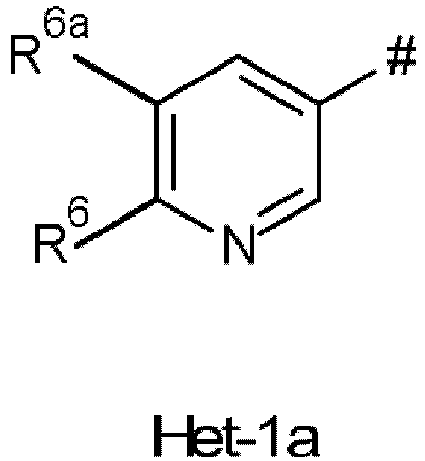 R6 aus Wasserstoff, C1-C4-Alkyl und C1-C4-Halogenalkyl ausgewählt ist undR6a für Wasserstoff oder Halogen, insbesondere Wasserstoff, steht.
 - Verbindung nach einem der vorhergehenden Ansprüche, wobei sowohl R1 als auch R2 für Wasserstoff stehen.
- Verbindung nach einem der vorhergehenden Ansprüche, wobeiR3 aus der Gruppe bestehend aus Wasserstoff, NO2, CN, C1-C6-Alkyl, C1-C4-Halogenalkyl, C3-C6-Cycloalkyl, C3-C6-Halogencycloalkyl, C2-C6-Alkinyl, das unsubstituiert oder teilweise oder vollständig halogeniert ist oder einen Rest R7d trägt;
OR8, NR9aR9b, C(=O)OR8, C(=O)NR9aR9b, C(=NOR21)OR8, C(NOR21)NR9aR9b, C(=S)NR9aR9b, C(=O)R7a, C(=S)R7a und C(=NOR22)R7a ausgewählt ist, wobeiR7a aus der Gruppe bestehend aus Wasserstoff, C1-C6-Alkyl, C3-C6-Cycloalkyl, C3-C6-Cycloalkylmethyl, Phenyl, Pyridyl, Pyridylmethyl und Benzyl, wobei die letzten fünf genannten Gruppen unsubstituiert oder teilweise oder vollständig halogeniert sein können, C1-C6-Alkyl, das durch 1 oder 2 Reste, die aus der Gruppe bestehend aus Phenyl, Pyridyl, OR16, S(O)nR16, S(O)nNR17aR17b, NR17aR17b, C(=O)NR17aR17b und C(=O)OR16 ausgewählt sind, substituiert ist, ausgewählt ist,R7d aus der Gruppe bestehend aus C3-C6-Cycloalkyl, Trimethylsilyl, Phenyl und Pyridyl ausgewählt ist, wobei die letzten drei genannten Gruppen unsubstituiert oder teilweise oder vollständig halogeniert sein können,R8 aus der Gruppe bestehend aus C1-C6-Alkyl, C3-C6-Cycloalkyl, C3-C6-Cycloalkylmethyl, wobei die letzten drei genannten Gruppen unsubstituiert oder teilweise oder vollständig halogeniert sein können, C1-C4-Alkyl, das durch 1 oder 2 Reste, die aus der Gruppe bestehend aus Cyano, Nitro, OR16, NR17aR17b, C(=O)R15, C(=O)OR16, C(=O)NR17aR17b, C(=S)NR17aR17b, Phenyl und Pyridyl ausgewählt sind, substituiert ist, wobei die letzten beiden Reste unsubstituiert sind oder 1, 2, 3 oder 4 aus Halogen ausgewählte Reste tragen, ausgewählt ist,R9a, R9b aus der Gruppe bestehend aus Wasserstoff, C1-C6-Alkyl, C1-C6-Halogenalkyl, C3-C6-Cycloalkyl, C3-C6-Halogencycloalkyl, C3-C6-Cycloalkylmethyl, Phenyl und Benzyl ausgewählt ist, wobei die letzten zwei genannten Gruppen unsubstituiert oder teilweise oder vollständig halogeniert sein können, eine der Variablen R9a, R9b auch für C1-C6-Alkoxy, C3-C6-Cycloalkoxy oder C3-C6-Cycloalkylmethoxy stehen kann oder R9a zusammen mit R9b eine C4-C6-Alkylenkette bildet und zusammen mit dem Stickstoffatom, an das sie gebunden sind, einen 5-, 6- oder 7-gliedrigen gesättigten Ring bilden, wobei die Alkylenkette ein oder zwei Heteroatome enthalten kann, die unabhängig voneinander aus Sauerstoff, Schwefel oder Stickstoff ausgewählt sind, und wobei die Alkylenkette gegebenenfalls durch 1, 2, 3 oder 4 Reste, die aus Halogen und C1-C4-Alkyl ausgewählt sind, substituiert sein kann;R15 aus der Gruppe bestehend aus Wasserstoff, C1-C6-Alkyl, C3-C6-Cycloalkyl, C3-C6-Cycloalkylmethyl, Phenyl, Pyridyl, Pyridylmethyl und Benzyl ausgewählt ist, wobei die letzten fünf genannten Gruppen unsubstituiert oder teilweise oder vollständig halogeniert sein können,R16 aus der Gruppe bestehend aus C1-C6-Alkyl, C3-C6-Cycloalkyl, C3-C6-Cycloalkylmethyl und Benzyl ausgewählt ist, wobei die letzten vier genannten Gruppen unsubstituiert oder teilweise oder vollständig halogeniert sein können,R17 aus der Gruppe bestehend aus C1-C6-Alkyl, C3-C6-Cycloalkyl, C3-C6-Cycloalkylmethyl, Phenyl und Benzyl ausgewählt ist, wobei die letzten fünf genannten Gruppen unsubstituiert oder teilweise oder vollständig halogeniert sein können,R17a, R17b aus der Gruppe bestehend aus Wasserstoff, C1-C6-Alkyl, C3-C6-Cycloalkyl, C3-C6-Cycloalkylmethyl, Phenyl und Benzyl ausgewählt ist, wobei die letzten fünf genannten Gruppen unsubstituiert oder teilweise oder vollständig halogeniert sein können, oder R17a zusammen mit R17b eine C4-C6-Alkylenkette bildet und zusammen mit dem Stickstoffatom, an das sie gebunden sind, einen 5-, 6- oder 7-gliedrigen gesättigten Ring bilden, wobei die Alkylenkette ein oder zwei Heteroatome enthalten kann, die unabhängig voneinander aus Sauerstoff, Schwefel oder Stickstoff ausgewählt sind, und wobei die Alkylenkette gegebenenfalls durch 1, 2, 3 oder 4 Reste, die aus Halogen und C1-C4-Alkyl ausgewählt sind, substituiert sein kann;R21 aus der Gruppe bestehend aus C1-C6-Alkyl, C3-C6-Cycloalkyl, C3-C6-Cycloalkylmethyl, Phenyl und Benzyl ausgewählt ist, wobei die letzten fünf genannten Gruppen unsubstituiert oder teilweise oder vollständig halogeniert sein können,R22 aus der Gruppe bestehend aus C1-C6-Alkyl, C3-C6-Cycloalkyl und C3-C6-Cycloalkylmethyl, wobei die letzten drei genannten Gruppen unsubstituiert oder teilweise oder vollständig halogeniert sein können,
C1-C6-Alkyl, das durch 1 oder 2 Reste, die aus Phenyl, Pyridyl, OR8, S(O)nR8, S(O)nNR17aR17b, NR17aR17b, C(=O)NR17aR17b und C(=O)OR8 ausgewählt sind, substituiert ist,
Phenyl und Pyridyl, wobei Phenyl und Pyridyl unsubstituiert oder teilweise oder vollständig halogeniert sein können und/oder 1, 2 oder 3 Substituenten, die aus Halogen, C1-C6-Alkyl, C1-C6-Halogenalkyl, C1-C6-Alkoxy, C1-C6-Halogenalkoxy und (C1-C6-Alkoxy)carbonyl ausgewählt sind, tragen können,
ausgewählt ist. - Verbindung nach Anspruch 5, wobeiR3 für Wasserstoff steht oderR3 aus der Gruppe bestehend aus NO2, CN, C(=O)R7a, C(=O)OR8, C(=O)NR9aR9b und C(=NOR22)R7a ausgewählt ist oderR3 aus der Gruppe bestehend aus C1-C6-Alkyl, C1-C4-Halogenalkyl, C3-C6-Cycloalkyl, C3-C6-Halogencycloalkyl und
Ethinyl, das unsubstituiert ist oder einen Rest, der aus C1-C4-Alkyl, C1-C2-Halogenalkyl, Phenyl, C3-C6-Cycloalkyl und Trimethylsilyl ausgewählt ist, trägt, ausgewählt ist. - Verbindung nach Anspruch 5, wobeiR3 aus der Gruppe bestehend aus Wasserstoff, Methyl, Trifluormethyl und CN ausgewählt ist.
- Verbindungen nach einem der vorhergehenden Ansprüche, wobei Y für O oder S steht undR4 aus der Gruppe bestehend aus
Wasserstoff, C1-C6-Alkyl, das unsubstituiert oder teilweise oder vollständig halogeniert ist oder durch einen Rest, der aus CN, C3-C6-Cycloalkyl, OR8, S(O)nR8, S(O)nNR17aR17b, NR17aR17b, C(=O)NR17aR17b, C(=S)NR17aR17b, C(=O)OR8, C(=O)R15, C(=S)R15, C(=NR17)R15, NR17a-C(=S)R7a, NR17a-C(=O)OR8 und NR17a-C(=O)NR17aR17b ausgewählt ist, substituiert ist, und einem 3-, 4-, 5-, 6- oder 7-gliedrigen gesättigten heterocyclischen Ring mit 1, 2 oder 3 Heteroatomen als Ringglieder, die aus Sauerstoff, Stickstoff und/oder Schwefel ausgewählt sind, wobeiR7a aus der Gruppe bestehend aus C1-C6-Alkyl, C3-C6-Cycloalkyl, C3-C6-Cycloalkylmethyl, Phenyl und Benzyl ausgewählt ist, wobei die letzten fünf genannten Gruppen unsubstituiert oder teilweise oder vollständig halogeniert sein können,R8 aus der Gruppe bestehend aus C1-C6-Alkyl, C3-C6-Cycloalkyl, C3-C6-Cycloalkylmethyl und Benzyl ausgewählt ist, wobei die letzten vier genannten Gruppen unsubstituiert oder teilweise oder vollständig halogeniert sein können,R15 aus der Gruppe bestehend aus C1-C6-Alkyl, C3-C6-Cycloalkyl, C3-C6-Cycloalkylmethyl, Phenyl und Benzyl ausgewählt ist, wobei die letzten fünf genannten Gruppen unsubstituiert oder teilweise oder vollständig halogeniert sein können,R17 aus der Gruppe bestehend aus C1-C6-Alkyl, C3-C6-Cycloalkyl, C3-C6-Cycloalkylmethyl, Phenyl und Benzyl ausgewählt ist, wobei die letzten fünf genannten Gruppen unsubstituiert oder teilweise oder vollständig halogeniert sein können,R17a, R17b aus der Gruppe bestehend aus Wasserstoff, C1-C6-Alkyl, C3-C6-Cycloalkyl, C3-C6-Cycloalkylmethyl, Phenyl und Benzyl ausgewählt ist, wobei die letzten fünf genannten Gruppen unsubstituiert oder teilweise oder vollständig halogeniert sein können, oder R17a zusammen mit R17b eine C4-C6-Alkylenkette bildet und zusammen mit dem Stickstoffatom, an das sie gebunden sind, einen 5-, 6- oder 7-gliedrigen gesättigten Ring bilden, wobei die Alkylenkette ein oder zwei Heteroatome enthalten kann, die unabhängig voneinander aus Sauerstoff, Schwefel oder Stickstoff ausgewählt sind, und wobei die Alkylenkette gegebenenfalls durch 1, 2, 3 oder 4 Reste, die aus Halogen und C1-C4-Alkyl ausgewählt sind, substituiert sein kann;wobei R10 unabhängig von seinem Auftreten aus Wasserstoff, CN, C1-C4-Alkyl, C1-C4-Alkylcarbonyl, C1-C4-Halogenalkyl, C1-C4-Alkoxy und C1-C4-Halogenalkoxy ausgewählt ist.
C2-C10-Alkenyl, C2-C6-Halogenalkenyl, C2-C10-Alkinyl, C2-C6-Halogenalkinyl,
C3-C6-Cycloalkyl, das unsubstituiert oder teilweise oder vollständig halogeniert ist und/oder 1, 2, 3, 4, 5 oder 6 C1-C4-Alkylgruppen trägt,
den Gruppierungen Q-Phenyl, Q'-S-Phenyl und Q'-O-Phenyl, wobei der Phenylring gegebenenfalls durch einen oder mehrere, z. B. 1, 2, 3, 4 oder 5, gleiche oder verschiedene Substituenten R10 substituiert ist,
und den Gruppierungen Q-Het# und Q'-O-Het#, wobeiHet# für einen 5- oder 6-gliedrigen gesättigten, teilweise ungesättigten oder ungesättigten aromatischen heterocyclischen Ring mit 1, 2 oder 3 Heteroatomen als Ringgliedern, die aus Sauerstoff, Stickstoff und/oder Schwefel ausgewählt sind, steht, wobei der heterocyclische Ring gegebenenfalls durch 1, 2, 3 oder 4 gleiche oder verschiedene Substituenten R10 substituiert ist und wobei das bzw. die Stickstoff- und/oder Schwefelatom(e) des heterocyclischen Rings gegebenenfalls oxidiert sein kann bzw. können,Q unabhängig von seinem Auftreten für eine Einfachbindung, C1-C4-Alkandiyl oder C3-C4-Alkendiyl steht,Q' unabhängig von seinem Auftreten für C1-C4-Alkandiyl oder C3-C4-Alkendiyl steht;ausgewählt ist
oderR3 und R4 zusammen auch für einen zweiwertigen Rest stehen können, der aus der Gruppe bestehend aus Q"-C1-C4-Alkandiyl und Q"-C2-C4-Alkendiyl ausgewählt ist, wobei die Kohlenstoffatome in den vier oben genannten Resten unsubstituiert sind oder 1, 2, 3 oder 4 Reste R7c tragen können und wobei Q" aus O und S ausgewählt ist und an das Kohlenstoffatom, das R3 trägt, gebunden ist, - Verbindung nach Anspruch 8, wobei Y für O steht,R3 aus der Gruppe bestehend aus Wasserstoff, Methyl, Trifluormethyl und CN ausgewählt ist undR4 aus der Gruppe bestehend aus C1-C6-Alkyl, C1-C6-Halogenalkyl, C2-C6-Alkenyl und C2-C6-Halogenalkenyl ausgewählt ist.
- Verbindungen nach einem der Ansprüche 1 bis 6, wobeiY für N-R5 steht;R4 aus der Gruppe bestehend aus
Wasserstoff, C1-C6-Alkyl, das unsubstituiert oder teilweise oder vollständig halogeniert ist oder durch einen Rest, der aus CN, C3-C6-Cycloalkyl, OR8, S(O)nR8, S(O)nNR17aR17b, NR17aR17b, C(=O)NR17aR17b, C(=S)NR17aR17b, C(=O)OR8, C(=O)R15, C(=S)R15, C(=NR17)R15, NR17a-C(=O)R7a, NR17a-C(=S)R7a, NR17a-C(=O)OR8, NR17a-C(=O)NR17aR17b ausgewählt ist, substituiert ist, und einem 3-, 4-, 5-, 6- oder 7-gliedrigen gesättigten heterocyclischen Ring mit 1, 2 oder 3 Heteroatomen als Ringglieder, die aus Sauerstoff, Stickstoff und/oder Schwefel ausgewählt sind, wobeiR7a aus der Gruppe bestehend aus C1-C6-Alkyl, C3-C6-Cycloalkyl, C3-C6-Cycloalkylmethyl, Phenyl und Benzyl ausgewählt ist, wobei die letzten fünf genannten Gruppen unsubstituiert oder teilweise oder vollständig halogeniert sein können,R8 aus der Gruppe bestehend aus C1-C6-Alkyl, C3-C6-Cycloalkyl, C3-C6-Cycloalkylmethyl und Benzyl ausgewählt ist, wobei die letzten vier genannten Gruppen unsubstituiert oder teilweise oder vollständig halogeniert sein können,R15 aus der Gruppe bestehend aus C1-C6-Alkyl, C3-C6-Cycloalkyl, C3-C6-Cycloalkylmethyl, Phenyl und Benzyl ausgewählt ist, wobei die letzten fünf genannten Gruppen unsubstituiert oder teilweise oder vollständig halogeniert sein können,R17 aus der Gruppe bestehend aus C1-C6-Alkyl, C3-C6-Cycloalkyl, C3-C6-Cycloalkylmethyl, Phenyl und Benzyl ausgewählt ist, wobei die letzten fünf genannten Gruppen unsubstituiert oder teilweise oder vollständig halogeniert sein können,R17a, R17b aus der Gruppe bestehend aus Wasserstoff, C1-C6-Alkyl, C3-C6-Cycloalkyl, C3-C6-Cycloalkylmethyl, Phenyl und Benzyl ausgewählt ist, wobei die letzten fünf genannten Gruppen unsubstituiert oder teilweise oder vollständig halogeniert sein können, oder R17a zusammen mit R17b eine C4-C6-Alkylenkette bildet und zusammen mit dem Stickstoffatom, an das sie gebunden sind, einen 5-, 6- oder 7-gliedrigen gesättigten Ring bilden, wobei die Alkylenkette ein oder zwei Heteroatome enthalten kann, die unabhängig voneinander aus Sauerstoff, Schwefel oder Stickstoff ausgewählt sind, und wobei die Alkylenkette gegebenenfalls durch 1, 2, 3 oder 4 Reste, die aus Halogen und C1-C4-Alkyl ausgewählt sind, substituiert sein kann;
C2-C6-Alkenyl, C2-C6-Halogenalkenyl, C2-C6-Alkinyl, C2-C6-Halogenalkinyl,
C3-C6-Cycloalkyl, das unsubstituiert oder teilweise oder vollständig halogeniert ist und/oder 1, 2, 3, 4, 5 oder 6 C1-C4-Alkylgruppen trägt,
C(=O)OR18, C(=O)NR19aR19b, C(=S)NR19aR19b, C(=O)R20 oder C(=S)R20, wobeiR18 aus der Gruppe bestehend aus C1-C6-Alkyl, C3-C6-Cycloalkyl, C3-C6-Cycloalkylmethyl und Benzyl ausgewählt ist, wobei die letzten vier genannten Gruppen unsubstituiert oder teilweise oder vollständig halogeniert sind,R19a, R19b aus der Gruppe bestehend aus Wasserstoff, C1-C6-Alkyl, C3-C6-Cycloalkyl, C3-C6-Cycloalkylmethyl, Phenyl und Benzyl ausgewählt ist, wobei die letzten fünf genannten Gruppen unsubstituiert oder teilweise oder vollständig halogeniert sind, oder R19a zusammen mit R19b eine C4-C6-Alkylenkette bildet und zusammen mit dem Stickstoffatom, an das sie gebunden sind, einen 5-, 6- oder 7-gliedrigen gesättigten Ring bilden, wobei die Alkylenkette ein oder zwei Heteroatome enthalten kann, die unabhängig voneinander aus Sauerstoff, Schwefel oder Stickstoff ausgewählt sind, und wobei die Alkylenkette gegebenenfalls durch 1, 2, 3 oder 4 Reste, die aus Halogen und C1-C4-Alkyl ausgewählt sind, substituiert sein kann;R20 aus der Gruppe bestehend aus C1-C6-Alkyl, C3-C6-Cycloalkyl, C3-C6-Cycloalkylmethyl, Phenyl und Benzyl ausgewählt ist, wobei die letzten fünf genannten Gruppen unsubstituiert oder teilweise oder vollständig halogeniert sein können,
den Gruppierungen Q-Phenyl und Q'-O-Phenyl, wobei der Phenylring gegebenenfalls durch einen oder mehrere, z. B. 1, 2, 3, 4 oder 5, gleiche oder verschiedene Substituenten R10 substituiert ist,
und den Gruppierungen Q-Het# und Q'-O-Het#, wobeiHet# für einen 5- oder 6-gliedrigen aromatischen heterocyclischen Ring mit 1, 2 oder 3 Heteroatomen als Ringgliedern, die aus Sauerstoff, Stickstoff und/oder Schwefel ausgewählt sind, steht, wobei der aromatische heterocyclische Ring gegebenenfalls durch 1, 2, 3 oder 4 gleiche oder verschiedene Substituenten R10 substituiert ist und wobei das bzw. die Stickstoff- und/oder Schwefelatom(e) des heterocyclischen Rings gegebenenfalls oxidiert sein kann bzw. können,Q unabhängig von seinem Auftreten für eine Einfachbindung, C1-C4-Alkandiyl oder C3-C4-Alkendiyl steht,Q' unabhängig von seinem Auftreten für C1-C4-Alkandiyl oder C3-C4-Alkendiyl steht;ausgewählt ist;R5 aus der Gruppe bestehend aus Wasserstoff, C1-C6-alkyl, C3-C8-Cycloalkyl, wobei jeder der zwei letztgenannten Reste unsubstituiert oder teilweise oder vollständig halogeniert sein kann,wobei R10 unabhängig von seinem Auftreten aus Wasserstoff, CN, C1-C4-Alkyl, C1-C4-Alkylcarbonyl, C1-C4-Halogenalkyl, C1-C4-Alkoxy und C1-C4-Halogenalkoxy ausgewählt ist.
Phenyl oder Benzyl, wobei der Phenylring in den letzten beiden genannten Resten unsubstituiert oder durch 1, 2, 3, 4 oder 5 gleiche oder verschiedene Substituenten R10 substituiert ist, ausgewählt ist, - Verbindungen nach einem der vorhergehenden Ansprüche, wobei die Gruppierung der Formel
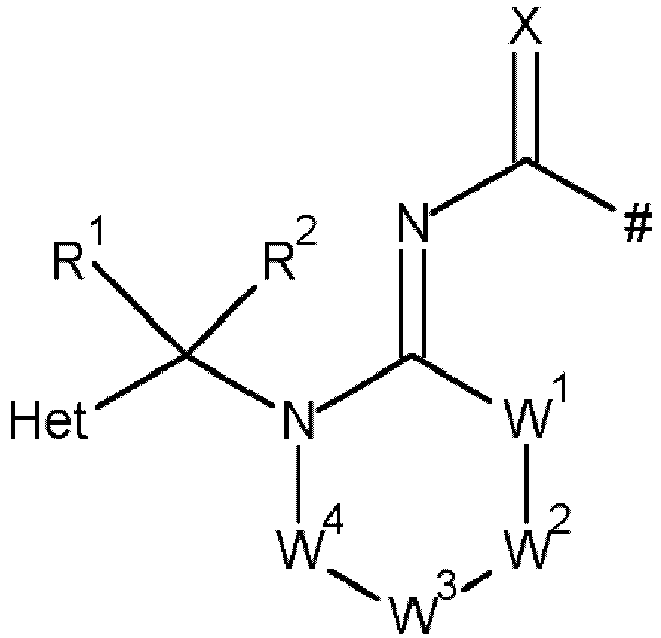


 Rw3, Rw4, Rw5 und Rw6 unabhängig voneinander aus Wasserstoff, Halogen, C1-C4-Alkoxy, C1-C4-Halogenalkoxy, C1-C4-Alkyl und C1-C4-Halogenalkyl ausgewählt sind.
 - Verbindung nach Anspruch 11, wobei der Rest A aus der Gruppe bestehend aus W.Het-2, W.Het-6 und
W.Het-10 ausgewählt ist und
wobei Rw5 für Wasserstoff steht. - Verbindung nach einem der Ansprüche 11 oder 12, wobei der Rest A aus der Gruppe bestehend aus W.Het-2, W.Het-6 und W.Het-10 ausgewählt ist und wobei Het aus der Gruppe bestehend aus Resten der Formeln Het-1, Het-11a und Het-24 ausgewählt ist:
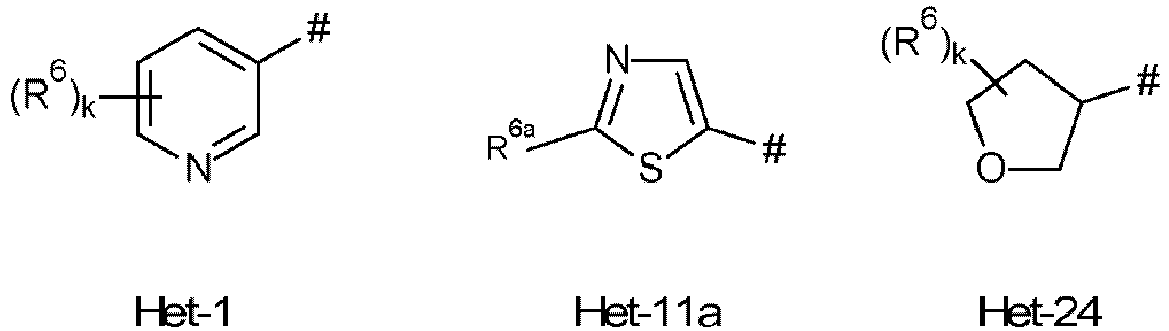 R6 aus Halogen, C1-C4-Alkyl, C1-C4-Alkoxy, C1-C4-Halogenalkoxy und C1-C4-Halogenalkyl ausgewählt ist;R6a aus Wasserstoff, Halogen, C1-C4-Alkyl, C1-C4-Alkoxy, C1-C4-Halogenalkoxy und C1-C4-Halogenalkyl ausgewählt ist undk für 0, 1 oder 2 steht.
 - Verbindung nach einem der Ansprüche 11 bis 13, wobei der Rest A für W.Het-2 steht, wobei Rw5 für Wasserstoff steht,Y für O steht,sowohl R1 als auch R2 für Wasserstoff stehen,R3 aus der Gruppe bestehend aus Wasserstoff, Methyl, Trifluormethyl und CN ausgewählt ist undR4 aus der Gruppe bestehend aus C1-C6-Alkyl, C1-C6-Halogenalkyl, C2-C6-Alkenyl und C2-C6-Halogenalkenyl ausgewählt ist,insbesondere
wobei Het, X, R3 und R4 wie in einer der Reihe 1 bis 64 der folgenden Tabelle definiert sind:# Het X R3 R4 1 6-Chlor-3-pyridyl O H CH3 2 6-Chlor-3-pyridyl S H CH3 3 6-Chlor-3-pyridyl O CH3 CH3 4 6-Chlor-3-pyridyl S CH3 CH3 5 6-Chlor-3-pyridyl O CF3 CH3 6 6-Chlor-3-pyridyl S CF3 CH3 7 6-Chlor-3-pyridyl O CN CH3 8 6-Chlor-3-pyridyl S CN CH3 9 6-Chlor-3-pyridyl O H CH2-CH=CH2 10 6-Chlor-3-pyridyl S H CH2-CH=CH2 11 6-Chlor-3-pyridyl O CH3 CH2-CH=CH2 12 6-Chlor-3-pyridyl S CH3 CH2-CH=CH2 13 6-Chlor-3-pyridyl O CF3 CH2-CH=CH2 14 6-Chlor-3-pyridyl S CF3 CH2-CH=CH2 15 6-Chlor-3-pyridyl O CN CH2-CH=CH2 16 6-Chlor-3-pyridyl S CN CH2-CH=CH2 17 6-Chlor-3-pyridyl O H CH2-CF=CH2 18 6-Chlor-3-pyridyl S H CH2-CF=CH2 19 6-Chlor-3-pyridyl O CH3 CH2-CF=CH2 20 6-Chlor-3-pyridyl S CH3 CH2-CF=CH2 21 6-Chlor-3-pyridyl O CF3 CH2-CF=CH2 22 6-Chlor-3-pyridyl S CF3 CH2-CF=CH2 23 6-Chlor-3-pyridyl O CN CH2-CF=CH2 24 6-Chlor-3-pyridyl S CN CH2-CF=CH2 25 6-Chlor-3-pyridyl O H CH2-C(CH3)=CH2 26 6-Chlor-3-pyridyl S H CH2-C(CH3)=CH2 27 6-Chlor-3-pyridyl O CH3 CH2-C(CH3)=CH2 28 6-Chlor-3-pyridyl S CH3 CH2-C(CH3)=CH2 29 6-Chlor-3-pyridyl O CF3 CH2-C(CH3)=CH2 30 6-Chlor-3-pyridyl S CF3 CH2-C(CH3)=CH2 31 6-Chlor-3-pyridyl O CN CH2-C(CH3)=CH2 32 6-Chlor-3-pyridyl S CN CH2-C(CH3)=CH2 33 6-Chlor-3-pyridyl O H CH2-CCl=CH2 34 6-Chlor-3-pyridyl S H CH2-CCl=CH2 35 6-Chlor-3-pyridyl O CH3 CH2-CCl=CH2 36 6-Chlor-3-pyridyl S CH3 CH2-CCl=CH2 37 6-Chlor-3-pyridyl O CF3 CH2-CCl=CH2 38 6-Chlor-3-pyridyl S CF3 CH2-CCl=CH2 39 6-Chlor-3-pyridyl O CN CH2-CCl=CH2 40 6-Chlor-3-pyridyl S CN CH2-CCl=CH2 41 6-Chlor-3-pyridyl O H CH2-CH=CH-CH3 42 6-Chlor-3-pyridyl S H CH2-CH=CH-CH3 43 6-Chlor-3-pyridyl O CH3 CH2-CH=CH-CH3 44 6-Chlor-3-pyridyl S CH3 CH2-CH=CH-CH3 45 6-Chlor-3-pyridyl O CF3 CH2-CH=CH-CH3 46 6-Chlor-3-pyridyl S CF3 CH2-CH=CH-CH3 47 6-Chlor-3-pyridyl O CN CH2-CH=CH-CH3 48 6-Chlor-3-pyridyl S CN CH2-CH=CH-CH3 49 6-Chlor-3-pyridyl O H CH2-CH=CH-Cl 50 6-Chlor-3-pyridyl S H CH2-CH=CH-Cl 51 6-Chlor-3-pyridyl O CH3 CH2-CH=CH-Cl 52 6-Chlor-3-pyridyl S CH3 CH2-CH=CH-Cl 53 6-Chlor-3-pyridyl O CF3 CH2-CH=CH-Cl 54 6-Chlor-3-pyridyl S CF3 CH2-CH=CH-Cl 55 6-Chlor-3-pyridyl O CN CH2-CH=CH-Cl 56 6-Chlor-3-pyridyl S CN CH2-CH=CH-Cl 57 6-Chlor-3-pyridyl O H CH2-CH=CH-Br 58 6-Chlor-3-pyridyl S H CH2-CH=CH-Br 59 6-Chlor-3-pyridyl O CH3 CH2-CH=CH-Br 60 6-Chlor-3-pyridyl S CH3 CH2-CH=CH-Br 61 6-Chlor-3-pyridyl O CF3 CH2-CH=CH-Br 62 6-Chlor-3-pyridyl S CF3 CH2-CH=CH-Br 63 6-Chlor-3-pyridyl O CN CH2-CH=CH-Br 64 6-Chlor-3-pyridyl S CN CH2-CH=CH-Br - Verbindung nach einem der vorhergehenden Ansprüche, wobeiX für O steht.
- Landwirtschaftliche oder tierärztliche Zusammensetzung für die Bekämpfung von tierischen Schädlingen, umfassend mindestens eine Verbindung gemäß einem der Ansprüche 1 bis 15 und mindestens einen inerten flüssigen und/oder festen unbedenklichen Träger und gegebenenfalls, falls gewünscht, mindestens ein Tensid.
- Verwendung einer Verbindung gemäß einem der Ansprüche 1 bis 15 zur Bekämpfung von wirbellosen Schädlingen, zum Schutz von wachsenden Pflanzen vor Befall oder Verseuchung durch wirbellose Schädlinge, zum Schutz von Pflanzenvermehrungsmaterial, insbesondere Samen, gegen Bodeninsekten oder zum Schutz der Keimlingswurzeln und Sprossen von Pflanzen gegen Boden- und Blattinsekten.
Priority Applications (1)
| Application Number | Priority Date | Filing Date | Title |
|---|---|---|---|
| PL14802420T PL3071560T3 (pl) | 2013-11-22 | 2014-11-21 | N-acyloiminowe związki heterocykliczne |
Applications Claiming Priority (5)
| Application Number | Priority Date | Filing Date | Title |
|---|---|---|---|
| US201361907408P | 2013-11-22 | 2013-11-22 | |
| US201361918683P | 2013-12-20 | 2013-12-20 | |
| US201462028360P | 2014-07-24 | 2014-07-24 | |
| US201462063965P | 2014-10-15 | 2014-10-15 | |
| PCT/EP2014/075256 WO2015075174A1 (en) | 2013-11-22 | 2014-11-21 | N-acylimino heterocyclic compounds |
Publications (2)
| Publication Number | Publication Date |
|---|---|
| EP3071560A1 EP3071560A1 (de) | 2016-09-28 |
| EP3071560B1 true EP3071560B1 (de) | 2018-01-10 |
Family
ID=51947364
Family Applications (1)
| Application Number | Title | Priority Date | Filing Date |
|---|---|---|---|
| EP14802420.1A Not-in-force EP3071560B1 (de) | 2013-11-22 | 2014-11-21 | Heterocyclische n-acylimino-verbindungen |
Country Status (14)
| Country | Link |
|---|---|
| US (1) | US9783523B2 (de) |
| EP (1) | EP3071560B1 (de) |
| JP (1) | JP6449283B2 (de) |
| KR (1) | KR20160079137A (de) |
| CN (1) | CN106414426A (de) |
| AU (1) | AU2014351870B2 (de) |
| CA (1) | CA2929062A1 (de) |
| EA (1) | EA201600403A1 (de) |
| ES (1) | ES2665430T3 (de) |
| IL (1) | IL245379A0 (de) |
| MX (1) | MX2016006685A (de) |
| PL (1) | PL3071560T3 (de) |
| UA (1) | UA117151C2 (de) |
| WO (1) | WO2015075174A1 (de) |
Families Citing this family (14)
| Publication number | Priority date | Publication date | Assignee | Title |
|---|---|---|---|---|
| US10479777B2 (en) | 2013-07-16 | 2019-11-19 | Basf Se | Herbicidal azines |
| US10206397B2 (en) * | 2013-09-19 | 2019-02-19 | Basf Se | N-acylimino heterocyclic compounds |
| KR102367876B1 (ko) | 2013-11-22 | 2022-02-24 | 사브레 테라퓨틱스 엘엘씨 | 오토탁신 억제제 화합물 |
| EP3071560B1 (de) | 2013-11-22 | 2018-01-10 | Basf Se | Heterocyclische n-acylimino-verbindungen |
| JP2017510588A (ja) * | 2014-03-27 | 2017-04-13 | ビーエーエスエフ ソシエタス・ヨーロピアBasf Se | 無脊椎有害生物を防除するためのn−アシルイミノ複素環式化合物 |
| EP3129360B1 (de) | 2014-04-11 | 2018-10-17 | Basf Se | Diaminotriazine-derivate als herbizide |
| US10941122B2 (en) | 2014-04-11 | 2021-03-09 | Basf Se | Diaminotriazine derivatives as herbicides |
| WO2015162166A1 (en) | 2014-04-23 | 2015-10-29 | Basf Se | Diaminotriazine compounds and their use as herbicides |
| EA036337B1 (ru) | 2015-05-27 | 2020-10-28 | Сабре Терапьютикс Ллс | Ингибиторы аутотаксина и их применения |
| US10440953B2 (en) | 2015-08-07 | 2019-10-15 | Basf Se | Control of pests in maize by ginkgolides and bilobalide |
| WO2017055386A1 (en) | 2015-10-02 | 2017-04-06 | Basf Se | Imino compounds with a 2-chloropyrimidin-5-yl substituent as pest-control agents |
| CN108697088A (zh) | 2016-02-19 | 2018-10-23 | 巴斯夫欧洲公司 | 包含邻氨基苯甲酰胺类化合物的农药活性混合物 |
| BR112018077104A2 (pt) | 2016-07-07 | 2019-04-02 | Basf Se | compostos, processo para a preparação de compostos de fórmula i, processo para a preparação de compostos de fórmula iv e uso de compostos da fórmula i |
| EP4351337A4 (de) * | 2021-06-09 | 2025-04-23 | Indian Council Of Agricultural Research | Zusammensetzungen zur auflösung von weighugwachs |
Family Cites Families (13)
| Publication number | Priority date | Publication date | Assignee | Title |
|---|---|---|---|---|
| JPH07121909B2 (ja) * | 1986-09-10 | 1995-12-25 | 日本バイエルアグロケム株式会社 | 新規複素環式化合物及び殺虫剤 |
| WO1992015564A1 (fr) | 1991-03-11 | 1992-09-17 | Nippon Soda Co., Ltd. | Nouveau compose heterocyclique |
| JPH0578323A (ja) * | 1991-03-11 | 1993-03-30 | Nippon Soda Co Ltd | 新規なヘテロ環化合物、その製造方法及び殺虫剤 |
| DE19937771A1 (de) * | 1999-08-10 | 2001-02-15 | Bayer Ag | Substituierte 2-Imino-thiazoline |
| PL2984930T3 (pl) * | 2010-08-31 | 2019-03-29 | Meiji Seika Pharma Co., Ltd. | Środek do zwalczania szkodników |
| CN112244015B (zh) * | 2012-02-29 | 2022-05-17 | 株式会社Mmag | 包括新型亚氨基吡啶衍生物的有害物防治组合物 |
| ES2626360T3 (es) | 2012-03-30 | 2017-07-24 | Basf Se | Compuestos de piridinilideno tiocarbonilo N-sustituidos y su uso para combatir plagas de animales |
| WO2013144223A1 (en) | 2012-03-30 | 2013-10-03 | Basf Se | N-substituted pyrimidinylidene compounds and derivatives for combating animal pests |
| WO2014170300A1 (en) | 2013-04-19 | 2014-10-23 | Basf Se | N-substituted acyl-imino-pyridine compounds and derivatives for combating animal pests |
| WO2015028630A1 (en) | 2013-08-30 | 2015-03-05 | Basf Se | N-substituted pyridylidene compounds and derivatives for combating animal pests |
| CN105593223A (zh) | 2013-09-19 | 2016-05-18 | 巴斯夫欧洲公司 | N-丙烯酰亚氨基杂环化合物 |
| US10206397B2 (en) | 2013-09-19 | 2019-02-19 | Basf Se | N-acylimino heterocyclic compounds |
| EP3071560B1 (de) | 2013-11-22 | 2018-01-10 | Basf Se | Heterocyclische n-acylimino-verbindungen |
-
2014
- 2014-11-21 EP EP14802420.1A patent/EP3071560B1/de not_active Not-in-force
- 2014-11-21 AU AU2014351870A patent/AU2014351870B2/en not_active Ceased
- 2014-11-21 US US15/038,272 patent/US9783523B2/en not_active Expired - Fee Related
- 2014-11-21 ES ES14802420.1T patent/ES2665430T3/es active Active
- 2014-11-21 PL PL14802420T patent/PL3071560T3/pl unknown
- 2014-11-21 UA UAA201606710A patent/UA117151C2/uk unknown
- 2014-11-21 JP JP2016533012A patent/JP6449283B2/ja not_active Expired - Fee Related
- 2014-11-21 WO PCT/EP2014/075256 patent/WO2015075174A1/en not_active Ceased
- 2014-11-21 MX MX2016006685A patent/MX2016006685A/es unknown
- 2014-11-21 KR KR1020167016731A patent/KR20160079137A/ko not_active Withdrawn
- 2014-11-21 CA CA2929062A patent/CA2929062A1/en not_active Abandoned
- 2014-11-21 EA EA201600403A patent/EA201600403A1/ru unknown
- 2014-11-21 CN CN201480073748.2A patent/CN106414426A/zh active Pending
-
2016
- 2016-05-02 IL IL245379A patent/IL245379A0/en unknown
Also Published As
| Publication number | Publication date |
|---|---|
| EA201600403A1 (ru) | 2016-10-31 |
| ES2665430T3 (es) | 2018-04-25 |
| JP6449283B2 (ja) | 2019-01-09 |
| CN106414426A (zh) | 2017-02-15 |
| EP3071560A1 (de) | 2016-09-28 |
| PL3071560T3 (pl) | 2018-07-31 |
| UA117151C2 (uk) | 2018-06-25 |
| JP2016539116A (ja) | 2016-12-15 |
| AU2014351870B2 (en) | 2018-07-05 |
| AU2014351870A1 (en) | 2016-06-09 |
| KR20160079137A (ko) | 2016-07-05 |
| US9783523B2 (en) | 2017-10-10 |
| MX2016006685A (es) | 2016-09-08 |
| WO2015075174A1 (en) | 2015-05-28 |
| CA2929062A1 (en) | 2015-05-28 |
| IL245379A0 (en) | 2016-06-30 |
| US20160297793A1 (en) | 2016-10-13 |
Similar Documents
| Publication | Publication Date | Title |
|---|---|---|
| US9783523B2 (en) | N-acylimino heterocyclic compounds | |
| WO2015165960A1 (en) | N-acylamidine compounds | |
| WO2015162244A1 (en) | N-acylamidine compounds | |
| US10757938B2 (en) | N-acylimino Heterocyclic Compounds | |
| EP3013820A1 (de) | Bicyclylensubstituierte isothiazolinverbindungen | |
| EP2986598B1 (de) | N-sustituierte acyl-imino-pyridin-verbindungen und deren derivate zur bekämpfung von tierischen schädlingen | |
| EP3122738B1 (de) | N-acylimino heterocyclische verbindungen zur kontrolle von wirbellosen schädlingen | |
| WO2015124606A1 (en) | N-substituted imino heterocyclic compounds for combating invertebrate pests | |
| WO2015086790A1 (en) | N-acylimino heterocyclic compounds and their use as pesticides | |
| WO2015124706A1 (en) | N-acylimino heterocyclic compounds for combating invertebrate pests | |
| EP3083581A1 (de) | N-substituierte heterocyclische iminoverbindungen | |
| US20160235069A1 (en) | N-acrylimino heterocyclic compounds |
Legal Events
| Date | Code | Title | Description |
|---|---|---|---|
| PUAI | Public reference made under article 153(3) epc to a published international application that has entered the european phase |
Free format text: ORIGINAL CODE: 0009012 |
|
| 17P | Request for examination filed |
Effective date: 20160622 |
|
| AK | Designated contracting states |
Kind code of ref document: A1 Designated state(s): AL AT BE BG CH CY CZ DE DK EE ES FI FR GB GR HR HU IE IS IT LI LT LU LV MC MK MT NL NO PL PT RO RS SE SI SK SM TR |
|
| AX | Request for extension of the european patent |
Extension state: BA ME |
|
| DAX | Request for extension of the european patent (deleted) | ||
| GRAP | Despatch of communication of intention to grant a patent |
Free format text: ORIGINAL CODE: EPIDOSNIGR1 |
|
| INTG | Intention to grant announced |
Effective date: 20170705 |
|
| RIN1 | Information on inventor provided before grant (corrected) |
Inventor name: VON DEYN, WOLFGANG Inventor name: GOCKEL, BIRGIT Inventor name: MCLAUGHLIN, MARTINJOHN Inventor name: KOERBER, KARSTEN Inventor name: POHLMAN, MATTHIAS Inventor name: DIETZ, JOCHEN Inventor name: BANDUR, NINA GERTRUD |
|
| GRAS | Grant fee paid |
Free format text: ORIGINAL CODE: EPIDOSNIGR3 |
|
| GRAA | (expected) grant |
Free format text: ORIGINAL CODE: 0009210 |
|
| AK | Designated contracting states |
Kind code of ref document: B1 Designated state(s): AL AT BE BG CH CY CZ DE DK EE ES FI FR GB GR HR HU IE IS IT LI LT LU LV MC MK MT NL NO PL PT RO RS SE SI SK SM TR |
|
| REG | Reference to a national code |
Ref country code: CH Ref legal event code: EP Ref country code: AT Ref legal event code: REF Ref document number: 962263 Country of ref document: AT Kind code of ref document: T Effective date: 20180115 |
|
| REG | Reference to a national code |
Ref country code: IE Ref legal event code: FG4D |
|
| REG | Reference to a national code |
Ref country code: DE Ref legal event code: R096 Ref document number: 602014019893 Country of ref document: DE |
|
| REG | Reference to a national code |
Ref country code: ES Ref legal event code: FG2A Ref document number: 2665430 Country of ref document: ES Kind code of ref document: T3 Effective date: 20180425 |
|
| REG | Reference to a national code |
Ref country code: NL Ref legal event code: MP Effective date: 20180110 |
|
| REG | Reference to a national code |
Ref country code: AT Ref legal event code: MK05 Ref document number: 962263 Country of ref document: AT Kind code of ref document: T Effective date: 20180110 |
|
| PG25 | Lapsed in a contracting state [announced via postgrant information from national office to epo] |
Ref country code: NL Free format text: LAPSE BECAUSE OF FAILURE TO SUBMIT A TRANSLATION OF THE DESCRIPTION OR TO PAY THE FEE WITHIN THE PRESCRIBED TIME-LIMIT Effective date: 20180110 |
|
| PG25 | Lapsed in a contracting state [announced via postgrant information from national office to epo] |
Ref country code: HR Free format text: LAPSE BECAUSE OF FAILURE TO SUBMIT A TRANSLATION OF THE DESCRIPTION OR TO PAY THE FEE WITHIN THE PRESCRIBED TIME-LIMIT Effective date: 20180110 Ref country code: LT Free format text: LAPSE BECAUSE OF FAILURE TO SUBMIT A TRANSLATION OF THE DESCRIPTION OR TO PAY THE FEE WITHIN THE PRESCRIBED TIME-LIMIT Effective date: 20180110 Ref country code: NO Free format text: LAPSE BECAUSE OF FAILURE TO SUBMIT A TRANSLATION OF THE DESCRIPTION OR TO PAY THE FEE WITHIN THE PRESCRIBED TIME-LIMIT Effective date: 20180410 Ref country code: FI Free format text: LAPSE BECAUSE OF FAILURE TO SUBMIT A TRANSLATION OF THE DESCRIPTION OR TO PAY THE FEE WITHIN THE PRESCRIBED TIME-LIMIT Effective date: 20180110 Ref country code: CY Free format text: LAPSE BECAUSE OF FAILURE TO SUBMIT A TRANSLATION OF THE DESCRIPTION OR TO PAY THE FEE WITHIN THE PRESCRIBED TIME-LIMIT Effective date: 20180110 |
|
| PG25 | Lapsed in a contracting state [announced via postgrant information from national office to epo] |
Ref country code: LV Free format text: LAPSE BECAUSE OF FAILURE TO SUBMIT A TRANSLATION OF THE DESCRIPTION OR TO PAY THE FEE WITHIN THE PRESCRIBED TIME-LIMIT Effective date: 20180110 Ref country code: SE Free format text: LAPSE BECAUSE OF FAILURE TO SUBMIT A TRANSLATION OF THE DESCRIPTION OR TO PAY THE FEE WITHIN THE PRESCRIBED TIME-LIMIT Effective date: 20180110 Ref country code: AT Free format text: LAPSE BECAUSE OF FAILURE TO SUBMIT A TRANSLATION OF THE DESCRIPTION OR TO PAY THE FEE WITHIN THE PRESCRIBED TIME-LIMIT Effective date: 20180110 Ref country code: RS Free format text: LAPSE BECAUSE OF FAILURE TO SUBMIT A TRANSLATION OF THE DESCRIPTION OR TO PAY THE FEE WITHIN THE PRESCRIBED TIME-LIMIT Effective date: 20180110 Ref country code: IS Free format text: LAPSE BECAUSE OF FAILURE TO SUBMIT A TRANSLATION OF THE DESCRIPTION OR TO PAY THE FEE WITHIN THE PRESCRIBED TIME-LIMIT Effective date: 20180510 Ref country code: BG Free format text: LAPSE BECAUSE OF FAILURE TO SUBMIT A TRANSLATION OF THE DESCRIPTION OR TO PAY THE FEE WITHIN THE PRESCRIBED TIME-LIMIT Effective date: 20180410 |
|
| REG | Reference to a national code |
Ref country code: GR Ref legal event code: EP Ref document number: 20180400964 Country of ref document: GR Effective date: 20180829 |
|
| REG | Reference to a national code |
Ref country code: DE Ref legal event code: R097 Ref document number: 602014019893 Country of ref document: DE |
|
| PG25 | Lapsed in a contracting state [announced via postgrant information from national office to epo] |
Ref country code: AL Free format text: LAPSE BECAUSE OF FAILURE TO SUBMIT A TRANSLATION OF THE DESCRIPTION OR TO PAY THE FEE WITHIN THE PRESCRIBED TIME-LIMIT Effective date: 20180110 Ref country code: EE Free format text: LAPSE BECAUSE OF FAILURE TO SUBMIT A TRANSLATION OF THE DESCRIPTION OR TO PAY THE FEE WITHIN THE PRESCRIBED TIME-LIMIT Effective date: 20180110 Ref country code: RO Free format text: LAPSE BECAUSE OF FAILURE TO SUBMIT A TRANSLATION OF THE DESCRIPTION OR TO PAY THE FEE WITHIN THE PRESCRIBED TIME-LIMIT Effective date: 20180110 |
|
| PLBE | No opposition filed within time limit |
Free format text: ORIGINAL CODE: 0009261 |
|
| STAA | Information on the status of an ep patent application or granted ep patent |
Free format text: STATUS: NO OPPOSITION FILED WITHIN TIME LIMIT |
|
| PG25 | Lapsed in a contracting state [announced via postgrant information from national office to epo] |
Ref country code: SK Free format text: LAPSE BECAUSE OF FAILURE TO SUBMIT A TRANSLATION OF THE DESCRIPTION OR TO PAY THE FEE WITHIN THE PRESCRIBED TIME-LIMIT Effective date: 20180110 Ref country code: CZ Free format text: LAPSE BECAUSE OF FAILURE TO SUBMIT A TRANSLATION OF THE DESCRIPTION OR TO PAY THE FEE WITHIN THE PRESCRIBED TIME-LIMIT Effective date: 20180110 Ref country code: DK Free format text: LAPSE BECAUSE OF FAILURE TO SUBMIT A TRANSLATION OF THE DESCRIPTION OR TO PAY THE FEE WITHIN THE PRESCRIBED TIME-LIMIT Effective date: 20180110 Ref country code: SM Free format text: LAPSE BECAUSE OF FAILURE TO SUBMIT A TRANSLATION OF THE DESCRIPTION OR TO PAY THE FEE WITHIN THE PRESCRIBED TIME-LIMIT Effective date: 20180110 |
|
| 26N | No opposition filed |
Effective date: 20181011 |
|
| PGFP | Annual fee paid to national office [announced via postgrant information from national office to epo] |
Ref country code: GR Payment date: 20181128 Year of fee payment: 5 Ref country code: PL Payment date: 20181030 Year of fee payment: 5 |
|
| PG25 | Lapsed in a contracting state [announced via postgrant information from national office to epo] |
Ref country code: SI Free format text: LAPSE BECAUSE OF FAILURE TO SUBMIT A TRANSLATION OF THE DESCRIPTION OR TO PAY THE FEE WITHIN THE PRESCRIBED TIME-LIMIT Effective date: 20180110 |
|
| PGFP | Annual fee paid to national office [announced via postgrant information from national office to epo] |
Ref country code: ES Payment date: 20181218 Year of fee payment: 5 Ref country code: FR Payment date: 20181127 Year of fee payment: 5 Ref country code: CH Payment date: 20181129 Year of fee payment: 5 Ref country code: TR Payment date: 20181101 Year of fee payment: 5 Ref country code: IT Payment date: 20181122 Year of fee payment: 5 Ref country code: GB Payment date: 20181130 Year of fee payment: 5 |
|
| PGFP | Annual fee paid to national office [announced via postgrant information from national office to epo] |
Ref country code: DE Payment date: 20190131 Year of fee payment: 5 |
|
| PG25 | Lapsed in a contracting state [announced via postgrant information from national office to epo] |
Ref country code: MC Free format text: LAPSE BECAUSE OF FAILURE TO SUBMIT A TRANSLATION OF THE DESCRIPTION OR TO PAY THE FEE WITHIN THE PRESCRIBED TIME-LIMIT Effective date: 20180110 Ref country code: LU Free format text: LAPSE BECAUSE OF NON-PAYMENT OF DUE FEES Effective date: 20181121 |
|
| REG | Reference to a national code |
Ref country code: BE Ref legal event code: MM Effective date: 20181130 |
|
| REG | Reference to a national code |
Ref country code: IE Ref legal event code: MM4A |
|
| PG25 | Lapsed in a contracting state [announced via postgrant information from national office to epo] |
Ref country code: IE Free format text: LAPSE BECAUSE OF NON-PAYMENT OF DUE FEES Effective date: 20181121 |
|
| PG25 | Lapsed in a contracting state [announced via postgrant information from national office to epo] |
Ref country code: BE Free format text: LAPSE BECAUSE OF NON-PAYMENT OF DUE FEES Effective date: 20181130 |
|
| PG25 | Lapsed in a contracting state [announced via postgrant information from national office to epo] |
Ref country code: MT Free format text: LAPSE BECAUSE OF NON-PAYMENT OF DUE FEES Effective date: 20181121 |
|
| PG25 | Lapsed in a contracting state [announced via postgrant information from national office to epo] |
Ref country code: PT Free format text: LAPSE BECAUSE OF FAILURE TO SUBMIT A TRANSLATION OF THE DESCRIPTION OR TO PAY THE FEE WITHIN THE PRESCRIBED TIME-LIMIT Effective date: 20180110 |
|
| REG | Reference to a national code |
Ref country code: DE Ref legal event code: R119 Ref document number: 602014019893 Country of ref document: DE |
|
| PG25 | Lapsed in a contracting state [announced via postgrant information from national office to epo] |
Ref country code: MK Free format text: LAPSE BECAUSE OF NON-PAYMENT OF DUE FEES Effective date: 20180110 Ref country code: HU Free format text: LAPSE BECAUSE OF FAILURE TO SUBMIT A TRANSLATION OF THE DESCRIPTION OR TO PAY THE FEE WITHIN THE PRESCRIBED TIME-LIMIT; INVALID AB INITIO Effective date: 20141121 |
|
| REG | Reference to a national code |
Ref country code: CH Ref legal event code: PL |
|
| PG25 | Lapsed in a contracting state [announced via postgrant information from national office to epo] |
Ref country code: CH Free format text: LAPSE BECAUSE OF NON-PAYMENT OF DUE FEES Effective date: 20191130 Ref country code: GR Free format text: LAPSE BECAUSE OF NON-PAYMENT OF DUE FEES Effective date: 20200609 Ref country code: LI Free format text: LAPSE BECAUSE OF NON-PAYMENT OF DUE FEES Effective date: 20191130 |
|
| GBPC | Gb: european patent ceased through non-payment of renewal fee |
Effective date: 20191121 |
|
| PG25 | Lapsed in a contracting state [announced via postgrant information from national office to epo] |
Ref country code: GB Free format text: LAPSE BECAUSE OF NON-PAYMENT OF DUE FEES Effective date: 20191121 Ref country code: DE Free format text: LAPSE BECAUSE OF NON-PAYMENT OF DUE FEES Effective date: 20200603 Ref country code: IT Free format text: LAPSE BECAUSE OF NON-PAYMENT OF DUE FEES Effective date: 20191121 Ref country code: FR Free format text: LAPSE BECAUSE OF NON-PAYMENT OF DUE FEES Effective date: 20191130 |
|
| REG | Reference to a national code |
Ref country code: ES Ref legal event code: FD2A Effective date: 20210527 |
|
| PG25 | Lapsed in a contracting state [announced via postgrant information from national office to epo] |
Ref country code: ES Free format text: LAPSE BECAUSE OF NON-PAYMENT OF DUE FEES Effective date: 20191122 |
|
| PG25 | Lapsed in a contracting state [announced via postgrant information from national office to epo] |
Ref country code: PL Free format text: LAPSE BECAUSE OF NON-PAYMENT OF DUE FEES Effective date: 20191121 |
|
| PG25 | Lapsed in a contracting state [announced via postgrant information from national office to epo] |
Ref country code: TR Free format text: LAPSE BECAUSE OF NON-PAYMENT OF DUE FEES Effective date: 20191121 |