EP3071946B1 - Procédé de détermination de cinétiques d'interaction avec dissociation rapide - Google Patents
Procédé de détermination de cinétiques d'interaction avec dissociation rapide Download PDFInfo
- Publication number
- EP3071946B1 EP3071946B1 EP14799136.8A EP14799136A EP3071946B1 EP 3071946 B1 EP3071946 B1 EP 3071946B1 EP 14799136 A EP14799136 A EP 14799136A EP 3071946 B1 EP3071946 B1 EP 3071946B1
- Authority
- EP
- European Patent Office
- Prior art keywords
- analyte
- dissociation
- fitting
- dissociation phase
- response data
- Prior art date
- Legal status (The legal status is an assumption and is not a legal conclusion. Google has not performed a legal analysis and makes no representation as to the accuracy of the status listed.)
- Active
Links
Images

Classifications
-
- G—PHYSICS
- G01—MEASURING; TESTING
- G01N—INVESTIGATING OR ANALYSING MATERIALS BY DETERMINING THEIR CHEMICAL OR PHYSICAL PROPERTIES
- G01N33/00—Investigating or analysing materials by specific methods not covered by groups G01N1/00 - G01N31/00
- G01N33/48—Biological material, e.g. blood, urine; Haemocytometers
- G01N33/50—Chemical analysis of biological material, e.g. blood, urine; Testing involving biospecific ligand binding methods; Immunological testing
- G01N33/53—Immunoassay; Biospecific binding assay; Materials therefor
- G01N33/543—Immunoassay; Biospecific binding assay; Materials therefor with an insoluble carrier for immobilising immunochemicals
- G01N33/54366—Apparatus specially adapted for solid-phase testing
- G01N33/54373—Apparatus specially adapted for solid-phase testing involving physiochemical end-point determination, e.g. wave-guides, FETS, gratings
-
- G—PHYSICS
- G01—MEASURING; TESTING
- G01N—INVESTIGATING OR ANALYSING MATERIALS BY DETERMINING THEIR CHEMICAL OR PHYSICAL PROPERTIES
- G01N21/00—Investigating or analysing materials by the use of optical means, i.e. using sub-millimetre waves, infrared, visible or ultraviolet light
- G01N21/17—Systems in which incident light is modified in accordance with the properties of the material investigated
- G01N21/25—Colour; Spectral properties, i.e. comparison of effect of material on the light at two or more different wavelengths or wavelength bands
- G01N21/27—Colour; Spectral properties, i.e. comparison of effect of material on the light at two or more different wavelengths or wavelength bands using photo-electric detection ; circuits for computing concentration
- G01N21/272—Colour; Spectral properties, i.e. comparison of effect of material on the light at two or more different wavelengths or wavelength bands using photo-electric detection ; circuits for computing concentration for following a reaction, e.g. for determining photometrically a reaction rate (photometric cinetic analysis)
-
- G—PHYSICS
- G01—MEASURING; TESTING
- G01N—INVESTIGATING OR ANALYSING MATERIALS BY DETERMINING THEIR CHEMICAL OR PHYSICAL PROPERTIES
- G01N21/00—Investigating or analysing materials by the use of optical means, i.e. using sub-millimetre waves, infrared, visible or ultraviolet light
- G01N21/17—Systems in which incident light is modified in accordance with the properties of the material investigated
- G01N21/55—Specular reflectivity
- G01N21/552—Attenuated total reflection
- G01N21/553—Attenuated total reflection and using surface plasmons
-
- G—PHYSICS
- G01—MEASURING; TESTING
- G01N—INVESTIGATING OR ANALYSING MATERIALS BY DETERMINING THEIR CHEMICAL OR PHYSICAL PROPERTIES
- G01N21/00—Investigating or analysing materials by the use of optical means, i.e. using sub-millimetre waves, infrared, visible or ultraviolet light
- G01N21/17—Systems in which incident light is modified in accordance with the properties of the material investigated
- G01N21/55—Specular reflectivity
- G01N21/552—Attenuated total reflection
- G01N21/553—Attenuated total reflection and using surface plasmons
- G01N21/554—Attenuated total reflection and using surface plasmons detecting the surface plasmon resonance of nanostructured metals, e.g. localised surface plasmon resonance
Definitions
- the present invention relates to a method for determining interaction kinetics for an analyte. More specifically, the invention relates to a method for automatically determining interaction kinetics, which includes first defining parts of the dissociation phase that contains kinetic information. The invention also relates to an analytical system and a computer program product for performing steps of the method.
- a variety of analytical techniques are used to characterize interactions between molecules, particularly in the context of assays directed to the detection and interaction of biomolecules.
- antibody-antigen interactions are of fundamental importance in many fields, including biology, immunology and pharmacology.
- many analytical techniques involve binding of a "ligand”, such as an antibody, to a solid support, followed by contacting the ligand with an "analyte", such as an antigen. Following contact of the ligand and analyte, some characteristic is measured which is indicative of the interaction, such as the ability of the ligand to bind the analyte. It is often desired that after measurement of the interaction, it should be possible to dissociate the ligand-analyte pair in order to "regenerate" free ligand, thereby enabling reuse of the ligand surface for a further analytical measurement.
- Analytical sensor systems that can monitor such molecular interactions in real time are gaining increasing interest. These systems are often based on optical biosensors and usually referred to as interaction analysis sensors or biospecific interaction analysis sensors.
- a representative biosensor system is the Biacore ® instrumentation sold by GE Healthcare Life Sciences, which uses surface plasmon resonance (SPR) for detecting interactions between molecules in a sample and molecular structures immobilized on a sensing surface.
- SPR surface plasmon resonance
- the method and algorithm automatically excludes from the fitting process the part of the dissociation phase that follows complete dissociation back to baseline. This method increases the success rate for fitting of rapid interaction kinetics and further facilitates big kinetic runs with many data sets.
- the invention is directed to a method for determining interaction kinetics for an analyte as defined in claim 1, to an analytical system as defined in claim 10, and to a computer program product as defined in claim 11.
- Biosensors include the above-mentioned Biacore ® system instruments, which are based on surface plasmon resonance (SPR) and permit monitoring of surface interactions in real time.
- SPR surface plasmon resonance
- SPR The phenomenon of SPR is well known. SPR arises when light is reflected under certain conditions at the interface between two media of different refractive indices, and the interface is coated by a metal film, typically silver or gold.
- the media are the sample and the glass of a sensor chip that is contacted with the sample by a microfluidic flow system.
- the metal film is a thin layer of gold on the chip surface.
- SPR causes a reduction in the intensity of the reflected light at a specific angle of reflection. This angle of minimum reflected light intensity varies with the refractive index close to the surface on the side opposite from the reflected light, in the Biacore ® system the sample side.
- the concentration, and therefore the refractive index at the surface changes and an SPR response is detected. Plotting the response against time during the course of an interaction will provide a quantitative measure of the progress of the interaction. Such a plot is usually called a sensorgram.
- the SPR response values are expressed in resonance units (RU).
- One RU represents a change of 0.00001° in the angle of minimum reflected light intensity, which for most proteins is roughly equivalent to a change in concentration of about 1 pg/mm 2 on the sensor surface.
- association As sample containing an analyte contacts the sensor surface, the capturing molecule (ligand) bound to the sensor surface interacts with the analyte in a step referred to as "association.” This step is indicated on the sensorgram by an increase in RU as the sample is initially brought into contact with the sensor surface. Conversely, “dissociation” normally occurs when sample flow is replaced by, for example, a buffer flow. This step is indicated on the sensorgram by a drop in RU over time as analyte dissociates from the surface-bound ligand.
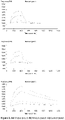
- FIG. 1 A representative set of sensorgrams (binding curves) for reversible interactions of six different analyte concentrations at the sensor chip surface is presented in Figure 1 , the sensing surface having an immobilized molecule (ligand), for example an antibody, interacting with analyte in a sample.
- the vertical axis (y-axis) indicates the response (here in resonance units, RU) and the horizontal axis (x-axis) indicates the time (here in seconds, s).
- ligand immobilized molecule
- x-axis indicates the time (here in seconds, s).
- the resonance signal plateaus.
- the sample is replaced with a continuous flow of buffer and a decrease in signal reflects the dissociation, or release, of analyte from the surface.
- This part of the binding curve is usually referred to as the "dissociation phase".
- the shape of the association/dissociation curve provides valuable information regarding the interaction kinetics, and the height of the resonance signal represents surface concentration (i.e., the response resulting from an interaction is related to the change in mass concentration on the surface).
- the simplest is the 1:1 binding model.
- Other models include, for example, 1:1 dissociation model, the bivalent analyte model, the heterogeneous analyte model, the heterogeneous ligand model, the two state reaction model and the 1:1 model with mass transfer. See, e.g., Biacore T200 Software Handbook 28-9768-78 Edition AA .
- the embodiments of the invention are suited for all the kinetic models.
- ⁇ is the concentration of bound analyte
- ⁇ max is the maximum binding capacity of the surface
- k ass is the association rate constant
- k diss is the dissociation rate constant
- C is the bulk analyte concentration
- curve fitting One method used for curve fitting relies on the Marquardt-Levenberg algorithm, which optimizes parameter values by minimizing the sum of the squared residuals.
- n ⁇ p ⁇ n and chi-square reduces to the average squared residual per data point.
- chi-square represents the mean square of the signal noise (since this is the only deviation from the fitted curve).
- an algorithm is added to define a part of the dissociation phase that contains kinetic information excluding the part of the dissociation phase that follows complete dissociation back to a baseline.
- the standard algorithm for fitting would use the entire dissociation phase for fitting (e.g., 400 - 1400 s).
- drifts, disturbances and single deviating curves etc. will also be taken into account.
- the method streamlines and makes kinetic evaluation of kinetic data simpler and enhances kinetic evaluation of big runs containing many kinetic data sets.
- Techniques for detecting binding interactions at the solid support surface may rely on a label, such as a radiolabel, a chromophore, a fluorophore, a marker for scattering light, an electrochemically active marker (e.g., field effect transistor based potentiometry), an electric field active marker (electro-stimulated emission), a magnetically active marker, a thermoactive marker, a chemiluminescent moiety or a transition metal, as well as so-called label free detection systems.
- a label such as a radiolabel, a chromophore, a fluorophore, a marker for scattering light, an electrochemically active marker (e.g., field effect transistor based potentiometry), an electric field active marker (electro-stimulated emission), a magnetically active marker, a thermoactive marker, a chemiluminescent moiety or a transition metal, as well as so-called label free detection systems.
- a biosensor is broadly defined as a device that uses a component for molecular recognition (for example a layer with immobilized antibodies) in either direct conjunction with a solid state physicochemical transducer, or with a mobile carrier bead/particle being in conjunction with the transducer. While such sensors are typically based on label free techniques, detecting, e.g., a change in mass, refractive index, or thickness for the immobilized layer, there are also sensors relying on some kind of labelling.
- a component for molecular recognition for example a layer with immobilized antibodies
- Typical sensor detection techniques include, but are not limited to, mass detection methods, such as optical, thermo-optical and piezoelectric or acoustic wave (including, e.g., surface acoustic wave (SAW) and quartz crystal microbalance (QCM)) methods, and electrochemical methods, such as potentiometric, conductometric, amperometric and capacitance/impedance methods.
- mass detection methods such as optical, thermo-optical and piezoelectric or acoustic wave (including, e.g., surface acoustic wave (SAW) and quartz crystal microbalance (QCM)) methods
- electrochemical methods such as potentiometric, conductometric, amperometric and capacitance/impedance methods.
- representative methods include those that detect mass surface concentration, such as reflection-optical methods, including both external and internal reflection methods, which may be angle, wavelength, polarization, or phase resolved, for example evanescent wave ellipsometry and evanescent wave spectroscopy (EWS, or Internal Reflection Spectroscopy), both of which may include evanescent field enhancement via surface plasmon resonance (SPR), Brewster angle refractometry, critical angle refractometry, frustrated total reflection (FTR), scattered total internal reflection (STIR) which may include scatter enhancing labels, optical wave guide sensors; external reflection imaging, evanescent wave-based imaging such as critical angle resolved imaging, Brewster angle resolved imaging, SPR angle resolved imaging, and the like.
- photometric and imaging/microscopy methods “per se” or combined with reflection methods, based on for example surface enhanced Raman spectroscopy (SERS), surface enhanced resonance Raman spectroscopy (SERRS), evanescent wave fluorescence (TIRF) and phosphorescence may be mentioned, as well as waveguide interferometers, waveguide leaky mode spectroscopy, reflective interference spectroscopy (RIfS), transmission interferometry, holographic spectroscopy, and atomic force microscopy (AFR).
- SERS surface enhanced Raman spectroscopy
- SERRS surface enhanced resonance Raman spectroscopy
- TIRF evanescent wave fluorescence
- phosphorescence phosphorescence
- waveguide interferometers waveguide leaky mode spectroscopy
- RfS reflective interference spectroscopy
- transmission interferometry holographic spectroscopy
- AFR atomic force microscopy
- solid support as used herein is to be interpreted broadly and is meant to comprise any solid (flexible or rigid) substrate onto which one or more binding agents can be immobilized and molecular interactions therewith be detected by the particular detection system chosen.
- the substrate may be biological, non-biological, organic, inorganic or a combination thereof, and may be in the form of particles, strands, precipitates, gels, sheets, tubings, spheres, containers, capillaries, pads, slices, films, plates, slides, etc, having any convenient shape, including disc, sphere, circle, etc.
- the substrate surface may have any two-dimensional configuration and may include, for example steps, ridges, kinks, terraces and the like and may be the surface of a layer of material different from that of the rest of the substrate.
Landscapes
- Health & Medical Sciences (AREA)
- Immunology (AREA)
- Life Sciences & Earth Sciences (AREA)
- Chemical & Material Sciences (AREA)
- Physics & Mathematics (AREA)
- Engineering & Computer Science (AREA)
- Analytical Chemistry (AREA)
- Biochemistry (AREA)
- General Health & Medical Sciences (AREA)
- General Physics & Mathematics (AREA)
- Pathology (AREA)
- Biomedical Technology (AREA)
- Urology & Nephrology (AREA)
- Molecular Biology (AREA)
- Hematology (AREA)
- Chemical Kinetics & Catalysis (AREA)
- Spectroscopy & Molecular Physics (AREA)
- Biotechnology (AREA)
- Cell Biology (AREA)
- Theoretical Computer Science (AREA)
- Microbiology (AREA)
- Mathematical Physics (AREA)
- Food Science & Technology (AREA)
- Medicinal Chemistry (AREA)
- Nanotechnology (AREA)
- Investigating Or Analysing Materials By Optical Means (AREA)
Claims (11)
- Procédé pour déterminer la cinétique d'interaction pour une substance à analyser, comprenanta) pendant une phase d'association la mise en contact d'une solution échantillon contenant ladite substance à analyser avec un ligand immobilisé, ou un analogue de celui-ci, immobilisé sur une surface de détection d'un capteur optique ;b) pendant une phase de dissociation le remplacement de la solution échantillon par un tampon ;c) le contrôle de la liaison de ladite substance à analyser dans ladite solution échantillon au ligand immobilisé ou analogue pour fournir des données de réponse pour ladite cinétique d'interaction, dans laquelle la liaison est mesurée comme un changement résultant d'une propriété de ladite surface indicatif d'au moins la phase d'association et la phase de dissociation entre le ligand ou son analogue et la substance à analyser ; etd) la détermination automatique de ladite cinétique d'interaction, caractérisée en ce que l'étape de détermination inclut l'utilisation des données de réponse provenant dudit changement d'une propriété pour d'abord définir une partie des données de réponse qui représente une phase de dissociation et qui contient des informations cinétiques pour ajuster des constantes de taux d'association et de taux de dissociation pour une interaction moléculaire en utilisant un modèle de liaison excluant des données de réponse qui représentent la partie de la phase de dissociation qui suit une dissociation complète en retour vers une ligne des bases.
- Procédé selon la revendication 1, dans lequel ledit ligand, ou son analogue, est immobilisé sur une série de surfaces de détection, et la substance à analyser est mise en contact avec chacune des surfaces de détection en parallèle.
- Procédé selon la revendication 1 ou la revendication 2, dans lequel ladite surface de détection fait partie d'un détecteur basé sur la détection d'onde évanescente.
- Procédé selon la revendication 3, dans lequel ladite détection d'onde évanescente est basée sur la résonance plasmonique de surface.
- Procédé selon la revendication 4, dans lequel la définition de la partie des données de réponse qui représente la phase de dissociation et qui contient des informations cinétiques pour l'ajustement est effectuée par l'exclusion de données de réponse inférieures à :
 où R est la réponse dans RU au-dessous de laquelle les données de phase de dissociation sont exclues de l'ajustementYhigh est la réponse la plus haute par rapport à la ligne des bases pendant la phase de dissociation sur une courbe de phase de dissociationx est un nombre arbitraire fixé par l'utilisateur ou codé dans le logiciel de programme.
 - Procédé selon la revendication 5, dans lequel x vaut 20.
- Procédé selon la revendication 4,
dans lequel la définition de la partie des données de réponse qui représente la phase de dissociation et qui contient des informations cinétiques pour l'ajustement est effectuée par l'exclusion de données de réponse inférieures à la ligne des bases R = 0, où R est la réponse dans RU au-dessous de laquelle les données de phase de dissociation sont exclues de l'ajustement. - Procédé selon la revendication 4,
dans lequel la définition de la partie des données de réponse qui représente la phase de dissociation et qui contient des informations cinétiques pour l'ajustement est effectuée par l'exclusion de données de réponse inférieures à R = x, dans lequel R est la réponse dans RU au-dessous de laquelle les données de phase de dissociation sont exclues de l'ajustement et x est un nombre arbitraire fixé par l'utilisateur ou codé dans le logiciel de programme. - Procédé selon l'une quelconque des revendications précédentes, dans lequel ladite étape de détermination inclut en outre l'ajustement de dérives, de perturbations ou de courbes de déviation simples.
- Système analytique pour étudier des interactions moléculaires, lequel système comprend :un moyen pour mettre en contact une solution échantillon contenant une substance à analyser avec un ligand immobilisé, ou un analogue de celui-ci, immobilisé sur une surface de détection d'une surface de capteur optique ;un moyen pour contrôler la liaison de ladite substance à analyser dans ladite solution échantillon du ligand ou analogue immobilisé, dans lequel la liaison est mesurée comme un changement résultant d'une propriété de ladite surface de détection indicatif d'au moins une phase de dissociation entre le ligand ou son analogue et la substance à analyser ; etun moyen de traitement informatique incluant un moyen formant code de programme pour amener le système analytique exécuter les étapes du procédé selon l'une quelconque des revendications précédentes.
- Produit formant programme informatique comprenant un moyen formant code de programme stocké sur un support lisible par ordinateur, ou porté sur un signal électrique ou optique, lequel, lorsqu'il est exécuté par le moyen de traitement informatique du système analytique de la revendication 10, amène le système analytique à effectuer les étapes du procédé selon l'une quelconque des revendications 1 à 9.
Applications Claiming Priority (2)
| Application Number | Priority Date | Filing Date | Title |
|---|---|---|---|
| US201361905962P | 2013-11-19 | 2013-11-19 | |
| PCT/EP2014/074396 WO2015074931A1 (fr) | 2013-11-19 | 2014-11-12 | Procédé pour déterminer la cinétique d'interaction avec dissociation rapide |
Publications (2)
| Publication Number | Publication Date |
|---|---|
| EP3071946A1 EP3071946A1 (fr) | 2016-09-28 |
| EP3071946B1 true EP3071946B1 (fr) | 2022-04-06 |
Family
ID=51900860
Family Applications (1)
| Application Number | Title | Priority Date | Filing Date |
|---|---|---|---|
| EP14799136.8A Active EP3071946B1 (fr) | 2013-11-19 | 2014-11-12 | Procédé de détermination de cinétiques d'interaction avec dissociation rapide |
Country Status (5)
| Country | Link |
|---|---|
| US (1) | US11022609B2 (fr) |
| EP (1) | EP3071946B1 (fr) |
| JP (1) | JP6540710B2 (fr) |
| CN (2) | CN115586329A (fr) |
| WO (1) | WO2015074931A1 (fr) |
Families Citing this family (3)
| Publication number | Priority date | Publication date | Assignee | Title |
|---|---|---|---|---|
| US11346839B2 (en) | 2018-08-03 | 2022-05-31 | Insingulo Ab | Method for determining the interaction between a ligand and a receptor |
| CN109752347B (zh) * | 2019-03-01 | 2021-04-23 | 中国科学技术大学 | 一种分析单根碳纳米管与蛋白相互作用的方法 |
| GB201914063D0 (en) * | 2019-09-30 | 2019-11-13 | Ge Healthcare Bio Sciences Ab | Method for classifying monitoring results from an analytical sensor system arranged to monitor molecular interactions |
Citations (3)
| Publication number | Priority date | Publication date | Assignee | Title |
|---|---|---|---|---|
| WO2005029077A1 (fr) | 2003-09-24 | 2005-03-31 | Biacore Ab | Procede et systeme d'analyse d'interactions moleculaires |
| US20050131650A1 (en) | 2003-09-24 | 2005-06-16 | Biacore Ab | Method and system for interaction analysis |
| US20130196343A1 (en) | 2010-03-31 | 2013-08-01 | Carlos H. Mastrangelo | Signal locking label free biosensing |
Family Cites Families (11)
| Publication number | Priority date | Publication date | Assignee | Title |
|---|---|---|---|---|
| SE8804074D0 (sv) | 1988-11-10 | 1988-11-10 | Pharmacia Ab | Sensorenhet och dess anvaendning i biosensorsystem |
| SE462454B (sv) | 1988-11-10 | 1990-06-25 | Pharmacia Ab | Maetyta foer anvaendning i biosensorer |
| SE462408B (sv) | 1988-11-10 | 1990-06-18 | Pharmacia Ab | Optiskt biosensorsystem utnyttjande ytplasmonresonans foer detektering av en specific biomolekyl, saett att kalibrera sensoranordningen samt saett att korrigera foer baslinjedrift i systemet |
| SE9200917D0 (sv) | 1991-08-20 | 1992-03-25 | Pharmacia Biosensor Ab | Assay method |
| SE9201984D0 (sv) | 1992-06-29 | 1992-06-29 | Pharmacia Biosensor Ab | Improvement in optical assays |
| JP4332478B2 (ja) * | 2004-08-17 | 2009-09-16 | 富士フイルム株式会社 | 表面プラズモン共鳴分析における反応速度係数の測定方法 |
| JP2006098370A (ja) * | 2004-09-30 | 2006-04-13 | Fuji Photo Film Co Ltd | 全反射減衰を利用したセンサー |
| WO2006135309A2 (fr) * | 2005-06-13 | 2006-12-21 | Biacore Ab | Procede et systeme d'analyse par affinite |
| US20110152120A1 (en) * | 2008-08-22 | 2011-06-23 | Ge Healthcare Bio-Sciences Ab | method of characterizing antibodies |
| JP5714023B2 (ja) * | 2009-11-30 | 2015-05-07 | ジーイー・ヘルスケア・バイオサイエンス・アクチボラグ | 結合の挙動の分析のための方法及びシステム |
| AU2011257260A1 (en) * | 2010-05-27 | 2013-01-10 | Episentec Ab | Improved method of sensor measurement |
-
2014
- 2014-11-12 JP JP2016553727A patent/JP6540710B2/ja active Active
- 2014-11-12 WO PCT/EP2014/074396 patent/WO2015074931A1/fr not_active Ceased
- 2014-11-12 EP EP14799136.8A patent/EP3071946B1/fr active Active
- 2014-11-12 CN CN202211018805.XA patent/CN115586329A/zh active Pending
- 2014-11-12 CN CN201480063097.9A patent/CN105849529A/zh active Pending
- 2014-11-12 US US15/034,084 patent/US11022609B2/en active Active
Patent Citations (3)
| Publication number | Priority date | Publication date | Assignee | Title |
|---|---|---|---|---|
| WO2005029077A1 (fr) | 2003-09-24 | 2005-03-31 | Biacore Ab | Procede et systeme d'analyse d'interactions moleculaires |
| US20050131650A1 (en) | 2003-09-24 | 2005-06-16 | Biacore Ab | Method and system for interaction analysis |
| US20130196343A1 (en) | 2010-03-31 | 2013-08-01 | Carlos H. Mastrangelo | Signal locking label free biosensing |
Non-Patent Citations (9)
| Title |
|---|
| "Best Practices in Data Processing and Analysis to Achieve High-Quality SPR Results", YOUTUBE VIDEO, 18 October 2012 (2012-10-18), Retrieved from the Internet <URL:https:/ /www.youtube.com/watch?v=upBwGRs_7C0> |
| ANONYMOUS: " Biacore™ Assay Handbook", GE HEALTHCARE LIFE SCIENCES, 1 May 2012 (2012-05-01), XP093014642 |
| ANONYMOUS: "Biacore T200", GE HEALTHCARE, 1 May 2010 (2010-05-01), XP093014496 |
| ANONYMOUS: "Biacore™ X100 Handbook", GE HEALTHCARE, 1 May 2007 (2007-05-01), XP093014645, [retrieved on 20230117] |
| BIOLOGIC SOFTWARE SCRUBBER 2.0 TUTORIALS, January 2006 (2006-01-01) |
| CHRISTINE BEE, YASMINA N. ABDICHE, DONNA M. STONE, SIERRA COLLIER, KEVIN C. LINDQUIST, ALANNA C. PINKERTON, JAUME PONS, ARVIND RAJ: "Exploring the Dynamic Range of the Kinetic Exclusion Assay in Characterizing Antigen-Antibody Interactions", PLOS ONE, vol. 7, no. 4, pages e36261, XP055661754, DOI: 10.1371/journal.pone.0036261 |
| JONSSON U, ET AL.: "REAL-TIME BIOSPECIFIC INTERACTION ANALYSIS USING SURFACE PLASMON RESONANCE AND A SENSOR CHIP TECHNOLOGY", BIOTECHNIQUES, NATICK, MA, US, vol. 11, no. 05, 1 January 1991 (1991-01-01), US , pages 620 + 622 + 624 - 627, XP009032672 |
| KATSAMBA, P.S. NAVRATILOVA, I. CALDERON-CACIA, M. FAN, L. THORNTON, K. ZHU, M. BOS, T.V. FORTE, C. FRIEND, D. LA: "Kinetic analysis of a high-affinity antibody/antigen interaction performed by multiple Biacore users", ANALYTICAL BIOCHEMISTRY, ACADEMIC PRESS, AMSTERDAM, NL, vol. 352, no. 2, 15 May 2006 (2006-05-15), Amsterdam, NL , pages 208 - 221, XP005414666, ISSN: 0003-2697, DOI: 10.1016/j.ab.2006.01.034 |
| YASMINA NOUBIA ABDICHE, DAN STEPHEN MALASHOCK, JAUME PONS: "Probing the binding mechanism and affinity of tanezumab, a recombinant humanized anti-NGF monoclonal antibody, using a repertoire of biosensors", PROTEIN SCIENCE, CAMBRIDGE UNIVERSITY PRESS, vol. 17, no. 8, 1 August 2008 (2008-08-01), pages 1326 - 1335, XP055113671, ISSN: 09618368, DOI: 10.1110/ps.035402.108 |
Also Published As
| Publication number | Publication date |
|---|---|
| US11022609B2 (en) | 2021-06-01 |
| WO2015074931A1 (fr) | 2015-05-28 |
| CN105849529A (zh) | 2016-08-10 |
| US20160282342A1 (en) | 2016-09-29 |
| JP2016537653A (ja) | 2016-12-01 |
| JP6540710B2 (ja) | 2019-07-10 |
| CN115586329A (zh) | 2023-01-10 |
| EP3071946A1 (fr) | 2016-09-28 |
Similar Documents
| Publication | Publication Date | Title |
|---|---|---|
| US20050131650A1 (en) | Method and system for interaction analysis | |
| US12366573B2 (en) | Method and system for interaction analysis | |
| EP2507618B1 (fr) | Procédé et système d'analyse d'interaction | |
| CN102667447B (zh) | 用于结合行为分析的方法和系统 | |
| EP1766398B1 (fr) | Detection des interactions superficielles moleculaires | |
| EP3071946B1 (fr) | Procédé de détermination de cinétiques d'interaction avec dissociation rapide | |
| WO2006135309A9 (fr) | Procede et systeme d'analyse par affinite | |
| EP3356949B1 (fr) | Procédé et système permettant d'améliorer l'évaluation d'une interaction entre un analyte et un ligand à l'aide d'un biocapteur | |
| US20070016378A1 (en) | Method and system for affinity analysis | |
| US10658072B2 (en) | Method and system for interaction analysis | |
| AU2004274843A1 (en) | Method and system for molecular interaction analysis | |
| EP3161454B1 (fr) | Normalisation des propriétés de transport de masse sur des surfaces de capteur optique |
Legal Events
| Date | Code | Title | Description |
|---|---|---|---|
| PUAI | Public reference made under article 153(3) epc to a published international application that has entered the european phase |
Free format text: ORIGINAL CODE: 0009012 |
|
| 17P | Request for examination filed |
Effective date: 20160427 |
|
| AK | Designated contracting states |
Kind code of ref document: A1 Designated state(s): AL AT BE BG CH CY CZ DE DK EE ES FI FR GB GR HR HU IE IS IT LI LT LU LV MC MK MT NL NO PL PT RO RS SE SI SK SM TR |
|
| AX | Request for extension of the european patent |
Extension state: BA ME |
|
| DAX | Request for extension of the european patent (deleted) | ||
| STAA | Information on the status of an ep patent application or granted ep patent |
Free format text: STATUS: EXAMINATION IS IN PROGRESS |
|
| 17Q | First examination report despatched |
Effective date: 20191219 |
|
| RAP1 | Party data changed (applicant data changed or rights of an application transferred) |
Owner name: CYTIVA SWEDEN AB |
|
| GRAP | Despatch of communication of intention to grant a patent |
Free format text: ORIGINAL CODE: EPIDOSNIGR1 |
|
| STAA | Information on the status of an ep patent application or granted ep patent |
Free format text: STATUS: GRANT OF PATENT IS INTENDED |
|
| INTG | Intention to grant announced |
Effective date: 20211126 |
|
| GRAS | Grant fee paid |
Free format text: ORIGINAL CODE: EPIDOSNIGR3 |
|
| GRAA | (expected) grant |
Free format text: ORIGINAL CODE: 0009210 |
|
| STAA | Information on the status of an ep patent application or granted ep patent |
Free format text: STATUS: THE PATENT HAS BEEN GRANTED |
|
| AK | Designated contracting states |
Kind code of ref document: B1 Designated state(s): AL AT BE BG CH CY CZ DE DK EE ES FI FR GB GR HR HU IE IS IT LI LT LU LV MC MK MT NL NO PL PT RO RS SE SI SK SM TR |
|
| REG | Reference to a national code |
Ref country code: GB Ref legal event code: FG4D |
|
| REG | Reference to a national code |
Ref country code: CH Ref legal event code: EP |
|
| REG | Reference to a national code |
Ref country code: AT Ref legal event code: REF Ref document number: 1481783 Country of ref document: AT Kind code of ref document: T Effective date: 20220415 |
|
| REG | Reference to a national code |
Ref country code: DE Ref legal event code: R096 Ref document number: 602014083133 Country of ref document: DE |
|
| REG | Reference to a national code |
Ref country code: IE Ref legal event code: FG4D |
|
| REG | Reference to a national code |
Ref country code: LT Ref legal event code: MG9D |
|
| REG | Reference to a national code |
Ref country code: NL Ref legal event code: MP Effective date: 20220406 |
|
| REG | Reference to a national code |
Ref country code: AT Ref legal event code: MK05 Ref document number: 1481783 Country of ref document: AT Kind code of ref document: T Effective date: 20220406 |
|
| PG25 | Lapsed in a contracting state [announced via postgrant information from national office to epo] |
Ref country code: NL Free format text: LAPSE BECAUSE OF FAILURE TO SUBMIT A TRANSLATION OF THE DESCRIPTION OR TO PAY THE FEE WITHIN THE PRESCRIBED TIME-LIMIT Effective date: 20220406 |
|
| PG25 | Lapsed in a contracting state [announced via postgrant information from national office to epo] |
Ref country code: SE Free format text: LAPSE BECAUSE OF FAILURE TO SUBMIT A TRANSLATION OF THE DESCRIPTION OR TO PAY THE FEE WITHIN THE PRESCRIBED TIME-LIMIT Effective date: 20220406 Ref country code: PT Free format text: LAPSE BECAUSE OF FAILURE TO SUBMIT A TRANSLATION OF THE DESCRIPTION OR TO PAY THE FEE WITHIN THE PRESCRIBED TIME-LIMIT Effective date: 20220808 Ref country code: NO Free format text: LAPSE BECAUSE OF FAILURE TO SUBMIT A TRANSLATION OF THE DESCRIPTION OR TO PAY THE FEE WITHIN THE PRESCRIBED TIME-LIMIT Effective date: 20220706 Ref country code: LT Free format text: LAPSE BECAUSE OF FAILURE TO SUBMIT A TRANSLATION OF THE DESCRIPTION OR TO PAY THE FEE WITHIN THE PRESCRIBED TIME-LIMIT Effective date: 20220406 Ref country code: HR Free format text: LAPSE BECAUSE OF FAILURE TO SUBMIT A TRANSLATION OF THE DESCRIPTION OR TO PAY THE FEE WITHIN THE PRESCRIBED TIME-LIMIT Effective date: 20220406 Ref country code: GR Free format text: LAPSE BECAUSE OF FAILURE TO SUBMIT A TRANSLATION OF THE DESCRIPTION OR TO PAY THE FEE WITHIN THE PRESCRIBED TIME-LIMIT Effective date: 20220707 Ref country code: FI Free format text: LAPSE BECAUSE OF FAILURE TO SUBMIT A TRANSLATION OF THE DESCRIPTION OR TO PAY THE FEE WITHIN THE PRESCRIBED TIME-LIMIT Effective date: 20220406 Ref country code: ES Free format text: LAPSE BECAUSE OF FAILURE TO SUBMIT A TRANSLATION OF THE DESCRIPTION OR TO PAY THE FEE WITHIN THE PRESCRIBED TIME-LIMIT Effective date: 20220406 Ref country code: BG Free format text: LAPSE BECAUSE OF FAILURE TO SUBMIT A TRANSLATION OF THE DESCRIPTION OR TO PAY THE FEE WITHIN THE PRESCRIBED TIME-LIMIT Effective date: 20220706 Ref country code: AT Free format text: LAPSE BECAUSE OF FAILURE TO SUBMIT A TRANSLATION OF THE DESCRIPTION OR TO PAY THE FEE WITHIN THE PRESCRIBED TIME-LIMIT Effective date: 20220406 |
|
| PG25 | Lapsed in a contracting state [announced via postgrant information from national office to epo] |
Ref country code: RS Free format text: LAPSE BECAUSE OF FAILURE TO SUBMIT A TRANSLATION OF THE DESCRIPTION OR TO PAY THE FEE WITHIN THE PRESCRIBED TIME-LIMIT Effective date: 20220406 Ref country code: PL Free format text: LAPSE BECAUSE OF FAILURE TO SUBMIT A TRANSLATION OF THE DESCRIPTION OR TO PAY THE FEE WITHIN THE PRESCRIBED TIME-LIMIT Effective date: 20220406 Ref country code: LV Free format text: LAPSE BECAUSE OF FAILURE TO SUBMIT A TRANSLATION OF THE DESCRIPTION OR TO PAY THE FEE WITHIN THE PRESCRIBED TIME-LIMIT Effective date: 20220406 Ref country code: IS Free format text: LAPSE BECAUSE OF FAILURE TO SUBMIT A TRANSLATION OF THE DESCRIPTION OR TO PAY THE FEE WITHIN THE PRESCRIBED TIME-LIMIT Effective date: 20220806 |
|
| REG | Reference to a national code |
Ref country code: DE Ref legal event code: R026 Ref document number: 602014083133 Country of ref document: DE |
|
| PLBI | Opposition filed |
Free format text: ORIGINAL CODE: 0009260 |
|
| PLAX | Notice of opposition and request to file observation + time limit sent |
Free format text: ORIGINAL CODE: EPIDOSNOBS2 |
|
| PG25 | Lapsed in a contracting state [announced via postgrant information from national office to epo] |
Ref country code: SM Free format text: LAPSE BECAUSE OF FAILURE TO SUBMIT A TRANSLATION OF THE DESCRIPTION OR TO PAY THE FEE WITHIN THE PRESCRIBED TIME-LIMIT Effective date: 20220406 Ref country code: SK Free format text: LAPSE BECAUSE OF FAILURE TO SUBMIT A TRANSLATION OF THE DESCRIPTION OR TO PAY THE FEE WITHIN THE PRESCRIBED TIME-LIMIT Effective date: 20220406 Ref country code: RO Free format text: LAPSE BECAUSE OF FAILURE TO SUBMIT A TRANSLATION OF THE DESCRIPTION OR TO PAY THE FEE WITHIN THE PRESCRIBED TIME-LIMIT Effective date: 20220406 Ref country code: EE Free format text: LAPSE BECAUSE OF FAILURE TO SUBMIT A TRANSLATION OF THE DESCRIPTION OR TO PAY THE FEE WITHIN THE PRESCRIBED TIME-LIMIT Effective date: 20220406 Ref country code: DK Free format text: LAPSE BECAUSE OF FAILURE TO SUBMIT A TRANSLATION OF THE DESCRIPTION OR TO PAY THE FEE WITHIN THE PRESCRIBED TIME-LIMIT Effective date: 20220406 Ref country code: CZ Free format text: LAPSE BECAUSE OF FAILURE TO SUBMIT A TRANSLATION OF THE DESCRIPTION OR TO PAY THE FEE WITHIN THE PRESCRIBED TIME-LIMIT Effective date: 20220406 |
|
| 26 | Opposition filed |
Opponent name: SARTORIUS STEDIM BIOTECH GMBH Effective date: 20230104 |
|
| PG25 | Lapsed in a contracting state [announced via postgrant information from national office to epo] |
Ref country code: AL Free format text: LAPSE BECAUSE OF FAILURE TO SUBMIT A TRANSLATION OF THE DESCRIPTION OR TO PAY THE FEE WITHIN THE PRESCRIBED TIME-LIMIT Effective date: 20220406 |
|
| PLBB | Reply of patent proprietor to notice(s) of opposition received |
Free format text: ORIGINAL CODE: EPIDOSNOBS3 |
|
| PG25 | Lapsed in a contracting state [announced via postgrant information from national office to epo] |
Ref country code: SI Free format text: LAPSE BECAUSE OF FAILURE TO SUBMIT A TRANSLATION OF THE DESCRIPTION OR TO PAY THE FEE WITHIN THE PRESCRIBED TIME-LIMIT Effective date: 20220406 |
|
| PG25 | Lapsed in a contracting state [announced via postgrant information from national office to epo] |
Ref country code: MC Free format text: LAPSE BECAUSE OF FAILURE TO SUBMIT A TRANSLATION OF THE DESCRIPTION OR TO PAY THE FEE WITHIN THE PRESCRIBED TIME-LIMIT Effective date: 20220406 |
|
| P01 | Opt-out of the competence of the unified patent court (upc) registered |
Effective date: 20230526 |
|
| REG | Reference to a national code |
Ref country code: BE Ref legal event code: MM Effective date: 20221130 |
|
| PG25 | Lapsed in a contracting state [announced via postgrant information from national office to epo] |
Ref country code: LU Free format text: LAPSE BECAUSE OF NON-PAYMENT OF DUE FEES Effective date: 20221112 |
|
| PG25 | Lapsed in a contracting state [announced via postgrant information from national office to epo] |
Ref country code: IE Free format text: LAPSE BECAUSE OF NON-PAYMENT OF DUE FEES Effective date: 20221112 |
|
| PG25 | Lapsed in a contracting state [announced via postgrant information from national office to epo] |
Ref country code: BE Free format text: LAPSE BECAUSE OF NON-PAYMENT OF DUE FEES Effective date: 20221130 |
|
| PG25 | Lapsed in a contracting state [announced via postgrant information from national office to epo] |
Ref country code: IT Free format text: LAPSE BECAUSE OF FAILURE TO SUBMIT A TRANSLATION OF THE DESCRIPTION OR TO PAY THE FEE WITHIN THE PRESCRIBED TIME-LIMIT Effective date: 20220406 |
|
| PG25 | Lapsed in a contracting state [announced via postgrant information from national office to epo] |
Ref country code: HU Free format text: LAPSE BECAUSE OF FAILURE TO SUBMIT A TRANSLATION OF THE DESCRIPTION OR TO PAY THE FEE WITHIN THE PRESCRIBED TIME-LIMIT; INVALID AB INITIO Effective date: 20141112 |
|
| PG25 | Lapsed in a contracting state [announced via postgrant information from national office to epo] |
Ref country code: CY Free format text: LAPSE BECAUSE OF FAILURE TO SUBMIT A TRANSLATION OF THE DESCRIPTION OR TO PAY THE FEE WITHIN THE PRESCRIBED TIME-LIMIT Effective date: 20220406 |
|
| PG25 | Lapsed in a contracting state [announced via postgrant information from national office to epo] |
Ref country code: MK Free format text: LAPSE BECAUSE OF FAILURE TO SUBMIT A TRANSLATION OF THE DESCRIPTION OR TO PAY THE FEE WITHIN THE PRESCRIBED TIME-LIMIT Effective date: 20220406 |
|
| PG25 | Lapsed in a contracting state [announced via postgrant information from national office to epo] |
Ref country code: MT Free format text: LAPSE BECAUSE OF FAILURE TO SUBMIT A TRANSLATION OF THE DESCRIPTION OR TO PAY THE FEE WITHIN THE PRESCRIBED TIME-LIMIT Effective date: 20220406 |
|
| APBP | Date of receipt of notice of appeal recorded |
Free format text: ORIGINAL CODE: EPIDOSNNOA2O |
|
| APAH | Appeal reference modified |
Free format text: ORIGINAL CODE: EPIDOSCREFNO |
|
| APAW | Appeal reference deleted |
Free format text: ORIGINAL CODE: EPIDOSDREFNO |
|
| PG25 | Lapsed in a contracting state [announced via postgrant information from national office to epo] |
Ref country code: BG Free format text: LAPSE BECAUSE OF FAILURE TO SUBMIT A TRANSLATION OF THE DESCRIPTION OR TO PAY THE FEE WITHIN THE PRESCRIBED TIME-LIMIT Effective date: 20220406 |
|
| PG25 | Lapsed in a contracting state [announced via postgrant information from national office to epo] |
Ref country code: BG Free format text: LAPSE BECAUSE OF FAILURE TO SUBMIT A TRANSLATION OF THE DESCRIPTION OR TO PAY THE FEE WITHIN THE PRESCRIBED TIME-LIMIT Effective date: 20220406 |
|
| APBQ | Date of receipt of statement of grounds of appeal recorded |
Free format text: ORIGINAL CODE: EPIDOSNNOA3O |
|
| REG | Reference to a national code |
Ref country code: CH Ref legal event code: U11 Free format text: ST27 STATUS EVENT CODE: U-0-0-U10-U11 (AS PROVIDED BY THE NATIONAL OFFICE) Effective date: 20251201 |
|
| PG25 | Lapsed in a contracting state [announced via postgrant information from national office to epo] |
Ref country code: TR Free format text: LAPSE BECAUSE OF FAILURE TO SUBMIT A TRANSLATION OF THE DESCRIPTION OR TO PAY THE FEE WITHIN THE PRESCRIBED TIME-LIMIT Effective date: 20220406 |
|
| PGFP | Annual fee paid to national office [announced via postgrant information from national office to epo] |
Ref country code: DE Payment date: 20251126 Year of fee payment: 12 |
|
| PGFP | Annual fee paid to national office [announced via postgrant information from national office to epo] |
Ref country code: GB Payment date: 20251125 Year of fee payment: 12 |
|
| PGFP | Annual fee paid to national office [announced via postgrant information from national office to epo] |
Ref country code: FR Payment date: 20251125 Year of fee payment: 12 |
|
| PGFP | Annual fee paid to national office [announced via postgrant information from national office to epo] |
Ref country code: CH Payment date: 20251201 Year of fee payment: 12 |