EP3072193B1 - Faisceau de câbles, procédé de pose de câbles et utilisation d'un moyen de fixation - Google Patents
Faisceau de câbles, procédé de pose de câbles et utilisation d'un moyen de fixation Download PDFInfo
- Publication number
- EP3072193B1 EP3072193B1 EP13794896.4A EP13794896A EP3072193B1 EP 3072193 B1 EP3072193 B1 EP 3072193B1 EP 13794896 A EP13794896 A EP 13794896A EP 3072193 B1 EP3072193 B1 EP 3072193B1
- Authority
- EP
- European Patent Office
- Prior art keywords
- cables
- bundle
- securing means
- underwater
- decomposable
- Prior art date
- Legal status (The legal status is an assumption and is not a legal conclusion. Google has not performed a legal analysis and makes no representation as to the accuracy of the status listed.)
- Not-in-force
Links
- 238000000034 method Methods 0.000 title claims description 17
- XLYOFNOQVPJJNP-UHFFFAOYSA-N water Substances O XLYOFNOQVPJJNP-UHFFFAOYSA-N 0.000 claims description 16
- 239000000835 fiber Substances 0.000 claims description 15
- 230000003287 optical effect Effects 0.000 claims description 11
- 238000000354 decomposition reaction Methods 0.000 claims description 9
- 238000004090 dissolution Methods 0.000 claims description 9
- 230000001580 bacterial effect Effects 0.000 claims description 8
- 230000007062 hydrolysis Effects 0.000 claims description 8
- 238000006460 hydrolysis reaction Methods 0.000 claims description 8
- 230000002538 fungal effect Effects 0.000 claims description 7
- 239000002390 adhesive tape Substances 0.000 claims description 5
- 238000002144 chemical decomposition reaction Methods 0.000 claims description 5
- 229920001169 thermoplastic Polymers 0.000 claims description 4
- 229920000954 Polyglycolide Polymers 0.000 claims description 3
- 239000004633 polyglycolic acid Substances 0.000 claims description 3
- 239000000463 material Substances 0.000 description 20
- 238000009933 burial Methods 0.000 description 13
- 230000008439 repair process Effects 0.000 description 6
- 230000008901 benefit Effects 0.000 description 4
- 238000009434 installation Methods 0.000 description 4
- 239000013307 optical fiber Substances 0.000 description 3
- 238000012546 transfer Methods 0.000 description 3
- 239000004372 Polyvinyl alcohol Substances 0.000 description 2
- 238000009954 braiding Methods 0.000 description 2
- 239000004020 conductor Substances 0.000 description 2
- 238000005516 engineering process Methods 0.000 description 2
- 238000007667 floating Methods 0.000 description 2
- 229920002451 polyvinyl alcohol Polymers 0.000 description 2
- 229940068984 polyvinyl alcohol Drugs 0.000 description 2
- 235000019422 polyvinyl alcohol Nutrition 0.000 description 2
- 230000008569 process Effects 0.000 description 2
- 239000000126 substance Substances 0.000 description 2
- 229920003169 water-soluble polymer Polymers 0.000 description 2
- 230000009471 action Effects 0.000 description 1
- QVGXLLKOCUKJST-UHFFFAOYSA-N atomic oxygen Chemical compound [O] QVGXLLKOCUKJST-UHFFFAOYSA-N 0.000 description 1
- 230000005540 biological transmission Effects 0.000 description 1
- 230000015572 biosynthetic process Effects 0.000 description 1
- 239000001913 cellulose Substances 0.000 description 1
- 229920002678 cellulose Polymers 0.000 description 1
- 238000003776 cleavage reaction Methods 0.000 description 1
- 238000004891 communication Methods 0.000 description 1
- 150000001875 compounds Chemical class 0.000 description 1
- 239000000470 constituent Substances 0.000 description 1
- 238000010276 construction Methods 0.000 description 1
- 239000004035 construction material Substances 0.000 description 1
- 230000003247 decreasing effect Effects 0.000 description 1
- 238000011161 development Methods 0.000 description 1
- 238000010586 diagram Methods 0.000 description 1
- 239000000945 filler Substances 0.000 description 1
- 238000005755 formation reaction Methods 0.000 description 1
- 238000011900 installation process Methods 0.000 description 1
- 230000001788 irregular Effects 0.000 description 1
- 238000012986 modification Methods 0.000 description 1
- 230000004048 modification Effects 0.000 description 1
- 229910052760 oxygen Inorganic materials 0.000 description 1
- 239000001301 oxygen Substances 0.000 description 1
- 238000004806 packaging method and process Methods 0.000 description 1
- -1 poly((meth)acrylic acid) Polymers 0.000 description 1
- 229920002401 polyacrylamide Polymers 0.000 description 1
- 229920000728 polyester Polymers 0.000 description 1
- 230000007017 scission Effects 0.000 description 1
- 238000009958 sewing Methods 0.000 description 1
- 230000003068 static effect Effects 0.000 description 1
- 239000003356 suture material Substances 0.000 description 1
- 239000004416 thermosoftening plastic Substances 0.000 description 1
Images


Classifications
-
- H—ELECTRICITY
- H01—ELECTRIC ELEMENTS
- H01B—CABLES; CONDUCTORS; INSULATORS; SELECTION OF MATERIALS FOR THEIR CONDUCTIVE, INSULATING OR DIELECTRIC PROPERTIES
- H01B11/00—Communication cables or conductors
- H01B11/22—Cables including at least one electrical conductor together with optical fibres
-
- G—PHYSICS
- G02—OPTICS
- G02B—OPTICAL ELEMENTS, SYSTEMS OR APPARATUS
- G02B6/00—Light guides; Structural details of arrangements comprising light guides and other optical elements, e.g. couplings
- G02B6/46—Processes or apparatus adapted for installing or repairing optical fibres or optical cables
- G02B6/50—Underground or underwater installation; Installation through tubing, conduits or ducts
- G02B6/506—Underwater installation
-
- H—ELECTRICITY
- H02—GENERATION; CONVERSION OR DISTRIBUTION OF ELECTRIC POWER
- H02G—INSTALLATION OF ELECTRIC CABLES OR LINES, OR OF COMBINED OPTICAL AND ELECTRIC CABLES OR LINES
- H02G1/00—Methods or apparatus specially adapted for installing, maintaining, repairing or dismantling electric cables or lines
- H02G1/06—Methods or apparatus specially adapted for installing, maintaining, repairing or dismantling electric cables or lines for laying cables, e.g. laying apparatus on vehicle
- H02G1/10—Methods or apparatus specially adapted for installing, maintaining, repairing or dismantling electric cables or lines for laying cables, e.g. laying apparatus on vehicle in or under water
-
- H—ELECTRICITY
- H02—GENERATION; CONVERSION OR DISTRIBUTION OF ELECTRIC POWER
- H02G—INSTALLATION OF ELECTRIC CABLES OR LINES, OR OF COMBINED OPTICAL AND ELECTRIC CABLES OR LINES
- H02G9/00—Installations of electric cables or lines in or on the ground or water
- H02G9/02—Installations of electric cables or lines in or on the ground or water laid directly in or on the ground, river-bed or sea-bottom; Coverings therefor, e.g. tile
Definitions
- the present invention relates to a bundle of cables, a method of laying at least two underwater cables simultaneously from a vessel and to a use of a water-soluble, biologically decomposable and/or chemically decomposable securing means to form a bundle of underwater cables.
- HVDC High Voltage Direct Current
- underwater cables and methods of laying such cables have been used since 1950's.
- direct current power cables there are two cables involved.
- the cables may be equal or there may be one primary conductor to transmit direct current and another conductor to provide a return path.
- Underwater power cables and fiber optical cables are used today in an increasing amount due to the increased need of power transfer from for example offshore energy sources, including offshore renewable energy plants, such as wind power plants.
- the length for power transfer cables is increasing since there is a need to interconnect different regional electrical transmission networks to allow global trading of energy. Areas, where energy is on the other hand needed and on the other hand produced, may also be remote from each other which further increases a need for safe power transfer.
- the underwater power cables may be for example HVDC or HVAC (High Voltage Alternating Current)-cables. Further common underwater cables are nowadays the above-mentioned fiber optical cables. It is known in the art to lay underwater cables and e.g. GB 2244321 A shows a method of laying such cables. It is also known in the art to lay for example two HVDC single core cables together with at least one fiber optical cable or three HVAC-cables together with at least one fiber optical cable.
- laying of cables can be performed from a vessel in which the cables are unwound from storage reels mounted on the vessel.
- the cables are laid or installed simultaneously.
- the cables are secured firmly together side by side to form a cable bundle before being guided overboard into the water and then on the sea bed.
- the cables are often secured by means of strong adhesive tape, wires, belts or ropes, hereinafter called for securing means, which keep the cable bundle together even during burial and after burial into the sea bed.
- a bundle comprising two cables is also disclosed (figure 35) in "Irish-Scottish Links on Energy Study (ISLES) Construction and Deployment Report European Union European Regional Development Fund Investing in your future TABLE OF CONTENTS", 30 April 2012 (2012-04-30), XP055218877, Retrieved from Internet: URL:http://www-isleproject.eu/wp-content/uploads/2014/03/8.0-Construction-and-Deployment.pdf.
- the objects of the invention have been achieved by a bundle of cables as defined in the appended claim 1, further by a method of laying at least two underwater cables simultaneously from a vessel as defined in the appended claims. The objects have also been achieved by the use of securing means which is water-soluble, biologically decomposable by bacterial or fungal action and/or decomposable by hydrolysis as defined in the appended claims.
- the present invention relates to a bundle of cables comprising at least two underwater cables and a securing means for fastening the underwater cables together.
- the securing means is water-soluble, biologically decomposable and/or chemically decomposable. When the securing means dissolves or decomposes, the securing means loses its tensional strength and therefore, cables are unfastened. After a time period the securing means dissolves or decomposes completely. Thus it is possible to bring an individual cable to the surface for repair.
- the bundle may comprise an underwater power cable.
- the bundle may comprise an underwater fiber optical cable.
- the securing means may be an adhesive tape. Alternatively the securing means may be a strand, cord, belt or rope. According to one embodiment the securing means may be woven.
- the securing means may be non-woven.
- the securing means may be wrapped around the bundle of cables.
- the securing means may be braided or interweaved with the cables to form a structure in which the cables are fastened together such that there is a gap between adjacent cables which corresponds to the thickness of the securing means.
- the securing means may be a clamping means.
- the securing means may comprise a thermoplastic polymer.
- the securing means may comprise polyglycolic acid.
- the securing means may have a predetermined rate of dissolution, chemical decomposition or biological decomposition.
- the present invention relates to a method of laying at least two underwater cables simultaneously from a vessel. The method comprises the steps of:
- Step c) may further comprise helically wrapping the bundle of cables by means of the securing means along the length of the bundle of cables.
- the wrapping may be performed such that at least two securing means are wrapped around the bundle of cables helically in opposite directions to provide a counter-helical structure for the securing means.
- the method according to above may additionally comprise the step of: burying the bundle of cables into the sea bed.
- the present invention relates to a use of water-soluble, biologically decomposable and/or chemically decomposable securing means to fasten at least two underwater cables together to form a bundle of underwater cables.
- securing means By using such securing means, unfastening of the cables can be provided automatically without any additional means.
- Fig. 1 laying of underwater cables as performed in general is schematically illustrated. It has been illustrated that a vessel 1 is floating on the water 3.
- the vessel 1 can be a floating offshore installation, such as a ship or barge, comprising a laying arrangement 5.
- a bundle 9 of cables 11, 13, 15 is laid from the vessel 1 on to the sea bed 7.
- the distance between the surface of the water 3 and the sea bed 7 may vary from a couple of meters to hundreds of meters, for example up to about 2500 meters. It is to be understood that only a part of the length of the cables is illustrated and that the length of cables can vary and be several hundreds of meters.
- the cables 11, 13, 15 can be continuously and simultaneously laid from the vessel 1.
- the vessel 1 comprises the laying arrangement 5 which comprises means for feeding, supporting and guiding (not shown) cables 11, 13, 15 from storage facilities 21, 23, 25 mounted on the vessel 1.
- the storage facilities may be for example turntables or static coils.
- the cables 11, 13, 15 may be individually unwound from the storage reels 21, 23, 25, fed and brought together at the laying arrangement 5 which also comprises means for applying securing means 17 to fasten the bundle 9 of cables.
- the laying arrangement 5 further comprises, downstream the means for applying the securing means, means for guiding the bundle of cables overboard into the water.
- the guiding means may be for example simply a U-shaped channel.
- the bundle of cables 9 is then laid on to the sea bed 7 and preferably buried into the sea bed at once or after a while. In some applications, the cables do not need to be buried, but this is rather rare.
- Fig. 2 an example of a bundle of cables 9 in a cross section is shown.
- the bundle 9 of cables 11, 13, 15, can be laid with the generally defined arrangement described above.
- the bundle 9 comprises two HVDC power cables 11 and 15, and one optical fiber cable 13, and the securing means 17 is wrapped around the cables 11, 13 and 15.
- the securing means surrounds the cables 11, 13, 15 and thus fastens the cables 11, 13 and 15 together.
- the bundle of cables may contain more cables or only two cables, and the bundle illustrated in Fig. 2 is to be regarded only as an example of underwater cables that can be laid.
- the underwater cables can be of various kinds, and the amount of the cables may vary.
- Examples of cables that can be laid are underwater power cables, such as HVDC cables, HVAC cables, medium-voltage cables and low-voltage cables, and underwater optical fiber cables.
- Other types of underwater cables or cable-like devices, such as flexible pipes, may also be secured and laid in a manner according to the present invention. Since fiber optical cables are needed in communications technology, it is a further advantage that such cables can be laid simultaneously with power cables.
- the length of the cables may vary from hundreds of meters to many tens of kilometres and is not limited to a certain length.
- the diameter of an underwater power cable may be for example from 50 to 300 mm, and the diameter of an optical fiber cable may be from 20 to 60 mm.
- the weight of the cables may vary of from about 30 to 90 kg/m.
- the weight of the bundle of cables may vary from about 60 to about 200 kg/m, but is not limited to such weights.
- the securing means used today provide securing also after the burial and as mentioned above problems arise when one of the cables in the bundle needs to be repaired.
- the problem of facilitating handling and/or repairing of underwater cables after laying or installation of the cables is solved by providing securing means for fastening the underwater cables together to form a bundle of cables which securing means is water-soluble, biologically decomposable and/or chemically decomposable.
- biological decomposition is meant that the material is broken down into constituent elements by bacterial or fungal action.
- chemical decomposition is meant that the material is broken down into simpler chemical compounds by hydrolysis.
- hydrolysis is meant cleavage of chemical bonds by addition of water.
- water-soluble is meant that the material dissolves in water.
- the securing means will thus lose its tensional strength after being in contact with water when it dissolves, and/or decomposes by biological or chemical action. In this way, since the securing means releases the cables, repairing of individual underwater cables will be facilitated.
- the securing means dissolves in water, or decomposes biologically or chemically after a certain time, which depends on the material used.
- the material has a predetermined rate of dissolution, chemical decomposition or biological decomposition. This makes it possible to better adjust the laying process and the burial of the bundle of cables such that the cables will not be released from the bundle before burial, e.g. during laying.
- the choice of the material depends on for example where in the sea bed the bundle of cables is placed.
- a securing means that decomposes biologically will not decompose or decomposes slowly.
- a securing means that is water-soluble would be suitable.
- a securing means which is biologically or chemically decomposable may then be chosen.
- the decomposition/dissolution rate of the material used for the securing means is thus preferably predetermined.
- the rate can be varied and is suitably adjusted to the laying or installation process so that the material provides sufficient tensional strength to keep the bundle secured during laying and beyond burial, but weakens or vanishes after burial.
- the decomposition/dissolution rate is meant the speed of the dissolution process.
- the material should not dissolve or decompose too quickly to avoid dissolution/decomposition already during laying or during the period the cables are waiting for the burial.
- the decomposition/dissolution rate of the material is thus adapted to vary from a few days to weeks so that the tensional strength of the securing means is decreased after burial of the cables.
- the material of the securing means may be for example based on water-soluble polymers, which can be thermoplastic. Such materials may be provided in different forms, such as fibers, threads or yarns or even as moulded products, e.g. as clamping means. Different kinds of woven and nonwoven securing means may be made of fibers or yarns based on thermoplastic polymers. Woven materials may provide a very strong structure to the securing means. Non-woven materials may be easily decomposable or water-soluble.
- the securing means may be also in the form of strands, cords, belts or ropes.
- water-soluble polymers examples include poly((meth)acrylic acid), polyacrylamide and polyglycolic acid. These materials may have a controlled solubility or chemical decomposition and are thus suitable for the present securing means. Yarns and fibers based on these materials are available on the market today and are used for example as suture materials or as fillers in construction materials, such as concrete.
- the material of the securing means may also be an adhesive tape, which is water soluble or biologically or chemically decomposable.
- adhesive tapes are for example tapes based on nonwoven materials comprising cellulosic fibers, poly vinyl alcohol (PVA)- based tapes and cellulose-based film tapes that are bio-degradable. These tapes are available on the market and used for example in packaging industry and there are several producers for such tapes.
- the securing means may be applied to the bundle of cables in different formations.
- the securing means may be helically wrapped around the bundle of cables. Wrapping machines, such as commercially available tape wrapping machines, can be used for the purpose, and thus an easy application of the securing means can be provided.
- the securing means may also be braided or interweaved with the cables to form a structure in which the cables are fastened or secured together. Braiding wheels are available to provide a braided structure.
- the securing means When the securing means is interwoven with the cables, it may be done such that there is a gap between adjacent cables which corresponds to the thickness of the securing means. By this arrangement, the cables can also be protected against damages caused by mutual forces between the underwater cables.
- the securing means may also be a clamping means which is water-soluble or biologically or chemically decomposable.
- the clamping means is adapted to secure the cables together and has a shape that can contain and fasten or secure the cables together in the bundle.
- the clamping means is positioned intermittently, i.e. non-continuously at regular or irregular intervals along the length of the bundle in a similar manner as illustrated in Fig. 5 , and fastened around the cables along the length of the cables.
- the securing means is clamping means which is adapted to secure or fasten a wrapping means around the cables.
- the wrapping means is wrapped around the bundle of cables intermittently along the length of the bundle and around the cables, in a similar manner as illustrated in Fig. 5 .
- the clamping means is adapted to fasten ends of the wrapping means so as to form tight securing of cables.
- the wrapping means may be in the form of a strand, cord, belt, wire or rope or corresponding means.
- the wrapping means may be water-soluble, biologically or chemically decomposable.
- the wrapping means may also be a traditional non-soluble or non-decomposable material, such as a woven belt of polyester or corresponding material.
- the clamping means alone dissolves or biologically or chemically decomposes and thus releases the securing of the cables.
- the clamping means may be of any shape or kind as long as it fastens the ends of the strand, cord, belt, wire or rope or corresponding means and keeps the wrapping means tightly wrapped around the bundle of cables.
- the clamping means may also be provided in the form of a seam, for example by means of sewing.
- the cables can be gripped individually by a remotely operated underwater vehicle (ROV) and the faulty cable can be isolated from the other cables.
- ROV remotely operated underwater vehicle
- the present invention also relates to a method of laying at least two underwater cables simultaneously from a vessel comprising the steps of providing at least two underwater cables in storage facilities, drawing or unwinding the underwater cables from the storage facilities and bringing the underwater cables together and fastening the underwater cables together by means of a securing means, which is water-soluble, biologically decomposable by bacterial or fungal action and/or chemically decomposable by hydrolysis to form a bundle of cables as defined above. The bundle of cables is then guided overboard and laid on a desired position on the sea bed.
- the cable storage reels or facilities can be driven to unwind the cables or the cables may be drawn from the storage reels by suitable means.
- the cables are preferably tensioned before fastening the cables together so that damages to the cables can be avoided and so that an even bundle can be provided.
- the fastening or securing of the cables may be done by using any available technology that is suitable for wrapping, such as commercial tape wrapping machines.
- the method preferably comprises helically wrapping the bundle of cables by means of the securing means and the wrapping may be done along the length of the bundle.
- an easy wrapping with relatively strong fastening may be provided.
- the wrapping may also be performed such that at least two securing means are wrapped around the bundle of cables helically in opposite directions to provide a counter-helical structure for the securing means.
- the counter-helical structure the forces provided by the securing means can be even along the length of the cables and thus, a greater torsional rigidity for the bundle can be provided. Also, damages to the cables can be avoided while a facilitated handling of the cables can be provided.
- the method may further comprise a step of burying the bundle of cables into the sea bed.
- the present invention further relates to a use of a water-soluble, biologically decomposable and/or chemically decomposable securing means to fasten at least two underwater cables together to form a bundle of underwater cables.
- Figs. 3-6 a similar vessel as in Fig. 1 is shown.
- the vessel 1 floats on water 3, above the sea bed 7, and comprises a laying arrangement 5 which comprises means for feeding, supporting and guiding (not shown), and storage reels 21, 23 and 25 mounted on the vessel.
- the cables 111, 113 and 115 may be individually unwound from the storage facilities 21, 23, 25, fed and brought together at the laying arrangement 5 which also comprises means for applying securing means 117 and 117' to form a bundle 90 of cables.
- the laying arrangement 5 further comprises, downstream the means for applying the securing means, means for guiding the bundle of cables overboard into the water.
- the guiding means may be for example simply a U-shaped channel.
- the bundle of cables 90 is then laid on the sea bed 7 and buried into the sea bed at once or after a while.
- a bundle 90 of cables 111, 113, 115 is laid from the vessel 1 to the sea bed 7.
- the cables 111, 113 and 115 are fastened or secured by means of a helically wrapped water-soluble, biologically decomposable and/or chemically decomposable securing means 117, 117' which can be a strand, cord, belt, wire or rope or corresponding means.
- the helical wrapping can be provided by means of two wrapping means that wrap the securing means 117 and 117', respectively, around the bundle of cables 90 in opposite directions.
- the wrapping means may be for example a braiding wheel or a commercially available tape wrapping machine.
- a counter-helical structure for the securing means can be provided.
- the forces provided by the securing means are even in both helical directions along the length of the bundle and thus, a facilitated handling of the cables can be provided while damages to the cables can be reduced.
- strands, cords, belts, wires or ropes or corresponding water-soluble, biologically decomposable and/or chemically decomposable securing means 217, 217', 217" and 217'" are braided around the cables 211, 213, 215 to form a bundle 290 of cables.
- the braided structure is used to further strengthen the securement of the cables.
- a strand, cord, belt, wire, rope, or corresponding water-soluble, biologically decomposable and/or chemically decomposable securing means 317 is intermittently wrapped around the cables 311, 313 and 315 to form a bundle 390 of cables.
- the securing means 317 could also be a water-soluble, biologically decomposable and/or chemically decomposable clamping means that surrounds the bundle of cables and thus secures the cables 311, 313 and 315 together.
- a strand, cord, belt, wire or rope or corresponding water-soluble, biologically decomposable and/or chemically decomposable securing means 417 has been braided or interweaved with the cables 411, 413, 415 to form a structure in which the cables 411, 413 and 415 are secured together such that a gap is formed between the adjacent cables 411, 413 and 415 which corresponds to the thickness of the strand, cord, belt, wire or rope or corresponding securing means 417, and a bundle 490 of cables is thus formed.
- the securing means 417 dissolves in water after a predetermined time and thus releases cables.
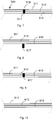
- a function of a water-soluble, biologically decomposable and/or chemically decomposable securing means which is in the form of a clamping means 519 is illustrated.
- a wrapping means 517 is intermittently fastened around the cables 511, 513 and 517.
- the clamping means 519 is adapted to secure the ends of a wrapping means 517, which is a belt, together. After applying the clamping means 519 on board of a vessel, the clamping means secures the belt 517 around cables 511, 513 and 515. After a certain time, e.g. after burial in the sea bed, the clamping means 519 dissolves or decomposes and releases the belt 517 and thus the cables 511, 513 and 515, as shown in Fig. 8 .
- a function of a securing means which is a water-soluble, biologically decomposable and/or chemically decomposable clamping means 617 is illustrated.
- the clamping means is fastened around the cables 611, 613 and 615.
- the clamping means may be intermittently fastened along the length of the cables as shown in Fig. 5 .
- the clamping means secures the cables 611, 613 and 615 together.
- the clamping means 617 dissolves or decomposes and releases the cables 611, 613 and 615, as shown in Fig. 10 .
Landscapes
- Physics & Mathematics (AREA)
- General Physics & Mathematics (AREA)
- Optics & Photonics (AREA)
- Laying Of Electric Cables Or Lines Outside (AREA)
Claims (17)
- Faisceau (9; 90; 290; 390; 490; 590) de câbles (11, 13, 15; 111, 113, 115; 211, 213, 215; 311, 313, 315; 411, 413, 415; 511, 513, 515; 611, 613, 615) comprenant au moins deux câbles sous-marins, ce faisceau comprenant un câble électrique sous-marin (11, 15; 111, 115; 211, 215; 311, 315; 411, 415; 511, 515; 611, 615), et un moyen de fixation (17; 117; 217, 217', 217", 217'"; 317; 417; 517, 519; 617) pour fixer les câbles sous-marins ensemble, caractérisé en ce que le moyen de fixation (17; 117; 217, 217', 217", 217'"; 317; 417; 519; 617) est soluble dans l'eau, biodégradable par intervention bactérienne ou fongique ou chimiquement dégradable par hydrolyse.
- Faisceau de câbles selon la revendication 1, caractérisé en ce que le faisceau (9; 90; 290; 390; 490; 590) comprend un câble sous-marin en fibre optique (13; 113; 213; 313; 413, 513; 613).
- Faisceau de câbles selon la revendication 1 or 2, caractérisé en ce que le moyen de fixation (17; 117; 217, 217', 217", 217'"; 317; 417) est un ruban adhésif.
- Faisceau de câbles selon la revendication 1 ou 2, caractérisé en ce que le moyen de fixation (17; 117; 217, 217', 217", 217'"; 317; 417) est un brin, un cordon, une courroie ou une corde.
- Faisceau de câbles selon une des revendications précédentes, caractérisé en ce que le moyen de fixation (17; 117; 217, 217', 217", 217'"; 317; 417; 519; 617) est tissé.
- Faisceau de câbles selon l'une quelconque des revendications précédentes 1 à 4, caractérisé en ce que le moyen de fixation (17; 117; 217, 217', 217", 217'"; 317; 417; 519; 617) est non-tissé.
- Faisceau de câbles selon une des revendications précédentes, caractérisé en ce que le moyen de fixation (17; 117; 217, 217', 217", 217'"; 317; 417) est enroulé autour du faisceau de câbles.
- Faisceau de câbles selon une des revendications précédentes 1 à 6, caractérisé en ce que le moyen de fixation (17; 117; 217, 217', 217", 217'"; 317; 417) est tressé ou entrelacé avec les câbles (11, 13, 15; 111, 113, 115; 211, 213, 215; 311, 313, 315; 411, 413, 415; 511, 513, 515; 611, 613, 615) de manière à former une structure dans laquelle les câbles sont attachés ensemble, de sorte qu'il y a entre des câbles adjacents un intervalle qui correspond à l'épaisseur du moyen de fixation (17; 117; 217, 217', 217", 217'"; 317; 417).
- Faisceau de câbles selon la revendication 1 ou 2, caractérisé en ce que le moyen de fixation est un moyen de serrage (519; 617).
- Faisceau de câbles selon une des revendications précédentes, caractérisé en ce que le moyen de fixation (17; 117; 217, 217', 217", 217'"; 317; 417; 519; 617) comprend un polymère thermoplastique.
- Faisceau de câbles selon la revendication 10, caractérisé en ce que le moyen de fixation (17; 117; 217, 217', 217", 217'"; 317; 417; 519; 617) comprend de l'acide polyglycolique.
- Faisceau de câbles selon une des revendications précédentes, caractérisé en ce que le moyen de fixation (17; 117; 217, 217', 217", 217'"; 317; 417; 519, 617) a une vitesse prédéterminée de dissolution, de décomposition chimique ou de décomposition biologique.
- Procédé de pose d'au moins deux câbles sous-marins comprenant un câble électrique sous-marin (11, 15; 111, 115, 211, 215; 311, 315; 411, 415; 511, 515; 611, 615) depuis un navire, comprenant les étapes suivantes:a. prévision des au moins deux câbles sous-marins (11, 13, 15; 111, 113, 115; 211, 213, 215; 311, 313, 315; 411, 413, 415; 511, 513, 515; 611, 613, 615) dans l'équipement de stockage (21, 23, 25);b. extraction ou déroulement des câbles sous-marins (11, 13, 15; 111, 113, 115; 211, 213, 215; 311, 313, 315; 411, 413, 415; 511, 513, 515; 611, 613, 615) depuis l'équipement de stockage (21, 23, 25) et réunion des câbles sous-marins ensemble (11, 13, 15; 111, 113, 115; 211, 213, 215; 311, 313, 315; 411, 413, 415; 511, 513, 515; 611, 613, 615);c. fixation des câbles sous-marins (11, 13, 15; 111, 113, 115; 211, 213, 215; 311, 313, 315; 411, 413, 415; 511, 513, 515; 611, 613, 615) à l'aide d'un moyen de fixation (17; 117; 217, 217', 217", 217'"; 317; 417; 519; 617) qui est soluble dans l'eau, biodégradable par intervention bactérienne ou fongique ou chimiquement dégradable par hydrolyse (9; 90; 290; 390; 490; 590) selon l'une quelconque des revendications 1 à 12;d. guidage du faisceau (9; 90; 290; 390; 490; 590) de câbles par-dessus bord dans l'eau, ete. pose du faisceau (9; 90; 290; 390; 490; 590) de câbles à une position désirée sur le lit marin.
- Procédé selon la revendication 13, dans lequel l'étape c) comprend en outre l'enveloppement du faisceau (9; 90; 290; 390; 490; 590) de câbles à l'aide du moyen de fixation (17; 117; 217, 217'; 417) sur la longueur du faisceau de câbles (9; 90; 290; 490).
- Procédé selon la revendication 14, dans lequel l'enveloppement est réalisé de manière à ce qu'au moins deux moyens de fixation (117, 117'; 217, 217', 217", 217'") soient enroulés autour du faisceau (90; 290) de câbles en hélice dans des sens opposés afin de créer une structure contre-hélicoïdale pour le moyen de fixation.
- Procédé selon l'une quelconque des revendications 13 à 15, comprenant en outre l'étape suivante:v. enterrement du faisceau (9; 90; 290; 390; 490; 590) de câbles dans le lit marin.
- Utilisation d'un moyen de fixation soluble dans l'eau, biodégradable par intervention bactérienne ou fongique et/ou chimiquement dégradable par hydrolyse (17; 117; 217, 217', 217", 217'"; 317; 417; 519; 617) pour fixer au moins deux câbles sous-marins (11, 13, 15; 111, 113, 115; 211, 213, 215; 311, 313, 315; 411, 413, 415; 511, 513, 515) comprenant un câble électrique sous-marin (11, 15; 111, 115; 211, 215; 311, 315; 411, 415; 511, 515; 611, 615) ensemble afin de former un faisceau (9; 90; 290; 390; 490; 590) de câbles.
Applications Claiming Priority (1)
| Application Number | Priority Date | Filing Date | Title |
|---|---|---|---|
| PCT/EP2013/074325 WO2015074696A1 (fr) | 2013-11-21 | 2013-11-21 | Faisceau de câbles, procédé de pose de câbles et utilisation d'un moyen de fixation |
Publications (2)
| Publication Number | Publication Date |
|---|---|
| EP3072193A1 EP3072193A1 (fr) | 2016-09-28 |
| EP3072193B1 true EP3072193B1 (fr) | 2018-01-10 |
Family
ID=49626956
Family Applications (1)
| Application Number | Title | Priority Date | Filing Date |
|---|---|---|---|
| EP13794896.4A Not-in-force EP3072193B1 (fr) | 2013-11-21 | 2013-11-21 | Faisceau de câbles, procédé de pose de câbles et utilisation d'un moyen de fixation |
Country Status (4)
| Country | Link |
|---|---|
| US (1) | US9640303B2 (fr) |
| EP (1) | EP3072193B1 (fr) |
| CA (1) | CA2931078C (fr) |
| WO (1) | WO2015074696A1 (fr) |
Families Citing this family (5)
| Publication number | Priority date | Publication date | Assignee | Title |
|---|---|---|---|---|
| GB2552370A (en) * | 2016-07-21 | 2018-01-24 | Jdr Cable Systems Ltd | Insulated cable |
| EP3596370B1 (fr) * | 2017-04-24 | 2023-06-07 | Siemens Gamesa Renewable Energy A/S | Procédé de pose d'un faisceau de tubes sur le fond marin |
| CN109449860B (zh) * | 2018-12-06 | 2020-12-01 | 桐乡市隆源纺织有限公司 | 线缆防护及整理罩 |
| EP4339972A1 (fr) | 2022-09-13 | 2024-03-20 | NKT HV Cables AB | Faisceau de câbles d'alimentation cc sous-marins en trèfle |
| US20250116837A1 (en) * | 2023-10-05 | 2025-04-10 | Subcom, Llc | Jacketed undersea fiber optic telecommunications cable joint with non-metallic strength member |
Family Cites Families (18)
| Publication number | Priority date | Publication date | Assignee | Title |
|---|---|---|---|---|
| US4140114A (en) * | 1977-07-18 | 1979-02-20 | Custom Cable Company | Diving umbilical cable |
| DE3606589A1 (de) | 1986-02-28 | 1987-09-03 | Siemens Ag | Zug- und druckfestes optisches seekabel |
| GB9002622D0 (en) | 1990-02-06 | 1990-04-04 | Ugland Oilfield Services A S | Method and apparatus for laying underwater cables and pipelines |
| JPH06228508A (ja) | 1993-02-04 | 1994-08-16 | Nitto Denko Corp | 粘着テープ |
| CA2128347C (fr) | 1993-07-28 | 1998-12-08 | Akihiko Takano | Etiquette autocollante et ruban adhesif biodegradables |
| GB2337366A (en) | 1998-05-06 | 1999-11-17 | Camco Int | Transmitting power underwater using coiled tubing |
| US6769840B1 (en) | 2000-03-20 | 2004-08-03 | Bernard Francois | Apparatus and method for deploying an object under water |
| GB2369728B (en) | 2000-11-21 | 2005-05-04 | Level 3 Communications Inc | Cable installation |
| US6988854B2 (en) | 2001-12-14 | 2006-01-24 | Sanmina-Sci Corporation | Cable dispenser and method |
| JP3936386B1 (ja) * | 2006-09-29 | 2007-06-27 | 株式会社エスイーシー | 水中投下型センサシステム |
| GB0619870D0 (en) | 2006-10-07 | 2006-11-15 | Deep Tek Ltd | Apparatus and method for use in handling an elongate member |
| US20110067799A1 (en) | 2008-04-30 | 2011-03-24 | Tesa Se | Adhesive tape |
| US8113290B2 (en) * | 2009-09-09 | 2012-02-14 | Schlumberger Technology Corporation | Dissolvable connector guard |
| US8616805B2 (en) * | 2010-05-18 | 2013-12-31 | Bluefin Robotics, Corporation | Optical fiber management system and method |
| US10073184B2 (en) * | 2012-02-06 | 2018-09-11 | Ion Geophysical Corporation | Sensor system of buried seismic array |
| CN202957067U (zh) | 2012-11-05 | 2013-05-29 | 江苏中辰电缆有限公司 | 光纤复合海底电力电缆 |
| US20140126865A1 (en) * | 2012-11-08 | 2014-05-08 | Chieng Ming Industries Co., Ltd. | Cable Structure for Underwater Equipment |
| WO2016065244A1 (fr) * | 2014-10-24 | 2016-04-28 | Schlumberger Canada Limited | Collier de serrage eutectique pour complétion de puits de forage |
-
2013
- 2013-11-21 CA CA2931078A patent/CA2931078C/fr not_active Expired - Fee Related
- 2013-11-21 US US15/027,416 patent/US9640303B2/en not_active Expired - Fee Related
- 2013-11-21 EP EP13794896.4A patent/EP3072193B1/fr not_active Not-in-force
- 2013-11-21 WO PCT/EP2013/074325 patent/WO2015074696A1/fr not_active Ceased
Also Published As
| Publication number | Publication date |
|---|---|
| WO2015074696A1 (fr) | 2015-05-28 |
| CA2931078A1 (fr) | 2015-05-28 |
| US20160254653A1 (en) | 2016-09-01 |
| CA2931078C (fr) | 2017-01-03 |
| EP3072193A1 (fr) | 2016-09-28 |
| US9640303B2 (en) | 2017-05-02 |
Similar Documents
| Publication | Publication Date | Title |
|---|---|---|
| CA2931078C (fr) | Faisceau de cables, procede de pose de cables et utilisation d'un moyen de fixation | |
| US7862891B2 (en) | Composite tether and methods for manufacturing, transporting, and installing same | |
| US11728632B2 (en) | Communications cable with fabric sleeve | |
| CN106030944B (zh) | 用于生产海底电缆的方法和设备以及用其生产的海底电缆 | |
| EP0177475B1 (fr) | Câble de conduit de tuyaux pour utilisation sous l'eau | |
| US4659253A (en) | Deep water cable laying method using buoyancy materials | |
| US20140133919A1 (en) | Offshore Cable Laying Method | |
| CA1328040C (fr) | Procede de fabrication de faisceaux tubulaires spirales | |
| KR101444327B1 (ko) | 케이블 그리퍼 | |
| US20220293300A1 (en) | Modular, deployable cable manufacturing machine and method for using the same | |
| US8314330B2 (en) | Umbilical for subsea installation | |
| CN110739098A (zh) | 无线小基站用微型易分支防鼠光电复合缆及其制备方法 | |
| WO2020005074A1 (fr) | Câblerie flottante | |
| US4151704A (en) | Method and apparatus for laying up elongate members | |
| US11274769B2 (en) | Method of laying a pipe bundle on the seabed | |
| WO2001060732A1 (fr) | Appareil et procede destines a la manipulation de cables | |
| CN114530282A (zh) | 一种海缆不同铠装结构的缆型过渡接头及其在线过渡方法 | |
| CN207468955U (zh) | 智能化纤绳索 | |
| JP2009102795A (ja) | プレハブケーブルの製造方法 | |
| CN112290457A (zh) | 一种碳纤维复合芯导线的施工方法 | |
| US20050279737A1 (en) | Optical cable unit | |
| CN114829260B (zh) | 用于件货物的保持系统 | |
| JPS5943888B2 (ja) | ケ−ブル布設方法 | |
| CA3101207A1 (fr) | Cable avec un manchon en tissu et son procede de fabrication | |
| JPH08186922A (ja) | ケーブル保護用可撓管およびその製造方法 |
Legal Events
| Date | Code | Title | Description |
|---|---|---|---|
| PUAI | Public reference made under article 153(3) epc to a published international application that has entered the european phase |
Free format text: ORIGINAL CODE: 0009012 |
|
| 17P | Request for examination filed |
Effective date: 20160621 |
|
| AK | Designated contracting states |
Kind code of ref document: A1 Designated state(s): AL AT BE BG CH CY CZ DE DK EE ES FI FR GB GR HR HU IE IS IT LI LT LU LV MC MK MT NL NO PL PT RO RS SE SI SK SM TR |
|
| AX | Request for extension of the european patent |
Extension state: BA ME |
|
| DAX | Request for extension of the european patent (deleted) | ||
| RAP1 | Party data changed (applicant data changed or rights of an application transferred) |
Owner name: ABB HV CABLES (SWITZERLAND) GMBH |
|
| GRAP | Despatch of communication of intention to grant a patent |
Free format text: ORIGINAL CODE: EPIDOSNIGR1 |
|
| INTG | Intention to grant announced |
Effective date: 20170608 |
|
| RAP1 | Party data changed (applicant data changed or rights of an application transferred) |
Owner name: NKT HV CABLES GMBH |
|
| GRAS | Grant fee paid |
Free format text: ORIGINAL CODE: EPIDOSNIGR3 |
|
| GRAA | (expected) grant |
Free format text: ORIGINAL CODE: 0009210 |
|
| AK | Designated contracting states |
Kind code of ref document: B1 Designated state(s): AL AT BE BG CH CY CZ DE DK EE ES FI FR GB GR HR HU IE IS IT LI LT LU LV MC MK MT NL NO PL PT RO RS SE SI SK SM TR |
|
| REG | Reference to a national code |
Ref country code: CH Ref legal event code: EP Ref country code: AT Ref legal event code: REF Ref document number: 963419 Country of ref document: AT Kind code of ref document: T Effective date: 20180115 |
|
| REG | Reference to a national code |
Ref country code: IE Ref legal event code: FG4D |
|
| REG | Reference to a national code |
Ref country code: DE Ref legal event code: R096 Ref document number: 602013031961 Country of ref document: DE |
|
| REG | Reference to a national code |
Ref country code: NL Ref legal event code: MP Effective date: 20180110 |
|
| REG | Reference to a national code |
Ref country code: AT Ref legal event code: MK05 Ref document number: 963419 Country of ref document: AT Kind code of ref document: T Effective date: 20180110 |
|
| PG25 | Lapsed in a contracting state [announced via postgrant information from national office to epo] |
Ref country code: NL Free format text: LAPSE BECAUSE OF FAILURE TO SUBMIT A TRANSLATION OF THE DESCRIPTION OR TO PAY THE FEE WITHIN THE PRESCRIBED TIME-LIMIT Effective date: 20180110 |
|
| PG25 | Lapsed in a contracting state [announced via postgrant information from national office to epo] |
Ref country code: ES Free format text: LAPSE BECAUSE OF FAILURE TO SUBMIT A TRANSLATION OF THE DESCRIPTION OR TO PAY THE FEE WITHIN THE PRESCRIBED TIME-LIMIT Effective date: 20180110 Ref country code: HR Free format text: LAPSE BECAUSE OF FAILURE TO SUBMIT A TRANSLATION OF THE DESCRIPTION OR TO PAY THE FEE WITHIN THE PRESCRIBED TIME-LIMIT Effective date: 20180110 Ref country code: LT Free format text: LAPSE BECAUSE OF FAILURE TO SUBMIT A TRANSLATION OF THE DESCRIPTION OR TO PAY THE FEE WITHIN THE PRESCRIBED TIME-LIMIT Effective date: 20180110 Ref country code: CY Free format text: LAPSE BECAUSE OF FAILURE TO SUBMIT A TRANSLATION OF THE DESCRIPTION OR TO PAY THE FEE WITHIN THE PRESCRIBED TIME-LIMIT Effective date: 20180110 Ref country code: NO Free format text: LAPSE BECAUSE OF FAILURE TO SUBMIT A TRANSLATION OF THE DESCRIPTION OR TO PAY THE FEE WITHIN THE PRESCRIBED TIME-LIMIT Effective date: 20180410 Ref country code: FI Free format text: LAPSE BECAUSE OF FAILURE TO SUBMIT A TRANSLATION OF THE DESCRIPTION OR TO PAY THE FEE WITHIN THE PRESCRIBED TIME-LIMIT Effective date: 20180110 |
|
| PG25 | Lapsed in a contracting state [announced via postgrant information from national office to epo] |
Ref country code: PL Free format text: LAPSE BECAUSE OF FAILURE TO SUBMIT A TRANSLATION OF THE DESCRIPTION OR TO PAY THE FEE WITHIN THE PRESCRIBED TIME-LIMIT Effective date: 20180110 Ref country code: GR Free format text: LAPSE BECAUSE OF FAILURE TO SUBMIT A TRANSLATION OF THE DESCRIPTION OR TO PAY THE FEE WITHIN THE PRESCRIBED TIME-LIMIT Effective date: 20180411 Ref country code: AT Free format text: LAPSE BECAUSE OF FAILURE TO SUBMIT A TRANSLATION OF THE DESCRIPTION OR TO PAY THE FEE WITHIN THE PRESCRIBED TIME-LIMIT Effective date: 20180110 Ref country code: RS Free format text: LAPSE BECAUSE OF FAILURE TO SUBMIT A TRANSLATION OF THE DESCRIPTION OR TO PAY THE FEE WITHIN THE PRESCRIBED TIME-LIMIT Effective date: 20180110 Ref country code: LV Free format text: LAPSE BECAUSE OF FAILURE TO SUBMIT A TRANSLATION OF THE DESCRIPTION OR TO PAY THE FEE WITHIN THE PRESCRIBED TIME-LIMIT Effective date: 20180110 Ref country code: IS Free format text: LAPSE BECAUSE OF FAILURE TO SUBMIT A TRANSLATION OF THE DESCRIPTION OR TO PAY THE FEE WITHIN THE PRESCRIBED TIME-LIMIT Effective date: 20180510 Ref country code: SE Free format text: LAPSE BECAUSE OF FAILURE TO SUBMIT A TRANSLATION OF THE DESCRIPTION OR TO PAY THE FEE WITHIN THE PRESCRIBED TIME-LIMIT Effective date: 20180110 Ref country code: BG Free format text: LAPSE BECAUSE OF FAILURE TO SUBMIT A TRANSLATION OF THE DESCRIPTION OR TO PAY THE FEE WITHIN THE PRESCRIBED TIME-LIMIT Effective date: 20180410 |
|
| REG | Reference to a national code |
Ref country code: DE Ref legal event code: R097 Ref document number: 602013031961 Country of ref document: DE |
|
| PG25 | Lapsed in a contracting state [announced via postgrant information from national office to epo] |
Ref country code: IT Free format text: LAPSE BECAUSE OF FAILURE TO SUBMIT A TRANSLATION OF THE DESCRIPTION OR TO PAY THE FEE WITHIN THE PRESCRIBED TIME-LIMIT Effective date: 20180110 Ref country code: RO Free format text: LAPSE BECAUSE OF FAILURE TO SUBMIT A TRANSLATION OF THE DESCRIPTION OR TO PAY THE FEE WITHIN THE PRESCRIBED TIME-LIMIT Effective date: 20180110 Ref country code: AL Free format text: LAPSE BECAUSE OF FAILURE TO SUBMIT A TRANSLATION OF THE DESCRIPTION OR TO PAY THE FEE WITHIN THE PRESCRIBED TIME-LIMIT Effective date: 20180110 Ref country code: EE Free format text: LAPSE BECAUSE OF FAILURE TO SUBMIT A TRANSLATION OF THE DESCRIPTION OR TO PAY THE FEE WITHIN THE PRESCRIBED TIME-LIMIT Effective date: 20180110 |
|
| PLBE | No opposition filed within time limit |
Free format text: ORIGINAL CODE: 0009261 |
|
| STAA | Information on the status of an ep patent application or granted ep patent |
Free format text: STATUS: NO OPPOSITION FILED WITHIN TIME LIMIT |
|
| PG25 | Lapsed in a contracting state [announced via postgrant information from national office to epo] |
Ref country code: SM Free format text: LAPSE BECAUSE OF FAILURE TO SUBMIT A TRANSLATION OF THE DESCRIPTION OR TO PAY THE FEE WITHIN THE PRESCRIBED TIME-LIMIT Effective date: 20180110 Ref country code: DK Free format text: LAPSE BECAUSE OF FAILURE TO SUBMIT A TRANSLATION OF THE DESCRIPTION OR TO PAY THE FEE WITHIN THE PRESCRIBED TIME-LIMIT Effective date: 20180110 Ref country code: CZ Free format text: LAPSE BECAUSE OF FAILURE TO SUBMIT A TRANSLATION OF THE DESCRIPTION OR TO PAY THE FEE WITHIN THE PRESCRIBED TIME-LIMIT Effective date: 20180110 Ref country code: SK Free format text: LAPSE BECAUSE OF FAILURE TO SUBMIT A TRANSLATION OF THE DESCRIPTION OR TO PAY THE FEE WITHIN THE PRESCRIBED TIME-LIMIT Effective date: 20180110 |
|
| 26N | No opposition filed |
Effective date: 20181011 |
|
| PG25 | Lapsed in a contracting state [announced via postgrant information from national office to epo] |
Ref country code: SI Free format text: LAPSE BECAUSE OF FAILURE TO SUBMIT A TRANSLATION OF THE DESCRIPTION OR TO PAY THE FEE WITHIN THE PRESCRIBED TIME-LIMIT Effective date: 20180110 |
|
| REG | Reference to a national code |
Ref country code: DE Ref legal event code: R119 Ref document number: 602013031961 Country of ref document: DE |
|
| REG | Reference to a national code |
Ref country code: CH Ref legal event code: PL |
|
| GBPC | Gb: european patent ceased through non-payment of renewal fee |
Effective date: 20181121 |
|
| PG25 | Lapsed in a contracting state [announced via postgrant information from national office to epo] |
Ref country code: MC Free format text: LAPSE BECAUSE OF FAILURE TO SUBMIT A TRANSLATION OF THE DESCRIPTION OR TO PAY THE FEE WITHIN THE PRESCRIBED TIME-LIMIT Effective date: 20180110 Ref country code: LU Free format text: LAPSE BECAUSE OF NON-PAYMENT OF DUE FEES Effective date: 20181121 |
|
| REG | Reference to a national code |
Ref country code: BE Ref legal event code: MM Effective date: 20181130 |
|
| REG | Reference to a national code |
Ref country code: IE Ref legal event code: MM4A |
|
| PG25 | Lapsed in a contracting state [announced via postgrant information from national office to epo] |
Ref country code: CH Free format text: LAPSE BECAUSE OF NON-PAYMENT OF DUE FEES Effective date: 20181130 Ref country code: LI Free format text: LAPSE BECAUSE OF NON-PAYMENT OF DUE FEES Effective date: 20181130 |
|
| PG25 | Lapsed in a contracting state [announced via postgrant information from national office to epo] |
Ref country code: FR Free format text: LAPSE BECAUSE OF NON-PAYMENT OF DUE FEES Effective date: 20181130 Ref country code: DE Free format text: LAPSE BECAUSE OF NON-PAYMENT OF DUE FEES Effective date: 20190601 Ref country code: IE Free format text: LAPSE BECAUSE OF NON-PAYMENT OF DUE FEES Effective date: 20181121 |
|
| PG25 | Lapsed in a contracting state [announced via postgrant information from national office to epo] |
Ref country code: BE Free format text: LAPSE BECAUSE OF NON-PAYMENT OF DUE FEES Effective date: 20181130 |
|
| PG25 | Lapsed in a contracting state [announced via postgrant information from national office to epo] |
Ref country code: GB Free format text: LAPSE BECAUSE OF NON-PAYMENT OF DUE FEES Effective date: 20181121 |
|
| PG25 | Lapsed in a contracting state [announced via postgrant information from national office to epo] |
Ref country code: MT Free format text: LAPSE BECAUSE OF NON-PAYMENT OF DUE FEES Effective date: 20181121 |
|
| PG25 | Lapsed in a contracting state [announced via postgrant information from national office to epo] |
Ref country code: TR Free format text: LAPSE BECAUSE OF FAILURE TO SUBMIT A TRANSLATION OF THE DESCRIPTION OR TO PAY THE FEE WITHIN THE PRESCRIBED TIME-LIMIT Effective date: 20180110 |
|
| PG25 | Lapsed in a contracting state [announced via postgrant information from national office to epo] |
Ref country code: PT Free format text: LAPSE BECAUSE OF FAILURE TO SUBMIT A TRANSLATION OF THE DESCRIPTION OR TO PAY THE FEE WITHIN THE PRESCRIBED TIME-LIMIT Effective date: 20180110 |
|
| PG25 | Lapsed in a contracting state [announced via postgrant information from national office to epo] |
Ref country code: MK Free format text: LAPSE BECAUSE OF NON-PAYMENT OF DUE FEES Effective date: 20180110 Ref country code: HU Free format text: LAPSE BECAUSE OF FAILURE TO SUBMIT A TRANSLATION OF THE DESCRIPTION OR TO PAY THE FEE WITHIN THE PRESCRIBED TIME-LIMIT; INVALID AB INITIO Effective date: 20131121 |