EP3072611A2 - Composants en poudre métallique à dimension proche de la spécification finale et leurs procédés de production - Google Patents
Composants en poudre métallique à dimension proche de la spécification finale et leurs procédés de production Download PDFInfo
- Publication number
- EP3072611A2 EP3072611A2 EP16161709.7A EP16161709A EP3072611A2 EP 3072611 A2 EP3072611 A2 EP 3072611A2 EP 16161709 A EP16161709 A EP 16161709A EP 3072611 A2 EP3072611 A2 EP 3072611A2
- Authority
- EP
- European Patent Office
- Prior art keywords
- metal
- net
- shape
- article
- metal powder
- Prior art date
- Legal status (The legal status is an assumption and is not a legal conclusion. Google has not performed a legal analysis and makes no representation as to the accuracy of the status listed.)
- Withdrawn
Links
Images
Classifications
-
- B—PERFORMING OPERATIONS; TRANSPORTING
- B22—CASTING; POWDER METALLURGY
- B22F—WORKING METALLIC POWDER; MANUFACTURE OF ARTICLES FROM METALLIC POWDER; MAKING METALLIC POWDER; APPARATUS OR DEVICES SPECIALLY ADAPTED FOR METALLIC POWDER
- B22F3/00—Manufacture of workpieces or articles from metallic powder characterised by the manner of compacting or sintering; Apparatus specially adapted therefor ; Presses and furnaces
- B22F3/12—Both compacting and sintering
- B22F3/14—Both compacting and sintering simultaneously
- B22F3/15—Hot isostatic pressing
-
- B—PERFORMING OPERATIONS; TRANSPORTING
- B22—CASTING; POWDER METALLURGY
- B22F—WORKING METALLIC POWDER; MANUFACTURE OF ARTICLES FROM METALLIC POWDER; MAKING METALLIC POWDER; APPARATUS OR DEVICES SPECIALLY ADAPTED FOR METALLIC POWDER
- B22F10/00—Additive manufacturing of workpieces or articles from metallic powder
- B22F10/20—Direct sintering or melting
- B22F10/28—Powder bed fusion, e.g. selective laser melting [SLM] or electron beam melting [EBM]
-
- B—PERFORMING OPERATIONS; TRANSPORTING
- B22—CASTING; POWDER METALLURGY
- B22F—WORKING METALLIC POWDER; MANUFACTURE OF ARTICLES FROM METALLIC POWDER; MAKING METALLIC POWDER; APPARATUS OR DEVICES SPECIALLY ADAPTED FOR METALLIC POWDER
- B22F3/00—Manufacture of workpieces or articles from metallic powder characterised by the manner of compacting or sintering; Apparatus specially adapted therefor ; Presses and furnaces
- B22F3/10—Sintering only
- B22F3/105—Sintering only by using electric current other than for infrared radiant energy, laser radiation or plasma ; by ultrasonic bonding
-
- B—PERFORMING OPERATIONS; TRANSPORTING
- B22—CASTING; POWDER METALLURGY
- B22F—WORKING METALLIC POWDER; MANUFACTURE OF ARTICLES FROM METALLIC POWDER; MAKING METALLIC POWDER; APPARATUS OR DEVICES SPECIALLY ADAPTED FOR METALLIC POWDER
- B22F3/00—Manufacture of workpieces or articles from metallic powder characterised by the manner of compacting or sintering; Apparatus specially adapted therefor ; Presses and furnaces
- B22F3/12—Both compacting and sintering
- B22F3/1208—Containers or coating used therefor
-
- B—PERFORMING OPERATIONS; TRANSPORTING
- B22—CASTING; POWDER METALLURGY
- B22F—WORKING METALLIC POWDER; MANUFACTURE OF ARTICLES FROM METALLIC POWDER; MAKING METALLIC POWDER; APPARATUS OR DEVICES SPECIALLY ADAPTED FOR METALLIC POWDER
- B22F3/00—Manufacture of workpieces or articles from metallic powder characterised by the manner of compacting or sintering; Apparatus specially adapted therefor ; Presses and furnaces
- B22F3/24—After-treatment of workpieces or articles
-
- B—PERFORMING OPERATIONS; TRANSPORTING
- B22—CASTING; POWDER METALLURGY
- B22F—WORKING METALLIC POWDER; MANUFACTURE OF ARTICLES FROM METALLIC POWDER; MAKING METALLIC POWDER; APPARATUS OR DEVICES SPECIALLY ADAPTED FOR METALLIC POWDER
- B22F7/00—Manufacture of composite layers, workpieces, or articles, comprising metallic powder, by sintering the powder, with or without compacting wherein at least one part is obtained by sintering or compression
- B22F7/02—Manufacture of composite layers, workpieces, or articles, comprising metallic powder, by sintering the powder, with or without compacting wherein at least one part is obtained by sintering or compression of composite layers
- B22F7/04—Manufacture of composite layers, workpieces, or articles, comprising metallic powder, by sintering the powder, with or without compacting wherein at least one part is obtained by sintering or compression of composite layers with one or more layers not made from powder, e.g. made from solid metal
-
- B—PERFORMING OPERATIONS; TRANSPORTING
- B23—MACHINE TOOLS; METAL-WORKING NOT OTHERWISE PROVIDED FOR
- B23K—SOLDERING OR UNSOLDERING; WELDING; CLADDING OR PLATING BY SOLDERING OR WELDING; CUTTING BY APPLYING HEAT LOCALLY, e.g. FLAME CUTTING; WORKING BY LASER BEAM
- B23K26/00—Working by laser beam, e.g. welding, cutting or boring
- B23K26/34—Laser welding for purposes other than joining
- B23K26/342—Build-up welding
-
- C—CHEMISTRY; METALLURGY
- C22—METALLURGY; FERROUS OR NON-FERROUS ALLOYS; TREATMENT OF ALLOYS OR NON-FERROUS METALS
- C22C—ALLOYS
- C22C1/00—Making non-ferrous alloys
- C22C1/08—Alloys with open or closed pores
-
- B—PERFORMING OPERATIONS; TRANSPORTING
- B22—CASTING; POWDER METALLURGY
- B22F—WORKING METALLIC POWDER; MANUFACTURE OF ARTICLES FROM METALLIC POWDER; MAKING METALLIC POWDER; APPARATUS OR DEVICES SPECIALLY ADAPTED FOR METALLIC POWDER
- B22F10/00—Additive manufacturing of workpieces or articles from metallic powder
- B22F10/20—Direct sintering or melting
- B22F10/25—Direct deposition of metal particles, e.g. direct metal deposition [DMD] or laser engineered net shaping [LENS]
-
- B—PERFORMING OPERATIONS; TRANSPORTING
- B22—CASTING; POWDER METALLURGY
- B22F—WORKING METALLIC POWDER; MANUFACTURE OF ARTICLES FROM METALLIC POWDER; MAKING METALLIC POWDER; APPARATUS OR DEVICES SPECIALLY ADAPTED FOR METALLIC POWDER
- B22F10/00—Additive manufacturing of workpieces or articles from metallic powder
- B22F10/30—Process control
- B22F10/36—Process control of energy beam parameters
-
- B—PERFORMING OPERATIONS; TRANSPORTING
- B22—CASTING; POWDER METALLURGY
- B22F—WORKING METALLIC POWDER; MANUFACTURE OF ARTICLES FROM METALLIC POWDER; MAKING METALLIC POWDER; APPARATUS OR DEVICES SPECIALLY ADAPTED FOR METALLIC POWDER
- B22F10/00—Additive manufacturing of workpieces or articles from metallic powder
- B22F10/60—Treatment of workpieces or articles after build-up
- B22F10/66—Treatment of workpieces or articles after build-up by mechanical means
-
- B—PERFORMING OPERATIONS; TRANSPORTING
- B22—CASTING; POWDER METALLURGY
- B22F—WORKING METALLIC POWDER; MANUFACTURE OF ARTICLES FROM METALLIC POWDER; MAKING METALLIC POWDER; APPARATUS OR DEVICES SPECIALLY ADAPTED FOR METALLIC POWDER
- B22F10/00—Additive manufacturing of workpieces or articles from metallic powder
- B22F10/70—Recycling
- B22F10/73—Recycling of powder
-
- B—PERFORMING OPERATIONS; TRANSPORTING
- B22—CASTING; POWDER METALLURGY
- B22F—WORKING METALLIC POWDER; MANUFACTURE OF ARTICLES FROM METALLIC POWDER; MAKING METALLIC POWDER; APPARATUS OR DEVICES SPECIALLY ADAPTED FOR METALLIC POWDER
- B22F2998/00—Supplementary information concerning processes or compositions relating to powder metallurgy
- B22F2998/10—Processes characterised by the sequence of their steps
-
- B—PERFORMING OPERATIONS; TRANSPORTING
- B33—ADDITIVE MANUFACTURING TECHNOLOGY
- B33Y—ADDITIVE MANUFACTURING, i.e. MANUFACTURING OF THREE-DIMENSIONAL [3D] OBJECTS BY ADDITIVE DEPOSITION, ADDITIVE AGGLOMERATION OR ADDITIVE LAYERING, e.g. BY 3D PRINTING, STEREOLITHOGRAPHY OR SELECTIVE LASER SINTERING
- B33Y10/00—Processes of additive manufacturing
-
- B—PERFORMING OPERATIONS; TRANSPORTING
- B33—ADDITIVE MANUFACTURING TECHNOLOGY
- B33Y—ADDITIVE MANUFACTURING, i.e. MANUFACTURING OF THREE-DIMENSIONAL [3D] OBJECTS BY ADDITIVE DEPOSITION, ADDITIVE AGGLOMERATION OR ADDITIVE LAYERING, e.g. BY 3D PRINTING, STEREOLITHOGRAPHY OR SELECTIVE LASER SINTERING
- B33Y80/00—Products made by additive manufacturing
-
- Y—GENERAL TAGGING OF NEW TECHNOLOGICAL DEVELOPMENTS; GENERAL TAGGING OF CROSS-SECTIONAL TECHNOLOGIES SPANNING OVER SEVERAL SECTIONS OF THE IPC; TECHNICAL SUBJECTS COVERED BY FORMER USPC CROSS-REFERENCE ART COLLECTIONS [XRACs] AND DIGESTS
- Y02—TECHNOLOGIES OR APPLICATIONS FOR MITIGATION OR ADAPTATION AGAINST CLIMATE CHANGE
- Y02P—CLIMATE CHANGE MITIGATION TECHNOLOGIES IN THE PRODUCTION OR PROCESSING OF GOODS
- Y02P10/00—Technologies related to metal processing
- Y02P10/25—Process efficiency
Definitions
- Embodiments of the present disclosure generally relate to metallic articles of manufacture and methods for producing the same. More particularly, the present disclosure relates to net-shape or near-net shape powder metal components and methods for producing the same.
- Additive manufacturing provides obvious manufacturing benefits with the design flexibility that it offers.
- many materials respond to additive manufacturing processing in unexpected ways.
- anisotropic behavior in both physical and mechanical properties, is common.
- This anisotropic behavior is likely attributed to a textured microstructure, resulting from the nature of the additive manufacturing process, which involves the fusion of powder particles, layer-by-layer, until the final part geometry is achieved.
- subsequent thermal processing appears to remove obvious artifacts associated with this layering ( see , e.g ., Etter et al., U.S. 2014/0053956 A1 )
- mechanical property testing reveals significant differences in physical properties (i.e., modulus) between the directions relative to the orientation of the build direction.
- a method for manufacturing net-shape or near-net shape metallic article includes the steps of: forming, using an additive manufacturing process, a metal can comprising a hollow interior portion, filling the hollow interior portion with a metal powder, and subjecting the metal can filled with the metal powder to a hot isostatic pressing (HIP) process to densify the metal powder.
- HIP hot isostatic pressing
- a net-shape or near-net shape metallic article of manufacture includes a metallic outer shell portion having a layer-by-layer fused microstructure that exhibits anisotropic mechanical and physical properties and a metallic inner core portion having a pressure-densified microstructure that exhibits isotropic mechanical and physical properties.
- net-shape or near-net shape powder metal components Disclosed herein are net-shape or near-net shape powder metal components and methods for producing the same.
- the term “net-shape” refers to an article that requires no post-densification machining or re-shaping to meet its final design shape criteria.
- the term “near-net shape” refers to an article that requires only minimal post-densification trimming or re-shaping to meet its final design shape criteria.
- hot isostatic press (HIP)-formed articles exhibit isotropic physic and mechanical properties (such articles will hereinafter be referred to with the term "as-HIP” articles).
- as-HIP articles may be formed by inserting a metallic powder into a cast metal die or "can" (the cast metal can being formed in the shape of the desired as-HIP article), hermetically sealing the powder within the can, subjecting the metal can filled with the metal powder to a HIP process, and thereafter removing the densified as-HIP article from the can. ( See , e.g., Hall et al., U.S.
- the as-HIP article formed in this manner may be a net-shape or near-net shape article. To this date, however, no attempts have been made to synergize the design flexibility of additive manufacturing processes with the desirable material properties of as-HIP processes.
- the Applicants herein describe the use of powder bed additive manufacturing processes to manufacture the metal can used to containerize and hermetically seal non-fused metal powder for subsequent densification with HIP.
- the can and the non-fused powder may or may not be the same material. Further, the can may or may not be removed via subsequent processing.
- the end result is a metallic article of manufacture with properties consistent with as-HIP processing with the design complexities offered by additive manufacturing.
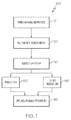
- FIG. 1 is a flow diagram illustrating steps in a method 100 for manufacturing net-shape or near-net shape powder metal components in accordance with an exemplary embodiment of the present disclosure.
- the method 100 includes a first step 110 of forming, using an additive manufacturing process, a metal can comprising a hollow interior portion.
- Additive manufacturing processes can be used to produce complex geometries in a single operation with no tooling.
- Additive manufacturing technology allows for the can to be produced at a net-shape or near-net shape without the application of the heating, casting, or forging processes commonly used in the prior art.
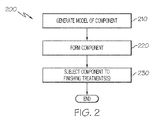
- FIG. 2 is a flowchart illustrating a method 200 for manufacturing the can using additive manufacturing techniques.
- a model such as a design model, of the can may be defined in any suitable manner.
- the model may be designed with computer aided design (CAD) software and may include three-dimensional ("3D") numeric coordinates of the entire configuration of the component including both external and internal surfaces.
- the model may include a number of successive two-dimensional ("2D") cross-sectional slices that together form the 3D component.
- the 3D model of the can may be designed according to whether or not the can is to be ultimately removed from the densified metal powder.
- the outer shape and dimensions of the can are relatively less important as compared to the shape of the hollow interior portion where the metal powder is to be filled.
- the hollow interior portion defines the net-shape or near-net shape of the article, and as such care should be taken to ensure that the hollow interior portion is designed with the final specification of the article in mind.
- the can is formed according to the model of step 210.
- the entire can is formed using a rapid prototyping or additive layer manufacturing process.
- additive layer manufacturing processes include: selective laser sintering in which a laser is used to sinter a powder media in precisely controlled locations; laser wire deposition in which a wire feedstock is melted by a laser and then deposited and solidified in precise locations to build the product; electron beam melting; laser engineered net shaping; and direct metal deposition.
- additive manufacturing techniques provide flexibility in free-form fabrication without geometric constraints, fast material processing time, and innovative joining techniques.
- direct metal laser fusion (DMLF) is used to produce the can in step 220.
- DMLF is a commercially-available, laser-based rapid prototyping and tooling process by which complex parts may be directly produced by precision melting and solidification of metal powder into successive layers of larger structures, each layer corresponding to a cross-sectional layer of the 3D component.
- step 220 is performed with DMLF techniques to form the can.
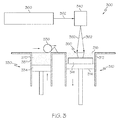
- FIG. 3 is a schematic view of a DMLF system 300 for manufacturing the can for use in an as-HIP process in accordance with an exemplary embodiment.
- the system 300 includes a fabrication device 310, a powder delivery device 330, a scanner 340, and a laser 360 that function to manufacture the article 350 (e.g., the can) with build material 370.
- the fabrication device 310 includes a build container 312 with a fabrication support 314 on which the article 350 is formed and supported.
- the fabrication support 314 is movable within the build container 312 in a vertical direction and is adjusted in such a way to define a working plane 316.
- the delivery device 330 includes a powder chamber 332 with a delivery support 334 that supports the build material 370 and is also movable in the vertical direction.
- the delivery device 330 further includes a roller or wiper 336 that transfers build material 370 from the delivery device 330 to the fabrication device 310.
- a base block 341 may be installed on the fabrication support 314.
- the fabrication support 314 is lowered and the delivery support 334 is raised.
- the roller or wiper 336 scrapes or otherwise pushes a portion of the build material 370 from the delivery device 330 to form the working plane 316 in the fabrication device 310.
- the laser 360 emits a laser beam 362, which is directed by the scanner 340 onto the build material 370 in the working plane 316 to selectively fuse the build material 370 into a cross-sectional layer of the article 350 according to the design.
- the speed, position, and other operating parameters of the laser beam 362 are controlled to selectively fuse the powder of the build material 370 into larger structures by rapidly melting the powder particles that may melt or diffuse into the solid structure below, and subsequently, cool and re-solidify.
- each layer of build material 370 may include unfused and fused build material 370 that respectively corresponds to the cross-sectional passages and walls that form the article 350.
- the laser beam 362 is relatively low power to selectively fuse the individual layer of build material 370.
- the laser beam 362 may have a power of approximately 50 to 500 Watts, although any suitable power may be provided.
- the fabrication support 314 Upon completion of a respective layer, the fabrication support 314 is lowered and the delivery support 334 is raised. Typically, the fabrication support 314, and thus the article 350, does not move in a horizontal plane during this step.
- the roller or wiper 336 again pushes a portion of the build material 370 from the delivery device 330 to form an additional layer of build material 370 on the working plane 316 of the fabrication device 310.
- the laser beam 362 is movably supported relative to the article 350 and is again controlled to selectively form another cross-sectional layer.
- the article 350 is positioned in a bed of build material 370 as the successive layers are formed such that the unfused and fused material supports subsequent layers. This process is continued according to the modeled design as successive cross-sectional layers are formed into the completed desired portion, e.g., the component of step 220.
- the delivery of build material 370 and movement of the article 350 in the vertical direction are relatively constant and only the movement of the laser beam 362 is selectively controlled to provide a simpler and more precise implementation.
- the localized fusing of the build material 370 enables more precise placement of fused material to reduce or eliminate the occurrence of over-deposition of material and excessive energy or heat, which may otherwise result in cracking or distortion.
- the unused and unfused build material 370 may be reused, thereby further reducing scrap.
- the build material 370 is provided as metal alloy in powder form.
- metal alloys are as follows: Ni-based alloys including Waspaloy®, Hastelloy® X, IN617®, IN718®, IN625®, Mar-M247®, IN100®, IN738®, 1N792®, Mar-M200®, B1900®, RENE 80®, Alloy 713®, Haynes 230®, Haynes 282®, and others; Co-based alloys including FSX 414®, X-40®R, X-45®, MAR-M 509®R or MAR-M 302®, and others; and Fe-based alloys including A 286®, Alloy 800 H®, N 155® , S 590®, Alloy 802®, Incoloy MA 956®, Incoloy MA 957® or PM 2000®, and others.
- the powder build material 370 may be selected based on one or more of strength, durability, and useful life, particularly at high temperatures, although it should be appreciated that the powder build material 370 may also be selected based on the intended function of the article being formed.
- the powdered form of the alloy is produced by combining the various constituents (metals and other elements) of the alloy into a mixture, melting the mixture, and atomizing the melted mixture to form a powder, a process which is well-known in the art.
- the can may be given a stress relief treatment, and then is removed from the additive manufacturing system (e.g., from the DMLF system 300).
- the component formed in step 220 may undergo finishing treatments. Finishing treatments may include, for example, polishing, peening, and/or the application of coatings. If necessary, the component may be machined to final specifications.
- the can produced using additive manufacturing techniques, has a layer-by-layer fused microstructure that exhibits anisotropic mechanical and physical properties.
- step 120 is performed, which includes filling the hollow interior portion of the can with a metal powder.
- the metal powder may be the same metal alloy as used to form the can, or it may be a different metal allow powder.
- Non-limiting examples of such metal alloys are as follows: Ni-based alloys including Waspaloy®, Hastelloy® X, IN617®, IN718®, IN625®, Mar-M247®, IN100®, IN738®, 1N792®, Mar-M200®, B1900®, RENE 80®, Alloy 713®, Haynes 230®, Haynes 282®, and others; Co-based alloys including FSX 414®, X-40®, X-45®, MAR-M 509® or MAR-M 302®, and others; and Fe-based alloys including A 286®, Alloy 800 H®, N 155®, S 590®, Alloy 802®, Incoloy MA 956
- the metal powder for insertion into the hollow interior portion of the can may be selected based on one or more of strength, durability, and useful life, particularly at high temperatures, although it should be appreciated that the metal powder may also be selected based on the intended function of the article being formed.
- the powdered form of the alloy is produced by combining the various constituents (metals and other elements) of the alloy into a mixture, melting the mixture, and atomizing the melted mixture to form a powder, a process which is well-known in the art.
- the metal powder may be hermetically sealed within the can, prior to subjecting the can and the metal powder to the HIP process.
- the can may be manufactured with an opening that is used to fill the interior portion thereof with the powder metal, and the opening is subsequently hermetically sealed using a conventional technique such as welding or brazing.
- the can may be manufactured in two parts, each part defining a portion (e.g., half) of the hollow interior, and the two portions may be joined together with metal powder therein using conventional techniques such as welding or brazing.
- the method 100 continues with a step 130 of subjecting the metal can filled with the metal powder to a hot isostatic pressing (HIP) process to densify the metal powder.
- HIP hot isostatic pressing
- the HIP process utilized in step 130 may proceed in with any suitable conditions.
- the HIP process may utilize an isostatic pressure of about 30,000 pounds per square inch (psi) in combination with a temperature of about 1500 °C.
- the pressure and temperature may, however, be any suitable conditions, and accordingly the temperature may also be less than 1500 °C in some embodiments and greater than 1500 °C in other embodiments (e.g., from 500 °C to 2200 °C); and the pressure may be less than 30,000 psi in some embodiments and greater than 30,000 psi in other embodiments (e.g., from 15,000 psi to 45,000 psi).
- the can with the metal powder therein may be subjected to such HIP conditions for any suitable time period in order to densify the solid powder depending on the temperature and pressure used, for example from several minutes to several hours or more.
- the densified metal powder within the interior portion of the can, which results from the HIP processing, has a pressure-densified microstructure that exhibits isotropic mechanical and physical properties.
- the can may or may not be removed via subsequent processing.
- the method 100 proceeds either to step 140 where the can is not removed or step 150 where the can is removed.
- step 140 where the can is not removed, the metallic article that results is referred to herein as a hybrid additive manufactured / HIP-processed article.
- This hybrid articles includes a metallic outer shell portion (i.e., the can left in place) having a layer-by-layer fused microstructure that exhibits anisotropic mechanical and physical properties as a result of the additive manufacturing process used to form the can, and it also has a metallic inner core portion having a pressure-densified microstructure that exhibits isotropic mechanical and physical properties as a result of the as-HIP densified metal powder.
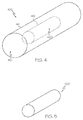
- FIG. 4 illustrates a hybrid additive manufactured / HIP-processed article in accordance with a simplified embodiment.
- the simplified article 400 includes an outer shell portion 410 in the shape of a cylinder at its outer bounds 411.
- the interior of the outer shell portion 410 is further defined by a cylindrical shape 412.
- the interior cylindrical shape 412 defines the outer bounds of the inner core portion 420.
- the subsequent processing to remove the can may include, for example, a machining process that allows for the separation of the can from the densified metal powder article enclosed therewith that was formed as a result of the as-HIP processing.
- the can may be machined so as to separate the can into one or more portions (such as halves), and then the one or more portions may be physically removed from over the densified metal powder article.
- it may be desirable to remove only portions of the can, leaving some of the can remaining over the densified metal powder article.
- chemically processing may be used to remove the can from the densified metal powder article.
- FIG. 5 illustrates a densified metal powder article in accordance with a simplified embodiment.
- the shape of the article shown is very basic (i.e., a cylinder) and is provided for purposes of illustrating the article, while not intending to be limiting with respect to any particular shape of the article.
- the simplified article 500 includes is provided in the shape of a cylinder, similar in configuration and size to the inner core portion 420 of FIG. 4 (from which it would be derived).
- the method 100 concludes with an optional step 160 of subjecting the densified metal powder article (where the can was removed) or the hybrid article (where the can was not removed) to a finishing treatment.
- exemplary, non-limiting finishing treatments can include polishing, peening, and/or the application of coatings.
- the finishing treatments may further include machining or reshaping to form the completed article.
- the present disclosure has provided net-shape or near-net shape powder metal components and methods for producing the same.
- the disclosure employs the use of powder bed additive manufacturing processes to manufacture the metal can used to containerize and hermetically seal non-fused metal powder for subsequent densification with HIP.
- the described embodiments beneficially synergize the design flexibility of additive manufacturing processes with the desirable material properties of as-HIP processes.
Landscapes
- Engineering & Computer Science (AREA)
- Mechanical Engineering (AREA)
- Manufacturing & Machinery (AREA)
- Physics & Mathematics (AREA)
- Chemical & Material Sciences (AREA)
- Materials Engineering (AREA)
- Optics & Photonics (AREA)
- Plasma & Fusion (AREA)
- Composite Materials (AREA)
- Metallurgy (AREA)
- Organic Chemistry (AREA)
- Powder Metallurgy (AREA)
Applications Claiming Priority (1)
| Application Number | Priority Date | Filing Date | Title |
|---|---|---|---|
| US14/669,111 US20160279708A1 (en) | 2015-03-26 | 2015-03-26 | Net-shape or near-net shape powder metal components and methods for producing the same |
Publications (2)
| Publication Number | Publication Date |
|---|---|
| EP3072611A2 true EP3072611A2 (fr) | 2016-09-28 |
| EP3072611A3 EP3072611A3 (fr) | 2016-10-05 |
Family
ID=56087062
Family Applications (1)
| Application Number | Title | Priority Date | Filing Date |
|---|---|---|---|
| EP16161709.7A Withdrawn EP3072611A3 (fr) | 2015-03-26 | 2016-03-22 | Composants en poudre métallique à dimension proche de la spécification finale et leurs procédés de production |
Country Status (2)
| Country | Link |
|---|---|
| US (1) | US20160279708A1 (fr) |
| EP (1) | EP3072611A3 (fr) |
Cited By (9)
| Publication number | Priority date | Publication date | Assignee | Title |
|---|---|---|---|---|
| WO2018211432A1 (fr) * | 2017-05-19 | 2018-11-22 | Bodycote H.I.P. Limited | Composants |
| CN108971495A (zh) * | 2018-08-08 | 2018-12-11 | 北京航空航天大学 | 一种钛合金气瓶半球体热等静压成形方法 |
| WO2019008348A1 (fr) * | 2017-07-05 | 2019-01-10 | Bodycote H.I.P. Limited | Capsule destinée à une compression isostatique à chaud |
| WO2019058020A1 (fr) * | 2017-09-25 | 2019-03-28 | Teknologian Tutkimuskeskus Vtt Oy | Procédé de fabrication de composant multimatériau et composant multimatériau |
| WO2019071445A1 (fr) * | 2017-10-11 | 2019-04-18 | 北京理工大学 | Système d'usinage et procédé d'usinage pour produire un environnement à pression variable |
| EP3639953A1 (fr) * | 2018-10-19 | 2020-04-22 | United Technologies Corporation | Procédé de métallurgie des poudres utilisant un réservoir cylindrique à quatre parois |
| EP3646970A1 (fr) * | 2018-10-31 | 2020-05-06 | Hamilton Sundstrand Corporation | Procédé de fabrication de composants à l'aide de fabrication additive hybride et procédé de consolidation |
| CN111278589A (zh) * | 2017-10-31 | 2020-06-12 | 株式会社Ihi | 金属部件的制造方法 |
| EP3661679B1 (fr) * | 2017-08-04 | 2024-11-13 | BAE Systems PLC | Pressage isostatique à chaud de poudre |
Families Citing this family (8)
| Publication number | Priority date | Publication date | Assignee | Title |
|---|---|---|---|---|
| EP3239468A1 (fr) * | 2016-04-27 | 2017-11-01 | MTU Aero Engines GmbH | Procédé de fabrication d'une aube de turbomachine |
| CA3091705A1 (fr) | 2017-02-24 | 2018-08-30 | Innomaq 21, S.L. | Procede de fabrication economique de composants legers |
| US11426818B2 (en) | 2018-08-10 | 2022-08-30 | The Research Foundation for the State University | Additive manufacturing processes and additively manufactured products |
| WO2021096517A1 (fr) * | 2019-11-14 | 2021-05-20 | Halliburton Energy Services, Inc. | Fabrication additive de composants ayant des propriétés fonctionnellement graduées |
| US11813672B2 (en) | 2020-05-08 | 2023-11-14 | Grid Logic Incorporated | System and method for manufacturing a part |
| US12179265B2 (en) * | 2020-10-08 | 2024-12-31 | Markforged, Inc. | Composites, tooling, dies and methods of manufacturing thereof |
| US11230971B1 (en) | 2020-10-19 | 2022-01-25 | General Electric Company | Unit cell structures including stiffening patterns |
| WO2024092114A1 (fr) * | 2022-10-28 | 2024-05-02 | Grid Logic Incorporated | Procédé pour la fabrication d'une pièce par fabrication additive à l'aide d'une presse isostatique à chaud |
Citations (6)
| Publication number | Priority date | Publication date | Assignee | Title |
|---|---|---|---|---|
| US5640667A (en) * | 1995-11-27 | 1997-06-17 | Board Of Regents, The University Of Texas System | Laser-directed fabrication of full-density metal articles using hot isostatic processing |
| US20090274923A1 (en) | 2008-03-04 | 2009-11-05 | Kenneth Hall | Tools Having Compacted Powder Metal Work Surfaces, And Method |
| US20140053956A1 (en) | 2012-08-21 | 2014-02-27 | Alstom Technology Ltd | Method for manufacturing a three-dimensional article |
| EP2910324A2 (fr) * | 2014-02-25 | 2015-08-26 | General Electric Company | Procédé de fabrication d'un objet tridimensionel à l'aide de poudres |
| EP3057729A1 (fr) * | 2013-10-17 | 2016-08-24 | The Exone Company | Récipients de pressage isostatique à chaud obtenus par impression tridimensionnelle et processus pour leur fabrication |
| EP3064295A1 (fr) * | 2015-03-05 | 2016-09-07 | General Electric Company | Procédé de production d'un article |
Family Cites Families (4)
| Publication number | Priority date | Publication date | Assignee | Title |
|---|---|---|---|---|
| EP2123377A1 (fr) * | 2008-05-23 | 2009-11-25 | Rovalma, S.A. | Procédé de fabrication d'une pièce à usiner, en particulier un outil de bloc de jeu de construction ou une pièce d'outil de bloc de jeu de construction |
| EP2551040A1 (fr) * | 2011-07-25 | 2013-01-30 | EADS Deutschland GmbH | Procédé de fabrication de composant par pression isostatique à chaud |
| US9555473B2 (en) * | 2011-10-08 | 2017-01-31 | The Boeing Company | System and method for increasing the bulk density of metal powder |
| GB201213940D0 (en) * | 2012-08-06 | 2012-09-19 | Materials Solutions | Additive manufacturing |
-
2015
- 2015-03-26 US US14/669,111 patent/US20160279708A1/en not_active Abandoned
-
2016
- 2016-03-22 EP EP16161709.7A patent/EP3072611A3/fr not_active Withdrawn
Patent Citations (6)
| Publication number | Priority date | Publication date | Assignee | Title |
|---|---|---|---|---|
| US5640667A (en) * | 1995-11-27 | 1997-06-17 | Board Of Regents, The University Of Texas System | Laser-directed fabrication of full-density metal articles using hot isostatic processing |
| US20090274923A1 (en) | 2008-03-04 | 2009-11-05 | Kenneth Hall | Tools Having Compacted Powder Metal Work Surfaces, And Method |
| US20140053956A1 (en) | 2012-08-21 | 2014-02-27 | Alstom Technology Ltd | Method for manufacturing a three-dimensional article |
| EP3057729A1 (fr) * | 2013-10-17 | 2016-08-24 | The Exone Company | Récipients de pressage isostatique à chaud obtenus par impression tridimensionnelle et processus pour leur fabrication |
| EP2910324A2 (fr) * | 2014-02-25 | 2015-08-26 | General Electric Company | Procédé de fabrication d'un objet tridimensionel à l'aide de poudres |
| EP3064295A1 (fr) * | 2015-03-05 | 2016-09-07 | General Electric Company | Procédé de production d'un article |
Cited By (16)
| Publication number | Priority date | Publication date | Assignee | Title |
|---|---|---|---|---|
| WO2018211432A1 (fr) * | 2017-05-19 | 2018-11-22 | Bodycote H.I.P. Limited | Composants |
| US11267049B2 (en) | 2017-05-19 | 2022-03-08 | Bodycote H.I.P. Limited | Components |
| WO2019008348A1 (fr) * | 2017-07-05 | 2019-01-10 | Bodycote H.I.P. Limited | Capsule destinée à une compression isostatique à chaud |
| US11478849B2 (en) | 2017-07-05 | 2022-10-25 | Bodycote H.I.P. Limited | Capsule for isostatic pressing and method |
| CN111093864A (zh) * | 2017-07-05 | 2020-05-01 | 博迪科特H.I.P.有限公司 | 用于热等静压的封壳 |
| EP3661679B1 (fr) * | 2017-08-04 | 2024-11-13 | BAE Systems PLC | Pressage isostatique à chaud de poudre |
| WO2019058020A1 (fr) * | 2017-09-25 | 2019-03-28 | Teknologian Tutkimuskeskus Vtt Oy | Procédé de fabrication de composant multimatériau et composant multimatériau |
| WO2019071445A1 (fr) * | 2017-10-11 | 2019-04-18 | 北京理工大学 | Système d'usinage et procédé d'usinage pour produire un environnement à pression variable |
| CN111278589A (zh) * | 2017-10-31 | 2020-06-12 | 株式会社Ihi | 金属部件的制造方法 |
| US11618074B2 (en) | 2017-10-31 | 2023-04-04 | Ihi Corporation | Method of manufacturing metal member |
| CN108971495B (zh) * | 2018-08-08 | 2021-01-19 | 北京航空航天大学 | 一种钛合金气瓶半球体热等静压成形方法 |
| CN108971495A (zh) * | 2018-08-08 | 2018-12-11 | 北京航空航天大学 | 一种钛合金气瓶半球体热等静压成形方法 |
| EP3639953A1 (fr) * | 2018-10-19 | 2020-04-22 | United Technologies Corporation | Procédé de métallurgie des poudres utilisant un réservoir cylindrique à quatre parois |
| US12233461B2 (en) | 2018-10-19 | 2025-02-25 | Rtx Corporation | Powder metallurgy method using a four-wall cylindrical canister |
| EP3646970A1 (fr) * | 2018-10-31 | 2020-05-06 | Hamilton Sundstrand Corporation | Procédé de fabrication de composants à l'aide de fabrication additive hybride et procédé de consolidation |
| US11498125B2 (en) | 2018-10-31 | 2022-11-15 | Hamilton Sundstrand Corporation | Method for fabricating components using hybrid additive manufacturing and consolidation process |
Also Published As
| Publication number | Publication date |
|---|---|
| EP3072611A3 (fr) | 2016-10-05 |
| US20160279708A1 (en) | 2016-09-29 |
Similar Documents
| Publication | Publication Date | Title |
|---|---|---|
| US20160279708A1 (en) | Net-shape or near-net shape powder metal components and methods for producing the same | |
| US10933497B2 (en) | Surface improvement of additively manufactured articles produced with aluminum alloys | |
| EP3034639B1 (fr) | Superalliages à base de nickel et procédés de fabrication d'additifs à l'aide de superalliages à base de nickel | |
| US9267189B2 (en) | Methods for forming dispersion-strengthened aluminum alloys | |
| EP3580434B1 (fr) | Composant de moteur à turbine annulaire et son procédé de fabrication | |
| JP6644007B2 (ja) | 金属又は金属マトリックス複合材料から作られた部品の製造のための方法及び積層造形とそれに続く前記部品の鍛造を含む工程からの結果物 | |
| EP2754515B1 (fr) | Procédés de fabrication de composants de moteur à turbine à gaz utiilisant des techniques de fabrication additives | |
| US9447484B2 (en) | Methods for forming oxide dispersion-strengthened alloys | |
| US9095900B2 (en) | Generative production method and powder therefor | |
| JP2016505709A (ja) | 溶融浴に隣接する範囲の加熱を含む、粉末を溶融する方法 | |
| EP2905097A2 (fr) | Article manufacturé par méthode de fabrication additive | |
| CN105710377A (zh) | 使用用于复合部件的复合增材制造特征的复合增材制造方法 | |
| US11193216B2 (en) | Methods and systems for electrochemical machining of articles formed by additive manufacturing | |
| US20090081066A1 (en) | Method of forming an article | |
| CA3068408C (fr) | Technique de fabrication additive pour materiau en poudre de superalliage durci par precipitation | |
| CN113927034A (zh) | 一种制造热等静压粉末冶金零件真空自封装包套的方法 | |
| US20240058862A1 (en) | Build materials having a powder mixture comprising graphene, methods of producing articles therefrom, and articles produced therewith | |
| US20220097139A1 (en) | Method for the production of parts made from metal or metal matrix composite and resulting from additive manufacturing followed by an operation involving the forging of said parts | |
| US20190016059A1 (en) | Additive manufacturing methods and related components | |
| EP3687717A1 (fr) | Procédé de fabrication de composant multimatériau et composant multimatériau | |
| EP4335568A1 (fr) | Matériaux de construction ayant un mélange de poudres comprenant du graphène, procédés de production d'articles à partir de ceux-ci et articles produits avec ceux-ci | |
| GB2453132A (en) | Method of forming an Article |
Legal Events
| Date | Code | Title | Description |
|---|---|---|---|
| PUAI | Public reference made under article 153(3) epc to a published international application that has entered the european phase |
Free format text: ORIGINAL CODE: 0009012 |
|
| PUAL | Search report despatched |
Free format text: ORIGINAL CODE: 0009013 |
|
| 17P | Request for examination filed |
Effective date: 20160322 |
|
| AK | Designated contracting states |
Kind code of ref document: A2 Designated state(s): AL AT BE BG CH CY CZ DE DK EE ES FI FR GB GR HR HU IE IS IT LI LT LU LV MC MK MT NL NO PL PT RO RS SE SI SK SM TR |
|
| AX | Request for extension of the european patent |
Extension state: BA ME |
|
| AK | Designated contracting states |
Kind code of ref document: A3 Designated state(s): AL AT BE BG CH CY CZ DE DK EE ES FI FR GB GR HR HU IE IS IT LI LT LU LV MC MK MT NL NO PL PT RO RS SE SI SK SM TR |
|
| AX | Request for extension of the european patent |
Extension state: BA ME |
|
| RIC1 | Information provided on ipc code assigned before grant |
Ipc: B22F 3/105 20060101AFI20160826BHEP Ipc: B22F 3/15 20060101ALI20160826BHEP |
|
| STAA | Information on the status of an ep patent application or granted ep patent |
Free format text: STATUS: EXAMINATION IS IN PROGRESS |
|
| 17Q | First examination report despatched |
Effective date: 20171006 |
|
| STAA | Information on the status of an ep patent application or granted ep patent |
Free format text: STATUS: THE APPLICATION IS DEEMED TO BE WITHDRAWN |
|
| 18D | Application deemed to be withdrawn |
Effective date: 20180926 |