EP3073488A1 - Procédé et appareil permettant d'intégrer et de récupérer des filigranes dans une représentation ambisonique d'un champ sonore - Google Patents
Procédé et appareil permettant d'intégrer et de récupérer des filigranes dans une représentation ambisonique d'un champ sonore Download PDFInfo
- Publication number
- EP3073488A1 EP3073488A1 EP15305427.5A EP15305427A EP3073488A1 EP 3073488 A1 EP3073488 A1 EP 3073488A1 EP 15305427 A EP15305427 A EP 15305427A EP 3073488 A1 EP3073488 A1 EP 3073488A1
- Authority
- EP
- European Patent Office
- Prior art keywords
- directional signals
- dimensional
- watermark
- sound field
- signals
- Prior art date
- Legal status (The legal status is an assumption and is not a legal conclusion. Google has not performed a legal analysis and makes no representation as to the accuracy of the status listed.)
- Withdrawn
Links
- 238000000034 method Methods 0.000 title claims abstract description 42
- 238000001514 detection method Methods 0.000 claims description 31
- 230000005236 sound signal Effects 0.000 claims description 14
- 230000000873 masking effect Effects 0.000 claims description 5
- 230000015654 memory Effects 0.000 claims description 2
- 238000004590 computer program Methods 0.000 claims 2
- 230000003287 optical effect Effects 0.000 claims 1
- 230000006835 compression Effects 0.000 description 16
- 238000007906 compression Methods 0.000 description 16
- 238000012545 processing Methods 0.000 description 13
- 238000000354 decomposition reaction Methods 0.000 description 8
- 230000005540 biological transmission Effects 0.000 description 4
- 238000006243 chemical reaction Methods 0.000 description 3
- 238000009877 rendering Methods 0.000 description 3
- 230000001419 dependent effect Effects 0.000 description 2
- 230000004048 modification Effects 0.000 description 2
- 238000012986 modification Methods 0.000 description 2
- 239000000654 additive Substances 0.000 description 1
- 230000000996 additive effect Effects 0.000 description 1
- 230000004931 aggregating effect Effects 0.000 description 1
- 230000015556 catabolic process Effects 0.000 description 1
- 235000009508 confectionery Nutrition 0.000 description 1
- 230000006837 decompression Effects 0.000 description 1
- 238000006731 degradation reaction Methods 0.000 description 1
- 230000000593 degrading effect Effects 0.000 description 1
- 230000001934 delay Effects 0.000 description 1
- 230000008825 perceptual sensitivity Effects 0.000 description 1
- 238000012805 post-processing Methods 0.000 description 1
- 238000005070 sampling Methods 0.000 description 1
- 230000011218 segmentation Effects 0.000 description 1
- 238000001228 spectrum Methods 0.000 description 1
- 230000002087 whitening effect Effects 0.000 description 1
Images




Classifications
-
- G—PHYSICS
- G10—MUSICAL INSTRUMENTS; ACOUSTICS
- G10L—SPEECH ANALYSIS TECHNIQUES OR SPEECH SYNTHESIS; SPEECH RECOGNITION; SPEECH OR VOICE PROCESSING TECHNIQUES; SPEECH OR AUDIO CODING OR DECODING
- G10L19/00—Speech or audio signals analysis-synthesis techniques for redundancy reduction, e.g. in vocoders; Coding or decoding of speech or audio signals, using source filter models or psychoacoustic analysis
- G10L19/018—Audio watermarking, i.e. embedding inaudible data in the audio signal
-
- G—PHYSICS
- G10—MUSICAL INSTRUMENTS; ACOUSTICS
- G10L—SPEECH ANALYSIS TECHNIQUES OR SPEECH SYNTHESIS; SPEECH RECOGNITION; SPEECH OR VOICE PROCESSING TECHNIQUES; SPEECH OR AUDIO CODING OR DECODING
- G10L19/00—Speech or audio signals analysis-synthesis techniques for redundancy reduction, e.g. in vocoders; Coding or decoding of speech or audio signals, using source filter models or psychoacoustic analysis
- G10L19/008—Multichannel audio signal coding or decoding using interchannel correlation to reduce redundancy, e.g. joint-stereo, intensity-coding or matrixing
-
- H—ELECTRICITY
- H04—ELECTRIC COMMUNICATION TECHNIQUE
- H04S—STEREOPHONIC SYSTEMS
- H04S3/00—Systems employing more than two channels, e.g. quadraphonic
- H04S3/008—Systems employing more than two channels, e.g. quadraphonic in which the audio signals are in digital form, i.e. employing more than two discrete digital channels
-
- H—ELECTRICITY
- H04—ELECTRIC COMMUNICATION TECHNIQUE
- H04S—STEREOPHONIC SYSTEMS
- H04S2420/00—Techniques used stereophonic systems covered by H04S but not provided for in its groups
- H04S2420/11—Application of ambisonics in stereophonic audio systems
Definitions
- the invention relates to a method and to an apparatus for embedding and regaining watermarks in a two-dimensional or three-dimensional Ambisonics representation of a sound field.
- a problem to be solved by the invention is to improve watermarking of a 2D or 3D Ambisonics sound field representation. This problem is solved by the embedding method disclosed in claim 1 and the regaining method disclosed in claim 8. Apparatus that utilise these methods are disclosed in claims 2 and 9. Advantageous additional embodiments of the invention are disclosed in the respective dependent claims.
- the following description discloses embedding and detecting of digital watermarks in a 2D or 3D Ambisonics representation of a sound field, based on the decomposition of the Ambisonics representation into dominant directional signals and ambient or residual components.
- the watermark data signal is embedded in the dominant directional signals by any PCM audio watermarking technique that operates in the baseband signal.
- Watermark detection can be performed as a part of the Ambisonics decoding processing following digital transmission. Alternatively, watermark detection can be carried out after recording of the rendered sound field. If a spherical microphone is available, directional signals can be estimated again in order to improve the robustness of the embedded watermarks.
- the embedding of watermark information in such directional signals provides a better trade-off between fidelity and robustness against HOA compression, because directional signals are perceptually dominant and a relatively high embedding strength can be used without degrading the resulting perceptual fidelity.
- directional signals are delivered without any change after HOA compression, a high robustness of the embedded watermarks is ensured.
- the inventive embedding method is adapted for watermarking a two-dimensional or three-dimensional Ambisonics representation of a sound field, wherein said Ambisonics representation is decomposed into directional signals and ambient components and includes estimated dominant directions, and wherein the order of said ambient components can be reduced, and wherein watermark information data are embedded in said directional signals.
- the inventive embedding apparatus is adapted for watermarking a two-dimensional or three-dimensional Ambisonics representation of a sound field, said apparatus being adapted to:
- the inventive regaining method is adapted for regaining watermark information data which were embedded in a two-dimensional or three-dimensional Ambisonics representation of a sound field according to the above embedding method, including:
- the inventive regaining apparatus is adapted for regaining watermark information data which were embedded in a two-dimensional or three-dimensional Ambisonics representation of a sound field according to the above embedding method, said apparatus being adapted to:
- Fig. 1 depicts a spherical coordinate system with inclination angle ⁇ and azimuth angle ⁇ , and r is the distance from the listening point as origin (sweet spot) of the coordinate system.
- Spherical harmonics (SH) are denoted by Y n m ⁇ ⁇
- a n m kr are the expansion (ambisonics) coefficients.
- HOA refers to SH expansions with an order N > 1.
- expansion coefficients are referred to as HOA coefficients, and the expansion order is also called HOA order.
- SH expansion coefficients A n m kr are delivered for rendering in the context of Ambisonics.
- a renderer tries to reproduce the delivered sound field by loudspeakers.
- the flexibility of HOA - that it can be applied for different loudspeaker setups - comes at the expense that decoding is necessary for individual loudspeaker setups. Further details on HOA and decoding for HOA can be found in WO2011/117399 A1 [10] or in [3].
- the data rate for transmitting HOA coefficients without compression can be evaluated as 0 ⁇ f s ⁇ b bits/s, where 0 is the number of HOA coefficients (see above) for each time index, f s is the sampling frequency and b is the number of bits representing each HOA coefficient.
- HOA compression intends to reduce the data rate without sacrificing perceptual fidelity.
- [9] shows how to reduce the data rate of transmitted HOA coefficients for the purpose of compression.
- the essential assumption is that HOA coefficients representing a sound field can be decomposed into directional signals and residual ambient components, and it has been verified that a lower HOA order, say N a ⁇ N, is sufficient for representing the residual or ambient components.
- the parameter D is pre-defined.
- the watermark information data are embedded in the directional signals, irrespective of the Ambisonics order and irrespective of two-dimensional or three-dimensional Ambisonics.
- Fig. 2 illustrates watermark embedding by modifying Ambisonics coefficients which are calculated from recorded or synthesised audio signals or are extracted from an Ambisonics audio file in any known Ambisonics format, see [4].
- Ambisonics coefficients are decomposed in step or stage 21 into estimated directional signals and corresponding estimated dominant directions information data, and residual ambient components or signals.
- One possible decomposition for HOA coefficients is disclosed in [9], which is also applicable for first-order Ambisonics.
- Directional signals can be interpreted as multiple PCM signals.
- directional signals can be employed for arbitrary PCM audio watermarking techniques (see for example [1]). For each directional signal to be watermarked an individual masking curve can be used to constrain the watermark embedding strength.
- watermark embedding step or stage 22 one or more watermarks are embedded into one or more directional signals.
- the watermarked directional signals, the ambient signals and the direction information data are composed in Ambisonics composition step or stage 23, resulting in watermarked Ambisonics coefficients.
- Watermarked directional signals and their associated estimated dominant directions are used to evaluate the corresponding Ambisonics representation, which is used for composing the final Ambisonics representation with residual ambient components obtained during decomposition.
- a similar composition process is described in [9] in the context of HOA decompression. Consequently, modified Ambisonics coefficients with watermark signals embedded can be used for a processing like compression as shown in [9] or in [11].
- Fig. 3 illustrates how to perform watermark embedding within the framework of HOA compression. This processing can also be applied for first-order Ambisonics, but HOA has potentially wider applications than first-order Ambisonics.
- the HOA conversion step or stage 31 calculates HOA coefficients from received recorded or synthesised audio signals, together with corresponding position information items, and based on HOA order N . Following HOA conversion, the HOA coefficients are decomposed in step or stage 32 into directional signals and ambient signals or components and related estimated dominant direction information data, as shown in [9].
- Watermarking is carried out in step or stage 33 for the directional signals with any PCM audio watermarking technique (see for example [1]).
- any PCM audio watermarking technique see for example [1]
- the ambient signals pass through an order reduction step or stage 34.
- the watermarked directional signals, together with the ambient HOA components after order reduction, are further compressed by means of perceptual coding in step or stage 35. Examples for such perceptual coding are AAC, mp3, or USAC (Unified speech and audio coding).
- the direction information of corresponding signals is multiplexed in step/stage 36 with the perceptually coded bitstream so as to form a watermarked HOA bitstream.
- watermark signals can be embedded in individual directional signals in order to achieve a high data rate for watermark transmission.
- the same watermark signal can be embedded in individual directional signals for high robustness against potential signal processing and acoustic path transmission.
- spread spectrum techniques and error correction codes can be employed for further increase of robustness, see [1].
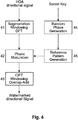
- Fig. 4 shows an example for watermark embedding using audio signal phase modifications as disclosed in [1].
- a directional signal passes through a step or stage 41 for segmentation, windowing and DFT to a phase modulation step or stage 42.
- the secret key is used for a random phase generation step or stage 44 and a corresponding generation of reference patterns of e.g. 16384 samples length in step or stage 45.
- a reference pattern is selected for modifying in step/stage 42 phases of one directional signal after HOA decomposition. For each directional signal to be watermarked an individual masking curve can be used to constrain the watermark embedding strength.
- the masking curve of the directional signal is determined so that the phase modification will not cause any perceptual degradation.
- a following IDFT, windowing and overlap-add step or stage 43 outputs the watermarked directional signal.
- Watermarked directional signals are processed to re-compose HOA coefficients as in Fig. 2 or to obtain the final HOA bitstream, see Fig. 3 .
- a watermark payload can be protected by error correction.
- Each watermark symbol corresponds to a reference pattern 45 in the watermark information data embedding 42.
- the watermark embedding step can also be integrated directly in the perceptual coder, as depicted in Fig. 5 .
- Recorded or synthesised audio signals, data about positions and the value N of the HOA order are supplied to an HOA converter 51.
- the HOA representation signal is fed to a HOA decomposition step or stage 52, which outputs directional signal data, related estimated dominant direction data, and ambient signal data.
- Preferably the order of the ambient signal is reduced in order reduction step or stage 54.
- the directional signal data and the order-reduced ambient signal data are perceptually encoded in step or stage 55, whereby watermark data are embedded. Examples for audio watermarking for AAC and AC-3 can be found in [6] and in [5], respectively.
- the perceptually encoded directional signal data and order-reduced ambient signal data together with the direction data are multiplexed in a multiplexer step or stage 56, which outputs a watermarked HOA bitstream.
- step or stage 62 can be performed by extracting directional signals, as shown in Fig. 6 .
- Decomposition of Ambisonics coefficients is performed in step or stage 61 corresponding to the processing in step/stage 21 or step/stage 32 at watermark embedding, using for example the processing described in [9].
- An example for the conversion of signals recorded by a spherical microphone array to an Ambisonics representation is described in [12].
- watermark detection can be carried out within the framework of HOA decoding in a digital transmission environment (e.g. in a set-top box) as shown in Fig. 7 .
- the incoming HOA bitstream is split in a demultiplexer step or stage 76 into a bitstream for perceptual decoding and direction information data for directional signals of the HOA coefficients.
- a perceptual decoding in step or stage 75 delivers watermarked directional signals and possibly order-reduced ambient HOA components.
- the watermark is then detected and extracted in watermark detection step or stage 73 from the watermarked directional signals.
- the watermarked directional signals and the ambient HOA components are used in HOA composition step or stage 72 together with the direction information data for recovering the HOA representation of the original sound field.
- the recovered HOA coefficients are used in HOA rendering step or stage 71 for rendering so as to reproduce loudspeaker signals for the original sound field.
- step/stage 73 is omitted and the watermark detection is carried out in said perceptually decoding step/stage 75.
- watermark detection can be carried out independent of HOA decoding, as illustrated in Fig. 8 .
- a watermarked HOA bitstream is HOA decoded in step or stage 81 and HOA rendered in step or stage 82, resulting in corresponding loudspeaker signals.
- Such represented sound field can be recorded in a sound field recoding step or stage 83.
- the (sound field recoded) loudspeaker signals are fed to a watermark detection step or stage 84 which provides the detected watermark data.
- the watermark can be detected as shown in Fig. 9 .
- a sound field reproduced by loudspeakers is recorded by an omnidirectional microphone or a microphone array like Eigenmike in a spherical microphone recording step or stage 97, followed by post-processing as required to transform the recorded microphone signal in step or stage 98 into the HOA coefficients.
- the recorded signal is used for watermark detection in step or stage 92.
- the recorded signal is a superposition of the rendered directional signals and the ambient component. If the same watermark is embedded in the directional signals, correlation-based watermark detectors will reveal several peaks in the correlation array due to time delays from the different loudspeakers.
- FIG. 10 A detailed example for watermark detection is shown in Fig. 10 .
- Fig. 8 processing or in the omnidirectional microphone case (first embodiment of Fig. 9 )
- watermarked directional signals are available for watermark detection.
- a directional signal or a watermarked directional signal passes through a whitening step or stage 101.
- the secret key is used for a random phase generation in step or stage 104 and a corresponding generation of reference patterns of e.g. 16384 samples length in step or stage 105.
- Candidate reference patterns from step/stage 105 are selected for cross correlations with a corresponding section of the whitened watermarked input signal in correlation step/stage 102. From the output signal of step/stage 102 the embedded watermark symbol is detected in symbol detection step or stage 103 and is output. The watermark symbol estimation based on correlation values can be performed as described in [1].
- the described processing can be carried out by a single processor or electronic circuit, or by several processors or electronic circuits operating in parallel and/or operating on different parts of the complete processing.
- the instructions for operating the processor or the processors according to the described processing can be stored in one or more memories. Then at least one processor is configured to carry out these instructions.
Landscapes
- Engineering & Computer Science (AREA)
- Physics & Mathematics (AREA)
- Signal Processing (AREA)
- Acoustics & Sound (AREA)
- Multimedia (AREA)
- Computational Linguistics (AREA)
- Health & Medical Sciences (AREA)
- Audiology, Speech & Language Pathology (AREA)
- Human Computer Interaction (AREA)
- Mathematical Physics (AREA)
- Stereophonic System (AREA)
- Editing Of Facsimile Originals (AREA)
Priority Applications (8)
| Application Number | Priority Date | Filing Date | Title |
|---|---|---|---|
| EP15305427.5A EP3073488A1 (fr) | 2015-03-24 | 2015-03-24 | Procédé et appareil permettant d'intégrer et de récupérer des filigranes dans une représentation ambisonique d'un champ sonore |
| KR1020177030172A KR20170130495A (ko) | 2015-03-24 | 2016-02-18 | 음장의 앰비소닉스 표현에서 워터마크들을 삽입하고 복구하는 방법 및 장치 |
| PCT/EP2016/053440 WO2016150624A1 (fr) | 2015-03-24 | 2016-02-18 | Procédé et appareil pour intégrer et récupérer des filigranes dans une représentation d'ambiophonie d'un champ sonore |
| CN201680017752.6A CN107430865A (zh) | 2015-03-24 | 2016-02-18 | 用于在声场的高保真度立体声响复制表示中嵌入和恢复水印的方法和装置 |
| JP2017549629A JP2018511083A (ja) | 2015-03-24 | 2016-02-18 | 音場のアンビソニックス表現に透かしを埋め込み、およびそれを復元する方法および装置 |
| US15/561,065 US20180075852A1 (en) | 2015-03-24 | 2016-02-18 | Method and apparatus for embedding and regaining watermarks in an ambisonics representation of a sound field |
| EP16705498.0A EP3274990A1 (fr) | 2015-03-24 | 2016-02-18 | Procédé et appareil pour intégrer et récupérer des filigranes dans une représentation d'ambiophonie d'un champ sonore |
| TW105106603A TW201635275A (zh) | 2015-03-24 | 2016-03-04 | 聲場二維度或三維度保真立體音響表示之加水印方法和裝置,水印資訊之恢復方法和裝置,從聲場揚聲器訊號恢復水印資訊資料之方法,數位聲訊訊號,儲存媒體,電腦程式及其製品 |
Applications Claiming Priority (1)
| Application Number | Priority Date | Filing Date | Title |
|---|---|---|---|
| EP15305427.5A EP3073488A1 (fr) | 2015-03-24 | 2015-03-24 | Procédé et appareil permettant d'intégrer et de récupérer des filigranes dans une représentation ambisonique d'un champ sonore |
Publications (1)
| Publication Number | Publication Date |
|---|---|
| EP3073488A1 true EP3073488A1 (fr) | 2016-09-28 |
Family
ID=52807762
Family Applications (2)
| Application Number | Title | Priority Date | Filing Date |
|---|---|---|---|
| EP15305427.5A Withdrawn EP3073488A1 (fr) | 2015-03-24 | 2015-03-24 | Procédé et appareil permettant d'intégrer et de récupérer des filigranes dans une représentation ambisonique d'un champ sonore |
| EP16705498.0A Withdrawn EP3274990A1 (fr) | 2015-03-24 | 2016-02-18 | Procédé et appareil pour intégrer et récupérer des filigranes dans une représentation d'ambiophonie d'un champ sonore |
Family Applications After (1)
| Application Number | Title | Priority Date | Filing Date |
|---|---|---|---|
| EP16705498.0A Withdrawn EP3274990A1 (fr) | 2015-03-24 | 2016-02-18 | Procédé et appareil pour intégrer et récupérer des filigranes dans une représentation d'ambiophonie d'un champ sonore |
Country Status (7)
| Country | Link |
|---|---|
| US (1) | US20180075852A1 (fr) |
| EP (2) | EP3073488A1 (fr) |
| JP (1) | JP2018511083A (fr) |
| KR (1) | KR20170130495A (fr) |
| CN (1) | CN107430865A (fr) |
| TW (1) | TW201635275A (fr) |
| WO (1) | WO2016150624A1 (fr) |
Cited By (1)
| Publication number | Priority date | Publication date | Assignee | Title |
|---|---|---|---|---|
| CN110110508A (zh) * | 2019-05-16 | 2019-08-09 | 百度在线网络技术(北京)有限公司 | 水印信息写入方法和装置以及水印信息读取方法和装置 |
Families Citing this family (2)
| Publication number | Priority date | Publication date | Assignee | Title |
|---|---|---|---|---|
| EP2665208A1 (fr) * | 2012-05-14 | 2013-11-20 | Thomson Licensing | Procédé et appareil de compression et de décompression d'une représentation de signaux d'ambiophonie d'ordre supérieur |
| US20210006976A1 (en) * | 2019-07-03 | 2021-01-07 | Qualcomm Incorporated | Privacy restrictions for audio rendering |
Citations (5)
| Publication number | Priority date | Publication date | Assignee | Title |
|---|---|---|---|---|
| WO2011117399A1 (fr) | 2010-03-26 | 2011-09-29 | Thomson Licensing | Procédé et dispositif pour le décodage d'une représentation d'un champ sonore audio pour une lecture audio |
| EP2469742A2 (fr) | 2010-12-21 | 2012-06-27 | Thomson Licensing | Procédé et appareil de codage et de décodage de cadres successifs d'une représentation d'ambiophonie de champ sonore bi ou tridimensionnel |
| WO2013068283A1 (fr) | 2011-11-11 | 2013-05-16 | Thomson Licensing | Procédé et appareil pour traitement de signaux d'un réseau de microphones sphérique sur une sphère rigide utilisé pour générer une représentation d'ambiophonie du champ sonore |
| WO2013171083A1 (fr) | 2012-05-14 | 2013-11-21 | Thomson Licensing | Procédé et appareil de compression et de décompression d'une représentation de signal ambiophonique d'ordre supérieur |
| WO2015038546A1 (fr) * | 2013-09-12 | 2015-03-19 | Dolby Laboratories Licensing Corporation | Tatouage sélectif des canaux d'un audio multicanal |
Family Cites Families (5)
| Publication number | Priority date | Publication date | Assignee | Title |
|---|---|---|---|---|
| KR20020071925A (ko) * | 2000-11-07 | 2002-09-13 | 코닌클리케 필립스 일렉트로닉스 엔.브이. | 정보 신호 내에 워터마크를 삽입하기 위한 방법 및 장치 |
| CN1795494A (zh) * | 2003-05-28 | 2006-06-28 | 皇家飞利浦电子股份有限公司 | 位流水印嵌入 |
| CN100385459C (zh) * | 2006-07-11 | 2008-04-30 | 电子科技大学 | 一种基于有限脊波变换的图像水印方法 |
| US9667365B2 (en) * | 2008-10-24 | 2017-05-30 | The Nielsen Company (Us), Llc | Methods and apparatus to perform audio watermarking and watermark detection and extraction |
| EP2565667A1 (fr) * | 2011-08-31 | 2013-03-06 | Friedrich-Alexander-Universität Erlangen-Nürnberg | Évaluation de direction d'arrivée à l'aide de signaux audio filigranés et réseaux de microphone |
-
2015
- 2015-03-24 EP EP15305427.5A patent/EP3073488A1/fr not_active Withdrawn
-
2016
- 2016-02-18 EP EP16705498.0A patent/EP3274990A1/fr not_active Withdrawn
- 2016-02-18 US US15/561,065 patent/US20180075852A1/en not_active Abandoned
- 2016-02-18 KR KR1020177030172A patent/KR20170130495A/ko not_active Withdrawn
- 2016-02-18 JP JP2017549629A patent/JP2018511083A/ja active Pending
- 2016-02-18 WO PCT/EP2016/053440 patent/WO2016150624A1/fr not_active Ceased
- 2016-02-18 CN CN201680017752.6A patent/CN107430865A/zh active Pending
- 2016-03-04 TW TW105106603A patent/TW201635275A/zh unknown
Patent Citations (5)
| Publication number | Priority date | Publication date | Assignee | Title |
|---|---|---|---|---|
| WO2011117399A1 (fr) | 2010-03-26 | 2011-09-29 | Thomson Licensing | Procédé et dispositif pour le décodage d'une représentation d'un champ sonore audio pour une lecture audio |
| EP2469742A2 (fr) | 2010-12-21 | 2012-06-27 | Thomson Licensing | Procédé et appareil de codage et de décodage de cadres successifs d'une représentation d'ambiophonie de champ sonore bi ou tridimensionnel |
| WO2013068283A1 (fr) | 2011-11-11 | 2013-05-16 | Thomson Licensing | Procédé et appareil pour traitement de signaux d'un réseau de microphones sphérique sur une sphère rigide utilisé pour générer une représentation d'ambiophonie du champ sonore |
| WO2013171083A1 (fr) | 2012-05-14 | 2013-11-21 | Thomson Licensing | Procédé et appareil de compression et de décompression d'une représentation de signal ambiophonique d'ordre supérieur |
| WO2015038546A1 (fr) * | 2013-09-12 | 2015-03-19 | Dolby Laboratories Licensing Corporation | Tatouage sélectif des canaux d'un audio multicanal |
Non-Patent Citations (9)
| Title |
|---|
| CH. NEUBAUER; J. HERRE: "Audio watermarking of MPEG-2 AAC bit streams", AUDIO ENGINEERING SOCIETY CONVENTION, 2000, pages 108 |
| F. ZOTTER: "PhD thesis", 2009, INSTITUTE OF ELECTRONIC MUSIC AND ACOUSTICS, article "Analysis and Synthesis of Sound Radiation with Spherical Arrays" |
| J. BOEHM: "Decoding for 3-D", 130TH CONVENTION OF THE AUDIO ENG. SOC., May 2011 (2011-05-01) |
| M. ARNOLD; X.M CHEN; P.G. BAUM; U. GRIES; G. DOERR: "A Phase-based Audio Watermarking System Robust to Acoustic Path Propagation", IEEE TRANSACTIONS ON INFORMATION FORENSICS AND SECURITY, vol. 9, March 2014 (2014-03-01), pages 411 - 425, XP011538857, DOI: doi:10.1109/TIFS.2013.2293952 |
| M. ARNOLD; X.M. CHEN; P.G. BAUM: "Robust Detection of Audio Watermarks after Acoustic Path Transmission", PROCEEDINGS OF THE ACM WORKSHOP ON MULTIMEDIA AND SECURITY, September 2010 (2010-09-01), pages 117 - 126, XP058209610, DOI: doi:10.1145/1854229.1854253 |
| M. CHAPMAN; W. RITSCH; TH. MUSIL; J. 2MOLNIG; H. POM-BERGER; F. ZOTTER; A. SONTACCHI: "A standard for interchange of ambisonic signal sets including a file standard with metadata", PROCEEDINGS OF THE AMBISONICS SYMPOSIUM 2009, 2009 |
| R. NISHIMURA: "Audio watermarking using spatial masking and ambisonics", IEEE TRANSACTIONS ON AUDIO, SPEECH, AND LANGUAGE PROCESSING, vol. 20, no. 9, November 2012 (2012-11-01), pages 2461 - 2469, XP011471463, DOI: doi:10.1109/TASL.2012.2203810 |
| RYOUICHI NISHIMURA: "Audio Information Hiding Based on Spatial Masking", INTELLIGENT INFORMATION HIDING AND MULTIMEDIA SIGNAL PROCESSING (IIH-MSP), 2010 SIXTH INTERNATIONAL CONFERENCE ON, IEEE, PISCATAWAY, NJ, USA, 15 October 2010 (2010-10-15), pages 522 - 525, XP031801765, ISBN: 978-1-4244-8378-5 * |
| X.M. CHEN; M. ARNOLD; P.G. BAUM; G. DOERR: "AC-3 Bit Stream Watermarking", PROCEEDINGS OF IEEE INTERNATIONAL WORKSHOP ON INFORMATION FORENSICS AND SECURITY, December 2012 (2012-12-01), pages 181 - 186 |
Cited By (1)
| Publication number | Priority date | Publication date | Assignee | Title |
|---|---|---|---|---|
| CN110110508A (zh) * | 2019-05-16 | 2019-08-09 | 百度在线网络技术(北京)有限公司 | 水印信息写入方法和装置以及水印信息读取方法和装置 |
Also Published As
| Publication number | Publication date |
|---|---|
| US20180075852A1 (en) | 2018-03-15 |
| TW201635275A (zh) | 2016-10-01 |
| WO2016150624A1 (fr) | 2016-09-29 |
| EP3274990A1 (fr) | 2018-01-31 |
| JP2018511083A (ja) | 2018-04-19 |
| CN107430865A (zh) | 2017-12-01 |
| KR20170130495A (ko) | 2017-11-28 |
Similar Documents
| Publication | Publication Date | Title |
|---|---|---|
| TWI590234B (zh) | 編碼聲訊資料之方法和裝置,以及解碼已編碼聲訊資料之方法和裝置 | |
| Lin et al. | Audio watermarking techniques | |
| US20220377481A1 (en) | Methods, apparatus and systems for decompressing a higher order ambisonics (hoa) signal | |
| US9704494B2 (en) | Down-mixing compensation for audio watermarking | |
| KR101444102B1 (ko) | 스테레오 오디오의 부호화, 복호화 방법 및 장치 | |
| EP3162086B1 (fr) | Appareil pour déterminer, pour la compression d'une représentation de trame de données hoa, un nombre entier le plus petit de bits requis pour représenter des valeurs de gain non différentielles | |
| EP2820647B1 (fr) | Commande de la cohérence de phase pour des signaux harmoniques dans des codecs audio perceptuels | |
| EP3162087B1 (fr) | Représentation de trames de données hoa codées qui comprend des valeurs de gain non différentielles associées à des signaux de canaux de trames spécifiques parmi les trames de données d'une représentation de trames de données hoa | |
| CN105027199A (zh) | 在位流中指定球谐系数和/或高阶立体混响系数 | |
| WO2015140292A1 (fr) | Procédé de compression d'un signal ambiophonique d'ordre supérieur (hoa), procédé de décompression un signal hoa compressé, appareil de compression d'un signal hoa, et appareil de décompression d'un signal hoa compressé | |
| US20070052560A1 (en) | Bit-stream watermarking | |
| WO2015140293A1 (fr) | Procédé de compression d'un signal d'ambiophonie d'ordre supérieur (hoa), procédé de décompression d'un signal hoa compressé, appareil de compression d'un signal hoa et appareil de décompression d'un signal hoa compressé | |
| EP3809409A1 (fr) | Procédé et appareil de détermination de la compression d'une représentation d'une trame de données hoa du plus petit nombre entier de bits nécessaires pour représenter des valeurs de gain non différentielles | |
| EP3073488A1 (fr) | Procédé et appareil permettant d'intégrer et de récupérer des filigranes dans une représentation ambisonique d'un champ sonore | |
| US11978461B1 (en) | Transient audio watermarks resistant to reverberation effects | |
| CN102222504A (zh) | 数字音频多层水印植入及提取方法 | |
| Choi et al. | High capacity digital audio reversible watermarking | |
| KR20070003544A (ko) | 아비트러리다운믹스게인을 이용한 클리핑복원 | |
| GB2431838A (en) | Audio processing | |
| Rout et al. | Digital audio steganography using flt and low-bit encoding for secure storage and transmission of confidential information | |
| WO2011160966A1 (fr) | Tatouage audio | |
| Altınbaş et al. | Stereo Audio Steganography based on Mid/Side Processing | |
| JP2024543189A5 (fr) | ||
| Hasoon et al. | Audio hiding based on wavelet transform and linear predictive coding | |
| HK40111043A (zh) | 用於对基於场景的沉浸式音频内容进行编码或解码的方法和设备 |
Legal Events
| Date | Code | Title | Description |
|---|---|---|---|
| PUAI | Public reference made under article 153(3) epc to a published international application that has entered the european phase |
Free format text: ORIGINAL CODE: 0009012 |
|
| AK | Designated contracting states |
Kind code of ref document: A1 Designated state(s): AL AT BE BG CH CY CZ DE DK EE ES FI FR GB GR HR HU IE IS IT LI LT LU LV MC MK MT NL NO PL PT RO RS SE SI SK SM TR |
|
| AX | Request for extension of the european patent |
Extension state: BA ME |
|
| STAA | Information on the status of an ep patent application or granted ep patent |
Free format text: STATUS: THE APPLICATION IS DEEMED TO BE WITHDRAWN |
|
| 18D | Application deemed to be withdrawn |
Effective date: 20170329 |