EP3073660B1 - Verfahren und vorrichtung zur verarbeitung von polarcodes - Google Patents
Verfahren und vorrichtung zur verarbeitung von polarcodes Download PDFInfo
- Publication number
- EP3073660B1 EP3073660B1 EP13898026.3A EP13898026A EP3073660B1 EP 3073660 B1 EP3073660 B1 EP 3073660B1 EP 13898026 A EP13898026 A EP 13898026A EP 3073660 B1 EP3073660 B1 EP 3073660B1
- Authority
- EP
- European Patent Office
- Prior art keywords
- polar code
- bit sequence
- locations
- number part
- information bits
- Prior art date
- Legal status (The legal status is an assumption and is not a legal conclusion. Google has not performed a legal analysis and makes no representation as to the accuracy of the status listed.)
- Active
Links
Images



Classifications
-
- H—ELECTRICITY
- H03—ELECTRONIC CIRCUITRY
- H03M—CODING; DECODING; CODE CONVERSION IN GENERAL
- H03M13/00—Coding, decoding or code conversion, for error detection or error correction; Coding theory basic assumptions; Coding bounds; Error probability evaluation methods; Channel models; Simulation or testing of codes
- H03M13/03—Error detection or forward error correction by redundancy in data representation, i.e. code words containing more digits than the source words
- H03M13/05—Error detection or forward error correction by redundancy in data representation, i.e. code words containing more digits than the source words using block codes, i.e. a predetermined number of check bits joined to a predetermined number of information bits
- H03M13/13—Linear codes
-
- H—ELECTRICITY
- H03—ELECTRONIC CIRCUITRY
- H03M—CODING; DECODING; CODE CONVERSION IN GENERAL
- H03M13/00—Coding, decoding or code conversion, for error detection or error correction; Coding theory basic assumptions; Coding bounds; Error probability evaluation methods; Channel models; Simulation or testing of codes
- H03M13/27—Coding, decoding or code conversion, for error detection or error correction; Coding theory basic assumptions; Coding bounds; Error probability evaluation methods; Channel models; Simulation or testing of codes using interleaving techniques
- H03M13/2792—Interleaver wherein interleaving is performed jointly with another technique such as puncturing, multiplexing or routing
-
- H—ELECTRICITY
- H03—ELECTRONIC CIRCUITRY
- H03M—CODING; DECODING; CODE CONVERSION IN GENERAL
- H03M13/00—Coding, decoding or code conversion, for error detection or error correction; Coding theory basic assumptions; Coding bounds; Error probability evaluation methods; Channel models; Simulation or testing of codes
- H03M13/37—Decoding methods or techniques, not specific to the particular type of coding provided for in groups H03M13/03 - H03M13/35
- H03M13/45—Soft decoding, i.e. using symbol reliability information
- H03M13/451—Soft decoding, i.e. using symbol reliability information using a set of candidate code words, e.g. ordered statistics decoding [OSD]
-
- H—ELECTRICITY
- H04—ELECTRIC COMMUNICATION TECHNIQUE
- H04L—TRANSMISSION OF DIGITAL INFORMATION, e.g. TELEGRAPHIC COMMUNICATION
- H04L1/00—Arrangements for detecting or preventing errors in the information received
- H04L1/004—Arrangements for detecting or preventing errors in the information received by using forward error control
- H04L1/0056—Systems characterized by the type of code used
- H04L1/0057—Block codes
-
- H—ELECTRICITY
- H04—ELECTRIC COMMUNICATION TECHNIQUE
- H04L—TRANSMISSION OF DIGITAL INFORMATION, e.g. TELEGRAPHIC COMMUNICATION
- H04L1/00—Arrangements for detecting or preventing errors in the information received
- H04L1/004—Arrangements for detecting or preventing errors in the information received by using forward error control
- H04L1/0056—Systems characterized by the type of code used
- H04L1/0071—Use of interleaving
-
- H—ELECTRICITY
- H04—ELECTRIC COMMUNICATION TECHNIQUE
- H04L—TRANSMISSION OF DIGITAL INFORMATION, e.g. TELEGRAPHIC COMMUNICATION
- H04L1/00—Arrangements for detecting or preventing errors in the information received
- H04L1/12—Arrangements for detecting or preventing errors in the information received by using return channel
- H04L1/16—Arrangements for detecting or preventing errors in the information received by using return channel in which the return channel carries supervisory signals, e.g. repetition request signals
- H04L1/18—Automatic repetition systems, e.g. Van Duuren systems
- H04L1/1812—Hybrid protocols; Hybrid automatic repeat request [HARQ]
Definitions
- Embodiments of the present invention relate to the field of communications technologies, and in particular, to a polar code processing method and device.
- a polar code is a linear block code, and it has been theoretically proved that the polar code is an encoding manner that can achieve a Shannon capacity and has low coding-decoding complexity.
- u A is a set of the information bits in u 1 N
- u A is a row vector having a length of K, where K is a quantity of the information bits
- G N is a sub-matrix, in G N. , obtained according to rows corresponding to indices in the set A, and G N .
- ( A ) is a K ⁇ N matrix; and performance of the polar code depends on selection of the set A.
- Rate matching further needs to be performed on a polar code.
- a traditional HARQ (Hybrid Automatic Repeat Request) technology for random (quasi-random) puncturing is used for a polar code, that is, a puncturing location is randomly (quasirandomly) selected.
- the prior art has a high frame error rate and poor HARQ performance.
- Document ⁇ LTE Convolutional Code Rate Matching - Update to R1-072969> discloses several rate matching solutions of Convolutional code.
- the figure 2c) disclose the odd-even bit ordering of sub-blocks[2], with and without interleaving of the odd/even components of the sublocks.
- the Nc refers to the number of bits that the physical channel can transmit.
- the figure 3 discloses a solution of the sub-block based interleaving at least for the "Odd-indexed PI" and "Even-indexed PI" sub-blocks.
- Embodiments of the present invention are defined in the claims and provide a polar code processing method and device, which can improve HARQ performance.
- a polar code processing method includes: dividing a first polar code into an odd number part and an even number part, where the odd number part of the first polar code includes bits in odd number locations in the first polar code, and the even number part of the first polar code includes bits in even number locations in the first polar code; and interleaving the odd number part of the first polar code to obtain a first bit sequence, and interleaving the even number part of the first polar code to obtain a second bit sequence, where the first bit sequence and the second bit sequence form an output sequence of rate matching.
- the determining locations of the information bits in the first polar code according to locations of the information bits in the second polar code includes: determining that the locations of the information bits in the second polar code plus N/2 are the locations of the information bits in the first polar code.
- sequence numbers in the first polar code that are less than or equal to N/2 include sequence numbers of t information bits
- the interleaving the odd number part of the first polar code to obtain a first bit sequence, and interleaving the even number part of the first polar code to obtain a second bit sequence includes: performing pseudo-random interleaving on the odd number part of the first polar code to obtain the first bit sequence, and performing pseudo-random interleaving on the even number part of the first polar code to obtain the second bit sequence; or performing quadratic interleaving on the odd number part of the first polar code to obtain the first bit sequence, and performing quadratic interleaving on the even number part of the first polar code to obtain the second bit sequence.
- the first bit sequence is the front half of the output sequence of rate matching, and the second bit sequence is the rear half of the output sequence of rate matching; or the second bit sequence is the front half of the output sequence of rate matching, and the first bit sequence is the rear half of the output sequence of rate matching.
- a polar code processing device configured to divide a first polar code into an odd number part and an even number part, where the odd number part of the first polar code includes bits in odd number locations in the first polar code, and the even number part of the first polar code includes bits in even number locations in the first polar code; and an interleaving unit, configured to interleave the odd number part of the first polar code that is obtained through division by the division unit, to obtain a first bit sequence, and interleave the even number part of the first polar code that is obtained through division by the division unit, to obtain a second bit sequence, where the first bit sequence and the second bit sequence form an output sequence of rate matching.
- the determining unit is specifically configured to determine that the locations of the information bits in the second polar code plus N/2 are the locations of the information bits in the first polar code.
- sequence numbers in the first polar code that are less than or equal to N/2 include sequence numbers of t information bits
- the interleaving unit is specifically configured to perform pseudo-random interleaving on the odd number part of the first polar code to obtain the first bit sequence, and perform pseudo-random interleaving on the even number part of the first polar code to obtain the second bit sequence; or the interleaving unit is specifically configured to perform quadratic interleaving on the odd number part of the first polar code to obtain the first bit sequence, and perform quadratic interleaving on the even number part of the first polar code to obtain the second bit sequence.
- the first bit sequence obtained by the interleaving unit is the front half of the output sequence of rate matching, and the second bit sequence is the rear half of the output sequence of rate matching; or the second bit sequence obtained by the interleaving unit is the front half of the output sequence of rate matching, and the first bit sequence is the rear half of the output sequence of rate matching.
- a wireless communications apparatus includes: a memory, configured to save an instruction for performing the following operations: dividing a first polar code into an odd number part and an even number part, where the odd number part of the first polar code includes bits in odd number locations in the first polar code, and the even number part of the first polar code includes bits in even number locations in the first polar code; and interleaving the odd number part of the first polar code to obtain a first bit sequence, and interleaving the even number part of the first polar code to obtain a second bit sequence, where the first bit sequence and the second bit sequence form an output sequence of rate matching; and a processor, coupled to the memory, and configured to execute an instruction saved in the memory.
- the memory is specifically configured to save an instruction for performing the following operation: determining that the locations of the information bits in the second polar code plus N/2 are the locations of the information bits in the first polar code.
- sequence numbers in the first polar code that are less than or equal to N/2 include sequence numbers of t information bits
- the memory is specifically configured to save an instruction for performing the following operation: performing pseudo-random interleaving on the odd number part of the first polar code to obtain the first bit sequence, and performing pseudo-random interleaving on the even number part of the first polar code to obtain the second bit sequence; or performing quadratic interleaving on the odd number part of the first polar code to obtain the first bit sequence, and performing quadratic interleaving on the even number part of the first polar code to obtain the second bit sequence.
- the memory is specifically configured to save an instruction for performing the following operation: the first bit sequence is the front half of the output sequence of rate matching, and the second bit sequence is the rear half of the output sequence of rate matching; or the second bit sequence is the front half of the output sequence of rate matching, and the first bit sequence is the rear half of the output sequence of rate matching.
- a first polar code is divided into an odd number part and an even number part, where the odd number part of the first polar code includes bits in odd number locations in the first polar code, and the even number part of the first polar code includes bits in even number locations in the first polar code; and the odd number part of the first polar code is interleaved to obtain a first bit sequence, and the even number part of the first polar code is interleaved to obtain a second bit sequence, where the first bit sequence and the second bit sequence form an output sequence of rate matching.
- the first polar code is divided according to odd number locations and even number locations, and quadratic interleaving is separately performed to form the output sequence of rate matching. In this way, a sequence structure after interleaving is more random, and an FER (Frame Error Rate, frame error rate) can be reduced. By reducing the frame error rate, HARQ performance can be improved, and data transmission reliability can be ensured.
- a component may be, but is not limited to, a process that runs on a processor, a processor, an object, an executable file, a thread of execution, a program, and/or a computer.
- a computing device and an application that runs on a computing device may be components.
- One or more components may reside within a process and/or a thread of execution, and a component may be located on one computer and/or distributed between two or more computers.
- these components may be executed from various computer-readable media that store data structures.
- the components may communicate by using a local and/or a remote process and according to, for example, a signal having one or more data packets (for example, data from two components interacting with another component in a local system, a distributed system, and/or across a network such as the Internet interacting with other systems by using the signal).
- a signal having one or more data packets (for example, data from two components interacting with another component in a local system, a distributed system, and/or across a network such as the Internet interacting with other systems by using the signal).
- An access terminal may also be referred to as a system, a subscriber unit, a subscriber station, a mobile station, a remote station, a remote terminal, a mobile device, a user terminal, a terminal, a wireless communications device, user agent, a user apparatus, or UE (User Equipment, user equipment).
- UE User Equipment, user equipment
- the access terminal may be a cellular phone, a cordless phone, a SIP (Session Initiation Protocol, Session Initiation Protocol) phone, a WLL (Wireless Local Loop, wireless local loop) station, a PDA (Personal Digital Assistant, personal digital assistant), a handheld device having a wireless communication function, a computing device, or another processing device connected to a wireless modem.
- SIP Session Initiation Protocol
- WLL Wireless Local Loop, wireless local loop
- PDA Personal Digital Assistant, personal digital assistant
- a base station can be used to communicate with a mobile device; and the base station may be a BTS (Base Transceiver Station, base transceiver station) in GSM (Global System for Mobile Communications) or CDMA (Code Division Multiple Access); or may be an NB (NodeB) in WCDMA (Wideband Code Division Multiple Access); or may be an eNB or eNodeB (evolved NodeB) in LTE (Long Term Evolution), a relay station or an access point, a base station device in a future 5G network, or the like.
- BTS Base Transceiver Station, base transceiver station
- GSM Global System for Mobile Communications
- CDMA Code Division Multiple Access
- NB NodeB
- WCDMA Wideband Code Division Multiple Access
- eNB or eNodeB evolved NodeB
- aspects or features of the present invention may be implemented as a method, an apparatus or a product that uses standard programming and/or engineering technologies.
- the term "product" used in this application covers a computer program that can be accessed from any computer-readable component, carrier or medium.
- the computer-readable medium may include but is not limited to: a magnetic storage component (for example, a hard disk, a floppy disk or a magnetic tape), an optical disc (for example, a CD (Compact Disk), a DVD (Digital Versatile Disk), a smart card and a flash memory component (for example, EPROM (Erasable Programmable Read-Only Memory), a card, a stick, or a key drive).
- various storage media described in this specification may indicate one or more devices and/or other machine-readable media that is used to store information.
- machine-readable media may include but is not limited to a wireless channel, and various other media that can store, contain and/or carry an instruction and/or data.
- FIG. 1 shows a wireless communications system 100 according to the embodiments of this specification.
- the system 100 includes a base station 102, which may include multiple antenna groups.
- an antenna group may include an antenna 104 and an antenna 106
- another antenna group may include an antenna 108 and an antenna 110
- an additional group may include an antenna 112 and an antenna 114.
- two antennas are shown; however, more or less antennas may be used for each group.
- the base station 102 may additionally include a transmitter chain and a receiver chain, and a person of ordinary skill in the art may understand that both the transmitter link and the receiver link may include multiple components related to signal sending and receiving (for example, a processor, a modulator, a multiplexer, a demodulator, a demultiplexer, and an antenna).
- a processor for example, a processor, a modulator, a multiplexer, a demodulator, a demultiplexer, and an antenna.
- the base station 102 may communicate with one or more access terminals (for example, an access terminal 116 and an access terminal 122). However, it may be understood that the base station 102 may basically communicate with any quantity of access terminals similar to the access terminal 116 and the access terminal 122.
- the access terminal 116 and the access terminal 122 may be, for example, a cellular phone, a smart phone, a portable computer, a handheld communications device, a handheld computing device, a satellite radio apparatus, a global positioning system, a PDA, and/or any other suitable devices configured to perform communication in the wireless communications system 100.
- the access terminal 116 communicates with the antenna 112 and the antenna 114, and the antenna 112 and the antenna 114 send information to the access terminal 116 by using a forward link 118, and receive information from the access terminal 116 by using a reverse link 120.
- the access terminal 122 communicates with the antenna 104 and the antenna 106, and the antenna 104 and the antenna 106 send information to the access terminal 122 by using a forward link 124, and receive information from the access terminal 122 by using a reverse link 126.
- the forward link 118 may use a frequency band different from that used by the reverse link 120, and the forward link 124 may use a frequency band different from that used by the reverse link 126.
- the forward link 118 and the reverse link 120 may use a common frequency band, and the forward link 124 and the reverse link 126 may use a common frequency band.
- Each antenna group and/or area designed for communication is referred to as a sector of the base station 102.
- an antenna group may be designed to communicate with an access terminal in a sector of a coverage area of the base station 102.
- a transmit antenna of the base station 102 may improve, by means of beamforming, signal to noise ratios of the forward link 118 and the forward link 124 respectively for the access terminal 116 and the access terminal 122.
- sending, by the base station 102 by means of beamforming, information to the access terminal 116 and the access terminal 122 that are scattered randomly in a related coverage area causes less interference to a mobile device in a neighboring cell.
- the base station 102, the access terminal 116, and/or the access terminal 122 may be a sending wireless communications apparatus and/or a receiving wireless communications apparatus.
- the sending wireless communications apparatus may encode the data for transmission.
- the sending wireless communications apparatus may have (for example, generate, obtain, save in a memory) a quantity of information bits to be sent to the receiving wireless communications apparatus on a channel.
- the information bits may be included in a transport block (or multiple transport blocks) of data, and the transport block may be segmented to generate multiple code blocks.
- the sending wireless communications apparatus may encode each code block by using a polar code encoder (which is not shown).
- FIG. 2 shows a system 200 for executing a polar code processing method in a wireless communications environment.
- the system 200 includes a wireless communications apparatus 202, where it is displayed that the wireless communications apparatus 202 sends data on a channel. Although it is shown that the wireless communications apparatus 202 sends data, the wireless communications apparatus 202 may also receive data on a channel (for example, the wireless communications apparatus 202 may simultaneously send and receive data, the wireless communications apparatus 202 may send and receive data at different time points, or the two cases coexist).
- the wireless communications apparatus 202 may be, for example, a base station (for example, the base station 102 in FIG. 1 ), an access terminal (for example, the access terminal 116 in FIG. 1 or the access terminal 122 in FIG. 1 ), or the like.
- the wireless communications apparatus 202 may include a polar code encoder 204, a rate matching apparatus 205, and a transmitter 206.
- the polar code encoder 204 is configured to encode data to be transmitted from the wireless communications apparatus 202.
- the rate matching apparatus 205 is configured to divide a first polar code output by the polar code encoder 204 into an odd number part and an even number part, where the odd number part of the first polar code includes bits in odd number locations in the first polar code, and the even number part of the first polar code includes bits in even number locations in the first polar code; and interleave the odd number part of the first polar code to obtain a first bit sequence, and interleave the even number part of the first polar code to obtain a second bit sequence, where the first bit sequence and the second bit sequence form an output sequence of rate matching.
- the transmitter 206 may subsequently transmit, on a channel, the output sequence that has been processed by the rate matching apparatus 205 and on which rate matching has been performed.
- the transmitter 206 may send related data to other different wireless communications apparatuses (which are not shown).
- FIG. 3 is a flowchart of a polar code processing method according to an embodiment of the present invention.
- the method in FIG. 3 may be executed by a rate matching device (such as an interleaver) in a polar code processing device.
- a rate matching device such as an interleaver
- the first polar code is divided into the odd number part and the even number part, which are separately interleaved to form the output sequence of rate matching.
- a sequence structure after interleaving is more random, and correlation between sequences before and after interleaving is reduced. Therefore, an FER (Frame Error Rate, frame error rate) can be reduced.
- FER Fre Error Rate, frame error rate
- locations of information bits in the first polar code are not limited in this embodiment of the present invention.
- the information bits may be arranged in the rear half of a bit sequence of the first polar code with reference to the following solutions.
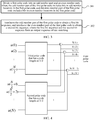
- a polar code has a recursive structure, and it may be considered that the first polar code is obtained according to two polar codes (which are a second polar code and a third polar code) that have code lengths of N/2. As may be schematically shown in FIG.
- the method may further include: determining the locations of the information bits in the first polar code according to locations of information bits in a polar code that has a code length of N/2 (for example, the foregoing second polar code), which is a selection process of a mother code and may be performed by a polar code encoder in the polar code processing device. Determining of other locations in the first polar code is not limited herein.
- the locations of the information bits in the second polar code plus N/2 are the locations of the information bits in the first polar code.
- sequence numbers in the first polar code that are less than or equal to N/2 include sequence numbers of t information bits
- the information bits in the first polar code are arranged in the rear half of the bit sequence of the first polar code. In this way, based on some rules for polar code construction, a frame error rate can be further reduced, and HARQ performance of a polar code can be further improved.
- pseudo-random interleaving may be performed on the odd number part of the first polar code to obtain the first bit sequence
- pseudo-random interleaving may be performed on the even number part of the first polar code to obtain the second bit sequence.
- quadratic interleaving is performed on the odd number part of the first polar code to obtain the first bit sequence
- quadratic interleaving is performed on the even number part of the first polar code to obtain the second bit sequence.
- the forming, by the first bit sequence and the second bit sequence, an output sequence of rate matching may specifically include cases as follows: the first bit sequence is the front half of the output sequence of rate matching, and the second bit sequence is the rear half of the output sequence of rate matching; or the second bit sequence is the front half of the output sequence of rate matching, and the first bit sequence is the rear half of the output sequence of rate matching.
- a bit sequence of a first polar code is C 1 C 2 C 3 C 4 C 5 C 6 C 7 C 8... C N-1 C N .
- information bits in the first polar code are in the rear half of the bit sequence of the first polar code.
- Step 501 Divide the first polar code into an odd number part and an even number part, where the odd number part of the first polar code is C 1 C 3 C 5 C 7... C N-1 , and the even number part of the first polar code is C 2 C 4 C 6 C 8... C N .
- Step 502 Interleave the odd number part C 1 C 3 C 5 C 7... C N-1 of the first polar code to obtain a first bit sequence D 1 D 2 D 3... D N/2-1 D N/2 , and interleave the even number part of the first polar code to obtain a second bit sequence E 1 E 2 E 3... E N/2-1 E N/2 .
- an output sequence of rate matching that includes the first bit sequence and the second bit sequence may be D 1 D 2 D 3... D N/2-1 D N/2 E 1 E 2 E 3... E N/2-1 E N/2
- an output sequence of rate matching that includes the first bit sequence and the second bit sequence may be E 1 E 2 E 3... E N/2-1 E N/2 D 1 D 2 D 3... D N/2-1 D N/2 . It should be understood that this is not limited in this embodiment of the present invention.
- a first polar code is divided into an odd number part and an even number part, which are separately interleaved to form an output sequence of rate matching.
- a sequence structure after interleaving is more random. Therefore, a frame error rate can be reduced, HARQ performance of a polar code can be improved, and data transmission reliability can be ensured.
- FIG. 6 is a structural block diagram of a polar code processing device according to an embodiment of the present invention.
- the polar code processing device 600 in FIG. 6 includes a division unit 601 and an interleaving unit 602.
- the polar code processing device includes a rate matching device (for example, an interleaver), and functions of the division unit 601 and the interleaving unit 602 may be implemented by using an interleaver.
- a rate matching device for example, an interleaver
- the division unit 601 is configured to divide a first polar code into an odd number part and an even number part, where the odd number part of the first polar code includes bits in odd number locations in the first polar code, and the even number part of the first polar code includes bits in even number locations in the first polar code.
- the interleaving unit 602 is configured to interleave the odd number part of the first polar code that is obtained by using division by the division unit 601, to obtain a first bit sequence, and interleave the even number part of the first polar code that is obtained by using division by the division unit 601, to obtain a second bit sequence, where the first bit sequence and the second bit sequence form an output sequence of rate matching.
- the polar code processing device 600 can implement the steps and operations involved in the embodiments in FIG. 1 to FIG. 3 , and a detailed description is not provided again to avoid repetition.
- a polar code has a recursive structure, and it may be considered that the first polar code is obtained according to two polar codes (which are a second polar code and a third polar code) that have code lengths of N/2, which may be schematically shown in FIG. 2 and is not described in detail herein again.
- a set of information bits of the first polar code is obtained according to a set of information bits of a second polar code that has a length of N/2 and a bit rate of 2R.
- locations of the information bits in the first polar code are in the rear half of a bit sequence of the first polar code.
- a rate matching device 600 of a polar code further includes a determining unit 603, where the determining unit 603 is configured to determine the locations of the information bits in the first polar code according to locations of the information bits in the second polar code, and a function of the determining unit 603 may be implemented by a polar code encoder.
- the determining unit 603 may be specifically configured to determine that the locations of the information bits in the second polar code plus N/2 are the locations of the information bits in the first polar code.
- sequence numbers in the first polar code that are less than or equal to N/2 include sequence numbers of t information bits
- the locations of the information bits in the first polar code are not limited in this embodiment of the present invention, and are preferably arranged in the rear half of the bit sequence of the first polar code.
- the information bits in the first polar code are arranged in the rear half of the bit sequence of the first polar code. In this way, a frame error rate can be reduced, and HARQ performance of a polar code can be improved.
- the interleaving unit 602 may be specifically configured to perform pseudo-random interleaving on the odd number part of the first polar code to obtain the first bit sequence, and perform pseudo-random interleaving on the even number part of the first polar code to obtain the second bit sequence.
- the interleaving unit 602 is specifically configured to perform Quadratic interleaving on the odd number part of the first polar code to obtain the first bit sequence, and perform quadratic interleaving on the even number part of the first polar code to obtain the second bit sequence.
- the first bit sequence obtained by the interleaving unit 602 may be the front half of the output sequence of rate matching, and the second bit sequence may be the rear half of the output sequence of rate matching; certainly, the second bit sequence obtained by the interleaving unit 602 may be the front half of the output sequence of rate matching, and the first bit sequence may be the rear half of the output sequence of rate matching. It should be understood that this is not limited in this embodiment of the present invention.
- FIG. 7 is a schematic diagram of an access terminal 700 that facilitates execution of the foregoing polar code processing method in a wireless communications system.
- the access terminal 700 includes a receiver 702, where the receiver 702 is configured to receive a signal from, for example, a receive antenna (which is not shown), perform a typical operation (for example, filtering, amplification, or down-conversion) on the received signal, and digitize the adjusted signal to obtain a sample.
- the receiver 702 may be, for example, an MMSE (Minimum Mean-Squared Error) receiver.
- the access terminal 700 may further include a demodulator 704, where the demodulator 704 may be configured to demodulate the received signals and provide the signals to a processor 706 for channel estimation.
- MMSE Minimum Mean-Squared Error
- the processor 706 may be a processor dedicated to analyzing information received by the receiver 702 and/or generating information to be sent by a transmitter 716, a processor configured to control one or more components of the access terminal 700, and/or a controller configured to analyze information received by the receiver 702, generate information to be sent by a transmitter 716, and control one or more components of the access terminal 700.
- the access terminal 700 may additionally include a memory 708, where the memory 708 is operationally coupled to the processor 706, and stores the following data: data to be sent, received data, and any other suitable information related to execution of various operations and functions in this specification.
- the memory 708 may additionally store a protocol and/or an algorithm related to polar code processing.
- a data storage apparatus for example, the memory 708, described in this specification may be a volatile memory or a non-volatile memory, or may include both a volatile memory and a non-volatile memory.
- a non-volatile memory may include: a ROM (Read-Only Memory, read-only memory), a PROM (Programmable ROM, programmable read-only memory), an EPROM (Erasable PROM, erasable programmable read-only memory), an EEPROM (Electrically EPROM, electrically erasable programmable read-only memory), or a flash memory, which is exemplary but does not constitute a limitation.
- a volatile memory may include a RAM (Random Access Memory), and is used as an external cache.
- RAMs in many forms such as an SRAM (Static RAM, static random access memory), a DRAM (Dynamic RAM, dynamic random access memory), an SDRAM (Synchronous DRAM, synchronous dynamic random access memory), a DDR SDRAM (Double Data Rate SDRAM, double data rate synchronous dynamic random access memory), an ESDRAM (Enhanced SDRAM, enhanced synchronous dynamic random access memory), an SLDRAM (Synchlink DRAM, synchlink dynamic random access memory), and a DR RAM (Direct Rambus RAM, direct rambus random access memory) may be used, which is exemplary but is not a limitative description.
- the memory 708 in the system and method described in this specification intends to include, but is not limited to, these memories and any other memory of a suitable type.
- the receiver 702 may be further coupled to a rate matching device 710, and they may be basically similar to the rate matching apparatus 205 in FIG. 2 .
- the access terminal 700 may include a polar code encoder 712, which is basically similar to the polar code encoder 204 in FIG. 2 .
- the rate matching device 710 may be configured to divide a first polar code output by the polar code encoder 204 into an odd number part and an even number part, where the odd number part of the first polar code includes bits in odd number locations in the first polar code, and the even number part of the first polar code includes bits in even number locations in the first polar code; and interleave the odd number part of the first polar code to obtain a first bit sequence, and interleave the even number part of the first polar code to obtain a second bit sequence, where the first bit sequence and the second bit sequence form an output sequence of rate matching.
- locations of information bits in the first polar code may be in the rear half of a bit sequence of the first polar code.
- the polar code encoder 712 may be further configured to determine the locations of the information bits in the first polar code according to locations of information bits in a second polar code.
- the rate matching device 710 may be further configured to perform pseudo-random interleaving on the odd number part of the first polar code to obtain the first bit sequence, and perform pseudo-random interleaving on the even number part of the first polar code to obtain the second bit sequence.
- Quadratic interleaving is performed on the odd number part of the first polar code to obtain the first bit sequence
- quadratic interleaving is performed on the even number part of the first polar code to obtain the second bit sequence.
- the first bit sequence obtained by the rate matching device 710 by using interleaving may be the front half of the output sequence of rate matching, and the second bit sequence may be the rear half of the output sequence of rate matching; certainly, the second bit sequence obtained by the rate matching device 710 by using interleaving may be the front half of the output sequence of rate matching, and the first bit sequence may be the rear half of the output sequence of rate matching. It should be understood that this is not limited in this embodiment of the present invention.
- the first polar code is divided into the odd number part and the even number part, which are separately interleaved to form the output sequence of rate matching.
- a sequence structure after interleaving is more random, and correlation between sequences before and after interleaving is reduced; therefore, an FER can be reduced, HARQ performance can be improved, and data transmission reliability can be ensured.
- the access terminal 700 may further include a modulator 714 and a transmitter 716, where the transmitter 716 is configured to send a signal to, for example, a base station or another access terminal.
- the polar code encoder 712, the rate matching device 710, and/or the modulator 714 are or is detached from the processor 706, it may be understood that the polar code encoder 712, the rate matching device 710, and/or the modulator 714 may be a part of the processor 706 or multiple processors (which are not shown).
- FIG. 8 is a schematic diagram of a system 800 that facilitates execution of the foregoing polar code processing method in a wireless communications environment.
- the system 800 includes a base station 802 (for example, an access point, an NB, or an eNB), where the base station 802 has a receiver 810 that receives signals from one or more access terminals 804 by using multiple receive antennas 806, and a transmitter 824 that transmits a signal to the one or more access terminals 804 by using a transmit antenna 808.
- the receiver 810 may receive information from the receive antennas 806, and is operationally associated to a demodulator 812 that demodulates the received information.
- a demodulated symbol is analyzed by using a processor 814 similar to the processor described in FIG.
- the processor 814 is connected to a memory 816, and the memory 816 is configured to store data to be sent to the access terminals 804 (or a different base station (which is not shown)), or data received from the access terminals 804 (or a different base station (which is not shown)), and/or any other suitable information related to execution of various operations and functions in this specification.
- the processor 814 may be further coupled to a polar code encoder 818 and a rate matching apparatus 820.
- the rate matching apparatus 820 may be configured to divide a first polar code output by the polar code encoder 818 into an odd number part and an even number part, where the odd number part of the first polar code includes bits in odd number locations in the first polar code, and the even number part of the first polar code includes bits in even number locations in the first polar code; and interleave the odd number part of the first polar code to obtain a first bit sequence, and interleave the even number part of the first polar code to obtain a second bit sequence, where the first bit sequence and the second bit sequence form an output sequence of rate matching.
- locations of information bits in the first polar code may be in the rear half of a bit sequence of the first polar code.
- the polar code encoder 818 may be further configured to determine the locations of the information bits in the first polar code according to locations of information bits in a second polar code.
- the rate matching apparatus 820 may be further configured to perform pseudo-random interleaving on the odd number part of the first polar code to obtain the first bit sequence, and perform pseudo-random interleaving on the even number part of the first polar code to obtain the second bit sequence.
- Quadratic interleaving is performed on the odd number part of the first polar code to obtain the first bit sequence
- quadratic interleaving is performed on the even number part of the first polar code to obtain the second bit sequence.
- the first bit sequence obtained by the rate matching apparatus 820 by using interleaving may be the front half of the output sequence of rate matching, and the second bit sequence may be the rear half of the output sequence of rate matching; certainly, the second bit sequence obtained by the rate matching apparatus 820 by using interleaving may be the front half of the output sequence of rate matching, and the first bit sequence may be the rear half of the output sequence of rate matching. It should be understood that this is not limited in this embodiment of the present invention.
- the first polar code is divided into the odd number part and the even number part, which are separately interleaved to form the output sequence of rate matching.
- a sequence structure after interleaving is more random, and correlation between sequences before and after interleaving is reduced; therefore, an FER can be reduced, HARQ performance can be improved, and data transmission reliability can be ensured.
- a modulator 822 may multiplex a frame, so that the transmitter 824 sends information to the access terminals 804 by using the antenna 808.
- the polar code encoder 818, the rate matching apparatus 820, and/or the modulator 822 are or is detached from the processor 814, it may be understood that the polar code encoder 818, the rate matching apparatus 820, and/or the modulator 822 may be a part of the processor 814 or multiple processors (which are not shown).
- a processing unit may be implemented in one or more ASICs (Application Specific Integrated Circuits, application specific integrated circuit), DSPs (Digital Signal Processing, digital signal processor), DSPDs (DSP Device, digital signal processing device), PLDs (Programmable Logic Device, programmable logic device), FPGAs (Field-Programmable Gate Array, field-programmable gate array), processors, controllers, micro-controllers, microprocessors, other electronic units for performing the functions in this application, or a combination thereof.
- ASICs Application Specific Integrated Circuits, application specific integrated circuit
- DSPs Digital Signal Processing, digital signal processor
- DSPDs DSP Device, digital signal processing device
- PLDs Programmable Logic Device, programmable logic device
- FPGAs Field-Programmable Gate Array, field-programmable gate array
- processors controllers, micro-controllers, microprocessors, other electronic units for performing the functions in this application, or a combination thereof.
- a code segment may indicate a process, a function, a subprogram, a program, a routine, a subroutine, a module, a software group, a type, or any combination of an instruction, a data structure, and a program statement.
- a code segment may be coupled to another code segment or a hardware circuit by transmitting and/or receiving information, data, an independent variable, a parameter, or content in a memory. Information, an independent variable, a parameter, data, or the like may be transferred, forwarded, or sent in any suitable manner including memory sharing, message transmission, token transmission, or network transmission.
- the technologies in this specification may be implemented by executing the functional modules (for example, a process and a function) in this specification.
- Software code may be stored in a storage unit and executed by a processor.
- the storage unit may be implemented inside a processor or outside a processor, and in the latter case, the storage unit may be coupled to the processor by means of communication by using various means known in the art.
- FIG. 9 shows a system 900 that can use a polar code processing method in a wireless communications environment.
- the system 900 may at least partially reside within a base station.
- the system 900 may at least partially reside within an access terminal.
- the system 900 may be indicated as including a functional block, which may indicate a functional block of a function implemented by a processor, software, or a combination thereof (for example, firmware).
- the system 900 includes a logical group 902 having electronic components that jointly perform an operation.
- the logical group 902 may include an electronic component 904 configured to divide a first polar code into an odd number part and an even number part, and an electronic component 906 configured to interleave the odd number part of the first polar code to obtain a first bit sequence, and interleave the even number part of the first polar code to obtain a second bit sequence.
- the logical group 902 may further include an electronic component 908 configured to determine locations of information bits in the first polar code according to locations of information bits in a second polar code.
- the first polar code is divided into the odd number part and the even number part, which are separately interleaved to form the output sequence of rate matching.
- a sequence structure after interleaving is more random, and correlation between sequences before and after interleaving is reduced. Therefore, an FER can be reduced, HARQ performance can be improved, and data transmission reliability can be ensured.
- the system 900 may include a memory 912, and the memory 912 saves instructions used to execute functions related to the electronic component 904, the electronic component 906, and the electronic component 908. Although it is shown that the electronic component 904, the electronic component 906, and the electronic component 908 are outside the memory 912, it may be understood that one or more of the electronic component 904, the electronic component 906, and the electronic component 908 may exist inside the memory 912.
- the disclosed system, apparatus, and method may be implemented in other manners.
- the described apparatus embodiment is merely exemplary.
- the unit division is merely logical function division and may be other division in actual implementation.
- a plurality of units or components may be combined or integrated into another system, or some features may be ignored or not performed.
- the displayed or discussed mutual couplings or direct couplings or communication connections may be implemented by using some interfaces.
- the indirect couplings or communication connections between the apparatuses or units may be implemented in electronic, mechanical, or other forms.
- the units described as separate parts may or may not be physically separate, and parts displayed as units may or may not be physical units, may be located in one position, or may be distributed on a plurality of network units. Some or all of the units may be selected according to actual needs to achieve the objectives of the solutions of the embodiments.
- functional units in the embodiments of the present invention may be integrated into one processing unit, or each of the units may exist alone physically, or two or more units are integrated into one unit.
- the functions When the functions are implemented in the form of a software functional unit and sold or used as an independent product, the functions may be stored in a computer-readable storage medium. Based on such an understanding, the technical solutions of the present invention essentially, or the part contributing to the prior art, or some of the technical solutions may be implemented in a form of a software product.
- the software product is stored in a storage medium, and includes several instructions for instructing a computer device (which may be a personal computer, a server, or a network device) to perform all or some of the steps of the methods described in the embodiments of the present invention.
- the foregoing storage medium includes: any medium that can store program code, such as a USB flash drive, a removable hard disk, a read-only memory (ROM, Read-Only Memory), a random access memory (RAM, Random Access Memory), a magnetic disk, or an optical disc.
- program code such as a USB flash drive, a removable hard disk, a read-only memory (ROM, Read-Only Memory), a random access memory (RAM, Random Access Memory), a magnetic disk, or an optical disc.
Landscapes
- Engineering & Computer Science (AREA)
- Computer Networks & Wireless Communication (AREA)
- Physics & Mathematics (AREA)
- Probability & Statistics with Applications (AREA)
- Theoretical Computer Science (AREA)
- Signal Processing (AREA)
- Error Detection And Correction (AREA)
- Mobile Radio Communication Systems (AREA)
- Detection And Prevention Of Errors In Transmission (AREA)
Claims (12)
- Polarcodeverarbeitungsverfahren, das Folgendes umfasst:Teilen (301) eines ersten Polarcodes durch eine drahtlose Kommunikationseinrichtung in einen ungeraden Zahlenteil und einen geraden Zahlenteil, wobei der ungerade Zahlenteil des ersten Polarcodes Bits an ungeraden Zahlenstellen im ersten Polarcode umfasst und der gerade Zahlenteil des ersten Polarcodes Bits an geraden Zahlenstellen im ersten Polarcode umfasst; undVerschachteln (302) des ungeraden Zahlenteils des ersten Polarcodes, um eine erste Bitsequenz zu erhalten, und Verschachteln des geraden Zahlenteils des ersten Polarcodes, um eine zweite Bitsequenz zu erhalten, durch die drahtlose Kommunikationseinrichtung, wobei die erste Bitsequenz und die zweite Bitsequenz eine Ausgabesequenz eines Ratenabgleichs bilden und das Verschachteln des ungeraden Zahlenteils des ersten Polarcodes, um eine erste Bitsequenz zu erhalten, und das Verschachteln des geraden Zahlenteils des ersten Polarcodes, um eine zweite Bitsequenz zu erhalten, Folgendes umfasst:
Durchführen einer quadratischen Verschachtelung am ungeraden Zahlenteil des ersten Polarcodes, um die erste Bitsequenz zu erhalten, und Durchführen einer quadratischen Verschachtelung am geraden Zahlenteil des ersten Polarcodes, um die zweite Bitsequenz zu erhalten. - Verfahren nach Anspruch 1, wobei
das Verfahren vor dem Teilen eines ersten Polarcodes in einen ungeraden Zahlenteil und einen geraden Zahlenteil ferner Folgendes umfasst:
Bestimmen von Stellen der Informationsbits im ersten Polarcode, der eine Länge von N aufweist, durch die drahtlose Kommunikationseinrichtung gemäß Stellen der Informationsbits in einem zweiten Polarcode, der eine Länge von N/2 aufweist, wobei N=2n und n eine Ganzzahl ist, die größer oder gleich 0 ist. - Verfahren nach Anspruch 2, wobei das Bestimmen von Stellen der Informationsbits im ersten Polarcode gemäß Stellen der Informationsbits im zweiten Polarcode Folgendes umfasst:
Bestimmen durch die drahtlose Kommunikationseinrichtung, dass die Stellen der Informationsbits im zweiten Polarcode plus N/2 die Stellen der Informationsbits im ersten Polarcode sind. - Verfahren nach Anspruch 2, wobei Sequenzzahlen im ersten Polarcode, die kleiner als oder gleich N/2 sind, Sequenzzahlen von t Informationsbits umfassen und das Bestimmen von Stellen der Informationsbits im ersten Polarcode gemäß Stellen der Informationsbits im zweiten Polarcode Folgendes umfasst:
Bestimmen durch die drahtlose Kommunikationseinrichtung, dass Stellen von (K-t) Informationsbits im zweiten Polarcode plus N/2 Stellen von Informationsbits im ersten Polarcode sind, die Sequenzzahlen größer als N/2 aufweisen, wobei K eine positive Ganzzahl ist und K=N∗R und t eine positive Ganzzahl ist und 0≤t<K. - Verfahren nach Anspruch 1, wobei die quadratische Verschachtelung wie folgt definiert ist:

eine Zuordnungsfunktion c(m)↦c(m+1)(mod N) ist, wobei m eine positive Ganzzahl ist und 0≤m<N, k eine ungerade Zahl ist und mod eine Modulooperation anzeigt. - Verfahren nach einem der Ansprüche 1 bis 5, wobei die erste Bitsequenz die vordere Hälfte der Ausgabesequenz des Ratenabgleichs ist und die zweite Bitsequenz die hintere Hälfte der Ausgabesequenz des Ratenabgleichs ist oder die zweite Bitsequenz die vordere Hälfte der Ausgabesequenz des Ratenabgleichs ist und die erste Bitsequenz die hintere Hälfte der Ausgabesequenz des Ratenabgleichs ist.
- Polarcodeverarbeitungsvorrichtung (600), die Folgendes umfasst:eine Teilungseinheit (601), die dazu ausgelegt ist, einen ersten Polarcode in einen ungeraden Zahlenteil und einen geraden Zahlenteil zu teilen, wobei der ungerade Zahlenteil des ersten Polarcodes Bits an ungeraden Zahlenstellen im ersten Polarcode umfasst und der gerade Zahlenteil des ersten Polarcodes Bits an geraden Zahlenstellen im ersten Polarcode umfasst; undeine Verschachtelungseinheit (602), die dazu ausgelegt ist, eine quadratische Verschachtelung am ungeraden Zahlenteil des ersten Polarcodes, der unter Verwendung einer Teilung durch die Teilungseinheit erhalten wird, durchzuführen, um eine erste Bitsequenz zu erhalten, und eine quadratische Verschachtelung am geraden Zahlenteil des ersten Polarcodes, der unter Verwendung einer Teilung durch die Teilungseinheit erhalten wird, durchzuführen, um eine zweite Bitsequenz zu erhalten, wobei die erste Bitsequenz und die zweite Bitsequenz eine Ausgabesequenz eines Ratenabgleichs bilden.
- Vorrichtung (600) nach Anspruch 7, die Folgendes umfasst:
eine Bestimmungseinheit (603), die dazu ausgelegt ist, Stellen der Informationsbits im ersten Polarcode, der eine Länge von N aufweist, gemäß Stellen der Informationsbits in einem zweiten Polarcode, der eine Länge von N/2 aufweist, zu bestimmen, wobei N=2n und n eine Ganzzahl ist, die größer oder gleich 0 ist. - Vorrichtung (600) nach Anspruch 8, wobei
die Bestimmungseinheit (603) speziell dazu ausgelegt ist zu bestimmen, dass die Stellen der Informationsbits im zweiten Polarcode plus N/2 die Stellen der Informationsbits im ersten Polarcode sind. - Vorrichtung (600) nach Anspruch 8, wobei Sequenzzahlen im ersten Polarcode, die kleiner als oder gleich N/2 sind, Sequenzzahlen von t Informationsbits umfassen, und die Bestimmungseinheit (603) speziell dazu ausgelegt ist zu bestimmen, dass Stellen von (K-t) Informationsbits im zweiten Polarcode plus N/2 Stellen von Informationsbits im ersten Polarcode sind, die Sequenzzahlen größer als N/2 aufweisen, wobei K eine positive Ganzzahl ist und K=N∗R und t eine positive Ganzzahl ist und 0≤t<K.
- Vorrichtung (600) nach Anspruch 7, wobei die quadratische Verschachtelung wie folgt definiert ist:

eine Zuordnungsfunktion c(m)↦c(m+1)(mod N) ist, wobei m eine positive Ganzzahl ist und 0≤m<N, k eine ungerade Zahl ist und mod eine Modulooperation anzeigt. - Vorrichtung (600) nach einem der Ansprüche 7 bis 11, wobei die erste Bitsequenz, die durch die Verschachtelungseinheit erhalten wird, die vordere Hälfte der Ausgabesequenz des Ratenabgleichs ist und die zweite Bitsequenz die hintere Hälfte der Ausgabesequenz des Ratenabgleichs ist oder die zweite Bitsequenz, die durch die Verschachtelungseinheit erhalten wird, die vordere Hälfte der Ausgabesequenz des Ratenabgleichs ist und die erste Bitsequenz die hintere Hälfte der Ausgabesequenz des Ratenabgleichs ist.
Applications Claiming Priority (1)
| Application Number | Priority Date | Filing Date | Title |
|---|---|---|---|
| PCT/CN2013/087488 WO2015074192A1 (zh) | 2013-11-20 | 2013-11-20 | 极化码的处理方法和设备 |
Publications (3)
| Publication Number | Publication Date |
|---|---|
| EP3073660A1 EP3073660A1 (de) | 2016-09-28 |
| EP3073660A4 EP3073660A4 (de) | 2016-12-28 |
| EP3073660B1 true EP3073660B1 (de) | 2020-06-24 |
Family
ID=53178792
Family Applications (1)
| Application Number | Title | Priority Date | Filing Date |
|---|---|---|---|
| EP13898026.3A Active EP3073660B1 (de) | 2013-11-20 | 2013-11-20 | Verfahren und vorrichtung zur verarbeitung von polarcodes |
Country Status (6)
| Country | Link |
|---|---|
| US (3) | US10148289B2 (de) |
| EP (1) | EP3073660B1 (de) |
| KR (1) | KR101853752B1 (de) |
| CN (2) | CN109861694B (de) |
| RU (1) | RU2673122C1 (de) |
| WO (1) | WO2015074192A1 (de) |
Cited By (2)
| Publication number | Priority date | Publication date | Assignee | Title |
|---|---|---|---|---|
| US11848778B2 (en) | 2019-01-29 | 2023-12-19 | Interdigital Patent Holdings, Inc. | Methods and procedures for polar encoding and decoding with low latency |
| US12621081B2 (en) | 2023-12-18 | 2026-05-05 | Interdigital Patent Holdings, Inc. | Methods and procedures for polar encoding and decoding with low latency |
Families Citing this family (65)
| Publication number | Priority date | Publication date | Assignee | Title |
|---|---|---|---|---|
| CN104038234B (zh) * | 2013-03-07 | 2017-09-29 | 华为技术有限公司 | 极性码的译码方法和译码器 |
| EP3073660B1 (de) | 2013-11-20 | 2020-06-24 | Huawei Technologies Co., Ltd. | Verfahren und vorrichtung zur verarbeitung von polarcodes |
| RU2663351C1 (ru) * | 2014-11-27 | 2018-08-03 | Хуавэй Текнолоджиз Ко., Лтд. | Способ и устройство согласования скорости полярного кода и устройство беспроводной связи |
| CN106899379B (zh) * | 2015-12-18 | 2020-01-17 | 华为技术有限公司 | 用于处理极化码的方法和通信设备 |
| WO2017127973A1 (en) | 2016-01-25 | 2017-08-03 | Qualcomm Incorporated | Generation of polar codes with a variable block length utilizing puncturing |
| WO2017156792A1 (en) | 2016-03-18 | 2017-09-21 | Qualcomm Incorporated | Transmission of new data in a hybrid automatic repeat request (harq) retransmission with polar coded transmissions |
| EP3247042B1 (de) | 2016-05-13 | 2020-09-30 | Mediatek Inc. | Bit-punktierung für polare codes |
| CN107508653B (zh) | 2016-06-14 | 2021-03-23 | 华为技术有限公司 | 一种数据传输方法、装置和设备 |
| EP3273602B1 (de) | 2016-07-19 | 2022-01-26 | MediaTek Inc. | Ratenanpassung niedriger komplexität für polare codes |
| CN109075803B (zh) | 2016-07-27 | 2020-11-06 | 华为技术有限公司 | 具有打孔、缩短和扩展的极化码编码 |
| CN114884610B (zh) | 2016-08-11 | 2024-04-09 | 华为技术有限公司 | 用于极化编码的方法、装置和设备 |
| US10756853B2 (en) * | 2016-10-21 | 2020-08-25 | Huawei Technologies Co., Ltd. | Method and device for incremental redundancy hybrid automatic repeat request (IR-HARQ) re-transmission |
| CN108649965B (zh) * | 2016-10-25 | 2019-07-09 | 华为技术有限公司 | 编码、译码方法及设备 |
| US10383106B2 (en) | 2017-01-04 | 2019-08-13 | Coherent Logix, Incorporated | Scrambling sequence design for embedding UE ID into frozen bits for DCI blind detection |
| CN107342843B (zh) * | 2017-01-05 | 2023-10-20 | 华为技术有限公司 | 速率匹配方法、编码装置和通信装置 |
| WO2018126378A1 (en) | 2017-01-05 | 2018-07-12 | Qualcomm Incorporated | Wireless communication with polar codes using a mask sequence for frozen bits |
| US11206044B2 (en) | 2017-01-05 | 2021-12-21 | Lg Electronics Inc. | Method and terminal for channel encoding using polar code |
| CN108288969B (zh) | 2017-01-07 | 2021-12-21 | 华为技术有限公司 | 数据编码及译码的方法和装置 |
| CN108289009B (zh) | 2017-01-09 | 2019-12-24 | 上海朗帛通信技术有限公司 | 一种被用于信道编码的ue、基站中的方法和设备 |
| WO2018141080A1 (en) * | 2017-02-02 | 2018-08-09 | Qualcomm Incorporated | False alarm rate reduction for polar codes |
| EP3577769B1 (de) * | 2017-02-06 | 2024-04-17 | MediaTek Inc. | Polare codeverschachtelung und bitauswahl |
| BR112019016212A2 (pt) | 2017-02-06 | 2020-04-07 | Telefonaktiebolaget Lm Ericsson (Publ) | método por um transmissor e transmisor para gerar adaptativamente bits de pré-codificador para um código polar |
| WO2018145284A1 (zh) * | 2017-02-09 | 2018-08-16 | 南通朗恒通信技术有限公司 | 一种被用于信道编码的终端、基站中的方法和设备 |
| AU2018218656B2 (en) * | 2017-02-10 | 2021-01-07 | Telefonaktiebolaget Lm Ericsson (Publ) | Circular buffer rate matching for polar codes |
| US10985871B2 (en) | 2017-02-24 | 2021-04-20 | Huawei Technologies Co., Ltd. | Method to generate ordered sequence for polar codes |
| CN108574556B (zh) * | 2017-03-10 | 2020-11-17 | 华为技术有限公司 | 一种Polar码的速率匹配方法及装置 |
| CN108599891B (zh) | 2017-03-17 | 2020-05-08 | 华为技术有限公司 | 编码方法、编码装置和通信装置 |
| WO2018174615A1 (en) * | 2017-03-23 | 2018-09-27 | Samsung Electronics Co., Ltd. | Method and apparatus for rate-matching of polar codes |
| CN117713996A (zh) * | 2017-03-24 | 2024-03-15 | 华为技术有限公司 | 极化码的速率匹配方法及设备 |
| CN109412608B (zh) | 2017-03-24 | 2019-11-05 | 华为技术有限公司 | Polar编码方法和编码装置、译码方法和译码装置 |
| CN108683479B (zh) | 2017-03-25 | 2019-08-13 | 华为技术有限公司 | 一种速率匹配的方法和装置 |
| CN109347488B (zh) | 2017-04-01 | 2019-11-01 | 华为技术有限公司 | 极化码编码和译码的方法、发送设备和接收设备 |
| CN108696333B (zh) | 2017-04-05 | 2021-10-01 | 华为技术有限公司 | Polar码编解码的方法、装置和设备 |
| US10868569B2 (en) * | 2017-05-08 | 2020-12-15 | Qualcomm Incorporated | PBCH signal design and efficient continuous monitoring and polar decoding |
| CN108880742B (zh) * | 2017-05-15 | 2020-08-25 | 华为技术有限公司 | 传输数据的方法、芯片、收发机和计算机可读存储介质 |
| CN109004939A (zh) * | 2017-06-06 | 2018-12-14 | 华为技术有限公司 | 极化码译码装置和方法 |
| US10560910B2 (en) | 2017-06-12 | 2020-02-11 | Qualcomm Incoporated | Synchronization signal for a broadcast channel |
| CN109150375A (zh) * | 2017-06-16 | 2019-01-04 | 华为技术有限公司 | 一种编码方法、无线设备和芯片 |
| US11258535B2 (en) * | 2017-06-16 | 2022-02-22 | Lg Electronics Inc. | Method and apparatus for transmitting information |
| CN109150381A (zh) * | 2017-06-18 | 2019-01-04 | 株式会社Ntt都科摩 | 极化编码方法、极化编码器和无线通信设备 |
| WO2018236114A1 (en) * | 2017-06-19 | 2018-12-27 | Samsung Electronics Co., Ltd. | METHOD AND APPARATUS FOR FLOW ADAPTATION FOR COMMUNICATION AND BROADCASTING SYSTEMS |
| KR102378324B1 (ko) | 2017-06-19 | 2022-03-25 | 삼성전자 주식회사 | 통신 및 방송 시스템을 위한 부호율-조정 방법 및 장치 |
| CN109245852B (zh) * | 2017-07-11 | 2022-02-11 | 华为技术有限公司 | Polar码的速率匹配方法及装置 |
| CN109391343B (zh) | 2017-08-02 | 2021-09-03 | 华为技术有限公司 | 一种Polar码编码方法及装置 |
| CN109391345B (zh) * | 2017-08-04 | 2022-10-11 | 华为技术有限公司 | 一种Polar码编码方法及装置 |
| CN108111252B (zh) * | 2017-08-04 | 2022-03-01 | 中兴通讯股份有限公司 | 序列生成、数据解码方法及装置 |
| JP7345471B2 (ja) * | 2017-08-11 | 2023-09-15 | コーヒレント・ロジックス・インコーポレーテッド | Dciブラインド検出時のマルチモード・ブロック弁別のためのスクランブル系列設計 |
| CN109391363B (zh) | 2017-08-11 | 2020-08-25 | 华为技术有限公司 | 一种交织方法及装置 |
| CN109391366A (zh) * | 2017-08-11 | 2019-02-26 | 电信科学技术研究院 | 一种对数据进行交织的方法和交织器 |
| CN109391365B (zh) | 2017-08-11 | 2021-11-09 | 华为技术有限公司 | 一种交织方法及装置 |
| CN109391353B (zh) | 2017-08-11 | 2021-09-14 | 华为技术有限公司 | 一种速率匹配的方法和装置 |
| CN109412747A (zh) * | 2017-08-15 | 2019-03-01 | 株式会社Ntt都科摩 | 一种用于极化码的速率匹配交织方法及装置 |
| CN109428675B (zh) * | 2017-08-30 | 2022-05-24 | 华为技术有限公司 | 数据传输方法及装置 |
| CN109495206B (zh) * | 2017-09-11 | 2020-06-30 | 上海朗帛通信技术有限公司 | 一种被用于无线通信的用户、基站中的方法和设备 |
| WO2019061338A1 (en) * | 2017-09-29 | 2019-04-04 | Zte Corporation | METHOD AND SYSTEM FOR POLAR CODE CODING |
| CN109672497B (zh) * | 2017-10-16 | 2021-09-28 | 普天信息技术有限公司 | 一种极化码的速率匹配方法及装置 |
| EP3570442A1 (de) * | 2018-05-17 | 2019-11-20 | Industrial Technology Research Institute | Kompakte übertragung von polar kodierter dci mit wiederholung für 5g kommunikationssysteme |
| CN109361492B (zh) * | 2018-10-08 | 2021-09-24 | 福州大学 | 一种联合物理层网络编码和极化码的高性能译码方法 |
| CN111181695B (zh) * | 2018-11-12 | 2022-12-02 | 中兴通讯股份有限公司 | 一种极化码混合自动重传请求方法、装置和系统 |
| CN109905202B (zh) * | 2019-03-21 | 2020-03-31 | 安徽大学 | 一种带有信息块译码错误纠正功能的极化码编译码方法 |
| WO2020198976A1 (en) * | 2019-03-29 | 2020-10-08 | Zte Corporation | Methods, apparatus and systems for transmitting data based on polar code |
| US11184108B2 (en) | 2019-08-02 | 2021-11-23 | Electronics And Telecommunications Research Institute | Method and apparatus for transmitting and receiving signal using polar code in communication system |
| CN112584144B (zh) * | 2019-09-30 | 2022-04-12 | 华为技术有限公司 | 一种图像信号处理方法及装置 |
| CN113438000A (zh) * | 2021-06-22 | 2021-09-24 | 电子科技大学 | 一种应对合作式窃听者的毫米波安全传输方法 |
| US11552736B1 (en) | 2021-08-13 | 2023-01-10 | Huawei Technologies Co., Ltd. | Systems and methods for encoding digital communications |
Family Cites Families (28)
| Publication number | Priority date | Publication date | Assignee | Title |
|---|---|---|---|---|
| US6052072A (en) | 1997-04-01 | 2000-04-18 | Seagate Technology, Inc. | System and scheme for maximum transition run length codes with location dependent constraints |
| KR100442607B1 (ko) * | 1999-02-04 | 2004-08-02 | 삼성전자주식회사 | 이동통신시스템의 채널확산 장치 및 방법 |
| CA2742096C (en) | 1999-04-13 | 2015-01-06 | Ericsson Ab | Rate matching and channel interleaving for a communications system |
| US8155178B2 (en) | 2007-10-30 | 2012-04-10 | Sony Corporation | 16k mode interleaver in a digital video broadcasting (DVB) standard |
| US7873016B2 (en) * | 2005-11-07 | 2011-01-18 | Broadcom Corporation | Method and system for utilizing tone grouping with givens rotations to reduce overhead associated with explicit feedback information |
| KR20080073624A (ko) * | 2007-02-06 | 2008-08-11 | 삼성전자주식회사 | 다중 편파 다중 입출력 시스템을 위한 코드북 생성 방법 및그 장치 |
| US8266508B2 (en) | 2007-06-08 | 2012-09-11 | Telefonaktiebolaget L M Ericsson (Publ) | Computational efficient convolutional coding with rate matching |
| ES2412429T3 (es) | 2007-10-30 | 2013-07-11 | Sony Corporation | Aparato y método para el tratamiento de datos |
| US7924763B2 (en) | 2007-12-11 | 2011-04-12 | Motorola Mobility, Inc. | Method and appratus for rate matching within a communication system |
| CN102868498B (zh) * | 2009-06-18 | 2015-12-09 | 华为技术有限公司 | 码本生成方法、数据传输方法及装置 |
| US8255759B2 (en) * | 2009-10-29 | 2012-08-28 | Qualcomm Incorporated | APP (a priori probability) storage design for LTE turbo decoder with quadratic permutation polynomial interleaver |
| KR20110060635A (ko) * | 2009-11-30 | 2011-06-08 | 전북대학교산학협력단 | 래딕스 4 기반의 폴라코드를 이용한 부호화방법 |
| CN102164025B (zh) * | 2011-04-15 | 2013-06-05 | 北京邮电大学 | 基于重复编码和信道极化的编码器及其编译码方法 |
| US9176927B2 (en) * | 2011-11-08 | 2015-11-03 | The Royal Institution For The Advancement Of Learning/Mcgill University | Methods and systems for decoding polar codes |
| CN103220001B (zh) * | 2012-01-20 | 2016-09-07 | 华为技术有限公司 | 与循环冗余校验级联的极性码的译码方法和译码装置 |
| CN103368583B (zh) * | 2012-04-11 | 2016-08-17 | 华为技术有限公司 | 极性码的译码方法和译码装置 |
| US8347186B1 (en) * | 2012-04-19 | 2013-01-01 | Polaran Yazilim Bilisim Danismanlik Ithalat Ihracat Sanayi Ticaret Limited Sirketi | Method and system for error correction in transmitting data using low complexity systematic encoder |
| KR101919934B1 (ko) * | 2012-04-19 | 2018-11-20 | 삼성전자주식회사 | 불휘발성 메모리 장치를 제어하는 컨트롤러의 동작 방법 및 극 부호화된 부호어를 불휘발성 메모리 장치의 멀티 비트 데이터에 매핑하는 매핑 패턴을 선택하는 매핑 패턴 선택 방법 |
| CN102694625B (zh) * | 2012-06-15 | 2014-11-12 | 北京邮电大学 | 一种循环冗余校验辅助的极化码译码方法 |
| CN103023618B (zh) * | 2013-01-11 | 2015-04-22 | 北京邮电大学 | 一种任意码长的极化编码方法 |
| US9362956B2 (en) * | 2013-01-23 | 2016-06-07 | Samsung Electronics Co., Ltd. | Method and system for encoding and decoding data using concatenated polar codes |
| US9367387B2 (en) * | 2013-01-24 | 2016-06-14 | Nec Corporation | Rate adaptive irregular QC-LDPC codes from pairwise balanced designs for ultra-high-speed optical transports |
| CN103281166B (zh) * | 2013-05-15 | 2016-05-25 | 北京邮电大学 | 一种基于极化码的混合自动重传请求传输方法 |
| US10108483B2 (en) * | 2013-08-26 | 2018-10-23 | Samsung Electronics Co., Ltd. | Computing system with error handling mechanism and method of operation thereof |
| EP3073660B1 (de) * | 2013-11-20 | 2020-06-24 | Huawei Technologies Co., Ltd. | Verfahren und vorrichtung zur verarbeitung von polarcodes |
| US20150333775A1 (en) * | 2014-05-15 | 2015-11-19 | Broadcom Corporation | Frozen-Bit Selection for a Polar Code Decoder |
| US9628114B2 (en) * | 2015-03-31 | 2017-04-18 | Macronix International Co., Ltd. | Length-compatible extended polar codes |
| US10231121B2 (en) * | 2015-06-24 | 2019-03-12 | Lg Electronics Inc. | Security communication using polar code scheme |
-
2013
- 2013-11-20 EP EP13898026.3A patent/EP3073660B1/de active Active
- 2013-11-20 RU RU2017121116A patent/RU2673122C1/ru active
- 2013-11-20 CN CN201910054838.1A patent/CN109861694B/zh active Active
- 2013-11-20 WO PCT/CN2013/087488 patent/WO2015074192A1/zh not_active Ceased
- 2013-11-20 CN CN201380074410.4A patent/CN105075163B/zh active Active
- 2013-11-20 KR KR1020167016495A patent/KR101853752B1/ko active Active
-
2016
- 2016-05-19 US US15/159,484 patent/US10148289B2/en active Active
-
2018
- 2018-11-20 US US16/196,600 patent/US10574269B2/en active Active
-
2019
- 2019-08-16 US US16/542,926 patent/US10778255B2/en active Active
Non-Patent Citations (1)
| Title |
|---|
| None * |
Cited By (2)
| Publication number | Priority date | Publication date | Assignee | Title |
|---|---|---|---|---|
| US11848778B2 (en) | 2019-01-29 | 2023-12-19 | Interdigital Patent Holdings, Inc. | Methods and procedures for polar encoding and decoding with low latency |
| US12621081B2 (en) | 2023-12-18 | 2026-05-05 | Interdigital Patent Holdings, Inc. | Methods and procedures for polar encoding and decoding with low latency |
Also Published As
| Publication number | Publication date |
|---|---|
| US20190372603A1 (en) | 2019-12-05 |
| CN109861694A (zh) | 2019-06-07 |
| US20160269050A1 (en) | 2016-09-15 |
| WO2015074192A1 (zh) | 2015-05-28 |
| US10148289B2 (en) | 2018-12-04 |
| CN109861694B (zh) | 2021-10-26 |
| CN105075163A (zh) | 2015-11-18 |
| US10574269B2 (en) | 2020-02-25 |
| CN105075163B (zh) | 2019-02-05 |
| US10778255B2 (en) | 2020-09-15 |
| EP3073660A1 (de) | 2016-09-28 |
| KR20160086945A (ko) | 2016-07-20 |
| RU2673122C1 (ru) | 2018-11-22 |
| KR101853752B1 (ko) | 2018-05-02 |
| US20190089380A1 (en) | 2019-03-21 |
| EP3073660A4 (de) | 2016-12-28 |
Similar Documents
| Publication | Publication Date | Title |
|---|---|---|
| EP3073660B1 (de) | Verfahren und vorrichtung zur verarbeitung von polarcodes | |
| US10389483B2 (en) | Rate matching method and apparatus for polar code | |
| US10009146B2 (en) | Polar code rate matching method and rate matching apparatus | |
| EP3226422B1 (de) | Codierungsverfahren und -decodierungsvorrichtung für polarcode | |
| US10361815B2 (en) | Polar code rate matching method and apparatus | |
| US10374753B2 (en) | Polar code rate matching method and polar code rate matching apparatus | |
| EP3142257B1 (de) | Verfahren und vorrichtung zur erstellung eines punktierten polarcodes | |
| CN107005690B (zh) | 极化码的速率匹配的方法、装置和无线通信设备 | |
| EP3979532B1 (de) | Polardecodierungsverfahren und -vorrichtung |
Legal Events
| Date | Code | Title | Description |
|---|---|---|---|
| PUAI | Public reference made under article 153(3) epc to a published international application that has entered the european phase |
Free format text: ORIGINAL CODE: 0009012 |
|
| 17P | Request for examination filed |
Effective date: 20160620 |
|
| AK | Designated contracting states |
Kind code of ref document: A1 Designated state(s): AL AT BE BG CH CY CZ DE DK EE ES FI FR GB GR HR HU IE IS IT LI LT LU LV MC MK MT NL NO PL PT RO RS SE SI SK SM TR |
|
| AX | Request for extension of the european patent |
Extension state: BA ME |
|
| A4 | Supplementary search report drawn up and despatched |
Effective date: 20161124 |
|
| RIC1 | Information provided on ipc code assigned before grant |
Ipc: H04L 1/00 20060101AFI20161118BHEP |
|
| DAX | Request for extension of the european patent (deleted) | ||
| STAA | Information on the status of an ep patent application or granted ep patent |
Free format text: STATUS: EXAMINATION IS IN PROGRESS |
|
| 17Q | First examination report despatched |
Effective date: 20190624 |
|
| GRAP | Despatch of communication of intention to grant a patent |
Free format text: ORIGINAL CODE: EPIDOSNIGR1 |
|
| STAA | Information on the status of an ep patent application or granted ep patent |
Free format text: STATUS: GRANT OF PATENT IS INTENDED |
|
| INTG | Intention to grant announced |
Effective date: 20200108 |
|
| GRAS | Grant fee paid |
Free format text: ORIGINAL CODE: EPIDOSNIGR3 |
|
| GRAA | (expected) grant |
Free format text: ORIGINAL CODE: 0009210 |
|
| STAA | Information on the status of an ep patent application or granted ep patent |
Free format text: STATUS: THE PATENT HAS BEEN GRANTED |
|
| AK | Designated contracting states |
Kind code of ref document: B1 Designated state(s): AL AT BE BG CH CY CZ DE DK EE ES FI FR GB GR HR HU IE IS IT LI LT LU LV MC MK MT NL NO PL PT RO RS SE SI SK SM TR |
|
| REG | Reference to a national code |
Ref country code: GB Ref legal event code: FG4D |
|
| REG | Reference to a national code |
Ref country code: CH Ref legal event code: EP |
|
| REG | Reference to a national code |
Ref country code: DE Ref legal event code: R096 Ref document number: 602013070246 Country of ref document: DE |
|
| REG | Reference to a national code |
Ref country code: AT Ref legal event code: REF Ref document number: 1284956 Country of ref document: AT Kind code of ref document: T Effective date: 20200715 |
|
| REG | Reference to a national code |
Ref country code: IE Ref legal event code: FG4D |
|
| PG25 | Lapsed in a contracting state [announced via postgrant information from national office to epo] |
Ref country code: LT Free format text: LAPSE BECAUSE OF FAILURE TO SUBMIT A TRANSLATION OF THE DESCRIPTION OR TO PAY THE FEE WITHIN THE PRESCRIBED TIME-LIMIT Effective date: 20200624 Ref country code: NO Free format text: LAPSE BECAUSE OF FAILURE TO SUBMIT A TRANSLATION OF THE DESCRIPTION OR TO PAY THE FEE WITHIN THE PRESCRIBED TIME-LIMIT Effective date: 20200924 Ref country code: SE Free format text: LAPSE BECAUSE OF FAILURE TO SUBMIT A TRANSLATION OF THE DESCRIPTION OR TO PAY THE FEE WITHIN THE PRESCRIBED TIME-LIMIT Effective date: 20200624 Ref country code: FI Free format text: LAPSE BECAUSE OF FAILURE TO SUBMIT A TRANSLATION OF THE DESCRIPTION OR TO PAY THE FEE WITHIN THE PRESCRIBED TIME-LIMIT Effective date: 20200624 Ref country code: GR Free format text: LAPSE BECAUSE OF FAILURE TO SUBMIT A TRANSLATION OF THE DESCRIPTION OR TO PAY THE FEE WITHIN THE PRESCRIBED TIME-LIMIT Effective date: 20200925 |
|
| REG | Reference to a national code |
Ref country code: LT Ref legal event code: MG4D |
|
| PG25 | Lapsed in a contracting state [announced via postgrant information from national office to epo] |
Ref country code: HR Free format text: LAPSE BECAUSE OF FAILURE TO SUBMIT A TRANSLATION OF THE DESCRIPTION OR TO PAY THE FEE WITHIN THE PRESCRIBED TIME-LIMIT Effective date: 20200624 Ref country code: RS Free format text: LAPSE BECAUSE OF FAILURE TO SUBMIT A TRANSLATION OF THE DESCRIPTION OR TO PAY THE FEE WITHIN THE PRESCRIBED TIME-LIMIT Effective date: 20200624 Ref country code: LV Free format text: LAPSE BECAUSE OF FAILURE TO SUBMIT A TRANSLATION OF THE DESCRIPTION OR TO PAY THE FEE WITHIN THE PRESCRIBED TIME-LIMIT Effective date: 20200624 Ref country code: BG Free format text: LAPSE BECAUSE OF FAILURE TO SUBMIT A TRANSLATION OF THE DESCRIPTION OR TO PAY THE FEE WITHIN THE PRESCRIBED TIME-LIMIT Effective date: 20200924 |
|
| REG | Reference to a national code |
Ref country code: NL Ref legal event code: MP Effective date: 20200624 |
|
| REG | Reference to a national code |
Ref country code: AT Ref legal event code: MK05 Ref document number: 1284956 Country of ref document: AT Kind code of ref document: T Effective date: 20200624 |
|
| PG25 | Lapsed in a contracting state [announced via postgrant information from national office to epo] |
Ref country code: NL Free format text: LAPSE BECAUSE OF FAILURE TO SUBMIT A TRANSLATION OF THE DESCRIPTION OR TO PAY THE FEE WITHIN THE PRESCRIBED TIME-LIMIT Effective date: 20200624 Ref country code: AL Free format text: LAPSE BECAUSE OF FAILURE TO SUBMIT A TRANSLATION OF THE DESCRIPTION OR TO PAY THE FEE WITHIN THE PRESCRIBED TIME-LIMIT Effective date: 20200624 |
|
| PG25 | Lapsed in a contracting state [announced via postgrant information from national office to epo] |
Ref country code: RO Free format text: LAPSE BECAUSE OF FAILURE TO SUBMIT A TRANSLATION OF THE DESCRIPTION OR TO PAY THE FEE WITHIN THE PRESCRIBED TIME-LIMIT Effective date: 20200624 Ref country code: CZ Free format text: LAPSE BECAUSE OF FAILURE TO SUBMIT A TRANSLATION OF THE DESCRIPTION OR TO PAY THE FEE WITHIN THE PRESCRIBED TIME-LIMIT Effective date: 20200624 Ref country code: AT Free format text: LAPSE BECAUSE OF FAILURE TO SUBMIT A TRANSLATION OF THE DESCRIPTION OR TO PAY THE FEE WITHIN THE PRESCRIBED TIME-LIMIT Effective date: 20200624 Ref country code: IT Free format text: LAPSE BECAUSE OF FAILURE TO SUBMIT A TRANSLATION OF THE DESCRIPTION OR TO PAY THE FEE WITHIN THE PRESCRIBED TIME-LIMIT Effective date: 20200624 Ref country code: SM Free format text: LAPSE BECAUSE OF FAILURE TO SUBMIT A TRANSLATION OF THE DESCRIPTION OR TO PAY THE FEE WITHIN THE PRESCRIBED TIME-LIMIT Effective date: 20200624 Ref country code: EE Free format text: LAPSE BECAUSE OF FAILURE TO SUBMIT A TRANSLATION OF THE DESCRIPTION OR TO PAY THE FEE WITHIN THE PRESCRIBED TIME-LIMIT Effective date: 20200624 Ref country code: ES Free format text: LAPSE BECAUSE OF FAILURE TO SUBMIT A TRANSLATION OF THE DESCRIPTION OR TO PAY THE FEE WITHIN THE PRESCRIBED TIME-LIMIT Effective date: 20200624 Ref country code: PT Free format text: LAPSE BECAUSE OF FAILURE TO SUBMIT A TRANSLATION OF THE DESCRIPTION OR TO PAY THE FEE WITHIN THE PRESCRIBED TIME-LIMIT Effective date: 20201026 |
|
| PG25 | Lapsed in a contracting state [announced via postgrant information from national office to epo] |
Ref country code: SK Free format text: LAPSE BECAUSE OF FAILURE TO SUBMIT A TRANSLATION OF THE DESCRIPTION OR TO PAY THE FEE WITHIN THE PRESCRIBED TIME-LIMIT Effective date: 20200624 Ref country code: PL Free format text: LAPSE BECAUSE OF FAILURE TO SUBMIT A TRANSLATION OF THE DESCRIPTION OR TO PAY THE FEE WITHIN THE PRESCRIBED TIME-LIMIT Effective date: 20200624 Ref country code: IS Free format text: LAPSE BECAUSE OF FAILURE TO SUBMIT A TRANSLATION OF THE DESCRIPTION OR TO PAY THE FEE WITHIN THE PRESCRIBED TIME-LIMIT Effective date: 20201024 |
|
| REG | Reference to a national code |
Ref country code: DE Ref legal event code: R097 Ref document number: 602013070246 Country of ref document: DE |
|
| PG25 | Lapsed in a contracting state [announced via postgrant information from national office to epo] |
Ref country code: DK Free format text: LAPSE BECAUSE OF FAILURE TO SUBMIT A TRANSLATION OF THE DESCRIPTION OR TO PAY THE FEE WITHIN THE PRESCRIBED TIME-LIMIT Effective date: 20200624 |
|
| PLBE | No opposition filed within time limit |
Free format text: ORIGINAL CODE: 0009261 |
|
| STAA | Information on the status of an ep patent application or granted ep patent |
Free format text: STATUS: NO OPPOSITION FILED WITHIN TIME LIMIT |
|
| REG | Reference to a national code |
Ref country code: DE Ref legal event code: R119 Ref document number: 602013070246 Country of ref document: DE |
|
| 26N | No opposition filed |
Effective date: 20210325 |
|
| PG25 | Lapsed in a contracting state [announced via postgrant information from national office to epo] |
Ref country code: MC Free format text: LAPSE BECAUSE OF FAILURE TO SUBMIT A TRANSLATION OF THE DESCRIPTION OR TO PAY THE FEE WITHIN THE PRESCRIBED TIME-LIMIT Effective date: 20200624 |
|
| REG | Reference to a national code |
Ref country code: CH Ref legal event code: PL |
|
| PG25 | Lapsed in a contracting state [announced via postgrant information from national office to epo] |
Ref country code: LU Free format text: LAPSE BECAUSE OF NON-PAYMENT OF DUE FEES Effective date: 20201120 |
|
| REG | Reference to a national code |
Ref country code: BE Ref legal event code: MM Effective date: 20201130 |
|
| PG25 | Lapsed in a contracting state [announced via postgrant information from national office to epo] |
Ref country code: CH Free format text: LAPSE BECAUSE OF NON-PAYMENT OF DUE FEES Effective date: 20201130 Ref country code: SI Free format text: LAPSE BECAUSE OF FAILURE TO SUBMIT A TRANSLATION OF THE DESCRIPTION OR TO PAY THE FEE WITHIN THE PRESCRIBED TIME-LIMIT Effective date: 20200624 Ref country code: LI Free format text: LAPSE BECAUSE OF NON-PAYMENT OF DUE FEES Effective date: 20201130 |
|
| PG25 | Lapsed in a contracting state [announced via postgrant information from national office to epo] |
Ref country code: FR Free format text: LAPSE BECAUSE OF NON-PAYMENT OF DUE FEES Effective date: 20201130 Ref country code: IE Free format text: LAPSE BECAUSE OF NON-PAYMENT OF DUE FEES Effective date: 20201120 |
|
| PG25 | Lapsed in a contracting state [announced via postgrant information from national office to epo] |
Ref country code: DE Free format text: LAPSE BECAUSE OF NON-PAYMENT OF DUE FEES Effective date: 20210601 |
|
| PG25 | Lapsed in a contracting state [announced via postgrant information from national office to epo] |
Ref country code: TR Free format text: LAPSE BECAUSE OF FAILURE TO SUBMIT A TRANSLATION OF THE DESCRIPTION OR TO PAY THE FEE WITHIN THE PRESCRIBED TIME-LIMIT Effective date: 20200624 Ref country code: MT Free format text: LAPSE BECAUSE OF FAILURE TO SUBMIT A TRANSLATION OF THE DESCRIPTION OR TO PAY THE FEE WITHIN THE PRESCRIBED TIME-LIMIT Effective date: 20200624 Ref country code: CY Free format text: LAPSE BECAUSE OF FAILURE TO SUBMIT A TRANSLATION OF THE DESCRIPTION OR TO PAY THE FEE WITHIN THE PRESCRIBED TIME-LIMIT Effective date: 20200624 |
|
| PG25 | Lapsed in a contracting state [announced via postgrant information from national office to epo] |
Ref country code: MK Free format text: LAPSE BECAUSE OF FAILURE TO SUBMIT A TRANSLATION OF THE DESCRIPTION OR TO PAY THE FEE WITHIN THE PRESCRIBED TIME-LIMIT Effective date: 20200624 |
|
| PG25 | Lapsed in a contracting state [announced via postgrant information from national office to epo] |
Ref country code: BE Free format text: LAPSE BECAUSE OF NON-PAYMENT OF DUE FEES Effective date: 20201130 |
|
| P01 | Opt-out of the competence of the unified patent court (upc) registered |
Effective date: 20230524 |
|
| PGFP | Annual fee paid to national office [announced via postgrant information from national office to epo] |
Ref country code: GB Payment date: 20250930 Year of fee payment: 13 |