EP3074647B1 - Écrou et boulon avancés - Google Patents
Écrou et boulon avancés Download PDFInfo
- Publication number
- EP3074647B1 EP3074647B1 EP14808802.4A EP14808802A EP3074647B1 EP 3074647 B1 EP3074647 B1 EP 3074647B1 EP 14808802 A EP14808802 A EP 14808802A EP 3074647 B1 EP3074647 B1 EP 3074647B1
- Authority
- EP
- European Patent Office
- Prior art keywords
- nut
- thread
- bolt
- pitch
- hardness
- Prior art date
- Legal status (The legal status is an assumption and is not a legal conclusion. Google has not performed a legal analysis and makes no representation as to the accuracy of the status listed.)
- Not-in-force
Links
- 239000000463 material Substances 0.000 claims description 60
- 230000007704 transition Effects 0.000 claims description 22
- 239000011295 pitch Substances 0.000 description 110
- 229910000831 Steel Inorganic materials 0.000 description 23
- 239000010959 steel Substances 0.000 description 23
- 230000010339 dilation Effects 0.000 description 5
- XAGFODPZIPBFFR-UHFFFAOYSA-N aluminium Chemical compound [Al] XAGFODPZIPBFFR-UHFFFAOYSA-N 0.000 description 4
- 229910052782 aluminium Inorganic materials 0.000 description 4
- 238000000034 method Methods 0.000 description 3
- 238000009434 installation Methods 0.000 description 2
- 229910001104 4140 steel Inorganic materials 0.000 description 1
- 229910001369 Brass Inorganic materials 0.000 description 1
- 229910000906 Bronze Inorganic materials 0.000 description 1
- RTAQQCXQSZGOHL-UHFFFAOYSA-N Titanium Chemical compound [Ti] RTAQQCXQSZGOHL-UHFFFAOYSA-N 0.000 description 1
- 230000001154 acute effect Effects 0.000 description 1
- 230000004323 axial length Effects 0.000 description 1
- 230000015572 biosynthetic process Effects 0.000 description 1
- 239000010951 brass Substances 0.000 description 1
- 239000010974 bronze Substances 0.000 description 1
- 230000006835 compression Effects 0.000 description 1
- 238000007906 compression Methods 0.000 description 1
- 239000012141 concentrate Substances 0.000 description 1
- KUNSUQLRTQLHQQ-UHFFFAOYSA-N copper tin Chemical compound [Cu].[Sn] KUNSUQLRTQLHQQ-UHFFFAOYSA-N 0.000 description 1
- 238000011161 development Methods 0.000 description 1
- 230000018109 developmental process Effects 0.000 description 1
- 230000006698 induction Effects 0.000 description 1
- 238000012986 modification Methods 0.000 description 1
- 230000004048 modification Effects 0.000 description 1
- 239000004033 plastic Substances 0.000 description 1
- 239000002994 raw material Substances 0.000 description 1
- 238000004904 shortening Methods 0.000 description 1
- 229910001220 stainless steel Inorganic materials 0.000 description 1
- 239000010935 stainless steel Substances 0.000 description 1
- 239000010936 titanium Substances 0.000 description 1
- 229910052719 titanium Inorganic materials 0.000 description 1
- 230000000007 visual effect Effects 0.000 description 1
Images


Classifications
-
- F—MECHANICAL ENGINEERING; LIGHTING; HEATING; WEAPONS; BLASTING
- F16—ENGINEERING ELEMENTS AND UNITS; GENERAL MEASURES FOR PRODUCING AND MAINTAINING EFFECTIVE FUNCTIONING OF MACHINES OR INSTALLATIONS; THERMAL INSULATION IN GENERAL
- F16B—DEVICES FOR FASTENING OR SECURING CONSTRUCTIONAL ELEMENTS OR MACHINE PARTS TOGETHER, e.g. NAILS, BOLTS, CIRCLIPS, CLAMPS, CLIPS OR WEDGES; JOINTS OR JOINTING
- F16B35/00—Screw-bolts; Stay-bolts; Screw-threaded studs; Screws; Set screws
-
- F—MECHANICAL ENGINEERING; LIGHTING; HEATING; WEAPONS; BLASTING
- F16—ENGINEERING ELEMENTS AND UNITS; GENERAL MEASURES FOR PRODUCING AND MAINTAINING EFFECTIVE FUNCTIONING OF MACHINES OR INSTALLATIONS; THERMAL INSULATION IN GENERAL
- F16B—DEVICES FOR FASTENING OR SECURING CONSTRUCTIONAL ELEMENTS OR MACHINE PARTS TOGETHER, e.g. NAILS, BOLTS, CIRCLIPS, CLAMPS, CLIPS OR WEDGES; JOINTS OR JOINTING
- F16B39/00—Locking of screws, bolts or nuts
- F16B39/22—Locking of screws, bolts or nuts in which the locking takes place during screwing down or tightening
- F16B39/28—Locking of screws, bolts or nuts in which the locking takes place during screwing down or tightening by special members on, or shape of, the nut or bolt
- F16B39/30—Locking exclusively by special shape of the screw-thread
-
- F—MECHANICAL ENGINEERING; LIGHTING; HEATING; WEAPONS; BLASTING
- F16—ENGINEERING ELEMENTS AND UNITS; GENERAL MEASURES FOR PRODUCING AND MAINTAINING EFFECTIVE FUNCTIONING OF MACHINES OR INSTALLATIONS; THERMAL INSULATION IN GENERAL
- F16B—DEVICES FOR FASTENING OR SECURING CONSTRUCTIONAL ELEMENTS OR MACHINE PARTS TOGETHER, e.g. NAILS, BOLTS, CIRCLIPS, CLAMPS, CLIPS OR WEDGES; JOINTS OR JOINTING
- F16B37/00—Nuts or like thread-engaging members
-
- F—MECHANICAL ENGINEERING; LIGHTING; HEATING; WEAPONS; BLASTING
- F16—ENGINEERING ELEMENTS AND UNITS; GENERAL MEASURES FOR PRODUCING AND MAINTAINING EFFECTIVE FUNCTIONING OF MACHINES OR INSTALLATIONS; THERMAL INSULATION IN GENERAL
- F16B—DEVICES FOR FASTENING OR SECURING CONSTRUCTIONAL ELEMENTS OR MACHINE PARTS TOGETHER, e.g. NAILS, BOLTS, CIRCLIPS, CLAMPS, CLIPS OR WEDGES; JOINTS OR JOINTING
- F16B39/00—Locking of screws, bolts or nuts
- F16B39/22—Locking of screws, bolts or nuts in which the locking takes place during screwing down or tightening
- F16B39/28—Locking of screws, bolts or nuts in which the locking takes place during screwing down or tightening by special members on, or shape of, the nut or bolt
- F16B39/34—Locking by deformable inserts or like parts
Definitions
- the present invention relates to a fastening system and, more particularly, to a vibration-resistant fastening system that includes a nut and a high fatigue strength bolt.
- a free running or prevailing torque nut that forms a vibration proof lock when tightened is desirable.
- the lock is formed by allowing the bolt thread to embed into the relatively softer nut thread. Reducing material weight and costs of the nut would be desirable.
- the document EP 0 065 344 A1 relates to a female fastener for assembly with a male fastener having a substantially uniform thread of substantially uniform pitch and including a top flank and a bottom flank intersecting to define a crest, said female fastener having a substantially uniform thread of substantially uniform pitch sized to receive the male thread and having a top flank and a bottom flank with a wedge ramp at the root thereof; said wedge ramp being disposed at an acute angle to the central axis of said female fastener and converging in the direction of the surface of said female fastener adapted to receive clamp loads.
- the pitch of said female thread is greater than the pitch of the male thread with which it is to be used, the number of said female thread convolutions, the pitch on the male fastener and the axial length of said ramp bearing a relationship to one another whereby said female fastener is placed in axial compression when all of the threads thereof are engaged on said male fastener.
- WO 2007/109751 A2 discloses a fastener that has portions thereof selectively hardened.
- the present invention relates to a fastener according to independent claims 1 and 6 whereas further developments of the inventive fastener are provided in the sub-claims, respectively.
- a fastener comprising a bolt including an elongated shank having a first end, a second end opposite the first end, and a threaded portion having an external bolt thread, wherein the bolt thread includes a bolt pitch; and a nut including a first end, a second end opposite the first end of the nut, and an internal nut thread extending between the first and second ends of the nut and adapted to engage threadedly the bolt thread of the bolt, wherein the nut thread includes a nut pitch, wherein the bolt pitch of the bolt thread of the bolt is mismatched with the nut pitch of the nut thread of the nut.
- the nut pitch of the nut thread of the nut is shorter than the bolt pitch of the bolt thread of the bolt. In an embodiment of the present disclosure, when the nut thread of the nut engages the bolt thread of the bolt, an initial contact and engagement between the nut thread and the bolt thread is located at a pitch of the nut pitch that is proximate to the first end of the nut. In an embodiment of the present disclosure, the nut pitch of the nut thread of the nut is longer than the bolt pitch of the bolt thread of the bolt.
- an initial contact and engagement between the nut thread and the bolt thread is located at a pitch of the nut pitch that is proximate to the second end of the nut.
- the nut includes a flange located at the first end thereof.
- a bolt including an elongated shank having a first end, a second end opposite the first end, and a threaded portion having an external bolt thread, wherein the bolt thread includes a bolt pitch; and a nut including a nut body having a first end, a second end opposite the first end of the nut body, and a countersunk aperture, an insert positioned within the countersunk aperture, and an internal nut thread extending between the first and second ends of the nut body and adapted to engage threadedly the bolt thread of the bolt, wherein the nut thread includes a nut pitch, wherein the bolt pitch of the bolt thread of the bolt is mismatched with the nut pitch of the nut thread of the nut.
- the nut pitch of the nut thread of the nut is shorter than the bolt pitch of the bolt thread of the bolt.
- the countersunk aperture is located at the second end of the nut body.
- the nut body is made from a first material and the insert is made from a second material that is softer than the first material.
- an initial contact and engagement between the nut thread and the bolt thread is located at a pitch of the nut pitch that is proximate to the second end of the nut.
- countersunk aperture is located at the first end of the nut body.
- the nut body is made from a first material and the insert is made from a second material that is harder than the first material.
- the nut thread of the nut engages the bolt thread of the bolt, an initial contact and engagement between the nut thread and the bolt thread is located at a pitch of the nut pitch that is proximate to the second end of the nut.
- the nut pitch of the nut thread of the nut is longer than the bolt pitch of the bolt thread of the bolt.
- the countersunk aperture is located at the second end of the nut body.
- the nut body is made from a first material and the insert is made from a second material that is harder than the first material.
- the nut thread of the nut engages the bolt thread of the bolt, an initial contact and engagement between the nut thread and the bolt thread is located at a pitch of the nut pitch that is proximate to the first end of the nut.
- the countersunk aperture is located at the first end of the nut body.
- the nut body is made from a first material and the insert is made from a second material that is softer than the first material.
- the nut thread of the nut engages the bolt thread of the bolt, an initial contact and engagement between the nut thread and the bolt thread is located at a pitch of the nut pitch that is proximate to the first end of the nut.
- a nut comprising a first end, a second end opposite the first end, an internal nut thread extending from the first end to the second end, and a hardness, wherein the hardness gradationally changes between the first and second ends.
- the nut includes a first hardness area extending between the first end and a first boundary located intermediate the first and second ends, a second hardness area extending from the first boundary to a second boundary located distal from the first boundary and towards the second end, and a third hardness area extending from the first boundary to the second end.
- the hardness within the first hardness area includes a first hardness
- the hardness within the second hardness area includes a second hardness
- the hardness within the third hardness area includes a third hardness.
- the first hardness is a range of approximately Rc 20 to approximately Rc 60
- the second hardness is a range of approximately Rb 20 to approximately Rc 60
- the third hardness is in a range of approximately Rb 20 to approximately Rb 100.
- the hardness increases gradually from the first end to the second end.
- a transition from the first hardness to the second hardness is abrupt, and wherein a transition from the second hardness to the third hardness is abrupt.
- the first hardness is in a range of approximately Rb 20 to approximately Rb 100
- the second hardness is a range of approximately Rb 20 to approximately Rc 60
- the third hardness is in a range of approximately Rc 20 to approximately Rc 60.
- the hardness increases gradually from the second end to the first end.
- a transition from the first hardness to the second hardness is abrupt, and wherein a transition from the second hardness to the third hardness is abrupt.
- At least one portion of the nut thread located proximate to the second end is locally softened, and a remaining portion of the nut thread is hardened.
- the at least one portion of the nut thread includes a length that is approximately equal to at least a portion of a pitch thread length of the nut thread.
- the at least one portion of the nut thread includes a length that is approximately equal to one pitch thread length of the nut thread.
- the at least one portion of the nut thread includes a length that is approximately equal to a plurality of pitch thread lengths of the nut thread.
- the at least one portion of the nut thread includes a length that is within a range between one pitch thread length of the nut thread and two pitch thread lengths of the nut thread.
- the engagement between the nut thread and the bolt thread provides a visual indication of the amount of clamp generated.
- a fastener comprising a bolt including an elongated shank having a first end, a second end opposite the first end, and a threaded portion having a an external bolt thread, wherein the bolt thread includes a bolt pitch; and a nut including a first end, a second end opposite the first end of the nut, a an internal nut thread extending between the first and second ends of the nut and adapted to engage threadedly the bolt thread of the bolt, wherein the nut thread includes a nut pitch, and a hardness that changes gradationally between the first and second ends of the nut, wherein the bolt pitch of the bolt thread of the bolt is mismatched with the nut pitch of the nut thread of the nut.
- the nut pitch of the nut thread of the nut is shorter than the bolt pitch of the bolt thread of the bolt. In an embodiment of the present disclosure, when the nut thread of the nut engages the bolt thread of the bolt, an initial contact and engagement between the nut thread and the bolt thread is located at a pitch of the nut pitch that is proximate to the first end of the nut. In an embodiment of the present disclosure, the nut pitch of the nut thread of the nut is longer than the bolt pitch of the bolt thread of the bolt.
- the nut thread of the nut engages the bolt thread of the bolt, an initial contact and engagement between the nut thread and the bolt thread is located at a pitch of the nut pitch that is proximate to the second end of the nut.
- the nut includes a flange located at the first end thereof.
- the nut includes a first hardness area extending between the first end and a first boundary located intermediate the first and second ends, a second hardness area extending from the first boundary to a second boundary located distal from the from the first boundary and towards the second end, and a third hardness area extending from the first boundary to the second end.
- the hardness within the first hardness area includes a first hardness
- the hardness within the second hardness area includes a second hardness
- the hardness within the third hardness area includes a third hardness.
- the first hardness is a range of approximately Rc 20 to approximately Rc 60
- the second hardness is a range of approximately Rb 20 to approximately Rc 60
- the third hardness is in a range of approximately Rb 20 to approximately Rb 100.
- the hardness increases gradually from the first end to the second end.
- a transition from the first hardness to the second hardness is abrupt, and wherein a transition from the second hardness to the third hardness is abrupt.
- the first hardness is in a range of approximately Rb 20 to approximately Rb 100
- the second hardness is a range of approximately Rb 20 to approximately Rc 60
- the third hardness is in a range of approximately Rc 20 to approximately Rc 60.
- the hardness increases gradually from the second end to the first end.
- a transition from the first hardness to the second hardness is abrupt, and wherein a transition from the second hardness to the third hardness is abrupt.
- the nut wherein at least one portion of the nut thread located proximate to the second end is locally softened, and a remaining portion of the nut thread is hardened.
- at least one portion of the nut thread includes a length that is approximately equal to at least a portion of a pitch thread length of the nut thread.
- the at least one portion of the nut thread includes a length that is approximately equal to one pitch thread length of the nut thread.
- the at least one portion of the nut thread includes a length that is approximately equal to a plurality of pitch thread lengths of the nut thread.
- the at least one portion of the nut thread includes a length that is within a range between one pitch thread length of the nut thread and two pitch thread lengths of the nut thread.
- a fastener 10 includes a bolt 12 and a nut 14 that threadedly mates with the bolt 12 for fastening two work pieces, joints, or the like to one another (not shown in the Figures).
- the bolt 12 is a high fatigue strength bolt made from a first material
- the nut 14 is made from a second material that is softer than that the first material of the bolt 12.
- the bolt 12 is a screw.
- the fastener 10 has a structure similar to the fasteners disclosed in U.S. Patent No. 8,465,240 to Corbett et al. , entitled "Advanced Nut and Bolt,".
- the bolt 12 includes an elongated shank 16 having a first end 18 and a second end 20 opposite the first end 18, and an enlarged bolt head 22 located at the first end 18.
- the bolt head 22 can consist of any type of bolt head size and shape known in the art (e.g., hex head, carriage bolt head, truss head, fillister head, etc.).
- the shank 16 includes a threaded portion 24 having an external bolt thread 26.
- the bolt thread 26 is a helical thread.
- the bolt thread 26 of the bolt 12 is similar to those of the BOBTAIL® fasteners manufactured by Alcoa Fastening Systems, which is also disclosed in United States Patent No. 7,293,339 to Mercer et al. , entitled “Low Swage Load Fastening System and Method,".
- An embodiment of the present disclosure of the bolt disclosed in U.S. Patent No. 7,293,339 includes a shallow thread and a large root radius (not shown in the present Figures).
- a shallow thread, a wide bolt thread groove (relative to a nut thread crest) and a large root radius of the bolt thread 26 create a larger bolt cross-section and reduce stress concentration, thereby giving the bolt 12 improved fatigue and shear strength in the threaded portion 24.
- the bolt head 22 need not be included, and the bolt 12 is an unheaded stud (not shown in the Figures).
- the bolt 12 is made from 4140 steel. In another embodiment, the bolt 12 is made from 50B35 steel. In another embodiment, the bolt 12 is made from stainless steel. In another embodiment, the bolt 12 is made from titanium. In another embodiment, the bolt 12 is made from aluminum.
- the nut 14 includes an external hex 28 for facilitating the rotational tightening and loosening of the nut 14 on and from the bolt 12, respectively.
- the nut 14 includes a first end 17 and a second end 19 opposite the first end 17, and a pre-tapped, internal nut thread 30 extending from the first end 17 to the second end 19.
- the nut thread 30 is a helical thread.
- the nut thread 30 is adapted to engage threadedly the bolt thread 26 of the bolt 12. In an embodiment of the present disclosure, there exists a thread pitch mismatch between the bolt thread 26 and the nut thread 30.
- the nut thread 30 includes a nut pitch having a length that is shorter than a length of the bolt pitch of the bolt thread 26.
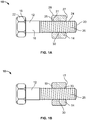
- FIG. 1A shows a 15.875 mm (5/8 inch) fastener 10 having the bolt thread 26 with a bolt pitch of about 2.54 mm (0.100 inch) and the nut thread 30 with a nut pitch of about 2.515 mm (0.099 inch).
- the fastener 10 consists of different fastener sizes having different and corresponding bolt pitches and nut pitches wherein each of the nut pitches has a length that is shorter than a length of the corresponding bolt pitch.
- the initial contact and engagement between the nut thread 30 and the bolt thread 26 is located at the inner most pitch 31 of the nut thread 30, i.e., that closest to the sheet line of the work piece and the second end 19 of the nut 14, and, thus, results in thread engagement at the inner most portion of the nut thread 30 closest to the sheet line.
- the nut thread 30 includes a nut pitch having a length that is longer than a length of the bolt pitch of the bolt thread 26. In another embodiment, the nut thread 30 includes a nut pitch having a length that is longer than a length of a bolt pitch of the bolt thread 26. In another embodiment, FIG. 1B shows a 15.875 mm (5/8 inch) fastener 10 having the bolt thread 26 with a bolt pitch of about 2.54 mm (0.100 inch) and the nut thread 30 with a nut pitch of about 2.515 (0.101 inch).
- the fastener 10 consists of different fastener sizes having different and corresponding bolt pitches and nut pitches wherein each of the nut pitches has a length that is longer than a length of the corresponding bolt pitch.
- the initial contact and engagement between the nut thread 30 and the bolt thread 26 is located at the outer most pitch 33 of the nut thread 30, i.e., that farthest from the sheet line and the second end 19 of the nut 14, and thus results in thread engagement at the outer most portion of the nut thread 30 from the sheet line of the work piece.
- the nut 14 is made from 1045 steel. In another embodiment, the nut 14 is made from 1010 steel. In another embodiment, the nut 14 is made from 1215 steel. In another embodiment, the nut 14 is made from aluminum.
- the fastener 10 is able to achieve lock creation (vibration resistance) at lower clamp loads and at lower torque.
- this mismatch concentrates the initial clamp at one end of the nut thread 30 and incrementally engages more thread length as the clamp increases, as shown in FIGS. 1A and 1B . This incremental engagement allows for lock formation at much lower clamp loads and torques, and thus, a more vibration resistant fastener in an under-tightened scenario.
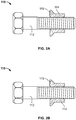
- FIGS. 2A and 2B disclose embodiments of a fastener 110 having a bolt 112 and a nut 114.
- the embodiments of the fastener 110 shown in FIGS. 2A and 2B are constructed and function similar to the respective fasteners 10 shown in FIGS. 1A and 1B , except that the nut 114 includes a flange 115 at one end thereof.
- the flange 115 prevents dilation of the nut 114 as the clamp load increases.
- the nut 114 allows for less raw material usage, resulting in cost savings.
- the flange 115 of the nut 114 shown in FIG. 2A (i.e., with the nut pitch being shorter than the bolt pitch) will prevent dilation thereof.
- the flange 115 of the nut 114 shown in FIG. 2B (i.e., with the nut pitch being longer than the bolt pitch and where initial contact is made on the outermost nut pitch), may not prevent dilation of the nut 114.
- an additional heat treating process on the nut 114 as described below addresses this scenario.
- FIGS. 3A and 3B illustrate embodiments of hardness profiles of the nut 114.
- the hardness profiles present hardness gradations from one end of the nut 114 to the other end of the nut 114.
- the softer end of the gradation will be on the end of the initial pitch contact.
- the hardness of the nut 114 then increases gradually until the other end of the nut 114 is reached.
- the harder end of the nut 114 can then be oriented toward the end that has a tendency to dilate.
- the harder material provides higher hoop strength and therefore will resist dilation.
- the harder material also increases the tensile strength of the fastener 110, and thus, allows for further shortening of the nut 114 in order to further reduce material weight and cost.
- the size of the nut 114 can be reduced by 10% to 20% of a standard nut.
- the hardness of the nut 114 increases from a first end 117 thereof to a second end 119 thereof.
- area A1 has a first hardness in a range of approximately Rc 20 to approximately Rc 60;
- area A2 has a second hardness in a range of approximately Rb 20 to approximately Rc 60; and
- area A3 has a third hardness in a range of approximately Rb 20 to approximately Rb 100.
- the softer end of the gradation will be towards the end of the initial pitch contact, i.e., located proximate to the second end 119 of the nut 114.
- the hardness of the nut 114 increases gradually from the first end 117 thereof to the second end 119 thereof.
- the transition from the first hardness of the area A1 to the second hardness of the area A2 is abrupt.
- the transition from the first hardness of the area A2 to the second hardness of the area A3 is abrupt.
- the transition from the first hardness of the area A1 to the second hardness of the area A2 is abrupt, while the transition from the second hardness of the area A2 to the third hardness of the area A3 is abrupt.
- the term "abrupt" means the transition from one hardness of one area to another hardness of another adjacent area over an area that has a width of less than or equal to three pitch lengths of the nut 114.
- the nut 114 includes only two hardness areas.
- the nut 114 includes four hardness areas.
- the nut 114 includes five hardness areas.
- the nut 114 includes more than five hardness areas.
- the first hardness of the nut 114 increases from the second end 119 to the first end 117 thereof.
- area A1 has a first hardness in a range of approximately Rb 20 to approximately Rb 100;
- area A2 has a second hardness in a range of approximately Rb 20 to approximately Rc 60; and
- area A3 has a third hardness in a range of approximately Rc 20 to approximately Rc 60.
- the softer end of the gradation will be towards the end of the initial pitch contact, i.e., located proximate to the first end 117 of the nut 114.
- the hardness of the nut 114 increases gradually from the second end 119 thereof to the first end 117 thereof.
- the transition from the first hardness of the area A1 to the second hardness of the area A2 is abrupt.
- the transition from the second hardness of the area A2 to the third hardness of the area A3 is abrupt.
- the transition from the first hardness of the area A1 to the second hardness of the area A2 is abrupt, while the transition from the second hardness of the area A2 to the third hardness of the area A3 is abrupt.
- the term "abrupt” means the transition from one hardness of one area to another hardness of another adjacent area over an area that has a width of less than or equal to three pitch lengths of the nut 114.
- the nut 114 includes only two hardness areas.
- the nut 114 includes four hardness areas.
- the nut 114 includes five hardness areas.
- the nut 114 includes more than five hardness areas.
- FIG. 4A , B shows an embodiment of the fastener 110 with the bolt 112 and the nut 114 engaging one another.
- at least one portion of the nut thread 130 of the nut 114 located proximate to the second end 119 thereof is locally softened for locking, while a remaining portion of the nut thread 130 is hardened for resisting dilation and achieving higher tensile.
- the at least one portion of the nut thread 130 includes a length that is approximately equal to at least a portion of a pitch thread length of the nut thread 130.
- the at least one portion of the nut thread 130 includes a length that is approximately equal to one pitch thread length of the nut thread 130. In another embodiment, the at least one portion of the nut thread 130 includes a length that is approximately equal to a plurality of pitch thread lengths of the nut thread 130. In another embodiment, the at least one portion of the nut thread 130 includes a length that is within a range between one pitch thread length of the nut thread 130 and two pitch thread lengths of the nut thread 130. In an embodiment of the present disclosure, the at least one portion of the nut thread 130 is softened. In an embodiment of the present disclosure, the at least one portion of the nut thread 130 is induction annealed. In other embodiments, the at least one portion of the nut thread 130 is locally softened by other means known in the art.
- the nut 114 material is 1045 steel. In another embodiment, the nut 14 is made from 1010 steel. In another embodiment, the nut 14 is made from 1215 steel. In another embodiment, the nut 14 is made from aluminum. In an embodiment of the present disclosure, the nut thread 130 lowers the minimum clamp load in a range of about 20% to 25% of the target clamp. In another embodiment, the nut thread 130 lowers the minimum clamp load about 50% of the target clamp. In an embodiment of the present disclosure, the nut thread 130 has a nut pitch that is shorter than the bolt pitch of the bolt thread 126, therefore allowing the nut thread 130 to embed into the bolt thread 126 before the flanks of the nut thread 130 contact the bolt thread 126.
- the mismatch of the nut pitch of the nut thread 130 and the bolt pitch of the bolt thread 126 allows for a rough field estimation of the clamp being generated by the installation method. This estimation can be made by observing the amount of thread engagement between the nut thread 130 and the bolt thread 126.
- 34.925 mm (1 3/8 inch) nuts 114 were used so the degree of embedment was easier to observe.
- Each of these nuts 114 was installed in a Skidmore Wilhelm test fixture at four clamp loads (27,215 kgf (60,000 Ibf), 36,287 kgf (80,000 Ibf), 45,359 kgf (100,000 Ibf), and 54,431 kgf (120,000 Ibf)). The length of embedment would then be a rough indicator of the clamp achieved, which is helpful in evaluating the quality of the installation without instrumentation.
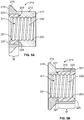
- FIGS. 5A and 5B show other embodiments nuts 214, 314, respectively.
- the embodiments of the nuts 214, 314 shown in FIGS. 5A and 5B are constructed and function similar to the nut 114 shown in FIGS. 2A through 4B , except as otherwise noted.
- the nut 214 includes a nut body 213 having a first end 217 and a second end 219 opposite the first end 217, a flange 215 formed at the second end 219, and an aperture 211 extending from the first end 217 to the second end 219.
- the nut body 213 includes a centrally-located, annular countersunk aperture 221 formed within the second end 219.
- the nut 214 includes an annular insert 223 that is sized and shaped to be inserted into and positioned within the countersunk aperture 221. In an embodiment of the present disclosure, there is an interference fit between the insert 223 and the aperture 221.
- the insert 223 includes a first end 225 and a second end 227 opposite the first end 225 which define a width W of the insert 223. In an embodiment of the present disclosure, when the insert 223 is inserted within the aperture 221 of the nut body 213, the second end 227 of the insert 223 is flush with (or substantially flush with) the second end 219 of the nut body 213.
- the nut 214 (i.e., the nut body 213 and the insert 223) is pre-tapped with an internal nut thread 230 extending from the first end 217 to the second end 219.
- the width W of the insert 223 is so chosen such that the insert 223 extends over a length of or about three nut pitches of the nut thread 230, as shown in FIG. 5A .
- the width W of the insert 223 is so chosen such that the insert 223 extends over a length of less than three nut pitches of the nut thread 230.
- the width W of the insert 223 is so chosen such that the insert 223 extends over a length of more than three nut pitches of the nut thread 230.
- the nut pitch of the nut thread 230 has a length that is shorter than a length of the bolt pitch of a bolt thread.
- the nut body 213 is made from a first material and the insert 223 is made from a second material that is softer than the first material of the nut body 213.
- the first material of the nut body 213 is made of steel and the second material of the insert 223 is made of a softer steel.
- the first material of the nut body 213 is made of steel and the second material of the insert 223 is made of the same steel as the nut body 213 but having a lower hardness.
- the insert 223 is made of aluminum, plastic, brass, or bronze.
- the initial contact and engagement between the nut thread 230 and the bolt thread is located at the inner most pitch 231 of the nut thread 230, i.e., that closest to the sheet line of the work piece and the second end 219 of the nut 214, and, thus, results in thread engagement at the inner most portion of the nut thread 230 closest to the sheet line.
- the nut body 213 is made from a first material and the insert 223 is made from a second material that is harder than the first material of the nut body 213.
- the first material of the nut body 213 is made of steel and the second material of the insert 223 is made of a harder steel.
- the first material of the nut body 213 is made of steel and the second material of the insert 223 is made of the same steel as the nut body 213 but having a higher hardness.
- the initial contact and engagement between the nut thread 230 and the bolt thread is located at the outer most pitch 233 of the nut thread 230, i.e., that farthest from the sheet line and the second end 319 of the nut 314, and thus results in thread engagement at the outer most portion of the nut thread 330 from the sheet line of the work piece.
- the nut 314 includes a nut body 313 having a first end 317 and a second end 319 opposite the first end 317, an aperture 311 extending from the first end 317 to the second end 319, and a flange 315 formed at the second end 319.
- the nut body 313 includes a centrally-located, annular countersunk aperture 321 formed within the first end 317.
- the nut 314 includes an annular insert 323 that is sized and shaped to be inserted into and positioned within the aperture 321. In an embodiment of the present disclosure, there is an interference fit between the insert 323 and the aperture 321.
- the insert 323 includes a first end 325 and a second end 327 opposite the first end 325 which define a width W of the insert 323.
- the first end 325 of the insert 323 is flush with (or substantially flush with) the first end 317 of the nut body 313.
- the nut 314 i.e., the nut body 313 and the insert 323 is pre-tapped with an internal nut thread 330 extending from the first end 317 to the second end 319.
- the width W of the insert 323 is so chosen such that the insert 323 extends over a length of or about five nut pitches of the nut thread 330, as shown in FIG. 5B . In another embodiment, the width W of the insert 323 is so chosen such that the insert 323 extends over a length of less than five nut pitches of the nut thread 330. In another embodiment, the width W of the insert 323 is so chosen such that the insert 323 extends over a length of more than five nut pitches of the nut thread 330.
- the nut pitch of the nut thread 330 has a length that is shorter than a length of the bolt pitch of a bolt thread.
- the nut body 313 is made from a first material and the insert 223 is made from a second material that is harder than the first material of the nut body 313.
- the first material of the nut body 313 is made of steel and the second material of the insert 223 is made of a harder steel.
- the first material of the nut body 313 is made of steel and the second material of the insert 323 is made of the same steel as the nut body 313 but having a higher hardness.
- the initial contact and engagement between the nut thread 330 and the bolt thread is located at the inner most pitch 331 of the nut thread 330, i.e., that closest to the sheet line of the work piece and the second end 319 of the nut 314, and, thus, results in thread engagement at the inner most portion of the nut thread 330 closest to the sheet line.
- the nut body 313 is made from a first material and the insert 323 is made from a second material that is softer than the first material of the nut body 313.
- the first material of the nut body 313 is made of steel and the second material of the insert 323 is made of a softer steel.
- the first material of the nut body 313 is made of steel and the second material of the insert 323 is made of the same steel as the nut body 313 but having a lower hardness.
- the initial contact and engagement between the nut thread 330 and the bolt thread is located at the outer most pitch 333 of the nut thread 330, i.e., that farthest from the sheet line and the second end 319 of the nut 314, and thus results in thread engagement at the outer most portion of the nut thread 330 from the sheet line of the work piece.
Landscapes
- Engineering & Computer Science (AREA)
- General Engineering & Computer Science (AREA)
- Mechanical Engineering (AREA)
- Connection Of Plates (AREA)
Claims (10)
- Attache (10), comprenant:- un boulon (12) incluant une queue allongée (16) ayant une première extrémité (18), une deuxième extrémité (20) opposée à la première extrémité (18), et une partie filetée (24) ayant un filet de boulon externe (26), dans laquelle le filet de boulon (26) inclut un pas de boulon ; et- un écrou (14) incluant un corps d'écrou (213) ayant une première extrémité (217), une deuxième extrémité (219) opposée à la première extrémité (217) du corps de l'écrou (213), et un filet d'écrou interne (30) s'étendant entre les première et deuxième extrémités (217, 219) du corps de l'écrou (213), et adapté pour engager par filetage le filet de boulon (26) du boulon (12), dans laquelle le filet d'écrou (30) inclut un pas d'écrou,dans laquelle le pas de boulon du filet de boulon (26) du boulon (12) est mal adapté avec le pas d'écrou du filet d'écrou (30) de l'écrou (14),
caractérisée en ce que
l'écrou (14) comprend en outre une ouverture fraisée (221), et une plaquette (223) positionnée dans l'ouverture fraisée (221). - Attache (10) selon la revendication 1,
dans laquelle le pas d'écrou du filet d'écrou (30) de l'écrou (14) est plus court que le pas de boulon du filet de boulon (26) du boulon (12), dans laquelle l'ouverture fraisée (221) est de préférence située à la deuxième extrémité (219) du corps de boulon (213), dans laquelle le corps d'écrou (213) est de préférence fabriqué à partir d'un premier matériau et la plaquette (223) est de préférence fabriquée à partir d'un deuxième matériau qui est préférentiellement plus souple que le premier matériau, dans laquelle lorsque le filet d'écrou (30) de l'écrou (14) engage le filet de boulon (26) du boulon (12), un contact initial et un engagement entre le filet d'écrou (30) et le filet de boulon (26) est de préférence situé à un pas du pas de boulon qui est proche de la deuxième extrémité de l'écrou (14). - Attache (10) selon la revendication 1,
dans laquelle le pas d'écrou du filet d'écrou (30) de l'écrou (14) est plus court que le pas de boulon du filet de boulon (26) du boulon (12), dans laquelle l'ouverture fraisée (221) est de préférence située à la première extrémité (217) du corps d'écrou (213), dans laquelle le corps d'écrou (213) est de préférence fabriqué à partir d'un premier matériau et la plaquette (223) est de préférence fabriquée à partir d'un deuxième matériau qui est préférentiellement plus dur que le premier matériau, et dans laquelle lorsque le filet d'écrou (30) de l'écrou (14) engage le filet de boulon (26) du boulon (12), un contact initial et un engagement entre le filet d'écrou (30) et le filet de boulon (26) est de préférence situé à un pas du pas de boulon qui est proche de la deuxième extrémité de l'écrou (14). - Attache (10) selon la revendication 1,
dans laquelle le pas d'écrou du filet d'écrou (30) de l'écrou (14) est plus long que le pas de boulon du filet de boulon (26) du boulon (12), dans laquelle l'ouverture fraisée (221) est de préférence située à la deuxième extrémité (219) du corps d'écrou (213), dans laquelle le corps d'écrou (213) est de préférence fabriqué à partir d'un premier matériau et la plaquette (223) est de préférence fabriquée à partir d'un deuxième matériau qui est préférentiellement plus dur que le premier matériau, et dans laquelle lorsque le filet d'écrou (30) de l'écrou (14) engage le filet de boulon (26) du boulon (12), un contact initial et un engagement entre le filet d'écrou (30) et le filet de boulon (26) est de préférence situé à un pas du pas de boulon qui est proche de la première extrémité de l'écrou (14). - Attache (10) selon la revendication 1,
dans laquelle le pas d'écrou du filet d'écrou (30) de l'écrou (14) est plus long que le pas de boulon du filet de boulon (26) du boulon (12), dans laquelle l'ouverture fraisée (221) est de préférence située à la première extrémité (217) du corps d'écrou (213), dans laquelle le corps d'écrou (213) est de préférence fabriqué à partir d'un premier matériau et la plaquette (223) est de préférence fabriquée à partir d'un deuxième matériau qui est préférentiellement plus souple que le premier matériau, et dans laquelle lorsque le filet d'écrou (30) de l'écrou (14) engage le filet de boulon (26) du boulon (12), un contact initial et un engagement entre le filet d'écrou (30) et le filet de boulon (26) est de préférence situé à un pas du pas de boulon qui est proche de la première extrémité de l'écrou (14). - Attache (10), comprenant :- un boulon (12) incluant une queue allongée (16) ayant une première extrémité, une deuxième extrémité opposée à la première extrémité, et une partie filetée (24) ayant un filet de boulon externe (26), dans laquelle le filet de boulon (26) inclut un pas de boulon ; et- un écrou (14) incluant une première extrémité, une deuxième extrémité opposée à la première extrémité de l'écrou (14), un filet d'écrou interne (30) s'étendant entre les première et deuxième extrémités de l'écrou (14) et adapté pour engager par filetage le filet de boulon (26) du boulon (12), dans laquelle le filet d'écrou (30) inclut un pas d'écrou, et une dureté qui change de manière échelonnée entre les première et deuxième extrémités de l'écrou (14),dans laquelle le pas de boulon du filet de boulon (26) du boulon (12) est mal adapté au pas de l'écrou du filet d'écrou (30) de l'écrou (14), dans laquelle au moins une partie du filet d'écrou (30) située proche de la deuxième extrémité est assouplie localement, et une partie restante du filet d'écrou (30) est durcie.
- Attache (10) selon la revendication 6,
dans laquelle le pas d'écrou du filet d'écrou (30) de l'écrou (14) est plus court que le pas de boulon du filet de boulon (26) du boulon (12), dans laquelle le filet d'écrou (30) de l'écrou (14) engage le filet de boulon (26) du boulon (12), un contact initial et un l'engagement entre le filet d'écrou (30) et le filet de boulon (26) sont de préférence situés à un pas du pas de l'écrou qui est proche de la première extrémité de l'écrou (14) ; ou dans laquelle le pas d'écrou du filet d'écrou (30) de l'écrou (14) est plus long que le pas de boulon du filet de boulon (26) du boulon (12), dans laquelle le filet d'écrou (30) de l'écrou (14) engage le filet de boulon (26) du boulon (12), un contact initial et un engagement entre le filet d'écrou (30) et le filet de boulon (26) sont de préférence situés à un pas du pas de l'écrou qui est proche de la deuxième extrémité de l'écrou (14). - Attache (10) selon la revendication 7,
dans laquelle l'écrou (14) inclut une première zone de dureté qui s'étend entre la première extrémité et une première limite située à l'intermédiaire des première et deuxième extrémités, une deuxième zone de dureté s'étendant de la première limite à une deuxième limite située en aval du depuis la première limite et vers la deuxième extrémité, et une troisième zone de dureté s'étendant de la première limite à la deuxième extrémité, dans laquelle la dureté dans la première zone de dureté inclut de préférence une première dureté, la dureté au sein de la deuxième zone de dureté inclut de préférence une deuxième dureté, et la dureté dans la troisième zone de dureté inclut de préférence une troisième dureté. - Attache (10) selon la revendication 8,
dans laquelle la première dureté se situe dans une plage d'environ 20 Rc à environ 60 Rc, la deuxième dureté se situe dans une plage d'environ 20 Rb à environ 60 Rc, et la troisième dureté se situe dans une plage d'environ 20 Rb à environ 100 Rb, dans laquelle la dureté augmente de préférence graduellement de la première extrémité à la deuxième extrémité, ou dans laquelle une transition de la première dureté à la deuxième dureté est de préférence abrupte, et dans laquelle une transition de la deuxième dureté à la troisième dureté est de préférence abrupte ; ou
dans laquelle la première dureté se situe dans une plage d'environ 20 Rb à environ 100 Rb, la deuxième dureté se situe dans une plage d'environ 20 Rb à environ 60 Rc, et la troisième dureté se situe dans une plage d'environ 20 Rc à environ 60 Rc, dans laquelle la dureté augmente de préférence graduellement de la deuxième extrémité à la première extrémité, ou dans laquelle une transition de la première dureté à la deuxième dureté est de préférence abrupte, et dans laquelle une transition de la deuxième dureté à la troisième dureté est de préférence abrupte. - Attache (10) selon la revendication 7 ou 8,
dans laquelle l'au moins une partie du filet d'écrou (30) inclut une longueur qui est approximativement égale à au moins une partie d'une longueur de filetage de pas du filet d'écrou (30) ; ou
dans laquelle l'au moins une partie du filet d'écrou (30) inclut une longueur qui est approximativement égale à une longueur de filetage de pas du filet d'écrou (30) ; ou
dans laquelle l'au moins une partie du filet d'écrou (30) inclut une longueur qui est approximativement égale à une pluralité de longueurs de filetage de pas du filet d'écrou (30) ; ou
dans laquelle l'au moins une partie du filet d'écrou (30) inclut une longueur qui se trouve dans une plage entre une longueur de filetage de pas du filet d'écrou (30) et deux longueurs de filetage de pas du filet d'écrou (30).
Applications Claiming Priority (2)
| Application Number | Priority Date | Filing Date | Title |
|---|---|---|---|
| US201361908922P | 2013-11-26 | 2013-11-26 | |
| PCT/US2014/067413 WO2015081099A1 (fr) | 2013-11-26 | 2014-11-25 | Écrou et boulon avancés |
Publications (2)
| Publication Number | Publication Date |
|---|---|
| EP3074647A1 EP3074647A1 (fr) | 2016-10-05 |
| EP3074647B1 true EP3074647B1 (fr) | 2019-10-09 |
Family
ID=52011342
Family Applications (1)
| Application Number | Title | Priority Date | Filing Date |
|---|---|---|---|
| EP14808802.4A Not-in-force EP3074647B1 (fr) | 2013-11-26 | 2014-11-25 | Écrou et boulon avancés |
Country Status (5)
| Country | Link |
|---|---|
| US (2) | US20150147134A1 (fr) |
| EP (1) | EP3074647B1 (fr) |
| CN (2) | CN204371870U (fr) |
| ES (1) | ES2765512T3 (fr) |
| WO (1) | WO2015081099A1 (fr) |
Families Citing this family (10)
| Publication number | Priority date | Publication date | Assignee | Title |
|---|---|---|---|---|
| EP3074647B1 (fr) * | 2013-11-26 | 2019-10-09 | Arconic Inc. | Écrou et boulon avancés |
| US10655669B2 (en) | 2013-11-26 | 2020-05-19 | Arconic Inc. | Advanced nut and bolt |
| US9845820B2 (en) * | 2014-08-21 | 2017-12-19 | Inspect 100 Ltd. | Thin walled fastener |
| WO2018119847A1 (fr) * | 2016-12-29 | 2018-07-05 | 诠丰精密工具股份有限公司 | Structure d'enclenchement par vissage fileté |
| DE102017101931B4 (de) | 2017-02-01 | 2022-05-05 | Kamax Holding Gmbh & Co. Kg | Hochfeste Schraube mit einem enthärteten Gewindeende |
| US20190017532A1 (en) * | 2017-07-13 | 2019-01-17 | Ming Yue | Anti-loosening washer |
| CN108741646A (zh) * | 2018-05-09 | 2018-11-06 | 兰州理工大学 | 一种便于调节的音乐教学用乐谱架 |
| CN110374980B (zh) * | 2019-07-22 | 2020-04-10 | 温州思林工业设计有限公司 | 一种快速自锁式螺母结构及其装配和使用方法 |
| US20220205471A1 (en) * | 2020-12-29 | 2022-06-30 | Dana Automotive Systems Group, Llc | Locking feature for a fastener |
| US20240229990A9 (en) * | 2022-10-25 | 2024-07-11 | Petróleo Brasileiro S.A. - Petrobras | Nut guide |
Family Cites Families (54)
| Publication number | Priority date | Publication date | Assignee | Title |
|---|---|---|---|---|
| US197467A (en) * | 1877-11-27 | Improvement in nut and bolt locks | ||
| US1197467A (en) | 1915-05-04 | 1916-09-05 | John Oliver Evans | Bed-warmer. |
| US1697118A (en) | 1927-11-01 | 1929-01-01 | Dardelet Threadlock Corp | Self-locking coupled screw element |
| US1884973A (en) | 1927-11-01 | 1932-10-25 | Dardelet Threadlock Corp | Self-locking coupled screw elements |
| US1922689A (en) * | 1931-07-11 | 1933-08-15 | Hans G H Linnenbruegge | Method of forming screw-threaded members |
| US1953095A (en) | 1931-07-18 | 1934-04-03 | Timken Roller Bearing Co | Detachable bit |
| BE439147A (fr) * | 1939-08-02 | |||
| GB567862A (en) * | 1943-08-31 | 1945-03-06 | Frank Birchall | Improvements in and relating to self-locking nuts |
| US2389377A (en) * | 1944-05-19 | 1945-11-20 | Richard C Manning | Lock nut |
| US2429103A (en) * | 1944-07-05 | 1947-10-14 | Mitchell Robert | Threaded fastener |
| US2467483A (en) | 1946-12-09 | 1949-04-19 | Hutchings Herschel | Agricultural tractor |
| US2564029A (en) | 1947-04-11 | 1951-08-14 | Peterson Dana | Nut and bolt construction |
| US2615119A (en) * | 1947-08-21 | 1952-10-21 | Caterpillar Tractor Co | Steel nut and method of making |
| US2684606A (en) | 1952-03-17 | 1954-07-27 | Eugene A Lafreniere | Combination self-threading easy out and lock nut |
| DE1073244B (de) | 1955-12-27 | 1960-01-14 | Heli-Coil Corporation Danbury, Conn (V St A) | Schraubverbindung mit einem Mutternkorper aus verhältnismäßig wei chem Baustoff |
| BE571794A (fr) | 1958-01-07 | |||
| US3258284A (en) | 1963-12-30 | 1966-06-28 | Phipps Orville | Drill bit and rod coupling |
| US3394626A (en) | 1967-03-17 | 1968-07-30 | Harold L. Oliver | Machine screw threads |
| US4019550A (en) * | 1975-06-09 | 1977-04-26 | Abbott Screw & Mfg. Co. | Sealing nut with nylon insert |
| US4171012A (en) | 1975-11-25 | 1979-10-16 | Holmes Horace D | Locking thread construction |
| DE2742098C2 (de) | 1977-09-19 | 1983-01-13 | Rosenthal Technik Ag, 8672 Selb | Endoprothese mit einer Metall-Keramik-Verbindung |
| US4594039A (en) * | 1981-05-11 | 1986-06-10 | Microdot Inc. | Fastener |
| NO159616C (no) | 1985-06-19 | 1989-01-18 | Harald Kolvereid | L smutter. |
| DE3601389A1 (de) * | 1986-01-18 | 1987-07-23 | Kellermann Fa Rudolf | Verbindungselement nach art einer schrauben/muttern-verbindung |
| US4846614A (en) | 1986-12-08 | 1989-07-11 | Rolf Steinbock | Differential thread for transfer of screw thread forces |
| JPH0429607A (ja) | 1990-05-23 | 1992-01-31 | Nippon Steel Corp | 耐遅れ破壊特性の優れた高張力ボルト |
| US5139380A (en) * | 1990-11-28 | 1992-08-18 | Pac Fasteners | Scalloped nut and method of construction |
| US5413445A (en) | 1991-11-22 | 1995-05-09 | Aceros Cartellone, S.A. | End link and swivel assemblies for chaincables |
| DE9219017U1 (de) | 1992-03-05 | 1997-01-16 | Schürmann & Hilleke GmbH, 58809 Neuenrade | Bolzen mit selbstsicherndem Gewinde und Werkzeug zur Herstellung eines solchen Bolzens |
| US5454675A (en) * | 1994-04-26 | 1995-10-03 | Abbott-Interfast Corporation | Sealing nut and method of making same |
| JP3816130B2 (ja) | 1994-10-03 | 2006-08-30 | ハック インターナショナル,インコーポレイテッド | 回転防止装置付き高強度トルク型ブラインドボルト |
| US5738472A (en) | 1995-10-18 | 1998-04-14 | Honeybee Robotics Inc. | Modified locking thread form for fastener |
| US5779413A (en) * | 1996-02-23 | 1998-07-14 | Fairchild Holding Corp. | Fastener system having improved locking element |
| US5908276A (en) | 1997-01-29 | 1999-06-01 | Lok-Mor, Inc. | Annular engagement lock nut |
| US5865581A (en) | 1997-04-16 | 1999-02-02 | Huck International, Inc. | Free running prevailing torque nut |
| JPH11315820A (ja) | 1998-05-07 | 1999-11-16 | Hideo Moroi | ロックナット |
| US6749386B2 (en) | 2001-08-20 | 2004-06-15 | Maclean-Fogg Company | Locking fastener assembly |
| GB2383106B (en) | 2001-12-14 | 2004-09-15 | Textron Fastening Syst Ltd | Method of fastening |
| JP2003183735A (ja) | 2001-12-18 | 2003-07-03 | Nsk Ltd | ボールねじの熱処理方法および熱処理装置 |
| US20050111934A1 (en) | 2003-11-14 | 2005-05-26 | Ladouceur Harold A. | Self-riveting male fastener and panel assembly |
| EP1590515B1 (fr) | 2003-01-29 | 2013-04-10 | Grant Prideco, Inc | Raccord a blocage rapide a epaulement tournant resistant a la fatigue |
| DE60318117T2 (de) | 2003-02-20 | 2008-12-11 | Conti Fasteners Ag | Schneidschraube für die verwendung in gering dehnbaren materialien |
| RU2249628C1 (ru) | 2003-12-26 | 2005-04-10 | Общество с ограниченной ответственностью "Интелмет НТ" | Сортовой прокат, круглый, из низкоуглеродистой стали для холодной объемной штамповки сложнопрофильных крепежных деталей особо сложной формы |
| RU2249629C1 (ru) | 2003-12-26 | 2005-04-10 | Общество с ограниченной ответственностью "Интелмет НТ" | Сортовой прокат, круглый, из среднеуглеродистой высокопластичной стали для холодной объемной штамповки сложнопрофильных крепежных деталей особо сложной формы |
| DE102004021484B4 (de) | 2004-04-30 | 2018-11-29 | Böllhoff Verbindungstechnik GmbH | Verfahren zum Herstellen einer Verbindungsanordnung |
| JP4797172B2 (ja) * | 2005-03-23 | 2011-10-19 | 国立大学法人佐賀大学 | ねじ |
| US7293339B2 (en) | 2005-06-29 | 2007-11-13 | Huck International, Inc. | Low swage load fastening system and method |
| US7717659B2 (en) | 2005-08-15 | 2010-05-18 | Acumet Intellectual Properties, Llc | Zero-clearance bolted joint |
| US7740436B2 (en) * | 2006-03-22 | 2010-06-22 | R B & W Manufacturing Llc | Clinch nut |
| JP5143407B2 (ja) | 2006-12-06 | 2013-02-13 | 株式会社森創 | 遊技機の基板ケース |
| US20080145185A1 (en) | 2006-12-13 | 2008-06-19 | Alcoa Global Fasteners | Two piece, free running, prevailing torque nut |
| US7802953B2 (en) * | 2007-03-16 | 2010-09-28 | Robert Stephen | Inset panel fastener |
| EP2238361B1 (fr) | 2009-01-06 | 2012-09-05 | Alcoa Inc. | Écrou et boulon de technique avancée |
| EP3074647B1 (fr) * | 2013-11-26 | 2019-10-09 | Arconic Inc. | Écrou et boulon avancés |
-
2014
- 2014-11-25 EP EP14808802.4A patent/EP3074647B1/fr not_active Not-in-force
- 2014-11-25 ES ES14808802T patent/ES2765512T3/es active Active
- 2014-11-25 US US14/553,476 patent/US20150147134A1/en not_active Abandoned
- 2014-11-25 WO PCT/US2014/067413 patent/WO2015081099A1/fr not_active Ceased
- 2014-11-26 CN CN201420731561.4U patent/CN204371870U/zh not_active Expired - Lifetime
- 2014-11-26 CN CN201410697074.5A patent/CN104728240B/zh not_active Expired - Fee Related
-
2019
- 2019-05-09 US US16/407,439 patent/US11519452B2/en active Active
Non-Patent Citations (1)
| Title |
|---|
| None * |
Also Published As
| Publication number | Publication date |
|---|---|
| CN204371870U (zh) | 2015-06-03 |
| CN104728240A (zh) | 2015-06-24 |
| ES2765512T3 (es) | 2020-06-09 |
| US11519452B2 (en) | 2022-12-06 |
| WO2015081099A1 (fr) | 2015-06-04 |
| US20150147134A1 (en) | 2015-05-28 |
| EP3074647A1 (fr) | 2016-10-05 |
| CN104728240B (zh) | 2018-10-30 |
| US20190264728A1 (en) | 2019-08-29 |
Similar Documents
| Publication | Publication Date | Title |
|---|---|---|
| EP3074647B1 (fr) | Écrou et boulon avancés | |
| US10724566B2 (en) | Threaded fastener | |
| EP2238361B1 (fr) | Écrou et boulon de technique avancée | |
| EP2092203B1 (fr) | Insert de goujon borgne | |
| EP3364050A1 (fr) | Passage conique de fixations d'interférence à ajustement serré | |
| EP3364049A1 (fr) | Entrée arrondie pour éléments de fixation à ajustement serré | |
| US20240376925A1 (en) | Threaded Fastener Having a Thread Crest Greater than Its Thread Root and V Angles on the Crest and Root | |
| US10655669B2 (en) | Advanced nut and bolt | |
| US4806054A (en) | Male threaded fastener capable of use with a swaged collar | |
| CN1592821A (zh) | 自攻丝螺钉及连接薄工件的方法 | |
| EP3988804B1 (fr) | Vis | |
| US20070237604A1 (en) | Low tolerance threaded fastener | |
| CA2992708C (fr) | Element de fixation filete | |
| CN107850106A (zh) | 防止拧松的螺栓 |
Legal Events
| Date | Code | Title | Description |
|---|---|---|---|
| PUAI | Public reference made under article 153(3) epc to a published international application that has entered the european phase |
Free format text: ORIGINAL CODE: 0009012 |
|
| 17P | Request for examination filed |
Effective date: 20160510 |
|
| AK | Designated contracting states |
Kind code of ref document: A1 Designated state(s): AL AT BE BG CH CY CZ DE DK EE ES FI FR GB GR HR HU IE IS IT LI LT LU LV MC MK MT NL NO PL PT RO RS SE SI SK SM TR |
|
| AX | Request for extension of the european patent |
Extension state: BA ME |
|
| DAX | Request for extension of the european patent (deleted) | ||
| RAP1 | Party data changed (applicant data changed or rights of an application transferred) |
Owner name: ARCONIC INC. |
|
| STAA | Information on the status of an ep patent application or granted ep patent |
Free format text: STATUS: EXAMINATION IS IN PROGRESS |
|
| 17Q | First examination report despatched |
Effective date: 20181022 |
|
| GRAP | Despatch of communication of intention to grant a patent |
Free format text: ORIGINAL CODE: EPIDOSNIGR1 |
|
| STAA | Information on the status of an ep patent application or granted ep patent |
Free format text: STATUS: GRANT OF PATENT IS INTENDED |
|
| INTG | Intention to grant announced |
Effective date: 20190603 |
|
| GRAS | Grant fee paid |
Free format text: ORIGINAL CODE: EPIDOSNIGR3 |
|
| GRAA | (expected) grant |
Free format text: ORIGINAL CODE: 0009210 |
|
| STAA | Information on the status of an ep patent application or granted ep patent |
Free format text: STATUS: THE PATENT HAS BEEN GRANTED |
|
| AK | Designated contracting states |
Kind code of ref document: B1 Designated state(s): AL AT BE BG CH CY CZ DE DK EE ES FI FR GB GR HR HU IE IS IT LI LT LU LV MC MK MT NL NO PL PT RO RS SE SI SK SM TR |
|
| REG | Reference to a national code |
Ref country code: GB Ref legal event code: FG4D |
|
| REG | Reference to a national code |
Ref country code: CH Ref legal event code: EP |
|
| REG | Reference to a national code |
Ref country code: IE Ref legal event code: FG4D |
|
| REG | Reference to a national code |
Ref country code: DE Ref legal event code: R096 Ref document number: 602014054986 Country of ref document: DE |
|
| REG | Reference to a national code |
Ref country code: AT Ref legal event code: REF Ref document number: 1189168 Country of ref document: AT Kind code of ref document: T Effective date: 20191115 |
|
| PGFP | Annual fee paid to national office [announced via postgrant information from national office to epo] |
Ref country code: DE Payment date: 20191119 Year of fee payment: 6 |
|
| REG | Reference to a national code |
Ref country code: SE Ref legal event code: TRGR |
|
| REG | Reference to a national code |
Ref country code: NL Ref legal event code: MP Effective date: 20191009 |
|
| REG | Reference to a national code |
Ref country code: LT Ref legal event code: MG4D |
|
| PGFP | Annual fee paid to national office [announced via postgrant information from national office to epo] |
Ref country code: ES Payment date: 20191202 Year of fee payment: 6 Ref country code: FR Payment date: 20191120 Year of fee payment: 6 Ref country code: IT Payment date: 20191031 Year of fee payment: 6 |
|
| REG | Reference to a national code |
Ref country code: AT Ref legal event code: MK05 Ref document number: 1189168 Country of ref document: AT Kind code of ref document: T Effective date: 20191009 |
|
| PG25 | Lapsed in a contracting state [announced via postgrant information from national office to epo] |
Ref country code: GR Free format text: LAPSE BECAUSE OF FAILURE TO SUBMIT A TRANSLATION OF THE DESCRIPTION OR TO PAY THE FEE WITHIN THE PRESCRIBED TIME-LIMIT Effective date: 20200110 Ref country code: PT Free format text: LAPSE BECAUSE OF FAILURE TO SUBMIT A TRANSLATION OF THE DESCRIPTION OR TO PAY THE FEE WITHIN THE PRESCRIBED TIME-LIMIT Effective date: 20200210 Ref country code: AT Free format text: LAPSE BECAUSE OF FAILURE TO SUBMIT A TRANSLATION OF THE DESCRIPTION OR TO PAY THE FEE WITHIN THE PRESCRIBED TIME-LIMIT Effective date: 20191009 Ref country code: PL Free format text: LAPSE BECAUSE OF FAILURE TO SUBMIT A TRANSLATION OF THE DESCRIPTION OR TO PAY THE FEE WITHIN THE PRESCRIBED TIME-LIMIT Effective date: 20191009 Ref country code: NL Free format text: LAPSE BECAUSE OF FAILURE TO SUBMIT A TRANSLATION OF THE DESCRIPTION OR TO PAY THE FEE WITHIN THE PRESCRIBED TIME-LIMIT Effective date: 20191009 Ref country code: LT Free format text: LAPSE BECAUSE OF FAILURE TO SUBMIT A TRANSLATION OF THE DESCRIPTION OR TO PAY THE FEE WITHIN THE PRESCRIBED TIME-LIMIT Effective date: 20191009 Ref country code: BG Free format text: LAPSE BECAUSE OF FAILURE TO SUBMIT A TRANSLATION OF THE DESCRIPTION OR TO PAY THE FEE WITHIN THE PRESCRIBED TIME-LIMIT Effective date: 20200109 Ref country code: FI Free format text: LAPSE BECAUSE OF FAILURE TO SUBMIT A TRANSLATION OF THE DESCRIPTION OR TO PAY THE FEE WITHIN THE PRESCRIBED TIME-LIMIT Effective date: 20191009 Ref country code: LV Free format text: LAPSE BECAUSE OF FAILURE TO SUBMIT A TRANSLATION OF THE DESCRIPTION OR TO PAY THE FEE WITHIN THE PRESCRIBED TIME-LIMIT Effective date: 20191009 Ref country code: NO Free format text: LAPSE BECAUSE OF FAILURE TO SUBMIT A TRANSLATION OF THE DESCRIPTION OR TO PAY THE FEE WITHIN THE PRESCRIBED TIME-LIMIT Effective date: 20200109 |
|
| PGFP | Annual fee paid to national office [announced via postgrant information from national office to epo] |
Ref country code: GB Payment date: 20191122 Year of fee payment: 6 |
|
| PG25 | Lapsed in a contracting state [announced via postgrant information from national office to epo] |
Ref country code: RS Free format text: LAPSE BECAUSE OF FAILURE TO SUBMIT A TRANSLATION OF THE DESCRIPTION OR TO PAY THE FEE WITHIN THE PRESCRIBED TIME-LIMIT Effective date: 20191009 Ref country code: HR Free format text: LAPSE BECAUSE OF FAILURE TO SUBMIT A TRANSLATION OF THE DESCRIPTION OR TO PAY THE FEE WITHIN THE PRESCRIBED TIME-LIMIT Effective date: 20191009 Ref country code: IS Free format text: LAPSE BECAUSE OF FAILURE TO SUBMIT A TRANSLATION OF THE DESCRIPTION OR TO PAY THE FEE WITHIN THE PRESCRIBED TIME-LIMIT Effective date: 20200224 |
|
| REG | Reference to a national code |
Ref country code: DE Ref legal event code: R082 Ref document number: 602014054986 Country of ref document: DE Representative=s name: MEISSNER BOLTE PATENTANWAELTE RECHTSANWAELTE P, DE Ref country code: DE Ref legal event code: R081 Ref document number: 602014054986 Country of ref document: DE Owner name: HOWMET AEROSPACE INC. (GESELLSCHAFT NACH DEN G, US Free format text: FORMER OWNER: ARCONIC INC., PITTSBURGH, PA., US |
|
| REG | Reference to a national code |
Ref country code: ES Ref legal event code: FG2A Ref document number: 2765512 Country of ref document: ES Kind code of ref document: T3 Effective date: 20200609 |
|
| PG25 | Lapsed in a contracting state [announced via postgrant information from national office to epo] |
Ref country code: AL Free format text: LAPSE BECAUSE OF FAILURE TO SUBMIT A TRANSLATION OF THE DESCRIPTION OR TO PAY THE FEE WITHIN THE PRESCRIBED TIME-LIMIT Effective date: 20191009 |
|
| REG | Reference to a national code |
Ref country code: CH Ref legal event code: PL |
|
| REG | Reference to a national code |
Ref country code: DE Ref legal event code: R097 Ref document number: 602014054986 Country of ref document: DE |
|
| PG2D | Information on lapse in contracting state deleted |
Ref country code: IS |
|
| PG25 | Lapsed in a contracting state [announced via postgrant information from national office to epo] |
Ref country code: EE Free format text: LAPSE BECAUSE OF FAILURE TO SUBMIT A TRANSLATION OF THE DESCRIPTION OR TO PAY THE FEE WITHIN THE PRESCRIBED TIME-LIMIT Effective date: 20191009 Ref country code: MC Free format text: LAPSE BECAUSE OF FAILURE TO SUBMIT A TRANSLATION OF THE DESCRIPTION OR TO PAY THE FEE WITHIN THE PRESCRIBED TIME-LIMIT Effective date: 20191009 Ref country code: LU Free format text: LAPSE BECAUSE OF NON-PAYMENT OF DUE FEES Effective date: 20191125 Ref country code: RO Free format text: LAPSE BECAUSE OF FAILURE TO SUBMIT A TRANSLATION OF THE DESCRIPTION OR TO PAY THE FEE WITHIN THE PRESCRIBED TIME-LIMIT Effective date: 20191009 Ref country code: CZ Free format text: LAPSE BECAUSE OF FAILURE TO SUBMIT A TRANSLATION OF THE DESCRIPTION OR TO PAY THE FEE WITHIN THE PRESCRIBED TIME-LIMIT Effective date: 20191009 Ref country code: LI Free format text: LAPSE BECAUSE OF NON-PAYMENT OF DUE FEES Effective date: 20191130 Ref country code: DK Free format text: LAPSE BECAUSE OF FAILURE TO SUBMIT A TRANSLATION OF THE DESCRIPTION OR TO PAY THE FEE WITHIN THE PRESCRIBED TIME-LIMIT Effective date: 20191009 Ref country code: CH Free format text: LAPSE BECAUSE OF NON-PAYMENT OF DUE FEES Effective date: 20191130 Ref country code: IS Free format text: LAPSE BECAUSE OF FAILURE TO SUBMIT A TRANSLATION OF THE DESCRIPTION OR TO PAY THE FEE WITHIN THE PRESCRIBED TIME-LIMIT Effective date: 20200209 |
|
| PLBE | No opposition filed within time limit |
Free format text: ORIGINAL CODE: 0009261 |
|
| STAA | Information on the status of an ep patent application or granted ep patent |
Free format text: STATUS: NO OPPOSITION FILED WITHIN TIME LIMIT |
|
| REG | Reference to a national code |
Ref country code: BE Ref legal event code: MM Effective date: 20191130 |
|
| PG25 | Lapsed in a contracting state [announced via postgrant information from national office to epo] |
Ref country code: SK Free format text: LAPSE BECAUSE OF FAILURE TO SUBMIT A TRANSLATION OF THE DESCRIPTION OR TO PAY THE FEE WITHIN THE PRESCRIBED TIME-LIMIT Effective date: 20191009 Ref country code: SM Free format text: LAPSE BECAUSE OF FAILURE TO SUBMIT A TRANSLATION OF THE DESCRIPTION OR TO PAY THE FEE WITHIN THE PRESCRIBED TIME-LIMIT Effective date: 20191009 |
|
| PGFP | Annual fee paid to national office [announced via postgrant information from national office to epo] |
Ref country code: SE Payment date: 20191025 Year of fee payment: 6 |
|
| 26N | No opposition filed |
Effective date: 20200710 |
|
| PG25 | Lapsed in a contracting state [announced via postgrant information from national office to epo] |
Ref country code: IE Free format text: LAPSE BECAUSE OF NON-PAYMENT OF DUE FEES Effective date: 20191125 |
|
| PG25 | Lapsed in a contracting state [announced via postgrant information from national office to epo] |
Ref country code: SI Free format text: LAPSE BECAUSE OF FAILURE TO SUBMIT A TRANSLATION OF THE DESCRIPTION OR TO PAY THE FEE WITHIN THE PRESCRIBED TIME-LIMIT Effective date: 20191009 Ref country code: BE Free format text: LAPSE BECAUSE OF NON-PAYMENT OF DUE FEES Effective date: 20191130 |
|
| PG25 | Lapsed in a contracting state [announced via postgrant information from national office to epo] |
Ref country code: CY Free format text: LAPSE BECAUSE OF FAILURE TO SUBMIT A TRANSLATION OF THE DESCRIPTION OR TO PAY THE FEE WITHIN THE PRESCRIBED TIME-LIMIT Effective date: 20191009 |
|
| REG | Reference to a national code |
Ref country code: DE Ref legal event code: R119 Ref document number: 602014054986 Country of ref document: DE |
|
| REG | Reference to a national code |
Ref country code: SE Ref legal event code: EUG |
|
| GBPC | Gb: european patent ceased through non-payment of renewal fee |
Effective date: 20201125 |
|
| PG25 | Lapsed in a contracting state [announced via postgrant information from national office to epo] |
Ref country code: HU Free format text: LAPSE BECAUSE OF FAILURE TO SUBMIT A TRANSLATION OF THE DESCRIPTION OR TO PAY THE FEE WITHIN THE PRESCRIBED TIME-LIMIT; INVALID AB INITIO Effective date: 20141125 Ref country code: MT Free format text: LAPSE BECAUSE OF FAILURE TO SUBMIT A TRANSLATION OF THE DESCRIPTION OR TO PAY THE FEE WITHIN THE PRESCRIBED TIME-LIMIT Effective date: 20191009 |
|
| PG25 | Lapsed in a contracting state [announced via postgrant information from national office to epo] |
Ref country code: SE Free format text: LAPSE BECAUSE OF NON-PAYMENT OF DUE FEES Effective date: 20201126 |
|
| PG25 | Lapsed in a contracting state [announced via postgrant information from national office to epo] |
Ref country code: FR Free format text: LAPSE BECAUSE OF NON-PAYMENT OF DUE FEES Effective date: 20201130 Ref country code: IT Free format text: LAPSE BECAUSE OF NON-PAYMENT OF DUE FEES Effective date: 20201125 |
|
| PG25 | Lapsed in a contracting state [announced via postgrant information from national office to epo] |
Ref country code: GB Free format text: LAPSE BECAUSE OF NON-PAYMENT OF DUE FEES Effective date: 20201125 Ref country code: DE Free format text: LAPSE BECAUSE OF NON-PAYMENT OF DUE FEES Effective date: 20210601 |
|
| REG | Reference to a national code |
Ref country code: ES Ref legal event code: FD2A Effective date: 20220203 |
|
| PG25 | Lapsed in a contracting state [announced via postgrant information from national office to epo] |
Ref country code: ES Free format text: LAPSE BECAUSE OF NON-PAYMENT OF DUE FEES Effective date: 20201126 |
|
| PG25 | Lapsed in a contracting state [announced via postgrant information from national office to epo] |
Ref country code: TR Free format text: LAPSE BECAUSE OF NON-PAYMENT OF DUE FEES Effective date: 20201125 Ref country code: MK Free format text: LAPSE BECAUSE OF FAILURE TO SUBMIT A TRANSLATION OF THE DESCRIPTION OR TO PAY THE FEE WITHIN THE PRESCRIBED TIME-LIMIT Effective date: 20191009 |