EP3075559A1 - Feuille transparente de marquage au laser, stratifié, et procédé pour marquage au laser - Google Patents
Feuille transparente de marquage au laser, stratifié, et procédé pour marquage au laser Download PDFInfo
- Publication number
- EP3075559A1 EP3075559A1 EP13898278.0A EP13898278A EP3075559A1 EP 3075559 A1 EP3075559 A1 EP 3075559A1 EP 13898278 A EP13898278 A EP 13898278A EP 3075559 A1 EP3075559 A1 EP 3075559A1
- Authority
- EP
- European Patent Office
- Prior art keywords
- sheet
- laser
- marking
- transparent
- layer
- Prior art date
- Legal status (The legal status is an assumption and is not a legal conclusion. Google has not performed a legal analysis and makes no representation as to the accuracy of the status listed.)
- Granted
Links
Images

Classifications
-
- B—PERFORMING OPERATIONS; TRANSPORTING
- B32—LAYERED PRODUCTS
- B32B—LAYERED PRODUCTS, i.e. PRODUCTS BUILT-UP OF STRATA OF FLAT OR NON-FLAT, e.g. CELLULAR OR HONEYCOMB, FORM
- B32B27/00—Layered products comprising a layer of synthetic resin
- B32B27/06—Layered products comprising a layer of synthetic resin as the main or only constituent of a layer, which is next to another layer of the same or of a different material
- B32B27/08—Layered products comprising a layer of synthetic resin as the main or only constituent of a layer, which is next to another layer of the same or of a different material of synthetic resin
-
- B—PERFORMING OPERATIONS; TRANSPORTING
- B32—LAYERED PRODUCTS
- B32B—LAYERED PRODUCTS, i.e. PRODUCTS BUILT-UP OF STRATA OF FLAT OR NON-FLAT, e.g. CELLULAR OR HONEYCOMB, FORM
- B32B27/00—Layered products comprising a layer of synthetic resin
- B32B27/36—Layered products comprising a layer of synthetic resin comprising polyesters
-
- B—PERFORMING OPERATIONS; TRANSPORTING
- B32—LAYERED PRODUCTS
- B32B—LAYERED PRODUCTS, i.e. PRODUCTS BUILT-UP OF STRATA OF FLAT OR NON-FLAT, e.g. CELLULAR OR HONEYCOMB, FORM
- B32B27/00—Layered products comprising a layer of synthetic resin
- B32B27/36—Layered products comprising a layer of synthetic resin comprising polyesters
- B32B27/365—Layered products comprising a layer of synthetic resin comprising polyesters comprising polycarbonates
-
- B—PERFORMING OPERATIONS; TRANSPORTING
- B32—LAYERED PRODUCTS
- B32B—LAYERED PRODUCTS, i.e. PRODUCTS BUILT-UP OF STRATA OF FLAT OR NON-FLAT, e.g. CELLULAR OR HONEYCOMB, FORM
- B32B7/00—Layered products characterised by the relation between layers; Layered products characterised by the relative orientation of features between layers, or by the relative values of a measurable parameter between layers, i.e. products comprising layers having different physical, chemical or physicochemical properties; Layered products characterised by the interconnection of layers
- B32B7/04—Interconnection of layers
- B32B7/12—Interconnection of layers using interposed adhesives or interposed materials with bonding properties
-
- B—PERFORMING OPERATIONS; TRANSPORTING
- B41—PRINTING; LINING MACHINES; TYPEWRITERS; STAMPS
- B41M—PRINTING, DUPLICATING, MARKING, OR COPYING PROCESSES; COLOUR PRINTING
- B41M5/00—Duplicating or marking methods; Sheet materials for use therein
- B41M5/26—Thermography ; Marking by high energetic means, e.g. laser otherwise than by burning, and characterised by the material used
- B41M5/267—Marking of plastic artifacts, e.g. with laser
-
- B—PERFORMING OPERATIONS; TRANSPORTING
- B42—BOOKBINDING; ALBUMS; FILES; SPECIAL PRINTED MATTER
- B42D—BOOKS; BOOK COVERS; LOOSE LEAVES; PRINTED MATTER CHARACTERISED BY IDENTIFICATION OR SECURITY FEATURES; PRINTED MATTER OF SPECIAL FORMAT OR STYLE NOT OTHERWISE PROVIDED FOR; DEVICES FOR USE THEREWITH AND NOT OTHERWISE PROVIDED FOR; MOVABLE-STRIP WRITING OR READING APPARATUS
- B42D25/00—Information-bearing cards or sheet-like structures characterised by identification or security features; Manufacture thereof
- B42D25/20—Information-bearing cards or sheet-like structures characterised by identification or security features; Manufacture thereof characterised by a particular use or purpose
- B42D25/23—Identity cards
-
- B—PERFORMING OPERATIONS; TRANSPORTING
- B42—BOOKBINDING; ALBUMS; FILES; SPECIAL PRINTED MATTER
- B42D—BOOKS; BOOK COVERS; LOOSE LEAVES; PRINTED MATTER CHARACTERISED BY IDENTIFICATION OR SECURITY FEATURES; PRINTED MATTER OF SPECIAL FORMAT OR STYLE NOT OTHERWISE PROVIDED FOR; DEVICES FOR USE THEREWITH AND NOT OTHERWISE PROVIDED FOR; MOVABLE-STRIP WRITING OR READING APPARATUS
- B42D25/00—Information-bearing cards or sheet-like structures characterised by identification or security features; Manufacture thereof
- B42D25/20—Information-bearing cards or sheet-like structures characterised by identification or security features; Manufacture thereof characterised by a particular use or purpose
- B42D25/24—Passports
-
- B—PERFORMING OPERATIONS; TRANSPORTING
- B42—BOOKBINDING; ALBUMS; FILES; SPECIAL PRINTED MATTER
- B42D—BOOKS; BOOK COVERS; LOOSE LEAVES; PRINTED MATTER CHARACTERISED BY IDENTIFICATION OR SECURITY FEATURES; PRINTED MATTER OF SPECIAL FORMAT OR STYLE NOT OTHERWISE PROVIDED FOR; DEVICES FOR USE THEREWITH AND NOT OTHERWISE PROVIDED FOR; MOVABLE-STRIP WRITING OR READING APPARATUS
- B42D25/00—Information-bearing cards or sheet-like structures characterised by identification or security features; Manufacture thereof
- B42D25/30—Identification or security features, e.g. for preventing forgery
- B42D25/351—Translucent or partly translucent parts, e.g. windows
-
- B—PERFORMING OPERATIONS; TRANSPORTING
- B42—BOOKBINDING; ALBUMS; FILES; SPECIAL PRINTED MATTER
- B42D—BOOKS; BOOK COVERS; LOOSE LEAVES; PRINTED MATTER CHARACTERISED BY IDENTIFICATION OR SECURITY FEATURES; PRINTED MATTER OF SPECIAL FORMAT OR STYLE NOT OTHERWISE PROVIDED FOR; DEVICES FOR USE THEREWITH AND NOT OTHERWISE PROVIDED FOR; MOVABLE-STRIP WRITING OR READING APPARATUS
- B42D25/00—Information-bearing cards or sheet-like structures characterised by identification or security features; Manufacture thereof
- B42D25/30—Identification or security features, e.g. for preventing forgery
- B42D25/36—Identification or security features, e.g. for preventing forgery comprising special materials
- B42D25/378—Special inks
- B42D25/387—Special inks absorbing or reflecting ultraviolet light
-
- B—PERFORMING OPERATIONS; TRANSPORTING
- B42—BOOKBINDING; ALBUMS; FILES; SPECIAL PRINTED MATTER
- B42D—BOOKS; BOOK COVERS; LOOSE LEAVES; PRINTED MATTER CHARACTERISED BY IDENTIFICATION OR SECURITY FEATURES; PRINTED MATTER OF SPECIAL FORMAT OR STYLE NOT OTHERWISE PROVIDED FOR; DEVICES FOR USE THEREWITH AND NOT OTHERWISE PROVIDED FOR; MOVABLE-STRIP WRITING OR READING APPARATUS
- B42D25/00—Information-bearing cards or sheet-like structures characterised by identification or security features; Manufacture thereof
- B42D25/40—Manufacture
- B42D25/405—Marking
- B42D25/41—Marking using electromagnetic radiation
-
- B—PERFORMING OPERATIONS; TRANSPORTING
- B42—BOOKBINDING; ALBUMS; FILES; SPECIAL PRINTED MATTER
- B42D—BOOKS; BOOK COVERS; LOOSE LEAVES; PRINTED MATTER CHARACTERISED BY IDENTIFICATION OR SECURITY FEATURES; PRINTED MATTER OF SPECIAL FORMAT OR STYLE NOT OTHERWISE PROVIDED FOR; DEVICES FOR USE THEREWITH AND NOT OTHERWISE PROVIDED FOR; MOVABLE-STRIP WRITING OR READING APPARATUS
- B42D25/00—Information-bearing cards or sheet-like structures characterised by identification or security features; Manufacture thereof
- B42D25/40—Manufacture
- B42D25/45—Associating two or more layers
- B42D25/465—Associating two or more layers using chemicals or adhesives
- B42D25/47—Associating two or more layers using chemicals or adhesives using adhesives
-
- C—CHEMISTRY; METALLURGY
- C09—DYES; PAINTS; POLISHES; NATURAL RESINS; ADHESIVES; COMPOSITIONS NOT OTHERWISE PROVIDED FOR; APPLICATIONS OF MATERIALS NOT OTHERWISE PROVIDED FOR
- C09J—ADHESIVES; NON-MECHANICAL ASPECTS OF ADHESIVE PROCESSES IN GENERAL; ADHESIVE PROCESSES NOT PROVIDED FOR ELSEWHERE; USE OF MATERIALS AS ADHESIVES
- C09J167/00—Adhesives based on polyesters obtained by reactions forming a carboxylic ester link in the main chain; Adhesives based on derivatives of such polymers
-
- B—PERFORMING OPERATIONS; TRANSPORTING
- B32—LAYERED PRODUCTS
- B32B—LAYERED PRODUCTS, i.e. PRODUCTS BUILT-UP OF STRATA OF FLAT OR NON-FLAT, e.g. CELLULAR OR HONEYCOMB, FORM
- B32B2255/00—Coating on the layer surface
- B32B2255/10—Coating on the layer surface on synthetic resin layer or on natural or synthetic rubber layer
-
- B—PERFORMING OPERATIONS; TRANSPORTING
- B32—LAYERED PRODUCTS
- B32B—LAYERED PRODUCTS, i.e. PRODUCTS BUILT-UP OF STRATA OF FLAT OR NON-FLAT, e.g. CELLULAR OR HONEYCOMB, FORM
- B32B2255/00—Coating on the layer surface
- B32B2255/26—Polymeric coating
-
- B—PERFORMING OPERATIONS; TRANSPORTING
- B32—LAYERED PRODUCTS
- B32B—LAYERED PRODUCTS, i.e. PRODUCTS BUILT-UP OF STRATA OF FLAT OR NON-FLAT, e.g. CELLULAR OR HONEYCOMB, FORM
- B32B2264/00—Composition or properties of particles which form a particulate layer or are present as additives
- B32B2264/10—Inorganic particles
- B32B2264/102—Oxide or hydroxide
-
- B—PERFORMING OPERATIONS; TRANSPORTING
- B32—LAYERED PRODUCTS
- B32B—LAYERED PRODUCTS, i.e. PRODUCTS BUILT-UP OF STRATA OF FLAT OR NON-FLAT, e.g. CELLULAR OR HONEYCOMB, FORM
- B32B2264/00—Composition or properties of particles which form a particulate layer or are present as additives
- B32B2264/10—Inorganic particles
- B32B2264/107—Ceramic
-
- B—PERFORMING OPERATIONS; TRANSPORTING
- B32—LAYERED PRODUCTS
- B32B—LAYERED PRODUCTS, i.e. PRODUCTS BUILT-UP OF STRATA OF FLAT OR NON-FLAT, e.g. CELLULAR OR HONEYCOMB, FORM
- B32B2264/00—Composition or properties of particles which form a particulate layer or are present as additives
- B32B2264/10—Inorganic particles
- B32B2264/107—Ceramic
- B32B2264/108—Carbon, e.g. graphite particles
-
- B—PERFORMING OPERATIONS; TRANSPORTING
- B32—LAYERED PRODUCTS
- B32B—LAYERED PRODUCTS, i.e. PRODUCTS BUILT-UP OF STRATA OF FLAT OR NON-FLAT, e.g. CELLULAR OR HONEYCOMB, FORM
- B32B2307/00—Properties of the layers or laminate
- B32B2307/40—Properties of the layers or laminate having particular optical properties
- B32B2307/412—Transparent
-
- B—PERFORMING OPERATIONS; TRANSPORTING
- B32—LAYERED PRODUCTS
- B32B—LAYERED PRODUCTS, i.e. PRODUCTS BUILT-UP OF STRATA OF FLAT OR NON-FLAT, e.g. CELLULAR OR HONEYCOMB, FORM
- B32B2307/00—Properties of the layers or laminate
- B32B2307/50—Properties of the layers or laminate having particular mechanical properties
- B32B2307/554—Wear resistance
-
- B—PERFORMING OPERATIONS; TRANSPORTING
- B32—LAYERED PRODUCTS
- B32B—LAYERED PRODUCTS, i.e. PRODUCTS BUILT-UP OF STRATA OF FLAT OR NON-FLAT, e.g. CELLULAR OR HONEYCOMB, FORM
- B32B2307/00—Properties of the layers or laminate
- B32B2307/70—Other properties
- B32B2307/75—Printability
-
- B—PERFORMING OPERATIONS; TRANSPORTING
- B32—LAYERED PRODUCTS
- B32B—LAYERED PRODUCTS, i.e. PRODUCTS BUILT-UP OF STRATA OF FLAT OR NON-FLAT, e.g. CELLULAR OR HONEYCOMB, FORM
- B32B2425/00—Cards, e.g. identity cards, credit cards
Definitions
- the present invention relates to a transparent laser-marking sheet, a laminate and a method for laser marking.
- an identification such as an ID card or a passport with personal information recorded thereon is used as means to identify an individual and verify the identity.
- an identification issued from an official body or a reliable organization has been growing.
- Patent Documents 1 and 2 for example.
- Patent Document 1 discloses a technique relating to the manufacturing of a flexible data sheet in a security document, such as a passport. Specifically, the technique relates to a data sheet in a security document including a data portion and an attachment portion.
- the data portion includes a data area in which at least some of the data on the data sheet can be recorded utilizing laser inscription technique.
- the attachment portion is configured to be flexible and have bending resistant in order to fasten the data sheet to the security document.
- Patent Document 2 discloses a technique relating to a laser-marking multilayer sheet used for an electronic passport and to an electronic passport including the multilayer sheet.
- a laser-marking multilayer sheet in the technique of Patent Document 2 is configured as a laser-marking multilayer sheet for an electronic passport obtained by stacking five layers of a multilayer sheet A/a multilayer sheet B/a film C/a multilayer sheet B/a multilayer sheet A.
- Each multilayer sheet A is a transparent laser-marking multilayer sheet having skin layers and a core layer and made of at least three-layer sheets.
- Each multilayer sheet B is a colored laser-marking multilayer sheet having skin layers and a core layer and made of at least three layers of sheets.
- the film C is a resin film or a film made of cloth.
- Patent Document 1 discloses another data sheet as well, including a filling layer disposed between two sheets and made of the same material as that of the sheets.
- Patent Document 1 simply obtains the lamination of a sheet printed by a laser inscription technique. That is, this technique cannot achieve the effect of sufficient integration between the printed sheet by a laser inscription technique and another sheet printed by a different method.
- a sheet printed by UV offset printing or UV silk printing and a sheet printed by a laser inscription technique may be combined for use as a data sheet, which is effective in terms of the design and forgery inhibition.
- the technique of Patent Document 1 if lamination or the like is performed with a UV offset printed sheet or a UV silk printed sheet, such lamination will lead to easy delamination, meaning a failure in integration.
- Patent Document 1 is configured so that one of the sheets is separated partly. Therefore, this technique is not suitable for countermeasure against forgery by combining a plurality of sheets to make a complicated design, for example.
- the sheets are integrated by heating or pressing. Therefore the laminate as the combination of a sheet subjected laser-marking and a printed sheet by UV offset printing or UV silk printing has to be improved for the bonding in terms of reliable integration. This is because it is important for the sheets so as not to generate a problem, such as peeling, to inhibit falsification, forgery or the like.
- Patent Document 2 has to be improved in the versatility or the forming workability as well.
- an official body or a reliable organization often processes data finally. In such a case, the configuration that can be handled easily is preferable.
- the present invention has been made in order to solve the aforementioned problems and aims to provide an excellent transparent laser-marking sheet that has thermal adhesiveness, adhesiveness, and transparency, such a laminate, and such a method for laser-marking.
- a transparent laser-marking sheet of the present invention has favorable adhesiveness between a base-material sheet and a transparent thermal activation adhesive, is versatile and has good forming workability.
- a laminate of the present invention which includes at least a printed sheet bonded to the adhesive layer of the transparent laser-marking sheet of the present invention, can realize clear display, such as printing by laser marking, printing by UV offset printing or printing by UV silk printing, and is excellent in inhibiting falsification, forgery or the like.
- the present invention provides the following transparent laser-marking sheet, laminate, and laser-marking method.
- the transparent laser-marking sheet of the present invention has good adhesiveness between the base-material sheet and the transparent thermal activation adhesive, is versatile and has good forming workability.
- the transparent laser-marking sheet of the present invention has excellent transparency, and letters, images, and the like printed on the printed sheet that is bonded to the adhesive layer face of the this transparent laser-marking sheet can be clearly viewed.
- the transparent laser-marking sheet of the present invention has very excellent thermal adhesiveness with another sheet making up an electronic passport or a plastic card, for example, as well other than the sheet subjected to printing.
- the transparent laser-marking sheet of the present invention enables clear laser-marking with high contrast by application of laser-light energy. Foaming does not occur at the portion irradiated with the laser-light energy. Etching at the laser-marking section does not occur, and the sheet has wear resistance.
- the laminate of the present invention which includes at least a printed sheet bonded to the adhesive layer of the transparent laser-marking sheet of the present invention, can realize clear display, such as printing by laser marking and printing by UV offset printing or printing by UV silk printing, or is excellent in inhibiting falsification, forgery or the like. Additionally, the laminate including the transparent laser-marking sheet and a sheet subjected to UV offset printing or UV silk printing is very excellent in thermal adhesiveness (bonding effect) between the transparent laser-marking sheet and the sheet subjected to the printing.
- a transparent laser-marking sheet and a printed sheet can be integrated by thermal-fusion reliably, and clear letters, figures, symbols or information can be laser-marked on the transparent laser-marking sheet easily and with high contrast.
- the present invention widely includes a transparent laser-marking sheet, a laminate, and a method for laser-marking including the invention-specifying matters and is not limited to the following embodiments.
- a transparent laser-marking sheet 1 (1A, 1B) of the present invention is a transparent laser-marking sheet including an adhesive layer 3 disposed on at least one of the faces of a base-material sheets 2 or 20.
- the base-material sheet 2 is configured as a single layer sheet made of a transparent polycarbonate resin composition including polycarbonate resin and laser-light energy absorbing agent.
- the base-material sheet 20 is configured as a multilayer sheet including skin layers 4 and a core layer 5, and the skin layers 4 as the outermost layers are made of a thermoplastic resin composition containing noncrystalline polyester resin, and the core layer 5 is made of a transparent polycarbonate resin composition including polycarbonate resin and laser-light energy absorbing agent.
- the adhesive layer 3 is configured as a layer made of transparent thermal activation adhesive made of polyester resin and having a thickness of 1 to 20 ⁇ m.
- the adhesive layer is described first, and then the single-layer sheet and the multilayer sheet are described in this order.
- the adhesive layer of the present invention is formed as a layer on at least one of the faces of the base-material sheet.
- the adhesive layer is made of transparent thermal activation adhesive made of polyester resin, and is configured as a layer of 1 to 20 ⁇ m in thickness. With this configuration, the versatility and forming workability thereof can be improved. Especially such a layer is easily integrated with another sheet subjected to printing by UV offset printing or UV silk printing, whereby the effect of inhibiting falsification, forgery or the like can be improved.
- the "adhesive layer” that is "formed as a layer on at least one of the faces of the base-material sheet” refers to that the adhesive layer is formed on at least one of the faces of the base-material sheet and as a layer on the face as a whole.
- the base-material sheet and the other sheet can be integrated reliably. That is, after integrating the transparent layer-marking sheet of the present invention and the other sheet, a problem such as peeling can be suppressed.
- the sheet can be brought into intimate contact with the other sheet so as to be combined with the other sheet in an integrated manner, whereby the effect of inhibiting falsification, forgery or the like can be obtained.
- the sheets can be integrated reliably, and a problem such as peeling can be suppressed. Accordingly the effect of inhibiting falsification, forgery or the like can be obtained.
- an adhesive layer is formed partially on at least one of the faces of the base-material sheet, because such a layer may cause a problem in integration with the sheet subjected to printing by UV offset printing or UV silk printing.
- the adhesive layer is made of transparent thermal activation adhesive made of polyester resin. Since the adhesive layer is made of such a material, the bonding effect with the other sheet or the like can be improved. Further, since the adhesive layer formed has excellent transparency, letters, images, and the like printed on the other sheet that is bonded to this transparent laser-marking sheet can be clearly viewed.
- transparent thermal activation adhesive made of polyester resin is adhesive that has a property of showing or increasing the bonding effect by heating, which makes the adhesive layer transparent when the adhesive layer is formed using this adhesive on the base-material sheet.
- transparent thermal activation adhesive include polyester resin.
- the adhesive to form the adhesive layer in the transparent laser-marking sheet of the present invention has a thermal activation property as stated above. If adhesive without a thermal activation property is used as the adhesive to form the adhesive layer in the present invention, such adhesive without a thermal activation property shows the bonding effect at ambient temperatures, meaning poor workability for punching, for example, unfavorably. Further, such adhesive leads to difficulty in alignment during forming as well, dust will easily adhere to the adhesive-layer forming face during forming, and has poor forming workability. Moreover, such adhesive without a thermal activation property typically has a relatively low glass-transition temperature, and therefore it has a problem, such as difficulty in increasing thermal resistance.
- the "adhesive layer" is formed as stated above to improve the versatility and the forming workability. If adhesive is applied during integration of the base-material sheet of the present invention and the other sheet, the working efficiency will deteriorate. In such a case, the amount, the thickness or the like of the adhesive applied may not be uniform, which may lead to variations in the final products. Further, when an official body or a reliable organization performs printing of data or the like as in the transparent laser-marking sheet or the laminate of the present invention, it is practically difficult for them to apply the adhesive of desired amount to be a desired thickness.
- the adhesive layer in the transparent laser-marking sheet of the present invention is configured as a layer of 1 to 20 ⁇ m in thickness.
- a desired thickness of the layer does not make the adhesive layer too thick, and so it can match with general standards for electronic passports or plastic carts. That is, an electronic passport or a plastic card can be easily formed using the transparent laser-marking sheet including such a desired adhesive layer. Further, such a desired thickness of the adhesive layer can keep the clarity of letters, figures, symbols, information or the like when they are laser-marked or printed.
- the thickness of the adhesive layer is less than 1 ⁇ m, sufficient adhesion with the other sheet cannot be achieved. That is, when the sheet is bonded with the other sheet, they will be easily peeled off or peeling will occur easily. Therefore, the effect of inhibiting falsification, forgery or the like cannot be obtained. If the thickness of the adhesive layer exceeds 20 ⁇ m, the adhesive layer is too thick. For such a too thick adhesive layer, it is difficult to obtain the adhesive strength corresponding to such a thickness. Further, it is difficult to use such a too thick adhesive layer for an electronic passport or a plastic card. This is because such a thickness has difficulty in matching with the general standards for thickness required of electronic passports or plastic cards. As a result, if such a too thick adhesive layer is formed, the versatility of the transparent laser-marking sheet will be poor.
- Such a too thick adhesive layer further leads to a problem during integration between the transparent laser-marking sheet and the other sheet.
- the transparent laser-marking sheet and the other sheet are heated or are heated and pressed for stacking and integration, the adhesive forming the adhesive layer in a solid state may stick out from the end face of the laminate.
- Such sticking-out adhesive causes damage in appearance, and requires the removal thereof at the same time, thus degrading the productivity.
- the adhesive layer is too thick, it will be difficult to read data such as letters printed on the other sheet from the side of the transparent laser-marking sheet.
- adhesive that shows a thermal activation property at temperatures of 60 to 160°C is preferably used.
- Such adhesive can be easily stored and handled, and does not have the risk of causing damage to the other sheet that is to be bonded to the adhesive layer.
- the adhesive shows a thermal activation property at temperatures less than 60°C, it is difficult to store and handle such adhesive unfavorably. If the temperature exceeds 160°C, thermal energy required during bonding increases, and energy loss correspondingly increases, meaning an increase in production cost. Further, the base-material sheet may be damaged, or the other sheet to be bonded with the adhesive layer also may be damaged more often.
- the adhesive layer preferably has whole beam transmittance of 70% or more. This is for enabling recognition of letters, figures, symbols, information or the like printed on the other sheet, for example, when the transparent laser-marking sheet and the other sheet or the like are integrated for use. The details and the method for measuring of the "whole beam transmittance" as stated above are described later.
- the polyester resin of the transparent thermal activation adhesive preferably has number average molecular weight of 10,000 to 200,000 and has a glass-transition temperature of 20 to 100°C.
- An adhesive layer made of such desired polyester resin formed enables the transparent laser-marking sheet of the present invention and the other sheet to be bonded reliably. That is, a problem such as peeling hardly occurs, and falsification, forgery and the like can be inhibited. Further, this can suppress stickiness or adhesion at the surface of the adhesive layer in the state of ambient temperatures, i.e., before forming to heat the resin at a desired temperature, and therefore the handling thereof becomes easy and the forming can be performed easily. Therefore, the sheet can be easily used for electronic passports, plastic cards and the like.
- the number average molecular weight of the "polyester resin of the transparent thermal activation adhesive” is less than 10,000, the adhesion strength thereof deteriorates. This may result in a problem such as peeling. If the number average molecular weight of the "polyester resin of the transparent thermal activation adhesive” exceeds 200,000, a large amount of solvent will be necessary for use to be solved in the solvent for adjustment to have desired viscosity. Therefore this is not favorable in terms of workability, environment and cost.
- the glass-transition temperature of the "polyester resin of the transparent thermal activation adhesive” is less than 20°C, stickiness or adhesion may occur at the adhesive layer at ambient temperatures. As a result, the working efficiency will deteriorate. If the glass-transition temperature of the "polyester resin of the transparent thermal activation adhesive" exceeds 100°C, a problem may occur during forming and integration of the transparent laser-marking sheet and the other sheet.
- polyester resin of the transparent thermal activation adhesive may be synthesized from terephthalic acid and ethyleneglycol, for example.
- polyester resin obtained by copolymerizing a monomer having hydrophilic functional group is preferable.
- water-dispersed polyester resin including a copolymer with a monomer having a hydrophilic functional group also is preferable.
- An adhesive layer that is made of such desired polyester resin allows a formed transparent laser-marking sheet to have strong bonding effect with the other sheet.
- hydrophilic functional group examples include a hydroxyl group, an amino group, a carboxyl group, a sulfonate group, and a quaternary ammonium base.
- monomer having a hydrophilic functional group examples include glycols and acrylic acids.
- the contained amount of the hydrophilic functional group is 60 mass% or less to 100 parts by mass of the polyester resin, preferably 50 mass% or less.
- Polyester resin having a hydrophilic functional group of such an amount has both of water dispersible property and water resistance. Therefore, the resin can be easily aqueous. That is, it can be of a non-solvent type. Therefore VOC regulations or the like can be cleared. Water resistance also may be given to the adhesive layer. If the contained amount of the hydrophilic functional group is too much, the water resistance will deteriorate.
- the adhesive layer is formed using the polyester resin as stated above, the resin can be dispersed easily in water to be aqueous dispersion without using dispersing agent, emulsifying agent or the like. Therefore, the adhesive layer can be formed easily. Further, coating at a desired thickness also can be easily performed. Additionally, the adhesive layer made of the polyester resin as stated above is not solved or hardly soluble in water. It has excellent water resistance as well. Therefore, the layer can be handled easily even under humid working environment.
- polyester resin as the transparent thermal activation adhesive to form an adhesive layer
- Vylonal MD-1200 product name, produced by Toyobo Co., Ltd
- XJ-36 product name, produced by Toagosei Co., Ltd
- the transparent thermal activation adhesive can be used as aqueous dispersion, aqueous solution or organic solvent solution.
- such adhesive can make the polyester resin as stated above homogeneous, and the adhesive layer can be easily formed as a uniform layer.
- the adhesive is used as aqueous dispersion in an ecologically friendly usage form.
- the polyester resin as stated above may not include surfactant, or may include a small amount of surfactant even when it includes surfactant, and therefore the adhesiveness, thermal adhesiveness, transparency and the like will be not degraded. Further, stability of the dispersion liquid can be ensured, and so when the adhesive layer is formed on the base-material sheet described later, the layer can be easily formed, and the thickness of the adhesive layer also can be controlled easily.
- the copolymer thereof preferably has solid content concentration in the range of 10 to 40 mass%. Such a range can facilitate the formation of a uniform adhesive layer on the base-material sheet. If the solid content concentration is less than 10 mass%, recoating will be required to form a layer of a thickness as stated above, meaning an increase in man-hour. Conversely if the solid content concentration exceeds 40 mass%, it is difficult to form a layer of a uniform thickness.
- organic solvent to solve such transparent thermal activation adhesive for use examples include cellosolve-based solvents such as methyl cellosolve, ethyl cellosolve and buthyl cellosolve, and keton-based solvents such as cyclohexanone.
- the organic solvent is not limited to them, which may be an organic solvent including known hydrocarbon-based solvent.
- the transparent thermal activation adhesive made of polyester resin to form the adhesive layer may include leveling agent, coloring agent and other additives as required in the range of not degrading the aims and the advantageous effects of the present invention.
- a known method for forming may be used. For instance, application liquid that is aqueous dispersion, aqueous solution or solvent solution may be prepared. Next, the thus prepared application liquid is formed like a layer on the base-material sheet by known means to form a layer, such as roll coating, bar coating, spray coating, or air-knife coating. After forming a layer, the layer may be dried to form an adhesive layer.
- application liquid that is aqueous dispersion, aqueous solution or solvent solution may be prepared.
- the thus prepared application liquid is formed like a layer on the base-material sheet by known means to form a layer, such as roll coating, bar coating, spray coating, or air-knife coating.
- the layer may be dried to form an adhesive layer.
- Temperatures during the drying as stated above preferably are about 60 to 120°C. With such a temperature condition, a layer made of the transparent thermal activation adhesive can be formed rigidly on the base-material sheet. On the contrary, if the drying temperature is less than 60°C, it is difficult to form the transparent thermal activation adhesive layer rigidly on the base-material sheet, and it takes long time for drying, so that the productive efficiency will deteriorate. If the drying temperature exceeds 120°C, voids or cracks may occur in the base-material sheet unfavorably.
- Time required for the drying as stated above typically is from a few tens of seconds to a few minutes. Although this drying time depends on the drying temperature, such desired drying time can form a base-material sheet without stickiness and a rigid adhesive layer having excellent adhesiveness with the base-material sheet. On the contrary, if the drying time is too short, the drying temperature has to be increased more than necessary. If the drying temperature is increased more than necessary, voids or cracks may occur in the base-material sheet unfavorably. If the drying time is too long, the production cost will be too high. Furthermore, the base-material sheet and the transparent thermal activation adhesive will be exposed to heating for a long time, and so voids or cracks may occur in the base-material sheet similarly to the above. The effect from longer drying time also is hardly expected. Therefore such drying time is not favorable.
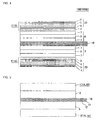
- a transparent laser-marking sheet 1 (1A) as shown in Fig. 1 may be formed.
- the base-material sheet is configured as a single-layer sheet 2 described later, on one face of which an adhesive layer 3 is formed.
- a transparent laser-marking sheet 1 (1B) as shown in Fig. 2 may be formed.
- the base-material sheet is configured as a multilayer sheet 20 described later.
- This multilayer sheet 20 includes skin layers 4 and a core layer 5.
- an adhesive layer 3 is formed on one of the skin layers 4 of this multilayer sheet 20, an adhesive layer 3 is formed.
- the base-material sheet is configured as a single-layer sheet or as a multilayer sheet.
- the multilayer sheet is configured as a three-layered sheet including at least skin layers and a core layer.
- a single-layer sheet is configured as a sheet of a single-layer structure.
- This single-layer sheet can be manufactured by a conventionally known method for forming a sheet-like object. Note here that a single-layer sheet is preferably formed by melt extrusion.
- a single-layer sheet as the base-material sheet is preferably made of the following materials.
- the single-layer sheet is preferably made of transparent resin including transparent polycarbonate resin as a main component.
- the polycarbonate resin as stated above is not limited especially, resin having a melt volume rate of 4 to 20 cm 3 /10 min. can be used preferably. If the melt volume rate is less than 4 cm 3 /10 min., this is meaningful because the flexibility and the toughness such as strength and robustness of the sheet are improved. However, the forming workability during melt extrusion will be poor and so has difficulty in actual use unfavorably. If the melt volume rate exceeds 20 cm 3 /10 min., the toughness of the sheet will be poor unfavorably.
- the single-layer sheet is made of a transparent resin layer including polycarbonate resin, whereby so-called “swelling" due to foaming of a laser-marked portion by laser-light energy irradiation can be suppressed, and additionally wear resistance also can be improved, which is due to etching at a laser-marking section when laser-light energy is applied thereto.
- the base-material sheet When the base-material sheet is configured as a single-layer sheet, it is important that the sheet has a high degree of transparency. Specifically when it is configured as the single-layer sheet, there is no limitation in adding and blending resin that does not inhibit the transparency of the polycarbonate resin, such as filler. In order to improve scratch resistance or thermal resistance, general-purpose polycarbonate resin and special-purpose polycarbonate resin may be blended or polycarbonate resin and polyallylate resin may be blended.
- the special-purpose polycarbonate resin as stated above examples include graft polymer including polycarbonate resin at the main chain and polystyrene resin or modified acrylonitrile-styrene copolymer resin at the side chain, and an specific example thereof includes "modiper C series" that is a product name produced by NOF Corporation.
- the blend ratio is preferably 95/5 to 60/40 (mass ratio).
- the blend ratio when blending with polyallylate resin also is in the range similar to the above preferably.
- the multilayer sheet is formed by stacking a plurality of layers including skin layers and a core layer. That is, in the present embodiment, the base-material sheet is configured as a multilayer sheet of "at least three layers” including skin layers and a core layer. Note here that this "three-layered sheet” means “at least three layers”, and is not limited to the three-layered structure. In other words, the "three-layered sheet” in the base-material sheet (multilayer sheet) is used for the purpose of illustration.
- the "three-layered sheet” means "a sheet made up of at least three layers”. It is not intended to limit the multilayer sheet to a sheet made up of "three layers”. That is, the multilayer sheet includes five layers, seven layers and any layers of odd numbers more than those as long as it is made of three layers or more.
- the multilayer sheet preferably is made up of five layers, more preferably three layers.
- the reason why the multilayer sheet in the present embodiment is configured of odd-numbered layers as described above is because even in the case of a multilayer sheet of even-numbered layers, when a skin layer or a core layer includes a plurality of layers made up of the same type of layers or different type of layers, these plurality of layers are considered as one layer. As a result, this is always the same configuration as that of a multilayer sheet of odd-numbered layers.
- a transparent laser-marking sheet including four layers for example, has a configuration such as a skin layer/a core layer /a core layer/a skin layer, which is the same configuration as that of a multilayer sheet of odd-numbered layers.
- the core layers made up of the same type or different type of two layers is considered as one layer.
- a multilayer sheet including three layers for example, two skin layers are disposed on both of the outermost sides (one side and the other side) so that they are arranged as in a skin layer/a core layer/a skin layer. Then, the one core layer is disposed so as to be sandwiched between the two skin layers, thus forming the multilayer sheet.
- two skin layers are disposed on both of the outermost sides (one side and the other side) so that they are arranged as in a skin layer/a core layer/a skin layer/a core layer/a skin layer. In this way, the skin layers and the core layers may be arranged alternately to form a multilayer sheet.
- a multilayer sheet is formed, including a multilayered structure as stated above.
- a base-material sheet as multilayer sheet having a multilayered structure enables laser light energy irradiation with higher power than in a single-layer sheet, and so can increase density at a laser marking section. Additionally, such a configuration can suppress a so-called "swelling" due to foaming at the laser-marking section, and can maintain the surface smoothness.
- such a multilayer configuration including a skin layer stacked above the laser-marking section enables improvement in wear resistance of the laser-marking section.
- the skin layers are configured as both outermost layers disposed on outer sides of the three-layered sheet. These skin layers serve as surface layers as the both outermost layers of the three-layered sheet so as to sandwich the core layer in the multilayer sheet from both end face sides (outer sides).
- the skin layers preferably have the same thickness.
- laser marking is typically performed from the surface and the rear face. Therefore, if thicknesses of the skin layers that are disposed and stacked as the outermost surface layer and the lowermost back layer of the base-material sheet as the laminate are different, different effects of suppressing so-called "swelling" because of foaming of the marking in the core layer by laser-light energy irradiation and different effects for resistance to wear at a laser-marking section will be obtained unfavorably.
- the base-material sheet is configured as a multilayer sheet including three layers of a skin layer/a core layer/a skin layer, where the core layer has a thickness of 20% or more and less than 80%
- the skin layers will be 20% or more and less than 80% on both sides. If the thickness of the skin layer on one side is less than 10%, the effects of suppressing so-called "swelling" because of foaming of the laser-marking section in the core layer by laser-light energy irradiation and of improving wear resistance at a laser-marking section are insufficient. On the contrary, too thick skin layers inevitably lead to a thin core layer, thus leading to poor laser markability unfavorably.
- the skin layers are made of noncrystalline polyester resin, especially made of a thermoplastic resin composition including noncrystalline aromatic polyester resin as a main component that is prepared from copolymer polyester resin.
- polyester resin as transparent resin making up the skin layers, which includes noncrystalline aromatic polyester resin as a main component, copolymer polyester resin, which is a polyester composed of a dicarboxylic acid unit having mainly a telephthalate unit, an ethylene glycol unit and a glycol unit having mainly 1,4-cyclohexane dimethanol unit, where the ethylene glycol unit (I) and the 1,4-cyclohexane dimethanol unit (II) has a relationship such that (I)/(II) is 90 to 20/10 to 80 mol%., is used.
- the reason why the component amounts of the ethylene glycol unit and the 1, 4-cyclohexane dimethanol unit contained in the copolymer polyester resin are adjusted is because the resin obtained with a component amount of the ethylene glycol unit less than 20 mol% in the copolymer polyester resin is not sufficiently non-crystalline to cause recrystallization to proceed in the cooling step after thermal fusion bonding, which degrades thermal adhesiveness.
- the resin obtained with above 90 mol% is not sufficiently non-crystalline to cause recrystallization to proceed in the cooling step after thermal fusion bonding, which degrades thermal adhesiveness. Therefore, the resin obtained by adjusting the component amounts of the ethylene glycol unit and the 1, 4-cycrohexane dimethanol unit as in the present embodiment can be a desirable resin because the resin can be sufficiently non-crystalline and excellent in thermal adhesiveness.
- this copolymer polyester resin a substantially noncrystalline aromatic polyester resin (product name "PETG” produced by Eastman Chemical Company) where about 30 mol% of ethylene glycol component in polyethylene telephthalate is substituted by 1, 4-cycrohexane dimethanol is commercially available.
- PETG substantially noncrystalline aromatic polyester resin
- a core layer in the multilayer sheet is configured as a so-called nucleus layer that is disposed at the center of the base-material sheet. That is, when the base-material sheet is configured as a multilayer sheet that is a three-layered sheet, the core layer is formed as a center layer of the three-layered sheet so as to be sandwiched between the two skin layers disposed on both of the outermost sides.
- the core layer in the multilayer sheet is made of transparent polycarbonate resin composition including transparent polycarbonate resin as a main component.
- the polycarbonate resin preferably used includes, but not limited to this, resin with a melt volume rate of 4 to 20 cm 3 /10 min. Resin with a melt volume rate less than 4 cm 3 /10 min. is meaningful because the flexibility and the toughness such as strength and robustness of the sheet are improved. However, the forming workability during melt extrusion will be poor and so has difficulty in actual use unfavorably. If the melt volume rate exceeds 20 cm 3 /10 min., the toughness of the sheet will be poor unfavorably.
- the core layer in the multilayer sheet is made of a transparent polycarbonate resin composition including polycarbonate resin, whereby so-called “swelling" due to foaming of a laser-marked portion by laser-light energy irradiation can be suppressed, and additionally wear resistance also can be improved, which is due to etching at a marking section when laser-light energy is applied thereto.
- the core layer in the multilayer sheet is preferably formed to have a ratio of the thickness to the entire sheet of 20% or greater and less than 80%.
- a thickness ratio of the core layer of 20% or greater increases contrast with an uncolored portion by an original white layer because of a thickness effect of a laser-marking section in the core layer by laser-light energy irradiation, and can improve visibility and clarity of the laser-marking section.
- a thickness ratio of the core layer of 80% or greater makes the skin layers too thin.
- the core layer has a thickness ratio of 80% or greater, then the skin layers will be relatively thinner because the total thickness including the thickness of the other sheet that is to be stacked on the transparent laser-marking sheet is specified.
- the skin layers include a lubricant, a problem of die-sticking occurs, where the sheet adheres to a die in a hot press step in the stacking process unfavorably.
- a thickness ratio of the core layer less than 20% does not cause a problem of the die-sticking in the stacking process because the skin layers are thick.
- such a ratio is not preferable because laser markability is degraded or the sheet generates warpage due to poor thermal resistance. The laser markability also is degraded unfavorably.
- a preferable thickness of the core layer in the multilayer sheet is 40% or more and less than 75%.
- the base-material sheet in the case of a single-layer sheet, preferably has a thickness of 50 to 200 ⁇ m. If the thickness of the single-layer sheet is less than 50 ⁇ m, the blend amount of the laser-light energy absorbing agent is too small, and the laser markability is insufficient unfavorably. On the contrary, if the thickness of the single-layer sheet exceeds 200 ⁇ m, this is too thick, and therefore actual use is difficult because handling thereof is inconvenient, for example.
- the total maximum thickness will exceed 800 ⁇ m.
- the total thickness of the multilayer sheet is preferably 50 to 200 ⁇ m.
- the total thickness of the base-material sheet may be set at the aforementioned desired thickness, whereby properties of the transparent laser-marking sheet can be easily realized.
- the ratio of thicknesses of the skin layers and the core layer making up the multilayer sheet to the thickness of the multilayer sheet may be set at the aforementioned desired ratio of the thicknesses, whereby, in combination with the entire thickness of the multilayer sheet within the desired range, can make it easy to improve laser markability.
- the base-material sheet making up the transparent laser-marking sheet includes laser-light energy absorbing agent. With this configuration, laser color saturation becomes excellent when laser marking, and contrast between the background section and the laser-marking section becomes high, whereby clear letters, figures, symbols or information can be obtained.
- the "background section” refers to a section where no laser-marking is performed, and the same applies hereafter.
- the base-material sheet When the base-material sheet is configured as a single-layer sheet, 0.0005 to 1 part by mass of the laser-light energy absorbing agent is included in 100 parts by mass of the transparent resin including polycarbonate resin as a main component preferably.
- 0.0005 to 1 part by mass of the laser-light energy absorbing agent is included in 100 parts by mass of the transparent polycarbonate resin including polycarbonate resin as a main component in the core layer preferably. In this way, laser-light energy absorbing agent is included, whereby laser color saturation becomes excellent when laser marking, and contrast between the background section and the laser-marking section becomes high, whereby clearer letters, figures, symbols or information can be obtained.
- the contained amount of the laser-light energy absorbing agent exceeds 1 part by mass, transparency of the transparent laser-marking sheet deteriorates. Further, when it is irradiated with laser-light energy, the amount of energy absorbed becomes too much, and so the resin will be degraded. As a result, sufficient contrast cannot be obtained. Additionally, if the contained amount of the laser-light energy absorbing agent exceeds 1 part by mass, abnormal heat generation may occur. If abnormal heat generation occurs, resin making up the sheet will be decomposed and foaming will be generated, thus failing to perform desired laser marking. On the contrary, if the contained amount of the laser-light energy absorbing agent is less than 0.0005 parts by mass, sufficient contrast between the background section and the laser-marking section cannot be obtained.
- the laser-light energy absorbing agent as stated above is not limited especially as long as it absorbs laser-light energy and can change the irradiated section to have different hue, color and brightness than those of the background section.
- they include at least one type selected from the group consisting of carbon black, titanium black, metal oxides, metal sulfides, metal nitrides, metal oxalates and metal carbonates.
- Preferable laser-light energy absorbing agent is at least one type selected from carbon black, titanium black, metal oxides, metal oxalates and metal carbonates. More preferable laser-light energy absorbing agent is at least one type or two types or more selected from carbon black, titanium black, and metal oxides.
- carbon black, titanium black, metal oxides, metal sulfides, metal nitrides, metal oxalates and metal carbonates as the laser-light energy absorbing agent preferably have an average particle diameter less than 150 nm. More preferably the average particle diameter is less than 100 nm. Further, carbon black with an average particle diameter of 10 to 90 nm and a dibutylphthalate (DBT) oil absorption amount of 60 to 170 ml/100 gr or carbon black in combination with titanium black or a metal oxide with an average particle diameter less than 150 nm is used preferably. If the average particle diameter of the laser-light energy absorbing agent exceeds 150 nm, transparency of the transparent laser-marking sheet deteriorates unfavorably.
- DBT dibutylphthalate
- metal to form an oxide in metal oxide as the laser-light energy absorbing agent examples include zinc, magnesium, aluminum, iron, titanium, silicon, antimony, tin, lead, copper, manganese, cobalt, vanadium, bismuth, niobium, molybdenum, ruthenium, tungsten, palladium, silver and platinum.
- composite metal oxide examples include ITO, ATO and AZO.
- Examples of the metal sulfide as the laser-light energy absorbing agent include zinc sulfide and cadmium sulfide.
- Examples of the metal nitride include titanium nitride.
- Examples of the metal oxalates include magnesium oxalate and copper oxalate.
- Examples of the metal carbonates include basic copper carbonate.
- the addition amount (blend amount) of the laser-light energy absorbing agent is 0.0005 to 1 part by mass to 100 parts by mass of the transparent resin including polycarbonate resin as a main component in the case of carbon black. It is 0.0008 to 0.1 parts by mass the most preferably.
- the blend amount of the mixture is 0.0005 to 1 part by mass. It is 0.0008 to 0.5 parts by mass the most preferably.
- the transparent laser-marking sheet is preferably transparent. That is, when the transparent laser-marking sheet is used as an electronic passport, a layer called overlay is formed on a white sheet (printing inlay sheet) subjected to printing (hereinafter printing on the white sheet, such as printing of letters and figures, is called a "printing section" as needed), or the transparent laser-marking sheet is stacked thereon.
- a part of the overlay not subjected to printing is irradiated with laser-light energy to produce black color for marking of letters, figures, symbols or information, whereby a design at the printing section is often combined with an anti-forgery effect by laser marking for use.
- carbon black with a smaller average particle diameter is preferably used, and when the mixture of carbon black and titanium black and at least one type selected from other metal oxides, metal sulfides, metal nitrides, metal oxalates, and metal carbonates is used as the laser-light energy absorbing agent as well, the average particle diameter of these metal oxides, metal sulfides, metal nitrides, metal oxalates and metal carbonates is at least less than 150 nm and preferably less than 100 nm.
- the base-material sheet making up a transparent laser-marking sheet preferably includes lubricant.
- the transparent laser-marking sheet includes a multilayer sheet, skin layers thereof preferably include lubricant.
- the lubricant contained can prevent fusion bonding to a pressing plate during hot press for forming.
- lubricant examples include fatty acid ester lubricant, fatty acid amide lubricant, and fatty acid metal-salt lubricant, and at least one type of the lubricant selected from them is preferably added.
- fatty acid ester lubricant examples include butyl stearate, cetyl palmitate, monoglyceride stearate, diglyceride stearate, triglyceride stearate, esters of montan acid wax, wax esters, dicarboxylates, and complex esters.
- fatty acid amide lubricant examples include stearic acid amide, and ethylenebisstearamide.
- fatty acid metal salt lubricant include calcium stearate, magnesium stearate, zinc stearate, aluminum stearate, and barium stearate.
- the base-material sheet of the transparent laser-marking sheet when configured as a single layer sheet, it preferably includes at least one type of antioxidant and anticolorant and at least one type of UV absorbing agent and light stabilizer as needed.
- the base-material sheet of the transparent laser-marking sheet is configured as a multilayer sheet as well, at least one layer of skin layers and a core layer thereof preferably includes at least one type of antioxidant and anticolorant and at least one type of UV absorbing agent and light stabilizer as needed.
- the addition (blending) of at least one type of antioxidant and anticolorant effectively prevents deterioration in physical property due to decrease in molecular weight during forming process or effectively stabilizes the hue.
- Examples of the at least one of antioxidant and anticolorant include phenol antioxidant and phosphite ester anticolorant.
- the addition (blending) of at least one type of UV absorbing agent and light stabilizer effectively suppresses a lightfastness property from deteriorating during the storage of the transparent laser-marking sheet and in the actual usage of an electronic passport or a plastic card as a final product.
- Examples of such UV absorbing agent include benzotriazole UV absorbing agent, hydroxyphenyltriazine UV absorbing agent and cyclic imino ester UV absorbing agent.
- antioxidant examples include phenol antioxidant and amine antioxidant.
- phenol antioxidant examples include ⁇ -tocopherol, butylhydroxytoluene, sinapyl alcohol, vitamin E, n-octadecyl-3-(3,5-di-t-butyl-4-hydroxyphenol) propionate, 3-5-di-t-butyl-4-hydroxytoluene, pentaerythrityl-tetrakis[3-(3,5-di-t-butyl-4-hydroxyphenyl) propyonate], triethyleneglycol-bis[3-(3-t-butyl-5-methyl-4-hydroxyphenyl)propionate], 1,6-hexanediol-bis[3-(3,5-di-t-butyl-4-hydroxyphenyl) propionate], 2-t-butyl-6-(3'-t-butyl-5'-methyl-2'-hydroxybenzil)-4-methylphenylacrylate, 2,6,-di-t-butyl-4-(N,N,
- n-octadecyl-3-(3,5-di-t-buryl-4-hydroxyphenyl)propyonate 1,3,5-trimethyl-2,4,6-tris(3,5-di-t-butyl-4-hydroxybenzyl)benzene, 1,3,5-tris(3,5-di-t-butyl-4-hydroxybenzyl)isocyanurate, and tetrakis[3-(3,5-di-t-butyl-4-hydroxyphenyl)propyonyloxymethyl]methane are preferable, and n-octadecyl-3-(3,5-di-t-butyl-4-hydroxyphenyl)propionate is particularly preferable.
- the aforementioned hindered phenol antioxidants may be used alone or in combination of two or more types.
- the anticolarant may be phosphite ester anticolorant.
- Examples thereof include triphenyl phosphite, tris(nonylphenyl) phosphite, tridecyl phosphite, trioctyl phosphite, trioctadecyl phosphite, didecylmonophenyl phosphite, dioctylmonophenyl phosphite, diisopropylmonophenyl phosphite, monobutyldiphenyl phospite, monodecyldiphenyl phosphite, monooctyldiphenyl phosphite, 2,2-methylenebis(4,6-di-t-butylphenyl)octyl phosphite, tris(diethylphenyl) phosphite, tris(di-iso-propyl
- phosphite compounds in the anticolorant can be used, which react with divalent phenols and which has a cyclic structure.
- examples thereof include 2,2'-methylenebis(4,6-di-t-butylphenyl)(2,4-di-t-butylphenyl) phosphite, 2,2'-methylenebis(4,6-di-t-butylphenyl)(2-t-butyl-4-methylphenyl)phosphite, 2,2'-methylenebis(4-methyl-6-t-butylphenyl)(2-t-butyl-4-metylphenyl)phosphite, and 2,2'-ethylidenebis(4-methyl-6-t-butylphenyl)(2-t-butyl-4-methylphenyl)phosphite.
- tris(2,4-di-t-butylphenyl)phosphite is particularly preferable because it has very high purity and is excellent in hydrolysis resistance and resistance to volatilization.
- the phosphite ester based anticolorant may be used alone or in combination of two or more kinds. Alternatively, it may be used together with phenol antioxidant.
- UV absorbing agent examples include the following.
- benzotriazole UV absorbing agent examples include 2-(2'-hydroxy-5'-methylphenyl)benzotriazole, 2-(2'-hydroxy-3',5'-di-t-amylphenyl)benzotriazole, 2-(2'-hydroxy-3',5'-bis( ⁇ , ⁇ '-dimethylbenzyl)phenylbenzotriazole, 2-(2'-hydroxy-3',5'-di-t-butylphenyl)-5-chlorobenzotriazole, 2,2' methylenebis[4-(1,1,3,3-tetramethylbutyl)-6-(2H-benzotriazole-2-yl)phenol], and a compound represented by a condensate with methyl-3-[3-t-butyl-5-(2H-benzotriazole-2-yl)-4-hydroxyphenylpropionate-polyethylene glycol.
- hydroxyphenyltriazine UV absorbing agent examples include 2-(4,6-diphenyl-1,3,5-triazine-2-yl)-5-hexyloxyphenol, and 2-(4,6-bis(2,4-dimethylphenyl)-1,3,5-triazine-2-yl)-5-hexyloxyphenol.
- Examples of the cyclic imino ester UV absorbing agent include 2,2'-p-phenylenebis(3,1-benzoxazine-4-one), 2-2'-m(2)-phenylenebis(3,1-benzoxazine-4-one), and 2,2'-4,4'-diphenylenebis(3,1-benzoxazine-4-one).
- Examples of the light stabilizer include bis(2,2,6,6-tetramethyl-4-piperidyl)sebacate, bis(1,2,2,6,6-pentamethyl-4-piperidyl)sebacate, tetrakis (2,2,6,6-tetramethyl-4-piperidyl)-1,2,3,4-butanetetracarboxylate, tetrakis(1,2,2,6,6-pentamethyl-4-piperidyl)-1,2,3,4-butanetetracarboxylate, poly ⁇ [6-(1,1,3,3-tetramethylbutyl)amino-1,3,5-triazine-2,4-diyl][(2,2,6,6-tetramethylpiperidyl)imino]hexamethylene[(2,2,6,6-tetramethylpiperidyl)imino] ⁇ , and a hyndered amine compound represented by polymethylpropyl-3-oxy-[4-(2,2,6,6-tetramethyl
- the base-material sheet making up the transparent laser-marking sheet is configured as a single-layer sheet
- the base-material sheet is made of a transparent polycarbonate resin composition including 0.01 to 3 parts by mass of lubricant to 100 parts by mass of transparent polycarbonate resin containing polycarbonate resin as main component.
- the base-material sheet making up the transparent laser-marking sheet includes 0.1 to 5 parts by mass of at least one type of antioxidant and anticolorant and 0.1 to 5 parts by mass of at least one type of UV absorbing agent and light stabilizer to 100 parts by mass of the transparent polycarbonate resin containing polycarbonate resin as main component.
- a skin layer of the multilayer sheet in the base-material sheet making up the transparent laser-marking sheet is made of a transparent polycarbonate resin composition including 0.01 to 3 parts by mass of lubricant to 100 parts by mass of transparent resin including noncrystalline polyester resin as a main component.
- at least one layer of the skin layers and the core layer of the multilayer sheet includes 0.1 to 5 parts by mass of at least one type of antioxidant and anticolorant and 0.1 to 5 parts by mass of at least one type of UV absorbing agent and light stabilizer to 100 parts by mass of the transparent polycarbonate resin containing polycarbonate resin as main component.
- the addition amount of the lubricant is 0.01 to 3 parts by mass, more preferably 0.05 to 1.5 parts by mass.
- the addition amount of lubricant less than 0.01 parts by mass causes a problem of fusion bonding to a pressing plate during hot press, and the addition amount of lubricant exceeding 3 parts by mass causes a problem in interlayer fusion bonding during hot press of a multilayered lamination for an electronic passport or a plastic card.
- Less than 0.1 parts by mass of at least one type of antioxidant and anticolorant causes a tendency of a trouble of thermal oxidation of the polycarbonate resin at a melt extrusion process and thermal discoloration due to the thermal oxidation.
- More than 5 parts by mass tends to cause a problem of bleeding of these additives, for example, unfavorably.
- Less than 0.1 parts by mass of at least one type of UV absorbing agent and light stabilizer has a poor effect thereof, and tends to cause a problem of deterioration in a lightfastness property and accordingly discoloration.
- More than 5 parts by mass tends to cause a problem of bleeding of these additives, for example, unfavorably.
- the fusion bonding effect and the opacifying property of the multilayer sheet become extremely important elements concerning the feasibility of the multilayer sheet, the productivity, the ability of responding to market needs and the like.
- a method of melt extruding a transparent polycarbonate resin composition may be used for a single sheet, for example.
- a method of melt extruding a resin composition making up each layer a method of forming a material making up each layer in a film shape and laminating the same, or a method of melt extruding two layers and laminating a film separately formed on these layers is available. From the viewpoints of productivity and costs, stacking for integration by melt extrusion is preferable.
- the resin composition making up each layer is prepared or is formed into a pellet shape as necessary to be put in each hopper of a three-layer T die extruder where T dies are subjected to shared connection. Then, they are melted at a temperature ranging from 200 to 300°C for three-layered T-die melt extrusion. After the forming, the resultant is cooled for solidification with a cooling roll or the like to form a three-layered sheet.
- the sheet can be formed by a known method without being limited to the aforementioned method. For example, it can be obtained in accordance with the description on Pages 6 and 7 of JP-A-10-71763 .
- the whole beam transmittance of the base-material sheet is preferably 70% or greater and more preferably 85% or greater.
- a printing inlay sheet is stacked, for example, and then laser-light energy is applied at a non-printing section other than the printing section of the printing inlay sheet in the transparent laser-marking sheet as an outermost layer so as to turn the section in black, i.e., marking letters, figures, symbols or information, whereby a design at the printing section is often combined with anti-forgery by laser marking for use.
- Such a combination can lead to clear letters, figures, symbols or information due to the clarity at the printing section and black/background color contrast at the laser marking section because the base layer is white. That is, in the case of lamination of a white sheet, for example, the transparency of the outermost layer in the aforementioned desired range of whole beam transmittance can maximize this effect, that is, can emphasize the clarity of black/white contrast.
- such transparency of the outermost layer is important to secure the clarity of the printing section and the clarity of black/white contrast at the laser marking section, and if the whole beam transmittance is less than 70%, black/white contrast is insufficient, and so a problem of a failure in securing sufficient markability occurs, and since printing is performed on the white sheet as the original surface, a problem arises in visibility of this printing unfavorably.
- the "whole beam transmittance" is an index indicating the ratio of light passing through a sheet, a film, a membrane or the like with respect to light incident there. When incident light entirely passes, the whole beam transmittance will be 100%.
- the "whole beam transmittance” in the present specification shows a value by the measurement in keeping with JIS-K7105 (test method for optical characteristics of plastics), and the whole beam transmittance may be measured using a haze meter produced by Nippon Denshoku Industries Co., Ltd. (trade name: "NDH 2000”) or a spectrophotometer (trade name "EYE7000” produced by GretagMacbeth GmbH), for example.
- a transparent laser-marking sheet 1 (1A) including a base-material sheet 2 as a single-layer sheet, and an adhesive layer 3 on one face of the base-material sheet 2, which is described in the above, can be shown as one example.
- a transparent laser-marking sheet 1 (1B) including a base-material sheet 20 as a multilayer sheet having skin layers 4 and a core layer 5, and an adhesive layer 3 on the base-material sheet 20, which are described in the above, can be shown.
- the following describes a laser-marking sheet for electronic passport, including the transparent laser-marking sheet described in the above. This is one example, and is not a limiting one.
- the laser-marking sheet for electronic passport 100 is a laser-marking sheet for electronic passport having the structure of five layers stacked, including a transparent laser-marking sheet 1 (1A) including a base-material sheet configured as a single-layer sheet/multilayer sheet for core 6/binding sheet 10/(multilayer sheet for core 6/a transparent laser-marking sheet 1 (1A) including a base-material sheet configured as a single-layer sheet base-material sheet.
- the transparent laser-marking sheet 1 (1A) is a transparent laser-marking sheet as stated above, including an adhesive layer 3 on at least one of the faces of the base-material sheet 2. That is, the base-material sheet 2 is configured as a single-layer sheet made of a transparent polycarbonate resin composition containing polycarbonate resin and laser-light energy absorbing agent. Then the adhesive layer 3 of the transparent laser-marking sheet is made of a transparent thermal activation adhesive including polyester resin, and is configured as a layer of 1 to 20 ⁇ m in thickness.
- the binding sheet 10 is described later.
- the multilayer sheet for core 6 includes skin layers 7 and a core layer 8, and is a sheet that is formed by stacking at least three layers by melt extrusion.
- the skin layers 7 as both of the outermost layers of this multilayer sheet for core 6 are made of copolymer polyester resin, which is polyester composed of a dicarboxylic acid unit having mainly a telephthalate unit, an ethylene glycol unit (I) and a glycol unit having mainly 1,4-cyclohexane dimethanol unit (II), where (I)/(II) is 90 to 30/10 to 70 mol%.
- the core layer 8 of the multilayer sheet for core 6 is made of transparent resin including polycarbonate resin as a main component.
- At least one layer of these skin layers 7 and core layer 8 includes 1 part by mass or more of at least one type of more of dyes or pigments to 100 parts by mass of the copolymer polyester resin and/or 100 parts by mass of the polycarbonate resin. Further the total thickness of the multilayer sheet for core 6 is from 50 to 200 ⁇ m, and the thickness ratio of the core layer 8 to the total thickness of the multilayer sheet for core 6 is 20% or more and less than 80%.
- the thus configured laser-marking sheet for electronic passport can be shown as one example.
- a laser-marking sheet for electronic passport 100 (100B) can be shown in Fig. 4 .
- the laser-marking sheet for electronic passport 100 (100B) is a laser-marking sheet for electronic passport having the structure of five layers stacked, including a transparent laser-marking sheet 1 (1B)/multilayer sheet for core 6/binding sheet 10/multilayer sheet for core 6/transparent laser-marking sheet 1 (1B).
- the transparent laser-marking sheet 1 (1B) is a transparent laser-marking sheet as stated above, including an adhesive layer 3 on at least one of the base-material sheet 20 including skin layers 4 and a core layer 5.
- the base-material sheet 20 includes the skin layers 4 and the core layer 5, the skin layers 4 as both of the outermost layers are made of a thermoplastic resin composition containing noncrystalline polyester resin, and the core layer 5 is configured as a multilayer sheet made of a transparent polycarbonate resin composition including polycarbonate resin and laser-light energy absorbing agent. Then, the adhesive layer 3 of the transparent laser-marking sheet is configured as a layer made of transparent thermal activation adhesive including polyester resin and having a thickness of 1 to 20 ⁇ m.
- the multilayer sheet for core 6 includes skin layers 7 and a core layer 8, and is a sheet that is formed by stacking at least three layers by melt extrusion.
- the skin layers 7 as both of the outermost layers of this multilayer sheet for core 6 are made of copolymer polyester resin, which is polyester composed of a dicarboxylic acid unit having mainly a telephthalate unit, an ethylene glycol unit (I) and a glycol unit having mainly 1,4-cyclohexane dimethanol unit (II), where the ethylene glycol unit (I) and the 1,4-cyclohexane dimethanol unit (II) have a relationship such that (I)/(II) is 90 to 30/10 to 70 mol%.
- the core layer 8 of the multilayer sheet for core 6 is made of transparent resin including polycarbonate resin as a main component, and at least one layer of these skin layers and core layer includes 1 part by mass or more of at least one type of more of dyes or pigments to 100 parts by mass of the copolymer polyester resin and/or 100 parts by mass of the polycarbonate resin.
- the total thickness of the multilayer sheet for core 6 is from 50 to 200 ⁇ m, and the thickness ratio of the core layer 8 to the total thickness of the multilayer sheet for core 6 is 20% or more and less than 80%.
- the thus configured laser-marking sheet for electronic passport can be shown as an example.
- the multilayer sheet for core 6 and the binding sheet 10 shown in Fig. 4 are sheets similar to those in Fig. 3 .
- the multilayer sheet for core 6 is configured as at least three-layer structured sheet (three-layered sheet) including skin layers 7 and a core layer 8, and is formed by stacking by melt extrusion. That is, similarly to the base-material sheet 20 making up the transparent laser-marking sheet 1 (1B), this multilayer sheet for core 6 also may be made up of five layers, seven layers and any layers of odd numbers more than those as long as it is made of three layers or more and the core layer 8 may be sandwiched between the skin layers 7.
- the multilayer sheet for core 6 has a too many multilayered structure, then the thickness of one layer of the skin layers 7 and the core layers 8 disposed is too small. In this case, thermal adhesiveness with the transparent laser-marking sheet according to the present invention will deteriorate unfavorably. Therefore, the multilayer sheet for core is made up of five layers, more preferably three layers.
- a multilayer sheet for core made up of three layers two skin layers are disposed on both of the outermost sides (one side and the other side) so that they are arranged as in a skin layer/a core layer/a skin layer. Then, the one core layer is disposed so as to be sandwiched between the two skin layers, thus forming the multilayer sheet for core.
- two skin layers are disposed on both of the outermost sides (one side and the other side) so that they are arranged as in a skin layer/a core layer/a skin layer/a core layer/a skin layer.
- the multilayer sheet for core may be formed by arranging skin layers and core layers alternately. In this way, the multilayer sheet for core having a multilayered structure is formed, whereby sufficient thermal adhesiveness can be secured.
- the total thickness (overall thickness) of the multilayer sheet for core 6 is from 50 to 200 ⁇ m, and the thickness ratio of the core layer 8 in the multilayer sheet for core 6 to the total thickness of the multilayer sheet for core 6 is 20% or more and less than 80%. If the total thickness of the multilayer sheet for core 6 is less than 50 ⁇ m, the skin layers 7 in the multilayer sheet for core 6 become inevitably thin. In this case, thermal adhesiveness between the transparent laser-marking sheet 1 (1A, 1B) that is stacked at the outermost layer during thermal fusion bonding in the multilayer-sheet stacking process and the multilayer sheet for core 6 cannot be secured.
- a laser-marking sheet for electronic passport including such a multilayer sheet for core 6 of 200 ⁇ m or more in thickness will have a too thick total thickness, and so the usability thereof will deteriorate.
- the skin layers 7 in the multilayer sheet for core 6 are too thin, then thermal adhesiveness between the transparent laser-marking sheet 1 (1A, 1B) that is stacked at the outermost layer and the multilayer sheet for core 6 cannot be secured during thermal fusion bonding in the multilayer sheet stacking process.
- the skin layers 7 in the multilayer sheet for core 6 are too thick, then the core layer 8 in the multilayer sheet for core 6 described later will be thin inevitably. In this case, opacifying property cannot be secured when printing is performed on the multilayer sheet for core 6.
- the thickness of the multilayer sheet for core 6 as a whole at the desired thickness can easily realize local properties such as properties of the multilayer sheet for core 6. Additionally, the properties of a laser-marking sheet for electronic passport including the transparent laser-marking sheet 1 (1A, 1B) and the multilayer sheet for core 6 can be realized easily. Moreover, not only the total thickness of the multilayer sheet for core 6 as a whole but also the thickness ratios of the skin layers 7 and the core layer 8 making up the multilayer sheet for core 6 to the multilayer sheet for core 6 are set at the desired ratios as stated above preferably, because the effects of improving contrast easily, for example, in association with the total thickness of the multilayer sheet for core 6 as a whole within the desired range, can be exerted more.
- the skin layers 7 in the multilayer sheet for core 6 preferably have the same thickness.
- the multilayer sheet for core 6 including skin layers having different thicknesses causes variations in thermal adhesiveness between the transparent laser-marking sheet 1 (1A, 1B) at the outermost layer and the multilayer sheet for core 6 during thermal fusion bonding in the multilayer sheet lamination procedure unfavorably. Further, the laminate after hot press may generate warpage unfavorably.
- the skin layers 7 in the multilayer sheet for core 6 are too thin, thermal adhesiveness will deteriorate. As stated above, if the skin layers 7 in the multilayer sheet for core 6 are too thick, then the core layer 6 in the multilayer sheet for core 6 will be thin inevitably.
- resin containing the colorant may be put in only one extruder, and therefore labor for cleaning of the colorant during cleaning-up after the production of sheets can be reduced half that in the case of mixing colorant in the skin layers as well as the core layer in extreme cases. This, however, causes the lack of an opacifying property when partial printing or entire printing is performed on the multilayer sheet for core 6.
- any problem concerning the opacifying property as stated above will not occur.
- a three-layered sheet using two types of resins is formed by melt extrusion, two extruders are used, and so resin including colorant has to be put in these two extruders.
- cleaning-up of the colorant requires a lot of labor and time, often causing problems of productivity and cost. Therefore, it is preferable that the total thickness (overall thickness) of the multilayer sheet for core 6 and the ratio of the thickness of the core layer 8 to the total thickness of the multilayer sheet for core 6 be formed within the desired ranges as stated above.
- the skin layers 7 in the multilayer sheet for core 6 include a polyester resin composition as stated above. That is, the skin layers 7 are preferably formed as a layer made of a substantially noncrystalline aromatic polyester resin composition prepared from copolymer polyester resin.
- substantially noncrystalline aromatic polyester based resin (“PETG”, trade name, produced by Eastman Chemical Company) may be used, which is commercially available, where about 30 mol% of ethylene glycol component in polyethylene telephthalate is substituted by 1, 4-cycrohexane dimethanol.
- the core layer 8 in the multilayer sheet for core 6 is configured as a so-called nucleus layer disposed at the center of the three-layered sheet. That is, the core layer 8 is formed as the nucleus layer of the three-layered sheet in such a manner that it is sandwiched between two skin layers 7 disposed on the outermost sides.
- the ratio of the thickness of the core layer to the thickness of the entire sheet is preferably 20% or greater and less than 80%. It is preferably 40% or greater and less than 75%.
- the ratio of the thickness of the core layer 8 of 80% or greater relatively makes the skin layers thinner because the total thickness of the multilayer sheet for core 6 is as thin as 50 to 200 ⁇ m, leading to a not-preferable factor of variations in thermal adhesiveness between the transparent laser-marking sheet 1 (1A, 1B) as the outermost layers and the multilayer sheet for core 6 during thermal fusion bonding in the multilayer sheet stacking procedure.
- the thickness ratio of the core layer 8 less than 20% causes a problem of failing to secure an opacifying property when printing is performed over the multilayer sheet for core 6. Further this causes a problem of failing to secure contrast when black marking is performed to the transparent laser-marking sheet 1 (1A, 1B) as the outermost layer by laser-light energy irradiation, and to secure visibility and clarity at a laser-marking section.
- the core layer 8 in the multilayer sheet for core 6 may be made of a material that is polycarbonate resin similarly to the above, particularly transparent polycarbonate resin.
- the polycarbonate resin used preferably has a melt volume rate of 4 to 20 cm 3 /10min. Resin with a melt volume rate less than 4 cm 3 /10min. is useful for the improvement of toughness of the sheet, but has poor forming workability and so has difficulty in the practical use unfavorably. Resin with a melt volume rate exceeding 20 cm 3 /10min. causes poor toughness of the sheet unfavorably.
- At least one of the skin layers 7 and the core layer 8 in the multilayer sheet for core 6 preferably includes 1 part by mass or greater of at least one type of a colorant for resin such as dyes and pigments to 100 parts by mass of the above-stated copolymer polyester resin and/or to 100 parts by mass of the above-stated polycarbonate resin.
- the sheet is different in this point from the base-material sheet 20 making up the transparent laser-marking sheet 1 (1B) including an adhesive layer.
- Blending of 1 part by mass or more of colorant for resin such as colorant dyes and pigments is for better contrast during marking by irradiation with laser-light energy after the stacking of the transparent laser-marking sheet 1 (1A, 1 B) and the multilayer sheet for core 6 serving as a coloring multilayer sheet as described later. This is for securing of an opacifying property when printing is performed over the multilayer sheet for core 6 as well.
- colorant of resin such as colorant dyes and pigments
- examples of the colorant of resin include titanium oxide, barium oxide and zinc oxide as a white pigment, iron oxide and titanium yellow as a yellow pigment, iron oxide as a red pigment, and cobalt blue ultramarine as a blue pigment.
- colorant for light coloring or tint colors is preferable for better contrast.
- colorant of resin such as a white-colored dye or pigment for emphasizing contrast is added more preferably.
- At least one layer of the core layer 8 and the skin layers 7 in the multilayer sheet for core 6 includes 0.1 to 5 parts by mass of at least one type of antioxidant and anticolorant and 0.1 to 5 parts by mass of at least one type of UV absorbing agent and light stabilizer to 100 parts by mass of the copolymer polyester resin or the polycarbonate resin.
- the addition (blending) of at least one type of antioxidant and anticolorant effectively influences on the property deterioration due to decrease in the molecular weight and the hue stabilization during forming process.
- the addition (blending) of at least one type of UV absorbing agent and light stabilizer is preferable because it effectively suppresses a lightfastness property from deteriorating during the storage of a laser-marking sheet for electronic passport and in the actual usage of an electronic passport as a final product. That is, this configuration allows a desired amount of the at least one type of antioxidant and anticolorant and the at least one type of UV absorbing agent and light stabilizer to be included selectively as needed. In addition, a region for inclusion may be selected as needed, and therefore, the effects of the present invention can be exerted more as the whole sheet synergistically.
- the lubricant, the antioxidant and the anticolorant in the multilayer sheet for core 6 are the same as the lubricant, the antioxidant and the anticolorant included in the transparent laser-marking sheet as described above. Therefore refer to the descriptions for those about the transparent laser-marking sheet.
- the binding sheet 10 in the laser-marking sheet for electronic passport is a sheet having a very important role to bind (1) letters, figures, symbols or information written on a transparent laser-marking sheet by laser marking, (2) information such as images and letters printed on the multilayer sheet for core 6 as stated above by printing, and (3) various types of information that is stored in a storage medium such as an IC chip to be disposed on a sheet, i.e., a so-called inlet sheet including various types of information stored in a storage medium such as an IC chip disposed thereon, with a cover of a passport and other visa sheets integrally and firmly.
- the binding sheet has to have rigid thermal adhesiveness, appropriate flexibility and thermal resistance during thermal fusion bonding.
- this binding sheet 10 is bound by a sewing machine with a cover or the like of (a passport), the sheet has to have excellent tear strength and tensile strength at the machine-sewn portion, and light stability and thermal resistance at this machine-sewn portion. Further it has to have resistance to repeated folding i.e., have an excellent hinge property. Therefore, the following materials are preferably used for the binding sheet 10 to meet these demands.
- the binding sheet 10 playing such a role preferably is configured as a sheet made of at least one type selected from thermoplastic polyester resin, thermoplastic polyester elastomer, thermoplastic polyamide resin, thermoplastic polyamide elastomer, thermoplastic polyurethane resin, and thermoplastic polyurethane elastomer.
- the binding sheet 10 preferably is configured as a laminate sheet including a woven fabric of polyester resin and/or polyamide resin, and a sheet made of the woven fabric and at least one type selected from thermoplastic polyester resin, thermoplastic polyester elastomer, thermoplastic polyamide resin, thermoplastic polyamide elastomer, thermoplastic polyurethane resin and thermoplastic polyurethane elastomer.
- the binding sheet 10 is used for easy binding to be an electronic passport as described above. Therefore there is no particular limitation on the shape, the length, the size and the like as long as it has a shape, a size and the like making it easy to bind, and they can be suitably selected as needed.
- the binding sheet 10 has a thickness of 50 to 500 ⁇ m, preferably 50 to 250 ⁇ m.
- the thickness of the binding sheet 10 less than 50 ⁇ m means insufficient strength at the machine-sewn section, which leads to a concern that a multilayer sheet with laser-marked personal information such as letters, figures, symbols or information on individuals is peeled off from the electronic passport.
- the thickness exceeding 500 ⁇ m makes the stiffness of the sheet too large, and so the electronic passport opens spontaneously even in non-use unfavorably.
- an end of the binding sheet 10 has a protruding portion 11 protruding from the transparent laser-marking sheet 1 (1A, 1B) and the multilayer sheet for core 6 sheet.
- This configuration can facilitate incorporation with an electronic passport by machine sewing or bonding or by machine sewing and bonding using this protruding portion.
- the length of the protruding portion is preferably determined according to machine-sewing or bonding workability or machine-sewing and bonding workability and the strength at the machine-sewn section and the bonding strength.
- the protruding portion preferably has a length of 5 to 100 mm, more preferably 5 to 50 mm and further preferably 5 to 20 mm.
- Such a protruding portion formed at the binding sheet 10 can facilitate the incorporation with an electronic passport.
- This protruding portion is to allow for incorporation of one end of the binding sheet 10 in the longitudinal direction with an electronic passport using the protruding portion that is longer than the transparent laser-marking sheet 1 (1A, 1B) and the multilayer sheet for core 6 by machine-sewing or bonding, or machine-sewing and bonding.
- reference numeral 12 denotes a machine-sewn section.
- thermoplastic adhesive or a thermosetting adhesive may be applied on one face or both faces of a part other than the protruding portion as needed.
- the thickness of these thermoplastic adhesive and thermosetting adhesive applied preferably is from 0.1 to 20 ⁇ m. This enables bonding strength, and so can suppress a problem during forming. On the contrary, the thickness of the adhesive applied less than 0.1 ⁇ m cannot realize sufficient bonding strength. The thickness of adhesive applied exceeding 20 ⁇ m makes the total thickness too large, or causes sticking-out of the adhesive during hot press unfavorably.
- fibers making up the woven fabric preferably have a fiber diameter of 40 to 250 ⁇ m. When there are mesh openings, the fiber diameter is 60 to 300 ⁇ m preferably. Forming to have a desired dimension as stated above can facilitate not only the forming of a laser-marking sheet for electronic passport, but also the production thereof.
- the woven fabric may have fine texture or have openings (mesh openings) therein.
- a composite hinge sheet including a woven-fabric like sheet (mesh cloth, or a non-woven fabric) made of flat yarns and having openings, the openings of which are blocked with thermoplastic elastomer or the mixture of thermoplastic elastomer, can be used preferably.
- the woven-fabric like sheet preferably is a two-axis structure made up of a plurality of yarns including warps and woofs, or a three-axis structure made up of a plurality of yarns including warps, woofs and oblique yarns, where at least one type of the warps, the woofs, or the oblique yarns are flat yarns having a flat cross section.
- the thus configured binding sheet is excellent in tearing and tensile strength at a binding portion. Especially this can avoid and prevent reliably tearing-off of the composite hinge sheet from the passport body. Additionally, it does not lose flexibility, has sufficient strength against repeated folding, and is excellent in time-related stability for lightfastness during actual use.
- thermoplastic resin making up the sheet include polycarbonate resin, amorphous polyester resin, polymer alloy of polycarbonate resin and amorphous polyester resin, thermoplastic polyurethane elastomer, thermoplastic polyamide elastomer, thermoplastic polyester elastomer, thermoplastic olefin elastomer, thermoplastic styrene elastomer, thermoplastic acrylic elastomer, and thermoplastic ethylene-vinyl acetate copolymer elastomer.
- the hinge sheet includes a composite hinge sheet made up of woven fabric, knitted fabric or non-woven fabric made of at least one type selected from polyester resin, polyamide resin, polypropylene resin, and polyethylene naphthalate resin, and the thermoplastic elastomer as stated above or the mixture including the thermoplastic elastomer.
- the woven fabric, the knitted fabric or the non-woven fabric may be a two-axis structure made up of a plurality of yarns including warps and woofs, where the yarns have a circular, elliptical or rectangle cross section, or a three-axis structure made up of a plurality of yarns including warps, woofs and oblique yarns.
- Such a combination sheet has formability, workability and versatility, and has both of the properties that a sheet made of thermoplastic resin has, such as thermal adhesiveness, flexibility, toughness, heat resistance, formability and workability and the properties that a hinge sheet has, such as resistance to tearing, resistance to fracture, flexibility, resistance to bending, durability, thermal adhesiveness, workability and dimension accuracy.
- FIG. 5 schematically shows one embodiment of an application example of a transparent laser-marking sheet of the present invention to an electronic passport.
- this drawing schematically shows a cross section of a laser-marking sheet for electronic passport, in which a multilayer sheet for core and a transparent laser-marking sheet are stacked for integration on both faces of a binding sheet to be bound to a surface or a rear face of an electronic passport.
- a method for obtaining the multilayer sheet for core 6 includes a method of melt extruding a resin composition making up each layer, followed by stacking, a method of forming a material making up a resin composition making up each layer in a film shape and laminating the same, or a method of melt extruding two layers for forming and laminating a film separately formed on the these layers, similarly to the base-material sheet 20 making up the transparent laser-marking sheet. From the viewpoints of productivity and costs, lamination for integration by melt extrusion is preferable.
- the resin composition making up each layer is prepared or is formed into a pellet shape as necessary to be put in each hopper of a three-layer T die extruder where T dies are subjected to shared connection. Then, they are melted at a temperature ranging from 200 to 300°C for three-layered T-die melt extrusion, and are cooled for solidification with a cooling roll or the like to form a three-layered laminate.
- the thus obtained transparent laser-marking sheet 1 (1A, 1B) and the multilayer sheet for core 6 are cut into predetermined dimensions, and then are stacked. During the stacking, they are disposed so that the adhesive layer 3 disposed at the transparent laser-marking sheet 1 (1A, 1B) is brought into contact with the multilayer sheet for core 6. Such a disposition allows the transparent laser-marking sheet 1 (1A, 1B) and the multilayer sheet for core 6 to be integrated firmly. Herein, they are bonded by thermal fusion in a desired time, at a desired pressure and a desired temperature, whereby an integrated sheet as shown in Figs. 3 to 5 can be obtained.
- a two-type and three-layered sheet is extruded by melt co-extrusion for each of the transparent laser-marking sheet 1 (1A, 1B) and the multilayer sheet for core 6.
- roll-shaped sheets wound around in a roll shape are made to pass between heating rollers heated at a predetermined temperature.
- the multilayer sheet for core 6/a sheet made of polyester elastomer, polyester mesh cloth/multilayer sheet for core 6 is made to pass therethrough to produce a long-length lamination sheet by heating and pressing through heating and pressing rollers, which is then cut into predetermined dimensions.
- the adhesive layer 3 of the transparent laser-marking sheet 1 (1A, 1 B) is formed by, after melt extrusion of the base-material sheet 2, 20 in the transparent laser-marking sheet 1 (1 A, 1 B), coating (applying) transparent thermal activation adhesive made of polyester resin on at least one of the faces of the sheet.
- the multilayer sheet for core 6 may be brought into contact with the face of the sheet where the adhesive layer 3 is formed, followed by heating and pressing for forming.
- the transparent laser-marking sheet 1 (1A, 1B) and the multilayer sheet for core 6 are cut into predetermined dimensions, followed by preparation of a cut-sheet lamination sheet by a hot pressing machine similarly to the above, for example, to be the transparent laser-marking sheet 1 (1A, 1B)/multilayer sheet for core 6/transparent laser-marking sheet 1 (1A, 1B), the transparent laser-marking sheet 1 (1A, 1B)/multilayer sheet for core 6/a sheet made of polyester elastomer, polyester mesh cloth/multilayer sheet for core 6/transparent laser-marking sheet 1 (1A, 1B) or the multilayer sheet for core 6/another sheet/multilayer sheet for core 6.
- the cut-sheet lamination sheet is preferably manufactured by bringing the adhesive layer 3 disposed at the transparent laser-marking sheet 1 (1A, 1 B) into contact with the multilayer sheet for core 6.
- the desired time, the desired pressure and the desired temperature are not limited especially, and they are preferably selected appropriately as needed while considering the compositions, the types and the like of the transparent laser-marking sheet 1 (1A, 1B), the multilayer sheet for core 6, the sheet made of polyester elastomer or the like, or the polyester mesh cloth.
- the desired time is about from 10 seconds to 6 minutes
- the desired pressure is from 1 to 20 MPa
- the desired temperature is from 120 to 170°C as an example.
- the time less than 10 seconds may lead to a failure in the formation of a laminate that is integrated reliably, and the time exceeding 6 min. may not lead to the effect corresponding to the time, and so the production efficiency deteriorates unfavorably.
- the pressure less than 1 MPa may lead to a failure in stacking, and the pressure exceeding 20 MPa affects the dimension accuracy of the laminate unfavorably.
- the temperature less than 120°C may lead to a failure in stacking similar to the case of too low pressure, and the temperature exceeding 170°C may cause warpage or contraction of the laminate, or burning of images, letters or the like printed at the core layer unfavorably.
- a laser-marking sheet for electronic passport is preferably configured as a five-layered laminate including a transparent laser-marking sheet 1 (1A, 1B)/a multilayer sheet for core 6/a binding sheet 10/a multilayer sheet for core 6/a transparent laser-marking sheet 1 (1A, 1B). That is, it is configured as a laminate of the transparent laser-marking sheet 1 (1A, 1B)/the multilayer sheet for core 6, whereby two-layered lamination structure including at least transparent laser-marking sheet and a coloring sheet (including a white sheet) can be obtained, and a contrast ratio in laser marking can be improved more as compared with the laminate including a transparent laser-marking layer and a white layer, and can improve clarity of letters, figures, symbols, information or the like.
- such a configuration of the five-layered laminate including a transparent laser-marking sheet 1 (1A, 1B)/a multilayer sheet for core 6/a binding sheet 10/a multilayer sheet for core 6/a transparent laser-marking sheet 1 (1A, 1B) enables laser marking either from a surface and/or from a rear face. Further, when this five-layered laminate is thermal fusion bonded for integration by hot press forming, the obtained five-layered laminate sheet hardly generates warpage.
- the transparent laser-marking sheet 1 (1A, 1B) preferably has a thickness of 50 to 200 ⁇ m
- the multilayer sheet for core 6 preferably has a thickness of 50 to 200 ⁇ m
- the binding sheet 10 preferably has a thickness of 50 to 500 ⁇ m as described above in details.
- it is a five-layer lamination structure including a transparent laser-marking sheet/a multilayer sheet for core/a binding sheet/a multilayer sheet for core/a transparent laser-marking sheet, and the base-material sheet making up the transparent laser-marking sheet has a three-layered structure a stated above.
- the five-layer laminate as stated above can be manufactured by various methods. For instance, after stacking the transparent laser-marking sheet 1 (1A, 1B)/multilayer sheet for core 6/binding sheet 10/multilayer sheet for core 6/transparent laser-marking sheet 1 (1A, 1 B), they are thermal fusion bonded (thermal lamination) by hot press, whereby a five-layered laminate can be manufactured.
- the transparent laser-marking sheet 1 (1A, 1B)/the printed multilayer sheet for core/the binding sheet 10/the printed multilayer sheet for core/the transparent laser-marking sheet 1 (1A, 1B) are stacked, followed by thermal fusion bonding (thermal lamination) by hot press.
- thermal fusion bonding thermal lamination
- this printed laminate and the transparent laser-marking sheets 1 (1A, 1 B) may be stacked so as to be the transparent laser-marking sheet 1 (1A, 1B)/(the multilayer sheet for core 6/binding sheet 10/multilayer sheet for core 6) laminate/the transparent laser-marking sheet 1 (1A, 1B), followed by hot pressing.
- the sheets are disposed so that the face of each transparent laser-marking sheet 1 (1A, 1B) where the adhesive layer is formed is brought into contact with the printed face of the multilayer sheet for core subjected to the printing.
- UV ink that can be used in the present invention is ink that causes a photochemical reaction to be cured (dried) in response to energy of UV rays applied (UV-curable ink).
- photo-polymerized resin, photo-polymerization initiator, pigments and other components making up the UV ink are not limited, as long as it is UV ink. Any known ink can be used, and the ink is not limited especially.
- Such UV ink is cured (dried) shortly, and printing by UV ink is excellent in chemical resistance and wear resistance.
- ink based on other curing methods such as permeation curing (drying), heating/evaporation curing (drying), oxidative polymerization and the like are not preferable.
- the offset printing in the present invention is a conventionally known printing method. Specifically ink is transferred from a plate to a member to be printed (multilayer sheet for core) via a blanket.
- the type of the blanket, the presence or not of damping water or the like is not limited especially.
- the UV silk printing also is a conventionally known printing method similarly to the offset printing. Specifically silk cloth is used for a plate material, and an appropriate amount of ink is pushed out through the silk by rubbing it with a spatula, and the ink is placed on a member to be printed (multilayer sheet for core) via a gap of a pattern.
- various methods for example, can be used, which are used in the field of this silk printing. They are not limited especially.
- UV silk printing printing of delicate color tone that is stereoscopic and is close to the actual image can be performed, and according to the offset printing, multi-color printing is easily performed, and the printing at favorable cost is enabled, and so the UV silk printing and the UV offset printing are preferable to intaglio printing and letterpress printing.
- the UV offset printing or the UV silk printing may be performed on one face of the multilayer sheet for core 6 as stated above, and then a light coating of varnish as a type of adhesive may be applied to the printed face and may be dried as needed, and then the transparent laser-marking sheet 1 (1A, 1B)/varnish applied and printed multilayer sheet for core/the binding sheet 10/varnish applied and printed multilayer sheet for core/the transparent laser-marking sheet 1 (1A, 1B) may be stacked and hot pressed.
- varnish applied at the printed face is expected to enable firmer bonding with the adhesive layer of the transparent laser-marking sheet 1 (1A, 1 B).
- thermoplastic or thermosetting adhesive of 0.1 to 20 ⁇ m in thickness may be applied beforehand to one face or both faces of the multilayer sheet for core 6 and the binding sheet 10, and then a transparent laser-marking sheet 1 (1A, 1B)/the multilayer sheet for core 6/the binding sheet 10/the multilayer sheet for core 6/a transparent laser-marking sheet 1 (1A, 1B) may be stacked and then may be subjected to thermal lamination (thermal fusion bonding), or after stacking a transparent laser-marking sheet 1 (1A, 1B)/the multilayer sheet for core 6/the binding sheet 10/the multilayer sheet for core 6/a transparent laser-marking sheet 1 (1A, 1B), dry lamination (press bonding) may be performed.
- thermal lamination or the dry lamination known devices or methods can be used.
- a transparent laser-marking sheet 1 (1A, 1B)/the printed multilayer sheet for core/a binding sheet 10/the printed multilayer sheet for core/a transparent laser-marking sheet 1 (1A, 1B) are stacked, and then may be hot pressed for thermal lamination more preferably.
- a light coating of varnish as a type of adhesive may be applied to the printed face and may be dried as needed, and then the transparent laser-marking sheet 1 (1A, 1B)/varnish applied and printed multilayer sheet for core/the binding sheet 10/varnish applied and printed multilayer sheet for core/the transparent laser-marking sheet 1 (1A, 1B) may be stacked and subjected to thermal lamination, whereby a laser-marking sheet for electronic passport is formed.
- convenience such as easy forming, can be improved.
- the temperature for hot pressing which varies with the types of the sheets making up the laser-marking sheet for electronic passport, is from 100 to 170°C and preferably from 130 to 160°C.
- a hot press temperature less than 100°C may cause an adhesion failure, and a hot press temperature exceeding 170°C may cause defects such as warpage or shrinkage of the five-layer laminate sheet or extending off of a sheet unfavorably.
- a laser-marking sheet for electronic passport including, between the multilayer sheet for core 6 and the binding sheet 10 as stated above, a sheet made of copolymer polyester resin, which is polyester composed of a dicarboxylic acid unit having mainly a telephthalate unit, an ethylene glycol unit (I) and a glycol unit having mainly 1,4-cyclohexane dimethanol unit (II), where the ethylene glycol unit (I) and the 1,4-cyclohexane dimethanol unit (II) have a relationship such that (I)/(II) is 90 to 30/10 to 70 mol%, or another adhesive thermoplastic resin sheet is also preferable.
- a sheet made of copolymer polyester resin which is polyester composed of a dicarboxylic acid unit having mainly a telephthalate unit, an ethylene glycol unit (I) and a glycol unit having mainly 1,4-cyclohexane dimethanol unit (II), where the ethylene glycol unit (I) and the 1,4-cyclo
- the sheet made of copolymer polyester resin or another adhesive thermoplastic resin sheet has a thickness of 50 to 300 ⁇ m, and is subjected to matting with the average roughness (Ra) of 0.1 to 5 ⁇ m.
- a sheet made of desired copolymer polyester resin and another adhesive thermoplastic resin sheet are stacked between a multilayer sheet for core and a binding sheet and between a binding sheet and a multilayer sheet for core, whereby the binding sheet and the other sheet are integrated, and so when a laser-marking sheet for electronic passport is used as an electronic passport as well, the machine-sewn cloth and the laminate with the surface or the rear face can have improved strength against peeling, and therefore it is one of preferable embodiments.
- an electronic passport is formed by machine-sewing or bonding or machine-sewing and bonding to an electronic-passport surface or rear-face using the protruding portion 11 of the binding sheet as described later
- peeling is performed between the binding sheet and the multilayer sheet artificially
- forgery can be performed by peeling off this portion and re-bonding with another sheet, which poses a big problem.
- the above-stated configuration can prevent artificial peeling because the binding sheet and the other sheet are integrated more, which is effective to prevent the forgery of an electronic passport.
- the laser-marking sheet for electronic passport as stated above is configured as a five-layered laminate including a transparent laser-marking sheet/multilayer sheet for core/inlet sheet/multilayer sheet for core/ multilayer sheet for core/the transparent laser-marking sheet as stated above, and each inlet sheet is provided with at least an IC chip and an antenna at the binding sheet.
- the inlet sheet is configured by stacking, above and/or under the binding sheet, copolymer polyester resin, which is polyester composed of a dicarboxylic acid unit having mainly a telephthalate unit, an ethylene glycol unit (I) and a glycol unit having mainly 1,4-cyclohexane dimethanol unit (II), where the ethylene glycol unit (I) and the 1,4-cyclohexane dimethanol unit (II) have a relationship such that (I)/(II) is 90 to 30/10 to 70 mol%, and is provided with an IC chip and an antenna.
- copolymer polyester resin which is polyester composed of a dicarboxylic acid unit having mainly a telephthalate unit, an ethylene glycol unit (I) and a glycol unit having mainly 1,4-cyclohexane dimethanol unit (II), where the ethylene glycol unit (I) and the 1,4-cyclohexane dimethanol unit (II) have a relationship such that (I)
- the laser-marking sheet for electronic passport is preferably configured so that the total thickness of the laminate sheet after stacking is smaller than the total thickness of the sheets before stacking. This is for making it easy to provide the IC chip and the antenna, which can be a so-called IC-chip embedded type laser-marking sheet for electronic passport.
- a laser-marking sheet for electronic passport can include the sheets having desired configurations as stated above, including a transparent laser-marking sheet of 50 to 200 ⁇ m, a multilayer sheet for core of 50 to 200 ⁇ m, and an inlet sheet of 200 to 400 ⁇ m in thickness before stacking, where the total thickness of the laser-marking sheet for electronic passport after stacking is smaller than the total thickness of the transparent laser-marking sheet, the multilayer sheet for core and the inlet sheet.
- a laser-marking sheet for electronic passport can include the sheets having desired configurations as stated above, including the transparent laser-marking sheet of 50 to 200 ⁇ m, the multilayer sheet for core of 50 to 200 ⁇ m, and the inlet sheet of 200 to 400 ⁇ m in thickness before stacking, where a protruding portion is provided at one end of the binding sheet, having a length longer than those of the transparent laser-marking sheet and the multilayer sheet for core by 5 to 100 mm.
- the inlet sheet may be incorporated to an electronic passport by machine-sewing or bonding or by machine-sewing and bonding in one example.
- the aforementioned IC-chip embedded type (so-called IC-chip model) laser-marking sheet for electronic passport can be manufactured as follows, for example. (1) Firstly, the sheets including a transparent laser-marking sheet, a multilayer sheet for core, and a binding sheet are manufactured by the methods as stated above.
- a layer made of copolymer polyester resin which is polyester composed of a dicarboxylic acid unit having mainly a telephthalate unit, an ethylene glycol unit (I) and a glycol unit having mainly 1,4-cyclohexane dimethanol unit (II), where the ethylene glycol unit (I) and the 1,4-cyclohexane dimethanol unit (II) have a relationship such that (I)/(II) is 90 to 30/10 to 70 mol%, is formed above and under the binding sheet.
- the thus obtained copolymer polyester resin layer/binding sheet/copolymer polyester resin layer are hot pressed, thus forming a laminate.
- an IC chip and an antenna are provided on the laminate after hot pressing.
- a layer made of copolymer polyester resin which is polyester composed of a dicarboxylic acid unit having mainly a telephthalate unit, an ethylene glycol unit (I) and a glycol unit having mainly 1,4-cyclohexane dimethanol unit (II), where the ethylene glycol unit (I) and the 1,4-cyclohexane dimethanol unit (II) have a relationship such that (I)/(II) is 90 to 30/10 to 70 mol%, is formed so as to cover the IC chip and the antenna.
- the layer made of the copolymer polyester resin as stated above is formed so as to cover the IC chip and the antenna, damage on the IC chip and the antenna due to stress, heat or the like during hot pressing can be prevented favorably.
- the inlet sheet is formed by hot press so as to form the inlet sheet.
- the transparent laser-marking sheet and the multilayer sheet for core as stated above are used to form a five-layer laminate including the transparent laser-marking sheet/multilayer sheet for core/inlet sheet/multilayer sheet for core/transparent laser-marking sheet, whereby the aforementioned IC-chip embedded type (so-called IC-chip model) laser-marking sheet for electronic passport can be formed.
- the manufacturing method as stated above is just an example, and the method is not limited to this especially.
- the "copolymer polyester resin which is polyester composed of a dicarboxylic acid unit having mainly a telephthalate unit, an ethylene glycol unit (I) and a glycol unit having mainly 1,4-cyclohexane dimethanol unit (II), where the ethylene glycol unit (I) and the 1,4-cyclohexane dimethanol unit (II) have a relationship such that (I)/(II) is 90 to 30/10 to 70 mol%" to form a layer so as to cover the IC chip and the antenna during the manufacturing of the IC-chip embedded type (so-called IC-chip model) laser-marking sheet for electronic passport, an adhesive sheet, for example, also is used preferably.
- An example of such an adhesive sheet includes a polyester adhesive sheet of about 30 ⁇ m in thickness (e.g., "Aron Melt PES-111EE sheet", product name, produced by Toa Gosei Co., Ltd.).
- the "copolymer polyester resin which is polyester composed of a dicarboxylic acid unit having mainly a telephthalate unit, an ethylene glycol unit (I) and a glycol unit having mainly 1,4-cyclohexane dimethanol unit (II), where the ethylene glycol unit (I) and the 1,4-cyclohexane dimethanol unit (II) have a relationship such that (I)/(II) is 90 to 30/10 to 70 mol%" or the adhesive sheet as stated above is used for the inlet sheet so as to cover the IC chip and the antenna as well, the thickness of the inlet sheet is desirably within the aforementioned desired range as a whole.
- the transparent laser-marking sheet in the present embodiment can be used preferably for an electronic passport.
- the sheet when the sheet is used for an electronic passport, two of the transparent laser-marking sheets in the present embodiment are prepared, and a binding sheet, which is to facilitate the binding of the transparent laser-marking sheets, is disposed between these sheets, and a machine-sewing portion is formed as needed. Then a surface, the laminate based on the present embodiment, a visa sheet, an IC chip and the like may be disposed, thus preparing the electronic passport.
- a binding sheet which is to facilitate the binding of the transparent laser-marking sheets, is disposed between these sheets, and a machine-sewing portion is formed as needed.
- a surface, the laminate based on the present embodiment, a visa sheet, an IC chip and the like may be disposed, thus preparing the electronic passport.
- This is just one example, and the configuration is not always limited to this.
- the transparent laser-marking sheet in the present embodiment can be used preferably for a plastic card.
- plastic card examples include, but not limited, a prepaid card, a membership card, an ID card, a telephone card, a commuter pass, and a cash card.
- a transparent laser-marking sheet provided with a transparent thermal activation adhesive layer made of polyester resin is bonded to one or both of the faces of a plastic information-medium sheet making up a plastic card.
- an adhesive layer provided at the transparent laser-marking sheet is brought into contact with the plastic information-medium sheet for heating and stacking for integration.
- the transparent thermal activation adhesive made of polyester resin provided at the transparent laser-marking sheet can be bonded firmly without softening or deforming the plastic information-medium sheet making up the plastic card.
- the plastic card is used while taking out or putting into a card case or a bag frequently, and is made to pass through a machine for data reading.
- the transparent laser-marking sheet provided with a transparent thermal activation adhesive layer made of polyester resin as stated above is firmly bonded with the plastic information-medium sheet, peeling does not likely occur. Further, the transparent laser-marking sheet has high degree of transparency, and therefore it has excellent visibility of information printed on the plastic information-medium sheet, and letter, figures, symbols, information or the like can be marked clearly by laser marking.
- the surface of at least one of the transparent laser-marking sheet, the multilayer sheet for core, and the other sheet is subjected to matting with the average roughness (Ra) of 0.1 to 5 ⁇ m.
- Ra average roughness
- a trouble tends to occur, e.g., when a sheet without matting is sucked/vacuumed, aligned and stacked, and thereafter when air is injected to detach the sheet, a problem tends to occur, for example, it may be difficult to detach the sheet, or misalignment in the stacking occurs even when the sheet can be detached.
- the average roughness (Ra) of the matting exceeding 5 ⁇ m tends to degrade thermal adhesiveness between the transparent laser-marking sheet and the other sheet of the present embodiment. Further, matting can be selected as needed, whereby adjustment for the sheet as a whole can be performed favorably.
- the average roughness (Ra) of the surface less than 0.1 ⁇ m leads to a tendency of causing a problem of sticking of the sheet to the conveying apparatus during conveyance or stacking of the sheet as described above.
- the laser-marking sheet for electronic passport as stated above is used, and this is machine-sewn or bonded, or machine-sewn and bonded with a cover or a back cover of the electronic passport to form an electronic passport using a protruding portion of the binding sheet in a five-layer laminate sheet including transparent laser-marking sheet/multilayer sheet for core/binding sheet/multilayer sheet for core/transparent laser-marking sheet, a five-layer laminate sheet including transparent laser-marking sheet/multilayer sheet for core/inlet sheet/multilayer sheet for core/transparent laser-marking sheet, or a seven-layer laminate sheet including transparent laser-marking sheet/multilayer sheet for core/another sheet/binding sheet/another sheet/multilayer sheet for core/transparent laser-marking sheet.
- This configuration is preferable because an electronic passport can be easily formed.
- a transparent laser-marking sheet in the present embodiment produces a color by applying laser-light energy thereto.
- the laser-light energy include a gas laser such as He-Ne laser, Ar laser, CO 2 laser, or excimer laser; a solid laser such as YAG laser or Nd ⁇ YVO4 laser; semiconductor layer; and pigment laser.
- a gas laser such as He-Ne laser, Ar laser, CO 2 laser, or excimer laser
- a solid laser such as YAG laser or Nd ⁇ YVO4 laser
- semiconductor layer and pigment laser.
- pigment laser Among them, YAG laser and Nd ⁇ YVO4 laser are preferable.
- a laser beam as the laser-light energy may be in a single mode or a multi mode.
- the laser beam having a narrow beam diameter such as 20 to 40 ⁇ m as well as a wide beam diameter of 80 to 100 ⁇ m may be used.
- a laser beam having a beam diameter of 20 to 40 ⁇ m in a single mode is preferable because contrast between printed letters, for example, by laser marking and the background can be 3 or more, and the printing quality with good contrast can be obtained.
- a laser-light energy absorbing agent included in the base-material sheet absorbs the laser-light energy and produces a color. Since this transparent laser-marking sheet is made of polycarbonate resin of high thermal resistance as a main component, high-power laser-light energy can be applied thereto. As a result, letters, figures, symbols, information or the like can be marked easily and more clearly.
- the phenomenon "swelling" can be suppressed due to the action of the skin layers of the multilayer sheet even under the condition of causing "foaming” due to the irradiation with higher-power laser-light energy in a single-layer sheet, and causing the phenomenon "swelling" at the sheet surface due to this foaming. Therefore, letters, figures, symbols, information or the like can be marked more clearly.
- the action of these skin layers is not limited to this.
- the laser-marking portion will be directly ground by external friction.
- the skin layers, if provided will be ground, but the laser-marking portion will not be ground. Therefore, the laser-marking portion can have more excellent wear resistance.
- the sheet made of polycarbonate resin has high thermal resistance, a thermal fusion bonding of the multilayer sheet thereof has to be performed at a high temperature ranging from 200 to 230°C.
- various printing is typically performed on an intermediate layer called an inlay sheet in a plastic data sheet of an electronic passport.
- thermal fusion bonding is performed at a high temperature ranging from 200 to 230°C during the hot press step of the multilayer stacking, the printing often is "burned".
- Printed letters and images may change in color, which is therefore not preferable.
- a coloring three-layered sheet including skin layer/core layer (colored)/skin layer is stacked at the multilayer sheet for core as a base layer of a transparent laser-marking sheet made up of a base-material sheet configured as the single-layer sheet as stated above or a transparent laser-marking sheet made up of a base-material sheet configured as the multilayer-sheet as stated above.
- the skin layers have a glass-transition temperature at about 80°C, which is lower than a glass-transition temperature of a polycarbonate resin of the core layer by about 60 to 70°C. Therefore, the thermal fusion bonding can be performed at a temperature at 150 to 170°C, whereby the temperature can be reduced by about 50 to 60°C.
- the transparent laser-marking sheet of the present embodiment has excellent clarity of printed letters, for example, by laser marking, and when laser-light energy is applied to the surface layer or a core layer of the surface layer to produce a black color for marking of letters, figures, symbols, or information, clearer letters, figures, symbols or information can be marked due to black/white contrast because the base layer is white.
- a method for laser-making to the transparent laser-marking sheet as stated above is to perform printing by applying laser-light energy from the side of the transparent laser-marking sheet (the opposite of the face where the adhesive layer is formed).
- desired laser-light energy is applied from the base-material sheet side of the transparent laser-marking sheet, whereby letters, figures, symbols, information or the like can be marked easily and clearly. Therefore, the transparent laser-marking sheet of the present embodiment is excellent in laser markability and thermal adhesiveness, and the laser-marking portion is excellent in wear resistance.
- the transparent laser-marking sheet and a printed sheet subjected to UV offset printing or UV silk printing are integrated, and then laser-light energy is applied toward the face where the adhesive layer is not formed so as to laser-mark letters, figures, symbols or information.
- Laser-light energy is applied from the side where the adhesive layer is not formed, whereby letters, figures, symbols or information can be marked, the marked letters, figures, symbols or information has high contrast between the background section and the laser-marking section, clear laser-marking can be obtained, and the resultant is excellent in prevention of forgery, falsification and the like.
- the aforementioned transparent thermal activation adhesive made of polyester resin is formed on at least one of the faces of the base-material sheet beforehand, whereby the operation to form a predetermined amount of the transparent thermal activation adhesive at a predetermined thickness on the base-material sheet at the site can be eliminated. Therefore, the method has high versatility and can facilitate forming.
- the aforementioned transparent thermal activation adhesive made of polyester resin that is formed on at least one of the faces of the base-material sheet does not adversely affect the laser-markability when letters, figures, symbols or information are marked by irradiation with laser-light energy. That is, contrast or clarity of the laser-marked letters, figures, symbols or information is not degraded. Further, the bonding effect of the adhesive layer is not degraded or the color does not change even when laser-light energy is applied.
- thermal adhesiveness between the transparent laser-marking sheets A1, A2 or A3 and the printed multilayer sheets B was evaluated based on the following criteria.
- Base-material sheet A1 (single-layer sheet):
- n-octadesyl-3-(3,5-di-t-butyl-4-hydroxyphenyl)propionate (trade name "Irganox 1076” produced by Ciba Specialty Chemicals Inc.) as the phenol antioxidant
- 2-(2'-hydroxy-3',5'-di-t-butylphenyl)-5-chlorobenzotriazole (trade name "Tinuvin 327” produced by Ciba Specialty Chemicals Inc.) as the ultraviolet absorber were blended, and a base-material sheet A1 (single-layer sheet) was obtained by T-die extrusion to be 100 ⁇ m in single-layer thickness.
- carbon black #10 produced by Mitsubishi Chemicals, Inc., with an average particle diameter of 75 nm and a DBP oil absorption of 86 ml/100 gr
- the total thickness of the sheet was 100 ⁇ m with the skin layers on the front and rear faces having the same thickness, and the layers had a configuration of the skin layer (16 ⁇ m)/the core layer (68 ⁇ m)/the skin layer (16 ⁇ m) so that the ratio of the thickness of the core layer was 68%, whereby the base-material sheet A2 (multilayer sheet) was obtained.
- Multilayer sheet for core (Manufacturing Example 3)
- the total thickness of the sheet was 300 ⁇ m with the skin layers on the front and rear faces having the same thickness.
- the layers had a configuration of the skin layer (40 ⁇ m)/the core layer (220 ⁇ m)/the skin layer (40 ⁇ m) so that the ratio of the thickness of the core layer was 73%.
- matting was performed so that the average surface roughness (Ra) of the both faces was 0.5 to 1.8 ⁇ m to obtain a multilayer sheet for core.
- Printing was performed by UV offset printing on one of the faces of this multilayer sheet for core.
- the base-material sheet A1 (single-layer sheet) obtained in Manufacturing Example 1 was used.
- the transparent thermal activation adhesive used for the adhesive layer water-dispersed polyester resin (trade name "Vylonal MD-1200" produced by Toyobo. Co., Ltd), solid content concentration: 34 mass%, butyl cellosolve: 11 mass%, number average molecular weight: 15,000, glass-transition temperature: 67°C) was prepared.
- the transparent thermal activation adhesive as stated above was applied using an automatic film applicator (produced by Yasuda Seiki Seisakusyo Ltd.), followed by drying so that a transparent laser-marking sheet was obtained, provided with the layer of the transparent thermal activation adhesive of 6 to 8 ⁇ m in thickness after drying. Mold release agent was applied to one end of this transparent laser-marking sheet and the UV offset printed multilayer sheet for core prepared in Manufacturing Example 3.
- these sheets were stacked so as to be the configuration of the transparent laser-marking sheet/the UV offset printed multilayer sheet for core/the UV offset printed multilayer sheet for core/transparent laser-marking sheet and so that the face of the transparent laser-marking sheet where the layer of transparent thermal activation adhesive was formed and the UV offset printed face of the multilayer sheet for core was brought into contact.
- this was sandwiched between two chrome-plated sheets, and was preheated using a vacuum press machine (produced by Nissei Plastic Industrial Co., Ltd.) at a preheat temperature of 100°C for 2 minutes. After preheating, this was held at the heating temperature of 160°C and with the surface pressure of 30 kg/cm 2 for 2 minutes (hereinafter this called "thermal fusion step").
- the base-material sheet A1 (single-layer sheet) obtained in Manufacturing Example 1 was used.
- the transparent thermal activation adhesive used for the adhesive layer polyester resin (produced by Toagosei Co., Ltd, XJ-36 (solid content concentration: 25 mass%, cyclohexanone solvent) was prepared.
- the transparent thermal activation adhesive was applied using an automatic film applicator, followed by drying so that a transparent laser-marking sheet was obtained, provided with the layer of the transparent thermal activation adhesive of 6 to 8 ⁇ m in thickness after drying.
- Mold release agent was applied to one end of this transparent laser-marking sheet and the UV offset printed multilayer sheet for core prepared in Manufacturing Example 3, and these sheets were stacked so as to be the same configuration as that of Example 1 and so that the UV offset printed face of the multilayer sheet for core was brought into contact. After stacking, this was subjected to a similar thermal fusion step, and was cooled to ambient temperatures, whereby a transparent laser-marking multilayer sheet was obtained.
- the base-material sheet A2 (multilayer sheet) obtained in Manufacturing Example 2 was used (the thickness of this base-material sheet A2 was 100 ⁇ m).
- the transparent thermal activation adhesive used for the adhesive layer the same water-dispersed polyester resin as that used in Example 1 was prepared. On one of the faces of the base-material sheet A2 (multilayer sheet), the transparent thermal activation adhesive was applied using an automatic film applicator, followed by drying so that a transparent laser-marking sheet was obtained, provided with the layer of the transparent thermal activation adhesive of 6 to 8 ⁇ m in thickness after drying.
- Mold release agent was applied to one end of this transparent laser-marking sheet and the printed multilayer sheet for core prepared in Manufacturing Example 3, and these sheets were stacked so as to be the same configuration as that of Example 1 and so that the UV offset printed face of the multilayer sheet for core was brought into contact. After stacking, this was subjected to a similar thermal fusion step, and was cooled to ambient temperatures, whereby a transparent laser-marking multilayer sheet was obtained.
- the base-material sheet A1 (single-layer sheet) obtained in Manufacturing Example 1 was used.
- the transparent thermal activation adhesive used for the adhesive layer water-dispersed polyester resin (solid content concentration: 20 mass%, ethyl cellosolve/butyl cellosolve mixture solvent (mass ratio 1/1), number average molecular weight: 5,000, glass-transition temperature: 80°C) was prepared.
- the transparent thermal activation adhesive was applied using an automatic film applicator, followed by drying so that a transparent laser-marking sheet was obtained, provided with the layer of the transparent thermal activation adhesive of 6 to 8 ⁇ m in thickness after drying.
- Mold release agent was applied to one end of this transparent laser-marking sheet and the UV offset printed multilayer sheet for core prepared in Manufacturing Example 3, and these sheets were stacked so as to be the same configuration as that of Example 1 and so that the UV offset printed face of the multilayer sheet for core was brought into contact. After stacking, this was subjected to a similar thermal fusion step, and was cooled to ambient temperatures, whereby a transparent laser-marking multilayer sheet was obtained.
- the base-material sheet A1 (single-layer sheet) obtained in Manufacturing Example 1 was used.
- the transparent thermal activation adhesive was applied using an automatic film applicator, followed by drying so that a transparent laser-marking sheet was obtained, provided with the layer of the transparent thermal activation adhesive of 6 to 8 ⁇ m in thickness after drying.
- Mold release agent was applied to one end of this transparent laser-marking sheet and the UV offset printed multilayer sheet for core prepared in Manufacturing Example 3, and these sheets were stacked so as to be the same configuration as that of Example 1 and so that the UV offset printed face of the multilayer sheet for core was brought into contact. After stacking, this was subjected to a similar thermal fusion step, and was cooled to ambient temperatures, whereby a transparent laser-marking multilayer sheet was obtained.
- the base-material sheet A1 (single-layer sheet) obtained in Manufacturing Example 1 was used.
- the transparent thermal activation adhesive was applied using an automatic film applicator, followed by drying so that a transparent laser-marking sheet was obtained, provided with the layer of the transparent thermal activation adhesive of 6 to 8 ⁇ m in thickness after drying.
- Mold release agent was applied to one end of this transparent laser-marking sheet and the UV offset printed multilayer sheet for core prepared in Manufacturing Example 3, and these sheets were stacked so as to be the same configuration as that of Example 1 and so that the UV offset printed face of the multilayer sheet for core was brought into contact. After stacking, this was subjected to a similar thermal fusion step, and was cooled to ambient temperatures, whereby a transparent laser-marking multilayer sheet was obtained.
- the base-material sheet A1 (single-layer sheet) obtained in Manufacturing Example 1 was used.
- the transparent thermal activation adhesive was applied using an automatic film applicator, followed by drying so that a transparent laser-marking sheet was obtained, provided with the layer of the transparent thermal activation adhesive of 6 to 8 ⁇ m in thickness after drying.
- Mold release agent was applied to one end of this transparent laser-marking sheet and the UV offset printed multilayer sheet for core prepared in Manufacturing Example 3, and these sheets were stacked so as to be the same configuration as that of Example 1 and so that the UV offset printed face of the multilayer sheet for core was brought into contact. After stacking, this was subjected to a similar thermal fusion step, and was cooled to ambient temperatures, whereby a transparent laser-marking multilayer sheet was obtained.
- the base-material sheet A1 (single-layer sheet) obtained in Manufacturing Example 1 was used.
- the transparent thermal activation adhesive was applied using an automatic film applicator, followed by drying so that a transparent laser-marking sheet was obtained, provided with the layer of the transparent thermal activation adhesive of 6 to 8 ⁇ m in thickness after drying.
- Mold release agent was applied to one end of this transparent laser-marking sheet and the UV offset printed multilayer sheet for core prepared in Manufacturing Example 3, and these sheets were stacked so as to be the same configuration as that of Example 1 and so that the UV offset printed face of the UV offset printed multilayer sheet for core was brought into contact. After stacking, this was subjected to a similar thermal fusion step, and was cooled to ambient temperatures, whereby a transparent laser-marking multilayer sheet was obtained.
- the base-material sheet A2 (multilayer sheet) obtained in Manufacturing Example 2 was used.
- the transparent thermal activation adhesive used for the adhesive layer the same one as that used in Comparative Example 1 was prepared.
- the transparent thermal activation adhesive was applied using an automatic film applicator, followed by drying so that a transparent laser-marking sheet was obtained, provided with the layer of the transparent thermal activation adhesive of 6 to 8 ⁇ m in thickness after drying.
- Mold release agent was applied to one end of this transparent laser-marking sheet and the UV offset printed multilayer sheet for core prepared in Manufacturing Example 3, and these sheets were stacked so as to be the same configuration as that of Example 1 and so that the UV offset printed face of the UV offset printed multilayer sheet for core was brought into contact. After stacking, this was subjected to a similar thermal fusion step, and was cooled to ambient temperatures, whereby a transparent laser-marking multilayer sheet was obtained.
- the base-material sheet A1 (single-layer sheet) obtained in Manufacturing Example 1 was used. Mold release agent was applied to one end of this base-material sheet (transparent laser-marking sheet without adhesive layer formed) and the UV offset printed multilayer sheet prepared in Manufacturing Example 3. Next, this transparent laser-marking sheet without adhesive layer formed and the multilayer sheet were stacked so as to be the same configuration as that of Example 1 and so that the UV offset printed face of the multilayer sheet was brought into contact. After stacking, this was subjected to a similar thermal fusion step, and was cooled to ambient temperatures, whereby a transparent laser-marking multilayer sheet was obtained.
- the base-material sheet A2 (multilayer sheet) obtained in Manufacturing Example 2 was used. Mold release agent was applied to one end of this base-material sheet (transparent laser-marking sheet without adhesive layer formed) and the UV offset printed multilayer sheet for core prepared in Manufacturing Example 3. Next, this transparent laser-marking sheet without adhesive layer formed and the multilayer sheet were stacked so as to be the same configuration as that of Example 1 and so that the UV offset printed face of the multilayer sheet was brought into contact. After stacking, this was subjected to a similar thermal fusion step, and was cooled to ambient temperatures, whereby a transparent laser-marking multilayer sheet was obtained. [Table 1] Ex. 1 Ex. 2 Ex. 3 Ex.4 Ex.
- the transparent laser-marking sheets obtained in Examples 1 to 3 and 5 included the base-material sheet to which the transparent thermal activation adhesive was firmly formed, and the adhesive did not peel in the cross-cut testing at all. Further, they were good in transparency and excellent in visibility, and their thermal adhesiveness exceeded material fracture. Even when being irradiated with laser-light energy, abnormality such as "swelling" did not occur, and marking was clear. They were usable practically for electronic passports or plastic cards.
- Example 4 was excellent in transparency and adhesiveness, but was a bit inferior in thermal adhesiveness and laser markability to Examples 1 to 3 and 5, which was more excellent than Comparative Examples 1 to 6.
- the transparent laser-marking sheets provided with the vinyl chloride copolymer or acrylic resin transparent thermal activation adhesive obtained in Comparative Examples 1 to 4 were good in transparency and adhesiveness, but were poor in thermal adhesiveness because they generated peeling at the entire surface with a small force. Further, when being irradiated with laser-light energy, "swelling" occurred at the irradiation portion, and so they were not usable practically.
- a transparent laser-marking sheet according to the present invention has favorable bonding effect to a printed sheet subjected to UV offset printing or UV silk printing especially, and can be used favorably for electronic passports and plastic cards.
Landscapes
- Physics & Mathematics (AREA)
- Optics & Photonics (AREA)
- Chemical & Material Sciences (AREA)
- Chemical Kinetics & Catalysis (AREA)
- Engineering & Computer Science (AREA)
- Health & Medical Sciences (AREA)
- General Health & Medical Sciences (AREA)
- Toxicology (AREA)
- Manufacturing & Machinery (AREA)
- Organic Chemistry (AREA)
- General Chemical & Material Sciences (AREA)
- Electromagnetism (AREA)
- Laminated Bodies (AREA)
- Thermal Transfer Or Thermal Recording In General (AREA)
Applications Claiming Priority (1)
| Application Number | Priority Date | Filing Date | Title |
|---|---|---|---|
| PCT/JP2013/082106 WO2015079541A1 (fr) | 2013-11-28 | 2013-11-28 | Feuille transparente de marquage au laser, stratifié, et procédé pour marquage au laser |
Publications (3)
| Publication Number | Publication Date |
|---|---|
| EP3075559A1 true EP3075559A1 (fr) | 2016-10-05 |
| EP3075559A4 EP3075559A4 (fr) | 2017-09-20 |
| EP3075559B1 EP3075559B1 (fr) | 2019-01-30 |
Family
ID=53198530
Family Applications (1)
| Application Number | Title | Priority Date | Filing Date |
|---|---|---|---|
| EP13898278.0A Active EP3075559B1 (fr) | 2013-11-28 | 2013-11-28 | Feuille transparente de marquage au laser, stratifié, et procédé pour marquage au laser |
Country Status (4)
| Country | Link |
|---|---|
| EP (1) | EP3075559B1 (fr) |
| KR (1) | KR102186392B1 (fr) |
| CN (1) | CN105793055B (fr) |
| WO (1) | WO2015079541A1 (fr) |
Cited By (3)
| Publication number | Priority date | Publication date | Assignee | Title |
|---|---|---|---|---|
| EP3326829A4 (fr) * | 2015-07-21 | 2019-02-20 | Dai Nippon Printing Co., Ltd. | Corps stratifié disposant d'une couche de développement de couleur laser |
| US10906282B2 (en) | 2017-06-19 | 2021-02-02 | Mitsubishi Gas Chemical Company, Inc. | Card-use resin composition having laser-marking coloring properties and card made therewith |
| US20210132047A1 (en) * | 2017-02-08 | 2021-05-06 | Toyo Seikan Group Holdings, Ltd. | Carrier for bio-related molecule immobilization |
Families Citing this family (8)
| Publication number | Priority date | Publication date | Assignee | Title |
|---|---|---|---|---|
| EP3357706A4 (fr) * | 2015-10-02 | 2018-10-03 | Toppan Printing Co., Ltd. | Structure anti-contrefaçon |
| JP6966907B2 (ja) * | 2017-09-15 | 2021-11-17 | リンテック株式会社 | 粘着フィルム |
| JP7047303B2 (ja) * | 2017-09-26 | 2022-04-05 | 大日本印刷株式会社 | 表示付き包装体の製造方法および表示付き包装体 |
| KR102794312B1 (ko) * | 2018-12-03 | 2025-04-11 | 미쯔비시 케미컬 주식회사 | 레이저 인쇄용 다층 필름, 전자 패스포트용 적층체, 플라스틱 카드용 적층체, 플라스틱 카드용 필름, 플라스틱 카드, 전자 패스포트용 데이터 시트, 및, 전자 패스포트 |
| JP7544053B2 (ja) * | 2019-07-31 | 2024-09-03 | 三菱ケミカル株式会社 | レーザー発色性多層フィルム、該多層フィルムを備えたプラスチックカード用積層体、および、電子パスポート用積層体、該多層フィルムを備えたパスポート等、ならびに、該多層フィルムをパスポート等として用いる方法 |
| EP4049839A4 (fr) * | 2019-10-25 | 2023-11-29 | Toyobo Co., Ltd. | Film imprimable au laser et emballage dans lequel il est utilisé |
| CN115179619B (zh) * | 2021-09-28 | 2023-06-27 | 广东硕成科技股份有限公司 | 一种复合材料压合垫及其标码作业工艺和应用 |
| CN119872115B (zh) * | 2025-03-26 | 2025-05-20 | 佛山市奥川顺新材料实业有限公司 | 一种可降解热转印刻字膜的制备方法及其应用 |
Family Cites Families (15)
| Publication number | Priority date | Publication date | Assignee | Title |
|---|---|---|---|---|
| JPS62152791A (ja) * | 1985-12-27 | 1987-07-07 | Sumitomo Bakelite Co Ltd | 電子部品へのレ−ザ−捺印方法 |
| JPH0825336B2 (ja) * | 1988-02-23 | 1996-03-13 | 宮地電子株式会社 | レーザマーキング方法 |
| JPH1071763A (ja) | 1996-05-24 | 1998-03-17 | Gunze Ltd | 水性インク印刷用シート |
| JP2000154365A (ja) * | 1998-11-18 | 2000-06-06 | Takeda Chem Ind Ltd | ドライラミネート用接着剤 |
| JP4146556B2 (ja) | 1998-11-20 | 2008-09-10 | 日東電工株式会社 | 水分散型感圧性接着剤組成物とその製造方法およびその接着シ―ト類 |
| JP2002141731A (ja) * | 2000-10-30 | 2002-05-17 | Oji Paper Co Ltd | Ic実装体及び共振周波数調整方法 |
| FI116782B (fi) | 2003-06-16 | 2006-02-28 | Setec Oy | Menetelmä tietosivun valmistamiseksi ja tietosivu |
| JP2007223114A (ja) * | 2006-02-22 | 2007-09-06 | Mitsubishi Paper Mills Ltd | 可逆性感熱記録材料 |
| JP4215817B1 (ja) * | 2008-05-26 | 2009-01-28 | 日本カラリング株式会社 | 電子パスポート用レーザーマーキング多層シート及び電子パスポート |
| EP2181858A1 (fr) * | 2008-11-04 | 2010-05-05 | Agfa-Gevaert N.V. | Document de sécurité et son procédé de production |
| JP2011025461A (ja) * | 2009-07-23 | 2011-02-10 | Nippon Kararingu Kk | レーザーマーキング用薄層積層体シート及びレーザーマーキング方法 |
| JP4456175B1 (ja) * | 2009-10-09 | 2010-04-28 | 日本カラリング株式会社 | 電子パスポート用レーザーマーキング積層体用複合ヒンジシート及び電子パスポート用レーザーマーキング積層体及び電子パスポート |
| JP2013001087A (ja) * | 2011-06-21 | 2013-01-07 | Nippon Kararingu Kk | 透明レーザーマーキングシート、及びレーザーマーキング方法 |
| KR102010599B1 (ko) | 2011-10-19 | 2019-08-13 | 미쯔비시 케미컬 주식회사 | 전자 여권용 콤비네이션 시트, 전자 여권용 레이저 마킹 다층 시트 및 전자 여권 |
| JP5717690B2 (ja) * | 2012-05-17 | 2015-05-13 | 日本カラリング株式会社 | 透明レーザーマーキングシート、積層体、及びレーザーマーキング方法 |
-
2013
- 2013-11-28 CN CN201380081229.6A patent/CN105793055B/zh active Active
- 2013-11-28 WO PCT/JP2013/082106 patent/WO2015079541A1/fr not_active Ceased
- 2013-11-28 KR KR1020167012793A patent/KR102186392B1/ko active Active
- 2013-11-28 EP EP13898278.0A patent/EP3075559B1/fr active Active
Cited By (6)
| Publication number | Priority date | Publication date | Assignee | Title |
|---|---|---|---|---|
| EP3326829A4 (fr) * | 2015-07-21 | 2019-02-20 | Dai Nippon Printing Co., Ltd. | Corps stratifié disposant d'une couche de développement de couleur laser |
| EP3778250A1 (fr) * | 2015-07-21 | 2021-02-17 | Dai Nippon Printing Co., Ltd. | Corps stratifié |
| US10974538B2 (en) | 2015-07-21 | 2021-04-13 | Dai Nippon Printing Co., Ltd. | Laminated body |
| US11813885B2 (en) | 2015-07-21 | 2023-11-14 | Dai Nippon Printing Co., Ltd. | Laminated body |
| US20210132047A1 (en) * | 2017-02-08 | 2021-05-06 | Toyo Seikan Group Holdings, Ltd. | Carrier for bio-related molecule immobilization |
| US10906282B2 (en) | 2017-06-19 | 2021-02-02 | Mitsubishi Gas Chemical Company, Inc. | Card-use resin composition having laser-marking coloring properties and card made therewith |
Also Published As
| Publication number | Publication date |
|---|---|
| EP3075559B1 (fr) | 2019-01-30 |
| KR102186392B1 (ko) | 2020-12-03 |
| CN105793055A (zh) | 2016-07-20 |
| CN105793055B (zh) | 2019-06-07 |
| KR20160091319A (ko) | 2016-08-02 |
| EP3075559A4 (fr) | 2017-09-20 |
| WO2015079541A1 (fr) | 2015-06-04 |
Similar Documents
| Publication | Publication Date | Title |
|---|---|---|
| EP3075559B1 (fr) | Feuille transparente de marquage au laser, stratifié, et procédé pour marquage au laser | |
| EP2399740B1 (fr) | Feuille multicouche marquable au laser pour passeport électronique et passeport électronique | |
| EP2487029B1 (fr) | Feuille d'articulation composite pour un stratifié multicouche marquable au laser pour passeport électronique, stratifié multicouche marquable au laser pour passeport électronique, passeport électronique, procédé de fabrication d'un stratifié multicouche, et utilisation d'une résine thermoplastique fondue | |
| EP2281686B1 (fr) | Feuille multicouche de marquage laser pour passeports électroniques et passeport électronique | |
| JP5717690B2 (ja) | 透明レーザーマーキングシート、積層体、及びレーザーマーキング方法 | |
| US8603633B2 (en) | Multilayer sheet for laser marking | |
| US8973830B2 (en) | PET-C based security laminates and documents | |
| EP2191967B1 (fr) | Feuille de recouvrement pour carte | |
| JP2013001087A (ja) | 透明レーザーマーキングシート、及びレーザーマーキング方法 | |
| EP2725063A1 (fr) | Feuille pour carte | |
| EP2997097A1 (fr) | Composition d'encre thermochromique | |
| JP2011079284A (ja) | 積層ヒンジシート及び電子パスポート用レーザーマーキング積層体及び電子パスポート | |
| KR20140085374A (ko) | 전자 여권용 콤비네이션 시트, 전자 여권용 레이저 마킹 다층 시트 및 전자 여권 | |
| WO2013118283A1 (fr) | Feuille d'articulation composite, feuille multicouche à marquage au laser pour un passeport électronique et passeport électronique | |
| JP2012121313A (ja) | 複合ヒンジシート、電子パスポート用レーザーマーキング多層シート及び電子パスポート |
Legal Events
| Date | Code | Title | Description |
|---|---|---|---|
| PUAI | Public reference made under article 153(3) epc to a published international application that has entered the european phase |
Free format text: ORIGINAL CODE: 0009012 |
|
| 17P | Request for examination filed |
Effective date: 20160624 |
|
| AK | Designated contracting states |
Kind code of ref document: A1 Designated state(s): AL AT BE BG CH CY CZ DE DK EE ES FI FR GB GR HR HU IE IS IT LI LT LU LV MC MK MT NL NO PL PT RO RS SE SI SK SM TR |
|
| AX | Request for extension of the european patent |
Extension state: BA ME |
|
| DAX | Request for extension of the european patent (deleted) | ||
| RAP1 | Party data changed (applicant data changed or rights of an application transferred) |
Owner name: MITSUBISHI CHEMICAL CORPORATION |
|
| A4 | Supplementary search report drawn up and despatched |
Effective date: 20170818 |
|
| RIC1 | Information provided on ipc code assigned before grant |
Ipc: B32B 9/00 20060101ALI20170811BHEP Ipc: B41M 5/26 20060101AFI20170811BHEP Ipc: B42D 25/24 20140101ALI20170811BHEP Ipc: B42D 25/41 20140101ALI20170811BHEP Ipc: B32B 27/36 20060101ALI20170811BHEP |
|
| GRAP | Despatch of communication of intention to grant a patent |
Free format text: ORIGINAL CODE: EPIDOSNIGR1 |
|
| STAA | Information on the status of an ep patent application or granted ep patent |
Free format text: STATUS: GRANT OF PATENT IS INTENDED |
|
| INTG | Intention to grant announced |
Effective date: 20180822 |
|
| GRAS | Grant fee paid |
Free format text: ORIGINAL CODE: EPIDOSNIGR3 |
|
| GRAA | (expected) grant |
Free format text: ORIGINAL CODE: 0009210 |
|
| STAA | Information on the status of an ep patent application or granted ep patent |
Free format text: STATUS: THE PATENT HAS BEEN GRANTED |
|
| AK | Designated contracting states |
Kind code of ref document: B1 Designated state(s): AL AT BE BG CH CY CZ DE DK EE ES FI FR GB GR HR HU IE IS IT LI LT LU LV MC MK MT NL NO PL PT RO RS SE SI SK SM TR |
|
| REG | Reference to a national code |
Ref country code: GB Ref legal event code: FG4D |
|
| REG | Reference to a national code |
Ref country code: CH Ref legal event code: EP |
|
| REG | Reference to a national code |
Ref country code: AT Ref legal event code: REF Ref document number: 1092928 Country of ref document: AT Kind code of ref document: T Effective date: 20190215 |
|
| REG | Reference to a national code |
Ref country code: IE Ref legal event code: FG4D |
|
| REG | Reference to a national code |
Ref country code: DE Ref legal event code: R096 Ref document number: 602013050411 Country of ref document: DE |
|
| REG | Reference to a national code |
Ref country code: LT Ref legal event code: MG4D |
|
| REG | Reference to a national code |
Ref country code: NL Ref legal event code: MP Effective date: 20190130 |
|
| PG25 | Lapsed in a contracting state [announced via postgrant information from national office to epo] |
Ref country code: LT Free format text: LAPSE BECAUSE OF FAILURE TO SUBMIT A TRANSLATION OF THE DESCRIPTION OR TO PAY THE FEE WITHIN THE PRESCRIBED TIME-LIMIT Effective date: 20190130 Ref country code: PL Free format text: LAPSE BECAUSE OF FAILURE TO SUBMIT A TRANSLATION OF THE DESCRIPTION OR TO PAY THE FEE WITHIN THE PRESCRIBED TIME-LIMIT Effective date: 20190130 Ref country code: ES Free format text: LAPSE BECAUSE OF FAILURE TO SUBMIT A TRANSLATION OF THE DESCRIPTION OR TO PAY THE FEE WITHIN THE PRESCRIBED TIME-LIMIT Effective date: 20190130 Ref country code: NL Free format text: LAPSE BECAUSE OF FAILURE TO SUBMIT A TRANSLATION OF THE DESCRIPTION OR TO PAY THE FEE WITHIN THE PRESCRIBED TIME-LIMIT Effective date: 20190130 Ref country code: FI Free format text: LAPSE BECAUSE OF FAILURE TO SUBMIT A TRANSLATION OF THE DESCRIPTION OR TO PAY THE FEE WITHIN THE PRESCRIBED TIME-LIMIT Effective date: 20190130 Ref country code: NO Free format text: LAPSE BECAUSE OF FAILURE TO SUBMIT A TRANSLATION OF THE DESCRIPTION OR TO PAY THE FEE WITHIN THE PRESCRIBED TIME-LIMIT Effective date: 20190430 Ref country code: SE Free format text: LAPSE BECAUSE OF FAILURE TO SUBMIT A TRANSLATION OF THE DESCRIPTION OR TO PAY THE FEE WITHIN THE PRESCRIBED TIME-LIMIT Effective date: 20190130 Ref country code: PT Free format text: LAPSE BECAUSE OF FAILURE TO SUBMIT A TRANSLATION OF THE DESCRIPTION OR TO PAY THE FEE WITHIN THE PRESCRIBED TIME-LIMIT Effective date: 20190530 |
|
| REG | Reference to a national code |
Ref country code: AT Ref legal event code: MK05 Ref document number: 1092928 Country of ref document: AT Kind code of ref document: T Effective date: 20190130 |
|
| PG25 | Lapsed in a contracting state [announced via postgrant information from national office to epo] |
Ref country code: GR Free format text: LAPSE BECAUSE OF FAILURE TO SUBMIT A TRANSLATION OF THE DESCRIPTION OR TO PAY THE FEE WITHIN THE PRESCRIBED TIME-LIMIT Effective date: 20190501 Ref country code: LV Free format text: LAPSE BECAUSE OF FAILURE TO SUBMIT A TRANSLATION OF THE DESCRIPTION OR TO PAY THE FEE WITHIN THE PRESCRIBED TIME-LIMIT Effective date: 20190130 Ref country code: IS Free format text: LAPSE BECAUSE OF FAILURE TO SUBMIT A TRANSLATION OF THE DESCRIPTION OR TO PAY THE FEE WITHIN THE PRESCRIBED TIME-LIMIT Effective date: 20190530 Ref country code: BG Free format text: LAPSE BECAUSE OF FAILURE TO SUBMIT A TRANSLATION OF THE DESCRIPTION OR TO PAY THE FEE WITHIN THE PRESCRIBED TIME-LIMIT Effective date: 20190430 Ref country code: RS Free format text: LAPSE BECAUSE OF FAILURE TO SUBMIT A TRANSLATION OF THE DESCRIPTION OR TO PAY THE FEE WITHIN THE PRESCRIBED TIME-LIMIT Effective date: 20190130 Ref country code: HR Free format text: LAPSE BECAUSE OF FAILURE TO SUBMIT A TRANSLATION OF THE DESCRIPTION OR TO PAY THE FEE WITHIN THE PRESCRIBED TIME-LIMIT Effective date: 20190130 |
|
| PG25 | Lapsed in a contracting state [announced via postgrant information from national office to epo] |
Ref country code: AL Free format text: LAPSE BECAUSE OF FAILURE TO SUBMIT A TRANSLATION OF THE DESCRIPTION OR TO PAY THE FEE WITHIN THE PRESCRIBED TIME-LIMIT Effective date: 20190130 Ref country code: CZ Free format text: LAPSE BECAUSE OF FAILURE TO SUBMIT A TRANSLATION OF THE DESCRIPTION OR TO PAY THE FEE WITHIN THE PRESCRIBED TIME-LIMIT Effective date: 20190130 Ref country code: RO Free format text: LAPSE BECAUSE OF FAILURE TO SUBMIT A TRANSLATION OF THE DESCRIPTION OR TO PAY THE FEE WITHIN THE PRESCRIBED TIME-LIMIT Effective date: 20190130 Ref country code: SK Free format text: LAPSE BECAUSE OF FAILURE TO SUBMIT A TRANSLATION OF THE DESCRIPTION OR TO PAY THE FEE WITHIN THE PRESCRIBED TIME-LIMIT Effective date: 20190130 Ref country code: DK Free format text: LAPSE BECAUSE OF FAILURE TO SUBMIT A TRANSLATION OF THE DESCRIPTION OR TO PAY THE FEE WITHIN THE PRESCRIBED TIME-LIMIT Effective date: 20190130 Ref country code: EE Free format text: LAPSE BECAUSE OF FAILURE TO SUBMIT A TRANSLATION OF THE DESCRIPTION OR TO PAY THE FEE WITHIN THE PRESCRIBED TIME-LIMIT Effective date: 20190130 Ref country code: IT Free format text: LAPSE BECAUSE OF FAILURE TO SUBMIT A TRANSLATION OF THE DESCRIPTION OR TO PAY THE FEE WITHIN THE PRESCRIBED TIME-LIMIT Effective date: 20190130 |
|
| REG | Reference to a national code |
Ref country code: DE Ref legal event code: R097 Ref document number: 602013050411 Country of ref document: DE |
|
| PG25 | Lapsed in a contracting state [announced via postgrant information from national office to epo] |
Ref country code: SM Free format text: LAPSE BECAUSE OF FAILURE TO SUBMIT A TRANSLATION OF THE DESCRIPTION OR TO PAY THE FEE WITHIN THE PRESCRIBED TIME-LIMIT Effective date: 20190130 |
|
| PLBE | No opposition filed within time limit |
Free format text: ORIGINAL CODE: 0009261 |
|
| STAA | Information on the status of an ep patent application or granted ep patent |
Free format text: STATUS: NO OPPOSITION FILED WITHIN TIME LIMIT |
|
| PG25 | Lapsed in a contracting state [announced via postgrant information from national office to epo] |
Ref country code: AT Free format text: LAPSE BECAUSE OF FAILURE TO SUBMIT A TRANSLATION OF THE DESCRIPTION OR TO PAY THE FEE WITHIN THE PRESCRIBED TIME-LIMIT Effective date: 20190130 |
|
| 26N | No opposition filed |
Effective date: 20191031 |
|
| PG25 | Lapsed in a contracting state [announced via postgrant information from national office to epo] |
Ref country code: SI Free format text: LAPSE BECAUSE OF FAILURE TO SUBMIT A TRANSLATION OF THE DESCRIPTION OR TO PAY THE FEE WITHIN THE PRESCRIBED TIME-LIMIT Effective date: 20190130 |
|
| PG25 | Lapsed in a contracting state [announced via postgrant information from national office to epo] |
Ref country code: TR Free format text: LAPSE BECAUSE OF FAILURE TO SUBMIT A TRANSLATION OF THE DESCRIPTION OR TO PAY THE FEE WITHIN THE PRESCRIBED TIME-LIMIT Effective date: 20190130 |
|
| REG | Reference to a national code |
Ref country code: CH Ref legal event code: PL |
|
| PG25 | Lapsed in a contracting state [announced via postgrant information from national office to epo] |
Ref country code: CH Free format text: LAPSE BECAUSE OF NON-PAYMENT OF DUE FEES Effective date: 20191130 Ref country code: LU Free format text: LAPSE BECAUSE OF NON-PAYMENT OF DUE FEES Effective date: 20191128 Ref country code: MC Free format text: LAPSE BECAUSE OF FAILURE TO SUBMIT A TRANSLATION OF THE DESCRIPTION OR TO PAY THE FEE WITHIN THE PRESCRIBED TIME-LIMIT Effective date: 20190130 Ref country code: LI Free format text: LAPSE BECAUSE OF NON-PAYMENT OF DUE FEES Effective date: 20191130 |
|
| REG | Reference to a national code |
Ref country code: BE Ref legal event code: MM Effective date: 20191130 |
|
| PG25 | Lapsed in a contracting state [announced via postgrant information from national office to epo] |
Ref country code: IE Free format text: LAPSE BECAUSE OF NON-PAYMENT OF DUE FEES Effective date: 20191128 |
|
| PG25 | Lapsed in a contracting state [announced via postgrant information from national office to epo] |
Ref country code: BE Free format text: LAPSE BECAUSE OF NON-PAYMENT OF DUE FEES Effective date: 20191130 |
|
| PG25 | Lapsed in a contracting state [announced via postgrant information from national office to epo] |
Ref country code: CY Free format text: LAPSE BECAUSE OF FAILURE TO SUBMIT A TRANSLATION OF THE DESCRIPTION OR TO PAY THE FEE WITHIN THE PRESCRIBED TIME-LIMIT Effective date: 20190130 |
|
| PG25 | Lapsed in a contracting state [announced via postgrant information from national office to epo] |
Ref country code: MT Free format text: LAPSE BECAUSE OF FAILURE TO SUBMIT A TRANSLATION OF THE DESCRIPTION OR TO PAY THE FEE WITHIN THE PRESCRIBED TIME-LIMIT Effective date: 20190130 Ref country code: HU Free format text: LAPSE BECAUSE OF FAILURE TO SUBMIT A TRANSLATION OF THE DESCRIPTION OR TO PAY THE FEE WITHIN THE PRESCRIBED TIME-LIMIT; INVALID AB INITIO Effective date: 20131128 |
|
| PG25 | Lapsed in a contracting state [announced via postgrant information from national office to epo] |
Ref country code: MK Free format text: LAPSE BECAUSE OF FAILURE TO SUBMIT A TRANSLATION OF THE DESCRIPTION OR TO PAY THE FEE WITHIN THE PRESCRIBED TIME-LIMIT Effective date: 20190130 |
|
| P01 | Opt-out of the competence of the unified patent court (upc) registered |
Effective date: 20230522 |
|
| PGFP | Annual fee paid to national office [announced via postgrant information from national office to epo] |
Ref country code: DE Payment date: 20251022 Year of fee payment: 13 |
|
| PGFP | Annual fee paid to national office [announced via postgrant information from national office to epo] |
Ref country code: GB Payment date: 20251022 Year of fee payment: 13 |
|
| PGFP | Annual fee paid to national office [announced via postgrant information from national office to epo] |
Ref country code: FR Payment date: 20251022 Year of fee payment: 13 |