EP3075740B1 - Procédé de purification de darbépoétine alfa - Google Patents
Procédé de purification de darbépoétine alfa Download PDFInfo
- Publication number
- EP3075740B1 EP3075740B1 EP14865782.8A EP14865782A EP3075740B1 EP 3075740 B1 EP3075740 B1 EP 3075740B1 EP 14865782 A EP14865782 A EP 14865782A EP 3075740 B1 EP3075740 B1 EP 3075740B1
- Authority
- EP
- European Patent Office
- Prior art keywords
- darbepoetin alfa
- washing
- buffer solution
- column
- anion exchange
- Prior art date
- Legal status (The legal status is an assumption and is not a legal conclusion. Google has not performed a legal analysis and makes no representation as to the accuracy of the status listed.)
- Active
Links
Images



Classifications
-
- C—CHEMISTRY; METALLURGY
- C07—ORGANIC CHEMISTRY
- C07K—PEPTIDES
- C07K1/00—General methods for the preparation of peptides, i.e. processes for the organic chemical preparation of peptides or proteins of any length
- C07K1/14—Extraction; Separation; Purification
- C07K1/16—Extraction; Separation; Purification by chromatography
- C07K1/18—Ion-exchange chromatography
-
- C—CHEMISTRY; METALLURGY
- C07—ORGANIC CHEMISTRY
- C07K—PEPTIDES
- C07K14/00—Peptides having more than 20 amino acids; Gastrins; Somatostatins; Melanotropins; Derivatives thereof
- C07K14/435—Peptides having more than 20 amino acids; Gastrins; Somatostatins; Melanotropins; Derivatives thereof from animals; from humans
- C07K14/475—Growth factors; Growth regulators
- C07K14/505—Erythropoietin [EPO]
Definitions
- the present invention relates to a method for purifying darbepoetin alfa by selectively separating only a structural isoform having a high content of sialic acid from a mixture of structural isoforms of darbepoetin alfa having various contents of sialic acid.
- Darbepoetin alfa is an analogue of erythropoietin (EPO), which has five substitutes in the amino acid sequence of the erythropoietin molecule, providing two additional N-glycosylated chains (International Publication No. WO 2001076640 ).
- EPO erythropoietin
- darbepoetin alfa differs from EPO in terms of biochemical characteristics such as molecular weight, isoelectric point, etc., it is also an erythropoiesis-stimulating protein like EPO.
- Darbepoetin alfa is known to have a serum half-life which is about three times longer than that of erythropoietin in mice, rats, dogs, humans, etc., due to its high sialic acid content ( Pedrazzoli P, Cinieri S, Lorusso V, Gamucci T, Secondino S, Silvestris N 2007 Nov-Dec, 27(6C), 4419-24; Anticancer Res. ), and thus its in vivo decomposition is inhibited, thereby affording a higher biological activity than that of EPO in its natural state.
- Darbepoetin alfa due to the difference in sialic acid content by glycosylation, maximally has 22 different types of structural isoforms, and the higher the sialic acid content is, the lower the isoelectric point and the higher therapeutic value are. Accordingly, the selective separation and purification of only the structural isoforms with a high sialic acid content is very important in the therapeutic field using darbepoetin alfa.
- Examples of the conventional method for purifying EPO and EPO analogues include anion exchange and cation exchange chromatographies, hydrophobic-interaction chromatography, size-exclusion chromatography, etc.
- International Publication No. WO 2010/027869 discloses a method for purifying EPO by sequentially applying hydrophobic-interaction, anion exchange, cation exchange, and size-exclusion chromatographies.
- International Publication No. WO 2003/045996 discloses a method for purifying recombinant human EPO by performing a reverse phase chromatography, anion exchange chromatography, and size-exclusion chromatography.
- Korean Patent Application Publication No. 10-2013-0042107 discloses a method which is more simplified than the above four-step process, by adopting a three-step process which sequentially applies anion, hydroxyapatite, anion exchange chromatography, and performing adsorption and washing under a particular pH condition when a secondary anion exchange resin chromatography is applied, for selective separation of isoforms having low isoelectric points.
- darbepoetin alfa is bound to the column at a pH ranging from 4.0 to 5.0 followed by washing with a buffer solution having a pH ranging from 2.0 to 2.4.
- the above method may be advantageous in terms of time and cost required in large-scale production because the process is a bit simplified compared with the conventional processes, however, for the embodiment of the low pH condition (pH ranging from 2.2 to 2.4) as suggested in the above published patent application, it is necessary that a toxic, acidic solution such as HCl be used in a large amount, and thus this method is not desirable. Additionally, since the reactions of isoforms at a given pH condition are not constant when the amount to be treated by the column is increased at the time of scale-up, the possibility of reproducibility in large-scale production is low when isoforms with a desirable range of isoelectric points are to be obtained by controlling pH conditions of a buffer solution.
- the conventional method of purifying darbepoetin alfa requires a complex process using chromatography consisting of various steps of resins, it requires an extremely high cost and much time, and when the purifying is performed using a process which is simplified compared with the conventional process, it is necessary that the conditions such as pH be precisely controlled to compensate for the purification effect that may be reduced, but it becomes more difficult to control the conditions as the production scale becomes larger.
- WO 2011/024024 discloses a method for purifying darbepoetin alfa, comprising: (a) binding darbepoetin alfa to an anion exchange chromatography column by loading a mixture comprising darbepoetin alfa into the anion exchange chromatography column; (b) washing the chromatography column with a washing buffer solution; and (c) eluting the darbepoetin alfa, which remains bound to the chromatography column, from the column.
- arginine as a washing buffer solution.
- the present inventors endeavored to develop a method for purifying darbepoetin alfa with improved convenience and simplicity compared with the conventional processes, and as a result, have surprisingly discovered that a simple method of using only anions and arginine can separate darbepoetin alfa with a high sialic acid content within a short period of time, thereby completing the present invention.
- an object of the present invention is to provide a method for purifying darbepoetin alfa having a high content of sialic acid from a mixture of structural isoforms of darbepoetin alfa having various contents of sialic acid.
- a method for purifying darbepoetin alfa comprising:
- a method for purifying darbepoetin alfa comprising:
- the method of the present invention is a novel method for purifying darbepoetin alfa which can be conveniently and simply produced, and it is possible to remarkably increase productivity due to the improvement in process efficiency as well as to yield high purity darbepoetin alfa at the time of large-scale production according to the present invention.
- the present invention provides a method for purifying darbepoetin alfa from a mixture of structural isoforms of darbepoetin alfa having various contents of sialic acid.
- the present invention provides a method for purifying darbepoetin alfa by anion exchange chromatography including washing with a washing buffer solution containing arginine.
- the method for purifying darbepoetin alfa according to the present invention includes performing at least one anion exchange chromatography, wherein the anion exchange chromatography includes binding a mixture comprising darbepoetin alfa having various contents of sialic acid to the anion exchange resin, washing the resin with a buffer solution containing arginine, and eluting the darbepoetin alfa bound to the chromatography column from the column.
- the present invention provides a method for purifying darbepoetin alfa including the steps of: (a) binding darbepoetin alfa to an anion exchange chromatography column by loading a mixture containing darbepoetin alfa having various contents of sialic acid into the anion exchange chromatography column; (b) washing the chromatography column with a washing buffer solution containing arginine to selectively separate a structural isoform of darbepoetin alfa having a desired isoelectric point from a mixture of structural isoforms of darbepoetin alfa having higher isoelectric points; and (c) eluting the darbepoetin alfa, which remains bound to the chromatography column, from the column, wherein the eluted darbepoetin alfa has an isoelectric point ranging from pI 2.0 to 4.0.
- the present invention provides a method for purifying darbepoetin alfa including the steps of: (a) eluting a darbepoetin alfa-containing fraction by applying a biological fluid comprising darbepoetin alfa to anion exchange chromatography; (b) eluting a darbepoetin alfa-containing fraction by applying the eluate produced in step (a) to hydroxyapatite resin chromatography; (c) binding darbepoetin alfa to an anion exchange chromatography column by loading the eluate produced in step (b) into the anion exchange chromatography column; (d) washing the column treated in step (c) with a washing buffer solution containing arginine to selectively separate a structural isoform of darbepoetin alfa having a desired isoelectric point from a mixture of structural isoforms of darbepoetin alfa having higher isoelectric points; and (e)
- erythropoietin alfa being in a recombinant form of erythropoietin (EPO), which is a glycoprotein, refers to a glycoprotein which has five substitutions in the amino acid sequence of the erythropoietin molecule, thereby providing two additional N-glycosylated chains.
- EPO erythropoietin
- Darbepoetin alfa is distinguished from erythropoietin in biochemical characteristics such as molecular weight, isoelectric point, etc.
- Darbepoetin alfa induces erythropoiesis and thus can be used as a therapeutic agent for renal failure or anemia associated with chemical treatment of cancer.
- darbepoetin alfa Due to the glycans added therein, darbepoetin alfa has a serum half-life which is about three times longer than that of erythropoietin, and can be present in various isoforms according to the sialic acid content.
- the structural isoforms of darbepoetin alfa with high contents of glycans and sialic acid have low isoelectric points, and these structural isoforms have high biological activities in vivo.
- the selective separation and purification of only the structural isoforms with high contents of glycans and sialic acid is very important in therapeutic protein agents using darbepoetin alfa, however, the conventional purification methods have problems in that they require extremely high cost and much time due to the use of resins in several steps.
- the present inventors have developed a method for purifying darbepoetin alfa with high glycosylation only by a simplified process within a short period of time.
- the sialic acid content per 1 mole of darbepoetin alfa is higher than that of EPO, which has a maximum 13 moles per 1 mole of EPO, and the maximum theoretical value of sialic acid content per 1 mole of darbepoetin alfa is known to be 22 moles (Development and characterization of novel erythropoiesis stimulating protein (NESP), British Journal of Cancer (2001) 84 (Supplement 1), 3-10 ).
- the darbepoetin alfa being separated and purified according to the purification methods of the present invention, has high contents of glycans and sialic acid and is one having structural isoforms with a low isoelectric point ranging from pI 2.0 to pI 4.0.
- the purified darbepoetin alfa has an isoelectric point of 3.5 or less.
- biological fluid refers to a culture containing cells, cell constituents, or cell products, or derivatives thereof, and although it is not limited thereto, may include cell cultures, cell culture supernatants, cell lysates, cell extracts, tissue extracts, blood, blood sera, milk, urines, fractions thereof, etc.
- the biological fluid to be used may be in various types.
- the biological fluid may be a yeast, a plant, or an animal cell culture, more preferably, an animal cell culture of a transgenic animal, into which a nucleotide sequence encoding darbepoetin alfa is transfected by genetic recombination, and even more preferably, an animal cell culture, wherein the animal cell is from Chinese hamster ovary (CHO).
- the animal cell culture as known in the art, it is more preferable that the supernatant obtained by centrifugation of the culture is used.
- the biological fluid of the present invention may be obtained by using an ultrafiltration/diafiltration method.
- the ultrafiltration/diafiltration method can not only remove low molecular weight materials of 10,000 molecular weight cut off (MWCO) (e.g., surfactants, dyeing agents, small peptides, sugar components, etc.) in a culture, but can also improve the column adsorption efficiency by subsequently replacing the buffer solution with a chromatography equilibrium buffer solution.
- MWCO molecular weight cut off
- CHO cells transfected with a vector containing darbepoetin alfa were cultured, and the supernatant of the culture was diafiltrated via ultrafiltration (using a 10 mM sodium phosphate buffer solution) and used as a biological fluid.
- anion exchange chromatography refers to a process that separates molecules based on their charges by binding negatively charged (or acidic) molecules to a positively charged support, and homologous molecules (acidic, basic, neutral) can be easily separated by this technique.
- a strong anion exchange resin and a weak anion exchange resin may be used in the present invention without limitation, for example, SephadexTM, SepharoseTM, SOURCETM, Mono QTM, and Mini QTM (GE healthcare), and resins in which the functional group is a quaternary amine (Q), diethylaminoethyl (DEAE), or quaternary aminoethyl (QAE), may be used, although they are not limited thereto.
- the functional group may be Q, DEAE, or QAE.
- Anion exchange chromatography may be performed by column chromatography. Additionally, the anion exchange resin used in anion exchange chromatography of the present invention may be equilibrated using an aqueous buffer solution before adsorbing the culture thereto, and examples of the buffer solution may include Tris-HCl, sodium phosphate buffer solution, etc.
- anion exchange resin used in anion exchange chromatography of the present invention may be equilibrated using an aqueous buffer solution before adsorbing the darbepoetin alfa-containing biological fluid thereto.
- the stationary phase of the adsorption chromatography used in the present invention may include silica, alumina, magnesium oxide, and hydroxyapatite, and most preferably hydroxyapatite.
- hydroxyapatite is known to be widely used for conventional removal of nucleic acids such as DNA.
- the darbepoetin alfa fraction including structural isoforms of various sialic acid contents is subjected to anion exchange chromatography, thereby selectively separating darbepoetin alfa with a high sialic acid content.
- washing with a washing buffer solution containing arginine may be to wash structural isoforms of darbepoetin alfa having isoelectric points higher than the desired isoelectric point, for the purpose of obtaining structural isoforms of darbepoetin alfa having the desired isoelectric point.
- the anion exchange chromatography column is washed using a washing solution containing arginine.
- the arginine-containing washing buffer solution may preferably have a pH ranging from 3.0 to 5.0, and may further include at least one selected from the group consisting of NaCl and urea.
- the washing buffer solution may contain NaCl at a concentration ranging from 5 mM to 90 mM, and may contain urea at a concentration ranging from 3 M to 8 M.
- the purification method of the present invention may further include washing with a washing buffer solution with or without arginine, before or after washing the chromatography column with a washing buffer solution containing arginine, after loading a mixture comprising darbepoetin alfa having various contents of sialic acid into an anion exchange chromatography column and binding darbepoetin alfa to the column, and more preferably, may further include a primary washing of the chromatography column with a washing buffer solution having a pH ranging from 6 to 8, before washing the chromatography column with a washing buffer solution containing arginine, and the washing of the chromatography column with the arginine-containing washing buffer solution may be a secondary washing of the chromatography column with a washing buffer solution having a pH ranging from 3 to 5.
- washing buffer solution to be used in the washing may include a sodium phosphate buffer solution, a sodium acetate buffer solution, a citrate buffer solution, a glycine-HCl buffer solution, a citric acid-sodium phosphate buffer solution, etc.
- the washing buffer solution used in the primary washing may be a sodium phosphate solution having a pH ranging from 6 to 8
- the washing buffer solution used in the secondary washing may be a glycine-HCl solution having a pH ranging from 3 to 5.
- NaCl, urea, etc. may be further contained to achieve the desired pH range or ionic strength of the mobile phase.
- the arginine-containing washing buffer solution used in the present invention serves an important role of removing darbepoetin alfa with a low sialic acid content.
- FIG. 2 shows the result of a chromatography performed using a glycine-HCl solution containing arginine as a washing buffer solution
- FIG. 3 shows the result of a chromatography performed using a sodium acetate solution containing arginine as a washing buffer solution. In both cases, it was confirmed that darbepoetin alfa with a high sialic acid content was eluted.
- darbepoetin alfa with a high sialic acid content was eluted by stepwise salt gradient using a buffer solution having a pH ranging from 6 to 8.
- the present invention provides a purification method for darbepoetin alfa, wherein only the structural isoforms with a high sialic acid content can be selectively separated by further employing gel filtration chromatography. That is, this may be a purification method further including fractionating the anion exchange chromatography eluate obtained above by applying it to gel filtration chromatography.
- Gel filtration chromatography is a method of separating proteins according to their size, and may be used for the separation of protein polymers.
- the resin to be used in the gel filtration chromatography may include SephadexTM, SepharoseTM, SephacrylTM, etc., (GE healthcare), and most preferably, Sephacryl S-100, S-200, and S-300 may be used.
- the anion exchange chromatography eluate obtained by performing anion chromatography using the washing buffer solution containing arginine, is further subjected to gel-filtration chromatography, darbepoetin alfa with a higher sialic acid content and a purity of 99% or higher may be eluted.
- An eluate having a desired isoelectric point may be obtained by sufficiently equilibrating the gel filtration chromatography with a buffer solution; loading the eluate obtained from the anion chromatography using the washing buffer solution containing arginine into the equilibrated gel filtration chromatography column; followed by fractionating the eluate.
- the fraction being eluted earlier may have a higher sialic acid content.
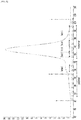
- a solution containing darbepoetin alfa was concentrated, and about 60 mL of the concentrate was flowed into the column at a rate of 7.5 mL/min, and the 20 mM sodium phosphate buffer solution containing 140 mM NaCl (pH 6.2) was sufficiently flowed into the column, thereby fractionating an eluate containing darbepoetin alfa with a high sialic acid content ( FIG. 5 ). It was confirmed that the eluate fractions of darbepoetin alfa had higher sialic acid contents in the order of the fractions (Table 1 and FIG. 6 ).
- the present invention provides a method for purifying darbepoetin alfa including the steps of: (a) eluting a darbepoetin alfa-containing fraction by applying a biological fluid containing darbepoetin alfa to anion exchange chromatography; (b) eluting a darbepoetin alfa-containing fraction by applying the eluate produced in step (a) to adsorption chromatography; (c) binding darbepoetin alfa to an anion exchange chromatography column by loading the eluate produced in step (b) into the anion exchange chromatography column; (d) washing the column treated in step (c) with a washing buffer solution containing arginine to selectively separate a structural isoform of darbepoetin alfa having a desired isoelectric point from a mixture of structural isoforms of darbepoetin alfa having higher isoelectric points; and (e) eluting the
- Step (a) is eluting a darbepoetin alfa-containing fraction by applying a darbepoetin alfa-containing biological fluid to anion exchange chromatography, and preferably, it may be adsorbing the darbepoetin alfa-containing biological fluid to an equilibrated anion exchange chromatography column by adding the darbepoetin alfa-containing biological fluid thereto, washing the column with a washing buffer solution which has a pH ranging from 6 to 8 and contains 10 mM to 100 mM NaCl, and eluting a darbepoetin alfa-containing fraction with an elution buffer solution which has a pH ranging from 6 to 8 and contains 100 mM to 300 mM NaCl.
- the anion exchange chromatography and the resin constituting the corresponding column are the same as described above.
- a culture which was obtained by expressing darbepoetin alfa in CHO cells transfected with a vector containing darbepoetin alfa was diafiltrated by ultrafiltration (MWCO of 10,000) using the 10 mM sodium phosphate buffer solution (pH 7.0) to obtain a biological fluid, which was applied to an XK-50 column filled with an anion exchange (Q fast flow, GE Healthcare) resin equilibrated with a 10 mM sodium phosphate buffer solution (pH 7.0), and again about 2 column volumes (CV) of the 10 mM sodium phosphate buffer solution (pH 7.0) was flowed thereinto to equilibrate the column.
- MWCO ultrafiltration
- the column was washed with a washing buffer solution containing NaCl ranging from 0 mM to 100 mM, and then eluted using an elution buffer solution which has a pH ranging from 6 to 8 and contains 100 mM to 300 mM NaCl.
- a washing buffer solution containing NaCl ranging from 0 mM to 100 mM
- an elution buffer solution which has a pH ranging from 6 to 8 and contains 100 mM to 300 mM NaCl.
- Step (b) is loading the eluate recovered in step (a) into a stationary phase of an equilibrated adsorption chromatography, more preferably, an equilibrated hydroxyapatite resin, washing the resulting resin with a washing buffer solution with a pH ranging from 6 to 8 wherein sodium phosphate, in the range of 0 mM to 100 mM, is contained, thereby obtaining a darbepoetin alfa-containing fraction from the liquid eluted without being adsorbed to the resin during loading and washing.
- a washing buffer solution with a pH ranging from 6 to 8 wherein sodium phosphate, in the range of 0 mM to 100 mM, is contained
- Examples of the stationary phase of the adsorption chromatography used in the present invention may include silica, alumina, magnesium oxide, and hydroxyapatite, and most preferably hydroxyapatite.
- hydroxyapatite resin chromatography or “hydroxyapatite chromatography” refers to an adsorption chromatography having a stationary phase filled with a hydroxyapatite resin, and may be interchangeably used with "hydroxyapatite column".
- Examples of the buffer solutions used in each of washing and elution steps preferably include a sodium phosphate buffer solution, a potassium phosphate buffer solution, and a Tris buffer solution.
- an anion exchange resin eluate was applied to an XK-50 column filled with a hydroxyapatite resin equilibrated with a 7 mM sodium phosphate buffer solution (pH 7.0), and about three column volumes of the 7 mM sodium phosphate buffer solution (pH 7.0) was flowed thereinto, and thereby darbepoetin alfa with many glycans bound thereto was eluted.
- Example 1 Obtaining a mixture of darbepoetin alfa isoforms having various sialic acid contents by anion exchange chromatography and hydroxyapatite adsorption chromatography
- a culture which was obtained by expressing darbepoetin alfa in CHO cells transfected with a vector containing a nucleotide sequence encoding darbepoetin alfa, was diafiltrated by ultrafiltration (MWCO of 10,000) using the 10 mM sodium phosphate buffer solution (pH 7.0) to obtain a biological fluid.
- the resultant was sequentially subjected to two columns of anion exchange chromatography and hydroxyapatite adsorption chromatography.
- the anion exchange chromatography was performed as follows. About 100 mL of an anion exchange (Q fast flow, GE Healthcare) resin was filled into an XK-50 column (GE Healthcare) and a 10 mM sodium phosphate buffer solution (pH 7.0) was flowed thereinto to equilibrate the column. The diafiltrate was flowed in the amount of about 0.1 L to 0.2 L into a Q Sepharose FF column prepared therein at a rate of 15 mL/min, and then about 2 column volumes (CV) of 10 mM sodium phosphate buffer solution (pH 7.0) was again flowed thereinto to equilibrate the column.
- anion exchange Q fast flow, GE Healthcare
- the column was washed with a washing buffer solution containing 10 mM to 100 mM NaCl and then eluted using an elution buffer solution which has a pH from 6 to 8 and contains 100 mM to 300 mM NaCl.
- About 0.1 L of diafiltrate was flowed into the hydroxyapatite column prepared therein at a rate of 10 mL/min, and then about 3 column volumes (CV) of 7 mM sodium phosphate buffer solution (pH 7.0) was again flowed thereinto.
- CV column volumes
- the solutions eluted without being adsorbed to the resin during loading and washing contained darbepoetin alfa with various sialic acid contents, and these solutions were collected and subjected to the subsequent process.
- 0.1 M to 0.7 M potassium phosphate buffer solution (pH 7) was flowed into the resin and the fraction(s) containing darbepoetin alfa with low glycans and impurities were removed by elution.
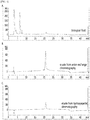
- the removal of biologically derived impurities and a large amount of darbepoetin alfa in the solutions were confirmed by RP-HPLC ( FIG. 1 ).
- Example 2 Purification of darbepoetin alfa with high sialic acid content by washing method applying arginine in anion exchange chromatography
- the column was subjected to a primary washing with a 10mM sodium phosphate buffer solution (pH 7.0) containing 50 mM NaCl, and then subsequently to a secondary washing with a glycine-HCl buffer solution which had a pH from 3 to 5 and contained urea, arginine, and NaCl, thereby washing the fractions containing darbepoetin alfa with a low sialic acid content.
- the proteins with only a high level of glycosylation and low isoelectric points were eluted using a sodium phosphate buffer solution containing 190 mM NaCl (pH 6.2).
- the darbepoetin alfa obtained by the washing processes was shown to have high quality by IEF ( FIG. 2 ).
- Example 2 The washing method applying arginine in Example 2 was confirmed as playing an important role in purifying darbepoetin alfa with a high sialic acid content.
- the solution containing the darbepoetin alfa obtained in Example 1 in the same manner as in Example 2 was adsorbed to a Q Sepharose FF, and about 2 column volumes (CV) of a 10 mM sodium phosphate buffer solution (pH 7.0), which is an equilibrium buffer solution, was flowed into the column to perform the primary washing.
- the secondary washing was performed using a sodium acetate buffer solution with a pH from 3 to 5 or less, instead of the glycine-HCl buffer solution used in Example 2.
- darbepoetin alfa with a high sialic acid content having an isoelectric point of 2 ⁇ 3 or less was confirmed to have been obtained (arrowed part in FIG. 3 ).
- the primary washing and the secondary washing were performed in the same manner as in Example 2, but without arginine.
- the darbepoetin alfa with a low sialic acid content having an isoelectric point of 2-3 or above was eluted, thus confirming a significant deterioration in its quality (arrowed part in FIG. 4 ).
- Example 4 Purification of darbepoetin alfa with high sialic acid content by gel filtration chromatography
- the solution containing darbepoetin alfa obtained in Example 2 was concentrated, and about 5 mL of the concentrate was flowed into the column at a rate of 7.5 mL/min, and the 20 mM sodium phosphate buffer solution containing 140 mM NaCl (pH 6.2) was sufficiently flowed into the column, thereby fractionating an eluate containing darbepoetin alfa with a high sialic acid content ( FIG. 5 ). It was confirmed that the eluate fractions of darbepoetin alfa had higher sialic acid contents in the order of the fractions (Table 1 and FIG. 6 ). The result of Wax-HPLC showing the sialic acid content according to each fraction is shown in Table 1 below. Table 1] Tetra-sialyated N-Glycan(%) Fraction 1 Fraction 2 Fraction 3 Fraction 4 Fraction 5 53.6 71.1 70.7 64.9 46.7
Landscapes
- Chemical & Material Sciences (AREA)
- Health & Medical Sciences (AREA)
- Organic Chemistry (AREA)
- Life Sciences & Earth Sciences (AREA)
- Proteomics, Peptides & Aminoacids (AREA)
- Biochemistry (AREA)
- Biophysics (AREA)
- General Health & Medical Sciences (AREA)
- Genetics & Genomics (AREA)
- Medicinal Chemistry (AREA)
- Molecular Biology (AREA)
- Gastroenterology & Hepatology (AREA)
- Zoology (AREA)
- Toxicology (AREA)
- Analytical Chemistry (AREA)
- Peptides Or Proteins (AREA)
- Saccharide Compounds (AREA)
Claims (13)
- Procédé de purification de darbépoétine alfa, comprenant :(a) la liaison de darbépoétine alfa à une colonne de chromatographie d'échange d'anions par chargement d'un un mélange comprenant de la darbépoétine alfa ayant différentes teneurs en acide sialique dans la colonne de chromatographie d'échange d'anions ;(b) le lavage de la colonne de chromatographie avec une solution tampon de lavage contenant de l'arginine pour séparer sélectivement une isoforme structurale de darbépoétine alfa ayant un point isoélectrique souhaité d'un mélange d'isoformes structurales de darbépoétine alfa ayant des points isoélectriques supérieurs ; et(c) l'élution de la darbépoétine alfa, qui reste liée à la colonne de chromatographie, à partir de la colonne, dans lequel la darbépoétine alfa éluée a un point isoélectrique dans la plage de pI de 2,0 à 4,0.
- Procédé selon la revendication 1, dans lequel la solution tampon de lavage contenant de l'arginine a un pH dans la plage de 3,0 à 5,0.
- Procédé selon la revendication 1, dans lequel la solution tampon de lavage contenant de l'arginine comprend en outre au moins l'un choisi dans le groupe constitué de NaCl et de l'urée.
- Procédé selon la revendication 1, comprenant en outre un lavage primaire de la colonne avec une solution tampon de lavage ayant un pH dans la plage de 6 à 8 avant l'étape (b) ; dans lequel l'étape (b) est un lavage secondaire de la colonne avec une solution tampon de lavage contenant de l'arginine ayant un pH dans la plage de 3 à 5.
- Procédé selon la revendication 4, dans lequel la solution tampon de lavage pour le lavage primaire est une solution de phosphate de sodium ; et la solution tampon de lavage pour le lavage secondaire est une solution de glycine-HCl.
- Procédé selon la revendication 1, dans lequel le mélange est une culture de levure, une culture de cellules végétales ou une culture de cellules animales.
- Procédé selon la revendication 1, dans lequel la colonne de chromatographie d'échange d'anions comprend une résine ayant un groupe fonctionnel qui est choisi dans le groupe constitué d'aminé quaternaire (Q), de diéthylaminoéthyle (DEAE), et d'aminoéthyle quaternaire (QAE).
- Procédé selon la revendication 1, comprenant en outre (d) le fractionnement de l'éluat de chromatographie d'échange d'anions obtenu dans l'étape (c) par application de celui-ci à une chromatographie de filtration sur gel.
- Procédé de purification de darbépoétine alfa, comprenant :(a) l'élution d'une fraction contenant de la darbépoétine alfa par application d'un fluide biologique comprenant de la darbépoétine alfa à une chromatographie d'échange d'anions ;(b) l'élution d'une fraction contenant de la darbépoétine alfa par application de l'éluat produit dans l'étape (a) à une chromatographie d'adsorption ;(c) la liaison de darbépoétine alfa à une colonne de chromatographie d'échange d'anions par chargement de l'éluat produit dans l'étape (b) dans la colonne de chromatographie d'échange d'anions ;(d) le lavage de la colonne traitée dans l'étape (c) avec une solution tampon de lavage contenant de l'arginine pour séparer sélectivement une isoforme structurale de darbépoétine alfa ayant un point isoélectrique souhaité d'un mélange d'isoformes structurales de darbépoétine alfa ayant des points isoélectriques supérieurs ; et(e) l'élution de la darbépoétine alfa, qui reste liée à la colonne de chromatographie par lavage dans l'étape (d), à partir de la colonne, dans lequel la darbépoétine alfa éluée a un point isoélectrique dans la plage de pI de 2,0 à 4,0.
- Procédé selon la revendication 9, dans lequel la phase stationnaire de la chromatographie d'adsorption est une résine d'hydroxyapatite.
- Procédé selon la revendication 9, comprenant en outre (f) le fractionnement de l'éluat de chromatographie d'échange d'anions obtenu dans l'étape (e) par application de celui-ci à une chromatographie de filtration sur gel.
- Procédé selon la revendication 9, dans lequel l'étape (a) comprend l'adsorption d'un fluide biologique contenant de la darbépoétine alfa à une résine d'échange d'anions équilibrée par ajout de celui-ci à celle-ci, le lavage de la résine résultante avec une solution tampon de lavage qui a un pH de 6 à 8 et contient 0 mM à 100 mM de NaCl, et l'élution d'une fraction contenant de la darbépoétine alfa avec une solution tampon d'élution qui a un pH de 6 à 8 et contient 100 mM à 300 mM de NaCl.
- Procédé selon la revendication 9, dans lequel l'étape (b) comprend le chargement de l'éluat récupéré dans l'étape (a) dans une résine d'hydroxyapatite équilibrée, le lavage de la résine résultante avec une solution tampon de lavage qui a un pH de 6 à 8 et contient 0 mM à 100 mM de phosphate de sodium, et l'obtention d'une fraction contenant de la darbépoétine alfa à partir du liquide sortant de la résine sans être adsorbé à celle-ci pendant le chargement et le lavage.
Applications Claiming Priority (2)
| Application Number | Priority Date | Filing Date | Title |
|---|---|---|---|
| KR1020130148026A KR101414897B1 (ko) | 2013-11-29 | 2013-11-29 | 다베포에틴 알파의 정제 방법 |
| PCT/KR2014/011527 WO2015080509A1 (fr) | 2013-11-29 | 2014-11-28 | Procédé de purification de darbépoétine alfa |
Publications (3)
| Publication Number | Publication Date |
|---|---|
| EP3075740A1 EP3075740A1 (fr) | 2016-10-05 |
| EP3075740A4 EP3075740A4 (fr) | 2017-06-28 |
| EP3075740B1 true EP3075740B1 (fr) | 2020-04-29 |
Family
ID=51741060
Family Applications (1)
| Application Number | Title | Priority Date | Filing Date |
|---|---|---|---|
| EP14865782.8A Active EP3075740B1 (fr) | 2013-11-29 | 2014-11-28 | Procédé de purification de darbépoétine alfa |
Country Status (9)
| Country | Link |
|---|---|
| US (1) | US10723775B2 (fr) |
| EP (1) | EP3075740B1 (fr) |
| JP (1) | JP6232130B2 (fr) |
| KR (1) | KR101414897B1 (fr) |
| CN (1) | CN105764915B (fr) |
| BR (1) | BR112016009421B1 (fr) |
| MX (1) | MX374783B (fr) |
| RU (1) | RU2643365C2 (fr) |
| WO (1) | WO2015080509A1 (fr) |
Families Citing this family (5)
| Publication number | Priority date | Publication date | Assignee | Title |
|---|---|---|---|---|
| JPH0696449B2 (ja) | 1989-01-10 | 1994-11-30 | 協同組合津久見ファインセラミックス研究センター | 板状炭酸カルシウムの製造方法 |
| JPH0699148B2 (ja) | 1989-10-04 | 1994-12-07 | 中山石灰工業株式会社 | 軽質炭酸カルシュウムの製造方法 |
| JP6906497B2 (ja) | 2016-03-09 | 2021-07-21 | Jcrファーマ株式会社 | 変異型ヒトエリスロポエチンの製造方法 |
| JP6258536B1 (ja) * | 2017-03-03 | 2018-01-10 | 協和発酵キリン株式会社 | ダルベポエチン組成物の製造方法およびダルべポエチン産生細胞の培養方法 |
| DK3613486T3 (da) | 2018-08-24 | 2021-01-04 | Uga Biopharma Gmbh | Metode og anlæg til rengøring af epo og/eller et epo-derivat |
Family Cites Families (14)
| Publication number | Priority date | Publication date | Assignee | Title |
|---|---|---|---|---|
| CN1057534C (zh) | 1993-08-17 | 2000-10-18 | 柯瑞英-艾格公司 | 促红细胞生成素类似物 |
| BR9917606A (pt) | 1998-11-06 | 2002-12-31 | Bio Sidus S A | Procedimento para a purificação de eritropoetina humana recombinante a partir de sobrenadantes de cultivo de células e eritropoetina humana recombinante obtida com tal procedimento |
| US6586398B1 (en) | 2000-04-07 | 2003-07-01 | Amgen, Inc. | Chemically modified novel erythropoietin stimulating protein compositions and methods |
| EP1453857B1 (fr) | 2001-11-28 | 2014-08-13 | Sandoz AG | Purification chromatographique d'erythropoietine humaine recombinee |
| WO2007058584A1 (fr) * | 2005-11-18 | 2007-05-24 | Ge Healthcare Bio-Sciences Ab | Procede de prefractionnement d’echantillons complexes |
| CN101511387A (zh) * | 2006-09-08 | 2009-08-19 | 惠氏公司 | 使用亲和色谱法纯化蛋白质的精氨酸洗涤液 |
| BRPI0915394A2 (pt) | 2008-06-24 | 2017-06-27 | Dr Reddys Laboratories Inc | purificação de citoquinas modificadas |
| US7877937B2 (en) | 2008-09-02 | 2011-02-01 | Amonix, Inc. | High-stiffness, lightweight beam structure |
| WO2011024024A1 (fr) * | 2009-08-28 | 2011-03-03 | Avesthagen Limited | Procédé de récupération d'isoformes de la darbépoïétine alpha |
| WO2011156369A2 (fr) * | 2010-06-07 | 2011-12-15 | Dr. Reddy's Laboratories Ltd. | Purification de cytokines modifiées |
| SG191071A1 (en) * | 2010-12-08 | 2013-07-31 | Amgen Inc | Ion exchange chromatography in the presence of an amino acid |
| WO2013002330A1 (fr) | 2011-06-29 | 2013-01-03 | 協和発酵キリン株式会社 | Procédé de purification d'une protéine |
| KR101443257B1 (ko) | 2011-10-18 | 2014-09-19 | 주식회사 종근당 | 낮은 등전점을 갖는 에리스로포이에틴 유사체의 정제방법 |
| HUE057005T2 (hu) * | 2013-09-25 | 2022-04-28 | Bioverativ Therapeutics Inc | Oszlopon történõ vírusinaktiváló eljárások |
-
2013
- 2013-11-29 KR KR1020130148026A patent/KR101414897B1/ko active Active
-
2014
- 2014-11-28 WO PCT/KR2014/011527 patent/WO2015080509A1/fr not_active Ceased
- 2014-11-28 CN CN201480065236.1A patent/CN105764915B/zh active Active
- 2014-11-28 MX MX2016005264A patent/MX374783B/es active IP Right Grant
- 2014-11-28 JP JP2016525549A patent/JP6232130B2/ja active Active
- 2014-11-28 RU RU2016123352A patent/RU2643365C2/ru active
- 2014-11-28 EP EP14865782.8A patent/EP3075740B1/fr active Active
- 2014-11-28 US US15/039,569 patent/US10723775B2/en active Active
- 2014-11-28 BR BR112016009421-2A patent/BR112016009421B1/pt active IP Right Grant
Non-Patent Citations (1)
| Title |
|---|
| None * |
Also Published As
| Publication number | Publication date |
|---|---|
| HK1223633A1 (en) | 2017-08-04 |
| CN105764915B (zh) | 2019-08-13 |
| JP2016538261A (ja) | 2016-12-08 |
| MX374783B (es) | 2025-03-06 |
| BR112016009421B1 (pt) | 2021-11-30 |
| KR101414897B1 (ko) | 2014-07-04 |
| US20170022257A1 (en) | 2017-01-26 |
| JP6232130B2 (ja) | 2017-11-15 |
| WO2015080509A1 (fr) | 2015-06-04 |
| CN105764915A (zh) | 2016-07-13 |
| EP3075740A1 (fr) | 2016-10-05 |
| BR112016009421A8 (pt) | 2020-03-24 |
| US10723775B2 (en) | 2020-07-28 |
| RU2643365C2 (ru) | 2018-02-01 |
| EP3075740A4 (fr) | 2017-06-28 |
| MX2016005264A (es) | 2016-07-08 |
Similar Documents
| Publication | Publication Date | Title |
|---|---|---|
| JP4109204B2 (ja) | 所望エリスロポエチングリコアイソフォームプロフィールの製造方法 | |
| EP3075740B1 (fr) | Procédé de purification de darbépoétine alfa | |
| EP2768846B1 (fr) | Procédés de purification d'analogues d'érythropoïétine ayant un point isoélectrique plus faible | |
| AU2015248461B2 (en) | Novel purification process of gonadotropin | |
| EP3997123B1 (fr) | Procédé de raffinage de produit pharmaceutique protéique ophtalmique | |
| CN102056940A (zh) | 纯化促红细胞生成素的方法 | |
| KR102140693B1 (ko) | 양이온 교환 크로마토그래피를 이용한 유사항체 정제 방법 | |
| EP2857417B1 (fr) | Protéine d'hormone de croissance humaine à longue action hautement glycosylée, et son procédé de production | |
| HUE027724T2 (hu) | Eljárás G-CSF tisztítására | |
| JP7445332B2 (ja) | ベバシズマブ精製の最適化された方法 | |
| KR101460266B1 (ko) | 신규한 지속형 인간 성장호르몬의 정제 방법 | |
| HK1223633B (en) | Method for purifying darbepoetin alfa | |
| EP2836504B1 (fr) | Procédé de fractionnement en une seule étape | |
| EP3153522A1 (fr) | Procédé de purification de l'érythropoïétine et de l'arbépoétine alfa | |
| WO2026013498A1 (fr) | Procédé de purification d'enzyme hyaluronidase | |
| KR20070091081A (ko) | 벼 세포 액체 현탁 배양액으로부터 인체 과립구 대식세포콜로니 자극인자를 순수하게 분리 정제하는 방법 | |
| KR20140065780A (ko) | 신규한 지속형 인간 성장호르몬 단량체를 제조하는 방법 |
Legal Events
| Date | Code | Title | Description |
|---|---|---|---|
| PUAI | Public reference made under article 153(3) epc to a published international application that has entered the european phase |
Free format text: ORIGINAL CODE: 0009012 |
|
| 17P | Request for examination filed |
Effective date: 20160624 |
|
| AK | Designated contracting states |
Kind code of ref document: A1 Designated state(s): AL AT BE BG CH CY CZ DE DK EE ES FI FR GB GR HR HU IE IS IT LI LT LU LV MC MK MT NL NO PL PT RO RS SE SI SK SM TR |
|
| AX | Request for extension of the european patent |
Extension state: BA ME |
|
| DAX | Request for extension of the european patent (deleted) | ||
| A4 | Supplementary search report drawn up and despatched |
Effective date: 20170531 |
|
| RIC1 | Information provided on ipc code assigned before grant |
Ipc: C07K 1/18 20060101AFI20170524BHEP Ipc: C07K 14/505 20060101ALI20170524BHEP |
|
| REG | Reference to a national code |
Ref country code: HK Ref legal event code: DE Ref document number: 1223633 Country of ref document: HK |
|
| STAA | Information on the status of an ep patent application or granted ep patent |
Free format text: STATUS: EXAMINATION IS IN PROGRESS |
|
| 17Q | First examination report despatched |
Effective date: 20180724 |
|
| GRAP | Despatch of communication of intention to grant a patent |
Free format text: ORIGINAL CODE: EPIDOSNIGR1 |
|
| STAA | Information on the status of an ep patent application or granted ep patent |
Free format text: STATUS: GRANT OF PATENT IS INTENDED |
|
| INTG | Intention to grant announced |
Effective date: 20191127 |
|
| GRAS | Grant fee paid |
Free format text: ORIGINAL CODE: EPIDOSNIGR3 |
|
| GRAA | (expected) grant |
Free format text: ORIGINAL CODE: 0009210 |
|
| STAA | Information on the status of an ep patent application or granted ep patent |
Free format text: STATUS: THE PATENT HAS BEEN GRANTED |
|
| AK | Designated contracting states |
Kind code of ref document: B1 Designated state(s): AL AT BE BG CH CY CZ DE DK EE ES FI FR GB GR HR HU IE IS IT LI LT LU LV MC MK MT NL NO PL PT RO RS SE SI SK SM TR |
|
| REG | Reference to a national code |
Ref country code: GB Ref legal event code: FG4D |
|
| REG | Reference to a national code |
Ref country code: CH Ref legal event code: EP |
|
| REG | Reference to a national code |
Ref country code: DE Ref legal event code: R096 Ref document number: 602014064699 Country of ref document: DE |
|
| REG | Reference to a national code |
Ref country code: AT Ref legal event code: REF Ref document number: 1263138 Country of ref document: AT Kind code of ref document: T Effective date: 20200515 |
|
| REG | Reference to a national code |
Ref country code: IE Ref legal event code: FG4D |
|
| REG | Reference to a national code |
Ref country code: DE Ref legal event code: R081 Ref document number: 602014064699 Country of ref document: DE Owner name: HK INNO.N CORPORATION, KR Free format text: FORMER OWNER: CJ HEALTHCARE CORPORATION, SEOUL, JP Ref country code: DE Ref legal event code: R082 Ref document number: 602014064699 Country of ref document: DE Representative=s name: NOVAGRAAF BREVETS, FR |
|
| REG | Reference to a national code |
Ref country code: NL Ref legal event code: MP Effective date: 20200429 |
|
| REG | Reference to a national code |
Ref country code: LT Ref legal event code: MG4D |
|
| PG25 | Lapsed in a contracting state [announced via postgrant information from national office to epo] |
Ref country code: GR Free format text: LAPSE BECAUSE OF FAILURE TO SUBMIT A TRANSLATION OF THE DESCRIPTION OR TO PAY THE FEE WITHIN THE PRESCRIBED TIME-LIMIT Effective date: 20200730 Ref country code: LT Free format text: LAPSE BECAUSE OF FAILURE TO SUBMIT A TRANSLATION OF THE DESCRIPTION OR TO PAY THE FEE WITHIN THE PRESCRIBED TIME-LIMIT Effective date: 20200429 Ref country code: FI Free format text: LAPSE BECAUSE OF FAILURE TO SUBMIT A TRANSLATION OF THE DESCRIPTION OR TO PAY THE FEE WITHIN THE PRESCRIBED TIME-LIMIT Effective date: 20200429 Ref country code: SE Free format text: LAPSE BECAUSE OF FAILURE TO SUBMIT A TRANSLATION OF THE DESCRIPTION OR TO PAY THE FEE WITHIN THE PRESCRIBED TIME-LIMIT Effective date: 20200429 Ref country code: PT Free format text: LAPSE BECAUSE OF FAILURE TO SUBMIT A TRANSLATION OF THE DESCRIPTION OR TO PAY THE FEE WITHIN THE PRESCRIBED TIME-LIMIT Effective date: 20200831 Ref country code: NO Free format text: LAPSE BECAUSE OF FAILURE TO SUBMIT A TRANSLATION OF THE DESCRIPTION OR TO PAY THE FEE WITHIN THE PRESCRIBED TIME-LIMIT Effective date: 20200729 Ref country code: IS Free format text: LAPSE BECAUSE OF FAILURE TO SUBMIT A TRANSLATION OF THE DESCRIPTION OR TO PAY THE FEE WITHIN THE PRESCRIBED TIME-LIMIT Effective date: 20200829 |
|
| REG | Reference to a national code |
Ref country code: AT Ref legal event code: MK05 Ref document number: 1263138 Country of ref document: AT Kind code of ref document: T Effective date: 20200429 |
|
| PG25 | Lapsed in a contracting state [announced via postgrant information from national office to epo] |
Ref country code: BG Free format text: LAPSE BECAUSE OF FAILURE TO SUBMIT A TRANSLATION OF THE DESCRIPTION OR TO PAY THE FEE WITHIN THE PRESCRIBED TIME-LIMIT Effective date: 20200729 Ref country code: RS Free format text: LAPSE BECAUSE OF FAILURE TO SUBMIT A TRANSLATION OF THE DESCRIPTION OR TO PAY THE FEE WITHIN THE PRESCRIBED TIME-LIMIT Effective date: 20200429 Ref country code: HR Free format text: LAPSE BECAUSE OF FAILURE TO SUBMIT A TRANSLATION OF THE DESCRIPTION OR TO PAY THE FEE WITHIN THE PRESCRIBED TIME-LIMIT Effective date: 20200429 Ref country code: LV Free format text: LAPSE BECAUSE OF FAILURE TO SUBMIT A TRANSLATION OF THE DESCRIPTION OR TO PAY THE FEE WITHIN THE PRESCRIBED TIME-LIMIT Effective date: 20200429 |
|
| PG25 | Lapsed in a contracting state [announced via postgrant information from national office to epo] |
Ref country code: AL Free format text: LAPSE BECAUSE OF FAILURE TO SUBMIT A TRANSLATION OF THE DESCRIPTION OR TO PAY THE FEE WITHIN THE PRESCRIBED TIME-LIMIT Effective date: 20200429 Ref country code: NL Free format text: LAPSE BECAUSE OF FAILURE TO SUBMIT A TRANSLATION OF THE DESCRIPTION OR TO PAY THE FEE WITHIN THE PRESCRIBED TIME-LIMIT Effective date: 20200429 |
|
| PG25 | Lapsed in a contracting state [announced via postgrant information from national office to epo] |
Ref country code: EE Free format text: LAPSE BECAUSE OF FAILURE TO SUBMIT A TRANSLATION OF THE DESCRIPTION OR TO PAY THE FEE WITHIN THE PRESCRIBED TIME-LIMIT Effective date: 20200429 Ref country code: DK Free format text: LAPSE BECAUSE OF FAILURE TO SUBMIT A TRANSLATION OF THE DESCRIPTION OR TO PAY THE FEE WITHIN THE PRESCRIBED TIME-LIMIT Effective date: 20200429 Ref country code: AT Free format text: LAPSE BECAUSE OF FAILURE TO SUBMIT A TRANSLATION OF THE DESCRIPTION OR TO PAY THE FEE WITHIN THE PRESCRIBED TIME-LIMIT Effective date: 20200429 Ref country code: SM Free format text: LAPSE BECAUSE OF FAILURE TO SUBMIT A TRANSLATION OF THE DESCRIPTION OR TO PAY THE FEE WITHIN THE PRESCRIBED TIME-LIMIT Effective date: 20200429 Ref country code: ES Free format text: LAPSE BECAUSE OF FAILURE TO SUBMIT A TRANSLATION OF THE DESCRIPTION OR TO PAY THE FEE WITHIN THE PRESCRIBED TIME-LIMIT Effective date: 20200429 Ref country code: CZ Free format text: LAPSE BECAUSE OF FAILURE TO SUBMIT A TRANSLATION OF THE DESCRIPTION OR TO PAY THE FEE WITHIN THE PRESCRIBED TIME-LIMIT Effective date: 20200429 Ref country code: RO Free format text: LAPSE BECAUSE OF FAILURE TO SUBMIT A TRANSLATION OF THE DESCRIPTION OR TO PAY THE FEE WITHIN THE PRESCRIBED TIME-LIMIT Effective date: 20200429 Ref country code: IT Free format text: LAPSE BECAUSE OF FAILURE TO SUBMIT A TRANSLATION OF THE DESCRIPTION OR TO PAY THE FEE WITHIN THE PRESCRIBED TIME-LIMIT Effective date: 20200429 |
|
| REG | Reference to a national code |
Ref country code: DE Ref legal event code: R097 Ref document number: 602014064699 Country of ref document: DE |
|
| PG25 | Lapsed in a contracting state [announced via postgrant information from national office to epo] |
Ref country code: PL Free format text: LAPSE BECAUSE OF FAILURE TO SUBMIT A TRANSLATION OF THE DESCRIPTION OR TO PAY THE FEE WITHIN THE PRESCRIBED TIME-LIMIT Effective date: 20200429 Ref country code: SK Free format text: LAPSE BECAUSE OF FAILURE TO SUBMIT A TRANSLATION OF THE DESCRIPTION OR TO PAY THE FEE WITHIN THE PRESCRIBED TIME-LIMIT Effective date: 20200429 |
|
| PLBE | No opposition filed within time limit |
Free format text: ORIGINAL CODE: 0009261 |
|
| STAA | Information on the status of an ep patent application or granted ep patent |
Free format text: STATUS: NO OPPOSITION FILED WITHIN TIME LIMIT |
|
| 26N | No opposition filed |
Effective date: 20210201 |
|
| PG25 | Lapsed in a contracting state [announced via postgrant information from national office to epo] |
Ref country code: SI Free format text: LAPSE BECAUSE OF FAILURE TO SUBMIT A TRANSLATION OF THE DESCRIPTION OR TO PAY THE FEE WITHIN THE PRESCRIBED TIME-LIMIT Effective date: 20200429 |
|
| PG25 | Lapsed in a contracting state [announced via postgrant information from national office to epo] |
Ref country code: MC Free format text: LAPSE BECAUSE OF FAILURE TO SUBMIT A TRANSLATION OF THE DESCRIPTION OR TO PAY THE FEE WITHIN THE PRESCRIBED TIME-LIMIT Effective date: 20200429 |
|
| REG | Reference to a national code |
Ref country code: CH Ref legal event code: PL |
|
| PG25 | Lapsed in a contracting state [announced via postgrant information from national office to epo] |
Ref country code: LU Free format text: LAPSE BECAUSE OF NON-PAYMENT OF DUE FEES Effective date: 20201128 |
|
| REG | Reference to a national code |
Ref country code: BE Ref legal event code: MM Effective date: 20201130 |
|
| PG25 | Lapsed in a contracting state [announced via postgrant information from national office to epo] |
Ref country code: CH Free format text: LAPSE BECAUSE OF NON-PAYMENT OF DUE FEES Effective date: 20201130 Ref country code: LI Free format text: LAPSE BECAUSE OF NON-PAYMENT OF DUE FEES Effective date: 20201130 |
|
| PG25 | Lapsed in a contracting state [announced via postgrant information from national office to epo] |
Ref country code: IE Free format text: LAPSE BECAUSE OF NON-PAYMENT OF DUE FEES Effective date: 20201128 |
|
| PG25 | Lapsed in a contracting state [announced via postgrant information from national office to epo] |
Ref country code: TR Free format text: LAPSE BECAUSE OF FAILURE TO SUBMIT A TRANSLATION OF THE DESCRIPTION OR TO PAY THE FEE WITHIN THE PRESCRIBED TIME-LIMIT Effective date: 20200429 Ref country code: MT Free format text: LAPSE BECAUSE OF FAILURE TO SUBMIT A TRANSLATION OF THE DESCRIPTION OR TO PAY THE FEE WITHIN THE PRESCRIBED TIME-LIMIT Effective date: 20200429 Ref country code: CY Free format text: LAPSE BECAUSE OF FAILURE TO SUBMIT A TRANSLATION OF THE DESCRIPTION OR TO PAY THE FEE WITHIN THE PRESCRIBED TIME-LIMIT Effective date: 20200429 |
|
| PG25 | Lapsed in a contracting state [announced via postgrant information from national office to epo] |
Ref country code: MK Free format text: LAPSE BECAUSE OF FAILURE TO SUBMIT A TRANSLATION OF THE DESCRIPTION OR TO PAY THE FEE WITHIN THE PRESCRIBED TIME-LIMIT Effective date: 20200429 |
|
| PG25 | Lapsed in a contracting state [announced via postgrant information from national office to epo] |
Ref country code: BE Free format text: LAPSE BECAUSE OF NON-PAYMENT OF DUE FEES Effective date: 20201130 |
|
| P01 | Opt-out of the competence of the unified patent court (upc) registered |
Effective date: 20230529 |
|
| PGFP | Annual fee paid to national office [announced via postgrant information from national office to epo] |
Ref country code: GB Payment date: 20250922 Year of fee payment: 12 |
|
| PGFP | Annual fee paid to national office [announced via postgrant information from national office to epo] |
Ref country code: FR Payment date: 20250925 Year of fee payment: 12 |
|
| PGFP | Annual fee paid to national office [announced via postgrant information from national office to epo] |
Ref country code: DE Payment date: 20250922 Year of fee payment: 12 |