EP3075802A1 - Agent de revêtement pour caoutchouc de balai d'essuie-glace, et caoutchouc de balai d'essuie-glace l'utilisant - Google Patents
Agent de revêtement pour caoutchouc de balai d'essuie-glace, et caoutchouc de balai d'essuie-glace l'utilisant Download PDFInfo
- Publication number
- EP3075802A1 EP3075802A1 EP14866551.6A EP14866551A EP3075802A1 EP 3075802 A1 EP3075802 A1 EP 3075802A1 EP 14866551 A EP14866551 A EP 14866551A EP 3075802 A1 EP3075802 A1 EP 3075802A1
- Authority
- EP
- European Patent Office
- Prior art keywords
- wiper blade
- blade rubber
- binder
- coating agent
- friction
- Prior art date
- Legal status (The legal status is an assumption and is not a legal conclusion. Google has not performed a legal analysis and makes no representation as to the accuracy of the status listed.)
- Withdrawn
Links
Images


Classifications
-
- C—CHEMISTRY; METALLURGY
- C09—DYES; PAINTS; POLISHES; NATURAL RESINS; ADHESIVES; COMPOSITIONS NOT OTHERWISE PROVIDED FOR; APPLICATIONS OF MATERIALS NOT OTHERWISE PROVIDED FOR
- C09D—COATING COMPOSITIONS, e.g. PAINTS, VARNISHES OR LACQUERS; FILLING PASTES; CHEMICAL PAINT OR INK REMOVERS; INKS; CORRECTING FLUIDS; WOODSTAINS; PASTES OR SOLIDS FOR COLOURING OR PRINTING; USE OF MATERIALS THEREFOR
- C09D175/00—Coating compositions based on polyureas or polyurethanes; Coating compositions based on derivatives of such polymers
- C09D175/04—Polyurethanes
-
- B—PERFORMING OPERATIONS; TRANSPORTING
- B60—VEHICLES IN GENERAL
- B60S—SERVICING, CLEANING, REPAIRING, SUPPORTING, LIFTING, OR MANOEUVRING OF VEHICLES, NOT OTHERWISE PROVIDED FOR
- B60S1/00—Cleaning of vehicles
- B60S1/02—Cleaning windscreens, windows or optical devices
- B60S1/04—Wipers or the like, e.g. scrapers
- B60S1/32—Wipers or the like, e.g. scrapers characterised by constructional features of wiper blade arms or blades
- B60S1/38—Wiper blades
-
- C—CHEMISTRY; METALLURGY
- C08—ORGANIC MACROMOLECULAR COMPOUNDS; THEIR PREPARATION OR CHEMICAL WORKING-UP; COMPOSITIONS BASED THEREON
- C08G—MACROMOLECULAR COMPOUNDS OBTAINED OTHERWISE THAN BY REACTIONS ONLY INVOLVING UNSATURATED CARBON-TO-CARBON BONDS
- C08G18/00—Polymeric products of isocyanates or isothiocyanates
- C08G18/06—Polymeric products of isocyanates or isothiocyanates with compounds having active hydrogen
- C08G18/28—Polymeric products of isocyanates or isothiocyanates with compounds having active hydrogen characterised by the compounds used containing active hydrogen
- C08G18/40—High-molecular-weight compounds
- C08G18/42—Polycondensates having carboxylic or carbonic ester groups in the main chain
- C08G18/44—Polycarbonates
-
- C—CHEMISTRY; METALLURGY
- C08—ORGANIC MACROMOLECULAR COMPOUNDS; THEIR PREPARATION OR CHEMICAL WORKING-UP; COMPOSITIONS BASED THEREON
- C08J—WORKING-UP; GENERAL PROCESSES OF COMPOUNDING; AFTER-TREATMENT NOT COVERED BY SUBCLASSES C08B, C08C, C08F, C08G or C08H
- C08J7/00—Chemical treatment or coating of shaped articles made of macromolecular substances
- C08J7/04—Coating
- C08J7/0427—Coating with only one layer of a composition containing a polymer binder
-
- C—CHEMISTRY; METALLURGY
- C08—ORGANIC MACROMOLECULAR COMPOUNDS; THEIR PREPARATION OR CHEMICAL WORKING-UP; COMPOSITIONS BASED THEREON
- C08J—WORKING-UP; GENERAL PROCESSES OF COMPOUNDING; AFTER-TREATMENT NOT COVERED BY SUBCLASSES C08B, C08C, C08F, C08G or C08H
- C08J7/00—Chemical treatment or coating of shaped articles made of macromolecular substances
- C08J7/04—Coating
- C08J7/043—Improving the adhesiveness of the coatings per se, e.g. forming primers
-
- C—CHEMISTRY; METALLURGY
- C08—ORGANIC MACROMOLECULAR COMPOUNDS; THEIR PREPARATION OR CHEMICAL WORKING-UP; COMPOSITIONS BASED THEREON
- C08J—WORKING-UP; GENERAL PROCESSES OF COMPOUNDING; AFTER-TREATMENT NOT COVERED BY SUBCLASSES C08B, C08C, C08F, C08G or C08H
- C08J7/00—Chemical treatment or coating of shaped articles made of macromolecular substances
- C08J7/04—Coating
- C08J7/046—Forming abrasion-resistant coatings; Forming surface-hardening coatings
-
- C—CHEMISTRY; METALLURGY
- C09—DYES; PAINTS; POLISHES; NATURAL RESINS; ADHESIVES; COMPOSITIONS NOT OTHERWISE PROVIDED FOR; APPLICATIONS OF MATERIALS NOT OTHERWISE PROVIDED FOR
- C09D—COATING COMPOSITIONS, e.g. PAINTS, VARNISHES OR LACQUERS; FILLING PASTES; CHEMICAL PAINT OR INK REMOVERS; INKS; CORRECTING FLUIDS; WOODSTAINS; PASTES OR SOLIDS FOR COLOURING OR PRINTING; USE OF MATERIALS THEREFOR
- C09D175/00—Coating compositions based on polyureas or polyurethanes; Coating compositions based on derivatives of such polymers
- C09D175/04—Polyurethanes
- C09D175/06—Polyurethanes from polyesters
-
- C—CHEMISTRY; METALLURGY
- C09—DYES; PAINTS; POLISHES; NATURAL RESINS; ADHESIVES; COMPOSITIONS NOT OTHERWISE PROVIDED FOR; APPLICATIONS OF MATERIALS NOT OTHERWISE PROVIDED FOR
- C09D—COATING COMPOSITIONS, e.g. PAINTS, VARNISHES OR LACQUERS; FILLING PASTES; CHEMICAL PAINT OR INK REMOVERS; INKS; CORRECTING FLUIDS; WOODSTAINS; PASTES OR SOLIDS FOR COLOURING OR PRINTING; USE OF MATERIALS THEREFOR
- C09D5/00—Coating compositions, e.g. paints, varnishes or lacquers, characterised by their physical nature or the effects produced; Filling pastes
-
- C—CHEMISTRY; METALLURGY
- C09—DYES; PAINTS; POLISHES; NATURAL RESINS; ADHESIVES; COMPOSITIONS NOT OTHERWISE PROVIDED FOR; APPLICATIONS OF MATERIALS NOT OTHERWISE PROVIDED FOR
- C09D—COATING COMPOSITIONS, e.g. PAINTS, VARNISHES OR LACQUERS; FILLING PASTES; CHEMICAL PAINT OR INK REMOVERS; INKS; CORRECTING FLUIDS; WOODSTAINS; PASTES OR SOLIDS FOR COLOURING OR PRINTING; USE OF MATERIALS THEREFOR
- C09D7/00—Features of coating compositions, not provided for in group C09D5/00; Processes for incorporating ingredients in coating compositions
- C09D7/40—Additives
-
- C—CHEMISTRY; METALLURGY
- C09—DYES; PAINTS; POLISHES; NATURAL RESINS; ADHESIVES; COMPOSITIONS NOT OTHERWISE PROVIDED FOR; APPLICATIONS OF MATERIALS NOT OTHERWISE PROVIDED FOR
- C09D—COATING COMPOSITIONS, e.g. PAINTS, VARNISHES OR LACQUERS; FILLING PASTES; CHEMICAL PAINT OR INK REMOVERS; INKS; CORRECTING FLUIDS; WOODSTAINS; PASTES OR SOLIDS FOR COLOURING OR PRINTING; USE OF MATERIALS THEREFOR
- C09D7/00—Features of coating compositions, not provided for in group C09D5/00; Processes for incorporating ingredients in coating compositions
- C09D7/40—Additives
- C09D7/66—Additives characterised by particle size
- C09D7/69—Particle size larger than 1000 nm
-
- C—CHEMISTRY; METALLURGY
- C10—PETROLEUM, GAS OR COKE INDUSTRIES; TECHNICAL GASES CONTAINING CARBON MONOXIDE; FUELS; LUBRICANTS; PEAT
- C10M—LUBRICATING COMPOSITIONS; USE OF CHEMICAL SUBSTANCES EITHER ALONE OR AS LUBRICATING INGREDIENTS IN A LUBRICATING COMPOSITION
- C10M103/00—Lubricating compositions characterised by the base-material being an inorganic material
- C10M103/02—Carbon; Graphite
-
- B—PERFORMING OPERATIONS; TRANSPORTING
- B60—VEHICLES IN GENERAL
- B60S—SERVICING, CLEANING, REPAIRING, SUPPORTING, LIFTING, OR MANOEUVRING OF VEHICLES, NOT OTHERWISE PROVIDED FOR
- B60S1/00—Cleaning of vehicles
- B60S1/02—Cleaning windscreens, windows or optical devices
- B60S1/04—Wipers or the like, e.g. scrapers
- B60S1/32—Wipers or the like, e.g. scrapers characterised by constructional features of wiper blade arms or blades
- B60S1/38—Wiper blades
- B60S2001/3827—Wiper blades characterised by the squeegee or blade rubber or wiping element
- B60S2001/3829—Wiper blades characterised by the squeegee or blade rubber or wiping element characterised by the material of the squeegee or coating thereof
-
- C—CHEMISTRY; METALLURGY
- C08—ORGANIC MACROMOLECULAR COMPOUNDS; THEIR PREPARATION OR CHEMICAL WORKING-UP; COMPOSITIONS BASED THEREON
- C08J—WORKING-UP; GENERAL PROCESSES OF COMPOUNDING; AFTER-TREATMENT NOT COVERED BY SUBCLASSES C08B, C08C, C08F, C08G or C08H
- C08J2321/00—Characterised by the use of unspecified rubbers
-
- C—CHEMISTRY; METALLURGY
- C08—ORGANIC MACROMOLECULAR COMPOUNDS; THEIR PREPARATION OR CHEMICAL WORKING-UP; COMPOSITIONS BASED THEREON
- C08J—WORKING-UP; GENERAL PROCESSES OF COMPOUNDING; AFTER-TREATMENT NOT COVERED BY SUBCLASSES C08B, C08C, C08F, C08G or C08H
- C08J2475/00—Characterised by the use of polyureas or polyurethanes; Derivatives of such polymers
- C08J2475/04—Polyurethanes
-
- C—CHEMISTRY; METALLURGY
- C08—ORGANIC MACROMOLECULAR COMPOUNDS; THEIR PREPARATION OR CHEMICAL WORKING-UP; COMPOSITIONS BASED THEREON
- C08K—Use of inorganic or non-macromolecular organic substances as compounding ingredients
- C08K2201/00—Specific properties of additives
- C08K2201/002—Physical properties
- C08K2201/003—Additives being defined by their diameter
-
- C—CHEMISTRY; METALLURGY
- C08—ORGANIC MACROMOLECULAR COMPOUNDS; THEIR PREPARATION OR CHEMICAL WORKING-UP; COMPOSITIONS BASED THEREON
- C08K—Use of inorganic or non-macromolecular organic substances as compounding ingredients
- C08K3/00—Use of inorganic substances as compounding ingredients
- C08K3/02—Elements
- C08K3/04—Carbon
-
- C—CHEMISTRY; METALLURGY
- C10—PETROLEUM, GAS OR COKE INDUSTRIES; TECHNICAL GASES CONTAINING CARBON MONOXIDE; FUELS; LUBRICANTS; PEAT
- C10M—LUBRICATING COMPOSITIONS; USE OF CHEMICAL SUBSTANCES EITHER ALONE OR AS LUBRICATING INGREDIENTS IN A LUBRICATING COMPOSITION
- C10M2201/00—Inorganic compounds or elements as ingredients in lubricant compositions
- C10M2201/04—Elements
- C10M2201/041—Carbon; Graphite; Carbon black
-
- C—CHEMISTRY; METALLURGY
- C10—PETROLEUM, GAS OR COKE INDUSTRIES; TECHNICAL GASES CONTAINING CARBON MONOXIDE; FUELS; LUBRICANTS; PEAT
- C10N—INDEXING SCHEME ASSOCIATED WITH SUBCLASS C10M RELATING TO LUBRICATING COMPOSITIONS
- C10N2050/00—Form in which the lubricant is applied to the material being lubricated
- C10N2050/08—Solids
Definitions
- the present invention relates to a coating agent for wiper blade rubber, which is used in wiper devices for wiping fine particles of rainwater, snow or dust, and to wiper blade rubber using the same.
- Sliding members in the form of wipers are used in transportation equipment such as vehicles, aircraft or marine vessels, and industrial machinery and equipment such as construction machinery, in order to wipe off water and fine particles adhered to their glass and other smooth surfaces.
- Wiper blade rubber is attached to the sliding portions of the wipers. For example, in the case of automobile windshield wipers, rainwater, snow, dust or mud and the like adhered to a glass surface are removed by a wiping operation of the wiper blade rubber with the driving of the wiper.
- resin elastomers and the like are used for the base material of wiper blade rubber in addition to rubber, it is rubber that is used most commonly.
- the wiper blade rubber serves to prevent scattering of transmitted light by creating a uniformly wet state by evenly spreading out rainwater into a uniform water film, thereby ensuring the driver's field of view.
- Water repellency treatment has recently come to be performed on the glass surfaces of automobiles and the like. Since water is inhibited from adhering to glass surfaces that have undergone this water repellency treatment due to the water-repelling effect thereof, it becomes difficult to form a uniform water film, friction between the wiper blade rubber and the glass increases, and problems such as skipping, streaking, uneven wiping, chattering and squeaking occur. In addition, the large amount of friction between the wiper blade rubber and the glass would cause the problem of disadvantageous acceleration of the damages to the wiper blade rubber and water repellency treatment film on the glass.
- Patent Document 1 JP 2002-20695 A
- An object of the present invention is to provide a coating agent for wiper blade rubber that demonstrates superior friction performance, capable of maintaining a low level of friction both initially and during use for extended periods, and superior wiping performance, capable of adequately inhibiting uneven wiping and wiping noise, while also imparting superior durability by inhibiting wear, and to provide a wiper blade rubber that uses the same.
- the present invention has the configurations indicated below.
- Present Invention 1 relates to a coating agent for wiper blade rubber, comprising a binder containing a polycarbonate-based polyurethane resin, and a solid lubricant.
- Present Invention 2 relates to the coating agent for wiper blade rubber described in Present Invention 1, wherein the polycarbonate-based polyurethane resin is a crosslinking polycarbonate-based polyurethane resin and/or a non-crosslinking polycarbonate-based polyurethane resin.
- the polycarbonate-based polyurethane resin is a crosslinking polycarbonate-based polyurethane resin and/or a non-crosslinking polycarbonate-based polyurethane resin.
- Present Invention 3 relates to the coating agent for wiper blade rubber described in Present Invention 1 or 2, wherein the weight ratio of the binder solid fraction to the solid lubricant is 1:1 to 1:8.
- Present Invention 4 relates to the coating agent for wiper blade rubber described in any of Present Inventions 1 to 3, wherein the solid lubricant is graphite having an average particle diameter (D 50 ) of 2 ⁇ m to 15 ⁇ m as measured according to the laser diffraction scattering method.
- D 50 average particle diameter
- Present Invention 5 relates to the coating agent for wiper blade rubber described in any of Present Inventions 1 to 4, wherein the polycarbonate-based polyurethane resin is dispersed in an aqueous medium.
- Present Invention 6 relates to the coating agent for wiper blade rubber described in any of Present Inventions 1 to 5, wherein the binder has a tensile elasticity, as determined in compliance with JIS K7161-1 using a film having a film thickness of 10 ⁇ m to 80 ⁇ m and width of 3 mm to 20 mm obtained by drying or curing the binder, of 20 MPa to 1300 MPa.
- Present Invention 7 relates to the coating agent for wiper blade rubber described in any of Present Inventions 1 to 6, wherein the binder has tensile strength of 35 MPa or more and elongation of 100% or more as determined in compliance with JIS K7311 using a film having a film thickness of 10 ⁇ m to 80 ⁇ m and width of 3 mm to 20 mm obtained by drying or curing the binder.
- Present Invention 8 relates to a wiper blade rubber provided with a coating layer comprising the coating agent for wiper blade rubber described in any of Present Inventions 1 to 7 on the lateral surfaces of a lip portion of the wiper blade rubber.
- Present Invention 9 relates to the wiper blade rubber described in Present Invention 8, wherein the thickness of the coating layer is 3 ⁇ m to 30 ⁇ m.
- a coating agent for wiper blade rubber that demonstrates superior friction performance and wiping performance both initially and during use for extended periods and imparts superior durability by inhibiting wear, and a wiper blade rubber that uses the same, can be provided.
- the coating agent for wiper blade rubber of the present invention comprises a binder containing a polycarbonate-based polyurethane resin, and a solid lubricant.
- the polycarbonate-based polyurethane resin contained in the binder is a polyurethane resin having units derived from a polycarbonate polyol, and is synthesized in the form of a dispersion dispersed in an aqueous medium or solution dissolved in an organic solvent.
- the polycarbonate-based polyurethane resin is a crosslinking polycarbonate-based polyurethane resin and/or a non-crosslinking polycarbonate-based polyurethane resin.
- a crosslinking polycarbonate-based polyurethane resin is a polycarbonate-based polyurethane resin that is crosslinkable by imparting energy.
- Examples of the imparted energy include radiation energy and thermal energy.
- Examples of radiation capable of imparting radiation energy that can be used include infrared rays, visible light, ultraviolet rays, X rays, electron beams, ⁇ rays, ⁇ rays and ⁇ rays.
- a polycarbonate-based polyurethane resin can be crosslinked by irradiating with radiation energy of, for example, 100 mJ/cm 2 to 3,000 mJ/cm 2 .
- a polycarbonate-based polyurethane resin in the case of crosslinking a thermal crosslinking polycarbonate-based polyurethane resin by imparting thermal energy, although there are no particular limitations on the temperature at which the resin is heated, a polycarbonate-based polyurethane resin can be heated and crosslinked at a temperature of, for example, 50°C to 200°C.
- the crosslinking polycarbonate-based polyurethane resin is preferably a thermal crosslinking polycarbonate-based polyurethane resin that forms a urethane crosslinked structure by being heated to 80°C to 200°C.
- An example of a binder containing a crosslinking polycarbonate-based polyurethane resin is Eternacoll® UW-1501F (Ube Industries, Ltd.).
- a non-crosslinking polycarbonate-based polyurethane resin is a polycarbonate-based polyurethane resin that does not crosslink even if imparted with energy.
- An example of a binder containing a non-crosslinking polycarbonate-based polyurethane resin is Eternacoll® UW-5002 (Ube Industries, Ltd.).
- the binder contains a crosslinking polycarbonate-based polyurethane resin and a non-crosslinking polycarbonate-based polyurethane resin
- the mixing ratio of the crosslinking polycarbonate-based polyurethane resin and the non-crosslinking polycarbonate-based polyurethane resin can be suitably set so that tensile elasticity, as determined in compliance with JIS K7161-1 using a film having a film thickness of 10 ⁇ m to 80 ⁇ m and width of 3 mm to 20 mm obtained by drying or curing the binder, is 20 MPa to 1,300 MPa.
- the content of the polycarbonate-based polyurethane resin (solid fraction) in the binder is preferably 15% by weight to 45% by weight and more preferably 20% by weight to 40% by weight, based on the total weight of the binder (100% by weight).
- the viscosity of the binder at 20°C is preferably 10 mPa ⁇ s to 200 mPa ⁇ s and more preferably 20 mPa ⁇ s to 100 mPa ⁇ s.
- the viscosity of the binder can be measured using, for example, a tuning fork vibration viscometer as described in the following examples.
- An example of a dispersion medium in which the polycarbonate-based polyurethane resin is dispersed is an aqueous medium.
- An example of a solvent that dissolves the polycarbonate-based polyurethane resin is an organic solvent.
- An aqueous medium is preferably used in the binder in consideration of emission standards for volatile organic compounds (VOC). Examples of aqueous media include water and mixed media of water and a hydrophilic organic solvent.
- water examples include deionized water, distilled water and ultrapure water
- deionized water is used preferably in consideration of such factors as dispersion stability.
- hydrophilic organic solvents examples include lower primary alcohols such as methanol, ethanol or propanol, polyvalent alcohols such as ethylene glycol or glycerin, and aprotic hydrophilic organic solvents such as dimethylsulfoxide, dimethylformamide, N-methylpyrrolidone and N-ethylpyrrolidone.
- the amount of hydrophilic organic solvent in the aqueous medium is preferably 0% by weight to 20% by weight and more preferably 0% by weight to 10% by weight based on 100% by weight of the aqueous medium.
- organic solvents examples include toluene, xylene, butyl acetate, dimethylformamide, dimethylacetoamide, N-methylpyrrolidone and N-ethylpyrrolidone.
- Tensile elasticity of the coating layer provided on the wiper blade rubber varies depending on the binder contained in the coating agent for wiper blade rubber.
- Tensile elasticity of the binder can be measured using a film of a prescribed thickness and width obtained by drying or curing the binder contained in the coating agent for wiper blade rubber. It is expected that a hard coating layer is obtained when a binder contained in the coating agent for wiper blade rubber forming a film having a high tensile elasticity is used. It is expected that a soft coating layer is obtained when a binder contained in the coating agent for wiper blade rubber forming a film having a low tensile elasticity is used.
- a hard coating layer usually refers to the coating layer having a Martens hardness of 20 N/mm 2 or more as measured in compliance with ISO14577-1
- a soft coating layer usually refers to the coating layer having a Martens hardness of less than 20 N/mm 2 as measured in compliance with ISO14577-1.
- Martens hardness of a coating layer measured in compliance with ISO14577-1 is indicated as "surface hardness”.
- the coating layer provided on wiper blade rubber is comprised of a binder containing a polycarbonate-based polyurethane resin and a solid lubricant, different values are obtained on different contact sites of the indenter of the device used to measure surface hardness and the sample. Consequently, the more frequently the surface hardness is measured the stabler the values of "surface hardness" become.
- Tensile elasticity as measured in compliance with JIS K7161-1 using a film having a film thickness of 10 ⁇ m to 80 ⁇ m and width of 3 mm to 20 mm obtained by drying or curing the binder containing the polycarbonate-based polyurethane resin, is preferably 20 MPa to 1,300 MPa, more preferably 20 MPa to 1,290 MPa and even more preferably 25 MPa to 1,280 MPa.
- the coating layer applied to the wiper blade rubber is soft and stretches favorably, thereby making it possible to demonstrate favorable followability to the glass surface, inhibit the occurrence of uneven wiping and the like, and demonstrate favorable wiping performance.
- tensile elasticity as measured in compliance with JIS K7161-1 using a film obtained by drying or curing the binder containing a polycarbonate-based polyurethane resin, is less than 20 MPa, the binder sometimes fails to provide a sufficiently small coefficient of friction of a wiper blade rubber provided with a coating layer composed of the coating agent for wiper blade rubber. If tensile elasticity, as measured in compliance with JIS K7161-1 using a film obtained by drying or curing the binder containing a polycarbonate-based polyurethane resin, exceeds 1,300 MPa, the binder sometimes provides an excessively hard wiper blade rubber, and a poor wiping performance of a wiper blade rubber provided with a coating layer composed of the coating agent for wiper blade rubber.
- Tensile elasticity in compliance with JIS K7161-1 can be determined under the measuring conditions including a measuring temperature of 23°C, humidity of 50% and pulling speed of 100 mm/min as explained in the following examples.
- the coating layer applied to the wiper blade rubber comprises a binder containing a polycarbonate-based polyurethane resin, and a solid lubricant
- the coating layer would influence the coefficient of friction and wiping performance also through the weight ratio of the binder solid fraction to the solid lubricant.
- a film having a film thickness of 10 ⁇ m to 80 ⁇ m and width of 3 mm to 20 mm obtained by drying or curing a binder containing a polycarbonate-based polyurethane resin preferably has a tensile strength and elongation, in compliance with JIS K7311, of 35 MPa or more and 100% or more, more preferably a tensile strength of 45 MPa or more and elongation of 200% or more, and even more preferably a tensile strength of 50 MPa or more and elongation of 250% or more.
- the coating layer composed of a coating agent for wiper blade rubber adhered to a rubber composing a base material of a wiper blade rubber such as chloroprene rubber or natural rubber has a favorable wear resistance, a capability to follow deformations in the base material, and suppressed cracking and separation of the coating layer.
- Tensile strength and elongation in compliance with JIS K7311 can be determined under measuring conditions including a measuring temperature of 23°C, humidity of 50% and pulling speed of 100 mm/min as explained in the following examples.
- the solid lubricant is a self-lubricating solid material, and any conventionally known solid lubricant can be used. Examples thereof include graphite, molybdenum disulfide, tungsten disulfide, polytetrafluoroethylene (PTFE), silver, lead and copper. Of these, graphite is preferable since it reduces the coefficient of friction.
- the graphite is preferably flake graphite.
- the particle diameter of the solid lubricant in terms of the volume-based average particle diameter (D 50 ) measured according to laser diffraction scattering method is preferably 2 ⁇ m to 15 ⁇ m, more preferably 3 ⁇ m to 12 ⁇ m, even more preferably 3 ⁇ m to 10 ⁇ m, and particularly preferably 3.0 ⁇ m to 8.0 ⁇ m.
- a device such as MT3300 Microtrac Particle Size Distribution Analyzer (Nikkiso Co., Ltd.) can be used to measure average particle diameter according to laser diffraction scattering method.
- average particle diameter refers to the length of the major axis.
- the solid lubricant is spherical, average particle diameter refers to the diameter thereof.
- the weight ratio of binder solid fraction to solid lubricant is preferably 1:1 to 1:8, more preferably 1:2 to 1:7, even more preferably 1:2 to 1:6, and particularly preferably 1:3 to 1:6.
- the amount of solid lubricant can be increased and the coefficient of friction of the coating layer formed can be reduced in comparison with coating agents into which a binder containing a polyol polyether-based polyurethane resin is incorporated or coating agents into which a binder containing a phenol resin and either chloroprene rubber-based or chlorosulfonated polyethylene is incorporated.
- the adhesion between the coating layer composed of a coating agent for wiper blade rubber and the base material is still favorable, and the wear of the coating layer can be inhibited even after an extended period of time of use of the wiper blade.
- the weight ratio between the binder solid fraction and the solid lubricant is 1:1 to 1:8 and particularly 1:2 to 1:7
- a coating layer for wiper blade rubber having a superior friction performance and wiping performance both initially and after an extended period of time of use, superior adhesion to a base material, suppressed wear and superior durability.
- the wiper blade rubbers provided with the coating layer composed of this coating agent for wiper blade rubber have superior wear resistance, wipeability and durability.
- the coating agent for wiper blade rubber of the present invention can be produced by using a binder in the form of a dispersion obtained by dispersing a polycarbonate-based polyurethane resin in an aqueous medium, or in the form of a solution obtained by dissolving a polycarbonate-based polyurethane resin in an organic solvent, and dispersing and mixing a solid lubricant in this binder.
- a known method can be used to disperse and mix the solid lubricant in the binder, and examples thereof include dispersing and mixing by using a bead mill, ball mill or dissolver.
- filler, surfactant, dispersant, thickener or preservative and the like may also be incorporated provided it does not impair the object and effect of the present invention.
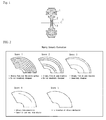
- FIG. 1 is a cross-sectional view showing a wiper blade rubber formed in a tandem shape.
- the wiper blade rubber has a tandem shape in which the ends of two wiper blade rubber base materials 1 are in contact.
- the coating agent for wiper blade rubber of the present invention is coated onto both sides of a lip portion 2 of the wiper blade rubber base material 1, followed by drying or curing to form a coating layer 3. Subsequently, the center of the lip portion 2 is cut (cut portion indicated by reference symbol 4 in FIG. 1 ) to form a wiper blade rubber having the coating layer 3 on both sides of the lip portion 2 with the rubber base material exposed on the end surface of the lip portion.
- Examples of rubber that can be used to compose the wiper blade rubber base material include natural rubber, styrene-butadiene rubber, chloroprene rubber, ethylene-propylene-diene rubber (EPDM), ethylene-propylene rubber and mixtures thereof.
- resin elastomers can be used depending on the application.
- a known method can be used to coat the coating agent, and examples thereof include spray coating, knife coating, roller coating and dipping.
- the thickness of the coating layer after drying or curing is preferably 3 ⁇ m to 30 ⁇ m, more preferably 3 ⁇ m to 15 ⁇ m, and particularly preferably 5 ⁇ m to 12 ⁇ m. If the thickness of the coating layer is 5 ⁇ m to 12 ⁇ m, the coefficient of friction can be reduced while ensuring followability to the rubber base material, wear can be inhibited and superior durability can be obtained. If the thickness of the coating layer is less than 3 ⁇ m, the coefficient of friction cannot be reduced, and since the coating layer is easily lost during use, uneven wiping or wiping noise occurs easily. If the thickness of the coating layer exceeds 30 ⁇ m, the coating agent is unable to follow the curvature of the glass thereby resulting in increased susceptibility to the occurrence of uneven wiping.
- Viscosity was measured at 23°C using a tuning fork vibration viscometer.
- Tensile elasticity, tensile strength and elongation were measured by forming a film having a film thickness of 10 ⁇ m to 80 ⁇ m and width of 5 mm by drying or curing a binder and subjecting this film to measurements in compliance with JIS K7161-1 and JIS K7311 at a measuring temperature of 23°C, humidity of 50% and pulling speed of 100 mm/min.
- Binder A is an aqueous polycarbonate-based polyurethane resin dispersion (Eternacoll® UW-1501F, Ube Industries, Ltd.) comprising 30% by weight, as the solid content thereof, of a thermal crosslinking polycarbonate-based polyurethane resin based on the total weight (100% by weight) of Binder A, and containing a dispersion medium in the form of water and N-methylpyrrolidone.
- the viscosity of the Binder A is shown in Table 1.
- a film composed of Binder A was formed to a film thickness of 10 ⁇ m to 80 ⁇ m and width of 5 mm by drying or curing the Binder A.
- the film composed of Binder A was measured for tensile elasticity in compliance with JIS K7161-1, and measured for tensile strength and elongation in compliance with JIS K7311. The measurement results are shown in Table 1.
- Binder B contains a Resin Dispersion B, a curing agent and a dispersion medium.
- the resin dispersion, curing agent and dispersion medium contained in the Binder B are indicated below.
- the solid fraction of Binder B is 80% by weight based on the total weight (100% by weight) of the Binder B.
- Resin Dispersion B Resin Dispersion B contains 65% by weight as the solid content thereof of a polyol polyether-based urethane resin (Nippolan® 179P, Nippon Polyurethane Industry Co., Ltd.) based on 100% by weight of the resin dispersion, and contains propylene glycol monomethyl ether acetate as a dispersion medium.
- the viscosity of Resin Dispersion B is shown in Table 1.
- Curing agent Polyisocyanate resin/(Coronate® 2513 (Nippon Polyurethane Industry Co., Ltd.)).
- Dispersion medium Xylene/Cellosolve acetate
- a film composed of Binder B was formed to a film thickness of 10 ⁇ m to 80 ⁇ m and width of 5 mm by drying or curing the Binder B.
- the film composed of Binder B was measured for tensile elasticity in compliance with JIS K7161-1 and measured for tensile strength and elongation in compliance with JIS K7311. The measurement results are shown in Table 1.
- Binder C is a rubber-mixed mixture (Shoprene® AD, Showa Denko K.K.) having a solid content of 30% by weight based on the total weight (100% by weight) of Binder C and containing xylene as a dispersion medium.
- a film composed of Binder C was formed to a film thickness of 10 ⁇ m to 80 ⁇ m and width of 5 mm by drying or curing the Binder C.
- the film composed of Binder C was measured for tensile elasticity in compliance with JIS K7161-1 and measured for tensile strength and elongation in compliance with JIS K7311. The measurement results are shown in Table 1.
- Binder A B C Viscosity mPa ⁇ s 10-100 6,000-16,000 1,000-2,500 Film Tensile elasticity MPa 53 270 27 Tensile strength MPa 52 24 13 Elongation % 270 4.1 300
- Graphite was used that has an average particle diameter (D 50 ) of 3.8 ⁇ m as determined by laser diffraction scattering using MT3300 Microtrac Particle Size Distribution Analyzer (Nikkiso Co., Ltd.).
- Example 1 and Comparative Examples 1 and 2 were obtained by mixing a binder, a solid lubricant and other materials in the incorporated amounts shown in Table 2 using a homodisperser stirrer. Furthermore, the values indicated in Table 2 are in parts by weight with the exception of the weight ratio of binder solid fraction to solid lubricant.
- the solid lubricant was added in small portions to the binder that had been preliminarily charged into the stirrer and the resultant mixture was stirred until individual particles reached an approximately uniform size based on visual observation without the presence of visually conspicuously large particles.
- the curing agent was added to the coating agent and mixed well immediately prior to coating onto the wiper blade.
- Example 1 Comparative Example 1 Comparative Example 2 Binder (parts by weight) A:Thermal crosslinking aqueous polycarbonate-based urethane resin dispersion 10.56 - - B:Polyol polyether-based urethane resin - 4.70 - C:Rubber-based mixture - - 10.56 Curing agent (parts by weight) - 5.64 - Solid lubricant: graphite (parts by weight) 12.67 7.57 11.09 Weight ratio of binder (solid fraction): solid lubricant 1:4 1:1 1 :3.5 Aqueous medium (parts bvy weight) Pure water 76.77 - - Organic solvent (parts by weight) Xylene - 22.09 29.35 Toluene - - 35.00 Methyl ethyl ketone - 60.00 - Acetone - - 15.00
- the resulting coating agents were coated onto the lip portion 2 of a tandem-shaped wiper blade rubber base material 1 so that the film thickness of the coating layer 3 after drying or curing was 5 ⁇ m to 12 ⁇ m as shown in FIG. 1 , followed by drying at 130°C to 140°C for 0.5 hours to form the coating layer 3. After forming the coating layer, the center of the lip portion 2 was cut to obtain a wiper blade rubber having the coating layer 3.
- a sensory evaluation of wiping performance was carried out by attaching wiper blade rubber provided with a coating layer formed with each of the coating agents of Example 1 and Comparative Examples 1 and 2 to an ordinary automobile windshield wiper, carrying out a wiping operation with the wiper in a state of evenly spraying water at the rate of 100 ml to 500 ml per minute onto the entire wiping surface of the windshield glass of the ordinary automobile, observing the state of streaks remaining when the wiper blade rubber wipes downward from the interior side of the windshield glass, and evaluating wiping in accordance with the following evaluation criteria.
- FIG. 2 is a schematic diagram schematically representing the criteria used for sensory evaluation scores.
- an endurance test of the wiper blade system was carried out on wiper blade rubber provided with a coating layer formed from each of the coating agents of Example 1 and Comparative Examples 1 and 2 based on SAE J903 with the surface of ordinary automobile windshield glass in a dry state, followed by measurement of the coefficient of friction at the start of the test (initial) and the coefficient of friction at completion of the endurance test (after endurance test).
- the rate of change in the coefficient of friction was calculated as the rate of change of the coefficient of friction following completion of the endurance test to the coefficient of friction at the start of use (coefficient of friction after endurance testing/coefficient of friction during initial use).
- Example 1 Comparative Example 1 Comparative Example 2 Binder Binder A Binder B Binder C Surface roughness N/mm 2 2.97 20.27 3.91 Wiping evaluation (ordinary surface) Score 5 3 5 Wiping evaluation (water-repellent surface) Score 5 4 5 Coefficient of friction (initial) - 0.97 1.26 1.23 Coefficient of friction (after endurance test) - 1.08 1.87 2.48 Rate of change of coefficient of friction Times 1.11 1.48 2.02
- the coating layer formed by the coating agent of Example 1 had a weight ratio of binder solid fraction to solid lubricant of 1:4 and was able to be confirmed to have adequate flexibility despite having a high content of solid lubricant in the coating agent.
- the wiper blade rubber provided with a coating layer formed by the coating agent of Example 1 demonstrated low friction during initial use and it was ascertained that a desirable coating layer has been formed.
- the wiper blade rubber provided with a coating layer formed by the coating agent of Example 1 was superior in durability, having such a small rate of change in the coefficient of friction after endurance testing relative to the coefficient of friction during initial use (coefficient of friction after endurance testing/coefficient of friction during initial use) as 1.11.
- FIG. 4 depicts a cross-sectional view (a) and overhead view (b) schematically representing the edge of the wiper blade rubber after endurance testing. As indicated in the overhead view of FIG. 4(b) , the coating layer 3 is present over the entire surface in the case the coating layer has not worn even after using the wiper blade rubber. In the photograph shown in FIG. 3 , it was ascertained that the coating layer 3 was present over the entire surface.
- the coating layer formed by the coating agent of Comparative Example 1 had a weight ratio of binder solid fraction to solid lubricant of 1:1, and although it only contained a small amount of solid lubricant, surface hardness was 20 N/mm 2 or more, the coating layer was hard and the coefficient of friction during initial use was comparatively low.
- a wiper blade rubber provided with a coating layer formed by the coating agent of Comparative Example 1 demonstrated inferior durability compared to that of Example 1, having a large rate of change in the coefficient of friction after endurance testing relative to the coefficient of friction during initial use of 1.48, and wore easily.
- FIG. 6 depicts a cross-sectional view (a) and overhead view (b) schematically representing the edge of the wiper blade rubber provided with a coating layer formed by the coating agent of Comparative Example 1 or 2 after endurance testing.
- a worn portion 3' is formed when the edge of the coating layer 3 becomes worn after use as observed in the wiper blade rubber provided with a coating layer formed by the coating agent of Comparative Example 1 or 2. It was ascertained that the worn portion 3' was present on the edge of the coating layer 3 in the photograph shown in FIG. 5 as well.
- the coating layer formed by the coating agent of Comparative Example 2 had a weight ratio of binder solid fraction to solid lubricant of 1:3.5, and despite the high content of solid lubricant in the coating agent, surface hardness was less than 20 N/mm 2 , the coating layer was soft and the coefficient of friction during initial use was low. In addition, wiping performance was also favorable. However, a wiper blade rubber provided with a coating layer formed by the coating agent of Comparative Example 2 wore easily and demonstrated decreased durability, having an extremely large rate of change in the coefficient of friction after endurance testing relative to the coefficient of friction during initial use of 2.02.
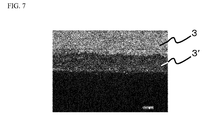
- this wiper blade rubber demonstrated poor wiping performance and a large coefficient of friction due to the worn out of coating layer and exposure of the rubber base material caused by the reduction of the solid lubricant content after use. It was assumed that the wiping performance of the coating layer formed by the coating agent of Comparative Example 2 was affected by the content of solid lubricant. In the photograph shown in FIG. 7 , the coating layer 3 of a wiper blade rubber provided with a coating layer formed by the coating agent of Comparative Example 2 had become worn, and it was ascertained that the worn portion 3' was present on the edge of the coating layer 3.
- Binders D-1 to D-7 are thermal crosslinking aqueous polycarbonate-based polyurethane resin dispersions.
- each of the aqueous polycarbonate-based polyurethane resin dispersions used in Binders D-1 to D-7 had a total of the content ratio of urethane bonds and the content ratio of urea bonds of 9.6% by weight to 16.7% by weight based on the solid contents thereof.
- the total of the content ratio of urethane bonds and the content ratio of urea bonds in an aqueous polycarbonate-based polyurethane resin dispersion can be measured according to the method indicated below.
- the viscosity of each of Binders D-1 to D-7 is also shown in Table 4.
- Respective films composed of each of Binder D-1 to D-7 were formed to a film thickness of 10 ⁇ m to 80 ⁇ m and width of 5 mm by drying or curing each of Binders D-1 to D-7.
- the films composed of each of Binder D-1 to D-7 were measured for tensile elasticity in compliance with JIS K7161-1 and measured for tensile strength and elongation in compliance with JIS K7311. The measurement results are shown in Table 4.
- aqueous An aqueous polycarbonate-based polyurethane resin dispersion was coated onto a glass plate and dried, 100 mg of the dried product was weighed out therefrom and dissolved in 0.75 mL of hexadeuterodimethyl sulfoxide together with a fixed amount of an external standard and the resultant mixture was subjected to 1 H-NMR measurement to calculate the total of the content ratio of urethane bonds and the content ratio of urea bonds of the aqueous polycarbonate-based polyurethane resin dispersion from the peaks observed in the 1 H-NMR measurement.
- the external standard a substance of which the peaks do not overlap with those of each of the aqueous polycarbonate-based polyurethane resins was selected each time out of typically used external standards.
- aqueous polycarbonate-based polyurethane resin dispersions Ube Industries, Ltd. containing 30% by weight of a non-crosslinking polycarbonate-based polyurethane resin as the solid content thereof based on the total weight (100% by weight) of the binder, and containing a dispersion medium consisting of water and N-methylpyrrolidone.
- Binders E-1 to E-4 are non-crosslinking aqueous polycarbonate-based polyurethane resin dispersions.
- each of the aqueous polycarbonate-based polyurethane resin dispersions used in Binders E-1 to E-4 had a total of the content ratio of urethane bonds and the content ratio of urea bonds of 10.6% by weight to 18.6% by weight based on the solid contents thereof.
- the viscosity of these binders E-1 to E-4 is also shown in Table 5.
- Films composed of each of Binder E-1 to E-4 were formed to a film thickness of 10 ⁇ m to 80 ⁇ m and width of 5 mm by drying or curing each of Binders E-1 to E-4.
- Binders E-1 to E-4 were measured for tensile elasticity in compliance with JIS K7161-1 and measured for tensile strength and elongation in compliance with JIS K7311. The measurement results are shown in Table 5.
- Binder D-1 D-2 D-3 D-4 D-5 D-6 D-7 Trade name TFK-004 TFK-011 TFK-002 TFK-001 TFK-005 TFK-006 TFE-007 Total of content ratio of urethane bonds and content ratio of urea bonds (based on solid content) wt % 9.6 11.0 10.7 15.2 16.0 16.0 16.7 Viscosity mPa ⁇ s 25 16.8 14.3 23.7 18.3 19.4 53.5 Film Tensile elasticity MPa 26 53 75 200 390 1090 1270 Tensile strength MPa 53.6 61.3 49.8 43.7 39.7 45.2 53.5 Elongation % 340 280 250 190 140 130 10 [Table 5] Binder E-1 E-2 E-3
- Example 2 Except that the coating agents of Example 2 were each produced by mixing Binder D-1, a solid lubricant and other materials using a homodisperser mixer while changing the weight ratio of the solid fraction of Binder D-1 to the solid lubricant to 1:1, 1:2, 1:3, 1:4, 1:5 or 1:6, the same procedures of the production method as in Example 1 were repeated.
- Each coating agent had the same formulation as in Example 1 with the exception of changing the weight ratio of the solid fraction of Binder D-1 to the solid lubricant, and thus, each coating agent contained 76.77 parts by weight of an aqueous medium (pure water) and a total of 23.23 parts by weight of Binder D-1 and solid lubricant.
- Wiper blade rubbers having a coating layer having a film thickness of 5 ⁇ m to 12 ⁇ m were produced in the same manner as in Example 1 with the exception of using each of the coating agents of Example 2.
- Examples 3 to 8 were produced in the same manner as in Example 2 with the exception of using Binders D-2 to D-7 and changing the weight ratio of the solid fraction of each of the Binders D-2 to D-7 to the solid lubricant to 1:1, 1:2, 1:3, 1:4, 1:5 or 1:6.
- Wiper blade rubber having a coating layer having a film thickness of 5 ⁇ m to 12 ⁇ m was produced in the same manner as in Example 1 with the exception of using these coating agents.
- coating agents of each example were produced in the same manner as Example 2 with the exception of using Binders E-1 to E-4 and changing the weight ratio of the solid fraction of each of the Binders E-1 to E-4 to the solid lubricant to 1:1, 1:2, 1:3, 1:4, 1:5 or 1:6.
- Wiper blade rubbers having a coating layer having a film thickness of 5 ⁇ m to 12 ⁇ m were produced in the same manner as in Example 1 with the exception of using these coating agents.
- the coating agents for wiper blade rubber of Examples 2 to 12 and wiper blade rubbers using each of these coating agents were measured for surface hardness, wiping evaluation (ordinary surface, water-repellent surface), coefficient of friction (initial, after endurance testing) and rate of change of coefficient of friction in the same manner as in Example 1.
- the results of Examples 2 to 8 using a binder containing a crosslinking polycarbonate-based polyurethane resin are shown in Table 6.
- the results of Examples 9 to 12 using a binder containing a non-crosslinking polycarbonate-based polyurethane resin are shown in Table 7.
- Example 2 Example 3 Example 4 Sample 5 Example 6 Example 7 Example E D-1 D-2 D-3 D-4 D-5 D-6 D-7 Surface hardness N/mm 2 5.05 5.66 10.90 13.66 15.03 17.27 20.04 Wiping evaluation (ordinary surface) Score 4-5 4 3-4 3-4 3 2-3 1 : 1* Wiping evaluation (water-repellent surface) Score 5 4-5 4 4 3-4 3 Coefficient of friction (initial) - 1.57 1.41 1.34 1.16 1.12 1.02 1.03 Coefficient of friction (after endurance testing) - 1.54 1.34 1.33 1.31 1.29 1.47 1.81 Rate of change of coefficient of friction Times 0.98 0.95 0.99 1.13 1.15 1.44 1.76 Surface hardness N/mm 2 4.01 5.08 9.71 12.59 13.24 14.03 15.21 Wiping evaluation (ordinary surface) Score 5 4-5 4 3-4 3-4 3 2-3 1:2* Wiping evaluation (water-repellent surface) Score 5 5 4-5 4 4 3-4 3 Coefficient of friction (initial) - 1.26 1.22 1.12 1.10 1.03 1
- the wiper blade rubbers using a coating agent comprising a binder containing a crosslinking polycarbonate-based polyurethane resin or non-crosslinking polycarbonate-based polyurethane resin, and a solid lubricant, demonstrated superior friction performance that permits maintaining low friction both initially and during use for extended periods, superior wiping performance that permits adequately inhibiting uneven wiping and wiping noise, and superior durability of inhibiting wear and the like.
- Each of the coating agents of Example 13 was produced in the same manner as in Example 2 with the exception of using Binder D-4 and mixing the Binder D-4, solid lubricant and other materials while changing the weight ratio of the solid fraction of Binder D-4 to the solid lubricant to 1:7 or 1:8.
- Wiper blade rubbers having a coating layer having a film thickness of 5 ⁇ m to 12 ⁇ m were produced in the same manner as in Example 1 with the exception of using each of these coating agents.
- Each of the coating agents of Example 14 was produced in the same manner as in Example 2 with the exception of using Binder E-3 and changing the weight ratio of the solid fraction of Binder E-3 to the solid lubricant to 1:7 or 1:8.
- Wiper blade rubbers having a coating layer having a film thickness of 5 ⁇ m to 12 ⁇ m were produced in the same manner as in Example 1 with the exception of using each of these coating agents.
- the coating agents for wiper blade rubber of Examples 13 and 14 and wiper blade rubbers using each of these coating agents were measured for surface hardness, wiping evaluation (ordinary surface, water-repellent surface), coefficient of friction (initial, after endurance testing) and rate of change of coefficient of friction in the same manner as in Example 1. The results are shown in Table 8.
- Example 13 Example 14 D-4 E-3 Surface hardness N/mm 2 2.89 2.91 Wiping evaluation (ordinary surface) Score 5 5 1:7* Wiping evaluation (water-repellent surface) Score 5 5 Coefficient of friction (initial) - 0.95 1.29 Coefficient of friction (after endurance testing) - 1.37 1.98 Rate of change of coefficient of friction Times 1.44 1.53 Surface hardness N/mm 2 2.88 2.9 Wiping evaluation (ordinary surface) Score 5 5 1:8* Wiping evaluation (water-repellent surface) Score 5 5 Coefficient of friction (initial) - 0.94 1.33 Coefficient of friction (after endurance testing) - 1.81 2.27 Rate of change of coefficient of friction Times 1.92 1.71 *Ratio of binder solid fraction: solid lubricant
- the wiper blade rubbers using a coating agent comprising a binder containing a crosslinking polycarbonate-based polyurethane resin or non-crosslinking polycarbonate-based polyurethane resin, and a solid lubricant, demonstrate superior friction performance that permits maintaining low friction both initially and during use for extended periods, superior wiping performance that permits adequately inhibiting uneven wiping and wiping noise, and superior durability of inhibiting wear and the like, even in the case of such a high content of solid lubricant that the ratio of binder solid fraction to solid lubricant in the coating agent is 1:7 or 1:8.
- Examples 13 and 14 which had such a high content of solid lubricant that the weight ratio of binder solid fraction to solid lubricant in the coating agents was 1:7 or 1:8, showed a rate of change in coefficient of friction of higher than 1.2 times, a tendency of poorly keeping a low friction and a slightly reduced durability in comparison with Examples 2 to 8 and Examples 9 to 12.
- Binder F The following two aqueous polycarbonate-based polyurethane resin dispersions were used for Binder F.
- aqueous polycarbonate-based polyurethane resin dispersion (Eternacoll® UW-1501F, Ube Industries, Ltd.) containing 30% by weight as the solid content thereof of a thermal crosslinking polycarbonate-based polyurethane resin based on 100% by weight of the resin dispersion, and a dispersion medium consisting of water and N-methylpyrrolidone.
- aqueous polycarbonate-based polyurethane resin dispersion (Eternacoll® UW-5002, Ube Industries, Ltd.) containing 30% by weight as the solid content thereof of a non-crosslinking polycarbonate-based polyurethane resin based on 100% by weight of the resin dispersion, and a dispersion medium consisting of water and N-methylpyrrolidone.
- Binder F was produced by mixing the two aqueous polycarbonate-based polyurethane resin dispersions f-1 and f-2 so that tensile elasticity, determined in compliance with JIS K7161-1 of a film composed of Binder F having a film thickness of 10 ⁇ m to 80 ⁇ m and a width of 5 mm, was 300 MPa.
- the solid content of Binder F was 30% by weight.
- the viscosity of Binder F was measured.
- a film composed of Binder F having a film thickness of 10 ⁇ m to 80 ⁇ m and a width of 5 mm was formed by drying or curing the Binder F.
- the film composed of Binder F was measured for tensile elasticity in compliance with JIS K7161-1 and measured for tensile strength and elasticity in compliance with JIS K7311. The measurement results are shown in Table 9.
- Example 15 The coating agent of Example 15 was produced in the same manner as in Example 2 with the exception of using Binder F and changing the weight ratio of the solid fraction of Binder F to the solid lubricant to 1:4.
- a wiper blade rubber having a coating layer having a film thickness of 5 ⁇ m to 12 ⁇ m was produced in the same manner as in Example 1 with the exception of using these coating agents.
- Example 15 The coating agent for wiper blade rubber of Example 15 and wiper blade rubber using this coating agent were measured for surface hardness, wiping evaluation (ordinary surface, water-repellent surface), coefficient of friction (initial, after endurance testing) and rate of change of coefficient of friction in the same manner as in Example 1.
- the results of Example 15 using a binder containing a crosslinking polycarbonate-based polyurethane resin and a non-crosslinking polycarbonate-based polyurethane resin are shown in Table 9.
- a wiper blade rubber that uses a coating agent comprising a binder containing a crosslinking polycarbonate-based polyurethane resin and a non-crosslinking polycarbonate-based polyurethane resin, and a solid lubricant, demonstrates superior friction performance that permits maintaining low friction both initially and during use for extended periods, superior wiping performance that permits adequately inhibiting uneven wiping and wiping noise, and superior durability of inhibiting wear and the like.
- a coating agent for wiper blade rubber which demonstrates superior friction performance that permits maintaining a low level of friction both initially and during use for extended periods, superior wiping performance that permits adequately inhibiting uneven wiping and wiping noise, and superior durability of inhibiting wear, and a wiper blade rubber that uses that coating agent, can be provided. Therefore, the present invention is industrially useful.
Landscapes
- Chemical & Material Sciences (AREA)
- Organic Chemistry (AREA)
- Engineering & Computer Science (AREA)
- Life Sciences & Earth Sciences (AREA)
- Wood Science & Technology (AREA)
- Materials Engineering (AREA)
- Chemical Kinetics & Catalysis (AREA)
- Polymers & Plastics (AREA)
- Health & Medical Sciences (AREA)
- Medicinal Chemistry (AREA)
- Mechanical Engineering (AREA)
- Nanotechnology (AREA)
- General Chemical & Material Sciences (AREA)
- Oil, Petroleum & Natural Gas (AREA)
- Paints Or Removers (AREA)
- Lubricants (AREA)
- Coating Of Shaped Articles Made Of Macromolecular Substances (AREA)
- Adhesives Or Adhesive Processes (AREA)
Applications Claiming Priority (2)
| Application Number | Priority Date | Filing Date | Title |
|---|---|---|---|
| JP2013245251 | 2013-11-27 | ||
| PCT/JP2014/081380 WO2015080202A1 (fr) | 2013-11-27 | 2014-11-27 | Agent de revêtement pour caoutchouc de balai d'essuie-glace, et caoutchouc de balai d'essuie-glace l'utilisant |
Publications (2)
| Publication Number | Publication Date |
|---|---|
| EP3075802A1 true EP3075802A1 (fr) | 2016-10-05 |
| EP3075802A4 EP3075802A4 (fr) | 2017-07-26 |
Family
ID=53199139
Family Applications (1)
| Application Number | Title | Priority Date | Filing Date |
|---|---|---|---|
| EP14866551.6A Withdrawn EP3075802A4 (fr) | 2013-11-27 | 2014-11-27 | Agent de revêtement pour caoutchouc de balai d'essuie-glace, et caoutchouc de balai d'essuie-glace l'utilisant |
Country Status (6)
| Country | Link |
|---|---|
| US (1) | US10071711B2 (fr) |
| EP (1) | EP3075802A4 (fr) |
| JP (1) | JP6482472B2 (fr) |
| KR (1) | KR20160090788A (fr) |
| CN (1) | CN105793369B (fr) |
| WO (1) | WO2015080202A1 (fr) |
Cited By (1)
| Publication number | Priority date | Publication date | Assignee | Title |
|---|---|---|---|---|
| WO2019002335A1 (fr) * | 2017-06-28 | 2019-01-03 | Robert Bosch Gmbh | Caoutchouc d'essuie-glace doté d'une épaisseur de revêtement optimisée |
Families Citing this family (5)
| Publication number | Priority date | Publication date | Assignee | Title |
|---|---|---|---|---|
| WO2018030084A1 (fr) * | 2016-08-09 | 2018-02-15 | アスモ株式会社 | Caoutchouc de balai d'essuie-glace |
| JP7140679B2 (ja) * | 2016-08-09 | 2022-09-21 | 株式会社フコク | ワイパーブレードラバー |
| US10946837B2 (en) | 2016-08-09 | 2021-03-16 | Fukoku Co., Ltd. | Wiper blade rubber |
| JP7182445B2 (ja) * | 2018-12-11 | 2022-12-02 | 株式会社フコク | ワイパーブレードゴム用コーティング剤 |
| CN112680084A (zh) * | 2020-12-29 | 2021-04-20 | 广东花王涂料有限公司 | 一种水性木器漆及其制备方法 |
Family Cites Families (11)
| Publication number | Priority date | Publication date | Assignee | Title |
|---|---|---|---|---|
| JPH1095314A (ja) * | 1996-09-20 | 1998-04-14 | Ntn Corp | ワイパーブレードおよびその製造方法 |
| DE19945848A1 (de) | 1999-09-24 | 2001-04-05 | Henkel Kgaa | Beschichtungsmittel für Elastomere |
| JP3821634B2 (ja) | 2000-07-05 | 2006-09-13 | 株式会社デンソー | ワイパーブレードゴム用コーティング剤及びワイパーブレードゴム |
| JP4073686B2 (ja) * | 2002-03-05 | 2008-04-09 | アクロス株式会社 | コーティング組成物およびワイパーブレード |
| DE10226752A1 (de) | 2002-06-14 | 2004-01-08 | Robert Bosch Gmbh | Wischblatt für Scheibenwischer und Verfahren zur Herstellung desselben |
| CN101348687B (zh) * | 2007-07-18 | 2010-12-08 | 比亚迪股份有限公司 | 一种涂料及其制备方法 |
| DE102008000928A1 (de) * | 2008-04-02 | 2009-10-08 | Robert Bosch Gmbh | Beschichtung für elastomere strangförmige Profile, insbesondere Scheibenwischerblätter, und Verfahren zu deren Herstellung |
| EP2468824A4 (fr) | 2009-08-21 | 2013-02-13 | Dow Corning Toray Co Ltd | Compositions de revêtement pour éléments coulissants |
| JP6187465B2 (ja) | 2012-09-06 | 2017-08-30 | 宇部興産株式会社 | ゴム積層体及びその製造方法 |
| JP6171618B2 (ja) * | 2013-06-24 | 2017-08-02 | 宇部興産株式会社 | 光及び熱硬化性水性樹脂分散体及びエラストマー積層体 |
| JP6297795B2 (ja) | 2013-06-24 | 2018-03-20 | 東レ・ダウコーニング株式会社 | 潤滑被膜用塗料組成物 |
-
2014
- 2014-11-27 US US15/025,845 patent/US10071711B2/en not_active Expired - Fee Related
- 2014-11-27 WO PCT/JP2014/081380 patent/WO2015080202A1/fr not_active Ceased
- 2014-11-27 JP JP2015550989A patent/JP6482472B2/ja active Active
- 2014-11-27 CN CN201480054045.5A patent/CN105793369B/zh not_active Expired - Fee Related
- 2014-11-27 KR KR1020167008188A patent/KR20160090788A/ko not_active Ceased
- 2014-11-27 EP EP14866551.6A patent/EP3075802A4/fr not_active Withdrawn
Cited By (1)
| Publication number | Priority date | Publication date | Assignee | Title |
|---|---|---|---|---|
| WO2019002335A1 (fr) * | 2017-06-28 | 2019-01-03 | Robert Bosch Gmbh | Caoutchouc d'essuie-glace doté d'une épaisseur de revêtement optimisée |
Also Published As
| Publication number | Publication date |
|---|---|
| EP3075802A4 (fr) | 2017-07-26 |
| US10071711B2 (en) | 2018-09-11 |
| US20160272158A1 (en) | 2016-09-22 |
| WO2015080202A1 (fr) | 2015-06-04 |
| CN105793369B (zh) | 2019-09-27 |
| CN105793369A (zh) | 2016-07-20 |
| JP6482472B2 (ja) | 2019-03-13 |
| KR20160090788A (ko) | 2016-08-01 |
| JPWO2015080202A1 (ja) | 2017-03-16 |
Similar Documents
| Publication | Publication Date | Title |
|---|---|---|
| US10071711B2 (en) | Coating agent for wiper blade rubber and wiper blade rubber using same | |
| KR100497791B1 (ko) | 와이퍼 블레이드 러버용 코팅제 및 그를 구비한 와이퍼블레이드 러버 | |
| DE102008000928A1 (de) | Beschichtung für elastomere strangförmige Profile, insbesondere Scheibenwischerblätter, und Verfahren zu deren Herstellung | |
| EP1059213A2 (fr) | Balai d'essuie-glace à base de caoutchouc de silicone pour vitres de véhicule | |
| KR20030011870A (ko) | 마찰방지 코팅 조성물, 마찰방지 코팅 및 윈드실드 와이퍼블레이드 같은 탄성중합체를 코팅하기 위한 방법 | |
| US11247639B2 (en) | Wiper blade rubber | |
| CN101368020B (zh) | 涂敷雨刮器橡胶的组合物、涂敷方法及所制的雨刮器橡胶 | |
| EP4349501A1 (fr) | Élément de nettoyage et élément élastique | |
| JP5531270B2 (ja) | ワイパー | |
| JP2019064281A (ja) | ワイパーブレードゴム | |
| KR100314514B1 (ko) | 고체 윤활제 조성물 및 이 조성물로 코팅된 차량용 와이퍼 블레이드 | |
| JP6881456B2 (ja) | ワイパーブレードラバー | |
| FR2977258A1 (fr) | Composition de renovation d'un organe d'essuyage | |
| JP2012131844A (ja) | ワイパー用ゴム組成物、およびその製造方法 | |
| DE102019007227A1 (de) | Chemisch-mechanisches polierkissen und polierverfahren | |
| KR102798712B1 (ko) | 와이퍼 블레이드용 코팅 조성물, 이의 제조방법 및 이를 이용하여 코팅한 와이퍼 블레이드 | |
| JPH1024803A (ja) | ワイパーブレードラバー | |
| US20250313679A1 (en) | Regeneration method of blade rubber and manufacturing method of regenerated blade rubber | |
| KR101845444B1 (ko) | 와이퍼 블레이드용 코팅 조성물 | |
| Roberts | Studies of lubricated rubber friction: Part 2: Optical techniques applied to practical problems | |
| US20190176764A1 (en) | Rubber wiper blade element with friction reducing agent that continuously migrates to the surface | |
| JP2004331831A (ja) | ブレードラバー | |
| JP2004050974A (ja) | ワイパーブレード | |
| KR20050031474A (ko) | 자동차의 글래스 런 채널용 불소코팅재 조성물 | |
| KR20120093661A (ko) | 차량용 와이퍼 블레이드 |
Legal Events
| Date | Code | Title | Description |
|---|---|---|---|
| PUAI | Public reference made under article 153(3) epc to a published international application that has entered the european phase |
Free format text: ORIGINAL CODE: 0009012 |
|
| 17P | Request for examination filed |
Effective date: 20160331 |
|
| AK | Designated contracting states |
Kind code of ref document: A1 Designated state(s): AL AT BE BG CH CY CZ DE DK EE ES FI FR GB GR HR HU IE IS IT LI LT LU LV MC MK MT NL NO PL PT RO RS SE SI SK SM TR |
|
| AX | Request for extension of the european patent |
Extension state: BA ME |
|
| DAX | Request for extension of the european patent (deleted) | ||
| A4 | Supplementary search report drawn up and despatched |
Effective date: 20170622 |
|
| RIC1 | Information provided on ipc code assigned before grant |
Ipc: C08K 3/04 20060101ALI20170616BHEP Ipc: C09D 5/00 20060101ALI20170616BHEP Ipc: C08G 18/44 20060101ALI20170616BHEP Ipc: C09D 175/06 20060101ALI20170616BHEP Ipc: C09D 7/12 20060101ALI20170616BHEP Ipc: C08J 7/04 20060101ALI20170616BHEP Ipc: C10M 103/02 20060101ALI20170616BHEP Ipc: B60S 1/38 20060101AFI20170616BHEP |
|
| STAA | Information on the status of an ep patent application or granted ep patent |
Free format text: STATUS: EXAMINATION IS IN PROGRESS |
|
| 17Q | First examination report despatched |
Effective date: 20190618 |
|
| STAA | Information on the status of an ep patent application or granted ep patent |
Free format text: STATUS: THE APPLICATION IS DEEMED TO BE WITHDRAWN |
|
| 18D | Application deemed to be withdrawn |
Effective date: 20210601 |