EP3076743A1 - Procédé, dispositif et système de transmission de données - Google Patents
Procédé, dispositif et système de transmission de données Download PDFInfo
- Publication number
- EP3076743A1 EP3076743A1 EP13900151.5A EP13900151A EP3076743A1 EP 3076743 A1 EP3076743 A1 EP 3076743A1 EP 13900151 A EP13900151 A EP 13900151A EP 3076743 A1 EP3076743 A1 EP 3076743A1
- Authority
- EP
- European Patent Office
- Prior art keywords
- data
- data packets
- transition
- module
- transition module
- Prior art date
- Legal status (The legal status is an assumption and is not a legal conclusion. Google has not performed a legal analysis and makes no representation as to the accuracy of the status listed.)
- Granted
Links
Images


Classifications
-
- H—ELECTRICITY
- H04—ELECTRIC COMMUNICATION TECHNIQUE
- H04W—WIRELESS COMMUNICATION NETWORKS
- H04W72/00—Local resource management
- H04W72/12—Wireless traffic scheduling
- H04W72/1263—Mapping of traffic onto schedule, e.g. scheduled allocation or multiplexing of flows
- H04W72/1273—Mapping of traffic onto schedule, e.g. scheduled allocation or multiplexing of flows of downlink data flows
-
- H—ELECTRICITY
- H04—ELECTRIC COMMUNICATION TECHNIQUE
- H04W—WIRELESS COMMUNICATION NETWORKS
- H04W72/00—Local resource management
- H04W72/20—Control channels or signalling for resource management
-
- H—ELECTRICITY
- H04—ELECTRIC COMMUNICATION TECHNIQUE
- H04L—TRANSMISSION OF DIGITAL INFORMATION, e.g. TELEGRAPHIC COMMUNICATION
- H04L5/00—Arrangements affording multiple use of the transmission path
-
- H—ELECTRICITY
- H04—ELECTRIC COMMUNICATION TECHNIQUE
- H04W—WIRELESS COMMUNICATION NETWORKS
- H04W28/00—Network traffic management; Network resource management
- H04W28/02—Traffic management, e.g. flow control or congestion control
- H04W28/06—Optimizing the usage of the radio link, e.g. header compression, information sizing, discarding information
- H04W28/065—Optimizing the usage of the radio link, e.g. header compression, information sizing, discarding information using assembly or disassembly of packets
-
- H—ELECTRICITY
- H04—ELECTRIC COMMUNICATION TECHNIQUE
- H04W—WIRELESS COMMUNICATION NETWORKS
- H04W72/00—Local resource management
- H04W72/04—Wireless resource allocation
- H04W72/044—Wireless resource allocation based on the type of the allocated resource
- H04W72/0453—Resources in frequency domain, e.g. a carrier in FDMA
-
- H—ELECTRICITY
- H04—ELECTRIC COMMUNICATION TECHNIQUE
- H04W—WIRELESS COMMUNICATION NETWORKS
- H04W72/00—Local resource management
- H04W72/12—Wireless traffic scheduling
- H04W72/1263—Mapping of traffic onto schedule, e.g. scheduled allocation or multiplexing of flows
-
- H—ELECTRICITY
- H04—ELECTRIC COMMUNICATION TECHNIQUE
- H04W—WIRELESS COMMUNICATION NETWORKS
- H04W80/00—Wireless network protocols or protocol adaptations to wireless operation
-
- H—ELECTRICITY
- H04—ELECTRIC COMMUNICATION TECHNIQUE
- H04L—TRANSMISSION OF DIGITAL INFORMATION, e.g. TELEGRAPHIC COMMUNICATION
- H04L5/00—Arrangements affording multiple use of the transmission path
- H04L5/003—Arrangements for allocating sub-channels of the transmission path
- H04L5/0032—Distributed allocation, i.e. involving a plurality of allocating devices, each making partial allocation
- H04L5/0035—Resource allocation in a cooperative multipoint environment
-
- H—ELECTRICITY
- H04—ELECTRIC COMMUNICATION TECHNIQUE
- H04W—WIRELESS COMMUNICATION NETWORKS
- H04W84/00—Network topologies
- H04W84/02—Hierarchically pre-organised networks, e.g. paging networks, cellular networks, WLAN [Wireless Local Area Network] or WLL [Wireless Local Loop]
- H04W84/04—Large scale networks; Deep hierarchical networks
- H04W84/042—Public Land Mobile systems, e.g. cellular systems
-
- H—ELECTRICITY
- H04—ELECTRIC COMMUNICATION TECHNIQUE
- H04W—WIRELESS COMMUNICATION NETWORKS
- H04W92/00—Interfaces specially adapted for wireless communication networks
- H04W92/16—Interfaces between hierarchically similar devices
- H04W92/20—Interfaces between hierarchically similar devices between access points
Definitions
- the present invention relates to the field of mobile communications technologies, and in particular, to a data transmission method, device, and system.
- Carrier Aggregation Carrier Aggregation, CA for short
- CA Carrier Aggregation
- 3GPP R10 3GPP R10
- multi-carrier joint scheduling processing is implemented.
- real-time transmission from a radio link control RLC layer to a Media Access Control MAC layer is generally required to be completed within 100 us (microseconds), and therefore relatively high interface bandwidth is required.
- All currently existing CA solutions are implemented inside a base station, and it is difficult to deploy inter-site CA and inter-board CA because of an interface bandwidth bottleneck.
- data transmission bandwidth that can be provided by an inter-base station interface is 1 Gbps
- the inter-base station interface bandwidth when data is being transmitted is generally greater than 1 Gbps, and therefore inter-site CA deployment cannot be implemented.
- data is transmitted from a Packet Data Convergence Protocol layer (Packet Data Convergence Protocol, PDCP for short) to an RLC layer at a low speed.
- Packet Data Convergence Protocol Packet Data Convergence Protocol
- the data is transmitted to all MAC layers for at a high speed, and generally the data is limited to be transmitted within 100 us; therefore, a requirement for inter-board interface bandwidth is relatively high.
- Payload (payload) data is 300 kb, and in an inter-board Intra-siteCA solution, transmission from the RLC layer to all the MAC layers is limited to be completed within 100 us.
- inter-board bandwidth that can be provided for data transmission is 1Gbps. It can be seen that the inter-board interface bandwidth is greater than the inter-board bandwidth that can be provided for data transmission, and inter-board CA deployment cannot be implemented.
- Embodiments of the present invention provide a data transmission method, device, and system, which are configured to resolve a problem in which it is difficult to implement a CA technology because relatively high interface bandwidth is required when a CA technology is used between devices.
- a data transmission system includes a first device and a second device, where the first device is configured to serve a primary carrier of user equipment, and the first device includes: a first unit that is configured to process an RLC layer, a second unit that is configured to process a MAC layer, a third unit that is configured to process a PDCP layer, and a first scheduling unit, where the first unit includes a first control module and a first transition module; the second device is configured to serve a secondary carrier of the user equipment, and the second device includes a fourth unit that is configured to process the RLC layer, a fifth unit that is configured to process the MAC layer, and a second scheduling unit, where the fourth unit includes a second transition module; the first scheduling unit is configured to send first scheduling information to all transition modules in the system, and the first scheduling information includes scheduling information of the primary carrier; the second scheduling unit is configured to send second scheduling information to all the transition modules in the system, and the second scheduling information includes scheduling information of the secondary carrier; the first control
- a data transmission device configured to serve a primary carrier of user equipment, and the data transmission device includes:
- a data transmission method is provided, where the data transmission method is applied to a data transmission device, where: the data transmission device is configured to serve a primary carrier of user equipment, and the data transmission device includes: a first unit that is configured to process an RLC layer, a second unit that is configured to process a MAC layer, a third unit that is configured to process a PDCP layer, and a first scheduling unit, where the first unit includes a first control module and a first transition module; and the method includes:
- the method further includes:
- a second possible implementation manner of the third aspect is further provided, where the first scheduling information includes information that is used to indicate a quantity M1 of data packets that need to be transmitted on the primary carrier, and the first transition module is specifically configured to acquire the M1 data packets from the N data packets.
- a third possible implementation manner of the third aspect is further provided, where the first scheduling information further includes a first location or information used to calculate the first location, where the first location is a location of the data packet that needs to be transmitted on the primary carrier in the N data packets; and the first transition module is specifically configured to acquire, from the N data packets, the M1 data packets indicated by the first location.
- a fourth possible implementation manner of the third aspect is further provided, where the first location includes an initial location of the M1 data packets in the N data packets; and the information used to calculate the first location includes a quantity of data packets that precede the M1 data packets in the N data packets.
- a fifth possible implementation manner of the third aspect is further provided, where the method further includes:
- a sixth possible implementation manner of the third aspect is further provided, where receiving, by the first control module, a completion message from all the transition modules in the data transmission device, and sending a synchronization message as a response to the received completion message, where the completion message is used to indicate that a transition module that sends the completion message has completed receiving of the N data packets of the data, and the synchronization message is used to instruct all the transition modules in the system to complete receiving of the N data packets of the data.
- a seventh possible implementation manner of the third aspect is further provided, where the method further includes:
- an eighth possible implementation manner of the third aspect is further provided, where the method further includes:
- a ninth possible implementation manner of the third aspect is further provided, where the method further includes:
- a tenth possible implementation manner of the third aspect is further provided, where the method further includes:
- an eleventh possible implementation manner of the third aspect is further provided, where the data transmission device is a base station or a backplane in a base station.
- Embodiments of the present invention provide a data transmission method, device, and system.
- a first control module and a first transition module are disposed in a first unit and a second transition module is disposed in a fourth unit; in this case, a third unit sends data to the first control module, the first control module sends the data to the first transition module and the second transition module, then the first transition module acquires, from the data, a data packet that is transmitted on a primary carrier and sends the data packet to a second unit, and then the second transition module acquires, from the data, a data packet that is transmitted on a secondary carrier and sends the data packet to a fifth unit.
- a process in which the first transition module sends a data packet to the second unit is also a process in which the data packet is transmitted from an RLC layer of the first device to a MAC layer of the first device, and the process is not limited by inter-board interface bandwidth; and a process in which the second transition module sends a data packet to the fifth unit is also a process in which the data packet is transmitted from an RLC layer of the second device to a MAC layer of the second device, and the process is not limited by inter-device interface bandwidth, which avoids a limitation imposed by the inter-device interface bandwidth.
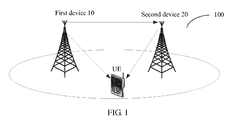
- an embodiment of the present invention provides a data transmission system 100, and the system includes a first device 10 and a second device 20.
- a user uses user equipment (User Equipment, UE for short) to communicate with all base stations, so as to receive required data.
- the first device 10 may be a first base station
- the second device 20 may be a second base station
- the first base station sends data required by the user to the UE
- the second base station acquires the data from the first base station and sends the data required by the user to the UE.
- the first device 10 and the second device 20 may simultaneously send same data to the UE, so as to implement CA.
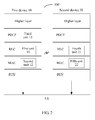
- the first device 10 and the second device 20 included by the system may serve same UE, and a protocol stack separately included by each are similar.
- the first device 10 serves a primary carrier of the UE, and the first device includes: a physical (Physical, PHY for short) layer, an RLC layer that is above the PHY layer, a PDCP layer that is above the RLC layer, and a higher layer that is above the PDCP layer, a first unit 11 that is configured to process the RLC layer, a second unit 12 that is configured to process the MAC layer, and a third unit 13 that is configured to process the PDCP layer, where the third unit 13 acquires data from the higher layer.
- a physical (Physical, PHY for short) layer an RLC layer that is above the PHY layer
- a PDCP layer that is above the RLC layer
- a higher layer that is above the PDCP layer
- a first unit 11 that is configured to process the RLC layer
- a second unit 12 that is configured to process the
- the second device 20 is configured to serve a secondary carrier of the UE, and the second device 20 includes: a PHY physical layer, an RLC layer that is above the PHY layer, a PDCP layer that is above the RLC layer, a higher layer that is above the PDCP layer, a fourth unit 21 that is configured to process the RLC layer, and a fifth unit 22 that is configured to process the MAC layer.
- first device 10 and the second device 20 may be two base stations or may be two backplanes in a base station.
- the first unit 11 includes a first control module 111 and a first transition module 112; the fourth unit 21 includes a second transition module 211.
- the first device 10 further includes a first scheduling unit 14, where the first scheduling unit 14 is configured to send first scheduling information to all transition modules in the system, and the first scheduling information includes scheduling information of the primary carrier; and the second device 20 further includes a second scheduling unit 23, where the second scheduling unit 23 is configured to send second scheduling information to all the transition modules in the system, and the second scheduling information includes scheduling information of the secondary carrier.
- the first scheduling unit 14 is disposed for the first transition module 112
- the second scheduling unit 23 is disposed for the second transition module 211, which ensures that all transition modules can quickly acquire the scheduling information, so as to quickly acquire a data packet transmitted on a carrier.
- the first control module 111 receives data from the third unit 13, groups the data into N data packets, and sends the N data packets to all the transition modules in the system.
- the first transition module 112 receives the N data packets and scheduling information sent by all scheduling units in the system, acquires, according to all or a part of the received scheduling information and from the N data packets, a data packet that needs to be transmitted on the primary carrier, and sends the data packet acquired by the first transition module 112 to the second unit 12.
- the second transition module 211 receives the N data packets and the scheduling information sent by all the scheduling units in the system, acquires, according to all or a part of the received scheduling information and from the N data packets, a data packet that needs to be transmitted on the secondary carrier, and sends the data packet acquired by the second transition module to the fifth unit 22.
- a data transmission method includes the following steps 401 to 412:
- the first control module 111 receives data from the third unit 13.
- the first control module 111 determines whether the data is the same as data sent to all transition modules; and when a result of the determining is yes, groups the data into N data packets; or after receiving the data, the first control module receives new data from the third unit and determines whether the new data is the same as data sent to all transition modules in the method; and when a result of the determining is no, waits until data sent next time is received.
- Step 402 ensures that data sent to all the transition modules each time is updated data.
- the first control module 111 sends the N data packets to the first transition module 112 and the second transition module 211.
- the first control module 111 After sending the N data packets, the first control module 111 requests the first transition module 112 and the second transition module 211 for synchronization with the first control module 111, and sends a data caching queue status to the first transition module 112 and the second transition module 211, where the data caching queue status is used to indicate that a quantity of the data packets sent by the first control module 111 is N.
- the first transition module 112 learns, from the first control module 111, that the first control module requests for synchronization, and receives the data caching queue status.
- the second transition module 211 learns, from the first control module 111, that the first control module requests for synchronization, and receives the data caching queue status.
- the first transition module 112 determines whether a quantity of the data packets received by the first transition module 112 is N. If a result of the determining is yes, 406 is performed; or if a result of the determining is no, 407 is performed.
- the second transition module 211 determines whether a quantity of the data packets received by the second transition module 211 is N. If a result of the determining is yes, 406 is performed; or if a result of the determining is no, 407 is performed.
- the first transition module 112 sends the completion message to the first control module 111; and the second transition module 211 sends the completion message to the first control module 111.
- the first transition module 112 continues to receive the data from the first control module 111 until it is determined that a quantity of data packets received by the first transition module 112 is N, and sends the completion message to the first control module 111.
- the second transition module 211 continues to receive the data from the first control module 111 until it is determined that a quantity of data packets received by the second transition module 211 is N, and sends the completion message to the first control module 111.
- the first control module 111 sends the synchronization message to the first transition module 112 and the second transition module 211 as a response to the received completion message.
- the first transition module 112 and the second transition module 211 complete receiving of the N data packets.
- steps 409 to 412 are mainly used to implement acquiring of a data packet transmitted on a carrier.
- the first transition module 112 sends a scheduling request to the first scheduling unit 14.
- the second transition module 211 sends a scheduling request to the second scheduling unit 23.
- different scheduling units may be disposed for each transition module, or all transition modules share one scheduling unit.
- configuring a scheduling module for each transition module can ensure fast implementation of a process of acquiring scheduling information, and therefore ensures that all transition modules concurrently start, by using the scheduling information, a process of acquiring the data packets transmitted on the carrier.
- the first scheduling unit 14 sends first scheduling information to the first transition module 112 and/or the second transition module 211 in the data transmission device.
- the second scheduling unit 23 sends second scheduling information to the second transition module 211 and/or the first transition module 112.
- the first transition module 112 acquires M1 data packets from the N data packets; and the second transition module 211 acquires M2 data packets from the N data packets.
- That the first transition module 112 acquires the M1 data packets from the N data packets may be completed by using the following implementation manner 1 and implementation manner 2.
- Implementation manner 1 In a case in which the first scheduling information includes information that is used to indicate a quantity M1 of data packets that need to be transmitted on the primary carrier, the first transition module 112 acquires the M1 data packets from the N data packets.
- the first scheduling information includes a first location or information used to calculate the first location, where the first location is a location of the data packet that needs to be transmitted on the primary carrier in the N data packets.
- the first transition module 112 acquires, from the N data packets, the M1 data packets indicated by the first location. In this way, the first transition module 112 may directly find, according to the first location, the M1 data packets from the N data packets.
- the first location includes an initial location of the M1 data packets in the N data packets.
- the information used to calculate the first location includes a quantity of data packets that precede the M1 data packets in the N data packets.
- the first transition module 112 determines the first location according to the information used to calculate the first location.
- the first transition module 112 acquires a total quantity of data packets in scheduling information corresponding to all the transition modules that precede M1 data blocks required by the first transition module 112, and acquires the M1 data packets starting from a first data packet after the data packets of the total quantity. Specifically, if M2 data packets required by the second transition module precede the M1 data packets required by the first transition module 112, the first transition module 112 calculates the initial location as M2+1 according to the second scheduling information and acquires the M1 data packets according to the first scheduling information.
- the first transition module 112 acquires, according to the first scheduling information, the M1 data packets starting from a first data packet of the N data packets.
- each transition module in a case in which information such as storage information is used to determine that a data block required by the transition module itself precedes another transition module, only scheduling information related to the transition module itself needs to be acquired in a scheduling information acquiring process, and no other scheduling information needs to be acquired.
- That the second transition module 211 acquires the M2 data packets from the N data packets may be specifically completed by using the following implementation manner 1 and implementation manner 2.
- Implementation manner 1 In a case in which the second scheduling information includes information that is used to indicate a quantity M2 of data packets that need to be transmitted on the secondary carrier, the second transition module 211 acquires the M2 data packets from the N data packets.
- the second scheduling information includes a second location or information used to calculate the second location, where the second location is a location of the data packet that needs to be transmitted on the secondary carrier in the N data packets, and the second transition module is specifically configured to acquire, from the N data packets, the M2 data packets indicated by the second location. In this way, the second transition module may directly find, according to the second location, the M2 data packets from the N data packets.
- the second location includes an initial location of the M2 data packets in N data packets; and the information used to calculate the second location includes a quantity of data packets that precede the M2 data packets in the N data packets.
- the second transition module 211 determines the second location according to the information used to calculate the second location.
- the first transition module 112 sends the acquired M1 data packets to the second unit 12; and the second transition module 211 sends the acquired M2 data packets to the fifth unit 22.
- first transition modules may be disposed in the first device 10 of the data transmission system of the present invention, and multiple second transition modules may be disposed in the second device 20.
- first transition module 113 is further disposed in the first unit 11
- second transition module 212 is further disposed in the fourth unit 21.
- the first control module 111 requests the first transition module 112, the second transition module 211, the first transition module 113, and the second transition module 212 for synchronization with the first control module 111, and sends a data caching queue status to the first transition module 112, the second transition module 211, the first transition module 113, and the second transition module 212, where the data caching queue status is used to indicate that a quantity of the data packets sent by the first control module 111 is N.
- the foregoing step 405 further includes: learning, by the first transition module 113 from the first control module 111, that the first control module requests for synchronization, and receiving the data caching queue status; and learning, by the second transition module 212 from the first control module 111, that the first control module requests for synchronization, and receiving the data caching queue status.
- the first transition module 113 determines whether a quantity of the data packets received by the first transition module 113 is N. If a result of the determining is yes, 406 is performed; or if a result of the determining is no, 407 is performed.
- the second transition module 212 determines whether a quantity of the data packets received by the second transition module 212 is N. If a result of the determining is yes, 406 is performed; or if a result of the determining is no, 407 is performed.
- the foregoing step 406 further includes: sending, by the first transition module 113, the completion message to the first control module 111; and sending, by the second transition module 212, the completion message to the first control module 111.
- the foregoing step 407 further includes: continuing to receive, by the first transition module 113, the data from the first control module 111 until it is determined that a quantity of data packets received by the first transition module 113is N, and sending the completion message to the first control module 111; and continuing to receive, by the second transition module 212, the data from the first control module 111 until it is determined that a quantity of data packets received by the second transition module 212 is N, and sending the completion message to the first control module 111.
- the first control module 111 sends a synchronization message to the first transition module 112, the second transition module 211, the first transition module 113, and the second transition module 212 as a response to the received completion message.
- the first transition module 113 and the second transition module 212 implement receiving of the N data packets.
- the foregoing step 409 further includes: sending, by the first transition module 113, a scheduling request to the first scheduling unit 15; and sending, by the second transition module 212, a scheduling request to the second scheduling unit 24.
- the first scheduling unit 14 sends the first scheduling information to the first transition module 112, the first transition module 113, the second transition module 211, and the second transition module 212.
- the first scheduling unit 15 sends the first scheduling information to the first transition module 112, the first transition module 113, the second transition module 211, and the second transition module 212.
- the second scheduling unit 23 sends the first scheduling information and sends the second scheduling information to the first transition module 112, the first transition module 113, the second transition module 211, and the second transition module 212.
- the second scheduling unit 24 sends the first scheduling information and sends the second scheduling information to the first transition module 112, the first transition module 113, the second transition module 211, and the second transition module 212.
- the first transition module 113 and the second transition module 212 complete, by using the scheduling information, acquiring of a data packet transmitted on a carrier.
- a process is the same as that of the first transition module 112 and the second transition module 211, and details are not described herein again.
- first transition module 112 and the first transition module 113 are disposed in the first device 10 and the second transition module 211 and the second transition module 212 are disposed in the second device 20, so that data transmitted on a carrier may be simultaneously distributed to four transition modules for transmission, and interface bandwidth can be effectively reduced by using this embodiment of the present invention.
- a first control module and a first transition module are disposed in a first unit, and a second transition module is disposed in a fourth unit. It can be seen from the entire data transmission process that a process in which the first transition module sends a data packet to the second unit is also a process in which the data packet is transmitted from an RLC layer of the first device to a MAC layer of the first device, and the process is not limited by inter-board interface bandwidth; and a process in which the second transition module sends a data packet to the fifth unit is also a process in which the data packet is transmitted from an RLC layer of the second device to a MAC layer of the second device, and the process is not limited by inter-device interface bandwidth, which avoids a limitation imposed by the inter-device interface bandwidth.
- An embodiment of the present invention provides a data transmission system 100.
- the system 10 includes a first device 10 and a second device 20.
- the first device 10 is configured to serve a primary carrier of UE, and the first device includes: a first unit 11 that is configured to process an RLC layer, a second unit 12 that is configured to process a MAC layer, and a third unit 13 that is configured to process a PDCP layer, where the first unit 11 includes a first control module 111 and a first transition module 112.
- the second device 20 is configured to serve a secondary carrier of the UE, and the second device 20 includes a fourth unit 21 that is configured to process the RLC layer and a fifth unit 22 that is configured to process the MAC layer, where the fourth unit 21 includes a second transition module 211.
- the first control module 111 is configured to: receive data from the third unit 15, group the data into N data packets, and send the N data packets to all the transition modules in the system.
- the first transition module 112 is configured to: receive the N data packets, acquire, from the N data packets, a data packet that needs to be transmitted on the primary carrier, and send the data packet acquired by the first transition module 112 to the second unit 12.
- the second transition module 211 is configured to: receive the N data packets, acquire, from the N data packets, a data packet that needs to be transmitted on the secondary carrier, and send the data packet acquired by the second transition module 211 to the fifth unit 22.
- the first control module 111 is further configured to:
- the first device 10 further includes a first scheduling unit 14, where the first scheduling unit 14 is configured to send first scheduling information to all the transition modules in the system, and the first scheduling information includes scheduling information of the primary carrier.
- the first transition module 112 is further configured to receive scheduling information sent by all scheduling units in the system.
- the first transition module 112 is specifically configured to acquire, according to all or a part of the received scheduling information and from the N data packets, the data packet that needs to be transmitted on the primary carrier.
- the first transition module 112 receives the scheduling information of all the scheduling units and acquires, according to all or a part of the scheduling information, the data packet that needs to be transmitted on the primary carrier, so as to send the acquired data packet to the second unit 12.
- a process in which the first transition module sends a data packet to the second unit is also a process in which the data packet is transmitted from an RLC layer of the first device to a MAC layer of the first device.
- the process is not limited by inter-board interface bandwidth, and generally, relatively high data transmission bandwidth can be provided in a board by using an intra-board interface.
- the second device 20 further includes a second scheduling unit 23, where the second scheduling unit 23 is configured to send second scheduling information to all the transition modules in the system, and the second scheduling information includes scheduling information of the secondary carrier.
- the second transition module 211 is further configured to receive the scheduling information sent by all the scheduling units in the system.
- the second transition module 211 is specifically configured to acquire, according to all or a part of the received scheduling information and from the N data packets, the data packet that needs to be transmitted on the secondary carrier.
- the second transition module 211 receives the scheduling information of all the scheduling units and acquires, according to all or a part of the scheduling information, the data packet that needs to be transmitted on the secondary carrier, so as to send the acquired data packet to the fifth unit 22. It can be seen from the entire data transmission process that a process in which the second transition module sends a data packet to the fifth unit is also a process in which the data packet is transmitted from an RLC layer of the second device to a MAC layer of the second device, which avoids limitation imposed by the inter-device interface bandwidth.
- the first control module 111 is further configured to:
- the first control module synchronizes with all the transition modules, which ensures that all the transition modules receive all data packets of currently transmitted time, so that each transition module can acquire a data packet transmitted on a carrier.
- first transition module 112 and/or the second transition module 211 are/is further configured to:
- the first control module is further configured to:
- the first control module 111 sends a synchronization message to all the transition modules, so as to implement that all the transition modules simultaneously acquire, from the N data packets, the data packet transmitted on the carrier, so that all the transition modules can send the data packet to each MAC layer.
- the first control module determines that all the transition modules in the system receive the N data packets of the data, which implements synchronization of receiving the data, so that all transition modules may acquire the data packet transmitted on the carrier, which indicates that a packet assembly process in which the first transition module 112 acquires M1 data packets and the second transition module 211 acquires M2 data packets starts.
- all the transition modules are synchronized with the first control module, which ensures that all the transition modules acquire all the data, and at the same time, the process of acquiring the data packet transmitted on the carrier starts, so that all the transition modules can concurrently send data to each MAC layer.
- this embodiment of the present invention can effectively reduce interface bandwidth.
- the first transition module 112 and/or the second transition module 211 are/is further configured to, after receiving the synchronization message, start to complete, according to all or a part of the scheduling information, acquiring of a data packet.
- a process in which the acquiring of the data packet is completed according to all or a part of the scheduling information is implemented as follows:
- the first scheduling information includes information that is used to indicate a quantity M1 of data packets that need to be transmitted on the primary carrier, and the first transition module 112 is specifically configured to acquire the M1 data packets from the N data packets.
- the second scheduling information includes information that is used to indicate a quantity M2 of data packets that need to be transmitted on the secondary carrier, and the second transition module 211 is specifically configured to acquire the M2 data packets from the N data packets.
- the first scheduling information further includes a first location or information used to calculate the first location, where the first location is a location of the data packet that needs to be transmitted on the primary carrier in the N data packets; and the first transition module 112 is specifically configured to acquire, from the N data packets, the M1 data packets indicated by the first location.
- the second scheduling information further includes a second location or information used to calculate the second location, where the second location is a location of the data packet that needs to be transmitted on the secondary carrier in the N data packets, and the second transition module 211 is specifically configured to acquire, from the N data packets, the M2 data packets indicated by the second location.
- the first location includes an initial location of the M1 data packets in the N data packets.
- the information used to calculate the first location includes a quantity of data packets that precede the M1 data packets in the N data packets.
- the second location includes an initial location of the M2 data packets in N data packets.
- the information used to calculate the second location includes a quantity of data packets that precede the M2 data packets in the N data packets.
- the first transition module 112 is further configured to determine the first location according to the information used to calculate the first location
- the second transition module 211 is further configured to determine the second location according to the information used to calculate the second location.
- the first transition module acquires a total quantity of data packets in scheduling information corresponding to all the transition modules that precede M1 data blocks required by the first transition module, and acquires the M1 data packets starting from a first data packet after the data packets of the total quantity.
- the first transition module calculates the initial location as M2+1 according to the second scheduling information and acquires the M1 data packets according to the first scheduling information.
- the first transition module acquires, according to the first scheduling information, the M1 data packets starting from a first data packet of the N data packets.
- a process in which the second transition module acquires the M2 data packets from the N data packets is the same as a process in which the first transition module acquires the M1 data packets, and details are not described herein again.
- the first device is a first base station
- the second device is a second base station
- the first device and the second device are different backplanes in a base station.
- a third unit sends data to a first control module, the first control module sends the data to a second transition module, and then the second transition module acquires, from the data, a data packet transmitted on a secondary carrier, and sends the data packet to a fifth unit.
- a process in which the second transition module sends the data packet to the fifth unit is also a process in which the data packets is transmitted from an RLC layer of the second device to a MAC layer of the second device.
- the process is not limited by inter-device interface bandwidth, which avoids a limitation imposed by the inter-device interface bandwidth.
- An embodiment of the present invention provides a data transmission device, for example, the foregoing first device 10, as shown in FIG. 3 .
- the data transmission device 10 is a base station or a backplane in a base station.
- the data transmission device 10 is configured to serve a primary carrier of UE, and the data transmission device 10 includes: a first unit 11 that is configured to process an RLC layer, a second unit 12 that is configured to process a MAC layer, and a third unit 13 and a first scheduling unit 14 that are configured to process a PDCP layer, where the first unit 11 includes a first control module 111 and a first transition module 112.
- the first scheduling unit 14 is configured to send first scheduling information to all transition modules in the data transmission device, where the first scheduling information includes scheduling information of the primary carrier.
- the first control module 111 is configured to: receive data from the third unit, group the data into N data packets, and send the N data packets to the first transition module 112 and a second transition module, where the second transition module is included in the first unit (for example, a first transition module 113) or included in another unit (for example, a second transition module 211) outside the transmission device.
- the first transition module 112 is configured to: receive the N data packets and scheduling information sent by the first scheduling unit, acquire, according to the received scheduling information and from the N data packets, a data packet that needs to be transmitted on the primary carrier, and send the data packet acquired by the first transition module 112 to the second unit.
- An embodiment of the present invention provides a data transmission device, which implements a process in which the first transition module sends a data packet to the second unit, which is also a process in which the data packet is transmitted from an RLC layer of the first device to a MAC layer of the first device.
- the process is implemented in a board, data transmission bandwidth provided in the board is relatively high, and therefore data transmission is not limited by inter-board interface bandwidth.
- the first control module 111 is further configured to:
- the first control module 111 is further configured to:
- the first control module initiates synchronization, and all transition modules work with the first control module to perform the synchronization, which ensures that the first transition module completes receiving of the data, so as to subsequently perform a process of acquiring a data packet transmitted on a carrier.
- the first control module 111 is specifically configured to:
- the first transition module 112 is further configured to:
- the first transition module 112 is further configured to:
- the first transition module 112 is further configured to:
- the first control module synchronizes with all the transition modules, which ensures that all the transition modules receive all data packets of currently transmitted data, so that the first transition module can acquire, according to all or a part of the scheduling information, a data packet transmitted on a carrier.
- the first scheduling information includes: information used to indicate a quantity M1 of data packets that need to be transmitted on the primary carrier.
- the first transition module 112 is specifically configured to acquire the M1 data packets from the N data packets.
- the first scheduling information further includes a first location or information used to calculate the first location, where the first location is a location of the data packet that needs to be transmitted on the primary carrier in the N data packets, and the first transition module 112 is specifically configured to acquire, from the N data packets, the M1 data packets indicated by the first location. In this way, the first transition module 112 may directly find, according to the first location, the M1 data packets from the N data packets.
- the first location includes an initial location of the M1 data packets in the N data packets.
- the information used to calculate the first location includes a quantity of data packets that precede the M1 data packets in the N data packets.
- the first transition module 112 is further configured to determine the first location according to the information used to calculate the first location.
- the first transition module 112 acquires a total quantity of data packets in scheduling information corresponding to all the transition modules that precede M1 data blocks required by the first transition module 112, and acquires the M1 data packets starting from a first data packet after the data packets of the total quantity. Specifically, if M2 data packets required by the second transition module precede the M1 data packets required by the first transition module 112, the first transition module 112 calculates the initial location as M2+1 according to the second scheduling information and acquires the M1 data packets according to the first scheduling information.
- the first transition module 112 acquires, according to the first scheduling information, the M1 data packets starting from a first data packet of the N data packets.
- a first control module and a first transition module are disposed in a first unit, and in this case, a third unit sends data to the first control module, the first control module sends the data to the first transition module, and then the first transition module acquires, from the data, a data packet transmitted on a primary carrier and send the data packet to a second unit.
- the first transition module implements receiving of all data sent by the first control module.
- the first control module initiates synchronization, so as to ensure that the first transition module completes the receiving of the data.
- the first transition module After completing the receiving of the data, acquires, according to the scheduling information, the data packet transmitted on the primary carrier, and sends the acquired data packet transmitted on the primary carrier to the second unit, so as to implement data transmission from an RLC layer to a MAC layer.
- An entire transmission process in this embodiment of the present invention is not limited by inter-board interface bandwidth.
- the functions When the functions are implemented in the form of a software functional unit and sold or used as an independent product, the functions may be stored in a computer-readable storage medium. Based on such an understanding, the technical solutions of the present invention essentially, or the part contributing to the prior art, or some of the technical solutions may be implemented in a form of a software product.
- the computer software product is stored in a storage medium, and includes several instructions for instructing a computer device (which may be a personal computer, a server, a network device, or the like) to perform all or some of the steps of the methods described in the embodiments of the present invention.
- the foregoing storage medium includes: any medium that can store program code, such as a USB flash drive, a removable hard disk, a read-only memory (Read-Only Memory, ROM for short), a random access memory (Random Access Memory, RAM for short), a magnetic disk, or an optical disc.
- program code such as a USB flash drive, a removable hard disk, a read-only memory (Read-Only Memory, ROM for short), a random access memory (Random Access Memory, RAM for short), a magnetic disk, or an optical disc.
Landscapes
- Engineering & Computer Science (AREA)
- Signal Processing (AREA)
- Computer Networks & Wireless Communication (AREA)
- Mobile Radio Communication Systems (AREA)
Applications Claiming Priority (1)
| Application Number | Priority Date | Filing Date | Title |
|---|---|---|---|
| PCT/CN2013/090325 WO2015096030A1 (fr) | 2013-12-24 | 2013-12-24 | Procédé, dispositif et système de transmission de données |
Publications (3)
| Publication Number | Publication Date |
|---|---|
| EP3076743A1 true EP3076743A1 (fr) | 2016-10-05 |
| EP3076743A4 EP3076743A4 (fr) | 2016-11-30 |
| EP3076743B1 EP3076743B1 (fr) | 2018-11-28 |
Family
ID=50864356
Family Applications (1)
| Application Number | Title | Priority Date | Filing Date |
|---|---|---|---|
| EP13900151.5A Not-in-force EP3076743B1 (fr) | 2013-12-24 | 2013-12-24 | Procédé, dispositif et système de transmission de données |
Country Status (5)
| Country | Link |
|---|---|
| US (1) | US9913288B2 (fr) |
| EP (1) | EP3076743B1 (fr) |
| KR (1) | KR101795646B1 (fr) |
| CN (1) | CN103858476B (fr) |
| WO (1) | WO2015096030A1 (fr) |
Families Citing this family (2)
| Publication number | Priority date | Publication date | Assignee | Title |
|---|---|---|---|---|
| WO2015096030A1 (fr) * | 2013-12-24 | 2015-07-02 | 华为技术有限公司 | Procédé, dispositif et système de transmission de données |
| JP7058292B2 (ja) | 2017-07-28 | 2022-04-21 | オッポ広東移動通信有限公司 | データ伝送方法及び関連製品 |
Family Cites Families (13)
| Publication number | Priority date | Publication date | Assignee | Title |
|---|---|---|---|---|
| US5365516A (en) * | 1991-08-16 | 1994-11-15 | Pinpoint Communications, Inc. | Communication system and method for determining the location of a transponder unit |
| US8462817B2 (en) * | 2003-10-15 | 2013-06-11 | Qualcomm Incorporated | Method, apparatus, and system for multiplexing protocol data units |
| KR100582575B1 (ko) * | 2003-10-27 | 2006-05-23 | 삼성전자주식회사 | 멀티 프레임을 이용한 무선 통신 시스템의 데이터 전송방법 |
| US7395064B2 (en) * | 2004-07-14 | 2008-07-01 | Intel Corporation | Systems and methods of distributed self-configuration for wireless networks |
| US8233926B2 (en) * | 2008-05-22 | 2012-07-31 | Futurewei Technologies, Inc. | Spatial mode adaptation at the cell edge using interferer spatial correlation |
| US9392515B2 (en) * | 2010-02-12 | 2016-07-12 | Interdigital Technology Corporation | Data split between multiple sites |
| US20140023015A1 (en) * | 2011-04-07 | 2014-01-23 | Nokia Siemens Networks Oy | Functional Split for a Multi-Node Carrier Aggregation Transmission Scheme |
| CN102843665B (zh) * | 2011-06-23 | 2017-12-05 | 中兴通讯股份有限公司 | 一种联合传输的方法和系统 |
| US8879667B2 (en) * | 2011-07-01 | 2014-11-04 | Intel Corporation | Layer shifting in open loop multiple-input, multiple-output communications |
| CN102958102B (zh) * | 2011-08-22 | 2017-09-29 | 中兴通讯股份有限公司 | 一种rlc分流传输方法及系统 |
| CN102300259B (zh) * | 2011-09-16 | 2015-06-10 | 电信科学技术研究院 | 一种数据块级联和拆解处理方法、装置及系统 |
| PL2832149T3 (pl) * | 2012-03-30 | 2019-06-28 | Nokia Solutions And Networks Oy | Urządzenia, sposoby i produkty programów komputerowych zapewniające lepsze przekazanie w sytuacjach międzylokacyjnej agregacji nośników |
| WO2015096030A1 (fr) * | 2013-12-24 | 2015-07-02 | 华为技术有限公司 | Procédé, dispositif et système de transmission de données |
-
2013
- 2013-12-24 WO PCT/CN2013/090325 patent/WO2015096030A1/fr not_active Ceased
- 2013-12-24 CN CN201380002484.7A patent/CN103858476B/zh active Active
- 2013-12-24 KR KR1020167019654A patent/KR101795646B1/ko active Active
- 2013-12-24 EP EP13900151.5A patent/EP3076743B1/fr not_active Not-in-force
-
2016
- 2016-06-23 US US15/191,013 patent/US9913288B2/en active Active
Also Published As
| Publication number | Publication date |
|---|---|
| WO2015096030A1 (fr) | 2015-07-02 |
| KR20160101145A (ko) | 2016-08-24 |
| EP3076743B1 (fr) | 2018-11-28 |
| KR101795646B1 (ko) | 2017-11-08 |
| US9913288B2 (en) | 2018-03-06 |
| CN103858476A (zh) | 2014-06-11 |
| CN103858476B (zh) | 2018-07-13 |
| EP3076743A4 (fr) | 2016-11-30 |
| US20160345350A1 (en) | 2016-11-24 |
Similar Documents
| Publication | Publication Date | Title |
|---|---|---|
| US11729846B2 (en) | Method for activating packet data convergence protocol duplication and node device | |
| JP2022502960A (ja) | Nr v2xにおけるサイドリンクharqフィードバックを送信する方法及び装置 | |
| EP4344172A3 (fr) | Procédé et dispositif de communication entre des entités de réseau dans un environnement de réseau local en nuage | |
| KR20250119667A (ko) | 통신 방식, slrb 구축 방식 및 통신 장치 | |
| JP7035190B2 (ja) | Pscellハンドオーバーのための方法および装置 | |
| US20170164231A1 (en) | Data transmission method and base station | |
| JP7250114B2 (ja) | サービスノードの更新方法、端末機器、および、ネットワーク側機器 | |
| WO2013166670A1 (fr) | Procédé et dispositif pour configurer les ressources d'un canal montant | |
| CN113596914B (zh) | 一种通信方法及装置 | |
| WO2019062621A1 (fr) | Procédé et dispositif de transmission en duplication | |
| CN114270975B (zh) | 一种通信方法及通信装置 | |
| CN109673021A (zh) | 业务时延确定方法 | |
| US10827403B2 (en) | Data transmission method, user equipment, base station, and system | |
| US9913288B2 (en) | Data transmission method, device, and system | |
| JP2016527828A5 (fr) | ||
| JP2017038335A (ja) | ユーザ装置及び通信方法 | |
| US20250150904A1 (en) | Data path control in seamless roaming | |
| KR101927081B1 (ko) | Rlc 계층의 데이터 패킷 처리 방법 및 rlc 엔티티 | |
| CN117322087A (zh) | 资源处理的方法、终端设备、网络设备及存储介质 | |
| CN102387565A (zh) | 下行数据发送方法和基站 | |
| WO2019091053A1 (fr) | Procédé et dispositif permettant de commander une fonction de réplication de données et un support de stockage informatique | |
| WO2014047790A1 (fr) | Procédé, dispositif et système destinés à synchroniser le traitement d'un numéro de séquence de transmission | |
| US20180132246A1 (en) | Method and system for transmitting dynamic control plane signaling of virtual cell | |
| KR20260049103A (ko) | 통신 네트워크에서 확장 현실 서비스의 품질 관리를 위한 방법 및 장치 | |
| CN118524457A (zh) | 一种小区配置方法和设备 |
Legal Events
| Date | Code | Title | Description |
|---|---|---|---|
| PUAI | Public reference made under article 153(3) epc to a published international application that has entered the european phase |
Free format text: ORIGINAL CODE: 0009012 |
|
| 17P | Request for examination filed |
Effective date: 20160628 |
|
| AK | Designated contracting states |
Kind code of ref document: A1 Designated state(s): AL AT BE BG CH CY CZ DE DK EE ES FI FR GB GR HR HU IE IS IT LI LT LU LV MC MK MT NL NO PL PT RO RS SE SI SK SM TR |
|
| AX | Request for extension of the european patent |
Extension state: BA ME |
|
| A4 | Supplementary search report drawn up and despatched |
Effective date: 20161031 |
|
| RIC1 | Information provided on ipc code assigned before grant |
Ipc: H04W 28/06 20090101ALN20161025BHEP Ipc: H04W 92/20 20090101ALN20161025BHEP Ipc: H04W 72/12 20090101ALI20161025BHEP Ipc: H04W 80/00 20090101AFI20161025BHEP |
|
| DAX | Request for extension of the european patent (deleted) | ||
| REG | Reference to a national code |
Ref country code: DE Ref legal event code: R079 Ref document number: 602013047646 Country of ref document: DE Free format text: PREVIOUS MAIN CLASS: H04W0080000000 Ipc: H04W0072120000 |
|
| GRAP | Despatch of communication of intention to grant a patent |
Free format text: ORIGINAL CODE: EPIDOSNIGR1 |
|
| RIC1 | Information provided on ipc code assigned before grant |
Ipc: H04W 92/20 20090101ALN20180529BHEP Ipc: H04W 72/12 20090101AFI20180529BHEP Ipc: H04W 28/06 20090101ALN20180529BHEP Ipc: H04W 80/00 20090101ALI20180529BHEP |
|
| RIC1 | Information provided on ipc code assigned before grant |
Ipc: H04W 72/12 20090101AFI20180607BHEP Ipc: H04W 92/20 20090101ALN20180607BHEP Ipc: H04W 28/06 20090101ALN20180607BHEP Ipc: H04W 80/00 20090101ALI20180607BHEP |
|
| INTG | Intention to grant announced |
Effective date: 20180620 |
|
| GRAS | Grant fee paid |
Free format text: ORIGINAL CODE: EPIDOSNIGR3 |
|
| GRAA | (expected) grant |
Free format text: ORIGINAL CODE: 0009210 |
|
| AK | Designated contracting states |
Kind code of ref document: B1 Designated state(s): AL AT BE BG CH CY CZ DE DK EE ES FI FR GB GR HR HU IE IS IT LI LT LU LV MC MK MT NL NO PL PT RO RS SE SI SK SM TR |
|
| REG | Reference to a national code |
Ref country code: CH Ref legal event code: EP |
|
| REG | Reference to a national code |
Ref country code: AT Ref legal event code: REF Ref document number: 1071796 Country of ref document: AT Kind code of ref document: T Effective date: 20181215 |
|
| REG | Reference to a national code |
Ref country code: DE Ref legal event code: R096 Ref document number: 602013047646 Country of ref document: DE |
|
| REG | Reference to a national code |
Ref country code: IE Ref legal event code: FG4D |
|
| REG | Reference to a national code |
Ref country code: NL Ref legal event code: MP Effective date: 20181128 |
|
| REG | Reference to a national code |
Ref country code: LT Ref legal event code: MG4D |
|
| REG | Reference to a national code |
Ref country code: AT Ref legal event code: MK05 Ref document number: 1071796 Country of ref document: AT Kind code of ref document: T Effective date: 20181128 |
|
| PG25 | Lapsed in a contracting state [announced via postgrant information from national office to epo] |
Ref country code: BG Free format text: LAPSE BECAUSE OF FAILURE TO SUBMIT A TRANSLATION OF THE DESCRIPTION OR TO PAY THE FEE WITHIN THE PRESCRIBED TIME-LIMIT Effective date: 20190228 Ref country code: NO Free format text: LAPSE BECAUSE OF FAILURE TO SUBMIT A TRANSLATION OF THE DESCRIPTION OR TO PAY THE FEE WITHIN THE PRESCRIBED TIME-LIMIT Effective date: 20190228 Ref country code: HR Free format text: LAPSE BECAUSE OF FAILURE TO SUBMIT A TRANSLATION OF THE DESCRIPTION OR TO PAY THE FEE WITHIN THE PRESCRIBED TIME-LIMIT Effective date: 20181128 Ref country code: IS Free format text: LAPSE BECAUSE OF FAILURE TO SUBMIT A TRANSLATION OF THE DESCRIPTION OR TO PAY THE FEE WITHIN THE PRESCRIBED TIME-LIMIT Effective date: 20190328 Ref country code: ES Free format text: LAPSE BECAUSE OF FAILURE TO SUBMIT A TRANSLATION OF THE DESCRIPTION OR TO PAY THE FEE WITHIN THE PRESCRIBED TIME-LIMIT Effective date: 20181128 Ref country code: LT Free format text: LAPSE BECAUSE OF FAILURE TO SUBMIT A TRANSLATION OF THE DESCRIPTION OR TO PAY THE FEE WITHIN THE PRESCRIBED TIME-LIMIT Effective date: 20181128 Ref country code: AT Free format text: LAPSE BECAUSE OF FAILURE TO SUBMIT A TRANSLATION OF THE DESCRIPTION OR TO PAY THE FEE WITHIN THE PRESCRIBED TIME-LIMIT Effective date: 20181128 Ref country code: LV Free format text: LAPSE BECAUSE OF FAILURE TO SUBMIT A TRANSLATION OF THE DESCRIPTION OR TO PAY THE FEE WITHIN THE PRESCRIBED TIME-LIMIT Effective date: 20181128 Ref country code: FI Free format text: LAPSE BECAUSE OF FAILURE TO SUBMIT A TRANSLATION OF THE DESCRIPTION OR TO PAY THE FEE WITHIN THE PRESCRIBED TIME-LIMIT Effective date: 20181128 |
|
| PG25 | Lapsed in a contracting state [announced via postgrant information from national office to epo] |
Ref country code: GR Free format text: LAPSE BECAUSE OF FAILURE TO SUBMIT A TRANSLATION OF THE DESCRIPTION OR TO PAY THE FEE WITHIN THE PRESCRIBED TIME-LIMIT Effective date: 20190301 Ref country code: AL Free format text: LAPSE BECAUSE OF FAILURE TO SUBMIT A TRANSLATION OF THE DESCRIPTION OR TO PAY THE FEE WITHIN THE PRESCRIBED TIME-LIMIT Effective date: 20181128 Ref country code: RS Free format text: LAPSE BECAUSE OF FAILURE TO SUBMIT A TRANSLATION OF THE DESCRIPTION OR TO PAY THE FEE WITHIN THE PRESCRIBED TIME-LIMIT Effective date: 20181128 Ref country code: SE Free format text: LAPSE BECAUSE OF FAILURE TO SUBMIT A TRANSLATION OF THE DESCRIPTION OR TO PAY THE FEE WITHIN THE PRESCRIBED TIME-LIMIT Effective date: 20181128 Ref country code: PT Free format text: LAPSE BECAUSE OF FAILURE TO SUBMIT A TRANSLATION OF THE DESCRIPTION OR TO PAY THE FEE WITHIN THE PRESCRIBED TIME-LIMIT Effective date: 20190328 |
|
| PG25 | Lapsed in a contracting state [announced via postgrant information from national office to epo] |
Ref country code: NL Free format text: LAPSE BECAUSE OF FAILURE TO SUBMIT A TRANSLATION OF THE DESCRIPTION OR TO PAY THE FEE WITHIN THE PRESCRIBED TIME-LIMIT Effective date: 20181128 |
|
| PG25 | Lapsed in a contracting state [announced via postgrant information from national office to epo] |
Ref country code: PL Free format text: LAPSE BECAUSE OF FAILURE TO SUBMIT A TRANSLATION OF THE DESCRIPTION OR TO PAY THE FEE WITHIN THE PRESCRIBED TIME-LIMIT Effective date: 20181128 Ref country code: DK Free format text: LAPSE BECAUSE OF FAILURE TO SUBMIT A TRANSLATION OF THE DESCRIPTION OR TO PAY THE FEE WITHIN THE PRESCRIBED TIME-LIMIT Effective date: 20181128 Ref country code: IT Free format text: LAPSE BECAUSE OF FAILURE TO SUBMIT A TRANSLATION OF THE DESCRIPTION OR TO PAY THE FEE WITHIN THE PRESCRIBED TIME-LIMIT Effective date: 20181128 Ref country code: CZ Free format text: LAPSE BECAUSE OF FAILURE TO SUBMIT A TRANSLATION OF THE DESCRIPTION OR TO PAY THE FEE WITHIN THE PRESCRIBED TIME-LIMIT Effective date: 20181128 |
|
| REG | Reference to a national code |
Ref country code: CH Ref legal event code: PL |
|
| REG | Reference to a national code |
Ref country code: DE Ref legal event code: R097 Ref document number: 602013047646 Country of ref document: DE |
|
| PG25 | Lapsed in a contracting state [announced via postgrant information from national office to epo] |
Ref country code: LU Free format text: LAPSE BECAUSE OF NON-PAYMENT OF DUE FEES Effective date: 20181224 Ref country code: MC Free format text: LAPSE BECAUSE OF FAILURE TO SUBMIT A TRANSLATION OF THE DESCRIPTION OR TO PAY THE FEE WITHIN THE PRESCRIBED TIME-LIMIT Effective date: 20181128 Ref country code: RO Free format text: LAPSE BECAUSE OF FAILURE TO SUBMIT A TRANSLATION OF THE DESCRIPTION OR TO PAY THE FEE WITHIN THE PRESCRIBED TIME-LIMIT Effective date: 20181128 Ref country code: SM Free format text: LAPSE BECAUSE OF FAILURE TO SUBMIT A TRANSLATION OF THE DESCRIPTION OR TO PAY THE FEE WITHIN THE PRESCRIBED TIME-LIMIT Effective date: 20181128 Ref country code: SK Free format text: LAPSE BECAUSE OF FAILURE TO SUBMIT A TRANSLATION OF THE DESCRIPTION OR TO PAY THE FEE WITHIN THE PRESCRIBED TIME-LIMIT Effective date: 20181128 Ref country code: EE Free format text: LAPSE BECAUSE OF FAILURE TO SUBMIT A TRANSLATION OF THE DESCRIPTION OR TO PAY THE FEE WITHIN THE PRESCRIBED TIME-LIMIT Effective date: 20181128 |
|
| REG | Reference to a national code |
Ref country code: IE Ref legal event code: MM4A |
|
| REG | Reference to a national code |
Ref country code: BE Ref legal event code: MM Effective date: 20181231 |
|
| PLBE | No opposition filed within time limit |
Free format text: ORIGINAL CODE: 0009261 |
|
| STAA | Information on the status of an ep patent application or granted ep patent |
Free format text: STATUS: NO OPPOSITION FILED WITHIN TIME LIMIT |
|
| GBPC | Gb: european patent ceased through non-payment of renewal fee |
Effective date: 20190228 |
|
| PG25 | Lapsed in a contracting state [announced via postgrant information from national office to epo] |
Ref country code: IE Free format text: LAPSE BECAUSE OF NON-PAYMENT OF DUE FEES Effective date: 20181224 Ref country code: SI Free format text: LAPSE BECAUSE OF FAILURE TO SUBMIT A TRANSLATION OF THE DESCRIPTION OR TO PAY THE FEE WITHIN THE PRESCRIBED TIME-LIMIT Effective date: 20181128 |
|
| 26N | No opposition filed |
Effective date: 20190829 |
|
| PG25 | Lapsed in a contracting state [announced via postgrant information from national office to epo] |
Ref country code: BE Free format text: LAPSE BECAUSE OF NON-PAYMENT OF DUE FEES Effective date: 20181231 |
|
| PG25 | Lapsed in a contracting state [announced via postgrant information from national office to epo] |
Ref country code: LI Free format text: LAPSE BECAUSE OF NON-PAYMENT OF DUE FEES Effective date: 20181231 Ref country code: CH Free format text: LAPSE BECAUSE OF NON-PAYMENT OF DUE FEES Effective date: 20181231 |
|
| PG25 | Lapsed in a contracting state [announced via postgrant information from national office to epo] |
Ref country code: GB Free format text: LAPSE BECAUSE OF NON-PAYMENT OF DUE FEES Effective date: 20190228 Ref country code: MT Free format text: LAPSE BECAUSE OF NON-PAYMENT OF DUE FEES Effective date: 20181224 |
|
| PG25 | Lapsed in a contracting state [announced via postgrant information from national office to epo] |
Ref country code: TR Free format text: LAPSE BECAUSE OF FAILURE TO SUBMIT A TRANSLATION OF THE DESCRIPTION OR TO PAY THE FEE WITHIN THE PRESCRIBED TIME-LIMIT Effective date: 20181128 |
|
| PG25 | Lapsed in a contracting state [announced via postgrant information from national office to epo] |
Ref country code: HU Free format text: LAPSE BECAUSE OF FAILURE TO SUBMIT A TRANSLATION OF THE DESCRIPTION OR TO PAY THE FEE WITHIN THE PRESCRIBED TIME-LIMIT; INVALID AB INITIO Effective date: 20131224 Ref country code: CY Free format text: LAPSE BECAUSE OF FAILURE TO SUBMIT A TRANSLATION OF THE DESCRIPTION OR TO PAY THE FEE WITHIN THE PRESCRIBED TIME-LIMIT Effective date: 20181128 Ref country code: MK Free format text: LAPSE BECAUSE OF NON-PAYMENT OF DUE FEES Effective date: 20181128 |
|
| PGFP | Annual fee paid to national office [announced via postgrant information from national office to epo] |
Ref country code: FR Payment date: 20231108 Year of fee payment: 11 Ref country code: DE Payment date: 20231031 Year of fee payment: 11 |
|
| REG | Reference to a national code |
Ref country code: DE Ref legal event code: R119 Ref document number: 602013047646 Country of ref document: DE |
|
| PG25 | Lapsed in a contracting state [announced via postgrant information from national office to epo] |
Ref country code: DE Free format text: LAPSE BECAUSE OF NON-PAYMENT OF DUE FEES Effective date: 20250701 |
|
| PG25 | Lapsed in a contracting state [announced via postgrant information from national office to epo] |
Ref country code: FR Free format text: LAPSE BECAUSE OF NON-PAYMENT OF DUE FEES Effective date: 20241231 |