EP3077262B1 - Verfahren zur steuerung der übertragung von drehmomenten bei einem fahrzeug je nach steigung - Google Patents
Verfahren zur steuerung der übertragung von drehmomenten bei einem fahrzeug je nach steigung Download PDFInfo
- Publication number
- EP3077262B1 EP3077262B1 EP14821747.4A EP14821747A EP3077262B1 EP 3077262 B1 EP3077262 B1 EP 3077262B1 EP 14821747 A EP14821747 A EP 14821747A EP 3077262 B1 EP3077262 B1 EP 3077262B1
- Authority
- EP
- European Patent Office
- Prior art keywords
- speed
- vehicle
- torque
- substantially constant
- torque transmission
- Prior art date
- Legal status (The legal status is an assumption and is not a legal conclusion. Google has not performed a legal analysis and makes no representation as to the accuracy of the status listed.)
- Active
Links
Images
Classifications
-
- B—PERFORMING OPERATIONS; TRANSPORTING
- B60—VEHICLES IN GENERAL
- B60W—CONJOINT CONTROL OF VEHICLE SUB-UNITS OF DIFFERENT TYPE OR DIFFERENT FUNCTION; CONTROL SYSTEMS SPECIALLY ADAPTED FOR HYBRID VEHICLES; ROAD VEHICLE DRIVE CONTROL SYSTEMS FOR PURPOSES NOT RELATED TO THE CONTROL OF A PARTICULAR SUB-UNIT
- B60W30/00—Purposes of road vehicle drive control systems not related to the control of a particular sub-unit, e.g. of systems using conjoint control of vehicle sub-units
- B60W30/14—Adaptive cruise control
- B60W30/143—Speed control
-
- B—PERFORMING OPERATIONS; TRANSPORTING
- B60—VEHICLES IN GENERAL
- B60W—CONJOINT CONTROL OF VEHICLE SUB-UNITS OF DIFFERENT TYPE OR DIFFERENT FUNCTION; CONTROL SYSTEMS SPECIALLY ADAPTED FOR HYBRID VEHICLES; ROAD VEHICLE DRIVE CONTROL SYSTEMS FOR PURPOSES NOT RELATED TO THE CONTROL OF A PARTICULAR SUB-UNIT
- B60W30/00—Purposes of road vehicle drive control systems not related to the control of a particular sub-unit, e.g. of systems using conjoint control of vehicle sub-units
- B60W30/18—Propelling the vehicle
- B60W30/18009—Propelling the vehicle related to particular drive situations
- B60W30/18072—Coasting
-
- B—PERFORMING OPERATIONS; TRANSPORTING
- B60—VEHICLES IN GENERAL
- B60W—CONJOINT CONTROL OF VEHICLE SUB-UNITS OF DIFFERENT TYPE OR DIFFERENT FUNCTION; CONTROL SYSTEMS SPECIALLY ADAPTED FOR HYBRID VEHICLES; ROAD VEHICLE DRIVE CONTROL SYSTEMS FOR PURPOSES NOT RELATED TO THE CONTROL OF A PARTICULAR SUB-UNIT
- B60W50/00—Details of control systems for road vehicle drive control not related to the control of a particular sub-unit, e.g. process diagnostic or vehicle driver interfaces
- B60W50/08—Interaction between the driver and the control system
- B60W50/14—Means for informing the driver, warning the driver or prompting a driver intervention
-
- B—PERFORMING OPERATIONS; TRANSPORTING
- B60—VEHICLES IN GENERAL
- B60W—CONJOINT CONTROL OF VEHICLE SUB-UNITS OF DIFFERENT TYPE OR DIFFERENT FUNCTION; CONTROL SYSTEMS SPECIALLY ADAPTED FOR HYBRID VEHICLES; ROAD VEHICLE DRIVE CONTROL SYSTEMS FOR PURPOSES NOT RELATED TO THE CONTROL OF A PARTICULAR SUB-UNIT
- B60W30/00—Purposes of road vehicle drive control systems not related to the control of a particular sub-unit, e.g. of systems using conjoint control of vehicle sub-units
- B60W30/18—Propelling the vehicle
- B60W30/18009—Propelling the vehicle related to particular drive situations
- B60W30/18072—Coasting
- B60W2030/1809—Without torque flow between driveshaft and engine, e.g. with clutch disengaged or transmission in neutral
-
- B—PERFORMING OPERATIONS; TRANSPORTING
- B60—VEHICLES IN GENERAL
- B60W—CONJOINT CONTROL OF VEHICLE SUB-UNITS OF DIFFERENT TYPE OR DIFFERENT FUNCTION; CONTROL SYSTEMS SPECIALLY ADAPTED FOR HYBRID VEHICLES; ROAD VEHICLE DRIVE CONTROL SYSTEMS FOR PURPOSES NOT RELATED TO THE CONTROL OF A PARTICULAR SUB-UNIT
- B60W2540/00—Input parameters relating to occupants
- B60W2540/10—Accelerator pedal position
-
- B—PERFORMING OPERATIONS; TRANSPORTING
- B60—VEHICLES IN GENERAL
- B60W—CONJOINT CONTROL OF VEHICLE SUB-UNITS OF DIFFERENT TYPE OR DIFFERENT FUNCTION; CONTROL SYSTEMS SPECIALLY ADAPTED FOR HYBRID VEHICLES; ROAD VEHICLE DRIVE CONTROL SYSTEMS FOR PURPOSES NOT RELATED TO THE CONTROL OF A PARTICULAR SUB-UNIT
- B60W2552/00—Input parameters relating to infrastructure
- B60W2552/15—Road slope, i.e. the inclination of a road segment in the longitudinal direction
-
- B—PERFORMING OPERATIONS; TRANSPORTING
- B60—VEHICLES IN GENERAL
- B60W—CONJOINT CONTROL OF VEHICLE SUB-UNITS OF DIFFERENT TYPE OR DIFFERENT FUNCTION; CONTROL SYSTEMS SPECIALLY ADAPTED FOR HYBRID VEHICLES; ROAD VEHICLE DRIVE CONTROL SYSTEMS FOR PURPOSES NOT RELATED TO THE CONTROL OF A PARTICULAR SUB-UNIT
- B60W2552/00—Input parameters relating to infrastructure
- B60W2552/20—Road profile, i.e. the change in elevation or curvature of a plurality of continuous road segments
Definitions
- the invention relates to vehicles which include at least one heat engine capable of transmitting torque, and more precisely the control of the transmission of this torque.
- the energy balance shows that with this type of “accordion” (or “puise & glide”) driving, the overall mechanical power generated by the heat engine and transmitted to the wheels is substantially the same, but that on the other hand the energy consumed to overcome the couple Cres resistance is less than the energy that must be consumed to maintain a constant speed, due to the time spent in idling engine speed.
- the low and high limit speeds can be increased in order to reduce the alternation frequency of accelerations and decelerations, but this induces excessively large variations in vehicle speed, which can hamper the drivers of surrounding vehicles, and a decrease in speed. average speed (when the objective is not to exceed the speed limit). It is also possible to increase the amplitude of the acceleration in order to improve the gain in consumption (because the vehicle stays at “high” speed for less time), but this induces less comfort in terms of longitudinal dynamics.
- the object of the invention is therefore in particular to improve the situation, in particular, but not limited to, when the vehicle is equipped with a speed control system with a programmable speed reference (speed limiter and / or regulator).
- the object of the invention is to provide a control method intended to allow control of the transmission of the torque which is produced by an engine of a transmission chain, with an automatic clutch and disengagement system, of a vehicle V .
- the vehicle V is of the automotive type. It is for example a car. But the invention is not limited to this type of vehicle. It relates in fact to any type of land vehicle having a transmission chain (or powertrain) with an automatic clutch and disengagement system.
- the vehicle V comprises a transmission chain of conventional type, that is to say comprising as a source of torque only an MT heat engine.
- this vehicle could include a hybrid type transmission chain, that is to say comprising at least one heat engine and at least one auxiliary engine (or machine) capable of supplying torque from the energy which is stored in energy storage means (such as for example an electric or compressed air motor).
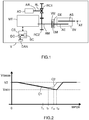
- a vehicle V comprising a transmission chain, a chain supervisor CS able to supervise the operation of the transmission chain, and a DC control device according to the invention.
- the transmission chain (or powertrain) comprises in particular, here, a heat engine MT, a motor shaft AM, a gearbox BV and a main clutch EM.
- the heat engine MT comprises a crankshaft (not shown) which is fixedly secured to the motor shaft AM in order to drive the latter (AM) in rotation.
- the BV gearbox comprises at least one input (or primary) shaft AE and one output shaft AS intended to be coupled to one another.
- the AE input shaft is intended to receive the engine torque via the main clutch EM.
- the output shaft AS is intended to receive the engine torque via the input shaft AE in order to communicate it to the transmission shaft AT to which it is coupled and which is indirectly coupled to the wheels of the vehicle V.
- the BV gearbox may or may not be robotized. Consequently, it may be an automatic gearbox, a piloted manual gearbox, a manual gearbox with a so-called “by-wire” clutch, or a dual-clutch gearbox ( or DCT).
- the clutch EM comprises in particular, here, a flywheel VM which is fixedly secured to the motor shaft AM and a clutch disc DE which is fixedly secured to the input shaft AE.
- the transmission chain also comprises an electric machine AD which constitutes, for example, an alternator-starter responsible in particular for starting the thermal engine MT in order to allow it to start, including in the presence of a stop control system and automatic restart (or “stop and start”).
- This alternator-starter AD is responsible for driving in rotation a rotor shaft (or armature) AR which is here secured to a freewheel RL intended to be coupled on command to a pinion or a coupling wheel RC1 which meshes with permanently another pinion or another coupling wheel RC2 fixedly secured to the motor shaft AM.
- the operations of the thermal engine MT and of the alternator-starter AD are controlled by the chain supervisor CS which can be in the form of a computer (preferably dedicated).
- the invention proposes to implement in the vehicle V a control method intended to allow the control of the transmission of the torque which is produced by the engine (here thermal) MT of the transmission chain of the vehicle V.
- the DC control device is part of the CS chain supervisor. But it is not compulsory. This DC control device could in fact be an item of equipment which is coupled to the chain supervisor CS, directly or indirectly. Consequently, the DC control device can be produced in the form of software (or computer or even “software”) modules, or else a combination of electronic circuits (or “hardware”) and software modules.
- the control method according to the invention comprises two steps (i) and (ii).
- Step (i) is initiated when the vehicle V is traveling at a substantially constant speed V2.
- this circulation at a speed substantially constant V2 results either from the action on the accelerator and / or brake pedals by the user, or from the programming by the user of a speed instruction of a speed control system SC of the vehicle V operating in speed regulation or in speed limitation.
- the vehicle V comprises a speed control system SC providing at least one speed regulation function, as well as possibly a speed limitation function.
- a speed control system SC is in particular responsible, when it is activated by the driver of the vehicle V and that it has been programmed with a speed reference, to determine for the transmission chain a reference acceleration according to of this speed setpoint and of the current speed of the vehicle V. It will be understood that each setpoint acceleration is determined so as to make the current speed of the vehicle V tend towards the speed setpoint which has been programmed by the driver.
- the SC speed control system is part of the CS chain supervisor. But it is not compulsory.
- This SC (speed control) system could in fact be a piece of equipment, such as for example a dedicated computer, which is coupled to the chain supervisor CS, directly or indirectly. Consequently, the (speed control) system SC can be implemented in the form of software modules (or computer or even "software”), or a combination of electronic circuits (or “hardware”) and software modules. .
- the activation of the speed regulation or limitation function requires an action on the lever (or commodo) which is associated with this function (and which is generally coupled to the steering column or to the steering wheel of the vehicle. V), that the deactivation of the speed regulation function requires an action on the aforementioned lever (or commodo) or a press on the brake pedal, and that the deactivation of the speed limit function requires an action on the lever (or commodo) above.
- DC control device could be part of the SC speed control system, for example in order to provide a additional economic function.
- Step (i) consists in estimating (by means of the control device DC), when the vehicle V is traveling at a substantially constant speed V2, a temporal evolution of its speed V e (t), in the absence of transmitted torque , as a function of data which are representative of the slopes of a traffic lane that this vehicle V will take, then in determining whether the estimated speed V e (T s ) at the end of a threshold period T s will be greater than a speed minimum Vmin, strictly less than the substantially constant speed V2.
- the condition to be checked is therefore Vmin ⁇ V e (T s ) ⁇ V2.
- the threshold duration T s begins when the estimation is carried out.
- the absence of transmitted torque can result either from operating the transmission chain in freewheel mode with the engine running at idle (or “free wheeling”), or from opening the transmission chain with with the engine off (or “sailing”).
- the transmission chain is said to be “closed” when the EM clutch is in the engaged position and therefore transmits engine torque to the BV gearbox, and called “open” when the EM clutch is in the disengaged position and therefore does not transmit. engine torque to the BV gearbox.
- you are sailing and want to transmit torque to the wheels again you must first restart the MT engine, then close the transmission chain.
- the data which are representative of the slopes of the traffic lanes are for example supplied by a device for aid to navigation DAN, possibly of the GPS type, which is on board the vehicle V and which is coupled to the control device DC, for example. via the bus of a communication network, possibly multiplexed, of the vehicle V.
- Such topographic data define the average slopes taken by at least certain known portions of at least certain known traffic lanes.
- the objective here is to estimate by means of a predefined mathematical model how the speed V e (t) of the vehicle V will evolve over time if we stop transmitting torque (here) to its wheels, account tenuous the slope of the traffic lane on which this vehicle is traveling (or is about to travel).
- the threshold duration T s can advantageously be a function at least of the substantially constant speed V2.
- the minimum speed Vmin can advantageously be a function at least of the substantially constant speed V2.
- the threshold duration T s and / or the minimum speed Vmin can be programmed by the user via a man / machine interface on board the vehicle V, for example that of the central instrument panel which is installed in the dashboard.
- Step (ii), of the control method consists in triggering the stop of torque transmission when the aforementioned condition (estimated speed V e (T s ) at the end of the threshold period T s is greater than the minimum speed Vmin ), then to authorize the transmission of torque when the speed of the vehicle V, in the absence of transmitted torque, becomes equal to the minimum speed Vmin (after a necessary deceleration phase), so that the vehicle V can regain the speed appreciably constant V2 that it had initially.
- step (ii) in the vehicle V, intended for the user, at least a first message intended to suggest that he release the pressure he exerts on the accelerator pedal is generated, and the torque transmission stop if the user releases this pressure.
- step (ii) in the vehicle V, intended for the user, at least one other (second) message is generated in the vehicle V, intended for the user, intended to suggest that he increase the pressure exerted on the user.
- accelerator pedal, and torque transmission is authorized so that the vehicle V can regain the substantially constant speed V2 when the user has increased the pressure exerted on the accelerator pedal.
- the DC control device does not trigger the stop of torque transmission. Furthermore, if the user does not increase the pressure exerted on the accelerator pedal after the second message generated, the DC control device can either re-authorize the transmission of torque by ordering the closing of the transmission chain, either wait for the user to press the accelerator pedal again before re-authorizing torque transmission by ordering the transmission chain to close.
- Each first or second message can, for example, be a text message which is displayed on a display screen of the vehicle V (for example that of the central instrument panel installed in the dashboard) and / or a summary audio message which is played through the vehicle's loudspeakers V.
- step (ii) when an acceleration of the vehicle V occurs while the torque transmission is stopped, after the threshold duration T s and before it reaches the minimum speed Vmin, it is possible to immediately authorize torque transmission, so that the vehicle V can regain the substantially constant speed V2 that it initially possessed.
- Such a situation is illustrated without limitation by the second curve C2 of the figure 2 .
- the vehicle V re-accelerates in a manner relative to the estimate of the step (i). Therefore, when the control device DC finds out at t Has it re-authorizes the transmission of torque to the wheels.
- the speed of the vehicle V then increases from the value possessed at the instant t ' at up to the substantially constant speed V2 that it initially possessed, for example thanks to the control carried out by the regulation function activated by the speed control system. SC.
- closing the transmission chain makes it possible to avoid being in a situation of natural acceleration of the vehicle V with an open transmission chain in which fuel is injected unnecessarily to maintain the idle speed while 'it is more interesting to be on the engine brake.
- the above situation does not concern the case where the acceleration occurs during a coasting phase while the engine is off.
- engine off as long as the vehicle V does not enter an area where the slope is sufficient to drive the vehicle with the engine running and the transmission chain closed, the MT engine is not restarted and the engine is closed. not the chain of transmission.
- the DC control device can maintain the torque transmission stop as long as the slope of the road used remains within a first range of values chosen in which a first quantity of fuel Q1 to be used to maintain the MT engine in support of idling is strictly less than a second quantity of fuel Q2 having to supply the MT engine to maintain the speed of the vehicle V in the event of reestablishment of the torque transmission.
- This first interval of slope values comprises values which are sufficient to naturally drive the vehicle V in the open transmission chain, but insufficient to drive the vehicle V in the closed transmission chain. Consequently, in an open transmission chain, it would be necessary to brake to maintain speed, and it would be necessary to inject a quantity of fuel Q1 to maintain the MT engine in support of idling, whereas in a closed transmission chain it would be necessary to inject a quantity of fuel. Q2 fuel higher than Q1 to maintain speed.
- this first interval of values chosen can depend on the speed of the vehicle at the instant t considered (here the substantially constant speed V2).
- the limits of the interval of values chosen may be substantially equal to 2.9% and 3.5% .
- This second interval of slope values comprises values which are also sufficient to naturally drive the vehicle V in an open transmission chain and insufficient to drive the vehicle V in a closed transmission chain, but for which in an open transmission chain it would be necessary to brake for maintain vehicle speed V and inject a quantity of fuel Q1 to maintain the engine MT in support of idling, and with the transmission chain closed it would be necessary to inject a quantity of fuel Q2 less than Q1 to maintain speed.
- the preceding sentence is only valid for freewheeling mode with the engine running. For freewheeling mode with the engine off, this second slope interval does not exist.
- this second interval of values chosen can also depend on the speed of the vehicle at the instant t considered (here the substantially constant speed V2).
- the limits of this other interval of values chosen can be substantially equal to 3.5% and 3.9% .
- the invention makes it possible to control the longitudinal dynamics of a vehicle thanks to an optimization in certain slope circumstances of the coasting deceleration phases followed by an acceleration, so as to reduce the consumption of the vehicle in use without this. does not constitute a nuisance for its passengers.
Landscapes
- Engineering & Computer Science (AREA)
- Automation & Control Theory (AREA)
- Transportation (AREA)
- Mechanical Engineering (AREA)
- Human Computer Interaction (AREA)
- Control Of Vehicle Engines Or Engines For Specific Uses (AREA)
- Control Of Transmission Device (AREA)
Claims (7)
- Verfahren zur Steuerung des in einem Fahrzeug (V) übertragenen Drehmoments, das einen ersten Schritt umfasst, bei dem, wenn das Fahrzeug (V) mit einer im Wesentlichen konstanten Geschwindigkeit fährt, eine zeitliche Entwicklung seiner Geschwindigkeit in Abwesenheit des übertragenen Drehmoments in Abhängigkeit von Daten geschätzt wird, die für die Steigungen einer Fahrbahn, die das Fahrzeug (V) benutzen wird, repräsentativ sind, dann wird bestimmt, ob die geschätzte Geschwindigkeit am Ende einer Schwellwertdauer größer als eine Mindestgeschwindigkeit sein wird, streng kleiner als die im Wesentlichen konstante Geschwindigkeit, und ein zweiter Schritt, in dem die Drehmomentübertragung gestoppt wird, wenn die geschätzte Geschwindigkeit am Ende einer Schwellwertdauer größer als die Mindestgeschwindigkeit ist dann die Drehmomentübertragung freigegeben wird, wenn die Geschwindigkeit des Fahrzeugs (V) in Abwesenheit des übertragenen Drehmoments gleich der Mindestgeschwindigkeit wird, so dass das Fahrzeug (V) die im Wesentlichen konstante Geschwindigkeit wiedererlangen kann, dadurch gekennzeichnet, dass in dem zweiten Schritt im Falle einer Beschleunigung des Fahrzeugs (V) während des Stopps der Drehmomentübertragung nach der Schwellenzeit und vor Erreichen der Mindestgeschwindigkeit die Drehmomentübertragung sofort freigegeben wird, so dass das Fahrzeug (V) die im Wesentlichen konstante Geschwindigkeit wiedererlangen kann.
- Verfahren zur Steuerung des in einem Fahrzeug (V) übertragenen Drehmoments, das einen ersten Schritt umfasst, bei dem, wenn das Fahrzeug (V) mit einer im Wesentlichen konstanten Geschwindigkeit fährt, eine zeitliche Entwicklung seiner Geschwindigkeit in Abwesenheit des übertragenen Drehmoments in Abhängigkeit von Daten geschätzt wird, die für die Steigungen einer Fahrbahn repräsentativ sind, die das Fahrzeug (V) benutzen wird, dann bestimmt wird, ob die geschätzte Geschwindigkeit am Ende einer Schwellendauer größer als eine Mindestgeschwindigkeit sein wird, die streng kleiner als die im Wesentlichen konstante Geschwindigkeit ist, und einen zweiten Schritt, bei dem der Stopp der Drehmomentübertragung ausgelöst wird, wenn die geschätzte Geschwindigkeit am Ende einer Schwellendauer größer als die Mindestgeschwindigkeit ist, dann die Drehmomentübertragung zugelassen wird, wenn die Geschwindigkeit des Fahrzeugs (V) in Abwesenheit des übertragenen Drehmoments gleich der Mindestgeschwindigkeit wird, um die Übertragung des Drehmoments an den Fahrer zu verhindern, gleich der Mindestgeschwindigkeit wird, so daß das Fahrzeug (V) die im wesentlichen konstante Geschwindigkeit wiedererlangen kann, dadurch gekennzeichnet, daß im zweiten Schritt im Falle einer Beschleunigung des Fahrzeugs (V) während des Drehmomentübertragungsstopps nach der Schwellenzeit und vor Erreichen der Mindestgeschwindigkeit der Drehmomentübertragungsstopp so lange aufrechterhalten wird, wie die Neigung der befahrenen Fahrbahn innerhalb eines ausgewählten Wertebereichs bleibt, in dem eine erste Kraftstoffmenge, die verwendet werden muss, um einen Motor des Fahrzeugs (V) zur Unterstützung des Leerlaufs aufrechtzuerhalten, strikt geringer ist als eine zweite Kraftstoffmenge, die dem Motor zugeführt werden muss, um die Geschwindigkeit des Fahrzeugs (V) im Falle der Wiederherstellung der Drehmomentübertragung aufrechtzuerhalten
- Verfahren nach einem der Ansprüche 1 oder 2, dadurch gekennzeichnet, dass die Schwellenzeit eine Funktion zumindest der im Wesentlichen konstanten Geschwindigkeit ist.
- Verfahren nach einem der Ansprüche 1 bis 3, dadurch gekennzeichnet, dass die Mindestdrehzahl eine Funktion von zumindest der im Wesentlichen konstanten Drehzahl ist.
- Verfahren nach einem der Ansprüche 1 bis 4, dadurch gekennzeichnet, dass im zweiten Schritt im Falle einer Beschleunigung des Fahrzeugs (V) während des Drehmomentübertragungsstopps nach der Schwellenzeit und vor Erreichen der Mindestgeschwindigkeit die Drehmomentübertragung sofort freigegeben wird, so dass das Fahrzeug (V) die im Wesentlichen konstante Geschwindigkeit wiedererlangen kann, wenn die Steigung der befahrenen Fahrbahn innerhalb eines ausgewählten Wertebereichs liegt, in dem eine erste Kraftstoffmenge, die zur Aufrechterhaltung eines Motors des Fahrzeugs (V) zur Unterstützung des Leerlaufs zu verwenden ist, strikt größer ist als eine zweite Kraftstoffmenge, die dem Motor zur Aufrechterhaltung der Geschwindigkeit des Fahrzeugs (V) im Falle der Wiederherstellung der Drehmomentübertragung zuzuführen ist.
- Verfahren nach einem der Ansprüche 1 bis 5, dadurch gekennzeichnet, dass die im Wesentlichen konstante Geschwindigkeit gleich einer eingestellten Geschwindigkeit ist, die von einem Benutzer des Fahrzeugs (V) in einem programmierbaren Geschwindigkeitssollwert-Geschwindigkeitssteuerungssystem (SC) programmiert wurde, das das Fahrzeug (V) umfasst.
- Verfahren nach Anspruch 6, dadurch gekennzeichnet, dass im zweiten Schritt, wenn die programmierte Sollgeschwindigkeit eine Grenzgeschwindigkeit ist, mindestens eine Meldung in dem Fahrzeug (V) für den Benutzer erzeugt wird, die dazu bestimmt ist, ihm vorzuschlagen, den Druck auf ein Gaspedal zu lösen, und die Drehmomentübertragung gestoppt wird, wenn der Benutzer den Druck auf das Gaspedal gelöst hat, dann, wenn die Geschwindigkeit des Fahrzeugs (V) gleich der Mindestgeschwindigkeit wird, mindestens eine weitere Nachricht in dem Fahrzeug (V) erzeugt wird, die an den Benutzer adressiert ist und dazu bestimmt ist, ihm vorzuschlagen, den auf das Gaspedal ausgeübten Druck zu erhöhen, und die Übertragung des Drehmoments freigegeben wird, damit das Fahrzeug (V) die im Wesentlichen konstante Geschwindigkeit wiedererlangen kann, wenn der Benutzer den auf das Gaspedal ausgeübten Druck erhöht hat.
Applications Claiming Priority (2)
| Application Number | Priority Date | Filing Date | Title |
|---|---|---|---|
| FR1361935A FR3014065B1 (fr) | 2013-12-02 | 2013-12-02 | Procede et dispositif de controle de la transmission de couple dans un vehicule en fonction de la pente |
| PCT/FR2014/053076 WO2015082810A1 (fr) | 2013-12-02 | 2014-11-28 | Procédé et dispositif de contrôle de la transmission de couple dans un véhicule en fonction de la pente |
Publications (2)
| Publication Number | Publication Date |
|---|---|
| EP3077262A1 EP3077262A1 (de) | 2016-10-12 |
| EP3077262B1 true EP3077262B1 (de) | 2021-06-16 |
Family
ID=50231336
Family Applications (1)
| Application Number | Title | Priority Date | Filing Date |
|---|---|---|---|
| EP14821747.4A Active EP3077262B1 (de) | 2013-12-02 | 2014-11-28 | Verfahren zur steuerung der übertragung von drehmomenten bei einem fahrzeug je nach steigung |
Country Status (4)
| Country | Link |
|---|---|
| EP (1) | EP3077262B1 (de) |
| CN (1) | CN105793136B (de) |
| FR (1) | FR3014065B1 (de) |
| WO (1) | WO2015082810A1 (de) |
Family Cites Families (5)
| Publication number | Priority date | Publication date | Assignee | Title |
|---|---|---|---|---|
| JP5257923B2 (ja) * | 2008-01-31 | 2013-08-07 | 株式会社アドヴィックス | 車両の運動制御装置 |
| DE102008023135B4 (de) * | 2008-05-09 | 2016-07-21 | Man Truck & Bus Ag | Verfahren zum Betreiben eines Fahrzeuges, insbesondere eines Nutzfahrzeuges, Steuer- und/oder Auswerteeinrichtung, Fahrerassistenzsystem für ein Nutzfahrzeug sowie Nutzfahrzeug |
| DE102010030346A1 (de) * | 2010-06-22 | 2011-12-22 | Zf Friedrichshafen Ag | Verfahren zur Fahrbetriebssteuerung eines Kraftfahrzeugs |
| DE102010062380B4 (de) * | 2010-12-03 | 2021-09-23 | Zf Friedrichshafen Ag | Verfahren zur Bestimmung einer Kraftstoffeinsparung einer Rollfunktion |
| DE102011109039A1 (de) * | 2011-07-30 | 2012-01-05 | Daimler Ag | Verfahren zum Betrieb eines Fahrzeuges |
-
2013
- 2013-12-02 FR FR1361935A patent/FR3014065B1/fr not_active Expired - Fee Related
-
2014
- 2014-11-28 CN CN201480065861.6A patent/CN105793136B/zh not_active Expired - Fee Related
- 2014-11-28 WO PCT/FR2014/053076 patent/WO2015082810A1/fr not_active Ceased
- 2014-11-28 EP EP14821747.4A patent/EP3077262B1/de active Active
Also Published As
| Publication number | Publication date |
|---|---|
| WO2015082810A1 (fr) | 2015-06-11 |
| EP3077262A1 (de) | 2016-10-12 |
| FR3014065B1 (fr) | 2017-03-24 |
| CN105793136A (zh) | 2016-07-20 |
| FR3014065A1 (fr) | 2015-06-05 |
| CN105793136B (zh) | 2018-09-21 |
Similar Documents
| Publication | Publication Date | Title |
|---|---|---|
| FR2958613A1 (fr) | Procede de gestion d'un vehicule et dispositif pour sa mise en oeuvre | |
| JP6696282B2 (ja) | 車両制御装置 | |
| JP2011179597A (ja) | 車両駆動システムの制御装置 | |
| CN114754134B (zh) | 一种挡位控制方法及装置 | |
| WO2017134373A1 (fr) | Procédé et dispositif de contrôle de la fonction de récupération d'énergie de freinage d'un véhicule hybride dans une pente descendante | |
| EP3601004A1 (de) | Verfahren zur steuerung des auf die räder eines elektro- oder hybridfahrzeuges übertragenen drehmomentes je nach zulässigem regenerativen drehmoment | |
| EP3074257B1 (de) | Verfahren und system zum starten eines verbrennungsmotors | |
| JP2018150018A (ja) | 車両制御装置 | |
| EP3044472A1 (de) | Verfahren und system zur steuerung einer kupplung | |
| EP3237257B1 (de) | Verfahren zur automatischen schaltung eines kraftfahrzeuges in den freilaufmodus | |
| FR2996510A1 (fr) | Procede et dispositif d’aide aux decisions de couplage/ decouplage d'une machine d'un vehicule hybride, en fonction du couple offert par le moteur thermique | |
| WO2021111051A1 (fr) | Véhicule à contrôle de répartition de couple en présence d'une instabilité, et procédé de contrôle associé | |
| WO2024200935A1 (fr) | Contrôle des décélérations d'un véhicule terrestre à fonction de contrôle de vitesse | |
| WO2014114855A1 (fr) | Procede de commande et dispositif de controle d'un vehicule hybride pour la transition des modes de motorisation | |
| EP3077262A1 (de) | Verfahren und vorrichtung zur steuerung der übertragung von drehmomenten bei einem fahrzeug je nach steigung | |
| EP2985201B1 (de) | Verfahren und vorrichtung zur bestimmung des sollwert-drehmoments, der auf die räder eines kraftfahrzeugs anzuwenden ist | |
| JP5924242B2 (ja) | アイドルストップ制御装置及びアイドルストップ制御方法 | |
| FR3017355A1 (fr) | Procede et dispositif d'aide a la conduite d'un vehicule suivant un autre vehicule, en fonction de la pente | |
| WO2011036383A1 (fr) | Procede de gestion de l'accouplement du moteur thermique sur un vehicule automobile hybride | |
| FR3053300B1 (fr) | Controle de l'etat de charge d'une batterie de machine motrice electrique d'une chaine de transmission hybride paralelle de vehicule | |
| FR3017586A1 (fr) | Procede et dispositif de regulation de vitesse en accordeon a adaptation de la vitesse maximale en presence d'un vehicule suiveur | |
| FR3022207A1 (fr) | Procede d'indication de couple nul d'un vehicule automobile et dispositif associe | |
| WO2014057184A1 (fr) | Procédé et dispositif de contrôle de l'accélération à imposer à un véhicule en cas de réactivation d'une fonction de régulation de vitesse | |
| FR3096638A1 (fr) | Procede de limitation du recul en pente d'un vehicule automobile hybride, dote d’une loi de commande | |
| JP3627500B2 (ja) | 車両用駆動力制御装置 |
Legal Events
| Date | Code | Title | Description |
|---|---|---|---|
| PUAI | Public reference made under article 153(3) epc to a published international application that has entered the european phase |
Free format text: ORIGINAL CODE: 0009012 |
|
| 17P | Request for examination filed |
Effective date: 20160627 |
|
| AK | Designated contracting states |
Kind code of ref document: A1 Designated state(s): AL AT BE BG CH CY CZ DE DK EE ES FI FR GB GR HR HU IE IS IT LI LT LU LV MC MK MT NL NO PL PT RO RS SE SI SK SM TR |
|
| AX | Request for extension of the european patent |
Extension state: BA ME |
|
| DAX | Request for extension of the european patent (deleted) | ||
| RAP1 | Party data changed (applicant data changed or rights of an application transferred) |
Owner name: PSA AUTOMOBILES SA |
|
| RAP1 | Party data changed (applicant data changed or rights of an application transferred) |
Owner name: PSA AUTOMOBILES SA |
|
| REG | Reference to a national code |
Ref country code: DE Ref legal event code: R079 Ref document number: 602014078178 Country of ref document: DE Free format text: PREVIOUS MAIN CLASS: B60W0030180000 Ipc: B60W0050140000 |
|
| GRAP | Despatch of communication of intention to grant a patent |
Free format text: ORIGINAL CODE: EPIDOSNIGR1 |
|
| STAA | Information on the status of an ep patent application or granted ep patent |
Free format text: STATUS: GRANT OF PATENT IS INTENDED |
|
| RIC1 | Information provided on ipc code assigned before grant |
Ipc: B60W 50/14 20200101AFI20210128BHEP |
|
| INTG | Intention to grant announced |
Effective date: 20210216 |
|
| GRAS | Grant fee paid |
Free format text: ORIGINAL CODE: EPIDOSNIGR3 |
|
| GRAA | (expected) grant |
Free format text: ORIGINAL CODE: 0009210 |
|
| STAA | Information on the status of an ep patent application or granted ep patent |
Free format text: STATUS: THE PATENT HAS BEEN GRANTED |
|
| AK | Designated contracting states |
Kind code of ref document: B1 Designated state(s): AL AT BE BG CH CY CZ DE DK EE ES FI FR GB GR HR HU IE IS IT LI LT LU LV MC MK MT NL NO PL PT RO RS SE SI SK SM TR |
|
| REG | Reference to a national code |
Ref country code: GB Ref legal event code: FG4D Free format text: NOT ENGLISH |
|
| REG | Reference to a national code |
Ref country code: CH Ref legal event code: EP |
|
| REG | Reference to a national code |
Ref country code: DE Ref legal event code: R096 Ref document number: 602014078178 Country of ref document: DE |
|
| REG | Reference to a national code |
Ref country code: AT Ref legal event code: REF Ref document number: 1402106 Country of ref document: AT Kind code of ref document: T Effective date: 20210715 |
|
| REG | Reference to a national code |
Ref country code: IE Ref legal event code: FG4D Free format text: LANGUAGE OF EP DOCUMENT: FRENCH |
|
| REG | Reference to a national code |
Ref country code: DE Ref legal event code: R084 Ref document number: 602014078178 Country of ref document: DE |
|
| REG | Reference to a national code |
Ref country code: LT Ref legal event code: MG9D |
|
| PG25 | Lapsed in a contracting state [announced via postgrant information from national office to epo] |
Ref country code: LT Free format text: LAPSE BECAUSE OF FAILURE TO SUBMIT A TRANSLATION OF THE DESCRIPTION OR TO PAY THE FEE WITHIN THE PRESCRIBED TIME-LIMIT Effective date: 20210616 Ref country code: FI Free format text: LAPSE BECAUSE OF FAILURE TO SUBMIT A TRANSLATION OF THE DESCRIPTION OR TO PAY THE FEE WITHIN THE PRESCRIBED TIME-LIMIT Effective date: 20210616 Ref country code: BG Free format text: LAPSE BECAUSE OF FAILURE TO SUBMIT A TRANSLATION OF THE DESCRIPTION OR TO PAY THE FEE WITHIN THE PRESCRIBED TIME-LIMIT Effective date: 20210916 Ref country code: HR Free format text: LAPSE BECAUSE OF FAILURE TO SUBMIT A TRANSLATION OF THE DESCRIPTION OR TO PAY THE FEE WITHIN THE PRESCRIBED TIME-LIMIT Effective date: 20210616 |
|
| REG | Reference to a national code |
Ref country code: AT Ref legal event code: MK05 Ref document number: 1402106 Country of ref document: AT Kind code of ref document: T Effective date: 20210616 |
|
| REG | Reference to a national code |
Ref country code: NL Ref legal event code: MP Effective date: 20210616 |
|
| PG25 | Lapsed in a contracting state [announced via postgrant information from national office to epo] |
Ref country code: LV Free format text: LAPSE BECAUSE OF FAILURE TO SUBMIT A TRANSLATION OF THE DESCRIPTION OR TO PAY THE FEE WITHIN THE PRESCRIBED TIME-LIMIT Effective date: 20210616 Ref country code: GR Free format text: LAPSE BECAUSE OF FAILURE TO SUBMIT A TRANSLATION OF THE DESCRIPTION OR TO PAY THE FEE WITHIN THE PRESCRIBED TIME-LIMIT Effective date: 20210917 Ref country code: SE Free format text: LAPSE BECAUSE OF FAILURE TO SUBMIT A TRANSLATION OF THE DESCRIPTION OR TO PAY THE FEE WITHIN THE PRESCRIBED TIME-LIMIT Effective date: 20210616 Ref country code: RS Free format text: LAPSE BECAUSE OF FAILURE TO SUBMIT A TRANSLATION OF THE DESCRIPTION OR TO PAY THE FEE WITHIN THE PRESCRIBED TIME-LIMIT Effective date: 20210616 Ref country code: NO Free format text: LAPSE BECAUSE OF FAILURE TO SUBMIT A TRANSLATION OF THE DESCRIPTION OR TO PAY THE FEE WITHIN THE PRESCRIBED TIME-LIMIT Effective date: 20210916 |
|
| PG25 | Lapsed in a contracting state [announced via postgrant information from national office to epo] |
Ref country code: AT Free format text: LAPSE BECAUSE OF FAILURE TO SUBMIT A TRANSLATION OF THE DESCRIPTION OR TO PAY THE FEE WITHIN THE PRESCRIBED TIME-LIMIT Effective date: 20210616 Ref country code: RO Free format text: LAPSE BECAUSE OF FAILURE TO SUBMIT A TRANSLATION OF THE DESCRIPTION OR TO PAY THE FEE WITHIN THE PRESCRIBED TIME-LIMIT Effective date: 20210616 Ref country code: PT Free format text: LAPSE BECAUSE OF FAILURE TO SUBMIT A TRANSLATION OF THE DESCRIPTION OR TO PAY THE FEE WITHIN THE PRESCRIBED TIME-LIMIT Effective date: 20211018 Ref country code: NL Free format text: LAPSE BECAUSE OF FAILURE TO SUBMIT A TRANSLATION OF THE DESCRIPTION OR TO PAY THE FEE WITHIN THE PRESCRIBED TIME-LIMIT Effective date: 20210616 Ref country code: ES Free format text: LAPSE BECAUSE OF FAILURE TO SUBMIT A TRANSLATION OF THE DESCRIPTION OR TO PAY THE FEE WITHIN THE PRESCRIBED TIME-LIMIT Effective date: 20210616 Ref country code: SM Free format text: LAPSE BECAUSE OF FAILURE TO SUBMIT A TRANSLATION OF THE DESCRIPTION OR TO PAY THE FEE WITHIN THE PRESCRIBED TIME-LIMIT Effective date: 20210616 Ref country code: SK Free format text: LAPSE BECAUSE OF FAILURE TO SUBMIT A TRANSLATION OF THE DESCRIPTION OR TO PAY THE FEE WITHIN THE PRESCRIBED TIME-LIMIT Effective date: 20210616 Ref country code: CZ Free format text: LAPSE BECAUSE OF FAILURE TO SUBMIT A TRANSLATION OF THE DESCRIPTION OR TO PAY THE FEE WITHIN THE PRESCRIBED TIME-LIMIT Effective date: 20210616 Ref country code: EE Free format text: LAPSE BECAUSE OF FAILURE TO SUBMIT A TRANSLATION OF THE DESCRIPTION OR TO PAY THE FEE WITHIN THE PRESCRIBED TIME-LIMIT Effective date: 20210616 |
|
| PGFP | Annual fee paid to national office [announced via postgrant information from national office to epo] |
Ref country code: DE Payment date: 20211020 Year of fee payment: 8 Ref country code: GB Payment date: 20211020 Year of fee payment: 8 |
|
| PG25 | Lapsed in a contracting state [announced via postgrant information from national office to epo] |
Ref country code: PL Free format text: LAPSE BECAUSE OF FAILURE TO SUBMIT A TRANSLATION OF THE DESCRIPTION OR TO PAY THE FEE WITHIN THE PRESCRIBED TIME-LIMIT Effective date: 20210616 |
|
| PGFP | Annual fee paid to national office [announced via postgrant information from national office to epo] |
Ref country code: FR Payment date: 20211020 Year of fee payment: 8 |
|
| REG | Reference to a national code |
Ref country code: DE Ref legal event code: R097 Ref document number: 602014078178 Country of ref document: DE |
|
| PLBE | No opposition filed within time limit |
Free format text: ORIGINAL CODE: 0009261 |
|
| STAA | Information on the status of an ep patent application or granted ep patent |
Free format text: STATUS: NO OPPOSITION FILED WITHIN TIME LIMIT |
|
| PG25 | Lapsed in a contracting state [announced via postgrant information from national office to epo] |
Ref country code: DK Free format text: LAPSE BECAUSE OF FAILURE TO SUBMIT A TRANSLATION OF THE DESCRIPTION OR TO PAY THE FEE WITHIN THE PRESCRIBED TIME-LIMIT Effective date: 20210616 |
|
| 26N | No opposition filed |
Effective date: 20220317 |
|
| PG25 | Lapsed in a contracting state [announced via postgrant information from national office to epo] |
Ref country code: AL Free format text: LAPSE BECAUSE OF FAILURE TO SUBMIT A TRANSLATION OF THE DESCRIPTION OR TO PAY THE FEE WITHIN THE PRESCRIBED TIME-LIMIT Effective date: 20210616 |
|
| PG25 | Lapsed in a contracting state [announced via postgrant information from national office to epo] |
Ref country code: MC Free format text: LAPSE BECAUSE OF FAILURE TO SUBMIT A TRANSLATION OF THE DESCRIPTION OR TO PAY THE FEE WITHIN THE PRESCRIBED TIME-LIMIT Effective date: 20210616 |
|
| REG | Reference to a national code |
Ref country code: CH Ref legal event code: PL |
|
| PG25 | Lapsed in a contracting state [announced via postgrant information from national office to epo] |
Ref country code: LU Free format text: LAPSE BECAUSE OF NON-PAYMENT OF DUE FEES Effective date: 20211128 Ref country code: IT Free format text: LAPSE BECAUSE OF FAILURE TO SUBMIT A TRANSLATION OF THE DESCRIPTION OR TO PAY THE FEE WITHIN THE PRESCRIBED TIME-LIMIT Effective date: 20210616 Ref country code: BE Free format text: LAPSE BECAUSE OF NON-PAYMENT OF DUE FEES Effective date: 20211130 |
|
| REG | Reference to a national code |
Ref country code: BE Ref legal event code: MM Effective date: 20211130 |
|
| PG25 | Lapsed in a contracting state [announced via postgrant information from national office to epo] |
Ref country code: LI Free format text: LAPSE BECAUSE OF NON-PAYMENT OF DUE FEES Effective date: 20211130 Ref country code: CH Free format text: LAPSE BECAUSE OF NON-PAYMENT OF DUE FEES Effective date: 20211130 |
|
| PG25 | Lapsed in a contracting state [announced via postgrant information from national office to epo] |
Ref country code: IE Free format text: LAPSE BECAUSE OF NON-PAYMENT OF DUE FEES Effective date: 20211128 |
|
| PG25 | Lapsed in a contracting state [announced via postgrant information from national office to epo] |
Ref country code: HU Free format text: LAPSE BECAUSE OF FAILURE TO SUBMIT A TRANSLATION OF THE DESCRIPTION OR TO PAY THE FEE WITHIN THE PRESCRIBED TIME-LIMIT; INVALID AB INITIO Effective date: 20141128 |
|
| REG | Reference to a national code |
Ref country code: DE Ref legal event code: R119 Ref document number: 602014078178 Country of ref document: DE |
|
| PG25 | Lapsed in a contracting state [announced via postgrant information from national office to epo] |
Ref country code: CY Free format text: LAPSE BECAUSE OF FAILURE TO SUBMIT A TRANSLATION OF THE DESCRIPTION OR TO PAY THE FEE WITHIN THE PRESCRIBED TIME-LIMIT Effective date: 20210616 |
|
| GBPC | Gb: european patent ceased through non-payment of renewal fee |
Effective date: 20221128 |
|
| PG25 | Lapsed in a contracting state [announced via postgrant information from national office to epo] |
Ref country code: GB Free format text: LAPSE BECAUSE OF NON-PAYMENT OF DUE FEES Effective date: 20221128 Ref country code: DE Free format text: LAPSE BECAUSE OF NON-PAYMENT OF DUE FEES Effective date: 20230601 |
|
| PG25 | Lapsed in a contracting state [announced via postgrant information from national office to epo] |
Ref country code: FR Free format text: LAPSE BECAUSE OF NON-PAYMENT OF DUE FEES Effective date: 20221130 |
|
| PG25 | Lapsed in a contracting state [announced via postgrant information from national office to epo] |
Ref country code: MK Free format text: LAPSE BECAUSE OF FAILURE TO SUBMIT A TRANSLATION OF THE DESCRIPTION OR TO PAY THE FEE WITHIN THE PRESCRIBED TIME-LIMIT Effective date: 20210616 |
|
| PG25 | Lapsed in a contracting state [announced via postgrant information from national office to epo] |
Ref country code: MT Free format text: LAPSE BECAUSE OF FAILURE TO SUBMIT A TRANSLATION OF THE DESCRIPTION OR TO PAY THE FEE WITHIN THE PRESCRIBED TIME-LIMIT Effective date: 20210616 |
|
| PG25 | Lapsed in a contracting state [announced via postgrant information from national office to epo] |
Ref country code: TR Free format text: LAPSE BECAUSE OF FAILURE TO SUBMIT A TRANSLATION OF THE DESCRIPTION OR TO PAY THE FEE WITHIN THE PRESCRIBED TIME-LIMIT Effective date: 20210616 |