EP3078394A1 - Cathéter à lumière triple - Google Patents
Cathéter à lumière triple Download PDFInfo
- Publication number
- EP3078394A1 EP3078394A1 EP16170540.5A EP16170540A EP3078394A1 EP 3078394 A1 EP3078394 A1 EP 3078394A1 EP 16170540 A EP16170540 A EP 16170540A EP 3078394 A1 EP3078394 A1 EP 3078394A1
- Authority
- EP
- European Patent Office
- Prior art keywords
- lumen
- catheter
- central lumen
- septa
- body portion
- Prior art date
- Legal status (The legal status is an assumption and is not a legal conclusion. Google has not performed a legal analysis and makes no representation as to the accuracy of the status listed.)
- Withdrawn
Links
- 238000003780 insertion Methods 0.000 claims abstract description 14
- 230000037431 insertion Effects 0.000 claims abstract description 14
- 238000001990 intravenous administration Methods 0.000 claims description 17
- 239000012530 fluid Substances 0.000 claims description 14
- 238000002347 injection Methods 0.000 abstract description 13
- 239000007924 injection Substances 0.000 abstract description 13
- 238000000034 method Methods 0.000 abstract description 8
- 239000003814 drug Substances 0.000 description 13
- 229940124597 therapeutic agent Drugs 0.000 description 7
- 210000003462 vein Anatomy 0.000 description 7
- 239000000032 diagnostic agent Substances 0.000 description 6
- 229940039227 diagnostic agent Drugs 0.000 description 5
- 229940079593 drug Drugs 0.000 description 5
- 230000008901 benefit Effects 0.000 description 4
- 239000008280 blood Substances 0.000 description 4
- 210000004369 blood Anatomy 0.000 description 4
- 210000001519 tissue Anatomy 0.000 description 4
- 238000012986 modification Methods 0.000 description 3
- 230000004048 modification Effects 0.000 description 3
- 229920001296 polysiloxane Polymers 0.000 description 3
- 230000001225 therapeutic effect Effects 0.000 description 3
- 238000002583 angiography Methods 0.000 description 2
- 210000000038 chest Anatomy 0.000 description 2
- 238000002591 computed tomography Methods 0.000 description 2
- 239000002872 contrast media Substances 0.000 description 2
- 238000003384 imaging method Methods 0.000 description 2
- 238000001802 infusion Methods 0.000 description 2
- 238000004519 manufacturing process Methods 0.000 description 2
- 238000002483 medication Methods 0.000 description 2
- 239000004033 plastic Substances 0.000 description 2
- 229920003023 plastic Polymers 0.000 description 2
- 229920000642 polymer Polymers 0.000 description 2
- 229920002635 polyurethane Polymers 0.000 description 2
- 239000004814 polyurethane Substances 0.000 description 2
- 230000000717 retained effect Effects 0.000 description 2
- 230000000472 traumatic effect Effects 0.000 description 2
- 210000002620 vena cava superior Anatomy 0.000 description 2
- 206010067484 Adverse reaction Diseases 0.000 description 1
- 241001609030 Brosme brosme Species 0.000 description 1
- 208000005156 Dehydration Diseases 0.000 description 1
- 206010040047 Sepsis Diseases 0.000 description 1
- 230000006838 adverse reaction Effects 0.000 description 1
- 210000001367 artery Anatomy 0.000 description 1
- 210000000988 bone and bone Anatomy 0.000 description 1
- 210000005242 cardiac chamber Anatomy 0.000 description 1
- 230000018044 dehydration Effects 0.000 description 1
- 238000006297 dehydration reaction Methods 0.000 description 1
- 238000002059 diagnostic imaging Methods 0.000 description 1
- 238000001125 extrusion Methods 0.000 description 1
- 239000011888 foil Substances 0.000 description 1
- 239000011521 glass Substances 0.000 description 1
- 230000001788 irregular Effects 0.000 description 1
- 210000004731 jugular vein Anatomy 0.000 description 1
- 230000007257 malfunction Effects 0.000 description 1
- 239000000463 material Substances 0.000 description 1
- 238000005259 measurement Methods 0.000 description 1
- 238000000465 moulding Methods 0.000 description 1
- 230000002093 peripheral effect Effects 0.000 description 1
- 239000000243 solution Substances 0.000 description 1
- 229910001220 stainless steel Inorganic materials 0.000 description 1
- 210000000779 thoracic wall Anatomy 0.000 description 1
- 230000002792 vascular Effects 0.000 description 1
- 210000005166 vasculature Anatomy 0.000 description 1
- 238000012800 visualization Methods 0.000 description 1
Images



Classifications
-
- A—HUMAN NECESSITIES
- A61—MEDICAL OR VETERINARY SCIENCE; HYGIENE
- A61M—DEVICES FOR INTRODUCING MEDIA INTO, OR ONTO, THE BODY; DEVICES FOR TRANSDUCING BODY MEDIA OR FOR TAKING MEDIA FROM THE BODY; DEVICES FOR PRODUCING OR ENDING SLEEP OR STUPOR
- A61M25/00—Catheters; Hollow probes
- A61M25/0021—Catheters; Hollow probes characterised by the form of the tubing
- A61M25/0023—Catheters; Hollow probes characterised by the form of the tubing by the form of the lumen, e.g. cross-section, variable diameter
- A61M25/0026—Multi-lumen catheters with stationary elements
- A61M25/0032—Multi-lumen catheters with stationary elements characterized by at least one unconventionally shaped lumen, e.g. polygons, ellipsoids, wedges or shapes comprising concave and convex parts
-
- A—HUMAN NECESSITIES
- A61—MEDICAL OR VETERINARY SCIENCE; HYGIENE
- A61M—DEVICES FOR INTRODUCING MEDIA INTO, OR ONTO, THE BODY; DEVICES FOR TRANSDUCING BODY MEDIA OR FOR TAKING MEDIA FROM THE BODY; DEVICES FOR PRODUCING OR ENDING SLEEP OR STUPOR
- A61M25/00—Catheters; Hollow probes
- A61M25/0021—Catheters; Hollow probes characterised by the form of the tubing
- A61M25/0023—Catheters; Hollow probes characterised by the form of the tubing by the form of the lumen, e.g. cross-section, variable diameter
- A61M25/0026—Multi-lumen catheters with stationary elements
-
- A—HUMAN NECESSITIES
- A61—MEDICAL OR VETERINARY SCIENCE; HYGIENE
- A61M—DEVICES FOR INTRODUCING MEDIA INTO, OR ONTO, THE BODY; DEVICES FOR TRANSDUCING BODY MEDIA OR FOR TAKING MEDIA FROM THE BODY; DEVICES FOR PRODUCING OR ENDING SLEEP OR STUPOR
- A61M25/00—Catheters; Hollow probes
- A61M25/0021—Catheters; Hollow probes characterised by the form of the tubing
- A61M25/0023—Catheters; Hollow probes characterised by the form of the tubing by the form of the lumen, e.g. cross-section, variable diameter
- A61M25/0026—Multi-lumen catheters with stationary elements
- A61M2025/0035—Multi-lumen catheters with stationary elements characterized by a variable lumen cross-section by means of a resilient flexible septum or outer wall
-
- A—HUMAN NECESSITIES
- A61—MEDICAL OR VETERINARY SCIENCE; HYGIENE
- A61M—DEVICES FOR INTRODUCING MEDIA INTO, OR ONTO, THE BODY; DEVICES FOR TRANSDUCING BODY MEDIA OR FOR TAKING MEDIA FROM THE BODY; DEVICES FOR PRODUCING OR ENDING SLEEP OR STUPOR
- A61M25/00—Catheters; Hollow probes
- A61M25/0021—Catheters; Hollow probes characterised by the form of the tubing
- A61M25/0023—Catheters; Hollow probes characterised by the form of the tubing by the form of the lumen, e.g. cross-section, variable diameter
- A61M25/0026—Multi-lumen catheters with stationary elements
- A61M2025/0037—Multi-lumen catheters with stationary elements characterized by lumina being arranged side-by-side
-
- A—HUMAN NECESSITIES
- A61—MEDICAL OR VETERINARY SCIENCE; HYGIENE
- A61M—DEVICES FOR INTRODUCING MEDIA INTO, OR ONTO, THE BODY; DEVICES FOR TRANSDUCING BODY MEDIA OR FOR TAKING MEDIA FROM THE BODY; DEVICES FOR PRODUCING OR ENDING SLEEP OR STUPOR
- A61M25/00—Catheters; Hollow probes
- A61M25/0021—Catheters; Hollow probes characterised by the form of the tubing
- A61M25/0023—Catheters; Hollow probes characterised by the form of the tubing by the form of the lumen, e.g. cross-section, variable diameter
Definitions
- This invention relates to catheters that are inserted into a patient's body for diagnostic or therapeutic purposes.
- the invention specially relates to multiple-lumen intravenous catheters that are suitable, as one of the intended applications, for pressurized injection of diagnostic and therapeutic agents.
- TIVAS Totally Implantable Venous Access System
- PICC Peripherally Inserted Central Catheter
- a TIVAS usually consists of a reservoir compartment (the portal) that has a silicone bubble for needle insertion (the septum), with an attached plastic tube (the catheter).
- the device is surgically inserted under the skin in the upper chest or in the arm, and the catheter is inserted into a vein.
- a PICC is inserted in a peripheral vein, such us the cephalic vein, basilic vein, or brachial vein and then advanced through increasingly larger veins, toward the heart until the tip rests in the distal superior vena cava or cave-atrial junction.
- the proximal end of the PICC remains outside of the body.
- Central venous catheter is also referred to us a chest catheter or a Hickman line.
- the distal end of the catheter enters the jugular vein and advances into the superior vena cava.
- the proximal end of the catheter tunnels under the skin and exits on the chest wall.
- a stainless steel wire guide wire
- Angiography is a medical imaging technique in which an X-ray picture is taken to visualize the inner opening of blood filled structures, including arteries, veins and the heart chambers. Computed tomography (CT) technique can also be used to generate detailed three dimensional images. Because blood has the same radiodensity us the surrounding tissues, a radio-contrast agent is added to the blood to make angiography visualization possible. A large amount of contrast agent infused in a short period of time is usually necessary for successfully obtaining images with good contrast. Power injection equipment is routinely employed with central venous access catheters to achieve the required rate of delivery. Clinical injection rates can go as high as 5mL/sec. Other medical procedures, such as in the treatment of dehydration and sepsis, may also require infusion of large amounts of fluid through a central venous line.
- PICC insertion is less traumatic compared to a central venous catheter.
- Multiple-lumen catheters have the distinct advantage of enabling multiple diagnostic and therapeutic access through a single placement procedure.
- Some patients undergoing imaging examinations may already have a PICC placed for other purposes. Insertion of a traditional central venous catheter solely for the purpose of imaging examination can be traumatic for the patients and cumbersome for the medical staff.
- Existing multiple-lumen PICCs may be used for power injection of diagnostic and therapeutic agents.
- the internal lumens of existing multiple-lumen PICC are generally configured as represented in FIGs. 1A and 1B .
- the lumens 110 are fanned by three septa 120 arranged radially, extending from the outer wall 130 of the catheter to the center of the catheter.
- Angular comers are formed at the intersection between the septa 120, and between each of the septum 120 and the outer wall 130 of the catheter.
- one of the lumens must be used to thread the guide wire.
- the angular corners in the catheter lumens have a tendency to catch the guide wire, and make PICC placement difficult.
- the radially arranged lumens 110 in FIG. 1A also do not perform well under pressure.
- the angular comers of the lumens are prone to rupture under pressure.
- FIG. 1B depicts the cross section of another example of a multiple-lumen catheter having three lumens with circular cross sections.
- a larger lumen 140 is formed on one side of the catheter, with two smaller lumens 150 on the other side.
- the larger lumen 140 which lacks any angular comers, is naturally suited to be used with the guide wire for advancement of the PICC.
- the diameter of the larger lumen 140 is relatively small compared to the usable space within the body of the catheter. As can be seen when viewing the FIG. 18 embodiment, the use of space is not very efficient.
- the small diameter of the larger lumen 140 also restricts the maximum flow rate achievable through this lumen. High pressure resulting from the required flow rate for power injection would reach unsafe levels that may cause catheter rupture.
- the structural weak point of the larger lumen is its outer wall 160.
- the outer wall 160 of the larger lumen 140 is the likely place to breach. Fluid in the larger lumen 140 may escape into the surrounding tissue, and cause complications.
- a PICC with the FIG. 1 B configuration is generally not suitable for power injection.
- a practitioner may have to increase the diameter of the inner lumen by increasing the overall diameter of the PICC.
- the multiple-lumen PICCs that are currently available on the market are generally of large diameters, typically 6 Fr or larger.
- the relatively large size of the existing multiple-lumen PICC is not an ideal solution, because it would make PICC placement more difficult and diminish the advantage of PICCs over central venous lines. Accordingly, it would be desirable to have a multiple-lumen PICC capable of use for power injection of diagnostic and therapeutic agents, while still having a traditional outer dimension and being configured (without small angular earners) for easy insertion over a guide wire.
- WO98/24501 discloses a multiple lumen access device for use in providing a single entry port into the human body for selectively introducing medical implements therethrough and for providing simultaneous auxiliary access into the body.
- the multiple lumen access device includes a multiple lumen sheath which may have an outer tube and structure defining a device lumen located therein.
- the inner structure may be an inner tube.
- the outer tube and inner structure are located so as to define at least one auxiliary lumen which may be located between the exterior surface of the inner tube and the interior surface of the outer tube.
- Embodiments include flexible inner tubes which can be flexed between relaxed and expanded/contracted positions wherein the relative cross-sectional areas of the device lumen and auxiliary lumens are varied.
- the present invention presents a multi-lumen intravenous catheter comprising an elongated body portion having an outer wall extending longitudinally between proximal and distal ends, wherein two septa extend longitudinally through the elongated body portion, the septa and the outer wall define a central lumen and two side lumens, the central lumen has a generally oblong shape in cross section and is positioned between the two side lumens, and each of the septa are configured to flex when the central lumen is under pressure, whereby a cross sectional area of the central lumen resultantly increases to increase flow capacity through the central lumen; and a plurality of extension tubes, each having a first end and a second end, extending generally longitudinally away from the proximal end of the body portion, wherein the first ends of the extension tubes connect to the proximal end of the body portion, the central lumen and the two side lumens each form a fluid tight connection to a respective extension tube.
- the present invention multi-lumen catheter may further comprise a plurality of connectors, wherein a connector is located at a second end of each of the extension tubes.
- the central lumen has a rounded top and bottom inner surface.
- the central lumen has a generally stadium shape.
- the central lumen having generally concave side surfaces and rounded top and bottom surfaces at normal atmospheric pressure, and generally convex side surfaces when under pressure.
- a radius of curvature of an inner surface of each of the side lumens is in all locations equal to or greater than a radius of curvature of an outer wall of a guide wire used for insertion of the multi-lumen catheter.
- a minimal thickness of the outer wall that bounds the central lumen maybe larger than a thickness of each of the septa.
- the outer wall is more rupture resistant than either of the septa.
- Each of the septa is configured to have less mechanical strength under catheter pressure than the outer wall, whereby catheter rupture will occur in one or both of the septa prior to in the outer wall.
- Each of the septa is configured to fail under catheter pressure before failure of the outer wall.
- the sum of the cross sectional areas of the two side lumens is less than the cross sectional area of the central lumen. In another embodiment of the present invention, the sum of the cross sectional areas of the two side lumens does not equal the cross sectional area of the central lumen.
- the side lumen is of generally "D” shape. In another embodiment of the present invention, the side lumen is of generally "C” shape. In yet another embodiment of the present invention, the side lumen is of generally circular shape. In a further embodiment of the present invention, the side lumen is of generally elliptical shape.
- the present invention also provides a multi-lumen intravenous catheter comprising an elongated body portion including an outer wall extending longitudinally along and forming the elongated body portion between proximal and distal ends, and two septa extending longitudinally along, through, and forming the elongated body portion, wherein the two septa and the outer wall define a central lumen and two side lumens, the central lumen has an inner surface defining a generally stadium shape of the central lumen; and a radius of curvature of the inner surface of the central lumen is, in all locations, equal to or greater than a radius of curvature of an outer surface of a guide wire used for insertion of the multi-lumen catheter.
- the present invention also provides a multi-lumen intravenous catheter comprising an elongated body portion including an outer wall extending longitudinally along and forming the elongated body portion between proximal and distal ends, and two septa extending longitudinally along, through, and forming the elongated body portion, wherein the two septa and the outer wall define a central lumen and two side lumens, and each of the septa is configured to fail under catheter pressure before failure of the outer wall.
- the present invention further provides a multi-lumen intravenous catheter comprising an elongated body portion including an outer wall extending longitudinally along and forming the elongated body portion between proximal and distal ends, and two septa extending longitudinally along, through, and forming the elongated body portion, wherein the two septa and the outer wall define a central-lumen and two side lumens, and each of the septa is configured to have less mechanical strength under catheter pressure than the outer wall, whereby catheter rupture will occur in one or both of the septa prior to in the outer wall.
- the present invention also provides a multi-lumen intravenous catheter comprising an elongated body portion including an outer wall extending longitudinally along and forming the elongated body portion between proximal and distal ends, and two flexible septa extending longitudinally along, through, and forming the elongated body portion, wherein the two septa and the outer wall define a central lumen and two side lumens, and the central lumen having generally concave side surfaces and rounded top and bottom surfaces at normal atmospheric pressure, and generally convex side surfaces when under pressure.
- the present invention also provides a multi-lumen intravenous catheter comprising an elongated body portion including an outer wall extending longitudinally along and forming the elongated body portion between proximal and distal ends, and at least two septa extending longitudinally along, through, and forming the elongated body portion, wherein the at least two septa and the outer wall define a central lumen and at least two side lumens, wherein the central lumen is located essentially at the center of the catheter body, and at least one of the side lumen is located on a first side of the central lumen and at least one side lumen is located on a second side of the central lumen, septa are configured to flex when the central lumen is under pressure, whereby a cross sectional area of the central lumen resultantly increases to increase flow capacity through the central lumen.
- proximal and distal refer to directions away from and closer to the insertion tip, respectively, of a catheter of the present invention.
- FIG. 2 depicts a representative multiple-lumen catheter 200 employing the present invention lumen configuration.
- the catheter comprises an elongated body portion 220. In the distal end, the body portion 220 connects to a tip structure 210.
- the internal space of the body portion 220 is divided into several lumens.
- Each of the lumens has an opening in the tip structure 210. In the embodiment shown in FIG. 2 , each of the lumens opens at the same point of the tip structure 210. In other embodiments of the present invention, openings of each of the lumens may be placed at different locations along the tip structure 210, thereby minimizing mixing and the possibility of adverse reactions when incompatible drugs or therapeutic agents are delivered at the same time through separate lumens of the catheter.
- the proximal end 230 of the body portion 220 of the catheter connects to a plurality of extension tubes 231 232 233.
- Each of the internal lumen forms a fluid tight connection to an extension tube 231 232 233.
- more than one lumen can be connected to a single extension tube.
- Each of the extension tube 231 232 233 further may connect to a connector of a type commonly used in medical applications 241 242 243, such as Luer-Lock type connecters, which provides easy linkage to other medical instruments or devices.
- Connectors for the present invention multiple-lumen catheter may be manufactured separately from the catheter, and are attached during insertion of the catheter assembly.
- Clamps 251 252 253 may be placed on the extension tubes to stop fluid flow when the catheter is not in use.
- the rate of flow through a rigid tube (Q) is proportional to the fourth power of the radius of the tube (r) and the difference in pressure at the two ends of the tube ( ⁇ P), and is inversely related to the viscosity of the fluid (p) and the length of the tube (L).
- the body portion 220 of catheter is usually made of material that is flexible, such as silicone or polyurethane or other tissue compatible polymers.
- Poiseuille's Law provides important guidance to approximate fluid flow characteristics within a multiple-lumen catheter where the walls may flex and expand slightly under pressure.
- FIG. 3 shows a cross section view of the catheter body of one embodiment of the present invention.
- Two septa 304 divide the internal space of the body portion 220 into three lumens 302 303.
- the lumens are arranged in a side-by-side configuration.
- the central lumen 303 is located essentially in the center of the catheter body, and the two side lumens 302 are located on each side of the central lumen 303.
- the central lumen 303 is defined by the two septa 304 and the outer wall 301 of the catheter, and is positioned between the two side lumens 302.
- the central lumen 303 has a generally stadium shape in cross section. In the embodiment shown in FIG.
- the central lumen 303 is formed by septa with essentially planar side surfaces 306, and rounded top and bottom surfaces 305.
- the central lumen 303 may have a cross section of an elongated circle, an ellipse, or other shapes that efficiently utilizes the internal space of the catheter.
- the side lumens 302 have a crescent or "D" shape in cross section.
- the side lumens 302 can have circular, elliptical, "C" shaped, or other suitable cross sections.
- the shape of the cross sections of the central lumen 303 and side lumens 302 is chosen so that it provides optimal utilization of the internal space of the body portion 220 of the catheter.
- the rounded top and bottom surface 305 of the central lumen 303 and the outer surface 307 of the catheter body portion 220 forms the outer wall 301 of the catheter body portion 220.
- the rounded top and bottom interior surface of the central lumen 305 connects smoothly to the side surfaces 306.
- the inner surface 305 306 of the central lumen 303 is free from any sharp corners.
- the smooth inner surface 305 306 of the central lumen 303 is optimal for catheter placement along a guide wire.
- the radius of curvature of the inner surface 305 is chosen to minimize the possibility that any corner within the central lumen 303 can catch the guide wire and hinder the advance of the catheter 200 along the guide wire. For example, if a guide wire of 0.018 in. diameter is intended, the radius of curvature for any earner in the central lumen 303 would preferably be equal to or larger than 0.009 in.
- the radius of curvature within the central lumen 303 is in all locations (i.e., at all points along the inner wall of the central lumen 303 and/or the side lumens 302) equal to or greater than the radius of curvature of the outer wall (or outer perimeter surface) of an associated guide wire.
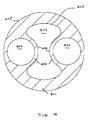
- FIG. 4 shows a cross section view of a second embodiment of the present invention.
- the two side lumens 402 are of a generally circular shape.
- the central lumen 403 is of a "dog bone" shape.
- the top and bottom interior surfaces 405 of the central lumen of the embodiment shown in FIG. 4 connect smoothly to the side surfaces 406.
- the entire interior surface 405 406 of the central lumen 403 is free of sharp corners.
- the septa 404 between the two side lumens 402 and the central lumen 403 protrude into the central lumen 403 at normal atmospheric pressure, i.e., the septa 404 are of generally concave shape. When under pressure, such as during power injection procedure, the septa 404 are capable of deforming and may be pushed outward.
- the side lumens 402, as a consequence, may have reduced size under pressure.
- the septa 404 may adopt convex shape under pressure.
- the potential to deform and expand the diameter of the central lumen 403 provides the present invention excellent flow performance when the overall exterior diameter is of a small size.
- the outer wall 401 of the catheter can be made thicker at the top and bottom of the central lumen than the septa 404. This configuration would help to provide stronger mechanical strength to the exterior wall of the catheter body 220.
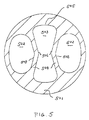
- FIG. 5 shows a cross section view of catheter body of a third embodiment of the present invention.
- the central lumen 503 is of a "hour glass" shape.
- the two side lumens 502 are of irregular elliptical shape having the interior surface 508 following the general shape of the side surfaces 506 of the central lumen 506.
- the septa 504 between the two side lumens 502 and the central lumen 503 protrude into the central lumen 503 under normal atmospheric pressure, i.e., the septa 504 are of generally concave shape. When under pressure, such as during power injection procedure, the septa 504 are capable of deforming and may be pushed outward.
- the septa 504 would adopt convex shape under pressure.
- the outer wall 501 of the catheter can be made thicker at the top and bottom of the central lumen than the septa 504. This configuration would help to provide stronger mechanical strength to the exterior wall of the catheter body 220.
- FIG. 6 shows a cross section view of the catheter body of a fourth embodiment of the present invention.
- two smaller side lumens 608 609 are formed.
- This lumen configuration can be adapted to all embodiments of the present invention, which include, but are not limited to, the embodiments disclosed in FIGs. 3 , 4 , and 5 .
- a guide wire is preferably traversed through one of the respective side lumens 402 502 602 when used to advance the catheter.
- the radius of curvature within the side lumen 402 502 602 is in all locations (i.e., at all points along the inner wall of the side lumen 402 502 602) equal to or greater than the radius of curvature of the outer wall (or outer perimeter surface) of an associated guide wire.
- the central lumen of the present invention 303 403 503 603, has a large cross section (or cross-sectional area) relative to the available space (or cross-sectional area) within the body portion 220 of the catheter. Because the flow rate is proportional to the fourth power of the radius of a tube, even a small increase in the cross section of the central lumen 303 403 503 603 greatly increases the flow rate achievable though the tube when all other parameters are constant.
- the present invention optimizes space utilization within the body portion 220 of the catheter, allowing the body portion 220 to have a relatively thick outer wall 301. This increases the mechanical strength of the body portion 220, and in turn allows a higher pressure rating for the catheter 200. When the catheter 200 is under pressure, each of the septa 304 404 504 604 may flex outward, resultantly increasing the cross section of the central lumen 303 403 503 603, and thereby further facilitating fluid flow.
- the septa 304 404 504 604 of the present invention is designed to have less mechanical strength than the outer wall 301 401 501 601 of the catheter body portion 220.
- the septa 304 404 504 604 are of u thickness less than the minimal thickness of the outer wall 301 401 501 601.
- the rupture characteristics of the septa 304 404 504 604 and the outer wall 301 401 501 601 are optimized by modifying both the thickness and the shape. This provides a fail-safe mechanism.
- one or both of the septa 304 404 504 604 would be first to rupture (relative to the outer wall 301 401 501 601).
- a septum 304 404 504 604 breach occurs, the fluid within the central lumen 303 403 503 603 would therefore leak into a side lumen 302 402 502 602 608 609. Accordingly, the integrity of the body portion 220 of the catheter 200 is retained.
- This configuration effectively protects against extravastation of the fluid within the central lumen 303 403 503 603 in the event of a septa 304 404 504 604 breach.
- the configuration of the present invention central lumen 303 403 503 603 provides high flow rate and fail safe protection under pressure. It is, therefore, suited for power injection of diagnostic or therapeutic agents.
- the catheter of the present invention can be safely used at a flow rate of 5 ce/sec at 300 psi.
- the configuration of the lumens also provide added benefits such as kink resistance and flexibility.
- the lumens of the present invention catheter are intended to be used independently to deliver drugs, therapeutic or diagnostic agents.
- the dimensions of the lumens are not necessarily constrained in relation to one another.
- the cross sectional area of the central lumen 304 404 504 604 may or may not be equal to the sum of the cross sectional areas of the side lumens 302 402 502 602 608 609.
- the sum of the cross sectional areas of the two side lumens 302 402 502 602 608 609 is greater than the cross sectional area of the central lumen 303 403 503 603.
- the sum of the cross sectional areas of the two side lumens 302 402 502 602 is less than the cross sectional area of the central lumen 303 403 503 603.
- the present invention catheter can be manufactured to various sizes suitable for PICC application.
- the unique lumen configuration of the present invention makes it possible to manufacture triple lumen PICC with small outer diameters such as French size 5 or 6.
- the catheters of the present invention can be made from existing thermal plastics presently used for intravenous catheters, such as silicone and polyurethane or other tissue compatible polymers.
- the body portion of the catheter of the present invention can be manufactured using existing molding or extrusion manufacturing processes. Placement of the catheters of the present invention also does not require any special modification to present medical procedures.
- the present invention relates to the following items:
Landscapes
- Health & Medical Sciences (AREA)
- Life Sciences & Earth Sciences (AREA)
- Biophysics (AREA)
- Pulmonology (AREA)
- Engineering & Computer Science (AREA)
- Anesthesiology (AREA)
- Biomedical Technology (AREA)
- Heart & Thoracic Surgery (AREA)
- Hematology (AREA)
- Animal Behavior & Ethology (AREA)
- General Health & Medical Sciences (AREA)
- Public Health (AREA)
- Veterinary Medicine (AREA)
- Physics & Mathematics (AREA)
- Geometry (AREA)
- Media Introduction/Drainage Providing Device (AREA)
Applications Claiming Priority (2)
| Application Number | Priority Date | Filing Date | Title |
|---|---|---|---|
| US3965508P | 2008-03-26 | 2008-03-26 | |
| EP09724674.8A EP2257332B1 (fr) | 2008-03-26 | 2009-03-26 | Cathéter à lumière triple |
Related Parent Applications (2)
| Application Number | Title | Priority Date | Filing Date |
|---|---|---|---|
| EP09724674.8A Division EP2257332B1 (fr) | 2008-03-26 | 2009-03-26 | Cathéter à lumière triple |
| EP09724674.8A Division-Into EP2257332B1 (fr) | 2008-03-26 | 2009-03-26 | Cathéter à lumière triple |
Publications (1)
| Publication Number | Publication Date |
|---|---|
| EP3078394A1 true EP3078394A1 (fr) | 2016-10-12 |
Family
ID=41114719
Family Applications (2)
| Application Number | Title | Priority Date | Filing Date |
|---|---|---|---|
| EP09724674.8A Active EP2257332B1 (fr) | 2008-03-26 | 2009-03-26 | Cathéter à lumière triple |
| EP16170540.5A Withdrawn EP3078394A1 (fr) | 2008-03-26 | 2009-03-26 | Cathéter à lumière triple |
Family Applications Before (1)
| Application Number | Title | Priority Date | Filing Date |
|---|---|---|---|
| EP09724674.8A Active EP2257332B1 (fr) | 2008-03-26 | 2009-03-26 | Cathéter à lumière triple |
Country Status (4)
| Country | Link |
|---|---|
| US (1) | US9314586B2 (fr) |
| EP (2) | EP2257332B1 (fr) |
| ES (1) | ES2683894T3 (fr) |
| WO (1) | WO2009120871A2 (fr) |
Families Citing this family (34)
| Publication number | Priority date | Publication date | Assignee | Title |
|---|---|---|---|---|
| US8440122B2 (en) | 2005-06-30 | 2013-05-14 | Abbott Vascular Inc. | Introducer sheath and methods of making |
| US8359723B2 (en) | 2005-06-30 | 2013-01-29 | Abbott Vascular Inc. | Introducer sheath and methods of making |
| US8801744B2 (en) | 2006-06-28 | 2014-08-12 | Abbott Laboratories | Expandable introducer sheath to preserve guidewire access |
| US9352118B2 (en) | 2005-06-30 | 2016-05-31 | Abbott Laboratories | Modular introducer and exchange sheath |
| US9597063B2 (en) | 2006-06-28 | 2017-03-21 | Abbott Laboratories | Expandable introducer sheath to preserve guidewire access |
| US9168359B2 (en) | 2005-06-30 | 2015-10-27 | Abbott Laboratories | Modular introducer and exchange sheath |
| US9889275B2 (en) | 2006-06-28 | 2018-02-13 | Abbott Laboratories | Expandable introducer sheath to preserve guidewire access |
| WO2012080783A1 (fr) | 2010-12-15 | 2012-06-21 | Querol Garcia Valeria | Tube trilobulaire pour drainage |
| WO2012109462A2 (fr) | 2011-02-10 | 2012-08-16 | C. R. Bard, Inc. | Cathéter multi-lumières comprenant un profil elliptique |
| US9717883B2 (en) | 2011-02-10 | 2017-08-01 | C. R. Bard, Inc. | Multi-lumen catheter with enhanced flow features |
| US8721588B2 (en) | 2011-04-15 | 2014-05-13 | DePuy Synthes Products, LLC | Noncircular inner lumen guiding catheter with assisted variable support |
| DK2765944T3 (en) | 2011-10-14 | 2018-12-03 | Ra Medical Systems Inc | LITTLE FLEXIBLE CATHETS WITH LIQUID CORE FOR LASER ABLATION IN BODY SLUMPS |
| WO2013177549A1 (fr) * | 2012-05-25 | 2013-11-28 | C.R. Bard, Inc. | Cathéter à lumières multiples à caractéristiques d'écoulement améliorées |
| US11273287B2 (en) | 2013-03-08 | 2022-03-15 | Endobar Solutions Llc | Selectively delivering particles into the distal portion of the left gastric artery |
| US9962527B2 (en) | 2013-10-16 | 2018-05-08 | Ra Medical Systems, Inc. | Methods and devices for treatment of stenosis of arteriovenous fistula shunts |
| GB2522403B (en) * | 2013-12-17 | 2017-09-13 | Aslam Nasir Muhammed | Airway device with flexible divider |
| GB2546167B (en) | 2013-12-17 | 2018-02-28 | Aslam Nasir Muhammed | Intubating Airway Device |
| USD842456S1 (en) | 2015-12-15 | 2019-03-05 | Intersurgical Ag | Airway device |
| USD1051359S1 (en) | 2015-06-15 | 2024-11-12 | Intersurgical Ag | Airway device |
| DE102015217061A1 (de) | 2015-09-07 | 2017-03-09 | Raumedic Ag | Schlauch |
| WO2017079061A2 (fr) * | 2015-10-28 | 2017-05-11 | Duke University | Cathéters permettant de décoller des agents d'encrassement de leur surface intérieure et procédés associés |
| US10555772B2 (en) | 2015-11-23 | 2020-02-11 | Ra Medical Systems, Inc. | Laser ablation catheters having expanded distal tip windows for efficient tissue ablation |
| CN109195656B (zh) * | 2016-07-04 | 2022-06-07 | 株式会社钟化 | 导管 |
| WO2018170088A1 (fr) * | 2017-03-14 | 2018-09-20 | Boston Scientific Scimed, Inc. | Tige de dispositif médical comprenant un revêtement |
| US11534336B2 (en) * | 2017-09-15 | 2022-12-27 | Rohit Khanna | Selective central nervous system treatment catheter and a method of using the same |
| JP7130748B2 (ja) * | 2017-11-28 | 2022-09-05 | セント・ジュード・メディカル,カーディオロジー・ディヴィジョン,インコーポレイテッド | ルーメン管理カテーテル |
| GB201720733D0 (en) | 2017-12-13 | 2018-01-24 | Ashkal Development Ltd | Airway device |
| JP2019166289A (ja) | 2018-03-22 | 2019-10-03 | ラ メディカル システムズ, インコーポレイテッド | オーバージャケットを伴う液体充填アブレーションカテーテル |
| JP1649724S (fr) | 2019-01-18 | 2020-01-14 | ||
| US12171963B2 (en) * | 2019-04-23 | 2024-12-24 | Merit Medical Systems, Inc. | Drainage catheter with suture lumen |
| USD1025348S1 (en) | 2020-04-16 | 2024-04-30 | Intersurgical Ag | Airway device |
| WO2022147476A1 (fr) * | 2020-12-31 | 2022-07-07 | Nuwellis, Inc. | Cathéter à double lumière |
| US20240181204A1 (en) * | 2021-03-31 | 2024-06-06 | Freeflow Medical Devices Llc | Implantable medical devices and tubing |
| JP2024516451A (ja) * | 2021-05-04 | 2024-04-15 | ボストン サイエンティフィック サイムド,インコーポレイテッド | マルチルーメンカテーテル |
Citations (2)
| Publication number | Priority date | Publication date | Assignee | Title |
|---|---|---|---|---|
| WO1998024501A1 (fr) | 1996-11-26 | 1998-06-11 | Baxter International Inc. | Dispositif d'acces a plusieurs lumieres |
| US20030093029A1 (en) * | 2001-01-09 | 2003-05-15 | Rex Medical | Dialysis catheter |
Family Cites Families (11)
| Publication number | Priority date | Publication date | Assignee | Title |
|---|---|---|---|---|
| CA1330285C (fr) * | 1987-12-22 | 1994-06-21 | Geoffrey S. Martin | Catheter a triple voie |
| NL9300231A (nl) * | 1993-02-04 | 1994-09-01 | Cordis Europ | Angiografie-catheter. |
| US5348536A (en) * | 1993-08-02 | 1994-09-20 | Quinton Instrument Company | Coextruded catheter and method of forming |
| US5395316A (en) * | 1993-08-11 | 1995-03-07 | Med-Pro Design, Inc. | Triple lumen catheter |
| US5378230A (en) * | 1993-11-01 | 1995-01-03 | Mahurkar; Sakharam D. | Triple-lumen critical care catheter |
| AU3371595A (en) * | 1994-09-06 | 1996-03-27 | Sims Deltec, Inc. | Method and apparatus for location of a catheter tip |
| US5556390A (en) * | 1995-03-07 | 1996-09-17 | Quinton Instrument Company | Catheter with oval or elliptical lumens |
| US5947940A (en) * | 1997-06-23 | 1999-09-07 | Beisel; Robert F. | Catheter reinforced to prevent luminal collapse and tensile failure thereof |
| US6544251B1 (en) * | 1999-02-10 | 2003-04-08 | Michael K. Crawford | Peripherally inserted catheter |
| US7465286B2 (en) * | 2004-03-03 | 2008-12-16 | C. R. Bard, Inc. | Loop-tip catheter |
| US20090054874A1 (en) * | 2007-08-23 | 2009-02-26 | C. R. Bard, Inc. | Multi-lumen catheter including a lumen having a variable cross sectional area |
-
2009
- 2009-03-26 ES ES09724674.8T patent/ES2683894T3/es active Active
- 2009-03-26 WO PCT/US2009/038414 patent/WO2009120871A2/fr not_active Ceased
- 2009-03-26 EP EP09724674.8A patent/EP2257332B1/fr active Active
- 2009-03-26 EP EP16170540.5A patent/EP3078394A1/fr not_active Withdrawn
- 2009-03-26 US US12/411,813 patent/US9314586B2/en active Active
Patent Citations (2)
| Publication number | Priority date | Publication date | Assignee | Title |
|---|---|---|---|---|
| WO1998024501A1 (fr) | 1996-11-26 | 1998-06-11 | Baxter International Inc. | Dispositif d'acces a plusieurs lumieres |
| US20030093029A1 (en) * | 2001-01-09 | 2003-05-15 | Rex Medical | Dialysis catheter |
Also Published As
| Publication number | Publication date |
|---|---|
| WO2009120871A3 (fr) | 2009-12-30 |
| US9314586B2 (en) | 2016-04-19 |
| EP2257332A4 (fr) | 2013-06-05 |
| WO2009120871A2 (fr) | 2009-10-01 |
| ES2683894T3 (es) | 2018-09-28 |
| EP2257332A2 (fr) | 2010-12-08 |
| US20090247868A1 (en) | 2009-10-01 |
| EP2257332B1 (fr) | 2018-07-04 |
Similar Documents
| Publication | Publication Date | Title |
|---|---|---|
| EP2257332B1 (fr) | Cathéter à lumière triple | |
| US12138405B2 (en) | Rapidly insertable central catheters, assemblies, and methods thereof | |
| JP7315915B2 (ja) | 穿刺システム | |
| US9713694B2 (en) | Low profile catheter assembly | |
| US8574192B2 (en) | Catheter tunneling systems, instruments and methods | |
| EP1905476B1 (fr) | Ensemble cathéter d'hémodialyse grave | |
| US8137316B2 (en) | Sheathless insertion stylet system for catheter placement | |
| US4559046A (en) | Apparatus for intravenous therapy and hyperalimentation | |
| ES2975734T3 (es) | Catéter integrado de inserción rápida | |
| US7704239B2 (en) | Catheter button hub | |
| US20090137944A1 (en) | Medical system and catheter connector apparatus | |
| US20040116901A1 (en) | Variable characteristic venous access catheter | |
| US20050228364A1 (en) | Tunneler device | |
| US20110313399A1 (en) | Intravenous cannula | |
| KR20100127815A (ko) | 압력 감지 카테터 | |
| JPH1033693A (ja) | 応力分配指状部を備えたカテーテル | |
| WO2008109549A2 (fr) | Appareil d'adaptateur de cathéter | |
| WO2024128586A1 (fr) | Nouveau cathéter central inséré par voie périphérique | |
| WO2002049511A1 (fr) | Catheter en queue de cochon a deux lumieres pour surveiller la pression | |
| CN223041904U (zh) | 一种引流及注药装置 | |
| CN118356566B (zh) | 一种内径可调的鞘管 | |
| US20250090810A1 (en) | Medical device integrating an accordion tube-like structure |
Legal Events
| Date | Code | Title | Description |
|---|---|---|---|
| PUAI | Public reference made under article 153(3) epc to a published international application that has entered the european phase |
Free format text: ORIGINAL CODE: 0009012 |
|
| AC | Divisional application: reference to earlier application |
Ref document number: 2257332 Country of ref document: EP Kind code of ref document: P |
|
| AK | Designated contracting states |
Kind code of ref document: A1 Designated state(s): AT BE BG CH CY CZ DE DK EE ES FI FR GB GR HR HU IE IS IT LI LT LU LV MC MK MT NL NO PL PT RO SE SI SK TR |
|
| STAA | Information on the status of an ep patent application or granted ep patent |
Free format text: STATUS: REQUEST FOR EXAMINATION WAS MADE |
|
| 17P | Request for examination filed |
Effective date: 20170412 |
|
| RBV | Designated contracting states (corrected) |
Designated state(s): AT BE BG CH CY CZ DE DK EE ES FI FR GB GR HR HU IE IS IT LI LT LU LV MC MK MT NL NO PL PT RO SE SI SK TR |
|
| STAA | Information on the status of an ep patent application or granted ep patent |
Free format text: STATUS: EXAMINATION IS IN PROGRESS |
|
| 17Q | First examination report despatched |
Effective date: 20190614 |
|
| STAA | Information on the status of an ep patent application or granted ep patent |
Free format text: STATUS: THE APPLICATION IS DEEMED TO BE WITHDRAWN |
|
| 18D | Application deemed to be withdrawn |
Effective date: 20191025 |