EP3078660B1 - Nouveau dérivé quinazoline - Google Patents
Nouveau dérivé quinazoline Download PDFInfo
- Publication number
- EP3078660B1 EP3078660B1 EP14868296.6A EP14868296A EP3078660B1 EP 3078660 B1 EP3078660 B1 EP 3078660B1 EP 14868296 A EP14868296 A EP 14868296A EP 3078660 B1 EP3078660 B1 EP 3078660B1
- Authority
- EP
- European Patent Office
- Prior art keywords
- oxy
- cis
- cyclohexanol
- quinazolin
- amino
- Prior art date
- Legal status (The legal status is an assumption and is not a legal conclusion. Google has not performed a legal analysis and makes no representation as to the accuracy of the status listed.)
- Not-in-force
Links
Images


Classifications
-
- C—CHEMISTRY; METALLURGY
- C07—ORGANIC CHEMISTRY
- C07D—HETEROCYCLIC COMPOUNDS
- C07D403/00—Heterocyclic compounds containing two or more hetero rings, having nitrogen atoms as the only ring hetero atoms, not provided for by group C07D401/00
- C07D403/02—Heterocyclic compounds containing two or more hetero rings, having nitrogen atoms as the only ring hetero atoms, not provided for by group C07D401/00 containing two hetero rings
- C07D403/12—Heterocyclic compounds containing two or more hetero rings, having nitrogen atoms as the only ring hetero atoms, not provided for by group C07D401/00 containing two hetero rings linked by a chain containing hetero atoms as chain links
-
- A—HUMAN NECESSITIES
- A61—MEDICAL OR VETERINARY SCIENCE; HYGIENE
- A61K—PREPARATIONS FOR MEDICAL, DENTAL OR TOILETRY PURPOSES
- A61K31/00—Medicinal preparations containing organic active ingredients
- A61K31/33—Heterocyclic compounds
- A61K31/395—Heterocyclic compounds having nitrogen as a ring hetero atom, e.g. guanethidine or rifamycins
- A61K31/495—Heterocyclic compounds having nitrogen as a ring hetero atom, e.g. guanethidine or rifamycins having six-membered rings with two or more nitrogen atoms as the only ring heteroatoms, e.g. piperazine or tetrazines
- A61K31/505—Pyrimidines; Hydrogenated pyrimidines, e.g. trimethoprim
- A61K31/517—Pyrimidines; Hydrogenated pyrimidines, e.g. trimethoprim ortho- or peri-condensed with carbocyclic ring systems, e.g. quinazoline, perimidine
-
- A—HUMAN NECESSITIES
- A61—MEDICAL OR VETERINARY SCIENCE; HYGIENE
- A61K—PREPARATIONS FOR MEDICAL, DENTAL OR TOILETRY PURPOSES
- A61K31/00—Medicinal preparations containing organic active ingredients
- A61K31/33—Heterocyclic compounds
- A61K31/395—Heterocyclic compounds having nitrogen as a ring hetero atom, e.g. guanethidine or rifamycins
- A61K31/535—Heterocyclic compounds having nitrogen as a ring hetero atom, e.g. guanethidine or rifamycins having six-membered rings with at least one nitrogen and one oxygen as the ring hetero atoms, e.g. 1,2-oxazines
- A61K31/5375—1,4-Oxazines, e.g. morpholine
- A61K31/5377—1,4-Oxazines, e.g. morpholine not condensed and containing further heterocyclic rings, e.g. timolol
-
- A—HUMAN NECESSITIES
- A61—MEDICAL OR VETERINARY SCIENCE; HYGIENE
- A61P—SPECIFIC THERAPEUTIC ACTIVITY OF CHEMICAL COMPOUNDS OR MEDICINAL PREPARATIONS
- A61P35/00—Antineoplastic agents
-
- A—HUMAN NECESSITIES
- A61—MEDICAL OR VETERINARY SCIENCE; HYGIENE
- A61P—SPECIFIC THERAPEUTIC ACTIVITY OF CHEMICAL COMPOUNDS OR MEDICINAL PREPARATIONS
- A61P35/00—Antineoplastic agents
- A61P35/04—Antineoplastic agents specific for metastasis
-
- A—HUMAN NECESSITIES
- A61—MEDICAL OR VETERINARY SCIENCE; HYGIENE
- A61P—SPECIFIC THERAPEUTIC ACTIVITY OF CHEMICAL COMPOUNDS OR MEDICINAL PREPARATIONS
- A61P43/00—Drugs for specific purposes, not provided for in groups A61P1/00-A61P41/00
-
- C—CHEMISTRY; METALLURGY
- C07—ORGANIC CHEMISTRY
- C07D—HETEROCYCLIC COMPOUNDS
- C07D401/00—Heterocyclic compounds containing two or more hetero rings, having nitrogen atoms as the only ring hetero atoms, at least one ring being a six-membered ring with only one nitrogen atom
- C07D401/02—Heterocyclic compounds containing two or more hetero rings, having nitrogen atoms as the only ring hetero atoms, at least one ring being a six-membered ring with only one nitrogen atom containing two hetero rings
- C07D401/12—Heterocyclic compounds containing two or more hetero rings, having nitrogen atoms as the only ring hetero atoms, at least one ring being a six-membered ring with only one nitrogen atom containing two hetero rings linked by a chain containing hetero atoms as chain links
-
- C—CHEMISTRY; METALLURGY
- C07—ORGANIC CHEMISTRY
- C07D—HETEROCYCLIC COMPOUNDS
- C07D413/00—Heterocyclic compounds containing two or more hetero rings, at least one ring having nitrogen and oxygen atoms as the only ring hetero atoms
- C07D413/02—Heterocyclic compounds containing two or more hetero rings, at least one ring having nitrogen and oxygen atoms as the only ring hetero atoms containing two hetero rings
- C07D413/12—Heterocyclic compounds containing two or more hetero rings, at least one ring having nitrogen and oxygen atoms as the only ring hetero atoms containing two hetero rings linked by a chain containing hetero atoms as chain links
-
- C—CHEMISTRY; METALLURGY
- C07—ORGANIC CHEMISTRY
- C07D—HETEROCYCLIC COMPOUNDS
- C07D417/00—Heterocyclic compounds containing two or more hetero rings, at least one ring having nitrogen and sulfur atoms as the only ring hetero atoms, not provided for by group C07D415/00
- C07D417/02—Heterocyclic compounds containing two or more hetero rings, at least one ring having nitrogen and sulfur atoms as the only ring hetero atoms, not provided for by group C07D415/00 containing two hetero rings
- C07D417/12—Heterocyclic compounds containing two or more hetero rings, at least one ring having nitrogen and sulfur atoms as the only ring hetero atoms, not provided for by group C07D415/00 containing two hetero rings linked by a chain containing hetero atoms as chain links
Definitions
- the present invention relates to a novel quinazoline derivative having an inhibitory effect on the Wnt/ ⁇ -catenin signaling pathway and exhibiting an antitumor effect, or a pharmaceutically acceptable salt thereof.
- Wnt signaling controls body axis formation and organ formation in early development; cell proliferation and cell differentiation after birth; and the like. It has been known that activation of the Wnt signaling induces various cell responses through a number of intracellular signaling pathways (Non-Patent Document 1). The most known among the Wnt signaling pathways is the ⁇ -catenin pathway. ⁇ -catenin, which is stored in the cytoplasm in a normal condition, is transferred to the nucleus by Wnt stimulation, and bound to T cell factor/lymphocyte enhancing factor (TCF/LEF) that are transcription factors to induce expression of genes such as AXIN and c-MYC. It has been known that when there is an abnormality in the Wnt signaling pathway, various diseases are caused.
- TCF/LEF T cell factor/lymphocyte enhancing factor
- Non-Patent Document 2 genetic mutations of ⁇ -catenin, APC (adenomatous polyposis coli), AXIN and the like, which are deeply related to the onset of cancer as well as are constituent proteins of the Wnt signaling pathway, have been reported in human cancer cases (Non-Patent Document 2). In these cancer cells, abnormal accumulation of ⁇ -catenin and various gene expressions promoting cell growth are observed.
- Non-Patent Documents 3, 4 the Wnt/ ⁇ -catenin signaling pathway is also involved with maintenance and differentiation of undifferentiated potential of stem cells besides early development and organ formation.
- cancer stem cells the presence of those cells having the similar characteristics to those of stem cells (cancer stem cells) has been reported. It is considered that cancer stem cells are sources of producing a large number of peripheral cancer cells by differentiation, while maintaining autologous cells in cancer tissue by autonomous replication. Not only in normal cells but also in cancer cells, the Wnt/ ⁇ -catenin signaling pathway is involved with maintenance of their stemness.
- cancer stem cells are resistant to treatment by general anticancer drugs, a very small number of cancer stem cells survived after the anticancer drug treatment cause recurrence and metastasis of cancer (Non-Patent Documents 5, 6). Since the cancer stem cells are considered to be causes of cancerogenesis, cancer metastasis, and cancer recurrence, they are also referred to as tumor initiating cells, cancer stem-like cells, stem-like cancer cells, highly tumorigenic cells or super malignant cells.
- compounds inhibiting the Wnt/ ⁇ -catenin signaling pathway are useful for treatment of diseases, with which the Wnt signaling is involved, in particular cancer, and also useful for prevention of metastasis and recurrence of tumors by targeting cancer stem cells.
- KR 2013 0084474 A relates to an aminoquinazoline derivative to suppress the activity of extracellular signal-regulated kinase 1/2 (ERK 1/2) and to prevent and/or treat cancer in which cell proliferation is not regulated.
- ERK 1/2 extracellular signal-regulated kinase 1/2
- WO 2007/117607 A2 describes quinazoline compounds that are inhibitors of PDK1.
- WO 2012/088712 A1 is concerned with quinazoline derivatives as an inhibitor of WNT signal transduction pathway.
- the present invention is achieved by the quinazoline derivatives or pharmaceutically acceptable salts thereof as defined in claim 1.
- novel quinazoline derivatives as defined in claim 1 and pharmaceutically acceptable salts thereof have an excellent inhibitory effect on the Wnt/ ⁇ -catenin signaling pathway and exhibit an antitumor effect, thereby completing the present invention.
- Compounds provided by the present invention are particularly useful for treatment of diseases known to be associated with abnormal cell response via the Wnt/ ⁇ -catenin signaling pathway, in particular cancer, and also useful for prevention of metastasis and recurrence of tumors by targeting cancer stem cells. Furthermore, they are useful for laboratory and researching reagents as Wnt/ ⁇ -catenin signaling pathway inhibitors.
- a quinazoline derivative disclosed is a compound represented by the following formula (I): wherein R 1 and R 2 represent a hydrogen atom, a halogen atom, or a lower alkyl group optionally having a substituent; Z represents a cycloalkyl group having a substituent or a cycloalkenyl group having a substituent; and Q represents a bicyclic heteroaryl group optionally having a substituent, or a pharmaceutically acceptable salt thereof.
- R 1 and R 2 represent a hydrogen atom, a halogen atom, or a lower alkyl group optionally having a substituent
- Z represents a cycloalkyl group having a substituent or a cycloalkenyl group having a substituent
- Q represents a bicyclic heteroaryl group optionally having a substituent, or a pharmaceutically acceptable salt thereof.
- examples of the halogen atom include fluorine, chlorine, bromine and the like.
- the lower alkyl moiety in the lower alkyl group optionally having a substituent may be any linear or branched alkyl group having 1 to 4 carbon atoms. Examples thereof include a methyl group, isopropyl group, tert-butyl group, and the like.
- the cycloalkyl moiety in the cycloalkyl group having a substituent may be any cyclic alkyl group having 3 to 7 carbon atoms. Examples thereof include a cyclopropyl group, cyclobutyl group, cyclopentyl group, cyclohexyl group, and the like.
- the cycloalkenyl moiety in the cycloalkenyl group having a substituent may be any cyclic alkenyl group having 5 to 7 carbon atoms. Examples thereof include a cyclopentenyl group, cyclohexenyl group, and the like.
- the bicyclic heteroaryl moiety in the bicyclic heteroaryl group optionally having a substituent may be, for example, any 4- to 6-membered condensed bicyclic aromatic hetero-ring group containing at least one hetero atom selected from the group consisting of a nitrogen atom, a sulfur atom and an oxygen atom.
- Examples thereof include a tetrahydroisoquinolyl group, benzothiophenyl group, benzimidazolyl group, benzoxazolyl group, benzothiazolyl group, indolyl group, benzotriazolyl group, quinolyl group, isoquinolyl group, quinazolyl group, indazolyl group, and the like.
- the substituents of the lower alkyl group optionally having a substituent, the cycloalkyl group having a substituent, the cycloalkenyl group having a substituent, and the bicyclic heteroaryl group optionally having a substituent may have one or two or more of any of the substituents at any chemically possible positions.
- the respective substituents may be the same or different.
- Examples thereof include a halogen atom, substituted or non-substituted alkyl group, cycloalkyl group, substituted or non-substituted alkoxy group, substituted or non-substituted amino group, nitro group, cyano group, hydroxy group, substituted or non-substituted alkylamino group, substituted or non-substituted carbamoyl group, carboxyl group, morpholinyl group, formyl group, acetyl group, mesyl group, benzoyl group, substituted or non-substituted acylamino group, and the like.
- examples of the substituent of "the lower alkyl group optionally having a substituent” include a halogen atom, C 1 -C 4 alkoxy group, amino group, C 1 -C 4 alkylamino group, hydroxy group, carbamoyl group, carboxyl group, formyl group, acetyl group, mesyl group, benzoyl group, acylamino group, and the like.
- the substituent of "the cycloalkyl group having a substituent” or “the cycloalkenyl group having a substituent” include a halogen atom, C 1 -C 4 alkyl group, C 1 -C 4 alkoxy group, amino group, C 1 -C 4 alkylamino group optionally substituted with a sulfonyl group, hydroxy group, carbamoyl group, carboxyl group, formyl group, acetyl group, mesyl group, benzoyl group, acylamino group, and the like. In particular, hydroxy group and amino group are preferred.
- the substituent of "the bicyclic heteroaryl group optionally having a substituent” include a halogen atom, a C 1 -C 4 alkyl group optionally substituted with (a hydroxy group, a methoxy group or a pyrrolidinyl group), a C 3 -C 5 cycloalkyl group, a C 1 -C 4 alkoxy group, an amino group, a C 1 -C 4 alkylamino group, a di(C 1 -C 4 alkyl)amino group, a hydroxy group, a carbamoyl group, a carboxyl group, a morpholinyl group, a pyrrolidinyl group, a formyl group, an acetyl group, a mesyl group, a benzoyl group, an acylamino group, and the like.
- the present disclosure also provides a quinazoline derivative (Ia): wherein R 1a and R 2a represent a hydrogen atom, a halogen atom, or a lower alkyl group; Z a represents a cycloalkyl group having a substituent or a cycloalkenyl group having a substituent; and Q a represents a bicyclic heteroaryl group optionally having a substituent, or a pharmaceutically acceptable salt thereof.
- R 1a and R 2a represent a hydrogen atom, a halogen atom, or a lower alkyl group
- Z a represents a cycloalkyl group having a substituent or a cycloalkenyl group having a substituent
- Q a represents a bicyclic heteroaryl group optionally having a substituent, or a pharmaceutically acceptable salt thereof.
- the halogen atom, the lower alkyl group, the cycloalkyl group, and the cycloalkenyl group are the same as those of the above formula (I).
- the bicyclic heteroaryl group of Q a may be any 4- to 6-membered condensed bicyclic aromatic hetero-ring group optionally containing at least one hetero atom selected from, in addition to a nitrogen atom, a sulfur atom and an oxygen atom.
- Examples thereof include a benzimidazolyl group, a benzoxazolyl group, a benzothiazolyl group, a quinolyl group, an isoquinolyl group, a quinazolyl group, an indazolyl group, and the like.
- Examples of the substituent of "the bicyclic heteroaryl group optionally having a substituent" in Q a include a halogen atom, a C 1 -C 4 alkyl group optionally substituted with (a halogen atom, a hydroxy group, a methoxy group, a dimethylamino group or a pyrrolidinyl group), a C 3 -C 5 cycloalkyl group, a C 1 -C 4 alkoxy group, an amino group, a C 1 -C 4 alkylamino group, a hydroxy group, a morpholinyl group, and the like.
- Q a is preferably an indazolyl group or a benzimidazolyl group optionally substituted with a lower alkyl group, and further the lower alkyl group may be substituted with a hydroxy group.
- the substituent of "the cycloalkyl group having a substituent” and “the cycloalkenyl group having a substituent” is selected from hydroxy and amino groups.
- the compound (I) may in some cases exist in isomers depending on the type of substituent, for example.
- the compound may be described in only one form of isomers, but the present invention includes all the isomers (geometric isomers, optical isomers, tautomers and the like) that can be structurally derived, and also includes single isomers, or mixtures of them.
- Examples of the pharmaceutically acceptable salt of the compound (I) include inorganic salts derived from hydrochloric acid, sulfuric acid, carbonic acid, phosphoric acid or the like; and organic acid salts derived from fumaric acid, maleic acid, methanesulfonic acid, p-toluenesulfonic acid or the like.
- alkali metal salts derived from sodium, potassium or the like alkaline earth metal salts derived from magnesium, calcium or the like; organic amine salts derived from a lower alkylamine, a lower alcohol amine or the like; basic amino acid salts derived from lysine, arginine, ornithine or the like, and, in addition to the above, ammonium salts and the like are also included in the present invention.
- both of an intramolecular salt thereof and a solvate thereof such as a hydrate thereof are included.
- the compounds (I) and pharmaceutically acceptable salts thereof can be produced, for example, by the following methods.
- the intended compounds or pharmaceutically acceptable salts thereof can be easily obtained by a method conventionally used in synthetic organic chemistry, for example, by using means such as protection and de-protection of functional groups [ T. W. Greene, Protective Groups in Organic Synthesis, 3rd Edition, John Wiley & Sons, Inc., 1999 ], and the like. Also an order of steps introducing a substituent may be changed, if necessary.
- the compound represented by the formula (I) can be produced, for example, by Scheme 1. wherein R 1 , R 2 , Q and Z are the same as defined above.
- a compound (I) can be produced by nucleophilic substitution reaction of a hydroxyl group of a compound (II) with a Z group-introducing agent (ZX).
- the compound (I) can be obtained by reacting the compound (II) under heating with 1 to 5 molar equivalents, preferably 1 to 1.5 molar equivalents of the Z group-introducing agent in a solvent in the presence of 1 to 5 molar equivalents, preferably 1 to 3.5 molar equivalents of a base such as cesium carbonate.
- the solvent is not particularly limited as long as it is inactive to the reaction. DMSO or DMF can be preferably used.
- the reaction can be carried out by heating the mixture at 80 to 180 °C for 1 to 24 hours, preferably at 100 °C to 150 °C for 1 to 4 hours.
- the compound (I) can also be produced by reacting a hydroxyl group of the compound (II) with the Z group-introducing agent having a hydroxyl group using Mitsunobu reaction. That is, the compound (I) can be obtained by reacting the compound (II) under heating with 1 to 5 molar equivalents, preferably 1 to 2 molar equivalents of the Z group-introducing agent having an alcohol group in a solvent in the presence of 1 to 10 molar equivalents, preferably 1 to 5 molar equivalents of a Mitsunobu reagent, for example, cyanomethylenetributylphosphoran.
- the solvent is not particularly limited as long as it is inactive to the reaction.
- 1,4-dioxane or THF can be used.
- the reaction can be carried out by heating the mixture at 50 °C to 150 °C for 1 to 24 hours, for example, at 100 °C for 3 to 16 hours.
- the Z group-introducing agent can be obtained as a commercially available product, or by a publicly known method or a method based thereon.
- the compound (I) can also be obtained by protection and de-protection of functional groups existing in Q and the Z group-introducing agent by combined use of methods conventionally used in synthetic organic chemistry, as necessary.
- protection and de-protection of the functional groups such as hydroxyl group and amino group [ T. W. Greene, Protective Groups in Organic Synthesis, 3rd Edition, John Wiley & Sons Inc., 1999 ] can be used.
- the compound (II) used as a raw material of Scheme 1 can be produced by a method shown in, for example, Scheme 2. wherein R 1 , R 2 and Q are the same as defined above.
- the compound (II) can be obtained by reacting a compound (III) under heating with 1 to 5 molar equivalents, preferably 1 to 1.5 molar equivalents of an amine (Q-NH 2 ) in a solvent, in the presence of an acid catalyst such as hydrochloric acid as necessary.
- the solvent is not particularly limited as long as it is inactive to the reaction.
- a lower alcohol preferably ethanol, 2-propanol or 1-butanol can be used.
- the reaction can be carried out by heating the mixture at 80 °C to 150 °C for 3 to 24 hours, for example, at 100 °C to 110 °C for 6 to 16 hours.
- the amine (Q-NH 2 ), one of the raw materials of Scheme 1, can be obtained as a commercially available product (for example, a product of Sigma-Aldrich Co. LLC.), or by a publicly known method or a method based thereon.
- the compound (III-a) can be produced from 2-amino-3-methoxy benzoic acid (IV) as a starting raw material. That is, a compound (V) obtained by reacting 2-amino-3-methoxy benzoic acid (IV) with urea under heating is treated with phosphoryl chloride in the presence of N,N-dimethylaniline so as to give a compound (VI). The resultant compound (VI) is reacted with palladium-carbon under a hydrogen atmosphere and under basic conditions to selectively remove a chloro atom at position 4. The resultant compound (VII) is treated with boron tribromide to obtain a compound (III-a).
- the compound (III-b) can be obtained by reacting the compound (III-a) with N-bromosuccinimide (NBS) in a solvent in the presence of diisopropylamine.
- NBS N-bromosuccinimide
- the compound (III-c) can be obtained in the following manner: 2-amino-3-methoxy benzoic acid (IV) is brominated with bromine. A carboxylic acid of a compound (VIII) thus obtained is reduced with borane, and converted into an alcohol. Then, a compound (X) obtained by oxidizing the alcohol again into an aldehyde is reacted with urea under heating to obtain a compound (XI). Then, the compound (XI) is treated with phosphoryl chloride, and converted into a compound (XII). Thereafter, the compound (XII) is treated with boron tribromide.
- a compound (III-d) in which R 1 is a fluorine atom, and R 2 is a hydrogen atom can be produced, for example, by a method shown in Scheme 5.
- the compound (III-d) can be obtained by nitrating 3-fluoro-5-methoxy benzoic acid (XIII), reducing the resultant compound with palladium-carbon to obtain a compound (XV), and treating the compound (XV) in the same manner as in Scheme 3.
- the compound (III-e) can be produced in the following manner: A compound (XX) obtained by acetylation and nitration of 3-amino-4-methyl benzoic acid (XIX) is treated with potassium hydroxide to obtain a phenol compound. The resultant phenol compound is methylated and further reduced with palladium-carbon to synthesize a compound (XXII). The compound (XXII) is treated in the same manner as in Scheme 3.
- the compound (I) can be obtained by combined use of the above methods as necessary, and carrying out the methods usually used in synthetic organic chemistry (for example, an alkylation reaction of an amino group; a reaction of oxidizing an alkylthio group to form a sulfoxide group or a sulfone group; a reaction of converting an alkoxy group into a hydroxyl group or vice versa).
- synthetic organic chemistry for example, an alkylation reaction of an amino group; a reaction of oxidizing an alkylthio group to form a sulfoxide group or a sulfone group; a reaction of converting an alkoxy group into a hydroxyl group or vice versa.
- the compounds (I) or pharmaceutically acceptable salts thereof can be prepared into the form of a conventional pharmaceutical preparation (pharmaceutical composition) suitable for oral administration, parenteral administration or local administration.
- the preparation for oral administration includes solid preparations such as a tablet, a granule, powder, a capsule; and liquid preparations such as syrup. These preparations can be prepared by a conventional method.
- the solid preparations can be prepared by using conventional pharmaceutical carriers such as lactose, starch such as corn starch, crystalline cellulose such as microcrystalline cellulose, hydroxypropyl cellulose, calcium carboxymethyl cellulose, talc and magnesium stearate.
- the capsule can be prepared by encapsulating the thus prepared granules or powder.
- the syrup can be prepared by dissolving or suspending the compound (I) or pharmaceutically acceptable salt thereof in an aqueous solution containing sucrose, carboxymethyl cellulose and the like.
- the preparation for parenteral administration includes an injection material such as intravenous feeding.
- An injectable preparation can also be prepared by a conventional method.
- a tonicity agent for example, mannitol, sodium chloride, glucose, sorbitol, glycerol, xylitol, fructose, maltose, mannose
- a stabilizer for example, sodium sulfite, albumin
- an antiseptic agent for example, benzyl alcohol, methyl p-oxybenzoate
- Doses of the compound (I) or pharmaceutically acceptable salt can be changed depending on the severity of disease, the age and body weight of a patient, the dosage form, and the like. Usually, a daily dose is in a range of 1 mg to 1,000 mg in adults, which can be administered once or dividedly administered twice or three times, by oral or parenteral administration.
- the compounds (I) or pharmaceutically acceptable salts thereof can also be used for laboratory and researching reagents as Wnt/ ⁇ -catenin signaling pathway inhibitors.
- compounds which are radiolabeled with the compound (I) can also be used as molecular probes for PET.
- Examples 1 to 3, 8 to 32 and 34 to 46 are according to the invention. Examples 4 to 7 and 33 are not according to the invention.
- Preparative HPLC chromatography was performed in a gradient mode, using a commercially available ODS column and water/methanol (containing formic acid) as an eluent.
- Example 2 To the compound of Example 1 (19.3 g, 51.4 mmol), 0.2 M hydrochloric acid-ethanol (273 mL, 51.4 mmol) was added, and the mixture was stirred at 35-50°C for 24 hours. After the mixture was cooled to room temperature, a precipitated product was filtered, washed with a small amount of ethanol, and dried to give the title compound (18.0 g).
- Evaluation of inhibitory activity of the compounds of the present invention against the Wnt/ ⁇ -catenin signaling pathway was performed by evaluating the inhibitory activity of the compounds of the present invention against the Wnt/ ⁇ -catenin signaling pathway activated by the Wnt-3a ligand using a commercially available TCF-luciferase reporter gene assay system.
- HEK 293 cells (ATCC No. CRL-1573) were added to a DMEM medium (manufactured by NACALAI TESQUE, INC., No. 08459-35) supplemented with 10% FBS (AusGeneX PTY LTD.) and 1% Penicillin/Streptomycin (NACALAI TESQUE, INC.). The cells in the flask were cultured in a 5% CO 2 incubator.
- the cultured HEK 293 cells were diluted with a DMEM medium supplemented with only 10% FBS so as to have a cell concentration of 2X10 5 cells/mL, and 100 ⁇ L each of the diluted cells were seeded into respective wells of 96-well plates (PerkinElmer Inc., ViewPlate No. 6005181), followed by culturing overnight in the 5% CO 2 incubator.
- a DMEM medium Invitrogen ® No. 11058
- pGL4.49 [luc2p/TCF-LEF-RE/Hygro] plasmid DNA Promega Corporation
- FuGENE ® HD Promega No.
- E2691 were added so as to have concentrations of 1 ⁇ g/mL and 3 ⁇ g/mL, respectively, to prepare a transfection solution as described in the protocol attached to the reagent.
- 100 ⁇ L each of the transfection solution was added gently, followed by culturing overnight in the 5% CO 2 incubator to perform transfection.
- LiCl-containing medium final concentration of LiCl: 10 mM.
- the medium in the respective wells of the HEK 293 cells cultured overnight and transfected with a reporter gene was removed by decantation.
- the LiCl-containing medium (90 ⁇ L) was added gently to each well, followed by culturing overnight in the 5% CO 2 incubator.
- a DMSO stock solution of the compound to be tested was diluted 100-fold with a LiCl-containing medium so as to prepare a solution of the compound to be tested, which is 10 times the test concentration. Further, Recombinant Mouse Wnt-3a (R&D Systems, Inc. #1324-WN) was dissolved in a 0.1% BSA-PBA solution so as to have a concentration of 40 ⁇ g/mL, and the resultant solution was diluted with a LiCl-containing medium so as to have a concentration of 100 ng/mL, to prepare a Wnt-3a solution.
- ONE-Glo TM Luciferase Assay System Promega Corporation, No. E6110
- the luciferase activity of the cells in the wells was measured by a microplate reader (Synergy H1, BioTek Instruments, Inc.)
- An IC 50 value was calculated from the luminescence intensity of each compound concentration, supposing that the luminescence intensity of a group with no addition of the compound and with Wnt-3a stimulation was 100 %, and that the luminescence intensity of a group with no addition of the compound and with no Wnt-3a stimulation was 0 %.
- the compounds of the present invention exhibited potent inhibitory activity in the TCF-luciferase reporter gene assay.
- the inhibitory activity of representative compounds of the present invention in the TCF-luciferase reporter gene assay is shown in Table 3.
- those having an IC 50 value of less than 0.3 ⁇ M are denoted with ***
- those having an IC 50 value of 0.3 ⁇ M or more and less than 1 ⁇ M are denoted with ⁇
- those having an IC 50 value of 1 ⁇ M or more and less than 3 ⁇ M are denoted with *.
- Compound to be tested (Ex.
- a cell culture medium (hereinafter referred to as medium 1).
- HCT116 cells ATCC No. CCL-247) were added to the medium 1. The cells in the flask were cultured in the 5% CO 2 incubator.
- the cultured HCT116 cells were diluted with the medium 1 so as to have a cell concentration of 1.1 ⁇ 10 5 cells/mL.
- 13.5 mL of the diluted cells was seeded, followed by culturing overnight in the 5% CO 2 incubator.
- 1.5 mL each of solutions of the compound to be tested obtained by diluting 10 and 3mM DMSO stock solutions of the compound to be tested 100-fold with the medium 1 were added (final concentrations of the compound to be tested: 10 and 3 ⁇ M), followed by culturing in the 5% CO 2 incubator for 24 hours.
- RNA concentration was measured by a microspectrophotometer (Thermo Fisher Scientific Inc., Nano Drop ND-1000). Reverse transcription reaction of 1 ⁇ g of total RNA was performed using ReverTra Ace ® qPCR RT Master Mix (TOYOBO CO., LTD. No. FSQ-201) as described in the protocol attached to the reagent, to prepare a reverse transcription reaction solution.
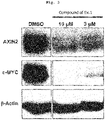
- the compounds of Example 1 inhibited the expression of AXIN2 and c-MYC that are Wnt/ ⁇ -catenin signaling target genes in a concentration-dependent manner. As seen from the above, inhibition of the activity of the Wnt/ ⁇ -catenin-signaling pathway by the compound of the present invention was able to be confirmed at the expression levels of the target genes.
- the mixture was gently stirred and then left to stand on ice for 30 minutes. Supernatant was recovered by centrifugal operation (15,000 rpm, 10 min.) and amounts of proteins were determined. An amount corresponding to 50 ⁇ g of protein was weighed from the supernatant, and mixed with a SDS sample buffer. The resultant mixture was reacted at 95°C for 5 min. followed by denaturation of the protein to give a sample solution. The sample solution was applied to respective wells of 4-20 % gradient acrylamide gel (COSMO BIO co., ltd., No. 414879) and then electrophoresis was performed. Thereafter, using iBlot gel transfer system (Life Technologies Co.), the proteins in the gel were transcribed onto a PVDF membrane.
- COSMO BIO co., ltd., No. 414879 4-20 % gradient acrylamide gel
- the transcribed PVDF membrane was subjected to blocking treatment with 2% ECL Prime Blocking Reagent (GE Healthcare Co.). Then, the proteins were reacted overnight at 4°C using as a primary antibody anti-AXIN2 rabbit antibody (Cell Signaling Co., No. 2151), anti-c-MYC rabbit antibody (Cell Signaling Co., No. 5605) or anti- ⁇ -Actin mouse antibody (Abcam plc., No. ab6276). Unreacted primary antibodies were washed with TBST buffer (10 mM Tris-HCl (pH 7.5), 150 mM NaCl, and 0.1% Tween 20).
- the proteins were reacted at room temperature for one hour in TBST buffer supplemented with 2% ECL Prime Blocking Reagent, using as a secondary antibody HRP-labeled Anti-Rabbit IgG Goat Antibody (Santa Cruz Biotechnology, Inc., No. sc2004) or HRP-labeled Anti-mouse IgG Goat Antibody (Zymed Laboratories, Inc., No. 62-6520).
- HRP-labeled Anti-Rabbit IgG Goat Antibody Santa Cruz Biotechnology, Inc., No. sc2004
- HRP-labeled Anti-mouse IgG Goat Antibody Zymed Laboratories, Inc., No. 62-6520.
- Chem-Lumi One Super NACALAI TESQUE, INC.
- the respective bands were detected by chemiluminescence.
- the detected bands were quantified by densitometry (GE Healthcare Co., ImageQuant TL v8.1.0.0). Inhibition rates were calculated from the intensities of the bands in the respective groups, with the luminescence of the band of the DMSO added group being 100%.
- the respective bands were corrected according to the intensity of the band corresponding to ⁇ -Actin.
- Example 1 inhibited the expressions of AXIN2 and c-MYC that are Wnt/ ⁇ -catenin signaling target proteins in a concentration-dependent manner in HCT116 cells. From the above, inhibition of the activity of the Wnt/ ⁇ -catenin-signaling pathway by the compound of the present invention was able to be confirmed at the expression levels of the target proteins. [Table 6] Inhibition rate (%) 10 ⁇ M 3 ⁇ M AXIN2 66.9 46.1 c-MYC 90.2 63.9
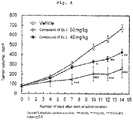
- the antitumor effects of the compound of the present invention were studied using nude mice subcutaneously transplanted with a human-derived colorectal cancer cell line HCT116, in which the Wnt signaling pathway was constantly activated.
- Two sample solutions (8 mg/L and 4 mg/L) for administration of a substance to be tested were prepared in accordance with respective administration doses.
- the substance to be tested (512 mg) was dissolved in DMSO (6.4 mL, NACALAI TESQUE, INC.), and polyethylene glycol #400 (28.8 mL, NACALAI TESQUE, INC.) was added thereto to prepare a preservative solution for the substance to be tested.
- the preservative solution was stored in a light-shielding condition until the day of use.
- Tumor volumes of the respective mice were calculated using the following formulas, and the antitumor effects were evaluated using a relative tumor volume ratio as an indicator.
- Tumor Volume Major Axis ⁇ Minor Axis ⁇ Minor Axis/2
- Tumor Volume Change Tumor Volume On Each Measurement Day ⁇ Tumor Volume On The Day Of Starting Administration
- Tumor Growth Inhibition Rate TGI % 1 ⁇ Average Value Of Tumor Volume Change In Each Administration Group Average Value Of Tumor Volume Change In Solvent Administration Group ⁇ 100
- the compound of Example 1 that is the compound of the present invention showed significant tumor growth inhibition in a dose-dependent manner.
- Tumor growth inhibition rates (TGIs) (%) on the last administration day were 42 % and 70 % in 40 mg/kg and 80 mg/kg, respectively. This confirmed that the compound of the present invention inhibits the activity of the Wnt signaling pathway, and is useful in the treatment of cancer in which the Wnt signaling is constantly activated.
- the compounds provided by the present invention are useful for treatment of diseases known to be associated with abnormal cell responses via the Wnt/ ⁇ -catenin signaling pathway, in particular cancer.
- the compounds of the present invention are also useful for prevention of metastasis and recurrence of tumors by targeting cancer stem cells.
- the compounds of the present invention are useful for laboratory and researching reagents as Wnt/ ⁇ -catenin signaling pathway inhibitors.
Landscapes
- Chemical & Material Sciences (AREA)
- Organic Chemistry (AREA)
- Health & Medical Sciences (AREA)
- General Health & Medical Sciences (AREA)
- Veterinary Medicine (AREA)
- Pharmacology & Pharmacy (AREA)
- Life Sciences & Earth Sciences (AREA)
- Animal Behavior & Ethology (AREA)
- Medicinal Chemistry (AREA)
- Public Health (AREA)
- Chemical Kinetics & Catalysis (AREA)
- General Chemical & Material Sciences (AREA)
- Nuclear Medicine, Radiotherapy & Molecular Imaging (AREA)
- Epidemiology (AREA)
- Engineering & Computer Science (AREA)
- Bioinformatics & Cheminformatics (AREA)
- Oncology (AREA)
- Pharmaceuticals Containing Other Organic And Inorganic Compounds (AREA)
- Plural Heterocyclic Compounds (AREA)
Claims (1)
- Dérivé de quinazoline choisi parmi les composés suivants :
Ex. Structure Nom 1 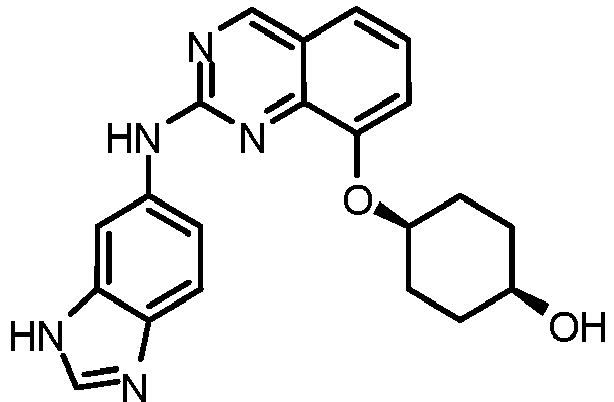
cis-4-({2-[(1H-benzo[d]imidazol-6-yl) amino] quinazolyn-8-yl}oxy)cyclohexanol 2 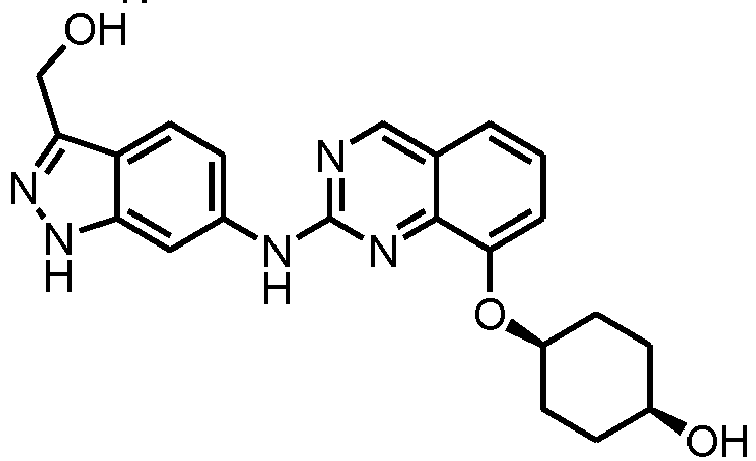
cis-4-[(2-{[3-(hydroxyméthyl)-1H-indazol-6-yl]amino}quinazolin-8-yl)oxy]cyclohexanol 3 
cis-4-{[2-({3-[(diméthylamino)méthyl] -1H-indazol-6-yl}amino)quinazolin-8-yl] oxy}cyclohexanol 8 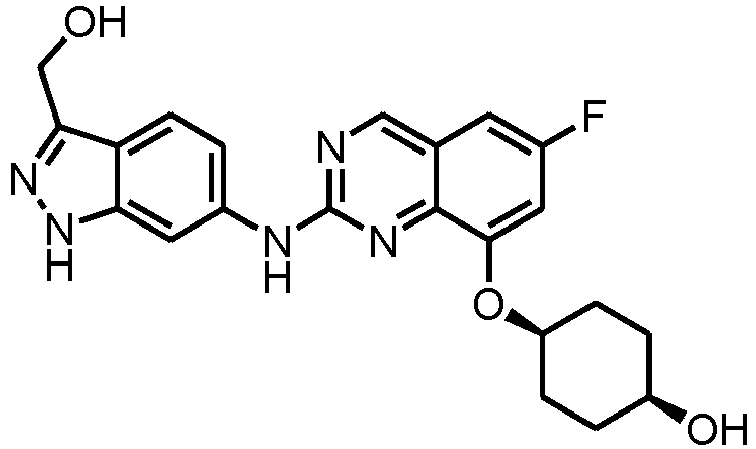
cis-4-[(6-fluoro-2-{[3-(hydroxyméthyl)-1H-indazol-6-yl]amino}quinazolin-8-yl)oxy]cyclohexanol 9 
cis-4-[(2-{[3-(1-hydroxyéthyl)- 1H-indazol-6-yl]amino}quinazolin-8-yl)oxy]cyclohexanol 10 
cis-4-[(7-bromo-2-{[3-(hydroxyméthyl)-1H-indazol-6-yl] amino}quinazolin-8-yl)oxy]cyclohexanol 11 
cis-4-({2-[(7-chloro-2-méthyl-1H-benzo[d]imidazol-5-yl) amino] quinazolin-8-yl}oxy)cyclohexanol 12 
cis-4-({2-[(2-méthyl- 1H-benzo[d]imidazol-5-yl) amino] quinazolin-8-yl}oxy)cyclohexanol 13 
cis-4-[(2-{[2-(pyrrolidin-1-ylméthyl)-1H-benzo[d]imidazol-5-yl] amino}quinazolin-8-yl)oxy]cyclohexanol 14 
cis-4-[(2-{[2-(hydroxyméthyl)-1H-benzo[d]imidazol-5-yl] amino}quinazolin-8-yl)oxy]cyclohexanol 15 
cis-4-{[2-(benzo[d]thiazol-6-ylamino)quinazolin-8-yl] oxy}cyclohexanol 16 
cis-4-{[2-(benzo[d]oxazol-6-ylamino)quinazolin-8-yl] oxy}cyclohexanol 17 
cis-4-({2-[(1H-benzo[d]imidazol-6-yl) amino] -7-méthylquinazolin-8-yl}oxy)cyclohexanol 18 
cis-4-({7-bromo-2-[(2-méthyl-1H-benzo[d]imidazol-6-yl) amino] quinazolin-8-yl}oxy)cyclohexanol 19 
cis-4-({2-[(4-bromo-2-méthyl- 1H-benzo[d]imidazol-6-yl) amino] quinazolin-8-yl}oxy)cyclohexanol 20 
cis-4-({2-[(2,4-diméthyl- 1H-benzo [d]imidazol-6-yl)amino]quinazolin -8-yl}oxy)cyclohexanol 21 
cis-4-({2-[(2-morpholino-1H-benzo[d]imidazol-6-yl) amino] quinazolin-8-yl}oxy)cyclohexanol 22 
cis-4-({2-[(4-fluoro-2-méthyl-1H-benzo[d]imidazol-6-yl)amino]quinazolin-8-yl}oxy)cyclohexanol 23 
cis-4-({2-[(2-éthyl- 1H-benzo[d]imidazol-6-yl)amino]quinazolin-8-yl}oxy)cyclohexanol 24 
cis-4-({2-[(2-éthyl- 1H-benzo[d]imidazol-6-yl)amino]quinazolin-8-yl}oxy)cyclohexanol 25 
cis-4-[(2-{[2-(méthoxyméthyl)- 1H-benzo[d]imidazol-6-yl]amino}quinazolin-8-yl)oxy]cyclohexanol 26 
cis-4-((2-{[2-(trifluorométhyl)-1H-benzo [d] imidazol-6-yl] amino}quinazolin-8-yl)oxy)cyclohexanol 27 
cis-4-{[2-({2-[(S)-1-hydroxyéthyl]-1H-benzo [d] imidazol-6-yl}amino)quinazolin-8-yl] oxy}cyclohexanol 28 
cis-4-({2-[(2-amino- 1H-benzo[d]imidazol-6-yl) amino] quinazolin-8-yl}oxy)cyclohexanol 29 
cis-4-[(2-{[4-(hydroxyméthyl)-1H-benzo[d]imidazol-6-yl] amino}quinazolin-8-yl)oxy]cyclohexanol 30 
cis-4-({2-[(5-méthyl- 1H-benzo[d]imidazol-6-yl)amino]quinazolin-8-yl}oxy)cyclohexanol 31 
cis-4-({2-[(1H-benzo[d]imidazol)-6-yl) amino] -7-bromoquinazolin-8-yl}oxy)cyclohexanol 32 
cis-4-({2-[(1H-benzo[d]imidazol-6-yl)amino]-6-fluoroquinazolin-8-yl}oxy)cyclohexanol 34 
cis-4-({2-[(1H-benzo[d]imidazol-6-yl) amino]-6-bromoquinazolin-8-yl}oxy)cyclohexanol 35 
cis-4-{[2-(quinoléine-6-ylamino)quinazolin-8-yl] oxy}cyclohexanol 36 
cis-4-{[2-(benzo[d]thiazol-5-ylamino)quinazolin-8-yl] oxy}cyclohexanol 37 
cis-4-{[2-(quinoléine-4-ylamino)quinazolin -8-yl] oxy}cyclohexanol 38 
cis-4-({2-[(2-méthylquinolin-6-yl)amino]quinazolin-8-yl}oxy)cyclohexanol 39 
cis-4-{[2-(isoquinoléine-6-ylamino)quinazolin-8-yl] oxy}cyclohexanol 40 
cis-4-{[2-(isoquinoléine-7-ylamino)quinazolin-8-yl] oxy}cyclohexanol 41 
cis-4-{[2-(isoquinoléine-5-ylamino)quinazolin -8-yl] oxy}cyclohexanol 42 
cis-4-{[2-(benzo[d]thiazol-6-ylamino)-7-fluoroquinazolin-8-yl] oxy}cyclohexanol 43 
cis-4-{[7-fluoro-2-(quinoléine-6-ylamino)quinazolin-8-yl] oxy}cyclohexanol 44 
cis-4-[(7-fluoro-2-{[3-(hydroxyméthyl)-1H-indazol-6-yl] amino}quinazolin-8-yl)oxy]cyclohexanol 45 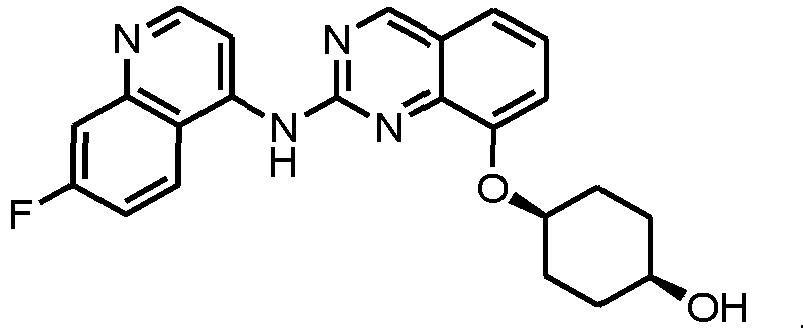
cis-4-({2-[(7-fluoroquinolin-4-yl) amino] quinazolin-8-yl}oxy)cyclohexanol 46 
cis-4-({2-[(7-méthoxyquinolin-4-yl)amino]quinazolin-8-yl}oxy)cyclohexanol
Applications Claiming Priority (2)
| Application Number | Priority Date | Filing Date | Title |
|---|---|---|---|
| JP2013253222 | 2013-12-06 | ||
| PCT/JP2014/082300 WO2015083833A1 (fr) | 2013-12-06 | 2014-12-05 | Nouveau dérivé quinazoline |
Publications (3)
| Publication Number | Publication Date |
|---|---|
| EP3078660A1 EP3078660A1 (fr) | 2016-10-12 |
| EP3078660A4 EP3078660A4 (fr) | 2017-05-17 |
| EP3078660B1 true EP3078660B1 (fr) | 2022-07-13 |
Family
ID=53273579
Family Applications (1)
| Application Number | Title | Priority Date | Filing Date |
|---|---|---|---|
| EP14868296.6A Not-in-force EP3078660B1 (fr) | 2013-12-06 | 2014-12-05 | Nouveau dérivé quinazoline |
Country Status (7)
| Country | Link |
|---|---|
| US (1) | US9682961B2 (fr) |
| EP (1) | EP3078660B1 (fr) |
| JP (1) | JP6492012B2 (fr) |
| KR (1) | KR102338568B1 (fr) |
| CN (1) | CN105358549B (fr) |
| ES (1) | ES2924480T3 (fr) |
| WO (1) | WO2015083833A1 (fr) |
Families Citing this family (9)
| Publication number | Priority date | Publication date | Assignee | Title |
|---|---|---|---|---|
| CN105755142A (zh) * | 2016-04-22 | 2016-07-13 | 同济大学苏州研究院 | 一种用于检测人源性axin2基因表达水平的引物探针组合及其应用 |
| CN108558854A (zh) * | 2017-06-10 | 2018-09-21 | 曹艳 | 一种治疗革兰氏阳性菌引起的感染的药物及其合成方法 |
| CN107033138B (zh) * | 2017-06-10 | 2018-06-08 | 徐晓东 | 一种治疗恶性肿瘤的药物 |
| CN107226815B (zh) * | 2017-06-22 | 2018-07-31 | 徐州市第一人民医院 | 喹唑啉类化合物及其在抗肿瘤药物中的应用 |
| AR112840A1 (es) * | 2017-09-29 | 2019-12-18 | Bayer Ag | 3- fenilquinazolin-4(3h)-onas sustituidas y sus usos |
| CN116874503B (zh) * | 2020-10-28 | 2025-08-08 | 杭州阿诺生物医药科技有限公司 | 一种高活性的hpk1激酶抑制剂 |
| CN116672450A (zh) * | 2022-02-23 | 2023-09-01 | 智宠制药(北京)有限公司 | Hpk1抑制剂在治疗干扰素相关疾病中的应用 |
| WO2026043823A2 (fr) | 2024-08-19 | 2026-02-26 | Sutro Biopharma, Inc. | Anticorps comprenant des résidus d'acides aminés non naturels spécifiques à un site, leurs procédés de préparation et leurs utilisations |
| WO2026080697A1 (fr) | 2024-10-09 | 2026-04-16 | Sutro Biopharma, Inc. | Conjugués d'anticorps à rapports élevés charge utile/anticorps, compositions les comprenant, et leurs procédés d'utilisation |
Family Cites Families (7)
| Publication number | Priority date | Publication date | Assignee | Title |
|---|---|---|---|---|
| TW200808739A (en) * | 2006-04-06 | 2008-02-16 | Novartis Vaccines & Diagnostic | Quinazolines for PDK1 inhibition |
| CA2651072A1 (fr) | 2006-05-01 | 2007-11-08 | Pfizer Products Inc. | Composes heterocycliques 2-amino-substitues a cycles fusionnes |
| EP2226315A4 (fr) | 2007-12-28 | 2012-01-25 | Carna Biosciences Inc | Dérivé de 2-aminoquinazoline |
| WO2012044090A2 (fr) | 2010-09-29 | 2012-04-05 | 크리스탈지노믹스(주) | Nouveau composé d'aminoquinazoline possédant une action inhibitrice de la protéine kinase |
| WO2012088712A1 (fr) * | 2010-12-31 | 2012-07-05 | Curegenix Inc. | Composé en tant qu'inhibiteur de signalisation de wnt, composition et applications |
| EP2694482A1 (fr) * | 2011-04-04 | 2014-02-12 | Siena Biotech S.p.A. | Antagonistes de la voie wnt |
| KR101360948B1 (ko) | 2012-01-17 | 2014-02-12 | 한국과학기술연구원 | 신규한 2-아미노퀴나졸린 유도체 및 이를 유효성분으로 포함하는 항암제 |
-
2014
- 2014-12-05 WO PCT/JP2014/082300 patent/WO2015083833A1/fr not_active Ceased
- 2014-12-05 JP JP2015551587A patent/JP6492012B2/ja not_active Expired - Fee Related
- 2014-12-05 CN CN201480029864.4A patent/CN105358549B/zh not_active Expired - Fee Related
- 2014-12-05 US US14/890,868 patent/US9682961B2/en not_active Expired - Fee Related
- 2014-12-05 KR KR1020157033989A patent/KR102338568B1/ko not_active Expired - Fee Related
- 2014-12-05 ES ES14868296T patent/ES2924480T3/es active Active
- 2014-12-05 EP EP14868296.6A patent/EP3078660B1/fr not_active Not-in-force
Non-Patent Citations (1)
| Title |
|---|
| L. B. LUNA-ULLOA ET AL: "Protein kinase C is a positive modulator of canonical Wnt signaling pathway in tumoral colon cell lines", CARCINOGENESIS., vol. 32, no. 11, 1 November 2011 (2011-11-01), GB, pages 1615 - 1624, XP055755991, ISSN: 0143-3334, DOI: 10.1093/carcin/bgr190 * |
Also Published As
| Publication number | Publication date |
|---|---|
| CN105358549B (zh) | 2019-09-20 |
| WO2015083833A1 (fr) | 2015-06-11 |
| US20160264555A1 (en) | 2016-09-15 |
| KR20160093543A (ko) | 2016-08-08 |
| CN105358549A (zh) | 2016-02-24 |
| JP6492012B2 (ja) | 2019-03-27 |
| EP3078660A4 (fr) | 2017-05-17 |
| EP3078660A1 (fr) | 2016-10-12 |
| JPWO2015083833A1 (ja) | 2017-03-16 |
| US9682961B2 (en) | 2017-06-20 |
| KR102338568B1 (ko) | 2021-12-13 |
| ES2924480T3 (es) | 2022-10-07 |
Similar Documents
| Publication | Publication Date | Title |
|---|---|---|
| EP3078660A1 (fr) | Nouveau dérivé quinazoline | |
| EP2984088B1 (fr) | Quinazolines et azaquinazolines en tant que doubles inhibiteurs des voies ras/raf/mek/erk et pi3k/akt/pten/mtor | |
| CN111848599A (zh) | 一类含氧五元杂环化合物、合成方法、药物组合物及用途 | |
| RU2656591C2 (ru) | Модуляторы протеин-тирозинкиназы и способы их применения | |
| CN102712601A (zh) | 化合物、其制备方法、药物组合物、化合物的用途、用于调节或调控丝氨酸/苏氨酸激酶的方法以及丝氨酸/苏氨酸激酶调节剂 | |
| CN104119280A (zh) | 含氨基类脲与端炔结构单元的嘧啶衍生物、制备方法及应用 | |
| JP2022504541A (ja) | 低分子mdm2タンパク質デグレーダー | |
| US10562890B2 (en) | Cancer therapeutics | |
| BRPI0911679B1 (pt) | Composto aciltioureia ou um sal do mesmo, uso do dito composto para tratar câncer, bem como agente farmacêutico, agente antitumoral e composição farmacêutica compreendendo dito composto | |
| CN102766103B (zh) | 2-硫代-4-胺基-1-萘酚衍生物、其制备方法和用途 | |
| ES2647849T3 (es) | Compuestos de pirido[2,3-d]pirimidin-4-ona como inhibidores de la tanquirasa | |
| US20250000854A1 (en) | 4-(Aminomethyl)-6-(1-Methyl-1H-Pyrazol-4-YL)Isoquinolin-1(2H)-One Derivatives as MTA-Cooperative Inhibitors of PRMT5 | |
| BR112017005113B1 (pt) | Composto de fórmula geral (i), método para preparar o composto de fórmula geral (i), método para preparar um composto de fórmula geral (iv), composição farmacêutica para o tratamento de doenças relacionadas com atividades anormais de jak3 e/ou jak1 quinases, uso do composto, e uso da composição farmacêutica | |
| WO2021193756A1 (fr) | Dérivé inédit de benzimidazole | |
| CN113880772B (zh) | 一类cdk激酶抑制剂及其应用 | |
| CN101475513B (zh) | Raf和HDAC小分子双重抑制剂及其制备方法和应用 | |
| CN114539226B (zh) | 一种含吲哚类衍生物自由碱的晶型及其制备方法和应用 | |
| CN111247137A (zh) | 一种嘧啶类化合物、其制备方法及其医药用途 | |
| CN109553617B (zh) | Wnt和Hedgehog信号通路双抑制剂及其应用 | |
| CN108794398B (zh) | 具有荧光的选择性组蛋白去乙酰化酶抑制剂及其制备方法和应用 | |
| US9901570B2 (en) | Breast cancer cell growth-inhibiting enzyme inhibitors, method for the production thereof, and use thereof | |
| CN118338898A (zh) | 具有临床前抗结直肠癌活性的致癌chd1l的小分子抑制剂 | |
| CN118724825B (zh) | 一种Mer/HDAC双靶点抑制剂及其在制备抗肿瘤药物中的应用 | |
| WO2022021683A1 (fr) | Composé alcaloïde indolique, procédé de préparation associé et application associée | |
| CN114920726B (zh) | 一种三氮唑-异烟酸类化合物及其制备方法和应用 |
Legal Events
| Date | Code | Title | Description |
|---|---|---|---|
| PUAI | Public reference made under article 153(3) epc to a published international application that has entered the european phase |
Free format text: ORIGINAL CODE: 0009012 |
|
| 17P | Request for examination filed |
Effective date: 20151120 |
|
| AK | Designated contracting states |
Kind code of ref document: A1 Designated state(s): AL AT BE BG CH CY CZ DE DK EE ES FI FR GB GR HR HU IE IS IT LI LT LU LV MC MK MT NL NO PL PT RO RS SE SI SK SM TR |
|
| AX | Request for extension of the european patent |
Extension state: BA ME |
|
| DAX | Request for extension of the european patent (deleted) | ||
| A4 | Supplementary search report drawn up and despatched |
Effective date: 20170421 |
|
| RIC1 | Information provided on ipc code assigned before grant |
Ipc: C07D 413/12 20060101ALI20170413BHEP Ipc: A61K 31/517 20060101ALI20170413BHEP Ipc: A61P 35/00 20060101ALI20170413BHEP Ipc: C07D 417/12 20060101ALI20170413BHEP Ipc: A61K 31/5377 20060101ALI20170413BHEP Ipc: C07D 403/12 20060101AFI20170413BHEP Ipc: A61P 43/00 20060101ALI20170413BHEP Ipc: C07D 401/12 20060101ALI20170413BHEP |
|
| STAA | Information on the status of an ep patent application or granted ep patent |
Free format text: STATUS: EXAMINATION IS IN PROGRESS |
|
| 17Q | First examination report despatched |
Effective date: 20190304 |
|
| RAP1 | Party data changed (applicant data changed or rights of an application transferred) |
Owner name: MYCHUNTER THERAPEUTICS, INC. |
|
| REG | Reference to a national code |
Ref country code: DE Ref legal event code: R079 Ref document number: 602014084311 Country of ref document: DE Free format text: PREVIOUS MAIN CLASS: C07D0403120000 Ipc: A61P0035040000 |
|
| RIC1 | Information provided on ipc code assigned before grant |
Ipc: C07D 417/12 20060101ALI20211115BHEP Ipc: C07D 401/12 20060101ALI20211115BHEP Ipc: C07D 403/12 20060101ALI20211115BHEP Ipc: A61P 35/04 20060101AFI20211115BHEP |
|
| GRAP | Despatch of communication of intention to grant a patent |
Free format text: ORIGINAL CODE: EPIDOSNIGR1 |
|
| STAA | Information on the status of an ep patent application or granted ep patent |
Free format text: STATUS: GRANT OF PATENT IS INTENDED |
|
| INTG | Intention to grant announced |
Effective date: 20220124 |
|
| GRAS | Grant fee paid |
Free format text: ORIGINAL CODE: EPIDOSNIGR3 |
|
| GRAA | (expected) grant |
Free format text: ORIGINAL CODE: 0009210 |
|
| STAA | Information on the status of an ep patent application or granted ep patent |
Free format text: STATUS: THE PATENT HAS BEEN GRANTED |
|
| AK | Designated contracting states |
Kind code of ref document: B1 Designated state(s): AL AT BE BG CH CY CZ DE DK EE ES FI FR GB GR HR HU IE IS IT LI LT LU LV MC MK MT NL NO PL PT RO RS SE SI SK SM TR |
|
| REG | Reference to a national code |
Ref country code: GB Ref legal event code: FG4D |
|
| REG | Reference to a national code |
Ref country code: CH Ref legal event code: EP |
|
| REG | Reference to a national code |
Ref country code: IE Ref legal event code: FG4D |
|
| REG | Reference to a national code |
Ref country code: DE Ref legal event code: R096 Ref document number: 602014084311 Country of ref document: DE |
|
| REG | Reference to a national code |
Ref country code: AT Ref legal event code: REF Ref document number: 1503955 Country of ref document: AT Kind code of ref document: T Effective date: 20220815 |
|
| REG | Reference to a national code |
Ref country code: ES Ref legal event code: FG2A Ref document number: 2924480 Country of ref document: ES Kind code of ref document: T3 Effective date: 20221007 |
|
| REG | Reference to a national code |
Ref country code: LT Ref legal event code: MG9D |
|
| REG | Reference to a national code |
Ref country code: NL Ref legal event code: MP Effective date: 20220713 |
|
| PG25 | Lapsed in a contracting state [announced via postgrant information from national office to epo] |
Ref country code: SE Free format text: LAPSE BECAUSE OF FAILURE TO SUBMIT A TRANSLATION OF THE DESCRIPTION OR TO PAY THE FEE WITHIN THE PRESCRIBED TIME-LIMIT Effective date: 20220713 Ref country code: RS Free format text: LAPSE BECAUSE OF FAILURE TO SUBMIT A TRANSLATION OF THE DESCRIPTION OR TO PAY THE FEE WITHIN THE PRESCRIBED TIME-LIMIT Effective date: 20220713 Ref country code: PT Free format text: LAPSE BECAUSE OF FAILURE TO SUBMIT A TRANSLATION OF THE DESCRIPTION OR TO PAY THE FEE WITHIN THE PRESCRIBED TIME-LIMIT Effective date: 20221114 Ref country code: NO Free format text: LAPSE BECAUSE OF FAILURE TO SUBMIT A TRANSLATION OF THE DESCRIPTION OR TO PAY THE FEE WITHIN THE PRESCRIBED TIME-LIMIT Effective date: 20221013 Ref country code: NL Free format text: LAPSE BECAUSE OF FAILURE TO SUBMIT A TRANSLATION OF THE DESCRIPTION OR TO PAY THE FEE WITHIN THE PRESCRIBED TIME-LIMIT Effective date: 20220713 Ref country code: LV Free format text: LAPSE BECAUSE OF FAILURE TO SUBMIT A TRANSLATION OF THE DESCRIPTION OR TO PAY THE FEE WITHIN THE PRESCRIBED TIME-LIMIT Effective date: 20220713 Ref country code: LT Free format text: LAPSE BECAUSE OF FAILURE TO SUBMIT A TRANSLATION OF THE DESCRIPTION OR TO PAY THE FEE WITHIN THE PRESCRIBED TIME-LIMIT Effective date: 20220713 Ref country code: FI Free format text: LAPSE BECAUSE OF FAILURE TO SUBMIT A TRANSLATION OF THE DESCRIPTION OR TO PAY THE FEE WITHIN THE PRESCRIBED TIME-LIMIT Effective date: 20220713 |
|
| REG | Reference to a national code |
Ref country code: AT Ref legal event code: MK05 Ref document number: 1503955 Country of ref document: AT Kind code of ref document: T Effective date: 20220713 |
|
| PG25 | Lapsed in a contracting state [announced via postgrant information from national office to epo] |
Ref country code: PL Free format text: LAPSE BECAUSE OF FAILURE TO SUBMIT A TRANSLATION OF THE DESCRIPTION OR TO PAY THE FEE WITHIN THE PRESCRIBED TIME-LIMIT Effective date: 20220713 Ref country code: IS Free format text: LAPSE BECAUSE OF FAILURE TO SUBMIT A TRANSLATION OF THE DESCRIPTION OR TO PAY THE FEE WITHIN THE PRESCRIBED TIME-LIMIT Effective date: 20221113 Ref country code: HR Free format text: LAPSE BECAUSE OF FAILURE TO SUBMIT A TRANSLATION OF THE DESCRIPTION OR TO PAY THE FEE WITHIN THE PRESCRIBED TIME-LIMIT Effective date: 20220713 Ref country code: GR Free format text: LAPSE BECAUSE OF FAILURE TO SUBMIT A TRANSLATION OF THE DESCRIPTION OR TO PAY THE FEE WITHIN THE PRESCRIBED TIME-LIMIT Effective date: 20221014 |
|
| REG | Reference to a national code |
Ref country code: DE Ref legal event code: R097 Ref document number: 602014084311 Country of ref document: DE |
|
| PG25 | Lapsed in a contracting state [announced via postgrant information from national office to epo] |
Ref country code: SM Free format text: LAPSE BECAUSE OF FAILURE TO SUBMIT A TRANSLATION OF THE DESCRIPTION OR TO PAY THE FEE WITHIN THE PRESCRIBED TIME-LIMIT Effective date: 20220713 Ref country code: RO Free format text: LAPSE BECAUSE OF FAILURE TO SUBMIT A TRANSLATION OF THE DESCRIPTION OR TO PAY THE FEE WITHIN THE PRESCRIBED TIME-LIMIT Effective date: 20220713 Ref country code: DK Free format text: LAPSE BECAUSE OF FAILURE TO SUBMIT A TRANSLATION OF THE DESCRIPTION OR TO PAY THE FEE WITHIN THE PRESCRIBED TIME-LIMIT Effective date: 20220713 Ref country code: CZ Free format text: LAPSE BECAUSE OF FAILURE TO SUBMIT A TRANSLATION OF THE DESCRIPTION OR TO PAY THE FEE WITHIN THE PRESCRIBED TIME-LIMIT Effective date: 20220713 Ref country code: AT Free format text: LAPSE BECAUSE OF FAILURE TO SUBMIT A TRANSLATION OF THE DESCRIPTION OR TO PAY THE FEE WITHIN THE PRESCRIBED TIME-LIMIT Effective date: 20220713 |
|
| PLBE | No opposition filed within time limit |
Free format text: ORIGINAL CODE: 0009261 |
|
| STAA | Information on the status of an ep patent application or granted ep patent |
Free format text: STATUS: NO OPPOSITION FILED WITHIN TIME LIMIT |
|
| PG25 | Lapsed in a contracting state [announced via postgrant information from national office to epo] |
Ref country code: SK Free format text: LAPSE BECAUSE OF FAILURE TO SUBMIT A TRANSLATION OF THE DESCRIPTION OR TO PAY THE FEE WITHIN THE PRESCRIBED TIME-LIMIT Effective date: 20220713 Ref country code: EE Free format text: LAPSE BECAUSE OF FAILURE TO SUBMIT A TRANSLATION OF THE DESCRIPTION OR TO PAY THE FEE WITHIN THE PRESCRIBED TIME-LIMIT Effective date: 20220713 |
|
| 26N | No opposition filed |
Effective date: 20230414 |
|
| PG25 | Lapsed in a contracting state [announced via postgrant information from national office to epo] |
Ref country code: AL Free format text: LAPSE BECAUSE OF FAILURE TO SUBMIT A TRANSLATION OF THE DESCRIPTION OR TO PAY THE FEE WITHIN THE PRESCRIBED TIME-LIMIT Effective date: 20220713 |
|
| REG | Reference to a national code |
Ref country code: CH Ref legal event code: PL |
|
| REG | Reference to a national code |
Ref country code: BE Ref legal event code: MM Effective date: 20221231 |
|
| PG25 | Lapsed in a contracting state [announced via postgrant information from national office to epo] |
Ref country code: SI Free format text: LAPSE BECAUSE OF FAILURE TO SUBMIT A TRANSLATION OF THE DESCRIPTION OR TO PAY THE FEE WITHIN THE PRESCRIBED TIME-LIMIT Effective date: 20220713 Ref country code: LU Free format text: LAPSE BECAUSE OF NON-PAYMENT OF DUE FEES Effective date: 20221205 |
|
| PG25 | Lapsed in a contracting state [announced via postgrant information from national office to epo] |
Ref country code: LI Free format text: LAPSE BECAUSE OF NON-PAYMENT OF DUE FEES Effective date: 20221231 Ref country code: IE Free format text: LAPSE BECAUSE OF NON-PAYMENT OF DUE FEES Effective date: 20221205 Ref country code: CH Free format text: LAPSE BECAUSE OF NON-PAYMENT OF DUE FEES Effective date: 20221231 |
|
| PG25 | Lapsed in a contracting state [announced via postgrant information from national office to epo] |
Ref country code: BE Free format text: LAPSE BECAUSE OF NON-PAYMENT OF DUE FEES Effective date: 20221231 |
|
| PGFP | Annual fee paid to national office [announced via postgrant information from national office to epo] |
Ref country code: GB Payment date: 20231120 Year of fee payment: 10 |
|
| PGFP | Annual fee paid to national office [announced via postgrant information from national office to epo] |
Ref country code: IT Payment date: 20231026 Year of fee payment: 10 Ref country code: FR Payment date: 20231010 Year of fee payment: 10 |
|
| PG25 | Lapsed in a contracting state [announced via postgrant information from national office to epo] |
Ref country code: HU Free format text: LAPSE BECAUSE OF FAILURE TO SUBMIT A TRANSLATION OF THE DESCRIPTION OR TO PAY THE FEE WITHIN THE PRESCRIBED TIME-LIMIT; INVALID AB INITIO Effective date: 20141205 |
|
| PGFP | Annual fee paid to national office [announced via postgrant information from national office to epo] |
Ref country code: ES Payment date: 20240102 Year of fee payment: 10 |
|
| PG25 | Lapsed in a contracting state [announced via postgrant information from national office to epo] |
Ref country code: CY Free format text: LAPSE BECAUSE OF FAILURE TO SUBMIT A TRANSLATION OF THE DESCRIPTION OR TO PAY THE FEE WITHIN THE PRESCRIBED TIME-LIMIT Effective date: 20220713 |
|
| PGFP | Annual fee paid to national office [announced via postgrant information from national office to epo] |
Ref country code: DE Payment date: 20231229 Year of fee payment: 10 |
|
| PG25 | Lapsed in a contracting state [announced via postgrant information from national office to epo] |
Ref country code: MK Free format text: LAPSE BECAUSE OF FAILURE TO SUBMIT A TRANSLATION OF THE DESCRIPTION OR TO PAY THE FEE WITHIN THE PRESCRIBED TIME-LIMIT Effective date: 20220713 |
|
| PG25 | Lapsed in a contracting state [announced via postgrant information from national office to epo] |
Ref country code: MC Free format text: LAPSE BECAUSE OF FAILURE TO SUBMIT A TRANSLATION OF THE DESCRIPTION OR TO PAY THE FEE WITHIN THE PRESCRIBED TIME-LIMIT Effective date: 20220713 |
|
| PG25 | Lapsed in a contracting state [announced via postgrant information from national office to epo] |
Ref country code: MC Free format text: LAPSE BECAUSE OF FAILURE TO SUBMIT A TRANSLATION OF THE DESCRIPTION OR TO PAY THE FEE WITHIN THE PRESCRIBED TIME-LIMIT Effective date: 20220713 |
|
| PG25 | Lapsed in a contracting state [announced via postgrant information from national office to epo] |
Ref country code: BG Free format text: LAPSE BECAUSE OF FAILURE TO SUBMIT A TRANSLATION OF THE DESCRIPTION OR TO PAY THE FEE WITHIN THE PRESCRIBED TIME-LIMIT Effective date: 20220713 |
|
| PG25 | Lapsed in a contracting state [announced via postgrant information from national office to epo] |
Ref country code: MT Free format text: LAPSE BECAUSE OF FAILURE TO SUBMIT A TRANSLATION OF THE DESCRIPTION OR TO PAY THE FEE WITHIN THE PRESCRIBED TIME-LIMIT Effective date: 20220713 |
|
| REG | Reference to a national code |
Ref country code: DE Ref legal event code: R119 Ref document number: 602014084311 Country of ref document: DE |
|
| GBPC | Gb: european patent ceased through non-payment of renewal fee |
Effective date: 20241205 |
|
| PG25 | Lapsed in a contracting state [announced via postgrant information from national office to epo] |
Ref country code: DE Free format text: LAPSE BECAUSE OF NON-PAYMENT OF DUE FEES Effective date: 20250701 |
|
| PG25 | Lapsed in a contracting state [announced via postgrant information from national office to epo] |
Ref country code: IT Free format text: LAPSE BECAUSE OF NON-PAYMENT OF DUE FEES Effective date: 20241205 |
|
| PG25 | Lapsed in a contracting state [announced via postgrant information from national office to epo] |
Ref country code: GB Free format text: LAPSE BECAUSE OF NON-PAYMENT OF DUE FEES Effective date: 20241205 |
|
| PG25 | Lapsed in a contracting state [announced via postgrant information from national office to epo] |
Ref country code: FR Free format text: LAPSE BECAUSE OF NON-PAYMENT OF DUE FEES Effective date: 20241231 |
|
| PG25 | Lapsed in a contracting state [announced via postgrant information from national office to epo] |
Ref country code: TR Free format text: LAPSE BECAUSE OF FAILURE TO SUBMIT A TRANSLATION OF THE DESCRIPTION OR TO PAY THE FEE WITHIN THE PRESCRIBED TIME-LIMIT Effective date: 20220713 |
|
| REG | Reference to a national code |
Ref country code: ES Ref legal event code: FD2A Effective date: 20260129 |
|
| PG25 | Lapsed in a contracting state [announced via postgrant information from national office to epo] |
Ref country code: ES Free format text: LAPSE BECAUSE OF NON-PAYMENT OF DUE FEES Effective date: 20241206 |