EP3078663A1 - Modifizierte partikel von palbociclib - Google Patents
Modifizierte partikel von palbociclib Download PDFInfo
- Publication number
- EP3078663A1 EP3078663A1 EP15162960.7A EP15162960A EP3078663A1 EP 3078663 A1 EP3078663 A1 EP 3078663A1 EP 15162960 A EP15162960 A EP 15162960A EP 3078663 A1 EP3078663 A1 EP 3078663A1
- Authority
- EP
- European Patent Office
- Prior art keywords
- palbociclib
- crystalline
- free base
- specific surface
- acid
- Prior art date
- Legal status (The legal status is an assumption and is not a legal conclusion. Google has not performed a legal analysis and makes no representation as to the accuracy of the status listed.)
- Ceased
Links
- AHJRHEGDXFFMBM-UHFFFAOYSA-N palbociclib Chemical compound N1=C2N(C3CCCC3)C(=O)C(C(=O)C)=C(C)C2=CN=C1NC(N=C1)=CC=C1N1CCNCC1 AHJRHEGDXFFMBM-UHFFFAOYSA-N 0.000 title claims abstract description 126
- 229960004390 palbociclib Drugs 0.000 title claims abstract description 85
- 239000002245 particle Substances 0.000 title description 14
- 238000000034 method Methods 0.000 claims abstract description 33
- 150000003839 salts Chemical class 0.000 claims abstract description 26
- 239000008194 pharmaceutical composition Substances 0.000 claims abstract description 24
- 239000011164 primary particle Substances 0.000 claims abstract description 21
- 239000003002 pH adjusting agent Substances 0.000 claims abstract description 16
- 238000002360 preparation method Methods 0.000 claims abstract description 15
- 206010028980 Neoplasm Diseases 0.000 claims abstract description 9
- 201000011510 cancer Diseases 0.000 claims abstract description 7
- 239000003814 drug Substances 0.000 claims abstract description 7
- YMWUJEATGCHHMB-UHFFFAOYSA-N Dichloromethane Chemical group ClCCl YMWUJEATGCHHMB-UHFFFAOYSA-N 0.000 claims description 57
- 239000000243 solution Substances 0.000 claims description 34
- 239000002904 solvent Substances 0.000 claims description 22
- 239000000725 suspension Substances 0.000 claims description 18
- 239000002253 acid Substances 0.000 claims description 17
- 239000002585 base Substances 0.000 claims description 10
- 238000002425 crystallisation Methods 0.000 claims description 10
- 230000008025 crystallization Effects 0.000 claims description 10
- 230000005855 radiation Effects 0.000 claims description 10
- IJGRMHOSHXDMSA-UHFFFAOYSA-N nitrogen Substances N#N IJGRMHOSHXDMSA-UHFFFAOYSA-N 0.000 claims description 9
- 239000012296 anti-solvent Substances 0.000 claims description 8
- 229910052757 nitrogen Inorganic materials 0.000 claims description 7
- XLYOFNOQVPJJNP-UHFFFAOYSA-N water Substances O XLYOFNOQVPJJNP-UHFFFAOYSA-N 0.000 claims description 7
- 150000001412 amines Chemical class 0.000 claims description 6
- 238000004458 analytical method Methods 0.000 claims description 5
- 238000001179 sorption measurement Methods 0.000 claims description 5
- 239000012452 mother liquor Substances 0.000 claims description 4
- 238000010899 nucleation Methods 0.000 claims description 4
- 239000012266 salt solution Substances 0.000 claims description 4
- 150000007524 organic acids Chemical class 0.000 claims description 3
- 239000000843 powder Substances 0.000 claims description 3
- 239000012074 organic phase Substances 0.000 claims description 2
- 239000012458 free base Substances 0.000 abstract description 13
- 239000000203 mixture Substances 0.000 description 26
- 239000013078 crystal Substances 0.000 description 22
- IMNFDUFMRHMDMM-UHFFFAOYSA-N N-Heptane Chemical compound CCCCCCC IMNFDUFMRHMDMM-UHFFFAOYSA-N 0.000 description 18
- 238000004090 dissolution Methods 0.000 description 16
- ZMANZCXQSJIPKH-UHFFFAOYSA-N Triethylamine Chemical compound CCN(CC)CC ZMANZCXQSJIPKH-UHFFFAOYSA-N 0.000 description 15
- 238000000634 powder X-ray diffraction Methods 0.000 description 15
- VYPSYNLAJGMNEJ-UHFFFAOYSA-N Silicium dioxide Chemical compound O=[Si]=O VYPSYNLAJGMNEJ-UHFFFAOYSA-N 0.000 description 14
- KDYFGRWQOYBRFD-UHFFFAOYSA-N Succinic acid Natural products OC(=O)CCC(O)=O KDYFGRWQOYBRFD-UHFFFAOYSA-N 0.000 description 12
- HQKMJHAJHXVSDF-UHFFFAOYSA-L magnesium stearate Chemical compound [Mg+2].CCCCCCCCCCCCCCCCCC([O-])=O.CCCCCCCCCCCCCCCCCC([O-])=O HQKMJHAJHXVSDF-UHFFFAOYSA-L 0.000 description 12
- 238000009472 formulation Methods 0.000 description 10
- 239000000463 material Substances 0.000 description 10
- 239000002775 capsule Substances 0.000 description 8
- 238000001914 filtration Methods 0.000 description 8
- 239000012071 phase Substances 0.000 description 7
- 238000003756 stirring Methods 0.000 description 7
- CSCPPACGZOOCGX-UHFFFAOYSA-N Acetone Chemical compound CC(C)=O CSCPPACGZOOCGX-UHFFFAOYSA-N 0.000 description 6
- VEXZGXHMUGYJMC-UHFFFAOYSA-N Hydrochloric acid Chemical compound Cl VEXZGXHMUGYJMC-UHFFFAOYSA-N 0.000 description 6
- 229920000168 Microcrystalline cellulose Polymers 0.000 description 6
- HEMHJVSKTPXQMS-UHFFFAOYSA-M Sodium hydroxide Chemical compound [OH-].[Na+] HEMHJVSKTPXQMS-UHFFFAOYSA-M 0.000 description 6
- FEWJPZIEWOKRBE-UHFFFAOYSA-N Tartaric acid Natural products [H+].[H+].[O-]C(=O)C(O)C(O)C([O-])=O FEWJPZIEWOKRBE-UHFFFAOYSA-N 0.000 description 6
- 229940075614 colloidal silicon dioxide Drugs 0.000 description 6
- 235000019359 magnesium stearate Nutrition 0.000 description 6
- 239000008108 microcrystalline cellulose Substances 0.000 description 6
- 229940016286 microcrystalline cellulose Drugs 0.000 description 6
- 235000019813 microcrystalline cellulose Nutrition 0.000 description 6
- 229940061285 palbociclib 75 mg Drugs 0.000 description 6
- 239000000546 pharmaceutical excipient Substances 0.000 description 6
- 229940079832 sodium starch glycolate Drugs 0.000 description 6
- 239000008109 sodium starch glycolate Substances 0.000 description 6
- 229920003109 sodium starch glycolate Polymers 0.000 description 6
- 239000001384 succinic acid Substances 0.000 description 6
- 239000011975 tartaric acid Substances 0.000 description 6
- 235000002906 tartaric acid Nutrition 0.000 description 6
- 239000008367 deionised water Substances 0.000 description 5
- 239000008188 pellet Substances 0.000 description 5
- 238000012545 processing Methods 0.000 description 5
- 210000002784 stomach Anatomy 0.000 description 5
- WSVLPVUVIUVCRA-KPKNDVKVSA-N Alpha-lactose monohydrate Chemical compound O.O[C@@H]1[C@@H](O)[C@@H](O)[C@@H](CO)O[C@H]1O[C@@H]1[C@@H](CO)O[C@H](O)[C@H](O)[C@H]1O WSVLPVUVIUVCRA-KPKNDVKVSA-N 0.000 description 4
- QGZKDVFQNNGYKY-UHFFFAOYSA-N Ammonia Chemical compound N QGZKDVFQNNGYKY-UHFFFAOYSA-N 0.000 description 4
- CIWBSHSKHKDKBQ-JLAZNSOCSA-N Ascorbic acid Chemical compound OC[C@H](O)[C@H]1OC(=O)C(O)=C1O CIWBSHSKHKDKBQ-JLAZNSOCSA-N 0.000 description 4
- FBPFZTCFMRRESA-KVTDHHQDSA-N D-Mannitol Chemical compound OC[C@@H](O)[C@@H](O)[C@H](O)[C@H](O)CO FBPFZTCFMRRESA-KVTDHHQDSA-N 0.000 description 4
- 229930195725 Mannitol Natural products 0.000 description 4
- JGFZNNIVVJXRND-UHFFFAOYSA-N N,N-Diisopropylethylamine (DIPEA) Chemical compound CCN(C(C)C)C(C)C JGFZNNIVVJXRND-UHFFFAOYSA-N 0.000 description 4
- LRHPLDYGYMQRHN-UHFFFAOYSA-N N-Butanol Chemical compound CCCCO LRHPLDYGYMQRHN-UHFFFAOYSA-N 0.000 description 4
- RDOXTESZEPMUJZ-UHFFFAOYSA-N anisole Chemical compound COC1=CC=CC=C1 RDOXTESZEPMUJZ-UHFFFAOYSA-N 0.000 description 4
- 239000008346 aqueous phase Substances 0.000 description 4
- 229910052681 coesite Inorganic materials 0.000 description 4
- 229910052906 cristobalite Inorganic materials 0.000 description 4
- 238000001035 drying Methods 0.000 description 4
- 125000005456 glyceride group Chemical group 0.000 description 4
- 229960001021 lactose monohydrate Drugs 0.000 description 4
- 239000000594 mannitol Substances 0.000 description 4
- 235000010355 mannitol Nutrition 0.000 description 4
- 239000000377 silicon dioxide Substances 0.000 description 4
- 229910052682 stishovite Inorganic materials 0.000 description 4
- 229910052905 tridymite Inorganic materials 0.000 description 4
- GETQZCLCWQTVFV-UHFFFAOYSA-N trimethylamine Chemical compound CN(C)C GETQZCLCWQTVFV-UHFFFAOYSA-N 0.000 description 4
- RFFLAFLAYFXFSW-UHFFFAOYSA-N 1,2-dichlorobenzene Chemical compound ClC1=CC=CC=C1Cl RFFLAFLAYFXFSW-UHFFFAOYSA-N 0.000 description 3
- 239000008186 active pharmaceutical agent Substances 0.000 description 3
- KRKNYBCHXYNGOX-UHFFFAOYSA-N citric acid Chemical compound OC(=O)CC(O)(C(O)=O)CC(O)=O KRKNYBCHXYNGOX-UHFFFAOYSA-N 0.000 description 3
- 238000001816 cooling Methods 0.000 description 3
- 229910021641 deionized water Inorganic materials 0.000 description 3
- 238000004821 distillation Methods 0.000 description 3
- 239000000945 filler Substances 0.000 description 3
- -1 glidants Substances 0.000 description 3
- SUMDYPCJJOFFON-UHFFFAOYSA-N isethionic acid Chemical class OCCS(O)(=O)=O SUMDYPCJJOFFON-UHFFFAOYSA-N 0.000 description 3
- 229940057948 magnesium stearate Drugs 0.000 description 3
- 239000007787 solid Substances 0.000 description 3
- 239000000126 substance Substances 0.000 description 3
- 206010005003 Bladder cancer Diseases 0.000 description 2
- HEDRZPFGACZZDS-UHFFFAOYSA-N Chloroform Chemical compound ClC(Cl)Cl HEDRZPFGACZZDS-UHFFFAOYSA-N 0.000 description 2
- FEWJPZIEWOKRBE-JCYAYHJZSA-N Dextrotartaric acid Chemical compound OC(=O)[C@H](O)[C@@H](O)C(O)=O FEWJPZIEWOKRBE-JCYAYHJZSA-N 0.000 description 2
- ROSDSFDQCJNGOL-UHFFFAOYSA-N Dimethylamine Chemical compound CNC ROSDSFDQCJNGOL-UHFFFAOYSA-N 0.000 description 2
- QUSNBJAOOMFDIB-UHFFFAOYSA-N Ethylamine Chemical compound CCN QUSNBJAOOMFDIB-UHFFFAOYSA-N 0.000 description 2
- VZCYOOQTPOCHFL-OWOJBTEDSA-N Fumaric acid Chemical compound OC(=O)\C=C\C(O)=O VZCYOOQTPOCHFL-OWOJBTEDSA-N 0.000 description 2
- 229920002153 Hydroxypropyl cellulose Polymers 0.000 description 2
- KFZMGEQAYNKOFK-UHFFFAOYSA-N Isopropanol Chemical compound CC(C)O KFZMGEQAYNKOFK-UHFFFAOYSA-N 0.000 description 2
- GUBGYTABKSRVRQ-QKKXKWKRSA-N Lactose Natural products OC[C@H]1O[C@@H](O[C@H]2[C@H](O)[C@@H](O)C(O)O[C@@H]2CO)[C@H](O)[C@@H](O)[C@H]1O GUBGYTABKSRVRQ-QKKXKWKRSA-N 0.000 description 2
- AFVFQIVMOAPDHO-UHFFFAOYSA-N Methanesulfonic acid Chemical compound CS(O)(=O)=O AFVFQIVMOAPDHO-UHFFFAOYSA-N 0.000 description 2
- BAVYZALUXZFZLV-UHFFFAOYSA-N Methylamine Chemical compound NC BAVYZALUXZFZLV-UHFFFAOYSA-N 0.000 description 2
- FAPWRFPIFSIZLT-UHFFFAOYSA-M Sodium chloride Chemical compound [Na+].[Cl-] FAPWRFPIFSIZLT-UHFFFAOYSA-M 0.000 description 2
- QAOWNCQODCNURD-UHFFFAOYSA-N Sulfuric acid Chemical compound OS(O)(=O)=O QAOWNCQODCNURD-UHFFFAOYSA-N 0.000 description 2
- DTQVDTLACAAQTR-UHFFFAOYSA-N Trifluoroacetic acid Chemical compound OC(=O)C(F)(F)F DTQVDTLACAAQTR-UHFFFAOYSA-N 0.000 description 2
- 208000007097 Urinary Bladder Neoplasms Diseases 0.000 description 2
- 238000010669 acid-base reaction Methods 0.000 description 2
- 229910021529 ammonia Inorganic materials 0.000 description 2
- 239000003125 aqueous solvent Substances 0.000 description 2
- 239000011668 ascorbic acid Substances 0.000 description 2
- 235000010323 ascorbic acid Nutrition 0.000 description 2
- 229960005070 ascorbic acid Drugs 0.000 description 2
- 210000004027 cell Anatomy 0.000 description 2
- MVPPADPHJFYWMZ-UHFFFAOYSA-N chlorobenzene Chemical compound ClC1=CC=CC=C1 MVPPADPHJFYWMZ-UHFFFAOYSA-N 0.000 description 2
- PAFZNILMFXTMIY-UHFFFAOYSA-N cyclohexylamine Chemical compound NC1CCCCC1 PAFZNILMFXTMIY-UHFFFAOYSA-N 0.000 description 2
- 230000007423 decrease Effects 0.000 description 2
- 238000011161 development Methods 0.000 description 2
- 239000003085 diluting agent Substances 0.000 description 2
- 208000037265 diseases, disorders, signs and symptoms Diseases 0.000 description 2
- 239000007884 disintegrant Substances 0.000 description 2
- 208000035475 disorder Diseases 0.000 description 2
- 229940079593 drug Drugs 0.000 description 2
- 238000011067 equilibration Methods 0.000 description 2
- 238000010438 heat treatment Methods 0.000 description 2
- 239000001863 hydroxypropyl cellulose Substances 0.000 description 2
- 235000010977 hydroxypropyl cellulose Nutrition 0.000 description 2
- 239000001866 hydroxypropyl methyl cellulose Substances 0.000 description 2
- 235000010979 hydroxypropyl methyl cellulose Nutrition 0.000 description 2
- 229920003088 hydroxypropyl methyl cellulose Polymers 0.000 description 2
- UFVKGYZPFZQRLF-UHFFFAOYSA-N hydroxypropyl methyl cellulose Chemical compound OC1C(O)C(OC)OC(CO)C1OC1C(O)C(O)C(OC2C(C(O)C(OC3C(C(O)C(O)C(CO)O3)O)C(CO)O2)O)C(CO)O1 UFVKGYZPFZQRLF-UHFFFAOYSA-N 0.000 description 2
- JVTAAEKCZFNVCJ-UHFFFAOYSA-N lactic acid Chemical compound CC(O)C(O)=O JVTAAEKCZFNVCJ-UHFFFAOYSA-N 0.000 description 2
- 229960001375 lactose Drugs 0.000 description 2
- 239000008101 lactose Substances 0.000 description 2
- 125000000400 lauroyl group Chemical group O=C([*])C([H])([H])C([H])([H])C([H])([H])C([H])([H])C([H])([H])C([H])([H])C([H])([H])C([H])([H])C([H])([H])C([H])([H])C([H])([H])[H] 0.000 description 2
- 239000000314 lubricant Substances 0.000 description 2
- 238000005259 measurement Methods 0.000 description 2
- UZKWTJUDCOPSNM-UHFFFAOYSA-N methoxybenzene Substances CCCCOC=C UZKWTJUDCOPSNM-UHFFFAOYSA-N 0.000 description 2
- XTEGVFVZDVNBPF-UHFFFAOYSA-N naphthalene-1,5-disulfonic acid Chemical compound C1=CC=C2C(S(=O)(=O)O)=CC=CC2=C1S(O)(=O)=O XTEGVFVZDVNBPF-UHFFFAOYSA-N 0.000 description 2
- 238000007873 sieving Methods 0.000 description 2
- 238000000935 solvent evaporation Methods 0.000 description 2
- 230000003068 static effect Effects 0.000 description 2
- 125000003696 stearoyl group Chemical group O=C([*])C([H])([H])C([H])([H])C([H])([H])C([H])([H])C([H])([H])C([H])([H])C([H])([H])C([H])([H])C([H])([H])C([H])([H])C([H])([H])C([H])([H])C([H])([H])C([H])([H])C([H])([H])C([H])([H])C([H])([H])[H] 0.000 description 2
- ZMZDMBWJUHKJPS-UHFFFAOYSA-N thiocyanic acid Chemical compound SC#N ZMZDMBWJUHKJPS-UHFFFAOYSA-N 0.000 description 2
- 201000005112 urinary bladder cancer Diseases 0.000 description 2
- HFVMEOPYDLEHBR-UHFFFAOYSA-N (2-fluorophenyl)-phenylmethanol Chemical compound C=1C=CC=C(F)C=1C(O)C1=CC=CC=C1 HFVMEOPYDLEHBR-UHFFFAOYSA-N 0.000 description 1
- BJEPYKJPYRNKOW-REOHCLBHSA-N (S)-malic acid Chemical compound OC(=O)[C@@H](O)CC(O)=O BJEPYKJPYRNKOW-REOHCLBHSA-N 0.000 description 1
- ZPQOPVIELGIULI-UHFFFAOYSA-N 1,3-dichlorobenzene Chemical compound ClC1=CC=CC(Cl)=C1 ZPQOPVIELGIULI-UHFFFAOYSA-N 0.000 description 1
- OCJBOOLMMGQPQU-UHFFFAOYSA-N 1,4-dichlorobenzene Chemical compound ClC1=CC=C(Cl)C=C1 OCJBOOLMMGQPQU-UHFFFAOYSA-N 0.000 description 1
- BMYNFMYTOJXKLE-UHFFFAOYSA-N 3-azaniumyl-2-hydroxypropanoate Chemical compound NCC(O)C(O)=O BMYNFMYTOJXKLE-UHFFFAOYSA-N 0.000 description 1
- QCQCHGYLTSGIGX-GHXANHINSA-N 4-[[(3ar,5ar,5br,7ar,9s,11ar,11br,13as)-5a,5b,8,8,11a-pentamethyl-3a-[(5-methylpyridine-3-carbonyl)amino]-2-oxo-1-propan-2-yl-4,5,6,7,7a,9,10,11,11b,12,13,13a-dodecahydro-3h-cyclopenta[a]chrysen-9-yl]oxy]-2,2-dimethyl-4-oxobutanoic acid Chemical compound N([C@@]12CC[C@@]3(C)[C@]4(C)CC[C@H]5C(C)(C)[C@@H](OC(=O)CC(C)(C)C(O)=O)CC[C@]5(C)[C@H]4CC[C@@H]3C1=C(C(C2)=O)C(C)C)C(=O)C1=CN=CC(C)=C1 QCQCHGYLTSGIGX-GHXANHINSA-N 0.000 description 1
- STEQOHNDWONVIF-UHFFFAOYSA-N 6-acetyl-8-cyclopentyl-5-methyl-2-[(5-piperazin-1-ylpyridin-2-yl)amino]pyrido[2,3-d]pyrimidin-7-one;hydrochloride Chemical compound Cl.N1=C2N(C3CCCC3)C(=O)C(C(=O)C)=C(C)C2=CN=C1NC(N=C1)=CC=C1N1CCNCC1 STEQOHNDWONVIF-UHFFFAOYSA-N 0.000 description 1
- 208000014697 Acute lymphocytic leukaemia Diseases 0.000 description 1
- 208000031261 Acute myeloid leukaemia Diseases 0.000 description 1
- 208000036762 Acute promyelocytic leukaemia Diseases 0.000 description 1
- 208000010839 B-cell chronic lymphocytic leukemia Diseases 0.000 description 1
- 208000003950 B-cell lymphoma Diseases 0.000 description 1
- 208000032791 BCR-ABL1 positive chronic myelogenous leukemia Diseases 0.000 description 1
- 206010005949 Bone cancer Diseases 0.000 description 1
- 208000018084 Bone neoplasm Diseases 0.000 description 1
- 206010006187 Breast cancer Diseases 0.000 description 1
- 208000026310 Breast neoplasm Diseases 0.000 description 1
- 108091007914 CDKs Proteins 0.000 description 1
- 206010008342 Cervix carcinoma Diseases 0.000 description 1
- 208000010833 Chronic myeloid leukaemia Diseases 0.000 description 1
- 206010009944 Colon cancer Diseases 0.000 description 1
- 102000013701 Cyclin-Dependent Kinase 4 Human genes 0.000 description 1
- 108010025464 Cyclin-Dependent Kinase 4 Proteins 0.000 description 1
- 102000013698 Cyclin-Dependent Kinase 6 Human genes 0.000 description 1
- 108010025468 Cyclin-Dependent Kinase 6 Proteins 0.000 description 1
- 102000003903 Cyclin-dependent kinases Human genes 0.000 description 1
- 108090000266 Cyclin-dependent kinases Proteins 0.000 description 1
- XDTMQSROBMDMFD-UHFFFAOYSA-N Cyclohexane Chemical compound C1CCCCC1 XDTMQSROBMDMFD-UHFFFAOYSA-N 0.000 description 1
- ZAFNJMIOTHYJRJ-UHFFFAOYSA-N Diisopropyl ether Chemical compound CC(C)OC(C)C ZAFNJMIOTHYJRJ-UHFFFAOYSA-N 0.000 description 1
- 239000004150 EU approved colour Substances 0.000 description 1
- 206010014733 Endometrial cancer Diseases 0.000 description 1
- 206010014759 Endometrial neoplasm Diseases 0.000 description 1
- 208000000461 Esophageal Neoplasms Diseases 0.000 description 1
- WHUUTDBJXJRKMK-UHFFFAOYSA-N Glutamic acid Natural products OC(=O)C(N)CCC(O)=O WHUUTDBJXJRKMK-UHFFFAOYSA-N 0.000 description 1
- 208000002250 Hematologic Neoplasms Diseases 0.000 description 1
- 208000017604 Hodgkin disease Diseases 0.000 description 1
- 208000021519 Hodgkin lymphoma Diseases 0.000 description 1
- 208000010747 Hodgkins lymphoma Diseases 0.000 description 1
- 208000008839 Kidney Neoplasms Diseases 0.000 description 1
- CKLJMWTZIZZHCS-REOHCLBHSA-N L-aspartic acid Chemical compound OC(=O)[C@@H](N)CC(O)=O CKLJMWTZIZZHCS-REOHCLBHSA-N 0.000 description 1
- WHUUTDBJXJRKMK-VKHMYHEASA-N L-glutamic acid Chemical compound OC(=O)[C@@H](N)CCC(O)=O WHUUTDBJXJRKMK-VKHMYHEASA-N 0.000 description 1
- 206010058467 Lung neoplasm malignant Diseases 0.000 description 1
- 208000031422 Lymphocytic Chronic B-Cell Leukemia Diseases 0.000 description 1
- 206010025323 Lymphomas Diseases 0.000 description 1
- 206010025476 Malabsorption Diseases 0.000 description 1
- 208000004155 Malabsorption Syndromes Diseases 0.000 description 1
- 208000025205 Mantle-Cell Lymphoma Diseases 0.000 description 1
- BZLVMXJERCGZMT-UHFFFAOYSA-N Methyl tert-butyl ether Chemical compound COC(C)(C)C BZLVMXJERCGZMT-UHFFFAOYSA-N 0.000 description 1
- 208000034578 Multiple myelomas Diseases 0.000 description 1
- 201000003793 Myelodysplastic syndrome Diseases 0.000 description 1
- 208000033761 Myelogenous Chronic BCR-ABL Positive Leukemia Diseases 0.000 description 1
- 208000033776 Myeloid Acute Leukemia Diseases 0.000 description 1
- 206010029260 Neuroblastoma Diseases 0.000 description 1
- GRYLNZFGIOXLOG-UHFFFAOYSA-N Nitric acid Chemical compound O[N+]([O-])=O GRYLNZFGIOXLOG-UHFFFAOYSA-N 0.000 description 1
- 208000015914 Non-Hodgkin lymphomas Diseases 0.000 description 1
- 206010030155 Oesophageal carcinoma Diseases 0.000 description 1
- 206010033128 Ovarian cancer Diseases 0.000 description 1
- 206010061535 Ovarian neoplasm Diseases 0.000 description 1
- 206010061902 Pancreatic neoplasm Diseases 0.000 description 1
- 206010035226 Plasma cell myeloma Diseases 0.000 description 1
- 206010060862 Prostate cancer Diseases 0.000 description 1
- 208000000236 Prostatic Neoplasms Diseases 0.000 description 1
- 208000015634 Rectal Neoplasms Diseases 0.000 description 1
- 206010038389 Renal cancer Diseases 0.000 description 1
- 208000006265 Renal cell carcinoma Diseases 0.000 description 1
- 206010039491 Sarcoma Diseases 0.000 description 1
- 229940124639 Selective inhibitor Drugs 0.000 description 1
- 201000010208 Seminoma Diseases 0.000 description 1
- 206010041067 Small cell lung cancer Diseases 0.000 description 1
- 206010042971 T-cell lymphoma Diseases 0.000 description 1
- 208000027585 T-cell non-Hodgkin lymphoma Diseases 0.000 description 1
- 208000024313 Testicular Neoplasms Diseases 0.000 description 1
- 206010057644 Testis cancer Diseases 0.000 description 1
- 208000024770 Thyroid neoplasm Diseases 0.000 description 1
- 208000006105 Uterine Cervical Neoplasms Diseases 0.000 description 1
- 238000010521 absorption reaction Methods 0.000 description 1
- 239000008351 acetate buffer Substances 0.000 description 1
- 230000002378 acidificating effect Effects 0.000 description 1
- 239000004480 active ingredient Substances 0.000 description 1
- 208000009956 adenocarcinoma Diseases 0.000 description 1
- 239000002156 adsorbate Substances 0.000 description 1
- BJEPYKJPYRNKOW-UHFFFAOYSA-N alpha-hydroxysuccinic acid Natural products OC(=O)C(O)CC(O)=O BJEPYKJPYRNKOW-UHFFFAOYSA-N 0.000 description 1
- 229940086711 ascorbic acid 30 mg Drugs 0.000 description 1
- 235000003704 aspartic acid Nutrition 0.000 description 1
- OQFSQFPPLPISGP-UHFFFAOYSA-N beta-carboxyaspartic acid Natural products OC(=O)C(N)C(C(O)=O)C(O)=O OQFSQFPPLPISGP-UHFFFAOYSA-N 0.000 description 1
- 239000011230 binding agent Substances 0.000 description 1
- 230000005540 biological transmission Effects 0.000 description 1
- 229960000074 biopharmaceutical Drugs 0.000 description 1
- 201000000220 brain stem cancer Diseases 0.000 description 1
- 239000006172 buffering agent Substances 0.000 description 1
- KDYFGRWQOYBRFD-NUQCWPJISA-N butanedioic acid Chemical group O[14C](=O)CC[14C](O)=O KDYFGRWQOYBRFD-NUQCWPJISA-N 0.000 description 1
- 201000007455 central nervous system cancer Diseases 0.000 description 1
- 238000005119 centrifugation Methods 0.000 description 1
- 201000010881 cervical cancer Diseases 0.000 description 1
- 238000006243 chemical reaction Methods 0.000 description 1
- 229910052801 chlorine Inorganic materials 0.000 description 1
- 125000001309 chloro group Chemical group Cl* 0.000 description 1
- 208000032852 chronic lymphocytic leukemia Diseases 0.000 description 1
- 235000015165 citric acid Nutrition 0.000 description 1
- 208000029742 colonic neoplasm Diseases 0.000 description 1
- 238000005056 compaction Methods 0.000 description 1
- 238000007796 conventional method Methods 0.000 description 1
- 239000000625 cyclamic acid and its Na and Ca salt Substances 0.000 description 1
- HCAJEUSONLESMK-UHFFFAOYSA-N cyclohexylsulfamic acid Chemical compound OS(=O)(=O)NC1CCCCC1 HCAJEUSONLESMK-UHFFFAOYSA-N 0.000 description 1
- 238000007405 data analysis Methods 0.000 description 1
- 238000010908 decantation Methods 0.000 description 1
- 230000003247 decreasing effect Effects 0.000 description 1
- 230000001419 dependent effect Effects 0.000 description 1
- HPNMFZURTQLUMO-UHFFFAOYSA-N diethylamine Chemical compound CCNCC HPNMFZURTQLUMO-UHFFFAOYSA-N 0.000 description 1
- 239000002552 dosage form Substances 0.000 description 1
- 230000000694 effects Effects 0.000 description 1
- 201000004101 esophageal cancer Diseases 0.000 description 1
- AFAXGSQYZLGZPG-UHFFFAOYSA-N ethanedisulfonic acid Chemical compound OS(=O)(=O)CCS(O)(=O)=O AFAXGSQYZLGZPG-UHFFFAOYSA-N 0.000 description 1
- 238000001704 evaporation Methods 0.000 description 1
- 230000008020 evaporation Effects 0.000 description 1
- 239000000796 flavoring agent Substances 0.000 description 1
- 239000012530 fluid Substances 0.000 description 1
- 235000013355 food flavoring agent Nutrition 0.000 description 1
- 235000003599 food sweetener Nutrition 0.000 description 1
- 239000001530 fumaric acid Substances 0.000 description 1
- 235000011087 fumaric acid Nutrition 0.000 description 1
- 239000011521 glass Substances 0.000 description 1
- 208000005017 glioblastoma Diseases 0.000 description 1
- 235000013922 glutamic acid Nutrition 0.000 description 1
- 239000004220 glutamic acid Substances 0.000 description 1
- 229940093915 gynecological organic acid Drugs 0.000 description 1
- 201000010536 head and neck cancer Diseases 0.000 description 1
- 208000014829 head and neck neoplasm Diseases 0.000 description 1
- 206010073071 hepatocellular carcinoma Diseases 0.000 description 1
- 231100000844 hepatocellular carcinoma Toxicity 0.000 description 1
- 239000008240 homogeneous mixture Substances 0.000 description 1
- 150000004677 hydrates Chemical class 0.000 description 1
- 230000001771 impaired effect Effects 0.000 description 1
- 230000003993 interaction Effects 0.000 description 1
- 239000002050 international nonproprietary name Substances 0.000 description 1
- 229940045996 isethionic acid Drugs 0.000 description 1
- 201000010982 kidney cancer Diseases 0.000 description 1
- 239000004310 lactic acid Substances 0.000 description 1
- 235000014655 lactic acid Nutrition 0.000 description 1
- 208000032839 leukemia Diseases 0.000 description 1
- 239000007788 liquid Substances 0.000 description 1
- 201000007270 liver cancer Diseases 0.000 description 1
- 208000014018 liver neoplasm Diseases 0.000 description 1
- 201000005202 lung cancer Diseases 0.000 description 1
- 208000020816 lung neoplasm Diseases 0.000 description 1
- 239000001630 malic acid Substances 0.000 description 1
- 235000011090 malic acid Nutrition 0.000 description 1
- 208000015486 malignant pancreatic neoplasm Diseases 0.000 description 1
- 238000004519 manufacturing process Methods 0.000 description 1
- 201000001441 melanoma Diseases 0.000 description 1
- 229940098779 methanesulfonic acid Drugs 0.000 description 1
- 238000000386 microscopy Methods 0.000 description 1
- 150000007522 mineralic acids Chemical class 0.000 description 1
- 239000012046 mixed solvent Substances 0.000 description 1
- 201000002120 neuroendocrine carcinoma Diseases 0.000 description 1
- 229910017604 nitric acid Inorganic materials 0.000 description 1
- 208000002154 non-small cell lung carcinoma Diseases 0.000 description 1
- 238000010943 off-gassing Methods 0.000 description 1
- 229940006093 opthalmologic coloring agent diagnostic Drugs 0.000 description 1
- 239000006186 oral dosage form Substances 0.000 description 1
- 235000005985 organic acids Nutrition 0.000 description 1
- 201000008968 osteosarcoma Diseases 0.000 description 1
- 201000002528 pancreatic cancer Diseases 0.000 description 1
- 208000008443 pancreatic carcinoma Diseases 0.000 description 1
- 230000035699 permeability Effects 0.000 description 1
- 230000003389 potentiating effect Effects 0.000 description 1
- 239000003755 preservative agent Substances 0.000 description 1
- 206010038038 rectal cancer Diseases 0.000 description 1
- 201000001275 rectum cancer Diseases 0.000 description 1
- 201000006402 rhabdoid cancer Diseases 0.000 description 1
- 238000004062 sedimentation Methods 0.000 description 1
- 238000000926 separation method Methods 0.000 description 1
- 239000002002 slurry Substances 0.000 description 1
- 208000000587 small cell lung carcinoma Diseases 0.000 description 1
- 239000011780 sodium chloride Substances 0.000 description 1
- 239000011343 solid material Substances 0.000 description 1
- 239000007858 starting material Substances 0.000 description 1
- 239000004094 surface-active agent Substances 0.000 description 1
- 239000003765 sweetening agent Substances 0.000 description 1
- 201000003120 testicular cancer Diseases 0.000 description 1
- 239000002562 thickening agent Substances 0.000 description 1
- 201000002510 thyroid cancer Diseases 0.000 description 1
- VZCYOOQTPOCHFL-UHFFFAOYSA-N trans-butenedioic acid Natural products OC(=O)C=CC(O)=O VZCYOOQTPOCHFL-UHFFFAOYSA-N 0.000 description 1
- 208000029729 tumor suppressor gene on chromosome 11 Diseases 0.000 description 1
- 239000000080 wetting agent Substances 0.000 description 1
Images


Classifications
-
- C—CHEMISTRY; METALLURGY
- C07—ORGANIC CHEMISTRY
- C07D—HETEROCYCLIC COMPOUNDS
- C07D471/00—Heterocyclic compounds containing nitrogen atoms as the only ring hetero atoms in the condensed system, at least one ring being a six-membered ring with one nitrogen atom, not provided for by groups C07D451/00 - C07D463/00
- C07D471/02—Heterocyclic compounds containing nitrogen atoms as the only ring hetero atoms in the condensed system, at least one ring being a six-membered ring with one nitrogen atom, not provided for by groups C07D451/00 - C07D463/00 in which the condensed system contains two hetero rings
- C07D471/04—Ortho-condensed systems
-
- A—HUMAN NECESSITIES
- A61—MEDICAL OR VETERINARY SCIENCE; HYGIENE
- A61P—SPECIFIC THERAPEUTIC ACTIVITY OF CHEMICAL COMPOUNDS OR MEDICINAL PREPARATIONS
- A61P35/00—Antineoplastic agents
Definitions
- the invention relates to crystalline free base of palbociclib having medium specific surface area, to flake- and/or plate-like primary particles of Palbociclib and to a modified salt break procedure for the preparation thereof.
- the invention is also directed to pharmaceutical compositions comprising palbociclib and a pH modifier and to the use of said pharmaceutical compositions as medicament, in particular for the treatment of cancer.
- Palbociclib and pharmaceutically acceptable salts thereof are disclosed in WO 2003/062236 A1 which describes the preparation of palbociclib as its hydrochloride salt.
- WO 2005/005426 A1 describes the preparation of palbociclib free base and various mono- and di-acid addition salts thereof including various polymorphic forms of the isethionate salt.
- WO 2014/128588 A1 teaches that palbociclib free base provided by salt break procedures, e.g. as described in example 4 of WO 2005/005426 A1 , was highly static prone and formed small primary particles, which agglomerated into large, hard agglomerates that were difficult to disperse by sieving and were unsuitable for further development (see page 2, lines 4 to 7). Therefore, WO 2014/128588 A1 provides palbociclib having larger primary particles and reduced specific surface area, which, according to the applicant, demonstrates improved physicochemical and manufacturability properties.
- palbociclib presents a pH-dependent solubility, which decreases as the pH increases. In people having a pH higher than normal in the stomach, the dissolution of Palbociclib is thus impaired and this leads to a decreased bioavailability of the drug.
- aim of the invention was to provide crystalline palbociclib free base which on the one hand has powder properties allowing for straight forward pharmaceutical processing and on the other is characterized by a high dissolution rate and consequently improved bioavailability.
- Another object of the invention is to provide Palbociclib particles with lower sticking tendency during processing and better flow properties.
- Yet another object of the invention is to provide palbociclib formulations that are more convenient to process and that show improved bioavailability also in people having a pH higher than normal in the stomach.
- Another object of the invention was to provide a process which delivers palbociclib in high yield and purity, while at the same time allowing an easy filtration of the active ingredient.
- the present invention relates to crystalline free base of palbociclib having medium specific surface area and to a modified salt break procedure for the preparation thereof, which delivers palbociclib in high yield and purity and with improved filterability.
- Palbociclib free base of the invention contains flake- and/or plate-like primary particles and consequently on the one hand shows powder properties viable for pharmaceutical processing and on the other hand ensures fast dissolution and therefore optimal bioavailability.
- the present invention is directed to pharmaceutical compositions comprising palbociclib and a pH modifier, preferably crystalline palbociclib free base having medium specific surface area and to the use of said pharmaceutical compositions as medicament, in particular for the treatment of cancer.
- API active pharmaceutical ingredient
- Pbociclib refers to the free base of 6-acetyl-8-cyclopentyl-5-methyl-2-(5-piperazin-1-yl-pyridin-2-ylamino)-8 H- pyrido[2,3- d ]pyrimidin-7-one.
- primary particles refers to individual API crystals.
- plates as used herein when talking about crystal habit or particle shape refers to flat, tabular crystals having similar breadth and width, which are thicker than flakes.
- fine as used herein when talking about crystal habit or particle shape refers to thin, flat crystals that have similar breadth and width, which are thinner than plates.
- crystal habit or particle shape refers to crystals which are equi-dimensional, such as cubes or spheres.
- needle as used herein when talking about crystal habit or particle shape refers to acicular, thin and highly elongated crystals having similar width and breadth.
- columns or “columnar” as used herein when talking about crystal habit or particle shape refers to elongated, prismatic crystals having greater width and thickness than needles.
- room temperature indicates that the applied temperature is not critical and that no exact temperature value has to be kept. Usually, “room temperature” is understood to mean temperatures in the range of from 15 to 25 °C [see e.g. European Pharmacopoeia 8.3, 1.2 (2015 )].
- the term "essentially the same" with reference to PXRD means that variabilities in positions and relative intensities of reflections are to be taken into account.
- a typical precision of the 2-Theta values is in the range of ⁇ 0.2° 2-Theta.
- a reflection that usually appears at 22.5° 2-Theta for example can appear between 22.3° and 22.7° 2-Theta on most X-ray diffractometers under standard conditions.
- relative intensities of the reflections will show inter-apparatus variability as well as variability due to degree of crystallinity, preferred orientation, sample preparation and other factors known to those skilled in the art and should be taken as qualitative measure only.
- Form A refers to a certain crystalline form of palbociclib free base.
- Form A is characterized by having a PXRD comprising peaks at 2-Theta angles of (5.0 ⁇ 0.2)°, (7.9 ⁇ 0.2)°, (10.2 ⁇ 0.2)°, (11.5 ⁇ 0.2)°, (22.5 ⁇ 0.2)°, when measured at room temperature with Cu-Kalpha 1,2 radiation having a wavelength of 0.15419 nm.
- pH modifier refers to substance with acidic or basic properties that can influence the pH of the mixture or the composition to which it is added.
- mother liquor refers to the solution remaining after crystallization of a solid.
- cancer includes both solid tumors and hematological malignancies.
- Cancers include, but are not limited to, breast cancer, ovarian cancer, cervical cancer, endometrial cancer, prostate cancer, testicular cancer, pancreatic cancer, esophageal cancer, head and neck cancer, bladder cancer, lung cancer (e.g. adenocarcinoma, non-small-cell lung cancer and small-cell lung cancer), bone cancer (e.g.
- osteosarcoma colon cancer
- rectal cancer thyroid cancer
- brain and central nervous system cancers glioblastoma, neuroblastoma, neuroendocrine cancer, rhabdoid cancer, keratocanthoma, epidermoid cancer, seminoma, melanoma, sarcoma (e.g. lipacarcoma), bladder cancer, liver cancer (e.g. hepatocellular carcinoma), kidney cancer (e.g. renal cell carcinoma), myeloid disorders (e.g. acute myeloid leukemia, chronic myeloid leukemia, myelodysplastic syndrome and promyelocytic leukemia) and lymphoid disorders (e.g.
- myeloid disorders e.g. acute myeloid leukemia, chronic myeloid leukemia, myelodysplastic syndrome and promyelocytic leukemia
- lymphoid disorders e.g.
- leukemia multiple myeloma, mantle cell lymphoma, acute lymphatic leukemia, chronic lymphatic leukemia, B-cell lymphoma, T-cell lymphoma, Hodgkin's lymphoma, non-Hodgkin's lymphoma, hairy cell lymphoma).
- the invention is described below in further detail by embodiments, without being limited.
- the invention may be characterized by one or more of the following embodiments or by combining two or more of them.
- the invention relates to crystalline free base of palbociclib characterized by having a specific surface area in the range of from about 2.1 to 6.0 m 2 /g, preferably from about 2.3 to 5.5 m 2 /g, more preferably from about 2.5 to 5.0 m 2 /g, even more preferably from about 2.5 to 4.8 m 2 /g, even more preferably from about 2.5 to 4.5 m 2 /g, even more preferably from about 2.8 to 4.5 m 2 /g, even more preferably from about 3.0 to 4.5 m 2 /g, even more preferably from about 3.0 to 4.3 m 2 /g, even more preferably from about 3.0 to 4.0 m 2 /g, even more preferably from about 3.0 to 3.8 m 2 /g, and most preferably from about 3.0 to 3.5 m 2 /g, such as from about 3.0 to 3.3 m 2 /g as determined by BET-nitrogen adsorption analysis.
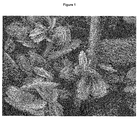
- Palbociclib free base of the invention is also characterized by having flake-like and/or plate-like primary particles, preferably rounded flake-like and/or plate-like primary particles, which have indistinct corners and edges.
- the palbociclib base of the invention preferably contains at least 50%, more preferably at least 60%, even more preferably at least 70%, even more preferably at least 80%, even more preferably at least 90% primary particles having flake-like and/or plate-like morphology.
- Most preferably the palbociclib base of the invention consists of primary particles having flake-like and/or plate-like morphology. A characteristic electron microscopic image is displayed in figure 1 herein.
- palbociclib free base obtained by the method disclosed in WO 2005/005426 A1 consists of needle-like primary particles.
- a characteristic electron microscopic image is displayed in figure 2 herein.
- palbociclib free base obtained by the method disclosed in WO 2014/128588 A1 consists of blocky equant and columnar primary particles.
- a characteristic electron microscopic image is displayed in figure 3 herein.
- the palbociclib of the invention is substantially free from needle-like or blocky equant or columnar primary particles.
- the palbociclib of the invention is substantially free from needle-like and blocky equant and columnar primary particles.
- the shape of a particle influences the pharmaceutical performance of a material, such as bulk and tap density, processability, tableting behavior, compaction, compressibility, flowability, tendency to stick to the punches or dissolution properties.
- the crystalline free base of palbociclib of the invention is characterized by having a PXRD comprising a reflection at (22.5 ⁇ 0.2)° 2-Theta, when measured at room temperature with Cu-Kalpha 1,2 radiation having a wavelength of 0.15419 nm.
- the crystalline free base of palbociclib of the invention is characterized by having a PXRD comprising reflections at 2-Theta angles of (10.3 ⁇ 0.2)°, (22.5 ⁇ 0.2)°, when measured at room temperature with Cu-Kalpha 1,2 radiation having a wavelength of 0.15419 nm.
- the crystalline free base of palbociclib of the invention is characterized by having a PXRD comprising reflections at 2-Theta angles of (5.1 ⁇ 0.2)°, (10.3 ⁇ 0.2)°, (22.5 ⁇ 0.2)°, when measured at room temperature with Cu-Kalpha 1,2 radiation having a wavelength of 0.15419 nm.
- the crystalline free base of palbociclib of the invention is characterized by having a PXRD comprising reflections at 2-Theta angles of (5.1 ⁇ 0.2)°, (8.0 ⁇ 0.2)°, (10.3 ⁇ 0.2)°, (22.5 ⁇ 0.2)°, when measured at room temperature with Cu-Kalpha 1,2 radiation having a wavelength of 0.15419 nm.
- the crystalline free base of palbociclib of the present invention is characterized by having a PXRD comprising reflections at 2-Theta angles of (5.1 ⁇ 0.2)°, (8.0 ⁇ 0.2)°, (10.3 ⁇ 0.2)°, (11.5 ⁇ 0.2)°, (22.5 ⁇ 0.2)°, when measured at room temperature with Cu-Kalpha 1,2 radiation having a wavelength of 0.15419 nm.
- the crystalline free base of palbociclib of the present invention is characterized by having a PXRD comprising reflections at 2-Theta angles of (5.1 ⁇ 0.2)°, (8.0 ⁇ 0.2)°, (10.3 ⁇ 0.2)°, (11.5 ⁇ 0.2)°, (22.5 ⁇ 0.2)° and at least one additional reflection selected from 2-Theta angles of (17.1 ⁇ 0.2)°, (18.8 ⁇ 0.2)°, (19.7 ⁇ 0.2)°, when measured at room temperature with Cu-Kalpha 1,2 radiation having a wavelength of 0.15419 nm.
- the crystalline free base of palbociclib of the invention is characterized by showing a PXRD essentially the same as displayed in figure 1 of WO 2014/128588 (Form A), when measured at room temperature with Cu-Kalpha 1,2 radiation having a wavelength of 0.15419 nm.
- the invention relates to pharmaceutical compositions comprising an effective amount of the crystalline palbociclib free base of the invention and at least one pharmaceutically acceptable excipient.
- the effective amount of the crystalline palbociclib free base of the invention is in the range of from about 10 to 200 mg, more preferably from about 25 to 150 mg, even more preferably from about 50 to 130 mg and most preferably the effective amount of crystalline palbociclib free base of the invention is about 75, 100 or 125 mg.
- compositions of the invention are preferably selected from the group consisting of fillers, diluents, sweeteners, buffering agents, glidants, flavouring agents, lubricants, preservatives, surfactants, wetting agents, binders, disintegrants, colouring agents and thickeners.
- Other excipients known to be used for the preparation of pharmaceutical compositions may also be used.
- compositions of the invention comprise an effective amount of palbociclib free base of the invention and one or more pharmaceutically acceptable excipients selected from the group of fillers, diluents, disintegrants, glidants and lubricants.
- compositions of the invention comprise an effective amount of palbociclib free base of the invention and one or more pharmaceutically acceptable excipients selected from microcrystalline cellulose, lactose monohydrate, sodium starch glycolate, colloidal silicon dioxide and magnesium stearate.
- compositions of the invention comprising an effective amount of crystalline palbociclib free base of the invention are preferably oral dosage forms, more preferably tablets or capsules and most preferably capsules.
- the invention relates to pharmaceutical compositions comprising an effective amount of palbociclib and one or more pH modifier in order to ensure a low pH in the stomach.
- This surprisingly leads to an improved dissolution profile and improved bioavailability independent of the pH in the stomach. Also variability is significantly reduced and malabsorptions are prevented. Particularly good dissolution and bioavailability are obtained when the medium specific surface area particles of the invention are combined with a pH modifier.
- the pH modifier is preferably a weak acid, more preferably an organic acid. More preferably, the pH modifier is selected from the group consisting of succinic acid, tartaric acid, ascorbic acid, citric acid, lactic acid, malic acid, fumaric acid, aspartic acid, glutamic acid, hydrates, salts and mixtures thereof. Most preferably the pH modifier is succinic acid or a mixture of succinic and tartaric acid.
- the pH modifier is preferably used in an amount between 1 and 40% w/w, more preferably between 2 and 30% w/w, most preferably between 2 and 20% w/w on the total weight of the pharmaceutical composition.
- the invention relates to pharmaceutical compositions comprising an effective amount of crystalline palbociclib free base of the invention for use as medicament.
- the invention relates to pharmaceutical compositions comprising an effective amount of crystalline palbociclib free base of the invention for use in the treatment of cancer.
- the present invention relates to a process for the preparation of palbociclib free base comprising:
- Suitable acid addition salts which may be provided in step (a) are selected from acid addition salts of palbociclib with inorganic acids such as hydrochloric acid, hydrobromic acid, sulfuric acid and nitric acid, from acid addition salts of palbociclib with organic acids such as isethionic acid, methanesulfonic acid, ethane-1,2-disulfonic acid, naphthalene-1,5-disulfonic acid, p-toluenesulfonic, thiocyanic acid, cyclamic acid and trifluoroacetic acid or mixtures thereof.
- inorganic acids such as hydrochloric acid, hydrobromic acid, sulfuric acid and nitric acid
- organic acids such as isethionic acid, methanesulfonic acid, ethane-1,2-disulfonic acid, naphthalene-1,5-disulfonic acid, p-toluenesulfonic, thiocyanic acid,
- Acid addition salts of palbociclib may be employed as mono-salts having approximately 1:1 stoichiometry such as palbociclib monohydrochloride or as di-salts having approximately 1:2 stoichiometry such as palbociclib dihydrochloride.
- palbociclib monohydrochloride, palbociclib dihydrochloride or mixtures thereof and most preferably palbociclib dihydrochloride is used as starting material in the process of the invention.
- the acid addition salts may be prepared in accordance with the procedures disclosed in WO 2003/062236 A1 , WO 2005/005426 A1 or WO 2008/032157 A2 .
- the aforementioned acid addition salts of palbociclib may be prepared by treating palbociclib free base with the corresponding acid in the presence of a suitable solvent.
- a chlorinated solvent is a solvent that contains at least one chlorine atom.
- Preferred chlorinated solvents are dichloromethane, chloroform, chlorobenzene, 1,2-dichlorobenzene, 1,3-dichlorobenzene, 1,4-dichlorobenzene and mixture thereof. Most preferably the chlorinated solvent is dichloromethane.
- the palbociclib acid addition salt concentration of the suspension is preferably in the range of from about 5 to 60 g, more preferably from about 15 to 40 g per liter solvent.
- the suspension is preferably prepared at a temperature of about 40 °C or less, more preferably of about 25 °C or less, for example at about room temperature.
- Suitable amine bases which may be employed are preferably selected from ammonia, methylamine, ethylamine, cyclohexylamine, dimethylamine, diethylamine, trimethylamine, triethylamine, diisopropylethylamine or mixtures thereof, more preferably from ammonia, trimethylamine, diisopropylethylamine or mixtures thereof. Most preferably, the suspension is treated with triethylamine.
- the molar ratio of palbociclib acid addition salt and amine base applied is preferably in the range of from about 1 : 2 to 12, more preferably from about 1 : 4 to 8.
- the amount of base is chosen such that at the end of the acid base reaction a solution, preferably a clear solution, more preferably a clear solution free of any solid material is obtained.
- the acid base reaction is preferably carried out at a temperature of about 40 °C or less, more preferably of about 25 °C or less, for example the reaction is performed at about room temperature.
- the obtained solution is then extracted water or an aqueous salt solution.
- the aqueous salt solution is an aqueous sodium chloride solution. Extracting may comprise stirring and/or shaking the product solution obtained in (c) with one or more of the aforementioned aqueous solvents.
- water soluble amine salts which are present in the solution obtained from step (c) are depleted or even removed.
- the aqueous phase may be extracted with dichloromethane before discarding the aqueous layer.
- the combined dichloromethane phases are then optionally diluted with further dichloromethane before subjecting the solution to crystallization conditions.
- step (d) is subjected to crystallization conditions comprising one or more of the following steps:
- the amount of seed crystals employed in step (e.1) may be in the range of from about 1 to 20% (w/w), preferably from about 1 to 10% (w/w), more preferably from about 1 to 5% (w/w) and most preferably from about 1 to 2% (w/w) based on the amount of palbociclib free base present in the product solution.
- Any crystalline form of palbociclib free base may be applied as seeds, whereat most preferably crystalline form A of palbociclib is used for seeding.
- step (e.2) the volume of the solution is reduced by solvent evaporation.
- the solvent may either be completely removed or reduced to an extent in the range of from about 5 to 99% (v/v), preferably from about 30 to 70% (v/v) based on the volume of the initial solution.
- the solvent may be preferably evaporated at a temperature in the range of from about 25 to 60 °C. Solvent evaporation may be performed at reduced or at atmospheric pressure.
- step (e.3) the chlorinated solvent solution is combined with an antisolvent, i.e. a liquid miscible with the solvent which reduces solute solubility in this new mixed solvent.
- the antisolvent is preferably selected from n -heptane, cyclohexane, tert -butylmethylether, diisopropylether or mixtures thereof, whereat most preferably n -heptane is used as antisolvent.
- the antisolvent may be added to the dichloromethane solution or vice versa.
- the antisolvent/solvent ratio applied may be in the range of from about 1 : 10 (v/v), preferably from about 1 : 8 (v/v), more preferably from about 1 : 6 (v/v), even more preferably from about 1 : 4 (v/v) and most preferably from about 1 : 2 (v/v).
- Crystallization may be initiated by subjecting the product solution obtained in step (d) to one or more of steps e.1) to (e.3) in any order.
- the obtained palbociclib crystals may be separated from their mother liquor by any conventional method such as filtration, centrifugation, evaporation of the solvent, decantation of the solvent or by two or more of these methods. Most preferably, the palbociclib crystals are collected by filtration.
- the isolated palbociclib crystals may be dried at a temperature of about 100 °C or less, preferably at a temperature of about 40 °C or less, for example at about room temperature. Drying may be performed at atmospheric or at reduced pressure for a period of about 168 hours or less.
- WO 2014/128588 A1 teaches that palbociclib free base provided by salt break procedures, e.g. as described in example 4 of WO 2005/005426 A1 , was highly static prone and formed small primary particles, which agglomerated into large, hard agglomerates that were difficult to disperse by sieving and were unsuitable for further development (see page 2, lines 4 to 7). Therefore, WO 2014/128588 A1 provides palbociclib having large primary particles and greatly reduced specific surface area which, according to the applicant, demonstrates improved physicochemical and manufacturability properties.
- the modified salt break procedure of the present invention gives high yields of crystalline palbociclib free base having a specific surface area in the range of from about 2.1 to 6.0 m 2 /g, preferably from about 2.5 to 5.0 m 2 /g, more preferably from about 2.5 to 4.5 m 2 /g, even more preferably from about 3.0 to 4.5 m 2 /g, even more preferably from about 3.0 to 4.0 m 2 /g and most preferably from about 3.0 to 3.5 m 2 /g, such as from about 3.0 to 3.3 m 2 /g as determined by BET-nitrogen adsorption analysis.
- the obtained material is characterized by having flake-like and plate-like primary particles, preferably rounded flake-like and plate-like primary particles, which have indistinct corners and edges.
- Table 1 provides a comparison of specific surface areas and particle shapes of crystalline palbociclib free base prepared according to different methods.
- Table 1 Specific surface areas and particle shape of palbociclib prepared according to different methods Palbociclib free base prepared according to BET SSA by N 2 particle shape [m 2 /g] salt break procedure of WO 2005/005426 (data from table 12 of WO 2014/128588 A1 ) needles 6.6 modified salt break procedure of the present invention (data from examples 1, 2 and 3 herein) 3.0 flakes/ plates 3.3 4.5 method disclosed in WO 2014/128588 A1 (data from table 12 of WO2014/128588 A1 ) 0.6 equant/ columns 0.7 0.7
- crystalline palbociclib of the present invention is characterized by having intermediate specific surface area.
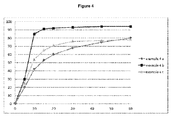
- This material on the one hand demonstrates viable physicochemical and manufacturability properties, such as good flowability, no electrostatic behavior, nor adherence to the laboratory and production equipment, which allow for straight forward pharmaceutical processing and on the other hand shows faster dissolution compared to the coarse material obtained according to the procedure disclosed in WO 2014/128588 A1 , which ensures optimal bioavailability. This is particularly evident when the dissolution profile is measured at pH 4.5 (see Figure 4 ) and proves particularly advantageous in patients having a pH of the stomach higher than the normal pH.
- the Palbociclib particles of the invention have a size comparable to that of the other excipients, a more homogeneous mixture, showing no sedimentation or separation, is obtained, which provides for more uniformity of the final dosage form. These effects are additionally promoted by the flake-like and plate-like crystal habit of the material. Therefore, crystalline palbociclib free base having medium specific surface area and flake-like respectively plate-like primary particles as provided by the present invention is preferably used for the preparation of orally administered pharmaceutical compositions.
- PXRDs were obtained with a PANalytical X'Pert PRO diffractometer equipped with a theta/theta coupled goniometer in transmission geometry, Cu-Kalpha 1,2 radiation (wavelength 0.15419 nm) with a focusing mirror and a solid state PIXcel detector.
- the diffractograms were recorded at a tube voltage of 45 kV and a tube current of 40 mA, applying a stepsize of 0.013° 2-Theta with 40s per step (255 channels) in the angular range of 2° to 40° 2-Theta at room temperature.
- a typical precision of the 2-Theta values is in the range of ⁇ 0.2° 2-Theta.
- the diffraction peak of Form A that appears at 5.1° 2-Theta can appear between 4.9 and 5.3° 2-Theta on most X-ray diffractometers under standard conditions.
- Dissolution profiles were obtained using a USP II apparatus with a sinker at 50 rpm and 1000 ml of 0.1 M hydrochloric acid (pH 1) or 1000 ml of 0,05 M acetate buffer (pH 4,5).
- Palbociclib dihydrochloride (17.5 g) was dissolved in 210 mL of de-ionized water and 122.5 mL of acetone by heating to a temperature of 50 °C. The obtained solution was further stirred at 50 °C for about 75 min before cooling it to 35 °C in 30 min. Thereafter, the solution was treated in 5 mL portions with a total of 55 mL of 5% (w/w) aqueous sodium hydroxide solution until a pH of 12.4 was achieved, whereupon crystallization was observed. Subsequently, the obtained suspension was cooled to 22.5 °C in 15 min and stirred at this temperature for 1 h.
- Palbociclib free base (10.0 g, e.g. prepared according to the procedure described in example 4 of WO 2005/005426 A1 ) was suspended in 160 mL of n-butanol and 240 mL of anisole and heated with stirring between 95 and 100 °C. The obtained solution was then cooled to 80 °C and seeded with a suspension consisting of 50 mg free base in 2.5 mL n-butanol. The resulting slurry was stirred at 80 °C for 3 h before cooling to 10°C over 350 min (cooling rate of 0.2 K/min) and further stirring the suspension at this temperature for 10 min. Thereafter, the solid was collected by filtration and the cake washed with anisole (50 mL) and n-heptane (50 mL) before drying it under vacuum at room temperature for 18 h.
- Example 1 Preparation of palbociclib free base having medium specific surface area - 25 g scale
- a mixture of the crystalline palbociclib of the invention (medium specific surface area), microcrystalline cellulose, lactose monohydrate, sodium starch glycolate, colloidal silicon dioxide and magnesium stearate is made and filled into capsules.
- formulation B comprising the palbociclib particles of the invention, shows a markedly better dissolution than formulations A and C.
- a mixture of the crystalline palbociclib of the invention (medium specific surface area), microcrystalline cellulose, lactose monohydrate and sodium starch glycolate is made and granulated in a fluid bed. Colloidal silicon dioxide and magnesium stearate are added and mixed. Afterwards a tablet is compressed.
- a mixture of the crystalline palbociclib of the invention (medium specific surface area), mannitol and colloidal silicon dioxide is made and filled into capsules.
- Example 6 formulations with pH modifier
- a mixture of the crystalline palbociclib of the invention (medium specific surface area), pH modifier, mannitol and colloidal silicon dioxide is made and filled into capsules.
- Example 7 formulations with pH modifier
- a mixture of palbociclib, pH modifier, microcrystalline cellulose, lactose monohydrate, sodium starch glycolate, colloidal silicon dioxide and magnesium stearate is made and filled into the capsules.
- Palbociclib and succinic acid are melt in the given amount of lauroyl macrogol-32 glycerides or stearoyl macrogol-32 glycerides and the mixture is filled into capsules.
- hydroxypropyl cellulose or hydroxypropyl methylcellulose is dissolved in isopropanol until a clear solution is obtained.
- Palbociclib is then added and the solution is coated onto the tartaric acid pellets. After drying the pellets are filled into the capsules. Alternatively the palbociclib solution can be sprayed onto the pellets.
Landscapes
- Chemical & Material Sciences (AREA)
- Organic Chemistry (AREA)
- Health & Medical Sciences (AREA)
- Chemical Kinetics & Catalysis (AREA)
- General Chemical & Material Sciences (AREA)
- Medicinal Chemistry (AREA)
- Nuclear Medicine, Radiotherapy & Molecular Imaging (AREA)
- Pharmacology & Pharmacy (AREA)
- Life Sciences & Earth Sciences (AREA)
- Animal Behavior & Ethology (AREA)
- General Health & Medical Sciences (AREA)
- Public Health (AREA)
- Veterinary Medicine (AREA)
- Pharmaceuticals Containing Other Organic And Inorganic Compounds (AREA)
Priority Applications (2)
| Application Number | Priority Date | Filing Date | Title |
|---|---|---|---|
| EP15162960.7A EP3078663A1 (de) | 2015-04-09 | 2015-04-09 | Modifizierte partikel von palbociclib |
| PCT/EP2016/056012 WO2016156070A1 (en) | 2015-04-02 | 2016-03-18 | Modified particles of palbociclib |
Applications Claiming Priority (1)
| Application Number | Priority Date | Filing Date | Title |
|---|---|---|---|
| EP15162960.7A EP3078663A1 (de) | 2015-04-09 | 2015-04-09 | Modifizierte partikel von palbociclib |
Publications (1)
| Publication Number | Publication Date |
|---|---|
| EP3078663A1 true EP3078663A1 (de) | 2016-10-12 |
Family
ID=52824112
Family Applications (1)
| Application Number | Title | Priority Date | Filing Date |
|---|---|---|---|
| EP15162960.7A Ceased EP3078663A1 (de) | 2015-04-02 | 2015-04-09 | Modifizierte partikel von palbociclib |
Country Status (1)
| Country | Link |
|---|---|
| EP (1) | EP3078663A1 (de) |
Cited By (2)
| Publication number | Priority date | Publication date | Assignee | Title |
|---|---|---|---|---|
| CN112569361A (zh) * | 2020-12-30 | 2021-03-30 | 扬子江药业集团上海海尼药业有限公司 | 一种哌柏西利干混悬组合物及其制备方法 |
| WO2025158014A1 (en) * | 2024-01-25 | 2025-07-31 | Zhejiang Qizheng Pharmaceutical Co.,Ltd. | Palbociclib dosage form |
Citations (6)
| Publication number | Priority date | Publication date | Assignee | Title |
|---|---|---|---|---|
| WO2003062236A1 (en) | 2002-01-22 | 2003-07-31 | Warner-Lambert Company Llc | 2-(PYRIDIN-2-YLAMINO)-PYRIDO[2,3d]PYRIMIDIN-7-ONES |
| WO2005005426A1 (en) | 2003-07-11 | 2005-01-20 | Warner-Lambert Company Llc | Isethionate salt of a selective cdk4 inhibitor |
| WO2008032157A2 (en) | 2006-09-08 | 2008-03-20 | Pfizer Products Inc. | Synthesis of 2-(pyridin-2-ylamino)-pyrido[2,3-d]pyrimidin-7-ones |
| WO2014128588A1 (en) | 2013-02-21 | 2014-08-28 | Pfizer Inc. | Solid forms of a selective cdk4/6 inhibitor |
| CN104478874A (zh) * | 2014-12-08 | 2015-04-01 | 新发药业有限公司 | 一种帕博赛布的制备方法 |
| CN104496983A (zh) * | 2014-11-26 | 2015-04-08 | 苏州明锐医药科技有限公司 | 一种帕博西尼的制备方法 |
-
2015
- 2015-04-09 EP EP15162960.7A patent/EP3078663A1/de not_active Ceased
Patent Citations (6)
| Publication number | Priority date | Publication date | Assignee | Title |
|---|---|---|---|---|
| WO2003062236A1 (en) | 2002-01-22 | 2003-07-31 | Warner-Lambert Company Llc | 2-(PYRIDIN-2-YLAMINO)-PYRIDO[2,3d]PYRIMIDIN-7-ONES |
| WO2005005426A1 (en) | 2003-07-11 | 2005-01-20 | Warner-Lambert Company Llc | Isethionate salt of a selective cdk4 inhibitor |
| WO2008032157A2 (en) | 2006-09-08 | 2008-03-20 | Pfizer Products Inc. | Synthesis of 2-(pyridin-2-ylamino)-pyrido[2,3-d]pyrimidin-7-ones |
| WO2014128588A1 (en) | 2013-02-21 | 2014-08-28 | Pfizer Inc. | Solid forms of a selective cdk4/6 inhibitor |
| CN104496983A (zh) * | 2014-11-26 | 2015-04-08 | 苏州明锐医药科技有限公司 | 一种帕博西尼的制备方法 |
| CN104478874A (zh) * | 2014-12-08 | 2015-04-01 | 新发药业有限公司 | 一种帕博赛布的制备方法 |
Non-Patent Citations (3)
| Title |
|---|
| "DETERMINATION OF THE SPECIFIC SURFACE AREA OF SOLIDS BY GAS ADSORPTION -BET METHOD", DRAFT INTERNATIONAL STANDARD ISO/DIS, XX, XX, no. ISO9277, 1 September 2010 (2010-09-01), pages 1 - 30, XP003035663 * |
| EUROPEAN PHARMACOPOEIA, vol. 8.3, 2015, pages 1.2 |
| GARY NICHOLS: "Light Microscopy", 2006, WILEY-VCH, article "Polymorphism in the Pharmaceutical Industry" |
Cited By (3)
| Publication number | Priority date | Publication date | Assignee | Title |
|---|---|---|---|---|
| CN112569361A (zh) * | 2020-12-30 | 2021-03-30 | 扬子江药业集团上海海尼药业有限公司 | 一种哌柏西利干混悬组合物及其制备方法 |
| CN112569361B (zh) * | 2020-12-30 | 2023-01-10 | 扬子江药业集团上海海尼药业有限公司 | 一种哌柏西利干混悬组合物及其制备方法 |
| WO2025158014A1 (en) * | 2024-01-25 | 2025-07-31 | Zhejiang Qizheng Pharmaceutical Co.,Ltd. | Palbociclib dosage form |
Similar Documents
| Publication | Publication Date | Title |
|---|---|---|
| WO2016156070A1 (en) | Modified particles of palbociclib | |
| US12187703B2 (en) | Crystalline forms of N-(3-(2-(2-hydroxyethoxy)-6-morpholinopyridin-4-yl)-4-methvlphenyl)-2 (trifluoromethyl)isonicotinamide as Raf inhibitors for the treatment of cancer | |
| EP4058151B1 (de) | Neuartiges salz von terphenylverbindung | |
| US10723730B2 (en) | Solid forms of a selective CDK4/6 inhibitor | |
| KR102342776B1 (ko) | (S)-2-((2-((S)-4-(다이플루오로메틸)-2-옥소옥사졸리딘-3-일)-5,6-다이하이드로벤조[f]이미다조[1,2-d][1,4]옥사제핀-9-일)아미노)프로판아미드의 다형체 및 고체 형태, 및 이의 제조 방법 | |
| CN103626803B (zh) | 替诺福韦二吡呋酯的固体及其制备方法和用途 | |
| JP2016527242A (ja) | 結晶形態のダサチニブの塩 | |
| EP3023421A1 (de) | Kristalline Formen von Afatinib-Dimaleat | |
| EP3847175B1 (de) | Kristalline formen eines inhibitors der phosphoinositid-3-kinase (pi3k) | |
| US9708301B2 (en) | Crystalline forms of afatinib monomaleate, preparation methods and pharmaceutical compositions thereof | |
| JP6621761B2 (ja) | 薬学的に活性な化合物の固体形態 | |
| EP3327020A1 (de) | Citratsalze eines hemmers der janus-kinase (jak) | |
| EP3461823B1 (de) | Pexidartinib-hydrochloridkristallformen, herstellungsverfahren und verwendung davon | |
| WO2016098070A1 (en) | Crystalline form of 5-chloro-n2-(2-isopropoxy-5-methyl-4-piperidin-4-yl-phenyl)-n4-[2-(propane-2-sulfonyl)-phenyl]-pyrimidine-2, 4-diamine | |
| EP3368527B1 (de) | Palbociclib-tosylat | |
| EP4660196A1 (de) | Kristallform einer verbindung, herstellungsverfahren dafür und verwendung davon | |
| HK40127061A (en) | New crystalline forms of n-(3-(2-(2-hydroxyethoxy)-6-morpholinopyridin-4-yl)-4-methvlphenyl)-2(trifluoromethyl) isonicotinamide as raf inhibitors for the treatment of cancer | |
| KR20180089903A (ko) | 싸이에노피리미딘 화합물의 하이드로클로라이드 염의 결정형 | |
| KR101833012B1 (ko) | 신규한 로티고틴의 결정질 이수화물, 이의 제조방법 또는 용도 | |
| HK40065390B (en) | New crystalline forms of n-(3-(2-(2-hydroxyethoxy)-6-morpholinopyridin-4-yl)-4-methvlphenyl)-2(trifluoromethyl)isonicotinamide as raf inhibitors for the treatment of cancer | |
| HK40065390A (en) | New crystalline forms of n-(3-(2-(2-hydroxyethoxy)-6-morpholinopyridin-4-yl)-4-methvlphenyl)-2(trifluoromethyl)isonicotinamide as raf inhibitors for the treatment of cancer | |
| WO2017093773A1 (en) | New polymorphic and solvate form of idelalisib | |
| EA046959B1 (ru) | Фармацевтическая композиция для перорального введения, содержащая производное аминопиримидина или его соль |
Legal Events
| Date | Code | Title | Description |
|---|---|---|---|
| PUAI | Public reference made under article 153(3) epc to a published international application that has entered the european phase |
Free format text: ORIGINAL CODE: 0009012 |
|
| AK | Designated contracting states |
Kind code of ref document: A1 Designated state(s): AL AT BE BG CH CY CZ DE DK EE ES FI FR GB GR HR HU IE IS IT LI LT LU LV MC MK MT NL NO PL PT RO RS SE SI SK SM TR |
|
| AX | Request for extension of the european patent |
Extension state: BA ME |
|
| STAA | Information on the status of an ep patent application or granted ep patent |
Free format text: STATUS: THE APPLICATION HAS BEEN REFUSED |
|
| 18R | Application refused |
Effective date: 20161113 |