EP3078709A1 - Composition de résine ignifuge et câble l'utilisant - Google Patents
Composition de résine ignifuge et câble l'utilisant Download PDFInfo
- Publication number
- EP3078709A1 EP3078709A1 EP14867282.7A EP14867282A EP3078709A1 EP 3078709 A1 EP3078709 A1 EP 3078709A1 EP 14867282 A EP14867282 A EP 14867282A EP 3078709 A1 EP3078709 A1 EP 3078709A1
- Authority
- EP
- European Patent Office
- Prior art keywords
- flame retardant
- mass
- parts
- resin composition
- silicone
- Prior art date
- Legal status (The legal status is an assumption and is not a legal conclusion. Google has not performed a legal analysis and makes no representation as to the accuracy of the status listed.)
- Withdrawn
Links
Images


Classifications
-
- C—CHEMISTRY; METALLURGY
- C08—ORGANIC MACROMOLECULAR COMPOUNDS; THEIR PREPARATION OR CHEMICAL WORKING-UP; COMPOSITIONS BASED THEREON
- C08L—COMPOSITIONS OF MACROMOLECULAR COMPOUNDS
- C08L23/00—Compositions of homopolymers or copolymers of unsaturated aliphatic hydrocarbons having only one carbon-to-carbon double bond; Compositions of derivatives of such polymers
- C08L23/02—Compositions of homopolymers or copolymers of unsaturated aliphatic hydrocarbons having only one carbon-to-carbon double bond; Compositions of derivatives of such polymers not modified by chemical after-treatment
- C08L23/04—Homopolymers or copolymers of ethene
- C08L23/06—Polyethylene
-
- C—CHEMISTRY; METALLURGY
- C08—ORGANIC MACROMOLECULAR COMPOUNDS; THEIR PREPARATION OR CHEMICAL WORKING-UP; COMPOSITIONS BASED THEREON
- C08K—Use of inorganic or non-macromolecular organic substances as compounding ingredients
- C08K5/00—Use of organic ingredients
- C08K5/04—Oxygen-containing compounds
- C08K5/09—Carboxylic acids; Metal salts thereof; Anhydrides thereof
- C08K5/098—Metal salts of carboxylic acids
-
- C—CHEMISTRY; METALLURGY
- C08—ORGANIC MACROMOLECULAR COMPOUNDS; THEIR PREPARATION OR CHEMICAL WORKING-UP; COMPOSITIONS BASED THEREON
- C08L—COMPOSITIONS OF MACROMOLECULAR COMPOUNDS
- C08L23/00—Compositions of homopolymers or copolymers of unsaturated aliphatic hydrocarbons having only one carbon-to-carbon double bond; Compositions of derivatives of such polymers
- C08L23/02—Compositions of homopolymers or copolymers of unsaturated aliphatic hydrocarbons having only one carbon-to-carbon double bond; Compositions of derivatives of such polymers not modified by chemical after-treatment
-
- C—CHEMISTRY; METALLURGY
- C08—ORGANIC MACROMOLECULAR COMPOUNDS; THEIR PREPARATION OR CHEMICAL WORKING-UP; COMPOSITIONS BASED THEREON
- C08L—COMPOSITIONS OF MACROMOLECULAR COMPOUNDS
- C08L23/00—Compositions of homopolymers or copolymers of unsaturated aliphatic hydrocarbons having only one carbon-to-carbon double bond; Compositions of derivatives of such polymers
- C08L23/02—Compositions of homopolymers or copolymers of unsaturated aliphatic hydrocarbons having only one carbon-to-carbon double bond; Compositions of derivatives of such polymers not modified by chemical after-treatment
- C08L23/04—Homopolymers or copolymers of ethene
- C08L23/08—Copolymers of ethene
- C08L23/0846—Copolymers of ethene with unsaturated hydrocarbons containing atoms other than carbon or hydrogen
- C08L23/0853—Ethylene vinyl acetate copolymers
-
- C—CHEMISTRY; METALLURGY
- C08—ORGANIC MACROMOLECULAR COMPOUNDS; THEIR PREPARATION OR CHEMICAL WORKING-UP; COMPOSITIONS BASED THEREON
- C08L—COMPOSITIONS OF MACROMOLECULAR COMPOUNDS
- C08L23/00—Compositions of homopolymers or copolymers of unsaturated aliphatic hydrocarbons having only one carbon-to-carbon double bond; Compositions of derivatives of such polymers
- C08L23/02—Compositions of homopolymers or copolymers of unsaturated aliphatic hydrocarbons having only one carbon-to-carbon double bond; Compositions of derivatives of such polymers not modified by chemical after-treatment
- C08L23/04—Homopolymers or copolymers of ethene
- C08L23/08—Copolymers of ethene
- C08L23/0846—Copolymers of ethene with unsaturated hydrocarbons containing atoms other than carbon or hydrogen
- C08L23/0869—Copolymers of ethene with unsaturated hydrocarbons containing atoms other than carbon or hydrogen with unsaturated acids, e.g. [meth]acrylic acid; with unsaturated esters, e.g. [meth]acrylic acid esters
-
- C—CHEMISTRY; METALLURGY
- C08—ORGANIC MACROMOLECULAR COMPOUNDS; THEIR PREPARATION OR CHEMICAL WORKING-UP; COMPOSITIONS BASED THEREON
- C08L—COMPOSITIONS OF MACROMOLECULAR COMPOUNDS
- C08L23/00—Compositions of homopolymers or copolymers of unsaturated aliphatic hydrocarbons having only one carbon-to-carbon double bond; Compositions of derivatives of such polymers
- C08L23/02—Compositions of homopolymers or copolymers of unsaturated aliphatic hydrocarbons having only one carbon-to-carbon double bond; Compositions of derivatives of such polymers not modified by chemical after-treatment
- C08L23/10—Homopolymers or copolymers of propene
- C08L23/12—Polypropene
-
- C—CHEMISTRY; METALLURGY
- C08—ORGANIC MACROMOLECULAR COMPOUNDS; THEIR PREPARATION OR CHEMICAL WORKING-UP; COMPOSITIONS BASED THEREON
- C08L—COMPOSITIONS OF MACROMOLECULAR COMPOUNDS
- C08L83/00—Compositions of macromolecular compounds obtained by reactions forming in the main chain of the macromolecule a linkage containing silicon with or without sulfur, nitrogen, oxygen or carbon only; Compositions of derivatives of such polymers
- C08L83/04—Polysiloxanes
-
- C—CHEMISTRY; METALLURGY
- C09—DYES; PAINTS; POLISHES; NATURAL RESINS; ADHESIVES; COMPOSITIONS NOT OTHERWISE PROVIDED FOR; APPLICATIONS OF MATERIALS NOT OTHERWISE PROVIDED FOR
- C09K—MATERIALS FOR MISCELLANEOUS APPLICATIONS, NOT PROVIDED FOR ELSEWHERE
- C09K21/00—Fireproofing materials
- C09K21/02—Inorganic materials
-
- G—PHYSICS
- G02—OPTICS
- G02B—OPTICAL ELEMENTS, SYSTEMS OR APPARATUS
- G02B6/00—Light guides; Structural details of arrangements comprising light guides and other optical elements, e.g. couplings
- G02B6/44—Mechanical structures for providing tensile strength and external protection for fibres, e.g. optical transmission cables
- G02B6/4401—Optical cables
- G02B6/4429—Means specially adapted for strengthening or protecting the cables
- G02B6/4436—Heat resistant
-
- H—ELECTRICITY
- H01—ELECTRIC ELEMENTS
- H01B—CABLES; CONDUCTORS; INSULATORS; SELECTION OF MATERIALS FOR THEIR CONDUCTIVE, INSULATING OR DIELECTRIC PROPERTIES
- H01B13/00—Apparatus or processes specially adapted for manufacturing conductors or cables
- H01B13/06—Insulating conductors or cables
- H01B13/14—Insulating conductors or cables by extrusion
-
- H—ELECTRICITY
- H01—ELECTRIC ELEMENTS
- H01B—CABLES; CONDUCTORS; INSULATORS; SELECTION OF MATERIALS FOR THEIR CONDUCTIVE, INSULATING OR DIELECTRIC PROPERTIES
- H01B3/00—Insulators or insulating bodies characterised by the insulating materials; Selection of materials for their insulating or dielectric properties
- H01B3/18—Insulators or insulating bodies characterised by the insulating materials; Selection of materials for their insulating or dielectric properties mainly consisting of organic substances
- H01B3/30—Insulators or insulating bodies characterised by the insulating materials; Selection of materials for their insulating or dielectric properties mainly consisting of organic substances plastics; resins; waxes
- H01B3/44—Insulators or insulating bodies characterised by the insulating materials; Selection of materials for their insulating or dielectric properties mainly consisting of organic substances plastics; resins; waxes vinyl resins; acrylic resins
- H01B3/441—Insulators or insulating bodies characterised by the insulating materials; Selection of materials for their insulating or dielectric properties mainly consisting of organic substances plastics; resins; waxes vinyl resins; acrylic resins from alkenes
-
- H—ELECTRICITY
- H01—ELECTRIC ELEMENTS
- H01B—CABLES; CONDUCTORS; INSULATORS; SELECTION OF MATERIALS FOR THEIR CONDUCTIVE, INSULATING OR DIELECTRIC PROPERTIES
- H01B3/00—Insulators or insulating bodies characterised by the insulating materials; Selection of materials for their insulating or dielectric properties
- H01B3/18—Insulators or insulating bodies characterised by the insulating materials; Selection of materials for their insulating or dielectric properties mainly consisting of organic substances
- H01B3/30—Insulators or insulating bodies characterised by the insulating materials; Selection of materials for their insulating or dielectric properties mainly consisting of organic substances plastics; resins; waxes
- H01B3/44—Insulators or insulating bodies characterised by the insulating materials; Selection of materials for their insulating or dielectric properties mainly consisting of organic substances plastics; resins; waxes vinyl resins; acrylic resins
- H01B3/447—Insulators or insulating bodies characterised by the insulating materials; Selection of materials for their insulating or dielectric properties mainly consisting of organic substances plastics; resins; waxes vinyl resins; acrylic resins from acrylic compounds
-
- H—ELECTRICITY
- H01—ELECTRIC ELEMENTS
- H01B—CABLES; CONDUCTORS; INSULATORS; SELECTION OF MATERIALS FOR THEIR CONDUCTIVE, INSULATING OR DIELECTRIC PROPERTIES
- H01B3/00—Insulators or insulating bodies characterised by the insulating materials; Selection of materials for their insulating or dielectric properties
- H01B3/18—Insulators or insulating bodies characterised by the insulating materials; Selection of materials for their insulating or dielectric properties mainly consisting of organic substances
- H01B3/30—Insulators or insulating bodies characterised by the insulating materials; Selection of materials for their insulating or dielectric properties mainly consisting of organic substances plastics; resins; waxes
- H01B3/44—Insulators or insulating bodies characterised by the insulating materials; Selection of materials for their insulating or dielectric properties mainly consisting of organic substances plastics; resins; waxes vinyl resins; acrylic resins
- H01B3/448—Insulators or insulating bodies characterised by the insulating materials; Selection of materials for their insulating or dielectric properties mainly consisting of organic substances plastics; resins; waxes vinyl resins; acrylic resins from other vinyl compounds
-
- H—ELECTRICITY
- H01—ELECTRIC ELEMENTS
- H01B—CABLES; CONDUCTORS; INSULATORS; SELECTION OF MATERIALS FOR THEIR CONDUCTIVE, INSULATING OR DIELECTRIC PROPERTIES
- H01B3/00—Insulators or insulating bodies characterised by the insulating materials; Selection of materials for their insulating or dielectric properties
- H01B3/18—Insulators or insulating bodies characterised by the insulating materials; Selection of materials for their insulating or dielectric properties mainly consisting of organic substances
- H01B3/30—Insulators or insulating bodies characterised by the insulating materials; Selection of materials for their insulating or dielectric properties mainly consisting of organic substances plastics; resins; waxes
- H01B3/46—Insulators or insulating bodies characterised by the insulating materials; Selection of materials for their insulating or dielectric properties mainly consisting of organic substances plastics; resins; waxes silicones
-
- H—ELECTRICITY
- H01—ELECTRIC ELEMENTS
- H01B—CABLES; CONDUCTORS; INSULATORS; SELECTION OF MATERIALS FOR THEIR CONDUCTIVE, INSULATING OR DIELECTRIC PROPERTIES
- H01B7/00—Insulated conductors or cables characterised by their form
- H01B7/02—Disposition of insulation
- H01B7/0275—Disposition of insulation comprising one or more extruded layers of insulation
-
- H—ELECTRICITY
- H01—ELECTRIC ELEMENTS
- H01B—CABLES; CONDUCTORS; INSULATORS; SELECTION OF MATERIALS FOR THEIR CONDUCTIVE, INSULATING OR DIELECTRIC PROPERTIES
- H01B7/00—Insulated conductors or cables characterised by their form
- H01B7/17—Protection against damage caused by external factors, e.g. sheaths or armouring
- H01B7/29—Protection against damage caused by extremes of temperature or by flame
- H01B7/295—Protection against damage caused by extremes of temperature or by flame using material resistant to flame
-
- C—CHEMISTRY; METALLURGY
- C08—ORGANIC MACROMOLECULAR COMPOUNDS; THEIR PREPARATION OR CHEMICAL WORKING-UP; COMPOSITIONS BASED THEREON
- C08L—COMPOSITIONS OF MACROMOLECULAR COMPOUNDS
- C08L2201/00—Properties
- C08L2201/02—Flame or fire retardant/resistant
Definitions
- the present invention relates to a flame retardant resin composition and a cable using the composition.
- a flame retardant resin composition there is known a composition formed by adding metal hydroxide as a flame retardant to a polyolefin resin, and also adding a silicone-based compound such as silicone oil, or magnesium stearate as a flame retardant aid, for example (see Patent Document 1 described below).
- Patent Document 1 JPH10-7913 A
- the invention was achieved under such circumstances, and it is an object of the invention to provide a flame retardant resin composition which can secure excellent flame retardancy while securing an excellent mechanical property, and a cable using this resin composition.
- the present inventors studied the magnitude relationship between the decomposition onset temperature of metal hydroxide as a flame retardant and the decomposition onset temperature of a silicone-based compound.
- the inventors found that when a silicone-based compound, a fatty acid containing compound such as magnesium stearate, and an inorganic flame retardant such as metal hydroxide or the like are respectively blended at a predetermined ratio relative to 100 parts by mass of a polyolefin resin, the problems can be solved by adjusting the decomposition onset temperature of an inorganic flame retardant to be lower than the decomposition onset temperature of a silicone-based compound, and thus the inventors completed the invention.
- the invention relates to a flame retardant resin composition containing a polyolefin resin, a silicone-based compound blended at a ratio of 1.5 parts by mass or more and 20 parts by mass or less relative to 100 parts by mass of the polyolefin resin, a fatty acid containing compound blended at a ratio of 5 parts by mass or more and 20 parts by mass or less relative to 100 parts by mass of the polyolefin resin, and an inorganic flame retardant blended at a ratio of 5 parts by mass or more and 40 parts by mass or less relative to 100 parts by mass of the polyolefin resin, in which the decomposition onset temperature of the inorganic flame retardant is lower than the decomposition onset temperature of the silicone-based compound.
- the present inventors assume that the reason why more excellent flame retardancy can be obtained with the flame retardant resin composition of the invention is as follows.
- the decomposition onset temperature of an inorganic flame retardant is lower than the decomposition onset temperature of a silicone-based compound, at the time of combustion, the inorganic flame retardant is decomposed by heat before the silicone-based compound is decomposed by heat.
- the decomposition of the inorganic flame retardant at this time is considered to be an endothermic reaction. Accordingly, the temperature increase of a polyolefin resin is sufficiently suppressed and it becomes possible to inhibit continuous combustion.
- a barrier layer of a silicone-based compound is formed on a surface of the polyolefin resin. The present inventors assume that a flame retardant effect is enhanced based on such reasons.
- the inorganic flame retardant is preferably aluminum hydroxide.
- the inorganic flame retardant is an inorganic flame retardant other than aluminum hydroxide.
- the inorganic flame retardant is preferably blended at a ratio of 10 parts by mass or more and 25 parts by mass or less relative to 100 parts by mass of the polyolefin resin.
- the flame retardancy of the flame retardant resin composition can be more improved compared to a case in which the blending amount of the inorganic flame retardant is not within the aforementioned range.
- the fatty acid containing compound is preferably magnesium stearate or calcium stearate.
- the flame retardant resin composition may be composed of the polyolefin resin, the silicone-based compound, the fatty acid containing compound, the inorganic flame retardant, and at least one additive selected from the group consisting of an oxidation inhibitor, an ultraviolet ray deterioration inhibitor, a processing aid, a coloring agent, and an anti-static agent.
- the flame retardant resin composition is composed only of the polyolefin resin, the silicone-based compound, the fatty acid containing compound, the inorganic flame retardant, and at least one additive selected from the group consisting of the oxidation inhibitor, the ultraviolet ray deterioration inhibitor, the processing aid, the coloring agent, and the anti-static agent.
- the oxidation inhibitor is composed of at least one selected from the group consisting of a phenol-based oxidation inhibitor, an amine-based oxidation inhibitor, a sulfur-based oxidation inhibitor, a phosphorus-based oxidation inhibitor, a hydrazine-based oxidation inhibitor, an amide-based oxidation inhibitor, phosphoric acid, and citric acid
- the ultraviolet ray deterioration inhibitor is composed of at least one selected from the group consisting of a benzophenone-based ultraviolet ray deterioration inhibitor, a salicylate-based ultraviolet ray deterioration inhibitor, a benzotriazole-based ultraviolet ray deterioration inhibitor, an acrylonitrile-based ultraviolet ray deterioration inhibitor, a metal complex salt-based ultraviolet ray deterioration inhibitor, and a hindered amine-based ultraviolet ray deterioration inhibitor
- the processing aid is composed of at least one selected from the group consisting of a hydrocarbon-based
- the invention is also a cable comprising an insulated wire which has a conductor and an insulating layer covering the conductor, in which the insulating layer consists of the aforementioned flame retardant resin composition.
- the invention is also a cable having a conductor, an insulating layer covering the conductor, and a sheath covering the insulating layer, in which at least one of the insulating layer and the sheath consists of the aforementioned flame retardant resin composition.
- the invention is also a cable having a sheath and an optical fiber provided on the inner side of the sheath or provided to penetrate the sheath, in which the sheath consists of the aforementioned flame retardant resin composition.
- the decomposition onset temperature means decomposition onset temperature which is determined according to analysis of gas evolved from the flame retardant resin composition of the invention based on evolved gas analysis (EGA-MS) method.
- EGA-MS evolved gas analysis
- the decomposition onset temperature refers to the temperature which corresponds to a peak rising point with respect to a baseline in the thermogram.
- a flame retardant resin composition which can secure excellent flame retardancy while securing an excellent mechanical property, and a cable using the composition are provided.
- Fig. 1 is a partial side view illustrating the first embodiment of the cable according to the invention.
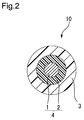
- Fig. 2 is a cross-sectional view taken along the II-II line illustrated in Fig. 1 .
- a cable 10 comprises one insulated wire 4, and a sheath 3 that covers the one insulated wire 4.
- the insulated wire 4 has an internal conductor 1 and an insulating layer 2 that covers the internal conductor 1.
- the insulating layer 2 and the sheath 3 consist of a flame retardant resin composition
- this flame retardant resin composition contains a polyolefin resin, a silicone-based compound blended at a ratio of 1.5 parts by mass or more and 20 parts by mass or less relative to 100 parts by mass of the polyolefin resin, a fatty acid containing compound blended at a ratio of 5 parts by mass or more and 20 parts by mass or less relative to 100 parts by mass of the polyolefin resin, and an inorganic flame retardant blended at a ratio of 5 parts by mass or more and 40 parts by mass or less relative to 100 parts by mass of the polyolefin resin.
- the decomposition onset temperature of the inorganic flame retardant is lower than the decomposition onset temperature of the silicone-based compound.
- the insulating layer 2 and the sheath 3 that are formed of the aforementioned flame retardant resin composition can secure excellent flame retardancy while securing an excellent mechanical property. Accordingly, the cable 10 can secure excellent flame retardancy while securing an excellent mechanical property.
- the internal conductor 1 is prepared.
- the internal conductor 1 may be composed of a single strand, or may be composed of plural strands that are bundled together. Furthermore, the internal conductor 1 is not particularly limited in terms of the diameter of the conductor, the material of the conductor and the like, and it can be appropriately selected in accordance with the use.
- the flame retardant resin composition contains a polyolefin resin, a silicone-based compound blended at a ratio of 1.5 parts by mass or more and 20 parts by mass or less relative to 100 parts by mass of the polyolefin resin, a fatty acid containing compound blended at a ratio of 5 parts by mass or more and 20 parts by mass or less relative to 100 parts by mass of the polyolefin resin, and an inorganic flame retardant blended at a ratio of 5 parts by mass or more and 40 parts by mass or less relative to 100 parts by mass of the polyolefin resin.
- examples of the polyolefin resin include an ethylene-based resin and a propylene-based resin. It may be used either singly or as a mixture of two or more thereof.
- the ethylene-based resin refers to a resin which contains ethylene as a constitutional unit and examples of the ethylene-based resin include a polyethylene resin (PE), an ethylene ethyl acrylate copolymer (EEA), and an ethylene vinyl acetate copolymer (EVA).
- the propylene-based resin refers to a resin which contains propylene as a constitutional unit and examples of the propylene-based resin include a polypropylene resin (PP).
- the silicone-based compound is a compound which functions as a flame retardant aid.
- examples of the silicone-based compound include polyorganosiloxanes.
- the polyorganosiloxanes are compounds which have siloxane bonds as a main chain, and have organic groups in side chains.
- examples of the organic groups include a methyl group, a vinyl group, an ethyl group, a propyl group, and a phenyl group.
- polyorganosiloxanes include dimethylpolysiloxane, methylethylpolysiloxane, methyloctylpolysiloxane, methylvinylpolysiloxane, methylphenylpolysiloxane, and methyl-(3,3,3-trifluoropropyl)polysiloxane.
- polyorganosiloxane include silicone powder, silicone gum, and silicone resin. Among them, silicone gum is preferable. In this case, blooming does not easily occur.
- the silicone-based compound is blended at a ratio of 1.5 parts by mass or more and 20 parts by mass or less relative to 100 parts by mass of the polyolefin resin as described above.
- the flame retardancy is significantly lowered.
- the blending ratio of the silicone-based compound is more than 20 parts by mass relative to 100 parts by mass of the polyolefin resin, blooming may easily occur.
- the silicone-based compound is preferably blended at a ratio of 15 parts by mass or less. In this case, a more excellent mechanical property can be obtained compared to a case in which the ratio of the silicone-based compound is more than 15 parts by mass.
- the silicone-based compound may be attached in advance to the surface of the inorganic flame retardant.
- the entirety of each of the inorganic flame retardant included in the flame retardant resin composition be covered with the silicone-based compound.
- the inorganic flame retardant can be easily dispersed in the polyolefin resin, uniformity of the characteristics in the flame retardant resin composition is further improved.
- Examples of the method of attaching the silicone-based compound to the surface of the inorganic flame retardant include, for example, a method in which the silicone-based compound is added to the inorganic flame retardant, they are mixed to obtain a mixture, the mixture is then subsequently dried at 40°C to 75°C for 10 minutes to 40 minutes, and the dried mixture is pulverized using a Henschel mixer, an atomizer or the like.
- the decomposition onset temperature (T1) of the silicone-based compound is preferably lower than the decomposition onset temperature (T2) of the polyolefin resin.
- T1 the same or higher than T2.
- the (T2-T1) is not particularly limited if it is higher than 0°C, but it is preferably 100 to 250°C. In this case, an advantage of having more excellent flame retardancy is obtained compared to a case in which the (T2-T1) is not within the aforementioned range.
- the (T2-T1) is more preferably 150 to 200°C.
- the fatty acid-containing compound is a compound which functions as a flame retardant aid.
- the fatty acid-containing compound refers to a compound containing a fatty acid or a metal salt thereof.
- a fatty acid for example, a fatty acid having 12 to 28 carbon atoms is used.
- examples of such a fatty acid include lauric acid, myristic acid, palmitic acid, stearic acid, tuberculostearic acid, oleic acid, linoleic acid, arachidonic acid, behenic acid, and montanic acid.
- the fatty acid is preferably stearic acid or tuberculostearic acid. Stearic acid is particularly preferred. In this case, more excellent flame retardancy is obtained as compared to a case in which a fatty acid other than stearic acid or tuberculostearic acid is used.
- Examples of the metal that constitutes a metal salt of the fatty acid include magnesium, calcium, zinc, and lead.
- the metal salt of the fatty acid is preferably magnesium stearate or calcium stearate. In this case, more excellent flame retardancy is obtained as compared to a case in which a fatty acid containing compound is not either magnesium stearate or calcium stearate.
- the fatty acid containing compound is blended at a ratio of 5 parts by mass or more and 20 parts by mass or less relative to 100 parts by mass of the polyolefin resin as described above.
- the flame retardancy is significantly lowered.
- the blending ratio of the fatty acid containing compound is more than 20 parts by mass relative to 100 parts by mass of the polyolefin resin, blooming may easily occur.
- the fatty acid containing compound is preferably blended at a ratio of 15 parts by mass or less. In this case, a more excellent mechanical property can be obtained compared to a case in which the ratio of the fatty acid containing compound is more than 15 parts by mass.
- the inorganic flame retardant is not particularly limited if it is an inorganic flame retardant which has lower decomposition onset temperature (T3) than the decomposition onset temperature (T1) of the silicone-based compound.
- T1-T3 When T1-T3 is 0°C or lower, the flame retardancy is significantly lowered.
- the inorganic flame retardant examples include aluminum hydroxide and calcium aluminate hydrate.
- aluminum hydroxide is preferable. In this case, more excellent mechanical property is obtained compared to a case in which the inorganic flame retardant is an inorganic flame retardant other than aluminum hydroxide.
- the (T1-T3) is not particularly limited if it is higher than 0°C, but it is preferably 50 to 250°C. In this case, an advantage of having more excellent flame retardancy is obtained compared to a case in which the (T1-T3) is not within the aforementioned range.
- the (T1-T3) is more preferably 50 to 150°C.
- the inorganic flame retardant is blended at a ratio of 5 parts by mass or more and 40 parts by mass or less relative to 100 parts by mass of the polyolefin resin.
- the flame retardancy is significantly improved compared to a case in which the blending ratio of the inorganic flame retardant is more than 40 parts by mass relative to 100 parts by mass of the polyolefin resin.
- the flame retardancy is significantly improved compared to a case in which the blending ratio of the inorganic flame retardant is less than 5 parts by mass relative to 100 parts by mass of the polyolefin resin.
- the inorganic flame retardant is blended at a ratio of 10 parts by mass or more and 25 parts by mass or less relative to 100 parts by mass of the polyolefin resin.
- the flame retardancy of the flame retardant resin composition can be improved more compared to a case in which the blending amount of the inorganic flame retardant is not within the aforementioned range.
- the flame retardant resin composition may also contain an additive, if necessary.
- the additive is composed of a material which is different from the polyolefin resin, silicone-based compound, fatty acid containing compound, and inorganic flame retardant that are described above.
- Examples of the additive include an oxidation inhibitor, an ultraviolet ray deterioration inhibitor, a processing aid, a coloring agent, and an anti-static agent. They may be used either singly or in combination of two or more types.
- any one of an oxidation inhibitor, an ultraviolet ray deterioration inhibitor, a processing aid, a coloring agent, and an anti-static agent refers to an additive which does not improve the flame retardancy of the flame retardant resin composition as it is contained in the flame retardant resin composition described above.
- the expression "which does not improve the flame retardancy of the flame retardant resin composition” means that, when a flame retardant resin composition containing an oxidation inhibitor, an ultraviolet ray deterioration inhibitor, a processing aid, a coloring agent, or an anti-static agent is tested by single vertical wire combustion test that is used for evaluation of flame retardancy of a flame retardant resin composition in Examples and Comparative Examples described later, the test result is the same or inferior to the evaluation result of flame retardancy of a flame retardant resin composition which is different only in that it does not contain any one of an oxidation inhibitor, an ultraviolet ray deterioration inhibitor, a processing aid, a coloring agent, and an anti-static agent.
- the oxidation inhibitor examples include a phenol-based oxidation inhibitor, an amine-based oxidation inhibitor, a sulfur-based oxidation inhibitor, a phosphorus-based oxidation inhibitor, a hydrazine-based oxidation inhibitor, an amide-based oxidation inhibitor, phosphoric acid, and citric acid. They may be used either singly or in combination of two or more types.
- the phenol-based oxidation inhibitor is particularly preferred as an oxidation inhibitor.
- the ultraviolet ray deterioration inhibitor examples include a benzophenone-based ultraviolet ray deterioration inhibitor, a salicylate-based ultraviolet ray deterioration inhibitor, a benzotriazole-based ultraviolet ray deterioration inhibitor, an acrylonitrile-based ultraviolet ray deterioration inhibitor, a metal complex salt-based ultraviolet ray deterioration inhibitor, and a hindered amine-based ultraviolet ray deterioration inhibitor. They may be used either singly or in combination of two or more types.
- the hindered amine-based ultraviolet ray deterioration inhibitor is particularly preferred as an ultraviolet ray deterioration inhibitor.
- processing aid examples include a hydrocarbon-based processing aid, a fatty acid-based processing aid, a fatty acid amide-based processing aid, an ester-based processing aid, an alcohol-based processing aid, a metal soap, and wax. They may be used either singly or in combination of two or more types.
- the hydrocarbon-based processing aid is particularly preferred as a processing aid.
- the coloring agent examples include an inorganic pigment, an organic pigment, a dye, and carbon black. They may be used either singly or in combination of two or more types.
- the inorganic pigment is particularly preferred as a coloring agent.
- the inorganic pigment examples include a chromate salt, a ferrocyan compound, a sulfide compound, an oxide compound, a sulfate salt, a silicate salt, a carbonate salt, and a phosphate salt. They may be used either singly or in combination of two or more types.
- organic pigment examples include an azo-based pigment, a phthalocyanin-based pigment, a vat dye-based pigment, a lake-based pigment for dyeing, a quinacridone-based pigment, and a dioxazine-based pigment. They may be used either singly or in combination of two or more types.
- the dye examples include an anthraquinone-based dye, an indigoid-based dye, and an azo-based dye. They may be used either singly or in combination of two or more types.
- anti-static agent examples include a cationic active agent, an anionic active agent, a non-ionic active agent, and an amphoteric active agent. They may be used either singly or in combination of two or more types.
- the cationic active agent is particularly preferred as the anti-static agent.
- Examples of the cationic active agent include a primary amine salt, tertiary amine, a quaternary ammonium compound, and a pyridine derivative. They may be used either singly or in combination of two or more types.
- anionic active agent examples include sulfated oil, soap, sulfated ester oil, sulfated amide oil, sulfated ester, sulfonate, and phosphoric acid ester. They may be used either singly or in combination of two or more types.
- non-ionic active agent examples include polyhydric alcohol fatty acid ester and ethylene oxide adduct. They may be used either singly or in combination of two or more types.
- amphoteric active agent examples include a carboxylic acid derivative and an imidazoline derivative. They may be used either singly or in combination of two or more types.
- the blending amount of the additive relative to 100 parts by mass of the polyolefin resin is not particularly limited. However, it is preferably 2 parts by mass or less, and more preferably 1 part by mass or less. However, the blending amount of the additive is preferably 0.1 part by mass or more relative to 100 parts by mass of the polyolefin resin.
- the flame retardant resin composition can be obtained by kneading the polyolefin resin, the inorganic flame retardant, the silicone-based compound, the fatty acid containing compound and the like. Kneading can be carried out by using, for example, a kneading device such as a Banbury mixer, a tumbler, a pressurized kneader, a kneader extruder, a twin screw extruder, a mixing roll or the like.
- a kneading device such as a Banbury mixer, a tumbler, a pressurized kneader, a kneader extruder, a twin screw extruder, a mixing roll or the like.
- a master batch (MB) obtained by kneading a portion of the polyolefin resin and the silicone-based compound may be kneaded with the remaining polyolefin resin, the inorganic flame retardant, the fatty acid containing compound, and the like.
- the internal conductor 1 is covered with the aforementioned flame retardant resin composition.
- the flame retardant resin composition described above is melt kneaded by using an extruder, and a tube-shaped extrusion product is formed. Then, this tube-shaped extrusion product is continuously coated on the internal conductor 1. Thus, the insulated wire 4 is obtained.
- one insulated wire 4 obtained as described above is prepared, and this insulated wire 4 is coated with the sheath 3 which has been produced by using the flame retardant resin composition described above.
- the sheath 3 protects the insulating layer 2 from physical or chemical damage.
- the cable 10 has one insulated wire 4; however, the cable of the invention is not limited to a cable which has only one insulated wire 4, and the cable may have two or more insulated wires 4 on the inner side of the sheath 3. Furthermore, a resin section formed of polypropylene or the like may also be provided between the sheath 3 and the insulated wire 4.
- the insulating layer 2 and the sheath 3 of the insulated wire 4 are formed of the flame retardant resin composition, but it is also possible that the insulating layer 2 is formed of a typical insulating resin, and only the sheath 3 is formed of the flame retardant resin composition that constitutes the insulating layer 2.
- the flame retardant resin composition of the invention is applied to the insulating layer 2 and the sheath 3 of the insulated wire 4 in the aforementioned first embodiment
- the flame retardant resin composition of the invention can be applied to a sheath of an optical fiber cable, that is, a sheath of a cable which has a sheath and an optical fiber provided on the inner side of the sheath or provided to penetrate the sheath.
- the optical fiber cable include a drop type optical fiber cable, an indoor type optical fiber cable, a layer type optical fiber cable, a tape slot type optical fiber cable and the like.
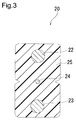
- Fig. 3 is a cross-sectional view illustrating an indoor type optical fiber cable.
- an indoor type optical fiber cable 20 is provided with two tension members 22 and 23, an optical fiber 24, and a sheath 25 covering them.
- the optical fiber 24 is provided to penetrate the sheath 25.
- Fig. 4 is a cross-sectional view illustrating a layer type optical fiber cable.
- a layer type optical fiber cable 30 is provided with a core part 31 and a sheath 35 provided to surround the core part 31.
- the core part 31 is provided with a tension member 32, a rip cord 33 provided to surround the tension member 32, and an optical fiber unit 34 which is arranged, between the tension member 32 and the rip cord 33, along the longitudinal direction of the tension member 32.
- the optical fiber unit 34 is formed by disposing the optical fiber 24 on the inner side of a tube 36 which is either colored or non-colored. Accordingly, the optical fiber 24 is provided on the inner side of the sheath 35.
- a press winding tape 37 is generally wound around the core part 31.
- the layer type optical fiber cable 30 may not have the press winding tape 37.
- a water-proofing material 38 may also be filled around the optical fiber unit 34 between the rip cord 33 and the tension member 32.
- the sheath 25 and the sheath 35 consist of the flame retardant resin composition of the invention.
- a base resin, a silicone master batch (silicone MB), a fatty acid containing compound, and an inorganic flame retardant were blended in the blending amounts indicated in Tables 1 to 5, and they were kneaded for 15 minutes at 160°C by a Banbury mixer. Thus, a flame retardant resin composition was obtained. Meanwhile, in Tables 1 to 5, the unit of the blending amount of each of the blended components is parts by mass. Furthermore, in Tables 1 to 5, the blending amount of a polyethylene resin (PE), an ethylene ethyl acrylate copolymer (EEA), an ethylene vinyl acetate copolymer (EVA), or a polypropylene resin (PP) is not 100 parts by mass.
- PE polyethylene resin
- ESA ethylene ethyl acrylate copolymer
- EVA ethylene vinyl acetate copolymer
- PP polypropylene resin
- the total amount of the base resin becomes 100 parts by mass when the resin in silicone MB is added with PE, EEA, EVA, or PP.
- Tables 1 to 5 the decomposition onset temperature of the inorganic flame retardant (T3), the decomposition onset temperature of the silicone-based compound (T1), and the decomposition onset temperature of the base resin (T2) are also indicated.
- the base resin As the base resin, the silicone MB, the fatty acid containing compound, and the inorganic flame retardant, specifically those described below were used.
- the evaluation of the mechanical property for the insulated wires of Examples 1 to 14 and Comparative Examples 1 to 7 was performed based on the tensile strength that is measured by tensile test according to JIS C3005. The results are shown in Tables 1 to 5.
- the unit of the tensile strength is MPa
- the criteria for evaluating the pass or failure in terms of the tensile strength is as follows. In the tensile test, the elongation rate was 200 mm/min and the distance between surface lines was 20 mm.
- the flame retardant resin composition of the invention can secure excellent flame retardancy while securing an excellent mechanical property.
Landscapes
- Chemical & Material Sciences (AREA)
- Organic Chemistry (AREA)
- Health & Medical Sciences (AREA)
- Chemical Kinetics & Catalysis (AREA)
- Medicinal Chemistry (AREA)
- Polymers & Plastics (AREA)
- Physics & Mathematics (AREA)
- Spectroscopy & Molecular Physics (AREA)
- Engineering & Computer Science (AREA)
- Manufacturing & Machinery (AREA)
- Inorganic Chemistry (AREA)
- Materials Engineering (AREA)
- General Physics & Mathematics (AREA)
- Optics & Photonics (AREA)
- Insulated Conductors (AREA)
- Compositions Of Macromolecular Compounds (AREA)
- Organic Insulating Materials (AREA)
Applications Claiming Priority (2)
| Application Number | Priority Date | Filing Date | Title |
|---|---|---|---|
| JP2013251231A JP5669924B1 (ja) | 2013-12-04 | 2013-12-04 | 難燃性樹脂組成物、及び、これを用いたケーブル |
| PCT/JP2014/081971 WO2015083737A1 (fr) | 2013-12-04 | 2014-12-03 | Composition de résine ignifuge et câble l'utilisant |
Publications (2)
| Publication Number | Publication Date |
|---|---|
| EP3078709A1 true EP3078709A1 (fr) | 2016-10-12 |
| EP3078709A4 EP3078709A4 (fr) | 2017-07-12 |
Family
ID=52573816
Family Applications (1)
| Application Number | Title | Priority Date | Filing Date |
|---|---|---|---|
| EP14867282.7A Withdrawn EP3078709A4 (fr) | 2013-12-04 | 2014-12-03 | Composition de résine ignifuge et câble l'utilisant |
Country Status (6)
| Country | Link |
|---|---|
| US (2) | US9982119B2 (fr) |
| EP (1) | EP3078709A4 (fr) |
| JP (2) | JP5669924B1 (fr) |
| CN (1) | CN105492525B (fr) |
| TW (1) | TWI598390B (fr) |
| WO (1) | WO2015083737A1 (fr) |
Cited By (2)
| Publication number | Priority date | Publication date | Assignee | Title |
|---|---|---|---|---|
| EP3098261A4 (fr) * | 2014-01-21 | 2017-08-16 | Fujikura Ltd. | Composition de résine ignifuge et câble l'utilisant |
| US10640634B2 (en) | 2015-12-14 | 2020-05-05 | Fujikura Ltd. | Flame retardant resin composition and metal cable, optical fiber cable, and molded article using the same |
Families Citing this family (13)
| Publication number | Priority date | Publication date | Assignee | Title |
|---|---|---|---|---|
| JPH0663597B2 (ja) | 1986-04-03 | 1994-08-22 | 敬之助 松谷 | 巻取り可能な伸縮構造体 |
| JP2929103B2 (ja) | 1997-08-08 | 1999-08-03 | 敬之助 松谷 | 伸縮構造体 |
| JP6595374B2 (ja) * | 2016-03-07 | 2019-10-23 | 株式会社戸出O−Fit | 難燃性複合樹脂材料の製造方法 |
| JPWO2018034173A1 (ja) * | 2016-08-16 | 2019-02-21 | 株式会社フジクラ | 難燃性樹脂組成物、これを用いた絶縁電線、メタルケーブル、光ファイバケーブル及び成形品 |
| NO345275B1 (en) * | 2019-03-18 | 2020-11-23 | Blue Sea Norway As | Power cable, method for production and use thereof |
| US12265270B2 (en) * | 2021-03-08 | 2025-04-01 | Corning Research & Development Corporation | Flame retardant compositions for buffer tubes and method of making same |
| KR102303462B1 (ko) * | 2021-03-12 | 2021-09-24 | (주)대아콤텍 | 절연재료 및 이를 이용하여 제조된 절연제품 |
| WO2023056208A1 (fr) | 2021-09-30 | 2023-04-06 | Exxonmobil Chemical Patents Inc. | Auxiliaires de transformation de polymère sans fluor comprenant des polyéthylènes glycols |
| US20240392129A1 (en) | 2021-09-30 | 2024-11-28 | Exxonmobil Chemical Patents Inc. | Fluoropolymer-free processing aids for ethylene-based polymers |
| CN114213743A (zh) * | 2022-01-05 | 2022-03-22 | 四川安费尔高分子材料科技有限公司 | 一种低烟无卤阻燃电缆料的生产工艺 |
| US20250145820A1 (en) | 2022-02-07 | 2025-05-08 | Exxonmobil Chemical Patents Inc. | Polyethylene glycol-based polymer processing aids |
| WO2023154744A1 (fr) | 2022-02-14 | 2023-08-17 | Exxonmobil Chemical Patents Inc. | Auxiliaires de traitement de polymères à base de polyéthylène glycol |
| CN115933081B (zh) * | 2022-11-18 | 2023-07-25 | 宏安集团有限公司 | 一种半干式光纤带光缆 |
Family Cites Families (17)
| Publication number | Priority date | Publication date | Assignee | Title |
|---|---|---|---|---|
| US4273691A (en) * | 1979-10-18 | 1981-06-16 | General Electric Company | Flame retardant compositions and coated article |
| JPH03231947A (ja) * | 1989-12-05 | 1991-10-15 | Sakai Chem Ind Co Ltd | ポリオレフィン系樹脂組成物およびその製造方法 |
| IE920241A1 (en) * | 1991-08-23 | 1993-02-24 | Hitachi Cable | Non-halogenated fire retardant resin composition and wires¹and cables coated therewith |
| JPH07296649A (ja) * | 1994-04-22 | 1995-11-10 | Hitachi Cable Ltd | ノンハロゲン難燃絶縁電線 |
| CN1102615C (zh) | 1995-12-27 | 2003-03-05 | 住友电木株式会社 | 制造阻燃型硅烷交联的聚烯烃的方法 |
| DE19610513B4 (de) | 1996-03-19 | 2006-10-19 | Alcatel Kabel Ag & Co. | Flammwidrige, halogenfreie Mischung |
| JP2001152035A (ja) * | 1999-11-30 | 2001-06-05 | Shin Etsu Chem Co Ltd | 流動性及び機械的特性に優れた熱可塑性樹脂組成物 |
| JP2001348466A (ja) * | 2000-06-06 | 2001-12-18 | Fujikura Ltd | 難燃性樹脂組成物 |
| DE60140524D1 (de) * | 2001-06-12 | 2009-12-31 | Borealis Tech Oy | Optisches Kabel mit verbesserter Kriechstromfestigkeit |
| US7518064B2 (en) * | 2003-07-30 | 2009-04-14 | Sumitomo Electric Industries, Ltd. | Halogen free flame retardant cable |
| US8331747B1 (en) * | 2008-11-07 | 2012-12-11 | Southwire Company | Non-conductive fiber optic member |
| EP2677552B1 (fr) | 2011-02-14 | 2018-01-17 | Asahi Kasei Kabushiki Kaisha | Structure de connexion pour module de production d'énergie solaire |
| KR101202473B1 (ko) | 2011-04-08 | 2012-11-16 | 주식회사 경신전선 | 엘리베이터 케이블 절연용 할로겐 프리 난연 피복조성물 |
| JP5167401B1 (ja) * | 2011-10-28 | 2013-03-21 | 株式会社フジクラ | 難燃性樹脂組成物、及び、これを用いたケーブル |
| JP5167428B1 (ja) | 2011-10-28 | 2013-03-21 | 株式会社フジクラ | 難燃性樹脂組成物、及び、これを用いたケーブル |
| JP2013133411A (ja) * | 2011-12-27 | 2013-07-08 | Fujikura Ltd | 難燃性樹脂組成物、及び、これを用いたケーブル |
| WO2013108919A1 (fr) | 2012-01-20 | 2013-07-25 | 三井化学株式会社 | Composition de résine ignifuge, son procédé de production, corps moulé à base de celle-ci, et fil électrique |
-
2013
- 2013-12-04 JP JP2013251231A patent/JP5669924B1/ja active Active
-
2014
- 2014-12-03 CN CN201480048254.9A patent/CN105492525B/zh not_active Expired - Fee Related
- 2014-12-03 JP JP2015551539A patent/JP6053236B2/ja active Active
- 2014-12-03 WO PCT/JP2014/081971 patent/WO2015083737A1/fr not_active Ceased
- 2014-12-03 EP EP14867282.7A patent/EP3078709A4/fr not_active Withdrawn
- 2014-12-03 US US15/038,753 patent/US9982119B2/en not_active Expired - Fee Related
- 2014-12-04 TW TW103142189A patent/TWI598390B/zh not_active IP Right Cessation
-
2018
- 2018-04-26 US US15/963,290 patent/US10544293B2/en not_active Expired - Fee Related
Cited By (3)
| Publication number | Priority date | Publication date | Assignee | Title |
|---|---|---|---|---|
| EP3098261A4 (fr) * | 2014-01-21 | 2017-08-16 | Fujikura Ltd. | Composition de résine ignifuge et câble l'utilisant |
| US10242769B2 (en) | 2014-01-21 | 2019-03-26 | Fujikura Ltd. | Flame retardant resin composition and cable using the same |
| US10640634B2 (en) | 2015-12-14 | 2020-05-05 | Fujikura Ltd. | Flame retardant resin composition and metal cable, optical fiber cable, and molded article using the same |
Also Published As
| Publication number | Publication date |
|---|---|
| EP3078709A4 (fr) | 2017-07-12 |
| WO2015083737A1 (fr) | 2015-06-11 |
| CN105492525B (zh) | 2017-03-22 |
| TW201540766A (zh) | 2015-11-01 |
| JPWO2015083737A1 (ja) | 2017-03-16 |
| JP5669924B1 (ja) | 2015-02-18 |
| CN105492525A (zh) | 2016-04-13 |
| US20180244903A1 (en) | 2018-08-30 |
| TWI598390B (zh) | 2017-09-11 |
| JP6053236B2 (ja) | 2016-12-27 |
| US20170051136A1 (en) | 2017-02-23 |
| US10544293B2 (en) | 2020-01-28 |
| US9982119B2 (en) | 2018-05-29 |
Similar Documents
| Publication | Publication Date | Title |
|---|---|---|
| US10544293B2 (en) | Flame retardant resin composition and cable using the same | |
| EP3098261B1 (fr) | Composition de résine ignifuge et câble l'utilisant | |
| EP3147322B1 (fr) | Composition ignifuge de résine et câble produit, l'utilisant | |
| EP3375816B1 (fr) | Composition de résine ignifuge, et câble métallique, câble à fibre optique ainsi qu'article moulé mettant en uvre celle-ci | |
| EP3375815A1 (fr) | Composition de résine ignifuge, et câble métallique, câble à fibre optique ainsi qu'article moulé mettant en uvre celle-ci | |
| EP3222661A1 (fr) | Composition de résine ignifuge, et câble et câble à fibre optique l'utilisant | |
| JP6563016B2 (ja) | 難燃性樹脂組成物、及び、これを用いたケーブル並びに光ファイバケーブル | |
| EP3385323A1 (fr) | Composition de résine ignifuge, câble métallique et câble à fibre optique utilisant chacun cette dernière et article moulé | |
| US20110094769A1 (en) | Covered conductor for wire harness and wire harness produced using the same | |
| JP2019089983A (ja) | 難燃性樹脂組成物、これを用いた絶縁電線、メタルケーブル、光ファイバケーブル及び成形品 |
Legal Events
| Date | Code | Title | Description |
|---|---|---|---|
| PUAI | Public reference made under article 153(3) epc to a published international application that has entered the european phase |
Free format text: ORIGINAL CODE: 0009012 |
|
| 17P | Request for examination filed |
Effective date: 20160520 |
|
| AK | Designated contracting states |
Kind code of ref document: A1 Designated state(s): AL AT BE BG CH CY CZ DE DK EE ES FI FR GB GR HR HU IE IS IT LI LT LU LV MC MK MT NL NO PL PT RO RS SE SI SK SM TR |
|
| AX | Request for extension of the european patent |
Extension state: BA ME |
|
| DAX | Request for extension of the european patent (deleted) | ||
| RIC1 | Information provided on ipc code assigned before grant |
Ipc: C08K 3/22 20060101ALI20170601BHEP Ipc: H01B 7/295 20060101ALI20170601BHEP Ipc: C08L 23/00 20060101AFI20170601BHEP Ipc: H01B 3/44 20060101ALI20170601BHEP Ipc: C08K 5/098 20060101ALI20170601BHEP Ipc: C08L 83/04 20060101ALI20170601BHEP |
|
| A4 | Supplementary search report drawn up and despatched |
Effective date: 20170612 |
|
| STAA | Information on the status of an ep patent application or granted ep patent |
Free format text: STATUS: EXAMINATION IS IN PROGRESS |
|
| 17Q | First examination report despatched |
Effective date: 20200205 |
|
| STAA | Information on the status of an ep patent application or granted ep patent |
Free format text: STATUS: THE APPLICATION IS DEEMED TO BE WITHDRAWN |
|
| 18D | Application deemed to be withdrawn |
Effective date: 20210701 |