EP3079387A1 - Verfahren und system zur kommunikation in einem mesh-drahtlosnetzwerk - Google Patents
Verfahren und system zur kommunikation in einem mesh-drahtlosnetzwerk Download PDFInfo
- Publication number
- EP3079387A1 EP3079387A1 EP16163915.8A EP16163915A EP3079387A1 EP 3079387 A1 EP3079387 A1 EP 3079387A1 EP 16163915 A EP16163915 A EP 16163915A EP 3079387 A1 EP3079387 A1 EP 3079387A1
- Authority
- EP
- European Patent Office
- Prior art keywords
- wireless communications
- communications device
- transmission time
- mesh network
- wireless
- Prior art date
- Legal status (The legal status is an assumption and is not a legal conclusion. Google has not performed a legal analysis and makes no representation as to the accuracy of the status listed.)
- Withdrawn
Links
Images




Classifications
-
- H—ELECTRICITY
- H04—ELECTRIC COMMUNICATION TECHNIQUE
- H04W—WIRELESS COMMUNICATION NETWORKS
- H04W4/00—Services specially adapted for wireless communication networks; Facilities therefor
- H04W4/06—Selective distribution of broadcast services, e.g. multimedia broadcast multicast service [MBMS]; Services to user groups; One-way selective calling services
-
- H—ELECTRICITY
- H04—ELECTRIC COMMUNICATION TECHNIQUE
- H04W—WIRELESS COMMUNICATION NETWORKS
- H04W72/00—Local resource management
- H04W72/30—Resource management for broadcast services
-
- H—ELECTRICITY
- H04—ELECTRIC COMMUNICATION TECHNIQUE
- H04W—WIRELESS COMMUNICATION NETWORKS
- H04W4/00—Services specially adapted for wireless communication networks; Facilities therefor
- H04W4/80—Services using short range communication, e.g. near-field communication [NFC], radio-frequency identification [RFID] or low energy communication
-
- H—ELECTRICITY
- H04—ELECTRIC COMMUNICATION TECHNIQUE
- H04W—WIRELESS COMMUNICATION NETWORKS
- H04W72/00—Local resource management
- H04W72/04—Wireless resource allocation
- H04W72/044—Wireless resource allocation based on the type of the allocated resource
- H04W72/0446—Resources in time domain, e.g. slots or frames
-
- H—ELECTRICITY
- H04—ELECTRIC COMMUNICATION TECHNIQUE
- H04W—WIRELESS COMMUNICATION NETWORKS
- H04W8/00—Network data management
- H04W8/005—Discovery of network devices, e.g. terminals
-
- H—ELECTRICITY
- H04—ELECTRIC COMMUNICATION TECHNIQUE
- H04W—WIRELESS COMMUNICATION NETWORKS
- H04W84/00—Network topologies
- H04W84/18—Self-organising networks, e.g. ad-hoc networks or sensor networks
Definitions
- This disclosure relates to wireless mesh networks and methods and systems for communicating in a wireless mesh network.
- a wireless mesh network can be used to facilitate communications between wireless communications devices.
- Typical wireless mesh networks include wireless communications devices that are wirelessly connected in a mesh topology.
- a method for communicating in a wireless mesh network involves, at a first wireless communications device, scanning the wireless mesh network for a unit time period to discover a first transmission time slot within the unit time period that is used by a second wireless communications device in the wireless mesh network, at the first wireless communications device, choosing a second transmission time slot within the unit time period for the first wireless communications device, and from the first wireless communications device, broadcasting data in the wireless mesh network in the second transmission time slot within a subsequent unit time period.
- the unit time period is divided into transmission time slots to be used by wireless communications devices in the wireless mesh network, the second wireless communications device is located within the communications range of the first wireless communications device, and the second transmission time slot is different from the first transmission time slot.
- the second wireless communications device is located within the communications range of the first wireless communications device, and the second transmission time slot is different from the first transmission time slot.
- the method for communicating in the wireless mesh network further involves, from the first wireless communications device, transmitting a request to join the wireless mesh network to the second wireless communications device in a transmission time slot reserved for joining the wireless mesh network or the second transmission time slot within a second subsequent unit time period, before broadcasting data in the wireless mesh network from the first wireless communications device in the second transmission time slot within the subsequent unit time period.
- the method for communicating in the wireless mesh network further involves, at the first wireless communications device, receiving a confirmation message from the second wireless communications device in the first transmission time slot within a second subsequent unit time period that confirms the usage of the second transmission time slot by the first wireless communications device, before broadcasting the data in the wireless mesh network from the first wireless communications device in the second transmission time slot within the subsequent unit time period.
- the method for communicating in the wireless mesh network further involves, at the first wireless communications device, choosing a third transmission time slot within each unit time period for the first wireless communications device before choosing the second transmission time slot within each unit time period for the first wireless communications device, where the third transmission time slot is different from the first and second transmission time slots, and, at the first wireless communications device, receiving a message from the second wireless communications device in the first transmission time slot within a second subsequent unit time period that objects to the usage of the third transmission time slot by the first wireless communications device.
- scanning the wireless mesh network for the unit time period involves, at the first wireless communications device, creating a neighbor table that identifies the second wireless communications device and the first transmission time slot that is used by the second wireless communications device.
- choosing the second transmission time slot within the unit time period for the first wireless communications device involves, at the first wireless communications device, generating a random number that corresponds to a place of the second transmission time slot within each unit time period.
- scanning the wireless mesh network for the unit time period involves, at the first wireless communications device, receiving signals in the wireless mesh network at a first frequency band. From the first wireless communications device, broadcasting data in the wireless mesh network, involves, from the first wireless communications device, transmitting signals in the wireless mesh network in a second frequency band, and where the first frequency band does not overlap with the second frequency band.
- the method for communicating in the wireless mesh network further involves, at the first wireless communications device, receiving a data packet from the second wireless communications device in the first transmission time slot within a second subsequent unit time period, and, from the first wireless communications device, transmitting the received data packet in the wireless mesh network in the second transmission time slot within the second subsequent unit time period or a third subsequent unit time period.
- the wireless mesh network is a peer-to-peer network.
- a method for communicating in a Bluetooth Low Energy (BLE) mesh network involves, at a first BLE compatible device, scanning the BLE mesh network for a unit time period to discover a first transmission time slot within the unit time period that is used by a second BLE compatible device in the BLE mesh network, at the first BLE compatible device, choosing a second transmission time slot within the unit time period for the BLE compatible device, and from the first BLE compatible device, broadcasting data in the BLE mesh network in the second transmission time slot within a subsequent unit time period.
- BLE Bluetooth Low Energy
- the unit time period is divided into transmission time slots to be used by BLE compatible devices in the BLE mesh network, the second BLE compatible device is located within the communications range of the first BLE compatible device, and the second transmission time slot is different from the first transmission time slot.
- the method for communicating in the BLE mesh network further involves, from the first BLE compatible device, transmitting a request to join the BLE mesh network to the second BLE compatible device in a transmission time slot reserved for joining the BLE mesh network or the second transmission time slot within a second subsequent unit time period, before broadcasting data in the BLE mesh network from the first BLE compatible device in the second transmission time slot within the subsequent unit time period.
- the method for communicating in the BLE mesh network further involves, at the first BLE compatible device, receiving a confirmation message from the second BLE compatible device in the first transmission time slot within a second subsequent unit time period that confirms the usage of the second transmission time slot by the first BLE compatible device, before broadcasting the data in the BLE mesh network from the first BLE compatible device in the second transmission time slot within the subsequent unit time period.
- the method for communicating in the BLE mesh network further involves, at the first BLE compatible device, choosing a third transmission time slot within each unit time period for the first BLE compatible device before choosing the second transmission time slot within each unit time period for the first BLE compatible device, where the third transmission time slot is different from the first and second transmission time slots, and, at the first BLE compatible device, receiving a message from the second BLE compatible device in the first transmission time slot within a second subsequent unit time period that objects to the usage of the third transmission time slot by the first BLE compatible device.
- scanning the BLE mesh network for the unit time period involves, at the first BLE compatible device, creating a neighbor table that identifies the second BLE compatible device and the first transmission time slot that is used by the second BLE compatible device.
- choosing the second transmission time slot within the unit time period for the first BLE compatible device involves, at the first BLE compatible device, generating a random number that corresponds to a place of the second transmission time slot within each unit time period.
- scanning the BLE mesh network for the unit time period involves, at the first BLE compatible device, receiving signals in the BLE mesh network at a first frequency band.
- broadcasting data in the BLE mesh network involves, from the first BLE compatible device, transmitting signals in the BLE mesh network in a second frequency band, and where the first frequency band does not overlap with the second frequency band.
- the method for communicating in the BLE mesh network further involves, at the first BLE compatible device, receiving a data packet from the second BLE compatible device in the first transmission time slot within a second subsequent unit time period, and, from the first BLE compatible device, transmitting the received data packet in the BLE mesh network in the second transmission time slot within the second subsequent unit time period or a third subsequent unit time period.
- the BLE mesh network is a peer-to-peer network.
- a wireless communications device includes an antenna module configured to receive radio frequency (RF) signals or transmit RF signal and a transceiver module configured to scan a wireless mesh network for a unit time period to discover a first transmission time slot within the unit time period that is used by a second wireless communications device in the wireless mesh network, choose a second transmission time slot within the unit time period for the wireless communications device, and broadcast data in the wireless mesh network in the second transmission time slot within a subsequent unit time period.
- the unit time period is divided into transmission time slots to be used by wireless communications devices in the wireless mesh network
- the second wireless communications device is located within the communications range of the wireless communications device, and the second transmission time slot is different from the first transmission time slot.
- the transceiver module is further configured to transmit a request to join the wireless mesh network to the second wireless communications device in a transmission time slot reserved for joining the wireless mesh network or the second transmission time slot within a second subsequent unit time period.
- the transceiver module is further configured to receive a confirmation message from the second wireless communications device in the first transmission time slot within a second subsequent unit time period that confirms the usage of the second transmission time slot by the wireless communications device, before broadcasting the data in the wireless mesh network from the wireless communications device in the second transmission time slot within the subsequent unit time period.
- transceiver module is further configured to choose a third transmission time slot within each unit time period for the wireless communications device before choosing the second transmission time slot within each unit time period for the wireless communications device, wherein the third transmission time slot is different from the first and second transmission time slots; and to receive a message from the second wireless communications device in the first transmission time slot within a second subsequent unit time period that objects to the usage of the third transmission time slot by the wireless communications device.
- each communications device continuously scans/listens to the communications channel for signals from other communications devices in the wireless mesh network in order to avoid communications collisions and to perform data relay.
- continuous channel scanning increases power consumption of the communications devices.
- continuous channel scanning leads to quick depletion of battery power, which can disable the non-communication (e.g., sensing/alarming) function of the battery-powered communications device.
- a wireless mesh network can be used to facilitate communications between wireless communications devices. Based on the network topology, a wireless mesh network can be categorized as a static mesh network, a semi-static mesh network, or a dynamic mesh network.
- a static mesh network the physical positions/locations of all communications devices/nodes are fixed such that the topological structure of the static mesh network is relatively stable.
- An example of a static mesh network is a smart home network that is composed of stationary devices, such as lights with Bluetooth Low Energy (BLE) communications capabilities.
- BLE Bluetooth Low Energy
- a semi-static mesh network different from a static mesh network, some communications devices/nodes may slowly move such that the topological structure of the semi-static mesh network may change.
- a patient in a hospital has a BLE smart band that is part of a semi-static hospital mesh network
- the real-time record of the patient's health condition can be monitored through the hospital mesh network, even when the patient moves within the hospital.
- many communications devices/nodes are moving and the topological structure of the dynamic mesh network continuously changes. For example, if a group of friends with smart phones that form a temporary dynamic mesh network attends a party, a person can communicate/talk with others in the group via the temporary dynamic mesh network.
- a communications device within a wireless mesh network, can act as a controller or a router.
- a controller is a communications device, such as a cellular phone, which acts as a control unit for the wireless mesh network.
- a router is a communications device that is responsible for associating and disassociating devices into the wireless mesh network.
- Fig. 1 depicts a network architecture 100 of a wireless mesh network.
- the network architecture of the wireless mesh network includes a mesh layer 102, a network layer 104 on top of the mesh layer, and an application layer 106 on top of the network layer.
- the network layer communicates with the application and mesh layers.
- the network layer provides routing and control function to the application layer.
- the network layer uses the mesh layer to transmit signal commands in the network layer and provides an interface to the application layer.
- Fig. 2 depicts an example network topology of a wireless mesh network 200.
- the wireless mesh network includes seven wireless communications devices/nodes 202-1, 202-2, 202-3, 202-4, 202-5, 202-6, 202-7, which are also labeled as wireless communications devices/nodes “1", “2", “3", “4", "5", “6", “7”.
- the wireless devices can wirelessly communicate using radio frequency (RF) communications signals.
- RF radio frequency
- Examples of the wireless devices include (without being limited to) handheld wireless devices, such as cell phones, mobile phones, smartphones, pad computers, Personal Digital Assistants (PDAs), handheld gaming devices etc, and embedded wireless devices, such as light switches, alarm controllers, and wireless sensors.
- PDAs Personal Digital Assistants
- embedded wireless devices such as light switches, alarm controllers, and wireless sensors.
- a wireless device can support various different RF communications protocols, including without limitation, Bluetooth (e.g., Bluetooth low energy (Bluetooth LE, BLE, or Bluetooth Smart), WiFi (802.111), Global System for Mobile communications (GSM), Universal Mobile Telecommunications System (UMTS), Code Division Multiple Access (CDMA), Worldwide Interoperability for Microwave Access (WiMax) and communications protocols as defined by the 3 rd Generation Partnership Project (3GPP) or the 3 rd Generation Partnership Project 2 (3GPP2), 4G Long Term Evolution (LTE) and IEEE 802.16 standards bodies.
- Bluetooth e.g., Bluetooth low energy (Bluetooth LE, BLE, or Bluetooth Smart
- WiFi 802.111
- GSM Global System for Mobile communications
- UMTS Universal Mobile Telecommunications System
- CDMA Code Division Multiple Access
- WiMax Worldwide Interoperability for Microwave Access
- communications protocols as defined by the 3 rd Generation Partnership Project (3GPP) or the 3 rd Generation Partnership Project 2 (3GPP2), 4G Long Term Evolution (LTE) and IEEE 8
- Wireless communications devices 202 that can "hear” each other in the wireless mesh network 200 without an intermediate communications device are referred to as neighbors/neighboring wireless communications devices.
- any wireless communications device within its communication range e.g., RF communications range
- wireless communications devices 202-1, 202-3, and 202-4 are neighbors of the wireless communications device 202-2 while wireless communications devices 202-3, 202-4, 202-6, and 202-7 are neighbors of the wireless communications device 202-5.
- a wireless communications device can only directly communicate with its neighbors in the wireless mesh network.
- the wireless communications device 202-2 can only directly receive signals from or transmit signals to the wireless communications devices 202-1, 202-3, and 202-4 while the wireless communications devices 202-3, 202-4, 202-6, and 202-7 can only directly receive signals from or transmit signals to the wireless communications device 202-5.
- each wireless communications device in the wireless mesh network maintains a neighbor table that identifies all of neighbors/neighboring wireless communications devices of that communications device.
- the wireless communications device 202-1 has a neighbor table [2, 3] that identifies its neighbor communications devices 202-2, 202-3
- the wireless communications device 202-2 has a neighbor table [1,3,4] that identifies its neighbor communications devices 202-1, 202-3, 202-4
- the wireless communications device 202-3 has a neighbor table [1, 2, 5] that identifies its neighbor communications devices 202-1, 202-2, 202-5
- the wireless communications device 202-4 has a neighbor table [2, 5] that identifies its neighbor communications devices 202-2, 202-5
- the wireless communications device 202-5 has a neighbor table [3, 4, 6, 7] that identifies its neighbor communications devices 202-3, 202-4, 202-6, 202-7
- the wireless communications device 202-6 has a neighbor table [5, 7] that identifies its neighbor communications devices 202-5, 202-7
- the wireless communications device 202-7 has a neighbor table [5, 6] that identifies its neighbor communications devices 202-5, 202-6.
- the wireless mesh network 200 utilizes time-division-multiplexing (TDM) and is referred to as a time-division network.
- TDM time-division-multiplexing
- a different transmission time slot within a unit time period is used by each wireless communications device 202 in a certain area of the wireless mesh network 200.
- using different transmission time slots for different communications devices can reduce power consumption due to continuous channel scanning/listening as well as data transmission collision.
- a wireless communications device 202 and all of its neighbor wireless communication devices in the wireless mesh network 200 use different transmission time slots within each unit time period.
- Fig. 3A is an example transmission time slot diagram for an area 210 of the wireless mesh network shown in Fig. 2 .
- the wireless communications device 202-2 and its neighbor communications devices 202-1, 202-3, 202-4 may use the transmission time slots S-2, S-1, S-3, S-4, respectively, within each unit time period 306-1 that includes the transmission time slots S-1, S-2, S-3, S-4, another transmission time slot S-5, and a transmission time slot S-0 that is used for a new communications device trying to join the wireless mesh network.
- Fig. 3A is an example transmission time slot diagram for an area 210 of the wireless mesh network shown in Fig. 2 .
- the wireless communications device 202-2 and its neighbor communications devices 202-1, 202-3, 202-4 may use the transmission time slots S-2, S-1, S-3, S-4, respectively, within each unit time period 306-1 that includes the transmission time slots S
- 3B is an example transmission time slot diagram for an area 220 of the wireless mesh network shown in Fig. 2 .
- the wireless communications device 202-5 may use the transmission time slot S-5 within each unit time period 306-2 while the wireless communications devices 202-6, 202-7 may use the transmission time slots S-1, S-2 within each unit time period.
- the wireless communications devices 202-6, 207 use the same transmission time slots as the wireless communications devices 202-1 and 202-2, the physical separation between these wireless communications devices prevents data transmission collisions.
- the communication range of the wireless communications devices 202-1 and 202-2 does not cover the wireless communications devices 202-6 and 207
- the communication range of the wireless communications devices 202-6 and 202-7 does not cover the wireless communications devices 202-1 and 202-2.
- randomness e.g., a random transmission start point within a transmission time slot
- a unit time period can be any suitable time duration, e.g., 1, 2, 5, or 10 milliseconds.
- a unit time period is dependent upon the desired network capacity (e.g., the maximum number of unique devices that can be accommodated in the wireless mesh network and/or the number of wireless communications devices in the wireless mesh network.
- a unit time period may include time slots for half or a quarter of the expected number of wireless communications devices in the wireless mesh network.
- a unit time period (e.g., 5 milliseconds) includes 50 time slots of equal time duration (e.g., 0.1 millisecond).
- the number of time slots in each unit time period can be dynamically adjusted, for example, based on the changes in the network capacity and/or network performance of the wireless mesh network.
- each wireless communications device 202 in the wireless mesh network 200 utilizes a different transmission time slot within a unit time period.
- Fig. 3C is an example transmission time slot diagram for the wireless mesh network 200 shown in Fig. 2 .
- the wireless communications devices 202-1, 202-2, 202-3, 202-4, 202-5, 202-6, 202-7 use the transmission time slots S-1, S-2, S-3, S-4, S-5, S6, S7, respectively, within a unit time period 306-3 that includes the transmission time slots S-1, S-2, S-3, S-4, S-5, S6, S7, and a transmission time slot S-0 that is reserved for a new communications device trying to join the wireless mesh network.
- transmission time slots are chosen by communications devices 202 that are trying to join the wireless mesh network.
- the chosen transmission time slots can be confirmed by other communications devices in the wireless mesh network.
- transmission time slots are allocated or assigned to communications devices in the wireless mesh network.
- Fig. 4 is a schematic block diagram of a wireless communications device, such as the wireless communications devices 202-1, 202-2, 202-3, 202-4, 202-5, 202-6, or 202-7 depicted in Fig. 2 in accordance with an embodiment of the invention.
- a wireless communications device 402 includes an antenna module 412, a transceiver module 414, a processor module 416, a timing module 418, and a functional module 420.
- the wireless communications device depicted in Fig. 4 is one possible embodiment of the wireless communications devices depicted in Fig. 2 .
- the wireless communications devices depicted in Fig. 2 are not limited to the embodiment shown in Fig. 4 .
- the antenna module 412 of the wireless communications device 402 is configured to receive RF signals and to transmit RF signals.
- the transceiver module 414 of the wireless communications device is configured to demodulate received RF signals and to modulate RF signals to be transmitted.
- the processor module 416 of the wireless communications device is configured to process received signals and to perform management functions, such as selecting a transmission time slot for the wireless communications device.
- the processor module may include a central processing unit (CPU). In certain embodiments, the processor module executes software or firmware stored in memory.
- the memory may be or may include random access memory (RAM), read-only memory (ROM), flash memory, or the like, or a combination of such devices and may include the main memory of the computer system.
- the processor module may be, or may include, one or more programmable general-purpose or special-purpose microprocessors, digital signal processors (DSPs), application specific integrated circuits (ASICs), programmable controllers, programmable logic devices (PLDs), or the like, or a combination of such devices.
- the timing module 418 of the wireless communications device is configured to provide a clock signal for the transceiver module and the processor module.
- the timing module may be a clock source or other timing device.
- the functional module 420 of the wireless communications device is configured to perform a certain function (such as controlling an alarm, controlling a light switch, and sensing).
- the functional module may be a controller (e.g., an alarm controller, a light controller) or a sensor (e.g., a light sensor, a temperature sensor, a humidity sensor).
- the wireless communications device does not include the timing module and/or the functional module.
- the wireless communications device 402 sends data by advertising and receives data by scanning.
- advertising time slots/channels can be reserved for each communications device in the wireless mesh network 200.
- Fig. 5 depicts a super frame 500 that includes advertising time slots.
- the super frame which is a logical structure, is divided into n advertising time slots/channels, CH0, CH1, CH2, CH3, ..., CHn, where n is a positive integer that is greater than 1.
- Each of the channels CH1, CH2, CH3, ..., CHn is used by a different wireless communications device in the wireless mesh network.
- Channel CH0 is used as a control channel to deal with some common events such as a new communications device joining the wireless mesh network.
- the process for building the wireless mesh network 200 is divided into three stages, which includes a discovery stage, a join stage, and an association stage.
- the wireless communications device/node 202 scans the wireless mesh network for one or more unit time periods to find neighbor wireless communications devices/nodes and to create a neighbor table according to the scan result during the discovery stage.
- Fig. 6 is a flow chart that illustrates a discovery stage for a wireless communications device 202 or 402.
- the wireless communications device begins operation, at step 602.
- the wireless communications device creates a neighbor table, which may be an empty neighbor table.
- the wireless communications device begins to scan the wireless mesh network 200 for neighbor wireless communications devices (e.g., listen to the wireless mesh network for one or more unit time periods to discover neighbor wireless communications devices and the transmission time slots within each unit time period used by the discovered neighbor wireless communications devices) and sets the current number, "i,” of channel/time slot scans to zero and n equal to a predefined range, "scanTimes"(which limits/controls the amount of scans to manage battery power usage), at step 606.
- neighbor wireless communications devices e.g., listen to the wireless mesh network for one or more unit time periods to discover neighbor wireless communications devices and the transmission time slots within each unit time period used by the discovered neighbor wireless communications devices
- the wireless communications device checks whether or not the current number, i, of channel scans exceeds the predefined range, "scanTimes," (i.e., whether or not the channel scan procedure is finished), at step 608. If the current number, i, of channel scans is below/less than the predefined range, scanTimes, the wireless communications device scans the wireless mesh network 200 for neighbor wireless communications devices, at step 610. The wireless communications device checks whether or not any neighbor wireless communications device is found, at step 612. If a neighbor wireless communications device is found, the wireless communications device adds the neighbor wireless communications device and the transmission time slot used by the neighbor wireless communications device to the neighbor table, at step 614. If no neighbor wireless communications device is found, the wireless communications device returns to step 608.
- scanTimes i.e., whether or not the channel scan procedure is finished
- the wireless communications device checks whether or not the neighbor table is empty, at step 616. If the neighbor table is empty, the wireless communications device enters a sleep mode for a time duration, at step 618, and the process go back to step 606. If the neighbor table is not empty, the wireless communications device enters the join stage to join the wireless mesh network, at step 620.
- a wireless communications device 202 chooses a proper time slot/channel according to neighbor table, sends a "Join Request Packet" within a control time slot channel or the selected time slot/channel to request to join the wireless mesh network 200. Once a 'Join Response packet' is received, the wireless communications device successfully joins the wireless mesh network. Otherwise, the wireless communications device returns to the discovery stage.
- Fig. 7 is a flow chart that illustrates a join stage for a wireless communications device 202 or 402.
- the wireless communications device begins operation, at step 702.
- the wireless communications device chooses a proper transmission time slot/channel. For example, a proper transmission time slot/channel is chosen based on the neighbor table created during the discovery stage. If the neighbor table shows one or more neighbor communication devices, the wireless communications device chooses a transmission time slot within each unit time period that is different from the transmission time slot(s) used by the neighbor communication devices in the wireless mesh network 200. For example, the wireless communications device generates a random number that corresponds to the desired transmission time slot within a unit time period.
- the wireless communications device chooses a transmission time slot within a unit time period, which can be any transmission time slot within the unit time period, except a time slot that has been used/reserved transmission time slot for some other purpose such as control communicating.
- the wireless communications device sets the current number, "i," of join request(s) to zero and n equal to a predefined range, "requestTimes" (e.g., which keeps the wireless communication device from continuously sending join requests and exhausting battery power), at step 706, and sends/broadcasts a join request to the wireless mesh network, at step 708.
- the wireless communications device checks whether or not a join response is received, at step 710.
- Receipt of a join response confirms the usage of the transmission time slot by the wireless communications device. If a join response is received (e.g., within a certain time limit as controlled by n), the wireless communications device goes to the association stage, at step 712. If no join response is received (e.g., within a certain time limit as controlled by n), the wireless communications device checks whether the current number, i, of join requests is less than the predefined range, "requestTimes," at step 714. If the current number, i, of join requests is less than the predefined range, requestTimes, the process goes back to step 706. If the current number, i, of join requests is greater than or equal to the predefined range, requestTimes, the process goes back the discovery stage, at step 716.
- a wireless communications device 202 performs the functions of a member of the wireless mesh network 200 and handles join requests/routing requests/data packets from wireless neighbor communications devices in the wireless mesh network.
- Fig. 8 is a flow chart that illustrates an associate stage for a wireless communications device 202 or 402.
- the wireless communications device begins operation, at step 802.
- the wireless communications device checks whether or not a join request from a neighbor communications device in the wireless mesh network 200 is received. If a join request is received (e.g., within a certain time limit), the wireless communications device sends a join response at step 806, assuming the chosen transmission time slot in the join request is unused by other wireless communications devices within the communications range of a wireless communications device trying to join the wireless mesh network.
- the wireless communications device sends a message, which objects to the usage of the chosen transmission time slot, to the wireless communications device trying to join the wireless mesh network.
- the wireless communications device checks whether or not a routing packet is received, at step 808. If no join request is received (e.g., within a certain time limit), the process also goes to step 808. If no routing packet is received (e.g., within a certain time limit), the process goes back to step 804. If a routing packet is received (e.g., within a certain time limit), the wireless communications device checks whether or not it is the destination of the data packet, at step 810.
- the wireless communications device If the wireless communications device is the destination of the data packet, the wireless communications device sends/broadcasts a routing response (e.g., an acknowledgement packet that confirms the receipt of the data packet at its intended destination), at step 812. If the wireless communications device is not the destination of the data packet, the wireless communications device forwards the packet to other communications devices, at step 814, and the process goes back to step 804. After the routing response is sent, the wireless communications device checks whether or not the received data packet is a command packet, at step 816. If the received data packet is a command packet, the wireless communications device processes the command packet, at step 818.
- a routing response e.g., an acknowledgement packet that confirms the receipt of the data packet at its intended destination
- the wireless communications device checks whether or not a neighbor communications device is lost (e.g., no longer reachable), at step 820. If no neighbor communications device is lost, the process goes back to step 804. If a neighbor communications device is lost, the wireless communications device updates its neighbor table to remove the lost neighbor communications device, at step 822, and checks whether or not the neighbor table is empty, at step 824. If the neighbor table is empty, the wireless communications device goes to the discovery stage, at step 826. If the neighbor table is not empty, the wireless communications device goes back to step 824.
- a neighbor communications device is lost (e.g., no longer reachable)
- the wireless communications device updates its neighbor table to remove the lost neighbor communications device, at step 822, and checks whether or not the neighbor table is empty, at step 824. If the neighbor table is empty, the wireless communications device goes to the discovery stage, at step 826. If the neighbor table is not empty, the wireless communications device goes back to step 824.
- the frequency band in which a wireless communications device 202 scans the wireless mesh network 200 is typically the same as or at least partially overlaps with the frequency band in which the wireless communications device 202 transmits data (e.g., data packet carrying payload). However, in some embodiments, the frequency band in which a wireless communications device scans the wireless mesh network is different from (e.g., does not overlap with) the frequency band in which the wireless communications device transmits data (e.g., data packet carrying payload).
- a Bluetooth Low Energy (BLE) device scans a BLE mesh network in an advertising frequency channel to find neighbor BLE devices, and subsequently, transmits or broadcasts data packets carrying a data payload in a data frequency channel.
- Fig. 9 shows three advertising frequency channels and thirty-seven data channels that can be used in a BLE mesh network.
- Table 1 shows an example of a command packet passed between two wireless communications devices 202.
- the command packet includes a service data section, a service identification number (UUID) section, and a mesh signal command section. All commands are sent via advertising packets and received by scanning. According to the format of Advertising data, a network layer packet is encapsulated into service data AD type.
- Table 1 Command Packet Octets 1 Byte 2 N Service data(0x16) Service UUID Mesh Signal command
- a report command allows a wireless communications device 202 to report its own status and information to a neighbor wireless communications device.
- Table 2 shows an example of a report command packet.
- Table 2 Report Command Packet Octets: 1 Byte 1 1 1 10 opcode 0x01 Src Network Address Channel ID ACK_ID Network layer payload
- the format of the Report Command packet includes the following data fields:
- Table 3 shows an example of a Join Request packet, which is used by a wireless communications device 202 trying to join the wireless mesh network 200.
- the format of the join request packet includes the following data fields:
- the Network ID field represents the level of a local device (e.g., the ID number of the local device) in the wireless mesh network 200.
- Table 4 shows an example of a Join Response packet, which is used to answer the join request.
- the format of the Join Response packet includes the following data fields:
- Table 5 shows an example of a Leave Notify packet, which is used by a wireless communications device 202 to inform other devices in the wireless mesh network 200 that the wireless communications device cannot hear other devices (i.e., cannot receive signals from other devices).
- the format of the Leave Notify packet includes the following data fields:
- Table 6 shows an example of a Status Code packet.
- a Status Code packet includes an Operation Success section that describes the status of an operation of a wireless communications device 202 in the wireless mesh network 200.
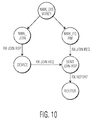
- Fig. 10 shows a state graph for a wireless communications device 202 in the wireless mesh network 200.
- the state graph includes the following processes:
- the wireless mesh network 200 can use various routing protocols.
- the wireless mesh network uses an Ad hoc On Demand Distance Vector (AODV) Routing Protocol.
- AODV Ad hoc On Demand Distance Vector
- a data transmission within the wireless mesh network 200 is started by a command from a collaborator.
- Fig. 11 shows a collaborator 1100 and the wireless mesh network 200 to which the collaborator sends a command packet.
- the collaborator can join the wireless mesh network similarly as a node in the wireless mesh network. However, the collaborator does not handle routing messages or join requests.
- the collaborator sends commands to one or a group of devices of the wireless mesh network.
- the communication device/node 202-1 which is associated with the collaborator, acts as an agent to handle the routing process. If an existing routing path is not found, the node 202-1 will activate a routing process to create a new routing path and send the command packet to the destination.
- the Network frame format includes a control header and an application payload.
- the frame control field can be formatted as illustrated in Table 7.
- the routing request command allows a wireless communications device 202 to request other wireless communications devices to engage in a search for a particular destination device and to establish a state within the wireless mesh network 202 that will allow messages to be routed to that destination more easily and economically in the future.
- Table 8 Routing Request Packet Byte 0 1 2 3 4 5 6 Var Frame Control Next hop Addr Sequence number Source ID Dest ID/ Group ID Hop info Data length Data
- routing response command An example of a routing response command is shown in Table 9.
- the routing response command allows the specified destination device of a route request command to inform the originator of the route request that the request has been received.
- Fig. 12 is a process flow diagram of a method for communicating in a wireless mesh network in accordance with an embodiment of the invention.
- the wireless mesh network is scanned for a unit time period to discover a first transmission time slot within each unit time period that is used by a second wireless communications device in the wireless mesh network, where each unit time period is divided into transmission time slots to be used by wireless communications devices in the wireless mesh network, and where the second wireless communications device is located within the communications range of the first wireless communications device.
- a second transmission time slot within each unit time period is chosen for the first wireless communications device, where the second transmission time slot is different from the first transmission time slot.
- the first and second wireless communications devices may be similar to or the same as the wireless communications devices 202, 402 depicted in Figs. 2 and 4 .
- the wireless mesh network may be similar to or the same as the wireless mesh network 200 depicted in Fig. 2 .
- Fig. 13 is a process flow diagram of a method for communicating in a Bluetooth Low Energy (BLE) mesh network in accordance with an embodiment of the invention.
- BLE Bluetooth Low Energy
- the BLE mesh network is scanned for a unit time period to discover a first transmission time slot within each unit time period that is used by a second BLE compatible device in the BLE mesh network, where each unit time period is divided into transmission time slots to be used by BLE compatible devices in the BLE mesh network, and where the second BLE compatible device is located within the communications range of the first BLE compatible device.
- a second transmission time slot within each unit time period is chosen for the BLE compatible device, where the second transmission time slot is different from the first transmission time slot.
- the first and second BLE compatible devices may be similar to or the same as the wireless communications devices 202, 402 depicted in Figs. 2 and 4 .
- the BLE mesh network may be similar to or the same as the wireless mesh network 200 depicted in Fig. 2 .
- an embodiment of a computer program product includes a computer useable storage medium to store a computer readable program that, when executed on a computer, causes the computer to perform operations, as described herein.
- embodiments of at least portions of the invention can take the form of a computer program product accessible from a computer-usable or computer-readable medium providing computer executable instructions, or program code, for use by or in connection with a computer or any instruction execution system.
- a computer-usable or computer readable medium can be any apparatus that can contain, store, communicate, propagate, or transport the program for use by or in connection with the instruction execution system, apparatus, or device.
- the computer-useable or computer-readable medium can be an electronic, magnetic, optical, electromagnetic, infrared, or semiconductor system (or apparatus or device).
- Examples of a computer-readable medium include a semiconductor or solid state memory, magnetic tape, a removable computer diskette, a random access memory (RAM), a read-only memory (ROM), a rigid magnetic disk, and an optical disk.
- Current examples of optical disks include a compact disk with read only memory (CD-ROM), a compact disk with read/write (CD-R/W), and a digital video disk (DVD).
Landscapes
- Engineering & Computer Science (AREA)
- Computer Networks & Wireless Communication (AREA)
- Signal Processing (AREA)
- Multimedia (AREA)
- Databases & Information Systems (AREA)
- Mobile Radio Communication Systems (AREA)
Applications Claiming Priority (1)
| Application Number | Priority Date | Filing Date | Title |
|---|---|---|---|
| US14/682,040 US9794934B2 (en) | 2015-04-08 | 2015-04-08 | Method and system for communicating in a wireless mesh network |
Publications (1)
| Publication Number | Publication Date |
|---|---|
| EP3079387A1 true EP3079387A1 (de) | 2016-10-12 |
Family
ID=55808354
Family Applications (1)
| Application Number | Title | Priority Date | Filing Date |
|---|---|---|---|
| EP16163915.8A Withdrawn EP3079387A1 (de) | 2015-04-08 | 2016-04-05 | Verfahren und system zur kommunikation in einem mesh-drahtlosnetzwerk |
Country Status (3)
| Country | Link |
|---|---|
| US (1) | US9794934B2 (de) |
| EP (1) | EP3079387A1 (de) |
| CN (1) | CN106060936B (de) |
Cited By (1)
| Publication number | Priority date | Publication date | Assignee | Title |
|---|---|---|---|---|
| WO2018236265A1 (en) * | 2017-06-22 | 2018-12-27 | Telefonaktiebolaget Lm Ericsson (Publ) | Handling communication of data in a bluetooth low energy (ble), mesh network |
Families Citing this family (24)
| Publication number | Priority date | Publication date | Assignee | Title |
|---|---|---|---|---|
| US9736019B2 (en) * | 2015-05-14 | 2017-08-15 | Eero Inc. | Methods for dynamic router configuration in a mesh network |
| US10448310B2 (en) | 2015-08-06 | 2019-10-15 | Gooee Limited | Method of mapping optimal communication routes through a mesh network |
| US20170041861A1 (en) * | 2015-08-06 | 2017-02-09 | Amir Fuhrmann | Method of Communicating to Selected Nodes in a Mesh Network |
| GB2543800B (en) * | 2015-10-28 | 2020-02-26 | Ayyeka Tech Ltd | Method and system for scheduling transmit time slots for network-connected measurement units |
| US20170134227A1 (en) * | 2015-11-11 | 2017-05-11 | Lg Electronics Inc. | Method and apparatus for transmitting and receiving data in mesh network using bluetooth |
| US10644746B2 (en) | 2016-04-29 | 2020-05-05 | Texas Instruments Incorporated | Pseudo channel hopping using scan dwell times in mesh networks without time synchronization |
| IT201600074712A1 (it) * | 2016-07-18 | 2018-01-18 | C T Elettr S R L | Sistema e metodo di trasmissione a divisione di tempo |
| CN110574414B (zh) | 2016-12-27 | 2023-04-04 | 株式会社电装 | 用于微定位传感器通信的系统和方法 |
| US10869183B2 (en) * | 2017-03-17 | 2020-12-15 | Lg Electronics Inc. | Method and apparatus for searching for device by using bluetooth low energy (LE) technology |
| US20190141616A1 (en) * | 2017-11-08 | 2019-05-09 | Carrier Corporation | Mesh networking using peer to peer messages |
| US10944669B1 (en) | 2018-02-09 | 2021-03-09 | GoTenna, Inc. | System and method for efficient network-wide broadcast in a multi-hop wireless network using packet echos |
| CN110278547B (zh) * | 2018-03-13 | 2022-04-08 | 博通集成电路(上海)股份有限公司 | 用于建立低功耗蓝牙网状网络的装置和方法 |
| US11483691B2 (en) * | 2018-03-13 | 2022-10-25 | Cypress Semiconductor Corporation | Time of arrival estimation for Bluetooth systems and devices |
| US11082324B2 (en) | 2018-07-27 | 2021-08-03 | goTenna Inc. | Vine: zero-control routing using data packet inspection for wireless mesh networks |
| EP3850891B1 (de) * | 2018-09-10 | 2022-06-29 | Telefonaktiebolaget LM Ericsson (publ) | Detektion kritischer verbindungen in bluetooth-mesh-netzwerken |
| US10813041B2 (en) * | 2018-11-09 | 2020-10-20 | Sony Corporation | Propagating discovery assistance request and response |
| US10999789B2 (en) * | 2019-03-13 | 2021-05-04 | Ademco Inc. | Systems and methods for reducing interference in a TDMA based wireless network |
| US11546096B2 (en) * | 2019-06-21 | 2023-01-03 | Carrier Corporation | Method and system for data transfer in a Bluetooth low energy network |
| CN112449333B (zh) * | 2019-08-30 | 2024-12-03 | 硅工厂股份有限公司 | 无线电池管理系统、用于无线通信的节点和网络建立方法 |
| US11197263B1 (en) * | 2019-09-03 | 2021-12-07 | Amazon Technologies, Inc. | Decentralized dynamic frequency selection (DFS) master service |
| US11388699B2 (en) * | 2020-03-25 | 2022-07-12 | Kabushiki Kaisha Toshiba | Communication between network nodes |
| CN111711941B (zh) * | 2020-04-30 | 2023-10-24 | 杭州涂鸦信息技术有限公司 | 数据传输方法以及相关设备、装置 |
| US20240015785A1 (en) * | 2022-06-21 | 2024-01-11 | Skyworks Solutions, Inc. | Systems, devices, and methods related to conserving communication bandwidth with spare time schedule |
| US12328149B1 (en) * | 2023-02-02 | 2025-06-10 | Rockwell Collins, Inc. | Notification system and apparatus |
Citations (4)
| Publication number | Priority date | Publication date | Assignee | Title |
|---|---|---|---|---|
| US5719868A (en) * | 1995-10-05 | 1998-02-17 | Rockwell International | Dynamic distributed, multi-channel time division multiple access slot assignment method for a network of nodes |
| US20090168796A1 (en) * | 2007-12-28 | 2009-07-02 | Synapsense Corporation | Apparatus and method for adaptive channel hopping in mesh networks |
| US20090168703A1 (en) * | 2007-12-28 | 2009-07-02 | Synapsense Corporation | Apparatus and method for admitting new devices in a self-healing, self-organizing mesh network |
| WO2014077673A1 (en) * | 2012-11-16 | 2014-05-22 | Mimos Berhad | System and method for frequency channel allocation in a wireless communication network |
Family Cites Families (6)
| Publication number | Priority date | Publication date | Assignee | Title |
|---|---|---|---|---|
| US7869378B2 (en) * | 2005-09-26 | 2011-01-11 | Interdigital Technology Corporation | Method and apparatus for sharing slot allocation schedule information amongst nodes of a wireless mesh network |
| US8861483B2 (en) * | 2007-02-13 | 2014-10-14 | Sk Telecom Co., Ltd. | Method for allocating a beacon slot using a beacon table in wireless personal area network (WPAN) and WPAN device |
| CN101282256A (zh) * | 2007-04-06 | 2008-10-08 | 华为技术有限公司 | 在无线网状网中建立时隙的方法及节点 |
| US9351301B2 (en) * | 2012-08-16 | 2016-05-24 | Daniel Chonghwan LEE | Maintenance of time slot usage indicators and self-organizing networking |
| US10111071B2 (en) * | 2014-09-19 | 2018-10-23 | Avago Technologies General Ip (Singapore) Pte. Ltd. | Bluetooth low energy automation mesh network |
| US10057352B2 (en) * | 2015-03-13 | 2018-08-21 | Qualcomm Incorporated | Internet of everything device relay discovery and selection |
-
2015
- 2015-04-08 US US14/682,040 patent/US9794934B2/en active Active
-
2016
- 2016-04-05 EP EP16163915.8A patent/EP3079387A1/de not_active Withdrawn
- 2016-04-08 CN CN201610217285.3A patent/CN106060936B/zh active Active
Patent Citations (4)
| Publication number | Priority date | Publication date | Assignee | Title |
|---|---|---|---|---|
| US5719868A (en) * | 1995-10-05 | 1998-02-17 | Rockwell International | Dynamic distributed, multi-channel time division multiple access slot assignment method for a network of nodes |
| US20090168796A1 (en) * | 2007-12-28 | 2009-07-02 | Synapsense Corporation | Apparatus and method for adaptive channel hopping in mesh networks |
| US20090168703A1 (en) * | 2007-12-28 | 2009-07-02 | Synapsense Corporation | Apparatus and method for admitting new devices in a self-healing, self-organizing mesh network |
| WO2014077673A1 (en) * | 2012-11-16 | 2014-05-22 | Mimos Berhad | System and method for frequency channel allocation in a wireless communication network |
Non-Patent Citations (2)
| Title |
|---|
| JAN MAGNE TJENSVOLD: "Comparison of the IEEE 802.11, 802.15.1, 802.15.4 and 802.15.6 wireless standards", 18 November 2007 (2007-11-18), XP055295278, Retrieved from the Internet <URL:https://janmagnet.files.wordpress.com/2008/07/comparison-ieee-802-standards.pdf> [retrieved on 20160812] * |
| N/A: "Architecture Mesh Networks And Some Related Issues ; 15-05-0455-00-0005-architecture-mesh-networks-and-some-related-issues", IEEE DRAFT; 15-05-0455-00-0005-ARCHITECTURE-MESH-NETWORKS-AND-SOME-RELATED-ISSUES, IEEE-SA MENTOR, PISCATAWAY, NJ USA, vol. 802.155, 20 July 2005 (2005-07-20), pages 1 - 34, XP017670101 * |
Cited By (2)
| Publication number | Priority date | Publication date | Assignee | Title |
|---|---|---|---|---|
| WO2018236265A1 (en) * | 2017-06-22 | 2018-12-27 | Telefonaktiebolaget Lm Ericsson (Publ) | Handling communication of data in a bluetooth low energy (ble), mesh network |
| US11576022B2 (en) | 2017-06-22 | 2023-02-07 | Telefonaktiebolaget Lm Ericsson (Publ) | Handling communication of data in a bluetooth low energy (BLE), mesh network |
Also Published As
| Publication number | Publication date |
|---|---|
| US9794934B2 (en) | 2017-10-17 |
| CN106060936A (zh) | 2016-10-26 |
| CN106060936B (zh) | 2021-12-14 |
| US20160302195A1 (en) | 2016-10-13 |
Similar Documents
| Publication | Publication Date | Title |
|---|---|---|
| EP3079387A1 (de) | Verfahren und system zur kommunikation in einem mesh-drahtlosnetzwerk | |
| US12414196B2 (en) | Method and device for discontinuous reception operation on sidelink communication channel | |
| US9655116B2 (en) | Method for channel switching in wireless communication system and apparatus therefor | |
| US11729614B2 (en) | Connection of wearable devices | |
| US8335175B2 (en) | Systems and methods for page delivery to a wireless client device in idle state | |
| KR102149862B1 (ko) | 시스템 메시지 처리 방법, 네트워크 장치 및 사용자 기기 | |
| EP2422551B1 (de) | Drahtlose Stationskonnektivitäts-Informationsverteilung | |
| JP7607054B2 (ja) | マルチキャストダウンリンクサービスの通知方法、端末デバイス及びネットワークデバイス | |
| WO2018170913A1 (zh) | 一种系统信息传输方法及装置 | |
| WO2008033651A2 (en) | Selecting a leader node for an ad hoc network based on services | |
| WO2015017189A1 (en) | Continuing multimedia broadcast multicast services for out-of-coverage devices | |
| US20230413229A1 (en) | Method and Apparatus for Relay Communication | |
| WO2022077796A1 (zh) | 一种通信方法及装置 | |
| WO2023024006A1 (zh) | 一种确定节能信号监听时机的方法及装置、终端设备 | |
| CN114007265A (zh) | 一种通信方法及装置 | |
| CN110999397B (zh) | 一种设备发现方法及相关设备 | |
| WO2024037210A1 (zh) | 广播安全通信的方法和装置 | |
| KR20120071927A (ko) | 통신 장치 및 방법 | |
| EP4175405A1 (de) | Verfahren, vorrichtung und computerprogramm | |
| WO2025227333A1 (zh) | 一种信息传输方法、装置、设备、芯片和存储介质 | |
| WO2025209350A1 (zh) | 系统信息的请求方法、通信装置和系统 | |
| WO2025123246A1 (zh) | 无线通信方法、装置、设备及存储介质 | |
| CN119174203A (zh) | 无线通信方法、装置、设备及存储介质 | |
| CN120358478A (zh) | 中继用户设备ue的发现方法、装置及存储介质 |
Legal Events
| Date | Code | Title | Description |
|---|---|---|---|
| PUAI | Public reference made under article 153(3) epc to a published international application that has entered the european phase |
Free format text: ORIGINAL CODE: 0009012 |
|
| AK | Designated contracting states |
Kind code of ref document: A1 Designated state(s): AL AT BE BG CH CY CZ DE DK EE ES FI FR GB GR HR HU IE IS IT LI LT LU LV MC MK MT NL NO PL PT RO RS SE SI SK SM TR |
|
| AX | Request for extension of the european patent |
Extension state: BA ME |
|
| STAA | Information on the status of an ep patent application or granted ep patent |
Free format text: STATUS: THE APPLICATION HAS BEEN PUBLISHED |
|
| STAA | Information on the status of an ep patent application or granted ep patent |
Free format text: STATUS: THE APPLICATION IS DEEMED TO BE WITHDRAWN |
|
| 18D | Application deemed to be withdrawn |
Effective date: 20170413 |