EP3080075B1 - Dérivés de n,n-(bis-2-aminoalkyle)-1,2-alkyldiamine - Google Patents
Dérivés de n,n-(bis-2-aminoalkyle)-1,2-alkyldiamine Download PDFInfo
- Publication number
- EP3080075B1 EP3080075B1 EP14802053.0A EP14802053A EP3080075B1 EP 3080075 B1 EP3080075 B1 EP 3080075B1 EP 14802053 A EP14802053 A EP 14802053A EP 3080075 B1 EP3080075 B1 EP 3080075B1
- Authority
- EP
- European Patent Office
- Prior art keywords
- formula
- hydrogen
- bis
- group
- catalyst
- Prior art date
- Legal status (The legal status is an assumption and is not a legal conclusion. Google has not performed a legal analysis and makes no representation as to the accuracy of the status listed.)
- Not-in-force
Links
- 239000003054 catalyst Substances 0.000 claims description 79
- 150000001875 compounds Chemical class 0.000 claims description 60
- 238000000034 method Methods 0.000 claims description 54
- 238000005984 hydrogenation reaction Methods 0.000 claims description 52
- 239000001257 hydrogen Substances 0.000 claims description 49
- 229910052739 hydrogen Inorganic materials 0.000 claims description 49
- UFHFLCQGNIYNRP-UHFFFAOYSA-N Hydrogen Chemical compound [H][H] UFHFLCQGNIYNRP-UHFFFAOYSA-N 0.000 claims description 45
- 230000008569 process Effects 0.000 claims description 45
- PXHVJJICTQNCMI-UHFFFAOYSA-N nickel Substances [Ni] PXHVJJICTQNCMI-UHFFFAOYSA-N 0.000 claims description 33
- XEEYBQQBJWHFJM-UHFFFAOYSA-N iron Substances [Fe] XEEYBQQBJWHFJM-UHFFFAOYSA-N 0.000 claims description 25
- 238000002360 preparation method Methods 0.000 claims description 25
- 125000002496 methyl group Chemical group [H]C([H])([H])* 0.000 claims description 23
- QGZKDVFQNNGYKY-UHFFFAOYSA-N Ammonia Chemical compound N QGZKDVFQNNGYKY-UHFFFAOYSA-N 0.000 claims description 21
- 125000001931 aliphatic group Chemical group 0.000 claims description 20
- 229910052759 nickel Inorganic materials 0.000 claims description 18
- GUTLYIVDDKVIGB-UHFFFAOYSA-N cobalt atom Chemical compound [Co] GUTLYIVDDKVIGB-UHFFFAOYSA-N 0.000 claims description 17
- 229910052742 iron Inorganic materials 0.000 claims description 17
- 229910017052 cobalt Inorganic materials 0.000 claims description 16
- 239000010941 cobalt Substances 0.000 claims description 16
- 239000002904 solvent Substances 0.000 claims description 16
- 239000003822 epoxy resin Substances 0.000 claims description 15
- 238000004519 manufacturing process Methods 0.000 claims description 15
- 229920000647 polyepoxide Polymers 0.000 claims description 15
- 125000001495 ethyl group Chemical group [H]C([H])([H])C([H])([H])* 0.000 claims description 13
- 150000001412 amines Chemical class 0.000 claims description 12
- LNEPOXFFQSENCJ-UHFFFAOYSA-N haloperidol Chemical compound C1CC(O)(C=2C=CC(Cl)=CC=2)CCN1CCCC(=O)C1=CC=C(F)C=C1 LNEPOXFFQSENCJ-UHFFFAOYSA-N 0.000 claims description 12
- 229910021529 ammonia Inorganic materials 0.000 claims description 10
- 229910052804 chromium Inorganic materials 0.000 claims description 10
- 125000000008 (C1-C10) alkyl group Chemical group 0.000 claims description 9
- 150000002431 hydrogen Chemical group 0.000 claims description 9
- 125000001449 isopropyl group Chemical group [H]C([H])([H])C([H])(*)C([H])([H])[H] 0.000 claims description 7
- 125000004108 n-butyl group Chemical group [H]C([H])([H])C([H])([H])C([H])([H])C([H])([H])* 0.000 claims description 7
- 229910052750 molybdenum Inorganic materials 0.000 claims description 6
- 125000002924 primary amino group Chemical group [H]N([H])* 0.000 claims description 6
- 125000002914 sec-butyl group Chemical group [H]C([H])([H])C([H])([H])C([H])(*)C([H])([H])[H] 0.000 claims description 6
- YGYAWVDWMABLBF-UHFFFAOYSA-N Phosgene Chemical compound ClC(Cl)=O YGYAWVDWMABLBF-UHFFFAOYSA-N 0.000 claims description 5
- 239000004952 Polyamide Substances 0.000 claims description 5
- 239000000178 monomer Substances 0.000 claims description 5
- 229920002647 polyamide Polymers 0.000 claims description 5
- 150000001298 alcohols Chemical class 0.000 claims description 4
- 150000001408 amides Chemical class 0.000 claims description 4
- 150000004945 aromatic hydrocarbons Chemical class 0.000 claims description 4
- 150000002148 esters Chemical class 0.000 claims description 4
- 150000002170 ethers Chemical class 0.000 claims description 4
- 125000001436 propyl group Chemical group [H]C([*])([H])C([H])([H])C([H])([H])[H] 0.000 claims description 4
- 229910052703 rhodium Inorganic materials 0.000 claims description 4
- 229910052707 ruthenium Inorganic materials 0.000 claims description 4
- 125000000999 tert-butyl group Chemical group [H]C([H])([H])C(*)(C([H])([H])[H])C([H])([H])[H] 0.000 claims description 4
- 229910000564 Raney nickel Inorganic materials 0.000 claims description 3
- 229910052799 carbon Inorganic materials 0.000 claims description 3
- 229910052741 iridium Inorganic materials 0.000 claims description 3
- 229910052762 osmium Inorganic materials 0.000 claims description 3
- 229910052763 palladium Inorganic materials 0.000 claims description 3
- 229910052697 platinum Inorganic materials 0.000 claims description 3
- 125000005442 diisocyanate group Chemical group 0.000 claims description 2
- 239000003999 initiator Substances 0.000 claims description 2
- 239000004848 polyfunctional curative Substances 0.000 claims description 2
- 125000004435 hydrogen atom Chemical group [H]* 0.000 claims 6
- WDKZAGLJEFIVOR-UHFFFAOYSA-N 1-n,1-n-bis(2-aminoethyl)propane-1,2-diamine Chemical compound CC(N)CN(CCN)CCN WDKZAGLJEFIVOR-UHFFFAOYSA-N 0.000 claims 1
- NPXOKRUENSOPAO-UHFFFAOYSA-N Raney nickel Chemical compound [Al].[Ni] NPXOKRUENSOPAO-UHFFFAOYSA-N 0.000 claims 1
- 229910052757 nitrogen Inorganic materials 0.000 description 34
- WYURNTSHIVDZCO-UHFFFAOYSA-N Tetrahydrofuran Chemical compound C1CCOC1 WYURNTSHIVDZCO-UHFFFAOYSA-N 0.000 description 21
- 238000006243 chemical reaction Methods 0.000 description 20
- 239000000203 mixture Substances 0.000 description 17
- 239000000725 suspension Substances 0.000 description 15
- 239000011651 chromium Substances 0.000 description 14
- HEMHJVSKTPXQMS-UHFFFAOYSA-M Sodium hydroxide Chemical compound [OH-].[Na+] HEMHJVSKTPXQMS-UHFFFAOYSA-M 0.000 description 12
- 125000000217 alkyl group Chemical group 0.000 description 11
- QVGXLLKOCUKJST-UHFFFAOYSA-N atomic oxygen Chemical compound [O] QVGXLLKOCUKJST-UHFFFAOYSA-N 0.000 description 11
- 239000001301 oxygen Substances 0.000 description 11
- 229910052760 oxygen Inorganic materials 0.000 description 11
- YLQBMQCUIZJEEH-UHFFFAOYSA-N tetrahydrofuran Natural products C=1C=COC=1 YLQBMQCUIZJEEH-UHFFFAOYSA-N 0.000 description 10
- VILCJCGEZXAXTO-UHFFFAOYSA-N 2,2,2-tetramine Chemical compound NCCNCCNCCN VILCJCGEZXAXTO-UHFFFAOYSA-N 0.000 description 9
- 239000000047 product Substances 0.000 description 9
- 239000007868 Raney catalyst Substances 0.000 description 8
- -1 aliphatic nitriles Chemical class 0.000 description 7
- XLYOFNOQVPJJNP-UHFFFAOYSA-N water Substances O XLYOFNOQVPJJNP-UHFFFAOYSA-N 0.000 description 7
- ZMXDDKWLCZADIW-UHFFFAOYSA-N N,N-Dimethylformamide Chemical compound CN(C)C=O ZMXDDKWLCZADIW-UHFFFAOYSA-N 0.000 description 6
- 229910052782 aluminium Inorganic materials 0.000 description 6
- 239000003960 organic solvent Substances 0.000 description 6
- 239000011541 reaction mixture Substances 0.000 description 6
- LFQSCWFLJHTTHZ-UHFFFAOYSA-N Ethanol Chemical compound CCO LFQSCWFLJHTTHZ-UHFFFAOYSA-N 0.000 description 5
- XAGFODPZIPBFFR-UHFFFAOYSA-N aluminium Chemical compound [Al] XAGFODPZIPBFFR-UHFFFAOYSA-N 0.000 description 5
- 239000003795 chemical substances by application Substances 0.000 description 5
- 239000010949 copper Substances 0.000 description 5
- 238000002386 leaching Methods 0.000 description 5
- LJAIDEYQVIJERM-UHFFFAOYSA-N 2-[bis(cyanomethyl)amino]acetonitrile Chemical compound N#CCN(CC#N)CC#N LJAIDEYQVIJERM-UHFFFAOYSA-N 0.000 description 4
- 229910052802 copper Inorganic materials 0.000 description 4
- 230000009477 glass transition Effects 0.000 description 4
- LELOWRISYMNNSU-UHFFFAOYSA-N hydrogen cyanide Chemical compound N#C LELOWRISYMNNSU-UHFFFAOYSA-N 0.000 description 4
- 229910052751 metal Inorganic materials 0.000 description 4
- 239000002184 metal Substances 0.000 description 4
- 150000002825 nitriles Chemical class 0.000 description 4
- 229920000768 polyamine Polymers 0.000 description 4
- 239000007858 starting material Substances 0.000 description 4
- 229910018072 Al 2 O 3 Inorganic materials 0.000 description 3
- OKTJSMMVPCPJKN-UHFFFAOYSA-N Carbon Chemical compound [C] OKTJSMMVPCPJKN-UHFFFAOYSA-N 0.000 description 3
- RYGMFSIKBFXOCR-UHFFFAOYSA-N Copper Chemical compound [Cu] RYGMFSIKBFXOCR-UHFFFAOYSA-N 0.000 description 3
- RPNUMPOLZDHAAY-UHFFFAOYSA-N Diethylenetriamine Chemical compound NCCNCCN RPNUMPOLZDHAAY-UHFFFAOYSA-N 0.000 description 3
- XEKOWRVHYACXOJ-UHFFFAOYSA-N Ethyl acetate Chemical compound CCOC(C)=O XEKOWRVHYACXOJ-UHFFFAOYSA-N 0.000 description 3
- PIICEJLVQHRZGT-UHFFFAOYSA-N Ethylenediamine Chemical compound NCCN PIICEJLVQHRZGT-UHFFFAOYSA-N 0.000 description 3
- WSFSSNUMVMOOMR-UHFFFAOYSA-N Formaldehyde Chemical compound O=C WSFSSNUMVMOOMR-UHFFFAOYSA-N 0.000 description 3
- OKKJLVBELUTLKV-UHFFFAOYSA-N Methanol Chemical compound OC OKKJLVBELUTLKV-UHFFFAOYSA-N 0.000 description 3
- ZOKXTWBITQBERF-UHFFFAOYSA-N Molybdenum Chemical compound [Mo] ZOKXTWBITQBERF-UHFFFAOYSA-N 0.000 description 3
- YXFVVABEGXRONW-UHFFFAOYSA-N Toluene Chemical compound CC1=CC=CC=C1 YXFVVABEGXRONW-UHFFFAOYSA-N 0.000 description 3
- 230000004913 activation Effects 0.000 description 3
- 239000003513 alkali Substances 0.000 description 3
- 238000005275 alloying Methods 0.000 description 3
- 238000009472 formulation Methods 0.000 description 3
- 238000002290 gas chromatography-mass spectrometry Methods 0.000 description 3
- 238000011835 investigation Methods 0.000 description 3
- 229910052748 manganese Inorganic materials 0.000 description 3
- 239000011572 manganese Substances 0.000 description 3
- 229910044991 metal oxide Inorganic materials 0.000 description 3
- 150000004706 metal oxides Chemical class 0.000 description 3
- 239000011733 molybdenum Substances 0.000 description 3
- 125000004123 n-propyl group Chemical group [H]C([H])([H])C([H])([H])C([H])([H])* 0.000 description 3
- 230000009257 reactivity Effects 0.000 description 3
- 230000009467 reduction Effects 0.000 description 3
- 238000007142 ring opening reaction Methods 0.000 description 3
- 229910052710 silicon Inorganic materials 0.000 description 3
- 0 *C(C#N)N(C(*)C#N)C(*)C#N Chemical compound *C(C#N)N(C(*)C#N)C(*)C#N 0.000 description 2
- OZDGMOYKSFPLSE-UHFFFAOYSA-N 2-Methylaziridine Chemical class CC1CN1 OZDGMOYKSFPLSE-UHFFFAOYSA-N 0.000 description 2
- SZNYYWIUQFZLLT-UHFFFAOYSA-N 2-methyl-1-(2-methylpropoxy)propane Chemical compound CC(C)COCC(C)C SZNYYWIUQFZLLT-UHFFFAOYSA-N 0.000 description 2
- 229910000838 Al alloy Inorganic materials 0.000 description 2
- LCFVJGUPQDGYKZ-UHFFFAOYSA-N Bisphenol A diglycidyl ether Chemical compound C=1C=C(OCC2OC2)C=CC=1C(C)(C)C(C=C1)=CC=C1OCC1CO1 LCFVJGUPQDGYKZ-UHFFFAOYSA-N 0.000 description 2
- 229910000531 Co alloy Inorganic materials 0.000 description 2
- RTZKZFJDLAIYFH-UHFFFAOYSA-N Diethyl ether Chemical compound CCOCC RTZKZFJDLAIYFH-UHFFFAOYSA-N 0.000 description 2
- LCGLNKUTAGEVQW-UHFFFAOYSA-N Dimethyl ether Chemical compound COC LCGLNKUTAGEVQW-UHFFFAOYSA-N 0.000 description 2
- KFZMGEQAYNKOFK-UHFFFAOYSA-N Isopropanol Chemical compound CC(C)O KFZMGEQAYNKOFK-UHFFFAOYSA-N 0.000 description 2
- PWHULOQIROXLJO-UHFFFAOYSA-N Manganese Chemical compound [Mn] PWHULOQIROXLJO-UHFFFAOYSA-N 0.000 description 2
- LRHPLDYGYMQRHN-UHFFFAOYSA-N N-Butanol Chemical compound CCCCO LRHPLDYGYMQRHN-UHFFFAOYSA-N 0.000 description 2
- SECXISVLQFMRJM-UHFFFAOYSA-N N-Methylpyrrolidone Chemical compound CN1CCCC1=O SECXISVLQFMRJM-UHFFFAOYSA-N 0.000 description 2
- 229910000990 Ni alloy Inorganic materials 0.000 description 2
- KKEYFWRCBNTPAC-UHFFFAOYSA-N Terephthalic acid Chemical compound OC(=O)C1=CC=C(C(O)=O)C=C1 KKEYFWRCBNTPAC-UHFFFAOYSA-N 0.000 description 2
- WNLRTRBMVRJNCN-UHFFFAOYSA-N adipic acid Chemical compound OC(=O)CCCCC(O)=O WNLRTRBMVRJNCN-UHFFFAOYSA-N 0.000 description 2
- 229910052783 alkali metal Inorganic materials 0.000 description 2
- 150000008044 alkali metal hydroxides Chemical class 0.000 description 2
- 150000001340 alkali metals Chemical class 0.000 description 2
- 229910052784 alkaline earth metal Inorganic materials 0.000 description 2
- 229910045601 alloy Inorganic materials 0.000 description 2
- 239000000956 alloy Substances 0.000 description 2
- DFNYGALUNNFWKJ-UHFFFAOYSA-N aminoacetonitrile Chemical compound NCC#N DFNYGALUNNFWKJ-UHFFFAOYSA-N 0.000 description 2
- 125000004069 aziridinyl group Chemical group 0.000 description 2
- 239000002585 base Substances 0.000 description 2
- 238000010923 batch production Methods 0.000 description 2
- 125000000484 butyl group Chemical group [H]C([*])([H])C([H])([H])C([H])([H])C([H])([H])[H] 0.000 description 2
- 239000006227 byproduct Substances 0.000 description 2
- 239000007795 chemical reaction product Substances 0.000 description 2
- 238000000576 coating method Methods 0.000 description 2
- 238000001816 cooling Methods 0.000 description 2
- 125000004122 cyclic group Chemical group 0.000 description 2
- 238000011066 ex-situ storage Methods 0.000 description 2
- 230000007717 exclusion Effects 0.000 description 2
- 238000001914 filtration Methods 0.000 description 2
- 239000007789 gas Substances 0.000 description 2
- 238000011065 in-situ storage Methods 0.000 description 2
- ZXEKIIBDNHEJCQ-UHFFFAOYSA-N isobutanol Chemical compound CC(C)CO ZXEKIIBDNHEJCQ-UHFFFAOYSA-N 0.000 description 2
- WPBNNNQJVZRUHP-UHFFFAOYSA-L manganese(2+);methyl n-[[2-(methoxycarbonylcarbamothioylamino)phenyl]carbamothioyl]carbamate;n-[2-(sulfidocarbothioylamino)ethyl]carbamodithioate Chemical compound [Mn+2].[S-]C(=S)NCCNC([S-])=S.COC(=O)NC(=S)NC1=CC=CC=C1NC(=S)NC(=O)OC WPBNNNQJVZRUHP-UHFFFAOYSA-L 0.000 description 2
- 239000000463 material Substances 0.000 description 2
- 238000005259 measurement Methods 0.000 description 2
- 238000002156 mixing Methods 0.000 description 2
- 230000000737 periodic effect Effects 0.000 description 2
- 229910052698 phosphorus Inorganic materials 0.000 description 2
- XNGIFLGASWRNHJ-UHFFFAOYSA-N phthalic acid Chemical compound OC(=O)C1=CC=CC=C1C(O)=O XNGIFLGASWRNHJ-UHFFFAOYSA-N 0.000 description 2
- 239000002861 polymer material Substances 0.000 description 2
- 239000004814 polyurethane Substances 0.000 description 2
- 150000003141 primary amines Chemical class 0.000 description 2
- 238000012545 processing Methods 0.000 description 2
- 230000008929 regeneration Effects 0.000 description 2
- 238000011069 regeneration method Methods 0.000 description 2
- 229920005989 resin Polymers 0.000 description 2
- 239000011347 resin Substances 0.000 description 2
- 239000011342 resin composition Substances 0.000 description 2
- 239000010703 silicon Substances 0.000 description 2
- 229910052708 sodium Inorganic materials 0.000 description 2
- 239000011734 sodium Substances 0.000 description 2
- 239000000126 substance Substances 0.000 description 2
- 238000003786 synthesis reaction Methods 0.000 description 2
- 238000005406 washing Methods 0.000 description 2
- 229910052726 zirconium Inorganic materials 0.000 description 2
- RYHBNJHYFVUHQT-UHFFFAOYSA-N 1,4-Dioxane Chemical compound C1COCCO1 RYHBNJHYFVUHQT-UHFFFAOYSA-N 0.000 description 1
- QRIBRPISTDIDOC-UHFFFAOYSA-N 1-cyclohexyl-2,5-dimethylpyrrolidine-2,5-dicarbonitrile Chemical compound N#CC1(C)CCC(C)(C#N)N1C1CCCCC1 QRIBRPISTDIDOC-UHFFFAOYSA-N 0.000 description 1
- 238000001644 13C nuclear magnetic resonance spectroscopy Methods 0.000 description 1
- JKBUXETUEXKFHN-UHFFFAOYSA-N 2-piperazin-1-ylpropan-1-amine Chemical compound NCC(C)N1CCNCC1 JKBUXETUEXKFHN-UHFFFAOYSA-N 0.000 description 1
- VYZAMTAEIAYCRO-UHFFFAOYSA-N Chromium Chemical compound [Cr] VYZAMTAEIAYCRO-UHFFFAOYSA-N 0.000 description 1
- ZAFNJMIOTHYJRJ-UHFFFAOYSA-N Diisopropyl ether Chemical compound CC(C)OC(C)C ZAFNJMIOTHYJRJ-UHFFFAOYSA-N 0.000 description 1
- XTHFKEDIFFGKHM-UHFFFAOYSA-N Dimethoxyethane Chemical compound COCCOC XTHFKEDIFFGKHM-UHFFFAOYSA-N 0.000 description 1
- IAYPIBMASNFSPL-UHFFFAOYSA-N Ethylene oxide Chemical compound C1CO1 IAYPIBMASNFSPL-UHFFFAOYSA-N 0.000 description 1
- DGAQECJNVWCQMB-PUAWFVPOSA-M Ilexoside XXIX Chemical compound C[C@@H]1CC[C@@]2(CC[C@@]3(C(=CC[C@H]4[C@]3(CC[C@@H]5[C@@]4(CC[C@@H](C5(C)C)OS(=O)(=O)[O-])C)C)[C@@H]2[C@]1(C)O)C)C(=O)O[C@H]6[C@@H]([C@H]([C@@H]([C@H](O6)CO)O)O)O.[Na+] DGAQECJNVWCQMB-PUAWFVPOSA-M 0.000 description 1
- 238000005481 NMR spectroscopy Methods 0.000 description 1
- OAICVXFJPJFONN-UHFFFAOYSA-N Phosphorus Chemical compound [P] OAICVXFJPJFONN-UHFFFAOYSA-N 0.000 description 1
- XBDQKXXYIPTUBI-UHFFFAOYSA-M Propionate Chemical compound CCC([O-])=O XBDQKXXYIPTUBI-UHFFFAOYSA-M 0.000 description 1
- GOOHAUXETOMSMM-UHFFFAOYSA-N Propylene oxide Chemical compound CC1CO1 GOOHAUXETOMSMM-UHFFFAOYSA-N 0.000 description 1
- 229910004298 SiO 2 Inorganic materials 0.000 description 1
- KDYFGRWQOYBRFD-UHFFFAOYSA-N Succinic acid Natural products OC(=O)CCC(O)=O KDYFGRWQOYBRFD-UHFFFAOYSA-N 0.000 description 1
- DKGAVHZHDRPRBM-UHFFFAOYSA-N Tert-Butanol Chemical compound CC(C)(C)O DKGAVHZHDRPRBM-UHFFFAOYSA-N 0.000 description 1
- 229910010413 TiO 2 Inorganic materials 0.000 description 1
- HCHKCACWOHOZIP-UHFFFAOYSA-N Zinc Chemical compound [Zn] HCHKCACWOHOZIP-UHFFFAOYSA-N 0.000 description 1
- GEIAQOFPUVMAGM-UHFFFAOYSA-N ZrO Inorganic materials [Zr]=O GEIAQOFPUVMAGM-UHFFFAOYSA-N 0.000 description 1
- KXKVLQRXCPHEJC-UHFFFAOYSA-N acetic acid trimethyl ester Natural products COC(C)=O KXKVLQRXCPHEJC-UHFFFAOYSA-N 0.000 description 1
- UWFSRRPOUJMFEW-UHFFFAOYSA-N acetonitrile;ethane-1,2-diamine Chemical compound CC#N.NCCN UWFSRRPOUJMFEW-UHFFFAOYSA-N 0.000 description 1
- 239000002253 acid Substances 0.000 description 1
- 239000000853 adhesive Substances 0.000 description 1
- 230000001070 adhesive effect Effects 0.000 description 1
- 239000001361 adipic acid Substances 0.000 description 1
- 235000011037 adipic acid Nutrition 0.000 description 1
- 150000001338 aliphatic hydrocarbons Chemical class 0.000 description 1
- 150000001342 alkaline earth metals Chemical class 0.000 description 1
- 125000002947 alkylene group Chemical group 0.000 description 1
- 125000004103 aminoalkyl group Chemical group 0.000 description 1
- 238000007098 aminolysis reaction Methods 0.000 description 1
- 125000005219 aminonitrile group Chemical group 0.000 description 1
- 150000001541 aziridines Chemical class 0.000 description 1
- 229910002056 binary alloy Inorganic materials 0.000 description 1
- BTANRVKWQNVYAZ-UHFFFAOYSA-N butan-2-ol Chemical compound CCC(C)O BTANRVKWQNVYAZ-UHFFFAOYSA-N 0.000 description 1
- KDYFGRWQOYBRFD-NUQCWPJISA-N butanedioic acid Chemical compound O[14C](=O)CC[14C](O)=O KDYFGRWQOYBRFD-NUQCWPJISA-N 0.000 description 1
- 229910052792 caesium Inorganic materials 0.000 description 1
- 125000004432 carbon atom Chemical group C* 0.000 description 1
- 239000006229 carbon black Substances 0.000 description 1
- 235000019241 carbon black Nutrition 0.000 description 1
- 239000000969 carrier Substances 0.000 description 1
- 239000012159 carrier gas Substances 0.000 description 1
- 238000006555 catalytic reaction Methods 0.000 description 1
- 238000005119 centrifugation Methods 0.000 description 1
- 239000011248 coating agent Substances 0.000 description 1
- 239000000470 constituent Substances 0.000 description 1
- 238000011437 continuous method Methods 0.000 description 1
- 238000010924 continuous production Methods 0.000 description 1
- 238000009295 crossflow filtration Methods 0.000 description 1
- 150000004292 cyclic ethers Chemical class 0.000 description 1
- 230000009849 deactivation Effects 0.000 description 1
- 230000003247 decreasing effect Effects 0.000 description 1
- 238000013461 design Methods 0.000 description 1
- 150000004985 diamines Chemical class 0.000 description 1
- 150000001991 dicarboxylic acids Chemical class 0.000 description 1
- MTHSVFCYNBDYFN-UHFFFAOYSA-N diethylene glycol Chemical compound OCCOCCO MTHSVFCYNBDYFN-UHFFFAOYSA-N 0.000 description 1
- 238000004821 distillation Methods 0.000 description 1
- 150000003947 ethylamines Chemical class 0.000 description 1
- 238000004817 gas chromatography Methods 0.000 description 1
- 229910002804 graphite Inorganic materials 0.000 description 1
- 239000010439 graphite Substances 0.000 description 1
- 230000017525 heat dissipation Effects 0.000 description 1
- 239000001307 helium Substances 0.000 description 1
- 229910052734 helium Inorganic materials 0.000 description 1
- SWQJXJOGLNCZEY-UHFFFAOYSA-N helium atom Chemical compound [He] SWQJXJOGLNCZEY-UHFFFAOYSA-N 0.000 description 1
- 238000009904 heterogeneous catalytic hydrogenation reaction Methods 0.000 description 1
- 238000007327 hydrogenolysis reaction Methods 0.000 description 1
- 230000007062 hydrolysis Effects 0.000 description 1
- 238000006460 hydrolysis reaction Methods 0.000 description 1
- 239000004922 lacquer Substances 0.000 description 1
- 239000007791 liquid phase Substances 0.000 description 1
- 229910052744 lithium Inorganic materials 0.000 description 1
- 238000011068 loading method Methods 0.000 description 1
- 230000014759 maintenance of location Effects 0.000 description 1
- 150000002739 metals Chemical class 0.000 description 1
- 125000002560 nitrile group Chemical group 0.000 description 1
- 230000000269 nucleophilic effect Effects 0.000 description 1
- 150000002894 organic compounds Chemical class 0.000 description 1
- 230000003647 oxidation Effects 0.000 description 1
- 238000007254 oxidation reaction Methods 0.000 description 1
- 150000002924 oxiranes Chemical class 0.000 description 1
- 239000002245 particle Substances 0.000 description 1
- 238000002161 passivation Methods 0.000 description 1
- 239000012071 phase Substances 0.000 description 1
- 239000011574 phosphorus Substances 0.000 description 1
- 150000004885 piperazines Chemical class 0.000 description 1
- 229920000642 polymer Polymers 0.000 description 1
- 229920002635 polyurethane Polymers 0.000 description 1
- 239000011148 porous material Substances 0.000 description 1
- 229910052700 potassium Inorganic materials 0.000 description 1
- 239000000843 powder Substances 0.000 description 1
- BDERNNFJNOPAEC-UHFFFAOYSA-N propan-1-ol Chemical compound CCCO BDERNNFJNOPAEC-UHFFFAOYSA-N 0.000 description 1
- 239000012429 reaction media Substances 0.000 description 1
- 238000000518 rheometry Methods 0.000 description 1
- 229910052701 rubidium Inorganic materials 0.000 description 1
- 150000003335 secondary amines Chemical class 0.000 description 1
- 238000000926 separation method Methods 0.000 description 1
- 239000007787 solid Substances 0.000 description 1
- 238000001228 spectrum Methods 0.000 description 1
- 238000003860 storage Methods 0.000 description 1
- 229940066771 systemic antihistamines piperazine derivative Drugs 0.000 description 1
- 229920001187 thermosetting polymer Polymers 0.000 description 1
- 229910052719 titanium Inorganic materials 0.000 description 1
- 238000012546 transfer Methods 0.000 description 1
- 229910052720 vanadium Inorganic materials 0.000 description 1
- 238000010626 work up procedure Methods 0.000 description 1
- 239000011701 zinc Substances 0.000 description 1
- 229910052725 zinc Inorganic materials 0.000 description 1
Classifications
-
- C—CHEMISTRY; METALLURGY
- C07—ORGANIC CHEMISTRY
- C07C—ACYCLIC OR CARBOCYCLIC COMPOUNDS
- C07C265/00—Derivatives of isocyanic acid
- C07C265/02—Derivatives of isocyanic acid having isocyanate groups bound to acyclic carbon atoms
- C07C265/04—Derivatives of isocyanic acid having isocyanate groups bound to acyclic carbon atoms of a saturated carbon skeleton
-
- C—CHEMISTRY; METALLURGY
- C07—ORGANIC CHEMISTRY
- C07C—ACYCLIC OR CARBOCYCLIC COMPOUNDS
- C07C209/00—Preparation of compounds containing amino groups bound to a carbon skeleton
- C07C209/44—Preparation of compounds containing amino groups bound to a carbon skeleton by reduction of carboxylic acids or esters thereof in presence of ammonia or amines, or by reduction of nitriles, carboxylic acid amides, imines or imino-ethers
- C07C209/48—Preparation of compounds containing amino groups bound to a carbon skeleton by reduction of carboxylic acids or esters thereof in presence of ammonia or amines, or by reduction of nitriles, carboxylic acid amides, imines or imino-ethers by reduction of nitriles
-
- C—CHEMISTRY; METALLURGY
- C07—ORGANIC CHEMISTRY
- C07C—ACYCLIC OR CARBOCYCLIC COMPOUNDS
- C07C211/00—Compounds containing amino groups bound to a carbon skeleton
- C07C211/01—Compounds containing amino groups bound to a carbon skeleton having amino groups bound to acyclic carbon atoms
- C07C211/02—Compounds containing amino groups bound to a carbon skeleton having amino groups bound to acyclic carbon atoms of an acyclic saturated carbon skeleton
- C07C211/14—Amines containing amino groups bound to at least two aminoalkyl groups, e.g. diethylenetriamines
-
- C—CHEMISTRY; METALLURGY
- C07—ORGANIC CHEMISTRY
- C07C—ACYCLIC OR CARBOCYCLIC COMPOUNDS
- C07C263/00—Preparation of derivatives of isocyanic acid
- C07C263/10—Preparation of derivatives of isocyanic acid by reaction of amines with carbonyl halides, e.g. with phosgene
Definitions
- the present invention relates to 2-N, N- (bis-2-aminoalkyl) -1,2-alkyldiamine derivatives of the formula (I) as such a process for preparing the 2-N, N- (bis-2-aminoalkyl) -1,2-alkyldiamine derivatives, the use of the 2-N, N- (bis-2-aminoalkyl) -1,2-alkyldiamine derivatives as curing agents for Epoxy resins, as an intermediate in the preparation of triisocyanates, as initiators for polyetherols and / or as monomers for the production of polyamides, triisocyanates derived from the 2-N, N- (bis-2-aminoalkyl) -1,2-alkyldiamine derivatives of the formula (I) and a process for producing these triisocyanates.
- aliphatic nitriles can be hydrogenated in the presence of hydrogen and catalysts to the corresponding amines.
- Such hydrogenation processes are known both for ⁇ -aminonitriles and for various ⁇ -aminonitriles, such as aminoacetonitrile (AAN) or ethylenediaminediacetonitrile (EDDN), for the preparation of the corresponding amines, such as ethylenediamine (EDA) or triethylenetetramine (TETA).
- EP 382508 describes a process for the hydrogenation of nitrilotriacetonitrile (NTAN) as a batch process. Continuous methods are explicitly excluded here.
- NTAN nitrilotriacetonitrile
- WO 2008/080755 also describes the hydrogenation of NTAN. However, this is done in the presence of ammonia, as loud WO 2008/080755 only so primary amines are available.
- TETA triethylenetetraamine
- EDDN ethylenediaminediacetonitrile
- DETA diethylenetriamine
- MGDN methylglycinenitrile N, N-diacetonitrile
- HCN formaldehyde and hydrogen cyanide
- any hydrogenation of the product obtained in this process to give the corresponding aminomethyl compound (MGTA) is not disclosed in this document.
- Numerous other documents are known in the prior art, all of which describe production methods of MGDN, such as EP 1881957 , However, the hydrogenation of MGDN to MGTA is not described or suggested in any of the documents.
- R 1 methyl or ethyl
- R 2 H
- R 3 and R 4 C 2-4 aminoalkyl groups
- n 1 in the formula (III).
- diamines or "triamines”
- diisocyanates or triisocyanates can be used for numerous uses, for example, as curing agents for epoxy resins or for the preparation of diisocyanates or triisocyanates.
- the structure of the polyamine used can influence the properties of the polymer materials prepared from the polyamines, such as weather resistance, hydrolysis resistance, chemical resistance, light resistance, electrical and mechanical properties. However, it can also exert an influence on the processability and the processing of the polyamines to the corresponding polymer materials, for example the curing of epoxy resins.
- the object of the present invention is therefore to provide compounds with three primary amino functions which can be used for curing epoxy resins and have new property profiles in the production of polyamines. It is a further object of the invention to provide a process that enables high yields and selectively 2-N, N- (bis-2-aminoalkyl) -1,2-alkyldiamines which are alkylated in the 2-position as in 2 -N, N- (bis-2-aminoethyl) -1,2-propanediamine (MGTA), because of the known propylene imine ring opening, preferably the N, N- (bis-2-aminoalkyl) -1,2-alkyldiamines are available are the maximum alkylated in 1-position and thus represent the regioisomers of the compounds of the invention. Furthermore, especially in the production of MGTA, the production of troublesome by-products such as 2-piperazin-1-yl-propan-1-amine should be reduced.
- R 1 is selected from the group of methyl, ethyl, propyl, isopropyl, n-butyl, sec-butyl and tert.
- R 2 is selected from the group of hydrogen, methyl, ethyl, propyl, isopropyl, n-butyl, sec-butyl and tert. Butyl.
- R 1 is methyl and R 2 is hydrogen.
- the catalyst used is one which contains as active species one or more elements selected from the group consisting of Fe, Co, Ni, Ru, Rh, Pd, Os, Ir and Pt.
- the two processes according to the invention are advantageous if the catalyst used is a Raney nickel or a Raney cobalt catalyst.
- the catalyst used is a Raney cobalt catalyst which contains as promoter at least one of the elements Mo, Cr or Fe.
- the two processes according to the invention are advantageous if the hydrogenation is carried out in a solvent selected from the group of amides, aromatic hydrocarbons, alcohols, amines, esters and ethers.
- the two processes according to the invention are hydrogenated at temperatures in the range from 60 to 180 ° C. and pressures in the range from 40 to 300 bar.
- MGDN methylglycinnitrile-diacetonitrile
- MGTA bis-2-aminoethyl-1,2-propanediamine
- MGDN methylglycinnitrile-diacetonitrile
- NTAN methylglycinnitrile-diacetonitrile
- Another object of the invention is the use of one of the 2-N, N- (bis-2-aminoalkyl) -1,2-alkyldiamine derivatives of the formula (I) as a curing agent for epoxy resins, as an intermediate in the preparation of triisocyanates, as a starter at Preparation of polyetherols and / or as a monomer for the polyamide production.
- Another object of the present invention is a process for preparing the triisocyanate according to the invention, wherein a 2-N, N- (bis-2-aminoalkyl) -1,2-alkyldiamine derivative of the formula (I) is reacted with phosgene.
- R 2 in the formula (I) is preferably selected from the group of hydrogen, methyl, ethyl, n-propyl, i-propyl, n-butyl, sec-butyl and tert-butyl, particularly preferably hydrogen, methyl and Ethyl, especially preferred is hydrogen.
- Preferred compounds are selected from the group in which R 1 is methyl and R 2 is hydrogen, R 1 is methyl and R 2 is methyl and R 1 is methyl and R 2 is ethyl, particularly preferably the compound wherein R 1 is methyl and R 2 is hydrogen (N , N- (bis-2-aminoethyl) -1,2-propanediamine (referred to herein as MGTA)).
- the process according to the invention for the preparation of the compounds of the formula (I) is generally carried out by reacting the compounds of the formula (II) wherein R 1 and R 2 have the above meaning with hydrogen in the presence of a hydrogenation catalyst.
- the hydrogenation process in which compounds of the formula (II) are used is preferably carried out without ammonia and continuously.
- the 2-N, N- (bis-2-aminoalkyl) -1,2-alkyldiamine derivatives of the formula (I) according to the invention can be prepared in an advantageous manner at high conversion and / or high selectivity.
- By-products such as the corresponding 2-piperazin-1-yl-alkyl-1-amine derivative or the 2- (2,6-dialkyl) piperazin-1-yl-alkyl-1-amine derivative are only present in small amounts On or can be further reduced by controlling process parameters such as pressure, temperature or catalyst.
- the hydrogenation of MGDN to give the corresponding N, N- (bis-2-aminoethyl) -1,2-propanediamine per se (MGTA) can be carried out with a high selectivity of preferably 60%, more preferably> 65%.
- the temperatures at which the hydrogenation is carried out are in a range from 60 to 180.degree. C., preferably from 80 to 140.degree. C., in particular at 100 to 130.degree.
- the pressure prevailing in the hydrogenation is generally from 40 to 300 bar, preferably from 40 to 240 bar, more preferably from 80 to 200 bar.
- the compound of formula (II) or (IIa) is fed at a rate of hydrogenation which is not greater than the rate at which the compound of formula (II) or (IIa) reacts with hydrogen in the hydrogenation ,
- the feed rate is preferably adjusted so that full conversion is achieved. This is influenced by temperature, pressure, nature of the compound of formula (II) or (IIa), amount and type of catalyst, the reaction medium, mixing quality of the reactor contents, residence time, etc.
- the process according to the invention is carried out in the presence of a catalyst.
- catalysts it is possible in principle to use all catalysts known to the person skilled in the art for a nitrile hydrogenation.
- catalysts for the hydrogenation of the three nitrile functions to the compounds of formula (II) or (IIa) according to the invention can thus be used, for example, as active species one or more elements of the 8th subgroup of the periodic table (Fe, Co, Ni, Ru, Rh, Pd, Os, Ir, Pt), preferably Fe, Co, Ni, Ru or Rh, more preferably Co or Ni.
- oxidic catalysts containing one or more active species in the form of their oxygen-containing compounds and so-called skeletal catalysts (also known as Raney® type, hereinafter also: Raney catalyst), which by leaching (activation) of a Alloy of hydrogenation-active metal and another component (preferably Al) can be obtained.
- the catalysts may additionally contain one or more promoters.
- hydrogenation of compounds of the formula (II) or (IIa) uses Raney catalysts, preferably Raney cobalt or Raney nickel catalysts, and particularly preferably a Raney cobalt catalyst, which promotor at least one contains the elements Mo, Cr or Fe.
- the Raney cobalt catalyst is thus doped with at least one of these elements.
- the catalysts can be used as unsupported catalysts or supported.
- the preferred carriers are metal oxides such as Al 2 O 3 , SiO 2 , ZrO 2 , TiO 2 , mixtures of metal oxides or carbon (activated carbons, carbon blacks, graphite).
- the oxide catalysts are activated before use outside the reactor or in the reactor by reduction of the metal oxides in a hydrogen-containing gas stream at elevated temperature. If the catalysts are reduced outside the reactor, then passivation by an oxygen-containing gas stream or embedding in an inert material can be done to avoid uncontrolled oxidation in air and to allow safe handling. Organic solvents such as alcohols but also water or an amine, preferably the reaction product, can be used as the inert material.
- An exception in the activation are the skeletal catalysts which by leaching with aqueous base, such. In EP-A 1 209 146 described, can be activated. Depending on the process carried out (suspension hydrogenation, fluidized bed process, fixed bed hydrogenation), the catalysts are used as powder, grit or shaped body (preferably extrudates or tablets).
- Particularly preferred fixed bed catalysts are those in EP-A1 742 045 disclosed cobalt full contacts doped with Mn, P, and alkali metal (Li, Na, K, Rb, Cs).
- the catalytically active composition of these catalysts before reduction with hydrogen from 55 to 98 wt .-%, in particular 75 to 95 wt .-%, cobalt, 0.2 to 15 wt .-% phosphorus, 0.2 to 15 wt. -% manganese and 0.05 to 5 wt .-% alkali metal, especially sodium, each calculated as the oxide.
- catalysts are those in EP-A 963 975 Catalysts whose catalytically active composition before treatment with hydrogen contains 22 to 40% by weight ZrCO 2 , 1 to 30% by weight of oxygen-containing compounds of copper, calculated as CuO, 15 to 50% by weight of oxygen-containing compounds of nickel, calculated as NiO, wherein the molar Ni: Cu ratio is greater than 1, 15 to 50% by weight of oxygen-containing compounds of cobalt, calculated as CoO, 0 to 10% by weight of oxygen-containing compounds of aluminum and / or manganese, calculated as Al 2 O 3 or MnO 2 , and contains no oxygen-containing compounds of molybdenum, for example, the catalyst A disclosed in this document with the composition 33 wt .-% Zr, calculated as ZrO 2 , 28 wt .-% Ni, calculated as NiO , 1 1 wt .-% Cu, calculated as CuO and 28 wt .-% Co, calculated as CoO.
- EP-A 696 572 20 to 85% by weight ZrO 2 , from 1 to 30% by weight of oxygen-containing compounds of copper, calculated as CuO, from 30 to 70% by weight of oxygen-containing compounds of nickel, of catalysts whose catalytically active composition before hydrogen reduction calculated as NiO, 0.1 to 5 wt .-% oxygen-containing compounds of molybdenum, calculated as MoO 3 , and 0 to 10 wt .-% oxygen-containing compounds of aluminum and / or manganese, calculated as Al 2 O 3 or MnO 2 contains.
- the specifically disclosed in this document catalyst having the composition 31, 5 wt .-% ZrO 2 , 50 wt .-% NiO, 17 wt .-% CuO and 1, 5 wt .-% MoO 3 .
- WO-A-99/44984 containing catalysts (a) iron or a compound based on iron or mixtures thereof, (b) from 0.001 to 0.3 wt .-% based on (a) of a promoter on the basis of 2, 3, 4 or 5 Elements selected from the group Al, Si, Zr, Ti, V, (c) from 0 to 0.3 wt .-% based on (a) a compound based on an alkali and / or alkaline earth metal, and (d) from 0.001 to 1 wt .-% based on (a) manganese.
- Raney catalysts are preferably used.
- the active catalyst becomes a "metal sponge" of a binary alloy (nickel, iron, cobalt, with aluminum or silicon) by dissolving out a partner made with acid or alkali. Residues of the original alloying partner often act synergistically.
- the Raney catalysts used in the process according to the invention are preferably prepared starting from an alloy of cobalt or nickel, more preferably cobalt, and another alloying component which is soluble in alkalis.
- this soluble alloy component aluminum is preferably used, but other components such as zinc and silicon or mixtures of such components may be used.
- the soluble alloying component is wholly or partly extracted with alkali, for which example aqueous sodium hydroxide solution can be used.
- alkali for which example aqueous sodium hydroxide solution can be used.
- the catalyst may then be washed with, for example, water or organic solvents.
- promoters are metals of subgroups IB, VIB and / or VIII of the Periodic Table, such as chromium, iron, molybdenum, nickel, copper, etc.
- Activation of the catalysts by leaching the soluble component may be either in the reactor itself or prior to charging to the reactor.
- the preactivated catalysts are sensitive to air and pyrophoric and are therefore usually under a medium such.
- a medium such as water, an organic solvent or a substance that is present in the reaction according to the invention (solvent, starting material, product) stored and handled or embedded in an organic compound which is solid at room temperature.
- the present invention uses a Raney cobalt skeletal catalyst composed of a Co / Al alloy by leaching with aqueous alkali metal hydroxide solution, e.g. Sodium hydroxide solution, and subsequent washing with water was obtained, and preferably contains as promoters at least one of the elements Fe, Ni or Cr.
- aqueous alkali metal hydroxide solution e.g. Sodium hydroxide solution
- such catalysts typically contain from 1 to 30% by weight Al, especially from 2 to 12% by weight Al, very particularly from 3 to 6% by weight Al, from 0 to 10% by weight Cr, in particular 0 , 1-7% by weight Cr, very particularly 0.5-5% by weight Cr, in particular 1.5-3.5% by weight Cr, 0-10% by weight Fe, especially 0.1 - 3 wt .-% Fe, more preferably 0.2 to 1 wt .-% Fe, and / or 0 - 10 wt .-% Ni, especially 0.1 to 7 wt .-% Ni, especially 0.5 5% by weight of Ni, in particular 1 to 4% by weight of Ni, the weight data in each case being based on the total weight of catalyst.
- a nickel skeletal catalyst composed of a Ni / Al alloy by leaching with aqueous alkali metal hydroxide solution, e.g. Sodium hydroxide solution, and subsequent washing with water was obtained, and preferably as promoters at least one of the elements Fe, Cr contains.
- Such catalysts typically still contain besides nickel 1 to 30% by weight Al, especially 2 to 20% by weight Al, very particularly 5 to 14% by weight Al, 0 to 10% by weight Cr, especially 0.1 to 7% by weight Cr , more particularly 1 to 4% by weight Cr, and / or 0 to 10% by weight Fe, especially 0.1 to 7% by weight Fe, very particularly 1 to 4% by weight Fe, where the weights are each based on the total catalyst weight.
- the catalysts may be used with decreasing activity and / or selectivity by methods known to the person skilled in the art, such as, for example, in US Pat WO 99/33561 and the publications cited therein, are regenerated.
- the regeneration of the catalyst can be carried out in the actual reactor (in situ) or on the removed catalyst (ex situ). In the case of fixed-bed processes, regeneration is preferably carried out in situ, in the case of suspension processes it is preferred to remove part of the catalyst continuously or batchwise, regenerate it ex situ and recycle it.
- Suitable solvents are, in principle, all solvents known to those skilled in the art, the solvents preferably being inert to the compounds of the formula (II) or (IIa).
- Possible solvents are organic solvents, for example amides, such as N-methylpyrrolidone (NMP) and dimethylformamide (DMF), aromatic and aliphatic hydrocarbons, such as toluene, alcohols, such as methanol, ethanol, propanol, isopropanol, butanol, isobutanol, secondary butanol and tertiary butanol, Amines, such as EDA or ethylamines and ammonia, esters, such as methyl acetate or ethyl acetate, and ethers, such as diisopropyl ether, diisobutyl ether, glycol dimethyl ether, diglycol dimethyl ether, dioxane and tetrahydrofuran (THF).
- NMP N-methylpyrrolidone
- DMF dimethylformamide
- aromatic and aliphatic hydrocarbons such as toluene
- alcohols such as methanol,
- the solvent is an amide, an aromatic hydrocarbon, an alcohol, an amine, an ester or an ether. More preferably, ethers are used in the process of the invention, more preferably cyclic ethers, and most preferably tetrahydrofuran.
- the solvent is normally used in a weight ratio to the compounds of the formula (II) or (IIa) used from 0.1: 1 to 15: 1.
- concentration of the compounds of the formula (II) or (IIa) in the solution in which the hydrogenation is carried out should be chosen so that a suitable feed rate or residence time can be set. It is preferred to mix the compounds of formula (II) or (IIa) at 5 to 50 wt .-% with the solvent. Based on the particularly preferred solvents tetrahydrofuran, it is advantageous, for example, to use the compounds of the formula (II) or (IIa) at 10 to 40% by weight, based on the solvent.
- reaction of the compounds of the formula (II) or (IIa) with hydrogen in the presence of catalysts can be carried out continuously, semicontinuously or batchwise in customary reaction vessels suitable for catalysis in a fixed bed, fluidized bed, suspension mode. Reaction vessels are suitable for carrying out the hydrogenation, in which it is possible to contact the compounds of the formula (II) or (IIa) and the catalyst with the hydrogen under pressure.
- the hydrogenation in suspension mode can be carried out in a stirred reactor, jet loop reactor, jet nozzle reactor, bubble column reactor or in a cascade of such identical or different reactors.
- the hydrogenation on a fixed bed catalyst preferably takes place in one or more tube reactors but also tube bundle reactors.
- the hydrogenation of the nitrile groups takes place with the release of heat, which usually has to be removed.
- the heat dissipation can be done by built-in heat exchanger surfaces, cooling jackets or external heat exchanger in a loop around the reactor.
- the hydrogenation reactor or a hydrogenation reactor cascade can be run in straight passage.
- a circulation procedure is possible in which a part of the reactor discharge is returned to the reactor inlet, preferably without prior workup of the circulation stream.
- the circulation stream can be cooled by means of an external heat exchanger in a simple and cost-effective manner and thus the heat of reaction can be dissipated.
- the reactor can also be operated adiabatically. With adiabatic operation of the reactor, the temperature rise in the reaction mixture can be limited by cooling the feeds or by supplying "cold" organic solvent.
- a simple and cost-effective design is possible.
- An alternative is a cooled tube bundle reactor (only in the case of the fixed bed).
- a combination of the two modes is conceivable.
- a fixed bed is followed by a suspension reactor.
- the catalyst can be arranged in a fixed bed (fixed-bed mode) or suspended in the reaction mixture (suspension mode).
- the catalyst is suspended in the reaction mixture to be hydrogenated.
- the settling rate of the hydrogenation catalyst in the chosen solvent should be low, meaning that it does not settle within 10 seconds to allow the catalyst to be well kept in suspension.
- the particle size of the catalysts used in the suspension mode is therefore preferably between 0.1 and 500 .mu.m, in particular 1 and 100 microns.
- the compounds of the formula (II) or (IIa) are preferably fed continuously into the reactor and a stream is removed from the reactor continuously, which hydrogenation products ( N, N- (bis-2-aminoalkyl) -1,2-alkyldiamine derivatives).
- the amount of catalyst is preferably 1 to 60 wt .-%, particularly preferably 5 to 40 wt .-%, and most preferably 20 to 30 wt .-%, based on the total reaction mixture.
- the residence time in the reactor is preferably 0.1 to 6 hours, more preferably 0.5 to 2 hours, in the case of a discontinuous suspension procedure.
- the residence time in the reactor is preferably 0.1 to 6 hours, more preferably 0.5 to 2 hours, in a continuous suspension procedure.
- the catalyst loading is in the continuous suspension mode or semi-batch process 0.1 to 5 kg, preferably 0.2 to 2 kg, more preferably 0.3 to 1 kg of compounds of formula (II) or (IIa) per kg of catalyst and hour.
- the power input via the stirrer is preferably 0.1 to 100 KW per m 3 .
- Used catalyst can be separated by filtration, centrifugation or cross-flow filtration. It may be necessary to compensate for losses of original amount of catalyst by attrition and / or deactivation by adding fresh catalyst.
- the effluent from the hydrogenation may optionally be further purified.
- the catalyst can be separated by methods known to those skilled in the art. As a rule, after removal of the catalyst, the hydrogen present during the hydrogenation is separated off.
- the separation of hydrogen is preferably carried out by lowering the pressure at which the hydrogenation was carried out to a value at which hydrogen is gaseous, but the other components are present in the reaction effluent but in the liquid phase.
- the reaction effluent from a hydrogenation pressure of preferably 60 to 325 bar, more preferably 100 to 280 bar, and most preferably 170 to 240 bar to a pressure of 5 to 50 bar relaxed in a container.
- a hydrogenation pressure preferably 60 to 325 bar, more preferably 100 to 280 bar, and most preferably 170 to 240 bar to a pressure of 5 to 50 bar relaxed in a container.
- At the top of the container are hydrogen, optionally ammonia, and optionally small amount of evaporated low boilers or solvents, such as THF obtained.
- N, N- (bis-2-aminoalkyl) -1,2-alkyldiamine derivatives according to the invention can be isolated from the reaction product by methods known to those skilled in the art.
- the present invention further relates to the use of the compounds of formula (I) as curing agents for epoxy resins, as an intermediate in the preparation of triisocyanates, as a starter in the preparation of polyetherols and / or as a monomer for polyamide production.
- the compounds of formula (I) are alternative curing agents for epoxy resins, which offer new possibilities in the formulation and processing of epoxy resins and can be used to control the property spectrum of epoxy resins.
- the compounds of the formula (I) according to the invention as hardeners for epoxy resins, exhibit fast curing times and high glass transition temperatures, which makes them particularly suitable for use in adhesives, floor coatings and resin transfer modling (RTM) applications.
- the compounds of the formula (I) can also be used as an intermediate in the preparation of the corresponding triisocyanates of the general formula (III) given below. be used.
- triisocyanates are suitable for the production of light-resistant polyurethanes, for example as a lacquer or coating, and offer due to their structure new formulation options and thus access to new, interesting property profiles.
- These triisocyanates are obtainable, for example, by reacting compounds of the formula (I) with phosgene.
- the compounds of formula (I) can also be used as starters in the preparation of polyetherols.
- the compounds of the formula (I) are CH-acidic compounds which can be deprotonated with a base and to which subsequent alkylene oxides, such as ethylene oxide, propylene oxide and / or butylene oxide, can be added.
- Alkoxylated triamines can be used, for example, as catalysts in PUR production.
- the compounds of the formula (I) can be used as monomer in the preparation of polyamides.
- the compounds of the formula (I) can be converted into polymers with dicarboxylic acids, such as, for example, succinic acid, adipic acid, terephthalic acid and / or phthalic acid.
- Another object of the present invention is thus also a triisocyanate according to the general formula (III), wherein R 1 and R 2 have the same meaning as in formula (I) and also the preferred and particularly preferred variants are the same as for R 1 and R 2 of formula (I).
- Another object of the present invention is thus also a process for the preparation of a triisocyanate according to the definitions described above.
- the triisocyanates are preferably prepared by reacting a corresponding compound of the formula (I) with phosgene. Preference is given to using an N, N- (bis-2-aminoethyl) -1,2-propanediamine (MGTA); if appropriate, it is also possible to use mixtures of two or more such compounds of the formula (I).
- MGTA bis-2-aminoethyl -1,2-propanediamine
- the hydrogenation effluent contained 61% N, N- (bis-2-aminoethyl) -1,2-propanediamine, 15% of the piperazine derivatives of the formula (1) listed below, 7.5% of the aminopiper derivatives of the formula (2) listed below. , 8% of the dehydropipo derivatives of the formula (3) listed below. The rest were unknown minor components.
- the yield of N, N- (bis-2-aminoethyl) -1,2-propanediamine was 70%, including the product content in the crude feed.
- a total of 300 g of MGDN were used and over this 60h period, the selectivity remained constant.
- the hydrogenation effluent contained 6% of the above compounds of formula (1), 5.5% of the above compounds of formula (2) and 4% of the above compounds of formula (3). The remainder of the hydrogenation output was unknown minor components.
- a portion of the crude reaction mixture was concentrated in a rotary evaporator and distilled through a Vigreux column at ⁇ 0.5 mbar. At 95 ° C, the product was distilled overhead.
- the product N, N- (bis-2-aminoethyl) -1,2-propanediamine was obtained with a purity of 85%.
- the product was characterized by GC-MS and NMR 13 C-NMR (125 MHz, THF): 58.73, 53.73, 46.37, 41.85, 31.25.
- GC-MS DB1 column, 30m, 0.32mm, 1 ⁇ m; 80 ° C initial temperature, temperature ramp 10 ° C / min to 280 ° C - retention time 10.11 min (93.3 fl.%).
- the conditions of GC-MS are the same as in Example 1.
- Investigation 3a Comparison of the time required for the freshly prepared reaction resin mass to achieve a viscosity of 10,000 mPa * s at a defined temperature: the measurement was rotated on the abovementioned rheometer at various temperatures (23 ° C., 75 ° C.) carried out.
- G loss modulus
- G ' storage modulus
Landscapes
- Chemical & Material Sciences (AREA)
- Organic Chemistry (AREA)
- Chemical Kinetics & Catalysis (AREA)
- Low-Molecular Organic Synthesis Reactions Using Catalysts (AREA)
- Organic Low-Molecular-Weight Compounds And Preparation Thereof (AREA)
- Epoxy Resins (AREA)
Claims (17)
- Dérivés de 2-N,N-(bis-2-aminoalkyl)-1,2-alkyldiamine de formule générale (I)
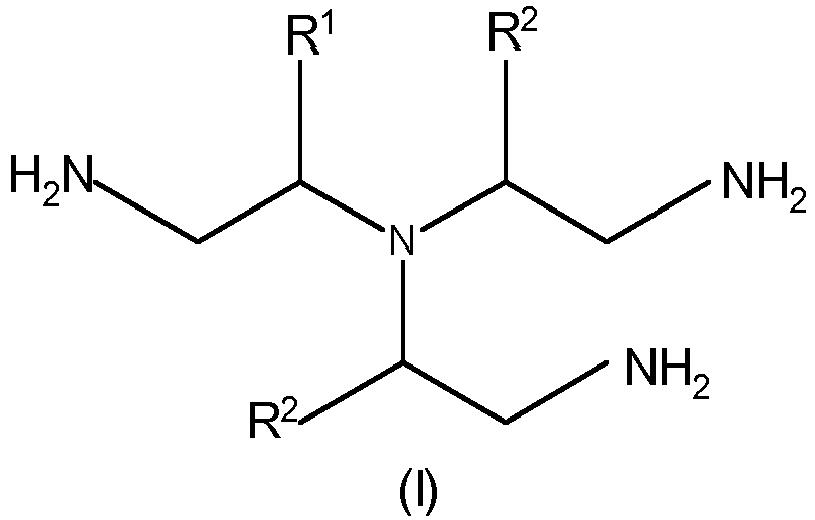 R1 est choisi dans le groupe formé par les groupes C1-10-alkyle aliphatiques, ramifiés ou non ramifiés,R2 est choisi dans le groupe formé par hydrogène et les groupes C1-10-alkyle aliphatiques, ramifiés ou non ramifiés,
- Composés de formule (I) selon la revendication 1, R1 étant choisi dans le groupe formé par méthyle, éthyle, propyle, isopropyle, n-butyle, sec-butyle et tert-butyle et R2 étant choisi dans le groupe formé par hydrogène, méthyle, éthyle, propyle, isopropyle, n-butyle, sec-butyle et tert-butyle.
- Composés de formule (I) selon l'une quelconque des revendications 1 à 2, R1 représentant méthyle et R2 représentant hydrogène.
- Procédé pour la préparation des composés de formule (I), les dérivés de 2-N,N-(bis-2-aminoalkyl)-1,2-alkyldiamine étant préparés à partir des 2-[N,N-(bis-1-cyanoalkyl)amino]alkylnitriles correspondants de formule générale (II)
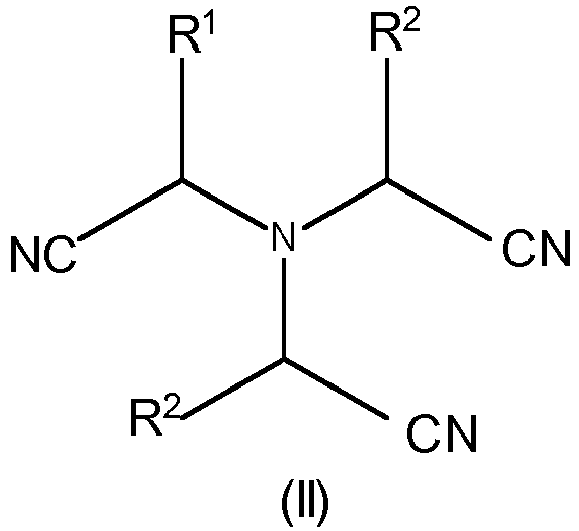 R1 est choisi dans le groupe formé par les groupes C1-10-alkyle aliphatiques, ramifiés ou non ramifiés,R2 est choisi dans le groupe formé par hydrogène et les groupes C1-10-alkyle aliphatiques, ramifiés ou non ramifiés,par hydrogénation en présence d'un catalyseur et d'hydrogène.
- Procédé selon la revendication 4, l'hydrogénation étant réalisée en continu et à l'abri d'ammoniac.
- Procédé pour la préparation des composés de formule (I), les dérivés de 2-N,N-(bis-2-aminoalkyl)-1,2-alkyldiamine étant préparés à partir des 2-[N,N-(bis-1-cyanoalkyl)amino]alkylnitriles de formule (IIa)
 R1a est choisi dans le groupe formé par les groupes C1-10-alkyle aliphatiques, ramifiés ou non ramifiés et hydrogène,R2 est choisi dans le groupe formé par hydrogène et les groupes C1-10-alkyle aliphatiques, ramifiés ou non ramifiés,par hydrogénation en présence d'un catalyseur et d'hydrogène, le procédé étant réalisé en continu et à l'abri d'ammoniac.
- Procédé selon l'une quelconque des revendications 4 et 5 ou 6, le catalyseur qui est utilisé étant un catalyseur contenant, comme espèces actives, un ou plusieurs éléments choisis dans le groupe formé par Fe, Co, Ni, Ru, Rh, Pd, Os, Ir et Pt.
- Procédé selon l'une quelconque des revendications 4, 5 et 7 ou 6 et 7, le catalyseur utilisé étant du nickel de Raney ou un catalyseur de type cobalt de Raney.
- Procédé selon l'une quelconque des revendications 4, 5, 7 à 8 ou 6 à 8, le catalyseur utilisé étant un catalyseur de type cobalt de Raney, qui contient comme promoteur au moins un des éléments Mo, Cr ou Fe.
- Procédé selon l'une quelconque des revendications 4, 5, 7 à 9 ou 6 à 9, l'hydrogénation étant réalisée dans un solvant choisi dans le groupe des amides, des hydrocarbures aromatiques, des alcools, des amines, des esters et des éthers.
- Procédé selon l'une quelconque des revendications 4, 5, 7 à 10 ou 6 à 10, l'hydrogénation étant réalisée à des températures dans la plage de 60 à 180°C et à des pressions dans la plage de 40 à 300 bars.
- Procédé selon l'une quelconque des revendications 4, 5, 7 à 11 ou 6 à 11, du méthylglycinenitrile-diacétonitrile (MGDN) étant hydrogéné en N,N-(bis-2-aminoéthyl)-1,2-propanediamine (MGTA).
- Procédé selon la revendication 12, le méthylglycinenitrile-diacétonitrile (MGDN) étant utilisé sous forme cristalline pure.
- Utilisation d'un des dérivés de N,N-(bis-2-aminoalkyl)-1,2-alkyldiamine de formule (I) selon l'une quelconque des revendications 1 à 3 comme durcisseur pour des résines époxy, en tant que produit intermédiaire lors de la préparation de triisocyanates, comme initiateur lors de la préparation de polyétherols et/ou comme monomère pour la préparation de polyamides.
- Triisocyanates selon la formule générale (III)
 R1 est choisi dans le groupe formé par les groupes C1-10-alkyle aliphatiques, ramifiés ou non ramifiés et hydrogène,R2 est choisi dans le groupe formé par hydrogène et les groupes C1-10-alkyle aliphatiques, ramifiés ou non ramifiés,
- Triisocyanate selon la revendication 15, R1 représentant méthyle et R2 représentant hydrogène.
- Procédé pour la préparation d'un triisocyanate selon l'une quelconque des revendications 15 ou 16, un dérivé de 2-N,N-(bis-2-aminoalkyl)-1,2-alkyldiamine de formule (I) selon la revendication 1 ou 3 étant transformé avec du phosgène.
Priority Applications (1)
| Application Number | Priority Date | Filing Date | Title |
|---|---|---|---|
| EP14802053.0A EP3080075B1 (fr) | 2013-12-11 | 2014-11-21 | Dérivés de n,n-(bis-2-aminoalkyle)-1,2-alkyldiamine |
Applications Claiming Priority (3)
| Application Number | Priority Date | Filing Date | Title |
|---|---|---|---|
| EP13196613 | 2013-12-11 | ||
| EP14802053.0A EP3080075B1 (fr) | 2013-12-11 | 2014-11-21 | Dérivés de n,n-(bis-2-aminoalkyle)-1,2-alkyldiamine |
| PCT/EP2014/075263 WO2015086293A1 (fr) | 2013-12-11 | 2014-11-21 | Dérivés 2-n, n-(bis-2-aminoalkyl)-l,2-alkyldiamine |
Publications (2)
| Publication Number | Publication Date |
|---|---|
| EP3080075A1 EP3080075A1 (fr) | 2016-10-19 |
| EP3080075B1 true EP3080075B1 (fr) | 2018-01-10 |
Family
ID=49759110
Family Applications (1)
| Application Number | Title | Priority Date | Filing Date |
|---|---|---|---|
| EP14802053.0A Not-in-force EP3080075B1 (fr) | 2013-12-11 | 2014-11-21 | Dérivés de n,n-(bis-2-aminoalkyle)-1,2-alkyldiamine |
Country Status (5)
| Country | Link |
|---|---|
| US (1) | US20160304445A1 (fr) |
| EP (1) | EP3080075B1 (fr) |
| JP (1) | JP6494629B2 (fr) |
| CN (1) | CN105814016A (fr) |
| WO (1) | WO2015086293A1 (fr) |
Family Cites Families (6)
| Publication number | Priority date | Publication date | Assignee | Title |
|---|---|---|---|---|
| US3218345A (en) * | 1962-07-17 | 1965-11-16 | Coastal Interchemical Company | Poly (isocyanatoethyl) amines and process therefor |
| NZ232379A (en) * | 1989-02-07 | 1991-05-28 | Grace W R & Co | Batchwise preparation of non-cyclic aliphatic polyamines by catalytic hydrogenation of a non-cyclic aliphatic polynitrile |
| DE4319935A1 (de) * | 1993-06-16 | 1994-12-22 | Basf Ag | Verwendung von Glycin-N,N-diessigsäure-Derivaten als Komplexbildner für Erdalkali- und Schwermetallionen |
| DE102005021055A1 (de) * | 2005-05-06 | 2006-11-09 | Basf Ag | Verfahren zur Herstellung von nebenproduktarmen Methylglycin-N,N-diessigsäure-Trialkalimetallsalzen |
| DE102006061535A1 (de) * | 2006-12-27 | 2008-07-03 | Saltigo Gmbh | Verfahren zur Herstellung von Aminoalkylaminen |
| US20120328811A1 (en) * | 2011-06-24 | 2012-12-27 | Air Products And Chemicals, Inc. | Epoxy Resin Compositions |
-
2014
- 2014-11-21 JP JP2016538664A patent/JP6494629B2/ja not_active Expired - Fee Related
- 2014-11-21 CN CN201480066867.5A patent/CN105814016A/zh active Pending
- 2014-11-21 EP EP14802053.0A patent/EP3080075B1/fr not_active Not-in-force
- 2014-11-21 US US15/101,964 patent/US20160304445A1/en not_active Abandoned
- 2014-11-21 WO PCT/EP2014/075263 patent/WO2015086293A1/fr not_active Ceased
Also Published As
| Publication number | Publication date |
|---|---|
| EP3080075A1 (fr) | 2016-10-19 |
| JP6494629B2 (ja) | 2019-04-03 |
| US20160304445A1 (en) | 2016-10-20 |
| WO2015086293A1 (fr) | 2015-06-18 |
| JP2017504587A (ja) | 2017-02-09 |
| CN105814016A (zh) | 2016-07-27 |
Similar Documents
| Publication | Publication Date | Title |
|---|---|---|
| EP2132162B1 (fr) | Procédé de préparation d'éthylène amines | |
| EP2129651B1 (fr) | Nouveau procédé de fabrication de teta au moyen de eddn | |
| EP2132165B1 (fr) | Procédé de préparation d'éthylène diamine | |
| EP2114861B1 (fr) | Procédé de fabrication de triéthylène-tétraamine | |
| EP2114857B1 (fr) | Procédé de fabrication de tétraéthylène-pentaamine | |
| EP1986990B1 (fr) | Procédé pour produire des éthylèneamines et des éthanolamines par hydroamination de monoéthylèneglycol et d'ammoniac en présence d'un catalyseur | |
| EP2114860B1 (fr) | Procédé de fabrication de mélanges éthylénamine | |
| EP2688861B1 (fr) | Procédé d'hydrogénation de nitriles | |
| EP2132163A1 (fr) | Procédé de fabrication d'éthylénamines à partir d'aan brut | |
| EP2961731B1 (fr) | Procédé de production d'éthylène diamine en utilisant de l'acide prussique dépourvu de so2 | |
| EP2688862A1 (fr) | Procédé d'hydrogénation de nitriles | |
| EP2443088B1 (fr) | Composés teta à substitution méthyle | |
| EP3061743A1 (fr) | Procédé de fabrication d'amines primaires à l'aide d'un catalyseur à lit fixe de nickel | |
| EP1159252A1 (fr) | Procede de racemisation d'amines a activite optique | |
| EP2951154B1 (fr) | Dérivés de 2,6-bis-(aminométhyl)pipéridine (2,6-bamp), 2,6-bis-(isocyanométhyl)pipéridine (diisocyanates) et 2,6-dicyanopipéridine (2,6-dcp) et leur utilisation dans la production de résins époxydiques, polyuréthanes, polyétheroles et polyamides | |
| EP3080075A1 (fr) | Dérivés 2-n, n-(bis-2-aminoalkyl)-l,2-alkyldiamine | |
| WO1999044983A1 (fr) | Procede de production de diamines alpha, omega aliphatiques |
Legal Events
| Date | Code | Title | Description |
|---|---|---|---|
| PUAI | Public reference made under article 153(3) epc to a published international application that has entered the european phase |
Free format text: ORIGINAL CODE: 0009012 |
|
| 17P | Request for examination filed |
Effective date: 20160711 |
|
| AK | Designated contracting states |
Kind code of ref document: A1 Designated state(s): AL AT BE BG CH CY CZ DE DK EE ES FI FR GB GR HR HU IE IS IT LI LT LU LV MC MK MT NL NO PL PT RO RS SE SI SK SM TR |
|
| AX | Request for extension of the european patent |
Extension state: BA ME |
|
| DAX | Request for extension of the european patent (deleted) | ||
| GRAP | Despatch of communication of intention to grant a patent |
Free format text: ORIGINAL CODE: EPIDOSNIGR1 |
|
| INTG | Intention to grant announced |
Effective date: 20170915 |
|
| GRAS | Grant fee paid |
Free format text: ORIGINAL CODE: EPIDOSNIGR3 |
|
| GRAA | (expected) grant |
Free format text: ORIGINAL CODE: 0009210 |
|
| AK | Designated contracting states |
Kind code of ref document: B1 Designated state(s): AL AT BE BG CH CY CZ DE DK EE ES FI FR GB GR HR HU IE IS IT LI LT LU LV MC MK MT NL NO PL PT RO RS SE SI SK SM TR |
|
| REG | Reference to a national code |
Ref country code: CH Ref legal event code: EP Ref country code: AT Ref legal event code: REF Ref document number: 962233 Country of ref document: AT Kind code of ref document: T Effective date: 20180115 |
|
| REG | Reference to a national code |
Ref country code: IE Ref legal event code: FG4D Free format text: LANGUAGE OF EP DOCUMENT: GERMAN |
|
| REG | Reference to a national code |
Ref country code: DE Ref legal event code: R096 Ref document number: 502014006955 Country of ref document: DE |
|
| REG | Reference to a national code |
Ref country code: NL Ref legal event code: FP |
|
| REG | Reference to a national code |
Ref country code: SE Ref legal event code: TRGR |
|
| PG25 | Lapsed in a contracting state [announced via postgrant information from national office to epo] |
Ref country code: FI Free format text: LAPSE BECAUSE OF FAILURE TO SUBMIT A TRANSLATION OF THE DESCRIPTION OR TO PAY THE FEE WITHIN THE PRESCRIBED TIME-LIMIT Effective date: 20180110 Ref country code: CY Free format text: LAPSE BECAUSE OF FAILURE TO SUBMIT A TRANSLATION OF THE DESCRIPTION OR TO PAY THE FEE WITHIN THE PRESCRIBED TIME-LIMIT Effective date: 20180110 Ref country code: NO Free format text: LAPSE BECAUSE OF FAILURE TO SUBMIT A TRANSLATION OF THE DESCRIPTION OR TO PAY THE FEE WITHIN THE PRESCRIBED TIME-LIMIT Effective date: 20180410 Ref country code: HR Free format text: LAPSE BECAUSE OF FAILURE TO SUBMIT A TRANSLATION OF THE DESCRIPTION OR TO PAY THE FEE WITHIN THE PRESCRIBED TIME-LIMIT Effective date: 20180110 Ref country code: LT Free format text: LAPSE BECAUSE OF FAILURE TO SUBMIT A TRANSLATION OF THE DESCRIPTION OR TO PAY THE FEE WITHIN THE PRESCRIBED TIME-LIMIT Effective date: 20180110 Ref country code: ES Free format text: LAPSE BECAUSE OF FAILURE TO SUBMIT A TRANSLATION OF THE DESCRIPTION OR TO PAY THE FEE WITHIN THE PRESCRIBED TIME-LIMIT Effective date: 20180110 |
|
| PG25 | Lapsed in a contracting state [announced via postgrant information from national office to epo] |
Ref country code: GR Free format text: LAPSE BECAUSE OF FAILURE TO SUBMIT A TRANSLATION OF THE DESCRIPTION OR TO PAY THE FEE WITHIN THE PRESCRIBED TIME-LIMIT Effective date: 20180411 Ref country code: PL Free format text: LAPSE BECAUSE OF FAILURE TO SUBMIT A TRANSLATION OF THE DESCRIPTION OR TO PAY THE FEE WITHIN THE PRESCRIBED TIME-LIMIT Effective date: 20180110 Ref country code: IS Free format text: LAPSE BECAUSE OF FAILURE TO SUBMIT A TRANSLATION OF THE DESCRIPTION OR TO PAY THE FEE WITHIN THE PRESCRIBED TIME-LIMIT Effective date: 20180510 Ref country code: LV Free format text: LAPSE BECAUSE OF FAILURE TO SUBMIT A TRANSLATION OF THE DESCRIPTION OR TO PAY THE FEE WITHIN THE PRESCRIBED TIME-LIMIT Effective date: 20180110 Ref country code: RS Free format text: LAPSE BECAUSE OF FAILURE TO SUBMIT A TRANSLATION OF THE DESCRIPTION OR TO PAY THE FEE WITHIN THE PRESCRIBED TIME-LIMIT Effective date: 20180110 Ref country code: BG Free format text: LAPSE BECAUSE OF FAILURE TO SUBMIT A TRANSLATION OF THE DESCRIPTION OR TO PAY THE FEE WITHIN THE PRESCRIBED TIME-LIMIT Effective date: 20180410 |
|
| PG25 | Lapsed in a contracting state [announced via postgrant information from national office to epo] |
Ref country code: MT Free format text: LAPSE BECAUSE OF FAILURE TO SUBMIT A TRANSLATION OF THE DESCRIPTION OR TO PAY THE FEE WITHIN THE PRESCRIBED TIME-LIMIT Effective date: 20180110 |
|
| REG | Reference to a national code |
Ref country code: DE Ref legal event code: R097 Ref document number: 502014006955 Country of ref document: DE |
|
| PG25 | Lapsed in a contracting state [announced via postgrant information from national office to epo] |
Ref country code: AL Free format text: LAPSE BECAUSE OF FAILURE TO SUBMIT A TRANSLATION OF THE DESCRIPTION OR TO PAY THE FEE WITHIN THE PRESCRIBED TIME-LIMIT Effective date: 20180110 Ref country code: RO Free format text: LAPSE BECAUSE OF FAILURE TO SUBMIT A TRANSLATION OF THE DESCRIPTION OR TO PAY THE FEE WITHIN THE PRESCRIBED TIME-LIMIT Effective date: 20180110 Ref country code: EE Free format text: LAPSE BECAUSE OF FAILURE TO SUBMIT A TRANSLATION OF THE DESCRIPTION OR TO PAY THE FEE WITHIN THE PRESCRIBED TIME-LIMIT Effective date: 20180110 |
|
| PLBE | No opposition filed within time limit |
Free format text: ORIGINAL CODE: 0009261 |
|
| STAA | Information on the status of an ep patent application or granted ep patent |
Free format text: STATUS: NO OPPOSITION FILED WITHIN TIME LIMIT |
|
| PG25 | Lapsed in a contracting state [announced via postgrant information from national office to epo] |
Ref country code: DK Free format text: LAPSE BECAUSE OF FAILURE TO SUBMIT A TRANSLATION OF THE DESCRIPTION OR TO PAY THE FEE WITHIN THE PRESCRIBED TIME-LIMIT Effective date: 20180110 Ref country code: SM Free format text: LAPSE BECAUSE OF FAILURE TO SUBMIT A TRANSLATION OF THE DESCRIPTION OR TO PAY THE FEE WITHIN THE PRESCRIBED TIME-LIMIT Effective date: 20180110 Ref country code: SK Free format text: LAPSE BECAUSE OF FAILURE TO SUBMIT A TRANSLATION OF THE DESCRIPTION OR TO PAY THE FEE WITHIN THE PRESCRIBED TIME-LIMIT Effective date: 20180110 |
|
| 26N | No opposition filed |
Effective date: 20181011 |
|
| PG25 | Lapsed in a contracting state [announced via postgrant information from national office to epo] |
Ref country code: SI Free format text: LAPSE BECAUSE OF FAILURE TO SUBMIT A TRANSLATION OF THE DESCRIPTION OR TO PAY THE FEE WITHIN THE PRESCRIBED TIME-LIMIT Effective date: 20180110 |
|
| PG25 | Lapsed in a contracting state [announced via postgrant information from national office to epo] |
Ref country code: LU Free format text: LAPSE BECAUSE OF NON-PAYMENT OF DUE FEES Effective date: 20181121 Ref country code: MC Free format text: LAPSE BECAUSE OF FAILURE TO SUBMIT A TRANSLATION OF THE DESCRIPTION OR TO PAY THE FEE WITHIN THE PRESCRIBED TIME-LIMIT Effective date: 20180110 |
|
| REG | Reference to a national code |
Ref country code: IE Ref legal event code: MM4A |
|
| PG25 | Lapsed in a contracting state [announced via postgrant information from national office to epo] |
Ref country code: IE Free format text: LAPSE BECAUSE OF NON-PAYMENT OF DUE FEES Effective date: 20181121 |
|
| PG25 | Lapsed in a contracting state [announced via postgrant information from national office to epo] |
Ref country code: TR Free format text: LAPSE BECAUSE OF FAILURE TO SUBMIT A TRANSLATION OF THE DESCRIPTION OR TO PAY THE FEE WITHIN THE PRESCRIBED TIME-LIMIT Effective date: 20180110 |
|
| PG25 | Lapsed in a contracting state [announced via postgrant information from national office to epo] |
Ref country code: PT Free format text: LAPSE BECAUSE OF FAILURE TO SUBMIT A TRANSLATION OF THE DESCRIPTION OR TO PAY THE FEE WITHIN THE PRESCRIBED TIME-LIMIT Effective date: 20180110 |
|
| PG25 | Lapsed in a contracting state [announced via postgrant information from national office to epo] |
Ref country code: MK Free format text: LAPSE BECAUSE OF NON-PAYMENT OF DUE FEES Effective date: 20180110 Ref country code: HU Free format text: LAPSE BECAUSE OF FAILURE TO SUBMIT A TRANSLATION OF THE DESCRIPTION OR TO PAY THE FEE WITHIN THE PRESCRIBED TIME-LIMIT; INVALID AB INITIO Effective date: 20141121 |
|
| PGFP | Annual fee paid to national office [announced via postgrant information from national office to epo] |
Ref country code: NL Payment date: 20201126 Year of fee payment: 7 |
|
| PGFP | Annual fee paid to national office [announced via postgrant information from national office to epo] |
Ref country code: CZ Payment date: 20201119 Year of fee payment: 7 Ref country code: CH Payment date: 20201123 Year of fee payment: 7 Ref country code: AT Payment date: 20201118 Year of fee payment: 7 Ref country code: FR Payment date: 20201126 Year of fee payment: 7 Ref country code: SE Payment date: 20201123 Year of fee payment: 7 Ref country code: IT Payment date: 20201120 Year of fee payment: 7 Ref country code: GB Payment date: 20201126 Year of fee payment: 7 |
|
| PGFP | Annual fee paid to national office [announced via postgrant information from national office to epo] |
Ref country code: BE Payment date: 20201126 Year of fee payment: 7 |
|
| PGFP | Annual fee paid to national office [announced via postgrant information from national office to epo] |
Ref country code: DE Payment date: 20210128 Year of fee payment: 7 |
|
| REG | Reference to a national code |
Ref country code: DE Ref legal event code: R119 Ref document number: 502014006955 Country of ref document: DE |
|
| REG | Reference to a national code |
Ref country code: NL Ref legal event code: MM Effective date: 20211201 |
|
| REG | Reference to a national code |
Ref country code: CH Ref legal event code: PL Ref country code: AT Ref legal event code: MM01 Ref document number: 962233 Country of ref document: AT Kind code of ref document: T Effective date: 20211121 |
|
| GBPC | Gb: european patent ceased through non-payment of renewal fee |
Effective date: 20211121 |
|
| PG25 | Lapsed in a contracting state [announced via postgrant information from national office to epo] |
Ref country code: SE Free format text: LAPSE BECAUSE OF NON-PAYMENT OF DUE FEES Effective date: 20211122 Ref country code: CZ Free format text: LAPSE BECAUSE OF NON-PAYMENT OF DUE FEES Effective date: 20211121 Ref country code: BE Free format text: LAPSE BECAUSE OF NON-PAYMENT OF DUE FEES Effective date: 20211130 |
|
| REG | Reference to a national code |
Ref country code: BE Ref legal event code: MM Effective date: 20211130 |
|
| PG25 | Lapsed in a contracting state [announced via postgrant information from national office to epo] |
Ref country code: AT Free format text: LAPSE BECAUSE OF NON-PAYMENT OF DUE FEES Effective date: 20211121 |
|
| PG25 | Lapsed in a contracting state [announced via postgrant information from national office to epo] |
Ref country code: NL Free format text: LAPSE BECAUSE OF NON-PAYMENT OF DUE FEES Effective date: 20211201 |
|
| PG25 | Lapsed in a contracting state [announced via postgrant information from national office to epo] |
Ref country code: GB Free format text: LAPSE BECAUSE OF NON-PAYMENT OF DUE FEES Effective date: 20211121 Ref country code: DE Free format text: LAPSE BECAUSE OF NON-PAYMENT OF DUE FEES Effective date: 20220601 |
|
| PG25 | Lapsed in a contracting state [announced via postgrant information from national office to epo] |
Ref country code: FR Free format text: LAPSE BECAUSE OF NON-PAYMENT OF DUE FEES Effective date: 20211130 |
|
| PG25 | Lapsed in a contracting state [announced via postgrant information from national office to epo] |
Ref country code: IT Free format text: LAPSE BECAUSE OF NON-PAYMENT OF DUE FEES Effective date: 20211121 |
|
| PG25 | Lapsed in a contracting state [announced via postgrant information from national office to epo] |
Ref country code: LI Free format text: LAPSE BECAUSE OF NON-PAYMENT OF DUE FEES Effective date: 20220701 Ref country code: CH Free format text: LAPSE BECAUSE OF NON-PAYMENT OF DUE FEES Effective date: 20220701 |