EP3080907B1 - Méthode de distribution moteur coil - Google Patents
Méthode de distribution moteur coil Download PDFInfo
- Publication number
- EP3080907B1 EP3080907B1 EP14827516.7A EP14827516A EP3080907B1 EP 3080907 B1 EP3080907 B1 EP 3080907B1 EP 14827516 A EP14827516 A EP 14827516A EP 3080907 B1 EP3080907 B1 EP 3080907B1
- Authority
- EP
- European Patent Office
- Prior art keywords
- rotor
- speed
- timings
- positions
- motor
- Prior art date
- Legal status (The legal status is an assumption and is not a legal conclusion. Google has not performed a legal analysis and makes no representation as to the accuracy of the status listed.)
- Active
Links
Images





Classifications
-
- H—ELECTRICITY
- H02—GENERATION; CONVERSION OR DISTRIBUTION OF ELECTRIC POWER
- H02P—CONTROL OR REGULATION OF ELECTRIC MOTORS, ELECTRIC GENERATORS OR DYNAMO-ELECTRIC CONVERTERS; CONTROLLING TRANSFORMERS, REACTORS OR CHOKE COILS
- H02P25/00—Arrangements or methods for the control of AC motors characterised by the kind of AC motor or by structural details
- H02P25/02—Arrangements or methods for the control of AC motors characterised by the kind of AC motor or by structural details characterised by the kind of motor
- H02P25/08—Reluctance motors
- H02P25/0805—Reluctance motors whereby the speed is regulated by measuring the motor speed and comparing it with a given physical value
-
- H—ELECTRICITY
- H02—GENERATION; CONVERSION OR DISTRIBUTION OF ELECTRIC POWER
- H02P—CONTROL OR REGULATION OF ELECTRIC MOTORS, ELECTRIC GENERATORS OR DYNAMO-ELECTRIC CONVERTERS; CONTROLLING TRANSFORMERS, REACTORS OR CHOKE COILS
- H02P25/00—Arrangements or methods for the control of AC motors characterised by the kind of AC motor or by structural details
- H02P25/02—Arrangements or methods for the control of AC motors characterised by the kind of AC motor or by structural details characterised by the kind of motor
- H02P25/08—Reluctance motors
-
- H—ELECTRICITY
- H02—GENERATION; CONVERSION OR DISTRIBUTION OF ELECTRIC POWER
- H02P—CONTROL OR REGULATION OF ELECTRIC MOTORS, ELECTRIC GENERATORS OR DYNAMO-ELECTRIC CONVERTERS; CONTROLLING TRANSFORMERS, REACTORS OR CHOKE COILS
- H02P6/00—Arrangements for controlling synchronous motors or other dynamo-electric motors using electronic commutation dependent on the rotor position; Electronic commutators therefor
- H02P6/14—Electronic commutators
- H02P6/16—Circuit arrangements for detecting position
- H02P6/17—Circuit arrangements for detecting position and for generating speed information
-
- H—ELECTRICITY
- H02—GENERATION; CONVERSION OR DISTRIBUTION OF ELECTRIC POWER
- H02P—CONTROL OR REGULATION OF ELECTRIC MOTORS, ELECTRIC GENERATORS OR DYNAMO-ELECTRIC CONVERTERS; CONTROLLING TRANSFORMERS, REACTORS OR CHOKE COILS
- H02P2203/00—Indexing scheme relating to controlling arrangements characterised by the means for detecting the position of the rotor
- H02P2203/05—Determination of the rotor position by using two different methods and/or motor models
-
- H—ELECTRICITY
- H02—GENERATION; CONVERSION OR DISTRIBUTION OF ELECTRIC POWER
- H02P—CONTROL OR REGULATION OF ELECTRIC MOTORS, ELECTRIC GENERATORS OR DYNAMO-ELECTRIC CONVERTERS; CONTROLLING TRANSFORMERS, REACTORS OR CHOKE COILS
- H02P25/00—Arrangements or methods for the control of AC motors characterised by the kind of AC motor or by structural details
- H02P25/02—Arrangements or methods for the control of AC motors characterised by the kind of AC motor or by structural details characterised by the kind of motor
- H02P25/08—Reluctance motors
- H02P25/086—Commutation
- H02P25/089—Sensorless control
Definitions
- the present invention relates to switched reluctance motors and in particular to a method of timing the operation of the coils of the motor.
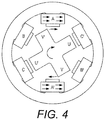
- FIG. 1A, 1B and 2 to 4 A typical switched reluctance motor is shown in Figures 1A, 1B and 2 to 4 .
- This example has a combination (which is frequent) of six, preferably evenly, spaced poles 2on the stator1 and four, preferably evenly, spaced poles 3 on the rotor 4.
- the poles of the stator project inwardly from a stator ring 5, the ring providing a path of low reluctance material between the stator poles.
- the rotor is formed of a stack of cross-shaped laminations, also of low reluctance material. Therefore each rotor pole is connected to the diametrically opposite rotor pole by a low reluctance path, for reasons which will become apparent. So, as marked, pole U is connected by a low reluctance path to pole U' and pole V to pole V'.
- Each pole of the stator is wound with a coil 6 and the coils are arranged in pairs, each pair comprising the coils at opposite ends of a respective diameter through the rotational axis of the motor.
- the pairs are coils AA', BB' and CC', as marked.
- the coils of a pair are energised at the same time, with current from a motor control circuit 10( Figure 5 ), and in a sense such that one provides a magnetic field towards the rotational axis and one away from the axis.
- the arrows on the coils represent the direction of the current in the coil above the plane of the paper and the dashed arrows represent the magnetic flux.
- the magnetic flux lines produced by the energised coils and their respective poles are arranged generally along the diameter between them and then follow the stator ring (in both circumferential directions) to the other energised coil of the pair.
- the rotor modifies the distribution of magnetic field lines in the space between the energised pair of stator poles.
- Positions of the rotor in which a pair of diametrically opposite poles of the rotor are aligned along the diameter between the energised pair of stator poles are positions of the rotor that have minimum reluctance for the magnetic circuit that comprises the rotor between the aligned rotor poles, the energised stator poles and the stator ring.
- the example of rotor poles U and U' being aligned between stator poles A and A' is shown in Figure 1B . Such a position is therefore a position of minimum magnetic energy.
- a non-aligned position e.g.
- the motor is driven by energising pairs of stator coils in turn to draw the poles of the rotor forward in the direction of rotation.
- the coils of A and A' are energised so that U and U' are drawn towards A and A'.
- Figure 1B When the position of Figure 1B is reached in which U and U' are aligned with coils A and A', A and A' are turned off ( Figure 2 ) so that the rotor can continue to rotate without being slowed or drawn back to A and A'.
- stator poles V and V' are approaching stator poles of coils B and B' so B and B' are energised ( Figure 2 ) to draw stator poles V and V' onwards in the clockwise direction towards B and B'.
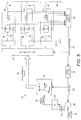
- a first known motor control circuit 10 is shown in Figure 5 . This comprises the stator coil pairs connected in parallel across a DC power supply20. Coils A and A', connected in parallel with each other, are energised by closing switches 21 and 22, and similarly coils B and B' by switches 23 and 24, and coils C and C' by switches 25 and 26. These switches are operated by the control circuit 10, which closes the switches when the coils are to be energised.
- each coil pair B and B', and C and C', having its own pair of common switches is sufficient to provide the patterns of coil energisation described above.
- the switches 21 to 26 are provided, for example, as FET or IGBT transistors.
- a measure of the current is used by the motor control circuit 10 to determine the position of the rotor and in turn to determine the timings of the operation of the switches 21 to 26.
- the coils are switched off and on at particular angles of rotation.
- the control circuit 10 of Figure 5 senses signals generated by the coils as they are both driven by their currents and their inductance changes as the rotor poles pass by them.
- This inductance comprises the stator coil pairs connected in parallel across a DC power supply 20.
- the voltage of this supply depends on the application and might be 12V, 24V, 48V or 300V, for example.
- Coils A and A', connected in parallel with each other, are energised by closing switches 21 and 22, and similarly coils B and B' by switches 23 and 24, and coils C and C' by switches 25 and 26. These switches are operated by a switch control unit 27, which closes the switches when the coils are to be energised.
- each coil pair is sensed by a resistor 28 connected in series with it to provide a resulting voltage signal that is proportional to the current, which is used to determine the rotor positions, which are used in turn to determine the timings of the operation of the switches 21 and 22, 23 and 24, and 25 and 26.
- the motor control circuit 10 processes the signals from the coils in a number of stages, forming a control loop.
- a position estimator 30 receives the signals indicative of the coil currents and continuously calculates from them the position of the rotor and outputs a rotor position value signal 31. The calculation is performed by a microcontroller and requires a complex algorithm.
- a speed estimator 32 differentiates this signal with respect to time, to provide a rotor speed signal 33.
- the control loop is designed to control the speed of the motor to be as set by an input signal, speed command signal 35, and the difference between the speed command signal and the rotor speed signal is formed by a subtractor 36 to form a speed error signal 37.
- a loop controller 38 uses this signal to adjust a torque command 39 for the motor.
- the relationship between the torque applied by a motor to its steady state speed is generally monotonically increasing. So the controller 38 increases the torque commanded if the speed error indicates that the motor is running slower than required and reduces torque commanded if the motor is running faster than commanded.
- the controller 38 also filters the signals circulating round the control loop in order to smooth the response of the loop.
- the motor 1 is of course not controlled directly by a torque command and the torque command 39 is converted to control angles 42 for the switches of the motor. These angles are the angles of the rotor at which the switches of the motor operated, in particular the angles at which a coil pair is turned on, the angle at which it is allowed to "freewheel", and the angle at which it is turned off.
- the conversion of the torque command signal to these angles is performed by a lookup table 41.
- the angles needed to provide the torque desired are dependent on the speed of the rotor, so the rotor speed signal 33 is also provided to the lookup table 41, to provide the angles for that torque and speed. These angles are determined empirically while driving the motor while connected to its desired load.
- the angles 42 produced by the lookup table are passed to the switch control unit27, which operates the switches at the angles 42 accordingly when those angles match the rotor position value signal 31.
- the angles 42 supplied are the same for each coil pair and are relative to the angular position of the coil pair.
- the switch controller 27 keeps track of which coil pair is to be operated next and uses the rotor position value 31 modulo 30° for the comparison with the angles 42.
- Circuit blocks 30, 32, 36, 38, 41 and 27 are preferably implemented by the microcontroller.
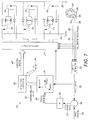
- a second known control circuit is illustrated by Figures 6 and 7 .
- Figure 6 shows the motor with a magnetic sensor ring 50 mounted on the rotor shaft 51 of the motor 1 to rotate with the shaft and hence with the rotor.
- the sensor ring is located along the shaft at some distance from the rotor to avoid magnetic interference from the motor itself. (That distance is not apparent in the Figure since the view is along the axis of the shaft.)
- the ring is magnetised radially in eight sectors, with each being magnetised in the opposite direction.
- Three Hall Effect sensors 51, 53, 55 are mounted a short distance outside the ring 50 and to be stationary with respect to the stator. The sensors are distributed along a section of the circumference of the ring, spaced from each other in steps of 30° in the circumferential direction.
- each N to S boundary of the ring (which are distinct to the sensors from the S to N boundaries) passes the three sensors in turn, one every 30° of rotation of the rotor and ring, and then after 90°, the next N-S boundary passes them in the same order again spaced by 30°, and so on.
- the pulses from the three Hall Effect sensors occur therefore with the same frequency and angular separation between them as the features of the current signals passing through the coils in the control circuit of Figure 5 .
- the speed estimator 32' uses the time between the pulses to estimate the angular speed of the rotor to provide the rotor speed signal 33. (The resource intensive position estimator is not required.)
- the switch controller 27' uses the pulses 52, 54, 56 on the respective conductors to time the switches for respective pairs of coils AA', BB', CC'. It calculates an offset in time for the operation of the switches from the angles 42' supplied by the control loop and rotor speed signal. These angles 42' are first adjusted by an angle offset corrector 43 from those 42 provided by the lookup table 41 to allow for the angular position of the N-S boundaries of the magnetic ring 50 with respect to the rotor.
- the offset adjustment needed (EOL (end-of-line) values 44) is measured at the end of manufacture of the motor complete with its magnetic indicator ring 50 in place on the rotor shaft, and is programmed into the motor control circuit 10'.
- the offset is the difference between the angle at which a rotor pole passes a stator pole of a coil (A or B or C) and the angle at which the N-S boundary respective to that rotor pole passes the sensor 51, 53, 55 respective to that coil.
- This adjustment was not needed in the circuit of Figure 5 because the current signals produced by the coils are automatically aligned to the rotor poles passing the stator poles. Otherwise the rest of the circuit of Figure 7 operates in the same way as the circuit of Figure 5 .
- stator and rotor pole numbers are possible for the motor. These have different cycles of energisation of the coils in order to keep the torque on the rotor in the forward direction.
- a common relationship between the numbers of poles is to have two more stator poles than rotor poles and to have both even in number.
- the choice of the number of poles usually takes into account the operating speed of the motor, the operating power, the acceptable level of torque ripple (variation in torque supplied by the motor with angle of the rotor), and the circuitry required. Note finally that it is usually generally preferred in such motors for reasons of balance of torque to energise coils in pairs that are diametrically opposite to each other.
- the UK Patent Application GB 2 264 407 A discloses a control circuit for a switched reluctance motor, comprising:controllable switches for connection to stator coils of the motor to control whether the coils are energised, a single position sensor responsive to the position of the rotor to provide indications of the timings of one or more positions of the rotor per revolution of the rotor, a position interpolator connected to receive the indications of timings of the rotor positions from the single position sensor, and to provide one or more indications of the timings of one or more estimated positions of the rotor between the timings indicated by the position sensor, a switch controller connected to receive the indications of the timings from the position interpolator to determine timings of switch control signals connected to operate the switches.
- a control circuit for a switched reluctance motor comprising:
- the present invention negates the need for multiple position sensors.
- the present invention recognises that by using an interpolator to provide the indication of the timings of the estimated positions of the rotor (between the timings indicated by the single position sensor), only one sensor need be provided. This simplifies the control system and may enable its cost to be reduced. In effect, the timing of the estimated positions from the interpolator can be used instead of requiring dedicated sensors to sense those timings (as is the case in the prior art example in Figure 6 .)
- the position interpolator may be connected to estimate the one or more positions of the rotor based on the assumption that the rotor speed is currently constant.
- the position interpolator may be connected to estimate the one or more positions of the rotor based on the assumption that the rotor speed is currently constant, that speed being a measured speed of the rotor.
- the position interpolator may be connected to receive the measured speed based on the indications of the timings of the rotor position from the position sensor.
- the position interpolator may be connected to estimate the one or more positions of the rotor taking into account the acceleration of the rotor. This tends to lead to faster transient response, and higher efficiency during transient operations.
- the position interpolator may be connected to estimate the acceleration of the motor from measurements of the speed of the rotor, to estimate the future speed of the rotor from the estimate of the acceleration and to estimate the time rotor will reach a particular position using that future speed.
- the position interpolator may be arranged to take into account the acceleration of the rotor by applying a correction factor.
- the timings of the one or more estimated positions of the rotor may be based on an initial estimation, which is then adjusted (for example multiplied) by the correction factor.
- the correction factor may be read from a look-up table.
- the control circuit may comprise a memory module in which the look-up table is stored.
- the values of the correction factor in the look-up table may have been empirically obtained.
- the look-up table may be responsive to a torque command and/or a rotor speed value to provide the correction factor.
- the look-up table may be responsive to other variables, such as the temperature of the motor and/or a battery voltage drop, to provide the correction factor.
- the control circuit may comprise a control loop connected to provide the switch controller with rotor angles, dependent on a required motor torque, at which to operate the switches, the switch controller being connected to base the determination of the timings of the switch control signals also on those angles.
- the control loop may comprise:
- the control loop may comprise an offset corrector connected to adjust the rotor angles from the lookup table with values allowing for an offset of the position sensor.
- the present disclosure also provides an apparatus comprising:
- the present invention further provides a method of controlling a switched reluctance motor, comprising:
- the deriving may comprise estimating the one or more positions of the rotor based on the assumption that the rotor speed is currently constant.
- the estimating may be based on a measured speed of the rotor.
- the measured speed may be based on the indications of the timings of the rotor positions.
- the deriving may comprise estimating the one or more positions of the rotor taking into account the acceleration of the rotor.
- the estimating may comprise: estimating the acceleration of the motor from measurements of the speed of the rotor, estimating the future speed of the rotor from the estimate of the acceleration and estimating the time rotor will reach a particular position using that future speed.
- the estimating may comprise: making an initial estimate of the timings of the one or more estimated positions of the rotor; and adjusting the initial estimate by applying a correction factor to thereby obtain the timings of one or more estimated positions of the rotor.
- the correction factor may be read from a look-up table. The correction factor may be such that initial estimate is corrected to take into account the acceleration of the rotor.
- the present disclosure also provides driving a compressor wheel of a supercharger with the switched reluctance motor.
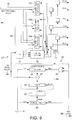
- FIG 8 is a block diagram of an example motor control circuit 10'' in accordance with the present invention. It has elements similar to that of the prior art circuit of Figure 7 , but there are significant differences.
- the magnetic indicator ring 50 ( Figure 6 ) again has eight alternately magnetised sectors, but this is sensed by only one Hall Effect sensor 57. Again this provides a pulse signal58 every time aN-S boundary of the indicator ring passes the sensor 57, which is therefore once every 90° of the rotation of the rotor, which is once per pole of the rotor.
- the speed estimator 32'' has a different form. In this example, it calculates the rotor speed signal from the time between the pulses 58from the single Hall Effect sensor 57.
- the next items on the control loop are as in the examples of Figures 5 and 7 and provide accordingly the switching angles for the stator coils required.
- the angles 42 are adjusted by the angle offset corrector 43 using the EOL values 44.
- the switch controller 27'' is also arranged differently. Again it receives the offset adjusted switch angles 42'' from the angle offset corrector 43' but in this example it cooperates with a position interpolator 59set out below. (Because there is now only one Hall Effect sensor 57 the EOL offset values 44' applied by the angle offset corrector 43' are only the angles between each N-S boundary of the magnetic ring 50 passing the sensor 57 and a respective rotor pole passing a particular coil e.g. coil A).
- the position interpolator 59 has a first counter timer 61, counting a clock signal 61, that is also responsive to the pulses 58 from the Hall Effect sensor 57. At each pulse of the Hall Effect sensor the count achieved by the counter timer 61 is zeroed but its value is also latched, having been divided by three by divider 62 into a target register 63 of a second counter timer 64, the counter 65 of which is also zeroed by the pulse 58 from the Hall Effect sensor 57, via OR gate 66.
- a comparator 67 of the second counter timer 64 provides periodic output pulses 68whenever the counter 65 equals the target register 63.
- the intervals defined by the value in target register 63 are therefore one third of the time taken for the last 90° of rotation of the rotor.
- the pulses 68 from the second counter time 65 therefore mark the expected beginnings of three subsequent coil phases of the motor if the assumption is that the speed of the motor is constant.
- a three state counter 71 counts the pulses 68 to keep track of which coil pair, AA', BB' or CC' is to be energised. It provides three outputs, respective to the coil pairs, each having a pulse having the timing of one of the pulses 68 when the respective coil is to be energised.
- These pulses 60 are used by the switch control unit 27" to time the operation of the switches 21 to 26 with each pulse timing consecutively coil pairs AA', BB', CC',AA', BB', CC' and so on.
- the position interpolator 59 operates as follows.
- the third pulse from the second counter timer 64 after the pulse 58 from the Hall Effect sensor would occur after the next pulse from the Hall Effect sensor, however it is suppressed by the reloading of target register 63 and zeroing of the counter65 caused by that next Hall effect pulse.
- the third pulse from the second counter timer 64 is issued, but it will be a little ahead of the next pulse from the Hall Effect sensor.
- the counter 65 begins to count again it is soon zeroed by the next Hall Effect sensor pulse and so the next three pulses 68 are timed relative to that.
- the position interpolator 59 does not issue a pulse at automatically at the same time as the pulse from the Hall Effect sensor but only at periods after it. An output pulse will occur at the same time as the Hall Effect pulse if the speed of the motor is constant.
- the circuit of Figure 9 is preferably provided by the microcontroller and is implemented by using its on board timers for the timer counters 61 and 64, which issue software interrupts when the counts are reached.
- the switch control unit 27'' uses the pulses 60 from the position interpolator as follows.
- the outputs 60 of three state counter 71 are respectively connected to a control logic unit 72, which immediately causes a respective timer counter 70A, 70B or 70C and to select latch into its target register the relevant offset adjusted on angle from among the angles 42".
- the relevant angle is selected by the control logic unit providing a selection signal 80 to the angle offset corrector 43', which depends on which particular N-S boundary of the indicator ring was sensed (of which the control logic unit keeps track.
- timer 70 can be utilised by first zeroing it loading the target with the on angle, then when that time is reached zeroing it and reloading the target with the difference between the freewheel angle and the on angle, and then when that time is reached zeroing it reloading the target with the difference between the off angle and the freewheel angle).
- Three timers counters 70 are used in this example, and the control logic unit operates the respective coil pair when it receives a pulse from one of them. Alternatively one time can be used (because only one coil pair is operated at a time) and the control logic unit remembers, from the pulses 60, which coil pair it is operating at the current time.
- the position interpolator 59 is as follows.
- the assumption used by the rotor position interpolator 59 to estimate the rotor position is improved by taking into account the acceleration of the rotor.
- the times of the most recent pulses 58 from the Hall Effect sensor 57 are recorded and the current acceleration of the rotor is estimated from that. This estimate of the acceleration is then used to estimate the timings of the rotor arriving at the three phases of the motor, which in this case are every 30°.
- This speed is then used to divide the on, freewheel and off angles as in the example above.
- the time between coil phases AA', BB' and CC' can be estimated as: 1 Speed n + 1 ⁇ 1 rotor poles ⁇ stator phases .
- the acceleration is not estimated using the above-mentioned formulae.
- This further embodiment of the invention is identical to the first embodiment except that the position interpolator 59 is arranged to take into account the acceleration of the rotor, by applying a correction factor 101.
- the position interpolator 59 first makes an initial estimate in the same manner as described with reference to the first embodiment. Acceleration of the rotor is taken into account by multiplying this initial estimate by the correction factor 101.
- the correction factor 101 is obtained from a look-up table103 (shown in Figure 10 ).
- the control circuit 10'' retrieves the rotor speed value (see description with reference to the first embodiment) and a torque command (dependent on whether the rotor speed value is less than the speed command value).
- An appropriate correction factor 101 is then read off the look-up table dependent on that speed value (x-axis105 with values of 0 -XXXX)and torque command (y-axis 107 with values of 0 - 100%).
- the look-up table 103 is populated with values of correction factor that have been obtain empirically. For example the optimal correction factors 101 for each combination of rotor speed and load, are obtained from experiment/calibration of the motor. In other embodiments the empirical testing may be performed by means of a computer simulation.
- Having a look-up table 103 of correction factors 101 is thought to be especially beneficial because the core implementation of the control circuit 10'' can remain the same for various different applications/rotors; only the values in the correction table 103 need be adjusted (those values being specific to particular applications/rotor inertia). This enables the arrangement to be relatively flexible in terms of the scenarios it can be used in.
- the look-up table includes third axis in respect of the temperature of the motor.
- the correction factor may also be adjusted, as required, in dependence on the temperature of the motor.
- Another parameter that may affect the correction factor is the battery voltage supplying the motor (which may vary while the system operates).
- the look-up table includes a third axis in respect of the battery voltage.
- the switched reluctance motor controlled by the invention may be used to drive the compressor wheel of a supercharger.
Landscapes
- Engineering & Computer Science (AREA)
- Power Engineering (AREA)
- Control Of Electric Motors In General (AREA)
- Control Of Motors That Do Not Use Commutators (AREA)
Claims (15)
- Un circuit de commande pour un moteur à réluctance commuté,
comprenant:des commutateurs contrôlables (21, 22, 23, 24, 25, 26) pour connexion aux bobines de stator du moteur pour contrôler si les bobines sont excitées,un capteur de position unique (57) sensible à la position du rotor pour fournir des indications sur les temps d'une ou plusieurs positions du rotor par tour du rotor,un interpolateur de position (59) connecté pour recevoir des indications de minutage des positions du rotor à partir du capteur de position (57), et pour fournir une ou plusieurs indications des synchronisations d'une ou plusieurs positions estimées du rotor entre les temporisations indiquées par le capteur de position (57),un contrôleur de commutateur (27 ") connecté pour recevoir les indications des synchronisations de l'interpolateur de position (59) et les indications des temporisations du capteur de position (57) pour déterminer les synchronisations des signaux de commande de commutateur connectés pour actionner les interrupteurs (21, 22, 23, 24, 25, 26). - Circuit de commande selon la revendication 1, dans lequel l'interpolateur de position (59) est connecté pour estimer une ou plusieurs positions du rotor sur la base de l'hypothèse que la vitesse du rotor est actuellement constante.
- Circuit de commande selon la revendication 2, dans lequel l'interpolateur de position (59) est connecté pour estimer l'une ou plusieurs positions du rotor sur la base de l'hypothèse que la vitesse du rotor est actuellement constante, cette vitesse étant la vitesse mesurée du rotor.
- Circuit de commande selon l'une quelconque des revendications précédentes comprenant une boucle de commande connectée pour fournir l'interrupteur contrôleur (27 ") avec des angles de rotor (42 '), dépendant d'un couple moteur requis pour actionner les interrupteurs (21, 22, 23, 24, 25, 26), le contrôleur de commutateur (27 ") étant connecté pour baser la détermination des temps du contrôleur de commutateur également les signaux de commande sur ces angles.
- Circuit de commande selon la revendication 4, dans lequel la boucle de contrôle comprend un estimateur de vitesse (32 ") connecté pour recevoir des indications de la synchronisation d'une ou plusieurs positions du rotor et lui fournir une valeur de vitesse de rotor,
un soustracteur (36) connecté pour recevoir la valeur de la vitesse du rotor et former la différence entre cela et une commande la valeur de vitesse à partir d'une valeur d'erreur de vitesse,
un contrôleur de boucle (38) connecté pour répondre à la valeur d'erreur de vitesse pour augmenter une commande de couple si la valeur de vitesse du rotor est inférieure à la valeur de commande de vitesse et à diminuer la commande de couple si la valeur de vitesse du rotor est supérieure à la valeur de la commande de vitesse,
une table de consultation (41) sensible à la commande de couple et la valeur de la vitesse du rotor pour fournir les angles du rotor. - Circuit de commande selon la revendication 5, dans lequel la boucle de commande comprend un correcteur de décalage (43) connecté pour ajuster les angles du rotor à partir de la table de recherche (41) avec des valeurs permettant un décalage du capteur de position (57).
- Appareil comprenant:un moteur à réluctance commutée, comprenant un rotor et comprenant des bobines de stator,un circuit de commande selon l'une quelconque des revendications 1 à 6 connectés selon les revendications aux bobines statoriques du moteur,un compresseur ayant une roue de compresseur couplée au rotor du moteur à entraîner.
- Méthode de commande d'un moteur à réluctance commutée,
comprenant:détecter la position du rotor du moteur, en utilisant un capteur unique (57), pour fournir des indications sur une ou plusieurs positions du rotor par tour du rotor,dériver des indications des synchronisations de position du rotor les indications des temps d'une ou plusieurs positions du rotor estimées entre les synchronisations indiquées par la détection, etexciter les bobines de stator du moteur à des moments déterminés en réponse aux indications du temps des positions estimées. - Procédé selon la revendication 8, dans lequel le dériver consiste à estimer une ou plusieurs positions du rotor basé sur l'hypothèse que la vitesse du rotor est actuellement constant.
- Procédé selon la revendication 8, dans lequel l'estimation est basé sur une vitesse mesurée du rotor.
- Procédé de circuit de commande selon la revendication 10 où la vitesse mesurée est basée sur les indications de la synchronisation des positions du rotor.
- Procédé selon la revendication 8, dans lequel la dérivation comprend l'estimation de la ou des positions du rotor en tenant compte de l'accélération du rotor.
- Procédé selon la revendication 12, dans lequel l'estimation comprend: l'estimation de l'accélération du moteur à partir des mesures de la vitesse du rotor, en estimant la vitesse future du rotor à partir de l'estimation de l'accélération et l'estimation du temps du rotor pour atteindre une position particulière en utilisant cette vitesse future.
- Procédé selon la revendication 12, dans lequel l'estimation comprend:(i) faire une estimation initiale des temps de une ou plusieurs positions estimées du rotor; et(ii) l'ajustement de l'estimation initiale en appliquant une correction facteur permettant ainsi d'obtenir les temps d'une ou de plusieurs positions estimées du rotor.
- Procédé selon l'une quelconque des revendications 8 à 14 dans lequel le moteur à réluctance commutée entraîne une roue de compresseur d'un supercharger.
Applications Claiming Priority (3)
| Application Number | Priority Date | Filing Date | Title |
|---|---|---|---|
| GB201323079A GB201323079D0 (en) | 2013-12-27 | 2013-12-27 | Motor coil timing method |
| GB201412773A GB201412773D0 (en) | 2014-07-18 | 2014-07-18 | Motor coil timing method |
| PCT/GB2014/053710 WO2015097440A1 (fr) | 2013-12-27 | 2014-12-16 | Procédé de synchronisation de bobine de moteur |
Publications (2)
| Publication Number | Publication Date |
|---|---|
| EP3080907A1 EP3080907A1 (fr) | 2016-10-19 |
| EP3080907B1 true EP3080907B1 (fr) | 2020-07-22 |
Family
ID=52350140
Family Applications (1)
| Application Number | Title | Priority Date | Filing Date |
|---|---|---|---|
| EP14827516.7A Active EP3080907B1 (fr) | 2013-12-27 | 2014-12-16 | Méthode de distribution moteur coil |
Country Status (6)
| Country | Link |
|---|---|
| US (1) | US20160329852A1 (fr) |
| EP (1) | EP3080907B1 (fr) |
| JP (1) | JP2017502640A (fr) |
| KR (1) | KR20160102205A (fr) |
| CN (1) | CN106464183A (fr) |
| WO (1) | WO2015097440A1 (fr) |
Families Citing this family (9)
| Publication number | Priority date | Publication date | Assignee | Title |
|---|---|---|---|---|
| CN105262383B (zh) * | 2015-10-13 | 2018-05-29 | 南京信息工程大学 | 航空开关磁阻起动/发电机的转子转速/位置检测方法 |
| US10236815B2 (en) * | 2016-12-02 | 2019-03-19 | Arm Ltd. | Sensor error detection and correction |
| CN108736656A (zh) * | 2017-04-13 | 2018-11-02 | 舍弗勒技术股份两合公司 | 电机、用于电机的校正装置和校正方法 |
| US10270379B2 (en) * | 2017-06-14 | 2019-04-23 | Software Motor Company | Method and apparatus for quasi-sensorless adaptive control of switched reluctance motor drives |
| CN108462415A (zh) * | 2018-02-09 | 2018-08-28 | 苏州仙崴机电有限公司 | 一种基于单个位置传感器的开关磁阻电机位置信息检测方法 |
| EP3665770B1 (fr) * | 2018-03-31 | 2025-03-19 | Turntide Technologies Inc. | Procédé et système de commande d'une machine à réluctance commutée |
| CN116391318A (zh) | 2020-10-09 | 2023-07-04 | 阿克伦大学 | 为电动机最小化直流链路电流纹波和声学噪声并减少直流链路电容器要求 |
| CN113422551B (zh) * | 2021-05-31 | 2022-06-21 | 江苏大学 | 一种带功率因数校正的开关磁阻电机速度控制系统 |
| IT202100018689A1 (it) * | 2021-07-15 | 2023-01-15 | Ferrari Spa | Procedimento ed apparato per controllare un motore elettrico |
Family Cites Families (7)
| Publication number | Priority date | Publication date | Assignee | Title |
|---|---|---|---|---|
| KR100234731B1 (ko) * | 1992-02-21 | 1999-12-15 | 구자홍 | 에스알엠의 위치 검출장치 |
| US5325026A (en) * | 1992-06-29 | 1994-06-28 | General Electric Company | Microprocessor-based commutator for electronically commutated motors |
| GB9523256D0 (en) * | 1995-11-14 | 1996-01-17 | Switched Reluctance Drives Ltd | Phase energization controller and method for controlling switched reluctance machines using simple angular position sensors with improved angle interpolation |
| GB9612148D0 (en) * | 1996-06-11 | 1996-08-14 | Switched Reluctance Drives Ltd | Rotor position encoder for an electrical machine |
| US5864217A (en) * | 1997-05-08 | 1999-01-26 | General Electric Company | Switched reluctance machine with toothed-wheel rotor sensor |
| GB201010443D0 (en) * | 2010-06-22 | 2010-08-04 | Aeristech Ltd | Controller |
| CN103281027B (zh) * | 2013-06-09 | 2016-01-20 | 中南大学 | 变频空调压缩机启动及低频转矩补偿方法 |
-
2014
- 2014-12-16 KR KR1020167017481A patent/KR20160102205A/ko not_active Withdrawn
- 2014-12-16 WO PCT/GB2014/053710 patent/WO2015097440A1/fr not_active Ceased
- 2014-12-16 CN CN201480076587.2A patent/CN106464183A/zh active Pending
- 2014-12-16 JP JP2016543203A patent/JP2017502640A/ja active Pending
- 2014-12-16 US US15/108,329 patent/US20160329852A1/en not_active Abandoned
- 2014-12-16 EP EP14827516.7A patent/EP3080907B1/fr active Active
Non-Patent Citations (1)
| Title |
|---|
| None * |
Also Published As
| Publication number | Publication date |
|---|---|
| US20160329852A1 (en) | 2016-11-10 |
| WO2015097440A1 (fr) | 2015-07-02 |
| EP3080907A1 (fr) | 2016-10-19 |
| JP2017502640A (ja) | 2017-01-19 |
| CN106464183A (zh) | 2017-02-22 |
| KR20160102205A (ko) | 2016-08-29 |
Similar Documents
| Publication | Publication Date | Title |
|---|---|---|
| EP3080907B1 (fr) | Méthode de distribution moteur coil | |
| EP2625782B1 (fr) | Commande d'une machine électrique | |
| CN101127502B (zh) | 无刷电机的驱动装置和无刷电机的启动方法及无刷电机的转子停止位置检测方法 | |
| US4514667A (en) | Method and apparatus for the constant speed control of brushless DC motors | |
| JP3906429B2 (ja) | 同期モータの駆動装置 | |
| EP2689527B1 (fr) | Procédé et appareil pour la commande de machines électriques | |
| CN111030548B (zh) | 多转子极开关磁阻电机的可靠控制 | |
| US20160327409A1 (en) | Method checking the orientation of a magnetic ring position indicator | |
| EP1135851A1 (fr) | Detection de la position d'un rotor sans utiliser de detecteur dans des machines a reluctance commutee presentant des poles irreguliers | |
| US7141945B2 (en) | Method and apparatus for controlling motor drive | |
| EP3080906B1 (fr) | Méthode de mise en marche d'un moteur à reluctance variable | |
| EP1158657B1 (fr) | Procédé et dispositif de contrôle de moteurs à reluctance variable | |
| CN102291063A (zh) | 鼓风机的驱动装置及驱动方法 | |
| US20160336890A1 (en) | Motor acceleration methods | |
| JP2012070495A (ja) | モータ駆動制御装置 | |
| US10931215B2 (en) | Motor control apparatus and motor control method | |
| US6781334B2 (en) | Motor controller and control method thereof | |
| US9793840B2 (en) | Motor control apparatus | |
| KR20210073596A (ko) | 무브러시 영구 자석 모터의 제어 방법 | |
| KR20060048737A (ko) | 전기 기계의 속도를 측정하는 방법 | |
| US20220209698A1 (en) | Control device of brushless dc motor | |
| EP3231082A1 (fr) | Compresseur de suralimentation électrique et procédé de protection d'un compresseur de suralimentation électrique contre les hautes températures | |
| JP2017073945A (ja) | 電子制御装置 | |
| JPH04145895A (ja) | モータ制御装置 |
Legal Events
| Date | Code | Title | Description |
|---|---|---|---|
| PUAI | Public reference made under article 153(3) epc to a published international application that has entered the european phase |
Free format text: ORIGINAL CODE: 0009012 |
|
| 17P | Request for examination filed |
Effective date: 20160712 |
|
| AK | Designated contracting states |
Kind code of ref document: A1 Designated state(s): AL AT BE BG CH CY CZ DE DK EE ES FI FR GB GR HR HU IE IS IT LI LT LU LV MC MK MT NL NO PL PT RO RS SE SI SK SM TR |
|
| AX | Request for extension of the european patent |
Extension state: BA ME |
|
| DAX | Request for extension of the european patent (deleted) | ||
| REG | Reference to a national code |
Ref country code: DE Ref legal event code: R079 Ref document number: 602014068087 Country of ref document: DE Free format text: PREVIOUS MAIN CLASS: H02P0025080000 Ipc: H02P0006170000 |
|
| GRAP | Despatch of communication of intention to grant a patent |
Free format text: ORIGINAL CODE: EPIDOSNIGR1 |
|
| STAA | Information on the status of an ep patent application or granted ep patent |
Free format text: STATUS: GRANT OF PATENT IS INTENDED |
|
| RIC1 | Information provided on ipc code assigned before grant |
Ipc: H02P 6/17 20160101AFI20200113BHEP Ipc: H02P 25/08 20160101ALI20200113BHEP |
|
| INTG | Intention to grant announced |
Effective date: 20200206 |
|
| GRAS | Grant fee paid |
Free format text: ORIGINAL CODE: EPIDOSNIGR3 |
|
| GRAA | (expected) grant |
Free format text: ORIGINAL CODE: 0009210 |
|
| STAA | Information on the status of an ep patent application or granted ep patent |
Free format text: STATUS: THE PATENT HAS BEEN GRANTED |
|
| AK | Designated contracting states |
Kind code of ref document: B1 Designated state(s): AL AT BE BG CH CY CZ DE DK EE ES FI FR GB GR HR HU IE IS IT LI LT LU LV MC MK MT NL NO PL PT RO RS SE SI SK SM TR |
|
| REG | Reference to a national code |
Ref country code: GB Ref legal event code: FG4D |
|
| REG | Reference to a national code |
Ref country code: CH Ref legal event code: EP |
|
| REG | Reference to a national code |
Ref country code: DE Ref legal event code: R096 Ref document number: 602014068087 Country of ref document: DE |
|
| REG | Reference to a national code |
Ref country code: AT Ref legal event code: REF Ref document number: 1294335 Country of ref document: AT Kind code of ref document: T Effective date: 20200815 |
|
| REG | Reference to a national code |
Ref country code: IE Ref legal event code: FG4D |
|
| REG | Reference to a national code |
Ref country code: LT Ref legal event code: MG4D |
|
| REG | Reference to a national code |
Ref country code: AT Ref legal event code: MK05 Ref document number: 1294335 Country of ref document: AT Kind code of ref document: T Effective date: 20200722 |
|
| PG25 | Lapsed in a contracting state [announced via postgrant information from national office to epo] |
Ref country code: BG Free format text: LAPSE BECAUSE OF FAILURE TO SUBMIT A TRANSLATION OF THE DESCRIPTION OR TO PAY THE FEE WITHIN THE PRESCRIBED TIME-LIMIT Effective date: 20201022 Ref country code: PT Free format text: LAPSE BECAUSE OF FAILURE TO SUBMIT A TRANSLATION OF THE DESCRIPTION OR TO PAY THE FEE WITHIN THE PRESCRIBED TIME-LIMIT Effective date: 20201123 Ref country code: LT Free format text: LAPSE BECAUSE OF FAILURE TO SUBMIT A TRANSLATION OF THE DESCRIPTION OR TO PAY THE FEE WITHIN THE PRESCRIBED TIME-LIMIT Effective date: 20200722 Ref country code: ES Free format text: LAPSE BECAUSE OF FAILURE TO SUBMIT A TRANSLATION OF THE DESCRIPTION OR TO PAY THE FEE WITHIN THE PRESCRIBED TIME-LIMIT Effective date: 20200722 Ref country code: SE Free format text: LAPSE BECAUSE OF FAILURE TO SUBMIT A TRANSLATION OF THE DESCRIPTION OR TO PAY THE FEE WITHIN THE PRESCRIBED TIME-LIMIT Effective date: 20200722 Ref country code: FI Free format text: LAPSE BECAUSE OF FAILURE TO SUBMIT A TRANSLATION OF THE DESCRIPTION OR TO PAY THE FEE WITHIN THE PRESCRIBED TIME-LIMIT Effective date: 20200722 Ref country code: HR Free format text: LAPSE BECAUSE OF FAILURE TO SUBMIT A TRANSLATION OF THE DESCRIPTION OR TO PAY THE FEE WITHIN THE PRESCRIBED TIME-LIMIT Effective date: 20200722 Ref country code: GR Free format text: LAPSE BECAUSE OF FAILURE TO SUBMIT A TRANSLATION OF THE DESCRIPTION OR TO PAY THE FEE WITHIN THE PRESCRIBED TIME-LIMIT Effective date: 20201023 Ref country code: NO Free format text: LAPSE BECAUSE OF FAILURE TO SUBMIT A TRANSLATION OF THE DESCRIPTION OR TO PAY THE FEE WITHIN THE PRESCRIBED TIME-LIMIT Effective date: 20201022 Ref country code: AT Free format text: LAPSE BECAUSE OF FAILURE TO SUBMIT A TRANSLATION OF THE DESCRIPTION OR TO PAY THE FEE WITHIN THE PRESCRIBED TIME-LIMIT Effective date: 20200722 |
|
| PG25 | Lapsed in a contracting state [announced via postgrant information from national office to epo] |
Ref country code: IS Free format text: LAPSE BECAUSE OF FAILURE TO SUBMIT A TRANSLATION OF THE DESCRIPTION OR TO PAY THE FEE WITHIN THE PRESCRIBED TIME-LIMIT Effective date: 20201122 Ref country code: RS Free format text: LAPSE BECAUSE OF FAILURE TO SUBMIT A TRANSLATION OF THE DESCRIPTION OR TO PAY THE FEE WITHIN THE PRESCRIBED TIME-LIMIT Effective date: 20200722 Ref country code: PL Free format text: LAPSE BECAUSE OF FAILURE TO SUBMIT A TRANSLATION OF THE DESCRIPTION OR TO PAY THE FEE WITHIN THE PRESCRIBED TIME-LIMIT Effective date: 20200722 Ref country code: LV Free format text: LAPSE BECAUSE OF FAILURE TO SUBMIT A TRANSLATION OF THE DESCRIPTION OR TO PAY THE FEE WITHIN THE PRESCRIBED TIME-LIMIT Effective date: 20200722 |
|
| PG25 | Lapsed in a contracting state [announced via postgrant information from national office to epo] |
Ref country code: NL Free format text: LAPSE BECAUSE OF FAILURE TO SUBMIT A TRANSLATION OF THE DESCRIPTION OR TO PAY THE FEE WITHIN THE PRESCRIBED TIME-LIMIT Effective date: 20200722 |
|
| REG | Reference to a national code |
Ref country code: DE Ref legal event code: R097 Ref document number: 602014068087 Country of ref document: DE |
|
| PG25 | Lapsed in a contracting state [announced via postgrant information from national office to epo] |
Ref country code: EE Free format text: LAPSE BECAUSE OF FAILURE TO SUBMIT A TRANSLATION OF THE DESCRIPTION OR TO PAY THE FEE WITHIN THE PRESCRIBED TIME-LIMIT Effective date: 20200722 Ref country code: RO Free format text: LAPSE BECAUSE OF FAILURE TO SUBMIT A TRANSLATION OF THE DESCRIPTION OR TO PAY THE FEE WITHIN THE PRESCRIBED TIME-LIMIT Effective date: 20200722 Ref country code: SM Free format text: LAPSE BECAUSE OF FAILURE TO SUBMIT A TRANSLATION OF THE DESCRIPTION OR TO PAY THE FEE WITHIN THE PRESCRIBED TIME-LIMIT Effective date: 20200722 Ref country code: IT Free format text: LAPSE BECAUSE OF FAILURE TO SUBMIT A TRANSLATION OF THE DESCRIPTION OR TO PAY THE FEE WITHIN THE PRESCRIBED TIME-LIMIT Effective date: 20200722 Ref country code: CZ Free format text: LAPSE BECAUSE OF FAILURE TO SUBMIT A TRANSLATION OF THE DESCRIPTION OR TO PAY THE FEE WITHIN THE PRESCRIBED TIME-LIMIT Effective date: 20200722 Ref country code: DK Free format text: LAPSE BECAUSE OF FAILURE TO SUBMIT A TRANSLATION OF THE DESCRIPTION OR TO PAY THE FEE WITHIN THE PRESCRIBED TIME-LIMIT Effective date: 20200722 |
|
| PLBE | No opposition filed within time limit |
Free format text: ORIGINAL CODE: 0009261 |
|
| STAA | Information on the status of an ep patent application or granted ep patent |
Free format text: STATUS: NO OPPOSITION FILED WITHIN TIME LIMIT |
|
| PG25 | Lapsed in a contracting state [announced via postgrant information from national office to epo] |
Ref country code: AL Free format text: LAPSE BECAUSE OF FAILURE TO SUBMIT A TRANSLATION OF THE DESCRIPTION OR TO PAY THE FEE WITHIN THE PRESCRIBED TIME-LIMIT Effective date: 20200722 |
|
| 26N | No opposition filed |
Effective date: 20210423 |
|
| PG25 | Lapsed in a contracting state [announced via postgrant information from national office to epo] |
Ref country code: SK Free format text: LAPSE BECAUSE OF FAILURE TO SUBMIT A TRANSLATION OF THE DESCRIPTION OR TO PAY THE FEE WITHIN THE PRESCRIBED TIME-LIMIT Effective date: 20200722 |
|
| REG | Reference to a national code |
Ref country code: CH Ref legal event code: PL |
|
| GBPC | Gb: european patent ceased through non-payment of renewal fee |
Effective date: 20201216 |
|
| PG25 | Lapsed in a contracting state [announced via postgrant information from national office to epo] |
Ref country code: SI Free format text: LAPSE BECAUSE OF FAILURE TO SUBMIT A TRANSLATION OF THE DESCRIPTION OR TO PAY THE FEE WITHIN THE PRESCRIBED TIME-LIMIT Effective date: 20200722 Ref country code: MC Free format text: LAPSE BECAUSE OF FAILURE TO SUBMIT A TRANSLATION OF THE DESCRIPTION OR TO PAY THE FEE WITHIN THE PRESCRIBED TIME-LIMIT Effective date: 20200722 |
|
| REG | Reference to a national code |
Ref country code: BE Ref legal event code: MM Effective date: 20201231 |
|
| REG | Reference to a national code |
Ref country code: NL Ref legal event code: MP Effective date: 20200722 |
|
| PG25 | Lapsed in a contracting state [announced via postgrant information from national office to epo] |
Ref country code: IE Free format text: LAPSE BECAUSE OF NON-PAYMENT OF DUE FEES Effective date: 20201216 Ref country code: LU Free format text: LAPSE BECAUSE OF NON-PAYMENT OF DUE FEES Effective date: 20201216 |
|
| PG25 | Lapsed in a contracting state [announced via postgrant information from national office to epo] |
Ref country code: CH Free format text: LAPSE BECAUSE OF NON-PAYMENT OF DUE FEES Effective date: 20201231 Ref country code: GB Free format text: LAPSE BECAUSE OF NON-PAYMENT OF DUE FEES Effective date: 20201216 Ref country code: LI Free format text: LAPSE BECAUSE OF NON-PAYMENT OF DUE FEES Effective date: 20201231 |
|
| PG25 | Lapsed in a contracting state [announced via postgrant information from national office to epo] |
Ref country code: IS Free format text: LAPSE BECAUSE OF FAILURE TO SUBMIT A TRANSLATION OF THE DESCRIPTION OR TO PAY THE FEE WITHIN THE PRESCRIBED TIME-LIMIT Effective date: 20201122 Ref country code: TR Free format text: LAPSE BECAUSE OF FAILURE TO SUBMIT A TRANSLATION OF THE DESCRIPTION OR TO PAY THE FEE WITHIN THE PRESCRIBED TIME-LIMIT Effective date: 20200722 Ref country code: MT Free format text: LAPSE BECAUSE OF FAILURE TO SUBMIT A TRANSLATION OF THE DESCRIPTION OR TO PAY THE FEE WITHIN THE PRESCRIBED TIME-LIMIT Effective date: 20200722 Ref country code: CY Free format text: LAPSE BECAUSE OF FAILURE TO SUBMIT A TRANSLATION OF THE DESCRIPTION OR TO PAY THE FEE WITHIN THE PRESCRIBED TIME-LIMIT Effective date: 20200722 |
|
| PG25 | Lapsed in a contracting state [announced via postgrant information from national office to epo] |
Ref country code: MK Free format text: LAPSE BECAUSE OF FAILURE TO SUBMIT A TRANSLATION OF THE DESCRIPTION OR TO PAY THE FEE WITHIN THE PRESCRIBED TIME-LIMIT Effective date: 20200722 |
|
| PG25 | Lapsed in a contracting state [announced via postgrant information from national office to epo] |
Ref country code: BE Free format text: LAPSE BECAUSE OF NON-PAYMENT OF DUE FEES Effective date: 20201231 |
|
| PGFP | Annual fee paid to national office [announced via postgrant information from national office to epo] |
Ref country code: FR Payment date: 20251230 Year of fee payment: 12 |
|
| PGFP | Annual fee paid to national office [announced via postgrant information from national office to epo] |
Ref country code: DE Payment date: 20251231 Year of fee payment: 12 |