EP3081601A1 - Pigments nacrés comprenannt des substrats monolithiques - Google Patents
Pigments nacrés comprenannt des substrats monolithiques Download PDFInfo
- Publication number
- EP3081601A1 EP3081601A1 EP15001083.3A EP15001083A EP3081601A1 EP 3081601 A1 EP3081601 A1 EP 3081601A1 EP 15001083 A EP15001083 A EP 15001083A EP 3081601 A1 EP3081601 A1 EP 3081601A1
- Authority
- EP
- European Patent Office
- Prior art keywords
- coating
- oxide
- substrate platelets
- metal oxide
- pearlescent pigments
- Prior art date
- Legal status (The legal status is an assumption and is not a legal conclusion. Google has not performed a legal analysis and makes no representation as to the accuracy of the status listed.)
- Withdrawn
Links
Images
Classifications
-
- C—CHEMISTRY; METALLURGY
- C09—DYES; PAINTS; POLISHES; NATURAL RESINS; ADHESIVES; COMPOSITIONS NOT OTHERWISE PROVIDED FOR; APPLICATIONS OF MATERIALS NOT OTHERWISE PROVIDED FOR
- C09C—TREATMENT OF INORGANIC MATERIALS, OTHER THAN FIBROUS FILLERS, TO ENHANCE THEIR PIGMENTING OR FILLING PROPERTIES ; PREPARATION OF CARBON BLACK ; PREPARATION OF INORGANIC MATERIALS WHICH ARE NO SINGLE CHEMICAL COMPOUNDS AND WHICH ARE MAINLY USED AS PIGMENTS OR FILLERS
- C09C1/00—Treatment of specific inorganic materials other than fibrous fillers; Preparation of carbon black
- C09C1/40—Compounds of aluminium
-
- C—CHEMISTRY; METALLURGY
- C09—DYES; PAINTS; POLISHES; NATURAL RESINS; ADHESIVES; COMPOSITIONS NOT OTHERWISE PROVIDED FOR; APPLICATIONS OF MATERIALS NOT OTHERWISE PROVIDED FOR
- C09C—TREATMENT OF INORGANIC MATERIALS, OTHER THAN FIBROUS FILLERS, TO ENHANCE THEIR PIGMENTING OR FILLING PROPERTIES ; PREPARATION OF CARBON BLACK ; PREPARATION OF INORGANIC MATERIALS WHICH ARE NO SINGLE CHEMICAL COMPOUNDS AND WHICH ARE MAINLY USED AS PIGMENTS OR FILLERS
- C09C1/00—Treatment of specific inorganic materials other than fibrous fillers; Preparation of carbon black
- C09C1/0015—Pigments exhibiting interference colours, e.g. transparent platelets of appropriate thinness or flaky substrates, e.g. mica, bearing appropriate thin transparent coatings
- C09C1/0051—Pigments exhibiting interference colours, e.g. transparent platelets of appropriate thinness or flaky substrates, e.g. mica, bearing appropriate thin transparent coatings comprising a stack of coating layers with alternating low and high refractive indices, wherein the first coating layer on the core surface has the low refractive index
-
- A—HUMAN NECESSITIES
- A61—MEDICAL OR VETERINARY SCIENCE; HYGIENE
- A61K—PREPARATIONS FOR MEDICAL, DENTAL OR TOILETRY PURPOSES
- A61K8/00—Cosmetics or similar toiletry preparations
- A61K8/02—Cosmetics or similar toiletry preparations characterised by special physical form
- A61K8/0241—Containing particulates characterized by their shape and/or structure
- A61K8/0254—Platelets; Flakes
- A61K8/0258—Layered structure
- A61K8/0262—Characterized by the central layer
-
- A—HUMAN NECESSITIES
- A61—MEDICAL OR VETERINARY SCIENCE; HYGIENE
- A61K—PREPARATIONS FOR MEDICAL, DENTAL OR TOILETRY PURPOSES
- A61K8/00—Cosmetics or similar toiletry preparations
- A61K8/18—Cosmetics or similar toiletry preparations characterised by the composition
- A61K8/19—Cosmetics or similar toiletry preparations characterised by the composition containing inorganic ingredients
- A61K8/26—Aluminium; Compounds thereof
-
- C—CHEMISTRY; METALLURGY
- C03—GLASS; MINERAL OR SLAG WOOL
- C03C—CHEMICAL COMPOSITION OF GLASSES, GLAZES OR VITREOUS ENAMELS; SURFACE TREATMENT OF GLASS; SURFACE TREATMENT OF FIBRES OR FILAMENTS MADE FROM GLASS, MINERALS OR SLAGS; JOINING GLASS TO GLASS OR OTHER MATERIALS
- C03C1/00—Ingredients generally applicable to manufacture of glasses, glazes, or vitreous enamels
- C03C1/04—Opacifiers, e.g. fluorides or phosphates; Pigments
-
- C—CHEMISTRY; METALLURGY
- C08—ORGANIC MACROMOLECULAR COMPOUNDS; THEIR PREPARATION OR CHEMICAL WORKING-UP; COMPOSITIONS BASED THEREON
- C08K—Use of inorganic or non-macromolecular organic substances as compounding ingredients
- C08K3/00—Use of inorganic substances as compounding ingredients
- C08K3/18—Oxygen-containing compounds, e.g. metal carbonyls
- C08K3/20—Oxides; Hydroxides
- C08K3/22—Oxides; Hydroxides of metals
-
- C—CHEMISTRY; METALLURGY
- C08—ORGANIC MACROMOLECULAR COMPOUNDS; THEIR PREPARATION OR CHEMICAL WORKING-UP; COMPOSITIONS BASED THEREON
- C08K—Use of inorganic or non-macromolecular organic substances as compounding ingredients
- C08K3/00—Use of inorganic substances as compounding ingredients
- C08K3/34—Silicon-containing compounds
- C08K3/36—Silica
-
- C—CHEMISTRY; METALLURGY
- C08—ORGANIC MACROMOLECULAR COMPOUNDS; THEIR PREPARATION OR CHEMICAL WORKING-UP; COMPOSITIONS BASED THEREON
- C08K—Use of inorganic or non-macromolecular organic substances as compounding ingredients
- C08K9/00—Use of pretreated ingredients
- C08K9/02—Ingredients treated with inorganic substances
-
- C—CHEMISTRY; METALLURGY
- C09—DYES; PAINTS; POLISHES; NATURAL RESINS; ADHESIVES; COMPOSITIONS NOT OTHERWISE PROVIDED FOR; APPLICATIONS OF MATERIALS NOT OTHERWISE PROVIDED FOR
- C09C—TREATMENT OF INORGANIC MATERIALS, OTHER THAN FIBROUS FILLERS, TO ENHANCE THEIR PIGMENTING OR FILLING PROPERTIES ; PREPARATION OF CARBON BLACK ; PREPARATION OF INORGANIC MATERIALS WHICH ARE NO SINGLE CHEMICAL COMPOUNDS AND WHICH ARE MAINLY USED AS PIGMENTS OR FILLERS
- C09C1/00—Treatment of specific inorganic materials other than fibrous fillers; Preparation of carbon black
- C09C1/0009—Pigments for ceramics
-
- C—CHEMISTRY; METALLURGY
- C09—DYES; PAINTS; POLISHES; NATURAL RESINS; ADHESIVES; COMPOSITIONS NOT OTHERWISE PROVIDED FOR; APPLICATIONS OF MATERIALS NOT OTHERWISE PROVIDED FOR
- C09C—TREATMENT OF INORGANIC MATERIALS, OTHER THAN FIBROUS FILLERS, TO ENHANCE THEIR PIGMENTING OR FILLING PROPERTIES ; PREPARATION OF CARBON BLACK ; PREPARATION OF INORGANIC MATERIALS WHICH ARE NO SINGLE CHEMICAL COMPOUNDS AND WHICH ARE MAINLY USED AS PIGMENTS OR FILLERS
- C09C3/00—Treatment in general of inorganic materials, other than fibrous fillers, to enhance their pigmenting or filling properties
- C09C3/06—Treatment with inorganic compounds
-
- C—CHEMISTRY; METALLURGY
- C09—DYES; PAINTS; POLISHES; NATURAL RESINS; ADHESIVES; COMPOSITIONS NOT OTHERWISE PROVIDED FOR; APPLICATIONS OF MATERIALS NOT OTHERWISE PROVIDED FOR
- C09D—COATING COMPOSITIONS, e.g. PAINTS, VARNISHES OR LACQUERS; FILLING PASTES; CHEMICAL PAINT OR INK REMOVERS; INKS; CORRECTING FLUIDS; WOODSTAINS; PASTES OR SOLIDS FOR COLOURING OR PRINTING; USE OF MATERIALS THEREFOR
- C09D11/00—Inks
- C09D11/02—Printing inks
- C09D11/03—Printing inks characterised by features other than the chemical nature of the binder
- C09D11/037—Printing inks characterised by features other than the chemical nature of the binder characterised by the pigment
-
- C—CHEMISTRY; METALLURGY
- C09—DYES; PAINTS; POLISHES; NATURAL RESINS; ADHESIVES; COMPOSITIONS NOT OTHERWISE PROVIDED FOR; APPLICATIONS OF MATERIALS NOT OTHERWISE PROVIDED FOR
- C09D—COATING COMPOSITIONS, e.g. PAINTS, VARNISHES OR LACQUERS; FILLING PASTES; CHEMICAL PAINT OR INK REMOVERS; INKS; CORRECTING FLUIDS; WOODSTAINS; PASTES OR SOLIDS FOR COLOURING OR PRINTING; USE OF MATERIALS THEREFOR
- C09D5/00—Coating compositions, e.g. paints, varnishes or lacquers, characterised by their physical nature or the effects produced; Filling pastes
- C09D5/36—Pearl essence, e.g. coatings containing platelet-like pigments for pearl lustre
-
- C—CHEMISTRY; METALLURGY
- C09—DYES; PAINTS; POLISHES; NATURAL RESINS; ADHESIVES; COMPOSITIONS NOT OTHERWISE PROVIDED FOR; APPLICATIONS OF MATERIALS NOT OTHERWISE PROVIDED FOR
- C09D—COATING COMPOSITIONS, e.g. PAINTS, VARNISHES OR LACQUERS; FILLING PASTES; CHEMICAL PAINT OR INK REMOVERS; INKS; CORRECTING FLUIDS; WOODSTAINS; PASTES OR SOLIDS FOR COLOURING OR PRINTING; USE OF MATERIALS THEREFOR
- C09D7/00—Features of coating compositions, not provided for in group C09D5/00; Processes for incorporating ingredients in coating compositions
- C09D7/40—Additives
- C09D7/70—Additives characterised by shape, e.g. fibres, flakes or microspheres
-
- C—CHEMISTRY; METALLURGY
- C01—INORGANIC CHEMISTRY
- C01P—INDEXING SCHEME RELATING TO STRUCTURAL AND PHYSICAL ASPECTS OF SOLID INORGANIC COMPOUNDS
- C01P2004/00—Particle morphology
- C01P2004/01—Particle morphology depicted by an image
- C01P2004/04—Particle morphology depicted by an image obtained by TEM, STEM, STM or AFM
-
- C—CHEMISTRY; METALLURGY
- C01—INORGANIC CHEMISTRY
- C01P—INDEXING SCHEME RELATING TO STRUCTURAL AND PHYSICAL ASPECTS OF SOLID INORGANIC COMPOUNDS
- C01P2004/00—Particle morphology
- C01P2004/20—Particle morphology extending in two dimensions, e.g. plate-like
- C01P2004/24—Nanoplates, i.e. plate-like particles with a thickness from 1-100 nanometer
-
- C—CHEMISTRY; METALLURGY
- C01—INORGANIC CHEMISTRY
- C01P—INDEXING SCHEME RELATING TO STRUCTURAL AND PHYSICAL ASPECTS OF SOLID INORGANIC COMPOUNDS
- C01P2004/00—Particle morphology
- C01P2004/54—Particles characterised by their aspect ratio, i.e. the ratio of sizes in the longest to the shortest dimension
-
- C—CHEMISTRY; METALLURGY
- C08—ORGANIC MACROMOLECULAR COMPOUNDS; THEIR PREPARATION OR CHEMICAL WORKING-UP; COMPOSITIONS BASED THEREON
- C08K—Use of inorganic or non-macromolecular organic substances as compounding ingredients
- C08K3/00—Use of inorganic substances as compounding ingredients
- C08K3/18—Oxygen-containing compounds, e.g. metal carbonyls
- C08K3/20—Oxides; Hydroxides
- C08K3/22—Oxides; Hydroxides of metals
- C08K2003/2227—Oxides; Hydroxides of metals of aluminium
-
- C—CHEMISTRY; METALLURGY
- C08—ORGANIC MACROMOLECULAR COMPOUNDS; THEIR PREPARATION OR CHEMICAL WORKING-UP; COMPOSITIONS BASED THEREON
- C08K—Use of inorganic or non-macromolecular organic substances as compounding ingredients
- C08K3/00—Use of inorganic substances as compounding ingredients
- C08K3/18—Oxygen-containing compounds, e.g. metal carbonyls
- C08K3/20—Oxides; Hydroxides
- C08K3/22—Oxides; Hydroxides of metals
- C08K2003/2265—Oxides; Hydroxides of metals of iron
-
- C—CHEMISTRY; METALLURGY
- C09—DYES; PAINTS; POLISHES; NATURAL RESINS; ADHESIVES; COMPOSITIONS NOT OTHERWISE PROVIDED FOR; APPLICATIONS OF MATERIALS NOT OTHERWISE PROVIDED FOR
- C09C—TREATMENT OF INORGANIC MATERIALS, OTHER THAN FIBROUS FILLERS, TO ENHANCE THEIR PIGMENTING OR FILLING PROPERTIES ; PREPARATION OF CARBON BLACK ; PREPARATION OF INORGANIC MATERIALS WHICH ARE NO SINGLE CHEMICAL COMPOUNDS AND WHICH ARE MAINLY USED AS PIGMENTS OR FILLERS
- C09C2200/00—Compositional and structural details of pigments exhibiting interference colours
- C09C2200/10—Interference pigments characterized by the core material
- C09C2200/1004—Interference pigments characterized by the core material the core comprising at least one inorganic oxide, e.g. Al2O3, TiO2 or SiO2
-
- C—CHEMISTRY; METALLURGY
- C09—DYES; PAINTS; POLISHES; NATURAL RESINS; ADHESIVES; COMPOSITIONS NOT OTHERWISE PROVIDED FOR; APPLICATIONS OF MATERIALS NOT OTHERWISE PROVIDED FOR
- C09C—TREATMENT OF INORGANIC MATERIALS, OTHER THAN FIBROUS FILLERS, TO ENHANCE THEIR PIGMENTING OR FILLING PROPERTIES ; PREPARATION OF CARBON BLACK ; PREPARATION OF INORGANIC MATERIALS WHICH ARE NO SINGLE CHEMICAL COMPOUNDS AND WHICH ARE MAINLY USED AS PIGMENTS OR FILLERS
- C09C2200/00—Compositional and structural details of pigments exhibiting interference colours
- C09C2200/10—Interference pigments characterized by the core material
- C09C2200/1054—Interference pigments characterized by the core material the core consisting of a metal
-
- C—CHEMISTRY; METALLURGY
- C09—DYES; PAINTS; POLISHES; NATURAL RESINS; ADHESIVES; COMPOSITIONS NOT OTHERWISE PROVIDED FOR; APPLICATIONS OF MATERIALS NOT OTHERWISE PROVIDED FOR
- C09C—TREATMENT OF INORGANIC MATERIALS, OTHER THAN FIBROUS FILLERS, TO ENHANCE THEIR PIGMENTING OR FILLING PROPERTIES ; PREPARATION OF CARBON BLACK ; PREPARATION OF INORGANIC MATERIALS WHICH ARE NO SINGLE CHEMICAL COMPOUNDS AND WHICH ARE MAINLY USED AS PIGMENTS OR FILLERS
- C09C2200/00—Compositional and structural details of pigments exhibiting interference colours
- C09C2200/30—Interference pigments characterised by the thickness of the core or layers thereon or by the total thickness of the final pigment particle
- C09C2200/301—Thickness of the core
-
- C—CHEMISTRY; METALLURGY
- C09—DYES; PAINTS; POLISHES; NATURAL RESINS; ADHESIVES; COMPOSITIONS NOT OTHERWISE PROVIDED FOR; APPLICATIONS OF MATERIALS NOT OTHERWISE PROVIDED FOR
- C09C—TREATMENT OF INORGANIC MATERIALS, OTHER THAN FIBROUS FILLERS, TO ENHANCE THEIR PIGMENTING OR FILLING PROPERTIES ; PREPARATION OF CARBON BLACK ; PREPARATION OF INORGANIC MATERIALS WHICH ARE NO SINGLE CHEMICAL COMPOUNDS AND WHICH ARE MAINLY USED AS PIGMENTS OR FILLERS
- C09C2200/00—Compositional and structural details of pigments exhibiting interference colours
- C09C2200/30—Interference pigments characterised by the thickness of the core or layers thereon or by the total thickness of the final pigment particle
- C09C2200/302—Thickness of a layer with high refractive material
-
- C—CHEMISTRY; METALLURGY
- C09—DYES; PAINTS; POLISHES; NATURAL RESINS; ADHESIVES; COMPOSITIONS NOT OTHERWISE PROVIDED FOR; APPLICATIONS OF MATERIALS NOT OTHERWISE PROVIDED FOR
- C09C—TREATMENT OF INORGANIC MATERIALS, OTHER THAN FIBROUS FILLERS, TO ENHANCE THEIR PIGMENTING OR FILLING PROPERTIES ; PREPARATION OF CARBON BLACK ; PREPARATION OF INORGANIC MATERIALS WHICH ARE NO SINGLE CHEMICAL COMPOUNDS AND WHICH ARE MAINLY USED AS PIGMENTS OR FILLERS
- C09C2200/00—Compositional and structural details of pigments exhibiting interference colours
- C09C2200/30—Interference pigments characterised by the thickness of the core or layers thereon or by the total thickness of the final pigment particle
- C09C2200/303—Thickness of a layer with low refractive material
-
- C—CHEMISTRY; METALLURGY
- C09—DYES; PAINTS; POLISHES; NATURAL RESINS; ADHESIVES; COMPOSITIONS NOT OTHERWISE PROVIDED FOR; APPLICATIONS OF MATERIALS NOT OTHERWISE PROVIDED FOR
- C09C—TREATMENT OF INORGANIC MATERIALS, OTHER THAN FIBROUS FILLERS, TO ENHANCE THEIR PIGMENTING OR FILLING PROPERTIES ; PREPARATION OF CARBON BLACK ; PREPARATION OF INORGANIC MATERIALS WHICH ARE NO SINGLE CHEMICAL COMPOUNDS AND WHICH ARE MAINLY USED AS PIGMENTS OR FILLERS
- C09C2220/00—Methods of preparing the interference pigments
- C09C2220/10—Wet methods, e.g. co-precipitation
- C09C2220/106—Wet methods, e.g. co-precipitation comprising only a drying or calcination step of the finally coated pigment
Definitions
- the present invention relates to pearlescent pigments, processes for their preparation and the use of such pearlescent pigments.
- Luster pigments in particular metallic luster pigments or metallic effect pigments, are widely used in many fields of technology. They are used, for example, for coloring paints, printing inks, inks, plastics, glasses, ceramic products and decorative cosmetic preparations. Of particular economic importance is the use of metallic luster pigments in automotive coatings. Due to their non-duplicable optical effects, they are also used in the production of counterfeit-proof securities and documents such as banknotes, checks, bank and credit cards, entrance tickets and tickets. They are characterized above all by their attractive angle-dependent color impression (goniochrome) and their metal-like shine.
- a color impression is created only by absorption of certain wavelengths of incident light and scattered reflection.
- Common metallic effect pigments reflect the incoming light to a high degree and produce a light-dark-flop, but no color impression.
- a color impression is created due to optical interference effects.
- Such pearlescent pigments which as a rule are based on at least single-coated platelet-shaped substrates, exhibit interference effects due to superimposition of differently refracted and reflected light beams.
- White light incident on the planar surface of the coated substrates is reflected in part on the outer surface of the coating. The other part is broken and reflected at interfaces, for example between the coating and substrate surface, and refracted again.
- pearlescent pigments One of the longest known interference pigments, which are also called pearlescent pigments, is natural fish silver, which, however, plays a subordinate role due to the extraction and the associated high costs.
- lead-containing monocrystalline pearlescent pigments such as basic lead carbonate or lead hydrogen phosphate
- non-toxic pearlescent pigments have generated increased interest.
- pigments based on bismuth oxychloride which are distinguished by high gloss and good hiding power, can be mentioned in this regard.
- bismuth oxychloride has low light stability and can be offered in paste form. Another disadvantage is the low mechanical strength.
- Pearlescent pigments which consist of interference layers applied to a substrate, are the most widespread.
- the interference layers consist of metal oxides such as titanium dioxide or iron oxide.
- Suitable substrates are natural or synthetic mica, glass flakes, aluminum oxide flakes, silicon dioxide or metallic flakes.
- Interference pigments based on transparent platelet-shaped substrates such as mica, silica or aluminum oxide, which are coated with a high refractive index coating consisting of TiO 2 , are disclosed in US Pat EP 1 564 261 A2 described.
- the platelet-shaped substrates have an average thickness of between 0.02 and 2 .mu.m, preferably between 0.1 and 1 .mu.m and particularly preferably between 0.2 and 0.8 .mu.m. To achieve an intense color effect with superimposed, angle-dependent tint, the average thickness of each slide must be within a standard deviation of ⁇ 15%.
- WO 2011/095326 A1 describes effect pigments based on uncoated or coated platelet-shaped substrates which have an outer metal oxide-containing, calcined coating containing various metal oxides. With respect to the dimensions of the platelet-shaped substrates WO 2011/095326 A1 that substrates of ordinary size can be used without making special demands. Because of this outer coating, these effect pigments have a high stability even without corresponding post-coatings.
- pearlescent pigments comprise a substantially transparent platelet-shaped synthetic substrate which is coated with an optically active coating, the substrate having an extremely small diameter and a small substrate thickness with an average thickness in the range from 40 nm to 110 nm.
- this small particle size which is preferably in a range of 3.0 to 5.0 microns, an undesirable gloss can be prevented. Due to the low aspect ratio (ratio between substrate diameter and thickness), the pearlescent effect is less pronounced.
- pearlescent pigments which are based on platelet-shaped metallic substrates.
- the sizes of the substrate particles are 5 to 100 microns and the thicknesses between 0.1 microns and 5 microns. Due to the metallic core these must However, pigments are phlegmatized, for example, with certain solvents to reduce their sensitivity to an explosive reaction.
- pearlescent pigments known from the prior art have considerable deficiencies in some respects. In principle, it is desirable for reasons of efficiency to provide pearlescent pigments with high hiding power and high chroma, in order to meet the requirements for ever thinner coating layers, such as, for example, in the automotive industry. Another disadvantage of known pearlescent pigments is the high costs associated with the production processes.
- the present invention has for its object to provide a flexible and cost-effective method for the production of environmentally friendly pearlescent pigments and corresponding pearlescent pigments, which should have a high hiding power, good stability and at the same time excellent chroma (chroma).
- a process for the preparation of pearlescent pigments comprising the steps providing monolithic metallic substrate platelets having an average thickness of 1 to 40 nm and a shape factor expressed by the ratio of the average size to the average thickness of at least 80, coating the metallic substrate platelets with an enveloping substantially transparent coating A of at least one low-refractive index metal oxide and / or metal oxide hydrate having a refractive index of less than 1.8, the coating of the thus coated metallic substrate platelets with at least one interference layer in the form of a coating B of at least a high refractive index metal oxide having a refractive index of at least 1.8, wherein the coating steps are carried out by hydrolytic decomposition of one or more organic metal compounds and / or by precipitation of one or more dissolved metal salts, and then calcining the thus coated substrate platelets at 500 to 1200 ° C, whereby the metallic substrate platelets is converted into the corresponding metal oxide.
- the pearlescent pigments produced by the process of the present invention have monolithically constructed substrate flakes of a metal oxide having an average thickness of 1 to 40 nm and a shape factor (aspect ratio of the substrate) expressed by the ratio of the average size to the average thickness of at least 80 the substrate platelets are enveloped by at least one substantially transparent coating A of at least one low refractive index metal oxide and / or metal oxide hydrate having a refractive index of less than 1.8, and at least one interference layer in the form of a coating B of at least one disposed thereon high refractive index metal oxide having a refractive index of at least 1.8.
- the pearlescent pigments according to the invention can be produced inexpensively. They have an exceptionally high hiding power and thus offer many advantages for their use, for example as a paint in the automotive and vehicle industry.
- the pearlescent pigments according to the present invention In addition, they are characterized by excellent chroma compared to conventional pearlescent pigments.
- the substrate platelets have an average thickness of at most 40 nm, preferably less than 40 nm, particularly preferably at most 25 nm, for example at most 20 nm.
- the average thickness of the substrate platelets is at least 1 nm, preferably at least 2.5 nm, more preferably at least 5 nm, for example at least 10 nm.
- Preferred ranges for the thickness of the substrate platelets are 2.5 to 40 nm, 5 to 40 nm, 10 to 40 nm, 2.5 to 30 nm, 5 to 30 nm, 10 to 30 nm, 2.5 to 25 nm, 5 to 25 nm, 10 to 25 nm, 2.5 to 20 nm, 5 to 20 nm and 10 to 20 nm.
- each substrate plate has a uniform thickness as possible.
- variations in thickness within a wafer may occur. These should preferably be not more than ⁇ 50%, based on the average thickness of the platelets considered, more preferably at most ⁇ 25%, more preferably at most ⁇ 10%, most preferably at most ⁇ 5%.
- the average thickness is to be understood as the maximum and minimum number average.
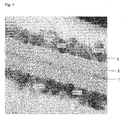
- the determination of the minimum and maximum layer thickness is carried out by measuring on the basis of a transmission electron microscopic (TEM) image of a (coated) substrate wafer (cf. FIG. 1 ). After the color of the coated substrate platelets is dependent on the layer thickness, a uniform color effect is ensured by a precisely and uniformly set thickness of the uncoated substrate platelets.
- TEM transmission electron microscopic
- the average thickness is therefore regarded as designated, unless otherwise specified at the relevant location.
- the substrate platelets are monolithic.
- monolithic means consisting of a single closed unit without breaks, laminations or inclusions. This is true for both the metallic substrate platelets and the oxidized substrate platelets after the calcination step.
- the oxidized substrate platelets are preferably homogeneously constructed, i. essentially no concentration gradient occurs within the platelets.
- the oxidized substrate platelets are not layered and have no particles or particles dispersed therein.
- they have no core-shell structure, the shell consisting, for example, of a material suitable for the substrate platelets and the core of another material, for example a silicon oxide. Due to their simple structure, the substrate platelets are inexpensive and efficient to manufacture. In contrast, a more complex, non-monolithic structure of the substrate platelets requires a complicated, time-consuming and expensive production process.
- the mass fraction of the substrate flake on the coated substrate flakes is preferably at most 25% by weight, particularly preferably at most 20% by weight, for example at most 15% by weight. However, the mass fraction of the substrate flakes should not fall below 1 wt%, preferably not below 2 wt% or 3 wt%. The mass fraction of the substrate flake on the coated substrate flake is particularly preferably 5 to 12% by weight.
- the pearlescent pigment of the invention Due to the small thickness or the small mass fraction of the substrate platelets, the pearlescent pigment of the invention has a particularly high hiding power. In addition, due to the small thickness / low mass fraction of the substrate platelets, expensive and rare materials such as special transition metals can be used sparingly and economically as material for the substrate platelets.
- the size of the uncoated substrate platelets is characterized in that the aspect ratio, expressed by the ratio of the average size to the average thickness, is at least 80, preferably at least 200, more preferably at least 500, more preferably more than 750.
- the mean size of the uncoated substrate platelets is understood to be the d 50 value of the uncoated substrate platelets.
- the d 50 value unless otherwise stated, determined with a device of the type Sympatec Helos with Quixel wet dispersion. For sample preparation, the sample to be examined is predispersed in isopropanol for a period of 3 minutes.
- the size of the uncoated substrate platelets is not critical and can be tailored to the particular application, insofar as the form factor is at least 80.
- the average size d 50 of the uncoated substrate platelets is about 2 to 200 ⁇ m.
- the mean size d 50 of the uncoated substrate platelets is 5 to 100 .mu.m, the lower limit being more preferably at least 8 .mu.m and particularly preferably at least 10 .mu.m.
- the upper limit according to a particularly preferred embodiment, is 50 ⁇ m, in particular 30 ⁇ m.
- the average size d 50 of the uncoated substrate platelets is in particular between 2 and 50 ⁇ m, more preferably between 5 and 30 ⁇ m.
- the average size d 50 of the uncoated substrate platelets depending on the intended use, for example as an industrial coating, for example, be at values of about 70 microns.
- the mean size d 50 of the uncoated substrate platelets is about 2 ⁇ m, it is clear to a person skilled in the art to choose a correspondingly lower upper limit for the average thickness of the uncoated substrate platelets (here: 25 nm). The same applies to the corresponding preferred lower limits.
- the coated substrate platelets preferably have a total thickness of 50 to 800 nm, particularly preferably 100 to 700 nm, particularly preferably 130 to 400 nm, for example 150 to 350 nm. Due to the small thickness of the substrate platelets, the pearlescent pigment of the invention has a particularly high hiding power.
- the small total thickness of the coated substrate platelets is achieved in particular by the fact that the thickness of the uncoated substrate platelets is low, but also by the fact that the thicknesses of the Coatings A and, if present, C should be set as small as possible. After the thickness of coating B determines the color impression of the pearlescent pigment, there is no room for maneuver with a specified desired color effect in this respect.
- substantially non-transmissive (opaque) materials such as metals
- substrate platelets to achieve high hiding power.
- inorganic substrates with low layer thicknesses (below 200 nm).
- a certain thickness should not be less.
- metallic substrate platelets are used for the preparation of the pearlescent pigments.
- Suitable metals are any metal and semimetal as well as metal alloy, which can be converted into a corresponding metal oxide in the calcination step according to the invention.
- Such metals include (transition) metals such as platinum, zinc, chromium, molybdenum, but also semi-metals such as silicon, and their alloys.
- Preferred metals are aluminum, copper, zinc and silicon.
- Preferred substrate platelets are aluminum platelets, copper platelets and brass platelets, aluminum platelets being particularly preferred.
- the metal platelets may optionally be treated by suitable means such as doping.
- Aluminum platelets can be produced, inter alia, by punching out of aluminum foil or by customary milling and atomization techniques. For example, aluminum flakes are available from the Hall process, a wet grinding process. Other metal platelets, such as bronze, can be obtained in a dry milling process such as the Hametagclar.
- the aluminum or metal flakes can have different shapes.
- lamellar and lenticular metal flakes or so-called vacuum metallized pigments (VMP) can be used as substrate flakes .
- Lamellar metal plates are characterized by an irregularly structured edge and are also referred to as "cornflakes” due to their appearance.
- Lenticular metal plates have a substantially regular round edge and are also referred to as "silver dollars" due to their appearance. Due to their irregular structure, metallic luster pigments based on lamellar metal flakes generate a higher proportion of scattered light than lenticular metal flakes, whereas in the latter case the proportion of the reflected light predominates.
- VMPs are used.
- VMPs can be obtained by liberating aluminum from metallized films. They are characterized by a particularly small thickness of the substrate platelets in the range of 1 to 40 nm and by a particularly smooth surface with increased reflectivity.
- the metallic substrate chip substantially completely becomes the corresponding metal oxide why the substrate flake is present in the pearlescent pigment of the invention as a monolithic and homogeneous material.
- the production method according to the invention differs from usual methods, in which the calcination processes merely lead to the burning of the outer layer (s).
- the pearlescent pigment obtained according to the invention has no substrate platelets in which only an oxide layer, for example in the form of a passivation, is formed on the metallic core.
- the term "substantially”, when applied to a constituent of a composition, means that the composition is at least 95% by weight, preferably at least 99% by weight, particularly preferably at least 99.5% by weight. , For example, about 100 wt .-% of the designated ingredient is constructed.
- the metallic substrate plate is converted into the corresponding metal oxide, is due in particular to the small thickness of the substrate wafer. If the thickness of the substrate flakes should be greater than 200 nm, it is difficult to obtain complete oxidation of the metallic substrate flake during the calcination step.
- the assessment of whether the metallic substrate platelet is converted into the corresponding metal oxide can preferably be determined by means of transmission electron microscopic (TEM) images in combination with energy-dispersive X-ray analysis.
- TEM transmission electron microscopic
- the coated substrate platelets are enveloped by at least one interference layer in the form of a coating B of a high refractive index metal oxide. Between the coating B and the substrate surface, the coated substrate platelets have an enveloping, substantially transparent coating A. Optionally, the substrate platelets have a further coating C different from the underlying layer B.
- Suitable materials for the coatings A, B and C are all substances that can be applied in a filmlike and durable manner to the substrate platelets and, in the Case of layers A and B, which have required optical properties.
- substantially transparent means that the coatings A transmit at least 70%, preferably at least 80%, particularly preferably at least 90%, of the incident visible light.
- coating a portion of the surface of the coated substrate sheets is sufficient to obtain a pearlescent pigment.
- only the upper and / or lower side of the platelets may be coated, wherein the side surface (s) are recessed.
- the entire surface of the substrate platelets, including the side surfaces, covered by coating B covers the substrate platelets.
- This improves the optical properties of the pigment according to the invention and increases the mechanical and chemical resistance of the coated substrate platelets.
- the above also applies to the layer A and preferably also to the layer C, if present.
- the coated substrate platelets preferably each have only one coating A, B and, if present, C.
- the pearlescent pigments according to the invention may have two interference layers in the form of the coating B, for example a combination of iron oxide (Fe 2 O 3 ) and TiO 2 .
- the coating B is composed of at least one high refractive index metal oxide.
- the coating B preferably comprises at least 95% by weight, more preferably at least 99% by weight, for example about 100% by weight, of at least one high-index metal oxide.
- the interference layer in the form of the coating B has a thickness of at least 20 nm, more preferably at least 40 nm, particularly preferably at least 50 nm.
- the thickness of coating B is not more than 250 nm, more preferably at most 150 nm
- Thickness of the interference layer in this context means the simple layer thickness of the coating B, which is doubled accordingly due to the coating in the pearlescent pigment according to the invention.
- the ratio of the thickness of coating B to the thickness of the uncoated substrate platelets is preferably at least 2, for example 4, 8 or 10. Basically, no upper limit must be maintained for this ratio, but for practical reasons it should be at most 1000, preferably at most 500.
- the average thickness of a coating or of a substrate wafer is determined from the arithmetic mean of the maximum and minimum thickness of the coating / of the substrate wafer.
- substrate platelets without distinction as to whether these are coated or not, uncoated substrate platelets shall be deemed to have been designated unless otherwise specified at the relevant location.
- a further coating A of at least one low refractive index metal oxide (hydrate) is present between the surface of the substrate platelets and the coating B.
- the coating A may be present as a single coating.
- two or more substantially transparent coatings A may also be arranged between the coating B and the substrate wafer.
- the coating A is composed of at least one low-refractive index metal oxide and / or metal oxide hydrate.
- coating A comprises at least 95% by weight, more preferably at least 99% by weight, for example about 100% by weight, of a low refractive index metal oxide (hydrate).
- the metal oxides which can be used for the coatings A, B and C a certain proportion of minor components and / or impurities.
- Typical minor constituents of metal oxides include in particular metal hydroxides.
- a coating of iron oxide may contain a certain amount of iron hydroxide.
- high refractive and low refractive respectively refer to high and low refractive index materials, respectively.
- High refractive materials have a refractive index of at least 1.8, preferably at least 2.0 and more preferably at least 2.4.
- Low refractive materials have a refractive index of less than 1.8, preferably at most 1.6.
- High refractive index metal oxides suitable for coating B are preferably selectively light absorbing (ie colored) metal oxides such as ferric oxide ( ⁇ - and ⁇ -Fe 2 O 3 , red), cobalt (II) oxide (blue), chromium (III) oxide (green), titanium (III) oxide (blue, usually in admixture with titanium oxynitrides and titanium nitrides), nickel (II) oxide (greenish), copper (I / II) oxide (blue) and vanadium (V) oxide ( orange) and mixtures thereof, without being limited to these.
- colorless high-index oxides such as titanium dioxide, antimony (III) oxide, zinc (II) oxide and / or zirconium dioxide.
- the interference layer consists essentially of titanium dioxide or, in the case of colored metal oxides, of iron (III) oxide.
- the interference layer contains corresponding dopants in the case of colorless oxides.
- the coating B of titanium dioxide contains dopants selected from tin, aluminum, lithium, zirconium, iron or cerium, in particular their salts, preferably 0.001 to 5 wt .-%, particularly preferably 0.01 to 1 wt. -%.
- the interference layer may contain a selectively absorbing dye, preferably 0.001 to 5 wt .-%, particularly preferably 0.01 to 1 wt .-%. Suitable are organic and inorganic dyes which can be stably incorporated into a metal oxide coating.
- a tin dioxide layer can furthermore be applied under the titanium dioxide layer. Accordingly, in the pearlescent pigment according to the invention, a thin ( ⁇ 10 nm) tin dioxide layer only a few nm thick can be contained between the coating A and the interference layer.
- the low-index metal oxides suitable for Coating A are, for example, silicon (di) oxide, silica hydrate, alumina, alumina hydrate, ceria, tin oxide (SnO 2 ) and mixtures thereof, with silica being preferred.
- the thickness of the coating A is usually 1 to 1000 nm, preferably 5 to 300 nm, more preferably 10 to 150 nm. According to a preferred embodiment, the coating A has a thickness of 5 to 50 nm, particularly preferably 5 to 40 nm, particularly preferably 10 to 40 nm, on.
- the thickness of the coating A, as well as the thickness of the coating B, can be adjusted variably and precisely.
- the distance between the surface of the substrate platelets and the inner surface of coating B is preferably at most 100 nm, more preferably at most 50 nm, particularly preferably at most 20 nm Because the thickness of coating A / the distance between the surface of the substrate platelets and coating B is in the range specified above, it is possible to ensure that the coated substrate platelets of the pearlescent pigment according to the invention have a high hiding power and a small ⁇ E- in the case of colored oxides. Have value.
- the ⁇ E value is the total color separation, which in the case of the pearlescent pigments according to the invention is preferably at most 25, particularly preferably at most 20, in particular at most 15.
- the measurement of ⁇ E takes place in accordance with DIN 55987, wherein a lacquer layer which contains the pearlescent pigment according to the invention with a mass fraction of 12% by weight (dry weight) is applied to one black and one white surface in each case.
- the layer thickness of the dried coating is 12 ⁇ m.
- the total color difference ⁇ E between the finishes on white and black ground is determined.
- a transparent coating B for example when using TiO 2
- the small thickness of the substrate leads to a high chroma in the interference angle (15 ° from the gloss).
- the thickness of the coating A is more than 50 nm. If the layer thickness of the coating A is more than 50 nm, an additional interference effect can be produced in the pearlescent pigment according to the invention.
- the thickness of the coating A can be set variably and precisely in accordance with the materials and dimensions of the substrate wafer and of the further coatings, the preferred values being the upper limit of the thickness.
- the additional interference effect can be further supported by the use of at least one matched to the thickness of the coating A interference layer, wherein two or more of these interference layers can be present. In particular in a range of 80 to 200 nm for the layer thickness of the coating A, in combination with the interference layer B, special color effects can be achieved.
- the pearlescent pigments may have a further coating C, whereby specific surface properties can be adjusted specifically.
- This coating C is selected according to a preferred embodiment of a metal oxide (hydrate), which is different from the underlying coating B, or of organic silane compounds.
- organosilanes are propyltrimethoxysilane, propyltriethoxysilane, isobutyltrimethoxysilane, n-octyltrimethoxysilane, i-octyltrimethoxysilane, n-octyltriethoxysilane, n-decyltrimethoxysilane, dodecyltrimethoxysilane, hexadecyltrimethoxysilane, vinyltrimethoxysilane.
- Suitable metal oxide (hydrates) are, for example, silicon (di) oxide, silicon oxide hydrate, aluminum oxide, aluminum oxide hydrate, zinc oxide, tin oxide, titanium dioxide, zirconium oxide, iron (III) oxide and chromium (III) oxide. Preferred is silica.
- the coating C preferably has a thickness of 1 to 500 nm, more preferably 10 to 500 nm, particularly preferably 50 to 300 nm.
- each of the coatings A, B and / or C may be composed of a mixture of two or more metal oxide (hydrate) s
- each of the coatings is preferably composed of a metal oxide (hydrate).
- the molar ratio ⁇ of oxygen not bound to aluminum to aluminum is preferably at least 3, more preferably at least 4, most preferably at least 5.
- ⁇ is at least 3, it is avoided that in the coated substrate platelets a molar ratio of oxygen, which is not bound to aluminum, to aluminum in the stoichiometric ratio of 3/2 (mol / mol) is present.
- a mixture of aluminum and oxygen compounds, in particular Fe 2 O 3 in which the molar ratio ⁇ is in the range of 3/2, can react strongly exothermic due to the high oxophilia of aluminum metal, possibly with an explosive effect (aluminothermy, thermite reaction). Therefore, a mixture with ⁇ in the range of 3/2 can pose a safety hazard.
- the reactivity of such a mixture can be reduced by adjusting the ratio ⁇ to a value which is either significantly greater or significantly smaller than 3/2.
- the process according to the invention for producing the pearlescent pigments comprises the step of coating the metallic substrate flakes by hydrolytic decomposition of one or more organic metal compounds and / or by precipitating one or more dissolved metal salts.
- organic metal compounds preferably organic silicon and / or aluminum compounds
- organic radicals are bonded to the metals via oxygen atoms
- organic solvent in which the metal compounds are soluble. hydrolyzed.
- organic solvents a variety of organic solvents is suitable, iso-propanol is preferred.
- organic metal compounds are the acetylacetonates and in particular alkoxides, especially C 1 -C 4 -alkanolates, for example Aluminiumtriisopropanolat and tetraethoxysilane (tetraethyl orthosilicate, TEOS).
- the hydrolysis is preferably carried out in the presence of a base or an acid as catalyst.
- a base or an acid as catalyst for this purpose, z. B. in addition to alkali lye such as sodium hydroxide, in particular aqueous ammonia solutions.
- Suitable acidic catalysts are, for example, phosphoric acid and organic acids such as acetic acid and oxalic acid (also called sol-gel process).
- Water must be present at least in the amount stoichiometrically required for the hydrolysis, but is preferably from 2 to 100 times, in particular 5 to 20 times the amount. Based on the amount of water used, preferably 3 to 40% by volume, more preferably 5 to 30% by volume, of a 25% strength by weight aqueous ammonia solution are added.
- reaction mixture For the temperature control, it has proven to be advantageous to gradually heat the reaction mixture to reflux temperature within 10 to 48 h.
- the mixture is stirred initially at 40 ° C. for 4 to 20 h, then at 60 ° C. for 4 to 20 h and finally at 80 ° C. for 2 to 8 h.
- the suspension may be subjected to severe mechanical stress such as pumping, vigorous stirring or exposure to ultrasound.
- the coating step can be repeated one or more times. If the mother liquor looks milky cloudy, it is advisable to replace these before a further coating.
- the isolation of coated with coating A metallic substrate platelets can be done in a simple manner by filtration, washing with organic solvent, preferably also used as a solvent alcohols, and then drying (usually 2 to 24 h at 20 to 200 ° C).
- organic solvent preferably also used as a solvent alcohols
- drying usually 2 to 24 h at 20 to 200 ° C.
- the metallic substrate flakes coated with coating A do not have to be isolated and can be used in situ for the further coating step.
- metal oxide layers B for example, ⁇ -iron oxide and chromium oxide layers by hydrolytic decomposition of iron (III) salts such as iron (III) chloride and sulfate or chromium (III) chloride and then transferring the resulting hydroxide-containing layers by annealing and / or calcining be applied in the oxide layers.
- iron (III) salts such as iron (III) chloride and sulfate or chromium (III) chloride
- TiO 2 layers can be applied by means of TiOCl.
- a titanium (III) oxide coating can be achieved by hydrolysis of titanium tetrachloride and subsequent reduction of the titanium dioxide formed with gaseous ammonia.
- an ⁇ -iron oxide layer is provided as the metal oxide layer B, it may be done by gas-phase decomposition of volatile iron pentacarbonyl in the presence of oxygen (oxidative decomposition of Fe (CO) 5 ).
- the oxidative decomposition can also result in the calcination of the substrate platelets, ie, for example, the conversion of the Al substrate platelets into Al 2 O 3 substrate platelets.
- a coating C it may be applied as described for coatings A and B.
- the transfer of the metallic substrate platelets into the corresponding metal oxide takes place. This takes place at temperatures of 500 to 1200 ° C. Under these conditions, the metal substrate platelets are completely oxidized, resulting in pearlescent pigments with exceptionally high hiding power (in the case of absorbing interference layers) and chroma (chroma). Controlled calcination as well as the process steps described above make it possible to provide extremely thin inorganic substrates with improved optical properties.
- the calcination is typically carried out for 30 to 200 minutes in the above temperature range.
- the calcination step takes place in an oxygen-containing atmosphere, with no special requirements being imposed on them.
- air may be used as the oxygen-containing atmosphere.
- the pearlescent pigments according to the invention have an excellent chroma (chroma).
- chroma chroma
- the reason for this is probably in the The fact that the proportion of the interference layer in the total weight of the pigments is much greater than in conventional pigments with much thicker substrates.
- Angle-dependent brightness measurements can be used to evaluate the coloristic properties of the pearlescent pigments, as described in more detail below. Herbei are determined at a constant angle of incidence of 45 °, the color data as a function of the observation angle.
- a lacquer with a pigment concentration of 6 or 12% by weight, based on the binder is prepared and coated with the aid of a package on a black plate with a layer thickness of 12 ⁇ m.
- the color data are determined using a Byk-mac from Byk Additive and Instrumente.
- the angles 15 °, 25 °, 45 °, 75 ° and 110 ° are read off the gloss.
- the thickness of the metallic substrate platelets and, associated therewith, the thickness of the non-metallic substrate platelet in the pearlescent pigment according to the invention can be precisely adjusted by the various method steps.
- the further coatings can be applied to the substrate with precise thicknesses, thereby obtaining true multi-layer optical systems.
- the coated substrate platelets on the one hand in a simple manner reproducible in large quantities getting produced.
- completely coated pigment particles with very high quality of the individual coatings can be obtained.
- the present invention relates to the use of the pearlescent pigments described above for coloring paints, printing inks, inks, plastics, glasses, ceramic products and decorative cosmetic preparations.
- the pearlescent pigments according to the invention are advantageously suitable for many purposes, such as for coloring plastics, glasses, ceramic products, decorative cosmetic preparations and, in particular, inks, printing inks and security printing inks and, above all, paints, for example for the automotive industry.
- the pearlescent pigments according to the invention can also be used advantageously in admixture with transparent and opaque white, colored and black pigments and also conventional luster pigments based on metal oxide-coated mica and metal pigments and platelet-shaped iron oxides.
- Example 1 thin aluminum flakes with SiO 2 (50 nm) and iron oxide coating (110 nm)
- the mixture was stirred for a further 15 minutes to ensure complete precipitation.
- the pH was then raised to a value of 7.0 by dropwise addition of a 10% NaOH solution over a period of 30 minutes.
- the coated pigment was separated from the supernatant reaction solution by filtration and washed until it was salt-free.
- the resulting coated aluminum flakes were calcined for 290 minutes at a heating rate of 2 ° C / minute to about 600 ° and screened with a sieve (mesh size 32 microns).
- the obtained product was subjected to evaluation of its color properties.
- Example 3 thin aluminum flakes with SiO 2 (15 nm) and iron oxide coating (100 nm)
- the mixture was stirred for a further 15 minutes to ensure complete precipitation.
- the pH was then raised to a value of 7.0 by dropwise addition of a 10% NaOH solution over a period of 30 minutes.
- the coated pigment was separated from the supernatant reaction solution by filtration and washed until it was salt-free.
- the resulting coated aluminum flakes were calcined for 290 minutes at a heating rate of 2 ° C / minute to about 600 ° and screened with a sieve (mesh size 32 microns).
- the obtained product was subjected to evaluation of its color properties.
- Example 4 thin aluminum flakes with SiO 2 (25 nm) and iron oxide coating (110 nm)
- the mixture was stirred for a further 15 minutes to ensure complete precipitation.
- the pH was then raised to a value of 7.0 by dropwise addition of a 10% NaOH solution over a period of 30 minutes.
- the coated pigment was separated from the supernatant reaction solution by filtration and washed until it was salt-free.
- the resulting coated aluminum flakes were calcined for 290 minutes at a heating rate of 2 ° C / minute to about 600 ° and screened with a sieve (mesh size 32 microns).
- the obtained product was subjected to evaluation of its color properties.
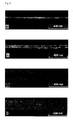
- Fig. 3 the corresponding TEM images are shown extended with EDX analysis, which show that the metallic Al substrate plate is completely oxidized.
- Example 5 thin aluminum flakes with titanium dioxide coating
- the coated aluminum flakes were heated at 2 ° C / minute to 800 ° C. After cooling, the finished pigment was sieved with a 25 micron sieve and then tested coloristically.
- Table 1 shows results for pearlescent pigments with body color, pearlescent pigments of the invention are compared from Example 1 with Mearlin ® Exterior CFS Super Copper 3503Z from BASF.
- Table 2 shows results for pearlescent pigments with body color, pearlescent pigments of the invention from Example 4 of the company BASF be compared with Iriodine ® 502 Auburn Merck and Mearlin Super Copper 3503Z ® Exterior CFS.
- Table 3 shows results for blue transparent pearlescent pigments, and pearlescent pigment according to the invention from Example 5 9225 Rutile Blue Pearl SW from Merck is compared with Iriodine ®.
- Table 1 Orange pigments No. L * 45 ° / 15 ° a * 45 ° / 15 ° b * 45 ° / 15 ° C 45 ° / 15 ° L * 45 ° / 45 ° a * 45 ° / 45 ° b * 45 ° / 45 ° C 45 ° / 45 ° ⁇ E 45 ° 1 80.8 80.8 61.4 81.7 25.1 27.8 28.5 39.8 18.2 Mearlin ® 3503Z 90.7 43.9 37.6 57.8 23.2 20.0 20.1 28.4 24.0 No.
- the chroma of the body color (C45 ° / 45 °) of Example 1 is significantly higher than the corresponding chroma of the commercial pigment Mearlin ® 3503Z. Also, the Interferenzchroma (C45 ° / 15 °) of Example 1 is improved in comparison with Mearlin ® 3503Z.
- Example 4 From the comparison of Example 4 with Iriodin ® 502 also shows a significant improvement in the chroma of the body color (C45 ° / 45 °) and the interference chroma (C45 ° / 15 °).
- the transparent pearlescent pigments with blue interference show that the chroma in the interference angle (C45 ° / 15 °) of Example 5 is clearly superior to the commercially available pigment.
Landscapes
- Chemical & Material Sciences (AREA)
- Organic Chemistry (AREA)
- Life Sciences & Earth Sciences (AREA)
- Health & Medical Sciences (AREA)
- Engineering & Computer Science (AREA)
- Materials Engineering (AREA)
- Chemical Kinetics & Catalysis (AREA)
- Wood Science & Technology (AREA)
- Medicinal Chemistry (AREA)
- Polymers & Plastics (AREA)
- Veterinary Medicine (AREA)
- Public Health (AREA)
- General Health & Medical Sciences (AREA)
- Animal Behavior & Ethology (AREA)
- Epidemiology (AREA)
- Birds (AREA)
- General Chemical & Material Sciences (AREA)
- Inorganic Chemistry (AREA)
- Geochemistry & Mineralogy (AREA)
- Ceramic Engineering (AREA)
- Pigments, Carbon Blacks, Or Wood Stains (AREA)
- Paints Or Removers (AREA)
- Cosmetics (AREA)
- Laminated Bodies (AREA)
Priority Applications (13)
| Application Number | Priority Date | Filing Date | Title |
|---|---|---|---|
| EP15001083.3A EP3081601A1 (fr) | 2015-04-15 | 2015-04-15 | Pigments nacrés comprenannt des substrats monolithiques |
| MX2017007260A MX383813B (es) | 2015-04-15 | 2016-04-15 | Pigmentos nacarados, proceso para producirlos y uso de tales pigmentos. |
| JP2017553424A JP6826538B2 (ja) | 2015-04-15 | 2016-04-15 | 一体式構造の基材を基礎とするパール光輝顔料、該パール光輝顔料の製造方法、及びそのようなパール光輝顔料の使用 |
| AU2016248559A AU2016248559B2 (en) | 2015-04-15 | 2016-04-15 | Pearlescent pigments based on monolithically constructed substrates, methods for producing same, and use of such pearlescent pigments |
| RU2017136967A RU2685659C1 (ru) | 2015-04-15 | 2016-04-15 | Перламутровый пигмент на основе монолитно сформированных субстратов, способ его получения и применение такого пигмента |
| BR112017017616-5A BR112017017616B1 (pt) | 2015-04-15 | 2016-04-15 | Pigmentos perolados baseados em substratos construídos monoliticamente, métodos para a produção dos mesmos e uso desses pigmentos perolados |
| CA2971306A CA2971306C (fr) | 2015-04-15 | 2016-04-15 | Pigments nacres, leur procede de production et l'utilisation de tels pigments |
| CN201680012032.0A CN107567484B (zh) | 2015-04-15 | 2016-04-15 | 珠光颜料、珠光颜料的制造方法以及该颜料的用途 |
| PCT/EP2016/000624 WO2016165832A1 (fr) | 2015-04-15 | 2016-04-15 | Pigments brillants nacrés à base de substrats ayant une structure monolithique, procédés servant à la fabrication desdits pigments et utilisation de pigments brillants nacrés de ce type |
| EP16721631.6A EP3283573B1 (fr) | 2015-04-15 | 2016-04-15 | Pigments nacrés comprenant des substrats monolithiques, procédé de fabrication et utilisation des pigments nacrés |
| KR1020177017997A KR102044398B1 (ko) | 2015-04-15 | 2016-04-15 | 모놀리식으로 구성된 기재에 기초한 진주빛 안료, 그 제조 방법, 및 그러한 진주빛 안료의 용도 |
| US15/566,248 US11214690B2 (en) | 2015-04-15 | 2016-04-15 | Pearlescent pigments, process for producing them, and use of such pigments |
| ZA2017/04940A ZA201704940B (en) | 2015-04-15 | 2017-07-20 | Pearlescent pigments based on monolithically constructed substrates, methods for producing same, and use of such pearlescent pigments |
Applications Claiming Priority (1)
| Application Number | Priority Date | Filing Date | Title |
|---|---|---|---|
| EP15001083.3A EP3081601A1 (fr) | 2015-04-15 | 2015-04-15 | Pigments nacrés comprenannt des substrats monolithiques |
Publications (1)
| Publication Number | Publication Date |
|---|---|
| EP3081601A1 true EP3081601A1 (fr) | 2016-10-19 |
Family
ID=52875397
Family Applications (2)
| Application Number | Title | Priority Date | Filing Date |
|---|---|---|---|
| EP15001083.3A Withdrawn EP3081601A1 (fr) | 2015-04-15 | 2015-04-15 | Pigments nacrés comprenannt des substrats monolithiques |
| EP16721631.6A Active EP3283573B1 (fr) | 2015-04-15 | 2016-04-15 | Pigments nacrés comprenant des substrats monolithiques, procédé de fabrication et utilisation des pigments nacrés |
Family Applications After (1)
| Application Number | Title | Priority Date | Filing Date |
|---|---|---|---|
| EP16721631.6A Active EP3283573B1 (fr) | 2015-04-15 | 2016-04-15 | Pigments nacrés comprenant des substrats monolithiques, procédé de fabrication et utilisation des pigments nacrés |
Country Status (12)
| Country | Link |
|---|---|
| US (1) | US11214690B2 (fr) |
| EP (2) | EP3081601A1 (fr) |
| JP (1) | JP6826538B2 (fr) |
| KR (1) | KR102044398B1 (fr) |
| CN (1) | CN107567484B (fr) |
| AU (1) | AU2016248559B2 (fr) |
| BR (1) | BR112017017616B1 (fr) |
| CA (1) | CA2971306C (fr) |
| MX (1) | MX383813B (fr) |
| RU (1) | RU2685659C1 (fr) |
| WO (1) | WO2016165832A1 (fr) |
| ZA (1) | ZA201704940B (fr) |
Cited By (15)
| Publication number | Priority date | Publication date | Assignee | Title |
|---|---|---|---|---|
| EP3345974A1 (fr) * | 2017-01-10 | 2018-07-11 | Schlenk Metallic Pigments GmbH | Pigments nacrés obtenus par oxydation en milieu humide |
| JP2019067817A (ja) * | 2017-09-28 | 2019-04-25 | 積水化学工業株式会社 | 太陽電池 |
| EP3613811A1 (fr) * | 2018-08-22 | 2020-02-26 | Schlenk Metallic Pigments GmbH | Pigments à effet métallique de tonalité de champagne |
| WO2020187734A1 (fr) * | 2019-03-19 | 2020-09-24 | Henkel Ag & Co. Kgaa | Procédé de coloration d'une matière kératinique consistant à utiliser un composé organique au silicium, un pigment à effet et un réactif de scellement iv |
| WO2020187728A1 (fr) * | 2019-03-19 | 2020-09-24 | Henkel Ag & Co. Kgaa | Procédé de coloration d'une matière kératinique consistant à utiliser un composé organique au silicium, un pigment à effet, un autre composé colorant et un polymère filmogène ii |
| WO2020187725A1 (fr) * | 2019-03-19 | 2020-09-24 | Henkel Ag & Co. Kgaa | Procédé de coloration d'une matière kératinique consistant à utiliser un composé organique au silicium, un pigment à effet et un polymère filmogène v |
| WO2020187727A1 (fr) * | 2019-03-19 | 2020-09-24 | Henkel Ag & Co. Kgaa | Procédé de coloration d'une matière kératinique consistant à utiliser un composé organique au silicium, un pigment à effet et un polymère filmogène ii |
| WO2020187737A1 (fr) * | 2019-03-19 | 2020-09-24 | Henkel Ag & Co. Kgaa | Procédé de coloration d'une matière kératinique consistant à utiliser un composé organique au silicium, un pigment à effet, un autre composé colorant et un polymère filmogène iii |
| WO2020187735A1 (fr) * | 2019-03-19 | 2020-09-24 | Henkel Ag & Co. Kgaa | Procédé de coloration d'une matière kératinique consistant à utiliser un composé organique au silicium, un pigment à effet et un réactif de scellement |
| WO2020187736A1 (fr) * | 2019-03-19 | 2020-09-24 | Henkel Ag & Co. Kgaa | Procédé de coloration d'une matière kératinique consistant à utiliser un composé organique au silicium, un pigment à effet, un autre composé colorant et un polymère filmogène i |
| WO2021013517A1 (fr) * | 2019-07-19 | 2021-01-28 | Henkel Ag & Co. Kgaa | Procédé de coloration d'une matière kératinique comprenant l'application d'un composé organosilicié, d'un pigment à effet coloré et d'un réactif de scellement i |
| WO2021052720A1 (fr) * | 2019-09-18 | 2021-03-25 | Henkel Ag & Co. Kgaa | Procédé de coloration de matières kératiniques, comprenant l'utilisation d'un composé d'organosilicium, d'un pigment à effet et d'un polymère filmogène |
| WO2021052648A1 (fr) * | 2019-09-19 | 2021-03-25 | Henkel Ag & Co. Kgaa | Méthode de coloration de matière kératinique, comprenant l'utilisation d'un composé organosilicié, d'un pigment à effet revêtu et d'un réactif d'étanchéité i |
| WO2021154123A1 (fr) | 2020-01-28 | 2021-08-05 | Общество С Ограниченной Ответственностью "Суал Пм" | Pigments métalliques avec revêtements anti-corrosion |
| RU2773189C1 (ru) * | 2018-08-22 | 2022-05-31 | Шленк Металлик Пигментс Гмбх | Пигменты с эффектом металла цвета шампань |
Families Citing this family (12)
| Publication number | Priority date | Publication date | Assignee | Title |
|---|---|---|---|---|
| CN107216687A (zh) * | 2017-06-30 | 2017-09-29 | 安徽金星钛白(集团)有限公司 | 一种基于改进表面处理工艺制备导电型钛白的方法 |
| EP3621089B1 (fr) * | 2018-09-10 | 2021-08-25 | Ivoclar Vivadent AG | Matériau dentaire avec particules à écran couleur amélioré |
| DE102019203670A1 (de) * | 2019-03-19 | 2020-09-24 | Henkel Ag & Co. Kgaa | Verfahren zum Färben von keratinischem Material, umfassend die Anwendung von einer siliciumorganischen Verbindung, eines Effektpigments und eines filmbildenden Polymers III |
| CN110272641B (zh) * | 2019-06-03 | 2020-03-20 | 广东维诺珠光颜料有限公司 | 一种高分散性珠光颜料的制备方法及珠光颜料和应用 |
| DE102020203248A1 (de) | 2020-03-13 | 2021-09-16 | Henkel Ag & Co. Kgaa | Verfahren zum Färben von keratinischem Material, umfassend die Anwendung von einer siliciumorganischen Verbindung, zweier farbgebender Verbindungen und eines Nachbehandlungsmittels |
| DE102020118344A1 (de) | 2020-07-11 | 2022-01-13 | Schlenk Metallic Pigments Gmbh | Laser Nachbehandlung von Metalleffektpigmentflächen zur lokalen Erhöhung der Radar- und/ oder Lichttransmission |
| DE102021208460A1 (de) * | 2021-08-04 | 2023-02-09 | Henkel Ag & Co. Kgaa | Mittel zum Färben von keratinischem Material, insbesondere menschlichen Haaren, enthaltend Aminosilikone und plättchenförmige Metallpigmente |
| CN113717549A (zh) * | 2021-09-30 | 2021-11-30 | 福建坤彩材料科技股份有限公司 | 绿色珠光颜料及其制备方法与应用 |
| CN116925569A (zh) * | 2022-03-29 | 2023-10-24 | 宁波融光纳米科技有限公司 | 光学颜料及其制备方法 |
| CN114958036B (zh) * | 2022-06-30 | 2023-12-01 | 丰田自动车株式会社 | 一种珠光颜料及其制备方法 |
| ES3010679T3 (en) * | 2022-09-13 | 2025-04-04 | Schlenk Metallic Pigments Gmbh | Yellow metal interference pigments having a green sting, a method for the production thereof and use thereof |
| KR102789558B1 (ko) * | 2022-11-07 | 2025-03-31 | 조선대학교산학협력단 | 진주 광택 및 항균 특성을 가진 유사삼각형 층상 판형 입자의 제조방법 및 이에 따라 제조된 유사삼각형 층상 판형 입자 |
Citations (10)
| Publication number | Priority date | Publication date | Assignee | Title |
|---|---|---|---|---|
| EP1072651A1 (fr) | 1999-07-29 | 2001-01-31 | MERCK PATENT GmbH | Pigment à base de particules fines et procédé de fabrication |
| WO2004055119A1 (fr) * | 2002-12-17 | 2004-07-01 | Merck Patent Gmbh | Pigments d'interference blanc argente a forte brillance a base de substrats sous forme de paillettes transparentes |
| EP1564261A2 (fr) | 2004-02-09 | 2005-08-17 | MERCK PATENT GmbH | Pigments Interferentiels |
| EP1621585A2 (fr) * | 2004-07-27 | 2006-02-01 | MERCK PATENT GmbH | Pigments interférentiels à couches multiples |
| DE102007062942A1 (de) * | 2006-12-22 | 2008-06-26 | Eckart Gmbh | Dünne Aluminiumpigmente mit enger Dickenverteilung, Verfahren zur Herstellung derselben und Verwendung der Aluminiumpigmente |
| WO2011045030A1 (fr) | 2009-10-14 | 2011-04-21 | Eckart Gmbh | Pigments nacrés à base de substrats synthétiques fins et minces |
| WO2011095326A1 (fr) | 2010-02-04 | 2011-08-11 | Merck Patent Gmbh | Pigments à effets |
| WO2013156327A1 (fr) * | 2012-04-19 | 2013-10-24 | Basf Se | Procédé pour la préparation d'un pigment à effet |
| EP2799397A2 (fr) * | 2013-04-30 | 2014-11-05 | Merck Patent GmbH | Flocons d'alumine |
| WO2015014484A1 (fr) * | 2013-08-02 | 2015-02-05 | Schlenk Metallic Pigments Gmbh | Pigments brillants métalliques à base de plaquettes de substrat d'une épaisseur de 1 - 50 nm |
Family Cites Families (57)
| Publication number | Priority date | Publication date | Assignee | Title |
|---|---|---|---|---|
| DE2313331C2 (de) * | 1973-03-17 | 1986-11-13 | Merck Patent Gmbh, 6100 Darmstadt | Eisenoxidhaltige Glimmerschuppenpigmente |
| DE3003352A1 (de) | 1980-01-31 | 1981-08-06 | Basf Ag, 6700 Ludwigshafen | Verfahren zur herstellung von eisenoxidbelegten metallpigmenten |
| FR2511016A1 (fr) | 1981-08-10 | 1983-02-11 | Rhone Poulenc Spec Chim | Latex de copolymeres acetate de vinyle-olefine et procede de preparation |
| DE3151354A1 (de) * | 1981-12-24 | 1983-07-07 | Merck Patent Gmbh, 6100 Darmstadt | Perlglanzpigmente, verfahren zu ihrer herstellung und ihre verwendung |
| DE3151343A1 (de) * | 1981-12-24 | 1983-07-07 | Merck Patent Gmbh, 6100 Darmstadt | Perlglanzpigmente mit verbesserter lichtbestaendigkeit, ihre herstellung und ihre verwendung |
| DE3211602A1 (de) * | 1982-03-30 | 1983-10-13 | Merck Patent Gmbh, 6100 Darmstadt | Verfahren zur herstellung von perlglanzpigmenten mit verbesserten glanzeigenschaften |
| GB8310366D0 (en) * | 1983-04-16 | 1983-05-18 | Verdugt Bv | Corrosion inhibitors |
| DE4209242A1 (de) | 1992-03-21 | 1993-09-23 | Basf Ag | Als glanzpigmente geeignete mischungen |
| JP3073836B2 (ja) * | 1992-07-02 | 2000-08-07 | メルク・ジヤパン株式会社 | 耐変色性を有する真珠光沢顔料およびその製造方法 |
| JPH07759B2 (ja) | 1992-09-09 | 1995-01-11 | 大阪真空工業株式会社 | 有彩色の光輝性パウダー |
| DE9400447U1 (de) | 1994-01-12 | 1994-06-23 | Carl Schlenk AG, 90409 Nürnberg | Gold-, silber- oder andersfarbige Pigmente |
| DE4405492A1 (de) | 1994-02-21 | 1995-08-24 | Basf Ag | Mehrfach beschichtete metallische Glanzpigmente |
| DE4437753A1 (de) | 1994-10-21 | 1996-04-25 | Basf Ag | Mehrfach beschichtete metallische Glanzpigmente |
| DE19516181A1 (de) * | 1995-05-03 | 1996-11-07 | Basf Ag | Goniochromatische Glanzpigmente mit Aluminiumbeschichtung |
| DE19520312B4 (de) | 1995-06-02 | 2004-09-16 | Eckart-Werke Standard-Bronzepulver-Werke Carl Eckart Gmbh & Co. | Oxidierte farbige Aluminiumpigmente, Verfahren zu deren Herstellung sowie deren Verwendung |
| JPH09249442A (ja) | 1996-03-12 | 1997-09-22 | Hideo Okazaki | プレミックスモルタル及びモルタル製品 |
| GB2312857A (en) | 1996-05-07 | 1997-11-12 | Silberline Ltd | Gold bronze effect pigments |
| DE19618569A1 (de) * | 1996-05-09 | 1997-11-13 | Merck Patent Gmbh | Mehrschichtige Interferenzpigmente |
| DE19618563A1 (de) | 1996-05-09 | 1997-11-13 | Merck Patent Gmbh | Titanathaltige Perlglanzpigmente |
| DE19803550A1 (de) * | 1998-01-30 | 1999-08-05 | Merck Patent Gmbh | Interferenzpigmente mit blauer Körperfarbe |
| US6776835B2 (en) | 1998-08-14 | 2004-08-17 | Merck Patent Gesellschaft Mit Beschrankter Haftung | Multilayer pigments based on coated metal platelets |
| DE19836810A1 (de) | 1998-08-14 | 2000-02-17 | Merck Patent Gmbh | Mehrschichtpigmente auf Basis beschichteter Metallplättchen |
| ES2212645T3 (es) | 1998-10-23 | 2004-07-16 | Avery Dennison Corporation | Procedimiento para la fabricacion de laminillas metalicas. |
| US6150022A (en) | 1998-12-07 | 2000-11-21 | Flex Products, Inc. | Bright metal flake based pigments |
| DE19901609A1 (de) * | 1999-01-18 | 2000-07-20 | Merck Patent Gmbh | Mehrschichtiges Perlglanzpigment |
| DE19951871A1 (de) | 1999-10-28 | 2001-05-03 | Merck Patent Gmbh | Farbstarke Interferenzpigmente |
| US20020160194A1 (en) | 2001-04-27 | 2002-10-31 | Flex Products, Inc. | Multi-layered magnetic pigments and foils |
| DE10128489A1 (de) * | 2001-06-12 | 2002-12-19 | Merck Patent Gmbh | Mehrschichtige Glanzpigmente |
| DE10128491A1 (de) | 2001-06-12 | 2002-12-19 | Merck Patent Gmbh | Mehrschichtsysteme mit optischen Eigenschaften |
| JP4610812B2 (ja) | 2001-09-06 | 2011-01-12 | 東洋アルミニウム株式会社 | アルミニウムフレーク顔料の製造方法 |
| DE10153196A1 (de) | 2001-10-27 | 2003-05-08 | Merck Patent Gmbh | Pigment mit Metallglanz |
| DE10221497A1 (de) | 2002-05-14 | 2003-11-27 | Basf Ag | Goniochromatische Glanzpigmente |
| ATE372364T1 (de) * | 2002-05-29 | 2007-09-15 | Eckart Gmbh & Co Kg | Beschichtungsmittel, verwendung und beschichtete substratoberflache |
| JP2004010714A (ja) * | 2002-06-05 | 2004-01-15 | Nippon Chem Ind Co Ltd | 樹脂用配合剤、その製法及びそれを用いた樹脂組成物 |
| WO2004044060A1 (fr) * | 2002-11-13 | 2004-05-27 | Ciba Specialty Chemicals Holding Inc. | Nouveaux pigments d'interference |
| US7291216B2 (en) * | 2003-01-23 | 2007-11-06 | Ciba Specialty Chemicals Corporation | Platelet-shaped pigments |
| DE10315775A1 (de) | 2003-04-04 | 2004-10-14 | Eckart Gmbh & Co. Kg | Dünne deckende Aluminiumpigmente, Verfahren zur Herstellung derselben und Verwendung der Aluminiumpigmente |
| EP1633819A1 (fr) * | 2003-05-21 | 2006-03-15 | MERCK PATENT GmbH | Pigments a effet photostabilises |
| JP4767845B2 (ja) | 2003-06-17 | 2011-09-07 | チバ ホールディング インコーポレーテッド | コア材料および少なくとも1層の誘電体層を含む顔料の製造方法 |
| DE10354763A1 (de) | 2003-11-21 | 2005-06-23 | Eckart Gmbh & Co. Kg | Effektpigmente mit Aluminium- oder Aluminiumlegierungskern, Verfahren zu deren Herstellung und Verwendung derselben |
| DE102004039554A1 (de) * | 2004-08-13 | 2006-02-23 | Merck Patent Gmbh | Perlglanzpigmente |
| EP1784458B1 (fr) | 2004-08-23 | 2011-03-09 | Basf Se | Procédé de préparation de pigment en paillettes a base d'aluminium et de sioz (z=0.7-2.0) |
| JP5475210B2 (ja) | 2004-12-24 | 2014-04-16 | メルク株式会社 | 高耐腐食性薄片状金属顔料、その製造方法、およびそれをベースとする金属光沢干渉発色顔料 |
| KR100619248B1 (ko) * | 2005-03-25 | 2006-09-01 | 한국화학연구원 | 판상 알파알루미나 결정체 및 이의 제조방법 |
| DE102005019431A1 (de) | 2005-04-25 | 2006-10-26 | Eckart Gmbh & Co. Kg | Pulverförmige Perlglanzzusammensetzung, Verfahren zu deren Herstellung und deren Verwendung |
| ES2622110T3 (es) * | 2005-10-03 | 2017-07-05 | Dainichiseika Color & Chemicals Mfg. Co., Ltd. | Pigmento perlescente, procesos para producir el mismo, composición de material de revestimiento y composición de película de revestimiento |
| US8133938B2 (en) | 2005-11-01 | 2012-03-13 | Ppg Industries Ohio, Inc. | Radiation diffraction colorants |
| KR100743674B1 (ko) * | 2006-08-28 | 2007-07-30 | 한국화학연구원 | 각형비가 큰 진주안료 및 이의 제조방법 |
| WO2008077612A2 (fr) | 2006-12-22 | 2008-07-03 | Eckart Gmbh | Pigments d'aluminium fins ayant une plage de répartition d'épaisseur étroite, leur procédé de réalisation et leur utilisation |
| ATE490293T1 (de) | 2007-12-28 | 2010-12-15 | Eckart Gmbh | Pigmentzubereitung und tintenstrahldrucktinte |
| CN101445675A (zh) | 2008-12-12 | 2009-06-03 | 温州亦柏化工有限公司 | 高色浓度的彩色铝颜料及其制备方法 |
| CN101475757A (zh) * | 2008-12-19 | 2009-07-08 | 林一中 | 色彩变换的干涉色珠光颜料及其制备方法 |
| DE102008064202A1 (de) | 2008-12-22 | 2010-06-24 | Merck Patent Gmbh | Pigmentgranulate |
| JP2010185073A (ja) | 2009-01-13 | 2010-08-26 | Ako Kasei Co Ltd | 鮮やかな外観色と干渉色を有する二色性顔料 |
| DE102009051171A1 (de) * | 2009-10-29 | 2011-05-05 | Merck Patent Gmbh | Pigmente |
| JP2013064053A (ja) | 2011-09-16 | 2013-04-11 | Seiko Epson Corp | 耐水化アルミニウム顔料分散液及びその製造方法、並びに水性インク組成物 |
| DE102011055072A1 (de) | 2011-11-04 | 2013-05-08 | Eckart Gmbh | Beschichtete, nasschemisch oxidierte Aluminiumeffektpigmente, Verfahren zu deren Herstellung, Beschichtungsmittel und beschichteter Gegenstand |
-
2015
- 2015-04-15 EP EP15001083.3A patent/EP3081601A1/fr not_active Withdrawn
-
2016
- 2016-04-15 EP EP16721631.6A patent/EP3283573B1/fr active Active
- 2016-04-15 AU AU2016248559A patent/AU2016248559B2/en active Active
- 2016-04-15 JP JP2017553424A patent/JP6826538B2/ja active Active
- 2016-04-15 KR KR1020177017997A patent/KR102044398B1/ko active Active
- 2016-04-15 CA CA2971306A patent/CA2971306C/fr active Active
- 2016-04-15 MX MX2017007260A patent/MX383813B/es unknown
- 2016-04-15 RU RU2017136967A patent/RU2685659C1/ru active
- 2016-04-15 CN CN201680012032.0A patent/CN107567484B/zh active Active
- 2016-04-15 BR BR112017017616-5A patent/BR112017017616B1/pt active IP Right Grant
- 2016-04-15 US US15/566,248 patent/US11214690B2/en active Active
- 2016-04-15 WO PCT/EP2016/000624 patent/WO2016165832A1/fr not_active Ceased
-
2017
- 2017-07-20 ZA ZA2017/04940A patent/ZA201704940B/en unknown
Patent Citations (10)
| Publication number | Priority date | Publication date | Assignee | Title |
|---|---|---|---|---|
| EP1072651A1 (fr) | 1999-07-29 | 2001-01-31 | MERCK PATENT GmbH | Pigment à base de particules fines et procédé de fabrication |
| WO2004055119A1 (fr) * | 2002-12-17 | 2004-07-01 | Merck Patent Gmbh | Pigments d'interference blanc argente a forte brillance a base de substrats sous forme de paillettes transparentes |
| EP1564261A2 (fr) | 2004-02-09 | 2005-08-17 | MERCK PATENT GmbH | Pigments Interferentiels |
| EP1621585A2 (fr) * | 2004-07-27 | 2006-02-01 | MERCK PATENT GmbH | Pigments interférentiels à couches multiples |
| DE102007062942A1 (de) * | 2006-12-22 | 2008-06-26 | Eckart Gmbh | Dünne Aluminiumpigmente mit enger Dickenverteilung, Verfahren zur Herstellung derselben und Verwendung der Aluminiumpigmente |
| WO2011045030A1 (fr) | 2009-10-14 | 2011-04-21 | Eckart Gmbh | Pigments nacrés à base de substrats synthétiques fins et minces |
| WO2011095326A1 (fr) | 2010-02-04 | 2011-08-11 | Merck Patent Gmbh | Pigments à effets |
| WO2013156327A1 (fr) * | 2012-04-19 | 2013-10-24 | Basf Se | Procédé pour la préparation d'un pigment à effet |
| EP2799397A2 (fr) * | 2013-04-30 | 2014-11-05 | Merck Patent GmbH | Flocons d'alumine |
| WO2015014484A1 (fr) * | 2013-08-02 | 2015-02-05 | Schlenk Metallic Pigments Gmbh | Pigments brillants métalliques à base de plaquettes de substrat d'une épaisseur de 1 - 50 nm |
Cited By (31)
| Publication number | Priority date | Publication date | Assignee | Title |
|---|---|---|---|---|
| EP3345974A1 (fr) * | 2017-01-10 | 2018-07-11 | Schlenk Metallic Pigments GmbH | Pigments nacrés obtenus par oxydation en milieu humide |
| JP2019067817A (ja) * | 2017-09-28 | 2019-04-25 | 積水化学工業株式会社 | 太陽電池 |
| KR20210033023A (ko) | 2018-08-22 | 2021-03-25 | 슐렝크 메탈릭 피그먼츠 게엠베하 | 샴페인 색조 금속 효과 안료 |
| EP3613811A1 (fr) * | 2018-08-22 | 2020-02-26 | Schlenk Metallic Pigments GmbH | Pigments à effet métallique de tonalité de champagne |
| WO2020038684A1 (fr) | 2018-08-22 | 2020-02-27 | Schlenk Metallic Pigments Gmbh | Pigments à effet métallique de teinte champagne |
| RU2773189C1 (ru) * | 2018-08-22 | 2022-05-31 | Шленк Металлик Пигментс Гмбх | Пигменты с эффектом металла цвета шампань |
| CN112654682B (zh) * | 2018-08-22 | 2022-02-18 | 舒伦克金属颜料公司 | 香槟色调的金属效应颜料 |
| CN112654682A (zh) * | 2018-08-22 | 2021-04-13 | 舒伦克金属颜料公司 | 香槟色调的金属效应颜料 |
| WO2020187727A1 (fr) * | 2019-03-19 | 2020-09-24 | Henkel Ag & Co. Kgaa | Procédé de coloration d'une matière kératinique consistant à utiliser un composé organique au silicium, un pigment à effet et un polymère filmogène ii |
| WO2020187725A1 (fr) * | 2019-03-19 | 2020-09-24 | Henkel Ag & Co. Kgaa | Procédé de coloration d'une matière kératinique consistant à utiliser un composé organique au silicium, un pigment à effet et un polymère filmogène v |
| WO2020187736A1 (fr) * | 2019-03-19 | 2020-09-24 | Henkel Ag & Co. Kgaa | Procédé de coloration d'une matière kératinique consistant à utiliser un composé organique au silicium, un pigment à effet, un autre composé colorant et un polymère filmogène i |
| US12377034B2 (en) | 2019-03-19 | 2025-08-05 | Henkel Ag & Co. Kgaa | Method for dyeing keratinous material, comprising the use of an organosilicon compound, an effect pigment and a film-forming polymer II |
| WO2020187737A1 (fr) * | 2019-03-19 | 2020-09-24 | Henkel Ag & Co. Kgaa | Procédé de coloration d'une matière kératinique consistant à utiliser un composé organique au silicium, un pigment à effet, un autre composé colorant et un polymère filmogène iii |
| US12357554B2 (en) | 2019-03-19 | 2025-07-15 | Henkel Ag & Co. Kgaa | Process of coloring keratinous material comprising the use of an organosilicon compound, an effect pigment, and a sealing reagent VI |
| US11992546B2 (en) | 2019-03-19 | 2024-05-28 | Henkel Ag & Co. Kgaa | Process of coloring keratinous material comprising the use of an organosilicon compound, an effect pigment, and a sealing reagent vi |
| US11504321B2 (en) | 2019-03-19 | 2022-11-22 | Henkel Ag & Co. Kgaa | Process of coloring keratinous material comprising the use of an organosilicon compound, an effect pigment, a further coloring compound and a film-forming polymer II |
| US11938211B2 (en) | 2019-03-19 | 2024-03-26 | Henkel Ag & Co. Kgaa | Process for coloring keratinous material comprising the use of an organosilicon compound, an effect pigment, a further coloring compound and a film-forming polymer I |
| CN113597295A (zh) * | 2019-03-19 | 2021-11-02 | 汉高股份有限及两合公司 | 对角蛋白材料着色的方法,其包括使用有机硅化合物、效应颜料、其他着色化合物和成膜聚合物i |
| WO2020187728A1 (fr) * | 2019-03-19 | 2020-09-24 | Henkel Ag & Co. Kgaa | Procédé de coloration d'une matière kératinique consistant à utiliser un composé organique au silicium, un pigment à effet, un autre composé colorant et un polymère filmogène ii |
| WO2020187735A1 (fr) * | 2019-03-19 | 2020-09-24 | Henkel Ag & Co. Kgaa | Procédé de coloration d'une matière kératinique consistant à utiliser un composé organique au silicium, un pigment à effet et un réactif de scellement |
| US11504319B2 (en) | 2019-03-19 | 2022-11-22 | Henkel Ag & Co. Kgaa | Process of coloring keratinous material comprising the use of an organosilicon compound, an effect pigment, a further coloring compound and a film-forming polymer III |
| WO2020187734A1 (fr) * | 2019-03-19 | 2020-09-24 | Henkel Ag & Co. Kgaa | Procédé de coloration d'une matière kératinique consistant à utiliser un composé organique au silicium, un pigment à effet et un réactif de scellement iv |
| US11918665B2 (en) | 2019-07-19 | 2024-03-05 | Henkel Ag & Co. Kgaa | Method for dyeing keratinous material, comprising the use of an organosilicon compound, a colored effect pigment and a sealing reagent I |
| CN114173743A (zh) * | 2019-07-19 | 2022-03-11 | 汉高股份有限及两合公司 | 包括使用有机硅化合物、有色的效应颜料和密封剂i的对角蛋白材料染色的方法 |
| WO2021013517A1 (fr) * | 2019-07-19 | 2021-01-28 | Henkel Ag & Co. Kgaa | Procédé de coloration d'une matière kératinique comprenant l'application d'un composé organosilicié, d'un pigment à effet coloré et d'un réactif de scellement i |
| US11998629B2 (en) | 2019-09-18 | 2024-06-04 | Henkel Ag & Co. Kgaa | Method for dyeing keratinous material, comprising the use of an organosilicon compound, an effect pigment and a film-forming polymer |
| WO2021052720A1 (fr) * | 2019-09-18 | 2021-03-25 | Henkel Ag & Co. Kgaa | Procédé de coloration de matières kératiniques, comprenant l'utilisation d'un composé d'organosilicium, d'un pigment à effet et d'un polymère filmogène |
| CN114430677A (zh) * | 2019-09-19 | 2022-05-03 | 汉高股份有限及两合公司 | 包括使用有机硅化合物、涂覆的效应颜料和封闭试剂i使角蛋白材料着色的方法 |
| US11957771B2 (en) | 2019-09-19 | 2024-04-16 | Henkel Ag & Co. Kgaa | Method for dyeing keratinous material, comprising the use of an organosilicon compound, a coated effect pigment and a sealing reagent I |
| WO2021052648A1 (fr) * | 2019-09-19 | 2021-03-25 | Henkel Ag & Co. Kgaa | Méthode de coloration de matière kératinique, comprenant l'utilisation d'un composé organosilicié, d'un pigment à effet revêtu et d'un réactif d'étanchéité i |
| WO2021154123A1 (fr) | 2020-01-28 | 2021-08-05 | Общество С Ограниченной Ответственностью "Суал Пм" | Pigments métalliques avec revêtements anti-corrosion |
Also Published As
| Publication number | Publication date |
|---|---|
| RU2685659C1 (ru) | 2019-04-22 |
| KR102044398B1 (ko) | 2019-11-13 |
| JP6826538B2 (ja) | 2021-02-03 |
| MX2017007260A (es) | 2017-10-16 |
| CN107567484A (zh) | 2018-01-09 |
| AU2016248559B2 (en) | 2019-10-03 |
| BR112017017616B1 (pt) | 2022-03-03 |
| ZA201704940B (en) | 2019-06-26 |
| WO2016165832A1 (fr) | 2016-10-20 |
| MX383813B (es) | 2025-03-14 |
| EP3283573B1 (fr) | 2020-01-01 |
| AU2016248559A1 (en) | 2017-06-29 |
| CN107567484B (zh) | 2021-07-27 |
| US11214690B2 (en) | 2022-01-04 |
| CA2971306C (fr) | 2020-11-03 |
| BR112017017616A2 (pt) | 2018-05-08 |
| US20180112076A1 (en) | 2018-04-26 |
| KR20180018475A (ko) | 2018-02-21 |
| CA2971306A1 (fr) | 2016-10-20 |
| JP2018514611A (ja) | 2018-06-07 |
| EP3283573A1 (fr) | 2018-02-21 |
Similar Documents
| Publication | Publication Date | Title |
|---|---|---|
| EP3283573B1 (fr) | Pigments nacrés comprenant des substrats monolithiques, procédé de fabrication et utilisation des pigments nacrés | |
| EP2999752B1 (fr) | Pigments brillants métalliques basés sur des substrats ayant une épaisseur de 1-50 nm | |
| EP0948572B2 (fr) | Pigments de polarisation multicouches | |
| DE1467468C3 (de) | Glimmerschuppenpigment und dessen Verwendung zur Herstellung von Überzugsmitteln und selbsttragenden Kunststoffilmen | |
| EP2370371B1 (fr) | Particules de verre colorées, leur procédé de fabrication et leur utilisation | |
| DE69818556T2 (de) | Pigment zur Abschirmung gegen Ultravioletstrahlung | |
| DE3941543A1 (de) | Dispersionen | |
| DE102005061684A1 (de) | Weißes, IR-Strahlung reflektierendes Pigment, dessen Herstellung und Verwendung | |
| EP2367889A1 (fr) | Pigments nacrés multicouches haute brillance à répartition granulométrique étroite et leur procédé de production | |
| DE69633235T2 (de) | Ultraviolett absorbierende zusammensetzung und verfahren zu ihrer herstellung | |
| EP0417567A2 (fr) | Procédé de fabrication de pigments d'hématite en plaquettes | |
| EP1506262B1 (fr) | Pigments brillants goniochromatiques | |
| EP1633819A1 (fr) | Pigments a effet photostabilises | |
| EP3841174B1 (fr) | Pigments à effet métallique de tonalité de champagne | |
| DE60004188T2 (de) | Verfahren zur herstellung von perlglanzpigmenten | |
| EP3738577A1 (fr) | Pigments à effet modifié en surface | |
| EP0659843A2 (fr) | Pigment non brillant | |
| EP2727966A1 (fr) | Pigment à activité photocatalytique, son procédé de fabrication et moyen de revêtement | |
| EP3345974B1 (fr) | Pigments nacrés obtenus par oxydation en milieu humide | |
| EP0718378B1 (fr) | Pigments colorés non brillants | |
| EP4339246B1 (fr) | Pigments jaunes a interference metallique, presentant un gout vert, procede de production et utilisation de ces pigments |
Legal Events
| Date | Code | Title | Description |
|---|---|---|---|
| PUAI | Public reference made under article 153(3) epc to a published international application that has entered the european phase |
Free format text: ORIGINAL CODE: 0009012 |
|
| AK | Designated contracting states |
Kind code of ref document: A1 Designated state(s): AL AT BE BG CH CY CZ DE DK EE ES FI FR GB GR HR HU IE IS IT LI LT LU LV MC MK MT NL NO PL PT RO RS SE SI SK SM TR |
|
| AX | Request for extension of the european patent |
Extension state: BA ME |
|
| STAA | Information on the status of an ep patent application or granted ep patent |
Free format text: STATUS: THE APPLICATION IS DEEMED TO BE WITHDRAWN |
|
| 18D | Application deemed to be withdrawn |
Effective date: 20170430 |