EP3081614A2 - An metallverbindung chemisch verankerte kolloidale partikel und verfahren zur herstellung und verwendung davon - Google Patents
An metallverbindung chemisch verankerte kolloidale partikel und verfahren zur herstellung und verwendung davon Download PDFInfo
- Publication number
- EP3081614A2 EP3081614A2 EP16161728.7A EP16161728A EP3081614A2 EP 3081614 A2 EP3081614 A2 EP 3081614A2 EP 16161728 A EP16161728 A EP 16161728A EP 3081614 A2 EP3081614 A2 EP 3081614A2
- Authority
- EP
- European Patent Office
- Prior art keywords
- particles
- metal compound
- colloidal
- metal
- colloidal particles
- Prior art date
- Legal status (The legal status is an assumption and is not a legal conclusion. Google has not performed a legal analysis and makes no representation as to the accuracy of the status listed.)
- Withdrawn
Links
- 0 C*(CC(C)(C)ONOC(C)(C)C*(C)(C)N)N Chemical compound C*(CC(C)(C)ONOC(C)(C)C*(C)(C)N)N 0.000 description 2
- ZMTAPJRDUAQYCY-UHFFFAOYSA-N CCOC(C)(C)CC(C)(C)N Chemical compound CCOC(C)(C)CC(C)(C)N ZMTAPJRDUAQYCY-UHFFFAOYSA-N 0.000 description 1
Images

Classifications
-
- C—CHEMISTRY; METALLURGY
- C09—DYES; PAINTS; POLISHES; NATURAL RESINS; ADHESIVES; COMPOSITIONS NOT OTHERWISE PROVIDED FOR; APPLICATIONS OF MATERIALS NOT OTHERWISE PROVIDED FOR
- C09G—POLISHING COMPOSITIONS; SKI WAXES
- C09G1/00—Polishing compositions
- C09G1/02—Polishing compositions containing abrasives or grinding agents
-
- B—PERFORMING OPERATIONS; TRANSPORTING
- B01—PHYSICAL OR CHEMICAL PROCESSES OR APPARATUS IN GENERAL
- B01J—CHEMICAL OR PHYSICAL PROCESSES, e.g. CATALYSIS OR COLLOID CHEMISTRY; THEIR RELEVANT APPARATUS
- B01J31/00—Catalysts comprising hydrides, coordination complexes or organic compounds
- B01J31/02—Catalysts comprising hydrides, coordination complexes or organic compounds containing organic compounds or metal hydrides
- B01J31/04—Catalysts comprising hydrides, coordination complexes or organic compounds containing organic compounds or metal hydrides containing carboxylic acids or their salts
-
- B—PERFORMING OPERATIONS; TRANSPORTING
- B01—PHYSICAL OR CHEMICAL PROCESSES OR APPARATUS IN GENERAL
- B01J—CHEMICAL OR PHYSICAL PROCESSES, e.g. CATALYSIS OR COLLOID CHEMISTRY; THEIR RELEVANT APPARATUS
- B01J31/00—Catalysts comprising hydrides, coordination complexes or organic compounds
- B01J31/16—Catalysts comprising hydrides, coordination complexes or organic compounds containing coordination complexes
- B01J31/1616—Coordination complexes, e.g. organometallic complexes, immobilised on an inorganic support, e.g. ship-in-a-bottle type catalysts
- B01J31/1625—Coordination complexes, e.g. organometallic complexes, immobilised on an inorganic support, e.g. ship-in-a-bottle type catalysts immobilised by covalent linkages, i.e. pendant complexes with optional linking groups
- B01J31/1633—Coordination complexes, e.g. organometallic complexes, immobilised on an inorganic support, e.g. ship-in-a-bottle type catalysts immobilised by covalent linkages, i.e. pendant complexes with optional linking groups covalent linkages via silicon containing groups
-
- B—PERFORMING OPERATIONS; TRANSPORTING
- B01—PHYSICAL OR CHEMICAL PROCESSES OR APPARATUS IN GENERAL
- B01J—CHEMICAL OR PHYSICAL PROCESSES, e.g. CATALYSIS OR COLLOID CHEMISTRY; THEIR RELEVANT APPARATUS
- B01J31/00—Catalysts comprising hydrides, coordination complexes or organic compounds
- B01J31/16—Catalysts comprising hydrides, coordination complexes or organic compounds containing coordination complexes
- B01J31/22—Organic complexes
- B01J31/2204—Organic complexes the ligands containing oxygen or sulfur as complexing atoms
- B01J31/2208—Oxygen, e.g. acetylacetonates
- B01J31/2226—Anionic ligands, i.e. the overall ligand carries at least one formal negative charge
- B01J31/223—At least two oxygen atoms present in one at least bidentate or bridging ligand
-
- B—PERFORMING OPERATIONS; TRANSPORTING
- B01—PHYSICAL OR CHEMICAL PROCESSES OR APPARATUS IN GENERAL
- B01J—CHEMICAL OR PHYSICAL PROCESSES, e.g. CATALYSIS OR COLLOID CHEMISTRY; THEIR RELEVANT APPARATUS
- B01J35/00—Catalysts, in general, characterised by their form or physical properties
- B01J35/20—Catalysts, in general, characterised by their form or physical properties characterised by their non-solid state
- B01J35/23—Catalysts, in general, characterised by their form or physical properties characterised by their non-solid state in a colloidal state
-
- B—PERFORMING OPERATIONS; TRANSPORTING
- B82—NANOTECHNOLOGY
- B82Y—SPECIFIC USES OR APPLICATIONS OF NANOSTRUCTURES; MEASUREMENT OR ANALYSIS OF NANOSTRUCTURES; MANUFACTURE OR TREATMENT OF NANOSTRUCTURES
- B82Y30/00—Nanotechnology for materials or surface science, e.g. nanocomposites
-
- C—CHEMISTRY; METALLURGY
- C07—ORGANIC CHEMISTRY
- C07F—ACYCLIC, CARBOCYCLIC OR HETEROCYCLIC COMPOUNDS CONTAINING ELEMENTS OTHER THAN CARBON, HYDROGEN, HALOGEN, OXYGEN, NITROGEN, SULFUR, SELENIUM OR TELLURIUM
- C07F15/00—Compounds containing elements of Groups 8, 9, 10 or 18 of the Periodic Table
- C07F15/02—Iron compounds
-
- C—CHEMISTRY; METALLURGY
- C09—DYES; PAINTS; POLISHES; NATURAL RESINS; ADHESIVES; COMPOSITIONS NOT OTHERWISE PROVIDED FOR; APPLICATIONS OF MATERIALS NOT OTHERWISE PROVIDED FOR
- C09G—POLISHING COMPOSITIONS; SKI WAXES
- C09G1/00—Polishing compositions
- C09G1/06—Other polishing compositions
- C09G1/14—Other polishing compositions based on non-waxy substances
-
- C—CHEMISTRY; METALLURGY
- C09—DYES; PAINTS; POLISHES; NATURAL RESINS; ADHESIVES; COMPOSITIONS NOT OTHERWISE PROVIDED FOR; APPLICATIONS OF MATERIALS NOT OTHERWISE PROVIDED FOR
- C09K—MATERIALS FOR MISCELLANEOUS APPLICATIONS, NOT PROVIDED FOR ELSEWHERE
- C09K3/00—Materials not provided for elsewhere
- C09K3/14—Anti-slip materials; Abrasives
- C09K3/1436—Composite particles, e.g. coated particles
- C09K3/1445—Composite particles, e.g. coated particles the coating consisting exclusively of metals
-
- C—CHEMISTRY; METALLURGY
- C09—DYES; PAINTS; POLISHES; NATURAL RESINS; ADHESIVES; COMPOSITIONS NOT OTHERWISE PROVIDED FOR; APPLICATIONS OF MATERIALS NOT OTHERWISE PROVIDED FOR
- C09K—MATERIALS FOR MISCELLANEOUS APPLICATIONS, NOT PROVIDED FOR ELSEWHERE
- C09K3/00—Materials not provided for elsewhere
- C09K3/14—Anti-slip materials; Abrasives
- C09K3/1454—Abrasive powders, suspensions and pastes for polishing
-
- C—CHEMISTRY; METALLURGY
- C09—DYES; PAINTS; POLISHES; NATURAL RESINS; ADHESIVES; COMPOSITIONS NOT OTHERWISE PROVIDED FOR; APPLICATIONS OF MATERIALS NOT OTHERWISE PROVIDED FOR
- C09K—MATERIALS FOR MISCELLANEOUS APPLICATIONS, NOT PROVIDED FOR ELSEWHERE
- C09K3/00—Materials not provided for elsewhere
- C09K3/14—Anti-slip materials; Abrasives
- C09K3/1454—Abrasive powders, suspensions and pastes for polishing
- C09K3/1463—Aqueous liquid suspensions
-
- C—CHEMISTRY; METALLURGY
- C23—COATING METALLIC MATERIAL; COATING MATERIAL WITH METALLIC MATERIAL; CHEMICAL SURFACE TREATMENT; DIFFUSION TREATMENT OF METALLIC MATERIAL; COATING BY VACUUM EVAPORATION, BY SPUTTERING, BY ION IMPLANTATION OR BY CHEMICAL VAPOUR DEPOSITION, IN GENERAL; INHIBITING CORROSION OF METALLIC MATERIAL OR INCRUSTATION IN GENERAL
- C23F—NON-MECHANICAL REMOVAL OF METALLIC MATERIAL FROM SURFACE; INHIBITING CORROSION OF METALLIC MATERIAL OR INCRUSTATION IN GENERAL; MULTI-STEP PROCESSES FOR SURFACE TREATMENT OF METALLIC MATERIAL INVOLVING AT LEAST ONE PROCESS PROVIDED FOR IN CLASS C23 AND AT LEAST ONE PROCESS COVERED BY SUBCLASS C21D OR C22F OR CLASS C25
- C23F3/00—Brightening metals by chemical means
-
- H—ELECTRICITY
- H10—SEMICONDUCTOR DEVICES; ELECTRIC SOLID-STATE DEVICES NOT OTHERWISE PROVIDED FOR
- H10P—GENERIC PROCESSES OR APPARATUS FOR THE MANUFACTURE OR TREATMENT OF DEVICES COVERED BY CLASS H10
- H10P52/00—Grinding, lapping or polishing of wafers, substrates or parts of devices
-
- H—ELECTRICITY
- H10—SEMICONDUCTOR DEVICES; ELECTRIC SOLID-STATE DEVICES NOT OTHERWISE PROVIDED FOR
- H10P—GENERIC PROCESSES OR APPARATUS FOR THE MANUFACTURE OR TREATMENT OF DEVICES COVERED BY CLASS H10
- H10P52/00—Grinding, lapping or polishing of wafers, substrates or parts of devices
- H10P52/40—Chemomechanical polishing [CMP]
- H10P52/402—Chemomechanical polishing [CMP] of semiconductor materials
-
- H—ELECTRICITY
- H10—SEMICONDUCTOR DEVICES; ELECTRIC SOLID-STATE DEVICES NOT OTHERWISE PROVIDED FOR
- H10P—GENERIC PROCESSES OR APPARATUS FOR THE MANUFACTURE OR TREATMENT OF DEVICES COVERED BY CLASS H10
- H10P52/00—Grinding, lapping or polishing of wafers, substrates or parts of devices
- H10P52/40—Chemomechanical polishing [CMP]
- H10P52/403—Chemomechanical polishing [CMP] of conductive or resistive materials
-
- B—PERFORMING OPERATIONS; TRANSPORTING
- B01—PHYSICAL OR CHEMICAL PROCESSES OR APPARATUS IN GENERAL
- B01J—CHEMICAL OR PHYSICAL PROCESSES, e.g. CATALYSIS OR COLLOID CHEMISTRY; THEIR RELEVANT APPARATUS
- B01J2531/00—Additional information regarding catalytic systems classified in B01J31/00
- B01J2531/80—Complexes comprising metals of Group VIII as the central metal
- B01J2531/84—Metals of the iron group
- B01J2531/842—Iron
Definitions
- This invention relates generally to metal compound chemically anchored colloidal particles, the methods of production and use thereof.
- the metal compound chemically anchored colloidal particles are colloidal particles having metal compounds uniformly anchored to the surfaces via chemical bonding.
- the metal compounds are in molecular form.
- the metal compound chemically anchored colloidal particles can be widely used in industry, for example, to act as catalyst to increase the reaction rates for a range of different processes. For example, they can be used as a solid catalyst in chemical-mechanical planarization (CMP) of semiconductor wafers.
- CMP chemical-mechanical planarization
- dielectric material such as TEOS, plasma-enhanced TEOS (PETEOS), and low-k dielectric materials
- barrier/adhesion layers such as tantalum nitride, tantalum, titanium, tantalum nitride, and titanium nitride
- conductive layers such as aluminum, tungsten, and noble metals are known in the industry.
- Interconnection structures normally have a first layer of metallization, an interconnection layer, a second level of metallization, and typically third and subsequent levels of metallization.
- Interlevel dielectric materials such as silicon dioxide and sometimes low-k materials are used to electrically isolate the different levels of metallization in a silicon substrate or well.
- the electrical connections between different interconnection levels are made through the use of metallized vias and in particular tungsten vias.
- U.S. Patent 4,789,648 describes a method for preparing multiple metallized layers and metallized vias in insulator films.
- metal contacts are used to form electrical connections between interconnection levels and devices formed in a well.
- the metal vias and contacts are generally filled with tungsten and generally employ an adhesion layer such as titanium nitride (TiN) and/or titanium to adhere a metal layer such as a tungsten metal layer to the dielectric material.
- TiN titanium nitride
- W tungsten
- CVD Chemical Vapor Deposition
- via holes are etched through the interlevel dielectric (ILD) to interconnection lines or to a semiconductor substrate.
- a thin adhesion layer such as titanium nitride and/or titanium is generally formed over the ILD and is directed into the etched via hole.
- a tungsten film is blanket deposited over the adhesion layer and into the via. The deposition is continued until the via hole is filled with tungsten. Finally, the excess tungsten is removed by chemical mechanical polishing (CMP) to form contacts and vias.
- CMP chemical mechanical polishing
- a substrate e.g. a wafer
- a CMP slurry typically an abrasive and chemically reactive mixture, is supplied to the pad during CMP processing of the substrate.
- the pad fixed to the platen
- substrate are rotated while a wafer carrier system or polishing head applies pressure (downward force) against the substrate.
- the slurry accomplishes the planarization (polishing) process by chemically and mechanically interacting with the substrate film being planarized due to the effect of the rotational movement of the pad parallel to the substrate.
- metal CMP slurries contain an abrasive material, such as silica or alumina, suspended in an oxidizing, aqueous medium.
- the ratio of the removal rate of a metal (e.g. tungsten) to the removal rate of a dielectric base is called the "selectivity" for removal of the metal in relation to removal of the dielectric during CMP processing of substrates comprised of metal and dielectric material.
- Erosion is the topography difference between a field of dielectric and a dense array of metal vias or trenches.
- CMP CMP
- the materials in the dense array may be removed or eroded at a faster rate than the surrounding field of dielectric. This causes a topography difference between the field of dielectric and the dense metal (e.g. copper or tungsten) array.
- the slurry chemistry plays a major role in removing the W material by CMP process.
- the W slurry should consist of suitable abrasives with appropriate chemicals to meet the requirements.
- an oxidizer is added to W slurry since it plays a key role in increasing the removal rate by forming the passive tungsten oxide layer, which is softer than W material, onto the surface and this surface is mechanically abraded by abrasive particles.
- Colloidal silica plays a key role as a polishing slurry for CMP process. Several attempts have been done in modifying these slurries to make it suitable for the CMP process for different materials and applications.
- US 4,478,742 discloses a method of producing iron acetate coated silica sol comprising the steps of passing a mixture of ion free colloidal silica and an inorganic iron salt in contact with a strong base anion exchange resin in the acetic acid salt form under conditions whereby the iron salt is converted to the iron acetate and is coated on the silica sol, thereby producing an iron acetate coated silica sol.
- US 7,014,669 , US 7,029,508 and US 7,427,305 teach a composition for chemical mechanical polishing which comprises at least one abrasive particle having a surface at least partially coated by a catalyst.
- the catalyst comprises a metal other than a metal of Group 4(b), Group 5(b) or Group 6(b).
- the composition further comprises at least one oxidizing agent.
- the composition is believed to be effective by virtue of the interaction between the catalyst coated on the surface of the abrasive particles and the oxidizing agent, at the catalyst surface.
- the invention further provides a method that employs the composition in the polishing of a feature or layer, such as a metal film, on a substrate surface.
- the invention additionally provides a substrate produced this method.
- Young-Jae Kang et al disclose a new method of Fe (metal) precipitation on colloidal silica to overcome the stability problem, which would be responsible for producing defects, with commercially available fumed silica slurry containing Fe ions. More specifically, Young-Jae Kang et al have synthesized colloidal silica particles using sodium silicate (Na 2 SiO 3 ) as raw material with and without Fe precipitation by ion exchange process. J. Colloid & Inter. Sci. 2005, 282, 11-19 , studied the synthesis and characterization of iron oxide-coated silica.
- a three-level fractional factorial study was used to determine the optimum conditions for producing goethite-coated silica.
- the amount of coating achieved was between 0.59 and 21.36 mg Fe g -1 solid.
- the most significant factor in coating using either adsorption or precipitation was the particle size of silica, where Fe increased from an average of 0.85 to 9.6 mg Fe g -1 solid as silica size decreased from 1.5 to 0.2 mm.
- FTIR revealed a band shift as well as a new band indicating changes in the chemical environment of Fe-O and Si-O bonds; these results along with abrasion studies suggest that the interaction between the oxide coating and silica surface potentially involves chemical forces. Because the nano-sized iron oxide coatings increased surface area, introduced small pores, and changed the surface charge distribution of silica, the coated system demonstrates a greater affinity for Ni compared to that of uncoated silica.
- US2013/0068995 discloses a silica having metal ions absorbed thereon and a fabricating method thereof.
- the silica having metal ions absorbed thereon is a silica having metal ions absorbed thereon and being modified with persulfate salt.
- the method includes following steps. A solution is provided, and the solution includes silica and persulfate salt therein. The solution is heated to react the silica with the persulfate salt, so as to obtain silica modified with persulfate salt.
- Metal ion source is added in the solution, the metal ion source dissociates metal ions, and the silica modified with persulfate salt absorbs the metal ions to obtain the silica having metal ions absorbed thereon.
- the present invention discloses metal compound chemically anchored colloidal particles, which are colloidal particles having metal compounds anchored, preferably uniformly anchored, to surfaces of colloidal particles via chemical bonding.
- the metal compounds are in molecular form.
- the chemical bonding between the particle and the metal compound may be covalent, ionic, hydrogen bonding, or through Van der Waal forces. More preferably the bonding is covalent in nature.
- the particles are covalently linked to a counterion/ligand (e.g. citrate) which is coordinated/ionically bonded to the metal.
- These metal compounds bonded to the particles may also be referred to as activator.
- the metal compound chemically anchored colloidal particles can be used as novel solid catalysts in CMP process. All the metal compounds are available for the catalysis reaction in CMP processes since the metal compounds are in molecular form.
- the invention provides metal compound chemically anchored colloidal particles comprising:
- the invention provides a method of making metal compound chemically anchored colloidal particles comprising:
- the invention provides a polishing composition comprising:
- the invention provides a method of chemical mechanical polishing a semiconductor substrate having at least one surface containing metal, comprising steps of:
- the invention provides a system for chemical mechanical planarization of a semiconductor substrate comprising at least one surface containing metal, the system comprising:
- the colloidal particles include, but are not limited to, silica particles, lattice doped silica particles, germania particles, alumina particles, lattice doped alumina particles, titania particles, zirconium oxide particles, ceria particles, organic polymeric particles, and combinations thereof; the size of the colloidal particles is in the range of 5-1000 nm, preferably 10-500 nm, more preferably 15-250 nm. "Size” as used herein is preferably mean particle size as measured by dynamic light scattering,
- the metal compound includes, but is not limited to, compounds of Fe, Ru, Rh, Ir, Pt, Ag, Au, Cu, and Pd; and other compounds of metals of Group 1 (b) or Group 8.
- the preferred activators are iron, copper, cerium, nickel, manganese, and/or cobalt. They can be used in any combination.
- the more preferred activators are iron or cerium salts.
- the preferred counterions are acetate, sulfate, nitrate or phosphate.
- the soluble metal compound precursor includes, but is not limited to, a metal compound precursor containing carboxylic functional group, 1-amino- ⁇ -(hydroxyamino)alkane chelating agent, or combinations thereof.
- the soluble metal compound precursor containing carboxylic functional group includes, but is not limited to, ammonium iron citrate, iron oxalates, iron acetates, iron tartrates, and iron complexes with various chelating agents selected form the group consisting of nitrilo acetic acid, ethylenediamine tetraacetic acid, phosphonic acids, glycolic acid, lactic acid, malic acid, tartaric acid, or other ⁇ -hydroxy carboxylic acid-based agents or siderophores dihydroxyphenylalanine (DOPA); ⁇ -N-hydroxy amino acids, and combinations thereof.
- various chelating agents selected form the group consisting of nitrilo acetic acid, ethylenediamine tetraacetic acid, phosphonic acids, glycolic acid, lactic acid, malic acid, tartaric acid, or other ⁇ -hydroxy carboxylic acid-based agents or siderophores dihydroxyphenylalanine (DOPA); ⁇ -N-hydroxy amino acids, and combinations thereof.
- the organic linking agent includes, but is not limited to, the agent having a general molecular structure selected from the group consisting of and combinations thereof; wherein n, m, p, q refer to the numbers of (-CH 2 -) groups between oxygen atoms connected to silicon atom and the methyl groups and range independently from 1 to 12.
- organic linking agents include, but are not limited to (3-aminopropyl)triethoxysilane (APTES), octadecyl dimethyl ethoxysilane, (3-aminopropyl)-diethoxy-methylsilane, (3-aminopropyl)-dimethyl-ethoxysilane, (3-aminopropyl)-trimethoxysilane, ethyl(dimethyl)ethoxysilane, 3-(carboethoxy) propyl dimethyl ethoxysilane, glycidoxypropyltrialkoxysilane, isocyanatopropyltrialkoxysilane, ureidopropyltrialkoxysilane, mercaptopropyltrialkoxysilane, cyanoethyltrialkoxysilane, 4,5-dihydro-1-(3-trialkoxysilylpropyl)imidazole
- the abrasive particles include, but are not limited to, silica, alumina, titania, ceria, zirconia, diamond particles, silicon nitride particles, mono-modal, bi-modal, multi-modal colloidal particles, organic polymer-based soft abrasives, surface-coated or modified particles, and combinations thereof. Size of the abrasive particles as measured by any suitable technique such as dynamic light scattering, electron microscopy, disc centrifuge techniques is preferably between 0.001 to 1000 ⁇ m, or preferably between 0.01 to 10 ⁇ m, or most preferably between 0.03 to 0.1 ⁇ m.
- the oxidizer includes, but is not limited to, hydrogen peroxide and other peroxy compounds, periodic acid, potassium iodate, potassium permanganate, ammonium persulfate, ammonium molybdate, ferric nitrate, nitric acid, potassium nitrate, and combinations thereof.
- activator can react with a compound that produces free radicals.
- Activators can be held in a matrix such that the fluid containing the compounds that form free radicals contacts the activator immediately before contacting the substrate.
- the activator can function effectively without actinic radiation.
- actinic radiation may be used to enhance the reaction rates.
- the polishing composition further comprises one or more of the following:
- Metal compound chemically anchored colloidal particles a facile and fast process to chemically anchor metal compounds onto colloidal particles surfaces; a CMP slurry using metal compound chemically anchored colloidal particles; are disclosed in present invention.
- Metal compounds are chemically linked to the surfaces of colloidal particles via an organic linking agent. Metal compounds remain in molecular form after the process. The process herein yields the uniform anchoring of metal compounds on the surfaces of colloidal particles.
- the colloidal particles include, but are not limited to, silica particles, lattice doped silica particles, germania particles, alumina particles, lattice doped alumina particles, titania particles, zirconium oxide particles, ceria particles, organic polymeric particles, and combinations thereof.
- the organic polymeric particles include, but are not limited to, carboxylic acid polymers such as those derived from monomers like acrylic acid, oligomeric acrylic acid, methacrylic acid, crotonic acid and vinyl acetic acid.
- carboxylic acid polymers such as those derived from monomers like acrylic acid, oligomeric acrylic acid, methacrylic acid, crotonic acid and vinyl acetic acid.
- the molecular weight of these polymers (e.g. the weight average molecular weight) may be from 20000 to 10000000.
- the colloidal particles can have various sizes.
- the size of colloidal particles ranges suitably between 5-1000 nm, preferably 10-500 nm, most preferably 15-250 nm for CMP application.
- the colloidal particles can have various kinds of shapes, such as spherical, cocoon, cubic, rectangular, aggregate, etc..
- a colloidal particle solution contains 0.01 to 30 wt% of colloidal particles. The remainder is solvent, such as distilled water, and deionized (DI) water.
- solvent such as distilled water, and deionized (DI) water.
- Metal compounds may comprise compounds of transition/lanthanide metals like copper, manganese, cobalt, and cerium, as well as the more traditional iron and copper.
- the metal-containing compound has a metal other than a metal of Group 4(b), Group 5(b) or Group 6(b) of the Periodic Table of Elements.
- compounds of metals of Group 1(b) or Group 8 are preferred metal-containing compounds.
- the metal compound includes, but is not limited to, compounds of Fe, Ru, Rh, Ir, Pt, Ag, Au, Cu, and Pd.
- the preferred activators are iron, copper, cerium, nickel, manganese, and/or cobalt. They can be used in any combination.
- the more preferred activators are iron or cerium salts.
- the metal compound precursor is water soluble.
- the water soluble metal compound precursor includes, but is not limited to, a soluble metal compound precursor containing carboxylic functional group, 1-amino- ⁇ -(hydroxyamino)alkane chelating agent, or combinations thereof.
- the soluble metal compound precursor containing carboxylic functional group includes, but is not limited to, ammonium iron citrate, iron oxalates, iron acetates, iron tartrates, and iron complexes with various chelating agents selected form the group consisting of nitrilo acetic acid, ethylenediamine tetraacetic acid, phosphonic acids, glycolic acid, lactic acid, malic acid, tartaric acid, or other ⁇ -hydroxy carboxylic acid-based agents, siderophores dihydroxyphenylalanine (DOPA); ⁇ -N-hydroxy amino acids, and combinations thereof.
- various chelating agents selected form the group consisting of nitrilo acetic acid, ethylenediamine tetraacetic acid, phosphonic acids, glycolic acid, lactic acid, malic acid, tartaric acid, or other ⁇ -hydroxy carboxylic acid-based agents, siderophores dihydroxyphenylalanine (DOPA); ⁇ -N-hydroxy amino acids, and combinations thereof.
- An organic linking agent chemically modifies colloidal particle surfaces, and still maintains suitable functional groups on the surface of modified particles to further allow the anchoring of water soluble metal compounds onto the particle surfaces to obtain immobilized metal compounds.
- the metal compounds are chemically linked to the surface of colloidal particles. Metal compounds remain in molecular form after the process. Thus, the immobilized metal compounds are homogeneously distributed on the surfaces of colloidal particles. All those immobilized metal compounds are acting as solid state catalyst.
- An organic linking agent includes but is not limited to organic silane compounds containing amine and/or carboxylic acid functional groups.
- One of the suitable organic silane compounds containing amine has the general molecular structure as shown below:
- n, m, p, q refer to the numbers of (-CH 2 -) groups between oxygen atoms connected to silicon atom and the methyl groups, and between oxygen atom and amine group. These n, m, p, q numbers are ranged from 1 to 12 independently.
- Examples include but are not limited to (3-aminopropyl)triethoxysilane (APTES), octadecyl dimethyl ethoxysilane, (3-aminopropyl)-diethoxy-methylsilane, (3-aminopropyl)-dimethyl-ethoxysilane, (3-aminopropyl)-trimethoxysilane, Ethyl(dimethyl)ethoxysilane, 3-(carboethoxy) propyl dimethyl ethoxysilane.
- APTES (3-aminopropyl)triethoxysilane
- APTES octadecyl dimethyl ethoxysilane
- 3-aminopropyl)-diethoxy-methylsilane (3-aminopropyl)-dimethyl-ethoxysilane
- (3-aminopropyl)-trimethoxysilane 3-(carboethoxy)
- organic silane containing carboxylic acid has the general molecular structure as shown below:
- n, m, p, q numbers represent the numbers of methylene groups (-CH 2 -) between oxygen atoms connected to silicon atom and the methyl groups and between oxygen atom and carboxylic acid group. These n, m, p, q numbers range from 1 to 12 independently.
- Examples include but are not limited to glycidoxypropyltrialkoxysilane, isocyanatopropyltrialkoxysilane, ureidopropyltrialkoxysilane, mercaptopropyltrialkoxysilane, cyanoethyltrialkoxysilane, 4,5-dihydro-1-(3-trialkoxysilylpropyl)imidazole, 3-(trialkoxysilyl)-methyl ester propenoic acid, trialkoxy[3-(oxiranylalkoxy)propyl]-silane, 2-methyl, 3-trialkoxysilyl)propyl ester 2-propenoic acid, [3-(trialkoxysilyl)propyl]urea, N-[(3-Trimethoxysilyl)propyl]ethylenediamine triacetic acid , trimethoxysilylpropyldiethylenetriamine and combinations thereof.
- Both amine and carboxylic acid functional groups can be linked onto colloidal particle surfaces through chemical coupling reactions. Amine and carboxylic acid functional groups on the chemical modified colloidal particle surfaces can then be used to directly anchor the homogeneous metal complex salt and convert them into the immobilized metal compounds which can be used as solid state catalyst.
- the weight % ratio of the metal compound precursor to the colloidal particles preferably ranges from 0.001 to 3; and molar ratio of the organic linking agent to the metal compound precursor is preferably 0.001 to 10.
- various sized colloidal silica particles and iron compounds are used for the preparation of iron compound chemically anchored colloidal silica particles.
- the process of chemically anchoring metal compounds from a metal compound precursor onto colloidal particles surfaces is developed via an organic linking agent.
- APTES links to, and thus modifies, the colloidal silica particles through the coupling reactions of Si (silane in APTES) with O (oxygen on the surfaces of colloidal silica particles).
- Si silane in APTES
- O oxygen on the surfaces of colloidal silica particles.
- APTES still maintains suitable functional amine groups on the surfaces of modified silica particles to further allow the reactions of anchoring water soluble iron compounds chemically onto the surfaces of colloidal silica particles to obtain the immobilized iron compounds.
- Iron compounds remain in molecular form after the process.
- the process thus preferably yields uniformly and chemically anchored iron compounds on the surfaces of colloidal silica particles wherein all iron will be available for the catalysis reaction in CMP process.
- colloidal particles e.g. silica particles
- organic linking agent e.g. (3-aminopropyl) triethoxysilane) (APTES)
- iron compound e.g. ammonium iron citrate
- the mixing sequences can be in any orders/combination.
- iron compound e.g. ammonium iron citrate
- organic linking agent e.g. (3-Aminopropyl) triethoxysilane) (APTES) first.
- colloidal e.g. silica particles can be added to the mixture.
- an organic linking agent e.g. (3-aminopropyl) triethoxysilane) (APTES)
- APTES organic linking agent
- the product or ending material of the process is iron compound chemically anchored colloidal silica particles.
- the metal compounds chemically anchored to the particle surfaces may be used as heterogeneous catalysts in variety of applications such as but not limited to water phase oxidation, Fenton reaction catalysis, semiconductor photocatalysis, heterogeneous catalytic sonolysis, various hydrogenating processes, denitrification process, hydrodearomatization, hydrodesulfurization and organic synthesis reactions.
- Some of these applications have been described by Kari Pirkaanniemi and Mika Sillanpaa (Chemosphere 48 (2002) 1047-1060 ) and by Ingmar Bauer and Hans-Joachim Knolker (Chemical Reviews 115 (2015) 3170-3387 ).
- a CMP polishing slurry (or composition) for polishing semiconductor substrate containing metals including but not being limited to tungsten (W), copper(Cu), Cobalt (Co), ruthenium (Ru), tantalum(Ta), and combinations thereof, using the metal compound chemically anchored colloidal particles as the solid catalyst can be prepared.
- Anchoring or attaching metal compounds (such as iron catalyst) chemically to colloidal particles' (such as silica particles) surface in molecular form is the most efficient way to utilize them as the catalyst in CMP slurry. Firstly, all metal atoms (active sites for catalytic reaction) are readily-accessible for solution species. Secondly, during polishing, a chemical reaction takes place between oxidizer and metal substrate in the presence of catalyst. The closer the catalyst to the metal substrate, the more efficient the catalyst is. For example, if the metal exists in particle form, only the metal atoms on the surface of the particle are able to behave as catalytic sites.
- metal molecule is not attached on the surface of colloidal particle, some or most of the metal active sites are far away from the surface of the metal substrate during reaction and not contributing to the chemical reaction (hydroxyl radical formed has a certain life time and will re-combine unless it reaches and reacts with the metal substrate).
- metal compound onto the silica particle surface, a much lower concentration of metal can be added into the slurry while still achieving high metal RR, which will potentially translate to lower metal contamination after polishing.
- Anchoring metal compound onto colloidal particle surfaces chemically also eliminates a common problem when using soluble metal compound - stability over pH range.
- the metal compound normally is sensitive to pH and will lose the stability outside a certain pH range.
- Anchoring soluble metal compound onto the particle surface chemically overcomes this problem and give a much wider pH range with good stability.
- the CMP polishing slurry or composition in the present invention comprises metal compound chemically anchored on colloidal particles, nano-sized abrasive, oxidizer, corrosion inhibitor, and the remainder is substantially liquid carrier.
- the metal compound chemically anchored on colloidal particles described herein can be used as the solid state form of catalysts in CMP processes.
- the CMP slurry contains metal compound chemically anchored on colloidal particles suitably ranging 0.01 wt% to 10 wt %; preferably ranging from 0.1 wt % to 0.5 wt %.
- Nano-sized abrasive particles used for the CMP polishing slurries include, but are not limited to, silica, alumina, titania, ceria, zirconia, nano-sized diamond particles, nano-sized silicon nitride particles, mono-modal, bi-modal, multi-modal colloidal abrasive particles, organic polymer-based soft abrasives, surface-coated or modified abrasives, and combinations thereof.
- Silica can be colloidal silica with narrow or broad particle size distributions, with various sizes and with various shapes, the various shapes of the abrasives include spherical shape, cocoon shape, aggregate shape and other shapes, colloidal silica particles doped by other metal oxide within lattice of the colloidal silica, such as alumina doped silica particles.
- Alumina can be colloidal aluminum oxide, which include alpha-, beta-, and gamma-types of aluminum oxides.
- Titania can be colloidal and photoactive titanium dioxide.
- Ceria can be cerium oxide, or colloidal cerium oxide.
- Zirconia can be zirconium oxide.
- the CMP polishing slurries suitably contain 0.01 wt% to 30 wt% abrasives; preferably, from 0.5 wt% to 5 wt%.
- Oxidizers used for the disclosed tungsten CMP slurries include, but are not limited to, hydrogen peroxide and other peroxy compounds, periodic acid, potassium iodate, potassium permanganate, ammonium persulfate, ammonium molybdate, ferric nitrate, nitric acid, potassium nitrate, and combinations thereof.
- the preferred oxidizer is hydrogen peroxide.
- the CMP slurry of this invention suitably contains 0.1 wt % to 10 wt % of an oxidizer; preferably from 1 wt % to 4 wt %, and most preferably from 2 wt % to 3 wt %.
- the corrosion inhibitor includes, but is not limited to, potassium cyanate, polyethylenimine, and other organic polymeric or oligomeric primary and secondary amines.
- the CMP slurry contains corrosion inhibitors suitably ranging from 0.0001 wt% to 2 wt%, preferably ranging 0.0001 wt% to 0.25 wt%; more preferably ranging from 0.0003 wt% to 0.01 wt%.
- the liquid carrier which typically provides the principal portion of the liquid component can be water or mixtures of water with other liquids that are miscible with water.
- the solvent is water, such as DI water.
- the chemical mechanical polishing (CMP) slurry can further comprise one or more of the following:
- the corrosion inhibitor includes, but is not limited to potassium cyanate, polyethylenimine, other organic polymeric or oligomeric primary and secondary amines; and combinations thereof.
- the CMP slurry of this invention suitably contains 0.0001 wt % to 2 wt %; preferably 0.0001 wt % to 0.25wt % corrosion inhibitor.
- PH adjusting agents used for the CMP slurry include, but are not limited to, acids such as nitric acid, inorganic or organic acids, and combinations thereof; bases such as sodium hydroxide, potassium hydroxide, ammonium hydroxide, inorganic base or organic bases
- acids such as nitric acid, inorganic or organic acids, and combinations thereof
- bases such as sodium hydroxide, potassium hydroxide, ammonium hydroxide, inorganic base or organic bases
- the preferred pH adjusting agents are nitric acid and potassium hydroxide.
- the CMP slurry of this invention suitably contains 0.01 wt % to 0.5 wt % pH adjusting agent(s); preferably from 0.05 wt % to 0.15 wt %.
- the surfactants used for the disclosed tungsten CMP slurries include, but are not limited to the following
- These agents typically are oxygen- or nitrogen-containing compounds with various hydrophobic and hydrophilic moieties in the same molecules.
- the molecular weight ranges from several hundreds to over 1 million.
- the viscosities of these materials also possess a very broad distribution.
- these compounds possess the negative net charge on major part of molecular frame, these compound include, but are not limited to, the following salts with suitable hydrophobic tails, such as alkyl carboxylate, alkyl sulfate, alkyl phosphate, alkyl bicarboxylate, alkyl bisulfate, alkyl biphosphate, such as alkoxy carboxylate, alkoxy sulfate, alkoxy phosphate, alkoxy bicarboxylate, alkoxy bisulfate, alkoxy biphosphate, such as substituted aryl carboxylate, substituted aryl sulfate, substituted aryl phosphate, substituted aryl bicarboxylate, substituted aryl bisulfate, substituted aryl biphosphate etc.
- the counter ions for this type of surface wetting agents include, but not limited to the following ions, such as potassium, ammonium and other positive ions.
- the molecular weights of these anionic surface wetting agents range from
- cationic surface wetting agents possess the positive charge on major frame part of the molecular frame.
- the cationic surfactants include, but are not limited to benzalkonium chloride, benzethonium chloride, bronidox, cetrimonium bromide, cetrimonium chloride, distearyldimethylammonium chloride, lauryl methyl gluceth-10 hydroxypropyl diammonium chloride, olaflur, tetraalkyl ammonium chlodride, tetraalkylammonium hydroxide, and combinations thereof.
- bipolar surface wetting agents include, but not limited to the salts of amino-carboxylic acids, amino-phosphoric acid, and amino-sulfonic acid.
- the surfactants used in the tungsten CMP slurries suitably range from 0.0001% to 0.50%; preferably range from 0.0005% to 0.10%.
- biocides used for the disclosed tungsten CMP slurries include, but are not limited to commercially available biocide products, such as Kathon, Kathon II and others.
- the biocides used in the tungsten CMP slurries suitably range from 0.0001% to 0.1%; preferably range from 0.0005% to 0.010%.
- removal rate ( ⁇ /min.) and Within Wafer non-uniformity % (WIWNU%) are used to measure the performance of the slurry.
- An increased RR and reduced WIWNU% are indications of better performance of a slurry.
- RR Removal Rate
- polishing tungsten/dielectric (W/D) films can be increased to afford tungsten CMP polishing slurries with higher selectivity of polishing W/D films.
- the associated methods described herein entail use of the aforementioned slurry for chemical mechanical planarization of substrates comprised of tungsten.
- iron compound chemically anchored colloidal silica particles are synthesized.
- polishing slurry and associated methods described herein are effective for CMP of a wide variety of substrates, including most of substrates having surfaces containing metal selected from the group consisting of tungsten (W), copper (Cu), Cobalt (Co), ruthenium (Ru), tantalum (Ta), and combinations thereof.
- a substrate containing tungsten (e.g., a wafer with W surface) is placed face-down on a polishing pad which is fixedly attached to a rotatable platen of a CMP polisher.
- the substrate to be polished and planarized is placed in direct contact with the polishing pad.
- a wafer carrier system or polishing head is used to hold the substrate in place and to apply a downward pressure against the backside of the substrate during CMP processing while the platen and the substrate are rotated.
- the polishing slurry (composition) is applied (usually continuously) on the pad during CMP processing to effect the removal of material to planarize the substrate.
- the CMP tool that was used in the examples is a Mirra ® , manufactured by Applied Materials, 3050 Boweres Avenue, Santa Clara, California, 95054.
- APTES 1000 ppm APTES was added to 500g of 3 wt% silica solution.
- the silica particles were ⁇ 30nm in diameter.
- the pH of the solution was adjusted to below 4 by adding HNO 3 .
- the solution was heated at 80 °C for 2 hours.
- APTES and ammonium iron citrate were mixed first in the solution.
- the solution was heated at 80 °C for 2 hours.
- silica solution was added to the solution and continued heating for another 2 hours. All chemical constituents in the final solution were kept the same as the first process: 3 wt% silica, 1000 ppm APTES and 600 ppm ammonium iron citrate.
- Figure 1 shows Transmission Electron Microscopy (TEM) images of the prepared iron compound chemically anchored colloidal silica particles.
- the iron compounds are anchored onto colloidal silica particles via chemical bonding.
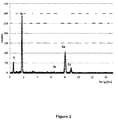
- FIG. 2 shows Energy Dispersive Spectra (EDS) of the prepared iron compound chemically anchored colloidal silica particles.
- Soluble iron test was conducted to see if there was any soluble iron left in the solution. The procedure was carried out as described below.
- the solution was centrifuged at 13,500 RPM for 1 hour. The supernatant was taken out. Full digestion of supernatant (by mixture of H 2 O 2 and sulfuric acid) was conducted by Inductively Coupled Plasma Atomic Emission Spectroscopy-(ICP-AES) to measure the iron level. The iron level was determined less than 1 ppm. Therefore, the results confirmed that near 100% iron was attached to the particles.
- the CMP slurry containing the new solid catalyst had TEOS RR at 220 ⁇ /min.
- the CMP slurry also offered high selectivity for removal of W vs TEOS.
Landscapes
- Chemical & Material Sciences (AREA)
- Organic Chemistry (AREA)
- Engineering & Computer Science (AREA)
- Materials Engineering (AREA)
- Chemical Kinetics & Catalysis (AREA)
- Composite Materials (AREA)
- Inorganic Chemistry (AREA)
- Nanotechnology (AREA)
- Mechanical Engineering (AREA)
- Metallurgy (AREA)
- General Chemical & Material Sciences (AREA)
- Physics & Mathematics (AREA)
- Condensed Matter Physics & Semiconductors (AREA)
- General Physics & Mathematics (AREA)
- Crystallography & Structural Chemistry (AREA)
- Mechanical Treatment Of Semiconductor (AREA)
- Finish Polishing, Edge Sharpening, And Grinding By Specific Grinding Devices (AREA)
- Catalysts (AREA)
Applications Claiming Priority (2)
| Application Number | Priority Date | Filing Date | Title |
|---|---|---|---|
| US201562136706P | 2015-03-23 | 2015-03-23 | |
| US15/070,590 US10160884B2 (en) | 2015-03-23 | 2016-03-15 | Metal compound chemically anchored colloidal particles and methods of production and use thereof |
Publications (2)
| Publication Number | Publication Date |
|---|---|
| EP3081614A2 true EP3081614A2 (de) | 2016-10-19 |
| EP3081614A3 EP3081614A3 (de) | 2017-01-11 |
Family
ID=56014766
Family Applications (1)
| Application Number | Title | Priority Date | Filing Date |
|---|---|---|---|
| EP16161728.7A Withdrawn EP3081614A3 (de) | 2015-03-23 | 2016-03-22 | An metallverbindung chemisch verankerte kolloidale partikel und verfahren zur herstellung und verwendung davon |
Country Status (8)
| Country | Link |
|---|---|
| US (2) | US10160884B2 (de) |
| EP (1) | EP3081614A3 (de) |
| JP (1) | JP6276315B2 (de) |
| KR (2) | KR101869528B1 (de) |
| CN (1) | CN105983441B (de) |
| IL (1) | IL244674B (de) |
| SG (1) | SG10201602254PA (de) |
| TW (1) | TWI603778B (de) |
Cited By (1)
| Publication number | Priority date | Publication date | Assignee | Title |
|---|---|---|---|---|
| WO2021023748A1 (en) * | 2019-08-08 | 2021-02-11 | Basf Se | Compositions for tungsten etching inhibition |
Families Citing this family (22)
| Publication number | Priority date | Publication date | Assignee | Title |
|---|---|---|---|---|
| KR20170044522A (ko) * | 2015-10-15 | 2017-04-25 | 삼성전자주식회사 | 화학적 기계적 연마용 슬러리 조성물, 그의 제조 방법, 그를 이용한 연마 방법 |
| JP6900165B2 (ja) | 2016-10-04 | 2021-07-07 | 矢崎総業株式会社 | 車両用表示装置 |
| KR102524807B1 (ko) * | 2016-11-04 | 2023-04-25 | 삼성전자주식회사 | 반도체 소자의 제조 방법 |
| WO2019151145A1 (ja) * | 2018-02-05 | 2019-08-08 | Jsr株式会社 | 化学機械研磨用組成物及び研磨方法 |
| US20190352535A1 (en) * | 2018-05-21 | 2019-11-21 | Versum Materials Us, Llc | Chemical Mechanical Polishing Tungsten Buffing Slurries |
| JP6784798B2 (ja) * | 2018-06-01 | 2020-11-11 | ケーシーテック カンパニー リミテッド | 研磨用スラリー組成物 |
| US20190382619A1 (en) * | 2018-06-18 | 2019-12-19 | Versum Materials Us, Llc | Tungsten Chemical Mechanical Polishing Compositions |
| SG10201904669TA (en) * | 2018-06-28 | 2020-01-30 | Kctech Co Ltd | Polishing Slurry Composition |
| US10995238B2 (en) * | 2018-07-03 | 2021-05-04 | Rohm And Haas Electronic Materials Cmp Holdings | Neutral to alkaline chemical mechanical polishing compositions and methods for tungsten |
| US11643599B2 (en) | 2018-07-20 | 2023-05-09 | Versum Materials Us, Llc | Tungsten chemical mechanical polishing for reduced oxide erosion |
| US11111435B2 (en) | 2018-07-31 | 2021-09-07 | Versum Materials Us, Llc | Tungsten chemical mechanical planarization (CMP) with low dishing and low erosion topography |
| US11198797B2 (en) * | 2019-01-24 | 2021-12-14 | Rohm And Haas Electronic Materials Cmp Holdings, Inc. | Chemical mechanical polishing compositions having stabilized abrasive particles for polishing dielectric substrates |
| KR102782857B1 (ko) | 2019-03-13 | 2025-03-14 | 삼성전자주식회사 | 연마 슬러리 및 반도체 소자의 제조 방법 |
| TW202132527A (zh) * | 2019-12-12 | 2021-09-01 | 日商Jsr股份有限公司 | 化學機械研磨用組成物及研磨方法 |
| KR20210095465A (ko) * | 2020-01-23 | 2021-08-02 | 삼성에스디아이 주식회사 | 텅스텐 패턴 웨이퍼 연마용 cmp 슬러리 조성물 및 이를 이용한 텅스텐 패턴 웨이퍼의 연마 방법 |
| KR102623640B1 (ko) * | 2020-07-22 | 2024-01-11 | 삼성에스디아이 주식회사 | 텅스텐 패턴 웨이퍼 연마용 cmp 슬러리 조성물 및 이를 이용한 텅스텐 패턴 웨이퍼의 연마 방법 |
| TWI877406B (zh) * | 2020-09-25 | 2025-03-21 | 日商福吉米股份有限公司 | 化學機械研磨漿料、化學機械研磨組合物、用於研磨表面的方法、及緩衝金屬氧化物鹽的方法 |
| CN112742606B (zh) * | 2020-12-24 | 2022-10-28 | 辽宁省地质矿产研究院有限责任公司 | 一种新型磁黄铁矿复合活化药剂及其应用 |
| CN115873507B (zh) * | 2022-12-06 | 2025-09-23 | 万华化学集团电子材料有限公司 | 一种钨化学机械抛光液及其应用 |
| CN116814169B (zh) * | 2023-06-30 | 2025-07-08 | 深圳市朗纳研磨材料有限公司 | 一种具有光催化辅助功效的抛光液及其制备方法 |
| US20260092196A1 (en) * | 2024-09-27 | 2026-04-02 | Entegris, Inc. | Cmp composition including ceria polymer composite particles |
| WO2026078797A1 (ja) * | 2024-10-08 | 2026-04-16 | 株式会社レゾナック | 砥粒、スラリ、研磨方法、及び、部品の製造方法 |
Citations (5)
| Publication number | Priority date | Publication date | Assignee | Title |
|---|---|---|---|---|
| US4478742A (en) | 1981-09-17 | 1984-10-23 | Nalco Chemical Company | Preparation of a ferric acetate coated silica sol by selective anion exchange |
| US4789648A (en) | 1985-10-28 | 1988-12-06 | International Business Machines Corporation | Method for producing coplanar multi-level metal/insulator films on a substrate and for forming patterned conductive lines simultaneously with stud vias |
| EP1104778B1 (de) * | 1999-11-22 | 2004-11-03 | JSR Corporation | Verfahren zur Herstellung eines Verbundpartikels für chemisch-mechanisches Polieren |
| US7014669B2 (en) | 2002-02-11 | 2006-03-21 | Dupont Air Products Nanomaterials Llc | Catalytic composition for chemical-mechanical polishing, method of using same, and substrate treated with same |
| US20130068995A1 (en) | 2011-09-19 | 2013-03-21 | Uwiz Technology Co., Ltd. | Silica having metal ions absorbed thereon and fabricating method thereof |
Family Cites Families (21)
| Publication number | Priority date | Publication date | Assignee | Title |
|---|---|---|---|---|
| US4478748A (en) | 1981-02-20 | 1984-10-23 | Pfizer Inc. | Bis-esters of alkanediols |
| CA2139313A1 (en) | 1992-07-28 | 1994-02-03 | Ahmet Celikkaya | Abrasive grain with metal oxide coating, method of making same and abrasive products |
| US6206756B1 (en) * | 1998-11-10 | 2001-03-27 | Micron Technology, Inc. | Tungsten chemical-mechanical polishing process using a fixed abrasive polishing pad and a tungsten layer chemical-mechanical polishing solution specifically adapted for chemical-mechanical polishing with a fixed abrasive pad |
| KR100447551B1 (ko) | 1999-01-18 | 2004-09-08 | 가부시끼가이샤 도시바 | 복합 입자 및 그의 제조 방법, 수계 분산체, 화학 기계연마용 수계 분산체 조성물 및 반도체 장치의 제조 방법 |
| JP4038912B2 (ja) * | 1999-01-18 | 2008-01-30 | Jsr株式会社 | 複合粒子を含有する研磨剤及び研磨剤用複合粒子の製造方法 |
| JP4151179B2 (ja) * | 1999-11-22 | 2008-09-17 | Jsr株式会社 | 複合粒子の製造方法及びこの方法により製造される複合粒子並びに複合粒子を含有する化学機械研磨用水系分散体 |
| KR100461885B1 (ko) * | 2000-01-25 | 2004-12-14 | 닛폰 에어로실 가부시키가이샤 | 산화물 분말과 그의 제조 방법, 및 상기 분말을 사용한 제품 |
| US7077880B2 (en) * | 2004-01-16 | 2006-07-18 | Dupont Air Products Nanomaterials Llc | Surface modified colloidal abrasives, including stable bimetallic surface coated silica sols for chemical mechanical planarization |
| JP2007095714A (ja) | 2005-09-26 | 2007-04-12 | Fujifilm Corp | 研磨方法 |
| DE102005053618A1 (de) * | 2005-11-10 | 2007-05-16 | Merck Patent Gmbh | Nanoskalige Partikel als Kontrastmittel für die Kernspintomographie |
| JP2007177137A (ja) | 2005-12-28 | 2007-07-12 | Nissan Motor Co Ltd | 金属酸化物誘導体、樹脂組成物、及び樹脂組成物の製造方法 |
| US20080105652A1 (en) | 2006-11-02 | 2008-05-08 | Cabot Microelectronics Corporation | CMP of copper/ruthenium/tantalum substrates |
| US20080149591A1 (en) | 2006-12-21 | 2008-06-26 | Junaid Ahmed Siddiqui | Method and slurry for reducing corrosion on tungsten during chemical mechanical polishing |
| CN101600738B (zh) | 2007-02-02 | 2012-11-14 | 日产化学工业株式会社 | 反应性单体分散硅溶胶、其制备方法、固化用组合物及其固化体 |
| US9028572B2 (en) | 2007-09-21 | 2015-05-12 | Cabot Microelectronics Corporation | Polishing composition and method utilizing abrasive particles treated with an aminosilane |
| JP2009209025A (ja) | 2008-03-06 | 2009-09-17 | Oji Paper Co Ltd | 複合微粒子とその製造方法及びそれを用いたインクジェット記録体 |
| FR2951091B1 (fr) | 2009-10-08 | 2011-11-25 | Commissariat Energie Atomique | Formation de particules metalliques sur un support solide a base d'oxyde et muni de deux fonctions chimiques distinctes greffees |
| US8858819B2 (en) | 2010-02-15 | 2014-10-14 | Air Products And Chemicals, Inc. | Method for chemical mechanical planarization of a tungsten-containing substrate |
| KR101243331B1 (ko) | 2010-12-17 | 2013-03-13 | 솔브레인 주식회사 | 화학 기계적 연마 슬러리 조성물 및 이를 이용하는 반도체 소자의 제조 방법 |
| CN102516876B (zh) | 2011-11-22 | 2014-06-04 | 清华大学 | 一种用于硅晶片抛光的抛光组合物及其制备方法 |
| US20140315386A1 (en) * | 2013-04-19 | 2014-10-23 | Air Products And Chemicals, Inc. | Metal Compound Coated Colloidal Particles Process for Making and Use Therefor |
-
2016
- 2016-03-15 US US15/070,590 patent/US10160884B2/en active Active
- 2016-03-20 IL IL244674A patent/IL244674B/en unknown
- 2016-03-22 SG SG10201602254PA patent/SG10201602254PA/en unknown
- 2016-03-22 EP EP16161728.7A patent/EP3081614A3/de not_active Withdrawn
- 2016-03-22 TW TW105108882A patent/TWI603778B/zh active
- 2016-03-23 KR KR1020160034494A patent/KR101869528B1/ko not_active Expired - Fee Related
- 2016-03-23 JP JP2016058913A patent/JP6276315B2/ja not_active Expired - Fee Related
- 2016-03-23 CN CN201610170305.6A patent/CN105983441B/zh not_active Expired - Fee Related
-
2018
- 2018-03-26 KR KR1020180034676A patent/KR102330206B1/ko active Active
- 2018-11-13 US US16/188,523 patent/US11104825B2/en not_active Expired - Fee Related
Patent Citations (7)
| Publication number | Priority date | Publication date | Assignee | Title |
|---|---|---|---|---|
| US4478742A (en) | 1981-09-17 | 1984-10-23 | Nalco Chemical Company | Preparation of a ferric acetate coated silica sol by selective anion exchange |
| US4789648A (en) | 1985-10-28 | 1988-12-06 | International Business Machines Corporation | Method for producing coplanar multi-level metal/insulator films on a substrate and for forming patterned conductive lines simultaneously with stud vias |
| EP1104778B1 (de) * | 1999-11-22 | 2004-11-03 | JSR Corporation | Verfahren zur Herstellung eines Verbundpartikels für chemisch-mechanisches Polieren |
| US7014669B2 (en) | 2002-02-11 | 2006-03-21 | Dupont Air Products Nanomaterials Llc | Catalytic composition for chemical-mechanical polishing, method of using same, and substrate treated with same |
| US7029508B2 (en) | 2002-02-11 | 2006-04-18 | Dupont Air Products Nanomaterials L.L.C. | Catalyst attached to solid and used to promote free radical formation in CMP formulations |
| US7427305B2 (en) | 2002-02-11 | 2008-09-23 | Dupont Air Products Nanomaterials Llc | Free radical-forming activator attached to solid and used to enhance CMP formulations |
| US20130068995A1 (en) | 2011-09-19 | 2013-03-21 | Uwiz Technology Co., Ltd. | Silica having metal ions absorbed thereon and fabricating method thereof |
Non-Patent Citations (4)
| Title |
|---|
| INGMAR BAUER; HANS-JOACHIM KNOLKER, CHEMICAL REVIEWS, vol. 115, 2015, pages 3170 - 3387 |
| J. COLLOID & INTER. SCI, vol. 282, 2005, pages 11 - 19 |
| KARI PIRKAANNIEMI; MIKA SILLANPAA, CHEMOSPHERE, vol. 48, 2002, pages 1047 - 1060 |
| YOUNG-JAE KANG ET AL., J. COLLOID & INTER. SCI., vol. 349, 2010, pages 402 - 407 |
Cited By (2)
| Publication number | Priority date | Publication date | Assignee | Title |
|---|---|---|---|---|
| WO2021023748A1 (en) * | 2019-08-08 | 2021-02-11 | Basf Se | Compositions for tungsten etching inhibition |
| US12378439B2 (en) | 2019-08-08 | 2025-08-05 | Basf Se | Compositions for tungsten etching inhibition |
Also Published As
| Publication number | Publication date |
|---|---|
| KR20180036932A (ko) | 2018-04-10 |
| US20160280962A1 (en) | 2016-09-29 |
| CN105983441B (zh) | 2019-12-06 |
| KR101869528B1 (ko) | 2018-06-22 |
| US20190100678A1 (en) | 2019-04-04 |
| JP6276315B2 (ja) | 2018-02-07 |
| KR102330206B1 (ko) | 2021-11-22 |
| JP2016196632A (ja) | 2016-11-24 |
| TW201637712A (zh) | 2016-11-01 |
| CN105983441A (zh) | 2016-10-05 |
| US10160884B2 (en) | 2018-12-25 |
| US11104825B2 (en) | 2021-08-31 |
| SG10201602254PA (en) | 2016-10-28 |
| KR20160113995A (ko) | 2016-10-04 |
| TWI603778B (zh) | 2017-11-01 |
| IL244674A0 (en) | 2016-07-31 |
| EP3081614A3 (de) | 2017-01-11 |
| IL244674B (en) | 2021-09-30 |
Similar Documents
| Publication | Publication Date | Title |
|---|---|---|
| US11104825B2 (en) | Metal compound chemically anchored colloidal particles and methods of production and use thereof | |
| JP4081064B2 (ja) | アスパラギン酸/トリルトリアゾールを用いる化学的機械的平坦化のための調整可能な組成物および方法 | |
| EP0971993B1 (de) | Planarisierungszusammensetzung zur entfernung von metallschichten | |
| EP2357059B1 (de) | Verfahren zur chemisch-mechanischen Planarisierung eines wolframhaltigen Substrats | |
| KR102312220B1 (ko) | 텅스텐 화학적 기계적 연마 조성물 | |
| EP2803704A2 (de) | Metallverbindungsbeschichtete kolloidale Teilchen sowie Prozess zur Herstellung und Verwendung dafür | |
| US20050194563A1 (en) | Bicine/tricine containing composition and method for chemical-mechanical planarization | |
| JP2002517593A (ja) | 金属cmpにおける研磨用組成物および研磨方法 | |
| JP6905002B2 (ja) | 化学機械研磨用タングステンバフ研磨スラリー | |
| US10214663B2 (en) | Chemical-mechanical polishing composition comprising organic/inorganic composite particles | |
| TW201120165A (en) | Method and composition for chemical mechanical planarization of a metal-containing substrate | |
| TW201723139A (zh) | 一種化學機械拋光液及其應用 | |
| WO2009071351A1 (en) | A method for chemically-mechanically polishing patterned surfaces composed of metallic and nonmetallic patterned regions | |
| US11066575B2 (en) | Chemical mechanical planarization for tungsten-containing substrates | |
| JP5813921B2 (ja) | 化学機械研磨用水系分散体および化学機械研磨方法 | |
| JP2009065001A (ja) | 化学機械研磨用水系分散体、該分散体を調製するためのキット、および化学機械研磨用水系分散体の調製方法 |
Legal Events
| Date | Code | Title | Description |
|---|---|---|---|
| PUAI | Public reference made under article 153(3) epc to a published international application that has entered the european phase |
Free format text: ORIGINAL CODE: 0009012 |
|
| AK | Designated contracting states |
Kind code of ref document: A2 Designated state(s): AL AT BE BG CH CY CZ DE DK EE ES FI FR GB GR HR HU IE IS IT LI LT LU LV MC MK MT NL NO PL PT RO RS SE SI SK SM TR |
|
| AX | Request for extension of the european patent |
Extension state: BA ME |
|
| PUAL | Search report despatched |
Free format text: ORIGINAL CODE: 0009013 |
|
| AK | Designated contracting states |
Kind code of ref document: A3 Designated state(s): AL AT BE BG CH CY CZ DE DK EE ES FI FR GB GR HR HU IE IS IT LI LT LU LV MC MK MT NL NO PL PT RO RS SE SI SK SM TR |
|
| AX | Request for extension of the european patent |
Extension state: BA ME |
|
| RIC1 | Information provided on ipc code assigned before grant |
Ipc: C09K 3/14 20060101AFI20161206BHEP Ipc: H01L 21/321 20060101ALI20161206BHEP |
|
| STAA | Information on the status of an ep patent application or granted ep patent |
Free format text: STATUS: REQUEST FOR EXAMINATION WAS MADE |
|
| 17P | Request for examination filed |
Effective date: 20170711 |
|
| RBV | Designated contracting states (corrected) |
Designated state(s): AL AT BE BG CH CY CZ DE DK EE ES FI FR GB GR HR HU IE IS IT LI LT LU LV MC MK MT NL NO PL PT RO RS SE SI SK SM TR |
|
| RAP1 | Party data changed (applicant data changed or rights of an application transferred) |
Owner name: VERSUM MATERIALS US, LLC |
|
| STAA | Information on the status of an ep patent application or granted ep patent |
Free format text: STATUS: EXAMINATION IS IN PROGRESS |
|
| 17Q | First examination report despatched |
Effective date: 20180406 |
|
| P01 | Opt-out of the competence of the unified patent court (upc) registered |
Effective date: 20230602 |
|
| STAA | Information on the status of an ep patent application or granted ep patent |
Free format text: STATUS: THE APPLICATION IS DEEMED TO BE WITHDRAWN |
|
| 18D | Application deemed to be withdrawn |
Effective date: 20251001 |