EP3081616B1 - Auf zirconium basierende weisslichtemittierende mofs - Google Patents
Auf zirconium basierende weisslichtemittierende mofs Download PDFInfo
- Publication number
- EP3081616B1 EP3081616B1 EP15382188.9A EP15382188A EP3081616B1 EP 3081616 B1 EP3081616 B1 EP 3081616B1 EP 15382188 A EP15382188 A EP 15382188A EP 3081616 B1 EP3081616 B1 EP 3081616B1
- Authority
- EP
- European Patent Office
- Prior art keywords
- group
- alkyl
- hydrogen
- alkenyl
- alkynyl
- Prior art date
- Legal status (The legal status is an assumption and is not a legal conclusion. Google has not performed a legal analysis and makes no representation as to the accuracy of the status listed.)
- Not-in-force
Links
- 0 *c(cc1)cc(*)c1C1=C2C=CC(*=*)=CC2P(*)c2cc(*N=O)ccc12 Chemical compound *c(cc1)cc(*)c1C1=C2C=CC(*=*)=CC2P(*)c2cc(*N=O)ccc12 0.000 description 2
Classifications
-
- A—HUMAN NECESSITIES
- A61—MEDICAL OR VETERINARY SCIENCE; HYGIENE
- A61K—PREPARATIONS FOR MEDICAL, DENTAL OR TOILETRY PURPOSES
- A61K49/00—Preparations for testing in vivo
- A61K49/001—Preparation for luminescence or biological staining
- A61K49/0013—Luminescence
- A61K49/0017—Fluorescence in vivo
- A61K49/0019—Fluorescence in vivo characterised by the fluorescent group, e.g. oligomeric, polymeric or dendritic molecules
- A61K49/0021—Fluorescence in vivo characterised by the fluorescent group, e.g. oligomeric, polymeric or dendritic molecules the fluorescent group being a small organic molecule
-
- C—CHEMISTRY; METALLURGY
- C09—DYES; PAINTS; POLISHES; NATURAL RESINS; ADHESIVES; COMPOSITIONS NOT OTHERWISE PROVIDED FOR; APPLICATIONS OF MATERIALS NOT OTHERWISE PROVIDED FOR
- C09K—MATERIALS FOR MISCELLANEOUS APPLICATIONS, NOT PROVIDED FOR ELSEWHERE
- C09K11/00—Luminescent materials, e.g. electroluminescent or chemiluminescent
- C09K11/06—Luminescent materials, e.g. electroluminescent or chemiluminescent containing organic luminescent materials
-
- H—ELECTRICITY
- H10—SEMICONDUCTOR DEVICES; ELECTRIC SOLID-STATE DEVICES NOT OTHERWISE PROVIDED FOR
- H10K—ORGANIC ELECTRIC SOLID-STATE DEVICES
- H10K30/00—Organic devices sensitive to infrared radiation, light, electromagnetic radiation of shorter wavelength or corpuscular radiation
- H10K30/451—Organic devices sensitive to infrared radiation, light, electromagnetic radiation of shorter wavelength or corpuscular radiation comprising a metal-semiconductor-metal [m-s-m] structure
-
- H—ELECTRICITY
- H10—SEMICONDUCTOR DEVICES; ELECTRIC SOLID-STATE DEVICES NOT OTHERWISE PROVIDED FOR
- H10K—ORGANIC ELECTRIC SOLID-STATE DEVICES
- H10K50/00—Organic light-emitting devices
- H10K50/10—OLEDs or polymer light-emitting diodes [PLED]
- H10K50/11—OLEDs or polymer light-emitting diodes [PLED] characterised by the electroluminescent [EL] layers
-
- H—ELECTRICITY
- H10—SEMICONDUCTOR DEVICES; ELECTRIC SOLID-STATE DEVICES NOT OTHERWISE PROVIDED FOR
- H10K—ORGANIC ELECTRIC SOLID-STATE DEVICES
- H10K85/00—Organic materials used in the body or electrodes of devices covered by this subclass
- H10K85/30—Coordination compounds
-
- H—ELECTRICITY
- H10—SEMICONDUCTOR DEVICES; ELECTRIC SOLID-STATE DEVICES NOT OTHERWISE PROVIDED FOR
- H10K—ORGANIC ELECTRIC SOLID-STATE DEVICES
- H10K85/00—Organic materials used in the body or electrodes of devices covered by this subclass
- H10K85/30—Coordination compounds
- H10K85/341—Transition metal complexes, e.g. Ru(II)polypyridine complexes
-
- H—ELECTRICITY
- H10—SEMICONDUCTOR DEVICES; ELECTRIC SOLID-STATE DEVICES NOT OTHERWISE PROVIDED FOR
- H10K—ORGANIC ELECTRIC SOLID-STATE DEVICES
- H10K85/00—Organic materials used in the body or electrodes of devices covered by this subclass
- H10K85/60—Organic compounds having low molecular weight
- H10K85/615—Polycyclic condensed aromatic hydrocarbons, e.g. anthracene
- H10K85/622—Polycyclic condensed aromatic hydrocarbons, e.g. anthracene containing four rings, e.g. pyrene
-
- C—CHEMISTRY; METALLURGY
- C09—DYES; PAINTS; POLISHES; NATURAL RESINS; ADHESIVES; COMPOSITIONS NOT OTHERWISE PROVIDED FOR; APPLICATIONS OF MATERIALS NOT OTHERWISE PROVIDED FOR
- C09K—MATERIALS FOR MISCELLANEOUS APPLICATIONS, NOT PROVIDED FOR ELSEWHERE
- C09K2211/00—Chemical nature of organic luminescent or tenebrescent compounds
- C09K2211/10—Non-macromolecular compounds
- C09K2211/1003—Carbocyclic compounds
- C09K2211/1007—Non-condensed systems
-
- C—CHEMISTRY; METALLURGY
- C09—DYES; PAINTS; POLISHES; NATURAL RESINS; ADHESIVES; COMPOSITIONS NOT OTHERWISE PROVIDED FOR; APPLICATIONS OF MATERIALS NOT OTHERWISE PROVIDED FOR
- C09K—MATERIALS FOR MISCELLANEOUS APPLICATIONS, NOT PROVIDED FOR ELSEWHERE
- C09K2211/00—Chemical nature of organic luminescent or tenebrescent compounds
- C09K2211/10—Non-macromolecular compounds
- C09K2211/1018—Heterocyclic compounds
- C09K2211/1025—Heterocyclic compounds characterised by ligands
- C09K2211/1029—Heterocyclic compounds characterised by ligands containing one nitrogen atom as the heteroatom
-
- C—CHEMISTRY; METALLURGY
- C09—DYES; PAINTS; POLISHES; NATURAL RESINS; ADHESIVES; COMPOSITIONS NOT OTHERWISE PROVIDED FOR; APPLICATIONS OF MATERIALS NOT OTHERWISE PROVIDED FOR
- C09K—MATERIALS FOR MISCELLANEOUS APPLICATIONS, NOT PROVIDED FOR ELSEWHERE
- C09K2211/00—Chemical nature of organic luminescent or tenebrescent compounds
- C09K2211/10—Non-macromolecular compounds
- C09K2211/1018—Heterocyclic compounds
- C09K2211/1025—Heterocyclic compounds characterised by ligands
- C09K2211/1029—Heterocyclic compounds characterised by ligands containing one nitrogen atom as the heteroatom
- C09K2211/1033—Heterocyclic compounds characterised by ligands containing one nitrogen atom as the heteroatom with oxygen
-
- C—CHEMISTRY; METALLURGY
- C09—DYES; PAINTS; POLISHES; NATURAL RESINS; ADHESIVES; COMPOSITIONS NOT OTHERWISE PROVIDED FOR; APPLICATIONS OF MATERIALS NOT OTHERWISE PROVIDED FOR
- C09K—MATERIALS FOR MISCELLANEOUS APPLICATIONS, NOT PROVIDED FOR ELSEWHERE
- C09K2211/00—Chemical nature of organic luminescent or tenebrescent compounds
- C09K2211/10—Non-macromolecular compounds
- C09K2211/1018—Heterocyclic compounds
- C09K2211/1025—Heterocyclic compounds characterised by ligands
- C09K2211/1029—Heterocyclic compounds characterised by ligands containing one nitrogen atom as the heteroatom
- C09K2211/1037—Heterocyclic compounds characterised by ligands containing one nitrogen atom as the heteroatom with sulfur
-
- C—CHEMISTRY; METALLURGY
- C09—DYES; PAINTS; POLISHES; NATURAL RESINS; ADHESIVES; COMPOSITIONS NOT OTHERWISE PROVIDED FOR; APPLICATIONS OF MATERIALS NOT OTHERWISE PROVIDED FOR
- C09K—MATERIALS FOR MISCELLANEOUS APPLICATIONS, NOT PROVIDED FOR ELSEWHERE
- C09K2211/00—Chemical nature of organic luminescent or tenebrescent compounds
- C09K2211/10—Non-macromolecular compounds
- C09K2211/1018—Heterocyclic compounds
- C09K2211/1025—Heterocyclic compounds characterised by ligands
- C09K2211/1088—Heterocyclic compounds characterised by ligands containing oxygen as the only heteroatom
-
- C—CHEMISTRY; METALLURGY
- C09—DYES; PAINTS; POLISHES; NATURAL RESINS; ADHESIVES; COMPOSITIONS NOT OTHERWISE PROVIDED FOR; APPLICATIONS OF MATERIALS NOT OTHERWISE PROVIDED FOR
- C09K—MATERIALS FOR MISCELLANEOUS APPLICATIONS, NOT PROVIDED FOR ELSEWHERE
- C09K2211/00—Chemical nature of organic luminescent or tenebrescent compounds
- C09K2211/18—Metal complexes
- C09K2211/183—Metal complexes of the refractory metals, i.e. Ti, V, Cr, Zr, Nb, Mo, Hf, Ta or W
-
- C—CHEMISTRY; METALLURGY
- C09—DYES; PAINTS; POLISHES; NATURAL RESINS; ADHESIVES; COMPOSITIONS NOT OTHERWISE PROVIDED FOR; APPLICATIONS OF MATERIALS NOT OTHERWISE PROVIDED FOR
- C09K—MATERIALS FOR MISCELLANEOUS APPLICATIONS, NOT PROVIDED FOR ELSEWHERE
- C09K2211/00—Chemical nature of organic luminescent or tenebrescent compounds
- C09K2211/18—Metal complexes
- C09K2211/188—Metal complexes of other metals not provided for in one of the previous groups
-
- H—ELECTRICITY
- H10—SEMICONDUCTOR DEVICES; ELECTRIC SOLID-STATE DEVICES NOT OTHERWISE PROVIDED FOR
- H10K—ORGANIC ELECTRIC SOLID-STATE DEVICES
- H10K2101/00—Properties of the organic materials covered by group H10K85/00
- H10K2101/10—Triplet emission
-
- H—ELECTRICITY
- H10—SEMICONDUCTOR DEVICES; ELECTRIC SOLID-STATE DEVICES NOT OTHERWISE PROVIDED FOR
- H10K—ORGANIC ELECTRIC SOLID-STATE DEVICES
- H10K50/00—Organic light-emitting devices
- H10K50/10—OLEDs or polymer light-emitting diodes [PLED]
- H10K50/11—OLEDs or polymer light-emitting diodes [PLED] characterised by the electroluminescent [EL] layers
- H10K50/12—OLEDs or polymer light-emitting diodes [PLED] characterised by the electroluminescent [EL] layers comprising dopants
- H10K50/121—OLEDs or polymer light-emitting diodes [PLED] characterised by the electroluminescent [EL] layers comprising dopants for assisting energy transfer, e.g. sensitization
-
- Y—GENERAL TAGGING OF NEW TECHNOLOGICAL DEVELOPMENTS; GENERAL TAGGING OF CROSS-SECTIONAL TECHNOLOGIES SPANNING OVER SEVERAL SECTIONS OF THE IPC; TECHNICAL SUBJECTS COVERED BY FORMER USPC CROSS-REFERENCE ART COLLECTIONS [XRACs] AND DIGESTS
- Y02—TECHNOLOGIES OR APPLICATIONS FOR MITIGATION OR ADAPTATION AGAINST CLIMATE CHANGE
- Y02B—CLIMATE CHANGE MITIGATION TECHNOLOGIES RELATED TO BUILDINGS, e.g. HOUSING, HOUSE APPLIANCES OR RELATED END-USER APPLICATIONS
- Y02B20/00—Energy efficient lighting technologies, e.g. halogen lamps or gas discharge lamps
-
- Y—GENERAL TAGGING OF NEW TECHNOLOGICAL DEVELOPMENTS; GENERAL TAGGING OF CROSS-SECTIONAL TECHNOLOGIES SPANNING OVER SEVERAL SECTIONS OF THE IPC; TECHNICAL SUBJECTS COVERED BY FORMER USPC CROSS-REFERENCE ART COLLECTIONS [XRACs] AND DIGESTS
- Y02—TECHNOLOGIES OR APPLICATIONS FOR MITIGATION OR ADAPTATION AGAINST CLIMATE CHANGE
- Y02E—REDUCTION OF GREENHOUSE GAS [GHG] EMISSIONS, RELATED TO ENERGY GENERATION, TRANSMISSION OR DISTRIBUTION
- Y02E10/00—Energy generation through renewable energy sources
- Y02E10/50—Photovoltaic [PV] energy
- Y02E10/549—Organic PV cells
-
- Y—GENERAL TAGGING OF NEW TECHNOLOGICAL DEVELOPMENTS; GENERAL TAGGING OF CROSS-SECTIONAL TECHNOLOGIES SPANNING OVER SEVERAL SECTIONS OF THE IPC; TECHNICAL SUBJECTS COVERED BY FORMER USPC CROSS-REFERENCE ART COLLECTIONS [XRACs] AND DIGESTS
- Y02—TECHNOLOGIES OR APPLICATIONS FOR MITIGATION OR ADAPTATION AGAINST CLIMATE CHANGE
- Y02P—CLIMATE CHANGE MITIGATION TECHNOLOGIES IN THE PRODUCTION OR PROCESSING OF GOODS
- Y02P70/00—Climate change mitigation technologies in the production process for final industrial or consumer products
- Y02P70/50—Manufacturing or production processes characterised by the final manufactured product
Definitions
- the present invention relates to composite materials emitting white light based on metal-organic frameworks (MOF) of Zr, to a method for their preparation and to applications thereof, such as in sensors or imaging.
- MOF metal-organic frameworks
- MOFs metal-organic frameworks
- MOFs have attracted considerable attention owing to their excellent structural properties, such as high specific surface areas, large pore volumes as well as their free and accessible cavities ( Zhou, H. C.; Long, J. R.; Yaghi, O. M., Introduction to metal-organic frameworks. Chem. Rev. (washington, DC, U. S.) 2012, 112 (2), 673-674 ). These properties make them promising materials for a wide range of applications, for example, as chemical sensors and optoelectronic devices. Thus, for the past two decades different MOFs containing specific ligands/metals and having different pore sizes and internal cavities have been developed ( Cook, T. R.; Zheng, Y.-R.; Stang, P.
- MOFs can be used as the luminescent layer for light emitting diode (LED) devices.
- LED light emitting diode
- the main advantage of using MOF complexes in the White-LED manufacturing is the need of only one composite material instead of three phosphorescent (blue, green and red) currently needed ( Kim, B. S.; Lee, J. Y., Interlayer free hybrid white organic light-emitting diodes with red/blue phosphorescent emitters and a green thermally activated delayed fluorescent emitter.
- Organic Electronics 2015, 21 (0), 100-105 are examples of the luminescent layer for light emitting diode (LED) devices.
- MOF molecules which can encapsulate fluorescent molecules such as rhodamine perchlorate or fluorescein.
- the emission spectra of the complexes of MOF MIL-101-NH2 with rhodamine 116, fluorescein, PSO3 or APNAF are studied, but none of them is capable of providing white light. Neither it is suggested that such light can be obtained.
- Xiu-Lian Lv et al Journal of solid state chemistry, 2015, 223, 104-108 discloses MOFs used in purification processes. No suggestion is given in relation to the possibility of obtaining MOFs which can provide white light emissions.
- Jiao He et al, Chem. Commun. 2014, 50(53), 7063-7066 discloses UiO-66@rhodamine B complexes having photocatalytic properties, but nothing is suggested about white light emission.
- MOFs can act as a host for luminescent dyes opening the possibility to tune the photoluminescent properties of both.
- the encapsulation of an Ir-complex into the porous matrix of a Cd-based MOF supplies a white light emissive material ( Sun, C. Y.; Wang, X. L.; Zhang, X.; Qin, C.; Li, P.; Su, Z. M.; Zhu, D. X.; Shan, G. G.; Shao, K. Z.; Wu, H.; Li, J., Efficient and tunable white-light emission of metal-organic frameworks by iridium-complex encapsulation. Nature Communications 2013, 4 ).
- CN 103 740 361 discloses a In-based MOF in which pyridine hemicyanine and acridine dyes are incorporated into the related MOF porous structure, providing a white light emissive material. Methods for the synthesis of such materials can be long and complex.
- MOF's ability to sense small molecules volatile organic compound (VOCS) and explosives (TNT) has been proven.
- Zr-based MOF have been used to sense the presence of small molecules ( Zhang, W.; Huang, H.; Liu, D.; Yang, Q.; Xiao, Y.; Ma, Q.; Zhong, C., A new metal-organic framework with high stability based on zirconium for sensing small molecules.
- MOF-based materials are needed which further improve those currently known and provide less complex manufacturing methods.
- the invention relates to a Zr-based metal-organic framework (MOF) in whose porous structure dyes, preferably organic laser dyes, are trapped.
- the composite materials of the invention display a high quality white light emission.
- the invention provides a white light emitting device comprising a composite material emitting white light comprising a MOF comprising a plurality of organic polydentate bridging ligands and a plurality of zirconium cations, characterized in that said composite material comprises at least one guest dye capable of absorbing energy in a wavelength range emitted by the MOF when said MOF is excited, said at least one guest dye comprising a chromophore selected from the group consisting of a naphthoxazinium group, an aromatic cyclobutadione group, a 1-benzopyran-2-one group, xanthenylidene-dialkylammonium group, a porphyrin group, a 4-dimethylaminostyryl group or boron-dipyrromethene group (also known as BODIPYs) and mixtures thereof.
- a chromophore selected from the group consisting of a naphthoxazinium group, an aromatic cyclobut
- the composite materials of the invention are easy to make and provide the composite material in good yield and short time, and high adsorption rate of the guest dyes (or dyes). It is thus a second aspect of the invention to provide a method for preparing the composite material, comprising contacting said MOF comprising a plurality of organic polydentate bridging ligands and zirconium, with at least one guest dye as defined in the first aspect.
- the composite materials of the invention provide high quality white light and can thus be used for manufacturing a white light emitting device, which is a third aspect of the invention.
- a fourth and fifth aspects of the invention are the use of the white light emitting device comprising the composite material for manufacturing a sensor, and such sensor, respectively
- Alkyl is given its usual meaning according to the IUPAC Gold Book and refers to a straight or branched univalent groups derived from alkanes by removal of a hydrogen atom from any carbon atom having the formula -C n H 2n+1 .
- exemplary alkyl groups can be methyl, ethyl, n-propyl, i-propyl, n-butyl, t-butyl, n-pentyl, etc.
- the alkyl group can be optionally perfluorated.
- alkenyl refers to a straight or branched hydrocarbon chain radical consisting of carbon and hydrogen atoms, containing at least one unsaturation (e.g. one, two, three or more), and which is attached to the rest of the molecule by a single bond.
- alkenyl groups are vinyl, neoprenyl, 2-propenyl, 1,3-butadiene or isopropenyl.
- Alkynyl refers to a straight or branched hydrocarbon chain radical consisting of carbon and hydrogen atoms, containing at least one triple bond (e.g. one, two, three or more), and which is attached to the rest of the molecule by a single bond.
- exemplary alkenyl groups are acyl or 2-propynyl.
- Aryl group refers to an aromatic hydrocarbon radical such as phenyl or naphthyl.
- Heteroaryl group refers to a stable 3- to 15- membered ring, wherein at least one of said rings is aromatic, which consists of carbon atoms and from one to five heteroatoms selected from the group consisting of nitrogen, oxygen, and sulphur, preferably a 4-to 8-membered ring with one or more heteroatoms, more preferably a 5-or 6-membered ring with one or more heteroatoms.
- the heterocycle may be a monocyclic, bicyclic or tricyclic ring system, which may include fused ring systems; and the nitrogen, carbon or sulfur atoms may be optionally oxidised; the nitrogen atom may be optionally quaternized; and the rings may be partially or fully saturated or aromatic.
- heterocycles include, but are not limited to, azepines, benzimidazole, benzothiazole, furan, isothiazole, imidazole, indole, piperidine, piperazine, purine, quinoline, thiadiazole, tetrahydrofuran, furan or 2-Benzothiazolyl.
- Alkylaryl or "arylakyl” group refers to an aryl group linked to an alkyl group, the alkylaryl group being attach to the rest of the molecule through either of the alkyl or the aryl moiety. Examples are benzyl or phenethyl. Also groups alternating different alkyl and aryl moieties, including cycloalkyl groups, such as 3-[3-[4-(4-Bromophenyl)phenyl]-1,2,3,4-tetrahydronaphthalen-1-yl]- or 3-[3-[4-(4-Bromophenyl)phenyl]-3-hydroxy-1-phenylpropyl]-.
- Alkoxy refers to a radical of the formula -ORa where Ra is an alkyl, alkenyl, alkynyl, aryl or arylalkyl having one to twelve carbon atoms, e. g., methoxy, ethoxy, propoxy, benzyloxy etc.
- Halogen takes its usual meaning and refers to any of the atoms of group 17 selected form -F, -Cl, -Br and -I.
- Heterocyclyl refers to a heteroaryl group having no aromatic rings.
- Cycloalkyl is given its usual meaning according to the IUPAC Gold Book and refers to a univalent group derived from cycloalkanes by removal of a hydrogen atom from a ring carbon atom.
- Examples of cycloalkyl groups are cyclopropyl, cyclopentyl or cyclo hexyl.
- the size of the above groups is indicated by the minimum and maximum number of carbons comprised in each is case. This is indicated in the usual way by noting the group has C n -C m carbon atoms, wherein n is the minimum number of carbon atoms, and m is the maximum number of carbon atoms.
- the composite materials of the invention comprises thus two main parts, the MOF structure which comprises a plurality of organic polydentate bridging ligands and a plurality of zirconium cations, and the guest dyes (or dyes).
- MOFs are porous materials built from metal ions with a defined coordination geometry, in the present invention a zirconium cations, and organic polydentate bridging ligands.
- the coordination between the metal ion and the ligands extend in one, two or three dimensions creating a network whose properties can be tuned.
- Many publications provide general descriptions of MOF materials. Examples are Zhou, H. C.; Long, J. R.; Yaghi, O. M., Introduction to metal-organic frameworks. Chem. Rev. (Washington, DC, U.S.) 2012, 112 (2), 673-674 ); Cook, T. R.; Zheng, Y.-R.; Stang, P.
- any Zr-based MOF is suitable, and the skilled person can choose a wide array of organic polydentate bridging ligands.
- Those preferred in the present invention allow in combination with the Zirconium cations the formation of a three dimensional network or two dimensional which can host dyes (e.g. nanotubes).
- Examples of organic polydentate bridging ligand families are according to an embodiment of the invention bidentate carboxylic acids, tridentate carboxylic acids or azoles.
- Bidentate carboxylic acids can be divided in non-aromatic and aromatic, of which ethanedioic acid, propanedioic acid, butanedioic acid or pentanedioic acid are examples of the former, and benzene-1,2-dicarboxylic acid- o -phthalic acid, benzene-1,3-dicarboxylic acid- m -phthalic acid, benzene-1,4-dicarboxylic acid- p -phthalic acid, 2,6-naphthalene dicarboxylic acid, 1,4-benzene dicarboxylic acid, biphenyl-4,4-dicarboxylic acid or 1-amine-2,6-naphthalene dicarboxylic acid are examples of the latter.
- Tridentate carboxylic acids can also be divided in non-aromatic (e.g. 2-Hydroxy-1,2,3-propanetricarboxylic acid) and aromatic (e.g. benzene-1,3,5-tricarboxylic acid). All the above make embodiments of the present invention.
- non-aromatic e.g. 2-Hydroxy-1,2,3-propanetricarboxylic acid
- aromatic e.g. benzene-1,3,5-tricarboxylic acid
- the organic polydentate bridging ligands are a dicarboxylic aromatic compounds, preferably one selected from the group consisting of 2,6-naphthalene dicarboxylic acid, 1,4-benzene dicarboxylic acid, Biphenyl-4,4-dicarboxylic acid, 1-amine-2,6-naphthalene dicarboxylic acid, and mixtures thereof, more preferably one comprising a napthane in its structure.
- at least one of said plurality of organic polydentate bridging ligands is 2,6-naphthalene dicarboxylic acid (NDC).
- the composite material of the invention adsorbs in the pores of the MOF at least one guest dye capable of absorbing energy of the same or similar wavelength as emitted by the MOF when said MOF is excited and of emitting light in a wavelength which, in combination with the light emitted by the MOF and the other guest dyes, creates white light.
- the inventors have discovered that Zr-based MOFs provide an appropriate template for hosting dyes, and the election of guest dyes emitting in the appropriate wavelength provides in combination with the MOF an excellent white light.
- Zr-NDC emits when excited with a UV-visible source around 335 nm, i.e. in the blue zone of the visible spectrum.
- the election of a guest dye which can absorb the energy emitted by the MOF upon excitation at 335 nm and emit at a wavelength in the red zone of the spectrum (e.g. 600nm-800nm) and the green zone (e.g. 460-600 nm) can create with a single material white light.
- Such emissions can come from a single dye or from different dyes.
- Dyes are marketed with information about their excitation and emission wavelengths, which is displayed in internet or provided as brochures. See for example, http:// docs.abcam.com/ pdf/immunology /fluorochromes table updated.pdf .
- the skilled person can choose the dye having the appropriate absorption and emission wavelengths which in combination with the Zr-MOF will provide white light.
- the composite material of the invention emits excellent quality white light.
- the energy absorption by the dye from the MOF takes place in at least one single step from the MOF to one of the dyes, takes place in cascade from the MOF to a first dye and from said first dye to a second dye, or wherein said energy absorption takes place in a combination of at least one single steps and at least one cascade.
- the MOF emits in a wavelength comprised between 350 and 550 nm.
- the composite material comprising two or more guest dyes wherein at least one of the guest dyes absorbs energy in a wavelength comprised between 350 and 550 nm and emits in a wavelength comprised between 460 and 650 nm, or two or more guest dyes wherein at least one of the guest dyes absorbs energy in a wavelength comprised between 350 and 550 nm and emits in a wavelength comprised between 600 and 800 nm.
- the composite material comprises two or more guest dyes wherein at least one of the guest dyes absorbs energy in a wavelength comprised between 350 and 550 nm and emits in a wavelength comprised between 600 and 800 nm and wherein at least one of the guest dyes absorbs energy in a wavelength comprised between 350 and 550 nm and emits in a wavelength comprised between 460 and 600 nm.
- At least one guest dye comprises a chromophore of formula (I), (II), (III), (IV) or (V) salts or stereoisomers thereof wherein
- the chromophore of formula (I), (II), (III), (IV) or (V) can be attached to the rest of the molecule through any free site
- the at least one guest dye is a compound of formula (VI), stereoisomers or salts thereof wherein
- the at least one guest dye is a compound of formula (VII), stereoisomers or salts thereof wherein
- the at least one guest dye is a compound of formula (VIII), stereoisomers or salts thereof wherein
- the at least one guest dye is a compound of formula (IX), stereoisomers or salts thereof
- each R26, R27, R28, R29, R30 are independently selected from the group consisting of hydrogen, C 1 -C 6 -alkyl, optionally substituted with a carbonyl, carboxy or carboxyester, C 2 -C 6 -alkenyl, C 2 -C 6 -alkynyl, C 6 -C 30 -aryl, C 7 -C 30 -arylalkyl and C 5 -C 12 -heteroaryl group.
- aromatic groups exist whether or not conjugated to heteroatoms such a nitrogen, oxygen or sulfur.
- the present invention encompasses all salts of these compounds, which can be represented by different resonant forms placing the charges in different atoms of the molecule.
- the present invention encompasses all said resonant forms.
- Said salts can be formed with different inorganic and organic acids, non-limiting examples of which are sulphates; hydrohalide salts; phosphates; lower alkane sulphonates; arylsulphonates; salts of aliphatic mono-, di- or tribasic acids; salts of aromatic acids in which the aromatic nuclei may or may not be substituted with groups such as hydroxyl, alkoxy, amino, mono- or di- lower alkylamino sulphonamido.
- R1 O or NH 2 .
- R2 and R3 are selected from the group consisting of C 1 -C 3 -alkyl, preferably ethyl.
- R1 O.
- each of R17, R18, R19 and R20 are selected from the group consisting of hydrogen and C 1 -C 3 -alkyl.
- Exemplary dyes of the invention are selected from the group consisting of coumarin 30, coumarin 153, coumarin 6, coumarin 343, Rhodamine B, Rhodamine 6G, Rhodamine 123, Nile Red, Nile Blue, 4-(dicyanomethylene)-2-methyl-6-(4-dimethylaminostyryl)-4H-pyran, BODIPYs and mixtures thereof, preferably from the group consisting of coumarin 153, Nile Red, 4-(dicyanomethylene)-2-methyl-6-(4-dimethylaminostyryl)-4H-pyran and mixtures thereof.
- the composite material comprises coumarin 153 and Nile Red, or 4-(dicyanomethylene)-2-methyl-6-(4-dimethylaminostyryl)-4H-pyran.
- Other guest dye which can be used are porphyrins, squarines and mixtures thereof.
- BODIPYs are known to the skilled person as those having a boron-dipyrromethene group and can be used in the present invention.
- Exemplary BODIPYs are those disclosed for example in WO 2014/055505 A1 , Si Kyung Yang, Xinghua Shi, Seongjin Park, Taekjip Ha, & Steven C. Zimmerman "A dendritic single-molecule fluorescent probe that is monovalent, photostable and minimally blinking, Nature Chemistry 5, 692-697 (2013 ), US 8,277,775 B2 or US 6,207,464 .
- BODIPYs commonly used in the art are ⁇ 2-[(3,5-Dimethyl-2H-pyrrol-2-ylidene- ⁇ N)(4-nitrophenyl)methyl]-3,5-dimethyl-1H-pyrrolato- ⁇ N ⁇ (difluoro)boron, Difluoro ⁇ 2-[(3,5-dimethyl-2H-pyrrol-2-ylidene-N)methyl]-3,5-dimethyl-1H-pyrrolato-N ⁇ boron, 1,3,5,7-Tetramethyl-8-phenyl-4,4-difluoroboradiazaindacene" 4,4-difluoro-5,7-dimethyl-4-bora-3a,4a-diaza-s-indacene-3-propopionic acid succinimidyl ester, 4,4-difluoro-5,7-diphenyl-4-bora-3a,4a-diaza-s-indacene-3-propopionic acid succinimidyl
- R28, R29 and R30 are independently selected from the group consisting of hydrogen and C 1 -C 6 -alkyl, optionally substituted with a carbonyl, carboxy or carboxyester.
- R28 is an aryl group, optionally substituted by a nitro group.
- R26 and R27 are selected from the group consisting of hydrogen, C 1 -C 6 -alkyl, C 6 -C 30 -aryl, C 7 -C 30 -arylalkyl and C 5 -C 12 -heteroaryl group.
- R26 is selected from the group consisting of hydrogen, C 1 -C 6 -alkyl and C 5 -C 12 -heteroaryl; and R27 is selected from the group consisting of hydrogen, C 1 -C 6 -alkyl and C 6 -C 30 -aryl.
- R29 is hydrogen of C 1 -C 3 -alkyl
- R30 is a C 1 -C 3 -alkyl, optionally substituted by carboxyester, preferably forming a succinimidyl ester
- R28 is hydrogen, C 1 -C 3 -alkyl or C 6 -C 15 -aryl, optionally substituted by a nitro group
- R27 is hydrogen, C 1 -C 3 -alkyl or C 6 -C 15 -aryl
- R26 is C 1 -C 3 -alkyl, C 6 -C 15 -aryl, or C 5 -C 12 -heteroaryl
- said at least one repeat unit is 2,6-naphthalene dicarboxylic acid (i.e. an Zr-NDC MOF) and said at least one guest dye comprises coumarin 153 and Nile Red, or comprises 4-(dicyanomethylene)-2-methyl-6-(4-dimethylaminostyryl)-4H-pyran.
- said at least one guest dye comprises coumarin 153 and Nile Red, or comprises 4-(dicyanomethylene)-2-methyl-6-(4-dimethylaminostyryl)-4H-pyran.
- the preparation of the composite materials of the invention comprises two parts: the synthesis of the MOF, previously described in the literature and the inclusion of the dyes into the MOF porous structure.
- the first part can be done by following standard methods described in the literature ( Schaate, A.; Roy, P.; Godt, A.; Lippke, J.; Waltz, F.; Wiebcke, M.; Behrens, P., Modulated Synthesis of Zr-Based Metal-Organic Frameworks: From Nano to Single Crystals. Chemistry - A European Journal 2011, 17 (24), 6643-6651 ; or Bon, V.; Senkovska, I.; Weiss, M.
- Trapping the dyes into the MOF is a simple process wherein the MOF is suspended in a solution of the dye (or dyes) and then washed. If the composite material comprises more than one dye, the process can be repeated with each one, or two or more dyes can be adsorbed simultaneously.
- Prefered solvents are those capable of disolving the dyes, and include, for example, organic sovents such as ketones, ethers or esters.
- the concentration of the at least one guest dye is comprised between 10 -7 M and 10 -4 M.
- the MOF is present in the solution in a concentration of between 0.1 and 10 grams per ml of solution.
- the synthetic method is simple and mild.
- the composite materials obtained display a high quality white light emission under UV-visible irradiation (250-360 nm) giving chromaticity coordinates quite close of the ideal white light one (0.32, 0.34 for Zr-NDC@NR/C153 and 0.32, 0.31 for Zr-NDC@DCM). Therefore, the obtained white light emissive materials can be applied to different fields as light emitting devices or fluorescent sensors.
- Further aspects of the invention are a composite material comprising a MOF comprising a plurality of organic polydentate bridging ligands and a plurality of zirconium cations, characterized in that it comprises at least two guest dyes, wherein at least one of said dyes is selected from the group consisting of a compound comprising a naphthoxazinium group, an aromatic cyclobutdione group, a 1-benzopyran-2-one group, xanthenylidene-dialkylammonium group, a porphyrin group or a 4-dimethylaminostyryl group and mixtures thereof.
- Further aspects include methods of manufacturing said composite material comprising at least two dyes, which are analogous to the second aspect of the invention, as well as their uses as white light emitters, sensors or in imaging, as well as white light emitting devices and sensors.
- a further aspect of the invention is a composite material comprising a zirconium and 2,6-naphthalene dicarboxylic acid based MOF (Zr-NDC), characterized in that it comprises at least one guest dye, for example, one, two or three organic guest dyes.
- Said dyes can be organic laser dyes, or those selected from the group consisting of a compound comprising a naphthoxazinium group, an aromatic cyclobutdione group, a 1-benzopyran-2-one group, xanthenylidene-dialkylammonium group, a porphyrin group or 4-dimethylaminostyryl group or a boron-dipyrrometheneand mixtures thereof.
- Further aspects include methods of manufacturing said composite material comprising Zr-NDC MOF, which are analogous to the second aspect of the invention, as well as their uses as white light emitters, sensors or in imaging, as well as white light emitting devices and sensors.
- the composite materials of the invention can be used to manufacture WLEDs, fluorescent sensors and can be used in imaging. Manufacturing of MOF-based LED can be made in a similar way to that described for other luminescent materials, providing single layer type ( Friend, R. H.; Gymer, R. W.; Holmes, A. B.; Burroughes, J. H.; Marks, R. N.; Taliani, C.; Bradley, D. D. C.; Santos, D. A. D.; Bredas, J. L.; Logdlund, M.; Salaneck, W. R., Electroluminescence in conjugated polymers. Nature 1999, 397 (6715), 121-128 ; and Hung, L. S.; Chen, C.
- MOF composite could act as the luminescent layer being deposited onto the ITO-covered glass by different methods such as plasma deposition, thermal evaporation, Langmuir-Blodget deposition, or spin casting from solutions.
- Low work-function metals such as calcium (Ca), magnesium (Mg), or aluminum (Al) and alloys such as Mg: Ag, are commonly used as cathode.
- MOF-based luminescent sensors can be based on MOF films which can be fabricated applying different methods as liquid-phase epitaxy, LangmuirBlodgett Layer-by-Layer deposition, electrochemical methods ( Betard, A.; Fischer, R., Metalorganic framework thin films: from fundamentals to applications. Chem. Rev. 2012, 112, 1055-1083 ).
- the sensing abilities of fluorescent MOFs films towards explosive derivatives have been tested ( Lan, A.; Li, K.; Wu, H.; Olson, D. H.; Emge, T. J.; Ki, W.; Hong, M.; Li, J., A Luminescent Microporous Metal-Organic Framework for the Fast and Reversible Detection of High Explosives.
- the composite material of the invention can be also used for bioimaging. Similar Zr-based MOF (UiO-66) has been tested interacting with HeLa and J774 cells, showing lower cytotoxicity ( Tamames-Tabar, C.; Cunha, D.; Imbuluzqueta, E.; Ragon, F.; Serre, C.; Blanco-Prieto, M. J.; Horcajada, P., Cytotoxicity of nanoscaled metal-organic frameworks. Journal of Materials Chemistry B 2014, 2 (3), 262-271 .).
- the solvent anhydrous
- diethyl ether DE, 99.9%
- the samples were prepared by adding 1 mg of the composite material to a 10 mL diethyl ether solution. The obtained suspension was placed into a 1cm quartz cuvette and the fluorescence spectra were obtained upon excitation at the MOF absorption region (300-360 nm). The samples were stirred with a magnetic stirring during the measurements to obtain an homogenous suspension.
- a Zr-NDC MOF was prepared as previously described in the literature ( Schaate, A.; Roy, P.; Godt, A.; Lippke, J.; Waltz, F.; Wiebcke, M.; Behrens, P., Modulated Synthesis of Zr-Based Metal-Organic Frameworks: From Nano to Single Crystals. Chemistry-A European Journal 2011, 17 (24), 6643-6651 ; and Bon, V.; Senkovska, I.; Weiss, M. S.; Kaskel, S., Tailoring of network dimensionality and porosity adjustment in Zr- and Hf-based MOFs. CrystEngComm 2013, 15 (45), 9572-9577 )
- An analogous process can be used to prepare similar MOF 3 dimensional structures.
- a DCM diethyl ether solution was added to a 10 mg/10 ml Zr-NDC MOF diethyl ether suspension to a final dye concentration of 1.5x10 -5 M. The mixture was sonicated for 15 minutes. After that, it was washed several times with diethyl ether and finally collected in a fresh diethyl ether suspension.
- the loading of DCM was 80%, calculated using the dye absorption spectra before and after its interaction with the MOF.
- the host-guest complex Zr-NDC@NR/C153 was prepared by adding NR in DE solution to a 10 mg/10 ml Zr-NDC DE suspension to a final dye concentration of 5x10 -6 M. The mixture was sonicated for 15 minutes, and after that a C153 DE solution was added to the Zr-NDC@NR DE suspension formed previously to a final C153 concentration of 3x10 -6 M, and sonicating again for 15 min. After that, the mixture was washed several times with DE and collected in a fresh DE suspension.
- the absorption spectrum of Zr-NDC@DCM reproduces those of DCM and Zr-NDC, exhibiting a broad absorption band around 450 nm due to the DCM guest, and the characteristic vibrational bands (at ⁇ 350 nm) of the Zr-NDC MOF.
- the fluorescence spectrum exciting at 335 nm (MOF absorption region) presents a dual emission at the blue and red regions.
- the emission at the bluest part ( ⁇ 400 nm) corresponds with the Zr-NDC MOF emission and it is a mirror image (showing vibrational bands) of the absorption one.
- the emission at the reddest part ( ⁇ 570 nm, DCM emission) is a broad band whose maximum coincides with that obtained for DCM in a pure DE solution.
- the relative intensity between the maxima of the observed emission band is 4:1 (Zr-NDC:DCM).
- DCM emission exciting at the MOF region indicates the occurrence of an energy transfer from MOF to DCM, providing a white light emitting material. This energy transfer is confirmed by the excitation spectrum observing at the reddest part (where Zr-NDC does not emit) which clearly shows the vibrational Zr-NDC absorption bands.
- the high quality white light emission is shown by its chromatography coordinates (0.32, 0.31) quite similar to that of the ideal white light (0.33, 0.33).
- the fluorescence quantum yield obtained upon excitation at 335 nm is 0.15 ⁇ 0.03.
- the absorption spectrum of Zr-NDC@NR/C153 reproduces those of NR, C153 and Zr-NDC, exhibiting broad absorption bands around 600 and 410 nm due to NR and C153 guest molecules, respectively; and the characteristics vibrational bands (at ⁇ 350 nm) of the Zr-NDC MOF.
- the emission spectrum exciting at the MOF region (335 nm) also shows three well differentiated regions.
- the first one at the bluest part ( ⁇ 400 nm) corresponds to the Zr-NDC emission and it is a mirror image of the absorption one, showing the vibrational structures.
- the second band whose maximum is at the green region ( ⁇ 500 nm) is the emission of the trapped C153, while the third red shifted band ( ⁇ 670 nm) is due to the emission of the included NR molecules.
- the relative intensity between the three emission bands is 1/0.5/0.9 (MOF/C153/NR).
Landscapes
- Chemical & Material Sciences (AREA)
- Engineering & Computer Science (AREA)
- Materials Engineering (AREA)
- Health & Medical Sciences (AREA)
- Inorganic Chemistry (AREA)
- Physics & Mathematics (AREA)
- Organic Chemistry (AREA)
- Life Sciences & Earth Sciences (AREA)
- Animal Behavior & Ethology (AREA)
- General Health & Medical Sciences (AREA)
- Public Health (AREA)
- Veterinary Medicine (AREA)
- Epidemiology (AREA)
- Crystallography & Structural Chemistry (AREA)
- Biomedical Technology (AREA)
- Spectroscopy & Molecular Physics (AREA)
- Optics & Photonics (AREA)
- Electromagnetism (AREA)
- Electroluminescent Light Sources (AREA)
Claims (10)
- Weißlicht emittierende Vorrichtung umfassend Verbundmaterial, das Weißlicht emittiert, umfassend ein metallorganisches Gerüst (MOF) umfassend eine Mehrzahl organischer mehrzähniger Überbrückungsliganden und eine Mehrzahl von Zirkoniumkationen, dadurch gekennzeichnet, dass das Verbundmaterial mindestens einen Gastfarbstoff umfasst, der in der Lage ist, Energie in einem Wellenlängenbereich zu absorbieren, der durch das MOF emittiert wird, wenn das MOF angeregt wird, wobei mindestens ein Gastfarbstoff ein Chromophor umfasst ausgewählt aus der Gruppe bestehend aus einer Naphthoxaziniumgruppe, einer aromatischen Cyclobutadiongruppe, einer 1-Benzopyran-2-ongruppe, Xanthenylidendialkylammoniumgruppe, einer Porphyringruppe, einer 4-Dimethylaminostyrylgruppe oder einer Bordipyrromethengruppe und Mischungen davon.
- Weißlicht emittierende Vorrichtung nach Anspruch 1, wobei die Mehrzahl organischer mehrzähniger Überbrückungsliganden eine aromatische Dicarbonsäureverbindung umfasst.
- Weißlicht emittierende Vorrichtung nach irgendeinem der Ansprüche 1 oder 2, wobei der mindestens eine Gastfarbstoff ein Chromophor der Formel (I), (II), (III), (IV) oder (V), Salze oder Stereoisomere davon umfasst
 R1 aus der Gruppe ausgewählt ist bestehend aus =O, =S oder =(+)N(R4) (R5), wobei jedes vonR4 und R5 unabhängig aus der Gruppe ausgewählt ist bestehend aus Wasserstoff, C1-C6-Alkyl, C2-C6-Alkenyl und C2-C6-Alkynyl; undjedes von R2 und R3 unabhängig aus der Gruppe ausgewählt ist bestehend aus Wasserstoff, C1-C6-Alkyl, C2-C6-Alkenyl und C2-C6-Alkynyl;
 wobeiR6 aus der Gruppe ausgewählt ist bestehend aus =O, =S oder =(+)N(R13)(R14), wobei jedes von R13 und R14 unabhängig aus der Gruppe ausgewählt ist bestehend aus Wasserstoff, C1-C6-Alkyl, C2-C6-Alkenyl und C2-C6-Alkynyl; und
 wobeijedes von R17, R18, R19 und R20 unabhängig aus der Gruppe ausgewählt ist bestehend aus Wasserstoff, C1-C6-Alkyl, C2-C6-Alkenyl und C2-C6-Alkynyl; undjedes von R21 und R22 aus der Gruppe ausgewählt ist bestehend aus -C(=O)-OH, C(=O)-O-C1-C6-Alkyl, SO3H und SO3N(H)-C1-C12-Alkyl;
 R23 eine C6-C30-Gruppe ist umfassend eine Arylgruppe; undjedes von R24 und R25 unabhängig aus der Gruppe ausgewählt ist bestehend aus Wasserstoff, C1-C6-Alkyl, C2-C6-Alkenyl und C2-C6-Alkynyl;
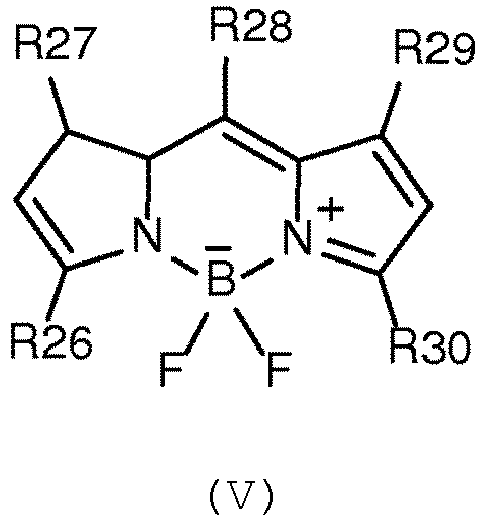 wobei jedes R26, R27, R28, R29, R30 unabhängig aus der Gruppe ausgewählt ist bestehend aus Wasserstoff, C1-C6-Alkyl, das optional mit einer Carbonyl-, Carboxy- oder Carboxyester-, C2-C6-Alkenyl-, C2-C6-Alkynyl-, C6-C30-Aryl-, C7-C30-Arylalkyl- und C5-C12-Heterorylgruppe substituiert ist.
 - Weißlicht emittierende Vorrichtung nach irgendeinem der Ansprüche 1 bis 3, wobei der mindestens eine Gastfarbstoff eine Verbindung der Formel (VI),Stereoisomere oder Salze davon
 R1 aus der Gruppe ausgewählt ist bestehend aus =O, =S oder =(+)N(R4)(R5), wobei jedes vonR4 und R5 unabhängig aus der Gruppe ausgewählt sind bestehend aus Wasserstoff, C1-C6-Alkyl, C2-C6-Alkenyl und C2-C6-Alkynyl; undjedes von R2 und R3 unabhängig aus der Gruppe ausgewählt ist bestehend aus Wasserstoff, C1-C6-Alkyl, C2-C6-Alkenyl und C2-C6-Alkynyl;
odereine Verbindung der Formel (VII), Stereoisomere oder Salze davon wobeiR6 aus der Gruppe ausgewählt ist bestehend aus =O, =S oder =(+)N(R13)(R14), wobei jedes von R13 und R14 unabhängig aus der Gruppe ausgewählt ist bestehend aus Wasserstoff, C1-C6-Alkyl, C2-C6-Alkenyl und C2-C6-Alkynyl;R7 aus der Gruppe ausgewählt ist bestehend aus Wasserstoff, einer C5-C12-Aryl-, C5-C12-Heteroarylgruppe, C1-C12-Alkyl-, C2-C12-Alkenyl-, C2-C12-Alkynyl-, C6-C15-Arylgruppe und C7-C30-Alkylarylgruppen, die optional mit 1 bis 3 Gruppen substituiert sind ausgewählt aus der Gruppe bestehend aus -OH, C1-C6-Alkoxy und Halogen;R8 aus der Gruppe ausgewählt ist bestehend aus -OH und C1-C6-Alkyl, das optional perfluoriert ist;R9 aus der Gruppe ausgewählt ist bestehend aus Wasserstoff und C1-C6-Alkyl;jedes von R10, R11 und R12 unabhängig aus der Gruppe ausgewählt ist bestehend aus Wasserstoff, C1-C12-Alkyl, C2-C12-Alkenyl, C2-C12-Alkynyl, C1-C12-Alcoxy und-N(R15)(R16), wobei jedes von R15 und R16 unabhängig aus der Gruppe ausgewählt ist bestehend aus C1-C6-Alkyl, C2-C6-Alkenyl und C2-C6-Alkynyl; oder wobei mindestens zwei von R10, R11 und R12 eine cyclische Gruppe bilden ausgewählt aus der Gruppe bestehend aus C3-C8-Heterocyclyl und C4-C8-Cycloalkyl;
odereine Verbindung der Formel (VIII), Stereoisomere oder Salze davon wobeijedes von R17, R18, R19 und R20 unabhängig aus der Gruppe ausgewählt ist bestehend aus Wasserstoff, C1-C6-Alkyl, C2-C6-Alkenyl und C2-C6-Alkynyl; undjedes von R21 und R22 aus der Gruppe ausgewählt ist bestehend aus -C(=O)-OH, C(=O)-O-C1-C6-Alkyl, SO3H und SO3N(H)-C1-C12-Alkyl;
oder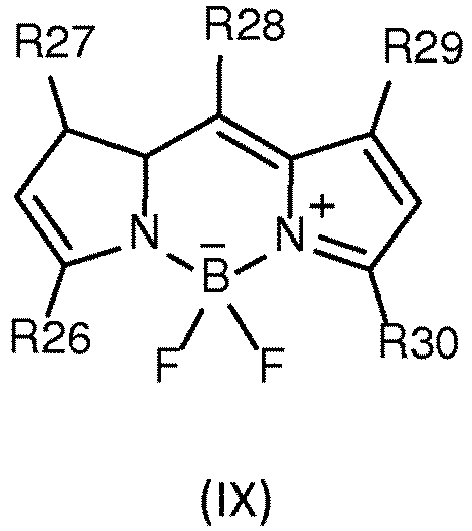 ist, wobei jedes von R26, R27, R28, R29, R30 unabhängig aus der Gruppe ausgewählt ist bestehend aus Wasserstoff, C1-C6-Alkyl, das optional mit einer Carbonyl-, Carboxy- oder Carboxyester-, C2-C6-Alkenyl-, C2-C6-Alkynyl-, C6-C30-Aryl-, C7-C30-Arylalkyl- und C5-C12-Heterorylgruppe substituiert ist.
 - Weißlicht emittierende Vorrichtung nach irgendeinem der Ansprüche 1 bis 4, wobei der mindestens eine Gastfarbstoff aus der Gruppe ausgewählt ist bestehend aus Cumarin 30, Cumarin 153, Cumarin 6, Cumarin 343, Rhodamin B, Rhodamin 6G, Rhodamin 123, Nilrot, Nilblau, 4-(Dicyanomethylen)-2-methyl-6-(4-dimethylaminostyryl)-4H-pyran, einer Bordipyrromethengruppe und Mischungen davon.
- Weißlicht emittierende Vorrichtung nach irgendeinem der Ansprüche 1 bis 5, wobei das MOF Zirkoniumkation und 2,6-Naphthalindicarbonsäure umfasst und der mindestens eine Gastfarbstoff Cumarin 153 und Nilrot umfasst oder 4-(Dicyanomethylen)-2-methyl-6-(4-dimethylaminostyryl)-4H-pyran umfasst.
- Weißlicht emittierende Vorrichtung nach irgendeinem der Ansprüche 1 bis 6, wobei die Energieabsorption in mindestens einem einzigen Schritt von dem MOF in einen der Farbstoffe erfolgt, in einer Kaskade von dem MOF zu einem ersten Farbstoff und von dem ersten Farbstoff zu einem zweiten Farbstoff erfolgt oder wobei die Energieabsorption in einer Kombination von mindestens einem einzigen Schritt und mindestens einer Kaskade erfolgt.
- Weißlicht emittierende Vorrichtung nach irgendeinem der Ansprüche 1 bis 7, wobei das MOF eine Wellenlänge emittiert, die zwischen 350 und 550 nm liegt.
- Sensor umfassend die Weißlicht emittierende Vorrichtung wie in irgendeinem der Ansprüche 1 bis 8 definiert.
- Verwendung der Weißlicht emittierenden Vorrichtung wie in irgendeinem der Ansprüche 1 bis 8 definiert, für die Herstellung eines Sensors.
Priority Applications (3)
| Application Number | Priority Date | Filing Date | Title |
|---|---|---|---|
| EP15382188.9A EP3081616B1 (de) | 2015-04-17 | 2015-04-17 | Auf zirconium basierende weisslichtemittierende mofs |
| PCT/EP2016/058298 WO2016166258A1 (en) | 2015-04-17 | 2016-04-14 | White light emitting zirconium-based mofs |
| US15/566,914 US20180097188A1 (en) | 2015-04-17 | 2016-04-14 | White light emitting zirconium-based mofs |
Applications Claiming Priority (1)
| Application Number | Priority Date | Filing Date | Title |
|---|---|---|---|
| EP15382188.9A EP3081616B1 (de) | 2015-04-17 | 2015-04-17 | Auf zirconium basierende weisslichtemittierende mofs |
Publications (2)
| Publication Number | Publication Date |
|---|---|
| EP3081616A1 EP3081616A1 (de) | 2016-10-19 |
| EP3081616B1 true EP3081616B1 (de) | 2018-06-06 |
Family
ID=52991674
Family Applications (1)
| Application Number | Title | Priority Date | Filing Date |
|---|---|---|---|
| EP15382188.9A Not-in-force EP3081616B1 (de) | 2015-04-17 | 2015-04-17 | Auf zirconium basierende weisslichtemittierende mofs |
Country Status (3)
| Country | Link |
|---|---|
| US (1) | US20180097188A1 (de) |
| EP (1) | EP3081616B1 (de) |
| WO (1) | WO2016166258A1 (de) |
Cited By (1)
| Publication number | Priority date | Publication date | Assignee | Title |
|---|---|---|---|---|
| CN109768151A (zh) * | 2019-01-04 | 2019-05-17 | 浙江大学 | 一种照明和显示用多色led及其制备方法 |
Families Citing this family (15)
| Publication number | Priority date | Publication date | Assignee | Title |
|---|---|---|---|---|
| KR101890588B1 (ko) * | 2017-04-24 | 2018-09-28 | 숙명여자대학교산학협력단 | 바이오 이미징용 물질이 담지된 나노금속유기골격구조체 및 그것의 제조방법 |
| CN107501567B (zh) * | 2017-08-24 | 2020-10-16 | 浙江大学 | 一种用于探测生理温度的含双光子染料的金属有机框架材料及其制备方法 |
| CN108394950B (zh) * | 2018-03-27 | 2021-01-15 | 湖南理工学院 | 一种吸附贵金属金离子的方法 |
| CN109297942B (zh) * | 2018-09-18 | 2021-05-04 | 曲阜师范大学 | 采用RhB@MOF-5复合材料测定小鼠脑脊液中AA含量的方法 |
| CN109244268B (zh) * | 2018-09-19 | 2021-01-29 | 京东方科技集团股份有限公司 | 有机发光二极管装置及其制造方法 |
| JP2022521096A (ja) * | 2019-02-22 | 2022-04-05 | マトリックス センサーズ,インコーポレイテッド | 配向性冷光エミッタを有する結晶質フィルムおよび発光デバイス |
| CN109970985A (zh) * | 2019-03-15 | 2019-07-05 | 中国石油大学(华东) | 一种室温合成金属有机框架材料pcn-224的方法 |
| CN110358106B (zh) * | 2019-08-02 | 2021-10-01 | 湖北师范大学 | 一种对硝基芳烃爆炸物传感的阴离子骨架金属有机框架材料及其制备方法和应用 |
| CN110734761A (zh) * | 2019-10-29 | 2020-01-31 | 南京邮电大学 | 一种二基色白光oled材料的制备方法和应用 |
| CN111675812B (zh) * | 2020-07-14 | 2021-12-31 | 河南理工大学 | 一种高量子产率的手性mof-染料复合材料及其制备方法和应用 |
| CN113648404B (zh) * | 2021-07-01 | 2024-01-30 | 中山大学 | 一种肿瘤全细胞靶向试剂及其制备方法及应用 |
| CN114437709B (zh) * | 2021-09-15 | 2023-07-14 | 中国科学院海洋研究所 | 一种核酸功能化mof材料及其制备和应用 |
| CN114437712B (zh) * | 2022-01-11 | 2024-05-28 | 武汉理工大学 | 荧光可调的染料分子/zif-8膜及制备方法及应用 |
| CN116574272A (zh) * | 2023-06-12 | 2023-08-11 | 河南工程学院 | 一种白光发射的铈基金属-有机框架材料及其制备方法和应用 |
| CN117467432A (zh) * | 2023-10-30 | 2024-01-30 | 浙江大学 | 一种用于单色多模激光输出的球形主客体型金属有机杂化材料及其制备方法 |
Family Cites Families (5)
| Publication number | Priority date | Publication date | Assignee | Title |
|---|---|---|---|---|
| US5852191A (en) | 1995-06-07 | 1998-12-22 | Carnegie Mellon University | Rigidized monomethine cyanines |
| WO2009025767A1 (en) | 2007-08-17 | 2009-02-26 | Research Foundation Of The City University Of New York | Boron dipyrromethene difluoro (bodipy) conjugates |
| FR2921661B1 (fr) * | 2007-10-01 | 2013-05-31 | Centre Nat Rech Scient | Solide hybride organique inorganique a surface modifiee. |
| WO2014055505A1 (en) | 2012-10-01 | 2014-04-10 | The General Hospital Corporation | Bodipy dyes for biological imaging |
| CN103740361B (zh) | 2013-12-24 | 2015-04-15 | 浙江大学 | 一种用于白光发射的染料/金属有机框架复合材料及其制备方法 |
-
2015
- 2015-04-17 EP EP15382188.9A patent/EP3081616B1/de not_active Not-in-force
-
2016
- 2016-04-14 WO PCT/EP2016/058298 patent/WO2016166258A1/en not_active Ceased
- 2016-04-14 US US15/566,914 patent/US20180097188A1/en not_active Abandoned
Non-Patent Citations (1)
| Title |
|---|
| None * |
Cited By (1)
| Publication number | Priority date | Publication date | Assignee | Title |
|---|---|---|---|---|
| CN109768151A (zh) * | 2019-01-04 | 2019-05-17 | 浙江大学 | 一种照明和显示用多色led及其制备方法 |
Also Published As
| Publication number | Publication date |
|---|---|
| WO2016166258A1 (en) | 2016-10-20 |
| EP3081616A1 (de) | 2016-10-19 |
| US20180097188A1 (en) | 2018-04-05 |
Similar Documents
| Publication | Publication Date | Title |
|---|---|---|
| EP3081616B1 (de) | Auf zirconium basierende weisslichtemittierende mofs | |
| Leith et al. | Confinement-guided photophysics in MOFs, COFs, and cages | |
| Cui et al. | Luminescent functional metal–organic frameworks | |
| Regulska et al. | Highlights on π-systems based on six-membered phosphorus heterocycles | |
| Ahmed et al. | Efficient layers of emitting ternary lanthanide complexes for fabricating red, green, and yellow OLEDs | |
| Yang et al. | Synthesis and photoluminescent properties of four novel trinuclear europium complexes based on two tris-β-diketones ligands | |
| US20170044428A1 (en) | Metal organic framework (mof) yellow phosphors and their applications in white light emitting devices | |
| Nie et al. | Two novel six-coordinated cadmium (II) and zinc (II) complexes from carbazate β-diketonate: crystal structures, enhanced two-photon absorption and biological imaging application | |
| Kitagawa et al. | Bright red emission with high color purity from Eu (iii) complexes with π-conjugated polycyclic aromatic ligands and their sensing applications | |
| Yang et al. | The effect of two additional Eu3+ lumophors in two novel trinuclear europium complexes on their photoluminescent properties | |
| CA2816432A1 (en) | Compounds and methods for enhancing metal luminescence that can be selectively turned off | |
| JP7837140B2 (ja) | インダンジオン骨格を有する希土類錯体 | |
| Jiang et al. | Planar Chiral [2.2] Paracyclophane-based Zr (IV) metal–organic frameworks | |
| Xu et al. | Syntheses, structures and photophysical properties of heterotrinuclear Zn2Ln clusters (ln= Nd, Eu, Tb, Er, Yb) | |
| CN106543231A (zh) | 伯啶配合物及采用该伯啶配合物的有机电致发光器件 | |
| Wang et al. | Remarkable 980 nm circularly polarized luminescence from dinuclear Yb (III) helicates with a D 4 symmetry | |
| Cui et al. | Luminescent properties and applications of metal-organic frameworks | |
| Li et al. | Two N, N-chelated difluoroboron complexes containing phenanthroimidazole moiety: Synthesis and luminescence properties | |
| EP2554533A1 (de) | Seltenerd-metallkomplex | |
| Sábio et al. | Near-infrared/visible-emitting nanosilica modified with silylated Ru (II) and Ln (III) complexes | |
| Sun et al. | Ternary lanthanide (Er3+, Nd3+, Yb3+, Sm3+, Pr3+) complex-functionalized mesoporous SBA-15 materials that emit in the near-infrared range | |
| Gu et al. | Lanthanide mesoporous SBA-15 hybrids through functionalized 6-hydroxybenz [de] anthracen-7-one linkage: UV–visible light sensitisation and visible-NIR luminescence | |
| CN103221509B (zh) | 发光化合物、发光化合物的制备方法和其应用 | |
| JP5924691B2 (ja) | 金属錯体、発光素子、表示装置 | |
| Sun et al. | Near-infrared materials |
Legal Events
| Date | Code | Title | Description |
|---|---|---|---|
| PUAI | Public reference made under article 153(3) epc to a published international application that has entered the european phase |
Free format text: ORIGINAL CODE: 0009012 |
|
| AK | Designated contracting states |
Kind code of ref document: A1 Designated state(s): AL AT BE BG CH CY CZ DE DK EE ES FI FR GB GR HR HU IE IS IT LI LT LU LV MC MK MT NL NO PL PT RO RS SE SI SK SM TR |
|
| AX | Request for extension of the european patent |
Extension state: BA ME |
|
| STAA | Information on the status of an ep patent application or granted ep patent |
Free format text: STATUS: REQUEST FOR EXAMINATION WAS MADE |
|
| 17P | Request for examination filed |
Effective date: 20170419 |
|
| RBV | Designated contracting states (corrected) |
Designated state(s): AL AT BE BG CH CY CZ DE DK EE ES FI FR GB GR HR HU IE IS IT LI LT LU LV MC MK MT NL NO PL PT RO RS SE SI SK SM TR |
|
| STAA | Information on the status of an ep patent application or granted ep patent |
Free format text: STATUS: EXAMINATION IS IN PROGRESS |
|
| 17Q | First examination report despatched |
Effective date: 20170623 |
|
| GRAP | Despatch of communication of intention to grant a patent |
Free format text: ORIGINAL CODE: EPIDOSNIGR1 |
|
| STAA | Information on the status of an ep patent application or granted ep patent |
Free format text: STATUS: GRANT OF PATENT IS INTENDED |
|
| RIC1 | Information provided on ipc code assigned before grant |
Ipc: A61K 49/00 20060101ALI20171114BHEP Ipc: C09K 11/06 20060101AFI20171114BHEP Ipc: H01L 51/00 20060101ALI20171114BHEP Ipc: H01L 51/50 20060101ALN20171114BHEP |
|
| INTG | Intention to grant announced |
Effective date: 20171208 |
|
| GRAS | Grant fee paid |
Free format text: ORIGINAL CODE: EPIDOSNIGR3 |
|
| GRAA | (expected) grant |
Free format text: ORIGINAL CODE: 0009210 |
|
| STAA | Information on the status of an ep patent application or granted ep patent |
Free format text: STATUS: THE PATENT HAS BEEN GRANTED |
|
| AK | Designated contracting states |
Kind code of ref document: B1 Designated state(s): AL AT BE BG CH CY CZ DE DK EE ES FI FR GB GR HR HU IE IS IT LI LT LU LV MC MK MT NL NO PL PT RO RS SE SI SK SM TR |
|
| REG | Reference to a national code |
Ref country code: GB Ref legal event code: FG4D |
|
| REG | Reference to a national code |
Ref country code: CH Ref legal event code: EP Ref country code: AT Ref legal event code: REF Ref document number: 1006065 Country of ref document: AT Kind code of ref document: T Effective date: 20180615 |
|
| REG | Reference to a national code |
Ref country code: IE Ref legal event code: FG4D |
|
| REG | Reference to a national code |
Ref country code: DE Ref legal event code: R096 Ref document number: 602015011782 Country of ref document: DE |
|
| REG | Reference to a national code |
Ref country code: NL Ref legal event code: MP Effective date: 20180606 |
|
| REG | Reference to a national code |
Ref country code: LT Ref legal event code: MG4D |
|
| PG25 | Lapsed in a contracting state [announced via postgrant information from national office to epo] |
Ref country code: SE Free format text: LAPSE BECAUSE OF FAILURE TO SUBMIT A TRANSLATION OF THE DESCRIPTION OR TO PAY THE FEE WITHIN THE PRESCRIBED TIME-LIMIT Effective date: 20180606 Ref country code: BG Free format text: LAPSE BECAUSE OF FAILURE TO SUBMIT A TRANSLATION OF THE DESCRIPTION OR TO PAY THE FEE WITHIN THE PRESCRIBED TIME-LIMIT Effective date: 20180906 Ref country code: FI Free format text: LAPSE BECAUSE OF FAILURE TO SUBMIT A TRANSLATION OF THE DESCRIPTION OR TO PAY THE FEE WITHIN THE PRESCRIBED TIME-LIMIT Effective date: 20180606 Ref country code: NO Free format text: LAPSE BECAUSE OF FAILURE TO SUBMIT A TRANSLATION OF THE DESCRIPTION OR TO PAY THE FEE WITHIN THE PRESCRIBED TIME-LIMIT Effective date: 20180906 Ref country code: CY Free format text: LAPSE BECAUSE OF FAILURE TO SUBMIT A TRANSLATION OF THE DESCRIPTION OR TO PAY THE FEE WITHIN THE PRESCRIBED TIME-LIMIT Effective date: 20180606 Ref country code: ES Free format text: LAPSE BECAUSE OF FAILURE TO SUBMIT A TRANSLATION OF THE DESCRIPTION OR TO PAY THE FEE WITHIN THE PRESCRIBED TIME-LIMIT Effective date: 20180606 Ref country code: LT Free format text: LAPSE BECAUSE OF FAILURE TO SUBMIT A TRANSLATION OF THE DESCRIPTION OR TO PAY THE FEE WITHIN THE PRESCRIBED TIME-LIMIT Effective date: 20180606 |
|
| PG25 | Lapsed in a contracting state [announced via postgrant information from national office to epo] |
Ref country code: GR Free format text: LAPSE BECAUSE OF FAILURE TO SUBMIT A TRANSLATION OF THE DESCRIPTION OR TO PAY THE FEE WITHIN THE PRESCRIBED TIME-LIMIT Effective date: 20180907 Ref country code: HR Free format text: LAPSE BECAUSE OF FAILURE TO SUBMIT A TRANSLATION OF THE DESCRIPTION OR TO PAY THE FEE WITHIN THE PRESCRIBED TIME-LIMIT Effective date: 20180606 Ref country code: LV Free format text: LAPSE BECAUSE OF FAILURE TO SUBMIT A TRANSLATION OF THE DESCRIPTION OR TO PAY THE FEE WITHIN THE PRESCRIBED TIME-LIMIT Effective date: 20180606 Ref country code: RS Free format text: LAPSE BECAUSE OF FAILURE TO SUBMIT A TRANSLATION OF THE DESCRIPTION OR TO PAY THE FEE WITHIN THE PRESCRIBED TIME-LIMIT Effective date: 20180606 |
|
| REG | Reference to a national code |
Ref country code: AT Ref legal event code: MK05 Ref document number: 1006065 Country of ref document: AT Kind code of ref document: T Effective date: 20180606 |
|
| PG25 | Lapsed in a contracting state [announced via postgrant information from national office to epo] |
Ref country code: NL Free format text: LAPSE BECAUSE OF FAILURE TO SUBMIT A TRANSLATION OF THE DESCRIPTION OR TO PAY THE FEE WITHIN THE PRESCRIBED TIME-LIMIT Effective date: 20180606 |
|
| PG25 | Lapsed in a contracting state [announced via postgrant information from national office to epo] |
Ref country code: CZ Free format text: LAPSE BECAUSE OF FAILURE TO SUBMIT A TRANSLATION OF THE DESCRIPTION OR TO PAY THE FEE WITHIN THE PRESCRIBED TIME-LIMIT Effective date: 20180606 Ref country code: RO Free format text: LAPSE BECAUSE OF FAILURE TO SUBMIT A TRANSLATION OF THE DESCRIPTION OR TO PAY THE FEE WITHIN THE PRESCRIBED TIME-LIMIT Effective date: 20180606 Ref country code: EE Free format text: LAPSE BECAUSE OF FAILURE TO SUBMIT A TRANSLATION OF THE DESCRIPTION OR TO PAY THE FEE WITHIN THE PRESCRIBED TIME-LIMIT Effective date: 20180606 Ref country code: AT Free format text: LAPSE BECAUSE OF FAILURE TO SUBMIT A TRANSLATION OF THE DESCRIPTION OR TO PAY THE FEE WITHIN THE PRESCRIBED TIME-LIMIT Effective date: 20180606 Ref country code: IS Free format text: LAPSE BECAUSE OF FAILURE TO SUBMIT A TRANSLATION OF THE DESCRIPTION OR TO PAY THE FEE WITHIN THE PRESCRIBED TIME-LIMIT Effective date: 20181006 Ref country code: PL Free format text: LAPSE BECAUSE OF FAILURE TO SUBMIT A TRANSLATION OF THE DESCRIPTION OR TO PAY THE FEE WITHIN THE PRESCRIBED TIME-LIMIT Effective date: 20180606 Ref country code: SK Free format text: LAPSE BECAUSE OF FAILURE TO SUBMIT A TRANSLATION OF THE DESCRIPTION OR TO PAY THE FEE WITHIN THE PRESCRIBED TIME-LIMIT Effective date: 20180606 |
|
| PG25 | Lapsed in a contracting state [announced via postgrant information from national office to epo] |
Ref country code: IT Free format text: LAPSE BECAUSE OF FAILURE TO SUBMIT A TRANSLATION OF THE DESCRIPTION OR TO PAY THE FEE WITHIN THE PRESCRIBED TIME-LIMIT Effective date: 20180606 Ref country code: SM Free format text: LAPSE BECAUSE OF FAILURE TO SUBMIT A TRANSLATION OF THE DESCRIPTION OR TO PAY THE FEE WITHIN THE PRESCRIBED TIME-LIMIT Effective date: 20180606 |
|
| REG | Reference to a national code |
Ref country code: DE Ref legal event code: R097 Ref document number: 602015011782 Country of ref document: DE |
|
| PLBE | No opposition filed within time limit |
Free format text: ORIGINAL CODE: 0009261 |
|
| STAA | Information on the status of an ep patent application or granted ep patent |
Free format text: STATUS: NO OPPOSITION FILED WITHIN TIME LIMIT |
|
| 26N | No opposition filed |
Effective date: 20190307 |
|
| PG25 | Lapsed in a contracting state [announced via postgrant information from national office to epo] |
Ref country code: DK Free format text: LAPSE BECAUSE OF FAILURE TO SUBMIT A TRANSLATION OF THE DESCRIPTION OR TO PAY THE FEE WITHIN THE PRESCRIBED TIME-LIMIT Effective date: 20180606 Ref country code: SI Free format text: LAPSE BECAUSE OF FAILURE TO SUBMIT A TRANSLATION OF THE DESCRIPTION OR TO PAY THE FEE WITHIN THE PRESCRIBED TIME-LIMIT Effective date: 20180606 |
|
| REG | Reference to a national code |
Ref country code: DE Ref legal event code: R119 Ref document number: 602015011782 Country of ref document: DE |
|
| PG25 | Lapsed in a contracting state [announced via postgrant information from national office to epo] |
Ref country code: AL Free format text: LAPSE BECAUSE OF FAILURE TO SUBMIT A TRANSLATION OF THE DESCRIPTION OR TO PAY THE FEE WITHIN THE PRESCRIBED TIME-LIMIT Effective date: 20180606 |
|
| REG | Reference to a national code |
Ref country code: CH Ref legal event code: PL |
|
| REG | Reference to a national code |
Ref country code: BE Ref legal event code: MM Effective date: 20190430 |
|
| GBPC | Gb: european patent ceased through non-payment of renewal fee |
Effective date: 20190417 |
|
| PG25 | Lapsed in a contracting state [announced via postgrant information from national office to epo] |
Ref country code: LU Free format text: LAPSE BECAUSE OF NON-PAYMENT OF DUE FEES Effective date: 20190417 Ref country code: MC Free format text: LAPSE BECAUSE OF FAILURE TO SUBMIT A TRANSLATION OF THE DESCRIPTION OR TO PAY THE FEE WITHIN THE PRESCRIBED TIME-LIMIT Effective date: 20180606 |
|
| PG25 | Lapsed in a contracting state [announced via postgrant information from national office to epo] |
Ref country code: DE Free format text: LAPSE BECAUSE OF NON-PAYMENT OF DUE FEES Effective date: 20191101 Ref country code: CH Free format text: LAPSE BECAUSE OF NON-PAYMENT OF DUE FEES Effective date: 20190430 Ref country code: LI Free format text: LAPSE BECAUSE OF NON-PAYMENT OF DUE FEES Effective date: 20190430 Ref country code: GB Free format text: LAPSE BECAUSE OF NON-PAYMENT OF DUE FEES Effective date: 20190417 |
|
| PG25 | Lapsed in a contracting state [announced via postgrant information from national office to epo] |
Ref country code: BE Free format text: LAPSE BECAUSE OF NON-PAYMENT OF DUE FEES Effective date: 20190430 Ref country code: FR Free format text: LAPSE BECAUSE OF NON-PAYMENT OF DUE FEES Effective date: 20190430 |
|
| PG25 | Lapsed in a contracting state [announced via postgrant information from national office to epo] |
Ref country code: TR Free format text: LAPSE BECAUSE OF FAILURE TO SUBMIT A TRANSLATION OF THE DESCRIPTION OR TO PAY THE FEE WITHIN THE PRESCRIBED TIME-LIMIT Effective date: 20180606 |
|
| PG25 | Lapsed in a contracting state [announced via postgrant information from national office to epo] |
Ref country code: IE Free format text: LAPSE BECAUSE OF NON-PAYMENT OF DUE FEES Effective date: 20190417 |
|
| PG25 | Lapsed in a contracting state [announced via postgrant information from national office to epo] |
Ref country code: PT Free format text: LAPSE BECAUSE OF FAILURE TO SUBMIT A TRANSLATION OF THE DESCRIPTION OR TO PAY THE FEE WITHIN THE PRESCRIBED TIME-LIMIT Effective date: 20181008 |
|
| PG25 | Lapsed in a contracting state [announced via postgrant information from national office to epo] |
Ref country code: HU Free format text: LAPSE BECAUSE OF FAILURE TO SUBMIT A TRANSLATION OF THE DESCRIPTION OR TO PAY THE FEE WITHIN THE PRESCRIBED TIME-LIMIT; INVALID AB INITIO Effective date: 20150417 Ref country code: MT Free format text: LAPSE BECAUSE OF FAILURE TO SUBMIT A TRANSLATION OF THE DESCRIPTION OR TO PAY THE FEE WITHIN THE PRESCRIBED TIME-LIMIT Effective date: 20180606 |
|
| PG25 | Lapsed in a contracting state [announced via postgrant information from national office to epo] |
Ref country code: MK Free format text: LAPSE BECAUSE OF FAILURE TO SUBMIT A TRANSLATION OF THE DESCRIPTION OR TO PAY THE FEE WITHIN THE PRESCRIBED TIME-LIMIT Effective date: 20180606 |