EP3081692A1 - Verfahren und vorrichtung zur herstellung von produkten aus cellulosefasern - Google Patents
Verfahren und vorrichtung zur herstellung von produkten aus cellulosefasern Download PDFInfo
- Publication number
- EP3081692A1 EP3081692A1 EP15001102.1A EP15001102A EP3081692A1 EP 3081692 A1 EP3081692 A1 EP 3081692A1 EP 15001102 A EP15001102 A EP 15001102A EP 3081692 A1 EP3081692 A1 EP 3081692A1
- Authority
- EP
- European Patent Office
- Prior art keywords
- female
- male
- moulded products
- products
- surface side
- Prior art date
- Legal status (The legal status is an assumption and is not a legal conclusion. Google has not performed a legal analysis and makes no representation as to the accuracy of the status listed.)
- Withdrawn
Links
- 229920003043 Cellulose fiber Polymers 0.000 title claims abstract description 34
- 238000000034 method Methods 0.000 title claims abstract description 23
- 238000001035 drying Methods 0.000 claims abstract description 49
- 238000003825 pressing Methods 0.000 claims abstract description 37
- 238000009423 ventilation Methods 0.000 claims abstract description 17
- 241000609240 Ambelania acida Species 0.000 claims description 11
- 239000010905 bagasse Substances 0.000 claims description 11
- 239000007788 liquid Substances 0.000 claims description 10
- 241000196324 Embryophyta Species 0.000 claims description 6
- 229920002678 cellulose Polymers 0.000 claims description 6
- 239000001913 cellulose Substances 0.000 claims description 6
- 240000000111 Saccharum officinarum Species 0.000 claims description 5
- 235000007201 Saccharum officinarum Nutrition 0.000 claims description 5
- 239000007787 solid Substances 0.000 claims description 3
- 239000000835 fiber Substances 0.000 description 4
- 229920001131 Pulp (paper) Polymers 0.000 description 3
- 125000004122 cyclic group Chemical group 0.000 description 3
- 238000007796 conventional method Methods 0.000 description 2
- 238000010586 diagram Methods 0.000 description 2
- 238000007598 dipping method Methods 0.000 description 2
- 230000007613 environmental effect Effects 0.000 description 2
- 230000002349 favourable effect Effects 0.000 description 2
- 238000007493 shaping process Methods 0.000 description 2
- 239000002699 waste material Substances 0.000 description 2
- 230000003247 decreasing effect Effects 0.000 description 1
- 230000001419 dependent effect Effects 0.000 description 1
- 235000011389 fruit/vegetable juice Nutrition 0.000 description 1
- 230000005484 gravity Effects 0.000 description 1
- 238000010438 heat treatment Methods 0.000 description 1
- 238000004519 manufacturing process Methods 0.000 description 1
- 238000000465 moulding Methods 0.000 description 1
- 238000003672 processing method Methods 0.000 description 1
- XLYOFNOQVPJJNP-UHFFFAOYSA-N water Substances O XLYOFNOQVPJJNP-UHFFFAOYSA-N 0.000 description 1
Images


Classifications
-
- D—TEXTILES; PAPER
- D21—PAPER-MAKING; PRODUCTION OF CELLULOSE
- D21J—FIBREBOARD; MANUFACTURE OF ARTICLES FROM CELLULOSIC FIBROUS SUSPENSIONS OR FROM PAPIER-MACHE
- D21J3/00—Manufacture of articles by pressing wet fibre pulp, or papier-mâché, between moulds
-
- D—TEXTILES; PAPER
- D21—PAPER-MAKING; PRODUCTION OF CELLULOSE
- D21J—FIBREBOARD; MANUFACTURE OF ARTICLES FROM CELLULOSIC FIBROUS SUSPENSIONS OR FROM PAPIER-MACHE
- D21J5/00—Manufacture of hollow articles by transferring sheets, produced from fibres suspensions or papier-mâché by suction on wire-net moulds, to couch-moulds
Definitions
- the present invention relates to a method and a system for producing products, such as plates, from cellulose fibers.
- Conventional technique to produce e.g. plates is based on dipping a forming mould having a male or female permeable surface side into a paper pulp, where the shape of the male or female permeable surface side substantially defines the shape of the plates to be produced.
- a vacuum pressure is supplied to the forming mould to draw the paper paper pulp through the permeable surface side leaving an outwardly facing fiber mat, i.e. a plurality of pre-shaped wet moulded products, on the permeable moulding outer surface side.
- the wet mouled products have a plate-like shape.
- the wet moulded products are placed into an after-press die set where heated male and female dies are pressed together for an approximately 40-50 seconds, or until the plate structures have dried.
- the invention preferably seeks to mitigate, alleviate or eliminate one or more of the above mentioned disadvantages singly or in any combination.
- a method is provided of producing products from cellulose fibers, comprising:
- the total time needed to produce the products may be decreased dramatically, or from 40-50 second down to 5-20 seconds. This reduction in time is obviously reflected in less energy use which makes the process more energetically friendly.
- the male of female shapes of the permeable side of the forming mould may be made of a wire mesh that is commonly used today.
- ventilation openings may be understood as any type of access channels, access slits, or drainage channels for the moisture and/or the liquid in the wet moulded products, that may have any type of cross sectional shape, e.g. cylindrical, rectangular, elliptical etc. that interconnect the inside and the outside of the male/female moulds.
- the diameter of these ventilation openings may have a dimension ranging from, but is not limited to, 1mm to micrometer range such as 50 ⁇ m.
- the product may be, but is not limited to, any type of plate, a container, a convex/concave shaped structure.
- the further drying step comprises placing the partly dried products into a microwave drier.
- a microwave drier use only a fraction of the energy compared to the conventional convection drier which makes the process more energetically favorable.
- the cellulose fibers is a plant based cellulose.
- the plant based cellulose may in one embodiment, be bagasse produced from sugarcane. Bagasse is 100% biodegradable and compostable and a bi product of sugar cane fiber which is left after the juice has been extracted from the sugar cane, but hundred thousands of tons of bagasse remains to be used yearly.
- bagasse has become an inexpensive product and thus the value of bagasse may be increased significantly and therefore a favorable option is provided for producing lids for containers using bagasse.
- bagasse is annually renewable as opposed to trees that take 7 top 20 years to grow and is biodegradable as trees.
- the pressure between the female or male die and the male or female permeable surface side during the wet-pressing is in the range of 5N/cm 2 to 50N/cm 2 .
- the heated female or male die and/or the female or male of the after-press die set is/are heated to a temperature in the range of 160°C and 210°C.
- the pressure between female and male die of the after-press die set is in the range of 125N/cm 2 and 1250N/cm 2 .
- the further drying step is adjusted such that after undergoing the further drying step the partly dried moulded products are 80° to 90° solid and have moisture in the range between 20° to 10°.
- the pressing time of the male or female after-press die set is very low, such as between 1 and 4 seconds, whereas in conventional techniques at least 40 seconds pressing time is required which obviously requires much more energy.
- the step of obtaining plurality of outwardly facing wet moulded products made from the cellulose fibers comprises:
- an effective process is provided to obtain the plurality of outwardly facing wet moulded products and subsequently perform the wet-drying in one and the same movement where the wet moulded products do not need to be removed from the forming mould in such a wet state.
- a system for producing products from cellulose fibers comprising:
- a system is provided that is capable of producing products such as plates, bowls, and the like, from cellulose fibers, in only a fraction of the time that is needed by conventional apparatuses. Also, due the additional wet-pressing and the subsequent further drying, the time needed to compress the male and female dies of the after-press die set is greatly reduced and therefor the energy costs is reduced.
- the drying station comprises microwave drier.
- the drying time may be one second or more, where the drying time is selected such that after the drying there is preferably 10-20° moisture in the products.
- the drying station may further comprise a conveyor means where the products, subsequent to the wet-pressing, are placed onto the conveyor and where they are conveyed through the microwave drier.
- suction mechanism may be provided to suck the partly dried moulded products from the forming mould and/or the forming mould may also supply an air pressure to facilitate the releasing of the partly dried moulded products from the forming mould.
- the means for obtaining plurality of outwardly facing wet moulded products comprises a computer controlled robotic arm and where the forming mould is attached to the robotic arm, and where the robotic arm and/or the forming mould is connected to a vacuum source, the robotic arm being adapted:
- the robotic arm may move the forming mould from the pulp with the wet moulded products and in the same movement or cycle, perform the wet-pressing.
- the robotic arm may comprise two or more sub-arms where two or more forming moulds are mounted to the respective one of the two or more sub-arm, such that while one sub-arm is dipping the forming mould mounted to the sub-arm into pulp containing the cellulose fibers, another sub-arm may be performing the wet-pressing, another sub-arm may have completed the wet-pressing and is at another position for released the partly dried products to the drying station, another sub-arm may be positioned at a halting position after obtaining the wet-moulded products, be before undergoing the wet pressing.
- the robotic arm may contain four such sub-arms arranged in a cross-like manner and that move in a cyclic movement, where each movement is a 90° degree movement between different operations steps.
- Figure 1 shows a flow diagram of a method according to the present invention of producing products from cellulose fibers, where the products may as an example be any type of plates.
- the cellulose fibers may in one embodiment be plant based cellulose, where the plant based cellulose is bagasse produced from sugarcane.
- step S1 a forming mould is provided comprising a male or female permeable surface side.
- step S2 plurality of outwardly facing wet moulded products is obtained made from the cellulose fibers at the permeable surface side of the male or female forming mold, where the plurality of wet moulded products have a shape substantially following the shape of the products to be produced.
- the step of obtaining plurality of outwardly facing wet moulded products made from the cellulose fibers comprises moving the forming mould into pulp containing cellulose fibers, and supplying vacuum to the forming mould so as to draw liquid through the permeable surface side leaving the outwardly facing wet moulded products at the permeable surface side of the male or female forming mold.
- step S3 a heated female or male die is provided having a shape essentially following the shape of the male or female permeable surface side.
- step S4 a wet-pressing is performed on the wet moulded products by means pressing the female or male die and the male or female permeable surface side together, where the pressure is maintained until the plurality of outwardly facing wet moulded products are partly dried.
- the pressure between the female or male die and the male or female permeable surface side during the wet-pressing may be in the range of 5N/cm 2 to 50N/cm. 2 and the female or male die may in one embodiment be heated to a temperature in the range of 160°C and 210°C.
- the time of maintaining the pressure depends on the temperature and or the pressure, and may in one embodiment be between 1-10 seconds.
- step S5 a further drying on the partly dried moulded products is performed.
- this further drying step comprises removing the partly dried products from the forming mould and placing them into a microwave drier where they may be moved or conveyed through the microwave drier. After completing this further drying step the products may be 80-90° solid/dried and contain 20-10° water.
- the step of placing the partly dried products from the forming mould and into the microwave drier may be done in several ways, e.g. via gravity and/or via air pressure at the forming mould where the semi dried products are blown away from the forming mould, and/or by means of removing the semi dried products from the forming mould via similarly shaped mould via a suction.
- Other solutions well known to a person skilled in the art are also possible to implement.
- step S6 a heated male and female after-press die set is provided having a shape defining the shape of the products to be produced, where at least one of the male or female after-press die set comprise plurality of ventilation openings.
- step S7 the partly dried products are, after undergoing the further drying step, placed into the male or female die of the after-press die set where the female and male die of the after-press die set are pressed together. This pressure is maintained until the partly dried moulded products are fully dried, which may e.g. be in the range of 1-4 seconds.
- the plurality of ventilation openings act as access channels for the remaining moisture in the partly dried moulded products.
- the pressure between the female and male die of the after-press die set may in one embodiment be in the range of 125N/cm 2 and 1250N/cm 2 and the temperature of at least one of the female and male die, preferably both of the female and male die, may be in the range of 160°C and 210°C.
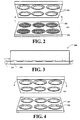
- Figure 2 shows graphically the wet-pressing step discussed in relation to figure 1 , showing where a forming mould 201 comprising a female permeable surface side 202 has been dipped into a pulp containing cellulose fibers leaving an outwardly facing fiber mats 203 on the permeable surface side.
- This heated male die may be stationary, e.g. fixed to a frame structure or to a wall or ceiling, and has a shape essentially following the shape of the female permeable surface side 202.
- the products to be produced are plates meaning that the female permeable surface side and the male die 204 have a plate like shapes.
- the forming mould may be moved towards the heated male die 204 where the forming mould and the heated die are pressed together, as discussed in relation to figure 1 , leaving partly dried products, in this case partly dried plates.
- the forming mould may be moved from the heated die 204 to an area (not shown) where the semi dried plates are removed, e.g. via suction as discussed in relation
- the forming mould may be mounted to a robotic arm (not shown) that moves the forming mould 201 smoothly from the pulp directly towards the heated die 204 where the wet-pressing takes place, where subsequently the robotic arm moves the forming mould towards the removing area.
- Figure 3 shows a drying station 300, e.g. a microwave drier, where the partly dried products 301 (the plates) have been removed from the forming mould in figure 2 and been into the drying station 300 where a further drying takes place, preferably until the plates are 80-90° dry.
- a drying station 300 e.g. a microwave drier
- a conveyor 302 may extend through the drying station 300 and convey the partly dried plates through the drying station.
- the speed and/or the drying station may be adapted to how dried the products are to be when leaving the drying station, but as already mentioned, subsequent to undergoing the drying the products still contain some remaining moisture.
- Figure 4 shows where the further partly dried plates 301 have been placed into heated female die 401 from an after-press die set where subsequently a corresponding heated male die 402 from the after-press die are compressed together as discussed in relation to figure 1 .
- the shape of the female and the male die of the after-press die define the final shape of the product, i.e. in this case the plate.
- the number of products that may be produced simultaneously by be tens or even hundreds, and not only six as shown here.
- Figure 5a-c depict graphically the final drying step where the partly dry products (in this example the plates) are dried in the after-press die set.
- Figure 5a depicts where the partly dried plates 301a have been placed into the female die 401 of the after-press die
- figure 5b depicts where the male die 402 and female die 401 are compressed together causing the remaining moisture/liquid in the products to leave via the ventilation openings 403, and where the pressure is maintained until the products are fully dried
- figure 5c depicts where the male die 402 is released from the female die.
- Figure 6 shows a zoomed up view 406 of the female die 401 in figure 5 depicting in more details the plurality of ventilation openings 404 (the same may apply for the male die) and a plate structure 301 b after undergoing the further drying step in figure 5 .
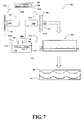
- Figure 7 shows an embodiment of system 700 according to the present invention for producing products from cellulose fibers, where in this embodiment four forming moulds 201a-201d comprising a female permeable surface side (could just as well be a male permeable surface side) attached to a robotic arm 701, which is preferably computer controlled, and where the robotic arm 701 comprises four sub-arms 702a-702d.
- the four forming moulds 201a-201d are mounted to these four sub-arms702a-702d arranged in a cross like manner, respectively.
- steps S1 - S5 discussed in relation to figure 1 may be a based on a cyclic movement as indicated by arrows 711a-711d of a robotic system that operates the robotic arm 701.
- One (or more) tub 712 is provided containing pulp 712 having the cellulose fibers, e.g. bagasse as discussed in relation to the previous figures.
- a forming mould 201c is dipped into the pulp 703 via a moving mechanism 704, which may be a hydraulic operating system, where subsequently a suction pressure 709 is provided for drawing the pulp through the permeable surface side leaving outwardly facing wet moulded products on the permeable surface side 713.
- a forming mould 201a at the opposite side that has already undergoing this process is performing a wet-pressing by moving the forming mould 201a towards the heated die 204 as indicated by an arrow 706 and presses it against the heated die 204.
- a forming mould 201d may be held at a holding position 714 and a forming mould 201b that has already undergone the wet-pressing is delivering the partly dried products to a take-away means 708, which may e.g. be a robotic arm that applies suction pressure 710 to such the partly dried products from the forming mould 201b.
- the take-away means 708 delivers the partly dried products to the drying station 300 discussed in relation to figure 3 , and the drying station delivers the further dried products to the after-press die set 401, 402 where the final drying and shaping takes place as shown in figue 5.
- the number of forming moulds should of course not be construed as being limited to four forming moulds, the number could just as well be more than four forming moulds or less that four forming moulds.
- this apparatus could implement only a single forming mould, two forming moulds, three forming moulds, or four forming molds as shown here, or even more.
Landscapes
- Engineering & Computer Science (AREA)
- Manufacturing & Machinery (AREA)
- Paper (AREA)
- Nonwoven Fabrics (AREA)
Priority Applications (1)
| Application Number | Priority Date | Filing Date | Title |
|---|---|---|---|
| EP15001102.1A EP3081692A1 (de) | 2015-04-16 | 2015-04-16 | Verfahren und vorrichtung zur herstellung von produkten aus cellulosefasern |
Applications Claiming Priority (1)
| Application Number | Priority Date | Filing Date | Title |
|---|---|---|---|
| EP15001102.1A EP3081692A1 (de) | 2015-04-16 | 2015-04-16 | Verfahren und vorrichtung zur herstellung von produkten aus cellulosefasern |
Publications (1)
| Publication Number | Publication Date |
|---|---|
| EP3081692A1 true EP3081692A1 (de) | 2016-10-19 |
Family
ID=52991420
Family Applications (1)
| Application Number | Title | Priority Date | Filing Date |
|---|---|---|---|
| EP15001102.1A Withdrawn EP3081692A1 (de) | 2015-04-16 | 2015-04-16 | Verfahren und vorrichtung zur herstellung von produkten aus cellulosefasern |
Country Status (1)
| Country | Link |
|---|---|
| EP (1) | EP3081692A1 (de) |
Cited By (2)
| Publication number | Priority date | Publication date | Assignee | Title |
|---|---|---|---|---|
| CN108589431A (zh) * | 2018-05-24 | 2018-09-28 | 浙江博特生物科技有限公司 | 一种纸浆模塑餐具的制备工艺 |
| CN108914710A (zh) * | 2018-06-20 | 2018-11-30 | 东莞三润田智能科技股份有限公司 | 餐盘初品制造方法 |
Citations (2)
| Publication number | Priority date | Publication date | Assignee | Title |
|---|---|---|---|---|
| WO2006046840A1 (en) * | 2004-10-28 | 2006-05-04 | Sunil Heat-Treatment Co., Ltd. | A fibroid board and manufacturing method thereof |
| WO2006057610A2 (en) * | 2004-11-26 | 2006-06-01 | Pakit International Trading Company Inc | A method and a machine for making fibre products from stock and a new type of fibre product |
-
2015
- 2015-04-16 EP EP15001102.1A patent/EP3081692A1/de not_active Withdrawn
Patent Citations (2)
| Publication number | Priority date | Publication date | Assignee | Title |
|---|---|---|---|---|
| WO2006046840A1 (en) * | 2004-10-28 | 2006-05-04 | Sunil Heat-Treatment Co., Ltd. | A fibroid board and manufacturing method thereof |
| WO2006057610A2 (en) * | 2004-11-26 | 2006-06-01 | Pakit International Trading Company Inc | A method and a machine for making fibre products from stock and a new type of fibre product |
Cited By (2)
| Publication number | Priority date | Publication date | Assignee | Title |
|---|---|---|---|---|
| CN108589431A (zh) * | 2018-05-24 | 2018-09-28 | 浙江博特生物科技有限公司 | 一种纸浆模塑餐具的制备工艺 |
| CN108914710A (zh) * | 2018-06-20 | 2018-11-30 | 东莞三润田智能科技股份有限公司 | 餐盘初品制造方法 |
Similar Documents
| Publication | Publication Date | Title |
|---|---|---|
| CN114585781B (zh) | 制造环保可降解纤维材料制成的成型件的纤维成型设施 | |
| US20130213597A1 (en) | Method and apparatus for forming an article from pulped material | |
| CN113272495B (zh) | 用于由纸浆浆料来生产3d模制产品的拾取压制装置和方法 | |
| SE2050980A1 (en) | A multi-cavity forming mould system and a method for forming cellulose products in a multi-cavity forming mould system | |
| CN103388290A (zh) | 纸浆模塑制品的生产系统及利用该系统的生产方法 | |
| US20250034816A1 (en) | Mold body for a pre-pressing tool for pressing three-dimensional preforms made of a fiber-containing material and pre-pressing station | |
| SE1550864A1 (en) | Pulp Molding Apparatus and Molds for Use Therein | |
| US20240218607A1 (en) | Mold body with varying thickness for a pre-pressing tool, and pre-pressing tool | |
| CN114585780B (zh) | 环保可降解纤维材料制成的成型件的制造方法 | |
| CN107815930A (zh) | 一种纸浆餐具成型机及其加工方法 | |
| US20240218606A1 (en) | Mold body with integrated connection unit for a pre-pressing tool, and pre-pressing tool | |
| US6103179A (en) | Method and arrangement for producing a fibre product | |
| JP4099147B2 (ja) | 抄造成形品の製造方法及び加熱プレス装置 | |
| US20240218597A1 (en) | Mold body for a pre-pressing tool, and pre-pressing tool | |
| CN120129778A (zh) | 使用无修整的成型和压制模具的模制纤维部件生产线 | |
| EP4095311A1 (de) | Zweilagiges formverfahren und vorrichtung | |
| CN205439371U (zh) | 一种高效自动纸托成型机 | |
| RU2434746C2 (ru) | Компрессионное формование распушенного целлюлозного материала | |
| JP4392196B2 (ja) | パルプモールド成形品の製造装置 | |
| CN104652178B (zh) | 大型厚体纸浆模压设备 | |
| DE102020121977A1 (de) | Verfahren und Vorrichtung zur Herstellung eines Faser-Formkörpers | |
| EP4345209A1 (de) | Formwerkzeug und verfahren zur regelung einer temperaturverteilung in einem formwerkzeug für dreidimensionale erzeugnisse | |
| JP4272411B2 (ja) | 抄紙成形装置および抄紙成形品の製造方法 | |
| CN202644310U (zh) | 纸浆模塑制品的生产系统中的干燥装置 | |
| CN212116911U (zh) | 一种小颗粒茯砖茶脱模装置 |
Legal Events
| Date | Code | Title | Description |
|---|---|---|---|
| PUAI | Public reference made under article 153(3) epc to a published international application that has entered the european phase |
Free format text: ORIGINAL CODE: 0009012 |
|
| AK | Designated contracting states |
Kind code of ref document: A1 Designated state(s): AL AT BE BG CH CY CZ DE DK EE ES FI FR GB GR HR HU IE IS IT LI LT LU LV MC MK MT NL NO PL PT RO RS SE SI SK SM TR |
|
| AX | Request for extension of the european patent |
Extension state: BA ME |
|
| STAA | Information on the status of an ep patent application or granted ep patent |
Free format text: STATUS: THE APPLICATION IS DEEMED TO BE WITHDRAWN |
|
| 18D | Application deemed to be withdrawn |
Effective date: 20170420 |