EP3081710A1 - Flammhemmender behälter zur isolierungsverwendung - Google Patents
Flammhemmender behälter zur isolierungsverwendung Download PDFInfo
- Publication number
- EP3081710A1 EP3081710A1 EP15163579.4A EP15163579A EP3081710A1 EP 3081710 A1 EP3081710 A1 EP 3081710A1 EP 15163579 A EP15163579 A EP 15163579A EP 3081710 A1 EP3081710 A1 EP 3081710A1
- Authority
- EP
- European Patent Office
- Prior art keywords
- container
- flap
- base
- opening
- container according
- Prior art date
- Legal status (The legal status is an assumption and is not a legal conclusion. Google has not performed a legal analysis and makes no representation as to the accuracy of the status listed.)
- Withdrawn
Links
- 238000009413 insulation Methods 0.000 title claims abstract description 36
- 239000003063 flame retardant Substances 0.000 title claims abstract description 21
- 239000000463 material Substances 0.000 claims abstract description 30
- 239000002699 waste material Substances 0.000 claims abstract description 27
- 239000004744 fabric Substances 0.000 claims description 15
- 229920000573 polyethylene Polymers 0.000 claims description 8
- 230000007246 mechanism Effects 0.000 claims description 5
- 244000025254 Cannabis sativa Species 0.000 claims description 3
- 238000000576 coating method Methods 0.000 claims description 3
- 239000003365 glass fiber Substances 0.000 claims description 3
- 239000010902 straw Substances 0.000 claims description 3
- 229920001131 Pulp (paper) Polymers 0.000 claims description 2
- 239000002390 adhesive tape Substances 0.000 claims description 2
- 239000011111 cardboard Substances 0.000 claims description 2
- 239000011248 coating agent Substances 0.000 claims description 2
- 239000000428 dust Substances 0.000 claims description 2
- 239000000123 paper Substances 0.000 claims description 2
- 239000004753 textile Substances 0.000 claims description 2
- 239000000835 fiber Substances 0.000 description 3
- 229920003023 plastic Polymers 0.000 description 3
- 239000004033 plastic Substances 0.000 description 3
- CURLTUGMZLYLDI-UHFFFAOYSA-N Carbon dioxide Chemical compound O=C=O CURLTUGMZLYLDI-UHFFFAOYSA-N 0.000 description 2
- 230000008901 benefit Effects 0.000 description 2
- 239000007799 cork Substances 0.000 description 2
- 239000010791 domestic waste Substances 0.000 description 2
- 230000007613 environmental effect Effects 0.000 description 2
- 239000010921 garden waste Substances 0.000 description 2
- 239000008187 granular material Substances 0.000 description 2
- 239000002440 industrial waste Substances 0.000 description 2
- 238000004519 manufacturing process Methods 0.000 description 2
- 229910052751 metal Inorganic materials 0.000 description 2
- 239000002184 metal Substances 0.000 description 2
- 210000002268 wool Anatomy 0.000 description 2
- 229920003043 Cellulose fiber Polymers 0.000 description 1
- 229920000742 Cotton Polymers 0.000 description 1
- 241001494479 Pecora Species 0.000 description 1
- BQCADISMDOOEFD-UHFFFAOYSA-N Silver Chemical compound [Ag] BQCADISMDOOEFD-UHFFFAOYSA-N 0.000 description 1
- 239000000853 adhesive Substances 0.000 description 1
- 230000009286 beneficial effect Effects 0.000 description 1
- 229910002092 carbon dioxide Inorganic materials 0.000 description 1
- 239000001569 carbon dioxide Substances 0.000 description 1
- 230000009977 dual effect Effects 0.000 description 1
- 238000005265 energy consumption Methods 0.000 description 1
- 230000003203 everyday effect Effects 0.000 description 1
- 239000002657 fibrous material Substances 0.000 description 1
- 239000005431 greenhouse gas Substances 0.000 description 1
- 238000010438 heat treatment Methods 0.000 description 1
- 229910052500 inorganic mineral Inorganic materials 0.000 description 1
- 239000011810 insulating material Substances 0.000 description 1
- 239000003562 lightweight material Substances 0.000 description 1
- 238000000034 method Methods 0.000 description 1
- 239000011707 mineral Substances 0.000 description 1
- 239000011490 mineral wool Substances 0.000 description 1
- 238000004806 packaging method and process Methods 0.000 description 1
- 238000004064 recycling Methods 0.000 description 1
- 230000001105 regulatory effect Effects 0.000 description 1
- 239000011435 rock Substances 0.000 description 1
- 229910052709 silver Inorganic materials 0.000 description 1
- 239000004332 silver Substances 0.000 description 1
- 239000007921 spray Substances 0.000 description 1
- 239000002023 wood Substances 0.000 description 1
Images


Classifications
-
- E—FIXED CONSTRUCTIONS
- E04—BUILDING
- E04B—GENERAL BUILDING CONSTRUCTIONS; WALLS, e.g. PARTITIONS; ROOFS; FLOORS; CEILINGS; INSULATION OR OTHER PROTECTION OF BUILDINGS
- E04B1/00—Constructions in general; Structures which are not restricted either to walls, e.g. partitions, or floors or ceilings or roofs
- E04B1/62—Insulation or other protection; Elements or use of specified material therefor
- E04B1/74—Heat, sound or noise insulation, absorption, or reflection; Other building methods affording favourable thermal or acoustical conditions, e.g. accumulating of heat within walls
- E04B1/76—Heat, sound or noise insulation, absorption, or reflection; Other building methods affording favourable thermal or acoustical conditions, e.g. accumulating of heat within walls specifically with respect to heat only
- E04B1/78—Heat insulating elements
-
- A—HUMAN NECESSITIES
- A45—HAND OR TRAVELLING ARTICLES
- A45C—PURSES; LUGGAGE; HAND CARRIED BAGS
- A45C3/00—Flexible luggage; Handbags
- A45C3/001—Flexible materials therefor
-
- E—FIXED CONSTRUCTIONS
- E04—BUILDING
- E04B—GENERAL BUILDING CONSTRUCTIONS; WALLS, e.g. PARTITIONS; ROOFS; FLOORS; CEILINGS; INSULATION OR OTHER PROTECTION OF BUILDINGS
- E04B1/00—Constructions in general; Structures which are not restricted either to walls, e.g. partitions, or floors or ceilings or roofs
- E04B1/62—Insulation or other protection; Elements or use of specified material therefor
- E04B1/74—Heat, sound or noise insulation, absorption, or reflection; Other building methods affording favourable thermal or acoustical conditions, e.g. accumulating of heat within walls
- E04B2001/742—Use of special materials; Materials having special structures or shape
- E04B2001/746—Recycled materials, e.g. made of used tires, bumpers or newspapers
-
- E—FIXED CONSTRUCTIONS
- E04—BUILDING
- E04B—GENERAL BUILDING CONSTRUCTIONS; WALLS, e.g. PARTITIONS; ROOFS; FLOORS; CEILINGS; INSULATION OR OTHER PROTECTION OF BUILDINGS
- E04B1/00—Constructions in general; Structures which are not restricted either to walls, e.g. partitions, or floors or ceilings or roofs
- E04B1/62—Insulation or other protection; Elements or use of specified material therefor
- E04B1/74—Heat, sound or noise insulation, absorption, or reflection; Other building methods affording favourable thermal or acoustical conditions, e.g. accumulating of heat within walls
- E04B1/76—Heat, sound or noise insulation, absorption, or reflection; Other building methods affording favourable thermal or acoustical conditions, e.g. accumulating of heat within walls specifically with respect to heat only
- E04B2001/7691—Heat reflecting layers or coatings
Definitions
- the present invention relates to an improved product for insulation of buildings, the product comprising a fire retardant container that utilises domestic and/or commercial waste products to provide insulation for a range of buildings, such as residential or light commercial properties.
- thermal insulation is provided within the loft space as an effective method of insulating the building and preventing heat loss through the roof.
- Typical types of loft insulation include foil-backed felt, rock fibre, glass fibre or mineral fibre, or sheep's wool blanket insulation, loose-fill loft insulation made from a variety of granular or lightweight materials such as cork granules, mineral wool or cellulose fibre, sheet or board insulation including cork, straw, or wood board, and blown-fibre insulation.
- Thermal insulation may also be provided by means of cavity wall insulation and/or through the use of draught excluders at doors or windows.
- Another problem that the present invention seeks to address is the amount of domestic and/or commercial waste produced by the occupants of a building.
- the environmental and monetary costs of disposing of waste products are significant.
- An ever-increasing amount of waste products are collected and transported for recycling.
- the transport, storage, and processing of recyclable materials all require additional energy, with its associated costs and environmental impact.
- the present invention seeks to provide the domestic consumer with a product which enables them to dispose of everyday waste packaging, fabrics, non-fibrous materials etc, in such a way as to reduce their energy consumption through the reduction of heat loss in their home whilst having the added benefit to the environment by utilising waste materials produced in the home thus reducing the associated ecological costs of transporting and re-cycling waste materials.
- a container for waste materials for use in the insulation of buildings comprising a base, at least one side wall extending upwardly from the base, a top wall, an opening formed in at least one of the walls of the container, and a flap configured to form a closure over the opening, the flap having attachment means for securing the flap to form the closure, wherein the container is formed from a fire retardant material, and the base of the container is either coated or formed from a heat-reflecting material.
- the term "about” means plus or minus 20%; more preferably plus or minus 10%; even more preferably plus or minus 5%; most preferably plus or minus 2%.
- the container according to the invention is generally box-shaped and the base of the container is square or rectangular. More preferably, the base of the container is generally rectangular.
- One or more side walls extend upwardly from the base of the container.
- the container has three or four side walls.
- the container has a square or rectangular base and the side walls extend upwardly from three edges of the square or rectangular base.
- the container has an opening formed in at least one of the walls of the container which allows the user to fill the container with waste material.
- the opening may be of any desired shape, provided the dimensions are sufficient to allow the user to conveniently place waste materials within the container.
- the opening may be circular, square, or rectangular.
- the opening forms one entire wall of the container.
- the opening forms an entire side wall of the container.
- the opening forms the entire top wall of the container.
- the container conveniently has a flap configured to form a closure over the opening.
- a first end portion of the flap is attached to the base, a side wall, or the top wall of the container.
- a second end portion of the flap is conveniently provided with attachment means for securing the second end portion of the flap to the container, thus positioning and securing the flap in place over the opening.
- the container has an opening formed in a side wall.
- a first end of the flap may be attached to the base, and a second end of the flap has attachment means for securing the second end of the flap to the top wall of the container.
- a first end of the flap may be attached to the top wall, and a second end of the flap has attachment means for securing the second end of the flap to the base of the container.
- a first end of the flap may be attached to a side wall, and a second end of the flap has attachment means for securing the second end of the flap to an opposing side wall of the container.
- the container has an opening formed in the top wall.
- a first end of the flap may be attached to the top wall or a side wall, and a second end of the flap has attachment means for securing the second end of the flap to an opposing side wall of the container.
- the container may further comprise one, two or three additional flaps.
- the container comprises two or three additional flaps.
- the container comprises two additional flaps.
- the container comprises three additional flaps.
- the additional flaps are conveniently configured to partially or fully cover the opening. The purpose of the additional flaps is to prevent the contents of the container from spilling out through any gap between the main flap forming the closure and the walls of the container.
- the additional flaps are attached to one of more of the base, the side walls, and the top wall of the container.
- the additional flaps are attached to the main flap configured to form a closure over the opening.
- the additional flaps essentially form an integral part with the flap configured to form a closure over the opening.
- the container has an opening formed in a side wall, a flap having a first end attached to the base of the container, the flap configured to form a closure over the opening, and two additional flaps, the additional flaps being attached to opposing side walls of the container.
- the container has an opening formed in a side wall, a flap having a first end attached to the top wall of the container, the flap configured to form a closure over the opening, and two additional flaps, the additional flaps being attached to opposing side walls of the container.
- the container has an opening formed in a side wall, a flap having a first end attached to a side wall of the container, the flap configured to form a closure over the opening, and two additional flaps, the first additional flap being attached to the top wall of the container, and the second additional flap being attached to the base of the container.
- the container has an opening formed in a side wall, a flap having a first end attached to the base of the container, the flap configured to form a closure over the opening, and two additional flaps, the additional flaps being attached to opposing sides of the main flap configured to form a closure over the opening.
- the additional flaps may form an integral part with the flap configured to form a closure over the opening. This arrangement is particularly preferred since it minimises spillage of any contents from the container.
- the flap of the container is conveniently provided with attachment means for securing the flap to form a closure over the opening in the container.
- the attachment means secures the free edges of the flap in place to form the closure, which may be an air-tight closure.
- the attachment means may be of any suitable type which can be conveniently used to secure the flap in place over the opening.
- the attachment means should be sufficient to securely close the container so as to maintain its fire retardant qualities.
- the attachment means may comprise one or more of the following: a button and button-hole, a button and loop, a zip, a Velcro fastening, a fastening snap, a magnetic snap, a toggle, a fabric cord and loop, a sham tie closure, a buckle, a prym fastening, a clasp, a press stud, self adhesive tape, or any combination thereof.
- the attachment means comprises a loop which will fasten over a button.
- the loop is provided on the second end of the flap, and the button is provided on the base, a side wall, or the top wall of the container.
- the attachment means comprises a Velcro fastening.
- one or more strips of Velcro are conveniently provided on one or more of the base, the side walls, and the top wall of the container, and a corresponding strip or strips of Velcro are provided on the flap configured to form a closure over the opening, and optionally on the additional flap or flaps.
- the container may be made from a fire retardant hessian fabric.
- the container may be made from a hessian fabric which has been treated with a fire retardant coating.
- Suitable fire retardant coatings include 'Envirograf 321 Fire Retardant spray' amongst others.
- Other fire retardant fabrics or fabrics treated to have fire retardant qualities may alternatively be used.
- the material should be of sufficient thickness to ensure that it is durable and is not easily damaged. For example, where the container is made from a hessian fabric, preferably the thickness of the fabric is from about 1.5 mm to about 2 mm.
- the materials used to produce the container should be chosen to ensure that the container complies with the relevant fire and safety regulatory requirements for insulated materials as set out in EN13501-1.
- the base of the container is either coated or formed from a heat-reflecting material.
- the material is a silver heat-reflecting fabric or material. Such a heat-reflecting layer acts to increase the product's insulating properties.
- the container may have any suitable dimensions that allow the product to be used in the desired type of thermal insulation.
- the container has suitable dimensions to allow the product to be used in loft insulation and to ensure that the product complies with current building regulations.
- the height of the container is preferably at least about 270 mm.
- the height of the container may be from about 270 mm to about 500 mm, more preferably from about 270 mm to about 300 mm. Such a height ensures that when a number of containers are used as insulation, e.g. in the loft of a building, the height of the insulation layer is at least about 270 mm, in accordance with current standards.
- the depth and width of the container may be of any suitable dimensions such that the container is easy to store and manoeuvre into position for the average user.
- the container may have a depth of from about 200 mm to about 1000 mm, and a width of from about 200 mm to about 1000 mm.
- the container has a depth of from about 250 mm to about 300 mm, and a width of from about 400 mm to about 500 mm.
- the container has a depth of about 276 mm, a width of about 450 mm, and a height of about 270 mm.
- the container has suitable dimensions to allow the product to be used in cavity wall insulation and to ensure that the product complies with current building regulations.
- the container has suitable dimensions to allow the product to be used as a draft excluder, for example, a draft excluder for placement at the base of a typical door.
- the width of the container should be sufficient to extend across the majority of the base of a door with which it is designed to be used. Typical standard sized external doors fitted to modern houses in the UK have a width of about 780 mm, whilst narrower doors may be present in older housing stock, and wider external doors may also be used to facilitate access. Accordingly, the width of the container is preferably at least about 600 mm.
- the width of the container may be from about 600 mm to about 1000 mm, more preferably from about 700 mm to about 850 mm, most preferably from about 750 mm to about 800 mm.
- the depth and height of the container may be of any suitable dimensions such that the container is easy to store and manoeuvre into position for the average user.
- the container may have a depth of from about 80 mm to about 120 mm, and a height of from about 80 mm to about 120 mm.
- the container has a depth of about 100 mm, and a height of about 100 mm.
- the container has a width of about 780 mm, a depth of about 100 mm, and a height of about 100 mm.
- a number of different dimensions of container may be produced to suit the needs of different individual users and/or for use in different types of thermal insulation.
- the container further comprises an air tight polythene bag situated within the container.
- an air tight polythene bag situated within the container.
- the air tight polythene bag may be completely separate from the container but located within it.
- the air tight polythene bag may be fixedly attached to the container.
- the external surface of the air tight polythene bag may be secured to the internal surface of the container.
- the polythene bag preferably has a separate closure mechanism to that of the container.
- the separate closure mechanism ensures that the filling materials do not become damp thus losing their heat insulating properties while in use.
- the closure mechanism may be of any suitable type that will ensure that the bag is air tight, thus preventing ingress of moisture.
- suitable closure mechanisms may include string, a wire, e.g. a metal wire or plastic-coated metal wire, a twist tie, a rubber band, a cable tie, zip tie, or tie-wrap, a self-adhesive flap or edge of the polythene bag, or a zip fastener, e.g. a plastic zip fastener.
- the container is designed so that it may be filled with any suitable waste material with heat insulating properties.
- the waste material is preferably shredded prior to filling the container.
- the container may be filled with one or more of the following materials:
- the present invention also provides a container as described herein filled with one or more waste materials.
- a number of such filled containers may be placed within a roof space of a building in order to form an insulating layer.
- a single filled container may be used as a draft excluder.
- the present invention also provides for the use of one or more filled containers as described above for insulation of a building.
- the container of the present invention may advantageously be designed and/or marketed as a dual-purpose product or a multi-purpose product.
- the container may be utilised as a shopping bag prior to its being filled with waste materials and used in the insulation of buildings.
- the container may be used as a shopping bag on a single occasion, or it may be utilised as a shopping bag on multiple occasions, prior to its being filled with waste materials and used in the insulation of buildings.
- the container has a secondary purpose as a shopping bag.
- the present invention also provides for the use of the container according to the invention as a shopping bag.
- Figure 1 shows a container 101 comprising a base 102, side walls 103 extending upwardly from the base, a top wall 104, and an opening 105 formed in a side wall of the container.
- a flap 106 is configured to form a closure over the opening and has a loop 107.
- a button 108 is provided on the top wall of the container.
- the container is formed from a fire retardant material, and the base of the container is either coated or formed from a heat-reflecting material.
- the container 101 may conveniently be hung up using loop 107 while it is being filled up with suitable waste materials. Once full, the user simply fastens the loop 107 over button 108 to secure the flap over the opening 105 thus forming a closure.
- the filled container may then be used as insulation for a building by placing it within the roof space of a building.
- Figure 2 shows an alternative container 201 comprising a base 202, side walls 203 extending upwardly from the base, a top wall 204, and an opening 205 formed in a side wall of the container.
- the container also comprises a flap 206 configured to form a closure over the opening, two additional flaps 209a and 209b, and a loop 207.
- a button 208 is provided on the top wall of the container.
- the container is formed from a fire retardant material, and the base of the container is either coated or formed from a heat-reflecting material.
- the container 201 may conveniently be hung up using loop 207 while it is being filled up with suitable waste materials. Once full, the user simply folds the additional flaps 209a and 209b over the opening, then folds flap 206 over the opening and fastens loop 207 over button 208 to secure the flap 206 and additional flaps 209a and 209b in place, thus forming a closure.
- the filled container may then be used as insulation for a building by placing it within the roof space of a building.
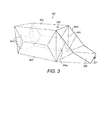
- Figure 3 shows another alternative container 301 comprising a base 302, side walls 303 extending upwardly from the base, a top wall 304, and an opening 305 formed in a side wall of the container.
- the container also comprises a flap 306 configured to form a closure over the opening, two additional flaps 309a and 309b which are formed integrally with flap 306, and a loop 307.
- a button 308 is provided on the top wall of the container.
- the container is formed from a fire retardant material, and the base of the container is either coated or formed from a heat-reflecting material.
- the container 301 may conveniently be hung up using loop 307 while it is being filled up with suitable waste materials. Once full, the user simply folds the additional flaps 309a and 309b over the opening, then folds flap 306 over the opening and fastens loop 307 over button 308 to secure the flap 306 and additional flaps 309a and 309b in place, thus forming a closure.
- the filled container may then be used as insulation for a building by placing it within the roof space of a building.
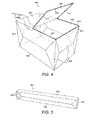
- Figure 4 shows yet another alternative container 401 comprising a base 402, side walls 403 extending upwardly from the base, a top wall 404, and an opening 405 formed in the top wall of the container.
- a flap 406 provided in the top wall 404 is configured to form a closure over the opening.
- the toothed strip 412A of a zip fastener 412 is attached to the flap 406 along its free edges 409, 410 and 411.
- the other toothed strip 412B of the zip fastener 412 is attached to the upper edges of the three side walls of the container that are adjacent to the free edges of the flap when the flap is closed.
- the container is formed from a fire retardant material, and the base of the container is either coated or formed from a heat-reflecting material.
- the flap 406 When the zip fastener 412 is open, as is shown in Figure 4 , the flap 406 may be folded open to allow the container to be filled up with suitable waste materials. Once full, the user simply folds the flap 406 over the opening 405 and secures the flap 406 in place by securing adjacent edges of the flap and the container with the zip fastener 412, thus forming a closure. The filled container may then be used as insulation for a building by placing it within the roof space of a building.
- Figure 5 shows yet another alternative container 501 comprising a base 502, side walls 503 extending upwardly from the base, and a top wall 504.
- the container also comprises a flap 506, which is shown in a closed position such that it forms a further side wall of the container.
- the attachment means by which the flap 506 is secured in place is not shown, but may comprise any suitable fasterner, such as a zip fastener, a button and loop arrangement, or other suitable means as described above.
- the container is formed from a fire retardant material.
- the container 501 is filled up with suitable waste materials, then the flap 506 is secured in place to form a closure.
- the filled container may then be used as a draught excluder for insulating a building.
- FIG. 6 shows yet another alternative container 601 which has been placed in an upright position for filling the container.
- the container When subsequently used for insulation purposes, the container is securely closed and then rotated such that it rests on its base 602.
- the container 601 comprises a base 602, side walls 603 extending upwardly from the base when in use for insulation purposes, a top wall 604, and an opening 605 formed in a side wall of the container.
- the container also comprises a flap 606 configured to form a closure over the opening, two additional flaps 609a and 609b which are formed integrally with and extend from the sides of flap 606.
- Strips of Velcro 613A are provided on two side walls and the top wall of the container, and corresponding strips of Velcro 613B are provided on the flap 606 and additional flaps 609a and 609b.
- the container is formed from a fire retardant material, and the base of the container is either coated or formed from a heat-reflecting material.
- the container 601 may conveniently be hung up using handle 314 while it is being filled up with suitable waste materials. Once full, the user simply folds flap 606 and additional flaps 609a and 609b over the opening, then fastens the Velcro strips 613A to the Velcro strips 613B to secure the flap 606 and additional flaps 609a and 609b in place, thus forming a closure.
- the filled container may then be used as insulation for a building by placing it within the roof space of a building.
Landscapes
- Physics & Mathematics (AREA)
- Engineering & Computer Science (AREA)
- Architecture (AREA)
- Acoustics & Sound (AREA)
- Electromagnetism (AREA)
- Civil Engineering (AREA)
- Structural Engineering (AREA)
- Packages (AREA)
Priority Applications (1)
| Application Number | Priority Date | Filing Date | Title |
|---|---|---|---|
| EP15163579.4A EP3081710A1 (de) | 2015-04-14 | 2015-04-14 | Flammhemmender behälter zur isolierungsverwendung |
Applications Claiming Priority (1)
| Application Number | Priority Date | Filing Date | Title |
|---|---|---|---|
| EP15163579.4A EP3081710A1 (de) | 2015-04-14 | 2015-04-14 | Flammhemmender behälter zur isolierungsverwendung |
Publications (1)
| Publication Number | Publication Date |
|---|---|
| EP3081710A1 true EP3081710A1 (de) | 2016-10-19 |
Family
ID=52997868
Family Applications (1)
| Application Number | Title | Priority Date | Filing Date |
|---|---|---|---|
| EP15163579.4A Withdrawn EP3081710A1 (de) | 2015-04-14 | 2015-04-14 | Flammhemmender behälter zur isolierungsverwendung |
Country Status (1)
| Country | Link |
|---|---|
| EP (1) | EP3081710A1 (de) |
Citations (7)
| Publication number | Priority date | Publication date | Assignee | Title |
|---|---|---|---|---|
| GB294755A (en) * | 1927-06-28 | 1928-08-02 | Rowland Hunt | Improvements in drapery and other boxes |
| GB727163A (en) * | 1952-07-22 | 1955-03-30 | Commercial Plastics Ltd | Fireproof fabric |
| US3669344A (en) * | 1969-03-31 | 1972-06-13 | Akerlund & Rausing Ab | Carton with capped lid |
| US3692235A (en) * | 1969-07-21 | 1972-09-19 | Carol Ann Franiel | Laminates |
| US4446660A (en) * | 1981-01-29 | 1984-05-08 | Liberty Carton Co. | Stuctural member storage device |
| EP1939370A2 (de) * | 2006-12-29 | 2008-07-02 | Viol, Michael | Dämmelement |
| US20100064614A1 (en) * | 2008-09-15 | 2010-03-18 | Tsu David V | Re-usable radiative thermal insulation |
-
2015
- 2015-04-14 EP EP15163579.4A patent/EP3081710A1/de not_active Withdrawn
Patent Citations (7)
| Publication number | Priority date | Publication date | Assignee | Title |
|---|---|---|---|---|
| GB294755A (en) * | 1927-06-28 | 1928-08-02 | Rowland Hunt | Improvements in drapery and other boxes |
| GB727163A (en) * | 1952-07-22 | 1955-03-30 | Commercial Plastics Ltd | Fireproof fabric |
| US3669344A (en) * | 1969-03-31 | 1972-06-13 | Akerlund & Rausing Ab | Carton with capped lid |
| US3692235A (en) * | 1969-07-21 | 1972-09-19 | Carol Ann Franiel | Laminates |
| US4446660A (en) * | 1981-01-29 | 1984-05-08 | Liberty Carton Co. | Stuctural member storage device |
| EP1939370A2 (de) * | 2006-12-29 | 2008-07-02 | Viol, Michael | Dämmelement |
| US20100064614A1 (en) * | 2008-09-15 | 2010-03-18 | Tsu David V | Re-usable radiative thermal insulation |
Similar Documents
| Publication | Publication Date | Title |
|---|---|---|
| US20240067438A1 (en) | Insulated box | |
| WO2005079229A3 (en) | Transparent egg cartons | |
| US3016042A (en) | Small animal house | |
| US3001332A (en) | Ventilating devices for hollow building walls | |
| US20070026185A1 (en) | Spunbond facing and faced insulation assembly | |
| GB2519290A (en) | Fire retardant container for insulation use | |
| US20130186896A1 (en) | Integrated Reusable Gift Packaging | |
| US1794821A (en) | Compound box | |
| US20070036949A1 (en) | Fungi resistant sheet, facing and faced insulation assembly | |
| CZ37831U1 (cs) | Sestava lepenkové krabice a v ní uloženého střešního okna, kde je umístěn přídržný prvek ventilační klapky a použití přídržného prvku ventilační klapky | |
| US1901999A (en) | Insulating material and method of making the same | |
| CN206654299U (zh) | 一种用于军工产品的包装盒 | |
| GB2597715A (en) | Freight protection and thermal management | |
| US20120055823A1 (en) | Refrigerator/freezer insulation blanket and packaging solution | |
| US20230320283A1 (en) | Plant Protector | |
| DK178425B1 (en) | Insulation bag and method for its use | |
| US20070189642A1 (en) | Firewood container | |
| US1967642A (en) | Packing container | |
| CN209474342U (zh) | 一种带有干燥盒的信报箱 | |
| CN213385174U (zh) | 一种可回收利用的包装盒 | |
| EP3566609B1 (de) | Verbesserte hülle für taschen | |
| CN214825485U (zh) | 一种具有防火透气功能的瓦楞纸箱 | |
| US1866059A (en) | Plant protector | |
| CN205707730U (zh) | 嵌入式包装盒 | |
| CN219154974U (zh) | 一种内置内衬组件的纸箱 |
Legal Events
| Date | Code | Title | Description |
|---|---|---|---|
| PUAI | Public reference made under article 153(3) epc to a published international application that has entered the european phase |
Free format text: ORIGINAL CODE: 0009012 |
|
| AK | Designated contracting states |
Kind code of ref document: A1 Designated state(s): AL AT BE BG CH CY CZ DE DK EE ES FI FR GB GR HR HU IE IS IT LI LT LU LV MC MK MT NL NO PL PT RO RS SE SI SK SM TR |
|
| AX | Request for extension of the european patent |
Extension state: BA ME |
|
| STAA | Information on the status of an ep patent application or granted ep patent |
Free format text: STATUS: THE APPLICATION IS DEEMED TO BE WITHDRAWN |
|
| 18D | Application deemed to be withdrawn |
Effective date: 20170420 |