EP3082099A1 - Systeme de prestations de service de voyage intermodal pour la communication avec une pluralite de prestataires de service de transport et de voyage - Google Patents
Systeme de prestations de service de voyage intermodal pour la communication avec une pluralite de prestataires de service de transport et de voyage Download PDFInfo
- Publication number
- EP3082099A1 EP3082099A1 EP16162849.0A EP16162849A EP3082099A1 EP 3082099 A1 EP3082099 A1 EP 3082099A1 EP 16162849 A EP16162849 A EP 16162849A EP 3082099 A1 EP3082099 A1 EP 3082099A1
- Authority
- EP
- European Patent Office
- Prior art keywords
- travel
- transport
- communication device
- information
- mpo
- Prior art date
- Legal status (The legal status is an assumption and is not a legal conclusion. Google has not performed a legal analysis and makes no representation as to the accuracy of the status listed.)
- Ceased
Links
Images


Classifications
-
- G—PHYSICS
- G06—COMPUTING OR CALCULATING; COUNTING
- G06Q—INFORMATION AND COMMUNICATION TECHNOLOGY [ICT] SPECIALLY ADAPTED FOR ADMINISTRATIVE, COMMERCIAL, FINANCIAL, MANAGERIAL OR SUPERVISORY PURPOSES; SYSTEMS OR METHODS SPECIALLY ADAPTED FOR ADMINISTRATIVE, COMMERCIAL, FINANCIAL, MANAGERIAL OR SUPERVISORY PURPOSES, NOT OTHERWISE PROVIDED FOR
- G06Q50/00—Information and communication technology [ICT] specially adapted for implementation of business processes of specific business sectors, e.g. utilities or tourism
- G06Q50/40—Business processes related to the transportation industry
-
- G—PHYSICS
- G01—MEASURING; TESTING
- G01C—MEASURING DISTANCES, LEVELS OR BEARINGS; SURVEYING; NAVIGATION; GYROSCOPIC INSTRUMENTS; PHOTOGRAMMETRY OR VIDEOGRAMMETRY
- G01C21/00—Navigation; Navigational instruments not provided for in groups G01C1/00 - G01C19/00
- G01C21/26—Navigation; Navigational instruments not provided for in groups G01C1/00 - G01C19/00 specially adapted for navigation in a road network
- G01C21/34—Route searching; Route guidance
- G01C21/3407—Route searching; Route guidance specially adapted for specific applications
- G01C21/3423—Multimodal routing
-
- G—PHYSICS
- G01—MEASURING; TESTING
- G01C—MEASURING DISTANCES, LEVELS OR BEARINGS; SURVEYING; NAVIGATION; GYROSCOPIC INSTRUMENTS; PHOTOGRAMMETRY OR VIDEOGRAMMETRY
- G01C21/00—Navigation; Navigational instruments not provided for in groups G01C1/00 - G01C19/00
- G01C21/26—Navigation; Navigational instruments not provided for in groups G01C1/00 - G01C19/00 specially adapted for navigation in a road network
- G01C21/34—Route searching; Route guidance
- G01C21/3453—Special cost functions, i.e. other than distance or default speed limit of road segments
- G01C21/3492—Special cost functions, i.e. other than distance or default speed limit of road segments employing speed data or traffic data, e.g. real-time or historical
-
- G—PHYSICS
- G08—SIGNALLING
- G08G—TRAFFIC CONTROL SYSTEMS
- G08G1/00—Traffic control systems for road vehicles
- G08G1/123—Traffic control systems for road vehicles indicating the position of vehicles, e.g. scheduled vehicles; Managing passenger vehicles circulating according to a fixed timetable, e.g. buses, trains, trams
- G08G1/127—Traffic control systems for road vehicles indicating the position of vehicles, e.g. scheduled vehicles; Managing passenger vehicles circulating according to a fixed timetable, e.g. buses, trains, trams to a central station ; Indicators in a central station
Definitions
- the invention relates to a travel service system and a method for communication between a traveler and a plurality of different travel and transport service providers.
- public transport is being promoted today for a variety of reasons.
- public transport is usually more energy-efficient and thus more environmentally friendly than individual means of transport powered by internal combustion engines.
- public transport in agglomerations and between metropolitan areas can usually be planned more efficiently, faster and better in terms of time due to the prevailing traffic density, especially if they have their own traffic route network, which is used exclusively by themselves, as with subways and high-speed trains.
- the range of work and leisure activities available during the time spent on public transport is not as limited as it is, especially for drivers of individual means of transport who have to concentrate on transport themselves.
- the traveler is not only interested in a particular travel service, but would like to examine various ways to design and / or continue his journey and information from many different ones Call service providers.
- the availability of the desired information from the travel service providers and the exact location of the traveler are crucial to obtaining real-time information about the course of a trip.
- it is desirable that the traveler is spared the active navigation between different websites of different providers, since such an approach is often confusing and time-pressure often too fast to accomplish.
- the travel service providers are also interested in offering their customers better service, whereby the infrastructure provided should be as cost-effective as possible.
- beacons Small permanently installed locally acting transmitters referred to as "beacons” have hitherto been used primarily in stationary situations, for example for so-called proximity marketing (an example of such a beacon is a product of a known IT system marketed under the name "iBeacon”). company).
- iBeacon a product of a known IT system marketed under the name "iBeacon”). company.
- a transmitter can be installed, for example, from a single store. Since the beacons only send in the near range, the current position of a customer is automatically correlated with the location of the respective beacon, so that the beacon targeted advertising for products in the vicinity of the customer's position on the Smartphone can be sent.
- customers need to download a smartphone application from the Internet before they can receive advertising messages from the beacons. In this way, customers who do not want to be constantly supplied with advertising, spared from such information.
- beacons have not been considered for communication with travelers in the planning and organization of travel.
- the reason for this is that during a trip, the communication over such beacons is not so easy to effectively realize, since a vehicle and travelers are on the move in transit. Additional difficulties arise especially when traveling with different means of transport are carried out by different operators. For example, if only one operator or provider operates an infrastructure with beacons to provide their customers with information about their service or general travel information via smartphone applications, then travelers who are customers of other travel providers and the application of the beacon operator may not your smartphone does not automatically access this information. Due to the complexity of the situation under consideration, an optimal combined use of the traffic offers by different providers is made more difficult.
- This mobile communication device also referred to as a mobile terminal, is adapted to communicate wirelessly with other communication devices.
- a mobile terminal may be, for example, a smartphone or a tablet computer, or generally a portable computer.
- Part of the travel service system according to the invention is also a position determination device.
- This position determining device is assigned to a specific transport or spatially assigned to a transport infrastructure of a travel or transport service provider.
- the position determination device is set up to determine current position data of the means of transport or of the traffic infrastructure and to wirelessly transmit travel information related to this position data to the mobile communication device.
- the travel information related to the location data may include, for example, coarse and fine area information about the location ("major region" and "minor region") as well as a globally unique identification number (UUID).
- the coarse area information may refer, for example, to a public transport or traffic infrastructure in a geographic area generally associated with the public transport or the traffic infrastructure.
- the fine area information may include specific location information directly related to the current position of the traveler, such as information about the next stop or the immediate surroundings of the traveler.
- the position determination device For the determination of the fine area information, in the event that the position determining device is in a mobile means of transport, measurement data or external information needed. From this data, an exact position of the position detecting device is determined.
- the position determination device preferably itself has corresponding functional units either for receiving position information from external sources or for the direct determination or measurement of the exact own position, such as sensors.
- direct position determination with the aid of sensors, it is also possible, for example, to query data from a traffic control system, operations control system or traffic monitoring system from which the current position of the means of transport can be derived, taking into account the identification information (UUID) of the position determining device.
- UUID identification information
- the travel service system comprises a central communication device (also referred to as a multi-operator backend) independent of the travel or transport service providers, which is set up to communicate between the mobile communication device and a plurality of travel service provider information systems assigned to the travel and transport service providers to ensure.
- the provision of a communication between the mobile communication device and a plurality of travel service provider information systems assigned to the travel and transport service providers should in particular be understood to mean the establishment of a data transmission connection between the communication partners or a corresponding addressing of suitable travel service provider information systems.
- an independent communication device should be understood as a communication device which is not monopolized by one of the travel or transport service providers, but rather communicates with all travel service provider information systems on an equal basis.
- the central communication device is used in the travel service system as a switching device, which, for example, requests from the Traveler to the travel and transport service providers and in particular the active navigation and addressing of individual service providers takes over.
- Such an architecture has the advantage that the system is very easily accessible and comprehensively usable both for the travelers and the travel and transport service providers.
- the services to be provided by the individual applications or at least part of their functions are preferably exercised by the central communication device according to the invention. If the central communication device has correspondingly broadband channels to the other components of the system, then for example also an accelerated data transmission between the mobile terminal and the travel service provider information systems can be achieved.
- a mobile communication device associated with a traveler communicates wirelessly with other communication devices.
- current position data and location-data-related travel information are transmitted to the mobile communication device by a position determination device, which is spatially permanently assigned to a transport or spatially assigned to a traffic infrastructure of a travel or transport service provider.
- the communication between the position detection device and the mobile communication device with respect to the position data is preferably carried out unidirectionally by the position determination device to the mobile communication device, for example via the standard Bluetooth Low Energy (BLE).
- BLE Bluetooth Low Energy
- a communication between the mobile communication device and a plurality of travel service systems which are each associated with a travel or transport service provider, via a central, independent of the individual travel or transport service providers communication device.
- the communication between the mobile communication device and the plurality of travel service systems is thus not directly, but via a central communication device.
- Some components of the travel service management system according to the invention can be designed predominantly in the form of software components. This relates in particular to functional features of the central communication device and of the mobile communication device.
- the travel service system comprises a plurality of travel service provider information systems which are each assigned to one of the travel or transport service providers and are configured to transmit current information regarding the means of transport or traffic infrastructures operated by the respective travel or transport service provider.
- the travel or transport service providers provide information regarding the networks and timetables of the means of transport they operate.
- the travel service system is configured such that the central communication device is adapted to receive position data from the mobile communication device and / or travel information related to these position data and to automatically query suitable travel service provider information systems based on this data and send the received information to the mobile Return communication device.
- the central communication device recognizes which of the travel and transport service providers might be of interest to the traveler and subsequently addresses these transport service providers. For the traveler then the information from the central communication device selected service providers are visible and accessible. The user therefore does not have to actively search for individual names or even Internet addresses of individual providers, but automatically receives access to the providers that match his data profile.
- the user's data profile is based primarily on the information requested by the position determination device. In this way, the traveler receives travel information or travel services tailored to his / her current situation from the respective providers, without necessarily having to actively participate.
- the central communication device is arranged in the means of transport or the traffic infrastructure. In an alternative variant, the central communication device is arranged away from the means of transport or the traffic infrastructure.
- the central communication device is set up to communicate with the mobile communication device via a secure WLAN connection or an LTE connection.
- a WLAN connection is particularly suitable for near-user or stationary variants, in which the central communication device in a means of transport or close a stationary transport infrastructure is arranged. The user then only needs to connect to the local WLAN network with his mobile terminal, without having access to a paid telephone or data transmission network, for example.
- the central communication device is arranged away from the user, for example in a central stationary device, then communication networks between the mobile device and the central communication device will require remote data transmission networks, such as networks according to the UMTS standard or the LTE standard.
- the position determining device of the travel service system is preferably permanently installed in the associated means of transport. If the position detection device is thus constantly carried, a data transmission to the mobile terminals of travelers who are in the means of transport is ensured at all times.
- a position information as context information to the mobile devices and from there to the central communication device can not only determine a position of a traveler, but also use automated for communication between a traveler and travel and transport service providers.
- the position-determining device of the travel service system may also include a location-based position determination device which is permanently installed in or on a traffic infrastructure, preferably a train station or airport or subway station and provides information regarding the position of the traffic infrastructure.
- a traffic infrastructure preferably a train station or airport or subway station
- the position determination device is set up, in addition to the position information, also an identification information of the assigned means of transport or the assigned traffic infrastructure and transmit position data related travel information to the mobile communication device.
- the identification information may, for example, be linked to additional information, the travel information relating to the position data, in a database relating to the name of the means of transport, the route currently traveled and details of the stops, and possibly also of timetable information.
- the position detecting means may comprise, for example, a small transmitter, as is the case with the units referred to above as beacons. It can also comprise a data transmission unit suitable for near field communication, also referred to as an NFC tag, or have a unit communicating via WLAN.
- the mobile communication device comprises a program module which can be integrated into a plurality of application programs of the individual travel or transport service providers stored on the mobile communication device.
- Such a program module is configured to ensure communication with the plurality of travel service provider information systems by means of the central communication device and using the position data acquired by the mobile communication device and the travel information related to the position data.
- the travel service system may comprise a position determination device management device which is set up to store the information identifying the respective position determination devices in more detail and to transmit the stored information to the central communication device on request.
- a position determination device management device which is set up to store the information identifying the respective position determination devices in more detail and to transmit the stored information to the central communication device on request.
- the position determination device administration device is set up to store more detailed information regarding the time at which a position determination device was installed and with respect to the owner of the position determination device.
- the travel service system can have additional databases, which are connected to the central communication device via a data connection.
- these databases may store information regarding relevant services and product offers for travelers.
- these additional databases can be connected to the mobile communication device via the central communication device.
- the product offers can be offers for travel needs or advertising for products and services tailored to a specific travel or travel route.
- the targeted advertising can be specified on the basis of the information obtained from the position determination device.
- the position-determining device of the travel service system preferably comprises a sensor device.
- the sensor device preferably has a number of sensors, which are designed to detect a movement of the sensor device and / or physical variables of an environment of the sensor device and output corresponding measured values, a data memory, which is adapted to predetermined positions on the predetermined route Store reference measured values for the sensors, and a computing device which is adapted to compare the measured values output by the sensors with the stored reference measured values and, if the measured values output by the sensors match the reference measured values, the position corresponding to the respective reference measured values as the current position Determine position of the position detection device.
- a sensor device is described in the German patent application with the official file number no. 102 01 52 055 35.3, to which reference is made at this point.
- FIG. 1 a travel service system 1 according to a first embodiment of the invention is shown.
- Parts MOB, MP of the travel service system 1 are arranged in a mobile public transport VM, such as a high-speed train.
- a position determination device MOB is permanently installed in the public transport VM. This position determination device MOB is not only set up to determine the geographical position of the public transport VM, but also to additionally ascertain travel information related to the current position, such as the current travel route with the start and destination of the public transport, and the official name of the means of transport, such as an official train designation, to be determined or reproduced.
- the aforementioned position determination devices MOB are mounted in public means of transport, such as trains, trams or buses.
- these position-determining devices MOB can be used to determine the exact position of a traveler, the official name of the means of transport or the infrastructure in or near which the traveler is currently staying, and an associated service. Once this information has been provided, it can be used to obtain additional travel-related information from the travel and transport service providers.
- beacons which have low-cost transmitters and software protocols in order to communicate information to smartphones when they are in the vicinity, can be used in particular as position determination devices MOB.
- BLE Bluetooth Low Energy
- Beacons are small and usually equipped with a battery for power and are used to convey an exact location and associated context to mobile terminals MP located near the beacons. For example, the context may be correlated with the position of the beacon.
- the beacons transmit a small amount of information to all mobile communication devices that have been activated for this purpose in a range of a few centimeters to about 70 m or under favorable circumstances even up to 400 m away.
- UUID Universally Unique Identifier
- This identification code may be used to identify the location or vicinity in the vicinity of a position of a beacon.
- the beacon's identification code may also be used to uniquely identify an infrastructure associated with the beacon, such as a train station or a wagon in which a traveler is currently located.
- so-called area information may be transmitted as context.
- area information of a beacon installed at a station at a platform of a subway terminal may include, for example, the name of the station, such as "Munich Central Station, Germany”.
- Fine area information of a beacon may include, for example, a name of a platform of a subway terminal where a traveler is currently located, such as "U4 / U5 subway platform”.
- a mobile beacon mounted in a high-speed train may include, as coarse range information, the name of the train and the starting and terminating stations, such as "ICE 582 from Kunststoff to Berlin".
- the mobile beacon may include the next holding station such as "next stop: Nuremberg".
- the geographic information to be transmitted may be received by the beacon, for example, from a sensor device (not shown) installed in the vehicle.
- the beacon with its identifier can be unambiguously assigned to a specific means of transport that travels on a certain route.
- it receives messages from the sensor device regarding a current geographical position.
- Other parts MPO, TOP1, TOP2, TOP3 of the travel service system 1 are in the in FIG. 1 shown embodiment outside the public transport VM arranged.
- a central communication device MPO can be accommodated in a central service center of the operator of the travel service system 1.
- the central communication device MPO can also be arranged in the means of transport VM.
- a plurality of travel service provider information systems TOP1, TOP2, TOP3 are stored, for example, on the Internet, ie concretely on web servers in corresponding server centers or also by the operators themselves operated web servers.
- position information PD and context information RI are used for requests from the mobile terminal MP to the travel service provider information systems TOP1, TOP2, TOP3.
- this information is communicated to the central communication device along with a request Q-OP or instruction relating to an interaction with one or more travel service provider information systems TOP1, TOP2, TOP3.
- the central communication device MPO searches for the suitable travel service provider information systems TOP1, TOP2, TOP3 and their Internet addresses and provides a communication connection between the mobile terminal MOB and the appropriate travel service provider information systems TOP1, TOP2, TOP3 forth, additionally transmits the detected position information PD and the context information RI to the appropriate travel service provider information systems TOP1, TOP2, TOP3 and a corresponding request Q-TOP based on the received request Q-OP from the mobile terminal MP.
- the addressed travel service provider information systems TOP1, TOP2, TOP3 can transmit travel information AVI to the mobile terminal MP on the basis of the received position information PD and the context information RI.
- the travel information AVI may relate, for example, to timetable information or actual arrival times, available connections at the next third-party stops, or the availability of individual means of transport at the next stops, such as rental vehicles or rental bicycles, or information about tourist attractions.
- the data transmission between the travel service provider information systems TOP1, TOP2, TOP3 and the mobile terminal MP preferably runs via the central communication device MPO as an intermediate station.
- the central communication device MPO has the additional function of the information received from the travel service provider information systems TOP1, TOP2, TOP3 before forwarding to the mobile terminal MP on the basis of the received position information PD and the context information RI and the request Q-OP of The mobile terminal MP, for example, to rank according to relevance and combine accordingly and forwarded so ordered to the mobile terminal MOB.
- the central communication device MPO searches for the Internet addresses assigned to this travel service provider information systems TOP1, TOP2, TOP3 and provides a connection between the mobile terminal MP and the travel service providers TOP1, TOP2, TOP3 ago.
- the data transmission via the central communication device makes it easier to plan or change the planning of a journey in which a multitude of different travel service providers and means of transport have to be used. Instead of the traveler having to find individual service providers and having to process or combine their data themselves, these tasks are performed by an independent central communication device MPO. Conversely, such a system 1 also facilitates the access of the different travel service providers TOP1, TOP2, TOP3 to their customers, since they themselves have not sought and found, indeed they do not even have to be known, in order to be able to transmit information and offers to the travelers ,
- the traveler can not only receive downlink information from the travel service providers TOP1, TOP2, TOP3, but also actively forward data to the travel service providers in the uplink direction (upstream), such as booking transactions or payment transactions or transmission Feedback from the customer or traveler regarding the quality of the service of the travel service providers TOP1, TOP2, TOP3 or the used means of transport VM.
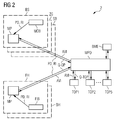
- FIG. 2 a travel service system 2 according to a second embodiment of the invention is shown.
- the system comprises 2 not just a mobile public transport VM, but a plurality of different means of transport, in the illustrated embodiment a bus BS, a train ZG and a tram SB.
- the system 2 also includes stationary infrastructure elements, in this specific case a station BG and an airport FH.
- the system 2 also includes a larger number of travel and transport service providers TOP1, ..., TOP5.
- FIG. 1 already mentioned elements MP, MOB, MPO, TOP1, ..., TOP5, transmitted data AVI, PD, RI and requests Q-OP, Q-TOP are hereby referenced again without being individually described again. Additionally is in FIG.
- the airport FH shown a fixed position determining device FIB shown, and a smartphone MP whose user is currently in the area of the airport FH.
- the user of the fixed position determining device FIB geographic information about its location and about the closer or more distant environment.
- the information relating to the more distant environment includes the name of the airport, such as "Munich Airport” and the information about the vicinity, a designation of the partial section in which the traveler is currently staying, such as "Terminal 2".
- a position detecting means managing means BME which is arranged to store more detailed information regarding the time at which a position detecting means MOB, FIB has been installed, and with respect to the owner of the position detecting means MOB, FIB to store.
- the position determination device management device BME may also include a database in which an association between an identifier (UUID) of a position determination device and the designation of the means of transport or the infrastructure in which the respective position determination device is located is stored.
- UUID an identifier
- FIG. 3 3 is a flowchart illustrating a method 300 of communicating with a plurality of different travel and transportation service providers TOP1,..., TOP5.
- a traveler first uses a mobile terminal MP to request or receive position data PD and position data-related travel information RI from a position determination device MOB, FIB.
- the position determining device MOB, FIB is spatially permanently assigned to a means of transport BS, ZG, SB or spatially assigned to a traffic infrastructure BH, FH of a travel or transport service provider OP.
- the traveler must be in the vicinity of the position determination device MOB, FIB to receive the said information.
- step 3.II the mobile terminal MP initiates communication with one or more travel and transport service providers by first transmitting the data PD, RI received from the position determination device MOB, FIB and an additional service request Q-OP to a central communication device become.
- the service request may relate, for example, to the execution of a booking and / or payment transaction or the query of timetable information.
- step 3.III one or more travel service systems TOP1,..., TOP5 are addressed by the central communication device MPO on the basis of the information received from the mobile terminal MP, and a communication connection between the one or more travel service systems TOP1,..., TOP5 and the mobile terminal MP. If a specific request Q-OP for a specific travel service has already been submitted by the mobile terminal MP, a corresponding request Q-TOP with correct addressing is transmitted by the central communication device MPO to a suitable travel service system TOP1,..., TOP5.
- step 3.IV the traveler R now carries out his intended action, such as a booking or a payment transaction or a request for additional travel information, in communication with his associated travel service systems TOP1, ..., TOP5.
- schedule information AVI is requested from several travel service systems TOP1,..., TOP5, and subsequently at step 3.V, this requested information AVI is sent from the addressed travel service systems TOP1,..., TOP5 to the mobile terminal MP transmitted.
- the user of the mobile terminal MP does not have to actively search for individual providers on the Internet in search of the schedule information. He does not even need an application on his smartphone that automatically executes such navigation for him.
- the latter has, for example, the additional advantage that the traveler does not have to make any constant updates, which concern, for example, the addresses of new service providers or new service functions, to an application on his mobile terminal.
- the effectiveness and the comfort of the travel service system 1, 2 are improved for the traveler. Improvements have also been made to the travel service providers involved in the travel service system as they can now be confident that the traveler has the ability to access their services. This access is facilitated according to the invention for each travel service provider involved in the system even if a traveler is currently in a means of transport from another operator or travel service provider.
- indefinite articles does not exclude “a” or “one”, that the characteristics in question can also be present multiple times.
- unit does not exclude that it consists of several components, which may also be spatially distributed.
Landscapes
- Engineering & Computer Science (AREA)
- Radar, Positioning & Navigation (AREA)
- Remote Sensing (AREA)
- Physics & Mathematics (AREA)
- General Physics & Mathematics (AREA)
- Automation & Control Theory (AREA)
- Business, Economics & Management (AREA)
- Economics (AREA)
- Health & Medical Sciences (AREA)
- General Health & Medical Sciences (AREA)
- Human Resources & Organizations (AREA)
- Marketing (AREA)
- Primary Health Care (AREA)
- Strategic Management (AREA)
- Tourism & Hospitality (AREA)
- General Business, Economics & Management (AREA)
- Theoretical Computer Science (AREA)
- Mobile Radio Communication Systems (AREA)
- Traffic Control Systems (AREA)
Applications Claiming Priority (1)
| Application Number | Priority Date | Filing Date | Title |
|---|---|---|---|
| DE102015206870 | 2015-04-16 |
Publications (1)
| Publication Number | Publication Date |
|---|---|
| EP3082099A1 true EP3082099A1 (fr) | 2016-10-19 |
Family
ID=55696968
Family Applications (1)
| Application Number | Title | Priority Date | Filing Date |
|---|---|---|---|
| EP16162849.0A Ceased EP3082099A1 (fr) | 2015-04-16 | 2016-03-30 | Systeme de prestations de service de voyage intermodal pour la communication avec une pluralite de prestataires de service de transport et de voyage |
Country Status (1)
| Country | Link |
|---|---|
| EP (1) | EP3082099A1 (fr) |
Cited By (2)
| Publication number | Priority date | Publication date | Assignee | Title |
|---|---|---|---|---|
| DE102016202611A1 (de) * | 2016-02-19 | 2017-08-24 | Siemens Aktiengesellschaft | Reisedienstleistungssystem für die Kommunikation zwischen einem Reisenden und einem Verkehrsdienstleister |
| EP3968673A1 (fr) * | 2020-09-10 | 2022-03-16 | RTB GmbH&Co.KG | Procédé et dispositif de fourniture d'informations et/ou de fonctions |
Citations (6)
| Publication number | Priority date | Publication date | Assignee | Title |
|---|---|---|---|---|
| DE4326237C1 (de) * | 1993-07-31 | 1994-12-15 | Gsp Sprachtechnologie Ges Fuer | Verfahren zur Standortbestimmung von Fahrzeugen des öffentlichen Personenverkehrs |
| WO2002048987A1 (fr) * | 2000-12-14 | 2002-06-20 | Koninklijke Philips Electronics N.V. | Procede de fourniture de renseignements sur les voyages a un dispositif de communications mobiles |
| US6736317B1 (en) * | 1999-04-20 | 2004-05-18 | Mcdonald Ian | Real time internet-based transit management and control system with wireless vehicular data link |
| WO2005032173A1 (fr) * | 2003-09-24 | 2005-04-07 | Siemens Aktiengesellschaft | Procede et dispositif pour actualiser des donnees sur les deplacements et/ou la position d'un terminal mobile sur un serveur de type agent de voyage |
| EP1555845A1 (fr) * | 2004-01-15 | 2005-07-20 | Siemens Aktiengesellschaft | Procédé de localisation des postes d'abonnés d'un système de communication radio |
| US20130217414A1 (en) * | 2012-02-22 | 2013-08-22 | Suresh NAGARAJ | Delivering content by predicting predetermined routes using wireless networks |
-
2016
- 2016-03-30 EP EP16162849.0A patent/EP3082099A1/fr not_active Ceased
Patent Citations (6)
| Publication number | Priority date | Publication date | Assignee | Title |
|---|---|---|---|---|
| DE4326237C1 (de) * | 1993-07-31 | 1994-12-15 | Gsp Sprachtechnologie Ges Fuer | Verfahren zur Standortbestimmung von Fahrzeugen des öffentlichen Personenverkehrs |
| US6736317B1 (en) * | 1999-04-20 | 2004-05-18 | Mcdonald Ian | Real time internet-based transit management and control system with wireless vehicular data link |
| WO2002048987A1 (fr) * | 2000-12-14 | 2002-06-20 | Koninklijke Philips Electronics N.V. | Procede de fourniture de renseignements sur les voyages a un dispositif de communications mobiles |
| WO2005032173A1 (fr) * | 2003-09-24 | 2005-04-07 | Siemens Aktiengesellschaft | Procede et dispositif pour actualiser des donnees sur les deplacements et/ou la position d'un terminal mobile sur un serveur de type agent de voyage |
| EP1555845A1 (fr) * | 2004-01-15 | 2005-07-20 | Siemens Aktiengesellschaft | Procédé de localisation des postes d'abonnés d'un système de communication radio |
| US20130217414A1 (en) * | 2012-02-22 | 2013-08-22 | Suresh NAGARAJ | Delivering content by predicting predetermined routes using wireless networks |
Non-Patent Citations (1)
| Title |
|---|
| ANONYMOUS: "Wi-Fi positioning system - Wikipedia", 25 March 2015 (2015-03-25), pages 1 - 3, XP055853115, Retrieved from the Internet <URL:https://en.wikipedia.org/w/index.php?title=Wi-Fi_positioning_system&oldid=653440243> [retrieved on 20211020] * |
Cited By (2)
| Publication number | Priority date | Publication date | Assignee | Title |
|---|---|---|---|---|
| DE102016202611A1 (de) * | 2016-02-19 | 2017-08-24 | Siemens Aktiengesellschaft | Reisedienstleistungssystem für die Kommunikation zwischen einem Reisenden und einem Verkehrsdienstleister |
| EP3968673A1 (fr) * | 2020-09-10 | 2022-03-16 | RTB GmbH&Co.KG | Procédé et dispositif de fourniture d'informations et/ou de fonctions |
Similar Documents
| Publication | Publication Date | Title |
|---|---|---|
| EP0755039B1 (fr) | Procédé et système pour le pronostic de l'écoulement du trafic | |
| DE69916482T2 (de) | Fahrerinformationssystem | |
| EP2223504B1 (fr) | Transmission d'informations d'un véhicule | |
| EP1198696B1 (fr) | Procede et dispositif pour la transmission d'informations de navigation d'une centrale de donnees a un systeme de navigation monte dans un vehicule | |
| DE69634561T2 (de) | Verfahren und vorrichtung zur bestimmung der erwarteten ankunftszeit | |
| EP2610815B1 (fr) | Procédé d'établissement de données de flux de trafic dans un réseau routier | |
| DE112018003048T5 (de) | Fahrzeugzuweisedienstleistungsvorrichtung, fahrzeugzuweisedienstleistungsverfahren und programm | |
| EP1668589A1 (fr) | Systeme pour la fourniture de services | |
| EP1482661A2 (fr) | Méthode pour le transfert d'information entre des objets en mouvement et dispositif de communication utilisant ladite méthode | |
| DE102019109133A1 (de) | Technik zum Abgleich von Fahrten von Kraftfahrzeugen | |
| DE112008000801T5 (de) | Verkehrsdatenerfassung unter Verwendung eines zellularen Kommunikationsnetzes und von Sondeneinheiten | |
| WO2013152783A1 (fr) | Procédé, système et véhicule pour effectuer un voyage en groupe | |
| EP2275780A2 (fr) | Procédé d'assistance à la formation de covoiturages | |
| EP3696787A1 (fr) | Concept de fourniture d'informations sur la disponibilité de places de stationnement | |
| DE10201106A1 (de) | Verfahren zum Bestimmen einer Reisezeit | |
| DE102019120705B3 (de) | System und Verfahren zur dynamischen und robusten Aktualisierung einer digitalen Karte | |
| EP3317848A1 (fr) | Système et procédé de mise à disposition d'informations concernant des possibilités de transport sur un appareil électronique d'un utilisateur | |
| EP3196841B1 (fr) | Serveur back-end et système pour déterminer automatiquement l'utilisation d'un réseau de transport | |
| EP3211605B1 (fr) | Dispositif de véhicule, système, dispositif coté route et procédé d'exécution d'au moins une transaction | |
| EP2023576A2 (fr) | Procédé et dispositif de préparation de services spécifique aux abonnés | |
| DE112018002736B4 (de) | Inhalte-Verteilserver und Inhalte-Verteilverfahren | |
| DE102017216936B4 (de) | Sicherheitssystem zur Fahrzeugkommunikation | |
| DE19959223C1 (de) | Verfahren zur dezentralen Steuerung der Beförderung mit Kraftfahrzeugen und System hierzu | |
| EP1339247B1 (fr) | Procédé pour rédiger des données pour utilisateurs mobiles d'un systéme de transmission d'information | |
| DE102016004802A1 (de) | Verfahren zum Auswählen und zur verkehrsorientierten Steuerung eines Fahrzeugs und Informationssystem für ein Fahrzeug |
Legal Events
| Date | Code | Title | Description |
|---|---|---|---|
| PUAI | Public reference made under article 153(3) epc to a published international application that has entered the european phase |
Free format text: ORIGINAL CODE: 0009012 |
|
| AK | Designated contracting states |
Kind code of ref document: A1 Designated state(s): AL AT BE BG CH CY CZ DE DK EE ES FI FR GB GR HR HU IE IS IT LI LT LU LV MC MK MT NL NO PL PT RO RS SE SI SK SM TR |
|
| AX | Request for extension of the european patent |
Extension state: BA ME |
|
| STAA | Information on the status of an ep patent application or granted ep patent |
Free format text: STATUS: REQUEST FOR EXAMINATION WAS MADE |
|
| 17P | Request for examination filed |
Effective date: 20170419 |
|
| RBV | Designated contracting states (corrected) |
Designated state(s): AL AT BE BG CH CY CZ DE DK EE ES FI FR GB GR HR HU IE IS IT LI LT LU LV MC MK MT NL NO PL PT RO RS SE SI SK SM TR |
|
| RAP1 | Party data changed (applicant data changed or rights of an application transferred) |
Owner name: SIEMENS AKTIENGESELLSCHAFT |
|
| RAP1 | Party data changed (applicant data changed or rights of an application transferred) |
Owner name: SIEMENS MOBILITY GMBH |
|
| STAA | Information on the status of an ep patent application or granted ep patent |
Free format text: STATUS: EXAMINATION IS IN PROGRESS |
|
| 17Q | First examination report despatched |
Effective date: 20190912 |
|
| STAA | Information on the status of an ep patent application or granted ep patent |
Free format text: STATUS: THE APPLICATION HAS BEEN REFUSED |
|
| 18R | Application refused |
Effective date: 20211202 |