EP3083030B1 - Partikelstabilisierte mikrokapseln - Google Patents
Partikelstabilisierte mikrokapseln Download PDFInfo
- Publication number
- EP3083030B1 EP3083030B1 EP14816237.3A EP14816237A EP3083030B1 EP 3083030 B1 EP3083030 B1 EP 3083030B1 EP 14816237 A EP14816237 A EP 14816237A EP 3083030 B1 EP3083030 B1 EP 3083030B1
- Authority
- EP
- European Patent Office
- Prior art keywords
- oil
- maleic anhydride
- particles
- microcapsule
- containing polymer
- Prior art date
- Legal status (The legal status is an assumption and is not a legal conclusion. Google has not performed a legal analysis and makes no representation as to the accuracy of the status listed.)
- Active
Links
Images





Classifications
-
- B—PERFORMING OPERATIONS; TRANSPORTING
- B01—PHYSICAL OR CHEMICAL PROCESSES OR APPARATUS IN GENERAL
- B01J—CHEMICAL OR PHYSICAL PROCESSES, e.g. CATALYSIS OR COLLOID CHEMISTRY; THEIR RELEVANT APPARATUS
- B01J13/00—Colloid chemistry, e.g. the production of colloidal materials or their solutions, not otherwise provided for; Making microcapsules or microballoons
- B01J13/02—Making microcapsules or microballoons
- B01J13/06—Making microcapsules or microballoons by phase separation
-
- B—PERFORMING OPERATIONS; TRANSPORTING
- B01—PHYSICAL OR CHEMICAL PROCESSES OR APPARATUS IN GENERAL
- B01J—CHEMICAL OR PHYSICAL PROCESSES, e.g. CATALYSIS OR COLLOID CHEMISTRY; THEIR RELEVANT APPARATUS
- B01J13/00—Colloid chemistry, e.g. the production of colloidal materials or their solutions, not otherwise provided for; Making microcapsules or microballoons
- B01J13/02—Making microcapsules or microballoons
- B01J13/06—Making microcapsules or microballoons by phase separation
- B01J13/14—Polymerisation; cross-linking
-
- A—HUMAN NECESSITIES
- A01—AGRICULTURE; FORESTRY; ANIMAL HUSBANDRY; HUNTING; TRAPPING; FISHING
- A01N—PRESERVATION OF BODIES OF HUMANS OR ANIMALS OR PLANTS OR PARTS THEREOF; BIOCIDES, e.g. AS DISINFECTANTS, AS PESTICIDES OR AS HERBICIDES; PEST REPELLANTS OR ATTRACTANTS; PLANT GROWTH REGULATORS
- A01N25/00—Biocides, pest repellants or attractants, or plant growth regulators, characterised by their forms, or by their non-active ingredients or by their methods of application, e.g. seed treatment or sequential application; Substances for reducing the noxious effect of the active ingredients to organisms other than pests
- A01N25/08—Biocides, pest repellants or attractants, or plant growth regulators, characterised by their forms, or by their non-active ingredients or by their methods of application, e.g. seed treatment or sequential application; Substances for reducing the noxious effect of the active ingredients to organisms other than pests containing solids as carriers or diluents
-
- A—HUMAN NECESSITIES
- A61—MEDICAL OR VETERINARY SCIENCE; HYGIENE
- A61K—PREPARATIONS FOR MEDICAL, DENTAL OR TOILETRY PURPOSES
- A61K8/00—Cosmetics or similar toiletry preparations
- A61K8/02—Cosmetics or similar toiletry preparations characterised by special physical form
- A61K8/11—Encapsulated compositions
-
- A—HUMAN NECESSITIES
- A61—MEDICAL OR VETERINARY SCIENCE; HYGIENE
- A61K—PREPARATIONS FOR MEDICAL, DENTAL OR TOILETRY PURPOSES
- A61K8/00—Cosmetics or similar toiletry preparations
- A61K8/18—Cosmetics or similar toiletry preparations characterised by the composition
- A61K8/19—Cosmetics or similar toiletry preparations characterised by the composition containing inorganic ingredients
- A61K8/25—Silicon; Compounds thereof
-
- A—HUMAN NECESSITIES
- A61—MEDICAL OR VETERINARY SCIENCE; HYGIENE
- A61K—PREPARATIONS FOR MEDICAL, DENTAL OR TOILETRY PURPOSES
- A61K8/00—Cosmetics or similar toiletry preparations
- A61K8/18—Cosmetics or similar toiletry preparations characterised by the composition
- A61K8/72—Cosmetics or similar toiletry preparations characterised by the composition containing organic macromolecular compounds
- A61K8/81—Cosmetics or similar toiletry preparations characterised by the composition containing organic macromolecular compounds obtained by reactions involving only carbon-to-carbon unsaturated bonds
- A61K8/8164—Compositions of homopolymers or copolymers of compounds having one or more unsaturated aliphatic radicals, each having only one carbon-to-carbon double bond, and at least one being terminated by a carboxyl radical, and containing at least one other carboxyl radical in the molecule, or of salts, anhydrides, esters, amides, imides or nitriles thereof; Compositions of derivatives of such polymers, e.g. poly (methyl vinyl ether-co-maleic anhydride)
-
- A—HUMAN NECESSITIES
- A61—MEDICAL OR VETERINARY SCIENCE; HYGIENE
- A61Q—SPECIFIC USE OF COSMETICS OR SIMILAR TOILETRY PREPARATIONS
- A61Q13/00—Formulations or additives for perfume preparations
-
- A—HUMAN NECESSITIES
- A61—MEDICAL OR VETERINARY SCIENCE; HYGIENE
- A61Q—SPECIFIC USE OF COSMETICS OR SIMILAR TOILETRY PREPARATIONS
- A61Q15/00—Anti-perspirants or body deodorants
-
- A—HUMAN NECESSITIES
- A61—MEDICAL OR VETERINARY SCIENCE; HYGIENE
- A61Q—SPECIFIC USE OF COSMETICS OR SIMILAR TOILETRY PREPARATIONS
- A61Q19/00—Preparations for care of the skin
- A61Q19/007—Preparations for dry skin
-
- A—HUMAN NECESSITIES
- A61—MEDICAL OR VETERINARY SCIENCE; HYGIENE
- A61Q—SPECIFIC USE OF COSMETICS OR SIMILAR TOILETRY PREPARATIONS
- A61Q19/00—Preparations for care of the skin
- A61Q19/10—Washing or bathing preparations
-
- A—HUMAN NECESSITIES
- A61—MEDICAL OR VETERINARY SCIENCE; HYGIENE
- A61Q—SPECIFIC USE OF COSMETICS OR SIMILAR TOILETRY PREPARATIONS
- A61Q5/00—Preparations for care of the hair
- A61Q5/02—Preparations for cleaning the hair
-
- A—HUMAN NECESSITIES
- A61—MEDICAL OR VETERINARY SCIENCE; HYGIENE
- A61Q—SPECIFIC USE OF COSMETICS OR SIMILAR TOILETRY PREPARATIONS
- A61Q5/00—Preparations for care of the hair
- A61Q5/12—Preparations containing hair conditioners
-
- B—PERFORMING OPERATIONS; TRANSPORTING
- B01—PHYSICAL OR CHEMICAL PROCESSES OR APPARATUS IN GENERAL
- B01J—CHEMICAL OR PHYSICAL PROCESSES, e.g. CATALYSIS OR COLLOID CHEMISTRY; THEIR RELEVANT APPARATUS
- B01J13/00—Colloid chemistry, e.g. the production of colloidal materials or their solutions, not otherwise provided for; Making microcapsules or microballoons
- B01J13/02—Making microcapsules or microballoons
- B01J13/04—Making microcapsules or microballoons by physical processes, e.g. drying, spraying
-
- C—CHEMISTRY; METALLURGY
- C11—ANIMAL OR VEGETABLE OILS, FATS, FATTY SUBSTANCES OR WAXES; FATTY ACIDS THEREFROM; DETERGENTS; CANDLES
- C11D—DETERGENT COMPOSITIONS; USE OF SINGLE SUBSTANCES AS DETERGENTS; SOAP OR SOAP-MAKING; RESIN SOAPS; RECOVERY OF GLYCEROL
- C11D3/00—Other compounding ingredients of detergent compositions covered in group C11D1/00
- C11D3/50—Perfumes
- C11D3/502—Protected perfumes
- C11D3/505—Protected perfumes encapsulated or adsorbed on a carrier, e.g. zeolite or clay
Definitions
- the present invention relates to a process for the preparation of microcapsules stabilized by inorganic particles that are selectively internally crosslinked, as well as capsules obtained by said process.
- Consumer products comprising said capsules, in particular products with high levels of ethanol or liquid aqueous surfactant-rich consumer products are also part of the invention.
- Aminoplast microcapsules formed of a melamine-formaldehyde resin have been largely used to encapsulate hydrophobic actives, thus protecting said actives and providing their controlled release.
- capsules such as aminoplast ones suffer from stability problems when used in consumer products comprising surfactants, such as perfumery consumer products, especially after prolonged storage at elevated temperatures.
- surfactants such as perfumery consumer products
- the encapsulated active tends to leak out of the capsule by diffusion through the wall due to the presence of surfactants that are able to solubilise the encapsulated active in the product base.
- the leakage phenomenon reduces the efficiency of the capsules to protect the active and provide its controlled release.
- WO2009/063257 also describes the use of polyisocyanates as possible crosslinker for surface-modified inorganic particles in order to prepare microcapsules with increased level of protection from u.v. light for the contents. These products are typically intended for agrochemical applications.
- the present invention relates to a particle-stabilized microcapsule obtainable by a process comprising the steps of suspending inorganic solid particles with at least one amine functionality in water to form an aqueous phase; suspending at least one maleic anhydride-containing polymer in a perfume or flavour oil to form an oil phase; and finally adding the oil phase to the water phase and mixing the resulting emulsion to form a core-shell or matrix structure with crosslinked particles present at the oil/water interface.
- the invention concerns a process for the preparation of those capsules as well as perfuming compositions and perfumed articles containing them, in particular compositions with high levels of ethanol on the one hand and consumer products with high levels of surfactants on the other hand.
- % are meant to designate percent by weight of a composition.
- each nanoparticle has been functionalised so as to comprise at least one amine moiety such as NH 2 .
- selective crosslinked nanoparticles it is meant that the functionalized particles interact explicitly with the crosslinker added to the oil core such that the particles are bound together but the oil core is not entirely polymerized to form a solid core.
- maleic anhydride-containing polymer it is meant that the polymer comprises maleic anhydride groups which react with amino groups to covalently bond the functionalized particles.
- perfume or flavour oil it is meant a single perfuming or flavouring compound or a mixture of several perfuming or flavouring compounds.
- Microx type morphology used in the context of the invention by opposition to "core-shell” morphology is also referred to as a composite structure and is meant to designate a network composite by opposition to a reservoir system, which nevertheless preserve the discrete microparticle morphology generated by the emulsion process.
- the configuration depends on the selection of maleic anhydride containing polymer.
- the present invention relates to a robust yet permeable vehicle for an active ingredient e.g. perfume oil, particularly adapted in the case of perfume, to fine fragrance applications.
- a first object of the present invention consists of a particle-stabilized microcapsule obtainable by a process comprising the steps of:
- the morphology of the microcapsules of the invention can vary from core-shell type to a matrix type depending on kinetics and thermodynamics in the preparation process.
- the capsules of the present invention have a core-shell structure with the particles present at the oil/water interface.
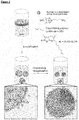
- the capsules of the present invention have a matrix structure. This schematic is given in Figure 2 and the structure is represented in Figure 6 . Without being bound by theory it is believed that in that case, the crosslinking reaction simultaneously pulls the particles into the oil phase as the particle surface becomes more hydrophobic, generating an oil-containing composite structure with particles present at the outer surface as illustrated in Figure 7 .
- the capsules of the invention are obtained through a process characterized by an internal cross linking with maleic anhydride-containing polymer of particle-stabilized oil droplets, which leads to successful encapsulation of volatile materials.
- the inorganic/organic hybrid system of amino-particles crosslinked by maleic anhydride-containing polymer shows remarkable retention of different encapsulated hydrophobic payloads without the need to post-functionalize or anneal the capsules after assembly.
- the use of biocompatible maleic anhydride-based polymers facilitates the incorporation of these delivery systems into a variety of complex, multicomponent consumer products.
- a robust, mechanically stable delivery system is therefore provided, which surprisingly and advantageously survives suspension in surfactant and also remains stable in the highly concentrated alcohol solvents used in fine fragrance without dissociating, dissolving or degrading.
- the remarkable physical stability to ethanol and surfactant molecules of the capsules of the invention in such products is unprecedented.
- the generated particle-stabilized capsules become robust through physical and chemical crosslinking by the specific polymer at the oil/water interface.
- the use of the particular biocompatible polymer crosslinker allows overcoming previous issues of dissociation of the particle shells in challenging bases.
- the obtained polymer-particle shell provides an optimized protection for the internal core, and does so in a low cost and biocompatible way.
- the system is amenable to a wide variety of oil and requires low amount of processing.
- Suitable inorganic particles according to the present invention includes silica, silicates, titanium dioxide, aluminium oxide, zinc oxide, iron oxide, mica, clays, kaolin, montmorillonite, laponite, bentonite, perlite, dolomite, diatomite, vermiculite, hectorite, gibbsite, illite, kaolinite, aluminosilicates, gypsum, bauxite, magnesite, talc, magnesium carbonate, calcium carbonate, and diatomaceous earth.
- inorganic particles selected from the group consisting of cosmetic-grade oxides such as silicon dioxide, titanium dioxide and zinc oxide are used. More preferably silica is used.
- the size of the nanoparticles is typically comprised between 100 and 1000 nm, preferably between 100 to 500 nm.
- inorganic particles are present in an amount comprised between 0.1 and 5 wt% of the aqueous phase.
- the maleic anhydride-containing polymer is an essential element of the present invention. This high molecular weight polymer with a long contour length proved to efficiently link particles together and form a tightly crosslinked polymer/particle hybrid membrane.
- the polymer is composed of two monomers, namely a hydrophobic moiety and a maleic anhydride moiety as illustrated in Figure 8 .
- the hydrophobic moiety is selected from the group consisting of styrene, isoprene, ethylene, methyl vinyl ether, propylene and octadecene.
- the hydrophobic moiety consists of high molecular weight monomers.
- the maleic anhydride-containing polymer is typically present in an amount comprised between 1 and 20 wt% of the oil phase.
- the particle-stabilized microcapsules of the invention may encapsulate a perfume or flavour oil as well as other active agents.
- oils that can be successfully encapsulated in the products of the invention have a wide range of hydrophobicities and volatilities.
- perfuming compound it is meant here a compound, which is used in a perfuming preparation or a composition to impart a hedonic effect.
- such compound to be considered as being a perfuming one, must be recognized by a person skilled in the art as being able to impart or modify in a positive or pleasant way the odour of a composition, and not just as having an odour.
- the perfume oil can be a perfuming ingredient alone or a mixture of ingredients in the form of a perfuming composition. Any perfuming ingredient or composition can be used. Typically, perfume oil comprising at least one ingredient with a log P above 1 can be used in the present invention.
- Flavouring oils i.e. one or several ingredients capable of imparting or modifying the taste of a composition or products are also suitable oil to be encapsulated in the products of the invention. Specific examples of such perfuming or flavouring ingredients may be found in the literature of reference, for example in Perfume and Flavour Chemicals, 1969 (and later editions), by S. Arctander, Montclair N.J. (USA ), as well as in the numerous patent and other literature related to the perfume industry.
- perfuming consumer products that is, or imparting a pleasant odour to a consumer product.
- the perfuming ingredients may be dissolved in a solvent of current use in the perfume industry. Examples of such solvents are diethyl phthalate, isopropyl myristate, Abalyn®, benzyl benzoate, ethyl citrate, limonene or other terpenes, or isoparaffins.
- the invention further concerns a process comprising the steps of
- the process of the invention consists in forming a Pickering emulsion that is further crosslinked from the inside-out.
- Water soluble, amine-functionalized particles stabilize the oil/water interface while poly(maleic) anhydride copolymers form covalent linkages between individual particles.
- Maleic anhydride-containing polymer advantageously allows to discriminately crosslink particles after the Pickering emulsion is formed, rather than quickly reacting with all available particles to simply form particle aggregates in solution as was the case with known crosslinkers.
- maleic anhydrides open up to form amides and carboxylic acids so it could possibly form 2 bonds (di-amides) which could improve crosslinking efficiency.
- Particles with amine functionality are in a first step of the process according to the invention suspended in an aqueous media.
- these solid particles are present in an amount comprised between 0.1 and 5 wt% of the aqueous phase.
- the pH of the aqueous phase is preferably adjusted between 7 and 11.
- at least one maleic anhydride containing polymer is suspended in a fragrance or flavour oil.
- This oil phase is then added to the aqueous phase and emulsified (see Figure 1-2 ).
- the generated Pickering emulsion becomes further stabilized by the reaction of the particles' amine functionalities with the maleic anhydride moieties of the oil-soluble polymers (see Figure 3 ). It is believed that the inside-out crosslinking advantageously prevents aggregation of multiple capsules and prevents coalescence of the oil droplets.
- the capsules of the present invention comprise a core of hydrophobic perfume or flavour oil and a shell consisting of inorganic particles selectively cross linked with maleic anhydride-containing polymer.
- Those capsules provide surprisingly robust yet permeable vehicle for e.g. perfume oil, particularly adapted for perfumed consumer products.
- the capsules of the invention have a composite structure. Is it believed that during the process, hydrophilic amine-functionalized silica nanoparticles are assembled at the oil-water interface. Reaction of particles with a hydrophobic copolymer increases the hydrophobicity of the particles, resulting in particle migration into the oil phase and confining the covalent bond formation to the interior of the emulsions.
- a perfumed consumer product comprising the microcapsules of the invention is therefore also an object of the present invention.
- this consumer product may be in the form of a home- or personal-care product or in the form of a fine fragrance product.
- the consumer product comprises from 0.1 to 15wt%, more preferably between 0.5 and 5wt% of the microcapsules of the present invention, these percentages being defined by weight relative to the total weight of the consumer product.
- concentrations may be adapted according to the olfactive effect desired in each product.
- the capsules of the invention proved to be particularly useful in fine fragrance products where they demonstrated a surprising stability to ethanol.
- Another object of the invention therefore consists of a composition comprising up to 90 wt% of ethanol, e.g. from 10 to 90% and from 0.1 to 15 wt% of microcapsules are defined above.
- said composition is in the form of a perfume, an eau de toilette, an eau-de-parfum, a Cologne, a body splash or spray or an after-shave lotion.
- Examples of personal-care products include shampoos, hair conditioners, soaps, body washes such as shower gel, bubble bath or bath salts, mousses, oils or gels, hygiene products, cosmetic preparations, body lotions, deodorants and antiperspirants.
- Examples of home-care products include liquid detergents, all-purpose cleaners, fabric softeners and refreshers, ironing waters and detergents and softener.
- As detergents we include here products such as detergent compositions or cleaning products for washing up or for cleaning various surfaces, for example intended for the treatment of textiles or hard surfaces (floors, tiles, stone-floors etc.).
- the capsules of the invention are particularly and advantageously stable in liquid aqueous surfactant-rich consumer products.
- a liquid perfumed consumer product comprising from 2 to 50 wt% relative to the total weight of the consumer products of at least one surfactant, water and from 0.1 to 15 wt% of microcapsules as defined above is therefore another object of the invention.
- Formulations of consumer products in which the microcapsules of the invention can be incorporated can be found in the abundant literature relative to such products. These formulations do not warrant a detailed description here which would in any case not be exhaustive. The person skilled in the art of formulating such consumer products is perfectly able to select the suitable components on the basis of his general knowledge and of the available literature. In particular, examples of such formulations can be found in the patents and patent applications relative to such products, for example in WO2008/016684 , US2007/0202063 , WO2007/062833 , WO2007/062733 , WO2005/054422 , EP1741775 , GB2432843 , GB2432850 , GB2432851 or in GB2432852 .
- Silica particles were generated using an adapted Stober method, wherein 24 mL of ammonium hydroxide were added to 300 mL of absolute ethanol and stirred for five minutes in a 500 mL round bottom flask. 12 mL of tetraethyl orthosilicate were added to the reaction flask and stirred overnight at room temperature. 1.22 mL of 3-aminopropyl triethoxysilane were added to coat the nanoparticles and the reaction was allowed to stir for an additional 24 hours. The particles were purified by centrifuging and re-dispersing in water and ethanol (3x each). The silica particles were then dried and stored for use as the Pickering stabilizing particles. 1.2.
- the oil phase was formed by dissolving 0.25 g of poly maleic anhydride containing polymer such as poly(stryrene-co-maleic anhydride) into 4.75 grams of limonene oil.
- the aqueous phase was homogenized together with the oil phase for 3 minutes to form crosslinked capsules.
- Emulsions were generated according to the route described in Figure 2 .
- a hydrophobic polymer Poly(maleic anhydride- alt -1-octadecene) (p-MA-alt-1-OD; average Mn of 30,000-50,000) purchased from Sigma-Aldrich was used and dissolved in limonene oil.
- Silica particles prepared according to Example 1 were suspended in Milli-Q water and the solution was adjusted to pH 10 with sodium hydroxide. The oil phase was added to the water phase and homogenized at 24,000 rpm for two minutes. Stable emulsions could be formed at silica loadings ranging from 0.6 to 2.0 wt%. Emulsions were then allowed to crosslink overnight at room temperature.
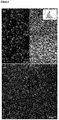
- Figure 6a-d shows the co-distribution of the particles and the Nile red containing oil phase, yielding matrix microcapsule morphologies.
- the average size of the generated composites (2 mLof 5 wt % p-MA-alt-1-OD in Nile red loaded limonene: 8 mL of 1.5 wt % silica particles in Milli-Q adjusted to pH 10) was 4.2 ⁇ 1.2 ⁇ m as determined using microscopy image analysis.
- control studies performed without the crosslinking polymer in the oil phase formed structures with a core-shell morphology. Nile red was not encapsulated effectively and polydisperse structures were formed for the control. Morphological stability of these cross-linked capsules were analyzed using SEM and TEM. A TEM image demonstrating the presence of particles at the surface of the crosslinked, composite microcapsules is provided in Figure 7 .
- Microcapsules prepared as described in Examples 1 and 2 were used for this stability test. Instead of Limonene, the following oils were individually encapsulated and tested: Table 1 : Oil properties Ingredient Log P Volatility ( ⁇ g/L) Limonene 4.38 14183 Phenylethyl Alcohol 1.52 Applinate 2.76 29820 Delta- Damascone 4.16 371 Dihydromycenol 3.47 1391 ⁇ -Ionone 3.012
- the capsules were incubated in a 80% ethanol and water solution, a common eau de toilette fine fragrance formulation, to test the stability of the capsules to dissociation.
- Both the core-shell microcapsules and matrix microcapsules were shown to be stable from pH 4 to pH 9 without physically dissociating, in addition to remaining physically intact and loaded with fragrance oil in concentrated ethanol solutions (25 -80%).
- Loaded, crosslinked core-shell microcapsules from Example 1 are shown in Figure 5 following incubation in 25% ethanol solution. Similar images were obtained for crosslinked, matrix-type microcapsules in 80% ethanol solutions.
- TEM and SEM images of dried, crosslinked microcapsules show structurally-intact spheres after incubation in 80% ethanol, as shown in Figure 7a-b for the capsules from Example 2. Collapse of these capsules was not observed.
- Beta-ionone a UV detectable oil
- Example 2 Beta-ionone, a UV detectable oil
- the capsules were incubated in an 80% solution of ethanol.
- Figure 9 shows increasing stability as the amount of polymer increases. As weight percentage of polymer in the oil phase increased the capsules displayed increased stability.
Landscapes
- Health & Medical Sciences (AREA)
- Chemical & Material Sciences (AREA)
- Life Sciences & Earth Sciences (AREA)
- General Health & Medical Sciences (AREA)
- Animal Behavior & Ethology (AREA)
- Public Health (AREA)
- Veterinary Medicine (AREA)
- Organic Chemistry (AREA)
- Chemical Kinetics & Catalysis (AREA)
- Dispersion Chemistry (AREA)
- Epidemiology (AREA)
- Birds (AREA)
- Dermatology (AREA)
- Wood Science & Technology (AREA)
- Engineering & Computer Science (AREA)
- Oil, Petroleum & Natural Gas (AREA)
- Inorganic Chemistry (AREA)
- Environmental Sciences (AREA)
- Zoology (AREA)
- Dentistry (AREA)
- Toxicology (AREA)
- Plant Pathology (AREA)
- Pest Control & Pesticides (AREA)
- Agronomy & Crop Science (AREA)
- Manufacturing Of Micro-Capsules (AREA)
- Cosmetics (AREA)
- Fats And Perfumes (AREA)
Claims (16)
- Partikelstabilisierte Mikrokapsel, die mit Hilfe eines Verfahrens erhalten werden kann, das die folgenden Schritte umfasst:1) Suspendieren von anorganischen Feststoffpartikeln mit mindestens einer Amin-Funktionalität in Wasser, um eine wässrige Phase zu bilden;2) Suspendieren von mindestens einem Maleinsäureanhydrid enthaltenden Polymer in einem Parfüm oder Aromaöl, um eine Ölphase zu bilden; und3) Zugeben der Ölphase zu der Wasserphase und Mischen der resultierenden Emulsion, um eine Mikrokapsel mit vernetzten Partikeln zu bilden, die an der Öl/Wasser-Grenzfläche vorhanden sind.
- Mikrokapsel nach Anspruch 1, wobei die anorganischen Partikel ausgewählt sind aus der Gruppe bestehend aus Siliciumdioxid, Silicaten, Titandioxid, Aluminiumoxid, Zinkoxid, Eisenoxid, Glimmer, Tonen, Kaolin, Montmorillonit, Laponit, Bentonit, Perlit, Dolomit, Diatomit, Vermiculit, Hectorit, Gibbsit, Illit, Kaolinit, Aluminiumsilicaten, Gips, Bauxit, Magnesit, Talk, Magnesiumcarbonat, Calciumcarbonat und Diatomeenerde.
- Mikrokapsel nach Anspruch 2, wobei die anorganischen Partikel aus Siliciumdioxid bestehen.
- Mikrokapsel nach Anspruch 1, wobei das mindestens eine Maleinsäureanhydrid enthaltende Polymer in einer Menge vorliegt, die zwischen 0,5 und 50 Gew.-% der Ölphase beträgt.
- Mikrokapsel nach Anspruch 4, wobei das mindestens eine Maleinsäureanhydrid enthaltende Polymer in einer Menge vorliegt, die zwischen 1 und 20 Gew.-% der Ölphase beträgt.
- Mikrokapsel nach Anspruch 1, wobei die anorganischen Partikel in einer Menge vorliegen, die zwischen 0,1 und 5 Gew.-% der wässrigen Phase beträgt.
- Mikrokapsel nach Anspruch 1, wobei die Größe der anorganischen Partikel zwischen 10 und 1.000 nm beträgt.
- Mikrokapsel nach Anspruch 1, wobei das Maleinsäureanhydrid enthaltende Polymer mindestens eine hydrophobe Einheit und mindestens eine MaleinsäureanhydridEinheit umfasst.
- Mikrokapsel nach Anspruch 8, wobei die hydrophobe Einheit ausgewählt ist aus der Gruppe bestehend aus Styrol, Isopren, Ethylen, Propylen, Methylvinylether und Octadecen.
- Verfahren zur Herstellung einer partikelstabilisierten Mikrokapsel, umfassend die folgenden Schritte:1) Suspendieren von anorganischen festen Partikeln mit mindestens einer Amin-Funktionalität in Wasser, um eine wässrige Phase zu bilden;2) Suspendieren mindestens eines Maleinsäureanhydrid enthaltenden Polymers in einem Parfümöl, um eine Ölphase zu bilden; und3) Zugeben der Ölphase zu der Wasserphase und Mischen, um eine Mikrokapsel mit vernetzten Partikeln zu bilden, die an der Öl/Wasser-Grenzfläche vorhanden sind.
- Zusammensetzung, umfassenda) 10 bis 90 Gew.-% Ethanol; undb) 0,1 bis 15 Gew.-% Mikrokapseln, wie nach Anspruch 1 festgelegt.
- Zusammensetzung nach Anspruch 11 in Form eines Parfüms, eines Eau de Toilette, eines Eau de Parfüm, eines Kölnisch Wassers oder eines Body Splash oder eines Sprays.
- Flüssiges parfümiertes Verbraucherprodukt, umfassenda) 2 bis 50 Gew.-%, bezogen auf das Gesamtgewicht des Verbraucherprodukts, mindestens eines Tensids;b) Wasser; undc) 0,1 bis 15 Gew.-% Mikrokapseln, wie nach Anspruch 1 festgelegt.
- Flüssiges parfümiertes Verbraucherprodukt nach Anspruch 13, wobei das Produkt ein Haushaltsreinigungs- oder Körperpflegeprodukt ist.
- Partikelstabilisierte Mikrokapsel nach einem der Ansprüche 1 bis 9, umfassenda) einen Kern aus hydrophobem Parfüm oder Aroma; undb) eine Hülle, bestehend aus anorganischen Partikeln, die selektiv mit Maleinsäureanhydrid enthaltendem Polymer vernetzt sind.
- Partikelstabilisierte Mikrokapsel nach einem der Ansprüche 1 bis 9, dadurch gekennzeichnet, dass sie eine Matrixmorphologie aufweist.
Priority Applications (1)
| Application Number | Priority Date | Filing Date | Title |
|---|---|---|---|
| EP14816237.3A EP3083030B1 (de) | 2013-12-19 | 2014-12-18 | Partikelstabilisierte mikrokapseln |
Applications Claiming Priority (4)
| Application Number | Priority Date | Filing Date | Title |
|---|---|---|---|
| US201361918063P | 2013-12-19 | 2013-12-19 | |
| EP14150292 | 2014-01-07 | ||
| PCT/EP2014/078603 WO2015091877A1 (en) | 2013-12-19 | 2014-12-18 | Particle-stabilized microcapsules |
| EP14816237.3A EP3083030B1 (de) | 2013-12-19 | 2014-12-18 | Partikelstabilisierte mikrokapseln |
Publications (2)
| Publication Number | Publication Date |
|---|---|
| EP3083030A1 EP3083030A1 (de) | 2016-10-26 |
| EP3083030B1 true EP3083030B1 (de) | 2019-06-12 |
Family
ID=49883035
Family Applications (1)
| Application Number | Title | Priority Date | Filing Date |
|---|---|---|---|
| EP14816237.3A Active EP3083030B1 (de) | 2013-12-19 | 2014-12-18 | Partikelstabilisierte mikrokapseln |
Country Status (3)
| Country | Link |
|---|---|
| US (1) | US9849435B2 (de) |
| EP (1) | EP3083030B1 (de) |
| WO (1) | WO2015091877A1 (de) |
Families Citing this family (29)
| Publication number | Priority date | Publication date | Assignee | Title |
|---|---|---|---|---|
| CN105080442B (zh) * | 2015-07-28 | 2017-09-22 | 西北工业大学 | 一种包覆异氰酸酯微胶囊的制备方法 |
| FR3064189B1 (fr) * | 2017-03-21 | 2019-04-26 | Capsum | Encapsulation de reactifs pour la preparation d'un biomateriau |
| SG11201909150XA (en) * | 2017-06-27 | 2020-01-30 | Firmenich & Cie | Process for preparing microcapsules |
| US11407965B2 (en) | 2017-07-31 | 2022-08-09 | Dow Global Technologies Llc | Detergent additive |
| WO2019115667A1 (en) * | 2017-12-14 | 2019-06-20 | Firmenich Sa | Process for preparing a powdered composition |
| KR102680962B1 (ko) | 2018-08-24 | 2024-07-03 | 주식회사 엘지생활건강 | 마이크로 캡슐의 제조방법 |
| US11794161B1 (en) | 2018-11-21 | 2023-10-24 | Trucapsol, Llc | Reduced permeability microcapsules |
| US11571674B1 (en) | 2019-03-28 | 2023-02-07 | Trucapsol Llc | Environmentally biodegradable microcapsules |
| CN111790322B (zh) * | 2019-04-03 | 2022-11-29 | 苏州丝美特生物技术有限公司 | 一种利用纳米颗粒稳定和增强丝素蛋白微胶囊壳结构的方法 |
| GB201904918D0 (en) * | 2019-04-08 | 2019-05-22 | Givaudan Sa | Improvements in or relating to organic compounds |
| EP3956054A1 (de) | 2019-04-17 | 2022-02-23 | The Procter & Gamble Company | Verfahren zur herstellung von kapseln |
| CA3135389C (en) | 2019-04-17 | 2023-11-07 | The Procter & Gamble Company | Capsules |
| CN113631695A (zh) | 2019-04-17 | 2021-11-09 | 宝洁公司 | 胶囊 |
| US11542392B1 (en) | 2019-04-18 | 2023-01-03 | Trucapsol Llc | Multifunctional particle additive for enhancement of toughness and degradation in biodegradable polymers |
| JP7642643B2 (ja) * | 2019-12-13 | 2025-03-10 | フイルメニツヒ ソシエテ アノニム | ハイブリッドマイクロカプセル |
| EP4081338B1 (de) * | 2019-12-25 | 2024-02-07 | Unilever IP Holdings B.V. | Mikrokapseln und kosmetische zusammensetzungen damit |
| US11465117B2 (en) * | 2020-01-30 | 2022-10-11 | Trucapsol Llc | Environmentally biodegradable microcapsules |
| EP4228589A1 (de) | 2020-10-16 | 2023-08-23 | The Procter & Gamble Company | Schweisshemmende und desodorierende zusammensetzungen mit kapseln |
| US12458942B2 (en) | 2020-10-16 | 2025-11-04 | The Procter & Gamble Company | Capsules |
| US11912961B2 (en) | 2020-10-16 | 2024-02-27 | The Procter & Gamble Company | Liquid fabric care compositions comprising capsules |
| US12077728B2 (en) | 2020-10-16 | 2024-09-03 | The Procter & Gamble Company | Laundry care additive particles |
| CN116368210B (zh) * | 2020-10-16 | 2025-07-18 | 宝洁公司 | 含有核/壳胶囊的水溶性单位剂量制品 |
| US20220133603A1 (en) * | 2020-11-04 | 2022-05-05 | Trucapsol Llc | Environmentally biodegradable microcapsules |
| CN113304702B (zh) * | 2021-02-23 | 2023-05-26 | 闽南师范大学 | 一种砂仁精油微胶囊的制备方法 |
| US12302933B2 (en) | 2021-06-25 | 2025-05-20 | Trucapsol Llc | Flavor delivery system |
| US12187829B2 (en) | 2021-08-12 | 2025-01-07 | Trucapsol Llc | Environmentally biodegradable microcapsules |
| US11878280B2 (en) | 2022-04-19 | 2024-01-23 | Trucapsol Llc | Microcapsules comprising natural materials |
| US11904288B1 (en) | 2023-02-13 | 2024-02-20 | Trucapsol Llc | Environmentally biodegradable microcapsules |
| US11969491B1 (en) | 2023-02-22 | 2024-04-30 | Trucapsol Llc | pH triggered release particle |
Family Cites Families (15)
| Publication number | Priority date | Publication date | Assignee | Title |
|---|---|---|---|---|
| WO2003097218A1 (en) | 2002-05-16 | 2003-11-27 | Mcmaster University | Novel composite tecto-membranes formed by interfacial reaction of crosslinked polymer microspheres with coupling agents |
| BRPI0417012A (pt) | 2003-11-28 | 2007-02-21 | Unilever Nv | composição detergente em pó, e, processo para a produção da mesma |
| GB0513803D0 (en) | 2005-07-06 | 2005-08-10 | Unilever Plc | Fabric care composition |
| GB0524659D0 (en) | 2005-12-02 | 2006-01-11 | Unilever Plc | Improvements relating to fabric treatment compositions |
| GB2432851A (en) | 2005-12-02 | 2007-06-06 | Unilever Plc | Laundry composition including polymer particles containing perfume and a non-ionic deposition aid |
| GB0524665D0 (en) | 2005-12-02 | 2006-01-11 | Unilever Plc | Laundry composition |
| GB2432843A (en) | 2005-12-02 | 2007-06-06 | Unilever Plc | Perfume carrying polymeric particle |
| GB2432850A (en) | 2005-12-02 | 2007-06-06 | Unilever Plc | Polymeric particle comprising perfume and benefit agent, in particular a laundry composition |
| GB2432852A (en) | 2005-12-02 | 2007-06-06 | Unilever Plc | Laundry composition including polymer particles containing perfume and a cationic deposition aid |
| US20070202063A1 (en) | 2006-02-28 | 2007-08-30 | Dihora Jiten O | Benefit agent containing delivery particle |
| PL2046269T3 (pl) | 2006-08-01 | 2011-05-31 | Procter & Gamble | Cząstka dostarczająca zawierająca korzystny środek |
| WO2008065563A1 (en) | 2006-11-28 | 2008-06-05 | Firmenich Sa | Moisture resistant perfuming microcapsules comprising a water-soluble resin |
| GB0804700D0 (en) * | 2008-03-13 | 2008-04-16 | Syngenta Ltd | Microencapsulation |
| MX339276B (es) | 2010-06-11 | 2016-05-19 | Firmenich & Cie | Proceso para preparar microcapsulas de poliurea. |
| GB201210156D0 (en) | 2012-06-08 | 2012-07-25 | Imerys Minerals Ltd | Microcapsules |
-
2014
- 2014-12-18 EP EP14816237.3A patent/EP3083030B1/de active Active
- 2014-12-18 WO PCT/EP2014/078603 patent/WO2015091877A1/en not_active Ceased
- 2014-12-18 US US15/105,487 patent/US9849435B2/en active Active
Non-Patent Citations (1)
| Title |
|---|
| None * |
Also Published As
| Publication number | Publication date |
|---|---|
| US20160317993A1 (en) | 2016-11-03 |
| EP3083030A1 (de) | 2016-10-26 |
| WO2015091877A1 (en) | 2015-06-25 |
| US9849435B2 (en) | 2017-12-26 |
Similar Documents
| Publication | Publication Date | Title |
|---|---|---|
| US9849435B2 (en) | Maleic anhydride polymer-stabilized microcapsules | |
| CN105828927B (zh) | 混合微胶囊 | |
| CN104011193B (zh) | 制备聚脲微胶囊的方法 | |
| CN107835707B (zh) | 微胶囊 | |
| JP6797139B2 (ja) | 表面上に高度の沈着物を有するマイクロカプセル | |
| CN105934272B (zh) | 用于制备氨基塑料微胶囊的方法 | |
| US8778867B2 (en) | Microcapsules and uses thereof | |
| JP4031362B2 (ja) | コア・シェル粒子及びそれらの製造方法 | |
| WO2016054351A1 (en) | Capsules containing polyvinyl alcohol | |
| CN102056656A (zh) | 制备聚脲微胶囊的方法 | |
| WO2015016367A1 (en) | Microcapsules | |
| BR112020003451B1 (pt) | Composição de quitosana, processo de obtenção da mesma, usos da quitosana e da referida composição e produtos de consumo | |
| JP2023506475A (ja) | ハイブリッドマイクロカプセル | |
| EP1899047A1 (de) | Polyurethan- und polyharn-mikrokapseln | |
| CN106456506A (zh) | 混合香料微胶囊 | |
| WO2018029161A1 (en) | Improvements in or relating to organic compounds | |
| CA3196419A1 (en) | Biodegradable delivery particles | |
| CN106999891A (zh) | 含有气体发生性光不稳定聚合物的微胶囊及其用途 | |
| JP6762950B2 (ja) | 強いバニラ香気ノートを発するマイクロカプセル | |
| JP7100640B2 (ja) | 香料組成物 | |
| CN113227341A (zh) | 包含聚乙二醇接枝共聚物和芳香化学品的成型体 |
Legal Events
| Date | Code | Title | Description |
|---|---|---|---|
| PUAI | Public reference made under article 153(3) epc to a published international application that has entered the european phase |
Free format text: ORIGINAL CODE: 0009012 |
|
| 17P | Request for examination filed |
Effective date: 20160719 |
|
| AK | Designated contracting states |
Kind code of ref document: A1 Designated state(s): AL AT BE BG CH CY CZ DE DK EE ES FI FR GB GR HR HU IE IS IT LI LT LU LV MC MK MT NL NO PL PT RO RS SE SI SK SM TR |
|
| AX | Request for extension of the european patent |
Extension state: BA ME |
|
| DAX | Request for extension of the european patent (deleted) | ||
| STAA | Information on the status of an ep patent application or granted ep patent |
Free format text: STATUS: EXAMINATION IS IN PROGRESS |
|
| 17Q | First examination report despatched |
Effective date: 20180119 |
|
| GRAP | Despatch of communication of intention to grant a patent |
Free format text: ORIGINAL CODE: EPIDOSNIGR1 |
|
| STAA | Information on the status of an ep patent application or granted ep patent |
Free format text: STATUS: GRANT OF PATENT IS INTENDED |
|
| INTG | Intention to grant announced |
Effective date: 20190130 |
|
| GRAS | Grant fee paid |
Free format text: ORIGINAL CODE: EPIDOSNIGR3 |
|
| GRAA | (expected) grant |
Free format text: ORIGINAL CODE: 0009210 |
|
| STAA | Information on the status of an ep patent application or granted ep patent |
Free format text: STATUS: THE PATENT HAS BEEN GRANTED |
|
| AK | Designated contracting states |
Kind code of ref document: B1 Designated state(s): AL AT BE BG CH CY CZ DE DK EE ES FI FR GB GR HR HU IE IS IT LI LT LU LV MC MK MT NL NO PL PT RO RS SE SI SK SM TR |
|
| REG | Reference to a national code |
Ref country code: GB Ref legal event code: FG4D |
|
| REG | Reference to a national code |
Ref country code: CH Ref legal event code: EP |
|
| REG | Reference to a national code |
Ref country code: AT Ref legal event code: REF Ref document number: 1141883 Country of ref document: AT Kind code of ref document: T Effective date: 20190615 |
|
| REG | Reference to a national code |
Ref country code: DE Ref legal event code: R096 Ref document number: 602014048330 Country of ref document: DE |
|
| REG | Reference to a national code |
Ref country code: IE Ref legal event code: FG4D |
|
| REG | Reference to a national code |
Ref country code: NL Ref legal event code: MP Effective date: 20190612 |
|
| REG | Reference to a national code |
Ref country code: LT Ref legal event code: MG4D |
|
| PG25 | Lapsed in a contracting state [announced via postgrant information from national office to epo] |
Ref country code: LT Free format text: LAPSE BECAUSE OF FAILURE TO SUBMIT A TRANSLATION OF THE DESCRIPTION OR TO PAY THE FEE WITHIN THE PRESCRIBED TIME-LIMIT Effective date: 20190612 Ref country code: HR Free format text: LAPSE BECAUSE OF FAILURE TO SUBMIT A TRANSLATION OF THE DESCRIPTION OR TO PAY THE FEE WITHIN THE PRESCRIBED TIME-LIMIT Effective date: 20190612 Ref country code: FI Free format text: LAPSE BECAUSE OF FAILURE TO SUBMIT A TRANSLATION OF THE DESCRIPTION OR TO PAY THE FEE WITHIN THE PRESCRIBED TIME-LIMIT Effective date: 20190612 Ref country code: AL Free format text: LAPSE BECAUSE OF FAILURE TO SUBMIT A TRANSLATION OF THE DESCRIPTION OR TO PAY THE FEE WITHIN THE PRESCRIBED TIME-LIMIT Effective date: 20190612 Ref country code: NO Free format text: LAPSE BECAUSE OF FAILURE TO SUBMIT A TRANSLATION OF THE DESCRIPTION OR TO PAY THE FEE WITHIN THE PRESCRIBED TIME-LIMIT Effective date: 20190912 Ref country code: SE Free format text: LAPSE BECAUSE OF FAILURE TO SUBMIT A TRANSLATION OF THE DESCRIPTION OR TO PAY THE FEE WITHIN THE PRESCRIBED TIME-LIMIT Effective date: 20190612 |
|
| PG25 | Lapsed in a contracting state [announced via postgrant information from national office to epo] |
Ref country code: BG Free format text: LAPSE BECAUSE OF FAILURE TO SUBMIT A TRANSLATION OF THE DESCRIPTION OR TO PAY THE FEE WITHIN THE PRESCRIBED TIME-LIMIT Effective date: 20190912 Ref country code: GR Free format text: LAPSE BECAUSE OF FAILURE TO SUBMIT A TRANSLATION OF THE DESCRIPTION OR TO PAY THE FEE WITHIN THE PRESCRIBED TIME-LIMIT Effective date: 20190913 Ref country code: LV Free format text: LAPSE BECAUSE OF FAILURE TO SUBMIT A TRANSLATION OF THE DESCRIPTION OR TO PAY THE FEE WITHIN THE PRESCRIBED TIME-LIMIT Effective date: 20190612 Ref country code: RS Free format text: LAPSE BECAUSE OF FAILURE TO SUBMIT A TRANSLATION OF THE DESCRIPTION OR TO PAY THE FEE WITHIN THE PRESCRIBED TIME-LIMIT Effective date: 20190612 |
|
| REG | Reference to a national code |
Ref country code: AT Ref legal event code: MK05 Ref document number: 1141883 Country of ref document: AT Kind code of ref document: T Effective date: 20190612 |
|
| PG25 | Lapsed in a contracting state [announced via postgrant information from national office to epo] |
Ref country code: EE Free format text: LAPSE BECAUSE OF FAILURE TO SUBMIT A TRANSLATION OF THE DESCRIPTION OR TO PAY THE FEE WITHIN THE PRESCRIBED TIME-LIMIT Effective date: 20190612 Ref country code: SK Free format text: LAPSE BECAUSE OF FAILURE TO SUBMIT A TRANSLATION OF THE DESCRIPTION OR TO PAY THE FEE WITHIN THE PRESCRIBED TIME-LIMIT Effective date: 20190612 Ref country code: RO Free format text: LAPSE BECAUSE OF FAILURE TO SUBMIT A TRANSLATION OF THE DESCRIPTION OR TO PAY THE FEE WITHIN THE PRESCRIBED TIME-LIMIT Effective date: 20190612 Ref country code: CZ Free format text: LAPSE BECAUSE OF FAILURE TO SUBMIT A TRANSLATION OF THE DESCRIPTION OR TO PAY THE FEE WITHIN THE PRESCRIBED TIME-LIMIT Effective date: 20190612 Ref country code: NL Free format text: LAPSE BECAUSE OF FAILURE TO SUBMIT A TRANSLATION OF THE DESCRIPTION OR TO PAY THE FEE WITHIN THE PRESCRIBED TIME-LIMIT Effective date: 20190612 Ref country code: PT Free format text: LAPSE BECAUSE OF FAILURE TO SUBMIT A TRANSLATION OF THE DESCRIPTION OR TO PAY THE FEE WITHIN THE PRESCRIBED TIME-LIMIT Effective date: 20191014 Ref country code: AT Free format text: LAPSE BECAUSE OF FAILURE TO SUBMIT A TRANSLATION OF THE DESCRIPTION OR TO PAY THE FEE WITHIN THE PRESCRIBED TIME-LIMIT Effective date: 20190612 |
|
| PG25 | Lapsed in a contracting state [announced via postgrant information from national office to epo] |
Ref country code: SM Free format text: LAPSE BECAUSE OF FAILURE TO SUBMIT A TRANSLATION OF THE DESCRIPTION OR TO PAY THE FEE WITHIN THE PRESCRIBED TIME-LIMIT Effective date: 20190612 Ref country code: IS Free format text: LAPSE BECAUSE OF FAILURE TO SUBMIT A TRANSLATION OF THE DESCRIPTION OR TO PAY THE FEE WITHIN THE PRESCRIBED TIME-LIMIT Effective date: 20191012 Ref country code: IT Free format text: LAPSE BECAUSE OF FAILURE TO SUBMIT A TRANSLATION OF THE DESCRIPTION OR TO PAY THE FEE WITHIN THE PRESCRIBED TIME-LIMIT Effective date: 20190612 Ref country code: ES Free format text: LAPSE BECAUSE OF FAILURE TO SUBMIT A TRANSLATION OF THE DESCRIPTION OR TO PAY THE FEE WITHIN THE PRESCRIBED TIME-LIMIT Effective date: 20190612 |
|
| REG | Reference to a national code |
Ref country code: DE Ref legal event code: R097 Ref document number: 602014048330 Country of ref document: DE |
|
| PG25 | Lapsed in a contracting state [announced via postgrant information from national office to epo] |
Ref country code: TR Free format text: LAPSE BECAUSE OF FAILURE TO SUBMIT A TRANSLATION OF THE DESCRIPTION OR TO PAY THE FEE WITHIN THE PRESCRIBED TIME-LIMIT Effective date: 20190612 |
|
| PLBE | No opposition filed within time limit |
Free format text: ORIGINAL CODE: 0009261 |
|
| STAA | Information on the status of an ep patent application or granted ep patent |
Free format text: STATUS: NO OPPOSITION FILED WITHIN TIME LIMIT |
|
| PG25 | Lapsed in a contracting state [announced via postgrant information from national office to epo] |
Ref country code: PL Free format text: LAPSE BECAUSE OF FAILURE TO SUBMIT A TRANSLATION OF THE DESCRIPTION OR TO PAY THE FEE WITHIN THE PRESCRIBED TIME-LIMIT Effective date: 20190612 Ref country code: DK Free format text: LAPSE BECAUSE OF FAILURE TO SUBMIT A TRANSLATION OF THE DESCRIPTION OR TO PAY THE FEE WITHIN THE PRESCRIBED TIME-LIMIT Effective date: 20190612 |
|
| 26N | No opposition filed |
Effective date: 20200313 |
|
| PG25 | Lapsed in a contracting state [announced via postgrant information from national office to epo] |
Ref country code: SI Free format text: LAPSE BECAUSE OF FAILURE TO SUBMIT A TRANSLATION OF THE DESCRIPTION OR TO PAY THE FEE WITHIN THE PRESCRIBED TIME-LIMIT Effective date: 20190612 Ref country code: IS Free format text: LAPSE BECAUSE OF FAILURE TO SUBMIT A TRANSLATION OF THE DESCRIPTION OR TO PAY THE FEE WITHIN THE PRESCRIBED TIME-LIMIT Effective date: 20200224 |
|
| REG | Reference to a national code |
Ref country code: DE Ref legal event code: R081 Ref document number: 602014048330 Country of ref document: DE Owner name: UNIVERSITY OF MASSACHUSETTS, BOSTON, US Free format text: FORMER OWNERS: FIRMENICH SA, GENEVA, CH; UNIVERSITY OF MASSACHUSETTS, BOSTON, MASS., US Ref country code: DE Ref legal event code: R081 Ref document number: 602014048330 Country of ref document: DE Owner name: FIRMENICH SA, CH Free format text: FORMER OWNERS: FIRMENICH SA, GENEVA, CH; UNIVERSITY OF MASSACHUSETTS, BOSTON, MASS., US |
|
| PG2D | Information on lapse in contracting state deleted |
Ref country code: IS |
|
| REG | Reference to a national code |
Ref country code: BE Ref legal event code: MM Effective date: 20191231 |
|
| PG25 | Lapsed in a contracting state [announced via postgrant information from national office to epo] |
Ref country code: MC Free format text: LAPSE BECAUSE OF FAILURE TO SUBMIT A TRANSLATION OF THE DESCRIPTION OR TO PAY THE FEE WITHIN THE PRESCRIBED TIME-LIMIT Effective date: 20190612 |
|
| REG | Reference to a national code |
Ref country code: CH Ref legal event code: PCOW Free format text: NEW ADDRESS: ONE BEACON STREET 31ST FLOOR, BOSTON, MA 02108 (US) $ FIRMENICH SA, 7, RUE DE LA BERGERE, 1242 SATIGNY (CH) |
|
| PG25 | Lapsed in a contracting state [announced via postgrant information from national office to epo] |
Ref country code: IE Free format text: LAPSE BECAUSE OF NON-PAYMENT OF DUE FEES Effective date: 20191218 Ref country code: LU Free format text: LAPSE BECAUSE OF NON-PAYMENT OF DUE FEES Effective date: 20191218 |
|
| PG25 | Lapsed in a contracting state [announced via postgrant information from national office to epo] |
Ref country code: BE Free format text: LAPSE BECAUSE OF NON-PAYMENT OF DUE FEES Effective date: 20191231 |
|
| PG25 | Lapsed in a contracting state [announced via postgrant information from national office to epo] |
Ref country code: CY Free format text: LAPSE BECAUSE OF FAILURE TO SUBMIT A TRANSLATION OF THE DESCRIPTION OR TO PAY THE FEE WITHIN THE PRESCRIBED TIME-LIMIT Effective date: 20190612 |
|
| PG25 | Lapsed in a contracting state [announced via postgrant information from national office to epo] |
Ref country code: MT Free format text: LAPSE BECAUSE OF FAILURE TO SUBMIT A TRANSLATION OF THE DESCRIPTION OR TO PAY THE FEE WITHIN THE PRESCRIBED TIME-LIMIT Effective date: 20190612 Ref country code: HU Free format text: LAPSE BECAUSE OF FAILURE TO SUBMIT A TRANSLATION OF THE DESCRIPTION OR TO PAY THE FEE WITHIN THE PRESCRIBED TIME-LIMIT; INVALID AB INITIO Effective date: 20141218 |
|
| PG25 | Lapsed in a contracting state [announced via postgrant information from national office to epo] |
Ref country code: MK Free format text: LAPSE BECAUSE OF FAILURE TO SUBMIT A TRANSLATION OF THE DESCRIPTION OR TO PAY THE FEE WITHIN THE PRESCRIBED TIME-LIMIT Effective date: 20190612 |
|
| REG | Reference to a national code |
Ref country code: FR Ref legal event code: PLFP Year of fee payment: 9 |
|
| PLAA | Information modified related to event that no opposition was filed |
Free format text: ORIGINAL CODE: 0009299DELT |
|
| PLBE | No opposition filed within time limit |
Free format text: ORIGINAL CODE: 0009261 |
|
| REG | Reference to a national code |
Ref country code: CH Ref legal event code: PK Free format text: BERICHTIGUNGEN |
|
| D26N | No opposition filed (deleted) | ||
| RIN2 | Information on inventor provided after grant (corrected) |
Inventor name: BENCZEDI, DANIEL Inventor name: OUALI, LAHOUSSINE Inventor name: JERRI, HUDA A. Inventor name: NORMAND, VALERY Inventor name: DUNCAN, BRADLEY P. Inventor name: ROTELLO, VINCENT M. |
|
| 26N | No opposition filed |
Effective date: 20200313 |
|
| P01 | Opt-out of the competence of the unified patent court (upc) registered |
Effective date: 20230518 |
|
| PGFP | Annual fee paid to national office [announced via postgrant information from national office to epo] |
Ref country code: FR Payment date: 20231122 Year of fee payment: 10 |
|
| PGFP | Annual fee paid to national office [announced via postgrant information from national office to epo] |
Ref country code: CH Payment date: 20240102 Year of fee payment: 10 |
|
| REG | Reference to a national code |
Ref country code: CH Ref legal event code: PL |
|
| PG25 | Lapsed in a contracting state [announced via postgrant information from national office to epo] |
Ref country code: FR Free format text: LAPSE BECAUSE OF NON-PAYMENT OF DUE FEES Effective date: 20241231 |
|
| PG25 | Lapsed in a contracting state [announced via postgrant information from national office to epo] |
Ref country code: CH Free format text: LAPSE BECAUSE OF NON-PAYMENT OF DUE FEES Effective date: 20241231 |
|
| PGFP | Annual fee paid to national office [announced via postgrant information from national office to epo] |
Ref country code: DE Payment date: 20251104 Year of fee payment: 12 |
|
| PGFP | Annual fee paid to national office [announced via postgrant information from national office to epo] |
Ref country code: GB Payment date: 20251114 Year of fee payment: 12 |