EP3083492B1 - Verfahren zur reinigung von synthesegas durch aminwäsche mit wässrigen aminlösungen - Google Patents
Verfahren zur reinigung von synthesegas durch aminwäsche mit wässrigen aminlösungen Download PDFInfo
- Publication number
- EP3083492B1 EP3083492B1 EP14824421.3A EP14824421A EP3083492B1 EP 3083492 B1 EP3083492 B1 EP 3083492B1 EP 14824421 A EP14824421 A EP 14824421A EP 3083492 B1 EP3083492 B1 EP 3083492B1
- Authority
- EP
- European Patent Office
- Prior art keywords
- stage
- amino
- methyl
- methoxypropyl
- synthesis gas
- Prior art date
- Legal status (The legal status is an assumption and is not a legal conclusion. Google has not performed a legal analysis and makes no representation as to the accuracy of the status listed.)
- Active
Links
Images


Classifications
-
- C—CHEMISTRY; METALLURGY
- C01—INORGANIC CHEMISTRY
- C01B—NON-METALLIC ELEMENTS; COMPOUNDS THEREOF; METALLOIDS OR COMPOUNDS THEREOF NOT COVERED BY SUBCLASS C01C
- C01B3/00—Hydrogen; Gaseous mixtures containing hydrogen; Separation of hydrogen from mixtures containing it; Purification of hydrogen; Reversible storage of hydrogen
- C01B3/02—Production of hydrogen; Production of gaseous mixtures containing hydrogen
- C01B3/06—Production of hydrogen; Production of gaseous mixtures containing hydrogen by reaction of inorganic compounds containing electro-positively bound hydrogen with inorganic reducing agents
- C01B3/12—Production of hydrogen; Production of gaseous mixtures containing hydrogen by reaction of inorganic compounds containing electro-positively bound hydrogen with inorganic reducing agents by reaction of water vapour with carbon monoxide
- C01B3/16—Production of hydrogen; Production of gaseous mixtures containing hydrogen by reaction of inorganic compounds containing electro-positively bound hydrogen with inorganic reducing agents by reaction of water vapour with carbon monoxide using catalysts
-
- C—CHEMISTRY; METALLURGY
- C01—INORGANIC CHEMISTRY
- C01B—NON-METALLIC ELEMENTS; COMPOUNDS THEREOF; METALLOIDS OR COMPOUNDS THEREOF NOT COVERED BY SUBCLASS C01C
- C01B3/00—Hydrogen; Gaseous mixtures containing hydrogen; Separation of hydrogen from mixtures containing it; Purification of hydrogen; Reversible storage of hydrogen
- C01B3/50—Separation of hydrogen or hydrogen-containing gases from gaseous mixtures, e.g. purification
- C01B3/52—Separation of hydrogen or hydrogen-containing gases from gaseous mixtures, e.g. purification by contacting with liquids; Regeneration of used liquids
-
- C—CHEMISTRY; METALLURGY
- C01—INORGANIC CHEMISTRY
- C01B—NON-METALLIC ELEMENTS; COMPOUNDS THEREOF; METALLOIDS OR COMPOUNDS THEREOF NOT COVERED BY SUBCLASS C01C
- C01B3/00—Hydrogen; Gaseous mixtures containing hydrogen; Separation of hydrogen from mixtures containing it; Purification of hydrogen; Reversible storage of hydrogen
- C01B3/50—Separation of hydrogen or hydrogen-containing gases from gaseous mixtures, e.g. purification
- C01B3/56—Separation of hydrogen or hydrogen-containing gases from gaseous mixtures, e.g. purification by contacting with solids; Regeneration of used solids
-
- C—CHEMISTRY; METALLURGY
- C01—INORGANIC CHEMISTRY
- C01B—NON-METALLIC ELEMENTS; COMPOUNDS THEREOF; METALLOIDS OR COMPOUNDS THEREOF NOT COVERED BY SUBCLASS C01C
- C01B3/00—Hydrogen; Gaseous mixtures containing hydrogen; Separation of hydrogen from mixtures containing it; Purification of hydrogen; Reversible storage of hydrogen
- C01B3/50—Separation of hydrogen or hydrogen-containing gases from gaseous mixtures, e.g. purification
- C01B3/56—Separation of hydrogen or hydrogen-containing gases from gaseous mixtures, e.g. purification by contacting with solids; Regeneration of used solids
- C01B3/58—Separation of hydrogen or hydrogen-containing gases from gaseous mixtures, e.g. purification by contacting with solids; Regeneration of used solids including a catalytic reaction
-
- C—CHEMISTRY; METALLURGY
- C10—PETROLEUM, GAS OR COKE INDUSTRIES; TECHNICAL GASES CONTAINING CARBON MONOXIDE; FUELS; LUBRICANTS; PEAT
- C10G—CRACKING HYDROCARBON OILS; PRODUCTION OF LIQUID HYDROCARBON MIXTURES, e.g. BY DESTRUCTIVE HYDROGENATION, OLIGOMERISATION, POLYMERISATION; RECOVERY OF HYDROCARBON OILS FROM OIL-SHALE, OIL-SAND, OR GASES; REFINING MIXTURES MAINLY CONSISTING OF HYDROCARBONS; REFORMING OF NAPHTHA; MINERAL WAXES
- C10G2/00—Production of liquid hydrocarbon mixtures of undefined composition from oxides of carbon
- C10G2/30—Production of liquid hydrocarbon mixtures of undefined composition from oxides of carbon from carbon monoxide with hydrogen
- C10G2/32—Production of liquid hydrocarbon mixtures of undefined composition from oxides of carbon from carbon monoxide with hydrogen with the use of catalysts
- C10G2/33—Production of liquid hydrocarbon mixtures of undefined composition from oxides of carbon from carbon monoxide with hydrogen with the use of catalysts characterised by the catalyst used
- C10G2/331—Production of liquid hydrocarbon mixtures of undefined composition from oxides of carbon from carbon monoxide with hydrogen with the use of catalysts characterised by the catalyst used containing group VIII-metals
-
- C—CHEMISTRY; METALLURGY
- C01—INORGANIC CHEMISTRY
- C01B—NON-METALLIC ELEMENTS; COMPOUNDS THEREOF; METALLOIDS OR COMPOUNDS THEREOF NOT COVERED BY SUBCLASS C01C
- C01B2203/00—Integrated processes for the production of hydrogen or synthesis gas
- C01B2203/02—Processes for making hydrogen or synthesis gas
- C01B2203/0283—Processes for making hydrogen or synthesis gas containing a CO-shift step, i.e. a water gas shift step
-
- C—CHEMISTRY; METALLURGY
- C01—INORGANIC CHEMISTRY
- C01B—NON-METALLIC ELEMENTS; COMPOUNDS THEREOF; METALLOIDS OR COMPOUNDS THEREOF NOT COVERED BY SUBCLASS C01C
- C01B2203/00—Integrated processes for the production of hydrogen or synthesis gas
- C01B2203/04—Integrated processes for the production of hydrogen or synthesis gas containing a purification step for the hydrogen or the synthesis gas
- C01B2203/0415—Purification by absorption in liquids
-
- C—CHEMISTRY; METALLURGY
- C01—INORGANIC CHEMISTRY
- C01B—NON-METALLIC ELEMENTS; COMPOUNDS THEREOF; METALLOIDS OR COMPOUNDS THEREOF NOT COVERED BY SUBCLASS C01C
- C01B2203/00—Integrated processes for the production of hydrogen or synthesis gas
- C01B2203/04—Integrated processes for the production of hydrogen or synthesis gas containing a purification step for the hydrogen or the synthesis gas
- C01B2203/0435—Catalytic purification
-
- C—CHEMISTRY; METALLURGY
- C01—INORGANIC CHEMISTRY
- C01B—NON-METALLIC ELEMENTS; COMPOUNDS THEREOF; METALLOIDS OR COMPOUNDS THEREOF NOT COVERED BY SUBCLASS C01C
- C01B2203/00—Integrated processes for the production of hydrogen or synthesis gas
- C01B2203/04—Integrated processes for the production of hydrogen or synthesis gas containing a purification step for the hydrogen or the synthesis gas
- C01B2203/0435—Catalytic purification
- C01B2203/045—Purification by catalytic desulfurisation
-
- C—CHEMISTRY; METALLURGY
- C01—INORGANIC CHEMISTRY
- C01B—NON-METALLIC ELEMENTS; COMPOUNDS THEREOF; METALLOIDS OR COMPOUNDS THEREOF NOT COVERED BY SUBCLASS C01C
- C01B2203/00—Integrated processes for the production of hydrogen or synthesis gas
- C01B2203/04—Integrated processes for the production of hydrogen or synthesis gas containing a purification step for the hydrogen or the synthesis gas
- C01B2203/0465—Composition of the impurity
-
- C—CHEMISTRY; METALLURGY
- C01—INORGANIC CHEMISTRY
- C01B—NON-METALLIC ELEMENTS; COMPOUNDS THEREOF; METALLOIDS OR COMPOUNDS THEREOF NOT COVERED BY SUBCLASS C01C
- C01B2203/00—Integrated processes for the production of hydrogen or synthesis gas
- C01B2203/04—Integrated processes for the production of hydrogen or synthesis gas containing a purification step for the hydrogen or the synthesis gas
- C01B2203/0465—Composition of the impurity
- C01B2203/047—Composition of the impurity the impurity being carbon monoxide
-
- C—CHEMISTRY; METALLURGY
- C01—INORGANIC CHEMISTRY
- C01B—NON-METALLIC ELEMENTS; COMPOUNDS THEREOF; METALLOIDS OR COMPOUNDS THEREOF NOT COVERED BY SUBCLASS C01C
- C01B2203/00—Integrated processes for the production of hydrogen or synthesis gas
- C01B2203/04—Integrated processes for the production of hydrogen or synthesis gas containing a purification step for the hydrogen or the synthesis gas
- C01B2203/0465—Composition of the impurity
- C01B2203/0475—Composition of the impurity the impurity being carbon dioxide
-
- C—CHEMISTRY; METALLURGY
- C01—INORGANIC CHEMISTRY
- C01B—NON-METALLIC ELEMENTS; COMPOUNDS THEREOF; METALLOIDS OR COMPOUNDS THEREOF NOT COVERED BY SUBCLASS C01C
- C01B2203/00—Integrated processes for the production of hydrogen or synthesis gas
- C01B2203/04—Integrated processes for the production of hydrogen or synthesis gas containing a purification step for the hydrogen or the synthesis gas
- C01B2203/0465—Composition of the impurity
- C01B2203/0485—Composition of the impurity the impurity being a sulfur compound
-
- C—CHEMISTRY; METALLURGY
- C01—INORGANIC CHEMISTRY
- C01B—NON-METALLIC ELEMENTS; COMPOUNDS THEREOF; METALLOIDS OR COMPOUNDS THEREOF NOT COVERED BY SUBCLASS C01C
- C01B2203/00—Integrated processes for the production of hydrogen or synthesis gas
- C01B2203/06—Integration with other chemical processes
-
- C—CHEMISTRY; METALLURGY
- C01—INORGANIC CHEMISTRY
- C01B—NON-METALLIC ELEMENTS; COMPOUNDS THEREOF; METALLOIDS OR COMPOUNDS THEREOF NOT COVERED BY SUBCLASS C01C
- C01B2203/00—Integrated processes for the production of hydrogen or synthesis gas
- C01B2203/06—Integration with other chemical processes
- C01B2203/062—Hydrocarbon production, e.g. Fischer-Tropsch process
-
- C—CHEMISTRY; METALLURGY
- C01—INORGANIC CHEMISTRY
- C01B—NON-METALLIC ELEMENTS; COMPOUNDS THEREOF; METALLOIDS OR COMPOUNDS THEREOF NOT COVERED BY SUBCLASS C01C
- C01B2203/00—Integrated processes for the production of hydrogen or synthesis gas
- C01B2203/10—Catalysts for performing the hydrogen forming reactions
- C01B2203/1041—Composition of the catalyst
-
- C—CHEMISTRY; METALLURGY
- C01—INORGANIC CHEMISTRY
- C01B—NON-METALLIC ELEMENTS; COMPOUNDS THEREOF; METALLOIDS OR COMPOUNDS THEREOF NOT COVERED BY SUBCLASS C01C
- C01B2203/00—Integrated processes for the production of hydrogen or synthesis gas
- C01B2203/10—Catalysts for performing the hydrogen forming reactions
- C01B2203/1041—Composition of the catalyst
- C01B2203/1047—Group VIII metal catalysts
-
- C—CHEMISTRY; METALLURGY
- C01—INORGANIC CHEMISTRY
- C01B—NON-METALLIC ELEMENTS; COMPOUNDS THEREOF; METALLOIDS OR COMPOUNDS THEREOF NOT COVERED BY SUBCLASS C01C
- C01B2203/00—Integrated processes for the production of hydrogen or synthesis gas
- C01B2203/10—Catalysts for performing the hydrogen forming reactions
- C01B2203/1041—Composition of the catalyst
- C01B2203/1047—Group VIII metal catalysts
- C01B2203/1052—Nickel or cobalt catalysts
-
- C—CHEMISTRY; METALLURGY
- C01—INORGANIC CHEMISTRY
- C01B—NON-METALLIC ELEMENTS; COMPOUNDS THEREOF; METALLOIDS OR COMPOUNDS THEREOF NOT COVERED BY SUBCLASS C01C
- C01B2203/00—Integrated processes for the production of hydrogen or synthesis gas
- C01B2203/10—Catalysts for performing the hydrogen forming reactions
- C01B2203/1041—Composition of the catalyst
- C01B2203/1082—Composition of support materials
-
- C—CHEMISTRY; METALLURGY
- C01—INORGANIC CHEMISTRY
- C01B—NON-METALLIC ELEMENTS; COMPOUNDS THEREOF; METALLOIDS OR COMPOUNDS THEREOF NOT COVERED BY SUBCLASS C01C
- C01B2203/00—Integrated processes for the production of hydrogen or synthesis gas
- C01B2203/14—Details of the flowsheet
- C01B2203/145—At least two purification steps in parallel
-
- C—CHEMISTRY; METALLURGY
- C01—INORGANIC CHEMISTRY
- C01B—NON-METALLIC ELEMENTS; COMPOUNDS THEREOF; METALLOIDS OR COMPOUNDS THEREOF NOT COVERED BY SUBCLASS C01C
- C01B2203/00—Integrated processes for the production of hydrogen or synthesis gas
- C01B2203/14—Details of the flowsheet
- C01B2203/146—At least two purification steps in series
-
- C—CHEMISTRY; METALLURGY
- C01—INORGANIC CHEMISTRY
- C01B—NON-METALLIC ELEMENTS; COMPOUNDS THEREOF; METALLOIDS OR COMPOUNDS THEREOF NOT COVERED BY SUBCLASS C01C
- C01B2203/00—Integrated processes for the production of hydrogen or synthesis gas
- C01B2203/14—Details of the flowsheet
- C01B2203/146—At least two purification steps in series
- C01B2203/147—Three or more purification steps in series
Definitions
- the present invention relates to the field of purification of synthesis gases containing carbon monoxide CO, in general. It relates more particularly to processes for removing acid gases such as for example CO 2 , H 2 S, COS, and HCN by carrying out a washing with one or more solvents.
- the process of the invention is carried out upstream of a Fischer-Tropsch synthesis unit, so as to eliminate impurities and in particular acid gases which are detrimental to the proper functioning of said unit. It can also be used to purify the synthesis gas used, for example, in cogeneration plants, in chemical synthesis processes such as methanol synthesis processes.
- the synthesis gases are generally gaseous mixtures comprising carbon monoxide CO, hydrogen H 2 , water vapor and carbon dioxide CO 2 . They can be obtained through the transformation of natural gas, coal, petroleum residues and / or biomass by processes such as steam reforming, autothermal reforming, or partial oxidation, or through the decomposition of methanol, or from any other method known to those skilled in the art.
- the synthesis gases contain intermediate chemical compounds which can be recovered in a multitude of applications such as cogeneration plants, and / or in chemical synthesis processes such as the processes for the synthesis of methanol, hydrogen ammonia, methane or even oxo-chemistry.
- the synthesis gases are also used in synthetic hydrocarbon production processes obtained for example by the Fischer-Tropsch reaction. All the fractions LPG (liquefied petroleum gas), naphtha, gasoline, kerosene, and diesel and lubricating bases or specialty products which result from it is characterized by a high level of technical and environmental performances.
- the raw synthesis gases obtained according to the processes from which they are derived contain, in addition, a number of impurities including sulfur compounds such as hydrogen sulfide H 2 S and carbonyl sulphide COS, compounds such as NH 3 ammonia and HCN hydrogen cyanide, halogenated compounds, and metals which are generally removed to that the gas contains only residual levels, on the one hand so as not to affect the proper functioning of downstream units and on the other hand to meet environmental standards.
- sulfur compounds such as hydrogen sulfide H 2 S and carbonyl sulphide COS
- compounds such as NH 3 ammonia and HCN hydrogen cyanide
- halogenated compounds halogenated compounds
- the synthesis gas production step used leads to a production of hydrogen and carbon monoxide whose relative contents depend on the charges used, the process, and the operating conditions of transformation [ C. Higman, M. van der Burgt, “Gasification”, Gulf Publishing, 2008 ; C. Ratnasamy, JP Wagner, “Water Gas Shift Catalysis”, Catalysis Reviews, 2009, 51, 325-440 ].
- the synthesis gas produced can then have a molar ratio H 2 / CO that is not optimal for the Fischer-Tropsch reaction, particularly when the catalyst used is a cobalt-based catalyst which advantageously requires a H 2 / CO molar ratio of approximately 2 to guide the synthesis towards the production of middle distillates [" Fischer-Tropsch Technology ", Studies in Surface Science and Catalysis, 2004, 152, 1-700 ].
- the raw synthesis gas is generally split into two streams, one of which is directed to a section of conversion of carbon monoxide to steam ("WGS "or" Water Gas Shift "according to the English terminology) for producing a gas stream rich in hydrogen and depleted in carbon monoxide.
- This reaction produces significant amounts of CO 2 .
- the respective proportions between the flow of gas undergoing the reaction of carbon monoxide conversion with steam and said complementary part are generally determined in order to obtain after recombination an effluent having the molar ratio H 2 / CO required for the proper operation of the process Fischer-Tropsch, that is to say around 2.
- the gas obtained after recombination thus contains a higher CO 2 content relative to the crude synthesis gas.
- the solvent washing technique can use aqueous solutions of alkanolamines such as monoethanolamine (MEA), diethanolamine (DEA), diisopropanolamine (DIPA), methyldiethanolamine (MDEA) or triethanolamine (TEA). which are conventionally used for the softening of natural gas.
- the compounds to be removed H 2 S, CO 2
- react chemically with the solvent [ A. Kohl, R. Nielsen, "Gas Purification", Gulf Publishing, 1997 ].
- the acid gas contents in the synthesis gas downstream of the solvent wash step are generally at most a few ppmv of H 2 S (generally less than 10 ppmv), and at most a few percent of CO 2 (generally less than 7% volume).
- amines with rapid CO 2 absorption kinetics are generally envisaged, namely primary or secondary amines such as monoethanolamine (MEA), diethanolamine (DEA), or tertiary amines activated with a secondary amine.
- primary or secondary amines such as monoethanolamine (MEA), diethanolamine ( DEA), or tertiary amines activated with a secondary amine.
- MEA monoethanolamine
- DEA diethanolamine
- tertiary amines activated with a secondary amine.
- US6852144 describes a method for removing acidic compounds present in gaseous hydrocarbons.
- the method uses an aqueous solution of absorbent amines comprising a water-N-methyldiethanolamine or water-triethanolamine mixture and containing a high proportion of a compound belonging to the following group: piperazine and / or methylpiperazine and / or morpholine.
- Tertiary amines are not or only slightly sensitive to the presence of CO, which in this case causes reduced degradation of the solvent, but has limited CO 2 removal kinetics compared with activated amines.
- the use of tertiary amines for the treatment of synthesis gas containing a large amount of CO 2 would require very high absorption columns.
- An object of the present invention is to provide an improved synthesis gas purification and conditioning method for obtaining a synthesis gas compatible with its use in hydrocarbon synthesis processes such as the Fischer-Tropsch process.
- the Applicant has implemented a new process which makes it possible to separately treat synthesis gas streams in specific sequences of steps and according to their composition and in particular from the point of view of CO 2 contents. and co. More particularly, the process of the invention incorporates in the process chain a fractionation step of the raw synthesis gas to be treated in at least two effluents, a first part and a complementary part, wherein said first part is subjected to a step of converting carbon monoxide to steam; and said complementary part is subjected to a step of catalytic hydrolysis of COS and HCN; the two resulting gas streams are then each separately treated in two dedicated acid gas removal steps, such as CO 2 and H 2 S, by washing with aqueous solutions of amines, before a recombination step of the two treated effluents.
- two dedicated acid gas removal steps such as CO 2 and H 2 S
- the process according to the invention makes it possible to significantly reduce the degradation of solvents composed of aqueous solutions of amines, to reduce the rate of solvent replacement, to improve the performance and operability of the process while reducing the flow of solvents. solvents necessary for the elimination of acid gases.
- the method according to the invention is economically more interesting by also allowing significant gains on investment and operating expenses.
- the purified synthesis gas thus obtained comprises less than 5% by volume of carbon dioxide CO 2 , preferably less than 2% by volume of CO 2 , and less than 50 ppm by H 2 S, preferably less than 10 ppm by H 2.
- S preferably less than 5 ppmv of H 2 S, very preferably less than 1 ppmv of H 2 S and also residual amounts of COS and HCN, and preferably less than 20 ppmv of COS, preferably less 10 ppmv of COS, very preferably less than 5 ppmv of COS, and even more preferably less than 2 ppmv of COS, and less than 10 ppmv of HCN, preferably less than 5 ppmv of HCN, more preferably less than 1 ppmv of HCN.
- the synthesis gas from step d) of recombination contains H 2 and CO, and advantageously has a H 2 / CO molar ratio of preferably between 0.5 and 4, preferably between 1 and 3, more preferably between 1.5 and 2.5
- An advantage of the present invention lies in the fact of separately treating synthesis gas streams in specific sequences of steps and as a function of their composition difference, in particular their difference in CO and CO 2 contents.
- An advantage of the present invention is that it makes it possible to significantly reduce the degradation of the aqueous amine solutions used in the acid gas removal steps, in particular by minimizing the contact between CO and primary and secondary amines, and by greatly reducing the rate of formation of degradation products such as, for example, formamides and temperature-stable amine salts.
- An advantage of the present invention is to provide a method with improved performance and operability, because among other things to reduce the rate of replacement of solvents.
- An advantage of the present invention is to provide a cost-effective method through the separate treatment of synthesis gas streams for more efficient and effective removal of H 2 S, COS and HCN, and thus overall reduction of the necessary amine fluxes, a reduction in the size of the treatment units, and thus a gain on investment and operating expenses.
- the process according to the present invention allows the elimination of a large quantity of impurities such as H 2 S, COS, CO 2 , HCN, NH 3 and the metals possibly present in the synthesis gas.
- the synthesis gas treated in the process of the invention can advantageously be obtained by the transformation of natural gas, coal or biomass, by processes such as steam reforming, autothermal reforming, or partial oxidation, or by the decomposition of methanol, or from any other method known to those skilled in the art.
- the synthesis gas can also be obtained from a feedstock comprising at least one biomass fraction and optionally at least a fraction of another feedstock.
- Biomass is understood to mean any type of biomass, preferably solid-type biomass, and in particular lignocellulosic biomass. Examples of non-limiting types of biomass include, for example, farm residues (including straw, corn cobs), logging residues, logging products, sawmill residues, crops dedicated to example coppice with short rotation.
- the synthesis gas may also be produced from a feedstock further comprising at least a fraction of another feedstock, preferably at least one gaseous, solid and / or liquid hydrocarbon feed fraction ("co-processing" according to the Anglo-Saxon terminology).
- Said hydrocarbon feed fraction is understood in the context of the present invention as being a load fraction that may advantageously contain at least coal, petroleum coke (petcoke according to the English terminology), natural gas, petroleum residues, crude oils, crude heading oils, deasphalted oils, deasphalting asphalts, derivatives of petroleum conversion processes (for example: FCC HCO / Slurry, heavy GO / VGO coking, visbreaking residue or thermal process similar, etc.), tar sands or their derivatives, shale gas and oil shale or their derivatives, liquid biomass (eg rapeseed oil, palm oil, pyrolysis oil, etc.), slurry biomass according to the Anglo-Saxon terminology corresponding to a mixture of liquid biomass with a solid hydrocarbon feedstock
- the feedstock of the process according to the invention may therefore be a feedstock comprising at least one solid biomass fraction, and optionally at least one fraction of another gaseous feedstock, solid or liquid, alone or as a mixture.
- the composition of the raw synthesis gas is a function of the feedstock and the process used for the preparation of the gas.
- the raw synthesis gas generally contains carbon monoxide CO, hydrogen H 2 , carbon dioxide CO 2 , and water.
- the synthesis gas contains between 5 and 65% by volume of CO, preferably between 10 and 50% by volume of CO, preferably between 12 and 45% by volume of CO, and between 1 and 65% by volume of H 2 , preferably between 3 and 50% by volume of H 2 , preferably between 5 and 35% by volume of H 2 , and between 1 and 50% by volume of CO 2 , preferably between 5 and 45% by volume of CO 2 , preferably between 10 and 40% CO 2 volume.
- a synthesis gas contains many impurities such as sulfur compounds (such as H 2 S, COS, mercaptans), nitrogen compounds (such as NH 3 , HCN), halogenated compounds (HF, HCl, HBr, HI), and also metals, such as, for example, mercury, selenium and metal carbonyls.
- impurities such as sulfur compounds (such as H 2 S, COS, mercaptans), nitrogen compounds (such as NH 3 , HCN), halogenated compounds (HF, HCl, HBr, HI), and also metals, such as, for example, mercury, selenium and metal carbonyls.
- the levels of impurities in the raw synthesis gas are a function of the feedstock and the process used for the preparation of the gas. More particularly, the contents of sulfur compounds can be between 20 and 20000 ppmv, or even 50 to 15000 ppmv. The contents of nitrogen compounds can be between 20 and 20000 ppmv, or even 50 to 15000 ppmv.
- the respective proportions of said flows resulting from the division step a) are advantageously determined in order to obtain a recombined effluent, which, after any purification steps intended to eliminate the residual impurities, feeds the Fischer-Tropsch synthesis step, and has a molar ratio H 2 / CO preferably between 0.5 and 4, preferably between 1 and 3, more preferably between 1.5 and 2.5.
- the first stream represents at least 20 to 80% by volume, preferably 30 to 70% by volume, preferably 40 to 60% by volume of the stream of synthesis gas entering in said stage a).
- Step b1) converting carbon monoxide to steam
- Said step b1) makes it possible to produce a gaseous effluent rich in H 2 and depleted in carbon monoxide CO. This reaction, however, produces significant amounts of CO 2 .
- the production step of the synthesis gas generally leads to a production of hydrogen and carbon monoxide in a molar ratio H 2 / CO not optimal for the Fischer-Tropsch reaction, particularly when the catalyst used is a catalyst based on cobalt which advantageously requires an optimum H 2 / CO molar ratio of about 2 to direct the synthesis towards the production of middle distillates.
- step b1) is carried out at an inlet temperature of between 150 and 280 ° C, preferably between 200 and 280 ° C.
- the reaction step b1) of conversion of carbon monoxide with steam is carried out at an absolute pressure of between 20 and 120 bar, preferably between 25 and 60 bar, and more preferably between 30 and 50 bar; at a volume hourly velocity VVH (charge volume / catalyst volume / hour) of between 1000 and 10000 h -1 , preferably between 1000 and 9000 h -1 and more preferably between 1500 and 8500 h -1 ; at a temperature between 150 and 550 ° C, preferably between 200 and 550 ° C, and more preferably between 250 and 500 ° C.
- VVH charge volume / catalyst volume / hour
- the catalyst used in this step b1) is a catalyst comprising at least one element of group VIII and / or at least one element of group VIB of the Mendeleev periodic classification (group VIII corresponds to group 8, 9 and 10, and Group VIB in Group 6 according to the new notation of the Periodic Table of Elements: Handbook of Chemistry and Physics, 81st Edition, 2000-2001 ).
- the catalyst is a catalyst comprising cobalt sulphide and / or molybdenum sulphide.
- the catalyst support is usually a porous solid selected from the group consisting of aluminas, silica and silica aluminas.
- the catalyst support is alumina.
- the catalyst used can be promoted with an alkaline or alkaline earth promoter. The conversion reaction of carbon monoxide makes it possible to considerably increase the hydrogen content in the outgoing effluent.
- step b1) is carried out with a H 2 O / CO ratio of between 0.5 and 100, preferably between 0.5 and 25, more preferably between 1.5 and 10. Because the exothermic character of the conversion reaction of carbon monoxide to steam, the gaseous effluent from this step has a temperature between 250 and 550 ° C.
- the catalyst used during the step of converting carbon monoxide to steam b1) also makes it possible to promote the hydrolysis reactions of carbon oxysulfide (COS) and hydrogen cyanide (HCN) in H 2 S and NH 3 .
- This step allows the partial elimination of COS and HCN which are poisons for the Fischer-Tropsch synthesis catalyst.
- the hydrolysis of COS and HCN during the step of conversion of carbon monoxide to vapor b1) allows further elimination of COS and HCN, when combined with the elimination stage. acid gas b2) downstream.
- the solvent used in the downstream stage b2) is also protected from a degradation of the reactive amines, which, if necessary, could be caused by the presence of HCN.
- step b1) makes it possible to obtain a gaseous effluent comprising at least hydrogen H 2 and carbon dioxide CO 2 .
- Said effluent advantageously contains between 5 and 95% by volume of H 2 , preferably between 10 and 80% by volume of H 2 , preferably between 20 and 60% by volume of H 2 , and contains between 5 and 60% by volume of carbon dioxide CO 2 , preferably between 10 and 50% by volume of CO 2 , preferably between 15 and 45% by volume of CO 2 .
- Said effluent also advantageously contains less than 15% by volume of carbon monoxide CO, preferably less than 10% by volume of CO, more preferably less than 5% by volume of CO, even more preferably less than 3% by volume of CO. .
- the effluent leaving step b1) for converting carbon monoxide to steam also contains less than 100 ppmv of COS, preferably less than 80 ppmv of COS, and more preferably less than 60 ppmv. of COS, and less than 10 ppmv of HCN, preferably less than 5 ppmv of HCN, and more preferably less than 2 ppmv of HCN.
- the gaseous effluent resulting from step b1) of conversion of carbon monoxide to steam is sent to a step of catalytic hydrolysis of the COS and HCN in H 2 S and NH 3 (step b1 '), preferably after cooling to a temperature between 100 and 400 ° C, preferably between 200 and 350 ° C.
- Step b1 ') is then carried out according to the same operating conditions as those of the catalytic hydrolysis step c1) described below.
- the effluent at the outlet of the hydrolysis unit of step b1 ') contains less than 50 ppmv of COS, preferably less than 25 ppmv of COS, and more preferably less than 10 ppmv of COS. , and less than 5 ppmv of HCN, preferably less than 1 ppmv of HCN, and more preferably less than 0.5 ppmv of HCN.
- the catalytic hydrolysis step b1 ') of the COS and HCN compounds present in the first synthesis gas stream resulting from step b1) may advantageously be implemented in step b2). removing acid gases from said first stream of synthesis gas.
- This embodiment is described in the patent FR 2950265 .
- the effluent from step b1) is washed with water.
- This water washing step has the advantage of eliminating impurities such as NH 3 and HCl which are soluble in water and which are particularly harmful to the operation of step b2) of eliminating acid gases.
- a step of removing acid gases from the gaseous effluent resulting from step b1) of conversion of carbon monoxide to steam and having optionally undergone step b1 ') of catalytic hydrolysis of COS and HCN is carried out by placing said effluent in contact with an aqueous solution of amines comprising at least one primary and / or secondary amine, mixed with or not with at least one sterically hindered tertiary or secondary amine.
- Acidic gases are understood to mean sulfur compounds H 2 S and COS, and the CO 2 remaining in the gaseous effluent from step b1).
- the composition of the gaseous effluent from step b1), enriched in H 2 and CO 2 and depleted in carbon monoxide CO, allows the use in said step b2) of a suitable aqueous solution of amines.
- a suitable aqueous solution of amines ensuring a high CO 2 and COS removal thanks to rapid reaction kinetics but sensitive to the presence of CO can be used.
- solvents consist of aqueous solutions of primary and / or secondary amines, optionally mixed with a tertiary amine or a sterically hindered secondary amine.
- tertiary amine means any molecule having one or more amine functions and all of whose amine functions are tertiary.
- hindered secondary amine any molecule having one or more amine functions and whose amine functions are tertiary or secondary cluttered, at least one being secondary and characterized by a steric hindrance.
- bulk of the secondary amine function is meant either the presence of at least one quaternary carbon ⁇ (alpha) nitrogen, or the presence of two tertiary carbons ⁇ and ⁇ 'position.
- the positions a and ⁇ 'of the nitrogen of a secondary amine are defined as in the following representation:
- the primary amine (s) are chosen from monoethanolamine, aminoethylethanolamine, diglycolamine, 2-amino-2-methyl-1-propanol and its non-N-substituted derivatives, alone or as a mixture.
- the secondary amine (s) are chosen from diethanolamine (DEA), diisopropanolamine, piperazine and its derivatives in which at least one nitrogen atom is not substituted, morpholine and its non-N substituted derivatives, piperidine and its non-N-substituted derivatives, N- (2'-hydroxyethyl) -2-amino-2-methyl-1-propanol, N- (2'-hydroxypropyl) -2-amino-2-methyl-1- propanol, N- (2'-hydroxybutyl) -2-amino-2-methyl-1-propanol, alone or in admixture.
- DEA diethanolamine
- diisopropanolamine piperazine and its derivatives in which at least one nitrogen atom is not substituted
- morpholine and its non-N substituted derivatives piperidine and its non-N-substituted derivatives
- step b2) operates in the presence of an aqueous solution of amines comprising at least one primary and / or secondary amine, mixed with at least one tertiary amine or a hindered secondary amine
- the primary amine (s) and / or secondary are called "activators”.
- This type of formulation makes it possible to optimize the absorption capacities of acid gases as well as the absorption kinetics of CO 2 and COS.
- the absorption kinetics of CO 2 and COS being maximized by the use of a primary amine or a secondary amine, the removal of acid gases from the gaseous effluent will be particularly favored.
- the tertiary amine or amines are chosen from methyldiethanolamine (MDEA), triethanolamine, ethyldiethanolamine, diethylethanolamine, dimethylethanolamine, 1-methyl-4- (3-dimethylaminopropyl) -piperazine, 1-ethyl- 4- (diethylaminoethyl) piperazine, 1-methyl-4-hydroxy-piperidine, 1-methyl-2-hydroxymethyl-piperidine, tert-butyldiethanolamine, 1,2-bis (2-dimethylaminoethoxy) ethane, bis (dimethylamino-3-propyl) ether, bis (diethylamino-3-propyl) ether, (dimethylamino-2-ethyl) - (dimethylamino-3-propyl) -ether, (dimethylamino-2-ethyl) - (dimethylamino-3-propyl) -ether, (dimethyla
- the hindered secondary amine (s) are chosen from N- (2'-hydroxyethyl) -2-amino-2-methyl-1-propanol, N- (2'-hydroxypropyl) -2-amino-2- methyl-1-propanol, N- (2'-hydroxybutyl) -2-amino-2-methyl-1-propanol.
- the aqueous amine solution comprises between 10% and 90% by weight of a primary amine, preferably between 20% and 60% by weight, very preferably between 25% by weight. and 50% mass; the solution comprises between 10% and 90% by weight of water, preferably between 40% and 80% by weight of water, very preferably from 50% to 75% by weight of water.
- the aqueous amine solution comprises between 10% and 90% by weight of a secondary amine, preferably between 20% and 60% by weight, very preferably between 25% and 50% by weight; the solution comprises between 10% and 90% by weight of water, preferably between 40% and 80% by weight of water, very preferably from 50% to 75% by weight of water.
- the aqueous solution of amines comprises between 10% and 90% by weight of a tertiary amine, preferably between 20% and 60% by weight, very preferably between 25% and 50% by weight; the solution comprises between 10% and 90% by weight of water, preferably between 40% and 80% by weight of water, very preferably from 50% to 75% by weight of water; and the solution comprises from 0.5% to 30% by weight of said activator, preferably from 0.5% to 15% by weight, very preferably from 0.5% to 10% by weight.
- the aqueous amine solution comprises between 10% and 90% by weight of a hindered secondary amine, preferably between 20% and 60% by weight, very preferably between 25% and 50% by weight; the solution comprises between 10% and 90% by weight of water, preferably between 40% and 80% by weight of water, very preferably from 50% to 75% by weight of water; and the solution comprises from 0.5% to 30% by weight of said activator, preferably from 0.5% to 15% by weight, very preferably from 0.5% to 10% by weight.
- the acid gas removal step b2) comprises a first step of absorption of the acidic compounds of the synthesis gas to be treated by contacting this gas with the solvent in an absorber operating at the pressure of the gas to be treated, followed by a solvent regeneration step, generally operating at a pressure slightly above atmospheric pressure.
- Said acid gas extraction step may advantageously be carried out in an acid gas absorption column.
- the absorption column may advantageously be equipped with any type of internal promoting gas / liquid contact known to those skilled in the art such as trays, bulk packings, structured packings, the solvent being distributed at the top of said column and the gas flowing countercurrently therein.
- Said step of regeneration of the solvent can advantageously be implemented in order to reduce the solvent consumption in the unit which can thus be regenerated, and is generally carried out in a column equipped at the bottom of a reboiler and at the head of a condenser for cooling the acidic compounds released by the regeneration.
- This heat regeneration step generally operates at a pressure slightly above atmospheric pressure, generally between 1 and 5 bar, preferably between 1.5 and 3 bar.
- the temperature at the bottom of the column is generally between 100 and 160 ° C., more preferably between 100 and 140 ° C.
- the regeneration column may advantageously be equipped with any type of internal promoting gas / liquid contact known to those skilled in the art such as trays, bulk packings, structured packings.
- This regeneration step may advantageously be carried out in two stages in order to eliminate, on the one hand, a gas stream rich in CO 2 and, on the other hand, a gas stream rich in H 2 S.
- this regeneration step may advantageously comprise a step of partial regeneration of the solvent by expansion at an absolute pressure slightly greater than atmospheric pressure, generally between 1 and 10 bar, preferably between 1 and 5 bar, the solvent partially regenerated can be reintroduced into the absorption column at an intermediate level between the head and the bottom of the column.
- the absorption step of the acidic gases is advantageously carried out at an absolute pressure of between 20 and 120 bar, preferably between 25 and 60 bar, and even more preferably between 30 and 50 bar.
- the absorption step of the acidic gases is advantageously carried out at a temperature of between 20 and 100 ° C., preferably between 30 and 80 ° C.
- Step b1) makes it possible to obtain a gaseous effluent from the gaseous effluent depleted in H 2 S and CO 2 .
- said gaseous effluent comprises less than 5% by volume of carbon dioxide CO 2 , preferably less than 1% by volume of CO 2 , and less than 50 ppm by H 2 S, preferably less than 10 ppm by H 2 S preferably less than 5 ppmv of H 2 S, preferably less than 1 ppmv of H 2 S.
- Said gaseous effluent from said step b2) also advantageously contains less than 20 ppmv of COS, preferably less than 10 ppmv of COS, preferably less than 5 ppmv of COS, preferably less than 2 ppmv of COS, and less than 10 ppmv of COS.
- ppmv of HCN preferably less than 5 ppmv of HCN, preferably less than 1 ppmv of HCN.
- the complementary part resulting from step a) is subjected to a step of catalytic hydrolysis of COS and HCN in H 2 S and NH 3 (step c1).
- This step allows the partial elimination of COS and HCN which are poisons for the Fischer-Tropsch synthesis catalyst.
- the implementation of the catalytic hydrolysis step c1) allows further elimination of COS and HCN, when combined with the acid gas removal step c2) downstream.
- performing the hydrolysis of the HCN during this step, the solvent used in step c2) is also protected from a degradation of the reactive amines, which if necessary could be caused by the presence of HCN.
- the catalytic hydrolysis step c1) of carbon oxysulfide (COS) and of hydrogen cyanide (HCN) is, according to the invention, advantageously carried out in the presence of a catalyst containing a platinum-based compound, or an oxide of a member selected from the group consisting of titanium, zirconium, aluminum, chromium, zinc, or a mixture thereof.
- the hydrolysis catalyst is a catalyst based on titanium oxide.
- the catalyst used may also contain at least alkali metals, alkaline earth metals and / or rare earths, for example from precursors such as potassium hydroxide, sodium hydroxide, sodium carbonate or barium carbonate, sodium bicarbonate or barium carbonate. , calcium sulphate, sodium or barium acetate, sodium oxalate or barium.
- the hydrolysis step is advantageously carried out at a temperature of between 100 and 400 ° C., preferably between 200 and 350 ° C.
- step c1) of catalytic hydrolysis of COS and HCN is carried out at an absolute pressure of between 20 and 120 bar, preferably between 25 and 60 bar, and more preferably between 30 and 50 bar.
- the synthesis gas leaving the hydrolysis unit of step c1) advantageously contains between 5 and 65% CO 2, preferably between 10 and 50% CO, preferably between 12 and 45% by volume. CO, and between 1 and 65% volume of H 2 , preferably between 3 and 50% by volume of H 2 , preferably between 5 and 35% by volume of H 2 , and between 1 and 50% by volume of CO 2 , preferably between 5 and 45% CO 2 volume, preferably between 10 and 40% CO 2 volume.
- Said gaseous effluent at the outlet of the hydrolysis unit of step c1) also advantageously contains less than 25 ppmv of COS, preferably less than 10 ppmv of COS, and more preferably less than 5 ppmv of COS, and less than 5 ppmv of HCN, preferably less than 1 ppmv of HCN, and more preferably less than 0.5 ppmv of HCN.
- step c1) of catalytic hydrolysis of the COS and HCN compounds present in the second stream of synthesis gas resulting from step a) can advantageously be carried out in the elimination step c2) acid gases of said second stream of synthesis gas.
- This embodiment is described in the patent FR 2950265 .
- the effluent from step c1) is washed with water.
- This water washing step has the advantage of eliminating impurities such as water-soluble NH 3 and HCl and particularly harmful to the operation of the acid gas removal step c 2).
- the second stream of synthesis gas from step c1) and richer in CO undergoes a step of elimination of the acid gases by contacting said stream with an aqueous solution of amines comprising at least one tertiary amine.
- Said step c2) makes it possible to produce a gaseous effluent depleted of H 2 S and CO 2 .
- said gaseous effluent from step c2) comprises less than 10% volume of CO 2 , preferably less than 7% volume of CO 2 , and less than 50 ppmv of H 2 S, preferably less than 10 ppmv. H 2 S, preferably less than 5 ppmv H 2 S, preferably less than 1 ppmv H 2 S.
- Said gaseous effluent from said step c2) also advantageously contains less than 20 ppmv of COS, preferably less than 10 ppmv of COS, preferably less than 5 ppmv of COS, preferably less than 2 ppmv of COS, and less than 10 ppmv preferably less than 5 ppmv of HCN, preferably less than 1 ppmv of HCN.
- composition of the second stream of synthesis gas from step c1), rich in CO requires the use in said step c2) of an aqueous solution of suitable amines.
- an aqueous solution of amines with little or no sensitivity to the presence of CO must be used.
- an aqueous solution of tertiary amines not allowing direct reaction with CO will be preferred.
- the tertiary amine or amines are chosen from methyldiethanolamine (MDEA), triethanolamine, ethyldiethanolamine, diethylethanolamine, dimethylethanolamine, 1-methyl-4- (3-dimethylaminopropyl) -piperazine, 1-ethyl- 4- (diethylaminoethyl) piperazine, 1-methyl-4-hydroxy-piperidine, 1-methyl-2-hydroxymethyl-piperidine, tert-butyldiethanolamine, 1,2-bis (2-dimethylaminoethoxy) ethane, bis (dimethylamino-3-propyl) ether, bis (diethylamino-3-propyl) ether,
- MDEA methyldiethanolamine
- triethanolamine ethyldiethanolamine
- diethylethanolamine diethylethanolamine
- dimethylethanolamine 1-methyl-4- (3-dimethylaminopropyl) -piperazine
- the aqueous solution of amines comprises between 10% and 90% by weight of a tertiary amine, preferably between 20% and 60% by weight, very preferably between 25% and 50% by weight; the solution comprises between 10% and 90% by weight of water, preferably between 40% and 80% by weight of water, very preferably from 50% to 75% by weight of water.
- the acid gas elimination step c2) comprises a first step of absorption of the acidic compounds of the synthesis gas to be treated by contacting this gas with the solvent in an absorber operating at the pressure of the gas to be treated, followed by a solvent regeneration step, generally operating at a pressure slightly above atmospheric pressure.
- Said acid gas extraction step may advantageously be carried out in an acid gas absorption column.
- the absorption column may advantageously be equipped with any type of internal promoting gas / liquid contact known to those skilled in the art such as trays, bulk packings, structured packings, the solvent being distributed at the top of said column and the gas flowing countercurrently therein.
- Said step of regeneration of the solvent can advantageously be implemented in order to reduce the solvent consumption in the unit which can thus be regenerated, and is generally carried out in a column equipped at the bottom of a reboiler and at the head of a condenser for cooling the acidic compounds released by the regeneration.
- This thermal regeneration step generally operates at a pressure slightly above atmospheric pressure, generally between 1 and 5 bar, preferably between 1.5 and 3 bar.
- the temperature at the bottom of the column is generally between 100 and 160 ° C., more preferably between 100 and 140 ° C.
- the column regeneration can advantageously be equipped with any type of internal promoting gas / liquid contact known to those skilled in the art such as trays, loose packings, structured packings.
- This regeneration step may advantageously be carried out in two stages in order to eliminate, on the one hand, a gas stream rich in CO 2 and, on the other hand, a gas stream rich in H 2 S.
- this regeneration step may advantageously comprise a step of partial regeneration of the solvent by expansion at an absolute pressure slightly greater than atmospheric pressure, generally between 1 and 10 bar, preferably between 1 and 5 bar, the solvent partially regenerated can be reintroduced into the absorption column at an intermediate level between the head and the bottom of the column.
- the absorption step of the acidic gases is advantageously carried out at an absolute pressure of between 20 and 120 bar, preferably between 25 and 60 bar, and even more preferably between 30 and 50 bar.
- the absorption step of the acidic gases is advantageously carried out at a temperature of between 20 and 100 ° C., preferably between 30 and 80 ° C.
- the aqueous solution of amines used in the absorption step may already be partially charged with acid gases, if it comes in particular from the absorption step of a gas enrichment unit. acid or a Claus tail gas treatment unit.
- the regeneration step may advantageously be combined with a regeneration step of an acid gas enrichment unit or a Claus tail gas treatment unit.
- At least a portion and preferably all the gaseous effluents from steps b2) and c2) are recombined to obtain a purified synthesis gas.
- the purified synthesis gas from step d) of recombination comprises less than 5% volume of carbon dioxide CO 2 , preferably less than 2% volume of CO 2 .
- the purified synthesis gas from step d) of recombination contains less than 50 ppmv of H 2 S, preferably less than 10 ppmv of H 2 S, preferably less than 5 ppmv of H 2 S, preferably less than 1 ppmv of H 2 S, and also includes residual amounts of COS and HCN, ie less than 20 ppmv of COS, preferably less than 10 ppmv of COS, preferably less than 5 ppmv. ppmv of COS, preferably less than 2 ppmv of COS, and less than 10 ppmv of HCN, preferably less than 5 ppmv of HCN, preferably less than 1 ppmv of HCN.
- the synthesis gas from step d) of recombination contains H 2 and CO, and advantageously has a H 2 / CO molar ratio of preferably between 0.5 and 4, preferably between 1 and 3, more preferably between 1.5 and 2.5.
- the purified synthesis gas from step d) of recombination may still contain impurities that it may agree to eliminate according to the specifications of downstream processes.
- the synthesis gas from step d) contains less than 50 ppmv of H 2 S, preferably less than 10 ppmv of H 2 S, more preferably less than 5 ppmv of H 2 S, very preferably preferred less than 1 ppmv H 2 S, and also includes residual amounts of COS and HCN, preferably less than 20 ppmv COS, preferably less than 10 ppmv COS, most preferably less than 5 ppmv COS more preferably less than 2 ppmv of COS, and less than 10 ppmv of HCN, preferably less than 5 ppmv of HCN, preferably less than 1 ppmv of HCN.
- the purified synthesis gas may also contain less than 20 ppmv of NH 3 , preferably less than 10 ppmv of NH 3 , preferably less than 5 ppmv of NH 3 , very preferably less than 2 ppmv of NH 3. ., as well as heavy metals such as lead, arsenic and mercury.
- said purified synthesis gas may optionally undergo a final purification stage e) by passing through at least one guard bed and / or in a catalytic reactor. Said step completely eliminates the last traces of impurities remaining in the purified synthesis gas such as halogenated compounds, H 2 S, COS, HCN and NH 3 , and heavy metals such as lead, arsenic, mercury.
- the gaseous effluent from step e) is washed with water.
- This water washing step has the advantage of eliminating impurities such as NH 3 and HCl which are soluble in water and which are particularly harmful in the Fischer-Tropsch synthesis step.
- the final purification step e) is carried out at an absolute pressure of between 20 and 120 bar, preferably between 25 and 60 bar, and more preferably between 30 and 50 bar.
- the synthesis gas contains at the end of the final purification step, a total sulfur content of less than 10 ppbv, preferably less than 5 ppbv, more preferably less than 2 ppbv, and a lower HCN content of 10 ppbv, preferably less than 5 ppbv, more preferably less than 2 ppbv, and a lower NH 3 content of 1 ppmv, preferably less than 0.5 ppmv, more preferably less than 0.1 ppmv.
- the process according to the invention can be used for conditioning and purification of the gases used in the chemical synthesis units, such as, for example, the synthesis of methanol.
- the synthesis gases are generally used at a pressure of between 10 and 150 bar, preferably of 50 to 100 bar, and at a temperature of between 150 and 300 ° C., preferably between 220 and 300 ° C. and 280 ° C.
- the process according to the invention can be used for conditioning and purification of the gases used in cogeneration installations.
- the synthesis gases are generally used at a pressure of between 1 and 150 bar, preferably of 15 to 50 bar, and at a temperature of between 100 and 450.degree. C., preferably between 170 and 450.degree. 350 ° C.
- the synthesis gas resulting from the purification process according to the invention is sent to a Fischer-Tropsch synthesis step f).
- the Fischer-Tropsch synthesis step f) of the process is carried out from a feed comprising the effluent from step e) and allowing the production of a stream comprising hydrocarbons. synthetic liquids and at least one gaseous effluent.
- the feed of the Fischer-Tropsch synthesis step f) comprises carbon monoxide and hydrogen with a molar ratio H 2 / CO of between 0.5 and 4, preferably between 1 and 3. more preferably between 1.5 and 2.5.
- Fischer-Tropsch synthesis step f) is carried out in a reaction unit comprising one or more suitable reactors, the technology of which is known to those skilled in the art. It may be For example, multitubular fixed bed reactors, or bubble column type reactors, known in English as “slurry bubble columns", or microchannel reactors.
- step f) uses one or more bubble column type reactors. Since the synthesis is highly exothermic, this embodiment makes it possible, among other things, to improve the thermal control of the reactor and to create little loss of charge.
- the catalyst used in this step f) of Fischer-Tropsch synthesis is generally any solid catalytic known to those skilled in the art for performing the Fischer-Tropsch synthesis.
- the catalyst used in said step comprises cobalt or iron, more preferably cobalt.
- the catalyst used in step f) is generally a supported catalyst.
- the support may be, for example, based on alumina, silica or titanium.
- the temperature and pressure conditions are variable and adapted to the catalyst used in this step f).
- the absolute pressure is generally between 10 and 60 bar, preferably between 15 and 35 bar and preferably between 20 and 30 bar.
- the temperature may generally be between 170 and 280 ° C., preferably between 190 and 260 ° C. and preferably between 210 and 240 ° C.
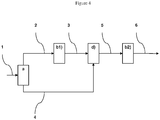
- FIGS. figures 1 , 2 and 3 These embodiments are given by way of example and are not limiting in nature. This illustration of the method of the invention does not include all the components necessary for its implementation. Only the elements necessary for understanding the invention are represented therein, those skilled in the art being able to complete this representation to implement the invention.
- step a) corresponds to a step of fractionation of synthesis gas No. 1 into two gas flows of identical composition No. 2 and No. 4, the flow of gas No. 2 being sent to a step b1) converting the CO monoxide to the steam to give a flow of gas No. 3, the gas streams No. 3 and No. 4 being recombined during the recombination step d) to give the gas flow No. 5, the flow of gas No. 5 then undergoing a step b2) of removing the acid gases to give a gas stream No. 6.
- Table 1 The evolution of the composition of the gas is specified in Table 1 below: The numbers of the flows refer to the figure 4 .
- Table 1 Composition of the synthesis gas to be purified. Flow n ° 1, n ° 2, n ° 4 Stream 3 Stream 5 Flow n ° 6 H 2 (% volume) 14.6 39.6 27.4 63.4 CO (% volume) 25.7 2.0 13.6 31.5 CO 2 (% volume) 6.6 31.5 19.4 0,001 H 2 O (% volume) 50.8 24.6 37.4 0.25 H 2 S (ppmvl) 4300 4750 4530 1 COS (ppmv) 480 30 250 145 HCN (ppmv) 200 1 100 15 NH 3 (ppmv) 650 850 750 10 H 2 / CO 0.6 19.8 2.0 2.0
- the figure 1 describes a sequence of processes according to the invention.
- the catalyst Cat2 used is an industrial catalyst based on titanium oxide. This industrial catalyst has a titanium oxide content of 85% by weight. Its specific surface area determined by the BET method is 120 m 2 / g. The catalyst is in the form of extrudates approximately 3 mm in diameter.
- the purification scheme according to the invention requires a flow rate of 200 m 3 / h of MDEA in step c2) and a flow rate of 1340 m 3 / h.
- MDEA h activated in step b2).
- the method according to the invention therefore makes it possible to reduce the overall flow rate of solvent used by 6%.
- the energy consumptions necessary for the regeneration of the aqueous solutions of amines are also diminished in the same proportions.
- the residual contents of acidic compounds in the gas at the end of the washing step are: for the H 2 S of 1 ppmv, for the COS of 10 ppmv, and for the HCN of 1 ppmv, either of the contents in impurities well below those obtained in Example 1 according to the prior art.
- the synthesis gas obtained has a ratio H 2 / CO equal to 2.
- the figure 2 describes a sequence of processes according to the invention.
- Table 4 refers to the figure 2 .
- Table 4 Composition of the synthesis gas to be purified.
- Solvent flow stage b2 Solvent flow stage b
- the purification scheme according to the invention requires a flow rate of 200 m 3 / h of MDEA in step c2) and a flow rate of 1340 m 3 / h.
- MDEA h activated in step b2).
- the method according to the invention therefore makes it possible to reduce the overall flow rate of solvent used by 6%.
- the energy consumptions necessary for the regeneration of the aqueous solutions of amines are also diminished in the same proportions.
- the residual contents of acid compounds in the gas at the end of the washing step are: for H 2 S of 1 ppmv, for the COS of 4 ppmv, and for HCN 1 ppmv, ie impurity levels well below those obtained in Example 1 according to the prior art.
- the synthesis gas obtained has a ratio H 2 / CO equal to 2.
- the test consists in comparing the stability of the amine in a mixture at 5 bar of CO or CO 2 at 140 ° C. for 14 days.
- the temperature is set at 140 ° C, corresponding to the temperature of the bottom of the regeneration column.
- the degradation results in the presence of CO 2 are taken as reference.
- Each test was repeated once ("test 1", "test 2").
- the table below presents the results of the tests carried out: Degradation 5 bar CO 2 C% m Trial 1 Trial 2 piperazine 7.7 26% 28% Degradation 5 bar CO piperazine 7.7 51% 53%
- piperazine secondary amine degrades about twice as much in the presence of CO than with CO 2 . This confirms that the use of piperazine as an activator, and more broadly the use of secondary amine is justified for the treatment of a gas depleted of CO during the washing step b2) downstream of the step conversion of CO to steam b1).
- the test consists in comparing the stability of each amine in a mixture at 5 bar of CO at 140 ° C. for 14 days.
- the temperature is set at 140 ° C, corresponding to the temperature of the bottom of the regeneration column. Samples taken over time and their assays by gas phase chromatography make it possible to follow the evolution of the concentrations over the duration of the test.
- step b2) the contact between CO and primary and / or secondary amines is minimized because of the composition of the gas to be treated having a reduced CO content relative to the raw synthesis gas .
- step c2) the tertiary amine (s) used are less sensitive to degradation by CO.
Landscapes
- Chemical & Material Sciences (AREA)
- Organic Chemistry (AREA)
- Chemical Kinetics & Catalysis (AREA)
- Engineering & Computer Science (AREA)
- Combustion & Propulsion (AREA)
- Inorganic Chemistry (AREA)
- Health & Medical Sciences (AREA)
- General Health & Medical Sciences (AREA)
- Oil, Petroleum & Natural Gas (AREA)
- General Chemical & Material Sciences (AREA)
- Gas Separation By Absorption (AREA)
- Organic Low-Molecular-Weight Compounds And Preparation Thereof (AREA)
- Industrial Gases (AREA)
- Treating Waste Gases (AREA)
Claims (16)
- Verfahren zur Reinigung von Synthesegas, umfassend mindestens die folgenden Schritte:a) einen Schritt des Teilens des Synthesegases in mindestens einen ersten und einen zweiten Synthesegasstrom mit derselben Zusammensetzung,b1) einen Schritt des Umwandelns mit Dampf von Kohlenmonoxid des ersten Synthesegasstroms aus dem Schritt a), um einen Gasabstrom zu erzeugen, der mindestens Wasserstoff H2 und Kohlendioxid CO2 umfasst,b2) einen Schritt des Eliminierens saurer Gase aus dem Gasabstrom aus dem Schritt b1) durch Inkontaktbringen des Abstroms mit einer wässrigen Amin-Lösung, die mindestens ein primäres und/oder sekundären Amin umfasst, in Mischung oder nicht mit mindestens einem tertiären Amin oder einem sekundären Amin, das als gehindert bezeichnet wird, umfassend mindestens einen quatären Kohlenstoff in α (alpha) des Stickstoffs oder zwei tertiäre Kohlenstoffe in Position α und α',c1) einen Schritt der katalytischen Hydrolyse von COS und von HCN, die in dem zweiten Synthesegasstrom vorhanden sind, der nicht der Umwandlungsreaktion von Kohlenmonoxid im Dampf unterzogen wurde,c2) einen Schritt des Eliminierens saurer Gase aus dem Synthesegasstrom aus dem Schritt der katalytischen Hydrolyse von COS und HCN c1), durch Inkontaktbringen des Stroms mit einer wässrigen Amin-Lösung, die mindestens ein tertiäres Amin umfasst,d) Rekombination mindestens eines Teils der Gasabströme aus den Schritten b2) und c2), um ein gereinigtes Synthesegas zu erhalten.
- Verfahren nach Anspruch 1, wobei der Schritt b1) bei einem absoluten Druck zwischen 20 und 120 bar, bei einer Volumengeschwindigkeit pro Stunde WH zwischen 1000 und 10000 h-1 und bei einer Temperatur zwischen 150 und 550°C durchgeführt wird.
- Verfahren nach einem der Ansprüche 1 oder 2, wobei der Katalysator, der in dem Schritt b1) verwendet wird, mindestens ein Element der Gruppe VIII und/oder mindestens ein Element der Gruppe VIB des Periodensystems und einen Träger, der ausgewählt wird aus der Gruppe bestehend aus Aluminiumoxiden, Siliciumdioxid, Siliciumdioxiden-Aluminiumoxiden, umfasst.
- Verfahren nach einem der Ansprüche 1 bis 3, wobei der Gasabstrom aus dem Schritt b1) in einen Schritt b1') der katalytischen Hydrolyse von COS und HCN in H2S und NH3 geschickt wird.
- Verfahren nach einem der Ansprüche 1 bis 4, wobei das oder die primären Amine, die in dem Schritt b2) verwendet werden, ausgewählt werden aus Monoethanolamin, Aminoethylethanolamin, Diglykolamin, 2-Amino-2-methyl-1-propanol und seinen nicht N-substituierten Derivaten, allein oder in Mischung.
- Verfahren nach einem der Ansprüche 1 bis 5, wobei das oder die sekundären Amine, die in dem Schritt b2) verwendet werden, ausgewählt werden aus Diethanolamin (DEA), Diisopropanolamin, Piperazin und seinen Derivaten, in denen mindestens ein Stickstoffatom nicht substituiert ist, Morpholin und seinen nicht N-substituierten Derivaten, Piperidin und seinen nicht N-substituierten Derivaten, N-(2'-Hydroxyethyl)-2-amino-2-methyl-1-propanol, N-(2'-Hydroxypropyl)-2-amino-2-methyl-1-propanol, N-(2'-Hydroxybutyl)-2-amino-2-methyl-1-propanol, allein oder in Mischung.
- Verfahren nach einem der Ansprüche 1 bis 4, wobei, in dem Fall, wo der Schritt b2) in Anwesenheit einer wässrigen Amin-Lösung betrieben wird, die mindestens ein primäres und/oder sekundäres Amin umfasst, in Mischung mit mindestens einem tertiären Amin oder einem sekundären Amin, umfassend mindestens einen quaternären Kohlenstoff in α oder alpha des Stickstoffs oder zwei tertiäre Kohlenstoffe in Position α und α', das oder die primären und/oder sekundären Amine, die als "Aktivatoren" bezeichnet werden, ausgewählt werden aus den Molekülen Monoethanolamin, Diethanolamin, N-Butylethanolamin, Aminoethylethanolamin, Diglykolamin, Piperazin, 1-Methylpiperazin, 2-Methylpiperazin, N-(2-Hydroxyethyl)-piperazin, N-(2-Aminoethyl)-piperazin, Morpholin, 3-(Methylamino)-propylamin und 1,6-Hexandiamin und allen seinen verschieden N-alkylierten Derivaten, allein oder in Mischung.
- Verfahren nach einem der Ansprüche 1 bis 7, wobei, in dem Fall, wo der Schritt b2) in Anwesenheit einer wässrigen Amin-Lösung betrieben wird, die mindestens ein primäres und/oder sekundäres Amin umfasst, in Mischung mit mindestens einem sekundären Amin, das als gehindert bezeichnet wird, umfassend mindestens einen quaternären Kohlenstoff in α oder alpha des Stickstoffs oder zwei tertiäre Kohlenstoffe in Position α und α', das oder die sekundären Amine, die als gehindert bezeichnet werden, ausgewählt werden aus N-(2'-Hydroxyethyl)-2-amino-2-methyl-1-propanol, N-(2'-Hydroxypropyl)-2-amino-2-methyl-1-propanol, N-(2'-Hydroxybutyl)-2-amino-2-methyl-1-propanol.
- Verfahren nach einem der Ansprüche 1 bis 8, wobei in dem Fall, wo der Schritt b2) in Anwesenheit einer wässrigen Amin-Lösung betrieben wird, die mindestens ein primäres und/oder sekundäres Amin umfasst, in Mischung mit mindestens einem tertiären Amin, das oder die tertiären Amine ausgewählt werden aus Methyldiethanolamin (MDEA), Triethanolamin, Ethyldiethanolamin, Diethylethanolamin, Dimethylethanolamin, 1-Methyl-4-(3-dimethylaminopropyl)-piperazin, 1-Ethyl-4-(diethylaminoethyl)-piperazin, 1-Methyl-4-hydroxypiperidin, 1-Methyl-2-hydroxymethylpiperidin, Tertiobutyldiethanolamin, 1,2-bis-(2-Dimethylaminoethoxy)-ethan, Bis-(Dimethylamino-3-propyl)-ether, Bis-(diethylamino-3-propyl)-ether, (Dimethylamino-2-ethyl)-(dimethylamino-3-propyl)-ether, (Diethylamino-2-ethyl)-(dimethylamino-3-propyl)-ether, (Dimethylamino-2-ethyl)-(diethylamino-3-propyl)-ether, (Diethylamino-2-ethyl)-(diethylamino-3-propyl)-ether, N-Methyl-N-(3-methoxypropyl)-2-aminoethanol, N-Methyl-N-(3-methoxypropyl)-1-amino-2-propanol, N-Methyl-N-(3-methoxypropyl)-1-amino-2-butanol, N-Ethyl-N-(3-methoxypropyl)-2-aminoethanol, N-Ethyl-N-(3-methoxypropyl)-1-amino-2-propanol, N-Ethyl-N-(3-methoxypropyl)-1-amino-2-butanol, N-Isopropyl-N-(3-methoxypropyl)-2-aminoethanol, N-Isopropyl-N-(3-methoxypropyl)-1-amino-2-propanol, N-Isopropyl-N-(3-methoxypropyl)-1-amino-2-butanol, 1-(4-Morpholino)-2-(methylisopropylamino)-ethan, 1-(4-Morpholino)-2-(methyltertiobutylamino)-ethan, 1-(4-Morpholino)-2-(diisopropylamino)-ethan, 1-(4-Morpholino)-2-(1-piperidinyl)-ethan, allein oder in Mischung.
- Verfahren nach einem der Ansprüche 1 bis 9, wobei der Schritt c1) in Anwesenheit eines Katalysators durchgeführt wird, umfassend eine Verbindung auf der Basis von Platin, oder einem Oxid eines Elements ausgewählt aus Titan, Zirconium, Aluminium, Chrom und Zink, allein oder in Mischung, wobei der Schritt c1) bei einer Temperatur zwischen 100 und 400°C und bei einem absoluten Druck zwischen 20 und 120 bar betrieben wird.
- Verfahren nach einem der Ansprüche 1 bis 10, wobei das oder die tertiären Amine, die in dem Schritt c2) verwendet werden, ausgewählt werden aus Methyldiethanolamin (MDEA), Triethanolamin, Ethyldiethanolamin, Diethylethanolamin, Dimethylethanolamin, 1-Methyl-4-(3-dimethylaminopropyl)-piperazin, 1-Ethyl-4-(diethylaminoethyl)-piperazin, 1-Methyl-4-hydroxypiperidin, 1-Methyl-2-hydroxymethylpiperidin, Tertiobutyldiethanolamin, 1,2-bis-(2-Dimethylaminoethoxy)-ethan, Bis-(Dimethylamino-3-propyl)-ether, Bis-(diethylamino-3-propyl)-ether, (Dimethylamino-2-ethyl)-(dimethylamino-3-propyl)-ether, (Diethylamino-2-ethyl)-(dimethylamino-3-propyl)-ether, (Dimethylamino-2-ethyl)-(diethylamino-3-propyl)-ether, (Diethylamino-2-ethyl)-(diethylamino-3-propyl)-ether, N-Methyl-N-(3-methoxypropyl)-2-aminoethanol, N-Methyl-N-(3-methoxypropyl)-1-amino-2-propanol, N-Methyl-N-(3-methoxypropyl)-1-amino-2-butanol, N-Ethyl-N-(3-methoxypropyl)-2-aminoethanol, N-Ethyl-N-(3-methoxypropyl)-1-amino-2-propanol, N-Ethyl-N-(3-methoxypropyl)-1-amino-2-butanol, N-Isopropyl-N-(3-methoxypropyl)-2-aminoethanol, N-Isopropyl-N-(3-methoxypropyl)-1-amino-2-propanol, N-Isopropyl-N-(3-methoxypropyl)-1-amino-2-butanol, 1-(4-Morpholino)-2-(methylisopropylamino)-ethan, 1-(4-Morpholino)-2-(methyltertiobutylamino)-ethan, 1-(4-Morpholino)-2-(diisopropylamino)-ethan, 1-(4-Morpholino)-2-(1-piperidinyl)-ethan, allein oder in Mischung.
- Verfahren nach einem der Ansprüche 1 bis 11, wobei die Schritte b2) und c2) des Eliminierens saurer Gase einen ersten Schritt des Absorbierens der sauren Verbindungen des Synthesegases, gefolgt von einem Regenerierungsschritt des Lösungsmittels, umfassen.
- Verfahren nach Anspruch 12, wobei die wässrigen Amin-LÖsung, die in dem Schritt c2) des Eliminierens saurer Gase verwendet wird, bereits teilweise mit sauren Gasen beladen ist, und diese aus dem Schritt der Absorption einer Einheit zur Anreicherung saurer Gase oder einer Einheit zur Behandlung von Gasen einer Claus-Anlage stammt.
- Verfahren nach Anspruch 13, wobei der Schritt des Regenerierens mit einem Schritt des Regenerierens einer Einheit zur Anreicherung saurer Gase oder einer Einheit zur Behandlung von Gasen einer Claus-Anlage kombiniert wird.
- Verfahren nach einem der Ansprüche 1 bis 14, wobei das gereinigte Synthesegas aus dem Schritt d) einem Endreinigungsschritt e) unterzogen wird.
- Verfahren nach Anspruch 15, wobei das gereinigte Synthesegas aus dem Schritt e) in einen Schritt f) der Fischer-Tropsch-Synthese geschickt wird.
Priority Applications (1)
| Application Number | Priority Date | Filing Date | Title |
|---|---|---|---|
| PL14824421T PL3083492T3 (pl) | 2013-12-17 | 2014-12-16 | Sposób oczyszczania gazu syntezowego sposobem przemywania wodnymi roztworami amin |
Applications Claiming Priority (2)
| Application Number | Priority Date | Filing Date | Title |
|---|---|---|---|
| FR1362751A FR3014862B1 (fr) | 2013-12-17 | 2013-12-17 | Procede de purification du gaz de synthese par voie de lavage sur des solutions aqueuses d'amines |
| PCT/EP2014/077972 WO2015091490A1 (fr) | 2013-12-17 | 2014-12-16 | Procédé de purification du gaz de synthèse par voie de lavage sur des solutions aqueuses d'amines |
Publications (2)
| Publication Number | Publication Date |
|---|---|
| EP3083492A1 EP3083492A1 (de) | 2016-10-26 |
| EP3083492B1 true EP3083492B1 (de) | 2019-04-17 |
Family
ID=50137880
Family Applications (1)
| Application Number | Title | Priority Date | Filing Date |
|---|---|---|---|
| EP14824421.3A Active EP3083492B1 (de) | 2013-12-17 | 2014-12-16 | Verfahren zur reinigung von synthesegas durch aminwäsche mit wässrigen aminlösungen |
Country Status (15)
| Country | Link |
|---|---|
| US (1) | US10118824B2 (de) |
| EP (1) | EP3083492B1 (de) |
| KR (1) | KR102330626B1 (de) |
| CN (1) | CN106029557A (de) |
| AU (1) | AU2014364629B2 (de) |
| BR (1) | BR112016013143B1 (de) |
| CA (1) | CA2932541C (de) |
| ES (1) | ES2736021T3 (de) |
| FR (1) | FR3014862B1 (de) |
| MY (1) | MY175603A (de) |
| PL (1) | PL3083492T3 (de) |
| RU (1) | RU2668925C1 (de) |
| UA (1) | UA118363C2 (de) |
| WO (1) | WO2015091490A1 (de) |
| ZA (1) | ZA201603815B (de) |
Families Citing this family (5)
| Publication number | Priority date | Publication date | Assignee | Title |
|---|---|---|---|---|
| US12421465B2 (en) * | 2016-10-17 | 2025-09-23 | Haldor Topsøe A/S | Gasification process employing acid gas recycle |
| CN110639494A (zh) * | 2019-10-31 | 2020-01-03 | 北京北科环境工程有限公司 | 一种高炉煤气羰基硫水解剂及其制备方法 |
| CN112811394A (zh) * | 2021-01-27 | 2021-05-18 | 山东恒邦冶炼股份有限公司 | 一种高纯砷工艺尾气回收循环利用的工艺及尾气回收系统 |
| GB202204766D0 (en) * | 2022-04-01 | 2022-05-18 | Johnson Matthey Davy Technologies Ltd | Method of producing liquid hydrocarbons from a syngas |
| US12227693B2 (en) | 2022-09-09 | 2025-02-18 | Saudi Arabian Oil Company | Aqueous fluid compositions and barite scale removal therewith |
Family Cites Families (14)
| Publication number | Priority date | Publication date | Assignee | Title |
|---|---|---|---|---|
| FR2420568A1 (fr) * | 1978-03-24 | 1979-10-19 | Texaco Development Corp | Procede pour produire un gaz de synthese nettoye et purifie et un gaz riche en co |
| DE69215345T2 (de) * | 1991-12-30 | 1997-03-13 | Texaco Development Corp | Behandlung von Synthesegas |
| DE102004062687A1 (de) * | 2004-12-21 | 2006-06-29 | Uhde Gmbh | Verfahren zum Erzeugen von Wasserstoff und Energie aus Synthesegas |
| CA2592599A1 (en) | 2004-12-30 | 2006-07-06 | Shell Canada Limited | Improvements relating to coal to liquid processes |
| AU2006245727B2 (en) * | 2005-05-13 | 2009-07-16 | Shell Internationale Research Maatschappij B.V. | Removal of carbon dioxide from a gas stream |
| AU2008281856B2 (en) * | 2007-07-31 | 2011-06-30 | Shell Internationale Research Maatschappij B.V. | Process for producing purified gas from gas comprising H2S, CO2 and HCN and/or COS |
| GB0715101D0 (en) | 2007-08-03 | 2007-09-12 | Johnson Matthey Plc | Process |
| GB0814053D0 (en) * | 2008-08-01 | 2008-09-10 | Johnson Matthey Plc | Process |
| FR2940920B1 (fr) * | 2009-01-12 | 2011-10-21 | Inst Francais Du Petrole | Procede d'elimination d'impuretes soufrees, azotees et halogenees contenues dans un gaz de synthese |
| CN102378735A (zh) * | 2009-03-30 | 2012-03-14 | 国际壳牌研究有限公司 | 用于生产纯化的合成气物流的方法 |
| EP2236457A1 (de) * | 2009-03-30 | 2010-10-06 | Shell Internationale Research Maatschappij B.V. | Verfahren zur Herstellung eines gereinigten Synthesegases |
| US20120095119A1 (en) * | 2009-03-30 | 2012-04-19 | Isaac Cormelis Van Den Born | Process for producing purified synthesis gas |
| CN103402608A (zh) | 2010-11-30 | 2013-11-20 | 氟石科技公司 | 气化装置的构造和方法 |
| MX362397B (es) * | 2010-12-01 | 2019-01-16 | Huntsman Petrochemical Llc | Aminas inhibidas estericamente y metodos asociados. |
-
2013
- 2013-12-17 FR FR1362751A patent/FR3014862B1/fr not_active Expired - Fee Related
-
2014
- 2014-12-16 ES ES14824421T patent/ES2736021T3/es active Active
- 2014-12-16 MY MYPI2016702158A patent/MY175603A/en unknown
- 2014-12-16 UA UAA201607753A patent/UA118363C2/uk unknown
- 2014-12-16 RU RU2016128964A patent/RU2668925C1/ru active
- 2014-12-16 KR KR1020167019335A patent/KR102330626B1/ko active Active
- 2014-12-16 CN CN201480068595.2A patent/CN106029557A/zh active Pending
- 2014-12-16 WO PCT/EP2014/077972 patent/WO2015091490A1/fr not_active Ceased
- 2014-12-16 EP EP14824421.3A patent/EP3083492B1/de active Active
- 2014-12-16 BR BR112016013143-6A patent/BR112016013143B1/pt active IP Right Grant
- 2014-12-16 PL PL14824421T patent/PL3083492T3/pl unknown
- 2014-12-16 US US15/105,075 patent/US10118824B2/en active Active
- 2014-12-16 AU AU2014364629A patent/AU2014364629B2/en active Active
- 2014-12-16 CA CA2932541A patent/CA2932541C/fr active Active
-
2016
- 2016-06-03 ZA ZA2016/03815A patent/ZA201603815B/en unknown
Non-Patent Citations (1)
| Title |
|---|
| None * |
Also Published As
| Publication number | Publication date |
|---|---|
| PL3083492T3 (pl) | 2020-02-28 |
| KR102330626B1 (ko) | 2021-11-24 |
| RU2668925C1 (ru) | 2018-10-04 |
| FR3014862B1 (fr) | 2016-01-01 |
| ES2736021T3 (es) | 2019-12-23 |
| EP3083492A1 (de) | 2016-10-26 |
| BR112016013143B1 (pt) | 2022-05-10 |
| AU2014364629A1 (en) | 2016-07-07 |
| MY175603A (en) | 2020-07-01 |
| KR20160124749A (ko) | 2016-10-28 |
| CN106029557A (zh) | 2016-10-12 |
| WO2015091490A1 (fr) | 2015-06-25 |
| FR3014862A1 (fr) | 2015-06-19 |
| BR112016013143A2 (pt) | 2020-06-30 |
| ZA201603815B (en) | 2017-08-30 |
| CA2932541A1 (fr) | 2015-06-25 |
| US20160368767A1 (en) | 2016-12-22 |
| UA118363C2 (uk) | 2019-01-10 |
| RU2016128964A (ru) | 2018-01-23 |
| CA2932541C (fr) | 2021-08-31 |
| AU2014364629B2 (en) | 2018-07-12 |
| US10118824B2 (en) | 2018-11-06 |
Similar Documents
| Publication | Publication Date | Title |
|---|---|---|
| EP2914701B1 (de) | Verfahren zur umwandlung eines biomassehaltigen ausgangsstoffes zur herstellung von kohlenwasserstoffen mittels fischer-tropsch-synthese | |
| EP2310110B1 (de) | Absorbierende lösung auf der basis von n,n,n',n'-tetramethylhexan-1,6-diamin und einem amin mit primären oder sekundären amingruppen und verfahren zur eliminierung von sauren komponenten aus einem gasstrom | |
| EP3083492B1 (de) | Verfahren zur reinigung von synthesegas durch aminwäsche mit wässrigen aminlösungen | |
| EP2385874B1 (de) | Verfahren zum entfernen von schwefel-, stickstoff- und halogenverunreinigungen aus einem synthesegas | |
| CA2874362C (fr) | Procede de purification de melanges gazeux contenant des gaz acides. | |
| EP2873450A1 (de) | Verfahren und Anlage zur Abscheidung von sauren Verbindungen aus Abgasen unterschiedlicher Herkunft | |
| FR2795420A1 (fr) | Procede d'hydrotraitement d'un distillat moyen dans deux zones successives comprenant une zone intermediaire de stripage de l'effluent de la premiere zone avec condensation des produits lourds sortant en tete du strippeur | |
| CA2514087C (fr) | Procede de capture des mercaptans contenus dans une charge gazeuse | |
| FR2789691A1 (fr) | Procede de synthese de distillat atmospherique comprenant l'utilisation de la technologie fischer-tropsch | |
| FR2896509A1 (fr) | Procede de capture des mercaptans contenus dans un gaz naturel par concentration. | |
| FR3001157A1 (fr) | Solution absorbante a base d'une amine tertiaire ou encombree et d'un activeur particulier et procede d'elimination de composes acides d'un effluent gazeux | |
| CA3199543A1 (fr) | Procede de captation de silicium a faible vitesse spatiale horaire | |
| CA2689878C (fr) | Utilisation d'une composition a base de tio2 pour la captation de composes halogenes contenus dans un melange gazeux | |
| CA2937194A1 (fr) | Optimisation de l'utilisation d'hydrogene pour l'hydrotraitement de charges hydrocarbonees | |
| FR2918386A1 (fr) | Procede d'elimination des mercaptans contenus dans les effluents liquides et gazeux. | |
| FR3142474A1 (fr) | Valorisation énergétique pour la production de carburants de synthèse à partir de dioxyde de carbone |
Legal Events
| Date | Code | Title | Description |
|---|---|---|---|
| PUAI | Public reference made under article 153(3) epc to a published international application that has entered the european phase |
Free format text: ORIGINAL CODE: 0009012 |
|
| 17P | Request for examination filed |
Effective date: 20160718 |
|
| AK | Designated contracting states |
Kind code of ref document: A1 Designated state(s): AL AT BE BG CH CY CZ DE DK EE ES FI FR GB GR HR HU IE IS IT LI LT LU LV MC MK MT NL NO PL PT RO RS SE SI SK SM TR |
|
| AX | Request for extension of the european patent |
Extension state: BA ME |
|
| DAX | Request for extension of the european patent (deleted) | ||
| RAP1 | Party data changed (applicant data changed or rights of an application transferred) |
Owner name: COMMISSARIAT A L'ENERGIE ATOMIQUE ET AUX ENERGIES Owner name: TOTAL RAFFINAGE CHIMIE Owner name: IFP ENERGIES NOUVELLES Owner name: BIONEXT Owner name: AVRIL Owner name: THYSSENKRUPP INDUSTRIAL SOLUTIONS AG Owner name: AXENS |
|
| RAP1 | Party data changed (applicant data changed or rights of an application transferred) |
Owner name: THYSSENKRUPP INDUSTRIAL SOLUTIONS AG Owner name: IFP ENERGIES NOUVELLES Owner name: AVRIL Owner name: AXENS Owner name: TOTAL RAFFINAGE CHIMIE Owner name: BIONEXT Owner name: COMMISSARIAT A L'ENERGIE ATOMIQUE ET AUX ENERGIES |
|
| GRAP | Despatch of communication of intention to grant a patent |
Free format text: ORIGINAL CODE: EPIDOSNIGR1 |
|
| STAA | Information on the status of an ep patent application or granted ep patent |
Free format text: STATUS: GRANT OF PATENT IS INTENDED |
|
| RIC1 | Information provided on ipc code assigned before grant |
Ipc: C01B 3/56 20060101ALI20181218BHEP Ipc: C01B 3/16 20060101AFI20181218BHEP Ipc: C10G 2/00 20060101ALI20181218BHEP Ipc: C01B 3/52 20060101ALI20181218BHEP |
|
| INTG | Intention to grant announced |
Effective date: 20190123 |
|
| GRAS | Grant fee paid |
Free format text: ORIGINAL CODE: EPIDOSNIGR3 |
|
| GRAA | (expected) grant |
Free format text: ORIGINAL CODE: 0009210 |
|
| STAA | Information on the status of an ep patent application or granted ep patent |
Free format text: STATUS: THE PATENT HAS BEEN GRANTED |
|
| AK | Designated contracting states |
Kind code of ref document: B1 Designated state(s): AL AT BE BG CH CY CZ DE DK EE ES FI FR GB GR HR HU IE IS IT LI LT LU LV MC MK MT NL NO PL PT RO RS SE SI SK SM TR |
|
| REG | Reference to a national code |
Ref country code: GB Ref legal event code: FG4D Free format text: NOT ENGLISH |
|
| REG | Reference to a national code |
Ref country code: CH Ref legal event code: EP |
|
| REG | Reference to a national code |
Ref country code: DE Ref legal event code: R096 Ref document number: 602014045034 Country of ref document: DE |
|
| REG | Reference to a national code |
Ref country code: AT Ref legal event code: REF Ref document number: 1121339 Country of ref document: AT Kind code of ref document: T Effective date: 20190515 Ref country code: IE Ref legal event code: FG4D Free format text: LANGUAGE OF EP DOCUMENT: FRENCH |
|
| REG | Reference to a national code |
Ref country code: NL Ref legal event code: FP |
|
| REG | Reference to a national code |
Ref country code: SE Ref legal event code: TRGR |
|
| REG | Reference to a national code |
Ref country code: LT Ref legal event code: MG4D |
|
| PG25 | Lapsed in a contracting state [announced via postgrant information from national office to epo] |
Ref country code: PT Free format text: LAPSE BECAUSE OF FAILURE TO SUBMIT A TRANSLATION OF THE DESCRIPTION OR TO PAY THE FEE WITHIN THE PRESCRIBED TIME-LIMIT Effective date: 20190817 Ref country code: AL Free format text: LAPSE BECAUSE OF FAILURE TO SUBMIT A TRANSLATION OF THE DESCRIPTION OR TO PAY THE FEE WITHIN THE PRESCRIBED TIME-LIMIT Effective date: 20190417 Ref country code: NO Free format text: LAPSE BECAUSE OF FAILURE TO SUBMIT A TRANSLATION OF THE DESCRIPTION OR TO PAY THE FEE WITHIN THE PRESCRIBED TIME-LIMIT Effective date: 20190717 Ref country code: LT Free format text: LAPSE BECAUSE OF FAILURE TO SUBMIT A TRANSLATION OF THE DESCRIPTION OR TO PAY THE FEE WITHIN THE PRESCRIBED TIME-LIMIT Effective date: 20190417 Ref country code: HR Free format text: LAPSE BECAUSE OF FAILURE TO SUBMIT A TRANSLATION OF THE DESCRIPTION OR TO PAY THE FEE WITHIN THE PRESCRIBED TIME-LIMIT Effective date: 20190417 |
|
| PG25 | Lapsed in a contracting state [announced via postgrant information from national office to epo] |
Ref country code: GR Free format text: LAPSE BECAUSE OF FAILURE TO SUBMIT A TRANSLATION OF THE DESCRIPTION OR TO PAY THE FEE WITHIN THE PRESCRIBED TIME-LIMIT Effective date: 20190718 Ref country code: LV Free format text: LAPSE BECAUSE OF FAILURE TO SUBMIT A TRANSLATION OF THE DESCRIPTION OR TO PAY THE FEE WITHIN THE PRESCRIBED TIME-LIMIT Effective date: 20190417 Ref country code: BG Free format text: LAPSE BECAUSE OF FAILURE TO SUBMIT A TRANSLATION OF THE DESCRIPTION OR TO PAY THE FEE WITHIN THE PRESCRIBED TIME-LIMIT Effective date: 20190717 Ref country code: RS Free format text: LAPSE BECAUSE OF FAILURE TO SUBMIT A TRANSLATION OF THE DESCRIPTION OR TO PAY THE FEE WITHIN THE PRESCRIBED TIME-LIMIT Effective date: 20190417 |
|
| REG | Reference to a national code |
Ref country code: ES Ref legal event code: FG2A Ref document number: 2736021 Country of ref document: ES Kind code of ref document: T3 Effective date: 20191223 |
|
| PG25 | Lapsed in a contracting state [announced via postgrant information from national office to epo] |
Ref country code: IS Free format text: LAPSE BECAUSE OF FAILURE TO SUBMIT A TRANSLATION OF THE DESCRIPTION OR TO PAY THE FEE WITHIN THE PRESCRIBED TIME-LIMIT Effective date: 20190817 |
|
| REG | Reference to a national code |
Ref country code: DE Ref legal event code: R097 Ref document number: 602014045034 Country of ref document: DE |
|
| PG25 | Lapsed in a contracting state [announced via postgrant information from national office to epo] |
Ref country code: DK Free format text: LAPSE BECAUSE OF FAILURE TO SUBMIT A TRANSLATION OF THE DESCRIPTION OR TO PAY THE FEE WITHIN THE PRESCRIBED TIME-LIMIT Effective date: 20190417 Ref country code: EE Free format text: LAPSE BECAUSE OF FAILURE TO SUBMIT A TRANSLATION OF THE DESCRIPTION OR TO PAY THE FEE WITHIN THE PRESCRIBED TIME-LIMIT Effective date: 20190417 Ref country code: RO Free format text: LAPSE BECAUSE OF FAILURE TO SUBMIT A TRANSLATION OF THE DESCRIPTION OR TO PAY THE FEE WITHIN THE PRESCRIBED TIME-LIMIT Effective date: 20190417 Ref country code: CZ Free format text: LAPSE BECAUSE OF FAILURE TO SUBMIT A TRANSLATION OF THE DESCRIPTION OR TO PAY THE FEE WITHIN THE PRESCRIBED TIME-LIMIT Effective date: 20190417 Ref country code: SK Free format text: LAPSE BECAUSE OF FAILURE TO SUBMIT A TRANSLATION OF THE DESCRIPTION OR TO PAY THE FEE WITHIN THE PRESCRIBED TIME-LIMIT Effective date: 20190417 |
|
| PLBE | No opposition filed within time limit |
Free format text: ORIGINAL CODE: 0009261 |
|
| STAA | Information on the status of an ep patent application or granted ep patent |
Free format text: STATUS: NO OPPOSITION FILED WITHIN TIME LIMIT |
|
| PG25 | Lapsed in a contracting state [announced via postgrant information from national office to epo] |
Ref country code: SM Free format text: LAPSE BECAUSE OF FAILURE TO SUBMIT A TRANSLATION OF THE DESCRIPTION OR TO PAY THE FEE WITHIN THE PRESCRIBED TIME-LIMIT Effective date: 20190417 |
|
| 26N | No opposition filed |
Effective date: 20200120 |
|
| PG25 | Lapsed in a contracting state [announced via postgrant information from national office to epo] |
Ref country code: TR Free format text: LAPSE BECAUSE OF FAILURE TO SUBMIT A TRANSLATION OF THE DESCRIPTION OR TO PAY THE FEE WITHIN THE PRESCRIBED TIME-LIMIT Effective date: 20190417 |
|
| PG25 | Lapsed in a contracting state [announced via postgrant information from national office to epo] |
Ref country code: SI Free format text: LAPSE BECAUSE OF FAILURE TO SUBMIT A TRANSLATION OF THE DESCRIPTION OR TO PAY THE FEE WITHIN THE PRESCRIBED TIME-LIMIT Effective date: 20190417 |
|
| REG | Reference to a national code |
Ref country code: AT Ref legal event code: UEP Ref document number: 1121339 Country of ref document: AT Kind code of ref document: T Effective date: 20190417 |
|
| REG | Reference to a national code |
Ref country code: CH Ref legal event code: PL |
|
| PG25 | Lapsed in a contracting state [announced via postgrant information from national office to epo] |
Ref country code: MC Free format text: LAPSE BECAUSE OF FAILURE TO SUBMIT A TRANSLATION OF THE DESCRIPTION OR TO PAY THE FEE WITHIN THE PRESCRIBED TIME-LIMIT Effective date: 20190417 |
|
| PG25 | Lapsed in a contracting state [announced via postgrant information from national office to epo] |
Ref country code: IE Free format text: LAPSE BECAUSE OF NON-PAYMENT OF DUE FEES Effective date: 20191216 Ref country code: LU Free format text: LAPSE BECAUSE OF NON-PAYMENT OF DUE FEES Effective date: 20191216 |
|
| PG25 | Lapsed in a contracting state [announced via postgrant information from national office to epo] |
Ref country code: LI Free format text: LAPSE BECAUSE OF NON-PAYMENT OF DUE FEES Effective date: 20191231 Ref country code: CH Free format text: LAPSE BECAUSE OF NON-PAYMENT OF DUE FEES Effective date: 20191231 |
|
| PG25 | Lapsed in a contracting state [announced via postgrant information from national office to epo] |
Ref country code: CY Free format text: LAPSE BECAUSE OF FAILURE TO SUBMIT A TRANSLATION OF THE DESCRIPTION OR TO PAY THE FEE WITHIN THE PRESCRIBED TIME-LIMIT Effective date: 20190417 |
|
| PG25 | Lapsed in a contracting state [announced via postgrant information from national office to epo] |
Ref country code: MT Free format text: LAPSE BECAUSE OF FAILURE TO SUBMIT A TRANSLATION OF THE DESCRIPTION OR TO PAY THE FEE WITHIN THE PRESCRIBED TIME-LIMIT Effective date: 20190417 Ref country code: HU Free format text: LAPSE BECAUSE OF FAILURE TO SUBMIT A TRANSLATION OF THE DESCRIPTION OR TO PAY THE FEE WITHIN THE PRESCRIBED TIME-LIMIT; INVALID AB INITIO Effective date: 20141216 |
|
| PG25 | Lapsed in a contracting state [announced via postgrant information from national office to epo] |
Ref country code: MK Free format text: LAPSE BECAUSE OF FAILURE TO SUBMIT A TRANSLATION OF THE DESCRIPTION OR TO PAY THE FEE WITHIN THE PRESCRIBED TIME-LIMIT Effective date: 20190417 |
|
| REG | Reference to a national code |
Ref country code: FI Ref legal event code: PCE Owner name: COMMISSARIAT A L'ENERGIE ATOMIQUE ET AUX ENERGIES ALTERNATIVES; AXENS; TOTALENERGIES ONETECH; BIONEXT; IFP ENERGIES NOUVELLES; THYSSENKRUPP INDUSTRIAL SOLUTIONS AG; AVRIL |
|
| REG | Reference to a national code |
Ref country code: BE Ref legal event code: PD Owner name: TOTALENERGIES ONETECH; FR Free format text: DETAILS ASSIGNMENT: CHANGE OF OWNER(S), ASSIGNMENT; FORMER OWNER NAME: TOTALENERGIES RAFFINAGE CHIMIE Effective date: 20240422 Ref country code: BE Ref legal event code: HC Owner name: TOTALENERGIES RAFFINAGE CHIMIE; FR Free format text: DETAILS ASSIGNMENT: CHANGE OF OWNER(S), CHANGE OF OWNER(S) NAME; FORMER OWNER NAME: TOTAL RAFFINAGE CHIMIE Effective date: 20240422 |
|
| REG | Reference to a national code |
Ref country code: DE Ref legal event code: R081 Ref document number: 602014045034 Country of ref document: DE Owner name: TOTALENERGIES ONETECH, FR Free format text: FORMER OWNERS: AVRIL, PARIS, FR; AXENS, RUEIL MALMAISON, FR; BIONEXT, VENETTE, FR; COMMISSARIAT A L'ENERGIE ATOMIQUE ET AUX ENERGIES ALTERNATIVES, PARIS, FR; IFP ENERGIES NOUVELLES, RUEIL-MALMAISON, FR; THYSSENKRUPP INDUSTRIAL SOLUTIONS AG, 45143 ESSEN, DE; TOTAL RAFFINAGE CHIMIE, COURBEVOIE, FR Ref country code: DE Ref legal event code: R081 Ref document number: 602014045034 Country of ref document: DE Owner name: THYSSENKRUPP INDUSTRIAL SOLUTIONS AG, DE Free format text: FORMER OWNERS: AVRIL, PARIS, FR; AXENS, RUEIL MALMAISON, FR; BIONEXT, VENETTE, FR; COMMISSARIAT A L'ENERGIE ATOMIQUE ET AUX ENERGIES ALTERNATIVES, PARIS, FR; IFP ENERGIES NOUVELLES, RUEIL-MALMAISON, FR; THYSSENKRUPP INDUSTRIAL SOLUTIONS AG, 45143 ESSEN, DE; TOTAL RAFFINAGE CHIMIE, COURBEVOIE, FR Ref country code: DE Ref legal event code: R081 Ref document number: 602014045034 Country of ref document: DE Owner name: IFP ENERGIES NOUVELLES, FR Free format text: FORMER OWNERS: AVRIL, PARIS, FR; AXENS, RUEIL MALMAISON, FR; BIONEXT, VENETTE, FR; COMMISSARIAT A L'ENERGIE ATOMIQUE ET AUX ENERGIES ALTERNATIVES, PARIS, FR; IFP ENERGIES NOUVELLES, RUEIL-MALMAISON, FR; THYSSENKRUPP INDUSTRIAL SOLUTIONS AG, 45143 ESSEN, DE; TOTAL RAFFINAGE CHIMIE, COURBEVOIE, FR Ref country code: DE Ref legal event code: R081 Ref document number: 602014045034 Country of ref document: DE Owner name: COMMISSARIAT A L'ENERGIE ATOMIQUE ET AUX ENERG, FR Free format text: FORMER OWNERS: AVRIL, PARIS, FR; AXENS, RUEIL MALMAISON, FR; BIONEXT, VENETTE, FR; COMMISSARIAT A L'ENERGIE ATOMIQUE ET AUX ENERGIES ALTERNATIVES, PARIS, FR; IFP ENERGIES NOUVELLES, RUEIL-MALMAISON, FR; THYSSENKRUPP INDUSTRIAL SOLUTIONS AG, 45143 ESSEN, DE; TOTAL RAFFINAGE CHIMIE, COURBEVOIE, FR Ref country code: DE Ref legal event code: R081 Ref document number: 602014045034 Country of ref document: DE Owner name: BIONEXT, FR Free format text: FORMER OWNERS: AVRIL, PARIS, FR; AXENS, RUEIL MALMAISON, FR; BIONEXT, VENETTE, FR; COMMISSARIAT A L'ENERGIE ATOMIQUE ET AUX ENERGIES ALTERNATIVES, PARIS, FR; IFP ENERGIES NOUVELLES, RUEIL-MALMAISON, FR; THYSSENKRUPP INDUSTRIAL SOLUTIONS AG, 45143 ESSEN, DE; TOTAL RAFFINAGE CHIMIE, COURBEVOIE, FR Ref country code: DE Ref legal event code: R081 Ref document number: 602014045034 Country of ref document: DE Owner name: AXENS, FR Free format text: FORMER OWNERS: AVRIL, PARIS, FR; AXENS, RUEIL MALMAISON, FR; BIONEXT, VENETTE, FR; COMMISSARIAT A L'ENERGIE ATOMIQUE ET AUX ENERGIES ALTERNATIVES, PARIS, FR; IFP ENERGIES NOUVELLES, RUEIL-MALMAISON, FR; THYSSENKRUPP INDUSTRIAL SOLUTIONS AG, 45143 ESSEN, DE; TOTAL RAFFINAGE CHIMIE, COURBEVOIE, FR Ref country code: DE Ref legal event code: R081 Ref document number: 602014045034 Country of ref document: DE Owner name: AVRIL, FR Free format text: FORMER OWNERS: AVRIL, PARIS, FR; AXENS, RUEIL MALMAISON, FR; BIONEXT, VENETTE, FR; COMMISSARIAT A L'ENERGIE ATOMIQUE ET AUX ENERGIES ALTERNATIVES, PARIS, FR; IFP ENERGIES NOUVELLES, RUEIL-MALMAISON, FR; THYSSENKRUPP INDUSTRIAL SOLUTIONS AG, 45143 ESSEN, DE; TOTAL RAFFINAGE CHIMIE, COURBEVOIE, FR |
|
| REG | Reference to a national code |
Ref country code: NL Ref legal event code: PD Owner name: TOTALENERGIES ONETECH; FR Free format text: DETAILS ASSIGNMENT: CHANGE OF OWNER(S), ASSIGNMENT; FORMER OWNER NAME: TOTALENERGIES RAFFINAGE CHIMIE Effective date: 20240905 Ref country code: NL Ref legal event code: HC Owner name: TOTALENERGIES RAFFINAGE CHIMIE; FR Free format text: DETAILS ASSIGNMENT: CHANGE OF OWNER(S), CHANGE OF OWNER(S) NAME; FORMER OWNER NAME: TOTAL RAFFINAGE CHIMIE Effective date: 20240905 |
|
| REG | Reference to a national code |
Ref country code: AT Ref legal event code: PC Ref document number: 1121339 Country of ref document: AT Kind code of ref document: T Owner name: TOTALENERGIES ONETECH, FR Effective date: 20240722 Ref country code: AT Ref legal event code: PC Ref document number: 1121339 Country of ref document: AT Kind code of ref document: T Owner name: THYSSENKRUPP INDUSTRIAL SOLUTIONS AG, DE Effective date: 20240722 Ref country code: AT Ref legal event code: PC Ref document number: 1121339 Country of ref document: AT Kind code of ref document: T Owner name: AVRIL, FR Effective date: 20240722 Ref country code: AT Ref legal event code: PC Ref document number: 1121339 Country of ref document: AT Kind code of ref document: T Owner name: IFP ENERGIES NOUVELLES, FR Effective date: 20240722 Ref country code: AT Ref legal event code: PC Ref document number: 1121339 Country of ref document: AT Kind code of ref document: T Owner name: COMMISSARIAT A L'ENERGIE ATOMIQUE ET AUX ENERG, FR Effective date: 20240722 Ref country code: AT Ref legal event code: PC Ref document number: 1121339 Country of ref document: AT Kind code of ref document: T Owner name: BIONEXT, FR Effective date: 20240722 Ref country code: AT Ref legal event code: PC Ref document number: 1121339 Country of ref document: AT Kind code of ref document: T Owner name: AXENS, FR Effective date: 20240722 |
|
| REG | Reference to a national code |
Ref country code: ES Ref legal event code: PC2A Owner name: TOTALENERGIES ONETECH Effective date: 20250310 |
|
| PGFP | Annual fee paid to national office [announced via postgrant information from national office to epo] |
Ref country code: GB Payment date: 20251223 Year of fee payment: 12 |
|
| PGFP | Annual fee paid to national office [announced via postgrant information from national office to epo] |
Ref country code: AT Payment date: 20251218 Year of fee payment: 12 |
|
| PGFP | Annual fee paid to national office [announced via postgrant information from national office to epo] |
Ref country code: IT Payment date: 20251218 Year of fee payment: 12 Ref country code: FI Payment date: 20251222 Year of fee payment: 12 |
|
| PGFP | Annual fee paid to national office [announced via postgrant information from national office to epo] |
Ref country code: NL Payment date: 20251222 Year of fee payment: 12 Ref country code: FR Payment date: 20251223 Year of fee payment: 12 |
|
| PGFP | Annual fee paid to national office [announced via postgrant information from national office to epo] |
Ref country code: SE Payment date: 20251222 Year of fee payment: 12 |
|
| PGFP | Annual fee paid to national office [announced via postgrant information from national office to epo] |
Ref country code: PL Payment date: 20251205 Year of fee payment: 12 |
|
| PGFP | Annual fee paid to national office [announced via postgrant information from national office to epo] |
Ref country code: ES Payment date: 20260122 Year of fee payment: 12 |
|
| PGFP | Annual fee paid to national office [announced via postgrant information from national office to epo] |
Ref country code: DE Payment date: 20251229 Year of fee payment: 12 |
|
| PGFP | Annual fee paid to national office [announced via postgrant information from national office to epo] |
Ref country code: BE Payment date: 20260109 Year of fee payment: 12 |