EP3083575B1 - C-6-spirocarbocyclische iminothiadiazindioxide als bace-inhibitoren, zusammensetzungen daraus und deren verwendung - Google Patents
C-6-spirocarbocyclische iminothiadiazindioxide als bace-inhibitoren, zusammensetzungen daraus und deren verwendung Download PDFInfo
- Publication number
- EP3083575B1 EP3083575B1 EP14872471.9A EP14872471A EP3083575B1 EP 3083575 B1 EP3083575 B1 EP 3083575B1 EP 14872471 A EP14872471 A EP 14872471A EP 3083575 B1 EP3083575 B1 EP 3083575B1
- Authority
- EP
- European Patent Office
- Prior art keywords
- alkyl
- och
- group
- compound
- cycloalkyl
- Prior art date
- Legal status (The legal status is an assumption and is not a legal conclusion. Google has not performed a legal analysis and makes no representation as to the accuracy of the status listed.)
- Active
Links
- 0 *C1NCCC1 Chemical compound *C1NCCC1 0.000 description 5
- JZCNCKZKKWBOJH-BJMVGYQFSA-N C/C(/c1cc([N+]([O-])=O)ccc1F)=N\S=O Chemical compound C/C(/c1cc([N+]([O-])=O)ccc1F)=N\S=O JZCNCKZKKWBOJH-BJMVGYQFSA-N 0.000 description 1
- ZHZUHRNDJYELAP-QGZVFWFLSA-N CC(C)(C)OC(/N=C(\N[C@@](C)(C12CC1)c1cc([N+]([O-])=O)ccc1F)/N(C)S2(=O)=O)=O Chemical compound CC(C)(C)OC(/N=C(\N[C@@](C)(C12CC1)c1cc([N+]([O-])=O)ccc1F)/N(C)S2(=O)=O)=O ZHZUHRNDJYELAP-QGZVFWFLSA-N 0.000 description 1
- BAHUYGLRPAIZLJ-BPJXYHRLSA-N CC(C)(C)OC(N(C)S(C1(CC1)[C@@](C)(c1cc([N+]([O-])=O)ccc1F)N[S@](C(C)(C)C)=O)(=O)=O)=O Chemical compound CC(C)(C)OC(N(C)S(C1(CC1)[C@@](C)(c1cc([N+]([O-])=O)ccc1F)N[S@](C(C)(C)C)=O)(=O)=O)=O BAHUYGLRPAIZLJ-BPJXYHRLSA-N 0.000 description 1
- HPMPDBKIEZIIPE-UHFFFAOYSA-N CC(C)(C)OC(N(C)S(C1CC1)(=O)=O)=O Chemical compound CC(C)(C)OC(N(C)S(C1CC1)(=O)=O)=O HPMPDBKIEZIIPE-UHFFFAOYSA-N 0.000 description 1
- NBXGDPBFRRQZEV-UHFFFAOYSA-N CC(C)(C)OC(NS(C1CC1)(=O)=O)=O Chemical compound CC(C)(C)OC(NS(C1CC1)(=O)=O)=O NBXGDPBFRRQZEV-UHFFFAOYSA-N 0.000 description 1
- BCXOSCQTHVTUET-UHFFFAOYSA-N CC(c1cc([N+]([O-])=O)ccc1F)=O Chemical compound CC(c1cc([N+]([O-])=O)ccc1F)=O BCXOSCQTHVTUET-UHFFFAOYSA-N 0.000 description 1
- COWOTELJLMLXQN-TYZXPVIJSA-N CN(C(N)N[C@@](C12CC1)(c1cc([N+]([O-])=O)ccc1F)C#C)S2(=O)=O Chemical compound CN(C(N)N[C@@](C12CC1)(c1cc([N+]([O-])=O)ccc1F)C#C)S2(=O)=O COWOTELJLMLXQN-TYZXPVIJSA-N 0.000 description 1
- IUKBYXPCHQMWHE-GOSISDBHSA-N C[C@](C1(CC1)S(N1C)(=O)=O)(c(cc(cc2)NC(c(nc3)cnc3OC)=O)c2F)NC1=N Chemical compound C[C@](C1(CC1)S(N1C)(=O)=O)(c(cc(cc2)NC(c(nc3)cnc3OC)=O)c2F)NC1=N IUKBYXPCHQMWHE-GOSISDBHSA-N 0.000 description 1
- OQMQSAHHJNGMTN-LJQANCHMSA-N C[C@](C1(CC1)S(N1C)(=O)=O)(c2cc(NC(c(nc3)cnc3OCCF)=O)ccc2F)NC1=N Chemical compound C[C@](C1(CC1)S(N1C)(=O)=O)(c2cc(NC(c(nc3)cnc3OCCF)=O)ccc2F)NC1=N OQMQSAHHJNGMTN-LJQANCHMSA-N 0.000 description 1
- SFQMOEHIAYEQHB-OAQYLSRUSA-N C[C@](C1(CC1)S(N1C)(=O)=O)(c2cc(NC(c3c[n](ccc(C#N)c4)c4n3)=O)ccc2F)NC1=N Chemical compound C[C@](C1(CC1)S(N1C)(=O)=O)(c2cc(NC(c3c[n](ccc(C#N)c4)c4n3)=O)ccc2F)NC1=N SFQMOEHIAYEQHB-OAQYLSRUSA-N 0.000 description 1
- MPCBJTDLQKWLDG-LLVKDONJSA-N C[C@](C1(CC1)S(NC)(=O)=O)(c1cc([N+]([O-])=O)ccc1F)N Chemical compound C[C@](C1(CC1)S(NC)(=O)=O)(c1cc([N+]([O-])=O)ccc1F)N MPCBJTDLQKWLDG-LLVKDONJSA-N 0.000 description 1
- WMSPXQIQBQAWLL-UHFFFAOYSA-N NS(C1CC1)(=O)=O Chemical compound NS(C1CC1)(=O)=O WMSPXQIQBQAWLL-UHFFFAOYSA-N 0.000 description 1
Classifications
-
- C—CHEMISTRY; METALLURGY
- C07—ORGANIC CHEMISTRY
- C07D—HETEROCYCLIC COMPOUNDS
- C07D417/00—Heterocyclic compounds containing two or more hetero rings, at least one ring having nitrogen and sulfur atoms as the only ring hetero atoms, not provided for by group C07D415/00
- C07D417/02—Heterocyclic compounds containing two or more hetero rings, at least one ring having nitrogen and sulfur atoms as the only ring hetero atoms, not provided for by group C07D415/00 containing two hetero rings
- C07D417/12—Heterocyclic compounds containing two or more hetero rings, at least one ring having nitrogen and sulfur atoms as the only ring hetero atoms, not provided for by group C07D415/00 containing two hetero rings linked by a chain containing hetero atoms as chain links
-
- A—HUMAN NECESSITIES
- A61—MEDICAL OR VETERINARY SCIENCE; HYGIENE
- A61P—SPECIFIC THERAPEUTIC ACTIVITY OF CHEMICAL COMPOUNDS OR MEDICINAL PREPARATIONS
- A61P25/00—Drugs for disorders of the nervous system
-
- C—CHEMISTRY; METALLURGY
- C07—ORGANIC CHEMISTRY
- C07D—HETEROCYCLIC COMPOUNDS
- C07D471/00—Heterocyclic compounds containing nitrogen atoms as the only ring hetero atoms in the condensed system, at least one ring being a six-membered ring with one nitrogen atom, not provided for by groups C07D451/00 - C07D463/00
- C07D471/02—Heterocyclic compounds containing nitrogen atoms as the only ring hetero atoms in the condensed system, at least one ring being a six-membered ring with one nitrogen atom, not provided for by groups C07D451/00 - C07D463/00 in which the condensed system contains two hetero rings
- C07D471/04—Ortho-condensed systems
-
- C—CHEMISTRY; METALLURGY
- C07—ORGANIC CHEMISTRY
- C07D—HETEROCYCLIC COMPOUNDS
- C07D513/00—Heterocyclic compounds containing in the condensed system at least one hetero ring having nitrogen and sulfur atoms as the only ring hetero atoms, not provided for in groups C07D463/00, C07D477/00 or C07D499/00 - C07D507/00
- C07D513/02—Heterocyclic compounds containing in the condensed system at least one hetero ring having nitrogen and sulfur atoms as the only ring hetero atoms, not provided for in groups C07D463/00, C07D477/00 or C07D499/00 - C07D507/00 in which the condensed system contains two hetero rings
- C07D513/04—Ortho-condensed systems
Definitions
- This invention provides certain C-6 spirocarbocyclic iminothiadiazine dioxide compounds, and compositions comprising these compounds, as inhibitors of BACE, which may be useful for treating or preventing pathologies related thereto.
- Amyloid beta peptide is a primary component of ⁇ amyloid fibrils and plaques, which are regarded as having a role in an increasing number of pathologies.
- pathologies include, but are not limited to, Alzheimer's disease, Down's syndrome, Parkinson's disease, memory loss (including memory loss associated with Alzheimer's disease and Parkinson's disease), attention deficit symptoms (including attention deficit symptoms associated with Alzheimer's disease (“AD”), Parkinson's disease, and Down's syndrome), dementia (including pre-senile dementia, senile dementia, dementia associated with Alzheimer's disease, Parkinson's disease, and Down's syndrome), progressive supranuclear palsy, cortical basal degeneration, neurodegeneration, olfactory impairment (including olfactory impairment associated with Alzheimer's disease, Parkinson's disease, and Down's syndrome), ⁇ -amyloid angiopathy (including cerebral amyloid angiopathy), hereditary cerebral hemorrhage, mild cognitive impairment (“MCI”), glaucoma,
- MCI
- a ⁇ peptides are short peptides which are made from the proteolytic break-down of the transmembrane protein called amyloid precursor protein ("APP").
- a ⁇ peptides are made from the cleavage of APP by ⁇ -secretase activity at a position near the N-terminus of A ⁇ , and by gamma-secretase activity at a position near the C-terminus of A ⁇ .
- Beta site APP Cleaving Enzyme (BACE-1”) is regarded as the primary aspartyl protease responsible for the production of A ⁇ by ⁇ -secretase activity. The inhibition of BACE-1 has been shown to inhibit the production of A ⁇ .
- AD Alzheimer's disease
- AD is estimated to afflict more than 20 million people worldwide and is believed to be the most common cause of dementia.
- AD is a disease characterized by degeneration and loss of neurons and also by the formation of senile plaques and neurofibrillary tangles.
- Treatment of Alzheimer's disease is limited to the treatment of its symptoms rather than the underlying causes.
- Symptom-improving agents approved for this purpose include, for example, N-methyl-D-aspartate receptor antagonists such as memantine (Namenda®, Forest Pharmaceuticals, Inc.), cholinesterase inhibitors such as donepezil (Aricept®, Pfizer), rivastigmine (Exelon®, Novartis), galantamine (Razadyne Reminyl®), and tacrine (Cognex®).
- N-methyl-D-aspartate receptor antagonists such as memantine (Namenda®, Forest Pharmaceuticals, Inc.)
- cholinesterase inhibitors such as donepezil (Aricept®, Pfizer), rivastigmine (Exelon®, Novartis), galantamine (Razadyne Reminyl®), and tacrine (Cognex®).
- a ⁇ peptides formed through ⁇ -secretase and gamma -secretase activity, can form tertiary structures that aggregate to form amyloid fibrils.
- a ⁇ peptides have also been shown to form A ⁇ oligomers (sometimes referred to as "A ⁇ aggregates” or “Abeta oligomers”).
- a ⁇ oligomers are small multimeric structures composed of 2 to 12 A ⁇ peptides that are structurally distinct from A ⁇ fibrils.
- Amyloid fibrils can deposit outside neurons in dense formations known as senile plaques, neuritic plaques, or diffuse plaques in regions of the brain important to memory and cognition.
- a ⁇ oligomers are cytotoxic when injected in the brains of rats or in cell culture.
- AD pathophysiology This A ⁇ plaque formation and deposition and/or A ⁇ oligomer formation, and the resultant neuronal death and cognitive impairment, are among the hallmarks of AD pathophysiology.
- Other hallmarks of AD pathophysiology include intracellular neurofibrillary tangles comprised of abnormally phosphorylated tau protein, and neuroinflammation.
- a ⁇ A ⁇ fibrils, aggregates, oligomers, and/or plaque play a causal role in AD pathophysiology.
- PS 1/2 presenilins 1/2
- a ⁇ has been shown to be neurotoxic in culture and in vivo. For example, when injected into the brains of aged primates, fibrillar A ⁇ causes neuronal cell death around the injection site.
- Other direct and circumstantial evidence of the role of A ⁇ in Alzheimer etiology has also been published.
- BACE-1 has become an accepted therapeutic target for the treatment of Alzheimer's disease.
- McConlogue et al. J. Bio. Chem., Vol. 282, No. 36 (Sept. 2007 ) have shown that partial reductions of BACE-1 enzyme activity and concomitant reductions of A ⁇ levels lead to a dramatic inhibition of A ⁇ -driven AD-like pathology, making ⁇ -secretase a target for therapeutic intervention in AD.
- the A673T substitution is adjacent to the aspartyl protease beta -site in APP, and results in an approximately 40% reduction in the formation of amyloidogenic peptides in a heterologous cell expression system in vitro.
- Jonsson, et al. report that an APP-derived peptide substrate containing the A673T mutation is processed 50% less efficiently by purified human BACE1 enzyme when compared to a wild-type peptide.
- Jonsson et al. indicate that the strong protective effect of the APP-A673T substitution against Alzheimer's disease provides proof of principle for the hypothesis that reducing the beta -cleavage of APP may protect against the disease.
- BACE-1 has also been identified or implicated as a therapeutic target for a number of other diverse pathologies in which A ⁇ or A ⁇ fragments have been identified to play a causative role.
- a ⁇ or A ⁇ fragments have been identified to play a causative role.
- One such example is in the treatment of AD-type symptoms of patients with Down's syndrome.
- the gene encoding APP is found on chromosome 21, which is also the chromosome found as an extra copy in Down's syndrome.
- Down's syndrome patients tend to acquire AD at an early age, with almost all those over 40 years of age showing Alzheimer's-type pathology. This is thought to be due to the extra copy of the APP gene found in these patients, which leads to overexpression of APP and therefore to increased levels of A ⁇ causing the prevalence of AD seen in this population.
- Glaucoma is a retinal disease of the eye and a major cause of irreversible blindness worldwide.
- Guo et al. report that A ⁇ colocalizes with apoptotic retinal ganglion cells (RGCs) in experimental glaucoma and induces significant RGC cell loss in vivo in a dose- and time-dependent manner.
- RGCs retinal ganglion cells
- the group report having demonstrated that targeting different components of the A ⁇ formation and aggregation pathway, including inhibition of ⁇ -secretase alone and together with other approaches, can effectively reduce glaucomatous RGC apoptosis in vivo.
- the reduction of A ⁇ production by the inhibition of BACE-1 could be useful, alone or in combination with other approaches, for the treatment of glaucoma.
- Another example is in the treatment of olfactory impairment.
- Getchell et al. Neurobiology of Aging, 24 (2003), 663-673 , have observed that the olfactory epithelium, a neuroepithelium that lines the posterior-dorsal region of the nasal cavity, exhibits many of the same pathological changes found in the brains of AD patients, including deposits of A ⁇ , the presence of hyperphosphorylated tau protein, and dystrophic neurites among others.
- BACE-2 is expressed in the pancreas.
- BACE-2 immunoreactivity has been reported in secretory granules of beta cells, co-stored with insulin and IAPP, but lacking in the other endocrine and exocrine cell types.
- Stoffel et al., WO2010/063718 disclose the use of BACE-2 inhibitors in the treatment of metabolic diseases such as Type-II diabetes.
- the presence of BACE-2 in secretory granules of beta cells suggests that it may play a role in diabetes-associated amyloidogenesis. ( Finzi, G. Franzi, et al., Ultrastruct Pathol. 2008 Nov-Dec;32(6):246-51 .)
- loane, et al. report the targeting of amyloid precursor protein secretases as therapeutic targets for traumatic brain injury.
- Amyloid precursor protein secretases as therapeutic targets for traumatic brain injury.
- Still other diverse pathologies characterized by the inappropriate formation and deposition of A ⁇ or fragments thereof, and/or by the presence of amyloid fibrils, and/or for which inhibitor(s) of BACE are expected to be of therapeutic value are discussed further hereinbelow.
- the present invention provides certain C-6 spirocarbocyclic iminothiadiazine dioxide compounds, which are collectively or individually referred to herein as "compound(s) of the invention", as described herein.
- the compounds of the invention are inhibitors of BACE-1 and/or BACE-2, and may be useful for treating or preventing diseases or pathologies related thereto.
- the compounds of the invention have the structural Formula (I): or a tautomer thereof having the structural Formula (I'): or pharmaceutically acceptable salt thereof, wherein:
- compositions including pharmaceutical compositions, comprising one or more compounds of the invention (e.g., one compound of the invention), or a tautomer thereof, or a pharmaceutically acceptable salt of said compound(s) and/or said tautomer(s), optionally in an acceptable (e.g., pharmaceutically acceptable) carrier or diluent.
- one or more compounds of the invention e.g., one compound of the invention
- a tautomer thereof e.g., one compound of the invention
- a pharmaceutically acceptable salt of said compound(s) and/or said tautomer(s) optionally in an acceptable (e.g., pharmaceutically acceptable) carrier or diluent.
- the invention provides one or more compounds of the invention, or a tautomer thereof, or pharmaceutically acceptable salt of said compound(s) and/or said tautomer(s) for use in treating, preventing, ameliorating, and/or delaying the onset of an A ⁇ pathology and/or a symptom or symptoms thereof to a patient.
- Such treatments may additionally comprise administering an effective amount of one or more additional therapeutic agents, simultaneously or sequentially, suitable for treating the patient being treated.
- any variable not explicitly defined in the embodiment is as defined in Formula (I) or (IA). In each of the embodiments described herein, each variable is selected independently of the other unless otherwise noted.
- the compounds of the invention have the structural Formula (IA): or a tautomer thereof having the structural Formula (IA'): or pharmaceutically acceptable salt thereof, wherein each variable is as described in Formula (I).
- R 1 is selected from the group consisting of H and methyl.
- R 1 is methyl
- R 4 is selected from the group consisting of methyl and ⁇ CH 2 F.
- ring A is selected from the group consisting of phenyl and pyridyl.
- each R A is independently selected from the group consisting of halogen, oxo, -CN, -SF 5 , -NHCH 3 , -N(CH 3 ) 2 , -OCH 3 , -OCH 2 CH 3 , -O-cyclopropyl, -O-CH 2 -cyclopropyl, -CH 2 OCH 3 , -S(CH 3 ), methyl, ethyl, cyclopropyl, -CH 2 -cyclopropyl, -CF 3 , -CHF 2 , -CH 2 F, -OCF 3 , and -OCHF 2 .
- each R A is independently selected from the group consisting of fluoro, chloro, bromo, -CN, -OCH 3 , -CH 2 OCH 3 , methyl, cyclopropyl, -CF 3 , -CHF 2 , -CH 2 F, -OCF 3 , and -OCHF 2 .
- each R A is independently selected from the group consisting of fluoro, chloro, -CN, -OCH 3 , -CH 2 OCH 3 , methyl, cyclopropyl, -CF 3 , -CHF 2 , and -CH 2 F.
- ring A is a moiety having 4 substitutable hydrogen atoms
- m is 0, 1, 2, 3, or 4.
- ring A is a moiety having 4 substitutable hydrogen atoms
- m is 0, 1, 2, or 3.
- ring A is a moiety having 4 substitutable hydrogen atoms
- m is 0, 1, or 2.
- ring A is a moiety having 3 substitutable hydrogen atoms
- m is 0 or 1.
- ring A is a moiety having 3 substitutable hydrogen atoms, m is 0.
- ring A is a moiety having 3 substitutable hydrogen atoms
- m is 0, 1, 2, or 3.
- p is 0, 1, or 2.
- m is 0 or 1.
- ring A is a moiety having 3 substitutable hydrogen atoms
- m is 0.
- R L is a moiety having the formula wherein q, L B , ring B, p, and R B are each as defined in Formula (I).
- q is 0.
- -L B - is absent;
- R L is a moiety having the formula and ring B and ⁇ L 1 - are directly connected as shown:
- R L is a moiety having the formula wherein: ring B is selected from the group consisting of furanyl, imidazothiazolyl, isothiazolyl, isoxazolyl, oxazolyl, phenyl, pyrazinyl, pyrazolyl, pyridazinyl, pyridyl, pyrimidinyl, pyrrolyl, thiadiazolyl, thiazolyl and thienyl;
- R L is a moiety having the formula wherein: ring B is selected from the group consisting of imidazothiazolyl, isoxazolyl, oxazolyl, phenyl, pyridinyl, pyrazinyl, pyrimidinyl, pyrazolyl, and thiadiazolyl.
- R L is a moiety having the formula wherein: each R B group (when present) is independently selected from the group consisting of halogen, oxo, -OH, -CN, -SFs, -NH 2 , -NH(CH 3 ), -N(CH 3 ) 2 , -NHC(O)CH 3 , -N(CH 3 )C(O)CH 3 , -NHS(O) 2 CH 3 , -N(CH 3 )S(O) 2 CH 3 , -C(O)OCH 3 , -C(O)OCH 2 CH 3 , -C(O)N(CH 3 ) 2 , -C(O)NHCH 3 , -S(O) 2 CH 3 , -S(O) 2 N(CH 3 ) 2 , - S(O) 2 NHCH 3 , -OCH 3
- R L is a moiety having the formula wherein: each R B group (when present) is independently selected from the group consisting of fluoro, chloro, bromo, -OH, -CN, -SFs, -NH 2 , -NH(CH 3 ), -N(CH 3 ) 2 , -NHC(O)CH 3 , -N(CH 3 )C(O)CH 3 , -NHS(O) 2 CH 3 , -N(CH 3 )S(O) 2 CH 3 , -C(O)OCH 3 , -C(O)OCH 2 CH 3 , -C(O)N(CH 3 ) 2 , -C(O)NHCH 3 , -S(O) 2 CH 3 , -S(O) 2 N(CH 3 ) 2 , - S(O) 2 NHCH 3 , -OC(O) 2 CH 3 , -S(O) 2 N(CH 3 ) 2 , -
- R L is a moiety having the formula wherein: each R B group (when present) is independently selected from the group consisting of fluoro, chloro, bromo, -CN, -S(O) 2 CH 3 , -OCH 3 , -O-cyclopropyl, -O-CH 2 -cyclopropyl, ⁇ OCH 2 -C ⁇ C ⁇ H, ⁇ OCH 2 -C ⁇ C ⁇ CH 3 , methyl, cyclopropyl, -CH 2 -cyclopropyl, -CH 2 OCH 3 , —C ⁇ CH, ⁇ C ⁇ C ⁇ CH 3 , -CF 3 , -CHF 2 , -CH 2 F, -OCF 3 , -OCHF 2 , -OCH 2 F, and -OCH 2 CH 2 F.
- R L is a moiety having the formula wherein:
- q is 1; and -L B - is a divalent moiety selected from the group consisting of -CH 2 -, -CF 2 -, and -CH 2 CH 2 -.
- q is 1; and -L B - is -CH 2 -.
- R L is a moiety having the formula wherein:
- q is 1; and -L B - is a divalent moiety selected from the group consisting of -CH 2 -, -CF 2 -, and -CH 2 CH 2 -.
- q is 1; and -L B - is -CH 2 -.
- R L is a moiety having the formula wherein:
- -L B - is -CH 2 -.
- ring B is a moiety having 4 substitutable hydrogen atoms
- p is 0, 1, 2, 3, or 4.
- p is 0, 1, 2, or 3.
- p is 0, 1, or 2.
- p is 0 or 1.
- p is 0.
- ring B is a moiety having 3 substitutable hydrogen atoms
- p is 0, 1, 2, or 3.
- p is 0, 1, or 2.
- p is 0 or 1.
- p is 0.
- ring B is a moiety having 2 substitutable hydrogen atoms
- p is 0, 1, or 2.
- p is 0 or 1.
- p is 0.
- p is 0 or 1. In an alternative of such embodiments wherein ring B is a moiety having 1 substitutable hydrogen atoms, p is 0.
- -L 1 - is -NHC(O)-.
- -L 1 - is -C(O)NH-.
- composition comprising a compound of the invention and a pharmaceutically acceptable carrier or diluent.
- compositions comprising a compound of the invention, either as the sole active agent and a pharmaceutically acceptable carrier or diluent.
- Additional therapeutic agents may be useful in combination with the compounds of the invention and include those selected from the group consisting of: (a) drugs that may be useful for the treatment of Alzheimer's disease and/or drugs that may be useful for treating one or more symptoms of Alzheimer's disease, (b) drugs that may be useful for inhibiting the synthesis A ⁇ , (c) drugs that may be useful for treating neurodegenerative diseases, and (d) drugs that may be useful for the treatment of type II diabetes and/or one or more symptoms or associated pathologies thereof.
- Examples of additional therapeutic agents which may be useful in combination with the compounds of the invention include drugs that may be useful for the treatment, prevention, delay of onset, amelioration of any pathology associated with A ⁇ and/or a symptom thereof.
- pathologies associated with A ⁇ include: Alzheimer's Disease, Down's syndrome, Parkinson's disease, memory loss, memory loss associated with Alzheimer's disease, memory loss associated with Parkinson's disease, attention deficit symptoms, attention deficit symptoms associated with Alzheimer's disease (“AD”), Parkinson's disease, and/or Down's syndrome, dementia, stroke, microgliosis and brain inflammation, pre-senile dementia, senile dementia, dementia associated with Alzheimer's disease, Parkinson's disease, and/or Down's syndrome, progressive supranuclear palsy, cortical basal degeneration, neurodegeneration, olfactory impairment, olfactory impairment associated with Alzheimer's disease, Parkinson's disease, and/or Down's syndrome, ⁇ -amyloid angiopathy, cerebral amyloid angiopathy,
- muscarinic antagonists e.g., mi agonists (such as acetylcholine, oxotremorine, carbachol, or McNa343), or m 2 antagonists (such as atropine, dicycloverine, tolterodine, oxybutynin, ipratropium, methoctramine, tripitamine, or gallamine)
- cholinesterase inhibitors e.g., acetyl- and/or butyrylchlolinesterase inhibitors such as donepezil (Aricept®, ( ⁇ )-2,3-dihydro-5,6-dimethoxy-2-[[1-(phenylmethyl)-4-piperidinyl]methyl]-1 H - inden-1-one hydrochloride), galantamine (Razadyne®), and rivastigimine (Exelon®); N-methyl-D-aspartate receptor
- mi agonists such as acetylcholine, o
- the pharmaceutical composition can be prepared by a method comprising the step of admixing at least one compound of the invention or pharmaceutically acceptable salt thereof, and a pharmaceutically acceptable carrier or diluent.
- Another embodiment provides at least one compound of the invention for use in inhibiting ⁇ -secretase comprising exposing a population of cells expressing ⁇ -secretase to at least one compound of the invention, or a tautomer thereof, in an amount effective to inhibit ⁇ -secretase.
- said population of cells is in vivo.
- said population of cells is ex vivo.
- said population of cells is in vitro.
- Additional embodiments in which the compounds of the invention may be useful include: compounds of the invention for use in inhibiting ⁇ -secretase in a patient; in inhibiting the formation of A ⁇ from APP in a patient; in inhibiting the formation of A ⁇ plaque and/or A ⁇ fibrils and/or A ⁇ oligomers and/or senile plaques and/or neurofibrillary tangles and/or inhibiting the deposition of amyloid protein (e.g., amyloid beta protein) in, on or around neurological tissue (e.g., the brain), in a patient.
- Each such embodiment comprises administering at least one compound of the invention, or a tautomer thereof, or pharmaceutically acceptable salt of said compound or said tautomer, in a therapeutically effective amount to inhibit said pathology or condition in said patient.
- Additional embodiments in which the compounds of the invention may be useful include: compounds of the invention for use in treating, preventing, and/or delaying the onset of one or more pathologies associated with A ⁇ and/or one or more symptoms of one or more pathologies associated with A ⁇ .
- pathologies which may be associated with A ⁇ include: Alzheimer's Disease, Down's syndrome, Parkinson's disease, memory loss, memory loss associated with Alzheimer's disease, memory loss associated with Parkinson's disease, attention deficit symptoms, attention deficit symptoms associated with Alzheimer's disease (“AD"), Parkinson's disease, and/orDown's syndrome, dementia, stroke, microgliosis and brain inflammation, pre-senile dementia, senile dementia, dementia associated with Alzheimer's disease, Parkinson's disease, and/or Down's syndrome, progressive supranuclear palsy, cortical basal degeneration, neurodegeneration, olfactory impairment, olfactory impairment associated with Alzheimer's disease, Parkinson's disease, and/or Down's syndrome, ⁇ -amyloid angiopathy, cerebral amyloid angiopathy, hereditary cerebral hemorrhage, mild cognitive impairment (“MCI”), glaucoma, amyloidosis, type II diabetes, hemodialysis complications (from ⁇ 2 microglobulins and complications
- Another embodiment in which the compounds of the invention may be useful includes a compound of the invention for use in treating Alzheimer's disease.
- Said treatment can comprise administering an effective (i.e., therapeutically effective) amount of one or more compounds of the invention (or a tautomer thereof, or pharmaceutically acceptable salt of said compound or said tautomer), optionally in further combination with one or more additional therapeutic agents which may be effective to treat Alzheimer's disease or a disease or condition associated therewith, to a patient.
- additional therapeutic agents may be administered sequentially or together. Examples of associated diseases or conditions, and examples of suitable additional therapeutically active agents, are as described above.
- Another embodiment in which the compounds of the invention may be useful includes a compound of the invention for use in treating mild cognitive impairment ("MCI") in a patient.
- MCI mild cognitive impairment
- treatment is commenced prior to the onset of symptoms.
- Another embodiment in which the compounds of the invention may be useful includes a compound of the invention for use in preventing, or alternatively of delaying the onset, of mild cognitive impairment or, in a related embodiment, of preventing or alternatively of delaying the onset of Alzheimer's disease.
- treatment can be initiated prior to the onset of symptoms, in some embodiments significantly before (e.g., from several months to several years before) the onset of symptoms to a patient at risk for developing MCI or Alzheimer's disease.
- such treatments comprise administering, prior to the onset of symptoms or clinical or biological evidence of MCI or Alzheimer's disease (e.g., from several months to several years before, an effective (i.e., therapeutically effective), and over a period of time and at a frequency of dose sufficient for the therapeutically effective degree of inhibition of the BACE enzyme over the period of treatment, an amount of one or more compounds of the invention (or a tautomer thereof, or pharmaceutically acceptable salt of said compound or said tautomer) to a patient.
- an effective i.e., therapeutically effective
- an amount of one or more compounds of the invention or a tautomer thereof, or pharmaceutically acceptable salt of said compound or said tautomer
- Another embodiment in which the compounds of the invention may be useful includes a compound of the invention for use in treating Down's syndrome in a patient.
- kits comprising, in separate containers, in a single package, pharmaceutical compositions for use in combination, wherein one container comprises an effective amount of a compound of the invention (or a tautomer thereof, or pharmaceutically acceptable salt of said compound or said tautomer) in a pharmaceutically acceptable carrier, and another container (i.e., a second container) comprises an effective amount of another pharmaceutically active ingredient, the combined quantities of the compound of the invention and the other pharmaceutically active ingredient being effective to: (a) treat Alzheimer's disease, or (b) inhibit the deposition of amyloid protein in, on or around neurological tissue (e.g., the brain), or (c) treat neurodegenerative diseases, or (d) inhibit the activity of BACE-1 and/or BACE-2.
- one container comprises an effective amount of a compound of the invention (or a tautomer thereof, or pharmaceutically acceptable salt of said compound or said tautomer) in a pharmaceutically acceptable carrier
- another container i.e., a second container
- another container comprises an effective amount of another pharmaceutically
- compositions and treatments disclosed above and below comprise compound(s) of the invention selected from the group consisting of the exemplary compounds of the invention described herein.
- the invention provides compounds of the invention for use in treating a disease or pathology, wherein said disease or pathology is Alzheimer's disease, olfactory impairment associated with Alzheimer's disease, Down's syndrome, olfactory impairment associated with Down's syndrome, Parkinson's disease, olfactory impairment associated with Parkinson's disease, stroke, microgliosis brain inflammation, pre-senile dementia, senile dementia, progressive supranuclear palsy, cortical basal degeneration, ⁇ -amyloid angiopathy, cerebral amyloid angiopathy, hereditary cerebral hemorrhage, mild cognitive impairment, glaucoma, amyloidosis, type II diabetes, diabetes-associated amyloidogenesis, scrapie, bovine spongiform encephalitis, traumatic brain injury, or Creutzfeld-Jakob disease.
- Such treatments comprise administering a compound of the invention, or a pharmaceutically acceptable salt thereof, to a patient.
- the invention provides the compounds of the invention for use as a medicament, or in medicine, or in therapy.
- the invention provides a compound of the invention for use in the treatment of a disease or pathology, wherein said disease or pathology is Alzheimer's disease, olfactory impairment associated with Alzheimer's disease, Down's syndrome, olfactory impairment associated with Down's syndrome, Parkinson's disease, olfactory impairment associated with Parkinson's disease, stroke, microgliosis brain inflammation, pre-senile dementia, senile dementia, progressive supranuclear palsy, cortical basal degeneration, ⁇ -amyloid angiopathy, cerebral amyloid angiopathy, hereditary cerebral hemorrhage, mild cognitive impairment, glaucoma, amyloidosis, type II diabetes, diabetes-associated amyloidogenesis, scrapie, bovine spongiform encephalitis, traumatic brain injury, or Creutzfeld-Jakob disease.
- Alzheimer's disease olfactory impairment associated with Alzheimer's disease
- Down's syndrome olfactory impairment associated with Down's syndrome
- any variable not explicitly defined in the context of the embodiment is as defined in Formula (I). All valences not explicitly filled are assumed to be filled by hydrogen.
- "Patient” includes both human and non-human animals. Non-human animals include those research animals and companion animals such as mice, primates, monkeys, great apes, canine (e.g., dogs), and feline (e.g., house cats).
- “Pharmaceutical composition” means a composition suitable for administration to a patient. Such compositions may contain the neat compound (or compounds) of the invention or mixtures thereof, or salts, solvates, prodrugs, isomers, or tautomers thereof, or they may contain one or more pharmaceutically acceptable carriers or diluents.
- pharmaceutically acceptable carriers or diluents may contain one or more pharmaceutically acceptable carriers or diluents.
- pharmaceutical composition is also intended to encompass both the bulk composition and individual dosage units comprised of more than one (e.g., two) pharmaceutically active agents such as, for example, a compound of the present invention and an additional agent selected from the lists of the additional agents described herein, along with any pharmaceutically inactive excipients.
- the bulk composition and each individual dosage unit can contain fixed amounts of the afore-said "more than one pharmaceutically active agents".
- the bulk composition is material that has not yet been formed into individual dosage units.
- An illustrative dosage unit is an oral dosage unit such as tablets, pills and the like.
- the herein-described method of treating a patient by administering a pharmaceutical composition of the present invention is also intended to encompass the administration of the afore-said bulk composition and individual dosage units.
- Halogen means fluorine, chlorine, bromine, or iodine. Preferred are fluorine, chlorine and bromine.
- Alkyl means an aliphatic hydrocarbon group, which may be straight or branched, comprising 1 to about 10 carbon atoms. Branched means that one or more alkyl groups such as methyl, ethyl or propyl, are attached to a linear alkyl chain. Examples of suitable alkyl groups include methyl, ethyl, n-propyl, isopropyl, n-butyl, i-butyl, and t-butyl.
- Haloalkyl means an alkyl as defined above wherein one or more hydrogen atoms on the alkyl is replaced by a halo group defined above.
- Heteroalkyl means an alkyl moiety as defined above, which is substituted by one or more (e.g., one, two, or three) moieties independently selected from the group consisting of: -O-alkyl, -S-alkyl, -S(O)-alkyl, -S(O) 2 -alkyl, -N(H)alkyl, and -N(alkyl) 2 .
- Alkenyl means an aliphatic hydrocarbon group containing at least one carbon-carbon double bond and which may be straight or branched and comprising about 2 to about 10 carbon atoms in the straight or branched chain. Branched means that one or more alkyl groups such as methyl, ethyl propyl, ethenyl or propenyl are attached to a linear or branched - alkenyl chain.
- suitable alkenyl groups include ethenyl, propenyl, n-butenyl, 3-methylbut-2-enyl, n-pentenyl, octenyl and decenyl.
- Alkylene means a difunctional group obtained by removal of a hydrogen atom from an alkyl group that is defined above.
- alkylene include methylene, ethylene and propylene. More generally, the suffix "ene” on alkyl, aryl, hetercycloalkyl, etc. indicates a divalent moiety, e.g., -CH 2 CH 2 - is ethylene, and is para-phenylene.
- Alkynyl means an aliphatic hydrocarbon group containing at least one carbon-carbon triple bond and which may be straight or branched and comprising about 2 to about 10 carbon atoms in the chain. Branched means that one or more alkyl groups such as methyl, ethyl or propyl, or alkenyl or lower alkynyl groups, are attached to a linear alkynyl chain. Examples of suitable alkynyl groups include ethynyl, propynyl, 2-butynyl and 3-methylbutynyl.
- Aryl means an aromatic monocyclic or multicyclic ring system comprising about 6 to about 14 carbon atoms, preferably about 6 to about 10 carbon atoms.
- the aryl group can be optionally substituted with one or more "ring system substituents" which may be the same or different, and are as defined herein. Examples of suitable aryl groups include phenyl and naphthyl. "Monocyclic aryl” means phenyl.
- Heteroaryl means an aromatic monocyclic or multicyclic ring system comprising about 5 to about 14 ring atoms, preferably about 5 to about 10 ring atoms, in which one or more of the ring atoms is an element other than carbon, for example nitrogen, oxygen or sulfur, alone or in combination. Preferred heteroaryls contain about 5 to about 6 ring atoms.
- the "heteroaryl” can be optionally substituted by one or more substituents, which may be the same or different, as defined herein.
- the prefix aza, oxa or thia before the heteroaryl root name means that at least a nitrogen, oxygen or sulfur atom respectively, is present as a ring atom.
- heteroaryl may also include a heteroaryl as defined above fused to an aryl as defined above.
- suitable heteroaryls include pyridyl, pyrazinyl, furanyl, thienyl (which alternatively may be referred to as thiophenyl), pyrimidinyl, pyridone (including N-substituted pyridones), isoxazolyl, isothiazolyl, oxazolyl, oxadiazolyl, thiazolyl, thiadiazolyl, pyrazolyl, furazanyl, pyrrolyl, pyrazolyl, triazolyl, 1,2,4-thiadiazolyl, pyrazinyl, pyridazinyl, quinoxalinyl, phthalazinyl, oxindolyl, imidazo[1,2-aminoxe, pyridazinyl, quinoxalinyl, phthalazinyl,
- heteroaryl also refers to partially saturated heteroaryl moieties such as, for example, tetrahydroisoquinolyl, tetrahydroquinolyl and the like.
- monocyclic heteroaryl refers to monocyclic versions of heteroaryl as described above and includes 4- to 7-membered monocyclic heteroaryl groups comprising from 1 to 4 ring heteroatoms, said ring heteroatoms being independently selected from the group consisting of N, O, and S, and oxides thereof. The point of attachment to the parent moiety is to any available ring carbon or ring heteroatom.
- Non-limiting examples of monocyclic heteroaryl moities include pyridyl, pyrazinyl, furanyl, thienyl, pyrimidinyl, pyridazinyl, pyridoneyl, thiazolyl, isothiazolyl, oxazolyl, oxadiazolyl, isoxazolyl, pyrazolyl, furazanyl, pyrrolyl, pyrazolyl, triazolyl, thiadiazolyl (e.g., 1,2,4-thiadiazolyl), imidazolyl, and triazinyl (e.g., 1,2,4-triazinyl), and oxides thereof.
- thiadiazolyl e.g., 1,2,4-thiadiazolyl
- imidazolyl e.g., 1,2,4-triazinyl
- oxides thereof e.g., 1,2,4-triazinyl
- Cycloalkyl means a non-aromatic monocyclic or multicyclic ring system comprising about 3 to about 10 carbon atoms, preferably about 3 to about 6 carbon atoms.
- the cycloalkyl can be optionally substituted with one or more substituents, which may be the same or different, as described herein.
- Monocyclic cycloalkyl refers to monocyclic versions of the cycloalkyl moieties described herein. Examples of suitable monocyclic cycloalkyls include cyclopropyl, cyclopentyl, cyclohexyl, cycloheptyl and the like. Examples of multicyclic cycloalkyls include [1.1.1]-bicyclopentane, 1-decalinyl, norbornyl, adamantyl and the like.
- Cycloalkenyl means a non-aromatic mono or multicyclic ring system comprising about 3 to about 10 carbon atoms, preferably about 5 to about 10 carbon atoms which contain at least one carbon-carbon double bond. Preferred cycloalkenyl rings contain about 5 to about 7 ring atoms. The cycloalkenyl can be optionally substituted with one or more substituents, which may be the same or different, as described herein.
- the term “monocyclic cycloalkenyl” refers to monocyclic versions of cycloalkenyl groups described herein and includes non-aromatic 3- to 7-membered monocyclic cycloalkyl groups which contains one or more carbon-carbon double bonds.
- Examples include cyclopropenyl, cyclobutenyl, cyclopentenyl, cyclohexenyl, cyclohetpenyl, cyclohepta-1,3-dienyl, and the like.
- An example of a suitable multicyclic cycloalkenyl is norbornylenyl.
- Heterocycloalkyl (or “heterocyclyl”) means a non-aromatic saturated monocyclic or multicyclic ring system comprising about 3 to about 10 ring atoms, preferably about 5 to about 10 ring atoms, in which one or more of the atoms in the ring system is an element other than carbon, for example nitrogen, oxygen or sulfur, alone or in combination. There are no adjacent oxygen and/or sulfur atoms present in the ring system.
- Preferred heterocyclyls contain about 5 to about 6 ring atoms.
- the prefix aza, oxa or thia before the heterocyclyl root name means that at least a nitrogen, oxygen or sulfur atom respectively is present as a ring atom.
- any ⁇ NH in a heterocyclyl ring may exist protected such as, for example, as an -N(Boc), -N(CBz), -N(Tos) group and the like; such protections are also considered part of this invention.
- the heterocyclyl can be optionally substituted by one or more substituents, which may be the same or different, as described herein.
- the nitrogen or sulfur atom of the heterocyclyl can be optionally oxidized to the corresponding N-oxide, S-oxide or S,S-dioxide.
- An example of such a moiety is pyrrolidinone (or pyrrolidone):
- the term “monocyclic heterocycloalkyl” refers monocyclic versions of the heterocycloalkyl moities decribed herein and include a 4- to 7-membered monocyclic heterocycloalkyl groups comprising from 1 to 4 ring heteroatoms, said ring heteroatoms being independently selected from the group consisting of N, N-oxide, O, S, S-oxide, S(O), and S(O) 2 .
- the point of attachment to the parent moiety is to any available ring carbon or ring heteroatom.
- monocyclic heterocycloalkyl groups include piperidyl, oxetanyl, pyrrolyl, piperazinyl, morpholinyl, thiomorpholinyl, thiazolidinyl, 1,4-dioxanyl, tetrahydrofuranyl, tetrahydrothiophenyl, beta lactam, gamma lactam, delta lactam, beta lactone, gamma lactone, delta lactone, and pyrrolidinone, and oxides thereof.
- alkyl-substituted oxetanyl include the moiety:
- Heterocycloalkenyl (or “heterocyclenyl”) means a non-aromatic monocyclic or multicyclic ring system comprising about 3 to about 10 ring atoms, preferably about 5 to about 10 ring atoms, in which one or more of the atoms in the ring system is an element other than carbon, for example nitrogen, oxygen or sulfur atom, alone or in combination, and which contains at least one carbon-carbon double bond or carbon-nitrogen double bond. There are no adjacent oxygen and/or sulfur atoms present in the ring system.
- Preferred heterocyclenyl rings contain about 5 to about 6 ring atoms.
- the prefix aza, oxa or thia before the heterocyclenyl root name means that at least a nitrogen, oxygen or sulfur atom respectively is present as a ring atom.
- the heterocyclenyl can be optionally substituted by one or more substituents, which may be the same or different, as described herein.
- the nitrogen or sulfur atom of the heterocyclenyl can be optionally oxidized to the corresponding N-oxide, S-oxide or S,S-dioxide.
- Non-limiting examples of suitable heterocyclenyl groups include 1,2,3,4- tetrahydropyridinyl, 1,2-dihydropyridinyl, 1,4-dihydropyridinyl, 1,2,3,6-tetrahydropyridinyl, 1,4,5,6-tetrahydropyrimidinyl, 2-pyrrolinyl, 3-pyrrolinyl, 2-imidazolinyl, 2-pyrazolinyl, dihydroimidazolyl, dihydrooxazolyl, dihydrooxadiazolyl, dihydrothiazolyl, 3,4-dihydro-2H-pyranyl, dihydrofuranyl, fluorodihydrofuranyl, 7-oxabicyclo[2.2.1]heptenyl, dihydrothiophenyl, dihydrothiopyranyl, and the like.
- Example of such moiety is pyrrolidenone (or pyrrolone):
- the term "monocyclic heterocycloalkenyl” refers to monocyclic versions of the heterocycloalkenyl moities described herein and include 4- to 7-membered monocyclic heterocycloalkenyl groups comprising from 1 to 4 ring heteroatoms, said ring heteroatoms being independently selected from the group consisting of N, N-oxide, O, S, S-oxide, S(O), and S(O) 2 .
- the point of attachment to the parent moiety is to any available ring carbon or ring heteroatom.
- monocyclic heterocyloalkenyl groups include 1,2,3,4- tetrahydropyridinyl, 1,2-dihydropyridinyl, 1,4-dihydropyridinyl, 1,2,3,6-tetrahydropyridinyl, 1,4,5,6-tetrahydropyrimidinyl, 2-pyrrolinyl, 3-pyrrolinyl, 2-imidazolinyl, 2-pyrazolinyl, dihydroimidazolyl, dihydrooxazolyl, dihydrooxadiazolyl, dihydrothiazolyl, 3,4-dihydro-2H-pyranyl, dihydrofuranyl, fluorodihydrofuranyl, dihydrothiophenyl, and dihydrothiopyranyl, and oxides thereof.
- hetero-atom containing ring systems of this invention there are no hydroxyl groups on carbon atoms adjacent to a N, O or S, as well as there are no N or S groups on carbon adjacent to another heteroatom. there is no -OH attached directly to carbons marked 2 and 5.
- Arylalkyl (or “aralkyl”) means an aryl-alkyl- group in which the aryl and alkyl are as previously described, except that in this context the "alkyl” portion of the “arylalkyl” (or “-alkyl-aryl”) group refers to a straight or branched alkyl group.
- suitable aralkyl groups include benzyl, 2-phenethyl and naphthalenylmethyl.
- the bond to the parent moiety is through the alkyl.
- the term (and similar terms) may be written as "arylalkyl-" (or as " ⁇ alkyl-aryl") to indicate the point of attachment to the parent moiety.
- heteroarylalkyl means a heteroaryl, cycloalkyl, cycloalkenyl, heterocycloalkyl, heterocycloalkenyl, etc. as described herein bound to a parent moiety through an alkyl group.
- alkyl in this context represents a lower alkyl group, which may be straight or branched, or unsubstituted and/or substituted as described herein.
- Alkylaryl means an alkyl-aryl- group in which the alkyl and aryl are as previously described. Preferred alkylaryls comprise a lower alkyl group. An example of a suitable alkylaryl group is tolyl. The bond to the parent moiety is through the aryl.
- Cycloalkylether means a non-aromatic ring of 3 to 7 members comprising an oxygen atom and 2 to 7 carbon atoms. Ring carbon atoms can be substituted, provided that substituents adjacent to the ring oxygen do not include halo or substituents joined to the ring through an oxygen, nitrogen or sulfur atom.
- Cycloalkylalkyl means a cycloalkyl moiety as defined above linked via an alkyl moiety (defined above) to a parent core.
- suitable cycloalkylalkyls include cyclohexylmethyl, adamantylmethyl, adamantylpropyl, and the like.
- Cycloalkenylalkyl means a cycloalkenyl moiety as defined above linked via an alkyl moiety (defined above) to a parent core.
- suitable cycloalkenylalkyls include cyclopentenylmethyl, cyclohexenylmethyl and the like.
- Heteroarylalkyl means a heteroaryl moiety as defined above linked via an alkyl moiety (defined above) to a parent core.
- suitable heteroaryls include 2-pyridinylmethyl, quinolinylmethyl and the like.
- Heterocyclylalkyl (or “heterocycloalkylalkyl”) means a heterocyclyl moiety as defined above linked via an alkyl moiety (defined above) to a parent core.
- suitable heterocyclylalkyls include piperidinylmethyl, piperazinylmethyl and the like.
- Heterocyclenylalkyl means a heterocyclenyl moiety as defined above linked via an alkyl moiety (defined above) to a parent core.
- Alkynylalkyl means an alkynyl-alkyl- group in which the alkynyl and alkyl are as previously described. The bond to the parent moiety is through the alkyl. Examples of suitable alkynylalkyl groups include propargylmethyl.
- Heteroaralkyl means a heteroaryl-alkyl- group in which the heteroaryl and alkyl are as previously described.
- suitable aralkyl groups include pyridylmethyl, and quinolin-3-ylmethyl. The bond to the parent moiety is through the alkyl.
- Hydroxyalkyl means a HO-alkyl- group in which alkyl is as previously defined. Preferred hydroxyalkyls contain lower alkyl. Examples of suitable hydroxyalkyl groups include hydroxymethyl and 2-hydroxyethyl.
- Alkoxy means an -O-alkyl group in which the alkyl group is as previously described. Examples of alkoxy groups include methoxy, ethoxy, n -propoxy, isopropoxy and n -butoxy. The bond to the parent moiety is through the oxygen.
- Alkyoxyalkyl means a group derived from an alkoxy and alkyl as defined herein. The bond to the parent moiety is through the alkyl.
- any of the foregoing functional groups may be unsubstituted or substituted as described herein.
- substituted means that one or more hydrogens on the designated atom is replaced with a selection from the indicated group, provided that the designated atom's normal valency under the existing circumstances is not exceeded, and that the substitution results in a stable compound. Combinations of substituents and/or variables are permissible only if such combinations result in stable compounds.
- stable compound' or “stable structure” is meant a compound that is sufficiently robust to survive isolation to a useful degree of purity from a reaction mixture, and formulation into an efficacious therapeutic agent.
- Substitution on a cycloalkylalkyl, heterocycloalkylalkyl, arylalkyl, heteroarylalkyl, arylfused cycloalkylalkyl- moiety or the like includes substitution on any ring portion and/or on the alkyl portion of the group.
- variables can be the same or different.
- the line as a bond generally indicates a mixture of, or either of, the possible isomers, e.g., containing (R)- and (S)- stereochemistry.
- the possible isomers e.g., containing (R)- and (S)- stereochemistry.
- the wavy line indicates a point of attachment to the rest of the compound.
- Lines drawn into the ring systems such as, for example: indicate that the indicated line (bond) may be attached to any of the substitutable ring carbon atoms.
- Oxo is defined as a oxygen atom that is double bonded to a ring carbon in a cycloalkyl, cycloalkenyl, heterocyclyl, heterocyclenyl, or other ring described herein, e.g.,
- the compounds of the invention, and/or compositions comprising them are present in isolated and/or purified form.
- purified refers to the physical state of said compound after being isolated from a synthetic process (e.g. from a reaction mixture), or natural source or combination thereof.
- purified in purified form or “in isolated and purified form” for a compound refers to the physical state of said compound (or a tautomer thereof, or pharmaceutically acceptable salt of said compound or said tautomer) after being obtained from a purification process or processes described herein or well known to the skilled artisan (e.g., chromatography, recrystallization and the like), in sufficient purity to be suitable for in vivo or medicinal use and/or characterizable by standard analytical techniques described herein or well known to the skilled artisan.
- protecting groups When a functional group in a compound is termed "protected", this means that the group is in modified form to preclude undesired side reactions at the protected site when the compound is subjected to a reaction. Suitable protecting groups will be recognized by those with ordinary skill in the art as well as by reference to standard textbooks such as, for example, T. W. Greene et al, Protective Groups in organic Synthesis (1991), Wiley, New York .
- prodrugs means a compound (e.g, a drug precursor) that is transformed in vivo to yield a compound of the invention or a pharmaceutically acceptable salt, hydrate or solvate of the compound.
- the transformation may occur by various mechanisms (e.g., by metabolic or chemical processes), such as, for example, through hydrolysis in blood.
- mechanisms e.g., by metabolic or chemical processes
- prodrugs are provided by T. Higuchi and W. Stella, "Pro-drugs as Novel Delivery Systems," Vol. 14 of the A.C.S. Symposium Series , and in Bioreversible Carriers in Drug Design, ed. Edward B. Roche, American Pharmaceutical Association and Pergamon Press, 1987 .
- One or more compounds of the invention may exist in unsolvated as well as solvated forms with pharmaceutically acceptable solvents such as water, ethanol, and the like.
- “Solvate” means a physical association of a compound of the invention with one or more solvent molecules. This physical association involves varying degrees of ionic and covalent bonding, including hydrogen bonding. In certain instances the solvate will be capable of isolation, for example when one or more solvent molecules are incorporated in the crystal lattice of the crystalline solid.
- “Solvate” encompasses both solution-phase and isolatable solvates. Non-limiting examples of suitable solvates include ethanolates, methanolates, and the like.
- “Hydrate” is a solvate wherein the solvent molecule is H 2 O.
- Effective amount or “therapeutically effective amount” is meant to describe an amount of compound or a composition of the present invention effective in inhibiting the above-noted diseases and thus producing the desired therapeutic, ameliorative, inhibitory or preventative effect.
- salts denotes any of the following: acidic salts formed with inorganic and/or organic acids, as well as basic salts formed with inorganic and/or organic bases.
- a compound of the invention contains both a basic moiety, such as, but not limited to a pyridine or imidazole, and an acidic moiety, such as, but not limited to a carboxylic acid, zwitterions ("inner salts") may be formed and are included within the term “salt(s)" as used herein.
- Pharmaceutically acceptable (i.e., non-toxic, physiologically acceptable) salts are preferred, although other salts are also potentially useful.
- Salts of the compounds of the invention may be formed by methods known to those of ordinary skill in the art, for example, by reacting a compound of the invention with an amount of acid or base, such as an equivalent amount, in a medium such as one in which the salt precipitates or in an aqueous medium followed by lyophilization.
- Exemplary acid addition salts which may be useful include acetates, ascorbates, benzoates, benzenesulfonates, bisulfates, borates, butyrates, citrates, camphorates, camphorsulfonates, fumarates, hydrochlorides, hydrobromides, hydroiodides, lactates, maleates, methanesulfonates, naphthalenesulfonates, nitrates, oxalates, phosphates, propionates, salicylates, succinates, sulfates, tartarates, thiocyanates, toluenesulfonates (also known as tosylates,) and the like.
- Exemplary basic salts include ammonium salts, alkali metal salts such as sodium, lithium, and potassium salts, alkaline earth metal salts such as calcium and magnesium salts, salts with organic bases (for example, organic amines) such as dicyclohexylamines, t-butyl amines, and salts with amino acids such as arginine, lysine and the like.
- Basic nitrogen-containing groups may be quarternized with agents such as alkyl halides (e.g. methyl, ethyl, and butyl chlorides, bromides and iodides), dialkyl sulfates (e.g.
- dimethyl, diethyl, and dibutyl sulfates dimethyl, diethyl, and dibutyl sulfates
- long chain halides e.g. decyl, lauryl, and stearyl chlorides, bromides and iodides
- aralkyl halides e.g. benzyl and phenethyl bromides
- esters may include the following groups: (1) carboxylic acid esters obtained by esterification of the hydroxy groups, in which the non-carbonyl moiety of the carboxylic acid portion of the ester grouping is selected from straight or branched chain alkyl (for example, acetyl, n-propyl, t-butyl, or n-butyl), alkoxyalkyl (for example, methoxymethyl), aralkyl (for example, benzyl), aryloxyalkyl (for example, phenoxymethyl), aryl (for example, phenyl optionally substituted with, for example, halogen, C 1-4 alkyl, or C 1-4 alkoxy or amino); (2) sulfonate esters, such as alkyl- or aralkylsulfonyl (for example, methanesulfonyl); (3) amino acid esters (for example, L-valyl or L-isoleu),
- the compounds of the invention may form tautomers.
- Such tautomers when present, comprise another embodiment of the invention. It shall be understood that all tautomeric forms of such compounds are within the scope of the compounds of the invention. For example, all keto-enol and imine-enamine forms of the compounds, when present, are included in the invention.
- the compounds of the invention may contain asymmetric or chiral centers, and, therefore, exist in different stereoisomeric forms. It is intended that all stereoisomeric forms of the compounds of the invention as well as mixtures thereof, including racemic mixtures, form part of the present invention.
- the present invention embraces all geometric and positional isomers. For example, if a compound of the invention incorporates a double bond or a fused ring, both the cis- and trans-forms, as well as mixtures, are embraced within the scope of the invention.
- Diastereomeric mixtures can be separated into their individual diastereomers on the basis of their physical chemical differences by methods well known to those skilled in the art, such as, for example, by chromatography and/or fractional crystallization.
- Enantiomers can be separated by converting the enantiomeric mixture into a diastereomeric mixture by reaction with an appropriate optically active compound (e.g., chiral auxiliary such as a chiral alcohol or Mosher's acid chloride), separating the diastereomers and converting (e.g., hydrolyzing) the individual diastereomers to the corresponding pure enantiomers.
- an appropriate optically active compound e.g., chiral auxiliary such as a chiral alcohol or Mosher's acid chloride
- some of the compounds of the invention may be atropisomers (e.g., substituted biaryls) and are considered as part of this invention.
- Enantiomers can also be separated by use of chiral HPLC column.
- All stereoisomers for example, geometric isomers, optical isomers and the like
- the compounds of the invention including those of the salts
- those which may exist due to asymmetric carbons on various substituents including enantiomeric forms (which may exist even in the absence of asymmetric carbons), rotameric forms, atropisomers, and diastereomeric forms, are contemplated as embodiments within the scope of this invention, as are positional isomers (such as, for example, 4-pyridyl and 3-pyridyl).
- Individual stereoisomers of the compounds of the invention may, for example, be substantially free of other isomers, or may be admixed, for example, as racemates or with all other, or other selected, stereoisomers.
- the chiral centers of the present invention can have the S or R configuration as defined by the IUPAC 1974 Recommendations.
- the use of the terms "salt”, “solvate”, “ester”, “prodrug” and the like, is intended to equally apply to the salt, solvate, ester and prodrug of enantiomers, stereoisomers, rotamers, tautomers, positional isomers, racemates or prodrugs of the inventive compounds.
- isotopically-labelled compounds of the invention Such compounds are identical to those recited herein, but for the fact that one or more atoms are replaced by an atom having an atomic mass or mass number different from the atomic mass or mass number usually found in nature.
- isotopes that can be incorporated into compounds of the invention include isotopes of hydrogen, carbon, nitrogen, oxygen, phosphorus, fluorine and chlorine, such as 2 H, 3 H, 11 C, 13 C, 14 C, 15 N, 18 O, 17 O, 31 P, 32 P, 35 S, 18 F, and 36 Cl, respectively.
- the atoms may exhibit their natural isotopic abundances, or one or more of the atoms may be artificially enriched in a particular isotope having the same atomic number, but an atomic mass or mass number different from the atomic mass or mass number predominantly found in nature.
- the present invention is meant to include all suitable isotopic variations of the compounds of the invention.
- different isotopic forms of hydrogen (H) include protium ( 1 H) and deuterium ( 2 H).
- Protium is the predominant hydrogen isotope found in nature. Enriching for deuterium may afford certain therapeutic advantages, such as increasing in vivo half-life or reducing dosage requirements, or may provide a compound useful as a standard for characterization of biological samples.
- Isotopically-enriched compounds of the invention can be prepared without undue experimentation by conventional techniques well known to those skilled in the art or by processes analogous to those described in the schemes and examples herein using appropriate isotopically-enriched reagents and/or intermediates.
- Suitable dosages and dosage forms of the compounds of the invention may readily be determined by those skilled in the art, e.g., by an attending physician, pharmacist, or other skilled worker, and may vary according to patient health, age, weight, frequency of administration, use with other active ingredients, and/or indication for which the compounds are administered. Doses may range from about 0.001 to 500 mg/kg of body weight/day of the compound of the invention. In one embodiment, the dosage is from about 0.01 to about 25 mg/kg of body weight/day of a compound of the invention, or a pharmaceutically acceptable salt or solvate of said compound.
- the quantity of active compound in a unit dose of preparation may be varied or adjusted from about 1 mg to about 100 mg, preferably from about 1 mg to about 50 mg, more preferably from about 1 mg to about 25 mg, according to the particular application.
- a typical recommended daily dosage regimen for oral administration can range from about 1 mg/day to about 500 mg/day, preferably 1 mg/day to 200 mg/day, in two to four divided doses.
- the compounds of this invention When used in combination with one or more additional therapeutic agents, the compounds of this invention may be administered together or sequentially. When administered sequentially, compounds of the invention may be administered before or after the one or more additional therapeutic agents, as determined by those skilled in the art or patient preference.
- such combination products employ the compounds of this invention within the dosage range described herein and the other pharmaceutically active agent or treatment within its dosage range.
- compositions comprising a compound of the invention.
- inert, pharmaceutically acceptable carriers can be either solid or liquid.
- Solid form preparations include powders, tablets, dispersible granules, capsules, cachets and suppositories. The powders and tablets may be comprised of from about 5 to about 95 percent active ingredient.
- Suitable solid carriers are known in the art, e.g., magnesium carbonate, magnesium stearate, talc, sugar or lactose. Tablets, powders, cachets and capsules can be used as solid dosage forms suitable for oral administration. Examples of pharmaceutically acceptable carriers and methods of manufacture for various compositions may be found in A. Gennaro (ed.), Remington's Pharmaceutical Sciences, 18th Edition, (1990), Mack Publishing Co., Easton, Pennsylvania .
- Liquid form preparations include solutions, suspensions and emulsions. Examples which may be useful include water or water-propylene glycol solutions for parenteral injection or addition of sweeteners and opacifiers for oral solutions, suspensions and emulsions. Liquid form preparations may also include solutions for intranasal administration.
- Aerosol preparations suitable for inhalation may include solutions and solids in powder form, which may be in combination with a pharmaceutically acceptable carrier, such as an inert compressed gas, e.g. nitrogen.
- a pharmaceutically acceptable carrier such as an inert compressed gas, e.g. nitrogen.
- solid form preparations that are intended to be converted, shortly before use, to liquid form preparations for either oral or parenteral administration.
- liquid forms include solutions, suspensions and emulsions.
- compositions comprising a compound of the invention formulated for transdermal delivery.
- the transdermal compositions can take the form of creams, lotions, aerosols and/or emulsions and can be included in a transdermal patch of the matrix or reservoir type as are conventional in the art for this purpose.
- compositions comprising a compound of the invention formulated for subcutaneous delivery or for oral delivery.
- the pharmaceutical preparation compring one or more compounds of the invention be prepared in a unit dosage form.
- the preparation may be subdivided into suitably sized unit doses containing appropriate quantities of the active component, e.g., an effective amount to achieve the desired purpose.
- the compounds of the invention may be prepared from known or readily prepared starting materials, following methods known to one skilled in the art of organic synthesis. Methods useful for making the compounds of the invention are set forth below. The definitions of the variables R 1 , R 4 , ring A, R A , m, -L 1 -, and R L are as defined in Formula (I) unless otherwise indicated. Alternative synthetic pathways, including alternate reagents to accomplish analogous chemical transformations, will be apparent to those skilled in the art. All stereoisomers and tautomeric forms of the compounds are contemplated. Some starting materials and intermediates used for the synthesis of the compounds of the invention are available from commercial suppliers such as Sigma-Aldrich (St. Louis, MO) and Acros Organics Co.
- ketimine ii an appropriately substituted ketone with structure i may be converted to ketimine ii by treatment with t -butylsulfinimde and an appropriate Lewis acid such as Ti(OEt) 4 .
- Sulfonamide iii may be treated with Boc 2 O and DMAP with the appropriate base to afford iv.
- Alkylation with the appropriate electrophile under basic conditions may provide v.
- Treatment of v with a base such as nBuLi followed by condensation of the corresponding anion with ketimine ii may afford vi.
- Treatment of vi with HCl may provide vii.
- Treatment of vii with cyanagen bromide may provide viii.
- reaction schemes show typical procedures, but those skilled in the art will recognize that other procedures can also be suitable.
- Reactions may involve monitoring for consumption of starting material, and there are many methods for said monitoring, including but not limited to thin layer chromatography (TLC) and liquid chromatography mass spectrometry (LCMS), and those skilled in the art will recognize that where one method is specified, other non-limiting methods may be substituted.
- TLC thin layer chromatography
- LCMS liquid chromatography mass spectrometry
- Step 1 Preparation of ( R )-N-(1-(2-fluoro-5-nitrophenyl)ethylidene)-2-methylpropane-2-sulfinamide:
- Step 2 Preparation of tert-butyl cyclopropylsulfonylcarbamate:
- Step 3 tert-butyl cyclopropylsulfonyl(methyl)carbamate:
- Step 4 tert-butyl (1-((R)-1-((R)-1,1-dimethylethylsulfinamido)-1-(2-fluoro-5-nitrophenyl)ethyl)cyclopropyl)sulfonyl(methyl)carbamate:
- Step 5 (R)-1-(1-amino-1-(2-fluoro-5-nitrophenyl)ethyl)-N-methylcyclopropane-1-sulfonamide:
- Step 6 (R)-8-(2-fluoro-5-nitrophenyl)-6-imino-5,8-dimethyl-4-thia-5,7-diazaspiro[2.5]octane 4,4-dioxide
- Step 7 (R)-8-(2-fluoro-5-nitrophenyl)-6-imino-5,8-dimethyl-4-thia-5,7-diazaspiro[2.5]octane 4,4-dioxide:
- Step 8 (R)-tert-butyl (8-(5-amino-2-fluorophenyl)-5,8-dimethyl-4,4-dioxido-4-thia-5,7-diazaspiro[2.5] octan-6-ylidene)carbamate:
- Example 2 The obtained product was further purified by chiral HPLC (Column: CHIRAL Phenomenox lux Cellulose-4 (250 X 21.2) mm 5 micron, Mobile Phase: hexanes:EtOH (80:20) Flow: 10.0 ml/min UV detection: 215 nm) to afford Example 2.
- Reagents Na + -Acetate pH 5.0; 1% Brij-35; Glycerol; Dimethyl Sulfoxide (DMSO); Recombinant human soluble BACE1 catalytic domain (>95% pure); APP Swedish mutant peptide substrate (QSY7-APP swe -Eu): QSY7-EISEVNLDAEFC-Europium-amide.
- a homogeneous time-resolved FRET assay can be used to determine IC 50 values for inhibitors of the soluble human BACE1 catalytic domain.
- This assay monitors the increase of 620 nm fluorescence that resulted from BACE1 cleavage of an APPswedish APP swe mutant peptide FRET substrate (QSY7-EISEVNLDAEFC-Europium-amide).
- This substrate contains an N-terminal QSY7 moiety that serves as a quencher of the C-terminal Europium fluorophore (620nm Em).
- 620nm fluorescence is low in the assay and increased linearly over 3 hours in the presence of uninhibited BACE1 enzyme.
- Inhibition of BACE1 cleavage of the QSY7-APP swe -Eu substrate by inhibitors is manifested as a suppression of 620 nm fluorescence.
- Varying concentrations of inhibitors at 3x the final desired concentration in a volume of 10ul are preincubated with purified human BACE1 catalytic domain (3 nM in 10 ⁇ l) for 30 minutes at 30° C in reaction buffer containing 20 mM Na-Acetate pH 5.0, 10% glycerol, 0.1% Brij-35 and 7.5% DSMO. Reactions are initiated by addition of 10 ⁇ l of 600 nM QSY7-APP swe -Eu substrate (200 nM final) to give a final reaction volume of 30 ⁇ l in a 384 well Nunc HTRF plate. The reactions are incubated at 30° C for 1.5 hours.
- the 620nm fluorescence is then read on a Rubystar HTRF plate reader (BMG Labtechnologies) using a 50 millisecond delay followed by a 400 millisecond acquisition time window.
- Inhibitor IC 50 values are derived from non-linear regression analysis of concentration response curves.
- K i values are then calculated from IC 50 values using the Cheng-Prusoff equation using a previously determined ⁇ m value of 8 ⁇ M for the QSY7-APP swe -Eu substrate at BACE1. Observed K i values for the non-limiting examples are reported in the tables above.
- Inhibitor ICsos at purified human autoBACE-2 are determined in a time-resolved endpoint proteolysis assay that measures hydrolysis of the QSY7-EISEVNLDAEFC-Eu-amide FRET peptide substrate (BACE-HTRF assay). BACE-mediated hydrolysis of this peptide results in an increase in relative fluorescence (RFU) at 620 nm after excitation with 320 nm light.
- REU relative fluorescence
- Inhibitor compounds prepared at 3x the desired final concentration in 1x BACE assay buffer (20 mM sodium acetate pH 5.0, 10% glycerol, 0.1% Brij-35) supplemented with 7.5% DMSO are pre-incubated with an equal volume of autoBACE-2 enzyme diluted in 1x BACE assay buffer (final enzyme concentration 1 nM) in black 384-well NUNC plates for 30 minutes at 30°C.
- Raw RFU data is normalized to maximum (1.0 nM BACE/DMSO) and minimum (no enzyme/DMSO) RFU values.
- IC 50s are determined by nonlinear regression analysis (sigmoidal dose response, variable slope) of percent inhibition data with minimum and maximum values set to 0 and 100 percent respectively. Similar ICsos are obtained when using raw RFU data.
- the K i values are calculated from the IC 50 using the Cheng-Prusoff equation.
Landscapes
- Chemical & Material Sciences (AREA)
- Organic Chemistry (AREA)
- Health & Medical Sciences (AREA)
- Engineering & Computer Science (AREA)
- Bioinformatics & Cheminformatics (AREA)
- Biomedical Technology (AREA)
- Neurology (AREA)
- Neurosurgery (AREA)
- Chemical Kinetics & Catalysis (AREA)
- General Chemical & Material Sciences (AREA)
- Medicinal Chemistry (AREA)
- Nuclear Medicine, Radiotherapy & Molecular Imaging (AREA)
- Pharmacology & Pharmacy (AREA)
- Life Sciences & Earth Sciences (AREA)
- Animal Behavior & Ethology (AREA)
- General Health & Medical Sciences (AREA)
- Public Health (AREA)
- Veterinary Medicine (AREA)
- Pharmaceuticals Containing Other Organic And Inorganic Compounds (AREA)
Claims (8)
- Eine Verbindung oder ein pharmazeutisch annehmbares Salz davon, wobei die Verbindung die Strukturformel (I) besitzt:
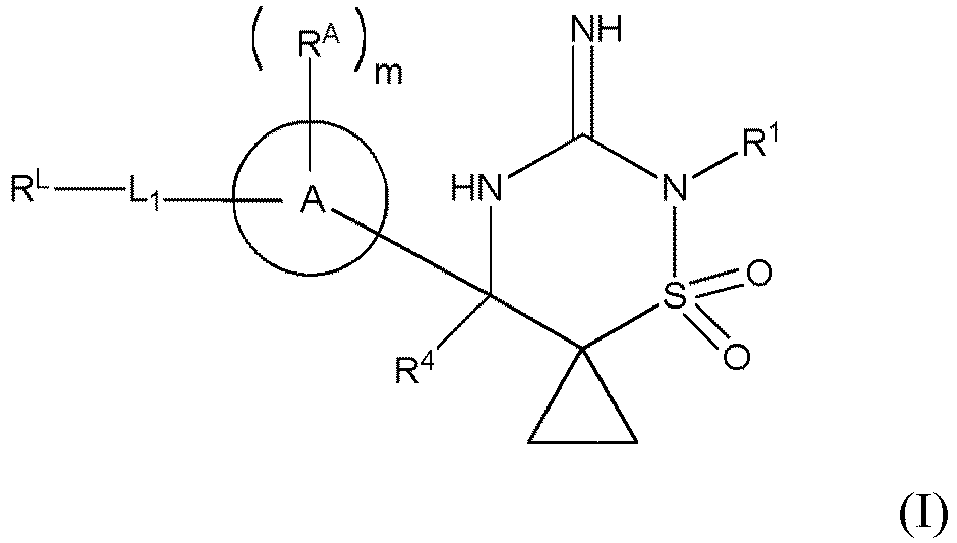
 -L1- ein bivalenter Rest ist, ausgewählt aus der Gruppe bestehend aus -NHC(O)- und - C(O)NH-,R1 ausgewählt ist aus der Gruppe bestehend aus H und Methyl,R4 ausgewählt ist aus der Gruppe bestehend aus Methyl und -CHF2,Ring A ausgewählt ist aus der Gruppe bestehend aus Phenyl und Pyridyl,m 0, 1, 2, 3 oder 4 ist,jedes RA (wenn vorhanden) unabhängig ausgewählt ist aus der Gruppe bestehend aus Halogen, Oxo, -OH, -CN, -SF5, -OSF5, -Si(R5A)3, -N(R6A)2, -OR6A, -SR6A, Alkyl, Heteroalkyl, Alkenyl, Alkinyl, Cycloalkyl, -Alkyl-Cycloalkyl, Heterocycloalkyl und Alkyl-Heterocycloalkyl,wobei das Alkyl, Heteroalkyl, Alkenyl, Alkinyl, Cycloalkyl, -Alkyl-Cycloalkyl, Heterocycloalkyl und -Alkyl-Heterocycloalkyl von RA jeweils gegebenenfalls unabhängig unsubstituiert oder substituiert sind mit einer oder mehreren Gruppen, unabhängig ausgewählt aus R8,RL ein Rest der Formel
 p 0 oder 1 ist,-LB- (wenn vorhanden) ein bivalenter Rest ist, ausgewählt aus der Gruppe bestehend aus -CH2-, -CF2-, -CH2CH2-, -CH2O- und -CF2O-,Ring B ausgewählt ist aus der Gruppe bestehend aus Furanyl, Imidazothiazolyl, Isothiazolyl, Isoxazolyl, Oxazolyl, Phenyl, Pyrazinyl, Pyrazolyl, Pyridazinyl, Pyridyl, Pyrimidinyl, Pyrrolyl, Thiadiazolyl, Thiazolyl, Thienyl und Oxadiazol,p 0, 1, 2, 3 oder 4 ist, undjede RB-Gruppe (wenn vorhanden) unabhängig ausgewählt ist aus der Gruppe bestehend aus Halogen, Oxo, -OH, -CN, -SF5, -NH2, -NH(CH3), -N(CH3)2, -NHC(O)CH3, -N(CH3)C(O)CH3, - NHS(O)2CH3, -N(CH3)S(O)2CH3, -C(O)OCH3, -C(O)OCH2CH3, -C(O)N(CH3)2, -C(O)NHCH3, - S(O)2CH3, -S(O)2N(CH3)2, -S(O)2NHCH3, -OCH3, -OCH2CH3, -O-Cyclopropyl, -O-CH2-Cyclopropyl, -OCH2-C≡C-H, -OCH2-C≡C-CH3, -S(CH3), Methyl, Ethyl, Propyl, Cyclopropyl, -CH2-Cyclopropyl, -CH2OCH3, -CH2OCH2CH3, -C≡CH, -C≡C-CH3, -CF3, -CHF2, -CH2F, -OCF3, - OCH2CF3, -OCHF2, -OCH2F, -OCH2CH2F, Phenyl, Pyridyl, Oxadiazolyl, Isoxazolyl, Oxazolyl und Pyrrolyl,wobei jede der Phenyl-, Pyridyl-, Oxadiazolyl-, Isoxazolyl-, Oxazolyl- und Pyrrolyl-Gruppen gegebenenfalls substituiert ist mit 1 bis 3 Substituenten, unabhängig ausgewählt aus der Gruppe bestehend aus F, Cl, CN, -CH3, -OCH3 und -CF3,jedes R5A (wenn vorhanden) unabhängig ausgewählt ist aus der Gruppe bestehend aus Alkyl, Heteroalkyl, Cycloalkyl, -Alkyl-Cycloalkyl, Heterocycloalkyl und -Alkyl-Heterocycloalkyl,wobei jede der Alkyl-, Heteroalkyl-, Cycloalkyl-, -Alkyl-Cycloalkyl-, Heterocycloalkyl- und - Alkyl-Heterocycloalkyl-Gruppen von R5A unsubstituiert oder substituiert ist mit einem oder mehreren Halogen,jedes R6A (wenn vorhanden) unabhängig ausgewählt ist aus der Gruppe bestehend aus H, Alkyl, -Alkyl-OH, Alkenyl, Alkinyl, Heteroalkyl, -Heteroalkyl-OH, Cycloalkyl, -Alkyl-Cycloalkyl, Heterocycloalkyl und -Alkyl-Heterocycloalkyl,wobei jede der Alkyl-, -Alkyl-OH-, Alkenyl-, Alkinyl-, Heteroalkyl-, -Heteroalkyl-OH-, Cycloalkyl-, -Alkyl-Cycloalkyl-, Heterocycloalkyl-, -Alkyl-Heterocycloalkyl-, Aryl-, -Alkyl-Aryl-, Heteroaryl- und -Alkyl-Heteroaryl-Gruppen von R6A unsubstituiert oder substituiert ist mit einer oder mehreren Gruppen, unabhängig ausgewählt aus Halogen, Alkyl, Cycloalkyl, Heteroalkyl, Halogenalkyl, Alkoxy, Heteroalkoxy und Halogenalkoxy, undjedes R8 (wenn vorhanden) unabhängig ausgewählt ist aus der Gruppe bestehend aus Halogen, C1-4-Alkyl, C1-4-Heteroalkyl, C1-4-Alkoxy, C3-6-Cycloalkyl und C3-6-Heterocycloalkyl, wobei jede der C1-4-Alkyl-, C1-4-Heteroalkyl-, C1-4-Alkoxy, C3-6-Cycloalkyl- und C3-6-Heterocycloalkyl-Gruppen von R8 gegebenenfalls substituiert ist mit Halogen.
 - Eine Verbindung nach Anspruch 1 oder ein Tautomer davon oder ein pharmazeutisch annehmbares Salz der Verbindung oder des Tautomers, wobei:
-L1- -C(O)NH- ist. - Eine Verbindung nach Anspruch 1 oder Anspruch 2 oder ein Tautomer davon oder ein pharmazeutisch annehmbares Salz der Verbindung oder des Tautomers, wobei:Ring A ausgewählt ist aus der Gruppe bestehend aus Phenyl und Pyridyl,m 0, 1 oder 2 ist, undjedes RA (wenn vorhanden) unabhängig ausgewählt ist aus der Gruppe bestehend aus Halogen, Oxo, -CN, -SF5, -NHCH3, -N(CH3)2, -OCH3, -OCH2CH3, -O-Cyclopropyl, -O-CH2-Cyclopropyl, -CH2OCH3, -S(CH3), Methyl, Ethyl, Cyclopropyl, -CH2-Cyclopropyl, -CF3, -CHF2, -CH2F, -OCF3 und -OCHF2.
- Eine Verbindung nach Anspruch 1 oder ein Tautomer davon oder ein pharmazeutisch annehmbares Salz der Verbindung oder des Tautomers, wobei die Verbindung ausgewählt ist aus der Gruppe bestehend aus:
Bsp. Struktur 1a 
1c 
1d 
1e 
1f 
1g 
1h 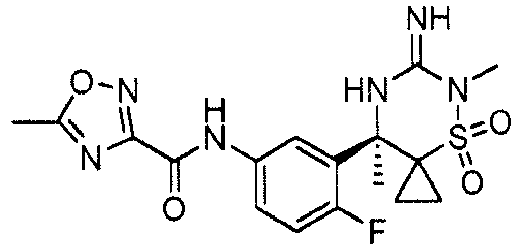
1i 
1j 
1k 
1l 
1o 
1p 
1q 
1r 
1s 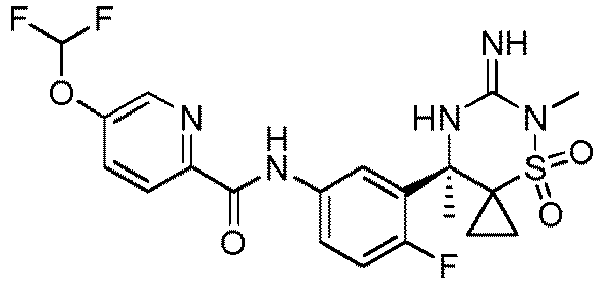
1t 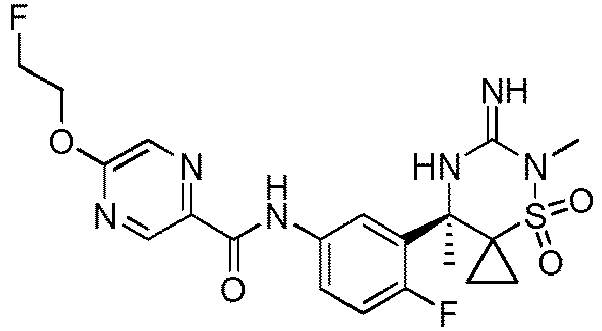
1u 
1v 
1w 
2 
- Eine pharmazeutische Zusammensetzung, die eine Verbindung gemäß einem der Ansprüche 1 oder 4 oder ein Tautomer davon oder ein pharmazeutisch annehmbares Salz der Verbindung oder des Tautomers und einen pharmazeutisch annehmbaren Träger oder ein pharmazeutisch annehmbares Verdünnungsmittel umfasst.
- Eine Verbindung gemäß einem der Ansprüche 1 bis 4 oder ein Tautomer davon oder ein pharmazeutisch annehmbares Salz der Verbindung oder des Tautomers zur Verwendung als Medikament.
- Eine Verbindung gemäß einem der Ansprüche 1 bis 4 oder ein Tautomer davon oder ein pharmazeutisch annehmbares Salz der Verbindung oder des Tautomers zur Verwendung bei der Behandlung einer Erkrankung oder Pathologie, wobei die Erkrankung oder Pathologie Alzheimer-Krankheit, Geruchssinnschwächung in Verbindung mit Alzheimer-Krankheit, Down-Syndrom, Geruchssinnschwächung in Verbindung mit Down-Syndrom, Parkinson-Krankheit, Geruchssinnschwächung in Verbindung mit Parkinson-Krankheit, Schlaganfall, Mikrogliose-Gehirnentzündung, präsenile Demenz, senile Demenz, progressive supranukleäre Blickparese, kortikale basale Degeneration, β-Amyloid-Angiopathie, zerebrale Amyloid-Angiopathie, erbliche Gehirnblutung, leichte kognitive Beeinträchtigung, Glaukom, Amyloidose, Typ-II-Diabetes, Diabetes-bedingte Amyloidogenese, Traberkrankheit, bovine spongiforme Enzephalitis, traumatische Hirnverletzung oder Creutzfeld-Jakob-Krankheit ist.
- Die Verbindung zur Verwendung gemäß Anspruch 7, wobei die Erkrankung oder Pathologie Alzheimer-Krankheit ist.
Applications Claiming Priority (2)
| Application Number | Priority Date | Filing Date | Title |
|---|---|---|---|
| US201361917568P | 2013-12-18 | 2013-12-18 | |
| PCT/US2014/069875 WO2015094930A1 (en) | 2013-12-18 | 2014-12-12 | C-6 spirocarbocyclic iminothiadiazine dioxides as bace inhibitors, compositions, and their use |
Publications (3)
| Publication Number | Publication Date |
|---|---|
| EP3083575A1 EP3083575A1 (de) | 2016-10-26 |
| EP3083575A4 EP3083575A4 (de) | 2017-05-17 |
| EP3083575B1 true EP3083575B1 (de) | 2021-11-03 |
Family
ID=53403545
Family Applications (1)
| Application Number | Title | Priority Date | Filing Date |
|---|---|---|---|
| EP14872471.9A Active EP3083575B1 (de) | 2013-12-18 | 2014-12-12 | C-6-spirocarbocyclische iminothiadiazindioxide als bace-inhibitoren, zusammensetzungen daraus und deren verwendung |
Country Status (3)
| Country | Link |
|---|---|
| US (1) | US9802928B2 (de) |
| EP (1) | EP3083575B1 (de) |
| WO (1) | WO2015094930A1 (de) |
Families Citing this family (10)
| Publication number | Priority date | Publication date | Assignee | Title |
|---|---|---|---|---|
| EP2908824B1 (de) | 2012-10-17 | 2018-05-02 | Merck Sharp & Dohme Corp. | Tricyclische substituierte thiadiazindioxidverbindungen als bace-hemmer, zusammensetzungen und deren verwendung |
| US9422277B2 (en) | 2012-10-17 | 2016-08-23 | Merck Sharp & Dohme Corp. | Tricyclic substituted thiadiazine dioxide compounds as BACE inhibitors, compositions and their use |
| US9489013B2 (en) | 2012-12-20 | 2016-11-08 | Merck Sharp & Dohme Corp. | C6-azaspiro iminothiadiazine dioxides as bace inhibitors, compositions, and their use |
| EP2934539B1 (de) | 2012-12-20 | 2019-03-27 | Merck Sharp & Dohme Corp. | C5, c6-oxacyclen-kondensierte iminothiazindioxidverbindungen als bace-inhibitoren |
| WO2014099788A1 (en) | 2012-12-21 | 2014-06-26 | Merck Sharp & Dohme Corp. | C5-spiro iminothiadiazine dioxides as bace inhibitors |
| WO2014150331A1 (en) | 2013-03-15 | 2014-09-25 | Merck Sharp & Dohme Corp. | S-imino-s-oxo iminothiazine compounds as bace inhibitors, compositions, and their use |
| US9428476B2 (en) | 2013-03-15 | 2016-08-30 | Merck Sharp & Dohme Corp. | S-imino-S-oxo-iminothiadiazine compounds as BACE inhibitors, compositions, and their use |
| JP2018534251A (ja) * | 2015-09-24 | 2018-11-22 | ファイザー・インク | Bace阻害剤として有用なn−[2−(3−アミノ−2,5−ジメチル−1,1−ジオキシド−5,6−ジヒドロ−2h−1,2,4−チアジアジン−5−イル)−1,3−チアゾール−4−イル]アミド |
| WO2017095759A1 (en) | 2015-12-04 | 2017-06-08 | Merck Sharp & Dohme Corp. | C5-c6-carbocyclic fused iminothiadiazine dioxides as bace inhibitors, compositions, and their use |
| US10618892B2 (en) * | 2016-02-17 | 2020-04-14 | Merck Sharp & Dohme Corp. | Processes for the preparation of a BACE inhibitor |
Family Cites Families (20)
| Publication number | Priority date | Publication date | Assignee | Title |
|---|---|---|---|---|
| US5534520A (en) | 1990-04-10 | 1996-07-09 | Fisher; Abraham | Spiro compounds containing five-membered rings |
| US7244764B2 (en) | 2003-06-23 | 2007-07-17 | Neurochem (International) Limited | Methods and compositions for treating amyloid-related diseases |
| EP2335701B1 (de) | 2003-12-15 | 2012-07-11 | Schering Corporation | Heterocyclische Aspartyl-Protease Inhibitoren |
| US7763609B2 (en) | 2003-12-15 | 2010-07-27 | Schering Corporation | Heterocyclic aspartyl protease inhibitors |
| US7592348B2 (en) | 2003-12-15 | 2009-09-22 | Schering Corporation | Heterocyclic aspartyl protease inhibitors |
| KR20080025079A (ko) | 2005-06-14 | 2008-03-19 | 쉐링 코포레이션 | 아스파르틸 프로테아제 억제제 |
| CA2628074C (en) | 2005-10-25 | 2014-01-14 | Shionogi & Co., Ltd. | Aminodihydrothiazine derivative |
| PE20080155A1 (es) | 2006-06-12 | 2008-03-10 | Schering Corp | Compuestos heterociclicos como inhibidores de aspartil-proteasa |
| JP5383484B2 (ja) | 2007-04-24 | 2014-01-08 | 塩野義製薬株式会社 | 環式基で置換されたアミノジヒドロチアジン誘導体 |
| WO2010063718A1 (en) | 2008-12-02 | 2010-06-10 | ETH Zürich | Screening assay for metabolic disease therapeuticals |
| EP2485590B1 (de) | 2009-10-08 | 2015-01-07 | Merck Sharp & Dohme Corp. | Heterozyklische pentafluorsulfur-imin-verbindungen als bace-1-hemmer sowie zusammensetzungen damit und ihre verwendung |
| UA108363C2 (uk) * | 2009-10-08 | 2015-04-27 | Похідні імінотіадіазиндіоксиду як інгібітори bace, композиція на їх основі і їх застосування | |
| WO2011044187A1 (en) * | 2009-10-08 | 2011-04-14 | Schering Corporation | Iminothiadiazine dioxide compounds as bace inhibitors, compositions, and their use |
| US8815881B2 (en) | 2010-08-09 | 2014-08-26 | Hoffmann-La Roche Inc. | 1,4,5,6-tetrahydro-pyrimidin-2-ylamine compounds |
| EP2694489B1 (de) | 2011-04-07 | 2017-09-06 | Merck Sharp & Dohme Corp. | C5-c6-oxacyclus-fusionierte thiadiazindioxidverbindungen als bace-hemmer sowie zusammensetzungen daraus und ihre verwendung |
| BR112013026341A2 (pt) * | 2011-04-13 | 2019-09-24 | Merck Sharp & Dohe Corp | composto, composição farmacêutica, e, método para tratar, prevenir e/ou atrasar o início de uma doença ou patologia |
| CN103874496A (zh) * | 2011-08-22 | 2014-06-18 | 默沙东公司 | 作为bace抑制剂的2-螺-取代的亚氨基噻嗪类及其单和二氧化物、组合物及其用途 |
| WO2014093190A1 (en) | 2012-12-14 | 2014-06-19 | Merck Sharp & Dohme Corp. | Bace inhibitors of iminothiadiazine dioxides |
| EP2934149B1 (de) | 2012-12-20 | 2019-02-06 | Merck Sharp & Dohme Corp. | C6-azaspiro-iminothiadiazindioxide als bace-inhibitoren |
| WO2014099788A1 (en) | 2012-12-21 | 2014-06-26 | Merck Sharp & Dohme Corp. | C5-spiro iminothiadiazine dioxides as bace inhibitors |
-
2014
- 2014-12-12 WO PCT/US2014/069875 patent/WO2015094930A1/en not_active Ceased
- 2014-12-12 EP EP14872471.9A patent/EP3083575B1/de active Active
- 2014-12-14 US US15/104,658 patent/US9802928B2/en active Active
Non-Patent Citations (1)
| Title |
|---|
| None * |
Also Published As
| Publication number | Publication date |
|---|---|
| EP3083575A1 (de) | 2016-10-26 |
| EP3083575A4 (de) | 2017-05-17 |
| US20160326155A1 (en) | 2016-11-10 |
| WO2015094930A1 (en) | 2015-06-25 |
| US9802928B2 (en) | 2017-10-31 |
Similar Documents
| Publication | Publication Date | Title |
|---|---|---|
| EP2934534B1 (de) | C5-spiro-iminothiadiazindioxide als bace-inhibitoren | |
| EP2934539B1 (de) | C5, c6-oxacyclen-kondensierte iminothiazindioxidverbindungen als bace-inhibitoren | |
| EP2931284B1 (de) | Bace-inhibitoren von iminothiadiazindioxiden | |
| EP2908825B1 (de) | Tricyclische substituierte thiadiazindioxidverbindungen als bace-hemmer, zusammensetzungen und deren verwendung | |
| EP2968356B1 (de) | S-imino-s-oxo-iminothiadiazinverbindungen als bace-hemmer, zusammensetzungen damit und deren verwendung | |
| EP2908824B1 (de) | Tricyclische substituierte thiadiazindioxidverbindungen als bace-hemmer, zusammensetzungen und deren verwendung | |
| EP2968357B1 (de) | S-imino-s-oxo-iminothiazin-verbindungen als bace-hemmer, zusammensetzungen und deren verwendung | |
| EP3083575B1 (de) | C-6-spirocarbocyclische iminothiadiazindioxide als bace-inhibitoren, zusammensetzungen daraus und deren verwendung | |
| EP2934149B1 (de) | C6-azaspiro-iminothiadiazindioxide als bace-inhibitoren | |
| EP3043802B1 (de) | C5-spiro-iminothiazin-dioxide als bace-inhibitoren, zusammensetzungen damit und deren verwendung | |
| EP3082823B1 (de) | Iminothiadiazepandioxidverbindungen als bace-hemmer, zusammensetzungen damit und deren verwendung | |
| EP3201204B1 (de) | C5-c6-kondensierte tricyclische iminothiadiazindioxinverbindungen als bace-hemmer, zusammensetzungen und deren verwendung | |
| EP3191447B1 (de) | S-imino-s-oxo-iminothiazin-verbindungen als bace-hemmer, zusammensetzungen und deren verwendung | |
| US9489013B2 (en) | C6-azaspiro iminothiadiazine dioxides as bace inhibitors, compositions, and their use |
Legal Events
| Date | Code | Title | Description |
|---|---|---|---|
| PUAI | Public reference made under article 153(3) epc to a published international application that has entered the european phase |
Free format text: ORIGINAL CODE: 0009012 |
|
| 17P | Request for examination filed |
Effective date: 20160718 |
|
| AK | Designated contracting states |
Kind code of ref document: A1 Designated state(s): AL AT BE BG CH CY CZ DE DK EE ES FI FR GB GR HR HU IE IS IT LI LT LU LV MC MK MT NL NO PL PT RO RS SE SI SK SM TR |
|
| AX | Request for extension of the european patent |
Extension state: BA ME |
|
| DAX | Request for extension of the european patent (deleted) | ||
| REG | Reference to a national code |
Ref country code: DE Ref legal event code: R079 Ref document number: 602014081093 Country of ref document: DE Free format text: PREVIOUS MAIN CLASS: C07D0285150000 Ipc: C07D0471040000 |
|
| A4 | Supplementary search report drawn up and despatched |
Effective date: 20170420 |
|
| RIC1 | Information provided on ipc code assigned before grant |
Ipc: A61K 31/5415 20060101ALI20170412BHEP Ipc: A61P 25/00 20060101ALI20170412BHEP Ipc: C07D 471/04 20060101AFI20170412BHEP Ipc: C07D 417/12 20060101ALI20170412BHEP Ipc: C07D 513/04 20060101ALI20170412BHEP |
|
| STAA | Information on the status of an ep patent application or granted ep patent |
Free format text: STATUS: EXAMINATION IS IN PROGRESS |
|
| 17Q | First examination report despatched |
Effective date: 20190228 |
|
| GRAP | Despatch of communication of intention to grant a patent |
Free format text: ORIGINAL CODE: EPIDOSNIGR1 |
|
| STAA | Information on the status of an ep patent application or granted ep patent |
Free format text: STATUS: GRANT OF PATENT IS INTENDED |
|
| INTG | Intention to grant announced |
Effective date: 20210520 |
|
| GRAS | Grant fee paid |
Free format text: ORIGINAL CODE: EPIDOSNIGR3 |
|
| GRAA | (expected) grant |
Free format text: ORIGINAL CODE: 0009210 |
|
| STAA | Information on the status of an ep patent application or granted ep patent |
Free format text: STATUS: THE PATENT HAS BEEN GRANTED |
|
| AK | Designated contracting states |
Kind code of ref document: B1 Designated state(s): AL AT BE BG CH CY CZ DE DK EE ES FI FR GB GR HR HU IE IS IT LI LT LU LV MC MK MT NL NO PL PT RO RS SE SI SK SM TR |
|
| REG | Reference to a national code |
Ref country code: GB Ref legal event code: FG4D |
|
| REG | Reference to a national code |
Ref country code: AT Ref legal event code: REF Ref document number: 1443875 Country of ref document: AT Kind code of ref document: T Effective date: 20211115 Ref country code: CH Ref legal event code: EP |
|
| REG | Reference to a national code |
Ref country code: DE Ref legal event code: R096 Ref document number: 602014081093 Country of ref document: DE |
|
| REG | Reference to a national code |
Ref country code: IE Ref legal event code: FG4D |
|
| REG | Reference to a national code |
Ref country code: LT Ref legal event code: MG9D |
|
| REG | Reference to a national code |
Ref country code: NL Ref legal event code: MP Effective date: 20211103 |
|
| REG | Reference to a national code |
Ref country code: AT Ref legal event code: MK05 Ref document number: 1443875 Country of ref document: AT Kind code of ref document: T Effective date: 20211103 |
|
| PG25 | Lapsed in a contracting state [announced via postgrant information from national office to epo] |
Ref country code: RS Free format text: LAPSE BECAUSE OF FAILURE TO SUBMIT A TRANSLATION OF THE DESCRIPTION OR TO PAY THE FEE WITHIN THE PRESCRIBED TIME-LIMIT Effective date: 20211103 Ref country code: LT Free format text: LAPSE BECAUSE OF FAILURE TO SUBMIT A TRANSLATION OF THE DESCRIPTION OR TO PAY THE FEE WITHIN THE PRESCRIBED TIME-LIMIT Effective date: 20211103 Ref country code: FI Free format text: LAPSE BECAUSE OF FAILURE TO SUBMIT A TRANSLATION OF THE DESCRIPTION OR TO PAY THE FEE WITHIN THE PRESCRIBED TIME-LIMIT Effective date: 20211103 Ref country code: BG Free format text: LAPSE BECAUSE OF FAILURE TO SUBMIT A TRANSLATION OF THE DESCRIPTION OR TO PAY THE FEE WITHIN THE PRESCRIBED TIME-LIMIT Effective date: 20220203 Ref country code: AT Free format text: LAPSE BECAUSE OF FAILURE TO SUBMIT A TRANSLATION OF THE DESCRIPTION OR TO PAY THE FEE WITHIN THE PRESCRIBED TIME-LIMIT Effective date: 20211103 |
|
| PG25 | Lapsed in a contracting state [announced via postgrant information from national office to epo] |
Ref country code: IS Free format text: LAPSE BECAUSE OF FAILURE TO SUBMIT A TRANSLATION OF THE DESCRIPTION OR TO PAY THE FEE WITHIN THE PRESCRIBED TIME-LIMIT Effective date: 20220303 Ref country code: SE Free format text: LAPSE BECAUSE OF FAILURE TO SUBMIT A TRANSLATION OF THE DESCRIPTION OR TO PAY THE FEE WITHIN THE PRESCRIBED TIME-LIMIT Effective date: 20211103 Ref country code: PT Free format text: LAPSE BECAUSE OF FAILURE TO SUBMIT A TRANSLATION OF THE DESCRIPTION OR TO PAY THE FEE WITHIN THE PRESCRIBED TIME-LIMIT Effective date: 20220303 Ref country code: PL Free format text: LAPSE BECAUSE OF FAILURE TO SUBMIT A TRANSLATION OF THE DESCRIPTION OR TO PAY THE FEE WITHIN THE PRESCRIBED TIME-LIMIT Effective date: 20211103 Ref country code: NO Free format text: LAPSE BECAUSE OF FAILURE TO SUBMIT A TRANSLATION OF THE DESCRIPTION OR TO PAY THE FEE WITHIN THE PRESCRIBED TIME-LIMIT Effective date: 20220203 Ref country code: NL Free format text: LAPSE BECAUSE OF FAILURE TO SUBMIT A TRANSLATION OF THE DESCRIPTION OR TO PAY THE FEE WITHIN THE PRESCRIBED TIME-LIMIT Effective date: 20211103 Ref country code: LV Free format text: LAPSE BECAUSE OF FAILURE TO SUBMIT A TRANSLATION OF THE DESCRIPTION OR TO PAY THE FEE WITHIN THE PRESCRIBED TIME-LIMIT Effective date: 20211103 Ref country code: HR Free format text: LAPSE BECAUSE OF FAILURE TO SUBMIT A TRANSLATION OF THE DESCRIPTION OR TO PAY THE FEE WITHIN THE PRESCRIBED TIME-LIMIT Effective date: 20211103 Ref country code: GR Free format text: LAPSE BECAUSE OF FAILURE TO SUBMIT A TRANSLATION OF THE DESCRIPTION OR TO PAY THE FEE WITHIN THE PRESCRIBED TIME-LIMIT Effective date: 20220204 Ref country code: ES Free format text: LAPSE BECAUSE OF FAILURE TO SUBMIT A TRANSLATION OF THE DESCRIPTION OR TO PAY THE FEE WITHIN THE PRESCRIBED TIME-LIMIT Effective date: 20211103 |
|
| PG25 | Lapsed in a contracting state [announced via postgrant information from national office to epo] |
Ref country code: SM Free format text: LAPSE BECAUSE OF FAILURE TO SUBMIT A TRANSLATION OF THE DESCRIPTION OR TO PAY THE FEE WITHIN THE PRESCRIBED TIME-LIMIT Effective date: 20211103 Ref country code: SK Free format text: LAPSE BECAUSE OF FAILURE TO SUBMIT A TRANSLATION OF THE DESCRIPTION OR TO PAY THE FEE WITHIN THE PRESCRIBED TIME-LIMIT Effective date: 20211103 Ref country code: RO Free format text: LAPSE BECAUSE OF FAILURE TO SUBMIT A TRANSLATION OF THE DESCRIPTION OR TO PAY THE FEE WITHIN THE PRESCRIBED TIME-LIMIT Effective date: 20211103 Ref country code: EE Free format text: LAPSE BECAUSE OF FAILURE TO SUBMIT A TRANSLATION OF THE DESCRIPTION OR TO PAY THE FEE WITHIN THE PRESCRIBED TIME-LIMIT Effective date: 20211103 Ref country code: DK Free format text: LAPSE BECAUSE OF FAILURE TO SUBMIT A TRANSLATION OF THE DESCRIPTION OR TO PAY THE FEE WITHIN THE PRESCRIBED TIME-LIMIT Effective date: 20211103 Ref country code: CZ Free format text: LAPSE BECAUSE OF FAILURE TO SUBMIT A TRANSLATION OF THE DESCRIPTION OR TO PAY THE FEE WITHIN THE PRESCRIBED TIME-LIMIT Effective date: 20211103 |
|
| REG | Reference to a national code |
Ref country code: CH Ref legal event code: PL |
|
| REG | Reference to a national code |
Ref country code: DE Ref legal event code: R097 Ref document number: 602014081093 Country of ref document: DE |
|
| PG25 | Lapsed in a contracting state [announced via postgrant information from national office to epo] |
Ref country code: MC Free format text: LAPSE BECAUSE OF FAILURE TO SUBMIT A TRANSLATION OF THE DESCRIPTION OR TO PAY THE FEE WITHIN THE PRESCRIBED TIME-LIMIT Effective date: 20211103 |
|
| PLBE | No opposition filed within time limit |
Free format text: ORIGINAL CODE: 0009261 |
|
| STAA | Information on the status of an ep patent application or granted ep patent |
Free format text: STATUS: NO OPPOSITION FILED WITHIN TIME LIMIT |
|
| REG | Reference to a national code |
Ref country code: BE Ref legal event code: MM Effective date: 20211231 |
|
| REG | Reference to a national code |
Ref country code: DE Ref legal event code: R081 Ref document number: 602014081093 Country of ref document: DE Owner name: MERCK SHARP & DOHME LLC, RAHWAY, US Free format text: FORMER OWNER: MERCK SHARP & DOHME CORP., RAHWAY, NJ, US |
|
| 26N | No opposition filed |
Effective date: 20220804 |
|
| PG25 | Lapsed in a contracting state [announced via postgrant information from national office to epo] |
Ref country code: LU Free format text: LAPSE BECAUSE OF NON-PAYMENT OF DUE FEES Effective date: 20211212 Ref country code: IE Free format text: LAPSE BECAUSE OF NON-PAYMENT OF DUE FEES Effective date: 20211212 Ref country code: AL Free format text: LAPSE BECAUSE OF FAILURE TO SUBMIT A TRANSLATION OF THE DESCRIPTION OR TO PAY THE FEE WITHIN THE PRESCRIBED TIME-LIMIT Effective date: 20211103 |
|
| REG | Reference to a national code |
Ref country code: GB Ref legal event code: 732E Free format text: REGISTERED BETWEEN 20221013 AND 20221019 |
|
| PG25 | Lapsed in a contracting state [announced via postgrant information from national office to epo] |
Ref country code: SI Free format text: LAPSE BECAUSE OF FAILURE TO SUBMIT A TRANSLATION OF THE DESCRIPTION OR TO PAY THE FEE WITHIN THE PRESCRIBED TIME-LIMIT Effective date: 20211103 Ref country code: BE Free format text: LAPSE BECAUSE OF NON-PAYMENT OF DUE FEES Effective date: 20211231 |
|
| PG25 | Lapsed in a contracting state [announced via postgrant information from national office to epo] |
Ref country code: LI Free format text: LAPSE BECAUSE OF NON-PAYMENT OF DUE FEES Effective date: 20211231 Ref country code: CH Free format text: LAPSE BECAUSE OF NON-PAYMENT OF DUE FEES Effective date: 20211231 |
|
| PG25 | Lapsed in a contracting state [announced via postgrant information from national office to epo] |
Ref country code: IT Free format text: LAPSE BECAUSE OF FAILURE TO SUBMIT A TRANSLATION OF THE DESCRIPTION OR TO PAY THE FEE WITHIN THE PRESCRIBED TIME-LIMIT Effective date: 20211103 Ref country code: HU Free format text: LAPSE BECAUSE OF FAILURE TO SUBMIT A TRANSLATION OF THE DESCRIPTION OR TO PAY THE FEE WITHIN THE PRESCRIBED TIME-LIMIT; INVALID AB INITIO Effective date: 20141212 |
|
| PG25 | Lapsed in a contracting state [announced via postgrant information from national office to epo] |
Ref country code: CY Free format text: LAPSE BECAUSE OF FAILURE TO SUBMIT A TRANSLATION OF THE DESCRIPTION OR TO PAY THE FEE WITHIN THE PRESCRIBED TIME-LIMIT Effective date: 20211103 |
|
| PG25 | Lapsed in a contracting state [announced via postgrant information from national office to epo] |
Ref country code: MK Free format text: LAPSE BECAUSE OF FAILURE TO SUBMIT A TRANSLATION OF THE DESCRIPTION OR TO PAY THE FEE WITHIN THE PRESCRIBED TIME-LIMIT Effective date: 20211103 |
|
| PG25 | Lapsed in a contracting state [announced via postgrant information from national office to epo] |
Ref country code: TR Free format text: LAPSE BECAUSE OF FAILURE TO SUBMIT A TRANSLATION OF THE DESCRIPTION OR TO PAY THE FEE WITHIN THE PRESCRIBED TIME-LIMIT Effective date: 20211103 |
|
| PG25 | Lapsed in a contracting state [announced via postgrant information from national office to epo] |
Ref country code: MT Free format text: LAPSE BECAUSE OF FAILURE TO SUBMIT A TRANSLATION OF THE DESCRIPTION OR TO PAY THE FEE WITHIN THE PRESCRIBED TIME-LIMIT Effective date: 20211103 |
|
| PGFP | Annual fee paid to national office [announced via postgrant information from national office to epo] |
Ref country code: DE Payment date: 20251118 Year of fee payment: 12 |
|
| PGFP | Annual fee paid to national office [announced via postgrant information from national office to epo] |
Ref country code: GB Payment date: 20251113 Year of fee payment: 12 |
|
| PGFP | Annual fee paid to national office [announced via postgrant information from national office to epo] |
Ref country code: FR Payment date: 20251111 Year of fee payment: 12 |