EP3086763B1 - Kosmetische zusammensetzung mit einem öl, einem nichtionischen tensid und einer c-glykosidverbindung - Google Patents
Kosmetische zusammensetzung mit einem öl, einem nichtionischen tensid und einer c-glykosidverbindung Download PDFInfo
- Publication number
- EP3086763B1 EP3086763B1 EP14824431.2A EP14824431A EP3086763B1 EP 3086763 B1 EP3086763 B1 EP 3086763B1 EP 14824431 A EP14824431 A EP 14824431A EP 3086763 B1 EP3086763 B1 EP 3086763B1
- Authority
- EP
- European Patent Office
- Prior art keywords
- radical
- linear
- branched
- denotes
- unsaturated
- Prior art date
- Legal status (The legal status is an assumption and is not a legal conclusion. Google has not performed a legal analysis and makes no representation as to the accuracy of the status listed.)
- Active
Links
- 0 C[C@](CC*)[C@@](C)C(CC([C@@]([C@@]1C)O*)OC[C@@]1O*)N=I Chemical compound C[C@](CC*)[C@@](C)C(CC([C@@]([C@@]1C)O*)OC[C@@]1O*)N=I 0.000 description 4
- GKVYNCAJIXKURZ-MXPGSBBYSA-N CONC(CCc1ccccc1)CC([C@@H]([C@H]1O)O)OC[C@H]1O Chemical compound CONC(CCc1ccccc1)CC([C@@H]([C@H]1O)O)OC[C@H]1O GKVYNCAJIXKURZ-MXPGSBBYSA-N 0.000 description 1
- WJQDESMBAQXVBR-UKBNQYSZSA-N COc1cc(CCC(C[C@H]([C@@H]([C@H]2O)O)OC[C@H]2O)O)ccc1O Chemical compound COc1cc(CCC(C[C@H]([C@@H]([C@H]2O)O)OC[C@H]2O)O)ccc1O WJQDESMBAQXVBR-UKBNQYSZSA-N 0.000 description 1
- XLSZMDLNRCVEIJ-UHFFFAOYSA-N Cc1cnc[nH]1 Chemical compound Cc1cnc[nH]1 XLSZMDLNRCVEIJ-UHFFFAOYSA-N 0.000 description 1
Classifications
-
- A—HUMAN NECESSITIES
- A61—MEDICAL OR VETERINARY SCIENCE; HYGIENE
- A61K—PREPARATIONS FOR MEDICAL, DENTAL OR TOILETRY PURPOSES
- A61K8/00—Cosmetics or similar toiletry preparations
- A61K8/18—Cosmetics or similar toiletry preparations characterised by the composition
- A61K8/30—Cosmetics or similar toiletry preparations characterised by the composition containing organic compounds
- A61K8/60—Sugars; Derivatives thereof
- A61K8/602—Glycosides, e.g. rutin
-
- A—HUMAN NECESSITIES
- A61—MEDICAL OR VETERINARY SCIENCE; HYGIENE
- A61K—PREPARATIONS FOR MEDICAL, DENTAL OR TOILETRY PURPOSES
- A61K8/00—Cosmetics or similar toiletry preparations
- A61K8/02—Cosmetics or similar toiletry preparations characterised by special physical form
- A61K8/04—Dispersions; Emulsions
- A61K8/06—Emulsions
-
- A—HUMAN NECESSITIES
- A61—MEDICAL OR VETERINARY SCIENCE; HYGIENE
- A61K—PREPARATIONS FOR MEDICAL, DENTAL OR TOILETRY PURPOSES
- A61K8/00—Cosmetics or similar toiletry preparations
- A61K8/02—Cosmetics or similar toiletry preparations characterised by special physical form
- A61K8/04—Dispersions; Emulsions
- A61K8/06—Emulsions
- A61K8/062—Oil-in-water emulsions
-
- A—HUMAN NECESSITIES
- A61—MEDICAL OR VETERINARY SCIENCE; HYGIENE
- A61K—PREPARATIONS FOR MEDICAL, DENTAL OR TOILETRY PURPOSES
- A61K8/00—Cosmetics or similar toiletry preparations
- A61K8/02—Cosmetics or similar toiletry preparations characterised by special physical form
- A61K8/04—Dispersions; Emulsions
- A61K8/06—Emulsions
- A61K8/068—Microemulsions
-
- A—HUMAN NECESSITIES
- A61—MEDICAL OR VETERINARY SCIENCE; HYGIENE
- A61K—PREPARATIONS FOR MEDICAL, DENTAL OR TOILETRY PURPOSES
- A61K8/00—Cosmetics or similar toiletry preparations
- A61K8/18—Cosmetics or similar toiletry preparations characterised by the composition
- A61K8/30—Cosmetics or similar toiletry preparations characterised by the composition containing organic compounds
- A61K8/33—Cosmetics or similar toiletry preparations characterised by the composition containing organic compounds containing oxygen
- A61K8/34—Alcohols
- A61K8/342—Alcohols having more than seven atoms in an unbroken chain
-
- A—HUMAN NECESSITIES
- A61—MEDICAL OR VETERINARY SCIENCE; HYGIENE
- A61K—PREPARATIONS FOR MEDICAL, DENTAL OR TOILETRY PURPOSES
- A61K8/00—Cosmetics or similar toiletry preparations
- A61K8/18—Cosmetics or similar toiletry preparations characterised by the composition
- A61K8/30—Cosmetics or similar toiletry preparations characterised by the composition containing organic compounds
- A61K8/33—Cosmetics or similar toiletry preparations characterised by the composition containing organic compounds containing oxygen
- A61K8/34—Alcohols
- A61K8/345—Alcohols containing more than one hydroxy group
-
- A—HUMAN NECESSITIES
- A61—MEDICAL OR VETERINARY SCIENCE; HYGIENE
- A61K—PREPARATIONS FOR MEDICAL, DENTAL OR TOILETRY PURPOSES
- A61K8/00—Cosmetics or similar toiletry preparations
- A61K8/18—Cosmetics or similar toiletry preparations characterised by the composition
- A61K8/30—Cosmetics or similar toiletry preparations characterised by the composition containing organic compounds
- A61K8/33—Cosmetics or similar toiletry preparations characterised by the composition containing organic compounds containing oxygen
- A61K8/37—Esters of carboxylic acids
-
- A—HUMAN NECESSITIES
- A61—MEDICAL OR VETERINARY SCIENCE; HYGIENE
- A61K—PREPARATIONS FOR MEDICAL, DENTAL OR TOILETRY PURPOSES
- A61K8/00—Cosmetics or similar toiletry preparations
- A61K8/18—Cosmetics or similar toiletry preparations characterised by the composition
- A61K8/30—Cosmetics or similar toiletry preparations characterised by the composition containing organic compounds
- A61K8/33—Cosmetics or similar toiletry preparations characterised by the composition containing organic compounds containing oxygen
- A61K8/37—Esters of carboxylic acids
- A61K8/375—Esters of carboxylic acids the alcohol moiety containing more than one hydroxy group
-
- A—HUMAN NECESSITIES
- A61—MEDICAL OR VETERINARY SCIENCE; HYGIENE
- A61K—PREPARATIONS FOR MEDICAL, DENTAL OR TOILETRY PURPOSES
- A61K8/00—Cosmetics or similar toiletry preparations
- A61K8/18—Cosmetics or similar toiletry preparations characterised by the composition
- A61K8/92—Oils, fats or waxes; Derivatives thereof, e.g. hydrogenation products thereof
-
- A—HUMAN NECESSITIES
- A61—MEDICAL OR VETERINARY SCIENCE; HYGIENE
- A61Q—SPECIFIC USE OF COSMETICS OR SIMILAR TOILETRY PREPARATIONS
- A61Q1/00—Make-up preparations; Body powders; Preparations for removing make-up
- A61Q1/02—Preparations containing skin colorants, e.g. pigments
- A61Q1/10—Preparations containing skin colorants, e.g. pigments for eyes, e.g. eyeliner, mascara
-
- A—HUMAN NECESSITIES
- A61—MEDICAL OR VETERINARY SCIENCE; HYGIENE
- A61Q—SPECIFIC USE OF COSMETICS OR SIMILAR TOILETRY PREPARATIONS
- A61Q1/00—Make-up preparations; Body powders; Preparations for removing make-up
- A61Q1/14—Preparations for removing make-up
-
- A—HUMAN NECESSITIES
- A61—MEDICAL OR VETERINARY SCIENCE; HYGIENE
- A61Q—SPECIFIC USE OF COSMETICS OR SIMILAR TOILETRY PREPARATIONS
- A61Q19/00—Preparations for care of the skin
-
- A—HUMAN NECESSITIES
- A61—MEDICAL OR VETERINARY SCIENCE; HYGIENE
- A61Q—SPECIFIC USE OF COSMETICS OR SIMILAR TOILETRY PREPARATIONS
- A61Q19/00—Preparations for care of the skin
- A61Q19/10—Washing or bathing preparations
-
- A—HUMAN NECESSITIES
- A61—MEDICAL OR VETERINARY SCIENCE; HYGIENE
- A61Q—SPECIFIC USE OF COSMETICS OR SIMILAR TOILETRY PREPARATIONS
- A61Q3/00—Manicure or pedicure preparations
-
- A—HUMAN NECESSITIES
- A61—MEDICAL OR VETERINARY SCIENCE; HYGIENE
- A61Q—SPECIFIC USE OF COSMETICS OR SIMILAR TOILETRY PREPARATIONS
- A61Q5/00—Preparations for care of the hair
-
- A—HUMAN NECESSITIES
- A61—MEDICAL OR VETERINARY SCIENCE; HYGIENE
- A61Q—SPECIFIC USE OF COSMETICS OR SIMILAR TOILETRY PREPARATIONS
- A61Q5/00—Preparations for care of the hair
- A61Q5/02—Preparations for cleaning the hair
-
- A—HUMAN NECESSITIES
- A61—MEDICAL OR VETERINARY SCIENCE; HYGIENE
- A61K—PREPARATIONS FOR MEDICAL, DENTAL OR TOILETRY PURPOSES
- A61K2800/00—Properties of cosmetic compositions or active ingredients thereof or formulation aids used therein and process related aspects
- A61K2800/20—Chemical, physico-chemical or functional or structural properties of the composition as a whole
- A61K2800/21—Emulsions characterized by droplet sizes below 1 micron
-
- A—HUMAN NECESSITIES
- A61—MEDICAL OR VETERINARY SCIENCE; HYGIENE
- A61K—PREPARATIONS FOR MEDICAL, DENTAL OR TOILETRY PURPOSES
- A61K2800/00—Properties of cosmetic compositions or active ingredients thereof or formulation aids used therein and process related aspects
- A61K2800/40—Chemical, physico-chemical or functional or structural properties of particular ingredients
- A61K2800/59—Mixtures
- A61K2800/596—Mixtures of surface active compounds
Definitions
- the present invention relates to a composition, especially a cosmetic composition, in the form of a nanoemulsion or a microemulsion as described according to the claims.
- Oil-in-water (O/W) emulsions or water-in-oil (W/O) emulsions are known in the field of cosmetics and dermatology, in particular for preparing cosmetic products, such as milks, creams, toners, serums or eaux de toilette.
- a fine emulsion such as an O/W nanoemulsion or microemulsion is particularly advantageous in cosmetic products on account of its transparent or slightly translucent appearance.
- O/W oil-in-water
- These emulsions which consist of an oily phase (or a lipophilic phase) dispersed in an aqueous phase, have an outer aqueous phase and are therefore products that are more pleasant to use on account of the fresh sensation they afford.
- they have the drawback of lacking stability when the amount of oil present is too high.
- it is advantageous to have a large amount of oils given that oils give the skin a comfortable feel, nourish it and may also remove makeup therefrom when these oils have makeup-removing properties.
- phase inversion temperature (PIT emulsions) in which the mean size of the globules constituting the oily phase is within given limits, namely between 0.1 and 4 ⁇ m (100 to 4000 nm).
- PIT phase inversion temperature
- the principle of phase inversion temperature (PIT) emulsification is, in theoretical terms, known to those skilled in the art; it was described in 1968 by K. Shinoda (J. Chem. Soc. Jpn., 1968, 89, 435 ). It has been shown that this emulsification technique allows stable, fine emulsions to be obtained ( K. Shinoda and H. Saito, J. Colloid Interface Sci., 1969, 30, 258 ).
- an O/W emulsion introduction of the aqueous phase into the oily phase
- a temperature which should be above the phase inversion temperature of the system which is the temperature at which the equilibrium between the hydrophilic and lipophilic properties of the emulsifier(s) used is reached
- the emulsion is of water-in-oil type, and, when it cools down, this emulsion inverts at the phase inversion temperature, to become an emulsion of oil-in-water type, passing beforehand through a microemulsion state.
- the emulsifying surfactants of oil-in-water type conventionally used have an HLB (hydrophilic-lipophilic balance) in the range from 8 to 18.
- HLB hydrophilic-lipophilic balance
- these emulsifiers are located at the oily phase/aqueous phase interface, and thus stabilize the dispersed oil droplets.
- a fine emulsion such as an O/W nanoemulsion or microemulsion is particularly advantageous in cosmetic products on account of its transparent or slightly translucent appearance.
- JP-A-H09-110635 describes a fine emulsion which is formed by using a combination of polyglyceryl fatty acid ester as surfactant and a C 10 -C 22 fatty 2-hydroxy acid.
- JP-A-H11-71256 describes a fine emulsion which is formed by using a combination of polyglyceryl fatty acid ester and betaine.
- One object of the present invention is to propose a cosmetic composition in the form of a nanoemulsion or microemulsion that has a transparent or slightly translucent, preferably transparent, appearance.
- the present invention relates to a cosmetic composition in the form of a nanoemulsion or microemulsion, according to claim 1.
- the cosmetic composition according to the present invention may have a transparent or slightly translucent appearance
- the composition may preferably be used for lotions and the like.
- the cosmetic composition according to the present invention may produce a pleasant texture and afford moisturizing properties and also increased suppleness.
- the dispersed phase is an oily phase and comprises one or more lipophilic or even amphiphilic active components
- the oily dispersed phase may function as a vehicle for the active substance and accelerate the penetration of the active components into the skin, or may distribute the active components on the skin.
- the present invention also relates to a non-therapeutic process for treating the skin, the hair, mucous membranes, the nails, the eyelashes, the eyelids and/or the scalp, characterized in that the cosmetic composition according to the present invention is applied to the skin, the hair, mucous membranes, the nails, the eyelashes, the eyelids or the scalp.
- the present invention also relates to a use of the cosmetic composition according to the present invention as or in care products and/or washing products and/or makeup products and/or makeup-removing products for bodily and/or facial skin and/or mucous membranes and/or the scalp and/or the hair and/or the nails and/or the eyelashes and/or the eyelids.
- the cosmetic composition according to the present invention comprises at least one oil.
- oil denotes a fatty compound or substance that is in the form of a liquid at room temperature (25°C) and at atmospheric pressure (760 mmHg).
- oils those generally used in cosmetics may be used alone or in combinations thereof. These oils may be volatile or non-volatile, preferably non-volatile.
- the oil may be a non-polar oil such as a hydrocarbon oil, a silicone oil or the like; a polar oil such as a plant or animal oil and an ester oil or an ether oil; or a mixture thereof.
- oil (a) is chosen from the group consisting of oils of plant origin, animal oils, synthetic oils, silicone oils and hydrocarbon oils.
- plant oils examples include linseed oil, camellia oil, macadamia oil, corn oil, castor oil, olive oil, avocado oil, sasanqua oil, safflower oil, jojoba oil, sunflower oil, almond oil, rapeseed oil, sesame oil, soybean oil, groundnut oil, argan oil and apricot kernel oil, and mixtures thereof.
- animal oils mention may be made, for example, of squalene and squalane.
- alkanes such as isododecane and isohexadecane
- fatty esters such as isododecane and isohexadecane
- fatty ethers such as fatty ethers
- artificial C6-C22 acid triglycerides such as isododecane and isohexadecane
- the fatty esters are preferably liquid esters of linear or branched, saturated or unsaturated C 1 -C 26 aliphatic monoacids or polyacids and of linear or branched, saturated or unsaturated C 1 -C 26 aliphatic monoalcohols or polyalcohols, the total number of carbon atoms in the fatty esters being greater than or equal to 10.
- At least one from among the alcohol and the acid is branched.
- ethyl palmitate ethylhexyl palmitate
- isopropyl palmitate dicaprylyl carbonate
- alkyl myristates such as isopropyl myristate or ethyl myristate
- isocetyl stearate 2-ethylhexyl isononanoate
- isononyl isononanoate isodecyl neopentanoate and isostearyl neopentanoate.
- Esters of C 4 -C 22 dicarboxylic or tricarboxylic acids and of C 1 -C 22 alcohols and esters of monocarboxylic, dicarboxylic or tricarboxylic acids and of non-saccharide C 4 -C 26 dihydroxy, trihydroxy, tetrahydroxy or pentahydroxy alcohols may also be used.
- Fatty esters that may be used include sugar esters and diesters of C 6 -C 30 and preferably C 12 -C 22 fatty acids. It is recalled that the term "sugar” means hydrocarbon-based compounds comprising oxygen containing several alcohol functions, with or without aldehyde or ketone functions, and which comprise at least 4 carbon atoms. These sugars may be monosaccharides, oligosaccharides or polysaccharides.
- suitable sugars include saccharose (or sucrose), glucose, galactose, ribose, fucose, maltose, fructose, mannose, arabinose, xylose and lactose, and derivatives thereof, in particular alkyl derivatives such as methyl derivatives, for example methylglucose.
- the sugar esters of fatty acids may be chosen especially from the group comprising the esters or mixtures of esters of sugars described previously and of linear or branched, saturated or unsaturated C 6 -C 30 and preferably C 12 -C 22 fatty acids. If they are unsaturated, these compounds may contain from one to three conjugated or unconjugated double bonds.
- esters according to this variant may also be chosen from monoesters, diesters, triesters, tetraesters and polyesters, and mixtures thereof.
- esters may be, for example, oleates, laurates, palmitates, myristates, behenates, cocoates, stearates, linoleates, linolenates, caprates and arachidonates, or mixtures thereof such as, in particular, oleopalmitate, oleostearate and palmitostearate mixed esters, and also pentaerythrityl tetraethylhexanoate.
- monoesters and diesters and in particular sucrose, glucose or methylglucose monooleates or dioleates, stearates, behenates, oleopalmitates, linoleates, linolenates and oleostearates.
- fatty esters mention may be made, for example, of diisopropyl adipate, dioctyl adipate, 2-ethylhexyl hexanoate, ethyl laurate, cetyl octanoate, octyldodecyl octanoate, isodecyl neopentanoate, myristyl propionate, 2-ethylhexyl 2-ethylhexanoate, 2-ethylhexyl octanoate, 2-ethylhexyl caprylate/caprate, methyl palmitate, ethyl palmitate, isopropyl palmitate, ethylhexyl palmitate, isohexyl laurate, hexyl laurate, isocetyl stearate, isopropyl isostearate, isopropyl myristate,
- artificial triglycerides mention may be made, for example, of glyceryl trimyristate, glyceryl tripalmitate, glyceryl trilinolenate, glyceryl trilaurate, glyceryl tricaprate, glyceryl tricaprylate, glyceryl tri(caprate/caprylate) and glyceryl tri(caprate/caprylate/linolenate).
- silicone oils mention may be made, for example, of linear organopolysiloxanes such as dimethylpolysiloxane, methylphenylpolysiloxane, methylhydrogenopolysiloxane and the like; cyclic organopolysiloxanes such as octamethylcyclotetrasiloxane, decamethylcyclopentasiloxane, dodecamethylcyclohexasiloxane and the like; and mixtures thereof.
- linear organopolysiloxanes such as dimethylpolysiloxane, methylphenylpolysiloxane, methylhydrogenopolysiloxane and the like
- cyclic organopolysiloxanes such as octamethylcyclotetrasiloxane, decamethylcyclopentasiloxane, dodecamethylcyclohexasiloxane and the like; and mixtures thereof.
- the silicone oil is chosen from liquid polydialkylsiloxanes, in particular liquid polydimethylsiloxanes (PDMS) and liquid polyorganosiloxanes comprising at least one aryl group.
- PDMS liquid polydimethylsiloxanes
- silicone oils may also be organomodified.
- organomodified silicones that may be used according to the present invention are silicone oils as defined above comprising in their structure one or more organofunctional groups linked via a hydrocarbon-based group.
- Organopolysiloxanes are defined in greater detail in Walter Noll's Chemistry and Technology of Silicones (1968), Academic Press . They may be volatile or non-volatile.
- Volatile or non-volatile silicone oils such as volatile or non-volatile polydimethylsiloxanes (PDMS) containing a linear or cyclic silicone chain, which are liquid or pasty at room temperature, in particular cyclopolydimethylsiloxanes (cyclomethicones) such as cyclohexasiloxane; polydimethylsiloxanes containing alkyl, alkoxy or phenyl groups that are pendent or at the end of the silicone chain, the said groups containing from 2 to 24 carbon atoms; phenyl silicones such as phenyl trimethicones, phenyl dimethicones, phenyltrimethylsiloxydiphenylsiloxanes, diphenyl dimethicones, diphenylmethyldiphenyltrisiloxanes, 2-phenyl ethyl trimethylsiloxysilicates and polymethylphenylsiloxanes, may be used.
- hydrocarbon-based oils may be chosen from:
- hydrocarbon-based oils examples include linear or branched hydrocarbons such as mineral oil (for example liquid paraffin), paraffin, petroleum jelly or petrolatum, naphthalens and the like; hydrogenated polyisobutene, isoeicosane, and a decene/butene copolymer; and mixtures thereof.
- oil (a) is chosen from oils with a molecular weight of less than 600 g/mol.
- the oil (a) is chosen from fatty esters containing one or more C 1 -C 12 hydrocarbon-based chains (for example isopropyl myristate, isopropyl palmitate, isononyl isononanoate and ethylhexyl palmitate), hydrocarbon oils (for example isododecane, isohexadecane and squalane), oils of branched and/or unsaturated C 12 -C 30 fatty alcohol type such as octyldodecanol or oleyl alcohol, and fatty ethers such as dicaprylyl ether.
- fatty esters containing one or more C 1 -C 12 hydrocarbon-based chains for example isopropyl myristate, isopropyl palmitate, isononyl isononanoate and ethylhexyl palmitate
- hydrocarbon oils for example isododecane, isohexadecane and squalane
- the amount of the oil (a) in the cosmetic composition according to the present invention may be in the range from 0.1% to 50% by weight, preferably from 1% to 40% by weight and more preferably from 5% to 30% by weight relative to the total weight of the composition.
- the cosmetic composition according to the present invention may comprise at least one specific nonionic surfactant.
- the nonionic surfactant has an HLB (hydrophilic-lipophilic balance) value of from 8.0 to 14.0, preferably from 9.0 to 13.5 and more preferably from 10.0 to 13.0. If two or more nonionic surfactants are used, the HLB value is determined by the mean weight of the HLB values of all the nonionic surfactants.
- HLB hydrophilic-lipophilic balance
- HLB hydrophilic-lipophilic balance of a surfactant
- the hydrophilic part corresponds to the oxyethylene units fused to the fatty alcohol and the calculated HLB value then corresponds to the HLB value according to Griffin ( Griffin W.C., J. Soc. Cosmet. Chemists, 5, 249,1954 ).
- the nonionic surfactant with an HLB value of from 8.0 to 14.0, preferably from 9.0 to 13.5 and more preferably from 10.0 to 13.0 may be chosen from:
- the surfactants (1) that are fluid at a temperature of less than or equal to 45°C may be, in particular:
- the mixed esters of fatty acid or of fatty alcohol (2), of carboxylic acid and of glycerol, which may be used as nonionic surfactant above, may be chosen in particular from the group comprising mixed esters of fatty acid or of fatty alcohol with an alkyl chain containing from 8 to 22 carbon atoms, and of ⁇ -hydroxy acid and/or of succinic acid, with glycerol.
- the ⁇ -hydroxy acid may be, for example, citric acid, lactic acid, glycolic acid or malic acid, and mixtures thereof.
- the alkyl chain of the fatty acids or fatty alcohols from which are derived the mixed esters that may be used in the emulsion of the invention may be linear or branched, and saturated or unsaturated. They may in particular be stearate, isostearate, linoleate, oleate, behenate, arachidonate, palmitate, myristate, laurate, caprate, isostearyl, stearyl, linoleyl, oleyl, behenyl, myristyl, lauryl or capryl chains, and mixtures thereof.
- mixed esters that may be used in the emulsion of the invention, mention may be made of the mixed ester of glycerol and the mixture of citric acid, lactic acid, linoleic acid and oleic acid (CTFA name: glyceryl citrate/lactate/linoleate/oleate) sold by the company Hüls under the name Imwitor 375; the mixed ester of succinic acid and of isostearyl alcohol with glycerol (CTFA name: isostearyl-diglyceryl succinate) sold by the company Hüls under the name Imwitor 780 K; the mixed ester of citric acid and of stearic acid with glycerol (CTFA name: glyceryl stearate-citrate) sold by the company Hüls under the name Imwitor 370; the mixed ester of lactic acid and of stearic acid with glycerol (CTFA name: glyceryl stearate-lactate)
- nonionic surfactant (b) with an HLB value of from 8.0 to 14.0, preferably from 9.0 to 13.5 and more preferably from 10.0 to 13.0 to be chosen from:
- the nonionic surfactant with an HLB value from 8.0 to 14.0, preferably from 9.0 to 13.5 and more preferably from 10.0 to 13.0 is chosen from polyglyceryl fatty acid esters and monooxyethylene or polyoxyethylene fatty acid esters.
- the polyglyceryl fatty acid ester prefferably comprises esters of a fatty acid and of polyglycerol containing 70% or more of polyglycerol in which the degree of polymerization is 4 or more, preferably esters of a fatty acid and of polyglycerol containing an amount greater than or equal to 60% of polyglycerol in which the degree of polymerization is between 4 and 11, and more preferably esters of a fatty acid and of polyglycerol containing an amount greater than or equal to 30% of polyglycerol in which the degree of polymerization is 5.
- the polyglyceryl fatty acid ester may be chosen from monoesters, diesters and triesters of a saturated or unsaturated acid, preferably a saturated acid, comprising 2 to 30 carbon atoms, preferably 6 to 30 carbon atoms and more preferably 8 to 30 carbon atoms, such as lauric acid, oleic acid, stearic acid, isostearic acid, capric acid, caprylic acid and myristic acid.
- polyglyceryl fatty acid ester prefferably be chosen from the group consisting of PG-4 laurate, PG-5 laurate, PG-5 dilaurate, PG-5 oleate, PG-5 dioleate, PG-6 tricaprylate, PG-5 myristate, PG-5 trimyristate, PG-5 stearate, PG-5 isostearate, PG-5 trioleate, PG-6 caprylate and PG-6 tricaprylate.
- the monooxyethylene or polyoxyethylene fatty acid ester prefferably contains a (poly)oxyalkylene fragment derived from 1 to 20 oxyalkylenes, preferably from 3 to 15 oxyalkylenes and more preferably from 8 to 10 oxyalkylenes.
- the oxyalkylene fragment may be derived from alkylene glycols such as ethylene glycol, propylene glycol, butylene glycol, pentylene glycol, hexylene glycol, and the like.
- the oxyalkylene fragment may contain a number of moles of ethylene oxide and/or propylene oxide of between 1 and 100 and preferably between 2 and 50.
- the nonionic surfactants do not comprise any oxypropylene units.
- the monooxyethylene or polyoxyethylene fatty acid ester may be chosen from monoesters and diesters of a saturated or unsaturated acid, preferably a saturated acid, comprising from 2 to 30 carbon atoms, preferably from 6 to 30 carbon atoms and more preferably from 8 to 30 carbon atoms, such as lauric acid, oleic acid, stearic acid, isostearic acid, capric acid, caprylic acid and myristic acid.
- Examples of monooxyethylene or polyoxyethylene fatty acid esters that may be mentioned comprise a linear or branched, saturated or unsaturated C 2 -C 30 , preferably C 6 -C 30 and more preferably C 8 -C 22 acid esters of polyethylene glycols.
- Examples of monooxyethylene or polyoxyethylene fatty acid esters that may be mentioned comprise adducts of ethylene oxide with lauric acid, myristic acid, palmitic acid, stearic acid, isostearic acid, oleic acid or behenic acid esters, and mixtures thereof, in particular those containing from 8 to 30 oxyethylene groups, such as PEG-8 to PEG-30 laurate (under the CTFA names: PEG-8 laurate to PEG-30 laurate); PEG-8 to PEG-30 myristate (under the CTFA names: PEG-8 myristate to PEG-30 myristate); PEG-8 to PEG-30 palmitate (under the CTFA names: PEG-8 palmitate to PEG-30 palmitate); PEG-8 to PEG-30 stearate (under the CTFA names: PEG-8 stearate to PEG-30 stearate); PEG-8 to PEG-30 isostearate (under the CTFA names: PEG-8 isostearate to PEG-30 isostearate); PEG
- the fatty acid ester of polyglycol prefferably be chosen from the group consisting of PEG-8 isostearate, PEG-8 stearate, PEG-10 isostearate, PEG-10 oleate, PEG-10 isocetyl ether, PEG-10 behenyl ether and PEG-10 isostearyl ether, and a mixture thereof.
- the amount of the nonionic surfactant (b) with an HLB value of from 8.0 to 14.0, preferably from 9.0 to 13.5 and more preferably from 10.0 to 13.0 in the cosmetic composition according to the present invention is not limited, and may be in the range from 0.1 % to 30% by weight, preferably from 1% to 25% by weight and more preferably from 3% to 20% by weight relative to the total weight of the composition.
- the cosmetic composition according to the present invention comprises at least one C-glycoside compound.
- the C-glycosides are preferably of general formula (I) below: in which:
- R a denotes:
- R b denotes:
- R c denotes:
- Rd denotes:
- the C-glycosides of formula (I) that are useful for performing the invention are in particular those for which R denotes a saturated linear C 1 -C 6 , in particular C 1 -C 4 and preferentially C 1 -C 2 alkyl radical and more preferentially a methyl radical.
- R denotes a saturated linear C 1 -C 6 , in particular C 1 -C 4 and preferentially C 1 -C 2 alkyl radical and more preferentially a methyl radical.
- alkyl groups that are suitable for use in the invention, mention may be made especially of methyl, ethyl, isopropyl, n-propyl, n-butyl, t-butyl, isobutyl, sec-butyl, pentyl, n-hexyl, cyclopropyl, cyclopentyl and cyclohexyl groups.
- a C-glycoside compound may be used corresponding to formula (I) for which S may represent a monosaccharide or a polysaccharide comprising up to 6 sugar units, in pyranose and/or furanose form and of L and/or D series, the said mono- or polysaccharide containing at least one mandatorily free hydroxyl function and/or optionally one or more mandatorily protected amine functions, X and R otherwise conserving all the definitions given previously.
- a monosaccharide of the invention may be chosen from D-glucose, D-galactose, D-mannose, D-xylose, D-lyxose, L-fucose, L-arabinose, L-rhamnose, D-glucuronic acid, D-galacturonic acid, D-iduronic acid, N-acetyl-D-glucosamine and N-acetyl-D-galactosamine and advantageously denotes D-glucose, D-xylose, N-acetyl-D-glucosamine or L-fucose, and in particular D-xylose.
- a polysaccharide of the invention containing up to 6 sugar units may be chosen from D-maltose, D-lactose, D-cellobiose, D-maltotriose, a disaccharide combining a uronic acid chosen from D-iduronic acid and D-glucuronic acid with a hexosamine chosen from D-galactosamine, D-glucosamine, N-acetyl-D-galactosamine and N-acetyl-D-glucosamine, an oligosaccharide containing at least one xylose which may be advantageously chosen from xylobiose, methyl-p-xylobioside, xylotriose, xylotetraose, xylopentaose and xylohexaose and especially xylobiose, which is composed of two xylose molecules linked via a 1-4 bond.
- S may represent a monosaccharide chosen from D-glucose, D-xylose, L-fucose, D-galactose and D-maltose, and especially D-xylose.
- the acceptable salts of the compounds described in the present invention include conventional non-toxic salts of the said compounds, such as those formed from organic or mineral acids.
- the salts of mineral acids such as sulfuric acid, hydrochloric acid, hydrobromic acid, hydriodic acid, phosphoric acid or boric acid.
- neutralization of the acid group(s) may be performed with a mineral base, such as LiOH, NaOH, KOH, Ca(OH) 2 , NH 4 OH, Mg(OH) 2 or Zn(OH) 2 ; or with an organic base such as a primary, secondary or tertiary alkylamine, for example triethylamine or butylamine.
- a mineral base such as LiOH, NaOH, KOH, Ca(OH) 2 , NH 4 OH, Mg(OH) 2 or Zn(OH) 2
- organic base such as a primary, secondary or tertiary alkylamine, for example triethylamine or butylamine.
- This primary, secondary or tertiary alkylamine may comprise one or more nitrogen and/or oxygen atoms and may thus comprise, for example, one or more alcohol functions; mention may be made especially of 2-amino-2-methylpropanol, triethanolamine, 2-dimethylaminopropanol and 2-amino-2-(hydroxymethyl)-1,3-propanediol. Mention may also be made of lysine or 3-(dimethylamino)propylamine.
- solvates that are acceptable for the compounds described in the present invention comprise conventional solvates such as those formed during the final step of preparation of the said compounds due to the presence of solvents. Mention may be made, by way of example, of the solvates due to the presence of water or of linear or branched alcohols, such as ethanol or isopropanol.
- C- ⁇ -D-xylopyranoside-2-hydroxypropane or C- ⁇ -D-xylopyranoside-2-hydroxypropane, and preferably C- ⁇ -D-xylopyranoside-2-hydroxypropane may be advantageously used for the preparation of a composition according to the invention.
- the C-glycoside compound may be C- ⁇ -D-xylopyranoside-2-hydroxypropane (or hydroxypropyltetrahydropyrantriol) in the form of a solution containing 30% by weight of active material in a water/propylene glycol mixture (60%/40% by weight).
- a C-glycoside derivative that is suitable for use in the invention may especially be obtained via the synthetic method described in document WO 02/051 828 .
- the C-glycosides are preferably chosen from the C-glycosides of general formula (I) in which S is xylose and R represents a saturated or unsaturated C2 alkyl radical substituted with a radical Y which denotes a phenyl radical or a heterocycle, optionally substituted with 1 to 5 groups (OR a ) and represented by formula (II) below: in which:
- R a denotes:
- R b denotes:
- R c denotes:
- Rd denotes:
- heterocycle denotes a saturated or unsaturated 5- to 10-membered cyclic hydrocarbon-based radical, including an aromatic radical, comprising at least one heteroatom chosen from O, S and N.
- heterocycle denotes a pyridine, pyrimidine or indole radical and more preferentially pyridine or indole.
- R a denotes:
- R b denotes:
- R c denotes:
- Rd denotes:
- heterocycle denotes a saturated or unsaturated 5- to 10-membered cyclic hydrocarbon-based radical, including an aromatic radical, comprising at least one heteroatom chosen from O, S and N.
- heterocycle denotes a pyridine, pyrimidine or indole radical and more preferentially pyridine or indole.
- R b denotes:
- R c denotes:
- Rd denotes:
- heterocycle denotes a saturated or unsaturated 5- to 10-membered cyclic hydrocarbon-based radical, including an aromatic radical, comprising at least one heteroatom chosen from O, S and N.
- heterocycle denotes a pyridine, pyrimidine or indole radical and more preferentially pyridine or indole.
- the C-glycoside compound (c) of formula (II) is preferably chosen from compounds (1) and (11).
- the C-glycoside compound (c) is preferably chosen from C- ⁇ -D-xylopyranoside-2-hydroxypropane, - ⁇ -D-xylopyranoside-2-hydroxypropane, compounds (1) and (11) and more particularly from C- ⁇ -D-xylopyranoside-2-hydroxypropane and compound 1.
- the compounds of formula (I) and/or (II) may be synthesized according to the general procedure given in patent application EP 2 376 510 or according to patent application FR 1 262 731 .
- a C-glycoside derivative corresponding to formula (I) and/or (II) may be used alone or as a mixture with other C-glycoside derivatives and in any proportion.
- the amount of the C-glycoside compound (c) in the cosmetic composition according to the present invention may range from 0.01% to 20% by weight, preferably from 0.1% to 15% by weight and more preferably from 1% to 10% by weight relative to the total weight of the composition.
- the cosmetic composition according to the present invention comprises water.
- the amount of water is not limited, and may range from 50% to 99% by weight, preferably from 55% to 95% by weight and more preferably from 60% to 90% by weight relative to the total weight of the composition.
- the cosmetic composition according to the present invention may also comprise at least one nonionic surfactant other than (b) above and/or at least one additional ionic surfactant.
- nonionic surfactant use may be made of at least one nonionic surfactant other than b), in particular with an HLB value of less than 8.0 or more than 14.0.
- additional nonionic surfactant mention may be made of compounds of the type listed in (b) above except that the additional nonionic surfactant has an HLB value of less than 8.0, preferably less than 9.0 and more preferably less than 10.0, and greater than 14.0, preferably greater than 13.5 and more preferably greater than 13.0.
- ionic surfactant use may be made of at least one ionic surfactant.
- the ionic surfactant may be chosen from cationic surfactants, anionic surfactants and amphoteric surfactants, and is more particularly chosen from anionic surfactants.
- the cationic surfactant that may be used in the compositions of the invention is chosen from quaternary ammonium salts, for example behenyltrimethylammonium chloride, cetyltrimethylammonium chloride, Quaternium-83, Quaternium-87, Quaternium-22, behenylamidopropyl-2,3-dihydroxypropyldimethylammonium chloride, palmitylamidopropyltrimethylammonium chloride and stearamidopropyldimethylamine.
- quaternary ammonium salts for example behenyltrimethylammonium chloride, cetyltrimethylammonium chloride, Quaternium-83, Quaternium-87, Quaternium-22, behenylamidopropyl-2,3-dihydroxypropyldimethylammonium chloride, palmitylamidopropyltrimethylammonium chloride and stearamidopropyldimethylamine.
- the anionic surfactants may comprise at least one group chosen from carboxylic, sulfate, sulfonate and phosphate groups. Use may be made of alkyl phosphates, alkyl sulfosuccinates, amino acid derivatives, alkyl sulfates, alkyl ether sulfates, alkylsulfonates, alkyl isethionates, alkyl taurates, alkyl sulfoacetates, alkylpolypeptides and anionic alkylpolyglucoside derivatives, and mixtures thereof, the alkyl groups containing from 8 to 22 carbon atoms.
- amino acid derivatives prefferably be acylglycine derivatives, in particular an acylglycine salt.
- acylglycine derivatives may be chosen from acylglycine salts (or acylglycinates) or glycine salts (or glycinates), and in particular the following:
- the acyl group may be chosen in particular from lauroyl, myristoyl, behenoyl, palmitoyl, stearoyl, isostearoyl, olivoyl, cocoyl and oleoyl groups, and mixtures thereof.
- R is a cocoyl group.
- compound of formula (I) mention may be made, for example, of the compounds having the INCI name sodium cocoyl glycinate, for instance Amilite GCS-12, sold by Ajinomoto, or potassium cocoyl glycinate, for instance Amilite GCK-12 from Ajinomoto.
- the amount of the additional surfactant(s) may be from 0.01% by weight to 20% by weight, preferably from 0.10% by weight to 10% by weight and more preferably from 1% by weight to 5% by weight, relative to the total weight of the composition.
- composition according to the present invention may also comprise at least one polyol.
- polyol denotes a compound bearing two or more than two hydroxyl groups.
- the polyol may be a C 2 -C 12 polyol, preferably a C 2-9 polyol, comprising at least 2 hydroxyl groups and preferably 2 to 5 hydroxyl groups.
- the polyol may be a natural or synthetic polyol.
- the polyol may have a linear, branched or cyclic molecular structure.
- the polyol may be chosen from glycerol and derivatives thereof, and glycols and derivatives thereof.
- the polyol may be chosen from the group consisting of glycerol, diglycerol, polyglycerol, diethylene glycol, propylene glycol, dipropylene glycol, butylene glycol, pentylene glycol, hexylene glycol, 1,3-propanediol, 1,5-pentanediol, polyethylene glycols, especially containing from 5 to 50 ethylene oxide groups, and sugars such as sorbitol.
- the polyol may be present in an amount in the range from 0.01% to 30% by weight and preferably from 0.1% to 20% by weight, such as from 1% to 10% by weight, relative to the total weight of the composition.
- the cosmetic composition according to the present invention may also comprise at least one thickener.
- the thickener may be chosen from organic and mineral thickeners.
- the thickener is preferably chosen from associative thickeners and polysaccharides such as starch and xanthan gum.
- amalgamative thickener denotes an amphiphilic thickener comprising both hydrophilic and hydrophobic units, for example comprising at least one C 8 -C 30 fatty chain and at least one hydrophilic unit.
- the viscosity of the cosmetic composition according to the present invention is not particularly limited.
- the viscosity may be measured at 25°C with viscometers or rheometers, preferably having cone-plate geometry.
- the viscosity of the cosmetic composition according to the present invention may be, for example, from 1 to 2000 Pa.s and preferably from 1 to 1000 Pa.s at 25°C and 1 s -1 .
- the thickener may be present in an amount in the range from 0.001% to 10% by weight and preferably from 0.01 % to 10% by weight, for example from 0.1 % to 5% by weight, relative to the total weight of the composition.
- the cosmetic composition according to the present invention may also comprise an efficient amount of other components, previously known elsewhere in compositions, especially cosmetic compositions, such as various adjuvants, anti-ageing agents, bleaching agents, anti-greasy skin agents, sequestrants such as EDTA and etidronic acid, UV stabilizers, preserving agents, vitamins or provitamins, for example panthenol, opacifiers, fragrances, plant extracts, cationic polymers, etc.
- cosmetic compositions such as various adjuvants, anti-ageing agents, bleaching agents, anti-greasy skin agents, sequestrants such as EDTA and etidronic acid, UV stabilizers, preserving agents, vitamins or provitamins, for example panthenol, opacifiers, fragrances, plant extracts, cationic polymers, etc.
- the cosmetic composition according to the present invention may also comprise at least one organic solvent. Consequently, the organic solvent is preferably water-miscible.
- organic solvents that may be mentioned include C 2 -C 4 alkanols, such as ethanol and isopropanol; aromatic alcohols such as benzyl alcohol and phenoxyethanol; similar products; and mixtures thereof.
- the water-soluble organic solvents may be present in a content ranging from 0 to 20% by weight, preferably from 0.1% to 10% by weight and more preferably from 0.5% to 5% by weight relative to the total weight of the composition.
- the cosmetic composition according to the present invention may be prepared by mixing the essential and optional components above according to a conventional process.
- the conventional process comprises mixing with a high-pressure homogenizer (a high-energy process).
- the cosmetic composition may be prepared via a low-energy process such as a phase inversion temperature (PIT) process, a phase inversion concentration (PIC), self-emulsification, and the like.
- PIT phase inversion temperature
- PIC phase inversion concentration
- the cosmetic composition is prepared via a low-energy process.
- the ratio of the nonionic surfactant (b) to the oil (a) may be from 0.25 to 6, preferably from 0.3 to 3 and more preferably from 0.4 to 1.5.
- the ratio of the nonionic surfactant (b) to the oil (a) is preferably 1.5 or less, for example from 0.25 to 1.5, preferably from 0.3 to 1.5 and more preferably from 0 to 1.5.
- the cosmetic composition according to the present invention is in the form of a nanoemulsion or microemulsion.
- microemulsion may be defined in two ways, i.e. in a broad sense and in a narrower sense. Namely, in one case (“microemulsion in the narrow sense”), the term microemulsion denotes a thermodynamically stable isotropic single liquid phase containing a ternary system having three components comprising an oily component, an aqueous component and a surfactant, and, in the other case ("microemulsion in the broad sense"), among the thermodynamically unstable typical emulsion systems, the term microemulsion also comprises emulsions that have transparent or translucent appearances on account of their smaller particle sizes ( Satoshi Tomomasa, et al., Oil Chemistry, vol. 37, No. 11 (1988), pp. 48-53 ). In the present context, the term “microemulsion” denotes a "microemulsion in the narrow sense", i.e. a thermodynamically stable isotropic single liquid phase.
- the microemulsion denotes a state of a microemulsion of O/W (oil-in-water) type in which the oil is dissolved by micelles, a microemulsion of W/O (water-in-oil) type in which the water is dissolved by inverse micelles, or a bicontinuous microemulsion in which the number of associations of surfactant molecules tends to infinity such that the aqueous phase and the oily phase both have a continuous structure.
- O/W oil-in-water
- W/O water-in-oil
- bicontinuous microemulsion in which the number of associations of surfactant molecules tends to infinity such that the aqueous phase and the oily phase both have a continuous structure.
- the microemulsion may have a dispersed phase with a numerical mean diameter of 100 nm or less, preferably 50 nm or less and more preferably 20 nm or less, measured by laser particle size analysis.
- nanoemulsion presently denotes an emulsion characterized by a dispersed phase with a size of less than 350 nm, the dispersed phase being stabilized by a crown of the nonionic surfactant (b) which may optionally form a liquid crystal phase of lamellar type, at the dispersed phase/continuous phase interface.
- the transparency of nanoemulsions is due to the small size of the dispersed phase, this small size being able to be obtained by means of using mechanical energy and in particular a high-pressure homogenizer.
- Nanoemulsions may be distinguished from microemulsions by their structure. Specifically, microemulsions are thermodynamically stable dispersions formed, for example, from swollen micelles of nonionic surfactant (b) with the oil (a). Furthermore, microemulsions do not require substantial mechanical energy to be prepared.
- the microemulsion may have a dispersed phase with a numerical mean diameter of 300 nm or less, preferably 200 nm or less and more preferably 100 nm or less, measured by laser particle size analysis.
- the cosmetic composition according to the present invention may be in the form of an O/W nanoemulsion or microemulsion, a W/O nanoemulsion or microemulsion, or a bicontinuous emulsion. It is preferable for the cosmetic composition according to the present invention to be in the form of an O/W nanoemulsion or microemulsion.
- the cosmetic composition according to the present invention is in the form of an O/W emulsion.
- the mean size of the droplets of the oily phase is measured by dynamic light scattering (DLS) with a Vasco particle size analyser. These measurements are taken on the undiluted emulsion.
- the numerical mean size ( ⁇ m) of the droplets of oily phase of the composition of the invention is less than 300 nm, preferably from 10 nm to 150 nm and more preferably from 20 nm to 100 nm.
- the cosmetic composition according to the present invention may have a transparent or slightly translucent appearance, preferably a transparent appearance.
- the transparency may be measured by measuring the transmission factor with an absorption spectrometer in the visible region (for example, the transparency is measured with a Hach 2100Q portable turbidimeter at 25°C).
- the portable turbidimeter uses the nephelometric principle for measuring turbidity.
- the nephelometric turbidity measurement depends on the detection of the light scattered by the particles in suspension in the liquid.
- the measuring unit is the NTU.
- a 60 ⁇ 25 cm round borosilicate glass tank with a screw stopper is used.
- the amount of sample required is 15 mL.
- the measuring range is 0-1000 NTU.
- the samples are measured undiluted.
- the cosmetic composition according to the present invention may preferably have a turbidity of between 1 and 200 NTU and preferably between 5 and 100 NTU.
- the cosmetic composition according to the present invention may be used for a non-therapeutic process, such as a cosmetic process, for treating the skin, the hair, mucous membranes, the nails, the eyelashes, the eyelids and/or the scalp, by application to the skin, the hair, mucous membranes, the nails, the eyelashes, the eyelids or the scalp.
- a cosmetic process for treating the skin, the hair, mucous membranes, the nails, the eyelashes, the eyelids and/or the scalp, by application to the skin, the hair, mucous membranes, the nails, the eyelashes, the eyelids or the scalp.
- the present invention also relates to a use of the cosmetic composition according to the present invention, in its native form or in care products and/or washing products and/or makeup products and/or makeup-removing products for bodily and/or facial skin and/or mucous membranes and/or the scalp and/or the hair and/or the nails and/or the eyelashes and/or the eyelids.
- the care product may be a lotion, a cream, a hair tonic, a hair conditioner, a sunscreen, and the like.
- the cleansing product may be a shampoo, a facial cleanser, a hand cleanser, and the like.
- the makeup product may be a foundation, a mascara, a lipstick, a lip gloss, a face powder, an eyeshadow, a nail varnish, and the like.
- the makeup-removing product may be a makeup-cleansing product, and the like.
- the particle size is measured using a Vasco-2 machine (Cordouan Technologies) under undiluted conditions.
- the transparency is measured using a Hach 2100Q portable turbidimeter at 25°C. A 60 ⁇ 25 cm round borosilicate glass tank with a screw stopper is used. The amount of sample required is 15 mL. The measuring range is 0-1000 NTU. The samples are measured undiluted.
- compositions according to Example 1 and Comparative Example 2, described in Table 1 are prepared by mixing the components described in Table 1 as follows: (1) mixing isopropyl myristate and polyglyceryl-5 laurate to form an oily phase; (2) heating the oily phase to about 75°C; (3) mixing water and (3R,4S,5R)-2-[2-hydroxy-4-(4-hydroxy-3-methoxyphenyl)butyl]tetrahydro-2H-pyran-3,4,5-triol containing 42.5% active material in propanediol and water; and (4) adding the aqueous phase to the oily phase with stirring to obtain an O/W emulsion.
Landscapes
- Health & Medical Sciences (AREA)
- Life Sciences & Earth Sciences (AREA)
- Veterinary Medicine (AREA)
- Animal Behavior & Ethology (AREA)
- General Health & Medical Sciences (AREA)
- Public Health (AREA)
- Birds (AREA)
- Epidemiology (AREA)
- Chemical & Material Sciences (AREA)
- Emergency Medicine (AREA)
- Dispersion Chemistry (AREA)
- Dermatology (AREA)
- Oil, Petroleum & Natural Gas (AREA)
- Cosmetics (AREA)
Claims (22)
- Kosmetische Zusammensetzung in Form einer Nanoemulsion oder Mikroemulsion, umfassend:(a) mindestens ein Öl;(b) mindestens ein nichtionisches Tensid mit einem HLB-Wert von 8,0 bis 14,0, vorzugsweise von 9,0 bis 13,5 und vorzugsweise von 10,0 bis 13,0;(c) mindestens eine C-Glycosid-Verbindung;(d) Wasser;wobei das nichtionische Tensid (b) ausgewählt ist aus:
den Tensiden, die bei einer Temperatur kleiner oder gleich 45 °C fließfähig sind, ausgewählt aus Estern von Polyglycerinen mit 2 bis 12 Glycerin-Einheiten und mindestens einer Fettsäure mit mindestens einer gesättigten oder ungesättigten, linearen oder verzweigten C8-C22-Alkylkette. - Kosmetische Zusammensetzung nach Anspruch 1, wobei das Öl (a) aus der Gruppe besthend aus Ölen pflanzlichen Ursprungs, Mineralölen, synthetischen Ölen, Silikonölen und Ölen auf Kohlenwasserstoffbasis ausgewählt ist.
- Kosmetische Zusammensetzung nach Anspruch 1 oder 2, wobei das Öl (a) aus Ölen auf Kohlenwasserstoffbasis, die bei Raumtemperatur in Form einer Flüssigkeit vorliegen, ausgewählt ist.
- Kosmetische Zusammensetzung nach einem der Ansprüche 1 bis 3, wobei das Öl (a) aus Ölen mit einem Molekulargewicht von weniger als 600 g/mol ausgewählt ist.
- Kosmetische Zusammensetzung nach einem der Ansprüche 1 bis 4, wobei die Menge von Öl (a) im Bereich von 0,1 bis 50 Gew.-%, vorzugsweise von 1 bis 40 Gew.-% und weiter bevorzugt von 3 bis 30 Gew.-%, bezogen auf das Gesamtgewicht der Zusammensetzung, liegt.
- Kosmetische Zusammensetzung nach einem der Ansprüche 1 bis 5, dadurch gekennzeichnet, dass das nichtionische Tensid (b) ausgewählt ist aus:- Polyglycerylmonolaurat oder -dilaurat mit 3 bis 6 Glycerin-Einheiten,- Polyglycerylmono(iso)stearat mit 3 bis 6 Glycerin-Einheiten,- Polyglycerylmonooleat mit 3 bis 6 Glycerin-Einheiten und- Polyglyceryldioleat mit 3 bis 6 Glycerin-Einheiten.
- Kosmetische Zusammensetzung nach einem der Ansprüche 1 bis 6, wobei das nichtionische Tensid (b) aus Polyglycerylfettsäureestern, vorzugsweise Estern von einer Fettsäure und Polyglycerin, die 70 Gew.-% oder mehr Polyglycerin mit einem Polymerisationsgrad von 4 oder mehr umfassen, vorzugsweise Estern von einer Fettsäure und Polyglycerin, die eine Menge größer oder gleich 60 Gew.-% Polyglycerin mit einem Polymerisationsgrad zwischen 4 und 11 enthalten, und weiter bevorzugt Estern von einer Fettsäure und Polyglycerin mit einer Menge größer oder gleich 30 Gew.-% Polyglycerin mit einem Polymerisationsgrad von 5 ausgewählt ist.
- Kosmetische Zusammensetzung nach einem der Ansprüche 1 bis 5, wobei die Menge von nichtionischem Tensid (b) im Bereich von 0,1 bis 30 Gew.-%, vorzugsweise 1 bis 25 Gew.-% und weiter bevorzugt 3 bis 20 Gew.-%, bezogen auf das Gesamtgewicht der Zusammensetzung, liegt.
- Kosmetische Zusammensetzung nach einem der Ansprüche 1 bis 8, wobei das Gewichtsverhältnis von nichtionischem Tensid (b) zu Öl (a) 0,25 bis 6, vorzugsweise 0,3 bis 3 und weiter bevorzugt 0,4 bis 1,5 beträgt.
- Kosmetische Zusammensetzung nach einem der Ansprüche 1 bis 9, wobei die C-Glycosid-Verbindung (c) durch die folgende Formel wiedergegeben wird:
 - R für einen gesättigten oder ungesättigten C1-C10- und insbesondere C1-C4-Alkylrest, der gegebenenfalls durch mindestens einen Rest, der aus OH, COOH, Y und COOR''2 ausgewählt ist, substituiert sein kann, steht, wobei R''2 für einen gesättigten C1-C4-Alkylrest steht und Y für einen Phenylrest oder einen Heterocyclus, die gegebenenfalls durch 1 bis 5 (ORa) -Gruppen substituiert sind, steht,- S für ein Monosaccharid oder ein Polysaccharid mit bis zu 20 Zuckereinheiten, insbesondere bis zu 6 Zuckereinheiten, in Pyranose- und/oder Furanose-Form und der L- und/oder D-Reihe steht, wobei das Monosaccharid oder Polysaccharid durch eine Hydroxylgruppe, die frei sein muss, und gegebenenfalls durch eine oder mehrere gegebenenfalls geschützte Aminfunktionen substituiert sein kann, und- X für einen Rest, der aus den Gruppen -CO-, -CH(OR'), -CH(NH2)-, CHNRbRc; CHNHORd, -C(OR')-, -C(NH2)-, CNRbRc; CNHORd, -CH(NHCH2CH2CH2OH)-, -CH(NHPh)- und -CH(CH3) ausgewählt ist und speziell einen Rest -CO-, -CH(OH)- oder -CH(NH2)- und spezieller einen Rest -CH(OH)- steht,- R' für:Ra für:* ein Wasserstoffatom,* einen gesättigten linearen C1-C18-Alkylrest,* einen ungesättigten linearen C2-C18-Alkylrest,* einen gesättigten oder ungesättigten verzweigten C3-C18-Alkylrest,* einen gesättigten oder ungesättigten cyclischen C5- oder C6-Rest,* einen linearen oder verzweigten, gesättigten oder ungesättigten C2-C18-Acylrest oder einen gesättigten oder ungesättigten cyclischen C5- oder C6-Acylrest steht,- ein Wasserstoffatom,- einen linearen oder verzweigten C1-C4-Alkylrest oder einen linearen oder verzweigten ungesättigten C3-C4-Kohlenwasserstoffrest,- einen linearen oder verzweigten C2-C18-Acylrest oder einen linearen oder verzweigten C2-C18-Alkenylcarbonylreststeht,
Rb für :- ein Wasserstoffatom,- einen linearen C2-C18- oder verzweigten C3-C18-Alkylrest oder einen linearen oder verzweigten ungesättigten C3-C4-Kohlenwasserstoffrest oder einen Rest -CH(Z1)-CO2Z2, in dem Z1 für ein Wasserstoffatom oder einen linearen oder verzweigten C1-C6-Alkylrest oder einen gesättigten oder ungesättigten cyclischen C3-C6-Alkylrest steht, wobei der Rest gegebenenfalls durch mindestens eine Gruppe, die aus =NH, -NH2, -N(T)2, =O, -OH, -OT, -SH, -ST, -CO2T, Phenyl, Phenyl, das durch -OH oder -OT substituiert ist,steht,
und Z2 für ein Wasserstoffatom oder einen linearen C1-C6-Alkylrest steht,
Rc für:- ein Wasserstoffatom,- einen linearen C1-C4- oder verzweigten C3-C4-Alkylrest oder einen linearen oder verzweigten ungesättigten C3-C4-Kohlenwasserstoffrest, wobei der Rest gegebenenfalls durch eine Phenylgruppe substituiert ist,steht,
Rd für:- ein Wasserstoffatom,- einen linearen C1-C18- oder verzweigten C3-C18-Alkylrest oder einen linearen oder verzweigten ungesättigten C3-C18-Kohlenwasserstoffrest, wobei der Rest gegebenenfalls durch eine Phenylgruppe substituiert ist,steht,
die Bindung S-CH2-X für eine Bindung C-anomerer Natur, die α oder β sein kann, steht,
sowie die kosmetisch unbedenklichen Salze davon, Solvate davon wie Hydrate und optische und geometrische Isomere davon. - Kosmetische Zusammensetzung nach einem der Ansprüche 1 bis 10, wobei die C-Glycosid-Verbindung (c) durch die folgende Formel wiedergegeben wird:
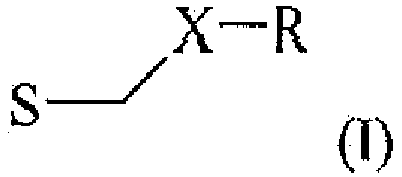 - R für einen unsubstituierten linearen C1-C4-Alkylrest, insbesondere C1-C2-Alkylrest, speziell Methyl, steht,- S für ein Monosaccharid gemäß obiger Beschreibung, das insbesondere aus D-Glucose, D-Xylose, N-Acetyl-D-glucösamin und L-Fucose ausgewählt ist, und insbesondere D-Xylose steht;- X für eine Gruppe, die aus -CO-, -CH(OH)- oder -CH(NH2)- ausgewählt ist, und vorzugsweise eine Gruppe -CH(OH)- steht.
 - Kosmetische Zusammensetzung nach einem der Ansprüche 1 bis 11, wobei es sich bei der C-Glycosid-Verbindung (c) um C-β-D-Xylopyranosid-2-hydroxypropan oder C-α-D-Xylopyranosid-2-hydroxypropan und vorzugsweise C-β-D-Xylopyranosid-2-hydroxypropan handelt.
- Kosmetische Zusammensetzung nach einem der Ansprüche 1 bis 10, wobei die C-Glycosid-Verbindung (c) durch die nachstehende Formel (II) wiedergegeben wird;
 - es sich bei den Verbindungen der Formel (II) um Xylosederivate handelt,- Y für einen Phenylrest oder einen Heterocyclus, die gegebenenfalls durch 1 bis 5 Gruppen (ORa) substituiert sind, steht,- W = -OR1; (=O); NRbRc; NHORd,- R' für:Ra für:* ein Wasserstoffatom,* einen gesättigten linearen C1-C18-Alkylrest,* einen ungesättigten linearen C2-C18-Alkylrest,* einen gesättigten oder ungesättigten verzweigten C3-C18-Alkylrest,* einen gesättigten oder ungesättigten cyclischen C5- oder C6-Rest,* einen linearen oder verzweigten, gesättigtten oder ungesättigten C2-C18-Acylrest oder einen gesättigten oder ungesättigten cyclischen C5- oder C6-Acylrest steht,- ein Wasserstoffatom,- einen linearen oder verzweigten C1-C4-Alkylrest oder einen linearen oder verzweigten ungesättigten C3-C4-Kohlenwasserstoffrest,- einen linearen oder verzweigten C2-C18-Acylrest oder einen linearen oder verzweigten C2-C18-Alkenylcarbonylreststeht,
dann, wenn Y für einen Phenylrest oder einen Heterocyclus, der durch 2 bis 5 Gruppen (ORa) substituiert ist, steht, zwei benachbarte Gruppen ORa zusammen einen zweiwertigen Rest -O-CH2-O bilden können,
mit der Maßgabe, dass im Fall von W = OH die Verbindung keine ethylenische Doppelbindung in alpha-Position zu dem dieses OH tragenden Kohlenstoff enthält,
Rb für:- ein Wasserstoffatom,- einen linearen C2-C18- oder verzweigten C3-C18-Alkylrest oder einen linearen oder verzweigten ungesättigten C3-C4-Kohlenwasserstoffrest oder einen Rest -CH(Z1)-CO2Z2, in dem Z1 für ein Wasserstoffatom oder einen linearen oder verzweigten C1-C6-Alkylrest oder einen gesättigten oder ungesättigten cyclischen C3-C6-Alkylrest steht, wobei der Rest gegebenenfalls durch mindestens eine Gruppe, die aus =NH, -NH2, -N(T)2, =O, -OH, -OT, -SH, -ST, -CO2T, Phenyl, Phenyl, das durch -OH oder -OT substituiert ist,steht,
und Z2 für ein Wasserstoffatom oder einen linearen C1-C6-Alkylrest steht,
Rc für:- ein Wasserstoffatom,- einen linearen C1-C4- oder verzweigten C3-C4-Alkylrest oder einen linearen oder verzweigten ungesättigten C3-C4-Kohlenwasserstoffrest, wobei der Rest gegebenenfalls durch eine Phenylgruppe substituiert ist,steht,
Rd für:- ein Wasserstoffatom,- einen linearen C1-C18- oder verzweigten C3-C18-Alkylrest oder einen linearen oder verzweigten ungesättigten C3-C18-Kohlenwasserstoffrest, wobei der Rest gegebenenfalls durch eine Phenylgruppe substituiert ist,steht,
sowie die kosmetisch unbedenklichen Salze davon, Solvate davon wie Hydrate und Stereoisomere davon. - Zusammensetzung nach einem der Ansprüche 1 bis 10 oder 13, dadurch gekennzeichnet, dass die C-Glycosid-Verbindung (c) die Formel (II) aufweist, wobei:- es sich bei den Verbindungen der Formel (II) um Xylosederivate handelt,- Y für einen Phenylrest oder einen Heterocyclus, die gegebenenfalls durch 1 bis 3 Gruppen (ORa) substituiert sind, steht,- W = -OR'; (=O); NRbRc; NHORd,- R' für:Ra für:* ein wasserstoffatom,* einen linearen oder verzweigten, gesättigten oder ungesättigten C1-C4-Alkylrest,* einen linearen oder verzweigten C1-C6-Acylreststeht,- ein Wasserstoffatom,- einen linearen oder verzweigten C1-C4-Alkylrest,- einen linearen oder verzweigten C1-C6-Acylrest steht,dann, wenn Y für einen Phenylrest oder einen Heterocyclus, der durch 2 oder 3 Gruppen (ORa) substituiert ist, steht, zwei benachbarte Gruppen ORa zusammen einen zweiwertigen Rest -O-CH2-O bilden können,
mit der Maßgabe, dass im Fall von W = OH die Verbindung keine ethylenische Doppelbindung in alpha-Position zu dem dieses OH tragenden Kohlenstoff enthält,
Rb für:- ein Wasserstoffatom,- einen linearen C2-C8- oder verzweigten C3-C8-Alkylrest oder einen Rest -CH(Z1)-CO2Z2, in dem Z1 für ein Wasserstoffatom oder einen linearen oder verzweigten C1-C6-Alkylrest oder einen gesättigten oder ungesättigten cyclischen C3-C6-Alkylrest steht, wobei der Rest gegebenenfalls durch mindestens eine Gruppe, die aus =NH, -NH2, -N(T)2, =O, -OH, -OT, -SH, -ST, -CO2T, Phenyl, Phenyl, das durch -OH oder -OT substituiert ist,steht,
und Z2 für ein Wasserstoffatom oder einen linearen C1-C6-Alkylrest steht,
Rc für:- ein Wasserstoffatom,- einen linearen C1-C4- oder verzweigten C3-C4-Alkylrest, der gegebenenfalls durch eine Phenylgruppe substituiert ist,steht,
Rd für:- ein Wasserstoffatom,- einen linearen C1-C4- oder verzweigten C3-C4-Alkylrest, wobei der Rest gegebenenfalls durch eine Phenylgruppe substituiert ist,steht,
sowie die kosmetisch unbedenklichen Salze davon, Solvate davon wie Hydrate und Stereoisomere davon. - Zusammensetzung nach einem der Ansprüche 1 bis 10 oder 13, dadurch gekennzeichnet, dass die C-Glycosid-Verbindung (c) die Formel (II) aufweist und ausgewählt ist aus:Verbindung 1. (3R,4S,5R)-2-[2-Hydroxy-4-(4-hydroxy-3-methoxyphenyl)butyl]tetrahydro-2H-pyran-3,4,5-triol
 Verbindung 2. 4-(4-Hydroxy-3-methoxyphenyl)-1-[(3R,4S,5R)-3,4,5-trihydroxytetrahydro-2H-pyran-2-yl]butan-2-on
 Verbindung 3. (3R,4S,5R)-2-[2-Hydroxy-4-(4-hydroxyphenyl)butyl]-tetrahydro-2H-pyran-3,4,5-triol
 Verbindung 4. 4-(4-Hydroxyphenyl)-1-[(3R,4S,5R)-3,4,5-trihydroxytetrahydro-2H-pyran-2-yl]butan-2-on
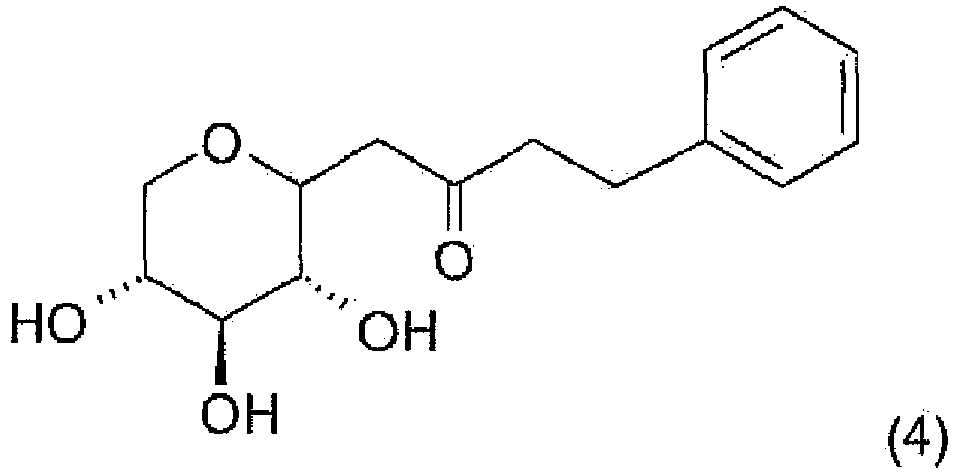 Verbindung 5. (3R,4S,5R)-2-[2-(Benzylamino)-4-(4-hydroxy-3-methoxyphenyl)butyl]tetrahydro-2H-pyran-3,4,5-triol
 Verbindung 6. {[3-(4-Hydroxy-3-methoxyphenyl)-1-{[Z3R,4S,5R)-3,4,5-trihydroxytetrahydro-2H-pyran-2-yl]methyl}-propyl]amino}(phenyl)essigsäureethylester
 Verbindung 7. (3E)-4-Phenyl-1-[(3R,4S,5R)-3,4,5-trihydroxytetrahydro-2H-pyran-2-yl]but-3-en-2-on
 Verbindung 8. (3E)-4-(4-Hydroxy-3,5-dimethoxyphenyl)-1-[(3R,4S,5R)-3,4,5-trihydroxytetrahydro-2H-pyran-2-yl]but-3-en-2-on
 Verbindung 9. (3R,4S,5R)-2-[2-Hydroxy-4-(2-hydroxyphenyl)butyl]-tetrahydro-2H-pyran-3,4,5-triol
 Verbindung 10: (3R,4S,5R)-2-[2-Hydroxy-4-(3-hydroxy-4-methoxyphenyl)butyl]tetrahydro-2H-pyran-3,4,5-triol
 Verbindung 11. (3R,4S,5R)-2-[2-Hydroxy-4-(2,4-dihydroxyphenyl)butyl]tetrahydro-2H-pyran-3,4,5-triol
 Verbindung 12. (3R,4S,5R)-2-[2-Hydroxy-4-(3-ethoxy-4-hydroxyphenyl)butyl]tetrahydro-2H-pyran-3,4,5-triol
 Verbindung 13. 5,9-Anhydro-1,2,4-tridesoxy-1-pyridin-3-yl-D-xylononitol
 Verbindung 14. (3R,4S,5R)-2-[(2E)-2-(Methoxyimino)-4-phenylbutyl]tetrahydro-2H-pyran-3,4,5-triol
 Verbindung 15. 5,9-Anhydro-1,2,4-tridesoxy-7-O-pentanoyl-1-phenyl-D-xylonon-3-ulose
 Verbindung 16. 5,9-Anhydro-1,2,4-tridesoxy-1-(3,4,5-trimethoxyphenyl)-D-xylononitol
- Zusammensetzung nach dem vorhergehenden Anspruch, dadurch gekennzeichnet, dass die C-Glycosid-Verbindung (c) die Formel (II) aufweist und aus den Verbindungen (1) und (11) ausgewählt ist.
- Kosmetische Zusammensetzung nach einem der Ansprüche 1 bis 16, wobei die Menge von C-Glycosid-Verbindung (c) im Bereich von 0,01 bis 20 Gew.-%, vorzugsweise von 0,1 bis 15 Gew.-% und weiter bevorzugt von 1 bis 10 Gew.-%, bezogen auf das Gesamtgewicht der Zusammensetzung, liegt.
- Kosmetische Zusammensetzung nach einem der Ansprüche 1 bis 17, die außerdem mindestens ein nichtionisches Tensid, das von (b) oben verschieden ist, und/oder mindestens ein ionisches Tensid umfasst.
- Kosmetische Zusammensetzung nach einem der Ansprüche 1 bis 18, die außerdem mindestens ein Polyol umfasst.
- Kosmetische Zusammensetzung nach einem der Ansprüche 1 bis 19, wobei die kosmetische Zusammensetzung in Form einer O/W-Emulsion vorliegt und das Öl (a) in Form von Tröpfchen mit einer zahlenmittleren Teilchengröße von 300 nm oder weniger, vorzugsweise von 10 nm bis 150 nm, vorliegt.
- Nichttherapeutisches Verfahren zur Behandlung der Haut, des Haars, der Schleimhäute, der Nägel, der Wimpern, der Augenlider und/oder der Kopfhaut, dadurch gekennzeichnet, dass die kosmetische Zusammensetzung nach einem der Ansprüche 1 bis 20 auf die Haut, das Haar, die Schleimhäute, die Nägel, die Wimpern, die Augenlider oder die Kopfhaut aufgebracht wird.
- Verwendung der kosmetischen Zusammensetzung nach einem der Ansprüche 1 bis 20 als oder in Pflegeprodukte/n und/oder Waschprodukte/n und/oder Schminkprodukte/n und/oder Abschminkprodukte/n für die Körper- und/oder Gesichtshaut und/oder Schleimhäute und/oder die Kopfhaut und/oder das Haar und/oder die Nägel und/oder die Wimpern und/oder die Augenlider.
Applications Claiming Priority (2)
| Application Number | Priority Date | Filing Date | Title |
|---|---|---|---|
| FR1363528A FR3015246B1 (fr) | 2013-12-24 | 2013-12-24 | Composition cosmetique comprenant une huile, un tensioactif non ionique et un compose c-glycoside |
| PCT/EP2014/078160 WO2015097029A1 (en) | 2013-12-24 | 2014-12-17 | Cosmetic composition comprising an oil, a nonionic surfactant and a c-glycoside compound |
Publications (2)
| Publication Number | Publication Date |
|---|---|
| EP3086763A1 EP3086763A1 (de) | 2016-11-02 |
| EP3086763B1 true EP3086763B1 (de) | 2019-07-03 |
Family
ID=50231415
Family Applications (1)
| Application Number | Title | Priority Date | Filing Date |
|---|---|---|---|
| EP14824431.2A Active EP3086763B1 (de) | 2013-12-24 | 2014-12-17 | Kosmetische zusammensetzung mit einem öl, einem nichtionischen tensid und einer c-glykosidverbindung |
Country Status (6)
| Country | Link |
|---|---|
| US (1) | US20160317416A1 (de) |
| EP (1) | EP3086763B1 (de) |
| JP (1) | JP6728044B2 (de) |
| ES (1) | ES2746006T3 (de) |
| FR (1) | FR3015246B1 (de) |
| WO (1) | WO2015097029A1 (de) |
Families Citing this family (21)
| Publication number | Priority date | Publication date | Assignee | Title |
|---|---|---|---|---|
| FR3045338B1 (fr) * | 2015-12-18 | 2019-09-27 | L'oreal | Composition comprenant au moins deux esters d'acide gras et de (poly)glycerol, et son utilisation en cosmetique |
| JP6843153B2 (ja) * | 2016-04-08 | 2021-03-17 | エルジー ハウスホールド アンド ヘルスケア リミテッド | 高含量のオイルを安定化したナノエマルジョン化粧料組成物 |
| FR3058050B1 (fr) * | 2016-10-28 | 2019-01-25 | L'oreal | Composition comprenant au moins deux esters d’acide gras et de (poly)glycerol, et son utilisation en cosmetique |
| JP7305311B2 (ja) | 2018-05-30 | 2023-07-10 | ロレアル | マイクロニードルシート |
| FR3084259B1 (fr) * | 2018-06-25 | 2021-01-22 | Oreal | Composition comprenant un monoester d'acide gras et de polyglycerol, une huile et un polyol, procede et utilisation |
| WO2020087273A1 (en) * | 2018-10-30 | 2020-05-07 | L'oreal | Cosmetic composition for skin care |
| FR3090362B1 (fr) * | 2018-12-20 | 2021-01-08 | Oreal | Composition comprenant un polysaccharide, un polyol, ainsi qu’un ester et une huile particuliers |
| FR3090360B1 (fr) * | 2018-12-20 | 2021-01-15 | Oreal | Composition comprenant un polysaccharide, un polyol et un ester spécifique |
| US11504327B1 (en) | 2019-01-21 | 2022-11-22 | Eric Morrison | Method of preparing nanoparticles by hot-melt extrusion |
| JP2021095374A (ja) * | 2019-12-18 | 2021-06-24 | ロレアル | 特定の成分の組み合わせを含む安定な組成物 |
| FR3104962B1 (fr) * | 2019-12-20 | 2021-12-31 | Oreal | Composition cosmétique comprenant au moins une huile polaire, un monoalcool aliphatique, un mélange de polyols et au moins un actif hydrophile |
| US11192913B2 (en) | 2020-01-09 | 2021-12-07 | The United States of America, as represented The Secretary of Agriculture | C-glycoside amine derivatives and methods of making |
| JP6945256B1 (ja) * | 2020-06-12 | 2021-10-06 | 株式会社Merry Plus | 洗浄組成物 |
| WO2021255260A1 (en) * | 2020-06-19 | 2021-12-23 | L'oreal | Composition comprising a polyol and at least one polyglyceryl ester |
| FR3111547B1 (fr) * | 2020-06-19 | 2022-09-23 | Oreal | Composition comprenant un polyol et au moins un ester polyglycérolé |
| FR3111549B1 (fr) * | 2020-06-19 | 2022-12-30 | Oreal | Composition comprenant un polyol et au moins un ester polyglycérolé |
| CN116648230A (zh) * | 2020-12-16 | 2023-08-25 | 莱雅公司 | 用于护理皮肤的组合物 |
| EP4408379A4 (de) * | 2021-08-31 | 2025-04-23 | L'oreal | Zusammensetzung zur pflege keratinischer materialien |
| WO2023044666A1 (en) * | 2021-09-23 | 2023-03-30 | L'oreal | Composition for conditioning or caring for keratin materials |
| CN121398796A (zh) * | 2023-08-29 | 2026-01-23 | 莱雅公司 | 用于护理和/或化妆角蛋白材料的无水组合物 |
| KR102661960B1 (ko) * | 2023-09-07 | 2024-04-29 | 주식회사 뉴앤뉴 | 저 에너지 소요 나노 에멀젼의 제조방법 |
Family Cites Families (8)
| Publication number | Priority date | Publication date | Assignee | Title |
|---|---|---|---|---|
| FR2811564B1 (fr) * | 2000-07-13 | 2002-12-27 | Oreal | Nanoemulsion contenant des polymeres non ioniques, et ses utilisations notamment dans les domaines cosmetique, dermatologique, pharmaceutique et/ou ophtalmologique |
| FR2903002B1 (fr) * | 2006-07-03 | 2012-08-17 | Oreal | Composition associant un derive c-glycoside et un polymere emulsionnant |
| FR2903003B1 (fr) * | 2006-07-03 | 2012-08-17 | Oreal | Utilisation d'un derive c-glycoside pour ameliorer la fonction barriere de la peau |
| EP2049077B1 (de) * | 2006-07-03 | 2010-12-01 | L'Oréal | Zusammensetzung mit mindestens einem c-glycosid-derivat und mindestens einer hyaluronsäure sowie ihre kosmetische anwendung |
| US20080008673A1 (en) * | 2006-07-03 | 2008-01-10 | Claudie Willemin | Compositions comprising at least one C-glycoside derivative |
| DE102006047247A1 (de) * | 2006-10-06 | 2008-04-10 | Evonik Goldschmidt Gmbh | Kaltherstellbare, niedrigviskose und langzeitstabile kosmetische Emulsionen mit kationische Gruppen enthaltenden Coemulgatoren |
| FR2939797B1 (fr) * | 2008-12-12 | 2011-01-21 | Oreal | Nouveaux composes c-xylosides aryle et utilisation en cosmetique |
| DE102011015191A1 (de) * | 2011-03-25 | 2012-09-27 | Henkel Ag & Co. Kgaa | Verfahren zur Herrstellung eines konditionierten Reinigungsmittels |
-
2013
- 2013-12-24 FR FR1363528A patent/FR3015246B1/fr not_active Expired - Fee Related
-
2014
- 2014-12-17 JP JP2016532554A patent/JP6728044B2/ja active Active
- 2014-12-17 WO PCT/EP2014/078160 patent/WO2015097029A1/en not_active Ceased
- 2014-12-17 US US15/107,642 patent/US20160317416A1/en not_active Abandoned
- 2014-12-17 ES ES14824431T patent/ES2746006T3/es active Active
- 2014-12-17 EP EP14824431.2A patent/EP3086763B1/de active Active
Non-Patent Citations (1)
| Title |
|---|
| None * |
Also Published As
| Publication number | Publication date |
|---|---|
| EP3086763A1 (de) | 2016-11-02 |
| FR3015246B1 (fr) | 2017-10-06 |
| US20160317416A1 (en) | 2016-11-03 |
| WO2015097029A1 (en) | 2015-07-02 |
| JP6728044B2 (ja) | 2020-07-22 |
| FR3015246A1 (fr) | 2015-06-26 |
| ES2746006T3 (es) | 2020-03-04 |
| JP2017500290A (ja) | 2017-01-05 |
Similar Documents
| Publication | Publication Date | Title |
|---|---|---|
| ES2746006T3 (es) | Composición cosmética que comprende un aceite, un tensioactivo no iónico y un compuesto de C-glucósido | |
| US10561587B2 (en) | Composition in the form of nano- or micro-emulsion | |
| EP2941238B1 (de) | Kosmetische zusammensetzung | |
| TWI771348B (zh) | 水中油型組成物 | |
| US11260000B2 (en) | Composition in the form of nano or micro emulsion or with lamellar structure | |
| US20190365628A1 (en) | Composition in the form of nano- or micro- emulsion | |
| EP3393603B1 (de) | Topisches verabreichungssystem für wirkstoffe | |
| WO2016091939A1 (en) | Composition comprising hesperetin, an oil, at least one fatty acid ester of (poly)glycerol, and a polyol | |
| KR102490687B1 (ko) | 클렌징 적합 조성물 | |
| WO2015152422A1 (en) | Composition in the form of nano- or micro-emulsion | |
| WO2014098263A1 (en) | Cosmetic composition comprising oil, non ionic surfactant and vitamine b3 | |
| US20200268628A1 (en) | Oil-in-water emulsion composition comprising ether oil | |
| JP2014122192A (ja) | 油、非イオン界面活性剤及びキサンチン塩基を含む化粧品組成物 | |
| JP2014122191A (ja) | 油、非イオン界面活性剤及びジャスモン酸誘導体を含む化粧品組成物 | |
| JP7768685B2 (ja) | 2種のポリグリセリル脂肪酸エステルとヒアルロン酸とを含む組成物 | |
| JP7520480B2 (ja) | O/wエマルションの形態の組成物 | |
| JP2023033903A (ja) | ポリヒドロキシ酸を含む透明組成物 | |
| WO2020175606A1 (ja) | 皮膚外用剤組成物 | |
| WO2020150982A1 (en) | Composition in the form of an oil-in-water microemulsion | |
| WO2011074127A1 (en) | Composition with enhanced hydration ability |
Legal Events
| Date | Code | Title | Description |
|---|---|---|---|
| PUAI | Public reference made under article 153(3) epc to a published international application that has entered the european phase |
Free format text: ORIGINAL CODE: 0009012 |
|
| 17P | Request for examination filed |
Effective date: 20160725 |
|
| AK | Designated contracting states |
Kind code of ref document: A1 Designated state(s): AL AT BE BG CH CY CZ DE DK EE ES FI FR GB GR HR HU IE IS IT LI LT LU LV MC MK MT NL NO PL PT RO RS SE SI SK SM TR |
|
| AX | Request for extension of the european patent |
Extension state: BA ME |
|
| DAX | Request for extension of the european patent (deleted) | ||
| STAA | Information on the status of an ep patent application or granted ep patent |
Free format text: STATUS: EXAMINATION IS IN PROGRESS |
|
| 17Q | First examination report despatched |
Effective date: 20170817 |
|
| GRAJ | Information related to disapproval of communication of intention to grant by the applicant or resumption of examination proceedings by the epo deleted |
Free format text: ORIGINAL CODE: EPIDOSDIGR1 |
|
| GRAP | Despatch of communication of intention to grant a patent |
Free format text: ORIGINAL CODE: EPIDOSNIGR1 |
|
| GRAP | Despatch of communication of intention to grant a patent |
Free format text: ORIGINAL CODE: EPIDOSNIGR1 |
|
| STAA | Information on the status of an ep patent application or granted ep patent |
Free format text: STATUS: GRANT OF PATENT IS INTENDED |
|
| INTG | Intention to grant announced |
Effective date: 20181128 |
|
| GRAS | Grant fee paid |
Free format text: ORIGINAL CODE: EPIDOSNIGR3 |
|
| GRAA | (expected) grant |
Free format text: ORIGINAL CODE: 0009210 |
|
| STAA | Information on the status of an ep patent application or granted ep patent |
Free format text: STATUS: THE PATENT HAS BEEN GRANTED |
|
| AK | Designated contracting states |
Kind code of ref document: B1 Designated state(s): AL AT BE BG CH CY CZ DE DK EE ES FI FR GB GR HR HU IE IS IT LI LT LU LV MC MK MT NL NO PL PT RO RS SE SI SK SM TR |
|
| REG | Reference to a national code |
Ref country code: GB Ref legal event code: FG4D |
|
| REG | Reference to a national code |
Ref country code: CH Ref legal event code: EP Ref country code: AT Ref legal event code: REF Ref document number: 1150106 Country of ref document: AT Kind code of ref document: T Effective date: 20190715 |
|
| REG | Reference to a national code |
Ref country code: IE Ref legal event code: FG4D |
|
| REG | Reference to a national code |
Ref country code: DE Ref legal event code: R096 Ref document number: 602014049598 Country of ref document: DE |
|
| REG | Reference to a national code |
Ref country code: NL Ref legal event code: MP Effective date: 20190703 |
|
| REG | Reference to a national code |
Ref country code: LT Ref legal event code: MG4D |
|
| REG | Reference to a national code |
Ref country code: AT Ref legal event code: MK05 Ref document number: 1150106 Country of ref document: AT Kind code of ref document: T Effective date: 20190703 |
|
| PG25 | Lapsed in a contracting state [announced via postgrant information from national office to epo] |
Ref country code: BG Free format text: LAPSE BECAUSE OF FAILURE TO SUBMIT A TRANSLATION OF THE DESCRIPTION OR TO PAY THE FEE WITHIN THE PRESCRIBED TIME-LIMIT Effective date: 20191003 Ref country code: SE Free format text: LAPSE BECAUSE OF FAILURE TO SUBMIT A TRANSLATION OF THE DESCRIPTION OR TO PAY THE FEE WITHIN THE PRESCRIBED TIME-LIMIT Effective date: 20190703 Ref country code: AT Free format text: LAPSE BECAUSE OF FAILURE TO SUBMIT A TRANSLATION OF THE DESCRIPTION OR TO PAY THE FEE WITHIN THE PRESCRIBED TIME-LIMIT Effective date: 20190703 Ref country code: PT Free format text: LAPSE BECAUSE OF FAILURE TO SUBMIT A TRANSLATION OF THE DESCRIPTION OR TO PAY THE FEE WITHIN THE PRESCRIBED TIME-LIMIT Effective date: 20191104 Ref country code: NL Free format text: LAPSE BECAUSE OF FAILURE TO SUBMIT A TRANSLATION OF THE DESCRIPTION OR TO PAY THE FEE WITHIN THE PRESCRIBED TIME-LIMIT Effective date: 20190703 Ref country code: LT Free format text: LAPSE BECAUSE OF FAILURE TO SUBMIT A TRANSLATION OF THE DESCRIPTION OR TO PAY THE FEE WITHIN THE PRESCRIBED TIME-LIMIT Effective date: 20190703 Ref country code: HR Free format text: LAPSE BECAUSE OF FAILURE TO SUBMIT A TRANSLATION OF THE DESCRIPTION OR TO PAY THE FEE WITHIN THE PRESCRIBED TIME-LIMIT Effective date: 20190703 Ref country code: FI Free format text: LAPSE BECAUSE OF FAILURE TO SUBMIT A TRANSLATION OF THE DESCRIPTION OR TO PAY THE FEE WITHIN THE PRESCRIBED TIME-LIMIT Effective date: 20190703 Ref country code: CZ Free format text: LAPSE BECAUSE OF FAILURE TO SUBMIT A TRANSLATION OF THE DESCRIPTION OR TO PAY THE FEE WITHIN THE PRESCRIBED TIME-LIMIT Effective date: 20190703 Ref country code: NO Free format text: LAPSE BECAUSE OF FAILURE TO SUBMIT A TRANSLATION OF THE DESCRIPTION OR TO PAY THE FEE WITHIN THE PRESCRIBED TIME-LIMIT Effective date: 20191003 |
|
| PG25 | Lapsed in a contracting state [announced via postgrant information from national office to epo] |
Ref country code: GR Free format text: LAPSE BECAUSE OF FAILURE TO SUBMIT A TRANSLATION OF THE DESCRIPTION OR TO PAY THE FEE WITHIN THE PRESCRIBED TIME-LIMIT Effective date: 20191004 Ref country code: LV Free format text: LAPSE BECAUSE OF FAILURE TO SUBMIT A TRANSLATION OF THE DESCRIPTION OR TO PAY THE FEE WITHIN THE PRESCRIBED TIME-LIMIT Effective date: 20190703 Ref country code: IS Free format text: LAPSE BECAUSE OF FAILURE TO SUBMIT A TRANSLATION OF THE DESCRIPTION OR TO PAY THE FEE WITHIN THE PRESCRIBED TIME-LIMIT Effective date: 20191103 Ref country code: AL Free format text: LAPSE BECAUSE OF FAILURE TO SUBMIT A TRANSLATION OF THE DESCRIPTION OR TO PAY THE FEE WITHIN THE PRESCRIBED TIME-LIMIT Effective date: 20190703 Ref country code: RS Free format text: LAPSE BECAUSE OF FAILURE TO SUBMIT A TRANSLATION OF THE DESCRIPTION OR TO PAY THE FEE WITHIN THE PRESCRIBED TIME-LIMIT Effective date: 20190703 |
|
| REG | Reference to a national code |
Ref country code: ES Ref legal event code: FG2A Ref document number: 2746006 Country of ref document: ES Kind code of ref document: T3 Effective date: 20200304 |
|
| PG25 | Lapsed in a contracting state [announced via postgrant information from national office to epo] |
Ref country code: TR Free format text: LAPSE BECAUSE OF FAILURE TO SUBMIT A TRANSLATION OF THE DESCRIPTION OR TO PAY THE FEE WITHIN THE PRESCRIBED TIME-LIMIT Effective date: 20190703 |
|
| PG25 | Lapsed in a contracting state [announced via postgrant information from national office to epo] |
Ref country code: DK Free format text: LAPSE BECAUSE OF FAILURE TO SUBMIT A TRANSLATION OF THE DESCRIPTION OR TO PAY THE FEE WITHIN THE PRESCRIBED TIME-LIMIT Effective date: 20190703 Ref country code: EE Free format text: LAPSE BECAUSE OF FAILURE TO SUBMIT A TRANSLATION OF THE DESCRIPTION OR TO PAY THE FEE WITHIN THE PRESCRIBED TIME-LIMIT Effective date: 20190703 Ref country code: RO Free format text: LAPSE BECAUSE OF FAILURE TO SUBMIT A TRANSLATION OF THE DESCRIPTION OR TO PAY THE FEE WITHIN THE PRESCRIBED TIME-LIMIT Effective date: 20190703 Ref country code: PL Free format text: LAPSE BECAUSE OF FAILURE TO SUBMIT A TRANSLATION OF THE DESCRIPTION OR TO PAY THE FEE WITHIN THE PRESCRIBED TIME-LIMIT Effective date: 20190703 |
|
| PG25 | Lapsed in a contracting state [announced via postgrant information from national office to epo] |
Ref country code: SM Free format text: LAPSE BECAUSE OF FAILURE TO SUBMIT A TRANSLATION OF THE DESCRIPTION OR TO PAY THE FEE WITHIN THE PRESCRIBED TIME-LIMIT Effective date: 20190703 Ref country code: SK Free format text: LAPSE BECAUSE OF FAILURE TO SUBMIT A TRANSLATION OF THE DESCRIPTION OR TO PAY THE FEE WITHIN THE PRESCRIBED TIME-LIMIT Effective date: 20190703 Ref country code: IS Free format text: LAPSE BECAUSE OF FAILURE TO SUBMIT A TRANSLATION OF THE DESCRIPTION OR TO PAY THE FEE WITHIN THE PRESCRIBED TIME-LIMIT Effective date: 20200224 |
|
| REG | Reference to a national code |
Ref country code: DE Ref legal event code: R097 Ref document number: 602014049598 Country of ref document: DE |
|
| PLBE | No opposition filed within time limit |
Free format text: ORIGINAL CODE: 0009261 |
|
| STAA | Information on the status of an ep patent application or granted ep patent |
Free format text: STATUS: NO OPPOSITION FILED WITHIN TIME LIMIT |
|
| PG2D | Information on lapse in contracting state deleted |
Ref country code: IS |
|
| REG | Reference to a national code |
Ref country code: CH Ref legal event code: PL |
|
| 26N | No opposition filed |
Effective date: 20200603 |
|
| REG | Reference to a national code |
Ref country code: BE Ref legal event code: MM Effective date: 20191231 |
|
| PG25 | Lapsed in a contracting state [announced via postgrant information from national office to epo] |
Ref country code: MC Free format text: LAPSE BECAUSE OF FAILURE TO SUBMIT A TRANSLATION OF THE DESCRIPTION OR TO PAY THE FEE WITHIN THE PRESCRIBED TIME-LIMIT Effective date: 20190703 Ref country code: SI Free format text: LAPSE BECAUSE OF FAILURE TO SUBMIT A TRANSLATION OF THE DESCRIPTION OR TO PAY THE FEE WITHIN THE PRESCRIBED TIME-LIMIT Effective date: 20190703 |
|
| PG25 | Lapsed in a contracting state [announced via postgrant information from national office to epo] |
Ref country code: LU Free format text: LAPSE BECAUSE OF NON-PAYMENT OF DUE FEES Effective date: 20191217 Ref country code: IE Free format text: LAPSE BECAUSE OF NON-PAYMENT OF DUE FEES Effective date: 20191217 |
|
| PG25 | Lapsed in a contracting state [announced via postgrant information from national office to epo] |
Ref country code: LI Free format text: LAPSE BECAUSE OF NON-PAYMENT OF DUE FEES Effective date: 20191231 Ref country code: CH Free format text: LAPSE BECAUSE OF NON-PAYMENT OF DUE FEES Effective date: 20191231 Ref country code: BE Free format text: LAPSE BECAUSE OF NON-PAYMENT OF DUE FEES Effective date: 20191231 |
|
| PG25 | Lapsed in a contracting state [announced via postgrant information from national office to epo] |
Ref country code: CY Free format text: LAPSE BECAUSE OF FAILURE TO SUBMIT A TRANSLATION OF THE DESCRIPTION OR TO PAY THE FEE WITHIN THE PRESCRIBED TIME-LIMIT Effective date: 20190703 |
|
| PG25 | Lapsed in a contracting state [announced via postgrant information from national office to epo] |
Ref country code: HU Free format text: LAPSE BECAUSE OF FAILURE TO SUBMIT A TRANSLATION OF THE DESCRIPTION OR TO PAY THE FEE WITHIN THE PRESCRIBED TIME-LIMIT; INVALID AB INITIO Effective date: 20141217 Ref country code: MT Free format text: LAPSE BECAUSE OF FAILURE TO SUBMIT A TRANSLATION OF THE DESCRIPTION OR TO PAY THE FEE WITHIN THE PRESCRIBED TIME-LIMIT Effective date: 20190703 |
|
| PG25 | Lapsed in a contracting state [announced via postgrant information from national office to epo] |
Ref country code: MK Free format text: LAPSE BECAUSE OF FAILURE TO SUBMIT A TRANSLATION OF THE DESCRIPTION OR TO PAY THE FEE WITHIN THE PRESCRIBED TIME-LIMIT Effective date: 20190703 |
|
| PGFP | Annual fee paid to national office [announced via postgrant information from national office to epo] |
Ref country code: IT Payment date: 20241112 Year of fee payment: 11 |
|
| PGFP | Annual fee paid to national office [announced via postgrant information from national office to epo] |
Ref country code: ES Payment date: 20250115 Year of fee payment: 11 |
|
| PGFP | Annual fee paid to national office [announced via postgrant information from national office to epo] |
Ref country code: DE Payment date: 20250930 Year of fee payment: 12 |
|
| PGFP | Annual fee paid to national office [announced via postgrant information from national office to epo] |
Ref country code: GB Payment date: 20251001 Year of fee payment: 12 |
|
| PGFP | Annual fee paid to national office [announced via postgrant information from national office to epo] |
Ref country code: FR Payment date: 20251008 Year of fee payment: 12 |