EP3087162B1 - Process for producing middle distillates - Google Patents
Process for producing middle distillates Download PDFInfo
- Publication number
- EP3087162B1 EP3087162B1 EP14819014.3A EP14819014A EP3087162B1 EP 3087162 B1 EP3087162 B1 EP 3087162B1 EP 14819014 A EP14819014 A EP 14819014A EP 3087162 B1 EP3087162 B1 EP 3087162B1
- Authority
- EP
- European Patent Office
- Prior art keywords
- product
- process according
- recycled
- carried out
- residual fraction
- Prior art date
- Legal status (The legal status is an assumption and is not a legal conclusion. Google has not performed a legal analysis and makes no representation as to the accuracy of the status listed.)
- Active
Links
Images
Classifications
-
- C—CHEMISTRY; METALLURGY
- C10—PETROLEUM, GAS OR COKE INDUSTRIES; TECHNICAL GASES CONTAINING CARBON MONOXIDE; FUELS; LUBRICANTS; PEAT
- C10G—CRACKING HYDROCARBON OILS; PRODUCTION OF LIQUID HYDROCARBON MIXTURES, e.g. BY DESTRUCTIVE HYDROGENATION, OLIGOMERISATION, POLYMERISATION; RECOVERY OF HYDROCARBON OILS FROM OIL-SHALE, OIL-SAND, OR GASES; REFINING MIXTURES MAINLY CONSISTING OF HYDROCARBONS; REFORMING OF NAPHTHA; MINERAL WAXES
- C10G67/00—Treatment of hydrocarbon oils by at least one hydrotreatment process and at least one process for refining in the absence of hydrogen only
- C10G67/02—Treatment of hydrocarbon oils by at least one hydrotreatment process and at least one process for refining in the absence of hydrogen only plural serial stages only
- C10G67/04—Treatment of hydrocarbon oils by at least one hydrotreatment process and at least one process for refining in the absence of hydrogen only plural serial stages only including solvent extraction as the refining step in the absence of hydrogen
- C10G67/0454—Solvent desasphalting
- C10G67/0463—The hydrotreatment being a hydrorefining
-
- C—CHEMISTRY; METALLURGY
- C10—PETROLEUM, GAS OR COKE INDUSTRIES; TECHNICAL GASES CONTAINING CARBON MONOXIDE; FUELS; LUBRICANTS; PEAT
- C10G—CRACKING HYDROCARBON OILS; PRODUCTION OF LIQUID HYDROCARBON MIXTURES, e.g. BY DESTRUCTIVE HYDROGENATION, OLIGOMERISATION, POLYMERISATION; RECOVERY OF HYDROCARBON OILS FROM OIL-SHALE, OIL-SAND, OR GASES; REFINING MIXTURES MAINLY CONSISTING OF HYDROCARBONS; REFORMING OF NAPHTHA; MINERAL WAXES
- C10G21/00—Refining of hydrocarbon oils, in the absence of hydrogen, by extraction with selective solvents
- C10G21/003—Solvent de-asphalting
-
- C—CHEMISTRY; METALLURGY
- C10—PETROLEUM, GAS OR COKE INDUSTRIES; TECHNICAL GASES CONTAINING CARBON MONOXIDE; FUELS; LUBRICANTS; PEAT
- C10G—CRACKING HYDROCARBON OILS; PRODUCTION OF LIQUID HYDROCARBON MIXTURES, e.g. BY DESTRUCTIVE HYDROGENATION, OLIGOMERISATION, POLYMERISATION; RECOVERY OF HYDROCARBON OILS FROM OIL-SHALE, OIL-SAND, OR GASES; REFINING MIXTURES MAINLY CONSISTING OF HYDROCARBONS; REFORMING OF NAPHTHA; MINERAL WAXES
- C10G65/00—Treatment of hydrocarbon oils by two or more hydrotreatment processes only
- C10G65/02—Treatment of hydrocarbon oils by two or more hydrotreatment processes only plural serial stages only
- C10G65/12—Treatment of hydrocarbon oils by two or more hydrotreatment processes only plural serial stages only including cracking steps and other hydrotreatment steps
-
- C—CHEMISTRY; METALLURGY
- C10—PETROLEUM, GAS OR COKE INDUSTRIES; TECHNICAL GASES CONTAINING CARBON MONOXIDE; FUELS; LUBRICANTS; PEAT
- C10G—CRACKING HYDROCARBON OILS; PRODUCTION OF LIQUID HYDROCARBON MIXTURES, e.g. BY DESTRUCTIVE HYDROGENATION, OLIGOMERISATION, POLYMERISATION; RECOVERY OF HYDROCARBON OILS FROM OIL-SHALE, OIL-SAND, OR GASES; REFINING MIXTURES MAINLY CONSISTING OF HYDROCARBONS; REFORMING OF NAPHTHA; MINERAL WAXES
- C10G67/00—Treatment of hydrocarbon oils by at least one hydrotreatment process and at least one process for refining in the absence of hydrogen only
- C10G67/02—Treatment of hydrocarbon oils by at least one hydrotreatment process and at least one process for refining in the absence of hydrogen only plural serial stages only
- C10G67/04—Treatment of hydrocarbon oils by at least one hydrotreatment process and at least one process for refining in the absence of hydrogen only plural serial stages only including solvent extraction as the refining step in the absence of hydrogen
- C10G67/0454—Solvent desasphalting
- C10G67/049—The hydrotreatment being a hydrocracking
-
- C—CHEMISTRY; METALLURGY
- C10—PETROLEUM, GAS OR COKE INDUSTRIES; TECHNICAL GASES CONTAINING CARBON MONOXIDE; FUELS; LUBRICANTS; PEAT
- C10J—PRODUCTION OF PRODUCER GAS, WATER-GAS, SYNTHESIS GAS FROM SOLID CARBONACEOUS MATERIAL, OR MIXTURES CONTAINING THESE GASES; CARBURETTING AIR OR OTHER GASES
- C10J3/00—Production of combustible gases containing carbon monoxide from solid carbonaceous fuels
-
- C—CHEMISTRY; METALLURGY
- C10—PETROLEUM, GAS OR COKE INDUSTRIES; TECHNICAL GASES CONTAINING CARBON MONOXIDE; FUELS; LUBRICANTS; PEAT
- C10G—CRACKING HYDROCARBON OILS; PRODUCTION OF LIQUID HYDROCARBON MIXTURES, e.g. BY DESTRUCTIVE HYDROGENATION, OLIGOMERISATION, POLYMERISATION; RECOVERY OF HYDROCARBON OILS FROM OIL-SHALE, OIL-SAND, OR GASES; REFINING MIXTURES MAINLY CONSISTING OF HYDROCARBONS; REFORMING OF NAPHTHA; MINERAL WAXES
- C10G2300/00—Aspects relating to hydrocarbon processing covered by groups C10G1/00 - C10G99/00
- C10G2300/20—Characteristics of the feedstock or the products
- C10G2300/201—Impurities
- C10G2300/202—Heteroatoms content, i.e. S, N, O, P
-
- C—CHEMISTRY; METALLURGY
- C10—PETROLEUM, GAS OR COKE INDUSTRIES; TECHNICAL GASES CONTAINING CARBON MONOXIDE; FUELS; LUBRICANTS; PEAT
- C10G—CRACKING HYDROCARBON OILS; PRODUCTION OF LIQUID HYDROCARBON MIXTURES, e.g. BY DESTRUCTIVE HYDROGENATION, OLIGOMERISATION, POLYMERISATION; RECOVERY OF HYDROCARBON OILS FROM OIL-SHALE, OIL-SAND, OR GASES; REFINING MIXTURES MAINLY CONSISTING OF HYDROCARBONS; REFORMING OF NAPHTHA; MINERAL WAXES
- C10G2300/00—Aspects relating to hydrocarbon processing covered by groups C10G1/00 - C10G99/00
- C10G2300/20—Characteristics of the feedstock or the products
- C10G2300/30—Physical properties of feedstocks or products
- C10G2300/301—Boiling range
-
- C—CHEMISTRY; METALLURGY
- C10—PETROLEUM, GAS OR COKE INDUSTRIES; TECHNICAL GASES CONTAINING CARBON MONOXIDE; FUELS; LUBRICANTS; PEAT
- C10G—CRACKING HYDROCARBON OILS; PRODUCTION OF LIQUID HYDROCARBON MIXTURES, e.g. BY DESTRUCTIVE HYDROGENATION, OLIGOMERISATION, POLYMERISATION; RECOVERY OF HYDROCARBON OILS FROM OIL-SHALE, OIL-SAND, OR GASES; REFINING MIXTURES MAINLY CONSISTING OF HYDROCARBONS; REFORMING OF NAPHTHA; MINERAL WAXES
- C10G2300/00—Aspects relating to hydrocarbon processing covered by groups C10G1/00 - C10G99/00
- C10G2300/40—Characteristics of the process deviating from typical ways of processing
- C10G2300/4081—Recycling aspects
-
- C—CHEMISTRY; METALLURGY
- C10—PETROLEUM, GAS OR COKE INDUSTRIES; TECHNICAL GASES CONTAINING CARBON MONOXIDE; FUELS; LUBRICANTS; PEAT
- C10G—CRACKING HYDROCARBON OILS; PRODUCTION OF LIQUID HYDROCARBON MIXTURES, e.g. BY DESTRUCTIVE HYDROGENATION, OLIGOMERISATION, POLYMERISATION; RECOVERY OF HYDROCARBON OILS FROM OIL-SHALE, OIL-SAND, OR GASES; REFINING MIXTURES MAINLY CONSISTING OF HYDROCARBONS; REFORMING OF NAPHTHA; MINERAL WAXES
- C10G2300/00—Aspects relating to hydrocarbon processing covered by groups C10G1/00 - C10G99/00
- C10G2300/40—Characteristics of the process deviating from typical ways of processing
- C10G2300/42—Hydrogen of special source or of special composition
Definitions
- the present invention relates to process for producing middle distillates.
- Object of the present invention is to provide a process for producing ultra low sulphur middle distillates in high yields.
- This object is achieved when use is made of a particular multi-step process.
- high yields of middle distillates containing less than 10 ppm sulphur can advantageously be produced from residual hydrocarbonaceous feedstocks.
- the residual hydrocarbonaceous feedstocks to be used in accordance with the present invention can suitable be residual hydrocarbon oils, such as those obtained in the distillation of crude oils at atmospheric or reduced pressure.
- at least 75 wt%, more preferably at least 85 wt%, and even more preferably at least 90 wt% of the residual hydrocarbonaceous feedstock has a boiling point of above 550 °C.
- Atmospheric residues or vacuum residues contain however considerable amounts of non-distillable compounds having a high molecular weight such as asphaltenes. It is therefore considered desirable to remove asphaltenes from a residual hydrocarbon oil feed prior to subjecting the residual hydrocarbon oil to subsequent upgrading steps.
- a residual hydrocarbonaceous feedstock is deasphalted to obtain a deasphalted product of which at least 50 wt% , preferably at least 70 %, more preferably at least 80 wt%, and even more preferably at least 85 wt% has a boiling point above 550 °C and an asphaltic product.
- step (a) the deasphalting in step (a) is carried out by means of a solvent deasphalting treatment.
- paraffinic compounds include C3-8 paraffinic hydrocarbons, such as propane, butane, isobutane, pentane, isopentane, hexane or mixtures of two or more of these.
- C3-C5 paraffinic hydrocarbons most preferably butane, pentane or a mixture thereof, are used as the extracting solvent.
- the extraction depth increases at increasing number of carbon atoms of the extracting solvent.
- a rotating disc contactor or a plate column can be used with the residual hydrocarbonaceous feedstock entering at the top and the extracting solvent entering at the bottom.
- the lighter hydrocarbons which are present in the residual hydrocarbonaceous feedstock dissolve in the extracting solvent and are withdrawn as the deasphalted product at the top of the apparatus.
- the asphaltenes which are insoluble in the extracting solvent are withdrawn in the form of the asphaltic product at the bottom of the apparatus.
- the conditions under which deasphalting takes place are known in the art. Deasphalting is carried out at a total extracting solvent to residual hydrocarbon oil ratio of 1.5 to 8 wt/wt, a pressure of from 1 to 60 bara and a temperature of from 40 to 200 ° C.
- a deasphalting treatment generally causes a substantial amount of the metallic contaminants present in the feed as high-molecular weight complexes to accumulate in the asphaltic product rather than in the deasphalted product. Nonetheless, the metals content of the deasphalted product will be such that the deasphalted product needs to be subjected to a hydrodemetallizing step before it can be subjected to further hydroprocessing upgrading steps.
- step (b) at least part of the deasphalted product as obtained in step (a) is hydrodemetallized to obtain a hydrodemetallized product.
- step (b) the entire deasphalted product as obtained in step (a) is hydrodemetallized.
- the deasphalted product which is hydrodemetallized in step (b) is a pure and heavy deasphalted product. This means that at least 50 wt%, preferably at least 70 wt%, more preferably at least 80 wt%, and even more preferably at least 85 wt% of the deasphalted product to be treated in step (b) has a boiling point of above 550 °C. Unlike in other hydroconversion processes such as for instance disclosed in EP 1731588 A1 , the entire undiluted deasphalted product as obtained in step (a) can now be hydrodemetallized in step (b), and there is no need to dilute the deasphalted product before it can be further processed.
- the hydrodemetallisation of the deasphalted product in step (b) can be achieved by any well known hydrodemetallization treatment wherein the deasphalted product to be hydrodemetallized is passed at elevated temperature and pressure and in the presence of hydrogen in an upward, downward or radial direction, through one or more vertically disposed reactors containing a fixed or moving bed of hydrodemetallization catalyst particles.
- the hydrodemetallization is at least partially carried out in a bunker flow.
- a hydrodemetallization catalyst for use in step (b), suitably use is made of a hydrodemetallization catalyst.
- Suitable hydrodemetallization catalysts to be used in accordance with the present invention consist of oxidic carriers such as alumina, silica or silica-alumina, on which one or more Group VIB or Group VIII metals or metal compounds may be deposited.
- Such hydrodemetallization catalysts are commercially available from many catalyst suppliers.
- Particularly suitable hydrodemetallization catalysts are those having as the active agent one of the combinations nickel/molybdenum (NiMo) or cobalt/molybdenum (CoMo), optionally promoted with phosphorus (P), on an alumina (Al2O3) carrier. Concrete examples of particularly suitable catalysts are CoMo/A1203, CoMoP/Al2O3 and NiMo/A1203 and NiMoP/Al2O3 catalysts.
- the hydrodemetallization in step (b) can suitably be carried out at a hydrogen partial pressure of 20-300 bara, preferably 50-210 bara, a temperature of 300-470 °C, preferably 310-440 °C, and a space velocity of 0.1-10 hr -1 , preferably 0.2 to 7 hr - 1.
- the hydrodemetallization reactor is preferably a bunker flow reactor, a fixed bed swing reactor or a movable bed reactor.
- the hydrodemetallization catalyst(s) is (are) regularly replaced for instance every three weeks or two months, whereas in conventional processes the hydrodemetallization catalyst(s) (like the hydrotreating and hydrocracking catalysts to be used in steps (c) and (d) in the present process) may not be replaced within a year time.
- step (c) at least part of the hydrodemetallized product as obtained in step (b) is hydrotreated to obtain a hydrotreated product.
- step (c) the entire hydrodemetallized product as obtained in step (b) is hydrotreated.
- the hydrotreating of the hydrodemetallized product in step (c) can be achieved by any well known hydrotreating process wherein the hydrodemetallized product to be hydrotreated is passed at elevated temperature and pressure and in the presence of hydrogen in an upward, downward or radial direction, through one or more vertically disposed reactors containing a fixed or moving bed of hydrotreating catalyst particles.
- the hydrotreatment can be carried out in a bunker flow reactor, a fixed bed reactor, a fixed bed swing reactor or a movable bed reactor.
- the hydrotreatment in step (c) is carried out in two reaction zones, whereby the hydrodemetallized product is first passed to a first reaction zone in which the hydrodemetallized product is partly hydrotreated after which the partly hydrotreated effluent so obtained is subjected to further hydrotreatment in a second reaction zone.
- the first reaction zone and second reaction zone can be arranged in a stacked bed configuration or the two reactions zones can each be arranged in a separate reactor.
- the first reaction zone and the second reaction zone are respectively arranged in a first reactor and a second reactor.
- the first reactor may be a bunker flow reactor and the second reactor may bea fixed bed reactor.
- the hydrotreating catalyst to be used in step (c) can suitably be a desulphurization catalyst.
- the desulphurization catalyst may be any hydrodesulphurization catalyst known in the art.
- Suitable hydrodesulphurization catalysts comprise a Group VIII metal of the Periodic Table and a compound of a Group VIB metal of the Periodic Table as hydrogenation components on a porous catalyst support, usually alumina or amorphous silica-alumina.
- a porous catalyst support usually alumina or amorphous silica-alumina.
- suitable combinations of hydrogenation compounds are cobalt-molybdenum, nickel-molybdenum, nickel-tungsten, and nickel-cobalt-molybdenum.
- a hydrodesulphurization catalyst comprising compounds of nickel and/or cobalt and molybdenum as hydrogenation compounds is preferred.
- the hydrodesulphurization catalyst may further comprise a cracking component such as for example Y zeolite. It is, however, preferred that no substantial hydrocracking takes place in the hydrotreatment in step (c). Therefore, it is preferred that the catalyst is substantially free of a cracking component.
- the hydrotreating conditions in step (c), i.e. temperature, pressure, hydrogen supply rate, weight hourly velocity of the feedstock, are typical hydrotreating conditions.
- the temperature used for the hydrotreating in step (c) is in the range of from 280 to 430 °C, more preferably in the range of from 320 to 420 °C, and most preferably in the range of from 330 to 410 °C.
- Suitable hydrotreating pressures are in the range of from 10 to 300 bara.
- the hydrotreating pressure is in the range of from 30 to 250 bara, more preferably in the range of from 80 to 220 bara.
- step (d) at least part of the hydrotreated product as obtained in step (c) is hydrocracked to obtain a hydrocracked product.
- step (d) the entire hydrotreated product as obtained in step (a) is hydrocracked.
- the hydrocracking in step (d) of the process according to the present invention may be conducted in any way known in the art, provided that at least one of the catalysts used in the hydrocracking zone is acidic.
- the hydrocracking is carried out in the presence of hydrogen and a suitable hydrocracking catalyst at elevated temperature and pressure.
- Suitable hydrocracking catalysts consist of one or more metals from nickel, tungsten, cobalt and molybdenum in elemental, oxidic or sulphidic form on a suitable carrier such as alumina, silica, silica-alumina or a zeolite.
- a suitable carrier such as alumina, silica, silica-alumina or a zeolite.
- There are many commercially available hydrocracking catalysts which can be suitably applied in the process of the present invention.
- At least one of the catalysts used in the hydrocracking zone must be acidic, i.e. must contain a silica-alumina and/or zeolitic component.
- the hydrocracking in step (d) can be carried out in a single- or multiple-stage mode of operation.
- a single-stage mode of operation a stacked bed of a hydrodenitrification/first-stage hydrocracking catalyst on top of a conversion catalyst can suitably be used.
- Particularly suitable hydrodenitrification/first-stage hydrocracking catalysts are NiMo/Al2O3 and CoMo/Al2O3, optionally promoted with phosphorus and/or fluor.
- Preferred conversion catalysts are those based on NiW/zeolite or NiW/zeolite/silica-alumina.
- Suitable hydrocracking conditions in step (d) are an operating pressure of 80-250 bara, preferably 90-220 bara, and a temperature of 300-460 °C, preferably 350-430 °C.
- step (e) at least part of the hydrocracked product as obtained in step (d) is subjected to a separation treatment to obtain at least a middle distillate fraction.
- step (e) the entire hydrocracked product as obtained in step (d) is subjected to the separation treatment.
- the separation treatment is step (e) can suitably a fractionating treatment which is carried out at a temperature in the range from 50 to 400 °C, preferably at a temperature in the range of from 70 to 370 °C, and a pressure in the range of from 0.03 to 15 bara, preferably a pressure in the range of from 0.05 to 10 bara.
- a heavy residual fraction Beside of the middle distillate fraction to be obtained in step (e) there can also be obtained a heavy residual fraction.
- at least 80% of the heavy residual fraction also obtained in the separation treatment in step (e) has a boiling point above 370 °C.
- at least 90% of the heavy residual fraction also obtained in the separation treatment in step (e) has a boiling point above 370 °C.
- At least part of a heavy residual fraction also obtained in step (e) may be recycled to step (a). In this way an improved yield of middle distillates can be obtained.
- said heavy fraction could also be suitably applied as a feed for a fluidised bed catalytic cracking (FCC) unit or as a feedstock for lubricating oil manufacture.
- FCC fluidised bed catalytic cracking
- step (e) In order to achieve an optimum middle distillates yield, it is preferred that at least a part of the heavy fraction obtained in step (e) is again subjected to hydrocracking to improve the yield of middle distillates. Hence, in a preferred embodiment at least part of a heavy residual fraction which is also obtained in step (e) is recycled to step (d).
- step (e) At least part of the heavy residual fraction also obtained in step (e) is recycled to step (a) and at least part of the heavy residual fraction also obtained in step (e) is recycled to step (d). In this way the yield of middle distillates is further improved.
- step (e) At least part of a heavy residual fraction also obtained in step (e) is subjected to a further hydrocracking step (f), and at least part of the hydrocracked product as obtained in such a step (f) is recycled to step (e). Also this embodiment ensures that an optimal yield of middle distillates will be established.
- At least part of the heavy residual fraction also obtained in step (e) is also recycled to step (a) to improve the middle distillate yield even further.
- the hydrocracking in step (d) and/or step (f) is carried out in two or more reaction zones.
- the two or more reaction zones are arranged in a stacked bed configuration.
- the asphaltic product as obtained in step (a) may be used in several ways. It can for instance be combusted for cogeneration of power and steam. Alternatively, it can be partially combusted for clean fuel gas production, cogeneration of power and steam, hydrogen manufacture or hydrocarbon synthesis. Still another option is application in bitumen, emulsion fuels or solid fuels by means of pelletizing.
- step (a) Preferably, at least part of the asphaltic product as obtained in step (a) is subjected to a gasification step (g) to obtain hydrogen and carbon monoxide.
- such a gasification step (g) is a partial combustion step.
- step (g) At least part of the hydrogen as obtained in step (g) is recycled to at least one of steps (b), (c), (d) and (f).
- the middle distillate fraction as obtained in step (e) comprises middle distillates which contain less than 10 ppmwt of sulphur.
- the middle distillates contain less than 8 ppmwt of sulphur, more preferably less than 6 ppmwt of sulphur, and most preferably less than 5 ppmwt of sulphur.
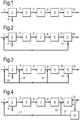
- Figure 1 depicts the process according to the present invention
- Figure 2 depicts a preferred embodiment of the present invention
- Figure 3 depicts a further preferred embodiment of the process according to the present invention.
- an atmospheric or reduced pressure hydrocarbon oil residue is passed via a line 1 into a deasphalting unit 2 in which a deasphalted product and an asphaltic product are obtained. At least part of the deasphalted product is passed via a line 3 into a hydrodemetallization unit 5 and the asphaltic product is withdrawn from the deasphalting unit 2 via a line 4. At least part of the hydrodemetallized product as obtained in hydrodemetallization unit 5 is passed via a line 6 to hydrotreating unit 7. At least part of the hydrotreated product as obtained in the hydrotreating unit 7 is then passed to a hydrocracking unit 9 via a line 8. At least part of the hydrocracked product as obtaind in the hydrocracking unit 9 is passed via a line 10 to a fractionating unit 11 from which at least a middle distillate fraction is recovered via a line 12.
- Figure 2 is an extension of Figure 1 in that in the fractionating unit 11 also a heavy residual fraction is obtained which is withdrawn via a line 13 from the fractionating unit 11 and at least part of the heavy residual fraction is recycled to the deasphalting unit 2.
- Figure 3 is an extension of Figure 2 in that in the fractionating unit 11 also a heavy residual fraction is obtained which is withdrawn via a line 13 from the fractionating unit 11 and at least part of the heavy residual fraction is recycled via a line 14 to the hydrocracking unit 9 and/or at least part of the heavy residual fraction is recycled via a line 15 to the hydrodemetallization unit 5 and/or at least part of the heavy residual fraction is recycled via a line 16 to the deasphalting unit 2.
- Figure 4 is an extension of Figure 1 in that in the fractionating unit 11 also a heavy residual fraction is obtained which is withdrawn via a line 13 from the fractionating unit 11 and at least part of the heavy residual fraction is passed via the line 13 to a hydrocracking unit 14. At least part of the hydrocracked product as obtained in the hydrocracking unit 14 is recycled to fractionating unit 11 via lines 15 and 16 and at least part of the heavy residual fraction as obtained in the fractionating unit 11 is recycled via lines 15 and 17 to the deasphalting unit 2.
Landscapes
- Chemical & Material Sciences (AREA)
- Oil, Petroleum & Natural Gas (AREA)
- Engineering & Computer Science (AREA)
- Organic Chemistry (AREA)
- Chemical Kinetics & Catalysis (AREA)
- General Chemical & Material Sciences (AREA)
- Combustion & Propulsion (AREA)
- Production Of Liquid Hydrocarbon Mixture For Refining Petroleum (AREA)
Priority Applications (2)
| Application Number | Priority Date | Filing Date | Title |
|---|---|---|---|
| PL14819014T PL3087162T3 (pl) | 2013-12-24 | 2014-12-22 | Sposób wytwarzania średnich destylatów |
| EP14819014.3A EP3087162B1 (en) | 2013-12-24 | 2014-12-22 | Process for producing middle distillates |
Applications Claiming Priority (3)
| Application Number | Priority Date | Filing Date | Title |
|---|---|---|---|
| EP13199599 | 2013-12-24 | ||
| EP14819014.3A EP3087162B1 (en) | 2013-12-24 | 2014-12-22 | Process for producing middle distillates |
| PCT/EP2014/079095 WO2015097199A1 (en) | 2013-12-24 | 2014-12-22 | Process for producing middle distillates |
Publications (2)
| Publication Number | Publication Date |
|---|---|
| EP3087162A1 EP3087162A1 (en) | 2016-11-02 |
| EP3087162B1 true EP3087162B1 (en) | 2019-04-10 |
Family
ID=49880627
Family Applications (1)
| Application Number | Title | Priority Date | Filing Date |
|---|---|---|---|
| EP14819014.3A Active EP3087162B1 (en) | 2013-12-24 | 2014-12-22 | Process for producing middle distillates |
Country Status (5)
| Country | Link |
|---|---|
| EP (1) | EP3087162B1 (pl) |
| KR (1) | KR102444109B1 (pl) |
| CN (2) | CN113214866A (pl) |
| PL (1) | PL3087162T3 (pl) |
| WO (1) | WO2015097199A1 (pl) |
Families Citing this family (4)
| Publication number | Priority date | Publication date | Assignee | Title |
|---|---|---|---|---|
| CN110114445A (zh) | 2016-12-28 | 2019-08-09 | 国际壳牌研究有限公司 | 用于生产中间馏出物的方法 |
| US20180230389A1 (en) | 2017-02-12 | 2018-08-16 | Magēmā Technology, LLC | Multi-Stage Process and Device for Reducing Environmental Contaminates in Heavy Marine Fuel Oil |
| US10604709B2 (en) | 2017-02-12 | 2020-03-31 | Magēmā Technology LLC | Multi-stage device and process for production of a low sulfur heavy marine fuel oil from distressed heavy fuel oil materials |
| CA3252165A1 (en) * | 2022-05-25 | 2023-11-30 | Shell Internationale Research Maatschappij B.V. | PROCESS FOR THE PRODUCTION OF MIDDLE DISTILLATES |
Family Cites Families (5)
| Publication number | Priority date | Publication date | Assignee | Title |
|---|---|---|---|---|
| CA2149595C (en) * | 1994-05-19 | 2005-10-25 | Johan Willem Gosselink | Process for the conversion of a residual hydrocarbon oil |
| EP0697455B1 (en) * | 1994-07-22 | 2001-09-19 | Shell Internationale Research Maatschappij B.V. | Process for producing a hydrowax |
| EP1731588A1 (en) * | 2005-06-08 | 2006-12-13 | Shell Internationale Researchmaatschappij B.V. | A process for upgrading a crude oil product |
| US9284502B2 (en) * | 2012-01-27 | 2016-03-15 | Saudi Arabian Oil Company | Integrated solvent deasphalting, hydrotreating and steam pyrolysis process for direct processing of a crude oil |
| CN104540926A (zh) * | 2012-06-05 | 2015-04-22 | 沙特阿拉伯石油公司 | 用于全原油脱沥青和脱硫的集成式工艺 |
-
2014
- 2014-12-22 WO PCT/EP2014/079095 patent/WO2015097199A1/en not_active Ceased
- 2014-12-22 CN CN202110317927.8A patent/CN113214866A/zh active Pending
- 2014-12-22 PL PL14819014T patent/PL3087162T3/pl unknown
- 2014-12-22 CN CN201480070805.1A patent/CN105849237A/zh active Pending
- 2014-12-22 KR KR1020167019992A patent/KR102444109B1/ko active Active
- 2014-12-22 EP EP14819014.3A patent/EP3087162B1/en active Active
Non-Patent Citations (1)
| Title |
|---|
| None * |
Also Published As
| Publication number | Publication date |
|---|---|
| PL3087162T3 (pl) | 2019-09-30 |
| CN113214866A (zh) | 2021-08-06 |
| WO2015097199A1 (en) | 2015-07-02 |
| KR102444109B1 (ko) | 2022-09-15 |
| CN105849237A (zh) | 2016-08-10 |
| EP3087162A1 (en) | 2016-11-02 |
| KR20160102510A (ko) | 2016-08-30 |
Similar Documents
| Publication | Publication Date | Title |
|---|---|---|
| KR102327288B1 (ko) | 다단 잔유(resid) 수소첨가분해 | |
| RU2509798C2 (ru) | Способ гидрокрекинга с использованием реакторов периодического действия и сырья, содержащего 200 м.д.масс.-2% масс. асфальтенов | |
| KR101829113B1 (ko) | 잔사유 수소첨가분해 및 용매 탈아스팔트화의 통합 | |
| US10221366B2 (en) | Residue hydrocracking | |
| CA2897212C (en) | Residue hydrocracking processing | |
| EP3562916A1 (en) | Process for producing middle distillates | |
| US10894922B2 (en) | Processing vacuum residuum and vacuum gas oil in ebullated bed reactor systems | |
| KR102444109B1 (ko) | 중간 증류유의 제조 방법 | |
| EP0683218B1 (en) | Process for the conversion of a residual hydrocarbon oil | |
| US20250283004A1 (en) | Process for producing middle distillates | |
| CA2149595C (en) | Process for the conversion of a residual hydrocarbon oil |
Legal Events
| Date | Code | Title | Description |
|---|---|---|---|
| PUAI | Public reference made under article 153(3) epc to a published international application that has entered the european phase |
Free format text: ORIGINAL CODE: 0009012 |
|
| 17P | Request for examination filed |
Effective date: 20160602 |
|
| AK | Designated contracting states |
Kind code of ref document: A1 Designated state(s): AL AT BE BG CH CY CZ DE DK EE ES FI FR GB GR HR HU IE IS IT LI LT LU LV MC MK MT NL NO PL PT RO RS SE SI SK SM TR |
|
| AX | Request for extension of the european patent |
Extension state: BA ME |
|
| DAX | Request for extension of the european patent (deleted) | ||
| STAA | Information on the status of an ep patent application or granted ep patent |
Free format text: STATUS: EXAMINATION IS IN PROGRESS |
|
| 17Q | First examination report despatched |
Effective date: 20170428 |
|
| RAP1 | Party data changed (applicant data changed or rights of an application transferred) |
Owner name: SHELL INTERNATIONALE RESEARCH MAATSCHAPPIJ B.V. |
|
| GRAP | Despatch of communication of intention to grant a patent |
Free format text: ORIGINAL CODE: EPIDOSNIGR1 |
|
| STAA | Information on the status of an ep patent application or granted ep patent |
Free format text: STATUS: GRANT OF PATENT IS INTENDED |
|
| INTG | Intention to grant announced |
Effective date: 20181129 |
|
| RIN1 | Information on inventor provided before grant (corrected) |
Inventor name: VAN DIJK, NICOLAAS |
|
| GRAS | Grant fee paid |
Free format text: ORIGINAL CODE: EPIDOSNIGR3 |
|
| GRAA | (expected) grant |
Free format text: ORIGINAL CODE: 0009210 |
|
| STAA | Information on the status of an ep patent application or granted ep patent |
Free format text: STATUS: THE PATENT HAS BEEN GRANTED |
|
| AK | Designated contracting states |
Kind code of ref document: B1 Designated state(s): AL AT BE BG CH CY CZ DE DK EE ES FI FR GB GR HR HU IE IS IT LI LT LU LV MC MK MT NL NO PL PT RO RS SE SI SK SM TR |
|
| REG | Reference to a national code |
Ref country code: GB Ref legal event code: FG4D |
|
| REG | Reference to a national code |
Ref country code: CH Ref legal event code: EP Ref country code: AT Ref legal event code: REF Ref document number: 1118622 Country of ref document: AT Kind code of ref document: T Effective date: 20190415 |
|
| REG | Reference to a national code |
Ref country code: IE Ref legal event code: FG4D |
|
| REG | Reference to a national code |
Ref country code: DE Ref legal event code: R096 Ref document number: 602014044579 Country of ref document: DE |
|
| REG | Reference to a national code |
Ref country code: NL Ref legal event code: FP |
|
| REG | Reference to a national code |
Ref country code: LT Ref legal event code: MG4D |
|
| REG | Reference to a national code |
Ref country code: AT Ref legal event code: MK05 Ref document number: 1118622 Country of ref document: AT Kind code of ref document: T Effective date: 20190410 |
|
| PG25 | Lapsed in a contracting state [announced via postgrant information from national office to epo] |
Ref country code: AL Free format text: LAPSE BECAUSE OF FAILURE TO SUBMIT A TRANSLATION OF THE DESCRIPTION OR TO PAY THE FEE WITHIN THE PRESCRIBED TIME-LIMIT Effective date: 20190410 Ref country code: ES Free format text: LAPSE BECAUSE OF FAILURE TO SUBMIT A TRANSLATION OF THE DESCRIPTION OR TO PAY THE FEE WITHIN THE PRESCRIBED TIME-LIMIT Effective date: 20190410 Ref country code: SE Free format text: LAPSE BECAUSE OF FAILURE TO SUBMIT A TRANSLATION OF THE DESCRIPTION OR TO PAY THE FEE WITHIN THE PRESCRIBED TIME-LIMIT Effective date: 20190410 Ref country code: NO Free format text: LAPSE BECAUSE OF FAILURE TO SUBMIT A TRANSLATION OF THE DESCRIPTION OR TO PAY THE FEE WITHIN THE PRESCRIBED TIME-LIMIT Effective date: 20190710 Ref country code: HR Free format text: LAPSE BECAUSE OF FAILURE TO SUBMIT A TRANSLATION OF THE DESCRIPTION OR TO PAY THE FEE WITHIN THE PRESCRIBED TIME-LIMIT Effective date: 20190410 Ref country code: PT Free format text: LAPSE BECAUSE OF FAILURE TO SUBMIT A TRANSLATION OF THE DESCRIPTION OR TO PAY THE FEE WITHIN THE PRESCRIBED TIME-LIMIT Effective date: 20190910 Ref country code: FI Free format text: LAPSE BECAUSE OF FAILURE TO SUBMIT A TRANSLATION OF THE DESCRIPTION OR TO PAY THE FEE WITHIN THE PRESCRIBED TIME-LIMIT Effective date: 20190410 Ref country code: LT Free format text: LAPSE BECAUSE OF FAILURE TO SUBMIT A TRANSLATION OF THE DESCRIPTION OR TO PAY THE FEE WITHIN THE PRESCRIBED TIME-LIMIT Effective date: 20190410 |
|
| PG25 | Lapsed in a contracting state [announced via postgrant information from national office to epo] |
Ref country code: LV Free format text: LAPSE BECAUSE OF FAILURE TO SUBMIT A TRANSLATION OF THE DESCRIPTION OR TO PAY THE FEE WITHIN THE PRESCRIBED TIME-LIMIT Effective date: 20190410 Ref country code: BG Free format text: LAPSE BECAUSE OF FAILURE TO SUBMIT A TRANSLATION OF THE DESCRIPTION OR TO PAY THE FEE WITHIN THE PRESCRIBED TIME-LIMIT Effective date: 20190710 Ref country code: RS Free format text: LAPSE BECAUSE OF FAILURE TO SUBMIT A TRANSLATION OF THE DESCRIPTION OR TO PAY THE FEE WITHIN THE PRESCRIBED TIME-LIMIT Effective date: 20190410 Ref country code: GR Free format text: LAPSE BECAUSE OF FAILURE TO SUBMIT A TRANSLATION OF THE DESCRIPTION OR TO PAY THE FEE WITHIN THE PRESCRIBED TIME-LIMIT Effective date: 20190711 |
|
| PG25 | Lapsed in a contracting state [announced via postgrant information from national office to epo] |
Ref country code: IS Free format text: LAPSE BECAUSE OF FAILURE TO SUBMIT A TRANSLATION OF THE DESCRIPTION OR TO PAY THE FEE WITHIN THE PRESCRIBED TIME-LIMIT Effective date: 20190810 Ref country code: AT Free format text: LAPSE BECAUSE OF FAILURE TO SUBMIT A TRANSLATION OF THE DESCRIPTION OR TO PAY THE FEE WITHIN THE PRESCRIBED TIME-LIMIT Effective date: 20190410 |
|
| REG | Reference to a national code |
Ref country code: DE Ref legal event code: R097 Ref document number: 602014044579 Country of ref document: DE |
|
| PG25 | Lapsed in a contracting state [announced via postgrant information from national office to epo] |
Ref country code: DK Free format text: LAPSE BECAUSE OF FAILURE TO SUBMIT A TRANSLATION OF THE DESCRIPTION OR TO PAY THE FEE WITHIN THE PRESCRIBED TIME-LIMIT Effective date: 20190410 Ref country code: SK Free format text: LAPSE BECAUSE OF FAILURE TO SUBMIT A TRANSLATION OF THE DESCRIPTION OR TO PAY THE FEE WITHIN THE PRESCRIBED TIME-LIMIT Effective date: 20190410 Ref country code: EE Free format text: LAPSE BECAUSE OF FAILURE TO SUBMIT A TRANSLATION OF THE DESCRIPTION OR TO PAY THE FEE WITHIN THE PRESCRIBED TIME-LIMIT Effective date: 20190410 Ref country code: RO Free format text: LAPSE BECAUSE OF FAILURE TO SUBMIT A TRANSLATION OF THE DESCRIPTION OR TO PAY THE FEE WITHIN THE PRESCRIBED TIME-LIMIT Effective date: 20190410 Ref country code: CZ Free format text: LAPSE BECAUSE OF FAILURE TO SUBMIT A TRANSLATION OF THE DESCRIPTION OR TO PAY THE FEE WITHIN THE PRESCRIBED TIME-LIMIT Effective date: 20190410 |
|
| PLBE | No opposition filed within time limit |
Free format text: ORIGINAL CODE: 0009261 |
|
| STAA | Information on the status of an ep patent application or granted ep patent |
Free format text: STATUS: NO OPPOSITION FILED WITHIN TIME LIMIT |
|
| PG25 | Lapsed in a contracting state [announced via postgrant information from national office to epo] |
Ref country code: SM Free format text: LAPSE BECAUSE OF FAILURE TO SUBMIT A TRANSLATION OF THE DESCRIPTION OR TO PAY THE FEE WITHIN THE PRESCRIBED TIME-LIMIT Effective date: 20190410 Ref country code: IT Free format text: LAPSE BECAUSE OF FAILURE TO SUBMIT A TRANSLATION OF THE DESCRIPTION OR TO PAY THE FEE WITHIN THE PRESCRIBED TIME-LIMIT Effective date: 20190410 |
|
| 26N | No opposition filed |
Effective date: 20200113 |
|
| PG25 | Lapsed in a contracting state [announced via postgrant information from national office to epo] |
Ref country code: TR Free format text: LAPSE BECAUSE OF FAILURE TO SUBMIT A TRANSLATION OF THE DESCRIPTION OR TO PAY THE FEE WITHIN THE PRESCRIBED TIME-LIMIT Effective date: 20190410 |
|
| PG25 | Lapsed in a contracting state [announced via postgrant information from national office to epo] |
Ref country code: SI Free format text: LAPSE BECAUSE OF FAILURE TO SUBMIT A TRANSLATION OF THE DESCRIPTION OR TO PAY THE FEE WITHIN THE PRESCRIBED TIME-LIMIT Effective date: 20190410 |
|
| REG | Reference to a national code |
Ref country code: DE Ref legal event code: R119 Ref document number: 602014044579 Country of ref document: DE |
|
| REG | Reference to a national code |
Ref country code: CH Ref legal event code: PL |
|
| PG25 | Lapsed in a contracting state [announced via postgrant information from national office to epo] |
Ref country code: MC Free format text: LAPSE BECAUSE OF FAILURE TO SUBMIT A TRANSLATION OF THE DESCRIPTION OR TO PAY THE FEE WITHIN THE PRESCRIBED TIME-LIMIT Effective date: 20190410 |
|
| GBPC | Gb: european patent ceased through non-payment of renewal fee |
Effective date: 20191222 |
|
| PG25 | Lapsed in a contracting state [announced via postgrant information from national office to epo] |
Ref country code: FR Free format text: LAPSE BECAUSE OF NON-PAYMENT OF DUE FEES Effective date: 20191231 Ref country code: DE Free format text: LAPSE BECAUSE OF NON-PAYMENT OF DUE FEES Effective date: 20200701 Ref country code: IE Free format text: LAPSE BECAUSE OF NON-PAYMENT OF DUE FEES Effective date: 20191222 Ref country code: GB Free format text: LAPSE BECAUSE OF NON-PAYMENT OF DUE FEES Effective date: 20191222 Ref country code: LU Free format text: LAPSE BECAUSE OF NON-PAYMENT OF DUE FEES Effective date: 20191222 |
|
| PG25 | Lapsed in a contracting state [announced via postgrant information from national office to epo] |
Ref country code: LI Free format text: LAPSE BECAUSE OF NON-PAYMENT OF DUE FEES Effective date: 20191231 Ref country code: CH Free format text: LAPSE BECAUSE OF NON-PAYMENT OF DUE FEES Effective date: 20191231 |
|
| PG25 | Lapsed in a contracting state [announced via postgrant information from national office to epo] |
Ref country code: CY Free format text: LAPSE BECAUSE OF FAILURE TO SUBMIT A TRANSLATION OF THE DESCRIPTION OR TO PAY THE FEE WITHIN THE PRESCRIBED TIME-LIMIT Effective date: 20190410 |
|
| PG25 | Lapsed in a contracting state [announced via postgrant information from national office to epo] |
Ref country code: HU Free format text: LAPSE BECAUSE OF FAILURE TO SUBMIT A TRANSLATION OF THE DESCRIPTION OR TO PAY THE FEE WITHIN THE PRESCRIBED TIME-LIMIT; INVALID AB INITIO Effective date: 20141222 Ref country code: MT Free format text: LAPSE BECAUSE OF FAILURE TO SUBMIT A TRANSLATION OF THE DESCRIPTION OR TO PAY THE FEE WITHIN THE PRESCRIBED TIME-LIMIT Effective date: 20190410 |
|
| PG25 | Lapsed in a contracting state [announced via postgrant information from national office to epo] |
Ref country code: MK Free format text: LAPSE BECAUSE OF FAILURE TO SUBMIT A TRANSLATION OF THE DESCRIPTION OR TO PAY THE FEE WITHIN THE PRESCRIBED TIME-LIMIT Effective date: 20190410 |
|
| PGFP | Annual fee paid to national office [announced via postgrant information from national office to epo] |
Ref country code: PL Payment date: 20250929 Year of fee payment: 12 |
|
| PGFP | Annual fee paid to national office [announced via postgrant information from national office to epo] |
Ref country code: NL Payment date: 20251003 Year of fee payment: 12 |
|
| PGFP | Annual fee paid to national office [announced via postgrant information from national office to epo] |
Ref country code: BE Payment date: 20251003 Year of fee payment: 12 |