EP3088309A1 - Procédé de fabrication d'une balle d'étoupe de filtre emballée - Google Patents
Procédé de fabrication d'une balle d'étoupe de filtre emballée Download PDFInfo
- Publication number
- EP3088309A1 EP3088309A1 EP15165662.6A EP15165662A EP3088309A1 EP 3088309 A1 EP3088309 A1 EP 3088309A1 EP 15165662 A EP15165662 A EP 15165662A EP 3088309 A1 EP3088309 A1 EP 3088309A1
- Authority
- EP
- European Patent Office
- Prior art keywords
- filter tow
- bale
- film part
- compressed
- baler
- Prior art date
- Legal status (The legal status is an assumption and is not a legal conclusion. Google has not performed a legal analysis and makes no representation as to the accuracy of the status listed.)
- Withdrawn
Links
- 238000000034 method Methods 0.000 title claims abstract description 107
- 238000004519 manufacturing process Methods 0.000 title description 13
- 239000000463 material Substances 0.000 claims abstract description 187
- 238000004806 packaging method and process Methods 0.000 claims abstract description 119
- 239000010408 film Substances 0.000 claims description 146
- 238000003825 pressing Methods 0.000 claims description 51
- 239000013039 cover film Substances 0.000 claims description 11
- 239000011888 foil Substances 0.000 claims description 11
- 238000012856 packing Methods 0.000 claims description 11
- 230000002093 peripheral effect Effects 0.000 claims description 10
- 238000011084 recovery Methods 0.000 claims description 10
- 239000004698 Polyethylene Substances 0.000 claims description 6
- -1 polyethylene Polymers 0.000 claims description 6
- 229920000573 polyethylene Polymers 0.000 claims description 6
- 239000004033 plastic Substances 0.000 claims description 5
- 229920003023 plastic Polymers 0.000 claims description 5
- 238000004026 adhesive bonding Methods 0.000 claims description 4
- 238000003466 welding Methods 0.000 claims description 3
- GNFTZDOKVXKIBK-UHFFFAOYSA-N 3-(2-methoxyethoxy)benzohydrazide Chemical compound COCCOC1=CC=CC(C(=O)NN)=C1 GNFTZDOKVXKIBK-UHFFFAOYSA-N 0.000 claims description 2
- VGGSQFUCUMXWEO-UHFFFAOYSA-N Ethene Chemical compound C=C VGGSQFUCUMXWEO-UHFFFAOYSA-N 0.000 claims description 2
- 239000004952 Polyamide Substances 0.000 claims description 2
- 239000002131 composite material Substances 0.000 claims description 2
- 229920000092 linear low density polyethylene Polymers 0.000 claims description 2
- 239000004707 linear low-density polyethylene Substances 0.000 claims description 2
- 229920001684 low density polyethylene Polymers 0.000 claims description 2
- 239000004702 low-density polyethylene Substances 0.000 claims description 2
- 229920002647 polyamide Polymers 0.000 claims description 2
- 239000005022 packaging material Substances 0.000 description 15
- 235000019504 cigarettes Nutrition 0.000 description 12
- 230000002040 relaxant effect Effects 0.000 description 10
- 230000008569 process Effects 0.000 description 9
- 238000005259 measurement Methods 0.000 description 8
- 238000012545 processing Methods 0.000 description 8
- 230000007547 defect Effects 0.000 description 5
- 238000012858 packaging process Methods 0.000 description 5
- 230000006835 compression Effects 0.000 description 4
- 238000007906 compression Methods 0.000 description 4
- 239000012785 packaging film Substances 0.000 description 4
- 229920006280 packaging film Polymers 0.000 description 4
- OVSKIKFHRZPJSS-UHFFFAOYSA-N 2,4-D Chemical compound OC(=O)COC1=CC=C(Cl)C=C1Cl OVSKIKFHRZPJSS-UHFFFAOYSA-N 0.000 description 3
- 230000008901 benefit Effects 0.000 description 3
- 230000009172 bursting Effects 0.000 description 3
- 230000008859 change Effects 0.000 description 3
- 238000011161 development Methods 0.000 description 3
- 230000018109 developmental process Effects 0.000 description 3
- 239000004744 fabric Substances 0.000 description 3
- FGUUSXIOTUKUDN-IBGZPJMESA-N C1(=CC=CC=C1)N1C2=C(NC([C@H](C1)NC=1OC(=NN=1)C1=CC=CC=C1)=O)C=CC=C2 Chemical compound C1(=CC=CC=C1)N1C2=C(NC([C@H](C1)NC=1OC(=NN=1)C1=CC=CC=C1)=O)C=CC=C2 FGUUSXIOTUKUDN-IBGZPJMESA-N 0.000 description 2
- 230000002411 adverse Effects 0.000 description 2
- OIPMQULDKWSNGX-UHFFFAOYSA-N bis[[ethoxy(oxo)phosphaniumyl]oxy]alumanyloxy-ethoxy-oxophosphanium Chemical compound [Al+3].CCO[P+]([O-])=O.CCO[P+]([O-])=O.CCO[P+]([O-])=O OIPMQULDKWSNGX-UHFFFAOYSA-N 0.000 description 2
- 230000003111 delayed effect Effects 0.000 description 2
- 230000001419 dependent effect Effects 0.000 description 2
- 238000011835 investigation Methods 0.000 description 2
- 238000005304 joining Methods 0.000 description 2
- 230000035699 permeability Effects 0.000 description 2
- URAYPUMNDPQOKB-UHFFFAOYSA-N triacetin Chemical compound CC(=O)OCC(OC(C)=O)COC(C)=O URAYPUMNDPQOKB-UHFFFAOYSA-N 0.000 description 2
- QTBSBXVTEAMEQO-UHFFFAOYSA-M Acetate Chemical compound CC([O-])=O QTBSBXVTEAMEQO-UHFFFAOYSA-M 0.000 description 1
- 239000000853 adhesive Substances 0.000 description 1
- 230000001070 adhesive effect Effects 0.000 description 1
- 239000002390 adhesive tape Substances 0.000 description 1
- 239000002249 anxiolytic agent Substances 0.000 description 1
- 230000015572 biosynthetic process Effects 0.000 description 1
- 229920002678 cellulose Polymers 0.000 description 1
- 239000001913 cellulose Substances 0.000 description 1
- 239000003795 chemical substances by application Substances 0.000 description 1
- 230000000694 effects Effects 0.000 description 1
- 235000013773 glyceryl triacetate Nutrition 0.000 description 1
- 239000001087 glyceryl triacetate Substances 0.000 description 1
- 230000002427 irreversible effect Effects 0.000 description 1
- 238000000691 measurement method Methods 0.000 description 1
- 238000012986 modification Methods 0.000 description 1
- 230000004048 modification Effects 0.000 description 1
- 230000003287 optical effect Effects 0.000 description 1
- 239000002985 plastic film Substances 0.000 description 1
- 229920006255 plastic film Polymers 0.000 description 1
- 230000036316 preload Effects 0.000 description 1
- 238000003672 processing method Methods 0.000 description 1
- 230000002441 reversible effect Effects 0.000 description 1
- 238000007789 sealing Methods 0.000 description 1
- 235000019613 sensory perceptions of taste Nutrition 0.000 description 1
- 238000009987 spinning Methods 0.000 description 1
- 239000007921 spray Substances 0.000 description 1
- 238000003892 spreading Methods 0.000 description 1
- 230000007480 spreading Effects 0.000 description 1
- 230000002195 synergetic effect Effects 0.000 description 1
- 230000035923 taste sensation Effects 0.000 description 1
- 238000012360 testing method Methods 0.000 description 1
- 229960002622 triacetin Drugs 0.000 description 1
- 238000002604 ultrasonography Methods 0.000 description 1
- 230000037303 wrinkles Effects 0.000 description 1
Images

Classifications
-
- B—PERFORMING OPERATIONS; TRANSPORTING
- B65—CONVEYING; PACKING; STORING; HANDLING THIN OR FILAMENTARY MATERIAL
- B65B—MACHINES, APPARATUS OR DEVICES FOR, OR METHODS OF, PACKAGING ARTICLES OR MATERIALS; UNPACKING
- B65B27/00—Bundling particular articles presenting special problems using string, wire, or narrow tape or band; Baling fibrous material, e.g. peat, not otherwise provided for
- B65B27/12—Baling or bundling compressible fibrous material, e.g. peat
-
- B—PERFORMING OPERATIONS; TRANSPORTING
- B65—CONVEYING; PACKING; STORING; HANDLING THIN OR FILAMENTARY MATERIAL
- B65B—MACHINES, APPARATUS OR DEVICES FOR, OR METHODS OF, PACKAGING ARTICLES OR MATERIALS; UNPACKING
- B65B27/00—Bundling particular articles presenting special problems using string, wire, or narrow tape or band; Baling fibrous material, e.g. peat, not otherwise provided for
- B65B27/12—Baling or bundling compressible fibrous material, e.g. peat
- B65B27/125—Baling or bundling compressible fibrous material, e.g. peat and wrapping or bagging
-
- B—PERFORMING OPERATIONS; TRANSPORTING
- B65—CONVEYING; PACKING; STORING; HANDLING THIN OR FILAMENTARY MATERIAL
- B65B—MACHINES, APPARATUS OR DEVICES FOR, OR METHODS OF, PACKAGING ARTICLES OR MATERIALS; UNPACKING
- B65B11/00—Wrapping, e.g. partially or wholly enclosing, articles or quantities of material, in strips, sheets or blanks, of flexible material
- B65B11/58—Applying two or more wrappers, e.g. in succession
- B65B11/585—Applying two or more wrappers, e.g. in succession to stacked articles, e.g. pallettised loads
-
- B—PERFORMING OPERATIONS; TRANSPORTING
- B65—CONVEYING; PACKING; STORING; HANDLING THIN OR FILAMENTARY MATERIAL
- B65B—MACHINES, APPARATUS OR DEVICES FOR, OR METHODS OF, PACKAGING ARTICLES OR MATERIALS; UNPACKING
- B65B51/00—Devices for, or methods of, sealing or securing package folds or closures; Devices for gathering or twisting wrappers, or necks of bags
- B65B51/10—Applying or generating heat or pressure or combinations thereof
Definitions
- the present invention relates to a method of producing a packaged bale of high density filter tow material.
- filter tow material which consists of endless cellulose 2,5-acetate filaments.
- the individual filaments are combined after spinning into a band and then crimped in a stuffer box. Thereafter, the product is dried and then laid loosely in several meters high Grekannen.
- the filter tow material is distributed uniformly as a layer over the cross-sectional area of the filling can by movements that change in the longitudinal and transverse directions of a laying unit. As many layers are deposited on each other until the filter tow pack has reached the desired mass and height in the filling can. Packing weights of several 100 kg are usual in this area.
- the inserted into the Grekannen filter tow material is pressed into a filter tow bales and end packed for the purpose of transport to the filter or cigarette manufacturer.
- the bales provided for further processing to cigarette filters weigh between 350 and 650 kg, exceptionally high density bales with weights of up to 900 kg, so-called “high-density tow bales" are available, as described for example in the document US 4,577,752 A are described.
- the filter tow material is removed from the bale and placed on a filter rod machine, as described for example in the publication US 5,460,590 A is described, processed into filter rods.
- the filter tow material When processing filter tow material into filter rods in a filter rod machine, the filter tow material is thickened as much as possible in a processing part. To bulge the filter tow material this is usually exploded by means of compressed air operated spreader nozzles and stretched by a system of drafting rollers, in particular with threaded or screw surfaces. After that the spreading becomes Filter tow material fed to a triacetin spray box, in which the acetate surface of the filter tow material is dissolved and tackified. In the format part of the filter rod machine, the filter tow band is gathered and compressed to the cross section of the future filter rod. The filaments stick together and form a three-dimensional spatial network structure with the filter hardness desired for further processing and for the consumers.
- the essential quality feature for the filter or cigarette manufacturer is the homogeneity with regard to the draw resistance, since this influences the taste sensation of the smoker and the filter performance.
- the still acceptable Switzerlandwiderstandsstreuonne are dependent on the absolute value of the draw resistance.
- the homogeneity of the filter rods with respect to the draw resistance is determined not only by the quality of the filter tow material and the processing method in the filter rod machine, but in particular by the type of packaging of the filter tow material.
- the type of packaging of the filter tow material is generally decisive for an undisturbed flow of the filter tow material from the filter tow bale to the filter rod machine.
- the packaging process includes on the one hand compression of the filter tow material deposited in the filling can and, on the other hand, subsequent packaging of the compressed filter tow material into an end-packed filter tow bale.
- the filter tow material is pressed in a baling press in the direction of the superposed layers of the filter tow material previously deposited in the filling can.
- a baler 10, 10 'of the baler acts in the direction of the superposed layers of the filter tow material, so that the initial height of the filter tow material laid down in layers in the filling can is reduced.
- the filter tow material does not exhibit complete elastic (reversible) behavior since the filter tow material stored in layers in the filling can does not regain its original height when over the press die 10, 10 'of the baler vertical pressing force applied to the filter tow material layers is removed again. Rather, the height at which the filter tow material grows again when the pressing force exerted on the press ram 10, 10 'of the baling press is suspended depends in particular on how long and at which pressing pressure the pressing was carried out beforehand.
- the filter tow material compressed in the filling can it is customary to coat the still under compressive stress filter tow pack, in particular within the pressing device, with a packaging material (packaging material). After wrapping the compressed filter tow bale provided in the baler, usually the baler is opened, thus removing the compressive stress exerted on the filter tow pack.
- a packaging material packaging material
- the filter tow pack tends to expand after release from the baler and that perpendicular to the filter tow material layers and opposite of the baler originally exerted pressing force.
- This elastic (relaxing) recovery proportion of the filter tow material is the lower, the longer the pressing time and the higher the pressing force during pressing of the filter tow bale in the filling can. Only the relaxing restorative component, after being released from the baler, represents the elastic restoring force which must be absorbed by the packaging material of the filter tow pack so that the bale holds together.
- Conventional packaging materials are cardboard, which are mechanically held together by transfiguration or gluing, or plastic fabric, which are closed, for example by a Velcro.
- the two last-mentioned types of packaging have the disadvantage that the relaxing recovery component existing after the release of the compressed bale, i. the elastic restoring force of the filter tow material, is absorbed by the packaging material. This inevitably leads to undesirable bulges on the top and bottom of the bale. Although these bulges do not interfere with the intended use of the filter tow material in the filter rod machine for the production of filter rods, but prevent safe stacking of the filter tow bales thus produced.
- the relaxing recovery component occurring after release of the bale from the baler ie the elastic restoring force of the filter tow material
- the elastic restoring force of the filter tow material can be reduced by correspondingly reducing the filling quantity of the bale.
- this measure has the disadvantage that in the further processing of the filter tow material, in particular in a filter rod machine due to the reduced bale capacity relatively quickly the filter tow material of a bale is consumed and the filter rod machine with a new filter tow bales must be fitted. This leads to relatively frequent interruptions in the filter rod production, which is not accepted by the filter rod manufacturer.
- Another measure for reducing the relaxant recovery rate of the filter tow material after release from the baler would be to increase the pressing force exerted in the baler during compression of the filter tow material.
- this leads to quality defects in the compressed filter tow material and thus to quality defects in the filter tow material produced Cigarette filters.
- an increased pressing force would have a negative effect on the ball outlet on the filter rod machine.
- Another measure for reducing the relaxed rebound rate of the filter tow material after release from the baler could be to correspondingly extend the pressing time to compensate for the irreversible (ie, non-elastic) rebound rate in the filter tow material at the expense of the relaxing rebound rate to increase.
- an extension of the pressing time inevitably reduces the press throughput, which is undesirable and unacceptable on the part of the filter tow manufacturer.
- the present invention has the object to provide a method for producing a packed bale of high-density filter tow material, in which the failure rate of the manufactured, packaged bales is reduced and in particular less than 1%, where at the same time previously described and occurring in the prior art disadvantages are avoided.
- the method should also be suitable for producing a filter tow bale in which the filling amount of the bale is not undershot by the filter rod manufacturers still accepted minimum, while the risk of introducing quality defects in the filter tow material at the same time Pressing minimized and the bale drain on the filter rod machine is not deteriorated.
- a filter tow bale compressed in a baler is provided in cuboidal shape, with the compressed filter tow bale then being filled with a compressed filter tow. Bales completely enclosing, airtight packaging wrapper is packed.
- the packaging wrapper is applied to the compressed filter tow bales such that at least 80%, preferably at least 90% and more preferably at least 95% of the packaging wrap directly abuts the high density filter tow material and thus contacts or at least less than 15 mm from the high density filter tow material.
- the risk of a bale place after release of the packaged filter tow bale from the baler can be significantly reduced, despite the constant filling capacity of the bale.
- the commonly used pressing process pressing force and pressing time
- the commonly used pressing process does not have to be changed, so that for carrying out the method according to the invention can be used in the usual way in the production of high-density bales of filter tow material balers and press processes used.
- the method of the present invention reduce the failure rate but also the risk of quality defects occurring in the filter tow material during the pressing operation, while at the same time not adversely affecting a desired bale drain on the filter rod machine desired by the cigarette or filter manufacturers.
- Another significant advantage, which is achieved with the manufacturing method according to the invention is to be seen in the fact that the increase in the height of the filter tow bale after release from the baler according to a predetermined event sequence takes place, wherein in particular the extent of the height change is limited upwards.
- the maximum final height of the finished packaged filter tow bale after release from the baler to a pre-definable maximum value in advance adjustable.
- bales produced by the novel process also stack easily. Bales can thus be produced together with the maximum height of the finished bale which has been pre-determined by the method according to the invention and released from the baler.
- the bales can be stacked under optimal space utilization in double layers in standard containers.
- high-density filter tow material in particular filter tow material with a packing density of at least 300 kg / m3 and at most 800 kg / m3.
- the balers commonly used in the filter tow production are suitable. These are balers with a pressing force of at least 100 t / m2, whereby a maximum pressing force of 600 t / m2 should not be exceeded.
- the compressed in the baler filter tow bales is provided by pressing it with a pressing force of at least 100 t / m2 and a pressing time of at least 4 to 20 min., Preferably 5 to 15 min. Pressed.
- the packaging wrapper is applied to the compressed filter tow bale which bears at least 80% of the wrapper wrap directly on the filter tow material or at least less than 15 mm from the filter tow wrap.
- Material is spaced, different solutions come into question.
- a measuring arrangement with at least one non-contact sensor unit is suitable for this purpose, wherein this sensor unit preferably has at least one distance sensor and preferably has at least one 2D distance sensor array. With the at least one distance sensor or the at least one 2D distance sensor array, a distance between the highly compressed filter tow material on the one hand and the packaging material of the packaging wrapper on the other hand can be detected exactly.
- the distance between the non-contact, at least one distance sensor or non-contact, at least one 2D distance sensor array and the filter tow material on the one hand and the distance between the non-contact, at least a distance sensor or non-contact, at least one 2D Abstandssensorarray and the packaging casing on the other hand is detected, in which case taking into account the thickness of the packaging wrapper, the actual distance between the packaging wrapper and the filter tow material can be determined.
- the non-contact distance sensor or the non-contact 2D distance sensor array has at least one light, infrared, radio wave, microwave, Terraherzstrahlen- or ultrasonic sensor.
- a distance measurement between the filter tow material and the packaging wrapper by means of a transit time and phase position measurement with radio waves, light, infrared or ultrasound feasible. Furthermore, it can be provided that the distance measurement by means of triangulation is feasible.
- the distance between the sensor device and the filter tow material may be determined, again following the application of the packaging wrapper, a 2D distance measurement, but with reference herein on the distance between the sensor device and the packaging wrapper. By comparing the two recorded 2D distance measurements can be easily be determined on the actual distance between the applied packaging wrapper and the filter tow material.
- the amount of height increase in releasing the bale from the baler must not exceed a maximum value to effectively prevent the packaging material from absorbing excessive forces resulting from the expansion of the filter tow material. Not only would this negatively affect the flatness of the top and bottom of the finished bale, but it would also result in the packaging material having to be designed to absorb these forces.
- the amount of air trapped in the packaging of the compressed filter tow bale between the packaging wrapper and the high density filter tow material may preferably be determined indirectly by a distance measurement between the packaging wrapper and the high density filter tow material.
- a distance measurement in particular the optical measuring methods described above come into question.
- the filter tow bale compressed in the baler is provided in such a way that it has a cuboid shape with a preferably rectangular shape adapted to the dimensions of a transport pallet, in particular Europool pallet
- the filter tow bales should be provided such that the compressed in the baler filter tow bales has a bale density of at least 300 kg / m3.
- the film preferably consists of polyethylene, in particular LDPE, or of modified polyethylene (LLDPE) or of a composite film with a polyamide and a polyethylene layer.
- a packaging film for advertising and / or aesthetic purposes can be used as a packaging film in particular a colored or printed film. This is particularly useful if the filter tow material to be packaged is light-sensitive.
- the packaging film preferably has a thickness of 100 to 400 .mu.m so that it can simultaneously serve as a transport packaging. As already stated, it is not necessary in the case of a bale produced by the method according to the invention to add an additional transport packaging made of cardboard, plastic fabric etc. around the packaging film of the bale.
- the provision of the compressed filter tow bale in cuboid shape is generally carried out by means of a baler known from the prior art.
- the method according to the invention can be carried out so that the quantity of filter tow material intended for packaging is first mechanically compressed in the baler and then wrapped with the packaging casing, wherein the airtight sealing of the packaging casing preferably takes place within the baler, so that the entire manufacturing process can be carried out in one place.
- the compressed filter tow bale is fed in an "auxiliary packaging", which may for example consist of retaining clips, a packaging station, where the auxiliary packaging is removed and the envelope of the compressed filter tow bale is made with the airtight packaging film.
- auxiliary packaging which may for example consist of retaining clips
- a packaging station where the auxiliary packaging is removed and the envelope of the compressed filter tow bale is made with the airtight packaging film.
- This embodiment would have the advantage that not all of the process is carried out in the baler, so that the baler has a higher availability.
- the pressing cycle of shorter duration and there are several degrees of freedom in the application of Packaging cover, as the compressed bale in the packing station is accessible from all sides.
- the compressed filter tow bale is packed with the packaging casing in such a way that the volume enclosed by the packaging casing is released after the packed filter tow bale has been released the baler can increase by at least 32 liters and preferably by at least 70 liters, without the material of the packaging wrapper being stretched or stretched.
- a "growth reserve” is intentionally provided in the packaging material surrounding the compressed bale.
- This growth reserve can for example be introduced into the packaging material, that consciously the packaging material partially has a wrinkle area, which unfolds when releasing the packaged bale and thus in a predictable manner an increase in the bale height up to a pre-determined over the fold area end height of the Bale allows.
- the guaranteed over the fold area growth reserve is preferably chosen so that in the expansion of the filter tow material after release from the baler an increase in volume of the volume enclosed by the airtight packaging envelope volume is guaranteed until the thereby adjusting inside the bale negative pressure compared to the outside atmosphere large is enough to equalize the restoring forces of the filter tow material as completely as possible, so that while the material of the packaging wrapper is neither stretched or stretched and only negligible or no forces must be absorbed by the packaging material.
- the filter tow bale compressed in the baler is provided in a cuboid between a cover film part and a bottom film part , wherein in the subsequent packaging step, the compressed filter tow bales completely enclosing, airtight packaging wrapper is formed by welding or gluing the two film parts.
- a sleeve-film part is applied to the side surfaces of the compressed filter tow bale. Subsequently, the opposite end portions of the sleeve film part are merged frontally and connected to each other. In addition, the lateral surface of the sleeve foil part is connected to the bottom foil part and the lid foil part such that a total of the compressed filter tow bales completely enclosing, airtight packaging wrapper is formed.
- the sleeve film part is applied in such a way that the side surfaces of the compressed filter tow bale that at least 80%, preferably at least 90% and more preferably at least 95% of the lateral surface of the sleeve film part on the high-density filter Tow material abuts directly and this is so touched or spaced at least less than 15 mm from the high-density filter tow material.
- shell surface of the sleeve film part as used herein means the ceiling surface of the sleeve film part, which in the finished state of the filter tow bale released from the baler points towards and touches the filter tow material.
- touched means that at least 80%, preferably at least 90%, and more preferably at least 95% of the packaging wrapper is directly adjacent to the high density filter tow material and touches it, or at least less than 15mm is spaced from the high density filter tow material.
- the sleeve film part is designed as a flat film.
- a maximum gas permeability of 10,000 cc / (m 2 ⁇ dx bar), and at most about 200 cc / (m 2 ⁇ dx bar) and more preferably at most about 20 cc / (m 2 ⁇ dx bar) should be measured, measured according to DIN 2000-07 (Date of filing) at 23 ° C and 75% relative humidity for air.
- the tearing force of the material of the packaging wrapper should be at least 10 N / 15 mm, in particular at least about 100 N / 15 mm, and preferably at least about 200 N / 15 mm, measured in each case DIN EN ISO527-1 "General principles for determining the tensile properties of plastics "or measured by DIN EN ISO527-3 "Test conditions for foils and sheets "(respective status: filing date).
- the material serving as packaging wrapper preferably is applied with bias to achieve that the packaging wrapper can be applied to the compressed filter tow bales such that at least 80%, preferably at least 90% and more preferably at least 95% of the wrapper wrap is directly attached to the high density filter tow. Material abuts and therefore touched or at least less than 15 mm from the high density filter tow material is spaced.
- the extensibility of the material used as a packaging wrapper should be a maximum of 1000 mm / 15 mm measured according to DIN EN ISO 527 (see above).
- the yield stress at 10% elongation in the longitudinal direction according to DIN EN ISO 527 (see above) should not exceed 38 to 47 N / 15 mm.
- the packaging casing preferably also represents the transport packaging of the filter tow bale, it is particularly advantageous in this context if the specific piercing force of the material of the packaging casing is based on the 0.8 mm mandrel DIN EN 14477 (Edition 2004-06 ) is at least 8N.
- the sleeve film part which has these conditions, in particular with regard to the breaking strength and elasticity, it is advantageous if, after the application of the sleeve film part to the side surfaces of the compressed filter tow bale, the sleeve film part is biased.
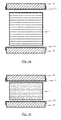
- filter tow material 1 is introduced in a baling press, as described in US Pat FIG. 1a is indicated schematically.
- the baling press which has, for example, a pressing force of 300 to 400 t, the filter tow material 1 is compressed to the desired pack size (cf. FIG. 1b ).
- the pressing is preferably carried out such that the compressed in the baler filter tow bales has a packing density of at least 250 kg / m2 and preferably a packing density of at least 300 kg / m2.
- the pack size i. the height of the compressed in the baler filter tow bale is preferably at least 700 mm.
- the press die 10, 10 'of the baler is prepared according to before filling the filter tow material into the baler or before filling the filter tow material in the filling can of the baler. Specifically, it is provided in the embodiment shown schematically in the drawings that the pressing of the filter tow material in the baler between a lid film part 11 and a bottom film part 12 takes place.
- the bottom of the filling can is garnished with a bottom film part 12. Subsequently, the filter tow material 1 to be pressed is placed in the so-prepared filling can.
- the subsequent bottom and cover film are placed at the correct positions (above or below the bale) even before the filter tow material is pressed.
- the filter tow material 1 is pressed in the baler to form a compressed filter tow bale (cf. FIG. 1b ).
- the actual pressing operation corresponds to the usual pressing processes known from the prior art and is not part of the invention disclosed herein.
- the pressing of the filter tow material in the baling press is carried out according to a predetermined program sequence, so that in the compressed filter tow bale after a predefined or definable event sequence the relaxing rebounding component is reduced.
- the pressing process lasts for at least 4 minutes, and preferably for at least 5 minutes, in order to achieve that the relaxing recovery rate in the filter tow material is sufficiently reduced.
- a compressed filter tow bales is provided in cuboid form in the baler between the lid film part 11 and the bottom film part 12.
- the compressed filter tow bale is packed with an airtight packaging wrapper completely surrounding the compressed filter tow bale.
- a sleeve film part 13 is applied to the side surfaces of the compressed filter tow bale, the sleeve film part 13 having a jacket surface with two opposite end regions. Subsequently, the opposite end portions of the sleeve film part 13 are merged frontally and connected to each other.
- FIG. 1d shown schematically - the lateral surface of the sleeve-film part 13 with the bottom-film part 12 and the lid-film part 11 is connected.
- the joining of the end regions of the sleeve film part 13 with each other and the joining of the lateral surface of the sleeve film part 13 with the bottom film part 12 and the lid film part 11 takes place in such a way that a total of the airtight packaging envelope enclosing the compressed filter tow bales is formed.
- the sleeve film part 13 is applied to the side surface of the compressed filter tow bale so that at least 80%, preferably at least 90%, and more preferably at least 95% of the The lateral surface of the sleeve film part 13 directly abuts against the highly compressed filter tow material and therefore touches it, or at least is spaced less than 15 mm from the highly compressed filter tow material.
- a compressed filter tow bale is provided in the baling press, which has a cuboid shape with a preferably rectangular base area of at least matched to the dimensions of a transport pallet, in particular Europool pallet 6,500 cm 2 and preferably at least 8,000 cm 2, and has a height of at least 75 cm (pack size), and preferably of at least 85 cm.
- the compressed filter tow bale having these dimensions provided in the baler has a bale density of at least 300 kg / m 3 in the exemplary embodiment.
- dimensions of a transport pallet as used herein is meant in particular the dimension of a commonly used transport pallet. This is in particular a transport pallet adapted to the common container dimensions, such as a Europool pallet.
- Europool pallets are based on a basic module of 400 mm x 600 mm. Pallets of this size are also called “1/4 Europool pallets” and correspond to the size of a so-called VDA box.
- the wooden Europool pallets EUR which have been used for many years, measure 800 x 1200 x 144 mm.
- Half of the 800mm x 600mm Europool pallets are also called display pallets. They are called "EUR 6 pallets" by EPAL; another name is Düsseldorfer Palette.
- the sleeve film part 13 is applied in this embodiment to the side surface of the compressed filter tow bale such that in the volume enclosed by the sleeve film part 13, the lid film part 11 and the bottom film part 12 at a temperature of 20 ° C a total of 650 liters of air, preferably a total of at most 450 liters of air and more preferably a total of at most 400 liters of air are included.
- the baler in which prior to pressing the filter tow material, the baler is garnished with a bottom film part 12 and a lid film part 11, and then a sleeve film part 13 around the side surface of the compressed Bale is applied, it is advantageous if the sleeve film part is applied to the side surface of the compressed filter tow bale such that at a temperature of 20 ° C maximum 50 liters of air, preferably at most 30 liters and more preferably at most 10 liters of air is trapped between the shell surface of the sleeve film part and the high-performance filter tow material.
- This application voltage can be easily monitored or monitored via strain gauges or similar sensors.
- an airtight packaging wrapper is provided in the embodiment shown schematically in the drawings, that in a front-side merging of the opposite end portions of the sleeve-foil part 13 formed vertical overlap region a vertically extending weld, in particular fin seam, is formed.
- the sleeve film part is biased in the direction of the vertically extending weld and fixed, in particular temporarily fixed, with the aid of clamps or the like fixing. It is then provided in one exemplary embodiment that a horizontally encircling overlap region is formed between the upper end region of the sleeve film part 13 and a circumferential edge region of the cover film part 11. In the same way, a horizontally encircling overlapping area is formed between the lower end portion of the sleeve sheet member 13 and a peripheral edge portion of the bottom sheet member 12. Following this, in each case a peripheral weld, in particular fin seam is formed in the horizontal circumferential overlap region.
- the vertically extending weld and the circumferential welds in the horizontal circumferential overlap areas are carried out such that with the bottom film part 12, with the lid film part 11 and the sleeve film part 13 a total of the compressed filter tow bales completely enclosing , airtight packaging wrapper is formed.
- the sleeve film part 13 when the sleeve film part 13 abuts against the side surface of the filter tow bale, it is provided that this takes place in such a way that the vertical overlapping region is preferably arranged centrally between two vertically extending corner edges of the filter tow bale.
- the sleeve film part 13 For pretensioning the sleeve film part 13 in the direction of the vertical weld seam, it is then preferably possible to manually slide film material of the cuffed film part 13 in the direction of the vertical weld seam in such a way that the overlapping area is increased in the horizontal direction.
- the sleeve film part 13 is prestressed with an average prestressing force of at least 50 N and preferably of at least 75 N. This preload force can be monitored in a simple manner, for example by attaching according to the strain gauges.
- the circumferential weld seam is formed with a predetermined or definable minimum distance from the bale in the horizontally encircling overlap region.
- This predetermined or definable minimum distance is in a range between 2 to 20 cm, and preferably in a range between 5 to 10 cm. This distance between the bale and the weld ultimately represents the degree to which the finished packaged bale can grow without stress on the packaging when the bale is released from the baler.
- the predetermined or definable minimum distance between the circumferential weld and the bale should be selected depending on the elastic recovery behavior of the compressed filter tow material after release of the filter tow material from the baler.
- the filter tow bale is released from the baler. This is preferably done by progressively increasing the distance between the upper and lower press plates of the baler to allow for gradual expansion of the filter tow material. In this way, voltage spikes are prevented.
- the distance between the upper and lower press plates is increased by 10 to 35 mm, preferably by 15 to 30 mm, and more preferably by 20 to 25 mm.
- the distance between the upper and lower press plates is then increased to at least 1,200 mm.
- the packaging wrapper is applied to the compressed filter tow bales such that at least 80%, preferably at least 90% and more preferably at least 95% of the wrapper wrap directly on the high density filter tow material is applied and therefore touched or at least less than 15 mm away from the high density filter tow material.
- the packaging wrapper is placed around the compressed filter tow bale such that at a temperature of 20 ° C. a maximum of 50 liters, preferably a maximum of 30 liters, and more preferably a maximum of 10 Liters of air between the shell surface of the sleeve film part 13 and the high density filter tow material.
- the filter tow bale compressed in the baler has a cuboid shape with a preferably rectangular base area of at least 6,500 cm 2 and preferably at least 8,500 cm 2 , and a height of at least 75 cm and preferably of at least 85 cm, the filter tow bale in step i) being provided in particular such that the filter tow bale compressed in the baler has a bale density of at least 300 kg / m 3 .
- the packaging casing is applied to the compressed filter tow bales in such a way that in the volume enclosed by the packaging casing at a temperature of 20 ° C a maximum of 650 liters of air, preferably a total of a maximum of 450 liters of air and more preferably a maximum of 400 liters of air are included.
- the filter tow bale compressed in the baler is provided in cuboid form between a cover film part 11 and a bottom film part 12, wherein in the subsequent process step ii) the compressed filter -Tow bales completely enclosing, airtight packaging wrapper is formed by welding or gluing the two film parts.
- step a) the sleeve film part 13 is applied around the side surfaces of the compressed filter tow bale such that at least 80%, preferably at least 90% and more preferably at least 95% of the lateral surface of the sleeves Sheet 13 directly abuts the high density filter tow material and so contacts or at least less than 15 mm from the high density filter tow material.
- the filter tow bales compressed in a baler have a cuboid shape with a preferably rectangular base area of at least 6,500 cm 2 and preferably at least 8,500 cm 2 , and a height of at least 75 cm and preferably of at least 85 cm, wherein in process step i) the filter tow bale is provided such that the compressed in the baler filter tow bales has a bale density of at least 300 kg / m 3 .
- the sleeve film part 13 is applied to the side surfaces of the compressed filter tow bale in such a way that is enclosed by the sleeve film part 13, the cover film part 11 and the bottom film part 12 Volume at a temperature of 20 ° C a maximum of 650 liters of air, preferably a total of at most 450 liters of air and more preferably a total of at most 400 liters of air are included.
- step a) the sleeve film part 13 is applied to the side surfaces of the compressed filter tow bale such that at a temperature of 20 ° C maximum 50 liters, preferably at most 30 liters, and More preferably, at most 10 liters of air is trapped between the shell surface of the sleeve film member 13 and the high density filter tow material.
- step a) the sleeve film part 13 is applied with an average application voltage of at least 50 N and preferably of at least 75 N around the side surfaces of the compressed filter tow bale.
- the vertically extending weld seam and the peripheral weld seams in the horizontally encircling overlap areas are designed in such a way that with the bottom film part 12, with the lid film part 11 and with the sleeve film part 13, the compressed filter tow -Ballen completely enclosing, airtight packaging wrapper is formed.
- the respective edge regions of the cover film part 11 and the bottom film part 12 are pulled outwards from the bale.
- the sleeve film part 13 is prestressed with an average preloading force of at least 50 N and preferably of at least 75 N.
- the sleeve film part 13 is applied to the side surfaces of the filter tow bale so that the vertical overlapping region is preferably centered between two vertically extending corner edges of the filter tow.
- Balls is arranged, wherein for biasing the sleeve film part 13 in the direction of the vertical weld in the process step e) is preferably pushed manually film material of the sleeve film part 13 in the direction of the vertical weld in such a way that in the horizontal direction of the overlap area is increased.
- the circumferential weld seam is formed with a predetermined or definable minimum distance from the bale in the horizontally encircling overlapping regions.
- the predetermined or definable minimum distance should be in a range between 2 to 20 cm and preferably in a range between 5 to 10 cm.
- the pre-determined or definable minimum distance between the circumferential weld and the bale should be selected depending on the elastic recovery behavior of the compressed filter tow material after release of the filter tow material from the baler.
- the sleeve film part 13 is fixed temporarily in its prestressed state, specifically by laterally folding over the vertical overlap region and preferably releasing the folded overlap region with an adhesive tape or the like Fixing agent is fixed to the bale.
- the sleeve film part 13 is placed in a biased manner on the side surfaces of the filter tow bale in the horizontal direction.
- the sleeve film part 13 is positioned relative to the cover film part 11 and the bottom film part 12 and temporarily fixed in the positioned state.
- the upper and / or lower edge region of the sleeve film part 13 is held by a holding device on the baler.
- the baler has an upper and a lower pressure plate, between which the compressed filter tow bale is provided in method step i), wherein for positioning and temporary fixing of the sleeve film part 13, the upper edge region of the sleeve film part 13 is held by a holding device arranged on the upper press plate of the baler, in particular by clamping.
- the temporary fixation of the sleeve film part 13 should be achieved in particular immediately before the formation of the horizontally encircling overlap areas in method step f).
- the baler has an upper and a lower press plate, wherein the filter tow bale is released from the baler by gradually increasing the distance between the upper and the lower press plate.
- the distance between the upper and the lower pressure plate is increased by 10 to 35 mm, preferably by 15 to 30 mm, and more preferably by 20 to 25 mm.
- the distance between the upper and lower press plates is increased to at least 1200 mm.
- the filter tow bales are compressed in the baling press for at least 180 s and preferably for at least 250 s is that a bale density of at least 300 kg / m 3 is present. In this way it is ensured that the elastic recovery behavior of the filter tow material is sufficiently reduced.
- the invention is not limited to the exemplary embodiment of the packaging method according to the invention shown in the drawings, but results from a synopsis of all features disclosed herein.
- the invention also relates to a filter tow bale in cuboid shape produced by the process according to the invention, in particular with a packing density of at least 250 kg / m3.
Landscapes
- Engineering & Computer Science (AREA)
- Mechanical Engineering (AREA)
- Auxiliary Devices For And Details Of Packaging Control (AREA)
- Packaging Of Annular Or Rod-Shaped Articles, Wearing Apparel, Cassettes, Or The Like (AREA)
- Basic Packing Technique (AREA)
- Packages (AREA)
Priority Applications (11)
| Application Number | Priority Date | Filing Date | Title |
|---|---|---|---|
| EP15165662.6A EP3088309A1 (fr) | 2015-04-29 | 2015-04-29 | Procédé de fabrication d'une balle d'étoupe de filtre emballée |
| BE2016/0083A BE1024772B1 (de) | 2015-04-29 | 2016-04-28 | Verfahren zum Herstellen eines verpackten Filter Tow-Ballens |
| US15/569,847 US10793305B2 (en) | 2015-04-29 | 2016-04-28 | Method for producing a packed filter tow bale |
| PCT/EP2016/059544 WO2016174162A1 (fr) | 2015-04-29 | 2016-04-28 | Procédé de fabrication d'une balle d'étoupe pour filtre empaquetée |
| CN201680036955.XA CN107709168B (zh) | 2015-04-29 | 2016-04-28 | 生产打包的过滤嘴丝束捆的方法 |
| DE112016001298.5T DE112016001298B4 (de) | 2015-04-29 | 2016-04-28 | Verfahren zum herstellen eines verpackten filter tow-ballens |
| BR112017023194-8A BR112017023194B1 (pt) | 2015-04-29 | 2016-04-28 | Método para produzir um fardo embalado de material de cabo acetato |
| RU2017141590A RU2670857C9 (ru) | 2015-04-29 | 2016-04-28 | Способ получения упакованной кипы фильтрующего жгута |
| KR1020177034455A KR102237986B1 (ko) | 2015-04-29 | 2016-04-28 | 패킹된 필터 토우 베일의 제조방법 |
| MX2017013914A MX387519B (es) | 2015-04-29 | 2016-04-28 | Metodo para producir un fardo de estopa de filtro empaquetado. |
| JP2017556606A JP6603328B2 (ja) | 2015-04-29 | 2016-04-28 | 梱包済みフィルタ・トウ・ベールを製造するための方法 |
Applications Claiming Priority (1)
| Application Number | Priority Date | Filing Date | Title |
|---|---|---|---|
| EP15165662.6A EP3088309A1 (fr) | 2015-04-29 | 2015-04-29 | Procédé de fabrication d'une balle d'étoupe de filtre emballée |
Publications (1)
| Publication Number | Publication Date |
|---|---|
| EP3088309A1 true EP3088309A1 (fr) | 2016-11-02 |
Family
ID=53016533
Family Applications (1)
| Application Number | Title | Priority Date | Filing Date |
|---|---|---|---|
| EP15165662.6A Withdrawn EP3088309A1 (fr) | 2015-04-29 | 2015-04-29 | Procédé de fabrication d'une balle d'étoupe de filtre emballée |
Country Status (11)
| Country | Link |
|---|---|
| US (1) | US10793305B2 (fr) |
| EP (1) | EP3088309A1 (fr) |
| JP (1) | JP6603328B2 (fr) |
| KR (1) | KR102237986B1 (fr) |
| CN (1) | CN107709168B (fr) |
| BE (1) | BE1024772B1 (fr) |
| BR (1) | BR112017023194B1 (fr) |
| DE (1) | DE112016001298B4 (fr) |
| MX (1) | MX387519B (fr) |
| RU (1) | RU2670857C9 (fr) |
| WO (1) | WO2016174162A1 (fr) |
Families Citing this family (4)
| Publication number | Priority date | Publication date | Assignee | Title |
|---|---|---|---|---|
| JP2018172144A (ja) * | 2017-03-31 | 2018-11-08 | 株式会社ダイセル | 識別されたたばこフィルター用トウベール |
| EP3409829B1 (fr) | 2017-05-30 | 2020-08-12 | Rhodia Acetow GmbH | Composition comprenant des hydrocarbures, des émulsifiants et de l'eau, son utilisation et produits comprenant une telle composition |
| EP3409786A1 (fr) | 2017-05-31 | 2018-12-05 | Rhodia Acetow GmbH | Fibres d'acétate de cellulose marquées, procédés de fabrication et produits contenant de telles fibres |
| KR20260028524A (ko) * | 2024-08-22 | 2026-03-04 | 코오롱인더스트리 주식회사 | 라이오셀 토우의 베일, 흡연 물품용 필터, 흡연 물품 및 이들의 제조방법 |
Citations (10)
| Publication number | Priority date | Publication date | Assignee | Title |
|---|---|---|---|---|
| DE7635849U1 (de) | 1976-11-13 | 1977-03-03 | Rhodiaceta Ag | Verpackung fuer zusammengepresste Fasern Faeden oder Fadenkabel |
| US4577752A (en) | 1984-05-04 | 1986-03-25 | Eastman Kodak Company | High density tow bale and method for forming it |
| DE3819854A1 (de) * | 1987-06-10 | 1989-01-05 | Autefa Maschinenfab | Verfahren und vorrichtung zum verpacken von gepressten ballen |
| US5460590A (en) | 1993-06-18 | 1995-10-24 | Rhone-Poulenc Rhodia Aktiengesellschaft | Method and apparatus for producing fiber skeins |
| EP0771741A1 (fr) * | 1995-10-30 | 1997-05-07 | Hoechst Celanese Corporation | Kit d'enveloppement en ballot pour fibres élastiques comprimées |
| DE10029503A1 (de) * | 2000-06-21 | 2002-01-03 | Allfo Vakuumverpackungen | Verfahren zum Verpacken von aus Fasern bestehendem Material o. dgl. |
| WO2002032238A2 (fr) | 2000-10-20 | 2002-04-25 | Messmer, Ludwig | Balle de meche pour filtre fortement comprimee |
| WO2003089309A2 (fr) | 2002-04-22 | 2003-10-30 | Rhodia Acetow Gmbh | Balle de meche pour filtre fortement comprimee et procede de production de cette balle |
| WO2007001810A1 (fr) * | 2005-06-20 | 2007-01-04 | Eastman Chemical Company | Emballages, systèmes d’emballage, procédés d’emballage et appareils d’emballage |
| US8161716B2 (en) * | 2009-03-31 | 2012-04-24 | Daicel Chemical Industries, Ltd. | Method of packaging a compressed filter tow bale |
Family Cites Families (13)
| Publication number | Priority date | Publication date | Assignee | Title |
|---|---|---|---|---|
| US2937484A (en) * | 1956-02-21 | 1960-05-24 | Kopparfors Ab | Device for automatically bundling material |
| NL6714109A (fr) | 1966-10-20 | 1968-04-22 | ||
| DE3732376A1 (de) | 1987-09-25 | 1989-04-06 | Fleissner Maschf Ag | Verfahren zum verpacken von faserigem gut in ballen sowie geeignete faserballenpresse dazu |
| DE4015642A1 (de) * | 1990-05-15 | 1991-11-21 | Autefa Maschinenfab | Verfahren und vorrichtung zum umschlagen einer deckfolie um einen pressballen |
| DE4405120A1 (de) | 1994-02-17 | 1995-08-31 | Autefa Maschinenfabrik Gmbh Au | Verfahren und Vorrichtung zum Verpacken von Preßballen sowie Packmittelzuschnitt |
| ZA963563B (en) | 1995-05-15 | 1996-11-19 | Saint Gobain Isover | Process and device for compressing and packaging compressible products |
| US7600635B2 (en) * | 2002-04-22 | 2009-10-13 | Dietmar Kern | Highly compressed filter tow bales and process for their production |
| JP2004075851A (ja) | 2002-08-19 | 2004-03-11 | Daido Kasei Kogyo Kk | たばこフィルタープラグ用ホットメルト接着剤 |
| US7306093B2 (en) | 2003-02-14 | 2007-12-11 | Eastman Chemical Company | Packages, packaging systems, methods for packaging and apparatus for packaging |
| US7424850B2 (en) | 2005-05-09 | 2008-09-16 | Celanese Acetate Llc | Fiber bale and a method for producing the same |
| GB0517551D0 (en) | 2005-08-27 | 2005-10-05 | Acetate Products Ltd | Process for making filter tow |
| US7487720B2 (en) | 2007-03-05 | 2009-02-10 | Celanese Acetate Llc | Method of making a bale of cellulose acetate tow |
| EP2910477B1 (fr) * | 2014-02-21 | 2018-03-28 | Celanese Acetate LLC | Procédés d'emballage de matériaux fibreux |
-
2015
- 2015-04-29 EP EP15165662.6A patent/EP3088309A1/fr not_active Withdrawn
-
2016
- 2016-04-28 BR BR112017023194-8A patent/BR112017023194B1/pt active IP Right Grant
- 2016-04-28 WO PCT/EP2016/059544 patent/WO2016174162A1/fr not_active Ceased
- 2016-04-28 CN CN201680036955.XA patent/CN107709168B/zh active Active
- 2016-04-28 MX MX2017013914A patent/MX387519B/es unknown
- 2016-04-28 JP JP2017556606A patent/JP6603328B2/ja active Active
- 2016-04-28 DE DE112016001298.5T patent/DE112016001298B4/de active Active
- 2016-04-28 RU RU2017141590A patent/RU2670857C9/ru active
- 2016-04-28 BE BE2016/0083A patent/BE1024772B1/de active IP Right Grant
- 2016-04-28 US US15/569,847 patent/US10793305B2/en active Active
- 2016-04-28 KR KR1020177034455A patent/KR102237986B1/ko active Active
Patent Citations (10)
| Publication number | Priority date | Publication date | Assignee | Title |
|---|---|---|---|---|
| DE7635849U1 (de) | 1976-11-13 | 1977-03-03 | Rhodiaceta Ag | Verpackung fuer zusammengepresste Fasern Faeden oder Fadenkabel |
| US4577752A (en) | 1984-05-04 | 1986-03-25 | Eastman Kodak Company | High density tow bale and method for forming it |
| DE3819854A1 (de) * | 1987-06-10 | 1989-01-05 | Autefa Maschinenfab | Verfahren und vorrichtung zum verpacken von gepressten ballen |
| US5460590A (en) | 1993-06-18 | 1995-10-24 | Rhone-Poulenc Rhodia Aktiengesellschaft | Method and apparatus for producing fiber skeins |
| EP0771741A1 (fr) * | 1995-10-30 | 1997-05-07 | Hoechst Celanese Corporation | Kit d'enveloppement en ballot pour fibres élastiques comprimées |
| DE10029503A1 (de) * | 2000-06-21 | 2002-01-03 | Allfo Vakuumverpackungen | Verfahren zum Verpacken von aus Fasern bestehendem Material o. dgl. |
| WO2002032238A2 (fr) | 2000-10-20 | 2002-04-25 | Messmer, Ludwig | Balle de meche pour filtre fortement comprimee |
| WO2003089309A2 (fr) | 2002-04-22 | 2003-10-30 | Rhodia Acetow Gmbh | Balle de meche pour filtre fortement comprimee et procede de production de cette balle |
| WO2007001810A1 (fr) * | 2005-06-20 | 2007-01-04 | Eastman Chemical Company | Emballages, systèmes d’emballage, procédés d’emballage et appareils d’emballage |
| US8161716B2 (en) * | 2009-03-31 | 2012-04-24 | Daicel Chemical Industries, Ltd. | Method of packaging a compressed filter tow bale |
Also Published As
| Publication number | Publication date |
|---|---|
| KR102237986B1 (ko) | 2021-04-08 |
| DE112016001298A5 (de) | 2017-12-28 |
| BR112017023194A2 (pt) | 2018-07-31 |
| DE112016001298B4 (de) | 2022-12-22 |
| MX387519B (es) | 2025-03-18 |
| KR20180018516A (ko) | 2018-02-21 |
| CN107709168B (zh) | 2021-02-19 |
| JP2018514472A (ja) | 2018-06-07 |
| US20180305052A1 (en) | 2018-10-25 |
| RU2670857C1 (ru) | 2018-10-25 |
| JP6603328B2 (ja) | 2019-11-06 |
| CN107709168A (zh) | 2018-02-16 |
| US10793305B2 (en) | 2020-10-06 |
| WO2016174162A1 (fr) | 2016-11-03 |
| RU2670857C9 (ru) | 2018-11-30 |
| BE1024772A1 (de) | 2018-06-26 |
| BR112017023194B1 (pt) | 2022-03-15 |
| MX2017013914A (es) | 2018-06-06 |
| BE1024772B1 (de) | 2018-07-02 |
Similar Documents
| Publication | Publication Date | Title |
|---|---|---|
| DE69104381T2 (de) | Tasche aus flexiblem material für kompressible produkte, insbesondre hygieneprodukte wie windeln, sowie eine packung dieser produkte verpackt in einer solchen tasche. | |
| DE69712509T2 (de) | Verfahren zum herstellen einer luftdichten, wiederverschliessbaren verpackung aus flexiblem material | |
| DE10058566C2 (de) | Folienumhüllter, evakuierter Wärmedämmkörper und Herstellungsverfahren für diesen | |
| EP1177879A2 (fr) | Corps thermoisolant conditionné sous vide et procédé d'obtention | |
| DE112016001298B4 (de) | Verfahren zum herstellen eines verpackten filter tow-ballens | |
| WO2009135666A1 (fr) | Plaque d'isolation sous vide et son procédé de production | |
| EP3135606B1 (fr) | Corps emballé présentant une balle de câble de filtre emballée avec un matériau d'emballage dans un état non hermétique, et procédé de fabrication de celui-ci | |
| DE10217840B4 (de) | Ballen aus lagenförmig angeordnetem Filter Tow sowie Verfahren zum Verpacken von Filter Tow | |
| DE602004002303T2 (de) | Rollenpackungen und ihr herstellungsverfahren | |
| DE102012206251A1 (de) | Verpackung von polykristallinem Silicium | |
| EP3570662B1 (fr) | Procédé de fabrication d'une unité de semence | |
| DE69115805T2 (de) | Verfahren und Vorrichtung zur Herstellung einer mit einem pulverförmigen Material gefüllten Vakuumverpackung | |
| DE69707149T2 (de) | Verpackung für zusammendrückbare produkte und verfahren zu deren herstellung | |
| WO2014177385A1 (fr) | Dispositif palettisé ou palettisable, et procédé pour sa production | |
| EP3283398B1 (fr) | Emballage de matériaux en rouleaux et méthode de fabrication | |
| DE69102355T2 (de) | Zuschnitt und verfahren zum herstellen einer verpackung. | |
| DE102005056420B4 (de) | Verfahren zur Herstellung eines Stützkerns für die Herstellung eines faserverstärkten Strukturhohlbauteiles | |
| DE102018107155B4 (de) | Verfahren zur Herstellung einer Packung von Tabakwaren | |
| DE102016209164A1 (de) | Verfahren und Vorrichtung zur luftdichten Verpackung kleinstückiger Artikel mit einer im Wesentlichen rechteckigen Bodenfläche | |
| EP0268576A2 (fr) | Matériau stratifié pour emballage et procédé de fabrication de ce matériau | |
| DE102011001566A1 (de) | Verfahren zum Verpacken von Gegenständen | |
| DE202018101219U1 (de) | Vorrichtung zum Trocknen von mit wässrigen Mitteln behandelten Produkten | |
| WO2017144504A1 (fr) | Stabilisation de suremballages |
Legal Events
| Date | Code | Title | Description |
|---|---|---|---|
| PUAI | Public reference made under article 153(3) epc to a published international application that has entered the european phase |
Free format text: ORIGINAL CODE: 0009012 |
|
| STAA | Information on the status of an ep patent application or granted ep patent |
Free format text: STATUS: THE APPLICATION HAS BEEN WITHDRAWN |
|
| AK | Designated contracting states |
Kind code of ref document: A1 Designated state(s): AL AT BE BG CH CY CZ DE DK EE ES FI FR GB GR HR HU IE IS IT LI LT LU LV MC MK MT NL NO PL PT RO RS SE SI SK SM TR |
|
| AX | Request for extension of the european patent |
Extension state: BA ME |
|
| 18W | Application withdrawn |
Effective date: 20161011 |