EP3089081A1 - Dispositif réseau neuronal hiérarchique, procédé d'apprentissage pour dispositif de détermination, et procédé de détermination - Google Patents
Dispositif réseau neuronal hiérarchique, procédé d'apprentissage pour dispositif de détermination, et procédé de détermination Download PDFInfo
- Publication number
- EP3089081A1 EP3089081A1 EP14882049.1A EP14882049A EP3089081A1 EP 3089081 A1 EP3089081 A1 EP 3089081A1 EP 14882049 A EP14882049 A EP 14882049A EP 3089081 A1 EP3089081 A1 EP 3089081A1
- Authority
- EP
- European Patent Office
- Prior art keywords
- nodes
- neural network
- learning
- weight
- code
- Prior art date
- Legal status (The legal status is an assumption and is not a legal conclusion. Google has not performed a legal analysis and makes no representation as to the accuracy of the status listed.)
- Ceased
Links
Images





Classifications
-
- G—PHYSICS
- G06—COMPUTING OR CALCULATING; COUNTING
- G06N—COMPUTING ARRANGEMENTS BASED ON SPECIFIC COMPUTATIONAL MODELS
- G06N3/00—Computing arrangements based on biological models
- G06N3/02—Neural networks
- G06N3/08—Learning methods
- G06N3/096—Transfer learning
-
- G—PHYSICS
- G06—COMPUTING OR CALCULATING; COUNTING
- G06N—COMPUTING ARRANGEMENTS BASED ON SPECIFIC COMPUTATIONAL MODELS
- G06N3/00—Computing arrangements based on biological models
- G06N3/02—Neural networks
- G06N3/08—Learning methods
- G06N3/09—Supervised learning
-
- G—PHYSICS
- G06—COMPUTING OR CALCULATING; COUNTING
- G06N—COMPUTING ARRANGEMENTS BASED ON SPECIFIC COMPUTATIONAL MODELS
- G06N3/00—Computing arrangements based on biological models
- G06N3/02—Neural networks
- G06N3/04—Architecture, e.g. interconnection topology
- G06N3/045—Combinations of networks
-
- G—PHYSICS
- G06—COMPUTING OR CALCULATING; COUNTING
- G06N—COMPUTING ARRANGEMENTS BASED ON SPECIFIC COMPUTATIONAL MODELS
- G06N3/00—Computing arrangements based on biological models
- G06N3/02—Neural networks
- G06N3/04—Architecture, e.g. interconnection topology
- G06N3/0495—Quantised networks; Sparse networks; Compressed networks
-
- G—PHYSICS
- G06—COMPUTING OR CALCULATING; COUNTING
- G06N—COMPUTING ARRANGEMENTS BASED ON SPECIFIC COMPUTATIONAL MODELS
- G06N3/00—Computing arrangements based on biological models
- G06N3/02—Neural networks
- G06N3/04—Architecture, e.g. interconnection topology
- G06N3/0499—Feedforward networks
-
- G—PHYSICS
- G06—COMPUTING OR CALCULATING; COUNTING
- G06N—COMPUTING ARRANGEMENTS BASED ON SPECIFIC COMPUTATIONAL MODELS
- G06N3/00—Computing arrangements based on biological models
- G06N3/02—Neural networks
- G06N3/08—Learning methods
- G06N3/084—Backpropagation, e.g. using gradient descent
-
- H—ELECTRICITY
- H03—ELECTRONIC CIRCUITRY
- H03M—CODING; DECODING; CODE CONVERSION IN GENERAL
- H03M13/00—Coding, decoding or code conversion, for error detection or error correction; Coding theory basic assumptions; Coding bounds; Error probability evaluation methods; Channel models; Simulation or testing of codes
- H03M13/03—Error detection or forward error correction by redundancy in data representation, i.e. code words containing more digits than the source words
- H03M13/05—Error detection or forward error correction by redundancy in data representation, i.e. code words containing more digits than the source words using block codes, i.e. a predetermined number of check bits joined to a predetermined number of information bits
Definitions
- the present invention relates to a hierarchical neural network apparatus, a classifier learning method and a discriminating method.
- a neural network has learning capacity, excels at nonlinearity and pattern matching capacity, and is used in a variety of fields such as control, a forecast, and diagnosis.
- the hierarchical neural network usually learns by an algorithm referred to as backpropagation (error backpropagation), and an internal coupled state (weights between nodes) is adjusted.
- backpropagation error backpropagation
- weights between nodes an algorithm referred to as backpropagation
- providing the same input data as the learning data will give nearly the same output as the learning data.
- providing nearly the same data as the learning data will give an output close to the learning data.
- Patent Document 1 discloses a structure that forms a group of input nodes with similar features by using statistical indicators such as the maximum, minimum, mean, standard deviation of the learning data about a plurality of input nodes, or by using correlation coefficients between the input nodes of learning data or between the input and output, and that forms loosely coupled parts by coupling input nodes and intermediate nodes within the groups.
- a neural network structure optimization method disclosed in a Patent Document 2 generates a plurality of neural networks with different structures by eliminating couplings between arbitrary nodes, and computes evaluation values of the individual neural networks, followed by comparison and decision of the evaluation values to alter to a neural network with the optimum structure.
- Patent Documents 1 and 2 require pre-learning to form loose couplings before carrying out classifier learning, and have to perform pre-learning every time the learning data is altered or corrected, which requires a lot of time and computation amount to form the loose couplings. Accordingly, it has a problem of being unable to speed up the classifier learning and discriminating processing.
- the present invention is implemented to solve the foregoing problems. Therefore it is an object of the present invention to provide a hierarchical network apparatus, classifier learning method and discriminating method capable of speeding up the classifier learning and discriminating processing by forming loose couplings independently of the learning data in a hierarchical neural network.
- a hierarchical neural network apparatus in accordance with the present invention comprises: a weight learning unit to generate loosely coupled parts by forming couplings between partial nodes in a hierarchical neural network in accordance with a check matrix of an error correcting code, and to learn weights between the nodes coupled, the hierarchical neural network comprising an input layer, intermediate layer and output layer, each of the layers comprising nodes; and a discriminating processor to solve a classification problem or a regression problem using the hierarchical neural network whose weights between the nodes coupled are updated by weight values learned by the weight learning unit.
- forming the loose couplings independently of the learning data in the hierarchical neural network offers an advantage of being able to speed up the classifier learning and discriminating processing.
- FIG. 1 is a block diagram showing a configuration of a hierarchical neural network apparatus of an embodiment 1 in accordance with the present invention.
- the hierarchical neural network apparatus 1 which is a device that makes a discrimination using a hierarchical neural network, is comprised of a classifier learning unit 2, a weight storage 3, a learning data storage 4 and a training data storage 5.
- the hierarchical neural network comprises an input layer, an intermediate layer and an output layer, each of which has a plurality of nodes.
- the hierarchical neural network functions as a classifier capable of solving various problems (classification problem or regression problem) by adjusting coupled states between nodes by setting arbitrary weights between the nodes of the input layer and the intermediate layer, and between the nodes of the intermediate layer and the output layer.
- the classifier learning unit 2 learns the hierarchical neural network, and makes a discrimination using the hierarchical neural network it learns. It comprises as its components a weight learning unit 20 and a discriminating processor 21.
- the weight learning unit 20 generates loosely coupled parts by forming couplings between partial nodes in the hierarchical neural network in accordance with a check matrix of an error correcting code, and learns weights between the nodes coupled. More specifically, receiving a discrimination result output from the discriminating processor 21, weights between the nodes (weights of classifiers) read out of the weight storage 3 and training data read out of the training data storage 5, the weight learning unit 20 performs weight learning using these data.
- the weight learning unit 20 assigns nodes of one of the layers to row elements of the check matrix of the error correcting code, assigns nodes of the other of the layers to column elements, couples between the nodes corresponding to a matrix element 1, but does not couple between the nodes corresponding to a matrix element 0. Thus, it can generate loosely coupled parts between the nodes without using the learning data.
- the discriminating processor 21 solves the classification problem or regression problem using the hierarchical neural network whose weights between the nodes coupled are updated by the weight values learned by the weight learning unit 20. For example, when the discriminating processor 21 receives initialized weights or weights during learning from the weight storage 3 and receives the learning data from the learning data storage 4, it outputs a discrimination result using them to the weight learning unit 20. In addition, the discriminating processor 21, receiving the weights that have already been learned from the weight storage 3 and receiving the discrimination data, outputs a discrimination result obtained by using them to an external transfer device such as a display.
- the discriminating processor 21 receives as its input signal the learning data or discrimination data between a node of the input layer and a node of the intermediate layer in the hierarchical neural network, and multiplies the input signal by the weight between the nodes.
- the multiplication results are summed up with respect to each node of the intermediate layer, and the sum undergoes computation through a threshold function and is output.
- the output value of the threshold function H j is given by the following Expression (1).
- H j f ⁇ X i W ji
- the discriminating processor 21 employs as its input signal the output signal computed by the threshold function between a node of the intermediate layer and a node of the output layer, and multiplies the input signal by the weight between the nodes.
- the multiplication results are summed up with respect to each node of the output layer, and the sum undergoes computation by a threshold function, and is output as the discrimination result.
- the output value of the threshold function O k can be given by the following Expression (2).
- the threshold function f() there are a sigmoid function, tanh function, max function and the like.
- multiplication of the weights between the nodes is performed only for the parts having couplings between the nodes.
- the weight storage 3 is a storage for storing the weights between the nodes in the hierarchical neural network.
- the weight storage 3 stores initial values of all the weights between the nodes of the hierarchical neural network at the initialization processing of the weights, and stores weight learning values between the nodes coupled at the creation of the loose couplings.
- the discriminating processor 21 constructs the hierarchical neural network by reading out the weight values of the nodes and the weight values between the nodes from the weight storage 3, and solves a classification problem or regression problem using the hierarchical neural network.
- the learning data storage 4 is a storage for storing the learning data.
- the learning data is data that indicates state information for discriminating between normal and abnormal states in advance, and indicates a feature value.
- training data there is a case where training data is known (supervised learning) and a case where training data desirable for the discrimination data is unknown (unsupervised learning).
- the training data storage 5 is a storage for storing the training data.
- the training data is output data desirable for the discrimination data.
- the discrimination data is also discrimination target data.
- the weight learning unit 20 and the discriminating processor 21 can be implemented as a concrete means in which hardware cooperates with software through a microcomputer that executes programs describing the processing special to the present embodiment 1, for example.
- the weight storage 3, learning data storage 4 and training data storage 5 are constructed on at least one of a hard disk drive (HDD), USB memory, and storage medium (CD, DVD, BD) reproducible by a storage medium reproducing device, which are mounted on the computer functioning as the hierarchical neural network apparatus 1.
- HDD hard disk drive
- USB memory USB memory
- CD, DVD, BD storage medium reproducing device
- FIG. 2 is a diagram showing a structure of the hierarchical neural network in the embodiment 1
- FIG. 3 is a diagram showing a structure of a conventional hierarchical neural network.
- the conventional hierarchical neural network all the nodes of the input layer are coupled with all the nodes of the intermediate layer, and all the nodes of the intermediate layer are coupled with all the nodes of the output layer.
- loosely coupled parts are formed at least one set of couplings of the set of couplings between the nodes of the input layer and the nodes of the intermediate layer and the set of couplings between the nodes of the intermediate layer and the nodes of the output layer,.
- FIG. 4 is a flowchart showing weight learning processing in the embodiment 1. Details of the weight learning by the weight learning unit 20 will be described with reference to FIG. 4 .
- the weight learning unit 20 initializes all the weights between the nodes in the respective layers of the hierarchical neural network (step ST1). More specifically, it assigns initial values consisting of random numbers from -0.5 to +0.5 to all the weights between the nodes in the respective layers.
- the weight learning unit 20 generates loose couplings by forming couplings only between partial nodes in the hierarchical neural network in accordance with the check matrix of the error correcting code (step ST2).
- the check matrix of the error correcting code a loose matrix is supposed which can equalize or reduce a learning error as compared with a general hierarchical neural network.
- the pseudorandom number code finite geometry code, cyclic code, pseudo-cyclic code, low-density parity-check (LDPC) code and spatially-coupled code can be used.
- the weight learning unit 20 computes correction values of the weights between the nodes coupled in the loosely coupled parts so as to reduce a value of an evaluation function for evaluating a learning error (step ST3).
- the evaluation function J can be given by the following Expression (3), for example.
- o denotes the output signal of a node
- t denotes the training data.
- J 1 / 2 * o ⁇ t 2
- the weight learning unit 20 updates the weights between the nodes coupled from their previous values using the correction values it obtains at step ST3 (step ST4).
- the weight learning unit 20 After completing the update of the weights between the nodes, the weight learning unit 20 confirms whether an end condition of the weight learning is satisfied or not (step ST5).
- the end condition for example, that the value of the evaluation function for computing the error between the training data and the discrimination result received from the discriminating processor 21 becomes equal to or less than a predetermined threshold.
- the end condition may be a case where the learning frequency becomes equal to or greater than a threshold.
- the weight learning unit 20 decides that the end condition is satisfied, and so the weight learning is to be closed (YES at step ST5), it terminates the weight learning. On the other hand, unless the end condition is satisfied (NO at step ST5), it returns to the processing at step ST3 to repeat the weight learning described above.
- the discriminating processor 21 can solve the classification problem or regression problem using the hierarchical neural network whose weights between the nodes coupled in the loosely coupled parts are updated by the weight values the weight learning unit 20 learns.
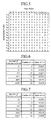
- the matrix of FIG. 5 is a 15*15 matrix in which each row and each column have four 1's.
- the calculation amount can be reduced sharply by making couplings between the nodes corresponding to the matrix elements of 1 as described above on the basis of a check matrix of a finite geometry code such as a Euclidean geometry code or projective geometry code, or a check matrix of a cyclic code such as a difference set cyclic code.
- a check matrix of a finite geometry code such as a Euclidean geometry code or projective geometry code
- a check matrix of a cyclic code such as a difference set cyclic code.
- a cyclic code is a code generated by a cyclic shift of a code word, and has a regular arrangement. For this reason, it is suitable for the learning discrimination of time-series data, and when implemented in hardware, it is characterized by facilitating the design as compared with the other codes.
- the calculation amount can be reduced sharply by making couplings between the nodes on the basis of one of a check matrix of an LDPC code, a check matrix of a spatially-coupled code, and a check matrix of a pseudo-cyclic code.
- a check matrix of an LDPC code a check matrix of a spatially-coupled code
- a check matrix of a pseudo-cyclic code the number of 1's contained in a row or the number of 1's contained in a column averages out at three to six independently of the number of rows or the number of columns.
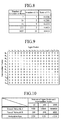
- the check matrix of a spatially-coupled code shown in FIG. 9 is a matrix with 1's arranged in a band, a maximum reduction in the calculation amount can be expected from the view point of facilitating the control.
- FIG. 10 is a diagram illustrating the number of couplings between the input nodes and intermediate nodes in neural networks A and B.
- the neural network A is an ordinary hierarchical neural network with the couplings formed between all the nodes
- the neural network B is a hierarchical neural network with the loose couplings formed between the nodes in accordance with the present invention.
- the embodiment 1 can reduce the number of couplings to 2/25, 1/25 and 1/250 as compared with the neural network A when the number of the input node and that of the intermediate node are each 50, 100 and 1000, respectively. As a result, it can reduce the product-sum operation between the input nodes and the intermediate nodes, thereby being able to speed up the classifier learning and discriminating processing.
- the weight learning unit 20 to generate the loosely coupled parts by forming couplings between the partial nodes in the hierarchical neural network comprising the input layer, the intermediate layer and the output layer, each of the layers comprising nodes, in accordance with the check matrix of an error correcting code, and to learn weights between the nodes coupled; and the discriminating processor 21 to solve a classification problem or a regression problem using the hierarchical neural network whose weights between the nodes coupled are updated by the weight values learned by the weight learning unit 20.
- the weight learning unit 20 to generate the loosely coupled parts by forming couplings between the partial nodes in the hierarchical neural network comprising the input layer, the intermediate layer and the output layer, each of the layers comprising nodes, in accordance with the check matrix of an error correcting code, and to learn weights between the nodes coupled; and the discriminating processor 21 to solve a classification problem or a regression problem using the hierarchical neural network whose weights between the nodes coupled are updated by the weight values learned by the weight learning unit 20.
- the foregoing embodiment 1 shows the instance which speeds up the classifier learning and discriminating processing using an ordinary 3-level hierarchical neural network.
- the present embodiment 2 which is a developed application of the hierarchical neural network, an instance will be described which speeds up the classifier learning and discriminating processing using a deep neural network, which has been attracting a great deal of attention recently.
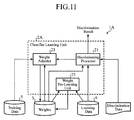
- FIG. 11 is a block diagram showing a configuration of a hierarchical neural network apparatus of the embodiment 2 in accordance with the present invention.
- the hierarchical neural network apparatus 1A shown in FIG. 11 which is a device for solving the classification problem or regression problem using a deep neural network, comprises a classifier learning unit 2A, the weight storage 3, the learning data storage 4 and the training data storage 5.
- the deep neural network is comprising an input layer, a plurality of intermediate layers and an output layer, and each layer has a plurality of nodes.
- the deep neural network functions as a classifier capable of solving various problems (classification problem or regression problem) by adjusting a coupled state between the nodes by setting arbitrary weights between the nodes of the input layer and the nodes of the intermediate layer and between the nodes of the intermediate layer and the nodes of the output layer.
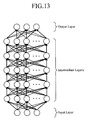
- FIG. 12 is a diagram showing a structure of the deep neural network in the embodiment 2; and FIG. 13 is a diagram showing a structure of a conventional deep neural network.
- the conventional deep neural network all the nodes are coupled between the input layer and the intermediate layer, and all the nodes are coupled between the adjacent intermediate layers, and all the nodes are coupled between the intermediate layer and the output layer.
- loosely coupled parts are formed at least one of them.
- the classifier learning unit 2A learns a deep neural network, and solves a classification problem or a regression problem using the deep neural network it learns. As its components, it comprises the discriminating processor 21, a weight pre-learning unit 22 and a weight adjuster 23.
- the weight pre-learning unit 22 generates loosely coupled parts by forming couplings between partial nodes in a deep neural network in accordance with a check matrix of an error correcting code, and performs unsupervised learning of the weights between the nodes coupled. For example, the weight pre-learning unit 22, receiving initialized weights between the nodes and learning data, performs pre-learning of the weights.
- the weight pre-learning unit 22 assigns nodes of one of the layers to the row elements of the check matrix of the error correcting code, assigns nodes of another of the layers to the column elements, couples between the nodes corresponding to a matrix element 1, but does not couple between the nodes corresponding to a matrix element 0. Thus, it can generate loosely coupled parts between the nodes without using learning data.
- the weight adjuster 23 uses the supervised learning to fine tune the weights the weight pre-learning unit 22 learns. Thus, the weight adjuster 23 finely tunes the weights for only between the nodes coupled.
- the discriminating processor 21 of the embodiment 2 receives the weights that have passed through the pre-learning or weights during learning from the weight storage 3, and the learning data from the learning data storage 4, it outputs a discrimination result of using them to the weight adjuster 23.
- the discriminating processor 21 receives the weights that have already been learned from the weight storage 3 and receives the discrimination data, it outputs a discrimination result of using them to an external transfer device such as a display.
- the discriminating processor 21 receives as its input signal the learning data or discrimination data between a node of the input layer and a node of the first intermediate layer in the deep neural network, and multiplies the input signal by the weight between the nodes.
- the multiplication results are summed up with respect to each node of the first intermediate layer and the sum undergoes computation through a threshold function and is output.
- the output value of the threshold function H 1,j is given by the following Expression (4).
- H 1 , j f ⁇ X i W 1 , j , i
- the discriminating processor 21 receives as its input signal the output signal computed by the threshold function of the (n-1) th intermediate node, and multiplies the input signal by the weight between the nodes.
- the multiplication results are summed up with respect to each intermediate node of the nth intermediate layer, and the sum undergoes computation through the threshold function and is output.
- the discriminating processor 21 receives as its input signal the output signal computed by the threshold function of the intermediate node, and multiplies the input signal by the weight between the nodes.
- the multiplication results are summed up with respect to each output node of the output layer, and the sum undergoes computation through the threshold function and is output as the discrimination result.
- the discriminating processor 21, the weight pre-learning unit 22 and the weight adjuster 23 can be implemented as a concrete means in which hardware cooperates with software through a microcomputer that executes programs describing the processing special to the present embodiment 2, for example.
- FIG. 14 is a flowchart showing the weight learning processing in the embodiment 2.
- the weight pre-learning unit 22 initializes all the weights between the nodes in the respective layers of the deep neural network (step ST1a). More specifically, as in the embodiment 1, it assigns initial values consisting of random numbers from -0.5 to +0.5 to all the weights between the nodes in the respective layers.
- the weight pre-learning unit 22 generates loose couplings by forming couplings between partial nodes in the deep neural network in accordance with the check matrix of the error correcting code (step ST2a).
- the check matrix of the error correcting code a loose matrix is supposed which can equalize or reduce the learning error as compared with a general deep neural network.
- the pseudorandom number code finite geometry code, cyclic code, pseudo-cyclic code, LDPC code and spatially-coupled code can be used.
- the weight pre-learning unit 22 performs pre-learning of the weights (W 1 , W 2 , ..., W N-2 ) between the nodes having couplings up to the (N-1) th layer (step ST3a).
- the weight pre-learning unit 22 performs unsupervised learning of the weight W 1 between the nodes of the first layer and the nodes of the second layer in the two-layer structure of the first layer and the second layer, first. Next, it carries out the unsupervised learning of the weight W 2 between the nodes of the second layer and the nodes of the third layer in the two-layer structure of the second layer and the third layer by using as the input signals the signals output from the nodes of the second layer by the unsupervised learning of the weight W 1 .
- the weight pre-learning unit 22 when performing the pre-learning of the weight between the nodes of the second layer and the nodes of the third layer on and after, the weight pre-learning unit 22 initializes the input signal to the signal output from the previous pre-learning (step ST1b). Next, the weight pre-learning unit 22 computes the correction value of the weight between the nodes coupled so as to increase the logarithmic likelihood (step ST2b) .
- the weight pre-learning unit 22 updates and corrects the weight value between the nodes coupled by the correction value of the weight it computes (step ST3b).
- the weight pre-learning unit 22 After the update of the weight between the nodes, the weight pre-learning unit 22 confirms whether the weight pre-learning in the present learning target layer satisfies its end condition or not (step ST4b).
- the end condition it is conceivable that the number of times of the learning becomes equal to or greater than a threshold.
- the weight pre-learning unit 22 decides that the end condition of the present learning target layer is satisfied and the weight pre-learning is to be terminated (YES at step ST4b), it proceeds to the processing at step ST5b.
- the weight pre-learning unit 22 confirms whether or not the pre-learning of the weight between the nodes coupled has been completed for all the layers up to the (N-1)th layer, where N is the number of layers of the deep neural network. If the weight pre-learning of all the layers has not yet been completed (NO at step ST5b), the weight pre-learning unit 22 returns to the processing at step ST1b, and carries out the weight pre-learning described above for the next (upper) layers used as the learning target. In contrast, if the weight pre-learning of all the layers has been completed (YES at step ST5b), the weight pre-learning unit 22 terminates the pre-learning.
- the deep neural network has N layers, it performs pre-learning of (N-2) weights from W 1 to W N - 2 .
- the weight adjuster 23 optimizes the weights the weight pre-learning unit 22 pre-learns through fine tuning by supervised learning (step ST4a). Details of the fine tuning of the weights will now be described with reference to FIG. 17 .
- the weight adjuster 23 computes the correction values of the weights by optimizing the weights between the nodes the weight pre-learning unit 22 pre-learns by the supervised learning using the training data it reads out of the training data storage 5, in order to reduce the value of the evaluation function J that evaluates the learning error given by the foregoing Expression (3) (step ST1c).
- the weight adjuster 23 updates the weight values between the nodes the weight pre-learning unit 22 pre-learns (step ST2c) .
- the weight adjuster 23 confirms whether the end condition of the fine tuning of the weights is satisfied or not (step ST3c).
- the end condition it is conceivable that the value of the evaluation function for computing the error between the training data and the discrimination result received from the discriminating processor 21 becomes equal to or less than a predetermined threshold, for example. Alternatively, it may be a case where the number of times of the learning becomes equal to or greater than a threshold.
- the weight adjuster 23 decides that the end condition is satisfied and the fine tuning of the weights is to be completed (YES at step ST3c)
- the weight adjuster 23 terminates the fine tuning of the weights.
- the weight adjuster 23 returns to the processing at step ST1c, and repeats the fine tuning of the weights described above.
- the discriminating processor 21 can solve the classification problem or regression problem using the deep neural network updated by the weight values resulting from the optimization adjustment by the weight adjuster 23 of the weights which have been pre-learned by the weight pre-learning unit 22 about the weights between the nodes coupled in the loosely coupled parts.
- the calculation amount can be reduced sharply by making couplings between the nodes corresponding to the matrix elements of 1 in a check matrix of a finite geometry code such as a Euclidean geometry code or projective geometry code, or in a check matrix of a cyclic code such as a difference set cyclic code, in which check matrix the nodes of one of the layers are assigned to the row elements and the nodes of another of the layers are assigned to the column elements.
- a check matrix of a finite geometry code such as a Euclidean geometry code or projective geometry code
- a check matrix of a cyclic code such as a difference set cyclic code
- a cyclic code is a code generated by a cyclic shift of a code word, and has a regular arrangement. For this reason, it is suitable for the learning discrimination of time-series data, and when implemented in hardware, it is characterized by facilitating the design as compared with the other codes.
- the calculation amount can be reduced sharply by making couplings between the nodes on the basis of one of a check matrix of an LDPC code, a check matrix of a spatially-coupled code, and a check matrix of a pseudo-cyclic code.
- the check matrix of the LDPC code, spatially-coupled code or pseudo-cyclic code the number of 1's contained in a row or the number of 1's contained in a column averages out at three to six independently of the number of rows or the number of columns.
- the check matrix of a spatially-coupled code shown in FIG. 9 is a matrix with 1's arranged in a band, a maximum reduction in the calculation amount can be expected from the view point of facilitating the control.
- the present embodiment 2 comprises the weight pre-learning unit 22 to generate the loosely coupled parts by forming couplings between partial nodes in the deep neural network comprising the input layer, the plurality of intermediate layers and the output layer, each of the layers comprising nodes, in accordance with the check matrix of the error correcting code, and to perform the unsupervised learning of the weights between the nodes coupled; the weight adjuster 23 to adjust the weights the weight pre-learning unit 22 has learned by the supervised learning; and the discriminating processor 21 to solve a classification problem or a regression problem using the deep neural network whose weights between the nodes coupled are updated by the weight values adjusted by the weight adjuster 23.
- the deep neural network has a greater number of the intermediate layers as compared with the hierarchical neural network shown in embodiment 1, and has a greater number of portions in which the loosely coupled parts can be formed, it has a higher reduction effect of the product-sum operation between the nodes.
- it since it generates the loose couplings independently of the learning data, even if the learning data is changed or corrected, it can save time and effort for pre-learning.
- a hierarchical neural network apparatus in accordance with the present invention can speed up the classifier learning and discriminating processing by forming loose couplings in the hierarchical neural network independently of the learning data. Accordingly, it is applicable to information processing relating to various control, prediction and diagnosis.
- 1, 1A hierarchical neural network apparatus 2, 2A classifier learning unit; 3 weight storage; 4 learning data storage; 5 training data storage; 20 weight learning unit; 21 discriminating processor; 22 weight pre-learning unit; 23 weight adjuster.
Landscapes
- Engineering & Computer Science (AREA)
- Theoretical Computer Science (AREA)
- Physics & Mathematics (AREA)
- General Health & Medical Sciences (AREA)
- Computing Systems (AREA)
- Biomedical Technology (AREA)
- Biophysics (AREA)
- Computational Linguistics (AREA)
- Data Mining & Analysis (AREA)
- Evolutionary Computation (AREA)
- Life Sciences & Earth Sciences (AREA)
- Molecular Biology (AREA)
- Artificial Intelligence (AREA)
- General Engineering & Computer Science (AREA)
- General Physics & Mathematics (AREA)
- Mathematical Physics (AREA)
- Software Systems (AREA)
- Health & Medical Sciences (AREA)
- Probability & Statistics with Applications (AREA)
- Image Analysis (AREA)
- Feedback Control In General (AREA)
Applications Claiming Priority (1)
| Application Number | Priority Date | Filing Date | Title |
|---|---|---|---|
| PCT/JP2014/053056 WO2015118686A1 (fr) | 2014-02-10 | 2014-02-10 | Dispositif réseau neuronal hiérarchique, procédé d'apprentissage pour dispositif de détermination, et procédé de détermination |
Publications (2)
| Publication Number | Publication Date |
|---|---|
| EP3089081A1 true EP3089081A1 (fr) | 2016-11-02 |
| EP3089081A4 EP3089081A4 (fr) | 2017-09-20 |
Family
ID=53777512
Family Applications (1)
| Application Number | Title | Priority Date | Filing Date |
|---|---|---|---|
| EP14882049.1A Ceased EP3089081A4 (fr) | 2014-02-10 | 2014-02-10 | Dispositif réseau neuronal hiérarchique, procédé d'apprentissage pour dispositif de détermination, et procédé de détermination |
Country Status (6)
| Country | Link |
|---|---|
| US (1) | US10796223B2 (fr) |
| EP (1) | EP3089081A4 (fr) |
| JP (1) | JP5937284B2 (fr) |
| KR (1) | KR101878579B1 (fr) |
| CN (2) | CN105900116A (fr) |
| WO (1) | WO2015118686A1 (fr) |
Families Citing this family (36)
| Publication number | Priority date | Publication date | Assignee | Title |
|---|---|---|---|---|
| EP3185184A1 (fr) | 2015-12-21 | 2017-06-28 | Aiton Caldwell SA | Procédé d'analyse d'un ensemble de données de facturation dans des réseaux neuronaux |
| CN108140144B (zh) * | 2016-03-31 | 2021-06-01 | 富士通株式会社 | 一种对神经网络模型进行训练的方法、装置及电子设备 |
| WO2017221412A1 (fr) * | 2016-06-24 | 2017-12-28 | オリンパス株式会社 | Dispositif de traitement d'image, dispositif d'apprentissage, procédé de traitement d'image, procédé de création de critère de discrimination, procédé d'apprentissage et programme |
| US10706327B2 (en) * | 2016-08-03 | 2020-07-07 | Canon Kabushiki Kaisha | Information processing apparatus, information processing method, and storage medium |
| KR101828011B1 (ko) | 2016-08-11 | 2018-02-21 | 서울대학교산학협력단 | 이미지에 포함된 객체의 상태를 분류하는 방법 및 분류 장치 |
| US10572342B2 (en) * | 2016-10-24 | 2020-02-25 | SK Hynix Inc. | Memory system with LDPC decoder and operating method thereof |
| US10685285B2 (en) * | 2016-11-23 | 2020-06-16 | Microsoft Technology Licensing, Llc | Mirror deep neural networks that regularize to linear networks |
| US11537851B2 (en) | 2017-04-07 | 2022-12-27 | Intel Corporation | Methods and systems using improved training and learning for deep neural networks |
| US10491243B2 (en) * | 2017-05-26 | 2019-11-26 | SK Hynix Inc. | Deep learning for low-density parity-check (LDPC) decoding |
| TWI636404B (zh) * | 2017-07-31 | 2018-09-21 | 財團法人工業技術研究院 | 深度神經網路、使用深度神經網路的方法與電腦可讀媒體 |
| KR101880901B1 (ko) | 2017-08-09 | 2018-07-23 | 펜타시큐리티시스템 주식회사 | 기계 학습 방법 및 장치 |
| CN109426859B (zh) * | 2017-08-22 | 2021-03-05 | 华为技术有限公司 | 神经网络训练系统、方法和计算机可读存储介质 |
| US10693496B2 (en) * | 2017-08-29 | 2020-06-23 | SK Hynix Inc. | Memory system with LDPC decoder and method of operating such memory system and LDPC decoder |
| US10552251B2 (en) * | 2017-09-06 | 2020-02-04 | Western Digital Technologies, Inc. | Storage of neural networks |
| US11301752B2 (en) * | 2017-10-24 | 2022-04-12 | International Business Machines Corporation | Memory configuration for implementing a neural network |
| CN108230359B (zh) * | 2017-11-12 | 2021-01-26 | 北京市商汤科技开发有限公司 | 目标检测方法和装置、训练方法、电子设备、程序和介质 |
| US11468332B2 (en) * | 2017-11-13 | 2022-10-11 | Raytheon Company | Deep neural network processor with interleaved backpropagation |
| CN109995380B (zh) * | 2018-01-02 | 2021-08-13 | 华为技术有限公司 | 译码方法及设备 |
| EP3518152B1 (fr) * | 2018-01-29 | 2025-12-10 | Panasonic Intellectual Property Corporation of America | Système et procédé de traitement d'informations |
| EP3518153B1 (fr) * | 2018-01-29 | 2026-03-11 | Panasonic Intellectual Property Corporation of America | Système et procédé de traitement d'informations |
| KR102501884B1 (ko) * | 2018-07-06 | 2023-02-21 | 에임시스템 주식회사 | 기계 학습 기반의 설비 이상 진단 시스템 및 방법 |
| KR102659892B1 (ko) * | 2018-07-24 | 2024-04-24 | 삼성전자주식회사 | 객체 인식 장치, 이를 포함하는 전자 장치 및 객체 인식 방법 |
| CN109492764B (zh) * | 2018-10-24 | 2024-07-26 | 平安科技(深圳)有限公司 | 生成式对抗网络的训练方法、相关设备及介质 |
| US11210565B2 (en) * | 2018-11-30 | 2021-12-28 | Microsoft Technology Licensing, Llc | Machine learning model with depth processing units |
| US10727868B2 (en) | 2018-12-03 | 2020-07-28 | Samsung Electronics Co., Ltd. | Apparatus and method for offset optimization for low-density parity-check (LDPC) code |
| JP2020095428A (ja) | 2018-12-12 | 2020-06-18 | 株式会社東芝 | モデル学習システム、モデル学習方法、プログラム、及び記憶媒体 |
| CN113228057B (zh) * | 2019-01-11 | 2024-05-31 | 三菱电机株式会社 | 推理装置和推理方法 |
| MX2021010406A (es) * | 2019-02-28 | 2021-09-21 | Mitsubishi Electric Corp | Dispositivo de procesamiento de datos, sistema de procesamiento de datos, y metodo de procesamiento de datos. |
| DE102019206720B4 (de) | 2019-05-09 | 2021-08-26 | Volkswagen Aktiengesellschaft | Überwachung eines KI-Moduls einer Fahrfunktion eines Fahrzeugs |
| US11080152B2 (en) * | 2019-05-15 | 2021-08-03 | Western Digital Technologies, Inc. | Optimized neural network data organization |
| US11468327B2 (en) * | 2020-05-26 | 2022-10-11 | GE Precision Healthcare LLC | Differential learning for learning networks |
| WO2022091530A1 (fr) * | 2020-11-02 | 2022-05-05 | Soinn株式会社 | Dispositif et procédé d'estimation ainsi que support non temporaire lisible par ordinateur sur lequel est mémorisé un programme |
| US11604719B2 (en) * | 2021-02-01 | 2023-03-14 | Microsoft Technology Licensing, Llc. | Automated program repair using stack traces and back translations |
| EP4285226A1 (fr) * | 2021-02-01 | 2023-12-06 | Microsoft Technology Licensing, LLC | Réparation de programme automatique à l'aide de traces de pile et de traductions inverses |
| EP4329202A4 (fr) * | 2021-05-25 | 2024-10-16 | Samsung Electronics Co., Ltd. | Décodeur min-sum à auto-correction basé sur un réseau neuronal et dispositif électronique le comprenant |
| JP2025011946A (ja) * | 2023-07-12 | 2025-01-24 | 株式会社東芝 | 磁気再生処理装置、磁気記録再生装置及び磁気再生方法 |
Family Cites Families (7)
| Publication number | Priority date | Publication date | Assignee | Title |
|---|---|---|---|---|
| JP2714600B2 (ja) | 1988-08-12 | 1998-02-16 | 衛 田中 | 連想型ニューロコンピュータ |
| JPH0991263A (ja) | 1995-09-20 | 1997-04-04 | Hitachi Medical Corp | ニューラルネットワーク構造最適化装置ならびに方法 |
| JP2003317073A (ja) * | 2002-04-24 | 2003-11-07 | Fuji Xerox Co Ltd | ニューラルネットワーク処理装置 |
| JP2006163808A (ja) | 2004-12-07 | 2006-06-22 | Fuji Electric Holdings Co Ltd | ニューラルネットワークの構造 |
| US7523375B2 (en) * | 2005-09-21 | 2009-04-21 | Distribution Control Systems | Set of irregular LDPC codes with random structure and low encoding complexity |
| FR2964222A1 (fr) * | 2010-08-25 | 2012-03-02 | Inst Telecom Telecom Bretagne | Dispositif d'apprentissage et de decodage de messages, mettant en œuvre un reseau de neurones, procedes d'apprentissage et de decodage et programmes d'ordinateur correspondants. |
| JP5234085B2 (ja) | 2010-11-11 | 2013-07-10 | 富士電機株式会社 | ニューラルネットワークの学習方法 |
-
2014
- 2014-02-10 US US15/110,362 patent/US10796223B2/en active Active
- 2014-02-10 EP EP14882049.1A patent/EP3089081A4/fr not_active Ceased
- 2014-02-10 JP JP2015561138A patent/JP5937284B2/ja active Active
- 2014-02-10 CN CN201480073042.6A patent/CN105900116A/zh active Pending
- 2014-02-10 CN CN202010084242.9A patent/CN111242300A/zh active Pending
- 2014-02-10 KR KR1020167024009A patent/KR101878579B1/ko not_active Expired - Fee Related
- 2014-02-10 WO PCT/JP2014/053056 patent/WO2015118686A1/fr not_active Ceased
Also Published As
| Publication number | Publication date |
|---|---|
| JP5937284B2 (ja) | 2016-06-22 |
| KR20160117537A (ko) | 2016-10-10 |
| CN105900116A (zh) | 2016-08-24 |
| US20160335536A1 (en) | 2016-11-17 |
| CN111242300A (zh) | 2020-06-05 |
| JPWO2015118686A1 (ja) | 2017-03-23 |
| KR101878579B1 (ko) | 2018-07-13 |
| WO2015118686A1 (fr) | 2015-08-13 |
| EP3089081A4 (fr) | 2017-09-20 |
| US10796223B2 (en) | 2020-10-06 |
Similar Documents
| Publication | Publication Date | Title |
|---|---|---|
| EP3089081A1 (fr) | Dispositif réseau neuronal hiérarchique, procédé d'apprentissage pour dispositif de détermination, et procédé de détermination | |
| US11853893B2 (en) | Execution of a genetic algorithm having variable epoch size with selective execution of a training algorithm | |
| US10380479B2 (en) | Acceleration of convolutional neural network training using stochastic perforation | |
| EP3564865A1 (fr) | Dispositif de circuit de réseau neuronal, réseau neuronal, procédé de traitement de réseau neuronal et programme d'exécution de réseau neuronal | |
| US12260337B2 (en) | Performing inference and training using sparse neural network | |
| US11256982B2 (en) | Noise-enhanced convolutional neural networks | |
| US20190080240A1 (en) | Execution of a genetic algorithm with variable evolutionary weights of topological parameters for neural network generation and training | |
| US11120333B2 (en) | Optimization of model generation in deep learning neural networks using smarter gradient descent calibration | |
| US20180075348A1 (en) | Machine learning model for analysis of instruction sequences | |
| US20180285729A1 (en) | Reservoir computing system | |
| US20180075349A1 (en) | Training a machine learning model for analysis of instruction sequences | |
| US20220237465A1 (en) | Performing inference and signal-to-noise ratio based pruning to train sparse neural network architectures | |
| JP6227052B2 (ja) | 処理装置、判別方法およびプログラム | |
| CN113825978B (zh) | 用于定义路径的方法和设备、存储装置 | |
| EP3739473B1 (fr) | Dispositif d'optimisation et procédé de commande de dispositif d'optimisation | |
| US11436475B2 (en) | Anomaly detection with spiking neural networks | |
| US20240157969A1 (en) | Methods and systems for determining control decisions for a vehicle | |
| EP3510528B1 (fr) | Modèle d'apprentissage de machine pour l'analyse de séquences d'instruction | |
| Li et al. | Hessian aware low-rank perturbation for order-robust continual learning | |
| US12353983B2 (en) | Inference device and method for reducing the memory usage in a weight matrix | |
| US20190258928A1 (en) | Artificial neural network | |
| US20190058494A1 (en) | Channel error rate optimization using markov codes | |
| KR102938164B1 (ko) | 과거 모델 파라미터 재생성을 통한 태스크 점진 학습 방법 및 시스템 | |
| CN112508165A (zh) | 用于信息处理的设备、方法及非暂态计算机可读存储介质 |
Legal Events
| Date | Code | Title | Description |
|---|---|---|---|
| PUAI | Public reference made under article 153(3) epc to a published international application that has entered the european phase |
Free format text: ORIGINAL CODE: 0009012 |
|
| 17P | Request for examination filed |
Effective date: 20160630 |
|
| AK | Designated contracting states |
Kind code of ref document: A1 Designated state(s): AL AT BE BG CH CY CZ DE DK EE ES FI FR GB GR HR HU IE IS IT LI LT LU LV MC MK MT NL NO PL PT RO RS SE SI SK SM TR |
|
| AX | Request for extension of the european patent |
Extension state: BA ME |
|
| DAX | Request for extension of the european patent (deleted) | ||
| A4 | Supplementary search report drawn up and despatched |
Effective date: 20170821 |
|
| RIC1 | Information provided on ipc code assigned before grant |
Ipc: G06N 3/04 20060101AFI20170814BHEP |
|
| STAA | Information on the status of an ep patent application or granted ep patent |
Free format text: STATUS: EXAMINATION IS IN PROGRESS |
|
| 17Q | First examination report despatched |
Effective date: 20180601 |
|
| APBK | Appeal reference recorded |
Free format text: ORIGINAL CODE: EPIDOSNREFNE |
|
| APBN | Date of receipt of notice of appeal recorded |
Free format text: ORIGINAL CODE: EPIDOSNNOA2E |
|
| APBR | Date of receipt of statement of grounds of appeal recorded |
Free format text: ORIGINAL CODE: EPIDOSNNOA3E |
|
| APBV | Interlocutory revision of appeal recorded |
Free format text: ORIGINAL CODE: EPIDOSNIRAPE |
|
| APBK | Appeal reference recorded |
Free format text: ORIGINAL CODE: EPIDOSNREFNE |
|
| APBN | Date of receipt of notice of appeal recorded |
Free format text: ORIGINAL CODE: EPIDOSNNOA2E |
|
| APBR | Date of receipt of statement of grounds of appeal recorded |
Free format text: ORIGINAL CODE: EPIDOSNNOA3E |
|
| APAF | Appeal reference modified |
Free format text: ORIGINAL CODE: EPIDOSCREFNE |
|
| REG | Reference to a national code |
Ref country code: DE Ref legal event code: R003 |
|
| APBT | Appeal procedure closed |
Free format text: ORIGINAL CODE: EPIDOSNNOA9E |
|
| STAA | Information on the status of an ep patent application or granted ep patent |
Free format text: STATUS: THE APPLICATION HAS BEEN REFUSED |
|
| 18R | Application refused |
Effective date: 20221107 |