EP3089386A1 - Verfahren, system und vorrichtung zur taktsynchronisierung über zeitvariable und verlustbehaftete netzwerke - Google Patents
Verfahren, system und vorrichtung zur taktsynchronisierung über zeitvariable und verlustbehaftete netzwerke Download PDFInfo
- Publication number
- EP3089386A1 EP3089386A1 EP15165756.6A EP15165756A EP3089386A1 EP 3089386 A1 EP3089386 A1 EP 3089386A1 EP 15165756 A EP15165756 A EP 15165756A EP 3089386 A1 EP3089386 A1 EP 3089386A1
- Authority
- EP
- European Patent Office
- Prior art keywords
- clock
- client
- time
- server
- offset
- Prior art date
- Legal status (The legal status is an assumption and is not a legal conclusion. Google has not performed a legal analysis and makes no representation as to the accuracy of the status listed.)
- Withdrawn
Links
- 238000000034 method Methods 0.000 title claims abstract description 75
- 230000001360 synchronised effect Effects 0.000 claims abstract description 13
- 238000005259 measurement Methods 0.000 claims description 72
- 230000005540 biological transmission Effects 0.000 claims description 16
- 238000004891 communication Methods 0.000 claims description 6
- 230000001934 delay Effects 0.000 claims description 6
- 230000008901 benefit Effects 0.000 description 12
- 230000006870 function Effects 0.000 description 10
- 238000013450 outlier detection Methods 0.000 description 10
- 230000000694 effects Effects 0.000 description 6
- 230000004044 response Effects 0.000 description 6
- 238000004422 calculation algorithm Methods 0.000 description 4
- 238000001914 filtration Methods 0.000 description 4
- 238000012545 processing Methods 0.000 description 4
- 230000005653 Brownian motion process Effects 0.000 description 2
- 238000013459 approach Methods 0.000 description 2
- 238000005537 brownian motion Methods 0.000 description 2
- 230000008859 change Effects 0.000 description 2
- 230000006872 improvement Effects 0.000 description 2
- 238000005457 optimization Methods 0.000 description 2
- 238000004088 simulation Methods 0.000 description 2
- 239000013598 vector Substances 0.000 description 2
- 238000007476 Maximum Likelihood Methods 0.000 description 1
- 239000000654 additive Substances 0.000 description 1
- 230000000996 additive effect Effects 0.000 description 1
- 238000004364 calculation method Methods 0.000 description 1
- 230000008878 coupling Effects 0.000 description 1
- 238000010168 coupling process Methods 0.000 description 1
- 238000005859 coupling reaction Methods 0.000 description 1
- 238000009795 derivation Methods 0.000 description 1
- 238000011156 evaluation Methods 0.000 description 1
- 230000010354 integration Effects 0.000 description 1
- 238000013178 mathematical model Methods 0.000 description 1
- 230000007246 mechanism Effects 0.000 description 1
- 230000006855 networking Effects 0.000 description 1
- 229920000729 poly(L-lysine) polymer Polymers 0.000 description 1
- 238000005295 random walk Methods 0.000 description 1
- 238000005309 stochastic process Methods 0.000 description 1
- 230000009897 systematic effect Effects 0.000 description 1
Images


Classifications
-
- H—ELECTRICITY
- H04—ELECTRIC COMMUNICATION TECHNIQUE
- H04J—MULTIPLEX COMMUNICATION
- H04J3/00—Time-division multiplex systems
- H04J3/02—Details
- H04J3/06—Synchronising arrangements
- H04J3/0635—Clock or time synchronisation in a network
- H04J3/0638—Clock or time synchronisation among nodes; Internode synchronisation
- H04J3/0658—Clock or time synchronisation among packet nodes
- H04J3/0661—Clock or time synchronisation among packet nodes using timestamps
- H04J3/0667—Bidirectional timestamps, e.g. NTP or PTP for compensation of clock drift and for compensation of propagation delays
-
- H—ELECTRICITY
- H04—ELECTRIC COMMUNICATION TECHNIQUE
- H04L—TRANSMISSION OF DIGITAL INFORMATION, e.g. TELEGRAPHIC COMMUNICATION
- H04L7/00—Arrangements for synchronising receiver with transmitter
- H04L7/0016—Arrangements for synchronising receiver with transmitter correction of synchronization errors
- H04L7/0033—Correction by delay
- H04L7/0037—Delay of clock signal
-
- H—ELECTRICITY
- H04—ELECTRIC COMMUNICATION TECHNIQUE
- H04L—TRANSMISSION OF DIGITAL INFORMATION, e.g. TELEGRAPHIC COMMUNICATION
- H04L67/00—Network arrangements or protocols for supporting network services or applications
- H04L67/01—Protocols
Definitions
- the present invention is directed towards a method which allows a synchronization of client clocks providing the master time to several client clocks.
- a server machine runs a reference clock and forms the basis for a system-wide time, which therefore has to be distributed over a network.
- the present invention provides an improved mechanism which allows a coupling of several client machines to the specific server machine with high synchronization accuracy.
- the present invention is also directed towards a system providing a client clock and a server clock, which are synchronized.
- a client is suggested which can be run in several instances distributed over a network, which is then synchronized with this server time.
- clocks at distributed locations must be synchronized. This can be done by exchanging time messages over a communication network connecting the clocks.
- time-varying behaviour of the communication network affects the synchronization performance.
- This invention concerns methods to mitigate the effects of unreliable communication networks on synchronization performance.
- NTP Network Time Protocol
- the basic idea of NTP is to provide time stamps for sending and receiving operations in a network and synchronizing clocks as a function of network delay times.
- the raw clock offset measurements denoted as ⁇ k
- the state of the art clips the input to the filter to some empirical 3 ⁇ level.
- a known method uses the mathematical clock model to derive a Kalman Filter to estimate the server clock state (phase and frequency) from ⁇ k .
- the Kalman filter is optimum for random Gaussian errors on ⁇ k , but for the case of interest with delay outliers and hence occasional large spikes in ⁇ k , the Kalman Filter is known to be too sensitive.
- the above methods modify recursive filtering to deal with outliers.
- a known method indicates that non-recursive (batch) procedures may perform better in the presence of outliers.
- batch line fitting methods have been described. It is assumed that the clock server periodically broadcasts time messages and considers consecutive differences between client and server time stamps. Delay outliers are then always positive, thus simplifying outlier detection and line fitting.
- NTP uses the latest eight measurements in an ad-hoc way to detect outliers.
- a clock server has a high quality clock (master clock) which provides the reference time.
- a communication link connects the clock server to a client clock (slave clock).
- the task is to synchronize the client clock to the server clock, i.e. to control the client clock such that the client time x C (t) closely tracks the server time x S (t).
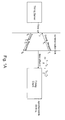
- client clock offset ⁇ is measured by exchanging timing messages between the server and client clock, and time-stamping the message transmission and reception times T 1 to T 4 . This is shown in Figure 1A .
- the problem to be solved is to mitigate these effects by appropriate processing of the sequence of measurements ⁇ k ⁇ , and thus to improve performance of network-based synchronization.
- the problem is solved by a method for network-based synchronization of a client clock to a server clock holding features according to claim 1.
- a method for synchronization of a client clock to a server clock over a network comprising the steps of determining on the network at least one clock offset, preferably a plurality of clock offsets, by exchanging time synchronization messages between the client and the server clock, wherein the clock offsets are only considered within a provided time horizon.
- the suggested method furthermore comprises weighting the determined clock offsets by their measurement accuracy, in order to obtain a weighted clock offset that may include an estimated clock phase and clock frequency.
- the weighted clock offset can be the output of a filter, e.g.
- the weighted clock offset can be the clock phase and the clock frequency obtained by moving horizon line fitting using equation (3) as described later.
- the client clock can be adjusted as a function of the weighted clock offset such that the client clock is synchronized to the server clock.
- the suggested subject-matter of the independent claims can be accomplished network-based.
- client-server-architecture is the typical application scenario of the present invention
- the person skilled in the art appreciates that the involved actors can as well behave in a peer-to-peer fashion.
- server machine as well as the client machine may both be provided by independent peers, which again can be implemented as hardware resources or software components.
- Network-based synchronization comprises the exchanging of timing messages such as timing request messages and/ or timing response messages, also known as sync and delay measurement messages.
- timing messages may comprise delay measurements and therefore delay measurement messages can be exchanged.
- the timing messages to be exchanged can be referred to as synchronization messages or time synchronization messages used in NTP, PTP and other similar protocols.
- the PTP message is the general term for synchronization messages, where the most relevant are: Sync, Delay_Req, Follow_Up, Delay_Resp.
- Sync is sent at t1 and Delay_Req at t3.
- a time stamp is provided for each sending operation of such a timing message and for each receiving operation.
- delay times of a network which means the transmission time between sending and receiving a message.
- This procedure can be performed repeatedly such that several measurements are taken and therefore the latency time of a network can be evaluated more accurately.
- a time horizon can be determined. Hence, only a specific number of messages or a specific time span or time interval is considered for evaluating the network parameters. As this procedure can be performed several times, at least one clock offset is determined, which is determined as a function of at least one transmission time of at least one message.
- the at least one clock offset is determined or measured, it is respectively weighted. This can be performed by selecting a provided weighting factor, such as the inverse of the measurement variance.
- the client clock can be adjusted as a function of the weighted at least one clock offset. This may be performed by the addition of delay times to the client timing.
- the model includes a third Brownian motion dW 3 (t) and becomes three-dimensional.
- a time-discrete linear stochastic clock model is derived:
- the clock parameters ⁇ 1 2 and ⁇ 2 2 are obtained from measurements (data sheets) of the oscillator on which the clock is based, see Note 1 below.
- Clock measurement for synchronization At the client clock side, the server clock phase X k is measured using the two-way echo measurement involving exchange of timestamps T 1 to T 4 . The resulting offset measurement ⁇ k corresponds directly to the phase X k . Measurement errors are due to jitter in the time stamping and Packet Delay Variation (PDV) and delay asymmetries ⁇ d of the message transmissions. In the model, these errors are all subsumed in the measurement noise v k .
- PDV Packet Delay Variation
- the measurement z k is the scalar ⁇ k
- v k is the measurement noise with variance
- T is the measurement interval.
- the Kalman Filter is mean-square optimal if the measurement noise v k is uncorrelated with known finite variance R k . However, any measurement outliers will lead to large errors in the estimates.
- the estimate of x k is x ⁇ k
- k F k - 1 x ⁇ k + 1
- k X ⁇ k+1
- k ⁇ k+1
- these values are to be applied as set points to adjust the client clock at time t k .
- Aspect B Moving Horizon Estimation (MHE) for synchronization
- the least square state estimate is found by solving the Quadratic Programming (QP) problem min X , W X ⁇ R X + 2 f ⁇ X + W ⁇ Q W where X, W are subject to the model state equation (A.7).
- QP Quadratic Programming
- the solution W is obtained by some standard numerical QP algorithm.
- minimization of (C.2) is identical to Maximum Likelihood estimation of X k and Y k . This interpretation motivates the choice of the objective function (C.2).
- minimization of J(.) reduces to simple line fitting, i.e. minimization with respect to the clock offset X k and frequency offset (slope) Y k .
- the client determines the at least one clock offset as a function of time stamps, each time stamp indicating a send or receive operation of the time delay measurement messages.
- the time stamps are based on a local free-running oscillator.
- the client time stamps for instance time stamps T 1 and T 4 as described with reference to Figure 2 are based on a local free-running oscillator driving a counter, such as a HW counter.
- the time stamps are based on a free-running time base, running in open loop. This will also be described in the specific embodiments.
- the step of weighting by measurement accuracy is performed by selecting the inverse measurement variance parameter as a weighting parameter.
- the step of weighting by the measurement accuracy may also be performed by selecting a measurement variance parameter as an inverse weighting parameter.
- a default value is provided for the variance parameter.
- an infinite value is provided for the variance parameter.
- the infinite value refers to a value which is much larger than the default value.
- much larger means that a specific factor is provided which can be multiplied with the default value for determining such a large value. For instance, instead of choosing an infinite value, a factor of 1000 can be chosen which is multiplied on the default value for the variance parameter.
- an infinite value is provided for the variance parameter.
- the infinite value which is provided for the variance parameter can again be a value which is much larger than the default value, for instance by means of the definition of infinite as provided above.
- the time horizon is determined by at least one of a group of techniques, the group comprising a number of previous message exchanges and a determined time span.
- a specific time interval for instance being specified by a number of seconds
- the time horizon can be specified by the last N timing message exchanges.
- a number of previous message exchanges or a specific time span is considered.
- This can also be referred to as an expiry time, as older measurements are not considered.
- One example for such a number N of the last timing message exchanges is a range between 10 and 1.000, namely 10 ⁇ N ⁇ 1000.
- “Moving Horizon" and “sliding window” refer to the "time horizon". Hence, this terminology can be used interchangeably.
- determining the timing offset considers asymmetric transmission times between the client and the server.
- This provides the advantage that the transmission time from the client to the server may differ from the transmission time from the server to the client.
- the client and server architecture can be enhanced towards a peer-to-peer architecture, which, again, may provide asymmetric transmission times.
- the network behaviour can be measured more precisely.
- one of a group of estimation techniques is applied, the group comprising a Moving Horizon Estimation and a line fitting over a sliding window technique.
- the measurement accuracy is perceived as a function of at least one of a time stamping inaccuracy due to hardware and software delays in the clocks, a message loss in the communication network, and time-varying delays and delay asymmetries due to network load and congestion.
- a system for synchronization of a client clock to a server clock over a network comprising a determining unit being arranged to determine on the network at least one clock offset by exchanging time synchronization messages between the client and the server, wherein clock offsets are only considered within a provided time horizon.
- the system also comprises a weighting unit being arranged to weight the determined at least one clock offset by their measurement accuracy and furthermore comprises an adjustment unit being arranged to adjust the client clock as a function of the weighted clock offsets such that the client clock is synchronized to the server clock.
- a client machine being arranged to perform a synchronization of a client clock to a server clock over a network, comprising a determining unit, a weighting unit, and an adjustment unit which are arranged according to those units as provided above.
- the system comprises a client and a server or respective peers and the suggested client can be operated independently of the server, which means that the client can perform the measurements, the weighting and the adjustment itself.
- the server machine only needs to send the timing messages back to the client machine.
- This invention gives a simple and robust method for network-based synchronization, with improved performance in the presence of measurement outliers as due to time-varying and lossy network connections.
- the method is derived in systematic way and is optimum in a well defined sense (as given by the objective functions (B.1) or (C.2)).
- the only parameters to be selected for the algorithm are horizon length NT and outlier detection threshold m ⁇ ⁇ . They have intuitive interpretations and are thus simple to tune.
- the invention improves synchronization performance even if the underlying time stamping method has low accuracy and the network connection is time-varying and lossy. This lowers the implementation cost of network-based synchronization, as it may allow software- (rather than hardware-) based time stamping and use of low cost lossy networks (rather than broadband deterministic) networks.
- the moving horizon method used in the invention may require that a batch of N measurement points is stored in local memory before processing can start, in contrast to recursive filtering approaches where only the newest clock state needs to be stored and updated.
- the time constant of the synchronization may be given by the horizon length, i.e. NT seconds. This affects in particular the synchronization response time when the client oscillator experiences fast changes in clock phase or frequency, e.g. due to vibration or temperature change.
- NT must be chosen as a compromise between high measurement accuracy and outlier detection reliability, requiring high NT, and low time lag of the control response, requiring low NT.
- synchronization accuracy and response time may depend also on the oscillator stability and the implementation of the "gearing" control between the free-running oscillator and synchronized clock at the client.
- the invention improves the well-known network-based synchronization method shown in Figure 1 .
- One of the main novelties is to apply Moving Horizon Estimation (MHE) to perform optimum batch estimation of the clock phase and frequency offset.
- MHE Moving Horizon Estimation
- MHE allows to introduce explicit constraints in the estimation, in order to suppress the effect of measurement outliers on the estimates. It also allows to weight measurements, based on their perceived accuracy. Thus estimation of phase and frequency is improved in the presence of outliers.
- the estimates are used to control the client clock, which results in an improved synchronization performance.
- the preferred embodiment uses a simplified form of MHE, here called Moving Horizon Line Fitting (MHLF).
- MHLF Moving Horizon Line Fitting
- MHE Moving Horizon Estimation
- Application of MHE to synchronization constitutes another embodiment of this invention; it is derived in Aspect B.
- QP Quadratic Programming
- Figure 3 shows simulation results of clock estimation methods applied to measured data ⁇ k ⁇ , showing improvement by the Moving Horizon Line Fitting (MHLF) method of the invention over known Kalman Filter (KF) methods.
- MHLF Moving Horizon Line Fitting
- KF Kalman Filter
- Figure 3 shows the following:
- FIG. 4 shows an aspect of a method for network-based synchronization of a client clock to a server clock according to the present invention.
- a timing measurement message also referred to as time synchronization message or synchronization message throughout the description.
- the sending operation as well as further receiving operations have one time stamp each which is assigned to the respective sending or receiving time.
- the sent message is received by the server 101.
- These method steps 100 and 101 may be performed repeatedly, for instance, several messages may be sent from the client to the server and several messages may be again sent from the server to the client, for instance according to a sending profile. Hence, it is possible to send messages according to a predefined time schedule.
- each of the transmission times from client to server and server to client is determined and/ or stored in a method step 102.
- a further method step 103 it is evaluated whether the performed measurements are within the provided time horizon.
- message step 103 checks the respective time stamps and compares them with the provided time horizon.
- the further method step 104 of weighting the measured clock offsets of step 102 is performed. After a weighting of the measured clock offsets is performed, the adjustment setpoints are calculated according to the described methods and the client clock can be adjusted and/or corrected accordingly in a further method step 105.
- all of the method steps may be performed iteratively and/or in a different order wherever applicable.
Landscapes
- Engineering & Computer Science (AREA)
- Computer Networks & Wireless Communication (AREA)
- Signal Processing (AREA)
- Synchronisation In Digital Transmission Systems (AREA)
Priority Applications (5)
| Application Number | Priority Date | Filing Date | Title |
|---|---|---|---|
| EP15165756.6A EP3089386A1 (de) | 2015-04-29 | 2015-04-29 | Verfahren, system und vorrichtung zur taktsynchronisierung über zeitvariable und verlustbehaftete netzwerke |
| CN201680039072.4A CN107710650B (zh) | 2015-04-29 | 2016-02-29 | 用于在时变和有损网络上的时钟同步的方法、系统和装置 |
| PCT/EP2016/054217 WO2016173741A1 (en) | 2015-04-29 | 2016-02-29 | Method, system and device for clock synchronization over time-varying and lossy networks |
| EP16710686.3A EP3289706B1 (de) | 2015-04-29 | 2016-02-29 | Verfahren, system und vorrichtung zur taktsynchronisierung über zeitvariable und verlustbehaftete netzwerke |
| US15/797,493 US10164762B2 (en) | 2015-04-29 | 2017-10-30 | Method, system and device for clock synchronization over time-varying and lossy networks |
Applications Claiming Priority (1)
| Application Number | Priority Date | Filing Date | Title |
|---|---|---|---|
| EP15165756.6A EP3089386A1 (de) | 2015-04-29 | 2015-04-29 | Verfahren, system und vorrichtung zur taktsynchronisierung über zeitvariable und verlustbehaftete netzwerke |
Publications (1)
| Publication Number | Publication Date |
|---|---|
| EP3089386A1 true EP3089386A1 (de) | 2016-11-02 |
Family
ID=53039756
Family Applications (2)
| Application Number | Title | Priority Date | Filing Date |
|---|---|---|---|
| EP15165756.6A Withdrawn EP3089386A1 (de) | 2015-04-29 | 2015-04-29 | Verfahren, system und vorrichtung zur taktsynchronisierung über zeitvariable und verlustbehaftete netzwerke |
| EP16710686.3A Active EP3289706B1 (de) | 2015-04-29 | 2016-02-29 | Verfahren, system und vorrichtung zur taktsynchronisierung über zeitvariable und verlustbehaftete netzwerke |
Family Applications After (1)
| Application Number | Title | Priority Date | Filing Date |
|---|---|---|---|
| EP16710686.3A Active EP3289706B1 (de) | 2015-04-29 | 2016-02-29 | Verfahren, system und vorrichtung zur taktsynchronisierung über zeitvariable und verlustbehaftete netzwerke |
Country Status (4)
| Country | Link |
|---|---|
| US (1) | US10164762B2 (de) |
| EP (2) | EP3089386A1 (de) |
| CN (1) | CN107710650B (de) |
| WO (1) | WO2016173741A1 (de) |
Cited By (2)
| Publication number | Priority date | Publication date | Assignee | Title |
|---|---|---|---|---|
| WO2019129366A1 (en) * | 2017-12-29 | 2019-07-04 | Khalifa University Of Science, Technology And Research | Method, device and system for estimating offset skew and drift |
| US10505652B2 (en) | 2017-12-29 | 2019-12-10 | Khalifa University of Science and Technology | Methods and systems for estimating offset skew and drift |
Families Citing this family (13)
| Publication number | Priority date | Publication date | Assignee | Title |
|---|---|---|---|---|
| CN108023723B (zh) * | 2016-11-04 | 2021-07-09 | 华为技术有限公司 | 频率同步的方法以及从时钟 |
| JP6626015B2 (ja) * | 2017-01-04 | 2019-12-25 | 株式会社東芝 | 同期装置、同期方法、同期プログラム、および同期システム |
| EP3659362B1 (de) * | 2017-07-26 | 2023-09-13 | Aviat Networks, Inc. | Flugwerkzeitstempeltechnik für punkt-zu-punkt-funkverbindungen |
| US10887038B2 (en) * | 2018-09-28 | 2021-01-05 | Samsung Electronics Co., Ltd. | GNSS-based multi-modal clock correction |
| CN111432465B (zh) * | 2019-01-09 | 2021-06-22 | 华为技术有限公司 | 一种同步方法及装置 |
| CN110300450B (zh) * | 2019-05-22 | 2021-03-19 | 南京大学 | 一种利用自适应滤波器校正ieee 1588协议的时钟伺服方法 |
| CN111629150A (zh) * | 2020-06-12 | 2020-09-04 | 北京中科深智科技有限公司 | 一种通过Wifi实现多设备拍照时间同步的方法及系统 |
| CN112040539B (zh) * | 2020-09-03 | 2021-09-14 | 广州视源电子科技股份有限公司 | 时钟同步方法、装置及存储介质 |
| CN113037418B (zh) * | 2021-03-17 | 2023-06-20 | 广州虎牙科技有限公司 | 一种网络授时的误差校正方法及相关装置 |
| CN114237020B (zh) * | 2021-12-10 | 2023-09-26 | 合肥兆芯电子有限公司 | 计时器校准方法与电子装置 |
| CN114221732B (zh) * | 2021-12-23 | 2024-08-09 | 北京四方继保工程技术有限公司 | 一种带同步质量的高精度乒乓同步方法及系统 |
| CN115664576A (zh) * | 2022-10-25 | 2023-01-31 | 电信科学技术第五研究所有限公司 | 基于ntp的不跳变时间同步方法 |
| CN120873978A (zh) * | 2025-09-24 | 2025-10-31 | 浙江宇脉科技股份有限公司 | 一种面向智慧社区的多模态传感器数据实时融合处理方法 |
Citations (3)
| Publication number | Priority date | Publication date | Assignee | Title |
|---|---|---|---|---|
| US20120269204A1 (en) * | 2011-04-20 | 2012-10-25 | Zampetti George P | Method for generating a robust timing correction in timing transfer systems |
| US20140068315A1 (en) * | 2012-09-05 | 2014-03-06 | Khalifa University of Science, Technology, and Research | Method and system for clock offset and skew estimation |
| WO2015049480A1 (en) * | 2013-10-02 | 2015-04-09 | Khalifa University of Science, Technology, and Research | Method and devices for time and frequency synchronization |
Family Cites Families (8)
| Publication number | Priority date | Publication date | Assignee | Title |
|---|---|---|---|---|
| US7860205B1 (en) * | 2001-09-18 | 2010-12-28 | Ciena Corporation | Clock synchronization using a weighted least squares error filtering technique |
| US7990909B2 (en) * | 2007-11-02 | 2011-08-02 | Ciena Corporation | Synchronization of network nodes |
| US7876791B2 (en) * | 2008-07-24 | 2011-01-25 | Samsung Electronics Co., Ltd. | Synchronizing apparatus and method in packet network |
| US8533355B2 (en) * | 2009-11-02 | 2013-09-10 | International Business Machines Corporation | Techniques for improved clock offset measuring |
| EP2434674B1 (de) * | 2010-09-24 | 2013-10-30 | Siemens Aktiengesellschaft | Verfahren zur Zeitsynchronisation in einem Kommunikationsnetz |
| US20120109620A1 (en) * | 2010-11-01 | 2012-05-03 | Honeywell International Inc. | Apparatus and method for model predictive control (mpc) using approximate window-based estimators |
| JP5358813B2 (ja) * | 2011-03-30 | 2013-12-04 | 株式会社日立製作所 | ネットワークノード、時刻同期方法及びネットワークシステム |
| US8954609B1 (en) * | 2012-04-25 | 2015-02-10 | Juniper Networks, Inc. | Time adjustment using time-to-live values |
-
2015
- 2015-04-29 EP EP15165756.6A patent/EP3089386A1/de not_active Withdrawn
-
2016
- 2016-02-29 CN CN201680039072.4A patent/CN107710650B/zh active Active
- 2016-02-29 WO PCT/EP2016/054217 patent/WO2016173741A1/en not_active Ceased
- 2016-02-29 EP EP16710686.3A patent/EP3289706B1/de active Active
-
2017
- 2017-10-30 US US15/797,493 patent/US10164762B2/en active Active
Patent Citations (3)
| Publication number | Priority date | Publication date | Assignee | Title |
|---|---|---|---|---|
| US20120269204A1 (en) * | 2011-04-20 | 2012-10-25 | Zampetti George P | Method for generating a robust timing correction in timing transfer systems |
| US20140068315A1 (en) * | 2012-09-05 | 2014-03-06 | Khalifa University of Science, Technology, and Research | Method and system for clock offset and skew estimation |
| WO2015049480A1 (en) * | 2013-10-02 | 2015-04-09 | Khalifa University of Science, Technology, and Research | Method and devices for time and frequency synchronization |
Non-Patent Citations (1)
| Title |
|---|
| CRISTINA ZUCCA; PATRIZIA TAVELLA: "The Clock Model and Its Relationship with the Allan and Related Variances", IEEE TRANSACTIONS ON ULTRASONICS, FERROELECTRICS, AND FREQUENCY CONTROL, vol. 52, no. 2, February 2005 (2005-02-01), pages 289 - 296 |
Cited By (2)
| Publication number | Priority date | Publication date | Assignee | Title |
|---|---|---|---|---|
| WO2019129366A1 (en) * | 2017-12-29 | 2019-07-04 | Khalifa University Of Science, Technology And Research | Method, device and system for estimating offset skew and drift |
| US10505652B2 (en) | 2017-12-29 | 2019-12-10 | Khalifa University of Science and Technology | Methods and systems for estimating offset skew and drift |
Also Published As
| Publication number | Publication date |
|---|---|
| EP3289706B1 (de) | 2018-08-08 |
| CN107710650B (zh) | 2019-08-16 |
| WO2016173741A1 (en) | 2016-11-03 |
| US20180048457A1 (en) | 2018-02-15 |
| CN107710650A (zh) | 2018-02-16 |
| US10164762B2 (en) | 2018-12-25 |
| EP3289706A1 (de) | 2018-03-07 |
Similar Documents
| Publication | Publication Date | Title |
|---|---|---|
| EP3289706B1 (de) | Verfahren, system und vorrichtung zur taktsynchronisierung über zeitvariable und verlustbehaftete netzwerke | |
| US8959381B2 (en) | Method and system for clock offset and skew estimation | |
| CN103141039B (zh) | 用于在通讯网络中的时间同步的方法 | |
| US10142088B2 (en) | Network clock skew estimation and calibration | |
| Giorgi et al. | Performance analysis of Kalman-filter-based clock synchronization in IEEE 1588 networks | |
| US9531395B2 (en) | Method and devices for time and frequency synchronization using a phase locked loop | |
| US7103124B1 (en) | Synchronization of nodes | |
| CN103888237B (zh) | 一种实现时钟时间同步的方法及装置 | |
| EP3053287B1 (de) | Verfahren und vorrichtungen für zeit- und frequenzsynchronisation unter verwendung eines phasenregelkreises | |
| US20140177528A1 (en) | Method for Synchronizing Clocks in a Communication Network | |
| WO2001050674A1 (en) | Synchronization in packet-switched telecommunications system | |
| US20150092796A1 (en) | Method and devices for time and frequency synchronization | |
| EP2893656B1 (de) | Verfahren und vorrichtung zur schätzung von uhrdifferenz und gangunterschied | |
| EP3053286A1 (de) | Synchronisierungsverfahren und -vorrichtungen | |
| US20250227047A1 (en) | Method and system for estimating communication latency | |
| Hajikhani et al. | A recursive method for clock synchronization in asymmetric packet-based networks | |
| EP2299613B1 (de) | Verfahren zur Taktsynchronisierung in einem Kommunikationsnetzwerk | |
| Novaes et al. | Analysis of Kalman filtering for clock synchronization in PTP-unaware networks | |
| CN120263328A (zh) | 一种基于ieee 1588协议的时间同步方法 | |
| JP5548268B2 (ja) | クライアントクロック周波数をサーバクロック周波数と同期させる方法 | |
| Yiğitler et al. | Recursive clock skew estimation for wireless sensor networks using reference broadcasts | |
| EP3824573A1 (de) | Peer-to-peer-transparente uhren und verfahren zum schätzen von skew in peer-to-peer transparenten uhren | |
| Hajikhani et al. | A recursive method for bias estimation in asymmetric packet-based networks | |
| Wang et al. | A nonlinear model for time synchronization | |
| Guchhait et al. | Joint minimum variance unbiased and maximum likelihood estimation of clock offset and skew in one-way packet transmission |
Legal Events
| Date | Code | Title | Description |
|---|---|---|---|
| PUAI | Public reference made under article 153(3) epc to a published international application that has entered the european phase |
Free format text: ORIGINAL CODE: 0009012 |
|
| AK | Designated contracting states |
Kind code of ref document: A1 Designated state(s): AL AT BE BG CH CY CZ DE DK EE ES FI FR GB GR HR HU IE IS IT LI LT LU LV MC MK MT NL NO PL PT RO RS SE SI SK SM TR |
|
| AX | Request for extension of the european patent |
Extension state: BA ME |
|
| RAP1 | Party data changed (applicant data changed or rights of an application transferred) |
Owner name: ABB SCHWEIZ AG |
|
| STAA | Information on the status of an ep patent application or granted ep patent |
Free format text: STATUS: THE APPLICATION IS DEEMED TO BE WITHDRAWN |
|
| 18D | Application deemed to be withdrawn |
Effective date: 20170503 |