EP3089441B1 - Dispositif et procédé de traitement d'informations et support d'enregistrement - Google Patents
Dispositif et procédé de traitement d'informations et support d'enregistrement Download PDFInfo
- Publication number
- EP3089441B1 EP3089441B1 EP14873581.4A EP14873581A EP3089441B1 EP 3089441 B1 EP3089441 B1 EP 3089441B1 EP 14873581 A EP14873581 A EP 14873581A EP 3089441 B1 EP3089441 B1 EP 3089441B1
- Authority
- EP
- European Patent Office
- Prior art keywords
- picture
- section
- composition
- information processing
- angular field
- Prior art date
- Legal status (The legal status is an assumption and is not a legal conclusion. Google has not performed a legal analysis and makes no representation as to the accuracy of the status listed.)
- Active
Links
Images







Classifications
-
- H—ELECTRICITY
- H04—ELECTRIC COMMUNICATION TECHNIQUE
- H04N—PICTORIAL COMMUNICATION, e.g. TELEVISION
- H04N23/00—Cameras or camera modules comprising electronic image sensors; Control thereof
- H04N23/60—Control of cameras or camera modules
- H04N23/64—Computer-aided capture of images, e.g. transfer from script file into camera, check of taken image quality, advice or proposal for image composition or decision on when to take image
-
- G—PHYSICS
- G06—COMPUTING OR CALCULATING; COUNTING
- G06T—IMAGE DATA PROCESSING OR GENERATION, IN GENERAL
- G06T7/00—Image analysis
- G06T7/20—Analysis of motion
- G06T7/246—Analysis of motion using feature-based methods, e.g. the tracking of corners or segments
-
- G—PHYSICS
- G06—COMPUTING OR CALCULATING; COUNTING
- G06T—IMAGE DATA PROCESSING OR GENERATION, IN GENERAL
- G06T7/00—Image analysis
- G06T7/70—Determining position or orientation of objects or cameras
- G06T7/73—Determining position or orientation of objects or cameras using feature-based methods
-
- H—ELECTRICITY
- H04—ELECTRIC COMMUNICATION TECHNIQUE
- H04N—PICTORIAL COMMUNICATION, e.g. TELEVISION
- H04N23/00—Cameras or camera modules comprising electronic image sensors; Control thereof
- H04N23/60—Control of cameras or camera modules
- H04N23/61—Control of cameras or camera modules based on recognised objects
- H04N23/611—Control of cameras or camera modules based on recognised objects where the recognised objects include parts of the human body
-
- H—ELECTRICITY
- H04—ELECTRIC COMMUNICATION TECHNIQUE
- H04N—PICTORIAL COMMUNICATION, e.g. TELEVISION
- H04N23/00—Cameras or camera modules comprising electronic image sensors; Control thereof
- H04N23/60—Control of cameras or camera modules
- H04N23/63—Control of cameras or camera modules by using electronic viewfinders
- H04N23/631—Graphical user interfaces [GUI] specially adapted for controlling image capture or setting capture parameters
-
- G—PHYSICS
- G06—COMPUTING OR CALCULATING; COUNTING
- G06T—IMAGE DATA PROCESSING OR GENERATION, IN GENERAL
- G06T2207/00—Indexing scheme for image analysis or image enhancement
- G06T2207/30—Subject of image; Context of image processing
- G06T2207/30221—Sports video; Sports image
- G06T2207/30224—Ball; Puck
-
- G—PHYSICS
- G06—COMPUTING OR CALCULATING; COUNTING
- G06T—IMAGE DATA PROCESSING OR GENERATION, IN GENERAL
- G06T2207/00—Indexing scheme for image analysis or image enhancement
- G06T2207/30—Subject of image; Context of image processing
- G06T2207/30241—Trajectory
Definitions
- the present disclosure relates to an information processing apparatus, a recording medium, and an information processing method.
- Patent Literature 1 discloses technology, for example, which arranges sensors on a hitting surface of a tennis racket and the surroundings of this, detects where the ball hits the hitting surface, and notifies the frequency and position of this to a user.
- Patent Literature 1 JP S59-194761A
- Patent Literature 1 a large number of sensors are arranged corresponding to each of the positions on the hitting surface of the tennis racket. In this way, it is possible to detect not only the frequency at which the ball has hit the hitting surface, but also where on the hitting surface the ball has hit.
- a large number of sensors will take time to be installed after a user has purchased a hitting tool. While hitting tools may be sold that have sensors built-in beforehand, the price of the hitting tool will increase, and it will be difficult for a user to replace the hitting tool.
- a high-speed camera capable of photographing with a frame rate of one several thousandth, and the position at which the ball is hit is confirmed from a picture
- a high-speed camera has a high cost, and the operation is also complex, and so it may be difficult for a user to easily use.
- photographing a picture within a play has becomes more common, by using a digital camera, or a camera mounted on a terminal apparatus such as a smart phone.
- a picture using such a camera has a frame rate that is low, or is not photographed with a fixed composition with respect to a user or a ball, and so it will be difficult to implement an analysis the same as that of a picture photographed, for example, by using the above described high-speed camera.
- the present disclosure proposes a new and improved information processing apparatus, recording medium, and information processing method, capable of easily obtaining a picture capable of being effectively analyzed, by specifying a composition of a picture acquired by an imaging apparatus.
- US 2013/0040700 A1 discloses an image capture device configured to illustrate a pin indicating a preferred shooting position to a user.
- US 2013/0293579 A1 describes an electronic system with augmented reality mechanism, wherein a content of a picture to be taken is adjusted by instructing a user to move an imaging apparatus in a predetermined way.
- US 5,266,985 A relates to a camera with optimum composition determinator, wherein a photographing plane is divided into a plurality of square regions and wherein focusing detections are performed for respective objects positioned on each of the regions.
- WO 2013/136712 A1 discloses an information processing device which detects behavior of a user playing a sport.
- the invention provides an information processing apparatus in accordance with claim 1.
- the invention provides a recording medium in accordance with claim 13.
- the invention provides an information processing method in accordance with claim 14. Further aspects of the invention are set forth in the dependent claims, the drawings and the following description of embodiments.
- an information processing apparatus including: an angular field estimation section configured to estimate an angular field of a picture acquired by an imaging apparatus, based on positions of at least two points whose position relationship in a real space is already known in the picture; and a composition specification information output section configured to output information specifying a composition of the picture, in a manner that a position relationship between a photographic subject and the imaging apparatus, prescribed in accordance with the angular field, is satisfied.
- a recording medium having a program stored therein, the program causing a computer to implement: a function of estimating an angular field of a picture acquired by an imaging apparatus, based on positions of at least two points whose position relationship in a real space is already known in the picture; and a function of outputting information specifying a composition of the picture, in a manner that a position relationship between a photographic subject and the imaging apparatus, prescribed in accordance with the angular field, is satisfied.
- an information processing method including: estimating, by a processor, an angular field of a picture acquired by an imaging apparatus, based on positions of at least two points whose position relationship in a real space is already known in the picture; and outputting information specifying a composition of the picture, in a manner that a position relationship between a photographic subject and the imaging apparatus, prescribed in accordance with the angular field, is satisfied.
- a picture capable of being effectively analyzed can be easily obtained, by specifying a composition of a picture acquired by an imaging apparatus.
- FIG. 1 is a figure that shows an example of a system configuration according to an embodiment of the present disclosure.
- the system 10 includes a sensor apparatus 100, a smart phone 200, and a server 300.
- the sensor apparatus 100 is mounted on a tennis racket R.
- the sensor apparatus 100 includes a vibration sensor, and detects vibrations generated in the racket R due to a ball colliding with the racket R.
- vibration data acquired by the vibration sensor is transmitted to the smart phone 200 by wireless communication such as Bluetooth (registered trademark).
- the sensor apparatus 100 may include an acceleration sensor, an angular velocity sensor, a magnetic field sensor or the like (for example, a nine axis motion sensor), and may detect acceleration, angular velocity, inclination or the like of the racket R.
- the data acquired by these sensors is also transmitted to the smart phone 200 by wireless communication.
- the smart phone 200 receives the data transmitted from the sensor apparatus 100.
- the smart phone 200 may execute an analysis process based on the received data.
- the smart phone 200 may output an analysis result to a user, and may upload the analysis data to the server 300.
- the smart phone 200 may forward the received data to the server 300.
- the smart phone 200 may receive a result of the analysis process executed by the server 300, and may output this result to the user.
- the smart phone 200 includes a camera capable of acquiring a picture that includes, as a photographic subject, a user who is playing tennis.
- this output may be executed by the smart phone 200.
- an picture captured by the camera may be displayed as a through picture on a display of the smart phone 200, and information that specifies a composition may be displayed superimposed on the through picture.
- the smart phone 200 may be replaced by another apparatus that includes an imaging function and an output function, for example, a tablet terminal, a digital camera or the like.
- the smart phone 200 may generate information that specifies a composition, for example, by analyzing a captured picture itself, or may request, to the server 300, a process for generating information that specifies a composition.
- a terminal apparatus such as the smart phone 200 outputting information that specifies a composition of a picture, and an imaging apparatus that acquires a picture
- the system 10 may include a digital camera separate from the smart phone 200, and information that specifies a composition of a picture acquired by the digital camera may be generated via the smart phone 200.
- data of the acquired picture for example, a through picture
- the smart phone 200 generates information that specifies a composition by an analysis of the picture.
- the smart phone 200 additionally transfers data of the picture to the server 300, and request the generation of information that specifies a composition.
- the generated information is output by the smart phone 200, or is transmitted from the smart phone 200 to the digital camera and output from the digital camera.
- the smart phone 200 itself may be replaced by a digital camera having an information processing function as described above.
- the server 300 communicates with the smart phone 200 via a network, and receives an analysis result of the data acquired in the sensor apparatus 100 or the data of this. Further, the server 300 may receive data of a picture captured from the smart phone 200. The server 300 retains an analysis result uploaded from the smart phone 200 or an analysis result calculated from the server 300 itself, and transmits this analysis result to a terminal apparatus used by the user such as the smart phone 200 as necessary. Further, the server 300 may transmit an analysis result to the terminal apparatus used by a user other than the user who has provided the analysis result or the data, and may enable sharing of the analysis result between the users.
- FIG. 2 is a block diagram that shows a schematic apparatus configuration of the system according to an embodiment of the present disclosure.
- the system 10 includes the sensor apparatus 100, the smart phone 200, and the server 300, and in addition, a hardware configuration example of an information processing apparatus that implements each apparatus will be described below.
- the sensor apparatus 100 includes a sensor 110, a processing section 120, and a transmission section 130.
- the sensor 110 includes a vibration sensor, an angular velocity sensor, an angular velocity sensor and/or magnetic field sensor or the like (for example, a nine axis motion sensor).
- the processing section 120 is implemented by a processor such as a CPU or the like, and processes data acquired by the sensor 110.
- the processes by the processing section 120 may be preprocesses such as sampling or noise removal, or may include an analysis process.
- the transmission section 130 is implemented by a communication apparatus, and transmits data to the smart phone 200, for example, by using wireless communication such as Bluetooth (registered trademark).
- the smart phone 200 includes a reception section 210, a processing section 220, a storage section 230, a transmission section 240, an imaging section 250, an input section 260, and an output section 270.
- the reception section 210 is implemented by a communication apparatus, and receives data transmitted by using wireless communication such as Bluetooth (registered trademark) from the sensor apparatus 100.
- the reception section 210 may receive data transmitted from the server 300 by using network communication.
- the processing section 220 is implemented, for example, by a processor such as a CPU, and processes the received data. For example, the processing section 220 may temporarily accumulate the received data in the storage section 230, and thereafter may transmit the accumulated data to the server 300 via the transmission section 240.
- the processing section 220 may execute an analysis of the received or acquired data.
- the storage section 230 is implemented, for example, by a memory or storage.
- the transmission section 240 is implemented by a communication apparatus, and transmits audio data (or data after analysis) to the server 300, for example, by using network communication such as the internet.
- the imaging section 250 is implemented, for example, by a camera module that combines an optical system of lenses or the like with an imaging sensor, and acquires pictures that include a user who is playing tennis as a photographic subject.
- the imaging section 250 continuously provides captured pictures to the processing section 220 during startup.
- the processing section 220 causes a display included in the output section 270 to display the provided pictures as through pictures, and stores picture data in the storage section 230 in the case where imaging of still pictures or moving pictures is executed.
- the input section 260 accepts an operation input of a user to the smart phone 200.
- the input section 260 may include an input apparatus such as a touch panel or hardware buttons installed on the display, and may include a microphone for accepting audio of a user as an operation input, or a camera or sensor or the like for accepting gestures of a user as an operation input.
- the output section 270 outputs various types of information of the user to the smart phone 200.
- the output section 270 includes a display, a speaker or the like.
- the output section 270 outputs information that specifies a composition of a picture, for example, acquired by the imaging section 250.
- the server 300 includes a reception section 310, a processing section 320, a storage section 330, and a transmission section 340.
- the reception section 310 is implemented by a communication apparatus, and receives data transmitted by using network communication such as the internet from the smart phone 200.
- the processing section 320 is implemented, for example, by a processor such as a CPU, and processes the received data. For example, the processing section 320 executes an analysis process of the process of the received data, and may additionally accumulate data after analysis in the storage section 330, or may output the data via the transmission section 340. Alternatively, the processing section 320 may only execute a control of the accumulation or output of the data already analyzed in the smart phone 200 or the like.
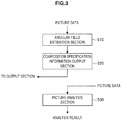
- FIG. 3 is a schematic block diagram that shows a configuration of the processing section in an embodiment of the present disclosure.
- the processing section according to the present embodiment includes an angular field estimation section 510, and a composition specification information output section 520.
- the processing section may additionally include a picture analysis section 530.
- the angular field estimation section 510, the composition specification information output section 520, and the picture analysis section 530 are implemented, for example, in the system 10 described above with reference to FIG. 2 , in the processing section 220 of the smart phone 200, or the processing section 320 of the server 300.
- the entire processing section may be implemented in a single apparatus, or one or a plurality of the component elements may be implemented by distributing to respectively different apparatuses.
- the angular field estimation section 510 estimates an angular field of a picture acquired by an imaging apparatus, with at least two points of a position relationship in a real space that are already known, based on the position relationship in the picture. This point will be additionally described by referring to FIG. 4 and FIG. 5 .
- FIG. 4 is a figure for describing an estimation of an angular field in an embodiment of the present disclosure.
- the angular fields A1 and A2 are mutually different, and the angular field A1 is wider than the angular field A2.
- Such a difference of angular fields is caused by the arrangement of an optical system that includes, for example, an imaging sensor and lens constituting the imaging apparatus.
- the angular field changes, for example, if changing the resolution of a picture, changing the aspect ratio, or performing a zoom operation, even if the same imaging apparatus.
- the angular field estimation section 510 may be implemented by the imaging section 250 and the processing section 220 in the same smart phone 200, it will not be easy to internally acquire all the setting information such as described above from the imaging section 250, even in this case. Especially in the case where the apparatus in which the angular field estimation section 510 is implemented and the imaging apparatus are separate, it will not be easy to acquire all the setting information such as described above to prescribe an angular field.
- the angular field estimation section 510 estimates an angular field of a picture, based on the positions within the picture of intersection points P1 and P4 between the sideline of a tennis court and the net, and intersection points P2 and P3 between the sideline for singles and the net. Since these points P1 to P4 are points on the tennis court prescribed in accordance with rules, this position relationship is already known. Therefore, for example, an angular field of a picture can be estimated, based on the positions of the points P1 to P4 in the picture, if capturing the picture of the direction of the points P1 to P4 upon arranging an imaging apparatus (imaging section 250) at a prescribed position (for example, on the center of the base line of the tennis court).
- the angular field estimation section 510 can estimate that the angular field is near to A1. Further, in the case where the point P2 is reflected at a portion near to the right edge of the captured picture, the point P3 is reflected at a portion near to the left edge, and the points P1 and P4 are not reflected in the picture, the angular field estimation section 510 can estimate that the angular field is near to A2.
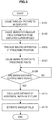
- FIG. 5 is a flow chart that shows an example of the processes of an estimation of an angular field in an embodiment of the present disclosure.
- the angular field estimation section 510 causes the display included in the output section 270 of the smart phone 200 to display a through picture (SI01).
- the through picture is a picture of a real space acquired by the imaging section 250, or another imaging apparatus. Note that, the through picture may be already displayed prior to S101.
- the angular field estimation section 510 causes marks for an angular field estimation to be displayed superimposed on the through picture displayed on the display (S103).
- the marks for an angular field estimation are figures such as circles or cross lines, for example, corresponding to the points P1 to P4 in the above example.
- a user arranges the imaging apparatus at a prescribed position (S105). If the above example, the user arranges the imaging apparatus (the smart phone 200 that includes the imaging section 250, or another imaging apparatus) towards the net, at the center of the baseline of the tennis court.
- the user causes the marks displayed superimposed in S103 to move, by operating a touch panel on the display included in the input section 260 of the smart phone 200, and causes them to match to prescribed points within the through picture (S107). For example, if the case of the points P1 to P4 in the above example, the user causes the four marks displayed on the display to respectively match to the four intersection points between the sideline and the sideline for singles and the net.
- the angular field estimation section 510 decides whether or not the positions of the prescribed points in the through picture and the positions of the marks moved by the user match (S109).
- the angular field estimation section 510 may be decided that the positions of the prescribed points and the positions of the marks match, based on an operation of the user via the input section 260 such as a touch panel.
- the angular field estimation section 510 may automatically decide that the positions of the prescribed points and the positions of the marks match, and may output a dialogue or the like, which confirms whether an angular field may be decided, to the user in the case where it is decided that there is a match.
- the angular field estimation section 510 may carry out the operation of the user of S107, and may cause the marks to automatically move.
- a user operation for causing an angular field specification to start is executed via the input section 260 at the point in time when the imaging apparatus of the user is arranged at a prescribed position in S105, and all the steps from S107 onwards may be automatically executed.
- the user may confirm a relationship between the positions of the marks automatically moved in S107 and the positions of the prescribed points in the through picture, and in the case where it is recognized that these positions are matching, may execute a user operation showing that the positions match in S109.
- the angular field estimation section 510 calculates a distance in a real space of the horizontal width of the picture (Sill). For example, if the case of the points P1 to P4 in the above example, a reduced scale for a real space of the picture can be calculated, on the surface that includes the points P1 to P4, by comparing the distance in a real space between each of the points P1 to P4, and the distance between each of these points within the picture. In this way, the distance in a real space of the horizontal width of the picture on this surface can be calculated.
- This calculation result may be expressed, for example, as a coefficient for converting one pixel in the picture into a distance unit of a real space (for example, meters).
- the angular field estimation section 510 estimates an angular field based on the distance from the position of the imaging apparatus up to the prescribed points (S113).
- the imaging apparatus is arranged at a prescribed position, more specifically, for example, at the center of the baseline of the tennis court. Therefore, the distance between the surface that includes the points P1 to P4 and the imaging apparatus is already known. Therefore, it becomes possible for the angular field estimation section 510 to estimate an angular field of the picture, for example, with a shape such as the angular fields A1 and A2 shown in FIG. 4 .
- the imaging apparatus can decide up to what range in a real space can be contained in the picture.
- the angular field estimation section 510 estimates an angular field of a picture.
- the angular field estimation section 510 estimates an angular field of a picture acquired by an imaging apparatus, with two points of a position relationship of a real space that are already known, based on the position in the picture.
- the angular field estimation section 510 may estimate an angular field of a picture based on the position in the picture of an image of a first flat or three-dimensional object that includes at least two points (for example, the image that includes the tennis court and the net in the above example).
- the first flat or three-dimensional object may include a line prescribing a court, a field, or a course (for example, the tennis court in the above example).
- the angular field estimation section 510 may estimate an angular field of a picture based on a position change in the picture of an object (for example, a ball) falling through a track that includes at least two points.
- an object for example, a ball
- the same gravitational acceleration acts on a falling object (including an object that has tossed up and that seems to ascend) regardless of the mass or shape of the object, and so a position change per time will become the same if having the same initial velocity.
- a reduced scale for a real space of the picture can be calculated on the surface that includes the falling track of the object, similar to the above example, and an angular field of the picture can be additionally estimated based on the distance from the position of the imaging apparatus up to the falling track of the object.
- the angular field estimation section 510 may estimate an angular field of a picture acquired by the imaging apparatus, by capturing a picture that includes at least two points in common from three of more different positions.
- an angular field has been estimated from a single picture, by capturing a picture that includes at least two points of a position relationship that is already known from a position where the position relationship between these points is already known.
- the relationship of respective imaging positions can be calculated, by the principle of triangulation, and an angular field of the picture can be additionally estimated.
- the composition specification information output section 520 outputs information that specifies a composition of a picture, so that a position relationship between a photographic subject and the imaging apparatus, prescribed in accordance with the angular field estimated by the angular field estimation section 510, is satisfied. This point will be additionally described by referring to FIG. 6 to FIG. 9 .
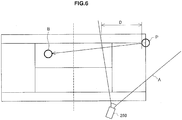
- FIG. 6 is a figure for describing a specification of a composition in an embodiment of the present disclosure.
- the imaging section 250 (imaging apparatus) of the smart phone 200, and a player P and a ball B included in an angular field A of a picture acquired by the imaging section 250, are shown in FIG. 6 .
- the picture acquired by the imaging section 250 is used for analyzing a play where the player P hits the ball B (for example, a serve of tennis).
- the composition specification information output section 520 outputs information for capturing a picture with an optimized composition for an analysis such as described above.
- an optimized composition the composition may be similarly optimized for another play, another ball game, or another operation other than for a sport.
- the composition may be optimized so that (1) the ball being tossed is reflected. More specifically, the player P is arranged on the lower side of the picture as much as possible, and the space of the picture top widened, so that the ball B tossed by the player P is not out of focus.
- composition may be optimized so that (2) an impact point of the ball is reflected. More specifically, the vicinity of the player P, where it is assumed that the player P hits the ball B with a racket, is contained in the picture.
- the composition may be optimized so that (3) the ball after an impact is reflected across a certain extent of time. More specifically, the player P is arranged on the right side of the picture (in the case where hitting from the right to the left such as in the illustrated example), so that the distance that the ball B after an impact moves within an angular field (the distance D shown in FIG. 6 ) is made as long as possible, or becomes a prescribed distance or more. For example, in the case where the velocity or the like of the ball B after an impact is calculated based on an analysis of the picture, it will be desirable for the ball after an impact to be reflected across a number of frames to a certain extent, and so optimization from this viewpoint will be important.
- the composition is optimized so that (4) an angle with respect to a movement direction of the ball after an impact approaches a right angle. More specifically, an angle of the imaging section 250 with respect to a predicted flat track of the ball after an impact approaches a right angle. For example, tracking of the ball B between frames will become easier, and the accuracy of a calculation of the velocity will also improve, as an angle with respect to a movement direction of the ball B after an impact approaches a right angle.
- the composition optimized such as described above may be different in accordance with an angular field of the picture.
- it will not necessarily be limited to an optimization being implemented such as in the above (1) to (4), if an angular field of the picture is different, even if the composition specification information output section 520 specifies a position at which the player P is to be arranged within the picture by a superimposed display or the like to a through picture.
- the compositions implementing the above (3) and (4) in a picture of a certain angular field are applied to another picture with a different angular field as it, for example, a picture with a horizontal width that is narrower, the distance D shown in FIG.
- the composition specification information output section 520 determines a composition specified by information to be output in accordance with an angular field estimated by the angular field estimation section 510.
- the composition may be prepared beforehand, for example, for each range of an angular field (for example, set in accordance with the distance of a horizontal width of a picture), or may be calculated in accordance with an estimated angular field.
- the composition is expressed, for example, by a standing position of the player P in the picture, and an angle of the imaging section 250 with respect to the ground surface.
- FIG. 7 is a figure for describing a display of a guide in an embodiment of the present disclosure. Guides respectively displayed in through pictures PIC1 and PIC2 are shown in FIG. 7 .
- the guides include a guide line G (G1, G2), and a standing position PS of a player (PS1, PS2).
- the guide line G and the player standing position PS are displayed superimposed, for example, on the through picture PIC displayed on the display included in the output section 270 of the smart phone 200.
- a composition specified by the composition specification information output section 520 is implemented, by having a user cause the smart phone to move, and respectively overlap the standing position PS on the feet of the player P, and the guide line G on a line of a tennis court.
- the guide that includes the guide line G and the player standing position PS is an example of information that specifies a composition of a picture, output by the composition specification information output section 520.
- the through picture PIC1 and the through picture PIC2 are pictures with respectively different angular fields. Therefore, as described above, the composition to be implemented in each picture will be different. Therefore, the guide line G1 and the standing position PS1 displayed in the through picture PIC1, and the guide line G2 and the standing position PS2 displayed in the through picture PIC2, will be mutually different. More specifically, there are coordinates (100, 400) on the basis of the picture left-bottom edge of the standing position PS1, and in contrast, there are coordinates (80, 380) on the basis of the picture left-bottom edge of the standing position PS2. Further, the guide line G2 is inclined with respect to the horizontal direction of the picture more than the guide line G1.
- the composition specification information output section 520 can implement a more appropriate composition than that adapted for the respective angular fields.
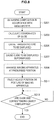
- FIG. 8 is a flow chart that shows an example of the processes of a specification of a composition in an embodiment of the present disclosure.
- the composition specification information output section 520 determines a composition in accordance with an angular field of the picture estimated by the angular field estimation section 510 (S201).
- the composition may be optimized, for example, from viewpoints such as in (1) to (4) described above, may be selected from that prepared beforehand for each angular field, or may be calculated on this occasion in accordance with an angular field.
- the composition specification information output section 520 calculates coordinates of a guide to be displayed superimposed on a through picture, based on the angular field and the composition (S203).
- the composition specification information output section 520 causes the display included in the output section 270 of the smart phone 200 to display the through picture (S205).
- the through picture is a picture of a real space acquired by the imaging section 250, or another imaging apparatus. Note that, the through picture may be already displayed prior to S205.
- the composition specification information output section 520 causes the guide according to the coordinates calculated in S203 to be displayed superimposed on the through picture displayed on the display (S207).
- the guide may include, for example, the standing position PS of the player, and the guide line G, such as shown in the above example of FIG. 7 .
- a user arranges the imaging apparatus at a prescribed position, in accordance with the display of the guide (S209). While an appropriate composition will be different for each angular field such as described above, the imaging apparatus to be arranged and the position of this will be the same (for example, the position of the imaging section 250 shown in FIG. 6 ). Accordingly, as in the illustrated example, a procedure may be adopted where first the user arranges the imaging apparatus at a prescribed position regardless of the angular field, and afterwards, finely adjusts the position and posture of the imaging apparatus by using the guide displayed superimposed on the through picture (S211). If the above example of FIG.
- the user may finely adjust the position and posture of the imaging apparatus, so that the standing position PS matches the feet of the player on the display, and the guide line G is overlapping on the line of the court, upon standing at the position of the imaging section 250 shown in FIG. 6 .
- the composition specification information output section 520 decides whether or not the guide displayed on the through picture, and an object corresponding to the guide, are overlapping (S213).
- the composition specification information output section 520 may be decided that the guide and the object are overlapping, based on an operation of the user via the input section 260 such as a touch panel.
- the composition specification information output section 520 may automatically decide that the guide and the object are overlapping, and may output a dialogue or the like, which confirms whether a composition may be decided, to the user in the case where it is decided that there is an overlap.
- the process that specifies a composition is completed, and the processes of imaging and analysis of the picture, for example, are started.
- FIG. 9 is a figure that shows an example of a picture displayed for a specification of a composition, in an embodiment of the present disclosure.
- a user interface for specifying at what side of the tennis court a player who hits a serve is to be captured is displayed.
- the composition specification information output section 520 selects a composition to be specified and information to be displayed for implementing this composition, for example, based on information input via such a user interface.
- the left-right of the guide displayed by the composition specification information output section 520 may be reversed, in the case where the left side (Left side) is selected and the case where the right side (Right side) is selected.
- the composition specification information output section 520 outputs information that specifies a composition of a picture.
- the composition specification information output section 520 outputs information that specifies a composition of a picture, so that a position relationship between a photographic subject and the imaging apparatus, prescribed in accordance with an angular field of the picture, is satisfied.
- the composition specification information output section 520 may output information for displaying a guide where the specified composition is implemented by overlapping on a second flat or three-dimensional object (for example, the player or the line of the court in the above example) visually recognized in a through picture acquired by the imaging apparatus (imaging section 250).
- the second flat or three-dimensional object may include a line prescribing a court, a field, or a course (for example, the tennis court in the above example), and a photographic subject (for example, the player in the above example) arranged at a prescribed position on the court, the field, or the course.
- the composition specification information output section 520 may output information that specifies a composition of the picture, so that at least three points in the vicinity of the photographic subject are arranged at prescribed positions.
- a composition of the picture can be specified if arranging two points at prescribed positions in the picture.
- an appropriate composition of the picture can be specified, upon specifying the position in a space of the imaging apparatus (photographer), by arranging three points at prescribed positions in the picture.
- the photographic subject may include a player arranged on the court or the field, or a ball thrown (includes the case of being hit, the case of being thrown, the case of being kicked or the like) by a play (for example, a serve of tennis in the above example) of this player.
- the composition specification information output section 520 may output information that specifies a composition of the picture, so that the ball is positioned within an angular field of the picture, at a prescribed time after this play (for example, the optimization of the composition shown in (3) of the above examples).
- the composition specification information output section 520 may output information that specifies a composition of the picture, by a method other than a display to the display.
- the composition specification information output section 520 may output information that specifies a composition of the picture, by a voice.
- the composition specification information output section 520 specifies the position or shape of an object in a through picture by a picture analysis, and calculates a deviation amount between the guide and the object.
- composition specification information output section 520 may cause an instruction, such as "please move a little to the right", “please shake your left hand a little” or the like, to be output by a voice from a speaker included in the output section 270 of the smart phone 200, for example, based on the deviation amount.
- the guide may be projected on a real space, by using a projector, a laser pointer or the like.
- the composition specification information output section 520 may output information that specifies a composition of the picture, in the case where the imaging section 250 (imaging apparatus) is not fixed and moves.
- the range necessary for analysis, the vicinity of a player and above this if the case of a serve of tennis, for example, and the space of the direction where the ball is hit may be included in the picture, for an analysis by the picture analysis section 530, which will be described below, and the imaging section 250 may not be necessarily be fixed.
- the picture analysis section 530 can calculate a change of the spacial position or posture of the imaging section 250, for example, on the basis of the standing position of the player, the line of the tennis court or the like, and can correct the picture acquired based on these and use this for analysis.
- the composition specification information output section 520 may output information that specifies a composition of the picture by including a prescribed margin, so that a picture of a necessary range can be acquired even if the imaging section 250 moves to a certain extent.
- the picture analysis section 530 executes a picture analysis based on the picture acquired in accordance with a composition specified by information output by the composition specification information output section 520.
- a picture analysis for example, in the case where a photographic subject includes a flying object, the velocity of the object may be estimated. Further, in the case where a photographic subject includes a rotating object, the rotation velocity of the object may be estimated. In the case where a photographic subject includes a parabolic-moving object, the position change amount of the object may be estimated.
- the object in these examples may be, for example, a ball thrown (hit, thrown, or kicked) in a play of a sport. In the case of a ball, the above estimation may be interpreted as an estimation of the ball speed, an estimation of the ball spin, and an estimation of the height that the ball has been tossed.
- a picture acquired in accordance with an optimized composition, specified by the composition specification information output section 520 in accordance with a composition estimated by the angular field estimation section 510 becomes a target of analysis in the picture analysis section 530. Therefore, for example, it is possible to set a composition so that the object (ball) thrown by a play of the player is positioned within an angular field of the picture across a prescribed time (a prescribed number of frames), and frame-out can be prevented without delay after an impact by the object. Further, by having a composition specified beforehand, it is possible for a track of the object in the picture to be predicted, and so the range of a search can be narrowed down, and a process such as tracking with a high accuracy, for example, is possible.
- a composition of a picture acquired by the imaging apparatus it may be possible to implement an effective analysis, for example, by using a picture acquired by a digital camera or a camera mounted in a smart phone.
- an effective analysis for example, by using a picture acquired by a digital camera or a camera mounted in a smart phone.
- a technique implemented by setting a picture with a sufficiently high frame rate or resolution up until here as a target it is possible to apply a technique implemented by setting a picture with a sufficiently high frame rate or resolution up until here as a target, and so a detailed description will be omitted here.
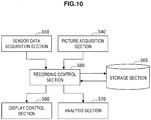
- FIG. 10 is a schematic block diagram that shows the component elements constituting the processing section in an embodiment of the present disclosure.
- the processing section in the present embodiment may include the following component elements, in addition to the component elements described with reference to FIG. 3 , or in place of these.
- the processing section according to the present embodiment may include a picture acquisition section 540, a sensor data acquisition section 550, a recording control section 560, a storage section 565, an analysis section 570, and a display control section 580.
- the picture acquisition section 540, the sensor data acquisition section 550, the recording control section 560, the analysis section 570, and the display control section 580 are implemented, for example, in the system 10 described above with reference to FIG. 2 , in the processing section 220 of the smart phone 200, or the processing section 320 of the server 300.
- the entire processing section may be implemented in a single apparatus, or one or a plurality of the component elements may be implemented by distributing to respectively different apparatuses.
- the picture acquisition section 540 acquires a picture captured in the imaging section 250 of the smart phone 200, or another imaging apparatus.
- the acquired picture may be a moving picture, for example, in which a series of plays by a player are captured.
- the sensor data acquisition section 550 acquires sensor data output from the sensor 110 of the sensor apparatus 100.
- the sensor data shows, for example, a vibration or motion (an acceleration, angular velocity, direction or the like) generated in a tool (for example, the racket R) used by the player, or in the player himself or herself.
- the recording control section 560 controls recording to the storage section 565 of the picture acquired by the picture acquisition section 540, based on an operation of a user, and/or the sensor data acquired by sensor data acquisition section 550. For example, the recording control section 560 may temporarily record the picture acquired by the picture acquisition section 540 in the storage section 565, and may specify a portion that becomes a target of analysis by the analysis section 570. Further, the recording control section 560 may temporarily record the picture acquired by the picture acquisition section 540 in the storage section 565, and may generate a picture displayed on the display by the display control section 580 from this picture.
- the analysis section 570 executes an analysis process based on the picture acquired by the picture acquisition section 540 and/or the sensor data acquired by the sensor data acquisition section 550.
- the analysis section 570 may include, for example, the picture analysis section 530 described above with reference to FIG. 3 .
- the analysis section 570 calculates the position where a ball hits the racket R, for example, based on vibration data acquired by the sensor data acquisition section 550, and particular vibration characteristics of the racket R measured beforehand. Further, the analysis section 570 may additionally calculate the velocity, rotation or the like of the ball after an impact, based on the velocity of the racket R before an impact. It is also possible for the analysis section 570 to calculate the velocity, rotation, track or the like of the ball, based on the picture acquired by the picture acquisition section 540, such as already described, for example, for the picture analysis section 530.
- the display control section 580 causes the display included in the output section 270 of the smart phone 200 to display a picture, for example, by using the picture acquired by the picture acquisition section 540.
- the display control section 580 may cause the display to display a picture acquired in real time by the picture acquisition section 540 as a through picture.
- the display control section 580 may reproduce, and cause the display to display, a picture temporarily or continuously recorded in the storage section 565 by the recording control section 560.
- the display control section 580 may cause the display to display various types of analysis results by the analysis section 570.
- the recording control section 560 controls recording (continuous recording to the storage section 565) of the picture acquired by the picture acquisition section 540, for example, based on the sensor data acquired by the sensor data acquisition section 550.
- the recording control section 560 may cause recording to stop, for example, at the instant of an impact, or after a prescribed time has elapsed from the instant of an impact.
- the recording control section 560 may cause recording to start, for example, in the case where a player starts a preliminary operation of a specific play.
- the start and the end of recording can both be automated, if recording is stopped at the instant of an impact, or after a prescribed time has elapsed from the instant of an impact, such as described above.
- FIG. 11 is a figure for describing an example of a control of recording in an embodiment of the present disclosure.
- the recording control section 560 starts recording of a picture from here. Note that, while the figure shows the start of the preliminary operation and the recording start at a same timing, as it is a schematic, time is actually necessary for an analysis of motion data and an execution of a recording control, and so recording may be started at a point in time when the above time has elapsed from when motion data showing the start of the preliminary operation is acquired.
- the recording control section 560 ends recording up until the 17th frame of the moving picture, which corresponds to a point in time one second after an impact.
- a segment of a play to be recorded as a picture can be recorded without excess or deficiency, and the time for editing of the user after-the-fact can be saved.
- the range to search for an analysis segment may be reduced, and the processing load may be reduced, if a segment of the specified picture is provided, for example, as an analysis segment to become a target of analysis by the analysis section 570.
- the recording control section 560 may temporarily record the picture acquired by the picture acquisition section 540 in the storage section 565, and may generate a picture displayed on the display by the display control section 580 from this picture.
- this picture may be a moving picture from which a segment of a specific play by a user is cut out, described in the above example of a recording control.
- the recording control section 560 may provide the same segment as a segment to be reproduced by the display control section 580, in the case where an analysis segment to become a target of analysis by the analysis section 570 is specified from within the picture acquired by the picture acquisition section 540, based on the sensor data acquired by the sensor data acquisition section 550, a segment longer than this segment may be set to a segment to be reproduced by the display control section 580.
- FIG. 12 is a figure for describing an example of picture reproduction of a segment different to an analysis segment in an embodiment of the present disclosure.
- the recording control section 560 specifies from the 1st frame up until the 18th frame of the moving picture, as a segment to be reproduced during analysis by the display control section 580.
- a track of the ball B may be displayed, based on a result of analysis by the analysis section 570.
- the recording control section 560 may specify a reproduction segment by extending the segment specified as an analysis segment before and after only a prescribed length.
- the length of extension may be determined, for example, for each of the start point and the end point of an analysis segment, in accordance with a temporal distance from the point in time of an impact generation.
- an analysis segment of the moving picture can be set without excess or deficiency based on the sensor data, a segment longer than the analysis segment can be set for a reproduction segment of the moving picture reproduced during an execution of analysis, and the waiting time of a sensory analysis process of a user can be reduced.
- FIG. 13 is a figure that shows a first example of a picture display during analysis in an embodiment of the present disclosure.
- a picture 1300 displayed on the display included in the output section 270 of the smart phone 200 for example, ball velocity information 1301, and a display during analysis 1303 are displayed superimposed on a still picture extracted from a picture of a reproduction segment.
- the ball velocity information 1301 is displayed, for example, by using a result of an analysis process based on the picture or sensor data in the analysis section 570. Further, the ball velocity information 1301 may be displayed along with an arrow 1301a showing a progress direction of the ball, and a figure 1301b showing a track of the ball.
- the progress direction of the ball, the track of the ball, and the velocity of the ball may be sequentially specified in accordance with the progression of the analysis process. Therefore, the elements constituting the ball velocity information 1301 may be gradually displayed, for example, in the order from being specified in the analysis process.
- FIG. 14 is a figure that shows a second example of a screen display during analysis in an embodiment of the present disclosure.
- a picture 1400 displayed on the display included in the output section 270 of the smart phone 200 for example, a rectangular region that includes a player, cut out from a picture of a reproduction segment, is arranged and displayed, along with a display during analysis 1401.
- These pictures are extracted from a series of frame pictures, for example, at prescribed time intervals. While four pictures are arranged in the illustrated example, a larger number of pictures may be arranged.
- multiple cut-out pictures may be displayed by automatic scrolling, or a picture may be displayed by scrolling in accordance with a flick operation or the like executed by a user via a touch panel or the like.
- the composition specification information output section 520 For example, in the case where the composition of the picture acquired by the picture acquisition section 540 is already known, by the above functions of the composition specification information output section 520, a region that includes a prescribed object that is not picture analyzed, for example, a region that includes the player, can be cut out from the picture. Therefore, after the start of an analysis process, the display such as of the picture 1400 shown above in FIG. 14 can be implemented at an earlier stage.
- FIG. 15 is a figure that shows a third example of a screen display during analysis in an embodiment of the present disclosure.
- a picture 1500 displayed on the display included in the output section 270 of the smart phone 200 for example, a picture of a player, extracted from a picture of a reproduction segment, is displayed overlapping the background, along with a display during analysis 1501.
- the picture of the player is acquired by cutting out a portion where the player is reflected, from pictures extracted from a series of frame pictures, for example, at prescribed time intervals. While five pictures are overlapping in the illustrated example, a larger number of pictures may be overlapping. Further, the position or velocity of the ball may be additionally displayed superimposed, such as in the example described above with reference to FIG. 13 .
- the above described displays all cause a picture that includes a still picture, for example, to be displayed. Therefore, a user may hardly feel the passage of time, and the waiting time of a sensory analysis process may be shortened, for example, compared to a case such as reproducing a segment of a play by a repeating moving picture.
- an analysis result by the analysis section 570 for example, it is possible to express, with more versatility, a series of movements in a play, and a result implemented by this.
- the reproduction velocity may change in the middle of reproduction, by using the fact that the instant of an impact is specified based on sensor data.
- the display control section 580 may change the reproduction velocity such as one times the velocity up until one second before an impact, half the velocity from here up until the instant of an impact, one-tenth the velocity from the instant of an impact up until 0.5 seconds afterwards, and one times the velocity from here onwards. In this way, a slow reproduction is automatically executed, for example, in important segments such as before and after an impact.
- the display control section 580 may simultaneously output a result of a picture analysis and a result of an analysis of the sensor data.
- the analysis section 570 may obtain various information related to a play, based on the picture acquired by the picture acquisition section 540 and the sensor data acquired by the sensor data acquisition section 550. Accordingly, for example, in addition to a position or velocity of the ball obtained by a result of a picture analysis, a shot power, a track of the racket, a spin amount of the ball or the like obtained by an analysis of the sensor data may be output by being simultaneously displayed on a display or the like.
- the recording control section 560 may generate sequential photographs, in which a series of movements are captured, on the basis of the instant of an impact specified by an analysis of the sensor data.
- the recording control section 560 may generate sequential photographs, by extracting frames of a moving picture at shorter intervals as it approaches an impact, and at longer intervals as it moves away from an impact.
- the display control section 580 may output a statistical indicator extracted from an analysis result by the analysis section 570.
- the display control section 580 may output a statistical indicator, such as the stability or proficiency of a toss, by displaying on a display or the like, based on an analysis result of a past play of a player.
- the display control section 580 may output information comparing an analysis result by the analysis section 570 with another player.
- the display control section 580 may cause a plurality of pictures, in which a play of a player is captured, to be reproduced in parallel, on the basis of the instant of an impact specified by an analysis of the sensor data.
- Parallel reproduction of a plurality of pictures may be reproduced, for example, by arranging the pictures up-down or left-right, or may be reproduced by transparently superimposing the pictures.
- the difference of a play between a player and another player for example, a professional
- the display control section 580 may reproduce a picture, in which a series of movements in a play are captured, and may apply an effect by using an analysis result based on the sensor data. More specifically, the display control section 580 may apply respectively different effects before an impact, at the time of an impact, and after an impact, to a picture or a part of a picture (the region of the player or the ball). Further, the display control section 580 may cause the expression of an effect to change in accordance with an analysis result (for example, the velocity of the racket or the ball) based on the sensor data.
- an analysis result for example, the velocity of the racket or the ball
- FIG. 16 is a figure that shows an example of a hardware configuration of the sensor apparatus according to an embodiment of the present disclosure.
- the sensor apparatus 100 may include a sensor 101, a Central Processing Section (CPU) 103, a Read Only Memory (ROM) 105, a Random Access Memory (RAM) 107, a user interface 109, an external storage apparatus 111, a communication apparatus 113, and an output apparatus 115. These elements are mutually connected by a bus, for example.
- the senor 101 includes an acceleration sensor, an angular velocity sensor, a vibration sensor, a magnetic field sensor, a temperature sensor, a pressure sensor (including a press switch), a Global Positioning System (GPS) receiver or the like.
- the sensor 101 may include a camera (image sensor) or a microphone (audio sensor).
- the CPU 103, the ROM 105 and the RAM 107 implement various types of functions with software, by reading and executing program instructions, for example, recorded in the external storage apparatus 111.
- functions such as control of the entire sensor apparatus 100 may be implemented, for example, by the CPU 103, the ROM 105 and the RAM 107.
- the user interface 109 is, for example, an input apparatus such as buttons or a touch panel, which receives user operations of the sensor apparatus 100. For example, operations of a user may instruct the start or completion of the transmission of sensor information from the sensor apparatus.
- the external storage apparatus 111 stores various types of information related to the sensor apparatus 100. For example, program instructions for causing functions to be implemented by software in the CPU 103, the ROM 105 and RAM 107 may be stored in the external storage apparatus 111, or data acquired by the sensor 101 may be cached temporarily.
- program instructions for causing functions to be implemented by software in the CPU 103, the ROM 105 and RAM 107 may be stored in the external storage apparatus 111, or data acquired by the sensor 101 may be cached temporarily.
- a sensor apparatus for example, with a strong impact such as a semiconductor memory, as the external storage apparatus 111.
- the communication apparatus 113 communicates with the analysis apparatus 600, which will be described below, by various types of wired or wireless communication systems. Further, the communication apparatus 113 may directly communicate with the analysis apparatus 600 by inter-device communication, or may communicate with the analysis apparatus 600 via a network such as the internet.
- the output apparatus 115 is constituted by an apparatus capable of outputting information as light, audio or pictures.
- the output apparatus 115 may output information that notifies a detection of a time or play event in the sensor apparatus 100, or may output a visual or aural notification to a user, based on an analysis result received from the analysis apparatus 600 or an analysis result calculated in the sensor apparatus 100.
- the output apparatus 115 includes, for example, a display such as a lamp of an LED or the like or an LCD, a speaker, a vibrator or the like.
- FIG. 17 is a figure that shows an example of a hardware configuration of the analysis apparatus according to an embodiment of the present disclosure.
- the analysis apparatus 600 may implement, for example, the analysis apparatus according to an embodiment of the present disclosure, or the smart phone 200 or the server 300 described above. Note that, as described above, the analysis apparatus may be implemented by the sensor apparatus 100.
- the analysis apparatus 600 may include a CPU 601, a ROM 603, a RAM 605, a user interface 609, an external storage apparatus 611, a communication apparatus 613, and an output apparatus 615. These elements are mutually connected by a bus, for example.
- the CPU 601, the ROM 603 and the RAM 605 implement various types of functions with software, by reading and executing program instructions, for example, recorded in the external storage apparatus 611.
- control of the entire analysis apparatus 600, functions of the processing section in the above described functional configuration or the like, may be implemented, for example, by the CPU 601, the ROM 603 and the RAM 605.
- the user interface 609 is, for example, an input apparatus such as buttons or a touch panel, which receives user operations of the analysis apparatus 600.
- the external storage apparatus 611 stores various types of information related to the analysis apparatus 600. For example, program instructions for causing functions to be implemented by software in the CPU 601, the ROM 603 and RAM 605 may be stored in the external storage apparatus 611, or sensor information received by the communication apparatus 613 may be cached temporarily. Further, a log of analysis results may be accumulated in the external storage apparatus 611.
- the output apparatus 615 is constituted by an apparatus capable of visually or aurally notifying information to a user.
- the output apparatus 615 may be a display device such as a Liquid Crystal Display (LCD), or an audio output device such as a speaker or headphones.
- the output apparatus 615 outputs a result obtained by the processes of the analysis apparatus 600 as video pictures such as text or pictures, or outputs the results as audio such as voices or sounds.
- each of the above described constituent elements may be constituted by using generic members, or may be constituted by hardware specialized for the functions of each of the constituent elements. Such a configuration may be appropriately changed in accordance with the technology level at the time of implementation.
- the embodiments of the present disclosure may include an analysis apparatus such as that described above (an information processing terminal such as a smart phone, a server, or a sensor apparatus), a system, an information processing method executed by the analysis apparatus or the system, a program for causing the analysis apparatus to function, and a non-temporarily tangible medium on which programs are recorded.
- an analysis apparatus such as that described above (an information processing terminal such as a smart phone, a server, or a sensor apparatus), a system, an information processing method executed by the analysis apparatus or the system, a program for causing the analysis apparatus to function, and a non-temporarily tangible medium on which programs are recorded.
Landscapes
- Engineering & Computer Science (AREA)
- Multimedia (AREA)
- Signal Processing (AREA)
- Computer Vision & Pattern Recognition (AREA)
- Physics & Mathematics (AREA)
- General Physics & Mathematics (AREA)
- Theoretical Computer Science (AREA)
- Human Computer Interaction (AREA)
- Studio Devices (AREA)
- Exposure Control For Cameras (AREA)
Claims (14)
- Appareil de traitement d'informations, comprenant :une section d'estimation de champ angulaire (510) configurée pour estimer un champ angulaire (A1, A2) d'une image acquise par un appareil d'imagerie (250), sur la base de positions dans l'image, les positions concernant au moins deux points dont la relation positionnelle dans un espace réel est déjà connue ; etune section de délivrance d'informations de spécification de composition (520) configurée pour délivrer des informations spécifiant une composition de l'image, de manière à ce qu'une relation positionnelle entre un sujet photographique et l'appareil d'imagerie, prescrite en fonction du champ angulaire, soit satisfaite.
- Appareil de traitement d'informations selon la revendication 1,
dans lequel la section d'estimation de champ angulaire (510) estime un champ angulaire de l'image sur la base d'une position d'une image d'un premier objet plat ou tridimensionnel comportant les au moins deux points dans l'image. - Appareil de traitement d'informations selon la revendication 2,
dans lequel le premier objet plat ou tridimensionnel comporte une ligne définissant un court, un terrain, ou une piste. - Appareil de traitement d'informations selon l'une quelconque des revendications 1 à 3,
dans lequel la section de délivrance d'informations de spécification de composition (520) délivre des informations destinées à afficher un guide où la composition spécifiée est mise en œuvre par chevauchement sur un deuxième objet plat ou tridimensionnel reconnu visuellement dans une image en direct acquise par l'appareil d'imagerie. - Appareil de traitement d'informations selon la revendication 4,
dans lequel le deuxième objet plat ou tridimensionnel comporte une ligne définissant un court, un terrain, ou une piste, et le sujet photographique disposé à une position prescrite sur le court, le terrain, ou la piste. - Appareil de traitement d'informations selon l'une quelconque des revendications 1 à 5,
dans lequel la section de délivrance d'informations de spécification de composition (520) délivre des informations spécifiant la composition de l'image, de manière à ce qu'au moins trois points à proximité du sujet photographique soient disposés à des positions prescrites dans l'image. - Appareil de traitement d'informations selon l'une quelconque des revendications 1 à 6,
dans lequel le sujet photographique comporte un joueur disposé sur un court ou un terrain, et une balle lancée par une action du joueur. - Appareil de traitement d'informations selon la revendication 7,
dans lequel la section de délivrance d'informations de spécification de composition (520) délivre des informations spécifiant la composition de l'image, de manière à ce que la balle soit positionnée à l'intérieur du champ angulaire de l'image, à un moment prescrit après l'action. - Appareil de traitement d'informations selon la revendication 1 ou 2,
dans lequel la section d'estimation de champ angulaire (510) estime le champ angulaire de l'image sur la base d'un changement de position d'un objet tombant le long d'une trajectoire comportant les au moins deux points dans l'image. - Appareil de traitement d'informations selon l'une quelconque des revendications 1 à 9,
le sujet photographique comportant un objet volant, et
l'appareil de traitement d'informations comprenant en outre une section d'analyse d'image (530) configurée pour estimer une vitesse de l'objet sur la base d'une image acquise en fonction de la composition. - Appareil de traitement d'informations selon l'une quelconque des revendications 1 à 10,
le sujet photographique comportant un objet en rotation, et
l'appareil de traitement d'informations comprenant en outre une section d'analyse d'image (530) configurée pour estimer une vitesse de rotation de l'objet sur la base d'une image acquise en fonction de la composition. - Appareil de traitement d'informations selon l'une quelconque des revendications 1 à 11,
le sujet photographique comportant un objet en mouvement parabolique, et
l'appareil de traitement d'informations comprenant en outre une section d'analyse d'image (530) configurée pour estimer une quantité de changement de position de l'objet en mouvement parabolique sur la base d'une image acquise en fonction de la composition. - Support d'enregistrement dans lequel est stocké un programme, le programme conduisant un ordinateur à mettre en œuvre :une fonction d'estimation d'un champ angulaire d'une image acquise par un appareil d'imagerie, sur la base de positions dans l'image, les positions concernant au moins deux points dont la relation positionnelle dans un espace réel est déjà connue ; etune fonction de délivrance d'informations spécifiant une composition de l'image, de manière à ce qu'une relation positionnelle entre un sujet photographique et l'appareil d'imagerie, prescrite en fonction du champ angulaire, soit satisfaite.
- Procédé de traitement d'informations, comprenant :l'estimation (S113), par un processeur, d'un champ angulaire d'une image acquise par un appareil d'imagerie, sur la base de positions dans l'image, les positions concernant au moins deux points dont la relation positionnelle dans un espace réel est déjà connue ; etla délivrance d'informations spécifiant une composition de l'image, de manière à ce qu'une relation positionnelle entre un sujet photographique et l'appareil d'imagerie, prescrite en fonction du champ angulaire, soit satisfaite.
Applications Claiming Priority (2)
| Application Number | Priority Date | Filing Date | Title |
|---|---|---|---|
| JP2013265271 | 2013-12-24 | ||
| PCT/JP2014/077593 WO2015098251A1 (fr) | 2013-12-24 | 2014-10-16 | Dispositif et procédé de traitement d'informations et support d'enregistrement |
Publications (3)
| Publication Number | Publication Date |
|---|---|
| EP3089441A1 EP3089441A1 (fr) | 2016-11-02 |
| EP3089441A4 EP3089441A4 (fr) | 2017-08-02 |
| EP3089441B1 true EP3089441B1 (fr) | 2020-01-22 |
Family
ID=53478130
Family Applications (1)
| Application Number | Title | Priority Date | Filing Date |
|---|---|---|---|
| EP14873581.4A Active EP3089441B1 (fr) | 2013-12-24 | 2014-10-16 | Dispositif et procédé de traitement d'informations et support d'enregistrement |
Country Status (5)
| Country | Link |
|---|---|
| US (1) | US10083519B2 (fr) |
| EP (1) | EP3089441B1 (fr) |
| JP (1) | JP6447515B2 (fr) |
| CN (1) | CN105850109B (fr) |
| WO (1) | WO2015098251A1 (fr) |
Families Citing this family (11)
| Publication number | Priority date | Publication date | Assignee | Title |
|---|---|---|---|---|
| US9848129B2 (en) * | 2015-07-08 | 2017-12-19 | Chengdu Sioeye Technology Co., Ltd. | Systems and methods for real-time integrating information into videos |
| JP6643162B2 (ja) * | 2016-03-30 | 2020-02-12 | キヤノン株式会社 | 制御装置、制御方法、撮像システム及びプログラム |
| CN105999666A (zh) * | 2016-06-28 | 2016-10-12 | 任有恒 | 网络智能球拍 |
| WO2018048838A1 (fr) * | 2016-09-06 | 2018-03-15 | Apple Inc. | Synchronisation de stabilisation d'image fixe/stabilisation d'image optique dans une capture d'images par caméras multiples |
| JP7334527B2 (ja) | 2019-07-31 | 2023-08-29 | ソニーグループ株式会社 | 情報処理装置、情報処理方法、及び、プログラム |
| JP7420377B2 (ja) * | 2020-01-31 | 2024-01-23 | 真一 原 | テニス技術上達支援データベースの作成方法、および、テニス技術上達支援システム |
| JP7283852B2 (ja) * | 2020-02-17 | 2023-05-30 | Kddi株式会社 | マルチモーダル行動認識方法、装置およびプログラム |
| JP7473449B2 (ja) * | 2020-10-28 | 2024-04-23 | Kddi株式会社 | 歪曲収差補正装置、方法及びプログラム |
| JP7622542B2 (ja) * | 2021-04-28 | 2025-01-28 | オムロン株式会社 | 動作改善装置、動作改善方法、動作改善プログラム及び動作改善システム |
| US20250159329A1 (en) * | 2022-02-08 | 2025-05-15 | Sony Semiconductor Solutions Corporation | Information processing apparatus |
| EP4644056A1 (fr) * | 2024-04-30 | 2025-11-05 | Siemens Aktiengesellschaft | Récupération automatique de collision pour machines |
Citations (1)
| Publication number | Priority date | Publication date | Assignee | Title |
|---|---|---|---|---|
| WO2013136712A1 (fr) * | 2012-03-15 | 2013-09-19 | Sony Corporation | Dispositif de traitement d'informations, système de traitement d'informations, et programme |
Family Cites Families (15)
| Publication number | Priority date | Publication date | Assignee | Title |
|---|---|---|---|---|
| JPS59194761A (ja) | 1983-04-20 | 1984-11-05 | 松下電工株式会社 | 打撃用具 |
| JPH0473731A (ja) * | 1990-07-16 | 1992-03-09 | Nikon Corp | 構図の変更を指示するカメラ |
| US5266985A (en) * | 1990-07-16 | 1993-11-30 | Nikon Corporation | Camera with optimum composition determinator |
| JP2002126147A (ja) * | 2000-10-23 | 2002-05-08 | Sumitomo Rubber Ind Ltd | テニス挙動測定方法 |
| AU2002368117A1 (en) * | 2002-07-26 | 2004-02-16 | National Institute Of Information And Communications Technology Incorporated Administrative Agency | Image recognition apparatus and image recognition program |
| JP5200780B2 (ja) * | 2008-09-08 | 2013-06-05 | ソニー株式会社 | 撮影装置および方法、並びにプログラム |
| JP2010109567A (ja) * | 2008-10-29 | 2010-05-13 | Hitachi Ltd | 情報処理装置および情報処理方法 |
| GB2473059A (en) * | 2009-08-28 | 2011-03-02 | Sony Corp | A method and apparatus for forming a composite image |
| JP2011151709A (ja) * | 2010-01-25 | 2011-08-04 | Olympus Corp | 撮像装置 |
| JP2013042250A (ja) * | 2011-08-12 | 2013-02-28 | Sony Corp | 撮像装置および撮像方法 |
| JP2013074376A (ja) * | 2011-09-27 | 2013-04-22 | Sony Corp | 撮像ガイド装置、撮像装置、撮像ガイド方法、プログラム |
| CN102509309B (zh) * | 2011-11-04 | 2013-12-18 | 大连海事大学 | 一种基于图像匹配的目标点定位系统 |
| GB2496428B (en) * | 2011-11-11 | 2018-04-04 | Sony Corp | An apparatus, method and system for detecting the position of a sporting projectile |
| JP2013213872A (ja) * | 2012-03-30 | 2013-10-17 | Sony Corp | 情報処理装置、情報処理方法、及びプログラム |
| US9385324B2 (en) * | 2012-05-07 | 2016-07-05 | Samsung Electronics Co., Ltd. | Electronic system with augmented reality mechanism and method of operation thereof |
-
2014
- 2014-10-16 EP EP14873581.4A patent/EP3089441B1/fr active Active
- 2014-10-16 US US15/104,268 patent/US10083519B2/en active Active
- 2014-10-16 JP JP2015554626A patent/JP6447515B2/ja not_active Expired - Fee Related
- 2014-10-16 WO PCT/JP2014/077593 patent/WO2015098251A1/fr not_active Ceased
- 2014-10-16 CN CN201480068702.1A patent/CN105850109B/zh not_active Expired - Fee Related
Patent Citations (1)
| Publication number | Priority date | Publication date | Assignee | Title |
|---|---|---|---|---|
| WO2013136712A1 (fr) * | 2012-03-15 | 2013-09-19 | Sony Corporation | Dispositif de traitement d'informations, système de traitement d'informations, et programme |
Also Published As
| Publication number | Publication date |
|---|---|
| JPWO2015098251A1 (ja) | 2017-03-23 |
| EP3089441A4 (fr) | 2017-08-02 |
| US20160321822A1 (en) | 2016-11-03 |
| JP6447515B2 (ja) | 2019-01-09 |
| CN105850109B (zh) | 2019-10-29 |
| EP3089441A1 (fr) | 2016-11-02 |
| CN105850109A (zh) | 2016-08-10 |
| US10083519B2 (en) | 2018-09-25 |
| WO2015098251A1 (fr) | 2015-07-02 |
Similar Documents
| Publication | Publication Date | Title |
|---|---|---|
| US10083519B2 (en) | Information processing apparatus and information processing method for specifying a composition of a picture | |
| US9448067B2 (en) | System and method for photographing moving subject by means of multiple cameras, and acquiring actual movement trajectory of subject based on photographed images | |
| EP3060317B1 (fr) | Dispositif de traitement d'informations, support d'enregistrement, et procédé de traitement d'informations | |
| JPWO2017134886A1 (ja) | 情報処理装置、情報処理方法、及び記録媒体 | |
| JP7466730B2 (ja) | プログラム、電子機器およびデータ記録方法 | |
| US10799758B2 (en) | Screen golf system, method of realizing image for screen golf, and computing-device-readable recording medium having the same recorded therein | |
| JP2002233665A5 (fr) | ||
| US10474342B2 (en) | Scrollable user interface control | |
| KR101823433B1 (ko) | 가상 골프 시뮬레이션 방법 및 장치 | |
| US20180140923A1 (en) | Image processing apparatus, analysis system, and method for processing images | |
| EP3528024B1 (fr) | Dispositif de traitement d'informations, procédé de traitement d'informations et programme | |
| CN103476467A (zh) | 虚拟高尔夫模拟装置及方法,及其使用的感测装置与感测方法 | |
| US20240037843A1 (en) | Image processing apparatus, image processing system, image processing method, and storage medium | |
| CN111192287A (zh) | 用于计算拍摄对象的运动轨迹的方法、系统及存储介质 | |
| EP3882853A1 (fr) | Procédé et appareil de traitement d'images | |
| KR101348419B1 (ko) | 영상컨텐츠를 제공하는 가상 골프 시뮬레이션 장치 및 그 방법 | |
| US12038744B2 (en) | System of obtaining exercise video utilizing drone and method of obtaining exercise video utilizing drone | |
| JP6942958B2 (ja) | 運動解析装置、運動解析方法及びプログラム | |
| CN115463409B (zh) | 手持设备的画面信息的补帧方法及手持设备 | |
| KR20230175032A (ko) | 알고리즘 기반의 골프 스윙 코칭 방법 및 장치 | |
| KR20160139634A (ko) | 골프공 스핀 계산 방법 및 장치 | |
| KR20010105012A (ko) | 인터넷을 이용한 골프 스윙 비교 분석 비쥬얼 시스템 | |
| JP7513938B2 (ja) | 情報処理方法、情報処理装置、及びプログラム | |
| JP6787072B2 (ja) | 画像処理装置、解析システム、画像処理方法及びプログラム | |
| JP6710961B2 (ja) | ゴルフスイングの解析方法 |
Legal Events
| Date | Code | Title | Description |
|---|---|---|---|
| PUAI | Public reference made under article 153(3) epc to a published international application that has entered the european phase |
Free format text: ORIGINAL CODE: 0009012 |
|
| 17P | Request for examination filed |
Effective date: 20160712 |
|
| AK | Designated contracting states |
Kind code of ref document: A1 Designated state(s): AL AT BE BG CH CY CZ DE DK EE ES FI FR GB GR HR HU IE IS IT LI LT LU LV MC MK MT NL NO PL PT RO RS SE SI SK SM TR |
|
| AX | Request for extension of the european patent |
Extension state: BA ME |
|
| DAX | Request for extension of the european patent (deleted) | ||
| A4 | Supplementary search report drawn up and despatched |
Effective date: 20170703 |
|
| RIC1 | Information provided on ipc code assigned before grant |
Ipc: H04N 5/232 20060101ALI20170627BHEP Ipc: H04N 5/225 20060101AFI20170627BHEP |
|
| STAA | Information on the status of an ep patent application or granted ep patent |
Free format text: STATUS: EXAMINATION IS IN PROGRESS |
|
| 17Q | First examination report despatched |
Effective date: 20180605 |
|
| GRAP | Despatch of communication of intention to grant a patent |
Free format text: ORIGINAL CODE: EPIDOSNIGR1 |
|
| STAA | Information on the status of an ep patent application or granted ep patent |
Free format text: STATUS: GRANT OF PATENT IS INTENDED |
|
| INTG | Intention to grant announced |
Effective date: 20190812 |
|
| GRAS | Grant fee paid |
Free format text: ORIGINAL CODE: EPIDOSNIGR3 |
|
| GRAA | (expected) grant |
Free format text: ORIGINAL CODE: 0009210 |
|
| STAA | Information on the status of an ep patent application or granted ep patent |
Free format text: STATUS: THE PATENT HAS BEEN GRANTED |
|
| AK | Designated contracting states |
Kind code of ref document: B1 Designated state(s): AL AT BE BG CH CY CZ DE DK EE ES FI FR GB GR HR HU IE IS IT LI LT LU LV MC MK MT NL NO PL PT RO RS SE SI SK SM TR |
|
| REG | Reference to a national code |
Ref country code: GB Ref legal event code: FG4D |
|
| REG | Reference to a national code |
Ref country code: CH Ref legal event code: EP |
|
| REG | Reference to a national code |
Ref country code: AT Ref legal event code: REF Ref document number: 1227696 Country of ref document: AT Kind code of ref document: T Effective date: 20200215 |
|
| REG | Reference to a national code |
Ref country code: IE Ref legal event code: FG4D |
|
| REG | Reference to a national code |
Ref country code: DE Ref legal event code: R096 Ref document number: 602014060494 Country of ref document: DE |
|
| REG | Reference to a national code |
Ref country code: NL Ref legal event code: FP |
|
| REG | Reference to a national code |
Ref country code: LT Ref legal event code: MG4D |
|
| PG25 | Lapsed in a contracting state [announced via postgrant information from national office to epo] |
Ref country code: PT Free format text: LAPSE BECAUSE OF FAILURE TO SUBMIT A TRANSLATION OF THE DESCRIPTION OR TO PAY THE FEE WITHIN THE PRESCRIBED TIME-LIMIT Effective date: 20200614 Ref country code: NO Free format text: LAPSE BECAUSE OF FAILURE TO SUBMIT A TRANSLATION OF THE DESCRIPTION OR TO PAY THE FEE WITHIN THE PRESCRIBED TIME-LIMIT Effective date: 20200422 Ref country code: FI Free format text: LAPSE BECAUSE OF FAILURE TO SUBMIT A TRANSLATION OF THE DESCRIPTION OR TO PAY THE FEE WITHIN THE PRESCRIBED TIME-LIMIT Effective date: 20200122 Ref country code: RS Free format text: LAPSE BECAUSE OF FAILURE TO SUBMIT A TRANSLATION OF THE DESCRIPTION OR TO PAY THE FEE WITHIN THE PRESCRIBED TIME-LIMIT Effective date: 20200122 |
|
| PG25 | Lapsed in a contracting state [announced via postgrant information from national office to epo] |
Ref country code: HR Free format text: LAPSE BECAUSE OF FAILURE TO SUBMIT A TRANSLATION OF THE DESCRIPTION OR TO PAY THE FEE WITHIN THE PRESCRIBED TIME-LIMIT Effective date: 20200122 Ref country code: LV Free format text: LAPSE BECAUSE OF FAILURE TO SUBMIT A TRANSLATION OF THE DESCRIPTION OR TO PAY THE FEE WITHIN THE PRESCRIBED TIME-LIMIT Effective date: 20200122 Ref country code: SE Free format text: LAPSE BECAUSE OF FAILURE TO SUBMIT A TRANSLATION OF THE DESCRIPTION OR TO PAY THE FEE WITHIN THE PRESCRIBED TIME-LIMIT Effective date: 20200122 Ref country code: GR Free format text: LAPSE BECAUSE OF FAILURE TO SUBMIT A TRANSLATION OF THE DESCRIPTION OR TO PAY THE FEE WITHIN THE PRESCRIBED TIME-LIMIT Effective date: 20200423 Ref country code: IS Free format text: LAPSE BECAUSE OF FAILURE TO SUBMIT A TRANSLATION OF THE DESCRIPTION OR TO PAY THE FEE WITHIN THE PRESCRIBED TIME-LIMIT Effective date: 20200522 Ref country code: BG Free format text: LAPSE BECAUSE OF FAILURE TO SUBMIT A TRANSLATION OF THE DESCRIPTION OR TO PAY THE FEE WITHIN THE PRESCRIBED TIME-LIMIT Effective date: 20200422 |
|
| REG | Reference to a national code |
Ref country code: DE Ref legal event code: R097 Ref document number: 602014060494 Country of ref document: DE |
|
| PG25 | Lapsed in a contracting state [announced via postgrant information from national office to epo] |
Ref country code: RO Free format text: LAPSE BECAUSE OF FAILURE TO SUBMIT A TRANSLATION OF THE DESCRIPTION OR TO PAY THE FEE WITHIN THE PRESCRIBED TIME-LIMIT Effective date: 20200122 Ref country code: SM Free format text: LAPSE BECAUSE OF FAILURE TO SUBMIT A TRANSLATION OF THE DESCRIPTION OR TO PAY THE FEE WITHIN THE PRESCRIBED TIME-LIMIT Effective date: 20200122 Ref country code: LT Free format text: LAPSE BECAUSE OF FAILURE TO SUBMIT A TRANSLATION OF THE DESCRIPTION OR TO PAY THE FEE WITHIN THE PRESCRIBED TIME-LIMIT Effective date: 20200122 Ref country code: EE Free format text: LAPSE BECAUSE OF FAILURE TO SUBMIT A TRANSLATION OF THE DESCRIPTION OR TO PAY THE FEE WITHIN THE PRESCRIBED TIME-LIMIT Effective date: 20200122 Ref country code: CZ Free format text: LAPSE BECAUSE OF FAILURE TO SUBMIT A TRANSLATION OF THE DESCRIPTION OR TO PAY THE FEE WITHIN THE PRESCRIBED TIME-LIMIT Effective date: 20200122 Ref country code: ES Free format text: LAPSE BECAUSE OF FAILURE TO SUBMIT A TRANSLATION OF THE DESCRIPTION OR TO PAY THE FEE WITHIN THE PRESCRIBED TIME-LIMIT Effective date: 20200122 Ref country code: DK Free format text: LAPSE BECAUSE OF FAILURE TO SUBMIT A TRANSLATION OF THE DESCRIPTION OR TO PAY THE FEE WITHIN THE PRESCRIBED TIME-LIMIT Effective date: 20200122 Ref country code: SK Free format text: LAPSE BECAUSE OF FAILURE TO SUBMIT A TRANSLATION OF THE DESCRIPTION OR TO PAY THE FEE WITHIN THE PRESCRIBED TIME-LIMIT Effective date: 20200122 |
|
| REG | Reference to a national code |
Ref country code: AT Ref legal event code: MK05 Ref document number: 1227696 Country of ref document: AT Kind code of ref document: T Effective date: 20200122 |
|
| PLBE | No opposition filed within time limit |
Free format text: ORIGINAL CODE: 0009261 |
|
| STAA | Information on the status of an ep patent application or granted ep patent |
Free format text: STATUS: NO OPPOSITION FILED WITHIN TIME LIMIT |
|
| 26N | No opposition filed |
Effective date: 20201023 |
|
| PG25 | Lapsed in a contracting state [announced via postgrant information from national office to epo] |
Ref country code: AT Free format text: LAPSE BECAUSE OF FAILURE TO SUBMIT A TRANSLATION OF THE DESCRIPTION OR TO PAY THE FEE WITHIN THE PRESCRIBED TIME-LIMIT Effective date: 20200122 Ref country code: IT Free format text: LAPSE BECAUSE OF FAILURE TO SUBMIT A TRANSLATION OF THE DESCRIPTION OR TO PAY THE FEE WITHIN THE PRESCRIBED TIME-LIMIT Effective date: 20200122 |
|
| PG25 | Lapsed in a contracting state [announced via postgrant information from national office to epo] |
Ref country code: PL Free format text: LAPSE BECAUSE OF FAILURE TO SUBMIT A TRANSLATION OF THE DESCRIPTION OR TO PAY THE FEE WITHIN THE PRESCRIBED TIME-LIMIT Effective date: 20200122 Ref country code: SI Free format text: LAPSE BECAUSE OF FAILURE TO SUBMIT A TRANSLATION OF THE DESCRIPTION OR TO PAY THE FEE WITHIN THE PRESCRIBED TIME-LIMIT Effective date: 20200122 |
|
| REG | Reference to a national code |
Ref country code: CH Ref legal event code: PL |
|
| PG25 | Lapsed in a contracting state [announced via postgrant information from national office to epo] |
Ref country code: LU Free format text: LAPSE BECAUSE OF NON-PAYMENT OF DUE FEES Effective date: 20201016 Ref country code: MC Free format text: LAPSE BECAUSE OF FAILURE TO SUBMIT A TRANSLATION OF THE DESCRIPTION OR TO PAY THE FEE WITHIN THE PRESCRIBED TIME-LIMIT Effective date: 20200122 |
|
| REG | Reference to a national code |
Ref country code: BE Ref legal event code: MM Effective date: 20201031 |
|
| PG25 | Lapsed in a contracting state [announced via postgrant information from national office to epo] |
Ref country code: FR Free format text: LAPSE BECAUSE OF NON-PAYMENT OF DUE FEES Effective date: 20201031 |
|
| PG25 | Lapsed in a contracting state [announced via postgrant information from national office to epo] |
Ref country code: BE Free format text: LAPSE BECAUSE OF NON-PAYMENT OF DUE FEES Effective date: 20201031 Ref country code: CH Free format text: LAPSE BECAUSE OF NON-PAYMENT OF DUE FEES Effective date: 20201031 Ref country code: LI Free format text: LAPSE BECAUSE OF NON-PAYMENT OF DUE FEES Effective date: 20201031 |
|
| PG25 | Lapsed in a contracting state [announced via postgrant information from national office to epo] |
Ref country code: IE Free format text: LAPSE BECAUSE OF NON-PAYMENT OF DUE FEES Effective date: 20201016 |
|
| PGFP | Annual fee paid to national office [announced via postgrant information from national office to epo] |
Ref country code: NL Payment date: 20210921 Year of fee payment: 8 |
|
| PGFP | Annual fee paid to national office [announced via postgrant information from national office to epo] |
Ref country code: GB Payment date: 20210922 Year of fee payment: 8 |
|
| PGFP | Annual fee paid to national office [announced via postgrant information from national office to epo] |
Ref country code: DE Payment date: 20210921 Year of fee payment: 8 |
|
| PG25 | Lapsed in a contracting state [announced via postgrant information from national office to epo] |
Ref country code: TR Free format text: LAPSE BECAUSE OF FAILURE TO SUBMIT A TRANSLATION OF THE DESCRIPTION OR TO PAY THE FEE WITHIN THE PRESCRIBED TIME-LIMIT Effective date: 20200122 Ref country code: MT Free format text: LAPSE BECAUSE OF FAILURE TO SUBMIT A TRANSLATION OF THE DESCRIPTION OR TO PAY THE FEE WITHIN THE PRESCRIBED TIME-LIMIT Effective date: 20200122 Ref country code: CY Free format text: LAPSE BECAUSE OF FAILURE TO SUBMIT A TRANSLATION OF THE DESCRIPTION OR TO PAY THE FEE WITHIN THE PRESCRIBED TIME-LIMIT Effective date: 20200122 |
|
| PG25 | Lapsed in a contracting state [announced via postgrant information from national office to epo] |
Ref country code: MK Free format text: LAPSE BECAUSE OF FAILURE TO SUBMIT A TRANSLATION OF THE DESCRIPTION OR TO PAY THE FEE WITHIN THE PRESCRIBED TIME-LIMIT Effective date: 20200122 Ref country code: AL Free format text: LAPSE BECAUSE OF FAILURE TO SUBMIT A TRANSLATION OF THE DESCRIPTION OR TO PAY THE FEE WITHIN THE PRESCRIBED TIME-LIMIT Effective date: 20200122 |
|
| REG | Reference to a national code |
Ref country code: DE Ref legal event code: R079 Ref document number: 602014060494 Country of ref document: DE Free format text: PREVIOUS MAIN CLASS: H04N0005225000 Ipc: H04N0023000000 |
|
| REG | Reference to a national code |
Ref country code: DE Ref legal event code: R119 Ref document number: 602014060494 Country of ref document: DE |
|
| REG | Reference to a national code |
Ref country code: NL Ref legal event code: MM Effective date: 20221101 |
|
| GBPC | Gb: european patent ceased through non-payment of renewal fee |
Effective date: 20221016 |
|
| PG25 | Lapsed in a contracting state [announced via postgrant information from national office to epo] |
Ref country code: NL Free format text: LAPSE BECAUSE OF NON-PAYMENT OF DUE FEES Effective date: 20221101 Ref country code: DE Free format text: LAPSE BECAUSE OF NON-PAYMENT OF DUE FEES Effective date: 20230503 |
|
| PG25 | Lapsed in a contracting state [announced via postgrant information from national office to epo] |
Ref country code: GB Free format text: LAPSE BECAUSE OF NON-PAYMENT OF DUE FEES Effective date: 20221016 |