EP3089480B2 - Procédé de fabrication d'une prothèse auditive et prothèse auditive - Google Patents
Procédé de fabrication d'une prothèse auditive et prothèse auditive Download PDFInfo
- Publication number
- EP3089480B2 EP3089480B2 EP16164091.7A EP16164091A EP3089480B2 EP 3089480 B2 EP3089480 B2 EP 3089480B2 EP 16164091 A EP16164091 A EP 16164091A EP 3089480 B2 EP3089480 B2 EP 3089480B2
- Authority
- EP
- European Patent Office
- Prior art keywords
- earmould
- filter element
- covering
- otoplastic
- cover
- Prior art date
- Legal status (The legal status is an assumption and is not a legal conclusion. Google has not performed a legal analysis and makes no representation as to the accuracy of the status listed.)
- Active
Links
Images
Classifications
-
- H—ELECTRICITY
- H04—ELECTRIC COMMUNICATION TECHNIQUE
- H04R—LOUDSPEAKERS, MICROPHONES, GRAMOPHONE PICK-UPS OR LIKE ACOUSTIC ELECTROMECHANICAL TRANSDUCERS; ELECTRIC HEARING AIDS; PUBLIC ADDRESS SYSTEMS
- H04R25/00—Electric hearing aids
- H04R25/65—Housing parts, e.g. shells, tips or moulds, or their manufacture
-
- H—ELECTRICITY
- H04—ELECTRIC COMMUNICATION TECHNIQUE
- H04R—LOUDSPEAKERS, MICROPHONES, GRAMOPHONE PICK-UPS OR LIKE ACOUSTIC ELECTROMECHANICAL TRANSDUCERS; ELECTRIC HEARING AIDS; PUBLIC ADDRESS SYSTEMS
- H04R25/00—Electric hearing aids
- H04R25/65—Housing parts, e.g. shells, tips or moulds, or their manufacture
- H04R25/658—Manufacture of housing parts
-
- A—HUMAN NECESSITIES
- A61—MEDICAL OR VETERINARY SCIENCE; HYGIENE
- A61F—FILTERS IMPLANTABLE INTO BLOOD VESSELS; PROSTHESES; DEVICES PROVIDING PATENCY TO, OR PREVENTING COLLAPSING OF, TUBULAR STRUCTURES OF THE BODY, e.g. STENTS; ORTHOPAEDIC, NURSING OR CONTRACEPTIVE DEVICES; FOMENTATION; TREATMENT OR PROTECTION OF EYES OR EARS; BANDAGES, DRESSINGS OR ABSORBENT PADS; FIRST-AID KITS
- A61F11/00—Methods or devices for treatment of the ears or hearing sense; Non-electric hearing aids; Methods or devices for enabling ear patients to achieve auditory perception through physiological senses other than hearing sense; Protective devices for the ears, carried on the body or in the hand
- A61F11/06—Protective devices for the ears
- A61F11/08—Protective devices for the ears internal, e.g. earplugs
- A61F11/085—Protective devices for the ears internal, e.g. earplugs including an inner channel
-
- B—PERFORMING OPERATIONS; TRANSPORTING
- B33—ADDITIVE MANUFACTURING TECHNOLOGY
- B33Y—ADDITIVE MANUFACTURING, i.e. MANUFACTURING OF THREE-DIMENSIONAL [3D] OBJECTS BY ADDITIVE DEPOSITION, ADDITIVE AGGLOMERATION OR ADDITIVE LAYERING, e.g. BY 3D PRINTING, STEREOLITHOGRAPHY OR SELECTIVE LASER SINTERING
- B33Y80/00—Products made by additive manufacturing
-
- H—ELECTRICITY
- H04—ELECTRIC COMMUNICATION TECHNIQUE
- H04R—LOUDSPEAKERS, MICROPHONES, GRAMOPHONE PICK-UPS OR LIKE ACOUSTIC ELECTROMECHANICAL TRANSDUCERS; ELECTRIC HEARING AIDS; PUBLIC ADDRESS SYSTEMS
- H04R25/00—Electric hearing aids
-
- A—HUMAN NECESSITIES
- A61—MEDICAL OR VETERINARY SCIENCE; HYGIENE
- A61F—FILTERS IMPLANTABLE INTO BLOOD VESSELS; PROSTHESES; DEVICES PROVIDING PATENCY TO, OR PREVENTING COLLAPSING OF, TUBULAR STRUCTURES OF THE BODY, e.g. STENTS; ORTHOPAEDIC, NURSING OR CONTRACEPTIVE DEVICES; FOMENTATION; TREATMENT OR PROTECTION OF EYES OR EARS; BANDAGES, DRESSINGS OR ABSORBENT PADS; FIRST-AID KITS
- A61F2240/00—Manufacturing or designing of prostheses classified in groups A61F2/00 - A61F2/26 or A61F2/82 or A61F9/00 or A61F11/00 or subgroups thereof
- A61F2240/001—Designing or manufacturing processes
- A61F2240/002—Designing or making customized prostheses
-
- H—ELECTRICITY
- H04—ELECTRIC COMMUNICATION TECHNIQUE
- H04R—LOUDSPEAKERS, MICROPHONES, GRAMOPHONE PICK-UPS OR LIKE ACOUSTIC ELECTROMECHANICAL TRANSDUCERS; ELECTRIC HEARING AIDS; PUBLIC ADDRESS SYSTEMS
- H04R2225/00—Details of deaf aids covered by H04R25/00, not provided for in any of its subgroups
- H04R2225/025—In the ear hearing aids [ITE] hearing aids
-
- H—ELECTRICITY
- H04—ELECTRIC COMMUNICATION TECHNIQUE
- H04R—LOUDSPEAKERS, MICROPHONES, GRAMOPHONE PICK-UPS OR LIKE ACOUSTIC ELECTROMECHANICAL TRANSDUCERS; ELECTRIC HEARING AIDS; PUBLIC ADDRESS SYSTEMS
- H04R2225/00—Details of deaf aids covered by H04R25/00, not provided for in any of its subgroups
- H04R2225/77—Design aspects, e.g. CAD, of hearing aid tips, moulds or housings
-
- H—ELECTRICITY
- H04—ELECTRIC COMMUNICATION TECHNIQUE
- H04R—LOUDSPEAKERS, MICROPHONES, GRAMOPHONE PICK-UPS OR LIKE ACOUSTIC ELECTROMECHANICAL TRANSDUCERS; ELECTRIC HEARING AIDS; PUBLIC ADDRESS SYSTEMS
- H04R25/00—Electric hearing aids
- H04R25/60—Mounting or interconnection of hearing aid parts, e.g. inside tips, housings or to ossicles
Definitions
- the invention relates to a method for producing an otoplastic, wherein a digital three-dimensional model of an ear cup is created, according to which the otoplastic is printed with a 3-D printer.
- the invention relates to an otoplastic for partial insertion into an ear canal and / or to be worn in an ear cup, the otoplastic being printed with a 3-D printer.
- the invention further relates to the use of such an otoplastic.
- An otoplastic is a molded fitting that can be at least partially inserted into a human's auditory canal or worn in an ear cup.
- An otoplastic is preferably produced individually for a wearer, since a shape of the ears and the auditory canal differs from person to person.
- the ear canal and the pinna or the area of the ear required for the otoplastic are molded with an impression material made of silicone, for example. After this material has hardened, a positive impression of the ear is made, which is scanned and a digital model of which is created.
- the digital model is further processed on a computer, after which the otoplastic is produced in accordance with the model. This can be done, for example, by superimposing a large number of wafer-thin plastic layers, which are then cured under UV light. Alternatively, the otoplastic can be printed as a whole using a 3-D printer. In order to bring such an earmold into a final, portable form, it is finally processed by hand.
- An earmold is used in different areas of application, for example as hearing protection, hearing aid or miniature headphones.
- An otoplastic used for this is mostly plain-colored, preferably in dark or skin-like shades. It is also known to produce an otoplastic in different colors or to decorate it with rhinestones, for example. However, this mainly concerns a pure jewelry otoplastic, which serves no other purpose. However, such a design or appearance corresponding to such a decorative earmold is not readily transferable to hearing protection, for example.
- Hearing protection includes technical means such as a sound filter, which cannot be decorated or covered without at least restricting their purpose.
- producing an otoplastic with such decorations is cost-intensive, especially if it is to be produced with an individual design.
- At least a filigree jewelry earmold is neither particularly durable nor comfortable to wear.
- the document US 2013/251161 shows an otoplastic, wherein a cover can be made of sensitive materials and can have an engraving. This is where the invention comes in.
- the object of the invention is to provide a method of the type mentioned at the outset with which a versatile earmold can be produced in a simple manner in a visually appealing manner.
- Another goal is to provide an otoplastic of the type mentioned at the outset, which can be used in a variety of ways and is visually appealing.
- Another aim is to indicate the use of such an otoplastic.
- the object is achieved according to the invention by a method according to claim 1.
- An advantage achieved with the invention can be seen in particular in that these two relatively simple steps make a visible part of the otoplastic in a simple manner optically appealing.
- the cover can be made of any material and covers the visible area. Wood, paper, PVC foils, metal and / or fabric, for example, are suitable. In any case, it is expedient if the cover has a small thickness, in particular less than 0.5 mm, preferably less than 0.3 mm, particularly preferably 0.2 mm or less.
- the cover is then glued to the outer or visible area or the outer surface of the otoplastic, which closes the otoplastic from the outside.
- the outer surface is preferably flat or flat and free of unevenness and / or grooves.
- the cover In order to protect the cover against signs of wear or the like and at the same time to reinforce a renewed connection to the otoplastic, the latter is then sealed. This prevents the penetration and / or escape of substances and a possibly sharp or rough material of the cover is covered or covered with a smooth and edge-free layer. Sealing is to be designed broadly so that it also includes painting or the like.
- an otoplastic for use as hearing protection, hearing aid or miniature headphones can be produced. Since only a visible surface of the otoplastic is changed by sticking on the cover, an otoplastic can be produced or designed relatively inexpensively according to individual requirements with such a method.
- An area of the otoplastic that can be inserted at least partially into the ear canal is preferably designed such that in particular medical claims are met.
- the otoplastic should be able to be worn over a long period of time without any allergic reactions to the skin or the like.
- a mass flowing apart in particular made of a hardenable plastic, is applied to it approximately centrally. In principle, this can be done by machine. However, it is convenient if e.g. B. a drop is applied by hand, since this can influence or control the flow of the drop.
- the drop is made of a liquid or viscous plastic, which is or is distributed fluently over the surface of the cover and ultimately forms a seal. Furthermore, a curable plastic is used for this, which after flowing apart or running with z. B. UV light is cured. In order to be able to see through a color or a design of the cover through the seal, it is favorable if the material of the drop or the seal is transparent.
- a surface of the cover formed thereby preferably has a curved shape.
- an entire surface of the otoplastic is formed essentially without sharp edges and corners, as a result of which its optical appearance is emphasized again positively.
- the otoplastic can thereby be inserted into or moved in an auricle without injury.
- the curvature of the seal can have its maximum height where the drop was originally applied.
- the cover, together with the seal is approximately 1 mm to 2 mm, in particular 1.3 mm to 1.7 mm, preferably approximately 1.5 mm thick at its thickest point.
- a digital two-dimensional model of the visible surface is calculated from the digital three-dimensional model of the ear cup. This is preferably carried out digitally using a computer or corresponding software. In principle, however, it is also possible to carry out this process at least in part analogously.
- an impression of the surface of the otoplastic is made, for example by applying a color, which is then stamped or printed on a sheet of paper. The stamped impression can then be scanned and processed on the computer.
- the cover is cut out of a material in accordance with the two-dimensional model of the visible surface, in particular with a laser.
- the calculated digital two-dimensional model is particularly preferably reduced in such a way that its outline is uniformly inward by approximately 0.5 mm to 1.5 mm, in particular 0.7 mm to 1.3 mm, particularly preferably approximately 1 mm is shifted towards the center of the two-dimensional model.
- This makes it possible to create a custom-fit cover for sticking on the visible surface.
- the difference between the area of the cover and the visible area of the otoplastic is filled with sealing material.
- the light from a laser cuts out the cover exactly, without fraying contours of the material of the object or the like.
- a laser can be used to cut almost any material with an equally good cutting quality.
- the visible surface is cleaned and / or polished before the cover is stuck on. This removes any irregularities and / or impurities on the visible or outer surface. Furthermore, it is possible to apply an adhesive as evenly as possible or to glue on the cover.
- the visible surface is particularly preferably designed to be flat and free of scratches, grooves or other unevenness.
- the otoplastic is painted in order to make it visually appealing on the one hand and to make it more resistant to wear and tear such as scratches, on the other hand.
- a transparent material is used in particular for painting.
- hearing protection is produced. Such hearing protection can be worn, for example, by athletes, musicians or workers. It can be important for these groups of people that the hearing protection is optically appealing. Hearing protection is designed according to the individual wishes and needs of a wearer. On the one hand, a design and / or material of the cover can be selected by the carrier, and on the other hand, for example, a suitable filter element.
- the filter element can be printed simultaneously with the otoplastic by a 3-D printer or can only be inserted into the otoplastic after 3-D printing. Hearing protection is usually finished after the filter element has been inserted, the filter element being arranged so that it is visible from the outside.
- the filter element is completely covered by sticking on the cover, an air volume being enclosed in the filter element. This air volume creates a resonance system through which a frequency response is influenced.
- the opening in the cover ensures that despite the same ambient noise, the filter element can reach and be picked up or filtered by it.
- the optimal size of the opening changes the resonance frequency so that filter properties are influenced as positively as possible.
- the opening is preferably approximately round or circular and has a free diameter in the range from 1 mm to 2 mm, in particular 1.4 mm to 1.7 mm, preferably approximately 1.6 mm.
- a choice of the free diameter of the opening is particularly important in order to optimally design the hearing protection or to let a defined amount of noise strike the filter element.
- two bores can be drilled, a first of which can have a free diameter in the range from 1 mm to 1.5 mm and a second can have a free diameter in the range from 0.5 mm to 1 mm.
- properties of the filter element are also influenced by a thickness of the seal or its curvature. It may therefore be necessary to adapt a number or size of one or more openings to the thickness or an angle of the curvature of the seal.
- the cover creates an optically appealing otoplastic which is versatile and durable. Since only a visible surface of the earmold can be customized, the earmold can be used for several areas of application, such as hearing aids, hearing protection or miniature headphones. The area of the otoplastic that can be inserted at least partially into the ear canal remains unchanged in accordance with the respective area of application. It is also particularly favorable if a large-area adhesive surface is provided. This creates a long-lasting connection between the earmold and the cover.
- the cover can be made of almost any material. For example, this can be made of wood, paper, PVC films or fabric.
- the adhesive used is advantageously adapted to the material of the cover.
- Sealing or sealing further increases the durability of the cover on the otoplastic.
- the cover or the earmold is protected against wear and tear and is free of corners and edges.
- the otoplastic not only has an attractive appearance, but can also be used without any risk of injury in or on the ear.
- a sealing mass e.g. B. one or more drops is applied approximately in the middle of the cover. In principle, this can be done by machine. However, it is advantageous if the drop is applied by hand, since this also influences the flow of the drop apart.
- Such a drop is particularly preferably formed from a transparent plastic which is curable, for example, with UV light.
- a final shape of the covering or otoplastic is produced.
- a surface of the cover formed in this way is preferably not flat or flat, but rather has a curved shape.
- the otoplastic is designed as hearing protection.
- the filter element is preferably inserted into the otoplastic before the cover is applied or glued. When the cover is stuck on, the filter element is excluded from the adhesive surface in order not to impair its effect.
- At least one opening is provided in the cover in order to allow ambient noise to be picked up by the filter element.
- the opening is arranged directly above the filter element, the filter element being excluded from an adhesive surface.
- the filter element is approximately cylindrical and has an approximately round surface, which is embedded in the visible surface of the otoplastic.
- a diameter of an uppermost layer of the filter element can be larger than a remaining body of the filter element.
- a free diameter of the preferably round opening can be, for example, 1 mm to 2 mm, in particular 1.4 mm to 1.7 mm, preferably approximately 1.6 mm.
- the opening can also be designed with a rectangular or other polygonal cross section.
- two or more openings can also be provided, each of which can have a different free diameter.
- a ratio of a free diameter of the opening to a diameter of a surface of the filter element can advantageously be at least 1: 4, in particular at least 1: 5, preferably at least 1: 6.
- An approximately round cross section of the opening and the filter element is assumed.
- a ratio of an area of the opening to the surface of the filter element is at least 1:16, in particular at least 1:25, preferably at least 1:36.
- the optimal size of the opening changes the resonance frequency so that filter properties are influenced as positively as possible.
- properties of the filter element are also influenced by a thickness of the seal or its curvature. It may therefore be necessary to adapt a number or size of one or more openings to the thickness or an angle of the curvature of the seal.
- an otoplastic according to the invention is advantageously used as hearing protection, which is particularly optically appealing.
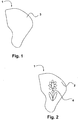
- Fig. 1 shows an otoplastic 1.
- a top view of the otoplastic 1 is shown, a surface 3 being shown, which is visible to the outside when the otoplastic 1 is worn in the auricle.
- a three-dimensional model of an ear cup is created in a first step. In principle, this can be done by scanning the pinna with, for example, laser light.
- the digital image is post-processed and optimized with a computer or corresponding software, after which this image of the ear or the pinna is printed with a 3D printer.
- a cover 2 is glued onto the outwardly flat surface 3, which is then sealed.
- FIG Fig. 2 An otoplastic 1 according to the invention with a cover 2 is shown in FIG Fig. 2 shown, the cover 2 can be made of any material such as paper, wood, plastic or metal. The material can also have any motif or design. In order to produce a long-lasting otoplastic 1 without susceptibility to wear, it is sealed. For this purpose, a drop of a seal 6 (in Fig. 2 not shown) applied material. A curable, viscous or liquid plastic is particularly preferably used for this purpose, which is cured, for example, under UV light. It is advantageous if the drop is applied by hand so that it can be controlled to separate.
- the seal 6 is also preferably transparent so that a motif or a material of the cover 2 remains visible through it.
- a surface of the cover 2 formed by the seal 6 preferably has a curved shape.
- an entire surface of the otoplastic 1 is formed essentially without sharp edges and corners, as a result of which its optical appearance is again positively emphasized.
- the ear is not injured by sharp edges or the like.
- the curvature of the seal 6 can have its maximum height where the drop was originally applied.
- a digital two-dimensional model of the visible surface 3 is calculated from the digital three-dimensional model of the ear cup.
- a model with reduced contours compared to surface 3 is particularly preferably created, said contour being inward in the direction of approximately 0.5 mm to 1.5 mm, in particular 0.7 mm to 1.3 mm, particularly preferably approximately 1 mm Center point.
- the cover 2 is then cut out of a material using a laser, for example, and glued to the surface 3 of the otoplastic 1. In order to establish an optimal connection between the surface 3 and the cover 2, an adhesive is applied over a large area.
- the surface 3 is cleaned and / or polished before the cover 2 is stuck on, in order to produce a surface that is as flat as possible and free from scratches, unevenness or other irregularities.
- the otoplastic 1 can be painted.
- hearing protection can be produced using the method according to the invention.
- the 3-D pressure of the otoplastic 1 is inserted into the filter element 5, which is intended to filter ambient noise.
- the cover 2 is glued onto the surface 3 such that the filter element 5 is completely covered by it.
- at least one opening 4 is drilled in the cover 2.
- Fig. 2 the opening 4 is shown, the filter element 5 not being shown.
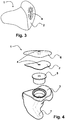
- An otoplastic 1 with filter element 5 is subsequently shown in Fig. 4 shown.
- Fig. 3 is a further view of the otoplastic 1 according to FIG Fig. 2 shown.
- the opening 4 is preferably approximately round or circular.
- a free diameter or area of the opening 4 is particularly important in order to optimally design the hearing protection or a defined amount of noise on the in Fig. 3 to let filter element 5, not shown, hit.
- Two or more openings 4 can also be drilled for sound entry into the cover 2, the free diameter of the openings 4 each being able to be of different sizes.
- two openings 4 can be drilled in the cover 2, a first of which has a free diameter in the range from 1 mm to 1.5 mm and a second has a free diameter in the range from 0.5 mm to 1 mm.
- the openings 4 are arranged at a distance from one another, it being possible for a size of a distance to contribute to an amount of noise impinging on the filter element 5.
- Fig. 4 shows an exploded view of an otoplastic 1 according to the invention, which is for use is produced as hearing protection.
- a filter element 5 is shown which is essentially cylindrical and is inserted in the otoplastic 1.
- the filter element 5 has an approximately round surface, which is embedded in a visible surface 3 of the otoplastic 1.
- a diameter of an uppermost layer is larger than a remaining body of the filter element 5 in order to be able to position it in the earmold 1 in a positionally stable manner.
- a cover 2 is glued to the surface 3, an area of the filter element 5 being excluded from an adhesive surface.
- the dashed line on surface 3 indicates that an area of cover 2 is somewhat smaller than surface 3.
- a seal 6 is also shown, which seals the cover 2 and has a curved shape.
- the seal 6 also has an opening 4, which is only drilled through the cover 2 and the seal only after the cover 2 has been glued and sealed.
- a curable, transparent plastic is used, which, for. B. is applied as one or more drops of a diverging mass on the cover 2.
- a channel 7 is also shown, through which a defined amount of noise via the filter element 5 through the otoplastic 1 strikes or is directed onto the ear canal of a person wearing the hearing protection.
- the channel 7 extends from a lower end of the filter element 5, which is mounted within the otoplastic 1, to an inner end of the otoplastic 1, which points in the direction of the auditory canal of the person wearing the hearing protection.
- the otoplastic 1 can also be used as a hearing aid, miniature headphones or miniature computer that can be worn in the ear.
- appropriate electronics and / or other necessary components can be placed in the otoplastic 1.
- the visible surface 3 is always glued to the cover 2, so that a desired material and / or motif is visible to the outside. The material and / or motif can be individually selected by a person wearing the otoplastic 1.
Landscapes
- Engineering & Computer Science (AREA)
- Manufacturing & Machinery (AREA)
- Health & Medical Sciences (AREA)
- General Health & Medical Sciences (AREA)
- Otolaryngology (AREA)
- Physics & Mathematics (AREA)
- Acoustics & Sound (AREA)
- Neurosurgery (AREA)
- Signal Processing (AREA)
- Life Sciences & Earth Sciences (AREA)
- Biophysics (AREA)
- Animal Behavior & Ethology (AREA)
- Chemical & Material Sciences (AREA)
- Psychology (AREA)
- Biomedical Technology (AREA)
- Heart & Thoracic Surgery (AREA)
- Vascular Medicine (AREA)
- Materials Engineering (AREA)
- Public Health (AREA)
- Veterinary Medicine (AREA)
- Prostheses (AREA)
- Filtering Of Dispersed Particles In Gases (AREA)
- Headphones And Earphones (AREA)
- Polymers With Sulfur, Phosphorus Or Metals In The Main Chain (AREA)
Claims (10)
- Procédé de production d'un otoplastique (1), dans lequel est établi un modèle tridimensionnel numérique d'un pavillon d'oreille selon lequel l'otoplastique (1) est imprimé avec une imprimante 3D, caractérisé en ce qu'une protection d'oreille est réalisée, un recouvrement (2) étant collé dans le pavillon d'oreille sur une surface (3) visible de celui-ci lors du port de l'otoplastique (1) et le recouvrement (2) étant ensuite scellé avec une couche lisse et sans arête, un élément filtrant (5) étant complètement recouvert par le collage du recouvrement (2), un volume d'air étant ainsi renfermé dans l'élément filtrant (5), étant créé par ce volume d'air un système de résonance par lequel une réponse de fréquence est influencée, et au moins une ouverture (4) étant percée dans le recouvrement (2) pour permettre une absorption des bruits environnants par l'élément filtrant (5) disposé dans l'otoplastique (1).
- Procédé selon la revendication 1, caractérisé en ce que, pour sceller le recouvrement (2), approximativement au centre, une masse s'étalant, en particulier composée d'une matière plastique durcissable, est appliquée.
- Procédé selon la revendication 1 ou 2, caractérisé en ce que, à partir du modèle tridimensionnel numérique du pavillon d'oreille, un modèle bidimensionnel numérique de la surface visible (3) est calculé.
- Procédé selon la revendication 3, caractérisé en ce que le recouvrement (2) est découpé en fonction du modèle bidimensionnel de la surface visible (3), en particulier avec un laser, dans un matériau.
- Procédé selon une des revendications 1 à 4, caractérisé en ce que la surface visible (3) set nettoyée et/ou polie avant le collage du recouvrement (2).
- Procédé selon une des revendications 1 à 5, caractérisé en ce que l'otoplastique (1) est verni.
- Otoplastique (1) destiné à une insertion partielle dans un conduit auditif et/ou à un port dans un pavillon d'oreille, l'otoplastique (1) étant imprimé avec une imprimante 3D et réalisé sous forme d'une protection d'oreille, caractérisé en ce qu'un recouvrement (2) est collé dans le pavillon d'oreille sur une surface visible (3) de celui-ci lors d'un port de l'otoplastique (1) et scellé avec une couche lisse et sans arête, un élément filtrant (5) étant complètement couvert par le recouvrement collé (2) pour ainsi renfermer un volume d'air dans l'élément filtrant (5) et créer grâce à ce volume d'air un système de résonance qui influence une réponse de fréquence, au moins une ouverture (4) étant percée dans le recouvrement (2) pour permettre une absorption de bruits environnants par l'élément filtrant (5) disposé dans l'otoplastique (1).
- Otoplastique (1) selon la revendication 7, caractérisé en ce qu'un élément filtrant (5) est inséré dans l'otoplastique (1).
- Otoplastique (1) selon la revendication 8, caractérisé en ce qu'il est prévu dans le recouvrement (2) au moins une ouverture (4) pour permettre une absorption de bruits environnants par l'élément filtrant (5).
- Otoplastique (1) selon la revendication 9, caractérisé en ce qu'un rapport entre un diamètre libre de l'ouverture (4) et un diamètre d'une surface de l'élément filtrant (5) s'élève à au moins 1:4, en particulier au moins 1:5, de préférence au moins 1:6.
Priority Applications (2)
| Application Number | Priority Date | Filing Date | Title |
|---|---|---|---|
| SI201630006T SI3089480T2 (sl) | 2015-04-30 | 2016-04-06 | Postopek za izdelavo ulitka za uho in ulitek za uho |
| HRP20171489TT HRP20171489T4 (hr) | 2015-04-30 | 2017-10-05 | Postupak proizvodnje otoplastike i otoplastika |
Applications Claiming Priority (1)
| Application Number | Priority Date | Filing Date | Title |
|---|---|---|---|
| ATA50353/2015A AT517194B1 (de) | 2015-04-30 | 2015-04-30 | Verfahren zum Herstellen einer Otoplastik und Otoplastik |
Publications (3)
| Publication Number | Publication Date |
|---|---|
| EP3089480A1 EP3089480A1 (fr) | 2016-11-02 |
| EP3089480B1 EP3089480B1 (fr) | 2017-07-26 |
| EP3089480B2 true EP3089480B2 (fr) | 2020-06-17 |
Family
ID=55697117
Family Applications (1)
| Application Number | Title | Priority Date | Filing Date |
|---|---|---|---|
| EP16164091.7A Active EP3089480B2 (fr) | 2015-04-30 | 2016-04-06 | Procédé de fabrication d'une prothèse auditive et prothèse auditive |
Country Status (4)
| Country | Link |
|---|---|
| EP (1) | EP3089480B2 (fr) |
| AT (1) | AT517194B1 (fr) |
| HR (1) | HRP20171489T4 (fr) |
| SI (1) | SI3089480T2 (fr) |
Families Citing this family (2)
| Publication number | Priority date | Publication date | Assignee | Title |
|---|---|---|---|---|
| CN107981973A (zh) * | 2018-01-25 | 2018-05-04 | 上海中医药大学附属曙光医院 | 基于3d打印的耳窍给药器及其打印方法 |
| JP7832496B2 (ja) * | 2022-11-01 | 2026-03-18 | オンキヨー株式会社 | 電子機器 |
Citations (12)
| Publication number | Priority date | Publication date | Assignee | Title |
|---|---|---|---|---|
| EP0263667A2 (fr) † | 1986-10-07 | 1988-04-13 | Unitron Industries Ltd. | Prothèse auditive modulaire avec un couvercle fixé par une charnière à la plaque frontale |
| EP0590698A2 (fr) † | 1992-05-31 | 1994-04-06 | Verenigde Bedrijven Groeneveld B.V. | Protecteur auditif |
| EP0660642B1 (fr) † | 1993-12-21 | 1996-06-12 | Siemens Audiologische Technik GmbH | Prothèse auditive à porter à la tête |
| US6144750A (en) † | 1997-01-16 | 2000-11-07 | Levin; Joanne | Hearing aid device |
| WO2002003757A1 (fr) † | 2000-06-29 | 2002-01-10 | Beltone Electronics Corporation | Appareil de correction auditive compressible |
| WO2002071794A1 (fr) † | 2001-03-02 | 2002-09-12 | 3Shape Aps | Procede de moulage de pieces auriculaires personnalisees |
| EP1246505A1 (fr) † | 2001-03-26 | 2002-10-02 | Widex A/S | Prothèse auditive avec plaque frontale qui est produite automatiquement pour s'adapter à la coquille de la prothèse |
| WO2005041831A1 (fr) † | 2003-10-30 | 2005-05-12 | Nederlandse Organisatie Voor Toegepast- Natuurwetenschappelijk Onderzoek Tno | Bouchon d'oreille |
| US6938622B2 (en) † | 2003-10-24 | 2005-09-06 | Fu-Sheng Huang | Earplug and apparatus with the earplugs |
| EP1629805A1 (fr) † | 2004-08-25 | 2006-03-01 | Phonak Ag | Protecteur auriculaire personnalisé avec un filtre acoustique et procédé pour sa fabrication |
| EP1795160A1 (fr) † | 2005-12-07 | 2007-06-13 | Phonak AG | Dispositif de protection auditive avec un filtre acoustique et procédé pour sa fabrication |
| US20110271965A1 (en) † | 2010-05-10 | 2011-11-10 | Red Tail Hawk Corporation | Multi-Material Hearing Protection Custom Earplug |
Family Cites Families (6)
| Publication number | Priority date | Publication date | Assignee | Title |
|---|---|---|---|---|
| US4520236A (en) * | 1983-11-30 | 1985-05-28 | Nu-Bar Electronics | Sound transfer from a hearing aid to the human ear drum |
| DE4031487A1 (de) * | 1990-10-05 | 1992-04-09 | Egger Otoplastik Labortech | Dekorelement fuer ein hoergeraet |
| US20070217641A1 (en) * | 2006-03-15 | 2007-09-20 | Rosal Mark B | Ear Gear |
| DK1915032T3 (da) * | 2006-10-18 | 2012-05-07 | Siemens Audiologische Technik | Høreapparat |
| US9113266B2 (en) * | 2011-09-14 | 2015-08-18 | Aurisonics, Inc. | Custom in-ear monitor |
| EP2615854A1 (fr) * | 2012-06-14 | 2013-07-17 | Oticon A/s | Boîtier pour prothèse auditive |
-
2015
- 2015-04-30 AT ATA50353/2015A patent/AT517194B1/de not_active IP Right Cessation
-
2016
- 2016-04-06 SI SI201630006T patent/SI3089480T2/sl unknown
- 2016-04-06 EP EP16164091.7A patent/EP3089480B2/fr active Active
-
2017
- 2017-10-05 HR HRP20171489TT patent/HRP20171489T4/hr unknown
Patent Citations (12)
| Publication number | Priority date | Publication date | Assignee | Title |
|---|---|---|---|---|
| EP0263667A2 (fr) † | 1986-10-07 | 1988-04-13 | Unitron Industries Ltd. | Prothèse auditive modulaire avec un couvercle fixé par une charnière à la plaque frontale |
| EP0590698A2 (fr) † | 1992-05-31 | 1994-04-06 | Verenigde Bedrijven Groeneveld B.V. | Protecteur auditif |
| EP0660642B1 (fr) † | 1993-12-21 | 1996-06-12 | Siemens Audiologische Technik GmbH | Prothèse auditive à porter à la tête |
| US6144750A (en) † | 1997-01-16 | 2000-11-07 | Levin; Joanne | Hearing aid device |
| WO2002003757A1 (fr) † | 2000-06-29 | 2002-01-10 | Beltone Electronics Corporation | Appareil de correction auditive compressible |
| WO2002071794A1 (fr) † | 2001-03-02 | 2002-09-12 | 3Shape Aps | Procede de moulage de pieces auriculaires personnalisees |
| EP1246505A1 (fr) † | 2001-03-26 | 2002-10-02 | Widex A/S | Prothèse auditive avec plaque frontale qui est produite automatiquement pour s'adapter à la coquille de la prothèse |
| US6938622B2 (en) † | 2003-10-24 | 2005-09-06 | Fu-Sheng Huang | Earplug and apparatus with the earplugs |
| WO2005041831A1 (fr) † | 2003-10-30 | 2005-05-12 | Nederlandse Organisatie Voor Toegepast- Natuurwetenschappelijk Onderzoek Tno | Bouchon d'oreille |
| EP1629805A1 (fr) † | 2004-08-25 | 2006-03-01 | Phonak Ag | Protecteur auriculaire personnalisé avec un filtre acoustique et procédé pour sa fabrication |
| EP1795160A1 (fr) † | 2005-12-07 | 2007-06-13 | Phonak AG | Dispositif de protection auditive avec un filtre acoustique et procédé pour sa fabrication |
| US20110271965A1 (en) † | 2010-05-10 | 2011-11-10 | Red Tail Hawk Corporation | Multi-Material Hearing Protection Custom Earplug |
Non-Patent Citations (1)
| Title |
|---|
| HÖRNIG, M. ET AL: "Faceplate cover for ITE Hearing Aid by Thermoforming Technique", JOURNAL TECHNIQUE, vol. 8, 11 April 2012 (2012-04-11), pages 65 † |
Also Published As
| Publication number | Publication date |
|---|---|
| SI3089480T2 (sl) | 2020-09-30 |
| SI3089480T1 (sl) | 2017-11-30 |
| AT517194A1 (de) | 2016-11-15 |
| HRP20171489T4 (hr) | 2020-10-02 |
| EP3089480A1 (fr) | 2016-11-02 |
| EP3089480B1 (fr) | 2017-07-26 |
| HRP20171489T1 (hr) | 2017-11-17 |
| AT517194B1 (de) | 2019-03-15 |
Similar Documents
| Publication | Publication Date | Title |
|---|---|---|
| EP1567314B1 (fr) | Corp de brosse à dents | |
| DE19851117C5 (de) | Verfahren zum Herstellen eines Formteils | |
| DE102009039880A1 (de) | An einem Zahn herzustellende Verblendung sowie ein hierzu geeignetes Verfahren | |
| EP3089480B2 (fr) | Procédé de fabrication d'une prothèse auditive et prothèse auditive | |
| EP3022036A1 (fr) | Procédé de fabrication d'une pièce moulée et pièce moulée | |
| EP1655122B1 (fr) | Procédé d'injection, de compression ou d'emboutissage et moule correspondant | |
| EP3615369B1 (fr) | Partie visible, notamment pour un élément de commande dans un véhicule automobile | |
| DE102009031405B3 (de) | Gehäuseschale für ein Hörhilfegerät, Hörhilfegerät und Verfahren zur Herstellung | |
| EP3600822A1 (fr) | Dispositif d'affichage à base de polyuréthane, procédé de fabrication associé et utilisation du dispositif d'affichage à base de polyuréthane et véhicule comportant un dispositif d'affichage à base de polyuréthane | |
| EP1865749A2 (fr) | Dispositif de recouvrement pour installation de boîtier d'appareil auditif | |
| EP1454596B1 (fr) | Façades pour dents artificielles | |
| EP1706007A1 (fr) | Bijou comportant un element decoratif et procede et outil pour produire un tel bijou | |
| EP1898829B1 (fr) | Procede pour realiser un element de prothese dentaire | |
| CH694752A5 (de) | Vorrichtung und Verfahren zum Applizieren von Gegenständen an einem Zahn. | |
| EP3600971A1 (fr) | Élément d'affichage, procédé servant à fabriquer un élément d'affichage et utilisation d'un élément d'affichage et véhicule comprenant un élément d'affichage | |
| DE20006593U1 (de) | Ohrenschutzstöpsel | |
| DE2810371C2 (de) | Reliefbild und Verfahren zu seiner Herstellung | |
| DE4134664C2 (de) | Schmuckstück | |
| WO2011057968A1 (fr) | Produit en corne naturelle | |
| EP2119347A2 (fr) | Procédé de fabrication d'une pièce d'accessoire | |
| DE102012215981B4 (de) | Vorrichtung und Verfahren zur Herstellung eines Ohrpassstücks | |
| DE3730869A1 (de) | Verfahren zum herstellen von hohlkoerpern aus zusammengefuegten durchscheinenden festen materialien, insbesondere glas oder kunstglas | |
| DE102017217718A1 (de) | Otoplastik | |
| DE102015002674A1 (de) | Rohling zur Herstellung von Zahnersatzteilen, der eine Dentinzone aufweist, die in eine Schmelzzone eingebettet ist | |
| WO2006079319A2 (fr) | Element de decoration |
Legal Events
| Date | Code | Title | Description |
|---|---|---|---|
| PUAI | Public reference made under article 153(3) epc to a published international application that has entered the european phase |
Free format text: ORIGINAL CODE: 0009012 |
|
| AK | Designated contracting states |
Kind code of ref document: A1 Designated state(s): AL AT BE BG CH CY CZ DE DK EE ES FI FR GB GR HR HU IE IS IT LI LT LU LV MC MK MT NL NO PL PT RO RS SE SI SK SM TR |
|
| AX | Request for extension of the european patent |
Extension state: BA ME |
|
| STAA | Information on the status of an ep patent application or granted ep patent |
Free format text: STATUS: REQUEST FOR EXAMINATION WAS MADE |
|
| 17P | Request for examination filed |
Effective date: 20170301 |
|
| RBV | Designated contracting states (corrected) |
Designated state(s): AL AT BE BG CH CY CZ DE DK EE ES FI FR GB GR HR HU IE IS IT LI LT LU LV MC MK MT NL NO PL PT RO RS SE SI SK SM TR |
|
| RIC1 | Information provided on ipc code assigned before grant |
Ipc: H04R 25/00 20060101AFI20170322BHEP |
|
| GRAP | Despatch of communication of intention to grant a patent |
Free format text: ORIGINAL CODE: EPIDOSNIGR1 |
|
| STAA | Information on the status of an ep patent application or granted ep patent |
Free format text: STATUS: GRANT OF PATENT IS INTENDED |
|
| INTG | Intention to grant announced |
Effective date: 20170502 |
|
| GRAS | Grant fee paid |
Free format text: ORIGINAL CODE: EPIDOSNIGR3 |
|
| GRAA | (expected) grant |
Free format text: ORIGINAL CODE: 0009210 |
|
| STAA | Information on the status of an ep patent application or granted ep patent |
Free format text: STATUS: THE PATENT HAS BEEN GRANTED |
|
| AK | Designated contracting states |
Kind code of ref document: B1 Designated state(s): AL AT BE BG CH CY CZ DE DK EE ES FI FR GB GR HR HU IE IS IT LI LT LU LV MC MK MT NL NO PL PT RO RS SE SI SK SM TR |
|
| REG | Reference to a national code |
Ref country code: GB Ref legal event code: FG4D Free format text: NOT ENGLISH |
|
| REG | Reference to a national code |
Ref country code: CH Ref legal event code: EP |
|
| REG | Reference to a national code |
Ref country code: AT Ref legal event code: REF Ref document number: 913300 Country of ref document: AT Kind code of ref document: T Effective date: 20170815 |
|
| REG | Reference to a national code |
Ref country code: IE Ref legal event code: FG4D Free format text: LANGUAGE OF EP DOCUMENT: GERMAN |
|
| REG | Reference to a national code |
Ref country code: DE Ref legal event code: R096 Ref document number: 502016000069 Country of ref document: DE |
|
| REG | Reference to a national code |
Ref country code: CH Ref legal event code: NV Representative=s name: KELLER AND PARTNER PATENTANWAELTE AG, CH |
|
| REG | Reference to a national code |
Ref country code: HR Ref legal event code: TUEP Ref document number: P20171489 Country of ref document: HR |
|
| REG | Reference to a national code |
Ref country code: HR Ref legal event code: T1PR Ref document number: P20171489 Country of ref document: HR |
|
| REG | Reference to a national code |
Ref country code: NL Ref legal event code: MP Effective date: 20170726 |
|
| REG | Reference to a national code |
Ref country code: LT Ref legal event code: MG4D |
|
| PG25 | Lapsed in a contracting state [announced via postgrant information from national office to epo] |
Ref country code: LT Free format text: LAPSE BECAUSE OF FAILURE TO SUBMIT A TRANSLATION OF THE DESCRIPTION OR TO PAY THE FEE WITHIN THE PRESCRIBED TIME-LIMIT Effective date: 20170726 Ref country code: NL Free format text: LAPSE BECAUSE OF FAILURE TO SUBMIT A TRANSLATION OF THE DESCRIPTION OR TO PAY THE FEE WITHIN THE PRESCRIBED TIME-LIMIT Effective date: 20170726 Ref country code: SE Free format text: LAPSE BECAUSE OF FAILURE TO SUBMIT A TRANSLATION OF THE DESCRIPTION OR TO PAY THE FEE WITHIN THE PRESCRIBED TIME-LIMIT Effective date: 20170726 Ref country code: FI Free format text: LAPSE BECAUSE OF FAILURE TO SUBMIT A TRANSLATION OF THE DESCRIPTION OR TO PAY THE FEE WITHIN THE PRESCRIBED TIME-LIMIT Effective date: 20170726 Ref country code: NO Free format text: LAPSE BECAUSE OF FAILURE TO SUBMIT A TRANSLATION OF THE DESCRIPTION OR TO PAY THE FEE WITHIN THE PRESCRIBED TIME-LIMIT Effective date: 20171026 |
|
| PG25 | Lapsed in a contracting state [announced via postgrant information from national office to epo] |
Ref country code: RS Free format text: LAPSE BECAUSE OF FAILURE TO SUBMIT A TRANSLATION OF THE DESCRIPTION OR TO PAY THE FEE WITHIN THE PRESCRIBED TIME-LIMIT Effective date: 20170726 Ref country code: PL Free format text: LAPSE BECAUSE OF FAILURE TO SUBMIT A TRANSLATION OF THE DESCRIPTION OR TO PAY THE FEE WITHIN THE PRESCRIBED TIME-LIMIT Effective date: 20170726 Ref country code: IS Free format text: LAPSE BECAUSE OF FAILURE TO SUBMIT A TRANSLATION OF THE DESCRIPTION OR TO PAY THE FEE WITHIN THE PRESCRIBED TIME-LIMIT Effective date: 20171126 Ref country code: ES Free format text: LAPSE BECAUSE OF FAILURE TO SUBMIT A TRANSLATION OF THE DESCRIPTION OR TO PAY THE FEE WITHIN THE PRESCRIBED TIME-LIMIT Effective date: 20170726 Ref country code: LV Free format text: LAPSE BECAUSE OF FAILURE TO SUBMIT A TRANSLATION OF THE DESCRIPTION OR TO PAY THE FEE WITHIN THE PRESCRIBED TIME-LIMIT Effective date: 20170726 Ref country code: GR Free format text: LAPSE BECAUSE OF FAILURE TO SUBMIT A TRANSLATION OF THE DESCRIPTION OR TO PAY THE FEE WITHIN THE PRESCRIBED TIME-LIMIT Effective date: 20171027 Ref country code: BG Free format text: LAPSE BECAUSE OF FAILURE TO SUBMIT A TRANSLATION OF THE DESCRIPTION OR TO PAY THE FEE WITHIN THE PRESCRIBED TIME-LIMIT Effective date: 20171026 |
|
| REG | Reference to a national code |
Ref country code: DE Ref legal event code: R026 Ref document number: 502016000069 Country of ref document: DE |
|
| PLBI | Opposition filed |
Free format text: ORIGINAL CODE: 0009260 |
|
| REG | Reference to a national code |
Ref country code: FR Ref legal event code: PLFP Year of fee payment: 3 |
|
| PG25 | Lapsed in a contracting state [announced via postgrant information from national office to epo] |
Ref country code: DK Free format text: LAPSE BECAUSE OF FAILURE TO SUBMIT A TRANSLATION OF THE DESCRIPTION OR TO PAY THE FEE WITHIN THE PRESCRIBED TIME-LIMIT Effective date: 20170726 Ref country code: CZ Free format text: LAPSE BECAUSE OF FAILURE TO SUBMIT A TRANSLATION OF THE DESCRIPTION OR TO PAY THE FEE WITHIN THE PRESCRIBED TIME-LIMIT Effective date: 20170726 |
|
| PLAX | Notice of opposition and request to file observation + time limit sent |
Free format text: ORIGINAL CODE: EPIDOSNOBS2 |
|
| 26 | Opposition filed |
Opponent name: K/S HIMPP Effective date: 20180419 |
|
| PG25 | Lapsed in a contracting state [announced via postgrant information from national office to epo] |
Ref country code: SM Free format text: LAPSE BECAUSE OF FAILURE TO SUBMIT A TRANSLATION OF THE DESCRIPTION OR TO PAY THE FEE WITHIN THE PRESCRIBED TIME-LIMIT Effective date: 20170726 Ref country code: SK Free format text: LAPSE BECAUSE OF FAILURE TO SUBMIT A TRANSLATION OF THE DESCRIPTION OR TO PAY THE FEE WITHIN THE PRESCRIBED TIME-LIMIT Effective date: 20170726 Ref country code: IT Free format text: LAPSE BECAUSE OF FAILURE TO SUBMIT A TRANSLATION OF THE DESCRIPTION OR TO PAY THE FEE WITHIN THE PRESCRIBED TIME-LIMIT Effective date: 20170726 Ref country code: EE Free format text: LAPSE BECAUSE OF FAILURE TO SUBMIT A TRANSLATION OF THE DESCRIPTION OR TO PAY THE FEE WITHIN THE PRESCRIBED TIME-LIMIT Effective date: 20170726 |
|
| PG25 | Lapsed in a contracting state [announced via postgrant information from national office to epo] |
Ref country code: MT Free format text: LAPSE BECAUSE OF FAILURE TO SUBMIT A TRANSLATION OF THE DESCRIPTION OR TO PAY THE FEE WITHIN THE PRESCRIBED TIME-LIMIT Effective date: 20170726 |
|
| PLBB | Reply of patent proprietor to notice(s) of opposition received |
Free format text: ORIGINAL CODE: EPIDOSNOBS3 |
|
| PG25 | Lapsed in a contracting state [announced via postgrant information from national office to epo] |
Ref country code: MC Free format text: LAPSE BECAUSE OF FAILURE TO SUBMIT A TRANSLATION OF THE DESCRIPTION OR TO PAY THE FEE WITHIN THE PRESCRIBED TIME-LIMIT Effective date: 20170726 |
|
| REG | Reference to a national code |
Ref country code: BE Ref legal event code: MM Effective date: 20180430 |
|
| REG | Reference to a national code |
Ref country code: IE Ref legal event code: MM4A |
|
| PG25 | Lapsed in a contracting state [announced via postgrant information from national office to epo] |
Ref country code: LU Free format text: LAPSE BECAUSE OF NON-PAYMENT OF DUE FEES Effective date: 20180406 |
|
| PG25 | Lapsed in a contracting state [announced via postgrant information from national office to epo] |
Ref country code: BE Free format text: LAPSE BECAUSE OF NON-PAYMENT OF DUE FEES Effective date: 20180430 |
|
| REG | Reference to a national code |
Ref country code: HR Ref legal event code: ODRP Ref document number: P20171489 Country of ref document: HR Payment date: 20190327 Year of fee payment: 4 |
|
| PG25 | Lapsed in a contracting state [announced via postgrant information from national office to epo] |
Ref country code: IE Free format text: LAPSE BECAUSE OF NON-PAYMENT OF DUE FEES Effective date: 20180406 |
|
| PG25 | Lapsed in a contracting state [announced via postgrant information from national office to epo] |
Ref country code: TR Free format text: LAPSE BECAUSE OF FAILURE TO SUBMIT A TRANSLATION OF THE DESCRIPTION OR TO PAY THE FEE WITHIN THE PRESCRIBED TIME-LIMIT Effective date: 20170726 |
|
| REG | Reference to a national code |
Ref country code: HR Ref legal event code: ODRP Ref document number: P20171489 Country of ref document: HR Payment date: 20200330 Year of fee payment: 5 |
|
| PUAH | Patent maintained in amended form |
Free format text: ORIGINAL CODE: 0009272 |
|
| STAA | Information on the status of an ep patent application or granted ep patent |
Free format text: STATUS: PATENT MAINTAINED AS AMENDED |
|
| PG25 | Lapsed in a contracting state [announced via postgrant information from national office to epo] |
Ref country code: PT Free format text: LAPSE BECAUSE OF FAILURE TO SUBMIT A TRANSLATION OF THE DESCRIPTION OR TO PAY THE FEE WITHIN THE PRESCRIBED TIME-LIMIT Effective date: 20170726 |
|
| REG | Reference to a national code |
Ref country code: CH Ref legal event code: AELC |
|
| 27A | Patent maintained in amended form |
Effective date: 20200617 |
|
| AK | Designated contracting states |
Kind code of ref document: B2 Designated state(s): AL AT BE BG CH CY CZ DE DK EE ES FI FR GB GR HR HU IE IS IT LI LT LU LV MC MK MT NL NO PL PT RO RS SE SI SK SM TR |
|
| REG | Reference to a national code |
Ref country code: DE Ref legal event code: R102 Ref document number: 502016000069 Country of ref document: DE |
|
| PG25 | Lapsed in a contracting state [announced via postgrant information from national office to epo] |
Ref country code: RO Free format text: LAPSE BECAUSE OF FAILURE TO SUBMIT A TRANSLATION OF THE DESCRIPTION OR TO PAY THE FEE WITHIN THE PRESCRIBED TIME-LIMIT Effective date: 20170726 Ref country code: HU Free format text: LAPSE BECAUSE OF FAILURE TO SUBMIT A TRANSLATION OF THE DESCRIPTION OR TO PAY THE FEE WITHIN THE PRESCRIBED TIME-LIMIT; INVALID AB INITIO Effective date: 20160406 Ref country code: CY Free format text: LAPSE BECAUSE OF FAILURE TO SUBMIT A TRANSLATION OF THE DESCRIPTION OR TO PAY THE FEE WITHIN THE PRESCRIBED TIME-LIMIT Effective date: 20170726 Ref country code: MK Free format text: LAPSE BECAUSE OF NON-PAYMENT OF DUE FEES Effective date: 20170726 |
|
| PG25 | Lapsed in a contracting state [announced via postgrant information from national office to epo] |
Ref country code: AL Free format text: LAPSE BECAUSE OF FAILURE TO SUBMIT A TRANSLATION OF THE DESCRIPTION OR TO PAY THE FEE WITHIN THE PRESCRIBED TIME-LIMIT Effective date: 20170726 |
|
| REG | Reference to a national code |
Ref country code: CH Ref legal event code: PFA Owner name: AUDIO LAB AUSTRIA GMBH, AT Free format text: FORMER OWNER: AUDIO LAB AUSTRIA GMBH, AT |
|
| REG | Reference to a national code |
Ref country code: HR Ref legal event code: T4IZ Ref document number: P20171489 Country of ref document: HR |
|
| REG | Reference to a national code |
Ref country code: DE Ref legal event code: R082 Ref document number: 502016000069 Country of ref document: DE Representative=s name: MAIWALD PATENTANWALTS- UND RECHTSANWALTSGESELL, DE Ref country code: DE Ref legal event code: R081 Ref document number: 502016000069 Country of ref document: DE Owner name: NEUROTH INTERNATIONAL AG, AT Free format text: FORMER OWNER: AUDIO LAB AUSTRIA GMBH, SCHWARZAU, AT |
|
| REG | Reference to a national code |
Ref country code: CH Ref legal event code: PUE Owner name: NEUROTH INTERNATIONAL AG, AT Free format text: FORMER OWNER: AUDIO LAB AUSTRIA GMBH, AT |
|
| REG | Reference to a national code |
Ref country code: HR Ref legal event code: PPPP Ref document number: P20171489 Country of ref document: HR Owner name: NEUROTH INTERNATIONAL AG, AT |
|
| GBPC | Gb: european patent ceased through non-payment of renewal fee |
Effective date: 20200406 |
|
| REG | Reference to a national code |
Ref country code: AT Ref legal event code: PC Ref document number: 913300 Country of ref document: AT Kind code of ref document: T Owner name: NEUROTH INTERNATIONAL AG, AT Effective date: 20210311 |
|
| REG | Reference to a national code |
Ref country code: HR Ref legal event code: ODRP Ref document number: P20171489 Country of ref document: HR Payment date: 20210331 Year of fee payment: 6 |
|
| PG25 | Lapsed in a contracting state [announced via postgrant information from national office to epo] |
Ref country code: GB Free format text: LAPSE BECAUSE OF NON-PAYMENT OF DUE FEES Effective date: 20200406 |
|
| REG | Reference to a national code |
Ref country code: SI Ref legal event code: SP73 Owner name: NEUROTH INTERNATIONAL AG; AT Effective date: 20210311 |
|
| REG | Reference to a national code |
Ref country code: HR Ref legal event code: ODRP Ref document number: P20171489 Country of ref document: HR Payment date: 20220330 Year of fee payment: 7 |
|
| REG | Reference to a national code |
Ref country code: HR Ref legal event code: ODRP Ref document number: P20171489 Country of ref document: HR Payment date: 20230403 Year of fee payment: 8 |
|
| PGFP | Annual fee paid to national office [announced via postgrant information from national office to epo] |
Ref country code: DE Payment date: 20230420 Year of fee payment: 8 |
|
| REG | Reference to a national code |
Ref country code: HR Ref legal event code: ODRP Ref document number: P20171489 Country of ref document: HR Payment date: 20240402 Year of fee payment: 9 |
|
| PGFP | Annual fee paid to national office [announced via postgrant information from national office to epo] |
Ref country code: CH Payment date: 20240501 Year of fee payment: 9 Ref country code: HR Payment date: 20240402 Year of fee payment: 9 |
|
| PGFP | Annual fee paid to national office [announced via postgrant information from national office to epo] |
Ref country code: AT Payment date: 20240305 Year of fee payment: 9 |
|
| PGFP | Annual fee paid to national office [announced via postgrant information from national office to epo] |
Ref country code: FR Payment date: 20240425 Year of fee payment: 9 Ref country code: SI Payment date: 20240328 Year of fee payment: 9 |
|
| REG | Reference to a national code |
Ref country code: HR Ref legal event code: PBON Ref document number: P20171489 Country of ref document: HR Effective date: 20250406 |
|
| REG | Reference to a national code |
Ref country code: DE Ref legal event code: R119 Ref document number: 502016000069 Country of ref document: DE |
|
| REG | Reference to a national code |
Ref country code: CH Ref legal event code: H13 Free format text: ST27 STATUS EVENT CODE: U-0-0-H10-H13 (AS PROVIDED BY THE NATIONAL OFFICE) Effective date: 20251125 |
|
| REG | Reference to a national code |
Ref country code: AT Ref legal event code: MM01 Ref document number: 913300 Country of ref document: AT Kind code of ref document: T Effective date: 20250406 |
|
| PG25 | Lapsed in a contracting state [announced via postgrant information from national office to epo] |
Ref country code: DE Free format text: LAPSE BECAUSE OF NON-PAYMENT OF DUE FEES Effective date: 20251104 |
|
| PG25 | Lapsed in a contracting state [announced via postgrant information from national office to epo] |
Ref country code: AT Free format text: LAPSE BECAUSE OF NON-PAYMENT OF DUE FEES Effective date: 20250406 |
|
| PG25 | Lapsed in a contracting state [announced via postgrant information from national office to epo] |
Ref country code: HR Free format text: LAPSE BECAUSE OF NON-PAYMENT OF DUE FEES Effective date: 20250406 Ref country code: FR Free format text: LAPSE BECAUSE OF NON-PAYMENT OF DUE FEES Effective date: 20250430 |
|
| PG25 | Lapsed in a contracting state [announced via postgrant information from national office to epo] |
Ref country code: CH Free format text: LAPSE BECAUSE OF NON-PAYMENT OF DUE FEES Effective date: 20250430 |