EP3090232B1 - Pyrotechnischer verzögerungssatz militärischer verzögerungselemente - Google Patents
Pyrotechnischer verzögerungssatz militärischer verzögerungselemente Download PDFInfo
- Publication number
- EP3090232B1 EP3090232B1 EP14818989.7A EP14818989A EP3090232B1 EP 3090232 B1 EP3090232 B1 EP 3090232B1 EP 14818989 A EP14818989 A EP 14818989A EP 3090232 B1 EP3090232 B1 EP 3090232B1
- Authority
- EP
- European Patent Office
- Prior art keywords
- weight
- parts
- delay
- delay set
- pyrotechnic
- Prior art date
- Legal status (The legal status is an assumption and is not a legal conclusion. Google has not performed a legal analysis and makes no representation as to the accuracy of the status listed.)
- Active
Links
Images
Classifications
-
- F—MECHANICAL ENGINEERING; LIGHTING; HEATING; WEAPONS; BLASTING
- F42—AMMUNITION; BLASTING
- F42C—AMMUNITION FUZES; ARMING OR SAFETY MEANS THEREFOR
- F42C9/00—Time fuzes; Combined time and percussion or pressure-actuated fuzes; Fuzes for timed self-destruction of ammunition
- F42C9/10—Time fuzes; Combined time and percussion or pressure-actuated fuzes; Fuzes for timed self-destruction of ammunition the timing being caused by combustion
-
- C—CHEMISTRY; METALLURGY
- C06—EXPLOSIVES; MATCHES
- C06B—EXPLOSIVES OR THERMIC COMPOSITIONS; MANUFACTURE THEREOF; USE OF SINGLE SUBSTANCES AS EXPLOSIVES
- C06B33/00—Compositions containing particulate metal, alloy, boron, silicon, selenium or tellurium with at least one oxygen supplying material which is either a metal oxide or a salt, organic or inorganic, capable of yielding a metal oxide
-
- C—CHEMISTRY; METALLURGY
- C06—EXPLOSIVES; MATCHES
- C06B—EXPLOSIVES OR THERMIC COMPOSITIONS; MANUFACTURE THEREOF; USE OF SINGLE SUBSTANCES AS EXPLOSIVES
- C06B33/00—Compositions containing particulate metal, alloy, boron, silicon, selenium or tellurium with at least one oxygen supplying material which is either a metal oxide or a salt, organic or inorganic, capable of yielding a metal oxide
- C06B33/06—Compositions containing particulate metal, alloy, boron, silicon, selenium or tellurium with at least one oxygen supplying material which is either a metal oxide or a salt, organic or inorganic, capable of yielding a metal oxide the material being an inorganic oxygen-halogen salt
-
- C—CHEMISTRY; METALLURGY
- C06—EXPLOSIVES; MATCHES
- C06C—DETONATING OR PRIMING DEVICES; FUSES; CHEMICAL LIGHTERS; PYROPHORIC COMPOSITIONS
- C06C5/00—Fuses, e.g. fuse cords
- C06C5/06—Fuse igniting means; Fuse connectors
Definitions
- the invention relates to a pyrotechnic delay set military delay elements. It is characterized by a flexible and easy setting of the burning speed over a wide range.
- the delay rate consists exclusively of raw materials which, according to current standards, are not included in the candidate list of Regulation (EC) No. 1907/2006 Registration, Evaluation, Authorization and Restriction of Chemicals (REACH) are listed ("REACH-compliant").
- the triggering takes place via ignition chains, which can consist of several igniters.
- the task of this ignition chain is to convert an external trigger pulse into a pyrotechnic reaction and to react the effective charge at the desired time. Often it is necessary to maintain a certain time interval between the external trigger and the reaction of the active charge. Since the times for external triggering and reaction of the active charge are generally fixed uninfluenced, a so-called delay element must ensure the necessary time interval (delay time) within the ignition chain. This delay time can be between a few milliseconds and several seconds, depending on the application.
- the ignition retarder (1) consists of a cylindrical metal tube (2) and usually contains three pyrotechnic sets.
- the cylindrical metal tube (2) is preferably made of steel, brass or aluminum.
- On the input side there is the flame-sensitive Anakiungssatz (3), which is ignited by the upstream ignition and has the task to safely ignite the following usually less sensitive delay set (4).
- On the output side after the delay set, there is the firing set (5) which ensures the transmission of the reaction to the following firing means.
- the pyrotechnic reaction thus runs linearly through the ignition retarder. All sets are introduced by one or more parts loading and pressing processes in the metal body.
- the control of the delay time is preferably realized by the sentence composition. What is needed, therefore, is a delay set system that, by fine-tuning within its composition, allows adjustment of the desired delay time.
- Pyrotechnic delay sets have been known for decades and are also used in civil blasting techniques in so-called explosive detonators. They usually consist of a mixture of fuel and oxidant. Compared to civil applications, additional requirements are added when used in pyrotechnic ammunition.
- the burn-through capability ie the reliable linear burn-up of the delay set
- the burning rate should ideally have no or only a small dependence on the temperature.
- a high stability of the delay sets and compatibility with the contact materials is necessary to ensure the long service life between 12 and 20 years. During this period, the burning speed should not change.
- Pyrotechnic delay sets can be prepared as a dry mixture of the starting materials or in a wet process with the addition of a binder as granules of the starting materials.
- WO 2008/035289 A2 discloses a pyrotechnic delay set wherein potassium perchlorate, barium sulfate and silicon are included in the mixture of the delay set.
- the in WO 2010/068957 A2 disclosed pyrotechnic delay rate contains 25 to 55 parts by weight of manganese dioxide.
- the in WO 02/072504 A1 disclosed pyrotechnic delay rate contains 40 to 65 parts by weight of barium sulfate and 25 to 50 parts by weight of silicon.
- pyrotechnic delay sets are often used in ignition retarders for military applications, which on the one hand contain toxic substances and, on the other hand, have a comparatively clear temperature curve of the firing time.
- a typical representative of these delay sets is a system consisting of potassium perchlorate, lead chromate, antimony and a suitable binder (for example nitrocellulose).
- This delay phrase contains, with lead chromate, an SVHC substance (Substances of Very High Concern), which has been classified under Regulation (EC) No. 1907/2006 REACH may no longer be used without authorization from May 2015.
- the temperature response in the processed state in the ignition retarder is approximately 10 to 20% of the nominal value of the delay time (temperature range: -54 ° C to +71 ° C).
- 0.1 to 3% by weight of a binder are included as a supplement in the mixture of the delay rate.
- 0.1-3% by weight of cellulose ethers (Tylose) are included as a supplement.
- 0.1 to 3% by weight of nitrocellulose or polyvinyl alcohol are included as a supplement in the pyrotechnic delay set as binder.
- the pyrotechnic delay set contains in a preferred embodiment in the mixture of the delay rate 8-12% by weight of potassium perchlorate having a specific surface area of 0.2 ⁇ 0.05 m 2 / g, 40-50% by weight of barium sulfate having a specific surface area of 2.3 ⁇ 1.0 m 2 / g, 40-50% by weight of silicon with a specific surface area of 1-6 m 2 / g and 0.2-1.0% by weight of cellulose ethers.
- a further preferred embodiment of the pyrotechnic delay set comprises 45-55% by weight of manganese dioxide having a specific surface area of 3.5 ⁇ 1.0 m 2 / g, 15-25% by weight of barium sulfate having a specific surface area of 2.3 in the mixture of the delay rate ⁇ 1.0 m 2 / g, 25-35% by weight of silicon with a specific surface area of 1-6 m 2 / g and 0.2-1.0% by weight of cellulose ethers.
- the invention also relates to a retarding element which contains a pyrotechnic retardant set in the context of the compositions described above.
- the adjustment of this delay set are possible by varying the proportions of potassium perchlorate (or manganese dioxide), barium sulfate and silicon and by varying the grain size of the raw materials used.
- the adjustment of the delay time by varying the particle size distribution of the silicon at a constant weight ratio of oxidizing agent and fuel is possible.
- the ignition delay 1 can be realized with this sentence system delay times between 0.1 and 5 s.
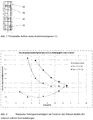
- the high flexibility of the proposed typesetting system can be demonstrated by measurements of the delay time in ignition retarders. For this purpose, the delay set in ignition delay 1 according to Fig. 1 introduced and compacted.
- a cheek charge 3 Into the sleeve 2 of a Anzündverzögerers 1 a cheek charge 3, a delay set 4 and a firing charge 5 are introduced. The height of the set column thus formed is 19 mm in all cases. The delay time is then defined as the time between the firing of the firing charge and the firing charge reaction.
- Fig. 2 shows the dependence of the reciprocal burning rate on the silicon content with different grain distributions (specific surface area: 5.3 m 2 / g (fine), 2.2 m 2 / g (medium); 1.5 m 2 / g (coarse)) of the sentence mixture.
- the proportion of potassium perchlorate is kontant 5%, while the proportion of barium sulfate varies accordingly.
- the reciprocal burning rate can then be varied between 50 ms / mm and almost 500 ms / mm by changing the recipe proportions. With a typical length of the delay set distance in the ignition retarder of 10 mm, this corresponds to the desired delay time interval of 0.5 to 5 s.
- Example 1 The following is the composition of two mixtures for ignition retarder, without limiting the invention to the specified compositions.
- the silicon content in Example 1 consists of a trimodal mixture.
- the desired good burn-through capability could be demonstrated by testing 1000 ignition retarders each. Based on 1000 error-free tests, the minimum reliability is 99.7% (confidence level 95%), which clearly exceeds the usual military requirements for such components of 99%.
- the dependence of the burning time on the temperature was determined on the basis of the delay time in the ignition retarder in the temperature range between -54 ° C and + 71 ° C. In the temperature range considered, it amounts to about 2-3%, based on the firing rate at room temperature, and is thus significantly below the value of about 10% in conventional batch systems (for example potassium perchlorate / lead chromate / antimony).
Landscapes
- Chemical & Material Sciences (AREA)
- Engineering & Computer Science (AREA)
- Organic Chemistry (AREA)
- Materials Engineering (AREA)
- Metallurgy (AREA)
- Inorganic Chemistry (AREA)
- General Engineering & Computer Science (AREA)
- Air Bags (AREA)
Description
- Die Erfindung betrifft einen pyrotechnischen Verzögerungssatz militärischer Verzögerungselemente. Er zeichnet sich durch eine flexible und einfache Einstellung der Brenngeschwindigkeit über einen weiten Bereich aus. Zudem besteht der Verzögerungssatz ausschließlich aus Rohstoffen, die nach derzeitigem Stand nicht auf der Kandidatenliste der Verordnung (EG) Nr.
1907/2006 - Bei pyrotechnischer Munition erfolgt die Auslösung über Anzündketten, die aus mehreren Anzündmitteln bestehen können. Aufgabe dieser Anzündkette ist es, einen externen Auslöseimpuls in eine pyrotechnische Reaktion umzuwandeln und die Wirkladung zum gewünschten Zeitpunkt zur Reaktion zu bringen. Oftmals ist es notwendig ein bestimmtes Zeitintervall zwischen dem externen Auslöseimpuls und der Reaktion der Wirkladung einzuhalten. Da die Zeitpunkte für externe Auslösung und Reaktion der Wirkladung in der Regel unbeeinflussbar feststehen, muss innerhalb der Anzündkette ein sogenanntes Verzögerungselement den notwendigen Zeitabstand (Verzögerungszeit) sicherstellen. Diese Verzögerungszeit kann in Abhängigkeit von der Anwendung zwischen einigen Millisekunden und mehreren Sekunden liegen.
- Eine typische Ausführungsform eines Verzögerungselementes (auch Anzündverzögerer genannt) zeigt
Abb.1 . Der Anzündverzögerer (1) besteht aus einem zylindrischen Metallröhrchen (2) und enthält in der Regel drei pyrotechnische Sätze. Das zylindrische Metallröhrchen (2) besteht vorzugsweise aus Stahl, Messing oder Aluminium. Eingangsseitig befindet sich der flammempfindliche Anfeuerungssatz (3), der durch das vorgeschaltete Anzündmittel angezündet wird und die Aufgabe hat, den nachfolgenden in der Regel unempfindlicheren Verzögerungssatz (4) sicher anzuzünden. Ausgangsseitig befindet sich nach dem Verzögerungssatz der Abfeuerungssatz (5), der die Übertragung der Reaktion auf das folgende Anzündmittel sicherstellt. Die pyrotechnische Reaktion läuft also linear durch den Anzündverzögerer hindurch. Alle Sätze werden durch ein- oder mehrteilige Lade- und Pressprozesse in den Metallkörper eingebracht. Aus konstruktionstechnischer Sicht der Munition ist es wünschenswert, die unterschiedlichen Verzögerungszeiten mit einer festen Länge des Anzündverzögerers zu realisieren. Da die Menge des Abfeuerungssatzes (5) konstant gehalten werden muss (Sicherstellung einer gleichmäßigen Ausgangsleistung) und auch die Länge der Anfeuerung nur in begrenztem Umfang variiert werden kann, ist die Steuerung der Verzögerungszeit vorzugsweise durch die Satzzusammensetzung zu realisieren. Notwendig ist daher ein Verzögerungssatzsystem, dass durch Feinabstimmung innerhalb ihrer Zusammensetzung die Einstellung der gewünschten Verzögerungszeit ermöglicht. - Pyrotechnische Verzögerungssätze sind seit Jahrzehnten bekannt und finden auch in der zivilen Sprengtechnik bei sogenannten Sprengzeitzündern Anwendung. Sie bestehen in der Regel aus einem Gemisch von Brennstoff und Oxidationsmittel. Gegenüber den zivilen Anwendungen kommen bei Einsatz in pyrotechnischer Munition zusätzliche Anforderungen hinzu. Das Durchbrennvermögen (also der zuverlässige lineare Abbrand des Verzögerungssatzes) muss über einen großen Temperaturbereich (mindestens -54°C bis +71 °C) gegeben sein. Dabei sollte die Brenngeschwindigkeit idealerweise keine oder nur eine geringe Abhängigkeit von der Temperatur aufweisen. Zudem ist eine hohe Stabilität der Verzögerungssätze und Verträglichkeit mit den Kontaktmaterialien notwendig, um die lange Lebensdauer zwischen 12 und 20 Jahren zu gewährleisten. In diesem Zeitraum sollte sich die Brenngeschwindigkeit nicht ändern. Pyrotechnische Verzögerungssätze können als Trockenmischung der Ausgangsstoffe oder in einem Nassverfahren unter Zugabe eines Binders als Granulat der Ausgangsstoffe hergestellt werden.
WO 2008/035289 A2 offenbart einen pyrotechnischen Verzögerungssatz, wobei in der Mischung des Verzögerungssatzes Kaliumperchlorat, Bariumsulfat und Silizium enthalten sind.
Der inWO 2010/068957 A2 offenbarte pyrotechnische Verzögerungssatz, enthält 25 bis 55 Gewichtsanteile Mangandioxid.
Der inWO 02/072504 A1 - Derzeit werden in Anzündverzögerern für militärische Applikationen oftmals pyrotechnische Verzögerungssätze verwendet, die einerseits toxische Stoffe enthalten und andererseits einen vergleichsweise deutlichen Temperaturgang der Brennzeit aufweisen. Ein typischer Vertreter dieser Verzögerungssätze ist ein System bestehend aus Kaliumperchlorat, Bleichromat, Antimon und einem geeigneten Bindemittel (beispielsweise Nitrozellulose). Dieser Verzögerungssatz enthält mit Bleichromat einen SVHC-Stoff (Substances of Very High Concern), der nach Verordnung (EG) Nr.
1907/2006 US 2008/0223242 A1 ein Verzögerungssatz bekannt, bei dem als Oxidationsmittel Bleimennige (Pb3O4) verwendet wird, welches nach derzeitigem Stand bereits auf der REACH-Kandidatenliste für SVHC-Stoffe steht. - Die vorliegende Erfindung hat sich zur Aufgabe gestellt einen pyrotechnischer Verzögerungssatz militärischer Verzögerungselemente anzugeben. Diese sollen:
- "REACH-konforme" (kein SVHC-Stoff nach Verordnung (EG) Nr.
1907/2006 - eine Einstellmöglichkeit der Verzögerungszeit innerhalb einer Rahmenzusammensetzung bei vorgegebener Geometrie und Ausführung des Anzündverzögerers gestatten,
- die Funktionsfähigkeit im Anzündverzögerer im Temperaturbereich zwischen -54°C und +71 °C sicher stellen,
- eine geringe Abhängigkeit der Verzögerungszeit von der Umgebungstemperatur aufweisen sowie
- die Einhaltung der Verzögerungszeit über einen Zeitraum von mindestens 12 Jahren gewährleisten.
- Die vorgenannten Ziele werden durch einen Verzögerungssatz auf Basis Kaliumperchlorat (oder Mangandioxid), Bariumsulfat, Silizium und einem Bindemittel erreicht. Erfindungsgemäß sind in der Mischung des Verzögerungssatzes mindestens 5 Gewichtsanteile Kaliumperchlorat oder 20 Gewichtsanteile Mangandioxid, mindestens 10 Gewichtsanteile Bariumsulfat und mindestens 20 Gewichtsanteile Silizium enthalten, wobei in der Mischung mindestens eine der aufgeführten Komponenten und gegebenenfalls mindestens eine weitere Komponente die Mischung zu 100 Gewichtsanteilen ergänzt. In einem pyrotechnischer Verzögerungssatz mit Verzögerungszeiten von 0,5 - 5 s sind in der Mischung des Verzögerungssatzes 5 - 15 Gewichtsanteile Kaliumperchlorat sowie 85 - 95 Gewichtsanteile einer Mischung aus Bariumsulfat und Silizium im Gewichtsverhältnis zwischen 6:1 und 1:3 enthalten. Insbesonder kann durch die Zusammensetzung des eingesetzten Siliziums aus den Partikelanteilen:
- fein mit einer spezifischen Oberfläche von etwa 5,3 m2/g,
- mittel mit einer spezifischen Oberfläche von etwa 2,2 m2/g und
- grob mit einer spezifischen Oberfläche von etwa 1,5 m2/g eingestellt werden.
- Vorzugsweise sind in der Mischung des Verzögerungssatzes noch 0,1 - 3% Gewichtsanteile eines Bindemittels als Zuschlag enthalten.
Besonders bevorzugt sind im pyrotechnischen Verzögerungssatz als Bindemittel 0,1 - 3% Gewichtsanteile Celluloseether (Tylose) als Zuschlag enthalten.
Alternativ dazu sind im pyrotechnischen Verzögerungssatz als Bindemittel 0,1 - 3% Gewichtsanteile Nitrocellulose oder Polyvinylalkohol als Zuschlag enthalten.
Der pyrotechnische Verzögerungssatz enthält in einer vorzugsweisen Ausgestaltung in der Mischung des Verzögerungssatzes 8 - 12 % Gewichtsanteile Kaliumperchlorat mit einer spezifische Oberfläche von 0,2 ± 0,05 m2/g, 40 - 50 % Gewichtsanteile Bariumsulfat mit einer spezifische Oberfläche von 2,3 ± 1,0 m2/g, 40 - 50 % Gewichtsanteile Silizium mit einer spezifische Oberfläche von 1 - 6 m2/g und 0,2 - 1,0 % Gewichtsanteile Celluloseether. Eine weitere vorzugsweise Ausgestaltung des pyrotechnischen Verzögerungssatz enthält in der Mischung des Verzögerungssatzes 45 - 55 % Gewichtsanteile Mangandioxid mit einer spezifische Oberfläche von 3,5 ± 1,0 m2/g, 15 - 25 % Gewichtsanteile Bariumsulfat mit einer spezifische Oberfläche von 2,3 ± 1,0 m2/g, 25 - 35 % Gewichtsanteile Silizium mit einer spezifische Oberfläche von 1 - 6 m2/g und 0,2 - 1,0 % Gewichtsanteile Celluloseether. Die Erfindung betrifft auch ein Verzögerungselement, welches einen pyrotechnischen Verzögerungssatz im Rahmen der vorstehend beschriebenen Zusammensetzungen enthält. - Die Einstellmöglichkeiten dieses Verzögerungssatzes sind durch Variation der Anteile von Kaliumperchlorat (oder Mangandioxid), Bariumsulfat und Silizium sowie durch Variation der Korngröße der verwendeten Rohstoffe möglich. Vorzugsweise ist die Einstellung der Verzögerungszeit durch Variation der Kornverteilung des Siliziums bei konstantem Gewichtsverhältnis von Oxidationsmitteln und Brennstoff möglich. In dem Anzündverzögerer 1 lassen sich mit diesem Satzsystem Verzögerungszeiten zwischen 0,1 und 5 s realisieren. Die hohe Flexibilität des vorgeschlagenen Satzsystems lässt sich durch Messungen der Verzögerungszeit in Anzündverzögerern nachweisen. Dazu wird der Verzögerungssatz in Anzündverzögerer 1 gemäß
Abb. 1 eingebracht und verdichtet. In die Hülse 2 eines Anzündverzögerers 1 werden dazu ein Anfeuerungsladung 3, ein Verzögerungssatz 4 und eine Abfeuerungsladung 5 eingebracht. Die Höhe der dadurch gebildeten Satzsäule beträgt in allen Fällen 19 mm. Die Verzögerungszeit ist dann definiert als Zeit zwischen der Anzündung der Anfeuerungsladung und der Reaktion der Abfeuerungsladung.Abb. 2 zeigt die Abhängigkeit der reziproken Brenngeschwindigkeit vom Silizium-Anteil mit unterschiedlichen Kornverteilungen (spezifische Oberflächen: 5,3 m2/g (fein); 2,2 m2/g (mittel); 1,5 m2/g (grob)) an der Satzmischung. Der Anteil des Kaliumperchlorats ist kontant 5 %, während der Anteil des Bariumsulfats entsprechend variiert. Die reziproke Brenngeschwindigkeit lässt sich danach zwischen 50 ms/mm und knapp 500 ms/mm durch Änderung der Rezepturanteile variieren. Bei einer typischen Länge der Verzögerungssatzstrecke im Anzündverzögerer von 10 mm entspricht das dem angestrebten Verzögerungszeitintervall von 0,5 bis 5 s. - Die Erfindung wird durch zwei Abbildungen und zwei Beispiele für erfindungsgemäße Mischungen näher erläutert.
Es zeigt: -
Figur 1 - im Längsschnitt den prinzipiellen Aufbau eines Anzündverzögerers (1) und -
Figur 2 - die reziproke Brenngeschwindigkeit als Funktion des Silizium-Anteils- Si mittel (2,2 m2/g); ▲ Si fein (5,3 m2/g); ◆ Si grob (1,5 m2/g)
- Nachfolgend sind die Zusammensetzung von zwei Mischungen für Anzündverzögerer angegeben, ohne die Erfindung auf die angegebenen Zusammensetzungen zu beschränken. Dabei besteht der Silizium-Anteil im Beispiel 1 aus einer trimodalen Mischung.
- Beispiel 1 (Verzögerungszeiten 0,5 - 5 s):
- Kaliumperchlorat: 10 ± 2 %
- Bariumsulfat: 50 ± 5 %
- Silizium: 40 ± 5 % bestehend aus
- 10 % fein (spezifische Oberfläche: 5,3 m2/g)
- 10 % mittel (spezifische Oberfläche: 2,2 m2/g)
- 20 % grob (spezifische Oberfläche: 1,5 m2/g)
- Celluloseether: ca. 0,5 %
- alternativ: Polyvinylalkohol oder Nitrozellulose ca. 0,5%
- Beispiel 2 (Verzögerungszeiten 0,1 - 0,5 s):
- Mangandioxid: 50 ± 5 %
- Bariumsulfat: 20 ± 5 %
- Silizium: 30 ± 5 % (spezifische Oberfläche: 5,3 m2/g)
- Celluloseether: ca. 0,5 %
- alternativ: Polyvinylalkohol oder Nitrozellulose ca. 0,5%
- Das gewünschte gute Durchbrennvermögen konnte durch die Prüfung von je 1000 Anzündverzögerern nachgewiesen werden. Basierend auf je 1000 fehlerfreien Versuchen ergibt sich eine Mindestzuverlässigkeit von 99,7 % (Vertrauensniveau 95 %), welches die üblichen militärischen Anforderungen an solche Komponenten von 99 % deutlich übertrifft.
- Die Abhängigkeit der Brennzeit von der Temperatur wurde anhand der Verzögerungszeit im Anzündverzögerer im Temperaturbereich zwischen -54°C und +71°C ermittelt. Sie beträgt im betrachteten Temperaturbereich ca. 2-3 % bezogen auf die Brenngeschwindigkeit bei Raumtemperatur und liegt damit deutlich unter dem Wert von ca. 10 % bei bisher üblichen Satzsystemen (z.B. Kaliumperchlorat/Bleichromat/Antimon).
- Die Langzeitstabilität wurde durch stoffliche Untersuchungen und
- Umweltsimulationsprogramme im geladenen Anzündverzögerern nachgewiesen. Die Ergebnisse dieser Untersuchungen lassen eine positive Prognose für den Einsatz über mehr als 12 Jahren zu.
Claims (10)
- Pyrotechnischer Verzögerungssatz militärischer Verzögerungselemente, dadurch gekennzeichnet, dass in der Mischung des Verzögerungssatzes von 100 Gewichtsanteilen mindestens 5 Gewichtsanteile Kaliumperchlorat oder 20 Gewichtsanteile Mangandioxid, mindestens 10 Gewichtsanteile Bariumsulfat und mindestens 20 Gewichtsanteile Silizium enthalten sind.
- Pyrotechnischer Verzögerungssatz nach Anspruch 1, dadurch gekennzeichnet, dass in der Mischung des Verzögerungssatzes 5 - 15 Gewichtsanteile Kaliumperchlorat sowie 85 - 95 Gewichtsanteile einer Mischung aus Bariumsulfat und Silizium im Gewichtsverhältnis zwischen 6:1 und 1:3 enthalten sind.
- Pyrotechnischer Verzögerungssatz nach Anspruch 1, dadurch gekennzeichnet, dass in der Mischung des Verzögerungssatzes 20 - 70 Gewichtsanteile Mangandioxid sowie 30 - 80 Gewichtsanteile einer Mischung aus Bariumsulfat und Silizium im Gewichtsverhältnis zwischen 2:1 und 1:4 enthalten sind.
- Pyrotechnischer Verzögerungssatz nach einem der Ansprüche 1 bis 3, dadurch gekennzeichnet, dass in der Mischung des Verzögerungssatzes 0,1 - 3 % Gewichtsanteile eines Bindemittels enthalten sind.
- Pyrotechnischer Verzögerungssatz nach Anspruch 4, dadurch gekennzeichnet, dass als Bindemittel 0,1 - 3 % Gewichtsanteile Celluloseether enthalten sind.
- Pyrotechnischer Verzögerungssatz nach Anspruch 4, dadurch gekennzeichnet, dass als Bindemittel 0,1 - 3 % Gewichtsanteile Polyvinylalkohol enthalten sind.
- Pyrotechnischer Verzögerungssatz nach Anspruch 4, dadurch gekennzeichnet, dass als Bindemittel 0,1 - 3 % Gewichtsanteile Nitrocellulose enthalten sind.
- Pyrotechnischer Verzögerungssatz nach Anspruch 1, 2, 4 oder 5, dadurch gekennzeichnet, dass in der Mischung des Verzögerungssatzes 8 - 12 % Gewichtsanteile Kaliumperchlorat, 40 - 50 % Gewichtsanteile Bariumsulfat, 40 - 50 % Gewichtsanteile Silizium und 0,2 - 1,0 % Gewichtsanteile Celluloseether enthalten sind.
- Pyrotechnischer Verzögerungssatz nach Anspruch 1, 3, 4 oder 5, dadurch gekennzeichnet, dass in der Mischung des Verzögerungssatzes 45 - 55 % Gewichtsanteile Mangandioxid, 15 - 25 % Gewichtsanteile Bariumsulfat, 25 - 35 % Gewichtsanteile Silizium und 0,2 - 1,0 % Gewichtsanteile Celluloseether enthalten sind.
- Verzögerungselement, dadurch gekennzeichnet, dass das Verzögerungselement einen pyrotechnischen Verzögerungssatz gemäß einem der Ansprüche 1 bis 8 enthält.
Applications Claiming Priority (2)
| Application Number | Priority Date | Filing Date | Title |
|---|---|---|---|
| DE102014000023 | 2014-01-03 | ||
| PCT/EP2014/078759 WO2015101525A1 (de) | 2014-01-03 | 2014-12-19 | Pyrotechnischer verzögerungssatz militärischer verzögerungselemente |
Publications (2)
| Publication Number | Publication Date |
|---|---|
| EP3090232A1 EP3090232A1 (de) | 2016-11-09 |
| EP3090232B1 true EP3090232B1 (de) | 2018-03-07 |
Family
ID=52146499
Family Applications (1)
| Application Number | Title | Priority Date | Filing Date |
|---|---|---|---|
| EP14818989.7A Active EP3090232B1 (de) | 2014-01-03 | 2014-12-19 | Pyrotechnischer verzögerungssatz militärischer verzögerungselemente |
Country Status (3)
| Country | Link |
|---|---|
| EP (1) | EP3090232B1 (de) |
| DE (1) | DE102014018792A1 (de) |
| WO (1) | WO2015101525A1 (de) |
Family Cites Families (3)
| Publication number | Priority date | Publication date | Assignee | Title |
|---|---|---|---|---|
| CA2340523C (en) * | 2001-03-09 | 2009-06-02 | Orica Explosives Technology Pty Ltd. | Delay compositions and detonation delay devices utilizing same |
| CL2007002676A1 (es) * | 2006-09-20 | 2008-02-22 | African Explosives Ltd | Proceso para producir composicion pirotecnica de retardo que comprende mezclar oxidante, combustible, surfactante y liquido para formar una pasta o suspension, secar la pasta o suspension para eliminar liquido y obtener un producto solido, tomar el p |
| WO2010068957A2 (en) * | 2008-12-09 | 2010-06-17 | African Explosives Limited | Slow burning pyrotechnic delay composition |
-
2014
- 2014-12-19 EP EP14818989.7A patent/EP3090232B1/de active Active
- 2014-12-19 DE DE102014018792.6A patent/DE102014018792A1/de not_active Withdrawn
- 2014-12-19 WO PCT/EP2014/078759 patent/WO2015101525A1/de not_active Ceased
Also Published As
| Publication number | Publication date |
|---|---|
| WO2015101525A1 (de) | 2015-07-09 |
| DE102014018792A1 (de) | 2015-07-09 |
| EP3090232A1 (de) | 2016-11-09 |
Similar Documents
| Publication | Publication Date | Title |
|---|---|---|
| DE69612300T2 (de) | Pyrotechnische ladung für zünder | |
| DE68912066T2 (de) | Initialelement für primärsprengstofffreie Detonatoren. | |
| DE3321943C2 (de) | ||
| DE69317514T2 (de) | Verzögerungsladung und Element, und Detonator mit solch einer Ladung | |
| EP2295927B1 (de) | Flugkörper mit einem pyrotechnischen Satz | |
| DE60006322T2 (de) | Zweistufiger, optischer Detonator mit Schlagwirkung | |
| DE2733700C2 (de) | Übungsgefechtskopf für Artillerieraketen | |
| EP3090232B1 (de) | Pyrotechnischer verzögerungssatz militärischer verzögerungselemente | |
| DE1129099B (de) | Elektrischer Zuender | |
| EP0250737B1 (de) | Sprengzeitzünder | |
| DE2338949A1 (de) | Trennelement | |
| EP3218331B1 (de) | Pyrotechnisches verzögerungselement | |
| DE102015014379A1 (de) | Pyrotechnisches Verzögerungselement | |
| EP1064241B1 (de) | Durch elektrische auslösung anzündbare initialexplosivstoffe und anzündsätze | |
| EP1110928A1 (de) | Anzündelement und fein abstufbare Zündsätze | |
| DE1646350B2 (de) | Reib- und schlagunempfindliches uebertragungszuendhuetchen | |
| DE4342428A1 (de) | Geschützmunition mit einer verbrennbaren Treibladungshülse | |
| DE69003627T2 (de) | Zündmittelzusammensetzung für pyrotechnisches Verzögerungselement. | |
| DE19614007C2 (de) | Pyrotechnischer Satz zur Erzeugung von akustischen und optischen Effekten sowie Verfahren zu dessen Herstellung | |
| DE102011116594B4 (de) | Verwendung von Zirkonium oder eines Zirkonium enthaltenden Gemischs | |
| DE891221C (de) | Vorrichtung zur Verbindung und zur Zuendungsuebertragung zwischen Zuendschnueren | |
| DE4000590C1 (en) | Ammunition detonator unit - comprises initial charge which contains sec explosive which ignites by chain reaction | |
| DE2040625C (de) | Feuchtigkeitsbeständiges Zund pulver auf der Basis poröser Nitro Zellulose und Verfahren zu seiner Herstellung | |
| DE1942207A1 (de) | Zeitzuenderladung | |
| DE3507399A1 (de) | Verzoegerungssatz aus bleioxid und bor fuer zuend- und anzuendmittel |
Legal Events
| Date | Code | Title | Description |
|---|---|---|---|
| PUAI | Public reference made under article 153(3) epc to a published international application that has entered the european phase |
Free format text: ORIGINAL CODE: 0009012 |
|
| 17P | Request for examination filed |
Effective date: 20160803 |
|
| AK | Designated contracting states |
Kind code of ref document: A1 Designated state(s): AL AT BE BG CH CY CZ DE DK EE ES FI FR GB GR HR HU IE IS IT LI LT LU LV MC MK MT NL NO PL PT RO RS SE SI SK SM TR |
|
| AX | Request for extension of the european patent |
Extension state: BA ME |
|
| DAX | Request for extension of the european patent (deleted) | ||
| GRAP | Despatch of communication of intention to grant a patent |
Free format text: ORIGINAL CODE: EPIDOSNIGR1 |
|
| RIC1 | Information provided on ipc code assigned before grant |
Ipc: F42C 9/10 20060101AFI20170818BHEP Ipc: C06B 33/06 20060101ALI20170818BHEP Ipc: C06C 5/06 20060101ALI20170818BHEP Ipc: C06B 33/00 20060101ALI20170818BHEP |
|
| INTG | Intention to grant announced |
Effective date: 20170915 |
|
| GRAS | Grant fee paid |
Free format text: ORIGINAL CODE: EPIDOSNIGR3 |
|
| GRAA | (expected) grant |
Free format text: ORIGINAL CODE: 0009210 |
|
| AK | Designated contracting states |
Kind code of ref document: B1 Designated state(s): AL AT BE BG CH CY CZ DE DK EE ES FI FR GB GR HR HU IE IS IT LI LT LU LV MC MK MT NL NO PL PT RO RS SE SI SK SM TR |
|
| REG | Reference to a national code |
Ref country code: GB Ref legal event code: FG4D Free format text: NOT ENGLISH |
|
| REG | Reference to a national code |
Ref country code: CH Ref legal event code: EP Ref country code: AT Ref legal event code: REF Ref document number: 977038 Country of ref document: AT Kind code of ref document: T Effective date: 20180315 |
|
| REG | Reference to a national code |
Ref country code: DE Ref legal event code: R096 Ref document number: 502014007580 Country of ref document: DE |
|
| REG | Reference to a national code |
Ref country code: IE Ref legal event code: FG4D Free format text: LANGUAGE OF EP DOCUMENT: GERMAN |
|
| REG | Reference to a national code |
Ref country code: NL Ref legal event code: MP Effective date: 20180307 |
|
| REG | Reference to a national code |
Ref country code: LT Ref legal event code: MG4D |
|
| PG25 | Lapsed in a contracting state [announced via postgrant information from national office to epo] |
Ref country code: ES Free format text: LAPSE BECAUSE OF FAILURE TO SUBMIT A TRANSLATION OF THE DESCRIPTION OR TO PAY THE FEE WITHIN THE PRESCRIBED TIME-LIMIT Effective date: 20180307 Ref country code: LT Free format text: LAPSE BECAUSE OF FAILURE TO SUBMIT A TRANSLATION OF THE DESCRIPTION OR TO PAY THE FEE WITHIN THE PRESCRIBED TIME-LIMIT Effective date: 20180307 Ref country code: NO Free format text: LAPSE BECAUSE OF FAILURE TO SUBMIT A TRANSLATION OF THE DESCRIPTION OR TO PAY THE FEE WITHIN THE PRESCRIBED TIME-LIMIT Effective date: 20180607 Ref country code: HR Free format text: LAPSE BECAUSE OF FAILURE TO SUBMIT A TRANSLATION OF THE DESCRIPTION OR TO PAY THE FEE WITHIN THE PRESCRIBED TIME-LIMIT Effective date: 20180307 Ref country code: FI Free format text: LAPSE BECAUSE OF FAILURE TO SUBMIT A TRANSLATION OF THE DESCRIPTION OR TO PAY THE FEE WITHIN THE PRESCRIBED TIME-LIMIT Effective date: 20180307 Ref country code: CY Free format text: LAPSE BECAUSE OF FAILURE TO SUBMIT A TRANSLATION OF THE DESCRIPTION OR TO PAY THE FEE WITHIN THE PRESCRIBED TIME-LIMIT Effective date: 20180307 |
|
| PG25 | Lapsed in a contracting state [announced via postgrant information from national office to epo] |
Ref country code: LV Free format text: LAPSE BECAUSE OF FAILURE TO SUBMIT A TRANSLATION OF THE DESCRIPTION OR TO PAY THE FEE WITHIN THE PRESCRIBED TIME-LIMIT Effective date: 20180307 Ref country code: SE Free format text: LAPSE BECAUSE OF FAILURE TO SUBMIT A TRANSLATION OF THE DESCRIPTION OR TO PAY THE FEE WITHIN THE PRESCRIBED TIME-LIMIT Effective date: 20180307 Ref country code: GR Free format text: LAPSE BECAUSE OF FAILURE TO SUBMIT A TRANSLATION OF THE DESCRIPTION OR TO PAY THE FEE WITHIN THE PRESCRIBED TIME-LIMIT Effective date: 20180608 Ref country code: BG Free format text: LAPSE BECAUSE OF FAILURE TO SUBMIT A TRANSLATION OF THE DESCRIPTION OR TO PAY THE FEE WITHIN THE PRESCRIBED TIME-LIMIT Effective date: 20180607 Ref country code: RS Free format text: LAPSE BECAUSE OF FAILURE TO SUBMIT A TRANSLATION OF THE DESCRIPTION OR TO PAY THE FEE WITHIN THE PRESCRIBED TIME-LIMIT Effective date: 20180307 |
|
| PG25 | Lapsed in a contracting state [announced via postgrant information from national office to epo] |
Ref country code: MT Free format text: LAPSE BECAUSE OF FAILURE TO SUBMIT A TRANSLATION OF THE DESCRIPTION OR TO PAY THE FEE WITHIN THE PRESCRIBED TIME-LIMIT Effective date: 20180307 |
|
| PG25 | Lapsed in a contracting state [announced via postgrant information from national office to epo] |
Ref country code: IT Free format text: LAPSE BECAUSE OF FAILURE TO SUBMIT A TRANSLATION OF THE DESCRIPTION OR TO PAY THE FEE WITHIN THE PRESCRIBED TIME-LIMIT Effective date: 20180307 Ref country code: AL Free format text: LAPSE BECAUSE OF FAILURE TO SUBMIT A TRANSLATION OF THE DESCRIPTION OR TO PAY THE FEE WITHIN THE PRESCRIBED TIME-LIMIT Effective date: 20180307 Ref country code: PL Free format text: LAPSE BECAUSE OF FAILURE TO SUBMIT A TRANSLATION OF THE DESCRIPTION OR TO PAY THE FEE WITHIN THE PRESCRIBED TIME-LIMIT Effective date: 20180307 Ref country code: EE Free format text: LAPSE BECAUSE OF FAILURE TO SUBMIT A TRANSLATION OF THE DESCRIPTION OR TO PAY THE FEE WITHIN THE PRESCRIBED TIME-LIMIT Effective date: 20180307 Ref country code: NL Free format text: LAPSE BECAUSE OF FAILURE TO SUBMIT A TRANSLATION OF THE DESCRIPTION OR TO PAY THE FEE WITHIN THE PRESCRIBED TIME-LIMIT Effective date: 20180307 Ref country code: RO Free format text: LAPSE BECAUSE OF FAILURE TO SUBMIT A TRANSLATION OF THE DESCRIPTION OR TO PAY THE FEE WITHIN THE PRESCRIBED TIME-LIMIT Effective date: 20180307 |
|
| PG25 | Lapsed in a contracting state [announced via postgrant information from national office to epo] |
Ref country code: SM Free format text: LAPSE BECAUSE OF FAILURE TO SUBMIT A TRANSLATION OF THE DESCRIPTION OR TO PAY THE FEE WITHIN THE PRESCRIBED TIME-LIMIT Effective date: 20180307 Ref country code: CZ Free format text: LAPSE BECAUSE OF FAILURE TO SUBMIT A TRANSLATION OF THE DESCRIPTION OR TO PAY THE FEE WITHIN THE PRESCRIBED TIME-LIMIT Effective date: 20180307 Ref country code: SK Free format text: LAPSE BECAUSE OF FAILURE TO SUBMIT A TRANSLATION OF THE DESCRIPTION OR TO PAY THE FEE WITHIN THE PRESCRIBED TIME-LIMIT Effective date: 20180307 |
|
| REG | Reference to a national code |
Ref country code: DE Ref legal event code: R097 Ref document number: 502014007580 Country of ref document: DE |
|
| PG25 | Lapsed in a contracting state [announced via postgrant information from national office to epo] |
Ref country code: PT Free format text: LAPSE BECAUSE OF FAILURE TO SUBMIT A TRANSLATION OF THE DESCRIPTION OR TO PAY THE FEE WITHIN THE PRESCRIBED TIME-LIMIT Effective date: 20180709 |
|
| PLBE | No opposition filed within time limit |
Free format text: ORIGINAL CODE: 0009261 |
|
| STAA | Information on the status of an ep patent application or granted ep patent |
Free format text: STATUS: NO OPPOSITION FILED WITHIN TIME LIMIT |
|
| PG25 | Lapsed in a contracting state [announced via postgrant information from national office to epo] |
Ref country code: DK Free format text: LAPSE BECAUSE OF FAILURE TO SUBMIT A TRANSLATION OF THE DESCRIPTION OR TO PAY THE FEE WITHIN THE PRESCRIBED TIME-LIMIT Effective date: 20180307 |
|
| REG | Reference to a national code |
Ref country code: DE Ref legal event code: R082 Ref document number: 502014007580 Country of ref document: DE Representative=s name: MEISSNER BOLTE PATENTANWAELTE RECHTSANWAELTE P, DE |
|
| 26N | No opposition filed |
Effective date: 20181210 |
|
| PG25 | Lapsed in a contracting state [announced via postgrant information from national office to epo] |
Ref country code: SI Free format text: LAPSE BECAUSE OF FAILURE TO SUBMIT A TRANSLATION OF THE DESCRIPTION OR TO PAY THE FEE WITHIN THE PRESCRIBED TIME-LIMIT Effective date: 20180307 |
|
| REG | Reference to a national code |
Ref country code: CH Ref legal event code: PL |
|
| GBPC | Gb: european patent ceased through non-payment of renewal fee |
Effective date: 20181219 |
|
| PG25 | Lapsed in a contracting state [announced via postgrant information from national office to epo] |
Ref country code: LU Free format text: LAPSE BECAUSE OF NON-PAYMENT OF DUE FEES Effective date: 20181219 Ref country code: MC Free format text: LAPSE BECAUSE OF FAILURE TO SUBMIT A TRANSLATION OF THE DESCRIPTION OR TO PAY THE FEE WITHIN THE PRESCRIBED TIME-LIMIT Effective date: 20180307 |
|
| REG | Reference to a national code |
Ref country code: IE Ref legal event code: MM4A |
|
| REG | Reference to a national code |
Ref country code: BE Ref legal event code: MM Effective date: 20181231 |
|
| PG25 | Lapsed in a contracting state [announced via postgrant information from national office to epo] |
Ref country code: FR Free format text: LAPSE BECAUSE OF NON-PAYMENT OF DUE FEES Effective date: 20181231 Ref country code: IE Free format text: LAPSE BECAUSE OF NON-PAYMENT OF DUE FEES Effective date: 20181219 |
|
| PG25 | Lapsed in a contracting state [announced via postgrant information from national office to epo] |
Ref country code: BE Free format text: LAPSE BECAUSE OF NON-PAYMENT OF DUE FEES Effective date: 20181231 |
|
| PG25 | Lapsed in a contracting state [announced via postgrant information from national office to epo] |
Ref country code: CH Free format text: LAPSE BECAUSE OF NON-PAYMENT OF DUE FEES Effective date: 20181231 Ref country code: GB Free format text: LAPSE BECAUSE OF NON-PAYMENT OF DUE FEES Effective date: 20181219 Ref country code: LI Free format text: LAPSE BECAUSE OF NON-PAYMENT OF DUE FEES Effective date: 20181231 |
|
| PG25 | Lapsed in a contracting state [announced via postgrant information from national office to epo] |
Ref country code: TR Free format text: LAPSE BECAUSE OF FAILURE TO SUBMIT A TRANSLATION OF THE DESCRIPTION OR TO PAY THE FEE WITHIN THE PRESCRIBED TIME-LIMIT Effective date: 20180307 |
|
| REG | Reference to a national code |
Ref country code: DE Ref legal event code: R082 Ref document number: 502014007580 Country of ref document: DE Representative=s name: MEISSNER BOLTE PATENTANWAELTE RECHTSANWAELTE P, DE |
|
| PG25 | Lapsed in a contracting state [announced via postgrant information from national office to epo] |
Ref country code: HU Free format text: LAPSE BECAUSE OF FAILURE TO SUBMIT A TRANSLATION OF THE DESCRIPTION OR TO PAY THE FEE WITHIN THE PRESCRIBED TIME-LIMIT; INVALID AB INITIO Effective date: 20141219 Ref country code: MK Free format text: LAPSE BECAUSE OF NON-PAYMENT OF DUE FEES Effective date: 20180307 |
|
| PG25 | Lapsed in a contracting state [announced via postgrant information from national office to epo] |
Ref country code: IS Free format text: LAPSE BECAUSE OF FAILURE TO SUBMIT A TRANSLATION OF THE DESCRIPTION OR TO PAY THE FEE WITHIN THE PRESCRIBED TIME-LIMIT Effective date: 20180707 |
|
| REG | Reference to a national code |
Ref country code: AT Ref legal event code: MM01 Ref document number: 977038 Country of ref document: AT Kind code of ref document: T Effective date: 20191219 |
|
| PG25 | Lapsed in a contracting state [announced via postgrant information from national office to epo] |
Ref country code: AT Free format text: LAPSE BECAUSE OF NON-PAYMENT OF DUE FEES Effective date: 20191219 |
|
| PGFP | Annual fee paid to national office [announced via postgrant information from national office to epo] |
Ref country code: DE Payment date: 20260224 Year of fee payment: 12 |