EP3090302B1 - Methode et dispositif pour un ecran autoparallactique et autostereoscopique - Google Patents
Methode et dispositif pour un ecran autoparallactique et autostereoscopique Download PDFInfo
- Publication number
- EP3090302B1 EP3090302B1 EP14836997.8A EP14836997A EP3090302B1 EP 3090302 B1 EP3090302 B1 EP 3090302B1 EP 14836997 A EP14836997 A EP 14836997A EP 3090302 B1 EP3090302 B1 EP 3090302B1
- Authority
- EP
- European Patent Office
- Prior art keywords
- display
- distance
- display device
- optical
- autostereoscopic
- Prior art date
- Legal status (The legal status is an assumption and is not a legal conclusion. Google has not performed a legal analysis and makes no representation as to the accuracy of the status listed.)
- Active
Links
Images



Classifications
-
- H—ELECTRICITY
- H04—ELECTRIC COMMUNICATION TECHNIQUE
- H04N—PICTORIAL COMMUNICATION, e.g. TELEVISION
- H04N13/00—Stereoscopic video systems; Multi-view video systems; Details thereof
- H04N13/30—Image reproducers
- H04N13/302—Image reproducers for viewing without the aid of special glasses, i.e. using autostereoscopic displays
- H04N13/31—Image reproducers for viewing without the aid of special glasses, i.e. using autostereoscopic displays using parallax barriers
-
- G—PHYSICS
- G02—OPTICS
- G02B—OPTICAL ELEMENTS, SYSTEMS OR APPARATUS
- G02B30/00—Optical systems or apparatus for producing three-dimensional [3D] effects, e.g. stereoscopic images
- G02B30/20—Optical systems or apparatus for producing three-dimensional [3D] effects, e.g. stereoscopic images by providing first and second parallax images to an observer's left and right eyes
- G02B30/26—Optical systems or apparatus for producing three-dimensional [3D] effects, e.g. stereoscopic images by providing first and second parallax images to an observer's left and right eyes of the autostereoscopic type
- G02B30/27—Optical systems or apparatus for producing three-dimensional [3D] effects, e.g. stereoscopic images by providing first and second parallax images to an observer's left and right eyes of the autostereoscopic type involving lenticular arrays
-
- H—ELECTRICITY
- H04—ELECTRIC COMMUNICATION TECHNIQUE
- H04N—PICTORIAL COMMUNICATION, e.g. TELEVISION
- H04N13/00—Stereoscopic video systems; Multi-view video systems; Details thereof
- H04N13/30—Image reproducers
- H04N13/302—Image reproducers for viewing without the aid of special glasses, i.e. using autostereoscopic displays
- H04N13/307—Image reproducers for viewing without the aid of special glasses, i.e. using autostereoscopic displays using fly-eye lenses, e.g. arrangements of circular lenses
Definitions
- the invention relates to the field of spatial representation, in particular the representation that is spatially perceptible without aids, the so-called autoparallactic and autostereoscopic visualization.
- the display contents can be variable or unchangeable in terms of location and / or time.
- displays that use the daylight in transmitted or reflected light that are backlit or light themselves, that are analog or digital, whose geometry is flat or linear.
- Examples of displays with low-image display content are those with warning or information signs, with symbols, letters, numbers and / or complete text.
- clocks with a digital number display One example are clocks with a digital number display.
- linear displays with horizontal and / or vertical scrolling text which, for example, as an architectural element on building facades or indoors, are intended to attract attention and increase the attractiveness of the building.
- All digital displays with moving display content have in common that their display content is generated and moved by a corresponding control unit.
- the display content moves independently of the viewer of the display.
- Control units are known that enable the display to be switched on and off contactless by people.
- Analog displays are stationary or only move when the static display changes.
- the movement of the display content in terms of direction, speed, extent and visibility through the movement of the viewer is not known in the prior art in visual displays.
- the patent publication DE 10 2006 010 971 A1 discloses a method for auto-parallactic and auto-stereoscopic display of low-image display content.
- a certain movement of the display content due to the movement of the viewer is known in so-called autostereoscopic displays and is referred to in this application as autostereoscopic display three.
- the extent of the movement of the spatial visual impression is extremely limited with these displays.
- C the distance between the eyes from the display device, hereinafter referred to as OA as the optimal viewing distance for the autostereoscopic display
- I the so-called pixel or subpixel pitch of the display device in the horizontal and / or vertical direction, hereinafter referred to as PP
- B the distance horizontal and / or vertically adjacent optical structures of the optical element.
- the basically poor stereoscopic channel separation is the cause of low color and brightness contrasts, low image sharpness and low spatial depth of the so-called autostereoscopic out- and / or inscreening of the spatial visual impression.
- the cause is the loss of optical magnification of the cylinder lenses in the event of a mismatch.
- the one in the DE 10 2009 054 706 A1 The alternative arrangement of a lenticular lenticular screen called Chromatic Light Deflector at CeBIT 2010 with non-spherical convex-concave optical structures and a transparent-opaque coating on the back that does not act as a barrier autostereoscopically does not solve these problems and instead suffers from a comparatively low gain in brightness.
- the optical imaging of the image reproduction surface of the image reproduction unit through the lenticular lens into the viewing area is intended.
- the gain in brightness and the maximum oblique viewing angle with the wave-like convex-concave optical structure of the Chromatoc Light Deflector screen are smaller than with a lenticular screen with plano-convex cylinder lenses.
- optical magnification that can be perceived by the observer through the lens grid which should be close to ⁇ infinity, is decisive for the gain in brightness and oblique viewing angle.
- optically undefined optical structure in the arrangement DE 10 2009 054 706 A1 is able to enlarge the optical image is not specified in the document.
- Digital displays so-called digital signages with display content suitable for the long-range and near-range, are known in many design variants. For example, two display arrangements are used simultaneously for the far and near range or two displays are presented on one display arrangement.
- One example of this is the HYBRID digital signage from Japanese company TOWA MECCS CORPORAION of the type BRIDII DS-WL415S, with which the principle "2 in 1" is realized with an LC display and an LED display.
- both display contents on one and the same display are made visible one after the other on a display arrangement.
- the invention is based on the object of creating a tool-free option for analog or digital display devices in which several viewers move motionless, low-image display content by their own movement, generate at least one additional movement to the moving display content, make visible display content invisible through their own movement and Conversely, to make disappeared display contents appear again through their own movement, to enlarge the movement range of the movement of the display content generated by the own movement of a viewer in comparison to the movement range of autostereoscopic 3D displays of the autostereoscopy of the prior art and further deficiencies in the movement of the display contents due to the own movement of the viewer of autostereoscopic 3D displays.
- an autoparallactic-autostereoscopic or only an autostereoscopic display of the same display content should be perceptible in the same range of viewing distances, this autostereoscopic display not being based on the theory of autostereoscopy of the prior art in the article from Sam H. Kaplan: "Theory of parallax barriers", Journal of SMPTE Vol. 59, No 7, pp 11-21, July 1952 and, if there are several groups of people, only one group of people can selectively allow the content to be perceived.
- the invention is based on the further object of creating a possibility for digital display arrangements of the far and near range by means of which the attractiveness and exclusivity of the display content and its location can be further increased, both autoparallactic-autostereoscopic display content and autostereoscopic display content of the autostereoscopy of the stand the technology to make perceptible on one and the same display arrangement in the form of a digital change display.
- the object is carried out with a method for auto-parallactic and auto-stereoscopic display according to claim 1 or 9, the display with an analog or digital display device, in which in a virtual or real grid of virtual or real lines k and virtual or real Columns 1 on display elements A (k, 1) object information from different perspective views of a scene or an object are made visible, the analog display device is a plate-shaped substrate with areas of different optical transparency, the digital display device is an LCD, an OLED display or a plasma screen and
- the grid of rows and columns with display elements A (k, 1) at a distance D is preceded or followed by at least one optical element with periodically arranged optical structures through which directions of propagation for the light transmitted or emitted by the display elements A (k, 1) are specified, the average horizontal and / or vertical smallest period length of the optical structures on the at least one optical element is an integral multiple of the average horizontal and / or vertical dimension of a display element A (k, 1) or an integral multiple of the d average horizontal and / or vertical distance between adjacent display
- the optical element is a lens barrier optic, the optical refractive index of the medium with the distance D between the optically effective surface of the optical element and the optically effective surface of the display device being preferably 1.
- the optical element can, however, also be a barrier screen, cylindrical lens screen, lens screen, chromatic light deflector screen.
- a further advantage of the invention is that the display elements A (k, 1) on the grid of the display device, which do not display any display content according to the invention at the respective point in time and / or at the respective location, can display content not according to the invention either moved or unmoved.
- the autostereoscopic display three of the autostereoscopy with an optimal viewing distance OA C> 0.
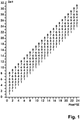
- the number of the respectively displayed view of the respective display element A (k, 1) is entered in the figures.
- the view numbers of switched-on pixels are shown in bold and the switched-off pixels are not shown in bold and italics.
- Fig. 1 is behind the barrier screen on a line k of the analog or digital display device at time 1 of all objects only the object 1 and only with the pixel 1 visible.
- pixels 1 and 2 of object 1 and pixel 1 of object 2 are visible.
- pixels 1, 2 and 3 of object 1, pixels 1 and 2 of object 2 and pixel 1 of object 3 are visible.
- pixels 1, 2, 3, ... and 8 of object 1, pixels 1, 2, 3, ... and 7 of object 2, and pixels 1, 2, 3 of object 3, ... and 6, ... as well as pixel 1 of object 8 is visible.
- Up to time 8 only objects 1 to 8 of the 24 objects are visible or partially visible.
- the drawings in the horizontal direction are always the view display in one and the same line k of the grid of display elements A (k, l) of the display device.
- the view display of the pixels in other lines, preferably adjacent lines, can be identical.
- FIG. 14 is an exemplary dynamic view display of the display elements A (k, 1) of the object with the horizontal position 10 in line 10 of FIG Fig. 1 shown.
- k is on the display device in a line Fig. 1a
- the following activation status of the pixels is realized at time 10: The pixels in columns 1-2, 1 and 1 + 1 are switched on and the pixel in column 1-1 is switched off and in columns 1-2, 1 and 1 + 1 is switched on the dynamic view 1 is shown in bold. The switching on and off of the pixels follows the respective display content to be displayed.
- the pixel remains switched off at times 2, 3, 4, ... 8.
- the activation status and / or the view display of the pixels in other lines k can be identical.
- Other activation states in other lines k are conceivable, as well as other element numbers EZ.
- Display elements A (k, 1) of objects with other horizontal positions than position 10 in line 10 Fig. 1 in particular adjacent, in particular the display elements that belong to the object number OZ, are identical.
- the number of elements EZ is the same in all lines k belonging to one and the same object.
- autoparallactic-autostereoscopic display one or in the same direction, hereinafter referred to as autoparallactic-autostereoscopic display two
- continuous movement of the display content with a constant transition from complete visibility of the display content too complete but complementary display up to complete reappearance, whereby this parallax cycle can be repeated as often as desired with further sideways movement.
- What has been said applies without reservation to auto-parallactic displays with the number of zones ZZ 1 as in Fig. 1 .
- the display elements A (k, 1) which are not used on the display device or are not used at the respective point in time to display display contents according to the invention can be switched on or off locally and / or temporally. This can be complex static or dynamic pictorial information. Likewise, simple patterns, fonts, letters, numbers or single-colored homogeneous surfaces can be designed. The "information-free" black is by no means excluded. According to the invention, these surfaces can be designed so that they serve as a reference for the autoparallactic-autostereoscopic display, appropriately contrast them in terms of brightness, color and movement, and their geometric structure and size are adapted to the viewing conditions of the display.
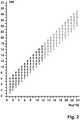
- FIG. 1a explained exemplary dynamic view display of the display elements A (k, 1) of an object with the horizontal position 10 in line 10 Fig. 1 and the further explanations for Fig. 1a apply mutatis mutandis as explanations Fig. 2 , Fig. 3 and Fig. 4 .
- autoparallactic-autostereoscopic display one and two introduced above mean that when the viewer moves himself, the same display content is perceived at the same time as the auto-parallactic display, hereinafter referred to as autoparallactic display one or two, an autostereoscopic display, hereinafter referred to as autostereoscopic display one or two which is not based on the theory of autostereoscopy according to the article by Sam H. Kaplan.
- the autostereoscopic display appears as so-called autostereoscopic outscreening in the case of opposite autoparallactic movement in the viewing direction in front of the display device and as so-called autostereoscopic inscreening in the case of the same-directional autoparallactic movement in the viewing direction behind the display device.
- the autostereoscopic display With binocular vision and with a trainable ability to physiologically decouple accommodation and convergence, the autostereoscopic display remains for each observer without any movement of his own. In the absence of binocular or monocular vision, the viewer is left with the auto-parallactic display.
- the additional autostereoscopic display can improve the attractiveness and exclusivity of the analog or digital displays and their locations.
- the exemplary embodiments A and F explained further below and further 10 examples AE and GL demonstrate the large number of views of the displays according to the invention and, as a consequence, their continuous and jumping point-free movement.
- the examples demonstrate the breadth of application and further advantages of the invention with regard to the display size, the dimensions of the viewing area with one and the same optical element instead of a single "optimal" viewing plane, the free choice of the distance D between the optical element and the display device, in particular in the Version as Lens Barrier Optic, the advantages of the Lens Barrier Optic compared to a Chromatic Light Deflector screen even if the Lens Barrier Optic uses the Chromatic Light Deflector technology for the convex-concave lens grid, the software-side change between the Auto-parallactic-auto-stereoscopic displays one and two, the displayable low-image display content without disturbing moiré effects.
- the quality term "stereo channel separation" which is necessarily introduced in autostereoscopic 3D displays of the autostereoscopic display three, is unnecessary in the case of the autoster
- FIGS. 1 to 4 show excerpts and schematically the analog or digital display device with objects that consist of light-transmitting or light-emitting display elements A (k, 1) in a grid of rows k and columns 1, which for each object at the same time different dynamic views with increasing or decreasing Show view number.
- the analog or digital display device is preceded or followed by an optical element with periodically arranged optical structures at distance D in the viewing direction of a viewer, which, due to its optical scanning, displays dynamic views of the display elements A (k, 1) on the display device.
- the optical element is preferably a lens barrier optic. This consists of a plano-convex cylindrical lenticular screen and a barrier screen on its flat rear surface, the lenticular screen being adapted to the transparent strips of the barrier in terms of image and geometry. According to the invention, said lenticular screen can be replaced by the convex-concave optical structure of a chromatic light deflector screen while maintaining the adaptation conditions.
- PA means the number of perspective views in the autostereoscopic display three of the autostereoscopy, whereby repeated identical perspective views within a perspective view period on the digital display device are to be counted
- the close-up viewing distance NA is a trainable viewing distance A.
- a real numerical value is provided for the multiplier K, for example 1 ⁇ K ⁇ 2, K real number.
- K real numerical value
- the display content is not displayed in a homogeneous, for example black, environment, but in an environment with known monoculars Depth effects like natural vision. This can be achieved, for example, by vertically moving, even simple structures on a black environment, with structures that appear further ahead move faster than those that appear further back. Likewise, structures that appear further ahead can be presented larger and brighter than those that appear further back.
- the content of the display in the case of auto parallactic / auto stereoscopic displays should be made one lighter and more conspicuous in color than the background or the surroundings.
- the environment of the display content can also be filled with a matching two-dimensional image, alternating or moving image with the known monocular 3D effects, whereby the principles of image design with regard to auto parallax and auto stereoscopy should be observed.
- the advantage of both variants is the lowering of the perception threshold.
- Examples A to F relate to the auto-parallactic-autostereoscopic display one, example G correspondingly to the display two.
- Examples H to L describe digital alternating displays with software switching between auto parallactic / auto stereoscopic display one and auto stereoscopic display three, the optimal viewing distance OA and the multiplier K are mentioned.
- Example A an analog display in A4 format for daylight backlighting
- Example B a 3.5 "OLED digital clock with horizontal HH: MM display
- Example C a 3.5 "OLED digital clock with vertical display
- Example D a 32 "LCD advertisement with vertical scrolling text
- Example E a 55 "2K LCD interchangeable display as an architectural element, vertically tiled
- example F a 54.1 "8K LCD alternating display for text block, Japanese and Chinese characters
- Example G a digital display, also with alternation for example 6
- the distance ⁇ x specified in the exemplary embodiments is the distance to be covered by an observer at close observation distance NA in the plane parallel to the display device for a complete parallax cycle with the parallax angle ⁇ , consisting for example of complete visibility of the display content - complete disappearance - complete reappearance.
- an analog display device and an optical element arranged in front of it in the viewing direction are to be used for the auto-parallactic-auto-stereoscopic display one.
- the element number EZ 5.
- the correction factor for the optical element (C - D) / C satisfies the inequality 0.9 (C - D) / C ⁇ 1.0.
- the display elements A (k, 1) of the objects are either transparent in an opaque environment or opaque in a transparent environment.
- the display device can be irradiated with either daylight or artificial light from behind.
- the parallax angle for a complete parallax cycle with total disappearance is ⁇ ⁇ 32.465 degrees.
- the software can switch to OZ 50.346 with the optical element unchanged.
- the software can switch to OZ ⁇ 55.392 with the optical element unchanged.
- the static, low-image display content can be, for example, a black Christian cross on a white or light or colored background or, conversely, a white or light or colored cross in a black environment.
- the cross measures 83 mm x 204 mm.
- the distance ⁇ x 1225 mm
- a spaced arrangement of several such crosses in partial windows of a large church window is also conceivable. It is possible to show each church visitor different phases of the movement of the display content on several displays at the same time. A visitor walking along the church aisle sees Christian crosses appear and disappear again on the church window. In the case of the large, mostly daylight-bright church window, partial windows with a black cross are preferably inserted in a transparent environment. A Christian cross filling a large church window is also conceivable.
- example A is only one of the possible analog displays with static display content.
- Such displays with external or internal lighting are conceivable in all sizes and shapes for low-image display content, from a few centimeters to several meters.
- the display device can also be a rear projection surface. With this and in another way, changing, low-image display contents can then be displayed in an autoparallactic-autostereoscopic manner.
- the auto parallactic-auto stereoscopic display one is a small digital clock.
- the digital time is displayed horizontally in HH: MM format.
- the correction factor for the optical element (C - D) / C satisfies the inequality 0.9 (C - D) / C ⁇ 1.0.
- the software can switch to OZ 7.836 with the optical element unchanged.
- the software can switch to OZ ⁇ 8,000 with the optical element unchanged.
- the correction factor for the optical element satisfies the inequality 0.9 (C - D) / C ⁇ 1.0.
- the software can switch to OZ 12.089 with the optical element unchanged.
- the software can switch to OZ ⁇ 12.761 with the optical element unchanged.
- the method thus enables the autoparallactic parallax angle ⁇ and the autostereoscopic outscreening OS to be changed without a significant change in the other parameters.
- FA remains unchanged, NA ⁇ 1500 mm is possible.
- the optical element also remains unchanged with regard to its azimuthal orientation and its optical structure.
- the software can switch to OZ 11.767 with the optical element unchanged.
- the software can switch to OZ ⁇ 12.063 with the optical element unchanged.
- the method can also be used if only one group of people is to see the display content in a selective display, but not people or groups of people who are adjacent to the side. This is conceivable for other display contents than a digital time.
- OZ, DZ, AZ, ZZ a significant increase in the parallax angle ⁇ can be achieved.
- the software can switch to OZ 11.522 with the optical element unchanged.
- the software can switch to OZ ⁇ 11.559 with the optical element unchanged.
- the optical element is preferably a lens barrier optic according to the invention.
- the barrier is applied to the flat surface of the lens grid facing away from the viewer in such a way that the apex lines of the plano-convex cylinder lenses face the center of the transparent strips of the barrier when projected in parallel.
- the lens barrier optic according to the invention differs from that in DE 10 2009 054 706 A1 and WO 002011082992 A2 Chromatic-Light-Deflector-Arrangement described from a lenticular lens with a rear barrier called transparent-opaque coating essentially with regard to the structure, the intended effect, the optical image and the optical quality.
- the term “barrier” used in this document is misleading when such screens are used in autostereoscopy.
- This light-blocking layer serves to reduce the optical interference caused by the unavoidable concave parts of the convex-concave structure and also reduce the brightness ([0010]: "Another effect of applying a barrier structure is that the image contrast is increased.
- the gain in brightness and maximum oblique viewing angle are greater with the lens barrier optic than with the wave-like convex-concave structure of the lens grid DE 10 2009 054 706 A1 .
- the optical magnification that can be perceived by the observer through the lens grid, which should be close to ⁇ infinity, is decisive for the gain in brightness and oblique viewing angle.
- the autoparallactic-autostereoscopic display one in example D is a 32 "LCD with RGB subpixel raster, which is used in portrait format because of the vertical display content.
- the correction factor for the optical element (C - D) / C satisfies the inequality 0.9 (C - D) / C ⁇ 1.0.
- NA 2600 mm
- the distance ⁇ x 500mm
- the auto-parallactic-auto-stereoscopic display one according to example D enables moving text vertically from top to bottom, i.e. falling and / or from bottom to top, i.e. ascending ticker simultaneously or successively on zones 1, 3, 5, 7 with the same or different ticker content or vertical descending or ascending scrolling text on all 7 or on fewer than 7 adjacent zones one after the other.
- the individual characters of descending, ascending scrolling text are expediently tilted 90 ° to the left and right.
- Such vertical fonts with tilted letters, numbers and / or other characters are not unknown to the technology.
- Example D The implementation of the method according to Example D is suitable, for example, for advertising purposes. Areas that are not used locally and / or temporally on the LCD for the autoparallactic-autostereoscopic displays can be filled with suitable, pictorial advertising information.
- Example E is an attractive and exclusive architectural element for representative buildings both indoors and outdoors.
- the auto-parallactic-auto-stereoscopic display one is a large display and consists of vertically arranged tileable 55 "LC displays, which are inserted framelessly one above the other in the building in portrait format.
- a vertical scrolling text that is visible from a great distance is shown on the display wall.
- the correction factor for the optical element (C - D) / C satisfies the inequality 0.9 (C - D) / C ⁇ 1.0.
- This embodiment of the method according to the invention is based on the drawing Fig. 2 .
- the width of the tilted characters in the vertical ticker display is not greater than 172 mm.
- a vertical tile wall with a height of 7.25 m can display a scrolling text made up of 42 characters.
- This embodiment of the method is designed for large viewing distances A.
- the software can switch to OZ ⁇ 24.140 with the optical element unchanged.
- the software can switch to OZ ⁇ 27.293 with the optical element unchanged.
- the design of the method can only be modified in software so that the vertical ticker does not completely disappear when the viewer moves sideways and at least part of the ticker is always visible from any position in the viewing area.
- the width of the tilted characters in the vertical ticker display is no greater than 34 mm.
- a vertical tile wall with a height of 7.25 m can display a ticker of 200 characters.
- the reduction factor RF1 0.500, all 7 zones can be assigned different display contents at the same time. Vertically moving and / or still display content is allowed at the same time.
- the conspicuousness of the transparent-black-opaque barrier structure is also undesirable in the barrier-based display according to the invention.
- This deficiency can also be largely eliminated with the aid of the lens barrier optic according to the invention.
- the barrier with regard to distance D, azimuthal orientation and optical structure is replaced by the rear barrier of the Lens Barrier Optic with identical parameters.
- a change in the optical structure with regard to the ratio VZ is permitted. Because the correction factor (C - D) / C is unchanged, there are no changes to the lens grid.
- the Lens Barrier Optic combines the advantages of cylindrical lens grids with the variability of the distance between barriers.
- Example F is now about the display of text in the horizontal reading direction.
- the autoparallactic-autostereoscopic display one uses an 8 K 54.1 "LC display without RGB filter in landscape format.
- the correction factor for the optical element satisfies the inequality 0.9 (C - D) / C ⁇ 1.0.
- the optical element is preferably a lens barrier optic.
- the design according to example F allows the display of horizontally legible text consisting of upright oriented letters, digits, special characters as a single line or multi-line, temporally changing and / or vertically moving text block.
- the parameters of this version are for example the following:
- the height of the upright characters in the text is not less than 47 mm.
- a text block of approximately 6 lines with single line spacing and 9 characters in each line can be displayed on the display area of 1198.1 mm x 673.9 mm.
- the height of the upright characters in the text is not less than 22 mm.
- a text block of approximately 10 lines with single line spacing and 9 characters in each line can be displayed in each zone.
- the advantage of this software-based switchover is, in particular, the simultaneous display of two text blocks with different content as a two-column display.
- a particular advantage of this design is the large movement range of 28 degrees for each viewer, in which the single-column text block remains fully visible.
- the one or two column text block of approximately 10 lines each can be formed into a one or two column scrolling text with any number of lines> 10 lines by moving it vertically or vertically in the software so that the viewer can see lines 11, 12, 13 ... or 0, -1, -2 ... are presented.
- the vertical movement can be continuous.
- the process allows the auto-parallactic-auto-stereoscopic display of, for example, Japanese KATAKANA characters or Chinese characters with vertical dimensions of up to 470 mm.
- the scope of protection of the invention includes not only the use of digital display devices with current and future high pixel densities, but also the use of analog display devices with current and future high grid densities of the display elements A (k, 1) and horizontal and vertical spacing of adjacent display elements A (k, 1 ) with PP ⁇ 0.001 mm.
- Analog display devices with a high grid density dpi are known, for example, on a photographic or printing technology basis, for example laser plotters with> 25000 dpi.
- a suitable lens barrier optic has the following parameters, for example:
- the optical element can of course also be designed in the form of a barrier, a cylindrical lens grid, a lens grid, a chromatic light deflector screen or in other configurations.
- example G after examples E and F, there is a further digital change display.
- the digital display device and the optical element are the same as in example F. It is to be shown how the auto parallactic-autostereoscopic display one in example F can be switched to the auto-parallactic-autostereoscopic display two in software alone.
- This change step has the following process parameters:
- the distance viewing distance NA 791 mm
- the height of the upright characters in the text is not less than 24 mm.
- a text block of approximately 8 lines with single line spacing and 20 characters in each line can be displayed on the display area of 1198.1 mm x 673.9 mm.
- Examples F and G can be carried out to switch between auto parallactic-auto stereoscopic displays one and two on one and the same digital alternating display.
- the digital display device of the digital interchangeable display in example H consists of two 16K 54.1 "LC displays, which are arranged and operated framelessly side by side in portrait format.
- the digital display device of the digital alternating display in example I is the same as in example H, but only requires a 54.1 "LC display in portrait format.
- the number of Perspective views remain PA 12, with the same perspective views occurring multiple times within a perspective view period on the digital display device to be counted.
- the digital display device of the digital change display in example J consists of a 54.1 "LC display in portrait format.
- Example J allows the large characters as in Example H on only one 54.1 "LC display.
- the software switch from Example I to Example J is possible without any hardware change with the same optical element, if on the LC display in the example 9 on the software side, two horizontally adjacent pixels can be combined into one with two vertically adjacent pixels.
- the digital display device of the digital interchangeable display in example K is the same as in examples H and I.
- the number of perspective views is PA 305i 12 as there, with the same perspective views occurring several times within a perspective view period on the digital display device being counted.
- high-resolution digital 8K and 16K display devices were used, which are in the global trend towards ever greater pixel density from currently 2K to 4K, for example the 55 "4K LED TV UE55HU8590 from Samsung 2014.
- Large-format 8K and 16K displays are not yet available, such as in example F. It should therefore be shown in example L that the method as described can also be carried out with a digital display device from the prior art, namely with a 2K 54.1 "LC display.
- Examples H to K the detailed description as in Examples A to B should be dispensed with.
- the digital display device of the digital interchangeable display in example L consists of two 54.1 "LC displays in portrait format, which are arranged and operated frameless side by side.
- the digital alternating display can also be a software switch between the auto parallactic-autostereoscopic displays one and / or two and a conventional two-dimensional image, alternating and / or moving image and / or such a background for the auto parallactic-autostereoscopic display one and / or two form.
- these two-dimensional display contents are visible in the entire area of the viewing distances A between FA and NA as well as outside this area. The latter applies in particular to the area of the viewing distances A between NA and OA.
- the procedure of auto-parallactic-auto-stereoscopic visualization is astonishing with its oppositely directed or rectified auto-parallactic display movement and its selective disappearance.
- the autostereoscopic display is characterized by complete stereo channel separation and high outscreenings.
- the invention enables the viewer to use it in a distance range from a few decimeters to several hundred meters.
- the process also enables the digital change to conventional autostereoscopic 3D display without changing the hardware.
- the various advantages of the invention are described in the exemplary embodiments for analog and digital displays and alternating displays in A4 and diagonals from 3.5 "to over 55".
- Visual display arrangements according to the invention can contribute to increasing the attractiveness and exclusivity of their location, for example as a vertical facade element in architecture.
- the process benefits directly from the 2K / 4K / 8K / 16K ...> 16K trend in digital display technology without increasing the computing power and yet requires comparatively little computing capacity.
Landscapes
- Engineering & Computer Science (AREA)
- Multimedia (AREA)
- Signal Processing (AREA)
- Physics & Mathematics (AREA)
- General Physics & Mathematics (AREA)
- Optics & Photonics (AREA)
- Testing, Inspecting, Measuring Of Stereoscopic Televisions And Televisions (AREA)
Claims (10)
- Méthode d'affichage auto-parallactique et auto-stéréoscopique du contenu d'affichage à faible image, tel que panneaux d'avertissement ou d'information, symboles, lettres, chiffres et / ou textes complets, avec un dispositif d'affichage numérique dans lequel, dans une grille de lignes k et colonnes l sur les éléments d'affichage Les informations sur l'objet A (k, l) sont rendues visibles, de sorte que- le dispositif d'affichage numérique est un écran LCD ou OLED ou un écran plasma et la grille avec les éléments d'affichage A (k, l) à une distance D est en amont ou en aval d'au moins un élément optique avec des structures optiques disposées périodiquement, à travers qui pour les directions de propagation de la lumière transmises ou émises par les éléments d'affichage A (k, l) sont spécifiées, la plus petite longueur de période horizontale et / ou verticale moyenne des structures optiques sur au moins un élément optique est un multiple entier de la moyenne dimension horizontale et / ou verticale d'un élément d'affichage A (k, l)ou un multiple entier de la distance horizontale et / ou verticale moyenne entre les éléments d'affichage adjacents A (k, l), multiplié par un facteur de correction (C - D) / C, où C est une distance de vision autostéréoscopique définie des yeux d'un visionneuse stéréoscopique depuis le dispositif d'affichage Pour que les téléspectateurs qui se trouvent à la distance de vision optimale OA, avec OA = C, aient une perception autostéréoscopique lorsqu'ils regardent le dispositif d'affichage sans aides, en raison de l'interaction optique entre l'élément optique et le dispositif d'affichage,caractérisé en ce que- Le dispositif d'affichage est un écran de 54,1 "sans filtre RVB au format L x H = 1198,1 mm x 673,9 mm avec des éléments d'affichage aux dimensions PP = 0,052 mm x 0,156 mm avec une résolution de 7680 pixels x 4320 pixels,- Les informations sur l'objet sont affichées sur le dispositif d'affichage sous forme de texte lisible horizontalement composé de lettres verticales, de chiffres, de caractères spéciaux, espacés de manière équidistante sur la largeur B, la plus petite distance étant SZ * PP, avec SZ un numéro de système, SZ = 120, et le texte lisible horizontalement se compose de EZ = 50 éléments d'affichage adjacents,- le nombre d'objets dans l'équation OZ = OZmax * RF = (O - 1) * RF est rempli, où OZ ≥ 64500 et RF est un facteur de réduction, RF = (1 / SZ) * (EZ + (Pd / ((O - 1) * PP) * (C / (A - C)))), RF = 0,5, où O est une fonction de balayage optique, selon l'équation O = ((C * (A - D)) / (D * (A - C))), avec D = 5,0 mm et C = 650,0 mm, A est une distance de vision générale, avec 2500 mm ≤ A ≤ infini et Pd est la distance pupillaire chez l'homme,- la plus petite distance entre les bandes transparentes de l'élément optique est ((C-D) / C) * SZ * PP,- La largeur de bande horizontale projetée SB des bandes transparentes verticales de l'élément optique dans l'exécution comme écran à barrière de parallaxe satisfait l'équation SB = VZ * PP, le centre de projection étant dans la distance de vision FA avec FA = 11000 mm et le la projection a lieu sur le dispositif d'affichage avec VZ = 2, 0,- DZ est calculé selon l'équation DZ = (O / SZ) * (1 + VZ), où DZ ≥ 3,250.- le produit (OZ / RF) * ZZ * SZ * PP est calculé de manière à avoir une limite supérieure en raison de la largeur horizontale utilisable B du dispositif d'affichage numérique, où ZZ est un numéro de zone, avec ZZ = 1 , et NA est la distance de vision rapprochée selon la définition NA ≥ 5 * C,de sorte qu'un affichage autoparallactique-autostéréoscopique avec le nombre de vues AZ, AZ = OZ * DZ ≥ 189 a lieu.
- Procédé d'affichage auto parallactique et auto stéréoscopique selon la revendication 1, caractérisé en ce que- une optique de barrière de lentille est agencée comme un élément optique dans la direction de visualisation devant le dispositif d'affichage et l'optique de barrière de lentille est construite à partir d'une grille de lentille dans la direction de visualisation à l'avant et d'une barrière sur sa surface arrière plate lors de la visualisation. direction arrière, la grille de lentille étant une grille de lentille cylindrique piano-convexe ou piano-convexe A une structure optique concave et le côté convexe de la grille de lentille cylindrique ou le côté convexe de la structure optique est disposé pointant dans la direction du spectateur, les lentilles cylindriques plano-convexes ou les lentilles piano-convexes de la structure optique plano-convexe-concave image-optiquement ainsi sur les bandes transparentes verticales des structures optiques de la barrière sont adaptées de sorte qu'elles soient pour l'observateur à un distance de vision A, qui est entre une distance de vision FA et une distance de vision proche NA, avec un grossissement optique V de chaque lentille cylindrique plan-convexe ou chaque structure optique plano-convexe de la structure optique plano-convexe-concave apparaît proche ou égale à ± l'infini, ce grossissement V de l'équation
V = (1/(((- a / f') - (-a / f') ∗ (p / f') + (p / f')))) ∗ V0 est suffisant, où f' est la focale longueur de la lentille cylindrique plan-convexe ou de la structure optique plan-convexe de la structure optique plan-convexe-concave, a la distance de l'objet, où a = s'H ', avec s'H' distance du point principal de la surface plane , est rempli, p le dégagement oculaire de l'optique de barrière de lentille, où p = A - (D + D') s'applique, avec D' étant l'épaisseur géométrique de l'optique de barrière de lentille, et V0 étant le grossissement normal de la loupe , le sommet de chaque lentille cylindrique plan-convexe ou le sommet de chaque structure optique plan-convexe de la structure optique plan-convexe-concave vers le centre, chaque bande transparente des structures optiques de la barrière sont alignées de manière à ce qu'elles soient dans un projection parallèle orthogonale sur tout plan parallèle à la surface plane du lenticulaire ou parallèle à la barrière
se superposent à chaque emplacement et pour minimiser les interférences optiques des plaques parallèles planes avec un indice de réfraction optique supérieur à un, l'épaisseur géométrique D 'de l'optique de barrière de lentille satisfait l'inégalité D' <D. - Procédé selon la revendication 1 ou 2, caractérisé en ce que la hauteur des caractères droits du texte n'est pas inférieure à 47 mm.
- Procédé selon la revendication 1 à 3, caractérisé en ce qu'un bloc de texte de 6 lignes à interligne simple et 9 caractères dans chaque ligne peut être affiché sur le dispositif d'affichage.
- Procédé selon la revendication 1 à 4, caractérisé en ce que l'autoparallactique contenu d'affichage autostéréoscopique- sont déplacés verticalement de haut en bas et / ou de bas en haut ou sont amenés à l'écran sans bouger, ou- comme ticker lisible verticalement dans une ou plusieurs zones avec des caractères composés de lettres, de chiffres, de caractères spéciaux et / ou inclinés de 90 degrés vers la gauche et / ou la droite- comme heure analogique et / ou numérique ou- sous forme de ligne de texte lisible horizontalement ou de bloc de texte multiligne dans une ou plusieurs colonnes de caractères verticaux ou- en caractères japonais ou chinois ou- S'affiche sous la forme d'un motif complexe.
- Procédé selon la revendication 1 ou 5, caractérisé en ce que plusieurs agencements d'affichage sont disposés sans cadre l'un au-dessus de l'autre et / ou côte à côte à la manière d'un carreau et le procédé est appliqué à toute la zone ou plusieurs agencements d'affichage sont agencés. à une distance l'un de l'autre dans laquelle le même contenu d'affichage avec le même angle de parallaxe α est affiché et le réglage de l'élément optique disposé à une distance D de chacun ou de certains de la pluralité d'agencements d'affichage par rapport au dispositif d'affichage à l'horizontale direction sans changer son orientation azimutale et en ce qui concerne la vue monoculaire et perpendiculaire du centre de l'agencement d'affichage respectif est réalisée de telle manière que le contenu d'affichage avec différentes phases du cycle de parallaxe soit visible sur ces agencements d'affichage, un affichage complet cycle de parallaxe étant le mouvement relatif du contenu d'affichage avec un mouvement horizontal de l'observateur respectif s signifie dans un sens et parallèle au dispositif d'affichage le long d'une telle distance qui correspond en mesure angulaire à l'angle de parallaxe a.
- Procédé selon la revendication 1 à 6, caractérisé en ce qu'un cycle de parallaxe complet de l'affichage auto-parallaxe selon l'équation de l'angle de parallaxe α = arctan (((O - 1) ∗ SZ ∗ PP) / C) est réglé, avec un cycle de parallaxe complet, le mouvement relatif du contenu d'affichage avec un mouvement horizontal du spectateur respectif dans une direction et parallèle au dispositif d'affichage le long d'une telle distance qui correspond en mesure angulaire à l'angle de parallaxe a.
- Procédé selon la revendication 1 ou 2, caractérisé en ce que le mouvement d'affichage auto-parallactique de l'affichage auto-parallactique-autostéréoscopique avec mouvement propre horizontal et / ou vertical de chaque spectateur s'effectue en correspondance en vitesse et en sens inverse.
- Méthode d'affichage auto-parallactique et auto-stéréoscopique de contenus d'affichage à faible image, tels que panneaux d'avertissement ou d'information, symboles, lettres, chiffres et / ou textes complets, avec un dispositif d'affichage analogique dans lequel, dans une grille de lignes k et colonnes l sur les éléments d'affichage Les informations sur l'objet A (k, l) sont rendues visibles, de sorte que- le dispositif d'affichage analogique est un substrat en forme de plaque avec des zones de transparence optique différente et la grille avec les éléments d'affichage A (k, 1) à une distance D est en amont ou en aval d'au moins un élément optique avec des structures optiques disposées périodiquement, à travers laquelle pour les éléments d'affichage A (k, l) les directions de propagation de la lumière transmise ou émise sont spécifiées, la plus petite longueur de période horizontale et / ou verticale moyenne des structures optiques sur au moins un élément optique est un multiple entier de l'horizontale moyenne et / ou dimension verticale d'un élément d'affichage A (k, 1) ou un multiple entier de la distance horizontale et / ou verticale moyenne entre les éléments d'affichage adjacents A (k, 1), multipliée par un facteur de correction (C - D) / C, où C est une distance de vision autostéréoscopique définie des yeux d'un Betrac stéréoscopique hters du dispositif d'affichage, de sorte que les téléspectateurs qui se trouvent à la distance de vision optimale OA, avec OA = C, aient une perception autostéréoscopique lorsqu'ils regardent le dispositif d'affichage sans aides, en raison de l'interaction optique entre l'élément optique et le dispositif d'affichage,caractérisé en ce que- le dispositif d'affichage au format L x H = 210 mm x 297 mm avec des éléments d'affichage aux dimensions PP = 0,150 mm x 18 mm est sélectionné,- les informations sur l'objet sous la forme de croix chrétiennes sont affichées de manière équidistante sur la largeur B sur le dispositif d'affichage, où la plus petite distance est SZ ∗ PP, avec SZ un numéro de système, SZ = 12, et les croix chrétiennes se composent de EZ = 5 adjacent éléments d'affichage,- le nombre d'objets répond à l'équation OZ = OZmax ∗ RF = (O - 1) ∗ RF, où OZ ≥ 47,634 et RF est un facteur de réduction, RF = (1 / SZ) ∗ (EZ + (Pd / ((O - 1) ∗ PP) ∗ (C / (A - C)))), RF = 0,5, où O est une fonction de balayage optique, selon l'équation O = ((C ∗ (A - D)) / (D ∗ (A - C))), avec D = 2,8 mm et C = 269,5 mm, A est une distance d'observation générale, avec 1924 mm ≤ A ≤ infini et Pd est la distance interpupillaire chez l'homme,- la plus petite distance entre les bandes transparentes de l'élément optique est ((C - D) / C) ∗ SZ ∗ PP,- La largeur de bande horizontale projetée SB des bandes transparentes verticales de l'élément optique dans l'exécution comme écran à barrière de parallaxe satisfait l'équation SB = VZ ∗ PP, le centre de projection étant à la distance de vision FA avec FA = 41000 mm et le projection sur le dispositif d'affichage avec VZ = 0,587,- DZ est calculé selon l'équation DZ = (O / SZ) ∗ (1 + VZ), où DZ ≥ 12,732,- le produit (OZ / RF) ∗ ZZ ∗ SZ ∗ PP est calculé de manière à avoir une limite supérieure en raison de la largeur horizontale utilisable B du dispositif d'affichage analogique, où ZZ est un numéro de zone, avec ZZ = 1 , et NA est la distance de vision rapprochée selon la définition NA ≥ 5 ∗ C,de sorte qu'un affichage autoparallactique-autostéréoscopique avec le nombre de vues AZ, AZ = OZ ∗ DZ ≥ 606 a lieu.
- Procédé selon la revendication 9, caractérisé en ce que la croix chrétienne qui a des dimensions de 83 mm x 204 mm.
Applications Claiming Priority (3)
| Application Number | Priority Date | Filing Date | Title |
|---|---|---|---|
| DE102014000082.6A DE102014000082A1 (de) | 2014-01-02 | 2014-01-02 | Verfahren und Anordnung zur autoparallaktischen Anzeige |
| DE102014004821.7A DE102014004821A1 (de) | 2014-03-28 | 2014-03-28 | Verfahren für einen Wechsel autoparallaktischer und autostereoskopischer Anzeigen |
| PCT/DE2014/100465 WO2015101373A1 (fr) | 2014-01-02 | 2014-12-23 | Procédé et système d'affichage auto-parallactique et auto-stéréoscopique |
Publications (2)
| Publication Number | Publication Date |
|---|---|
| EP3090302A1 EP3090302A1 (fr) | 2016-11-09 |
| EP3090302B1 true EP3090302B1 (fr) | 2021-07-07 |
Family
ID=52472151
Family Applications (1)
| Application Number | Title | Priority Date | Filing Date |
|---|---|---|---|
| EP14836997.8A Active EP3090302B1 (fr) | 2014-01-02 | 2014-12-23 | Methode et dispositif pour un ecran autoparallactique et autostereoscopique |
Country Status (2)
| Country | Link |
|---|---|
| EP (1) | EP3090302B1 (fr) |
| WO (1) | WO2015101373A1 (fr) |
Cited By (1)
| Publication number | Priority date | Publication date | Assignee | Title |
|---|---|---|---|---|
| DE102021003496B3 (de) | 2021-07-07 | 2022-08-18 | Wolfgang Tzschoppe | Verfahren zur autoparallaktischen und autostereoskopischen Anzeige bildarmer Anzeigeinhalte und Verfahren und Anordnung zur Detektion von Wiederholungsclustern und zu deren Strukturanalyse im Mikrometerbereich |
Families Citing this family (1)
| Publication number | Priority date | Publication date | Assignee | Title |
|---|---|---|---|---|
| CN106231294B (zh) * | 2015-10-30 | 2017-11-21 | 深圳超多维光电子有限公司 | 一种立体片源格式的检测方法及装置 |
Family Cites Families (12)
| Publication number | Priority date | Publication date | Assignee | Title |
|---|---|---|---|---|
| DE10145133C1 (de) | 2001-09-06 | 2003-04-30 | 4D Vision Gmbh | Verfahren zur räumlichen Darstellung |
| FR2851399A1 (fr) * | 2003-02-19 | 2004-08-20 | Franck Andre Marie Guigan | Television 3d |
| DE10309194B4 (de) | 2003-02-26 | 2008-10-09 | Newsight Gmbh | Verfahren und Anordnung zur räumlichen Darstellung |
| DE102007016773B4 (de) | 2007-04-04 | 2011-12-22 | Wise Vision Holdings Ltd. | Verfahren und Anordnung zur dreidimensionalen Darstellung |
| DE102007045385B3 (de) | 2007-09-20 | 2009-04-23 | Visumotion Gmbh | Verfahren zur Verkürzung oder Verlängerung eines Betrachtungsabstandes zwischen Betrachter und einer Anordnung zur räumlich wahrnehmbaren Darstellung |
| DE102007049238A1 (de) | 2007-10-11 | 2009-04-16 | Visumotion Gmbh | Anordnung zur räumlichen Darstellung |
| DE102007054011B4 (de) | 2007-11-09 | 2012-06-14 | Visumotion Gmbh | Verfahren und Anordnung zur räumlichen Darstellung |
| DE102008024425A1 (de) | 2008-05-19 | 2009-11-26 | Visumotion Gmbh | Verfahren und Anordnung zur dreidimensionalen Darstellung mit hoher Auflösung |
| DE102008062790A1 (de) | 2008-12-19 | 2010-06-24 | Visumotion Gmbh | Verfahren und Anordnung zur räumlichen Darstellung |
| DE102009013912A1 (de) | 2009-03-20 | 2010-09-23 | Visumotion Gmbh | Verfahren und Anordnung zur räumlichen Darstellung |
| WO2010136921A2 (fr) * | 2009-05-28 | 2010-12-02 | Koninklijke Philips Electronics N.V. | Dispositif d'affichage autostéréoscopique |
| DE102009054706B4 (de) | 2009-12-15 | 2025-03-06 | 3D Global Holding Gmbh | Vorrichtung zur räumlichen Darstellung |
-
2014
- 2014-12-23 EP EP14836997.8A patent/EP3090302B1/fr active Active
- 2014-12-23 WO PCT/DE2014/100465 patent/WO2015101373A1/fr not_active Ceased
Non-Patent Citations (1)
| Title |
|---|
| KAPLAN S H: "THEORY OF PARALLAX BARRIERS", SMPTE JOURNAL, SMPTE, EASTON, PA, US, vol. 59, no. PART 02, 1 July 1952 (1952-07-01), pages 11 - 21, XP000645716, ISSN: 0898-0438 * |
Cited By (1)
| Publication number | Priority date | Publication date | Assignee | Title |
|---|---|---|---|---|
| DE102021003496B3 (de) | 2021-07-07 | 2022-08-18 | Wolfgang Tzschoppe | Verfahren zur autoparallaktischen und autostereoskopischen Anzeige bildarmer Anzeigeinhalte und Verfahren und Anordnung zur Detektion von Wiederholungsclustern und zu deren Strukturanalyse im Mikrometerbereich |
Also Published As
| Publication number | Publication date |
|---|---|
| EP3090302A1 (fr) | 2016-11-09 |
| WO2015101373A1 (fr) | 2015-07-09 |
Similar Documents
| Publication | Publication Date | Title |
|---|---|---|
| DE10339076B4 (de) | Autostereoskopisches Multi-User-Display | |
| EP0946895B1 (fr) | Procede et dispositif pour la representation tridimensionnelle d'informations | |
| DE102005012348B3 (de) | Sweet-Spot-Einheit für ein Multi-User-Display mit erweitertem Betrachterbereich | |
| DE102012108346B4 (de) | Stereoskopische Bildanzeigevorrichtung und Steuerungsverfahren für diese | |
| EP1695562A1 (fr) | Afficheur autostereoscopique a poursuite de position pour plusieurs utilisateurs | |
| WO2004077839A1 (fr) | Procede et dispositif de representation spatiale | |
| DE102007016773A1 (de) | Verfahren und Anordnung zur dreidimensionalen Darstellung | |
| US20110249331A1 (en) | Method and Arrangement for Spatial Display | |
| DE102014205519A1 (de) | Verfahren und Vorrichtung zum Anpassen einer Anzeige eines autostereoskopischen Displays für ein Fahrzeug | |
| WO2009036758A1 (fr) | Procédé pour raccourcir ou allonger la distance d'observation entre des observateurs et un dispositif afin d'obtenir une représentation perceptible en trois dimensions | |
| DE202007018666U1 (de) | Autostereoskopische Anzeigevorrichtung | |
| DE60007649T2 (de) | Anzeigevorrichtung zum zeigen von bildern an bewegliche beobachter | |
| EP3090302B1 (fr) | Methode et dispositif pour un ecran autoparallactique et autostereoscopique | |
| DE102016202697B4 (de) | Anzeigevorrichtung mit einer Anzeigefläche zur Ausgabe einer Anzeige | |
| EP2122415B1 (fr) | Dispositif de reproduction d'image autostéréoscopique pour produire une image stéréo réelle flottante | |
| EP1964413A1 (fr) | Procédé et agencement permettant une représentation monoscopique d'au moins un secteur d'une image sur un dispositif d'affichage autostéréoscopique et appareil de reproduction d'informations muni d'un tel agencement | |
| DE102007054011B4 (de) | Verfahren und Anordnung zur räumlichen Darstellung | |
| DE102014000082A1 (de) | Verfahren und Anordnung zur autoparallaktischen Anzeige | |
| DE102007049238A1 (de) | Anordnung zur räumlichen Darstellung | |
| WO2006094780A2 (fr) | Procede d'observation autostereoscopique d'images et systeme autostereoscopique | |
| WO2005106563A2 (fr) | Systeme pour observer des images stereoscopiques | |
| DE102007043574A1 (de) | Auto-Stereoskope Multi User 3D Fenster Technik für Flachbildschirme (ASMUW 3D) | |
| DE102009056591A1 (de) | Verfahren zum Darstellen von Bildinformationen und autostereoskopischer Bildschirm | |
| WO2005032152A1 (fr) | Procede et dispositif pour effectuer une representation perceptible tridimensionnellement | |
| DE102006033548B4 (de) | Steuerbare Beleuchtungseinrichtung für ein autostereoskopisches Display |
Legal Events
| Date | Code | Title | Description |
|---|---|---|---|
| PUAI | Public reference made under article 153(3) epc to a published international application that has entered the european phase |
Free format text: ORIGINAL CODE: 0009012 |
|
| 17P | Request for examination filed |
Effective date: 20160613 |
|
| AK | Designated contracting states |
Kind code of ref document: A1 Designated state(s): AL AT BE BG CH CY CZ DE DK EE ES FI FR GB GR HR HU IE IS IT LI LT LU LV MC MK MT NL NO PL PT RO RS SE SI SK SM TR |
|
| AX | Request for extension of the european patent |
Extension state: BA ME |
|
| STAA | Information on the status of an ep patent application or granted ep patent |
Free format text: STATUS: EXAMINATION IS IN PROGRESS |
|
| 17Q | First examination report despatched |
Effective date: 20170111 |
|
| DAX | Request for extension of the european patent (deleted) | ||
| REG | Reference to a national code |
Ref country code: DE Ref legal event code: R079 Ref document number: 502014015734 Country of ref document: DE Free format text: PREVIOUS MAIN CLASS: G02B0027220000 Ipc: G02B0030260000 |
|
| GRAP | Despatch of communication of intention to grant a patent |
Free format text: ORIGINAL CODE: EPIDOSNIGR1 |
|
| STAA | Information on the status of an ep patent application or granted ep patent |
Free format text: STATUS: GRANT OF PATENT IS INTENDED |
|
| RIC1 | Information provided on ipc code assigned before grant |
Ipc: H04N 13/31 20180101ALI20201202BHEP Ipc: G02B 30/26 20200101AFI20201202BHEP |
|
| INTG | Intention to grant announced |
Effective date: 20201217 |
|
| GRAJ | Information related to disapproval of communication of intention to grant by the applicant or resumption of examination proceedings by the epo deleted |
Free format text: ORIGINAL CODE: EPIDOSDIGR1 |
|
| STAA | Information on the status of an ep patent application or granted ep patent |
Free format text: STATUS: EXAMINATION IS IN PROGRESS |
|
| INTC | Intention to grant announced (deleted) | ||
| GRAP | Despatch of communication of intention to grant a patent |
Free format text: ORIGINAL CODE: EPIDOSNIGR1 |
|
| STAA | Information on the status of an ep patent application or granted ep patent |
Free format text: STATUS: GRANT OF PATENT IS INTENDED |
|
| GRAJ | Information related to disapproval of communication of intention to grant by the applicant or resumption of examination proceedings by the epo deleted |
Free format text: ORIGINAL CODE: EPIDOSDIGR1 |
|
| STAA | Information on the status of an ep patent application or granted ep patent |
Free format text: STATUS: EXAMINATION IS IN PROGRESS |
|
| INTG | Intention to grant announced |
Effective date: 20210406 |
|
| GRAS | Grant fee paid |
Free format text: ORIGINAL CODE: EPIDOSNIGR3 |
|
| STAA | Information on the status of an ep patent application or granted ep patent |
Free format text: STATUS: GRANT OF PATENT IS INTENDED |
|
| INTC | Intention to grant announced (deleted) | ||
| GRAA | (expected) grant |
Free format text: ORIGINAL CODE: 0009210 |
|
| STAA | Information on the status of an ep patent application or granted ep patent |
Free format text: STATUS: THE PATENT HAS BEEN GRANTED |
|
| AK | Designated contracting states |
Kind code of ref document: B1 Designated state(s): AL AT BE BG CH CY CZ DE DK EE ES FI FR GB GR HR HU IE IS IT LI LT LU LV MC MK MT NL NO PL PT RO RS SE SI SK SM TR |
|
| REG | Reference to a national code |
Ref country code: GB Ref legal event code: FG4D Free format text: NOT ENGLISH |
|
| REG | Reference to a national code |
Ref country code: DE Ref legal event code: R084 Ref document number: 502014015734 Country of ref document: DE |
|
| REG | Reference to a national code |
Ref country code: AT Ref legal event code: REF Ref document number: 1409153 Country of ref document: AT Kind code of ref document: T Effective date: 20210715 |
|
| REG | Reference to a national code |
Ref country code: DE Ref legal event code: R096 Ref document number: 502014015734 Country of ref document: DE |
|
| REG | Reference to a national code |
Ref country code: IE Ref legal event code: FG4D Free format text: LANGUAGE OF EP DOCUMENT: GERMAN |
|
| REG | Reference to a national code |
Ref country code: LT Ref legal event code: MG9D |
|
| REG | Reference to a national code |
Ref country code: NL Ref legal event code: MP Effective date: 20210707 |
|
| PG25 | Lapsed in a contracting state [announced via postgrant information from national office to epo] |
Ref country code: SE Free format text: LAPSE BECAUSE OF FAILURE TO SUBMIT A TRANSLATION OF THE DESCRIPTION OR TO PAY THE FEE WITHIN THE PRESCRIBED TIME-LIMIT Effective date: 20210707 Ref country code: RS Free format text: LAPSE BECAUSE OF FAILURE TO SUBMIT A TRANSLATION OF THE DESCRIPTION OR TO PAY THE FEE WITHIN THE PRESCRIBED TIME-LIMIT Effective date: 20210707 Ref country code: HR Free format text: LAPSE BECAUSE OF FAILURE TO SUBMIT A TRANSLATION OF THE DESCRIPTION OR TO PAY THE FEE WITHIN THE PRESCRIBED TIME-LIMIT Effective date: 20210707 Ref country code: LT Free format text: LAPSE BECAUSE OF FAILURE TO SUBMIT A TRANSLATION OF THE DESCRIPTION OR TO PAY THE FEE WITHIN THE PRESCRIBED TIME-LIMIT Effective date: 20210707 Ref country code: BG Free format text: LAPSE BECAUSE OF FAILURE TO SUBMIT A TRANSLATION OF THE DESCRIPTION OR TO PAY THE FEE WITHIN THE PRESCRIBED TIME-LIMIT Effective date: 20211007 Ref country code: NO Free format text: LAPSE BECAUSE OF FAILURE TO SUBMIT A TRANSLATION OF THE DESCRIPTION OR TO PAY THE FEE WITHIN THE PRESCRIBED TIME-LIMIT Effective date: 20211007 Ref country code: NL Free format text: LAPSE BECAUSE OF FAILURE TO SUBMIT A TRANSLATION OF THE DESCRIPTION OR TO PAY THE FEE WITHIN THE PRESCRIBED TIME-LIMIT Effective date: 20210707 Ref country code: PT Free format text: LAPSE BECAUSE OF FAILURE TO SUBMIT A TRANSLATION OF THE DESCRIPTION OR TO PAY THE FEE WITHIN THE PRESCRIBED TIME-LIMIT Effective date: 20211108 Ref country code: FI Free format text: LAPSE BECAUSE OF FAILURE TO SUBMIT A TRANSLATION OF THE DESCRIPTION OR TO PAY THE FEE WITHIN THE PRESCRIBED TIME-LIMIT Effective date: 20210707 Ref country code: ES Free format text: LAPSE BECAUSE OF FAILURE TO SUBMIT A TRANSLATION OF THE DESCRIPTION OR TO PAY THE FEE WITHIN THE PRESCRIBED TIME-LIMIT Effective date: 20210707 |
|
| PGFP | Annual fee paid to national office [announced via postgrant information from national office to epo] |
Ref country code: DE Payment date: 20210720 Year of fee payment: 8 |
|
| PG25 | Lapsed in a contracting state [announced via postgrant information from national office to epo] |
Ref country code: PL Free format text: LAPSE BECAUSE OF FAILURE TO SUBMIT A TRANSLATION OF THE DESCRIPTION OR TO PAY THE FEE WITHIN THE PRESCRIBED TIME-LIMIT Effective date: 20210707 Ref country code: LV Free format text: LAPSE BECAUSE OF FAILURE TO SUBMIT A TRANSLATION OF THE DESCRIPTION OR TO PAY THE FEE WITHIN THE PRESCRIBED TIME-LIMIT Effective date: 20210707 Ref country code: GR Free format text: LAPSE BECAUSE OF FAILURE TO SUBMIT A TRANSLATION OF THE DESCRIPTION OR TO PAY THE FEE WITHIN THE PRESCRIBED TIME-LIMIT Effective date: 20211008 |
|
| REG | Reference to a national code |
Ref country code: DE Ref legal event code: R097 Ref document number: 502014015734 Country of ref document: DE |
|
| PG25 | Lapsed in a contracting state [announced via postgrant information from national office to epo] |
Ref country code: DK Free format text: LAPSE BECAUSE OF FAILURE TO SUBMIT A TRANSLATION OF THE DESCRIPTION OR TO PAY THE FEE WITHIN THE PRESCRIBED TIME-LIMIT Effective date: 20210707 |
|
| PLBE | No opposition filed within time limit |
Free format text: ORIGINAL CODE: 0009261 |
|
| STAA | Information on the status of an ep patent application or granted ep patent |
Free format text: STATUS: NO OPPOSITION FILED WITHIN TIME LIMIT |
|
| PG25 | Lapsed in a contracting state [announced via postgrant information from national office to epo] |
Ref country code: SM Free format text: LAPSE BECAUSE OF FAILURE TO SUBMIT A TRANSLATION OF THE DESCRIPTION OR TO PAY THE FEE WITHIN THE PRESCRIBED TIME-LIMIT Effective date: 20210707 Ref country code: SK Free format text: LAPSE BECAUSE OF FAILURE TO SUBMIT A TRANSLATION OF THE DESCRIPTION OR TO PAY THE FEE WITHIN THE PRESCRIBED TIME-LIMIT Effective date: 20210707 Ref country code: RO Free format text: LAPSE BECAUSE OF FAILURE TO SUBMIT A TRANSLATION OF THE DESCRIPTION OR TO PAY THE FEE WITHIN THE PRESCRIBED TIME-LIMIT Effective date: 20210707 Ref country code: EE Free format text: LAPSE BECAUSE OF FAILURE TO SUBMIT A TRANSLATION OF THE DESCRIPTION OR TO PAY THE FEE WITHIN THE PRESCRIBED TIME-LIMIT Effective date: 20210707 Ref country code: CZ Free format text: LAPSE BECAUSE OF FAILURE TO SUBMIT A TRANSLATION OF THE DESCRIPTION OR TO PAY THE FEE WITHIN THE PRESCRIBED TIME-LIMIT Effective date: 20210707 Ref country code: AL Free format text: LAPSE BECAUSE OF FAILURE TO SUBMIT A TRANSLATION OF THE DESCRIPTION OR TO PAY THE FEE WITHIN THE PRESCRIBED TIME-LIMIT Effective date: 20210707 |
|
| 26N | No opposition filed |
Effective date: 20220408 |
|
| PG25 | Lapsed in a contracting state [announced via postgrant information from national office to epo] |
Ref country code: MC Free format text: LAPSE BECAUSE OF FAILURE TO SUBMIT A TRANSLATION OF THE DESCRIPTION OR TO PAY THE FEE WITHIN THE PRESCRIBED TIME-LIMIT Effective date: 20210707 Ref country code: IT Free format text: LAPSE BECAUSE OF FAILURE TO SUBMIT A TRANSLATION OF THE DESCRIPTION OR TO PAY THE FEE WITHIN THE PRESCRIBED TIME-LIMIT Effective date: 20210707 |
|
| REG | Reference to a national code |
Ref country code: CH Ref legal event code: PL |
|
| GBPC | Gb: european patent ceased through non-payment of renewal fee |
Effective date: 20211223 |
|
| REG | Reference to a national code |
Ref country code: BE Ref legal event code: MM Effective date: 20211231 |
|
| PG25 | Lapsed in a contracting state [announced via postgrant information from national office to epo] |
Ref country code: LU Free format text: LAPSE BECAUSE OF NON-PAYMENT OF DUE FEES Effective date: 20211223 Ref country code: IE Free format text: LAPSE BECAUSE OF NON-PAYMENT OF DUE FEES Effective date: 20211223 Ref country code: GB Free format text: LAPSE BECAUSE OF NON-PAYMENT OF DUE FEES Effective date: 20211223 |
|
| PG25 | Lapsed in a contracting state [announced via postgrant information from national office to epo] |
Ref country code: FR Free format text: LAPSE BECAUSE OF NON-PAYMENT OF DUE FEES Effective date: 20211231 Ref country code: BE Free format text: LAPSE BECAUSE OF NON-PAYMENT OF DUE FEES Effective date: 20211231 |
|
| PG25 | Lapsed in a contracting state [announced via postgrant information from national office to epo] |
Ref country code: LI Free format text: LAPSE BECAUSE OF NON-PAYMENT OF DUE FEES Effective date: 20211231 Ref country code: CH Free format text: LAPSE BECAUSE OF NON-PAYMENT OF DUE FEES Effective date: 20211231 |
|
| REG | Reference to a national code |
Ref country code: AT Ref legal event code: MM01 Ref document number: 1409153 Country of ref document: AT Kind code of ref document: T Effective date: 20211223 |
|
| PG25 | Lapsed in a contracting state [announced via postgrant information from national office to epo] |
Ref country code: AT Free format text: LAPSE BECAUSE OF NON-PAYMENT OF DUE FEES Effective date: 20211223 |
|
| PG25 | Lapsed in a contracting state [announced via postgrant information from national office to epo] |
Ref country code: HU Free format text: LAPSE BECAUSE OF FAILURE TO SUBMIT A TRANSLATION OF THE DESCRIPTION OR TO PAY THE FEE WITHIN THE PRESCRIBED TIME-LIMIT; INVALID AB INITIO Effective date: 20141223 |
|
| PG25 | Lapsed in a contracting state [announced via postgrant information from national office to epo] |
Ref country code: CY Free format text: LAPSE BECAUSE OF FAILURE TO SUBMIT A TRANSLATION OF THE DESCRIPTION OR TO PAY THE FEE WITHIN THE PRESCRIBED TIME-LIMIT Effective date: 20210707 |
|
| REG | Reference to a national code |
Ref country code: DE Ref legal event code: R119 Ref document number: 502014015734 Country of ref document: DE |
|
| PG25 | Lapsed in a contracting state [announced via postgrant information from national office to epo] |
Ref country code: DE Free format text: LAPSE BECAUSE OF NON-PAYMENT OF DUE FEES Effective date: 20230701 |
|
| PG25 | Lapsed in a contracting state [announced via postgrant information from national office to epo] |
Ref country code: MK Free format text: LAPSE BECAUSE OF FAILURE TO SUBMIT A TRANSLATION OF THE DESCRIPTION OR TO PAY THE FEE WITHIN THE PRESCRIBED TIME-LIMIT Effective date: 20210707 |
|
| PG25 | Lapsed in a contracting state [announced via postgrant information from national office to epo] |
Ref country code: MT Free format text: LAPSE BECAUSE OF FAILURE TO SUBMIT A TRANSLATION OF THE DESCRIPTION OR TO PAY THE FEE WITHIN THE PRESCRIBED TIME-LIMIT Effective date: 20210707 |
|
| PG25 | Lapsed in a contracting state [announced via postgrant information from national office to epo] |
Ref country code: TR Free format text: LAPSE BECAUSE OF FAILURE TO SUBMIT A TRANSLATION OF THE DESCRIPTION OR TO PAY THE FEE WITHIN THE PRESCRIBED TIME-LIMIT Effective date: 20210707 |