EP3090983A1 - Sattel - Google Patents
Sattel Download PDFInfo
- Publication number
- EP3090983A1 EP3090983A1 EP16167064.1A EP16167064A EP3090983A1 EP 3090983 A1 EP3090983 A1 EP 3090983A1 EP 16167064 A EP16167064 A EP 16167064A EP 3090983 A1 EP3090983 A1 EP 3090983A1
- Authority
- EP
- European Patent Office
- Prior art keywords
- saddle
- axis
- animal
- hinge
- support
- Prior art date
- Legal status (The legal status is an assumption and is not a legal conclusion. Google has not performed a legal analysis and makes no representation as to the accuracy of the status listed.)
- Withdrawn
Links
Images



Classifications
-
- B—PERFORMING OPERATIONS; TRANSPORTING
- B68—SADDLERY; UPHOLSTERY
- B68C—SADDLES; STIRRUPS
- B68C1/00—Saddling equipment for riding- or pack-animals
- B68C1/02—Saddles
- B68C1/025—Saddle-trees
-
- B—PERFORMING OPERATIONS; TRANSPORTING
- B68—SADDLERY; UPHOLSTERY
- B68C—SADDLES; STIRRUPS
- B68C1/00—Saddling equipment for riding- or pack-animals
-
- B—PERFORMING OPERATIONS; TRANSPORTING
- B68—SADDLERY; UPHOLSTERY
- B68C—SADDLES; STIRRUPS
- B68C1/00—Saddling equipment for riding- or pack-animals
- B68C1/02—Saddles
- B68C1/04—Adjustable saddles
-
- B—PERFORMING OPERATIONS; TRANSPORTING
- B68—SADDLERY; UPHOLSTERY
- B68C—SADDLES; STIRRUPS
- B68C1/00—Saddling equipment for riding- or pack-animals
- B68C1/02—Saddles
- B68C1/04—Adjustable saddles
- B68C2001/042—Adjustable saddles self-adjustable by means of articulations
Definitions
- the present application relates to a saddle for an animal.
- a saddle is a supportive structure for a rider or other load, fastened to an animal's back by a girth.
- the most common type of saddle is the equestrian saddle designed for a horse.
- a saddle typically includes a base on which the rest of the saddle is built, this is called the tree.
- the tree In one conventional saddle configuration, the tree is made out of a rigid material such as wood; however, this saddle configuration does not allow the saddle to flex with the movement of the horse.
- the tree is made out of a flexible material such as rubber; however, this saddle configuration allows the front and aft portions of the saddle to raise, therefore causing the weight of the load to be placed on the spine of the animal.
- a saddle does not include a tree; however, this saddle configuration does not sufficiently redistribute the weight of the load over the surface of the animal's back.
- These conventional saddle configurations may result in bruising, the development of sores, the pinching of withers, and other painful conditions. These conditions may cause the animal to not move freely and correctly, the animal's endurance to be reduced, pressure points that cause the animal's muscles to atrophy, or a harmful mental impact on the animal.
- Saddle 100 is a device that is fastened to an animal's back and can be suitable for supporting a rider or other load. Saddle 100 can be fastened to an animal's back by a girth. Saddle 100 may include a pair of front panels 110 and 110', a pair of aft panels 120 and 120', pommel 130, seat 140, and cantle 150. It should be understood that front panels 110 and 110' are mirror images with respect to each other, and aft panels 120 and 120' are mirror images with respect to each other. Accordingly, anything described in regards to front panel 110 applies to 110', and anything described in regards to aft panel 120 applies to 120'.
- saddle 100 is merely illustrative of a wide variety of possible implementations. Further, even though saddle 100 is particularly well suited for horses, saddle 100 may be implemented for use on other animals, such as mules or donkeys.
- saddle 100 can include a tree assembly 200.
- Tree assembly 200 can include front supports 210 and 210', a center support 220, and aft supports 230 and 230'. It should be understood that front supports 210 and 210' are mirror images with respect to each other, and aft supports 230 and 230' are mirror images with respect to each other; therefore, anything described in regards to front support 210 applies to 210', and anything described in regards to aft support 230 applies to 230'.
- Front support 210, center support 220, and aft support 230 may be fabricated out of any suitable material.
- front support 210, center support 220, and aft support 230 may be cast, forged, or machined out of a suitable metal such as aluminum or steel.
- front support 210, center support 220, and aft support 230 may be manufactured out of a suitable material such as wood, plastic, or a composite such as carbon-fiber-reinforced polymer or fiberglass.
- Front support 210, center support 220, and aft support 230 can each be fabricated out of different materials.
- front support 210 can be coupled to front support 210' at a specified angle depending on the size and shape of the animal's shoulders, which will be explained in greater detail below.
- front supports 210 and 210' join together to form a single structure and an opening that allows pin 214 to be disposed within.
- Front supports 210 and 210' may be configured to rotate in relation to pin 214.
- Front pin 214 may define axis 211 which bisects front pin 214.
- Axis 211 can run parallel to a portion of the animal's back that front pin 214 is intended to reside over. Accordingly, front supports 210 and 210' may be configured to rotate around axis 211.
- aft support 230 may be coupled to aft support 230' at a specified angle, depending on the size and shape of the animal's hips, which will be explained in greater detail below.
- aft supports 230 and 230' join together to form a single structure and form an opening that allows pin 234 to be disposed within.
- Aft supports 230 and 230' may configured to rotate in relation to aft pin 234.
- Aft pin 234 may define axis 231 which bisects aft pin 234.
- Axis 231 may run parallel to a portion of the animal's back that pin 234 is intended to reside over. Accordingly, aft supports 230 and 230' may be configured to rotate around axis 231.
- Front supports 210 and 210' and aft supports 230 and 230' may be coupled to center support 220.
- Center support 220 may configured to run substantially parallel to the animal's back while the saddle is in use.
- tree assembly 200 may include a hinge 222 that defines axis 223 and couples front supports 210 and 210' to center support 220. Hinge 222 may allow front supports 210 and 210' to be rotatable around axis 223.
- Axis 223 may be configured to be perpendicular to the portion of the animal's back that hinge 222 is intended to be over. In some examples, axis 223 may be perpendicular to a forward portion of center support 220.
- Tree assembly 200 may include a hinge 242 that defines axis 243 that couples aft supports 230 and 230' to center support 220. Hinge 242 may allow aft supports 230 and 230' to be rotatable around axis 243. Axis 243 may be configured to be perpendicular to the portion of the animal's back that hinge 242 is intended to be over. In some examples, axis 243 may be perpendicular to an aft end of center support 220.
- tree assembly 200 may include shape members 215, 225, and 235.
- Shape members 215, 225, and 235 may be manufactured out of any suitable material such as fiberglass, carbon-fiber-reinforced polymer, or plastic.
- Shape member 215 may be located on top and/or bottom of front supports 210 and 210' and can be configured to conform to the shape of the animal's body.
- a bottom portion of shape member 215, bottom shape member 215a, is made of plastic and is located underneath front support 210.
- a top portion of shape member 215, top shape member 215b, is made of a composite material and is located on top of both shape member 215a and front support 210.
- shape member 225 may be located on top and/or bottom of center support 220, and shape member 235 may be located on top and/or bottom of aft supports 230 and 230'.
- shape member 215 may be the same piece as front supports 210 and 210', shape member 225 may be the same piece as center support 220, and shape member 235 may be the same piece as aft supports 230 and 230'.
- saddle 100 may include padding and may be wrapped in leather, as best seen in Figures 1 and 2 .
- front supports 210 and 210', shape member 215, front pin 214, and hinge 212 may be disposed within padding and wrapped in leather to form front panels 110, 110', and pommel 130.
- Center support 220, hinge 222, and hinge 242 may be disposed within padding and wrapped in leather to form seat 140 and cantle 150.
- Aft supports 230 and 230', hinge 232, aft pin 234, and shape member 235 may be disposed within padding and wrapped in leather to form aft panels 120 and 120'.
- saddle 100 is fastened to the back of a horse and a rider sits on seat 140.
- the weight of the rider can be primarily distributed to front panels 110 and 110', and aft panels 120 and 120'.
- the weight that is distributed to front panels 110 and 110' can then be distributed to the horse's shoulders.
- the weight that is distributed to aft panels 120 and 120' can then be distributed to the horse's hips.
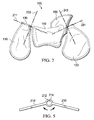
- the shape of the horse's shoulders, back, and hips may change shape and position. For example, as best seen in Figure 8 , as a horse turns to the right, the horse's right shoulder and right hip become closer together; conversely, the horse's left shoulder and left hip become further apart. Additionally, when the front left leg moves forward, the muscles on the left shoulder move down, while the muscles on the right shoulder go up. Also, when the rear left leg moves forward, the surrounding muscles on the left hip move up, while the muscles on the right hip go down.
- saddle 100 may be configured to move with the horse's movement.
- front panel 110 and 110' may rotate clockwise in relation to seat 140; aft panel 120 may rotate counter-clockwise in relation to seat 140.
- front supports 210 and 210', front pin 214, and shape member 215 may rotate clockwise around axis 223 while aft supports 230 and 230', aft pin 234, and shape member 235 may rotate counter-clockwise around axis 243.
- front panels 110 and 110' may rotate counter-clockwise, in relation to seat 140; aft panel 120 may rotate clockwise in relation to seat 140.
- front supports 210 and 210', front pin 214, and shape member 215 may rotate counter-clockwise around axis 223 while aft supports 230 and 230', aft pin 234, and shape member 235 may rotate clockwise around axis 243.
- front panels 110 and 110' may rotate clockwise in relation to axis 211, when looking from the front.
- aft panel 120 and 120' may rotate clockwise in relation to axis 231, when looking from the front.
- Each horse's back may have a unique shape and size. For example, there may be a large variance between the size and shape of each horse's withers, shoulders, loins, and hips.
- Tool 500 may include top 510, a plurality of holes 515, a plurality of rods 520, and one or more legs 530.
- Top 510 may be a flat surface that can be manufactured out of a suitable material such as wood, plastic, or a metal such as aluminum or steel.
- Top 510 can include a plurality of holes 515 that are configured to allow a rod 520 to be disposed within each hole 515.
- Rod 520 may be manufactured out of a suitable material such as wood, plastic, or a metal such as aluminum or steel.
- Tool 500 may also include one or more legs 530 configured to elevate and support top 510.
- Tool 500 can be configured so that the height of each rod 520 may be independently adjusted in relation to top 510.
- Several different methods may be used to adjust the height of each rod 520. Now referring to Figure 11 , one method may be to include a threaded surface on each rod 520. Each hole 515 may also include a corresponding thread on the interior wall of hole 515.
- tool 500 may include a threaded nut 540. In these examples, the height of each rod 520 may be adjusted by twisting each rod 520 so that each rod is at a preferred height.
- each rod 520 may be adjusted and made stationary by the use of clamps on each rod 520.
- the height of each rod 520 may be adjusted and made stationary by the use of stackable bricks under each rod 520.
- the height of each rod 520 may be adjusted and made stationary by the use of adjustable actuators under each rod 520.
- each rod 520 is pressure fitted into each hole 515 so that friction holds each rod 520 in place.
- the flexible mold of tool 500 may be an apparatus that can be configured to shape one or more components of tree assembly 200.
- the mold of tool 500 may be made out of a flexible material, such as elastomer or rubber, so that the mold conforms to the collective shape of rods 520.
- the flexible mold of tool 500 allows at least one component of tree assembly 200 to be formed by injection molding.
- a bottom portion of shape members 215, 225, and 235 may be collectively formed by injecting liquid plastic into the flexible mold. Once the liquid plastic cures and hardens, the plastic can be removed from the mold and the remaining components of tree assembly 200 may be placed on top of shape members 215, 225, and 235. Since shape members 215, 225, and 235 were collectively formed, the shape members 215, 225, and 235 can be separated by machining portions out, in between the three sections.
- the flexible mold of tool 500 allows at least one component of tree assembly 200 to be formed by 'laying up' composite material onto the flexible mold.
- a bottom portion of shape members 215, 225, and 235 may be collectively formed by placing peel ply release film onto the flexible mold, placing the composite material and the resin on top of the peel ply release film, and allowing the resin to cure. Once the resin in the composite material cures, the component can be removed from the flexible mold and the remaining components of tree assembly may be installed on top of shape members 215, 225, and 235. Since shape members 215, 225, and 235 were collectively formed, the shape members 215, 225, and 235 can be separated by machining portions out, in between the three sections.
- portions of tree assembly 200 may be disposed under, over, or within shape members 215, 225, and 235. Therefore, portions of tree assembly 200, such as front support 210, center support 220, and aft support 230, may be placed on the flexible mold of tool 500 before or after a portion of shape members 215, 225, and 235 are placed on top of tool 500. If the components of tree assembly 200 are made out of materials such as fiberglass, carbon-fiber-reinforced polymer, or plastic, tree assembly 200 may require curing. Therefore, tree assembly 200 may need to remain on tool 500 until the components have sufficiently cured. After tree assembly 200 is removed from tool 500, padding and a wrapping, such as leather, may be attached to tree assembly 200 to complete saddle 100.
- Adjustments to the shape of saddle 100 may be preferred because the shape of a horse's back, hips, and shoulders can change over time due to the horse's condition, age, and training. For example, the horse's back muscles and/or the underlying skeletal structure may change shape over time. Thus, a method of adjusting the shape of saddle 100 may be needed.
- One method of making adjustments may be to use shims that are configured to compensate for changes in the shape of the horse's back, hips, and shoulders.
- the shim may be made out of a padding material, such as rubber or polyester fiberfill, and may be wrapped in a smooth material such as leather.
- One or more shims may be strategically placed on the underside of saddle 100 to accommodate the shape of the horse's back, hips, and shoulders.
- One way of attaching the shims to the underside of saddle 100 can be to use a hook and loop fastener such as VELCRO brand fastener.
- Another way of attaching the shims to the underside of saddle 100 can be to use an adhesive.
Landscapes
- Engineering & Computer Science (AREA)
- Mechanical Engineering (AREA)
- Toys (AREA)
- Orthopedics, Nursing, And Contraception (AREA)
Applications Claiming Priority (1)
| Application Number | Priority Date | Filing Date | Title |
|---|---|---|---|
| US14/701,906 US9340406B2 (en) | 2015-05-01 | 2015-05-01 | Saddle |
Publications (1)
| Publication Number | Publication Date |
|---|---|
| EP3090983A1 true EP3090983A1 (de) | 2016-11-09 |
Family
ID=53797474
Family Applications (1)
| Application Number | Title | Priority Date | Filing Date |
|---|---|---|---|
| EP16167064.1A Withdrawn EP3090983A1 (de) | 2015-05-01 | 2016-04-26 | Sattel |
Country Status (2)
| Country | Link |
|---|---|
| US (1) | US9340406B2 (de) |
| EP (1) | EP3090983A1 (de) |
Cited By (1)
| Publication number | Priority date | Publication date | Assignee | Title |
|---|---|---|---|---|
| EP3224194B1 (de) * | 2014-11-24 | 2021-01-06 | Thomas Loeffler | Sich dynamisch anpassender sattelbaum für einen reit- oder tragesattel |
Families Citing this family (5)
| Publication number | Priority date | Publication date | Assignee | Title |
|---|---|---|---|---|
| DE102012103250B4 (de) * | 2012-04-13 | 2015-08-20 | Dt Saddlery Gmbh Design & Technik | Vorrichtung für eine Sitzauflage eines Reit- oder Transporttieres |
| US11299389B2 (en) * | 2017-09-12 | 2022-04-12 | Jacqueline Fenaroli | Saddle with interface having passively morphing elements and method of use |
| GB2581472A (en) * | 2019-01-18 | 2020-08-26 | Ideal & Wrs Company Ltd | Saddle Tree Mould |
| EP3733591B1 (de) * | 2019-04-30 | 2021-09-08 | Euroriding GmbH & Co KG | Sattelbaum für einen reitsattel und reitsattel |
| MX2022011789A (es) * | 2020-03-24 | 2022-10-18 | Prestige Italia S P A | Silla para equitacion. |
Citations (5)
| Publication number | Priority date | Publication date | Assignee | Title |
|---|---|---|---|---|
| DE202010004326U1 (de) * | 2009-04-30 | 2010-08-05 | Georg Kieffer Sattlerwarenfabrik Gmbh | Lastsattelsystem |
| US20100229507A1 (en) * | 2009-03-16 | 2010-09-16 | Isidore Strauss | Locking headplate for adjustable saddle tree |
| US20120017547A1 (en) | 2009-03-12 | 2012-01-26 | Christoph Rieser | Measuring device and method for determining a surface contour on a human or animal |
| US8261520B2 (en) * | 2006-09-05 | 2012-09-11 | Equine Fusion As | Saddle for riding or carrying a load |
| EP2660189A2 (de) * | 2012-04-13 | 2013-11-06 | dt Saddlery GmbH design & technik | Vorrichtung für eine Sitzauflage eines Reit- oder Transporttieres |
Family Cites Families (9)
| Publication number | Priority date | Publication date | Assignee | Title |
|---|---|---|---|---|
| GB191026756A (en) * | 1910-11-17 | 1911-10-19 | James Grosvenor Jeffries | Improvements in, or Additions to, Harness Saddle Trees and Saddles. |
| US1213329A (en) | 1916-05-25 | 1917-01-23 | Frederick C Beal | Saddle. |
| FR2603879B1 (fr) * | 1986-09-12 | 1988-11-10 | Warin & Fils Ets | Selle d'equitation et son procede de fabrication |
| EP0328376B1 (de) * | 1988-02-11 | 1991-10-09 | Wellep International (Uk) Limited | Kammerbügel und Baum für Sattel |
| US5343674A (en) | 1993-10-01 | 1994-09-06 | Ortho-Flex Saddle Co., Inc. | Racing saddle |
| CA2209755C (en) | 1996-07-08 | 2004-04-13 | Ray C. Biddlecome | Adjustable saddle |
| GB0105336D0 (en) * | 2001-03-03 | 2001-04-18 | Seymour Powell Ltd | Improvements in or relating to equestrian saddles |
| US8899004B2 (en) * | 2009-03-16 | 2014-12-02 | Intec Corporation | Locking headplate for adjustable saddle tree |
| AR101326A1 (es) * | 2011-08-05 | 2016-12-14 | Martiarena Guadalupe | Armazón regulable para silla de montar sin necesidad de desarme |
-
2015
- 2015-05-01 US US14/701,906 patent/US9340406B2/en not_active Expired - Fee Related
-
2016
- 2016-04-26 EP EP16167064.1A patent/EP3090983A1/de not_active Withdrawn
Patent Citations (5)
| Publication number | Priority date | Publication date | Assignee | Title |
|---|---|---|---|---|
| US8261520B2 (en) * | 2006-09-05 | 2012-09-11 | Equine Fusion As | Saddle for riding or carrying a load |
| US20120017547A1 (en) | 2009-03-12 | 2012-01-26 | Christoph Rieser | Measuring device and method for determining a surface contour on a human or animal |
| US20100229507A1 (en) * | 2009-03-16 | 2010-09-16 | Isidore Strauss | Locking headplate for adjustable saddle tree |
| DE202010004326U1 (de) * | 2009-04-30 | 2010-08-05 | Georg Kieffer Sattlerwarenfabrik Gmbh | Lastsattelsystem |
| EP2660189A2 (de) * | 2012-04-13 | 2013-11-06 | dt Saddlery GmbH design & technik | Vorrichtung für eine Sitzauflage eines Reit- oder Transporttieres |
Cited By (1)
| Publication number | Priority date | Publication date | Assignee | Title |
|---|---|---|---|---|
| EP3224194B1 (de) * | 2014-11-24 | 2021-01-06 | Thomas Loeffler | Sich dynamisch anpassender sattelbaum für einen reit- oder tragesattel |
Also Published As
| Publication number | Publication date |
|---|---|
| US20150232322A1 (en) | 2015-08-20 |
| US9340406B2 (en) | 2016-05-17 |
Similar Documents
| Publication | Publication Date | Title |
|---|---|---|
| EP3090983A1 (de) | Sattel | |
| AU2013201358B2 (en) | Device for a seat support suitable for a riding animal or a pack animal | |
| AU2002236042B2 (en) | Adjustable saddle | |
| EP1497224B1 (de) | Sattelbaum | |
| EP2013136B1 (de) | Sattelbaum | |
| US20180162718A1 (en) | Saddle | |
| US20060080946A1 (en) | Treeless riding saddle and method of making the same | |
| EP2275382B1 (de) | Sattel und Sattelbaum | |
| US7743589B2 (en) | Riding saddle and its method of manufacture | |
| GB2488030A (en) | Girth strap | |
| US7401454B2 (en) | Saddle fitting system and method | |
| US10538426B2 (en) | Saddle | |
| US6769234B2 (en) | Method for fitting a horse for a saddle pad or riding saddle | |
| WO2024163684A1 (en) | Inverse stirrup | |
| CN202864904U (zh) | 用于骑乘动物或驮畜的座托装置、鞍架及鞍座 | |
| AU2015201816B2 (en) | Device for a seat support suitable for a riding animal or a pack animal | |
| US11591208B2 (en) | Saddle stirrup adjustable strap D-ring | |
| WO2007124553A1 (en) | Saddle | |
| GB2623841A (en) | Saddle trees | |
| DE102017106257A1 (de) | Einlage für einen Schuh und Herstellungsverfahren |
Legal Events
| Date | Code | Title | Description |
|---|---|---|---|
| PUAI | Public reference made under article 153(3) epc to a published international application that has entered the european phase |
Free format text: ORIGINAL CODE: 0009012 |
|
| AK | Designated contracting states |
Kind code of ref document: A1 Designated state(s): AL AT BE BG CH CY CZ DE DK EE ES FI FR GB GR HR HU IE IS IT LI LT LU LV MC MK MT NL NO PL PT RO RS SE SI SK SM TR |
|
| AX | Request for extension of the european patent |
Extension state: BA ME |
|
| STAA | Information on the status of an ep patent application or granted ep patent |
Free format text: STATUS: REQUEST FOR EXAMINATION WAS MADE |
|
| 17P | Request for examination filed |
Effective date: 20170508 |
|
| RBV | Designated contracting states (corrected) |
Designated state(s): AL AT BE BG CH CY CZ DE DK EE ES FI FR GB GR HR HU IE IS IT LI LT LU LV MC MK MT NL NO PL PT RO RS SE SI SK SM TR |
|
| STAA | Information on the status of an ep patent application or granted ep patent |
Free format text: STATUS: EXAMINATION IS IN PROGRESS |
|
| 17Q | First examination report despatched |
Effective date: 20200421 |
|
| STAA | Information on the status of an ep patent application or granted ep patent |
Free format text: STATUS: THE APPLICATION IS DEEMED TO BE WITHDRAWN |
|
| 18D | Application deemed to be withdrawn |
Effective date: 20210831 |