EP3090997A1 - Procédé de conversion de méthane en méthanol à basse température - Google Patents
Procédé de conversion de méthane en méthanol à basse température Download PDFInfo
- Publication number
- EP3090997A1 EP3090997A1 EP15166246.7A EP15166246A EP3090997A1 EP 3090997 A1 EP3090997 A1 EP 3090997A1 EP 15166246 A EP15166246 A EP 15166246A EP 3090997 A1 EP3090997 A1 EP 3090997A1
- Authority
- EP
- European Patent Office
- Prior art keywords
- methane
- methanol
- oxygen
- catalyst material
- pressure
- Prior art date
- Legal status (The legal status is an assumption and is not a legal conclusion. Google has not performed a legal analysis and makes no representation as to the accuracy of the status listed.)
- Withdrawn
Links
- OKKJLVBELUTLKV-UHFFFAOYSA-N Methanol Chemical compound OC OKKJLVBELUTLKV-UHFFFAOYSA-N 0.000 title claims abstract description 170
- VNWKTOKETHGBQD-UHFFFAOYSA-N methane Chemical compound C VNWKTOKETHGBQD-UHFFFAOYSA-N 0.000 title claims abstract description 144
- 238000000034 method Methods 0.000 title claims abstract description 49
- 238000006243 chemical reaction Methods 0.000 title claims abstract description 48
- 230000008569 process Effects 0.000 title claims abstract description 42
- 239000003054 catalyst Substances 0.000 claims abstract description 40
- QVGXLLKOCUKJST-UHFFFAOYSA-N atomic oxygen Chemical compound [O] QVGXLLKOCUKJST-UHFFFAOYSA-N 0.000 claims abstract description 31
- 239000001301 oxygen Substances 0.000 claims abstract description 31
- 229910052760 oxygen Inorganic materials 0.000 claims abstract description 31
- 239000000463 material Substances 0.000 claims abstract description 26
- 239000007789 gas Substances 0.000 claims abstract description 20
- XLYOFNOQVPJJNP-UHFFFAOYSA-N water Substances O XLYOFNOQVPJJNP-UHFFFAOYSA-N 0.000 claims abstract description 10
- 239000001307 helium Substances 0.000 claims abstract description 7
- 229910052734 helium Inorganic materials 0.000 claims abstract description 7
- SWQJXJOGLNCZEY-UHFFFAOYSA-N helium atom Chemical compound [He] SWQJXJOGLNCZEY-UHFFFAOYSA-N 0.000 claims abstract description 7
- IJGRMHOSHXDMSA-UHFFFAOYSA-N Atomic nitrogen Chemical compound N#N IJGRMHOSHXDMSA-UHFFFAOYSA-N 0.000 claims abstract description 6
- MYMOFIZGZYHOMD-UHFFFAOYSA-N Dioxygen Chemical compound O=O MYMOFIZGZYHOMD-UHFFFAOYSA-N 0.000 claims abstract description 6
- 229910001882 dioxygen Inorganic materials 0.000 claims abstract description 6
- 239000007788 liquid Substances 0.000 claims abstract description 6
- 239000002243 precursor Substances 0.000 claims abstract description 6
- 230000003213 activating effect Effects 0.000 claims abstract description 4
- 239000011261 inert gas Substances 0.000 claims abstract description 3
- 229910052751 metal Inorganic materials 0.000 claims abstract description 3
- 239000002184 metal Substances 0.000 claims abstract description 3
- 229910052757 nitrogen Inorganic materials 0.000 claims abstract description 3
- 239000011148 porous material Substances 0.000 claims abstract description 3
- XKRFYHLGVUSROY-UHFFFAOYSA-N Argon Chemical compound [Ar] XKRFYHLGVUSROY-UHFFFAOYSA-N 0.000 claims abstract 4
- 230000007704 transition Effects 0.000 claims abstract 3
- 229910052786 argon Inorganic materials 0.000 claims abstract 2
- BASFCYQUMIYNBI-UHFFFAOYSA-N platinum Chemical compound [Pt] BASFCYQUMIYNBI-UHFFFAOYSA-N 0.000 claims description 21
- 239000010457 zeolite Substances 0.000 claims description 13
- 229910052697 platinum Inorganic materials 0.000 claims description 10
- 229910052680 mordenite Inorganic materials 0.000 claims description 9
- 229910021536 Zeolite Inorganic materials 0.000 claims description 5
- HNPSIPDUKPIQMN-UHFFFAOYSA-N dioxosilane;oxo(oxoalumanyloxy)alumane Chemical compound O=[Si]=O.O=[Al]O[Al]=O HNPSIPDUKPIQMN-UHFFFAOYSA-N 0.000 claims description 5
- 229910052723 transition metal Inorganic materials 0.000 claims description 5
- 150000003624 transition metals Chemical class 0.000 claims description 3
- -1 but not limited to Chemical class 0.000 claims 1
- 230000006872 improvement Effects 0.000 abstract description 3
- 238000005265 energy consumption Methods 0.000 abstract description 2
- 230000004913 activation Effects 0.000 description 30
- 239000010949 copper Substances 0.000 description 10
- RYGMFSIKBFXOCR-UHFFFAOYSA-N Copper Chemical compound [Cu] RYGMFSIKBFXOCR-UHFFFAOYSA-N 0.000 description 9
- 229910052802 copper Inorganic materials 0.000 description 9
- 230000003197 catalytic effect Effects 0.000 description 6
- 239000000203 mixture Substances 0.000 description 6
- 238000000605 extraction Methods 0.000 description 5
- 238000011068 loading method Methods 0.000 description 5
- 238000007254 oxidation reaction Methods 0.000 description 5
- 230000000694 effects Effects 0.000 description 4
- 125000004122 cyclic group Chemical group 0.000 description 3
- 239000002360 explosive Substances 0.000 description 3
- 229910052782 aluminium Inorganic materials 0.000 description 2
- XAGFODPZIPBFFR-UHFFFAOYSA-N aluminium Chemical compound [Al] XAGFODPZIPBFFR-UHFFFAOYSA-N 0.000 description 2
- 230000008901 benefit Effects 0.000 description 2
- 239000003153 chemical reaction reagent Substances 0.000 description 2
- JZMJDSHXVKJFKW-UHFFFAOYSA-N methyl sulfate Chemical compound COS(O)(=O)=O JZMJDSHXVKJFKW-UHFFFAOYSA-N 0.000 description 2
- 239000007800 oxidant agent Substances 0.000 description 2
- 230000003647 oxidation Effects 0.000 description 2
- 230000001590 oxidative effect Effects 0.000 description 2
- 229910052710 silicon Inorganic materials 0.000 description 2
- 239000010703 silicon Substances 0.000 description 2
- 239000002904 solvent Substances 0.000 description 2
- OKTJSMMVPCPJKN-UHFFFAOYSA-N Carbon Chemical compound [C] OKTJSMMVPCPJKN-UHFFFAOYSA-N 0.000 description 1
- 239000004411 aluminium Substances 0.000 description 1
- 238000013459 approach Methods 0.000 description 1
- 230000015572 biosynthetic process Effects 0.000 description 1
- 229910052799 carbon Inorganic materials 0.000 description 1
- 238000002485 combustion reaction Methods 0.000 description 1
- 238000001816 cooling Methods 0.000 description 1
- 230000003247 decreasing effect Effects 0.000 description 1
- 238000003795 desorption Methods 0.000 description 1
- 230000008030 elimination Effects 0.000 description 1
- 238000003379 elimination reaction Methods 0.000 description 1
- 238000000769 gas chromatography-flame ionisation detection Methods 0.000 description 1
- 238000010438 heat treatment Methods 0.000 description 1
- 230000007062 hydrolysis Effects 0.000 description 1
- 238000006460 hydrolysis reaction Methods 0.000 description 1
- 238000005470 impregnation Methods 0.000 description 1
- 230000003993 interaction Effects 0.000 description 1
- 239000000543 intermediate Substances 0.000 description 1
- 238000005342 ion exchange Methods 0.000 description 1
- QSHDDOUJBYECFT-UHFFFAOYSA-N mercury Chemical compound [Hg] QSHDDOUJBYECFT-UHFFFAOYSA-N 0.000 description 1
- 238000002156 mixing Methods 0.000 description 1
- 229910000510 noble metal Inorganic materials 0.000 description 1
- 230000008092 positive effect Effects 0.000 description 1
- 238000002360 preparation method Methods 0.000 description 1
- 238000011112 process operation Methods 0.000 description 1
- 239000003586 protic polar solvent Substances 0.000 description 1
- 239000000376 reactant Substances 0.000 description 1
- 239000011541 reaction mixture Substances 0.000 description 1
- 239000007787 solid Substances 0.000 description 1
- 238000003756 stirring Methods 0.000 description 1
- 239000000126 substance Substances 0.000 description 1
- 238000003786 synthesis reaction Methods 0.000 description 1
- 230000009466 transformation Effects 0.000 description 1
Images
Classifications
-
- C—CHEMISTRY; METALLURGY
- C07—ORGANIC CHEMISTRY
- C07C—ACYCLIC OR CARBOCYCLIC COMPOUNDS
- C07C29/00—Preparation of compounds having hydroxy or O-metal groups bound to a carbon atom not belonging to a six-membered aromatic ring
- C07C29/48—Preparation of compounds having hydroxy or O-metal groups bound to a carbon atom not belonging to a six-membered aromatic ring by oxidation reactions with formation of hydroxy groups
-
- Y—GENERAL TAGGING OF NEW TECHNOLOGICAL DEVELOPMENTS; GENERAL TAGGING OF CROSS-SECTIONAL TECHNOLOGIES SPANNING OVER SEVERAL SECTIONS OF THE IPC; TECHNICAL SUBJECTS COVERED BY FORMER USPC CROSS-REFERENCE ART COLLECTIONS [XRACs] AND DIGESTS
- Y02—TECHNOLOGIES OR APPLICATIONS FOR MITIGATION OR ADAPTATION AGAINST CLIMATE CHANGE
- Y02P—CLIMATE CHANGE MITIGATION TECHNOLOGIES IN THE PRODUCTION OR PROCESSING OF GOODS
- Y02P20/00—Technologies relating to chemical industry
- Y02P20/50—Improvements relating to the production of bulk chemicals
- Y02P20/52—Improvements relating to the production of bulk chemicals using catalysts, e.g. selective catalysts
Definitions
- the present invention relates to a process for methane to methanol conversion at low temperature.
- methanol can be extracted from the catalyst by bringing the catalyst into contact with water. This step can either be performed off-line, by removing the catalyst from the reactor and suspending it in a solvent or online by flowing a water-containing stream through the catalyst bed. Typical yields with this method, reported in literature are 13 ⁇ mol MeOH /g cat and 5 % methane diluted in either helium or nitrogen is used at ambient pressures.
- the objective of the present invention is to provide a process for methane to methanol conversion which has high selectivity while providing advantageous and energy-saving conditions for this process.
- This process allows the conversion of methane to methanol with high methanol yields, advantageous energy consumption for the conversion process without the presence of mixed methane and oxygen containing gas.
- Major improvement in the present process is the temperature that can be kept significantly below temperatures so far disclosed in the prior art; the whole process can be executed isothermally.
- Preferred reaction conditions can be achieved when the temperature is kept constant at a level in the range of 175 to 225°C.
- Experimental data confirms that a temperature range around 200°C delivers high methanol yields.
- a preferred embodiment of the present invention which delivers high methanol yields provides for catalyst materials that are zeolites, preferably a copper-exchanged mordenite and/or a ZSM-5 and/or a zeolite Y.
- the catalyst material may comprise an additional transition metal such as platinum.
- Preferred reactions conditions with respect to the pressure can be achieved when the pressure for methane and/or the oxygen containing gas ranges from ambient pressure to 250 bar.
- Preferred examples of the present invention are hereinafter described with reference to the attached figures which depict in:
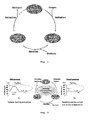
- Figure 1 illustrates schematically a catalytic cycle for the low temperature and isothermal reaction from methane to methanol using copper-loaded zeolites according to the present invention.
- the reactor has to be heated up to the activation temperature in a flow of oxygen, dwell for a certain time, cooled down to reaction temperature, after which the reaction of methane can take place and then the extraction has to be carried out.
- the present invention provides a way to simplify this process, in which the activation and the reaction can be carried out both at low temperature and even isothermally below 280 C.
- the process according to the present invention is substantially different from the processes disclosed in the prior art( CN101875016 A ).
- the material is activated, reacts with methane and methanol is extracted.
- the reagents are introduced separately and are admitted in pure form, in contrast to admission of a mixture of reactants oxygen and methane, which may lead to explosive mixtures, putting limits on the range of possible concentrations.
- the first is an engineering solution, where, by using a higher pressure of methane, the methanol yield can be increased dramatically. Even catalysts with a relatively low yield in the isothermal reaction at low pressures gave a considerably high yield with increased pressures (Table 1, e.g. 5.4 ⁇ mol MeOH /g cat at ambient pressures vs. 21.2 ⁇ mol MeOH /g cat at ambient pressure of oxygen during activation and 6 bar of methane). It was found that the oxygen pressure has only a minor influence on the yield, whereas an increase in methane pressure results in a greatly increased yield of methanol.
- the second solution is related to the nature of the catalyst.
- materials which are intrinsically active at low temperature preferably at 200°C and up to 280°C, even at ambient pressure, without activation at a higher temperature.
- Table 2 Yields obtained with copper mordenite synthesized from NaMOR with different silicon to aluminum ratios. The methanol yields were obtained by activating the catalyst in oxygen at ambient pressure overnight and subsequent methane reaction, all at 200°C.
- bimetallic catalysts were successfully employed in this process.
- a significant increase of activity at low temperature was observed by using copper-transition metal, preferentially platinum, mordenite.
- copper-transition metal preferentially platinum, mordenite.
- two 'trends' were shown.
- the methanol yield decreased together with increasing platinum content.
- the methanol yield increased (Table 3). The best results were achieved by lowering the copper loading in the catalyst and employing a considerably high platinum loading.
- the maximum yield gained at ambient pressures by this method was 7.4 ⁇ mol MeOH /g cat .
- the extraction can be carried out on-line with steam after reaction and condensing the reactor effluent.
- the catalyst gives conversion over several cycles.
- the cyclic process comprised of three steps according to the present invention is described in detail below.
- the first step is the oxidation in oxygen-containing gas.
- the oxygen-containing gas is removed from the reactor and by introducing methane, the catalyst is partially reduced and activated methane-species are generated on the material. These species are strongly bound and do not desorb during the methane treatment. This is a measure to prevent over-oxidation of carbon-containing species, as methanol is more reactive than methane. Instant desorption would generate free methanol, which would result in over-oxidation and ultimately in total combustion. This leads to low yields of other processes for the direct conversion of methane to methanol.
- water or any other reagent or solvent
- water is introduced as liquid in case of off-line extraction or as water-containing gas stream in case of on-line extraction, which was proven at laboratory scale.
- Figure 2 illustrates schematically the three step process for the conversion of methane to methanol using molecular oxygen. Novel is the ability to produce methanol without activation at high temperature, which allows to react methane preferentially at the same temperature or different but lower than 280°C, and therefore all steps can be executed isothermally as shown in the right part of Figure 2 , contrarily to the left part in Figure 2 showing the prior art cycle.
- the present invention steps in here. The elimination of the high temperature activation renders the process easier to carry out, without the need of temperature swings -in case of commercial application- in large volumes and reactors.
- the present invention is uniquely able to carry out catalyst activation in oxygen at 200°C, subsequently the solid is put in contact with methane and methanol is then released using water and/or protic solvents and/or CO, all preferentially at the same temperature or at temperature lower than 280°C. As described previously this is possible by (i) using higher pressures and/or (ii) using specific catalyst materials.
- the three-step process consists of (i) activation in oxygen-containing gas, (ii) reaction with methane and (iii) treatment with a liquid or a gas (most preferably water) to extract methanol.
- a liquid or a gas most preferably water
- the prior art closest to the present invention system is a catalytic (not step-wise) process ( CN101875016A ) and the step-wise process with high temperature activation ( JACS, 127 (2005) 1394-1395 , WO2011046621 ).
- the first has the problem of possibly generating explosive mixtures and the latter involves complicated heating and cooling procedures.
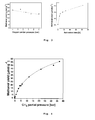
- Figure 3 shows the effects of pressure and activation time during the activation step.
- Figure 4 shows the methanol yield at different methane pressures. Another advantage of the step-wise process compared to process in which the catalyst is exposed to oxygen after and possibly during methane activation has been found.
- a reaction in which the catalyst has been exposed to oxygen-containing gas after reaction with methane (six bar) yielded 5.7 ⁇ mol ⁇ g -1 instead of 21.2 ⁇ mol ⁇ g -1 , if the catalyst is not exposed to oxygen at 200°C after the reaction.
- the reaction was proven to work under isothermal conditions between 175°C and 225°C and different zeolites were also shown to yield methanol, i.e. copper-exchanged mordenite (data presented herein), ZSM-5, zeolite Y, and omega.
- the second option to attain low temperature activation, thus enabling isothermal process operation, is the usage of specific catalyst materials.
- the reaction has been carried out under isothermal conditions at 200°C and one bar of both oxygen and methane have been used.
- bimetallic materials Platinum is an example of such secondary metal. Yields of up to 7.5 ⁇ mol ⁇ g -1 were achieved by adding platinum to a copper-exchanged mordenite. Different preparation techniques were successful, such as impregnation and ion-exchange of platinum-species. The reference reaction with only Cu-MOR resulted in a low yield of 0.8 ⁇ mol ⁇ g -1 . Other transition metals can also be employed.
Landscapes
- Chemical & Material Sciences (AREA)
- Organic Chemistry (AREA)
- Chemical Kinetics & Catalysis (AREA)
- Catalysts (AREA)
- Organic Low-Molecular-Weight Compounds And Preparation Thereof (AREA)
Priority Applications (2)
| Application Number | Priority Date | Filing Date | Title |
|---|---|---|---|
| EP15166246.7A EP3090997A1 (fr) | 2015-05-04 | 2015-05-04 | Procédé de conversion de méthane en méthanol à basse température |
| PCT/EP2016/058017 WO2016177542A1 (fr) | 2015-05-04 | 2016-04-12 | Procédé de transformation de méthane en méthanol à basse température |
Applications Claiming Priority (1)
| Application Number | Priority Date | Filing Date | Title |
|---|---|---|---|
| EP15166246.7A EP3090997A1 (fr) | 2015-05-04 | 2015-05-04 | Procédé de conversion de méthane en méthanol à basse température |
Publications (1)
| Publication Number | Publication Date |
|---|---|
| EP3090997A1 true EP3090997A1 (fr) | 2016-11-09 |
Family
ID=53052717
Family Applications (1)
| Application Number | Title | Priority Date | Filing Date |
|---|---|---|---|
| EP15166246.7A Withdrawn EP3090997A1 (fr) | 2015-05-04 | 2015-05-04 | Procédé de conversion de méthane en méthanol à basse température |
Country Status (2)
| Country | Link |
|---|---|
| EP (1) | EP3090997A1 (fr) |
| WO (1) | WO2016177542A1 (fr) |
Cited By (3)
| Publication number | Priority date | Publication date | Assignee | Title |
|---|---|---|---|---|
| WO2018234044A1 (fr) * | 2017-06-23 | 2018-12-27 | Haldor Topsøe A/S | Procédé d'oxydation d'un alcane inférieur à basses températures dans des mélanges gazeux contenant de l'ammoniac |
| US10954205B2 (en) | 2017-06-23 | 2021-03-23 | Haldor Topsøe A/S | Process for oxidation of a lower alkene at low temperatures in ammonia-containing gas mixtures |
| CN114768690A (zh) * | 2022-03-18 | 2022-07-22 | 西安石油大学 | 气固相连续光催化甲烷直接氧化制甲醇的反应器及方法 |
Families Citing this family (4)
| Publication number | Priority date | Publication date | Assignee | Title |
|---|---|---|---|---|
| CN106996886A (zh) * | 2017-04-17 | 2017-08-01 | 苏州大学张家港工业技术研究院 | 一种用于制备实验气体的装置及其制备方法 |
| KR20190053339A (ko) * | 2017-11-10 | 2019-05-20 | 아주대학교산학협력단 | 메탄올의 제조 방법 |
| CZ309441B6 (cs) | 2019-04-03 | 2023-01-18 | Ústav fyzikální chemie J. Heyrovského AV ČR, v. v. i. | Použití katalyzátoru pro výrobu metanolu z metanu a způsob výroby metanolu z metanu |
| CN114621054B (zh) * | 2020-12-10 | 2023-03-24 | 中国科学院大连化学物理研究所 | 一种低温活化甲烷制备含氧有机化合物的方法 |
Citations (2)
| Publication number | Priority date | Publication date | Assignee | Title |
|---|---|---|---|---|
| CN101875016A (zh) | 2009-11-19 | 2010-11-03 | 中国海洋石油总公司 | 一种用于甲烷低温氧化制备甲醇的催化剂及其制备方法与应用 |
| WO2011046621A1 (fr) | 2009-10-14 | 2011-04-21 | The Board Of Trustees Of The Leland Stanford Junior University | Conversion directe et sélective du méthane en méthanol à basse température |
-
2015
- 2015-05-04 EP EP15166246.7A patent/EP3090997A1/fr not_active Withdrawn
-
2016
- 2016-04-12 WO PCT/EP2016/058017 patent/WO2016177542A1/fr not_active Ceased
Patent Citations (2)
| Publication number | Priority date | Publication date | Assignee | Title |
|---|---|---|---|---|
| WO2011046621A1 (fr) | 2009-10-14 | 2011-04-21 | The Board Of Trustees Of The Leland Stanford Junior University | Conversion directe et sélective du méthane en méthanol à basse température |
| CN101875016A (zh) | 2009-11-19 | 2010-11-03 | 中国海洋石油总公司 | 一种用于甲烷低温氧化制备甲醇的催化剂及其制备方法与应用 |
Non-Patent Citations (7)
| Title |
|---|
| JACS, vol. 127, 2005, pages 1394 - 1395 |
| M.H. GROOTHAERT ET AL., JACS, vol. 127, 2005, pages 1394 |
| P.J. SMEETS ET AL., CATAL. TODAY, vol. 110, 2005, pages 303 |
| R. A. PERIANA ET AL., SCIENCE, vol. 259, 1993, pages 340 |
| R. A. PERIANA ET AL., SCIENCE, vol. 280, 1998, pages 560 |
| SMEETS P J ET AL: "Cu based zeolites: A UV-vis study of the active site in the selective methane oxidation at low temperatures", CATALYSIS TODAY, ELSEVIER, NL, vol. 110, no. 3-4, 30 December 2005 (2005-12-30), pages 303 - 309, XP027834809, ISSN: 0920-5861, [retrieved on 20051230] * |
| T. SHEPPARD ET AL: "A low temperature, isothermal gas-phase system for conversion of methane to methanol over Cu-ZSM-5", CHEMICAL COMMUNICATIONS, vol. 50, no. 75, 7 August 2014 (2014-08-07), pages 11053, XP055192458, ISSN: 1359-7345, DOI: 10.1039/C4CC02832E * |
Cited By (4)
| Publication number | Priority date | Publication date | Assignee | Title |
|---|---|---|---|---|
| WO2018234044A1 (fr) * | 2017-06-23 | 2018-12-27 | Haldor Topsøe A/S | Procédé d'oxydation d'un alcane inférieur à basses températures dans des mélanges gazeux contenant de l'ammoniac |
| US10941093B2 (en) | 2017-06-23 | 2021-03-09 | Haldor Topsøe A/S | Process for oxidation of a lower alkane at low temperatures in ammonia-containing gas mixtures |
| US10954205B2 (en) | 2017-06-23 | 2021-03-23 | Haldor Topsøe A/S | Process for oxidation of a lower alkene at low temperatures in ammonia-containing gas mixtures |
| CN114768690A (zh) * | 2022-03-18 | 2022-07-22 | 西安石油大学 | 气固相连续光催化甲烷直接氧化制甲醇的反应器及方法 |
Also Published As
| Publication number | Publication date |
|---|---|
| WO2016177542A1 (fr) | 2016-11-10 |
Similar Documents
| Publication | Publication Date | Title |
|---|---|---|
| EP3090997A1 (fr) | Procédé de conversion de méthane en méthanol à basse température | |
| Sushkevich et al. | The effect of the active‐site structure on the activity of copper mordenite in the aerobic and anaerobic conversion of methane into methanol | |
| Ferlin et al. | Aerobic waste-minimized Pd-catalysed C–H alkenylation in GVL using a tube-in-tube heterogeneous flow reactor | |
| US9138726B2 (en) | Copper-based catalyst for converting ammonia into nitrogen | |
| Kubacka et al. | Hydroxylation/oxidation of benzene over Cu-ZSM-5 systems: Optimization of the one-step route to phenol | |
| CN106866589B (zh) | 一种γ-戊内酯的制备方法 | |
| KR20070009590A (ko) | 프로필렌 옥사이드 제조 방법 | |
| Pérez-Ramı́rez et al. | Direct N2O decomposition over ex-framework FeMFI catalysts. Role of extra-framework species | |
| CN106582788A (zh) | 一种改性zsm‑5分子筛及制备方法和催化制备3‑甲基‑3‑丁烯‑1‑醇的合成方法 | |
| MXPA00006916A (es) | Procedimiento para hidrogenar acetona. | |
| CN109400480B (zh) | 一种制备亚硝酸甲酯的方法和设备 | |
| CN106925332A (zh) | 超重力法制备乙炔加氢制乙烯的催化剂的方法及应用 | |
| EP3642177A1 (fr) | Procédé d'oxydation d'un alcane inférieur à basses températures dans des mélanges gazeux contenant de l'ammoniac | |
| CN108299336B (zh) | 一种催化制备n-甲基吡咯烷的方法 | |
| Buchmüller et al. | Control of homogeneously catalyzed reactions by phase equilibria | |
| EP4461722A1 (fr) | Procédé de préparation de méthylisobutylcétone | |
| Wang et al. | Epoxidation of allyl choride with molecular oxygen and 2-ethyl-anthrahydroquinone catalyzed by TS-1 | |
| CA2951451A1 (fr) | Un procede selectif de conversion d'acide levulinique en gamma-valerolactone | |
| CN115771884B (zh) | 一种硝酸羟胺的微通道连续生产工艺 | |
| JP2004285055A (ja) | プロピレンオキサイドの製造方法 | |
| RU2257340C1 (ru) | Способ получения гидроксиламинсульфата | |
| JP6269026B2 (ja) | ジイソブチルケトンの水素化によるジイソブチルカルビノールの製造法 | |
| CN121930100A (zh) | 一种高收率的2-硝基丙烷制备工艺 | |
| Lee | Thermodynamic features of the Cu-ZSM-5 catalyzed NO decomposition reaction | |
| Li et al. | Catalytic mechanism and reaction pathway of acetone ammoximation to acetone oxime over TS-1 |
Legal Events
| Date | Code | Title | Description |
|---|---|---|---|
| PUAI | Public reference made under article 153(3) epc to a published international application that has entered the european phase |
Free format text: ORIGINAL CODE: 0009012 |
|
| AK | Designated contracting states |
Kind code of ref document: A1 Designated state(s): AL AT BE BG CH CY CZ DE DK EE ES FI FR GB GR HR HU IE IS IT LI LT LU LV MC MK MT NL NO PL PT RO RS SE SI SK SM TR |
|
| AX | Request for extension of the european patent |
Extension state: BA ME |
|
| STAA | Information on the status of an ep patent application or granted ep patent |
Free format text: STATUS: THE APPLICATION IS DEEMED TO BE WITHDRAWN |
|
| 18D | Application deemed to be withdrawn |
Effective date: 20170510 |