EP3091788A1 - Procédé pour recevoir des informations dans un réseau cellulaire sans fil - Google Patents
Procédé pour recevoir des informations dans un réseau cellulaire sans fil Download PDFInfo
- Publication number
- EP3091788A1 EP3091788A1 EP15166285.5A EP15166285A EP3091788A1 EP 3091788 A1 EP3091788 A1 EP 3091788A1 EP 15166285 A EP15166285 A EP 15166285A EP 3091788 A1 EP3091788 A1 EP 3091788A1
- Authority
- EP
- European Patent Office
- Prior art keywords
- system information
- user equipment
- broadcast channel
- channel modification
- modification period
- Prior art date
- Legal status (The legal status is an assumption and is not a legal conclusion. Google has not performed a legal analysis and makes no representation as to the accuracy of the status listed.)
- Withdrawn
Links
- 238000000034 method Methods 0.000 title claims abstract description 44
- 230000001413 cellular effect Effects 0.000 title claims abstract description 22
- 230000004048 modification Effects 0.000 claims abstract description 123
- 238000012986 modification Methods 0.000 claims abstract description 123
- 230000005540 biological transmission Effects 0.000 claims description 100
- 230000002618 waking effect Effects 0.000 claims description 4
- 101150096310 SIB1 gene Proteins 0.000 description 20
- 238000004891 communication Methods 0.000 description 17
- 230000008859 change Effects 0.000 description 12
- 230000000694 effects Effects 0.000 description 7
- 230000008569 process Effects 0.000 description 4
- 230000003252 repetitive effect Effects 0.000 description 4
- 230000011664 signaling Effects 0.000 description 4
- 230000008901 benefit Effects 0.000 description 3
- 230000001419 dependent effect Effects 0.000 description 3
- 238000013459 approach Methods 0.000 description 2
- 235000013361 beverage Nutrition 0.000 description 2
- 230000001427 coherent effect Effects 0.000 description 2
- 230000003111 delayed effect Effects 0.000 description 2
- 238000011161 development Methods 0.000 description 1
- 238000010586 diagram Methods 0.000 description 1
- 238000005516 engineering process Methods 0.000 description 1
- 230000003993 interaction Effects 0.000 description 1
- 230000002045 lasting effect Effects 0.000 description 1
- 230000007774 longterm Effects 0.000 description 1
- 238000005259 measurement Methods 0.000 description 1
- 238000005457 optimization Methods 0.000 description 1
- 230000000737 periodic effect Effects 0.000 description 1
- 230000004044 response Effects 0.000 description 1
- 230000003068 static effect Effects 0.000 description 1
- 230000001960 triggered effect Effects 0.000 description 1
Images


Classifications
-
- H—ELECTRICITY
- H04—ELECTRIC COMMUNICATION TECHNIQUE
- H04W—WIRELESS COMMUNICATION NETWORKS
- H04W4/00—Services specially adapted for wireless communication networks; Facilities therefor
- H04W4/70—Services for machine-to-machine communication [M2M] or machine type communication [MTC]
-
- H—ELECTRICITY
- H04—ELECTRIC COMMUNICATION TECHNIQUE
- H04W—WIRELESS COMMUNICATION NETWORKS
- H04W48/00—Access restriction; Network selection; Access point selection
- H04W48/08—Access restriction or access information delivery, e.g. discovery data delivery
- H04W48/12—Access restriction or access information delivery, e.g. discovery data delivery using downlink control channel
-
- H—ELECTRICITY
- H04—ELECTRIC COMMUNICATION TECHNIQUE
- H04W—WIRELESS COMMUNICATION NETWORKS
- H04W48/00—Access restriction; Network selection; Access point selection
- H04W48/16—Discovering, processing access restriction or access information
-
- H—ELECTRICITY
- H04—ELECTRIC COMMUNICATION TECHNIQUE
- H04W—WIRELESS COMMUNICATION NETWORKS
- H04W48/00—Access restriction; Network selection; Access point selection
- H04W48/08—Access restriction or access information delivery, e.g. discovery data delivery
- H04W48/10—Access restriction or access information delivery, e.g. discovery data delivery using broadcasted information
Definitions
- the present invention relates to a method for transmitting information from a base station to a user equipment.
- the invention also pertains to a base station using said method.
- the invention further relates to a user equipment configured to receive information transmitted using said method.
- the cellular standards in particular those supporting long term evolution (LTE) standard, are beginning to face the fact that different types of user equipment are operating within the wireless cellular networks.
- MTC machine-type communication
- SIB system information blocks
- SIBs system information blocks dedicated for MTC devices
- MTC devices are separated in low complexity and low complexity devices with Enhanced Coverage UEs.
- Low complexity is achieved by placing in bandwidth reception capabilities lower demands than for normal devices, i.e. those devices are only required to receive 1,4MHz radio frequency bandwidth.
- the low complexity devices for enhanced coverage are characterized that they are receiving or transmitting information in a repetitive manner and the receiver performing coherent average so that additional reception gain is achieved i.e. these are also low complexity devices applying coverage enhancements techniques.
- These two categories of devices are defined in specification 3GPP TR 36.888 V12.0.0, which content is incorporated here by reference. Both of these types of devices address different use cases and hence place different burdens on the SIB handling. It is in particular preferable to address both types of devices with one common set of M-SIBs.
- the enhanced coverage devices typically considered as meters are static/semi-static and gain their enhanced coverage by repetitive reading of the related information. This is also applicable for the SIBs itself.
- the number of repetitions for enhanced coverage may be very high, which leads to high latencies for receiving of all system information in an UE. Times of 10,24s are assumed to be acceptable for these devices.
- SIB1 needs to be read in order to know if in at least one of the other system information blocks a change has happened, which is indicated by the so-called BCCH value tag.
- BCCH value tag For enhanced coverage devices it is by now a challenge to successfully decode the SIB1 let alone the whole system information during one broadcast channel modification period.
- the first aspect it is proposed a method for receiving system information by a user equipment from a base station, the user equipment being a limited-bandwidth device, camping on the base station, the base station being part of a wireless cellular network, wherein the system information are divided in a plurality of system information blocks, which each is at least once transmitted by the base station during one broadcast channel modification period, the method comprising the step for the user equipment of:
- the invention is based on the commonly known architecture of wireless cellular networks according to technology standards like GSM, UMTS and LTE.
- the base stations resp. NodeB or eNodeB, transmit in a dedicated broadcast channel a defined collection of system information to the user equipments (UEs) which are operating with the respective base station. This operation relationship is known as camping of the user equipment on a base station.
- UEs user equipments
- limited-bandwidth devices These UEs form a special class of devices - in particular machine type communication devices - which comprise fewer resources for operating in the wireless cellular network, and are generally operating in a different manner than mobile handsets.
- limited-bandwidth devices are a subset of low complexity devices.
- the system information provided by the base station to the UEs is known to be submitted in several blocks, the System Information Blocks (SIB).
- SIB System Information Blocks
- the normal user equipment reads the first SIB - the SIB1.
- the SIB1 in particular comprises information including the BCCH value tag.
- This BCCH value tag - in the following simple named value tag - allows for the UE to derive whether the content of one of the SIBs has changed since the last broadcast channel modification period. Based on that information the user equipment continues to read the rest of the system information blocks transmitted by the base station. It is further known that limited-bandwidth devices might be situated in places with only a comparably reduced receivable signaling power from the base station, where the UE is currently camping on. Such limited-bandwidth devices are called enhanced coverage devices, and they are able to compensate the reduced signaling power by repeating to read the signals, in order to get sufficient coverage gain.
- the system information blocks are completely transmitted during a broadcast channel modification period.
- the SIB1 indicates with the BCCH value tag that no modification has happened, this status lasts for one broadcast channel modification period.
- the repetitive reading of the SIBs or even the SIB1 does not finish during one broadcast channel modification period. This is in particular the case due to two situations:
- the first step includes an initialization of received system information
- the second and later step takes advantage of the results stored within the first step.
- the user equipment has available the key information about the broadcast channel modification period, in particular the length and the starting point.
- the latter is typically given as a system frame number (SFN) and an offset.
- SFN system frame number
- the step of initially receiving system information is conducted in conjunction with at least one out of the group of:
- the system information from the other base station is either read faster or the broadcast channel modification period is longer, or supporting higher coverage enhancement or any combination thereof.
- the user equipment has available in its storage unit a representation of the up to date system information received from the active base station.
- the user equipment is configured to refer to the stored data and adapt the subsequent network operations based on these data. That means that after a certain break, lasting at least another broadcast channel modification period, the user equipment determines the start of another broadcast channel modification period and when to read system information.
- the break is in particular indicated by the fact, when it is needed to read the whole set of system information again. This is typically the case when either the system information have changed, or a data transmission is about to be launched. In the time in between no reception of the system information is preferably executed, which is advantageous in terms of power consumption.
- the user equipment determines the start of a - in particular the next - broadcast channel modification period in terms of an SFN offset compared to the current SFN.
- SFN system frame number
- the user equipment is further configured to determine when to start reading the system information. In particular this point in time is selected that way, that it is located after the start of the next broadcast channel modification period, and the user equipment is able to finish reading the system information before the end of the respective broadcast channel modification period.
- a method further comprising the step for the user equipment of determining the duration of receiving the system information, and further considering for determination of the start of reading system information further said duration of receiving the system information.
- the user equipment With the time needed for receiving the system information the user equipment has an indication how long after a start of the broadcast channel modification period the user equipment will successfully finish reading the system information.
- This duration is preferably used for determining the start of reading the system information.
- Said duration of receiving the system information in particular depends upon the repetitions conducted by the user equipment for gaining sufficient confidence in decoding of the system information. For enhanced coverage devices a number of repetitions of reading the broadcast from the active base station is needed. The number of repetitions is individual for each user equipment.
- the user equipment decides that sufficient repetitions are carried out, when a confidence level was reached, that the broadcast information data are correctly received.
- the information about the repetitions and/or time until the sufficient confidence level in decoding the system information is reached is in particular known to the user equipment from the first step of initial receiving the system information. Hence, it is stored following the initial reception of the system information.
- the user equipment has available the point in time of the start of the current broadcast channel modification period, the duration of the broadcast channel modification period and the duration of successfully receiving the system information, it is able to detect if an immediate start of receiving the system information would end prior to the end of the current broadcast channel modification period. If this is not the case, the start of receiving the system is determined differently.
- a method further comprising the step of determining the start time of a first data transmission by the user equipment considering the determined start of broadcast channel modification period.
- the user equipment further determines the start of a first data transmission. This is in particular advantageous for the case that the user equipment conducts the previous steps due to the fact that the envisaged data transmission is about to be carried out. Consequently the respective data transmission is further conducted in dependence of the determined start of the broadcast channel modification period. It is in particular further conducted depending on the determined start of the reception of the system information and the determined duration of reading the system information.
- the start of the data transmission is preferably carried out between the end of the reception of the system information and the next start of a broadcast channel modification period.
- the determination of the start of the reception of system information preferably takes into account the envisaged data transmission.
- the data transmission consists of comparably small data packets, it is advantageous to carry out the system information reception and the whole data transmission during one broadcast channel modification period.
- the determination of the start of reading system information comprises shifting said reading allowing completion of reading of said system information within a single broadcast channel modification period.
- This embodiment means in particular that the determination of the start of reading is shifted after the next start of a broadcast channel modification period, hence the start of reading is delayed beyond that point in time
- This is in particular advantageous for a planned scheduling of activities where a reading of system information is related to. This is in particular the case for a data transmission. This means when a data transmission is scheduled for a certain point in time, then the reading of system information and/or the actual start of the data transmission is preferably shifted in relationship to the start of a broadcast channel modification period.
- Those parts of the system information comprise in particular one or a few system information blocks which include information concerning an access barring for certain type(s) of devices or similar access limitations.
- the user equipment is set in the position to further control that the data transmission is started within the same broadcast channel modification period as the just mentioned reception of system information. This embodiment is advantageous as it saves attempts of system information receptions and thus saves power.
- the data transmission would be started right after the system information reception has ended.
- a method comprising for the user equipment the step of further considering for determining the first data transmission start time the duration of receiving the system information and a random value.
- the start time for data transmission is further dependant from another parameter.
- the additional parameter is a random value which distributes the data transmissions over the remaining time within the broadcast channel modification period, but still assures that the data transmission is carried out in the same broadcast channel modification periods.
- the broadcast channel modification period is split in several intervals, e.g.
- the user equipment preferably determines from the determined and/or stored duration of reading the system information and the duration of the broadcast channel modification period and in particular an estimated duration of data transmission, a plurality of said intervals which allow to start and/or finish the data transmission within the broadcast channel modification period. This results in a discrete number of intervals. With the random value, one of the intervals is chosen and the data transmission is started within this interval.
- a method comprising for the user equipment the step of determining the start time of at least one second data transmission considering a time related to the start time of the first data transmission and a time related to the start time of a broadcast channel modification period. This embodiment envisages the issue of carrying out more than one data transmission with an optimized power consumption footprint.
- the start time of a second data transmission is determined taking into account both the start time of the first data transmission and the start time of a broadcast channel modification period, in particular the start time of the next broadcast channel modification period. Additionally the duration of the broadcast channel modification period and/or the start time of the previous broadcast channel modification period are preferably considered as well.
- the idea here is when a plurality of data transmissions are planned, then it is tried to achieve that with as few system information receptions as possible.
- the system information reception, in particular the reception of the SIB1 are necessary for each broadcast channel modification period where the UE is supposed to interact with the base station, in particular to conduct data transmissions.
- the limited-bandwidth device was operated in a sleeping mode, probably the system information or parts thereof are received once, but then the pending data transmissions - e.g. transmission of sensor data and a request to a remote server for updates of parametrization etc. - are moved into the same broadcast channel modification period. This saves receiving system information. Further data transmissions are handled accordingly, taking into account the start time of the previous data transmission.
- the system information indicates if any change has occurred since previously transmitted system information. So, when a user equipment reads system information and detects value tag a, but then activates a sleep mode, it generally just needs to read the SIB1 in order to figure out, if the value tag has changed. If no change has happened, that is the value tag is still a, the stored system information can be reused.
- the stored system information is outdated and needs to be received again.
- This procedure is modified by the validity period in that way that even if the SIB1 received after the sleep mode indicates an unchanged value tag, the system information need to be received completely again, should the validity period have expired.
- the start time of the first or second data transmission is taking the validity period in account.
- the validity period is stored with the initially read system information and/or with the first data transmission, should it concern a later, in particular second, data transmission.
- the start time of the data transmission is adapted considering the stored validity period in that the user equipment shifts a planned data transmission ahead, to avoid expiration of the validity period. This is advantageous as with this embodiment avoidable system information reception efforts can be saved.
- validity periods envisaged for different types of devices are advantageous.
- For metering devices an increase up to 24h hours is advantageous as otherwise for each data transmissions system information needed to be completely read, as in any case the validity period have expired between two data transmissions.
- Further such validity periods in particular for certain device types, are preferably provided with the system information.
- the user equipment has the up to date validity periods available from the previous reading of the complete set of system information blocks.
- a user equipment configured for operating in camping relationship with a base station of a wireless cellular network, the user equipment being a limited-bandwidth device, and is configured to receive system information from the base station, the system information are divided in a plurality of system information blocks, which each is at least once transmitted by the base station during one broadcast channel modification period, the user equipment further comprising at least a storage unit, where the user equipment is further configured to:
- the user equipment is in particular a wireless communication device, preferably configured for machine-type communication. It is as limited-bandwidth device comprising fewer resources for operating in a wireless cellular network than other devices, including mobile handsets. Further the user equipment comprises a storage unit. This is in particular a permanent memory like a flash memory. However it is also covered by the invention to use a volatile memory, such as operating memory for this task. Typically it is expected that after a restart of the user equipment from power-off mode, that all previously stored data need to be retrieved again. Nevertheless, some information, in particular the validity period depicting the maximum validity of system information, are stored permanently, while other - more volatile - information is stored in the operating memory.
- the user equipment is configured to operate within a wireless cellular network, and for that is camping on a base station, which is then the active base station.
- a change of the base station - be it by means of a reselection or a handover during an active connection - preferably leads to a new attempt to receive the system information broadcasted by the by then active base station.
- this new attempt to receive the system information complies with the suggested initial receiving of system information, according to the proposed aspect of the invention.
- the start of reading the system information the next time is dependent upon the start of the broadcast channel modification period.
- the second aspect of the invention shares the advantages of the first aspect.
- he user equipment further comprises a transceiver unit and a controlling unit, and wherein the controlling unit is configured to execute the determination of start time of reading system information and/or the determination of start time of a data transmission; and the transceiver unit is configured to execute the reading of system information and/or the reading of the data transmission.
- the user equipment comprises said units, which are configured to fulfill different tasks.
- a transceiver unit in particular a receiver, is configured for carrying out all signaling operations with the base station via the air interface.
- the controlling unit is controlling the transceiver. As part of that task the controlling unit determines - based on system information broadcasts received by the transceiver unit and forwarded to the controlling unit - the start time of reading system information and/or of data transmission.
- the user equipment further comprises a control appliance, wherein the control appliance is configured to receive from the controlling unit information related to the determined start of the broadcast channel modification period and/or the validity period of said stored system information.
- the control appliance is configured to receive from the controlling unit information related to the determined start of the broadcast channel modification period and/or the validity period of said stored system information.
- both units are part of a communication unit, in particular a wireless module.
- a control appliance controls the wireless module.
- the control appliance provides via a defined interface, in particular the AT-interface or another command interface, controlling commands in terms of the command for data transmission etc.
- the control appliance is effectively the core of a device which is equipped with wireless connectivity by means of the wireless module.
- the control appliance therefore - at least by means of a user interface - knows the relevance and hence the required quality of service for a data transmissions.
- the control appliance takes on those instructions and acts accordingly.
- the controlling unit in particular as part of the communication unit, the proposed user equipment comprises an intermediate layer controlling the communication, including finding appropriate points in time for various operations, in particular receiving system information and/or transmitting data.
- the controlling unit fulfills further tasks as intermediary between the control appliance and the transceiver unit. As part of that intermediary task the control unit is further providing information to the control appliance regarding the start of a broadcast channel modification period and/or the validity period.
- control appliance is advantageously put in the position to provide instructions to the control unit if a power-aware operation is preferred rather to momentary traffic. This is in particular preferable as with each data transmission the preference may be different. Effectively the control appliance is at least informally involved in the way the control unit is handling data transmissions and reception of system information.
- this invention advantageously solves the depicted problem and suggests a change that makes possible the operation of enhanced coverage devices with the base stations in a manner complying with power consumption objectives.
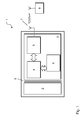
- Fig. 1 it is shown the general architecture of a user equipment 1 according to a preferred embodiment of the invention.
- the user equipment 1 is in this exemplifying embodiment a limited-bandwidth machine-type device, which generally comprises a control appliance 2 and a communication unit 3.
- the control appliance 2 typically controls the whole device, which is further managed by a user interface - if any - and incorporates the device specific intelligence. If the user equipment represents a metering device or a vending machine, the control appliance cares for all operations related to measuring by means of sensors resp. for vending beverages etc. As part of this task, the control appliance has the capability to connect to remote servers and - in the case of the metering device - send measuring data resp.
- the connectivity of the user equipment 1 is provided by the communication unit 3.
- the control appliance 2 controls the connectivity by means of the command interface 9, which is typically an AT interface implementing the Hayes standard set of commands for controlling modems.
- a typical chain of AT commands would open a connection with a remote server specified by its URL, send measured data as part of a payload data transmission and close the connection.
- the control appliance assumes that each of the AT commands leads to an immediate interaction of the communication unit 3 with the communication bearer, in this case the wireless cellular network by means of the transceiver 5 and the antenna 7.
- the communication unit 3 is accepting the AT commands and takes the necessary steps for fulfilling the commands.
- the communication unit 3 comprises at least a control unit 4, the transceiver 5 and a storage unit 6 for storing received data.
- the exemplary user equipment 1 has a special architecture, as here a control unit 4 is acting as intermediary unit within the communication unit 3.
- the communication unit 3 typically has objectives from the control appliance in terms of power consumption, but when the control appliance would in short succession effect short wireless cellular network accesses, reaching the objectives would be thwarted.
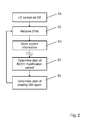
- FIG. 2 The general approach of the inventive method is shown in FIG. 2 in a flow chart. This solution starts in step S1 with the user equipment resp.
- the communication unit 3 operating in conjunction with a base station 8 of the wireless cellular network, in other words the UE camps on base station 8.
- the transceiver 5 receives in step S2 a complete set of system information from the base station 8.
- the system information is provided in a set of system information blocks (SIBs).
- SIBs are preferably SIBs which are dedicated to MTC devices and/or limited-bandwidth devices.
- M-SIBs M-SIBs.
- the inventive method works both with all types of SIBs, it is in the following only referred to SIBs, meaning all types of SIBs.
- the initial step of reading the complete set of SIBs is preferably triggered by the camping of the UE at the current active BS. This is true for a just powered on UE and also for a first registration of the UE in the current wireless cellular network.
- the full reception of the complete sets of SIBs takes a while. The duration is dependent from the place where the UE is located, and the reception conditions. The less power the UE receives in the respective frequency band, the more repetitions are needed. The UE repeats receiving until it gains sufficient confidence in decoding the system information.
- the initial reception of system information may take longer than the current broadcast channel modification period. This is in particular due to the fact that according to network resp. base station configuration the broadcast channel modification period may take different times.
- step S3 When the broadcast channel modification period is passed, the system information needs to be received again. This is what is avoided for later occurrences through the inventive method.
- Storage unit 6 is preferably a permanent storage in particular a flash memory unit.
- step S3 After a powering down the system information need to be read again, it is advantageous if some data, in particular quasi-constant data like the validity period of system information are stored permanently.
- step S3 the user equipment 1 is operated in relationship with the base station 8 for a while. It is assumed that no data transmission is effected in the meantime. Data transmissions in this sense are both payload data sent to a remote server. However, also data transmissions as part of the mobility management, like neighbor cell measurements, are data transmissions in this sense.
- the user equipment may want to read system information again. This may be the case when a data transmission is about to be carried out. Alternatively this may be carried out, when the user equipment figures out that the stored system information data are outdated meanwhile. One reason for that is when the validity period of the system information is expired. This is according to a network configuration the case after a predefined couple of hours. This means, that system information which were received earlier need to be read again, even if the value tag did not change. The value tag of the system information is another reason for reading the complete set of system information again.
- the SIB1 - typically in the first SIB - the SIB1 - the value tag, known under the name " systemInfoValueTag ", it is indicated by an incrementing number a change of system information compared to previous broadcasts. If one value in the complete set of SIBs is changed, the value tag is incremented. This means, that by reading only the SIB1 - which is remarkably faster achieved than the whole set of SIBs - the UE knows by comparing with the stored system information, if it is time for reading the complete set of system information again, as long it needs an up to date set. For optimized reception of the system information, the UE determines in step S4 the start of the broadcast channel modification period.
- the UE is able to derive the beginning and duration of the broadcast channel modification period from network specific information like the paging cycle and the received system frame number (SFN) or information related to system information periodicity of any system information window. Such information is in particular a certain time needed for transmitting one or many system information messages corresponding in particular to one complete set of system information.
- SFN system frame number
- These information elements are preferably stored in the storage unit 6 baed on the initially received complete set of system information.
- the user equipment determines in step S5 based on these information - preferably in conjunction with the estimated duration of receiving the system information - a starting point for reading the system information.
- the starting point is positioned in an interval right after the start of the broadcast channel modification period, where still the remaining broadcast channel modification period is longer than the duration for reception of the system information.
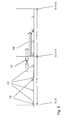
- FIG. 3 it is shown in a time diagram the effect of the inventive method for a limited-bandwidth user equipment 1 camping on a base station. It is shown two successive broadcast channel modification periods 11, indicated by the ordering indices 11 (n) and 11(n+1). The passing time is indicated from left to right. Each broadcast channel modification period is delimited by the broadcast channel modification period border 12, here 12(n), 12 (n+1), 12(n+2). During one broadcast channel modification period 11 system information 13, 13 is submitted from the active base station for reception of each user equipment camping on the respective base station. This in particular applies to devices which belong to a certain group of devices for which the system information is dedicated. This is in particular true for limited-bandwidth devices, resp. MTC devices.
- the system information 13 is split into a couple of system information blocks 13', 13". Each system information block 13', 13" is preferably submitted multiple times during one broadcast channel modification period 11. An enhanced coverage user equipment requires a couple of repetitions of reading the system information blocks 13', 13". This number of repetitions leads to a specific duration for a successful SIB reception attempt 14', 14" for each individual device. It is now dependent upon the start of reading the system information blocks, if the reading can successfully be concluded during one broadcast channel modification period 11. A not optimized SIB reception attempt 14' according to prior art would horr in broadcast channel modification period 11 (n). It would end in broadcast channel modification period 11(n+1).
- SIB reception attempt 14" according to a preferred embodiment of the inventive method orients on the start 12(n+1) of the broadcast channel modification period 11 (n+1). As shown before, the point in time of the start of the broadcast channel modification period is determined from previously stored system information received in an initial reception attempt. With that information, the user equipment is put into the position to only start receiving system information when it is able to successfully conclude this SIB reception attempt 14". In effect, it is assured that with one SIB reception attempt 14" system information is successfully received by the UE.
- FIG. 4a and 4b show for a preferred embodiment of the inventive method how further to take into account a scheduled data transmission in the determination of the start of reading system information.
- FIG. 4a shows the situation of two successive broadcast channel modification periods 11 (n), 11(n+1), separated by the broadcast channel modification period border 12(n).
- FIG. 4b it is shown the embodiment of the inventive method, wherein additionally the imminent data transmission is taken into account for determining the start time of reading the system information. This means, that the start time of the SIB reception attempt 14' is shifted beyond the next broadcast channel modification period border 12(n) and thus both the SIB reception attempt 14' and the data transmission 15' are completed during the broadcast channel modification period 11(n+1). This helps reducing the amount of power needed for the whole operation.
- FIG 5a An advanced embodiment of the inventive method is shown in FIG 5a .
- the start of the data transmission 15 is carried out according to a random value.
- the start of regular periodic data transmissions is positioned within an interval 16 within that the data transmission is able to be started during the same broadcast channel modification period 11 (n) as the SIB reception attempt 14.
- the further determined information, in particular the start time of the broadcast channel modification period, the start time and the duration of the SIB reception attempt 14 are further to be taken into account for determining the start time of the data transmission.
- the positioning of data transmissions 15 within the further displayed broadcast channel modification periods 11(n+1), 11(n+2), 11(n+3) shows exemplarily the way the data transmissions may be distributed.
- FIG. 5b shows a further advantageous embodiment of the inventive method. It handles multiple regular data transmissions that way that a second data transmission 15' is shifted within the same broadcast channel modification period 11 (n) as the first data transmission 15. This is an example of shifting a data transmission ahead, in particular when the second data transmission 15' is scheduled. Over the shown row of four broadcast channel modification periods 11 (n), 11 (n+1), 11 (n+2), 11 (n+3) four data transmissions 15, 15' are distributed that way that only two times the system information need to be received with a SIB reception attempt 14, provided the SIB1 indicates a change.
- FIG. 6 and FIG. 7 exemplarily show the further advantageous embodiment of the inventive method wherein the validity period of the system information is considered for shifting a data transmission.
- the validity period 18 of system information depict the duration that has to expire until previously received system information are latest outdated. Even when the BCCH value tag has not changed, the previously received system information needs to be discarded and a new SIB reception attempt 14' needs to be carried out.
- the validity period 18 is typically preconfigured for the wireless cellular network. Further it preferably is applicable to a certain class of devices, in particular MTC devices. Typically the validity period 18 lasts a couple of hours.
- the process flow starts with step S11 and a UE which - like shown in FIG. 2 - camps on an active base station and initially receives and stores a complete set of system information blocks.
- This initial SIB reception attempt 14 is preferably terminated within the broadcast channel modification period 11 (n).
- the UE activates a sleep mode in step S12. Steps S13 and S14 check if the sleep mode is continued and carry out other activities which could lead to a trigger for ending the sleep mode.
- step S15 the UE reads first the SIB1 17, preferably after the broadcast channel modification period border 12(n+x). Should the value tag received with SIB1 have increased compared to the value tag stored before with the system information, then in step S16 it is decided to receive again the complete set of SIBs in SIB reception attempt 14'.
- the SIB reception attempt 14' is executed in step S17 within the broadcast channel modification period 11 (n'). Otherwise, the validity period 18 is checked in step S18. If the validity period 18 already expired when the SIB1 17 was read, then the previously stored system information is discarded and a new SIB reception attempt 14 is carried out in step S19, again taking into account the start of the broadcast channel modification period 11 (n') based on the stored system information.
- the process flow in step S18 decides for the No-branch, the situation is present of an equal value tag compared to the initial SIB reception attempt 14 and a not expired validity period since initially receiving the SIBs.
- step S20 it is checked in step S20 if the scheduled data transmission is scheduled for a time beyond the end of the validity period 18. If so - and preferably if the data transmission is able to be shifted - the scheduled data transmission 15' is shifted ahead to be carried out within the validity period 18, effectively before the end of the broadcast channel modification period 11(n+x). Hence the scheduled data transmission 15' is carried out without another SIB reception attempt 14. It becomes apparent that by this embodiment the SIB reception attempt 14' is avoided and thus the method is advantageous in terms of power consumption. It can easily be seen that the problem for the envisaged UEs with the known structure of SIBs and broadcast channel modification periods will be solved with the invention. This allows for the enhanced coverage devices an operation with an optimization in terms of power consumption, reliability and response times.
Landscapes
- Engineering & Computer Science (AREA)
- Computer Networks & Wireless Communication (AREA)
- Signal Processing (AREA)
- Computer Security & Cryptography (AREA)
- Mobile Radio Communication Systems (AREA)
Priority Applications (1)
| Application Number | Priority Date | Filing Date | Title |
|---|---|---|---|
| EP15166285.5A EP3091788A1 (fr) | 2015-05-04 | 2015-05-04 | Procédé pour recevoir des informations dans un réseau cellulaire sans fil |
Applications Claiming Priority (1)
| Application Number | Priority Date | Filing Date | Title |
|---|---|---|---|
| EP15166285.5A EP3091788A1 (fr) | 2015-05-04 | 2015-05-04 | Procédé pour recevoir des informations dans un réseau cellulaire sans fil |
Publications (1)
| Publication Number | Publication Date |
|---|---|
| EP3091788A1 true EP3091788A1 (fr) | 2016-11-09 |
Family
ID=53040426
Family Applications (1)
| Application Number | Title | Priority Date | Filing Date |
|---|---|---|---|
| EP15166285.5A Withdrawn EP3091788A1 (fr) | 2015-05-04 | 2015-05-04 | Procédé pour recevoir des informations dans un réseau cellulaire sans fil |
Country Status (1)
| Country | Link |
|---|---|
| EP (1) | EP3091788A1 (fr) |
Cited By (2)
| Publication number | Priority date | Publication date | Assignee | Title |
|---|---|---|---|---|
| WO2020150981A1 (fr) * | 2019-01-24 | 2020-07-30 | 富士通株式会社 | Procédé et appareil pour la mise à jour d'informations système, et système de communication |
| CN111771395A (zh) * | 2017-12-20 | 2020-10-13 | 泰雷兹数字安全德国有限公司 | 用于在蜂窝网络中的系统信息的传输的方法 |
Citations (1)
| Publication number | Priority date | Publication date | Assignee | Title |
|---|---|---|---|---|
| WO2013183966A1 (fr) * | 2012-06-08 | 2013-12-12 | Lg Electronics Inc. | Procédé et appareil pour recevoir des informations de système dans un système de communication sans fil |
-
2015
- 2015-05-04 EP EP15166285.5A patent/EP3091788A1/fr not_active Withdrawn
Patent Citations (1)
| Publication number | Priority date | Publication date | Assignee | Title |
|---|---|---|---|---|
| WO2013183966A1 (fr) * | 2012-06-08 | 2013-12-12 | Lg Electronics Inc. | Procédé et appareil pour recevoir des informations de système dans un système de communication sans fil |
Non-Patent Citations (3)
| Title |
|---|
| GEMALTO N V: "MTC considerations concerning SIB scheduling", vol. RAN WG2, no. Japan; 20150525 - 20150529, 12 May 2015 (2015-05-12), XP050968049, Retrieved from the Internet <URL:http://www.3gpp.org/ftp/tsg_ran/WG2_RL2/TSGR2_90/Docs/> [retrieved on 20150512] * |
| SIERRA WIRELESS: "MIB and SIB Considerations for MTC", vol. RAN WG2, no. Bratislava, Slovakia; 20150420 - 20150424, 19 April 2015 (2015-04-19), XP050936070, Retrieved from the Internet <URL:http://www.3gpp.org/ftp/Meetings_3GPP_SYNC/RAN2/Docs/> [retrieved on 20150419] * |
| SONY: "SIB scheduling for MTC", vol. RAN WG2, no. Athens, Greece; 20150209 - 20150213, 8 February 2015 (2015-02-08), XP050935530, Retrieved from the Internet <URL:http://www.3gpp.org/ftp/Meetings_3GPP_SYNC/RAN2/Docs/> [retrieved on 20150208] * |
Cited By (3)
| Publication number | Priority date | Publication date | Assignee | Title |
|---|---|---|---|---|
| CN111771395A (zh) * | 2017-12-20 | 2020-10-13 | 泰雷兹数字安全德国有限公司 | 用于在蜂窝网络中的系统信息的传输的方法 |
| CN111771395B (zh) * | 2017-12-20 | 2022-08-16 | 泰雷兹数字安全德国有限公司 | 用于在蜂窝网络中的系统信息的传输的方法 |
| WO2020150981A1 (fr) * | 2019-01-24 | 2020-07-30 | 富士通株式会社 | Procédé et appareil pour la mise à jour d'informations système, et système de communication |
Similar Documents
| Publication | Publication Date | Title |
|---|---|---|
| US10341936B2 (en) | Method for transfer of information in a wireless cellular network | |
| US9706494B2 (en) | Mobile station, core network node, base station subsystem, and methods for implementing longer paging cycles in a cellular network | |
| US20230354190A1 (en) | Paging indication information grouping techniques | |
| EP3091788A1 (fr) | Procédé pour recevoir des informations dans un réseau cellulaire sans fil | |
| CN110214454A (zh) | 用于搜索适合的基站的用户设备 | |
| US20200275364A1 (en) | Method for service-based cell selection | |
| CN117242878A (zh) | 定位信号的传输方法、装置、设备及可读存储介质 | |
| HK1235575A (en) | System acquisition mechanism for fixed devices in mobile broadband networks |
Legal Events
| Date | Code | Title | Description |
|---|---|---|---|
| PUAI | Public reference made under article 153(3) epc to a published international application that has entered the european phase |
Free format text: ORIGINAL CODE: 0009012 |
|
| AK | Designated contracting states |
Kind code of ref document: A1 Designated state(s): AL AT BE BG CH CY CZ DE DK EE ES FI FR GB GR HR HU IE IS IT LI LT LU LV MC MK MT NL NO PL PT RO RS SE SI SK SM TR |
|
| AX | Request for extension of the european patent |
Extension state: BA ME |
|
| STAA | Information on the status of an ep patent application or granted ep patent |
Free format text: STATUS: THE APPLICATION HAS BEEN PUBLISHED |
|
| STAA | Information on the status of an ep patent application or granted ep patent |
Free format text: STATUS: THE APPLICATION IS DEEMED TO BE WITHDRAWN |
|
| 18D | Application deemed to be withdrawn |
Effective date: 20170510 |