EP3091970B1 - Agonistes du récepteur x du foie et leurs utilisations - Google Patents
Agonistes du récepteur x du foie et leurs utilisations Download PDFInfo
- Publication number
- EP3091970B1 EP3091970B1 EP15734952.3A EP15734952A EP3091970B1 EP 3091970 B1 EP3091970 B1 EP 3091970B1 EP 15734952 A EP15734952 A EP 15734952A EP 3091970 B1 EP3091970 B1 EP 3091970B1
- Authority
- EP
- European Patent Office
- Prior art keywords
- compound
- group
- phenyl
- alkyl
- methyl
- Prior art date
- Legal status (The legal status is an assumption and is not a legal conclusion. Google has not performed a legal analysis and makes no representation as to the accuracy of the status listed.)
- Active
Links
- 0 Cc1cc(S(*)(=O)=O)ccc1 Chemical compound Cc1cc(S(*)(=O)=O)ccc1 0.000 description 19
- CTMCLPXMKBMAJI-HLTLCVLOSA-N C/C=C\C=C/C(C(CN(CCCOc1cccc(CC(O)=O)c1)Cc1cccc(OC(F)(F)F)c1)c1ccccc1)=C Chemical compound C/C=C\C=C/C(C(CN(CCCOc1cccc(CC(O)=O)c1)Cc1cccc(OC(F)(F)F)c1)c1ccccc1)=C CTMCLPXMKBMAJI-HLTLCVLOSA-N 0.000 description 1
- ZRHISSXDDQRDDX-OOXLGZTCSA-N C/C=C\[U]=C/C(C(CNCC(CC=CC1)[C@@H]1C(CC(F)(F)F)CCl)c1ccccc1)=C Chemical compound C/C=C\[U]=C/C(C(CNCC(CC=CC1)[C@@H]1C(CC(F)(F)F)CCl)c1ccccc1)=C ZRHISSXDDQRDDX-OOXLGZTCSA-N 0.000 description 1
- KPMOTMJYZHYFEW-UHFFFAOYSA-N CC(C)CC(C)=N Chemical compound CC(C)CC(C)=N KPMOTMJYZHYFEW-UHFFFAOYSA-N 0.000 description 1
- PBCGPPKZPKBBHA-ARJAWSKDSA-N CC(C)[I+]/C=C\CN Chemical compound CC(C)[I+]/C=C\CN PBCGPPKZPKBBHA-ARJAWSKDSA-N 0.000 description 1
- RHWWSAHGQWWKRK-UHFFFAOYSA-N CC(CC(c1ccccc1)c1ccccc1)C(CCCCOc1cc(S(C)(=O)=O)c(CO)c(C(C)=C)c1)Cc(cc1)cc(Cl)c1F Chemical compound CC(CC(c1ccccc1)c1ccccc1)C(CCCCOc1cc(S(C)(=O)=O)c(CO)c(C(C)=C)c1)Cc(cc1)cc(Cl)c1F RHWWSAHGQWWKRK-UHFFFAOYSA-N 0.000 description 1
- FRSHBPVCFVZZEV-UHFFFAOYSA-N CC(CN(CC(c1ccccc1)c1ccccc1)CC(C(CC(F)(F)F)Cl)=CC=C)COC(C1)=CC(F)=C(CO)C1S(C)O Chemical compound CC(CN(CC(c1ccccc1)c1ccccc1)CC(C(CC(F)(F)F)Cl)=CC=C)COC(C1)=CC(F)=C(CO)C1S(C)O FRSHBPVCFVZZEV-UHFFFAOYSA-N 0.000 description 1
- FLQHGKKVLHCLRS-UHFFFAOYSA-N CP(c1c(CO)ccc(OCCCN(CC(c2ccccc2)c2ccccc2)Cc2cccc(C(F)(F)F)c2Cl)c1)(O)=O Chemical compound CP(c1c(CO)ccc(OCCCN(CC(c2ccccc2)c2ccccc2)Cc2cccc(C(F)(F)F)c2Cl)c1)(O)=O FLQHGKKVLHCLRS-UHFFFAOYSA-N 0.000 description 1
- SYDZPMYJONYEPJ-HXUWFJFHSA-N C[C@H](CCOS(C)(=O)=O)N(CC(c1ccccc1)c1ccccc1)Cc1cccc(C(F)(F)F)c1Cl Chemical compound C[C@H](CCOS(C)(=O)=O)N(CC(c1ccccc1)c1ccccc1)Cc1cccc(C(F)(F)F)c1Cl SYDZPMYJONYEPJ-HXUWFJFHSA-N 0.000 description 1
- QEOVFNBNRYSFCX-UHFFFAOYSA-N Cc(cccc1CC(CCCCCOc2cc(C)c(CN)c(S(C)(O)=O)c2)CC(c2ccccc2)c2ccccc2)c1Cl Chemical compound Cc(cccc1CC(CCCCCOc2cc(C)c(CN)c(S(C)(O)=O)c2)CC(c2ccccc2)c2ccccc2)c1Cl QEOVFNBNRYSFCX-UHFFFAOYSA-N 0.000 description 1
Classifications
-
- C—CHEMISTRY; METALLURGY
- C07—ORGANIC CHEMISTRY
- C07F—ACYCLIC, CARBOCYCLIC OR HETEROCYCLIC COMPOUNDS CONTAINING ELEMENTS OTHER THAN CARBON, HYDROGEN, HALOGEN, OXYGEN, NITROGEN, SULFUR, SELENIUM OR TELLURIUM
- C07F9/00—Compounds containing elements of Groups 5 or 15 of the Periodic Table
- C07F9/02—Phosphorus compounds
- C07F9/547—Heterocyclic compounds, e.g. containing phosphorus as a ring hetero atom
- C07F9/6564—Heterocyclic compounds, e.g. containing phosphorus as a ring hetero atom having phosphorus atoms, with or without nitrogen, oxygen, sulfur, selenium or tellurium atoms, as ring hetero atoms
- C07F9/6571—Heterocyclic compounds, e.g. containing phosphorus as a ring hetero atom having phosphorus atoms, with or without nitrogen, oxygen, sulfur, selenium or tellurium atoms, as ring hetero atoms having phosphorus and oxygen atoms as the only ring hetero atoms
- C07F9/657163—Heterocyclic compounds, e.g. containing phosphorus as a ring hetero atom having phosphorus atoms, with or without nitrogen, oxygen, sulfur, selenium or tellurium atoms, as ring hetero atoms having phosphorus and oxygen atoms as the only ring hetero atoms the ring phosphorus atom being bound to at least one carbon atom
- C07F9/657172—Heterocyclic compounds, e.g. containing phosphorus as a ring hetero atom having phosphorus atoms, with or without nitrogen, oxygen, sulfur, selenium or tellurium atoms, as ring hetero atoms having phosphorus and oxygen atoms as the only ring hetero atoms the ring phosphorus atom being bound to at least one carbon atom the ring phosphorus atom and one oxygen atom being part of a (thio)phosphinic acid ester: (X = O, S)
-
- A—HUMAN NECESSITIES
- A61—MEDICAL OR VETERINARY SCIENCE; HYGIENE
- A61K—PREPARATIONS FOR MEDICAL, DENTAL OR TOILETRY PURPOSES
- A61K45/00—Medicinal preparations containing active ingredients not provided for in groups A61K31/00 - A61K41/00
- A61K45/06—Mixtures of active ingredients without chemical characterisation, e.g. antiphlogistics and cardiaca
-
- A—HUMAN NECESSITIES
- A61—MEDICAL OR VETERINARY SCIENCE; HYGIENE
- A61K—PREPARATIONS FOR MEDICAL, DENTAL OR TOILETRY PURPOSES
- A61K31/00—Medicinal preparations containing organic active ingredients
- A61K31/13—Amines
- A61K31/135—Amines having aromatic rings, e.g. ketamine, nortriptyline
- A61K31/138—Aryloxyalkylamines, e.g. propranolol, tamoxifen, phenoxybenzamine
-
- A—HUMAN NECESSITIES
- A61—MEDICAL OR VETERINARY SCIENCE; HYGIENE
- A61K—PREPARATIONS FOR MEDICAL, DENTAL OR TOILETRY PURPOSES
- A61K31/00—Medicinal preparations containing organic active ingredients
- A61K31/13—Amines
- A61K31/145—Amines having sulfur, e.g. thiurams (>N—C(S)—S—C(S)—N< and >N—C(S)—S—S—C(S)—N<), Sulfinylamines (—N=SO), Sulfonylamines (—N=SO2)
-
- A—HUMAN NECESSITIES
- A61—MEDICAL OR VETERINARY SCIENCE; HYGIENE
- A61K—PREPARATIONS FOR MEDICAL, DENTAL OR TOILETRY PURPOSES
- A61K31/00—Medicinal preparations containing organic active ingredients
- A61K31/16—Amides, e.g. hydroxamic acids
- A61K31/165—Amides, e.g. hydroxamic acids having aromatic rings, e.g. colchicine, atenolol, progabide
-
- A—HUMAN NECESSITIES
- A61—MEDICAL OR VETERINARY SCIENCE; HYGIENE
- A61K—PREPARATIONS FOR MEDICAL, DENTAL OR TOILETRY PURPOSES
- A61K31/00—Medicinal preparations containing organic active ingredients
- A61K31/185—Acids; Anhydrides, halides or salts thereof, e.g. sulfur acids, imidic, hydrazonic or hydroximic acids
- A61K31/19—Carboxylic acids, e.g. valproic acid
- A61K31/195—Carboxylic acids, e.g. valproic acid having an amino group
-
- A—HUMAN NECESSITIES
- A61—MEDICAL OR VETERINARY SCIENCE; HYGIENE
- A61K—PREPARATIONS FOR MEDICAL, DENTAL OR TOILETRY PURPOSES
- A61K31/00—Medicinal preparations containing organic active ingredients
- A61K31/21—Esters, e.g. nitroglycerine, selenocyanates
- A61K31/215—Esters, e.g. nitroglycerine, selenocyanates of carboxylic acids
- A61K31/235—Esters, e.g. nitroglycerine, selenocyanates of carboxylic acids having an aromatic ring attached to a carboxyl group
- A61K31/24—Esters, e.g. nitroglycerine, selenocyanates of carboxylic acids having an aromatic ring attached to a carboxyl group having an amino or nitro group
-
- A—HUMAN NECESSITIES
- A61—MEDICAL OR VETERINARY SCIENCE; HYGIENE
- A61K—PREPARATIONS FOR MEDICAL, DENTAL OR TOILETRY PURPOSES
- A61K31/00—Medicinal preparations containing organic active ingredients
- A61K31/33—Heterocyclic compounds
- A61K31/335—Heterocyclic compounds having oxygen as the only ring hetero atom, e.g. fungichromin
- A61K31/357—Heterocyclic compounds having oxygen as the only ring hetero atom, e.g. fungichromin having two or more oxygen atoms in the same ring, e.g. crown ethers, guanadrel
-
- A—HUMAN NECESSITIES
- A61—MEDICAL OR VETERINARY SCIENCE; HYGIENE
- A61K—PREPARATIONS FOR MEDICAL, DENTAL OR TOILETRY PURPOSES
- A61K31/00—Medicinal preparations containing organic active ingredients
- A61K31/33—Heterocyclic compounds
- A61K31/335—Heterocyclic compounds having oxygen as the only ring hetero atom, e.g. fungichromin
- A61K31/365—Lactones
- A61K31/366—Lactones having six-membered rings, e.g. delta-lactones
-
- A—HUMAN NECESSITIES
- A61—MEDICAL OR VETERINARY SCIENCE; HYGIENE
- A61K—PREPARATIONS FOR MEDICAL, DENTAL OR TOILETRY PURPOSES
- A61K31/00—Medicinal preparations containing organic active ingredients
- A61K31/33—Heterocyclic compounds
- A61K31/395—Heterocyclic compounds having nitrogen as a ring hetero atom, e.g. guanethidine or rifamycins
- A61K31/397—Heterocyclic compounds having nitrogen as a ring hetero atom, e.g. guanethidine or rifamycins having four-membered rings, e.g. azetidine
-
- A—HUMAN NECESSITIES
- A61—MEDICAL OR VETERINARY SCIENCE; HYGIENE
- A61K—PREPARATIONS FOR MEDICAL, DENTAL OR TOILETRY PURPOSES
- A61K31/00—Medicinal preparations containing organic active ingredients
- A61K31/33—Heterocyclic compounds
- A61K31/395—Heterocyclic compounds having nitrogen as a ring hetero atom, e.g. guanethidine or rifamycins
- A61K31/40—Heterocyclic compounds having nitrogen as a ring hetero atom, e.g. guanethidine or rifamycins having five-membered rings with one nitrogen as the only ring hetero atom, e.g. sulpiride, succinimide, tolmetin, buflomedil
-
- A—HUMAN NECESSITIES
- A61—MEDICAL OR VETERINARY SCIENCE; HYGIENE
- A61K—PREPARATIONS FOR MEDICAL, DENTAL OR TOILETRY PURPOSES
- A61K31/00—Medicinal preparations containing organic active ingredients
- A61K31/33—Heterocyclic compounds
- A61K31/395—Heterocyclic compounds having nitrogen as a ring hetero atom, e.g. guanethidine or rifamycins
- A61K31/435—Heterocyclic compounds having nitrogen as a ring hetero atom, e.g. guanethidine or rifamycins having six-membered rings with one nitrogen as the only ring hetero atom
- A61K31/44—Non condensed pyridines; Hydrogenated derivatives thereof
- A61K31/445—Non condensed piperidines, e.g. piperocaine
-
- A—HUMAN NECESSITIES
- A61—MEDICAL OR VETERINARY SCIENCE; HYGIENE
- A61K—PREPARATIONS FOR MEDICAL, DENTAL OR TOILETRY PURPOSES
- A61K31/00—Medicinal preparations containing organic active ingredients
- A61K31/66—Phosphorus compounds
- A61K31/661—Phosphorus acids or esters thereof not having P—C bonds, e.g. fosfosal, dichlorvos, malathion or mevinphos
-
- A—HUMAN NECESSITIES
- A61—MEDICAL OR VETERINARY SCIENCE; HYGIENE
- A61K—PREPARATIONS FOR MEDICAL, DENTAL OR TOILETRY PURPOSES
- A61K31/00—Medicinal preparations containing organic active ingredients
- A61K31/66—Phosphorus compounds
- A61K31/675—Phosphorus compounds having nitrogen as a ring hetero atom, e.g. pyridoxal phosphate
-
- A—HUMAN NECESSITIES
- A61—MEDICAL OR VETERINARY SCIENCE; HYGIENE
- A61P—SPECIFIC THERAPEUTIC ACTIVITY OF CHEMICAL COMPOUNDS OR MEDICINAL PREPARATIONS
- A61P35/00—Antineoplastic agents
-
- C—CHEMISTRY; METALLURGY
- C07—ORGANIC CHEMISTRY
- C07B—GENERAL METHODS OF ORGANIC CHEMISTRY; APPARATUS THEREFOR
- C07B59/00—Introduction of isotopes of elements into organic compounds ; Labelled organic compounds per se
- C07B59/004—Acyclic, carbocyclic or heterocyclic compounds containing elements other than carbon, hydrogen, halogen, oxygen, nitrogen, sulfur, selenium or tellurium
-
- C—CHEMISTRY; METALLURGY
- C07—ORGANIC CHEMISTRY
- C07C—ACYCLIC OR CARBOCYCLIC COMPOUNDS
- C07C217/00—Compounds containing amino and etherified hydroxy groups bound to the same carbon skeleton
- C07C217/02—Compounds containing amino and etherified hydroxy groups bound to the same carbon skeleton having etherified hydroxy groups and amino groups bound to acyclic carbon atoms of the same carbon skeleton
- C07C217/04—Compounds containing amino and etherified hydroxy groups bound to the same carbon skeleton having etherified hydroxy groups and amino groups bound to acyclic carbon atoms of the same carbon skeleton the carbon skeleton being acyclic and saturated
- C07C217/06—Compounds containing amino and etherified hydroxy groups bound to the same carbon skeleton having etherified hydroxy groups and amino groups bound to acyclic carbon atoms of the same carbon skeleton the carbon skeleton being acyclic and saturated having only one etherified hydroxy group and one amino group bound to the carbon skeleton, which is not further substituted
- C07C217/14—Compounds containing amino and etherified hydroxy groups bound to the same carbon skeleton having etherified hydroxy groups and amino groups bound to acyclic carbon atoms of the same carbon skeleton the carbon skeleton being acyclic and saturated having only one etherified hydroxy group and one amino group bound to the carbon skeleton, which is not further substituted the oxygen atom of the etherified hydroxy group being further bound to a carbon atom of a six-membered aromatic ring
- C07C217/18—Compounds containing amino and etherified hydroxy groups bound to the same carbon skeleton having etherified hydroxy groups and amino groups bound to acyclic carbon atoms of the same carbon skeleton the carbon skeleton being acyclic and saturated having only one etherified hydroxy group and one amino group bound to the carbon skeleton, which is not further substituted the oxygen atom of the etherified hydroxy group being further bound to a carbon atom of a six-membered aromatic ring the six-membered aromatic ring or condensed ring system containing that ring being further substituted
-
- C—CHEMISTRY; METALLURGY
- C07—ORGANIC CHEMISTRY
- C07C—ACYCLIC OR CARBOCYCLIC COMPOUNDS
- C07C217/00—Compounds containing amino and etherified hydroxy groups bound to the same carbon skeleton
- C07C217/02—Compounds containing amino and etherified hydroxy groups bound to the same carbon skeleton having etherified hydroxy groups and amino groups bound to acyclic carbon atoms of the same carbon skeleton
- C07C217/04—Compounds containing amino and etherified hydroxy groups bound to the same carbon skeleton having etherified hydroxy groups and amino groups bound to acyclic carbon atoms of the same carbon skeleton the carbon skeleton being acyclic and saturated
- C07C217/06—Compounds containing amino and etherified hydroxy groups bound to the same carbon skeleton having etherified hydroxy groups and amino groups bound to acyclic carbon atoms of the same carbon skeleton the carbon skeleton being acyclic and saturated having only one etherified hydroxy group and one amino group bound to the carbon skeleton, which is not further substituted
- C07C217/14—Compounds containing amino and etherified hydroxy groups bound to the same carbon skeleton having etherified hydroxy groups and amino groups bound to acyclic carbon atoms of the same carbon skeleton the carbon skeleton being acyclic and saturated having only one etherified hydroxy group and one amino group bound to the carbon skeleton, which is not further substituted the oxygen atom of the etherified hydroxy group being further bound to a carbon atom of a six-membered aromatic ring
- C07C217/18—Compounds containing amino and etherified hydroxy groups bound to the same carbon skeleton having etherified hydroxy groups and amino groups bound to acyclic carbon atoms of the same carbon skeleton the carbon skeleton being acyclic and saturated having only one etherified hydroxy group and one amino group bound to the carbon skeleton, which is not further substituted the oxygen atom of the etherified hydroxy group being further bound to a carbon atom of a six-membered aromatic ring the six-membered aromatic ring or condensed ring system containing that ring being further substituted
- C07C217/20—Compounds containing amino and etherified hydroxy groups bound to the same carbon skeleton having etherified hydroxy groups and amino groups bound to acyclic carbon atoms of the same carbon skeleton the carbon skeleton being acyclic and saturated having only one etherified hydroxy group and one amino group bound to the carbon skeleton, which is not further substituted the oxygen atom of the etherified hydroxy group being further bound to a carbon atom of a six-membered aromatic ring the six-membered aromatic ring or condensed ring system containing that ring being further substituted by halogen atoms, by trihalomethyl, nitro or nitroso groups, or by singly-bound oxygen atoms
-
- C—CHEMISTRY; METALLURGY
- C07—ORGANIC CHEMISTRY
- C07C—ACYCLIC OR CARBOCYCLIC COMPOUNDS
- C07C217/00—Compounds containing amino and etherified hydroxy groups bound to the same carbon skeleton
- C07C217/02—Compounds containing amino and etherified hydroxy groups bound to the same carbon skeleton having etherified hydroxy groups and amino groups bound to acyclic carbon atoms of the same carbon skeleton
- C07C217/04—Compounds containing amino and etherified hydroxy groups bound to the same carbon skeleton having etherified hydroxy groups and amino groups bound to acyclic carbon atoms of the same carbon skeleton the carbon skeleton being acyclic and saturated
- C07C217/06—Compounds containing amino and etherified hydroxy groups bound to the same carbon skeleton having etherified hydroxy groups and amino groups bound to acyclic carbon atoms of the same carbon skeleton the carbon skeleton being acyclic and saturated having only one etherified hydroxy group and one amino group bound to the carbon skeleton, which is not further substituted
- C07C217/14—Compounds containing amino and etherified hydroxy groups bound to the same carbon skeleton having etherified hydroxy groups and amino groups bound to acyclic carbon atoms of the same carbon skeleton the carbon skeleton being acyclic and saturated having only one etherified hydroxy group and one amino group bound to the carbon skeleton, which is not further substituted the oxygen atom of the etherified hydroxy group being further bound to a carbon atom of a six-membered aromatic ring
- C07C217/18—Compounds containing amino and etherified hydroxy groups bound to the same carbon skeleton having etherified hydroxy groups and amino groups bound to acyclic carbon atoms of the same carbon skeleton the carbon skeleton being acyclic and saturated having only one etherified hydroxy group and one amino group bound to the carbon skeleton, which is not further substituted the oxygen atom of the etherified hydroxy group being further bound to a carbon atom of a six-membered aromatic ring the six-membered aromatic ring or condensed ring system containing that ring being further substituted
- C07C217/22—Compounds containing amino and etherified hydroxy groups bound to the same carbon skeleton having etherified hydroxy groups and amino groups bound to acyclic carbon atoms of the same carbon skeleton the carbon skeleton being acyclic and saturated having only one etherified hydroxy group and one amino group bound to the carbon skeleton, which is not further substituted the oxygen atom of the etherified hydroxy group being further bound to a carbon atom of a six-membered aromatic ring the six-membered aromatic ring or condensed ring system containing that ring being further substituted by carbon atoms having at least two bonds to oxygen atoms
-
- C—CHEMISTRY; METALLURGY
- C07—ORGANIC CHEMISTRY
- C07C—ACYCLIC OR CARBOCYCLIC COMPOUNDS
- C07C217/00—Compounds containing amino and etherified hydroxy groups bound to the same carbon skeleton
- C07C217/54—Compounds containing amino and etherified hydroxy groups bound to the same carbon skeleton having etherified hydroxy groups bound to carbon atoms of at least one six-membered aromatic ring and amino groups bound to acyclic carbon atoms or to carbon atoms of rings other than six-membered aromatic rings of the same carbon skeleton
- C07C217/56—Compounds containing amino and etherified hydroxy groups bound to the same carbon skeleton having etherified hydroxy groups bound to carbon atoms of at least one six-membered aromatic ring and amino groups bound to acyclic carbon atoms or to carbon atoms of rings other than six-membered aromatic rings of the same carbon skeleton with amino groups linked to the six-membered aromatic ring, or to the condensed ring system containing that ring, by carbon chains not further substituted by singly-bound oxygen atoms
- C07C217/58—Compounds containing amino and etherified hydroxy groups bound to the same carbon skeleton having etherified hydroxy groups bound to carbon atoms of at least one six-membered aromatic ring and amino groups bound to acyclic carbon atoms or to carbon atoms of rings other than six-membered aromatic rings of the same carbon skeleton with amino groups linked to the six-membered aromatic ring, or to the condensed ring system containing that ring, by carbon chains not further substituted by singly-bound oxygen atoms with amino groups and the six-membered aromatic ring, or the condensed ring system containing that ring, bound to the same carbon atom of the carbon chain
-
- C—CHEMISTRY; METALLURGY
- C07—ORGANIC CHEMISTRY
- C07C—ACYCLIC OR CARBOCYCLIC COMPOUNDS
- C07C259/00—Compounds containing carboxyl groups, an oxygen atom of a carboxyl group being replaced by a nitrogen atom, this nitrogen atom being further bound to an oxygen atom and not being part of nitro or nitroso groups
- C07C259/04—Compounds containing carboxyl groups, an oxygen atom of a carboxyl group being replaced by a nitrogen atom, this nitrogen atom being further bound to an oxygen atom and not being part of nitro or nitroso groups without replacement of the other oxygen atom of the carboxyl group, e.g. hydroxamic acids
- C07C259/06—Compounds containing carboxyl groups, an oxygen atom of a carboxyl group being replaced by a nitrogen atom, this nitrogen atom being further bound to an oxygen atom and not being part of nitro or nitroso groups without replacement of the other oxygen atom of the carboxyl group, e.g. hydroxamic acids having carbon atoms of hydroxamic groups bound to hydrogen atoms or to acyclic carbon atoms
-
- C—CHEMISTRY; METALLURGY
- C07—ORGANIC CHEMISTRY
- C07C—ACYCLIC OR CARBOCYCLIC COMPOUNDS
- C07C311/00—Amides of sulfonic acids, i.e. compounds having singly-bound oxygen atoms of sulfo groups replaced by nitrogen atoms, not being part of nitro or nitroso groups
- C07C311/50—Compounds containing any of the groups, X being a hetero atom, Y being any atom
- C07C311/51—Y being a hydrogen or a carbon atom
-
- C—CHEMISTRY; METALLURGY
- C07—ORGANIC CHEMISTRY
- C07C—ACYCLIC OR CARBOCYCLIC COMPOUNDS
- C07C317/00—Sulfones; Sulfoxides
- C07C317/02—Sulfones; Sulfoxides having sulfone or sulfoxide groups bound to acyclic carbon atoms
- C07C317/04—Sulfones; Sulfoxides having sulfone or sulfoxide groups bound to acyclic carbon atoms of an acyclic saturated carbon skeleton
-
- C—CHEMISTRY; METALLURGY
- C07—ORGANIC CHEMISTRY
- C07C—ACYCLIC OR CARBOCYCLIC COMPOUNDS
- C07C317/00—Sulfones; Sulfoxides
- C07C317/14—Sulfones; Sulfoxides having sulfone or sulfoxide groups bound to carbon atoms of six-membered aromatic rings
-
- C—CHEMISTRY; METALLURGY
- C07—ORGANIC CHEMISTRY
- C07C—ACYCLIC OR CARBOCYCLIC COMPOUNDS
- C07C317/00—Sulfones; Sulfoxides
- C07C317/16—Sulfones; Sulfoxides having sulfone or sulfoxide groups and singly-bound oxygen atoms bound to the same carbon skeleton
- C07C317/22—Sulfones; Sulfoxides having sulfone or sulfoxide groups and singly-bound oxygen atoms bound to the same carbon skeleton with sulfone or sulfoxide groups bound to carbon atoms of six-membered aromatic rings of the carbon skeleton
-
- C—CHEMISTRY; METALLURGY
- C07—ORGANIC CHEMISTRY
- C07C—ACYCLIC OR CARBOCYCLIC COMPOUNDS
- C07C317/00—Sulfones; Sulfoxides
- C07C317/44—Sulfones; Sulfoxides having sulfone or sulfoxide groups and carboxyl groups bound to the same carbon skeleton
- C07C317/46—Sulfones; Sulfoxides having sulfone or sulfoxide groups and carboxyl groups bound to the same carbon skeleton the carbon skeleton being further substituted by singly-bound oxygen atoms
-
- C—CHEMISTRY; METALLURGY
- C07—ORGANIC CHEMISTRY
- C07C—ACYCLIC OR CARBOCYCLIC COMPOUNDS
- C07C323/00—Thiols, sulfides, hydropolysulfides or polysulfides substituted by halogen, oxygen or nitrogen atoms, or by sulfur atoms not being part of thio groups
- C07C323/01—Thiols, sulfides, hydropolysulfides or polysulfides substituted by halogen, oxygen or nitrogen atoms, or by sulfur atoms not being part of thio groups containing thio groups and halogen atoms, or nitro or nitroso groups bound to the same carbon skeleton
- C07C323/09—Thiols, sulfides, hydropolysulfides or polysulfides substituted by halogen, oxygen or nitrogen atoms, or by sulfur atoms not being part of thio groups containing thio groups and halogen atoms, or nitro or nitroso groups bound to the same carbon skeleton having sulfur atoms of thio groups bound to carbon atoms of six-membered aromatic rings of the carbon skeleton
-
- C—CHEMISTRY; METALLURGY
- C07—ORGANIC CHEMISTRY
- C07C—ACYCLIC OR CARBOCYCLIC COMPOUNDS
- C07C323/00—Thiols, sulfides, hydropolysulfides or polysulfides substituted by halogen, oxygen or nitrogen atoms, or by sulfur atoms not being part of thio groups
- C07C323/23—Thiols, sulfides, hydropolysulfides or polysulfides substituted by halogen, oxygen or nitrogen atoms, or by sulfur atoms not being part of thio groups containing thio groups and nitrogen atoms, not being part of nitro or nitroso groups, bound to the same carbon skeleton
- C07C323/31—Thiols, sulfides, hydropolysulfides or polysulfides substituted by halogen, oxygen or nitrogen atoms, or by sulfur atoms not being part of thio groups containing thio groups and nitrogen atoms, not being part of nitro or nitroso groups, bound to the same carbon skeleton having the sulfur atom of at least one of the thio groups bound to a carbon atom of a six-membered aromatic ring of the carbon skeleton
- C07C323/32—Thiols, sulfides, hydropolysulfides or polysulfides substituted by halogen, oxygen or nitrogen atoms, or by sulfur atoms not being part of thio groups containing thio groups and nitrogen atoms, not being part of nitro or nitroso groups, bound to the same carbon skeleton having the sulfur atom of at least one of the thio groups bound to a carbon atom of a six-membered aromatic ring of the carbon skeleton having at least one of the nitrogen atoms bound to an acyclic carbon atom of the carbon skeleton
-
- C—CHEMISTRY; METALLURGY
- C07—ORGANIC CHEMISTRY
- C07D—HETEROCYCLIC COMPOUNDS
- C07D205/00—Heterocyclic compounds containing four-membered rings with one nitrogen atom as the only ring hetero atom
- C07D205/02—Heterocyclic compounds containing four-membered rings with one nitrogen atom as the only ring hetero atom not condensed with other rings
- C07D205/04—Heterocyclic compounds containing four-membered rings with one nitrogen atom as the only ring hetero atom not condensed with other rings having no double bonds between ring members or between ring members and non-ring members
-
- C—CHEMISTRY; METALLURGY
- C07—ORGANIC CHEMISTRY
- C07D—HETEROCYCLIC COMPOUNDS
- C07D207/00—Heterocyclic compounds containing five-membered rings not condensed with other rings, with one nitrogen atom as the only ring hetero atom
- C07D207/46—Heterocyclic compounds containing five-membered rings not condensed with other rings, with one nitrogen atom as the only ring hetero atom with hetero atoms directly attached to the ring nitrogen atom
- C07D207/48—Sulfur atoms
-
- C—CHEMISTRY; METALLURGY
- C07—ORGANIC CHEMISTRY
- C07D—HETEROCYCLIC COMPOUNDS
- C07D209/00—Heterocyclic compounds containing five-membered rings, condensed with other rings, with one nitrogen atom as the only ring hetero atom
- C07D209/02—Heterocyclic compounds containing five-membered rings, condensed with other rings, with one nitrogen atom as the only ring hetero atom condensed with one carbocyclic ring
- C07D209/44—Iso-indoles; Hydrogenated iso-indoles
- C07D209/48—Iso-indoles; Hydrogenated iso-indoles with oxygen atoms in positions 1 and 3, e.g. phthalimide
-
- C—CHEMISTRY; METALLURGY
- C07—ORGANIC CHEMISTRY
- C07D—HETEROCYCLIC COMPOUNDS
- C07D211/00—Heterocyclic compounds containing hydrogenated pyridine rings, not condensed with other rings
- C07D211/04—Heterocyclic compounds containing hydrogenated pyridine rings, not condensed with other rings with only hydrogen or carbon atoms directly attached to the ring nitrogen atom
- C07D211/06—Heterocyclic compounds containing hydrogenated pyridine rings, not condensed with other rings with only hydrogen or carbon atoms directly attached to the ring nitrogen atom having no double bonds between ring members or between ring members and non-ring members
- C07D211/36—Heterocyclic compounds containing hydrogenated pyridine rings, not condensed with other rings with only hydrogen or carbon atoms directly attached to the ring nitrogen atom having no double bonds between ring members or between ring members and non-ring members with hetero atoms or with carbon atoms having three bonds to hetero atoms with at the most one bond to halogen, e.g. ester or nitrile radicals, directly attached to ring carbon atoms
- C07D211/40—Oxygen atoms
- C07D211/42—Oxygen atoms attached in position 3 or 5
-
- C—CHEMISTRY; METALLURGY
- C07—ORGANIC CHEMISTRY
- C07D—HETEROCYCLIC COMPOUNDS
- C07D211/00—Heterocyclic compounds containing hydrogenated pyridine rings, not condensed with other rings
- C07D211/92—Heterocyclic compounds containing hydrogenated pyridine rings, not condensed with other rings with a hetero atom directly attached to the ring nitrogen atom
- C07D211/96—Sulfur atom
-
- C—CHEMISTRY; METALLURGY
- C07—ORGANIC CHEMISTRY
- C07D—HETEROCYCLIC COMPOUNDS
- C07D311/00—Heterocyclic compounds containing six-membered rings having one oxygen atom as the only hetero atom, condensed with other rings
- C07D311/02—Heterocyclic compounds containing six-membered rings having one oxygen atom as the only hetero atom, condensed with other rings ortho- or peri-condensed with carbocyclic rings or ring systems
- C07D311/76—Benzo[c]pyrans
-
- C—CHEMISTRY; METALLURGY
- C07—ORGANIC CHEMISTRY
- C07D—HETEROCYCLIC COMPOUNDS
- C07D317/00—Heterocyclic compounds containing five-membered rings having two oxygen atoms as the only ring hetero atoms
- C07D317/08—Heterocyclic compounds containing five-membered rings having two oxygen atoms as the only ring hetero atoms having the hetero atoms in positions 1 and 3
- C07D317/44—Heterocyclic compounds containing five-membered rings having two oxygen atoms as the only ring hetero atoms having the hetero atoms in positions 1 and 3 ortho- or peri-condensed with carbocyclic rings or ring systems
- C07D317/46—Heterocyclic compounds containing five-membered rings having two oxygen atoms as the only ring hetero atoms having the hetero atoms in positions 1 and 3 ortho- or peri-condensed with carbocyclic rings or ring systems condensed with one six-membered ring
-
- C—CHEMISTRY; METALLURGY
- C07—ORGANIC CHEMISTRY
- C07F—ACYCLIC, CARBOCYCLIC OR HETEROCYCLIC COMPOUNDS CONTAINING ELEMENTS OTHER THAN CARBON, HYDROGEN, HALOGEN, OXYGEN, NITROGEN, SULFUR, SELENIUM OR TELLURIUM
- C07F9/00—Compounds containing elements of Groups 5 or 15 of the Periodic Table
- C07F9/02—Phosphorus compounds
- C07F9/06—Phosphorus compounds without P—C bonds
- C07F9/08—Esters of oxyacids of phosphorus
- C07F9/09—Esters of phosphoric acids
-
- C—CHEMISTRY; METALLURGY
- C07—ORGANIC CHEMISTRY
- C07F—ACYCLIC, CARBOCYCLIC OR HETEROCYCLIC COMPOUNDS CONTAINING ELEMENTS OTHER THAN CARBON, HYDROGEN, HALOGEN, OXYGEN, NITROGEN, SULFUR, SELENIUM OR TELLURIUM
- C07F9/00—Compounds containing elements of Groups 5 or 15 of the Periodic Table
- C07F9/02—Phosphorus compounds
- C07F9/06—Phosphorus compounds without P—C bonds
- C07F9/08—Esters of oxyacids of phosphorus
- C07F9/09—Esters of phosphoric acids
- C07F9/094—Esters of phosphoric acids with arylalkanols
-
- C—CHEMISTRY; METALLURGY
- C07—ORGANIC CHEMISTRY
- C07F—ACYCLIC, CARBOCYCLIC OR HETEROCYCLIC COMPOUNDS CONTAINING ELEMENTS OTHER THAN CARBON, HYDROGEN, HALOGEN, OXYGEN, NITROGEN, SULFUR, SELENIUM OR TELLURIUM
- C07F9/00—Compounds containing elements of Groups 5 or 15 of the Periodic Table
- C07F9/02—Phosphorus compounds
- C07F9/06—Phosphorus compounds without P—C bonds
- C07F9/08—Esters of oxyacids of phosphorus
- C07F9/09—Esters of phosphoric acids
- C07F9/12—Esters of phosphoric acids with hydroxyaryl compounds
-
- C—CHEMISTRY; METALLURGY
- C07—ORGANIC CHEMISTRY
- C07F—ACYCLIC, CARBOCYCLIC OR HETEROCYCLIC COMPOUNDS CONTAINING ELEMENTS OTHER THAN CARBON, HYDROGEN, HALOGEN, OXYGEN, NITROGEN, SULFUR, SELENIUM OR TELLURIUM
- C07F9/00—Compounds containing elements of Groups 5 or 15 of the Periodic Table
- C07F9/02—Phosphorus compounds
- C07F9/28—Phosphorus compounds with one or more P—C bonds
- C07F9/30—Phosphinic acids [R2P(=O)(OH)]; Thiophosphinic acids ; [R2P(=X1)(X2H) (X1, X2 are each independently O, S or Se)]
- C07F9/304—Aromatic acids (P-C aromatic linkage)
-
- C—CHEMISTRY; METALLURGY
- C07—ORGANIC CHEMISTRY
- C07F—ACYCLIC, CARBOCYCLIC OR HETEROCYCLIC COMPOUNDS CONTAINING ELEMENTS OTHER THAN CARBON, HYDROGEN, HALOGEN, OXYGEN, NITROGEN, SULFUR, SELENIUM OR TELLURIUM
- C07F9/00—Compounds containing elements of Groups 5 or 15 of the Periodic Table
- C07F9/02—Phosphorus compounds
- C07F9/547—Heterocyclic compounds, e.g. containing phosphorus as a ring hetero atom
- C07F9/6564—Heterocyclic compounds, e.g. containing phosphorus as a ring hetero atom having phosphorus atoms, with or without nitrogen, oxygen, sulfur, selenium or tellurium atoms, as ring hetero atoms
- C07F9/6571—Heterocyclic compounds, e.g. containing phosphorus as a ring hetero atom having phosphorus atoms, with or without nitrogen, oxygen, sulfur, selenium or tellurium atoms, as ring hetero atoms having phosphorus and oxygen atoms as the only ring hetero atoms
- C07F9/6574—Esters of oxyacids of phosphorus
- C07F9/65744—Esters of oxyacids of phosphorus condensed with carbocyclic or heterocyclic rings or ring systems
-
- C—CHEMISTRY; METALLURGY
- C07—ORGANIC CHEMISTRY
- C07B—GENERAL METHODS OF ORGANIC CHEMISTRY; APPARATUS THEREFOR
- C07B2200/00—Indexing scheme relating to specific properties of organic compounds
- C07B2200/05—Isotopically modified compounds, e.g. labelled
-
- C—CHEMISTRY; METALLURGY
- C07—ORGANIC CHEMISTRY
- C07C—ACYCLIC OR CARBOCYCLIC COMPOUNDS
- C07C2601/00—Systems containing only non-condensed rings
- C07C2601/12—Systems containing only non-condensed rings with a six-membered ring
- C07C2601/14—The ring being saturated
Definitions
- WO 03/082205 and WO 2004/043939 concern certain compounds that are LXR modulators.
- This invention relates to the field of compounds that modulate the activity of liver X receptors and their use in therapy, including the treatment of cancer.
- LXRs Liver X receptors
- LXR ⁇ Liver X receptors
- LXR ⁇ is ubiquitous in mammals and was found in nearly all tissues examined. Given the intricate link between lipid metabolism and cancer cell growth, the ubiquitous expression of LXR ⁇ in some types of cancer is unlikely to be coincidental, allowing cancer cells to synthesize lipids and lipoprotein particles to sustain their growth. At the same time, however, such stable basal expression levels make LXR ⁇ an ideal therapeutic target.
- This invention features compounds that modulate the activity of liver X receptors, pharmaceutical compositions including the compounds of the invention, and methods of utilizing those compositions for modulating the activity of liver X receptors (e.g., for the treatment of cancer).
- the invention features a compound of Formula I: wherein A is:
- c is 0.
- R 4 is hydrogen. In certain embodiments, R 4 is fluorine.
- R 5 is hydrogen. In some embodiments, R 5 is fluorine.
- b is 1. In some embodiments, b is 0.
- each R 6 is hydrogen. In other embodiments, each R 7 is hydrogen. In certain embodiments, d is 1. In some embodiments, each R 8 is hydrogen. In other embodiments, each R 9 is hydrogen.
- R 3 is optionally substituted C 6 -C 10 aryl (e.g., phenyl or 4-fluoro-phenyl).
- R 5 is optionally substituted C 6 -C 10 aryl (e.g., phenyl). In some embodiments, R 5 is optionally substituted C 3 -C 10 cycloalkyl (e.g., cyclohexyl). In some embodiments, R 4 is optionally substituted C 1 -C 6 alkyl (e.g., methyl). In certain embodiments, R 5 is optionally substituted C 1 -C 6 alkyl (e.g., methyl). In some embodiments, R 4 and R 5 are both optionally substituted C 1 -C 6 alkyl (e.g., methyl). In some embodiments, R 5 is hydrogen, methyl, or phenyl. In other embodiments, a is 3.
- each R 1 is hydrogen. In some embodiments, each R 2 is hydrogen. In other embodiments, at least one R 2 is optionally substituted C 1 -C 6 alkyl (e.g., methyl).
- -(CR I R 2 ) 3 - has the structure: In some embodiments, -(CR 1 R 2 ) 3 - has the structure: In some embodiments, -(CR 1 R 2 ) 3 - has the structure: In some embodiments, -(CR 1 R 2 ) 3 - has the structure: In certain embodiments, -(CR 1 R 2 ) 3 - has the structure: In certain embodiments, L is -O-. In certain embodiments, L is absent.
- B is optionally substituted C 6 -C 10 aryl (e.g., 2-chloro-3-trifluoromethyl-phenyl, 2-fluoro-3-trifluoromethyl-phenyl, 3-(1,1,2,2-tetrafluoroethoxy)-phenyl, 3-trifluoromethyl-phenyl, 3-trifluoromethyl-4-fluoro-phenyl, 3-trifluoromethoxy-phenyl, or 2,2-difluoro-1,3-benzodioxole).
- C 6 -C 10 aryl e.g., 2-chloro-3-trifluoromethyl-phenyl, 2-fluoro-3-trifluoromethyl-phenyl, 3-(1,1,2,2-tetrafluoroethoxy)-phenyl, 3-trifluoromethyl-phenyl, 3-trifluoromethyl-4-fluoro-phenyl, 3-trifluoromethoxy-phenyl, or 2,2-difluoro-1,3
- A is:
- A is:
- the compound has the structure: In some embodiments, the compound has the structure: In certain embodiments, the compound has the structure: In certain embodiments, the compound has the structure: In certain embodiments, the compound has the structure: In certain embodiments, the compound has the structure: In some embodiments, the compound has the structure: In some embodiments, the compound has the structure: In some embodiments, the compound has the structure: In certain embodiments, the compound has the structure: In certain embodiments, the compound has the structure: In certain embodiments, the compound has the structure: In certain embodiments, the compound has the structure: In certain embodiments, the compound has the structure:
- the invention features a compound selected from any one of compounds 1 to 97 of Table 1.
- Compounds labelled with an asterisk (*) are for reference only: Table 1: Exemplary Compounds of the Invention # Structure # Structure 1* 8 2* 9 3* 10 4* 11 5* 12 6* 13 7* 14 15 22* 16 23* 17 24* 18 25* 19 26* 20 27* 21* 28* 29* 36* 30* 37 31* 38* 32* 39 33* 40* 34* 42* 35 44* 43* 45* 59 66* 60 67* 61* 68 62* 69 63* 70 64 71 65 72 73 81 74 82 75 83 77 84 78 85 79 87 80 88 89 94 90 95 91 96 92 97 93
- the invention features a compound have the structure of any compound described herein, (e.g., any one of compounds 1 to 680), as defined in the claims.
- the compounds of the invention are for use in a method of treating cancer as defined in the claims. This includes: administering an effective amount (e.g., an amount sufficient to increase the expression level or activity level of ApoE to a level sufficient to slow the spread of metastasis of the cancer) a compound described herein or a pharmaceutically acceptable salt thereof to a subject in need therof.
- an effective amount e.g., an amount sufficient to increase the expression level or activity level of ApoE to a level sufficient to slow the spread of metastasis of the cancer
- the compounds of the invention are for use in another method of treating cancer in a subject in need thereof. This includes contacting cells (e.g., cancer cells and/or healthy cells) in the subject with a compound described herein or a pharmaceutically acceptable salt thereof,
- the compounds of the invention are for use in a method of slowing the spread of a migrating cancer. This includes administering an effective amount of a compound described herein or a pharmaceutically acceptable salt thereof to a subject in need thereof.
- the compounds of the invention are for use in a method for inhibiting proliferation or growth of cancer stem cells or cancer initiating cells. This includes contacting a cell with an effective amount of a compound described herein or a pharmaceutically acceptable salt thereof.
- the compounds of the invention are for use in a method for reducing the rate of tumor seeding of a cancer. This includes administering an effective amount of a compound described herein or a pharmaceutically acceptable salt thereof to a subject in need thereof.
- the compounds of the invention are for use in a method of reducing or treating metastatic nodule-forming of cancer. This includes administering an effective amount of a compound described herein or a pharmaceutically acceptable salt thereof to a subject in need thereof.
- the cancer is a drug resistant cancer or has failed to respond to a prior therapy (e.g., a cancer resistant to, or a cancer that has failed to respond to prior treatment with, vemurafenib, dacarbazine, a CTLA4 inhibitor, a PD1 inhibitor, interferon therapy, a BRAF inhibitor, a MEK inhibitor, radiotherapy, temozolimide, irinotecan, a CAR-T therapy, herceptin, perjeta, tamoxifen, xeloda, docetaxol, platinum agents such as carboplatin, taxanes such as paclitaxel and docetaxel, ALK inhibitors, MET inihibitors, alimta, abraxane, adriamycin, gemcitabine, avastin, halaven, neratinib, a PARP inhibitor, ARN810, an mTOR inhibitor, topotecan, gemzar, a V
- the cancer is metastatic.
- the cancer can include cells exhibiting migration and/or invasion of migrating cells and/or include cells exhibiting endothelial recruitment and/or angiogenesis.
- the cancer is a cell migration cancer.
- the cell migration cancer is a non-metastatic cell migration cancer.
- the cancer can be a cancer spread via seeding the surface of the peritoneal, pleural, pericardial, or subarachnoid spaces.
- the cancer can be a cancer spread via the lymphatic system, or a cancer spread hematogenously.
- the cancer is a cell migration cancer that is a non-metastatic cell migration cancer, such as ovarian cancer, mesothelioma, or primary lung cancer.
- the compound increases the expression level of ApoE at least 2.5-fold in vitro.
- the compound is selective for LXR ⁇ over LXR ⁇ .
- the compound has activity for LXR ⁇ that is at least 2.5-fold greater than the activity of said compound for LXR ⁇ .
- the compound has activity for LXR ⁇ that is at least 10-fold greater than the activity of said compound for LXR ⁇ .
- the compound has activity for LXR ⁇ that is at least 100-fold greater than the activity of said compound for LXR ⁇ .
- the compound has activity for LXR ⁇ that is at least within 2.5-fold of the activity of said compound for LXR ⁇ .
- the cancer includes cells which express LRP1.
- the cancer is breast cancer, colon cancer, renal cell cancer, non-small cell lung cancer, hepatocellular carcinoma, gastric cancer, ovarian cancer, pancreatic cancer, esophageal cancer, prostate cancer, sarcoma, glioblastoma, diffuse large B-cell lymphoma, leukemia (e.g., acute myeloid leukemia), multiple myeloma, or melanoma.
- the cancer is melanoma.
- the cancer is breast cancer.
- the cancer is renal cell cancer.
- the cancer is pancreatic cancer.
- the cancer is non-small cell lung cancer.
- the cancer is colon cancer.
- the cancer is ovarian cancer. In other embodiments, the cancer is glioblastoma. In some embodiments, the cancer is breast cancer. In other embodiments, the cancer is prostate cancer. In certain embodiments, the cancer is diffuse large B-cell lymphoma. In some embodiments, the cancer is leukemia (e.g., acute myeloid leukemia). In some embodiments, the cancer is multiple myeloma.
- the cancer is ovarian cancer. In other embodiments, the cancer is glioblastoma. In some embodiments, the cancer is breast cancer. In other embodiments, the cancer is prostate cancer. In certain embodiments, the cancer is diffuse large B-cell lymphoma. In some embodiments, the cancer is leukemia (e.g., acute myeloid leukemia). In some embodiments, the cancer is multiple myeloma.
- the cancer is melanoma that is resistant to, or has failed to respond to prior treatment with, vemurafenib, dacarbazine, interferon therapy, a CTLA-4 inhibitor, a BRAF inhibitor, a MEK inhibitor, a PD1 inhibitor, a PDL-1 inhibitor, or a CAR-T therapy.
- the cancer is glioblastoma that is resistant to, or has failed to respond to prior treatment with, temozolimide, radiotherapy, avastin, irinotecan, a VEGFR2 inhibitor, a CAR-T therapy, or an mTOR inhibitor.
- the cancer is non-small cell lung cancer that is resistant to, or has failed to respond to prior treatment with, an EGFR inhibitor, platinum agents (e.g., carboplatin), avastin, an ALK inhibitor, a MET inhibitor, a taxane (e.g., paclitaxel or doceltaxel), gemzar, alimta, radiotherapy, a PD1 inhibitor, a PDL1 ihibitor, or a CAR-T therapy.
- platinum agents e.g., carboplatin
- avastin an ALK inhibitor
- a MET inhibitor e.g., paclitaxel or doceltaxel
- gemzar e.g., paclitaxel or doceltaxel
- the cancer is a breast cancer that is resistant to, or has failed to respond to prior treatment with, herceptin, perjeta, tamoxifen, xeloda, docetaxel, carboplatin, paclitaxel, abraxane, adriamycin, gemcitabine, avastin, halaven, neratinib, a PARP inhibitor, a PD1 inhibitor, a PDL1 inhibitor, a CAR-T therapy, ARN810, or an mTOR inhibitor.
- the cancer is ovarian cancer that is resistant to, or has failed to respond to prior treatment with, a PARP inhibitor, avastin, carboplatin, paclitaxel, docetaxel, topotecan, gemzar, a VEGR2 inhibitor, a folate receptor antagonist, a PD1 inhibitor, a PDL1 inhibitor, a CAR-T therapy, demcizumab, or fosbretabulin.
- the compounds of the invention are for use in a method of treating inflammation, cardiovascular disease, diabetes, or atherosclerosis (e.g., by increasing reverse cholesterol transport, inhibiting cholesterol absorption, or decreasing inflammation), including administering to a subject in need thereof, any of the foregoing compounds.
- the compounds of the invention are for use in a method of treating an angiogenic disorder, including administering to a subject in need thereof, any of the foregoing compounds.
- the angiogenic disorder is cancer (e.g., vascularized tumors) or metastasis of cancer, chronic inflammatory illnesses (e.g., rheumatoid arthritis), inflammatory bowel disease (e.g., Crohn's disease or ulcerative colitis)), diabetic retinopathy, chronic radiation-induced proctitis, peripheral vascular disease (e.g., atherosclerosis, thromboembolic disease, Buerger's disease (thromboangiitis obliterans)), cardiovascular disease (e.g., atherosclerosis, heart disease, myocardial infarction, or coronary artery disease), tissue organ engraftment rejection, macular degeneration, or sequelae of ischemic reperfusion injury.
- cancer e.g., vascularized tumors
- chronic inflammatory illnesses e.g., rheumatoid arthritis
- inflammatory bowel disease e.g., Crohn's disease or ulcerative colitis
- diabetic retinopathy
- the compounds of the invention are for use in a method of treating dementia (e.g., Alzheimer's disease), including administering to a subject in need thereof, any of the foregoing compounds.
- dementia e.g., Alzheimer's disease
- a number of other disorders or conditions can be treated with the above-described compounds. Examples include arthritis, psoriasis, Grave's disease, vascular restenosis (including restenosis following angioplasty), arteriovenous malformations (AVM), meningioma, hemangioma, neovascular glaucoma, chronic kidney disease, diabetic nephropathy, polycystic kidney disease, interstitial lung disease, pulmonary hypertension, chronic obstructive pulmonary disease (COPD), emphysema, autoimmune hepatitis, chronic inflammatory liver disease, hepatic cirrhosis, rosacea, angiofibroma, atherosclerotic plaques, corneal graft neovascularization, hemophilic joints, hypertrophic scars, Osler-Weber syndrome, pyogenic granuloma retrolental fibroplasia, scleroderma, trachoma, vascular adhesions,
- Some embodiments further include administration of an additional anticancer therapy (e.g., an antiproliferative).
- the additional anticancer therapy is any one of the antiproliferatives listed in Table 3.
- the antiproliferative and compound of the invention are administered within 28 days of each (e.g., within 21, 14, 10, 7, 5, 4, 3, 2, or 1 days) or within 24 hours (e.g., 12, 6, 3, 2, or 1 hours; or concomitantly) other in amounts that together are effective to treat the subject.
- the antiproliferative is: a chemotherapeutic or cytotoxic agent, a differentiation-inducing agent (e.g. retinoic acid, vitamin D, cytokines), a hormonal agent, an immunological agent, or an anti-angiogenic agent.
- Chemotherapeutic and cytotoxic agents include, but are not limited to, alkylating agents, cytotoxic antibiotics, antimetabolites, vinca alkaloids, etoposides, and others (e.g., paclitaxel, taxol, docetaxel, taxotere, cis-platinum).
- a list of additional compounds having antiproliferative activity can be found in L. Brunton, B. Chabner and B. Knollman (eds). Goodman and Gilman's The Pharmacological Basis of Therapeutics, Twelfth Edition, 2011, McGraw Hill Companies, New York, NY .
- the antiproliferative is a PD1 inhibitor, a VEGF inhibitor, a VEGFR2 inhibitor, a PDL1 inhibitor, a BRAF inhibitor, a CTLA-4 inhibitor, a MEK inhibitor, an ERK inhibitor, vemurafenib, dacarbazine, trametinib, dabrafenib, MEDI-4736, an mTOR inhibitor, a CAR-T therapy, abiraterone, enzalutamine, ARN-509, 5-FU, FOLFOX, FOLFIRI, herceptin, xeloda, a PD1 antibody (e.g., pembrolizumab or nivolumab), a PDL-1 antibody, a CTLA-4 antibody (e.g, ipilimumab), ramucirumab, rindopepimut, glembatumumab, vedotin, ANG1005, and/or ANG404
- the cancer is a renal cell carcinoma and the antiproliferative is a PD1 inhibitor, a PDL-1 inhibitor, or an mTOR inhibitor.
- the cancer is diffuse large B-cell lymphoma and the antiproliferative is a CAR-T therapy.
- the cancer is prostate cancer and the antiproliferative is abiraterone, enzalutamide, or ARN-509.
- the cancer is hepatocellular carcinoma, gastric cancer, or esophageal cancer and the antiproliferative is 5-FU, FOLFOX, FOLFIRI, herceptin, or xeloda.
- the cancer is sarcoma and the antiproliferative is gemcitabine.
- the cancer is pancreatic cancer and the antiproliferative is irinotecan, cisplatin, abraxane, a taxane (e.g., paclitaxel or docetaxel), or capecitabine.
- Some embodiments may further include administering an antiproliferative selected from the group consisting of alkylating agents, platinum agents, antimetabolites, topoisomerase inhibitors, antitumor antibiotics, antimitotic agents, aromatase inhibitors, thymidylate synthase inhibitors, DNA antagonists, farnesyltransferase inhibitors, pump inhibitors, histone acetyltransferase inhibitors, metalloproteinase inhibitors, ribonucleoside reductase inhibitors, TNF alpha agonists/antagonists, endothelin A receptor antagonist, retinoic acid receptor agonists, immuno-modulators, hormonal and antihormonal agents, photodynamic agents, tyrosine kinase inhibitors, antisense compounds, corticosteroids, HSP90 inhibitors, proteosome inhibitors (for example, NPI-0052), CD40 inhibitors, anti-CSI antibodies, FGFR3 inhibitors, VEGF inhibitors, MEK inhibitors
- the compounds of the invention are for use in a method of treating a dermal disease, disorder, or condition (e.g., skin aging, scarring, psoriasis, atopic dermatitis, eczema, urticaria, rosacea, bums, or acne) including administering an effective amount of a compound of the invention, or pharmaceutically acceptable salts thereof to a subject in need thereof.
- a dermal disease, disorder, or condition e.g., skin aging, scarring, psoriasis, atopic dermatitis, eczema, urticaria, rosacea, bums, or acne
- the compounds of the invention are for use in a method of treating a neurological disorder (e.g., Alzheimers disease) including administering an effective amount of a compound of the invention, or pharmaceutically acceptable salts thereof to a subject in need thereof.
- a neurological disorder e.g., Alzheimers disease
- administering comprises contacting a cell with an effective amount of a compound described herein.
- the term "compound,” is meant to include all stereoisomers, geometric isomers, tautomers, and isotopes of the structures depicted.
- the compounds described herein can be asymmetric ( e.g., having one or more stereocenters). All stereoisomers, such as enantiomers and diastereomers, are intended unless otherwise indicated.
- Tautomeric forms result from the swapping of a single bond with an adjacent double bond and the concomitant migration of a proton.
- Tautomeric forms include prototropic tautomers which are isomeric protonation states having the same empirical formula and total charge.
- Examples prototropic tautomers include ketone - enol pairs, amide - imidic acid pairs, lactam - lactim pairs, amide - imidic acid pairs, enamine - imine pairs, and annular forms where a proton can occupy two or more positions of a heterocyclic system, such as, 1Hand 3H-imidazole, 1H-, 2H- and 4H- 1,2,4-triazole, 1H- and 2H- isoindole, and 1H- and 2H-pyrazole.
- Tautomeric forms can be in equilibrium or sterically locked into one form by appropriate substitution.
- Compounds of the present disclosure also include all of the isotopes of the atoms occurring in the intermediate or final compounds.
- “Isotopes” refers to atoms having the same atomic number but different mass numbers resulting from a different number of neutrons in the nuclei.
- isotopes of hydrogen include tritium and deuterium.
- the compounds and salts of the present disclosure can be prepared in combination with solvent or water molecules to form solvates and hydrates by routine methods.
- substituents of compounds of the present disclosure are disclosed in groups or in ranges. It is specifically intended that the present disclosure include each and every individual subcombination of the members of such groups and ranges.
- C 1-6 alkyl is specifically intended to individually disclose methyl, ethyl, C 3 alkyl, C 4 alkyl, C 5 alkyl, and C 6 alkyl.
- a phrase of the form "optionally substituted X" e.g ., optionally substituted alkyl
- X is optionally substituted alkyl
- alkyl wherein the alkyl is optionally substituted
- acyl represents a hydrogen or an alkyl group (e.g., a haloalkyl group), as defined herein, that is attached to the parent molecular group through a carbonyl group, as defined herein, and is exemplified by formyl (i.e., a carboxyaldehyde group), acetyl, trifluoroacetyl, propionyl, and butanoyl.
- exemplary unsubstituted acyl groups include from 1 to 7, from 1 to 11, or from 1 to 21 carbons.
- the alkyl group is further substituted with 1, 2, 3, or 4 substituents as described herein.
- Non-limiting examples of optionally substituted acyl groups include, alkoxycarbonyl, alkoxycarbonylacyl, arylalkoxycarbonyl, aryloyl, carbamoyl, carboxyaldehyde, (heterocyclyl) imino, and (heterocyclyl)oyl:
- the "alkoxycarbonyl” group which as used herein, represents an alkoxy, as defined herein, attached to the parent molecular group through a carbonyl atom (e.g., -C(O)-OR, where R is H or an optionally substituted C 1-6 , C 1-10 , or C 1-20 alkyl group).
- Exemplary unsubstituted alkoxycarbonyl include from 1 to 21 carbons (e.g., from 1 to 11 or from 1 to 7 carbons).
- the alkoxy group is further substituted with 1, 2, 3, or 4 substituents as described herein.
- alkoxycarbonylacyl represents an acyl group, as defined herein, that is substituted with an alkoxycarbonyl group, as defined herein (e.g., -C(O) -alkyl-C(O)-OR, where R is an optionally substituted C 1-6 , C 1-10 , or C 1-20 alkyl group).
- Exemplary unsubstituted alkoxycarbonylacyl include from 3 to 41 carbons (e.g., from 3 to 10, from 3 to 13, from 3 to 17, from 3 to 21, or from 3 to 31 carbons, such as C 1-6 alkoxycarbonyl-C 1-6 acyl, C 1-10 alkoxycarbonyl-C 1-10 acyl, or C 1-20 alkoxycarbonyl-C 1-20 acyl).
- each alkoxy and alkyl group is further independently substituted with 1, 2, 3, or 4 substituents, as described herein (e.g., a hydroxy group) for each group.
- arylalkoxycarbonyl which as used herein, represents an arylalkoxy group, as defined herein, attached to the parent molecular group through a carbonyl (e.g., -C(O)-O-alkyl-aryl).
- exemplary unsubstituted arylalkoxy groups include from 8 to 31 carbons (e.g., from 8 to 17 or from 8 to 21 carbons, such as C 6-10 aryl-C 1-6 alkoxy-carbonyl, C 6-10 aryl-C 1-10 alkoxy-carbonyl, or C 6-10 aryl-C 1-20 alkoxy-carbonyl).
- the arylalkoxycarbonyl group can be substituted with 1, 2, 3, or 4 substituents as defined herein.
- aryloyl which as used herein, represents an aryl group, as defined herein, that is attached to the parent molecular group through a carbonyl group.
- exemplary unsubstituted aryloyl groups are of 7 to 11 carbons.
- the aryl group can be substituted with 1, 2, 3, or 4 substituents as defined herein.
- the "carboxyaldehyde” group which as used herein, represents an acyl group having the structure -CHO.
- heterocyclyl imino represents a heterocyclyl group, as defined herein, attached to the parent molecular group through an imino group.
- the heterocyclyl group can be substituted with 1, 2, 3, or 4 substituent groups as defined herein.
- heterocyclyl represents a heterocyclyl group, as defined herein, attached to the parent molecular group through a carbonyl group.
- the heterocyclyl group can be substituted with 1, 2, 3, or 4 substituent groups as defined herein.
- alkyl is inclusive of both straight chain and branched chain saturated groups from 1 to 20 carbons (e.g., from 1 to 10 or from 1 to 6), unless otherwise specified.
- Alkyl groups are exemplified by methyl, ethyl, n- and iso-propyl, n-, sec-, iso- and tert-butyl, and neopentyl, and may be optionally substituted with one, two, three, or, in the case of alkyl groups of two carbons or more, four substituents independently selected from the group consisting of: (1) C 1-6 alkoxy; (2) C 1-6 alkylsulfinyl; (3) amino, as defined herein (e.g., unsubstituted amino (i.e., -NH 2 ) or a substituted amino (i.e., -N(R N1 ) 2 , where R N1 is as defined for amino); (4) C 6-10 aryl-C 1-6
- alkylene and the prefix "alk-,” as used herein, represent a saturated divalent hydrocarbon group derived from a straight or branched chain saturated hydrocarbon by the removal of two hydrogen atoms, and is exemplified by methylene, ethylene, and isopropylene.
- C x-y alkylene and the prefix "C x-y alk-” represent alkylene groups having between x and y carbons.
- Exemplary values for x are 1, 2, 3, 4, 5, and 6, and exemplary values for y are 2, 3, 4, 5, 6, 7, 8, 9, 10, 12, 14, 16, 18, or 20 (e.g., C 1-6 , C 1-10 , C 2-20 , C 2-6 , C 2-10 , or C 2-20 alkylene).
- the alkylene can be further substituted with 1, 2, 3, or 4 substituent groups as defined herein for an alkyl group.
- Non-limiting examples of optionally substituted alkyl and alkylene groups include acylaminoalkyl, acyloxyalkyl, alkoxyalkyl, alkoxycarbonylalkyl, alkylsulfinyl, alkylsulfinylalkyl, aminoalkyl, carbamoylalkyl, carboxyalkyl, carboxyaminoalkyl, haloalkyl, hydroxyalkyl, perfluoroalkyl, and sulfoalkyl:
- the "acylaminoalkyl” group which as used herein, represents an acyl group, as defined herein, attached to an amino group that is in turn attached to the parent molecular group through an alkylene group, as defined herein (i.e., -alkyl-N(R N1 )-C(O)-R, where R is H or an optionally substituted C 1-6 , C 1-10 , or C 1-20 alkyl group (e.g.
- Exemplary unsubstituted acylaminoalkyl groups include from 1 to 41 carbons (e.g., from 1 to 7, from 1 to 13, from 1 to 21, from 2 to 7, from 2 to 13, from 2 to 21, or from 2 to 41 carbons).
- the alkylene group is further substituted with 1, 2, 3, or 4 substituents as described herein, and/or the amino group is -NH 2 or - NHR N1 , wherein R N1 is, independently, OH, NO 2 , NH 2 , NR N2 2 , SO 2 OR N2 , SO 2 R 12 , SOR N2 , alkyl, aryl, acyl (e.g., acetyl, trifluoroacetyl, or others described herein), or alkoxycarbonylalkyl, and each R N2 can be H, alkyl, or aryl.
- acyloxyalkyl represents an acyl group, as defined herein, attached to an oxygen atom that in turn is attached to the parent molecular group though an alkylene group (i.e., -alkyl-O-C(O)-R, where R is H or an optionally substituted C 1-6 , C 1-10 , or C 1-20 alkyl group).
- alkylene group i.e., -alkyl-O-C(O)-R, where R is H or an optionally substituted C 1-6 , C 1-10 , or C 1-20 alkyl group.
- exemplary unsubstituted acyloxyalkyl groups include from 1 to 21 carbons (e.g., from 1 to 7 or from 1 to 11 carbons).
- the alkylene group is, independently, further substituted with 1, 2, 3, or 4 substituents as described herein.
- alkoxyalkyl represents an alkyl group that is substituted with an alkoxy group.
- exemplary unsubstituted alkoxyalkyl groups include between 2 to 40 carbons (e.g., from 2 to 12 or from 2 to 20 carbons, such as C 1-6 alkoxy-C 1-6 alkyl, C 1-10 alkoxy-C 1-10 alkyl, or C 1-20 alkoxy-C 1-20 alkyl).
- the alkyl and the alkoxy each can be further substituted with 1, 2, 3, or 4 substituent groups as defined herein for the respective group.
- alkoxycarbonylalkyl represents an alkyl group, as defined herein, that is substituted with an alkoxycarbonyl group, as defined herein (e.g., -alkyl-C(O)-OR, where R is an optionally substituted C 1-20 , C 1-10 , or C 1-6 alkyl group).
- Exemplary unsubstituted alkoxycarbonylalkyl include from 3 to 41 carbons (e.g., from 3 to 10, from 3 to 13, from 3 to 17, from 3 to 21, or from 3 to 31 carbons, such as C 1-6 alkoxycarbonyl-C 1-6 alkyl, C 1-10 alkoxycarbonyl-C 1-10 alkyl, or C 1-20 alkoxycarbonyl-C 1-20 alkyl).
- each alkyl and alkoxy group is further independently substituted with 1, 2, 3, or 4 substituents as described herein (e.g., a hydroxy group).
- alkylsulfinylalkyl which as used herein, represents an alkyl group, as defined herein, substituted with an alkylsulfinyl group.
- exemplary unsubstituted alkylsulfinylalkyl groups are from 2 to 12, from 2 to 20, or from 2 to 40 carbons.
- each alkyl group can be further substituted with 1, 2, 3, or 4 substituent groups as defined herein.
- aminoalkyl represents an alkyl group, as defined herein, substituted with an amino group, as defined herein.
- the alkyl and amino each can be further substituted with 1, 2, 3, or 4 substituent groups as described herein for the respective group (e.g., CO 2 R A' , where R A' is selected from the group consisting of (a) C 1-6 alkyl, (b) C 6-10 aryl, (c) hydrogen, and (d) C 1-6 alk-C 6-10 aryl, e.g., carboxy, and/or an N -protecting group).
- the "carbamoylalkyl” group which as used herein, represents an alkyl group, as defined herein, substituted with a carbamoyl group, as defined herein.
- the alkyl group can be further substituted with 1, 2, 3, or 4 substituent groups as described herein.
- the "carboxyalkyl” group which as used herein, represents an alkyl group, as defined herein, substituted with a carboxy group, as defined herein.
- the alkyl group can be further substituted with 1, 2, 3, or 4 substituent groups as described herein, and the carboxy group can be optionally substituted with one or more O -protecting groups.
- the "carboxyaminoalkyl” group which as used herein, represents an aminoalkyl group, as defined herein, substituted with a carboxy, as defined herein.
- the carboxy, alkyl, and amino each can be further substituted with 1, 2, 3, or 4 substituent groups as described herein for the respective group (e.g., CO 2 R A' , where R A' is selected from the group consisting of (a) C 1-6 alkyl, (b) C 6-10 aryl, (c) hydrogen, and (d) C 1-6 alk-C 6-10 aryl, e.g., carboxy, and/or an N -protecting group, and/or an O-protecting group).
- haloalkyl represents an alkyl group, as defined herein, substituted with a halogen group (i.e., F, Cl, Br, or I).
- a haloalkyl may be substituted with one, two, three, or, in the case of alkyl groups of two carbons or more, four halogens.
- Haloalkyl groups include perfluoroalkyls (e.g., -CF 3 ), -CHF 2 , -CH 2 F, -CCl 3 , -CH 2 CH 2 Br, -CH 2 CH(CH 2 CH 2 Br)CH 3 , and -CHlCH 3 .
- the haloalkyl group can be further substituted with 1, 2, 3, or 4 substituent groups as described herein for alkyl groups.
- hydroxyalkyl group which as used herein, represents an alkyl group, as defined herein, substituted with one to three hydroxy groups, with the proviso that no more than one hydroxy group may be attached to a single carbon atom of the alkyl group, and is exemplified by hydroxymethyl and dihydroxypropyl.
- the hydroxyalkyl group can be substituted with 1, 2, 3, or 4 substituent groups (e.g., O-protecting groups) as defined herein for an alkyl.
- perfluoroalkyl which as used herein, represents an alkyl group, as defined herein, where each hydrogen radical bound to the alkyl group has been replaced by a fluoride radical.
- Perfluoroalkyl groups are exemplified by trifluoromethyl.
- the "sulfoalkyl” group which as used herein, represents an alkyl group, as defined herein, substituted with a sulfo group of -SO 3 H.
- the alkyl group can be further substituted with 1, 2, 3, or 4 substituent groups as described herein, and the sulfo group can be further substituted with one or more O-protecting groups (e.g., as described herein).
- alkenyl represents monovalent straight or branched chain groups of, unless otherwise specified, from 2 to 20 carbons (e.g., from 2 to 6 or from 2 to 10 carbons) containing one or more carbon-carbon double bonds and is exemplified by ethenyl, 1-propenyl, 2-propenyl, 2-methyl-1-propenyl, 1-butenyl, and 2-butenyl.
- Alkenyls include both cis and trans isomers.
- Alkenyl groups may be optionally substituted with 1, 2, 3, or 4 substituent groups that are selected, independently, from amino, aryl, cycloalkyl, or heterocyclyl (e.g., heteroaryl), as defined herein, or any of the exemplary alkyl substituent groups described herein.
- Non-limiting examples of optionally substituted alkenyl groups include, alkoxycarbonylalkenyl, aminoalkenyl, and hydroxyalkenyl:
- the "alkoxycarbonylalkenyl” group which as used herein, represents an alkenyl group, as defined herein, that is substituted with an alkoxycarbonyl group, as defined herein (e.g., -alkenyl-C(O)-OR, where R is an optionally substituted C 1-20 , C 1-10 , or C 1-6 alkyl group).
- Exemplary unsubstituted alkoxycarbonylalkenyl include from 4 to 41 carbons (e.g., from 4 to 10, from 4 to 13, from 4 to 17, from 4 to 21, or from 4 to 31 carbons, such as C 1-6 alkoxycarbonyl-C 2-6 alkenyl, C 1-10 alkoxycarbonyl-C 2-10 alkenyl, or C 1-20 alkoxycarbonyl-C 2-20 alkenyl).
- each alkyl, alkenyl, and alkoxy group is further independently substituted with 1, 2, 3, or 4 substituents as described herein (e.g., a hydroxy group).
- aminoalkenyl represents an alkenyl group, as defined herein, substituted with an amino group, as defined herein.
- the alkenyl and amino each can be further substituted with 1, 2, 3, or 4 substituent groups as described herein for the respective group (e.g., CO 2 R A' , where R A' is selected from the group consisting of (a) C 1-6 alkyl, (b) C 6-10 aryl, (c) hydrogen, and (d) C 1-6 alk-C 6-10 aryl, e.g., carboxy, and/or an N -protecting group).
- hydroxyalkenyl represents an alkenyl group, as defined herein, substituted with one to three hydroxy groups, with the proviso that no more than one hydroxy group may be attached to a single carbon atom of the alkyl group, and is exemplified by dihydroxypropenyl, and hydroxyisopentenyl.
- the hydroxyalkenyl group can be substituted with 1, 2, 3, or 4 substituent groups (e.g., O -protecting groups) as defined herein for an alkyl.
- alkynyl represents monovalent straight or branched chain groups from 2 to 20 carbon atoms (e.g., from 2 to 4, from 2 to 6, or from 2 to 10 carbons) containing a carbon-carbon triple bond and is exemplified by ethynyl, and 1-propynyl.
- Alkynyl groups may be optionally substituted with 1, 2, 3, or 4 substituent groups that are selected, independently, from aryl, cycloalkyl, or heterocyclyl (e.g., heteroaryl), as defined herein, or any of the exemplary alkyl substituent groups described herein.
- Non-limiting examples of optionally substituted alkynyl groups include alkoxycarbonylalkynyl, aminoalkynyl, and hydroxyalkynyl:
- the "alkoxycarbonylalkynyl” group which as used herein, represents an alkynyl group, as defined herein, that is substituted with an alkoxycarbonyl group, as defined herein (e.g., -alkynyl-C(O)-OR, where R is an optionally substituted C 1-20 , C 1-10 , or C 1-6 alkyl group).
- Exemplary unsubstituted alkoxycarbonylalkynyl include from 4 to 41 carbons (e.g., from 4 to 10, from 4 to 13, from 4 to 17, from 4 to 21, or from 4 to 31 carbons, such as C 1-6 alkoxycarbonyl-C 2-6 alkynyl, C 1-10 alkoxycarbonyl-C 2-10 alkynyl, or C 1-20 alkoxycarbonyl-C 2-20 alkynyl).
- each alkyl, alkynyl, and alkoxy group is further independently substituted with 1, 2, 3, or 4 substituents as described herein (e.g., a hydroxy group).
- aminoalkynyl represents an alkynyl group, as defined herein, substituted with an amino group, as defined herein.
- the alkynyl and amino each can be further substituted with 1, 2, 3, or 4 substituent groups as described herein for the respective group (e.g., CO 2 R A' , where R A' is selected from the group consisting of (a) C 1-6 alkyl, (b) C 6-10 aryl, (c) hydrogen, and (d) C 1-6 alk-C 6-10 aryl, e.g., carboxy, and/or an N -protecting group).
- hydroxyalkynyl which as used herein, represents an alkynyl group, as defined herein, substituted with one to three hydroxy groups, with the proviso that no more than one hydroxy group may be attached to a single carbon atom of the alkyl group.
- the hydroxyalkynyl group can be substituted with 1, 2, 3, or 4 substituent groups (e.g., O-protecting groups) as defined herein for an alkyl.
- amino represents -N(R N1 ) 2 , wherein each R N1 is, independently, H, OH, NO 2 , N(R N2 ) 2 , SO 2 OR N2 , SO 2 R N2 , SOR N2 , an N -protecting group, alkyl, alkenyl, alkynyl, alkoxy, aryl, alkaryl, cycloalkyl, alkcycloalkyl, carboxyalkyl (e.g., optionally substituted with an O-protecting group, such as optionally substituted arylalkoxycarbonyl groups or any described herein), sulfoalkyl, acyl (e.g., acetyl, trifluoroacetyl, or others described herein), alkoxycarbonylalkyl (e.g., optionally substituted with an O-protecting group, such as optionally substituted arylalkoxycarbonyl groups or any described herein),
- amino groups of the invention can be an unsubstituted amino (i.e., -NH 2 ) or a substituted amino (i.e., - N(R N1 ) 2 ).
- amino is-NH 2 or-NHR N1 , wherein R N1 is, independently, OH, NO 2 , NH 2 , NR N2 2 , SO 2 OR N2 , SO 2 R N2 , SOR N2 , alkyl, carboxyalkyl, sulfoalkyl, acyl (e.g., acetyl, trifluoroacetyl, or others described herein), alkoxycarbonylalkyl (e.g., t-butoxycarbonylalkyl) or aryl, and each R N2 can be H, C 1-20 alkyl (e.g., C 1-6 alkyl), or C 6-10 aryl.
- Non-limiting examples of optionally substituted amino groups include acylamino and carbamyl:
- the "acylamino" group which as used herein, represents an acyl group, as defined herein, attached to the parent molecular group though an amino group, as defined herein (i.e., -N(R N1 )-C(O)-R, where R is H or an optionally substituted C 1-6 , C 1-10 , or C 1-20 alkyl group (e.g., haloalkyl) and R N1 is as defined herein).
- acylamino groups include from 1 to 41 carbons (e.g., from 1 to 7, from 1 to 13, from 1 to 21, from 2 to 7, from 2 to 13, from 2 to 21, or from 2 to 41 carbons).
- the alkyl group is further substituted with 1, 2, 3, or 4 substituents as described herein, and/or the amino group is -NH 2 or -NHR N1 , wherein R N1 is, independently, OH, NO 2 , NH 2 , NR N2 2 , SO 2 OR N2 , SO 2 R N2 , SOR N2 , alkyl, aryl, acyl (e.g., acetyl, trifluoroacetyl, or others described herein), or alkoxycarbonylalkyl, and each R N2 can be H, alkyl, or aryl.
- amino acid refers to a molecule having a side chain, an amino group, and an acid group (e.g., a carboxy group of -CO 2 H or a sulfo group of -SO 3 H), wherein the amino acid is attached to the parent molecular group by the side chain, amino group, or acid group (e.g., the side chain).
- the amino acid is attached to the parent molecular group by a carbonyl group, where the side chain or amino group is attached to the carbonyl group.
- Exemplary side chains include an optionally substituted alkyl, aryl, heterocyclyl, alkaryl, alkheterocyclyl, aminoalkyl, carbamoylalkyl, and carboxyalkyl.
- Exemplary amino acids include alanine, arginine, asparagine, aspartic acid, cysteine, glutamic acid, glutamine, glycine, histidine, hydroxynorvaline, isoleucine, leucine, lysine, methionine, norvaline, ornithine, phenylalanine, proline, pyrrolysine, selenocysteine, serine, taurine, threonine, tryptophan, tyrosine, and valine.
- Amino acid groups may be optionally substituted with one, two, three, or, in the case of amino acid groups of two carbons or more, four substituents independently selected from the group consisting of: (1) C 1-6 alkoxy; (2) C 1-6 alkylsulfinyl; (3) amino, as defined herein (e.g., unsubstituted amino (i.e., -NH 2 ) or a substituted amino (i.e., -N(R N1 ) 2 , where R N1 is as defined for amino); (4) C 6-10 aryl-C 1-6 alkoxy; (5) azido; (6) halo; (7) (C 2-9 heterocyclyl)oxy; (8) hydroxy; (9) nitro; (10) oxo (e.g., carboxyaldehyde or acyl); (11) C 1-7 spirocyclyl; (12) thioalkoxy; (13) thiol; (14) -CO 2 R A' , where R A'
- aryl represents a mono-, bicyclic, or multicyclic carbocyclic ring system having one or two aromatic rings and is exemplified by phenyl, naphthyl, 1,2-dihydronaphthyl, 1,2,3,4-tetrahydronaphthyl, anthracenyl, phenanthrenyl, fluorenyl, indanyl, and indenyl, and may be optionally substituted with 1, 2, 3, 4, or 5 substituents independently selected from the group consisting of: (1) C 1-7 acyl (e.g., carboxyaldehyde); (2) C 1-20 alkyl (e.g., C 1-6 alkyl, C 1-6 alkoxy-C 1-6 alkyl, C 1-6 alkylsulfinyl-C 1-6 alkyl, amino-C 1-6 alkyl, azido-C 1-6 alkyl, (carboxyaldehyde)-C 1-6 alkyl
- each of these groups can be further substituted as described herein.
- the alkylene group of a C 1 -alkaryl or a C 1 -alkheterocyclyl can be further substituted with an oxo group to afford the respective aryloyl and (heterocyclyl)oyl substituent group.
- arylalkyl group which as used herein, represents an aryl group, as defined herein, attached to the parent molecular group through an alkylene group, as defined herein.
- exemplary unsubstituted arylalkyl groups are from 7 to 30 carbons (e.g., from 7 to 16 or from 7 to 20 carbons, such as C 1-6 alk-C 6-10 aryl, C 1-10 alk-C 6-10 aryl, or C 1-20 alk-C 6-10 aryl).
- the alkylene and the aryl each can be further substituted with 1, 2, 3, or 4 substituent groups as defined herein for the respective groups.
- Other groups preceded by the prefix "alk-" are defined in the same manner, where “alk” refers to a C 1-6 alkylene, unless otherwise noted, and the attached chemical structure is as defined herein.
- bicyclic refers to a structure having two rings, which may be aromatic or non-aromatic.
- Bicyclic structures include spirocyclyl groups, as defined herein, and two rings that share one or more bridges, where such bridges can include one atom or a chain including two, three, or more atoms.
- Exemplary bicyclic groups include a bicyclic carbocyclyl group, where the first and second rings are carbocyclyl groups, as defined herein; a bicyclic aryl groups, where the first and second rings are aryl groups, as defined herein; bicyclic heterocyclyl groups, where the first ring is a heterocyclyl group and the second ring is a carbocyclyl (e.g., aryl) or heterocyclyl (e.g., heteroaryl) group; and bicyclic heteroaryl groups, where the first ring is a heteroaryl group and the second ring is a carbocyclyl (e.g., aryl) or heterocyclyl (e.g., heteroaryl) group.
- the bicyclic group can be substituted with 1, 2, 3, or 4 substituents as defined herein for cycloalkyl, heterocyclyl, and aryl groups.
- boranyl represents -B(R B1 ) 3 , where each R B1 is, independently, selected from the group consisting of H and optionally substituted alkyl.
- the boranyl group can be substituted with 1, 2, 3, or 4 substituents as defined herein for alkyl.
- Carbocyclic and “carbocyclyl,” as used herein, refer to an optionally substituted C 3-12 monocyclic, bicyclic, or tricyclic structure in which the rings, which may be aromatic or non-aromatic, are formed by carbon atoms.
- Carbocyclic structures include cycloalkyl, cycloalkenyl, and aryl groups.
- cyano represents an -CN group.
- cycloalkyl represents a monovalent saturated or unsaturated non-aromatic cyclic hydrocarbon group from three to eight carbons, unless otherwise specified, and is exemplified by cyclopropyl, cyclobutyl, cyclopentyl, cyclohexyl, cycloheptyl, and bicycle heptyl.
- cycloalkyl group includes one carbon-carbon double bond
- the cycloalkyl group can be referred to as a "cycloalkenyl” group.
- Exemplary cycloalkenyl groups include cyclopentenyl, and cyclohexenyl.
- the cycloalkyl groups of this invention can be optionally substituted with: (1) C 1-7 acyl (e.g., carboxyaldehyde); (2) C 1-20 alkyl (e.g., C 1-6 alkyl, C 1-6 alkoxy-C 1-6 alkyl, C 1-6 alkylsulfinyl-C 1-6 alkyl, amino-C 1-6 alkyl, azido-C 1-5 alkyl, (carboxyaldehyde)-C 1-6 alkyl, halo-C 1-6 alkyl (e.g., perfluoroalkyl), hydroxy-C 1-6 alkyl, nitro-C 1-6 alkyl, or C 1-6 thioalkoxy-C 1-6 alkyl); (3) C 1-20 alkoxy (e.g., C 1-6 alkoxy, such as perfluoroalkoxy); (4) C 1-6 alkylsulfinyl; (5) C 6-10 aryl; (6) amino; (7)
- each of these groups can be further substituted as described herein.
- the alkylene group of a C 1 -alkaryl or a C 1 -alkheterocyclyl can be further substituted with an oxo group to afford the respective aryloyl and (heterocyclyl)oyl substituent group.
- cycloalkylalkyl represents a cycloalkyl group, as defined herein, attached to the parent molecular group through an alkylene group, as defined herein (e.g., an alkylene group of from 1 to 4, from 1 to 6, from 1 to 10, or form 1 to 20 carbons).
- alkylene group as defined herein (e.g., an alkylene group of from 1 to 4, from 1 to 6, from 1 to 10, or form 1 to 20 carbons).
- the alkylene and the cycloalkyl each can be further substituted with 1, 2, 3, or 4 substituent groups as defined herein for the respective group.
- diastereomer as used herein means stereoisomers that are not mirror images of one another and are non-superimposable on one another.
- enantiomer means each individual optically active form of a compound of the invention, having an optical purity or enantiomeric excess (as determined by methods standard in the art) of at least 80% (i.e., at least 90% of one enantiomer and at most 10% of the other enantiomer), preferably at least 90% and more preferably at least 98%.
- halo represents a halogen selected from bromine, chlorine, iodine, or fluorine.
- heteroalkyl refers to an alkyl group, as defined herein, in which one or two of the constituent carbon atoms have each been replaced by nitrogen, oxygen, or sulfur.
- the heteroalkyl group can be further substituted with 1, 2, 3, or 4 substituent groups as described herein for alkyl groups.
- heteroalkenyl and heteroalkynyl refer to alkenyl and alkynyl groups, as defined herein, respectively, in which one or two of the constituent carbon atoms have each been replaced by nitrogen, oxygen, or sulfur.
- the heteroalkenyl and heteroalkynyl groups can be further substituted with 1, 2, 3, or 4 substituent groups as described herein for alkyl groups.
- Non-limiting examples of optionally substituted heteroalkyl, heteroalkenyl, and heteroalkynyl groups include acyloxy, alkenyloxy, alkoxy, alkoxyalkoxy, alkoxycarbonylalkoxy, alkynyloxy, aminoalkoxy, arylalkoxy, carboxyalkoxy, cycloalkoxy, haloalkoxy, (heterocyclyl)oxy, perfluoroalkoxy, thioalkoxy, and thioheterocyclylalkyl:
- the "acyloxy" group which as used herein, represents an acyl group, as defined herein, attached to the parent molecular group though an oxygen atom (i.e., -O-C(O)-R, where R is H or an optionally substituted C 1-6 , C 1-10 , or C 1-20 alkyl group).
- Exemplary unsubstituted acyloxy groups include from 1 to 21 carbons (e.g., from 1 to 7 or from 1 to 11 carbons).
- the alkyl group is further substituted with 1, 2, 3, or 4 substituents as described herein.
- alkenyloxy represents a chemical substituent of formula -OR, where R is a C 2-20 alkenyl group (e.g., C 2-6 or C 2-10 alkenyl), unless otherwise specified.
- alkenyloxy groups include ethenyloxy, and propenyloxy.
- the alkenyl group can be further substituted with 1, 2, 3, or 4 substituent groups as defined herein (e.g., a hydroxy group).
- alkoxy group which as used herein, represents a chemical substituent of formula -OR, where R is a C 1-20 alkyl group (e.g., C 1-6 or C 1-10 alkyl), unless otherwise specified.
- alkoxy groups include methoxy, ethoxy, propoxy (e.g., n-propoxy and isopropoxy), and t-butoxy.
- the alkyl group can be further substituted with 1, 2, 3, or 4 substituent groups as defined herein (e.g., hydroxy or alkoxy).
- alkoxyalkoxy represents an alkoxy group that is substituted with an alkoxy group.
- exemplary unsubstituted alkoxyalkoxy groups include between 2 to 40 carbons (e.g., from 2 to 12 or from 2 to 20 carbons, such as C 1-6 alkoxy-C 1-6 alkoxy, C 1-10 alkoxy-C 1-10 alkoxy, or C 1-20 alkoxy-C 1-20 alkoxy).
- the each alkoxy group can be further substituted with 1, 2, 3, or 4 substituent groups as defined herein.
- alkoxycarbonylalkoxy represents an alkoxy group, as defined herein, that is substituted with an alkoxycarbonyl group, as defined herein (e.g., -O-alkyl-C(O)-OR, where R is an optionally substituted C 1-6 , C 1-10 , or C 1-20 alkyl group).
- Exemplary unsubstituted alkoxycarbonylalkoxy include from 3 to 41 carbons (e.g., from 3 to 10, from 3 to 13, from 3 to 17, from 3 to 21, or from 3 to 31 carbons, such as C 1-6 alkoxycarbonyl-C 1-6 alkoxy, C 1-10 alkoxycarbonyl-C 1-10 alkoxy, or C 1-20 alkoxycarbonyl-C 1-20 alkoxy).
- each alkoxy group is further independently substituted with 1, 2, 3, or 4 substituents, as described herein (e.g., a hydroxy group).
- alkynyloxy represents a chemical substituent of formula -OR, where R is a C 2-20 alkynyl group (e.g., C 2-6 or C 2-10 alkynyl), unless otherwise specified.
- exemplary alkynyloxy groups include ethynyloxy, and propynyloxy.
- the alkynyl group can be further substituted with 1, 2, 3, or 4 substituent groups as defined herein (e.g., a hydroxy group).
- aminoalkoxy group which as used herein, represents an alkoxy group, as defined herein, substituted with an amino group, as defined herein.
- the alkyl and amino each can be further substituted with 1, 2, 3, or 4 substituent groups as described herein for the respective group (e.g., CO 2 R A' , where R A' is selected from the group consisting of (a) C 1-6 alkyl, (b) C 6-10 aryl, (c) hydrogen, and (d) C 1-6 alk-C 6-10 aryl, e.g., carboxy).
- arylalkoxy represents an alkaryl group, as defined herein, attached to the parent molecular group through an oxygen atom.
- exemplary unsubstituted arylalkoxy groups include from 7 to 30 carbons (e.g., from 7 to 16 or from 7 to 20 carbons, such as C 6-10 aryl-C 1-6 alkoxy, C 6-10 aryl-C 1-10 alkoxy, or C 6-10 aryl-C 1-20 alkoxy).
- the arylalkoxy group can be substituted with 1, 2, 3, or 4 substituents as defined herein.
- aryloxy group which as used herein, represents a chemical substituent of formula -OR', where R' is an aryl group of 6 to 18 carbons, unless otherwise specified.
- the aryl group can be substituted with 1, 2, 3, or 4 substituents as defined herein.
- the "carboxyalkoxy” group which as used herein, represents an alkoxy group, as defined herein, substituted with a carboxy group, as defined herein.
- the alkoxy group can be further substituted with 1, 2, 3, or 4 substituent groups as described herein for the alkyl group, and the carboxy group can be optionally substituted with one or more O-protecting groups.
- cycloalkoxy represents a chemical substituent of formula - OR, where R is a C 3-8 cycloalkyl group, as defined herein, unless otherwise specified.
- the cycloalkyl group can be further substituted with 1, 2, 3, or 4 substituent groups as described herein.
- Exemplary unsubstituted cycloalkoxy groups are from 3 to 8 carbons.
- the cycloalkyl group can be further substituted with 1, 2, 3, or 4 substituent groups as described herein.
- haloalkoxy represents an alkoxy group, as defined herein, substituted with a halogen group (i.e., F, Cl, Br, or I).
- a haloalkoxy may be substituted with one, two, three, or, in the case of alkyl groups of two carbons or more, four halogens.
- Haloalkoxy groups include perfluoroalkoxys (e.g., -OCF 3 ), -OCHF 2 , -OCH 2 F, -OCCl 3 , -OCH 2 CH 2 Br, -OCH 2 CH(CH 2 CH 2 Br)CH 3 , and - OCHICH 3 .
- the haloalkoxy group can be further substituted with 1, 2, 3, or 4 substituent groups as described herein for alkyl groups.
- heterocyclyloxy represents a heterocyclyl group, as defined herein, attached to the parent molecular group through an oxygen atom.
- the heterocyclyl group can be substituted with 1, 2, 3, or 4 substituent groups as defined herein.
- perfluoroalkoxy which as used herein, represents an alkoxy group, as defined herein, where each hydrogen radical bound to the alkoxy group has been replaced by a fluoride radical.
- Perfluoroalkoxy groups are exemplified by trifluoromethoxy.
- alkylsulfinyl represents an alkyl group attached to the parent molecular group through an -S(O)- group.
- exemplary unsubstituted alkylsulfinyl groups are from 1 to 6, from 1 to 10, or from 1 to 20 carbons.
- the alkyl group can be further substituted with 1, 2, 3, or 4 substituent groups as defined herein.
- thioarylalkyl represents a chemical substituent of formula - SR, where R is an arylalkyl group.
- the arylalkyl group can be further substituted with 1, 2, 3, or 4 substituent groups as described herein.
- the "thioalkoxy” group as used herein represents a chemical substituent of formula -SR, where R is an alkyl group, as defined herein.
- R is an alkyl group, as defined herein.
- the alkyl group can be further substituted with 1, 2, 3, or 4 substituent groups as described herein.
- the "thioheterocyclylalkyl” group which as used herein, represents a chemical substituent of formula -SR, where R is an heterocyclylalkyl group.
- R is an heterocyclylalkyl group.
- the heterocyclylalkyl group can be further substituted with 1, 2, 3, or 4 substituent groups as described herein.
- heteroaryl represents that subset of heterocyclyls, as defined herein, which are aromatic: i.e., they contain 4 n +2 pi electrons within the mono- or multicyclic ring system.
- exemplary unsubstituted heteroaryl groups are of 1 to 12 (e.g., 1 to 11, 1 to 10, 1 to 9, 2 to 12, 2 to 11, 2 to 10, or 2 to 9) carbons.
- the heteroaryl is substituted with 1, 2, 3, or 4 substituents groups as defined for a heterocyclyl group.
- heteroarylalkyl refers to a heteroaryl group, as defined herein, attached to the parent molecular group through an alkylene group, as defined herein.
- exemplary unsubstituted heteroarylalkyl groups are from 2 to 32 carbons (e.g., from 2 to 22, from 2 to 18, from 2 to 17, from 2 to 16, from 3 to 15, from 2 to 14, from 2 to 13, or from 2 to 12 carbons, such as C 1-6 alk-C 1-12 heteroaryl, C 1-10 alk-C 1-12 heteroaryl, or C 1-20 alk-C 1-12 heteroaryl).
- the alkylene and the heteroaryl each can be further substituted with 1, 2, 3, or 4 substituent groups as defined herein for the respective group.
- Heteroarylalkyl groups are a subset of heterocyclylalkyl groups.
- heterocyclyl represents a 5-, 6- or 7-membered ring, unless otherwise specified, containing one, two, three, or four heteroatoms independently selected from the group consisting of nitrogen, oxygen, and sulfur.
- the 5-membered ring has zero to two double bonds, and the 6- and 7-membered rings have zero to three double bonds.
- Exemplary unsubstituted heterocyclyl groups are of 1 to 12 (e.g., 1 to 11, 1 to 10, 1 to 9, 2 to 12, 2 to 11, 2 to 10, or 2 to 9) carbons.
- heterocyclyl also represents a heterocyclic compound having a bridged multicyclic structure in which one or more carbons and/or heteroatoms bridges two non-adjacent members of a monocyclic ring, e.g., a quinuclidinyl group.
- heterocyclyl includes bicyclic, tricyclic, and tetracyclic groups in which any of the above heterocyclic rings is fused to one, two, or three carbocyclic rings, e.g., an aryl ring, a cyclohexane ring, a cyclohexene ring, a cyclopentane ring, a cyclopentene ring, or another monocyclic heterocyclic ring, such as indolyl, quinolyl, isoquinolyl, tetrahydroquinolyl, benzofuryl, and benzothienyl.
- fused heterocyclyls include tropanes and 1,2,3,5,8,8a-hexahydroindolizine.
- Heterocyclics include pyrrolyl, pyrrolinyl, pyrrolidinyl, pyrazolyl, pyrazolinyl, pyrazolidinyl, imidazolyl, imidazolinyl, imidazolidinyl, pyridyl, piperidinyl, homopiperidinyl, pyrazinyl, piperazinyl, pyrimidinyl, pyridazinyl, oxazolyl, oxazolidinyl, isoxazolyl, isoxazolidiniyl, morpholinyl, thiomorpholinyl, thiazolyl, thiazolidinyl, isothiazolyl, isothiazolidinyl, indolyl, indazolyl, quinolyl, isoquinolyl,
- Still other exemplary heterocyclyls include: 2,3,4,5-tetrahydro-2-oxo-oxazolyl; 2,3-dihydro-2-oxo-1H-imidazolyl; 2,3,4,5-tetrahydro-5-oxo-1 H-pyrazolyl (e.g., 2,3,4,5-tetrahydro-2-phenyl-5-oxo-1H-pyrazolyl); 2,3,4,5-tetrahydro-2,4-dioxo-1H-imidazolyl (e.g., 2,3,4,5-tetrahydro-2,4-dioxo-5-methyl-5-phenyl-1H-imidazolyl); 2,3-dihydro-2-thioxo-1,3,4-oxadiazolyl (e.g., 2,3-dihydro-2-thioxo-5-phenyl-1,3,4-oxadiazolyl); 4,5-dihydro-5-oxo-1 H -triazolyl
- Additional heterocyclics include 3,3a,4,5,6,6a-hexahydro-pyrrolo[3,4-b]pyrrol-(2H)-yl, and 2,5-diazabicyclo[2.2.1]heptan-2-yl, homopiperazinyl (or diazepanyl), tetrahydropyranyl, dithiazolyl, benzofuranyl, benzothienyl, oxepanyl, thiepanyl, azocanyl, oxecanyl, and thiocanyl.
- any of the heterocyclyl groups mentioned herein may be optionally substituted with one, two, three, four or five substituents independently selected from the group consisting of: (1) C 1-7 acyl (e.g., carboxyaldehyde ); (2) C 1-20 alkyl (e.g., C 1-6 alkyl, C 1-6 alkoxy-C 1-6 alkyl, C 1-6 alkylsulfinyl-C 1-6 alkyl, amino-C 1-6 alkyl, azido-C 1-5 alkyl, (carboxyaldehyde)-C 1-6 alkyl, halo-C 1-6 alkyl (e.g., perfluoroalkyl), hydroxy-C 1-6 alkyl, nitro-C 1-6 alkyl, or C 1-6 thioalkoxy-C 1-6 alkyl); (3) C 1-20 alkoxy (e.g., C 1-6 alkoxy, such as perfluoroalkoxy); (4) C 1-6 alkyls
- each of these groups can be further substituted as described herein.
- the alkylene group of a C 1 -alkaryl or a C 1 -alkheterocyclyl can be further substituted with an oxo group to afford the respective aryloyl and (heterocyclyl)oyl substituent group.
- heterocyclylalkyl which as used herein, represents a heterocyclyl group, as defined herein, attached to the parent molecular group through an alkylene group, as defined herein.
- exemplary unsubstituted heterocyclylalkyl groups are from 2 to 32 carbons (e.g., from 2 to 22, from 2 to 18, from 2 to 17, from 2 to 16, from 3 to 15, from 2 to 14, from 2 to 13, or from 2 to 12 carbons, such as C 1-6 alk-C 1-12 heterocyclyl, C 1-10 alk-C 1-12 heterocyclyl, or C 1-20 alk-C 1-12 heterocyclyl).
- the alkylene and the heterocyclyl each can be further substituted with 1, 2, 3, or 4 substituent groups as defined herein for the respective group.
- hydrocarbon represents a group consisting only of carbon and hydrogen atoms.
- hydroxy represents an -OH group.
- the hydroxy group can be substituted with 1, 2, 3, or 4 substituent groups (e.g., O-protecting groups) as defined herein for an alkyl.
- isomer means any tautomer, stereoisomer, enantiomer, or diastereomer of any compound of the invention. It is recognized that the compounds of the invention can have one or more chiral centers and/or double bonds and, therefore, exist as stereoisomers, such as double-bond isomers (i.e., geometric E/Z isomers) or diastereomers (e.g., enantiomers (i.e., (+) or (-)) or cis/trans isomers).
- stereoisomers such as double-bond isomers (i.e., geometric E/Z isomers) or diastereomers (e.g., enantiomers (i.e., (+) or (-)) or cis/trans isomers).
- the chemical structures depicted herein, and therefore the compounds of the invention encompass all of the corresponding stereoisomers, that is, both the stereomerically pure form (e.g., geometrically pure, enantiomerically pure, or diastereomerically pure) and enantiomeric and stereoisomeric mixtures, e.g., racemates.
- Enantiomeric and stereoisomeric mixtures of compounds of the invention can typically be resolved into their component enantiomers or stereoisomers by well-known methods, such as chiral-phase gas chromatography, chiral-phase high performance liquid chromatography, crystallizing the compound as a chiral salt complex, or crystallizing the compound in a chiral solvent.
- Enantiomers and stereoisomers can also be obtained from stereomerically or enantiomerically pure intermediates, reagents, and catalysts by well-known asymmetric synthetic methods.
- N -protected amino refers to an amino group, as defined herein, to which is attached one or two N -protecting groups, as defined herein.
- N -protecting group represents those groups intended to protect an amino group against undesirable reactions during synthetic procedures. Commonly used N -protecting groups are disclosed in Greene, "Protective Groups in Organic Synthesis,” 3rd Edition (John Wiley & Sons, New York, 1999 ).
- N -protecting groups include acyl, aryloyl, or carbamyl groups such as formyl, acetyl, propionyl, pivaloyl, t-butylacetyl, 2-chloroacetyl, 2-bromoacetyl, trifluoroacetyl, trichloroacetyl, phthalyl, o-nitrophenoxyacetyl, ⁇ -chlorobutyryl, benzoyl, 4-chlorobenzoyl, 4-bromobenzoyl, 4-nitrobenzoyl, and chiral auxiliaries such as protected or unprotected D, L or D, L-amino acids such as alanine, leucine, and phenylalanine; sulfonyl-containing groups such as benzenesulfonyl, and p-toluenesulfonyl; carbamate forming groups such as benzyloxycarbonyl, p
- N -protecting groups are formyl, acetyl, benzoyl, pivaloyl, t-butylacetyl, alanyl, phenylsulfonyl, benzyl, t-butyloxycarbonyl (Boc), and benzyloxycarbonyl (Cbz).
- nitro represents an -NO 2 group.
- O -protecting group represents those groups intended to protect an oxygen containing (e.g., phenol, hydroxyl, or carbonyl) group against undesirable reactions during synthetic procedures. Commonly used O-protecting groups are disclosed in Greene, "Protective Groups in Organic Synthesis,” 3rd Edition (John Wiley & Sons, New York, 1999 ).
- O-protecting groups include acyl, aryloyl, or carbamyl groups, such as formyl, acetyl, propionyl, pivaloyl, t-butylacetyl, 2-chloroacetyl, 2-bromoacetyl, trifluoroacetyl, trichloroacetyl, phthalyl, o-nitrophenoxyacetyl, ⁇ -chlorobutyryl, benzoyl, 4-chlorobenzoyl, 4-bromobenzoyl, t -butyldimethylsilyl, tri- iso -propylsilyloxymethyl, 4,4'-dimethoxytrityl, isobutyryl, phenoxyacetyl, 4-isopropylpehenoxyacetyl, dimethylformamidino, and 4-nitrobenzoyl; alkylcarbonyl groups, such as acyl, acetyl, propionyl,
- perfluoro represents anyl group, as defined herein, where each hydrogen radical bound to the alkyl group has been replaced by a fluoride radical.
- perfluoroalkyl groups are exemplified by trifluoromethyl.
- protected hydroxyl refers to an oxygen atom bound to an O- protecting group.
- spirocyclyl represents a C 2-7 alkylene diradical, both ends of which are bonded to the same carbon atom of the parent group to form a spirocyclic group, and also a C 1-6 heteroalkylene diradical, both ends of which are bonded to the same atom.
- the heteroalkylene radical forming the spirocyclyl group can containing one, two, three, or four heteroatoms independently selected from the group consisting of nitrogen, oxygen, and sulfur.
- the spirocyclyl group includes one to seven carbons, excluding the carbon atom to which the diradical is attached.
- the spirocyclyl groups of the invention may be optionally substituted with 1, 2, 3, or 4 substituents provided herein as optional substituents for cycloalkyl and/or heterocyclyl groups.
- stereoisomer refers to all possible different isomeric as well as conformational forms which a compound may possess (e.g., a compound of any formula described herein), in particular all possible stereochemically and conformationally isomeric forms, all diastereomers, enantiomers and/or conformers of the basic molecular structure. Some compounds of the present invention may exist in different tautomeric forms, all of the latter being included within the scope of the present invention.
- sulfonyl represents an -S(O) 2 - group.
- thiol as used herein represents an -SH group.
- angiogenic disorder refers to a disorder characterized by pathological angiogenesis.
- a disorder characterized by pathological angiogenesis refers to a disorder where abnormal or aberrant angiogenesis, alone or in combination with others, contributes to causation, origination, or symptom of the disorder. Examples of this disorder include various cancers (e.g., vascularized tumors), eye disorders, inflammatory disorders, and others.
- Typical vascularized tumors that can be treated with the compoundsof the invention include solid tumors, particularly carcinomas, which require a vascular component for the provision of oxygen and nutrients.
- Exemplary solid tumors include, but are not limited to, carcinomas of the lung, breast, bone, ovary, stomach, pancreas, larynx, esophagus, testes, liver, parotid, biliary tract, colon, rectum, cervix, uterus, endometrium, kidney, bladder, prostate, thyroid, squamous cell carcinomas, adenocarcinomas, small cell carcinomas, melanomas, gliomas, glioblastomas, neuroblastomas, Kaposi's sarcoma, and sarcomas.
- cancer refers to any cancer caused by the proliferation of malignant neoplastic cells, such as tumors, neoplasms, carcinomas, sarcomas, leukimias, and lymphomas.
- Cell migration involves the invasion by the cancer cells into the surrounding tissue and the crossing of the vessel wall to exit the vasculature in distal organs of the cancer cell.
- cell migration cancers cancers that migrate by invasion by the cancer cells into the surrounding tissue and the crossing of the vessel wall to exit the vasculature in distal organs of the cancer cell.
- drug resistant cancer refers to any cancer that is resistant to an antiproliferative in Table 3.
- metal nodule refers to an aggregation of tumor cells in the body at a site other than the site of the original tumor.
- metastatic tumor refers to a tumor or cancer in which the cancer cells forming the tumor have a high potential to or have begun to, metastasize, or spread from one location to another location or locations within a subject, via the lymphatic system or via haematogenous spread, for example, creating secondary tumors within the subject. Such metastatic behavior may be indicative of malignant tumors. In some cases, metastatic behavior may be associated with an increase in cell migration and/or invasion behavior of the tumor cells.
- cancers that can be defined as metastatic include but are not limited to non-small cell lung cancer, breast cancer, ovarian cancer, colorectal cancer, biliary tract cancer, bladder cancer, brain cancer including glioblastomas and medullablastomas, cervical cancer, choriocarcinoma, endometrial cancer, esophageal cancer, gastric cancer, hematological neoplasms, multiple myeloma, leukemia, intraepithelial neoplasms, livercancer, lymphomas, neuroblastomas, oral cancer, pancreatic cancer, prostate cancer, sarcoma, skin cancer including melanoma, basocellular cancer, squamous cell cancer, testicular cancer, stromal tumors, germ cell tumors, thyroid cancer, and renal cancer.
- mirating cancer refers to a cancer in which the cancer cells forming the tumor migrate and subsequently grow as malignant implants at a site other than the site of the original tumor.
- the cancer cells migrate via seeding the surface of the peritoneal, pleural, pericardial, or subarachnoid spaces to spread into the body cavities; via invasion of the lymphatic system through invasion of lymphatic cells and transport to regional and distant lymph nodes and then to other parts of the body; via haematogenous spread through invasion of blood cells; or via invasion of the surrounding tissue.
- Migrating cancers include metastatic tumors and cell migration cancers, such as ovarian cancer, mesothelioma, and primary lung cancer, each of which is characterized by cellular migration.
- Non-metastatic cell migration cancer refers to cancers that do not migrate via the lymphatic system or via haematogenous spread.
- Treatment-free survival refers to the length of time during and after medication or treatment during which the disease being treated (e.g., cancer) does not get worse.
- slowing the spread of metastasis refers to reducing or stopping the formation of new loci; or reducing, stopping, or reversing the tumor load.
- slowing the spread of migrating cancer refers to reducing or stopping the formation of new loci; or reducing, stopping, or reversing the tumor load.
- beneficial or desired results can include, but are not limited to, alleviation or amelioration of one or more symptoms or conditions; diminishment of extent of disease, disorder, or condition; stabilized (i.e., not worsening) state of disease, disorder, or condition; preventing spread of disease, disorder, or condition; delay or slowing the progress of the disease, disorder, or condition; amelioration or palliation of the disease, disorder, or condition; and remission (whether partial or total), whether detectable or undetectable.
- “Palliating" a disease, disorder, or condition means that the extent and/or undesirable clinical manifestations of the disease, disorder, or condition are lessened and/or time course of the progression is slowed or lengthened, as compared to the extent or time course in the absence of treatment.
- tumor seeding refers to the spillage of tumor cell clusters and their subsequent growth as malignant implants at a site other than the site of the original tumor.
- the present invention features compounds and compounds for use in for preventing or reducing aberrant proliferation, differentiation, or survival of cells, as defined in the claims.
- compounds of the invention may be useful in reducing the risk of, or preventing, tumors from increasing in size or from reaching a metastatic state.
- the subject compounds may be administered to halt the progression or advancement of cancer.
- the instant invention includes use of the subject compounds to reduce the risk of, or prevent, a recurrence of cancer.
- the invention features compounds useful in the treatment of cancer.
- Exemplary compounds described herein include compounds having a structure according to Formula I as described herein: wherein A is:
- A is:
- Other embodiments e.g., any compound described herein, as well as exemplary methods for the synthesis of these compounds, are described herein.
- the compounds described herein are for use in the methods of the invention and, while not bound by theory, are believed to exert their desirable effects through their ability to act as LXR agonists.
- the compounds described herein e.g., a compound according to Formula I or any of Table 1 or Table 4 can also be used for the treatment of certain conditions such as cancer.
- LXR ⁇ is the major LXR isoform expressed by melanoma cells and pharmacologic modulation of LXR ⁇ strongly inhibits melanoma progression phenotypes-cell invasion, endothelial recruitment, tumor progression, and metastasis.
- LXR ⁇ targeting mediates melanoma suppression through the transcriptional induction of cancer-derived and systemic ApoE -a potent metastasis suppressor in melanoma.
- LXR ⁇ and LXR ⁇ are to a family of nuclear hormone receptors that are endogenously activated by cholesterol and its oxidized derivatives to mediate transcription of genes involved in maintaining glucose, cholesterol, and fatty acid metabolism.
- the ubiquitous expression of LXR ⁇ in melanoma is unlikely to be coincidental, allowing melanoma cells to synthesize lipids and lipoprotein particles to sustain their growth.
- such stable basal expression levels make LXR ⁇ an ideal therapeutic target, as exemplified by the broad-ranging responsiveness of melanoma cells to LXR ⁇ activation therapy.
- LXR agonist As used herein, reference to the activity of an LXR agonist at LXR ⁇ and LXR ⁇ refer to the activity as measured using the ligand sensing assay (LiSA) described in Spencer et al. J. Med. Chem. 2001, 44, 886-897 .
- the LXR agonist has an EC 50 of less than 1 ⁇ M in the ligand sensing assay (e.g., 0.5 nm to 500 nM, 10 nM to 100 nM).
- the invention can be performed using an LXR ⁇ agonist having activity for LXR ⁇ that is at least 3-fold greater than the activity of the agonist for LXR ⁇ , or having activity for LXR ⁇ that is at least 10-fold greater than the activity of the agonist for LXR ⁇ , or having activity for LXR ⁇ that is at least 100-fold greater than the activity of the agonist for LXR ⁇ , or having activity for LXR ⁇ that is at least within 3-fold of the activity of the agonist for LXR ⁇ .
- the term "greater activity" in the LiSA assay assay refers to a lower EC 50 .
- the term "increases the level of ApoE expression in vitro" refers to certain LXR agonists capable of increasing the level of ApoE expression 2.5-fold in the qPCR assay of Example 1 at a concentration of less than 5 ⁇ M (e.g., at a concentration of 100 nM to 2 ⁇ M, at a concentration of less than or equal to 1 ⁇ M).
- the LXR agonists exhibiting this in vitro effect can be highly efficacious for use in the methods of the invention.
- the term "increases the level of ApoE expression in vivo" refers to certain LXR agonists capable of increasing the level of ApoE expression 2.5-fold in the whole blood gene expression analysis assay of Example 4 at a concentration of less than 5 ⁇ M (e.g., at a concentration of 100 nM to 2 ⁇ M, at a concentration of less than or equal to 1 ⁇ M).
- the LXR agonists exhibiting this in vivo effect can be highly efficacious for use in the methods of the invention.
- ApoE and LXR function as metastasis suppressors or inhibitors of the same process. Cancer-secreted ApoE suppresses invasion and endothelial recruitment by activating melanoma cell LRP1 and endothelial LRP8 receptors, respectively. Accordingly, the compounds of this invention are for use in methods for treating cancer via increasing in the subject the expression level or activity level of ApoE.
- the compounds of the invention are also for use in methods for treating in a subject an angiogenic disorder or a disorder of angiogenesis.
- angiogenic disorder disorder of angiogenesis
- angiogenesis disorder refers to a disorder characterized by pathological angiogenesis.
- a disorder characterized by pathological angiogenesis refers to a disorder where abnormal or aberrant angiogenesis, alone or in combination with others, contributes to causation, origination, or symptom of the disorder. Examples of this disorder include various cancers (e.g., vascularized tumors), eye disorders, inflammatory disorders, and others.
- Typical vascularized tumors that can be treated with the compounds of the invention include solid tumors, particularly carcinomas, which require a vascular component for the provision of oxygen and nutrients.
- Exemplary solid tumors include, but are not limited to, carcinomas of the lung, breast, bone, ovary, stomach, pancreas, larynx, esophagus, testes, liver, parotid, biliary tract, colon, rectum, cervix, uterus, endometrium, kidney, bladder, prostate, thyroid, squamous cell carcinomas, adenocarcinomas, small cell carcinomas, melanomas, gliomas, glioblastomas, neuroblastomas, Kaposi's sarcoma, and sarcomas.
- Examples include arthritis, rheumatoid arthritis, psoriasis, atherosclerosis, diabetic retinopathy, age-related macular degeneration, Grave's disease, vascular restenosis (including restenosis following angioplasty), arteriovenous malformations (AVM), meningioma, hemangioma, neovascular glaucoma, chronic kidney disease, diabetic nephropathy, polycystic kidney disease, interstitial lung disease, pulmonary hypertension, chronic obstructive pulmonary disease (COPD), emphysema, autoimmune hepatitis, chronic inflammatory liver disease, hepatic cirrhosis, cutaneous T-cell lymphoma, rosacea, and basal cell carcinoma.
- COPD chronic obstructive pulmonary disease
- treatment targets include those described in, e.g., US Applications 2009004297 , 20090175791 , and 20070161553 , such as angiofibroma, atherosclerotic plaques, corneal graft neovascularization, hemophilic joints, hypertrophic scars, Osler-Weber syndrome, pyogenic granuloma retrolental fibroplasia, scleroderma, trachoma, vascular adhesions, synovitis, dermatitis, various other inflammatory diseases and disorders, and endometriosis.
- angiofibroma such as angiofibroma, atherosclerotic plaques, corneal graft neovascularization, hemophilic joints, hypertrophic scars, Osler-Weber syndrome, pyogenic granuloma retrolental fibroplasia, scleroderma, trachoma, vascular adhesions, synovitis, dermatitis, various other
- Treating cancer can result in a reduction in size or volume of a tumor.
- tumor size is reduced by 5% or greater (e.g., 10%, 20%, 30%, 40%, 50%, 60%, 70%, 80%, 90% or greater) relative to its size prior to treatment.
- Size of a tumor may be measured by any reproducible means of measurement.
- the size of a tumor may be measured as a diameter of the tumor or by any reproducible means of measurement.
- Treating cancer may further result in a decrease in number of tumors.
- tumor number is reduced by 5% or greater (e.g., 10%, 20%, 30%, 40%, 50%, 60%, 70%, 80%, 90% or greater) relative to number prior to treatment.
- Number of tumors may be measured by any reproducible means of measurement.
- the number of tumors may be measured by counting tumors visible to the naked eye or at a specified magnification (e.g., 2x, 3x, 4x, 5x, 10x, or 50x).
- Treating cancer can result in a decrease in number of metastatic nodules in other tissues or organs distant from the primary tumor site.
- the number of metastatic nodules is reduced by 5% or greater (e.g., 10%, 20%, 30%, 40%, 50%, 60%, 70%, 80%, 90% or greater) relative to number prior to treatment.
- the number of metastatic noduless may be measured by any reproducible means of measurement.
- the number of metastatic nodules may be measured by counting metastatic nodules visible to the naked eye or at a specified magnification (e.g., 2x, 10x, or 50x).
- Treating cancer can result in an increase in average survival time of a population of subjects treated according to the present invention in comparison to a population of untreated subjects.
- the average survival time is increased by more than 30 days (more than 60 days, 90 days, or 120 days).
- An increase in average survival time of a population may be measured by any reproducible means.
- An increase in average survival time of a population may be measured, for example, by calculating for a population the average length of survival following initiation of treatment with the compound of the invention.
- An increase in average survival time of a population may also be measured, for example, by calculating for a population the average length of survival following completion of a first round of treatment with the compound of the invention.
- Treating cancer can also result in a decrease in the mortality rate of a population of treated subjects in comparison to an untreated population.
- the mortality rate is decreased by more than 2% (e.g., more than 5%, 10%, or 25%).
- a decrease in the mortality rate of a population of treated subjects may be measured by any reproducible means, for example, by calculating for a population the average number of disease-related deaths per unit time following initiation of treatment with the compound of the invention.
- a decrease in the mortality rate of a population may also be measured, for example, by calculating for a population the average number of disease-related deaths per unit time following completion of a first round of treatment with the compound of the invention.
- Treating cancer can also result in an increased average progression-free survival time of a population of treated subjects in comparison to an untreated population.
- the average progression-free survival time is increased by more than 30 days (more than 60 days, 90 days, or 120 days).
- An increase in average progression-free survival time of a population may be measured by any reproducible means.
- An increase in average progression-free survival time of a population may be measured, for example, by calculating for a population the average length of progression-free survival following initiation of treatment with the compound of the invention.
- An increase in average progression-free survival time of a population may also be measured, for example, by calculating for a population the average length of progression-free survival following completion of a first round of treatment with the compound of the invention.
- the compounds of this invention are for use in methods for treating neurological disorders such as Alzheimers disease via increasing in the subject the expression level or activity level of ApoE.
- LXR activation is associated with inflammation, hyperproliferation, and/or disordered skin barrier differentiation, e.g., see International Patent Publication Nos.: WO2013/130892 and WO2013/138565 . Further LXR activiation also modulates several pathways underlying etiology and pathology of skin aging. Accordingly, the compounds of this invention are for use in methods for treating dermal diseases, disorders, or conditions (e.g., skin aging, scarring, psoriasis, atopic dermatitis, eczema, urticaria, rosacea, bums, or acne) including administering an effective amount of a compound of the invention.
- dermal diseases, disorders, or conditions e.g., skin aging, scarring, psoriasis, atopic dermatitis, eczema, urticaria, rosacea, bums, or acne
- LXR alpha and LXR beta are highly expressed in the epidermis and LXR activators stimulate keratinocyte proliferation and differentiation. Activation of LXRs also improves permeability barrier homeostasis by a number ofmechanisms, including stimulating epidermal lipid synthesis, increasing lamellar body formation and secretion, and increasing the activity of enzymes required for the extracellular processing of lipids in the stratum corneum, leading to the formation of lamellar membranes that mediate permeability barrier function. LXR activation is also anti-inflammatory, reducing inflammation in animal models of allergic and irritant contact dermatitis. ( Schmuth et al. 2008, Journal of Lipid Research, 49, 499-509 ).
- Examples of conditions that involve or give rise to a disrupted or dysfunctional epidermal barrier are: inflammation to mucous membranes, such as cheilitis, chapped lips, nasal irritation and vulvovaginitis; eczematous dermnatitides, such as atopic and seborrheic dermatitis, allergic or irritant contact dermatitis, eczema craquelee, photo allergic dermatitis, phototoxic dermatitis, phytophotodermatitis, radiation dermatitis, and stasis dermatitis; ulcers and erosions resulting from trauma, bums, bullous disorders, or ischemia of the skin or mucous membranes; several forms of ichthyoses; epidermolysis bullosae; psoriasis; hypertrophic scars and keloids and cutaneous changes of intrinsic aging and photoaging.
- Topical formulations containing LXR activators or activators described herein are applied to beneficial effect to skin and/or mucus membranes.
- the activators are formulated as lotions, solutions, gels, creams, emollient creams, unguents, sprays, or any other form that will permit topical application.
- the formulation may also contain one or more agents that promote the spreading of the formulation over the affected area, but are otherwise biologically inactive. Examples of these agents are surfactants, humectants, wetting agents, emulsifiers, or propellants.
- Amounts that are referred to herein as effective in enhancing barrier development are any amount that will cause a substantial relief of the symptoms of a disrupted or dysfunctional epidermal permeability barrier when applied repeatedly over time.
- the optimum amounts in any given instance will be readily apparent to those skilled in the art or are capable of determination by routine experimentation.
- Examples of skin conditions that are susceptible to topical treatment with LXR activators are: atopic and seborrheic dermatitis; inflammation to mucous membranes, such as cheilitis, chapped lips, nasal irritation and vulvovaginitis; eczematous dermatitis resulting from allergic and irritant contact, eczema craquelee, radiation and stasis dermatitis; ulcers and erosions due to chemical or thermal burns, bullous disorders, or vascular compromise or ischemia including venous, arterial, embolic or diabetic ulcers; ichthyoses, with or without an associated barrier abnormality; epidermolysis bullosa; psoriasis; hypertrophic scars and keloids; intrinsic aging, photoaging and/or dermatoheliosus; melanoma and non-melanoma skin cancer, including lignin melanoma, basal cell carcinoma, squamous cell carcinoma, actinic kerato
- compositions that contains a suitable carrier and one or more of the therapeutic agents described above.
- the composition can be a pharmaceutical composition that contains a pharmaceutically acceptable carrier, a dietary composition that contains a dietarily acceptable suitable carrier, or a cosmetic composition that contains a cosmetically acceptable carrier.
- composition refers to the combination of an active agent with a carrier, inert or active, making the composition especially suitable for diagnostic or therapeutic use in vivo or ex vivo.
- a “pharmaceutically acceptable carrier,” after administered to or upon a subject, does not cause undesirable physiological effects.
- the carrier in the pharmaceutical composition must be “acceptable” also in the sense that it is compatible with the active ingredient and can be capable of stabilizing it.
- One or more solubilizing agents can be utilized as pharmaceutical carriers for delivery of an active compound.
- a pharmaceutically acceptable carrier include, but are not limited to, biocompatible vehicles, adjuvants, additives, and diluents to achieve a composition usable as a dosage form.
- examples of other carriers include colloidal silicon oxide, magnesium stearate, cellulose, sodium lauryl sulfate, and D&C Yellow # 10.
- the term "pharmaceutically acceptable salt” refers to those salts which are, within the scope of sound medical judgment, suitable for use in contact with the tissues of humans and lower animals without undue toxicity, irritation, or allergic response, and are commensurate with a reasonable benefit/risk ratio.
- Pharmaceutically acceptable salts of amines, carboxylic acids, and other types of compounds are well known in the art. For example, S.M. Berge, et al. describe pharmaceutically acceptable salts in detail in J. Pharmaceutical Sciences, 66: 1-19 (1977 ).
- the salts can be prepared in situ during the final isolation and purification of the compounds of the invention, or separately by reacting a free base or free acid function with a suitable reagent, as described generally below.
- a free base function can be reacted with a suitable acid.
- suitable pharmaceutically acceptable salts thereof may, include metal salts such as alkali metal salts, e.g. sodium or potassium salts; and alkaline earth metal salts, e.g. calcium or magnesium salts.
- Examples of pharmaceutically acceptable, nontoxic acid addition salts are salts of an amino group formed with inorganic acids such as hydrochloric acid, hydrobromic acid, phosphoric acid, sulfuric acid and perchloric acid or with organic acids such as acetic acid, oxalic acid, maleic acid, tartaric acid, citric acid, succinic acid or malonic acid or by using other methods used in the art such as ion exchange.
- inorganic acids such as hydrochloric acid, hydrobromic acid, phosphoric acid, sulfuric acid and perchloric acid
- organic acids such as acetic acid, oxalic acid, maleic acid, tartaric acid, citric acid, succinic acid or malonic acid or by using other methods used in the art such as ion exchange.
- salts include adipate, alginate, ascorbate, aspartate, benzenesulfonate, benzoate, bisulfate, borate, butyrate, camphorate, camphorsulfonate, citrate, cyclopentanepropionate, digluconate, dodecylsulfate, ethanesulfonate, formate, fumarate, glucoheptonate, glycerophosphate, gluconate, hemisulfate, heptanoate, hexanoate, hydroiodide, 2-hydroxy-ethanesulfonate, lactobionate, lactate, laurate, lauryl sulfate, malate, maleate, malonate, methanesulfonate, 2-naphthalenesulfonate, nicotinate, nitrate, oleate, oxalate, palmitate, pamoate, pectinate
- Representative alkali or alkaline earth metal salts include sodium, lithium, potassium, calcium, and magnesium.
- Further pharmaceutically acceptable salts include, when appropriate, nontoxic ammonium, quaternary ammonium, and amine cations formed using counterions such as halide, hydroxide, carboxylate, sulfate, phosphate, nitrate, loweralkyl sulfonate and aryl sulfonate.
- the pharmaceutical compositions of the present invention additionally include a pharmaceutically acceptable carrier, which, as used herein, includes any and all solvents, diluents, or other liquid vehicle, dispersion or suspension aids, surface active agents, isotonic agents, thickening or emulsifying agents, preservatives, solid binders, and lubricants, as suited to the particular dosage form desired.
- a pharmaceutically acceptable carrier includes any and all solvents, diluents, or other liquid vehicle, dispersion or suspension aids, surface active agents, isotonic agents, thickening or emulsifying agents, preservatives, solid binders, and lubricants, as suited to the particular dosage form desired.
- Remington's Pharmaceutical Sciences, Sixteenth Edition, E. W. Martin (Mack Publishing Co., Easton, Pa., 1980 ) discloses various carriers used in formulating pharmaceutical compositions and known techniques for the preparation thereof.
- any conventional carrier medium is incompatible with the compounds of the invention, such as by producing any undesirable biological effect or otherwise interacting in a deleterious manner with any other component(s) of the pharmaceutical composition, its use is contemplated to be within the scope of this invention.
- materials which can serve as pharmaceutically acceptable carriers include, but are not limited to, sugars such as lactose, glucose and sucrose; starches such as corn starch and potato starch; cellulose and its derivatives such as sodium carboxymethyl cellulose, ethyl cellulose and cellulose acetate; powdered tragacanth; malt; gelatine; talc; excipients such as cocoa butter and suppository waxes; oils such as peanut oil, cottonseed oil; safflower oil, sesame oil; olive oil; corn oil and soybean oil; glycols; such as propylene glycol; esters such as ethyl oleate and ethyl laurate; agar; natural and synthetic phospholipids, such as soybean and egg yolk phosphatides, lecithin, hydrogenated soy lecithin, dimyristoyl lecithin, dipalmitoyl lecithin, distearoyl lecithin, dioleoyl lec
- lecithin which are preferred include those which are available under the trade name Phosal® or Phospholipon® and include Phosal 53 MCT, Phosal 50 PG, Phosal 75 SA, Phospholipon 90H, Phospholipon 90G and Phospholipon 90 NG; soy-phosphatidylcholine (SoyPC) and DSPE-PEG2000 are particularly preferred; buffering agents such as magnesium hydroxide and aluminum hydroxide; alginic acid; pyrogen-free water; isotonic saline; Ringer's solution; ethyl alcohol, and phosphate buffer solutions, as well as other non-toxic compatible lubricants such as sodium lauryl sulfate and magnesium stearate, as well as coloring agents, releasing agents, coating agents, sweetening, flavoring and perfuming agents, preservatives and antioxidants can also be present in the composition, according to the judgment of the formulator.
- buffering agents such as magnesium hydroxide and aluminum hydrox
- compositions in any of the forms described above, can be used for treating melanoma, or any other disease or condition described herein.
- An effective amount refers to the amount of an active compound/agent that is required to confer a therapeutic effect on a treated subject. Effective doses will vary, as recognized by those skilled in the art, depending on the types of diseases treated, route of administration, excipient usage, and the possibility of co-usage with other therapeutic treatment.
- a pharmaceutical composition of this invention can be administered parenterally, orally, nasally, rectally, topically, or buccally.
- parenteral refers to subcutaneous, intracutaneous, intravenous, intrmuscular, intraarticular, intraarterial, intrasynovial, intrasternal, intrathecal, intralesional, or intracranial injection, as well as any suitable infusion technique.
- a sterile injectable composition can be a solution or suspension in a non-toxic parenterally acceptable diluent or solvent.
- solutions include, but are not limited to, 1,3-butanediol, mannitol, water, Ringer's solution, and isotonic sodium chloride solution.
- fixed oils are conventionally employed as a solvent or suspending medium (e.g., synthetic mono- or diglycerides).
- Fatty acid such as, but not limited to, oleic acid and its glyceride derivatives, are useful in the preparation of injectables, as are natural pharmaceutically acceptable oils, such as, but not limited to, olive oil or castor oil, polyoxyethylated versions thereof.
- oil solutions or suspensions also can contain a long chain alcohol diluent or dispersant such as, but not limited to, carboxymethyl cellulose, or similar dispersing agents.
- a long chain alcohol diluent or dispersant such as, but not limited to, carboxymethyl cellulose, or similar dispersing agents.
- Other commonly used surfactants such as, but not limited to, Tweens or Spans or other similar emulsifying agents or bioavailability enhancers, which are commonly used in the manufacture of pharmaceutically acceptable solid, liquid, or other dosage forms also can be used for the purpose of formulation.
- a composition for oral administration can be any orally acceptable dosage form including capsules, tablets, emulsions and aqueous suspensions, dispersions, and solutions.
- commonly used carriers include, but are not limited to, lactose and corn starch.
- Lubricating agents such as, but not limited to, magnesium stearate, also are typically added.
- useful diluents include, but are not limited to, lactose and dried corn starch.
- compositions for topical administration can be formulated as solutions, ointments, creams, suspensions, lotions, powders, pastes, gels, sprays, aerosols, or oils.
- topical formulations can be in the form of patches or dressings impregnated with active ingredient(s), which can optionally include one or more excipients or diluents.
- the topical formulations include a material that would enhance absorption or penetration of the active agent(s) through the skin or other affected areas.
- a topical composition contains a safe and effective amount of a dermatologically acceptable carrier suitable for application to the skin.
- a "cosmetically acceptable” or “dermatologically-acceptable” composition or component refers a composition or component that is suitable for use in contact with human skin without undue toxicity, incompatibility, instability, or allergic response.
- the carrier enables an active agent and optional component to be delivered to the skin at an appropriate concentration(s).
- the carrier thus can act as a diluent, dispersant, solvent, or the like to ensure that the active materials are applied to and distributed evenly over the selected target at an appropriate concentration.
- the carrier can be solid, semi-solid, or liquid.
- the carrier can be in the form of a lotion, a cream, or a gel, in particular one that has a sufficient thickness or yield point to prevent the active materials from sedimenting.
- the carrier can be inert or possess dermatological benefits. It also should be physically and chemically compatible with the active components described herein, and should not unduly impair stability, efficacy, or other use benefits associated with the composition.
- the pharmaceutical composition may further include an additional compound having antiproliferative activity.
- the additional compound having antiproliferative activity can be selected from a group of antiproliferative agents including those shown in Table 3.
- the compounds and pharmaceutical compositions of the present invention can be formulated and employed in combination therapies, that is, the compounds and pharmaceutical compositions can be formulated with or administered concurrently with, prior to, or subsequent to, one or more other desired therapeutics or medical procedures.
- the particular combination of therapies (therapeutics or procedures) to employ in a combination regimen will take into account compatibility of the desired therapeutics and/or procedures and the desired therapeutic effect to be achieved.
- the therapies employed may achieve a desired effect for the same disorder, or they may achieve different effects (e.g., control of any adverse effects).
- antiproliferative agent any antiproliferative agent, including those antiproliferative agents listed in Table 3, any of which can be used in combination with a LXR agonist to treat the medical conditions recited herein.
- Antiproliferative agents also include organo-platine derivatives, naphtoquinone and benzoquinone derivatives, chrysophanic acid and anthroquinone derivatives thereof.
- an aldehyde A is reacted with an amine B under standard reductive amination conditions using a reducing agent such as borohydride (e.g. sodium cyanoborohydride or sodium triacetoxyborohydride), an acid (e.g. acetic acid or TFA), and a solvent (e.g. THF, DCM, ACN) to afford secondary amines C.
- a reducing agent such as borohydride (e.g. sodium cyanoborohydride or sodium triacetoxyborohydride), an acid (e.g. acetic acid or TFA), and a solvent (e.g. THF, DCM, ACN) to afford secondary amines C.
- a reducing agent such as borohydride (e.g. sodium cyanoborohydride or sodium triacetoxyborohydride), an acid (e.g. acetic acid or TFA), and a solvent (e.g. THF, DCM, ACN)
- THF, DCM, ACN
- X represents a leaving group (i.e. chloride, bromide, iodide, methanesulfonate, para-toluenesulfoneate, trifluoromethanesulfonate), if not already part of the original carbon linker reagent, it is installed after the linker is attached, for example through mesylate formation from an alcohol.
- the leaving group X is displaced with the appropriate nucleophile (R4OH) using base (e.g. potassium carbonate, cesium carbonate) in polar solvent (e.g. DMF, THF, ACN) to afford the final products E.
- base e.g. potassium carbonate, cesium carbonate
- polar solvent e.g. DMF, THF, ACN
- amines B are reacted with silyl-protect carbinols F via displacement of the leaving group X (e.g. chloride, bromide, iodide, methanesulfonate, para-toluenesulfoneate, trifluoromethanesulfonate) in a polar solvent (e.g. DMF, THF, ACN) to afford secondary amines G.
- a polar solvent e.g. DMF, THF, ACN
- These amines are alkylated with various substituted benzyl reagents (e.g. 2-chloro-3-trifluoromethylbenzyl bromide) in polar solvent (e.g. DMF, THF, ACN) to afford tertiary amines H.
- the silyl-protecting group is removed under standard conditions (e.g. TBAF, HF) in polar solvent (e.g. DMF, THF, ACN) and the resulting alcohol is converted to a leaving group X (e.g. chloride, bromide, iodide, methanesulfonate, para-toluenesulfoneate, trifluoromethanesulfonate) to afford intermediates D.
- the leaving group X is displaced with the appropriate nucleophile (R4OH) using base (e.g. potassium carbonate, cesium carbonate) and polar solvent (e.g. DMF, THF, ACN) to afford final products E.
- INT-02 (190 mg, 0.319 mmol) was dissolved in dry methanol (5 mL). Addition of hydroxylamine hydrochloride (89 mg, 1.27 mmol) and sodium hydroxide (90 mg, 1.60 mmol) was followed by stirring at room temperature for 18 h or until TLC control showed completed conversion.
- GW3965 was made from INT-02 using aqueous base hydrolysis as previously described ( US7247748 ). 1,1-Carbonyldiimidazole (0.1 g, 0.67 mmol) was added to a stirring solution of GW3965 (0.3 g, 0.52 mmol) in THF (5 mL) and the solution was stirred under argon for 3 h. To this solution was added methane sulfonamide (74 mg, 0.78 mmol) and 1,8-diazabicyclo[5.4.0]undec-7-ene (0.12 g, 0.78 mmol) and the reaction was stirred at RT overnight.
- Step 1 Synthesis of INT-03
- ester INT-03 (0.2 g, 0.34 mmol) in a 1:1 mixture of MeOH/THF (3 mL) was added 2N sodium hydroxide (3 mL) drop-wise at 0 °C. The resulting solution was stirred at RT overnight. The reaction mixture was acidified with 3N hydrochloric acid (pH ⁇ 4) and volatiles were removed under reduced pressure. The reaction mixture was extracted with EtOAc (2 x 10 mL). The combined organic layers were washed with water and brine, dried over sodium sulfate, filtered, and concentrated under reduced pressure.
- Bromide INT-01 (0.30 mmol) is reacted with 3-bromophenol (0.30 mmol) in ACN (3 mL) using potassium carbonate (0.40 mmol) as base as described above for compound 3 to yield [3-(3-bromophenoxy)propyl] ( ⁇ [2-chloro-3-(trifluoromethyl)phenyl]methyl ⁇ )(2,2-diphenylethyl)amine ( INT-05 ).
- INT-05 (0.2 mmol) is dissolved in THF, cooled to -78 °C, and treated with n-butyllithium (0.22 mmol, 1.6 M in hexanes). After 30 min, hexafluoroacetone is bubbled into the solution and the mixture is stirred for an additional 30 min at -78 °C. The reaction is quenched with saturated aqueous ammonium chloride solution, extracted with EtOAc (3 x 50 mL), the combined organic layers are washed with brine, dried over sodium sulfate, filtered, and concentrated under reduced pressure.
- 6-Methoxy-3,4-dihydro-1 H -2-benzopyran-3-one was prepared as described previously ( WO2009005998 and J. Org. Chem. 1997, 42, 2989 ).
- Step 1 Synthesis of INT-07
- Bromide INT-01 200 mg, 0.392 mmol
- phenol INT-08 (112 mg, 0.509 mmol)
- potassium carbonate 325 mg, 2.35 mmol
- the resulting mixture was poured into EtOAc (100 mL) and then washed with water (2 x 100 mL).
- the combined aqueous layers were re-extracted with EtOAc (100 mL) and this second organic layer was washed with water (100 mL) again.
- Step 1 Synthesis of INT-09
- INT-09 was made using a modified protocol previously described for [4-bromo-2-fluoro-6-(methylsulfanyl)phenyl]methanol (see WO20100138598 ) by replacing sodium borohydride with sodium borodeuteride for the reduction of the acid.
- Benzylamine (200 mg, 1.87 mmol) was reacted with 2-chloro-3-trifluoromethyl benzaldehyde (0.38 g, 1.87 mmol) as described above for INT-11 to yield benzyl( ⁇ [2-chloro-3-(trifluoromethyl)phenyl] methyl ⁇ )amine (381 mg, 68 %).
- reaction mixture was poured into EtOAc and washed with 1N hydrochloric acid (2 x 100 mL), water (100 mL), and brine (50 mL). The mixture was dried over magnesium sulfate, filtrated, and concentrated under reduced pressure to yield crude (2 S )-4-[( tert -butyldimethylsilyl)oxy]-butan-2-yl methanesulfonate ( INT-21 ) as a yellowish oil in quantitative yield.
- Amine INT-22 (1.3 g, 3.39 mmol), 2-chloro-3-(trifluoromethyl)benzyl bromide (1.18 g, 4.31 mmol), and potassium carbonate (1.87 g, 13.6 mmol) were suspended in dry acetonitrile (13 mL). After 12 h at 90 °C, the reaction was deemed complete by TLC and poured into MTBE (100 mL). The organic mixture was washed with water (2 x 100 mL). The combined aqueous layers were extracted with MTBE (100 mL) and this second organic layer was in turn washed with water (100 mL).
- Triethylamine (6.27 mL, 45 mmol) was added and the mixture was cooled to 0 °C followed by slow addition of dry MeOH (5 mL, large excess). The reaction was warmed to RT over 30 min and then stirred for 1 h. The reaction was poured into water (200 mL), the pH was adjusted to pH ⁇ 1 with 1N hydrochloric acid, extracted with EtOAc (200 mL), the organic layer was washed with water (100 mL), and the combined aqueous layers were extracted with EtOAc (100 mL). The second organic layer was also washed with water (100 mL).
- Compound 37 is hydrolyzed as described for compound 3 and subsequent benzoic acid reduction is accomplished as described for the synthesis of INT-09 using sodium borohydride and catalytic iodine. Work-up and purification affords ⁇ 4-[(2 R )-3-( ⁇ [2-chloro-3-(trifluoromethyl)phenyl]methyl ⁇ (2,2-diphenylethyl)amino)-2-methylpropoxy]-2-fluoro-6-methanesulfonylphenyl ⁇ methanol ( 70 ).
- Compound 39 is hydrolyzed as described for compound 3 and subsequent benzoic acid reduction is accomplished as described for the synthesis of INT-09 using sodium borohydride and catalytic iodine. Work-up and purification affords (4- ⁇ [(2 R )-4-( ⁇ [2-chloro-3-(trifluoromethyl)phenyl]methyl ⁇ (2,2-diphenylethyl)amino)butan-2-yl]oxy ⁇ -2-fluoro-6-methanesulfonylphenyl)methanol ( 69 ).
- Ester 64 (80 mg, 0.118 mmol) was dissolved in THF (10 mL) and treated with a solution of 2.0 N lithium hydroxide (2 mL). After stirring for 16 h, the reaction mixture was quenched with water (100 mL) and 2N aqueous hydrochloric acid to adjust the pH to between 2-3.
- Ester 64 (100 mg, 0.148 mmol) was dissolved in dry THF (5 mL) and treated with 3.0 M methylmagnesium bromide solution in diethyl ether (0.45 mL, 1.35 mmol). The reaction was heated for 2 days at 60 °C. HPLC analysis showed 60-70% conversion. The reaction was cooled and the mixture was poured into diethyl ether (100 mL), washed with half-saturated sodium bicarbonate solution (100 mL) and water (100 mL). The combined aqueous layers were re-extracted with diethyl ether (100 mL).
- the second organic layer was washed with water (100 mL) and the combined organic layers were dried over magnesium sulfate, filtered, and concentrated under reduced pressure to yield an inseparable mixture of starting material and product.
- This mixture was dissolved in THF (5 mL), treated with 2N lithium hydroxide solution (0.5 mL, 1.0 mmol), and the reaction was stirred at RT overnight.
- the reaction was diluted with EtOAc (100 mL), washed with water (2 x 100 mL), and the combined aqueous layers were re-extracted with EtOAc (100 mL).
- Chromium trioxide (75 mg, 0.75 mmol) was slurried in concentrated sulfuric acid (0.075 mL) for 5 min. Water (0.225 mL) was then added to the mixture resulting in a bright red solution. Silica gel (1.0 g) was added followed by stirring the orange powder for 10 min. Compound 8 (325 mg, 0.50 mmol) was added in DCM (15 mL) and the slurry was stirred for 30 min at RT or until TLC indicated consumption of starting materials. The remaining oxidant was quenched with MeOH (5 mL) and the mixture was stirred for 10 min (the slurry becomes dark green).
- Alcohol 8 (325 mg, 0.50 mmol) was dissolved in dry DCM (10 mL) and treated with triethylamine (0.21 mL, 3.0 mmol) and methanesulfonyl chloride (0.058 mL, 1.5 mmol). The reaction was stirred overnight, diluted with EtOAc (100 mL), washed with water (2 x 100 mL), and the combined aqueous layers were re-extracted with EtOAc (100 mL). The second organic layer was washed with water (100 mL) and the combined organic layers were dried over magnesium sulfate, filtered, concentrated under reduced pressure to yield the crude mesylate INT-29, which was used in the next step without further purification.
- Phthalate INT-30 (280 mg, 0.359 mmol) was suspended in ethanol (5 mL) and treated with hydrazine monohydrate (1.0 mL). The mixture was heated at 70 °C for 3 h resulting in a clear solution, followed by precipitate formation at which point TLC showed complete consumption of the starting material. The reaction was diluted with EtOAc (100 mL), washed with water (2 x 100 mL), and the combined aqueous layers were then re-extracted with EtOAc (100 mL).
- 1-Bromo-4-methoxy-2-(methylsulfanyl)benzene is prepared as described in Organic Process Research & Development 2004, 8(1), 33-44 .
- 1-Bromo-4-methoxy-2-(methylsulfanyl)benzene (5.0 mmol) is dissolved in THF (50 mL), cooled to -78 °C, and treated with n -butyllithium (5.3 mmol, 1.6 M in hexanes). After 30 min, hexafluoroacetone is bubbled into the solution and the mixture is stirred for an additional 30 min at -78 °C.
- INT-65 (1.0 mmol) is dissolved in DCM (10 mL) and treated with mCPBA (77%, 3.0 mmol). The resulting mixture is stirred overnight at RT. The organic solvent is removed under reduced pressure and the residue is dissolved in EtOAc (50 mL). The solution is washed with 1N sodium hydroxide (2 x 50 mL) and water (2 x 50 mL). The organic layer is dried over magnesium sulfate, filtered, concentrated under reduced pressure, and the residue is purified by silica gel chromatography (MeOH/DCM) to yield 4-(1,1,1,3,3,3-hexafluoro-2-hydroxypropan-2-yl)-3-methanesulfonylphenol (INT-66).
- reaction mixture is diluted with DCM (10 mL), washed with brine, dried, concentrated under reduced pressure, and purified by silica gel chromatography to afford di- tert- butyl (4-[(3 R )-3-( ⁇ [2-chloro-3-(trifluoromethyl)phenyl]methyl)(2,2-diphenylethyl)amino)-butoxy]-2-fluoro-6-methanesulfonylphenyl ⁇ methyl phosphate ( INT-33 ).
- 2-(4-( Bis (benzyloxy)phosphoryloxy)phenyl)acetic acid (1.0 mmol) is prepared as previously described ( WO20120135082 ) and added to a solution of compound 9 (0.5 mmol) and DMAP (1.0 mmol) in DCM (5 mL). N,N' -dicyclohexylcarbodiimide (1.2 mmol) in DCM (5 mL) is added to the reaction and the mixture is stirred at RT for 30 min. The solution is filtered and concentrated under reduced pressure to yield crude product.
- Ethyl (3-hydroxyphenyl)methylphosphinate (0.5 mmol) is prepared as previously described ( WO2010036613 ) and dissolved in ACN (3 mL). Bromide INT-01 (0.5 mmol) and potassium carbonate (0.60 mmol) are added as described above for compound 9. The resulting product is isolated and purified by chromatography and then the ester is hydrolyzed in dioxane (0.5 mL) with 5N sodium hydroxide (0.2 mL) at reflux temperature overnight. The reaction is concentrated under reduced pressure, treated with TFA (0.5 mL), and concentrated.
- Compound 22 is hydrolyzed in dioxane (0.5 mL) with 5N sodium hydroxide (0.2 mL) at reflux temperature overnight. The reaction is concentrated under reduced pressure, treated with TFA (0.5 mL), and concentrated. The residue is purified by reverse phase preparative HPLC to afford ⁇ 5-[3-( ⁇ [2-chloro-3-(trifluoromethyl)phenyl]methyl ⁇ (2,2-diphenylethyl)amino)propoxy]-2-(hydroxymethyl)phenyl ⁇ -(methyl)-phosphinic acid (23).
- Phenol INT-08 50 mg, 0.227 mmol
- 1,3-dibromopropane (0.23 mL, 2.27 mmol) were dissolved in dry ACN (2 mL).
- Potassium carbonate 94 mg, 0.681 mmol
- the reaction was diluted with EtOAc (100 mL), washed with water (2 x 100 mL), and the combined aqueous layers were re-extracted with EtOAc (100 mL).
- tert -butyl 3-hydroxypiperidine-1-carboxylate is replaced with (3S)-1-methanesulfonylpyrrolidin-3-ol and INT-01 is replaced with INT-25 to make ⁇ [2-chloro-3-(trifluoromethyl)phenyl ⁇ methyl ⁇ (2,2-diphenylethyl)[(2 R )-4- ⁇ [(3 S )-1-methanesulfonylpyrrolidin-3-yl]oxy ⁇ butan-2-yl]amine (32).
- tert -butyl 3-hydroxypiperidine-1-carboxylate is replaced with (3 R )-1-methanesulfonylpyrrolidin-3-ol and INT-01 is replaced with INT-25 to make ⁇ [2-chloro-3-(trifluoromethyl)phenyl]methyl ⁇ (2,2-diphenylethyl)[(2 R )-4- ⁇ [(3 R )-1-methanesulfonylpyrrolidin-3-yl]oxy ⁇ butan-2-yl]amine (33).
- (2 R ,4 S )-4-hydroxypyrrolidine-2-carboxylic acid is replaced with (2 S ,4 S )-4-hydroxypyrrolidine-2-carboxylic acid to make (2 S ,4 S )-4-[(3 R )-3-( ⁇ [2-chloro-3-(trifluoromethyl)phenyl]methyl ⁇ (2,2-diphenylethyl)amino)butoxy]-1-methanesulfonylpyrrolidine-2-carboxylic acid (36).
- (2 R ,4 S )-4-hydroxypyrrolidine-2-carboxylic acid is replaced with (2 S ,4 R )-4-hydroxypyrrolidine-2-carboxylic acid to make (2 S ,4 R )-4-[(3 R )-3-( ⁇ [2-chloro-3-(trifluoromethyl)phenyl]methyl ⁇ (2,2-diphenylethyl)amino)-butoxy]-1-methanesulfonylpyrrolidine-2-carboxylic acid (38).
- (2 R ,4 S )-4-hydroxypyrrolidine-2-carboxylic acid is replaced with (2 R ,4 R )-4-hydroxypyrrolidine-2-carboxylic acid to make (2 R ,4 R )-4-[(3 R )-3-( ⁇ [2-chloro-3-(trifluoromethyl)phenyl]methyl ⁇ (2,2-diphenylethyl)amino)-butoxy]-1-methanesulfonylpyrrolidine-2-carboxylic acid (40).
- Protected amine INT-48 (127 mg, 0.206 mmol) was dissolved in dry DCM (10 mL) and treated with trifluoroacetic acid (0.80 mL). The mixture was stirred at RT for 3 h or until TLC confirmed full removal of the protecting group. The reaction was carefully quenched with saturated potassium carbonate solution (100 mL), extracted with DCM (3 x 100 mL), dried over magnesium sulfate, and solvent was concentrated under reduced pressure to afford the crude amine INT-49 that was used in the next step without further purification.
- INT-49 was dissolved in dry DCM (5 mL), and treated with triethylamine (0.142 mL, 1.01 mmol) and methanesulfonyl chloride (0.039 mL, 0.5 mmol). The reaction was stirred at RT overnight or until TLC showed complete consumption of the starting material. The mixture was diluted with EtOAc (100 mL), washed with 10:1 water/saturated sodium bicarbonate solution (100 mL) and water (100 mL), and the combined aqueous layers were re-extracted with EtOAc (100 mL).
- INT-50 (0.15 g, 0.24 mmol) was dissolved in 1:1 MeOH and THF (3 mL) and treated with 2N sodium hydroxide (0.5 mL) at 0 °C. The mixture was stirred at RT overnight and then concentration under reduced pressure. The residue was dissolved in DCM (5 mL) and water (5 mL), carefully neutralized with 1N hydrochloric acid to pH ⁇ 7, transferred into a separating funnel, and the organic layer was separated. The water layer was re-extracted with DCM (2 x 5 mL). The combined DCM layers were washed with brine, dried over sodium sulfate, filtered, and concentrated under reduced pressure.
- tert -butyl 3-hydroxypiperidine-1-carboxylate is replaced with tert -butyl 3-hydroxypyrrolidine-1-carboxylate to make 2- ⁇ 3-[3-( ⁇ [2-chloro-3-(trifluoromethyl)-phenyl]methyl ⁇ (2,2-diphenylethyl)amino)propoxy]pyrrolidin-1-yl ⁇ acetic acid (44).
- reaction of compound 44 with hydroxylamine affords 2- ⁇ 3-[3-( ⁇ [2-chloro-3-(trifluoromethyl)phenyl]methyl ⁇ (2,2-diphenylethyl)amino)propoxy]pyrrolidin-1-yl ⁇ - N -hydroxyacetamide (45).
- INT-31 (0.15 mmol) is dissolved in THF (3 mL) and treated with 6N hydrochloric acid (2 mL). The reaction is stirred for 3.5 h at RT, or until TLC showed complete consumption of starting material. The reaction is carefully quenched with saturated potassium carbonate solution to adjust the pH to 8-9. The mixture is diluted with EtOAc (50 mL), washed with water (2 x 50 mL), and the combined aqueous layers are re-extracted with EtOAc (50 mL).
- the second organic layer is washed with water (50 mL) and the combined organic layers are dried over magnesium sulfate, filtered, and concentrated under reduced pressure to afford the crude aldehyde which is oxidized directly to the carboxylic acid without further purification and using known literature protocols (e.g. Org. Lett. 2003, 5, 1031-1034 ).
- the crude aldehyde (0.15 mmol) is dissolved in DMF (3 mL) and treated with methanesulfonic acid (0.15 mmol) and Oxone® (0.15 mmol). The reaction is stirred for 3 h at RT, the mixture is diluted with EtOAc (50 mL), washed with water (2 x 50 mL), and the combined aqueous layers are extracted with EtOAc (50 mL).
- the second organic layer is washed with water (50 mL) and the combined organic layers are dried over magnesium sulfate, filtered, concentrated under reduced pressure, and purified by silica gel column chromatography to afford 2- ⁇ 4-[3-( ⁇ [2-chloro-3-(trifluoromethyl)phenyl]methyl ⁇ (2,2-diphenylethyl)amino)propoxy]-2-fluoro-6-methanesulfonylphenyl ⁇ acetic acid (77).
- INT-08 is replaced by INT-67 which is made from 4-bromo-2-(methylsulfonyl)benzaldehyde [849035-77-4] by standard sodium borohydride reduction and following a similar sequence of steps described for INT-08.
- Table 4 LXR agonists.
- Results The results of ApoE gene expression analysis are shown in Table 5. The results are shown in relation to GW3965 ApoE expression at 1 ⁇ M (i.e. 100%). EC 50 values for selected compounds are shown in Table 6. Table 5: Results of ApoE gene expression analysis Compound 1 ⁇ M 10 ⁇ M GW3965 100% ++ SB742881 ++ ++ WO2007002563 Tb. 1 Ex. 19 ++ ++ WO20100138598 Ex. 9 ++ ++ WO2013138565 Racemic Ex.
- Cancer cells (MeWo) were pre-treated in presence of 1 ⁇ M drug or control (DMSO) for 72 h after which cancer cells were switched to serum-starvation in 0.2% FBS DMEM-based media for 16 h in the presence of the drug or control, respectively.
- Trans-well invasion chambers (354480, BD Biosciences, Bedford, MA) were pre-equilibrated in DMEM-based media prior to the beginning of the assay by adding 0.5 ml of starvation media to the top and bottom chambers. After 30 min, the media in the top chamber was removed, and 0.5 ml of media containing 1x10 5 cancer cells in the presence of the drug, was added into each matrigel-coated trans-well insert. Cells were allowed to invade through the matrigel-coated inserts for 24 h at 37oC.
- Table 7 The results of the invasion assay with select compounds are shown in Table 7.
- Table 7 Invasion assay results Compound % of Cells Migrated Compared to Control GW3965 ⁇ 70% SB742881 ⁇ 70% WO20100138598 Ex. 9 ⁇ 90% DMSO Control 100% 1 ⁇ 95% 8 ⁇ 50% 9 ⁇ 50% 29 ⁇ 50% 31 ⁇ 70%
- mice For primary tumor growth studies, 5 ⁇ 10 4 B16F10 melanoma cells were mixed 1:1 with matrigel and subcutaneously injected into the lower flanks of 6-week old C57BI6 mice. Upon the formation of palpable tumors, 4-5 days after tumor cell injection, 10 mice were randomly assigned to groups eating a control diet or a diet supplemented with compound 8 (5 and 25 mg/kg). Tumor volume was calculated as (small diameter) 2 ⁇ (large diameter)/2 and tumor growth inhibition was measured relative to vehicle control.
- Results The result of in vivo tumor growth inhibition of compound 8 is shown in Table 8.
- Compound 8 demonstrated 39% tumor growth inhibition of B16F10 melanoma cells in vivo at 25 mpk.
- Table 8 In vivo tumor growth inhibition assay results for compound 8.
- Control 5 mg/kg Cmpd 8 25 mg/kg Cmpd 8
- mice received a single dose of Compound 8 at 52.6 mg/kg, formulated in 2%DMSO/20% Propylene Glycol/ 78% 0.5 % Methylcellulose (400 cp) at a final concentration of 4.62 mg/mL by oral gavage. Bleeds were taken at 0.5 h, 2 h, 4 h, 8 h, 16 h, 24 h and 48 h. Mice were bled twice, the first bleed was drawn submandibular and the second through intracardiac puncture. Blood was collected in Dipotassium EDTA Microtainer tubes (02-669-38, Fisher).
- peripheral blood lymphocytes To isolate peripheral blood lymphocytes, blood samples were centrifuged at 2000g for 5 min. After separation of the plasma, Erythrocytes were lysed in 1 mL Erythrocyte Lysis (EL) buffer (79217, Qiagen) and incubation at room temperature for 20 min. Samples were centrifuged at 400g for 10 min, and peripheral blood lymphocytes washed once in EL buffer, followed by one wash in PBS.
- EL Erythrocyte Lysis
- Results The results of ApoE induction in vivo by compound 8 is shown in Table 9 where Pre-Dose represents endogenous levels of ApoE induction prior to dosing, n is the number of samples analyzed, and values are expressed as fold induction over pre-dose endogenous ApoE levels (normalized to 1.0). Peak induction of compound 8 is > 6-fold over background at 4 h.
- Human primary melanoma skin samples are resected from melanoma patients, formalin-fixed, embedded in paraffin, and sectioned into 5- ⁇ m-thick increments.
- the samples are first de-paraffinized by two consecutive xylene washes (5-min each), and rehydrated in a series of ethanol washes (100%, 95%, 80%, and 70% EtOH).
- ApoE antigen is retrieved by incubating the samples in the presence of proteinase K (5 ⁇ g/mL) for 20 min at room temperature. To quench endogenous peroxidase activity, the slides are incubated in 3% H 2 O 2 solution.
- the slides are then blocked in three consecutive Avidin, Biotin, and horse serum block solutions for 15 min each at room temperature (SP-2001, Vector Laboratories, Burlingame, CA).
- ApoE is detected by staining with D6E10 anti-ApoE antibody (ab1908, Abcam), which is used at a 1:100 dilution in PBS at 4 °C overnight.
- the primary antibody is then recognized by incubating the slides in a peroxidase-conjugated secondary antibody (PK-4002, Vector Laboratories) and exposed by DAB (SK-4105, Vector Laboratories) oxidation reaction.
- PK-4002 peroxidase-conjugated secondary antibody
- DAB SK-4105, Vector Laboratories
- ApoE expression is quantified by counting the number of DAB-positive cells and measuring the area of extracellular ApoE staining. Total ApoE staining signal is expressed as the percentage staining area per given tumor area, determined based on matched H&E-stained slides for each sample.
- PBMCs Human Peripheral Blood Mononuclear Cells
- Purified PBMC are suspended in culture medium (RPMI + 10% FBS + 1% penicillin/ streptomycin/amphotericin B with 1% L-glutamine) and transferred into 6-well culture dishes at 5x10 6 cells/well. After one hour, drug or control (DMSO) is added and incubation is continued for 48 h. The conditioned media is removed and centrifuged at 450g for 5 min. The cell pellet is washed once in PBS before resuspending in lysis buffer (17200, Norgen, Thorold, Canada). The remaining adherent cells are washed once in PBS and directly lysed by the addition of lysis buffer. The fractions are pooled and RNA extracted (17200, Norgen, Thorold, Canada).
- RNA 600 ng of total RNA is then reverse transcribed into cDNA using the Verso cDNA Synthesis Kit (AB-1453/B, Fisher Scientific). 6 ng of the resulting cDNA is mixed with SYBR green PCR Master Mix (4309155, Applied Biosystems) and the appropriate primers. Each reaction is performed in quadruplicate, and mRNA expression is quantified by performing real-time PCR amplification using a StepOne Plus Real-Time PCR System (Applied Biosystems). GAPDH is used as an endogenous control for normalization. The following primers are used:
- Example 92 LXR ⁇ / ⁇ Agonist Activity and Selectivity Profiling
- DiscoveRx PathHunter cells (NR1H2 for ⁇ ; NR1H3 for ⁇ ) are seeded in a total volume of 20 ⁇ L in white-walled, 384-well microplates and incubated at 37°C for the appropriate time prior to testing.
- Assay media contains charcoal-dextran-filtered serum to reduce the level of hormones present.
- Serial dilution of drug is performed to generate 5x sample in assay buffer and 3.5 ⁇ L of each 5x sample is added to cells in the appropriate well. The plate is incubated at 37°C or RT for 3-16 hours. Final assay vehicle concentration is 1%.
- mice contact dermatitis model (ear edema model) has been previously used for the characterization of topical application of LXR activators for their effect on skin inflammation ( Fowler et al. J. Invest. Dermatol. 2003, 120, 246 ).
- phorbol 12-myristate-13-acetate is applied topically to both the inner and outer surface (10 ⁇ L each surface, 20 ⁇ L total) of the left ears of the mice to induce irritant contact dermatitis.
- Acetone alone (vehicle) is applied to the right ears.
- Test compounds (20 ⁇ L/side) are applied 30 min prior and 15 min after PMA application to both surfaces of left ear (40 ⁇ L total). Identical treatments are performed with 20 ⁇ L of the positive control (0.05% clobetasol) and the vehicle group (acetone application alone).
- Plasma samples (approximately 60 ⁇ L) are collected from retro-orbital plexus of 5 mice (from each group), at the 6 h time point, into labeled micro-tubes containing K 2 EDTA solution as an anticoagulant. Plasma is immediately harvested by centrifugation at 4000 rpm for 10 min at 4 ⁇ 2°C and stored below -70 °C until bioanalysis. The inflammatory insult induced by PMA is assessed as the percentage increase in ear thickness and/or ear weight in the treated left ear versus the vehicle-treated right ear. Ear thickness is measured with a digital caliper followed by whole ear weight to ascertain changes in ear weights.
- ear swelling % 100 ⁇ a ⁇ b / b where a is the thickness/weight of the left (treated) ear and b is the thickness/weight of the right (untreated control) ear.
- biopsies are obtained from adjacent sites for routine histopathology fixation in 4% freshly prepared paraformaldehyde in phosphate-buffered saline. Ear swelling and ear weight for test compounds are compared to Clobetasol (corticosteroid used to treat various skin disorders).
- a mouse model of Alzheimer's disease has been previously described for the characterization of LXR agonist's ability to reduce A ⁇ levels and ameliorates plaque burden in Tg2576 mice ( Neuron 2008, 58 (5), 681-693 ).
- mice or wild type littermates 5 animals/group), 12 months of age, are fed AIN-76A standard rodent diet alone or supplemented with test compound (e.g., at 120 mg/kg; 33 mg/kg/ day) ad libitum for 4 months.
- test compound e.g., at 120 mg/kg; 33 mg/kg/ day
- the animals are sacrificed, and the right hemispheres are fixed and processed for immunohistochemical analysis.
- the left hemispheres are snap-frozen on dry ice and subject to serial extraction of total RNA, DNA and protein.
- Wild type mice (C57BL/6), Apoe null mice (B6129P2-Apoe tm1Unc/J ) and Abca1 heterozygote mice (DBA/1-Abca1 tm1Jdm/J ) are obtained from Jackson Laboratory (Bar Harbor, ME).
- Abca1 +/+, +/- and -/- mice are bred from Abca1 heterozygote mice (DBA/1-Abca1 tm1Jdm/J ).
- Tg2576 mice are maintained by crossing to B6SJLF1/J animals.
- a ⁇ plaque burden is monitored by 6E10 staining in the hippocampus by quantifying plaque number and plaque area for treated groups vs control. Levels of full-length APP, C99 C-terminal fragment, total A ⁇ , ABCA1 and ApoE arre monitored by Western blot analysis. The results are normalized to ⁇ -actin.
- Sections are incubated with primary antibody in the blocking solution overnight at 4°C.
- the antigens are detected by secondary antibodies using standard ABC-DAB methods.
- Sections are counterstained with hematoxylin.
- the 6E10 antibody against human A ⁇ is used to stain A ⁇ plaques. Images are analyzed using Image Pro-Plus software (Media Cybernetics, Silver Spring, MD).
- Organs e.g. liver, lung, small intestine, brain, tumor, etc.
- Organs e.g. liver, lung, small intestine, brain, tumor, etc.
- Frozen tissue (10 mg) is homogenized in 600 ⁇ l lysis buffer (17200, Norgen, Thorold, Canada) using a scalpel followed by passing the lysate 5-10 times through a 25G needle attached to a syringe.
- the lysate is transferred to a microcentrifuge tube and centrifuged for 2 min at 14,000g.
- the supernatant is transferred to a new microcentrifuge tube and an equal amount of 70% ethanol is added and mixed by vortexing.
- RNA extraction column 650 ⁇ l of the lysate is loaded onto a RNA extraction column and processed according to the manufacturers protocol (17200, Norgen, Thorold, Canada). 600 ng of total RNA is then reverse transcribed into cDNA using the Verso cDNA Synthesis Kit (AB-1453/B, Fisher Scientific). 6 ng of the resulting cDNA is mixed with SYBR green PCR Master Mix (4309155, Applied Biosystems) and the appropriate primers (see Example 98). Each reaction is performed in quadruplicate, and mRNA expression quantified by performing real-time PCR amplification using a StepOne Plus Real-Time PCR System (Applied Biosystems). GAPDH is used as an endogenous control for normalization.
- ApoE levels are determined by W-blot analysis, in which case mouse lung and brain tissues are homogenized on ice in RIPA buffer (Sigma-Aldrich). Mouse adipose tissue is homogenized in TNET buffer (1.5 mM Tris [pH 7.5], 150 mM NaCl, 2mM EDTA, 1% triton, protease inhibitors). Total protein lysates are separated by SDS-PAGE and processed as described in Example 102, with the exception that tubulin (2148, Cell Signaling Technology) is used as an internal loading control.
Landscapes
- Chemical & Material Sciences (AREA)
- Organic Chemistry (AREA)
- Health & Medical Sciences (AREA)
- General Health & Medical Sciences (AREA)
- Life Sciences & Earth Sciences (AREA)
- Veterinary Medicine (AREA)
- Public Health (AREA)
- Animal Behavior & Ethology (AREA)
- Pharmacology & Pharmacy (AREA)
- Medicinal Chemistry (AREA)
- Epidemiology (AREA)
- Biochemistry (AREA)
- Molecular Biology (AREA)
- Emergency Medicine (AREA)
- General Chemical & Material Sciences (AREA)
- Chemical Kinetics & Catalysis (AREA)
- Nuclear Medicine, Radiotherapy & Molecular Imaging (AREA)
- Pharmaceuticals Containing Other Organic And Inorganic Compounds (AREA)
- Acyclic And Carbocyclic Compounds In Medicinal Compositions (AREA)
Claims (14)
- Composé de Formule I :

 dans laquelle e est égal à 1 ou à 2 ;RA représente un groupement méthyle ;chacun des radicaux RB représente un groupement fluoro, -CH2OH, -CH(CH3)OH, -C(CH3)2OH, -CH2NH(C=O)CH3,-CH2CH2OH, -CH2(C=O)OH, -(C=O)OCH3 ou -(C=O)H ;L représente -O- ou est absent ;a est égal à 2, 3, 4, 5, 6, 7 ou 8 ;b est égal à 0 ou à 1 ;c est égal à 0 ;d est égal à 1 ;chacun des radicaux R1 et R2 représente indépendamment un atome d'hydrogène ou un groupement alkyle en C1-C6 ;R3 représente un groupement phényle ou 4-fluorophényle ;R4 représente un atome d'hydrogène ou un groupement méthyle ou fluor ;R5 représente un atome d'hydrogène ou un groupement fluor, phényle, cyclohexyle ou méthyle ;chacun des radicaux R6 et R7 représente un atome d'hydrogène ;chacun des radicaux R8 et R9 représente un atome d'hydrogène ; etB représente un groupement aryle en C6-C10, éventuellement substitué par 1, 2, 3, 4 ou 5 substituants indépendamment choisis dans le groupe constitué par : (1) acyle en C1-7 (par exemple carboxaldéhyde) ; (2) alkyle en C1-20 (par exemple alkyle en C1-6, (alkoxy en C1-6)-alkyle en C1-6, (alkyle en C1-6)-sulfinyl-alkyle en C1-6, amino-alkyle en C1-6, azoturo-alkyle en C1-6, (carboxaldéhyde)-alkyle en C1-6, halogéno-alkyle en C1-6 (par exemple perfluoroalkyle), hydroxy-alkyle en C1-6, nitro-alkyle en C1-6, ou thioalkoxy en C1-6-alkyle en C1-6) ; (3) alkoxy en C1-20 (par exemple alkoxy en C1-6, tel que perfluoroalkoxy) ; (4) (alkyle en C1-6)-sulfinyle ; (5) aryle en C6-10 ; (6) amino ; (7) (alkyle en C1-6)-aryle en C6-10 ; (8) azoturo ; (9) cycloalkyle en C3-8 ; (10) alkyle en C1-6-cycloalkyle en C3-8 ; (11) halogéno ; (12) hétérocyclyle en C1-12 (par exemple hétéroaryle en C1-12) ; (13) hétérocyclyloxy en C1-12 ; (14) hydroxy ; (15) nitro ; (16) thioalkoxy en C1-20 (par exemple thioalkoxy en C1-6) ; (17) -(CH2)qCO2RA', dans lequel q représente un entier compris entre zéro et quatre, et RA' est choisi dans le groupe constitué par (a) alkyle en C1-6, (b) aryle en C6-10, (c) hydrogène, et (d) (alkyle en C1-6)-aryle en C6-10) ; (18) -(CH2)qCONRB'RC', où q représente un entier compris entre zéro et quatre et où RB' et RC' sont indépendamment choisis dans le groupe constitué par (a) hydrogène, (b) alkyle en C1-6, (c) aryle en C6-10, et (d) alkyle en C1-6-aryle en C6-10 ; (19) - (CH2) qSO2RD', où q représente un entier compris entre zéro et quatre et où RD' est choisi dans le groupe constitué par (a) alkyle, (b) aryle en C6-10, et (c) alkyle-aryle en C6-10 ; (20)-(CH2)qSO2NRE'RF', où q représente un entier compris entre zéro et quatre et où chacun des radicaux RE' et RF' est indépendamment choisi dans le groupe constitué par (a) hydrogène, (b) alkyle en C1-6, (c) aryle en C6-10, et (d) alkyle en C1-6-aryle en C6-10 ; (21) thiol ; (22) aryloxy en C6-10 ; (23) cycloalkoxy en C3-8 ; (24) (aryle en C6-10)-alkoxy en C1-6 ; (25) (alkyle en C1-6)-hétérocyclyle en C1-12 (par exemple (alkyle en C1-6-hétéroaryle en C1-12) ; (26) alcényle en C2-20 ; et (27) alcynyle en C2-20, dans lequel le groupement alkylène d'un (alkyle en Ci)-aryle ou d'un (alkyle en Ci)-hétérocyclyle peut être substitué plus avant par un groupement oxo pour obtenir le groupement substituant aryloyle et (hétérocyclyl)oyle correspondant ;ou un sel pharmaceutiquement acceptable de celui-ci.
 - Composé selon la revendication 1, dans lequel b est égal à 1.
- Composé selon la revendication 1 ou 2, dans lequel L représente -O-.
- Composé selon l'une quelconque des revendications 1 à 3, dans lequel chacun des radicaux R1 représente un atome d'hydrogène, et chacun des radicaux R2 représente un atome d'hydrogène ou un groupement alkyle en C1-C6, par exemple méthyle.
- Composé selon l'une quelconque des revendications 1 à 4, dans lequel -(CR1R2)3- répond à la structure :


- Composé selon l'une quelconque des revendications 1 à 5, dans lequel ledit composé répond à la structure :


- Composé selon l'une quelconque des revendications 1 à 6, dans lequel B représente : un groupement 2-chloro-3-trifluorométhyl-phényle, 2-fluoro-3-trifluorométhyl-phényle, 3-(1,1,2,2-tétrafluoroéthoxy)-phényle, 3-trifluorométhyl-phényle, 3-trifluorométhyl-4-fluoro-phényle, 3-trifluorométhoxy-phényle, ou 2,2-difluoro-1,3-benzodioxole, plus préférentiellement 2-chloro-3-trifluorométhyl-phényle, 2-fluoro-3-trifluorométhyl-phényle ou 3-trifluorométhyl-phényle, le plus préférentiellement B représente un groupement 2-chloro-3-trifluorométhyl-phényle.
- Composé selon l'une quelconque des revendications 1 à 7, dans lequel A représente :


- Composé choisi parmi :








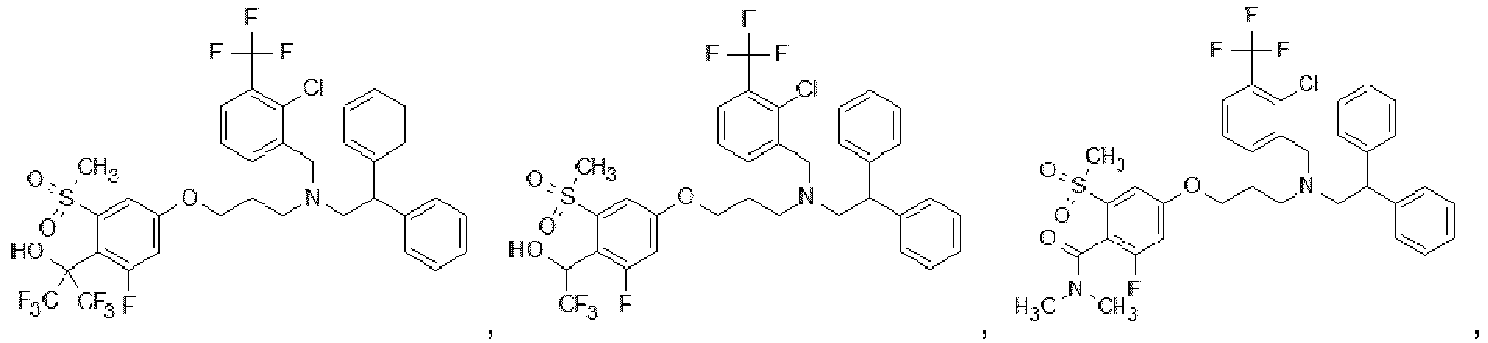

- Composé ou sel pharmaceutiquement acceptable de celui-ci selon l'une quelconque des revendications 1 à 9 pour utilisation dans une méthode de traitement du cancer, la méthode comprenant l'administration d'une quantité active d'un composé selon l'une quelconque des revendications 1 à 9, ou de l'un des sels pharmaceutiquement acceptables de celui-ci à un sujet le nécessitant.
- Composé ou sel pharmaceutiquement acceptable de celui-ci selon l'une quelconque des revendications 1 à 9 pour utilisation dans une méthode de traitement du cancer, la méthode comprenant la mise en contact d'une cellule avec une quantité active d'un composé selon l'une quelconque des revendications 1 à 9, ou de l'un des sels pharmaceutiquement acceptables de celui-ci.
- Composé ou sel pharmaceutiquement acceptable de celui-ci pour utilisation selon la revendication 10 ou 11, dans lequel :a.) ladite quantité active est une quantité suffisante pour augmenter le niveau d'expression ou le niveau d'activité d'ApoE jusqu'à un niveau suffisant pour ralentir la propagation des métastases dudit cancer ;b.) ledit cancer est résistant aux médicaments ou n'a pas réagi à une thérapie antérieure ;c.) ledit cancer est métastatique ;d.) ledit cancer comprend des cellules exprimant LRP1 ;e.) ledit cancer est un cancer du sein, un cancer du côlon, un cancer à cellules rénales, un cancer du poumon non à petites cellules, un carcinome hépatocellulaire, un cancer de l'estomac, un cancer de l'ovaire, un cancer du pancréas, un cancer de l'œsophage, un cancer de la prostate, un sarcome, un glioblastome, un lymphome diffus à grandes cellules B, une leucémie myéloïde aiguë, un myélome multiple, des carcinomes à cellules squameuses, un cancer de la vessie ou un mélanome ; et/ouf.) ladite méthode comprend en outre l'administration d'une thérapie anticancéreuse supplémentaire, préférentiellement dans laquelle ladite thérapie anticancéreuse supplémentaire est administrée dans les 28 jours qui suivent l'administration d'un composé selon l'une quelconque des revendications 1 à 7, ou de l'un des sels pharmaceutiquement acceptables de celui-ci.
- Composé ou sel pharmaceutiquement acceptable de celui-ci selon l'une quelconque des revendications 1 à 9 pour utilisation dans une méthode de traitement d'une maladie, d'un trouble ou d'un état pathologique cutanés, la méthode comprenant l'administration d'une quantité active d'un composé selon l'une quelconque des revendications 1 à 9, ou de l'un des sels pharmaceutiquement acceptables de celui-ci à un sujet le nécessitant, préférentiellement dans lequel lesdits maladie, trouble ou état pathologique cutanés sont le vieillissement de la peau, les cicatrices, le psoriasis, la dermatite atopique, l'eczéma, l'urticaire, la rosacée, les bosses cutanées ou l'acné.
- Composé ou sel pharmaceutiquement acceptable de celui-ci selon l'une quelconque des revendications 1 à 9 pour utilisation dans une méthode de traitement d'un trouble neurologique, la méthode comprenant l'administration d'une quantité active d'un composé selon l'une quelconque des revendications 1 à 9, ou de l'un des sels pharmaceutiquement acceptables de celui-ci à un sujet le nécessitant, préférentiellement dans lequel ledit trouble neurologique est la maladie d'Alzheimer.
Applications Claiming Priority (2)
| Application Number | Priority Date | Filing Date | Title |
|---|---|---|---|
| US201461926150P | 2014-01-10 | 2014-01-10 | |
| PCT/US2015/010909 WO2015106164A1 (fr) | 2014-01-10 | 2015-01-09 | Agonistes du récepteur x du foie et leurs utilisations |
Publications (3)
| Publication Number | Publication Date |
|---|---|
| EP3091970A1 EP3091970A1 (fr) | 2016-11-16 |
| EP3091970A4 EP3091970A4 (fr) | 2017-08-09 |
| EP3091970B1 true EP3091970B1 (fr) | 2020-10-28 |
Family
ID=53524389
Family Applications (1)
| Application Number | Title | Priority Date | Filing Date |
|---|---|---|---|
| EP15734952.3A Active EP3091970B1 (fr) | 2014-01-10 | 2015-01-09 | Agonistes du récepteur x du foie et leurs utilisations |
Country Status (5)
| Country | Link |
|---|---|
| US (1) | US10669296B2 (fr) |
| EP (1) | EP3091970B1 (fr) |
| AU (1) | AU2015204572B2 (fr) |
| CA (1) | CA2939120A1 (fr) |
| WO (1) | WO2015106164A1 (fr) |
Families Citing this family (16)
| Publication number | Priority date | Publication date | Assignee | Title |
|---|---|---|---|---|
| EP3091970B1 (fr) | 2014-01-10 | 2020-10-28 | Rgenix, Inc. | Agonistes du récepteur x du foie et leurs utilisations |
| US11648220B2 (en) * | 2016-01-11 | 2023-05-16 | The Rockefeller University | Methods for the treatment of myeloid derived suppressor cells related disorders |
| MA45280B1 (fr) | 2016-03-02 | 2021-08-31 | Eisai R&D Man Co Ltd | Conjugués anticorps-médicament à base d'éribuline et leurs procédés d'utilisation |
| TWI808055B (zh) | 2016-05-11 | 2023-07-11 | 美商滬亞生物國際有限公司 | Hdac 抑制劑與 pd-1 抑制劑之組合治療 |
| TWI794171B (zh) | 2016-05-11 | 2023-03-01 | 美商滬亞生物國際有限公司 | Hdac抑制劑與pd-l1抑制劑之組合治療 |
| CN110291089B (zh) | 2017-01-17 | 2022-05-27 | 海帕瑞吉尼克斯股份有限公司 | 用于促进肝再生或者减少或预防肝细胞死亡的蛋白激酶抑制剂 |
| CN110494415A (zh) * | 2017-03-03 | 2019-11-22 | 睿治尼斯公司 | 具有改善的稳定性的制剂 |
| AU2018373028A1 (en) | 2017-11-21 | 2020-04-30 | Inspirna, Inc. | Polymorphs and uses thereof |
| US20220127680A1 (en) * | 2019-02-28 | 2022-04-28 | The Rockefeller Universtiy | Apoe genotyping in cancer prognostics and treatment |
| EP4027989A4 (fr) * | 2019-09-11 | 2023-09-06 | Inspirna, Inc. | Méthodes de traitement du cancer |
| CN114981298B (zh) | 2019-12-12 | 2024-08-20 | 听治疗有限责任公司 | 用于预防和治疗听力损失的组合物和方法 |
| EP4073025B1 (fr) | 2019-12-13 | 2024-03-27 | Inspirna, Inc. | Sels métalliques et leurs utilisations |
| CN115724739A (zh) * | 2021-08-24 | 2023-03-03 | 山东特珐曼药业有限公司 | 一类间苯二酚羧酸酯金属配合物、共晶或盐及其制备方法和用途 |
| WO2023028558A2 (fr) * | 2021-08-25 | 2023-03-02 | Abbvie Inc. | Procédé de fabrication d'agents induisant l'apoptose |
| CN117599041B (zh) * | 2024-01-22 | 2024-05-03 | 中国人民解放军军事科学院军事医学研究院 | 去氢雌马酚及其衍生物作为新型辐射防护剂和细胞保护剂的医药用途 |
| CN118702701B (zh) * | 2024-04-10 | 2025-09-26 | 中国科学院昆明植物研究所 | 白毛多花蒿内酯a-k及其药物组合物和其制备方法与应用 |
Family Cites Families (126)
| Publication number | Priority date | Publication date | Assignee | Title |
|---|---|---|---|---|
| DD150456A5 (de) * | 1979-03-01 | 1981-09-02 | Ciba Geigy Ag | Verfahren zur herstellung von derivaten des 3-amino-1,2-propandiols |
| DE2951400A1 (de) * | 1979-12-20 | 1981-07-02 | Hoechst Ag, 6230 Frankfurt | Verfahren zur herstellung von n,n'-diarylaethylendiaminen oder n, n',n''-triaryldiaethylen-triaminen |
| US5676978A (en) | 1989-02-14 | 1997-10-14 | Amira, Inc. | Methods of inhibiting undesirable cell growth using a combination of a cyclocreatine compound and a hyperplastic inhibitory agent |
| US5324731A (en) | 1989-02-14 | 1994-06-28 | Amira, Inc. | Method of inhibiting transformation of cells in which purine metabolic enzyme activity is elevated |
| US5843974A (en) | 1995-06-06 | 1998-12-01 | Eli Lilly And Company | Methods of inhibiting melanoma using Benzothiophenes as cytotoxic agents per se |
| US7012069B2 (en) | 2001-05-03 | 2006-03-14 | Arch Development Corporation | Liver X receptor agonists |
| US20030153541A1 (en) | 1997-10-31 | 2003-08-14 | Robert Dudley | Novel anticholesterol compositions and method for using same |
| US6906069B1 (en) | 1999-01-08 | 2005-06-14 | Amgen Inc. | LXR modulators |
| US6316503B1 (en) | 1999-03-15 | 2001-11-13 | Tularik Inc. | LXR modulators |
| BR0010197A (pt) | 1999-04-30 | 2002-07-16 | Arch Dev Corp | Derivados de esteróides |
| US8257750B2 (en) | 1999-04-30 | 2012-09-04 | Kibow Biotech, Inc. | Calcium carbonate compositions for preventing or treating hyperphosphatemia |
| US6414002B1 (en) | 1999-09-22 | 2002-07-02 | Bristol-Myers Squibb Company | Substituted acid derivatives useful as antidiabetic and antiobesity agents and method |
| WO2001066534A2 (fr) | 2000-03-09 | 2001-09-13 | Abbott Laboratories | Antagonistes du recepteur d'histamine-3 diamino cycliques et bicycliques |
| WO2002013594A1 (fr) | 2000-08-17 | 2002-02-21 | Northland Seed & Grain Corp. | Procede pour minimiser la contamination de cultures et de produits de ces cultures |
| US20040072868A1 (en) | 2000-09-18 | 2004-04-15 | Collins Jon Loren | Substitued aminopropoxyaryl derivatives useful as agonists for lxr |
| EP1385868A4 (fr) | 2001-02-08 | 2004-12-08 | Univ Chicago | Derives de steroides |
| US6908934B2 (en) | 2001-06-11 | 2005-06-21 | Merck & Co., Inc. | Therapeutic compounds for treating dyslipidemic conditions |
| WO2003031408A2 (fr) | 2001-10-08 | 2003-04-17 | Eli Lilly And Company | Composes tricycliques utiles pour moduler lxr |
| EP1456187A4 (fr) | 2001-11-15 | 2005-02-09 | Incyte San Diego Inc | Heterocycles n-substitues pour le traitement de l'hypercholesterolemie, de la dyslipidemie et autres troubles du metabolisme, du cancer et de pathologies diverses |
| EP1448193A4 (fr) | 2001-11-21 | 2005-11-23 | Merck & Co Inc | Composes therapeutiques pour le traitement d'etats dyslipidemiques |
| AU2002351412B2 (en) | 2001-12-21 | 2010-05-20 | Exelixis Patent Company Llc | Modulators of LXR |
| US7482366B2 (en) | 2001-12-21 | 2009-01-27 | X-Ceptor Therapeutics, Inc. | Modulators of LXR |
| WO2003059874A2 (fr) | 2001-12-21 | 2003-07-24 | Pharmacia Corporation | Modulateurs du recepteur x du foie de thioether aromatique |
| US6696473B2 (en) | 2001-12-21 | 2004-02-24 | X-Ceptor Therapeutics, Inc. | Heterocyclic modulators of nuclear receptors |
| AU2003220558A1 (en) | 2002-03-27 | 2004-06-03 | Smithkline Beecham Corporation | Amide compounds and methods of using the same |
| AU2003220521A1 (en) * | 2002-03-27 | 2003-10-13 | Smithkline Beecham Corporation | Methods of treatment with lxr modulators |
| WO2003082205A2 (fr) * | 2002-03-27 | 2003-10-09 | Smithkline Beecham Corporation | Composes et procedes |
| WO2003082802A1 (fr) * | 2002-03-27 | 2003-10-09 | Smithkline Beecham Corporation | Composes acides et esters et procedes d'utilisation associes |
| AU2003228614A1 (en) | 2002-04-23 | 2003-11-10 | Chugai Seiyaku Kabushiki Kaisha | Lxr modulators |
| AU2003223684A1 (en) | 2002-04-23 | 2003-11-10 | Chugai Seiyaku Kabushiki Kaisha | Lxr modulators for the treatment of cardiovascular diseases |
| AU2003222667A1 (en) | 2002-04-23 | 2003-11-10 | Chugai Seiyaku Kabushiki Kaisha | 1,3-thiazoles as lxr modulators in the treatment of cardiovascular diseases |
| US6900244B2 (en) | 2002-05-24 | 2005-05-31 | Pharmacia Corporation | Anilino liver X-receptor modulators |
| CA2486651A1 (fr) | 2002-05-24 | 2003-12-04 | Pharmacia Corporation | Modulateurs de recepteur x hepatique a base de sulfone |
| WO2004009091A1 (fr) | 2002-06-17 | 2004-01-29 | Glaxo Group Limited | Agonistes des recepteurs x du foie |
| AU2003238157A1 (en) | 2002-06-18 | 2003-12-31 | Sankyo Company, Limited | Fused-ring pyrimidin-4(3h)-one derivatives, processes for the preparation and uses thereof |
| WO2004011448A1 (fr) | 2002-07-25 | 2004-02-05 | Merck & Co., Inc. | Composes therapeutiques destines au traitement d'etats dyslipidemiques |
| EP1407774A1 (fr) | 2002-09-10 | 2004-04-14 | LION Bioscience AG | 2-amino-4-quinazolinones se liant au récepteur nucléair LXR |
| AU2003272552A1 (en) | 2002-09-17 | 2004-04-08 | Pharmacia Corporation | Aromatic liver x-receptor modulators |
| EP1572660B1 (fr) | 2002-12-20 | 2011-01-26 | X-Ceptor Therapeutics, Inc. | Dérives d'isoquinolinone et leur utilisation comme agents thérapeutiques |
| WO2004072046A2 (fr) | 2003-02-12 | 2004-08-26 | Carex S.A. | Modulation de l'activite des recepteurs nucleaires |
| WO2004072042A2 (fr) | 2003-02-12 | 2004-08-26 | Carex S.A. | Modulation de l'activite de recepteurs nucleaires |
| WO2004072041A1 (fr) | 2003-02-12 | 2004-08-26 | Care X S.A. | Tetrahydroquinoleines utilisees comme agonistes des recepteurs hepatiques |
| US7135575B2 (en) | 2003-03-03 | 2006-11-14 | Array Biopharma, Inc. | P38 inhibitors and methods of use thereof |
| GB0316232D0 (en) | 2003-07-11 | 2003-08-13 | Astrazeneca Ab | Therapeutic agents |
| GB0316237D0 (en) | 2003-07-11 | 2003-08-13 | Astrazeneca Ab | Therapeutic agents |
| JP2007502291A (ja) | 2003-08-12 | 2007-02-08 | アムジエン・インコーポレーテツド | アリールスルホンアミドベンジル系化合物 |
| BRPI0413991B8 (pt) * | 2003-09-03 | 2021-05-25 | Kowa Co | composto ativador de ppar e composição farmacêutica contendo o mesmo |
| JP2006193426A (ja) | 2003-09-05 | 2006-07-27 | Sankyo Co Ltd | 置換された縮環ピリミジン−4(3h)−オン化合物 |
| US20050113419A1 (en) | 2003-10-31 | 2005-05-26 | Huang Shaei Y. | Therapeutic compounds for treating dyslipidemic conditions |
| PE20050676A1 (es) | 2003-12-12 | 2005-11-02 | Wyeth Corp | Quinolinas referidas a enfermedades cardiovasculares |
| FR2865736B1 (fr) | 2004-02-02 | 2006-07-14 | Synt Em | Inhibiteurs de l'angiogenese, compositions les contenant et leur utilisation pour le traitement des maladies liees a une deregulation de l'angiogenese |
| EP1713799A4 (fr) | 2004-02-11 | 2010-07-07 | Irm Llc | Composes et compositions comme modulateurs de lxr |
| BRPI0507626A (pt) | 2004-02-11 | 2007-07-03 | Irm Llc | compostos e composiçoes como moduladores de lxr |
| NZ549396A (en) | 2004-03-26 | 2010-04-30 | Hoffmann La Roche | Tetrahydrocarbazoles and derivatives |
| PT1756096E (pt) | 2004-05-03 | 2009-10-16 | Hoffmann La Roche | Derivados de indolilo como moduladores do receptor x do fígado |
| WO2005113499A1 (fr) | 2004-05-20 | 2005-12-01 | Sankyo Company, Limited | Composés indoles |
| MXPA06014807A (es) | 2004-06-28 | 2007-02-12 | Hoffmann La Roche | Nuevos derivados de hexafluorisopropanol. |
| TW200606133A (en) | 2004-06-30 | 2006-02-16 | Sankyo Co | Substituted benzene compounds |
| AU2005271737A1 (en) | 2004-08-03 | 2006-02-16 | Wyeth | Indazoles useful in treating cardiovascular diseases |
| US20060178398A1 (en) | 2004-09-16 | 2006-08-10 | Adams Alan D | Therapeutic compounds for treating dyslipidemic conditions |
| ES2315912T3 (es) | 2004-10-01 | 2009-04-01 | F. Hoffmann-La Roche Ag | Derivados de eter sustituido por hexafluorisopropanol. |
| KR101021828B1 (ko) | 2004-10-27 | 2011-03-17 | 다이이찌 산쿄 가부시키가이샤 | 2 이상의 치환기를 갖는 벤젠 화합물 |
| CN101087754B (zh) | 2004-12-22 | 2012-01-18 | 霍夫曼-拉罗奇有限公司 | 环己烷衍生物 |
| SE0500058D0 (sv) | 2005-01-10 | 2005-01-10 | Astrazeneca Ab | Therapeutic agents 5 |
| WO2006073364A1 (fr) | 2005-01-10 | 2006-07-13 | Astrazeneca Ab | Derives non aniliques d'isothiazol-3(2h)-thione 1,1-dioxides servant de modulateurs de recepteurs nucleaires hepatiques |
| KR20070094963A (ko) | 2005-01-10 | 2007-09-27 | 아스트라제네카 아베 | 간 x 수용체 조절제로서 이소티아졸-3(2h)-온1,1-디옥사이드 유도체 |
| SE0500055D0 (sv) | 2005-01-10 | 2005-01-10 | Astrazeneca Ab | Therapeutic agents 3 |
| SE0500056D0 (sv) | 2005-01-10 | 2005-01-10 | Astrazeneca Ab | Therapeutic agents 4 |
| JP2006232703A (ja) * | 2005-02-23 | 2006-09-07 | Dai Ichi Seiyaku Co Ltd | フェニルエーテル誘導体及びそれを用いた医薬 |
| WO2006109633A1 (fr) | 2005-04-07 | 2006-10-19 | Daiichi Sankyo Company, Limited | Composé indole substitué |
| WO2007002563A1 (fr) | 2005-06-27 | 2007-01-04 | Exelixis, Inc. | Régulateurs de lxr de type imidazole |
| WO2007022563A1 (fr) | 2005-08-24 | 2007-03-01 | Graham Scott | Emballage avec agent repulsif au gout amer destine a repousser un bebe |
| US7790745B2 (en) | 2005-10-21 | 2010-09-07 | Bristol-Myers Squibb Company | Tetrahydroisoquinoline LXR Modulators |
| US20070093524A1 (en) | 2005-10-25 | 2007-04-26 | Wyeth | 5-Lipoxygenase modulators |
| WO2008011071A2 (fr) | 2006-07-19 | 2008-01-24 | The Regents Of The University Of California | Interactions des voies de signaux hedgehog et du récepteur x hépatique |
| US20080085879A1 (en) | 2006-08-31 | 2008-04-10 | University Of Pittsburgh - Of The Commonwealth System Of Higher Education | Methods of treating estrogen-responsive conditions by orphan nuclear receptor activation |
| WO2008073825A1 (fr) | 2006-12-08 | 2008-06-19 | Exelixis, Inc. | Modulateurs lxr et fxr |
| US8993628B2 (en) | 2007-02-23 | 2015-03-31 | City Of Hope | Synthetic ligands selective for LXRβ over LXRα, identification and methods of use thereof |
| AU2008270784A1 (en) | 2007-07-02 | 2009-01-08 | Glaxosmithkline Llc | Farnesoid X receptor agonists |
| CN103772299A (zh) | 2007-08-13 | 2014-05-07 | 霍夫曼-拉罗奇有限公司 | 新型哌嗪酰胺衍生物 |
| ES2463665T3 (es) | 2007-10-04 | 2014-05-28 | Stella Aps | Tratamiento de combinación para el tratamiento de infección por virus de la hepatitis C |
| MX2010005104A (es) | 2007-11-09 | 2010-08-04 | Peregrine Pharmaceuticals Inc | Composiciones de anticuerpo anti-factor de crecimiento endotelial vascular y metodos. |
| WO2009075836A2 (fr) | 2007-12-10 | 2009-06-18 | The Brigham And Women's Hospital, Inc. | Variantes de rap pour l'administration de médicaments |
| WO2009086130A1 (fr) | 2007-12-21 | 2009-07-09 | Wyeth | Composés d'imidazo-[1,2-b]-pyridazine comme modulateurs des récepteurs x du foie |
| BRPI0821315A2 (pt) | 2007-12-21 | 2019-09-24 | Wyeth Llc | compostos benzimidazol |
| CN101952293A (zh) | 2007-12-21 | 2011-01-19 | 惠氏有限责任公司 | 吡唑并[1,5-a]嘧啶化合物 |
| EP2248811B1 (fr) | 2008-02-29 | 2012-11-14 | Kowa Company, Ltd. | Derive de 2-oxochromene |
| JP5511080B2 (ja) | 2008-03-31 | 2014-06-04 | 興和株式会社 | 1,3−ジヒドロイソベンゾフラン誘導体 |
| JP5371118B2 (ja) | 2008-04-30 | 2013-12-18 | 興和株式会社 | キノリン化合物 |
| TW201006816A (en) | 2008-05-15 | 2010-02-16 | Organon Nv | Hexafluoroisopropanol derivatives |
| CN102105452A (zh) | 2008-05-29 | 2011-06-22 | 兴和株式会社 | 具有环状连接基的取代甲醇化合物 |
| WO2009148915A2 (fr) | 2008-05-29 | 2009-12-10 | Bristol-Myers Squibb Company | Procédés pour prédire une réponse de patient à une modulation de la voie de co-stimulation |
| US8063088B2 (en) | 2008-06-11 | 2011-11-22 | Hoffmann-La Roche Inc. | Imidazolidine derivatives |
| WO2010002982A1 (fr) | 2008-07-01 | 2010-01-07 | Cognosci, Inc. | PROCÉDÉS DE TRAITEMENT D’UN CANCER À L'AIDE DE PEPTIDES ApoE |
| TW201022230A (en) | 2008-08-28 | 2010-06-16 | Organon Nv | 1-(4-ureidobenzoyl)piperazine derivatives |
| US8613367B2 (en) | 2008-08-29 | 2013-12-24 | Saint-Gobain Performance Plastics Corporation | Sealing assembly and method of making such assembly |
| FR2935380B1 (fr) | 2008-08-29 | 2010-09-10 | Galderma Res & Dev | Nouveaux composes hexafluoro-2-biphenyl-isopropanol, modulateurs des recepteurs de type lxrs, leur procede de preparation et leur application comme medicaments en medecine humaine ou veterinaire ainsi qu'en cosmetique. |
| CN102361857B (zh) | 2008-09-26 | 2015-09-16 | 默沙东公司 | 可用作抗糖尿病剂的环状苯并咪唑衍生物 |
| EP2367801A1 (fr) | 2008-11-19 | 2011-09-28 | Wyeth LLC | Quinazolines polaires en tant que modulateurs des récepteurs hépatiques x (lxr) |
| WO2010101888A2 (fr) | 2009-03-02 | 2010-09-10 | Biocure Pharma, Llc | Méthodes et compositions pour traiter la métastase tumorale |
| EA201171167A1 (ru) | 2009-04-29 | 2012-06-29 | Кова Компани, Лтд. | Карбинольное соединение, содержащее гетероциклический линкер |
| HRP20170194T1 (hr) | 2009-05-28 | 2017-05-19 | Exelixis Patent Company Llc | Lxr modulatori |
| CN102482315A (zh) | 2009-07-29 | 2012-05-30 | 芝加哥大学 | 肝x受体激动剂 |
| TWI513695B (zh) | 2009-10-27 | 2015-12-21 | Merck Sharp & Dohme | (1,1,1,3,3,3-六氟-2-羥基丙-2-基)苯基衍生物 |
| US8796290B2 (en) | 2009-11-09 | 2014-08-05 | Advinus Therapeutics Limited | Substituted fused pyrimidine compounds, its preparation and uses thereof |
| KR101737151B1 (ko) | 2009-12-04 | 2017-05-17 | 닛산 가가쿠 고교 가부시키 가이샤 | 2-피리돈 화합물 |
| WO2011103175A2 (fr) | 2010-02-16 | 2011-08-25 | The Regents Of The University Of California | Oxystérols qui activent la signalisation du récepteur x du foie et inhibent la signalisation du hérisson |
| WO2011115892A1 (fr) | 2010-03-15 | 2011-09-22 | Griffin Patrick R | Modulateurs des récepteurs orphelins liés au récepteur de l'acide rétinoïque |
| WO2011130426A2 (fr) | 2010-04-13 | 2011-10-20 | New York University | Compositions et procédés de traitement de mélanome |
| US20130090258A1 (en) | 2010-06-16 | 2013-04-11 | National University Corporation Hamamatsu University School Of Medicines | Method for detecting colorectal tumor |
| KR20130023335A (ko) | 2010-07-08 | 2013-03-07 | 와이어쓰 엘엘씨 | 피부 장애를 치료하는데 유용한 신규 퀴놀린 에스테르 |
| EP2474617A1 (fr) | 2011-01-11 | 2012-07-11 | InteRNA Technologies BV | MIR pour traiter une nouvelle angiogenèse |
| US20130004481A1 (en) | 2011-01-12 | 2013-01-03 | Boehringer Ingelheim International Gmbh | Anticancer therapy |
| AR088728A1 (es) | 2011-03-25 | 2014-07-02 | Bristol Myers Squibb Co | Moduladores de lxr como prodroga de imidazol |
| US20130071403A1 (en) | 2011-09-20 | 2013-03-21 | Vical Incorporated | Synergistic anti-tumor efficacy using alloantigen combination immunotherapy |
| CN103958541A (zh) | 2011-10-18 | 2014-07-30 | 国家医疗保健研究所 | 5α-羟基-6β-[2-(1H-咪唑-4-基)乙基氨基]胆甾烷-3β-醇的酸加成盐 |
| IN2014MN00976A (fr) | 2011-11-24 | 2015-04-24 | Inserm Inst Nat De La Santé Et De La Rech Médicale | |
| EP3441390A1 (fr) | 2012-03-02 | 2019-02-13 | Ralexar Therapeutics, Inc. | Modulateurs du récepteur hépatique x (lxr) permettant de traiter les maladies, troubles et affections dermiques |
| SMT201700009T1 (it) | 2012-03-16 | 2017-03-08 | Vitae Pharmaceuticals Inc | Modulatori del recettore x del fegato |
| SG11201405328SA (en) | 2012-03-16 | 2014-11-27 | Vitae Pharmaceuticals Inc | Liver x receptor modulators |
| ES2765573T3 (es) | 2012-08-13 | 2020-06-09 | Univ Rockefeller | Tratamiento y diagnóstico de melanoma |
| EP2968275B1 (fr) | 2013-03-15 | 2017-11-29 | Bristol-Myers Squibb Company | Modulateurs des lxr |
| JP6066860B2 (ja) | 2013-08-05 | 2017-01-25 | 株式会社クボタ | 草刈機 |
| EP3091970B1 (fr) | 2014-01-10 | 2020-10-28 | Rgenix, Inc. | Agonistes du récepteur x du foie et leurs utilisations |
| SI3102208T2 (sl) | 2014-02-07 | 2024-10-30 | Global Blood Therapeutics, Inc. | Kristalinični polimorf proste baze 2-hidroksi-6-((2-(1-izopropil-1H-pirazol-5-IL)piridin-3-IL)metoksi)- benzaldehida |
| US11058700B2 (en) | 2015-10-28 | 2021-07-13 | City Of Hope | Macrocyclic lactones and uses thereof as modulators of purinergic receptors |
-
2015
- 2015-01-09 EP EP15734952.3A patent/EP3091970B1/fr active Active
- 2015-01-09 AU AU2015204572A patent/AU2015204572B2/en active Active
- 2015-01-09 WO PCT/US2015/010909 patent/WO2015106164A1/fr not_active Ceased
- 2015-01-09 US US15/110,343 patent/US10669296B2/en active Active
- 2015-01-09 CA CA2939120A patent/CA2939120A1/fr active Pending
Non-Patent Citations (1)
| Title |
|---|
| None * |
Also Published As
| Publication number | Publication date |
|---|---|
| CA2939120A1 (fr) | 2015-07-16 |
| EP3091970A1 (fr) | 2016-11-16 |
| AU2015204572A1 (en) | 2016-08-04 |
| EP3091970A4 (fr) | 2017-08-09 |
| US20170066791A1 (en) | 2017-03-09 |
| AU2015204572B2 (en) | 2020-07-30 |
| US10669296B2 (en) | 2020-06-02 |
| WO2015106164A1 (fr) | 2015-07-16 |
Similar Documents
| Publication | Publication Date | Title |
|---|---|---|
| US10669296B2 (en) | LXR agonists and uses thereof | |
| AU2020200715B2 (en) | Treatment and diagnosis of melanoma | |
| US20230338314A1 (en) | Methods for the treatment of myeloid derived suppressor cells related disorders | |
| US20190125745A1 (en) | Treatment and diagnosis of cancer | |
| US10717704B2 (en) | Inhibitors of creatine transport and uses thereof | |
| WO2016176636A1 (fr) | Inhibiteurs de transport de créatine et leurs utilisations | |
| HK1230929B (en) | Lxr agonists and uses thereof | |
| HK1235391B (en) | Inhibitors of creatine transport and uses thereof |
Legal Events
| Date | Code | Title | Description |
|---|---|---|---|
| PUAI | Public reference made under article 153(3) epc to a published international application that has entered the european phase |
Free format text: ORIGINAL CODE: 0009012 |
|
| 17P | Request for examination filed |
Effective date: 20160808 |
|
| AK | Designated contracting states |
Kind code of ref document: A1 Designated state(s): AL AT BE BG CH CY CZ DE DK EE ES FI FR GB GR HR HU IE IS IT LI LT LU LV MC MK MT NL NO PL PT RO RS SE SI SK SM TR |
|
| AX | Request for extension of the european patent |
Extension state: BA ME |
|
| DAX | Request for extension of the european patent (deleted) | ||
| RAP1 | Party data changed (applicant data changed or rights of an application transferred) |
Owner name: MARTINEZ, EDUARDO, J. Owner name: TAVAZOIE, MASOUD, FAKHR Owner name: RGENIX, INC. Owner name: TAVAZOIE, SOHAIL, F. Owner name: KURTH, ISABEL Owner name: KAISER, BERND Owner name: DARST, DAVID, M., JR. Owner name: GONSALVES, FOSTER, CASIMIR |
|
| RAP1 | Party data changed (applicant data changed or rights of an application transferred) |
Owner name: RGENIX, INC. |
|
| A4 | Supplementary search report drawn up and despatched |
Effective date: 20170706 |
|
| RIC1 | Information provided on ipc code assigned before grant |
Ipc: A61P 35/00 20060101ALI20170630BHEP Ipc: A61K 31/145 20060101AFI20170630BHEP |
|
| REG | Reference to a national code |
Ref country code: HK Ref legal event code: DE Ref document number: 1230929 Country of ref document: HK |
|
| STAA | Information on the status of an ep patent application or granted ep patent |
Free format text: STATUS: EXAMINATION IS IN PROGRESS |
|
| 17Q | First examination report despatched |
Effective date: 20180829 |
|
| GRAP | Despatch of communication of intention to grant a patent |
Free format text: ORIGINAL CODE: EPIDOSNIGR1 |
|
| STAA | Information on the status of an ep patent application or granted ep patent |
Free format text: STATUS: GRANT OF PATENT IS INTENDED |
|
| INTG | Intention to grant announced |
Effective date: 20200506 |
|
| GRAS | Grant fee paid |
Free format text: ORIGINAL CODE: EPIDOSNIGR3 |
|
| GRAA | (expected) grant |
Free format text: ORIGINAL CODE: 0009210 |
|
| STAA | Information on the status of an ep patent application or granted ep patent |
Free format text: STATUS: THE PATENT HAS BEEN GRANTED |
|
| AK | Designated contracting states |
Kind code of ref document: B1 Designated state(s): AL AT BE BG CH CY CZ DE DK EE ES FI FR GB GR HR HU IE IS IT LI LT LU LV MC MK MT NL NO PL PT RO RS SE SI SK SM TR |
|
| REG | Reference to a national code |
Ref country code: GB Ref legal event code: FG4D |
|
| REG | Reference to a national code |
Ref country code: CH Ref legal event code: EP |
|
| REG | Reference to a national code |
Ref country code: CH Ref legal event code: NV Representative=s name: E. BLUM AND CO. AG PATENT- UND MARKENANWAELTE , CH |
|
| REG | Reference to a national code |
Ref country code: AT Ref legal event code: REF Ref document number: 1327497 Country of ref document: AT Kind code of ref document: T Effective date: 20201115 |
|
| REG | Reference to a national code |
Ref country code: DE Ref legal event code: R096 Ref document number: 602015061124 Country of ref document: DE |
|
| REG | Reference to a national code |
Ref country code: IE Ref legal event code: FG4D |
|
| REG | Reference to a national code |
Ref country code: AT Ref legal event code: MK05 Ref document number: 1327497 Country of ref document: AT Kind code of ref document: T Effective date: 20201028 |
|
| REG | Reference to a national code |
Ref country code: NL Ref legal event code: MP Effective date: 20201028 |
|
| PG25 | Lapsed in a contracting state [announced via postgrant information from national office to epo] |
Ref country code: PT Free format text: LAPSE BECAUSE OF FAILURE TO SUBMIT A TRANSLATION OF THE DESCRIPTION OR TO PAY THE FEE WITHIN THE PRESCRIBED TIME-LIMIT Effective date: 20210301 Ref country code: RS Free format text: LAPSE BECAUSE OF FAILURE TO SUBMIT A TRANSLATION OF THE DESCRIPTION OR TO PAY THE FEE WITHIN THE PRESCRIBED TIME-LIMIT Effective date: 20201028 Ref country code: FI Free format text: LAPSE BECAUSE OF FAILURE TO SUBMIT A TRANSLATION OF THE DESCRIPTION OR TO PAY THE FEE WITHIN THE PRESCRIBED TIME-LIMIT Effective date: 20201028 Ref country code: NL Free format text: LAPSE BECAUSE OF FAILURE TO SUBMIT A TRANSLATION OF THE DESCRIPTION OR TO PAY THE FEE WITHIN THE PRESCRIBED TIME-LIMIT Effective date: 20201028 Ref country code: NO Free format text: LAPSE BECAUSE OF FAILURE TO SUBMIT A TRANSLATION OF THE DESCRIPTION OR TO PAY THE FEE WITHIN THE PRESCRIBED TIME-LIMIT Effective date: 20210128 Ref country code: GR Free format text: LAPSE BECAUSE OF FAILURE TO SUBMIT A TRANSLATION OF THE DESCRIPTION OR TO PAY THE FEE WITHIN THE PRESCRIBED TIME-LIMIT Effective date: 20210129 |
|
| REG | Reference to a national code |
Ref country code: LT Ref legal event code: MG4D |
|
| PG25 | Lapsed in a contracting state [announced via postgrant information from national office to epo] |
Ref country code: AT Free format text: LAPSE BECAUSE OF FAILURE TO SUBMIT A TRANSLATION OF THE DESCRIPTION OR TO PAY THE FEE WITHIN THE PRESCRIBED TIME-LIMIT Effective date: 20201028 Ref country code: ES Free format text: LAPSE BECAUSE OF FAILURE TO SUBMIT A TRANSLATION OF THE DESCRIPTION OR TO PAY THE FEE WITHIN THE PRESCRIBED TIME-LIMIT Effective date: 20201028 Ref country code: BG Free format text: LAPSE BECAUSE OF FAILURE TO SUBMIT A TRANSLATION OF THE DESCRIPTION OR TO PAY THE FEE WITHIN THE PRESCRIBED TIME-LIMIT Effective date: 20210128 Ref country code: IS Free format text: LAPSE BECAUSE OF FAILURE TO SUBMIT A TRANSLATION OF THE DESCRIPTION OR TO PAY THE FEE WITHIN THE PRESCRIBED TIME-LIMIT Effective date: 20210228 Ref country code: PL Free format text: LAPSE BECAUSE OF FAILURE TO SUBMIT A TRANSLATION OF THE DESCRIPTION OR TO PAY THE FEE WITHIN THE PRESCRIBED TIME-LIMIT Effective date: 20201028 Ref country code: LV Free format text: LAPSE BECAUSE OF FAILURE TO SUBMIT A TRANSLATION OF THE DESCRIPTION OR TO PAY THE FEE WITHIN THE PRESCRIBED TIME-LIMIT Effective date: 20201028 Ref country code: SE Free format text: LAPSE BECAUSE OF FAILURE TO SUBMIT A TRANSLATION OF THE DESCRIPTION OR TO PAY THE FEE WITHIN THE PRESCRIBED TIME-LIMIT Effective date: 20201028 |
|
| PG25 | Lapsed in a contracting state [announced via postgrant information from national office to epo] |
Ref country code: HR Free format text: LAPSE BECAUSE OF FAILURE TO SUBMIT A TRANSLATION OF THE DESCRIPTION OR TO PAY THE FEE WITHIN THE PRESCRIBED TIME-LIMIT Effective date: 20201028 |
|
| REG | Reference to a national code |
Ref country code: DE Ref legal event code: R097 Ref document number: 602015061124 Country of ref document: DE |
|
| PG25 | Lapsed in a contracting state [announced via postgrant information from national office to epo] |
Ref country code: SK Free format text: LAPSE BECAUSE OF FAILURE TO SUBMIT A TRANSLATION OF THE DESCRIPTION OR TO PAY THE FEE WITHIN THE PRESCRIBED TIME-LIMIT Effective date: 20201028 Ref country code: RO Free format text: LAPSE BECAUSE OF FAILURE TO SUBMIT A TRANSLATION OF THE DESCRIPTION OR TO PAY THE FEE WITHIN THE PRESCRIBED TIME-LIMIT Effective date: 20201028 Ref country code: LT Free format text: LAPSE BECAUSE OF FAILURE TO SUBMIT A TRANSLATION OF THE DESCRIPTION OR TO PAY THE FEE WITHIN THE PRESCRIBED TIME-LIMIT Effective date: 20201028 Ref country code: SM Free format text: LAPSE BECAUSE OF FAILURE TO SUBMIT A TRANSLATION OF THE DESCRIPTION OR TO PAY THE FEE WITHIN THE PRESCRIBED TIME-LIMIT Effective date: 20201028 Ref country code: CZ Free format text: LAPSE BECAUSE OF FAILURE TO SUBMIT A TRANSLATION OF THE DESCRIPTION OR TO PAY THE FEE WITHIN THE PRESCRIBED TIME-LIMIT Effective date: 20201028 Ref country code: EE Free format text: LAPSE BECAUSE OF FAILURE TO SUBMIT A TRANSLATION OF THE DESCRIPTION OR TO PAY THE FEE WITHIN THE PRESCRIBED TIME-LIMIT Effective date: 20201028 |
|
| PG25 | Lapsed in a contracting state [announced via postgrant information from national office to epo] |
Ref country code: DK Free format text: LAPSE BECAUSE OF FAILURE TO SUBMIT A TRANSLATION OF THE DESCRIPTION OR TO PAY THE FEE WITHIN THE PRESCRIBED TIME-LIMIT Effective date: 20201028 |
|
| PLBE | No opposition filed within time limit |
Free format text: ORIGINAL CODE: 0009261 |
|
| STAA | Information on the status of an ep patent application or granted ep patent |
Free format text: STATUS: NO OPPOSITION FILED WITHIN TIME LIMIT |
|
| PG25 | Lapsed in a contracting state [announced via postgrant information from national office to epo] |
Ref country code: LU Free format text: LAPSE BECAUSE OF NON-PAYMENT OF DUE FEES Effective date: 20210109 |
|
| 26N | No opposition filed |
Effective date: 20210729 |
|
| REG | Reference to a national code |
Ref country code: DE Ref legal event code: R081 Ref document number: 602015061124 Country of ref document: DE Owner name: INSPIRNA, INC., NEW YORK, US Free format text: FORMER OWNER: RGENIX, INC., NEW YORK, NY, US |
|
| PG25 | Lapsed in a contracting state [announced via postgrant information from national office to epo] |
Ref country code: IT Free format text: LAPSE BECAUSE OF FAILURE TO SUBMIT A TRANSLATION OF THE DESCRIPTION OR TO PAY THE FEE WITHIN THE PRESCRIBED TIME-LIMIT Effective date: 20201028 Ref country code: AL Free format text: LAPSE BECAUSE OF FAILURE TO SUBMIT A TRANSLATION OF THE DESCRIPTION OR TO PAY THE FEE WITHIN THE PRESCRIBED TIME-LIMIT Effective date: 20201028 |
|
| PG25 | Lapsed in a contracting state [announced via postgrant information from national office to epo] |
Ref country code: SI Free format text: LAPSE BECAUSE OF FAILURE TO SUBMIT A TRANSLATION OF THE DESCRIPTION OR TO PAY THE FEE WITHIN THE PRESCRIBED TIME-LIMIT Effective date: 20201028 |
|
| REG | Reference to a national code |
Ref country code: BE Ref legal event code: HC Owner name: INSPIRNA, INC.; US Free format text: DETAILS ASSIGNMENT: CHANGE OF OWNER(S), CHANGE OF OWNER(S) NAME; FORMER OWNER NAME: RGENIX, INC. Effective date: 20211213 |
|
| PG25 | Lapsed in a contracting state [announced via postgrant information from national office to epo] |
Ref country code: IS Free format text: LAPSE BECAUSE OF FAILURE TO SUBMIT A TRANSLATION OF THE DESCRIPTION OR TO PAY THE FEE WITHIN THE PRESCRIBED TIME-LIMIT Effective date: 20210228 |
|
| PG25 | Lapsed in a contracting state [announced via postgrant information from national office to epo] |
Ref country code: HU Free format text: LAPSE BECAUSE OF FAILURE TO SUBMIT A TRANSLATION OF THE DESCRIPTION OR TO PAY THE FEE WITHIN THE PRESCRIBED TIME-LIMIT; INVALID AB INITIO Effective date: 20150109 |
|
| PG25 | Lapsed in a contracting state [announced via postgrant information from national office to epo] |
Ref country code: CY Free format text: LAPSE BECAUSE OF FAILURE TO SUBMIT A TRANSLATION OF THE DESCRIPTION OR TO PAY THE FEE WITHIN THE PRESCRIBED TIME-LIMIT Effective date: 20201028 |
|
| PG25 | Lapsed in a contracting state [announced via postgrant information from national office to epo] |
Ref country code: MK Free format text: LAPSE BECAUSE OF FAILURE TO SUBMIT A TRANSLATION OF THE DESCRIPTION OR TO PAY THE FEE WITHIN THE PRESCRIBED TIME-LIMIT Effective date: 20201028 |
|
| PG25 | Lapsed in a contracting state [announced via postgrant information from national office to epo] |
Ref country code: MT Free format text: LAPSE BECAUSE OF FAILURE TO SUBMIT A TRANSLATION OF THE DESCRIPTION OR TO PAY THE FEE WITHIN THE PRESCRIBED TIME-LIMIT Effective date: 20201028 |
|
| PGFP | Annual fee paid to national office [announced via postgrant information from national office to epo] |
Ref country code: MC Payment date: 20250129 Year of fee payment: 11 |
|
| PGFP | Annual fee paid to national office [announced via postgrant information from national office to epo] |
Ref country code: DE Payment date: 20250129 Year of fee payment: 11 |
|
| PGFP | Annual fee paid to national office [announced via postgrant information from national office to epo] |
Ref country code: IE Payment date: 20250128 Year of fee payment: 11 |
|
| PGFP | Annual fee paid to national office [announced via postgrant information from national office to epo] |
Ref country code: CH Payment date: 20250201 Year of fee payment: 11 Ref country code: BE Payment date: 20250127 Year of fee payment: 11 |
|
| PGFP | Annual fee paid to national office [announced via postgrant information from national office to epo] |
Ref country code: FR Payment date: 20250127 Year of fee payment: 11 |
|
| PGFP | Annual fee paid to national office [announced via postgrant information from national office to epo] |
Ref country code: GB Payment date: 20250127 Year of fee payment: 11 |
|
| PG25 | Lapsed in a contracting state [announced via postgrant information from national office to epo] |
Ref country code: TR Free format text: LAPSE BECAUSE OF FAILURE TO SUBMIT A TRANSLATION OF THE DESCRIPTION OR TO PAY THE FEE WITHIN THE PRESCRIBED TIME-LIMIT Effective date: 20201028 |