EP3092060B1 - Membrane de polyamide composite présentant une teneur en groupes azo et une haute teneur en acide - Google Patents
Membrane de polyamide composite présentant une teneur en groupes azo et une haute teneur en acide Download PDFInfo
- Publication number
- EP3092060B1 EP3092060B1 EP14821447.1A EP14821447A EP3092060B1 EP 3092060 B1 EP3092060 B1 EP 3092060B1 EP 14821447 A EP14821447 A EP 14821447A EP 3092060 B1 EP3092060 B1 EP 3092060B1
- Authority
- EP
- European Patent Office
- Prior art keywords
- acid
- membrane
- polyamide
- thin film
- content
- Prior art date
- Legal status (The legal status is an assumption and is not a legal conclusion. Google has not performed a legal analysis and makes no representation as to the accuracy of the status listed.)
- Active
Links
Images

Classifications
-
- B—PERFORMING OPERATIONS; TRANSPORTING
- B01—PHYSICAL OR CHEMICAL PROCESSES OR APPARATUS IN GENERAL
- B01D—SEPARATION
- B01D71/00—Semi-permeable membranes for separation processes or apparatus characterised by the material; Manufacturing processes specially adapted therefor
- B01D71/06—Organic material
- B01D71/56—Polyamides, e.g. polyester-amides
-
- B—PERFORMING OPERATIONS; TRANSPORTING
- B01—PHYSICAL OR CHEMICAL PROCESSES OR APPARATUS IN GENERAL
- B01D—SEPARATION
- B01D67/00—Processes specially adapted for manufacturing semi-permeable membranes for separation processes or apparatus
- B01D67/0002—Organic membrane manufacture
- B01D67/0006—Organic membrane manufacture by chemical reactions
-
- B—PERFORMING OPERATIONS; TRANSPORTING
- B01—PHYSICAL OR CHEMICAL PROCESSES OR APPARATUS IN GENERAL
- B01D—SEPARATION
- B01D67/00—Processes specially adapted for manufacturing semi-permeable membranes for separation processes or apparatus
- B01D67/0081—After-treatment of organic or inorganic membranes
- B01D67/0093—Chemical modification
-
- B—PERFORMING OPERATIONS; TRANSPORTING
- B01—PHYSICAL OR CHEMICAL PROCESSES OR APPARATUS IN GENERAL
- B01D—SEPARATION
- B01D67/00—Processes specially adapted for manufacturing semi-permeable membranes for separation processes or apparatus
- B01D67/0081—After-treatment of organic or inorganic membranes
- B01D67/0093—Chemical modification
- B01D67/00931—Chemical modification by introduction of specific groups after membrane formation, e.g. by grafting
-
- B—PERFORMING OPERATIONS; TRANSPORTING
- B01—PHYSICAL OR CHEMICAL PROCESSES OR APPARATUS IN GENERAL
- B01D—SEPARATION
- B01D67/00—Processes specially adapted for manufacturing semi-permeable membranes for separation processes or apparatus
- B01D67/0081—After-treatment of organic or inorganic membranes
- B01D67/0093—Chemical modification
- B01D67/00933—Chemical modification by addition of a layer chemically bonded to the membrane
-
- B—PERFORMING OPERATIONS; TRANSPORTING
- B01—PHYSICAL OR CHEMICAL PROCESSES OR APPARATUS IN GENERAL
- B01D—SEPARATION
- B01D67/00—Processes specially adapted for manufacturing semi-permeable membranes for separation processes or apparatus
- B01D67/0081—After-treatment of organic or inorganic membranes
- B01D67/0095—Drying
-
- B—PERFORMING OPERATIONS; TRANSPORTING
- B01—PHYSICAL OR CHEMICAL PROCESSES OR APPARATUS IN GENERAL
- B01D—SEPARATION
- B01D67/00—Processes specially adapted for manufacturing semi-permeable membranes for separation processes or apparatus
- B01D67/0081—After-treatment of organic or inorganic membranes
- B01D67/0097—Storing or preservation
-
- B—PERFORMING OPERATIONS; TRANSPORTING
- B01—PHYSICAL OR CHEMICAL PROCESSES OR APPARATUS IN GENERAL
- B01D—SEPARATION
- B01D69/00—Semi-permeable membranes for separation processes or apparatus characterised by their form, structure or properties; Manufacturing processes specially adapted therefor
- B01D69/02—Semi-permeable membranes for separation processes or apparatus characterised by their form, structure or properties; Manufacturing processes specially adapted therefor characterised by their properties
-
- B—PERFORMING OPERATIONS; TRANSPORTING
- B01—PHYSICAL OR CHEMICAL PROCESSES OR APPARATUS IN GENERAL
- B01D—SEPARATION
- B01D69/00—Semi-permeable membranes for separation processes or apparatus characterised by their form, structure or properties; Manufacturing processes specially adapted therefor
- B01D69/12—Composite membranes; Ultra-thin membranes
- B01D69/125—In situ manufacturing by polymerisation, polycondensation, cross-linking or chemical reaction
- B01D69/1251—In situ manufacturing by polymerisation, polycondensation, cross-linking or chemical reaction by interfacial polymerisation
-
- B—PERFORMING OPERATIONS; TRANSPORTING
- B01—PHYSICAL OR CHEMICAL PROCESSES OR APPARATUS IN GENERAL
- B01D—SEPARATION
- B01D2323/00—Details relating to membrane preparation
- B01D2323/15—Use of additives
- B01D2323/218—Additive materials
- B01D2323/2182—Organic additives
- B01D2323/21827—Salts
-
- B—PERFORMING OPERATIONS; TRANSPORTING
- B01—PHYSICAL OR CHEMICAL PROCESSES OR APPARATUS IN GENERAL
- B01D—SEPARATION
- B01D2323/00—Details relating to membrane preparation
- B01D2323/36—Introduction of specific chemical groups
-
- B—PERFORMING OPERATIONS; TRANSPORTING
- B01—PHYSICAL OR CHEMICAL PROCESSES OR APPARATUS IN GENERAL
- B01D—SEPARATION
- B01D2323/00—Details relating to membrane preparation
- B01D2323/40—Details relating to membrane preparation in-situ membrane formation
Definitions
- the present invention is generally directed toward composite polyamide membranes along with methods for making and using the same.
- Composite polyamide membranes are used in a variety of fluid separations.
- One common class of membranes includes a porous support coated with a "thin film” polyamide layer.
- This class of membrane is commonly referred to as thin film composite (TFC).
- TFC thin film composite
- the thin film layer may be formed by an interfacial polycondensation reaction between polyfunctional amine (e.g. m-phenylenediamine) and polyfunctional acyl halide (e.g. trimesoyl chloride) monomers which are sequentially coated upon the support from immiscible solutions, see for example US 4277344 to Cadotte .
- US 4812270 and US 4888116 to Cadotte describe the post-treatment of such membranes with phosphoric or nitrous acid.
- WO2012/102942 , WO2012/102943 , WO2012/102944 , WO2013/048765 and WO2013/103666 describe the addition of various monomers including carboxylic acid and amine-reactive functional groups in combination with the addition of a tri-hydrocarbyl phosphate compound as described in US 6878278 to Mickols . The search continues for new combinations of monomers, additives and post-treatments that further improve polyamide membrane performance.
- Figure 1 is a plot of a MS response (a) for a representative thin film polyamide layer as a function of temperature (b) corresponding to a representative thin film polyamide layer.
- the invention is applicable to flat sheet, tubular and hollow fiber polyamide membranes useful in a variety of applications including forward osmosis (FO), reverse osmosis (RO), nano filtration (NF), ultra filtration (UF), micro filtration (MF) and pressure retarded fluid separations.
- FO forward osmosis
- RO reverse osmosis
- NF nano filtration
- UF ultra filtration
- MF micro filtration
- the invention is particularly useful for membranes designed for RO and NF separations.
- RO composite membranes are relatively impermeable to virtually all dissolved salts and typically reject more than about 95% of salts having monovalent ions such as sodium chloride.
- RO composite membranes also typically reject more than about 95% of inorganic compounds as well as organic molecules with molecular weights greater than approximately 100 Daltons.
- NF composite membranes are more permeable than RO composite membranes and typically reject less than about 95% of salts having monovalent ions while rejecting more than about 50% (and often more than 90%) of salts having divalent ions - depending upon the species of divalent ion. NF composite membranes also typically reject particles in the nanometer range as well as organic molecules having molecular weights greater than approximately 200 to 500 Daltons (AMU).
- composite polyamide membranes include a flat sheet composite membrane comprising a bottom layer (back side) of a nonwoven backing web (e.g. PET scrim), a middle layer of a porous support having a typical thickness of about 25-125 ⁇ m and top layer (front side) comprising a thin film polyamide layer having a thickness typically less than about 1 micron, e.g. from 0.01 micron to 1 micron but more commonly from about 0.01 to 0.1 ⁇ m.
- the porous support is typically a polymeric material having pore sizes which are of sufficient size to permit essentially unrestricted passage of permeate but not large enough so as to interfere with the bridging over of a thin film polyamide layer formed thereon.
- the pore size of the support preferably ranges from about 0.001 to 0.5 ⁇ m.
- porous supports include those made of: polysulfone, polyether sulfone, polyimide, polyamide, polyetherimide, polyacrylonitrile, poly(methyl methacrylate), polyethylene, polypropylene, and various halogenated polymers such as polyvinylidene fluoride.
- the porous support provides strength but offers little resistance to fluid flow due to its relatively high porosity.
- the polyamide layer is often described in terms of its coating coverage or loading upon the porous support, e.g. from about 2 to 5000 mg of polyamide per square meter surface area of porous support and more preferably from about 50 to 500 mg/m 2 .
- the polyamide layer is preferably prepared by an interfacial polycondensation reaction between a polyfunctional amine monomer and a polyfunctional acyl halide monomer upon the surface of the porous support as described in US 4277344 and US 6878278 .
- the polyamide membrane layer may be prepared by interfacially polymerizing a polyfunctional amine monomer with a polyfunctional acyl halide monomer, (wherein each term is intended to refer both to the use of a single species or multiple species), on at least one surface of a porous support.
- polyamide refers to a polymer in which amide linkages (-C(O)NH-) occur along the molecular chain.
- the polyfunctional amine and polyfunctional acyl halide monomers are most commonly applied to the porous support by way of a coating step from solution, wherein the polyfunctional amine monomer is typically coated from an aqueous-based or polar solution and the polyfunctional acyl halide from an organic-based or non-polar solution.
- the coating steps need not follow a specific order, the polyfunctional amine monomer is preferably first coated on the porous support followed by the polyfunctional acyl halide. Coating can be accomplished by spraying, film coating, rolling, or through the use of a dip tank among other coating techniques. Excess solution may be removed from the support by air knife, dryers, ovens.
- the polyfunctional amine monomer comprises at least two primary amine groups and may be aromatic (e.g., m-phenylenediamine (mPD), p-phenylenediamine, 1,3,5-triaminobenzene, 1,3,4-triaminobenzene, 3,5-diaminobenzoic acid, 2,4-diaminotoluene, 2,4-diaminoanisole, and xylylenediamine) or aliphatic (e.g., ethylenediamine, propylenediamine, cyclohexane-1,3-diameine and tris (2-diaminoethyl) amine).
- aromatic e.g., m-phenylenediamine (mPD), p-phenylenediamine, 1,3,5-triaminobenzene, 1,3,4-triaminobenzene, 3,5-diaminobenzoic acid, 2,4-diaminotolu
- the polyfunctional amine monomer may be applied to the porous support as a polar solution.
- the polar solution may contain from about 0.1 to about 10 wt% and more preferably from about 1 to about 6 wt% polyfunctional amine monomer.
- the polar solutions includes at least 2.5 wt% (e.g. 2.5 to 6 wt %) of the polyfunctional amine monomer. Once coated on the porous support, excess solution may be removed.
- the polyfunctional acyl halide monomer comprises at least two acyl halide groups and preferably no carboxylic acid functional groups and may be coated from a non-polar solvent although the polyfunctional acyl halide may be alternatively delivered from a vapor phase (e.g., for polyfunctional acyl halides having sufficient vapor pressure).
- the polyfunctional acyl halide is not particularly limited and aromatic or alicyclic polyfunctional acyl halides can be used along with combinations thereof.
- aromatic polyfunctional acyl halides include: trimesic acyl chloride, terephthalic acyl chloride, isophthalic acyl chloride, biphenyl dicarboxylic acyl chloride, and naphthalene dicarboxylic acid dichloride.
- Examples of alicyclic polyfunctional acyl halides include: cyclopropane tri carboxylic acyl chloride, cyclobutane tetra carboxylic acyl chloride, cyclopentane tri carboxylic acyl chloride, cyclopentane tetra carboxylic acyl chloride, cyclohexane tri carboxylic acyl chloride, tetrahydrofuran tetra carboxylic acyl chloride, cyclopentane dicarboxylic acyl chloride, cyclobutane dicarboxylic acyl chloride, cyclohexane dicarboxylic acyl chloride, and tetrahydrofuran dicarboxylic acyl chloride.
- One preferred polyfunctional acyl halide is trimesoyl chloride (TMC).
- TMC trimesoyl chloride
- the polyfunctional acyl halide may be dissolved in a non-polar solvent in a range from about 0.01 to 10 wt%, preferably 0.05 to 3% wt% and may be delivered as part of a continuous coating operation.
- the polyfunctional amine monomer concentration is less than 3 wt %
- the polyfunctional acyl halide is less than 0.3 wt %.
- Suitable solvents are those which are capable of dissolving the polyfunctional acyl halide and which are immiscible with water; e.g. paraffins (e.g.
- isoparaffins e.g. ISOPARTM L
- aromatics e.g. SolvessoTM aromatic fluids, VarsolTM non-dearomatized fluids, benzene, alkylated benzene (e.g. toluene, xylene, trimethylbenzene isomers, diethylbenzene)
- halogenated hydrocarbons e.g. FREONTM series, chlorobenzene, di and trichlorobenzene
- Preferred solvents include those which pose little threat to the ozone layer and which are sufficiently safe in terms of flashpoints and flammability to undergo routine processing without taking special precautions.
- a preferred solvent is ISOPARTM available from Exxon Chemical Company.
- the non-polar solution may include additional constituents including co-solvents, phase transfer agents, solubilizing agents, complexing agents and acid scavengers wherein individual additives may serve multiple functions.
- Representative co-solvents include: benzene, toluene, xylene, mesitylene, ethyl benzene- diethylene glycol dimethyl ether, cyclohexanone, ethyl acetate, butyl carbitolTM acetate, methyl laurate and acetone.
- a representative acid scavenger includes N, N-diisopropylethylamine (DIEA).
- DIEA N, N-diisopropylethylamine
- the non-polar solution may also include small quantities of water or other polar additives but preferably at a concentration below their solubility limit in the non-polar solution.
- One or both of the polar and non-polar solutions additionally includes a tri-hydrocarbyl phosphate compound as represented by Formula I.
- P is phosphorous
- O is oxygen
- R 1 , R 2 and R 3 are independently selected from hydrogen and hydrocarbyl groups comprising from 1 to 10 carbon atoms, with the proviso that no more than one of R 1 , R 2 and R 3 are hydrogen.
- R 1 , R 2 and R 3 are preferably independently selected from aliphatic and aromatic groups. Applicable aliphatic groups include both branched and unbranched species, e.g.
- Applicable cyclic groups include cyclopentyl and cyclohexyl.
- Applicable aromatic groups include phenyl and naphthyl groups. Cyclo and aromatic groups may be linked to the phosphorous atom by way of an aliphatic linking group, e.g., methyl, ethyl, etc.
- the aforementioned aliphatic and aromatic groups may be unsubstituted or substituted (e.g., substituted with methyl, ethyl, propyl, hydroxyl, amide, ether, sulfone, carbonyl, ester, cyanide, nitrile, isocyanate, urethane, beta-hydroxy ester, etc); however, unsubstituted alkyl groups having from 3 to 10 carbon atoms are preferred.
- tri-hydrocarbyl phosphate compounds include: triethyl phosphate, tripropyl phosphate, tributyl phosphate, tripentyl phosphate, trihexyl phosphate, triphenyl phosphate, propyl biphenyl phosphate, dibutyl phenyl phosphate, butyl diethyl phosphate, dibutyl hydrogen phosphate, butyl heptyl hydrogen phosphate and butyl heptyl hexyl phosphate.
- the specific compound selected should be at least partially soluble in the solution from which it is applied. Additional examples of such compounds are described in US 6878278 , US 6723241 , US 6562266 and US 6337018 .
- the solution When combined within the non-polar solution, the solution preferably includes from 0.001 to 10 wt% and more preferably from 0.01 to 1 wt% of the tri-hydrocarbyl phosphate compound.
- the non-polar solution includes the tri-hydrocarbyl phosphate compound in a molar (stoichiometric) ratio of 1:5 to 5:1 and more preferably 1:1 to 3:1 with the polyfunctional acyl halide monomer.
- the solution When combined within the polar solution, the solution preferably includes from 0.001 to 10 wt% and more preferably from 0.1 to 1 wt% of the tri-hydrocarbyl phosphate compound.
- a preferred species for addition to the polar phase includes triethylphosphate.
- the non-polar solution further comprises an acid-containing monomer comprising a C 2 -C 20 hydrocarbon moiety substituted with at least one carboxylic acid functional group or salt thereof and at least one amine-reactive functional group selected from: acyl halide, sulfonyl halide and anhydride, wherein the acid-containing monomer is distinct from the polyfunctional acyl halide monomer.
- the acid-containing monomer comprises an arene moiety.
- Examples include mono and di-hydrolyzed counterparts of the aforementioned polyfunctional acyl halide monomers including two to three acyl halide groups and mono, di and tri-hydrolyzed counterparts of the polyfunctional halide monomers that include at least four amine-reactive moieties.
- a preferred species includes 3,5-bis(chlorocarbonyl)benzoic acid (i.e. mono-hydrolyzed trimesoyl chloride or "mhTMC"). Additional examples of monomers are described in WO 2012/102942 and WO 2012/102943 (see Formula III wherein the amine-reactive groups ("Z”) are selected from acyl halide, sulfonyl halide and anhydride).
- Specific species including an arene moiety and a single amine-reactive group include: 3-carboxylbenzoyl chloride, 4-carboxylbenzoyl chloride, 4-carboxy phthalic anhydride and 5-carboxy phthalic anhydride, and salts thereof. Additional examples are represented by Formula II. wherein A is selected from: oxygen (e.g. -O-); amino (-N(R)-) wherein R is selected from a hydrocarbon group having from 1 to 6 carbon atoms, e.g.
- n is an integer from 1 to 6, or the entire group is an aryl group;
- Z is an amine reactive functional group selected from: acyl halide, sulfonyl halide and anhydride (preferably acyl halide);
- Z' is selected from the functional groups described by Z along with hydrogen and carboxylic acid. Z and Z' may be independently positioned meta or ortho to the A substituent on the ring.
- n is 1 or 2.
- Z and Z' are both the same (e.g. both acyl halide groups).
- A is selected from alkyl and alkoxy groups having from 1 to 3 carbon atoms.
- Representative species include: 2-(3,5-bis(chlorocarbonyl)phenoxy)acetic acid, 3-(3,5-bis(chlorocarbonyl)phenyl) propanoic acid, 2-((1,3-dioxo-1,3-dihydroisobenzofuran-5-yl)oxy)acetic acid, 3-(1,3-dioxo-1,3-dihydroisobenzofuran-5-yl)propanoic acid, 2-(3-(chlorocarbonyl) phenoxy)acetic acid, 3-(3-(chlorocarbonyl)phenyl)propanoic acid, 3-((3,5bis(chlorocarbonyl)phenyl) sulfonyl) propanoic acid, 3-((3-(chlorocarbonyl)phenyl)sulfonyl)propanoic acid, 3-((1,3-dioxo-1,3-dihydroisobenzofuran-5-yl)
- Another embodiment is represented by Formula III. wherein the carboxylic acid group may be located meta, para or ortho upon the phenyl ring.
- hydrocarbon moiety is an aliphatic group
- X is a halogen (preferably chlorine) and n is an integer from 1 to 20, preferably 2 to 10.
- Representative species include: 4-(chlorocarbonyl) butanoic acid, 5-(chlorocarbonyl) pentanoic acid, 6-(chlorocarbonyl)hexanoic acid, 7-(chlorocarbonyl)heptanoic acid, 8-(chlorocarbonyl) octanoic acid, 9-(chlorocarbonyl)nonanoic acid, 10-(chlorocarbonyl)decanoic acid, 11-chloro-11-oxoundecanoic acid, 12-chloro-12-oxododecanoic acid, 3-(chlorocarbonyl)cyclobutanecarboxylic acid, 3-(chlorocarbonyl)cyclopentane carboxylic acid, 2,4-bis(chlorocarbonyl)cycl
- acyl halide and carboxylic acid groups are shown in terminal positions, one or both may be located at alternative positions along the aliphatic chain. While not shown in Formula (IV), the acid-containing monomer may include additional carboxylic acid and acyl halide groups.
- acid-containing monomers include at least one anhydride group and at least one carboxylic acid groups include: 3,5-bis(((butoxycarbonyl)oxy)carbonyl)benzoic acid, 1,3-dioxo-1,3-dihydroisobenzofuran-5-carboxylic acid, 3-(((butoxycarbonyl)oxy)carbonyl)benzoic acid, and 4-(((butoxycarbonyl)oxy)carbonyl)benzoic acid.
- the upper concentration range of acid-containing monomer may be limited by its solubility within the non-polar solution and is dependent upon the concentration of the tri-hydrocarbyl phosphate compound, i.e. the tri-hydrocarbyl phosphate compound is believed to serve as a solubilizer for the acid-containing monomer within the non-polar solvent. In most embodiments, the upper concentration limit is less than 1 wt %.
- the acid-containing monomer is provided in the non-polar solution at concentration of at least 0.01 wt%, 0.02 wt%, 0.03 wt%, 0.04 wt%, 0.05 wt%, 0.06 wt%, 0.07 wt%, 0.08 wt%, 0.1 wt% or even 0.13wt % while remaining soluble in solution.
- the non-polar solution comprises from 0.01 to 1 wt %, 0.02 to 1 wt %, 0.04 to 1 wt % or 0.05 to 1 wt% of the acid-containing monomer.
- the inclusion of the acid-containing monomer during interfacial polymerization between the polyfunctional amine and acyl halide monomers results in a membrane having improved performance. And, unlike post hydrolysis reactions that may occur on the surface of the thin-film polyamide layer, the inclusion of the acid-containing monomer during interfacial polymerization is believed to result in a polymer structure that is beneficially modified throughout the thin-film layer.
- the polyfunctional acyl halide and polyfunctional amine monomers react at their surface interface to form a polyamide layer or film.
- This layer often referred to as a polyamide “discriminating layer” or “thin film layer,” provides the composite membrane with its principal means for separating solute (e.g. salts) from solvent (e.g. aqueous feed).
- solute e.g. salts
- solvent e.g. aqueous feed
- the reaction time of the polyfunctional acyl halide and the polyfunctional amine monomer may be less than one second but contact times typically range from about 1 to 60 seconds.
- the removal of the excess solvent can be achieved by rinsing the membrane with water and then drying at elevated temperatures, e.g. from about 40°C to about 120°C, although air drying at ambient temperatures may be used.
- the membrane is preferably not permitted to dry and is simply rinsed (e.g. dipped) with water and optionally stored in a wet state.
- the polyamide layer is exposed to nitrous acid.
- nitrous acid reacts with the residual primary amine groups present in the polyamide discrimination layer to form diazonium salt groups. At least a portion of these diazonium salt groups hydrolyze to form phenol groups or azo crosslinks via diazo-coupling.
- the aqueous solution may include nitrous acid, it preferably includes reagents that form nitrous acid in situ, e.g.
- an alkali metal nitrite in an acid solution or nitrosyl sulfuric acid is preferably formed by reaction of an alkali metal nitrite in an acidic solution in contact with the polyamide discriminating layer.
- nitrous acid is volatile and subject to decomposition, it is preferably formed by reaction of an alkali metal nitrite in an acidic solution in contact with the polyamide discriminating layer.
- the pH of the aqueous solution is less than about 7, (preferably less than about 5), an alkali metal nitrite will react to liberate nitrous acid.
- Sodium nitrite reacted with hydrochloric or sulfuric acid in an aqueous solution is especially preferred for formation of nitrous acid.
- the aqueous solution may further include wetting agents or surfactants.
- the concentration of the nitrous acid in the aqueous solution is preferably from 0.01 to 1 wt%.
- the nitrous acid is more soluble at 5° than at 20° C and somewhat higher concentrations of nitrous acid are operable at lower temperatures. Higher concentrations are operable so long as the membrane is not deleteriously affected and the solutions can be handled safely. In general, concentrations of nitrous acid higher than about one-half (0.5) percent are not preferred because of difficulties in handling these solutions.
- the nitrous acid is present at a concentration of about 0.1 weight percent or less because of its limited solubility at atmospheric pressure.
- the temperature at which the membrane is contacted can vary over a wide range.
- nitrous acid is not particularly stable, it is generally desirable to use contact temperatures in the range from about 0° to about 30° C, with temperatures in the range from 0° to about 20° C being preferred. Temperatures higher than this range can increase the need for ventilation or super-atmospheric pressure above the treating solution. Temperatures below the preferred range generally result in reduced reaction and diffusion rates.
- the reaction between the nitrous acid and the primary amine groups occurs relatively quickly once the nitrous acid has diffused into the membrane.
- the time required for diffusion and the desired reaction to occur will depend upon the concentration of nitrous acid, any pre-wetting of the membrane, the concentration of primary amine groups present and the temperature at which contact occurs. Contact times may vary from a few minutes to a few days. The optimum reaction time can be readily determined empirically for a particular membrane and treatment.
- One preferred application technique involves passing the aqueous nitrous acid solution over the surface of the membrane in a continuous stream. This allows the use of relatively low concentrations of nitrous acid. When the nitrous acid is depleted from the treating medium, it can be replenished and the medium recycled to the membrane surface for additional treatment. Batch treatments are also operable.
- the specific technique for applying aqueous nitrous acid is not particularly limited and includes spraying, film coating, rolling, or through the use of a dip tank among other application techniques. Once treated the membrane may be washed with water and stored either wet or dry prior to use.
- membranes treated with nitrous acid preferably have a NaCl rejection of at least 2 % when tested using an aqueous NaCl solution (250 ppm) at 25°C and 70 psi.
- Diazonium cations which are generated by treatment of aromatic amine with nitrous acid or stronger mineral acid, may participate in an electrophilic aromatic substitution reaction as an electrophile.
- the azo content of the thin film polyamide layer may be determined by using a Frontier Lab 2020iD pyrolyzer mounted on an Agilent 6890GC with a 30 m X 0.32 mm 10 ⁇ m Molsieve 5 ⁇ PLOT from Agilent connected to a thermal conductivity detector (TCD). Ammonium dichromate (NH 4 Cr 2 O 7 ) is used as a calibration standard which upon thermal degradation at 600°C produced one mole of N 2 .
- a standard calibration solution is made by dissolving approximately 10 mg of NH 4 Cr 2 O 7 in 10 mL of water.
- 2, 3, 4, and 5 ⁇ L of the standard solution are deposited into the sample cups and linear least squares routine is used to develop a response factor. Pyrolysis on the standards is performed at 600°C for 6 seconds.
- the backing and polysulfone layers of the composite polyamide membrane are removed (delaminated) and the resulting membrane is weighed into sample cups in the range of 200 ⁇ g and pyrolyzed at 550°C for 6 seconds using the single shot mode.
- the columns are maintained at a constant flow of 1.8 mL/min of helium with the injector having a split ratio of 30:1 at 280°C.
- the oven is programmed from 38°C for 1 minute and 38 to 200°C at 25°C per minute.
- the TCD is maintained at 150°C with a reference flow of 14 mL/min and combined flow of 7 mL/min. This methodology was used to determine the azo content of the samples described in the Example section.
- the thin film polyamide layer is characterized by having a dissociated carboxylate content of at least 0.4 moles/kg and in some embodiments at least 0.45 moles/kg of polyamide at pH 9.5 as measured by a Rutherford Backscattering (RBS) measurement technique.
- the thin film layer has a dissociated carboxylate content of from 0.4 to 0.50 moles/kg.
- RBS Rutherford Backscattering
- 1 inch x 1 inch size sample of these membranes are immersed in a 20 mL 1 x 10 -4 M AgNO 3 solution with pH adjusted to 9.5 for 30 minutes. Vessels containing silver ions are wrapped in tape and to limit light exposure. After soaking with the silver ion solution, the unbound silver is removed by soaking the membranes in 2 clean 20 mL aliquots of dry methanol for 5 minutes each. Finally, the membranes are allowed to dry in a nitrogen atmosphere for a minimum of 30 minutes. Membrane samples are mounted on a thermally and electrically conductive double sided tape, which was in turn mounted to a silicon wafer acting as a heat sink. The tape is preferably Chromerics Thermattach T410 or a 3M copper tape.
- RBS measurements are obtained with a Van de Graff accelerator (High Voltage Engineering Corp., Burlington, MA); A 2 MeV He + room temperature beam with a diameter of 3 mm at an incident angle of 22.5°, exit angle of 52.5°, scattering angle of 150°, and 40 nanoamps (nAmps) beam current.
- Membrane samples are mounted onto a movable sample stage which is continually moved during measurements. This movement allows ion fluence to remain under 3 x 10 14 He + /cm 2 .
- Analysis of the spectra obtained from RBS is carried out using SIMNRA®, a commercially available simulation program. A description of its use to derive the elemental composition from RBS analysis of RO/NF membranes is described by; Coronell, et. al. J.
- the concentration of silver is determined using the two layer modeling approach in SIMNRA® by fixing the composition of the polysulfone and fitting the silver peak while maintaining a narrow window of composition for the polyamide layer (layer 2, ranges predetermined using XPS). From the simulation, a molar concentration for the elements in the polyamide layer (carbon, hydrogen, nitrogen, oxygen and silver) is determined.
- the silver concentration is a direct reflection of the carboxylate molar concentration available for binding silver at the pH of the testing conditions.
- the moles of carboxylic acids groups per unit area of membrane is indicative of the number of interactions seen by a species passing through the membrane, and a larger number will thus favorably impact salt passage. This value may be calculated by multiplying the measured carboxylate content by a measured thickness and by the polyamide density.
- the carboxylate number per unit area of membrane may be determined more directly by methods that measure the total complexed metal within a known area.
- Approaches using both Uranyl acetate and toluidine blue O dye are described in: Tiraferri, et. al., Journal of Membrane Science, 2012, 389, 499-508 .
- An approach to determine the complexed cation (sodium or potassium) content in membranes by polymer ashing is described in ( Wei Xie, et al., Polymer, Volume 53, Issue 7, 22 March 2012, Pages 1581-1592 ).
- a preferred method to determine the dissocated carboxylate number at pH 9.5 per unit area of membrane for a thin film polyamide membrane is as follows. A membrane sample is boiled for 30 minutes in deionized water, then placed in a 50 wt% solution of methanol in water to soak overnight. Next, the membrane sample is immersed in a 1 x 10 -4 M AgNO 3 solution with pH adjusted to 9.5 with NaOH for 30 minutes. After soaking in the silver ion solution, the unbound silver is removed by soaking the membranes twice in dry methanol for 30 minutes. The amount of silver per unit area is preferably determined by ashing, as described by Wei, and redissolving for measurement by ICP.
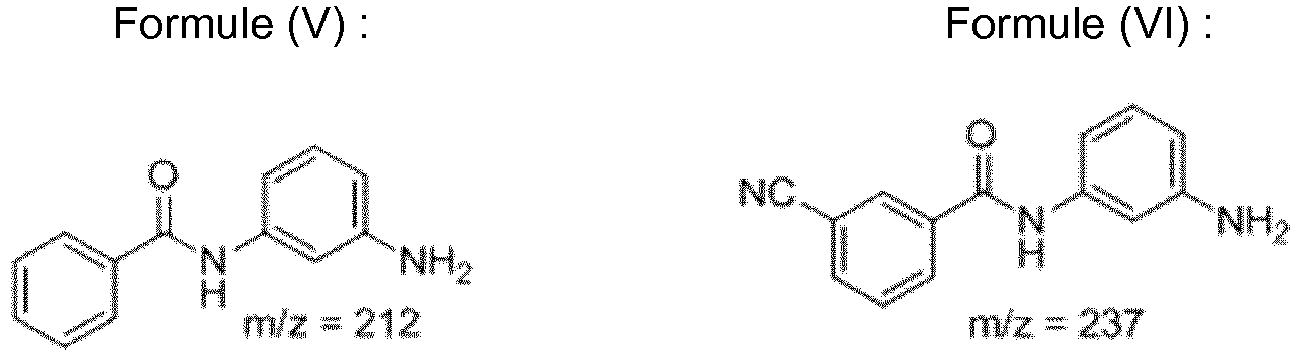
- Pyrolysis of the thin film polyamide layer at 650°C results in a ratio of responses from a flame ionization detector for fragments produced at 212 m/z and 237 m/z of equal to or greater than 2% (i.e. ratio of dimers produced at 212 m/z to those produced at 237 m/z.
- the fragments produced at 212 and 237 m/z are represented by Formula V and VI, respectively.
- the ratio of fragments (Formula V : Formula VI) is believed to be indicative of polymer structures that provide improved flux.
- the dimer fragment at 212 m/z forms predominantly during pyrolysis temperatures below 500°C whereas the dimer fragment 237 m/z predominantly forms at pyrolysis temperatures above 500°C.
- dimer fragment 212 originates from end groups where only single bound cleavage prevails and that dimer fragment 237 originates substantially from the bulk material where multiple bond cleavages and reduction occurs.
- the ratio of dimer fragment 212 m/z to that at 237 m/z can be used as a measure of relative conversion.
- a preferred pyrolysis methodology was conducted using a Frontier Lab 2020iD pyrolyzer mounted on an Agilent 6890 GC according to the Frontier Lab manufacturer conditions. Peak area detection was made using a flame ionization detector (FID). Membrane samples were weighed into Frontier Labs silica lined stainless steel cups using a Mettler E20 micro-balance capable of measuring to 0.001 mg. Sample weight targets were 200 ⁇ g +/- 50 ⁇ g.
- the pyrolysis was conducted by dropping the sample cup into the oven set at 650°C for 6 seconds in single shot mode. Separation was performed using a 30M X 0.25mm id with a 1 ⁇ m 5% phenyl methyl silicone internal phase column from Varian (FactorFour VF-5MS CP8946). Gas chromatograph conditions were the following: Agilent 6890 GC (SN: CN10605069 ), with a 30M X 0.25 mm, 1 ⁇ m 5% dimethyl polysiloxane phase (Varian FactorFour VF-5MS CP8946).
- the peak area of the fragment 212 m/z and fragment 237 m/z are normalized to the sample weight.
- the normalized peak areas are used to determine the ratio of fragments 212 m/z to 237 m/z. Further the normalize peak area of fragment 212 m/z is divided by the sum of the normalized peak areas for all other fragments providing a fraction of the m/z 212 fragment relative to the polyamide and is commonly noted as a percent composition by multiplying by 100.
- This methodology was used to determine the dimer content reported for the samples in the Example section. This value is equal to or greater than 2.0%, 2.6%, 2.7%, 3.0%, 3.2, and 3.5%; and less than 4%. Preferred ranges include: 2.0% to 4.0%, 2.6% to 4.0%, 2.7% to 4.0% and 3.0% to 4.0%.
- a potential drawback to the high charge membranes as described in the literature is their high NaCl passage at neutral and low pHs. This is believed to be due to the formation of a more open polyamide structure associated with very high levels of disassociated carboxylate content. Unexpectedly, post treatment of such membranes through diazotization chemistry has been demonstrated to restore acceptable NaCl passage qualities such that the resulting membrane shows acceptable NaCl passage at both neutral and low pHs.
- the thin film polyamide layer may optionally include hygroscopic polymers upon at least a portion of its surface.
- polymers include polymeric surfactants, polyacrylic acid, polyvinyl acetate, polyalkylene oxide compounds, poly(oxazoline) compounds, polyacrylamides and related reaction products as generally described in US 6280853 ; US 7815987 ; US 7918349 and US 7905361 .
- such polymers may be blended and/or reacted and may be coated or otherwise applied to the polyamide membrane from a common solution, or applied sequentially.
- Sample membranes were prepared using a pilot scale membrane manufacturing line. Polysulfone supports were casts from 16.5 wt % solutions in dimethylformamide (DMF) and subsequently soaked in a 3.5wt% aqueous solution meta-phenylene diamine (mPD). The resulting support was then pulled through a reaction table at constant speed while a thin, uniform layer of a non-polar coating solution was applied.
- DMF dimethylformamide
- mPD meta-phenylene diamine
- the non-polar coating solution included a isoparaffinic solvent (ISOPAR L), trimesoyl acid chloride (TMC), tri butyl phosphate (TBP) provided in a 1:1.3 stoichiometric ratio with TMC, and varying quantities of 1-carboxy-3,5-bis(chlorocarbonyl)benzoic acid (mh-TMC).
- ISOPAR L isoparaffinic solvent
- TMC trimesoyl acid chloride
- TBP tri butyl phosphate
- mh-TMC 1-carboxy-3,5-bis(chlorocarbonyl)benzoic acid
- Sample membrane sheets were then either (i) stored in deionized water until testing; or (ii) "post treated” by being soaked for approximately 15 minutes in a solution at 5-15°C prepared by combining 0.05% w/v NaNO 2 and 0.1 w/v% HCl and thereafter rinsed and stored in deionized water at room temperature until testing. Testing was conducted using a 2000 ppm NaCl solution at room temperature, pH 8 and 150 psi. Mean average flux is expressed in GFD. As shown by the test results summarized in Table 1, post-treatment of samples produced using a tri-hydrocarbyl compound and carboxylic acid monomer had an unexpected improvement in flux over comparable control membranes.
- the samples according to the invention are 4b and 5b. All other examples are comparative examples.
Landscapes
- Chemical & Material Sciences (AREA)
- Chemical Kinetics & Catalysis (AREA)
- Engineering & Computer Science (AREA)
- Manufacturing & Machinery (AREA)
- Inorganic Chemistry (AREA)
- Health & Medical Sciences (AREA)
- Transplantation (AREA)
- Separation Using Semi-Permeable Membranes (AREA)
- Polyamides (AREA)
- Manufacture Of Porous Articles, And Recovery And Treatment Of Waste Products (AREA)
Claims (5)
- Une membrane de polyamide composite en film mince comprenant un support poreux et une couche de polyamide en film mince caractérisée par le fait de posséder :i) une teneur en azo (-N=N-) allant de 0,40 % en poids à 1,00 % en poids, telle que mesurée par pyrolyse-chromatographie en phase gazeuse en utilisant du dichromate d'ammonium comme étalon de référence et en pyrolysant la couche de polyamide à 550 °C pendant 6 secondes, etii) une teneur en carboxylate dissocié d'au moins 0,40 mol/kg de polyamide telle que mesurée par RBS à un pH de 9,5 ; etdans laquelle la couche de polyamide en film mince est caractérisée en sus par le fait de produire un rapport du dimère représenté par la formule V au dimère représenté par la formule VI de 2,0 % à 4,0 % après pyrolyse à 650 °C pendant 6 secondes, tel que mesuré par GC-MS.
- La membrane de la revendication 1 dans laquelle la couche de polyamide en film mince est caractérisée en sus par le fait de posséder une teneur en carboxylate dissocié d'au moins 0,45 mol/kg de polyamide.
- La membrane de la revendication 1 dans laquelle la couche de polyamide en film mince est caractérisée en sus par le fait de produire un rapport des dimères allant de 2,6 % à 4,0 %.
- La membrane de la revendication 1 dans laquelle la couche de polyamide en film mince est caractérisée en sus par le fait de produire un rapport des dimères allant de 2,7 % à 4,0 %.
- La membrane de la revendication 1 dans laquelle la couche de polyamide en film mince est caractérisée en sus par le fait de produire un rapport des dimères allant de 3,0 % à 4,0 %.
Applications Claiming Priority (2)
| Application Number | Priority Date | Filing Date | Title |
|---|---|---|---|
| US201461925520P | 2014-01-09 | 2014-01-09 | |
| PCT/US2014/070305 WO2015105636A1 (fr) | 2014-01-09 | 2014-12-15 | Membrane de polyamide composite présentant une teneur en composés azoïques et une haute teneur en acide |
Publications (2)
| Publication Number | Publication Date |
|---|---|
| EP3092060A1 EP3092060A1 (fr) | 2016-11-16 |
| EP3092060B1 true EP3092060B1 (fr) | 2018-07-25 |
Family
ID=52273592
Family Applications (1)
| Application Number | Title | Priority Date | Filing Date |
|---|---|---|---|
| EP14821447.1A Active EP3092060B1 (fr) | 2014-01-09 | 2014-12-15 | Membrane de polyamide composite présentant une teneur en groupes azo et une haute teneur en acide |
Country Status (8)
| Country | Link |
|---|---|
| US (1) | US9981227B2 (fr) |
| EP (1) | EP3092060B1 (fr) |
| JP (1) | JP6535011B2 (fr) |
| KR (1) | KR102273550B1 (fr) |
| CN (1) | CN105899283A (fr) |
| CA (1) | CA2935699C (fr) |
| ES (1) | ES2690849T3 (fr) |
| WO (1) | WO2015105636A1 (fr) |
Families Citing this family (9)
| Publication number | Priority date | Publication date | Assignee | Title |
|---|---|---|---|---|
| WO2014179024A1 (fr) | 2013-05-03 | 2014-11-06 | Dow Global Technologies Llc | Membrane de polyamide composite dérivée d'un composé d'amine tertiaire acyclique aliphatique |
| JP6577468B2 (ja) | 2013-12-02 | 2019-09-18 | ダウ グローバル テクノロジーズ エルエルシー | 亜硝酸で後処理される複合ポリアミド膜 |
| WO2015084512A1 (fr) | 2013-12-02 | 2015-06-11 | Dow Global Technologies Llc | Membrane polyamide composite traitée au moyen de composés de dihydroxyaryle et d'acide nitreux |
| EP3092060B1 (fr) * | 2014-01-09 | 2018-07-25 | Dow Global Technologies LLC | Membrane de polyamide composite présentant une teneur en groupes azo et une haute teneur en acide |
| CN105873666B (zh) | 2014-01-09 | 2019-11-01 | 陶氏环球技术有限责任公司 | 具有高酸含量和低偶氮含量的复合聚酰胺膜 |
| ES2677994T3 (es) | 2014-01-09 | 2018-08-08 | Dow Global Technologies Llc | Membrana de poliamida de material compuesto con contenido azoico preferido |
| JP2017513703A (ja) | 2014-04-28 | 2017-06-01 | ダウ グローバル テクノロジーズ エルエルシー | 亜硝酸で後処理される複合ポリアミド膜 |
| KR102359211B1 (ko) | 2014-05-14 | 2022-02-07 | 다우 글로벌 테크놀로지스 엘엘씨 | 아질산으로 후처리된 복합 폴리아미드 막 |
| CN110404417A (zh) * | 2019-07-19 | 2019-11-05 | 中国石油大学(华东) | 聚酰胺膜的改性方法及改性聚酰胺膜 |
Family Cites Families (110)
| Publication number | Priority date | Publication date | Assignee | Title |
|---|---|---|---|---|
| CH462993A (de) | 1961-06-12 | 1968-09-30 | Ciba Geigy | Verfahren zur Herstellung von Küpenfarbstoffen |
| FR1587787A (fr) | 1968-10-02 | 1970-03-27 | ||
| US3694390A (en) | 1970-03-30 | 1972-09-26 | Alfred Edwards Winslow | Epoxidized polyamide resin forming stable aqueous solutions of high concentration |
| JPS5223346B2 (fr) | 1972-08-30 | 1977-06-23 | ||
| US4265745A (en) | 1977-05-25 | 1981-05-05 | Teijin Limited | Permselective membrane |
| US4259183A (en) | 1978-11-07 | 1981-03-31 | Midwest Research Institute | Reverse osmosis membrane |
| US4277344A (en) | 1979-02-22 | 1981-07-07 | Filmtec Corporation | Interfacially synthesized reverse osmosis membrane |
| US4606943A (en) | 1983-03-18 | 1986-08-19 | Culligan International Company | Method for preparation of semipermeable composite membrane |
| US4529646A (en) | 1984-07-30 | 1985-07-16 | E. I. Du Pont De Nemours And Company | Production of composite membranes |
| US4643829A (en) | 1984-07-30 | 1987-02-17 | E. I. Du Pont De Nemours And Company | Multilayer reverse osmosis membrane in which one layer is poly-meta-phenylene cyclohexane-1,3,5-tricarboxamide |
| US4761234A (en) | 1985-08-05 | 1988-08-02 | Toray Industries, Inc. | Interfacially synthesized reverse osmosis membrane |
| US4758343A (en) | 1985-09-20 | 1988-07-19 | Toray Industries, Inc. | Interfacially synthesized reverse osmosis membrane |
| US4719062A (en) | 1986-04-23 | 1988-01-12 | E. I. Du Pont De Nemours And Company | Extractant-surfactant post-treatments of permselective composite membranes |
| US4626468A (en) | 1986-04-23 | 1986-12-02 | E. I. Du Pont De Nemours And Company | Microporous support layer with interfacially polymerized copolyamide thereon |
| US4812270A (en) | 1986-04-28 | 1989-03-14 | Filmtec Corporation | Novel water softening membranes |
| US4888116A (en) | 1987-01-15 | 1989-12-19 | The Dow Chemical Company | Method of improving membrane properties via reaction of diazonium compounds or precursors |
| CA1318091C (fr) * | 1987-01-15 | 1993-05-25 | Filmtec Corporation | Membranes d'osmose inverse |
| US4830885A (en) | 1987-06-08 | 1989-05-16 | Allied-Signal Inc. | Chlorine-resistant semipermeable membranes |
| US4769148A (en) | 1987-11-18 | 1988-09-06 | The Dow Chemical Company | Novel polyamide reverse osmosis membranes |
| US4783346A (en) | 1987-12-10 | 1988-11-08 | E. I. Du Pont De Nemours And Company | Process for preparing composite membranes |
| JPH01180208A (ja) | 1988-01-11 | 1989-07-18 | Toray Ind Inc | 複合半透膜の製造方法およびその膜 |
| US4948507A (en) | 1988-09-28 | 1990-08-14 | Hydranautics Corporation | Interfacially synthesized reverse osmosis membrane containing an amine salt and processes for preparing the same |
| US4872984A (en) | 1988-09-28 | 1989-10-10 | Hydranautics Corporation | Interfacially synthesized reverse osmosis membrane containing an amine salt and processes for preparing the same |
| CN1035338A (zh) | 1988-12-16 | 1989-09-06 | 北京市海洋综合技术开发部 | 塑胶无胎卷材 |
| GB2247419B (en) | 1989-10-30 | 1993-08-25 | Aligena Ag | Semipermeable composite membranes |
| US5015382A (en) | 1989-04-20 | 1991-05-14 | E. I. Du Pont De Nemours And Company | Microporous support layer with interfacially polymerized copolyamide membrane thereon |
| US5015380A (en) | 1989-04-20 | 1991-05-14 | E. I. Du Pont De Nemours And Company | Microporous support layer with interfacially polymerized copolyamide membrane thereon |
| US4950404A (en) | 1989-08-30 | 1990-08-21 | Allied-Signal Inc. | High flux semipermeable membranes |
| US4960517A (en) | 1989-12-13 | 1990-10-02 | Filmtec Corporation | Treatment of composite polyamide membranes via substitution with amine reactive reagents |
| US5180802A (en) | 1990-07-18 | 1993-01-19 | Rheox, Inc. | Monoamine capped non-reactive polyamide composition |
| US5019264A (en) | 1990-07-31 | 1991-05-28 | E. I. Du Pont De Nemours And Company | Multilayer reverse osmosis membrane of polyamide-urea |
| JP3031763B2 (ja) | 1990-09-14 | 2000-04-10 | 日東電工株式会社 | 複合逆浸透膜およびその製造方法 |
| US5254261A (en) | 1991-08-12 | 1993-10-19 | Hydranautics | Interfacially synthesized reverse osmosis membranes and processes for preparing the same |
| US5290452A (en) | 1991-12-05 | 1994-03-01 | Exxon Research & Engineering Co. | Crosslinked polyester amide membranes and their use for organic separations |
| US5246587A (en) | 1991-12-23 | 1993-09-21 | Hydranautics | Interfacially synthesized reverse osmosis membranes and processes for preparing the same |
| CA2087421A1 (fr) | 1992-01-22 | 1993-07-23 | Hisao Hachisuka | Membrane d'osmose inverse composite et nouveau chlorure d'acide |
| US5616249A (en) | 1993-05-20 | 1997-04-01 | Ionics, Incorporated | Nanofiltration apparatus and processes |
| JP3006976B2 (ja) | 1993-06-24 | 2000-02-07 | 日東電工株式会社 | 高透過性複合逆浸透膜の製造方法 |
| JPH07178327A (ja) | 1993-11-12 | 1995-07-18 | Nitto Denko Corp | 複合半透膜及びその製造方法 |
| US5783079A (en) | 1994-08-29 | 1998-07-21 | Toyo Boseki Kabushiki Kaisha | Composite hollow fiber membrane and process for its production |
| US5693227A (en) | 1994-11-17 | 1997-12-02 | Ionics, Incorporated | Catalyst mediated method of interfacial polymerization on a microporous support, and polymers, fibers, films and membranes made by such method |
| JP3489922B2 (ja) | 1994-12-22 | 2004-01-26 | 日東電工株式会社 | 高透過性複合逆浸透膜の製造方法 |
| US5614099A (en) | 1994-12-22 | 1997-03-25 | Nitto Denko Corporation | Highly permeable composite reverse osmosis membrane, method of producing the same, and method of using the same |
| US5582725A (en) | 1995-05-19 | 1996-12-10 | Bend Research, Inc. | Chlorine-resistant composite membranes with high organic rejection |
| US5989426A (en) | 1995-07-05 | 1999-11-23 | Nitto Denko Corp. | Osmosis membrane |
| KR0183370B1 (ko) | 1995-07-07 | 1999-04-15 | 김은영 | 방향족 폴리에스테르 또는 방향족 폴리에스테르와 폴리아미드 공중합체의 활성층을 갖는 역삼투용 복합막 |
| JP3681214B2 (ja) | 1996-03-21 | 2005-08-10 | 日東電工株式会社 | 高透過性複合逆浸透膜 |
| IL121046A (en) | 1997-06-10 | 2001-07-24 | Weizmann Kiryat Membrane Prod | Semipermeable encapsulated membranes with improved acid and base stability and process for their manufacture and their use |
| DE69814891T2 (de) | 1997-07-02 | 2004-05-13 | Nitto Denko Corp., Ibaraki | Zusammengesetzte umkehrosmosemembran und verfahren zu ihrer herstellung |
| US5876602A (en) | 1997-11-04 | 1999-03-02 | The Dow Chemical Company | Treatment of composite polyamide membranes to improve performance |
| US6162358A (en) | 1998-06-05 | 2000-12-19 | Nl Chemicals Technologies, Inc. | High flux reverse osmosis membrane |
| WO2000041800A1 (fr) | 1999-01-14 | 2000-07-20 | Toray Industries, Inc. | Membrane semi-permeable composite, procede de fabrication et procede de purification d'eau a l'aide de cette membrane |
| JP4404988B2 (ja) | 1999-04-21 | 2010-01-27 | 住友精化株式会社 | ポリアミド樹脂水性分散液の製造方法 |
| US6245234B1 (en) | 1999-06-03 | 2001-06-12 | Saehan Industries Incorporation | Composite polyamide reverse osmosis membrane and method of producing the same |
| US6280853B1 (en) | 1999-06-10 | 2001-08-28 | The Dow Chemical Company | Composite membrane with polyalkylene oxide modified polyamide surface |
| US6464873B1 (en) | 1999-06-15 | 2002-10-15 | Hydranautics | Interfacially polymerized, bipiperidine-polyamide membranes for reverse osmosis and/or nanofiltration and process for making the same |
| CN1195576C (zh) | 1999-09-28 | 2005-04-06 | 东丽株式会社 | 复合半透膜的制造方法 |
| US6337018B1 (en) | 2000-04-17 | 2002-01-08 | The Dow Chemical Company | Composite membrane and method for making the same |
| US7279097B2 (en) | 2003-06-18 | 2007-10-09 | Toray Industries, Inc. | Composite semipermeable membrane, and production process thereof |
| CN101325998B (zh) | 2005-12-16 | 2011-12-21 | 东丽株式会社 | 复合半透膜、其制造方法及其用途 |
| US20070251883A1 (en) | 2006-04-28 | 2007-11-01 | Niu Q Jason | Reverse Osmosis Membrane with Branched Poly(Alkylene Oxide) Modified Antifouling Surface |
| KR100905901B1 (ko) | 2006-09-07 | 2009-07-02 | 웅진코웨이주식회사 | 폴리아미드 역삼투 복합막 활성층 형성용 아민 수용액,이를 이용한 폴리아미드 역삼투 복합막, 및 이의 제조방법 |
| CN100443150C (zh) | 2006-09-22 | 2008-12-17 | 中国科学院长春应用化学研究所 | 含联苯结构的芳香聚酰胺反渗透复合膜 |
| WO2008097786A2 (fr) | 2007-02-05 | 2008-08-14 | Dow Global Technologies Inc. | Membrane en polyamide modifié |
| US7806275B2 (en) | 2007-05-09 | 2010-10-05 | The United States Of America As Represented By The Secretary Of The Interior, The Bureau Of Reclamation | Chlorine resistant polyamides and membranes made from the same |
| US20090107922A1 (en) | 2007-10-26 | 2009-04-30 | General Electric Company | Membrane, water treatment system, and associated method |
| US8177978B2 (en) | 2008-04-15 | 2012-05-15 | Nanoh20, Inc. | Reverse osmosis membranes |
| US8147735B2 (en) | 2008-07-09 | 2012-04-03 | Eltron Research & Development, Inc. | Semipermeable polymers and method for producing same |
| US7815987B2 (en) | 2008-12-04 | 2010-10-19 | Dow Global Technologies Inc. | Polyamide membrane with coating of polyalkylene oxide and polyacrylamide compounds |
| WO2011008549A2 (fr) | 2009-06-29 | 2011-01-20 | NanoH2O Inc. | Membranes perfectionnées d'osmose inverse, composites à couches minces, hybrides, avec des additifs azotés |
| US20110049055A1 (en) | 2009-08-31 | 2011-03-03 | General Electric Company | Reverse osmosis composite membranes for boron removal |
| US9486745B2 (en) | 2009-12-22 | 2016-11-08 | Toray Industries, Inc. | Semipermeable membrane and manufacturing method therefor |
| JP5640972B2 (ja) | 2009-12-24 | 2014-12-17 | 東レ株式会社 | 複合半透膜およびその製造方法 |
| CN102781560B (zh) | 2010-02-23 | 2015-05-20 | 东丽株式会社 | 复合半透膜及其制造方法 |
| NO335286B1 (no) | 2010-06-04 | 2014-11-03 | Tom-Nils Nilsen | Tynnfilmkompositter |
| CN103025412A (zh) | 2010-08-11 | 2013-04-03 | 东丽株式会社 | 分离膜元件以及制造复合半透膜的方法 |
| US9216385B2 (en) | 2010-10-04 | 2015-12-22 | Saudi Arabian Oil Company | Application of rejection enhancing agents (REAs) that do not have cloud point limitations on desalination membranes |
| US20130256215A1 (en) | 2010-12-28 | 2013-10-03 | Toray Industries, Inc. | Composite semipermeable membrane |
| CN103328083B (zh) | 2011-01-24 | 2018-02-09 | 陶氏环球技术有限责任公司 | 复合聚酰胺膜 |
| KR101920192B1 (ko) | 2011-01-24 | 2018-11-20 | 다우 글로벌 테크놀로지스 엘엘씨 | 복합 폴리아미드 막 |
| US8968828B2 (en) | 2011-01-24 | 2015-03-03 | Dow Global Technologies Llc | Composite polyamide membrane |
| US9022227B2 (en) * | 2011-03-21 | 2015-05-05 | International Business Machines Corporation | Composite membranes and methods of preparation thereof |
| CN102219673B (zh) | 2011-05-06 | 2014-07-02 | 中国科学院长春应用化学研究所 | 荷正电纳滤复合膜及其制备方法 |
| CN103764264B (zh) | 2011-08-31 | 2016-11-16 | 陶氏环球技术有限责任公司 | 源自包含胺反应性官能团和含磷官能团的单体的复合聚酰胺膜 |
| KR101946792B1 (ko) * | 2011-09-29 | 2019-02-13 | 다우 글로벌 테크놀로지스 엘엘씨 | 카복실산 함유 아실 할라이드 단량체로부터 유도된 복합 폴리아미드 멤브레인 |
| WO2013048764A1 (fr) | 2011-09-29 | 2013-04-04 | Dow Global Technologies Llc | Procédé pour préparer un composé halogénure d'acyle monohydrolysé de haute pureté |
| IN2014CN02226A (fr) | 2011-09-29 | 2015-06-12 | Dow Global Technologies Llc | |
| EP2745919A4 (fr) | 2011-09-29 | 2015-06-24 | Toray Industries | Membrane semi-perméable composite |
| WO2013048763A1 (fr) | 2011-09-29 | 2013-04-04 | Dow Global Technologies Llc | Procédé de solubilisation d'un composé contenant de l'acide carboxylique dans un solvant hydrocarboné |
| ES2806675T3 (es) | 2012-01-06 | 2021-02-18 | Ddp Specialty Electronic Mat Us Inc | Método de preparación de una membrana de poliamida de material compuesto |
| CN104470627B (zh) | 2012-07-19 | 2018-05-11 | 陶氏环球技术有限责任公司 | 复合聚酰胺膜 |
| CN104918687A (zh) | 2013-01-14 | 2015-09-16 | 陶氏环球技术有限责任公司 | 使用非极性溶剂的掺合物经由界面聚合制造复合聚酰胺膜 |
| JP6272905B2 (ja) | 2013-01-14 | 2018-01-31 | ダウ グローバル テクノロジーズ エルエルシー | トリ−ヒドロカルビルホスフェートを含む複合ポリアミド膜 |
| WO2014109947A1 (fr) | 2013-01-14 | 2014-07-17 | Dow Global Technologies Llc | Membrane en polyamide composite comprenant un monomère de benzamide substitué |
| US9051227B2 (en) | 2013-03-16 | 2015-06-09 | Dow Global Technologies Llc | In-situ method for preparing hydrolyzed acyl halide compound |
| US9289729B2 (en) | 2013-03-16 | 2016-03-22 | Dow Global Technologies Llc | Composite polyamide membrane derived from carboxylic acid containing acyl halide monomer |
| US9051417B2 (en) | 2013-03-16 | 2015-06-09 | Dow Global Technologies Llc | Method for solubilizing carboxylic acid-containing compound in hydrocarbon solvent |
| US8999449B2 (en) | 2013-03-27 | 2015-04-07 | Dow Global Technologies Llc | Composite polyamide membrane derived from aromatic monomer including anhydride and sulfonyl halide functional groups |
| JP6577468B2 (ja) | 2013-12-02 | 2019-09-18 | ダウ グローバル テクノロジーズ エルエルシー | 亜硝酸で後処理される複合ポリアミド膜 |
| WO2015084512A1 (fr) | 2013-12-02 | 2015-06-11 | Dow Global Technologies Llc | Membrane polyamide composite traitée au moyen de composés de dihydroxyaryle et d'acide nitreux |
| US20160304363A1 (en) * | 2014-01-07 | 2016-10-20 | Dow Global Technologies Llc | Separation of hydrocarbons from aqueous mixture using fouling resistant reverse osmosis membrane |
| EP3092056B1 (fr) | 2014-01-07 | 2018-08-01 | Dow Global Technologies LLC | Désalinisation de mélange aqueux contenant des particules nanométriques à l'aide d'une membrane d'osmose inverse résistant à l'encrassement |
| EP3092057B1 (fr) * | 2014-01-07 | 2018-09-19 | Dow Global Technologies LLC | Traitement de mélanges aqueux contenant un tensioactif anionique utilisant une membrane d'osmose inverse résistant à l'encrassement |
| EP3092060B1 (fr) * | 2014-01-09 | 2018-07-25 | Dow Global Technologies LLC | Membrane de polyamide composite présentant une teneur en groupes azo et une haute teneur en acide |
| CN105873666B (zh) * | 2014-01-09 | 2019-11-01 | 陶氏环球技术有限责任公司 | 具有高酸含量和低偶氮含量的复合聚酰胺膜 |
| ES2677994T3 (es) * | 2014-01-09 | 2018-08-08 | Dow Global Technologies Llc | Membrana de poliamida de material compuesto con contenido azoico preferido |
| CN105899284A (zh) | 2014-01-13 | 2016-08-24 | 陶氏环球技术有限责任公司 | 高溶胀性复合聚酰胺膜 |
| US9774058B2 (en) * | 2014-04-18 | 2017-09-26 | Seeo, Inc. | Polymer composition with electrophilic groups for stabilization of lithium sulfur batteries |
| JP6654576B2 (ja) | 2014-05-14 | 2020-02-26 | ダウ グローバル テクノロジーズ エルエルシー | 亜硝酸で後処理される複合ポリアミド膜 |
| WO2015175256A1 (fr) | 2014-05-14 | 2015-11-19 | Dow Global Technologies Llc | Membrane de polyamide composite post-traitée avec de l'acide nitreux |
-
2014
- 2014-12-15 EP EP14821447.1A patent/EP3092060B1/fr active Active
- 2014-12-15 JP JP2016542974A patent/JP6535011B2/ja active Active
- 2014-12-15 ES ES14821447.1T patent/ES2690849T3/es active Active
- 2014-12-15 KR KR1020167020100A patent/KR102273550B1/ko active Active
- 2014-12-15 CA CA2935699A patent/CA2935699C/fr active Active
- 2014-12-15 WO PCT/US2014/070305 patent/WO2015105636A1/fr not_active Ceased
- 2014-12-15 US US15/102,882 patent/US9981227B2/en active Active
- 2014-12-15 CN CN201480071398.6A patent/CN105899283A/zh active Pending
Non-Patent Citations (1)
| Title |
|---|
| None * |
Also Published As
| Publication number | Publication date |
|---|---|
| CA2935699A1 (fr) | 2015-07-16 |
| US20160310909A1 (en) | 2016-10-27 |
| WO2015105636A1 (fr) | 2015-07-16 |
| KR102273550B1 (ko) | 2021-07-07 |
| US9981227B2 (en) | 2018-05-29 |
| CN105899283A (zh) | 2016-08-24 |
| KR20160106084A (ko) | 2016-09-09 |
| CA2935699C (fr) | 2022-05-31 |
| ES2690849T3 (es) | 2018-11-22 |
| EP3092060A1 (fr) | 2016-11-16 |
| JP2017503648A (ja) | 2017-02-02 |
| JP6535011B2 (ja) | 2019-06-26 |
Similar Documents
| Publication | Publication Date | Title |
|---|---|---|
| EP3092060B1 (fr) | Membrane de polyamide composite présentant une teneur en groupes azo et une haute teneur en acide | |
| EP3092062B1 (fr) | Membrane de polyamide composite ayant une teneur en groupes azo préférée | |
| EP3092061B1 (fr) | Membrane de polyamide composite présentant une haute teneur en acide et une faible teneur en composés azoïques | |
| JP6272905B2 (ja) | トリ−ヒドロカルビルホスフェートを含む複合ポリアミド膜 | |
| EP3142777B1 (fr) | Membrane de polyamide composite post-traitée avec de l'acide nitreux | |
| KR102357884B1 (ko) | 아질산으로 후-처리된 복합 폴리아미드 멤브레인 | |
| EP3092056B1 (fr) | Désalinisation de mélange aqueux contenant des particules nanométriques à l'aide d'une membrane d'osmose inverse résistant à l'encrassement | |
| EP3077088B1 (fr) | Methode de fabrication d'une membrane de polyamide composite post-traitée avec de l'acide nitreux | |
| EP3092057B1 (fr) | Traitement de mélanges aqueux contenant un tensioactif anionique utilisant une membrane d'osmose inverse résistant à l'encrassement |
Legal Events
| Date | Code | Title | Description |
|---|---|---|---|
| PUAI | Public reference made under article 153(3) epc to a published international application that has entered the european phase |
Free format text: ORIGINAL CODE: 0009012 |
|
| 17P | Request for examination filed |
Effective date: 20160728 |
|
| AK | Designated contracting states |
Kind code of ref document: A1 Designated state(s): AL AT BE BG CH CY CZ DE DK EE ES FI FR GB GR HR HU IE IS IT LI LT LU LV MC MK MT NL NO PL PT RO RS SE SI SK SM TR |
|
| AX | Request for extension of the european patent |
Extension state: BA ME |
|
| DAX | Request for extension of the european patent (deleted) | ||
| GRAJ | Information related to disapproval of communication of intention to grant by the applicant or resumption of examination proceedings by the epo deleted |
Free format text: ORIGINAL CODE: EPIDOSDIGR1 |
|
| GRAP | Despatch of communication of intention to grant a patent |
Free format text: ORIGINAL CODE: EPIDOSNIGR1 |
|
| GRAP | Despatch of communication of intention to grant a patent |
Free format text: ORIGINAL CODE: EPIDOSNIGR1 |
|
| INTG | Intention to grant announced |
Effective date: 20180104 |
|
| GRAS | Grant fee paid |
Free format text: ORIGINAL CODE: EPIDOSNIGR3 |
|
| GRAJ | Information related to disapproval of communication of intention to grant by the applicant or resumption of examination proceedings by the epo deleted |
Free format text: ORIGINAL CODE: EPIDOSDIGR1 |
|
| GRAL | Information related to payment of fee for publishing/printing deleted |
Free format text: ORIGINAL CODE: EPIDOSDIGR3 |
|
| GRAR | Information related to intention to grant a patent recorded |
Free format text: ORIGINAL CODE: EPIDOSNIGR71 |
|
| INTC | Intention to grant announced (deleted) | ||
| GRAA | (expected) grant |
Free format text: ORIGINAL CODE: 0009210 |
|
| AK | Designated contracting states |
Kind code of ref document: B1 Designated state(s): AL AT BE BG CH CY CZ DE DK EE ES FI FR GB GR HR HU IE IS IT LI LT LU LV MC MK MT NL NO PL PT RO RS SE SI SK SM TR |
|
| INTG | Intention to grant announced |
Effective date: 20180618 |
|
| REG | Reference to a national code |
Ref country code: GB Ref legal event code: FG4D |
|
| REG | Reference to a national code |
Ref country code: CH Ref legal event code: EP |
|
| REG | Reference to a national code |
Ref country code: AT Ref legal event code: REF Ref document number: 1021162 Country of ref document: AT Kind code of ref document: T Effective date: 20180815 |
|
| REG | Reference to a national code |
Ref country code: IE Ref legal event code: FG4D |
|
| REG | Reference to a national code |
Ref country code: DE Ref legal event code: R096 Ref document number: 602014029280 Country of ref document: DE |
|
| REG | Reference to a national code |
Ref country code: NL Ref legal event code: FP |
|
| REG | Reference to a national code |
Ref country code: ES Ref legal event code: FG2A Ref document number: 2690849 Country of ref document: ES Kind code of ref document: T3 Effective date: 20181122 |
|
| REG | Reference to a national code |
Ref country code: LT Ref legal event code: MG4D |
|
| REG | Reference to a national code |
Ref country code: AT Ref legal event code: MK05 Ref document number: 1021162 Country of ref document: AT Kind code of ref document: T Effective date: 20180725 |
|
| PG25 | Lapsed in a contracting state [announced via postgrant information from national office to epo] |
Ref country code: NO Free format text: LAPSE BECAUSE OF FAILURE TO SUBMIT A TRANSLATION OF THE DESCRIPTION OR TO PAY THE FEE WITHIN THE PRESCRIBED TIME-LIMIT Effective date: 20181025 Ref country code: FI Free format text: LAPSE BECAUSE OF FAILURE TO SUBMIT A TRANSLATION OF THE DESCRIPTION OR TO PAY THE FEE WITHIN THE PRESCRIBED TIME-LIMIT Effective date: 20180725 Ref country code: AT Free format text: LAPSE BECAUSE OF FAILURE TO SUBMIT A TRANSLATION OF THE DESCRIPTION OR TO PAY THE FEE WITHIN THE PRESCRIBED TIME-LIMIT Effective date: 20180725 Ref country code: GR Free format text: LAPSE BECAUSE OF FAILURE TO SUBMIT A TRANSLATION OF THE DESCRIPTION OR TO PAY THE FEE WITHIN THE PRESCRIBED TIME-LIMIT Effective date: 20181026 Ref country code: RS Free format text: LAPSE BECAUSE OF FAILURE TO SUBMIT A TRANSLATION OF THE DESCRIPTION OR TO PAY THE FEE WITHIN THE PRESCRIBED TIME-LIMIT Effective date: 20180725 Ref country code: LT Free format text: LAPSE BECAUSE OF FAILURE TO SUBMIT A TRANSLATION OF THE DESCRIPTION OR TO PAY THE FEE WITHIN THE PRESCRIBED TIME-LIMIT Effective date: 20180725 Ref country code: IS Free format text: LAPSE BECAUSE OF FAILURE TO SUBMIT A TRANSLATION OF THE DESCRIPTION OR TO PAY THE FEE WITHIN THE PRESCRIBED TIME-LIMIT Effective date: 20181125 Ref country code: PL Free format text: LAPSE BECAUSE OF FAILURE TO SUBMIT A TRANSLATION OF THE DESCRIPTION OR TO PAY THE FEE WITHIN THE PRESCRIBED TIME-LIMIT Effective date: 20180725 Ref country code: SE Free format text: LAPSE BECAUSE OF FAILURE TO SUBMIT A TRANSLATION OF THE DESCRIPTION OR TO PAY THE FEE WITHIN THE PRESCRIBED TIME-LIMIT Effective date: 20180725 Ref country code: BG Free format text: LAPSE BECAUSE OF FAILURE TO SUBMIT A TRANSLATION OF THE DESCRIPTION OR TO PAY THE FEE WITHIN THE PRESCRIBED TIME-LIMIT Effective date: 20181025 |
|
| PG25 | Lapsed in a contracting state [announced via postgrant information from national office to epo] |
Ref country code: LV Free format text: LAPSE BECAUSE OF FAILURE TO SUBMIT A TRANSLATION OF THE DESCRIPTION OR TO PAY THE FEE WITHIN THE PRESCRIBED TIME-LIMIT Effective date: 20180725 Ref country code: AL Free format text: LAPSE BECAUSE OF FAILURE TO SUBMIT A TRANSLATION OF THE DESCRIPTION OR TO PAY THE FEE WITHIN THE PRESCRIBED TIME-LIMIT Effective date: 20180725 Ref country code: HR Free format text: LAPSE BECAUSE OF FAILURE TO SUBMIT A TRANSLATION OF THE DESCRIPTION OR TO PAY THE FEE WITHIN THE PRESCRIBED TIME-LIMIT Effective date: 20180725 |
|
| REG | Reference to a national code |
Ref country code: DE Ref legal event code: R097 Ref document number: 602014029280 Country of ref document: DE |
|
| PG25 | Lapsed in a contracting state [announced via postgrant information from national office to epo] |
Ref country code: CZ Free format text: LAPSE BECAUSE OF FAILURE TO SUBMIT A TRANSLATION OF THE DESCRIPTION OR TO PAY THE FEE WITHIN THE PRESCRIBED TIME-LIMIT Effective date: 20180725 Ref country code: RO Free format text: LAPSE BECAUSE OF FAILURE TO SUBMIT A TRANSLATION OF THE DESCRIPTION OR TO PAY THE FEE WITHIN THE PRESCRIBED TIME-LIMIT Effective date: 20180725 Ref country code: EE Free format text: LAPSE BECAUSE OF FAILURE TO SUBMIT A TRANSLATION OF THE DESCRIPTION OR TO PAY THE FEE WITHIN THE PRESCRIBED TIME-LIMIT Effective date: 20180725 |
|
| PG25 | Lapsed in a contracting state [announced via postgrant information from national office to epo] |
Ref country code: SM Free format text: LAPSE BECAUSE OF FAILURE TO SUBMIT A TRANSLATION OF THE DESCRIPTION OR TO PAY THE FEE WITHIN THE PRESCRIBED TIME-LIMIT Effective date: 20180725 Ref country code: SK Free format text: LAPSE BECAUSE OF FAILURE TO SUBMIT A TRANSLATION OF THE DESCRIPTION OR TO PAY THE FEE WITHIN THE PRESCRIBED TIME-LIMIT Effective date: 20180725 Ref country code: DK Free format text: LAPSE BECAUSE OF FAILURE TO SUBMIT A TRANSLATION OF THE DESCRIPTION OR TO PAY THE FEE WITHIN THE PRESCRIBED TIME-LIMIT Effective date: 20180725 |
|
| PLBE | No opposition filed within time limit |
Free format text: ORIGINAL CODE: 0009261 |
|
| STAA | Information on the status of an ep patent application or granted ep patent |
Free format text: STATUS: NO OPPOSITION FILED WITHIN TIME LIMIT |
|
| 26N | No opposition filed |
Effective date: 20190426 |
|
| REG | Reference to a national code |
Ref country code: CH Ref legal event code: PL |
|
| GBPC | Gb: european patent ceased through non-payment of renewal fee |
Effective date: 20181215 |
|
| PG25 | Lapsed in a contracting state [announced via postgrant information from national office to epo] |
Ref country code: SI Free format text: LAPSE BECAUSE OF FAILURE TO SUBMIT A TRANSLATION OF THE DESCRIPTION OR TO PAY THE FEE WITHIN THE PRESCRIBED TIME-LIMIT Effective date: 20180725 Ref country code: LU Free format text: LAPSE BECAUSE OF NON-PAYMENT OF DUE FEES Effective date: 20181215 Ref country code: MC Free format text: LAPSE BECAUSE OF FAILURE TO SUBMIT A TRANSLATION OF THE DESCRIPTION OR TO PAY THE FEE WITHIN THE PRESCRIBED TIME-LIMIT Effective date: 20180725 |
|
| REG | Reference to a national code |
Ref country code: IE Ref legal event code: MM4A |
|
| REG | Reference to a national code |
Ref country code: BE Ref legal event code: MM Effective date: 20181231 |
|
| PG25 | Lapsed in a contracting state [announced via postgrant information from national office to epo] |
Ref country code: IE Free format text: LAPSE BECAUSE OF NON-PAYMENT OF DUE FEES Effective date: 20181215 |
|
| PG25 | Lapsed in a contracting state [announced via postgrant information from national office to epo] |
Ref country code: BE Free format text: LAPSE BECAUSE OF NON-PAYMENT OF DUE FEES Effective date: 20181231 |
|
| PG25 | Lapsed in a contracting state [announced via postgrant information from national office to epo] |
Ref country code: CH Free format text: LAPSE BECAUSE OF NON-PAYMENT OF DUE FEES Effective date: 20181231 Ref country code: GB Free format text: LAPSE BECAUSE OF NON-PAYMENT OF DUE FEES Effective date: 20181215 Ref country code: LI Free format text: LAPSE BECAUSE OF NON-PAYMENT OF DUE FEES Effective date: 20181231 |
|
| PG25 | Lapsed in a contracting state [announced via postgrant information from national office to epo] |
Ref country code: MT Free format text: LAPSE BECAUSE OF NON-PAYMENT OF DUE FEES Effective date: 20181215 |
|
| PG25 | Lapsed in a contracting state [announced via postgrant information from national office to epo] |
Ref country code: TR Free format text: LAPSE BECAUSE OF FAILURE TO SUBMIT A TRANSLATION OF THE DESCRIPTION OR TO PAY THE FEE WITHIN THE PRESCRIBED TIME-LIMIT Effective date: 20180725 |
|
| PG25 | Lapsed in a contracting state [announced via postgrant information from national office to epo] |
Ref country code: PT Free format text: LAPSE BECAUSE OF FAILURE TO SUBMIT A TRANSLATION OF THE DESCRIPTION OR TO PAY THE FEE WITHIN THE PRESCRIBED TIME-LIMIT Effective date: 20180725 |
|
| PG25 | Lapsed in a contracting state [announced via postgrant information from national office to epo] |
Ref country code: HU Free format text: LAPSE BECAUSE OF FAILURE TO SUBMIT A TRANSLATION OF THE DESCRIPTION OR TO PAY THE FEE WITHIN THE PRESCRIBED TIME-LIMIT; INVALID AB INITIO Effective date: 20141215 Ref country code: CY Free format text: LAPSE BECAUSE OF FAILURE TO SUBMIT A TRANSLATION OF THE DESCRIPTION OR TO PAY THE FEE WITHIN THE PRESCRIBED TIME-LIMIT Effective date: 20180725 Ref country code: MK Free format text: LAPSE BECAUSE OF NON-PAYMENT OF DUE FEES Effective date: 20180725 |
|
| P01 | Opt-out of the competence of the unified patent court (upc) registered |
Effective date: 20230528 |
|
| PGFP | Annual fee paid to national office [announced via postgrant information from national office to epo] |
Ref country code: NL Payment date: 20231116 Year of fee payment: 10 |
|
| PGFP | Annual fee paid to national office [announced via postgrant information from national office to epo] |
Ref country code: IT Payment date: 20231110 Year of fee payment: 10 Ref country code: FR Payment date: 20231108 Year of fee payment: 10 |
|
| PGFP | Annual fee paid to national office [announced via postgrant information from national office to epo] |
Ref country code: ES Payment date: 20240118 Year of fee payment: 10 |
|
| REG | Reference to a national code |
Ref country code: DE Ref legal event code: R082 Ref document number: 602014029280 Country of ref document: DE Representative=s name: ABITZ & PARTNER PATENTANWAELTE MBB, DE Ref country code: DE Ref legal event code: R081 Ref document number: 602014029280 Country of ref document: DE Owner name: DDP SPECIALTY ELECTRONIC MATERIALS US, LLC, WI, US Free format text: FORMER OWNER: DOW GLOBAL TECHNOLOGIES LLC, MIDLAND, MICH., US |
|
| REG | Reference to a national code |
Ref country code: NL Ref legal event code: MM Effective date: 20250101 |
|
| PG25 | Lapsed in a contracting state [announced via postgrant information from national office to epo] |
Ref country code: NL Free format text: LAPSE BECAUSE OF NON-PAYMENT OF DUE FEES Effective date: 20250101 |
|
| PG25 | Lapsed in a contracting state [announced via postgrant information from national office to epo] |
Ref country code: IT Free format text: LAPSE BECAUSE OF NON-PAYMENT OF DUE FEES Effective date: 20241215 |
|
| PG25 | Lapsed in a contracting state [announced via postgrant information from national office to epo] |
Ref country code: FR Free format text: LAPSE BECAUSE OF NON-PAYMENT OF DUE FEES Effective date: 20241231 |
|
| PGFP | Annual fee paid to national office [announced via postgrant information from national office to epo] |
Ref country code: DE Payment date: 20251104 Year of fee payment: 12 |
|
| REG | Reference to a national code |
Ref country code: ES Ref legal event code: FD2A Effective date: 20260202 |
|
| PG25 | Lapsed in a contracting state [announced via postgrant information from national office to epo] |
Ref country code: ES Free format text: LAPSE BECAUSE OF NON-PAYMENT OF DUE FEES Effective date: 20241216 |