EP3092914A2 - Anpassbares schuhoberteil und anpassbare sohle - Google Patents
Anpassbares schuhoberteil und anpassbare sohle Download PDFInfo
- Publication number
- EP3092914A2 EP3092914A2 EP16168587.0A EP16168587A EP3092914A2 EP 3092914 A2 EP3092914 A2 EP 3092914A2 EP 16168587 A EP16168587 A EP 16168587A EP 3092914 A2 EP3092914 A2 EP 3092914A2
- Authority
- EP
- European Patent Office
- Prior art keywords
- layer
- sole
- shoe upper
- regions
- shoe
- Prior art date
- Legal status (The legal status is an assumption and is not a legal conclusion. Google has not performed a legal analysis and makes no representation as to the accuracy of the status listed.)
- Withdrawn
Links
Images


Classifications
-
- A—HUMAN NECESSITIES
- A43—FOOTWEAR
- A43B—CHARACTERISTIC FEATURES OF FOOTWEAR; PARTS OF FOOTWEAR
- A43B5/00—Footwear for sporting purposes
- A43B5/02—Football boots or shoes, i.e. for soccer, football or rugby
-
- A—HUMAN NECESSITIES
- A43—FOOTWEAR
- A43B—CHARACTERISTIC FEATURES OF FOOTWEAR; PARTS OF FOOTWEAR
- A43B13/00—Soles; Sole-and-heel integral units
- A43B13/02—Soles; Sole-and-heel integral units characterised by the material
- A43B13/04—Plastics, rubber or vulcanised fibre
-
- A—HUMAN NECESSITIES
- A43—FOOTWEAR
- A43B—CHARACTERISTIC FEATURES OF FOOTWEAR; PARTS OF FOOTWEAR
- A43B13/00—Soles; Sole-and-heel integral units
- A43B13/02—Soles; Sole-and-heel integral units characterised by the material
- A43B13/12—Soles with several layers of different materials
-
- A—HUMAN NECESSITIES
- A43—FOOTWEAR
- A43B—CHARACTERISTIC FEATURES OF FOOTWEAR; PARTS OF FOOTWEAR
- A43B13/00—Soles; Sole-and-heel integral units
- A43B13/14—Soles; Sole-and-heel integral units characterised by the constructive form
- A43B13/141—Soles; Sole-and-heel integral units characterised by the constructive form with a part of the sole being flexible, e.g. permitting articulation or torsion
-
- A—HUMAN NECESSITIES
- A43—FOOTWEAR
- A43B—CHARACTERISTIC FEATURES OF FOOTWEAR; PARTS OF FOOTWEAR
- A43B13/00—Soles; Sole-and-heel integral units
- A43B13/14—Soles; Sole-and-heel integral units characterised by the constructive form
- A43B13/18—Resilient soles
- A43B13/187—Resiliency achieved by the features of the material, e.g. foam, non liquid materials
-
- A—HUMAN NECESSITIES
- A43—FOOTWEAR
- A43B—CHARACTERISTIC FEATURES OF FOOTWEAR; PARTS OF FOOTWEAR
- A43B23/00—Uppers; Boot legs; Stiffeners; Other single parts of footwear
- A43B23/02—Uppers; Boot legs
- A43B23/0205—Uppers; Boot legs characterised by the material
- A43B23/0235—Different layers of different material
-
- A—HUMAN NECESSITIES
- A43—FOOTWEAR
- A43B—CHARACTERISTIC FEATURES OF FOOTWEAR; PARTS OF FOOTWEAR
- A43B23/00—Uppers; Boot legs; Stiffeners; Other single parts of footwear
- A43B23/02—Uppers; Boot legs
- A43B23/0245—Uppers; Boot legs characterised by the constructive form
- A43B23/025—Uppers; Boot legs characterised by the constructive form assembled by stitching
-
- A—HUMAN NECESSITIES
- A43—FOOTWEAR
- A43B—CHARACTERISTIC FEATURES OF FOOTWEAR; PARTS OF FOOTWEAR
- A43B23/00—Uppers; Boot legs; Stiffeners; Other single parts of footwear
- A43B23/02—Uppers; Boot legs
- A43B23/0245—Uppers; Boot legs characterised by the constructive form
- A43B23/0255—Uppers; Boot legs characterised by the constructive form assembled by gluing or thermo bonding
-
- A—HUMAN NECESSITIES
- A43—FOOTWEAR
- A43B—CHARACTERISTIC FEATURES OF FOOTWEAR; PARTS OF FOOTWEAR
- A43B23/00—Uppers; Boot legs; Stiffeners; Other single parts of footwear
- A43B23/02—Uppers; Boot legs
- A43B23/0245—Uppers; Boot legs characterised by the constructive form
- A43B23/0265—Uppers; Boot legs characterised by the constructive form having different properties in different directions
- A43B23/027—Uppers; Boot legs characterised by the constructive form having different properties in different directions with a part of the upper particularly flexible, e.g. permitting articulation or torsion
-
- A—HUMAN NECESSITIES
- A43—FOOTWEAR
- A43B—CHARACTERISTIC FEATURES OF FOOTWEAR; PARTS OF FOOTWEAR
- A43B23/00—Uppers; Boot legs; Stiffeners; Other single parts of footwear
- A43B23/02—Uppers; Boot legs
- A43B23/0245—Uppers; Boot legs characterised by the constructive form
- A43B23/0265—Uppers; Boot legs characterised by the constructive form having different properties in different directions
- A43B23/0275—Uppers; Boot legs characterised by the constructive form having different properties in different directions with a part of the upper particularly rigid, e.g. resisting articulation or torsion
-
- A—HUMAN NECESSITIES
- A43—FOOTWEAR
- A43B—CHARACTERISTIC FEATURES OF FOOTWEAR; PARTS OF FOOTWEAR
- A43B23/00—Uppers; Boot legs; Stiffeners; Other single parts of footwear
- A43B23/02—Uppers; Boot legs
- A43B23/0245—Uppers; Boot legs characterised by the constructive form
- A43B23/028—Resilient uppers, e.g. shock absorbing
-
- A—HUMAN NECESSITIES
- A43—FOOTWEAR
- A43B—CHARACTERISTIC FEATURES OF FOOTWEAR; PARTS OF FOOTWEAR
- A43B23/00—Uppers; Boot legs; Stiffeners; Other single parts of footwear
- A43B23/02—Uppers; Boot legs
- A43B23/0245—Uppers; Boot legs characterised by the constructive form
- A43B23/0295—Pieced uppers
-
- A—HUMAN NECESSITIES
- A43—FOOTWEAR
- A43B—CHARACTERISTIC FEATURES OF FOOTWEAR; PARTS OF FOOTWEAR
- A43B3/00—Footwear characterised by the shape or the use
- A43B3/26—Footwear characterised by the shape or the use adjustable as to length or size
-
- A—HUMAN NECESSITIES
- A43—FOOTWEAR
- A43B—CHARACTERISTIC FEATURES OF FOOTWEAR; PARTS OF FOOTWEAR
- A43B5/00—Footwear for sporting purposes
Definitions
- the present invention relates to an adaptable shoe upper and an adaptable sole, as well as a shoe, which comprises such a shoe upper and/or such a sole.
- shoes comprise a shoe upper and a sole attached thereto. After the purchase of a shoe neither the width nor the length of the shoe upper and/or the sole are adaptable. However, it is often the case that not until after the purchase, after a longer period of wearing a shoe the wearer notices a not perfectly correct fit of the shoe. Besides, shoes are made on lasts, whose dimensions (e.g. the width) have been determined according to average values out of a population group. Persons, whose feet do not correspond to these average values, thus do always get not perfectly optimal fitting shoes. Also the shape and/or the size of the feet can change over the time. This is especially true for children, whose shoe size rapidly changes in the first years of life.
- a further example are sportspersons, which wear bandages for the support of the foot and/or the ankle joint, e.g. for medical reasons. In this case the shoe does not fit optimally due to the bandage and it may lead to chafe marks. Still a further example are persons with differently formed feet, e.g. slightly different size. Because the left and the right shoe of a pair are normally made on mirror-symmetrical lasts, at least in this case one of both shoes is not optimally fitting.
- the DE 20 2010 017 958 U1 relates to a sports shoe, in particular a football boot, wherein the whole shoe comprises two components - an inner section and an outer section.
- a sole for a shoe which comprises a midsole and an outer sole.
- the midsole comprises thereby a base body and a plurality of deformation elements.
- the outer sole comprises a first outer sole region and a plurality of first outer sole elements, wherein pressure load onto a first outer sole element leads to a deformation of at least one of the deformation elements that are assigned to the first outer sole element.
- US 7,546,698 B2 and US 7,770,307 B2 describe a footwear article, which comprises a shoe upper, which is at least partially formed of a base layer and thread sections, which lie adjacent to a surface of the base layer.
- the thread sections are arranged such that they provide structural elements, which, for example, delimit the rotation in directions, which correspond to longitudinal axes of the thread sections.
- US 8,561,322 B2 refers to a sole with adaptable size.
- the sole comprises a solid region and an adaptable region.
- the adaptable region is deformable, if the sole is heated up to a melting temperature, which is assigned to the adaptable region.
- the shape and the size of the sole can be adapted by deforming the adaptable region.
- the present invention relates to the underlying problem to provide a shoe upper and/or a sole for a shoe, in particular a sports shoe, which adapts in an easy manner to the shape of the foot.
- a shoe upper for a shoe in particular a sports shoe, which comprises: (a.) a first layer; (b.) a second layer connected to the first layer in a fixed way, wherein (c.) the second layer comprises at least two regions separated from each other, and wherein (d.) the first layer comprises a higher elasticity in a region not covered by the at least two regions of the second layer than the second layer.
- the shoe upper comprises a first layer and a second layer connected therewith.
- the elasticity of the first layer is higher than the elasticity of the second layer.
- the shoe upper may adapt in an optimal way to the shape of the foot of a wearer, due to the fact that the first layer yields.
- the second, less elastic, layer does not form a closed surface, but forms at least two regions that are separated from each other. At least in a region not covered by these regions the first layer is more elastic than the second layer.
- the at least two regions of the second layer thus form a gap for the subjacent or overlying first layer. Depending on the shape of the foot this gap expands more or less so that the shoe upper can adapt to the shape of the foot.
- the second layer is less elastic than the first layer, the second layer may, despite the flexibility and adaptability of the shoe upper, provide the necessary support for the foot.
- the second layer may provide stability to the shoe upper at especially stressed places, for example in the heel and toe region.
- an adaptable and flexible shoe upper is then obtained, which is, at the same time, in a position to provide the necessary support and stability to the foot.
- the elasticity of materials may, for example, be described by its modulus of elasticity (also referred to as modulus of tension, elasticity coefficient, modulus of elasticity, E-modulus or Young's modulus).
- modulus of elasticity also referred to as modulus of tension, elasticity coefficient, modulus of elasticity, E-modulus or Young's modulus.
- the absolute value of the modulus of elasticity is the larger, the larger the tensile stress is, which is required in order to evoke a certain stretching.
- the second layer may be at least partially arranged on the first layer. Thereby the second layer may delimit the elasticity of the first layer at systematical selected places. The second layer may thus delimit the elasticity of the subjacent first layer in the regions in which the first layer and the second layer overlap.
- the first layer may substantially define the shape of the shoe upper.
- the shape of the shoe upper is then provided by the first layer. This simplifies the manufacturing process of the shoe upper, since no further materials are required -besides the second layer.
- the first layer may be manufactured as knitted fabric made in one piece on a weft knitting machine or warp knitting machine.
- the at least two regions of the second layer may be patches, which are arranged on the first layer in a distance to each other. Patches simply may be cut-out or blanked-out from a suitable material and may be fixed on the first layer.
- the at least two regions of the second layer may be made from leather or plastic. These materials are relatively easy to process and provide a high degree of stability and support to the foot at the places at which the regions are arranged at the shoe upper.
- the at least two regions of the second layer may be stitched, glued or welded onto the first layer. In this way, a simple but nonetheless durable connection between the first layer and the second layer can be established.
- the first layer may be made of an elastic polyurethane material, an elastic polyurethane coated substrate or an elastic, rubber-coated plastic. These materials comprise an ideal elasticity for the present invention and are durable and enduring.
- the first layer may be substantially formed as a two-ply layer.
- an inner ply may be made of a lining material, for example a foamed material.
- the elastic material may be applied to the first ply.
- the second ply may, for example, be glued or welded to the first ply.
- the first ply and the second ply may at least partially overlap.
- the at least two regions of the second ply may be connected by means of at least one first connecting element.
- the connecting element may delimit the relative arrangement of the two regions to each other and thereby define a maximum stretching of the shoe upper. That way it can be prevented that the shoe upper stretches too much and does not provide sufficient support and stability to the foot.
- the connecting element can ensure a maximum distance between the at least two regions of the second ply.
- the connecting element prevents then that the gap between the two regions becomes too large and the first ply is stretched too much.
- the connecting element thereby constitutes a delimitation for the elasticity of the shoe upper.
- the connecting element may comprise a smaller elasticity than the first ply.
- the elasticity of the shoe upper may be effectively delimited.
- the at least one connecting element can be made in such a way that it can be severed. If the foot needs more space (e.g. as with shoes for children, bandaged feet, or feet that are asymmetrically formed) the elasticity of the shoe upper in the region of the severed connecting element may be increased by means of a systematic severing of the connecting element. Consequently the shoe upper may be adapted quite systematically to the shape of the foot and/or size. Such an adaption can be done by the owner of the respective shoe even after the purchase. For that purpose no special tool is needed.
- the at least one connecting element may be removable connected with the at least two regions of the second ply.
- the connecting element may be attached to the at least two regions of the second ply by means of a hook-and-loop fastener or snap fasteners.
- an elasticity of the shoe upper may be adapted. Because the connecting element may be attached again to the shoe upper, this action is reversible. In case the wearer may set the bandages aside, for example due to a medical recovery, the elasticity of the shoe upper may be adapted according to the smaller required space of the foot by means of reattaching the connecting element.
- the maximum distance between the at least two regions of the second layer may increase, if the at least one connecting element is severed or removed. In this way, as already explained, the elasticity of the shoe upper may be increased systematically.
- the at least one connecting element may be replaced by another connecting element of a different length. That way the maximum elasticity of the shoe upper may be adapted in an easy manner.
- the connecting element may be replaced by a longer connecting element, if the foot of the child reaches a certain shoe size.
- the at least two regions of the second layer may be connected to each other by means of at least one second connecting element.
- the second connecting element may comprise a different length than the first connecting element. That way the elasticity of the shoe upper may be increased, if the shorter connecting element (e.g. the first connecting element) is severed or removed.
- the second connecting element may be arranged above the first connecting element.
- a shorter first connecting element may be arranged above a longer second connecting element.
- a severing or removing of the first connecting element increases the maximum elasticity of the shoe upper.
- the second connecting element may be arranged besides the first connecting element. It may be a connecting element of the same length as the first connecting element. Alternatively the second connecting element may have another length, in order to make the maximum elasticity of the shoe upper adaptable, as already described.
- the first connecting element and/or the second connecting element may be made of a non-elastic, or only slightly elastic, material.
- the elasticity of the first and/or second connecting element is in any case smaller than the elasticity of the first layer.
- the first and/or second connecting element may be made, for example, from a textile material.
- the textile material may be, for example, a knitted, braided and/or woven material and/or a non-woven fabric.
- a further aspect of the present invention relates to a shoe, in particular a sports shoe, comprising (a.) a shoe upper as described before; and (b.) a sole attached to the shoe upper.
- Still a further aspect of the present invention relates to a sole, in particular a sole for a sports shoe, comprising (a.) a first layer; (b.) a second layer connected to the first layer in a fixed way, wherein (c.) the second layer comprises at least two regions separated from each other, and wherein (d.) the first layer comprises a higher elasticity in at least one region not covered by the at least two regions of the second layer than the second layer.
- this aspect of the invention provides for obtaining a shoe which adapts in an optimal way to the foot.
- the sole comprises namely a first layer and a second layer connected therewith.
- the elasticity of the first layer is higher than the elasticity of the second layer.
- the sole can adapt in an optimal way to the sole of foot of the wearer, because the first layer yields.
- the second, less elastic layer does not form a closed surface, but forms at least two regions separated from each other. At least in a region not covered by these regions the first layer is more elastic than the second layer.
- the at least two regions of the second layer form a gap then for the subjacent or overlying first layer. Depending on the shape of the sole of foot and the load the gap extends more or less, so that it may adapt to the sole.
- the second layer may provide the necessary support for the foot, despite the flexibility and adaptability of the sole.
- the second layer may give stability to the sole and the especially stressed places, for example in the heel and toe region.
- the second layer may be profiled and abrasion-resistant for the ground contact.
- an adaptable and flexible sole is then obtained, which is, at the same time, in the position to provide the necessary support and stability to the sole of foot as well as traction and abrasion resistance.
- the inner sole may comprise at least one first region, which comprises a higher elasticity than a second region of the inner sole. In this manner the inner sole also adapts to the shape of the foot and the load accordingly.
- the arrangement of the at least first region with a higher elasticity of the inner sole may be adapted to the arrangement of the second layer on the first layer. In regions in which the second layer does not overlap the first layer the inner sole may preferably comprise regions with a higher elasticity.
- the second layer may at least partially be arranged on the first layer.
- the second layer may delimit the elasticity of the first layer in systematically selected places. That way the second layer may delimit the elasticity of the subjacent first layer in the regions, in which the first layer and the second layer overlap.
- the first layer may substantially define the shape of the sole.
- the shape of the sole is then defined by the first layer. This simplifies the manufacturing process of the sole, since no further materials are necessary, besides the second layer.
- the first layer could be manufactured in a casting process in one piece.
- the second layer may be injection-molded to the first layer. In this way a fixed and permanent connection between both layers may be provided.
- the first layer may be made of TPU with a Shore hardness of 60-100, 70-90 or 78-82 A.
- the second layer may be made off polyamide, for example PA6, PA11 or PA12, and/or TPU with a Shore hardness of 90-100 or 94-96 A.
- the sole may further comprise an inner sole.
- the inner sole may serve as an insole (Brandsohle).
- An inner sole provides for a feeling that the shoe is comfortable to wear and may be additionally provided with further functions, e.g. air permeability and/or moisture absorption.
- the regions with a higher elasticity of the inner sole may overlap at least partially regions with a higher elasticity of the first layer of the sole.
- selected regions e.g. in the heel and/or toe region
- the whole sole can adapt to the shape of the sole of the wearer in an optimal way and/or stretch according to the loads.
- Still a further aspect of the present invention relates to a shoe, in particular a sports shoe, comprising (a.) a sole as described before; and (b.) a shoe upper attached to the sole.
- the shoe upper may be a shoe upper as described before.
- the Fig. 1 shows a schematic illustration of a shoe 11, which comprises a shoe upper 12 according to the invention.
- the shoe 11 shown in Fig. 1 is a sports shoe, as for example a football boot.
- the present invention is applicable to any sport shoes, as for example rugby, football, basketball, tennis, golf, running shoes, etc.
- the invention is not limited to sports shoes, but may also be applied in casual shoes and shoes, which are worn on formal occasions.
- the shoe upper 12 comprises a first layer 13.
- the first layer 13 substantially defines the shape of the shoe upper 12, i.e. the shoe 11 may be worn also without the second layer 14 that is to be explained.
- the shoe upper 12 would, in this case, however, yield way too much at certain places should the situation arise.
- the first layer 13 is arranged in certain regions of the shoe upper 12, i.e. the first layer does not have to extend across the whole shoe upper 12.
- the first layer 13 could be arranged only in a toe region, a heel region, an instep region, or combinations thereof.
- the first layer 13 is arranged at that position, where the shoe upper 12 shall be elastic, so that it can adapt to the shape of the foot.
- the first layer 13 also comprises two different kinds of regions.
- a first region is denoted by reference sign 13a and extents across the front foot region crosswise and along a lower region of the side of the shoe upper 12 into the rear region of the shoe upper 12.
- the first layer 13 comprises a further region 13b in the toe region, a region 13c in the front side region and a region 13d at the instep region of the shoe upper 12.
- the material used for the region 13a may be different from the one used for the regions 13b, 13c and 13d. In particular the elasticity of these materials may be different.
- the first layer is substantially formed two-plyed.
- an inner ply could be made of a lining material, for example a foamed material.
- the elastic material can be applied to the first ply.
- the second ply may for example be glued or welded onto the first ply.
- the first ply and the second ply may at least partially overlap.
- the inner ply may substantially extends across the whole shoe upper and may be visible in the crosswise region denoted by the reference sign 13a.
- the inner ply in the regions of the second ply denoted by the reference signs 13a, 13b, 13c and 13d may be glued or welded.
- the elasticity of the first ply may differ from the elasticity of the second ply.
- the arrangement and the shape of the regions 13a, 13b, 13c and 13d in Fig. 1 is only to understand exemplary and may vary according to the application (e.g. the sport) of the shoe 11. Also the first layer 13 may not comprise such regions, but may be made throughout from one material.
- the first layer 13 is an elastic material. Potential materials are for example polyurethan or rubber-coated plastic.
- the shoe upper 12 also comprises as second layer 14 connected to the first layer 13 in a fixed way, which comprises at least two regions separated from each other.
- two such regions are denoted exemplarily with the reference signs 14a and 14b.
- the regions 14a and 14b are patches, which are arranged onto the first layer 13 with a distance to each other.
- Fig. 1 is an explosive view, i.e. the second layer 14 is illustrated spaced apart from the first layer 13 due to illustration reasons.
- the second layer 14 is however connected in a fixed way of the first layer 13, for example by stitching, gluing or welding.
- the at least two regions of the second layer 14 are spaced apart, i.e. the regions 14a and 14b are arranged onto the first layer 13 spaced apart from each other.
- the at least two regions 14a and 14b may be made from leather or plastic.
- the first layer 13 comprises according to the invention a higher elasticity in at least one region not covered by the at least two regions of the second layer than the second layer 14.
- the region 13a of the first layer 13 is not covered by the second layer 14.
- the elasticity of the region 13a is higher than the elasticity of the second layer 14, in particular as in the at least two regions 14a and 14b.
- the elasticity of materials may be described for example by its modulus of elasticity (also referred to as modulus of tension, elasticity coefficient, modulus of elasticity, E-modulus or Young's modulus).
- modulus of tension also referred to as modulus of tension, elasticity coefficient, modulus of elasticity, E-modulus or Young's modulus.
- the absolute value of the modulus of elasticity is the larger, the larger the tension is, which is required to in order to evoke a certain stretching.
- the second layer 14 comprises a lower elasticity than the first layer 13 and is connected to it in a fixed way, the second layer 14 delimits the elasticity of the subjacent first layer 13 in the regions, in which the first layer 13 and the second layer 14 overlap.
- the second layer 14 overlaps the subjacent first layer 13 completely, i.e. there is no region, in which both of the layers do not overlap. It is also possible in the scope of the present invention, that the first layer 13 and the second layer 14 overlap only partially. Also in the exemplary embodiment of Fig. 1 the second layer 14 is arranged above the first layer 13. A reverse arrangement is also possible, i.e. the second layer 14 may be arranged below the first layer 13.
- the at least two regions 14a and 14b of the second layer 14 are connected with each other by means of an optional first connecting element.
- a first connecting element is exemplarily denoted by the reference sign 15a in Fig. 1 .
- the connecting element 15a ensures a maximum distance between the at least two regions 14a and 14b of the second layer 14.
- the connecting element 15a may comprise a lower elasticity than the first layer 13, i.e. the connecting element 15a delimits the relative movement of both regions 14a and 14b with respect to each other, which is possible due to the higher elasticity of the subjacent first layer 13.
- the first connecting element 15a may be made for example from a non-woven material.
- the first connecting element 15a may also be a knitted, braided and/or woven material. While in the first example of Fig. 1 the first connecting element 15a has a tape-like shape, it is also possible, that the first connecting element 15a comprises a round cross section and is e.g. a thread or yarn.
- the first connecting element 15a may be made in such a way that it may be severed.
- the first connecting element 15a may be severed for example by means of a scissor.
- the first connecting element 15a is removable connected to the at least two regions 14a and 14b.
- the first connecting element 15a and at least one of the two regions 14a and 14b may comprise a snap fastener or a hook-and-loop fastener, so that the connecting element may be removed from this region.
- the other region comprises a snap fastener or a hook-and-loop fastener, so that the connecting element 15a may be removed completely from the shoe upper 12.
- the connecting element 15a When the first connecting element 15a is severed or removed, in general, the maximum distance between the at least two regions 14a and 14b of the second layer increases, since the connecting element does not delimit the relative movement of the two regions 14a and 14b with respect to each other anymore, which is possible due to the lower elasticity of the subjacent first layer 13. So, if the connecting element 15a in the exemplary embodiment of Fig. 1 is severed or removed, the elasticity of the shoe upper 12 increases in this lateral region, in which the connecting element 15a was arranged. The shoe upper 12 could then receive a foot with a larger width.
- first connecting element 15a may be replaced by another connecting element of another length. So, the maximum elasticity of the shoe upper may be adapted in the region of the connecting element 15a. A shorter connecting element delimits the elasticity of the shoe upper accordingly, while a longer connecting element allows for a broader distance between the regions 14a and 14b of the second layer.
- the regions 14a and 14b of the second layer 14 are connected with each other by means of an optional second connecting element 15b.
- the second connecting element 15b is arranged besides the first element 15a.
- the second connecting element 15b is arranged above the first connecting element.
- the second connecting element 15b may comprise another length than the first connecting element.
- the length of the second connecting element 15b may be greater than that of the first connecting element 15a.
- the shoe 11, illustrated in Fig. 1 also comprises, besides the already described shoe upper 12, a sole 16. It is connected to the shoe upper 12 e.g. by stitching, gluing or welding. Alternatively, the sole 16 may be injection-molded directly onto the shoe upper 12.
- the sole 16 may be an ordinary sole, for example made from ethylene vinyl acetate (EVA), thermoplastic polyurethane (TPU), cured rubber or expanded polyurethane (eTPU). Alternatively, it may be a sole according to another aspect of the present invention, which will be explained in more detail with reference to Fig. 4 .
- FIGS. 2A , 2B and 2C show a further exemplary embodiment of a shoe 11 with a shoe upper 12 according to the invention.
- This is a football boot, which comprises, besides a shoe upper 12 already described with reference to Fig. 1 , a sole 16 with studs, three of which are exemplarily denoted by reference sign 21.
- the shoe upper 12 what has been said with reference to Fig. 1 is valid.
- the shoe upper according to Fig. 2A , 2B and 2C comprises additional connecting elements in the rear foot region and heel region, respectively, two of which are exemplarily denoted by the reference signs 15c and 15d.
- the shoe upper 12 according to Fig. 2A , 2B and 2C comprises overall a higher number of connecting elements 15a, 15b, 15c, 15d, whereby the adaptability of the shoe upper 12 is further increased.
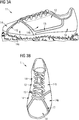
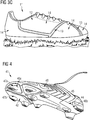
- the figures 3A, 3B and 3C show an exemplary embodiment of the invention that is an alternative to the example of figures 2A , 2B and 2C .
- the shoe 11 shown in figures 3A, 3B and 3C also comprises a shoe upper 12 according to the invention with the same features as the shoe 11 shown in the figures 2A , 2B and 2C .
- the shoe 11 shown in the figures 3A, 3B and 3C comprises, however, no connecting elements between regions of the second layer 14.
- no connecting element between the regions 14a and 14b is arranged.
- the elasticity of the first layer 13 is basically lower than in the exemplary embodiment of the figures 2A , 2B and 2C , in order to count for the absence of connecting elements.
- the Fig. 4 shows an exemplary embodiment of a shoe 11 with a sole 42 according to a further aspect of the present invention.
- the shoe 41 shown in Fig.4 is a football boot.
- the sole 42 shown in Fig. 4 may, however, be applied to any arbitrary sports shoes, as for example rugby, football, basketball, tennis, golf, running shoes, etc.
- the invention is not limited to sports shoes, but may also be applied to casual shoes and shoes, which are worn at formal occasions.
- the sole 42 comprises a first layer 43.
- the layer 43 may be made from TPU 80A for example.
- the sole 42 further comprises a second layer 44 connected to the first layer 43 in a fixed way.
- the second layer 44 comprises a first section 45 in the mid foot region, which is made from PA12.
- the first layer comprises a front foot section 46a and a heel section 46b, which is made from TPU 95A.
- This arrangement of the sections 45, 46a and 46b of the second layer 44 allows for a flexible and stretchable outer sole.
- the arrangement of the sections 45, 46a and 46b may, however, vary fundamental. Likewise, other materials may be used.
- the two layers 43 and 44 may be connected to each other by gluing or welding. Alternatively the first layer 43 may be injection-molded to the second layer 44, or vice versa.
- the second layer 44 comprises at least two regions separated from each other, from which two are exemplarily denoted in Fig. 4 by the reference signs 47a and 47b.
- the two regions 47a and 47b are spaced apart from each other, so that the first layer 43 is visible between the regions 47a and 47b of the second layer 44.
- the first layer 43 comprises a higher elasticity in at least one region not covered by the at least two regions 47a and 47b of the second layer 44 than the second layer 44.
- a crosswise region of the first layer 43 is not covered by the second layer 44.
- the elasticity of the first layer 43 is higher in this region than the elasticity of the second layer 44, in particular as in the at least two regions 47a and 47b.
- the second layer 44 and the subjacent first layer 43 do not cover completely.
- the second layer 44 extends up to the edge of the sole 42, however, the first layer 43 does not.
- the first layer 43 and second layer 44 cover completely, i.e. there is no region in which the two layers do not cover each other.
- the second layer 44 is arranged above the first layer 43.
- a reverse arrangement is also possible, i.e. the second layer 44 may be arranged below the first layer 43.
- the second layer 44 comprises a lower elasticity than the first layer 43 and is connected to it in a fixed way, the second layer 44 delimits the elasticity of the subjacent first layer 43 in the regions, in which the first layer 43 and the second layer 44 overlap.
- the first layer 43 substantially defines the shape of the sole 42, i.e. the shoe 41 could be worn without the second layer 44. In this case, however, the sole would yield too much at certain places. In general, it is sufficient, if the first layer 43 is arranged in certain regions of the sole 42, i.e. the first layer 43 does not have to extend across the whole sole 42. For example, the first layer 43 could be arranged only in a toe region, a heel region, a mid foot region, or combinations thereof. In general, the first layer 43 is arranged at positions, where the sole 42 shall be elastic, so that it can adapt to the foot sole shape and the loads while wearing the shoe 41.
- the sole 42 may also comprise an inner sole (not shown in Fig. 4 ).
- This sole may comprise regions with a higher elasticity than other regions.
- the regions of higher elasticity of the inner sole may at least partially overlap regions with a higher elasticity of the first layer 43 of the sole 42.
- the complete sole 42 may adapt to the sole shape of the wearer and/or may stretch according to the loads.
- the shoe 41 shown in Fig. 4 also comprises a shoe upper 48, which may be connected to the sole 42 e.g. by stitching, gluing or welding.
- the sole 42 may also be injection-molded onto the shoe upper 48.
- the shoe upper 48 may be a shoe upper, as it is used with ordinary football boots. Alternatively, it may be a shoe upper 12 according to the invention, as it was already described with reference to the figures 1, 2A , 2B, 2C , 3A, 3B and 3C .
- exemplary embodiments may be combined with each other, in order to obtain a further exemplary embodiment, which was not explicitly described herein.
- certain features of an exemplary embodiment may be combined with certain features of another exemplary embodiment, in order to obtain a new exemplary embodiment according to the present invention, which was not explicitly described herein.
Landscapes
- Chemical & Material Sciences (AREA)
- Engineering & Computer Science (AREA)
- Materials Engineering (AREA)
- Health & Medical Sciences (AREA)
- General Health & Medical Sciences (AREA)
- Physical Education & Sports Medicine (AREA)
- Footwear And Its Accessory, Manufacturing Method And Apparatuses (AREA)
Applications Claiming Priority (1)
| Application Number | Priority Date | Filing Date | Title |
|---|---|---|---|
| DE102015208763.8A DE102015208763A1 (de) | 2015-05-12 | 2015-05-12 | Anpassbares Schuhoberteil und anpassbare Sohle |
Publications (2)
| Publication Number | Publication Date |
|---|---|
| EP3092914A2 true EP3092914A2 (de) | 2016-11-16 |
| EP3092914A3 EP3092914A3 (de) | 2017-03-22 |
Family
ID=55919708
Family Applications (1)
| Application Number | Title | Priority Date | Filing Date |
|---|---|---|---|
| EP16168587.0A Withdrawn EP3092914A3 (de) | 2015-05-12 | 2016-05-06 | Anpassbares schuhoberteil und anpassbare sohle |
Country Status (5)
| Country | Link |
|---|---|
| US (1) | US20160331082A1 (de) |
| EP (1) | EP3092914A3 (de) |
| JP (1) | JP2016209565A (de) |
| CN (1) | CN106136431A (de) |
| DE (1) | DE102015208763A1 (de) |
Cited By (3)
| Publication number | Priority date | Publication date | Assignee | Title |
|---|---|---|---|---|
| FR3064893A1 (fr) * | 2017-04-06 | 2018-10-12 | Ladinvest | Chaussure adaptable |
| WO2021126330A1 (en) * | 2019-12-20 | 2021-06-24 | Nike Innovate C.V. | Article of footwear with removable cover layers and method of manufacturing an article of footwear |
| WO2026076087A1 (en) * | 2024-10-01 | 2026-04-09 | Nike Innovate C.V. | Engineered upper with zonal support for an article of footwear |
Families Citing this family (19)
| Publication number | Priority date | Publication date | Assignee | Title |
|---|---|---|---|---|
| US10595584B2 (en) * | 2016-01-28 | 2020-03-24 | Christopher Anthony Silva | Adjustable article system |
| US10602801B2 (en) * | 2016-01-28 | 2020-03-31 | Compuglobalhypermeganet Llc | Adjustable article system |
| US11470908B2 (en) * | 2017-02-27 | 2022-10-18 | Kornit Digital Technologies Ltd. | Articles of footwear and apparel having a three-dimensionally printed feature |
| US11857023B2 (en) | 2017-02-27 | 2024-01-02 | Kornit Digital Technologies Ltd. | Digital molding and associated articles and methods |
| US10932515B2 (en) | 2017-02-27 | 2021-03-02 | Voxel8, Inc. | 3D printed articles of footwear with sensors and methods of forming the same |
| US10098409B1 (en) * | 2017-05-25 | 2018-10-16 | Nike, Inc. | Pre-tensioned article and method of making |
| US20180360159A1 (en) * | 2017-06-20 | 2018-12-20 | Footloose, Inc. | Flexible, form-fitting, slide-type sandal |
| US10485302B2 (en) * | 2017-07-07 | 2019-11-26 | Reebok International Limited | Method of making an upper |
| US11112537B2 (en) | 2017-09-29 | 2021-09-07 | Nike, Inc. | Structurally-colored articles and methods for making and using structurally-colored articles |
| US11597996B2 (en) | 2019-06-26 | 2023-03-07 | Nike, Inc. | Structurally-colored articles and methods for making and using structurally-colored articles |
| CN114206149A (zh) | 2019-07-26 | 2022-03-18 | 耐克创新有限合伙公司 | 结构着色的物品以及用于制造和使用结构着色的物品的方法 |
| US11986042B2 (en) | 2019-10-21 | 2024-05-21 | Nike, Inc. | Structurally-colored articles and methods for making and using structurally-colored articles |
| CN114945293B (zh) * | 2020-01-07 | 2024-10-11 | 耐克创新有限合伙公司 | 具有可调节尺寸的鞋类物品 |
| EP4087435B1 (de) * | 2020-01-07 | 2024-11-06 | NIKE Innovate C.V. | Schuhwerk mit verstellbaren abmessungen |
| US20210298424A1 (en) * | 2020-03-31 | 2021-09-30 | Mizuno Corporation | Shoe Upper Structure, Shoe having the Same and Method for Manufacturing Shoe |
| US20210370711A1 (en) | 2020-05-29 | 2021-12-02 | Nike, Inc. | Structurally-colored articles and methods for making and using structurally-colored articles |
| US11241062B1 (en) | 2020-08-07 | 2022-02-08 | Nike, Inc. | Footwear article having repurposed material with structural-color concealing layer |
| US11889894B2 (en) * | 2020-08-07 | 2024-02-06 | Nike, Inc. | Footwear article having concealing layer |
| US11129444B1 (en) | 2020-08-07 | 2021-09-28 | Nike, Inc. | Footwear article having repurposed material with concealing layer |
Citations (9)
| Publication number | Priority date | Publication date | Assignee | Title |
|---|---|---|---|---|
| US5377430A (en) * | 1993-09-17 | 1995-01-03 | Nike, Inc. | Shoe with elastic closure system |
| DE60203716T2 (de) | 2001-08-03 | 2006-03-09 | Bencom S.R.L. | Verbesserter schuhwerkaufbau |
| US7546698B2 (en) | 2006-05-25 | 2009-06-16 | Nike, Inc. | Article of footwear having an upper with thread structural elements |
| US7770307B2 (en) | 2006-05-25 | 2010-08-10 | Nike, Inc. | Article of footwear having an upper with thread structural elements |
| DE102011086742A1 (de) | 2011-11-21 | 2013-05-23 | Adidas Ag | Schuh |
| DE102012206062A1 (de) | 2012-04-13 | 2013-10-17 | Adidas Ag | Schuhoberteil |
| US8561322B2 (en) | 2009-01-13 | 2013-10-22 | Nike, Inc. | Sole with adjustable sizing |
| US20140360048A1 (en) * | 2013-06-05 | 2014-12-11 | Nike, Inc. | Article of Footwear |
| EP3725178A1 (de) * | 2014-04-15 | 2020-10-21 | NIKE Innovate C.V. | Schuhwerk mit motorisiertem anpassungssystem und elastischem oberteil |
Family Cites Families (30)
| Publication number | Priority date | Publication date | Assignee | Title |
|---|---|---|---|---|
| US2147197A (en) * | 1936-11-25 | 1939-02-14 | Hood Rubber Co Inc | Article of footwear |
| DE3233792A1 (de) * | 1982-09-11 | 1984-03-15 | Puma-Sportschuhfabriken Rudolf Dassler Kg, 8522 Herzogenaurach | Sportschuh fuer die leichtathletik |
| US5197210A (en) * | 1989-11-20 | 1993-03-30 | Sink Jeffrey A | Athletic shoe |
| US5765296A (en) * | 1997-01-31 | 1998-06-16 | Nine West Group, Inc. | Exercise shoe having fit adaptive upper |
| US5979083A (en) * | 1998-01-23 | 1999-11-09 | Acushnet Company | Multi-layer outsole |
| US6029376A (en) * | 1998-12-23 | 2000-02-29 | Nike, Inc. | Article of footwear |
| US20020078591A1 (en) * | 2000-12-27 | 2002-06-27 | Ballet Makers, Inc. | Dance shoe with tri-split |
| JP2003289903A (ja) * | 2002-03-29 | 2003-10-14 | Mizuno Corp | ミッドソール及びカップインソール |
| US20040107604A1 (en) * | 2002-12-10 | 2004-06-10 | Ki-Ho Ha | Length adjustable shoe |
| US7424783B2 (en) * | 2003-06-30 | 2008-09-16 | Nike, Inc. | Article of apparel incorporating a stratified material |
| US7065820B2 (en) * | 2003-06-30 | 2006-06-27 | Nike, Inc. | Article and method for laser-etching stratified materials |
| US7287294B2 (en) * | 2003-10-24 | 2007-10-30 | Harry Miller Co., Inc. | Method of making an expandable shoe |
| US7836608B2 (en) * | 2004-12-06 | 2010-11-23 | Nike, Inc. | Article of footwear formed of multiple links |
| US7631440B2 (en) * | 2005-07-15 | 2009-12-15 | The Timberland Company | Shoe with anatomical protection |
| US20070039208A1 (en) * | 2005-08-22 | 2007-02-22 | Fila Luxembourg S.A.R.L. | Adaptable shoe having an expandable sole assembly |
| DE202006009950U1 (de) * | 2006-06-26 | 2007-11-08 | Puma Aktiengesellschaft Rudolf Dassler Sport | Schuh, insbesondere Sportschuh |
| US7793435B1 (en) * | 2007-04-10 | 2010-09-14 | Reebok International Ltd. | Article of footwear having an integrated support system |
| FR2940019B1 (fr) * | 2008-12-22 | 2011-03-25 | Salomon Sas | Chaussure a semelage ameliore |
| US8356428B2 (en) * | 2009-10-20 | 2013-01-22 | Nike, Inc. | Article of footwear with flexible reinforcing plate |
| FR2961068B1 (fr) * | 2010-06-11 | 2013-04-26 | Salomon Sas | Chaussure presentant un confort de marche ameliore |
| DE202010017958U1 (de) | 2010-09-16 | 2013-06-11 | Achim Wolf | Sportschuh, insbesondere Fussballschuh |
| WO2013121578A1 (ja) * | 2012-02-17 | 2013-08-22 | 株式会社アシックス | 靴およびその製造方法 |
| US9314065B2 (en) * | 2012-06-15 | 2016-04-19 | Nike, Inc. | Article of footwear with base plate having structure and studs |
| US10085516B2 (en) * | 2013-02-26 | 2018-10-02 | Nike, Inc. | Article of footwear with reinforced elastic upper |
| US20140250723A1 (en) * | 2013-03-07 | 2014-09-11 | Nike, Inc. | Flexible sole supports for articles of footwear |
| DE102013208170B4 (de) | 2013-05-03 | 2019-10-24 | Adidas Ag | Sohle für einen Schuh und Schuh mit einer solchen Sohle |
| WO2015052814A1 (ja) * | 2013-10-10 | 2015-04-16 | 株式会社アシックス | 靴底 |
| ITVR20130238A1 (it) * | 2013-11-05 | 2015-05-06 | Pieffe Sport S N C Di Rossignoli F Rancesco Paol | Procedimento per la realizzazione di calzature elasticizzate e prodotto ottenuto con tale procedimento |
| US9861162B2 (en) * | 2014-04-08 | 2018-01-09 | Nike, Inc. | Components for articles of footwear including lightweight, selectively supported textile components |
| US9603417B2 (en) * | 2015-05-04 | 2017-03-28 | Alvaro L. Arevalo | Tieless footwear lacing system, apparatuses, and methods of using the same |
-
2015
- 2015-05-12 DE DE102015208763.8A patent/DE102015208763A1/de not_active Withdrawn
-
2016
- 2016-04-25 JP JP2016087118A patent/JP2016209565A/ja active Pending
- 2016-04-29 US US15/142,955 patent/US20160331082A1/en not_active Abandoned
- 2016-04-29 CN CN201610282237.2A patent/CN106136431A/zh active Pending
- 2016-05-06 EP EP16168587.0A patent/EP3092914A3/de not_active Withdrawn
Patent Citations (9)
| Publication number | Priority date | Publication date | Assignee | Title |
|---|---|---|---|---|
| US5377430A (en) * | 1993-09-17 | 1995-01-03 | Nike, Inc. | Shoe with elastic closure system |
| DE60203716T2 (de) | 2001-08-03 | 2006-03-09 | Bencom S.R.L. | Verbesserter schuhwerkaufbau |
| US7546698B2 (en) | 2006-05-25 | 2009-06-16 | Nike, Inc. | Article of footwear having an upper with thread structural elements |
| US7770307B2 (en) | 2006-05-25 | 2010-08-10 | Nike, Inc. | Article of footwear having an upper with thread structural elements |
| US8561322B2 (en) | 2009-01-13 | 2013-10-22 | Nike, Inc. | Sole with adjustable sizing |
| DE102011086742A1 (de) | 2011-11-21 | 2013-05-23 | Adidas Ag | Schuh |
| DE102012206062A1 (de) | 2012-04-13 | 2013-10-17 | Adidas Ag | Schuhoberteil |
| US20140360048A1 (en) * | 2013-06-05 | 2014-12-11 | Nike, Inc. | Article of Footwear |
| EP3725178A1 (de) * | 2014-04-15 | 2020-10-21 | NIKE Innovate C.V. | Schuhwerk mit motorisiertem anpassungssystem und elastischem oberteil |
Cited By (4)
| Publication number | Priority date | Publication date | Assignee | Title |
|---|---|---|---|---|
| FR3064893A1 (fr) * | 2017-04-06 | 2018-10-12 | Ladinvest | Chaussure adaptable |
| WO2021126330A1 (en) * | 2019-12-20 | 2021-06-24 | Nike Innovate C.V. | Article of footwear with removable cover layers and method of manufacturing an article of footwear |
| US11533966B2 (en) | 2019-12-20 | 2022-12-27 | Nike, Inc. | Article of footwear with removable cover layers and method of manufacturing an article of footwear |
| WO2026076087A1 (en) * | 2024-10-01 | 2026-04-09 | Nike Innovate C.V. | Engineered upper with zonal support for an article of footwear |
Also Published As
| Publication number | Publication date |
|---|---|
| US20160331082A1 (en) | 2016-11-17 |
| EP3092914A3 (de) | 2017-03-22 |
| CN106136431A (zh) | 2016-11-23 |
| JP2016209565A (ja) | 2016-12-15 |
| DE102015208763A1 (de) | 2016-11-17 |
Similar Documents
| Publication | Publication Date | Title |
|---|---|---|
| EP3092914A2 (de) | Anpassbares schuhoberteil und anpassbare sohle | |
| TWI552690B (zh) | 具有含編織組件之跟部的鞋類物件 | |
| US20210177070A1 (en) | Method including footwear and sock having aligning indicia | |
| CN204070726U (zh) | 鞋类物品以及集成到鞋类物品的鞋面中的编织部件 | |
| EP3150077B1 (de) | Schuhoberteil | |
| EP1903898B1 (de) | Fussbekleidungsartikel mit obermaterial mit einer matrixschicht | |
| KR101838824B1 (ko) | 편조형 갑피를 지닌 신발류 물품 | |
| EP2974615B1 (de) | Schuh mit einer fersenkappe sowie schuh mit einem knöchelkragen | |
| CN204207163U (zh) | 用于形成鞋面的加工件以及编织加工件 | |
| CN106604656B (zh) | 包含用于鞋面的鞋跟部分的针织部件的鞋类物品 | |
| EP4473859A2 (de) | Oberteil für einen schuhartikel mit einer inneren komponente und einer umhüllung | |
| EP3284362A1 (de) | Schuhoberteil für einen schuh | |
| TW201713231A (zh) | 製造具有漸變式突出物之鞋類物件的方法 | |
| CN110996704B (zh) | 具有带有鞋前部部分和鞋跟部分的针织部件的鞋类物品 | |
| KR20160052659A (ko) | 팽창 구조체 및 팽창 구조체를 가진 밑창을 구비하는 신발류 | |
| CN106835484A (zh) | 间隔织物材料及用于制造间隔织物材料的方法 | |
| CN223979501U (zh) | 用于鞋类物品的紧固系统、鞋类物品和衣物 | |
| CN117042645A (zh) | 具有针织鞋面的鞋类制品 | |
| HK40046053A (en) | Upper for an article of footwear having an inner component and a shroud | |
| HK1215363B (en) | Article of footwear having heel portion with knitted component |
Legal Events
| Date | Code | Title | Description |
|---|---|---|---|
| PUAI | Public reference made under article 153(3) epc to a published international application that has entered the european phase |
Free format text: ORIGINAL CODE: 0009012 |
|
| 17P | Request for examination filed |
Effective date: 20160506 |
|
| AK | Designated contracting states |
Kind code of ref document: A2 Designated state(s): AL AT BE BG CH CY CZ DE DK EE ES FI FR GB GR HR HU IE IS IT LI LT LU LV MC MK MT NL NO PL PT RO RS SE SI SK SM TR |
|
| AX | Request for extension of the european patent |
Extension state: BA ME |
|
| PUAL | Search report despatched |
Free format text: ORIGINAL CODE: 0009013 |
|
| AK | Designated contracting states |
Kind code of ref document: A3 Designated state(s): AL AT BE BG CH CY CZ DE DK EE ES FI FR GB GR HR HU IE IS IT LI LT LU LV MC MK MT NL NO PL PT RO RS SE SI SK SM TR |
|
| AX | Request for extension of the european patent |
Extension state: BA ME |
|
| RIC1 | Information provided on ipc code assigned before grant |
Ipc: A43B 13/14 20060101ALI20170213BHEP Ipc: A43B 23/02 20060101ALI20170213BHEP Ipc: A43B 3/26 20060101AFI20170213BHEP Ipc: A43B 5/02 20060101ALI20170213BHEP Ipc: A43B 13/12 20060101ALI20170213BHEP Ipc: A43B 13/38 20060101ALI20170213BHEP |
|
| STAA | Information on the status of an ep patent application or granted ep patent |
Free format text: STATUS: EXAMINATION IS IN PROGRESS |
|
| 17Q | First examination report despatched |
Effective date: 20210111 |
|
| STAA | Information on the status of an ep patent application or granted ep patent |
Free format text: STATUS: THE APPLICATION IS DEEMED TO BE WITHDRAWN |
|
| 18D | Application deemed to be withdrawn |
Effective date: 20210522 |