EP3093280A1 - Procédé d'oligomérisation d'oléfines par polymérisation de coordination de transfert de chaîne et synthèse de catalyseurs - Google Patents
Procédé d'oligomérisation d'oléfines par polymérisation de coordination de transfert de chaîne et synthèse de catalyseurs Download PDFInfo
- Publication number
- EP3093280A1 EP3093280A1 EP15167707.7A EP15167707A EP3093280A1 EP 3093280 A1 EP3093280 A1 EP 3093280A1 EP 15167707 A EP15167707 A EP 15167707A EP 3093280 A1 EP3093280 A1 EP 3093280A1
- Authority
- EP
- European Patent Office
- Prior art keywords
- catalyst
- cctp
- process according
- olefins
- ethylene
- Prior art date
- Legal status (The legal status is an assumption and is not a legal conclusion. Google has not performed a legal analysis and makes no representation as to the accuracy of the status listed.)
- Withdrawn
Links
- 0 CCN(CC)C(C(C*(C)(C)C1C)c2c(C(C)C)cccc2C(C)C)C1C(C(C(C)C)=CCC1)=C1C(C)C Chemical compound CCN(CC)C(C(C*(C)(C)C1C)c2c(C(C)C)cccc2C(C)C)C1C(C(C(C)C)=CCC1)=C1C(C)C 0.000 description 6
- MWWNHUVCHNJZPF-UHFFFAOYSA-N CC(C)c1cccc(C(C)C)c1C Chemical compound CC(C)c1cccc(C(C)C)c1C MWWNHUVCHNJZPF-UHFFFAOYSA-N 0.000 description 2
- MIPLBQPNNMPFKU-UHFFFAOYSA-N CCN(C)C(C)C(C)c1c(C(C)C)cccc1C(C)C Chemical compound CCN(C)C(C)C(C)c1c(C(C)C)cccc1C(C)C MIPLBQPNNMPFKU-UHFFFAOYSA-N 0.000 description 1
Images



Classifications
-
- C—CHEMISTRY; METALLURGY
- C07—ORGANIC CHEMISTRY
- C07C—ACYCLIC OR CARBOCYCLIC COMPOUNDS
- C07C2/00—Preparation of hydrocarbons from hydrocarbons containing a smaller number of carbon atoms
- C07C2/86—Preparation of hydrocarbons from hydrocarbons containing a smaller number of carbon atoms by condensation between a hydrocarbon and a non-hydrocarbon
- C07C2/88—Growth and elimination reactions
-
- B—PERFORMING OPERATIONS; TRANSPORTING
- B01—PHYSICAL OR CHEMICAL PROCESSES OR APPARATUS IN GENERAL
- B01J—CHEMICAL OR PHYSICAL PROCESSES, e.g. CATALYSIS OR COLLOID CHEMISTRY; THEIR RELEVANT APPARATUS
- B01J31/00—Catalysts comprising hydrides, coordination complexes or organic compounds
- B01J31/02—Catalysts comprising hydrides, coordination complexes or organic compounds containing organic compounds or metal hydrides
- B01J31/04—Catalysts comprising hydrides, coordination complexes or organic compounds containing organic compounds or metal hydrides containing carboxylic acids or their salts
-
- B—PERFORMING OPERATIONS; TRANSPORTING
- B01—PHYSICAL OR CHEMICAL PROCESSES OR APPARATUS IN GENERAL
- B01J—CHEMICAL OR PHYSICAL PROCESSES, e.g. CATALYSIS OR COLLOID CHEMISTRY; THEIR RELEVANT APPARATUS
- B01J31/00—Catalysts comprising hydrides, coordination complexes or organic compounds
- B01J31/02—Catalysts comprising hydrides, coordination complexes or organic compounds containing organic compounds or metal hydrides
- B01J31/12—Catalysts comprising hydrides, coordination complexes or organic compounds containing organic compounds or metal hydrides containing organo-metallic compounds or metal hydrides
- B01J31/128—Mixtures of organometallic compounds
-
- B—PERFORMING OPERATIONS; TRANSPORTING
- B01—PHYSICAL OR CHEMICAL PROCESSES OR APPARATUS IN GENERAL
- B01J—CHEMICAL OR PHYSICAL PROCESSES, e.g. CATALYSIS OR COLLOID CHEMISTRY; THEIR RELEVANT APPARATUS
- B01J31/00—Catalysts comprising hydrides, coordination complexes or organic compounds
- B01J31/02—Catalysts comprising hydrides, coordination complexes or organic compounds containing organic compounds or metal hydrides
- B01J31/12—Catalysts comprising hydrides, coordination complexes or organic compounds containing organic compounds or metal hydrides containing organo-metallic compounds or metal hydrides
- B01J31/14—Catalysts comprising hydrides, coordination complexes or organic compounds containing organic compounds or metal hydrides containing organo-metallic compounds or metal hydrides of aluminium or boron
- B01J31/143—Catalysts comprising hydrides, coordination complexes or organic compounds containing organic compounds or metal hydrides containing organo-metallic compounds or metal hydrides of aluminium or boron of aluminium
-
- B—PERFORMING OPERATIONS; TRANSPORTING
- B01—PHYSICAL OR CHEMICAL PROCESSES OR APPARATUS IN GENERAL
- B01J—CHEMICAL OR PHYSICAL PROCESSES, e.g. CATALYSIS OR COLLOID CHEMISTRY; THEIR RELEVANT APPARATUS
- B01J31/00—Catalysts comprising hydrides, coordination complexes or organic compounds
- B01J31/02—Catalysts comprising hydrides, coordination complexes or organic compounds containing organic compounds or metal hydrides
- B01J31/12—Catalysts comprising hydrides, coordination complexes or organic compounds containing organic compounds or metal hydrides containing organo-metallic compounds or metal hydrides
- B01J31/14—Catalysts comprising hydrides, coordination complexes or organic compounds containing organic compounds or metal hydrides containing organo-metallic compounds or metal hydrides of aluminium or boron
- B01J31/146—Catalysts comprising hydrides, coordination complexes or organic compounds containing organic compounds or metal hydrides containing organo-metallic compounds or metal hydrides of aluminium or boron of boron
-
- B—PERFORMING OPERATIONS; TRANSPORTING
- B01—PHYSICAL OR CHEMICAL PROCESSES OR APPARATUS IN GENERAL
- B01J—CHEMICAL OR PHYSICAL PROCESSES, e.g. CATALYSIS OR COLLOID CHEMISTRY; THEIR RELEVANT APPARATUS
- B01J31/00—Catalysts comprising hydrides, coordination complexes or organic compounds
- B01J31/16—Catalysts comprising hydrides, coordination complexes or organic compounds containing coordination complexes
- B01J31/18—Catalysts comprising hydrides, coordination complexes or organic compounds containing coordination complexes containing nitrogen, phosphorus, arsenic or antimony as complexing atoms, e.g. in pyridine ligands, or in resonance therewith, e.g. in isocyanide ligands C=N-R or as complexed central atoms
- B01J31/1805—Catalysts comprising hydrides, coordination complexes or organic compounds containing coordination complexes containing nitrogen, phosphorus, arsenic or antimony as complexing atoms, e.g. in pyridine ligands, or in resonance therewith, e.g. in isocyanide ligands C=N-R or as complexed central atoms the ligands containing nitrogen
-
- B—PERFORMING OPERATIONS; TRANSPORTING
- B01—PHYSICAL OR CHEMICAL PROCESSES OR APPARATUS IN GENERAL
- B01J—CHEMICAL OR PHYSICAL PROCESSES, e.g. CATALYSIS OR COLLOID CHEMISTRY; THEIR RELEVANT APPARATUS
- B01J31/00—Catalysts comprising hydrides, coordination complexes or organic compounds
- B01J31/16—Catalysts comprising hydrides, coordination complexes or organic compounds containing coordination complexes
- B01J31/18—Catalysts comprising hydrides, coordination complexes or organic compounds containing coordination complexes containing nitrogen, phosphorus, arsenic or antimony as complexing atoms, e.g. in pyridine ligands, or in resonance therewith, e.g. in isocyanide ligands C=N-R or as complexed central atoms
- B01J31/1805—Catalysts comprising hydrides, coordination complexes or organic compounds containing coordination complexes containing nitrogen, phosphorus, arsenic or antimony as complexing atoms, e.g. in pyridine ligands, or in resonance therewith, e.g. in isocyanide ligands C=N-R or as complexed central atoms the ligands containing nitrogen
- B01J31/181—Cyclic ligands, including e.g. non-condensed polycyclic ligands, comprising at least one complexing nitrogen atom as ring member, e.g. pyridine
- B01J31/1815—Cyclic ligands, including e.g. non-condensed polycyclic ligands, comprising at least one complexing nitrogen atom as ring member, e.g. pyridine with more than one complexing nitrogen atom, e.g. bipyridyl, 2-aminopyridine
- B01J31/182—Cyclic ligands, including e.g. non-condensed polycyclic ligands, comprising at least one complexing nitrogen atom as ring member, e.g. pyridine with more than one complexing nitrogen atom, e.g. bipyridyl, 2-aminopyridine comprising aliphatic or saturated rings
-
- B—PERFORMING OPERATIONS; TRANSPORTING
- B01—PHYSICAL OR CHEMICAL PROCESSES OR APPARATUS IN GENERAL
- B01J—CHEMICAL OR PHYSICAL PROCESSES, e.g. CATALYSIS OR COLLOID CHEMISTRY; THEIR RELEVANT APPARATUS
- B01J31/00—Catalysts comprising hydrides, coordination complexes or organic compounds
- B01J31/16—Catalysts comprising hydrides, coordination complexes or organic compounds containing coordination complexes
- B01J31/22—Organic complexes
- B01J31/2282—Unsaturated compounds used as ligands
- B01J31/2295—Cyclic compounds, e.g. cyclopentadienyls
-
- C—CHEMISTRY; METALLURGY
- C07—ORGANIC CHEMISTRY
- C07F—ACYCLIC, CARBOCYCLIC OR HETEROCYCLIC COMPOUNDS CONTAINING ELEMENTS OTHER THAN CARBON, HYDROGEN, HALOGEN, OXYGEN, NITROGEN, SULFUR, SELENIUM OR TELLURIUM
- C07F7/00—Compounds containing elements of Groups 4 or 14 of the Periodic Table
- C07F7/003—Compounds containing elements of Groups 4 or 14 of the Periodic Table without C-Metal linkages
-
- B—PERFORMING OPERATIONS; TRANSPORTING
- B01—PHYSICAL OR CHEMICAL PROCESSES OR APPARATUS IN GENERAL
- B01J—CHEMICAL OR PHYSICAL PROCESSES, e.g. CATALYSIS OR COLLOID CHEMISTRY; THEIR RELEVANT APPARATUS
- B01J2231/00—Catalytic reactions performed with catalysts classified in B01J31/00
- B01J2231/20—Olefin oligomerisation or telomerisation
-
- B—PERFORMING OPERATIONS; TRANSPORTING
- B01—PHYSICAL OR CHEMICAL PROCESSES OR APPARATUS IN GENERAL
- B01J—CHEMICAL OR PHYSICAL PROCESSES, e.g. CATALYSIS OR COLLOID CHEMISTRY; THEIR RELEVANT APPARATUS
- B01J2531/00—Additional information regarding catalytic systems classified in B01J31/00
- B01J2531/02—Compositional aspects of complexes used, e.g. polynuclearity
- B01J2531/0213—Complexes without C-metal linkages
- B01J2531/0216—Bi- or polynuclear complexes, i.e. comprising two or more metal coordination centres, without metal-metal bonds, e.g. Cp(Lx)Zr-imidazole-Zr(Lx)Cp
-
- B—PERFORMING OPERATIONS; TRANSPORTING
- B01—PHYSICAL OR CHEMICAL PROCESSES OR APPARATUS IN GENERAL
- B01J—CHEMICAL OR PHYSICAL PROCESSES, e.g. CATALYSIS OR COLLOID CHEMISTRY; THEIR RELEVANT APPARATUS
- B01J2531/00—Additional information regarding catalytic systems classified in B01J31/00
- B01J2531/02—Compositional aspects of complexes used, e.g. polynuclearity
- B01J2531/0286—Complexes comprising ligands or other components characterized by their function
- B01J2531/0288—Sterically demanding or shielding ligands
-
- B—PERFORMING OPERATIONS; TRANSPORTING
- B01—PHYSICAL OR CHEMICAL PROCESSES OR APPARATUS IN GENERAL
- B01J—CHEMICAL OR PHYSICAL PROCESSES, e.g. CATALYSIS OR COLLOID CHEMISTRY; THEIR RELEVANT APPARATUS
- B01J2531/00—Additional information regarding catalytic systems classified in B01J31/00
- B01J2531/02—Compositional aspects of complexes used, e.g. polynuclearity
- B01J2531/0286—Complexes comprising ligands or other components characterized by their function
- B01J2531/0297—Non-coordinating anions
-
- B—PERFORMING OPERATIONS; TRANSPORTING
- B01—PHYSICAL OR CHEMICAL PROCESSES OR APPARATUS IN GENERAL
- B01J—CHEMICAL OR PHYSICAL PROCESSES, e.g. CATALYSIS OR COLLOID CHEMISTRY; THEIR RELEVANT APPARATUS
- B01J2531/00—Additional information regarding catalytic systems classified in B01J31/00
- B01J2531/40—Complexes comprising metals of Group IV (IVA or IVB) as the central metal
- B01J2531/48—Zirconium
-
- B—PERFORMING OPERATIONS; TRANSPORTING
- B01—PHYSICAL OR CHEMICAL PROCESSES OR APPARATUS IN GENERAL
- B01J—CHEMICAL OR PHYSICAL PROCESSES, e.g. CATALYSIS OR COLLOID CHEMISTRY; THEIR RELEVANT APPARATUS
- B01J2531/00—Additional information regarding catalytic systems classified in B01J31/00
- B01J2531/80—Complexes comprising metals of Group VIII as the central metal
- B01J2531/84—Metals of the iron group
- B01J2531/847—Nickel
-
- C—CHEMISTRY; METALLURGY
- C07—ORGANIC CHEMISTRY
- C07C—ACYCLIC OR CARBOCYCLIC COMPOUNDS
- C07C2531/00—Catalysts comprising hydrides, coordination complexes or organic compounds
- C07C2531/16—Catalysts comprising hydrides, coordination complexes or organic compounds containing coordination complexes
- C07C2531/22—Organic complexes
-
- C—CHEMISTRY; METALLURGY
- C08—ORGANIC MACROMOLECULAR COMPOUNDS; THEIR PREPARATION OR CHEMICAL WORKING-UP; COMPOSITIONS BASED THEREON
- C08F—MACROMOLECULAR COMPOUNDS OBTAINED BY REACTIONS ONLY INVOLVING CARBON-TO-CARBON UNSATURATED BONDS
- C08F2410/00—Features related to the catalyst preparation, the catalyst use or to the deactivation of the catalyst
- C08F2410/01—Additive used together with the catalyst, excluding compounds containing Al or B
-
- C—CHEMISTRY; METALLURGY
- C08—ORGANIC MACROMOLECULAR COMPOUNDS; THEIR PREPARATION OR CHEMICAL WORKING-UP; COMPOSITIONS BASED THEREON
- C08F—MACROMOLECULAR COMPOUNDS OBTAINED BY REACTIONS ONLY INVOLVING CARBON-TO-CARBON UNSATURATED BONDS
- C08F2410/00—Features related to the catalyst preparation, the catalyst use or to the deactivation of the catalyst
- C08F2410/04—Dual catalyst, i.e. use of two different catalysts, where none of the catalysts is a metallocene
-
- C—CHEMISTRY; METALLURGY
- C08—ORGANIC MACROMOLECULAR COMPOUNDS; THEIR PREPARATION OR CHEMICAL WORKING-UP; COMPOSITIONS BASED THEREON
- C08F—MACROMOLECULAR COMPOUNDS OBTAINED BY REACTIONS ONLY INVOLVING CARBON-TO-CARBON UNSATURATED BONDS
- C08F4/00—Polymerisation catalysts
- C08F4/42—Metals; Metal hydrides; Metallo-organic compounds; Use thereof as catalyst precursors
- C08F4/44—Metals; Metal hydrides; Metallo-organic compounds; Use thereof as catalyst precursors selected from light metals, zinc, cadmium, mercury, copper, silver, gold, boron, gallium, indium, thallium, rare earths or actinides
- C08F4/60—Metals; Metal hydrides; Metallo-organic compounds; Use thereof as catalyst precursors selected from light metals, zinc, cadmium, mercury, copper, silver, gold, boron, gallium, indium, thallium, rare earths or actinides together with refractory metals, iron group metals, platinum group metals, manganese, rhenium technetium or compounds thereof
- C08F4/62—Refractory metals or compounds thereof
- C08F4/64—Titanium, zirconium, hafnium or compounds thereof
- C08F4/659—Component covered by group C08F4/64 containing a transition metal-carbon bond
- C08F4/65912—Component covered by group C08F4/64 containing a transition metal-carbon bond in combination with an organoaluminium compound
-
- C—CHEMISTRY; METALLURGY
- C08—ORGANIC MACROMOLECULAR COMPOUNDS; THEIR PREPARATION OR CHEMICAL WORKING-UP; COMPOSITIONS BASED THEREON
- C08F—MACROMOLECULAR COMPOUNDS OBTAINED BY REACTIONS ONLY INVOLVING CARBON-TO-CARBON UNSATURATED BONDS
- C08F4/00—Polymerisation catalysts
- C08F4/42—Metals; Metal hydrides; Metallo-organic compounds; Use thereof as catalyst precursors
- C08F4/44—Metals; Metal hydrides; Metallo-organic compounds; Use thereof as catalyst precursors selected from light metals, zinc, cadmium, mercury, copper, silver, gold, boron, gallium, indium, thallium, rare earths or actinides
- C08F4/60—Metals; Metal hydrides; Metallo-organic compounds; Use thereof as catalyst precursors selected from light metals, zinc, cadmium, mercury, copper, silver, gold, boron, gallium, indium, thallium, rare earths or actinides together with refractory metals, iron group metals, platinum group metals, manganese, rhenium technetium or compounds thereof
- C08F4/62—Refractory metals or compounds thereof
- C08F4/64—Titanium, zirconium, hafnium or compounds thereof
- C08F4/659—Component covered by group C08F4/64 containing a transition metal-carbon bond
- C08F4/65916—Component covered by group C08F4/64 containing a transition metal-carbon bond supported on a carrier, e.g. silica, MgCl2, polymer
Definitions
- the present invention relates to a process for the oligomerisation of olefins, in particular ethylene, via coordinative chain transfer polymerisation (CCTP) and alkyl elimation reaction.
- the present invention further relates to a new method of synthesizing CCTP-catalysts.
- a preferred embodiment of the invention relates to CCTP of olefins, in particular ethylene, with the use of guanidinato or amidinato complexes of titanium zirconium or lanthanides, a chain displacement catalyst (CDC), such as a nickel or cobalt compound,; and a chain transfer agent (CSA), typically a main group metal alkyl.
- CDC chain displacement catalyst
- CSA chain transfer agent
- the characteristics of the process according to the invention are that various olefins can be produced either at a high stoichiometric excess of CSA but also using only catalytic amounts of CSA. Further by changing the parameters of the process Schulz-Flory or Poisson distributed olefins can be obtained as wanted.
- the oligomerisation of olefins can yield product distributions with regard to chain lengths which are either Poisson distributions or Schulz-Flory distributions.
- a Poisson distribution is a normal distribution curve approximately centered about the average degree of oligomerisation.
- Schulz-Flory distribution describes a product distribution having a greater molar amount of the small oligomers with a broader range of chain lengths.
- For short chain oligomers C ⁇ 12 mainly Schulz-Flory distributions are desired, however, if chain length above C12 are requested Poisson distributed products are often desired.
- Linear alpha olefins are valuable commodity chemicals used as precursors in many areas of industry. Annually, more than 3 Mio. tons of alpha olefins are produced globally.
- linear alpha-olefins are used as such in many final products in various applications.
- the light olefin fractions, 1-butene, 1-hexene and 1-octene are used as co-monomers in the rapidly growing polymer market, in particular for the production of LLDPE (Linear Low Density Polyethylene) and EPDM (Ethylene Propylene Diene Monomer) rubber.
- the middle olefin fractions such as 1-decene, 1-dodecene and 1-tetradecene are raw materials for the production of synthetic oils, detergents and shampoos.
- the heavy olefin fractions can be used as additives for lubricating oils, surfactants, oil field chemicals, waxes and as polymer compatibilisers.
- the coal is first reacted at very high temperatures (above 1000°C) with water vapour and oxygen to form synthesis gas which, subsequent to the separation of nitrogen oxides and sulphur dioxide, is reacted via heterogeneous catalysis to form hydrocarbons including alpha-olefins and water.
- synthesis gas which, subsequent to the separation of nitrogen oxides and sulphur dioxide, is reacted via heterogeneous catalysis to form hydrocarbons including alpha-olefins and water.
- natural gas is reacted via addition of oxygen and water vapour to form synthesis gas, and the latter is transformed into hydrocarbons in a Fischer-Tropsch-Synthesis.
- Both processes have the disadvantage that also a broad variety of byproducts (paraffins and alcohols) are produced. This means that more pure alpha-olefins become accessible only after purification processes (e.g.
- CCTP coordinative chain transfer polymerisation
- transition metal based catalysts are typically used together with co-catalysts which usually act as chain transfer/shuttling agent (CSA).
- CSA chain transfer/shuttling agent
- Suitable co-catalysts include alkyl zinc, alkyl aluminium, alkyl aluminium halides and alkyl alumoxanes, commonly used together with inert, non-coordinating ion forming compounds (activators), Lewis and Bronstedt acids and mixtures thereof.
- CCTP One characteristics of CCTP is that polymer chains are end-capped with the respective main group metal of the co-catalyst and can be further functionalized ( M. Bialek, J. Polym. Sci.: Part A: Polym. Chem. 2010, 48, 3209-3214 and W. P. Kretschmer et al., Dalton Trans. 2010, 39, 6847-6852 ).
- Nearly all catalytic systems reported until today suffer from ligand transfer from the CCTP catalyst complex onto the CSA and are therefore not stable at high CSA concentrations.
- CCTP typically requires the use of a metal complex as catalyst, a co-catalyst and optionally an activator.
- a metal complex as catalyst
- co-catalyst is a chain shuttling agent (CSA) and may optionally but not necessarily be an activator at the same time.
- CSA chain shuttling agent
- the activator may be for example a compound different from the chain transfer agent that is not functioning as a chain shuttling agent.
- Such activator is in the understanding of the invention solely called an activator and not a co-catalyst.
- a chain displacement catalyst capable of catalysing an olefin exchange reaction (beta-H elimination) is for example Ni(acac) 2 , which is reported to give linear alpha-olefins such as disclosed in US 4918254 , US 6444867 , US 5780697 and US 5550303 .
- EP2671639 A1 a novel guanidinato group 4 metal catalyst system is described, which catalyses the chain growth on aluminium via CCTP.
- the object of the present invention is to find a highly flexible process which is capable of oligomerising or co-oligomerising alpha-olefins, preferably as wanted in either Poisson- or a Schulz-Flory-distribution, at very mild process conditions and with very high catalyst activities over a wide range of CSA amounts.
- a process is needed for the in-situ generation of alpha-olefins with the use of known CCTP catalysts systems, which so far have not been stable at high ratios of CCTP to CSA.
- the present invention is concerned with a process capable for producing differently distributed oligomerised olefins, including linear olefins, branched olefins, alpha- olefins and/or internal olefins), particular linear olefins at mild condition, in a flexible manner.
- a process is provided for preparing linear and/or branched oligomerised olefins, particularly linear alpha-olefins including waxes.
- the invention makes use of a CCTP catalyst system operating preferably at temperatures of 20-200 °C which comprises a metal organic complex capable of oligomerising or co-oligomerising alpha-olefins as gases or liquids, an activator, a chain shuttling agent, which is capable of transferring the alkyl chain at the catalyst onto the chain shuttling agent, and a chain-displacement-catalyst (CDC) capable of catalysing the beta-H-elimination and if necessary isomerisation to finally obtain olefins (alpha and/or internal olefins) with a controlled chain length distribution.
- a CCTP catalyst system operating preferably at temperatures of 20-200 °C which comprises a metal organic complex capable of oligomerising or co-oligomerising alpha-olefins as gases or liquids, an activator, a chain shuttling agent, which is capable of transferring the alkyl chain at the catalyst onto the chain shuttling agent
- the oligomerisation according to the present invention can be conducted at high CCTP to CSA and low CCTP to CSA ratios.
- the problem of lack of stability of many CCTP catalyst systems in particular at ratios of CCTP / CSA 1 to above 50000
- a CDC in particular at a ratio of CCTP / CDC of 1: 1 and above, as defined herein.
- CDC can be used either in stoichiometric or catalytic amounts.
- the obtained olefins can vary in chain length and distribution, which depends on CCTP, CSA, CDC, ratios and the process conditions applied.
- the oligomerised olefins obtained are C4 to C80 olefins, most preferably C16 to C30 olefins.
- N',N" -bis[2,6-di(isopropyl)phenyl]- N N- dialkyl-guanidinato ⁇ -(diethylamino)-trichlorido-zirconium(VI) complexes are obtained which upon reaction with a Grignard reagent provide the desired compounds.
- the new synthesis route enables the synthesis of group 4 metal catalyst alkyl complexes, which are about 50 % more active as their chloride congeners.
- Subject of the present invention is a highly flexible tandem catalytic approach to produce alpha-olefins with a Schulz-Flory and/or Poisson distribution.
- a CCTP catalyst M is used to catalyze the oligomerisation/polymerisation of ethylene or ethylene and propylene and/or C4- to C8- olefins and subsequently transfers the carbon chain onto the main group metal alkyl CSA (chain shuttling agent).
- This CSA than shuttles the carbon chain to a chain displacement catalyst (CDC), which exchanges the carbon chain for an alkyl group by releasing one equivalent of an alpha-olefin.
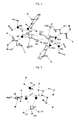
- Fig. 1 illustrates the assumed mechanism of the tandem catalyst oligomerisation process of ethylene.
- the coordinative chain transfer polymerisation (CCTP) catalyst comprises one transition metal compound selected from (according to IUPAC)
- preferred metals are Ti, Zr or Hf in the +2, +3 or +4 formal oxidation state, preferably in the +4 formal oxidation state.
- Z1 and Z3 independently from each other are:
- complexes as defined by structures III may also exist as anionic species with an additional cation Q + which for example is selected from the group of R 4 N + , R 3 NH + , R 2 NH 2 + , RNH 3 + , NH 4 + , R 4 P + in which R is an alkyl, aryl, phenyl, hydrogen or halogen.
- metal catalysts examples include ⁇ N',N"-bis[2,6-di(isopropyl)phenyl]-N,N-dimethyl-guanidinato ⁇ metal(IV) chloride, ⁇ N',N"-bis[2,6-di(isopropyl)phenyl]-N,N-diethyl-guanidinato ⁇ metal(IV) chloride, ⁇ N',N"-bis[2,6-di(isopropyl)phenyl]-N,N-pentamethylene-guanidinato ⁇ metal (IV) chloride, ⁇ N',N"-bis[2,6-di(isopropyl)phenyl]-N-cyclohexyl-N-methyl-guanidinato ⁇ metal (IV) chloride, ⁇ N',N"-bis[2,6-di(isopropyl)phenyl]-N-cyclohexyl-N-methyl-guanidinato ⁇ metal (
- the metal complex may be formed in situ from suitable transition metal and ligand precursors.
- the structure of the resulting in situ complex is as defined for the complexes (structure II and III) above.
- the transition metal precursor may be any Ti, Zr or Hf complex capable of reacting with a ligand precursor to form a guanidinate complex as described above in situ.
- transition metal precursor examples include: MX 4 where each X may independently halogen ⁇ F, Cl, Br, I ⁇ , hydride ⁇ H ⁇ , hydrocarbyl ⁇ R, e.g. benzyl ⁇ , alkoxide ⁇ OR ⁇ or amide ⁇ NR1R2 ⁇ ); MX 4 L 2 where each X may independently halogen ⁇ F, Cl, Br, I ⁇ , hydride ⁇ H ⁇ , hydrocarbyl ⁇ R, e.g. benzyl ⁇ , alkoxide ⁇ OR ⁇ or amide ⁇ NR1R2 ⁇ with L equals any two electron donor ligand, e.g.
- the ligand precursor may be any compound capable of reacting with a transition metal precursor to form an amidine or guanidine complex in situ.
- Examples of such ligand precursor include:
- the metal complexes become a catalyst for CCTP when combined at least with a co-catalyst.
- the co-catalyst acts as a chain transfer agent and may optionally act in addition as an activator for the complex in order that the complex becomes the (active) catalyst.
- the activator may comprise a boron containing compound such as a borate. More preferably the activator comprises pentafluorophenyl boranes and pentafluorophenyl borates.
- boron compounds which may be used as activator in the preparation of catalysts of this invention are tri-substituted (alkyl) ammonium salts such as trimethylammonium tetraphenylborate, triethylammonium tetraphenylborate, tripropylammonium tetraphenylborate, tri(n-butyl)ammonium tetraphenylborate, tri(t-butyl)ammonium tetraphenylborate, N,N-dimethylanilinium tetraphenylborate, N,N-diethylanilinium tetraphenylborate, N,N-dimethyl-2,4,6-trimethylanilinium tetraphen
- the activator may alternatively comprise an aluminium containing compound such as an aluminate. More preferably the activator comprises an tetrakisalkyloxy-aluminate or tetrakisaryloxy-aluminate, in particular Tetrakis-C1 to C6-alkyloxy-aluminate or tetrakisaryloxy-aluminate, the alky or aryl being -CF 3 substituted, such as [AI(OC(Ph)(CF 3 ) 2 ) 4 ] - or [AI(OC(CF 3 ) 3 ) 4 ] - .
- an aluminium containing compound such as an aluminate. More preferably the activator comprises an tetrakisalkyloxy-aluminate or tetrakisaryloxy-aluminate, in particular Tetrakis-C1 to C6-alkyloxy-aluminate or tetrakisaryloxy-aluminate, the alky
- the CSA a chain shuttling agent (CSA) being one or more metal alkyls selected from the group II, XII and XIII from the periodic table,
- the CSA preferably is a C1 to C30 hydrocarbyl metal compound, methylaluminoxane or both, the metal being aluminium, zinc, magnesium, indium or gallium, preferably trihydrocarbyl aluminium, dihydrocarbyl magnesium or dihydrocarbyl zink.
- a mixture in particular a mixture of tri C1- to C3- alkyl aluminium and di- C1- to C3- alkyl zinc is preferred.
- CSA co-catalyst
- the most preferred CSA (acting also as co-catalyst) for use in forming the (active) catalysts is triethylaluminium or a mixture of triethylaluminium comprising minor portions of diethylaluminiumhydrid (such as below 10 wt.%).
- the active CCTP catalysts are rendered catalytically active by combination of CCTP catalyst (see 1.0 CCTP catalyst and ligands) with a) an activating co-catalyst (CSA) (on its own) or b) by a combination of a co-catalyst (CSA) with an activator as listed under 2.0 activator.
- CCTP catalyst see 1.0 CCTP catalyst and ligands
- CSA activating co-catalyst
- CSA co-catalyst
- CSA co-catalyst
- an activator can be used or is preferably to be used when the co-catalyst on its own is not activating. If the respective co-catalyst is selected from the trialkyl aluminium compounds use of activator is preferable. Suitable activators are referenced above.
- the molar ratio of catalyst (CCTP catalyst) to co-catalyst (CSA) with reference to the [metal catalyst] to [CSA] atomic ratio preferably is from 1:1 to 1:10000000, more preferably 1:100 to 1:100000 and most preferably 1:1000 to 1:40000.
- the chain displacement catalyst is a Nickel or Cobalt compound.
- Typical compounds are Nickel and Cobalt compounds with one or more of the following substituent: halides, carbonyls, acetylacetonato, cyclooocta-1,5-diene, cyclopentadienyl, C1- to C12- octanoates, tri(C1- to C12- hydrocarbyl)-phosphines.
- a support especially silica, alumina, magnesium chloride, or a polymer (especially poly(tetrafluoroethylene or a polyolefin) may also be applied.
- the support is preferably used in an amount to provide a weight ratio of catalyst (based on metal): support from 1:100000 to 1:10, more preferably from 1:50000 to 1:20, and most preferably from 1:10000 to 1:30.
- Suitable solvents for polymerisation are preferably inert liquids.
- Suitable solvents include aliphatic and aromatic hydrocarbons, particularly C4 to C20 hydrocarbons or olefins, linear and/or branched, and mixtures thereof (including monomers subject to polymerisation, especially the previously mentioned addition polymerisable monomers and produced oligomerised olefins); cyclic and alicyclic hydrocarbons such as cyclohexane, cycloheptane, methylcyclohexane, methylcycloheptane, and mixtures thereof; isooctanes, aromatic and hydrocarbyl-substituted aromatic compounds such as benzene, toluene, and xylene, Mixtures of the foregoing are also suitable. Most preferred is toluene.
- C1- to C8-olefins particularly alpha olefins, especially ethylene or ethylene and propylene or propylene are converted to oligomeric mono-unsaturated hydrocarbons, in short herein called oligomerised olefins.
- the Process for the manufacture of oligomerised olefins comprises bringing in contact with each other at least
- the growth composition contains further before or during the oligomerisation the chain displacement catalyst (CDC) according to one embodiment (simultaneous process) and according to another embodiment the chain displacement catalyst (CDC) is added when the oligomerisation is substantially finished and the CCTP is inactivated (sequential process).
- CDC chain displacement catalyst
- the products obtained are the oligomerised olefins described herein below.
- Suspension, solution, slurry, gas phase, solid state powder oligomerisation or other process condition may be applied as desired.
- the oligomerisation may be accomplished at temperatures from 20 to 200 °C, preferably 50 to 100 °C, most preferably 60-90 °C, and pressures from 1 to 100 bar, preferably 1 to 30 bar.
- shorter olefins can be produced if the reaction temperature is increased and pressure is decreased.
- the distribution can be shifted from Schulz-Flory to Poisson via the applied CCTP catalyst system, the CSA, the activator and displacement catalyst.
- the distribution can additionally be tuned by the catalyst/CSA/CDC ratio.
- the distribution can also be altered via temperature and applied pressure.
- the produced olefins can be purified via mechanical or thermal purification processes. In general filtration and distillation can be applied for purification purposes.
- the olefin is obtained in a Poisson distribution, wherein the molar ratio of the coordinative chain transfer polymerisation catalyst (CCTP catalyst) to the chain shuttling agent (CSA) is 1 : > 10000, preferably 1 : > 100000.
- the chain length can be tuned by the amount of olefin oligomerised.
- CSA concentrations CCTP / CSA 1 : ⁇ 1000, in particular 1: 100 to 1: 500
- low CDC concentrations CCTP / CDC 1 : 1 to 1: 2
- the product distribution can either be tuned by the applied type of CCTP, CSA and CDC and by the ratio of CCTP/CSA/CDC or by the applied reaction conditions, mainly pressure and temperature. Increasing ethylene pressure results in higher molecular weight olefins and broader distribution, while increasing temperature yields more short chain olefins with a more narrow distribution.
- CCTP catalyst with a higher transfer to propagation rate (K t ⁇ K p , Scheme 2), e.g. guanidinato zirconium complexes, yields at equivalent reaction conditions mainly a Schulz-Flory distribution of alpha-olefins
- a CCTP catalyst with K t ⁇ K p e.g. guanidinato titanium catalysts, gives mainly Poisson distribution one.
- CCTP and CDC are present during the whole reaction typically resulting in oligomerised olefins, wherein more that 80 wt% of olefins are obtained in a Schulz-Flory distribution
- the molar ratio of the coordinative chain transfer polymerisation catalyst (CCTP catalyst) to the chain shuttling agent (CSA) is 1 : ⁇ 10000, preferably 1 : ⁇ 1000
- the molar ratio of the coordinative chain transfer polymerisation catalyst (CCTP catalyst) to the chain displacement catalyst (CDC) is 1 : > 2, preferably 1 : 5 to 1 : 10.
- the oligomerised olefins are being obtained in a mainly Poisson distribution, wherein the molar ratio of the coordinative chain transfer polymerisation catalyst (CCTP catalyst) to the chain shuttling agent (CSA) is 1 : ⁇ 10000, preferably 1 : ⁇ 1000; and the molar ratio of the coordinative chain transfer polymerisation catalyst (CCTP catalyst) to the chain displacement catalyst (CDC) is 1 : ⁇ 10, preferably 1 : ⁇ 4.
- the olefin is further preferably obtained in a Schulz-Flory distribution, if the molar ratio of the coordinative chain transfer polymerisation catalyst (CCTP catalyst) to the chain shuttling agent (CSA) is 1 : > 1000, preferably 1 : > 10000; and the molar ratio of the coordinative chain transfer polymerisation catalyst (CCTP catalyst) to the chain displacement catalyst (CDC) is 1 : > 10, preferably 1 : 10 to 1 : 20.
- the process is carried out with a C2 to C3 olefin and a pressure of lower than 4 bar, preferably lower than 2 bar, the oligomerised olefin is being obtained predominately in a Schulz-Flory distribution.
- the process can be performed in one single reactor without any intermediate steps or transfers.
- the CDC is subsequently brought in contact with the reaction composition comprising the inactivated CCTP catalyst, the CSA and the oligomerised olefin, the reaction composition not comprising the CDC, wherein the CCTP catalyst is inactivated by heating the reaction composition, most preferably above 120°C or adding catalysts poisons, the catalyst poisons being preferably selected from the group consisting of halogenated metal alkyls alkali and earth alkali salts, the catalysts poisons being selected in a manner that the CCTP catalyst is inactivated but not the CSA and not the CDC to be added.
- the molar ratio of the coordinative chain transfer polymerisation catalyst (CCTP catalyst) to the chain shuttling agent (CSA) is preferably 1 : > 50000.
- the CDC catalyst is preferably added at a temperature above 120°C.
- the sequential reaction mode results in a Schulz-Flory distribution, of the oligomerised olefins only at low molar ratios of olefin to CSA. Otherwise the sequential reaction mode results in a Poisson distribution, in particular if the C2 to C3 pressure is greater than 2 bar. In other words in case of sub-sequent addition of CDC and at CSA conversion above 20% increasing amounts of CSA give shorter chain length with a mainly Poisson distribution, below 20% conversion the process will result in a product with a mainly Schulz-Flory distribution.
- the oligomerisation is conducted by contacting the monomer(s) and catalyst composition under conditions to produce an oligomer or a polymer having molecular weight (MW [g/mol]) from 56 to 1000000, preferably 56 to 10000, most preferably 84 to 1000.
- MW [g/mol] molecular weight
- the distribution of the chain lengths of the olefins obtained can be influenced as follows: Simultaneous Process CCTP CSA CDC CCTP:CSA CCTP:CDC Dominant distribution of products IV (Zr) TEAL Ni 1: ⁇ 1000 1: ⁇ 4 POISSON IV (Zr) TEAL Ni 1: ⁇ 1000 1:5-1:10 Schulz-Flory IV (Zr) TEAL Ni 1:>10000 1:10-1:20 Schulz-Flory I (Ti) TEAL Ni 1:>10000 1: ⁇ 20 POISSON Sequential Process CCTP CSA CDC CSA conversion Dominant distribution of products IV (Zr) TEAL Ni >20% POISSON IV (Zr) TEAL Ni ⁇ 20% Schulz-Flory I (Ti) TEAL Ni 10-100% POISSON
- the most preferred catalysts according to this invention are complexes IV which are obtained with high selectivity by reacting Zr(NEt 2 )Cl 3 (Et 2 O) with Ar-NCN-Ar in a first step to obtain III and reacting III in a second step with 6 moles of methyl magnesium chloride in hexane.
- the new well-defined catalyst (structure IV) can therefore improve the earlier described CCTP process by reducing the high molecular weight polymer side products by simultaneously enhancing the catalyst activity.
- GPC Gel permeation chromatography
- GC analysis was performed with an Agilent 6850 gas chromatograph and/or Agilent 7890A GC with an inert MSD 5975C with Triple Axis Detector. Both GC's are equipped with an Agilent 19095J-323E capillary column (HP-5; 5 % phenyl methyl siloxane; 30 m; film 1.5 ⁇ m, diameter 0.53 mm) and a flame ionization detector.
- N,N-Dimethylanilinium (tetrapentafluorophenyl) borate [PhNMe 2 H][B(C 6 F 5 ) 4 ]
- Nickel(II) stearate Bis(1,5-cyclooctadiene)nickel(0), Nickel(II) pentanedionate (anhydrous; 95%)
- Titanium(IV)chloride and Zirconium(IV)chloride are commercially available from abcr GmbH & Co. KG.
- Triethyl aluminium SASOL Germany GmbH
- Bis(2,6-diisopropylphenyl)carbodiimide TCI GmbH
- the catalytic ethylene polymerisation reactions were performed in a 250 mL glass autoclave (Buechi) in semi-batch mode (ethylene was added by replenishing flow to keep the pressure constant).
- the reactor was ethylene flow controlled and equipped with separated toluene, catalyst and co-catalyst injection systems. During a polymerisation run the pressure and the reactor temperature were kept constant while the ethylene flow was monitored continuously.
- the autoclave was evacuated and heated for 1 h at 80 °C prior to use. The reactor was then brought to desired temperature, stirred at 1000 rpm and charged with 150 mL of toluene. After pressurizing with ethylene to reach 2 bar total pressure the autoclave was equilibrated for 10 min. Successive TEAL co-catalyst solution, activator (perfluorophenylborate) and 1 mL of a zirconium pre-catalyst stock solution in toluene was injected, to start the reaction.
- the catalytic ethylene polymerisation reactions were performed in a 250 mL glass autoclave (Buechi) in semi-batch mode (ethylene was added by replenishing flow to keep the pressure constant).
- the reactor was ethylene flow controlled and equipped with separated toluene, catalyst and co-catalyst injection systems. During a polymerisation run the pressure and the reactor temperature were kept constant while the ethylene flow was monitored continuously.
- the autoclave was evacuated and heated for 1 h at 80 °C prior to use. The reactor was then brought to desired temperature, stirred at 1000 rpm and charged with 150 mL of toluene. After pressurizing with ethylene to reach 2 bar total pressure the autoclave was equilibrated for 10 min. Successive TEAL co-catalyst solution, activator (perfluorophenylborate) and 1 mL of a zirconium pre-catalyst stock solution in toluene was injected, to start the reaction. After the desired reaction time the reactor was vented and the residual aluminium alkyls were destroyed by addition of 50 mL of ethanol.
- Diethylamido-trichloridozirconium(IV) etherate (0.68 g, 2.0 mmol) and Bis(2,6-diisopropylphenyl) carbodiimide (0.55 g, 1.5 mmol were dissolved in toluene (100 mL) and stirred overnight at 60°C. After filtration and concentration of the reaction solution, colourless crystals were obtained at -30°C.
- the catalytic ethylene polymerisation reactions were performed in a 250 mL glass autoclave (Buechi) in semi-batch mode (ethylene was added by replenishing flow to keep the pressure constant).
- the reactor was ethylene flow controlled and equipped with separated toluene, catalyst and co-catalyst injection systems. During a polymerisation run the pressure and the reactor temperature were kept constant while the ethylene flow was monitored continuously.
- the autoclave was evacuated and heated for 1 h at 80 °C prior to use. The reactor was then brought to desired temperature, stirred at 1000 rpm and charged with 150 mL of toluene. After pressurizing with ethylene to reach 2 bar total pressure the autoclave was equilibrated for 10 min.
- the catalytic ethylene polymerisation reactions were performed in a 250 mL glass autoclave (Buechi) in semi-batch mode (ethylene was added by replenishing flow to keep the pressure constant).
- the reactor was ethylene flow controlled and equipped with separated toluene, catalyst and co-catalyst injection systems. During a polymerisation run the pressure and the reactor temperature were kept constant while the ethylene flow was monitored continuously.
- the autoclave was evacuated and heated for 1 h at 80 °C prior to use. The reactor was then brought to desired temperature, stirred at 1000 rpm and charged with 150 mL of toluene. After pressurizing with ethylene to reach 2 bar total pressure the autoclave was equilibrated for 10 min.
- the catalytic ethylene polymerisation reactions were performed in a 250 mL glass autoclave (Buechi) in semi-batch mode (ethylene was added by replenishing flow to keep the pressure constant).
- the reactor was ethylene flow controlled and equipped with separated toluene, catalyst and co-catalyst injection systems. During a polymerisation run the pressure and the reactor temperature were kept constant while the ethylene flow was monitored continuously.
- the autoclave was evacuated and heated for 1 ⁇ 2 h at 80 °C prior to use. The reactor was then brought to desired temperature, stirred at 500 rpm and charged with 150 mL of toluene. After pressurizing with ethylene to reach 2 bar total pressure the autoclave was equilibrated for 10 min. Successive chain transfer agent, activator, and 1 mL of a 0.001 M pre-catalyst stock solution in toluene was injected, to start the reaction. After 15 min reaction time the reactor was vented and the residual CSA alkyls were destroyed by addition of 20 mL of ethanol.
- Polymeric product was collected by filtration at 50°C, washed with acidified ethanol and rinsed with ethanol and acetone on a glass frit. The polymer was initially dried on air and subsequently in vacuum at 50°C. The soluble residue was analyzed by GC and /or GC-MS.
- the catalytic ethylene polymerisation reactions were performed in a 250 mL glass autoclave (Buechi) in semi-batch mode (ethylene was added by replenishing flow to keep the pressure constant).
- the reactor was ethylene flow controlled and equipped with separated toluene, catalyst and co-catalyst injection systems. During a polymerisation run the pressure and the reactor temperature were kept constant while the ethylene flow was monitored continuously.
- the autoclave was evacuated and heated for 1 ⁇ 2 h at 80 °C prior to use. The reactor was then brought to desired temperature, stirred at 500 rpm and charged with 150 mL of toluene.
- the catalytic ethylene polymerisation reactions were performed in a 250 mL glass autoclave (Buechi) in semi-batch mode (ethylene was added by replenishing flow to keep the pressure constant).
- the reactor was ethylene flow controlled and equipped with separated toluene, catalyst and co-catalyst injection systems. During a polymerisation run the pressure and the reactor temperature were kept constant while the ethylene flow was monitored continuously.
- the autoclave was evacuated and heated for 1 ⁇ 2 h at 80 °C prior to use. The reactor was then brought to desired temperature, stirred at 500 rpm and charged with the desired amount of toluene.
- the catalytic ethylene polymerisation reaction was performed in a 1000 mL glass autoclave (Buechi) in semi-batch mode (ethylene was added by replenishing flow to keep the pressure constant).
- the reactor was ethylene flow controlled and equipped with separated toluene, catalyst and co-catalyst injection systems. During the polymerisation run the pressure and the reactor temperature were kept constant while the ethylene flow was monitored continuously.
- the autoclave was evacuated and heated for 1 ⁇ 2 h at 100 °C prior to use. The reactor was then brought to desired temperature, stirred at 500 rpm and charged with 300 mL toluene. After pressurizing with ethylene to reach the desired total pressure the autoclave was equilibrated for 10 min.
- Waxy product was collected by filtration (0.2 ⁇ m) at 50°C, washed with acidified ethanol and rinsed with ethanol and acetone on a glass frit. The filtrate was initially dried on air and subsequently in vacuum at 50°C and analyzed via GPC. The permeate was analyzed by GC and /or GC-MS.
- the catalytic ethylene polymerisation reaction was performed in a 1000 mL glass autoclave (Buechi) in semi-batch mode (ethylene was added by replenishing flow to keep the pressure constant).
- the reactor was ethylene flow controlled and equipped with separated toluene, catalyst and co-catalyst injection systems. During a polymerisation run the pressure and the reactor temperature were kept constant while the ethylene flow was monitored continuously.
- the autoclave was evacuated and heated for 1 ⁇ 2 h at 100 °C prior to use. The reactor was then brought to desired temperature, stirred at 500 rpm and charged with 300 mL toluene.
- the reactor was depressurized and the reactor flushed with argon. Subsequently the temperature was raised to 100 °C for 1 hour. 8 ⁇ mol Bis(cyclooctadienyl)nickel(0), was added to the reactor via a syringe. A temperature of 120 °C was set and maintained via a thermostat. The reactor was pressurized with ethylene again and the reaction monitored until no more ethylene was consumed. The residual TEAL was destroyed by addition of 20 mL of ethanol. A sample was taken from the solution and analyzed via GC with nonane as internal standard.
- Waxy product was collected by filtration (0.2 ⁇ m) at 50°C, washed with acidified ethanol and rinsed with ethanol and acetone on a glass frit. The filtrate was initially dried on air and subsequently in vacuum at 50°C and analyzed via GPC. The permeate was analyzed by GC and /or GC-MS. The distribution of the obtained linear ⁇ -olefins are shown in Fig. 9 .
Landscapes
- Chemical & Material Sciences (AREA)
- Organic Chemistry (AREA)
- Chemical Kinetics & Catalysis (AREA)
- Engineering & Computer Science (AREA)
- Materials Engineering (AREA)
- Inorganic Chemistry (AREA)
- Organic Low-Molecular-Weight Compounds And Preparation Thereof (AREA)
Priority Applications (9)
| Application Number | Priority Date | Filing Date | Title |
|---|---|---|---|
| EP15167707.7A EP3093280A1 (fr) | 2015-05-13 | 2015-05-13 | Procédé d'oligomérisation d'oléfines par polymérisation de coordination de transfert de chaîne et synthèse de catalyseurs |
| PCT/EP2016/000789 WO2016180538A1 (fr) | 2015-05-13 | 2016-05-13 | Procédé d'oligomérisation d'oléfines par polymérisation par transfert de chaîne et coordination |
| CN201680041398.0A CN107848908A (zh) | 2015-05-13 | 2016-05-13 | 通过配位链转移聚合的烯烃低聚方法 |
| US15/571,315 US20180280951A1 (en) | 2015-05-13 | 2016-05-13 | Process for the Oligomerisation of Olefins by Coordinative Chain Transfer Polymerisation |
| PCT/EP2016/000790 WO2016180539A1 (fr) | 2015-05-13 | 2016-05-13 | Procédé de fabrication d'un composé guanidinato alkyle zirconium et composé bis guanidinato tétrahalogène di zirconium ponté par di-mu-halogène |
| CA2985141A CA2985141A1 (fr) | 2015-05-13 | 2016-05-13 | Procede d'oligomerisation d'olefines par polymerisation par transfert de chaine et coordination |
| AU2016260568A AU2016260568A1 (en) | 2015-05-13 | 2016-05-13 | Process for the oligomerisation of olefins by coordinative chain transfer polymerisation |
| EP16732224.7A EP3294692A1 (fr) | 2015-05-13 | 2016-05-13 | Procédé d'oligomérisation d'oléfines par polymérisation par transfert de chaîne et coordination |
| ZA2017/07498A ZA201707498B (en) | 2015-05-13 | 2017-11-06 | Process for the oligomerisation of olefins by coordinative chain transfer polymerisation |
Applications Claiming Priority (1)
| Application Number | Priority Date | Filing Date | Title |
|---|---|---|---|
| EP15167707.7A EP3093280A1 (fr) | 2015-05-13 | 2015-05-13 | Procédé d'oligomérisation d'oléfines par polymérisation de coordination de transfert de chaîne et synthèse de catalyseurs |
Publications (1)
| Publication Number | Publication Date |
|---|---|
| EP3093280A1 true EP3093280A1 (fr) | 2016-11-16 |
Family
ID=53177215
Family Applications (1)
| Application Number | Title | Priority Date | Filing Date |
|---|---|---|---|
| EP15167707.7A Withdrawn EP3093280A1 (fr) | 2015-05-13 | 2015-05-13 | Procédé d'oligomérisation d'oléfines par polymérisation de coordination de transfert de chaîne et synthèse de catalyseurs |
Country Status (1)
| Country | Link |
|---|---|
| EP (1) | EP3093280A1 (fr) |
Cited By (2)
| Publication number | Priority date | Publication date | Assignee | Title |
|---|---|---|---|---|
| CN111013593A (zh) * | 2020-01-06 | 2020-04-17 | 苏州明德新能源技术有限公司 | 一种原位制备的用于催化液体有机氢载体吸氢和放氢的镍基催化剂及其制备方法 |
| CN119954580A (zh) * | 2023-11-09 | 2025-05-09 | 中国石油天然气股份有限公司 | 长链线性α-烯烃及其制备方法 |
Citations (14)
| Publication number | Priority date | Publication date | Assignee | Title |
|---|---|---|---|---|
| EP0277003A1 (fr) | 1987-01-30 | 1988-08-03 | Exxon Chemical Patents Inc. | Catalyseurs, méthode de préparation de ces catalyseurs, et procédé de polymérisation en utilisant ces catalyseurs |
| US4918254A (en) | 1989-02-06 | 1990-04-17 | Ethyl Corporation | Nickel catalyzed displacement reaction |
| US5064802A (en) | 1989-09-14 | 1991-11-12 | The Dow Chemical Company | Metal complex compounds |
| EP0468651A1 (fr) | 1990-07-03 | 1992-01-29 | The Dow Chemical Company | Catalyseur de polymérisation, type addition, avec action oxydante |
| US5153157A (en) | 1987-01-30 | 1992-10-06 | Exxon Chemical Patents Inc. | Catalyst system of enhanced productivity |
| EP0520732A1 (fr) | 1991-06-24 | 1992-12-30 | The Dow Chemical Company | Catalyseur homogène de polymérisation d'olefines obtenu par élimination d'un ligand avec un acide de lewis |
| US5276220A (en) | 1992-06-18 | 1994-01-04 | Ethyl Corporation | Actinide catalyzed chain growth process |
| US5550303A (en) | 1995-06-02 | 1996-08-27 | Amoco Corporation | High efficiency olefin displacement process |
| US5780697A (en) | 1997-06-17 | 1998-07-14 | Amoco Corporation | Trialkyl aluminum displacement process |
| DE10022466A1 (de) | 2000-05-09 | 2001-11-15 | Linde Ag | Verfahren zur Entfernung von organischen Störkomponenten aus einem Alpha-Olefin-Rohprodukt |
| US6444867B1 (en) | 2001-05-17 | 2002-09-03 | Bp Corporation North America Inc. | Process for linear alpha olefins |
| WO2003014046A1 (fr) | 2001-08-06 | 2003-02-20 | Bp Chemicals Limited | Procede de reaction de croissance de chaine |
| EP2671639A1 (fr) | 2012-06-04 | 2013-12-11 | Sasol Olefins & Surfactants GmbH | Complexes d'amidinate et guanidinate, leur utilisation en tant que catalyseurs de polymérisation de transfert de chaîne et alcools à longue chaîne obtenus par le procédé |
| US20140155666A1 (en) | 2012-12-05 | 2014-06-05 | California Institute Of Technology | Palladium-catalyzed decarbonylation of fatty acid anhydrides for the production of linear alpha olefins |
-
2015
- 2015-05-13 EP EP15167707.7A patent/EP3093280A1/fr not_active Withdrawn
Patent Citations (14)
| Publication number | Priority date | Publication date | Assignee | Title |
|---|---|---|---|---|
| EP0277003A1 (fr) | 1987-01-30 | 1988-08-03 | Exxon Chemical Patents Inc. | Catalyseurs, méthode de préparation de ces catalyseurs, et procédé de polymérisation en utilisant ces catalyseurs |
| US5153157A (en) | 1987-01-30 | 1992-10-06 | Exxon Chemical Patents Inc. | Catalyst system of enhanced productivity |
| US4918254A (en) | 1989-02-06 | 1990-04-17 | Ethyl Corporation | Nickel catalyzed displacement reaction |
| US5064802A (en) | 1989-09-14 | 1991-11-12 | The Dow Chemical Company | Metal complex compounds |
| EP0468651A1 (fr) | 1990-07-03 | 1992-01-29 | The Dow Chemical Company | Catalyseur de polymérisation, type addition, avec action oxydante |
| EP0520732A1 (fr) | 1991-06-24 | 1992-12-30 | The Dow Chemical Company | Catalyseur homogène de polymérisation d'olefines obtenu par élimination d'un ligand avec un acide de lewis |
| US5276220A (en) | 1992-06-18 | 1994-01-04 | Ethyl Corporation | Actinide catalyzed chain growth process |
| US5550303A (en) | 1995-06-02 | 1996-08-27 | Amoco Corporation | High efficiency olefin displacement process |
| US5780697A (en) | 1997-06-17 | 1998-07-14 | Amoco Corporation | Trialkyl aluminum displacement process |
| DE10022466A1 (de) | 2000-05-09 | 2001-11-15 | Linde Ag | Verfahren zur Entfernung von organischen Störkomponenten aus einem Alpha-Olefin-Rohprodukt |
| US6444867B1 (en) | 2001-05-17 | 2002-09-03 | Bp Corporation North America Inc. | Process for linear alpha olefins |
| WO2003014046A1 (fr) | 2001-08-06 | 2003-02-20 | Bp Chemicals Limited | Procede de reaction de croissance de chaine |
| EP2671639A1 (fr) | 2012-06-04 | 2013-12-11 | Sasol Olefins & Surfactants GmbH | Complexes d'amidinate et guanidinate, leur utilisation en tant que catalyseurs de polymérisation de transfert de chaîne et alcools à longue chaîne obtenus par le procédé |
| US20140155666A1 (en) | 2012-12-05 | 2014-06-05 | California Institute Of Technology | Palladium-catalyzed decarbonylation of fatty acid anhydrides for the production of linear alpha olefins |
Non-Patent Citations (15)
| Title |
|---|
| A. VALENTE ET AL., CHEM. REV., vol. 113, 2013, pages 3836 - 3857 |
| E. V. AVTOMONOV; K. A. RUFANOV, Z. NATURFORSCH, vol. 54 B, 1999, pages 1563 - 1567 |
| G. J. P. BRITOVSEK ET AL., ANGEW. CHEM. INT. ED., vol. 38, 1999, pages 428 - 447 |
| G. J. P. BRITOVSEK ET AL., ANGEW. CHEM. INT. ED., vol. 41, 2002, pages 489 - 491 |
| G. JIN; C. JONES; P. C. JUNK; K.-A. LIPPERT; R. P. ROSE; A. STASCH, NEW J. CHEM, vol. 33, 2008, pages 64 - 75 |
| GUATIME , I; J. OBENAUF; W. P. KRETSCHMER; R. KEMPE, EUR. J. INORG. CHEM., 2014, pages 1446 - 1453 |
| I. HAAS ET AL., ORGANOMETALLICS, vol. 30, 2011, pages 4854 - 4861 |
| J. OBENAUF ET AL., EUR. J. INORG. CHEM., 2013, pages 537 - 544 |
| M. BIALEK, J. POLYM. SCI.: PART A: POLYM. CHEM, vol. 48, 2010, pages 3209 - 3214 |
| MEISU ZHOU, ET AL.: "Synthesis, structure and catalytic properties of a novel zirconium guanidinato complex [Zr{ArNC(NMe2)N(SiMe3)}(.mu.2-Cl)Cl2]2[Ar=2,6-i-Pr2-C6H3]", INORGANIC CHEMISTRY COMMUNICATIONS, vol. 10, no. 11, 18 October 2007 (2007-10-18), Elsevier, Amsterdam, NL, pages 1262 - 1264, XP022304519, ISSN: 1387-7003, DOI: 10.1016/j.inoche.2007.08.001 * |
| S. B. AMIN; T. J. MARKS, ANGEW. CHEM., vol. 120, 2008, pages 2034 - 2054 |
| S. D. ITTEL ET AL., CHEM. REV., vol. 100, 2000, pages 1169 - 1204 |
| S. K. T. PILLAI ET AL., CHEM. EUR. J., vol. 18, 2012, pages 13974 - 13978 |
| W. P. KRETSCHMER ET AL., CHEM. EUR. J., vol. 12, 2006, pages 8969 - 8978 |
| W. P. KRETSCHMER ET AL., DALTON TRANS., vol. 39, 2010, pages 6847 - 6852 |
Cited By (3)
| Publication number | Priority date | Publication date | Assignee | Title |
|---|---|---|---|---|
| CN111013593A (zh) * | 2020-01-06 | 2020-04-17 | 苏州明德新能源技术有限公司 | 一种原位制备的用于催化液体有机氢载体吸氢和放氢的镍基催化剂及其制备方法 |
| CN111013593B (zh) * | 2020-01-06 | 2022-06-10 | 苏州明德新能源技术有限公司 | 一种原位制备的用于催化液体有机氢载体吸氢和放氢的镍基催化剂及其制备方法 |
| CN119954580A (zh) * | 2023-11-09 | 2025-05-09 | 中国石油天然气股份有限公司 | 长链线性α-烯烃及其制备方法 |
Similar Documents
| Publication | Publication Date | Title |
|---|---|---|
| KR101466431B1 (ko) | 촉매 조성물 및 에틸렌의 올리고머화를 위한 공정 | |
| EP2899196B1 (fr) | Composé ligand, composé organochromique, système catalytique pour l'oligomérisation d'éthylène, procédé de préparation de ceux-ci et procédé d'oligomérisation d'éthylène les utilisant | |
| EP2671639B1 (fr) | Complexes de guanidinate et leur utilisation en tant que catalyseurs de polymérisation de transfert | |
| KR102280005B1 (ko) | 리간드 기재 크롬 촉매 및 에틸렌 올리고머화를 촉매하는 데 있어서의 이의 용도 | |
| US20020177744A1 (en) | Linear alpha-olefin dimers possessing substantial linearity | |
| EP2987783A1 (fr) | Composé de ligand, système catalyseur pour l'oligomérisation d'oléfines, et procédé d'oligomérisation d'oléfines à l'aide de ceux-ci | |
| JP2007508128A (ja) | オレフィンモノマーの接触三量化 | |
| EP1377535A1 (fr) | Systeme de catalyseur pour la trimerisation d'olefines | |
| KR101937993B1 (ko) | 올레핀 올리고머화 반응용 촉매 시스템 및 이를 이용한 올레핀 올리고머화 방법 | |
| KR20150058018A (ko) | 리간드 화합물, 올레핀 올리고머화용 촉매계, 및 이를 이용한 올레핀 올리고머화 방법 | |
| EP3231808B1 (fr) | Composé ligand, système catalyseur d'oligomérisation et procédé d'oligomérisation d'oléfine mettant en oeuvre ce dernier | |
| EP3484929B1 (fr) | Oligomérisation d'éthylène | |
| EP2803669B1 (fr) | Procédé d'oligomérisation de l'éthylène | |
| JP2009513538A (ja) | 直鎖状αオレフィンを製造する方法 | |
| EP3093280A1 (fr) | Procédé d'oligomérisation d'oléfines par polymérisation de coordination de transfert de chaîne et synthèse de catalyseurs | |
| WO2002066405A1 (fr) | Systeme de catalyseur pour la trimerisation d'olefines | |
| EP3190118B1 (fr) | Composé ligand, composé de chrome organique, système catalyseur pour l'oligomérisation d'oléfines, et procédé d'oligomérisation d'oléfines au moyen de ce dernier | |
| KR101654432B1 (ko) | 1-헥센 및 1-옥텐의 제조방법 | |
| US20180280951A1 (en) | Process for the Oligomerisation of Olefins by Coordinative Chain Transfer Polymerisation | |
| JP6524330B2 (ja) | 1−オクテン組成物 | |
| CN114054095A (zh) | 一种乙烯齐聚催化剂组合物及其应用 | |
| KR20160110079A (ko) | 올리고머화 촉매계 및 이를 이용한 올레핀 올리고머화 방법 | |
| KR20190057542A (ko) | 에틸렌 올리고머화 촉매계 | |
| JP2010189297A (ja) | エチレンの三量化および/または四量化による1−ヘキセンおよび/または1−オクテンの製造方法 | |
| EP3214087B1 (fr) | Composé ligand, système catalyseur pour l'oligomérisation d'oléfine, et procédé d'oligomérisation d'oléfine les mettant en oeuvre |
Legal Events
| Date | Code | Title | Description |
|---|---|---|---|
| PUAI | Public reference made under article 153(3) epc to a published international application that has entered the european phase |
Free format text: ORIGINAL CODE: 0009012 |
|
| AK | Designated contracting states |
Kind code of ref document: A1 Designated state(s): AL AT BE BG CH CY CZ DE DK EE ES FI FR GB GR HR HU IE IS IT LI LT LU LV MC MK MT NL NO PL PT RO RS SE SI SK SM TR |
|
| AX | Request for extension of the european patent |
Extension state: BA ME |
|
| STAA | Information on the status of an ep patent application or granted ep patent |
Free format text: STATUS: THE APPLICATION HAS BEEN PUBLISHED |
|
| STAA | Information on the status of an ep patent application or granted ep patent |
Free format text: STATUS: THE APPLICATION IS DEEMED TO BE WITHDRAWN |
|
| 18D | Application deemed to be withdrawn |
Effective date: 20170517 |