EP3093677A1 - Irm dans le domaine temporel - Google Patents
Irm dans le domaine temporel Download PDFInfo
- Publication number
- EP3093677A1 EP3093677A1 EP15171708.9A EP15171708A EP3093677A1 EP 3093677 A1 EP3093677 A1 EP 3093677A1 EP 15171708 A EP15171708 A EP 15171708A EP 3093677 A1 EP3093677 A1 EP 3093677A1
- Authority
- EP
- European Patent Office
- Prior art keywords
- spatial
- distribution
- sample
- parameter distributions
- spatial distribution
- Prior art date
- Legal status (The legal status is an assumption and is not a legal conclusion. Google has not performed a legal analysis and makes no representation as to the accuracy of the status listed.)
- Withdrawn
Links
- 238000009826 distribution Methods 0.000 claims abstract description 121
- 239000000463 material Substances 0.000 claims abstract description 37
- 230000005284 excitation Effects 0.000 claims abstract description 30
- 230000005415 magnetization Effects 0.000 claims abstract description 24
- 230000005672 electromagnetic field Effects 0.000 claims abstract description 18
- 238000002595 magnetic resonance imaging Methods 0.000 claims abstract description 18
- 238000000034 method Methods 0.000 claims description 19
- 238000004590 computer program Methods 0.000 claims description 8
- 230000003595 spectral effect Effects 0.000 claims description 5
- 230000006870 function Effects 0.000 description 19
- 238000012545 processing Methods 0.000 description 7
- 238000004088 simulation Methods 0.000 description 6
- 230000001419 dependent effect Effects 0.000 description 5
- 239000011159 matrix material Substances 0.000 description 5
- 230000000694 effects Effects 0.000 description 4
- 239000012634 fragment Substances 0.000 description 4
- 238000004364 calculation method Methods 0.000 description 3
- 150000001875 compounds Chemical class 0.000 description 3
- 238000002474 experimental method Methods 0.000 description 3
- 239000000126 substance Substances 0.000 description 3
- 239000013598 vector Substances 0.000 description 3
- UFHFLCQGNIYNRP-UHFFFAOYSA-N Hydrogen Chemical compound [H][H] UFHFLCQGNIYNRP-UHFFFAOYSA-N 0.000 description 2
- 238000013461 design Methods 0.000 description 2
- 229910052739 hydrogen Inorganic materials 0.000 description 2
- 239000001257 hydrogen Substances 0.000 description 2
- 238000003384 imaging method Methods 0.000 description 2
- 238000005259 measurement Methods 0.000 description 2
- 238000012986 modification Methods 0.000 description 2
- 230000004048 modification Effects 0.000 description 2
- 230000008569 process Effects 0.000 description 2
- 238000005070 sampling Methods 0.000 description 2
- 238000003860 storage Methods 0.000 description 2
- 230000009466 transformation Effects 0.000 description 2
- 238000012307 MRI technique Methods 0.000 description 1
- 238000013459 approach Methods 0.000 description 1
- 230000005540 biological transmission Effects 0.000 description 1
- 238000004422 calculation algorithm Methods 0.000 description 1
- 238000010586 diagram Methods 0.000 description 1
- 239000000835 fiber Substances 0.000 description 1
- 238000001914 filtration Methods 0.000 description 1
- 230000006872 improvement Effects 0.000 description 1
- 230000006698 induction Effects 0.000 description 1
- 238000013178 mathematical model Methods 0.000 description 1
- 238000005457 optimization Methods 0.000 description 1
- 238000007781 pre-processing Methods 0.000 description 1
- 108090000623 proteins and genes Proteins 0.000 description 1
- 230000009467 reduction Effects 0.000 description 1
- 230000004044 response Effects 0.000 description 1
- 238000012772 sequence design Methods 0.000 description 1
- 238000012360 testing method Methods 0.000 description 1
- XLYOFNOQVPJJNP-UHFFFAOYSA-N water Substances O XLYOFNOQVPJJNP-UHFFFAOYSA-N 0.000 description 1
Images

Classifications
-
- G—PHYSICS
- G01—MEASURING; TESTING
- G01R—MEASURING ELECTRIC VARIABLES; MEASURING MAGNETIC VARIABLES
- G01R33/00—Arrangements or instruments for measuring magnetic variables
- G01R33/20—Arrangements or instruments for measuring magnetic variables involving magnetic resonance
- G01R33/44—Arrangements or instruments for measuring magnetic variables involving magnetic resonance using nuclear magnetic resonance [NMR]
- G01R33/48—NMR imaging systems
- G01R33/50—NMR imaging systems based on the determination of relaxation times, e.g. T1 measurement by IR sequences; T2 measurement by multiple-echo sequences
-
- G—PHYSICS
- G01—MEASURING; TESTING
- G01R—MEASURING ELECTRIC VARIABLES; MEASURING MAGNETIC VARIABLES
- G01R33/00—Arrangements or instruments for measuring magnetic variables
- G01R33/20—Arrangements or instruments for measuring magnetic variables involving magnetic resonance
- G01R33/24—Arrangements or instruments for measuring magnetic variables involving magnetic resonance for measuring direction or magnitude of magnetic fields or magnetic flux
- G01R33/243—Spatial mapping of the polarizing magnetic field
-
- G—PHYSICS
- G01—MEASURING; TESTING
- G01R—MEASURING ELECTRIC VARIABLES; MEASURING MAGNETIC VARIABLES
- G01R33/00—Arrangements or instruments for measuring magnetic variables
- G01R33/20—Arrangements or instruments for measuring magnetic variables involving magnetic resonance
- G01R33/24—Arrangements or instruments for measuring magnetic variables involving magnetic resonance for measuring direction or magnitude of magnetic fields or magnetic flux
- G01R33/246—Spatial mapping of the RF magnetic field B1
-
- G—PHYSICS
- G01—MEASURING; TESTING
- G01R—MEASURING ELECTRIC VARIABLES; MEASURING MAGNETIC VARIABLES
- G01R33/00—Arrangements or instruments for measuring magnetic variables
- G01R33/20—Arrangements or instruments for measuring magnetic variables involving magnetic resonance
- G01R33/44—Arrangements or instruments for measuring magnetic variables involving magnetic resonance using nuclear magnetic resonance [NMR]
- G01R33/48—NMR imaging systems
- G01R33/54—Signal processing systems, e.g. using pulse sequences ; Generation or control of pulse sequences; Operator console
- G01R33/56—Image enhancement or correction, e.g. subtraction or averaging techniques, e.g. improvement of signal-to-noise ratio and resolution
- G01R33/561—Image enhancement or correction, e.g. subtraction or averaging techniques, e.g. improvement of signal-to-noise ratio and resolution by reduction of the scanning time, i.e. fast acquiring systems, e.g. using echo-planar pulse sequences
-
- G—PHYSICS
- G01—MEASURING; TESTING
- G01R—MEASURING ELECTRIC VARIABLES; MEASURING MAGNETIC VARIABLES
- G01R33/00—Arrangements or instruments for measuring magnetic variables
- G01R33/20—Arrangements or instruments for measuring magnetic variables involving magnetic resonance
- G01R33/44—Arrangements or instruments for measuring magnetic variables involving magnetic resonance using nuclear magnetic resonance [NMR]
- G01R33/48—NMR imaging systems
- G01R33/54—Signal processing systems, e.g. using pulse sequences ; Generation or control of pulse sequences; Operator console
- G01R33/56—Image enhancement or correction, e.g. subtraction or averaging techniques, e.g. improvement of signal-to-noise ratio and resolution
- G01R33/561—Image enhancement or correction, e.g. subtraction or averaging techniques, e.g. improvement of signal-to-noise ratio and resolution by reduction of the scanning time, i.e. fast acquiring systems, e.g. using echo-planar pulse sequences
- G01R33/5613—Generating steady state signals, e.g. low flip angle sequences [FLASH]
-
- G—PHYSICS
- G01—MEASURING; TESTING
- G01R—MEASURING ELECTRIC VARIABLES; MEASURING MAGNETIC VARIABLES
- G01R33/00—Arrangements or instruments for measuring magnetic variables
- G01R33/20—Arrangements or instruments for measuring magnetic variables involving magnetic resonance
- G01R33/44—Arrangements or instruments for measuring magnetic variables involving magnetic resonance using nuclear magnetic resonance [NMR]
- G01R33/48—NMR imaging systems
- G01R33/54—Signal processing systems, e.g. using pulse sequences ; Generation or control of pulse sequences; Operator console
- G01R33/56—Image enhancement or correction, e.g. subtraction or averaging techniques, e.g. improvement of signal-to-noise ratio and resolution
- G01R33/561—Image enhancement or correction, e.g. subtraction or averaging techniques, e.g. improvement of signal-to-noise ratio and resolution by reduction of the scanning time, i.e. fast acquiring systems, e.g. using echo-planar pulse sequences
- G01R33/5613—Generating steady state signals, e.g. low flip angle sequences [FLASH]
- G01R33/5614—Generating steady state signals, e.g. low flip angle sequences [FLASH] using a fully balanced steady-state free precession [bSSFP] pulse sequence, e.g. trueFISP
Definitions
- the invention relates to time-domain magnetic resonance imaging.
- Magnetic resonance imaging is an imaging modality used for many applications and with many sequence parameters that can be tuned and many imaging parameters that can be observed to extract e.g. different kinds of biological information.
- Conventional MRI image reconstruction makes use of inverse fast Fourier transform (FFT) and k-space data with Cartesian sampling.
- FFT inverse fast Fourier transform
- the gridding method can be applied as a preprocessing step.
- US 8,421,456 discloses a method of time-domain magnetic resonance imaging and device thereof.
- the method includes transiently exciting a sample; receiving a signal emitted from the sample; and processing the received signal without Fourier transformation to acquire an image.
- the device includes an excitation device, a detecting coil and an operating circuit to process a received emitting signal and generate an image, wherein the received emitting signal is a time-domain signal free from Fourier transformation.
- An aspect of the invention is to provide a solution for the above-identified problem.
- Other aspects and advantages will be apparent from the description below.
- the invention provides a system for performing time-domain magnetic resonance imaging.
- the system comprises an excitation device for transiently exciting a sample thereby causing the sample to emit an emitting signal; a receiving coil for receiving the emitting signal; and a processor configured to:
- the simulated signal may more accurately correspond to the measured signal providing a better fit.
- the fitting results in the values of the fitted parameter distributions, which provide valuable information about the sample.
- the material property may comprise a property of a tissue of an organism. This is useful for e.g. medical applications.
- the material property may include a relaxation time.
- the spatial distribution of a relaxation time of the sample provides important information and/or may help to fit the plurality of spatial parameter distributions.
- the distribution of the relaxation time may be, for example, a distribution of a T1 relaxation time, a distribution of a T2 relaxation time and a distribution of a T2* relaxation time. Also a combination of these relaxation times may be used as material properties.
- the processor may be configured to generate the simulated signal based on at least one of: a spatial distribution of a T1 relaxation time, a spatial distribution of a T2 relaxation time and a spatial distribution of a T2* relaxation time.
- the spatial distribution of the electromagnetic field may comprise at least one of: a distribution of a transmit magnetic field B 1 + , and a distribution of an off-resonance ( ⁇ B 0 ). These distributions may further help to improve the reconstruction.
- the spatial distribution of the material property of the material of the sample may comprise a spatial distribution of a spectral content. This may help to improve the reconstruction and may provide important information.
- a spatial distribution of a spectral content may be used, for example, when the sample is made of different materials, each resonating at a different frequency. Then, the ⁇ B 0 can be not only spatially dependent, but also material dependent.
- the sample can consist of different molecules in which the hydrogen nuclei that create the MRI signal, have different Larmor frequencies due to different chemical bondings.
- the spatial parameter distributions may include each one of: a distribution of a T1 relaxation time, a distribution of a T2 or T2* relaxation time, a transmit magnetic field B 1 + , and a distribution of an off-resonance ( ⁇ B 0 ). This may lead to improved reconstruction result.
- the distribution of the magnetization may be based on a product M 0 B 1 - of an equilibrium value M 0 of spin magnetization and a spatially varying receiving radio-frequency (RF) field B 1 - of the receiving coil.
- RF radio-frequency
- the processor may be configured to generate the simulated signal by solving a system of equations including Bloch equations and Faraday equations.
- the system may comprise a gradient coil configured to apply a spatial encoding gradient and/or a readout gradient.
- the excitation device, the gradient coil, and the receiving coil may be configured to perform a sequence of a plurality of acquisitions with different gradient encodings. This helps to improve a spatial resolution of the reconstructions.
- the excitation device may be configured to employ an RF train in which a tip angle alternates between a plurality of different states. This may help to reduce the effect of noise on the reconstructed parameter maps.
- the excitation device may be configured to employ an RF train in which a tip angle alternates between two different states.
- the excitation device may be configured to perform a sequence of excitations wherein the sample is excited again before the sample can reach an equilibrium state. This helps to speed up the acquisitions.
- Another aspect of the invention provides a method of performing time-domain magnetic resonance imaging, comprising transiently exciting a sample by an excitation device, thereby causing the sample to emit an emitting signal; receiving the emitting signal by a receiving coil; generating a simulated signal of the receiving coil in a time domain, based on a plurality of spatial parameter distributions, wherein the spatial parameter distributions include a spatial distribution of a magnetization, wherein the spatial parameter distributions further include at least one of a spatial distribution of a material property of a material of the sample and a spatial distribution of an electromagnetic field; determining an objective function based on a difference between the received emitting signal and the simulated signal in the time domain; and fitting the plurality of spatial parameter distributions based on the objective function.
- Another aspect of the invention provides a computer program product comprising instructions for causing a processor to:
- a ( r ) represents the product M 0 r ⁇ B 1 - r ⁇ ; B 1 - r ⁇ denotes the (complex valued) spatially varying receive RF field of the receiving coil.
- M denotes the transverse magnetization, which has real part M x and imaginary part M y ;
- ⁇ denotes the acquisition interval.
- the parameters to be estimated are a ( r ) and b ( r ). These parameters may be estimated for all r over the whole volume V .
- the collected demodulated data in time domain is denoted by d(t).
- the remaining parameters appearing in Eq. (1) and Eq. (2) can be considered to be known based on the settings and properties of the MRI apparatus.
- the reconstruction problem acts directly on the signal in time domain. This is different from most existing MRI techniques, in which the reconstruction is based on assembling the k -space matrix and subsequently perform (variants of) Fast Fourier Transform. Furthermore, the quantitative values of the tissue parameters and applicable electromagnetic field are directly reconstructed.
- the indices j and r denote, respectively, time and space discretization.
- J is the number of acquired data samples
- R is the number of spatial grid points to be reconstructed
- ⁇ r and ⁇ t are, respectively, the space and time discretization intervals.
- the vectors a ⁇ C R and b ⁇ R 4 R represent, respectively, the vertical concatenation of all a and b values in the spatial grid to be reconstructed.
- M ( b ) a the response of the system, M ( b ) a , is linearly dependent on a and nonlinearly dependent on b .
- the nonlinear least squares problem is thus separable.
- M ( b ) is given by the numerical solution of the Bloch equation (refer to Eq. (1)) for each voxel and each time point.
- the values at time index j and spatial location r are stored in [ M ( b )] j,r .
- a calculation of the full matrix M is called a full Bloch simulation .
- M j denotes the j-th row of M .
- the estimated standard deviation of the n-th parameter is ⁇ n ⁇ C n , n .
- the type of measurement sequence at least partially determines ⁇ n .
- fully balanced 2D gradient echo sequences were employed.
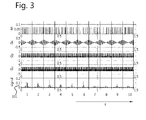
- ⁇ n were computed and the sequence parameters were adjusted until ⁇ n would be small enough. It was found that, by employing an RF train wherein the tip angle alternates between two different states, the resulting ⁇ n is small enough to reconstruct accurately the parameter maps. For example, this was the case when 10 full k -space acquisitions are subsequently performed (see Fig. 3 ). For example, the tip angle may alternate between 0 and a fixed value ⁇ (see Fig. 1 ).
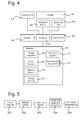
- the sample 401 itself is not part of the system.
- the system comprises an excitation device 402 for transiently exciting the sample 401, thereby causing the sample 401 to emit an emitting signal.
- the system further comprises a receiving coil 403 for receiving the emitting signal.
- the excitation device 402 and the receiving coil 403 are well known in the field of MRI, and are not described herein in greater detail.
- the system further comprises a processor 405 which controls the components of the system including the excitation device 402 and the receiving coil 403.
- the processor 405 may further control a display 404 for outputting images and/or status information, and an input device 406, such as a touch screen, mouse, and keyboard, for receiving commands and auxiliary information from a user.
- the processor 405 may comprise a plurality of processing devices that are configured to cooperate to perform a task such as a computation. Alternatively, the processor 405 consists of a single processing device.
- processing devices such as central processing unit (CPU), controller, or FPGA, are known in the art.
- the system further comprises a storage means, such as a memory 407.
- the memory 407 may be configured to store, under control of the processor 405, signals 412 received from the receiving coil 403 and/or reconstructed image data 413.
- the reconstructed image data 413 may be generated by the system by processing the received signals 412.
- the memory 407 may further store computer code to cause the processor 405 to perform its tasks.
- the computer code may include an image acquisition module 408 for operating a data acquisition based on an acquisition scheme such as illustrated in Fig. 1 . That image acquisition module 408 may cause the excitation device 402 to transiently excite the sample 401 thereby causing the sample to emit an emitting signal. Further, the image acquisition module 408 may cause the processor 405 to receive and store the emitting signal from the receiving coil 403 which receives the signal emitted by the sample 401.
- the memory 407 may store a signal simulator module 409 configured to generate a simulated signal of the receiving coil in a time domain, based on a plurality of spatial parameter distributions.
- a spatial parameter distribution is a parameter which varies across the space. For example such a parameter is different for different portions of the sample 401.
- the spatial distribution comprises the values of the parameter for different spatial locations.
- the spatial parameter distributions on which the simulation is based may include a spatial distribution of a magnetization, that is, a state of the spins of the relevant nuclei at each location.
- the spatial parameter distributions on which the simulation is based may also include a spatial distribution of a material property of a material of the sample.
- the spatial parameter distributions on which the simulation is based may also include a spatial distribution of an electromagnetic field.
- an electromagnetic field describes at least an aspect of an electromagnetic environment in which the sample exists. At a macroscopic level, an electromagnetic field has an effect on the magnetization, but the magnetization does not have an effect on the electromagnetic field. In fact, the magnetization represents the state of the spins and it is determined by the electromagnetic fields (i.e. B1+, B0 and RF).
- the memory may further store an objective function calculating module 410.
- This module calculates an objective function based on a difference between the received emitting signal and the simulated signal in the time domain. Note, that the received emitting signal may be subjected to some processing such as demodulation, digitization, filtering, and/or noise reduction before the objective function is applied to it. However, the received emitting signal remains in the time domain.
- the memory may further store a fitting module 411.
- the fitting module 411 fits the plurality of spatial parameter distributions based on the objective function.
- the fitting may be realized in an iterative fashion.
- the spatial parameter distributions may be adjusted and the objective function may be re-calculated by the objective function module 410, until the outcome of the objective function satisfies a predetermined termination criterion.
- the material property may comprise a relaxation time, such as a T1 relaxation time, a T2 relaxation time or a spatial distribution of a T2* relaxation time.
- a relaxation time such as a T1 relaxation time, a T2 relaxation time or a spatial distribution of a T2* relaxation time.
- the spatial distribution of the electromagnetic field may comprise at least one of: a distribution of a transmit magnetic field B 1 + , and a distribution of an off-resonance ( ⁇ B 0 ), or both.
- said spatial parameter distributions can include the combination of a distribution of a T1 relaxation time, a distribution of a T2 (or T2*) relaxation time, a transmit magnetic field B 1 + , and a distribution of an off-resonance ( ⁇ B 0 ).
- the distribution of the magnetization may be based on, or equal to, a product M 0 B 1 - of an equilibrium value M 0 of spin magnetization and a spatially varying radio-frequency (RF) field B 1 - of the receiving coil.
- RF radio-frequency
- the signal simulator 409 may be configured to generate the simulated signal by solving a system of equations including Bloch equations and Faraday equations.
- the system may further comprise a gradient coil 414 configured to apply, under control of the processor 405 and the image acquisition module 408, a spatial encoding gradient and/or a readout gradient as part of the acquisition sequence.
- a gradient coil 414 configured to apply, under control of the processor 405 and the image acquisition module 408, a spatial encoding gradient and/or a readout gradient as part of the acquisition sequence.
- the image acquisition module 408 may cause the excitation device 402, the gradient coil 414, and the receiving coil 403 to perform a sequence of a plurality of acquisitions with different gradient encodings.
- the signals collected in the plurality of acquisitions may be combined in the reconstruction.
- the signal simulator 409 may be configured to simulate each of the plurality of acquisitions, and the objective function module 410 may calculate a combined objective value based on the collected received signals and the corresponding simulated signals.
- the image acquisition module 408 may cause the excitation device 402, during acquisition, to employ an RF train in which a tip angle alternates between two different states. This may be an on state and an off state.
- the image acquisition module 408 may carry out an acquisition sequence in which the excitation device is configured to perform a sequence of excitations wherein the sample is excited again before the sample can reach an equilibrium state.
- Fig. 5 shows a flow chart of a method of performing time-domain magnetic resonance imaging.
- a sample is transiently excited by an excitation device, thereby causing the sample to emit an emitting signal.
- the emitting signal is received by a receiving coil.
- a simulated signal of the receiving coil is simulated in a time domain, based on a plurality of spatial parameter distributions, wherein the spatial parameter distributions include a spatial distribution of a magnetization, wherein the spatial parameter distributions further include at least one of a spatial distribution of a material property of a material of the sample and a spatial distribution of an electromagnetic field.
- step 504 an objective function is determined based on a difference between the received emitting signal and the simulated signal in the time domain.
- step 505 the plurality of spatial parameter distributions is fitted based on the objective function.
- the fitting step includes searching for spatial parameter distributions for which the simulated signal is most similar to the received signal according to the objective function.
- the steps 503, 504 may be repeated for different values of the spatial parameter distributions to find a spatial parameter distribution satisfying certain criteria regarding the outcome of the objective function.
- At least steps 503, 504, and 505 may be implemented by means of software code for the iterative algorithm.
- the MR dynamics are dependent on the molecular environment in which the nucleus finds itself. If a chemical compound is present whose resonance frequency is different than the hydrogen Larmor frequency, the Bloch equation may be modified. In particular, suppose that fat molecules are present.
- Some or all aspects of the invention may be suitable for being implemented in form of software, in particular a computer program product.
- Such computer program product may comprise a storage media, such as a memory, on which the software is stored.
- the computer program may be represented by a signal, such as an optic signal or an electro-magnetic signal, carried by a transmission medium such as an optic fiber cable or the air.
- the computer program may partly or entirely have the form of source code, object code, or pseudo code, suitable for being executed by a computer system.
- the code may be executable by one or more processors.
Landscapes
- Physics & Mathematics (AREA)
- Condensed Matter Physics & Semiconductors (AREA)
- General Physics & Mathematics (AREA)
- High Energy & Nuclear Physics (AREA)
- Health & Medical Sciences (AREA)
- General Health & Medical Sciences (AREA)
- Nuclear Medicine, Radiotherapy & Molecular Imaging (AREA)
- Radiology & Medical Imaging (AREA)
- Engineering & Computer Science (AREA)
- Signal Processing (AREA)
- Magnetic Resonance Imaging Apparatus (AREA)
Priority Applications (6)
| Application Number | Priority Date | Filing Date | Title |
|---|---|---|---|
| EP15171708.9A EP3093677A1 (fr) | 2015-05-15 | 2015-06-11 | Irm dans le domaine temporel |
| PCT/EP2016/060727 WO2016184779A1 (fr) | 2015-05-15 | 2016-05-12 | Irm en domaine temporel |
| JP2018511520A JP6797189B2 (ja) | 2015-05-15 | 2016-05-12 | 時間領域mri |
| US15/573,599 US10571542B2 (en) | 2015-05-15 | 2016-05-12 | Time-domain MRI |
| EP16724604.0A EP3295196B1 (fr) | 2015-05-15 | 2016-05-12 | Irm dans le domaine temporel |
| CN201680035391.8A CN108027409B (zh) | 2015-05-15 | 2016-05-12 | 时域mri |
Applications Claiming Priority (3)
| Application Number | Priority Date | Filing Date | Title |
|---|---|---|---|
| EP15020075 | 2015-05-15 | ||
| EP15001457 | 2015-05-15 | ||
| EP15171708.9A EP3093677A1 (fr) | 2015-05-15 | 2015-06-11 | Irm dans le domaine temporel |
Publications (1)
| Publication Number | Publication Date |
|---|---|
| EP3093677A1 true EP3093677A1 (fr) | 2016-11-16 |
Family
ID=57083418
Family Applications (2)
| Application Number | Title | Priority Date | Filing Date |
|---|---|---|---|
| EP15171708.9A Withdrawn EP3093677A1 (fr) | 2015-05-15 | 2015-06-11 | Irm dans le domaine temporel |
| EP16724604.0A Active EP3295196B1 (fr) | 2015-05-15 | 2016-05-12 | Irm dans le domaine temporel |
Family Applications After (1)
| Application Number | Title | Priority Date | Filing Date |
|---|---|---|---|
| EP16724604.0A Active EP3295196B1 (fr) | 2015-05-15 | 2016-05-12 | Irm dans le domaine temporel |
Country Status (5)
| Country | Link |
|---|---|
| US (1) | US10571542B2 (fr) |
| EP (2) | EP3093677A1 (fr) |
| JP (1) | JP6797189B2 (fr) |
| CN (1) | CN108027409B (fr) |
| WO (1) | WO2016184779A1 (fr) |
Cited By (14)
| Publication number | Priority date | Publication date | Assignee | Title |
|---|---|---|---|---|
| US10635833B2 (en) | 2015-09-12 | 2020-04-28 | Q Bio, Inc. | Uniform-frequency records with obscured context |
| NL2022890B1 (en) * | 2019-04-08 | 2020-10-15 | Umc Utrecht Holding Bv | Parameter map determination for time domain magnetic resonance |
| US10936180B2 (en) | 2017-03-16 | 2021-03-02 | Q Bio, Inc. | User interface for medical information |
| US10964412B2 (en) | 2015-10-20 | 2021-03-30 | Q Bio, Inc. | Population-based medical rules via anonymous sharing |
| US11085984B2 (en) | 2016-04-03 | 2021-08-10 | Q Bio, Inc. | Tensor field mapping |
| US11131735B2 (en) | 2019-09-27 | 2021-09-28 | Q Bio, Inc. | Maxwell parallel imaging |
| US11354586B2 (en) | 2019-02-15 | 2022-06-07 | Q Bio, Inc. | Model parameter determination using a predictive model |
| US11360166B2 (en) | 2019-02-15 | 2022-06-14 | Q Bio, Inc | Tensor field mapping with magnetostatic constraint |
| US11614509B2 (en) | 2019-09-27 | 2023-03-28 | Q Bio, Inc. | Maxwell parallel imaging |
| US11614508B1 (en) | 2021-10-25 | 2023-03-28 | Q Bio, Inc. | Sparse representation of measurements |
| CN116029181A (zh) * | 2023-03-30 | 2023-04-28 | 西安热工研究院有限公司 | 一种磁脉冲下绕组线匝对地短路的波过程仿真方法及系统 |
| US11650195B2 (en) | 2017-02-03 | 2023-05-16 | Q Bio, Inc. | Iterative medical testing of biological samples |
| US11872025B2 (en) | 2016-03-18 | 2024-01-16 | Q Bio, Inc. | System and method for magnetic resonance elastography |
| US12320880B2 (en) | 2019-09-27 | 2025-06-03 | Q Bio, Inc. | Maxwell parallel imaging |
Families Citing this family (4)
| Publication number | Priority date | Publication date | Assignee | Title |
|---|---|---|---|---|
| WO2018029063A1 (fr) * | 2016-08-09 | 2018-02-15 | Koninklijke Philips N.V. | Correction rétrospective de fluctuations de champ dans une irm à écho à gradient multiple |
| US20230044166A1 (en) | 2020-01-08 | 2023-02-09 | Umc Utrecht Holding B.V. | Accelerated time domain magnetic resonance spin tomography |
| KR102401046B1 (ko) * | 2020-08-24 | 2022-05-23 | 서울대학교 산학협력단 | Mri rf펄스 생성방법 및 이를 위한 장치 |
| KR20230069967A (ko) * | 2020-09-18 | 2023-05-19 | 코르스메드 에이비 | 자기 공명(mr) 영상 시뮬레이션에 관한 방법 |
Citations (1)
| Publication number | Priority date | Publication date | Assignee | Title |
|---|---|---|---|---|
| US8421456B2 (en) | 2009-01-17 | 2013-04-16 | National Taiwan University | Method of time-domain magnetic resonance imaging and device thereof |
Family Cites Families (15)
| Publication number | Priority date | Publication date | Assignee | Title |
|---|---|---|---|---|
| US4709212A (en) * | 1986-01-03 | 1987-11-24 | General Electric Company | Method of enhancing image signal-to-noise ratio by combining NMR images of differing pulse sequence timing |
| JP2001515736A (ja) * | 1997-08-13 | 2001-09-25 | ビー・ティー・ジー・インターナショナル・リミテッド | 緩和パラメータ値決定装置および方法 |
| EP1779130A1 (fr) | 2004-08-13 | 2007-05-02 | Philips Intellectual Property & Standards GmbH | Procede de resonance magnetique pour la determination quantitative de valeurs de temps de relaxation locales |
| WO2008004192A2 (fr) | 2006-07-06 | 2008-01-10 | Koninklijke Philips Electronics N.V. | Dispositif à résonance magnétique et procédé correspondant |
| WO2008109783A2 (fr) * | 2007-03-06 | 2008-09-12 | The Regents Of The University Of California | Détection de perturbations du spin à l'aide de l'imagerie par résonance magnétique |
| JP2009036468A (ja) | 2007-08-02 | 2009-02-19 | Denso Corp | ハウジングレス式熱交換器 |
| US8032335B2 (en) * | 2008-05-02 | 2011-10-04 | Emory University | Evaluating magnetic resonance spectra |
| DE102009014924B3 (de) | 2009-03-25 | 2010-09-16 | Bruker Biospin Mri Gmbh | Rekonstruktion von Spektral- oder Bilddateien bei simultaner Anregung und Detektion in der Magnetischen Resonanz |
| JP5449903B2 (ja) * | 2009-07-29 | 2014-03-19 | 株式会社日立メディコ | 磁気共鳴イメージング装置 |
| DE102010041751B4 (de) * | 2010-09-30 | 2012-09-20 | Siemens Aktiengesellschaft | Steady-State MR-Pulssequenz, bei der das erste Moment des Phasenkodiergradienten zum Zeitpunkt des Einstrahlens eines HF-Pulses minimal ist |
| KR101674848B1 (ko) | 2012-09-19 | 2016-11-22 | 케이스 웨스턴 리저브 유니버시티 | 핵 자기 공명(nmr) 핑거프린팅 |
| US9568579B2 (en) * | 2012-12-19 | 2017-02-14 | Case Western Reserve University | Magnetic resonance fingerprinting (MRF) with echo splitting |
| CN107106039B (zh) * | 2014-11-14 | 2020-08-11 | 皇家飞利浦有限公司 | 切片中的沿着一维延伸的磁共振指纹识别 |
| TWI540330B (zh) * | 2015-09-30 | 2016-07-01 | 國立臺灣大學 | 偵測動態磁場變化之方法與裝置 |
| US10094899B2 (en) * | 2016-08-04 | 2018-10-09 | General Electric Company | Magnetic resonance T2 preparatory pulses for magnetic field inhomogeneity robustness and contrast optimization |
-
2015
- 2015-06-11 EP EP15171708.9A patent/EP3093677A1/fr not_active Withdrawn
-
2016
- 2016-05-12 JP JP2018511520A patent/JP6797189B2/ja active Active
- 2016-05-12 EP EP16724604.0A patent/EP3295196B1/fr active Active
- 2016-05-12 WO PCT/EP2016/060727 patent/WO2016184779A1/fr not_active Ceased
- 2016-05-12 CN CN201680035391.8A patent/CN108027409B/zh active Active
- 2016-05-12 US US15/573,599 patent/US10571542B2/en active Active
Patent Citations (1)
| Publication number | Priority date | Publication date | Assignee | Title |
|---|---|---|---|---|
| US8421456B2 (en) | 2009-01-17 | 2013-04-16 | National Taiwan University | Method of time-domain magnetic resonance imaging and device thereof |
Non-Patent Citations (7)
| Title |
|---|
| BRADLEY P SUTTON ET AL: "Simultaneous estimation of I,, Rz*, and field map using a multi-echo spiral acquisition", PROCEEDINGS OF THE INTERNATIONAL SOCIETY FOR MAGNETIC RESONANCE IN MEDICINE, 10TH ANNUAL MEETING AND EXHIBITION, HONOLULU, HAWAII, USA, 18-24 MAY 2002, vol. 10, 4 May 2002 (2002-05-04), pages 1323, XP055207007 * |
| CLOOS MARTIJN A. ET AL: "Plug and play parallel transmission at 7 and 9.4 Tesla based on principles from MR fingerprinting", PROCEEDINGS OF THE INTERNATIONAL SOCIETY FOR MAGNETIC RESONANCE IN MEDICINE, 22ND ANNUAL MEETING AND EXHIBITION, MILAN, ITALY, 10-16 MAY 2014, vol. 22, no. 542, 25 April 2014 (2014-04-25), XP040661622 * |
| DAN MA ET AL: "MR Fingerprinting (MRF): a Novel Quantitative Approach to MRI", PROCEEDINGS OF THE INTERNATIONAL SOCIETY FOR MAGNETIC RESONANCE IN MEDICINE, 20TH ANNUAL MEETING AND EXHIBITION, MELBOURNE, AUSTRALIA, 5-11 MAY 2012, vol. 20, 21 April 2012 (2012-04-21), pages 288, XP055207010 * |
| DONALD B TWIEG ET AL: "Basic Properties of SS-PARSE Parameter Estimates", IEEE TRANSACTIONS ON MEDICAL IMAGING, IEEE SERVICE CENTER, PISCATAWAY, NJ, US, vol. 29, no. 5, 1 May 2010 (2010-05-01), pages 1156 - 1172, XP011305215, ISSN: 0278-0062 * |
| GENE H. GOLUB; V. PEREYRA: "Separable nonlinear least squares: the variable projection method and its applications", INVERSE PROBLEMS, vol. 19, 2003, pages R1 - R26 |
| KNOPP T ET AL: "Iterative Off-Resonance and Signal Decay Estimation and Correction for Multi-Echo MRI", IEEE TRANSACTIONS ON MEDICAL IMAGING, IEEE SERVICE CENTER, PISCATAWAY, NJ, US, vol. 28, no. 3, 1 March 2009 (2009-03-01), pages 394 - 404, XP011248349, ISSN: 0278-0062 * |
| NOAM BEN-ELIEZER ET AL: "Rapid and accurate T 2 mapping from multi-spin-echo data using Bloch-simulation-based reconstruction", MAGNETIC RESONANCE IN MEDICINE, vol. 73, no. 2, 19 March 2014 (2014-03-19), pages 809 - 817, XP055207015, ISSN: 0740-3194, DOI: 10.1002/mrm.25156 * |
Cited By (22)
| Publication number | Priority date | Publication date | Assignee | Title |
|---|---|---|---|---|
| US10635833B2 (en) | 2015-09-12 | 2020-04-28 | Q Bio, Inc. | Uniform-frequency records with obscured context |
| US10964412B2 (en) | 2015-10-20 | 2021-03-30 | Q Bio, Inc. | Population-based medical rules via anonymous sharing |
| US12114968B2 (en) | 2016-03-18 | 2024-10-15 | Q Bio, Inc. | System and method for magnetic resonance elastography |
| US11872025B2 (en) | 2016-03-18 | 2024-01-16 | Q Bio, Inc. | System and method for magnetic resonance elastography |
| US11085984B2 (en) | 2016-04-03 | 2021-08-10 | Q Bio, Inc. | Tensor field mapping |
| US12529743B2 (en) | 2016-04-03 | 2026-01-20 | Q Bio, Inc. | Tensor field mapping |
| US12529744B2 (en) | 2016-04-03 | 2026-01-20 | Q Bio, Inc. | Tensor field mapping |
| US11650195B2 (en) | 2017-02-03 | 2023-05-16 | Q Bio, Inc. | Iterative medical testing of biological samples |
| US10936180B2 (en) | 2017-03-16 | 2021-03-02 | Q Bio, Inc. | User interface for medical information |
| US11748642B2 (en) | 2019-02-15 | 2023-09-05 | Q Bio, Inc. | Model parameter determination using a predictive model |
| US11354586B2 (en) | 2019-02-15 | 2022-06-07 | Q Bio, Inc. | Model parameter determination using a predictive model |
| US11360166B2 (en) | 2019-02-15 | 2022-06-14 | Q Bio, Inc | Tensor field mapping with magnetostatic constraint |
| US12007455B2 (en) | 2019-02-15 | 2024-06-11 | Q Bio, Inc. | Tensor field mapping with magnetostatic constraint |
| NL2022890B1 (en) * | 2019-04-08 | 2020-10-15 | Umc Utrecht Holding Bv | Parameter map determination for time domain magnetic resonance |
| US11867786B2 (en) | 2019-04-08 | 2024-01-09 | Umc Utrecht Holding B.V. | Parameter map determination for time domain magnetic resonance |
| WO2020208066A1 (fr) * | 2019-04-08 | 2020-10-15 | Umc Utrecht Holding B.V. | Détermination de carte de paramètres pour résonance magnétique dans le domaine temporel |
| US12320880B2 (en) | 2019-09-27 | 2025-06-03 | Q Bio, Inc. | Maxwell parallel imaging |
| US11614509B2 (en) | 2019-09-27 | 2023-03-28 | Q Bio, Inc. | Maxwell parallel imaging |
| US11131735B2 (en) | 2019-09-27 | 2021-09-28 | Q Bio, Inc. | Maxwell parallel imaging |
| US11614508B1 (en) | 2021-10-25 | 2023-03-28 | Q Bio, Inc. | Sparse representation of measurements |
| US12270883B2 (en) | 2021-10-25 | 2025-04-08 | Q Bio, Inc. | Sparse representation of measurements |
| CN116029181A (zh) * | 2023-03-30 | 2023-04-28 | 西安热工研究院有限公司 | 一种磁脉冲下绕组线匝对地短路的波过程仿真方法及系统 |
Also Published As
| Publication number | Publication date |
|---|---|
| US10571542B2 (en) | 2020-02-25 |
| CN108027409B (zh) | 2021-03-09 |
| US20180149722A1 (en) | 2018-05-31 |
| EP3295196A1 (fr) | 2018-03-21 |
| JP6797189B2 (ja) | 2020-12-09 |
| WO2016184779A1 (fr) | 2016-11-24 |
| EP3295196B1 (fr) | 2024-10-09 |
| JP2018517152A (ja) | 2018-06-28 |
| CN108027409A (zh) | 2018-05-11 |
Similar Documents
| Publication | Publication Date | Title |
|---|---|---|
| EP3295196B1 (fr) | Irm dans le domaine temporel | |
| Sbrizzi et al. | Fast quantitative MRI as a nonlinear tomography problem | |
| Wang et al. | Physics-based reconstruction methods for magnetic resonance imaging | |
| US10335049B2 (en) | Magnetic resonance fingerprinting with steady state precession (MRF-FISP) | |
| Zhang et al. | Fast computation of full density matrix of multispin systems for spatially localized in vivo magnetic resonance spectroscopy | |
| JP6270668B2 (ja) | 多点ディクソン法 | |
| Jochimsen et al. | Efficient simulation of magnetic resonance imaging with Bloch–Torrey equations using intra-voxel magnetization gradients | |
| US10145917B2 (en) | Multi-component voxel separation using magnetic resonance fingerprinting with compartment exchange | |
| US11041925B2 (en) | Direct measurement of the B0-off-resonance field during magnetic resonance fingerprinting | |
| US20180238983A1 (en) | Systems and methods for multislice magentic resonance fingerprinting | |
| CN113924503B (zh) | 时域磁共振的参数图确定 | |
| Sbrizzi et al. | Optimal control design of turbo spin‐echo sequences with applications to parallel‐transmit systems | |
| US20120224757A1 (en) | Method and device to process complex image data | |
| US10761172B2 (en) | System and method for an eddy-current field compensation in magnetic resonance imaging | |
| US20160018504A1 (en) | Fractional Order and Entropy Bio-Markers for Biological Tissue in Diffusion Weighted Magnetic Resonance Imaging | |
| Bi et al. | Stabilization of parameter estimates from multiexponential decay through extension into higher dimensions | |
| US11875509B2 (en) | System and method for determining undersampling errors for a magnetic resonance fingerprinting pulse sequence | |
| JP6613161B2 (ja) | Mriシミュレーションシステム | |
| Özarslan et al. | Characterizing magnetic resonance signal decay due to Gaussian diffusion: the path integral approach and a convenient computational method | |
| US20260126505A1 (en) | Quantitative Material Characterization of an Object | |
| CN110623666B (zh) | 磁共振指纹方法 | |
| Smith et al. | Design and use of variable flip angle schedules in transient balanced SSFP subtractive imaging |
Legal Events
| Date | Code | Title | Description |
|---|---|---|---|
| PUAI | Public reference made under article 153(3) epc to a published international application that has entered the european phase |
Free format text: ORIGINAL CODE: 0009012 |
|
| AK | Designated contracting states |
Kind code of ref document: A1 Designated state(s): AL AT BE BG CH CY CZ DE DK EE ES FI FR GB GR HR HU IE IS IT LI LT LU LV MC MK MT NL NO PL PT RO RS SE SI SK SM TR |
|
| AX | Request for extension of the european patent |
Extension state: BA ME |
|
| STAA | Information on the status of an ep patent application or granted ep patent |
Free format text: STATUS: THE APPLICATION IS DEEMED TO BE WITHDRAWN |
|
| 18D | Application deemed to be withdrawn |
Effective date: 20170517 |