EP3094612B1 - Procede de production du e-1-chloro-3,3,3-trifluoropropene a partir du 1,1,3,3-tetrachloropropene - Google Patents
Procede de production du e-1-chloro-3,3,3-trifluoropropene a partir du 1,1,3,3-tetrachloropropene Download PDFInfo
- Publication number
- EP3094612B1 EP3094612B1 EP15704043.7A EP15704043A EP3094612B1 EP 3094612 B1 EP3094612 B1 EP 3094612B1 EP 15704043 A EP15704043 A EP 15704043A EP 3094612 B1 EP3094612 B1 EP 3094612B1
- Authority
- EP
- European Patent Office
- Prior art keywords
- reactor
- reaction
- products
- tetrachloropropene
- fluorination
- Prior art date
- Legal status (The legal status is an assumption and is not a legal conclusion. Google has not performed a legal analysis and makes no representation as to the accuracy of the status listed.)
- Active
Links
Images

Classifications
-
- C—CHEMISTRY; METALLURGY
- C07—ORGANIC CHEMISTRY
- C07C—ACYCLIC OR CARBOCYCLIC COMPOUNDS
- C07C17/00—Preparation of halogenated hydrocarbons
- C07C17/093—Preparation of halogenated hydrocarbons by replacement by halogens
- C07C17/20—Preparation of halogenated hydrocarbons by replacement by halogens of halogen atoms by other halogen atoms
- C07C17/202—Preparation of halogenated hydrocarbons by replacement by halogens of halogen atoms by other halogen atoms two or more compounds being involved in the reaction
- C07C17/206—Preparation of halogenated hydrocarbons by replacement by halogens of halogen atoms by other halogen atoms two or more compounds being involved in the reaction the other compound being HX
-
- C—CHEMISTRY; METALLURGY
- C07—ORGANIC CHEMISTRY
- C07C—ACYCLIC OR CARBOCYCLIC COMPOUNDS
- C07C17/00—Preparation of halogenated hydrocarbons
- C07C17/38—Separation; Purification; Stabilisation; Use of additives
- C07C17/383—Separation; Purification; Stabilisation; Use of additives by distillation
-
- Y—GENERAL TAGGING OF NEW TECHNOLOGICAL DEVELOPMENTS; GENERAL TAGGING OF CROSS-SECTIONAL TECHNOLOGIES SPANNING OVER SEVERAL SECTIONS OF THE IPC; TECHNICAL SUBJECTS COVERED BY FORMER USPC CROSS-REFERENCE ART COLLECTIONS [XRACs] AND DIGESTS
- Y02—TECHNOLOGIES OR APPLICATIONS FOR MITIGATION OR ADAPTATION AGAINST CLIMATE CHANGE
- Y02P—CLIMATE CHANGE MITIGATION TECHNOLOGIES IN THE PRODUCTION OR PROCESSING OF GOODS
- Y02P20/00—Technologies relating to chemical industry
- Y02P20/50—Improvements relating to the production of bulk chemicals
- Y02P20/584—Recycling of catalysts
Definitions
- the present invention relates to a process for the continuous manufacture of E-1-chloro-3,3,3-trifluoropropene (E-1233zd) comprising at least one step of liquid phase fluorination of 1,1,3,3-tetrachloropropene (1230za ).
- E-1-chloro-3,3,3-trifluoropropene can be made by fluorination of 1,1,1,3,3-pentachloropropane (240fa).
- 240fa 1,1,1,3,3-pentachloropropane
- documents US 8,436,217 and US 8,426,656 describe the fluorination of 240fa to E-1233zd in the liquid phase, in the presence of suitable catalysts such as TiCl 4 or a combination of TiCl 4 and SbCl 5 .
- the document FR2768727 also teaches that the fluorination of 240fa or 1230za can be carried out in the presence of a catalyst such as TiCl 4 .
- the documents US2010 / 0191025 and US 6,166,274 also describe the use of a catalyst for the liquid phase fluorination of 1230za in order to obtain E-1233zd: an ionic liquid-based catalyst for the first document and a triflic or trifluoroacetic acid for the second document.
- the uncatalyzed liquid phase fluorination reaction of 1230za is exemplified in the document US 5,616,819 .
- the pressure used is 200 psi (14 bar) and results in the formation of oligomers despite the short duration of the batch test.
- the present invention overcomes the drawbacks of the state of the art. It more particularly provides a new process for the production of E-1-chloro-3,3,3-trifluoropropene.
- the process comprises at least one step during which 1,1,3,3-tetrachloropropene reacts with anhydrous hydrofluoric acid in the liquid phase, in the absence of a catalyst, with an HF molar ratio / 1,1,3,3-tetrachloropropene between 9 and 20, at a temperature between 50 and 150 ° C and an absolute pressure between 1 and 20 bar, characterized in that the fluorination reaction is carried out in an unstirred reactor.
- the HF / 1,1,3,3-tetrachloropropene molar ratio is preferably between 9 and 14 and preferably between 9 and 12.
- the HF / 1,1,3,3-tetrachloropropene molar ratio includes the recycled part of HF and is preferably measured at the inlet of the reactor.
- the presence of an excess of HF relative to the organic compound makes it possible to rapidly evacuate the E-1233zd formed by azeotropic entrainment and thus makes it possible to avoid the subsequent formation of superfluorinated products, such as in particular 1,3,3, 3-tetrafluoropropene, or 1234ze, and 1,1,1,3,3-pentafluoropropane, or 245fa.
- the purity of the final product is thus improved thanks to the reduction in the quantity of impurities formed from the reaction stage.
- the reaction temperature is preferably between 80 and 120, and advantageously between 90 and 110 ° C.
- the fluorination reaction is preferably carried out at a pressure between 5 and 20 bars, preferably between 5 and 15 bars, even more preferably between 7 and 15 bars and advantageously between 7 and 12 bars.
- the fluorination reaction is carried out in an unstirred reactor.
- the process according to the present invention can be implemented continuously, discontinuously or batch. We prefer to operate continuously.
- the process according to the present invention offers the advantage of obtaining a very advantageous yield and selectivity while using mild conditions. In addition, these results can be obtained using a single reactor.
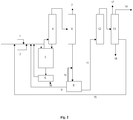
- the figure 1 schematically represents an embodiment of the method according to the invention and an installation for its implementation.
- the invention provides for the fluorination of 1230za to E-1233zd with hydrogen fluoride in the liquid phase, in the absence of a catalyst.
- the installation comprises a catalytic reactor 3 for carrying out the fluorination reaction of 1230za to E-1233zd.
- Reactor 3 is fed by a feed line for 1,1,3,3-tetrachloropropene 2 and a feed line for hydrogen fluoride 1. Heating means are preferably provided to preheat the reactants before their arrival. in reactor 3.
- the aforementioned supply lines can feed the reactor 3 separately or can be connected together upstream of the reactor in order to feed the latter with a mixture of reactants.
- Reactor 3 is preferably a metallic reactor.
- the metal of the reactor can be steel or stainless steel. However, other materials such as a superaustenitic stainless steel or a passivable nickel-based alloy could be used.
- the absence of a catalyst for the reaction is an advantage which makes it possible to avoid corrosion phenomena known to those skilled in the art when a fluorination catalyst is used in this type of reactor.
- All of the other equipment of the installation and in particular all of the separation columns or distillation columns can be made of metal.
- the reactor 3 can include a heating jacket making it possible to bring the reaction mixture to the desired temperature between 50 and 150 ° C, preferably between 80 and 120 ° C and advantageously between 90 and 110 ° C.
- a sampling line makes it possible to purge a quantity of undesirable products of high molecular weight which could have formed during the fluorination reaction.
- This stream also contains HF and valuable organic compounds which are separated by a specific treatment before being returned to the reactor.
- This treatment involves technologies known to those skilled in the art such as decantation or azeotropic distillation, and preferably a combination of the two.
- Stream 16 corresponds to heavy non-recoverable compounds which must be eliminated from the process.
- a pipe for taking products from the reaction is connected at the outlet of reactor 3.
- This pipe carries a stream containing the desired product (E-1233zd), hydrogen chloride, hydrogen fluoride and co-products and sub- products. reaction products.
- the line for withdrawing products from the reaction feeds a preliminary separation unit 4, which is preferably a column of distillation fitted with an overhead reflux system.
- This preliminary separation unit ensures a first separation of the HF from the rest of the products resulting from the reaction.
- a first intermediate pipe which is intended for the collection of the remaining reaction products, and feeds a separation unit 6 intended for the separation of hydrogen chloride, which is a co-product of the reaction.
- the composition resulting from the intermediate separation unit 4 typically comprises 43% E-1233zd, 15-18% HF, 35-40% HCl, the remainder consisting of Z-1233zd, (Z + E) -1234ze, 243fc, 245fa and 1232 and / or 1231 isomers
- Cooling means can be provided on the first intermediate pipe so that the first separation unit operates at the desired temperature.
- the separation unit 6 is preferably a distillation column provided with a reboiler at the bottom and with a reflux system at the top. It can for example be operated at a pressure slightly lower than that of the reactor 3.
- a hydrogen chloride sampling line At the head of the first separation unit is connected a hydrogen chloride sampling line through which is taken a stream 7 mainly comprising hydrogen chloride. . Traces of E-1233zd or of light co-products such as 245fa or E-1234ze may be present in this flux.
- the HCl produced is preferably recovered in the form of HCl solution after adiabatic or isothermal absorption in water.
- the HCl can be purified by passing the gas through alumina towers to obtain a desired quality of analysis.
- the composition resulting from the separation unit 6 typically comprises between 25 and 30% of HF, 70% of E-1233zd, between 1 and 5% of compounds by-products of the reaction.
- This separation system may consist of a first phase separation unit consisting of a settling tank, implemented at a temperature advantageously between -50 and 50 ° C, preferably between -20 ° C and 10 ° C.
- the HF-rich phase can thus be brought to a separation unit which is preferably an azeotropic distillation column, the fraction at the bottom of the column is enriched in HF before being recycled to reactor 3 along line 9 (99.7 % HF, 0.3% E-1233zd).
- the azeotropic fraction 10 collected at the top (69% E-1233zd, 27% HF, the remainder being composed of HCl and traces of other organics) is recycled to the separation unit 8.
- phase rich in organic compounds will be collected through line 11 and may be treated, depending on the Figure 1 , by a downstream train of a purification unit 12 comprising at least one additional azeotropic distillation column making it possible to finalize the separation of the HF and a final purification unit making it possible to obtain E-1233zd with a purity greater than or equal to 98 % (flow 14 of the figure 1 ).
- the phase from separation unit 8 has a composition of approximately 90-95% E-1233zd, 3-5% HF, 1-5% Z-1233zd and 0, 1-2% co-products and intermediate products.
- the process comprises two azeotropic distillations provided: an azeotropic column integrated in the separation system 8 after the settling tank and an azeotropic column in the purification unit 12.
- the purification unit 12 preferably comprises a first distillation column for removing the light products (245fa, E-1234ze or residual traces of HCl) which are discharged from the process via line 13.
- the gas stream resulting from this first distillation is then treated with an azeotropic column to finalize the separation of the HF.
- An azeotropic composition is thus collected in line 17 and recycled to the separation unit 8.
- the composition of this flow is close to that of the flow of line 10, that is to say an azeotropic mixture of HF and of E-1233zd.
- the resulting gas stream is finally treated with at least one purification column, preferably two columns, to remove a fraction mainly containing the cis-1233zd isomer and intermediate compounds (for example isomers 1231, 1232, 241, 242, 243 ...) which are recycled to the reactor via line 15 and another fraction containing non-recoverable compounds (heavy, 1223xd, etc.) which are eliminated via line 18.
- at least one purification column preferably two columns
- the final product E-1233zd is then collected via line 14 with a purity greater than or equal to 98%, advantageously greater than or equal to 99%, and very advantageously greater than or equal to 99.9% by weight.
- the phase rich in organic compounds will be collected through line 11 (approximately 90-95% E-1233zd, 3-5% HF, 1-5% Z-1233zd and 0.1-2% of co-products and intermediate products) and can be treated by an absorption washing system 12 then a final elimination step 13 allowing to finalize the separation of the HF and to obtain the E-1233zd with a purity greater than or equal to 98% (Flux 14 of the Figure 2 ).
- the washing system 12 preferably consists of a first washing with water which makes it possible to absorb the residual HF. The temperature of this wash is maintained above the dew point of the organic mixture. The washing system is then completed by a second washing column supplied with a caustic solution (KOH, NaOH, etc.) which makes it possible to finalize the neutralization of the flow. The organic stream is then dried (using, for example, molecular sieves) then condensed before being taken to the final purification train.
- a caustic solution KOH, NaOH, etc.
- composition of the stream no longer contains HF and the distribution of organic compounds is typically as follows: 93-94% of E-1233zd, 3.5-4% of isomer Z-1233zd, 1% of 1232zd, less than 1% of 1234ze and less than 1% of 245fa.
- the purification unit 13 preferably comprises a first distillation column for removing the light products (245fa, E-1234ze) which are discharged from the process via line 17.
- the resulting gas stream is finally treated with at least one purification column, preferably two columns, to remove a fraction mainly containing the cis-1233zd isomer and intermediate compounds (for example isomers 1231, 1232, 241, 242, 243 ...) which are recycled to the reactor via line 15 and another fraction containing non-recoverable compounds (heavy, 1223xd, etc.) which are eliminated via line 18.
- at least one purification column preferably two columns
- the final product E-1233zd is then collected via line 14 with a purity greater than or equal to 98%, advantageously greater than or equal to 99%, and very advantageously greater than or equal to 99.9% by weight.
- a first step is to prepare the raw material.
- 1,1,3,3-tetrachloropropene is obtained by dehydrochlorination of 1,1,1,3,3-pentachloropropane in the presence of anhydrous ferric chloride.
- the low purity 1230za is then subjected to conventional laboratory distillation involving a column of 10 trays, condenser, vacuum pump, flask, and receiving flasks.
- the distillation is carried out under a vacuum of 25 mbar, the product 1230za then has a boiling point of 53 ° C.
- a raw material of good purity is obtained having the following composition: 99.33% of 1230za, 0.02% 250fa, 0.15% 240fa, 0.009% C 2 Cl 6 and 0.001% 240db.
- Example 3 continuous liquid phase fluorination of 1230za with a molar ratio of 9 at the inlet of the reactor
- the equipment used consists of an autoclave with a capacity of 1 liter with a double jacket, made of 316L stainless steel. It is provided with means for measuring temperature and pressure. Openings at the top of the autoclave allow the introduction of reagents and the removal of products.
- a condenser is provided at the top, as well as a valve for pressure regulation. The condenser is temperature controlled by means of an independent thermostatic bath. Its function is to return part of the unreacted HF and the intermediates back to the reactor.
- the reaction products are continuously extracted during the reaction.
- the outlet gas stream passes through a scrubber which collects the hydracids HF and HCl, and then is cooled in liquid nitrogen.
- the molar distribution of the products of the outlet gas is analyzed periodically by GPC (gas chromatography).
- the reaction medium is depressurized and slowly heated in order to evacuate the residual HF.
- the organic compounds possibly entrained are also recovered, after passing through the washing device in order to remove HF and HCl from the gas stream.
- the autoclave is opened and emptied.
- the raw material prepared in Example 2 is used for a fluorination reaction.
- a quantity of 300 g of HF is introduced into the autoclave.
- the temperature of the reactor is adjusted to 92-93 ° C in the liquid phase.
- the pressure is regulated at 10 bar abs.
- the reagents are then introduced at the following flow rates: 20 g / h of 1230za and 20 g / h of HF.
- the molar ratio of HF to the organic compound is therefore 9.
- the establishment of a correct mass balance between the inlet and the outlet is regularly checked.
- composition of the output stream is followed by GPC analysis, and reported in Table 2: ⁇ u> Table 2 - molar composition of the outlet gas (1230za inlet flow rate of 20g / h) ⁇ /u> Time Molar composition at the outlet F1233zd-E F1233zd-Z F1234ze (E + Z) F245fa 5.5 h 90.6% 3.9% 1.4% 2.2% 11 p.m. 92.1% 3.7% 1.5% 1.4% 29.2 h 91.6% 3.7% 1.6% 1.4% 46.7 h 92.4% 3.7% 1.5% 1.1% 53.7 h 92.1% 3.6% 1.6% 1.2%
- the quantity of superfluorinated impurities 1234ze (E + Z) and 245fa remain greater than 1% throughout the test.
- the remainder of the composition consists of intermediate products (1231, 1232, 242, 243) and / or unidentified products.
- the productivity of the F1233zd-E reaction system is 0.31 mol / h / L.
- Example 4 continuous liquid phase fluorination of 1230za with a molar ratio of between 9 and 10 at the inlet of the reactor
- Example 3 The procedure of Example 3 is reproduced, but by doubling the organic and HF feed rates, ie 40 g / h of 1230za and 40-44 g / h of HF.
- the molar ratio of HF to the organic compound is between 9 and 10.
- composition of the output stream is followed by GPC analysis, and reported in Table 3: ⁇ u> Table 3 - molar composition of the outlet gas (1230za inlet flow rate of 40g / h) ⁇ /u> Time Molar composition at the outlet F1233zd-E F1233zd-Z F1234ze (E + Z) F245fa 5.5 h 92.5% 3.8% 1.0% 1.0% 23.1 h 93.7% 3.7% 0.6% 0.7% 29.1 h 93.5% 3.8% 0.5% 0.6% 46.6 h 91.4% 4.5% 0.2% 0.1%
- the quantity of superfluorinated impurities 1234ze (E + Z) and 245fa is rapidly less than 1%.
- the productivity of the F1233zd-E reaction system is 0.68 mol / h / L.
- the reactor was emptied.
- the hydracids were trapped in water, the light organics were trapped in the cold and the organics remaining in the reactor base recovered.
- the liquid level in the reactor decreased during the test and the composition of the reactor is as follows: 11.3g of HF, 5.6g of HCl, 9g of light organics and 127g of organic compounds accumulated in the reactor.
- the conversion of the entire test is calculated on the basis of 27.9 g of 1230za found in the liquid phase relative to 3059 g introduced in total, ie 99.1%.
- the selectivity for E-1233zd over the whole of the continuous test (example 3 and example 4) is 89.2%, the selectivity for Z-1233zd is 3.8%, 2% for 1232, 0.7 % in 1234zeE, 0.7% in 245fa and 2.9% in unknown products.
- Example 5 continuous liquid phase fluorination of 1230za with a molar ratio of 11
- Example 3 The procedure of Example 3 is reproduced. A quantity of 302g of HF is introduced into the autoclave. The temperature of the reactor is adjusted to 90 ° C. in the liquid phase. The pressure is regulated at 10 bar abs. The molar ratio of HF to the organic compound is adjusted to 11 and a longer test was carried out to establish the stability of the continuous process for 366 h. 50 g / h of 1230za and 62 g / h of HF are introduced continuously. The establishment of a correct mass balance between the inlet and the outlet is regularly checked.
- composition of the output stream is followed by GPC analysis, and reported in Table 4: ⁇ u> Table 4 - molar composition of the outlet gas (molar ratio of 11, longer test) ⁇ /u> Time Molar composition at the outlet F1233zd-E F1233zd-Z F1234ze (E + Z) F245fa 3.5 h 90.1% 3.5% 1.6% 3.8% 8.6 h 93.3% 3.5% 0.9% 0.9% 2 p.m. 93.3% 3.6% 1.1% 0.6% 7 p.m.
- the remainder of the composition consists of intermediate products (1231, 1232, 242, 243) and / or unidentified products.
- the quantity of superfluorinated impurities 1234ze (E + Z) and 245fa is less than 1%.
- a batch of 902g of crude product collected during a certain period of the continuous test of Example 5 was analyzed before being distilled.
- the Oldershaw type distillation column has twenty trays. The distillation is carried out at atmospheric pressure. The product is charged cold (5 ° C.) into the boiler which is gradually reheated so as to withdraw various fractions.
- the analysis of the crude product and of the various fractions obtained are given in Table 5.
- fraction 3 reaches a purity greater than 99.9% with simple laboratory equipment.
- the 245fa in the final product does not exceed 40 ppm.
Landscapes
- Chemical & Material Sciences (AREA)
- Organic Chemistry (AREA)
- Chemical Kinetics & Catalysis (AREA)
- Organic Low-Molecular-Weight Compounds And Preparation Thereof (AREA)
- Low-Molecular Organic Synthesis Reactions Using Catalysts (AREA)
- Catalysts (AREA)
Description
- La présente invention concerne un procédé de fabrication continue de E-1-chloro-3,3,3-trifluoropropène (E-1233zd) comprenant au moins une étape de fluoration en phase liquide du 1,1,3,3-tetrachloropropène (1230za).
- Le E-1-chloro-3,3,3-trifluoropropène (E-1233zd) peut être fabriqué par fluoration du 1,1,1,3,3-pentachloropropane (240fa). Par exemple, les documents
US 8,436,217 etUS 8,426,656 décrivent la fluoration du 240fa en E-1233zd en phase liquide, en présence de catalyseurs adaptés tels que TiCl4 ou une combinaison de TiCl4 et SbCl5. - Le document
FR2768727 - Les documents
US2010/0191025 etUS 6,166,274 décrivent également l'utilisation d'un catalyseur pour la fluoration en phase liquide du 1230za afin d'obtenir le E-1233zd : un catalyseur à base de liquide ionique pour le premier document et un acide triflique ou trifluoroacétique pour le deuxième document. - Le document
US 2012/0059199 décrit la fluoration en phase liquide de 240fa en l'absence de catalyseur. Ce document enseigne qu'un désavantage de procédé en phase liquide non catalysé est le faible taux de conversion de la réaction. Plusieurs réacteurs en série sont donc nécessaires pour augmenter le taux de conversion global, chacun des réacteurs apportant sa contribution à l'avancement du taux de conversion. - Le document
US 2013/0211154 décrit l'utilisation d'une pression de réaction élevée associée à un réacteur de fluoration agité pour pouvoir augmenter le taux de conversion dans un procédé en phase liquide non catalysé du 240fa. Toutefois, il n'y a aucune précision du taux de conversion. - Le document
US 6,987,206 décrit la possibilité d'obtenir le E-1233zd à partir du 1230za comme intermédiaire sans indication de conditions opératoires. - La réaction non catalysée en phase liquide de fluoration du 1230za est exemplifiée dans le document
US 5,616,819 . La pression utilisée est de 200 psi (14 bar) et engendre la formation d'oligomères malgré la courte durée de l'essai batch. - Le document
US 5,877,359 présente la fluoration non catalysée en phase liquide du 1230za. Les exemples montrent qu'un ratio molaire très élevé de 166 a été utilisé pour obtenir une conversion complète sur un essai batch de courte durée. Lorsque le ratio molaire est diminué à 12,6, une pression de 600psig (42 bar) est appliquée. D'autre part, les conditions opératoires d'un procédé continu extrapolable ne sont donc pas définies : ratio molaire HF/1230za, température de reflux, nature des sous-produits à distiller. La productivité ou la stabilité dans le temps d'un procédé basé sur cette réaction ne sont pas décrites non plus. - Il existe toujours un besoin de mettre au point un nouveau procédé de production continu et extrapolable de E-1233zd en évitant des conditions opératoires contraignantes telles qu'une pression excessive, un ratio molaire élevé ou une agitation dans le réacteur de fluoration qui pourraient conduire à une perte de sélectivité par formation d'oligomères ou de produits surfluorés.
- La présente invention permet de surmonter les inconvénients de l'état de la technique. Elle fournit plus particulièrement un nouveau procédé de production de E-1-chloro-3,3,3-trifluoropropène.
- Ceci est accompli grâce à la mise en œuvre simplifiée de la fluoration du 1230za en E-1233zd par le fluorure d'hydrogène en phase liquide en l'absence de catalyseur.
- Selon la présente invention, le procédé comprend au moins une étape au cours de laquelle le 1,1,3,3-tetrachloropropène réagit avec de l'acide fluorhydrique anhydre en phase liquide, en l'absence de catalyseur, avec un ratio molaire HF/1,1,3,3-tetrachloropropène compris entre 9 et 20, à une température comprise entre 50 et 150°C et une pression absolue comprise entre 1 et 20 bar, caractérisé en ce que la réaction de fluoration est mise en oeuvre dans un réacteur non agité.
- Le ratio molaire HF/1,1,3,3-tetrachloropropène est de préférence compris entre 9 et 14 et préférentiellement entre 9 et 12. Le ratio molaire HF/1,1,3,3-tetrachloropropène inclus la partie d'HF recyclée et est de préférence mesuré à l'entrée du réacteur. La présence d'un excès d'HF par rapport au composé organique permet d'évacuer rapidement le E-1233zd formé par entrainement azéotropique et permet d'éviter ainsi la formation consécutive de produits surfluorés, comme en particulier le 1,3,3,3-tétrafluoropropène, ou 1234ze, et le 1,1,1,3,3-pentafluoropropane, ou 245fa. La pureté du produit final est ainsi améliorée grâce à la diminution de la quantité d'impuretés formées dès l'étape réactionnelle.
- La température de réaction est de préférence comprise entre 80 et 120, et avantageusement comprise entre 90 et 110°C.
- La réaction de fluoration est de préférence mise en œuvre à une pression comprise entre 5 et 20 bars, préférentiellement entre 5 et 15 bars, encore plus préférentiellement entre 7 et 15 bars et avantageusement comprise entre 7 et 12 bars. La réaction de fluoration est mise en œuvre dans un réacteur non agité.
- Le procédé selon la présente invention peut être mis en œuvre en continu, discontinu ou batch. On préfère opérer en continu.
- Le procédé selon la présente invention offre l'avantage d'obtenir un rendement et une sélectivité très intéressants tout en utilisant des conditions douces. En outre, ces résultats peuvent être obtenus à l'aide d'un réacteur unique.
- De préférence, lorsqu'il est fait référence à des intervalles, les expressions « compris entre...et... » excluent les bornes de l'intervalle.
- La
figure 1 représente de manière schématique un mode de réalisation du procédé selon l'invention et une installation pour sa mise en œuvre. - Sauf mention contraire, l'ensemble des pourcentages indiqués ci-dessous sont des pourcentages massiques.
- L'invention prévoit la fluoration de 1230za en E-1233zd par du fluorure d'hydrogène en phase liquide, en l'absence de catalyseur.
- En faisant référence à la
figure 1 , l'installation comprend un réacteur catalytique 3 pour la mise en œuvre de la réaction de fluoration du 1230za en E-1233zd. - Le réacteur 3 est alimenté par une conduite d'amenée de 1,1,3,3-tétrachloropropène 2 et une conduite d'amenée de fluorure d'hydrogène 1. Des moyens de chauffage sont de préférence prévus pour préchauffer les réactifs avant leur arrivée dans le réacteur 3.
- Les conduites d'amenée précitées peuvent alimenter le réacteur 3 séparément ou bien peuvent être connectées ensemble en amont du réacteur pour alimenter celui-ci en mélange de réactifs.
- Le réacteur 3 est de préférence un réacteur métallique. Le métal du réacteur pourra être de l'acier ou de l'acier inoxydable. Toutefois, d'autres matériaux comme un acier inoxydable superausténitique ou un alliage à base nickel passivable pourront être utilisés. L'absence de catalyseur pour la réaction est un avantage qui permet d'éviter des phénomènes de corrosion connus de l'homme de l'art lorsqu'un catalyseur de fluoration est utilisé dans ce type de réacteur.
- L'ensemble des autres équipements de l'installation et notamment l'ensemble des colonnes de séparation ou colonnes de distillation peuvent être en métal.
- Le réacteur 3 peut comprendre une enveloppe chauffante permettant de porter le mélange réactionnel à la température souhaitée entre 50 et 150°C, de préférence entre 80 et 120°C et de manière avantageuse entre 90 et 110°C.
- Une conduite de prélèvement permet de purger une quantité de produits indésirables de haut poids moléculaire qui auraient pu se former au cours de la réaction de fluoration. Ce flux contient également de l'HF et des composés organiques valorisables qui sont séparés par un traitement spécifique 5 avant d'être retournés au réacteur. Ce traitement implique des technologies connues de l'homme de l'art comme la décantation ou la distillation azéotropique, et de préférence une combinaison des deux. Le flux 16 correspond aux composés lourds non valorisables qui doivent être éliminés du procédé.
- Une conduite de prélèvement de produits issus de la réaction est connectée en sortie du réacteur 3. Cette conduite transporte un flux contenant le produit désiré (E-1233zd), du chlorure d'hydrogène, du fluorure d'hydrogène et des coproduits et sous-produits de la réaction.
- La conduite de prélèvement de produits issus de la réaction alimente une unité de séparation préliminaire 4, qui est de préférence une colonne de distillation munie d'un système de reflux en tête. Cette unité de séparation préliminaire assure une première séparation du HF du reste des produits issus de la réaction.
- En tête de l'unité de séparation préliminaire 4 est connectée une première conduite intermédiaire, qui est destinée à la collecte des produits issus de la réaction restants, et alimente une unité de séparation 6 destinée à la séparation du chlorure d'hydrogène, qui est un coproduit de la réaction. La composition issue de l'unité de séparation intermédiaire 4 comprend typiquement 43% E-1233zd, 15-18% HF, 35-40% HCl, le complément étant constitué de Z-1233zd, (Z+E)-1234ze, 243fc, 245fa et d'isomères 1232 et/ou 1231
- Des moyens de refroidissement peuvent être prévus sur la première conduite intermédiaire de sorte que la première unité de séparation opère à la température souhaitée.
- L'unité de séparation 6 est de préférence une colonne de distillation munie d'un rebouilleur en pied et d'un système de reflux en tête. Elle peut par exemple être opérée à une pression légèrement inférieure à celle du réacteur 3. En tête de la première unité de séparation est connectée une conduite de prélèvement de chlorure d'hydrogène par laquelle est prélevé un flux 7 comprenant majoritairement du chlorure d'hydrogène. Des traces de E-1233zd ou de coproduits légers comme le 245fa ou E-1234ze peuvent être présentes dans ce flux.
- Le HCl produit est préférablement valorisé sous forme de HCl solution après absorption adiabatique ou isotherme dans l'eau. L'HCl peut être purifié par passage du gaz dans des tours d'alumine pour avoir une qualité d'analyse souhaitée.
- En pied de l'unité de séparation 6 est connecté un système de séparation 8 qui va permettre la séparation du HF et des autres produits organiques. La composition issue de l'unité de séparation 6 comprend typiquement entre 25 et 30% de HF, 70% de E-1233zd, entre 1 et 5% de composés sous-produits de la réaction. Ce système de séparation pourra être constitué d'une première unité de séparation de phases constituée d'un décanteur, mis en œuvre à une température avantageusement comprise entre - 50 et 50°C, de préférence entre -20°C et 10°C. La phase riche en HF pourra être ainsi amenée vers une unité de séparation qui est de préférence une colonne de distillation azéotropique dont la fraction en pied de colonne est enrichie en HF avant d'être recyclée au réacteur 3 selon la conduite 9 (99,7% HF, 0.3% E-1233zd). La fraction azéotropique 10 collectée en tête (69% E-1233zd, 27% HF, le reste étant composé d'HCl et de traces d'autres organiques) est recyclée vers l'unité de séparation 8.
- La phase riche en composés organiques sera collectée par la conduite 11 et pourra être traité, selon la
Figure 1 , par un train aval d'une unité de purification 12 comprenant au moins une colonne de distillation azéotropique supplémentaire permettant de finaliser la séparation du HF et une unité de purification finale permettant d'obtenir le E-1233zd avec une pureté supérieure ou égale à 98 % (flux 14 de lafigure1 ). De préférence, avant l'étape de purification, la phase issue de l'unité de séparation 8 a une composition d'environ 90-95 % E-1233zd, 3-5 % HF, 1-5% Z-1233zd et 0,1-2% de coproduits et de produits intermédiaires. - Selon un mode de réalisation, le procédé comprend deux distillations azéotropiques prévues : une colonne azéotropique intégrée dans le système de séparation 8 après le décanteur et une colonne azéotropique dans l'unité de purification 12.
- L'unité de purification 12 comprend de préférence une première colonne à distiller pour éliminer les produits légers (245fa, E-1234ze ou des traces résiduelles d'HCl) qui sont évacués du procédé par la conduite 13.
- Le flux gazeux résultant de cette première distillation est ensuite traité par une colonne azéotropique pour finaliser la séparation de l'HF. Une composition azéotropique est ainsi collectée dans la conduite 17 et recyclée vers l'unité de séparation 8. La composition de ce flux est proche de celle du flux de la conduite 10, c'est-à-dire un mélange azéotropique de HF et de E-1233zd.
- Le flux gazeux résultant est finalement traité par au moins une colonne de purification, de préférence deux colonnes, pour éliminer une fraction contenant majoritairement l'isomère cis-1233zd et des composés intermédiaires (par exemple les isomères 1231, 1232, 241, 242, 243...) qui sont recyclés au réacteur par la conduite 15 et une autre fraction contenant des composés non valorisables (lourds, 1223xd, ..) qui sont éliminés par la conduite 18.
- Le produit final E-1233zd est ensuite collecté par la conduite 14 avec une pureté supérieure ou égale à 98 %, avantageusement supérieure ou égale à 99 %, et très avantageusement supérieure ou égale à 99,9 % en poids.
- Selon un mode de réalisation préféré référencé dans la
Figure 2 , la phase riche en composés organiques sera collectée par la conduite 11 (environ 90-95 % E-1233zd, 3-5 % HF, 1-5% Z-1233zd et 0,1-2% de coproduits et produits intermédiaires) et pourra être traité par un système de lavage par absorption 12 puis une étape d'élimination finale 13 permettant de finaliser la séparation du HF et d'obtenir le E-1233zd avec une pureté supérieure ou égale à 98 % (Flux 14 de laFigure 2 ). - Le système de lavage 12 est constitué de préférence d'un premier lavage à l'eau qui permet d'absorber le HF résiduel. La température de ce lavage est maintenue au-dessus du point de rosée du mélange organique. Le système de lavage est complété ensuite par une deuxième colonne de lavage alimentée par une solution caustique (KOH, NaOH, ..) qui permet de finaliser la neutralisation du flux. Le flux organique est ensuite séché (à l'aide par exemple de tamis moléculaires) puis condensé avant d'être conduit vers le train final de purification.
- A l'issue de ce lavage, la composition du flux ne contient plus de HF et la répartition des composés organiques est typiquement la suivante : 93-94% de E-1233zd, 3,5-4% d'isomère Z-1233zd, 1% de 1232zd, moins de 1% de 1234ze et moins de 1% de 245fa.
- L'unité de purification 13 comprend de préférence une première colonne à distiller pour éliminer les produits légers (245fa, E-1234ze) qui sont évacués du procédé par la conduite 17.
- Le flux gazeux résultant est finalement traité par au moins une colonne de purification, de préférence deux colonnes, pour éliminer une fraction contenant majoritairement l'isomère cis-1233zd et des composés intermédiaires (par exemple les isomères 1231, 1232, 241, 242, 243...) qui sont recyclés au réacteur par la conduite 15 et une autre fraction contenant des composés non valorisables (lourds, 1223xd, ..) qui sont éliminés par la conduite 18.
- Le produit final E-1233zd est ensuite collecté par la conduite 14 avec une pureté supérieure ou égale à 98 %, avantageusement supérieure ou égale à 99 %, et très avantageusement supérieure ou égale à 99,9 % en poids.
- Les exemples suivants illustrent l'invention sans la limiter.
- Une première étape consiste à préparer la matière première. Le 1,1,3,3-tetrachloropropène est obtenu par déshydrochloration du 1,1,1,3,3-pentachloropropane en présence de chlorure ferrique anhydre.
- Dans un réacteur en verre équipé d'une double enveloppe et d'un reflux, on introduit 1441,6g de 1,1,1,3,3-pentachloropropane, de pureté de 99,6%. Le ciel du réacteur est balayé par un débit d'azote de 4l/h pour inerter l'atmosphère. On introduit ensuite 14,4g de chlorure ferrique anhydre avant de mettre en route l'agitation à 800 tours/min. Le reflux est alimenté par un fluide maintenu à 20°C. La sortie gaz du condenseur est reliée à un barboteur à eau qui permet de piéger l'HCl qui se dégage au cours de la réaction de déshydrochloration. Le mélange est ensuite chauffé entre 75 et 80°C pendant plusieurs heures (environ 4 heures) jusqu'à ce que le dégagement gazeux cesse. 1195.6g de solution résultante sont vidangés du ballon. Le mélange obtenu est filtré pour éliminer le chlorure ferrique en suspension puis analysé en chromatographie phase gazeuse.
Tableau 1- déshydrochloration du 240fa : composition du mélange Composé (mol%) Avant réaction Après réaction 1230za 0,055 92,613 250 0,035 0,025 240fa 99,58 6,062 C2Cl6 0,051 0,052 240db 0,157 0,159 - Le 1230za de faible pureté est ensuite soumis à une distillation classique de laboratoire impliquant une colonne de 10 plateaux, un réfrigérant, une pompe à vide, un ballon et des ballons de réception. La distillation est réalisée sous un vide de 25 mbar, le produit 1230za a alors un point d'ébullition de 53°C. On obtient une matière première de bonne pureté ayant la composition suivante: 99,33% de 1230za, 0,02% 250fa, 0,15% 240fa, 0,009% C2Cl6 et 0,001% 240db.
- L'équipement utilisé consiste en un autoclave d'une capacité de 1 litre avec une double enveloppe, fabriqué en acier inoxydable 316L. Il est pourvu de moyens de mesure de température et de pression. Des ouvertures au sommet de l'autoclave permettent l'introduction des réactifs et l'enlèvement des produits. Un condenseur est prévu au sommet, ainsi qu'une vanne pour la régulation de la pression. Le condenseur est contrôlé en température au moyen d'un bain thermostaté indépendant. Sa fonction est de renvoyer le dans le réacteur une partie du HF non réagi et des intermédiaires.
- Les produits de la réaction sont extraits en continu lors de la réaction. Le flux de gaz de sortie passe dans un dispositif de lavage qui collecte les hydracides HF et HCl, puis est refroidi dans de l'azote liquide. La répartition molaire des produits du gaz de sortie est analysée périodiquement, par GPC (chromatographie en phase gazeuse).
- A la fin de l'essai, le milieu réactionnel est dépressurisé et lentement chauffé afin d'évacuer le HF résiduel. Pendant cette période de dégazification, les composés organiques éventuellement entraînés sont également récupérés, après un passage dans le dispositif de lavage afin d'éliminer HF et HCl du flux gazeux. Dans une dernière étape, l'autoclave est ouvert et vidé.
- La matière première préparée dans l'exemple 2 est utilisée pour une réaction de fluoration.
- Une quantité de 300g d'HF est introduite dans l'autoclave. La température du réacteur est ajustée à 92-93°C dans la phase liquide. La régulation de la pression est effectuée à 10 bars abs. Les réactifs sont ensuite introduits avec les débits suivants : 20 g/h de 1230za et 20 g/h d'HF. Le rapport molaire d'HF sur le composé organique est donc de 9. L'établissement d'un équilibre massique correct entre l'entrée et la sortie est régulièrement vérifié. La composition du flux de sortie est suivie par analyse GPC, et reportée dans le tableau 2 :
Tableau 2 - composition molaire du gaz de sortie (débit d'entrée de 1230za de 20g/h) Temps Composition molaire en sortie F1233zd-E F1233zd-Z F1234ze(E+Z) F245fa 5,5 h 90,6 % 3,9 % 1,4 % 2,2% 23 h 92,1 % 3,7 % 1,5 % 1,4 % 29,2 h 91,6 % 3,7 % 1,6 % 1,4 % 46,7 h 92,4 % 3,7 % 1,5 % 1,1% 53,7 h 92,1 % 3,6 % 1,6 % 1,2 % - La quantité d'impuretés surfluorées 1234ze (E+Z) et 245fa restent supérieures à 1% tout au long de l'essai.
- Le complément de la composition est constitué de produits intermédiaires (1231, 1232,, 242, 243) et / ou de produits non identifiés.
- La productivité du système réactionnel en F1233zd-E est de 0,31 mol/h/L.
- La procédure de l'exemple 3 est reproduite, mais en doublant les débits d'alimentation d'organique et d' HF, soit 40g/h de 1230za et 40-44g/h de HF. Le ratio molaire d' HF sur le composé organique est compris entre 9 et 10.
- La composition du flux de sortie est suivie par analyse GPC, et reportée dans le tableau 3 :
Tableau 3 - composition molaire du gaz de sortie (débit d'entrée de 1230za de 40g/h) Temps Composition molaire en sortie F1233zd-E F1233zd-Z F1234ze(E+Z) F245fa 5,5 h 92,5 % 3,8 % 1,0 % 1,0 % 23,1 h 93,7 % 3,7 % 0,6 % 0,7 % 29,1 h 93,5 % 3,8 % 0,5 % 0,6 % 46,6 h 91,4 % 4,5 % 0,2 % 0,1 % - La quantité d'impuretés surfluorées 1234ze (E+Z) et 245fa est rapidement inférieure à 1%.
- La productivité du système réactionnel en F1233zd-E est de 0,68 mol/h/L.
- A la suite des essais décrits dans les exemples 3 et 4, le réacteur a été vidangé. Les hydracides ont été piégés dans de l'eau, les organiques légers ont été piégés à froid et les organiques restants dans le pied de réacteur récupérés. Le niveau de liquide dans le réacteur a diminué au cours de l'essai et la composition du réacteur est la suivante: 11,3g de HF, 5,6g de HCl, 9 g d'organiques légers et 127g de composés organiques accumulés dans le réacteur. L'analyse chromatographique de ces deux fractions a été réalisée et a permis de reconstituer la composition globale du mélange liquide en pourcentage massique : 7,4% HF, 3,7%HCl, 3,5% E-1233zd, 0,25% Z-1233zd, 18,2% de 1230za, 2,4% de 1231, 14,8% de 1232, 49,2% de composés non identifiés.
- La conversion de l'ensemble de l'essai est calculée sur la base de 27,9g de 1230za retrouvée dans la phase liquide par rapport à 3059 g introduit au total, soit 99,1%. La sélectivité en E-1233zd sur l'ensemble de l'essai continu (exemple 3 et exemple 4) est de 89,2%, la sélectivité en Z-1233zd est de 3,8%, 2% en 1232, 0,7% en 1234zeE, 0,7% en 245fa et 2,9% en produits inconnus.
- La procédure de l'exemple 3 est reproduite. Une quantité de 302g d'HF est introduite dans l'autoclave. La température du réacteur est ajustée à 90°C dans la phase liquide. La régulation de la pression est effectuée à 10 bars abs. Le rapport molaire d'HF sur le composé organique est ajusté à 11 et un essai de plus longue durée a été mis en œuvre pour établir la stabilité du procédé continu pendant 366h. 50 g/h de 1230za et 62 g/h d'HF sont introduits en continu. L'établissement d'un équilibre massique correct entre l'entrée et la sortie est régulièrement vérifié.
- La composition du flux de sortie est suivie par analyse GPC, et reportée dans le tableau 4 :
Tableau 4 - composition molaire du gaz de sortie (ratio molaire de 11, essai de plus longue durée) Temps Composition molaire en sortie F1233zd-E F1233zd-Z F1234ze(E+Z) F245fa 3.5 h 90,1% 3,5% 1,6% 3,8% 8.6 h 93,3% 3,5% 0.9% 0,9% 14 h 93,3% 3,6% 1,1% 0,6% 19 h 93,3% 3,6% 0,6% 0,6% 24 h 93,5% 3,5% 0,7% 0,6% 30 h 93,5% 3,6% 0,7% 0,6% 36 h 93,5% 3,6% 0.7% 0,6% 105 h 93,5% 3,6% 0,6% 0,5% 111 h 93,4% 3,6% 0.6% 0,5% 128 h 93,5% 3,6% 0.5% 0,5% 135 h 93,4% 3,6% 0,5% 0,5% 151 h 93,7% 3,6% 0,4% 0,4% 158 h 93,6% 3,5% 0,3% 0,3% 175 h 93,1% 3,6% 0,3% 0,2% 250 h 92,7% 3,7% 0,3% 0,2% 271 h 92,7% 3,7% 0,3% 0,2% 278 h 93,1% 3,8% 0,3% 0,2% 366 h 91,9% 3,9% 0,2% 0,04% - Le complément de la composition est constitué de produits intermédiaires (1231, 1232, 242, 243) et / ou de produits non identifiés.
- A la suite des essais décrits dans l'exemple 5, le réacteur a été vidangé. Les hydracides ont été piégés dans de l'eau, les organiques légers ont été piégés à froid et les organiques restants dans le pied de réacteur récupérés. Aucune trace de 1230za n'a pu être détectée. La conversion est donc de 100%. La sélectivité en E-1233zd est 90-92%. La productivité en E-1233zd est de 0,9 mol/h/l.
- 229g de substances organiques ont été collectées dans le fond du réacteur. Considérant que 17.6kgs de 1230za ont été alimentés pendant l'essai, la production de lourds est calculée à seulement 1,3%.
- La quantité d'impuretés surfluorées 1234ze (E+Z) et 245fa est inférieure à 1%.
- Un lot de 902g de produit brut collecté pendant une certaine période de l'essai continu de l'exemple 5 a été analysé avant d'être distillé. La colonne de distillation de type Oldershaw dispose de vingt plateaux. La distillation est effectuée à pression atmosphérique. Le produit est chargé à froid (5°C) dans le bouilleur qui est rechauffé progressivement de manière à soutirer différentes fractions. L'analyse du produit brut et des différentes fractions obtenues sont donnés dans le tableau 5.
Tableau 5- Purification du E-1233zd brut par distillation Produit brut Fraction 1 Fraction 2 Fraction 3 Fraction 4 E-1234ze 0,279 1,249 0,001 Nd Nd 245fa 0,487 1,362 0,142 0,004 Nd Z-1234ze 0,071 0,231 0,007 Nd Nd E-1233zd 93,85 97,047 99,831 99,967 99,898 Z-1233zd 3,458 0,053 0,019 0,025 0,102 E-1232zd 1,424 0,003 Nd 0,004 Nd 243fc 0,062 Nd Nd Nd Nd 1232za 0,119 Nd Nd Nd Nd X 0,250 0,055 Nd Nd Nd - La pureté de la fraction 3 atteint une pureté supérieure à 99.9% avec un simple équipement de laboratoire. Le 245fa dans le produit final n'excède pas 40 ppm.
Claims (5)
- Procédé de fabrication du E-1-chloro-3,3,3-trifluoropropène comprenant au moins une étape au cours de laquelle le 1,1,3,3-tetrachloropropène réagit avec de l'acide fluorhydrique anhydre en phase liquide, en l'absence de catalyseur, avec un ratio molaire HF/1,1,3,3-tetrachloropropène compris entre 9 et 20, à une température comprise entre 50 et 150°C et une pression absolue comprise entre 1 et 20 bar, caractérisé en ce que la réaction de fluoration est mise en œuvre dans un réacteur non agité.
- Procédé selon la revendication 1 caractérisé en ce que le ratio molaire HF/1,1,3,3-tetrachloropropène compris entre 9 et 15 et avantageusement entre 9 et 12.
- Procédé selon l'une quelconque des revendications précédentes caractérisé en ce que la température est comprise entre 50 et 150°C, de préférence comprise entre 80 et 120°C et avantageusement entre 90 et 110°C.
- Procédé selon l'une quelconque des revendications précédentes caractérisé en ce que la pression est entre 7 et 12 bar.
- Procédé selon l'une quelconque des revendications précédentes caractérisé en ce que le procédé est mis en œuvre en continu, discontinu ou batch, de préférence en continu.
Applications Claiming Priority (3)
| Application Number | Priority Date | Filing Date | Title |
|---|---|---|---|
| US14/153,500 US9255045B2 (en) | 2014-01-13 | 2014-01-13 | E-1-chloro-3,3,3-trifluoropropene production process from 1,1,3,3-tetrachloropropene |
| FR1450381A FR3016627B1 (fr) | 2014-01-17 | 2014-01-17 | Procede de production du e-1-chloro-3,3,3-trifluoropropene a partir du 1,1,3,3-tetrachloropropene |
| PCT/FR2015/050072 WO2015104517A1 (fr) | 2014-01-13 | 2015-01-13 | Procede de production du e-1-chloro-3,3,3-trifluoropropene a partir du 1,1,3,3-tetrachloropropene |
Publications (2)
| Publication Number | Publication Date |
|---|---|
| EP3094612A1 EP3094612A1 (fr) | 2016-11-23 |
| EP3094612B1 true EP3094612B1 (fr) | 2021-08-04 |
Family
ID=52469232
Family Applications (1)
| Application Number | Title | Priority Date | Filing Date |
|---|---|---|---|
| EP15704043.7A Active EP3094612B1 (fr) | 2014-01-13 | 2015-01-13 | Procede de production du e-1-chloro-3,3,3-trifluoropropene a partir du 1,1,3,3-tetrachloropropene |
Country Status (7)
| Country | Link |
|---|---|
| EP (1) | EP3094612B1 (fr) |
| JP (2) | JP6668254B2 (fr) |
| CN (2) | CN110746266A (fr) |
| CA (1) | CA2935008C (fr) |
| ES (1) | ES2891855T3 (fr) |
| MX (1) | MX389335B (fr) |
| WO (1) | WO2015104517A1 (fr) |
Families Citing this family (9)
| Publication number | Priority date | Publication date | Assignee | Title |
|---|---|---|---|---|
| WO2017028826A2 (fr) * | 2015-08-19 | 2017-02-23 | Spolek Pro Chemickou A Hutni Vyrobu, Akciova Spolecnost | Procédé de production de composés alcènes et alcanes en c3 chlorés |
| FR3041632B1 (fr) | 2015-09-24 | 2020-01-10 | Arkema France | Procede de purification et de sechage d'un flux d'hydrofluoroolefines |
| US20180194703A1 (en) * | 2017-01-06 | 2018-07-12 | Honeywell International Inc. | Systems and methods for separating (e)-1-chloro-3,3,3-trifluoropropene, hf, and a heavy organic and reactor purge |
| FR3083232B1 (fr) * | 2018-06-27 | 2021-11-12 | Arkema France | Procede de production du 1-chloro-3,3,3-trifluoropropene |
| FR3084078B1 (fr) * | 2018-07-18 | 2020-06-19 | Arkema France | Procede de production du trans-1-chloro-3,3,3-trifluoropropene. |
| FR3094713B1 (fr) * | 2019-04-03 | 2021-04-09 | Arkema France | Procédé de purification du 1-chloro-3,3,3-trifluoropropène |
| FR3094714B1 (fr) * | 2019-04-03 | 2021-04-23 | Arkema France | Procédé de purification du 1-chloro-3,3,3-trifluoropropène |
| CN117836914A (zh) | 2021-09-28 | 2024-04-05 | 株式会社国际电气 | 支撑件、基板处理装置以及半导体装置的制造方法 |
| JP2025139097A (ja) | 2024-03-12 | 2025-09-26 | 東京エレクトロン株式会社 | 情報処理装置、基板処理装置及び情報処理方法 |
Citations (1)
| Publication number | Priority date | Publication date | Assignee | Title |
|---|---|---|---|---|
| US5877359A (en) * | 1998-01-27 | 1999-03-02 | Elf Atochem North America, Inc. | Uncatalyzed liquid phase fluorination of 1230ZA |
Family Cites Families (16)
| Publication number | Priority date | Publication date | Assignee | Title |
|---|---|---|---|---|
| US5616819A (en) * | 1995-08-28 | 1997-04-01 | Laroche Industries Inc. | Process for preparing fluorinated aliphatic compounds |
| FR2768727A1 (fr) | 1997-09-23 | 1999-03-26 | Atochem Elf Sa | Synthese du 1,1,1,3,3-pentafluoropropane |
| US6013846A (en) * | 1998-03-05 | 2000-01-11 | Elf Atochem North America, Inc. | Azeotrope of HF and 1233zd |
| US6166274A (en) | 1999-12-15 | 2000-12-26 | Atofina Chemicals, Inc. | Catalyzed liquid phase fluorination of 1230za |
| FR2916755B1 (fr) | 2007-05-31 | 2009-08-21 | Arkema France | Procede de preparation d'(hydro)(chloro)(fluoro)olefines |
| EP2349962B1 (fr) * | 2008-11-19 | 2020-02-26 | Arkema Inc. | Procédé de fabrication d'hydrochlorofluorooléfines |
| WO2010111067A1 (fr) * | 2009-03-24 | 2010-09-30 | Arkema Inc. | Séparation de r-1233 de fluorure d'hydrogène |
| US9045386B2 (en) * | 2010-02-18 | 2015-06-02 | Honeywell International Inc. | Integrated process and methods of producing (E)-1-chloro-3,3,3-trifluoropropene |
| US8426656B2 (en) | 2010-04-05 | 2013-04-23 | Honeywell International Inc. | Integrated process to co-produce trans-1-chloro-3,3,3-trifluoropropene and trans-1,3,3,3-tetrafluoropropene |
| US8704017B2 (en) * | 2010-09-03 | 2014-04-22 | Honeywell International Inc. | Continuous low-temperature process to produce trans-1-chloro-3,3,3-trifluoropropene |
| JP5750917B2 (ja) * | 2011-02-01 | 2015-07-22 | セントラル硝子株式会社 | シス−1−クロロ−3,3,3−トリフルオロプロペンの製造方法 |
| US8436217B2 (en) | 2011-04-25 | 2013-05-07 | Honeywell International Inc. | Integrated process to co-produce 1,1,1,3,3-pentafluoropropane, trans-1-chloro-3,3,3-trifluoropropene and trans-1,3,3,3-tetrafluoropropene |
| JP5834791B2 (ja) * | 2011-11-11 | 2015-12-24 | セントラル硝子株式会社 | (e)−1−クロロ−3,3,3−トリフルオロプロペンの製造方法 |
| US8921621B2 (en) | 2012-02-15 | 2014-12-30 | Honeywell International Inc. | Process for the production of HCFC-1233zd |
| CN104144900A (zh) * | 2012-03-02 | 2014-11-12 | 阿科玛股份有限公司 | 通过萃取蒸馏从氢氯氟烯烃中去除污染物的方法 |
| US8664456B2 (en) * | 2012-03-28 | 2014-03-04 | Honeywell International Inc. | Integrated process for the co-production of trans-1-chloro-3,3,3-trifluoropropene, trans-1,3,3,3-tetrafluoropropene, and 1,1,1,3,3-pentafluoropropane |
-
2015
- 2015-01-13 WO PCT/FR2015/050072 patent/WO2015104517A1/fr not_active Ceased
- 2015-01-13 CA CA2935008A patent/CA2935008C/fr active Active
- 2015-01-13 CN CN201911043671.5A patent/CN110746266A/zh active Pending
- 2015-01-13 EP EP15704043.7A patent/EP3094612B1/fr active Active
- 2015-01-13 JP JP2016563270A patent/JP6668254B2/ja active Active
- 2015-01-13 ES ES15704043T patent/ES2891855T3/es active Active
- 2015-01-13 CN CN201580004336.8A patent/CN105899479A/zh active Pending
- 2015-01-13 MX MX2016009118A patent/MX389335B/es unknown
-
2019
- 2019-11-22 JP JP2019211102A patent/JP2020059722A/ja active Pending
Patent Citations (1)
| Publication number | Priority date | Publication date | Assignee | Title |
|---|---|---|---|---|
| US5877359A (en) * | 1998-01-27 | 1999-03-02 | Elf Atochem North America, Inc. | Uncatalyzed liquid phase fluorination of 1230ZA |
Also Published As
| Publication number | Publication date |
|---|---|
| ES2891855T3 (es) | 2022-01-31 |
| CN110746266A (zh) | 2020-02-04 |
| CA2935008C (fr) | 2023-04-18 |
| JP2020059722A (ja) | 2020-04-16 |
| CA2935008A1 (fr) | 2015-07-16 |
| WO2015104517A1 (fr) | 2015-07-16 |
| MX2016009118A (es) | 2016-09-09 |
| JP2017510621A (ja) | 2017-04-13 |
| EP3094612A1 (fr) | 2016-11-23 |
| MX389335B (es) | 2025-03-20 |
| JP6668254B2 (ja) | 2020-03-18 |
| CN105899479A (zh) | 2016-08-24 |
Similar Documents
| Publication | Publication Date | Title |
|---|---|---|
| EP3094612B1 (fr) | Procede de production du e-1-chloro-3,3,3-trifluoropropene a partir du 1,1,3,3-tetrachloropropene | |
| US10532965B2 (en) | E-1-chloro-3,3,3-trifluoropropene production process from 1,1,3,3-tetrachloropropene | |
| EP2300411B1 (fr) | Procede de fabrication d'acide propionique bio-ressource a partir de glycerol | |
| TWI432410B (zh) | 雜質移除之環己酮生產方法 | |
| WO2016189214A1 (fr) | Compositions a base de 1,1,3,3-tetrachloropropène | |
| CN103687840B (zh) | 纯化包含mca和dca的液体进料的方法 | |
| FR3058721B1 (fr) | Procede pour produire de l'hexafluoroisopropanol et de l'ether de fluoromethyl hexafluoroisopropyl (sevoflurane). | |
| US8410307B2 (en) | Method for producing vinyl acetate | |
| CA2942595A1 (fr) | Procede de purification d'acide chlorhydrique | |
| EP0669303B1 (fr) | Procédé de séparation du fluorure d'hydrogène et du difluorométhane | |
| FR3016627B1 (fr) | Procede de production du e-1-chloro-3,3,3-trifluoropropene a partir du 1,1,3,3-tetrachloropropene | |
| EP3793967A1 (fr) | Procédé de production du 1-chloro-3,3,3-trifluoropropène | |
| EP3390326B1 (fr) | Procede de production de butadiene a partir de butanediols | |
| JP2011105625A (ja) | ヘプタフルオロシクロペンテンの異性化方法及びその利用 | |
| EP0532540B1 (fr) | Procede de preparation de 1,1-dichloro-1-fluoroethane | |
| EP2882703A1 (fr) | Procede de production de difluoromethane | |
| WO2016051987A1 (fr) | Procédés de production d'acétaldéhyde | |
| JP4466050B2 (ja) | アルコールの製造方法 | |
| JP4348890B2 (ja) | ガンマブチロラクトンの精製方法 | |
| JP6261531B2 (ja) | フッ化メチルの製造方法 | |
| EP2522652A1 (fr) | Procédé de production d'un ester d'acide difluoroacétique | |
| WO2023047056A1 (fr) | Procédé de production et de purification du trifluoroéthylène et composition obtenue à partir de celui-ci | |
| JP6551064B2 (ja) | 2−フルオロブタン又は2,2−ジフルオロブタンの精製方法 |
Legal Events
| Date | Code | Title | Description |
|---|---|---|---|
| PUAI | Public reference made under article 153(3) epc to a published international application that has entered the european phase |
Free format text: ORIGINAL CODE: 0009012 |
|
| 17P | Request for examination filed |
Effective date: 20160610 |
|
| AK | Designated contracting states |
Kind code of ref document: A1 Designated state(s): AL AT BE BG CH CY CZ DE DK EE ES FI FR GB GR HR HU IE IS IT LI LT LU LV MC MK MT NL NO PL PT RO RS SE SI SK SM TR |
|
| AX | Request for extension of the european patent |
Extension state: BA ME |
|
| DAX | Request for extension of the european patent (deleted) | ||
| STAA | Information on the status of an ep patent application or granted ep patent |
Free format text: STATUS: EXAMINATION IS IN PROGRESS |
|
| 17Q | First examination report despatched |
Effective date: 20191202 |
|
| GRAP | Despatch of communication of intention to grant a patent |
Free format text: ORIGINAL CODE: EPIDOSNIGR1 |
|
| STAA | Information on the status of an ep patent application or granted ep patent |
Free format text: STATUS: GRANT OF PATENT IS INTENDED |
|
| RIC1 | Information provided on ipc code assigned before grant |
Ipc: C07C 17/20 20060101AFI20210224BHEP Ipc: C07C 17/383 20060101ALI20210224BHEP Ipc: C07C 21/18 20060101ALI20210224BHEP |
|
| INTG | Intention to grant announced |
Effective date: 20210316 |
|
| RIN1 | Information on inventor provided before grant (corrected) |
Inventor name: PIGAMO, ANNE Inventor name: COLLIER, BERTRAND Inventor name: BONNET, PHILIPPE Inventor name: WISMER, JOHN |
|
| GRAS | Grant fee paid |
Free format text: ORIGINAL CODE: EPIDOSNIGR3 |
|
| GRAA | (expected) grant |
Free format text: ORIGINAL CODE: 0009210 |
|
| STAA | Information on the status of an ep patent application or granted ep patent |
Free format text: STATUS: THE PATENT HAS BEEN GRANTED |
|
| AK | Designated contracting states |
Kind code of ref document: B1 Designated state(s): AL AT BE BG CH CY CZ DE DK EE ES FI FR GB GR HR HU IE IS IT LI LT LU LV MC MK MT NL NO PL PT RO RS SE SI SK SM TR |
|
| REG | Reference to a national code |
Ref country code: GB Ref legal event code: FG4D Free format text: NOT ENGLISH |
|
| REG | Reference to a national code |
Ref country code: AT Ref legal event code: REF Ref document number: 1416842 Country of ref document: AT Kind code of ref document: T Effective date: 20210815 |
|
| REG | Reference to a national code |
Ref country code: CH Ref legal event code: EP |
|
| REG | Reference to a national code |
Ref country code: DE Ref legal event code: R096 Ref document number: 602015071896 Country of ref document: DE |
|
| REG | Reference to a national code |
Ref country code: IE Ref legal event code: FG4D Free format text: LANGUAGE OF EP DOCUMENT: FRENCH |
|
| REG | Reference to a national code |
Ref country code: LT Ref legal event code: MG9D |
|
| REG | Reference to a national code |
Ref country code: NL Ref legal event code: MP Effective date: 20210804 |
|
| REG | Reference to a national code |
Ref country code: AT Ref legal event code: MK05 Ref document number: 1416842 Country of ref document: AT Kind code of ref document: T Effective date: 20210804 |
|
| PG25 | Lapsed in a contracting state [announced via postgrant information from national office to epo] |
Ref country code: PT Free format text: LAPSE BECAUSE OF FAILURE TO SUBMIT A TRANSLATION OF THE DESCRIPTION OR TO PAY THE FEE WITHIN THE PRESCRIBED TIME-LIMIT Effective date: 20211206 Ref country code: NO Free format text: LAPSE BECAUSE OF FAILURE TO SUBMIT A TRANSLATION OF THE DESCRIPTION OR TO PAY THE FEE WITHIN THE PRESCRIBED TIME-LIMIT Effective date: 20211104 Ref country code: FI Free format text: LAPSE BECAUSE OF FAILURE TO SUBMIT A TRANSLATION OF THE DESCRIPTION OR TO PAY THE FEE WITHIN THE PRESCRIBED TIME-LIMIT Effective date: 20210804 Ref country code: AT Free format text: LAPSE BECAUSE OF FAILURE TO SUBMIT A TRANSLATION OF THE DESCRIPTION OR TO PAY THE FEE WITHIN THE PRESCRIBED TIME-LIMIT Effective date: 20210804 Ref country code: BG Free format text: LAPSE BECAUSE OF FAILURE TO SUBMIT A TRANSLATION OF THE DESCRIPTION OR TO PAY THE FEE WITHIN THE PRESCRIBED TIME-LIMIT Effective date: 20211104 Ref country code: LT Free format text: LAPSE BECAUSE OF FAILURE TO SUBMIT A TRANSLATION OF THE DESCRIPTION OR TO PAY THE FEE WITHIN THE PRESCRIBED TIME-LIMIT Effective date: 20210804 Ref country code: SE Free format text: LAPSE BECAUSE OF FAILURE TO SUBMIT A TRANSLATION OF THE DESCRIPTION OR TO PAY THE FEE WITHIN THE PRESCRIBED TIME-LIMIT Effective date: 20210804 Ref country code: RS Free format text: LAPSE BECAUSE OF FAILURE TO SUBMIT A TRANSLATION OF THE DESCRIPTION OR TO PAY THE FEE WITHIN THE PRESCRIBED TIME-LIMIT Effective date: 20210804 Ref country code: HR Free format text: LAPSE BECAUSE OF FAILURE TO SUBMIT A TRANSLATION OF THE DESCRIPTION OR TO PAY THE FEE WITHIN THE PRESCRIBED TIME-LIMIT Effective date: 20210804 |
|
| REG | Reference to a national code |
Ref country code: ES Ref legal event code: FG2A Ref document number: 2891855 Country of ref document: ES Kind code of ref document: T3 Effective date: 20220131 |
|
| PG25 | Lapsed in a contracting state [announced via postgrant information from national office to epo] |
Ref country code: PL Free format text: LAPSE BECAUSE OF FAILURE TO SUBMIT A TRANSLATION OF THE DESCRIPTION OR TO PAY THE FEE WITHIN THE PRESCRIBED TIME-LIMIT Effective date: 20210804 Ref country code: LV Free format text: LAPSE BECAUSE OF FAILURE TO SUBMIT A TRANSLATION OF THE DESCRIPTION OR TO PAY THE FEE WITHIN THE PRESCRIBED TIME-LIMIT Effective date: 20210804 Ref country code: GR Free format text: LAPSE BECAUSE OF FAILURE TO SUBMIT A TRANSLATION OF THE DESCRIPTION OR TO PAY THE FEE WITHIN THE PRESCRIBED TIME-LIMIT Effective date: 20211105 |
|
| PG25 | Lapsed in a contracting state [announced via postgrant information from national office to epo] |
Ref country code: NL Free format text: LAPSE BECAUSE OF FAILURE TO SUBMIT A TRANSLATION OF THE DESCRIPTION OR TO PAY THE FEE WITHIN THE PRESCRIBED TIME-LIMIT Effective date: 20210804 |
|
| PG25 | Lapsed in a contracting state [announced via postgrant information from national office to epo] |
Ref country code: DK Free format text: LAPSE BECAUSE OF FAILURE TO SUBMIT A TRANSLATION OF THE DESCRIPTION OR TO PAY THE FEE WITHIN THE PRESCRIBED TIME-LIMIT Effective date: 20210804 |
|
| REG | Reference to a national code |
Ref country code: DE Ref legal event code: R097 Ref document number: 602015071896 Country of ref document: DE |
|
| PG25 | Lapsed in a contracting state [announced via postgrant information from national office to epo] |
Ref country code: SM Free format text: LAPSE BECAUSE OF FAILURE TO SUBMIT A TRANSLATION OF THE DESCRIPTION OR TO PAY THE FEE WITHIN THE PRESCRIBED TIME-LIMIT Effective date: 20210804 Ref country code: SK Free format text: LAPSE BECAUSE OF FAILURE TO SUBMIT A TRANSLATION OF THE DESCRIPTION OR TO PAY THE FEE WITHIN THE PRESCRIBED TIME-LIMIT Effective date: 20210804 Ref country code: RO Free format text: LAPSE BECAUSE OF FAILURE TO SUBMIT A TRANSLATION OF THE DESCRIPTION OR TO PAY THE FEE WITHIN THE PRESCRIBED TIME-LIMIT Effective date: 20210804 Ref country code: EE Free format text: LAPSE BECAUSE OF FAILURE TO SUBMIT A TRANSLATION OF THE DESCRIPTION OR TO PAY THE FEE WITHIN THE PRESCRIBED TIME-LIMIT Effective date: 20210804 Ref country code: AL Free format text: LAPSE BECAUSE OF FAILURE TO SUBMIT A TRANSLATION OF THE DESCRIPTION OR TO PAY THE FEE WITHIN THE PRESCRIBED TIME-LIMIT Effective date: 20210804 |
|
| PLBE | No opposition filed within time limit |
Free format text: ORIGINAL CODE: 0009261 |
|
| STAA | Information on the status of an ep patent application or granted ep patent |
Free format text: STATUS: NO OPPOSITION FILED WITHIN TIME LIMIT |
|
| 26N | No opposition filed |
Effective date: 20220506 |
|
| PG25 | Lapsed in a contracting state [announced via postgrant information from national office to epo] |
Ref country code: SI Free format text: LAPSE BECAUSE OF FAILURE TO SUBMIT A TRANSLATION OF THE DESCRIPTION OR TO PAY THE FEE WITHIN THE PRESCRIBED TIME-LIMIT Effective date: 20210804 Ref country code: MC Free format text: LAPSE BECAUSE OF FAILURE TO SUBMIT A TRANSLATION OF THE DESCRIPTION OR TO PAY THE FEE WITHIN THE PRESCRIBED TIME-LIMIT Effective date: 20210804 |
|
| REG | Reference to a national code |
Ref country code: CH Ref legal event code: PL |
|
| REG | Reference to a national code |
Ref country code: BE Ref legal event code: MM Effective date: 20220131 |
|
| PG25 | Lapsed in a contracting state [announced via postgrant information from national office to epo] |
Ref country code: LU Free format text: LAPSE BECAUSE OF NON-PAYMENT OF DUE FEES Effective date: 20220113 |
|
| PG25 | Lapsed in a contracting state [announced via postgrant information from national office to epo] |
Ref country code: BE Free format text: LAPSE BECAUSE OF NON-PAYMENT OF DUE FEES Effective date: 20220131 |
|
| PG25 | Lapsed in a contracting state [announced via postgrant information from national office to epo] |
Ref country code: LI Free format text: LAPSE BECAUSE OF NON-PAYMENT OF DUE FEES Effective date: 20220131 Ref country code: CH Free format text: LAPSE BECAUSE OF NON-PAYMENT OF DUE FEES Effective date: 20220131 |
|
| PG25 | Lapsed in a contracting state [announced via postgrant information from national office to epo] |
Ref country code: IE Free format text: LAPSE BECAUSE OF NON-PAYMENT OF DUE FEES Effective date: 20220113 |
|
| P01 | Opt-out of the competence of the unified patent court (upc) registered |
Effective date: 20230524 |
|
| PG25 | Lapsed in a contracting state [announced via postgrant information from national office to epo] |
Ref country code: HU Free format text: LAPSE BECAUSE OF FAILURE TO SUBMIT A TRANSLATION OF THE DESCRIPTION OR TO PAY THE FEE WITHIN THE PRESCRIBED TIME-LIMIT; INVALID AB INITIO Effective date: 20150113 |
|
| PG25 | Lapsed in a contracting state [announced via postgrant information from national office to epo] |
Ref country code: MK Free format text: LAPSE BECAUSE OF FAILURE TO SUBMIT A TRANSLATION OF THE DESCRIPTION OR TO PAY THE FEE WITHIN THE PRESCRIBED TIME-LIMIT Effective date: 20210804 Ref country code: CY Free format text: LAPSE BECAUSE OF FAILURE TO SUBMIT A TRANSLATION OF THE DESCRIPTION OR TO PAY THE FEE WITHIN THE PRESCRIBED TIME-LIMIT Effective date: 20210804 |
|
| PG25 | Lapsed in a contracting state [announced via postgrant information from national office to epo] |
Ref country code: TR Free format text: LAPSE BECAUSE OF FAILURE TO SUBMIT A TRANSLATION OF THE DESCRIPTION OR TO PAY THE FEE WITHIN THE PRESCRIBED TIME-LIMIT Effective date: 20210804 |
|
| PG25 | Lapsed in a contracting state [announced via postgrant information from national office to epo] |
Ref country code: MT Free format text: LAPSE BECAUSE OF FAILURE TO SUBMIT A TRANSLATION OF THE DESCRIPTION OR TO PAY THE FEE WITHIN THE PRESCRIBED TIME-LIMIT Effective date: 20210804 |
|
| PGFP | Annual fee paid to national office [announced via postgrant information from national office to epo] |
Ref country code: GB Payment date: 20251204 Year of fee payment: 12 |
|
| PGFP | Annual fee paid to national office [announced via postgrant information from national office to epo] |
Ref country code: FR Payment date: 20251128 Year of fee payment: 12 |
|
| PGFP | Annual fee paid to national office [announced via postgrant information from national office to epo] |
Ref country code: CZ Payment date: 20251219 Year of fee payment: 12 |
|
| PGFP | Annual fee paid to national office [announced via postgrant information from national office to epo] |
Ref country code: ES Payment date: 20260213 Year of fee payment: 12 |
|
| PGFP | Annual fee paid to national office [announced via postgrant information from national office to epo] |
Ref country code: DE Payment date: 20251203 Year of fee payment: 12 |
|
| PGFP | Annual fee paid to national office [announced via postgrant information from national office to epo] |
Ref country code: IT Payment date: 20251219 Year of fee payment: 12 |