EP3095884A1 - Martensitaushärtender stahl - Google Patents
Martensitaushärtender stahl Download PDFInfo
- Publication number
- EP3095884A1 EP3095884A1 EP16170618.9A EP16170618A EP3095884A1 EP 3095884 A1 EP3095884 A1 EP 3095884A1 EP 16170618 A EP16170618 A EP 16170618A EP 3095884 A1 EP3095884 A1 EP 3095884A1
- Authority
- EP
- European Patent Office
- Prior art keywords
- mass
- balance
- comp
- content
- maraging steel
- Prior art date
- Legal status (The legal status is an assumption and is not a legal conclusion. Google has not performed a legal analysis and makes no representation as to the accuracy of the status listed.)
- Granted
Links
Images

Classifications
-
- C—CHEMISTRY; METALLURGY
- C22—METALLURGY; FERROUS OR NON-FERROUS ALLOYS; TREATMENT OF ALLOYS OR NON-FERROUS METALS
- C22C—ALLOYS
- C22C38/00—Ferrous alloys, e.g. steel alloys
- C22C38/18—Ferrous alloys, e.g. steel alloys containing chromium
-
- C—CHEMISTRY; METALLURGY
- C21—METALLURGY OF IRON
- C21D—MODIFYING THE PHYSICAL STRUCTURE OF FERROUS METALS; GENERAL DEVICES FOR HEAT TREATMENT OF FERROUS OR NON-FERROUS METALS OR ALLOYS; MAKING METAL MALLEABLE, e.g. BY DECARBURISATION OR TEMPERING
- C21D6/00—Heat treatment of ferrous alloys
- C21D6/02—Hardening by precipitation
-
- C—CHEMISTRY; METALLURGY
- C21—METALLURGY OF IRON
- C21D—MODIFYING THE PHYSICAL STRUCTURE OF FERROUS METALS; GENERAL DEVICES FOR HEAT TREATMENT OF FERROUS OR NON-FERROUS METALS OR ALLOYS; MAKING METAL MALLEABLE, e.g. BY DECARBURISATION OR TEMPERING
- C21D1/00—General methods or devices for heat treatment, e.g. annealing, hardening, quenching or tempering
- C21D1/18—Hardening; Quenching with or without subsequent tempering
- C21D1/25—Hardening, combined with annealing between 300 degrees Celsius and 600 degrees Celsius, i.e. heat refining ("Vergüten")
-
- C—CHEMISTRY; METALLURGY
- C21—METALLURGY OF IRON
- C21D—MODIFYING THE PHYSICAL STRUCTURE OF FERROUS METALS; GENERAL DEVICES FOR HEAT TREATMENT OF FERROUS OR NON-FERROUS METALS OR ALLOYS; MAKING METAL MALLEABLE, e.g. BY DECARBURISATION OR TEMPERING
- C21D6/00—Heat treatment of ferrous alloys
- C21D6/004—Heat treatment of ferrous alloys containing Cr and Ni
-
- C—CHEMISTRY; METALLURGY
- C21—METALLURGY OF IRON
- C21D—MODIFYING THE PHYSICAL STRUCTURE OF FERROUS METALS; GENERAL DEVICES FOR HEAT TREATMENT OF FERROUS OR NON-FERROUS METALS OR ALLOYS; MAKING METAL MALLEABLE, e.g. BY DECARBURISATION OR TEMPERING
- C21D6/00—Heat treatment of ferrous alloys
- C21D6/007—Heat treatment of ferrous alloys containing Co
-
- C—CHEMISTRY; METALLURGY
- C21—METALLURGY OF IRON
- C21D—MODIFYING THE PHYSICAL STRUCTURE OF FERROUS METALS; GENERAL DEVICES FOR HEAT TREATMENT OF FERROUS OR NON-FERROUS METALS OR ALLOYS; MAKING METAL MALLEABLE, e.g. BY DECARBURISATION OR TEMPERING
- C21D6/00—Heat treatment of ferrous alloys
- C21D6/04—Hardening by cooling below 0 degrees Celsius
-
- C—CHEMISTRY; METALLURGY
- C21—METALLURGY OF IRON
- C21D—MODIFYING THE PHYSICAL STRUCTURE OF FERROUS METALS; GENERAL DEVICES FOR HEAT TREATMENT OF FERROUS OR NON-FERROUS METALS OR ALLOYS; MAKING METAL MALLEABLE, e.g. BY DECARBURISATION OR TEMPERING
- C21D7/00—Modifying the physical properties of iron or steel by deformation
- C21D7/13—Modifying the physical properties of iron or steel by deformation by hot working
-
- C—CHEMISTRY; METALLURGY
- C22—METALLURGY; FERROUS OR NON-FERROUS ALLOYS; TREATMENT OF ALLOYS OR NON-FERROUS METALS
- C22C—ALLOYS
- C22C38/00—Ferrous alloys, e.g. steel alloys
- C22C38/001—Ferrous alloys, e.g. steel alloys containing N
-
- C—CHEMISTRY; METALLURGY
- C22—METALLURGY; FERROUS OR NON-FERROUS ALLOYS; TREATMENT OF ALLOYS OR NON-FERROUS METALS
- C22C—ALLOYS
- C22C38/00—Ferrous alloys, e.g. steel alloys
- C22C38/002—Ferrous alloys, e.g. steel alloys containing In, Mg, or other elements not provided for in one single group C22C38/001 - C22C38/60
-
- C—CHEMISTRY; METALLURGY
- C22—METALLURGY; FERROUS OR NON-FERROUS ALLOYS; TREATMENT OF ALLOYS OR NON-FERROUS METALS
- C22C—ALLOYS
- C22C38/00—Ferrous alloys, e.g. steel alloys
- C22C38/02—Ferrous alloys, e.g. steel alloys containing silicon
-
- C—CHEMISTRY; METALLURGY
- C22—METALLURGY; FERROUS OR NON-FERROUS ALLOYS; TREATMENT OF ALLOYS OR NON-FERROUS METALS
- C22C—ALLOYS
- C22C38/00—Ferrous alloys, e.g. steel alloys
- C22C38/06—Ferrous alloys, e.g. steel alloys containing aluminium
-
- C—CHEMISTRY; METALLURGY
- C22—METALLURGY; FERROUS OR NON-FERROUS ALLOYS; TREATMENT OF ALLOYS OR NON-FERROUS METALS
- C22C—ALLOYS
- C22C38/00—Ferrous alloys, e.g. steel alloys
- C22C38/08—Ferrous alloys, e.g. steel alloys containing nickel
-
- C—CHEMISTRY; METALLURGY
- C22—METALLURGY; FERROUS OR NON-FERROUS ALLOYS; TREATMENT OF ALLOYS OR NON-FERROUS METALS
- C22C—ALLOYS
- C22C38/00—Ferrous alloys, e.g. steel alloys
- C22C38/10—Ferrous alloys, e.g. steel alloys containing cobalt
-
- C—CHEMISTRY; METALLURGY
- C22—METALLURGY; FERROUS OR NON-FERROUS ALLOYS; TREATMENT OF ALLOYS OR NON-FERROUS METALS
- C22C—ALLOYS
- C22C38/00—Ferrous alloys, e.g. steel alloys
- C22C38/12—Ferrous alloys, e.g. steel alloys containing tungsten, tantalum, molybdenum, vanadium, or niobium
-
- C—CHEMISTRY; METALLURGY
- C22—METALLURGY; FERROUS OR NON-FERROUS ALLOYS; TREATMENT OF ALLOYS OR NON-FERROUS METALS
- C22C—ALLOYS
- C22C38/00—Ferrous alloys, e.g. steel alloys
- C22C38/14—Ferrous alloys, e.g. steel alloys containing titanium or zirconium
-
- C—CHEMISTRY; METALLURGY
- C22—METALLURGY; FERROUS OR NON-FERROUS ALLOYS; TREATMENT OF ALLOYS OR NON-FERROUS METALS
- C22C—ALLOYS
- C22C38/00—Ferrous alloys, e.g. steel alloys
- C22C38/18—Ferrous alloys, e.g. steel alloys containing chromium
- C22C38/40—Ferrous alloys, e.g. steel alloys containing chromium with nickel
- C22C38/44—Ferrous alloys, e.g. steel alloys containing chromium with nickel with molybdenum or tungsten
-
- C—CHEMISTRY; METALLURGY
- C22—METALLURGY; FERROUS OR NON-FERROUS ALLOYS; TREATMENT OF ALLOYS OR NON-FERROUS METALS
- C22C—ALLOYS
- C22C38/00—Ferrous alloys, e.g. steel alloys
- C22C38/18—Ferrous alloys, e.g. steel alloys containing chromium
- C22C38/40—Ferrous alloys, e.g. steel alloys containing chromium with nickel
- C22C38/46—Ferrous alloys, e.g. steel alloys containing chromium with nickel with vanadium
-
- C—CHEMISTRY; METALLURGY
- C22—METALLURGY; FERROUS OR NON-FERROUS ALLOYS; TREATMENT OF ALLOYS OR NON-FERROUS METALS
- C22C—ALLOYS
- C22C38/00—Ferrous alloys, e.g. steel alloys
- C22C38/18—Ferrous alloys, e.g. steel alloys containing chromium
- C22C38/40—Ferrous alloys, e.g. steel alloys containing chromium with nickel
- C22C38/48—Ferrous alloys, e.g. steel alloys containing chromium with nickel with niobium or tantalum
-
- C—CHEMISTRY; METALLURGY
- C22—METALLURGY; FERROUS OR NON-FERROUS ALLOYS; TREATMENT OF ALLOYS OR NON-FERROUS METALS
- C22C—ALLOYS
- C22C38/00—Ferrous alloys, e.g. steel alloys
- C22C38/18—Ferrous alloys, e.g. steel alloys containing chromium
- C22C38/40—Ferrous alloys, e.g. steel alloys containing chromium with nickel
- C22C38/50—Ferrous alloys, e.g. steel alloys containing chromium with nickel with titanium or zirconium
-
- C—CHEMISTRY; METALLURGY
- C22—METALLURGY; FERROUS OR NON-FERROUS ALLOYS; TREATMENT OF ALLOYS OR NON-FERROUS METALS
- C22C—ALLOYS
- C22C38/00—Ferrous alloys, e.g. steel alloys
- C22C38/18—Ferrous alloys, e.g. steel alloys containing chromium
- C22C38/40—Ferrous alloys, e.g. steel alloys containing chromium with nickel
- C22C38/52—Ferrous alloys, e.g. steel alloys containing chromium with nickel with cobalt
-
- C—CHEMISTRY; METALLURGY
- C22—METALLURGY; FERROUS OR NON-FERROUS ALLOYS; TREATMENT OF ALLOYS OR NON-FERROUS METALS
- C22C—ALLOYS
- C22C38/00—Ferrous alloys, e.g. steel alloys
- C22C38/18—Ferrous alloys, e.g. steel alloys containing chromium
- C22C38/40—Ferrous alloys, e.g. steel alloys containing chromium with nickel
- C22C38/54—Ferrous alloys, e.g. steel alloys containing chromium with nickel with boron
-
- C—CHEMISTRY; METALLURGY
- C21—METALLURGY OF IRON
- C21D—MODIFYING THE PHYSICAL STRUCTURE OF FERROUS METALS; GENERAL DEVICES FOR HEAT TREATMENT OF FERROUS OR NON-FERROUS METALS OR ALLOYS; MAKING METAL MALLEABLE, e.g. BY DECARBURISATION OR TEMPERING
- C21D2211/00—Microstructure comprising significant phases
- C21D2211/008—Martensite
Definitions
- the present invention relates to a maraging steel, and more specifically, it relates to a maraging steel has high strength and excellent toughness and ductility, and is usable for engine shafts and the like.
- Maraging steels are carbon-free or low-carbon steels, and are obtained by subjecting steels containing Ni, Co, Mo, Ti and like elements in high proportions to solution heat treatment and then to quenching and aging treatment.
- Maraging steels have characteristics including (1) good machinability attributable to formation of soft martensite in a quenched stage, (2) very high strength attributable to precipitation of intermetallic compounds, such as Ni 3 Mo, Fe 2 Mo and Ni 3 Ti, in martensite texture through aging treatment, and (3) high toughness and ductility in spite of its high strength.
- Maraging steels have therefore been used as structural materials (e.g. engine shafts) for spacecraft and aircraft, structural materials for automobiles, materials for high-pressure vessels, materials for tools, and so on.
- 18Ni Maraging steels e.g. Fe-18Ni-9Co-5Mo-0.5Ti-0.1Al
- Grade 250 ksi (1724 MP) have been used for engine shafts of aircraft.
- enhancement of efficiency has been required of aircraft also.
- Patent Document 1 has disclosed a ultrahigh tensile strength tough-and-hard steel containing 0.05 to 0.20 weight% of C, at most 2.0 weight% of Si, at most 3.0 weight% of Mn, 4.1 to 9.5 weight% ofNi, 2.1 to 8.0 weight% of Cr, 0.1 to 4.5 weight% of Mo which may be substituted partially or entirely with a doubling amount of W, 0.2 to 2.0 weight% of Al, and 0.3 to 3.0 weight% of Cu, with the balance being Fe and inevitable impurities.
- Patent Document 2 has disclosed a high-strength highly-fatigue-resistant steel containing about 10 to 18 weight% of Ni, about 8 to 16 weight% of Co, about 1 to 5 weight% of Mo, 0.5 to 1.3 weight% of Al, about 1 to 3 weight% of Cr, at most about 0.3 weight% of C, and less than about 0.10 weight% of Ti, with the balance being Fe and inevitable impurities, and further containing both of fine intermetallic compounds and carbides made to precipitate out.
- maraging steels are generally high-strength materials which excel in toughness and ductility, it is known that, in a tensile strength range exceeding 2,000 MPa, it is difficult to ensure fatigue resistance as well as toughness and ductility. Thus, as for general-purpose materials, only Grade-250 ksi 18Ni maraging steels has been utilized so far.
- Patent Document 2 steels of the type which are disclosed in Patent Document 2 are also known as high-grade materials for general-purpose use.
- further increase in strength (2,300 MPa or higher) without attended by reduction in fatigue resistance as well as toughness and ductility has been required of maraging steels.
- Patent Document 3 a maraging steel having a tensile strength of 2,300 MPa or higher, an elongation of 7% or larger and excellent fatigue characteristics.
- a maraging steel is apt to form thin tabular AlN particles which are supposed to be inclusions affecting low-cycle fatigue characteristics. Accordingly, the maraging steel may suffer deterioration in low-cycle fatigue characteristics, and high-level stabilization of low-cycle fatigue characteristics may be difficult for it to achieve.
- a problem that the present invention is to solve consists in providing maraging steels each of which has a tensile strength of 2,300 MPa or higher and excels in toughness, ductility and fatigue characteristics.
- the gist of a maraging steel according to the present invention which aims to solve the above problem consists in consisting of:
- the maraging steel preferably has a tensile strength of at least 2,300 MPa at room temperature (23°C), and preferably has an elongation of at least 8% at room temperature (23°C).
- the maraging steel of the second case satisfies the following relational expression (2): Parameter X ⁇ 10
- each primary element content being confined to the range specified above, and preferably, at the same time, with the individual content range of each element being optimized so as to satisfy the relational expression (1) or (2), it is possible to control the form (precipitate geometry) of AlN which is supposed to be inclusion affecting low-cycle fatigue characteristics.
- maraging steels which each have not only a tensile strength of at least 2,300 MPa and an elongation of at least 8% but also fatigue characteristics stabilized at a high level.
- Each of the maraging steels according to embodiments of the present invention contains elements in their respective content ranges as mentioned below, with the balance being Fe and inevitable impurities.
- Kinds and content ranges of added elements and reasons for limitations thereon are as follows.
- the C contributes to enhancement of matrix strength through precipitation of a Mo-containing carbide such as Mo 2 C.
- a moderate amount of carbide remaining in the matrix can inhibit prior austenite grain size from becoming excessively large during the solution heat treatment.
- the C content is required to be at least 0.10 mass%.
- the C content is adjusted preferably to 0.16 mass% or more, and far preferably to 0.20 mass% or more.
- the C content is required to be at most 0.35 mass%.
- the C content is adjusted preferably to 0.30 mass% or less, and far preferably to 0.25 mass% or less.
- Ni contributes to enhancement of matrix strength through precipitation of intermetallic compounds such as Ni 3 Mo and NiAl.
- the Ni content is required to be at least 6.0 mass% for the purpose of producing such an effect.
- the Ni content is adjusted preferably to 7.0 mass% or more.
- the Ni content is required to be at most 9.4 mass%.
- the Ni content is adjusted preferably to 9.0 mass% or less.
- the Ni content is required to be at least 6.0 mass% for the purpose of producing the effect mentioned above.
- the Ni content is adjusted preferably to 7.0 mass% or more, and far preferably to 10.0 mass% or more.
- the Ni content can be adjusted to 20.0 mass% or less.
- the Ni content is preferably adjusted to 19.0 mass% or less.
- the Ni content is preferably adjusted to 12.0 mass% or more.
- Co has an effect of promoting precipitation of intermetallic compounds, such as Ni 3 Mo and NiAl, by being left in a state of solid solution in the matrix.
- the Co content is required to be at least 9.0 mass%.
- the Co content is adjusted preferably to 11.0 mass% or more, far preferably to 12.0 mass% or more, and further preferably to 14.0 mass% or more.
- the Co content is required to be at most 20.0 mass%.
- the Co content is adjusted preferably to 18.0 mass% or less, and far preferably to 16.0 mass% or less.
- W forms a W-containing carbide such as W 2 C and contributes to enhancement of matrix strength as is the case with the Mo-containing carbide mentioned above. Accordingly, part or all of Mo can be replaced with W. However, the strength enhancement effect produced by addition of W is about 1/2, on a mass% basis, that produced by addition of Mo. Thus the total for Mo and W contents is required to be 1.0 mass% or more in terms of (Mo+W/2).
- the Mo and W contents are excessively high, it becomes necessary to perform heat treatment at higher temperatures in order that carbides, such as Mo 2 C and W 2 C, precipitating out under solidification can be dissolved, thereby resulting in excessive increase in prior austenite grain size. Consequently, the optimum temperature range for inhibiting coarsening of prior austenite grain size and dissolving the carbides becomes narrow. The decreasing of elongation is due to coarsening of prior austenite grain size and carbides which remain after solution treatment. Accordingly, the total for Mo and W contents is required to be at most 2.0 mass% in terms of (Mo + W/2). The total for Mo and W contents is adjusted preferably to 1.8 mass% or less, and far preferably to 1.6 mass% or less, in terms of (Mo+W/2).
- Mo ⁇ 0.40 mass% is appropriate for a reason that it allows the securing of an increment in matrix strength by precipitation of intermetallic compounds such as Ni 3 Mo.
- Mo contributes to enhancement of matrix strength through the precipitation of intermetallic compounds such as Ni 3 Mo and Mo-containing carbides such as Mo 2 C.
- the Mo content is required to be at least 1.0 mass% in order to ensure such an effect.
- the Mo content is required to be at most 2.0 mass%.
- the Mo content is adjusted preferably to 1.8 mass% or less, and far preferably to 1.6 mass% or less.
- the appropriate W content in the case of using W by itself is 2.0 mass% or more.
- the appropriate W content is 4.0 mass% or less, preferably 3.6 mass% or less, and far preferably 3.2 mass% or less.
- Cr contributes to improvement in ductility. It is conceivable that the ductility improvement by addition of Cr may be attributed to solid solution of Cr into Mo-containing carbides, which makes the carbides spherical in shape. In order to ensure such an effect, the Cr content is required to be at least 1.0 mass%. The Cr content is adjusted preferably to 2.0 mass% or more.
- the Cr content is required to be at most 4.0 mass%.
- the Cr content is adjusted preferably to 3.5 mass% or less, and far preferably to 3.0 mass% or less.
- Al contributes to enhancement of matrix strength through precipitation of intermetallic compounds such as NiAl.
- the Al content is required to be at least 1.4 mass% in order to ensure such effects.
- the Al content is required to be at most 2.0 mass%.
- the Al content is adjusted preferably to 1.7 mass% or less.
- the Al content is required to be at most 2.0 mass%.
- the Al content is adjusted preferably to 1.7 mass% or less.
- each of the maraging steels according to embodiments of the present invention can further contain elements as mentioned below.
- Kinds and content ranges of added elements and reasons for limitations thereon are as follows.
- V and Nb V + Nb ⁇ 0.60 mass% (0 mass% ⁇ V + Nb ⁇ 0.60 mass%)
- the total for V and Nb contents is 0.020 mass% or less, sufficient tensile strength and fatigue strength can be secured.
- V and/or Nb M2C type carbides or MC type carbides are formed and they conduct to improvement in hydrogen embrittlement characteristics.
- incorporation of V and/or Nb ensures excellent fracture toughness characteristics.
- the total for V and Nb contents is excessively high, the total amount of Mo and Cr carbides formed is reduced, and thereby the tensile strength is lowered. Accordingly, it is appropriate that the total for V and Nb contents be 0.60 mass% or less. The total for V and Nb contents is adjusted preferably to 0.30 mass% or less.
- V content is 0.050 mass% or less
- sufficient tensile strength and fatigue strength can be secured.
- V by incorporation of V in a specified amount or more, M2C type carbides or MC type carbides are formed and they conduct to improvement in hydrogen embrittlement characteristics.
- incorporation of V ensures excellent fracture toughness characteristics.
- the V content in the case where the V content is excessively high, the total amount of Mo and Cr carbides formed is reduced, and thereby the tensile strength is lowered. Accordingly, it is appropriate that the V content be 0.60 mass% or less. The V content is adjusted preferably to 0.30 mass% or less.
- Adjustment of the V content to 0.050 mass% or more is effective in inhibiting AlN from becoming planar in shape even under the condition of 0.50 mass% ⁇ Al ⁇ 2.0 mass%.
- Nb content is 0.050 mass% or less
- sufficient tensile strength and fatigue strength can be secured.
- Nb by incorporation of Nb in a specified amount or more, M2C type carbides or MC type carbides are formed and they conduct to improvement in hydrogen embrittlement characteristics.
- incorporation of Nb ensures excellent fracture toughness characteristics.
- the Nb content in the case where the Nb content is excessively high, the total amount of Mo and Cr carbides formed is reduced, and thereby the tensile strength is lowered. Accordingly, it is appropriate that the Nb content be 0.60 mass% or less. The Nb content is adjusted preferably to 0.30 mass% or less.
- Adjustment of the Nb content to 0.050 mass% or more is effective in inhibiting AlN from becoming planar in shape even under the condition of 0.50 mass% ⁇ Al ⁇ 2.0 mass%.
- B may be added because it is an element effective in improving hot workability of steel.
- the B content is excessively high, B combines with N to form BN and degrades toughness and ductility. Accordingly, it is appropriate that the B content be at most 0.0050 mass%.
- Si acts as a deoxidizing agent at the time of melting, and lessens oxygen included as an impurity.
- Si contributes to enhancement of tensile strength through the solid solution strengthening.
- Si content be at most 1.0 mass%.
- the maraging steel of the first case according to the present invention where the contents of V and Nb satisfy V + Nb ⁇ 0.020 mass%, satisfies the following relational expression (1): Parameter X ⁇ 45
- the maraging steel of the second case according to the present invention where the contents of V and Nb satisfy 0.020 mass% ⁇ V + Nb ⁇ 0.60 mass%, satisfies the following relational expression (2): Parameter X ⁇ 10
- Each of the relational expressions (1) and (2) is an empirical formula representing the balance of constituent elements which is required to stabilize low-cycle fatigue strength at a high level.
- AlN is conceived as an inclusion affecting the low-cycle fatigue characteristics.
- Most of AlN precipitates are massive or planar in shape.
- those having a planar shape, notably a thin tabular shape with a high aspect ratio affect adversely the low-cycle fatigue characteristics.
- the AlN precipitates which produce adverse effects are AlN precipitates having the geometry of a tablet such that its minor axis is 1.0 ⁇ m or smaller and its aspect ratio (major axis/minor axis ratio) is 10 or larger when the surface of a metal texture is observed under SEM. It is appropriate that, when observed under SEM, such tabular AlN precipitates be present to the number of 6 or less for every 100 mm 2 .
- the number of the tabular AlN precipitates is preferably 4 or less, far preferably 2 or less, and particularly preferably 0, for every 100 mm 2 .
- the grain boundary of prior austenite is made fine, and even when AlN precipitates out in the shape of a tablet, the growth in the length direction is inhibited, and thereby it becomes difficult to form AlN precipitates with a high aspect ratio. Accordingly, the value of X can be defined as 10 or more.
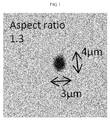
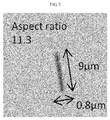
- FIG. 1 and FIG. 2 SEM photographs of a massive AlN precipitate and a tabular AlN precipitate are shown in FIG. 1 and FIG. 2 , respectively.
- the numeric values in each of FIG. 1 and FIG. 2 indicate the length of a minor axis, the length of a major axis and the aspect ratio.
- FIG. 3 and FIG. 4 SEM photographs of a massive AlN precipitate and a tabular AlN precipitate, which are extracted by chemical extraction testing, are shown in FIG. 3 and FIG. 4 , respectively.
- the chemical extraction testing may be performed by, for example, taking a test specimen, removing accretion on the surface thereof by pickling, chemically dissolving the resulting test specimen with bromine methanol, and then filtering the dissolved specimen by means of an extraction filter having a pore diameter ⁇ of about 5 ⁇ m.
- an extraction filter having a pore diameter ⁇ of about 5 ⁇ m.
- the filter pore underneath the AlN precipitate is not seen through the AlN precipitate ( FIG. 3 ).
- the thickness (minor axis) of an AlN precipitate is thin (e.g.
- a manufacturing method for maraging steels according to the present invention contains a melting step, a re-melting step, a homogenizing step, a forging step, a solution heat treatment step, a sub-zero treatment step and an aging treatment step.
- the melting step is a step of melting and casting a raw material prepared by mixing constituent elements in respectively-specified content ranges.
- the raw material to be used has no particular restrictions as to its background and conditions for melting and casting thereof, and it can be selected from those best suited for intended purposes.
- cleanliness enhancement of the steels is favorable.
- the melting of a raw material be carried out under vacuum (e.g. by a method of using a vacuum induction melting furnace).
- the re-melting step is a step in which the ingot obtained in the melting step is subjected to melting and casting once again. This step is not necessarily required, but steel's cleanliness can be further enhanced by carrying out re-melting, and thereby the fatigue resistance of steel is improved. For achievement of such effects, it is appropriate that the re-melting be carried out under vacuum (e.g. according to a vacuum arc re-melting method), and besides, it be repeated several times.
- vacuum e.g. according to a vacuum arc re-melting method
- the homogenizing step is a step of heating the ingot obtained in the melting step or the re-melting step at a specified temperature.
- the heat treatment for homogenization is carried out for the purpose of removing segregation having occurred during the casting.
- Heat treatment conditions for homogenization are not particularly limited, and any conditions will do, as long as they allow elimination of solidifying segregation.
- the heating temperature is generally from 1,150°C to 1,350°C, and the heating time is generally at least 10 hours.
- the ingot after the heat treatment for homogenization is generally air-cooled or sent off to the next step as it is in a red hot state.
- the forging step is a step in which the ingot after the heat treatment for homogenization is forged into a predetermined shape.
- the forging is generally carried out in a hot state.
- the heating temperature is generally from 900°C to 1,350°C
- the heating time is generally at least one hour
- the termination temperature is generally 800°C or higher.
- the method for cooling after hot forging has no particular restrictions.
- the hot forging may be carried out at a time, or it may be divided into 4 to 5 steps and performed in succession.
- annealing is done as required.
- the heating temperature is from 550°C to 950°C
- the heating time is from 1 hour to 36 hours
- the cooling method is air cooling.
- the solution heat treatment step is a step of heating the steel worked into the predetermined shape at a specified temperature. This step is carried out for the purpose of transforming the matrix into the ⁇ -phase alone, and besides converting precipitates, such as Mo carbides, into solid solution.
- optimum conditions are selected in response to the steel composition.
- the heating temperature is from 800°C to 1,200°C
- the heating time is from 1 hour to 10 hours
- the cooling method is air cooling (AC), blast cooling (BC), water cooling (WC) or oil cooling (OC).
- the sub-zero treatment is a step for cooling the steel after having received the solution heat treatment to room temperature (23°C) or lower. This treatment is carried out for the purpose of transforming the remaining ⁇ -phase into the martensite phase.
- Maraging steels are low in Ms point, and hence a great quantity of ⁇ -phase usually remains at the time of cooling the steels to room temperature (23°C). Even if maraging steels are subjected to aging treatment as a great quantity of ⁇ -phase remains therein, there will be no expectation of significant increase in strength. Thus it becomes necessary to transform the remaining ⁇ -phase into the martensite phase by performing the sub-zero treatment after the solution heat treatment.
- the cooling temperature is from -197°C to -73°C and the cooling time is from 1 hour to 10 hours.
- the aging treatment is a step for subjecting the steel having been transformed into the martensite phase to heating at a specified temperature. This treatment is carried out for the purpose of precipitating carbides such as Mo 2 C as well as intermetallic compounds such as Ni 3 Mo and NiAl.
- optimum conditions are selected according to the steel composition.
- the aging treatment temperature is from 400°C to 600°C
- the aging treatment time is from 0.5 hour to 24 hours
- the cooling method is air cooling.
- each primary element content being confined to the range specified above, and preferably, at the same time, with the individual content range of each element being optimized so as to satisfy the relational expression (1) or (2), it is possible to control the form (precipitate geometry) of AlN which is supposed to be inclusion affecting low-cycle fatigue characteristics.
- the maraging steels obtained can have a tensile strength of 2,300 MPa or higher, an elongation of 8% or larger and fatigue characteristics stabilized at a high level.
- the maraging steels according to the present invention make it possible to make engine shafts excellent in low-cycle fatigue characteristics. This is because, in regard to AlN inclusions having minor axes of 1.0 ⁇ m or smaller and aspect ratios of 10 or larger, the maraging steels according to the present invention make it possible to reduce the number of such AlN inclusions to 6 or less, preferably 2 or less, for every 100 mm 2 of the plane parallel to the length direction of the engine shaft.
- Each of steels having the chemical compositions shown in Table 1 and Table 2 was melted with vacuum induction melting furnace (VIF) and cast into 50 kg of steel ingot.
- VIF steel ingots were subjected to homogenization treatment under the condition of 1,200°C ⁇ 20 hours. After the treatment, part of each steel ingot was forged into square bars measuring 70 mm per side for use as fracture toughness test specimens and the remainder was forged into round bars measuring ⁇ 22 for use as other test specimens. After the forging, all the test specimens were subjected to annealing treatment under the condition of 650°C ⁇ 16 hours for the purpose of softening them.
- Hardness measurements were made in accordance with the Vickers hardness testing method defined in JIS Z 2244:2009. The measurements were carried out under a load of 4.9N at positions of one-fourth the diameter of a ⁇ 22 round bar. The average of values measured at 5 points was adopted as hardness.
- Tensile testing was carried out in accordance with the metal tensile testing method defined in JIS Z 2241:2011.
- the testing temperature adopted herein was room temperature (23°C).
- test specimens Materials for test specimens were taken so that the length directions of test specimens were parallel to the directions of extension during the forging of the materials, and therefrom test specimens were made according to JIS law (JIS Z 2242:2005). By the use of these test specimens, the testing was carried out. The temperature during the testing was set at 200°C. In addition, a triangular form was chosen as the skew waveform, and the frequency setting was adjusted to 0.1 Hz and the distortion setting was adjusted to 0.9%.
- Test specimens each measuring 10 mm per side were taken, and observation faces corresponding to planes parallel to the length directions of the round bar materials were polished to a mirror-smooth state. The whole area (100 mm 2 ) of each face was observed under SEM (Scanning Electron Microscope), and examined for inclusions. In order to identify the inclusions, EDX analysis was conducted.
- AlN inclusions having minor axes (thickness) of 1.0 ⁇ m or smaller and aspect ratios (major axis/minor axis ratios) of 10 or larger were counted, and the number of such AlN inclusions present in the area of 100 mm 2 was determined.
- test specimens Materials for test specimens were taken so that the notch directions of test specimens were parallel to the directions of extension during the forging of the materials, and therefrom compact tension (CT) test specimens were made according to ASTM law (ASTM E399). By the use of these test specimens, the testing was conducted and values of fracture toughness K 1C were determined. As the testing temperature, room temperature (23°C) was chosen.
- Results obtained are shown in Table 3 and Table 4. The following can be seen from Table 3 and Table 4.
- (1) In the case where C contents are low, though the elongation becomes great, the hardness and the tensile strength become low. On the other hand, in the case where C contents are excessively high, though the hardness and the tensile strength become high, the elongation becomes small. In contrast to these tendencies, optimizations of C contents performed concurrently with optimizations of other element contents allow achievement of the compatibility between high strength, high elongation and high fatigue resistance.
- (2) In the case where Ni, Co, Mo and Al contents relating to precipitation amounts of intermetallic compounds and carbides are too low, the tensile strength tends to become low. In contrast to this tendency, optimizations of these element contents performed concurrently with optimizations of other element contents allow achievement of the compatibility between high strength, high elongation and high fatigue resistance.
- Test specimens were made in the same manners as in Example 1, except that alloys having the compositions shown in Tables 5 to 8 were used. On the specimens thus made, evaluations of their characteristics were performed according to the same methods as in Example 1. By the way, the compositions in Examples 20 to 22 and those in Comparative Examples 20 to 22 are also listed in Table 5 and Table 8, respectively.
- Composition (mass%) Parameter X Ni/ Al Mo+ W/2 C Si S Ni Cr Mo Co Ti Al V Nb W B N Fe Ex. 20 0.21 0.07 0.0005 8.5 2.2 1.6 14.4 0.009 1.49 0.12 0.0006 balance 48.8 5.7 1.6 Ex.
- Results obtained are shown in Tables 9 to 12. Incidentally, results obtained in Examples 20 to 22 and those obtained in Comparative Examples 20 to 22 are also listed in Table 9 and Table 12, respectively. As can be seen from Tables 9 to 12, among the cases where 0.020 mass% ⁇ V+Nb ⁇ 0.60 mass%, the Examples where the Ni contents were in a range of 10.0 mass% to 19.0 mass% not only ensure outstanding tensile strength but also deliver excellent fracture toughness (32 MPa ⁇ m or higher) as compared with the other Examples where the Ni contents were lower than the foregoing range (Examples 25 to 54 and 72) or higher than the foregoing range (Examples 65).
- Example 67 where Cr is 3.7 mass%, other Examples where Cr is 3.0 mass% or less not only ensure outstanding tensile strength but also deliver excellent fracture toughness (32 MPa ⁇ m or higher).
- HV Hardness
- maraging steels according to the present invention have very high tensile strengths of 2,300 MPa or higher, it is possible to use them as members of which high strength is required, such as structural materials for spacecraft and aircraft, parts for continuously variable transmission of automobile engines, materials for high-pressure vessels, materials for tools, and molds.
- maraging steels according to the present invention can be used for engine shafts of aircraft, motor cases of solid rockets, lifting apparatus of aircraft, engine valve springs, heavy-duty bolts, transmission shafts, high-pressure vessels for petrochemical industry, and so on.
Landscapes
- Chemical & Material Sciences (AREA)
- Engineering & Computer Science (AREA)
- Mechanical Engineering (AREA)
- Materials Engineering (AREA)
- Metallurgy (AREA)
- Organic Chemistry (AREA)
- Crystallography & Structural Chemistry (AREA)
- Physics & Mathematics (AREA)
- Thermal Sciences (AREA)
- Heat Treatment Of Steel (AREA)
Applications Claiming Priority (2)
| Application Number | Priority Date | Filing Date | Title |
|---|---|---|---|
| JP2015104465 | 2015-05-22 | ||
| JP2015247124A JP6582960B2 (ja) | 2015-05-22 | 2015-12-18 | マルエージング鋼 |
Publications (2)
| Publication Number | Publication Date |
|---|---|
| EP3095884A1 true EP3095884A1 (de) | 2016-11-23 |
| EP3095884B1 EP3095884B1 (de) | 2019-12-11 |
Family
ID=56026761
Family Applications (1)
| Application Number | Title | Priority Date | Filing Date |
|---|---|---|---|
| EP16170618.9A Active EP3095884B1 (de) | 2015-05-22 | 2016-05-20 | Martensitaushärtender stahl |
Country Status (4)
| Country | Link |
|---|---|
| US (1) | US10378072B2 (de) |
| EP (1) | EP3095884B1 (de) |
| CN (1) | CN106167879B (de) |
| CA (1) | CA2930153C (de) |
Families Citing this family (4)
| Publication number | Priority date | Publication date | Assignee | Title |
|---|---|---|---|---|
| CN108359909B (zh) * | 2018-05-25 | 2020-01-03 | 江苏集萃冶金技术研究院有限公司 | 通过薄带铸轧和时效工艺制备高强韧马氏体钢方法 |
| NL1043487B1 (en) * | 2019-11-28 | 2021-08-31 | Bosch Gmbh Robert | Ring component of a drive belt for a continuously variable transmission |
| CN115478212A (zh) * | 2021-05-31 | 2022-12-16 | 宝武特种冶金有限公司 | 一种碳化物和金属间化合物复合强化的超高强度钢及其棒材制备方法 |
| CN117187706B (zh) * | 2023-09-05 | 2025-12-12 | Oppo广东移动通信有限公司 | 超高强度钢及其制备方法、电子设备的结构件及电子设备 |
Citations (6)
| Publication number | Priority date | Publication date | Assignee | Title |
|---|---|---|---|---|
| GB1243382A (en) * | 1967-09-18 | 1971-08-18 | Nippon Steel Corp | Structural steel having martensite structure |
| JPS5330916A (en) | 1976-09-03 | 1978-03-23 | Nippon Steel Corp | Super high tensile and tough steel |
| US5393488A (en) | 1993-08-06 | 1995-02-28 | General Electric Company | High strength, high fatigue structural steel |
| JP2002161342A (ja) * | 2000-11-24 | 2002-06-04 | Daido Steel Co Ltd | 強度、耐疲労性及び耐食性に優れた構造用鋼 |
| JP2002285290A (ja) * | 2001-03-27 | 2002-10-03 | Daido Steel Co Ltd | 高強度・高耐疲労構造用鋼及びその製造方法 |
| EP2671955A1 (de) * | 2012-06-06 | 2013-12-11 | Daido Steel Co.,Ltd. | Martensitaushärtender Stahl |
Family Cites Families (6)
| Publication number | Priority date | Publication date | Assignee | Title |
|---|---|---|---|---|
| US3294527A (en) * | 1964-06-09 | 1966-12-27 | Int Nickel Co | Age hardening silicon-containing maraging steel |
| BE666818A (de) * | 1964-07-13 | |||
| US5866066A (en) | 1996-09-09 | 1999-02-02 | Crs Holdings, Inc. | Age hardenable alloy with a unique combination of very high strength and good toughness |
| FR2885142B1 (fr) | 2005-04-27 | 2007-07-27 | Aubert & Duval Soc Par Actions | Acier martensitique durci, procede de fabrication d'une piece a partir de cet acier, et piece ainsi obtenue |
| FR2885141A1 (fr) | 2005-04-27 | 2006-11-03 | Aubert & Duval Soc Par Actions | Acier martensitique durci, procede de fabrication d'une piece a partir de cet acier, et piece ainsi obtenue |
| JP2011195922A (ja) | 2010-03-23 | 2011-10-06 | Daido Steel Co Ltd | Cvtリング用薄板鋼 |
-
2016
- 2016-05-13 US US15/154,737 patent/US10378072B2/en active Active
- 2016-05-16 CA CA2930153A patent/CA2930153C/en active Active
- 2016-05-20 EP EP16170618.9A patent/EP3095884B1/de active Active
- 2016-05-23 CN CN201610345305.5A patent/CN106167879B/zh active Active
Patent Citations (7)
| Publication number | Priority date | Publication date | Assignee | Title |
|---|---|---|---|---|
| GB1243382A (en) * | 1967-09-18 | 1971-08-18 | Nippon Steel Corp | Structural steel having martensite structure |
| JPS5330916A (en) | 1976-09-03 | 1978-03-23 | Nippon Steel Corp | Super high tensile and tough steel |
| US5393488A (en) | 1993-08-06 | 1995-02-28 | General Electric Company | High strength, high fatigue structural steel |
| JP2002161342A (ja) * | 2000-11-24 | 2002-06-04 | Daido Steel Co Ltd | 強度、耐疲労性及び耐食性に優れた構造用鋼 |
| JP2002285290A (ja) * | 2001-03-27 | 2002-10-03 | Daido Steel Co Ltd | 高強度・高耐疲労構造用鋼及びその製造方法 |
| EP2671955A1 (de) * | 2012-06-06 | 2013-12-11 | Daido Steel Co.,Ltd. | Martensitaushärtender Stahl |
| JP2014012887A (ja) | 2012-06-06 | 2014-01-23 | Daido Steel Co Ltd | マルエージング鋼 |
Also Published As
| Publication number | Publication date |
|---|---|
| CA2930153C (en) | 2022-10-25 |
| CN106167879A (zh) | 2016-11-30 |
| CN106167879B (zh) | 2019-01-11 |
| US20160340753A1 (en) | 2016-11-24 |
| EP3095884B1 (de) | 2019-12-11 |
| CA2930153A1 (en) | 2016-11-22 |
| US10378072B2 (en) | 2019-08-13 |
Similar Documents
| Publication | Publication Date | Title |
|---|---|---|
| EP3214194B1 (de) | Austenitischer edelstahl und herstellungsverfahren dafür | |
| JP4712882B2 (ja) | 耐水素脆化特性および加工性に優れた高強度冷延鋼板 | |
| EP3133179B1 (de) | Austenitischer edelstahl und verfahren zur herstellung davon | |
| JP4712838B2 (ja) | 耐水素脆化特性および加工性に優れた高強度冷延鋼板 | |
| EP3095883B1 (de) | Martensitaushärtender stahl | |
| US9506125B2 (en) | Aircraft engine shaft comprising a maraging steel having a tensile strength of 2300MPa or more | |
| US20250290182A1 (en) | Martensitic stainless alloy | |
| EP2840160B1 (de) | Martensitaushärtender Stahl mit hervorragenden Ermüdungscharakteristiken | |
| EP3208354A1 (de) | Ni-basierte superlegierung zum warmschmieden | |
| EP3095884B1 (de) | Martensitaushärtender stahl | |
| EP4112754A1 (de) | Präzipitationsshärtender martensitischer edelstahl | |
| EP3901303A1 (de) | Kohlenstoffreiches warmgewalztes stahlblech und verfahren zur herstellung davon | |
| JP6160787B2 (ja) | 薄板及びその製造方法 | |
| EP4527969A1 (de) | Warmarbeitsstahl und wärmebehandlungsverfahren dafür sowie warmarbeitswerkzeug | |
| WO2010109702A1 (ja) | 冷延鋼板 | |
| US10689721B2 (en) | Case hardening steel and carburized component obtained therefrom | |
| JP6582960B2 (ja) | マルエージング鋼 | |
| EP3901302A1 (de) | Warmgewalztes stahlblech mit hohem kohlenstoffgehalt und verfahren zur herstellung davon | |
| EP4361297A1 (de) | Ni-basierte legierung und verfahren zur herstellung davon sowie element aus ni-basierter legierung | |
| EP4653565A1 (de) | Austenitisches edelstahlmaterial | |
| JP2024066436A (ja) | Ni基合金及びその製造方法、並びに、Ni基合金部材 | |
| JP4775276B2 (ja) | 高温浸炭用鋼材 | |
| JPH10168543A (ja) | 耐粗粒化肌焼鋼及び強度と靱性に優れた表面硬化部品並びにその製造方法 |
Legal Events
| Date | Code | Title | Description |
|---|---|---|---|
| PUAI | Public reference made under article 153(3) epc to a published international application that has entered the european phase |
Free format text: ORIGINAL CODE: 0009012 |
|
| AK | Designated contracting states |
Kind code of ref document: A1 Designated state(s): AL AT BE BG CH CY CZ DE DK EE ES FI FR GB GR HR HU IE IS IT LI LT LU LV MC MK MT NL NO PL PT RO RS SE SI SK SM TR |
|
| AX | Request for extension of the european patent |
Extension state: BA ME |
|
| STAA | Information on the status of an ep patent application or granted ep patent |
Free format text: STATUS: REQUEST FOR EXAMINATION WAS MADE |
|
| 17P | Request for examination filed |
Effective date: 20170519 |
|
| RBV | Designated contracting states (corrected) |
Designated state(s): AL AT BE BG CH CY CZ DE DK EE ES FI FR GB GR HR HU IE IS IT LI LT LU LV MC MK MT NL NO PL PT RO RS SE SI SK SM TR |
|
| STAA | Information on the status of an ep patent application or granted ep patent |
Free format text: STATUS: EXAMINATION IS IN PROGRESS |
|
| 17Q | First examination report despatched |
Effective date: 20180925 |
|
| REG | Reference to a national code |
Ref country code: DE Ref legal event code: R079 Ref document number: 602016025880 Country of ref document: DE Free format text: PREVIOUS MAIN CLASS: C21D0006000000 Ipc: C22C0038520000 |
|
| GRAP | Despatch of communication of intention to grant a patent |
Free format text: ORIGINAL CODE: EPIDOSNIGR1 |
|
| STAA | Information on the status of an ep patent application or granted ep patent |
Free format text: STATUS: GRANT OF PATENT IS INTENDED |
|
| RIC1 | Information provided on ipc code assigned before grant |
Ipc: C21D 6/04 20060101ALI20190625BHEP Ipc: C22C 38/06 20060101ALI20190625BHEP Ipc: C21D 6/02 20060101ALI20190625BHEP Ipc: C22C 38/46 20060101ALI20190625BHEP Ipc: C22C 38/44 20060101ALI20190625BHEP Ipc: C22C 38/50 20060101ALI20190625BHEP Ipc: C22C 38/48 20060101ALI20190625BHEP Ipc: C22C 38/52 20060101AFI20190625BHEP Ipc: C22C 38/54 20060101ALI20190625BHEP Ipc: C22C 38/02 20060101ALI20190625BHEP Ipc: C21D 7/13 20060101ALI20190625BHEP Ipc: C21D 6/00 20060101ALI20190625BHEP Ipc: C21D 1/25 20060101ALI20190625BHEP |
|
| INTG | Intention to grant announced |
Effective date: 20190723 |
|
| GRAS | Grant fee paid |
Free format text: ORIGINAL CODE: EPIDOSNIGR3 |
|
| GRAA | (expected) grant |
Free format text: ORIGINAL CODE: 0009210 |
|
| STAA | Information on the status of an ep patent application or granted ep patent |
Free format text: STATUS: THE PATENT HAS BEEN GRANTED |
|
| AK | Designated contracting states |
Kind code of ref document: B1 Designated state(s): AL AT BE BG CH CY CZ DE DK EE ES FI FR GB GR HR HU IE IS IT LI LT LU LV MC MK MT NL NO PL PT RO RS SE SI SK SM TR |
|
| REG | Reference to a national code |
Ref country code: GB Ref legal event code: FG4D |
|
| REG | Reference to a national code |
Ref country code: CH Ref legal event code: EP |
|
| REG | Reference to a national code |
Ref country code: AT Ref legal event code: REF Ref document number: 1212258 Country of ref document: AT Kind code of ref document: T Effective date: 20191215 |
|
| REG | Reference to a national code |
Ref country code: DE Ref legal event code: R096 Ref document number: 602016025880 Country of ref document: DE |
|
| REG | Reference to a national code |
Ref country code: IE Ref legal event code: FG4D |
|
| REG | Reference to a national code |
Ref country code: NL Ref legal event code: MP Effective date: 20191211 |
|
| REG | Reference to a national code |
Ref country code: LT Ref legal event code: MG4D |
|
| PG25 | Lapsed in a contracting state [announced via postgrant information from national office to epo] |
Ref country code: LV Free format text: LAPSE BECAUSE OF FAILURE TO SUBMIT A TRANSLATION OF THE DESCRIPTION OR TO PAY THE FEE WITHIN THE PRESCRIBED TIME-LIMIT Effective date: 20191211 Ref country code: SE Free format text: LAPSE BECAUSE OF FAILURE TO SUBMIT A TRANSLATION OF THE DESCRIPTION OR TO PAY THE FEE WITHIN THE PRESCRIBED TIME-LIMIT Effective date: 20191211 Ref country code: LT Free format text: LAPSE BECAUSE OF FAILURE TO SUBMIT A TRANSLATION OF THE DESCRIPTION OR TO PAY THE FEE WITHIN THE PRESCRIBED TIME-LIMIT Effective date: 20191211 Ref country code: FI Free format text: LAPSE BECAUSE OF FAILURE TO SUBMIT A TRANSLATION OF THE DESCRIPTION OR TO PAY THE FEE WITHIN THE PRESCRIBED TIME-LIMIT Effective date: 20191211 Ref country code: BG Free format text: LAPSE BECAUSE OF FAILURE TO SUBMIT A TRANSLATION OF THE DESCRIPTION OR TO PAY THE FEE WITHIN THE PRESCRIBED TIME-LIMIT Effective date: 20200311 Ref country code: GR Free format text: LAPSE BECAUSE OF FAILURE TO SUBMIT A TRANSLATION OF THE DESCRIPTION OR TO PAY THE FEE WITHIN THE PRESCRIBED TIME-LIMIT Effective date: 20200312 Ref country code: NO Free format text: LAPSE BECAUSE OF FAILURE TO SUBMIT A TRANSLATION OF THE DESCRIPTION OR TO PAY THE FEE WITHIN THE PRESCRIBED TIME-LIMIT Effective date: 20200311 |
|
| PG25 | Lapsed in a contracting state [announced via postgrant information from national office to epo] |
Ref country code: HR Free format text: LAPSE BECAUSE OF FAILURE TO SUBMIT A TRANSLATION OF THE DESCRIPTION OR TO PAY THE FEE WITHIN THE PRESCRIBED TIME-LIMIT Effective date: 20191211 Ref country code: RS Free format text: LAPSE BECAUSE OF FAILURE TO SUBMIT A TRANSLATION OF THE DESCRIPTION OR TO PAY THE FEE WITHIN THE PRESCRIBED TIME-LIMIT Effective date: 20191211 |
|
| PG25 | Lapsed in a contracting state [announced via postgrant information from national office to epo] |
Ref country code: AL Free format text: LAPSE BECAUSE OF FAILURE TO SUBMIT A TRANSLATION OF THE DESCRIPTION OR TO PAY THE FEE WITHIN THE PRESCRIBED TIME-LIMIT Effective date: 20191211 |
|
| PG25 | Lapsed in a contracting state [announced via postgrant information from national office to epo] |
Ref country code: CZ Free format text: LAPSE BECAUSE OF FAILURE TO SUBMIT A TRANSLATION OF THE DESCRIPTION OR TO PAY THE FEE WITHIN THE PRESCRIBED TIME-LIMIT Effective date: 20191211 Ref country code: RO Free format text: LAPSE BECAUSE OF FAILURE TO SUBMIT A TRANSLATION OF THE DESCRIPTION OR TO PAY THE FEE WITHIN THE PRESCRIBED TIME-LIMIT Effective date: 20191211 Ref country code: ES Free format text: LAPSE BECAUSE OF FAILURE TO SUBMIT A TRANSLATION OF THE DESCRIPTION OR TO PAY THE FEE WITHIN THE PRESCRIBED TIME-LIMIT Effective date: 20191211 Ref country code: EE Free format text: LAPSE BECAUSE OF FAILURE TO SUBMIT A TRANSLATION OF THE DESCRIPTION OR TO PAY THE FEE WITHIN THE PRESCRIBED TIME-LIMIT Effective date: 20191211 Ref country code: NL Free format text: LAPSE BECAUSE OF FAILURE TO SUBMIT A TRANSLATION OF THE DESCRIPTION OR TO PAY THE FEE WITHIN THE PRESCRIBED TIME-LIMIT Effective date: 20191211 Ref country code: PT Free format text: LAPSE BECAUSE OF FAILURE TO SUBMIT A TRANSLATION OF THE DESCRIPTION OR TO PAY THE FEE WITHIN THE PRESCRIBED TIME-LIMIT Effective date: 20200506 |
|
| PG25 | Lapsed in a contracting state [announced via postgrant information from national office to epo] |
Ref country code: IS Free format text: LAPSE BECAUSE OF FAILURE TO SUBMIT A TRANSLATION OF THE DESCRIPTION OR TO PAY THE FEE WITHIN THE PRESCRIBED TIME-LIMIT Effective date: 20200411 Ref country code: SK Free format text: LAPSE BECAUSE OF FAILURE TO SUBMIT A TRANSLATION OF THE DESCRIPTION OR TO PAY THE FEE WITHIN THE PRESCRIBED TIME-LIMIT Effective date: 20191211 Ref country code: SM Free format text: LAPSE BECAUSE OF FAILURE TO SUBMIT A TRANSLATION OF THE DESCRIPTION OR TO PAY THE FEE WITHIN THE PRESCRIBED TIME-LIMIT Effective date: 20191211 |
|
| REG | Reference to a national code |
Ref country code: DE Ref legal event code: R097 Ref document number: 602016025880 Country of ref document: DE |
|
| REG | Reference to a national code |
Ref country code: AT Ref legal event code: MK05 Ref document number: 1212258 Country of ref document: AT Kind code of ref document: T Effective date: 20191211 |
|
| PLBE | No opposition filed within time limit |
Free format text: ORIGINAL CODE: 0009261 |
|
| STAA | Information on the status of an ep patent application or granted ep patent |
Free format text: STATUS: NO OPPOSITION FILED WITHIN TIME LIMIT |
|
| PG25 | Lapsed in a contracting state [announced via postgrant information from national office to epo] |
Ref country code: DK Free format text: LAPSE BECAUSE OF FAILURE TO SUBMIT A TRANSLATION OF THE DESCRIPTION OR TO PAY THE FEE WITHIN THE PRESCRIBED TIME-LIMIT Effective date: 20191211 |
|
| 26N | No opposition filed |
Effective date: 20200914 |
|
| PG25 | Lapsed in a contracting state [announced via postgrant information from national office to epo] |
Ref country code: AT Free format text: LAPSE BECAUSE OF FAILURE TO SUBMIT A TRANSLATION OF THE DESCRIPTION OR TO PAY THE FEE WITHIN THE PRESCRIBED TIME-LIMIT Effective date: 20191211 Ref country code: SI Free format text: LAPSE BECAUSE OF FAILURE TO SUBMIT A TRANSLATION OF THE DESCRIPTION OR TO PAY THE FEE WITHIN THE PRESCRIBED TIME-LIMIT Effective date: 20191211 |
|
| PG25 | Lapsed in a contracting state [announced via postgrant information from national office to epo] |
Ref country code: IT Free format text: LAPSE BECAUSE OF FAILURE TO SUBMIT A TRANSLATION OF THE DESCRIPTION OR TO PAY THE FEE WITHIN THE PRESCRIBED TIME-LIMIT Effective date: 20191211 Ref country code: MC Free format text: LAPSE BECAUSE OF FAILURE TO SUBMIT A TRANSLATION OF THE DESCRIPTION OR TO PAY THE FEE WITHIN THE PRESCRIBED TIME-LIMIT Effective date: 20191211 Ref country code: CH Free format text: LAPSE BECAUSE OF NON-PAYMENT OF DUE FEES Effective date: 20200531 Ref country code: LI Free format text: LAPSE BECAUSE OF NON-PAYMENT OF DUE FEES Effective date: 20200531 |
|
| PG25 | Lapsed in a contracting state [announced via postgrant information from national office to epo] |
Ref country code: PL Free format text: LAPSE BECAUSE OF FAILURE TO SUBMIT A TRANSLATION OF THE DESCRIPTION OR TO PAY THE FEE WITHIN THE PRESCRIBED TIME-LIMIT Effective date: 20191211 |
|
| REG | Reference to a national code |
Ref country code: BE Ref legal event code: MM Effective date: 20200531 |
|
| PG25 | Lapsed in a contracting state [announced via postgrant information from national office to epo] |
Ref country code: LU Free format text: LAPSE BECAUSE OF NON-PAYMENT OF DUE FEES Effective date: 20200520 |
|
| PG25 | Lapsed in a contracting state [announced via postgrant information from national office to epo] |
Ref country code: IE Free format text: LAPSE BECAUSE OF NON-PAYMENT OF DUE FEES Effective date: 20200520 |
|
| PG25 | Lapsed in a contracting state [announced via postgrant information from national office to epo] |
Ref country code: BE Free format text: LAPSE BECAUSE OF NON-PAYMENT OF DUE FEES Effective date: 20200531 |
|
| PG25 | Lapsed in a contracting state [announced via postgrant information from national office to epo] |
Ref country code: TR Free format text: LAPSE BECAUSE OF FAILURE TO SUBMIT A TRANSLATION OF THE DESCRIPTION OR TO PAY THE FEE WITHIN THE PRESCRIBED TIME-LIMIT Effective date: 20191211 Ref country code: MT Free format text: LAPSE BECAUSE OF FAILURE TO SUBMIT A TRANSLATION OF THE DESCRIPTION OR TO PAY THE FEE WITHIN THE PRESCRIBED TIME-LIMIT Effective date: 20191211 Ref country code: CY Free format text: LAPSE BECAUSE OF FAILURE TO SUBMIT A TRANSLATION OF THE DESCRIPTION OR TO PAY THE FEE WITHIN THE PRESCRIBED TIME-LIMIT Effective date: 20191211 |
|
| PG25 | Lapsed in a contracting state [announced via postgrant information from national office to epo] |
Ref country code: MK Free format text: LAPSE BECAUSE OF FAILURE TO SUBMIT A TRANSLATION OF THE DESCRIPTION OR TO PAY THE FEE WITHIN THE PRESCRIBED TIME-LIMIT Effective date: 20191211 |
|
| REG | Reference to a national code |
Ref country code: FR Ref legal event code: PLFP Year of fee payment: 8 |
|
| PGFP | Annual fee paid to national office [announced via postgrant information from national office to epo] |
Ref country code: DE Payment date: 20250402 Year of fee payment: 10 |
|
| PGFP | Annual fee paid to national office [announced via postgrant information from national office to epo] |
Ref country code: FR Payment date: 20250401 Year of fee payment: 10 |
|
| PGFP | Annual fee paid to national office [announced via postgrant information from national office to epo] |
Ref country code: GB Payment date: 20260323 Year of fee payment: 11 |