EP3097103B1 - Diazabicyclo[4.3.1]decane derivate zur behandlung von psychiatrischen störungen - Google Patents
Diazabicyclo[4.3.1]decane derivate zur behandlung von psychiatrischen störungen Download PDFInfo
- Publication number
- EP3097103B1 EP3097103B1 EP15702136.1A EP15702136A EP3097103B1 EP 3097103 B1 EP3097103 B1 EP 3097103B1 EP 15702136 A EP15702136 A EP 15702136A EP 3097103 B1 EP3097103 B1 EP 3097103B1
- Authority
- EP
- European Patent Office
- Prior art keywords
- diazabicyclo
- decan
- sulfonyl
- och
- cyclo
- Prior art date
- Legal status (The legal status is an assumption and is not a legal conclusion. Google has not performed a legal analysis and makes no representation as to the accuracy of the status listed.)
- Active
Links
- 0 Cc1c(*)c(*)c(*)c(CC*)c1C Chemical compound Cc1c(*)c(*)c(*)c(CC*)c1C 0.000 description 125
- BKJRPOJPECURJJ-UHFFFAOYSA-N C=CC(C(CCCC12)N1S(c1cc(Cl)cc(Cl)c1)(=O)=O)C21N(Cc2ncccc2)C1=O Chemical compound C=CC(C(CCCC12)N1S(c1cc(Cl)cc(Cl)c1)(=O)=O)C21N(Cc2ncccc2)C1=O BKJRPOJPECURJJ-UHFFFAOYSA-N 0.000 description 1
- WNRJSHBXSDZGAB-NSNWSRRYSA-N C=C[C@H](C(CCCC12)N1S(c1cc(Cl)cc(Cl)c1)(=O)=O)C21N(Cc2nccnc2)C1=O Chemical compound C=C[C@H](C(CCCC12)N1S(c1cc(Cl)cc(Cl)c1)(=O)=O)C21N(Cc2nccnc2)C1=O WNRJSHBXSDZGAB-NSNWSRRYSA-N 0.000 description 1
- FURGULXVNALUDK-ZQCWTGEXSA-N C=C[C@H](C1NC2CCC1)C21N(Cc2ccccn2)C1=O Chemical compound C=C[C@H](C1NC2CCC1)C21N(Cc2ccccn2)C1=O FURGULXVNALUDK-ZQCWTGEXSA-N 0.000 description 1
- SNWOXEXWPPTTJN-CMHAJOKASA-N CC(Nc(c(Br)c1)ccc1S(N(C(CCC1)[C@H]2C=C)C1C21N(Cc2ccccn2)C1=O)(=O)=O)=O Chemical compound CC(Nc(c(Br)c1)ccc1S(N(C(CCC1)[C@H]2C=C)C1C21N(Cc2ccccn2)C1=O)(=O)=O)=O SNWOXEXWPPTTJN-CMHAJOKASA-N 0.000 description 1
- VUPABNZMCATWHA-UHFFFAOYSA-N CC1=NNNN1N Chemical compound CC1=NNNN1N VUPABNZMCATWHA-UHFFFAOYSA-N 0.000 description 1
- BDXYGPRMXYIBOX-UHFFFAOYSA-N CCCOc(cc1O)ccc1[O]=C Chemical compound CCCOc(cc1O)ccc1[O]=C BDXYGPRMXYIBOX-UHFFFAOYSA-N 0.000 description 1
- WZGXMSWDTMSUDK-PWWBFRNWSA-N COCCN(C[C@@H](C1(C2CCC1)C1N2S(c2cc(Cl)cc(Cl)c2)(=O)=O)OCCOC)C1=O Chemical compound COCCN(C[C@@H](C1(C2CCC1)C1N2S(c2cc(Cl)cc(Cl)c2)(=O)=O)OCCOC)C1=O WZGXMSWDTMSUDK-PWWBFRNWSA-N 0.000 description 1
- GNUSEJVEFVFZBA-ZGTOLYCTSA-N COCCN(C[C@@H](C1N(S(c2cc(Cl)cc(Cl)c2)(=O)=O)[I]2CCC1)C=O)C2=O Chemical compound COCCN(C[C@@H](C1N(S(c2cc(Cl)cc(Cl)c2)(=O)=O)[I]2CCC1)C=O)C2=O GNUSEJVEFVFZBA-ZGTOLYCTSA-N 0.000 description 1
- KAVOSLXZKHPHGD-KPXAEBBHSA-N C[C@H](CC1[C@@H](COC)C23N(CC#C)C2=O)CC3N1S(c1cnccc1)(=O)=O Chemical compound C[C@H](CC1[C@@H](COC)C23N(CC#C)C2=O)CC3N1S(c1cnccc1)(=O)=O KAVOSLXZKHPHGD-KPXAEBBHSA-N 0.000 description 1
- ZJFQBNCCRYZGSL-UHFFFAOYSA-N Cc(cc1)cc(S2)c1NC2=O Chemical compound Cc(cc1)cc(S2)c1NC2=O ZJFQBNCCRYZGSL-UHFFFAOYSA-N 0.000 description 1
- FAUPBXZBUNFXIR-UHFFFAOYSA-N Cc1cc([o]nn2)c2nc1 Chemical compound Cc1cc([o]nn2)c2nc1 FAUPBXZBUNFXIR-UHFFFAOYSA-N 0.000 description 1
- KESXCYPIFNHSLP-UHFFFAOYSA-N Cc1cc([s]nn2)c2nc1 Chemical compound Cc1cc([s]nn2)c2nc1 KESXCYPIFNHSLP-UHFFFAOYSA-N 0.000 description 1
- FQSWXRHLJDIHKW-UHFFFAOYSA-N Cc1cnc2NNOc2c1 Chemical compound Cc1cnc2NNOc2c1 FQSWXRHLJDIHKW-UHFFFAOYSA-N 0.000 description 1
- QWNBAHHRUUKFIU-UHFFFAOYSA-N Cc1n[n](N)nn1 Chemical compound Cc1n[n](N)nn1 QWNBAHHRUUKFIU-UHFFFAOYSA-N 0.000 description 1
- JEKCSLMWKCKDCC-UHFFFAOYSA-N Cc1nc2ccc(C)cc2[s]1 Chemical compound Cc1nc2ccc(C)cc2[s]1 JEKCSLMWKCKDCC-UHFFFAOYSA-N 0.000 description 1
- ODHCTXKNWHHXJC-VKHMYHEASA-N OC([C@H](CC1)NC1=O)=O Chemical compound OC([C@H](CC1)NC1=O)=O ODHCTXKNWHHXJC-VKHMYHEASA-N 0.000 description 1
Images


Classifications
-
- C—CHEMISTRY; METALLURGY
- C07—ORGANIC CHEMISTRY
- C07D—HETEROCYCLIC COMPOUNDS
- C07D471/00—Heterocyclic compounds containing nitrogen atoms as the only ring hetero atoms in the condensed system, at least one ring being a six-membered ring with one nitrogen atom, not provided for by groups C07D451/00 - C07D463/00
- C07D471/02—Heterocyclic compounds containing nitrogen atoms as the only ring hetero atoms in the condensed system, at least one ring being a six-membered ring with one nitrogen atom, not provided for by groups C07D451/00 - C07D463/00 in which the condensed system contains two hetero rings
- C07D471/08—Bridged systems
-
- A—HUMAN NECESSITIES
- A61—MEDICAL OR VETERINARY SCIENCE; HYGIENE
- A61K—PREPARATIONS FOR MEDICAL, DENTAL OR TOILETRY PURPOSES
- A61K31/00—Medicinal preparations containing organic active ingredients
- A61K31/33—Heterocyclic compounds
- A61K31/395—Heterocyclic compounds having nitrogen as a ring hetero atom, e.g. guanethidine or rifamycins
- A61K31/55—Heterocyclic compounds having nitrogen as a ring hetero atom, e.g. guanethidine or rifamycins having seven-membered rings, e.g. azelastine, pentylenetetrazole
- A61K31/551—Heterocyclic compounds having nitrogen as a ring hetero atom, e.g. guanethidine or rifamycins having seven-membered rings, e.g. azelastine, pentylenetetrazole having two nitrogen atoms, e.g. dilazep
-
- A—HUMAN NECESSITIES
- A61—MEDICAL OR VETERINARY SCIENCE; HYGIENE
- A61K—PREPARATIONS FOR MEDICAL, DENTAL OR TOILETRY PURPOSES
- A61K31/00—Medicinal preparations containing organic active ingredients
- A61K31/63—Compounds containing para-N-benzenesulfonyl-N-groups, e.g. sulfanilamide, p-nitrobenzenesulfonyl hydrazide
- A61K31/635—Compounds containing para-N-benzenesulfonyl-N-groups, e.g. sulfanilamide, p-nitrobenzenesulfonyl hydrazide having a heterocyclic ring, e.g. sulfadiazine
-
- A—HUMAN NECESSITIES
- A61—MEDICAL OR VETERINARY SCIENCE; HYGIENE
- A61K—PREPARATIONS FOR MEDICAL, DENTAL OR TOILETRY PURPOSES
- A61K45/00—Medicinal preparations containing active ingredients not provided for in groups A61K31/00 - A61K41/00
- A61K45/06—Mixtures of active ingredients without chemical characterisation, e.g. antiphlogistics and cardiaca
-
- A—HUMAN NECESSITIES
- A61—MEDICAL OR VETERINARY SCIENCE; HYGIENE
- A61P—SPECIFIC THERAPEUTIC ACTIVITY OF CHEMICAL COMPOUNDS OR MEDICINAL PREPARATIONS
- A61P25/00—Drugs for disorders of the nervous system
-
- A—HUMAN NECESSITIES
- A61—MEDICAL OR VETERINARY SCIENCE; HYGIENE
- A61P—SPECIFIC THERAPEUTIC ACTIVITY OF CHEMICAL COMPOUNDS OR MEDICINAL PREPARATIONS
- A61P27/00—Drugs for disorders of the senses
-
- A—HUMAN NECESSITIES
- A61—MEDICAL OR VETERINARY SCIENCE; HYGIENE
- A61P—SPECIFIC THERAPEUTIC ACTIVITY OF CHEMICAL COMPOUNDS OR MEDICINAL PREPARATIONS
- A61P3/00—Drugs for disorders of the metabolism
-
- A—HUMAN NECESSITIES
- A61—MEDICAL OR VETERINARY SCIENCE; HYGIENE
- A61P—SPECIFIC THERAPEUTIC ACTIVITY OF CHEMICAL COMPOUNDS OR MEDICINAL PREPARATIONS
- A61P35/00—Antineoplastic agents
-
- C—CHEMISTRY; METALLURGY
- C07—ORGANIC CHEMISTRY
- C07D—HETEROCYCLIC COMPOUNDS
- C07D211/00—Heterocyclic compounds containing hydrogenated pyridine rings, not condensed with other rings
- C07D211/04—Heterocyclic compounds containing hydrogenated pyridine rings, not condensed with other rings with only hydrogen or carbon atoms directly attached to the ring nitrogen atom
- C07D211/06—Heterocyclic compounds containing hydrogenated pyridine rings, not condensed with other rings with only hydrogen or carbon atoms directly attached to the ring nitrogen atom having no double bonds between ring members or between ring members and non-ring members
- C07D211/36—Heterocyclic compounds containing hydrogenated pyridine rings, not condensed with other rings with only hydrogen or carbon atoms directly attached to the ring nitrogen atom having no double bonds between ring members or between ring members and non-ring members with hetero atoms or with carbon atoms having three bonds to hetero atoms with at the most one bond to halogen, e.g. ester or nitrile radicals, directly attached to ring carbon atoms
- C07D211/60—Carbon atoms having three bonds to hetero atoms with at the most one bond to halogen, e.g. ester or nitrile radicals
-
- C—CHEMISTRY; METALLURGY
- C07—ORGANIC CHEMISTRY
- C07D—HETEROCYCLIC COMPOUNDS
- C07D303/00—Compounds containing three-membered rings having one oxygen atom as the only ring hetero atom
- C07D303/02—Compounds containing oxirane rings
- C07D303/36—Compounds containing oxirane rings with hydrocarbon radicals, substituted by nitrogen atoms
-
- Y—GENERAL TAGGING OF NEW TECHNOLOGICAL DEVELOPMENTS; GENERAL TAGGING OF CROSS-SECTIONAL TECHNOLOGIES SPANNING OVER SEVERAL SECTIONS OF THE IPC; TECHNICAL SUBJECTS COVERED BY FORMER USPC CROSS-REFERENCE ART COLLECTIONS [XRACs] AND DIGESTS
- Y02—TECHNOLOGIES OR APPLICATIONS FOR MITIGATION OR ADAPTATION AGAINST CLIMATE CHANGE
- Y02A—TECHNOLOGIES FOR ADAPTATION TO CLIMATE CHANGE
- Y02A50/00—TECHNOLOGIES FOR ADAPTATION TO CLIMATE CHANGE in human health protection, e.g. against extreme weather
- Y02A50/30—Against vector-borne diseases, e.g. mosquito-borne, fly-borne, tick-borne or waterborne diseases whose impact is exacerbated by climate change
Definitions
- the present invention relates to diazabicyclo[4.3.1]decane derivatives and stereoisomeric forms, solvates, hydrates and/or pharmaceutically acceptable salts of these compounds as well as pharmaceutical compositions containing at least one of these bicyclic aza-amides derivatives together with pharmaceutically acceptable carrier, excipient and/or diluents.
- Said diazabicyclo[4.3.1]decane derivatives have been identified as specific inhibitors of the FK506 binding proteins (FKBP's), especially FKBP51 and FKBP52, and are useful for the treatment of psychiatric disorders and neurodegenerative diseases, disorders and conditions, for treating vision disorders and/or improving vision; for treating memory impairment and/or enhancing memory performance, for treating alopecia and promoting hair growth, for treating metabolic disorders and obesity, or for treating prostate cancer or malignant melanoma.
- FKBP's FK506 binding proteins
- the FK506-binding protein (FKBP) family of immunophilins consists of proteins with a variety of protein-protein interaction domains and versatile cellular functions. This highly conserved protein family binds with immunosuppressive drugs, such as FK506 and rapamycin. This protein family displays peptidyl propyl isomerase (PPlase) activity as seen with cyclophilins and parvulins. FKBP12, a 12 kD protein is the most widely studied member of this family.
- the immunosuppressant drugs FK506, rapamycin, and cyclosporin are well known as potent T-cell specific immunosuppressants, and are effective against autoimmunity, transplant or graft rejection, inflammation, allergic responses, other autoimmune or immune-mediated diseases, and infectious diseases.
- FK506 and rapamycin apart from binding to FKBP12 also interact and inhibit calcineurin (CaN) and mTOR respectively thereby mediating their immunosuppressive action.
- the high molecular weight multidomain homologs of FKBP12, FKBP51 and FKBP 52 act as cochaperones for the heat shock protein 90 (Hsp90) and modulate the signal transduction of the glucocorticoid receptor by participating in the Heat shock protein 90 (Hsp90) - steroid receptor complex.
- FKBP51 and FKBP52 modulate the binding competence and signalling of steroid hormone receptors and thereby regulate the cellular responsiveness to circulating hormone levels.
- This is supported by a natural animal model (squirrel monkey) and by knockout mice, where the crucial role of FKPB51 and FKBP52 on the Glucocorticoid Receptor (GR) Progesterone Receptor (PR) or Androgen Receptor (AR) activity have been clearly demonstrated.
- GR Glucocorticoid Receptor
- PR Progesterone Receptor
- AR Androgen Receptor
- polymorphisms in the FKBP51-encoding gene of psychiatric patients have been associated with numerous stress-related psychiatric disorders ( Schmidt et al., ChemMedChem 2012, 7, 1351-1359 ).
- the immunosuppressive compounds disclosed in the prior art suppress the immune system, by definition, and also exhibit other toxic side effects. Accordingly, there is a need for non-immunosuppressant, small molecule compounds, and compositions and methods for use of such compounds, that are useful in treating psychiatric disorders and neurodegenerative diseases, disorders and conditions.
- FKBP51 farnesoid receptor signaling
- FKBP51-GR interplay glucocorticoid receptor interplay
- Another aspect of the invention is to provide compounds and/or pharmaceutically acceptable salts thereof which can be used as pharmaceutically active agents, especially for the treatment of psychiatric disorders and neurodegenerative diseases, disorders and conditions, for treating vision disorders and/or improving vision; for treating memory impairment and/or enhancing memory performance and for treating alopecia, as well as compositions comprising at least one of those compounds and/or pharmaceutically acceptable salts thereof as pharmaceutically active ingredients.
- a further aspect of the disclosure is to provide methods for preparing said compounds.
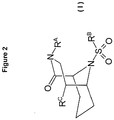
- the present invention relates to the compound of the general formula (I): wherein R A represents -H, -CH 3 , -C 2 H 5 , -C 3 H 7 , -CH(CH 3 ) 2 , -C 4 H 9 , -CH 2 -CH(CH 3 ) 2 , -CH(CH 3 )-C 2 H 5 , -C(CH 3 ) 3 , -C 5 H 11 , -CH(CH 3 )-C 3 H 7 , -CH 2 -CH(CH 3 )-C 2 H 5 , -CH(CH 3 )-CH(CH 3 ) 2 , -C(CH 3 ) 2 -C 2 H 5 , -CH 2 -C(CH 3 ) 3 , -CH(C 2 H 5 , -C 2 H 4 -CH(CH 3 ) 2 , -C 6 H 13 , -C 7 H 15 , -C 8 H 17 ,
- tautomer is defined as an organic compound that is interconvertible by a chemical reaction called tautomerization. Tautomerization can be catalyzed preferably by bases or acids or other suitable compounds.
- diazabicyclic compounds as FKBP51/52 ligands which have respectively 3,10-diazabicyclo[4.3.1]decan-2-one or 3,9-diazabicyclo[3.3.1]nonan-2-one as back bone structure
- the compounds of the present invention are characterized by better affinity.
- These bicyclic back bones are useful for fixing the conformation of FKBP51/52 ligands.
- these bicyclic compounds have usually better affinity to FKBP51/52 than the monocyclic compounds which have piperidine as back bone structure.
- the diazabicyclo[4.3.1]decan-2-one derivatives have higher affinity compared to the 3,9-diazabicyclo[3.3.1]nononan-2-one derivates, because the sulfonamide nitrogen of the diazabicyclo[4.3.1]decan-2-one derivatives can accept an unsual hydrogen bond from Tyr113 that mimics the putative FKBP transition state.
- the compounds of the present invention are characterized by a high affintity and/or selectivity to FKBP 51 and FKBP 52.
- R A Preferred substituents for R A are or wherein R 1 - R 8 , R 15 - R 16 , R 31 , R 34 - R 36 , R N and Y have the meanings as defined in the general formula (I) and R' and R" represent independently of each other -H, -CH 3 , -C 2 H 5 , -CH(CH 3 ) 2 , -CF 3 , or -COCH 3 .
- R A is selected from the following group: wherein
- R 6 - R 10 , R 13 and Q have the meanings as defined in the general formula (I), and more preferably have the following meanings:
- Preferred substituents for R 1 - R 10 are: -H, -OH, -OCH 3 , -OC 2 H 5 , -OC 3 H 7 , -OCH(CH 3 ) 2 , -OCPh 3 , -CH 2 -OCH 3 , -CH 2 -OH, -OC 3 H 7 , -OC(CH 3 ) 3 , -OCH 2 -COOH, -CO 2 Me, -CO 2 Et, -CONH 2 , -NHCOCH 3 , -NHSO 2 CH 3 , -CH 3 , -CH 2 -OH, -C 2 H 5 , -C 3 H 7 , -CH(CH 3 ) 2 , -CN, -F, -Cl, -Br, -I,
- R C represents: -OH, -CH 2 -OH, -C 2 H 4 -OH, -C 3 H 6 -OH, -CHO, -CH 2 CHO, -CH 2 CH 2 CHO, -O-CH 3 , -O-C 2 H 5 , -O-C 3 H 7 , -O-CH(CH 3 ) 2 , -CONH 2 , -CONHCH 3 , -CONHC 2 H 5 , -CONHC 3 H 7 , -CO-CH 3 , -CO-C 2 H 5 , -CO-C 3 H 7 , -CO-CH(CH 3 ) 2 , -CO 2 H, -CH 2 -CO 2 H, -C 2 H 4 -CO 2 H, -O-CH 2 -OH, -O-CH 2 -O-CH 3 , -O-C 2 H 4 -O-CH 3 , -CH 2 -O-CH 3 , -CH
- R C represents: -OH, -NH 2 , -CH 2 F, -CHF 2 , -CH 2 CH 3 , -CH 2 OH, -CHO, -CO 2 H, -CONH 2 , -COCH 3 , -OCH 3 , -OCH 2 CH 3 , -OCH(CH 3 ) 2 , -OCH 2 OCH 3 , -OC 2 H 4 OCH 3 , -CH 2 OCH 3 , -CH 2 OCH 2 CH 3 , -CH 2 CH 2 OH, -CH 2 CHO, -CH 2 CH 2 CHO, -CH 2 NH 2 , -CH 2 NHCH 3 , -CH 2 N(CH 3 ) 2 , -CH(OH)CH 3 , -C(OH)(CH 3 ) 2 , -CH 2 CH(OH)CH 3 or -CH(OH)CH 2 OH.
- R C residues which comprise a hydroxyl group or an alkoxy group such as -CH 2 OH, -CH 2 CH 2 OH, -CH(OH)CH 3 , -C(OH)(CH 3 ) 2 , -CH 2 CH(OH)CH 3 , -CH(OH)CH 2 OH and -CH 2 OCH 3 .
- R B represents preferably wherein R 6 -R 9 , R 13 and Q have the same meanings as defined in the general formula (I).
- R A , R B and R 7 - R 9 have the meanings as defined herein;
- R C' and R C" represent independently of each other, -H, -CH 3 , -C 2 H 5 , -CH 2 -OH;
- Z represents -OH, -OCH 3 , -OC 2 H 5 , -OCH(CH 3 ) 2 , -NH 2 , -NH(CH 3 ), -NH(C 2 H 5 ), -NHCH(CH 3 ) 2 , -N(CH 3 ) 2 , or -N(C 2 H 5 ) 2 ; and
- q is 0 or 1.
- R 7 - R 9 represent independently of each other -H, -F, -Cl, -Br, -I, -OH, -OCH 3 , -OC 2 H 5 , -OC 3 H 7 , -CN, -CONH 2 , -NHCOCH 3 , -NHCOC 2 H 5 , -NHCOC 3 H 7 , -COOH, -COOCH 3 , -COOC 2 H 5 , -COOC 3 H 7 , -Ph, and more preferably -F, -Cl, -Br, -OH, -OCH 3 , -CN, -CONH 2 , -NHCOCH 3 , -COOCH 3 , -Ph, or
- R A Preferred for any general formula disclosed herein and especially for general formulae (I), (V), (XII) and (XIII) substituents for R A are preferably selected from: wherein R 1 - R 8 , R 15 - R 16 , R 31 , R 34 - R 36 , R N and Y have the meanings as defined in the general formula (I) and R' and R" represent independently of each other -H, -CH 3 , -C 2 H 5 , -CH(CH 3 ) 2 , -CF 3 , -COCH 3 .
- FKBP inhibitors or FKBP ligands as used herein are defined as compounds that (i) inhibit the peptidyl-prolyl isomerase activity of FKBPs (PPlase inhibitors, also referred to as rotamase inhibitors) or (ii) displace FK506 or FK506 analogs from the PPlase active site of FKBPs or (iii) bind to the FK506-binding domain of FKBPs as determined by isothermal calorimetry, surface plasmon resonance, tryptophan quenching, NMR or x-ray crystallography.
- PPlase inhibitors also referred to as rotamase inhibitors
- displace FK506 or FK506 analogs from the PPlase active site of FKBPs or bind to the FK506-binding domain of FKBPs as determined by isothermal calorimetry, surface plasmon resonance, tryptophan quenching, NMR or x-ray crystallography.
- prodrug is defined as a pharmacological substance, a drug, which is administered in an inactive or significantly less active form. Once administered, the prodrug is metabolized in the body in vivo into the active compound.
- tautomer is defined as an organic compound that is interconvertible by a chemical reaction called tautomerization. Tautomerization can be catalyzed preferably by bases or acids or other suitable compounds.
- the compound according to the general formula (I) is selected from the group comprising or consisting of: B1 (1 S ,5 S ,6 R )-5-acetyl-10-((3,5-dichlorophenyl)sulfonyl)-3-(2-methoxyethyl)-3,10-diazabicyclo[4.3.1]decan-2-one B2 2-((1 S ,5 S ,6 R )-10-((3,5-dichlorophenyl)sulfonyl)-3-(2-methoxyethyl)-2-oxo-3,10-diazabicyclo[4.3.1]decan-5-yl)acetaldehyde B3 (1 S ,5 S ,6 R )-10-((3,5-dichlorophenyl)sulfonyl)-5-(2-hydroxypropan-2-yl)-3-(2-methoxyethyl)-3,10-diaza
- intermediate compound ( I-A1 ) can be prepared by providing 6-carboxy-2-piperidone and a precursor molecule for the moiety R A which has a suitable leaving group (LG) such as trimethylsilyl (TMS) and a carbon-carbon double bond in allyl position to the R A amino group. Said R A amino group is reacted with the carboxy moiety of 6-carboxy-2-piperidone. Subsequently, this compound undergoes a cyclization reaction upon which the leaving group LG is detached from the starting molecule.
- LG suitable leaving group
- TMS trimethylsilyl
- a method for preparation of compound of the general formula (I) by synthetic route 1 comprises the following steps:
- intermediate compound ( I-A2 ) can be prepared by providing 6-carboxy-2-piperidone and a butenyl amine protected with a protecting group PG 6 which has a suitable leaving group (LG) such as trimethylsilyl (TMS) and a carbon-carbon double bond in allyl position to the amino group. Said protected amino group is reacted with the carboxy moiety of 6-carboxy-2-piperidone. Subsequently, this compound undergoes a cyclization reaction upon which the leaving group LG is detached from the starting molecule. After deprotecting PG 1 from amide, 5-vinyl-3,10-diazabicyclo[4.3.1]decane-2-one derivative ( I-B2 ) is formed.
- LG leaving group
- TMS trimethylsilyl
- a sulphonamide intermediate ( I-B3 ) can be obtained by subsequently reacting ( I-B2 ) with a suitable precursor for the moiety -SO 2 -R B .
- a sulphonamide compound ( I-C ) can be produced.
- suitable transformation reactions of vinyl group at C-5 postion of the resulting sulphonamide compound ( I-C ) can be obtaind.
- the vinyl group could be transformed by oxidation reaction with oxygen gas or ozone, epoxidation reaction or dihydroxylation catalyzed by osmium (VIII) oxide.
- a method for preparation of compound of the general formula (I) by synthetic route 2 comprises the following steps:
- 1-amino-hex-2-en-yl substituted amino acid derivate ( I-D ) can be used as starting material (scheme 2).
- Amino group of hexenyl substituent is further substituted with R A .
- Amino group and carboxy group of said amino acid are also protected respectively with suitable protecting groups PG 2 and PG 3 .
- piperidine intermediate ( I-F ) is formed by deprotecting PG 2 and spontaneous ring formation reaction.
- An amino group of piperidine ring and a hydroxyl group derived from epoxide ring are protected respectively with protecting groups PG 4 and PG 5 .
- a method for preparation of compound of the general formula (I) by alternative synthetic route 2 comprises the following steps:
- Said compounds of the formulae ( I-E ) and ( I-F ) are important intermediates for preparing the compound of the fomula (I).
- the intermediate compound of the formula ( I-E ) has all necessary functional groups to form a diazabicyclo[4.3.1]decane moiety.
- a protected amine group at C-1 position and an expoxy group at C-5 and C-6 positions form 6-membered piperidine ring of diazabicyclo[4.3.1]decane moiety by nucleophilic epoxide ring opening reaction, as shown in the compound of the formula ( I-F ).
- a protected carboxylic acid (ester) group at C-1 position and a secondary amine group at C-7 position further form 7-membered azepane ring of diazabicyclo[4.3.1]decane moiety by amide coupling reaction.
- said epoxy ring at C-5 and C-6 positions is also a precursor group from which a hydroxyl group is formed at C-6 position and said hydroxyl group can be easily transformed to R C group of the compound of the formula (I) as shown the step (e). Therefore, said intermediate of the formula ( I-E ) has important technical meaning for the present invention.
- the intermediate of the formula ( I-F ) has a 6-membered piperidine ring and also functional groups, i.e.
- Suitable protecting groups PG 1 - PG 4 , and PG 6 for amines represent independently of each other carbobenzyloxy (Cbz), p-methoxybenzyl carbonyl (Moz), tert-butyloxycarbonyl (Boc), 9-fluorenylmethyloxycarbonyl (Fmoc), allyloxycarbonyl (Alloc), 2,2,2-trichlorethoxycarbonyl (Troc), trifluoroacetyl, 2-(trimethylsilyl)ethoxycarbonyl (Teoc) p-methoxy-benzyl (PMB) or phtalimide.
- Cbz carbobenzyloxy
- Moz p-methoxybenzyl carbonyl
- Boc tert-butyloxycarbonyl
- 9-fluorenylmethyloxycarbonyl Fmoc
- allyloxycarbonyl Alloc
- Suitable protecting group PG 3 for carboxylic acid is selected from the group consisting of methyl, ethyl, isopropyl, tert-butyl (tBu), allyl, and benzyl (Bn).
- Suitable protecting group PG 5 for hydroxyl group is selected from the group consisting of trimethylsilyl (TMS), triethylsilyl (TES), tert-butyldimethylsilyl (TBDMS), tert-butyldiphenylsilyl (TBDPS), allyl, benzyl, tert-butyl, methoxylmethyl (MOM), methoxyethyl (MEM), tetrahydropyranyl (THP), acetyl (Ac), benzoyl (Bz) and pivalic (Piv).
- TMS trimethylsilyl
- TES triethylsilyl
- TDMS tert-butyldimethylsilyl
- TDPS tert-butyldiphenylsilyl
- allyl benzyl, tert-butyl, methoxylmethyl (MOM), methoxyethyl (MEM), tetrahydr
- the compounds of this invention can be distinguished from the closest prior art by having the additional substituent R C .
- Preferred compounds of this invention have at least one polar heteroatom (N, O, S, F, Cl) in the inventive R C substituent and thus have the potential to engage in hydrogen bonds with Tyr57, Asp68, or Arg73 of FKBP51 or FKBP52 or conserved equivalent residues in other FKBPs.
- the compounds of the general formula (I) are characterized in that the substituent R C significantly increases affinity to FKBP51/52.
- the inventive compounds of the general formula (I) have R C as hydrophilic substituents containing polar functional groups or hetero atoms which can form hydrogen bond(s) with amino acid(s) of FK506 domain.
- FK506 analogs have repeatedly been described as neuroprotective and neuroregenerative agents in the prior arts.
- N2a neuroblastoma cells which are a recognized model for neuronal differentiation
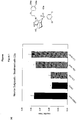
- compounds C2a and C2b potently enhanced neurite outgrowth( Fig.1 ).
- the present invention also comprises pharmaceutically acceptable salts of the compounds according to the general formula ( I ) and the subformulas (II-XIII), all stereoisomeric forms of the compounds according to the general formula (I) and the subformulas (II- XIII) as well as solvates, especially hydrates thereof.
- the inventive compounds bear basic and/or acidic substituents, they may form salts with organic or inorganic acids or bases.
- suitable acids for such acid addition salt formation are hydrochloric acid, hydrobromic acid, sulfuric acid, phosphoric acid, acetic acid, citric acid, oxalic acid, malonic acid, salicylic acid, p-aminosalicylic acid, malic acid, fumaric acid, succinic acid, ascorbic acid, maleic acid, sulfonic acid, phosphonic acid, perchloric acid, nitric acid, formic acid, propionic acid, gluconic acid, lactic acid, tartaric acid, hydroxymaleic acid, pyruvic acid, phenylacetic acid, benzoic acid, p-aminobenzoic acid, p-hydroxybenzoic acid, methanesulfonic acid, ethanesulfonic acid, nitrous acid, hydroxyethanesulfonic acid, ethylenesulfonic acid
- the salts are prepared by contacting the free base form with a sufficient amount of the desired acid to produce a salt in the conventional manner.
- suitable inorganic or organic bases are, for example, NaOH, KOH, NH 4 OH, tetraalkylammonium hydroxide, lysine or arginine and the like.
- Salts may be prepared in a conventional manner using methods well known in the art, for example by treatment of a solution of the compound of the general formula (I) and the subformulas (II-XIII) with a solution of an acid, selected out of the group mentioned above.
- Some of the compounds of the present invention may be crystallised or recrystallised from solvents such as aqueous and organic solvents. In such cases solvates may be formed.
- This invention includes within its scope stoichiometric solvates including hydrates as well as compounds containing variable amounts of water that may be produced by processes such as lyophilisation.
- Certain compounds of the general formula (I) and the subformulas (II-XIII) may exist in the form of optical isomers if substituents with at least one asymmetric center are present, e.g. diastereoisomers and mixtures of isomers in all ratios, e.g. racemic mixtures.
- the invention includes all such forms, in particular the pure isomeric forms.
- the different isomeric forms may be separated or resolved one from the other by conventional methods, or any given isomer may be obtained by conventional synthetic methods or by stereospecific or asymmetric syntheses.
- a compound according to the general formula (I) contains an alkene moiety, the alkene can be presented as a cis or trans isomer or a mixture thereof.
- an isomeric form of a compound of the invention When an isomeric form of a compound of the invention is provided substantially free of other isomers, it will preferably contain less than 5% w/w, more preferably less than 2% w/w and especially less than 1 % w/w of the other isomers.
- Another aspect of the present disclosure relates to the use of the inventive FKBP51/52 ligand derivatives as drugs, i.e. as pharmaceutically active agents applicable in medicine. Therefore one aspect of the present invention is that the compounds according to the general formula (I) and the subformulas (II-XIII) are suitable for use as inhibitor of FK506-binding proteins (FKBP). It is preferred if said compound is suitable for use as inhibitor of the FK506-binding protein 51 (FKBP51) and/or the FK506-binding protein 52 (FKBP52).
- FKBP51 has been implicated in numerous in human diseases ( Schmidt et al., ChemMedChem 2012, 7, 1351-1359 ; Gaali et al, Curr Med Chem 2011, 18, 5355-5379 ; Galigniana et al, J. Neurochem 2012, 122, 4-18 ; Erlejman et al, Futue Med Chem 2013, 5,591-607 ; Sanchez, biochim Biophys Acta Mol Cell Res 2012r, 1823, 722-729 ; Zannas, A. S. & Binder, E. B. Gene-environment interactions at the FKBP5 locus: sensitive periods, mechanisms and pleiotropism. Genes Brain Behav, doi: 10.1111/gbb.12104 (2013 )).
- FKBP51 is a target which is addressed in order to prevent and/or treat the diseases disclosed in the afore-mentioned literature.
- FKBP51 and/or FKBP 52 ligand compounds of the present invention can be used as pharmaceutically active agent in medicine.
- the FKBP51/52 ligand compounds of the present invention can be used for treatment, or for the preparation of a pharmaceutical formulation for prophylaxis and/or treatment of these FKBP51/52-associated diseases.
- inventive compound of any one of formula (I) and subformulae (II)-(XIII) is used in the manufacture of a medicament or of a pharmaceutical composition for the treatment and/or prevention of FKBP51/52-associated diseases.
- Another aspect of the present disclosure relates to a method of treating FKBP51/52-associated diseases comprising administration a therapeutically effective amount of at least one inventive compound or a pharmaceutical composition comprising at least one inventive compound.
- FKBP51/52-associated diseases include psychiatric and neurodegenerative diseases, disorders and conditions, for metabolic diseases such as localized adiposity or obesity, for sleep disorders, neuroprotection or neuroregeneration, for the treatment of neurological disorders, for the treatment of diseases relating to neurodegeneration, for the treatment of cancers such as malignant melanoma or acute lymphoblastic leukemia and especially steroid-hormone dependent cancers such as prostate cancer, for the treatment of glucocorticoid hyposensitivity syndromes and for peripheral glucocorticoid resistance, for asthma, especially steroid-resistant asthma, and for the treatment of infectious diseases, for the treatment of alopecia and promoting hair growth, for the treatment or prevention of multi-drug resistance, for stimulating neurite growth or neuroregeneration, for neuroprotection, for the use as wound healing agents for treating wounds resulting from injury or surgery; for the use in antiglaucomatous medications for treating abnormally elevated intraocular pressure; for the use in limiting or preventing hemorr
- the FKBP51 and/or FKBP52 ligand compounds of the present invention are preferably suitable for treatment, or for the preparation of a pharmaceutical formulation for prophylaxis and treatment of psychiatric diseases. It is especially preferred if this psychiatric diseases is an affective disorder (ICD-10 classification: F30-F39) or an anxiety disorder.
- Affective disorder is a mental disorder characterized by dramatic changes or extremes of mood.
- the affective disorder according to the invention is selected from the group comprising or consisting of depression, bipolar disorder, mania, substance induced mood disorder and seasonal affective disorder (SAD).
- SAD seasonal affective disorder
- the most preferred is depression, the most commonly diagnosed psychiatric disorder.
- the anxiety disorder according to the invention is selected from the group comprising or consisting of generalized anxiety disorder, panic disorder, panic disorder with agoraphobia, phobias, obsessive-compulsive disorder, post-traumatic stress disorder, separation anxiety and childhood anxiety disorders.
- Alzheimer's Disease Blair et al, J Clin Invest 2013, DOI: 10.1172/JCI69003
- Parkinson's Disease and amyotrophic lateral sclerosis.
- malignant melanoma ( Romano et al, Cell Death Dis 2013, 4, e578 ), acute lymphoblastic leukemia ( Li at al, Br J Cancer, 2013, DOI: 10.1038/bjc.2013.562 ), gliomas ( Jiang et al, Neoplasia 2013, 10, 235-243 ), idiopathic myelofibrosis ( Komura et al, Cancer Res 2005, 65, 3281-3289 ), pancreatic and breast cancers ( Hou & Wang, PLOS One 2012, 7, e36252 ), steroid-hormone dependent cancers or prostate cancer.
- vision disorders the attention has been given to visual impairments; orbital disorders; disorders of the lacrimal apparatus; disorders of the eyelids; disorders of the conjunctiva; disorders of the Cornea; cataract; disorders of the uveal tract; disorders of the retina; disorders of the optic nerve or visual pathways; free radical induced eye disorders and diseases; immunologically-mediated eye disorders and diseases; eye injuries; and symptoms and complications of eye disease, eye disorder, or eye injury.
- compositions comprising at least one compound of the present invention as active ingredient, together with at least one pharmaceutically acceptable carrier, excipient and/or diluents.
- the pharmaceutical compositions of the present invention can be prepared in a conventional solid or liquid carrier or diluent and a conventional pharmaceutically-made adjuvant at suitable dosage level in a known way.
- the preferred preparations are adapted for oral application.
- These administration forms include, for example, pills, tablets, film tablets, coated tablets, capsules, powders and deposits.
- the present invention also includes pharmaceutical preparations for parenteral application, including dermal, intradermal, intragastral, intracutan, intravasal, intravenous, intramuscular, intraperitoneal, intranasal, intravaginal, intrabuccal, percutan, rectal, subcutaneous, sublingual, topical, or transdermal application, which preparations in addition to typical vehicles and/or diluents contain at least one compound according to the present invention and/or a pharmaceutical acceptable salt thereof as active ingredient.
- the pharmaceutical compositions according to the present invention containing at least one compound according to the present invention, and/or a pharmaceutical acceptable salt thereof as active ingredient will typically be administered together with suitable carrier materials selected with respect to the intended form of administration, i.e.
- the active drug component may be combined with any oral non-toxic pharmaceutically acceptable carrier, preferably with an inert carrier like lactose, starch, sucrose, cellulose, magnesium stearate, dicalcium phosphate, calcium sulfate, talc, mannitol, ethyl alcohol (liquid filled capsules) and the like.
- an inert carrier like lactose, starch, sucrose, cellulose, magnesium stearate, dicalcium phosphate, calcium sulfate, talc, mannitol, ethyl alcohol (liquid filled capsules) and the like.
- Powders and tablets may contain about 5 to about 95 weight % of the benzothiophene-1,1-dioxide derived compound and/or the respective pharmaceutically active salt as active ingredient.
- Suitable binders include starch, gelatin, natural sugars, corn sweeteners, natural and synthetic gums such as acacia, sodium alginate, carboxymethylcellulose, polyethylene glycol and waxes.
- suitable lubricants there may be mentioned boric acid, sodium benzoate, sodium acetate, sodium chloride, and the like.
- Suitable disintegrants include starch, methylcellulose, guar gum, and the like. Sweetening and flavoring agents as well as preservatives may also be included, where appropriate. The disintegrants, diluents, lubricants, binders etc. are discussed in more detail below.
- compositions of the present invention may comprise an additional pharmaceutically active compound or drug.
- the pharmaceutically active compound or drug may belong to the group of glucocorticoids.
- an embodiment of the current invention comprises the administration of a compound of the current invention in addition to a co-administration of glucocorticoids.
- compositions of the present invention may be formulated in sustained release form to provide the rate controlled release of any one or more of the components or active ingredients to optimise the therapeutic effect(s), e.g. antihistaminic activity and the like.
- Suitable dosage forms for sustained release include tablets having layers of varying disintegration rates or controlled release polymeric matrices impregnated with the active components and shaped in tablet form or capsules containing such impregnated or encapsulated porous polymeric matrices.
- Liquid form preparations include solutions, suspensions, and emulsions.
- Liquid form preparations may also include solutions for intranasal administration.
- Aerosol preparations suitable for inhalation may include solutions and solids in powder form, which may be present in combination with a pharmaceutically acceptable carrier such as an inert, compressed gas, e.g. nitrogen.
- a pharmaceutically acceptable carrier such as an inert, compressed gas, e.g. nitrogen.
- a low melting fat or wax such as a mixture of fatty acid glycerides like cocoa butter is melted first, and the active ingredient is then dispersed homogeneously therein e.g. by stirring. The molten, homogeneous mixture is then poured into conveniently sized moulds, allowed to cool, and thereby solidified.
- solid form preparations which are intended to be converted, shortly before use, to liquid form preparations for either oral or parenteral administration.
- liquid forms include solutions, suspensions, and emulsions.
- the compounds according to the present invention may also be delivered transdermally.
- the transdermal compositions may have the form of a cream, a lotion, an aerosol and/or an emulsion and may be included in a transdermal patch of the matrix or reservoir type as is known in the art for this purpose.
- capsule refers to a specific container or enclosure made e.g. of methyl cellulose, polyvinyl alcohols, or denatured gelatins or starch for holding or containing compositions comprising the active ingredient(s).
- Capsules with hard shells are typically made of blended of relatively high gel strength gelatins from bones or pork skin.
- the capsule itself may contain small amounts of dyes, opaquing agents, plasticisers and/or preservatives.
- Under tablet a compressed or moulded solid dosage form is understood which comprises the active ingredients with suitable diluents.
- the tablet may be prepared by compression of mixtures or granulations obtained by wet granulation, dry granulation, or by compaction well known to a person of ordinary skill in the art.
- Oral gels refer to the active ingredients dispersed or solubilised in a hydrophilic semi-solid matrix.
- Powders for constitution refers to powder blends containing the active ingredients and suitable diluents which can be suspended e.g. in water or in juice.
- Suitable diluents are substances that usually make up the major portion of the composition or dosage form. Suitable diluents include sugars such as lactose, sucrose, mannitol, and sorbitol, starches derived from wheat, corn rice, and potato, and celluloses such as microcrystalline cellulose.
- the amount of diluent in the composition can range from about 5 to about 95 % by weight of the total composition, preferably from about 25 to about 75 weight %, and more preferably from about 30 to about 60 weight %.
- disintegrants refers to materials added to the composition to support break apart (disintegrate) and release the pharmaceutically active ingredients of a medicament.
- Suitable disintegrants include starches, "cold water soluble" modified starches such as sodium carboxymethyl starch, natural and synthetic gums such as locust bean, karaya, guar, tragacanth and agar, cellulose derivatives such as methylcellulose and sodium carboxymethylcellulose, microcrystalline celluloses, and cross-linked microcrystalline celluloses such as sodium croscaramellose, alginates such as alginic acid and sodium alginate, clays such as bentonites, and effervescent mixtures.
- the amount of disintegrant in the composition may range from about 2 to about 20 weight % of the composition, more preferably from about 5 to about 10 weight %.
- Binders are substances which bind or "glue” together powder particles and make them cohesive by forming granules, thus serving as the "adhesive" in the formulation. Binders add cohesive strength already available in the diluent or bulking agent. Suitable binders include sugars such as sucrose, starches derived from wheat corn rice and potato, natural gums such as acacia, gelatin and tragacanth, derivatives of seaweed such as alginic acid, sodium alginate and ammonium calcium alginate, cellulose materials such as methylcellulose, sodium carboxymethylcellulose and hydroxypropylmethylcellulose, polyvinylpyrrolidone, and inorganic compounds such as magnesium aluminum silicate. The amount of binder in the composition may range from about 2 to about 20 weight % of the composition, preferably from about 3 to about 10 weight %, and more preferably from about 3 to about 6 weight %.
- Lubricants refer to a class of substances which are added to the dosage form to enable the tablet granules etc. after being compressed to release from the mould or die by reducing friction or wear.
- Suitable lubricants include metallic stearates such as magnesium stearate, calcium stearate, or potassium stearate, stearic acid, high melting point waxes, and other water soluble lubricants such as sodium chloride, sodium benzoate, sodium acetate, sodium oleate, polyethylene glycols and D,L-leucine. Lubricants are usually added at the very last step before compression, since they must be present at the surface of the granules.
- the amount of lubricant in the composition may range from about 0.2 to about 5 weight % of the composition, preferably from about 0.5 to about 2 weight %, and more preferably from about 0.3 to about 1.5 weight % of the composition.
- Glidents are materials that prevent caking of the components of the pharmaceutical composition and improve the flow characteristics of granulate so that flow is smooth and uniform.
- Suitable glidents include silicon dioxide and talc.
- the amount of glident in the composition may range from about 0.1 to about 5 weight % of the final composition, preferably from about 0.5 to about 2 weight %.
- Coloring agents are excipients that provide coloration to the composition or the dosage form. Such excipients can include food grade dyes adsorbed onto a suitable adsorbent such as clay or aluminum oxide.
- the amount of the coloring agent may vary from about 0.1 to about 5 weight % of the composition, preferably from about 0.1 to about 1 weight %.
- Said pharmaceutical compositions may further comprise at least one FKBP51/52 ligand of the general formulas (I) and subformulas (II-XIII).
- compositions may further comprise at least one further active agent. It is preferred if this active agent is selected from the group consisting of anti-depressant and other psychotropic drugs. It is further preferred if the anti-depressant is selected from amitriptyline, amioxide clomipramine, doxepine, duloxetine, imipramine trimipramine, mirtazapine, reboxetine, citaloprame, fluoxetine, moclobemide and sertraline.
- this active agent is selected from the group consisting of anti-depressant and other psychotropic drugs. It is further preferred if the anti-depressant is selected from amitriptyline, amioxide clomipramine, doxepine, duloxetine, imipramine trimipramine, mirtazapine, reboxetine, citaloprame, fluoxetine, moclobemide and sertraline.
- AIBN azobisisobutyronitrile
- Boc tert-butyloxycarbonyl
- CAN ceric ammonium nitrate
- CDI 1,1'-carbonyldiimidazole
- DAST diethylaminosulfur trifluoride
- DCM diichloromethane
- dba dibenzylideneacetone
- DIBAL-H diisobutylaluminium hydride
- DIPEA N,N-diisopropylethylamine
- DMAP 4-dimethyl-aminopyridine
- DMF dimethylformamide
- DMM diimethoxymethane
- DMSO dimethyl sulfoxide
- EDC 1-ethyl-3-(3-dimethylaminopropyl)carbodiimide
- EDTA ethylenediaminetetraacetic acid
- EtOAc ethylacetate
- Fmoc fluorenylmethyloxycarbonyl
- the compound of the general formula ( I ) can be prepared according to the following synthetic procedures.
- the resin resulted from the first step was dissolved in CH 2 Cl 2 (25 mL) and cooled to - 78 °C. HF (70 % in pyridine, 1.25 mL) was added and the reaction was stirred for 1 h. Then Sat. aq. NaHCO 3 solution was added. The reaction was extracted three times with CH 2 Cl 2 , the combined organic layers were dried over MgSO 4 and the solvent removed under reduced pressure. Column chromatography (5 % MeOH and 2 % TEA in EtOAc) afforded the title compound (60.0 mg, 0.251 mmol, 49.1 % over two steps) as an orange resin.
- Example 1-6 Preparation of (1 S ,5 R ,6 R )-10-((3,5-dichlorophenyl)sulfonyl)-3-(2-methoxyethyl)-5-vinyl-3,10-diazabicyclo[4.3.1]decan-2-one A7
- Example 2-1 Preparation of (1 S ,5 S ,6 R )-5-acetyl-10-((3,5-dichlorophenyl)sulfonyl)-3-(2-methoxyethyl)-3,10-diazabicyclo[4.3.1]decan-2-one B1 and 2-((1 S ,5 S ,6 R )-10-((3,5-dichlorophenyl)sulfonyl)-3-(2-methoxyethyl)-2-oxo-3,10-diazabicyclo[4.3.1] decan-5-yl)acetaldehyde B2
- Example 2-2 Preparation of (1 S ,5 S ,6 R )-10-((3,5-dichlorophenyl)sulfonyl)-5-(2-hydroxypropan-2-yl)-3-(2-methoxyethyl)-3,10-diazabicyclo[4.3.1]decan-2-one B3
- Example 2-3 Preparation of (1 S ,5 S ,6 R )-10-((3,5-dichlorophenyl)sulfonyl)-5-((R)-1-hydroxyethyl)-3-(2-methoxyethyl)-3,10-diazabicyclo[4.3.1]decan-2-one B6, (1 S ,5 S ,6 R )-10-((3,5-dichlorophenyl)sulfonyl)-5-((S)-1-hydroxyethyl)-3-(2-methoxy ethyl)-3,10-diazabicyclo[4.3.1]decan-2-one B7, and (1 S ,5 S ,6 R )-10-((3,5-dichlorophenyl)sulfonyl)-5-(2-hydroxyethyl)-3-(2-methoxyethyl)-3,10-diazabicyclo[4.3.1]decan-2-one B8
- Example 2-4 Preparation of (1 S ,5 S ,6 R )-10-((3,5-dichlorophenyl)sulfonyl)-3-(2-methoxyethyl)-2-oxo-3,10-diazabicyclo[4.3.1]decane-5-carbaldehyde B9
- Example 2-5 Preparation of (1 S ,5 S ,6 R )-10-((3,5-dichlorophenyl)sulfonyl)-3-(2-methoxyethyl)-2-oxo-3,10-diazabicyclo[4.3.1]decane-5-carboxamide B11
- Example 2-6 Preparation of (1 S ,5 S ,6 R )-10-((3,5-dichlorophenyl)sulfonyl)-3-(2-methoxyethyl)-5-((methylamino)methyl)-3,10-diazabicyclo[4.3.1]decan-2-one B12
- Example 2-7 Preparation of (1 S ,5 R ,6 R )-10-((3,5-dichlorophenyl)sulfonyl)-5-(hydroxymethyl)-3-(2-methoxyethyl)-3,10-diazabicyclo[4.3.1]decan-2-one B13
- Example 2-8 Preparation of (1S,5R,6 R )-10-((3,5-dichlorophenyl)sulfonyl)-3-(2-methoxyethyl)-5-(methoxymethyl)-3,10-diazabicyclo[4.3.1]decan-2-one B14
- Example 2-9 Preparation of (1 S ,5 R ,6 R )-10-((3,5-dichlorophenyl)sulfonyl)-5-ethyl-3-(2-methoxyethyl)-3,10-diazabicyclo[4.3.1]decan-2-one B15
- Example 2-10 Preparation of (1 S ,5 R ,6 R )-10-((3,5-dichlorophenyl)sulfonyl)-5-((S)-2-hydroxypropyl)-3-(2-methoxyethyl)-3,10-diazabicyclo[4.3.1]decan-2-one B4 and (1S,5R,6R)-10-((3,5-dichlorophenyl)sulfonyl)-5-((R)-2-hydroxypropyl)-3-(2-methoxyethyl)-3,10-diazabicyclo[4.3.1]decan-2-one B5
- Example 3-1 Preparation of (1 S ,5 R ,6 R )-10-((3,5-dichlorophenyl)sulfonyl)-3-(2-hydroxyethyl)-5-(hydroxymethyl)-3,10-diazabicyclo[4.3.1]decan-2-one C1
- Example 3-2 Preparation of (1 S ,5 S ,6 R )-10-((3,5-dichlorophenyl)sulfonyl)-5-(1,2-dihydroxyethyl)-3-(2-(3,4-dimethoxyphenoxy)ethyl)-3,10-diazabicyclo[4.3.1]decan-2-one C2/C2b
- Example 3-3 Preparation of (1 S ,5 S ,6 R )-10-((3,5-dichlorophenyl)sulfonyl)-5-(1,2-dihydroxyethyl)-3-(2-ethoxyethyl)-3,10-diazabicyclo[4.3.1]decan-2-one C3
- Example 4-1 Preparation of (1S,5S,6R)-5-acetyl-10-((3,5-dichlorophenyl)sulfonyl)-3-(2-(3,4-dimethoxyphenoxy)ethyl)-3,10-diazabicyclo[4.3.1]decan-2-one D1 and 2-((1S,5S,6R)-10-((3,5-dichlorophenyl)sulfonyl)-3-(2-(3,4-dimethoxyphenoxy)ethyl)-2-oxo-3,10-diazabicyclo[4.3.1]decan-5-yl)acetaldehyde D2
- Example 4-2 Preparation of (1 S ,5 S ,6 R )-10-((3,5-dichlorophenyl)sulfonyl)-3-(2-(3,4-dimethoxyphenoxy)ethyl)-5-(2-hydroxypropan-2-yl)-3,10-diazabicyclo[4.3.1]decan-2-one D3, (1 S ,5 S ,6 R )-10-((3,5-dichlorophenyl)sulfonyl)-3-(2-(3,4-dimethoxyphenoxy) ethyl)-5-(2-hydroxypropyl)-3,10-diazabicyclo[4.3.1]decan-2-one D4, and (1 S ,5 S ,6 R )-10-((3,5-dichlorophenyl)sulfonyl)-3-(2-(3,4-dimethoxyphenoxy)ethyl)-5-(2-hydroxypropyl)-3,10-diazabicyclo[
- Example 4-3 Preparation of (1 S ,5 S ,6 R )-10-((3,5-dichlorophenyl)sulfonyl)-3-(2-(3,4-dimethoxyphenoxy)ethyl)-5-((R)-1-hydroxyethyl)-3,10-diazabicyclo[4.3.1]decan-2-one D6, (1 S ,5 S ,6 R )-10-((3,5-dichlorophenyl)sulfonyl)-3-(2-(3,4-dimethoxyphenoxy)ethyl)-5-((R)-1-hydroxyethyl)-3,10-diazabicyclo[4.3.1]decan-2-one D7, and (1 S ,5 S ,6 R )-10-((3,5-dichlorophenyl)sulfonyl)-3-(2-(3,4-dimethoxyphenoxy)ethyl)-5-(2-hydroxyethyl)-3,10
- the residue was purified by column chromatography on SiO 2 (CH 2 Cl 2 /MeOH 20:1 to 10:1).
- the obtained amino acid was dissolved in CH 2 Cl 2 (25 mL) and the solution was added dropwise at room temperature over 1 h to a solution of HATU (593 mg, 1.56 mmol, 1.5 equiv.) and ( i Pr) 2 NEt (400 ⁇ L, 2.23 mmol, 2.2 equiv.) in CH 2 Cl 2 (200 mL). Stirring was continued for further 16 h, following evaporation of the solvent under reduced pressure. The residue was taken up in CH 2 Cl 2 (100 mL), washed with CuSO 4 solution (10 wt.
- the compound consists of two carbamate rotamers in a 1:0.7 ratio.
- Example 6-1 Preparation of (1S,6R)-10-((3,5-dichlorophenyl)sulfonyl)-3,10-diazabicyclo[4.3.1]decane-2,5-dione H1.1
- Example 6-3 Preparation of (1S,5S,6R)-10-((3,5-dichlorophenyl)sulfonyl)-5-methoxy-3-methyl-3,10-diazabicyclo[4.3.1]decan-2-one H1.3
- Example 6-5 Preparation of (1S,5S,6R)-10-((3,5-dichlorophenyl)sulfonyl)-5-(2-methoxyethoxy)-3-(2-methoxyethyl)-3,10-diazabicyclo[4.3.1]decan-2-one H2.1
- Example 6-6 Preparation of (1S,5S,6R)-10-((3,5-dichlorophenyl)sulfonyl)-5-(methoxymethoxy)-3,10-diazabicyclo[4.3.1]decan-2-one H2.2
- Example 7-5 Preparation of (S)-N-(4-methoxybenzyl)-6-oxo-N-(4-(trimethylsilyl)but-2-en-1-yl)piperidine-2-carboxamide I5.1 and (S)-tert-butyl 2-((4-methoxybenzyl)(4-(trimethylsilyl)but-2-en-1-yl)carbamoyl)-6-oxopiperidine-1-carboxylate I5.2
- the resin resulted from the first step was dissolved in CH 2 Cl 2 (300 mL) in a teflon flask and cooled to -78 °C.
- HF 70 % in pyridine, 15 mL
- the reaction flask was putted in an ice bath at 0 °C.
- CaCO 3 solution and NaOH (10 M solution) was added to the solution to neutralize the acid and precipitate the fluoride ions as CaF 2 .
- the reaction was extracted three times with CH 2 Cl 2 , the combined organic layers were dried over MgSO 4 and the solvent removed under reduced pressure.
- Example 7-17 Preparation of ethyl 2-((1S,5R,6R)-10-((3,5-dichlorophenyl)sulfonyl)-2-oxo-5-vinyl-3,10-diazabicyclo[4.3.1]decan-3-yl)acetate J9
- Example 8-1 Preparation of 6-(((1S,5R,6R)-2-oxo-3-(pyridin-2-ylmethyl)-5-vinyl-3,10-diazabicyclo[4.3.1]decan-10-yl)sulfonyl)benzo[d]thiazol-2(3H)-one ( K4 )
- Example 8-2 Preparation of (1S, 5R, 6R)-10-((3-bromophenyl)sulfonyl)-3-(pyridin-2-ylmethyl)-5-vinyl-3,10-diazabicyclo[4.3.1]decan-2-one ( K5 )
- Example 8-3 Preparation of (1S,5R,6R)-10-((2-methylbenzo[d]thiazol-6-yl)sulfonyl)-3-(pyridin-2-ylmethyl)-5-vinyl-3,10-diazabicyclo[4.3.1]decan-2-one ( K6 )
- Example 8-4 Preparation of 3-(((1S,5R,6R)-2-oxo-3-(pyridin-2-ylmethyl)-5-vinyl-3,10-diazabicyclo[4.3.1]decan-10-yl)sulfonyl)benzonitrile ( K7 )
- Example 8-5 Preparation of (1S,5R,6R)-10-((3,5-dichloro-4-hydroxyphenyl)sulfonyl)-3-(pyridin-2-ylmethyl)-5-vinyl-3,10-diazabicyclo[4.3.1]decan-2-one ( K8 )
- Example 8-6 Preparation of (1S,5R,6R)-10-(benzo[d]thiazol-6-ylsulfonyl)-3-(pyridin-2-ylmethyl)-5-vinyl-3,10-diazabicyclo[4.3.1]decan-2-one ( K9 )
- Example 8-7 Preparation of (1S,5R,6R)-10-((3-chloro-4-methoxyphenyl)sulfonyl)-3-(pyridin-2-ylmethyl)-5-vinyl-3,10-diazabicyclo[4.3.1]decan-2-one ( K10 )
- Example 8-8 Preparation of (1S,5R,6R)-10-((3-chlorophenyl)sulfonyl)-3-(pyridin-2-ylmethyl)-5-vinyl-3,10-diazabicyclo[4.3.1]decan-2-one ( K11 )
- Example 8-9 Preparation of (1S,5R,6R)-10-((2,3-dihydrobenzofuran-5-yl)sulfonyl (pyridin-2-ylmethyl)-5-vinyl-3,10-diazabicyclo[4.3.1]decan-2-one ( K12 )
- Example 8-10 Preparation of (1S,5R,6R)-10-(phenylsulfonyl)-3-(pyridin-2-ylmeth 5-vinyl-3,10-diazabicyclo[4.3.1]decan-2-one ( K13 )
- Example 8-11 Preparation of (1S,5R,6R)-3-(pyridin-2-ylmethyl)-10-(pyridin-2-ylsulfonyl)-5-vinyl-3,10-diazabicyclo[4.3.1]decan-2-one ( K14 )
- Example 8-12 Preparation of (1S,5R,6R)-10-((3-fluorophenyl)sulfonyl)-3-(pyridin-2-ylmethyl)-5-vinyl-3,10-diazabicyclo[4.3.1]decan-2-one ( K15 )
- Example 8-13 Preparation of (1S,5R,6R)-10-((3,5-dibromophenyl)sulfonyl)-3-(pyridin-2-ylmethyl)-5-vinyl-3,10-diazabicyclo[4.3.1]decan-2-one ( K16 )
- Example 8-14 Preparation of 3-(((1S,5R,6R)-2-oxo-3-(pyridin-2-ylmethyl)-5-vinyl-3,10-diazabicyclo[4.3.1]decan-10-yl)sulfonyl)benzamide ( K17 )
- Example 8-15 Preparation of 3-bromo-5-(((1S,5R,6R)-2-oxo-3-(pyridin-2-ylmeth 5-vinyl-3,10-diazabicyclo[4.3.1]decan-10-yl)sulfonyl)benzamide ( K18 )
- Example 8-16 Preparation of 3-chloro-5-(((1S,5R,6R)-2-oxo-3-(pyridin-2-ylmethyl)-5-vinyl-3,10-diazabicyclo[4.3.1]decan-10-yl)sulfonyl)benzamide ( K19 )
- Example 8-17 Preparation of N-(2-bromo-4-(((1S,5R,6R)-2-oxo-3-(pyridin-2-yl-methyl)-5-vinyl-3,10-diazabicyclo[4.3.1]decan-10-yl)sulfonyl)phenyl)acetamide ( K20 )
- Example 8-18 Preparation of N-(2-chloro-4-(((1S,5R,6R)-2-oxo-3-(pyridin-2-yl-methyl)-5-vinyl-3,10-diazabicyclo[4.3.1]decan-10-yl)sulfonyl)phenyl)acetamide ( K21 )
- Example 8-20 Preparation of methyl 3-(((1S,5R,6R)-2-oxo-3-(pyridin-2-ylmethyl)-5-vinyl-3,10-diazabicyclo[4.3.1]decan-10-yl)sulfonyl)benzoate ( K23 )
- Example 8-21 Preparation of methyl 3-bromo-5-(((1S,5R,6R)-2-oxo-3-(pyridin-2-ylmethyl)-5-vinyl-3,10-diazabicyclo[4.3.1]decan-10-yl)sulfonyl)benzoate K24 )
- Example 8-22 Preparation of methyl 3-chloro-5-(((1S,5R,6R)-2-oxo-3-(pyridin-2-ylmethyl)-5-vinyl-3,10-diazabicyclo[4.3.1]decan-10-yl)sulfonyl)benzoate (K25)
- Example 8-23 Preparation of (1S,5R,6R)-3-(pyridin-2-ylmethyl)-10-(pyridin-3-ylsulfonyl)-5-vinyl-3,10-diazabicyclo[4.3.1]decan-2-one ( K26 )
- Example 9-1 Preparation of (1S,5R,6R)-10-((3,5-dichlorophenyl)sulfonyl)-5-ethyl-3-(pyridin-2-ylmethyl)-3,10-diazabicyclo[4.3.1]decan-2-one M1
- R B modifications N1-N32 are prepared from I6 according to the following synthesis procedure (Scheme N)
- Example 10-1 Preparation of (1S,5S,6R)-5-(methoxymethyl)-3-(prop-2-yn-1-yl)-3,10-diazabicyclo[4.3.1]decan-2-one (N1.5)
- Example 10-2 Preparation of (1S,5S,6R)-10-((3-fluorophenyl)sulfonyl)-5-(methoxymethyl)-3-(prop-2-yn-1-yl)-3,10-diazabicyclo[4.3.1]decan-2-one (N2)
- Example 10-3 Preparation of (1S,5S,6R)-10-((3,5-dibromophenyl)sulfonyl)-5-(methoxymethyl)-3-(prop-2-yn-1-yl)-3,10-diazabicyclo[4.3.1]decan-2-one (N3)
- Example 10-4 Preparation of 3-(((1S,5S,6R)-5-(methoxymethyl)-2-oxo-3-(prop-2-yn-1-yl)-3,10-diazabicyclo[4.3.1]decan-10-yl)sulfonyl)benzamide (N4)
- Example 10-5 Preparation of 3-bromo-5-(((1S,5S,6R)-5-(methoxymethyl)-2-oxo-3-(prop-2-yn-1-yl)-3,10-diazabicyclo[4.3.1]decan-10-yl)sulfonyl)benzamide (N5)
- Example 10-6 Preparation of 3-chloro-5-(((1S,5S,6R)-5-(methoxymethyl)-2-oxo-3-(prop-2-yn-1-yl)-3,10-diazabicyclo[4.3.1]decan-10-yl)sulfonyl)benzamide (N6)
- Example 10-7 Prep. of N-(2-bromo-4-(((1S,5S,6R)-5-(methoxymethyl)-2-oxo-3-(prop-2-yn-1-yl)-3,10-diazabicyclo[4.3.1]decan-10-yl)sulfonyl)phenyl)acetamide (N7)
- Example 10-8 Prep. of N-(2-chloro-4-(((1S,5S,6R)-5-(methoxymethyl)-2-oxo-3-(prop-2-yn-1-yl)-3,10-diazabicyclo[4.3.1]decan-10-yl)sulfonyl)phenyl)acetamide (N8)
- Example 10-9 Preparation of N-(2,6-dichloro-4-(((1S,5S,6R)-5-(methoxymethyl)-2-oxo-3-(prop-2-yn-1-yl)-3,10-diazabicyclo[4.3.1]decan-10-yl)sulfonyl)phenyl)acetamide (N9)
- Example 10-10 Preparation of methyl 3-(((1S,5S,6R)-5-(methoxymethyl)-2-oxo-3-(prop-2-yn-1-yl)-3,10-diazabicyclo[4.3.1]decan-10-yl)sulfonyl)benzoate (N10)
- Example 10-11 Preparation of methyl 3-bromo-5-(((1S,5S,6R)-5-(methoxymethyl)-2-oxo-3-(prop-2-yn-1-yl)-3,10-diazabicyclo[4.3.1]decan-10-yl)sulfonyl)benzoate (N11)
- Example 10-12 Preparation of methyl 3-chloro-5-(((1S,5S,6R)-5-(methoxymethyl)-2-oxo-3-(prop-2-yn-1-yl)-3,10-diazabicyclo[4.3.1]decan-10-yl)sulfonyl)benzoate (N12)
- Example 10-13 Preparation of (1S,5S,6R)-5-(methoxymethyl)-3-(prop-2-yn-1-yl)-10-(pyridin-3-ylsulfonyl)-3,10-diazabicyclo[4.3.1]decan-2-one (N13)
- Example 10-14 Preparation of (1S,5S,6R)-5-(methoxymethyl)-10-((6-phenylpyridin-3-yl)sulfonyl)-3-(prop-2-yn-1-yl)-3,10-diazabicyclo[4.3.1]decan-2-one (N14)
- Example 10-16 Preparation of (1S,5S,6R)-10-((1H-benzo[d]imidazol-2-yl)sulfonyl)-5-(methoxymethyl)-3-(prop-2-yn-1-yl)-3,10-diazabicyclo[4.3.1]decan-2-one (N16)
- Example 10-17 Preparation of (1S,5S,6R)-3-((1H-1,2,3-triazo)-5-yl)methyl)-10-((3-fluorophenyl)sulfonyl)-5-(methoxymethyl)-3,10-diazabicyclo[4.3.1]decan-2-one (N17)
- Example 10-18 Preparation of (1S,5S,6R)-3-((1H-1,2,3-triazol-5-yl)methyl)-10-((3,5-dibromophenyl)sulfonyl)-5-(methoxymethyl)-3,10-diazabicyclo[4.3.1]decan-2-one (N18)
- Example 10-20 Preparation of 3-(((1S,5S,6R)-3-((1H-1,2,3-triazol-5-yl)methyl)-5-(methoxymethyl)-2-oxo-3,10-diazabicyclo[4.3.1]decan-10-yl)sulfonyl)-5-bromobenzamide (N20)
- Example 10-22 Preparation of N-(4-(((1S,5S,6R)-3-((1H-1,2,3-triazol-5-yl)methyl)-5-(methoxymethyl)-2-oxo-3,10-diazabicyclo[4.3.1]decan-10-yl)sulfonyl)-2-bromophenyl)acetamide (N22)
- Example 10-23 Preparation of N-(4-(((1S,5S,6R)-3-((1H-1,2,3-triazol-5-yl)methyl)-5-(methoxymethyl)-2-oxo-3,10-diazabieyclo[4.3.1]decan-10-yl)sulfonyl)-2-chlorophenyl)acetamide (N23)
- Example 10-24 Preparation of N-(4-(((1S,5S,6R)-3-((1H-1,2,3-triazol-5-yl)methyl)-5-(methoxymethyl)-2-oxo-3,10-diazabicyclo[4.3.1]decan-10-yl)sulfonyl)-2,6-dichlorophenyl)acetamide (N24)
- Example 10-26 Preparation of (1S,5S,6R)-3-((1H-1,2,3-triazol-5-yl)methyl)-5-(methoxymethyl)-10-((6-phenylpyridin-3-yl)sulfonyl)-3,10-diazabicyclo[4.3.1]decan-2- one (N26)
- Example 10-27 Preparation of (1S,5S,6R)-3-((1H-1,2,3-triazol-5-yl)methyl)-5-(methoxymethyl)-10-((4-(pyrimidin-2-yl)phenyl)sulfonyl)-3,10-diazabicyclo[4.3.1]decan-2-one (N27)
- Example 10-28 Preparation of (1S,5S,6R)-3-((1H-1,2,3-triazol-5-yl)methyl)-10-((1H-benzo[d]imidazol-2-yl)sulfonyl)-5-(methoxymethyl)-3,10-diazabicyclo[4.3.1]decan-2-one (N28)
- Example 10-29 Preparation of (1S,5R,6R)-10-((3-fluorophenyl)sulfonyl)-5-(methoxymethyl)-3-((1-phenyl-1H-1,2,3-triazol-5-yl)methyl)-3,10-diazabicyclo[4.3.1]decan-2-one (N29)
- Example 10-12 Preparation of (1S,5S,6R)-3-((1-benzoyl-1H-1,2,3-triazol-5-yl)methyl)-10-((3-fluorophenyl)sulfonyl)-5-(methoxymethyl)-3,10-diazabicyclo[4.3.1]decan-2-one (N31)
- Example 10-12 Preparation of (1S,5S,6R)-10-((3-fluorophenyl)sulfonyl)-5-(methoxymethyl)-3-((1-(phenylsulfonyl)-1H-1,2,3-triazol-5-yl)methyl)-3,10-diazabicyclo[4.3.1]decan-2-one (N32)
- In-vitro fluorescence polarization assays were performed to determine the binding affinities for FKBP51 and 52 according to a literature procedure ( Kozany, C.; Marz, A.; Kress, C.; Hausch, F., Fluorescent probes to characterise FK506-binding proteins. Chembiochem 2009, 10, (8), 1402-10 ).
- fluorescent ligand 2b was dissolved in HEPES (20 mm, pH 8), Triton-X100 (0.01 %), at double the concentration required for the final sample.
- the target protein was also diluted in this assay buffer at double the highest concentration required for the final sample. This protein stock was used for a 1:1 serial dilution.
- the fluorescent ligand 2b was diluted in assay buffer to a concentration double the final concentration (20nM 2b).
- the inventive compound was dissolved in DMSO to reach a 100-times concentrated stock solution. This was used for a 1:1 serial dilution in DMSO. Every sample of this serial dilution was diluted by a factor of 50 in assay buffer supplemented with ligand 2b to achieve a 2x concentrated mixture of ligand 2b and the inventive compound.
- FKBP51 FK1 560 nM (2x280 nM) or FKBP52FK1 800 nM (2x400 nM) diluted in assay buffer was added.
- the samples were transferred to black 384-well assay plates (No.: 3575; Corning Life Sciences). After incubation at room temperature for 30 min the fluorescence anisotropy was measured (GENios Pro, Tecan, Gurnnedorf, Switzerland) by using an excitation filters of 485/20 nm and emission filters of 535/25 nm. The binding assays were performed in duplicates in the plate format.
- A A max ⁇ A min / L t ⁇ ( L t ⁇ 2 ⁇ K lig + K comp + L t + I t ⁇ R t ⁇ 2 ⁇ 3 ⁇ K comp ⁇ L t ⁇ R t + K lig ⁇ I t ⁇ R t + K lig ⁇ K comp ⁇ 0.5 ⁇ COS ARCCOS ⁇ 2 ⁇ K lig + K comp + L t + I t ⁇ R t ⁇ 3 + 9 ⁇ K lig + K comp + L t + I t ⁇ R t ⁇ K comp ⁇ L t ⁇ R t + K lig ⁇ I t ⁇ R t + K lig ⁇ K comp ⁇ 27 ⁇ ⁇ 1 ⁇ K lig ⁇ K comp ⁇ R t / 2 ⁇ ( ( K lig + K comp + L t + I t ⁇ R 1 ⁇ 2 ⁇ 3 ⁇ K comp ⁇ L t ⁇ R t + K lig ⁇
- K lig and K comp stand for the K d values of the used tracer or competing inhibitor, [I] t is referring to the total concentration of the titrated inhibitor.
- the compounds B3 - N32 and Ref. 1- Ref. 4 are FKBP51/52 inhibitors of which Ki values are: K i ⁇ 0.1 ⁇ M ++++ 0.1 ⁇ M ⁇ K i ⁇ 0.5 ⁇ M +++ 0.5 ⁇ M ⁇ K i ⁇ 1 ⁇ M ++ 1 ⁇ M ⁇ K i ⁇ 5 ⁇ M + 5 ⁇ M ⁇ K i O Table 1: Chemical compounds according to formula (I) tested for binding to the FK506-binding domain of FKBP51/52 using fluorescence polarization assay (Kozany et al, ChemBioChem 2009, 10, 1402) Compound FKBP51 K i [ ⁇ M] FKBP52 K i [ ⁇ M] B3 ++++ ++++++ B4&B5 +++ ++++++ B6 ++++ ++++ B7 ++++ ++++++ B8 +++ +++ B9 +++ +++ B11 +++ +++ B12 +++ +++ B
- Reference compounds Ref.1 - Ref. 4 and FK506 have the following structures: Compound Structure Compound Structure Ref.1 Ref. 3 Ref.2 Ref.4 FK506
- N2a cells were plated into 24-well plates with cover slips (pretreated with polylysine) at a density of 35,000 cells/well and cultured with DMEM (incl. FCS 10% and Pen/Strep 1%) for 24 h.
- DMEM incl. FCS 10% and Pen/Strep 16%
- cells were transfected with 80 ng expression plasmids encoding Venus as well as 720 ng pRK5 (mock transfection) in a total volume of 500 ⁇ l starvation media containing different concentrations of compounds or DMSO for 36 h (media without FCS; induction of neurite outgrowth). Therefore media was removed and replaced by 400 ⁇ l DMEM (empty).
- an equivalent volume of plasmids were given to 50 ⁇ l OPTIMEM and incubated for 5 min at RT.
Landscapes
- Chemical & Material Sciences (AREA)
- Health & Medical Sciences (AREA)
- Organic Chemistry (AREA)
- Public Health (AREA)
- Veterinary Medicine (AREA)
- Medicinal Chemistry (AREA)
- Pharmacology & Pharmacy (AREA)
- Life Sciences & Earth Sciences (AREA)
- Animal Behavior & Ethology (AREA)
- General Health & Medical Sciences (AREA)
- Epidemiology (AREA)
- Nuclear Medicine, Radiotherapy & Molecular Imaging (AREA)
- General Chemical & Material Sciences (AREA)
- Chemical Kinetics & Catalysis (AREA)
- Engineering & Computer Science (AREA)
- Bioinformatics & Cheminformatics (AREA)
- Diabetes (AREA)
- Hematology (AREA)
- Obesity (AREA)
- Biomedical Technology (AREA)
- Neurology (AREA)
- Neurosurgery (AREA)
- Pharmaceuticals Containing Other Organic And Inorganic Compounds (AREA)
Claims (15)
- Verbindung der allgemeinen Formel (I):

RA repräsentiert -CH3, -C2H5, -C3H7, -CH(CH3)2, -C4H9, -CH2-CH(CH3)2, -CH(CH3)-C2H5, -C(CH3)3, -C5H11, -CH(CH3)-C3H7, -CH2-CH(CH3)-C2H5, -CH(CH3)-CH(CH3)2, -C(CH3)2-C2H5, -CH2-C(CH3)3, -CH(C2H5)2, -C2H4-CH(CH3)2, -C6H13, -C7H15, -C8H17, -C3H6-CH(CH3)2, -C2H4-CH(CH3)-C2H5, -CH(CH3)-C4H9, -CH2-CH(CH3)-C3H7, -CH(CH3)-CH2-CH(CH3)2, -CH(CH3)-CH(CH3)-C2H5, -CH2-CH(CH3)-CH(CH3)2, -CH2-C(CH3)2-C2H5, -C(CH3)2-C3H7, -C(CH3)2-CH(CH3)2, -C2H4-C(CH3)3, -CH(CH3)-C(CH3)3, -CH2OH, -C2H4OH, -C3H6OH, -C4H8OH, -CH(CH3)-C2H4OH, -C5H10OH, -CH2OCH3, -C2H4OCH3, -C3H6OCH3, -C4H8OCH3, -CH(CH3)-C2H4OCH3, -C5H10OCH3, -CH2NH2, -C2H4NH2, -C3H6NH2, -C4H8NH2, -CH(CH3)-C2H4NH2, -C5H10NH2, -C2H4NHCH3, -C2H4N(CH3)2, -C2H4N(CH3)2, -C2H4NHCH(CH3)2, -C2H4NH(CH2CH3), -C2H4N(CH2CH3)2, -CH=CH2, -CH2-CH=CH2, -C(CH3)=CH2, -CH=CH-CH3, -C2H4-CH=CH2, -CH2-CH=CH-CH3, -CH=CH-C2H5, -CH2-C(CH3)=CH2, -CH(CH3)-CH=CH, -CH=C(CH3)2, -C(CH3)=CH-CH3, -CH=CH-CH=CH2, -C3H6-CH=CH2, -C2H4-CH=CH-CH3, -CH2-CH=CH-C2H5, -CH=CH-C3H7, -CH2-CH=CH-CH=CH2, -CH=CH-CH=CH-CH3, -CH=CH-CH2-CH=CH2, -C(CH3)=CH-CH=CH2, -CH=C(CH3)-CH=CH2, -CH=CH-C(CH3)=CH2, -C2H4-C(CH3)=CH2, -CH2-CH(CH3)-CH=CH2, -CH(CH3)-CH2-CH=CH2, -CH2-CH=C(CH3)2, -CH2-C(CH3)=CH-CH3, -CH(CH3)-CH=CH-CH3, -CH=CH-CH(CH3)2, -CH=C(CH3)-C2H5, -C(CH3)=CH-C2H5, -C(CH3)=C(CH3)2, -C(CH3)2-CH=CH2, -CH(CH3)-C(CH3)=CH2, -C(CH3)=CH-CH=CH2, -CH=C(CH3)-CH=CH2, -CH=CH-C(CH3)=CH2, -C4H8-CH=CH2, -C3H6-CH=CH-CH3, -C2H4-CH=CH-C2H5, -CH2-CH=CH-C3H7, -CH=CH-C4H9, -C3H6-C(CH3)=CH2, -C2H4-CH(CH3)-CH=CH2, -CH2-CH(CH3)-CH2-CH=CH2, -C2H4-CH=C(CH3)2, -CH(CH3)-C2H4-CH=CH2, -C2H4-C(CH3)=CH-CH3, -CH2-CH(CH3)-CH=CH-CH3, -CH(CH3)-CH2-CH=CH-CH3, -CH2-CH=CH-CH(CH3)2, -CH2-CH=C(CH3)-C2H5, -CH2-C(CH3)=CH-C2H5, -CH(CH3)-CH=CH-C2H5, -CH=CH-CH2-CH(CH3)2, -CH=CH-CH(CH3)-C2H5, -CH=C(CH3)-C3H7, -C(CH3)=CH-C3H7, -CH2-CH(CH3)-C(CH3)=CH2, -C[C(CH3)3]=CH2, -CH(CH3)-CH2-C(CH3)=CH2, -CH(CH3)-CH(CH3)-CH=CH2, -CH=CH-C2H4-CH=CH2, -CH2-C(CH3)2-CH=CH2, -C(CH3)2-CH2-CH=CH2, -CH2-C(CH3)=C(CH3)2, -CH(CH3)-CH=C(CH3)2, -C(CH3)2-CH=CH-CH3, -CH=CH-CH2-CH=CH-CH3, -CH(CH3)-C(CH3)=CH-CH3, -CH=C(CH3)-CH(CH3)2, -C(CH3)=CH-CH(CH3)2, -C(CH3)=C(CH3)-C2H5, -CH=CH-C(CH3)3, -C(CH3)2-C(CH3)=CH2, -CH(C2H5)-C(CH3)=CH2, -C(CH3)(C2H5)-CH=CH2, -CH(CH3)-C(C2H5)=CH2, -CH2-C(C3H7)=CH2, -CH2-C(C2H5)=CH-CH3, -CH(C2H5)-CH=CH-CH3, -C(C4H9)=CH2, -C(C3H7)=CH-CH3, -C(C2H5)=CH-C2H5, -C(C2H5)=C(CH3)2, -C[CH(CH3)(C2H5)]=CH2, -C[CH2-CH(CH3)2]=CH2, -C2H4-CH=CH-CH=CH2, -CH2-CH=CH-CH2-CH=CH2, -C3H6-C=C-CH3, -CH2-CH=CH-CH=CH-CH3, -CH=CH-CH=CH-C2H5, -CH2-CH=CH-C(CH3)=CH2, -CH2-CH=C(CH3)-CH=CH2, -CH2-C(CH3)=CH-CH=CH2, -CH(CH3)-CH2-C≡CH, -CH(CH3)-CH=CH-CH=CH2, -CH=CH-CH2-C(CH3)=CH2, -CH(CH3)-C≡C-CH3, -CH=CH-CH(CH3)-CH=CH2, -CH=C(CH3)-CH2-CH=CH2, -C2H4-CH(CH3)-C=CH, -C(CH3)=CH-CH2-CH=CH2, -CH=CH-CH=C(CH3)2, -CH2-CH(CH3)-CH2-C≡CH, -CH=CH-C(CH3)=CH-CH3, -CH=C(CH3)-CH=CH-CH3, -CH2-CH(CH3)-C≡CH, -C(CH3)=CH-CH=CH-CH3, -CH=C(CH3)-C(CH3)=CH2, -C(CH3)=CH-C(CH3)=CH2, -C(CH3)=C(CH3)-CH=CH2, -CH=CH-CH=CH-CH=CH2, -C≡CH, -C≡C-CH3, -CH2-C≡CH, -C2H4-C≡CH, -CH2-C≡C-CH3, -C≡C-C2H5, -C3H6-C≡CH, -C2H4-C≡C-CH3, -CH2-C≡C-C2H5, -C≡C-C3H7, -CH(CH3)-C≡CH, -C4H8-C≡CH, -C2H4-C≡C-C2H5, -CH2-C≡C-C3H7, -C≡C-C4H9, -C≡C-C(CH3)3, -CH(CH3)-C2H4-C≡CH, -CH2-CH(CH3)-C≡C-CH3, -CH(CH3)-CH2-C≡C-CH3, -CH(CH3)-C≡C-C2H5, -CH2-C≡C-CH(CH3)2, -C≡C-CH(CH3)-C2H5, -C≡C-CH2-CH(CH3)2, -CH(C2H5)-C≡C-CH3, -C(CH3)2-C≡C-CH3, -CH(C2H5)-CH2-C≡CH, -CH2-CH(C2H5)-C≡CH, -C(CH3)2-CH2-C≡CH, -CH2-C(CH3)2-C≡CH, -CH(CH3)-CH(CH3)-C≡CH, -CH(C3H7)-C≡CH, -C(CH3)(C2H5)-C≡CH, -CH2-Ph, -CH2-L1-RD,
 Y repräsentiert -CH2-, -CH2-CH2-, -CH2-CH2-CH2-, -CH=CH-, -CH=CH-CH2-, -CH2-CH=CH-, -CH(CH3)-, -CH(CH3)-CH2-, -CH2-CH(CH3)-, -CH2-CH(CH3)-CH2-, oder -CH2-O-CH2-;RD repräsentiert R22 oder


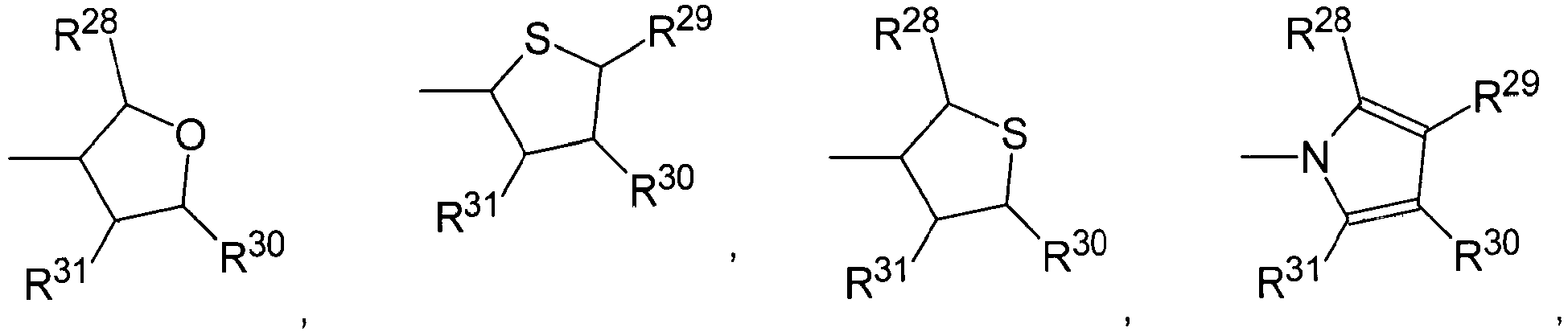

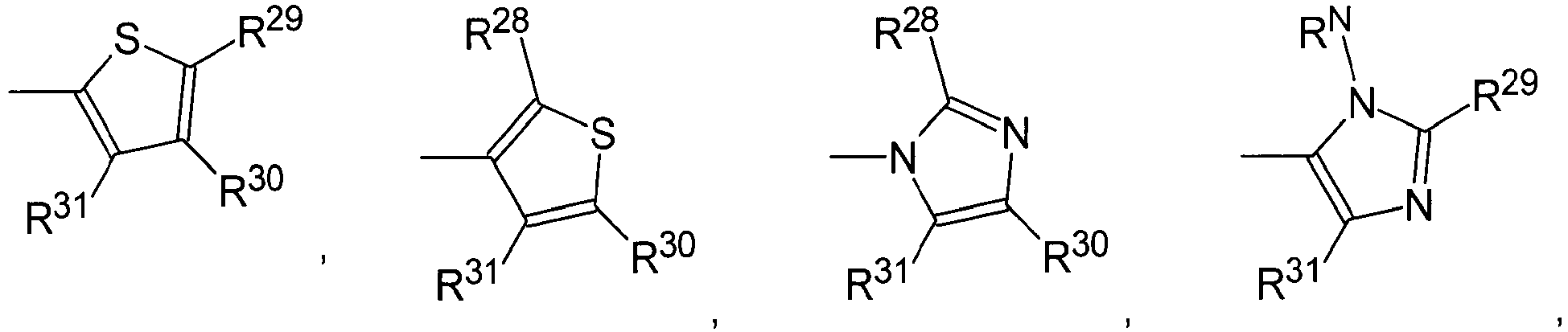


 RE repräsentiert R23 oder


 RF repräsentiert R24 oder


 L1 , L2 und L3 repräsentieren unabhängig voneinander:a bond, -CH2-, -C2H4-, -C3H6-, -C4H8-, -C5H10-, -C6H12-, -C7H14-, -C8H16-, -C9H18-, -C10H20-, -CH(CH3)-, -C[(CH3)2]-, -CH2-CH(CH3)-, -CH(CH3)-CH2-, -CH(CH3)-C2H4-, -CH2-CH(CH3)-CH2-, -C2H4-CH(CH3)-, -CH2-C[(CH3)2]-, -C[(CH3)2]-CH2-, -CH(CH3)-CH(CH3)-, -C[(C2H5)(CH3)]-, -CH(C3H7)-, -(CH2)mO-, -(CH2)pOCH2-, -(CH2-CH2-O)n-CH2-CH2-, -CH=CH-, -C(CH3)=CH-, -CH=C(CH3)-, -CH2-CH=CH-, -CH2-C(CH3)=CH-, -CH2-CH=C(CH3)-, -CH=CH-CH2-, -C(CH3)=CH-CH2-, -CH=C(CH3)-CH2-, -C(CH3)=CH-C(CH3)=CH-, -C2H4-CH=CH-CH=CH-, -CH2-CH=CH-CH2-CH=CH-, -C3H6-C≡C-CH2-, -CH2-CH=CH-CH=CH-CH2-, -CH=CH-CH=CH-C2H4-, -CH2-CH=CH-C(CH3)=CH-, -CH2-CH=C(CH3)-CH=CH-, -CH2-C(CH3)=CH-CH=CH-, -CH(CH3)-CH=CH-CH=CH-, -CH=CH-CH2-C(CH3)=CH-, -CH(CH3)-C≡C-CH2-, -CONH-, -NHCO-, -CH2-CONH-, -CONH-CH2-, -NHCO-CH2-, -CH2-NHCO-;wobei n, m, p unabhängig voneinander eine ganze Zahl zwischen 1 bis 10 sind; oderL1-RD und L2-RE oder L1-RD und L3-RF oder L2-RE und L3-RF können zusammen einen cyclischen Ring bilden, welcher ausgewählt wird aus der Gruppe bestehend aus:
 RN repräsentiert -H, -CH2-OCH3, -C2H4-OCH3, -C3H6-OCH3, -CH2-OC2H5, -C2H4-OC2H5, -C3H6-OC2H5, -CH2-OC3H7, -C2H4-OC3H7, -C3H6-OC3H7, -CH2-O-cyclo-C3H5, -C2H4-O-cyclo-C3H5, -C3H6-O-cyclo-C3H5, -CH2-OCH(CH3)2, -C2H4-OCH(CH3)2, -C3H6-OCH(CH3)2, -CH2-OC(CH3)3, -C2H4-OC(CH3)3, -C3H6-OC(CH3)3, -CH2-OC4H9, -C2H4-OC4H9, -C3H6-OC4H9, -CH2-OPh, -C2H4-OPh, -C3H6-OPh, -CH2-OCH2-Ph, -C2H4-OCH2-Ph, -C3H6-OCH2-Ph, -CHO, -COCH3, -COC2H5, -COC3H7, -CO-cyclo-C3H5, -COCH(CH3)2, -COC(CH3)3, -COPh, -COCN, -COOCH3, -COOC2H5, -COOC3H7, -COO-cyclo-C3H5, -COOCH(CH3)2, -COOC(CH3)3, -COCH2Ph, -CONH2, -CONHCH3, -CONHC2H5, -CONHC3H7, -CONH-cyclo-C3H5, -CONH[CH(CH3)2], -CONH[C(CH3)3], -CON(CH3)2, -CON(C2H5)2, -CON(C3H7)2, -CON(cyclo-C3H5)2, -CON[CH(CH3)2]2, -CON[C(CH3)3]2, -SO2CH3, -SO2C2H5, -SO2CH2Ph, -SO2C3H7, -SO2-cyclo-C3H5, -SO2CH(CH3)2, -SO2C(CH3)3, -SO2Ph, -CH2-OCF3, -C2H4-OCF3, -C3H6-OCF3, -OC2F5, -CH2-OC2F5, -C2H4-OC2F5, -C3H6-OC2F5, -CH2F, -CHF2, -CF3, -CH2Cl, -CH2Br, -CH2I, -CH2-CH2F, -CH2-CHF2, -CH2-CF3, CH2-CH2Cl, -CH2-CH2Br, -CH2-CH2I, -cyclo-C8H15, -Ph, -CH2-Ph, -CH2-CH2-Ph, -CH=CH-Ph, -CPh3, -CH3, -C2H5, -C3H7, -CH(CH3)2, -C4H9, -CH2-CH(CH3)2, -CH(CH3)-C2H5, -C(CH3)3, -C5H11, -CH(CH3)-C3H7, -CH2-CH(CH3)-C2H5, -CH(CH3)-CH(CH3)2, -C(CH3)2-C2H5, -CH2-C(CH3)3, -CH(C2H5)2, -C2H4-CH(CH3)2, -C6H13, -C7H15, -C8H17, -C3H6-CH(CH3)2, -C2H4-CH(CH3)-C2H5, -CH(CH3)-C4H9, -CH2-CH(CH3)-C3H7, -CH(CH3)-CH2-CH(CH3)2, -CH(CH3)-CH(CH3)-C2H5, -CH2-CH(CH3)-CH(CH3)2, -CH2-C(CH3)2-C2H5, -C(CH3)2-C3H7, -C(CH3)2-CH(CH3)2, -C2H4-C(CH3)3, -CH(CH3)-C(CH3)3, -CH=CH2, -CH2-CH=CH2, -C(CH3)=CH2, -CH=CH-CH3, -C2H4-CH=CH2, -CH2-CH=CH-CH3, -CH=CH-C2H5, -CH2-C(CH3)=CH2, -CH(CH3)-CH=CH, -CH=C(CH3)2, -C(CH3)=CH-CH3, -CH=CH-CH=CH2, -C3H6-CH=CH2, -C2H4-CH=CH-CH3, -CH2-CH=CH-C2H5, -CH=CH-C3H7, -CH2-CH=CH-CH=CH2, -CH=CH-CH=CH-CH3, -CH=CH-CH2-CH=CH2, -C(CH3)=CH-CH=CH2, -CH=C(CH3)-CH=CH2, -CH=CH-C(CH3)=CH2, -C2H4-C(CH3)=CH2, -CH2-CH(CH3)-CH=CH2, -CH(CH3)-CH2-CH=CH2, -CH2-CH=C(CH3)2, -CH2-C(CH3)=CH-CH3, -CH(CH3)-CH=CH-CH3, -CH=CH-CH(CH3)2, -CH=C(CH3)-C2H5, -C(CH3)=CH-C2H5, -C(CH3)=C(CH3)2, -C(CH3)2-CH=CH2, -CH(CH3)-C(CH3)=CH2, -C(CH3)=CH-CH=CH2, -CH=C(CH3)-CH=CH2, -CH=CH-C(CH3)=CH2, -C4H8-CH=CH2, -C3H6-CH=CH-CH3, -C2H4-CH=CH-C2H5, -CH2-CH=CH-C3H7, -CH=CH-C4H9, -C3H6-C(CH3)=CH2, -C2H4-CH(CH3)-CH=CH2, -CH2-CH(CH3)-CH2-CH=CH2, -C2H4-CH=C(CH3)2, -CH(CH3)-C2H4-CH=CH2, -C2H4-C(CH3)=CH-CH3, -CH2-CH(CH3)-CH=CH-CH3, -CH(CH3)-CH2-CH=CH-CH3, -CH2-CH=CH-CH(CH3)2, -CH2-CH=C(CH3)-C2H5, -CH2-C(CH3)=CH-C2H5, -CH(CH3)-CH=CH-C2H5, -CH=CH-CH2-CH(CH3)2, -CH=CH-CH(CH3)-C2H5, -CH=C(CH3)-C3H7, -C(CH3)=CH-C3H7, -CH2-CH(CH3)-C(CH3)=CH2, -C[C(CH3)3]=CH2, -CH(CH3)-CH2-C(CH3)=CH2, -CH(CH3)-CH(CH3)-CH=CH2, -CH=CH-C2H4-CH=CH2, -CH2-C(CH3)2-CH=CH2, -C(CH3)2-CH2-CH=CH2, -CH2-C(CH3)=C(CH3)2, -CH(CH3)-CH=C(CH3)2, -C(CH3)2-CH=CH-CH3, -CH=CH-CH2-CH=CH-CH3, -CH(CH3)-C(CH3)=CH-CH3, -CH=C(CH3)-CH(CH3)2, -C(CH3)=CH-CH(CH3)2, -C(CH3)=C(CH3)-C2H5, -CH=CH-C(CH3)3, -C(CH3)2-C(CH3)=CH2, -CH(C2H5)-C(CH3)=CH2, -C(CH3)(C2H5)-CH=CH2, -CH(CH3)-C(C2H5)=CH2, -CH2-C(C3H7)=CH2, -CH2-C(C2H5)=CH-CH3, -CH(C2H5)-CH=CH-CH3, -C(C4H9)=CH2, -C(C3H7)=CH-CH3, -C(C2H5)=CH-C2H5, -C(C2H5)=C(CH3)2, -C[CH(CH3)(C2H5)]=CH2, -C[CH2-CH(CH3)2]=CH2, -C2H4-CH=CH-CH=CH2, -CH2-CH=CH-CH2-CH=CH2, -C3H6-C=C-CH3, -CH2-CH=CH-CH=CH-CH3, -CH=CH-CH=CH-C2H5, -CH2-CH=CH-C(CH3)=CH2, -CH2-CH=C(CH3)-CH=CH2, -CH2-C(CH3)=CH-CH=CH2, -CH(CH3)-CH2-C≡CH, -CH(CH3)-CH=CH-CH=CH2, -CH=CH-CH2-C(CH3)=CH2, -CH(CH3)3C≡C-CH3, -CH=CH-CH(CH3)-CH=CH2, -CH=C(CH3)-CH2-CH=CH2, -C2H4-CH(CH3)-C≡CH, -C(CH3)=CH-CH2-CH=CH2, -CH2-C≡C-C2H5, -CH=CH-CH=C(CH3)2, -CH2-CH(CH3)-CH2-C≡CH, -C2H4-C≡C-CH3, -CH=CH-C(CH3)=CH-CH3, -CH=C(CH3)-CH=CH-CH3, -CH2-CH(CH3)-C≡CH, -C(CH3)=CH-CH=CH-CH3, -CH=C(CH3)-C(CH3)=CH2, -C(CH3)=CH-C(CH3)=CH2, -C(CH3)=C(CH3)-CH=CH2, -CH=CH-CH=CH-CH=CH2, -C≡CH, -C≡C-CH3, -CH2-C≡CH, -C2H4-C≡CH, -CH2-C≡C-CH3, -C≡C-C2H5, -C3H6-C≡CH, -C≡C-C3H7, -CH(CH3)-C≡CH, -C4H8-C≡CH, -C2H4-C≡C-C2H5, -CH2-C≡C-C3H7, -C≡C-C4H9, -C≡C-C(CH3)3, -CH(CH3)-C2H4-C≡CH, -CH2-CH(CH3)-C≡C-CH3, -CH(CH3)-CH2-C≡C-CH3, -CH(CH3)-C≡C-C2H5, -CH2-C≡C-CH(CH3)2, -C≡C-CH(CH3)-C2H5, -C≡C-CH2-CH(CH3)2, -CH(C2H5)-C≡C-CH3, -C(CH3)2-C≡C-CH3, -CH(C2H5)-CH2-C≡CH, -CH2-CH(C2H5)-C≡CH, -C(CH3)2-CH2-C≡CH, -CH2-C(CH3)2-C≡CH, -CH(CH3)-CH(CH3)-C≡CH, -CH(C3H7)-C≡CH, -C(CH3)(C2H5)-C≡CH, -CH2-CH(C≡CH)2, -C=C-C=CH, -CH2-C≡C-C≡CH, -C≡C-C≡C-CH3, -CH(C≡CH)2, -C2H4-C≡C-C≡CH, -CH2-C≡C-CH2-C≡CH, -C≡C-C2H4-C≡CH, -CH2-C≡C-C≡C-CH3, -C≡C-CH2-C≡C-CH3, -C≡C-C≡C-C2 H5, -C(C≡CH)2-CH3, -C≡C-CH(CH3)-C≡CH, -CH(CH3)-C≡C-C≡CH, -CH(C≡CH)-CH2-C≡CH, oder -CH(C≡CH)-C≡C-CH3;RB repräsentiert


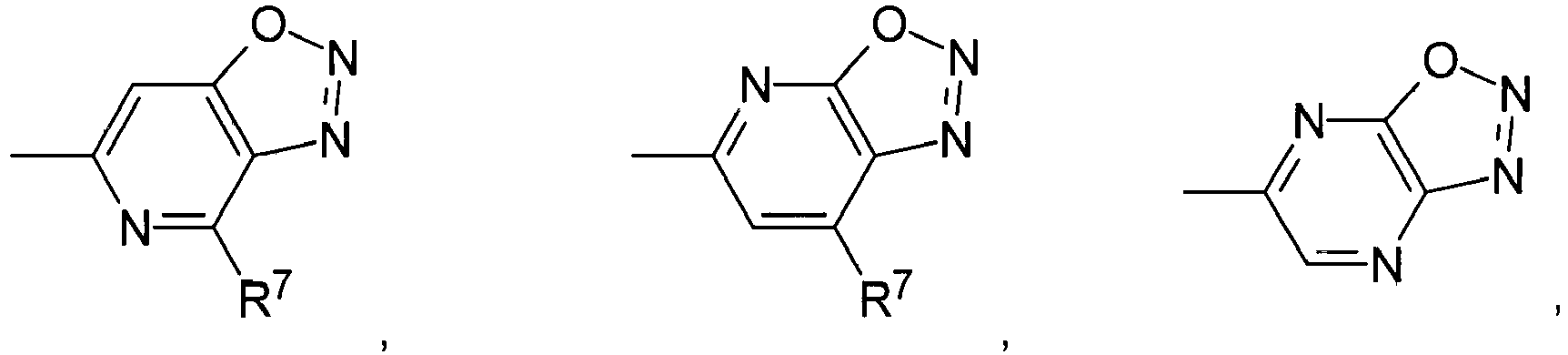





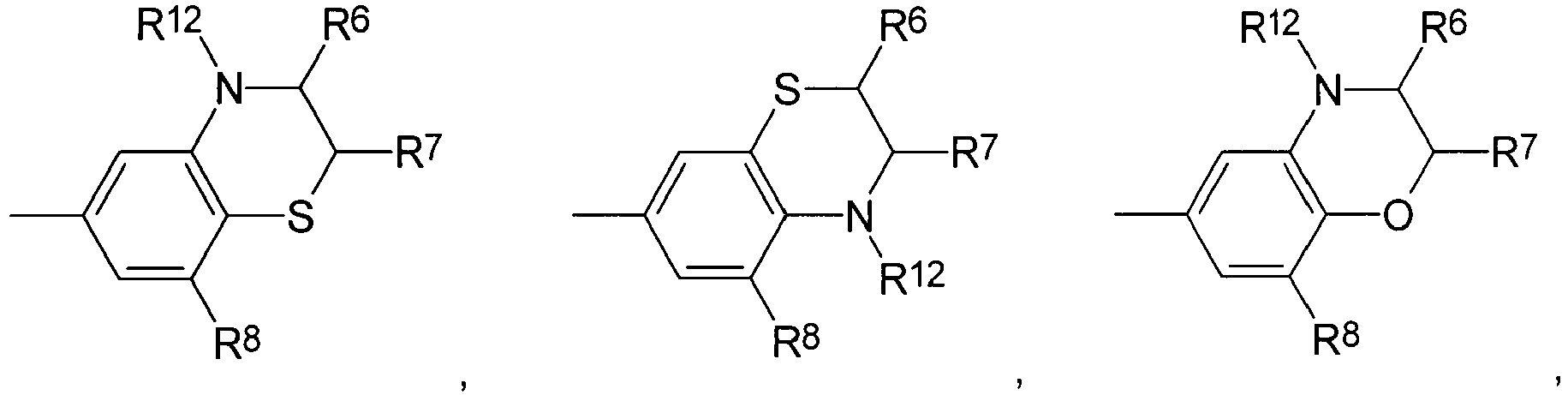


 Q repräsentiert =O, =S, oder =N-R12;Rc repräsentiert -OH, -CH2-OH, -CHO, -CH2CHO, -CH2CH2CHO, -C2H4-OH, -C3H6-OH, -O-CH3, -O-C2H5, -O-CH2-OH, -O-CH(CH3)2, -O-CH2-O-CH3, -O-C2H4-O-CH3, -CH2-O-CH3, -CH2-O-CH2-OH, -CH2O-C2H5, -CH2-O-CH(CH3)2, -CH2-O-C3H7, -CO-CH3, -CH2-CO-CH3, -CO-CH2-OH, -CH(OH)-CH3, -C(OH)(CH3)2, -CH(CH3)CH2OH, -CH(OH)-CH2-OH, -CH2-CH(OH)-CH3, -CH2-CH(OH)-CH2-OH, -CH(OCH3)-CH2OH, -CH(OC2H5)-CH2OH, -CH(OCH3)-CH2OCH3, -CH(OC2H5)-CH2OCH3, -CH(OC2H5)-CH2OC2H5, -CH(OAc)-CH2OH, -CH(OAc)-CH2OAc, -CH(OH)-CH2OAc, -CH(OH)-CH2-NH2, -CH2-CH(OH)-CH2-NH2, -CH(OCH3)-CH2-NH2, -CH(OC2H5)-CH2-NH2, -CH2-CH(OCH3)-CH2-NH2, -CH2-CH(OC2H5)-CH2-NH2, -CH(OH)-CH2-NHCH3, -CH(OH)-CH2-NHC2H5, -CH2-CH(OH)-CH2-NHCH3, -CO-C3H7, -CH2-CH(OH)-CH2-NHC2H5, -CH(OCH3)-CH2NHCH3, -CO-C2H5, -CO-CH(CH3)2, -CH(OC2H5)-CH2NHCH3, -CH2-CH(OCH3)-CH2-NHCH3, -O-C3H7, -CH2-CH(OC2H5)-CH2-NHCH3, -CH(OCH3)-CH2NHC2H5, -CH(OC2H5)-CH2NHC2H5, -CH(OCH3)-CH2N(CH3)2, -CH(OC2H5)-CH2N(CH3)2, -NH2, -NHCH3, -N(CH3)2, -CH2-NH2, -CH2-NHCH3, -CH2-N(CH3)2, -C2H4-NH2, -C2H4-NHCH3, -C2H5-N(CH3)2, -CH(NHCH3)CH3, -CH(NHC2H5)CH3, -CH(N(CH3)2)CH3, -CH(N(C2H5)2)CH3, -CH(NH2)CH2OH, -CH(NHCH3)CH2OH, -CH(NHC2H5)CH2OH, -CH(N(CH3)2)CH2OH, -CH(N(C2H5)2)CH2OH, -CH(NH2)CH2OCH3, -CH(NHCH3)CH2OCH3, -CH(NHC2H5)CH2OCH3, -CH(N(CH3)2)CH2OCH3, -CH(N(C2H5)2)CH2OCH3, -CH(NH2)CH2OC2H5, -CH(NHCH3)CH2OC2H5, -CH(NHC2H5)CH2OC2H5, -CH(N(CH3)2)CH2OC2H5, -CH(N(C2H5)2)CH2OC2H5, -CH(NH2)CH2OAc, -CH(NHCH3)CH2OAc, -CH(NHC2H5)CH2OAc, -CH(N(CH3)2)CH2OAc, -CH(N(C2H5)2)CH2OAc, -CH2-CH(NHAc)CH2OH, -CH2-CH(NHAc)CH2OCH3, -CH2-CH(NHAc)CH2OC2H5, -CH2-CH(NHCH3)CH3, -CH2-CH(NHC2H5)CH3, -CH2-CH(N(CH3)2)CH3, -CH2-CH(N(C2H5)2)CH3, -CH2-CH(NH2)CH2OH, -CH2-CH(NHCH3)CH2OH, -CH2-CH(NHC2H5)CH2OH, -CH2-CH(N(CH3)2)CH2OH, -CH2-CH(N(C2H5)2)CH2OH, -CH2-CH(NH2)CH2OCH3, -CH2-CH(NHCH3)CH2OCH3, -CH2-CH(NHC2H5)CH2OCH3, -CH2-CH(N(CH3)2)CH2OCH3, -CH2-CH(N(C2H5)2)CH2OCH3, -CH2-CH(NH2)CH2OC2H5, -CH2-CH(NHCH3)CH2OC2H5, -CH2-CH(NHC2H5)CH2OC2H5, -CH2-CH(N(CH3)2)CH2OC2H5, -CH2-CH(N(C2H5)2)CH2OC2H5, -CH2-CH(NH2)CH2OAc, -CH2-CH(NHCH3)CH2OAc, -CH2-CH(NHC2H5)CH2OAc, -CH2-CH(N(CH3)2)CH2OAc, -CH2-CH(N(C2H5)2)CH2OAc, -CH2-CH(NHAc)CH2OH, -CH2-CH(NHAc)CH2OCH3, -CH2-CH(NHAc)CH2OC2H5, -NHCOCH3, -CH2-NHCOCH3, -C2H4-NHCOCH3, -NHCHO, -CH2-NHCHO, -C2H4-NHCHO, -NHSO2CH3, -NHSO2CF3, -NHSO2CH2CF3, -CH2-NHSO2CH3, -CH2-NHSO2CF3, -CH2-NHSO2CH2CF3, -C2H4-NHSO2CH3, -C2H4-NHSO2CF3, -C2H4-NHSO2CH2CF3, -CONH2, -CONHCH3, -CONHC2H5, -CONHC3H7, -NH(C2H5), -N(C2H5)2, -CH2-NH(C2H5), -CH2-N(C2H5)2, -C2H4-NH(C2H5), -C2H4-N(C2H5)2, -NO2, -CH2-NO2, -C2H4-NO2, -CH(OH)-NO2, -CH(NO2)-OH, -CO2H, -CH2-CO2H, -C2H4-CO2H, -CH=CH-CO2H, -CO2CH3, -CO2C2H5, -CO2CH(CH3)2, -CH2-CO2CH3, -CH2-CO2C2H5, -CH2-CO2CH(CH3)2, -C2H4-CO2CH3, -C2H4-CO2C2H5, -C2H4-CO2CH(CH3)2, -CO2NH2, -CO2NHCH3, -CO2N(CH3)2, -CH2-CO2NH2, -CH2-CO2NHCH3, -CH2-CO2N(CH3)2, -C2H4-CO2NH2, -C2H4-CO2NHCH3, -C2H4-CO2N(CH3)2, -O-Si(CH3)3, -O-Si(C2H5)3, -CO-CHO, -CO-CO-CH3, -C(OH)-CO-CH3, -CO-C(OH)-CH3, -CO-CH2-CO-CH3, -C(OH)-CH2-CO-CH3, -CO-CH2-C(OH)-CH3, -C(OH)-CH2-C(OH)-CH3, -F, -Cl, -Br, -CH2-F, -CHF2, -CF3, -C2H4-F, -CH2-CF3, -CF2-CF3, -O-CHF2, -O-CF3, -O-CH2-CF3, -O-C2F5, -CH3, -CH2CH3, -C3CH7, -CH(CH3)2, -CH=CH2, -C≡CH, -CH2-CH=CH2, oder -CH2-C≡CH;R 1 - R 10 repräsentieren unabhängig voneinander -H, -OH, -OCH3, -OC2H5, -OC3H7, -O-cyclo-C3H5, -OCH(CH3)2, -OC(CH3)3, -OC4H9, -OCH2-COOH, -OPh, -OCH2-Ph, -OCPh3, -CH2-OCH3, -CH2-OH, -C2H4-OCH3, -C3H6-OCH3, -CH2-OC2H5, -C2H4-OC2H5, -C3H6-OC2H5, -CH2-OC3H7, -C2H4-OC3H7, -C3H6-OC3H7, -CH2-O-cyclo-C3H5, -C2H4-O-cyclo-C3H5, -C3H6-O-cyclo-C3H5, -CH2-OCH(CH3)2, -C2H4-OCH(CH3)2, -C3H6-OCH(CH3)2, -CH2-OC(CH3)3, -C2H4-OC(CH3)3, -C3H6-OC(CH3)3, -CH2-OC4H9, -C2H4-OC4H9, -C3H6-OC4H9, -CH2-OPh, -C2H4-OPh, -C3H6-OPh, -CH2-OCH2-Ph, -C2H4-OCH2-Ph, -C3H6-OCH2-Ph, -SH, -SCH3, -SC2H5, -SC3H7, -S-cyclo-C3H5, -SCH(CH3)2, -SC(CH3)3, -NO2, -F, -Cl, -Br, -I, -P(O)(OH)2, -P(O)(OCH3)2, -P(O)(OC2H5)2, -P(O)(OCH(CH3)2)2, -C(OH)[P(O)(OH)2]2, -Si(CH3)2(C(CH3)3), -Si(C2H5)3, -Si(CH3)3, -N3, -CN, -OCN, -NCO, -SCN, -NCS, -CHO, -COCH3, -COC2H5, -COC3H7, -CO-cyclo-C3H5, -COCH(CH3)2, -COC(CH3)3, -COOH, -COCN, -COOCH3, -COOC2H5, -COOC3H7, -COO-cyclo-C3H5, -COOCH(CH3)2, -COOC(CH3)3, -OOC-CH3, -OOC-C2H5, -OOC-C3H7, -OOC-cyclo-C3H5, -OOC-CH(CH3)2, -OOC-C(CH3)3, -CONH2, -CONHCH3, -CONHC2H5, -CONHC3H7, -CONH-cyclo-C3H5, -CONH[CH(CH3)2], -CONH[C(CH3)3], -CON(CH3)2, -CON(C2H5)2, -CON(C3H7)2, -CON(cyclo-C3H5)2, -CON[CH(CH3)2]2, -CON[C(CH3)3]2, -NHCOCH3, -NHCOC2H5, -NHCOC3H7, -NHCO-cyclo-C3H5, -NHCO-CH(CH3)2, -NHCO-C(CH3)3, -NHCO-OCH3, -NHCO-OC2H5, -NHCO-OC3H7, -NHCO-O-cyclo-C3H5, -NHCO-OCH(CH3)2, -NHCO-OC(CH3)3, -NH2, -NHCH3, -NHC2H5, -NHC3H7, -NH-cyclo-C3H5, -NHCH(CH3)2, -NHC(CH3)3, -N(CH3)2, -N(C2H5)2, -N(C3H7)2, -N(cyclo-C3H5)2, -N[CH(CH3)2]2, -N[C(CH3)3]2, -SOCH3, -SOC2H5, -SOC3H7, -SO-cyclo-C3H5, -SOCH(CH3)2, -SOC(CH3)3, -SO2CH3, -SO2C2H5, -SO2C3H7, --SO2-cyclo-C3H5, -SO2CH(CH3)2, -SO2C(CH3)3, -SO3H, -SO3CH3, -SO3C2H5, -SO3C3H7, -SO3-cyclo-C3H5, -SO3CH(CH3)2, -SO3C(CH3)3, -SO2NH2, -SO2NHCH3, -SO2NHC2H5, -SO2NHC3H7, -SO2NH-cyclo-C3H5, -SO2NHCH(CH3)2, -SO2NHC(CH3)3, -SO2N(CH3)2, -SO2N(C2H5)2, -SO2N(C3H7)2, -SO2N(cyclo-C3H5)2, -SO2N[CH(CH3)2]2, -SO2N[C(CH3)3]2, -O-S(=O)CH3, -O-S(=O)C2H5, -O-S(=O)C3H7, -O-S(=O)-cyclo-C3H5, -O-S(=O)CH(CH3)2, -O-S(=O)C(CH3)3, -S(=O)(=NH)CH3, -S(=O)(=NH)C2H5, -S(=O)(=NH)C3H7, -S(=O)(=NH)-cyclo-C3H5, -S(=O)(=NH)CH(CH3)2, -S(=O)(=NH)C(CH3)3, -NH-SO2-CH3, -NH-SO2-C2H5, -NH-SO2-C3H7, -NH-SO2-cyclo-C3H5, -NH-SO2-CH(CH3)2, -NH-SO2-C(CH3)3, -O-SO2-CH3, -O-SO2-C2H5, -O-SO2-C3H7, -O-SO2-cyclo-C3H5, -O-SO2-CH(CH3)2, -O-SO2-C(CH3)3, -OCF3, -CH2-OCF3, -C2H4-OCF3, -C3H6-OCF3, -OC2F5, -CH2-OC2F5, -C2H4-OC2F5, -C3H6-OC2F5, -O-COOCH3, -O-COOC2H5, -O-COOC3H7, -O-COO-cyclo-C3H5, -O-COOCH(CH3)2, -O-COOC(CH3)3, -NH-CO-NH2, -NH-CO-NHCH3, -NH-CO-NHC2H5, -NH-CS-N(C3H7)2, -NH-CO-NHC3H7, -NH-CO-N(C3H7)2, -NH-CO-NH[CH(CH3)2], -NH-CO-NH[C(CH3)3], -NH-CO-N(CH3)2, -NH-CO-N(C2H5)2, -NH-CO-NH-cyclo-C3H5, -NH-CO-N(cyclo-C3H5)2, -NH-CO-N[CH(CH3)2]2, -NH-CS-N(C2H5)2, -NH-CO-N[C(CH3)3]2, -NH-CS-NH2, -NH-CS-NHCH3, -NH-CS-N(CH3)2, -NH-CS-NHC2H5, -NH-CS-NHC3H7, -NH-CS-NH-cyclo-C3H5, -NH-CS-NH[CH(CH3)2], -NH-CS-NH[C(CH3)3], -NH-CS-N(cyclo-C3H5)2, -NH-CS-N[CH(CH3)2]2, -NH-CS-N[C(CH3)3]2, -NH-C(=NH)-NH2, -NH-C(=NH)-NHCH3, -NH-C(=NH)-NHC2H5, -NH-C(=NH)-NHC3H7, -O-CO-NH-cyclo-C3H5, -NH-C(=NH)-NH-cyclo-C3H5, -NH-C(=NH)-NH[CH(CH3)2], -O-CO-NH[CH(CH3)2], -NH-C(=NH)-NH[C(CH3)3], -NH-C(=NH)-N(CH3)2, -NH-C(=NH)-N(C2H5)2, -NH-C(=NH)-N(C3H7)2, -NH-C(=NH)-N(cyclo-C3H5)2, -O-CO-NHC3H7, -NH-C(=NH)-N[CH(CH3)2]2, -NH-C(=NH)-N[C(CH3)3]2, -O-CO-NH2, -O-CO-NHCH3, -O-CO-NHC2H5, -O-CO-NH[C(CH3)3], -O-CO-N(CH3)2, -O-CO-N(C2H5)2, -O-CO-N(C3H7)2, -O-CO-N(cyclo-C3H5)2, -O-CO-N[CH(CH3)2]2, -O-CO-N[C(CH3)3]2, -O-CO-OCH3, -O-CO-OC2H5, -O-CO-OC3H7, -O-CO-O-cyclo-C3H5, -O-CO-OCH(CH3)2, -O-CO-OC(CH3)3, -CH2F, -CHF2, -CF3, -CH2Cl, -CH2Br, -CH2I, -CH2-CH2F, -CH2-CHF2, -CH2-CF3, -CH2-CH2Cl, -CH2-CH2Br, -CH2-CH2I, -cyclo-C3H5, -cyclo-C4H7, -cyclo-C5H9, -cyclo-C6H11, -cyclo-C7H13, -cyclo-C8H15, -Ph, -CH2-Ph, -CH2-CH2-Ph, -CH=CH-Ph, -CPh3, -CH3, -C2H5, -C3H7, -CH(CH3)2, -C4H9, -CH2-CH(CH3)2, -CH(CH3)-C2H5, -C(CH3)3, -C5H11, -CH(CH3)-C3H7, -CH2-CH(CH3)-C2H5, -CH(CH3)-CH(CH3)2, -C(CH3)2-C2H5, -CH2-C(CH3)3, -CH(C2H5)2, -C2H4-CH(CH3)2, -C6H13, -C7H15, -C8H17, -C3H6-CH(CH3)2, -C2H4-CH(CH3)-C2H5, -CH(CH3)-C4H9, -CH2-CH(CH3)-C3H7, -CH(CH3)-CH2-CH(CH3)2, -CH(CH3)-CH(CH3)-C2H5, -CH2-CH(CH3)-CH(CH3)2, -CH2-C(CH3)2-C2H5, -C(CH3)2-C3H7, -C(CH3)2-CH(CH3)2, -C2H4-C(CH3)3, -CH(CH3)-C(CH3)3, -CH=CH2, -CH2-CH=CH2, -C(CH3)=CH2, -CH=CH-CH3, -C2H4-CH=CH2, -CH2-CH=CH-CH3, -CH=CH-C2H5, -CH2-C(CH3)=CH2, -CH(CH3)-CH=CH, -CH=C(CH3)2, -C(CH3)=CH-CH3, -CH=CH-CH=CH2, -C3H6-CH=CH2, -C2H4-CH=CH-CH3, -CH2-CH=CH-C2H5, -CH=CH-C3H7, -CH2-CH=CH-CH=CH2, -CH=CH-CH=CH-CH3, -CH=CH-CH2-CH=CH2, -C(CH3)=CH-CH=CH2, -CH=C(CH3)-CH=CH2, -CH=CH-C(CH3)=CH2, -C2H4-C(CH3)=CH2, -CH2-CH(CH3)-CH=CH2, -CH(CH3)-CH2-CH=CH2, -CH2-CH=C(CH3)2, -CH2-C(CH3)=CH-CH3, -CH(CH3)-CH=CH-CH3, -CH=CH-CH(CH3)2, -CH=C(CH3)-C2H5, -C(CH3)=CH-C2H5, -C(CH3)=C(CH3)2, -C(CH3)2-CH=CH2, -CH(CH3)-C(CH3)=CH2, -C(CH3)=CH-CH=CH2, -CH=C(CH3)-CH=CH2, -CH=CH-C(CH3)=CH2, -C4H8-CH=CH2, -C3H6-CH=CH-CH3, -C2H4-CH=CH-C2H5, -CH2-CH=CH-C3H7, -CH=CH-C4H9, -C3H6-C(CH3)=CH2, -C2H4-CH(CH3)-CH=CH2, -CH2-CH(CH3)-CH2-CH=CH2, -C2H4-CH=C(CH3)2, -CH(CH3)-C2H4-CH=CH2, -C2H4-C(CH3)=CH-CH3, -CH2-CH(CH3)-CH=CH-CH3, -CH(CH3)-CH2-CH=CH-CH3, -CH2-CH=CH-CH(CH3)2, -CH2-CH=C(CH3)-C2H5, -CH2-C(CH3)=CH-C2H5, -CH(CH3)-CH=CH-C2H5, -CH=CH-CH2-CH(CH3)2, -CH=CH-CH(CH3)-C2H5, -CH=C(CH3)-C3H7, -C(CH3)=CH-C3H7, -CH2-CH(CH3)-C(CH3)=CH2, -C[C(CH3)3]=CH2, -CH(CH3)-CH2-C(CH3)=CH2, -CH(CH3)-CH(CH3)-CH=CH2, -CH2-C(CH3)2-CH=CH2, -C(CH3)2-CH2-CH=CH2, -CH2-C(CH3)=C(CH3)2, -CH(CH3)-CH=C(CH3)2, -C(CH3)2-CH=CH-CH3, -CH(CH3)-C(CH3)=CH-CH3, -CH=C(CH3)-CH(CH3)2, -C(CH3)=CH-CH(CH3)2, -C(CH3)=C(CH3)-C2H5, -CH=CH-C(CH3)3, -C(CH3)2-C(CH3)=CH2, -CH(C2H5)-C(CH3)=CH2, -C(CH3)(C2H5)-CH=CH2, -CH(CH3)-C(C2H5)=CH2, -CH2-C(C3H7)=CH2, -CH2-C(C2H5)=CH-CH3, -CH(C2H5)-CH=CH-CH3, -C(C4H9)=CH2, -C(C3H7)=CH-CH3, -C(C2H5)=CH-C2H5, -C(C2H5)=C(CH3)2, -C[CH(CH3)(C2H5)]=CH2, -C[CH2-CH(CH3)2]=CH2, -C3H6-C≡C-CH3, -CH(CH3)-CH2-C≡CH, -CH(CH3)-C≡C-CH3, -C2H4-CH(CH3)-C≡CH, -CH2-CH(CH3)-CH2-C≡CH, -CH2-CH(CH3)-C≡CH, -C≡CH, -C≡C-CH3, -CH2-C≡CH, -C2H4-C≡CH, -CH2-C≡C-CH3, -C≡C-C2H5, -C3H6-C≡CH, -C2H4-C≡C-CH3, -CH2-C≡C-C2H5, -C≡C-C3H7, -CH(CH3)-C≡CH, -C4H8-C≡CH, -C2H4-C≡C-C2H5, -CH2-C≡C-C3H7, -C≡C-C4H9, -C≡C-C(CH3)3, -CH(CH3)-C2H4-C≡CH, -CH2-CH(CH3)-C≡C-CH3, -CH(CH3)-CH2-C≡C-CH3, -CH(CH3)-C≡C-C2H5, -CH2-C≡C-CH(CH3)2, -C≡C-CH(CH3)-C2H5, -C≡C-CH2-CH(CH3)2, -CH(C2H5)-C≡C-CH3, -C(CH3)2-C≡C-CH3, -CH(C2H5)-CH2-C≡CH, -CH2-CH(C2H5)-C≡CH, -C(CH3)2-CH2-C≡CH, -CH2-C(CH3)2-C≡CH, -CH(CH3)-CH(CH3)-C≡CH, -CH(C3H7)-C≡CH, -C(CH3)(C2H5)-C≡CH, -CH2-CH(C≡CH)2,
 R 15 repräsentiert -R 20, -CN, -CH2-CN, -CH2-OR17, -CH2-CH2-OR17, -CH2-NR17R18, -CH2-NR17COR19, -CH2-CH2-NR17R18, -CH2-CH2-NR17COR19, -CO2R17, -CO-NR17R18, -CH2-CO2R17, oder -CH2-CO-NR17R18;R 16 repräsentiert -R 21, -H, -CH3, -C2H5, -C3H7, -CH(CH3)2, -C4H9, -CH2-CH(CH3)2, -CH(CH3)-C2H5, -C(CH3)3, -C5H11, -CH(CH3)-C3H7, -CH2-CH(CH3)-C2H5, -CH(CH3)-CH(CH3)2, -C(CH3)2-C2H5, -CH2-C(CH3)3, -CH(C2H5)2, -C2H4-CH(CH3)2, -C6H13, -C7H15, -C8H17, -C3H6-CH(CH3)2, -C2H4-CH(CH3)-C2H5, -CH(CH3)-C4H9, -CH2-CH(CH3)-C3H7, -CH(CH3)-CH2-CH(CH3)2, -CH(CH3)-CH(CH3)-C2H5, -CH2-CH(CH3)-CH(CH3)2, -CH2-C(CH3)2-C2H5, -C(CH3)2-C3H7, -C(CH3)2-CH(CH3)2, -C2H4-C(CH3)3, -CH(CH3)-C(CH3)3, -CH2OH, -CH2-SH, -CH(OH)CH3, -C2H4OH, -C3H6OH, -C4H8OH, -CH(CH3)-C2H4OH, -C5H10OH, -CH2-S-CH3, -CH2-CH2-S-CH3, -C3H6-S-CH3, -CH2OCH3, -C2H4OCH3, -C3H6OCH3, -C4H8OCH3, -CH(CH3)-C2H4OCH3, -C5H10OCH3, -CH2NH2, -C2H4NH2, -C3H6NH2, -C4H8NH2, -CH(CH3)-C2H4NH2, -C5H10NH2, -CH2-CH2-CH2-NH-C(NH)NH2, -CH2-CO2H, -CH2-CONH2, -CH2-CH2-CO2H, -CH2-CH2-CONH2, -CH2-CO2CH3, -CH2-CONHCH3, -CH2-CON(CH3)2, -CH2-CH2-CO2CH3, -CH2-CH2-CONHCH3, -CH2-CH2-CONH(CH3)2, -CH=CH-CO2H, -CH=CH-CO2CH3, -CH=CH-CONHCH3, -CH=CH-CONHC2H5, -CH=CH-CON(CH3)2, -CH=CH-CON(C2H5)2, -CH2-CH=CH-CO2H, -CH2-CH=CH-CO2CH3, -CH2-CH=CH-CONHCH3, -CH2-CH=CH-CON(CH3)2, -CH2-CH=CH-CONHC2H5, -CH2-CH=CH-CON(C2H5)2, -CH=CH2, -CH2-CH=CH2, -C(CH3)=CH2, -CH=CH-CH3, -C2H4-CH=CH2, -CH2-CH=CH-CH3, -CH=CH-C2H5, -CH2-C(CH3)=CH2, -CH(CH3)-CH=CH, -CH=C(CH3)2, -C(CH3)=CH-CH3, -CH=CH-CH=CH2, -C3H6-CH=CH2, -C2H4-CH=CH-CH3, -CH2-CH=CH-C2H5, -CH=CH-C3H7, -CH2-CH=CH-CH=CH2, -CH=CH-CH=CH-CH3, -CH=CH-CH2-CH=CH2, -C(CH3)=CH-CH=CH2, -CH=C(CH3)-CH=CH2, -CH=CH-C(CH3)=CH2, -C2H4-C(CH3)=CH2, -CH2-CH(CH3)-CH=CH2, -CH(CH3)-CH2-CH=CH2, -CH2-CH=C(CH3)2, -CH2-C(CH3)=CH-CH3, -CH(CH3)-CH=CH-CH3, -CH=CH-CH(CH3)2, -CH=C(CH3)-C2H5, -C(CH3)=CH-C2H5, -C(CH3)=C(CH3)2, -C(CH3)2-CH=CH2, -CH(CH3)-C(CH3)=CH2, -C(CH3)=CH-CH=CH2, -CH=C(CH3)-CH=CH2, -CH=CH-C(CH3)=CH2, -C4H8-CH=CH2, -C3H6-CH=CH-CH3, -C2H4-CH=CH-C2H5, -CH2-CH=CH-C3H7, -CH=CH-C4H9, -C3H6-C(CH3)=CH2, -C2H4-CH(CH3)-CH=CH2, -CH2-CH(CH3)-CH2-CH=CH2, -C2H4-CH=C(CH3)2, -CH(CH3)-C2H4-CH=CH2, -C2H4-C(CH3)=CH-CH3, -CH2-CH(CH3)-CH=CH-CH3, -CH(CH3)-CH2-CH=CH-CH3, -CH2-CH=CH-CH(CH3)2, -CH2-CH=C(CH3)-C2H5, -CH2-C(CH3)=CH-C2H5, -CH(CH3)-CH=CH-C2H5, -CH=CH-CH2-CH(CH3)2, -CH=CH-CH(CH3)-C2H5, -CH=C(CH3)-C3H7, -C(CH3)=CH-C3H7, -CH2-CH(CH3)-C(CH3)=CH2, -C[C(CH3)3]=CH2, -CH(CH3)-CH2-C(CH3)=CH2, -CH(CH3)-CH(CH3)-CH=CH2, -CH=CH-C2H4-CH=CH2, -CH2-C(CH3)2-CH=CH2, -C(CH3)2-CH2-CH=CH2, -CH2-C(CH3)=C(CH3)2, -CH(CH3)-CH=C(CH3)2, -C(CH3)2-CH=CH-CH3, -CH=CH-CH2-CH=CH-CH3, -CH(CH3)-C(CH3)=CH-CH3, -CH=C(CH3)-CH(CH3)2, -C(CH3)=CH-CH(CH3)2, -C(CH3)=C(CH3)-C2H5, -CH=CH-C(CH3)3, -C(CH3)2-C(CH3)=CH2, -CH(C2H5)-C(CH3)=CH2, -C(CH3)(C2H5)-CH=CH2, -CH(CH3)-C(C2H5)=CH2, -CH2-C(C3H7)=CH2, -CH2-C(C2H5)=CH-CH3, -CH(C2H5)-CH=CH-CH3, -C(C4H9)=CH2, -C(C3H7)=CH-CH3, -C(C2H5)=CH-C2H5, -C(C2H5)=C(CH3)3, -C[CH(CH3)(C2H5)]=CH2, -C[CH2-CH(CH3)2]=CH2, -C2H4-CH=CH-CH=CH2, -CH2-CH=CH-CH2-CH=CH2, -C3H6-C≡C-CH3, -CH2-CH=CH-CH=CH-CH3, -CH=CH-CH=CH-C2H5, -CH2-CH=CH-C(CH3)=CH2, -CH2-CH=C(CH3)-CH=CH2, -CH2-C(CH3)=CH-CH=CH2, -CH(CH3)-CH2-C≡CH, -CH(CH3)-CH=CH-CH=CH2, -CH=CH-CH2-C(CH3)=CH2, -CH(CH3)-C≡C-CH3, -CH=CH-CH(CH3)-CH=CH2, -CH=C(CH3)-CH2-CH=CH2, -C2H4-CH(CH3)-C=CH, -C(CH3)=CH-CH2-CH=CH2, -CH=CH-CH=C(CH3)2, -CH2-CH(CH3)-CH2-C≡CH, -CH=CH-C(CH3)=CH-CH3, -CH=C(CH3)-CH=CH-CH3, -CH2-CH(CH3)-C≡CH, -C(CH3)=CH-CH=CH-CH3, -CH=C(CH3)-C(CH3)=CH2, -C(CH3)=CH-C(CH3)=CH2, -C(CH3)=C(CH3)-CH=CH2, -CH=CH-CH=CH-CH=CH2, -C≡CH, -C≡C-CH3, -CH2-C≡CH, -C2H4-C≡CH, -CH2-C≡C-CH3, -C≡C-C2H5, -C3H6-C≡CH, -C2H4-C≡C-CH3, -CH2-C≡C-C2H5, -C≡C-C3H7, -CH(CH3)-C≡CH, -C4H8-C≡CH, -C2H4-C≡C-C2H5, -CH2-C≡C-C3H7, -C≡C-C4H9, -C≡C-C(CH3)3, -CH(CH3)-C2H4-C≡CH, -CH2-CH(CH3)-C≡C-CH3, -CH(CH3)-CH2-C≡C-CH3, -CH(CH3)-C≡C-C2H5, -CH2-C≡C-CH(CH3)2, -C≡C-CH(CH3)-C2H5, -C≡C-CH2-CH(CH3)2, -CH(C2H5)-C≡C-CH3, -C(CH3)2-C≡C-CH3, -CH(C2H5)-CH2-C≡CH, -CH2-CH(C2H5)-C≡CH, -C(CH3)2-CH2-C≡CH, -CH2-C(CH3)2-C≡CH, -CH(CH3)-CH(CH3)-C≡CH, -CH(C3H7)-C≡CH, -C(CH3)(C2H5)-C≡CH, -CH2-Ph,


 R 11- R 14 und R 17 - R 21 repräsentieren unabhängig voneinander -H, -CH2F, -CHF2, -CH2-OCH3, -CH2-OH, -C2H4-OCH3, -C3H6-OCH3, -CH2-OC2H5, -C2H4-OC2H5, -C3H6-OC2H5, -CH2-OC3H7, -C2H4-OC3H7, -C3H6-OC3H7, -CH2-O-cyclo-C3H5, -C2H4-O-cyclo-C3H5, -C3H6-O-cyclo-C3H5, -CH2-OCH(CH3)2, -C2H4-OCH(CH3)2, -C3H6-OCH(CH3)2, -CH2-OC(CH3)3, -C2H4-OC(CH3)3, -C3H6-OC(CH3)3, -CH2-OC4H9, -C2H4-OC4H9, -C3H6-OC4H9, -CH2-OPh, -C2H4-OPh, -C3H6-OPh, -CH2-OCH2-Ph, -C2H4-OCH2-Ph, -C3H6-OCH2-Ph, -CF3, -CH2Cl, -CH2Br, -CH2I, -CH2-CH2F, -CH2-CHF2, -CH2-CF3, -CH2-CH2Cl, -CH2-CH2Br, -CH2-CH2I, -cyclo-C3H5, -cyclo-C4H7, -cyclo-C5H9, -cyclo-C6H11, -cyclo-C7H13, -cyclo-C8H15, -Ph, -CH2-Ph, -CH2-CH2-Ph, -CH=CH-Ph, -CPh3, -CH3, -C2H5, -C3H7, -CH(CH3)2, -C4H9, -CH2-CH(CH3)2, -CH(CH3)-C2H5, -C(CH3)3, -C5H11, -CH(CH3)-C3H7, -CH2-CH(CH3)-C2H5, -CH(CH3)-CH(CH3)2, -C(CH3)2-C2H5, -CH2-C(CH3)3, -CH(C2H5)2, -C2H4-CH(CH3)2, -C6H13, -C7H15, -C8H17, -C3H6-CH(CH3)2, -C2H4-CH(CH3)-C2H5, -CH(CH3)-C4H9, -CH2-CH(CH3)-C3H7, -CH(CH3)-CH2-CH(CH3)2, -CH(CH3)-CH(CH3)-C2H5, -CH2-CH(CH3)-CH(CH3)2, -CH2-C(CH3)2-C2H5, -C(CH3)2-C3H7, -C(CH3)2-CH(CH3)2, -C2H4-C(CH3)3, -CH(CH3)-C(CH3)3, -CH=CH2, -CH2-CH=CH2, -C(CH3)=CH2, -CH=CH-CH3, -C2H4-CH=CH2, -CH2-CH=CH-CH3, -CH=CH-C2H5, -CH2-C(CH3)=CH2, -CH(CH3)-CH=CH, -CH=C(CH3)2, -C(CH3)=CH-CH3, -CH=CH-CH=CH2, -C3H6-CH=CH2, -C2H4-CH=CH-CH3, -CH2-CH=CH-C2H5, -CH=CH-C3H7, -CH2-CH=CH-CH=CH2, -CH=CH-CH=CH-CH3, -CH=CH-CH2-CH=CH2, -C(CH3)=CH-CH=CH2, -CH=C(CH3)-CH=CH2, -CH=CH-C(CH3)=CH2, -C2H4-C(CH3)=CH2, -CH2-CH(CH3)-CH=CH2, -CH(CH3)-CH2-CH=CH2, -CH2-CH=C(CH3)2, -CH2-C(CH3)=CH-CH3, -CH(CH3)-CH=CH-CH3, -CH=CH-CH(CH3)2, -CH=C(CH3)-C2H5, -C(CH3)=CH-C2H5, -C(CH3)=C(CH3)2, -C(CH3)2-CH=CH2, -CH(CH3)-C(CH3)=CH2, -C(CH3)=CH-CH=CH2, -CH=C(CH3)-CH=CH2, -CH=CH-C(CH3)=CH2, -C4H8-CH=CH2, -C3H6-CH=CH-CH3, -C2H4-CH=CH-C2H5, -CH2-CH=CH-C3H7, -CH=CH-C4H9, -C3H6-C(CH3)=CH2, -C2H4-CH(CH3)-CH=CH2, -CH2-CH(CH3)-CH2-CH=CH2, -C2H4-CH=C(CH3)2, -CH(CH3)-C2H4-CH=CH2, -C2H4-C(CH3)=CH-CH3, -CH2-CH(CH3)-CH=CH-CH3, -CH(CH3)-CH2-CH=CH-CH3, -CH2-CH=CH-CH(CH3)2, -CH2-CH=C(CH3)-C2H5, -CH2-C(CH3)=CH-C2H5, -CH(CH3)-CH=CH-C2H5, -CH=CH-CH2-CH(CH3)2, -CH=CH-CH(CH3)-C2H5, -CH=C(CH3)-C3H7, -C(CH3)=CH-C3H7, -CH2-CH(CH3)-C(CH3)=CH2, -C[C(CH3)3]=CH2, -CH(CH3)-CH2-C(CH3)=CH2, -CH(CH3)-CH(CH3)-CH=CH2, -CH2-C(CH3)2-CH=CH2, -C(CH3)2-CH2-CH=CH2, -CH2-C(CH3)=C(CH3)2, -CH(CH3)-CH=C(CH3)2, -C(CH3)2-CH=CH-CH3, -CH(CH3)-C(CH3)=CH-CH3, -CH=C(CH3)-CH(CH3)2, -C(CH3)=CH-CH(CH3)2, -C(CH3)=C(CH3)-C2H5, -CH=CH-C(CH3)3, -C(CH3)2-C(CH3)=CH2, -CH(C2H5)-C(CH3)=CH2, -C(CH3)(C2H5)-CH=CH2, -CH(CH3)-C(C2H5)=CH2, -CH2-C(C3H7)=CH2, -CH2-C(C2H5)=CH-CH3, -CH(C2H5)-CH=CH-CH3, -C(C4H9)=CH2, -C(C3H7)=CH-CH3, -C(C2H5)=CH-C2H5, -C(C2H5)=C(CH3)2, -C[CH(CH3)(C2H5)]=CH2, -C[CH2-CH(CH3)2]=CH2, -C3H6-C≡C-CH3, -CH(CH3)-CH2-C≡CH, -CH(CH3)-C≡C-CH3, -C2H4-CH(CH3)-C≡CH, -CH2-CH(CH3)-CH2-C≡CH, -CH2-CH(CH3)-C≡CH, -C=CH, -C≡C-CH3, -CH2-C≡CH, -C2H4-C≡CH, -CH2-C≡C-CH3, -C≡C-C2H5, -C3H6-C≡CH, -C2H4-C≡C-CH3, -CH2-C≡C-C2H5, -C≡C-C3H7, -CH(CH3)-C≡CH, -C4H8-C≡CH, -C2H4-C≡C-C2H5, -CH2-C≡C-C3H7, -C≡C-C4H9, -C≡C-C(CH3)3, -CH(CH3)-C2H4-C≡CH, -CH2-CH(CH3)-C≡C-CH3, -CH(CH3)-CH2-C≡C-CH3, -CH(CH3)-C≡C-C2H5, -CH2-C≡C-CH(CH3)2, -C≡C-CH(CH3)-C2H5, -C≡C-CH2-CH(CH3)2, -CH(C2H5)-C≡C-CH3, -C(CH3)2-C≡C-CH3, -CH(C2H5)-CH2-C≡CH, -CH2-CH(C2H5)-C≡CH, -C(CH3)2-CH2-C≡CH, -CH2-C(CH3)2-C≡CH, -CH(CH3)-CH(CH3)-C≡CH, -CH(C3H7)-C≡CH, -C(CH3)(C2H5)-C≡CH, oder -CH2-CH(C≡CH)2;R22 - R37 repräsentieren unabhängig voneinander -H, -OH, -OCH3, -OC2H5, -OC3H7, -O-cyclo-C3H5, -OCH(CH3)2, -OC(CH3)3, -OC4H9, -OCH2-COOH, -OPh, -OCH2-Ph, -OCPh3, -CH2-OH, -C2H4-OH, -C3H6-OH, -CH(OH)-CH2-OH, -CH2-OCH3, -C2H4-OCH3, -C3H6-OCH3, -CH2-OC2H5, -C2H4-OC2H5, -C3H6-OC2H5, -CH2-OC3H7, -C2H4-OC3H7, -C3H6-OC3H7, -CH2-O-cyclo-C3H5, -C2H4-O-cyclo-C3H5, -C3H6-O-cyclo-C3H5, -CH2-OCH(CH3)2, -C2H4-OCH(CH3)2, -C3H6-OCH(CH3)2, -CH2-OC(CH3)3, -C2H4-OC(CH3)3, -C3H6-OC(CH3)3, -CH2-OC4H9, -C2H4-OC4H9, -C3H6-OC4H9, -CH2-OPh, -C2H4-OPh, -C3H6-OPh, -CH2-OCH2-Ph, -C2H4-OCH2-Ph, -C3H6-OCH2-Ph, -SH, -SCH3, -SC2H5, -SC3H7, -S-cyclo-C3H5, -SCH(CH3)2, -SC(CH3)3, -NO2, -F, -Cl, -Br, -I, -P(O)(OH)2, -P(O)(OCH3)2, -P(O)(OC2H5)2, -P(O)(OCH(CH3)2)2, -C(OH)[P(O)(OH)2]2, -Si(CH3)2(C(CH3)3), -Si(C2H5)3, -Si(CH3)3, -N3, -CN, -OCN, -NCO, -SCN, -NCS, -CHO, -COCH3, -COC2H5, -COC3H7, -CO-cyclo-C3H5, -COCH(CH3)2, -COC(CH3)3, -COOH, -COCN, -COOCH3, -COOC2H5, -COOC3H7, -COO-cyclo-C3H5, -COOCH(CH3)2, -COOC(CH3)3, -OOC-CH3, -OOC-C2H5, -OOC-C3H7, -OOC-cyclo-C3H5, -OOC-CH(CH3)2, -OOC-C(CH3)3, -CONH2, -CH2-CONH2, -CONHCH3, -CONHC2H5, -CONHC3H7, -CONH-cyclo-C3H5, -CONH[CH(CH3)2], -CONH[C(CH3)3], -CON(CH3)2, -CON(C2H5)2, -CON(C3H7)2, -CON(cyclo-C3H5)2, -CON[CH(CH3)2]2, -CON[C(CH3)3]2, -NHCOCH3, -NHCOC2H5, -NHCOC3H7, -NHCO-cyclo-C3H5, -NHCO-CH(CH3)2, -NHCO-C(CH3)3, -NHCO-OCH3, -NHCO-OC2H5, -NHCO-OC3H7, -NHCO-O-cyclo-C3H5, -NHCO-OCH(CH3)2, -NHCO-OC(CH3)3, -NH2, -NHCH3, -NHC2H5, -NHC3H7, -NH-cyclo-C3H5, -NHCH(CH3)2, -NHC(CH3)3, -N(CH3)2, -N(C2H5)2, -N(C3H7)2, -N(cyclo-C3H5)2, -N[CH(CH3)2]2, -N[C(CH3)3]2, -SOCH3, -SOC2H5, -SOC3H7, -SO-cyclo-C3H5, -SOCH(CH3)2, -SOC(CH3)3, -SO2CH3, -SO2C2H5, -SO2C3H7, -SO2-cyclo-C3H5, -SO2CH(CH3)2, -SO2C(CH3)3, -SO3H, -SO3CH3, -SO3C2H5, -SO3C3H7, -SO3-cyclo-C3H5, -SO3CH(CH3)2, -SO3C(CH3)3, -SO2NH2, -SO2NHCH3, -SO2NHC2H5, -SO2NHC3H7, -SO2NH-cyclo-C3H5, -SO2NHCH(CH3)2, -SO2NHC(CH3)3, -SO2N(CH3)2, -SO2N(C2H5)2, -SO2N(C3H7)2, -SO2N(cyclo-C3H5)2, -SO2N[CH(CH3)2]2, -SO2N[C(CH3)3]2, -O-S(=O)CH3, -O-S(=O)C2H5, -O-S(=O)C3H7, -O-S(=O)-cyclo-C3H5, -O-S(=O)CH(CH3)2, -O-S(=O)C(CH3)3, -S(=O)(=NH)CH3, -S(=O)(=NH)C2H5, -S(=O)(=NH)C3H7, -S(=O)(=NH)-cyclo-C3H5, -S(=O)(=NH)CH(CH3)2, -S(=O)(=NH)C(CH3)3, -NH-SO2-CH3, -NH-SO2-C2H5, -NH-SO2-C3H7, -NH-SO2-cyclo-C3H5, -NH-SO2-CH(CH3)2, -NH-SO2-C(CH3)3, -O-SO2-CH3, -O-SO2-C2H5, -O-SO2-C3H7, -O-SO2-cyclo-C3H5, -O-SO2-CH(CH3)2, -O-SO2-C(CH3)3, -OCF3, -CH2-OCF3, -C2H4-OCF3, -C3H6-OCF3, -OC2F5, -CH2-OC2F5, -C2H4-OC2F5, -C3H6-OC2F5, -O-COOCH3, -O-COOC2H5, -O-COOC3H7, -O-COO-cyclo-C3H5, -O-COOCH(CH3)2, -O-COOC(CH3)3, -NH-CO-NH2, -NH-CO-NHCH3, -NH-CO-NHC2H5, -NH-CS-N(C3H7)2, -NH-CO-NHC3H7, -NH-CO-N(C3H7)2, -NH-CO-NH[CH(CH3)2], -NH-CO-NH[C(CH3)3], -NH-CO-N(CH3)2, -NH-CO-N(C2H5)2, -NH-CO-NH-cyclo-C3H5, -NH-CO-N(cyclo-C3H5)2, -NH-CO-N[CH(CH3)2]2, -NH-CS-N(C2H5)2, -NH-CO-N[C(CH3)3]2, -NH-CS-NH2, -NH-CS-NHCH3, -NH-CS-N(CH3)2, -NH-CS-NHC2H5, -NH-CS-NHC3H7, -NH-CS-NH-cyclo-C3H5, -NH-CS-NH[CH(CH3)2], -NH-CS-NH[C(CH3)3], -NH-CS-N(cyclo-C3H5)2, -NH-CS-N[CH(CH3)2]2, -NH-CS-N[C(CH3)3]2, -NH-C(=NH)-NH2, -NH-C(=NH)-NHCH3, -NH-C(=NH)-NHC2H5, -NH-C(=NH)-NHC3H7, -O-CO-NH-cyclo-C3H5, -NH-C(=NH)-NH-cyclo-C3H5, -NH-C(=NH)-NH[CH(CH3)2] -O-CO-NH[CH(CH3)2], -NH-C(=NH)-NH[C(CH3)3], -NH-C(=NH)-N(CH3)2, -NH-C(=NH)-N(C2H5)2, -NH-C(=NH)-N(C3H7)2, -NH-C(=NH)-N(cyclo-C3H5)2, -O-CO-NHC3H7, -NH-C(=NH)-N[CH(CH3)2]2, -NH-C(=NH)-N[C(CH3)3]2, -O-CO-NH2, -O-CO-NHCH3, -O-CO-NHC2H5, -O-CO-NH[C(CH3)3], -O-CO-N(CH3)2, -O-CO-N(C2H5)2, -O-CO-N(C3H7)2, -O-CO-N(cyclo-C3H5)2, -O-CO-N[CH(CH3)2]2, -O-CO-N[C(CH3)3]2, -O-CO-OCH3, -O-CO-OC2H5, -O-CO-OC3H7, -O-CO-O-cyclo-C3H5, -O-CO-OCH(CH3)2, -O-CO-OC(CH3)3, -CH2F, -CHF2, -CF3, -CH2Cl, -CH2Br, -CH2I, -CH2-CH2F, -CH2-CHF2, -CH2-CF3, -CH2-CH2Cl, -CH2-CH2Br, -CH2-CH2I, -cyclo-C5H9, -cyclo-C6H11, -CH2-cyclo-C6H11, -CH2-CH2-cyclo-C6H11, -cyclo-C7H13, -cyclo-C8H15, -Ph, -CH2-Ph, -CH2-CH2-Ph, -CH=CH-Ph, -CPh3, -CH3, -C2H5, -C3H7, -CH(CH3)2, -C4H9, -CH2-CH(CH3)2, -CH(CH3)-C2H5, -C(CH3)3, -C5H11, -CH(CH3)-C3H7, -CH2-CH(CH3)-C2H5, -CH(CH3)-CH(CH3)2, -C(CH3)2-C2H5, -CH2-C(CH3)3, -CH(C2H5)2, -G2H4-CH(CH3)2, -C6H13, -C7H15, -C8H17, -C3H6-CH(CH3)2, -C2H4-CH(CH3)-C2H5, -CH(CH3)-C4H9, -CH2-CH(CH3)-C3H7, -CH(CH3)-CH2-CH(CH3)2, -CH(CH3)-CH(CH3)-C2H5, -CH2-CH(CH3)-CH(CH3)2, -CH2-C(CH3)2-C2H5, -C(CH3)2-C3H7, -C(CH3)2-CH(CH3)2, -C2H4-C(CH3)3, -CH(CH3)-C(CH3)3, -CH=CH2, -CH2-CH=CH2, -C(CH3)=CH2, -CH=CH-CH3, -C2H4-CH=CH2, -CH2-CH=CH-CH3, -CH=CH-C2H5, -CH2-C(CH3)=CH2, -CH(CH3)-CH=CH, -CH=C(CH3)2, -C(CH3)=CH-CH3, -CH=CH-CH=CH2, -C3H6-CH=CH2, -C2H4-CH=CH-CH3, -CH2-CH=CH-C2H5, -CH=CH-C3H7, -CH2-CH=CH-CH=CH2, -CH=CH-CH=CH-CH3, -CH=CH-CH2-CH=CH2, -C(CH3)=CH-CH=CH2, -CH=C(CH3)-CH=CH2, -CH=CH-C(CH3)=CH2, -C2H4-C(CH3)=CH2, -CH2-CH(CH3)-CH=CH2, -CH(CH3)-CH2-CH=CH2, -CH2-CH=C(CH3)2, -CH2-C(CH3)=CH-CH3, -CH(CH3)-CH=CH-CH3, -CH=CH-CH(CH3)2, -CH=C(CH3)-C2H5, -C(CH3)=CH-C2H5, -C(CH3)=C(CH3)2, -C(CH3)2-CH=CH2, -CH(CH3)-C(CH3)=CH2, -C(CH3)=CH-CH=CH2, -CH=C(CH3)-CH=CH2, -CH=CH-C(CH3)=CH2, -C4H8-CH=CH2, -C3H6-CH=CH-CH3, -C2H4-CH=CH-C2H5, -CH2-CH=CH-C3H7, -CH=CH-C4H9, -C3H6-C(CH3)=CH2, -C2H4-CH(CH3)-CH=CH2, -CH2-CH(CH3)-CH2-CH=CH2, -C2H4-CH=C(CH3)2, -CH(CH3)-C2H4-CH=CH2, -C2H4-C(CH3)=CH-CH3, -CH2-CH(CH3)-CH=CH-CH3, -CH(CH3)-CH2-CH=CH-CH3, -CH2-CH=CH-CH(CH3)2, -CH2-CH=C(CH3)-C2H5, -CH2-C(CH3)=CH-C2H5, -CH(CH3)-CH=CH-C2H5, -CH=CH-CH2-CH(CH3)2, -CH=CH-CH(CH3)-C2H5, -CH=C(CH3)-C3H7, -C(CH3)=CH-C3H7, -CH2-CH(CH3)-C(CH3)=CH2, -C[C(CH3)3]=CH2, -CH(CH3)-CH2-C(CH3)=CH2, -CH(CH3)-CH(CH3)-CH=CH2, -CH=CH-C2H4-CH=CH2, -CH2-C(CH3)2-CH=CH2, -C(CH3)2-CH2-CH=CH2, -CH2-C(CH3)=C(CH3)2, -CH(CH3)-CH=C(CH3)2, -C(CH3)2-CH=CH-CH3, -CH=CH-CH2-CH=CH-CH3, -CH(CH3)-C(CH3)=CH-CH3, -CH=C(CH3)-CH(CH3)2, -C(CH3)=CH-CH(CH3)2, -C(CH3)=C(CH3)-C2H5, -CH=CH-C(CH3)3, -C(CH3)2-C(CH3)=CH2, -CH(C2H5)-C(CH3)=CH2, -C(CH3)(C2H5)-CH=CH2, -CH(CH3)-C(C2H5)=CH2, -CH2-C(C3H7)=CH2, -CH2-C(C2H5)=CH-CH3, -CH(C2H5)-CH=CH-CH3, -C(C4H9)=CH2, -C(C3H7)=CH-CH3, -C(C2H5)=CH-C2H5, -C(C2H5)=C(CH3)2, -C[CH(CH3)(C2H5)]=CH2, -C[CH2-CH(CH3)2]=CH2, -C2H4-CH=CH-CH=CH2, -CH2-CH=CH-CH2-CH=CH2, -C3H6-C≡C-CH3, -CH2-CH=CH-CH=CH-CH3, -CH=CH-CH=CH-C2H5, -CH2-CH=CH-C(CH3)=CH2, -CH2-CH=C(CH3)-CH=CH2, -CH2-C(CH3)=CH-CH=CH2, -CH(CH3)-CH2-C≡CH, -CH(CH3)-CH=CH-CH=CH2, -CH=CH-CH2-C(CH3)=CH2, -CH(CH3)-C≡C-CH3, -CH=CH-CH(CH3)-CH=CH2, -CH=C(CH3)-CH2-CH=CH2, -C2H4-CH(CH3)-C≡CH, -C(CH3)=CH-CH2-CH=CH2, -CH=CH-CH=C(CH3)2, -CH2-CH(CH3)-CH2-C≡CH, -CH=CH-C(CH3)=CH-CH3, -CH=C(CH3)-CH=CH-CH3, -CH2-CH(CH3)-C≡CH, -C(CH3)=CH-CH=CH-CH3, -CH=C(CH3)-C(CH3)=CH2, -C(CH3)=CH-C(CH3)=CH2, -C(CH3)=C(CH3)-CH=CH2, -CH=CH-CH=CH-CH=CH2, -C≡CH, -C≡C-CH3, -CH2-C≡CH, -C2H4-C≡CH, -CH2-C≡C-CH3, -C≡C-C2H5, -C3H6-C≡CH, -C2H4-C≡C-CH3, -CH2-C≡C-C2H5, -C≡C-C3H7, -CH(CH3)-C≡CH, -C4H8-C≡CH, -C2H4-C≡C-C2H5, -CH2-C≡C-C3H7, -C≡C-C4H9, -C≡C-C(CH3)3, -CH(CH3)-C2H4-C≡CH, -CH2-CH(CH3)-C≡C-CH3, -CH(CH3)-CH2-C≡C-CH3, -CH(CH3)-C≡C-C2H5, -CH2-C≡C-CH(CH3)2, -C≡C-CH(CH3)-C2H5, -C≡C-CH2-CH(CH3)2, -CH(C2H5)-C≡C-CH3, -C(CH3)2-C≡C-CH3, -CH(C2H5)-CH2-C≡CH, -CH2-CH(C2H5)-C≡CH, -C(CH3)2-CH2-C≡CH, -CH2-C(CH3)2-C≡CH, -CH(CH3)-CH(CH3)-C≡CH, -CH(C3H7)-C≡CH, -C(CH3)(C2H5)-C≡CH, -CH2-CH(C≡CH)2, -C=C-C=CH, -CH2-C≡C-C≡CH, -C≡C-C≡C-CH3, -CH(C≡CH)2, -C2H4-C≡C-C≡CH, -CH2-C≡C-CH2-C≡CH, -C≡C-C2H4-C≡CH, -CH2-C≡C-C≡C-CH3, -C≡C-CH2-C≡C-CH3, -C≡C-C≡C-C2H5, -C(C≡CH)2-CH3, -C≡C-CH(CH3)-C≡CH, -CH(CH3)-C≡C-C≡CH, -CH(C≡CH)-CH2-C≡CH, -CH(C≡CH)-C≡C-CH3,und Enantiomere, stereoisomere Formen, Mischungen von Enantiomeren, Anomere Deoxy-Formen, Diastereomere, Mischungen von Diastereomeren, Tautomere, Hydrate, Solvate und Racemate der zuvor genannten Verbindungen und pharmazeutisch verträgliche Salze;

unter der Bedingung, dass die Verbindung kein (1S,5S,6R)-10-(3,5-Dichlorophenylsulfonyl)-3-(2-(3,4-dimethoxyphenoxy)ethyl)-5-vinyl-3,10-diazabicyclo[4.3.1]decan-2-on ist. - Verbindung gemäß Anspruch 1 mit der allgemeinen Formel (II):

- Verbindung gemäß Anspruch 1 mit der allgemeinen Formel (VII):

- Verbindung gemäß Anspruch 1 ausgewählt aus der Gruppe bestehend aus:(1S,5S,6R)-5-Acetyl-10-((3,5-dichlorophenyl)sulfonyl)-3-(2-methoxyethyl)-3,10-diazabicyclo[4.3.1]decan-2-on,2-((1S,5S,6R)-10-((3,5-Dichlorophenyl)sulfonyl)-3-(2-methoxyethyl)-2-oxo-3,10-diazabicyclo[4.3.1]decan-5-yl)acetaldehyd,(1S,5S,6R)-10-((3,5-Dichlorophenyl)sulfonyl)-5-(2-hydroxypropan-2-yl)-3-(2-methoxyethyl)-3,10-diazabicyclo[4.3.1]decan-2-on,(1S,5S,6R)-10-((3,5-Dichlorophenyl)sulfonyl)-5-((R)-1-hydroxyethy))-3-(2-methoxyethyl)-3,10-diazabicyclo[4.3.1]decan-2-on,(1S,5S,6R)-10-((3,5-Dichlorophenyl)sulfonyl)-5-((S)-1-hydroxyethyl)-3-(2-methoxyethyl)-3,10-diazabicyclo[4.3.1]decan-2-on,(1S,5S,6R)-10-((3,5-Dichlorophenyl)sulfonyl)-5-(2-hydroxyethyl)-3-(2-methoxyethyl)-3,10-diazabicyclo[4.3.1]decan-2-on,(1S,5S,6R)-10-((3,5-Dichlorophenyl)sulfonyl)-3-(2-methoxyethyl)-2-oxo-3,10-diazabicyclo[4.3.1]decane-5-carbaldehyd,(1S,5S,6R)-10-((3,5-Dichlorophenyl)sulfonyl)-3-(2-methoxyethyl)-2-oxo-3,10-diazabicyclo[4.3.1]decane-5-carboxylic acid,(1S,5S,6R)-10-((3,5-Dichlorophenyl)sulfonyl)-3-(2-methoxyethyl)-2-oxo-3,10-diazabicyclo[4.3.1]decan-5-carboxamid,(1S,5R,6R)-10-((3,5-Dichlorophenyl)sulfonyl)-3-(2-methoxyethyl)-5-((methylamino)methyl)-3,10-diazabicyclo[4.3.1]decan-2-on,(1S,5R,6R)-10-((3,5-Dichlorophenyl)sulfonyl)-5-(hydroxymethyl)-3-(2-methoxyethyl)-3,10-diazabicyclo[4.3.1]decan-2-on,(1S,5R,6R)-10-((3,5-Dichlorophenyl)sulfonyl)-3-(2-methoxyethyl)-5-(methoxymethyl)-3,10-diazabicyclo[4.3.1]decan-2-on,(1S,5S,6R)-10-((3,5-Dichlorophenyl)sulfonyl)-5-ethyl-3-(2-methoxyethyl)-3,10-diazabicyclo[4.3.1]decan-2-on,(1S,5R,6R)-10-((3,5-Dichlorophenyl)sulfonyl)-3-(2-hydroxyethyl)-5-(hydroxymethyl)-3,10-diazabicyclo[4.3.1]decan-2-on,(1S,5S,6R)-10-((3,5-Dichlorophenyl)sulfonyl)-5-(1,2-dihydroxyethyl)-3-(2-(3,4-dimethoxyphenoxy)ethyl)-3,10-diazabicyclo[4.3.1]decan-2-on,(1S,5S,6R)-10-((3,5-Dichlorophenyl)sulfonyl)-5-(1,2-dihydroxyethyl)-3-(2-ethoxyethyl)-3,10-diazabicyclo[4.3.1]decan-2-on,(1S,5S,6R)-5-Acetyl-10-((3,5-dichlorophenyl)sulfonyl)-3-(2-(3,4-dimethoxyphenoxy)ethyl)-3,10-diazabicyclo[4.3.1]decan-2-on,2-((1S,5S,6R)-10-((3,5-Dichlorophenyl)sulfonyl)-3-(2-(3,4-dimethoxyphenoxy)ethyl)-2-oxo-3,10-diazabicyclo[4.3.1]decan-5-yl)acetaldehyd,(1S,5S,6R)-10-((3,5-Dichlorophenyl)sulfonyl)-3-(2-(3,4-dimethoxyphenoxy) ethyl)-5-(2-hydroxypropan-2-yl)-3,10-diazabicyclo[4.3.1]decan-2-on,(1S,5S,6R)-10-((3,5-Dichlorophenyl)sulfonyl)-3-(2-(3,4-dimethoxyphenoxy) ethyl)-5-(2-hydroxypropyl)-3,10-diazabicyclo[4.3.1]decan-2-on,(1S,5S,6R)-10-((3,5-Dichlorophenyl)sulfonyl)-3-(2-(3,4-dimethoxyphenoxy) ethyl)-5-(2-hydroxypropyl)-3,10-diazabicyclo[4.3.1]decan-2-on,(1S,5S,6R)-10-((3,5-Dichlorophenyl)sulfonyl)-3-(2-(3,4-dimethoxyphenoxy) ethyl)-5-((R)-1-hydroxyethyl)-3,10-diazabicyclo[4.3.1]decan-2-on,(1S,5S,6R)-10-((3,5-Dichlorophenyl)sulfonyl)-3-(2-(3,4-dimethoxyphenoxy) ethyl)-5-((R)-1-hydroxyethyl)-3,10-diazabicyclo[4.3.1]decan-2-on,(1S,5S,6R)-10-((3,5-Dichlorophenyl)sulfonyl)-3-(2-(3,4-dimethoxyphenoxy) ethyl)-5-(2-hydroxyethyl)-3,10-diazabicyclo[4.3.1]decan-2-on,(1S,5S,6R)-10-((3,5-Dichlorophenyl)sulfonyl)-5-hydroxy-3,10diazabicyclo-[4.3.1]decan-2-on,(1S,5R,6R)-5-Amino-10-((3,5-dichlorophenyl)sulfonyl)-3,10-diazabicyclo-[4.3.1]decan-2-on,(1S,5S,6R)-10-((3,5-Dichlorophenyl)sulfonyl)-5-methoxy-3-methyl-3, 10-diazabicyclo[4.3.1]decan-2-on,(1S,5R,6R)-10-((3,5-Dichlorophenyl)sulfonyl)-5-hydroxy-3,10-diazabicyclo-[4.3.1]decan-2-on,(1S,5S,6R)-10-((3,5-Dichlorophenyl)sulfonyl)-5-(2-methoxyethoxy)-3-(2-methoxy-ethyl)-3,10-diazabicyclo[4.3.1]decan-2-on,(1S,5S,6R)-10-((3,5-Dichlorophenyl)sulfonyl)-5-(methoxymethoxy)-3,10-diaza-bicyclo[4.3.1]decan-2-on,(1S,5S,6R)-10-((3,5-Dichlorophenyl)sulfonyl)-3-(2-(3,4-dimethoxyphenoxy) ethyl)-5-hydroxy-3,10-diazabicyclo[4.3.1]decan-2-on,(1S,5R,6R)-10-((3,5-Dichlorophenyl)sulfonyl)-3-(4-methoxybenzyl)-5-vinyl-3,10-diazabicyclo[4.3.1]decan-2-on,(1S,5R,6R)-10-((3,5-Dichlorophenyl)sulfonyl)-5-vinyl-3,10-diazabicyclo [4.3.1]decan-2-on,(1S,5R,6R)-10-((3,5-Dichlorophenyl)sulfonyl)-3-(3-methoxypropyl)-5-vinyl-3,10-diazabicyclo[4.3.1]decan-2-on,(1S,5R,6R)-10-((3,5-Dichlorophenyl)sulfonyl)-3-(4-methoxybutyl)-5-vinyl-3,10-diazabicyclo[4.3.1]decan-2-on,(1S,5R,6R)-10-((3,5-Dichlorophenyl)sulfonyl)-3-(pyridin-2-ylmethyl)-5-vinyl-3,10-diazabicyclo[4.3.1]decan-2-on,(1S,5R,6R)-10-((3,5-Dichlorophenyl)sulfonyl)-5-(hydroxymethyl)-3-(3-hydroxypropyl)-3,10-diazabicyclo[4.3.1]decan-2-on,(1S,5R,6R)-10-((3,5-Dichlorophenyl)sulfonyl)-5-(hydroxymethyl)-3-(3-methoxypropyl)-3,10-diazabicyclo[4.3.1]decan-2-on,(1S,5R,6R)-10-((3,5-Dichlorophenyl)sulfonyl)-5-(hydroxymethyl)-3-(4-methoxybutyl)-3,10-diazabicyclo[4.3.1]decan-2-on, und(1S,5R,6R)-10-((3,5-Dichlorophenyl)sulfonyl)-5-(hydroxymethyl)-3-(pyridin-2-ylmethyl)-3,10-diazabicyclo[4.3.1]decan-2-on,Ethyl 2-((1S,5R,6R)-10-((3,5-dichlorophenyl)sulfonyl)-2-oxo-5-vinyl-3,10-diazabicyclo[4.3.1]decan-3-yl)acetat,2-((1S,5R,6R)-10-((3,5-Dichlorophenyl)sulfonyl)-2-oxo-5-vinyl-3,10-diazabicyclo[4.3.1]decan-3-yl)essigsäure,2-((1S,5R,6R)-10-((3,5-Dichlorophenyl)sulfonyl)-2-oxo-5-vinyl-3,10-diazabicyclo[4.3.1]decan-3-yl)acetamid,(1S,5R,6R)-10-((3,5-Dichlorophenyl)sulfonyl)-3-(prop-2-yn-1-yl)-5-vinyl-3,10-diazabicyclo[4.3.1]decan-2-on,(1S,5R,6R)-3-((1H-1,2,3-Triazol-4-yl)methyl)-10-((3,5-dichlorophenyl)sulfonyl)-5-vinyl-3,10-diazabicyclo[4.3.1]decan-2-on,(1S,5R,6R)-10-((3,5-Dichlorophenyl)sulfonyl)-3-(pyrazin-2-ylmethyl)-5-vinyl-3,10-diazabicyclo[4.3.1]decan-2-on,(1S,5R,6R)-10-((3,5-Dichlorophenyl)sulfonyl)-3-(pyrimidin-4-ylmethyl)-5-vinyl-3,10-diazabicyclo[4.3.1]decan-2-on,2-((1S,5R,6R)-10-((3,5-Dichlorophenyl)sulfonyl)-2-oxo-5-vinyl-3,10-diazabicyclo[4.3.1]decan-3-yl)acetonitril,(1S,5R,6R)-10-((3,5-Dichlorophenyl)sulfonyl)-3-(furan-2-ylmethyl)-5-vinyl-3,10-diazabicyclo[4.3.1]decan-2-on,((1S,5R,6R)-10-((3,5-Dichlorophenyl)sulfonyl)-3-(thiophen-2-ylmethyl)-5-vinyl-3,10-diazabicyclo[4.3.1]decan-2-on,(1S,5R,6R)-10-((3,5-Dichlorophenyl)sulfonyl)-3-(2-(methylamino)ethyl)-5-vinyl-3,10-diazabicyclo[4.3.1]decan-2-on6-(((1S,5R,6R)-2-Oxo-3-(pyridin-2-ylmethyl)-5-vinyl-3,10-diazabicyclo[4.3.1]decan-10-yl)sulfonyl)benzo[d]thiazol-2(3H)-on,(1S,5R,6R)-10-((3-Bromophenyl)sulfonyl)-3-(pyridin-2-ylmethyl)-5-vinyl-3,10-diazabicyclo[4.3.1]decan-2-on,(1S,5R,6R)-10-((2-Methylbenzo[d]thiazol-6-yl)sulfonyl)-3-(pyridin-2-ylmethyl)-5-vinyl-3,10-diazabicyclo[4.3.1]decan-2-on,3-(((1S,5R,6R)-2-oxo-3-(Pyridin-2-ylmethyl)-5-vinyl-3,10-diazabicyclo[4.3.1]decan-10-yl)sulfonyl)benzonitril,(1S,5R,6R)-10-((3,5-Dichloro-4-hydroxyphenyl)sulfonyl)-3-(pyridin-2-ylmethyl)-5-vinyl-3,10-diazabicyclo[4.3.1]decan-2-on,(1S,5R,6R)-10-(Benzo[d]thiazol-6-ylsulfonyl)-3-(pyridin-2-ylmethyl)-5-vinyl-3,10-diazabicyclo[4.3.1]decan-2-on,(1S,5R,6R)-10-((3-Chloro-4-methoxyphenyl)sulfonyl)-3-(pyridin-2-ylmethyl)-5-vinyl-3,10-diazabicyclo[4.3.1]decan-2-on,(1S,5R,6R)-10-((3-Chlorophenyl)sulfonyl)-3-(pyridin-2-ylmethyl)-5-vinyl-3,10-diazabicyclo[4.3.1]decan-2-on,(1S,5R,6R)-10-((2,3-Dihydrobenzofuran-5-yl)sulfonyl)-3-(pyridin-2-ylmethyl)-5-vinyl-3,10-diazabicyclo[4.3.1]decan-2-on,(1S,5R,6R)-10-(Phenylsulfonyl)-3-(pyridin-2-ylmethyl)-5-vinyl-3,10-diazabicyclo[4.3.1]decan-2-on,(1S,5R,6R)-3-(Pyridin-2-ylmethyl)-10-(pyridin-2-ylsulfonyl)-5-vinyl-3,10-diazabicyclo[4.3.1]decan-2-on,(1S,5R,6R)-10-((3-Fluorophenyl)sulfonyl)-3-(pyridin-2-ylmethyt)-5-vinyl-3,10-diazabicyclo[4.3.1]decan-2-on,1S,5R,6R)-10-((3,5-Dibromophenyl)sulfonyl)-3-(pyridin-2-ylmethyl)-5-vinyl-3,10-diazabicyclo[4.3.1]decan-2-on,3-(((1S,5R,6R)-2-Oxo-3-(pyridin-2-ylmethyl)-5-vinyl-3,10-diazabicyclo[4.3.1]decan-10-yl)sulfonyl)benzamid,3-Bromo-5-(((1S,5R,6R)-2-oxo-3-(pyridin-2-ylmethyl)-5-vinyl-3,10-diazabicyclo[4.3.1]decan-10-yl)sulfonyl)benzamid,3-Chloro-5-(((1S,5R,6R)-2-oxo-3-(pyridin-2-ylmethyl)-5-vinyl-3,10-diazabicyclo[4.3.1]decan-10-yl)sulfonyl)benzamid,N-(2-Chloro-4-(((1S,5R,6R)-2-oxo-3-(pyridin-2-ylmethyl)-5-vinyl-3,10-diazabicyclo[4.3.1]decan-10-yl)sulfonyl)phenyl)acetamid,N-(2,6-Dichloro-4-(((1S,5R,6R)-2-oxo-3-(pyridin-2-ylmethyl)-5-vinyl-3,10-diazabicyclo[4.3.1]decan-10-yl)sulfonyl)phenyl)acetamid,Methyl 3-(((1S,5R,6R)-2-oxo-3-(pyridin-2-ylmethyl)-5-vinyl-3,10-diazabicyclo[4.3.1]decan-10-yl)sulfonyl)benzoat,Methyl 3-bromo-5-(((1S,5R,6R)-2-oxo-3-(pyridin-2-ylmethyl)-5-vinyl-3,10-diazabicyclo[4.3.1]decan-10-yl)sulfonyl)benzoat,Methyl 3-chloro-5-(((1S,5R,6R)-2-oxo-3-(pyridin-2-ylmethyl)-5-vinyl-3,10-diazabicyclo[4.3.1]decan-10-yl)sulfonyl)benzoat,(1S,5R,6R)-3-(Pyridin-2-ylmethyl)-10-(pyridin-3-ylsulfonyl)-5-vinyl-3,10-diazabicyclo[4.3.1]decan-2-on,(1S,5R,6R)-10-((6-Phenylpyridin-3-yl)sulfonyl)-3-(pyridin-2-ylmethyl)-5-vinyl-3,10-diazabicyclo[4.3.1]decan-2-on,1S,5R,6R)-3-(Pyridin-2-ylmethyl)-10-((4-(pyrimidin-2-yl)phenyl)sulfonyl)-5-vinyl-3,10-diazabicyclo[4.3.1]decan-2-on,(1S,5R,6R)-10-((1H-Benzo[d]imidazol-2-yl)sulfonyl)-3-(pyridin-2-ylmethyl)-5-vinyl-3,10-diazabicyclo[4.3.1]decan-2-on,(1S,5R,6R)-10-((3,5-Dichlorophenyl)sulfonyl)-5-ethyl-3-(pyridin-2-ylmethyl)-3,10-diazabicyclo[4.3.1]decan-2-on,(1S,5S,6R)-10-((3,5-Dichlorophenyl)sulfonyl)-5-((dimethylamino)methyl)-3-(pyridin-2-ylmethyl)-3,10-diazabicyclo[4.3.1]decan-2-on,(1S,5S,6R)-10-((3,5-Dichlorophenyl)sulfonyl)-5-(difluoromethyl)-3-(pyridin-2-ylmethyl)-3,10-diazabicyclo[4.3.1]decan-2-on,(1S,5S,6R)-10-((3,5-Dichlorophenyl)sulfonyl)-5-(fluoromethyl)-3-(pyridin-2-ylmethyl)-3,10-diazabicyclo[4.3.1]decan-2-on,(1S,5R,6R)-10-((3,5-Dichlorophenyl)sulfonyl)-5-(methoxymethyl)-3-(pyridin-2-ylmethyl)-3,10-diazabicyclo[4.3.1]decan-2-on,(1S,5S,6R)-10-((3,5-Dichlorophenyl)sulfonyl)-5-(ethoxymethyl)-3-(pyridin-2-ylmethyl)-3,10-diazabicyclo[4.3.1]decan-2-on,(1S,5S,6R)-10-((3-Fluorophenyl)sulfonyl)-5-(methoxymethyl)-3-(prop-2-yn-1-yl)-3,10-diazabicyclo[4.3.1]decan-2-on,(1S,5S,6R)-10-((3,5-Dibromophenyl)sulfonyl)-5-(methoxymethyl)-3-(prop-2-yn-1-yl)-3,10-diazabicyclo[4.3.1]decan-2-on,3-(((1S,5S,6R)-5-(Methoxymethyl)-2-oxo-3-(prop-2-yn-1-yl)-3,10-diazabicyclo[4.3.1]decan-10-yl)sulfonyl)benzamid,3-Bromo-5-(((1S,5S,6R)-5-(methoxymethyl)-2-oxo-3-(prop-2-yn-1-yl)-3,10-diazabicyclo[4.3.1]decan-10-yl)sulfonyl)benzamid,3-Chloro-5-(((1S,5S,6R)-5-(methoxymethyl)-2-oxo-3-(prop-2-yn-1-yl)-3,10-diazabicyclo[4.3.1]decan-10-yl)sulfonyl)benzamid,N-(2-Bromo-4-(((1S,5S,6R)-5-(methoxymethyl)-2-oxo-3-(prop-2-yn-1-yl)-3,10-diazabicyclo[4.3.1]decan-10-yl)sulfonyl)phenyl)acetamid,N-(2-Chloro-4-(((1S,5S,6R)-5-(methoxymethyl)-2-oxo-3-(prop-2-yn-1-yl)-3,10-diazabicyclo[4.3.1]decan-10-yl)sulfonyl)phenyl)acetamid,N-(2,6-Dichloro-4-(((1S,5S,6R)-5-(methoxymethyl)-2-oxo-3-(prop-2-yn-1-yl)-3,10-diazabicyclo[4.3.1]decan-10-yl)sulfonyl)phenyl)acetamid,Methyl 3-(((1S,5S,6R)-5-(methoxymethyl)-2-oxo-3-(prop-2-yn-1-yl)-3,10-diazabicyclo[4.3.1]decan-10-yl)sulfonyl)benzoat,Methyl 3-bromo-5-(((1S,5S,6R)-5-(methoxymethyl)-2-oxo-3-(prop-2-yn-1-yl)-3,10-diazabicyclo[4.3.1]decan-10-yl)sulfonyl)benzoat,Methyl 3-chloro-5-(((1S,5S,6R)-5-(methoxymethyl)-2-oxo-3-(prop-2-yn-1-yl)-3,10-diazabicyclo[4.3.1]decan-10-yl)sulfonyl)benzoat,1S,5S,6R)-5-(Methoxymethyl)-3-(prop-2-yn-1-yl)-10-(pyridin-3-ylsulfonyl)-3,10-diazabicyclo[4.3.1]decan-2-on,(1S,5S,6R)-5-(Methoxymethyl)-10-((6-phenylpyridin-3-yl)sulfonyl)-3-(prop-2-yn-1-yl)-3,10-diazabicyclo[4.3.1]decan-2-on,(1S,5S,6R)-5-(Methoxymethyl)-3-(prop-2-yn-1-yl)-10-((4-(pyrimidin-2-yl)phenyl)sulfonyl)-3,10-diazabicyclo[4.3.1]decan-2-on,(1S,5S,6R)-10-((1H-Benzo[d]imidazol-2-yl)sulfonyl)-5-(methoxymethyl)-3-(prop-2-yn-1-yl)-3,10-diazabicyclo[4.3.1]decan-2-on,(1S,5S,6R)-3-((1H-1,2,3-Triazol-5-yl)methyl)-10-((3-fluorophenyl)sulfonyl)-5-(methoxymethyl)-3,10-diazabicyclo[4.3.1]decan-2-on,1S,5S,6R)-3-((1H-1,2,3-Triazol-5-yl)methyl)-10-((3,5-dibromophenyl)-sulfonyl)-5-(methoxymethyl)-3,10-diazabicyclo[4.3.1]decan-2-on,3-(((1S,5S,6R)-3-((1H-1,2,3-Triazol-5-yl)methyl)-5-(methoxymethyl)-2-oxo-3,10-diazabicyclo[4.3.1]decan-10-yl)sulfonyl)benzamid,3-(((1S,5S,6R)-3-((1H-1,2,3-Triazol-5-yl)methyl)-5-(methoxymethyl)-2-oxo-3,10-diazabicyclo[4.3.1]decan-10-yl)sulfonyl)-5-bromobenzamid,3-(((1S,5S,6R)-3-((1H-1,2,3-Triazol-5-yl)methyl)-5-(methoxymethyl)-2-oxo-3,10-diazabicyclo[4.3.1]decan-10-yl)sulfonyl)-5-chlorobenzamid,N-(4-(((1S,5S,6R)-3-((1H-1,2,3-Triazol-5-yl)methyl)-5-(methoxymethyl)-2-oxo-3,10-diazabicyclo[4.3.1]decan-10-yl)sulfonyl)-2-bromophenyl)acetamid,N-(4-(((1S,5S,6R)-3-((1H-1,2,3-Triazol-5-yl)methyl)-5-(methoxymethyl)-2-oxo-3,10-diazabicyclo[4.3.1]decan-10-yl)sulfonyl)-2-chlorophenyl)acetamid,N-(4-(((1S,5S,6R)-3-((1H-1,2,3-Triazol-5-yl)methyl)-5-(methoxymethyl)-2-oxo-3,10-diazabicyclo[4.3.1]decan-10-yl)sulfonyl)-2,6-dichlorophenyl)acetamid,(1S,5S,6R)-3-((1H-1,2,3-Triazol-5-yl)methyl)-5-(methoxymethyl)-10-(pyridin-3-ylsulfonyl)-3,10-diazabicyclo[4.3.1]decan-2-on,(1S,5S,6R)-3-((1H-1,2,3-Triazol-5-yl)methyl)-5-(methoxymethyl)-10-((6-phenylpyridin-3-yl)sulfonyl)-3,10-diazabicyclo[4.3.1]decan-2-on,(1S,5S,6R)-3-((1H-1,2,3-Triazol-5-yl)methyl)-5-(methoxymethyl)-10-((4-(pyrimidin-2-yl)phenyl)sulfonyl)-3,10-diazabicyclo[4.3.1]decan-2-on,(1S,5S,6R)-3-((1H-1,2,3-Triazol-5-yl)methyl)-10-((1H-benzo[d]imidazol-2-yl)sulfonyl)-5-(methoxymethyl)-3,10-diazabicyclo[4.3.1]decan-2-on,(1S,5R,6R)-10-((3-Fluorophenyl)sulfonyl)-5-(methoxymethyl)-3-((1-phenyl-1H-1,2,3-triazol-5-yl)methyl)-3,10-diazabicyclo[4.3.1]decan-2-on,(1S,5S,6R)-3-((1-Benzyl-1H-1,2,3-triazol-5-yl)methyl)-10-((3-fluorophenyl)-sulfonyl)-5-(methoxymethyl)-3,10-diazabicyclo[4.3.1]decan-2-on,(1S,5S,6R)-3-((1-Benzoyl-1H-1,2,3-triazol-5-yl)methyl)-10-((3-fluorophenyl)-sulfonyl)-5-(methoxymethyl)-3,10-diazabicyclo[4.3.1]decan-2-on, und(1S,5S,6R)-10-((3-Fluorophenyl)sulfonyl)-5-(methoxymethyl)-3-((1-(phenylsulfonyl)-1H-1,2,3-triazol-5-yl)methyl)-3,10-diazabicyclo[4.3.1]decan-2-on.
- Verbindung gemäß einem der Ansprüche 1 - 4 zur Verwendung als Inhibitor von FK506-bindenden Proteinen.
- Verbindung gemäß Anspruch 5 zur Verwendung als Inhibitor des FK506-bindenden Proteins 51 und/oder des FK506-bindenden Proteins 52.
- Verbindung gemäß einem der Ansprüche 1 - 6 zur Verwendung als pharmazeutischen Wirkstoff in der Medizin.
- Verbindung gemäß einem der Ansprüche 1 - 7 zur Verwendung in der Behandlung oder Prophylaxe von psychischen Erkrankungen, neurologischen Erkrankungen, Stoffwechselerkrankungen, Krebserkrankungen, Glucocorticoid-Hyposensivitätssyndrome, periphere Glucocorticoid-Resistenz, Infektionskrankheiten, Alopezie, abnormal erhöhter Augeninnendruck, Makulardegeneration, oxidativer Schaden des Augengewebes, Sehstörungen, Schlafstörungen, Asthma, Diabetes, traumatische Gehirnverletzung, Nervenverletzung, Alzheimer-Krankheit, Huntington Krankheit, Parkinson Krankheit, Ischämie, Gedächtnisschwäche und für Neuroprotektion, Neuroregeneration, Förderung des Haarwachstums, Stimulierung des Neuritenwachstums, Wundheilung, Antiglaukomamitteln, Verbesserung des Sehvermögens, Verstärkung der Gedächtnisleistung, zur Verwendung in der Behandlung oder Prävention einer Mulitwirkstoffresistenz, zur Verwendung beim künstlichen Abort und der Inhibition der Embryo-Implantation, zur Verwendung in der Limitierung oder Prävention von Hämorrhagien oder Neovaskularisation und zur Verwendung in der Behandlung von Neurodegenerations-bezogenen Krankeiten.
- Verbindung gemäß Anspruch 8, wobei die psychische Erkrankungen eine affektive Störung oder eine Angststörung ist und/oder die Stoffwechselerkrankungen eine lokale Adipositas, metabolisches Syndrom oder Obesitas ist und/oder die Krebserkrankungen Prostatakrebs, akutes lymphoblastische Leukämie oder Melanom ist und/oder wobei die affektive Störung ausgewählt wird aus der Gruppe bestehend aus: Depression, bipolare Störung, Manie, substanzinduzierte Stimmungsschwankungen und jahreszeitabhängige Störung (SAD) und/oder wobei die Depression ausgwählt wird aus Major Depression oder Major-depressive Störungen und/oder wobei die Angststörung ausgewählt wird aus der Gruppe umfassend oder bestehend aus generalisierte Angststörung, Panikstörung, Panikstörung mit Agoraphobie, Phobien, Zwangsstörung, posttraumatische Belastungsstörung, Trennungsangst und Angststörung bei Kindern und/oder wobei die Infektionskrankheit ausgewählt wird aus der Gruppe bestehend aus Malaria und der Legionärskrankheit.
- Pharmazeutische Zusammensetzung umfassend mindestens eine Verbindung gemäß einem der Ansprüche 1 - 4 zusammen mit mindestens einem pharmazeutisch verträglichen Träger, Solvens oder Excipient oder zusammen mit mindestens einem pharmazeutisch verträglichen Träger, Solvens oder Excipient und mindestens einen Wirkstoff ausgewählt aus der Gruppe bestehend aus einem Antidepressivum und anderen psychotropen Wirkstoffen.
- Pharmazeutische Zusammensetzung gemäß Anspruch 10, wobei das Antidepressivum ausgewählt wird aus Amitriptylin, Amioxid, Clomipramin, Doxepin, Duloxetin, Imipramin, Trimipramin, Mirtazapin, Reboxetin, Citaloprame, Fluoxetin, Moclobemid und Sertralin.
- Verfahren zur Herstellung einer Verbindung der allgemeinen Formel ( I ) umfassend die folgenden Schritte:(a) Bereitstellen einer Zwischenverbindung der Formel (I-A1)
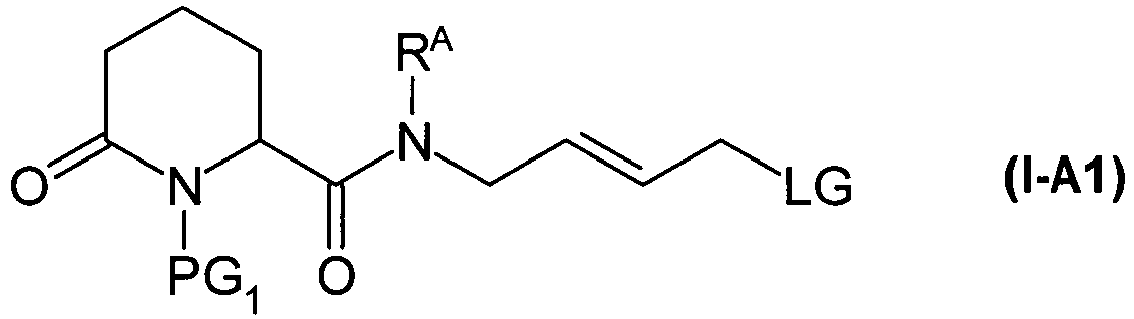 (b) Ausführen einer Cyclisierungsreaktion und entschützen von PG1 unter Ausbildung der Verbindung der Formel (I-B1)
 (c) Einführen eines Restes -SO2-RB unter Ausbildung einer Verbindung der Formel (I-C)
 (d) Transformieren der Vinylgruppe der Verbindung (I-C) in den Substituenten Rc unter Ausbildung der Verbindung der Formel (I)
- Verfahren zur Herstellung einer Verbindung der allgemeinen Formel (I) umfassend die folgenden Schritte:(a) Bereitstellen einer Zwischenverbindung der Formel (I-A2)
 (b) Ausführren einer Cyclisierungsreaktion und entschützen von PG1 unter Ausbildung der Verbindung der Formel (I-B1)
 (c) Einführen des Restes -SO2-RB unter Ausbildung der Formel (I-B3)
 (d) Entschützen von PG6 und einführen des Restes RA unter Ausbildung der Verbindung der Formel (I-C)
 (e) Transformieren der Vinylgruppe der Verbindung (I-C) in den Substituenten RC unter Ausbildung der Verbindung der Formul (I)
- Verfahren zur Herstellung einer Verbindung gemäß der allgemeinen Formel (I) umfassend die folgenden Schritte:(a) Bereitstellen einer Zwischenverbindung der Formel (I-E)
 (b) Entschützen von PG2, ausführen einer Piperidinringbildungsreaktion und einführen von PG4 unter Ausbildung der Formel (I-F)
 (c) Einführen von PG5, entschützen von PG3 und ausführen einer Amindkupplungsreaktion unter Ausbildung der Verbindung der Formel (I-G)
 (d) Entschützen von PG4 und einführen eines Restes -SO2-RB unter Ausbildung der Formel (I-H)
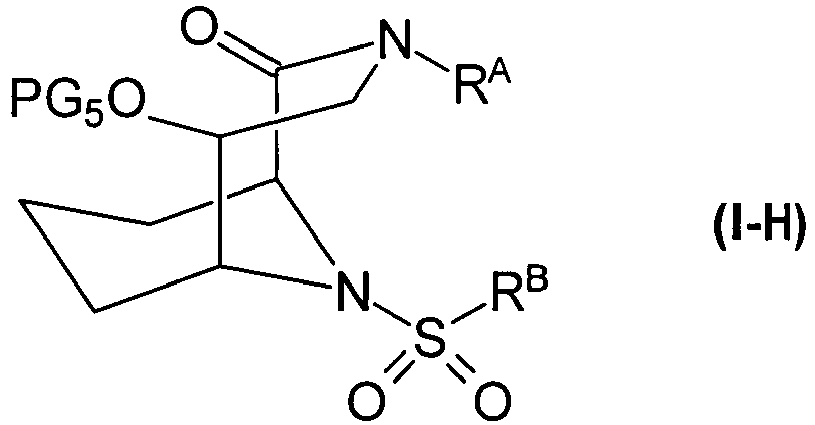 (e) Transformieren einer Hydroxygruppe erhalten durch das Entschützen von PG5 unter Ausbildung der Verbindung der Formel (I)
- Zwischenverbindung der Formel (I-E) oder (I-F):


Priority Applications (1)
| Application Number | Priority Date | Filing Date | Title |
|---|---|---|---|
| EP15702136.1A EP3097103B1 (de) | 2014-01-24 | 2015-01-26 | Diazabicyclo[4.3.1]decane derivate zur behandlung von psychiatrischen störungen |
Applications Claiming Priority (4)
| Application Number | Priority Date | Filing Date | Title |
|---|---|---|---|
| EP14152567.5A EP2899192A1 (de) | 2014-01-24 | 2014-01-24 | Diazabicyclo[4.3.1]decane Derivate zur Behandlung von Psychiatrischen Störungen |
| EP14186483 | 2014-09-25 | ||
| EP15702136.1A EP3097103B1 (de) | 2014-01-24 | 2015-01-26 | Diazabicyclo[4.3.1]decane derivate zur behandlung von psychiatrischen störungen |
| PCT/EP2015/000176 WO2015110271A1 (en) | 2014-01-24 | 2015-01-26 | Diazabicyclo[4.3.1]decane derivatives for treatment of psychiatric disorders |
Publications (2)
| Publication Number | Publication Date |
|---|---|
| EP3097103A1 EP3097103A1 (de) | 2016-11-30 |
| EP3097103B1 true EP3097103B1 (de) | 2017-11-15 |
Family
ID=52444248
Family Applications (1)
| Application Number | Title | Priority Date | Filing Date |
|---|---|---|---|
| EP15702136.1A Active EP3097103B1 (de) | 2014-01-24 | 2015-01-26 | Diazabicyclo[4.3.1]decane derivate zur behandlung von psychiatrischen störungen |
Country Status (3)
| Country | Link |
|---|---|
| US (1) | US9914732B2 (de) |
| EP (1) | EP3097103B1 (de) |
| WO (1) | WO2015110271A1 (de) |
Families Citing this family (10)
| Publication number | Priority date | Publication date | Assignee | Title |
|---|---|---|---|---|
| US9399039B1 (en) | 2015-06-30 | 2016-07-26 | University Of South Florida | Inhibitors of the FKBP51 protein from a high-throughput drug screen and methods of use |
| WO2017003469A1 (en) * | 2015-06-30 | 2017-01-05 | University Of South Florida | Inhibitors of the fkbp51 protein from a high-throughput drug screen and methods of use |
| US10366811B2 (en) * | 2016-09-15 | 2019-07-30 | Sumitomo Electric Industries, Ltd. | Parallel pair cable |
| EP3875456A1 (de) | 2020-03-02 | 2021-09-08 | Technische Universität Darmstadt | Auf chimären abzielende heterobifunktionelle proteolyse (protacs) für den selektiven abbau von fk506-bindenden proteinen (fkbps) |
| EP3875151B1 (de) * | 2020-03-02 | 2023-09-20 | Technische Universität Darmstadt | Alpha-methyl-substituierte diazabicyclo[4.3.1]decan-derivate zur behandlung von psychiatrischen erkrankungen |
| EP3964515A1 (de) | 2020-09-04 | 2022-03-09 | Technische Universität Darmstadt | Hochaffine makrozyklische fkb51-inhibitoren zur behandlung von psychiatrischen erkrankungen |
| CN116693531A (zh) * | 2023-06-09 | 2023-09-05 | 河南师范大学 | 一种桥联多环内酰胺类化合物的合成方法 |
| TW202542165A (zh) | 2023-12-19 | 2025-11-01 | 瑞士商愛杜西亞製藥有限公司 | 大環食慾素激動劑 |
| EP4631946A1 (de) * | 2024-04-08 | 2025-10-15 | Technische Universität Darmstadt | Substituierte tricyclische liganden für fk506-bindende proteine zur behandlung von krankheiten |
| EP4686495A1 (de) | 2024-08-02 | 2026-02-04 | Technische Universität Darmstadt | Makrocyclische liganden für fk506-bindende proteine zur behandlung von erkrankungen mit verbesserten eigenschaften |
Family Cites Families (4)
| Publication number | Priority date | Publication date | Assignee | Title |
|---|---|---|---|---|
| ES2226409T3 (es) * | 1998-07-17 | 2005-03-16 | Agouron Pharmaceuticals, Inc. | Compuestos, composiciones y procedimientos para estimular el crecimiento y elongacion neuronales. |
| US6818643B1 (en) | 1999-12-08 | 2004-11-16 | Bristol-Myers Squibb Company | Neurotrophic bicyclic diamides |
| CA2446795A1 (en) * | 2001-05-10 | 2002-11-14 | Agouron Pharmaceuticals, Inc. | Sulfamide, sulfamate, sulfonamide, urea, amide, alpha, alpha-difluoro amide oxalyl diamide, and heterobicycles fkbp-binding ligands |
| EP2690102A1 (de) * | 2012-07-24 | 2014-01-29 | Max-Planck-Gesellschaft zur Förderung der Wissenschaften e.V. | Bizyklische Aza-Amide zur Behandlung psychischer Erkrankungen |
-
2015
- 2015-01-26 EP EP15702136.1A patent/EP3097103B1/de active Active
- 2015-01-26 WO PCT/EP2015/000176 patent/WO2015110271A1/en not_active Ceased
- 2015-01-26 US US15/113,529 patent/US9914732B2/en active Active
Non-Patent Citations (1)
| Title |
|---|
| None * |
Also Published As
| Publication number | Publication date |
|---|---|
| US20170002003A1 (en) | 2017-01-05 |
| US9914732B2 (en) | 2018-03-13 |
| EP3097103A1 (de) | 2016-11-30 |
| WO2015110271A1 (en) | 2015-07-30 |
Similar Documents
| Publication | Publication Date | Title |
|---|---|---|
| EP3097103B1 (de) | Diazabicyclo[4.3.1]decane derivate zur behandlung von psychiatrischen störungen | |
| CN113631557B (zh) | Jak激酶抑制剂及其制备方法和在医药领域的应用 | |
| TWI804003B (zh) | Tlr7/8拮抗劑及其用途 | |
| CA2944475C (en) | Bicyclic-fused heteroaryl or aryl compounds | |
| AU2022228165A1 (en) | Pyrrolo [1,2-b] pyridazine derivatives | |
| US8901313B2 (en) | 6,5-heterocyclic propargylic alcohol compounds and uses therefor | |
| US11618753B2 (en) | Aminopyrrolotriazines as kinase inhibitors | |
| AU2019382504B2 (en) | Cyclic ureas | |
| JP2020530446A (ja) | 化合物、組成物、及び、方法 | |
| US10167281B2 (en) | Substituted thiazole or oxazole P2X7 receptor antagonists | |
| EP2877470B1 (de) | Bizyklische aza-amide zur behandlung psychischer erkrankungen | |
| JP6908536B2 (ja) | ムスカリンm2受容体の正のアロステリックモジュレーター | |
| JP2020532506A (ja) | 化合物、組成物、及び、方法 | |
| JP2018507877A (ja) | CDK阻害剤としてのピラゾロ[1,5−a][1,3,5]トリアジンとピラゾロ[1,5−a]ピリミジン誘導体 | |
| WO2002004402A1 (en) | Ester derivatives | |
| CA3069554A1 (en) | Inhibitors of leucine rich repeat kinase 2 | |
| EP4284365A1 (de) | Cdk2-inhibitoren und verfahren zur verwendung davon | |
| AU2004278158A1 (en) | Imidazopyridine substituted tropane derivatives with CCR5 receptor antagonist activity for the treatment of HIV and inflammation | |
| JP5204227B2 (ja) | ベンゼンスルホニル−クロマン、チオクロマン、テトラヒドロナフタレン、および関連するガンマセクレターゼインヒビター | |
| JP2022546029A (ja) | アルファ-d-ガラクトピラノシド誘導体 | |
| AU2005262330A1 (en) | Piperidine derivatives as NK1 antagonists | |
| AU2018354777A1 (en) | Novel Pyrazolo-pyrrolo-pyrimidine-dione derivatives as P2X3 inhibitors | |
| WO2016100349A2 (en) | Bicyclic azaheterocyclic compounds as nr2b nmda receptor antagonists | |
| JP6605121B2 (ja) | ヤヌスキナーゼ1選択的阻害剤及びその医薬用途 | |
| EP2899192A1 (de) | Diazabicyclo[4.3.1]decane Derivate zur Behandlung von Psychiatrischen Störungen |
Legal Events
| Date | Code | Title | Description |
|---|---|---|---|
| PUAI | Public reference made under article 153(3) epc to a published international application that has entered the european phase |
Free format text: ORIGINAL CODE: 0009012 |
|
| 17P | Request for examination filed |
Effective date: 20160718 |
|
| AK | Designated contracting states |
Kind code of ref document: A1 Designated state(s): AL AT BE BG CH CY CZ DE DK EE ES FI FR GB GR HR HU IE IS IT LI LT LU LV MC MK MT NL NO PL PT RO RS SE SI SK SM TR |
|
| AX | Request for extension of the european patent |
Extension state: BA ME |
|
| DAX | Request for extension of the european patent (deleted) | ||
| GRAP | Despatch of communication of intention to grant a patent |
Free format text: ORIGINAL CODE: EPIDOSNIGR1 |
|
| INTG | Intention to grant announced |
Effective date: 20170529 |
|
| GRAS | Grant fee paid |
Free format text: ORIGINAL CODE: EPIDOSNIGR3 |
|
| GRAA | (expected) grant |
Free format text: ORIGINAL CODE: 0009210 |
|
| AK | Designated contracting states |
Kind code of ref document: B1 Designated state(s): AL AT BE BG CH CY CZ DE DK EE ES FI FR GB GR HR HU IE IS IT LI LT LU LV MC MK MT NL NO PL PT RO RS SE SI SK SM TR |
|
| REG | Reference to a national code |
Ref country code: CH Ref legal event code: EP Ref country code: GB Ref legal event code: FG4D Ref country code: AT Ref legal event code: REF Ref document number: 946152 Country of ref document: AT Kind code of ref document: T Effective date: 20171115 |
|
| REG | Reference to a national code |
Ref country code: IE Ref legal event code: FG4D |
|
| REG | Reference to a national code |
Ref country code: DE Ref legal event code: R096 Ref document number: 602015006029 Country of ref document: DE |
|
| REG | Reference to a national code |
Ref country code: FR Ref legal event code: PLFP Year of fee payment: 4 |
|
| REG | Reference to a national code |
Ref country code: NL Ref legal event code: MP Effective date: 20171115 |
|
| REG | Reference to a national code |
Ref country code: LT Ref legal event code: MG4D |
|
| REG | Reference to a national code |
Ref country code: AT Ref legal event code: MK05 Ref document number: 946152 Country of ref document: AT Kind code of ref document: T Effective date: 20171115 |
|
| PG25 | Lapsed in a contracting state [announced via postgrant information from national office to epo] |
Ref country code: FI Free format text: LAPSE BECAUSE OF FAILURE TO SUBMIT A TRANSLATION OF THE DESCRIPTION OR TO PAY THE FEE WITHIN THE PRESCRIBED TIME-LIMIT Effective date: 20171115 Ref country code: SE Free format text: LAPSE BECAUSE OF FAILURE TO SUBMIT A TRANSLATION OF THE DESCRIPTION OR TO PAY THE FEE WITHIN THE PRESCRIBED TIME-LIMIT Effective date: 20171115 Ref country code: ES Free format text: LAPSE BECAUSE OF FAILURE TO SUBMIT A TRANSLATION OF THE DESCRIPTION OR TO PAY THE FEE WITHIN THE PRESCRIBED TIME-LIMIT Effective date: 20171115 Ref country code: LT Free format text: LAPSE BECAUSE OF FAILURE TO SUBMIT A TRANSLATION OF THE DESCRIPTION OR TO PAY THE FEE WITHIN THE PRESCRIBED TIME-LIMIT Effective date: 20171115 Ref country code: NO Free format text: LAPSE BECAUSE OF FAILURE TO SUBMIT A TRANSLATION OF THE DESCRIPTION OR TO PAY THE FEE WITHIN THE PRESCRIBED TIME-LIMIT Effective date: 20180215 Ref country code: NL Free format text: LAPSE BECAUSE OF FAILURE TO SUBMIT A TRANSLATION OF THE DESCRIPTION OR TO PAY THE FEE WITHIN THE PRESCRIBED TIME-LIMIT Effective date: 20171115 |
|
| PG25 | Lapsed in a contracting state [announced via postgrant information from national office to epo] |
Ref country code: GR Free format text: LAPSE BECAUSE OF FAILURE TO SUBMIT A TRANSLATION OF THE DESCRIPTION OR TO PAY THE FEE WITHIN THE PRESCRIBED TIME-LIMIT Effective date: 20180216 Ref country code: BG Free format text: LAPSE BECAUSE OF FAILURE TO SUBMIT A TRANSLATION OF THE DESCRIPTION OR TO PAY THE FEE WITHIN THE PRESCRIBED TIME-LIMIT Effective date: 20180215 Ref country code: HR Free format text: LAPSE BECAUSE OF FAILURE TO SUBMIT A TRANSLATION OF THE DESCRIPTION OR TO PAY THE FEE WITHIN THE PRESCRIBED TIME-LIMIT Effective date: 20171115 Ref country code: AT Free format text: LAPSE BECAUSE OF FAILURE TO SUBMIT A TRANSLATION OF THE DESCRIPTION OR TO PAY THE FEE WITHIN THE PRESCRIBED TIME-LIMIT Effective date: 20171115 Ref country code: LV Free format text: LAPSE BECAUSE OF FAILURE TO SUBMIT A TRANSLATION OF THE DESCRIPTION OR TO PAY THE FEE WITHIN THE PRESCRIBED TIME-LIMIT Effective date: 20171115 Ref country code: RS Free format text: LAPSE BECAUSE OF FAILURE TO SUBMIT A TRANSLATION OF THE DESCRIPTION OR TO PAY THE FEE WITHIN THE PRESCRIBED TIME-LIMIT Effective date: 20171115 |
|
| PG25 | Lapsed in a contracting state [announced via postgrant information from national office to epo] |
Ref country code: CZ Free format text: LAPSE BECAUSE OF FAILURE TO SUBMIT A TRANSLATION OF THE DESCRIPTION OR TO PAY THE FEE WITHIN THE PRESCRIBED TIME-LIMIT Effective date: 20171115 Ref country code: SK Free format text: LAPSE BECAUSE OF FAILURE TO SUBMIT A TRANSLATION OF THE DESCRIPTION OR TO PAY THE FEE WITHIN THE PRESCRIBED TIME-LIMIT Effective date: 20171115 Ref country code: EE Free format text: LAPSE BECAUSE OF FAILURE TO SUBMIT A TRANSLATION OF THE DESCRIPTION OR TO PAY THE FEE WITHIN THE PRESCRIBED TIME-LIMIT Effective date: 20171115 Ref country code: DK Free format text: LAPSE BECAUSE OF FAILURE TO SUBMIT A TRANSLATION OF THE DESCRIPTION OR TO PAY THE FEE WITHIN THE PRESCRIBED TIME-LIMIT Effective date: 20171115 Ref country code: CY Free format text: LAPSE BECAUSE OF FAILURE TO SUBMIT A TRANSLATION OF THE DESCRIPTION OR TO PAY THE FEE WITHIN THE PRESCRIBED TIME-LIMIT Effective date: 20171115 |
|
| REG | Reference to a national code |
Ref country code: DE Ref legal event code: R097 Ref document number: 602015006029 Country of ref document: DE |
|
| PG25 | Lapsed in a contracting state [announced via postgrant information from national office to epo] |
Ref country code: RO Free format text: LAPSE BECAUSE OF FAILURE TO SUBMIT A TRANSLATION OF THE DESCRIPTION OR TO PAY THE FEE WITHIN THE PRESCRIBED TIME-LIMIT Effective date: 20171115 Ref country code: IT Free format text: LAPSE BECAUSE OF FAILURE TO SUBMIT A TRANSLATION OF THE DESCRIPTION OR TO PAY THE FEE WITHIN THE PRESCRIBED TIME-LIMIT Effective date: 20171115 Ref country code: PL Free format text: LAPSE BECAUSE OF FAILURE TO SUBMIT A TRANSLATION OF THE DESCRIPTION OR TO PAY THE FEE WITHIN THE PRESCRIBED TIME-LIMIT Effective date: 20171115 Ref country code: SM Free format text: LAPSE BECAUSE OF FAILURE TO SUBMIT A TRANSLATION OF THE DESCRIPTION OR TO PAY THE FEE WITHIN THE PRESCRIBED TIME-LIMIT Effective date: 20171115 |
|
| PLBE | No opposition filed within time limit |
Free format text: ORIGINAL CODE: 0009261 |
|
| STAA | Information on the status of an ep patent application or granted ep patent |
Free format text: STATUS: NO OPPOSITION FILED WITHIN TIME LIMIT |
|
| 26N | No opposition filed |
Effective date: 20180817 |
|
| PG25 | Lapsed in a contracting state [announced via postgrant information from national office to epo] |
Ref country code: LU Free format text: LAPSE BECAUSE OF NON-PAYMENT OF DUE FEES Effective date: 20180126 |
|
| REG | Reference to a national code |
Ref country code: IE Ref legal event code: MM4A |
|
| REG | Reference to a national code |
Ref country code: BE Ref legal event code: MM Effective date: 20180131 |
|
| PG25 | Lapsed in a contracting state [announced via postgrant information from national office to epo] |
Ref country code: SI Free format text: LAPSE BECAUSE OF FAILURE TO SUBMIT A TRANSLATION OF THE DESCRIPTION OR TO PAY THE FEE WITHIN THE PRESCRIBED TIME-LIMIT Effective date: 20171115 Ref country code: BE Free format text: LAPSE BECAUSE OF NON-PAYMENT OF DUE FEES Effective date: 20180131 |
|
| PG25 | Lapsed in a contracting state [announced via postgrant information from national office to epo] |
Ref country code: IE Free format text: LAPSE BECAUSE OF NON-PAYMENT OF DUE FEES Effective date: 20180126 |
|
| PG25 | Lapsed in a contracting state [announced via postgrant information from national office to epo] |
Ref country code: MC Free format text: LAPSE BECAUSE OF FAILURE TO SUBMIT A TRANSLATION OF THE DESCRIPTION OR TO PAY THE FEE WITHIN THE PRESCRIBED TIME-LIMIT Effective date: 20171115 |
|
| PG25 | Lapsed in a contracting state [announced via postgrant information from national office to epo] |
Ref country code: MT Free format text: LAPSE BECAUSE OF NON-PAYMENT OF DUE FEES Effective date: 20180126 |
|
| PG25 | Lapsed in a contracting state [announced via postgrant information from national office to epo] |
Ref country code: TR Free format text: LAPSE BECAUSE OF FAILURE TO SUBMIT A TRANSLATION OF THE DESCRIPTION OR TO PAY THE FEE WITHIN THE PRESCRIBED TIME-LIMIT Effective date: 20171115 |
|
| PG25 | Lapsed in a contracting state [announced via postgrant information from national office to epo] |
Ref country code: PT Free format text: LAPSE BECAUSE OF FAILURE TO SUBMIT A TRANSLATION OF THE DESCRIPTION OR TO PAY THE FEE WITHIN THE PRESCRIBED TIME-LIMIT Effective date: 20171115 |
|
| PG25 | Lapsed in a contracting state [announced via postgrant information from national office to epo] |
Ref country code: HU Free format text: LAPSE BECAUSE OF FAILURE TO SUBMIT A TRANSLATION OF THE DESCRIPTION OR TO PAY THE FEE WITHIN THE PRESCRIBED TIME-LIMIT; INVALID AB INITIO Effective date: 20150126 Ref country code: MK Free format text: LAPSE BECAUSE OF NON-PAYMENT OF DUE FEES Effective date: 20171115 |
|
| PG25 | Lapsed in a contracting state [announced via postgrant information from national office to epo] |
Ref country code: AL Free format text: LAPSE BECAUSE OF FAILURE TO SUBMIT A TRANSLATION OF THE DESCRIPTION OR TO PAY THE FEE WITHIN THE PRESCRIBED TIME-LIMIT Effective date: 20171115 Ref country code: IS Free format text: LAPSE BECAUSE OF FAILURE TO SUBMIT A TRANSLATION OF THE DESCRIPTION OR TO PAY THE FEE WITHIN THE PRESCRIBED TIME-LIMIT Effective date: 20180315 |
|
| REG | Reference to a national code |
Ref country code: CH Ref legal event code: U11 Free format text: ST27 STATUS EVENT CODE: U-0-0-U10-U11 (AS PROVIDED BY THE NATIONAL OFFICE) Effective date: 20260201 |
|
| PGFP | Annual fee paid to national office [announced via postgrant information from national office to epo] |
Ref country code: GB Payment date: 20260122 Year of fee payment: 12 |
|
| PGFP | Annual fee paid to national office [announced via postgrant information from national office to epo] |
Ref country code: DE Payment date: 20251209 Year of fee payment: 12 |
|
| PGFP | Annual fee paid to national office [announced via postgrant information from national office to epo] |
Ref country code: FR Payment date: 20260128 Year of fee payment: 12 |
|
| PGFP | Annual fee paid to national office [announced via postgrant information from national office to epo] |
Ref country code: CH Payment date: 20260201 Year of fee payment: 12 |