EP3098897A1 - Dispositif et procédé pour chauffer des batteries au lithium - Google Patents
Dispositif et procédé pour chauffer des batteries au lithium Download PDFInfo
- Publication number
- EP3098897A1 EP3098897A1 EP16170811.0A EP16170811A EP3098897A1 EP 3098897 A1 EP3098897 A1 EP 3098897A1 EP 16170811 A EP16170811 A EP 16170811A EP 3098897 A1 EP3098897 A1 EP 3098897A1
- Authority
- EP
- European Patent Office
- Prior art keywords
- lithium
- temperature
- direct current
- heating element
- battery
- Prior art date
- Legal status (The legal status is an assumption and is not a legal conclusion. Google has not performed a legal analysis and makes no representation as to the accuracy of the status listed.)
- Withdrawn
Links
Images


Classifications
-
- H—ELECTRICITY
- H01—ELECTRIC ELEMENTS
- H01M—PROCESSES OR MEANS, e.g. BATTERIES, FOR THE DIRECT CONVERSION OF CHEMICAL ENERGY INTO ELECTRICAL ENERGY
- H01M10/00—Secondary cells; Manufacture thereof
- H01M10/60—Heating or cooling; Temperature control
- H01M10/61—Types of temperature control
- H01M10/615—Heating or keeping warm
-
- H—ELECTRICITY
- H01—ELECTRIC ELEMENTS
- H01M—PROCESSES OR MEANS, e.g. BATTERIES, FOR THE DIRECT CONVERSION OF CHEMICAL ENERGY INTO ELECTRICAL ENERGY
- H01M10/00—Secondary cells; Manufacture thereof
- H01M10/60—Heating or cooling; Temperature control
- H01M10/65—Means for temperature control structurally associated with the cells
- H01M10/651—Means for temperature control structurally associated with the cells characterised by parameters specified by a numeric value or mathematical formula, e.g. ratios, sizes or concentrations
-
- H—ELECTRICITY
- H01—ELECTRIC ELEMENTS
- H01M—PROCESSES OR MEANS, e.g. BATTERIES, FOR THE DIRECT CONVERSION OF CHEMICAL ENERGY INTO ELECTRICAL ENERGY
- H01M10/00—Secondary cells; Manufacture thereof
- H01M10/60—Heating or cooling; Temperature control
- H01M10/65—Means for temperature control structurally associated with the cells
- H01M10/657—Means for temperature control structurally associated with the cells by electric or electromagnetic means
- H01M10/6571—Resistive heaters
-
- H—ELECTRICITY
- H05—ELECTRIC TECHNIQUES NOT OTHERWISE PROVIDED FOR
- H05B—ELECTRIC HEATING; ELECTRIC LIGHT SOURCES NOT OTHERWISE PROVIDED FOR; CIRCUIT ARRANGEMENTS FOR ELECTRIC LIGHT SOURCES, IN GENERAL
- H05B1/00—Details of electric heating devices
- H05B1/02—Automatic switching arrangements specially adapted to apparatus ; Control of heating devices
- H05B1/0227—Applications
- H05B1/023—Industrial applications
- H05B1/0236—Industrial applications for vehicles
-
- H—ELECTRICITY
- H05—ELECTRIC TECHNIQUES NOT OTHERWISE PROVIDED FOR
- H05B—ELECTRIC HEATING; ELECTRIC LIGHT SOURCES NOT OTHERWISE PROVIDED FOR; CIRCUIT ARRANGEMENTS FOR ELECTRIC LIGHT SOURCES, IN GENERAL
- H05B3/00—Ohmic-resistance heating
- H05B3/10—Heating elements characterised by the composition or nature of the materials or by the arrangement of the conductor
- H05B3/12—Heating elements characterised by the composition or nature of the materials or by the arrangement of the conductor characterised by the composition or nature of the conductive material
- H05B3/14—Heating elements characterised by the composition or nature of the materials or by the arrangement of the conductor characterised by the composition or nature of the conductive material the material being non-metallic
- H05B3/145—Carbon only, e.g. carbon black, graphite
-
- H—ELECTRICITY
- H05—ELECTRIC TECHNIQUES NOT OTHERWISE PROVIDED FOR
- H05B—ELECTRIC HEATING; ELECTRIC LIGHT SOURCES NOT OTHERWISE PROVIDED FOR; CIRCUIT ARRANGEMENTS FOR ELECTRIC LIGHT SOURCES, IN GENERAL
- H05B3/00—Ohmic-resistance heating
- H05B3/20—Heating elements having extended surface area substantially in a two-dimensional [2D] plane, e.g. plate-heater
- H05B3/34—Heating elements having extended surface area substantially in a two-dimensional [2D] plane, e.g. plate-heater flexible, e.g. heating nets or webs
-
- H—ELECTRICITY
- H01—ELECTRIC ELEMENTS
- H01M—PROCESSES OR MEANS, e.g. BATTERIES, FOR THE DIRECT CONVERSION OF CHEMICAL ENERGY INTO ELECTRICAL ENERGY
- H01M10/00—Secondary cells; Manufacture thereof
- H01M10/05—Accumulators with non-aqueous electrolyte
- H01M10/052—Li-accumulators
- H01M10/0525—Rocking-chair batteries, i.e. batteries with lithium insertion or intercalation in both electrodes; Lithium-ion batteries
-
- Y—GENERAL TAGGING OF NEW TECHNOLOGICAL DEVELOPMENTS; GENERAL TAGGING OF CROSS-SECTIONAL TECHNOLOGIES SPANNING OVER SEVERAL SECTIONS OF THE IPC; TECHNICAL SUBJECTS COVERED BY FORMER USPC CROSS-REFERENCE ART COLLECTIONS [XRACs] AND DIGESTS
- Y02—TECHNOLOGIES OR APPLICATIONS FOR MITIGATION OR ADAPTATION AGAINST CLIMATE CHANGE
- Y02E—REDUCTION OF GREENHOUSE GAS [GHG] EMISSIONS, RELATED TO ENERGY GENERATION, TRANSMISSION OR DISTRIBUTION
- Y02E60/00—Enabling technologies; Technologies with a potential or indirect contribution to GHG emissions mitigation
- Y02E60/10—Energy storage using batteries
Definitions
- the present invention relates to a device and a method for warming a lithium-ion battery, battery pack or series of lithium-ion batteries that are used in devices that are commonly exposed to harsh environmental conditions, most notably low temperatures in the freezing or sub-freezing range.
- Most commonly known devices utilizing lithium-ion batteries under these conditions are car, or other motor vehicle batteries, portable jump starters, outdoor power tools and the like.
- the device and method according to the present invention provides a quick and efficient method for warming a lithium-ion battery from a temperature well below the optimal operating temperature of the battery, as well as maintaining the temperature of the battery within its temperature limits rating for producing maximum electrical discharge. Maintaining the temperature of the lithium-ion battery in this temperature range permits the battery to be always ready for use, and also has been shown to extend the useful lifetime of the battery itself.
- Lithium-ion batteries are finding more and more uses in a variety of applications in today's world. Of significant importance is their use in hybrid and totally electric motor vehicles as well as portable power banks and jump starters for starting car and truck engines.
- Gasoline and diesel engines typically use lead-acid batteries, and when the lead-acid battery is too weak due to battery age or low temperature to provide enough cranking power to start the engine, jump-starting using lithium-ion battery packs can be used.
- the performance of lithium-ion batteries is also highly dependent on temperature. All direct current batteries function best in a specific temperature range. Batteries that are discharged in a cold environment have a much higher internal resistance that lowers their discharge capacity. For example, an average lead-acid car battery with 100% capacity at 27°C (80°F) will typically deliver only 50% at -18°C (0°F). Most lead-acid batteries discharge best at 20°C (68°F), or slightly below.
- lithium-ion battery cells require careful temperature control because of decreased chemical reaction rates at lower temperatures, translating to a reduction of the current carrying capacity of the cell.
- lithium-ion batteries have not replaced lead-acid batteries used in many products or applications because of their chemistry being greatly affected by low or very cold temperatures. Specifically, lithium-ion batteries reach an optimal electrical discharge rate when the temperature is above 15 °C (59°F), or higher. Lower than this temperature, lithium-ion battery performance begins to diminish. When the temperature reaches 0°C, the performance drops to 20% and the discharge rate is generally no higher than 5 amps. Lithium-ion batteries generally cease to function when the temperature falls below -10°C. This is well below the rate for charging a lead-acid battery or jump-starting a car or truck engine.
- the present invention can literally heat-up the lithium-ion batteries in seconds on demand, thereby eliminating the need to provide power to the battery jacket all the time. The average draw required to warm lithium-ion batteries or battery packs to their optimal discharge temperature is minimal.
- a principle object of the present invention is to provide a device and method for warming lithium-ion batteries or battery packs to their optimal electrical discharge operating temperatures, thereby allowing the use of lithium-ion batteries in cold or freezing temperatures. It is also an object of the present invention to provide a device and method for rapidly warming the lithium-ion battery or battery pack, and for utilizing a low amount of electrical energy to do so. It is a further object of this invention to provide a device and method for detecting when the temperature of the lithium-ion battery or battery pack is below the optimal electrical discharge temperature, and to automatically warm the lithium-ion battery or battery pack until the optimal electrical discharge temperature is reached.
- the system of the present invention uses a heating element constructed of flexible carbon fiber material.
- the carbon fiber material utilized conducts direct current voltage and has a resistivity such that heat is created when DC voltage is applied.
- the flexible heating element is encased in a foldable polymer material that forms an interface between the heating element and the lithium-ion battery to be warmed, in the form of a "battery jacket.”
- the polymer material selected has a high tolerance for heat such that it remains flexible after the heating element is repeatedly warmed. Also, the polymer material has the ability to allow heat to transfer from the heating element to the battery, while not acting as an insulator.
- the foldable battery jacket is placed on and/or around the lithium-ion battery or battery pack to be warmed.
- the battery jacket can also be placed between the individual cells in order to provide maximum surface area contact to facilitate heating of the battery.
- multiple layers of the heating jacket can be applied when necessary due to extremely cold conditions.
- the carbon fiber heating element is typically configured to have two ends designed as terminals for connecting the DC power source to the heating element.
- the DC power source can be any source of sufficient DC voltage, which can include a lithium-ion battery, and can also be the lithium-ion or battery pack to be warmed.
- the DC voltage from the DC power source is controlled by a central processing unit ("CPU"), which also controls other elements and functions of the device.
- the device may also include a temperature sensor, connected to the CPU, for monitoring the temperature of the lithium-ion battery.
- a temperature sensor connected to the CPU, for monitoring the temperature of the lithium-ion battery.
- the temperature of the lithium-ion battery falls below a pre-determined, pre-set temperature
- voltage is applied to the carbon fiber heating element, causing it to warm.
- the applied DC voltage is discontinued.
- the lithium-ion battery temperature range in which the DC voltage is applied can be any range desired, narrow or large, but should be selected according to the ideal operational parameters of the lithium-ion battery.
- the lower temperature for pre-heating the lithium-ion battery is set at 15 °C (59°F)
- the upper shut-off temperature is set for 65 °C (149°F), to protect the lithium-ion battery from being over heated.
- the device and method of this invention also provides for LCD display indicators that tell the user the status of the system.
- LCD displays showing battery capacity, charging mode, low temperature warning, voltage applied and timing of heating, can be used.
- FIGS. 1-5 of the drawings The preferred embodiments of the present invention will now be described with reference to the FIGS. 1-5 of the drawings. Identical elements in the various figures are designated with the same reference numerals.
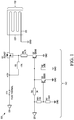
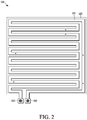
- FIGS. 1 and 2 illustrate a preferred embodiment of the device of the present invention, generally designated by the reference number 100.
- the device comprises a flexible carbon fiber heating element 110 enclosed in a flexible, foldable polymer covering 120 which, together with heating element 110, forms what is herein referred to as "battery jacket" 130.
- FIG. 1 also illustrates by schematic diagram electronic circuitry 140 that regulates the DC flow to heating element 110.
- the electronic components comprising electronic circuitry 140 are known to those of skill in the art as identified in FIG. 1 .
- FIG. 2 illustrates battery jacket 130, where it is shown that heating element 110 is encased in a flexible polymeric covering 120, much in the form of a laminate (see inset FIG. 3 ).
- the flexible carbon fiber heating element 110 is comprised of conductive carbon fiber material that has resistivity to electrical current. The resistivity characteristic is such that, when DC electrical current is applied, heating element 110 will rapidly warm to a desired temperature with only a minimum of current.
- heating element 110 is illustrated as being generally flat, it may be of any desired cross-sectional shape, such as round or oval, for examples. Heating element 110 also has a width and a thickness dimension which can vary according to the size of battery jacket 130 itself.
- heating element 110 Utilizing a wider heating element 110 provides for more surface area for contacting the lithium-ion battery and thus more efficient heating of the battery.
- heating jacket 130 and therefore heating element 110 are meant to be flexible for wrapping around a lithium-ion battery.
- Heating element 110 also comprises two terminal ends 180 for connecting to the DC current provide through electronic circuitry 140.
- a cross-sectional view of battery jacket 130 (see inset FIG. 3 ), illustrates carbon fiber heating element 110 enclosed between a polymer top layer 160 and a polymer bottom layer 170.
- FIG. 3 illustrates battery jacket 130 as folded between three lithium-ion batteries (not numbered), in the form of a battery pack.
- the flexible nature of carbon fiber heating element 110 and the polymer layers 160, 170 provides battery jacket 130 with the capability of completely surrounding one of the lithium-ion batteries, while the other two lithium-ion batteries are placed above and below battery jacket 130. In this manner, all three lithium-ion batteries are warmed simultaneously.
- other configurations using battery jacket 130, such as completely surrounding a lithium-ion battery to be warmed on all sides is contemplated by the within invention.
- FIG. 4 illustrates another view of a lithium-ion battery being warmed by battery jacket 130 of the within invention.
- battery jacket 130 is shown placed below a single lithium-ion battery.
- it can also wrap around the battery, as it does for the middle battery shown in FIG. 3 .
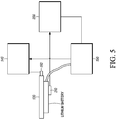
- FIG. 5 diagrammatically depicts a device for warming a lithium-ion battery, within the scope of this invention.
- the DC voltage from DC power source 190 is provided through electronic circuitry 140 to battery jacket 130.
- Central processing unit 200 which also controls other elements and functions of the device, is connected to power source 190 and regulates the DC voltage therefrom, including turning the voltage on and off as desired.
- An embodiment of this invention may also include a temperature sensor 210, connected to CPU 200, for monitoring the temperature of the lithium-ion battery. When the temperature of the lithium-ion battery falls below a pre-determined, pre-set temperature set in CPU 200, DC voltage is applied to heating element 110 in battery jacket 130, causing it to warm.
- CPU 200 When the temperature of the lithium-ion battery consequently reaches a pre-set maximum temperature set in CPU 200, CPU 200 signals power source 190 to discontinue the applied DC voltage.
- the lithium-ion battery temperature range in which the DC voltage is applied can be any range desired, narrow or large, but should be selected according to the ideal operational parameters of the lithium-ion battery.
- the lower temperature for pre-heating the lithium-ion battery is set at 15 °C (59°F)
- the upper shut-off temperature is set for 65 °C (149°F), to protect the lithium-ion battery from being over heated.
- the lithium-ion battery itself may be connected to power source 190 and can become the source for the DC voltage for heating element 110.
- the lithium-ion battery becomes self-warming such that it is capable of maintaining its operational temperature for a period of time, while using only a minimum of electrical energy.
Landscapes
- Chemical Kinetics & Catalysis (AREA)
- Manufacturing & Machinery (AREA)
- General Chemical & Material Sciences (AREA)
- Chemical & Material Sciences (AREA)
- Engineering & Computer Science (AREA)
- Electrochemistry (AREA)
- Physics & Mathematics (AREA)
- Algebra (AREA)
- Pure & Applied Mathematics (AREA)
- Mathematical Optimization (AREA)
- Mathematical Analysis (AREA)
- General Physics & Mathematics (AREA)
- Electromagnetism (AREA)
- Secondary Cells (AREA)
- Charge And Discharge Circuits For Batteries Or The Like (AREA)
Applications Claiming Priority (1)
| Application Number | Priority Date | Filing Date | Title |
|---|---|---|---|
| US201562179974P | 2015-05-26 | 2015-05-26 |
Publications (1)
| Publication Number | Publication Date |
|---|---|
| EP3098897A1 true EP3098897A1 (fr) | 2016-11-30 |
Family
ID=56068770
Family Applications (1)
| Application Number | Title | Priority Date | Filing Date |
|---|---|---|---|
| EP16170811.0A Withdrawn EP3098897A1 (fr) | 2015-05-26 | 2016-05-23 | Dispositif et procédé pour chauffer des batteries au lithium |
Country Status (1)
| Country | Link |
|---|---|
| EP (1) | EP3098897A1 (fr) |
Cited By (3)
| Publication number | Priority date | Publication date | Assignee | Title |
|---|---|---|---|---|
| CN108631025A (zh) * | 2017-03-23 | 2018-10-09 | 扬州市纵横光电科技有限公司 | 一种带有加温功能的锂电池组 |
| CN109560350A (zh) * | 2018-12-04 | 2019-04-02 | 卧龙电气集团股份有限公司 | 一种可在低温环境中工作的锂离子电池组 |
| DE102018211005B3 (de) | 2018-07-04 | 2019-04-18 | Bayerische Motoren Werke Aktiengesellschaft | Heizeinrichtung für eine prismatische Batteriezelle einer Hochvoltbatterie eines Kraftfahrzeugs, Batteriezelle, Batteriemodul, Hochvoltbatterie sowie Kraftfahrzeug |
Citations (5)
| Publication number | Priority date | Publication date | Assignee | Title |
|---|---|---|---|---|
| US6002240A (en) * | 1997-12-12 | 1999-12-14 | Dell Usa, L.P. | Self heating of batteries at low temperatures |
| CN203085710U (zh) * | 2013-02-20 | 2013-07-24 | 天津雅迪实业有限公司 | 锂电池组的温控装置 |
| WO2014098348A1 (fr) * | 2012-12-21 | 2014-06-26 | (주)엘지하우시스 | Feuille de chauffage pour module de batterie et module de batterie la contenant |
| US20140356658A1 (en) * | 2013-05-31 | 2014-12-04 | Legends | Battery heating element |
| US20150072190A1 (en) * | 2013-09-06 | 2015-03-12 | Lg Chem, Ltd. | Battery cell assembly |
-
2016
- 2016-05-23 EP EP16170811.0A patent/EP3098897A1/fr not_active Withdrawn
Patent Citations (6)
| Publication number | Priority date | Publication date | Assignee | Title |
|---|---|---|---|---|
| US6002240A (en) * | 1997-12-12 | 1999-12-14 | Dell Usa, L.P. | Self heating of batteries at low temperatures |
| WO2014098348A1 (fr) * | 2012-12-21 | 2014-06-26 | (주)엘지하우시스 | Feuille de chauffage pour module de batterie et module de batterie la contenant |
| EP2937931A1 (fr) * | 2012-12-21 | 2015-10-28 | LG Hausys, Ltd. | Feuille de chauffage pour module de batterie et module de batterie la contenant |
| CN203085710U (zh) * | 2013-02-20 | 2013-07-24 | 天津雅迪实业有限公司 | 锂电池组的温控装置 |
| US20140356658A1 (en) * | 2013-05-31 | 2014-12-04 | Legends | Battery heating element |
| US20150072190A1 (en) * | 2013-09-06 | 2015-03-12 | Lg Chem, Ltd. | Battery cell assembly |
Cited By (8)
| Publication number | Priority date | Publication date | Assignee | Title |
|---|---|---|---|---|
| CN108631025A (zh) * | 2017-03-23 | 2018-10-09 | 扬州市纵横光电科技有限公司 | 一种带有加温功能的锂电池组 |
| DE102018211005B3 (de) | 2018-07-04 | 2019-04-18 | Bayerische Motoren Werke Aktiengesellschaft | Heizeinrichtung für eine prismatische Batteriezelle einer Hochvoltbatterie eines Kraftfahrzeugs, Batteriezelle, Batteriemodul, Hochvoltbatterie sowie Kraftfahrzeug |
| WO2020007569A1 (fr) * | 2018-07-04 | 2020-01-09 | Bayerische Motoren Werke Aktiengesellschaft | Dispositif de chauffage d'un élément de batterie prismatique d'une batterie haute tension d'un véhicule automobile, élément de batterie, module de batterie, batterie haute tension et véhicule automobile |
| CN111989817A (zh) * | 2018-07-04 | 2020-11-24 | 宝马股份公司 | 用于机动车高压电池的棱柱形电池单体的加热装置、电池单体、电池模块、高压电池以及机动车 |
| US11335965B2 (en) | 2018-07-04 | 2022-05-17 | Bayerische Motoren Werke Aktiengesellschaft | Heating device for a prismatic battery cell of a high-voltage battery of a motor vehicle, battery cell, battery module, high-voltage battery and motor vehicle |
| CN111989817B (zh) * | 2018-07-04 | 2024-08-06 | 宝马股份公司 | 加热装置、电池单体、电池模块、高压电池以及机动车 |
| CN109560350A (zh) * | 2018-12-04 | 2019-04-02 | 卧龙电气集团股份有限公司 | 一种可在低温环境中工作的锂离子电池组 |
| CN109560350B (zh) * | 2018-12-04 | 2024-12-10 | 卧龙电气驱动集团股份有限公司 | 一种可在低温环境中工作的锂离子电池组 |
Similar Documents
| Publication | Publication Date | Title |
|---|---|---|
| JP5804540B2 (ja) | 安全性の向上した電池パック | |
| EP1349230B1 (fr) | Unité d'alimentation de courant | |
| CN105210226B (zh) | 具有多个电阻位的可充电电池 | |
| US9083065B2 (en) | Self heating battery system | |
| US9627723B2 (en) | Operation of electrochemical energy systems | |
| US9034507B2 (en) | Arrangement having at least one battery | |
| RU2488932C2 (ru) | Аккумуляторная батарея и содержащий ее электрический прибор | |
| CN102064365A (zh) | 电池温度控制方法和组件 | |
| US20170338533A1 (en) | Battery Jacket | |
| CN105529508A (zh) | 电池加热系统、电池装置及电动汽车 | |
| US9531042B2 (en) | Battery target temperature methods and systems | |
| CN105322606B (zh) | 用于电池放电的设备和方法以及电池、电池系统和车辆 | |
| CN105051968B (zh) | 电池和机动车 | |
| US20130136964A1 (en) | Electrochemical cell having a safety device | |
| WO2017015586A1 (fr) | Batterie au lithium-ion comprenant deux alimentations électriques | |
| CN115461536A (zh) | 具有多个电池组兼容性的车辆电池跨接启动器 | |
| CN108701882A (zh) | 锂离子电池组 | |
| JP6361322B2 (ja) | 電池 | |
| CN207967201U (zh) | 二次电池 | |
| EP3098897A1 (fr) | Dispositif et procédé pour chauffer des batteries au lithium | |
| CN109155531B (zh) | 电池装置、电子设备、电动车辆、蓄电系统以及控制方法 | |
| JP2008507248A (ja) | 2次電池の過充電防止のための安全素子及びその安全素子が結合された2次電池 | |
| KR102122854B1 (ko) | 보조 배터리 장치 | |
| US6404169B1 (en) | Auto-controller for battery charger using thermo-control and current balance technology | |
| JP2008021569A (ja) | 二次電池システム |
Legal Events
| Date | Code | Title | Description |
|---|---|---|---|
| PUAI | Public reference made under article 153(3) epc to a published international application that has entered the european phase |
Free format text: ORIGINAL CODE: 0009012 |
|
| AK | Designated contracting states |
Kind code of ref document: A1 Designated state(s): AL AT BE BG CH CY CZ DE DK EE ES FI FR GB GR HR HU IE IS IT LI LT LU LV MC MK MT NL NO PL PT RO RS SE SI SK SM TR |
|
| AX | Request for extension of the european patent |
Extension state: BA ME |
|
| 17P | Request for examination filed |
Effective date: 20170529 |
|
| RBV | Designated contracting states (corrected) |
Designated state(s): AL AT BE BG CH CY CZ DE DK EE ES FI FR GB GR HR HU IE IS IT LI LT LU LV MC MK MT NL NO PL PT RO RS SE SI SK SM TR |
|
| 17Q | First examination report despatched |
Effective date: 20180411 |
|
| STAA | Information on the status of an ep patent application or granted ep patent |
Free format text: STATUS: THE APPLICATION IS DEEMED TO BE WITHDRAWN |
|
| 18D | Application deemed to be withdrawn |
Effective date: 20181023 |