EP3099280B1 - Film nanocomposite rigide destiné à être utilisé dans un article absorbent - Google Patents
Film nanocomposite rigide destiné à être utilisé dans un article absorbent Download PDFInfo
- Publication number
- EP3099280B1 EP3099280B1 EP15744090.0A EP15744090A EP3099280B1 EP 3099280 B1 EP3099280 B1 EP 3099280B1 EP 15744090 A EP15744090 A EP 15744090A EP 3099280 B1 EP3099280 B1 EP 3099280B1
- Authority
- EP
- European Patent Office
- Prior art keywords
- film
- absorbent article
- machine direction
- ethylene polymer
- polymer
- Prior art date
- Legal status (The legal status is an assumption and is not a legal conclusion. Google has not performed a legal analysis and makes no representation as to the accuracy of the status listed.)
- Active
Links
Images



Classifications
-
- A—HUMAN NECESSITIES
- A61—MEDICAL OR VETERINARY SCIENCE; HYGIENE
- A61L—METHODS OR APPARATUS FOR STERILISING MATERIALS OR OBJECTS IN GENERAL; DISINFECTION, STERILISATION OR DEODORISATION OF AIR; CHEMICAL ASPECTS OF BANDAGES, DRESSINGS, ABSORBENT PADS OR SURGICAL ARTICLES; MATERIALS FOR BANDAGES, DRESSINGS, ABSORBENT PADS OR SURGICAL ARTICLES
- A61L15/00—Chemical aspects of, or use of materials for, bandages, dressings or absorbent pads
- A61L15/16—Bandages, dressings or absorbent pads for physiological fluids such as urine or blood, e.g. sanitary towels, tampons
- A61L15/22—Bandages, dressings or absorbent pads for physiological fluids such as urine or blood, e.g. sanitary towels, tampons containing macromolecular materials
- A61L15/225—Mixtures of macromolecular compounds
-
- A—HUMAN NECESSITIES
- A61—MEDICAL OR VETERINARY SCIENCE; HYGIENE
- A61F—FILTERS IMPLANTABLE INTO BLOOD VESSELS; PROSTHESES; DEVICES PROVIDING PATENCY TO, OR PREVENTING COLLAPSING OF, TUBULAR STRUCTURES OF THE BODY, e.g. STENTS; ORTHOPAEDIC, NURSING OR CONTRACEPTIVE DEVICES; FOMENTATION; TREATMENT OR PROTECTION OF EYES OR EARS; BANDAGES, DRESSINGS OR ABSORBENT PADS; FIRST-AID KITS
- A61F13/00—Bandages or dressings; Absorbent pads
- A61F13/15—Absorbent pads, e.g. sanitary towels, swabs or tampons for external or internal application to the body; Supporting or fastening means therefor; Tampon applicators
- A61F13/15577—Apparatus or processes for manufacturing
- A61F13/15707—Mechanical treatment, e.g. notching, twisting, compressing, shaping
- A61F13/15731—Treating webs, e.g. for giving them a fibrelike appearance, e.g. by embossing
-
- A—HUMAN NECESSITIES
- A61—MEDICAL OR VETERINARY SCIENCE; HYGIENE
- A61F—FILTERS IMPLANTABLE INTO BLOOD VESSELS; PROSTHESES; DEVICES PROVIDING PATENCY TO, OR PREVENTING COLLAPSING OF, TUBULAR STRUCTURES OF THE BODY, e.g. STENTS; ORTHOPAEDIC, NURSING OR CONTRACEPTIVE DEVICES; FOMENTATION; TREATMENT OR PROTECTION OF EYES OR EARS; BANDAGES, DRESSINGS OR ABSORBENT PADS; FIRST-AID KITS
- A61F13/00—Bandages or dressings; Absorbent pads
- A61F13/15—Absorbent pads, e.g. sanitary towels, swabs or tampons for external or internal application to the body; Supporting or fastening means therefor; Tampon applicators
- A61F13/45—Absorbent pads, e.g. sanitary towels, swabs or tampons for external or internal application to the body; Supporting or fastening means therefor; Tampon applicators characterised by the shape
- A61F13/47—Sanitary towels, incontinence pads or napkins
-
- A—HUMAN NECESSITIES
- A61—MEDICAL OR VETERINARY SCIENCE; HYGIENE
- A61F—FILTERS IMPLANTABLE INTO BLOOD VESSELS; PROSTHESES; DEVICES PROVIDING PATENCY TO, OR PREVENTING COLLAPSING OF, TUBULAR STRUCTURES OF THE BODY, e.g. STENTS; ORTHOPAEDIC, NURSING OR CONTRACEPTIVE DEVICES; FOMENTATION; TREATMENT OR PROTECTION OF EYES OR EARS; BANDAGES, DRESSINGS OR ABSORBENT PADS; FIRST-AID KITS
- A61F13/00—Bandages or dressings; Absorbent pads
- A61F13/15—Absorbent pads, e.g. sanitary towels, swabs or tampons for external or internal application to the body; Supporting or fastening means therefor; Tampon applicators
- A61F13/45—Absorbent pads, e.g. sanitary towels, swabs or tampons for external or internal application to the body; Supporting or fastening means therefor; Tampon applicators characterised by the shape
- A61F13/47—Sanitary towels, incontinence pads or napkins
- A61F13/4702—Sanitary towels, incontinence pads or napkins having a reinforcing member
-
- A—HUMAN NECESSITIES
- A61—MEDICAL OR VETERINARY SCIENCE; HYGIENE
- A61F—FILTERS IMPLANTABLE INTO BLOOD VESSELS; PROSTHESES; DEVICES PROVIDING PATENCY TO, OR PREVENTING COLLAPSING OF, TUBULAR STRUCTURES OF THE BODY, e.g. STENTS; ORTHOPAEDIC, NURSING OR CONTRACEPTIVE DEVICES; FOMENTATION; TREATMENT OR PROTECTION OF EYES OR EARS; BANDAGES, DRESSINGS OR ABSORBENT PADS; FIRST-AID KITS
- A61F13/00—Bandages or dressings; Absorbent pads
- A61F13/15—Absorbent pads, e.g. sanitary towels, swabs or tampons for external or internal application to the body; Supporting or fastening means therefor; Tampon applicators
- A61F13/45—Absorbent pads, e.g. sanitary towels, swabs or tampons for external or internal application to the body; Supporting or fastening means therefor; Tampon applicators characterised by the shape
- A61F13/47—Sanitary towels, incontinence pads or napkins
- A61F13/472—Sanitary towels, incontinence pads or napkins specially adapted for female use
-
- A—HUMAN NECESSITIES
- A61—MEDICAL OR VETERINARY SCIENCE; HYGIENE
- A61F—FILTERS IMPLANTABLE INTO BLOOD VESSELS; PROSTHESES; DEVICES PROVIDING PATENCY TO, OR PREVENTING COLLAPSING OF, TUBULAR STRUCTURES OF THE BODY, e.g. STENTS; ORTHOPAEDIC, NURSING OR CONTRACEPTIVE DEVICES; FOMENTATION; TREATMENT OR PROTECTION OF EYES OR EARS; BANDAGES, DRESSINGS OR ABSORBENT PADS; FIRST-AID KITS
- A61F13/00—Bandages or dressings; Absorbent pads
- A61F13/15—Absorbent pads, e.g. sanitary towels, swabs or tampons for external or internal application to the body; Supporting or fastening means therefor; Tampon applicators
- A61F13/51—Absorbent pads, e.g. sanitary towels, swabs or tampons for external or internal application to the body; Supporting or fastening means therefor; Tampon applicators characterised by the outer layers of the pads
-
- A—HUMAN NECESSITIES
- A61—MEDICAL OR VETERINARY SCIENCE; HYGIENE
- A61F—FILTERS IMPLANTABLE INTO BLOOD VESSELS; PROSTHESES; DEVICES PROVIDING PATENCY TO, OR PREVENTING COLLAPSING OF, TUBULAR STRUCTURES OF THE BODY, e.g. STENTS; ORTHOPAEDIC, NURSING OR CONTRACEPTIVE DEVICES; FOMENTATION; TREATMENT OR PROTECTION OF EYES OR EARS; BANDAGES, DRESSINGS OR ABSORBENT PADS; FIRST-AID KITS
- A61F13/00—Bandages or dressings; Absorbent pads
- A61F13/15—Absorbent pads, e.g. sanitary towels, swabs or tampons for external or internal application to the body; Supporting or fastening means therefor; Tampon applicators
- A61F13/51—Absorbent pads, e.g. sanitary towels, swabs or tampons for external or internal application to the body; Supporting or fastening means therefor; Tampon applicators characterised by the outer layers of the pads
- A61F13/514—Backsheet, i.e. the impermeable cover or layer furthest from the skin
- A61F13/51401—Backsheet, i.e. the impermeable cover or layer furthest from the skin characterised by the material
-
- A—HUMAN NECESSITIES
- A61—MEDICAL OR VETERINARY SCIENCE; HYGIENE
- A61F—FILTERS IMPLANTABLE INTO BLOOD VESSELS; PROSTHESES; DEVICES PROVIDING PATENCY TO, OR PREVENTING COLLAPSING OF, TUBULAR STRUCTURES OF THE BODY, e.g. STENTS; ORTHOPAEDIC, NURSING OR CONTRACEPTIVE DEVICES; FOMENTATION; TREATMENT OR PROTECTION OF EYES OR EARS; BANDAGES, DRESSINGS OR ABSORBENT PADS; FIRST-AID KITS
- A61F13/00—Bandages or dressings; Absorbent pads
- A61F13/15—Absorbent pads, e.g. sanitary towels, swabs or tampons for external or internal application to the body; Supporting or fastening means therefor; Tampon applicators
- A61F13/56—Supporting or fastening means
- A61F13/5605—Supporting or fastening means specially adapted for sanitary napkins or the like
- A61F13/5616—Supporting or fastening means specially adapted for sanitary napkins or the like using flaps, e.g. adhesive, for attachment to the undergarment
-
- A—HUMAN NECESSITIES
- A61—MEDICAL OR VETERINARY SCIENCE; HYGIENE
- A61F—FILTERS IMPLANTABLE INTO BLOOD VESSELS; PROSTHESES; DEVICES PROVIDING PATENCY TO, OR PREVENTING COLLAPSING OF, TUBULAR STRUCTURES OF THE BODY, e.g. STENTS; ORTHOPAEDIC, NURSING OR CONTRACEPTIVE DEVICES; FOMENTATION; TREATMENT OR PROTECTION OF EYES OR EARS; BANDAGES, DRESSINGS OR ABSORBENT PADS; FIRST-AID KITS
- A61F13/00—Bandages or dressings; Absorbent pads
- A61F13/15—Absorbent pads, e.g. sanitary towels, swabs or tampons for external or internal application to the body; Supporting or fastening means therefor; Tampon applicators
- A61F13/84—Accessories, not otherwise provided for, for absorbent pads
-
- A—HUMAN NECESSITIES
- A61—MEDICAL OR VETERINARY SCIENCE; HYGIENE
- A61L—METHODS OR APPARATUS FOR STERILISING MATERIALS OR OBJECTS IN GENERAL; DISINFECTION, STERILISATION OR DEODORISATION OF AIR; CHEMICAL ASPECTS OF BANDAGES, DRESSINGS, ABSORBENT PADS OR SURGICAL ARTICLES; MATERIALS FOR BANDAGES, DRESSINGS, ABSORBENT PADS OR SURGICAL ARTICLES
- A61L15/00—Chemical aspects of, or use of materials for, bandages, dressings or absorbent pads
- A61L15/16—Bandages, dressings or absorbent pads for physiological fluids such as urine or blood, e.g. sanitary towels, tampons
- A61L15/18—Bandages, dressings or absorbent pads for physiological fluids such as urine or blood, e.g. sanitary towels, tampons containing inorganic materials
-
- A—HUMAN NECESSITIES
- A61—MEDICAL OR VETERINARY SCIENCE; HYGIENE
- A61L—METHODS OR APPARATUS FOR STERILISING MATERIALS OR OBJECTS IN GENERAL; DISINFECTION, STERILISATION OR DEODORISATION OF AIR; CHEMICAL ASPECTS OF BANDAGES, DRESSINGS, ABSORBENT PADS OR SURGICAL ARTICLES; MATERIALS FOR BANDAGES, DRESSINGS, ABSORBENT PADS OR SURGICAL ARTICLES
- A61L15/00—Chemical aspects of, or use of materials for, bandages, dressings or absorbent pads
- A61L15/16—Bandages, dressings or absorbent pads for physiological fluids such as urine or blood, e.g. sanitary towels, tampons
- A61L15/20—Bandages, dressings or absorbent pads for physiological fluids such as urine or blood, e.g. sanitary towels, tampons containing organic materials
-
- A—HUMAN NECESSITIES
- A61—MEDICAL OR VETERINARY SCIENCE; HYGIENE
- A61L—METHODS OR APPARATUS FOR STERILISING MATERIALS OR OBJECTS IN GENERAL; DISINFECTION, STERILISATION OR DEODORISATION OF AIR; CHEMICAL ASPECTS OF BANDAGES, DRESSINGS, ABSORBENT PADS OR SURGICAL ARTICLES; MATERIALS FOR BANDAGES, DRESSINGS, ABSORBENT PADS OR SURGICAL ARTICLES
- A61L15/00—Chemical aspects of, or use of materials for, bandages, dressings or absorbent pads
- A61L15/16—Bandages, dressings or absorbent pads for physiological fluids such as urine or blood, e.g. sanitary towels, tampons
- A61L15/22—Bandages, dressings or absorbent pads for physiological fluids such as urine or blood, e.g. sanitary towels, tampons containing macromolecular materials
- A61L15/24—Macromolecular compounds obtained by reactions only involving carbon-to-carbon unsaturated bonds; Derivatives thereof
-
- A—HUMAN NECESSITIES
- A61—MEDICAL OR VETERINARY SCIENCE; HYGIENE
- A61L—METHODS OR APPARATUS FOR STERILISING MATERIALS OR OBJECTS IN GENERAL; DISINFECTION, STERILISATION OR DEODORISATION OF AIR; CHEMICAL ASPECTS OF BANDAGES, DRESSINGS, ABSORBENT PADS OR SURGICAL ARTICLES; MATERIALS FOR BANDAGES, DRESSINGS, ABSORBENT PADS OR SURGICAL ARTICLES
- A61L15/00—Chemical aspects of, or use of materials for, bandages, dressings or absorbent pads
- A61L15/16—Bandages, dressings or absorbent pads for physiological fluids such as urine or blood, e.g. sanitary towels, tampons
- A61L15/42—Use of materials characterised by their function or physical properties
-
- A—HUMAN NECESSITIES
- A61—MEDICAL OR VETERINARY SCIENCE; HYGIENE
- A61L—METHODS OR APPARATUS FOR STERILISING MATERIALS OR OBJECTS IN GENERAL; DISINFECTION, STERILISATION OR DEODORISATION OF AIR; CHEMICAL ASPECTS OF BANDAGES, DRESSINGS, ABSORBENT PADS OR SURGICAL ARTICLES; MATERIALS FOR BANDAGES, DRESSINGS, ABSORBENT PADS OR SURGICAL ARTICLES
- A61L15/00—Chemical aspects of, or use of materials for, bandages, dressings or absorbent pads
- A61L15/16—Bandages, dressings or absorbent pads for physiological fluids such as urine or blood, e.g. sanitary towels, tampons
- A61L15/42—Use of materials characterised by their function or physical properties
- A61L15/46—Deodorants or malodour counteractants, e.g. to inhibit the formation of ammonia or bacteria
-
- A—HUMAN NECESSITIES
- A61—MEDICAL OR VETERINARY SCIENCE; HYGIENE
- A61L—METHODS OR APPARATUS FOR STERILISING MATERIALS OR OBJECTS IN GENERAL; DISINFECTION, STERILISATION OR DEODORISATION OF AIR; CHEMICAL ASPECTS OF BANDAGES, DRESSINGS, ABSORBENT PADS OR SURGICAL ARTICLES; MATERIALS FOR BANDAGES, DRESSINGS, ABSORBENT PADS OR SURGICAL ARTICLES
- A61L15/00—Chemical aspects of, or use of materials for, bandages, dressings or absorbent pads
- A61L15/16—Bandages, dressings or absorbent pads for physiological fluids such as urine or blood, e.g. sanitary towels, tampons
- A61L15/42—Use of materials characterised by their function or physical properties
- A61L15/60—Liquid-swellable gel-forming materials, e.g. super-absorbents
-
- C—CHEMISTRY; METALLURGY
- C08—ORGANIC MACROMOLECULAR COMPOUNDS; THEIR PREPARATION OR CHEMICAL WORKING-UP; COMPOSITIONS BASED THEREON
- C08J—WORKING-UP; GENERAL PROCESSES OF COMPOUNDING; AFTER-TREATMENT NOT COVERED BY SUBCLASSES C08B, C08C, C08F, C08G or C08H
- C08J5/00—Manufacture of articles or shaped materials containing macromolecular substances
- C08J5/18—Manufacture of films or sheets
-
- C—CHEMISTRY; METALLURGY
- C08—ORGANIC MACROMOLECULAR COMPOUNDS; THEIR PREPARATION OR CHEMICAL WORKING-UP; COMPOSITIONS BASED THEREON
- C08L—COMPOSITIONS OF MACROMOLECULAR COMPOUNDS
- C08L23/00—Compositions of homopolymers or copolymers of unsaturated aliphatic hydrocarbons having only one carbon-to-carbon double bond; Compositions of derivatives of such polymers
- C08L23/02—Compositions of homopolymers or copolymers of unsaturated aliphatic hydrocarbons having only one carbon-to-carbon double bond; Compositions of derivatives of such polymers not modified by chemical after-treatment
- C08L23/04—Homopolymers or copolymers of ethene
- C08L23/06—Polyethylene
-
- A—HUMAN NECESSITIES
- A61—MEDICAL OR VETERINARY SCIENCE; HYGIENE
- A61F—FILTERS IMPLANTABLE INTO BLOOD VESSELS; PROSTHESES; DEVICES PROVIDING PATENCY TO, OR PREVENTING COLLAPSING OF, TUBULAR STRUCTURES OF THE BODY, e.g. STENTS; ORTHOPAEDIC, NURSING OR CONTRACEPTIVE DEVICES; FOMENTATION; TREATMENT OR PROTECTION OF EYES OR EARS; BANDAGES, DRESSINGS OR ABSORBENT PADS; FIRST-AID KITS
- A61F13/00—Bandages or dressings; Absorbent pads
- A61F13/15—Absorbent pads, e.g. sanitary towels, swabs or tampons for external or internal application to the body; Supporting or fastening means therefor; Tampon applicators
- A61F13/15203—Properties of the article, e.g. stiffness or absorbency
- A61F2013/15284—Properties of the article, e.g. stiffness or absorbency characterized by quantifiable properties
- A61F2013/15292—Resistance, i.e. modulus or strength
-
- A—HUMAN NECESSITIES
- A61—MEDICAL OR VETERINARY SCIENCE; HYGIENE
- A61F—FILTERS IMPLANTABLE INTO BLOOD VESSELS; PROSTHESES; DEVICES PROVIDING PATENCY TO, OR PREVENTING COLLAPSING OF, TUBULAR STRUCTURES OF THE BODY, e.g. STENTS; ORTHOPAEDIC, NURSING OR CONTRACEPTIVE DEVICES; FOMENTATION; TREATMENT OR PROTECTION OF EYES OR EARS; BANDAGES, DRESSINGS OR ABSORBENT PADS; FIRST-AID KITS
- A61F13/00—Bandages or dressings; Absorbent pads
- A61F13/15—Absorbent pads, e.g. sanitary towels, swabs or tampons for external or internal application to the body; Supporting or fastening means therefor; Tampon applicators
- A61F13/15203—Properties of the article, e.g. stiffness or absorbency
- A61F2013/15284—Properties of the article, e.g. stiffness or absorbency characterized by quantifiable properties
- A61F2013/15422—Density
-
- A—HUMAN NECESSITIES
- A61—MEDICAL OR VETERINARY SCIENCE; HYGIENE
- A61F—FILTERS IMPLANTABLE INTO BLOOD VESSELS; PROSTHESES; DEVICES PROVIDING PATENCY TO, OR PREVENTING COLLAPSING OF, TUBULAR STRUCTURES OF THE BODY, e.g. STENTS; ORTHOPAEDIC, NURSING OR CONTRACEPTIVE DEVICES; FOMENTATION; TREATMENT OR PROTECTION OF EYES OR EARS; BANDAGES, DRESSINGS OR ABSORBENT PADS; FIRST-AID KITS
- A61F13/00—Bandages or dressings; Absorbent pads
- A61F13/15—Absorbent pads, e.g. sanitary towels, swabs or tampons for external or internal application to the body; Supporting or fastening means therefor; Tampon applicators
- A61F13/15577—Apparatus or processes for manufacturing
- A61F13/15707—Mechanical treatment, e.g. notching, twisting, compressing, shaping
- A61F2013/15715—Shaping or making outer layers
-
- A—HUMAN NECESSITIES
- A61—MEDICAL OR VETERINARY SCIENCE; HYGIENE
- A61F—FILTERS IMPLANTABLE INTO BLOOD VESSELS; PROSTHESES; DEVICES PROVIDING PATENCY TO, OR PREVENTING COLLAPSING OF, TUBULAR STRUCTURES OF THE BODY, e.g. STENTS; ORTHOPAEDIC, NURSING OR CONTRACEPTIVE DEVICES; FOMENTATION; TREATMENT OR PROTECTION OF EYES OR EARS; BANDAGES, DRESSINGS OR ABSORBENT PADS; FIRST-AID KITS
- A61F13/00—Bandages or dressings; Absorbent pads
- A61F13/15—Absorbent pads, e.g. sanitary towels, swabs or tampons for external or internal application to the body; Supporting or fastening means therefor; Tampon applicators
- A61F13/51—Absorbent pads, e.g. sanitary towels, swabs or tampons for external or internal application to the body; Supporting or fastening means therefor; Tampon applicators characterised by the outer layers of the pads
- A61F2013/51002—Absorbent pads, e.g. sanitary towels, swabs or tampons for external or internal application to the body; Supporting or fastening means therefor; Tampon applicators characterised by the outer layers of the pads with special fibres
- A61F2013/51023—Absorbent pads, e.g. sanitary towels, swabs or tampons for external or internal application to the body; Supporting or fastening means therefor; Tampon applicators characterised by the outer layers of the pads with special fibres being polymeric fibres
-
- A—HUMAN NECESSITIES
- A61—MEDICAL OR VETERINARY SCIENCE; HYGIENE
- A61F—FILTERS IMPLANTABLE INTO BLOOD VESSELS; PROSTHESES; DEVICES PROVIDING PATENCY TO, OR PREVENTING COLLAPSING OF, TUBULAR STRUCTURES OF THE BODY, e.g. STENTS; ORTHOPAEDIC, NURSING OR CONTRACEPTIVE DEVICES; FOMENTATION; TREATMENT OR PROTECTION OF EYES OR EARS; BANDAGES, DRESSINGS OR ABSORBENT PADS; FIRST-AID KITS
- A61F13/00—Bandages or dressings; Absorbent pads
- A61F13/15—Absorbent pads, e.g. sanitary towels, swabs or tampons for external or internal application to the body; Supporting or fastening means therefor; Tampon applicators
- A61F13/51—Absorbent pads, e.g. sanitary towels, swabs or tampons for external or internal application to the body; Supporting or fastening means therefor; Tampon applicators characterised by the outer layers of the pads
- A61F13/514—Backsheet, i.e. the impermeable cover or layer furthest from the skin
- A61F13/51401—Backsheet, i.e. the impermeable cover or layer furthest from the skin characterised by the material
- A61F2013/51409—Backsheet, i.e. the impermeable cover or layer furthest from the skin characterised by the material being a film
-
- B—PERFORMING OPERATIONS; TRANSPORTING
- B29—WORKING OF PLASTICS; WORKING OF SUBSTANCES IN A PLASTIC STATE IN GENERAL
- B29C—SHAPING OR JOINING OF PLASTICS; SHAPING OF MATERIAL IN A PLASTIC STATE, NOT OTHERWISE PROVIDED FOR; AFTER-TREATMENT OF THE SHAPED PRODUCTS, e.g. REPAIRING
- B29C48/00—Extrusion moulding, i.e. expressing the moulding material through a die or nozzle which imparts the desired form; Apparatus therefor
- B29C48/022—Extrusion moulding, i.e. expressing the moulding material through a die or nozzle which imparts the desired form; Apparatus therefor characterised by the choice of material
-
- B—PERFORMING OPERATIONS; TRANSPORTING
- B29—WORKING OF PLASTICS; WORKING OF SUBSTANCES IN A PLASTIC STATE IN GENERAL
- B29C—SHAPING OR JOINING OF PLASTICS; SHAPING OF MATERIAL IN A PLASTIC STATE, NOT OTHERWISE PROVIDED FOR; AFTER-TREATMENT OF THE SHAPED PRODUCTS, e.g. REPAIRING
- B29C48/00—Extrusion moulding, i.e. expressing the moulding material through a die or nozzle which imparts the desired form; Apparatus therefor
- B29C48/03—Extrusion moulding, i.e. expressing the moulding material through a die or nozzle which imparts the desired form; Apparatus therefor characterised by the shape of the extruded material at extrusion
- B29C48/09—Articles with cross-sections having partially or fully enclosed cavities, e.g. pipes or channels
- B29C48/10—Articles with cross-sections having partially or fully enclosed cavities, e.g. pipes or channels flexible, e.g. blown foils
-
- B—PERFORMING OPERATIONS; TRANSPORTING
- B29—WORKING OF PLASTICS; WORKING OF SUBSTANCES IN A PLASTIC STATE IN GENERAL
- B29K—INDEXING SCHEME ASSOCIATED WITH SUBCLASSES B29B, B29C OR B29D, RELATING TO MOULDING MATERIALS OR TO MATERIALS FOR MOULDS, REINFORCEMENTS, FILLERS OR PREFORMED PARTS, e.g. INSERTS
- B29K2023/00—Use of polyalkenes or derivatives thereof as moulding material
- B29K2023/04—Polymers of ethylene
- B29K2023/06—PE, i.e. polyethylene
- B29K2023/0608—PE, i.e. polyethylene characterised by its density
- B29K2023/0625—LLDPE, i.e. linear low density polyethylene
-
- B—PERFORMING OPERATIONS; TRANSPORTING
- B29—WORKING OF PLASTICS; WORKING OF SUBSTANCES IN A PLASTIC STATE IN GENERAL
- B29K—INDEXING SCHEME ASSOCIATED WITH SUBCLASSES B29B, B29C OR B29D, RELATING TO MOULDING MATERIALS OR TO MATERIALS FOR MOULDS, REINFORCEMENTS, FILLERS OR PREFORMED PARTS, e.g. INSERTS
- B29K2023/00—Use of polyalkenes or derivatives thereof as moulding material
- B29K2023/04—Polymers of ethylene
- B29K2023/06—PE, i.e. polyethylene
- B29K2023/0608—PE, i.e. polyethylene characterised by its density
- B29K2023/065—HDPE, i.e. high density polyethylene
-
- B—PERFORMING OPERATIONS; TRANSPORTING
- B29—WORKING OF PLASTICS; WORKING OF SUBSTANCES IN A PLASTIC STATE IN GENERAL
- B29K—INDEXING SCHEME ASSOCIATED WITH SUBCLASSES B29B, B29C OR B29D, RELATING TO MOULDING MATERIALS OR TO MATERIALS FOR MOULDS, REINFORCEMENTS, FILLERS OR PREFORMED PARTS, e.g. INSERTS
- B29K2105/00—Condition, form or state of moulded material or of the material to be shaped
- B29K2105/06—Condition, form or state of moulded material or of the material to be shaped containing reinforcements, fillers or inserts
- B29K2105/16—Fillers
- B29K2105/162—Nanoparticles
-
- B—PERFORMING OPERATIONS; TRANSPORTING
- B29—WORKING OF PLASTICS; WORKING OF SUBSTANCES IN A PLASTIC STATE IN GENERAL
- B29K—INDEXING SCHEME ASSOCIATED WITH SUBCLASSES B29B, B29C OR B29D, RELATING TO MOULDING MATERIALS OR TO MATERIALS FOR MOULDS, REINFORCEMENTS, FILLERS OR PREFORMED PARTS, e.g. INSERTS
- B29K2509/00—Use of inorganic materials not provided for in groups B29K2503/00 - B29K2507/00, as filler
-
- B—PERFORMING OPERATIONS; TRANSPORTING
- B29—WORKING OF PLASTICS; WORKING OF SUBSTANCES IN A PLASTIC STATE IN GENERAL
- B29L—INDEXING SCHEME ASSOCIATED WITH SUBCLASS B29C, RELATING TO PARTICULAR ARTICLES
- B29L2031/00—Other particular articles
- B29L2031/48—Wearing apparel
- B29L2031/4871—Underwear
- B29L2031/4878—Diapers, napkins
-
- C—CHEMISTRY; METALLURGY
- C08—ORGANIC MACROMOLECULAR COMPOUNDS; THEIR PREPARATION OR CHEMICAL WORKING-UP; COMPOSITIONS BASED THEREON
- C08J—WORKING-UP; GENERAL PROCESSES OF COMPOUNDING; AFTER-TREATMENT NOT COVERED BY SUBCLASSES C08B, C08C, C08F, C08G or C08H
- C08J2323/00—Characterised by the use of homopolymers or copolymers of unsaturated aliphatic hydrocarbons having only one carbon-to-carbon double bond; Derivatives of such polymers
- C08J2323/02—Characterised by the use of homopolymers or copolymers of unsaturated aliphatic hydrocarbons having only one carbon-to-carbon double bond; Derivatives of such polymers not modified by chemical after treatment
- C08J2323/04—Homopolymers or copolymers of ethene
- C08J2323/06—Polyethene
-
- C—CHEMISTRY; METALLURGY
- C08—ORGANIC MACROMOLECULAR COMPOUNDS; THEIR PREPARATION OR CHEMICAL WORKING-UP; COMPOSITIONS BASED THEREON
- C08L—COMPOSITIONS OF MACROMOLECULAR COMPOUNDS
- C08L2203/00—Applications
- C08L2203/16—Applications used for films
-
- C—CHEMISTRY; METALLURGY
- C08—ORGANIC MACROMOLECULAR COMPOUNDS; THEIR PREPARATION OR CHEMICAL WORKING-UP; COMPOSITIONS BASED THEREON
- C08L—COMPOSITIONS OF MACROMOLECULAR COMPOUNDS
- C08L2207/00—Properties characterising the ingredient of the composition
- C08L2207/06—Properties of polyethylene
- C08L2207/062—HDPE
-
- C—CHEMISTRY; METALLURGY
- C08—ORGANIC MACROMOLECULAR COMPOUNDS; THEIR PREPARATION OR CHEMICAL WORKING-UP; COMPOSITIONS BASED THEREON
- C08L—COMPOSITIONS OF MACROMOLECULAR COMPOUNDS
- C08L2207/00—Properties characterising the ingredient of the composition
- C08L2207/06—Properties of polyethylene
- C08L2207/066—LDPE (radical process)
-
- C—CHEMISTRY; METALLURGY
- C08—ORGANIC MACROMOLECULAR COMPOUNDS; THEIR PREPARATION OR CHEMICAL WORKING-UP; COMPOSITIONS BASED THEREON
- C08L—COMPOSITIONS OF MACROMOLECULAR COMPOUNDS
- C08L2310/00—Masterbatches
Definitions
- Feminine care absorbent articles such as sanitary napkins, are generally constructed from an absorbent core that is positioned between a liquid-permeable topsheet, which defines a "body-facing” surface disposed toward the body, and a liquid-impermeable backsheet, which defines a "garment-facing” surface disposed away from the body.
- Such articles often contain flaps or wings that extend laterally from an edge of the article and can attach around the side edges of a wearer's undergarments.
- the wings may be formed from a linear low density polyethylene (“LLDPE”) film, which can be optionally laminated to a polypropylene nonwoven web.
- LLDPE linear low density polyethylene
- an absorbent article comprising a liquid permeable layer, a liquid-impermeable layer, and an absorbent core positioned between the liquid permeable layer and the liquid-impermeable layer.
- the absorbent article contains a film having a thickness of 50 micrometers or less.
- the film contains a layer that is formed from a polymer composition, wherein the polymer composition contains a first ethylene polymer having a density of 0.94 g/cm 3 or less, a second ethylene polymer having a density of greater than 0.94 g/cm 3 , and a nanoclay having an organic surface treatment.
- the weight ratio of the first ethylene polymer to the second ethylene polymer is from 0.1 to 10.
- a film having a thickness of 50 micrometers or less contains a layer that is formed from a polymer composition.
- the polymer composition contains from 5 wt.% to 90 wt.% of a first ethylene polymer having a density of 0.94 g/cm 3 or less, from 5 wt.% to 90 wt.% of a second ethylene polymer having a density of greater than 0.94 g/cm 3 , and from 0.5 wt.% to 20 wt.% of a nanoclay having an organic surface treatment.
- the weight ratio of the first ethylene polymer to the second ethylene polymer is from 0.1 to 10, and the film preferably exhibits a Young's modulus in the machine direction of from 150 to 1000 Megapascals.
- the present invention is directed to a thin nanocomposite film for use in an absorbent article (e.g., sanitary napkin).
- the film contains a first ethylene polymer having a density of 0.94 g/cm 3 or less (e.g., LLDPE and/or LDPE), a second ethylene polymer having a density of greater than 0.94 g/cm 3 (e.g., HDPE), and at least one nanoclay having an organic surface treatment.
- the weight ratio of the first ethylene polymer to the second ethylene polymer is from 0.1 to 10, in some embodiments from about 0.15 to about 8, and in some embodiments, from about 0.2 to about 5.
- the first ethylene polymer may constitute from 5 wt.% to 90 wt.%, in some embodiments from about 10 wt.% to about 80 wt.%, and in some embodiments, from about 20 wt.% to 70 wt.% of the polymer composition and the second ethylene polymer may constitute from 5 wt.% to 90 wt.%, in some embodiments from about 10 wt.% to about 80 wt.%, and in some embodiments, from about 20 wt.% to 70 wt.% of the polymer composition.
- the nanoclay may likewise constitute from 0.5 wt.% to 20 wt.%, in some embodiments from about 1 wt.% to about 15 wt.%, and in some embodiments, from about 2 wt.% to about 10 wt.% of the polymer composition.
- the present inventors have discovered that through selective control over the particular type and concentration of the components used to form the film, as well as the manner in which it is formed, the stiffness of the film can be significantly improved without having an adverse impact on its strength and ductility.
- One parameter that is indicative of good stiffness is the Young's modulus of elasticity of the film, which is equal to the ratio of the tensile stress to the tensile strain and is determined from the slope of a stress-strain curve, may also be good.
- the film typically exhibits a Young's modulus in the machine direction of from 150 to 1000 MPa, in some embodiments from about 200 to about 800 MPa, and in some embodiments, from about 300 to about 700 MPa, and in the cross-machine direction of from 200 to 1200 MPa, in some embodiments from about 250 to about 1000 MPa, and in some embodiments, from about 350 to about 800 MPa.
- the film of the present invention is nevertheless able to retain good mechanical strength and ductility.
- the film of the present invention may exhibit an ultimate tensile strength in the machine direction and/or cross-machine direction of from 15 to 150 Megapascals (MPa), in some embodiments from about 20 to about 100 MPa, and in some embodiments, from about 25 to about 80 MPa.
- the film may also exhibit a peak elongation in the machine direction of 200% or more, in some embodiments about 250% or more, and in some embodiments, from about 300% to about 400%, and in the cross-machine direction of 700% or more, in some embodiments about 750% or more, and in some embodiments, from about 800% to about 1500%.
- the normalized mechanical properties which are determined by dividing a particular mechanical value (e.g., Young's modulus, tensile strength, or peak elongation) by the average film thickness ( ⁇ m), may also be improved.
- the film may exhibit a normalized peak elongation in the machine direction of about 10%/ ⁇ m or more, in some embodiments about 15%/ ⁇ m or more, and in some embodiments, from about 20%/ ⁇ m to about 100%/ ⁇ m.
- the film may likewise exhibit a normalized peak elongation in the cross-machine direction of about 40%/ ⁇ m or more, in some embodiments about 50%/ ⁇ m or more, and in some embodiments, from about 60%/ ⁇ m to about 200%/ ⁇ m.
- the film may exhibit a normalized ultimate tensile strength in the machine direction and/or cross-machine direction of from about 0.5 to about 20 MPa/ ⁇ m, in some embodiments from about 1 to about 12 MPa/ ⁇ m, and in some embodiments, from about 2 to about 8 MPa/ ⁇ m.
- the normalized Young's modulus in the machine direction and/or cross-machine direction may also be from about 5 to about 60 MPa/ ⁇ m, in some embodiments from about 15 to about 50 MPa/ ⁇ m, and in some embodiments, from about 25 to about 45 MPa/ ⁇ m.
- the actual thickness of the film is 50 micrometers or less, in some embodiments from about 1 to about 40 micrometers, in some embodiments from about 5 to about 35 micrometers, and in some embodiments, from about 10 to about 30 micrometers.
- the film may generate a relatively low degree of noise when physically deformed.
- the noise level of the film may be about 45 decibels (dB) or less, in some embodiments about 42 dB or less, and in some embodiments, from about 20 dB to about 40 dB, such as determined at a frequency of 2,000 Hz or 4,000 Hz.
- the "normalized noise level" of the film which is determined by dividing the noise level of the film that is generated while the film is subjected to physical deformation for two (2) minutes by the noise level generated by an ambient environment, may likewise be 2.5 or less, in some embodiments about 2.4 or less, and in some embodiments, from about 1.5 to about 2.3, such as determined at a frequency of 2,000 Hz or 4,000 Hz.
- the entire absorbent article may also exhibit a relatively low degree of noise.
- the noise level generated by the absorbent article may be about 30 decibels (dB) or less, in some embodiments about 29 dB or less, and in some embodiments, from about 20 dB to about 28 dB, as determined at a frequency of 2000 Hz.
- the "normalized noise level" of the absorbent article may likewise be about 1.55 or less, in some embodiments about 1.50 or less, and in some embodiments, from about 0.5 to about 1.45, such as determined at a frequency of 2,000 Hz or 4,000 Hz.
- the film of the present invention may also have excellent barrier properties to oxygen transmission. Without intending to be limited by theory, it is believed that the nanoclay platelet structure can create a tortuous pathway in the film, which may slow down the transmission rate and reduce the amount of permeant oxygen.
- the oxygen transmission rate may be about 350 cm 3 /100 in 2 *24-hours [2300 cm 3 /100 cm 2 *24-hours] or less, in some embodiments about 330 cm 3 /100 in 2 *24-hours [2100 cm 3 /100 cm 2 *24-hours] or less, and in some embodiments, from about 100 to about 300 cm 3 /100 in 2 *24-hours [640 to 1900 cm 3 /100 cm 2 *24-hours], such as determined in accordance with ASTM D3985-05 at a temperature of 23°C and a relative humidity of 0%.
- the first ethylene polymer has a relatively low density in the range of 0.94 g/cm 3 or less, in some embodiments from about 0.85 to 0.94 g/cm 3 , and in some embodiments, from about 0.90 to about 0.935 g/cm 3 .
- One or more polymers may be employed in the composition that has these density characteristics.
- Linear low density polyethylene (“LLDPE”) and/or low density polyethylene (“LDPE”) are particularly suitable.
- the first ethylene polymer typically has a relatively low melting temperature and modulus of elasticity, which can provide the resulting film with a relatively soft and ductile feel.
- the first ethylene polymer may have a melting temperature of from about 50°C to about 145°C, in some embodiments from about 75°C to about 140°C, and in some embodiments, from about 100°C to about 135°C, and a modulus of elasticity of from about 50 to about 700 MPa, in some embodiments from about 75 to about 600 MPa, and in some embodiments, from about 100 to about 500 MPa, as determined in accordance with ASTM D638-10.
- the first ethylene polymer may also have a melt flow index of from about 0.1 to about 100 grams per 10 minutes, in some embodiments from about 0.5 to about 50 grams per 10 minutes, and in some embodiments, from about 1 to about 40 grams per 10 minutes, determined at a load of 2160 grams and at 190°C, as determined in accordance with ASTM D1238-13 (or ISO 1133).
- the second ethylene polymer has a relatively high density in the range of greater than 0.94 g/cm 3 , in some embodiments from about 0.945 to about 0.98 g/cm 3 , and in some embodiments, from about 0.95 to about 0.97 g/cm 3 .
- one or more polymers may be employed in the composition that has these characteristics.
- High density polyethylene (“HDPE") is particularly suitable.
- the second ethylene polymer typically has a relatively low melting temperature and modulus of elasticity, which can provide the resulting film with a relatively soft and ductile feel.
- the first ethylene polymer may have a melting temperature of from about 70°C to about 160°C, in some embodiments from about 85°C to about 150°C, and in some embodiments, from about 110°C to about 145°C, and a modulus of elasticity of from about 700 to about 5,000 MPa, in some embodiments from about 750 to about 3,000 MPa, and in some embodiments, from about 1,000 to about 2,000 MPa, as determined in accordance with ASTM D638-10.
- the second ethylene polymer may also have a melt flow index of from about 0.1 to about 100 grams per 10 minutes, in some embodiments from about 0.5 to about 50 grams per 10 minutes, and in some embodiments, from about 1 to about 40 grams per 10 minutes, determined at a load of 2160 grams and at 190°C, as determined in accordance with ASTM D1238-13 (or ISO 1133).
- the first and/or second ethylene polymer may be formed from any type of ethylene polymer as is known in the art.
- the ethylene polymers may, for example, be a copolymer of ethylene and an ⁇ -olefin, such as a C 3 -C 20 ⁇ -olefin or C 3 -C 12 ⁇ -olefin.
- Suitable ⁇ -olefins may be linear or branched (e.g., one or more C 1 -C 3 alkyl branches, or an aryl group).
- Particularly desired ⁇ -olefin comonomers are 1-butene, 1-hexene and 1-octene.
- the ethylene content of such copolymers may be from about 60 mole% to about 99 mole%, in some embodiments from about 80 mole% to about 98.5 mole%, and in some embodiments, from about 87 mole% to about 97.5 mole%.
- the ⁇ -olefin content may likewise range from about 1 mole% to about 40 mole%, in some embodiments from about 1.5 mole% to about 15 mole%, and in some embodiments, from about 2.5 mole% to about 13 mole%.
- the density of the polyethylene may vary depending on the type of polymer employed, but generally ranges from about 0.85 to about 0.96 grams per cubic centimeter (g/cm 3 ).
- ethylene polymers may be formed using a free radical or a coordination catalyst (e.g., Ziegler-Natta).
- a coordination catalyst e.g., Ziegler-Natta
- the ethylene polymer is formed from multi-site Ziegler-Natta catalysts, the resulting ethylene polymer has a broad molecular weight distribution with a polydispersity index (weight average molecular weight divided by number average molecular weight) of up to 20 or higher.
- the ethylene polymer made by a single-site coordination catalyst, such as a metallocene catalyst has a narrow molecular weight distribution.
- Such a catalyst system produces ethylene polymers in which a comonomer is randomly distributed within a molecular chain and uniformly distributed across the different molecular weight fractions.
- Metallocene-catalyzed polyolefins are described, for instance, in U.S. Patent Nos. 5,571,619 to McAlpin et al. ; 5,322,728 to Davis et al. ; 5,472,775 to Obiieski et al. ; 5,272,236 to Lai et al. ; and 6,090,325 to Wheat, et al.
- metallocene catalysts include bis(n-butylcyclopentadienyl)titanium dichloride, bis(n-butylcyclopentadienyl)zirconium dichloride, bis(cyclopentadienyl)scandium chloride, bis(indenyl)zirconium dichloride, bis(methylcyclopentadienyl)titanium dichloride, bis(methylcyclopentadienyl)zirconium dichloride, cobaltocene, cyclopentadienyltitanium trichloride, ferrocene, hafnocene dichloride, isopropyl(cyclopentadienyl,-1-flourenyl)zirconium dichloride, molybdocene dichloride, nickelocene, niobocene dichloride, ruthenocene, titanocene dichloride, zirconocene chloride hydr
- metallocene catalysts typically have a narrow molecular weight range.
- metallocene-catalyzed polymers may have polydispersity numbers (M w /M n ) of below 4, controlled short chain branching distribution, and controlled isotacticity.
- the term "nanoclay” generally refers to nanoparticles of a clay material (a naturally occurring mineral, an organically modified mineral, or a synthetic nanomaterial).
- the clay material typically has a flake-like morphology in that it possesses a relatively flat or platelet shape.
- the clay platelets may, for example, have an average thickness of from 0.2 to 100 nanometers, in some embodiments from about 0.5 to about 50 nanometers, and in some embodiments, from about 1 to about 20 nanometers.
- the “aspect ratio" of the clay material i.e., the average length of the platelets divided by the average thickness
- the average length (e.g., diameter) may, for instance, range from about 20 nanometers to about 10 micrometers, in some embodiments from about 100 nanometers to about 5 micrometers, and in some embodiments, from about 200 nanometers to about 4 micrometers.
- the clay material may be formed from a phyllosilicate, such as a smectite clay mineral (e.g., bentonite, kaolinite, or montmorillonite, as well as salts thereof, such as sodium montmorillonite, magnesium montmorillonite, calcium montmorillonite, etc.); nontronite; beidellite; volkonskoite; hectorite; saponite; sauconite; sobockite; stevensite; svinfordite; vermiculite; etc.
- a phyllosilicate such as a smectite clay mineral (e.g., bentonite, kaolinite, or montmorillonite, as well as salts thereof, such as sodium montmorillonite, magnesium montmorillonite, calcium montmorillonite, etc.); nontronite; beidellite; volkonskoite; hectorite; saponite; sauconite; sobockite; ste
- nanoclays include micaceous minerals (e.g., illite) and mixed illite/smectite minerals, such as rectorite, tarosovite, ledikite and admixtures of illites with the clay minerals named above.
- Particularly suitable are montmorillonite (2:1 layered smectite clay structure), bentonite (aluminium phyllosilicate formed primarily of montmorillonite), kaolinite (1:1 aluminosilicate having a platy structure and empirical formula of Al 2 Si 2 O 5 (OH) 4 ), halloysite (1:1 aluminosilicate having a tubular structure and empirical formula of Al 2 Si 2 O 5 (OH) 4 ), etc.
- the nanoclay also contains an organic surface treatment that enhances the hydrophobicity of the clay material and thus improves its compatibility with the ethylene polymer.
- the organic surface treatment may be formed from a quaternary onium (e.g., salt or ion), which may become intercalated via ion-exchange into the interlayer spaces between adjacent layered clay platelets.
- the quaternary onium ion may have the following structure: wherein
- Particularly suitable quaternary ammonium ions are those having the structure below: wherein
- Additional useful multi-charged spacing/coupling agents include for example, tetra-, tri-, and di-onium species such as tetra-ammonium, tri-ammonium, and di-ammonium (primary, secondary, tertiary, and quaternary), -phosphonium, -oxonium, or -sulfonium derivatives of aliphatic, aromatic or arylaliphatic amines, phosphines, esters, alcohols and sulfides.
- R groups are alkyls (e.g., methyl, ethyl, butyl, octyl, etc.); aryl (e.g., benzyl, phenylalkyl, etc.); alkylenes (e.g., methylene, ethylene, octylene, nonylene, tert-butylene, neopentylene, isopropylene, sec-butylene, dodecylene, etc.); alkenylenes (e.g., 1-propenylene, 1-butenylene, 1-pentenylene, 1-hexenylene, 1-heptenylene, 1-octenylene, etc.); cycloalkenylenes (e.g., cyclohexenylene, cyclopentenylene, etc.); hydroxyalkyl (e.g.
- alkanoylalkylenes e.g., butanoyl octadecylene, pentanoyl nonadecylene, octanoyl pentadecylene, ethanoyl undecylene, propanoyl hexadecylene, etc.
- alkylaminoalkylenes e.g., methylamino octadecylene, ethylamino pentadecylene, butylamino nonadecylene, etc.
- dialkylaminoalkylene e.g., dimethylamino octadecylene, methylethylamino nonadecylene,
- Such tetra-, tri-, and di-ammonium, -sulfonium, -phosphonium, -oxonium; ammonium/sulfonium; ammonium/phosphonium; ammonium/oxonium; phosphonium/oxonium; sulfonium/oxonium; and sulfonium/phosphonium radicals are well known in the art and can be derived from the corresponding amines, phosphines, alcohols or ethers, and sulfides.
- multi-charged spacing/coupling agent compounds are multi-onium ion compounds that include at least two primary, secondary, tertiary or quaternary ammonium, phosphonium, sulfonium, and/or oxonium ions having the following general formula: wherein
- Particularly suitable organic cations may include, for instance, quaternary ammonium compounds, such as dimethyl bis[hydrogenated tallow] ammonium chloride (2M2HT), methyl benzyl bis[hydrogenated tallow] ammonium chloride (MB2HT), methyl tris[hydrogenated tallow alkyl] chloride (M3HT), etc.
- An example of a suitable nanoclay is NanomerTM 1.44P, which is a quaternary ammonium modified montmorillonite nanoclay and commercially available from Nanocor, Inc.
- Other suitable nanoclay additives include those available from Southern Clay Products, such as CloisiteTM 15A, CloisiteTM 30B, CloisiteTM 93A, and CloisiteTM Na + .
- the onium ion may be introduced into (sorbed within) the interlayer spaces of the clay material in a number of ways.
- the clay material is slurried in water, and the onium ion compound is dissolved therein.
- the onium ion compound can be dissolved first in an organic solvent (e.g., propanol).
- the nanoclay may also be intercalated with an oligomer and/or polymer intercalant as is known in the art.
- an olefin polymer or oligomer (e.g., ethylene polymer) intercalant may be employed.
- the clay material may be first contacted with the onium ion and simultaneously or thereafter contacted with the melted oligomer/polymer intercalant to the onium ion-intercalated layered material. This may be accomplished, for instance, by directly compounding the materials in an extruder.
- the oligomer/polymer can be intercalated by an emulsion process by vigorously mixing with an emulsifier.
- a coupling agent e.g., silane coupling agent
- the clay material may be initially treated with a coupling agent followed by ion-exchange of onium ions between the clay material, prior to or simultaneously with intercalation of the oligomer(s) or polymer(s).
- the oligomer or polymer intercalant(s) can also be intercalated between and complexed to the internal platelet faces by other well-known mechanisms, such as by dipole/dipole bonding (direct intercalation of the oligomer or polymer) as described in U.S. Patent Nos.
- compatibilizers may also be incorporated into the film of the present invention, such as compatibilizers, slip additives, melt stabilizers, processing stabilizers, heat stabilizers, light stabilizers, antioxidants, heat aging stabilizers, whitening agents, bonding agents, fillers, etc.
- Compatibilizers may be employed in certain embodiments to help improve the affinity of the ethylene polymers to the nanoclay.
- compatibilizers may constitute from about 0.1 wt.% to about 10 wt.%, in some embodiments from about 0.2 wt.% to about 8 wt.%, and in some embodiments, from about 0.5 wt.% to about 5 wt.% of the polymer composition.
- a suitable compatibilizer includes a polyolefin containing an olefin component and a polar component.
- the olefin component is non-polar and thus generally has an affinity for the ethylene polymer.
- the olefin component may generally be formed from any linear or branched ⁇ -olefin monomer, oligomer, or polymer (including copolymers) derived from an ⁇ -olefin monomer.
- the compatibilizer includes at least one linear or branched ⁇ -olefin monomer, such as those having from 2 to 20 carbon atoms and preferably from 2 to 8 carbon atoms.
- ⁇ -olefin co-monomers are ethylene and propylene.
- the polyolefin compatibilizer is also functionalized with a polar component, which can be grafted onto the polymer, incorporated as a monomeric constituent of the polymer (e.g., block or random copolymers), etc.
- a polar component which can be grafted onto the polymer, incorporated as a monomeric constituent of the polymer (e.g., block or random copolymers), etc.
- particularly suitable polar groups are maleic anhydride, maleic acid, acrylic acid, methacrylic acid, fumaric acid, maleimide, maleic acid hydrazide, a reaction product of maleic anhydride and diamine, methylnadic anhydride, dichloromaleic anhydride, maleic acid amide, etc.
- Maleic anhydride modified polyolefins are particularly suitable for use in the present invention.
- modified polyolefins are typically formed by grafting maleic anhydride onto a polymeric backbone material.
- maleated polyolefins are available from E.I. du Pont de Nemours and Company under the designation FUSABOND®, such as the P Series (chemically modified polypropylene), E Series (chemically modified polyethylene), C Series (chemically modified ethylene vinyl acetate), A Series (chemically modified ethylene acrylate copolymers or terpolymers), M Series (chemically modified polyethylene), or N Series (chemically modified ethylene-propylene, ethylene-propylene diene monomer (“EPDM”) or ethylene-octene).
- modifier polyolefins are also available from Chemtura Corp. under the designation POLYBOND® (e.g., acrylic acid-modified polypropylene) and Eastman Chemical Company under the designation Eastman G series.
- the polar component may also be incorporated into the polyolefin compatibilizer as a monomer.
- a (meth)acrylic monomeric component may be employed in certain embodiments.
- the term "(meth)acrylic” includes acrylic and methacrylic monomers, as well as salts or esters thereof, such as acrylate and methacrylate monomers.
- Examples of such (meth)acrylic monomers may include methyl acrylate, ethyl acrylate, n-propyl acrylate, i-propyl acrylate, n-butyl acrylate, s-butyl acrylate, i-butyl acrylate, t-butyl acrylate, n-amyl acrylate, i-amyl acrylate, isobornyl acrylate, n-hexyl acrylate, 2-ethylbutyl acrylate, 2-ethylhexyl acrylate, n-octyl acrylate, n-decyl acrylate, methylcyclohexyl acrylate, cyclopentyl acrylate, cyclohexyl acrylate, methyl methacrylate, ethyl methacrylate, 2-hydroxyethyl methacrylate, n-propyl methacrylate, n-butyl
- the film of the present invention may be mono- or multi-layered.
- Multilayer films may be prepared by co-extrusion of the layers, extrusion coating, or by any conventional layering process.
- Such multilayer films normally contain at least one base layer and at least one skin layer, but may contain any number of layers desired.
- the multilayer film may be formed from a base layer and one or more skin layers.
- the skin and/or base layers may be formed from the polymer composition of the present invention.
- the base layer is formed from the polymer composition of the present invention and the skin layer(s) are formed from the polymer composition or from an additional polymer material.
- one or more of the skin layers are formed from the polymer composition of the present invention and the base layer is formed from an additional polymer material.
- the additional material may include any type of polymer, such as polyolefins (e.g., polyethylene, polypropylene, etc.), polyesters, polyamides, styrenic copolymers, polyurethanes, polyvinyl acetate, polyvinyl alcohol, etc.
- the base layer typically constitutes a substantial portion of the weight of the film, such as from about 50 wt.% to about 99 wt.%, in some embodiments from about 55 wt.% to about 90 wt.%, and in some embodiments, from about 60 wt.% to about 85 wt.% of the film.
- the skin layer(s) may likewise constitute from about 1 wt.% to about 50 wt.%, in some embodiments from about 10 wt.% to about 45 wt.%, and in some embodiments, from about 15 wt.% to about 40 wt.% of the film.
- Each skin layer may also have a thickness of from about 0.1 to about 10 micrometers, in some embodiments from about 0.5 to about 5 micrometers, and in some embodiments, from about 1 to about 2.5 micrometers.
- the base layer may have a thickness of from about from about 1 to about 40 micrometers, in some embodiments from about 2 to about 25 micrometers, and in some embodiments, from about 5 to about 20 micrometers.
- the total thickness of the film is 50 micrometers or less, in some embodiments from about 1 to about 40 micrometers, in some embodiments from about 5 to about 35 micrometers, and in some embodiments, from about 10 to about 30 micrometers.
- any of a variety of techniques may generally be employed to form the film of the present invention.
- the components of the film e.g., ethylene polymers, nanoclay, etc.
- the nanoclay may be in the form of a powder containing particles, such as described above.
- it is believed such a multi-step process can allow the nanoclay to be more uniformly oriented, thereby even further enhancing ductility.
- the nanoclay When supplied, the nanoclay may itself be in the form of a masterbatch, which may contain nanoclay particles blended with a polymer (e.g., ethylene polymer), or in the form of a powder containing particles.
- a masterbatch may be formed that contains the first and second ethylene polymers.
- a second masterbatch may be formed that contains the nanoclay and optionally some portion of the first and/or second ethylene polymers.
- the components can be melt blended together using any known extrusion device in the art.
- a twin screw extruder may be employed that includes co-rotating screws rotatably mounted and received within a barrel (e.g., cylindrical barrel), which may be heated. The components are moved downstream from a feed end to a discharge end by forces exerted by rotation of the screws.
- the ratio of the length to outer diameter ("L/D") of the screws may be selected to achieve an optimum balance between throughput and blend uniformity. For example, too large of an L/D value may increase the retention time to such an extent that the nanoclay degrades beyond the desired level.
- the L/D value is typically from about 25 to about 60, in some embodiments from about 35 to about 55, and in some embodiments from about 40 to about 50.
- the speed of the screws may also be selected to achieve the desired residence time, shear rate, melt processing temperature, etc.
- an increase in product temperature is observed with increasing screw speed due to the additional mechanical energy input into the system.
- the frictional energy results from the shear exerted by the turning screw on the materials within the extruder and results in the fracturing of large molecules. This results in lowering the apparent viscosity and increasing the melt flow rate of the finished material.
- the screw speed may range from about 50 to about 400 revolutions per minute ("rpm"), in some embodiments from about 100 to about 300 rpm, and in some embodiments, from about 120 to about 280 rpm.
- melt processing may occur at a temperature of from about 100°C to about 500°C, in some embodiments, from about 150°C to about 350°C, and in some embodiments, from about 150°C to about 300°C.
- the apparent shear rate during melt processing may range from about 300 seconds -1 to about 10,000 seconds -1 , in some embodiments from about 500 seconds -1 to about 5000 seconds -1 , and in some embodiments, from about 800 seconds -1 to about 1200 seconds -1 .
- the apparent shear rate is equal to 4Q / R 3 , where Q is the volumetric flow rate ("m 3 /s") of the polymer melt and R is the radius ("m") of the capillary (e.g., extruder die) through which the melted polymer flows.
- Q is the volumetric flow rate ("m 3 /s") of the polymer melt
- R is the radius ("m") of the capillary (e.g., extruder die) through which the melted polymer flows.
- the pre-blended masterbatch may be supplied to a film-forming system.
- Any known technique may be used to form a film from the compounded material, including blowing, casting, flat die extruding, etc.
- the film may be formed by a blown process in which a gas (e.g., air) is used to expand a bubble of the extruded polymer blend through an annular die. The bubble is then collapsed and collected in flat film form.
- a gas e.g., air
- Processes for producing blown films are described, for instance, in U.S. Patent Nos. 3,354,506 to Raley ; 3,650,649 to Schippers ; and 3,801,429 to Schrenk et al. , as well as U.S. Patent Application Publication Nos. 2005/0245162 to McCormack, et al. and 2003/0068951 to Boggs, et al .
- the film is formed using a casting technique.
- a method for forming a cast film is shown.
- the pre-blended masterbatch is supplied to an extruder 80 for melt processing.
- an extruder 80 for melt processing.
- Such single screw extruders are typically divided into three sections along the length of the screw. The first section is a feed section where the solid material is introduced to the screw. The second section is a melting section where a majority of the melting of the solid occurs. Within this section, the screw generally possesses a tapered diameter to enhance melting of the polymer. The third section is the mixing section, which delivers the molten material in a constant amount for extrusion.
- the L/D ratio for the screw is typically from about 5 to about 50, in some embodiments from about 10 to about 40, and in some embodiments from about 15 to about 35. Such L/D ratios may be readily achieved in a single screw extruder by using mixing section(s) that constitute only a small portion of the length of the screw.
- the screw speed may likewise range from about 5 to about 150 rpm, in some embodiments from about 10 to about 100 rpm, and in some embodiments, from about 20 to about 80 rpm.
- melt processing may occur at a temperature of from about 100°C to about 500°C, in some embodiments, from about 150°C to about 350°C, and in some embodiments, from about 150°C to about 300°C.
- the extruded material may be immediately chilled and cut into pellet form.
- the extruded material is cast onto a casting roll 90 to form a single-layered precursor film 10a. If a multilayered film is to be produced, the multiple layers are co-extruded together onto the casting roll 90.
- the casting roll 90 may optionally be provided with embossing elements to impart a pattern to the film.
- the casting roll 90 is kept at temperature sufficient to solidify and quench the sheet 10a as it is formed, such as from about 20 to 60°C.
- a vacuum box may be positioned adjacent to the casting roll 90 to help keep the precursor film 10a close to the surface of the roll 90.
- air knives or electrostatic pinners may help force the precursor film 10a against the surface of the casting roll 90 as it moves around a spinning roll.
- An air knife is a device known in the art that focuses a stream of air at a very high flow rate to pin the edges of the film.
- the film 10a may then be optionally oriented in one or more directions to further improve film uniformity and reduce thickness.
- the "softened" film is drawn by rolls rotating at different speeds of rotation such that the sheet is stretched to the desired draw ratio in the longitudinal direction (machine direction).
- the uniaxially oriented film may also be oriented in the cross-machine direction to form a "biaxially oriented" film.
- the film may be clamped at its lateral edges by chain clips and conveyed into a tenter oven. In the tenter oven, the film may be reheated and drawn in the cross-machine direction to the desired draw ratio by chain clips diverged in their forward travel.
- the precursor film 10a is directed to a film-orientation unit 100 or machine direction orienter ("MDO"), such as commercially available from Marshall and Willams, Co. of Buffalo, Rhode Island.
- MDO machine direction orienter
- the MDO has a plurality of stretching rolls (such as from 5 to 8) which progressively stretch and thin the film in the machine direction, which is the direction of travel of the film through the process as shown in Fig. 1 . While the MDO 100 is illustrated with eight rolls, it should be understood that the number of rolls may be higher or lower, depending on the level of stretch that is desired and the degrees of stretching between each roll.
- the film may be stretched in either single or multiple discrete stretching operations.
- some of the rolls in an MDO apparatus may not be operating at progressively higher speeds. If desired, some of the rolls of the MDO 100 may act as preheat rolls. If present, these first few rolls heat the film 10a above room temperature. The progressively faster speeds of adjacent rolls in the MDO act to stretch the film 10a. The rate at which the stretch rolls rotate determines the amount of stretch in the film and final film weight. The resulting film 10b may then be wound and stored on a take-up roll 60.
- the film of the present invention may be laminated to a nonwoven facing that reduces the coefficient of friction and enhances the cloth-like feel of the laminate surface.
- Exemplary polymers for use in forming nonwoven web materials may include, for instance, polyolefins, e.g., polyethylene, polypropylene, polybutylene, etc.; polytetrafluoroethylene; polyesters, e.g., polyethylene terephthalate and so forth; polyvinyl acetate; polyvinyl chloride acetate; polyvinyl butyral; acrylic resins, e.g., polyacrylate, polymethylacrylate, polymethylmethacrylate, and so forth; polyamides, e.g., nylon; polyvinyl chloride; polyvinylidene chloride; polystyrene; polyvinyl alcohol; polyurethanes; polylactic acid; copolymers thereof; and so forth.
- polyolefins e.g., polyethylene, polypropylene, polybutylene, etc.
- polytetrafluoroethylene polyesters, e.g., polyethylene terephthalate and so forth
- biodegradable polymers such as those described above, may also be employed.
- Synthetic or natural cellulosic polymers may also be used, including but not limited to, cellulosic esters; cellulosic ethers; cellulosic nitrates; cellulosic acetates; cellulosic acetate butyrates; ethyl cellulose; regenerated celluloses, such as viscose, rayon, and so forth.
- the polymer(s) may also contain other additives, such as processing aids or treatment compositions to impart desired properties to the fibers, residual amounts of solvents, pigments or colorants, and so forth.
- the nonwoven facing used to form the laminate may itself have a multi-layer structure.
- Suitable multi-layered materials may include, for instance, spunbond/meltblown/spunbond (SMS) laminates and spunbond/meltblown (SM) laminates.
- SMS laminates are described in U.S. Patent Nos. 4,041,203 to Brock et al. ; 5,213,881 to Timmons, et al. ; 5,464,688 to Timmons, et al. ; 4,374,888 to Bornslaeger ; 5,169,706 to Collier, et al. ; and 4,766,029 to Brock et al .
- the basis weight of the nonwoven facing may generally vary, such as from about 5 grams per square meter ("gsm") to 120 gsm, in some embodiments from about 10 gsm to about 70 gsm, and in some embodiments, from about 15 gsm to about 35 gsm. When multiple nonwoven web materials, such materials may have the same or different basis weights.
- the nanocomposite film of the present invention may be used in a wide variety of absorbent articles.
- An "absorbent article” generally refers to any article capable of absorbing water or other fluids. Examples of some absorbent articles include, but are not limited to, personal care absorbent articles, such as diapers, training pants, absorbent underpants, incontinence articles, feminine care articles (e.g., sanitary napkins, pantiliners, etc.), swim wear, baby wipes, and so forth; medical absorbent articles, such as garments, fenestration materials, underpads, bedpads, bandages, absorbent drapes, and medical wipes; food service wipers; clothing articles; and so forth. Several examples of such absorbent articles are described in U.S. Patent Nos.
- absorbent articles typically include a liquid-impermeable layer (e.g., backsheet), a liquid-permeable layer (e.g., topsheet, surge layer, etc.), and an absorbent core.
- a liquid-impermeable layer e.g., backsheet
- a liquid-permeable layer e.g., topsheet, surge layer, etc.
- absorbent core e.g., absorbent core
- the nanocomposite film of the present invention, or a laminate thereof, may be used to form any component of the article, such as the backsheet and/or topsheet. In one particular embodiment, the film is employed in the backsheet. Alternatively, the nanocomposite film may be used in other components of the article, such as wing portions that laterally extend from a side region of the article.
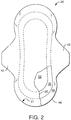
- the feminine care absorbent article 20 (e.g., feminine care pad or napkin) includes a topsheet 26, a backsheet 28, and an absorbent core 30 positioned between the topsheet 26 and the backsheet 28.
- the topsheet 26 and/or backsheet 28 may contain the nanocomposite film of the present invention.
- the topsheet 26 defines a body-facing surface 27 of the absorbent article 20.
- the absorbent core 30 is positioned inwardly from the outer periphery of the absorbent article 20 and includes a body-facing side positioned adjacent the topsheet 26 and a garment-facing surface positioned adjacent the backsheet 28.
- the topsheet 26 and the backsheet 28 are joined by adhesive bonding, ultrasonic bonding, or any other suitable joining method known in the art, the sealed edges defining an overall sealed peripheral edge 99 of the article 20.
- the article 20 may take on various geometries but will generally have opposite lateral sides and longitudinal ends.
- the topsheet 26 is generally designed to contact the body of the user and is liquid-permeable.
- the liquid permeable topsheet 26 has an outwardly facing surface that may contact the body of the wearer and receive aqueous fluids from the body.
- the topsheet 26 is provided for comfort and conformability and functions to direct bodily exudates away from the body, through the topsheet 26 and toward the absorbent core 30.
- the topsheet 26 retains little or no liquid in its structure so that it provides a relatively comfortable and non-irritating surface next to the tissues within the vestibule of a female wearer.
- the topsheet 26 may contain the nanocomposite film of the present invention.
- the topsheet 26 may also contain a woven or nonwoven material that is easily penetrated by bodily exudates contacting the surface of the baffle.
- suitable materials include rayon, bonded carded webs of polyester, polypropylene, polyethylene, nylon, or other heat-bondable fibers, polyolefins, such as copolymers of polypropylene and polyethylene, linear low-density polyethylene, and aliphatic esters such as polylactic acid.
- a specific example of a suitable topsheet material is a bonded carded web made of polypropylene and polyethylene such as that used as topsheet stock for KOTEX® pantiliners.
- the topsheet 26 may also contain a plurality of apertures (not shown) formed therethrough to permit body fluid to pass more readily into the absorbent core 30.
- the apertures may be randomly or uniformly arranged throughout the topsheet 26, or they may be located only in the narrow longitudinal band or strip arranged along the longitudinal axis of the absorbent article 20.
- the apertures permit rapid penetration of body fluid down into the absorbent core 30.
- the size, shape, diameter and number of apertures may be varied to suit one's particular needs.
- the backsheet 28 is liquid-impermeable and designed to face the inner surface, i.e., the crotch portion of an undergarment (not shown).
- the backsheet 28 may permit a passage of air or vapor out of the absorbent article 20, while still blocking the passage of liquids.
- Any liquid-impermeable material may generally be utilized to form the backsheet 28.
- the backsheet 28 may contain the nanocomposite film of the present invention.
- the backsheet 28 may contain a conventional polyolefin film, such as a polyethylene film such as that used in KOTEX® pantiliners.
- an absorbent core 30 is positioned between the topsheet 26 and the backsheet 28 that provides capacity to absorb and retain bodily exudates.
- the absorbent core 30 may be formed from a variety of different materials and contain any number of desired layers.
- the core 30 typically includes one or more layers of an absorbent web material of cellulosic fibers (e.g., wood pulp fibers), other natural fibers, synthetic fibers, woven or nonwoven sheets, scrim netting or other stabilizing structures, superabsorbent material, binder materials, surfactants, selected hydrophobic and hydrophilic materials, pigments, lotions, odor control agents or the like, as well as combinations thereof.
- the absorbent web material includes a matrix of cellulosic fluff, and may also include superabsorbent material.
- the cellulosic fluff may comprise a blend of wood pulp fluff.
- One preferred type of fluff is identified with the trade designation NB 416, available from Weyerhaeuser Corp., and is a bleached, highly absorbent wood pulp containing primarily soft wood fibers.
- the absorbent materials may be formed into a web structure by employing various conventional methods and techniques.
- the absorbent web may be formed with a dry-forming technique, an air forming technique, a wet-forming technique, a foam-forming technique, or the like, as well as combinations thereof.
- a coform nonwoven material may also be employed. Methods and apparatus for carrying out such techniques are well known in the art.
- the topsheet 26 may be maintained in secured relation with the absorbent core 30 by bonding all or a portion of the adjacent surfaces to one another.
- a variety of bonding mechanisms known to one of skill in the art may be utilized to achieve any such secured relation. Examples of such mechanisms include, but are not limited to, the application of adhesives in a variety of patterns between the two adjoining surfaces, entangling at least portions of the adjacent surface of the absorbent with portions of the adjacent surface of the cover, or fusing at least portions of the adjacent surface of the cover to portions of the adjacent surface of the absorbent.
- the topsheet 26 typically extends over the upper, bodyside surface of the absorbent core 30, but can alternatively extend around the article to partially or entirely, surround or enclose the absorbent core.
- the topsheet 26 and the backsheet 28 can have peripheral margins that extend outwardly beyond the terminal, peripheral edges of the absorbent core 30, and the extending margins can be joined together to partially or entirely, surround or enclose the absorbent core.
- the absorbent article 20 may also contain other additional layers as is known in the art, any of which may contain the nanocomposite film of the present invention if so desired.
- a liquid-permeable intake layer 32 is positioned vertically between the topsheet 26 and the absorbent core 30.
- the intake layer 32 may be made of a material that is capable of rapidly transferring, in the z-direction, body fluid that is delivered to the topsheet 26.
- the intake layer 32 may generally have any shape and/or size desired. In one embodiment, the intake layer 32 has a rectangular shape, with a length equal to or less than the overall length of the absorbent article 20, and a width less than the width of the absorbent article 20.
- a length of between about 150 mm to about 300 mm and a width of between about 10 mm to about 60 mm may be utilized.
- the material may be synthetic, cellulosic, or a combination of synthetic and cellulosic materials.
- airlaid cellulosic tissues may be suitable for use in the intake layer 32.
- the airlaid cellulosic tissue may have a basis weight ranging from about 10 grams per square meter (gsm) to about 300 gsm, and in some embodiments, between about 40 gsm to about 150 gsm.
- the airlaid tissue may be formed from hardwood and/or softwood fibers.
- the airlaid tissue has a fine pore structure and provides an excellent wicking capacity, especially for menses.
- the absorbent article 20 may also contain a transfer delay layer (not shown) positioned between the intake layer 32 and the absorbent core 30.
- the transfer delay layer may contain a material that is substantially hydrophobic, such as a nonwoven web composed of polypropylene, polyethylene, polyester, etc.
- a material suitable for the transfer delay layer is a spunbond web composed of polypropylene, multi-lobal fibers.
- suitable transfer delay layer materials include spunbond webs composed of polypropylene fibers, which may be round, tri-lobal or poly-lobal in cross-sectional shape and which may be hollow or solid in structure. Typically the webs are bonded, such as by thermal bonding, over about 3% to about 30% of the web area.
- the transfer delay layer 36 may also be treated with a selected amount of surfactant to increase its initial wettability.
- the transfer delay layer typically has a basis weight less than that of the other absorbent members.
- the basis weight of the transfer delay layer 36 is typically less than about 250 grams per square meter (gsm), and in some embodiments, between about 40 gsm to about 200 gsm.
- the absorbent article 20 may also include laterally extending wing portions 42 that may be integrally connected to side regions along the intermediate portion of the article.
- the nanocomposite film of the present invention may be particularly suitable for forming the wing portions 42 due to its enhanced stiffness.
- the wing portions 42 may be a separately provided material that is subsequently attached or otherwise operatively joined to the intermediate portion of the article.
- the wing portions 42 may be unitarily formed with one or more components of the article. As representatively shown in Fig. 1 , for example, either or both wing portions 42 may be formed from a corresponding, operative extension of the material employed to form the topsheet 26.
- the nanocomposite film of the present invention may be used in both the topsheet 26 and the wing portions 42.
- either or both wing portions 42 may be formed from a corresponding, operative extension of the material employed to form the backsheet 28.
- the nanocomposite film of the present invention may be used in both the backsheet 28 and the wing portions 42.
- any other absorbent article may be formed in accordance with the present invention, including, but not limited to, other personal care absorbent articles, such as training pants, absorbent underpants, adult incontinence products, diapers, swim wear, baby wipes, and so forth; medical absorbent articles, such as garments, fenestration materials, underpads, bandages, absorbent drapes, and medical wipes; food service wipers; clothing articles; and so forth.
- the film may also be used in applications other than absorbent articles.
- the film may be employed as an individual wrap, packaging pouch, or bag for the disposal of a variety of articles, such as food products, absorbent articles, etc.
- a variety of articles such as food products, absorbent articles, etc.
- Various suitable pouch, wrap, or bag configurations for absorbent articles are disclosed, for instance, in U.S. Patent Nos. 6,716,203 to Sorebo, et al. and 6,380,445 to Moder, et al. , as well as U.S. Patent Application Publication No. 2003/0116462 to Sorebo, et al .
- the strip tensile strength values were determined in substantial accordance with ASTM Standard D638-99.
- a constant-rate-of-extension type of tensile tester was employed.
- the tensile testing system was an MTS Synergy 200 tensile frame.
- the tensile tester was equipped with TESTWORKS 4.08B software from MTS Corporation to support the testing.
- the load cell was 100 Newtons.
- the film samples were initially cut into dog-bone shapes with a center width of 3.0 mm before testing. The samples were held between grips having a front and back face measuring 25.4 millimeters x 76 millimeters. The grip faces were rubberized, and the longer dimension of the grip was perpendicular to the direction of pull.
- the grip pressure was pneumatically maintained at a pressure of 40 pounds per square inch.
- the tensile test was run using a gauge length of 18.0 millimeters and a break sensitivity of 40%. Five samples were tested by applying the test load along the machine-direction and five samples were tested by applying the test load along the cross direction. During the test, samples were stretched at a crosshead speed of about 127 millimeters per minute until breakage occurred. The modulus, peak stress, peak elongation (percent strain at break), and energy per volume at break were measured in the machine direction (“MD”) and cross-machine directions ("CD").
- Noise levels of film and absorbent article samples may be tested in an apparatus comprised of a test chamber, a control chamber, and a sound level meter.
- the purpose of the apparatus is to manipulate an article in a controlled noise environment, and to accurately quantify the noise produced by the movement of the sample.
- a sample is physically deformed within the test apparatus to generate a noise level.
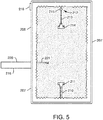
- the testing apparatus includes a test chamber 201 and a control chamber 202.
- the test chamber 201 includes a door 203, a top wall 204, a bottom wall 205, two side walls 206 and 207, and a rear wall 208.
- the door and each wall are constructed of 0.25-inch (0.635 cm) thick 6061 grade anodized aluminum.
- the door 203 and rear wall 208 are each 36 inches (91.4 cm) in height and 24 inches (61.0 cm) in width.
- the test chamber side walls 206 and 207 are each 36 inches (91.4 cm) high and 18 inches (45.7 cm) wide.
- the test chamber top and bottom panels are each 24 inches wide (61.0 cm) and 18 inches (45.7 cm) long.
- the interior surface of the door 203 and each wall 204-208 has applied thereto two-inch thick polyurethane sound-dampening foam 209, available from IIIbruck Inc. under the brand name SONEX and stock number SOC-2.
- a sound level meter support 216 extends perpendicularly outward from side wall 206 just below a microphone orifice 217.
- the microphone orifice 217 is positioned 14.5 centimeters above the floor of the bottom wall 205, and is further centered between the door 203 and the rear wall 208.
- the sound level meter support 216 is constructed of aluminum and is bolted (not shown) to side wall 206.
- the control chamber 202 includes a front wall 230, two side walls 231 and 232, a top wall 233, and a bottom wall 234. Each wall is constructed of 0.125-inch (0.3175 cm) thick 6061 grade anodized aluminum.
- the front wall 230 is 36 inches (91.4 cm) high and 24 inches (61.0 cm) wide.
- the control chamber side walls 231 and 232 are each 36 inches high (91.4 cm) and 12 inches (30.5 cm) wide.
- the control chamber top and bottom walls 233 and 234 are each 24 inches (61.0 cm) wide and 12 inches (30.5 cm) long.
- the control chamber 202 is bolted (not shown) to the outer surface of rear wall 208 along seam 270 ( Fig. 4 ).
- the testing apparatus 200 further includes a sound level meter 220 ( Fig. 5 ), such as a model 1900, equipped with a model OB-100 octave filter set, both available from Quest Technologies, a company having offices in Oconomowoc, Wisconsin.
- the sound level meter is supported by a model QC-20 calibrator and QuestSuite master module software, each also available from Quest Technologies.
- the software is installed on a personal computer (not shown).
- the sound level meter 220 rests in the sound level meter support 216.
- the sound level meter includes a microphone 221 extending 4.75 inches (12 centimeters) therefrom.
- the apparatus may also contain features for automatically deforming a sample during a test.
- the apparatus may contain a lower slide bracket 210, a six-inch (15.24 cm) high Series A1500 Model available from Velmex, Inc., which extends from the bottom wall 205 into the test chamber 201, and a lower clamp 211 that is affixed to the lower slide bracket 210.
- An eyelet 212 ( Fig. 5 ) may optionally extend from the top wall 204 into the test chamber 201, and an optional lanyard 213 extends through the eyelet 212.
- One end of the lanyard 213 extends into the test chamber 201, and has an upper clamp 214 affixed thereto.
- the other end of the lanyard 213 extends into the control chamber 202 through a lanyard orifice 215, which is 5/8 inch (16 mm) in diameter.
- the lanyard may be a premium-braid, 80-lb test Spiderwire®, part number SB80G-300, manufactured by Johnson Worldwide Associates (JWA), Inc.
- five (5) specimens of a sample may then be physically deformed approximately 15 to 20 centimeters from the microphone within the test apparatus.
- the tests ranged between 1 to 2 seconds in duration. All tests involved starting the sound level meter, completing the respective product manipulation, and then stopping the sound level meter.
- the chamber door was allowed to remain open during testing to accommodate the arms and hands of the tester, as well as the motions of the product manipulation protocols.
- the ambient noise outside of the apparatus was quiet and was the same during calibration (including measuring the ambient noise level) and testing of the sample.
- a film was formed from DowlexTM EG 2244G using a HAAKE Rheomex® 252p single screw extruder and a 6" [15 cm] cast film die.
- DowlexTM EG2244G is a linear low density polyethylene having a melt flow index of 1.0 g/10 minutes at 190°C (Dow Chemical).
- the screw had a diameter of 19.05 mm and an L/D of 25 (L is the screw length).
- a chill roll was used to cool and flatten the polymer as it exited the cast film die. The screw speed was maintained at 38 rpm for a target thickness of 12.7 micrometers.
- the four controlled temperature zones from the first heating zone to the die adaptor were set at 180°C, 180°C, 180°C, and 180°C, respectively.
- the torque on the extruder was 24 N-m and the pressure at the die was 520 psi [3.6 MPa].
- a film was formed from DPDA-3320 N7 using a HAAKE Rheomex® 252p single screw extruder and a 6" [15 cm] cast film die.
- DPDA-3320 N7 is a high density polyethylene having a melt flow index of 2.0 g/10 minutes at 190°C (Dow Chemical).
- the screw had a diameter of 19.05 mm and an L/D of 25 (L is the screw length).
- a chill roll was used to cool and flatten the polymer as it exited the cast film die.
- the screw speed was maintained at 40 rpm for a target thickness of 12.7 micrometers.
- the four controlled temperature zones from the first heating zone to the die adaptor were set at 170°C, 180°C, 185°C, and 190°C, respectively.
- the torque on the extruder was 20 N-m and the pressure at the die was 493 psi [3.4 MPa].
- a film was formed from 90 wt.% of a first masterbatch and 10 wt.% of a second masterbatch.
- the first masterbatch was formed by dry blending 80 wt.% DowlexTM 2244G (LLDPE) and 20 wt.% DPDA-3320 N7 (HDPE) and the second masterbatch was formed by dry blending 80 wt.% NanoMaxTM LDPE (Nanocor, Inc.) and 20 wt.% NanoMaxTM HDPE (Nanocor, Inc.).
- NanMaxTM LDPE contains 50 wt.% NanomerTM nanoclay (quaternary ammonium surface-modified montmorillonite) and 50 wt.% of LDPE and maleic anhydride grafted LDPE
- NanoMaxTM HDPE contains 50 wt.% NanomerTM nanoclay and 50 wt.% HDPE and maleic anhydride grafted HDPE.
- the materials were delivered through two K-Tron gravimetric feeders and melt blended together using a Werner & Pfleiderer (W&P) ZSK-30 co-rotating, twin screw extruder.
- the extruder had 14 processing barrels, with 13 heated barrels. Three barrels are open barrels.
- the outer diameters of the screws were 30 mm and the inner screw diameters were 21.3 mm.
- the lengths of the screws were 1328 mm and the total processing section length was 1338 mm.
- the zones had a processing temperature of 171°C, 181°C, 188°C, 190°C, 191°C, 195°C, and 200°C, respectively.
- the melt temperature was about 224°C and the pressure was about 260-290 psi [1.8-2.0 MPa].
- the compounding speed in the twin screw extruder was set as 250 rpm.
- the blends were formed into a film using a HAAKE single screw extruder as described in Control 1.
- the screw speed was maintained at 35 rpm for a target thickness of 12.7 micrometers.
- the four controlled temperature zones from the first heating zone to the die adaptor were set at 190°C, 200°C, 200°C, and 200°C, respectively.
- the torque on the extruder was 12 N-m and the pressure at the die was 406 psi [2.8 MPa].
- a film was formed from 90 wt.% of a first masterbatch and 10 wt.% of a second masterbatch.
- the first masterbatch was formed by dry blending 60 wt.% DowlexTM 2244G (LLDPE) and 40 wt.% DPDA-3320 N7 (HDPE) and the second masterbatch was formed by dry blending 60 wt.% NanoMaxTM LDPE and 40 wt.% NanoMaxTM HDPE.
- the materials were delivered through two K-Tron gravimetric feeders and melt blended together using a Werner & Pfleiderer (W&P) ZSK-30 co-rotating, twin screw extruder as described in Example 1.
- the zones had a processing temperature of 166°C, 183°C, 191°C, 190°C, 191°C, 195°C, and 201°C, respectively.
- the melt temperature was about 227°C and the pressure was about 220-340 psi [1.5-2.3 MPa].
- the compounding speed in the twin screw extruder was set as 250 rpm. Once formed, the blends were formed into a film using a HAAKE single screw extruder as described in Control 1. The screw speed was maintained at 33 rpm for a target thickness of 12.7 micrometers.
- the four controlled temperature zones from the first heating zone to the die adaptor were set at 190°C, 200°C, 200°C, and 200°C, respectively.
- the torque on the extruder was 14 N-m and the pressure at the die was 406 psi [2.8 MPa].
- a film was formed from 90 wt.% of a first masterbatch and 10 wt.% of a second masterbatch.
- the first masterbatch was formed by dry blending 40 wt.% DowlexTM 2244G (LLDPE) and 60 wt.% DPDA-3320 N7 (HDPE) and the second masterbatch was formed by dry blending 40 wt.% NanoMaxTM LDPE and 60 wt.% NanoMaxTM HDPE.
- the materials were delivered through two K-Tron gravimetric feeders and melt blended together using a Werner & Pfleiderer (W&P) ZSK-30 co-rotating, twin screw extruder as described in Example 1.
- the zones had a processing temperature of 169°C, 177°C, 191°C, 191°C, 190°C, 195°C, and 200°C, respectively.
- the melt temperature was about 225°C and the pressure was about 280-320 psi [1.9-2.2 MPa].
- the compounding speed in the twin screw extruder was set as 250 rpm. Once formed, the blends were formed into a film using a HAAKE single screw extruder as described in Control 1. The screw speed was maintained at 35 rpm for a target thickness of 12.7 micrometers.
- the four controlled temperature zones from the first heating zone to the die adaptor were set at 190°C, 200°C, 200°C, and 200°C, respectively.
- the torque on the extruder was 16 N-m and the pressure at the die was 435 psi [3.0 MPa].
- a film was formed from 90 wt.% of a first masterbatch and 10 wt.% of a second masterbatch.
- the first masterbatch was formed by dry blending 20 wt.% DowlexTM 2244G (LLDPE) and 80 wt.% DPDA-3320 N7 (HDPE) and the second masterbatch was formed by dry blending 20 wt.% NanoMaxTM LDPE and 80 wt.% NanoMaxTM HDPE.
- the materials were delivered through two K-Tron gravimetric feeders and melt blended together using a Werner & Pfleiderer (W&P) ZSK-30 co-rotating, twin screw extruder as described in Example 1.
- the zones had a processing temperature of 170°C, 180°C, 190°C, 191°C, 190°C, 195°C, and 200°C, respectively.
- the melt temperature was about 226°C and the pressure was about 280-320 psi [1.9-2.2 MPa].
- the compounding speed in the twin screw extruder was set as 250 rpm. Once formed, the blends were formed into a film using a HAAKE single screw extruder as described in Control 1. The screw speed was maintained at 35 rpm for a target thickness of 12.7 micrometers.
- the four controlled temperature zones from the first heating zone to the die adaptor were set at 190°C, 200°C, 200°C, and 200°C, respectively.
- the torque on the extruder was 16 N-m and the pressure at the die was 420 psi [2.9 MPa].
- Example 1 The films of Examples 1-4 were then conditioned overnight at 23 ⁇ 2°C and 50 ⁇ 5% RH and subjected to mechanical testing as described above. The results are set forth below in Table 1.
- Table 1 Mechanical Properties Ex. LLDPE (wt.%) LDPE (wt.%) HDPE (wt.%) Wt. Ratio of (LLDPE + LDPE) / HDPE Nanoclay (wt.%) Avg. Peak Stress (MPa) Avg. Peak Elongation (%) Avg. Modulus (MPa) Avg.
- the mechanical properties e.g., modulus
- the mechanical properties generally improved with the incorporation of nanoclay.
- a commercial film was tested that is produced by Quanxing Plastics, Inc.
- the film had a basis weight of 18 grams per square meters and was cast extruded from a blend containing 35 to 45 wt.% high density polyethylene (HDPE 5070), 20 to 30 wt.% low density polyethylene (LDPE LD100AC), 25 to 35 wt.% linear low density polyethylene (LLDPE 7050), and 5 to 10 wt.% of a titanium dioxide masterbatch (1605H).
- a micro-embossed pattern having a depth of 1 to 5 micrometers was formed on a surface of the film.
- a film was formed from a blend containing 93.5 wt.% of a polyethylene masterbatch, 4.5 wt.% of ClaytonTM HY, and 2 wt.% of Fusabond® E-528, which is a graft copolymer of polyethylene and maleic anhydride available from DuPont.
- the polyethylene masterbatch contained 35 to 45 wt.% high density polyethylene (HDPE 5070), 20 to 30 wt.% low density polyethylene (LDPE LD100AC), 25 to 35 wt.% linear low density polyethylene (LLDPE 7050), and 5 to 10 wt.% of a titanium dioxide masterbatch (1605H).
- ClaytonTM HY is an organoclay powder treated with quaternary ammonium solution and is available from BYK Additives, Inc. (Gonzales TX).
- the blend was formed using a co-rotating, twin screw extruder available from Entek®.
- the extruder had 14 processing barrels, with 13 heated barrels. Three barrels are open barrels. The outer diameter of the screws was 53 mm.
- the processing temperatures along the extruder were set as 175°C and the compounding speed in the twin extruder was set as 700 rpm.
- the resultant strands were cooled in a water bath with 15 feet length in total. The cooled strand was then pelletized and collected for the following film processing.
- a film was thereafter produced from the resulting blend using a single-screw extruder.
- the extruder has 8 processing barrels, with 7 heated barrels with temperatures ranging from 175-210°C.
- the screw speed was adjusted between 66.5 and 68.6 rpm depending on the required film thickness.
- the corresponding line speed was adjusted between 85 and 90 meters per minute.
- the resulting film had a basis weight of 13.5 grams per square meter.
- a micro-embossed pattern having a depth of 1 to 5 micrometers was formed on a surface of the film.
- a film was formed as described in Example 5 except that a deep embossing pattern having a depth of 5 to 15 micrometers was formed on the surface.
Landscapes
- Health & Medical Sciences (AREA)
- Epidemiology (AREA)
- Engineering & Computer Science (AREA)
- General Health & Medical Sciences (AREA)
- Veterinary Medicine (AREA)
- Public Health (AREA)
- Life Sciences & Earth Sciences (AREA)
- Animal Behavior & Ethology (AREA)
- Chemical & Material Sciences (AREA)
- Materials Engineering (AREA)
- Heart & Thoracic Surgery (AREA)
- Vascular Medicine (AREA)
- Biomedical Technology (AREA)
- Hematology (AREA)
- Chemical Kinetics & Catalysis (AREA)
- Manufacturing & Machinery (AREA)
- Inorganic Chemistry (AREA)
- Polymers & Plastics (AREA)
- Medicinal Chemistry (AREA)
- Organic Chemistry (AREA)
- Dispersion Chemistry (AREA)
- Dermatology (AREA)
- Mechanical Engineering (AREA)
- Compositions Of Macromolecular Compounds (AREA)
- Absorbent Articles And Supports Therefor (AREA)
- Laminated Bodies (AREA)
Claims (15)
- Article absorbant comprenant une couche perméable aux liquides, une couche imperméable aux liquides et une âme absorbante positionnée entre la couche perméable aux liquides et la couche imperméable aux liquides, l'article absorbant contenant un film ayant une épaisseur de 50 micromètres ou moins, le film contenant une couche qui est formée à partir d'une composition de polymère, la composition de polymère contenant un premier polymère d'éthylène ayant une masse volumique de 0,94 g/cm3 ou moins, un deuxième polymère d'éthylène ayant une masse volumique supérieure à 0,94 g/cm3 et une nano-argile ayant un traitement de surface organique, le rapport en poids entre le première polymère d'éthylène et le deuxième polymère d'éthylène étant de 0,1 à 10.
- Article absorbant de la revendication 1, dans lequel les polymères d'éthylène ayant une masse volumique de 0,94 g/cm3 ou moins constituent 5 % en poids à 90 % en poids de la composition de polymère et les polymères d'éthylène ayant une masse volumique supérieure à 0,94 g/cm3 constituent 5 % en poids à 90 % en poids de la composition de polymère ; ou dans lequel la nano-argile constitue 0,5 % en poids à 20 % en poids de la composition de polymère.
- Article absorbant de la revendication 1, dans lequel le premier polymère d'éthylène, le deuxième polymère d'éthylène, ou les deux, comprennent un copolymère d'éthylène et d'une α-oléfine.
- Article absorbant de la revendication 1, dans lequel la nano-argile comprend un phyllosilicate, de préférence le phyllosilicate comprenant une montmorillonite ou un sel de celle-ci.
- Article absorbant de la revendication 1, dans lequel la composition de polymère comprend en outre un compatibilisant de polyoléfine qui comprend un composant oléfine et un composant polaire, l'agent de compatibilisant comprenant de préférence un acide carboxylique ou une polyoléfine greffée avec un anhydride d'acide carboxylique.
- Article absorbant de la revendication 1, dans lequel le film présente un module de Young dans le sens machine de 150 à 1000 mégapascals ; ou dans lequel le film présente un module de Young dans le sens travers de 200 à 1200 mégapascals ; ou dans lequel le film présente un pic d'allongement dans le sens machine de 200 % ou plus et une résistance à la traction ultime dans le sens machine de 15 à 150 mégapascals ; ou dans lequel le film présente un pic d'allongement dans le sens travers de 700 % ou plus et une résistance à la traction ultime dans le sens travers de 15 à 150 mégapascals.
- Article absorbant de la revendication 1, l'article absorbant comprenant en outre au moins une aile qui s'étend latéralement depuis un bord de l'article, l'aile contenant le film : ou dans lequel la couche imperméable aux liquides est une feuille de renfort de l'article absorbant, la feuille de renfort contenant le film.
- Film ayant une épaisseur de 50 micromètres ou moins, le film contenant une couche qui est formée à partir d'une composition de polymère, la composition de polymère contenant 5 % en poids à 90 % en poids d'un premier polymère d'éthylène ayant une masse volumique de 0,94 g/cm3 ou moins, 5 % en poids à 90 % en poids d'un deuxième polymère d'éthylène ayant une masse volumique supérieure à 0,94 g/cm3 et 0,5 % en poids à 20 % en poids d'une nano-argile ayant un traitement de surface organique, le rapport en poids entre le premier polymère d'éthylène et le deuxième polymère d'éthylène étant de 0,1 à 10, le film présentant un module de Young dans le sens machine de 150 à 1000 mégapascals.
- Film de la revendication 8, le film présentant un module de Young dans le sens travers de 200 à 1200 mégapascals ; ou le film présente un pic d'allongement dans le sens machine de 200 % ou plus et une résistance à la traction ultime dans le sens machine de 15 à 150 mégapascals ; ou le film présentant un pic d'allongement dans le sens travers de 700 % ou plus et une résistance à la traction ultime dans le sens travers de 15 à 150 mégapascals ; ou le film présentant un niveau de bruit normalisé de 2,5 ou moins déterminé à une fréquence de 4000 Hz, le niveau de bruit normalisé étant déterminé par une division du niveau de bruit du film par le niveau de bruit d'un environnement ambiant.
- Film de la revendication 8, dans lequel la nano-argile comprend une montmorillonite ou un sel de celle-ci.
- Article absorbant de la revendication 1 ou film de la revendication 8, dans lequel la nano-argile comprend des plaquettes ayant une épaisseur moyenne de 0,2 à 100 nanomètres.
- Article absorbant de la revendication 1 ou film de la revendication 8, dans lequel le traitement de surface organique comprend un onium quaternaire.
- Film de la revendication 8, le film étant multi-couche et contenant une couche de base et/ou une couche de peau formée à partir de la composition de polymère.
- Article absorbant de la revendication 1 ou film de la revendication 8, dans lequel le premier polymère d'éthylène comprend un polyéthylène basse densité, un polyéthylène basse densité ou un mélange de ceux-ci ; ou dans lequel le deuxième polymère d'éthylène comprend un polymère haute densité.
- Procédé de formation du film de la revendication 8, le procédé comprenant :le mélange à l'état fondu du premier polymère d'éthylène, du deuxième polymère d'éthylène et de la nano-argile ;l'application de la composition de polymère sur une surface pour former le film ; le mélange à l'état fondu s'effectuant de préférence dans une extrudeuse à deux vis, ou la nano-argile se présentant de préférence sous la forme d'une poudre.
Applications Claiming Priority (2)
| Application Number | Priority Date | Filing Date | Title |
|---|---|---|---|
| US201461934434P | 2014-01-31 | 2014-01-31 | |
| PCT/US2015/013821 WO2015116953A1 (fr) | 2014-01-31 | 2015-01-30 | Film nanocomposite rigide destiné à être utilisé dans un article absorbent |
Publications (3)
| Publication Number | Publication Date |
|---|---|
| EP3099280A1 EP3099280A1 (fr) | 2016-12-07 |
| EP3099280A4 EP3099280A4 (fr) | 2017-10-11 |
| EP3099280B1 true EP3099280B1 (fr) | 2018-12-12 |
Family
ID=53757763
Family Applications (1)
| Application Number | Title | Priority Date | Filing Date |
|---|---|---|---|
| EP15744090.0A Active EP3099280B1 (fr) | 2014-01-31 | 2015-01-30 | Film nanocomposite rigide destiné à être utilisé dans un article absorbent |
Country Status (9)
| Country | Link |
|---|---|
| US (1) | US9878065B2 (fr) |
| EP (1) | EP3099280B1 (fr) |
| KR (1) | KR101673248B1 (fr) |
| CN (1) | CN105934225B (fr) |
| AU (1) | AU2015210792B2 (fr) |
| BR (1) | BR112016017524B1 (fr) |
| MX (1) | MX355934B (fr) |
| RU (1) | RU2612931C1 (fr) |
| WO (1) | WO2015116953A1 (fr) |
Families Citing this family (13)
| Publication number | Priority date | Publication date | Assignee | Title |
|---|---|---|---|---|
| WO2015187198A1 (fr) | 2014-06-06 | 2015-12-10 | Kimberly-Clark Worldwide, Inc. | Fibres poreuses creuses |
| MX383673B (es) | 2013-06-12 | 2025-03-14 | Kimberly Clark Co | Fibras de poliolefina porosas. |
| EP3099733B1 (fr) | 2014-01-31 | 2020-05-06 | Kimberly-Clark Worldwide, Inc. | Film d'emballage nanocomposite |
| AU2015210804B2 (en) | 2014-01-31 | 2018-09-20 | Kimberly-Clark Worldwide, Inc. | Thin nanocomposite film for use in an absorbent article |
| CN107124874A (zh) | 2014-06-06 | 2017-09-01 | 金伯利-克拉克环球有限公司 | 由多孔聚合物片材形成的热成型制品 |
| CN107205871B (zh) * | 2015-01-30 | 2019-11-29 | 金伯利-克拉克环球有限公司 | 用于吸收制品的具有降低的噪声的膜 |
| US10869790B2 (en) | 2015-01-30 | 2020-12-22 | Kimberly-Clark Worldwide, Inc. | Absorbent article package with reduced noise |
| WO2018089440A1 (fr) * | 2016-11-09 | 2018-05-17 | Berry Plastics Corporation | Film élastique perforé pré-étiré ayant une résistance à des ruptures de bande |
| CN108732448A (zh) | 2017-04-24 | 2018-11-02 | 凹凸电子(武汉)有限公司 | 电池管理系统中的断线检测方法及断线解除检测方法 |
| US20180327614A1 (en) * | 2017-05-09 | 2018-11-15 | Imam Abdulrahman Bin Faisal University | Method of repairing an acrylic denture base and zirconia autopolymerizable resins therof |
| US20190000697A1 (en) * | 2017-06-30 | 2019-01-03 | The Procter & Gamble Company | Feminine hygiene article having adhesive side extensions with enhanced longitudinal flexure and structural integrity |
| JP6705871B2 (ja) * | 2018-09-10 | 2020-06-03 | ユニ・チャーム株式会社 | 吸収性物品 |
| KR102494370B1 (ko) * | 2020-07-31 | 2023-02-01 | 박석원 | 접착제 미사용 생리대 |
Family Cites Families (82)
| Publication number | Priority date | Publication date | Assignee | Title |
|---|---|---|---|---|
| US3354506A (en) | 1962-04-30 | 1967-11-28 | Union Carbide Corp | Apparatus for melt extrusion of multi-wall plastic tubing |
| US3801429A (en) | 1969-06-06 | 1974-04-02 | Dow Chemical Co | Multilayer plastic articles |
| DE1939528A1 (de) | 1969-08-02 | 1971-02-11 | Barmag Barmer Maschf | Vorrichtung zum kontinuierlichen Herstellen von Mehrschichtblasfolien |
| GB1453447A (en) | 1972-09-06 | 1976-10-20 | Kimberly Clark Co | Nonwoven thermoplastic fabric |
| US4374888A (en) | 1981-09-25 | 1983-02-22 | Kimberly-Clark Corporation | Nonwoven laminate for recreation fabric |
| US4886512A (en) | 1983-04-04 | 1989-12-12 | Kimberly-Clark Corporation | Incontinent garment with elasticized pouch |
| CA1341430C (fr) | 1984-07-02 | 2003-06-03 | Kenneth Maynard Enloe | Couche avec poches laterales elasticisees |
| US4728325A (en) * | 1986-04-03 | 1988-03-01 | Exxon Chemical Patents Inc. | Diaper backsheet |
| US4789699A (en) | 1986-10-15 | 1988-12-06 | Kimberly-Clark Corporation | Ambient temperature bondable elastomeric nonwoven web |
| US4766029A (en) | 1987-01-23 | 1988-08-23 | Kimberly-Clark Corporation | Semi-permeable nonwoven laminate |
| FR2610328B1 (fr) * | 1987-01-30 | 1989-08-25 | Charbonnages Ste Chimique | Matiere interpolymere renforcatrice de matrices thermoplastiques rigides, preparation de cette matiere interpolymere et compositions renforcees correspondantes |
| US4798603A (en) | 1987-10-16 | 1989-01-17 | Kimberly-Clark Corporation | Absorbent article having a hydrophobic transport layer |
| JPH0747644B2 (ja) | 1989-05-19 | 1995-05-24 | 宇部興産株式会社 | ポリアミド複合材料及びその製造方法 |
| US5169706A (en) | 1990-01-10 | 1992-12-08 | Kimberly-Clark Corporation | Low stress relaxation composite elastic material |
| US5254111A (en) | 1990-02-12 | 1993-10-19 | Clopay Plastic Products Company, Inc. | Barrier cuff for disposable absorbent articles |
| US5213881A (en) | 1990-06-18 | 1993-05-25 | Kimberly-Clark Corporation | Nonwoven web with improved barrier properties |
| US5464688A (en) | 1990-06-18 | 1995-11-07 | Kimberly-Clark Corporation | Nonwoven web laminates with improved barrier properties |
| US5272236A (en) | 1991-10-15 | 1993-12-21 | The Dow Chemical Company | Elastic substantially linear olefin polymers |
| US5248309A (en) | 1990-07-19 | 1993-09-28 | Kimberly-Clark Corporation | Thin sanitary napkin having a central absorbent zone and a method of forming the napkin |
| US5192606A (en) | 1991-09-11 | 1993-03-09 | Kimberly-Clark Corporation | Absorbent article having a liner which exhibits improved softness and dryness, and provides for rapid uptake of liquid |
| US5322728A (en) | 1992-11-24 | 1994-06-21 | Exxon Chemical Patents, Inc. | Fibers of polyolefin polymers |
| US5472775A (en) | 1993-08-17 | 1995-12-05 | The Dow Chemical Company | Elastic materials and articles therefrom |
| US5558659A (en) | 1993-12-09 | 1996-09-24 | Kimberly-Clark Corporation | Incontinence article for males |
| CA2116081C (fr) | 1993-12-17 | 2005-07-26 | Ann Louise Mccormack | Materiau permeable a l'air constitue d'une pellicule et d'un non-tisse colles |
| US5486166A (en) | 1994-03-04 | 1996-01-23 | Kimberly-Clark Corporation | Fibrous nonwoven web surge layer for personal care absorbent articles and the like |
| DE69510707T2 (de) | 1994-03-04 | 1999-11-04 | Kimberly-Clark Worldwide, Inc. | Vliesstoff mit verbesserten Flüssigkeits-Strömungs-Eigenschaften für absorbierende Artikel der persönlichen Pflege und dergleichen |
| US5571619A (en) | 1994-05-24 | 1996-11-05 | Exxon Chemical Patents, Inc. | Fibers and oriented films of polypropylene higher α-olefin copolymers |
| US5669896A (en) | 1994-06-16 | 1997-09-23 | Kimberly-Clark Worldwide, Inc. | Absorbent garment comprising dual containment flaps |
| EP0778763B1 (fr) | 1994-08-31 | 2000-11-02 | Kimberly-Clark Worldwide, Inc. | Article absorbant mince ayant des proprietes d'absorption par capillarite et de resistance a la compression |
| US5702377A (en) | 1994-09-01 | 1997-12-30 | Kimberly-Clark Worldwide, Inc. | Wet liner for child toilet training aid |
| US5760121A (en) | 1995-06-07 | 1998-06-02 | Amcol International Corporation | Intercalates and exfoliates formed with oligomers and polymers and composite materials containing same |
| KR19990071499A (ko) | 1995-12-01 | 1999-09-27 | 에프. 아. 프라저, 에른스트 알테르 (에. 알테르), 한스 페터 비틀린 (하. 페. 비틀린), 피. 랍 보프, 브이. 스펜글러, 페. 아에글러 | 폴리(9,9'-스피로비스플루오렌), 이들의 제조 및 이들의 용도 |
| US5880197A (en) | 1995-12-22 | 1999-03-09 | Amcol International Corporation | Intercalates and exfoliates formed with monomeric amines and amides: composite materials containing same and methods of modifying rheology therewith |
| US6060638A (en) | 1995-12-22 | 2000-05-09 | Kimberly-Clark Worldwide, Inc. | Matched permeability liner/absorbent structure system for absorbent articles and the like |
| US5853886A (en) | 1996-06-17 | 1998-12-29 | Claytec, Inc. | Hybrid nanocomposites comprising layered inorganic material and methods of preparation |
| US5931823A (en) | 1997-03-31 | 1999-08-03 | Kimberly-Clark Worldwide, Inc. | High permeability liner with improved intake and distribution |
| NL1006743C2 (nl) | 1997-08-08 | 1999-02-09 | Tno | Nanocomposiet-materiaal. |
| US6090325A (en) | 1997-09-24 | 2000-07-18 | Fina Technology, Inc. | Biaxially-oriented metallocene-based polypropylene films |
| US6197404B1 (en) | 1997-10-31 | 2001-03-06 | Kimberly-Clark Worldwide, Inc. | Creped nonwoven materials |
| US6455161B1 (en) | 1999-06-30 | 2002-09-24 | Dow Global Technologies Inc. | Essentially amorphous, non-chlorinated polymeric barrier films and method of using such films |
| US6511465B1 (en) | 1999-08-23 | 2003-01-28 | Kimberly-Clark Worldwide, Inc. | Absorbent article having a refastenable mechanism |
| US6663611B2 (en) | 1999-09-28 | 2003-12-16 | Kimberly-Clark Worldwide, Inc. | Breathable diaper with low to moderately breathable inner laminate and more breathable outer cover |
| US6737464B1 (en) * | 2000-05-30 | 2004-05-18 | University Of South Carolina Research Foundation | Polymer nanocomposite comprising a matrix polymer and a layered clay material having a low quartz content |
| US6846532B1 (en) | 2001-02-15 | 2005-01-25 | Sonoco Development, Inc. | Laminate packaging material |
| US6824734B2 (en) | 2001-10-09 | 2004-11-30 | Kimberly-Clark Worldwide, Inc. | Method of producing latent elastic, cross-direction-oriented films |
| US6716203B2 (en) | 2001-12-18 | 2004-04-06 | Kimberly-Clark Worldwide, Inc. | Individual absorbent articles wrapped in a quiet and soft package |
| US20030116462A1 (en) | 2001-12-20 | 2003-06-26 | Kimberly-Clark Worldwide, Inc. | Pouch configuration for wrapped absorbent articles |
| JP2005529768A (ja) | 2002-06-17 | 2005-10-06 | トレドガー フィルム プロダクツ コーポレーション | 押出し成形された高吸収性織物 |
| CN2577812Y (zh) * | 2002-09-27 | 2003-10-08 | 上海佳期生活用品有限公司 | 设有反渗隔边的卫生巾 |
| US20040060112A1 (en) | 2002-09-27 | 2004-04-01 | Kimberly-Clark Worldwide, Inc. | Bed pad |
| US7060867B2 (en) | 2002-11-27 | 2006-06-13 | Kimberly-Clark Worldwide, Inc. | Absorbent article with a body facing liner having discretely placed lotion deposits |
| US6888044B2 (en) | 2002-12-23 | 2005-05-03 | Kimberly-Clark Worldwide, Inc. | High capacity absorbent structure and method for producing same |
| JP4943835B2 (ja) | 2003-01-16 | 2012-05-30 | オード マイケル ヤコブズ イアン | 優れた耐環境応力亀裂性を持つ物品を形成するための方法、組成物及びブレンド |
| BRPI0408020A (pt) | 2003-03-03 | 2006-02-14 | Polymers Australia Pty Ltd | agentes de dispersão em nanocompósitos |
| US20050054255A1 (en) | 2003-09-08 | 2005-03-10 | Kimberly-Clark Worldwide, Inc. | Nonwoven fabric liner and diaper including a nonwoven laminate liner |
| US20050059941A1 (en) | 2003-09-11 | 2005-03-17 | Kimberly-Clark Worldwide, Inc. | Absorbent product with improved liner treatment |
| US7758557B2 (en) * | 2003-11-21 | 2010-07-20 | Kimberly-Clark Worldwide, Inc. | Reduced-noise composite materials and disposable personal care devices employing same |
| US8198200B2 (en) | 2004-03-29 | 2012-06-12 | The Procter & Gamble Company | Web materials having both plastic and elastic properties |
| US7030188B2 (en) * | 2004-04-01 | 2006-04-18 | Equistar Chemicals, Lp | Multi-phase polypropylene compositions |
| US20050245162A1 (en) | 2004-04-30 | 2005-11-03 | Kimberly-Clark Worldwide, Inc. | Multi-capable elastic laminate process |
| TWI265090B (en) | 2004-11-01 | 2006-11-01 | Lg Chemical Ltd | Multi-layer container having barrier property |
| BRPI0609843B1 (pt) | 2005-03-17 | 2023-01-10 | Dow Global Technologies Inc | Composição polimérica carregada, artigo de amortecimento sonoro, tapete automotivo e material de cobertura |
| WO2007061883A2 (fr) | 2005-11-18 | 2007-05-31 | Research Foundation Of State University Of New York | Compositions de plastique ininflammables |
| US7872169B2 (en) | 2005-12-22 | 2011-01-18 | The Procter & Gamble Company | Reduced noise level fastening system |
| US20090292055A1 (en) | 2006-04-11 | 2009-11-26 | Polyone Corporation | Nanocomposites compliant with regulatory requirements |
| US20100121295A1 (en) | 2006-04-28 | 2010-05-13 | The Procter & Gamble Company | Products comprising polymeric webs with nanoparticles |
| US20070264897A1 (en) * | 2006-05-15 | 2007-11-15 | The Procter & Gamble Company | Polymeric webs with nanoparticles |
| RU2411961C1 (ru) | 2006-11-17 | 2011-02-20 | Ска Хайджин Продактс Аб | Впитывающие изделия, содержащие кислотные целлюлозные волокна и органическую соль цинка |
| CA2674027A1 (fr) | 2006-12-29 | 2008-10-23 | Pliant Corporation | Films decollables contenant des nanoparticules |
| PT2117834E (pt) * | 2007-02-05 | 2011-07-06 | Lankhorst Pure Composites Bv | Materiais poliolefínicos estirados e objectos produzidos a partir dos mesmos |
| EP2144961A1 (fr) * | 2007-04-27 | 2010-01-20 | Dow Global Technologies Inc. | Films microporeux fabriqués à partir de mélanges polymériques rendus compatibles |
| US8323258B2 (en) | 2007-07-27 | 2012-12-04 | The Procter & Gamble Company | Quiet adhesive fastening system for a disposable absorbent article |
| EP2028219A1 (fr) | 2007-08-24 | 2009-02-25 | Total Petrochemicals Research Feluy | Composition de résine comprenant des polyoléfines, de l'acide poly(hydroxy carboxylique) et des nanoargiles |
| ES2335847B9 (es) | 2008-10-01 | 2016-12-30 | Nanobiomatters, S.L. | Materiales nanocompuestos con propiedades de barrera a la radiacion electromagnetica y procedimiento para su obtencion |
| KR101211303B1 (ko) * | 2009-10-22 | 2012-12-11 | 주식회사 엘지화학 | 클레이 강화 폴리유산-폴리올레핀 얼로이 조성물 |
| CN102115576B (zh) * | 2009-12-31 | 2014-09-17 | 金伯利-克拉克环球有限公司 | 天然生物聚合物热塑性膜 |
| CN101798466B (zh) * | 2010-03-16 | 2012-05-30 | 漳州市奈特新型建材有限责任公司 | 一种天然纤维复合材料及其制备方法 |
| BR112012025925B1 (pt) | 2010-04-13 | 2020-03-17 | Univation Technologies, Llc | Mistura polimérica e filme |
| US8518313B2 (en) | 2010-05-21 | 2013-08-27 | E I Du Pont De Nemours And Company | Process for enhancing compression set resistance of foamed copolyester compositions |
| DK2720862T3 (en) * | 2011-06-17 | 2016-09-19 | Fiberweb Inc | Vapor permeable, water impervious TOTAL MAJOR MULTI-LAYER ARTICLE |
| EP3099733B1 (fr) | 2014-01-31 | 2020-05-06 | Kimberly-Clark Worldwide, Inc. | Film d'emballage nanocomposite |
| AU2015210804B2 (en) | 2014-01-31 | 2018-09-20 | Kimberly-Clark Worldwide, Inc. | Thin nanocomposite film for use in an absorbent article |
-
2015
- 2015-01-30 BR BR112016017524-7A patent/BR112016017524B1/pt active IP Right Grant
- 2015-01-30 WO PCT/US2015/013821 patent/WO2015116953A1/fr not_active Ceased
- 2015-01-30 US US14/914,263 patent/US9878065B2/en active Active
- 2015-01-30 CN CN201580005396.1A patent/CN105934225B/zh active Active
- 2015-01-30 MX MX2016009865A patent/MX355934B/es active IP Right Grant
- 2015-01-30 EP EP15744090.0A patent/EP3099280B1/fr active Active
- 2015-01-30 RU RU2016133866A patent/RU2612931C1/ru active
- 2015-01-30 KR KR1020167023157A patent/KR101673248B1/ko active Active
- 2015-01-30 AU AU2015210792A patent/AU2015210792B2/en active Active
Non-Patent Citations (1)
| Title |
|---|
| None * |
Also Published As
| Publication number | Publication date |
|---|---|
| WO2015116953A1 (fr) | 2015-08-06 |
| BR112016017524B1 (pt) | 2021-11-30 |
| MX355934B (es) | 2018-05-04 |
| US9878065B2 (en) | 2018-01-30 |
| CN105934225A (zh) | 2016-09-07 |
| EP3099280A1 (fr) | 2016-12-07 |
| KR101673248B1 (ko) | 2016-11-07 |
| KR20160105910A (ko) | 2016-09-07 |
| BR112016017524A2 (pt) | 2017-08-08 |
| MX2016009865A (es) | 2016-10-28 |
| RU2612931C1 (ru) | 2017-03-13 |
| AU2015210792A1 (en) | 2016-08-25 |
| CN105934225B (zh) | 2019-10-15 |
| AU2015210792B2 (en) | 2019-04-18 |
| EP3099280A4 (fr) | 2017-10-11 |
| US20160325005A1 (en) | 2016-11-10 |
Similar Documents
| Publication | Publication Date | Title |
|---|---|---|
| EP3099280B1 (fr) | Film nanocomposite rigide destiné à être utilisé dans un article absorbent | |
| EP3105053B1 (fr) | Film nanocomposite fin destiné à être utilisé dans un article absorbant | |
| KR102342026B1 (ko) | 나노복합체 포장 필름 | |
| AU2020227682B2 (en) | Absorbent article package with reduced noise | |
| US10849800B2 (en) | Film with reduced noise for use in an absorbent article |
Legal Events
| Date | Code | Title | Description |
|---|---|---|---|
| PUAI | Public reference made under article 153(3) epc to a published international application that has entered the european phase |
Free format text: ORIGINAL CODE: 0009012 |
|
| STAA | Information on the status of an ep patent application or granted ep patent |
Free format text: STATUS: REQUEST FOR EXAMINATION WAS MADE |
|
| 17P | Request for examination filed |
Effective date: 20160819 |
|
| AK | Designated contracting states |
Kind code of ref document: A1 Designated state(s): AL AT BE BG CH CY CZ DE DK EE ES FI FR GB GR HR HU IE IS IT LI LT LU LV MC MK MT NL NO PL PT RO RS SE SI SK SM TR |
|
| AX | Request for extension of the european patent |
Extension state: BA ME |
|
| DAX | Request for extension of the european patent (deleted) | ||
| A4 | Supplementary search report drawn up and despatched |
Effective date: 20170913 |
|
| RIC1 | Information provided on ipc code assigned before grant |
Ipc: A61F 13/51 20060101ALI20170907BHEP Ipc: A61F 13/472 20060101ALI20170907BHEP Ipc: A61L 15/22 20060101AFI20170907BHEP Ipc: C08L 23/06 20060101ALI20170907BHEP Ipc: A61F 13/47 20060101ALI20170907BHEP Ipc: A61L 15/24 20060101ALI20170907BHEP |
|
| REG | Reference to a national code |
Ref country code: DE Ref legal event code: R079 Ref document number: 602015021347 Country of ref document: DE Free format text: PREVIOUS MAIN CLASS: A61F0013510000 Ipc: A61L0015220000 |
|
| GRAP | Despatch of communication of intention to grant a patent |
Free format text: ORIGINAL CODE: EPIDOSNIGR1 |
|
| STAA | Information on the status of an ep patent application or granted ep patent |
Free format text: STATUS: GRANT OF PATENT IS INTENDED |
|
| RIC1 | Information provided on ipc code assigned before grant |
Ipc: A61L 15/22 20060101AFI20180522BHEP Ipc: A61F 13/472 20060101ALI20180522BHEP Ipc: A61F 13/51 20060101ALI20180522BHEP Ipc: C08L 23/06 20060101ALI20180522BHEP Ipc: A61L 15/24 20060101ALI20180522BHEP Ipc: A61F 13/47 20060101ALI20180522BHEP |
|
| INTG | Intention to grant announced |
Effective date: 20180622 |
|
| RIN1 | Information on inventor provided before grant (corrected) |
Inventor name: WIDEMAN, GREGORY, J. Inventor name: CHEN, FENG Inventor name: FAULKS, MICHAEL J. Inventor name: MLEZIVA, MARK M. Inventor name: WANG, JAMES, HONGXUE |
|
| GRAS | Grant fee paid |
Free format text: ORIGINAL CODE: EPIDOSNIGR3 |
|
| GRAA | (expected) grant |
Free format text: ORIGINAL CODE: 0009210 |
|
| STAA | Information on the status of an ep patent application or granted ep patent |
Free format text: STATUS: THE PATENT HAS BEEN GRANTED |
|
| AK | Designated contracting states |
Kind code of ref document: B1 Designated state(s): AL AT BE BG CH CY CZ DE DK EE ES FI FR GB GR HR HU IE IS IT LI LT LU LV MC MK MT NL NO PL PT RO RS SE SI SK SM TR |
|
| REG | Reference to a national code |
Ref country code: GB Ref legal event code: FG4D |
|
| REG | Reference to a national code |
Ref country code: CH Ref legal event code: EP |
|
| REG | Reference to a national code |
Ref country code: AT Ref legal event code: REF Ref document number: 1075110 Country of ref document: AT Kind code of ref document: T Effective date: 20181215 |
|
| REG | Reference to a national code |
Ref country code: DE Ref legal event code: R096 Ref document number: 602015021347 Country of ref document: DE |
|
| REG | Reference to a national code |
Ref country code: IE Ref legal event code: FG4D |
|
| REG | Reference to a national code |
Ref country code: NL Ref legal event code: MP Effective date: 20181212 |
|
| REG | Reference to a national code |
Ref country code: LT Ref legal event code: MG4D |
|
| PG25 | Lapsed in a contracting state [announced via postgrant information from national office to epo] |
Ref country code: LV Free format text: LAPSE BECAUSE OF FAILURE TO SUBMIT A TRANSLATION OF THE DESCRIPTION OR TO PAY THE FEE WITHIN THE PRESCRIBED TIME-LIMIT Effective date: 20181212 Ref country code: ES Free format text: LAPSE BECAUSE OF FAILURE TO SUBMIT A TRANSLATION OF THE DESCRIPTION OR TO PAY THE FEE WITHIN THE PRESCRIBED TIME-LIMIT Effective date: 20181212 Ref country code: LT Free format text: LAPSE BECAUSE OF FAILURE TO SUBMIT A TRANSLATION OF THE DESCRIPTION OR TO PAY THE FEE WITHIN THE PRESCRIBED TIME-LIMIT Effective date: 20181212 Ref country code: NO Free format text: LAPSE BECAUSE OF FAILURE TO SUBMIT A TRANSLATION OF THE DESCRIPTION OR TO PAY THE FEE WITHIN THE PRESCRIBED TIME-LIMIT Effective date: 20190312 Ref country code: FI Free format text: LAPSE BECAUSE OF FAILURE TO SUBMIT A TRANSLATION OF THE DESCRIPTION OR TO PAY THE FEE WITHIN THE PRESCRIBED TIME-LIMIT Effective date: 20181212 Ref country code: BG Free format text: LAPSE BECAUSE OF FAILURE TO SUBMIT A TRANSLATION OF THE DESCRIPTION OR TO PAY THE FEE WITHIN THE PRESCRIBED TIME-LIMIT Effective date: 20190312 Ref country code: HR Free format text: LAPSE BECAUSE OF FAILURE TO SUBMIT A TRANSLATION OF THE DESCRIPTION OR TO PAY THE FEE WITHIN THE PRESCRIBED TIME-LIMIT Effective date: 20181212 |
|
| REG | Reference to a national code |
Ref country code: AT Ref legal event code: MK05 Ref document number: 1075110 Country of ref document: AT Kind code of ref document: T Effective date: 20181212 |
|
| PG25 | Lapsed in a contracting state [announced via postgrant information from national office to epo] |
Ref country code: GR Free format text: LAPSE BECAUSE OF FAILURE TO SUBMIT A TRANSLATION OF THE DESCRIPTION OR TO PAY THE FEE WITHIN THE PRESCRIBED TIME-LIMIT Effective date: 20190313 Ref country code: SE Free format text: LAPSE BECAUSE OF FAILURE TO SUBMIT A TRANSLATION OF THE DESCRIPTION OR TO PAY THE FEE WITHIN THE PRESCRIBED TIME-LIMIT Effective date: 20181212 Ref country code: AL Free format text: LAPSE BECAUSE OF FAILURE TO SUBMIT A TRANSLATION OF THE DESCRIPTION OR TO PAY THE FEE WITHIN THE PRESCRIBED TIME-LIMIT Effective date: 20181212 Ref country code: RS Free format text: LAPSE BECAUSE OF FAILURE TO SUBMIT A TRANSLATION OF THE DESCRIPTION OR TO PAY THE FEE WITHIN THE PRESCRIBED TIME-LIMIT Effective date: 20181212 |
|
| PG25 | Lapsed in a contracting state [announced via postgrant information from national office to epo] |
Ref country code: NL Free format text: LAPSE BECAUSE OF FAILURE TO SUBMIT A TRANSLATION OF THE DESCRIPTION OR TO PAY THE FEE WITHIN THE PRESCRIBED TIME-LIMIT Effective date: 20181212 |
|
| PG25 | Lapsed in a contracting state [announced via postgrant information from national office to epo] |
Ref country code: PL Free format text: LAPSE BECAUSE OF FAILURE TO SUBMIT A TRANSLATION OF THE DESCRIPTION OR TO PAY THE FEE WITHIN THE PRESCRIBED TIME-LIMIT Effective date: 20181212 Ref country code: PT Free format text: LAPSE BECAUSE OF FAILURE TO SUBMIT A TRANSLATION OF THE DESCRIPTION OR TO PAY THE FEE WITHIN THE PRESCRIBED TIME-LIMIT Effective date: 20190412 Ref country code: CZ Free format text: LAPSE BECAUSE OF FAILURE TO SUBMIT A TRANSLATION OF THE DESCRIPTION OR TO PAY THE FEE WITHIN THE PRESCRIBED TIME-LIMIT Effective date: 20181212 Ref country code: IT Free format text: LAPSE BECAUSE OF FAILURE TO SUBMIT A TRANSLATION OF THE DESCRIPTION OR TO PAY THE FEE WITHIN THE PRESCRIBED TIME-LIMIT Effective date: 20181212 |
|
| REG | Reference to a national code |
Ref country code: DE Ref legal event code: R119 Ref document number: 602015021347 Country of ref document: DE |
|
| PG25 | Lapsed in a contracting state [announced via postgrant information from national office to epo] |
Ref country code: RO Free format text: LAPSE BECAUSE OF FAILURE TO SUBMIT A TRANSLATION OF THE DESCRIPTION OR TO PAY THE FEE WITHIN THE PRESCRIBED TIME-LIMIT Effective date: 20181212 Ref country code: IS Free format text: LAPSE BECAUSE OF FAILURE TO SUBMIT A TRANSLATION OF THE DESCRIPTION OR TO PAY THE FEE WITHIN THE PRESCRIBED TIME-LIMIT Effective date: 20190412 Ref country code: SM Free format text: LAPSE BECAUSE OF FAILURE TO SUBMIT A TRANSLATION OF THE DESCRIPTION OR TO PAY THE FEE WITHIN THE PRESCRIBED TIME-LIMIT Effective date: 20181212 Ref country code: EE Free format text: LAPSE BECAUSE OF FAILURE TO SUBMIT A TRANSLATION OF THE DESCRIPTION OR TO PAY THE FEE WITHIN THE PRESCRIBED TIME-LIMIT Effective date: 20181212 Ref country code: SK Free format text: LAPSE BECAUSE OF FAILURE TO SUBMIT A TRANSLATION OF THE DESCRIPTION OR TO PAY THE FEE WITHIN THE PRESCRIBED TIME-LIMIT Effective date: 20181212 |
|
| REG | Reference to a national code |
Ref country code: CH Ref legal event code: PL |
|
| PG25 | Lapsed in a contracting state [announced via postgrant information from national office to epo] |
Ref country code: LU Free format text: LAPSE BECAUSE OF NON-PAYMENT OF DUE FEES Effective date: 20190130 |
|
| REG | Reference to a national code |
Ref country code: BE Ref legal event code: MM Effective date: 20190131 |
|
| PLBE | No opposition filed within time limit |
Free format text: ORIGINAL CODE: 0009261 |
|
| STAA | Information on the status of an ep patent application or granted ep patent |
Free format text: STATUS: NO OPPOSITION FILED WITHIN TIME LIMIT |
|
| REG | Reference to a national code |
Ref country code: IE Ref legal event code: MM4A |
|
| PG25 | Lapsed in a contracting state [announced via postgrant information from national office to epo] |
Ref country code: MC Free format text: LAPSE BECAUSE OF FAILURE TO SUBMIT A TRANSLATION OF THE DESCRIPTION OR TO PAY THE FEE WITHIN THE PRESCRIBED TIME-LIMIT Effective date: 20181212 Ref country code: DK Free format text: LAPSE BECAUSE OF FAILURE TO SUBMIT A TRANSLATION OF THE DESCRIPTION OR TO PAY THE FEE WITHIN THE PRESCRIBED TIME-LIMIT Effective date: 20181212 Ref country code: DE Free format text: LAPSE BECAUSE OF NON-PAYMENT OF DUE FEES Effective date: 20190801 Ref country code: AT Free format text: LAPSE BECAUSE OF FAILURE TO SUBMIT A TRANSLATION OF THE DESCRIPTION OR TO PAY THE FEE WITHIN THE PRESCRIBED TIME-LIMIT Effective date: 20181212 Ref country code: SI Free format text: LAPSE BECAUSE OF FAILURE TO SUBMIT A TRANSLATION OF THE DESCRIPTION OR TO PAY THE FEE WITHIN THE PRESCRIBED TIME-LIMIT Effective date: 20181212 |
|
| 26N | No opposition filed |
Effective date: 20190913 |
|
| PG25 | Lapsed in a contracting state [announced via postgrant information from national office to epo] |
Ref country code: BE Free format text: LAPSE BECAUSE OF NON-PAYMENT OF DUE FEES Effective date: 20190131 |
|
| PG25 | Lapsed in a contracting state [announced via postgrant information from national office to epo] |
Ref country code: CH Free format text: LAPSE BECAUSE OF NON-PAYMENT OF DUE FEES Effective date: 20190131 Ref country code: LI Free format text: LAPSE BECAUSE OF NON-PAYMENT OF DUE FEES Effective date: 20190131 |
|
| PG25 | Lapsed in a contracting state [announced via postgrant information from national office to epo] |
Ref country code: IE Free format text: LAPSE BECAUSE OF NON-PAYMENT OF DUE FEES Effective date: 20190130 |
|
| PG25 | Lapsed in a contracting state [announced via postgrant information from national office to epo] |
Ref country code: FR Free format text: LAPSE BECAUSE OF NON-PAYMENT OF DUE FEES Effective date: 20190212 |
|
| PG25 | Lapsed in a contracting state [announced via postgrant information from national office to epo] |
Ref country code: TR Free format text: LAPSE BECAUSE OF FAILURE TO SUBMIT A TRANSLATION OF THE DESCRIPTION OR TO PAY THE FEE WITHIN THE PRESCRIBED TIME-LIMIT Effective date: 20181212 |
|
| PG25 | Lapsed in a contracting state [announced via postgrant information from national office to epo] |
Ref country code: MT Free format text: LAPSE BECAUSE OF NON-PAYMENT OF DUE FEES Effective date: 20190130 |
|
| PG25 | Lapsed in a contracting state [announced via postgrant information from national office to epo] |
Ref country code: CY Free format text: LAPSE BECAUSE OF FAILURE TO SUBMIT A TRANSLATION OF THE DESCRIPTION OR TO PAY THE FEE WITHIN THE PRESCRIBED TIME-LIMIT Effective date: 20181212 |
|
| PG25 | Lapsed in a contracting state [announced via postgrant information from national office to epo] |
Ref country code: HU Free format text: LAPSE BECAUSE OF FAILURE TO SUBMIT A TRANSLATION OF THE DESCRIPTION OR TO PAY THE FEE WITHIN THE PRESCRIBED TIME-LIMIT; INVALID AB INITIO Effective date: 20150130 |
|
| PG25 | Lapsed in a contracting state [announced via postgrant information from national office to epo] |
Ref country code: MK Free format text: LAPSE BECAUSE OF FAILURE TO SUBMIT A TRANSLATION OF THE DESCRIPTION OR TO PAY THE FEE WITHIN THE PRESCRIBED TIME-LIMIT Effective date: 20181212 |
|
| PGFP | Annual fee paid to national office [announced via postgrant information from national office to epo] |
Ref country code: GB Payment date: 20260127 Year of fee payment: 12 |